View allAll Photos Tagged Attribute
ProEXR File Description
=Attributes=
cameraAperture (float): 36.000000
cameraFNumber (float): 8.001842
cameraFarClip (float): 1000000015047466200000000000000.000000
cameraFarRange (float): 100000.000000
cameraFocalLength (float): 28.006443
cameraFov (float): 65.458466
cameraNearClip (float): 0.000000
cameraNearRange (float): 0.000000
cameraProjection (int): 0
cameraTargetDistance (float): 12170.362305
cameraTransform (m44f)
channels (chlist)
compression (compression): Zip
dataWindow (box2i): [0, 0, 1599, 1999]
displayWindow (box2i): [0, 0, 1599, 1999]
lineOrder (lineOrder): Increasing Y
name (string): ""
pixelAspectRatio (float): 1.000000
screenWindowCenter (v2f): [0.000000, 0.000000]
screenWindowWidth (float): 1.000000
type (string): "scanlineimage"
=Channels=
A (half)
B (half)
G (half)
MultiMatteElement.B (half)
MultiMatteElement.G (half)
MultiMatteElement.R (half)
R (half)
VRayExtraTex_AO.B (half)
VRayExtraTex_AO.G (half)
VRayExtraTex_AO.R (half)
VRayGlobalIllumination.B (half)
VRayGlobalIllumination.G (half)
VRayGlobalIllumination.R (half)
VRayLight_CAR.B (half)
VRayLight_CAR.G (half)
VRayLight_CAR.R (half)
VRayLight_INT.B (half)
VRayLight_INT.G (half)
VRayLight_INT.R (half)
VRayLight_PARKING.B (half)
VRayLight_PARKING.G (half)
VRayLight_PARKING.R (half)
VRayLight_PLANT.B (half)
VRayLight_PLANT.G (half)
VRayLight_PLANT.R (half)
VRayLight_PORTAL.B (half)
VRayLight_PORTAL.G (half)
VRayLight_PORTAL.R (half)
VRayLight_RETAIL.B (half)
VRayLight_RETAIL.G (half)
VRayLight_RETAIL.R (half)
VRayLight_Sun.B (half)
VRayLight_Sun.G (half)
VRayLight_Sun.R (half)
VRayLighting.B (half)
VRayLighting.G (half)
VRayLighting.R (half)
VRayRawReflection.B (half)
VRayRawReflection.G (half)
VRayRawReflection.R (half)
VRayRawTotalLighting.B (half)
VRayRawTotalLighting.G (half)
VRayRawTotalLighting.R (half)
VRayReflection.B (half)
VRayReflection.G (half)
VRayReflection.R (half)
VRayReflectionFilter.B (half)
VRayReflectionFilter.G (half)
VRayReflectionFilter.R (half)
VRayRefraction.B (half)
VRayRefraction.G (half)
VRayRefraction.R (half)
VRayRefractionFilter.B (half)
VRayRefractionFilter.G (half)
VRayRefractionFilter.R (half)
VRaySelfIllumination.B (half)
VRaySelfIllumination.G (half)
VRaySelfIllumination.R (half)
VRaySpecular.B (half)
VRaySpecular.G (half)
VRaySpecular.R (half)
VRayWireColor.B (half)
VRayWireColor.G (half)
VRayWireColor.R (half)
VRayZDepth1 (half)
VRayZDepth2 (half)
Ceremonial rattle, Tlingit-attributed, 18th Century, copper, wood, and spruce root, artist, southeastern Alaska. Behind glass, Peabody-Essex Museum, Salem Massachusetts. Sigma Art 18-35mm, @f1/8.
“things only exist if they are told/narrated”
(attributed to Alessandro Baricco);
“le cose esistono solo se vengono raccontate”
(attribuita ad Alessandro Baricco).
POSTER - LOCANDINA –
< a>
----------------------------------------------------------
click to activate the small icon of slideshow: the small triangle inscribed in the small rectangle, at the top right, in the photostream (it means the monitor);
or…. Press the “L” button to zoom in the image;
clicca sulla piccola icona per attivare lo slideshow: sulla facciata principale del photostream, in alto a destra c'è un piccolo rettangolo (rappresenta il monitor) con dentro un piccolo triangolo nero;
oppure…. premi il tasto “L” per ingrandire l'immagine;
www.worldphoto.org/sony-world-photography-awards/winners-...
www.fotografidigitali.it/gallery/2726/opere-italiane-segn...
………………………………………………………
This "photographic story" ideally follows the previous one, for two reasons, first because in this case too, as in the previous story we talk about "angels", they are the "Golden Angels" of San Pier Niceto (in the province of Messina), and second, because this singular and beautiful religious festival, with its procession, also takes place during the Easter period, specifically during "Holy Tuesday". The photographs that I post (not a few, I wish in this way to pay homage to the inhabitants of San Pier Niceto, who can find themselves in these photos, especially for those fathers, mothers, grandfathers, grandmothers, aunts and uncles, in seeing their beloved and very sweet "angels - angiolette"); if you look closely at some of the photographed subjects, you will notice a "temporal disconnect", in fact in some cases, the same girls are present, with two different ages, they will be dressed differently, this is because the photos were taken during Holy Tuesday of 2024 and that of 2025. The temporal sequence of the photographs does not take into account either the year in which they were taken, nor the moments attributable to the phases of the ceremony and subsequent procession.
In San Pier Niceto, on the Peloritani Mountains in Sicily, during the Holy Tuesday takes place the SS. Crucifix procession, whose roots are ancient. The Church of St. James houses and cares for the precious Crucifix, Which is brought to the procession by the streets of the country preceded by very young children, of both sexes, who imitate little Angels, Angels and Grieving young Nuns, dressed in elaborate dresses covered with many gold jewelery, sewn by handy hands that with pins, necklaces , Bracelets and many other gold jewelry applied to their little clothes, they make real works of art whose designs are reminiscent of Easter symbols. Gold for dressing is collected home from home by people who have to melt a "vote", gold that will be returned at the end of the procession. Everything begins during Lent when parents decide to dress their baby by little Angels, Angels or Grieving Nuns .The Little Angels are usually 3 or 4 year olds, the Angels are a little bigger, the Nuns are little young girls. Thus the preparations for the elaboration of the elaborate clothes begin: Parents during Lent are knocking at every door of the country, among friends and relatives, to borrow bracelets, brooches, necklaces and all the gold necessary for the composition of embroidery . The Little Angel's dress is white, short down to the knee, made up of a gold-plated bodice and a skirt with some golden embroidery; Arms are adorned by bracelets, the head is adorned by a collier, small wings (white dove feathers) sprout from behind. The Angels have a white tunic, on which sacred icons are embroidered in gold, the head is covered by a collier, wings lie on their shoulders. The Nun's dress is black, on which are stitched the crowns of the S.S. Rosary, on the head is placed a white veil, held by a rose crown. At 16:30 on Holy Tuesday, a tapping of bells together with the band's fanfare in the village, set off at the "Crucifixion Procession" of San Pier Niceto: at the foot of the Crucifix there are red roses, behind it are located branches of cypress (at the end of the event the faithful will carry with them a piece of cypress as a relic), finally the red ribbons are tied to the arms of the Crucifix, they will mark the procession of the procession until the arrival at the Mother Church, a century church to St. Peter the Apostle, where the celebration of the Holy Mass will take place (the reverse path will bring the SS Crucifix to the Church of St. James): in perfect order the faithful in religious silence, with votive candles in their hands, walk the streets of the country never crossing the red ribbons as they delimit the path of the Golden Little Angels, Angels and the Grieving young Nuns .
Questo "racconto fotografico" segue idealmente il precedente, per due motivi, innanzitutto perchè anche in questo caso, come nel racconto precedente si parla di "angeli", sono "gli Angioletti d'oro" di San Pier Niceto (in provincia di Messina), e secondo, perchè questa singolare e bella festa religiosa, con la sua processione, si svolge anch'essa durante il periodo pasquale, nello specifico durante il "Martedì Santo". Le fotografie che posto (non poche, desidero in tal modo omaggiare gli abitanti di San Pier Niceto, che possano ritrovarsi in queste foto, soprattutto per quei papà, mamme, nonni, nonne, zie e zii, nel rivedere i loro adorati e dolcissimi "angioletti - angiolette"); a ben guardare in alcuni dei soggetti fotografati, si noterà uno "scollamento temportale", infatti in qualche caso, sono presenti le stessi bimbe, con due età diverse, saranno vestite diversamente, questo perchè le foto sono state realizzate durante il Martedì Santo del 2024 e quello del 2025. La sequenza temporale delle fotografie non tiene conto nè dell'anno nel quale sono state realizzate, nè dei momenti ascrivibili alle fasi della cerimonia e successiva processione.
A San Pier Niceto, sui monti Peloritani in Sicilia, durante il Martedì Santo prende vita la processione per le vie del paese del SS. Crocifisso, le cui radici sono antichissime. La Chiesa di San Giacomo ospita e custodisce il pregevole Crocifisso, che viene portato in processione per le vie del paese preceduto da bambini anche molto piccoli, di entrambi i sessi, che impersonano Angioletti ed Addoloratine vestiti con elaboratissimi abiti ricoperti con tantissimi monili d’oro, cuciti dalle mani abili di sarte che con spille, collane, bracciali e tanti altri monili in oro applicati sui loro piccoli vestiti, realizzano vere opere d’arte i cui disegni ricordano simboli pasquali. L’oro per la realizzazione dei vestitini viene raccolto di casa in casa da persone che hanno da sciogliere un “voto”, oro che verrà restituito alla fine della processione. Tutto ha inizio durante la Quaresima, quando dei genitori decidono per “voto” di vestire il proprio bambino da Angioletto, Angiolone o Monachella.
Gli Angioletti sono solitamente bimbi di 3 o 4 anni, gli Angioloni sono un po’ più grandi, le Monachelle sono delle bambine. Così iniziano i preparativi per la realizzazione degli elaboratissimi vestiti: i genitori durante la Quaresima bussano ad ogni porta del paese, tra la cerchia di amici e parenti, per prendere in prestito bracciali, spille, collane e tutto l’oro necessario alla composizione dei ricami. Il vestito degli Angioletti è bianco, corto fino al ginocchio, composto da un corpetto ricoperto d’oro ed una gonna segnata da alcuni ricami d’oro; le braccia sono adornate da bracciali, la testa è adornata da un collier, da dietro le spalle spuntano delle piccole ali (piume di colomba bianca). Gli Angioloni hanno una tunica bianca sulla quale vengono ricamate delle icone sacre in oro, la testa è cinta da un collier, sulle spalle trovano posto delle ali. Il vestito delle Monachelle invece è nero, sul quale vengono cucite delle coroncine del S.S. Rosario, sul capo viene posto un velo bianco, trattenuto da una corona di rose. Alle 16:30 del Martedì Santo un rintocco di campane insieme alla fanfare della banda del paese, danno il via alla “Processione del Crocifisso” di San Pier Niceto: ai piedi della Croce vi sono delle rose rosse, dietro di essa trovano posto dei rami di cipresso (alla fine dell’evento i fedeli porteranno con se un pezzetto di rametto come reliquia), infine dei nastri rossi vengono legati alle braccia del Crocifisso, essi segneranno il percorso della processione, fino all’arrivo al Duomo, una chiesa cinquecentesca dedicata a San Pietro apostolo, ove si terrà la celebrazione della Santa Messa ( il percorso inverso riporterà il S.S. Crocifisso nella Chiesa di San Giacomo): in perfetto ordine i fedeli in religioso silenzio, con ceri votivi in mano, percorrono le vie del paese, non oltrepassando i nastri rossi poiché essi delimitano il percorso degli Angioletti d’oro e delle Addoloratine.
Yes, showing off many of my lovely feminine attributes! ...And teasing you with a little dangle of my stiletto pumps too!
My May 2012 minidress shooping binge brought this super tight & shiny tank minidress that arrived from greatglam.com. I've matched it up with my shiny Platino Clean Cut pantyhose from shapings.com over Hanes Alive Barely There support hose from onehanesplace.com
and my silver Pleasers pumps with the 5" heels from electriqueboutique.com.
To see more pix of me in other tight, sexy and revealing outfits click this link:www.flickr.com/photos/kaceycdpix/sets/72157623668202157/
To see more pix of me in other outfits from Great Glam click this link: www.flickr.com/photos/kaceycdpix/sets/72157621973539909/
To see more pix of me showing off my legs click this link: www.flickr.com/photos/kaceycdpix/sets/72157623668202157/
To see more pix of me wearing shiny gold outfits click this link: www.flickr.com/photos/kaceycdpix/albums/72157622775914543/
DSC_9951-27
The panel was first attributed to Giovanni Bellini in 1916; until then it had been considered a work of Mantegna, partly owing to a spurious inscription on the back of the work probably added in the eighteenth century.Due to its strong compositional similarities it has always been linked to Andrea Mantegna’s The Presentation of Christ in the Temple, now exhibited in Berlin’s Gemäldegalerie. There is some discussion as to an exact date for the painting. The Presentation of Christ in the Temple by Mantegna, from 1454-1455, is the first example of a scenic representation of half-length figures in a single space. With the Querini panel Bellini wanted to practise on this sort of new and extraordinary composition, reviving the Venetian tradition. --- --- A comparison with early work by the artist indicates that some time passed between the two versions and allows a possible dating to the Querini version of around 1469.A palette rich with red shades, the use of brilliant and intense colours with strong contrasts, and the light sources which arrive simultaneously from above and below, reveal the Venetian roots of the artist.Various identifications have been proposed for the figures present in the Querini Stampalia panel: Giovanni and Andrea Mantegna to the right; Nicolosia Bellini and the mother of the artist, Anna Bellini, to the left; and perhaps Jacopo Bellini in the figure of Saint Joseph or in that of the High Priest.The wonderful under-drawing , discovered thanks to reflectography carried out in the process of the recent conservation project, confirms the attribution of this work to Giovanni Bellini. ( from the Fondazione's website )
“things only exist if they are told/narrated”
(attributed to Alessandro Baricco);
“le cose esistono solo se vengono raccontate”
(attribuita ad Alessandro Baricco).
POSTER - LOCANDINA –
www.primevideo.com/detail/Oh-Mio-Dio/0FBFGSB0G1HMNXV56F5C...
pad.mymovies.it/filmclub/2018/02/181/locandina.jpg
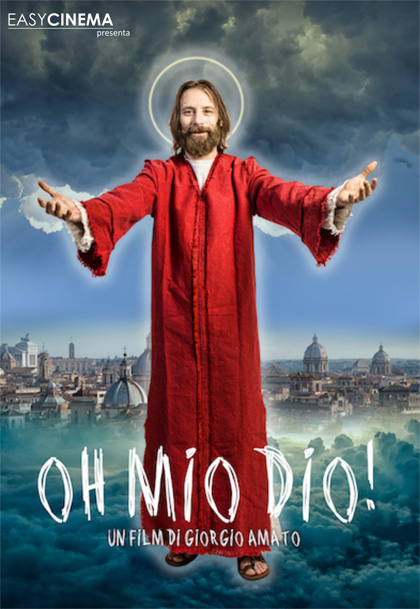
movieplayer.net-cdn.it/t/images/2018/03/08/oh_mio_dio_car...

----------------------------------------------------------
click to activate the small icon of slideshow: the small triangle inscribed in the small rectangle, at the top right, in the photostream (it means the monitor);
or…. Press the “L” button to zoom in the image;
clicca sulla piccola icona per attivare lo slideshow: sulla facciata principale del photostream, in alto a destra c'è un piccolo rettangolo (rappresenta il monitor) con dentro un piccolo triangolo nero;
oppure…. premi il tasto “L” per ingrandire l'immagine;
www.worldphoto.org/sony-world-photography-awards/winners-...
www.fotografidigitali.it/gallery/2726/opere-italiane-segn...
………………………………………………………
This "photographic story" ideally follows the previous one, for two reasons, first because in this case too, as in the previous story we talk about "angels", they are the "Golden Angels" of San Pier Niceto (in the province of Messina), and second, because this singular and beautiful religious festival, with its procession, also takes place during the Easter period, specifically during "Holy Tuesday". The photographs that I post (not a few, I wish in this way to pay homage to the inhabitants of San Pier Niceto, who can find themselves in these photos, especially for those fathers, mothers, grandfathers, grandmothers, aunts and uncles, in seeing their beloved and very sweet "angels - angiolette"); if you look closely at some of the photographed subjects, you will notice a "temporal disconnect", in fact in some cases, the same girls are present, with two different ages, they will be dressed differently, this is because the photos were taken during Holy Tuesday of 2024 and that of 2025. The temporal sequence of the photographs does not take into account either the year in which they were taken, nor the moments attributable to the phases of the ceremony and subsequent procession.
In San Pier Niceto, on the Peloritani Mountains in Sicily, during the Holy Tuesday takes place the SS. Crucifix procession, whose roots are ancient. The Church of St. James houses and cares for the precious Crucifix, Which is brought to the procession by the streets of the country preceded by very young children, of both sexes, who imitate little Angels, Angels and Grieving young Nuns, dressed in elaborate dresses covered with many gold jewelery, sewn by handy hands that with pins, necklaces , Bracelets and many other gold jewelry applied to their little clothes, they make real works of art whose designs are reminiscent of Easter symbols. Gold for dressing is collected home from home by people who have to melt a "vote", gold that will be returned at the end of the procession. Everything begins during Lent when parents decide to dress their baby by little Angels, Angels or Grieving Nuns .The Little Angels are usually 3 or 4 year olds, the Angels are a little bigger, the Nuns are little young girls. Thus the preparations for the elaboration of the elaborate clothes begin: Parents during Lent are knocking at every door of the country, among friends and relatives, to borrow bracelets, brooches, necklaces and all the gold necessary for the composition of embroidery . The Little Angel's dress is white, short down to the knee, made up of a gold-plated bodice and a skirt with some golden embroidery; Arms are adorned by bracelets, the head is adorned by a collier, small wings (white dove feathers) sprout from behind. The Angels have a white tunic, on which sacred icons are embroidered in gold, the head is covered by a collier, wings lie on their shoulders. The Nun's dress is black, on which are stitched the crowns of the S.S. Rosary, on the head is placed a white veil, held by a rose crown. At 16:30 on Holy Tuesday, a tapping of bells together with the band's fanfare in the village, set off at the "Crucifixion Procession" of San Pier Niceto: at the foot of the Crucifix there are red roses, behind it are located branches of cypress (at the end of the event the faithful will carry with them a piece of cypress as a relic), finally the red ribbons are tied to the arms of the Crucifix, they will mark the procession of the procession until the arrival at the Mother Church, a century church to St. Peter the Apostle, where the celebration of the Holy Mass will take place (the reverse path will bring the SS Crucifix to the Church of St. James): in perfect order the faithful in religious silence, with votive candles in their hands, walk the streets of the country never crossing the red ribbons as they delimit the path of the Golden Little Angels, Angels and the Grieving young Nuns .
Questo "racconto fotografico" segue idealmente il precedente, per due motivi, innanzitutto perchè anche in questo caso, come nel racconto precedente si parla di "angeli", sono "gli Angioletti d'oro" di San Pier Niceto (in provincia di Messina), e secondo, perchè questa singolare e bella festa religiosa, con la sua processione, si svolge anch'essa durante il periodo pasquale, nello specifico durante il "Martedì Santo". Le fotografie che posto (non poche, desidero in tal modo omaggiare gli abitanti di San Pier Niceto, che possano ritrovarsi in queste foto, soprattutto per quei papà, mamme, nonni, nonne, zie e zii, nel rivedere i loro adorati e dolcissimi "angioletti - angiolette"); a ben guardare in alcuni dei soggetti fotografati, si noterà uno "scollamento temportale", infatti in qualche caso, sono presenti le stessi bimbe, con due età diverse, saranno vestite diversamente, questo perchè le foto sono state realizzate durante il Martedì Santo del 2024 e quello del 2025. La sequenza temporale delle fotografie non tiene conto nè dell'anno nel quale sono state realizzate, nè dei momenti ascrivibili alle fasi della cerimonia e successiva processione.
A San Pier Niceto, sui monti Peloritani in Sicilia, durante il Martedì Santo prende vita la processione per le vie del paese del SS. Crocifisso, le cui radici sono antichissime. La Chiesa di San Giacomo ospita e custodisce il pregevole Crocifisso, che viene portato in processione per le vie del paese preceduto da bambini anche molto piccoli, di entrambi i sessi, che impersonano Angioletti ed Addoloratine vestiti con elaboratissimi abiti ricoperti con tantissimi monili d’oro, cuciti dalle mani abili di sarte che con spille, collane, bracciali e tanti altri monili in oro applicati sui loro piccoli vestiti, realizzano vere opere d’arte i cui disegni ricordano simboli pasquali. L’oro per la realizzazione dei vestitini viene raccolto di casa in casa da persone che hanno da sciogliere un “voto”, oro che verrà restituito alla fine della processione. Tutto ha inizio durante la Quaresima, quando dei genitori decidono per “voto” di vestire il proprio bambino da Angioletto, Angiolone o Monachella.
Gli Angioletti sono solitamente bimbi di 3 o 4 anni, gli Angioloni sono un po’ più grandi, le Monachelle sono delle bambine. Così iniziano i preparativi per la realizzazione degli elaboratissimi vestiti: i genitori durante la Quaresima bussano ad ogni porta del paese, tra la cerchia di amici e parenti, per prendere in prestito bracciali, spille, collane e tutto l’oro necessario alla composizione dei ricami. Il vestito degli Angioletti è bianco, corto fino al ginocchio, composto da un corpetto ricoperto d’oro ed una gonna segnata da alcuni ricami d’oro; le braccia sono adornate da bracciali, la testa è adornata da un collier, da dietro le spalle spuntano delle piccole ali (piume di colomba bianca). Gli Angioloni hanno una tunica bianca sulla quale vengono ricamate delle icone sacre in oro, la testa è cinta da un collier, sulle spalle trovano posto delle ali. Il vestito delle Monachelle invece è nero, sul quale vengono cucite delle coroncine del S.S. Rosario, sul capo viene posto un velo bianco, trattenuto da una corona di rose. Alle 16:30 del Martedì Santo un rintocco di campane insieme alla fanfare della banda del paese, danno il via alla “Processione del Crocifisso” di San Pier Niceto: ai piedi della Croce vi sono delle rose rosse, dietro di essa trovano posto dei rami di cipresso (alla fine dell’evento i fedeli porteranno con se un pezzetto di rametto come reliquia), infine dei nastri rossi vengono legati alle braccia del Crocifisso, essi segneranno il percorso della processione, fino all’arrivo al Duomo, una chiesa cinquecentesca dedicata a San Pietro apostolo, ove si terrà la celebrazione della Santa Messa ( il percorso inverso riporterà il S.S. Crocifisso nella Chiesa di San Giacomo): in perfetto ordine i fedeli in religioso silenzio, con ceri votivi in mano, percorrono le vie del paese, non oltrepassando i nastri rossi poiché essi delimitano il percorso degli Angioletti d’oro e delle Addoloratine.
ПАОЛО АНТОНИО БАРБЬЕРИ (предположительно), ок. 1627 года - Портрет Гверчино и его матери с лаготто
☆📀
Location: Roma Fondazione Sorgente Group, Rome, Italy.
Sources: fondazionesorgentegroup.com/en/art-collection/paintings/p...
it.m.wikipedia.org/wiki/Paolo_Antonio_Barbieri
en.m.wikipedia.org/wiki/Lagotto_Romagnolo
Rus: Этот неопубликованный холст представляет собой любопытный взгляд на жизнь известного художника из Ченто Джованни Франческо Барбьери по прозвищу Гверчино, который изображен обнимающим правой рукой собаку, сидящую в центре композиции, на которую указывает сам Гверчино. В сцене также принимает участие пожилая женщина, в которой можно узнать Елену Джизеллини, мать Гверчино. Она изображена с большим ключом, свисающим с талии, что придает ей статус «хозяйки дома», и многие источники описывают большую привязанность Джованни Франческо к своей матери.
Интересно, что Гверчино изображен на портрете с серьезной деформацией правого глаза, явившейся причиной его прозвища. Этот физическое несовершенство никогда не подчеркивалось на других портретах художника и ясно выражено только здесь. Разумно предположить, что Гверчино не хотел, чтобы его изображали в реальном физическом состоянии, но на этой картине запрет, кажется, исчезает. Этот аспект, дополненный радостной и уверенной атмосферой, характеризующей произведение, позволяет нам найти его автора в ближайшем окружении Гверчино, и предположить, что полотно предназначалось исключительно для украшения его частного дома.
Внимание к деталям хорошо выраженное в тонкости кружева, украшающего платье Гверчино, позволяет нам приписать эту картину младшему брату мастера, Паоло Антонио Барбьери. Последний был помощником в мастерской, специализирующейся на натюрмортах, а также бухгалтером семейного бизнеса: он начал и вел так называемую «Libro dei Conti», бухгалтерскую книгу, которую он тщательно заполнял до своей смерти в 1649 году.
Кстати, настоящий герой полотна не Гверчино, а собака породы лаготто, на которую Гверчино указывает пальцем. Лаготто - старинная порода итальянских водяных ретриверов, родом из Романьи. Животное на картине украшено особым ошейником с лилиями и гербом семьи Фарнезе из Пармы. Надо понимать, что это не случайность, и изображенная собака вероятно была подарком Гверчино от герцогов Пармских в благодарность за единственный заказ, который они ему дали: написание фресок в куполе собора Пьяченцы. Эта деталь позволяет нам датировать картину примерно 1627 годом.
“things only exist if they are told/narrated”
(attributed to Alessandro Baricco);
“le cose esistono solo se vengono raccontate”
(attribuita ad Alessandro Baricco).
POSTER - LOCANDINA –
www.primevideo.com/detail/Oh-Mio-Dio/0FBFGSB0G1HMNXV56F5C...
pad.mymovies.it/filmclub/2018/02/181/locandina.jpg
movieplayer.net-cdn.it/t/images/2018/03/08/oh_mio_dio_car...
----------------------------------------------------------
click to activate the small icon of slideshow: the small triangle inscribed in the small rectangle, at the top right, in the photostream (it means the monitor);
or…. Press the “L” button to zoom in the image;
clicca sulla piccola icona per attivare lo slideshow: sulla facciata principale del photostream, in alto a destra c'è un piccolo rettangolo (rappresenta il monitor) con dentro un piccolo triangolo nero;
oppure…. premi il tasto “L” per ingrandire l'immagine;
www.worldphoto.org/sony-world-photography-awards/winners-...
www.fotografidigitali.it/gallery/2726/opere-italiane-segn...
………………………………………………………
This "photographic story" ideally follows the previous one, for two reasons, first because in this case too, as in the previous story we talk about "angels", they are the "Golden Angels" of San Pier Niceto (in the province of Messina), and second, because this singular and beautiful religious festival, with its procession, also takes place during the Easter period, specifically during "Holy Tuesday". The photographs that I post (not a few, I wish in this way to pay homage to the inhabitants of San Pier Niceto, who can find themselves in these photos, especially for those fathers, mothers, grandfathers, grandmothers, aunts and uncles, in seeing their beloved and very sweet "angels - angiolette"); if you look closely at some of the photographed subjects, you will notice a "temporal disconnect", in fact in some cases, the same girls are present, with two different ages, they will be dressed differently, this is because the photos were taken during Holy Tuesday of 2024 and that of 2025. The temporal sequence of the photographs does not take into account either the year in which they were taken, nor the moments attributable to the phases of the ceremony and subsequent procession.
In San Pier Niceto, on the Peloritani Mountains in Sicily, during the Holy Tuesday takes place the SS. Crucifix procession, whose roots are ancient. The Church of St. James houses and cares for the precious Crucifix, Which is brought to the procession by the streets of the country preceded by very young children, of both sexes, who imitate little Angels, Angels and Grieving young Nuns, dressed in elaborate dresses covered with many gold jewelery, sewn by handy hands that with pins, necklaces , Bracelets and many other gold jewelry applied to their little clothes, they make real works of art whose designs are reminiscent of Easter symbols. Gold for dressing is collected home from home by people who have to melt a "vote", gold that will be returned at the end of the procession. Everything begins during Lent when parents decide to dress their baby by little Angels, Angels or Grieving Nuns .The Little Angels are usually 3 or 4 year olds, the Angels are a little bigger, the Nuns are little young girls. Thus the preparations for the elaboration of the elaborate clothes begin: Parents during Lent are knocking at every door of the country, among friends and relatives, to borrow bracelets, brooches, necklaces and all the gold necessary for the composition of embroidery . The Little Angel's dress is white, short down to the knee, made up of a gold-plated bodice and a skirt with some golden embroidery; Arms are adorned by bracelets, the head is adorned by a collier, small wings (white dove feathers) sprout from behind. The Angels have a white tunic, on which sacred icons are embroidered in gold, the head is covered by a collier, wings lie on their shoulders. The Nun's dress is black, on which are stitched the crowns of the S.S. Rosary, on the head is placed a white veil, held by a rose crown. At 16:30 on Holy Tuesday, a tapping of bells together with the band's fanfare in the village, set off at the "Crucifixion Procession" of San Pier Niceto: at the foot of the Crucifix there are red roses, behind it are located branches of cypress (at the end of the event the faithful will carry with them a piece of cypress as a relic), finally the red ribbons are tied to the arms of the Crucifix, they will mark the procession of the procession until the arrival at the Mother Church, a century church to St. Peter the Apostle, where the celebration of the Holy Mass will take place (the reverse path will bring the SS Crucifix to the Church of St. James): in perfect order the faithful in religious silence, with votive candles in their hands, walk the streets of the country never crossing the red ribbons as they delimit the path of the Golden Little Angels, Angels and the Grieving young Nuns .
Questo "racconto fotografico" segue idealmente il precedente, per due motivi, innanzitutto perchè anche in questo caso, come nel racconto precedente si parla di "angeli", sono "gli Angioletti d'oro" di San Pier Niceto (in provincia di Messina), e secondo, perchè questa singolare e bella festa religiosa, con la sua processione, si svolge anch'essa durante il periodo pasquale, nello specifico durante il "Martedì Santo". Le fotografie che posto (non poche, desidero in tal modo omaggiare gli abitanti di San Pier Niceto, che possano ritrovarsi in queste foto, soprattutto per quei papà, mamme, nonni, nonne, zie e zii, nel rivedere i loro adorati e dolcissimi "angioletti - angiolette"); a ben guardare in alcuni dei soggetti fotografati, si noterà uno "scollamento temportale", infatti in qualche caso, sono presenti le stessi bimbe, con due età diverse, saranno vestite diversamente, questo perchè le foto sono state realizzate durante il Martedì Santo del 2024 e quello del 2025. La sequenza temporale delle fotografie non tiene conto nè dell'anno nel quale sono state realizzate, nè dei momenti ascrivibili alle fasi della cerimonia e successiva processione.
A San Pier Niceto, sui monti Peloritani in Sicilia, durante il Martedì Santo prende vita la processione per le vie del paese del SS. Crocifisso, le cui radici sono antichissime. La Chiesa di San Giacomo ospita e custodisce il pregevole Crocifisso, che viene portato in processione per le vie del paese preceduto da bambini anche molto piccoli, di entrambi i sessi, che impersonano Angioletti ed Addoloratine vestiti con elaboratissimi abiti ricoperti con tantissimi monili d’oro, cuciti dalle mani abili di sarte che con spille, collane, bracciali e tanti altri monili in oro applicati sui loro piccoli vestiti, realizzano vere opere d’arte i cui disegni ricordano simboli pasquali. L’oro per la realizzazione dei vestitini viene raccolto di casa in casa da persone che hanno da sciogliere un “voto”, oro che verrà restituito alla fine della processione. Tutto ha inizio durante la Quaresima, quando dei genitori decidono per “voto” di vestire il proprio bambino da Angioletto, Angiolone o Monachella.
Gli Angioletti sono solitamente bimbi di 3 o 4 anni, gli Angioloni sono un po’ più grandi, le Monachelle sono delle bambine. Così iniziano i preparativi per la realizzazione degli elaboratissimi vestiti: i genitori durante la Quaresima bussano ad ogni porta del paese, tra la cerchia di amici e parenti, per prendere in prestito bracciali, spille, collane e tutto l’oro necessario alla composizione dei ricami. Il vestito degli Angioletti è bianco, corto fino al ginocchio, composto da un corpetto ricoperto d’oro ed una gonna segnata da alcuni ricami d’oro; le braccia sono adornate da bracciali, la testa è adornata da un collier, da dietro le spalle spuntano delle piccole ali (piume di colomba bianca). Gli Angioloni hanno una tunica bianca sulla quale vengono ricamate delle icone sacre in oro, la testa è cinta da un collier, sulle spalle trovano posto delle ali. Il vestito delle Monachelle invece è nero, sul quale vengono cucite delle coroncine del S.S. Rosario, sul capo viene posto un velo bianco, trattenuto da una corona di rose. Alle 16:30 del Martedì Santo un rintocco di campane insieme alla fanfare della banda del paese, danno il via alla “Processione del Crocifisso” di San Pier Niceto: ai piedi della Croce vi sono delle rose rosse, dietro di essa trovano posto dei rami di cipresso (alla fine dell’evento i fedeli porteranno con se un pezzetto di rametto come reliquia), infine dei nastri rossi vengono legati alle braccia del Crocifisso, essi segneranno il percorso della processione, fino all’arrivo al Duomo, una chiesa cinquecentesca dedicata a San Pietro apostolo, ove si terrà la celebrazione della Santa Messa ( il percorso inverso riporterà il S.S. Crocifisso nella Chiesa di San Giacomo): in perfetto ordine i fedeli in religioso silenzio, con ceri votivi in mano, percorrono le vie del paese, non oltrepassando i nastri rossi poiché essi delimitano il percorso degli Angioletti d’oro e delle Addoloratine.
Real Name: Unknown
Current Alias: Chancer
Attributes: Claims to possess the power of “luck”.
Inventory: 1 White Coat, 1 pair of red slacks, 1 red cotton dress shirt, 1 white sport coat, 1 white tie, 1 pair of red gloves, 1 pair of white shoes, 1 white piece of facial covering, 1 pair of sunglasses, a set of red and white dice, a deck of cheap playing cards.
Blackgate Prison File: Prisoner 7137137 “Chancer” is another story of rags to riches. His real name is unknown, though he claims the alias of Montgomery Sharp as his favorite of many false identities. He began his criminal career in Gotham city working under Drury Walker Aka Killer Moth and The Misfits. During this time he commuted acts of arson, theft, armed robbery, assault, breaking and entering, and murder in the first, second and third degree. He eventually left the group, though statements from Walker himself claimed Chancer was let go for crossing lines. After his time he began a career as a professional gambler, going as far to best men like Oswald Cobblepot. He was a sensation to criminals and common patrons. Rumors began to spread that the games were rigged, he proved himself worthy when he won against professional gambler Victor Zsasz in the nude. Chancer’s stardom continued to rise, but his past was littered with bodies. Dean Hunter, a photographer from Texas was one of Chancer’s Victims from his days with the Misfits. Chancer murdered his family and burned his house down. He returned during Chancer’s rise with a vengeance, stole an experimental military suit and pursued Chancer under the guise of an unnamed vigilante. The GCPD pursued Hunter, but he allied himself with The Batman and brought Chancer to Justice. Chancer knows nothing about Hunter, but he has described his captor as a nimrod. We know little of his past, we however found a pair of dice and a deck of cheap playing cards. Some guards question if he did cheat or not, although they’re empty wallets seemed to answer that question. The dice are thought to be a memento, we however have no idea what they remind him of. The prisoner has not attempted to escape, although he is to be kept under constant watch. He claims to have the power of “luck”, while we’ve yet to prove this claim, he’s been able to avoid confrontation with most prisoners. When he however comes into contact he is universally unscathed. More information will follow if further progression is made.
By yon bonnie banks and by yon bonnie braes,
Where the sun shines bright on Loch Lomond,
Where me and my true love were ever wont to gae,
In the bonnie, bonnie banks of Loch Lomond.
Chorus:
O ye'll take the high road, and I'll take the low road,
And I'll be in Scotland afore ye,
Where me and my true love will never meet again,
On the bonnie, bonnie banks of Loch Lomond.
'Twas there that we parted, in by yon shady glen,
On the steep, steep side of Ben Lomond,
Where, deep in purple hue, the highland hills we view,
And the moon coming out in the gloaming.
"Chorus"
The wee birdies sing and the wild flowers spring,
And in sunshine waters lie sleeping.
But the broken heart it kens, nae second spring again,
Though the waeful may cease frae their greeting.
"Chorus"
There are many theories about the meaning of the song, most of which are connected to the Jacobite Uprising of 1745. One interpretation based on the lyrics is that the song is sung by the lover of a captured Jacobite rebel set to be executed in London following a show trial. The heads of the executed rebels were then set upon pikes and exhibited in all of the towns between London and Edinburgh in a procession along the "high road" (the most important road), while the relatives of the rebels walked back along the "low road" (the ordinary road travelled by peasants and commoners).
Another interpretation of the 'Low Road' is that it refers to the traditional underground route taken by the 'fairies' or 'little people' who were reputed to transport the soul of a dead Scot who died in a foreign land - in this case, England - back to his homeland to rest in peace.
Another similar interpretation also attributes it to a Jacobite Highlander captured after the 1745 rising. The Hanoverian British victors were known to play cruel games on the captured Jacobites, and would supposedly find a pair of either brothers or friends and tell them one could live and the other would be executed, and it was up to the pair to decide. Thus the interpretation here is that the song is sung by the brother or friend who chose or was chosen to die. He is therefore telling his friend that they will both go back to Scotland, but he will go on the 'low road', his body being paraded along the main road controlled by the Duke of Cumberland's forces, whereas his friend will have to head for the hilltops, taking longer to get back. Another supporting feature of this is that he states he will never meet his love again in the temporal world, on Loch Lomond. Some believe that this version is written entirely to a lover who lived near the loch.
A related interpretation holds that a professional soldier and a volunteer were captured by the English in one of the small wars between the countries in the couple of hundred years prior to 1746. Volunteers could accept parole, a release contingent on the volunteer's refusal to rejoin the fighting, but regulars could not and so could face execution. The volunteer would take the high road that linked London and Edinburgh while the soul of the executed regular would return along the "low road" and would get back to Scotland first.
#ABFAV_light
I was doing a photoshoot of 2 days at Wimbledon, and on the last evening the V.I.P.'s arrived for the prize ceremony... once that was over, well, as a photographer, you are ALWAYS on the 'look-out' for some extra and more creative images?
This, of course, drew my attention, the light and subject.
One came in wearing this hat (the optimist?), the other had been holding onto his umbrella the entire day (the pessimist?)
LOL, I might just upload the owner of the hat...
thank you and stay optimistic! M, (*_*)
ALL IMAGES ARE BEST seen On Black, yours too!
For more of my work: www.indigo2photography.com
Please do not use any of my images on websites, blogs or any other media without my explicit permission. © All rights reserved
Stereographs taken during a tour of the Southern Goldfields, New South Wales and Victoria, May-June 1860 / attributed to Edward Wolstenholme Ward
Call Number: PXB 598
Format: stereograph
Find more detailed information about this photograph: www.acmssearch.sl.nsw.gov.au/search/itemLargeCopyright.cg...
Search for more great images in the State Library's collections: acms.sl.nsw.gov.au/search/SimpleSearch.aspx
From the collection of the State Library of New South Wales www.sl.nsw.gov.au
What was the hardest part of this capture?
It was not the exposure. With a solid cloud cover, I was able to lock in a manual exposure for perfect results on every shot. In this case, I chose a 1/1000 shutter speed (the bird was moving a lot and quickly), an f/5.6 aperture (to isolate the bird using shallow depth of field) and ISO 160 to bring the brightest whites up to near RGB 255,255,255.
The challenge was not the tight framing of the bird. I was able to slowly belly-crawl close to the small flock of terns. So close that I only needed a 234mm focal length in front of the 7D II's APS-C sensor. I should have used a slightly wider angle still as I added a small amount of canvas on the left in post, providing additional breathing room for the wing.
The challenge was also not the low shooting position. Using the NatureScapes Skimmer Ground Pod II (www.the-digital-picture.com/Reviews/NatureScapes-Skimmer-...), I was able to push the camera forward as I crawled in the sand. Shooting from on the ground gave me a clean background (only sky) and the remaining land in the frame is primarily a blur of texture.
The big challenge? Timing the shutter release in conjunction with using the proper AF tactics to get this specific composition with the head included in focus. The sandwich tern cleaning process involved a wide array of moves, few of which I was able to predict and all of them fast. The head was constantly moving in what seemed like all directions and fast framing adjustment with a properly-selected AF point proved very challenging. A narrower aperture would have reduced the AF task, but the result would have been more ground in focus for a different look.
One aspect of this image that I like is the complete separation of the head from the body. Many of the preening positions did not have this attribute (and many had a completely hidden head). I also like the balance. While I don't often place my subject in the center of the frame, I felt that centered worked best in this case. The wing and tail balance the bird over the dark, eye-catching legs. The head extended to the right caused me to want the legs shifted just left of center to get what I felt was the right overall balance. My shooting position was low enough that only the legs intersected the color of the sand. The small amount of feather pulling through the bill is the bonus feature. I'll credit the 7D II's short shutter lag for enabling that timing.
This sandwich tern was on the gulf shores of Captiva Island, just north of Blind Pass. This location in southwest Florida is ideal for expanding one's bird photography portfolio.
Gear Used:
Canon EOS 7D Mark II
Canon EF 100-400mm f/4.5-5.6L IS II USM Lens
NatureScapes Skimmer Ground Pod II
Camera and Lens Settings:
234mm f/5.6 1/1000s, ISO 160, 5622 x 3648px
Click on the image to view large. Get more camera gear and photo information at www.the-digital-picture.com/
#Canon #CanonPhotographers #Canon7DMarkII #Telephoto #Bokeh #Sand #SandwichTern #Nature #NaturePhotography #Wildlife #WildlifePhoto #WildlifePhotography #Bird #Birds #BirdPhotography #BirdPhoto #BirdsUnlimited #SeaBirds #Shorebirds #Birding #BirdWatching #USA #UnitedStates #Florida #Captiva #SanibelIsland #BlindPass #Photo #Photography
Somewhere Jackie had wanted to visit for a long time.
In the foreground The Attributes of Divine Perfection by Ahmed Moustafa.
artuk.org/discover/artworks/the-attributes-of-divine-perc...
I neglected to shoot the information on the stained glass windows - oops.
The museum is named after Glasgow's patron saint who brought the Christian faith to Glasgow in the 6th century. It is built on the site of the medieval Bishops’ Castle and is designed in its style. The galleries are full of displays, objects and stunning works of art that explore the importance of religion in peoples’ lives across the world and across time.
The venue aims to promote understanding and respect between people of different faiths and those of none and offers something for everyone.
Memento mori & roue de la fortune
Napoli MAN Inv 109982 -
wm; Marie-Lan Nguyen
Fig. 8 - Skull with attributes of the beggar and the king.
(before 79 AD from Pompeii) - Roman mosaic, 47 x 41 cm
Naples, Museo Archeologico Nazionale Inv. 871 (109 982)
Between a stick with a knapsack (provision bag) on the right, the indispensable companion of tramps and mendicant philosophers, and a sceptre fluttered by a white band of cloth (the "diadem") with a piece of purple cloth on the left, the skull is enthroned as a sober symbol for the bodily remains of man. Below, the turning wheel of Fortuna or of Nemesis, who inexorably drives the course of life, while the soul - the butterfly - leaves the body.
The aedicule-shaped finial is formed by a set balance, a device for levelling (aequare), which measures the beggar's staff and the king's sceptre with complete indifference. The statement "Omnia mors aequat" (Death makes all things equal) was widespread in antiquity as a popular Cynic moral concept.
Source:
The History of Still Life, Sybille Ebert-Schifferer; Hirmer-Verlag Munich, 1998 - ISBN 3-7774-7890-3
******************************************************************************
Abb. 8 – Totenkopf mit Attributen des Bettlers und des Königs
(vor 79 n.Chr. aus Pompeji) – Römisches Mosaik, 47 x 41 cm
Neapel, Museo Archeologico Nazionale Inv. 871 (109 982)
Die Geschichte des Stilllebens, Sybille Ebert-Schifferer; Hirmer-Verlag München, 1998 – ISBN 3-7774-7890-3
Zwischen einem Stock mit Schnappsack rechts, dem unentbehrlichen Begleiter der Landstreicher und Bettelphilosophen und einem von einem weißen Stoffband (dem „Diadem“) umflatterten Szepter mit einem Stück Purpurstoff links, thront der Totenschädel als nüchternes Symbol für die leiblichen Überreste des Menschen. Darunter dreht sich unaufhaltsam das Rad der Fortuna bzw. Nemesis, das den Lebenslauf der Menschen unerbittlich vorantreibt, während die Seele – der Schmetterling – den Körper verläßt.
Den ädikulaförmigen Abschluß bildet eine Setzwaage, ein Gerät zum Nivellieren (aequare), das völlig gleichgültig Bettelstab und Königsszepter mißt. Die Aussage „Omnia mors aequat“ (Alles macht der Tod gleich) war in der Antike als volkstümlich kynische Moralvorstellung verbreitet.
Sassanid Palace, Sarvestan, Iran.
In 9 kilometers southwest from the city of Sarvestan in Fars, in the middle of a vast plain and on the rout of Nazarabad village, there is a historical monument called Sassanid Palace. This huge building is made up of stone and plaster and has several domes, terraces, rooms, and corridors. Different opinions exist on the date of its construction; probably this building is one of the works of Bahramgur or The fifth Sassanid Bahram. Archeologists attribute it to the 5th century. This 25 hectares complex in comparison with other Sassanid architectures has a more complex and diverse style of building, and has the oldest brick dome in Iran. The approximate dimensions of the palace are 43 by 37 meters and its main facade is towards southwest. It has 3 terraces that behind the central terrace there is a square hall with domed brick ceiling and it has access to new routes from four directions. Some researchers of Sassanid architecture with regard to the advanced technique in the design and details of the building think that it belongs to the late Sassanid period, and they believe that the construction of this building was one of the first steps towards a special construction style of which the gothic architecture can be seen as its ultimate realization.
A night view of Cesenatico port canal, whose design and realization is usually attributed to Leonardo da Vinci (I am not sure how solid the foundation of this claim are). The canal is provided with a modern water gate to protect it from the incoming waves when necessary (but such a device could well have been present since the beginning, as Leonardo was an expert hydraulic engineer).
On the left there is St. James church (a XIV century church rebuilt in the XVIII century). In the canal you can see some of the traditional boats parked there as part of the exposition at the Marine Museum (sorry, it looks like the site is only in Italian). Since 1986, during Christmas time, these boats become populated with 50 wooden life-size sculptures creating a very peculiar Marine Nativity scene.
During this photographic session I was thinking of Leonardo conceiving, designing and surveying the realization of this canal. I found myself brooding over the fact that ordinary people dream by night, whereas a genius is always dreaming - especially when she is awake :-)
I have blended three HDR images derived from a 3-bracketing, -1.67 ev/0/+1.67 ev, generated and tonemapped with Luminance HDR 2.4.0 (Fattal, Reinhard05, and Mantiuk06 operators).
I am not fully satisfied with the result of this scene (especially the spot lights, which have proved to be beyond recovery (grrr!), so I hope to receive useful comments, suggestions and critics helping me to understand what are its weak points (and possibly how to avoid them in the future).
Luminance HDR 2.4.0 tonemapping parameters:
Operator: Fattal
alpha: 1.49
beta: 0.92
Saturation: 0.81
Noiseredux: 0.05
fftsolver: 1
---
PreGamma: 1.55
Operator: Reinhard05
Brightness: 1.0
Chromatic adaptation: 0.28
Light adaptation: 1.0
---
PreGamma: 1.18
Operator: Mantiuk06
Contrast Mapping factor: 0.88
Saturation Factor: 0.5
Detail Factor: 2.2
------
PreGamma: 0.48
Talk Show
Oil on canvas Signed W x H (“) 36 x 47 Early Period
Talk Show is a painting that proves the idea that we live in a post-modern world with the apparent loss of any reasonable hope for alternative to the present.
In Talk Show, immediacy unites with immortality, trivial with profound.
In our days the long myth of immortality is replaced by the myth of immediacy.
The substitution of the trivial for the profound for many was a loss, rather than a gain, although, the will to be immediate speaks more directly to our lives. Jaisini unites the two principles, searching for unique ways that can create this double effect of physical lowland, united with the philosophical purity of mind. Talk Show has the significance of biblical wisdom based on a street scene. In Talk Show, Jaisini pictures not the dark side' of people, but the substantial one, when sex became 'the lyricism of the masses'.
The picture shows that we live in a more cynical, realistic time by means of parody. The new cynicism is the old one. The work is timeless and can relate to anyone. Talk Show has the analogous environment as in the work called Show Time the crowd representatives and the image that centers the crowd's attention. In Talk Show, it is the two dogs in an intercourse that attracts the attention of different people of the crowd. In the painting we can clearly see the interlocked line of composition. This line flows freely as an unconscious line. The absence of an 'end' in Jaisini's composition may be the artist's revolt against the end of ideology and the general failures of social theory, obsessed with 'ends', with visions of finished worlds and finalities.
Modern society was once based on a principle of expansion, but having reached a certain 'critical mass' it has begun to recoil.
Is this why Jaisini creates his secluded line composition? What we are witnessing in the domain of the social is a kind of inverse explosion. The artist avoids breaking the line because any attempt to save the principle of expansion is not 'archaic' and regressive. The principle of enclosure is the radical inquiry for continuance. Jaisini has found his way to avoid the end-state. His closed circle of composition creates a new visual code that guarantees the 'addressee,' a recognizable meaning.
The Talk Show mockery reflects the contemporary condition of Byzantizm. It could be mentioned here that even in Cicero's time, the ancient world was becoming stupid. Talk Show may symbolize the mass communication as an enclosing circle connecting mass culture and its audiences of 'mass conformist,' the picture's title can be attributed to the fact that consequently television, along with the rest of mass culture, has become an undreamed-of medium of psychological control. We become part of mass communication circuits, part of a realm and era of connection, contact, feedback, an era that is 'obscene,' yet lunar cold. The reason why the artist prescribes the emerald color to his painting may be to symbolize the coldness of the contemporary world of communications which contacts penetrate without resistance. In the picture, we see the dogs' intercourse as the critique of the talk show.
“things only exist if they are told/narrated”
(attributed to Alessandro Baricco);
“le cose esistono solo se vengono raccontate”
(attribuita ad Alessandro Baricco).
POSTER - LOCANDINA –
< a>
----------------------------------------------------------
click to activate the small icon of slideshow: the small triangle inscribed in the small rectangle, at the top right, in the photostream (it means the monitor);
or…. Press the “L” button to zoom in the image;
clicca sulla piccola icona per attivare lo slideshow: sulla facciata principale del photostream, in alto a destra c'è un piccolo rettangolo (rappresenta il monitor) con dentro un piccolo triangolo nero;
oppure…. premi il tasto “L” per ingrandire l'immagine;
www.worldphoto.org/sony-world-photography-awards/winners-...
www.fotografidigitali.it/gallery/2726/opere-italiane-segn...
………………………………………………………
This "photographic story" ideally follows the previous one, for two reasons, first because in this case too, as in the previous story we talk about "angels", they are the "Golden Angels" of San Pier Niceto (in the province of Messina), and second, because this singular and beautiful religious festival, with its procession, also takes place during the Easter period, specifically during "Holy Tuesday". The photographs that I post (not a few, I wish in this way to pay homage to the inhabitants of San Pier Niceto, who can find themselves in these photos, especially for those fathers, mothers, grandfathers, grandmothers, aunts and uncles, in seeing their beloved and very sweet "angels - angiolette"); if you look closely at some of the photographed subjects, you will notice a "temporal disconnect", in fact in some cases, the same girls are present, with two different ages, they will be dressed differently, this is because the photos were taken during Holy Tuesday of 2024 and that of 2025. The temporal sequence of the photographs does not take into account either the year in which they were taken, nor the moments attributable to the phases of the ceremony and subsequent procession.
In San Pier Niceto, on the Peloritani Mountains in Sicily, during the Holy Tuesday takes place the SS. Crucifix procession, whose roots are ancient. The Church of St. James houses and cares for the precious Crucifix, Which is brought to the procession by the streets of the country preceded by very young children, of both sexes, who imitate little Angels, Angels and Grieving young Nuns, dressed in elaborate dresses covered with many gold jewelery, sewn by handy hands that with pins, necklaces , Bracelets and many other gold jewelry applied to their little clothes, they make real works of art whose designs are reminiscent of Easter symbols. Gold for dressing is collected home from home by people who have to melt a "vote", gold that will be returned at the end of the procession. Everything begins during Lent when parents decide to dress their baby by little Angels, Angels or Grieving Nuns .The Little Angels are usually 3 or 4 year olds, the Angels are a little bigger, the Nuns are little young girls. Thus the preparations for the elaboration of the elaborate clothes begin: Parents during Lent are knocking at every door of the country, among friends and relatives, to borrow bracelets, brooches, necklaces and all the gold necessary for the composition of embroidery . The Little Angel's dress is white, short down to the knee, made up of a gold-plated bodice and a skirt with some golden embroidery; Arms are adorned by bracelets, the head is adorned by a collier, small wings (white dove feathers) sprout from behind. The Angels have a white tunic, on which sacred icons are embroidered in gold, the head is covered by a collier, wings lie on their shoulders. The Nun's dress is black, on which are stitched the crowns of the S.S. Rosary, on the head is placed a white veil, held by a rose crown. At 16:30 on Holy Tuesday, a tapping of bells together with the band's fanfare in the village, set off at the "Crucifixion Procession" of San Pier Niceto: at the foot of the Crucifix there are red roses, behind it are located branches of cypress (at the end of the event the faithful will carry with them a piece of cypress as a relic), finally the red ribbons are tied to the arms of the Crucifix, they will mark the procession of the procession until the arrival at the Mother Church, a century church to St. Peter the Apostle, where the celebration of the Holy Mass will take place (the reverse path will bring the SS Crucifix to the Church of St. James): in perfect order the faithful in religious silence, with votive candles in their hands, walk the streets of the country never crossing the red ribbons as they delimit the path of the Golden Little Angels, Angels and the Grieving young Nuns .
Questo "racconto fotografico" segue idealmente il precedente, per due motivi, innanzitutto perchè anche in questo caso, come nel racconto precedente si parla di "angeli", sono "gli Angioletti d'oro" di San Pier Niceto (in provincia di Messina), e secondo, perchè questa singolare e bella festa religiosa, con la sua processione, si svolge anch'essa durante il periodo pasquale, nello specifico durante il "Martedì Santo". Le fotografie che posto (non poche, desidero in tal modo omaggiare gli abitanti di San Pier Niceto, che possano ritrovarsi in queste foto, soprattutto per quei papà, mamme, nonni, nonne, zie e zii, nel rivedere i loro adorati e dolcissimi "angioletti - angiolette"); a ben guardare in alcuni dei soggetti fotografati, si noterà uno "scollamento temportale", infatti in qualche caso, sono presenti le stessi bimbe, con due età diverse, saranno vestite diversamente, questo perchè le foto sono state realizzate durante il Martedì Santo del 2024 e quello del 2025. La sequenza temporale delle fotografie non tiene conto nè dell'anno nel quale sono state realizzate, nè dei momenti ascrivibili alle fasi della cerimonia e successiva processione.
A San Pier Niceto, sui monti Peloritani in Sicilia, durante il Martedì Santo prende vita la processione per le vie del paese del SS. Crocifisso, le cui radici sono antichissime. La Chiesa di San Giacomo ospita e custodisce il pregevole Crocifisso, che viene portato in processione per le vie del paese preceduto da bambini anche molto piccoli, di entrambi i sessi, che impersonano Angioletti ed Addoloratine vestiti con elaboratissimi abiti ricoperti con tantissimi monili d’oro, cuciti dalle mani abili di sarte che con spille, collane, bracciali e tanti altri monili in oro applicati sui loro piccoli vestiti, realizzano vere opere d’arte i cui disegni ricordano simboli pasquali. L’oro per la realizzazione dei vestitini viene raccolto di casa in casa da persone che hanno da sciogliere un “voto”, oro che verrà restituito alla fine della processione. Tutto ha inizio durante la Quaresima, quando dei genitori decidono per “voto” di vestire il proprio bambino da Angioletto, Angiolone o Monachella.
Gli Angioletti sono solitamente bimbi di 3 o 4 anni, gli Angioloni sono un po’ più grandi, le Monachelle sono delle bambine. Così iniziano i preparativi per la realizzazione degli elaboratissimi vestiti: i genitori durante la Quaresima bussano ad ogni porta del paese, tra la cerchia di amici e parenti, per prendere in prestito bracciali, spille, collane e tutto l’oro necessario alla composizione dei ricami. Il vestito degli Angioletti è bianco, corto fino al ginocchio, composto da un corpetto ricoperto d’oro ed una gonna segnata da alcuni ricami d’oro; le braccia sono adornate da bracciali, la testa è adornata da un collier, da dietro le spalle spuntano delle piccole ali (piume di colomba bianca). Gli Angioloni hanno una tunica bianca sulla quale vengono ricamate delle icone sacre in oro, la testa è cinta da un collier, sulle spalle trovano posto delle ali. Il vestito delle Monachelle invece è nero, sul quale vengono cucite delle coroncine del S.S. Rosario, sul capo viene posto un velo bianco, trattenuto da una corona di rose. Alle 16:30 del Martedì Santo un rintocco di campane insieme alla fanfare della banda del paese, danno il via alla “Processione del Crocifisso” di San Pier Niceto: ai piedi della Croce vi sono delle rose rosse, dietro di essa trovano posto dei rami di cipresso (alla fine dell’evento i fedeli porteranno con se un pezzetto di rametto come reliquia), infine dei nastri rossi vengono legati alle braccia del Crocifisso, essi segneranno il percorso della processione, fino all’arrivo al Duomo, una chiesa cinquecentesca dedicata a San Pietro apostolo, ove si terrà la celebrazione della Santa Messa ( il percorso inverso riporterà il S.S. Crocifisso nella Chiesa di San Giacomo): in perfetto ordine i fedeli in religioso silenzio, con ceri votivi in mano, percorrono le vie del paese, non oltrepassando i nastri rossi poiché essi delimitano il percorso degli Angioletti d’oro e delle Addoloratine.
“things only exist if they are told/narrated”
(attributed to Alessandro Baricco);
“le cose esistono solo se vengono raccontate”
(attribuita ad Alessandro Baricco).
POSTER - LOCANDINA –
< a>
----------------------------------------------------------
click to activate the small icon of slideshow: the small triangle inscribed in the small rectangle, at the top right, in the photostream (it means the monitor);
or…. Press the “L” button to zoom in the image;
clicca sulla piccola icona per attivare lo slideshow: sulla facciata principale del photostream, in alto a destra c'è un piccolo rettangolo (rappresenta il monitor) con dentro un piccolo triangolo nero;
oppure…. premi il tasto “L” per ingrandire l'immagine;
www.worldphoto.org/sony-world-photography-awards/winners-...
www.fotografidigitali.it/gallery/2726/opere-italiane-segn...
………………………………………………………
This "photographic story" ideally follows the previous one, for two reasons, first because in this case too, as in the previous story we talk about "angels", they are the "Golden Angels" of San Pier Niceto (in the province of Messina), and second, because this singular and beautiful religious festival, with its procession, also takes place during the Easter period, specifically during "Holy Tuesday". The photographs that I post (not a few, I wish in this way to pay homage to the inhabitants of San Pier Niceto, who can find themselves in these photos, especially for those fathers, mothers, grandfathers, grandmothers, aunts and uncles, in seeing their beloved and very sweet "angels - angiolette"); if you look closely at some of the photographed subjects, you will notice a "temporal disconnect", in fact in some cases, the same girls are present, with two different ages, they will be dressed differently, this is because the photos were taken during Holy Tuesday of 2024 and that of 2025. The temporal sequence of the photographs does not take into account either the year in which they were taken, nor the moments attributable to the phases of the ceremony and subsequent procession.
In San Pier Niceto, on the Peloritani Mountains in Sicily, during the Holy Tuesday takes place the SS. Crucifix procession, whose roots are ancient. The Church of St. James houses and cares for the precious Crucifix, Which is brought to the procession by the streets of the country preceded by very young children, of both sexes, who imitate little Angels, Angels and Grieving young Nuns, dressed in elaborate dresses covered with many gold jewelery, sewn by handy hands that with pins, necklaces , Bracelets and many other gold jewelry applied to their little clothes, they make real works of art whose designs are reminiscent of Easter symbols. Gold for dressing is collected home from home by people who have to melt a "vote", gold that will be returned at the end of the procession. Everything begins during Lent when parents decide to dress their baby by little Angels, Angels or Grieving Nuns .The Little Angels are usually 3 or 4 year olds, the Angels are a little bigger, the Nuns are little young girls. Thus the preparations for the elaboration of the elaborate clothes begin: Parents during Lent are knocking at every door of the country, among friends and relatives, to borrow bracelets, brooches, necklaces and all the gold necessary for the composition of embroidery . The Little Angel's dress is white, short down to the knee, made up of a gold-plated bodice and a skirt with some golden embroidery; Arms are adorned by bracelets, the head is adorned by a collier, small wings (white dove feathers) sprout from behind. The Angels have a white tunic, on which sacred icons are embroidered in gold, the head is covered by a collier, wings lie on their shoulders. The Nun's dress is black, on which are stitched the crowns of the S.S. Rosary, on the head is placed a white veil, held by a rose crown. At 16:30 on Holy Tuesday, a tapping of bells together with the band's fanfare in the village, set off at the "Crucifixion Procession" of San Pier Niceto: at the foot of the Crucifix there are red roses, behind it are located branches of cypress (at the end of the event the faithful will carry with them a piece of cypress as a relic), finally the red ribbons are tied to the arms of the Crucifix, they will mark the procession of the procession until the arrival at the Mother Church, a century church to St. Peter the Apostle, where the celebration of the Holy Mass will take place (the reverse path will bring the SS Crucifix to the Church of St. James): in perfect order the faithful in religious silence, with votive candles in their hands, walk the streets of the country never crossing the red ribbons as they delimit the path of the Golden Little Angels, Angels and the Grieving young Nuns .
Questo "racconto fotografico" segue idealmente il precedente, per due motivi, innanzitutto perchè anche in questo caso, come nel racconto precedente si parla di "angeli", sono "gli Angioletti d'oro" di San Pier Niceto (in provincia di Messina), e secondo, perchè questa singolare e bella festa religiosa, con la sua processione, si svolge anch'essa durante il periodo pasquale, nello specifico durante il "Martedì Santo". Le fotografie che posto (non poche, desidero in tal modo omaggiare gli abitanti di San Pier Niceto, che possano ritrovarsi in queste foto, soprattutto per quei papà, mamme, nonni, nonne, zie e zii, nel rivedere i loro adorati e dolcissimi "angioletti - angiolette"); a ben guardare in alcuni dei soggetti fotografati, si noterà uno "scollamento temportale", infatti in qualche caso, sono presenti le stessi bimbe, con due età diverse, saranno vestite diversamente, questo perchè le foto sono state realizzate durante il Martedì Santo del 2024 e quello del 2025. La sequenza temporale delle fotografie non tiene conto nè dell'anno nel quale sono state realizzate, nè dei momenti ascrivibili alle fasi della cerimonia e successiva processione.
A San Pier Niceto, sui monti Peloritani in Sicilia, durante il Martedì Santo prende vita la processione per le vie del paese del SS. Crocifisso, le cui radici sono antichissime. La Chiesa di San Giacomo ospita e custodisce il pregevole Crocifisso, che viene portato in processione per le vie del paese preceduto da bambini anche molto piccoli, di entrambi i sessi, che impersonano Angioletti ed Addoloratine vestiti con elaboratissimi abiti ricoperti con tantissimi monili d’oro, cuciti dalle mani abili di sarte che con spille, collane, bracciali e tanti altri monili in oro applicati sui loro piccoli vestiti, realizzano vere opere d’arte i cui disegni ricordano simboli pasquali. L’oro per la realizzazione dei vestitini viene raccolto di casa in casa da persone che hanno da sciogliere un “voto”, oro che verrà restituito alla fine della processione. Tutto ha inizio durante la Quaresima, quando dei genitori decidono per “voto” di vestire il proprio bambino da Angioletto, Angiolone o Monachella.
Gli Angioletti sono solitamente bimbi di 3 o 4 anni, gli Angioloni sono un po’ più grandi, le Monachelle sono delle bambine. Così iniziano i preparativi per la realizzazione degli elaboratissimi vestiti: i genitori durante la Quaresima bussano ad ogni porta del paese, tra la cerchia di amici e parenti, per prendere in prestito bracciali, spille, collane e tutto l’oro necessario alla composizione dei ricami. Il vestito degli Angioletti è bianco, corto fino al ginocchio, composto da un corpetto ricoperto d’oro ed una gonna segnata da alcuni ricami d’oro; le braccia sono adornate da bracciali, la testa è adornata da un collier, da dietro le spalle spuntano delle piccole ali (piume di colomba bianca). Gli Angioloni hanno una tunica bianca sulla quale vengono ricamate delle icone sacre in oro, la testa è cinta da un collier, sulle spalle trovano posto delle ali. Il vestito delle Monachelle invece è nero, sul quale vengono cucite delle coroncine del S.S. Rosario, sul capo viene posto un velo bianco, trattenuto da una corona di rose. Alle 16:30 del Martedì Santo un rintocco di campane insieme alla fanfare della banda del paese, danno il via alla “Processione del Crocifisso” di San Pier Niceto: ai piedi della Croce vi sono delle rose rosse, dietro di essa trovano posto dei rami di cipresso (alla fine dell’evento i fedeli porteranno con se un pezzetto di rametto come reliquia), infine dei nastri rossi vengono legati alle braccia del Crocifisso, essi segneranno il percorso della processione, fino all’arrivo al Duomo, una chiesa cinquecentesca dedicata a San Pietro apostolo, ove si terrà la celebrazione della Santa Messa ( il percorso inverso riporterà il S.S. Crocifisso nella Chiesa di San Giacomo): in perfetto ordine i fedeli in religioso silenzio, con ceri votivi in mano, percorrono le vie del paese, non oltrepassando i nastri rossi poiché essi delimitano il percorso degli Angioletti d’oro e delle Addoloratine.
This came from a Book of Hours attributed to Jean Colombe, from about 1475. It was rubbed and damaged, but it does show Colombe's interest in rendering deeply sculpted interior spaces, gold grisaille portraits, and luminous accents. The figures and faces are typical of his style, even echoing work he did in the Tres Riches Heures, but the Virgin's face was horribly redone later and the painting was rather mangled. Jean Colombe is not an easily accessible artist for collectors nowadays and the elaborate room screamed for some help. After weeks of study and comparison with similar versions in several Colombe manuscripts, I carefully reconstructed what is a reasonable rendering of the scene, and I extended the right margin.
In every spiritual tradition, we talk about basic elements that are material and energetic, but since we know that every manifested thing is a trinity of matter, energy, and Consciousness, then we have to understand that the basic elements are also elements of Consciousness, not just matter and energy. The four primary elements—air, fire, water, earth—make up everything that we are, on every level. The important question we need to answer practically in our lives is how the four elements relate to the fifth element. How are we working with the fifth element? That is what we talked about in the previous lecture. The fifth element, literally “the quintessence,” relates to the Akash, the ether. In Sanskrit terms, we can also say that it is Kundalini. It is the Prakriti, the root energy that in some religions is symbolized as the Divine Mother.. The Divine Mother is that creative force or intelligence in nature that gives life to everything. If we want spiritual life, we need to know our Divine Mother. Her active agent is the quintessence, which is an energy in us. We need that energy to be active, and right now it is not. In us, it is passive, latent, what in science we could call "static, non-kinetic energy." Aphrodite Urania, the pure light of the Divine Mother. The method to awaken that energy, to activate it, has been hidden in every religion and mystical tradition. In the West, it is most famously known in the tradition we call Alchemy. The entire tradition of Alchemy is a symbolic presentation of a practical science. Alchemy hides the knowledge of how to elaborate the full potential of the human being, which is hidden in all of our atoms and cells. To do that, we need to know about transmutation. The Divine Mother is the fire of the Tree of Life
This word transmutation gets utilized a lot in esoteric traditions, but it appears as if it utilized without much knowledge of what the word really means. So it is important that we analyze this word and understand what it means, where it comes from, and what it implies. The word transmutation came into use because of the tradition of Alchemy, and is derived from Latin roots. The implications of the word transmutation are far beyond what most esoteric traditions attribute to it. Trans means “thoroughly,” and mutare means “change.” To transmute means to completely change something. In the modern Gnostic movement, for example, most students use this word transmutation exclusively in relation to sexual energy, which is a valid use of the word, but it is not its full meaning and not its original use. The word transmutation originally applied to our entire being, to everything about us. Really, to transmute comes from that famous phrase from Alchemy, "to transmute lead into gold." It means to purge the lead, which is a dense, heavy, and impure metal, and reduce it into its quintessence—in other words, to reduce it to the most basic components that originally made it, and from that, to perfect it. Everything that exists is constructed out of the basic elements that we explained in the previous lecture. First is the Akash or ether, and that becomes particularized into air, fire, water, and earth. Those four basic elements, which are physical, energetic, and conscious, become everything that exists. Everything that we are is made of four elements arranged and particularized into particular sequences. Physically, we call this encoding DNA, which is not merely physical chemicals, but also encodes energetic and spiritual data, as combinations of elements. Those elements are physically sequenced in series combinations of molecules that are arranged in infinite combinations to create everything that we are. Those sequences of four are reflections of the four elements. Similarly, the four subtle elements are reflected in the four basic components of physical matter:“For the most comprehensive and lucid exposition of occult pneumatology (the branch of philosophy dealing with spiritual substances) extant, mankind is indebted to Philippus Aureolus Paracelsus (Theophrastus Bombastus von Hohenheim), prince of alchemists and Hermetic philosophers and true possessor of the Royal Secret (the Philosopher's Stone and the Elixir of Life). Paracelsus believed that each of the four primary elements known to the ancients (earth, fire, air, and water) consisted of a subtle, vaporous principle and a gross corporeal substance.“Air is, therefore, twofold in nature-tangible atmosphere and an intangible, volatile substratum which may be termed spiritual air. Fire is visible and invisible, discernible and indiscernible--a spiritual, ethereal flame manifesting through a material, substantial flame. Carrying the analogy further, water consists of a dense fluid and a potential essence of a fluidic nature. Earth has likewise two essential parts--the lower being fixed, terreous, immobile; the higher, rarefied, mobile, and virtual. The general term elements has been applied to the lower, or physical, phases of these four primary principles, and the name elemental essences to their corresponding invisible, spiritual constitutions. Minerals, plants, animals, and men live in a world composed of the gross side of these four elements, and from various combinations of them construct their living organisms.“Henry Drummond, in Natural Law in the Spiritual World, describes this process as follows: "If we analyse this material point at which all life starts, we shall find it to consist of a clear structureless, jelly-like substance resembling albumen or white of egg. It is made of Carbon, Hydrogen, Oxygen and Nitrogen. Its name is protoplasm. And it is not only the structural unit with which all living bodies start in life, but with which they are subsequently built up. 'Protoplasm,' says Huxley, 'simple or nucleated, is the formal basis of all life. It is the clay of the Potter.'"“The water element of the ancient philosophers has been metamorphosed into the hydrogen of modern science; the air has become oxygen; the fire, nitrogen; the earth, carbon.” - Manly P. Hall, The Secret Teachings of All Ages For us to become something new, we need to unzip the sequence that makes who we are, and reconnect it in a superior way. But how are you going to disarrange everything about yourself, and rearrange it? Especially when you are the one trying to do it. Not easy! But this is what to "transmute" really means. It means “to thoroughly change.” Gnosis is a science of transmutation. Yes, it begins with sexual energy, that is the root energy that makes the full and complete transmutation possible, but we do not seek to only transmute sexual energy. We want to transmute all of our matter, all of our Consciousness, our psyche, our soul: everything. We want to thoroughly change: to transmute. Interestingly, the result of that transmutation is a mutant. A mutant is someone who is different, who is changed. This word “mutant” has a negative connotation nowadays, but in reality every existing creature is a mutation, a mutant. What we want is a conscious mutation, a change for the better. We want a change towards something beneficial and positive, something useful, something that will bring harmony and peace, not discord and violence. We want a change that will bring about goodness, equality, harmony, love. For that type of change, we need to thoroughly change the causes of discord, the causes of suffering, and those causes are within us, in our matter, our energy, and our Consciousness. A genuine transmutation requires that the causes or the origins of problems and pain, suffering, are changed thoroughly, so that new effects can emerge. That change is not easy. If you consider how anything in nature changes, fundamentally changes, its a process of birth, growth, decline, death, rebirth, growth, decline and death. This is how evolution advances, through small mutations over time. If you have ever studied biology or evolution, you can see that this is how species grow. They grow because of the pressures put on them by their environment. They change, and adapt, and hopefully improve. We need the same thing. Unfortunately, we are not responding properly to the pressures that are upon us. In response to the psychological, material, social, and physical pressures that are on us now, we are not mutating ourselves properly. If we were, we would be transcending the problems. We would be adapting and overcoming them so that they would not be problems anymore. Instead, we see that the problems are deepening, that we are not changing fast enough, and in the right way. We need to know how to do it, how to transmute. Samael Aun Weor said:“No one can Self-realize without transmutation.” - Samael Aun Weor, Tarot and Kabbalah .In this context, he was not talking about sexual transmutation, he was talking about transmutation of the psyche, the mind, the heart, and the body: to change thoroughly. Stated in another way, you can transmute your sexual energy, but if you do not transmute your mind, you will not self-realize. three-pillarsWhen we study the Tree of Life, our primary interest is how it applies to us here and now. The Tree of Life maps all of the levels of existence. But those levels of existence are meaningless if we cannot access them. Studying and memorizing scriptures and teachings mean nothing if we cannot experience what they point towards. We need to examine this Tree of Life in relation with ourselves, and understand that these ten sephiroth relate to levels of being within us. Here on this graphic we see not only our physical state but our psychological state, so on this image while we see a physical body to remind us that this relates to us here and now, really all these spheres or levels show our levels of psychology. Symbolized here are two divisions, two sides. The superior part is related to the heavens or superior aspects of being. The inferior part that hangs below is called Klipoth or hell, and this aspect relates to the inferior or inverted aspect of our psyche. Everything on this map is composed of elements: air, fire, water and earth. All of this is suspended in or supported by the Akash.
So in this context, if we use our imagination and we look at how this applies to us here and now, everything about us is encoded, in elements. Here physically, we can sense those physical aspects: our physical body is an encoded series of elements, which is reflected in our DNA. But as well, our entire psychological make up is encoded in us. Sadly, we only hazily perceive it. We hazily perceive it as thoughts and feelings, and certain types of sensations physically. But we do not perceive or comprehend that all of the thoughts, feelings, and impulses are driven by matter and energy that is not physical. This is a real problem that we have. Really, open up your imagination, and analyze yourself: look at how you have a physical body here and now. This body is composed of a trinity of elements: matter, energy, and Consciousness. The Consciousness here is not awake, it is very asleep, but there is some degree of Consciousness or perception. Thoughts, feelings, and other impulses are more subtle that physical matter, but still we can perceive that they have some level of manifestation. We can verify that they are there, somehow. They also have matter, energy, and Consciousness, but not in the physical dimension. Those thoughts that you sense, and the feelings that you sense, are modifications of Consciousness that have matter and energy associated with them, but not physically. What we experience physically is their reflection, like light being bounced through a mirror. We have the mirror of our mind, which reflects the contents of our thoughts and feelings, but where are the thoughts? Where are the feelings? They are not in the brain, because you can experience thoughts and feelings when you are out of your body. So where are they? This is the problem we have: we do not know. The problem is compounded because we need to change. Rapidly. Otherwise, we are threatened with grave problems, even worse problems then we have now. We need to transmute all of these psychological elements, very quickly. How, if we cannot see them? If we cannot sense them, how can we change them? How can you work in the dark? How can a blind person create a piece of art if he cannot even see what he is doing? This is our fundamental challenge. Psychologically, spiritually, we are blind. How then can we create a perfect soul, if we cannot see what we are doing? How can we transmute ourselves into something better, if we cannot even see who we really are? For this, we need help. We need to understand how these elements work, in all of the levels of nature. So to remind you, these are the five elements. Space
Air Fire Water Earth All things are composed by these elements; understanding that, we need to look at how those elements manifest in us. We need to analyze our psychology, to see it for what it is. Let me remind you of the previous lecture: these elements do not refer to the literal physical aspects, they are psychological. Expansiveness Mobility
Temperature Fluidity Solidity In order to transmute yourself, you need to know what you are working with, you need to see yourself, you need to see how your mind and heart functions, how all of the sensations you experience flow. You need to see what parts of your psyche are expansive, what is the relative mobility of your thinking and feeling, what about its temperature? Its fluidity and solidity? In this way, you can analyze the elements that are involved. You can understand how to manage the elements in your experiences, psychologically. As we explained in the previous lecture, we get help with that process through what we call ordeals, psychological challenges that are given by our own Innermost, through our psychological trainer, who presents us with scenarios designed to bring out those parts of ourselves that we need to work on. If we are not prepared to see it, we will respond poorly, the way that we have been doing previously, and we will make our situation worse. If we are not psychologically trained to watch ourselves and look for the patterns in our psychology, we will not see what is really happening to us, and we will make mistakes. When you enter into this type of work and the process of starting to transmute yourself, you are given challenges, opportunities to see yourself as you are, and those opportunities will come every day. If you are really attentive, you will find that those opportunities are continually arising, all the time. We do not call them opportunities physically, we call them adversities, problems, suffering. We have all of our complaints. We have an old psychological habit that is a very serious obstacle in this type of study, this type of work. That is the habit of self-esteem. Its an old habit that thinks we deserve things that we do not deserve, and that wants things to be ideal, the way that we want it, and we get very frustrated and upset when things do not go the way that we want or expect. I am curious: what percentage of people listening to the lecture today are very disappointed they did not win the lottery last night? I would like to find that out, but I do not think anyone would tell me.
We all have this self-esteem, and it is in direct conflict with the Innermost, with the Being, because this “self” of self-esteem is the ego. The Being wants the ego dead. Dead. Dissolved. Transmuted...But we do not want to transmute it. We want things the way we want them, and when we do not get things the way we want them, what do we do? We complain. We complain in our mind, and we complain with our mouth. Many of us complain all the time. That is a sign, a very significant sign, that we are not transmuting. Another word for transmutation is transformation. We use that in a very important phrase in this teaching: the transformation of impressions. Someone who is transforming impressions has serenity, acceptance. In other words, they have no complaints.
So if we have a lot of complaints, we need to analyze the desires that are complaining: the complaining pride, the lust, the envy, the greed, the gluttony, the fear, the avarice, the laziness, all of those egos. And we need to analyze them in relation with the elements: space, air, fire, water and earth, to understand how they are made, how they work, how they function. In this work, we need to learn to not just go with the flow of our psychological river, but to fight it. The psychological river of our mind is flowing into hell. It is not taking us to God. To reach God, divinity, purity, you have to fight against everything that comes up in yourself that is impure, that is selfish. That fight is not easy. four-ordeals
The four elements are the basic tools that our psychological trainer uses in order to show us ourselves, to show us what we're made of—literally, what we (as a psyche) are made of. Not physically, psychologically. The physical part is impermanent and irrelevant. Spiritually speaking, we have had so many physical bodies in the past and may have more in the future, thus in the long term perspective the physical part is not as important as the psychological part, because the psychological part lasts, and is the determining factor as to whether we get more physical bodies, and what kind, and in what circumstances. Focusing on physicality is foolish. Focusing on psychology is wise. In the psychological point of view, what are we made of? We are made of these elements in different combinations, but unfortunately corrupted with desire. In order to transmute these elements, we have to break them down. Imagine if you were a weaver and you got really drunk and wove something, using up all your good cloth, your good fibers and materials; then you sobered up and realized that what you wove was a complete disaster and wouldn't do anybody any good, in fact it was a waste of all that material, but it was the only material that you had, and you need clothes... What do you do? You have to take it apart. You have to go back to zero. You have to be naked, and start again. We need to do that psychologically; we need to strip our identity completely: this self-esteem has to die. We have to renounce everything except God. To only hold fast to divinity. Nothing else. This is the only way that you can fully and completely transmute. Remember: transmute means to throughly change—thoroughly, not partially. Thoroughly, from the ground up, from zero. It is the only way to build something properly. This is why that Jesus told us that we need a new wineskin. “No man putteth a piece of a new garment upon an old; if otherwise, then both the new maketh a rent, and the piece that was [taken] out of the new agreeth not with the old. And no man putteth new wine into old bottles; else the new wine will burst the bottles, and be spilled, and the bottles shall perish. But new wine must be put into new bottles; and both are preserved.” - Jesus, in Luke 5 We need a new garment. A new mind. A new heart. A new body. That transmutation comes through these elements, so we are tested, every day, constantly, by our trainer, through these elements, to pull things out psychologically so we will see them for what they are. This is not for fun or games or just to punish us and humiliate us, it is not to make us suffer, just because we deserve it. It is to help us. It is the medicine we need; we are sick. To be healed, we need a very profound surgery, very deep, very painful. It is not easy. It is not easy to die psychologically. It is not pleasant. It is not something that you will enjoy. You will be in pain. You will cry. You will have regret. You will have remorse. You will be ashamed of yourself. And you should be. Don't avoid it. Embrace it, yet do not attach to it. Look squarely at the facts, accept them, and change. This is how you become spiritually mature. You do not avoid the facts. You look them in the face, you see them for what they are, and you change them. Thoroughly. When you are getting your psychological challenges every day, look them square in the face, accept them, accept responsibility for yourself, do not blame others, do not blame God, accept it, look at it and say, "I deserve this, I created this, now I'm going to change it". This is what a Master comes from. Everybody wonders, "How do the Masters become so beautiful? How do they become so humble, so pure?"... because they are honest. That is how. Because they are honest. They do not avoid the facts. They work hard to change, to become worthy of reflecting God.
The way that this is done is through this fifth element. Everything that we are is constructed of these basic elements. So our pride for example is constructed of the four elements. The humility of an angel is constructed from the same elements that your pride is made from. Isn't that odd? Its constructed of the same light, but arranged differently. The “pride” of an angel—that element, that light, that has to do with virtue of esteem or self nature—is not corrupted by desire, whereas ours is corrupted. What we call “pride” is a modified light that comes from the sun. It is the same light that shines in an angel, but in an angel it shines as humility. Its the same light, but in us, it is modified, corrupted. What shines in that psychological component is the quintessence. But in us, it is impure. In an angel, in a master, it is pure. The word quintessence comes from a root word which means: "To be":
esse "to be." Sanskrit asmi, Hittite eimi, O.C.S. jesmi, Lith. esmi, Goth. imi, O.E. eom "I am"The quintessence hidden in each element within us is the Being, the light of the Being, that shines through any psychological element. Everything that we are as a psyche is the light of the Being, but in us that light is trapped in corruption. If you want that light to shine pure, you need to break apart the lens and reform it to make it perfect, clean. This is the basic science of Alchemy: to purge the metals and make them pure. We could remove the word metals and instead use crystals or lenses, and it would mean the same thing. The quintessence is that light, what in Hebrew is called Shekinah, the light of the Divine Mother. That light shines through everything that we are, psychologically and physically. It shines as all of those elements arranged in all of those different patterns that make up all of the different people and things and plants and animals and minerals and everything that exist; everything is that light, but modified. What we are as a person is a huge complication of all those lights. “And אלהים Elohim said, Let there be מארת ma'owroth [lights] in the firmament of שמים shamayim to divide the day from ליל layil [night]. And let them be מאורת ma'owroth in the firmament of שמים shamayim to give איר owr [light] upon ארץ erets [the earth]...” - Genesis 1:15 We do not see the lights for what they are. We need to analyze ourselves physically, energetically, emotionally, intellectually, and consciously.
This graphic shows the basic psyche that we can perceive here and now, if we look. All of the psychological elements that we can perceive here and now are related to other forms of matter. Physically, we perceive our physical body. If you pay attention, you will recognize that this physical body has energy that allows it to be active and move, the energy of digestion and the circulation of blood, and the energy that flows through the muscles, in the senses and nerves. five-bodies. We also have energy that flows through the psyche, that let us us have imagination and memory and thought, feeling. All of those energies are related with the vital body, what in the Tree of Life is called Yesod (“foundation”). The vital body reflects the contents of thought, emotion, and will into the physical body. Everything we perceive physically is reflected, either through the five physical senses, or through the internal senses that we perceive inside. The vital body reflects those contents into our brain, into our heart. This is important to understand so that we have a clear perspective on how to analyze ourselves. When we are feeling emotions, those emotions do not originate in the physical body. They are not just imaginary. They are reflected forms of light. They are light that we feel and sense emotionally in the physical body, but is being reflected to the physical body from our Astral body, through the vital body. The light of emotion originates in the Astral body. That means that if we are feeling a negative emotion, full comprehension and elimination of that defect is only possible by working on it at that level, with the Astral body in the fifth dimension, where its originating. But how many of us have clairvoyance? How many of us are awake in the astral plane, in the fifth dimension, to work on that discursive negative emotion? None of us, we are asleep! Moreover, when we sleep at night and we are dreaming with those emotions, we do not remember them when we come back to our body. So our trainer has no choice but to give us ordeals in the physical world so that we can see and experience what is happening in that Astral body, so that it is reflected here physically, so that it can come up and we will work on it. Internally, consciously, we are asleep and enslaved, so to help us, our trainer gives us ordeals. Our trainer puts us in circumstances where we feel those emotions, so that our Consciousness, our willpower, can see it, and can respond consciously, not mechanically, but can comprehend and free itself. This is why we have ordeals. We need them. Do not complain about your problems. Learn from them. They are your path to liberation. In several places of the Bible it states very clearly: “For whom יהוה loveth he correcteth; even as a father the son [in whom] he delighteth.” - Proverbs 3:12 The chastisement or ordeals are given as help to help us and aid us, otherwise we will not see who we are, and what is stopping us from reaching God. So this applies to all of our emotions, all of our thoughts, all of our problems, all of our situations, all of our circumstances, everything thats bothering us or that we think is limiting us, or is a problem for us, is actually something that we need to take advantage of. That is why Samael Aun Weor said: “We must learn how to take advantage of the worst adversities. The worst adversities bring us the best opportunities. We must learn to smile before all adversities.” “People protest because of the difficulties that interaction offers them. They do not want to realize that those difficulties are precisely providing them with the necessary opportunities for the dissolution of their “I.” So why are all the spiritual students, including the so-called Gnostics , looking for easy lives? Students are trying to win the lottery, longing to retire in the countryside and grow sunflowers, longing to retreat from their problems. Listen: if you have an easy, laid back life, you will stagnate spiritually. You will rot. If you want to grow spiritually, you need to die psychologically. The only way you will do that is by seeing the garbage in your mind and in your heart. That is why we are given ordeals. “During times of rigorous temptations [ordeals], discouragement and desolation, one must appeal to the intimate Remembering of the Self.“Deep within each one of us is the Aztec Tonantzin, Stella Maris, the Egyptian Isis, God the Mother, waiting for us in order to heal our painful heart.“When one gives to oneself the shock of “Self-remembering,” then indeed, a miraculous change [transmutation] in the entire work of the body is produced, so that the cells receive a different nourishment.” - Samael Aun Weor. That is why Samael said:“We can disintegrate our defects and dissolve the psychological “I” only by means of this science of transmutations. We can modify our errors, transmute the vile metals into pure gold and command only by means of the science of transmutations.” - Samael Aun Weor, Tarot and Kabbalah. In The Gnostic Bible, The Pistis Sophia Unveiled, he said: “It is possible to crystallize the Soul within ourselves by dissolving the animal ego.“We need to dissolve the undesirable psychological elements in order to crystallize the Soul within ourselves.
“We must convert ourselves into pure Soul. With patience you will possess your Soul.“This is possible based on conscious work and voluntary sufferings. “The Souls of the people reside in a superior level of the Being.“The Soul is the conjunction of all the forces, powers, virtues, essences, etc., that crystallize within us when the entire animal ego has been dissolved.
“Each time that a psychological defect is dissolved, a virtue, a power, etc., crystallizes within our interior. “The complete dissolution of all the defects implies the integral crystallization of the Soul within ourselves. “If the water does not boil at one hundred degrees, that which must be crystallized does not crystallize, and that which must be dissolved is not dissolved.
“In similar form, we say that it is necessary to pass through great emotional crisis in order to dissolve psychological defects and crystallize the Soul.” Firstly, this is accomplished based on conscious work and voluntary suffering. Voluntary suffering means that we accept our suffering, we do not fight it, in the sense of resisting it or denying it or trying to change our physical circumstances all of the time. Instead we accept it, we do what we need to do in order to survive, and care for our responsibilities, and that's enough. The rest of our effort should be focused on changing ourselves. The soul is the conjunction of all the powers, virtues, etc., and they crystalize within us when the animal ego has been dissolved: that is transmutation. Each construction in the psyche is made of the elements. We dissolve each ego in order to liberate the light in each of the elements that are there, then automatically, spontaneously, the light emerges as the soul. In other words, the quintessence is freed. From there is a great range of potential. What happens with that energy next depends on the nature of our path. But whatever the nature of that path, it will be positive, since the light has been liberated. The other important point here is “if the water does not boil at one hundred degrees, that which must be crystalized does not crystalize, and that which must dissolve does not dissolve.” What is that water? Water is one of the elements. Where is the water in us? What water is it that must boil? Anybody know? Well, this is a sort of trick question, because everything about us is based on water. There is no exception. In the Hebrew letters are the three mother letters that we mentioned previously. mother-letters-three-brains..The element of water is represented by the letter Mem. The element water and the letter Mem are related with the vital body. That is the lower Eden or Mayim in the book of Genesis. “And אלהים Elohiym said, Let the מים mayim (waters) under שמים shamayim be gathered together unto one place…” - Genesis 1:9 yesod-body-croppedThe sephirah Yesod, the ninth sphere, is our creative waters, from which we create everything, physically, spiritually, psychologically. Those are our creative waters, the waters of Genesis within us. From Yesod, the sexual organs, was made our earth, our physical body. “And אלהים Elohiym said, Let the מים mayim (waters) under שמים shamayim be gathered together unto one place, and let the dry [land] appear: and it was so. And אלהים Elohiym called the dry [land] ארץ 'erets [earth, our body]; and the gathering together of the waters called he ים yam [seas]…” - Genesis 1:9-10 The physical body is mostly water. Without it we cannot live. The emotional body (Astral body) is very strongly influenced by water. Our emotions are a sea. The Mental body also is constructed with the element of water. The Causal body is made from the waters. Water is in everything. Everything that exists depends on water. Physically, energetically and consciously. So when the water must boil, that means that our entire psyche must boil. What is the boiling? The problems, difficulties. When you study how physics works, when you study how nature works, you find that crystallization and dissolution are very closely related. The entire science of Alchemy is based upon this understanding. This is why if you study any of the old alchemical texts, they always talk about the need to dissolve and coagulate or crystalize. The entire science of Alchemy is based upon that. One short example is from the Bosom Book of George Ripley (circa 1476): “Then mingle with this white calx [dusty residue remaining after a mineral or metal has been calcined or roasted] the fiery water [שמים shamayim], and distil it with a strong fire all off as before, and calcine the earth [ארץ 'erets] again that remaineth in the bottom of the still, and then distil it again with a strong fire as before, and again calcine it, and thus distil and calcine it seven times, until all the substance of the calx be lifted up by the limbec: and then thou hast the water [מים mayim] of life rectified and made indeed spiritual; and so hast thou the four elements exalted in the virtue of their quintessence. This water will dissolve all bodies, and putrefy them, and purge them: and this is our Mercury and our Lunary; and whosoever thinketh there is any other water than this is an ignorant and a fool, and shall never be able to come to the effect.”This is only one example of hundreds of writings like it. This excerpt explains that the process of purification and the elaboration of the quintessence is a process of dissolution and crystallization.
For centuries, foolish people lacking initiation into the actual science read these things literally and thought they were talking about literal water, literal physical mercury, literal physical elements. That is wrong. These scriptures are about the psyche, the mind. The dissolution is psychological, and it is accomplished through ordeals, through analyzing and dissolving impurities in the mind. Symbolically, we analyze the elements of the mind as having seven fundamental qualities, related to the seven lights that organize all things.
gnosticteachings.org/courses/alchemy/3076-transmutation.html
Representing Herakles with kantharos, Dionysos, and a satyr treading grapes
Attributed to the Eucharides Painter, ca. 500-490 BCE.
Used as a funerary urn. Found on Samothrace.
www.beazley.ox.ac.uk/record/C2C2DF60-4488-4F09-85FC-16D5E344FE07 (?)
On display at the special exhibit "Samothrace. The mysteries of the Great Gods" at the Acropolis Museum, Athens, Greece, June 30-September 30, 2015 (extended to January 10, 2016).
"Σαμοθράκη. Τα μυστήρια των Μεγάλων Θεών"
“things only exist if they are told/narrated”
(attributed to Alessandro Baricco);
“le cose esistono solo se vengono raccontate”
(attribuita ad Alessandro Baricco).
POSTER - LOCANDINA –
www.primevideo.com/detail/Oh-Mio-Dio/0FBFGSB0G1HMNXV56F5C...
pad.mymovies.it/filmclub/2018/02/181/locandina.jpg
movieplayer.net-cdn.it/t/images/2018/03/08/oh_mio_dio_car...
----------------------------------------------------------
click to activate the small icon of slideshow: the small triangle inscribed in the small rectangle, at the top right, in the photostream (it means the monitor);
or…. Press the “L” button to zoom in the image;
clicca sulla piccola icona per attivare lo slideshow: sulla facciata principale del photostream, in alto a destra c'è un piccolo rettangolo (rappresenta il monitor) con dentro un piccolo triangolo nero;
oppure…. premi il tasto “L” per ingrandire l'immagine;
www.worldphoto.org/sony-world-photography-awards/winners-...
www.fotografidigitali.it/gallery/2726/opere-italiane-segn...
………………………………………………………
This "photographic story" ideally follows the previous one, for two reasons, first because in this case too, as in the previous story we talk about "angels", they are the "Golden Angels" of San Pier Niceto (in the province of Messina), and second, because this singular and beautiful religious festival, with its procession, also takes place during the Easter period, specifically during "Holy Tuesday". The photographs that I post (not a few, I wish in this way to pay homage to the inhabitants of San Pier Niceto, who can find themselves in these photos, especially for those fathers, mothers, grandfathers, grandmothers, aunts and uncles, in seeing their beloved and very sweet "angels - angiolette"); if you look closely at some of the photographed subjects, you will notice a "temporal disconnect", in fact in some cases, the same girls are present, with two different ages, they will be dressed differently, this is because the photos were taken during Holy Tuesday of 2024 and that of 2025. The temporal sequence of the photographs does not take into account either the year in which they were taken, nor the moments attributable to the phases of the ceremony and subsequent procession.
In San Pier Niceto, on the Peloritani Mountains in Sicily, during the Holy Tuesday takes place the SS. Crucifix procession, whose roots are ancient. The Church of St. James houses and cares for the precious Crucifix, Which is brought to the procession by the streets of the country preceded by very young children, of both sexes, who imitate little Angels, Angels and Grieving young Nuns, dressed in elaborate dresses covered with many gold jewelery, sewn by handy hands that with pins, necklaces , Bracelets and many other gold jewelry applied to their little clothes, they make real works of art whose designs are reminiscent of Easter symbols. Gold for dressing is collected home from home by people who have to melt a "vote", gold that will be returned at the end of the procession. Everything begins during Lent when parents decide to dress their baby by little Angels, Angels or Grieving Nuns .The Little Angels are usually 3 or 4 year olds, the Angels are a little bigger, the Nuns are little young girls. Thus the preparations for the elaboration of the elaborate clothes begin: Parents during Lent are knocking at every door of the country, among friends and relatives, to borrow bracelets, brooches, necklaces and all the gold necessary for the composition of embroidery . The Little Angel's dress is white, short down to the knee, made up of a gold-plated bodice and a skirt with some golden embroidery; Arms are adorned by bracelets, the head is adorned by a collier, small wings (white dove feathers) sprout from behind. The Angels have a white tunic, on which sacred icons are embroidered in gold, the head is covered by a collier, wings lie on their shoulders. The Nun's dress is black, on which are stitched the crowns of the S.S. Rosary, on the head is placed a white veil, held by a rose crown. At 16:30 on Holy Tuesday, a tapping of bells together with the band's fanfare in the village, set off at the "Crucifixion Procession" of San Pier Niceto: at the foot of the Crucifix there are red roses, behind it are located branches of cypress (at the end of the event the faithful will carry with them a piece of cypress as a relic), finally the red ribbons are tied to the arms of the Crucifix, they will mark the procession of the procession until the arrival at the Mother Church, a century church to St. Peter the Apostle, where the celebration of the Holy Mass will take place (the reverse path will bring the SS Crucifix to the Church of St. James): in perfect order the faithful in religious silence, with votive candles in their hands, walk the streets of the country never crossing the red ribbons as they delimit the path of the Golden Little Angels, Angels and the Grieving young Nuns .
Questo "racconto fotografico" segue idealmente il precedente, per due motivi, innanzitutto perchè anche in questo caso, come nel racconto precedente si parla di "angeli", sono "gli Angioletti d'oro" di San Pier Niceto (in provincia di Messina), e secondo, perchè questa singolare e bella festa religiosa, con la sua processione, si svolge anch'essa durante il periodo pasquale, nello specifico durante il "Martedì Santo". Le fotografie che posto (non poche, desidero in tal modo omaggiare gli abitanti di San Pier Niceto, che possano ritrovarsi in queste foto, soprattutto per quei papà, mamme, nonni, nonne, zie e zii, nel rivedere i loro adorati e dolcissimi "angioletti - angiolette"); a ben guardare in alcuni dei soggetti fotografati, si noterà uno "scollamento temportale", infatti in qualche caso, sono presenti le stessi bimbe, con due età diverse, saranno vestite diversamente, questo perchè le foto sono state realizzate durante il Martedì Santo del 2024 e quello del 2025. La sequenza temporale delle fotografie non tiene conto nè dell'anno nel quale sono state realizzate, nè dei momenti ascrivibili alle fasi della cerimonia e successiva processione.
A San Pier Niceto, sui monti Peloritani in Sicilia, durante il Martedì Santo prende vita la processione per le vie del paese del SS. Crocifisso, le cui radici sono antichissime. La Chiesa di San Giacomo ospita e custodisce il pregevole Crocifisso, che viene portato in processione per le vie del paese preceduto da bambini anche molto piccoli, di entrambi i sessi, che impersonano Angioletti ed Addoloratine vestiti con elaboratissimi abiti ricoperti con tantissimi monili d’oro, cuciti dalle mani abili di sarte che con spille, collane, bracciali e tanti altri monili in oro applicati sui loro piccoli vestiti, realizzano vere opere d’arte i cui disegni ricordano simboli pasquali. L’oro per la realizzazione dei vestitini viene raccolto di casa in casa da persone che hanno da sciogliere un “voto”, oro che verrà restituito alla fine della processione. Tutto ha inizio durante la Quaresima, quando dei genitori decidono per “voto” di vestire il proprio bambino da Angioletto, Angiolone o Monachella.
Gli Angioletti sono solitamente bimbi di 3 o 4 anni, gli Angioloni sono un po’ più grandi, le Monachelle sono delle bambine. Così iniziano i preparativi per la realizzazione degli elaboratissimi vestiti: i genitori durante la Quaresima bussano ad ogni porta del paese, tra la cerchia di amici e parenti, per prendere in prestito bracciali, spille, collane e tutto l’oro necessario alla composizione dei ricami. Il vestito degli Angioletti è bianco, corto fino al ginocchio, composto da un corpetto ricoperto d’oro ed una gonna segnata da alcuni ricami d’oro; le braccia sono adornate da bracciali, la testa è adornata da un collier, da dietro le spalle spuntano delle piccole ali (piume di colomba bianca). Gli Angioloni hanno una tunica bianca sulla quale vengono ricamate delle icone sacre in oro, la testa è cinta da un collier, sulle spalle trovano posto delle ali. Il vestito delle Monachelle invece è nero, sul quale vengono cucite delle coroncine del S.S. Rosario, sul capo viene posto un velo bianco, trattenuto da una corona di rose. Alle 16:30 del Martedì Santo un rintocco di campane insieme alla fanfare della banda del paese, danno il via alla “Processione del Crocifisso” di San Pier Niceto: ai piedi della Croce vi sono delle rose rosse, dietro di essa trovano posto dei rami di cipresso (alla fine dell’evento i fedeli porteranno con se un pezzetto di rametto come reliquia), infine dei nastri rossi vengono legati alle braccia del Crocifisso, essi segneranno il percorso della processione, fino all’arrivo al Duomo, una chiesa cinquecentesca dedicata a San Pietro apostolo, ove si terrà la celebrazione della Santa Messa ( il percorso inverso riporterà il S.S. Crocifisso nella Chiesa di San Giacomo): in perfetto ordine i fedeli in religioso silenzio, con ceri votivi in mano, percorrono le vie del paese, non oltrepassando i nastri rossi poiché essi delimitano il percorso degli Angioletti d’oro e delle Addoloratine.
Nothing escapes His notice!
(Arthur Pink, "The Attributes of God")
What a wondrous Being is the God of Scripture!
"Nothing in all creation is hidden from God's sight.
Everything is uncovered and laid bare before the
eyes of Him to whom we must give account."
Hebrews 4:13
God is omniscient.
He knows everything:
everything possible,
everything actual,
all events,
all creatures,
of the past, the present, and the future.
He is perfectly acquainted with every detail in the
life of every being in heaven, in earth, and in hell.
Nothing escapes His notice, nothing can be
hidden from Him, nothing is forgotten by Him.
His knowledge is perfect.
He never errs.
He never changes.
He never overlooks anything.
God not only knows whatever has happened in the past
in every part of His vast domains; and He is not only
thoroughly acquainted with everything that is now
transpiring throughout the entire universe—but He is
also perfectly cognizant of every event, from the least
to the greatest, that ever will happen in the ages to
come! God's knowledge of the future is as complete
as is His knowledge of the past and the present; and
that, because the future depends entirely upon Himself.
God has Himself designed whatever shall yet be, and
what He has designed, must be effectuated. God's
knowledge does not arise from things because they
are or will be—but because He has ordained them to
be! Yes, such is the God with whom we have to do!
"You know when I sit and when I rise; You perceive my
thoughts from afar. You discern my going out and my
lying down; You are familiar with all my ways. Before a
word is on my tongue—You know it completely, O Lord!"
Psalm 139:2-4
How solemn is this fact: nothing can be concealed from
God! "For I know the things that come into your mind,
every one of them" (Ezekiel 11:5). Though He is invisible
to us—we are not so to Him. Neither the darkness of night,
the closest curtains, nor the deepest dungeon—can hide
any sinner from the eyes of Omniscience! Men would strip
Deity of His omniscience if they could. They wish there
might be . . .
no Witness of their sins,
no Searcher of their hearts,
no Judge of their deeds!
Panoramic view of Macquarie Street and city from the dome of the Garden Palace, Sydney, attributed to Charles Pickering, 1881, albumen photoprint, SPF/568 digital.sl.nsw.gov.au/delivery/DeliveryManagerServlet?emb...
Grade I listed historic cathedral.
"The Cathedral and Metropolitical Church of Saint Peter in York, commonly known as York Minster, is the cathedral of York, England, and is one of the largest of its kind in Northern Europe. The minster is the seat of the Archbishop of York, the third-highest office of the Church of England (after the monarch as Supreme Governor and the Archbishop of Canterbury), and is the mother church for the Diocese of York and the Province of York. It is run by a dean and chapter, under the Dean of York. The title "minster" is attributed to churches established in the Anglo-Saxon period as missionary teaching churches, and serves now as an honorific title. Services in the minster are sometimes regarded as on the High Church or Anglo-Catholic end of the Anglican continuum.
The minster, devoted to Saint Peter, has a very wide Decorated Gothic nave and chapter house, a Perpendicular Gothic quire and east end and Early English North and South transepts. The nave contains the West Window, constructed in 1338, and over the Lady Chapel in the east end is the Great East Window (finished in 1408), the largest expanse of medieval stained glass in the world. In the north transept is the Five Sisters Window, each lancet being over 53 feet (16.3 m) high. The south transept contains a rose window, while the West Window contains a heart-shaped design colloquially known as The Heart of Yorkshire.
A bishop of York was summoned to the Council of Arles in 314 indicating the presence of a Christian community in York at this time; however, archaeological evidence of Christianity in Roman York is limited. The first recorded church on the site was a wooden structure built hurriedly in 627 to provide a place to baptise Edwin, King of Northumbria. Moves toward a more substantial building began in the decade of the 630s. A stone structure was completed in 637 by Oswald and was dedicated to Saint Peter. The church soon fell into disrepair and was dilapidated by 670 when Saint Wilfrid ascended to the See of York. He repaired and renewed the structure. The attached school and library were established and by the 8th century were some of the most substantial in Northern Europe.
In 741, the church was destroyed in a fire. It was rebuilt as a more impressive structure containing thirty altars. The church and the entire area then passed through the hands of numerous invaders, and its history is obscure until the 10th century. There were a series of Benedictine archbishops, including Saint Oswald of Worcester, Wulfstan and Ealdred, who travelled to Westminster to crown William in 1066. Ealdred died in 1069 and was buried in the church.
The church was damaged in 1069 during William the Conqueror's harrying of the North, but the first Norman archbishop, Thomas of Bayeux, arriving in 1070, organised repairs. The Danes destroyed the church in 1075, but it was again rebuilt from 1080. Built in the Norman style, it was 111 m (364.173 ft) long and rendered in white and red lines. The new structure was damaged by fire in 1137 but was soon repaired. The choir and crypt were remodelled in 1154, and a new chapel was built, all in the Norman style.
The Gothic style in cathedrals had arrived in the mid 12th century. Walter de Gray was made archbishop in 1215 and ordered the construction of a Gothic structure to compare to Canterbury; building began in 1220. The north and south transepts were the first new structures; completed in the 1250s, both were built in the Early English Gothic style but had markedly different wall elevations. A substantial central tower was also completed, with a wooden spire. Building continued into the 15th century.
The Chapter House was begun in the 1260s and was completed before 1296. The wide nave was constructed from the 1280s on the Norman foundations. The outer roof was completed in the 1330s, but the vaulting was not finished until 1360. Construction then moved on to the eastern arm and chapels, with the last Norman structure, the choir, being demolished in the 1390s. Work here finished around 1405. In 1407 the central tower collapsed; the piers were then reinforced, and a new tower was built from 1420. The western towers were added between 1433 and 1472. The cathedral was declared complete and consecrated in 1472.
The English Reformation led to the looting of much of the cathedral's treasures and the loss of much of the church lands. Under Elizabeth I there was a concerted effort to remove all traces of Roman Catholicism from the cathedral; there was much destruction of tombs, windows and altars. In the English Civil War the city was besieged and fell to the forces of Cromwell in 1644, but Thomas Fairfax prevented any further damage to the cathedral.
Following the easing of religious tensions there was some work to restore the cathedral. From 1730 to 1736 the whole floor of the minster was relaid in patterned marble and from 1802 there was a major restoration. However, on 2 February 1829, an arson attack by Jonathan Martin inflicted heavy damage on the east arm. An accidental fire in 1840 left the nave, south west tower and south aisle roofless and blackened shells. The cathedral slumped deeply into debt and in the 1850s services were suspended. From 1858 Augustus Duncombe worked successfully to revive the cathedral. In 1866, there were six residentiary canonries: of which one was the Chancellor's, one the Sub-Dean's, and another annexed to the Archdeaconry of York.
During the 20th century there was more concerted preservation work, especially following a 1967 survey that revealed the building, in particular the central tower, was close to collapse. £2,000,000 was raised and spent by 1972 to reinforce and strengthen the building foundations and roof. During the excavations that were carried out, remains of the north corner of the Roman Principia (headquarters of the Roman fort, Eboracum) were found under the south transept. This area, as well as remains of the Norman cathedral, re-opened to the public in spring 2013 as part of the new exhibition exploring the history of the building of York Minster.
York is a cathedral city and unitary authority area in North Yorkshire, England. The population of the council area which includes nearby villages was 208,200 as of 2017 and the population of the urban area was 153,717 at the 2011 census. Located at the confluence of the Rivers Ouse and Foss, it is the county town of the historic county of Yorkshire. The city is known for its famous historical landmarks such as York Minster and the city walls, as well as a variety of cultural and sporting activities, which makes it a popular tourist destination in England. The local authority is the City of York Council, a single tier governing body responsible for providing all local services and facilities throughout the city. The City of York local government district includes rural areas beyond the old city boundaries. It is about 25 miles north-east of Leeds and 34 miles north-west of Kingston upon Hull. York is the largest settlement in the ceremonial county of North Yorkshire.
The city was founded by the Romans as Eboracum in 71 AD. It became the capital of the Roman province of Britannia Inferior, and later of the kingdoms of Deira, Northumbria and Jórvík. In the Middle Ages, York grew as a major wool trading centre and became the capital of the northern ecclesiastical province of the Church of England, a role it has retained. In the 19th century, York became a major hub of the railway network and a confectionery manufacturing centre, a status it maintained well into the 20th century. During the Second World War, York was bombed as part of the Baedeker Blitz. Although less affected by bombing than other northern cities, several historic buildings were gutted and restoration efforts continued into the 1960s.
The economy of York is dominated by services. The University of York and National Health Service are major employers, whilst tourism has become an important element of the local economy. In 2016, York became sister cities with the Chinese city of Nanjing, as per an agreement signed by the Lord Mayor of York, focusing on building links in tourism, education, science, technology and culture. Today, the city is a popular tourist attraction, especially for international visitors from America, Germany, France and China. In 2017, York became UK's first human rights city, which formalised the city's aim to use human rights in decision making." - info from Wikipedia.
Summer 2019 I did a solo cycling tour across Europe through 12 countries over the course of 3 months. I began my adventure in Edinburgh, Scotland and finished in Florence, Italy cycling 8,816 km. During my trip I took 47,000 photos.
Now on Instagram.
Become a patron to my photography on Patreon.
Must attribute with link to: www.ptpioneer.com
Girl doing pull-ups outdoors while exercising with a personal trainer.
Giovanni Ambrogio Maggiore (turning); carved coral and stone attributed to Valentine Drausch; weaving attributed to Jan de la Groze.
Bavarian State Museum, Munich.
"This precious 'kunstkammer" piece was a gift to his parents before he became Duke of Bavaria.
The scene inside the tondo of this damaged kylix painted by the Thalia Painter shows an orgy. In the center, an entwined couple: the man is grasping the edges of the kline as he penetrates the woman lying under him, who, contrary to what might be assumed, is tapping her sandal on the upraised buttocks of her bearded partner. Behind them, on a bolster, is a masturbating youth. The Thalia Painter has been careful to show the woman’s leg wrapping around the man’s and the youth’s legs disappearing behind the couple’s. Beneath them is a woman with her eyes languorously shut, also masturbating. Probably this is the the only depiction of a woman using her hand rather than a dildo or other objects. She is placed below the kline and above the top of a footstool. The youth is almost certainly placed as an onlooker; the woman, almost certainly not. Above the scene an inscription reads: Λεαγρος καλ[ος].
The conventional name of the painter derives from the name Thalia - “ΘΑΛΙΑ” - engraved near a hataira painted on the external side of this kylix.
CAV / CAVI @ www.beazley.ox.ac.uk
Source: Blondel R., “Ancient sex”
Attic red-figured kylix
Attributed to The Thalia Painter
520- 500 BC
From Vulci
Berlin, Antikensammlung, Inv. N. 3251
Attributed to Charles Joseph Flipart (1721-1797) - Portrait of Carlo Broschi, called Farinelli, in the role of Epitide in Geminiano Giacomelli's Merope
Name: Callum Hunt
Age: 14
Hair: Black
Eye Colour: Blueish Grey
Attributes/abilities: Martial arts expert, Flexibility, Peak endurance and physical stature
Callum Hunt was a child who grew up without any parents in a foster house looked after by the corrupt men that ran the place. They were child labourers that made the children within the house work for their meals and if they were unable to meet the standards of the days work and seldom did any of them they were punished and given no meal or food at all. Callum instead of sleeping trained himself to stay in peak physical condition while he was in the house so one day he could escape. Callum tried several times to escape but each ended in failure. He was punished severely for this by being whipped and locked in a small room were the rats lived. These punishments were inflected by the man who ran his wing of the operation; Callum had not known his real name but referred to him as Brute. He was about to give up hope on escape when in his eyes a dark angel saved him when he had turned seven. The Batman had stormed the labourers’ house and took down the head. In the assuming chaos Callum escaped but promised he would return to stop the rest of the organisation and Brute who had seemed to escape the Batman’s wrath.
Callum decided to seek refuge elsewhere from Gotham and hone his skills in the category of martial arts to give balance to his reckless fighting style. He boarded a ship to Japan with the help of some smugglers and went to go find a teacher that could help him in his quest. This is where he met Shen who found him hungry and covered in filth, roaming the streets without hope after being rejected time and time again by each person he looked up to train him. Shen took the child in and trained him in the arts of all the weapons, weapons that could be an extension of his self. As well as all types of fighting styles that would bring honour to the boy. When he had turned thirteen Shen told him that he had learnt all that he could teach and said it was time for his final test. The final test turned out to be a battle between him and his master. Callum lost the battle in the end and thought he had failed. Shen said that he had succeeded in the test despite the outcome, explaining that he may of lost the battle but he had shown all the true value of the ninja and showed he was worthy of the title Shen was about to bestow upon him. Shen sat him down and told him the tale of the ninja of ancient times and revealing that he was among the last of who remained through his line of blood and he had no sons or daughters to carry on his legacy. He then told Callum that he was trusted to continue the line despite his birth and race. Shen then bought him a ticket back to Gotham and said that he would bring the values he had taught him back to Gotham. But he had warned, that Callum was still inexperienced in the people in the corrupt city and still had much to learn despite what had transpired while he was in Japan and would need another teacher to help him become the person he new he could be.
When he returned to Gotham he found out as much as he could about the watcher of the city trough the internet in the public library and discovered that Batman had previously worked with people his own age and that he was without a partner at present time. He then fashioned himself a suit similar to that of the previous robins and went to find the Dark Knight to show him his skill. He followed a police report to an attempt a Gotham second national bank where a couple of thugs were attempting to rob it. The self proclaimed Robin attempted to stop the robbery before the Bat arrived and went to attack the men he found with his new fighting skills to take them down. He was on the winning side until one guy got up behind him gun loaded and ready to kill him amused by the child’s fight, but still told him that he was going to kill him anyway. This is where Batman showed up and took down the man in the ski mask before he could unload the weapon into the teenager. After Batman had stopped the villain he turned to see Callum. He asked who he was and Callum explained and said he needed to be his Robin to help bring balance to the city. Batman refused and left.
Callum tried several times after to help the vigilante and become his partner, each time was met with a refusal. This continued until Batman showed up at the small flat Callum had been able to afford with the money Shen had left him. Though he would soon have to leave because he was running out of cash. Batman allowed him to follow him on a patrol through the city to see if Callum was well equipped and good enough to match up to the previous Robins before him. Callum matched up to his expectations and when Dawn began to approach Batman looked at the teenager and told him to get in the car. Callum went in with extreme joy and asked if this meant he was going to be Robin. Batman didn’t reply and kept driving. It looked as if the crime fighter was about to drive straight into the cliff wall that lay before him and looked at the man with worried eyes. Batman then pressed a button on the wheel of the Batmobile and the cliff opened up enveloping them into darkness and depositing them into a cave full of high-tech gadgets and machinery. Batman then told him he was going to need a new suit and would need to get cleaned up, pulling of his mask and walking up to the huge computer at the top of the cave. Callum was shocked to see Bruce Wayne behind the cowl and asked again if this meant he was Robin. An old man came up behind him and asked if he really needed an answer after this and went to Batman’s side. “Are you sure this is a good idea to bring a street urchin into the batcave, what if he has a rather large mouth on him?” the butler asked. “Jason lived on the streets, he kept the secret well” Bruce replied. “And remember what happened to him?” the man said in a British accent to Bruce. Bruce remained quiet for a few moments before replying. “Jason was different, more reckless and angry, Callum showed more clarity and control while fighting” he responded. “How do you know my name and am I going to be Robin or not?” Callum blurted out, and then shrinking back wishing he had kept silent. Again the man waited before speaking, as if he was having doubts on bringing him into the batcave. “I know your name because I’ve been watching you for a few weeks now and have seen how you act, you should stop talking to yourself, it’s a bad habit. And yes you’re going to be Robin despite Alfred’s protests.” Bruce said keeping his eyes glued to the computer screen. “Very well sir, please Master Callum let me show you to your room. I suggest you get yourself cleaned up, fresh clothes will be laid out on your bed, some old ones of Master Timothy’s should fit. Breakfast is in one hour, though I’m afraid Master Bruce may not show up due to his other duties, now come along” Alfred said somehow without taking a breath rushing the boy out of the cave and up a stairway. From then on a new Robin emerged ready to take on those who worshipped crime and with a personal vendetta against the child labourers and the man he had dubbed Brute.
------------------------------------------------------------------------------------------------------------------------------------------------
Callum has a very serious personality and usually uses dark humour and taunts when fighting crime. When he tries to smile, if he does at all, it comes across pained and seems fake and the look in his eyes shows that he has been hurt in a strange way. He tries to stray away from his darker side and let go of his traumatic past to become a better person, but he knows he won't be able to do so alone, that is part of the reason Bruce decided to take him in.
My costume for Robin is a mix of all three previous Robins with my own touches here and there.
Callum is a master of many forms of Japanese style martial arts, bojitsu, jujitsu, judo, karate, nijitsu as well as a mastery in nun chucks and is given a cape which weight is adjusted to use to hide in the shadows and move freely through the rooftops of Gotham as well as allowing him to glide through the use of an electric current that charges the density of the fabric to allow him to do so, many gadgets and equipment e.g. smoke pellets, birdarangs, infra-red vision built into the domino mask, a con-link located in his ear directed to Bruce's cowl and police reports, grappling hook and launcher, computer hacking gauntlets that can connect to machinery and the internet via a wireless signal, a code cracker and a line connected through the gauntlet that launches a tazer line
My Robin varies from the other three with a different origin as he is grown up as a slave and went to train himself for revenge, where Dicks parents were murdered in front of him, Jason grew up on the streets with his 'father' and Tim had his farther around who changed his ways to be a better father to him and discovered Batman and Robins identities. While Dick was the more agile and carefree Robin, Jason was an arrogant self absorbed one and Tim was more intelligent, Callum is the more tactical and reasoning.
I hope you like it anyway. Dawing is made with the help of Phil-Cho from Devianart C & C welcome.
Pre-wedding photography (to produce photos to be used for the wedding invitation), aka "maedori" 前撮り. Taken in Korakuen, Okayama.
If you use this image, please attribute it with a link reading "Japanexperterna" to www.japanexperterna.se, or, where this is not possible, non-linked text reading "Japanexperterna.se"
The panel was first attributed to Giovanni Bellini in 1916; until then it had been considered a work of Mantegna, partly owing to a spurious inscription on the back of the work probably added in the eighteenth century.Due to its strong compositional similarities it has always been linked to Andrea Mantegna’s The Presentation of Christ in the Temple, now exhibited in Berlin’s Gemäldegalerie. There is some discussion as to an exact date for the painting. The Presentation of Christ in the Temple by Mantegna, from 1454-1455, is the first example of a scenic representation of half-length figures in a single space. With the Querini panel Bellini wanted to practise on this sort of new and extraordinary composition, reviving the Venetian tradition. --- --- A comparison with early work by the artist indicates that some time passed between the two versions and allows a possible dating to the Querini version of around 1469.A palette rich with red shades, the use of brilliant and intense colours with strong contrasts, and the light sources which arrive simultaneously from above and below, reveal the Venetian roots of the artist.Various identifications have been proposed for the figures present in the Querini Stampalia panel: Giovanni and Andrea Mantegna to the right; Nicolosia Bellini and the mother of the artist, Anna Bellini, to the left; and perhaps Jacopo Bellini in the figure of Saint Joseph or in that of the High Priest.The wonderful under-drawing , discovered thanks to reflectography carried out in the process of the recent conservation project, confirms the attribution of this work to Giovanni Bellini. ( from the Fondazione's website )
The most distinctive behavior attributed to the Eastern Phoebe is the 'tail-wag,' in which the bird sweeps its tail widely up and down and then side to side when alighted on a perch. One of the most important factors in the spread of the phoebe into the U.S. is its growing habit of building nests on human structures or under bridges, giving it the nickname 'bridge pewee.' Its migrations follow the insect emergence northward in spring and frost-induced insect decline southward in fall.
The Eastern Phoebe is predominantly insectivorous, consuming mostly flying insects such as wasps, ants, flies and wild bees. Invertebrates such as grasshoppers, airborn spiders, hairworms from the water and even small fishes from shallow water round out their diet. It has been observed that it can survive on fruit when insects are unavailable. Flycatching is its main means of obtaining food, usually done from a perch less than 10 meters off the ground. It also occasionally chases flying insects to the ground, pounces on insects on the ground, and picks insects from trees while hovering. Its most active foraging period occurs in the morning.
I found this one perched on a Loquat Tree limb in my backyard.
Lake Wales, Florida.
1. The Mind-Body Problem and the History of Dualism
1.1 The Mind-Body Problem
The mind-body problem is the problem: what is the relationship between mind and body? Or alternatively: what is the relationship between mental properties and physical properties?
Humans have (or seem to have) both physical properties and mental properties. People have (or seem to have)the sort of properties attributed in the physical sciences. These physical properties include size, weight, shape, colour, motion through space and time, etc. But they also have (or seem to have) mental properties, which we do not attribute to typical physical objects These properties involve consciousness (including perceptual experience, emotional experience, and much else), intentionality (including beliefs, desires, and much else), and they are possessed by a subject or a self. Physical properties are public, in the sense that they are, in principle, equally observable by anyone. Some physical properties – like those of an electron – are not directly observable at all, but they are equally available to all, to the same degree, with scientific equipment and techniques. The same is not true of mental properties. I may be able to tell that you are in pain by your behaviour, but only you can feel it directly. Similarly, you just know how something looks to you, and I can only surmise. Conscious mental events are private to the subject, who has a privileged access to them of a kind no-one has to the physical. The mind-body problem concerns the relationship between these two sets of properties. The mind-body problem breaks down into a number of components. The ontological question: what are mental states and what are physical states? Is one class a subclass of the other, so that all mental states are physical, or vice versa? Or are mental states and physical states entirely distinct?
The causal question: do physical states influence mental states? Do mental states influence physical states? If so, how?
Different aspects of the mind-body problem arise for different aspects of the mental, such as consciousness, intentionality, the self. The problem of consciousness: what is consciousness? How is it related to the brain and the body? The problem of intentionality: what is intentionality? How is it related to the brain and the body? The problem of the self: what is the self? How is it related to the brain and the body? Other aspects of the mind-body problem arise for aspects of the physical. For example:
The problem of embodiment: what is it for the mind to be housed in a body? What is it for a body to belong to a particular subject?
The seemingly intractable nature of these problems have given rise to many different philosophical views.
Materialist views say that, despite appearances to the contrary, mental states are just physical states. Behaviourism, functionalism, mind-brain identity theory and the computational theory of mind are examples of how materialists attempt to explain how this can be so. The most common factor in such theories is the attempt to explicate the nature of mind and consciousness in terms of their ability to directly or indirectly modify behaviour, but there are versions of materialism that try to tie the mental to the physical without explicitly explaining the mental in terms of its behaviour-modifying role. The latter are often grouped together under the label ‘non-reductive physicalism’, though this label is itself rendered elusive because of the controversial nature of the term ‘reduction’.
Idealist views say that physical states are really mental. This is because the physical world is an empirical world and, as such, it is the intersubjective product of our collective experience.
Dualist views (the subject of this entry) say that the mental and the physical are both real and neither can be assimilated to the other. For the various forms that dualism can take and the associated problems, see below.
In sum, we can say that there is a mind-body problem because both consciousness and thought, broadly construed, seem very different from anything physical and there is no convincing consensus on how to build a satisfactorily unified picture of creatures possessed of both a mind and a body.
Other entries which concern aspects of the mind-body problem include (among many others): behaviorism, consciousness, eliminative materialism, epiphenomenalism, functionalism, identity theory, intentionality, mental causation, neutral monism, and physicalism.
1.2 History of dualism
In dualism, ‘mind’ is contrasted with ‘body’, but at different times, different aspects of the mind have been the centre of attention. In the classical and mediaeval periods, it was the intellect that was thought to be most obviously resistant to a materialistic account: from Descartes on, the main stumbling block to materialist monism was supposed to be ‘consciousness’, of which phenomenal consciousness or sensation came to be considered as the paradigm instance.
The classical emphasis originates in Plato’s Phaedo. Plato believed that the true substances are not physical bodies, which are ephemeral, but the eternal Forms of which bodies are imperfect copies. These Forms not only make the world possible, they also make it intelligible, because they perform the role of universals, or what Frege called ‘concepts’. It is their connection with intelligibility that is relevant to the philosophy of mind. Because Forms are the grounds of intelligibility, they are what the intellect must grasp in the process of understanding. In Phaedo Plato presents a variety of arguments for the immortality of the soul, but the one that is relevant for our purposes is that the intellect is immaterial because Forms are immaterial and intellect must have an affinity with the Forms it apprehends (78b4–84b8). This affinity is so strong that the soul strives to leave the body in which it is imprisoned and to dwell in the realm of Forms. It may take many reincarnations before this is achieved. Plato’s dualism is not, therefore, simply a doctrine in the philosophy of mind, but an integral part of his whole metaphysics.
One problem with Plato’s dualism was that, though he speaks of the soul as imprisoned in the body, there is no clear account of what binds a particular soul to a particular body. Their difference in nature makes the union a mystery.
Aristotle did not believe in Platonic Forms, existing independently of their instances. Aristotelian forms (the capital ‘F’ has disappeared with their standing as autonomous entities) are the natures and properties of things and exist embodied in those things. This enabled Aristotle to explain the union of body and soul by saying that the soul is the form of the body. This means that a particular person’s soul is no more than his nature as a human being. Because this seems to make the soul into a property of the body, it led many interpreters, both ancient and modern, to interpret his theory as materialistic. The interpretation of Aristotle’s philosophy of mind – and, indeed, of his whole doctrine of form – remains as live an issue today as it was immediately after his death (Robinson 1983 and 1991; Nussbaum 1984; Rorty and Nussbaum, eds, 1992). Nevertheless, the text makes it clear that Aristotle believed that the intellect, though part of the soul, differs from other faculties in not having a bodily organ. His argument for this constitutes a more tightly argued case than Plato’s for the immateriality of thought and, hence, for a kind of dualism. He argued that the intellect must be immaterial because if it were material it could not receive all forms. Just as the eye, because of its particular physical nature, is sensitive to light but not to sound, and the ear to sound and not to light, so, if the intellect were in a physical organ it could be sensitive only to a restricted range of physical things; but this is not the case, for we can think about any kind of material object (De Anima III,4; 429a10–b9). As it does not have a material organ, its activity must be essentially immaterial.
It is common for modern Aristotelians, who otherwise have a high view of Aristotle’s relevance to modern philosophy, to treat this argument as being of purely historical interest, and not essential to Aristotle’s system as a whole. They emphasize that he was not a ‘Cartesian’ dualist, because the intellect is an aspect of the soul and the soul is the form of the body, not a separate substance. Kenny (1989) argues that Aristotle’s theory of mind as form gives him an account similar to Ryle (1949), for it makes the soul equivalent to the dispositions possessed by a living body. This ‘anti-Cartesian’ approach to Aristotle arguably ignores the fact that, for Aristotle, the form is the substance.
These issues might seem to be of purely historical interest. But we shall see in below, in section 4.5, that this is not so.
The identification of form and substance is a feature of Aristotle’s system that Aquinas effectively exploits in this context, identifying soul, intellect and form, and treating them as a substance. (See, for example, Aquinas (1912), Part I, questions 75 and 76.) But though the form (and, hence, the intellect with which it is identical) are the substance of the human person, they are not the person itself. Aquinas says that when one addresses prayers to a saint – other than the Blessed Virgin Mary, who is believed to retain her body in heaven and is, therefore, always a complete person – one should say, not, for example, ‘Saint Peter pray for us’, but ‘soul of Saint Peter pray for us’. The soul, though an immaterial substance, is the person only when united with its body. Without the body, those aspects of its personal memory that depend on images (which are held to be corporeal) will be lost.(See Aquinas (1912), Part I, question 89.)
The more modern versions of dualism have their origin in Descartes’ Meditations, and in the debate that was consequent upon Descartes’ theory. Descartes was a substance dualist. He believed that there were two kinds of substance: matter, of which the essential property is that it is spatially extended; and mind, of which the essential property is that it thinks. Descartes’ conception of the relation between mind and body was quite different from that held in the Aristotelian tradition. For Aristotle, there is no exact science of matter. How matter behaves is essentially affected by the form that is in it. You cannot combine just any matter with any form – you cannot make a knife out of butter, nor a human being out of paper – so the nature of the matter is a necessary condition for the nature of the substance. But the nature of the substance does not follow from the nature of its matter alone: there is no ‘bottom up’ account of substances. Matter is a determinable made determinate by form. This was how Aristotle thought that he was able to explain the connection of soul to body: a particular soul exists as the organizing principle in a particular parcel of matter.
The belief in the relative indeterminacy of matter is one reason for Aristotle’s rejection of atomism. If matter is atomic, then it is already a collection of determinate objects in its own right, and it becomes natural to regard the properties of macroscopic substances as mere summations of the natures of the atoms.
Although, unlike most of his fashionable contemporaries and immediate successors, Descartes was not an atomist, he was, like the others, a mechanist about the properties of matter. Bodies are machines that work according to their own laws. Except where there are minds interfering with it, matter proceeds deterministically, in its own right. Where there are minds requiring to influence bodies, they must work by ‘pulling levers’ in a piece of machinery that already has its own laws of operation. This raises the question of where those ‘levers’ are in the body. Descartes opted for the pineal gland, mainly because it is not duplicated on both sides of the brain, so it is a candidate for having a unique, unifying function.
The main uncertainty that faced Descartes and his contemporaries, however, was not where interaction took place, but how two things so different as thought and extension could interact at all. This would be particularly mysterious if one had an impact view of causal interaction, as would anyone influenced by atomism, for whom the paradigm of causation is like two billiard balls cannoning off one another.
Various of Descartes’ disciples, such as Arnold Geulincx and Nicholas Malebranche, concluded that all mind-body interactions required the direct intervention of God. The appropriate states of mind and body were only the occasions for such intervention, not real causes. Now it would be convenient to think that occasionalists held that all causation was natural except for that between mind and body. In fact they generalized their conclusion and treated all causation as directly dependent on God. Why this was so, we cannot discuss here.
Descartes’ conception of a dualism of substances came under attack from the more radical empiricists, who found it difficult to attach sense to the concept of substance at all. Locke, as a moderate empiricist, accepted that there were both material and immaterial substances. Berkeley famously rejected material substance, because he rejected all existence outside the mind. In his early Notebooks, he toyed with the idea of rejecting immaterial substance, because we could have no idea of it, and reducing the self to a collection of the ‘ideas’ that constituted its contents. Finally, he decided that the self, conceived as something over and above the ideas of which it was aware, was essential for an adequate understanding of the human person. Although the self and its acts are not presented to consciousness as objects of awareness, we are obliquely aware of them simply by dint of being active subjects. Hume rejected such claims, and proclaimed the self to be nothing more than a concatenation of its ephemeral contents.
In fact, Hume criticised the whole conception of substance for lacking in empirical content: when you search for the owner of the properties that make up a substance, you find nothing but further properties. Consequently, the mind is, he claimed, nothing but a ‘bundle’ or ‘heap’ of impressions and ideas – that is, of particular mental states or events, without an owner. This position has been labelled bundle dualism, and it is a special case of a general bundle theory of substance, according to which objects in general are just organised collections of properties. The problem for the Humean is to explain what binds the elements in the bundle together. This is an issue for any kind of substance, but for material bodies the solution seems fairly straightforward: the unity of a physical bundle is constituted by some form of causal interaction between the elements in the bundle. For the mind, mere causal connection is not enough; some further relation of co-consciousness is required. We shall see in 5.2.1 that it is problematic whether one can treat such a relation as more primitive than the notion of belonging to a subject.
One should note the following about Hume’s theory. His bundle theory is a theory about the nature of the unity of the mind. As a theory about this unity, it is not necessarily dualist. Parfit (1970, 1984) and Shoemaker (1984, ch. 2), for example, accept it as physicalists. In general, physicalists will accept it unless they wish to ascribe the unity to the brain or the organism as a whole. Before the bundle theory can be dualist one must accept property dualism, for more about which, see the next section.
A crisis in the history of dualism came, however, with the growing popularity of mechanism in science in the nineteenth century. According to the mechanist, the world is, as it would now be expressed, ‘closed under physics’. This means that everything that happens follows from and is in accord with the laws of physics. There is, therefore, no scope for interference in the physical world by the mind in the way that interactionism seems to require. According to the mechanist, the conscious mind is an epiphenomenon (a notion given general currency by T. H. Huxley 1893): that is, it is a by-product of the physical system which has no influence back on it. In this way, the facts of consciousness are acknowledged but the integrity of physical science is preserved. However, many philosophers found it implausible to claim such things as the following; the pain that I have when you hit me, the visual sensations I have when I see the ferocious lion bearing down on me or the conscious sense of understanding I have when I hear your argument – all have nothing directly to do with the way I respond. It is very largely due to the need to avoid this counterintuitiveness that we owe the concern of twentieth century philosophy to devise a plausible form of materialist monism. But, although dualism has been out of fashion in psychology since the advent of behaviourism (Watson 1913) and in philosophy since Ryle (1949), the argument is by no means over. Some distinguished neurologists, such as Sherrington (1940) and Eccles (Popper and Eccles 1977) have continued to defend dualism as the only theory that can preserve the data of consciousness. Amongst mainstream philosophers, discontent with physicalism led to a modest revival of property dualism in the last decade of the twentieth century. At least some of the reasons for this should become clear below.
2. Varieties of Dualism: Ontology
There are various ways of dividing up kinds of dualism. One natural way is in terms of what sorts of things one chooses to be dualistic about. The most common categories lighted upon for these purposes are substance and property, giving one substance dualism and property dualism. There is, however, an important third category, namely predicate dualism. As this last is the weakest theory, in the sense that it claims least, I shall begin by characterizing it.
2.1 Predicate dualism
Predicate dualism is the theory that psychological or mentalistic predicates are (a) essential for a full description of the world and (b) are not reducible to physicalistic predicates. For a mental predicate to be reducible, there would be bridging laws connecting types of psychological states to types of physical ones in such a way that the use of the mental predicate carried no information that could not be expressed without it. An example of what we believe to be a true type reduction outside psychology is the case of water, where water is always H2O: something is water if and only if it is H2O. If one were to replace the word ‘water’ by ‘H2O’, it is plausible to say that one could convey all the same information. But the terms in many of the special sciences (that is, any science except physics itself) are not reducible in this way. Not every hurricane or every infectious disease, let alone every devaluation of the currency or every coup d’etat has the same constitutive structure. These states are defined more by what they do than by their composition or structure. Their names are classified as functional terms rather than natural kind terms. It goes with this that such kinds of state are multiply realizable; that is, they may be constituted by different kinds of physical structures under different circumstances. Because of this, unlike in the case of water and H2O, one could not replace these terms by some more basic physical description and still convey the same information. There is no particular description, using the language of physics or chemistry, that would do the work of the word ‘hurricane’, in the way that ‘H2O’ would do the work of ‘water’. It is widely agreed that many, if not all, psychological states are similarly irreducible, and so psychological predicates are not reducible to physical descriptions and one has predicate dualism. (The classic source for irreducibility in the special sciences in general is Fodor (1974), and for irreducibility in the philosophy of mind, Davidson (1971).)
2.2 Property Dualism
Whereas predicate dualism says that there are two essentially different kinds of predicates in our language, property dualism says that there are two essentially different kinds of property out in the world. Property dualism can be seen as a step stronger than predicate dualism. Although the predicate ‘hurricane’ is not equivalent to any single description using the language of physics, we believe that each individual hurricane is nothing but a collection of physical atoms behaving in a certain way: one need have no more than the physical atoms, with their normal physical properties, following normal physical laws, for there to be a hurricane. One might say that we need more than the language of physics to describe and explain the weather, but we do not need more than its ontology. There is token identity between each individual hurricane and a mass of atoms, even if there is no type identity between hurricanes as kinds and some particular structure of atoms as a kind. Genuine property dualism occurs when, even at the individual level, the ontology of physics is not sufficient to constitute what is there. The irreducible language is not just another way of describing what there is, it requires that there be something more there than was allowed for in the initial ontology. Until the early part of the twentieth century, it was common to think that biological phenomena (‘life’) required property dualism (an irreducible ‘vital force’), but nowadays the special physical sciences other than psychology are generally thought to involve only predicate dualism. In the case of mind, property dualism is defended by those who argue that the qualitative nature of consciousness is not merely another way of categorizing states of the brain or of behaviour, but a genuinely emergent phenomenon.
2.3 Substance Dualism
There are two important concepts deployed in this notion. One is that of substance, the other is the dualism of these substances. A substance is characterized by its properties, but, according to those who believe in substances, it is more than the collection of the properties it possesses, it is the thing which possesses them. So the mind is not just a collection of thoughts, but is that which thinks, an immaterial substance over and above its immaterial states. Properties are the properties of objects. If one is a property dualist, one may wonder what kinds of objects possess the irreducible or immaterial properties in which one believes. One can use a neutral expression and attribute them to persons, but, until one has an account of person, this is not explanatory. One might attribute them to human beings qua animals, or to the brains of these animals. Then one will be holding that these immaterial properties are possessed by what is otherwise a purely material thing. But one may also think that not only mental states are immaterial, but that the subject that possesses them must also be immaterial. Then one will be a dualist about that to which mental states and properties belong as well about the properties themselves. Now one might try to think of these subjects as just bundles of the immaterial states. This is Hume’s view. But if one thinks that the owner of these states is something quite over and above the states themselves, and is immaterial, as they are, one will be a substance dualist.
Substance dualism is also often dubbed ‘Cartesian dualism’, but some substance dualists are keen to distinguish their theories from Descartes’s. E. J. Lowe, for example, is a substance dualist, in the following sense. He holds that a normal human being involves two substances, one a body and the other a person. The latter is not, however, a purely mental substance that can be defined in terms of thought or consciousness alone, as Descartes claimed. But persons and their bodies have different identity conditions and are both substances, so there are two substances essentially involved in a human being, hence this is a form of substance dualism. Lowe (2006) claims that his theory is close to P. F. Strawson’s (1959), whilst admitting that Strawson would not have called it substance dualism.
3. Varieties of Dualism: Interaction
If mind and body are different realms, in the way required by either property or substance dualism, then there arises the question of how they are related. Common sense tells us that they interact: thoughts and feelings are at least sometimes caused by bodily events and at least sometimes themselves give rise to bodily responses. I shall now consider briefly the problems for interactionism, and its main rivals, epiphenomenalism and parallelism.
3.1 Interactionism
Interactionism is the view that mind and body – or mental events and physical events – causally influence each other. That this is so is one of our common-sense beliefs, because it appears to be a feature of everyday experience. The physical world influences my experience through my senses, and I often react behaviourally to those experiences. My thinking, too, influences my speech and my actions. There is, therefore, a massive natural prejudice in favour of interactionism. It has been claimed, however, that it faces serious problems (some of which were anticipated in section 1).
The simplest objection to interaction is that, in so far as mental properties, states or substances are of radically different kinds from each other, they lack that communality necessary for interaction. It is generally agreed that, in its most naive form, this objection to interactionism rests on a ‘billiard ball’ picture of causation: if all causation is by impact, how can the material and the immaterial impact upon each other? But if causation is either by a more ethereal force or energy or only a matter of constant conjunction, there would appear to be no problem in principle with the idea of interaction of mind and body.
Even if there is no objection in principle, there appears to be a conflict between interactionism and some basic principles of physical science. For example, if causal power was flowing in and out of the physical system, energy would not be conserved, and the conservation of energy is a fundamental scientific law. Various responses have been made to this. One suggestion is that it might be possible for mind to influence the distribution of energy, without altering its quantity. (See Averill and Keating 1981). Another response is to challenge the relevance of the conservation principle in this context. The conservation principle states that ‘in a causally isolated system the total amount of energy will remain constant’. Whereas ‘[t]he interactionist denies…that the human body is an isolated system’, so the principle is irrelevant (Larmer (1986), 282: this article presents a good brief survey of the options). This approach has been termed conditionality, namely the view that conservation is conditional on the physical system being closed, that is, that nothing non-physical is interacting or interfering with it, and, of course, the interactionist claims that this condition is, trivially, not met. That conditionality is the best line for the dualist to take, and that other approaches do not work, is defended in Pitts (2019) and Cucu and Pitts (2019). This, they claim, makes the plausibility of interactionism an empirical matter which only close investigation on the fine operation of the brain could hope to settle. Cucu, in a separate article (2018), claims to find critical neuronal events which do not have sufficient physical explanation.This claim clearly needs further investigation.
Robins Collins (2011) has claimed that the appeal to conservation by opponents of interactionism is something of a red herring because conservation principles are not ubiquitous in physics. He argues that energy is not conserved in general relativity, in quantum theory, or in the universe taken as a whole. Why then, should we insist on it in mind-brain interaction?
Most discussion of interactionism takes place in the context of the assumption that it is incompatible with the world’s being ‘closed under physics’. This is a very natural assumption, but it is not justified if causal overdetermination of behaviour is possible. There could then be a complete physical cause of behaviour, and a mental one. The strongest intuitive objection against overdetermination is clearly stated by Mills (1996: 112), who is himself a defender of overdetermination.
For X to be a cause of Y, X must contribute something to Y. The only way a purely mental event could contribute to a purely physical one would be to contribute some feature not already determined by a purely physical event. But if physical closure is true, there is no feature of the purely physical effect that is not contributed by the purely physical cause. Hence interactionism violates physical closure after all.
Mills says that this argument is invalid, because a physical event can have features not explained by the event which is its sufficient cause. For example, “the rock’s hitting the window is causally sufficient for the window’s breaking, and the window’s breaking has the feature of being the third window-breaking in the house this year; but the facts about prior window-breakings, rather than the rock’s hitting the window, are what cause this window-breaking to have this feature.”
The opponent of overdetermination could perhaps reply that his principle applies, not to every feature of events, but to a subgroup – say, intrinsic features, not merely relational or comparative ones. It is this kind of feature that the mental event would have to cause, but physical closure leaves no room for this. These matters are still controversial.
The problem with closure of physics may be radically altered if physical laws are indeterministic, as quantum theory seems to assert. If physical laws are deterministic, then any interference from outside would lead to a breach of those laws. But if they are indeterministic, might not interference produce a result that has a probability greater than zero, and so be consistent with the laws? This way, one might have interaction yet preserve a kind of nomological closure, in the sense that no laws are infringed. Because it involves assessing the significance and consequences of quantum theory, this is a difficult matter for the non-physicist to assess. Some argue that indeterminacy manifests itself only on the subatomic level, being cancelled out by the time one reaches even very tiny macroscopic objects: and human behaviour is a macroscopic phenomenon. Others argue that the structure of the brain is so finely tuned that minute variations could have macroscopic effects, rather in the way that, according to ‘chaos theory’, the flapping of a butterfly’s wings in China might affect the weather in New York. (For discussion of this, see Eccles (1980), (1987), and Popper and Eccles (1977).) Still others argue that quantum indeterminacy manifests itself directly at a high level, when acts of observation collapse the wave function, suggesting that the mind may play a direct role in affecting the state of the world (Hodgson 1988; Stapp 1993).
3.2 Epiphenomenalism
If the reality of property dualism is not to be denied, but the problem of how the immaterial is to affect the material is to be avoided, then epiphenomenalism may seem to be the answer. According to this theory, mental events are caused by physical events, but have no causal influence on the physical. I have introduced this theory as if its point were to avoid the problem of how two different categories of thing might interact. In fact, it is, at best, an incomplete solution to this problem. If it is mysterious how the non-physical can have it in its nature to influence the physical, it ought to be equally mysterious how the physical can have it in its nature to produce something non-physical. But that this latter is what occurs is an essential claim of epiphenomenalism. (For development of this point, see Green (2003), 149–51). In fact, epiphenomenalism is more effective as a way of saving the autonomy of the physical (the world as ‘closed under physics’) than as a contribution to avoiding the need for the physical and non-physical to have causal commerce.
There are at least three serious problems for epiphenomenalism. First, as I indicated in section 1, it is profoundly counterintuitive. What could be more apparent than that it is the pain that I feel that makes me cry, or the visual experience of the boulder rolling towards me that makes me run away? At least one can say that epiphenomenalism is a fall-back position: it tends to be adopted because other options are held to be unacceptable.
The second problem is that, if mental states do nothing, there is no reason why they should have evolved. This objection ties in with the first: the intuition there was that conscious states clearly modify our behaviour in certain ways, such as avoiding danger, and it is plain that they are very useful from an evolutionary perspective.
Frank Jackson (1982) replies to this objection by saying that it is the brain state associated with pain that evolves for this reason: the sensation is a by-product. Evolution is full of useless or even harmful by-products. For example, polar bears have evolved thick coats to keep them warm, even though this has the damaging side effect that they are heavy to carry. Jackson’s point is true in general, but does not seem to apply very happily to the case of mind. The heaviness of the polar bear’s coat follows directly from those properties and laws which make it warm: one could not, in any simple way, have one without the other. But with mental states, dualistically conceived, the situation is quite the opposite. The laws of physical nature which, the mechanist says, make brain states cause behaviour, in no way explain why brain states should give rise to conscious ones. The laws linking mind and brain are what Feigl (1958) calls nomological danglers, that is, brute facts added onto the body of integrated physical law. Why there should have been by-products of that kind seems to have no evolutionary explanation.
The third problem concerns the rationality of belief in epiphenomenalism, via its effect on the problem of other minds. It is natural to say that I know that I have mental states because I experience them directly. But how can I justify my belief that others have them? The simple version of the ‘argument from analogy’ says that I can extrapolate from my own case. I know that certain of my mental states are correlated with certain pieces of behaviour, and so I infer that similar behaviour in others is also accompanied by similar mental states. Many hold that this is a weak argument because it is induction from one instance, namely, my own. The argument is stronger if it is not a simple induction but an ‘argument to the best explanation’. I seem to know from my own case that mental events can be the explanation of behaviour, and I know of no other candidate explanation for typical human behaviour, so I postulate the same explanation for the behaviour of others. But if epiphenomenalism is true, my mental states do not explain my behaviour and there is a physical explanation for the behaviour of others. It is explanatorily redundant to postulate such states for others. I know, by introspection, that I have them, but is it not just as likely that I alone am subject to this quirk of nature, rather than that everyone is?
For more detailed treatment and further reading on this topic, see the entry epiphenomenalism.
3.3 Parallelism
The epiphenomenalist wishes to preserve the integrity of physical science and the physical world, and appends those mental features that he cannot reduce. The parallelist preserves both realms intact, but denies all causal interaction between them. They run in harmony with each other, but not because their mutual influence keeps each other in line. That they should behave as if they were interacting would seem to be a bizarre coincidence. This is why parallelism has tended to be adopted only by those – like Leibniz – who believe in a pre-established harmony, set in place by God. The progression of thought can be seen as follows. Descartes believes in a more or less natural form of interaction between immaterial mind and material body. Malebranche thought that this was impossible naturally, and so required God to intervene specifically on each occasion on which interaction was required. Leibniz decided that God might as well set things up so that they always behaved as if they were interacting, without particular intervention being required. Outside such a theistic framework, the theory is incredible. Even within such a framework, one might well sympathise with Berkeley’s instinct that once genuine interaction is ruled out one is best advised to allow that God creates the physical world directly, within the mental realm itself, as a construct out of experience.
4. Arguments for Dualism
4.1 The Knowledge Argument Against Physicalism
One category of arguments for dualism is constituted by the standard objections against physicalism. Prime examples are those based on the existence of qualia, the most important of which is the so-called ‘knowledge argument’. Because this argument has its own entry (see the entry qualia: the knowledge argument), I shall deal relatively briefly with it here. One should bear in mind, however, that all arguments against physicalism are also arguments for the irreducible and hence immaterial nature of the mind and, given the existence of the material world, are thus arguments for dualism.
The knowledge argument asks us to imagine a future scientist who has lacked a certain sensory modality from birth, but who has acquired a perfect scientific understanding of how this modality operates in others. This scientist – call him Harpo – may have been born stone deaf, but become the world’s greatest expert on the machinery of hearing: he knows everything that there is to know within the range of the physical and behavioural sciences about hearing. Suppose that Harpo, thanks to developments in neurosurgery, has an operation which finally enables him to hear. It is suggested that he will then learn something he did not know before, which can be expressed as what it is like to hear, or the qualitative or phenomenal nature of sound. These qualitative features of experience are generally referred to as qualia. If Harpo learns something new, he did not know everything before. He knew all the physical facts before. So what he learns on coming to hear – the facts about the nature of experience or the nature of qualia – are non-physical. This establishes at least a state or property dualism. (See Jackson 1982; Robinson 1982.)
There are at least two lines of response to this popular but controversial argument. First is the ‘ability’ response. According to this, Harpo does not acquire any new factual knowledge, only ‘knowledge how’, in the form of the ability to respond directly to sounds, which he could not do before. This essentially behaviouristic account is exactly what the intuition behind the argument is meant to overthrow. Putting ourselves in Harpo’s position, it is meant to be obvious that what he acquires is knowledge of what something is like, not just how to do something. Such appeals to intuition are always, of course, open to denial by those who claim not to share the intuition. Some ability theorists seem to blur the distinction between knowing what something is like and knowing how to do something, by saying that the ability Harpo acquires is to imagine or remember the nature of sound. In this case, what he acquires the ability to do involves the representation to himself of what the thing is like. But this conception of representing to oneself, especially in the form of imagination, seems sufficiently close to producing in oneself something very like a sensory experience that it only defers the problem: until one has a physicalist gloss on what constitutes such representations as those involved in conscious memory and imagination, no progress has been made.
The other line of response is to argue that, although Harpo’s new knowledge is factual, it is not knowledge of a new fact. Rather, it is new way of grasping something that he already knew. He does not realise this, because the concepts employed to capture experience (such as ‘looks red’ or ‘sounds C-sharp’) are similar to demonstratives, and demonstrative concepts lack the kind of descriptive content that allow one to infer what they express from other pieces of information that one may already possess. A total scientific knowledge of the world would not enable you to say which time was ‘now’ or which place was ‘here’. Demonstrative concepts pick something out without saying anything extra about it. Similarly, the scientific knowledge that Harpo originally possessed did not enable him to anticipate what it would be like to re-express some parts of that knowledge using the demonstrative concepts that only experience can give one. The knowledge, therefore, appears to be genuinely new, whereas only the mode of conceiving it is novel.
Proponents of the epistemic argument respond that it is problematic to maintain both that the qualitative nature of experience can be genuinely novel, and that the quality itself be the same as some property already grasped scientifically: does not the experience’s phenomenal nature, which the demonstrative concepts capture, constitute a property in its own right? Another way to put this is to say that phenomenal concepts are not pure demonstratives, like ‘here’ and ‘now’, or ‘this’ and ‘that’, because they do capture a genuine qualitative content. Furthermore, experiencing does not seem to consist simply in exercising a particular kind of concept, demonstrative or not. When Harpo has his new form of experience, he does not simply exercise a new concept; he also grasps something new – the phenomenal quality – with that concept. How decisive these considerations are, remains controversial.
4.2 The Argument from Predicate Dualism to Property Dualism
I said above that predicate dualism might seem to have no ontological consequences, because it is concerned only with the different way things can be described within the contexts of the different sciences, not with any real difference in the things themselves. This, however, can be disputed.
The argument from predicate to property dualism moves in two steps, both controversial. The first claims that the irreducible special sciences, which are the sources of irreducible predicates, are not wholly objective in the way that physics is, but depend for their subject matter upon interest-relative perspectives on the world. This means that they, and the predicates special to them, depend on the existence of minds and mental states, for only minds have interest-relative perspectives. The second claim is that psychology – the science of the mental – is itself an irreducible special science, and so it, too, presupposes the existence of the mental. Mental predicates therefore presuppose the mentality that creates them: mentality cannot consist simply in the applicability of the predicates themselves.
First, let us consider the claim that the special sciences are not fully objective, but are interest-relative.
No-one would deny, of course, that the very same subject matter or ‘hunk of reality’ can be described in irreducibly different ways and it still be just that subject matter or piece of reality. A mass of matter could be characterized as a hurricane, or as a collection of chemical elements, or as mass of sub-atomic particles, and there be only the one mass of matter. But such different explanatory frameworks seem to presuppose different perspectives on that subject matter.
This is where basic physics, and perhaps those sciences reducible to basic physics, differ from irreducible special sciences. On a realist construal, the completed physics cuts physical reality up at its ultimate joints: any special science which is nomically strictly reducible to physics also, in virtue of this reduction, it could be argued, cuts reality at its joints, but not at its minutest ones. If scientific realism is true, a completed physics will tell one how the world is, independently of any special interest or concern: it is just how the world is. It would seem that, by contrast, a science which is not nomically reducible to physics does not take its legitimation from the underlying reality in this direct way. Rather, such a science is formed from the collaboration between, on the one hand, objective similarities in the world and, on the other, perspectives and interests of those who devise the science. The concept of hurricane is brought to bear from the perspective of creatures concerned about the weather. Creatures totally indifferent to the weather would have no reason to take the real patterns of phenomena that hurricanes share as constituting a single kind of thing. With the irreducible special sciences, there is an issue of salience , which involves a subjective component: a selection of phenomena with a certain teleology in mind is required before their structures or patterns are reified. The entities of metereology or biology are, in this respect, rather like Gestalt phenomena.
Even accepting this, why might it be thought that the perspectivality of the special sciences leads to a genuine property dualism in the philosophy of mind? It might seem to do so for the following reason. Having a perspective on the world, perceptual or intellectual, is a psychological state. So the irreducible special sciences presuppose the existence of mind. If one is to avoid an ontological dualism, the mind that has this perspective must be part of the physical reality on which it has its perspective. But psychology, it seems to be almost universally agreed, is one of those special sciences that is not reducible to physics, so if its subject matter is to be physical, it itself presupposes a perspective and, hence, the existence of a mind to see matter as psychological. If this mind is physical and irreducible, it presupposes mind to see it as such. We seem to be in a vicious circle or regress.
We can now understand the motivation for full-blown reduction. A true basic physics represents the world as it is in itself, and if the special sciences were reducible, then the existence of their ontologies would make sense as expressions of the physical, not just as ways of seeing or interpreting it. They could be understood ‘from the bottom up’, not from top down. The irreducibility of the special sciences creates no problem for the dualist, who sees the explanatory endeavor of the physical sciences as something carried on from a perspective conceptually outside of the physical world. Nor need this worry a physicalist, if he can reduce psychology, for then he could understand ‘from the bottom up’ the acts (with their internal, intentional contents) which created the irreducible ontologies of the other sciences. But psychology is one of the least likely of sciences to be reduced. If psychology cannot be reduced, this line of reasoning leads to real emergence for mental acts and hence to a real dualism for the properties those acts instantiate (Robinson 2003).
4.3 The Modal Argument
There is an argument, which has roots in Descartes (Meditation VI), which is a modal argument for dualism. One might put it as follows:
It is imaginable that one’s mind might exist without one’s body.
therefore
It is conceivable that one’s mind might exist without one’s body.
therefore
It is possible one’s mind might exist without one’s body.
therefore
One’s mind is a different entity from one’s body.
The rationale of the argument is a move from imaginability to real possibility. I include (2) because the notion of conceivability has one foot in the psychological camp, like imaginability, and one in the camp of pure logical possibility and therefore helps in the transition from one to the other.
This argument should be distinguished from a similar ‘conceivability’ argument, often known as the ‘zombie hypothesis’, which claims the imaginability and possibility of my body (or, in some forms, a body physically just like it) existing without there being any conscious states associated with it. (See, for example, Chalmers (1996), 94–9.) This latter argument, if sound, would show that conscious states were something over and above physical states. It is a different argument because the hypothesis that the unaltered body could exist without the mind is not the same as the suggestion that the mind might continue to exist without the body, nor are they trivially equivalent. The zombie argument establishes only property dualism and a property dualist might think disembodied existence inconceivable – for example, if he thought the identity of a mind through time depended on its relation to a body (e.g., Penelhum 1970).
Before Kripke (1972/80), the first challenge to such an argument would have concerned the move from (3) to (4). When philosophers generally believed in contingent identity, that move seemed to them invalid. But nowadays that inference is generally accepted and the issue concerns the relation between imaginability and possibility. No-one would nowadays identify the two (except, perhaps, for certain quasi-realists and anti-realists), but the view that imaginability is a solid test for possibility has been strongly defended. W. D. Hart ((1994), 266), for example, argues that no clear example has been produced such that “one can imagine that p (and tell less imaginative folk a story that enables them to imagine that p) plus a good argument that it is impossible that p. No such counterexamples have been forthcoming…” This claim is at least contentious. There seem to be good arguments that time-travel is incoherent, but every episode of Star-Trek or Doctor Who shows how one can imagine what it might be like were it possible.
It is worth relating the appeal to possibility in this argument to that involved in the more modest, anti-physicalist, zombie argument. The possibility of this hypothesis is also challenged, but all that is necessary for a zombie to be possible is that all and only the things that the physical sciences say about the body be true of such a creature. As the concepts involved in such sciences – e.g., neuron, cell, muscle – seem to make no reference, explicit or implicit, to their association with consciousness, and are defined in purely physical terms in the relevant science texts, there is a very powerful prima facie case for thinking that something could meet the condition of being just like them and lack any connection with consciousness. There is no parallel clear, uncontroversial and regimented account of mental concepts as a whole that fails to invoke, explicitly or implicitly, physical (e.g., behavioural) states.
For an analytical behaviourist the appeal to imaginability made in the argument fails, not because imagination is not a reliable guide to possibility, but because we cannot imagine such a thing, as it is a priori impossible. The impossibility of disembodiment is rather like that of time travel, because it is demonstrable a priori, though only by arguments that are controversial. The argument can only get under way for those philosophers who accept that the issue cannot be settled a priori, so the possibility of the disembodiment that we can imagine is still prima facie open.
A major rationale of those who think that imagination is not a safe indication of possibility, even when such possibility is not eliminable a priori, is that we can imagine that a posteriori necessities might be false – for example, that Hesperus might not be identical to Phosphorus. But if Kripke is correct, that is not a real possibility. Another way of putting this point is that there are many epistemic possibilities which are imaginable because they are epistemic possibilities, but which are not real possibilities. Richard Swinburne (1997, New Appendix C), whilst accepting this argument in general, has interesting reasons for thinking that it cannot apply in the mind-body case. He argues that in cases that involve a posteriori necessities, such as those identities that need discovering, it is because we identify those entities only by their ‘stereotypes’ (that is, by their superficial features observable by the layman) that we can be wrong about their essences. In the case of our experience of ourselves this is not true.
Now it is true that the essence of Hesperus cannot be discovered by a mere thought experiment. That is because what makes Hesperus Hesperus is not the stereotype, but what underlies it. But it does not follow that no one can ever have access to the essence of a substance, but must always rely for identification on a fallible stereotype. One might think that for the person him or herself, while what makes that person that person underlies what is observable to others, it does not underlie what is experienceable by that person, but is given directly in their own self-awareness.
This is a very appealing Cartesian intuition: my identity as the thinking thing that I am is revealed to me in consciousness, it is not something beyond the veil of consciousness. Now it could be replied to this that though I do access myself as a conscious subject, so classifying myself is rather like considering myself qua cyclist. Just as I might never have been a cyclist, I might never have been conscious, if things had gone wrong in my very early life. I am the organism, the animal, which might not have developed to the point of consciousness, and that essence as animal is not revealed to me just by introspection.
But there are vital differences between these cases. A cyclist is explicitly presented as a human being (or creature of some other animal species) cycling: there is no temptation to think of a cyclist as a basic kind of thing in its own right. Consciousness is not presented as a property of something, but as the subject itself. Swinburne’s claim that when we refer to ourselves we are referring to something we think we are directly aware of and not to ‘something we know not what’ that underlies our experience seemingly ‘of ourselves’ has powerful intuitive appeal and could only be overthrown by very forceful arguments. Yet, even if we are not referring primarily to a substrate, but to what is revealed in consciousness, could it not still be the case that there is a necessity stronger than causal connecting this consciousness to something physical? To consider this further we must investigate what the limits are of the possible analogy between cases of the water-H2O kind, and the mind-body relation.
We start from the analogy between the water stereotype – how water presents itself – and how consciousness is given first-personally to the subject. It is plausible to claim that something like water could exist without being H2O, but hardly that it could exist without some underlying nature. There is, however, no reason to deny that this underlying nature could be homogenous with its manifest nature: that is, it would seem to be possible that there is a world in which the water-like stuff is an element, as the ancients thought, and is water-like all the way down. The claim of the proponents of the dualist argument is that this latter kind of situation can be known to be true a priori in the case of the mind: that is, one can tell by introspection that it is not more-than-causally dependent on something of a radically different nature, such as a brain or body. What grounds might one have for thinking that one could tell that a priori?
The only general argument that seem to be available for this would be the principle that, for any two levels of discourse, A and B, they are more-than-causally connected only if one entails the other a priori. And the argument for accepting this principle would be that the relatively uncontroversial cases of a posteriori necessary connections are in fact cases in which one can argue a priori from facts about the microstructure to the manifest facts. In the case of water, for example, it would be claimed that it follows a priori that if there were something with the properties attributed to H2O by chemistry on a micro level, then that thing would possess waterish properties on a macro level. What is established a posteriori is that it is in fact H2O that underlies and explains the waterish properties round here, not something else: the sufficiency of the base – were it to obtain – to explain the phenomena, can be deduced a priori from the supposed nature of the base. This is, in effect, the argument that Chalmers uses to defend the zombie hypothesis. The suggestion is that the whole category of a posteriori more-than-causally necessary connections (often identified as a separate category of metaphysical necessity) comes to no more than this. If we accept that this is the correct account of a posteriori necessities, and also deny the analytically reductionist theories that would be necessary for a priori connections between mind and body, as conceived, for example, by the behaviourist or the functionalist, does it follow that we can tell a priori that consciousness is not more-than-causally dependent on the body?
It is helpful in considering this question to employ a distinction like Berkeley’s between ideas and notions. Ideas are the objects of our mental acts, and they capture transparently – ‘by way of image or likeness’ (Principles, sect. 27) – that of which they are the ideas. The self and its faculties are not the objects of our mental acts, but are captured only obliquely in the performance of its acts, and of these Berkeley says we have notions, meaning by this that what we capture of the nature of the dynamic agent does not seem to have the same transparency as what we capture as the normal objects of the agent’s mental acts. It is not necessary to become involved in Berkeley’s metaphysics in general to feel the force of the claim that the contents and internal objects of our mental acts are grasped with a lucidity that exceeds that of our grasp of the agent and the acts per se. Because of this, notions of the self perhaps have a ‘thickness’ and are permanently contestable: there seems always to be room for more dispute as to what is involved in that concept. (Though we shall see later, in 5.2.2, that there is a ‘non-thick’ way of taking the Berkeleyan concept of a notion.)
Because ‘thickness’ always leaves room for dispute, this is one of those cases in philosophy in which one is at the mercy of the arguments philosophers happen to think up. The conceivability argument creates a prima facie case for thinking that mind has no more than causal ontological dependence on the body. Let us assume that one rejects analytical (behaviourist or functionalist) accounts of mental predicates. Then the above arguments show that any necessary dependence of mind on body does not follow the model that applies in other scientific cases. This does not show that there may not be other reasons for believing in such dependence, for so many of the concepts in the area are still contested. For example, it might be argued that identity through time requires the kind of spatial existence that only body can give: or that the causal continuity required by a stream of consciousness cannot be a property of mere phenomena. All these might be put forward as ways of filling out those aspects of our understanding of the self that are only obliquely, not transparently, presented in self-awareness. The dualist must respond to any claim as it arises: the conceivability argument does not pre-empt them.......
5.2 The Unity of the Mind
Whether one believes that the mind is a substance or just a bundle of properties, the same challenge arises, which is to explain the nature of the unity of the immaterial mind. For the Cartesian, that means explaining how he understands the notion of immaterial substance. For the Humean, the issue is to explain the nature of the relationship between the different elements in the bundle that binds them into one thing. Neither tradition has been notably successful in this latter task: indeed, Hume, in the appendix to the Treatise, declared himself wholly mystified by the problem, rejecting his own initial solution (though quite why is not clear from the text).
Attributed to Johann Eleazar Schenau (1737-1806) - A music lesson
www.sothebys.com/en/auctions/ecatalogue/2013/old-master-a...
“things only exist if they are told/narrated”
(attributed to Alessandro Baricco);
“le cose esistono solo se vengono raccontate”
(attribuita ad Alessandro Baricco).
POSTER - LOCANDINA –
< a>
----------------------------------------------------------
click to activate the small icon of slideshow: the small triangle inscribed in the small rectangle, at the top right, in the photostream (it means the monitor);
or…. Press the “L” button to zoom in the image;
clicca sulla piccola icona per attivare lo slideshow: sulla facciata principale del photostream, in alto a destra c'è un piccolo rettangolo (rappresenta il monitor) con dentro un piccolo triangolo nero;
oppure…. premi il tasto “L” per ingrandire l'immagine;
www.worldphoto.org/sony-world-photography-awards/winners-...
www.fotografidigitali.it/gallery/2726/opere-italiane-segn...
………………………………………………………
This "photographic story" ideally follows the previous one, for two reasons, first because in this case too, as in the previous story we talk about "angels", they are the "Golden Angels" of San Pier Niceto (in the province of Messina), and second, because this singular and beautiful religious festival, with its procession, also takes place during the Easter period, specifically during "Holy Tuesday". The photographs that I post (not a few, I wish in this way to pay homage to the inhabitants of San Pier Niceto, who can find themselves in these photos, especially for those fathers, mothers, grandfathers, grandmothers, aunts and uncles, in seeing their beloved and very sweet "angels - angiolette"); if you look closely at some of the photographed subjects, you will notice a "temporal disconnect", in fact in some cases, the same girls are present, with two different ages, they will be dressed differently, this is because the photos were taken during Holy Tuesday of 2024 and that of 2025. The temporal sequence of the photographs does not take into account either the year in which they were taken, nor the moments attributable to the phases of the ceremony and subsequent procession.
In San Pier Niceto, on the Peloritani Mountains in Sicily, during the Holy Tuesday takes place the SS. Crucifix procession, whose roots are ancient. The Church of St. James houses and cares for the precious Crucifix, Which is brought to the procession by the streets of the country preceded by very young children, of both sexes, who imitate little Angels, Angels and Grieving young Nuns, dressed in elaborate dresses covered with many gold jewelery, sewn by handy hands that with pins, necklaces , Bracelets and many other gold jewelry applied to their little clothes, they make real works of art whose designs are reminiscent of Easter symbols. Gold for dressing is collected home from home by people who have to melt a "vote", gold that will be returned at the end of the procession. Everything begins during Lent when parents decide to dress their baby by little Angels, Angels or Grieving Nuns .The Little Angels are usually 3 or 4 year olds, the Angels are a little bigger, the Nuns are little young girls. Thus the preparations for the elaboration of the elaborate clothes begin: Parents during Lent are knocking at every door of the country, among friends and relatives, to borrow bracelets, brooches, necklaces and all the gold necessary for the composition of embroidery . The Little Angel's dress is white, short down to the knee, made up of a gold-plated bodice and a skirt with some golden embroidery; Arms are adorned by bracelets, the head is adorned by a collier, small wings (white dove feathers) sprout from behind. The Angels have a white tunic, on which sacred icons are embroidered in gold, the head is covered by a collier, wings lie on their shoulders. The Nun's dress is black, on which are stitched the crowns of the S.S. Rosary, on the head is placed a white veil, held by a rose crown. At 16:30 on Holy Tuesday, a tapping of bells together with the band's fanfare in the village, set off at the "Crucifixion Procession" of San Pier Niceto: at the foot of the Crucifix there are red roses, behind it are located branches of cypress (at the end of the event the faithful will carry with them a piece of cypress as a relic), finally the red ribbons are tied to the arms of the Crucifix, they will mark the procession of the procession until the arrival at the Mother Church, a century church to St. Peter the Apostle, where the celebration of the Holy Mass will take place (the reverse path will bring the SS Crucifix to the Church of St. James): in perfect order the faithful in religious silence, with votive candles in their hands, walk the streets of the country never crossing the red ribbons as they delimit the path of the Golden Little Angels, Angels and the Grieving young Nuns .
Questo "racconto fotografico" segue idealmente il precedente, per due motivi, innanzitutto perchè anche in questo caso, come nel racconto precedente si parla di "angeli", sono "gli Angioletti d'oro" di San Pier Niceto (in provincia di Messina), e secondo, perchè questa singolare e bella festa religiosa, con la sua processione, si svolge anch'essa durante il periodo pasquale, nello specifico durante il "Martedì Santo". Le fotografie che posto (non poche, desidero in tal modo omaggiare gli abitanti di San Pier Niceto, che possano ritrovarsi in queste foto, soprattutto per quei papà, mamme, nonni, nonne, zie e zii, nel rivedere i loro adorati e dolcissimi "angioletti - angiolette"); a ben guardare in alcuni dei soggetti fotografati, si noterà uno "scollamento temportale", infatti in qualche caso, sono presenti le stessi bimbe, con due età diverse, saranno vestite diversamente, questo perchè le foto sono state realizzate durante il Martedì Santo del 2024 e quello del 2025. La sequenza temporale delle fotografie non tiene conto nè dell'anno nel quale sono state realizzate, nè dei momenti ascrivibili alle fasi della cerimonia e successiva processione.
A San Pier Niceto, sui monti Peloritani in Sicilia, durante il Martedì Santo prende vita la processione per le vie del paese del SS. Crocifisso, le cui radici sono antichissime. La Chiesa di San Giacomo ospita e custodisce il pregevole Crocifisso, che viene portato in processione per le vie del paese preceduto da bambini anche molto piccoli, di entrambi i sessi, che impersonano Angioletti ed Addoloratine vestiti con elaboratissimi abiti ricoperti con tantissimi monili d’oro, cuciti dalle mani abili di sarte che con spille, collane, bracciali e tanti altri monili in oro applicati sui loro piccoli vestiti, realizzano vere opere d’arte i cui disegni ricordano simboli pasquali. L’oro per la realizzazione dei vestitini viene raccolto di casa in casa da persone che hanno da sciogliere un “voto”, oro che verrà restituito alla fine della processione. Tutto ha inizio durante la Quaresima, quando dei genitori decidono per “voto” di vestire il proprio bambino da Angioletto, Angiolone o Monachella.
Gli Angioletti sono solitamente bimbi di 3 o 4 anni, gli Angioloni sono un po’ più grandi, le Monachelle sono delle bambine. Così iniziano i preparativi per la realizzazione degli elaboratissimi vestiti: i genitori durante la Quaresima bussano ad ogni porta del paese, tra la cerchia di amici e parenti, per prendere in prestito bracciali, spille, collane e tutto l’oro necessario alla composizione dei ricami. Il vestito degli Angioletti è bianco, corto fino al ginocchio, composto da un corpetto ricoperto d’oro ed una gonna segnata da alcuni ricami d’oro; le braccia sono adornate da bracciali, la testa è adornata da un collier, da dietro le spalle spuntano delle piccole ali (piume di colomba bianca). Gli Angioloni hanno una tunica bianca sulla quale vengono ricamate delle icone sacre in oro, la testa è cinta da un collier, sulle spalle trovano posto delle ali. Il vestito delle Monachelle invece è nero, sul quale vengono cucite delle coroncine del S.S. Rosario, sul capo viene posto un velo bianco, trattenuto da una corona di rose. Alle 16:30 del Martedì Santo un rintocco di campane insieme alla fanfare della banda del paese, danno il via alla “Processione del Crocifisso” di San Pier Niceto: ai piedi della Croce vi sono delle rose rosse, dietro di essa trovano posto dei rami di cipresso (alla fine dell’evento i fedeli porteranno con se un pezzetto di rametto come reliquia), infine dei nastri rossi vengono legati alle braccia del Crocifisso, essi segneranno il percorso della processione, fino all’arrivo al Duomo, una chiesa cinquecentesca dedicata a San Pietro apostolo, ove si terrà la celebrazione della Santa Messa ( il percorso inverso riporterà il S.S. Crocifisso nella Chiesa di San Giacomo): in perfetto ordine i fedeli in religioso silenzio, con ceri votivi in mano, percorrono le vie del paese, non oltrepassando i nastri rossi poiché essi delimitano il percorso degli Angioletti d’oro e delle Addoloratine.
Holywell Bay, Cornwall. This location was featured in the BBC TV series Jamaica Inn, adapted from the Daphne du Maurier novel, starring Jessica Brown Findlay and Matthew McNulty.
Photo by Thomas Tolkien
Website | Facebook Fan Page | Twitter
If you use this photo under the Creative Commons license, please attribute the photo with a name credit and a link to my website. For example: "Photo by Tom Tolkien".
Copyright Tom Tolkien 2014