View allAll Photos Tagged Applied
How To Create Images Like This
======================================
I do love confusing people with photos, its fun xD
======================================
If anyones at all interested, heres my lovely image analysis for my A-levels, describing how I did it in detail and shizz
======================================
For this image, my main aim was to create the strongest lead through line effect as possible, something which Peter Keetman (the artist Im studying) continuously did throughout his images.
To make the image ‘my own’ I wanted to create a large sense of surrealism and almost disorientation.
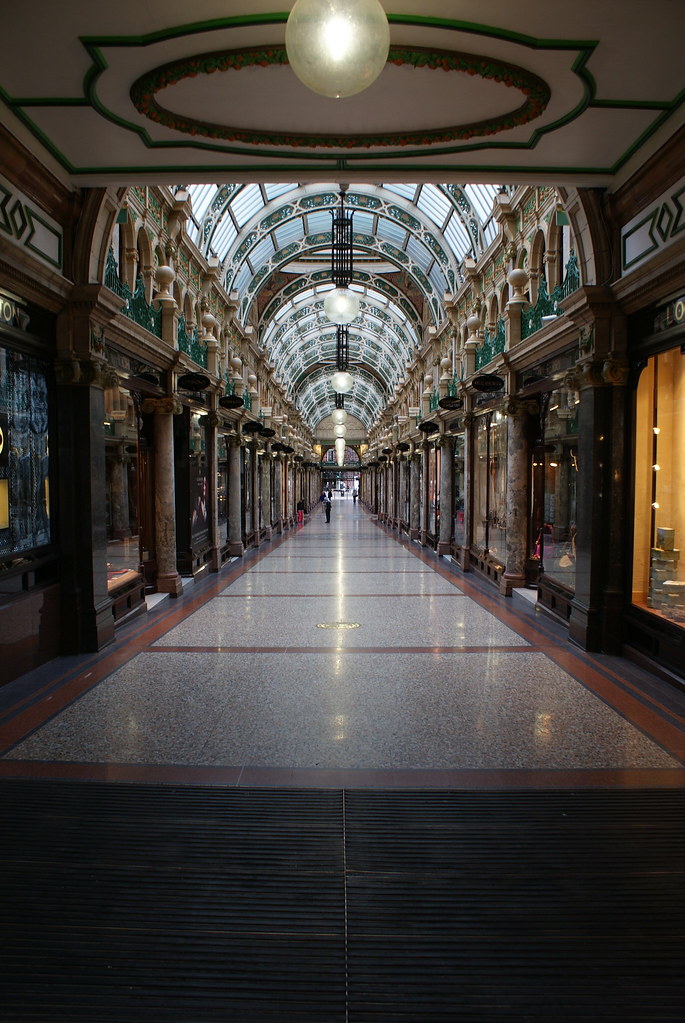
To create this image, to start off with I set my lens to 18mm to exaggerate the perspective of the building as much as possible, helping make things in the distance look further away, and placing the end of the line of shops right in the middle of the image, helping out with the lead through line.
I also opted to use a very deep depth of field in order to not lose any detail in any of the shops.
======================================
Then in Photoshop:
-Using a mixture of the tools in Camera RAW and gradient maps, I adjusted the colours to suit my preferences, upping the vibrancy and turning down the saturation helped bring out the greens in the image, I also upped the exposure and gave the blacks/contrast a boost.
-I also saw the image as too ‘cold,’ so I turned up the white balance, giving a much more warm feeling.
-To sharpen the image without creating colour artefacts, I changed the image mode to lab colour, as opposed to RBG, then turned off the A+B channels, and applied a small radius, large amount, unsharp mask.
-I then selectively dodged and burned areas of the image to bring out the details I wanted, and lose the ones I didn't.
-I then applied a very small noise reduction just to remove any unwanted grain.
-Using the patch, clone, heal and content aware fill tools I selectively removed every person out of the image as I saw them as unwanted distractions from the subject and patterns.
-To create the whole pattern itself, first I cropped the top and bottom third of the image off.
-I then selected the right half of the photograph, duplicated it into a new layer and flipped it horizontally and placed it at the left hand side and flattened the layers.
-Then I selected the top half of the image, duplicated it, flipped it vertically and placed it at the bottom of the image.
-To blend both the horizontal and vertical ‘reflections’ I used a mask and filled it with a short black to white gradient, fading the line between the layers.
-To finalise the image, creating as much disorientation as I could, I rotated it 90 degrees, making the sides of the building appear to be the path.
Personally I believe this photo tuned out exactly how I wanted it, it is full of patterns, has a multitude of lead in lines, and appears to very disorientating.
Taken in the Queens Arcade, Leeds.
Logos now applied, and looking very striking, which is the whole point of an advertisment.
I think Robson's coaches have got an advertising contract from Tyneside Safety Glass as well, so look out for that one appearing.
However, this is ours, and will be on 939 this evening. Lets see how many heads it turns...
Comments Welcome.
First Worcester Wright Streetlite DF 63 360 at Angel Place, Worcester on December 19th 2015 a few days after entering service. The bus carries the new livery style being applied in Worcester with the fuchsia front.
Ponder Stibbon's baize-space technique makes it possible for Archchancellor Mustrum Ridcully to play billiard without cleaning his desk - and also uses 40 % of Unseen University's thinking engine Hex's rune-time.
Scene from Sir Terry Pratchett's book Going Postal - and an entry for Summer Joust 2021's High Fantasy category.
More on Cyclopic Bricks.
Visiting together with Odile (Danube1) the Museum for Applied Arts Vienna.
Exhibition "City of Broken Furniture" by Kerstin von Gabain
Part of My Memory-Photograph-Album
DMC-G2 - P1580543 - 2013-04-02
#88: As of 10/26/22, of my 3300+ pics, this is listed as #88 in most # of views.
#255: As of 10/20/21, of my 3000+ pics, this is listed as #255 in most # of faves.
#761: As of 9/10/21, under Flickr's popularity rankings of my 3000+ pics, this is listed as #761 in "interestingness."
For a fun interlude, this is a close-up/headshot image based off one of my more popular pics posted here on flickr in the last year+. This particular image was generated with the help of the FaceApp application, where I took a photo of a close-up of the "1992-August pic3" pic I've posted here. Then I just applied a filter in FA in part to help with the graininess of this close-up - and to have some fun with the look... :-)
Over the Gambia river, at Wassadou. Niokolo-Koba National Park. Senegal. 13°04′N.
Niokolo-Koba National Park is considered by UNESCO as having "Outstanding Universal Value" and is listed a World Heritage Site and a Reserve of the Biosphere.
This is not a selfie. Photo taken by Zé Eduardo...
No photoshop applied.
The view I has having: www.flickr.com/photos/danielvirella/33108751803/in/datepo...
Arriva North East's Jesmond-based "Coastliner" branded Wright Streetlite DF/Wright Streetlite Micro-Hybrid 1582 (NK64 EEV), which carries a special 'green' livery to promote more environmentally-friendly public transport, with sub-branding also applied for service 306, is pictured here at Tynemouth, whilst attending a publicity event to launch the new vehicles which are due to enter service on the 306 route. 14/10/14
Arriva North East held a unique and innovative marketing publicity launch on October 14th 2014 to mark the £1.3 million investment into Jesmond's 306 service, which operates between Whitley Bay, Tynemouth, North Shields, Coast Road and Newcastle. Sand artists created a marvellous image in the sand - taking just under five hours to construct - which attracted the attention of many passers-by. The brand new vehicles were also in attendance, with the doors being opened to allow members of the public to be some of the very first people to look around the new buses. A small picnic was also had on-board one of the buses, with coffee also being handed out to warm everyone up.
Eight brand new Wright Streetlite DF/Wright Streetlite Micro-Hybrid vehicles have been purchased by Arriva for their 306 service which is based at Jesmond depot. The vehicles all have comfortable e-leather seating, and are Wi-Fi enabled. These vehicle are a Micro-Hybrid version of the Wright Streetlite, which is 11.5m in length. The Micro Hybrid recovers energy lost from braking to power the vehicle electrics and compressed air systems, saving up to 10% in fuel costs. The buses therefore carry a special livery to mark this, and are also branded "Coastliner" to integrate service 306 with service 308, which is allocated similar liveried environmentally-friendly Volvo B5LH/Wright Eclipse Gemini vehicles.
Museum Arnhem NL
This museum for modern, contemporary and applied art and design in Arnhem, was renovated and expanded. Benthem Crouwel Architects’ clear and simple design concept involved restoring Cornelis Outshoorn’s 1873 design in all its former glory. The design highlights the museum’s unique location and the building’s characteristic qualities: the landscape plays a key role in the museum experience; the galleries are simple and quiet, creating optimal conditions for enjoying the works of art; and the dome regains its original, spacious character. The renovation and extension of Museum Arnhem seamlessly integrates art and nature.
A new volume was added on the west side. It provides views of, and connects with the landscape in a variety of ways: the lateral moraine with its vegetation, the gardens with their sculptures, panoramic vistas of the Rhine and the Betuwe, the view of Oosterbeek railway bridge, and not to mention Arnhem’s grand skyline. This wing has a unique feature: a public amphitheater with a large tribune, which makes it possible for visitors without a museum ticket to enjoy the views and the garden. The new wing extends on both sides, and is clearly visible from both roads approaching the museum. The part that protrudes on the south side, above the moraine, accentuates the differences in height: looking out over the landscape, visitors feel like they are hovering above the trees.
Gross floor area 6.000 m². Planning 2006-2022
Another full load for BoxXpress. I really like their branding applied to leased locos. Sun still holding as well!
Glowing in the gloom of a January day in 1965 Vanden Plas 1300 BOH 255C waits at the kerbside for it's proud new owner. This was the first 'C' reg car I had seen and the first of this model, it was finished in a deep grey/green with a gold coach line.
The collection of vehicles around it include a filthy Rolls Royce, a Birmingham Standard bus, a bent and grubby Bedford Dormobile, a Rover 75 and a Commer van. At the time there was a BMC dealership on the corner of Alcester Road and St Marys Row and this new car was parked outside The car is facing oncoming traffic as well so the new owner might have not enjoyed his first trip!
Back then if you bought a new car the tax disc often didn't arrive for a week or two so dealers usually put a neatly printed circle of paper in the tax disc holder saying "tax applied for"
Copyright Geoff Dowling; all rights reserved
A cúpula (o Domo), no interior do Panteão, em Roma.
The Dome, at Pantheon's Interior, in Rome.
A text, in english, from Wikipedia, the free encyclopedia:
Pantheon, Rome.
The Pantheon (Latin: Pantheon, from Greek: Πάνθειον, meaning "Temple of all the gods") is a building in Rome which was originally built as a temple to all the gods of Ancient Rome, and rebuilt circa 126 AD during Hadrian's reign. The intended degree of inclusiveness of this dedication is debated. The generic term pantheon is now applied to a monument in which illustrious dead are buried. It is the best preserved of all Roman buildings, and perhaps the best preserved building of its age in the world. It has been in continuous use throughout its history. The design of the extant building is sometimes credited to Trajan's architect Apollodorus of Damascus, but it is equally likely that the building and the design should be credited to Emperor Hadrian's architects, though not to Hadrian himself as many art scholars once thought. Since the 7th century, the Pantheon has been used as a Roman Catholic church. The Pantheon is the oldest standing domed structure in Rome. The height to the oculus and the diameter of the interior circle are the same, 43.3 metres (142 ft).
n the aftermath of the Battle of Actium (31 BC), Agrippa built and dedicated the original Pantheon during his third consulship (27 BC). Agrippa's Pantheon was destroyed along with other buildings in a huge fire in 80 AD. The current building dates from about 126 AD, during the reign of the Emperor Hadrian, as date-stamps on the bricks reveal. It was totally reconstructed with the text of the original inscription ("M·AGRIPPA·L·F·COS·TERTIVM·FECIT", standing for Latin: Marcus Agrippa, Lucii filius, consul tertium fecit translated to "'Marcus Agrippa, son of Lucius, Consul for the third time, built this") which was added to the new facade, a common practice in Hadrian's rebuilding projects all over Rome. Hadrian was a cosmopolitan emperor who travelled widely in the East and was a great admirer of Greek culture. He might have intended the Pantheon, a temple to all the gods, to be a kind of ecumenical or syncretist gesture to the subjects of the Roman Empire who did not worship the old gods of Rome, or who (as was increasingly the case) worshipped them under other names. How the building was actually used is not known.
Cassius Dio, a Graeco-Roman senator, consul and author of a comprehensive History of Rome, writing approximately 75 years after the Pantheon's reconstruction, mistakenly attributed the domed building to Agrippa rather than Hadrian. Dio's book appears to be the only near-contemporary writing on the Pantheon, and it is interesting that even by the year 200 there was uncertainty about the origin of the building and its purpose:
Agrippa finished the construction of the building called the Pantheon. It has this name, perhaps because it received among the images which decorated it the statues of many gods, including Mars and Venus; but my own opinion of the name is that, because of its vaulted roof, it resembles the heavens. (Cassius Dio History of Rome 53.27.2)
The building was repaired by Septimius Severus and Caracalla in 202 AD, for which there is another, smaller inscription. This inscription reads "pantheum vetustate corruptum cum omni cultu restituerunt" ('with every refinement they restored the Pantheon worn by age').
In 609 the Byzantine emperor Phocas gave the building to Pope Boniface IV, who converted it into a Christian church and consecrated it to Santa Maria ad Martyres, now known as Santa Maria dei Martiri.
The building's consecration as a church saved it from the abandonment, destruction, and the worst of the spoliation which befell the majority of ancient Rome's buildings during the early medieval period. Paul the Deacon records the spoliation of the building by the Emperor Constans II, who visited Rome in July 663:
Remaining at Rome twelve days he pulled down everything that in ancient times had been made of metal for the ornament of the city, to such an extent that he even stripped off the roof of the church [of the blessed Mary] which at one time was called the Pantheon, and had been founded in honor of all the gods and was now by the consent of the former rulers the place of all the martyrs; and he took away from there the bronze tiles and sent them with all the other ornaments to Constantinople.
Much fine external marble has been removed over the centuries, and there are capitals from some of the pilasters in the British Museum. Two columns were swallowed up in the medieval buildings that abbutted the Pantheon on the east and were lost. In the early seventeenth century, Urban VIII Barberini tore away the bronze ceiling of the portico, and replaced the medieval campanile with the famous twin towers built by Maderno, which were not removed until the late nineteenth century. The only other loss has been the external sculptures, which adorned the pediment above Agrippa's inscription. The marble interior and the great bronze doors have survived, although both have been extensively restored.
Since the Renaissance the Pantheon has been used as a tomb. Among those buried there are the painters Raphael and Annibale Carracci, the composer Arcangelo Corelli, and the architect Baldassare Peruzzi. In the 15th century, the Pantheon was adorned with paintings: the best-known is the Annunciation by Melozzo da Forlì. Architects, like Brunelleschi, who used the Pantheon as help when designing the Cathedral of Florence's dome, looked to the Pantheon as inspiration for their works.
Pope Urban VIII (1623 to 1644) ordered the bronze ceiling of the Pantheon's portico melted down. Most of the bronze was used to make bombards for the fortification of Castel Sant'Angelo, with the remaining amount used by the Apostolic Camera for various other works. It is also said that the bronze was used by Bernini in creating his famous baldachin above the high altar of St. Peter's Basilica, but according to at least one expert, the Pope's accounts state that about 90% of the bronze was used for the cannon, and that the bronze for the baldachin came from Venice. This led the Roman satirical figure Pasquino to issue the famous proverb: Quod non fecerunt barbari, fecerunt Barberini ("What the barbarians did not do, the Barberinis [Urban VIII's family name] did")
In 1747, the broad frieze below the dome with its false windows was “restored,” but bore little resemblance to the original. In the early decades of the twentieth century, a piece of the original, as could be reconstructed from Renaissance drawings and paintings, was recreated in one of the panels.
Also buried there are two kings of Italy: Vittorio Emanuele II and Umberto I, as well as Umberto's Queen, Margherita. Although Italy has been a republic since 1946, volunteer members of Italian monarchist organizations maintain a vigil over the royal tombs in the Pantheon. This has aroused protests from time to time from republicans, but the Catholic authorities allow the practice to continue, although the Italian Ministry of Cultural Heritage is in charge of the security and maintenance.
The Pantheon is still used as a church. Masses are celebrated there, particularly on important Catholic days of obligation, and weddings.
The building is circular with a portico of three ranks of huge granite Corinthian columns (eight in the first rank and two groups of four behind) under a pediment opening into the rotunda, under a coffered, concrete dome, with a central opening (oculus), the Great Eye, open to the sky. A rectangular structure links the portico with the rotunda. Though often still drawn as a free-standing building, there was a building at its rear into which it abutted; of this building there are only archaeological remains.
In the walls at the back of the portico were niches, probably for statues of Caesar, Augustus and Agrippa, or for the Capitoline Triad, or another set of gods. The large bronze doors to the cella, once plated with gold, still remain but the gold has long since vanished. The pediment was decorated with a sculpture — holes may still be seen where the clamps which held the sculpture in place were fixed.
The 4,535 metric ton (5,000 tn) weight of the concrete dome is concentrated on a ring of voussoirs 9.1 metres (30 ft) in diameter which form the oculus while the downward thrust of the dome is carried by eight barrel vaults in the 6.4 metre (21 ft) thick drum wall into eight piers. The thickness of the dome varies from 6.4 metres (21 ft) at the base of the dome to 1.2 metres (4 ft) around the oculus. The height to the oculus and the diameter of the interior circle are the same, 43.3 metres (142 ft), so the whole interior would fit exactly within a cube (alternatively, the interior could house a sphere 43.3 metres (142 ft) in diameter). The Pantheon holds the record for the largest unreinforced concrete dome. The interior of the roof was possibly intended to symbolize the arched vault of the heavens. The Great Eye at the dome's apex is the source of all light in the interior. The oculus also serves as a cooling and ventilation method. During storms, a drainage system below the floor handles the rain that falls through the oculus.
The interior features sunken panels (coffers), which, in antiquity, may have contained bronze stars, rosettes, or other ornaments. This coffering was not only decorative, but also reduced the weight of the roof, as did the elimination of the apex by means of the Great Eye. The top of the rotunda wall features a series of brick-relieving arches, visible on the outside and built into the mass of the brickwork. The Pantheon is full of such devices — for example, there are relieving arches over the recesses inside — but all these arches were hidden by marble facing on the interior and possibly by stone revetment or stucco on the exterior. Some changes have been made in the interior decoration.
It is known from Roman sources that their concrete is made up of a pasty hydrate of lime, with pozzolanic ash (Latin pulvis puteolanum) and lightweight pumice from a nearby volcano, and fist-sized pieces of rock. In this, it is very similar to modern concrete. No tensile test results are available on the concrete used in the Pantheon; however Cowan discussed tests on ancient concrete from Roman ruins in Libya which gave a compressive strength of 2.8 ksi (20 MPa). An empirical relationship gives a tensile strength of 213 psi (1.5 MPa) for this specimen. Finite element analysis of the structure by Mark and Hutchison found a maximum tensile stress of only 18.5 psi (0.13 MPa) at the point where the dome joins the raised outer wall. The stresses in the dome were found to be substantially reduced by the use of successively less dense concrete in higher layers of the dome. Mark and Hutchison estimated that if normal weight concrete had been used throughout the stresses in the arch would have been some 80% higher.
The 16 gray granite columns Hadrian ordered for the Pantheon's pronaos were quarried at Mons Claudianus in Egypt's eastern mountains. Each was 39 feet (11.8 m) tall, five feet (1.5 m) in diameter, and 60 tons in weight. These were dragged on wooden sledges when transporting on land. They were floated by barge down the Nile and transferred to vessels to cross the Mediterranean to the Roman port of Ostia where they were transferred back onto barges and up the Tiber to Rome.
As the best-preserved example of an Ancient Roman monumental building, the Pantheon has been enormously influential in Western Architecture from at least the Renaissance on; starting with Brunelleschi's 42-meter dome of Santa Maria del Fiore in Florence, completed in 1436 – the first sizeable dome to be constructed in Western Europe since Late Antiquity. The style of the Pantheon can be detected in many buildings of the nineteenth and twentieth centuries; numerous city halls, universities and public libraries echo its portico-and-dome structure. Examples of notable buildings influenced by the Pantheon include: the Panthéon in Paris, the Temple in Dartrey, the British Museum Reading Room, Manchester Central Library, Thomas Jefferson's Rotunda at the University of Virginia, the Rotunda of Mosta, in Malta, Low Memorial Library at Columbia University, New York, the domed Marble Hall of Sanssouci palace in Potsdam, Germany, the State Library of Victoria, and the Supreme Court Library of Victoria, both in Melbourne, Australia, the 52-meter-tall Ottokár Prohászka Memorial Church in Székesfehérvár, Hungary, Holy Trinity Church in Karlskrona by Nicodemus Tessin the Younger, Sweden, The National Gallery of Art West Building by John Russell Pope, located in Washington, D.C, as well as the California State Capitol in Sacramento.
The present high altar and the apse were commissioned by Pope Clement XI (1700-1721) and designed by Alessandro Specchi. In the apse, a copy of a Byzantine icon of the Madonna is enshrined. The original, now in the Chapel of the Canons in the Vatican, has been dated to the 13th century, although tradition claims that it is much older. The choir was added in 1840, and was designed by Luigi Poletti.
The first niche to the right of the entrance holds a Madonna of the Girdle and St Nicholas of Bari (1686) painted by an unknown artist. The first chapel on the right, the Chapel of the Annunciation, has a fresco of the Annunication attributed to Melozzo da Forli. On the left side is a canvas by Clement Maioli of St Lawrence and St Agnes (1645-1650). On the right wall is the Incredulity of St Thomas (1633) by Pietro Paolo Bonzi.
The second niche has a 15th century fresco of the Tuscan school, depicting the Coronation of the Virgin. In the second chapel is the tomb of King Victor Emmanuel II (died 1878). It was originally dedicated to the Holy Spirit. A competition was held to decide which architect should be given the honor of designing it. Giuseppe Sacconi participated, but lost — he would later design the tomb of Umberto I in the opposite chapel. Manfredio Manfredi won the competition, and started work in 1885. The tomb consists of a large bronze plaque surmounted by a Roman eagle and the arms of the house of Savoy. The golden lamp above the tomb burns in honor of Victor Emmanuel III, who died in exile in 1947.
The third niche has a sculpture by Il Lorenzone of St Anne and the Blessed Virgin. In the third chapel is a 15th-century painting of the Umbrian school, The Madonna of Mercy between St Francis and St John the Baptist. It is also known as the Madonna of the Railing, because it originally hung in the niche on the left-hand side of the portico, where it was protected by a railing. It was moved to the Chapel of the Annunciation, and then to its present position some time after 1837. The bronze epigram commemorated Pope Clement XI's restoration of the sanctuary. On the right wall is the canvas Emperor Phocas presenting the Pantheon to Pope Boniface IV (1750) by an unknown. There are three memorial plaques in the floor, one conmmemorating a Gismonda written in the vernacular. The final niche on the right side has a statue of St. Anastasio (1725) by Bernardino Cametti.
On the first niche to the left of the entrance is an Assumption (1638) by Andrea Camassei. The first chapel on the left, is the Chapel of St Joseph in the Holy Land, and is the chapel of the Confraternity of the Virtuosi at the Pantheon. This refers to the confraternity of artists and musicians that was formed here by a 16th-century Canon of the church, Desiderio da Segni, to ensure that worship was maintained in the chapel. The first members were, among others, Antonio da Sangallo the younger, Jacopo Meneghino, Giovanni Mangone, Zuccari, Domenico Beccafumi and Flaminio Vacca. The confraternity continued to draw members from the elite of Rome's artists and architects, and among later members we find Bernini, Cortona, Algardi and many others. The institution still exists, and is now called the Academia Ponteficia di Belle Arti (The Pontifical Academy of Fine Arts), based in the palace of the Cancelleria. The altar in the chapel is covered with false marble. On the altar is a statue of St Joseph and the Holy Child by Vincenzo de Rossi. To the sides are paintings (1661) by Francesco Cozza, one of the Virtuosi: Adoration of the Shepherds on left side and Adoration of the Magi on right. The stucco relief on the left, Dream of St Joseph is by Paolo Benaglia, and the one on the right, Rest during the flight from Egypt is by Carlo Monaldi. On the vault are several 17th-century canvases, from left to right: Cumean Sibyl by Ludovico Gimignani; Moses by Francesco Rosa; Eternal Father by Giovanni Peruzzini; David by Luigi Garzi and finally Eritrean Sibyl by Giovanni Andrea Carlone.
The second niche has a statue of St Agnes, by Vincenco Felici. The bust on the left is a portrait of Baldassare Peruzzi, derived from a plaster portrait by Giovanni Duprè. The tomb of King Umberto I and his wife Margherita di Savoia is in the next chapel. The chapel was originally dedicated to St Michael the Archangel, and then to St. Thomas the Apostle. The present design is by Giuseppe Sacconi, completed after his death by his pupil Guido Cirilli. The tomb consists of a slab of alabaster mounted in gilded bronze. The frieze has allegorical representations of Generosity, by Eugenio Maccagnani, and Munificence, by Arnaldo Zocchi. The royal tombs are maintained by the National Institute of Honour Guards to the Royal Tombs, founded in 1878. They also organize picket guards at the tombs. The altar with the royal arms is by Cirilli.
The third niche holds the mortal remains — his Ossa et cineres, "Bones and ashes", as the inscription on the sarcophagus says — of the great artist Raphael. His fiancée, Maria Bibbiena is buried to the right of his sarcophagus; she died before they could marry. The sarcophagus was given by Pope Gregory XVI, and its insription reads ILLE HIC EST RAPHAEL TIMUIT QUO SOSPITE VINCI / RERUM MAGNA PARENS ET MORIENTE MORI, meaning "Here lies Raphael, by whom the mother of all things (Nature) feared to be overcome while he was living, and while he was dying, herself to die". The epigraph was written by Pietro Bembo. The present arrangement is from 1811, designed by Antonio Munoz. The bust of Raphael (1833) is by Giuseppe Fabris. The two plaques commemorate Maria Bibbiena and Annibale Carracci. Behind the tomb is the statue known as the Madonna del Sasso (Madonna of the Rock) so named because she rests one foot on a boulder. It was commissioned by Raphael and made by Lorenzetto in 1524.
In the Chapel of the Crucifixion, the Roman brick wall is visible in the niches. The wooden crucifix on the altar is from the 15th century. On the left wall is a Descent of the Holy Ghost (1790) by Pietro Labruzi. On the right side is the low relief Cardinal Consalvi presents to Pope Pius VII the five provinces restored to the Holy See (1824) made by the Danish sculptor Bertel Thorvaldsen. The bust is a portrait of Cardinal Agostino Rivarola. The final niche on this side has a statue of St. Rasius (S. Erasio) (1727) by Francesco Moderati.
Truck: Renault Range T High 520 Evolution (by Gloover)
Trailer: Ekeri L3 stepframe trailer (by kast)
We applied for a sponsorship of replacing the worn batteries ("Akku") from our tractor.
Ta978 had been constructed 1915 to support the building of the second Simplon tunnel hole.
Over different ways - including the shops in Bellinzona - it ended up at our club.
It needs now a replacement of the batteries.
You can vote for us here:
www.aew-energiebatzen.ch/voting/voting-1-2021/mikado-trak...
Conrail CAOI (Camden, NJ to Oak Island, NJ) rolls through Piscataway on Conrail's 18th birthday with a C39-8/SD40-2 combo leading. Conrail 6007 is one of only 22 C39-8s on the roster. This unit sports a red "L" next to the road number. The "L" was applied to this and other units that were leased to Southern Pacific in the early 90s.
April 1, 1994
en.wikipedia.org/wiki/Atlantic_Ocean
The Atlantic Ocean is the second-largest of the world's oceanic divisions. With a total area of about 106,400,000 square kilometres (41,100,000 sq mi),[1] it covers approximately 20% of the Earth's surface and about 26% of its water surface area. The first part of its name refers to Atlas of Greek mythology, making the Atlantic the "Sea of Atlas".
The oldest known mention of "Atlantic" is in The Histories of Herodotus around 450 BC (Hdt. 1.202.4): Atlantis thalassa (Greek: Ἀτλαντὶς θάλασσα; English: Sea of Atlas); see also: Atlas Mountains. The term Ethiopic Ocean, derived from Ethiopia, was applied to the southern Atlantic ocean as late as the mid-19th century.[2] Before Europeans discovered other oceans, the term "ocean" itself was synonymous with the waters beyond the Strait of Gibraltar that we now know as the Atlantic. The early Greeks believed this ocean to be a gigantic river encircling the world.
The Atlantic Ocean occupies an elongated, S-shaped basin extending longitudinally between Eurasia and Africa to the east, and the Americas to the west. As one component of the interconnected global ocean, it is connected in the north to the Arctic Ocean (which is sometimes considered a sea of the Atlantic), to the Pacific Ocean in the southwest, the Indian Ocean in the southeast, and the Southern Ocean in the south. (Other definitions describe the Atlantic as extending southward to Antarctica.) The equator subdivides it into the North Atlantic Ocean and South Atlantic Ocean.
Geography
The Atlantic Ocean is bounded on the west by North and South America. It connects to the Arctic Ocean through the Denmark Strait, Greenland Sea, Norwegian Sea and Barents Sea. To the east, the boundaries of the ocean proper are Europe; the Strait of Gibraltar (where it connects with the Mediterranean Sea–one of its marginal seas–and, in turn, the Black Sea, both of which also touch upon Asia) and Africa.
In the southeast, the Atlantic merges into the Indian Ocean. The 20° East meridian, running south from Cape Agulhas to Antarctica defines its border. Some authorities show it extending south to Antarctica, while others show it bounded at the 60° parallel by the Southern Ocean.[3]
In the southwest, the Drake Passage connects it to the Pacific Ocean. The man-made Panama Canal links the Atlantic and Pacific. Besides those mentioned, other large bodies of water adjacent to the Atlantic are the Caribbean Sea; the Gulf of Mexico; Hudson Bay; the Arctic Ocean; the Mediterranean Sea; the North Sea; the Baltic Sea and the Celtic Sea.
Covering approximately 22% of Earth's surface, the Atlantic is second in size to the Pacific. With its adjacent seas, it occupies an area of about 106,400,000 square kilometres (41,100,000 sq mi);[1] without them, it has an area of 82,400,000 square kilometres (31,800,000 sq mi). The land that drains into the Atlantic covers four times that of either the Pacific or Indian oceans. The volume of the Atlantic with its adjacent seas is 354,700,000 cubic kilometers (85,100,000 cu mi) and without them 323,600,000 cubic kilometres (77,640,000 cu mi).
The average depth of the Atlantic, with its adjacent seas, is 3,339 metres (1,826 fathoms; 10,950 ft); without them it is 3,926 metres (2,147 fathoms; 12,880 ft). The greatest depth, Milwaukee Deep with 8,380 metres (4,580 fathoms; 27,500 ft), is in the Puerto Rico Trench. The Atlantic's width varies from 1,538 nautical miles (2,848 km; 1,770 mi) between Brazil and Sierra Leone to over 3,450 nautical miles (6,400 km; 4,000 mi) in the south
Cultural significance
Transatlantic travel played a major role in the expansion of Western civilization into the Americas. It is the Atlantic that separates the "Old World" from the "New World". In modern times, some idioms refer to the ocean in a humorously diminutive way as the Pond, describing both the geographical and cultural divide between North America and Europe, in particular between the English-speaking nations of both continents. Many British people refer to the United States and Canada as "across the pond", and vice versa
Ocean bottom
The principal feature of the bathymetry (bottom topography) is a submarine mountain range called the Mid-Atlantic Ridge.[5] It extends from Iceland in the north to approximately 58° South latitude, reaching a maximum width of about 860 nautical miles (1,590 km; 990 mi). A great rift valley also extends along the ridge over most of its length. The depth of water at the apex of the ridge is less than 2,700 metres (1,500 fathoms; 8,900 ft) in most places, while the bottom of the ridge is three times as deep. Several peaks rise above the water and form islands.[6] The South Atlantic Ocean has an additional submarine ridge, the Walvis Ridge.[7]
The Mid-Atlantic Ridge separates the Atlantic Ocean into two large troughs with depths from 3,700–5,500 metres (2,000–3,000 fathoms; 12,000–18,000 ft). Transverse ridges running between the continents and the Mid-Atlantic Ridge divide the ocean floor into numerous basins. Some of the larger basins are the Blake, Guiana, North American, Cape Verde, and Canaries basins in the North Atlantic. The largest South Atlantic basins are the Angola, Cape, Argentina, and Brazil basins.
The deep ocean floor is thought to be fairly flat with occasional deeps, abyssal plains, trenches, seamounts, basins, plateaus, canyons, and some guyots. Various shelves along the margins of the continents constitute about 11% of the bottom topography with few deep channels cut across the continental rise.
Ocean floor trenches and seamounts:
•Puerto Rico Trench, in the North Atlantic, is the deepest trench at 8,605 metres (4,705 fathoms; 28,230 ft)[8]
•Laurentian Abyss is found off the eastern coast of Canada
•South Sandwich Trench reaches a depth of 8,428 metres (4,608 fathoms; 27,650 ft)
•Romanche Trench is located near the equator and reaches a depth of about 7,454 metres (4,076 fathoms; 24,460 ft).
Ocean sediments are composed of:
•Terrigenous deposits with land origins, consisting of sand, mud, and rock particles formed by erosion, weathering, and volcanic activity on land washed to sea. These materials are found mostly on the continental shelves and are thickest near large river mouths or off desert coasts.
•Pelagic deposits, which contain the remains of organisms that sink to the ocean floor, include red clays and Globigerina, pteropod, and siliceous oozes. Covering most of the ocean floor and ranging in thickness from 60–3,300 metres (33–1,800 fathoms; 200–11,000 ft) they are thickest in the convergence belts, notably at the Hamilton Ridge and in upwelling zones.
•Authigenic deposits consist of such materials as manganese nodules. They occur where sedimentation proceeds slowly or where currents sort the deposits, such as in the Hewett Curve.
Water characteristics
On average, the Atlantic is the saltiest major ocean; surface water salinity in the open ocean ranges from 33 to 37 parts per thousand (3.3 – 3.7%) by mass and varies with latitude and season. Evaporation, precipitation, river inflow and sea ice melting influence surface salinity values. Although the lowest salinity values are just north of the equator (because of heavy tropical rainfall), in general the lowest values are in the high latitudes and along coasts where large rivers enter. Maximum salinity values occur at about 25° north and south, in subtropical regions with low rainfall and high evaporation.
Surface water temperatures, which vary with latitude, current systems, and season and reflect the latitudinal distribution of solar energy, range from below −2 °C (28 °F). Maximum temperatures occur north of the equator, and minimum values are found in the polar regions. In the middle latitudes, the area of maximum temperature variations, values may vary by 7–8 °C (12–15 °F).
The Atlantic Ocean consists of four major water masses. The North and South Atlantic central waters make up the surface. The sub-Antarctic intermediate water extends to depths of 1,000 metres (550 fathoms; 3,300 ft). The North Atlantic Deep Water reaches depths of as much as 4,000 metres (2,200 fathoms; 13,000 ft). The Antarctic Bottom Water occupies ocean basins at depths greater than 4,000 metres.
Within the North Atlantic, ocean currents isolate the Sargasso Sea, a large elongated body of water, with above average salinity. The Sargasso Sea contains large amounts of seaweed and is also the spawning ground for both the European eel and the American eel.
The Coriolis effect circulates North Atlantic water in a clockwise direction, whereas South Atlantic water circulates counter-clockwise. The south tides in the Atlantic Ocean are semi-diurnal; that is, two high tides occur during each 24 lunar hours. In latitudes above 40° North some east-west oscillation occurs.
Climate
Climate is influenced by the temperatures of the surface waters and water currents as well as winds. Because of the ocean's great capacity to store and release heat, maritime climates are more moderate and have less extreme seasonal variations than inland climates. Precipitation can be approximated from coastal weather data and air temperature from water temperatures.
The oceans are the major source of the atmospheric moisture that is obtained through evaporation. Climatic zones vary with latitude; the warmest zones stretch across the Atlantic north of the equator. The coldest zones are in high latitudes, with the coldest regions corresponding to the areas covered by sea ice. Ocean currents influence climate by transporting warm and cold waters to other regions. The winds that are cooled or warmed when blowing over these currents influence adjacent land areas.
The Gulf Stream and its northern extension towards Europe, the North Atlantic Drift, for example, warms the atmosphere of the British Isles and north-western Europe and influences weather and climate as far south as the northern Mediterranean. The cold water currents contribute to heavy fog off the coast of eastern Canada (the Grand Banks of Newfoundland area) and Africa's north-western coast. In general, winds transport moisture and air over land areas. Hurricanes develop in the southern part of the North Atlantic Ocean. More local particular weather examples could be found in examples such as the; Azores High, Benguela Current, Nor'easter.
History
The Atlantic Ocean appears to be the second youngest of the five oceans. It did not exist prior to 130 million years ago, when the continents that formed from the breakup of the ancestral super continent Pangaea were drifting apart from seafloor spreading. The Atlantic has been extensively explored since the earliest settlements along its shores.
The Vikings, the Portuguese, and the Spaniards were the most famous among early explorers. After Columbus, European exploration rapidly accelerated, and many new trade routes were established.
As a result, the Atlantic became and remains the major artery between Europe and the Americas (known as transatlantic trade). Scientific explorations include the Challenger expedition, the German Meteor expedition, Columbia University's Lamont-Doherty Earth Observatory and the United States Navy Hydrographic Office.
Notable crossings
Ra II, a ship built from papyrus, was successfully sailed across the Atlantic by Thor Heyerdahl proving that it was possible to cross the Atlantic from Africa using such boats in early epochs of history.
•Around 980 – 982, Eric the Red discovered Greenland, geographically and geologically a part of the Americas.
•In 985 or 986, Bjarni Herjólfsson was the first European to sight the Americas. He did not go ashore, though.
•In the year 1000, the Icelander Leif Ericson was the first European to set foot on North American soil, corresponding to today's Eastern coast of Canada, i. e. the province of Newfoundland and Labrador, including the area of land named "Vinland" by Ericson. The Norse discovery was documented in the 13th century Icelandic Sagas and was corroborated by recent L'Anse aux Meadows archeological evidence.
•Around 1010, Thorfinnr Karlsefni led an attempted Viking settlement in North America with 160 settlers, but was later driven off by the natives. His son Snorri Thorfinnsson was the first American born (somewhere between 1010 and 1013) to European (Icelandic) immigrant parents.
•In 1419 and 1427, Portuguese navigators reached Madeira and Azores, respectively.
•From 1415 to 1488, Portuguese navigators sailed along the Western African coast, reaching the Cape of Good Hope.
•In 1492, Christopher Columbus landed on the island of San Salvador in The Bahamas.
•In 1497, John Cabot landed at Bonavista Newfoundland and Labrador.
•In 1500, Pedro Álvares Cabral reached Brazil.
•In 1524, Italian explorer Giovanni da Verrazzano discovered the United States of America's east coast.
•In 1534, Jacques Cartier entered the Gulf of St. Lawrence and reached the mouth of the St. Lawrence River.
•In 1583, Sir Humphrey Gilbert claimed Newfoundland for the English Crown.
•In 1764 William Harrison (the son of John Harrison) sailed aboard the HMS Tartar, with the H-4 time piece. The voyage became the basis for the invention of the global system of Longitude.
•In 1858, Cyrus West Field laid the first transatlantic telegraph cable (it quickly failed).
•In 1865 Brunel's ship the SS Great Eastern laid the first successful transatlantic telegraph cable .
•In 1870 the small City of Ragusa (Dubrovnik) became the first small Lifeboat to cross the Atlantic from Cork to Boston with two men crew, John Charles Buckley and Nikola Primorac (di Costa), only.[9]
•In 1896 Frank Samuelsen and George Harbo from Norway became the first people to ever row across the Atlantic Ocean.
•On April 15, 1912 the RMS Titanic sank after hitting an iceberg with a loss of more than 1,500 lives.[10]
•1914–1918, the First Battle of the Atlantic took place.
•In 1919, the American NC-4 became the first seaplane to cross the Atlantic (though it made a couple of landings on islands and the sea along the way, and taxied several hundred miles).
•Later in 1919, a British aeroplane piloted by Alcock and Brown made the first non-stop transatlantic flight, from Newfoundland to Ireland.
•In 1921, the British were the first to cross the North Atlantic in an airship.
•In 1922, Sacadura Cabral and Gago Coutinho were the first to cross the South Atlantic in an airship.
•In 1927, Charles Lindbergh made the first solo non-stop transatlantic flight in an aircraft (between New York City and Paris).
•In 1931, Bert Hinkler made the first solo non-stop transatlantic flight across the South Atlantic in an aircraft.
•In 1932, Amelia Earhart became the first female to make a solo flight across the Atlantic
•1939–1945, the Second Battle of the Atlantic. Nearly 3,700 Allied ships were sunk at a cost of 783 German U-boats.[11]
•In 1952, Ann Davison was the first woman to single-handedly sail the Atlantic Ocean.
•In 1965, Robert Manry crossed the Atlantic from the U.S. to England non-stop in a 13.5 foot (4.05 meters) sailboat named "Tinkerbell".[12] Several others also crossed the Atlantic in very small sailboats in the 1960s, none of them non-stop, though.
•In 1969 and 1970 Thor Heyerdahl launched expeditions to cross the Atlantic in boats built from papyrus. He succeeded in crossing the Atlantic from Morocco to Barbados after a two-month voyage of 6,100 km with Ra II in 1970, thus conclusively proving that boats such as the Ra could have sailed with the Canary Current across the Atlantic in prehistoric times.[13]
•In 1975, Fons Oerlemans crossed the Atlantic in 82 days, starting from Safi (Morocco) to Trinidad and Tobago, on a selfmade raft.
•In 1980, Gérard d'Aboville was the first man to cross the Atlantic Ocean rowing solo.
•In 1984, Five Argentines sail in a 10-meter-long raft made from tree trunks named Atlantis from Canary Islands and after 52 days 3,000 miles (4,800 km) journey arrived to Venezuela in an attempt to prove travelers from Africa may have crossed the Atlantic before Christopher Columbus.[14][15]
•In 1994, Guy Delage was the first man to allegedly swim across the Atlantic Ocean (with the help of a kick board, from Cape Verde to Barbados).
•In 1998, Benoît Lecomte was the first man to swim across the northern Atlantic Ocean without a kick board, stopping for only one week in the Azores.
•In 1999, after rowing for 81 days and 4,767 kilometres (2,962 mi), Tori Murden became the first woman to cross the Atlantic Ocean by rowboat alone when she reached Guadeloupe from the Canary Islands.
Ethiopic Ocean
The Aethiopian Sea, Ethiopic Ocean or Ethiopian Ocean (Okeanos Aithiopos), is an old name for what is now called the South Atlantic Ocean, which is separated from the North Atlantic Ocean by a narrow region between Natal, Brazil and Monrovia, Liberia. The use of this term illustrates a past trend towards referring to the whole continent of Africa by the name Aethiopia. The modern nation of Ethiopia, in northeast Africa, is nowhere near the Ethiopic Ocean, which would be said to lie off the west coast of Africa. The term Ethiopian Ocean sometimes appeared until the mid-19th century.[
Economy
The Atlantic has contributed significantly to the development and economy of surrounding countries. Besides major transatlantic transportation and communication routes, the Atlantic offers abundant petroleum deposits in the sedimentary rocks of the continental shelves. The Atlantic hosts the world's richest fishing resources, especially in the waters covering the shelves. The major fish are cod, haddock, hake, herring, and mackerel.
The most productive areas include Newfoundland's Grand Banks, the Nova Scotia shelf, Georges Bank off Cape Cod, the Bahama Banks, the waters around Iceland, the Irish Sea, the Dogger Bank of the North Sea, and the Falkland Banks. Eel, lobster, and whales appear in great quantities. Various international treaties attempt to reduce pollution caused by environmental threats such as oil spills, marine debris, and the incineration of toxic wastes at sea.
Terrain
From October to June the surface is usually covered with sea ice in the Labrador Sea, Denmark Strait, and Baltic Sea. A clockwise warm-water gyre occupies the northern Atlantic, and a counter-clockwise warm-water gyre appears in the southern Atlantic. The Mid-Atlantic Ridge, a rugged north-south centerline for the entire Atlantic basin, first discovered by the Challenger Expedition dominates the ocean floor. This was formed by the vulcanism that also formed the ocean floor and the islands rising from it.
The Atlantic has irregular coasts indented by numerous bays, gulfs, and seas. These include the Norwegian Sea, Baltic Sea, North Sea, Labrador Sea, Black Sea, Gulf of Saint Lawrence, Bay of Fundy, Gulf of Maine, Mediterranean Sea, Gulf of Mexico, and Caribbean Sea.
Islands include Newfoundland (including hundreds of surrounding islands), Greenland, Iceland, Faroe Islands, Great Britain (including numerous surrounding islands), Ireland, Rockall, Sable Island, Azores, St. Pierre and Miquelon, Madeira, Bermuda, Canary Islands, Caribbean, Cape Verde, São Tomé and Príncipe, Annobón Province, Fernando de Noronha, Rocas Atoll, Ascension Island, Saint Helena, Trindade and Martim Vaz, Tristan da Cunha, Gough Island (Also known as Diego Alvarez), Falkland Islands, Tierra del Fuego, South Georgia Island, South Sandwich Islands, and Bouvet Island.
Natural resources
The Atlantic harbors petroleum and gas fields, fish, marine mammals (seals and whales), sand and gravel aggregates, placer deposits, polymetallic nodules, and precious stones.
Natural hazards
Icebergs are common from February to August in the Davis Strait, Denmark Strait, and the northwestern Atlantic and have been spotted as far south as Bermuda and Madeira. Ships are subject to superstructure icing in the extreme north from October to May. Persistent fog can be a maritime hazard from May to September, as can hurricanes north of the equator (May to December).
The United States' southeast coast has a long history of shipwrecks due to its many shoals and reefs. The Virginia and North Carolina coasts were particularly dangerous.
The Bermuda Triangle is popularly believed to be the site of numerous aviation and shipping incidents because of unexplained and supposedly mysterious causes, but Coast Guard records do not support this belief.
Hurricanes are also a natural hazard in the Atlantic, but mainly in the northern part of the ocean, rarely tropical cyclones form in the southern parts. Hurricanes usually form between June 1 and November 30 of every year. The most notable hurricane in the Atlantic would be Hurricane Katrina in the 2005 season
Current environmental issues
Endangered marine species include the manatee, seals, sea lions, turtles, and whales. Drift net fishing can kill dolphins, albatrosses and other seabirds (petrels, auks), hastening the fish stock decline and contributing to international disputes.[16] Municipal pollution comes from the eastern United States, southern Brazil, and eastern Argentina; oil pollution in the Caribbean Sea, Gulf of Mexico, Lake Maracaibo, Mediterranean Sea, and North Sea; and industrial waste and municipal sewage pollution in the Baltic Sea, North Sea, and Mediterranean Sea.
In 2005, there was some concern that warm northern European currents were slowing down, but no scientific consensus formed from that evidence.[17]
On June 7, 2006, Florida's wildlife commission voted to take the manatee off the state's endangered species list. Some environmentalists worry that this could erode safeguards for the popular sea creature.
Marine pollution
Marine pollution is a generic term for the entry into the ocean of potentially hazardous chemicals or particles. The biggest culprits are rivers and with them many agriculture fertilizer chemicals as well as livestock and human waste. The excess of oxygen-depleting chemicals leads to hypoxia and the creation of a dead zone.[18]
Marine debris, which is also known as marine litter, describes human-created waste floating in a body of water. Oceanic debris tends to accumulate at the center of gyres and coastlines, frequently washing aground where it is known as beach litter
Bordering countries and territories
The states (territories in italics) with a coastline on the Atlantic Ocean (excluding the Baltic and Mediterranean Seas) are:
Europe
• Belgium
• Denmark
• Germany
• Spain
• France
• Faroe Islands
• Guernsey
• Isle of Man
• Ireland
• Iceland
• Jersey
• Netherlands
• Norway
• Portugal
• Sweden
• United Kingdom
Africa
• Morocco
• Angola
• Benin
• Bouvet Island
• Côte d'Ivoire
• Cameroon
• Democratic Republic of the Congo
• Republic of the Congo
• Cape Verde
• Western Sahara (claimed by Morocco)
• Spain (Canary Islands)
• Gabon
• Ghana
• Guinea
• Gambia
• Guinea-Bissau
• Equatorial Guinea
• Liberia
• Mauritania
• Namibia
• Nigeria
• Senegal
• Saint Helena, Ascension and Tristan da Cunha
• Sierra Leone
• São Tomé and Príncipe
•
South America
• Argentina
• Brazil
• Chile
• Colombia
• Falkland Islands
• France (French Guiana)
• Guyana
• South Georgia and the South Sandwich Islands
• Suriname
• Uruguay
• Venezuela
Caribbean
• Aruba
• Anguilla
• Antigua and Barbuda
• Bahamas
• Saint Barthélemy
• Barbados
• Cuba
• Curaçao
• Cayman Islands
• Dominica
• Dominican Republic
• France (Martinique and Guadeloupe)
• Grenada
• Haiti
• Jamaica
• Saint Lucia
• Saint Martin
• Montserrat
• Netherlands (Caribbean Netherlands)
• Puerto Rico
• Saint Kitts and Nevis
• Sint Maarten
• Turks and Caicos Islands
• Trinidad and Tobago
• Saint Vincent and the Grenadines
• British Virgin Islands
• United States Virgin Islands
Central and North America
• Belize
• Bermuda
• Canada
• Costa Rica
• Greenland
• Guatemala
• Honduras
• Mexico
• Nicaragua
• Panama
• Saint Pierre and Miquelon
• United States
I set up at a curve just east of Green River, Utah, for Amtrak No. 6, the California Zephyr, on September 1, 1999. After photographing No. 6 at this location, I started to drive away when I heard “Second Amtrak No. 6, highball Green River.” What?! I did a quick U-turn and tried to figure out what that was all about! It ended up being the U. S. Postal Service special “Celebrate the Century Express” train on part of its two-year tour of the country in 1999-2000, hot on the heels of the California Zephyr. A special paint scheme was applied to Amtrak P42DC No. 100, a baggage car, and an Amfleet car with a modified interior. This scheme consisted of a very elaborate collection of enlarged stamps and postmarks from the 1900s to the 1990s. Besides these cars, vintage Southern Railway RPO No. 36 and a business/lounge car Missouri-Kansas-Texas No. 403, both heavyweight passenger cars, accompanied the train. I had no idea this train was coming, but I’m glad I was listening to the scanner.
S. Turribi
Graphite on paper
CORSO DI DISEGNO E PITTURA
miminadecorazioni.blogspot.com/
Applied front tilt to get the stones in the foreground and the building in the background in focus. Averaged spot metering gave 2 seconds, so exposed for 5s to account for reciprocity failure.
Intrepid Camera 4x5 Mk 5 | Schneider-Kreuznach 150mm F5.6 Symmar S | Fomapan 100 100
Digitized with Nikon Z7 / 60mm Micro Nikkor / Negative Supply Pro Riser MK3 | Raleno LED Light Panel | Glass Sheets
Home developed in 510 Pyro 1:100 | 7m at 20c | Ilford Standard Agitaion
Negative Lab Pro v2.4.2 | Color Model: None | Pre-Sat: 3 | Tone Profile: LAB - Standard | WB: None | LUT: None
This afternoon I worked some more on the painting I started yesterday. This is another mountain landscape painting from my imagination and memories of the Colorado Rockies. Today I applied some magenta washes to the mountains and some pale periwinkle to the sky. There are a few things I want to fix, but I hope to finish this tomorrow. This is acrylic paint used with water on watercolor paper, 9 x 12 inches.
Thank you everyone who applied to blog for Elephante Collective! We have our new 2022 blogger group yay congrats everyone! I'm excited to be back and doing events in the coming months. I've been working hard on the mainstores which should be opened by the end of this month! I can't wait to show you guys!
Blogger applications will always be open if we find future bloggers we are interested in adding to our team for our next round of bloggers we'll add you to a waitlist. Thanks again everyone who applied! <3
Excerpt from www.achives.syr.edu/buildings: Designed by Gaggin and Gaggin, and built in 1902 at at cost of $75,000 in Ohio sandstone, it was named after Lyman C. Smith, typewriter pioneer and president of L.C. Smith & Brothers Typewriter Company; Board of Trustees, 1896-1910.
Taken on a foggy morning as the Turkey Vultures circle their breakfast.
Texture "Wash It All Away" by Darkwood67
darkwood67 applied challenge #2
source texture by darkwood67
Rear Nearside view of the recently applied promotion for 'Keeping Plymouth Moving', seen at Nine Elms, Battersea.
5 Apr 14
Gone to pot:
An item which is broken, defective or substandard. Two explanations have been historically applied. The first is that in olden times when food was scarce, people would leave the bones, fat and undesirable portions behind after eating their meal. These second-rate items would be used for soup the next day, so as such, the poor-quality leftovers would "go to pot". The second (and more plausible) explanation is that in the days of the industrial revolution and early mass-production, assembly workers would occasionally find a defective or out-of-tolerance part which was not suitable for use. This part would be sent back to the smelting room to be melted down and re-cast a second time. Since the smelting was done in a giant pot, these defective parts had "gone to pot". In either case, the phrase gained popular use by the "American home-owner" who would occasionally wear out an item which would fail- often at an inconvenient time.
www.youtube.com/watch?v=A6c6eUeoa9Q
Candid shot, Mid Devon Show 2017.
Applied Dynamic Systems Inc. Model DWA-1109e
Project Code Name: 'Ratite'
A little something in the same class as the IP2K-D202-V.
A small, bipedal frame barely big enough for a pilot. Designed to accommodate unmanned or AI operation.
===========================================================
Built for Mobile Frame Zero - a tabletop wargame.
Mobile Frame Hangar (MFZ Community Forums).
===========================================================
With all my ❤️ I thank you for your ⭐ or 💬 or just for 👀 it.
A 📷 taken by me + Camera Raw +ps
THIS PHOTO IT'S NOT AI 📀
You can look at the Exif data on your right.➡️ in pc, and on phone below the comments 👇
This image is born from reality, from the solidity of stone and the light that surrounds it. The Venus of the Hill, a sculpture by Subirats, stands imposingly at the entrance of the neighborhood where I live. Its creator, the same artist who left his mark on the Passion Façade of the Sagrada Familia, sculpted a timeless force and elegance into this piece.
Although digital processes have been applied to this image, its essence remains unchanged: a serene, almost mystical presence that solemnly watches over the horizon. The editing merely seeks to enhance its majesty, playing with light and color to accentuate its dialogue with the surroundings.
The Venus of the Hill is not just a work of art; it is a stone guardian, blending with nature and time itself.
My astro pal, Jerry Keith, let me use some Ha data he shot recently of NGC1499 the California Nebula. I added it to my color version (Canon 5D 12.8mp) and made a SuperLumHaRGB. Jerry used a 7nm Baader filter on his Hutech modded Canon 6D. I registered the two in Registar, then removed the stars from the registered Ha image with Straton. I made a copy of this and added 12% of each channel of the RGB and saved it as SuperLuminance. I used layer stacking in Photoshop CS6, then applied the luminosity with the SuperLum.
#abfav_spring
forming a flower-carpet, they are out, for sale now, all waiting for the transplant in someone’s much loved garden.
It is still early in the year, and they tremble in the chilly wind. The flowers still quite hidden, frightened to come out.
The word primula is the Latin feminine diminutive of primus, meaning first (prime), applied to flowers that are among the first to open in Spring.
Hope this brings a bit of joy again, have a good day and thanx for your visit, so very much appreciated, Magda, (*_*)
For more of my work, visit here: www.indigo2photography.com
Please do not use this image on websites, blogs or any other media without my explicit permission. © All rights reserved
Original image taken of a framed advertisement for O'Keefe's Pilsener Lager Special Extra Mild Ale which was hanging in a restaurant.
With special thanks to Garlandcannon for her advise and special framing which I applied here.
View Garlandcannon's original framed art here:
Hastily applied, I'm not a fan of the overall finish, But it works. I need to order more sealant, as I'm currently eating through my supplies at this rate.
I've added people who have experience in decals and/or knowledge of Vietnam.
Good? Y/N?
09-01-2022
Cracking newly applied paintjob on Gulfstream G280 N815CE. Arriving from Bangor on it's second visit here, previously visit was in the manufacturer's house colours.
Accession Number: 1966:0039:0003
Maker: Unidentified
Title: Unidentified African American Woman Wearing White Gloves
Date: ca. 1855
Medium: daguerreotype with applied color
Dimensions: 8.2 x 7.0 cm., 1/6 plate
George Eastman House Collection
General – information about the George Eastman House Photography Collection is available at http://www.eastmanhouse.org/inc/collections/photography.php.
For information on obtaining reproductions go to: www.eastmanhouse.org/flickr/index.php?pid=196600390003.
An aurora appears across the northern sky over the University of Calgary's Rothney Astrophysical Observatory on May 11, 2024 during one of the RAO's monthly Space Nights with talks and telescopes for the public. The RAO is near Priddis, southwest of Calgary, Alberta. Telescopes are staffed by members of the Calgary Centre of the Royal Astronomical Society of Canada.
This May weekend was when a major geomagnetic storm was hitting Earth producing widely seen auroras around the world. The show this night was dimmer than the previous night, and the sky was also plagued by smoke from fires in northern B.C. and Alberta.
The "W" stars of Cassiopeia are are left low in the north over the Visitor Centre and Celestron 14 roll-offf building. Polaris is at upper left. Vega and Deneb are rising at right in the east.
This is a blend of two 15-second exposures with the TTArtisan 11mm full-frame fish-eye lens at f/2.8 on the Canon EOS R at ISO 1600. Adobe DeNoise AI applied.
The blue fin with the 5 yellow stars and the blue engine panels, all remnants of the Farnair livery, are now white, probably because the yellow/white DHL/ASL livery is to be applied soon.
LGAV I 23.06.2017 I Boeing 737-43QSF I HA-FAU
{"total_effects_actions":0,"total_draw_time":264167,"layers_used":2,"effects_tried":0,"total_draw_actions":9,"total_editor_actions":{"border":0,"frame":0,"mask":0,"lensflare":0,"clipart":0,"text":0,"square_fit":0,"shape_mask":0,"callout":0},"effects_applied":0,"uid":"548EB902-2C5A-439B-BCA4-6F7581C59123_1551713718731","width":1594,"photos_added":0,"total_effects_time":0,"tools_used":{"tilt_shift":0,"resize":0,"adjust":0,"curves":0,"motion":0,"perspective":0,"clone":0,"crop":0,"enhance":0,"selection":0,"free_crop":0,"flip_rotate":0,"shape_crop":0,"stretch":0},"source":"editor","origin":"gallery","height":1062,"subsource":"done_button","total_editor_time":321,"brushes_used":0}
NASA and Northrop Grumman technicians in Promontory, Utah, have applied insulation to the final booster motor segment for the second flight of NASA's deep space rocket, the Space Launch System, and NASA's Orion spacecraft. The insulation, applied to the interior of each steel motor segment, protects the casing from the heat generated by the propellant during launch and flight. The twin, five-segment solid rocket motor boosters for SLS are the largest, most powerful solid propellant boosters ever built. SLS uses both liquid and solid propellant to provide the thrust needed to launch the vehicle and send it to space. The boosters provide more than 75% of the total thrust at launch and into the first two minutes of flight. Five motor segments are stacked together to create a single, very large motor for each booster. The manufacture and checkout of all 10 motor segments for the first test flight of SLS and Orion were completed earlier this year.
NASA is charged to get American astronauts to the surface of the Moon by 2024. SLS and the Orion are our backbone for deep space exploration. SLS and Orion will launch from NASA's Kennedy Space Center in Florida on missions to the Gateway in lunar orbit. NASA is targeting 2022 to test SLS with astronauts aboard the Orion spacecraft.
Image Credit: Northrop Grumman Photo