View allAll Photos Tagged Acknowledgment
Vernonia sp (ironweed, not accessioned, HG-AS), Asian garden, National Herb Garden, US Naional Arboretum, Washington, DC
land acknowledgment: unceded Nactochtank land
6th Birthday - Raub Pahang 1964
To my Entire Flickr Friend,
Today I’m going to celebrate another milestone of achievement. It may not be that great to everyone out there but to me it’s an achievement that I would like to share with my entire beloved flickr friend no matter where you are.
On May 15th 2009 my first shot was posted here at (Flickr) as it progress I became attached to it.
On July 17th 2009 my Photo stream were view approximately 1000 times. (Your photo stream has been viewed 1,002 times. - acknowledgment by flickr)
31st October 2009 I did not realized my Photo stream again hit another barrier (from flickr- This is a view of your 189 most popular bits: Your photo stream has been viewed 10,917 times.)
What do I really achieved here?
Learning and meeting new friends’ everyday who share the common interest as I do.
And I will share lots of thing with most of you my beloved friends here through my work and thought, and so do you.
Least but not last I love you all my dearest Flickr friends.
Love
Nazlio69
"It's a Hard Life - Fredie Mercury"
Located around 5,000 light-years away in the constellation of Cygnus (the Swan), Abell 78 is an unusual type of planetary nebula.
After exhausting the nuclear fuel in their cores, stars with a mass of around 0.8 to eight times the mass of our Sun collapse to form dense and hot white dwarf stars. As this process occurs, the dying star will throw off its outer layers of material, forming an elaborate cloud of gas and dust known as a planetary nebula. This phenomenon is not uncommon, and planetary nebulae are a popular focus for astrophotographers because of their often beautiful and complex shapes. However, a few like Abell 78 are the result of a so-called “born again” star.
Although the core of the star has stopped burning hydrogen and helium, a thermonuclear runaway at its surface ejects material at high speeds. This ejecta shocks and sweeps up the material of the old nebula, producing the filaments and irregular shell around the central star seen in this image, which features data from Hubble’s Wide Field Camera 3 and the Panoramic Survey Telescope and Rapid Response System.
Text credit: European Space Agency (ESA)
Image credit: ESA/Hubble & NASA, M. Guerrero; Acknowledgment: Judy Schmidt
For more information: www.nasa.gov/image-feature/goddard/2021/hubble-captures-r...
light upon light!
jaune (pronounced zzhohn, french) is my favorite word for yellow.. it has the vibrance & sound of the lush, boing-y, sun-filled color! ... say it aloud, you'll see. :)
this image is to celebrate * fathers & suns *
≈ fathers ≈
do not know where else this might be happening, but today is Fathers' Day in the United States.
so.. thank you fathers! .. our fathers who art in heaven.. and those who are still here on earth.
thanks to those who give father energy to other living beings .. like mentors, coaches, neighbors, uncles, grandfathers, mothers who are fathers, brothers, gurus, teachers, adoptive fathers, foster fathers...
all those who give love, guidance, a hand up, a smile, acknowledgment, wisdom, knowledge, playfulness, acceptance ..and more love.
fatherhood is a sacred trust. .. thank you, fathers!
≈ sun ≈
on June 21st, just after noon (12:26 p.m.) Universal Time, we who live in the Northern Hemisphere will be experiencing ≈full light≈ with the Summer Solstice.
so here is my wish for us all...
to emanate and absorb the ≈full light≈ ... to dance with it & in it ... to thank it and gather it around us, like a cloak of yellow, to warm us in days when there is darkness ... to breathe it, drink it, sing with it and share it.. *
thank you, sun!
often i quote from many traditions and faiths.. Sufi, Buddhist, Hindu... so today it will be sweetest Jesus, both sun & son.. i found this in my grandfather's Bible. (Luke 11:36):
"If thy whole body be full of light, having no part of it in darkness ~ then the whole shall be full of light ~ as when the bright shining of a candle doth give thee light with its rays."
*
Check railroad casualties where you live:
safetydata.fra.dot.gov/officeofsafety/publicsite/Query/Ca...
Locomotive Horn Signals
Ever wondered why the UP locomotives running on the track just down the block always sound their horns four times when approaching your street? Or heard a whole series of short whistle blasts and wondered what they meant? Horns are sounded for safety reasons – to warn of approaching trains. The following list "translates" some of those horn signals. The "o" indicates short sounds and "=" is for longer sounds. The General Code of Operating Rules (GCOR) contains information on horn use. These rules are frequently updated, and for the most up to date information, the sources of record are the GCOR, General Orders, Subdivision General Orders and Superintendent Bulletins.
Sound / Indication
Succession of short soundsThe whistle is sounded in an attempt to attract attention to the train. It is used when persons or livestock are on the track at other-than-road crossings at grade.
=When train is stopped. The air brakes are applied and pressure is equalized.
= =Train releases brakes and proceeds.
o oAcknowledgment of any signal not otherwise provided for.
o o oWhen train is stopped: means backing up, or acknowledgment of a hand signal to back up.
o o o oA request for a signal to be given or repeated if not understood.
= o o oInstruction for flagman to protect rear of train.
= = = =The flagman may return from west or south.
= = = = =The flagman may return from east or north.
= = o =Train is approaching public crossings at grade with engine in front.
o =Inspect the brake system for leaks or sticking brakes.
= o
Train is approaching men or equipment on or near the track, regardless of any whistle prohibitions.
After this initial warning, "o o" sounds intermittently until the head end of train has passed the men or equipment.
Horn Signals: A Proven Safety Precaution
On April 27, 2005, the Federal Railroad Administration (FRA), which enforces rail safety regulations, published the Final Rule on the Use of Locomotive Horns at Highway-Rail Grade Crossings. Effective June 24, 2005, the Final Rule requires that locomotive horns be sounded at all public grade crossings 15-20 seconds before entering a crossing, but not more than one-quarter mile in advance.
The pattern for blowing the horn remains two long, one short, and one long sounding to be repeated as necessary until the locomotive clears the crossing. Locomotive engineers will retain the authority to vary this pattern as necessary for crossings in close proximity. Locomotive engineers will be allowed to sound the horn in emergency situations consistent with the Final Rule.
A ban on locomotive horns in Florida was ordered removed by the FRA after it was shown that the accident rate doubled during the ban. The Final Rule preempts any state or local laws regarding the use of the train horn at public crossings. The Final Rule also provides public authorities the option to maintain and/or establish quiet zones provided certain supplemental or alternative safety measures are in place and the crossing accident rate meets FRA standards. Read more about the FRA Rule on the Use of Locomotive Horns
Acknowledgment 😻
Imported golden ochre livered 12002 + 12047 UBL ( HUBBALLI ) WDG4 twins
With BTPN CONSISTS for its departure towards HASSAN
Lc : MYSORE NEW GOODS TERMINAL
Study area. (A) Temporal sequence of sea otter colonization of Glacier Bay National Park and Preserve and Pleasant Island in Icy Straight, Alaska, USA. (B) Sea otter consumption by wolves occurred in areas with the highest estimated sea otter densities (21, 24), but the relative frequency of sea otter in wolf scats was highest in Glacier Bay and Pleasant Island (26, 28).
________________________________________________
Recovery of a marine keystone predator transforms terrestrial predator–prey dynamics
Gretchen H. Roffler orcid.org/0000-0002-8534-3664 gretchen.roffler@alaska.gov, Charlotte E. Eriksson, Jennifer M. Allen, and Taal Levi orcid.org/0000-0003-1853-8311 taal.levi@oregonstate.eduAuthors Info & Affiliations
Edited by Mary Power, University of California Berkeley, CA; received May 25, 2022; accepted November 7, 2022
January 23, 2023
120 (5) e2209037120
doi.org/10.1073/pnas.2209037120
7,002
Metrics
7,002
Last 12 Months
7,002
Vol. 120 | No. 5
Significance
Abstract
Results
Discussion
Materials and Methods
Data, Materials, and Software Availability
Acknowledgments
Supporting Information
References
Significance
While there has been much effort to understand how sea otter recovery transforms nearshore ecosystems, the effects on terrestrial systems have remained uninvestigated. We documented a transboundary food web interaction resulting from the recolonization of sea otters in Icy Straight, Alaska, which provided an ample marine subsidy to island wolves, and subsequently caused extirpation of a terrestrial ungulate. This defies former predictions of predator–prey dynamics which do not account for increasingly abundant and predictable subsidies such that occur on the forefront of the sea otter recovery wave. Although disruption of terrestrial consumer-resource dynamics was previously unforeseen, it hints at both the possibility that these interactions occurred historically and could also become more widespread as sea otters continue to rebound.
Abstract
Sea otters (Enhydra lutris) and wolves (Canis lupus) are two apex predators with strong and cascading effects on ecosystem structure and function. After decades of recovery from near extirpation, their ranges now overlap, allowing sea otters and wolves to interact for the first time in the scientific record. We intensively studied wolves during 2015 to 2021 in an island system colonized by sea otters in the 2000s and by wolves in 2013. After wolf colonization, we quantified shifts in foraging behavior with DNA metabarcoding of 689 wolf scats and stable isotope analyses, both revealing a dietary switch from Sitka black-tailed deer (Odocoileus hemionus), the terrestrial in situ primary prey, to sea otters. Here we show an unexpected result of the reintroduction and restoration of sea otters, which became an abundant marine subsidy for wolves following population recovery. The availability of sea otters allowed wolves to persist and continue to reproduce, subsequently nearly eliminating deer. Genotypes from 390 wolf scats and telemetry data from 13 wolves confirmed island fidelity constituting one of the highest known wolf population densities and upending standardly accepted wolf density predictions based on ungulate abundance. Whereas marine subsidies in other systems are generally derived from lower trophic levels, here an apex nearshore predator became a key prey species and linked nearshore and terrestrial food webs in a recently deglaciated and rapidly changing ecosystem. These results underscore that species restoration may serve as an unanticipated nutrient pathway for recipient ecosystems even resulting in cross-boundary subsidy cascades.
Sign up for PNAS alerts.
Get alerts for new articles, or get an alert when an article is cited.
A widely recognized ecological phenomenon is the connection of ostensibly distinct systems through the transboundary movement of resources (1). Allochthonous subsidies such as marine resources commonly increase productivity of terrestrial systems through the transport of nutrients by physical or biotic agents, or through movement of organisms (1, 2), and may directly or indirectly affect terrestrial food webs and population dynamics (1, 3). The effect of allochthonous subsidies from a donor system depends upon characteristics of the consumer and the focal habitat; more mobile and generalist consumers inhabiting permeable ecosystem boundaries or landscapes with a higher edge to area ratio may receive increased subsidies (1, 4, 5). The magnitude and the timing of the availability of marine subsidies is also influential to predator–prey dynamics. Seasonal availability may result in prey switching, or temporarily satiate predators, easing pressure on resident prey (i.e., apparent mutualism) (6), whereas consistent availability is likely to decouple predator density from local prey availability, resulting in increased predation pressure on resident terrestrial prey (i.e., apparent competition, refs. 3, 7, and 8).
Marine subsidies to large mammalian predators have the potential to be particularly influential given the strong effect apex predators have on their herbivore prey with consequences for vegetation structure and composition. Although wolves (Canis lupus) are considered to be obligate ungulate predators (9) with population densities consistently linked to ungulate density (9, 10), they display a high degree of dietary plasticity and consume a variety of alternative prey (10) including marine resources (11–15). If marine resources are abundant and predictable in space and time, and do not present a risk to obtain, they may allow canid populations to persist despite low abundance of primary prey, which may in effect uncouple their numerical response from ungulate abundance (16–18) leading to apparent competition through increased ungulate predation (19).
Sea otters were once nearly extirpated throughout their North Pacific range but have rapidly recovered in some areas due to reintroduction efforts and legal protection (20, 21). These conservation successes have been hailed not only for recovering an endangered species, but also for restoring a keystone species interaction in nearshore communities (22). Sea otters play an important role as predators of marine invertebrates such that their absence leads to the proliferation of sea urchins, which eliminate kelp forests with concomitant declines in biodiversity (23). Where sea otters recover, they can become extremely abundant. For example, after translocation from the Aleutian Islands in the 1960s, sea otters reached the southern fjord entrance to Glacier Bay National Park in the late 1980s and have continued to expand rapidly (Fig. 1A) before recently approaching local carrying capacity and a population estimate of 8,108 individuals (95% CIs = 6,374, 10,456) (Fig. 2B) in 2018 (24, 25).
Fig. 1.
Study area. (A) Temporal sequence of sea otter colonization of Glacier Bay National Park and Preserve and Pleasant Island in Icy Straight, Alaska, USA. (B) Sea otter consumption by wolves occurred in areas with the highest estimated sea otter densities (21, 24), but the relative frequency of sea otter in wolf scats was highest in Glacier Bay and Pleasant Island (26, 28).
Fig. 2.
Prey population and wolf diet trends. (A) Sitka black-tailed deer abundance and harvest declined on Pleasant Island after wolves became established in 2013. (B) Annual population estimates of sea otters (with 95% credible intervals) in Glacier Bay have increased dramatically since re-establishment. (C) The proportion of sea otters in Pleasant Island wolf diets increased as the proportion of deer decreased, measured by the relative frequency of occurrence of prey identified in scats (D) Isoplot of δ13C and δ15N for Pleasant Island wolf hair indicates increasing relative importance of marine resources in comparison to terrestrial resources coinciding temporally with declines in deer abundance.
We have recently discovered that this profusion of sea otters also serves as a substantial food resource for wolves in the archipelagic landscape of Southeast Alaska and particularly in areas adjacent to Glacier Bay (Fig. 1B) (26, 27) where sea otters are protected and the most abundant marine mammal (25). After decades of recovery, the ranges of wolves and sea otters now overlap allowing these species to interact for the first time in the scientific record. This presents the possibility that the ongoing recolonization of sea otters will, surprisingly, modify species interactions in terrestrial systems and would represent an unusual species interaction in which a keystone marine apex predator also serves as an important bottom-up resource to a terrestrial apex predator.
We report on a serendipitous opportunity to study sea otter-wolf-ungulate interactions focused on Pleasant Island and the adjacent mainland Gustavus Forelands on the periphery of Glacier Bay (Fig. 1A), beginning shortly after wolves became established on Pleasant Island in 2013. From 2015 to 2020, we used two complimentary methods to profile temporal dietary patterns of wolves—DNA metabarcoding of scats and stable isotope analysis of δ13C and δ15N ratios. We evaluated wolf dietary data in combination with population trends of wolves and ungulate prey, human harvest, and winter severity to provide insight on the factors driving predator–prey dynamics. Wolves are highly mobile and typically have a more dispersed home range than their ungulate prey, allowing them to take advantage of patchy resource distribution. To determine whether island wolves were accessing prey available in adjacent mainland systems, we assessed the spatial distribution and movement patterns of wolves by analyzing individual wolf relocation data obtained from GPS-collared wolves and wolf scats genotyped at 38 single nucleotide polymorphic markers (SNPs). In small and isolated populations, such as occur on islands, generalist predators may have large impacts on prey species even leading to local extinctions (5, 27, 28). We found that increasingly abundant marine subsidies decoupled predator–prey (i.e., wolf-ungulate) relationships, as predators switched from ungulates to marine resources. The continued annual reproduction of wolves on a primarily sea otter diet suggests that wolves are not currently energetically limited and that apparent competition between marine and terrestrial prey may prevent the recovery of deer.
This grip, and its attendant reference to the Lion of the Tribe of Judah, has significance in several respects, both legendary and allegorical.The lion has in all ages been noted as symbol of strength and sovereignty. The "King of the Beasts," whose mighty roar brought fear to the hearts of all, was known and respect by many ancient cultures. The lion's head and mane were placed on many Egyptian hieroglyphs, idols, and the famous Sphinx, recognizing this animal as the ruler of the animal kingdom. Having the "heart of a lion" was, and is today, deemed an acknowledgment of strength and character. Medieval knights adorned their shields and coats of arms with representations of lions, lion's heads, manes, and paws. Richard, the Lion Hearted, and his famous shield of three lions are well documented, both in history and legend, signifying his sovereignty over England.As a symbol, the Jews sometimes used the lion as an emblem of the Tribe of Judah as they expected the Messiah to descend from this tribe. This reference carried over to Christianity where the Lion of the Tribe of Judah refers to Jesus Christ, the Messiah. To the ancient craft, this symbolism was seen further in the death and the resurrection to life of man. Legend had that a lion's cub, or whelp, was born dead and brought to life by the roar of its sire. As such, the reference to the lion may be applied to the Messiah, who brought life and the light of immortality to the tribes of Israel, through the roar of God's word.The Alchemy is introduced to the symbolism of the lion's paw during the Master Alchemist degree during the portrayal of the Thot's legend where the reference is to the spiritual resurrection and immortality. The symbolism of resurrection clearly is an important part of a Alchemist's journey and quest for Light. In moving from darkness to Light, the Alchemists recognizes his personal transformation and improvement, but the great step forward is made in the Third degree. From the hand of a trusted Brother one is raised to a higher level of spiritual understanding and with the strength so gained, may become a better man and Alchemy . Albert Pike, in his "Morals and Dogma", gives this interpretation of our legend, saying "The Lion of the House of Judah is the strong grip, never to be broken, with which Christ of the Royal Line of that House, has clasped to Himself the whole human race and embraces them in His wide arms as closely and affectionately as Brethren embrace each other on the five points of fellowship."Applying this symbolism to the candidate, it means that he entered the Lodge as a natural man, lost in sin and spiritually buried. By the strong Grip of the Lion's Paw, he is raised again to a new life, or born again to spiritual righteousness, standing, again in a living perpendicular with a purified inner self accomplished through the direct action of the Redeemer, who was the Lion of the Tribe of Judah.
Its connection in the legend of Alchemy is that, as Solomon biggest magician, was the Chief of the Tribe of Judah, the symbolism of the Lion represents the achievement of that Tribe in producing the Christ who brought all of us the promise of light and the immortality of our soul.Just as Solomon built the beautiful Temple unto the Lord, so the candidate is raised to the living perpendicular of righteousness by the Lion's Grip. Symbolically he has been resurrected by restoring the purity of his soul. The candidate now bears the responsibility of building his spiritual temple here on earth which will be worthy of eternal life.It is a lesson to each of us to so live our lives here on earth that, as Mackey said, "when man shall have passed the gates of life and have yielded to the inexorable fiat of death, he shall be raised, at the omnific Word of the Grand Master of the Universe, from time to eternity; from the tomb of corruption to the chambers of hope? From the darkness of death to the celestial beams of life; and that his disembodied spirit shall be conveyed as near to the Holy of Holies of the Divine Presence as humanity can never approach to Deity."
thelionspawblog.blogspot.fr/2009/05/meaning-of-lions-paw....
Way-back Wednesday: Originally shot this image with my iPhone on September 10, 2011, the Eve of the 10th anniversary of 9/11. I was amazed at how much the sky looked like the American flag. It made me think that perhaps God was feeling patriotic that evening.
Edited with Snapseed, I increased Saturation to enhance the color of the "flag clouds". I posted this in square form on my Instagram & Facebook accounts & learned the hard way about people stealing images & not giving credit. The image went viral on Facebook and on Reddit...all without any acknowledgment of the source.
...Anyway... Hope you all have a wonderful Independence Day! I received my D5200 back from Nikon Service & am looking forward to capturing some fireworks!
While visiting Mission San Louis Rey in Oceanside, CA we came across a touching scene with a lone man praying at this 200+ year old altar.
The cold, crisp air brushed against Blitz squad as they chased the Sith down the hall. The patches of ice across the stone floors glimmered as it reflected the moon light shining through the temple's worn, high ceilings.
As they neared the end of the hall a bridge came into view, laying across what resembled a large ravine, cutting deep, down into the depths below. The squad fired their blasters as the Sith began to cross the bridge.
"Make sure to check your fire. We can't risk hitting any support pillars."
The group nodded in acknowledgment to Sergeant Havoc's orders. As they approached the beginning of the bridge a large figure slammed into the ground on the opposite side.
Blitz Squad froze, their helmets' tilted upward until they finally met eye to eye with the figure.
"You soldiers must understand the true power that lies within the galaxy. The 'King', created by the Ancient Sith, lies in front of you now. Your other friends should consider themselves lucky as for they only had to face the sentries."
The Sith stood underneath the entrance to the passage way behind the large Sith droid. At least 6 meters tall, the armored droid fixed its arm cannon at the clones.
"With respect Sergeant, I wish you and your fellow brothers good luck. The wrath you're about to feel is only a fragment of the Sith's power."
The Sith then turned and began to enter the passage. Havoc looked at Fixer.
"Detonators?"
"Already on it sir."
They readied their weapons.
"For the 253rd, boys."
[S198]
Due to the recent unauthorized publication of my images in a magazine. newspaper and two published books without payment I have to now make this statement. I keep attending online Railway Soc events where speakers brazenly show my images without any acknowledgment of the photographer or the fact they have just stolen them off my FLICKR site. Hence I have been forced to add a copyright sign in the corner.
This image is the copyright of © Peter Brabham or © Derek Chaplin family ; Any users, found to replicate, reproduce, circulate, distribute, download, manipulate or otherwise use my images without my written consent will be in breach of copyright laws. I will retrospectively claim £50 per print image if prior written authorization for publication has not been sought. Please contact me at pete.brabham@ntlworld.com for permission to use any of my FLICKR photographs in hard copy publication. I will usually give permission free of charge to Heritage Railways and steam loco restoration project advertising, but profit-making magazines and book authors must pay a reproduction fee. Authors should know the provenance of high quality digital images that they use.
in the middle of the night when i went into my kitchen .. (which is near-empty because is under renovation) .. there was a giant cane spider! as big as the palm of a human’s hand.. near the doorway. have only seen 3 of these in my life.
i spoke to/with her for a few moments, telling her i would sweep her outside into the garden. .. no jumping nor racing around, she was very peaceful, exuding beneficent energy, as i got the broom which was between her and the door. .. and she let me gently sweep her outdoors, where she would want to be!
then
this morning when i awoke, the very first thing i saw was this water lily! which had just this morning opened with fragrance in my wee fish pond outside.
they're so similarly shaped, it was as if the cane spider had become the water lily ! and she was giving me this gift of herself!
flower as spider and spider as flower ... their Oneness *
🌿
something i love & revere most about life here on our so-beautiful, so-nurturing, so-generous planet Mother Earth is that..
we are provided with reflections all around us that we are One
and.. that signposts/acknowledgments are given to us to help guide us along the way, while here .. such Love is this!
and that we can see these guiding gifts when our Souls, with fragrance :) are opened from the Heart *
also that there are myriad generous Healing gifts present all around us. .. trust this !
for example, in the wild country of big sur where i lived & loved for several years, right next to poison oak always grew its antidote, jewelweed... which we called ‘monkey flowers’ ;)
and, because jewelweed is a bright apricot-orange.. always near it grew lovely bluish-purple flowers! .. color opposites :)
which brings up another sweet gift of Nature and of Life .. complementary colors being beautifully present next to one another!
(as am seeing here/now in the fish pond, the orange fish swimming next to their purple water lily :)
love love Love!
may we each see the so-generous gifts right next to us
and, amidst all the strife and heartache that seems ever-present in the world right now.. may ALL beings be blessed with love and joy and kindness, and moments when our hearts are Light *
🌿
🔅
Hubble Sees Galaxy on Edge
NGC 5866 is an edge-on galaxy that is tilted to our line-of-sight. It is classified as an S0 lenticular, due to its flat stellar disk and large ellipsoidal bulge. NGC 5866 lies in the Northern constellation Draco - The Dragon, at a distance of 44 million light-years (13.5 Megaparsecs). It has a diameter of roughly 60,000 light-years (18,400 parsecs). This Hubble image of NGC 5866 is a combination of blue, green and red observations taken with the Hubble Telescope's Advanced Camera for Surveys in November 2005.
Credit: NASA, ESA, and The Hubble Heritage Team (STScI/AURA)
Acknowledgment: W. Keel (University of Alabama, Tuscaloosa)
Wayang (Krama Javanese: Ringgit) is a Javanese word for particular kinds of theatre. When the term is used to refer to kinds of puppet theatre, sometimes the puppet itself is referred to as wayang. Performances of shadow puppet theatre are accompanied by a gamelan orchestra in Java, and by gender wayang in Bali.
UNESCO designated wayang kulit, a shadow puppet theatre and the best known of the Indonesian wayang, as a Masterpiece of Oral and Intangible Heritage of Humanity on 7 November 2003. In return for the acknowledgment, UNESCO required Indonesians to preserve their heritage.
The spiral pattern shown by the galaxy in this image from the NASA/ESA Hubble Space Telescope is striking because of its delicate, feathery nature. These "flocculent" spiral arms indicate that the recent history of star formation of the galaxy, known as NGC 2775, has been relatively quiet. There is virtually no star formation in the central part of the galaxy, which is dominated by an unusually large and relatively empty galactic bulge, where all the gas was converted into stars long ago.
NGC 2275 is classified as a flocculent (or fluffy-looking) spiral galaxy, located 67 million light-years away in the constellation of Cancer.
Millions of bright, young, blue stars shine in the complex, feather-like spiral arms, interlaced with dark lanes of dust. Complexes of these hot, blue stars are thought to trigger star formation in nearby gas clouds. The overall feather-like spiral patterns of the arms are then formed by shearing of the gas clouds as the galaxy rotates. The spiral nature of flocculent galaxies stands in contrast to the grand-design spirals, which have prominent, well defined-spiral arms.
For more information, visit www.nasa.gov/image-feature/goddard/2020/hubble-spots-feat....
Text credit: ESA (European Space Agency)
Image credit: ESA/Hubble & NASA, J. Lee and the PHANGS-HST Team; Acknowledgment: Judy Schmidt (Geckzilla)
In 1959 Derek Chaplin accompanied BBC broadcaster Wynford Vaughan Thomas making a radio broadcast catching trains only from Cardiff to North Wales and calling in on both the embryonic Talyllyn and Ffestiniog railways. The driver in the middle with the cap is Tom Rolt. Subsequently, Derek made up a 35mm slide show called " Trains of Wales 1959" which he showed at railway societies. These 137 mainly Kodachrome slides have been found by his family preserved in a dry wooden storage box and I am privileged to scan them for people to see again. The notes on each slide are minimalist and with no actual dates so anybody who can add interesting information is appreciated.
Due to the recent unauthorized publication of my images in a magazine. newspaper and two published books without payment I have to now make this statement. I keep attending online Railway Soc events where speakers brazenly show my images without any acknowledgment of the photographer. Hence I have been forced to add a copyright sign in the corner.
This image is the copyright of © Peter Brabham; Any users, found to replicate, reproduce, circulate, distribute, download, manipulate or otherwise use my images without my written consent will be in breach of copyright laws. I will retrospectively claim £50 per print image if prior written authorization for publication has not been sought. Please contact me at pete.brabham@ntlworld.com for permission to use any of my FLICKR photographs in hard copy publication. I will usually give permission free of charge to Heritage Railways and steam loco restoration project advertising, but profit making magazines and book authors must pay a reproduction fee. Authors should know the provenance of high quality digital images that they use.
The twisting patterns created by the multiple spiral arms of NGC 2835 create the illusion of an eye. This is a fitting description, as this magnificent galaxy resides near the head of the southern constellation of Hydra, the water snake. This stunning barred spiral galaxy, with a width of just over half that of the Milky Way, is brilliantly featured in this image taken by the NASA/ESA Hubble Space Telescope. Although it cannot be seen in this image, a supermassive black hole with a mass millions of times that of our Sun is known to nestle in the very center of NGC 2835.
This galaxy was imaged as part of PHANGS-HST, a large galaxy survey with Hubble that aims to study the connections between cold gas and young stars in a variety of galaxies in the local universe. Within NGC 2835, this cold, dense gas produces large numbers of young stars within large star formation regions. The bright blue areas, commonly observed in the outer spiral arms of many galaxies, show where near-ultraviolet light is being emitted more strongly, indicating recent or ongoing star formation.
Expected to image over 100,000 gas clouds and star-forming regions outside our Milky Way, this survey hopes to uncover and clarify many of the links between cold gas clouds, star formation, and the overall shape and morphology of galaxies. This initiative is a collaboration with the international Atacama Large Millimeter/submillimeter Array (ALMA) and the European Southern Observatory's Very Large Telescope's MUSE instrument, through the greater PHANGS program.
Text credit: ESA (European Space Agency)
Image credit: ESA/Hubble & NASA, J. Lee, and the PHANGS-HST Team; acknowledgment: Judy Schmidt (Geckzilla)
For more information: www.nasa.gov/image-feature/goddard/2020/hubble-locks-eyes...
I knew I had the capture of the day when this was snapped...
...until, I checked the LED screen on the back of the camera! Ugh!
There are times when I thank the good lord for things... things like bran flakes, bucket list items checked off, beer... you know, stuff that really matters but today, I added one more item to my grateful acknowledgments to the Big Man... the fact I shoot RAW. This sucker was pulled out of the murkiest, dankest, darker-than-Mordor depths of underexposure that has been known to man! I cringe to think of just how flat black, thank you Jack this was. Makes me want to hang up the ol' Nikon and pick up a hockey stick... so as to smash the living crap out of the pixel gathering device!
Any hoot, this is Matt. "Where," you say? Oh, for heavens sake, right there! There's an arrow pointing straight at him! Of course, then you might say, "Umm, how did that arrow get there?" At this point, I would kind of shuffle off, kicking at a few rocks... maybe whistle a tune about a lass in the Highlands... ignore any further inquiries with casual indifference...
Spanish postcard by Edic. Raker, Barcelona, no. 117. Photo: Fox. Capucine in North to Alaska (Henry Hathaway, 1960).
Elegant French actress and fashion model Capucine (1928-1990) appeared in 36 films and 17 television productions between 1948 and 1990. She is best known for her roles in the comedies The Pink Panther (1963) and What's New Pussycat? (1965). In 1990 she committed suicide.
Capucine was born Germaine Hélène Irène Lefebvre in Saint-Raphaël, France in 1928. She often confused the issue by saying she was born in 1931 or 1933, and some sources report these years, but according to Wikipedia there is documentary evidence for a 1928 year of birth. She attended school in France and received a B.A. in foreign languages. Her middle-class family wanted her to become a school teacher. When she balked at that, they suggested she work in a bank. At 17, while riding in a carriage in Paris, she was noticed by a commercial photographer. She became a fashion model, working for the fashion houses of Hubert de Givenchy, Pierre Balmain, and Christian Dior. She had classic patrician features (The New York Times compared her to Nefertiti) and an independent, non-conformist personality. She adopted the name Capucine, French for the nasturtium flower, a kind of watercress. While modelling in Paris, Capucine met Audrey Hepburn, and the two would remain friends for the rest of Capucine's life. When she was sixteen, Capucine made her film debut as an extra in the French film L’Aigle à deux têtes/The Eagle Has Two Heads (Jean Cocteau, 1948) starring Edwige Feuillère. It was followed by a small part in Rendez-vous de Juillet/Rendezvous in July (Jacques Becker, 1949) starring Daniel Gélin. In Rendez-vous de Juillet, she played the girlfriend of a character played by Pierre Trabaud. In real life, the two also fell in love and they married the next year. However, the marriage lasted only six months, and Capucine never married again. She played small parts in the comedy Mon ami Sainfoin/My Friend Sainfoin (Marc-Gilbert Sauvajon, 1950) with Pierre Blanchar, Bertrand coeur de lion/Bernard and the Lion (Robert Dhéry, 1951) and Frou-Frou (Augusto Genina, 1955) featuring Dany Robin. In 1956 Capucine moved to New York to model there. One night in 1957 at the Manhattan restaurant Le Pavilion, she met John Wayne and agent/producer Charles K. Feldman. Feldman signed her to a contract and she later moved in with him. Feldman brought her to Hollywood to learn English and study acting under Gregory Ratoff. She signed a contract with Columbia Pictures in 1958 and landed her first English-speaking role as Princess Carolyne in the Franz Liszt biopic Song Without End (Charles Vidor, George Cukor, 1960) for which she was nominated for a Golden Globe Award. She became close friends with her co-star Dirk Bogarde, and often visited him at his home in France.
For the next few years, Capucine made six more major Hollywood movies. They included the Western comedy North to Alaska (Henry Hathaway, 1960), as a prostitute who becomes the love interest of John Wayne, and the sensational melodrama Walk on the Wild Side (Edward Dmytryk, 1962), in which she portrayed a lesbian hooker opposite Laurence Harvey. The role gave her some notoriety, but also made her an icon for many lesbians. In Hollywood, she met actor William Holden and the two began a two-year affair, despite the fact that Holden was married to Brenda Marshall. Capucine and Holden starred together in the films The Lion (Jack Cardiff, 1962) and The 7th Dawn (Lewis Gilbert, 1964). After the affair ended, she and Holden remained friends until his death in 1981. In 1962, she moved to Switzerland where Holden had a house, and much of The Pink Panther (Blake Edwards, 1963) was shot in Europe. She played in this crime comedy Simone Clouseau, the wife of bumbling and conceited police inspector Jacques Clouseau (Peter Sellers). The film was nominated for an Oscar and became a huge box office a hit. This success led to a number of popular sequels and Capucine returned in two of them. She also reunited with Peter Sellers in the cult comedy What's New Pussycat? (Clive Donner, Richard Talmadge, 1965), written by Woody Allen. Other successful films were the crime comedy The Honey Pot (Joseph L. Mankiewicz, 1967) with Rex Harrison, Fellini’s flamboyant masterpiece about ancient Rome Satyricon (Federico Fellini, 1969) and the action-thriller Soleil rouge/Red Sun (Terence Young, 1971) starring Charles Bronson. She continued making films in Europe until her death. Among her later films were the comedy L'incorrigible/Incorrigible (Philippe de Broca, 1975) with Jean-Paul Belmondo, the romantic drama Per amore (Mino Giarda, 1976) with Michael Craig, and Bluff storia di truffe e di imbroglioni/The Con Artists (Sergio Corbucci, 1976) with Anthony Quinn and Adriano Celentano. Except for some appearances in TV films, she spent her last decade in seclusion in Switzerland. In 1990, Capucine jumped from her eighth-floor apartment in Lausanne, where she had lived for 28 years. She had reportedly suffered from illness and depression for some time. According to IMDb, she was a manic-depressive, and on several occasions, her friend Audrey Hepburn had saved her life after suicide attempts. Capucine was 62. The New York Times stated in its obituary that her only known survivors were her three cats (this detail is removed from the internet version of the obituary). Lenin Imports quotes her: "I used to think I needed a man to define myself. Not any more." Whether this statement was an acknowledgment that Capucine was lesbian or bisexual is not known, though she did talk in later interviews late in life about her preference for women.
Sources: Hal Erickson (AllMovie), The New York Times, Lenin Imports, Wikipedia (English and French), and IMDb.
And, please check out our blog European Film Star Postcards.
Resting on the tail of the Great Bear in the constellation of Ursa Major lies NGC 5585, a spiral galaxy that is more than it appears.
The many stars and clouds of dust and gas that make up NGC 5585, shown here in this Hubble image, contribute only a small fraction of the total mass of the galaxy. As in many galaxies, this discrepancy can be explained by the abundant yet seemingly invisible presence of dark matter, a mysterious material that astronomers can’t directly observe.
The stellar disk of the galaxy extends over 35,000 light-years across. When compared with galaxies of a similar shape and size, NGC 5585 stands out by having a notably different composition. Contributing to the total mass of the galaxy, it contains a far higher proportion of dark matter.
Hot spots of star formation can be seen along the galaxy’s faint spiral arms. These regions shine a brilliant blue, contrasting strikingly against the ever-black background of space.
Text credit: ESA (European Space Agency)
Image credit: ESA/Hubble & NASA, R. Tully; acknowledgment: Gagandeep Anand
For more information: www.nasa.gov/image-feature/goddard/2020/hubble-views-a-ga...
Well, needless to say, it's been a difficult weekend for me. I had to end the relationship between someone who became very close to me over the last few months. So close that she has been living with me for about two months. I still care about her. She's an incredibly nice person. It just came down to us having different views on what friendship is and commitment. It looks like I'm not the person with commitment issues. But she doesn't seem to be at the place in her life to settle down. With that aside, I'd like to explain this photo.
After a sleepless Saturday night, with my significant other nowhere to be found, my nerves were shot. The only thing I knew was that she went to dinner with someone. She didn't call, didn't answer my calls or text messages. I was wondering if she was in an accident, or worse, was she at this guys house.
My phone rang and I answered it. It was her. I was still very uneasy and angry. But her answer was that she was tired and just slept at the guys house like I had thought. But she said it was just as friends. I had my coffee made to try to get through the day and my daughter was now awake. I went to the back porch with my coffee because I didn't know how the conversation would go. My daughter really liked this person and didn't want to submit her to hearing any argument (many of you know how much I hate arguments and conflict). As I'm outside with the morning sun shining on me, discussing the situation on the phone, my daughter comes out and asks if she can make some breakfast. I tell her it's fine. A minute later she comes out with this bread tie and says, "Daddy, look, it's a heart." I knod in acknowledgment and she goes back inside to finish her breakfast.
So here I am. Explaining my frustrations and my heart sinking in my stomach. My daughter seems to have known what was going on. She knew I was hurt. She knew something was wrong. And I can just imagine her looking at this piece of plastic and seeing the heart in it. And her decision to come show me. Just that very small gesture means the world to me.
My ex-significant other seems to think it's fine to make out with someone, even as friends, when you're living with someone. My view is that she was moving way too fast with me. Maybe she sees the nice guy in me which attracts her to me. But the nice guys always get hurt. And why should this be any different. She's not ready for commitment. And I understand that. And maybe in a way, I'm becoming scared of relationships. Or maybe I just need to take things much slower next time.
It's nice to see the unconditional love I get from my daughter though. She will always be the closest to my heart. And I thank her for that. So although love seems to come and go in my life, my daughter always keeps me surrounded by her own love.
Ring galaxies arise from a collision in which one galaxy plunges directly through the disk of another one. Seen here is galaxy AM 0644-741, located approximately 300 million light-years away in the southern constellation Volans. Its prominent ring is the result of a hit-and-run event by a celestial neighbor. The spiral galaxy visible to the left of AM 0644-741 is not the culprit, as it is actually a background galaxy that is not interacting with the ring galaxy at all. The true perpetrator has been identified by astronomers, but is outside the field of view of this image.
The gravitational shock imparted by a collision of this kind drastically changes the orbits of stars and gas in the "target" galaxy's disk, causing them to rush outward. As the ring plows outward into its surroundings, gas clouds collide and are compressed. The clouds can then contract under their own gravity, collapse, and form an abundance of new stars.
The rampant star formation explains why the ring here is so blue: It is continuously forming massive, young, hot stars, which are blue in color. Associated with them are the pink regions visible along the ring. These are rarefied clouds of glowing hydrogen gas, fluorescing because of the strong ultraviolet light from the newly formed massive stars.
This image was released to commemorate the 14th anniversary of Hubble's launch on April 24, 1990, and its deployment from the space shuttle Discovery on April 25, 1990.
For more information, visit: hubblesite.org/contents/news-releases/2004/news-2004-15.html
Credit: NASA, ESA, and the Hubble Heritage Team (AURA/STScI);
Acknowledgment: J. Higdon (Cornell U.) and I. Jordan (STScI)
[S167]
When you look at this photo you realize what a terrible decision it was to scrap the Mumbles trams for a bus service. It was not exactly an impartial vote with bus company interests ignoring local protests. Even more tragic that no complete tram exists today. What a tourist attraction this would be for traffic gridlocked Swansea today. I love the fact that Ashliegh Road halt is on the FLICKR base map some 60 years after it was closed.
Due to the recent unauthorized publication of my images in a magazine. newspaper and two published books without payment I have to now make this statement. I keep attending online Railway Soc events where speakers brazenly show my images without any acknowledgment of the photographer or the fact they have just stolen them off my FLICKR site. Hence I have been forced to add a copyright sign in the corner.
This image is the copyright of © Peter Brabham or © Derek Chaplin family ; Any users, found to replicate, reproduce, circulate, distribute, download, manipulate or otherwise use my images without my written consent will be in breach of copyright laws. I will retrospectively claim £50 per print image if prior written authorization for publication has not been sought. Please contact me at pete.brabham@ntlworld.com for permission to use any of my FLICKR photographs in hard copy publication. I will usually give permission free of charge to Heritage Railways and steam loco restoration project advertising, but profit-making magazines and book authors must pay a reproduction fee. Authors should know the provenance of high quality digital images that they use.
Right in the middle of this image taken with the NASA/ESA Hubble Space Telescope, nestled among a smattering of distant stars and even more distant galaxies, lies the newly discovered dwarf galaxy known as Donatiello II. If you can’t quite discern Donatiello II’s clump of faint stars in this image, then you are in good company. Donatiello II is one of three newly discovered galaxies. All three were missed by an algorithm designed to search astronomical data for potential galaxy candidates. Even the best algorithms have their limitations when it comes to distinguishing very faint galaxies from individual stars and background noise. In such challenging situations, identification must be done the old-fashioned way – by a dedicated human trawling through the data themselves.
The data that enabled these discoveries was collected by the Dark Energy Survey (DES), an intense observation effort that spanned six years. Using DES data, amateur astronomer Giuseppe Donatiello made his discovery – three very faint galaxies, now named Donatiello II, III and IV, respectively. All three are satellites of the well-known Sculptor Galaxy (otherwise known as NGC 253), meaning that they are all bound gravitationally to their more massive companion.
A team of astronomers used Hubble in an independent search to obtain long-exposure images of several faint galaxies, including Donatiello II. With the Hubble images, they were able to confirm their target galaxies’ association with NGC 253, thereby providing both an independent confirmation of Donatiello’s discovery and this new image.
Text credit: European Space Agency (ESA)
Image credit: ESA/Hubble & NASA, B. Mutlu-Pakdil; Acknowledgment: G. Donatiello
For more information: www.nasa.gov/image-feature/goddard/2023/hubble-spots-an-e...
“ARTIST: RICK GUIDICE PIONEER F SPACECRAFT IN ORBIT AROUND JUPITER”
NO……….AND……….NO ! ! ! ! !
I’m sorry, I can’t help it and I KNOW I shouldn’t be burning calories, popping blood vessels, raising my blood pressure, seeing red, etc., etc., but, damn, Damn, I Mean DAMN!!! REALLY???
I can ALMOST…NOT QUITE, but almost overlook the Guidice citation. He was producing a lot, if not most, of the conceptual Pioneer 10/11 Jupiter/Saturn & beyond artwork for the ARC during the early(?) – mid 70’s. However, wouldn’t the photograph/imagery, printing/publication department, section, office, supply/remedial writing room...clown factory…whatever it was called…dolt’s/dolts’ source work of this also have contained the artist’s signature, BEFORE THEY(?) would’ve cropped or otherwise removed it???
So, what, was Guidice was just an ‘educated’ guess? AGAIN, the bar was/is(?) EXCEEDINGLY LOW, so they get a pass on this.
And, it’s “Pioneer F” pre-launch/mission/flight, “Pioneer 10” upon launch/liftoff. A begrudging pass.
BUT - NOT - ON - THIS:
“…IN ORBIT AROUND JUPITER…”
Being a fairly historic ‘first’ & significant scientific/technical achievement, as far as space stuff goes, the media gave it plenty of coverage - providing desperately needed positive exposure. I remember such because I was really into it by that time. And as Pioneer neared Jupiter, IT WAS PUT OUT, OVER & OVER & OVER AGAIN that the spacecraft would ZOOM BY the planet, REALLY REALLY FAST, destined to eventually become the FIRST human-made object to LEAVE the solar system!!! You’d have to be living under - no, INSIDE a rock, beneath a glacier, in Antarctica, with earplugs & blinders on, to NOT know this…OR I suppose, work at NASA in whatever “office” responsible for releasing beautiful artwork of the aforementioned impending spectacular achievement.
To exacerbate this crap, as with way too many other instances of NASA photo-associated buffoonery, in lemming-like fashion, it’s propagated across the internet.
At least they stumbled upon the image & inadvertently posted it:
images.nasa.gov/details-ARC-1972-AC72-1281
See also:
solarsystem.nasa.gov/resources/708/pioneer-10-at-jupiter-...
On the bright side, it’s by talented NASA(?)/NASA-commissioned(?) artist Joseph “Chris” Chizanskos. A HUGE WIN+!!! Unfortunately though, having been inside the event horizon of NASA’s artist identification, acknowledgment, recognition & preservation blackhole, there’s nary a trace of him, other than the cursory info by way of the NASA Art Program thing from back then. Also, regrettably, there appears to be only a blip of a gentleman with that name having passed in 1973.
An absolutely beautiful image. I’m assuming the ominous dark area just above & behind the spacecraft is the Great Red Spot. Probably no greater resolution of it available at the time? I also like the visually evident actual physical texture of the image, I suppose picked up by whatever photo, scanning, illumination equipment used to capture the image. Bravo at least on that! So, reasonable to conclude it was outsourced then.
Although obscure as hell, at least there’s this:
collections.si.edu/search/results.htm?q=%22Joseph+Christo...
Credit: Smithsonian NASM website
The ultra-faint dwarf galaxy Pegasus V
Credit:
International Gemini Observatory/NOIRLab/NSF/AURA
Acknowledgment: Image processing: T.A. Rector (University of Alaska Anchorage/NSF’s NOIRLab), M. Zamani (NSF’s NOIRLab) & D. de Martin (NSF’s NOIRLab)
Michelle L M Collins, Emily J E Charles, David Martínez-Delgado, Matteo Monelli, Noushin Karim, Giuseppe Donatiello, Erik J Tollerud, Walter Boschin, Pegasus V/Andromeda XXXIV–a newly discovered ultrafaint dwarf galaxy on the outskirts of Andromeda, Monthly Notices of the Royal Astronomical Society: Letters, Volume 515, Issue 1, September 2022, Pages L72–L77, doi.org/10.1093/mnrasl/slac063
A unique ultra-faint dwarf galaxy has been discovered in the outer fringes of the Andromeda Galaxy thanks to the sharp eyes of an amateur astronomer, Giuseppe Donatiello, examining archival data from the US Department of Energy-fabricated Dark Energy Camera on the Víctor M. Blanco 4-meter Telescope at Cerro Tololo Inter-American Observatory (CTIO) and processed by the Community Science and Data Center (CSDC). Follow-up by professional astronomers using the International Gemini Observatory revealed that the dwarf galaxy — Pegasus V — contains very few heavier elements and is likely to be a fossil of the first galaxies. All three facilities involved are Programs of NSF's NOIRLab.
Full science relase
www.noirlab.edu/public/news/noirlab2214/
www.media.inaf.it/2022/07/01/pegasus-v-un-fossile-nelluni...
About me: www.flickr.com/people/133259498@N05/
My new novel:
B♭ (B-flat)
There’s still more to come. 😃
(This is not the final draft.)
++++++++++++++++++++++++++++++++++++++
++++++++++++++++++++++++++++++++++++++
Scene: Garden 3‑4
Jack slumped deeply in the commander’s chair, his gaze sweeping across the pale glow of the monitor wall.
Camera feeds A17, A18, A19—all fixed on the arena’s center. Yet the security guard on the west side of the stands wasn’t watching there. His eyes were glued to the emergency exit at Section 212. Its sensor blinked once—a flash of red warning across the screen.
“A suspicious movement… the door sensor just lit up,” Jack's low voice vibrated through Ben’s earpiece.
Ben glanced upward at the monitors and whispered,
“Shall I go?”
“No,” Jack replied, his voice dropping. “Don’t leave your post. I’ll handle it.”
He paused, stern. “It’s probably nothing. But—stay alert. Keep your eyes peeled.”
Silence fell over each earpiece, the tension thickening. On the monitor, the door remained motionless—neither opening nor closing—frozen in stillness.
Jack burst from the briefing room, sprinted up from underground into the arena, his view sweeping the western stand. He looked up at the broad, flat ceiling of Madison Square Garden, sensed it swelling with the heat of the crowd. Cheers greeting the presidential candidate blended with jeers—clearly, anti‑Republicans had infiltrated.
Jack narrowed his gaze on the west stand, then lowered his eyes to his iPhone. Multiple social feeds scrolled with frenetic energy, and one post caught his attention: a murder threat, flashing in angry red text.
He dashed down the crowded corridor and reached the west stand, addressing a nearby guard:
“Evening. Everything clear on your end?”
The guard, clad in plain black suit with no tie—just a discreet earpiece—nodded, calm. He lifted his jacket slightly, revealing the outline of a Glock 19 at his waist. No hostility—just a tacit acknowledgment. Jack responded with a silent nod, their training speaking volumes.
“Door sensor tripped once. I’ll check visually.” Jack seized the cold metal handle and cast a glance down the corridor beyond. Darkness swallowed the path; silence reigned.
He spoke into his earpiece:
“All clear in the west stands. Security is solid.”
He patted the guard’s shoulder. “Stay alert.” The man returned a brief smile—and then lights died across the arena.
In the dark, red lasers lanced from ceiling to floor as a menacing bass drum rolled in from below. A crisp hi‑hat scythed in sixteenth‑notes; a heavy kick drum struck four‑on‑the‑floor. A low, rumbling bass synth layered in—and the very air of the arena began to pulse.
The crowd's heartbeat synchronized with the beat. Swirling smoke and laser cuts, the floor trembling. From deep within the sound, a processed male voice intoned again and again:
“Strength. Order. America.”
As smoke thickened the light, colossal center-hung screens flickered to life:
J U S T I N B R A D F O R D
One spotlight pierced the gloom—red, then blue, finally white—tracing the American tricolor. Within its glow appeared a man: Justin. Clad in a dark‑navy tailored suit, a bold crimson tie signifying the Republican Party, a single white rose pinned to his lapel.
Moments later, another spotlight revealed Eleanor Blake, dressed in an elegant black gown, standing behind him. Hand in hand, they strode center stage, each step purposeful. The audience looked on, awestruck, shouting cheers:
—“Take back America!”—
Red, blue, and white lights danced across their feet. Eleanor paused; Justin stepped forward to the microphone as the music faded and lights dimmed again. Silence engulfed the arena.
He made no sound—only a slight, assured smile. That smile was a declaration of war. Saying everything without uttering a word. That posture—that was the bearing of a man who would become the most powerful leader in the world: President of the United States.
Justin scanned the crowd for a moment, then spoke in calm tones. His golden hair, blue eyes—mirroring Eleanor’s—lent gravity to his words:
“Good evening, New York. How’s your night going so far?”
He smiled at a woman in the front row. Following his father’s advice, he spoke as if addressing just one person, not an entire audience—
—“When I arrived in the parking lot tonight, I felt weighed down by the humidity. Eleanor whispered to me: ‘We chose the best course to protect you. Our team would risk their lives for you.’”
His voice rang clear. Thunderous applause erupted from tens of thousands. A wave of anticipation rolled toward the stage. The spotlight seemed to center itself in his eyes—and likewise in Eleanor’s.
“Tonight, we gather to put our will once again at the heart of this nation. To reclaim the ‘light’ America is forgetting. Over the past four years, our party restored the economy, brought back security, rebuilt national order. Now, it’s time to shine that light brighter—not as mere hope, but as our responsibility. If America shines again, the world will follow. We must seize that stronger, purer light. It will illuminate the world.”
Justin’s voice reverberated through the arena—until… a dry gunshot cracked the air from center stage.
Jack dove instinctively. His eyes darted upward to the giant screens: time froze. He saw Justin’s body convulse backwards, his jacket tail flipping off his left shoulder. The first bullet struck his left arm, the second to his left abdomen. Justin crumpled slowly, falling face‑first.
“Justin!” Eleanor’s scream cut across the stage. Her wide eyes fixed on him, trembling. A haze of tears blurred her vision. Secret Service agents shielded her, pulling her back.
“Hit the deck!” Guards and crowd shouted in chorus. Pandemonium erupted. Women's screams overlapped. The reverberation of gunfire lingered ominously in the cavernous space.
Unbeknownst to most, Jack’s ears had discerned two shots. He closed his eyes and re‑ran the sound—each fired from above—each from perilously close.
“Ben—where are you?” Jack pushed through collapsing spectators, heading to the stage.
“By Justin’s side. Missed his heart—just grazed left arm and abdomen. Not arterial, but bleeding heavily.”
“Medical team’s on the motorcade. Justin has Bombay blood—two bags ready on the ambulance. Start transfusion.”
“If that’s not enough, what about Elijah?”
“Either way, he’s en route. Bellevue Hospital stores Bombay bags—confirmed three days ago.”
Bombay blood: a rare type first found in Bombay (now Mumbai) in 1952—not A, B, or O—afflicting about 1 in 10,000 in India, 1 in 2.5 million worldwide. It can only be transfused to someone of the same type.
Ben replied calmly.
They rushed Justin to Bellevue Hospital—the closest to the Garden. Jack called Elijah. Before the first ring ended, Elijah answered, breathless:
“Jack... this is bad. We’ve no blood—no Bombay stock.”
Jack couldn’t believe it.
“I saw the bags in person three days ago!”
Silence, then Elijah replied:
“The blood keeper was killed in a car crash yesterday.”
As Jack absorbed the news, his voice boomed over the arena’s PA, shaking the trembling building. The crowd froze and then shattered. Thousands surged toward exits—only to find them locked.
“There’s explosives in this building. Please, stay calm and head for the exits. I repeat—I am….”
Panic rippled. Eight exits in total—most had been sealed for VIP and motorcade security. The crowd funnelled into the remaining three.
Low moans grew to shrieks. People trampled the fallen. A little girl's white blouse had turned grey, her teddy flattened. During flight, no one looked back. At one exit, dozens collapsed, graves to the trampling. The weight buckled railings, jammed the door.
“Doors won’t open!” “There’s children—!” Screams scattered. Security couldn’t reach the scene. Orders were drowned in noise. Control evaporated.
“The crowd is uncontrollable, Jack,” came Zakaria’s voice through the PA, along with a simultaneous link to staff smartphones.
“You got my email? Open the link. No virus, I promise.”
Hurriedly, Jack checked his phone. The site loaded:
“Good evening, New York—and Los Angeles. My name is Zakaria Haddad. My real name. Five years ago, I lived in Gaza. Now I sit in a room many of you recognize.”
On the screen, a brown-skinned man with a trimmed beard—Zakaria—seated in a chair eerily like the Oval Office. Three green-curtained windows behind him—the color favored by Prophet Muhammad. A portrait of Ibn Sina hung on the wall, his gaze deep, delicate—reaching from time’s past to the present.
Zakaria glanced at his watch, then back at camera—an unreadable dark joy flickering in his eyes.
“Breaking news—watch your phone alerts.” Instantly:
Former Democratic President Owen Reed shot at Los Angeles Convention Center
Zakaria hid a wry smile.
“A sad update, America. But don’t mourn. In Gaza, we suffered 55,000 times this. We lost over 55,000 dear souls—and we wept.”
He averted his gaze, clasped both hands, slammed his fist onto the desk. The air thickened. Yet in his eyes brimmed silent tears—quiet sorrow.
“We do not seek money or glory in death. We seek tears equal to the 55,000. Only tears can heal us.”
He rested his elbows, folded his hands, chin supported. A long pause. His eyes twitched with small sorrowful motions.
Zakaria rotated a framed photo toward the camera.
“My family. More precious than my life. Gone in an instant.”
There was no hatred in his voice—only respect and gentle grief. He began again.
“I was one among those 55,000. Even if I perish, their wills persist. I stand here to voice our will.”
He quietly reached into his right drawer, withdrew a Glock 17, chambered a round, and placed the barrel against his temple. His eyes were merciful—gentle, embracing his lost family.
As a Sunni, he stared straight at the camera:
“God bless America.”
Backlit by three blazing windows, he closed his eyes and pulled the trigger. The dry crack snapped through the room. The camera jerked—then the screen went black.
++++++++++++++++++++++++++++++++++++++
++++++++++++++++++++++++++++++++++++++
Previous notes
3
www.flickr.com/photos/stealaway/54639396885/in/dateposted...
2
www.flickr.com/photos/stealaway/54628511025/in/dateposted...
1
www.flickr.com/photos/stealaway/54599616429/in/dateposted...
Note: I gave a brief explanation of this novel in the following video:
youtu.be/3w65lqUF-YI?si=yG7qy6TPeCL9xRJV
iTunes Playlist Link::
music.apple.com/jp/playlist/b/pl.u-47DJGhopxMD
++++++++++++++++++++++++++++++++++++++
++++++++++++++++++++++++++++++++++++++
Notes
1. "Bombay Blood Type (hh type)"
•Characteristics: A rare blood type that lacks the usual ABO antigens — cannot be classified as A, B, or O.
•Discovery: First identified in 1952 in Mumbai, India (formerly Bombay).
•Prevalence: Roughly 1 in 10,000 people in India; globally, about 1 in 2.5 million.
•Transfusion Compatibility: Only compatible with blood from other Bombay type donors.
2. 2024 Harvard University Valedictorian Speech – The Power of Not Knowing
youtu.be/SOUH8iVqSOI?si=Ju-Y728irtcWR71K
3. Shots Fired at Trump Rally
youtu.be/1ejfAkzjEhk?si=ASqJwEmkY-2rW_hT
++++++++++++++++++++++++++++++++++++++
++++++++++++++++++++++++++++++++++++++
Saipan. USA. 2016. LUMIX G3 shot … 12 / 12
サイパン。アメリカ。2016。LUMIX G3 shot … 12 / 12
++++++++++++++++++++++++++++++++++++++
++++++++++++++++++++++++++++++++++++++
僕の新しい小説。
B♭ (ビーフラット)
まだまだ投下します。😃
(最終稿ではありません。)
++++++++++++++++++++++++++++++++++++++
++++++++++++++++++++++++++++++++++++++
場面 ガーデン3−4
指揮官席に深く腰を落としていたジャックは、青白いモニター群をくまなく睨んでいた。
カメラ番号A17、A18、A19──いずれもアリーナ中央を捉えている。だが、スタンド席西側の警備員の視線が集中していたのは、そこではなかった。彼が見つめていたのはセクション212の非常扉だった。その扉のセンサーが、わずか一度だけ、反応を示し、ディスプレイに赤い警告が走った。
「不審な動きだな。ドアのセンサーが一瞬、点いた」
ジャックの低い声が、ベンのイヤピースを震わせた。
ベンは即座に 頭上のモニターを見上げ、囁くように言った。
「行くか?」
「…いや。持ち場は離れるな。俺が行く」
ジャックの声がわずかに低くなった。
「たぶん、気のせいだ。ただし──全員、警戒は解くな。そのまま、周囲に意識を集中しておけ」
それぞれのイヤピースに静寂が落ち、張り詰めた空気で満ちた。
モニターに今映っている扉は、開くことも、閉じることもなく、ただ沈黙している。
ジャックはブリーフィングルームを飛び出し、スタンド席、西側が見渡せるアリーナまで、地下から駆け上がった。
マジソンスクエアガーデンの平坦な天井は、吐き出された人の熱気でいつもより膨らんでいるように、ジャックには見えた。大統領候補を歓迎する声とそれを罵倒する叫び声が錯綜し、鼓膜の奥を揺らした。どうやら反共和党も紛れ込んでいるようだ。
ジャックは、スタンド席西側へしばらく目を凝らしてから、手元のアイフォンに目を落とした。画面には、いくつかのSNSが同時に広がっており、それぞれが激しい書き込みによって文字が流れてゆく。右下の、メタの書き込みに、ジャックは目を留めた。殺害予告のメッセージが走り、赤く灯っている。ジャックは喧騒に満ちた通路を駆け抜け、スタンド席西側へ着くと、警備員へ声を掛けた。
「おつかれ。異常はないか?」
ジャックはさりげなく背筋を伸ばした。ジャケットの背中越しに、腰の中央──背骨の下に沿ってぴたりと固定されたグロック19の存在を確かめた。
「どうも。こちらは異常ありませんよ。何かありましたか?」
黒のスーツで、胸元にネクタイはない、プレーン・クロースの私設セキュリティだ。視線は沈着で、イヤピースから伸びるコードが耳の下に覗いている。男は一瞬、ジャックを睨むように見たが、ジャケットの裾を軽く持ち上げ、ホルスターの形をわずかに見せた。男に敵意はなかった。それが合図だった。ジャックも同じように、背筋を伸ばしながら無言で頷いた。この沈黙こそが、互いの訓練と経験を示していた。
「ドアのセンサーが一度反応した。目視で確認する」
ジャックは、冷たい金属の取っ手を掴み、扉の奥を一瞥した。辺りは暗闇に沈み、静まり返っていた。
ジャックはその場からすぐにイヤピースで伝えた。
「スタンド席西側に異常はなかった。セキュリティーにも問題はない」
ジャックは、男の肩を軽く叩いて、いった。
「引き続き、頼む」
男が笑顔でジャックに挨拶すると、アリーナの照明が一気に落ちた。
闇の中、赤いレーザーがガーデンの天井から床まで、縦横に切り裂き、重く低く唸るような打ち込みの硬質なバスドラがアリーナの底から噴き上がった。ハイハットが16分音符で刻まれ、深く沈むキックドラムが四拍を正確に打つ。そこに、低くうねるベース・シンセが重なり、会場全体の空気そのものが脈打つように震え始めた。
観客の鼓動が、低く分厚い音にシンクロし始めた。スモークが舞い、赤いレーザーが切り裂く中、床の震えが増していった。低いベース音に重なった奥から、加工された男性の声が繰り返し聞こえてくる。
“Strength.(強さ) Order.(秩序) America.”
場内のスモークが、光を濁らせるようにさらに舞うと、巨大なセンター・ハング・スクリーンに文字が浮かび上がった。
J U S T I N・B R A D F O R D
その瞬間、中央のスポットライトが、ひとつだけ点いた。赤から青へ──そして白へと、アメリカの三色をなぞるように変化する演出だ。
その光の中、男が姿を現した。
ジャスティンだ。ダークネイビーのテーラードスーツに、共和党を示す真紅のネクタイを巻いている。胸元には一輪の白いバラのピンバッジが添えられていた。
数秒遅れて、彼の背後にもうひとつ光が射した。漆黒のドレスを纏ったエリノア・ブレイクがスポットライトを浴びている。
ふたりは笑顔で手を取り合うと、ゆっくりステージ中央へ歩み始めた。彼らの歩みに迷いはなかった。強さと秩序の意志を現した姿に、観客の誰もがその姿を見上げ、歓声を上げている。
ー アメリカを取り戻せ! ー
マイクスタンドへ近づくにつれ、アリーナの熱はさらに帯び、波のようにうねった。
赤、青、白の光がジャスティンらの足元を錯綜した。
エリノアを残し、ジャスティンは、一歩前に出て、マイクの前に立った。
音楽が静かにフェードアウトし、照明が再び落ちていく。
── その瞬間、全アリーナが沈黙に包まれた。
彼は、何も言わず、ただ口元に微笑みを浮かべた。その微笑みが、宣戦布告に等しかった。
語らずに、何かを語っている。
それが、世界でもっとも権力を持つ、アメリカ大統領の姿勢なのだ。
ジャスティンは、しばらく観衆を見渡してから、穏やかな口調でいった。エリノアと同じ金色に煌めく髪とブルーの瞳が、彼の言葉をさらに支えるようだ。
「こんばんは。ニューヨーク。今日は、いいことがあったかい?」
ジャスティンは、微笑みながら、最前列の女性に問いかけた。彼は、父のルールを守っていた。多くの聴衆に語るのではなく、たったひとりの身近な人へ言葉を伝えるのだ ーー
「僕は今日、駐車場に着いた時、気が滅入ったよ。ひどい湿気に陰鬱になった。でも、ここにいるエリノアが僕に言ったんだ。あなたを守るために、スタッフは最善の手段を選んだ、とね。そして、スタッフはみな、僕のために命を賭けてくれると」
歯切れよく言い切ったジャスティンの言葉に、再び観衆は沸いた。数万人の熱波がステージへ押し寄せた。
ジャスティンの目には、ステージにあった光を収束させたような輝きがあった。もちろん、エリノアの青い瞳にもだ。
「今夜、僕らがここに集まったのは、それぞれの意志を、再びこの国の中心に叩き込むためだ。アメリカが忘れかけている“光”を、もう一度我々の手に取り戻すためだ。この4年間、我が党は経済を立て直し、治安を取り戻し、国家の秩序を再構築した。今、私たちはその“光”をもっと強く照らす時に来ている。それは、ただの希望ではない。責任だ。アメリカが再び輝けば、世界はそれに倣う。そして、もっと強い、鮮明な光を私たちは手にしなければならない。アメリカが強い光を取り戻すことで、世界をくまなく照らすことができるのだ。私たちには、もっとそれができるはずだ」
ジャスティンの声が、再び会場を震わせた瞬間、乾いた銃声が響いた。ステージ中央あたりからだ。ジャックは音と同時に身を屈め、アリーナの頭上に展開した巨大なセンター・ハング・スクリーンに目をやった。ジャックには映る全ての時間が止まっていた。ジャスティンの身体が弾けたように背後へ揺れた。ジャケットの裾がゆっくり翻り、左肩から崩れてゆく。たぶん、最初の弾は左肩に着弾した。その後、再びジャスティンは前屈みになった。二発目は左腹部だ。ジャスティンの身体は、床へスローモーションのように崩れ落ち、うつぶした。
「ジャスティン!」
エリノアの矯正がステージに響いた。大きく見開いた瞳が、一点を見つめまま、細かく揺れている。一瞬にして透明な薄い膜が幾重にも重なって滲み、零れた。
ジャスティンへ近づこうとするエリノアの体を前面から覆うようにしてSPが抑え込み、引き離している。
「伏せろ!」というSPと観客からの声が同時に周囲を支配した途端、観客席は混乱に包まれた。
女性らの悲鳴が錯綜し、誰か、とやはり別の女性の声がかぶさった。すでに消えている銃声の余韻が、巨大な会場に重く残って覆っている。
ステージにいた者以外は、一聴しただけでは気づかなかったがジャックの耳は聴き分けていた。弾は間違いなく2発だった。騒然とした場内をよそに、ジャックは静かに目を閉じた。発射音から着弾までを想像した。一発目の弾は、ジャスティンのほぼ頭上からだった。そして、もう一発もだ。発射音から着弾までの様子からしておそらくかなりの近距離だ。
「ベン、どこだ」
ジャックは、出口へ卒倒してゆく観客らを抗うようにしてステージへ近づいていく。ベンの冷静な声がすぐに聞こえてきた。
「ジャスティンのそばだ。心臓ははずれているが、左肩と左腹部をかすめているようだ。動脈には達していないが出血がひどい」
「車列にあった救護班がすぐにいく。ジャスティンはボンベイブラッドだ。救急車にブラッドバッグが二つ備えてある。とりあえず輸血するはずだ」
「足らなかった場合は、イライジャのところか?」
「いずれにしても搬入だ。ベルビュー病院にブラッドバッグが保管されている。予備の輸血だ。三日前に確認した」
ボンベイブラッドとは、1952年にインドのムンバイ、旧ボンベイで初めて確認された、通常のA、B、Oには分類されない特殊な血液型だ。インドでは1万人にひとり程度だが、世界的には250万人に1人ともいわれているもので、同じボンベイ型からボンベイ型への輸血しかできない。
ベンは、冷静にわかったといった。
マジソンスクエアガーデンに最も近いベルビュー病院にジャスティンを運び込む。ジャックは、病院で控えているイライジャに直接電話した。ワンコールが切れる前にすぐイライジャは反応した。
「ジャック、大変だ。血液がない。ボンベイブラッドがないんだ」
ジャックは、耳を疑った。
「三日前に、俺は直接担当の、名前は忘れたな。とにかく目の前でブラッドバッグを確認したぞ」
イライジャは、数秒の沈黙の後、応えた。
「その血液の管理者は、きのう、交通事故で亡くなったんだ」
ジャックがその言葉に沈黙していると、場内にジャックの声でアナウンスが流れた。すでに震えているガーデンをさらにその声が震わせた。ジャックは、再びスクリーンに目をやったが、音声だけがジャックの声だった。
「みなさん、落ち着いてください。私はシークレットサービスのジャック・バンスです。この建物には爆薬が仕掛けられていますが、みなさん、落ち着いて、出口へ向かってください。繰り返します。私は….」
場内の空気が一瞬にして、硬直した。同時に、崩壊した。パニックはすぐに伝染した。数千の観客は、波紋のように大きく揺れ、一斉に出口へ傾れ込んだ。しかし、ジャスティンへの発砲と同時に出口は封鎖されていた。
メインアリーナの出入口は合計8つ――だがその多くは、来賓警備や車列誘導のためにすでに封鎖されていた。群衆の大半が、残された3つの出入口に集中した。
低い声から高い叫び声。倒れた人間を踏みつける足。転倒した白いブラウスの少女はすでに黒ずんでいる。小さな熊のぬいぐるみの顔が真っ平らになっている。
人は、逃げるときに後ろを見ない。出入口の一つでは、すでに数人が折り重なるように倒れ、その上をさらに何十人もの足が越えていった。荷重により手すりが歪み、出口の一部が完全に塞がれる。
「ドアが開かない!」
「子どもが――!」
叫び声が乱れ飛び、場内警備は現場への到達すら困難な状態だった。あらゆる指示が雑音にかき消され、もはや群衆は誰の言葉も聞いていなかった。
制御不能の肉の波――それが、人間の集団というものだった。
「この程度の混乱ではなかったぞ、ジャック」
ザカリアの声が切ったはずのPAから場内へ響いた。同時に、ジャックら警備スタッフへのスマートフォンへリンク先の案内がいっせいに届いた。
「メールが届いただろう? リンク先を開け。安心しろ、ウィルスは除去済みだ」
ザカリアが笑いを抑え、皮肉混じりにいった。
ジャックは後ろポケットから慌てて、アイフォンを開いた。1件のメール着信を開くと、サイトが現れた。
「こんばんは、ニューヨーク。そしてロサンゼルス。私の名前はザカリア・ハッダード。本名だ。5年前、ガザに住んでいた。今は、みなさんがよく目にする部屋を真似た部屋に私はいる」
褐色の、顎髭をたくわえたザカリアは、アメリカ大統領執務室とほとんど同じ部屋の椅子に座っていた。背後に見える三つの大きな窓には、グリーンのカーテンが掛けられている。預言者ムハンマドが好んだ色だ。
壁面には、剣ではなく詩と理性で世界を導こうとした男、イブン・シーナーの肖像画が掛けられていた。その眼差しは、ワシントンよりも深く、リンカーンよりも繊細なもので、遥か遠く、消え去った時間の底からこちらを見据えているようだった。
ザカリアは腕時計に目を落としてから、再び、カメラに視線を向けた。目には言葉にできない喜びのような暗い影が落ちている。
「そろそろブレイキングニュースだ。スマートフォンの速報に注目して欲しい」
ザカリアがそういった途端、速報が流れた。
【民主党前大統領のオーウェン・リードがロサンゼルス・コンベンション・センターで銃撃された模様です】
ザカリアは、一瞬俯いて笑いを堪えながらいった。
「悲しい速報じゃないか。アメリカのみなさん。でもどうか悲しまないで欲しい。私が経験したガザではこの55,000倍だ。55,000人以上の大切な人を失い、そして、涙を流した」
ザカリアはカメラから目を逸らし、俯いた。そして両手を固く握りしめ、力強く机を叩きつけた。部屋の空気が硬直した。重く固まった空気が画像からも伝わってくる。しかし、顔を上げたザカリアの目にはうっすらと涙が溢れていた。静かな涙だった。
「私たちは、お金を求めない。また、死による名誉も求めない。私たちが欲しいのは、55,000人が流した涙と同じだけの涙だ。流された涙と同じだけの涙だけが、私たちを癒す」
両肘を机につき、両手を組むと、ザカリアは静かに顎を乗せた。目を閉じて、しばらく沈黙が続いた。目尻が細かく震えているようだった。
ザカリアはデスクにあったフォトフレームをカメラへ向け、反転させた。
「私の家族だ。私の命よりも大切な家族だ。すべて一瞬で奪われたよ」
彼の言葉に憎しみはなかった。語尾には、亡くなったものへの敬意とたくさんの優しさを詰め込んだ静けさが含まれている。続けて、ザカリアはゆっくり口を開いた。
「55,000人のうちの私はひとりに過ぎない。私が消えても55,000人もの意思は決して消えず、引き継がれる。私は、私たちの意思をここに表明するためにいる」
ザカリアは、向かって右手の机の引き出しにそっと手を伸ばした。引き出しから、グロック17を取り出すと、スライドしてチャンバーに弾を流した。そして、銃口を自分のこめかみに当てた。ザカリアの目からは憎悪は消えていた。穏やかで、亡くなった家族を包み込むようなやさしい眼差しだった。
スンニ派である彼は、まっすぐにカメラを見つめ、いった。
「神のご加護を。アメリカ」
執務室の三つの窓から差し込んだ眩い逆光の中、ザカリアは、静かに目を閉じると、トリガーを真っ直ぐに引いた。乾いた銃声が部屋に響いた。一瞬、カメラが横へぶれたが、映像は瞬時に黒へ切り替わった。
++++++++++++++++++++++++++++++++++++++
++++++++++++++++++++++++++++++++++++++
これまでのメモ
3
www.flickr.com/photos/stealaway/54639396885/in/dateposted...
2
www.flickr.com/photos/stealaway/54628511025/in/dateposted...
1
www.flickr.com/photos/stealaway/54599616429/in/dateposted...
追記 この小説を多少説明しました。
youtu.be/3w65lqUF-YI?si=yG7qy6TPeCL9xRJV
iTunes Playlist Link::
music.apple.com/jp/playlist/b/pl.u-47DJGhopxMD
++++++++++++++++++++++++++++++++++++++
++++++++++++++++++++++++++++++++++++++
メモ
1
「Bombay型(ボンベイ型、hh型)」
•特徴:通常のABO血液型を持たない(A、B、Oに分類されない)特殊な型。
•発見地:1952年、インド・ムンバイ(旧ボンベイ)で初めて確認。
•発生頻度:インドでは1万人に1人程度だが、世界的には約250万人に1人とも。
•輸血制限:同じBombay型しか輸血できない。
2
2024年ハーバード大学首席の卒業式スピーチ『知らないことの力』
youtu.be/SOUH8iVqSOI?si=Ju-Y728irtcWR71K
3
Shots fired at Trump rally
youtu.be/1ejfAkzjEhk?si=ASqJwEmkY-2rW_hT
++++++++++++++++++++++++++++++++++++++
++++++++++++++++++++++++++++++++++++++
"The Palais Garnier (French: [palɛ ɡaʁnje], Garnier Palace) or Opéra Garnier (French: [ɔpeʁa ɡaʁnje], Garnier Opera), is a 1,979-seat opera house at the Place de l'Opéra in the 9th arrondissement of Paris, France. It was built for the Paris Opera from 1861 to 1875 at the behest of Emperor Napoleon III. Initially referred to as "le nouvel Opéra de Paris" (the new Paris Opera), it soon became known as the Palais Garnier, "in acknowledgment of its extraordinary opulence" and the architect Charles Garnier's plans and designs, which are representative of the Napoleon III style. It was the primary theatre of the Paris Opera and its associated Paris Opera Ballet until 1989, when a new opera house, the Opéra Bastille, opened at the Place de la Bastille. The company now uses the Palais Garnier mainly for ballet. The theatre has been a monument historique of France since 1923.
The Palais Garnier has been called "probably the most famous opera house in the world, a symbol of Paris like Notre Dame Cathedral, the Louvre, or the Sacré Coeur Basilica." This is at least partly due to its use as the setting for Gaston Leroux's 1910 novel The Phantom of the Opera and, especially, the novel's subsequent adaptations in films and the popular 1986 musical. Another contributing factor is that among the buildings constructed in Paris during the Second Empire, besides being the most expensive, it has been described as the only one that is "unquestionably a masterpiece of the first rank." This opinion is far from unanimous however: the 20th-century French architect Le Corbusier once described it as "a lying art" and contended that the "Garnier movement is a décor of the grave".
The Palais Garnier also houses the Bibliothèque-Musée de l'Opéra de Paris (Paris Opera Library-Museum), which is managed by the Bibliothèque Nationale de France and is included in unaccompanied tours of the Palais Garnier.
The 9th arrondissement of Paris (IXe arrondissement) is one of the 20 arrondissements of the capital city of France. In spoken French, it is referred to as le neuvième ([nœvjɛm]; "ninth").
The arrondissement, called Opéra, is located on the right bank of the River Seine. It contains many places of cultural, historical and architectural interest, including the Palais Garnier (home to the Paris Opera), on the Place de l'Opéra, together with the InterContinental Paris Le Grand Hotel's Café de la Paix, as well as Boulevard Haussmann, with the Galeries Lafayette and Printemps, two large department stores, in addition to the Le Figaro newspaper. It hosts two historic churches, noted for their classical architecture, art and decoration:: Saint-Louis-d'Antin (18th c.) and Notre-Dame-de-Lorette (19th c.).
The arrondissement also contains a number of theatres and music venues including the Olympia, Folies Bergère, Théâtre Mogador, Théâtre Édouard VII and Théâtre de Paris. Along with the 2nd and 8th arrondissements, it hosts one of the business centres of Paris, located around the Palais Garnier.
In 2019, the 9th arrondissement had a population of 60,026.
Paris (French pronunciation: [paʁi]) is the capital and most populous city of France, with an estimated population of 2,150,271 residents as of 2020, in an area of 105 square kilometres (41 square miles). Since the 17th century, Paris has been one of Europe's major centres of finance, diplomacy, commerce, fashion, science and arts. The City of Paris is the centre and seat of government of the Île-de-France, or Paris Region, which has an estimated official 2020 population of 12,278,210, or about 18 percent of the population of France. The Paris Region had a GDP of €709 billion ($808 billion) in 2017. According to the Economist Intelligence Unit Worldwide Cost of Living Survey in 2018, Paris was the second most expensive city in the world, after Singapore, and ahead of Zürich, Hong Kong, Oslo and Geneva. Another source ranked Paris as most expensive, on a par with Singapore and Hong Kong, in 2018.
The city is a major railway, highway and air-transport hub served by two international airports: Paris–Charles de Gaulle (the second busiest airport in Europe) and Paris–Orly. Opened in 1900, the city's subway system, the Paris Métro, serves 5.23 million passengers daily; it is the second busiest metro system in Europe after the Moscow Metro. Gare du Nord is the 24th busiest railway station in the world, but the first located outside Japan, with 262 million passengers in 2015 Paris is especially known for its museums and architectural landmarks: the Louvre was the most visited art museum in the world in 2019, with 9.6 million visitors. The Musée d'Orsay, Musée Marmottan Monet, and Musée de l'Orangerie are noted for their collections of French Impressionist art, the Pompidou Centre Musée National d'Art Moderne has the largest collection of modern and contemporary art in Europe, and the Musée Rodin and Musée Picasso exhibit the works of two noted Parisians. The historical district along the Seine in the city centre is classified as a UNESCO Heritage Site, and popular landmarks in the city centre included the Cathedral of Notre Dame de Paris, on the Île de la Cité, now closed for renovation after the 15 April 2019 fire. Other popular tourist sites include the Gothic royal chapel of Sainte-Chapelle, also on the Île de la Cité; the Eiffel Tower, constructed for the Paris Universal Exposition of 1889; the Grand Palais and Petit Palais, built for the Paris Universal Exposition of 1900; the Arc de Triomphe on the Champs-Élysées, and the Basilica of Sacré-Coeur on the hill of Montmartre.
Paris received 38 million visitors in 2019, measured by hotel stays, with the largest numbers of foreign visitors coming from the United States, the United Kingdom, Germany and China. It was ranked as the second most visited travel destination in the world in 2019, after Bangkok and just ahead of London. The football club Paris Saint-Germain and the rugby union club Stade Français are based in Paris. The 80,000-seat Stade de France, built for the 1998 FIFA World Cup, is located just north of Paris in the neighbouring commune of Saint-Denis. Paris hosts the annual French Open Grand Slam tennis tournament on the red clay of Roland Garros. The city hosted the Olympic Games in 1900, 1924 and will host the 2024 Summer Olympics. The 1938 and 1998 FIFA World Cups, the 2007 Rugby World Cup, as well as the 1960, 1984 and 2016 UEFA European Championships were also held in the city. Every July, the Tour de France bicycle race finishes on the Avenue des Champs-Élysées in Paris." - info from Wikipedia.
Summer 2019 I did a solo cycling tour across Europe through 12 countries over the course of 3 months. I began my adventure in Edinburgh, Scotland and finished in Florence, Italy cycling 8,816 km. During my trip I took 47,000 photos.
Now on Instagram.
121/365 - 6 Things (Image of floor and model: Nikon D3100, f/10, 1/4 sec, ISO-200, off camera light)
Twenty fifth in the Leah Likes series.
Leah likes to imagine 6 impossible things before breakfast every day.
All space images were taken from Nasa's astronomy photo of the day website and credited below.
The Horsehead Nebula in Infrared from Hubble
Image Credit: NASA, ESA, and The Hubble Heritage Team (STSci/AURA)
Image link: apod.nasa.gov/apod/image/1304/horseheadir_hubble_1225.jpg
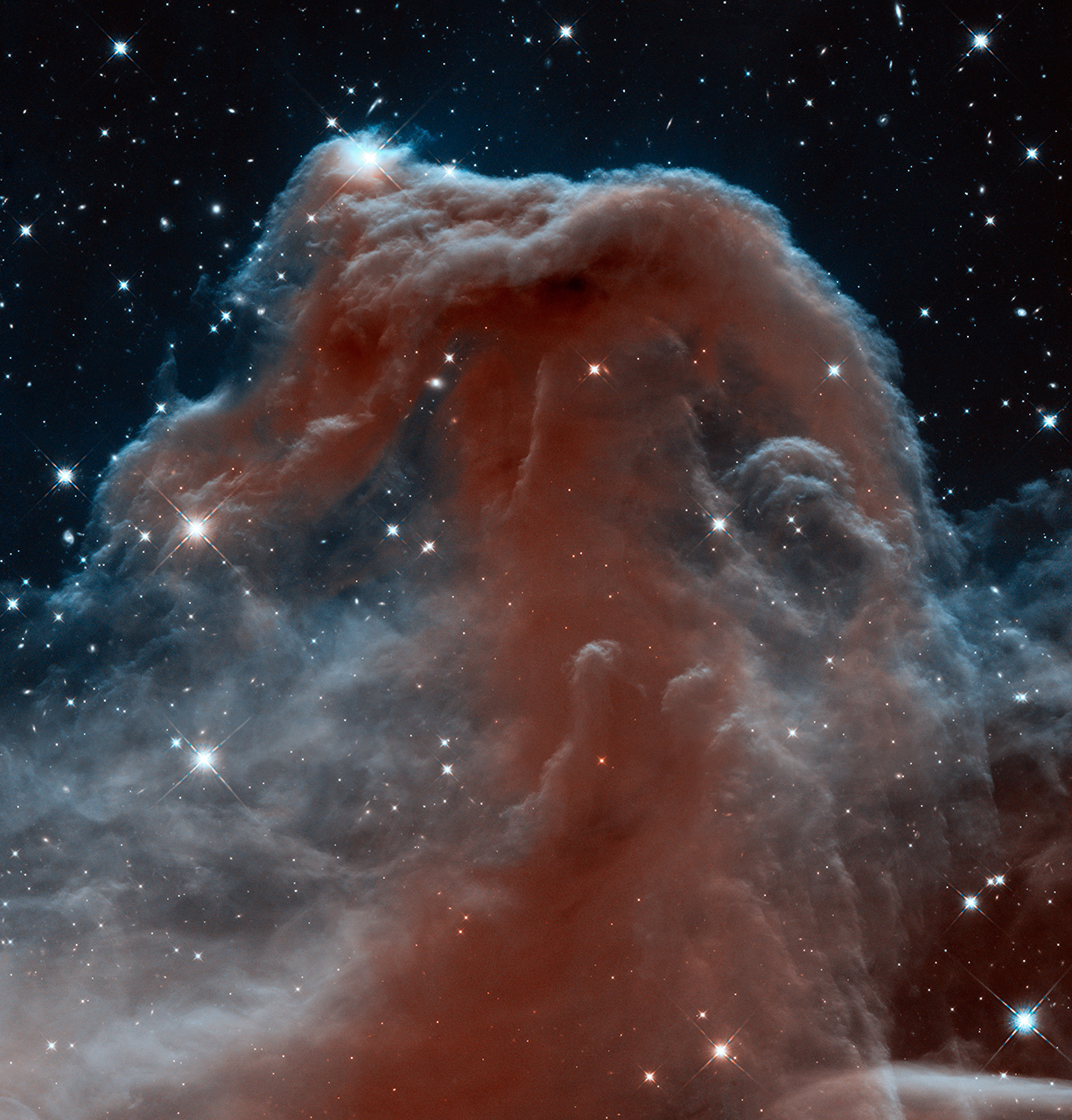
Star Factory Messier 17
Image Credit: Subaru Telescope (NAOJ), Hubble Space Telescope,
Color data: Wolfgang Promper, Processing: Robert Gendler
Image link: apod.nasa.gov/apod/image/1304/M17-HST-Subaru-LLL.jpg
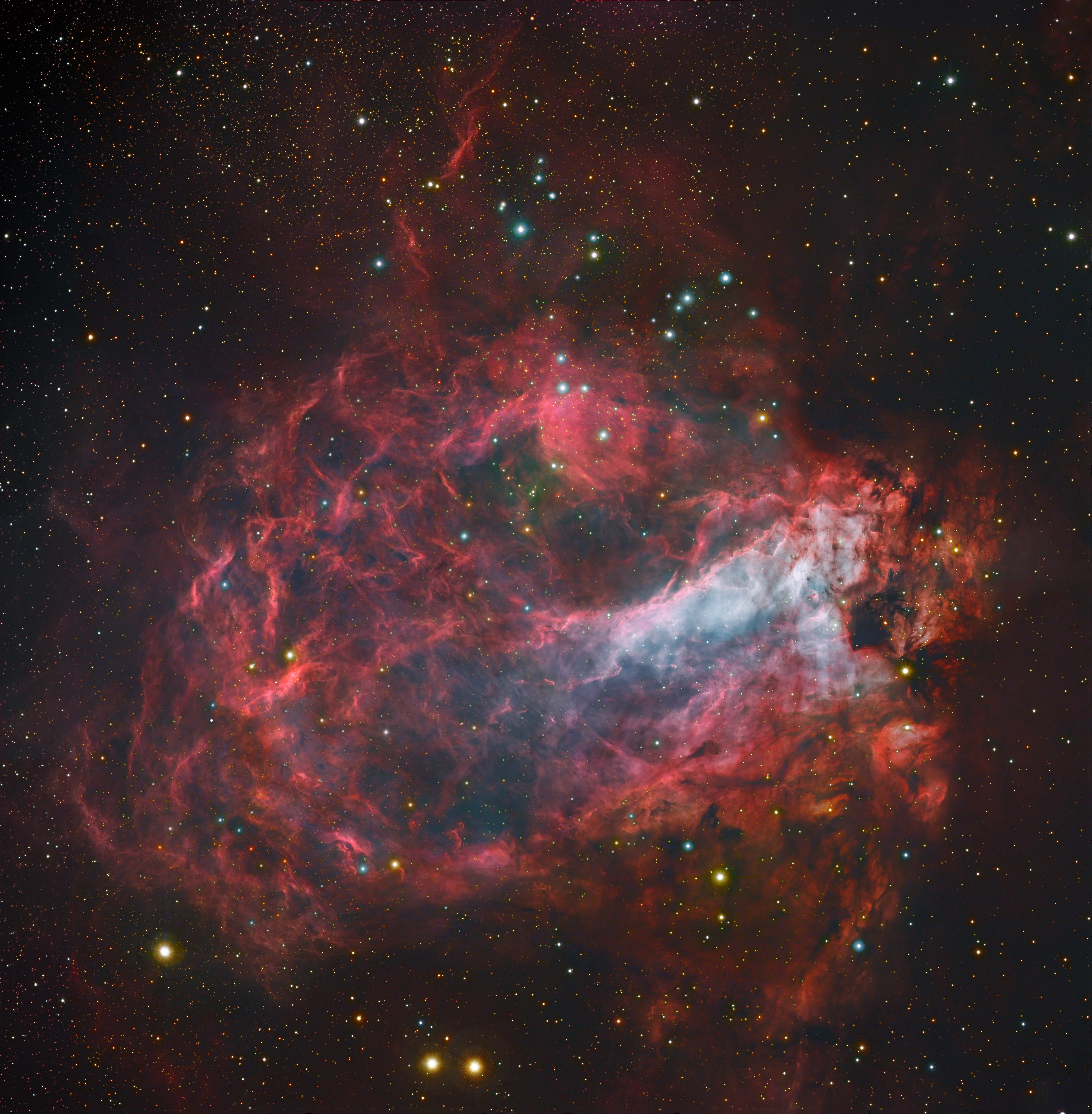
Infrared Portrait of the Large Magellanic Cloud
Credit: ESA / NASA / JPL-Caltech / STScI
Image link: apod.nasa.gov/apod/image/1303/PIA15254_LMC2048.jpg
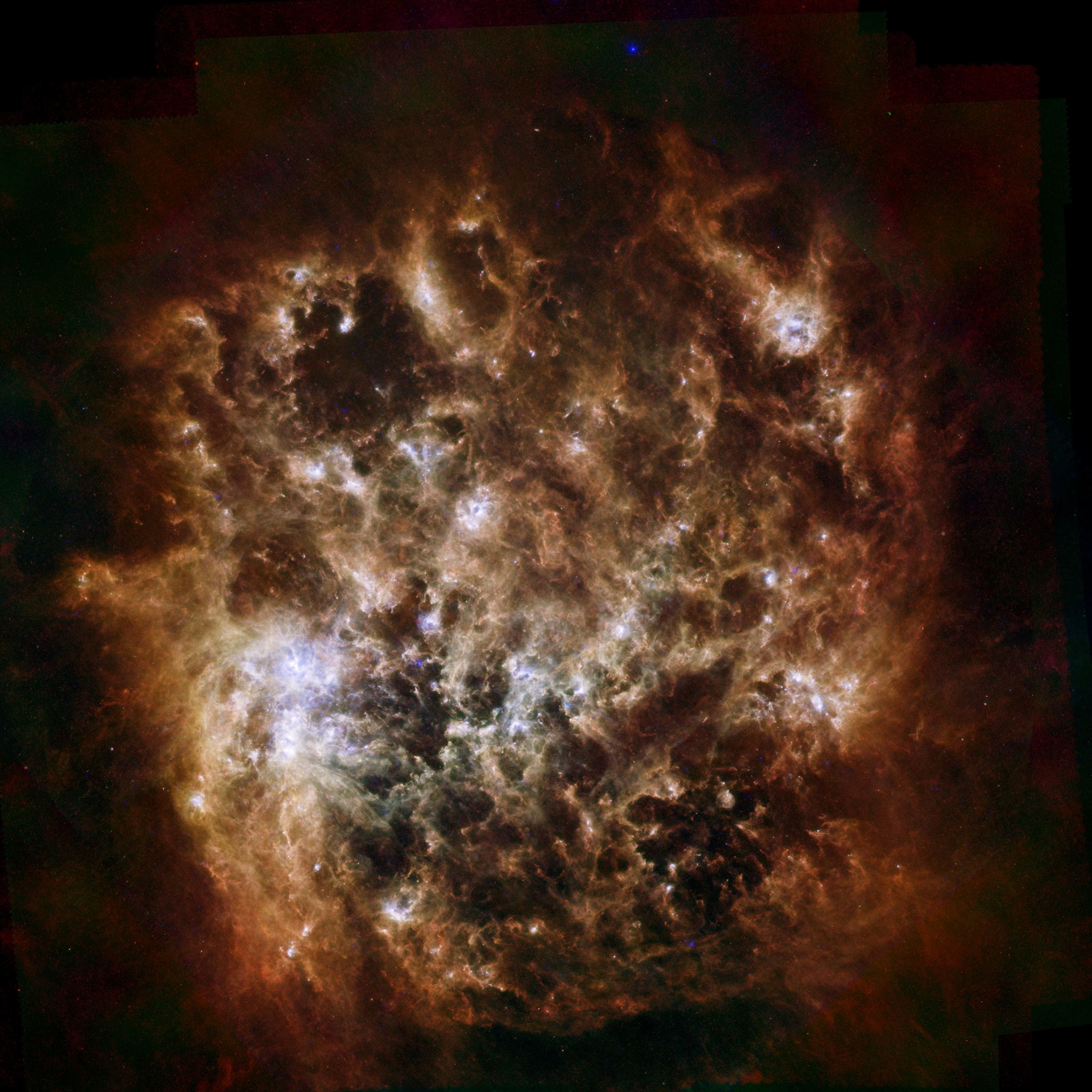
Light Echoes from V838 Mon
Image Credit: NASA, ESA, H. E. Bond (STScI)
Image link: apod.nasa.gov/apod/image/1303/v838_hubble_2238.jpg
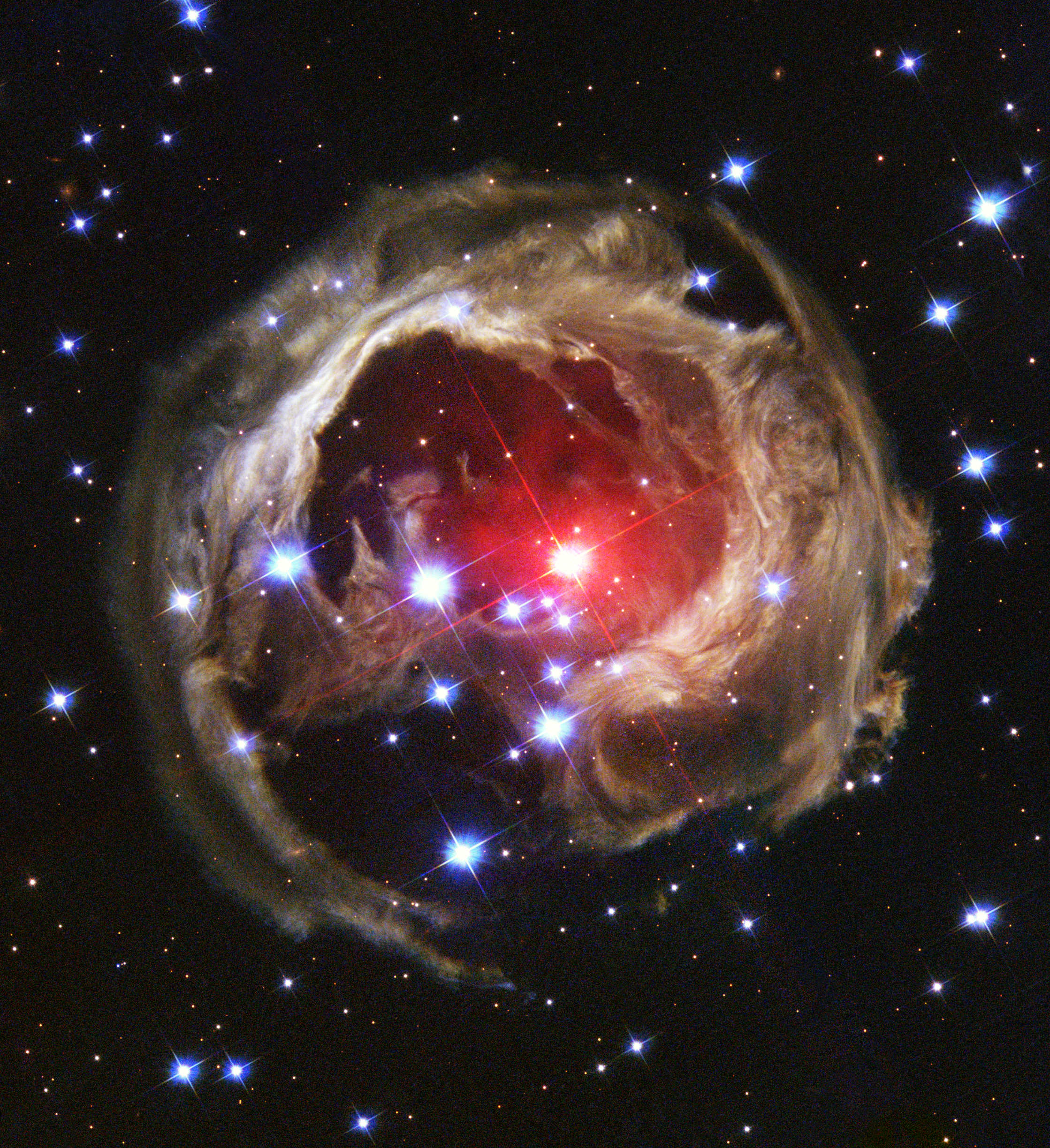
Looking Through Abell 68
Credit: NASA, ESA, Hubble Heritage/ESA-Hubble Collaboration - Acknowledgment: Nick Rose
Image link: apod.nasa.gov/apod/image/1303/abell68_hubble.jpg
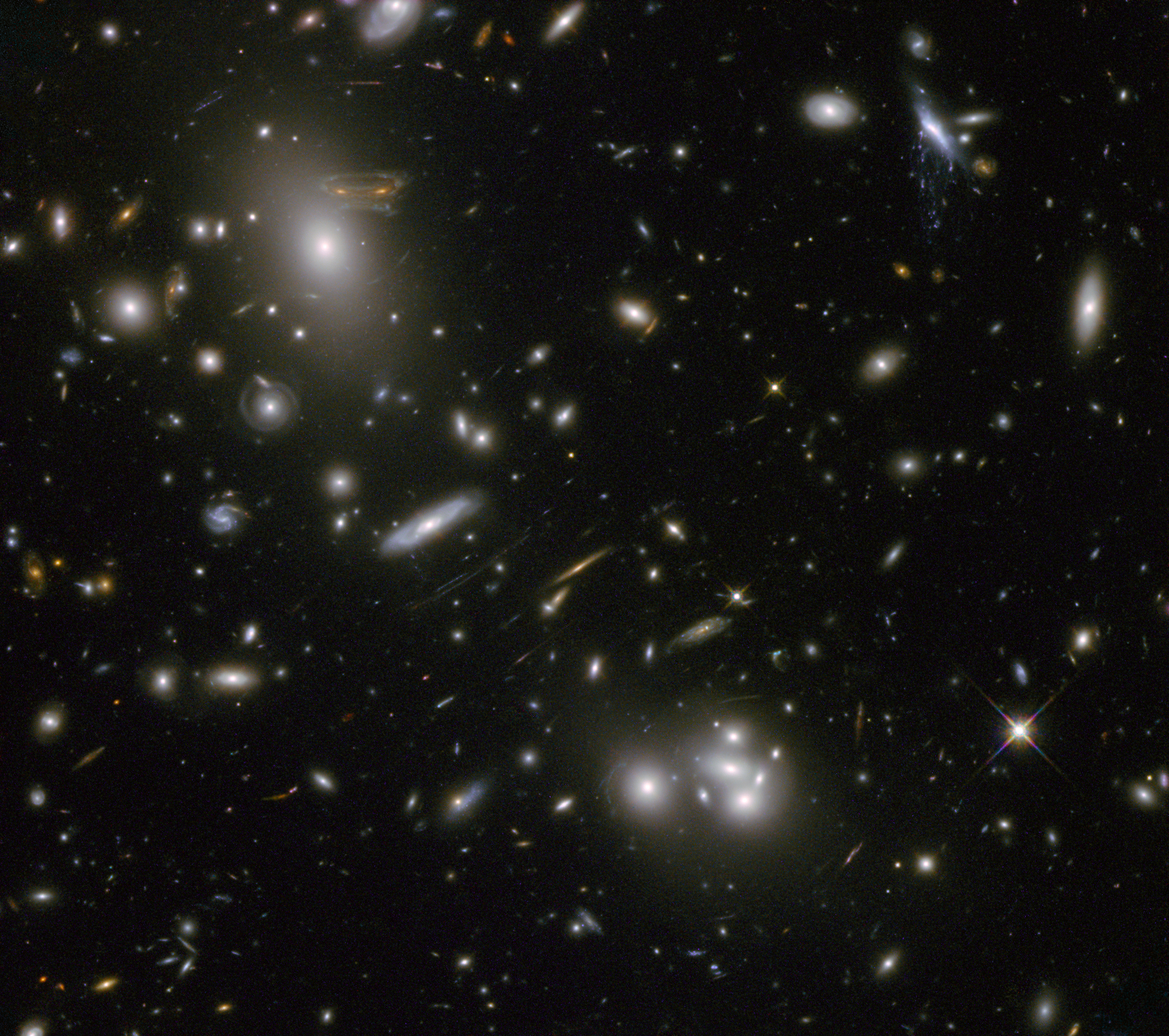
Infrared Orion from WISE
Image Credit: NASA, JPL-Caltech, UCLA
Image link: apod.nasa.gov/apod/image/1302/orion_wise_5401.jpg
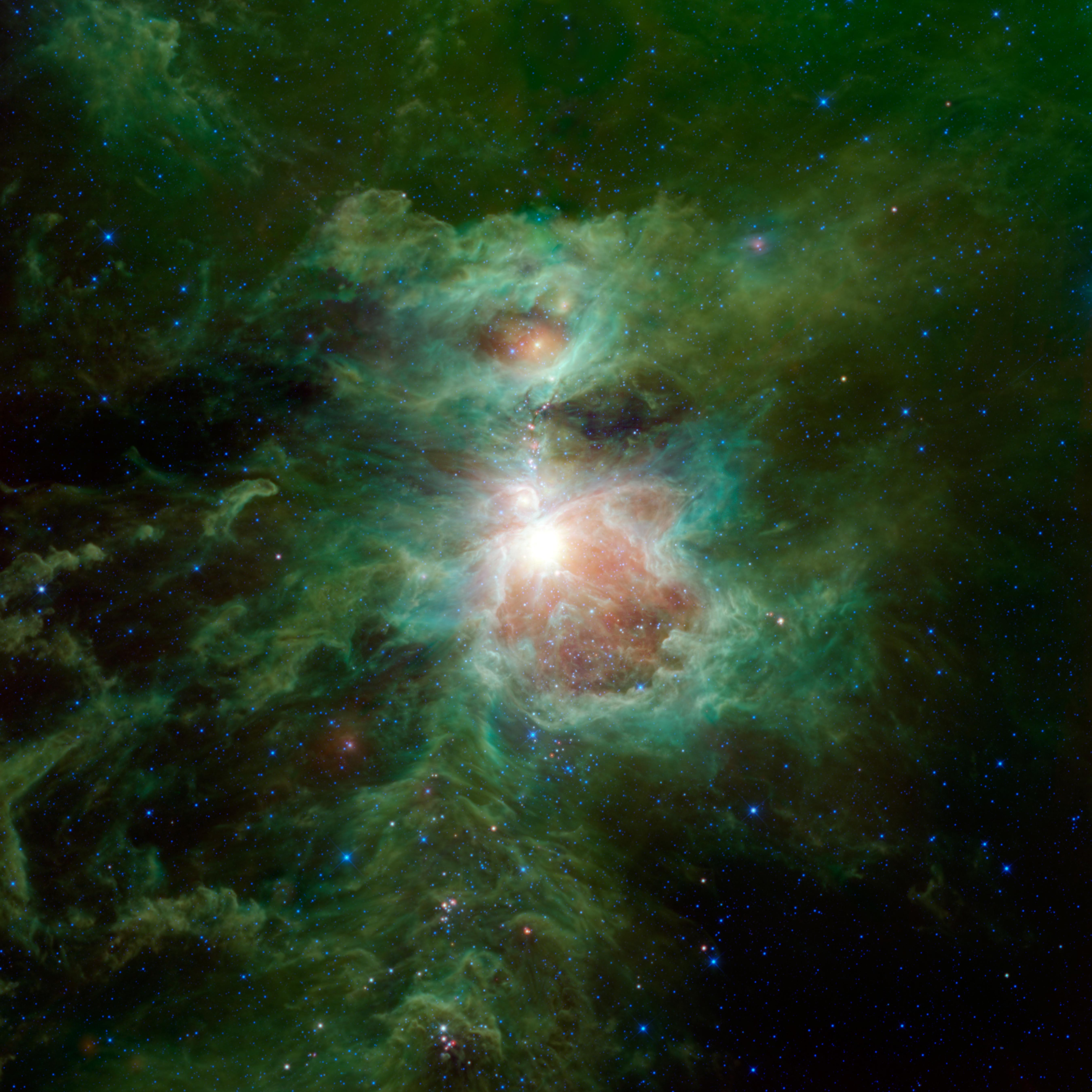
The Arms of M106
Credit: Image Data - Hubble Legacy Archive, Robert Gendler, Jay Gabany, Processing - Robert Gendler
Image linl: apod.nasa.gov/apod/image/1302/M106-HST-Lgendler.jpg

LL Ori and the Orion Nebula
Image Credit: NASA, ESA, and The Hubble Heritage Team
Image link: apod.nasa.gov/apod/image/1302/LLOri_hubble_4806.jpg

In the Center of the Trifid Nebula
Image Credit: Subaru Telescope (NAOJ), Hubble Space Telescope, Martin Pugh; Processing: Robert Gendler
Image link: apod.nasa.gov/apod/image/1301/trifid_gendler_2400.jpg
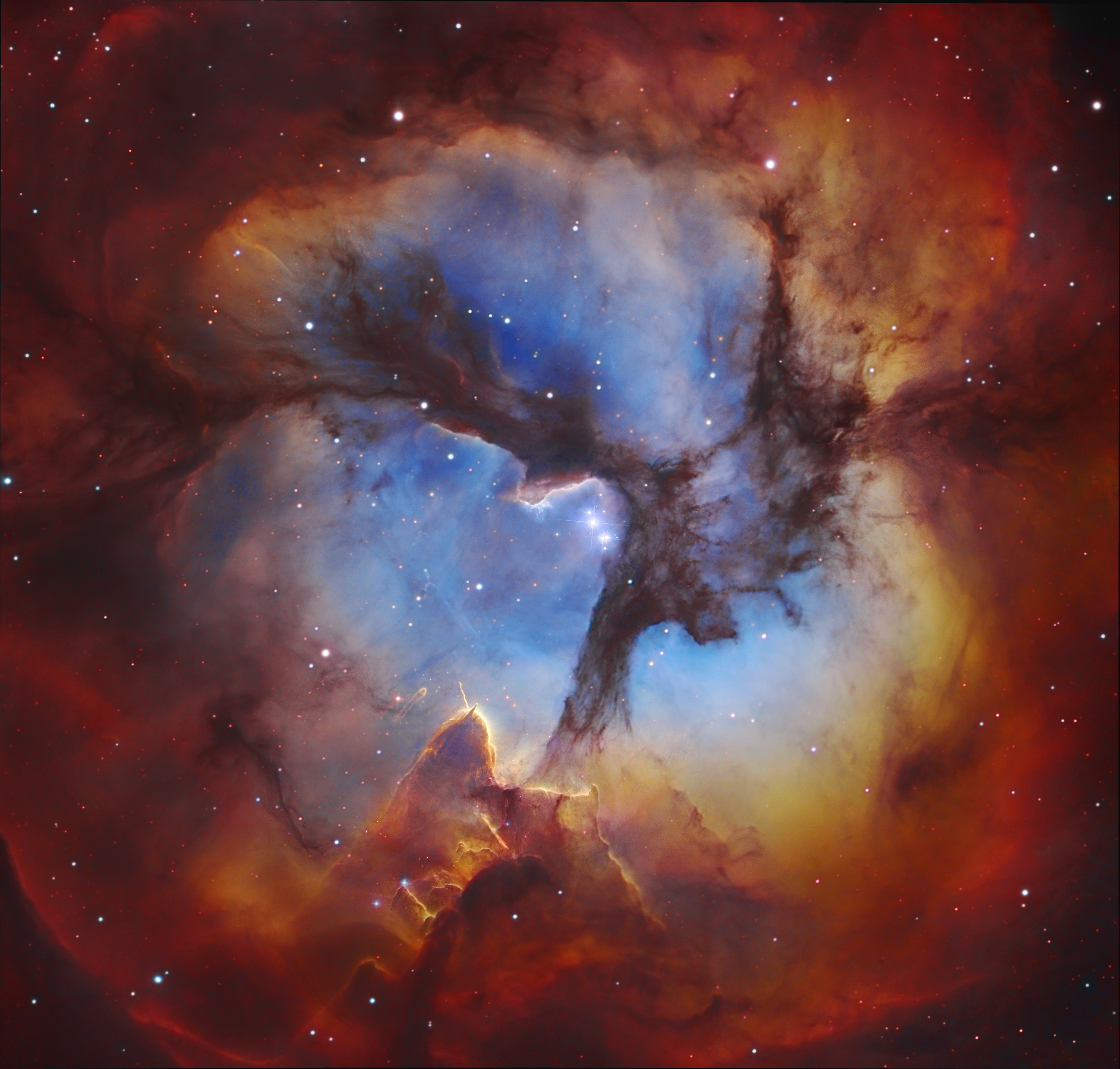
Light beam brush courtesy of: www.obsidiandawn.com
STROBIST: YN460-II flash through optic white umbrella at full power three feet behind model directly on back. fired through sync cables.
Patient Waiting
James Smith, 1842
"But if we hope for what we do not yet have, we wait for it patiently." Romans 8:25
The objects of our hope are all future, all good, and all promised. We expect them because God has promised them; on His word do we hope.
There is not an evil — but we hope to be one day rid of!
There is not a blessing — but we hope one day to enjoy it!
This present world is a land of hope.
Heaven is a land of fruition.
The highest object of our hope is perfect holiness, exact conformity to the Lord Jesus Christ — to be brought to such a state, that we shall glorify our God in every desire, thought, feeling, and action.
We hope for the period when we shall say:
farewell sickness — welcome perpetual health;
farewell sorrow — welcome everlasting joy;
farewell sin — welcome perfect purity;
farewell ignorance — welcome perfect knowledge;
farewell desertion — welcome the eternal, presence of my God;
farewell death — welcome everlasting life!
Do we hope for these things? Then let us patiently wait for them. Patience supposes trials, difficulties, and burdens — it is a grace of which we have much need on earth. "You have need of patience, that after you have done the will of God, you might receive the promise. For yet a little while, and He who shall come will come, and will not tarry." While the bridegroom tarries — the servants are tried; but those who are consistent will watch, expect, and wait.
The blessings we expect are worth waiting for, they are laid up for us in Heaven, as we have heard in the word of the truth of the gospel.
Faith believes the message respecting them,
hope longs to be put in possession,
love incites to grateful acknowledgments and holy walking,
ardent desire wants immediate enjoyment —
but patience is willing to wait. Her language is, "All the days of my appointed time I will wait, until my change comes."
Seasons of trouble seem long; but what are the longest seasons compared with eternity, an eternity of perfect blessedness? Let your lamps be trimmed, your lights burning, your loins girded, and you yourselves like unto men that wait for the bridegroom. Often ask, What am I waiting for? And think of an inheritance incorruptible and undefiled, and that fades not away. How am I waiting? Patiently, prayerfully, usefully, gratefully? If you rightly hope, you will patiently wait. Be content to finish your education before you are removed home. Believe that your Father is wiser than you are. You have never had an unnecessary trouble. As bad as things may seem, they would have been worse — but for the discipline used before they came.
"Tribulation works patience." Patient waiting insures an enlarged experience of Jehovah's love and goodness. Your present journey will lead you to a place of repose, "where the wicked cease from troubling, and the weary are at rest." Your troubles will end well, everlastingly well. Look therefore unto the Lord, wait for the God of your salvation; your God will hear you. "Let patience have her perfect work, that you may be perfect and entire, lacking nothing." James 1:4. Your God is the God of patience, who exercises, bestows, and approves of patience.
Father! Whatever of earthly bliss
Your sovereign will denies;
Accepted at the throne of grace,
Let this petition rise;
Give me a calm and thankful heart,
From every murmur free;
The blessings of your grace impart,
And make me live to Thee.
Let the sweet hope — that You are mine
My life and death attend;
Your presence through my journey shine,
And crown my journey's end!
Culture:Tlingit
Materials: Maple wood. Abalone shell. Paint
Place made: USA: Alaska
Location: Gallery of Northwest Coast Masterworks
Date Made: ca. 1800-1840
Date Acquired: 12 Apr 2018
How Acquired: Donated
Credit Line: Elspeth McConnell Collection
Measurements: Overall: 19.2 cm x 14.5 cm x 5 cm
Museum of Anthropology
University of British Columbia
About this object
History of use
Carved frontlets, or shakee.át among the Tlingit, are said to have originated on the northern Northwest Coast. They continue to be made and worn ceremonially as part of a Tlingit clan leader’s complete headdress – regalia to which the frontlet is sewn, and that includes a long train of white ermine skins as well as a crown or circlet of upright sea-lion whiskers and flicker feathers into which eagle down is placed, to be shaken out during dancing.
Narrative
Displayed in the "Box of Daylight" exhibition at the Seattle Art Museum in 1983. Previously part of the Ziff family collection. The blue-green paint is made of a native green-earth pigment highly valued by artists of the northern coast.
The painter would have ground the pigment and mixed it with water before applying it with his brush.
The combination of blue-green paint, Chinese red vermilion – introduced in the late 1700s by fur traders – and abalone shell traded north from California helped to proclaim the wearer’s status and treasured at.óow (clan crests, names, land, and more) that this regalia was made to display.
Physical description
Rectangular carved frontlet with Thunderbird or other bird-being in relief; abalone inlay along both sides and across top, and used for accents on animal features. The bird has a recurved beak going into lower lip.
Below the face are red human-like arms and hands with palms out, fingers upward, with abalone on each palm.
The bird's mouth is open, showing a row of abalone teeth behind wooden incisors and red painted lips.
The eyes are circles of abalone, under arched black brows. This supernatural being shares space with a small orca, whose dorsal fin rises upward and pectoral fins downward.
Painted red, green-blue, and black. The rear of the frontlet is concave. Illegible hand writing on back surface.
Museum photos: collection-online.moa.ubc.ca/search/item?keywords=Frontle...
🔍 Additional Insight:
The positioning of the upraised red hands with abalone inlays may reference the Tlingit "watchman" motif — figures who serve as spiritual guardians, witnesses, or protectors, often placed high on totem poles or architectural elements. In the context of this frontlet, the raised hands could be interpreted as a gesture of invocation, defense, or ceremonial address, emphasizing the chief’s role as both a guardian and an intermediary between worlds.
This symbolic hand gesture also evokes the visual language of transformation and spiritual power — with human-animal hybridity (bird above, orca below) framing the central figure. The merging of Thunderbird and Killer Whale isn't just decorative; it's a statement of inherited crest rights that link sky, sea, and the chiefly line’s supernatural authority.
🔧 Speculative but Plausible (Ethnographically Informed):
This frontlet may have belonged to a Raven moiety clan with rights to both Thunderbird and Killer Whale (keet) crests — a pairing rare but not unknown among southern Tlingit groups and Haida families through intermarriage. The Thunderbird–Orca combination suggests dominion over weather and sea mammals, echoing stories in which Thunderbird controls storms and preys on whales — stories claimed by clans in places like Yakutat, Sitka, or Cape Fox.
If this piece came from such a lineage, the dancer wearing it would have been enacting a mythic origin story in which human hands mediate between supernatural power (Thunderbird above) and oceanic wealth (Killer Whale below).
🔶 “Human hands mediate between supernatural power (Thunderbird above) and oceanic wealth (Killer Whale below).”
This phrasing reflects the vertical layering of the frontlet:
Above: Thunderbird — a celestial, lightning-bringing being of immense power, often associated with sky, weather, transformation, and spiritual might. Thunderbird is capable of summoning storms and striking down whales with lightning.
Below: Killer Whale (Keet) — emblem of ocean wealth, danger, abundance, and deep ancestral ties to the sea. In Tlingit tradition, some clans trace descent from Killer Whale ancestors or transformations.
Center: Human-like hands — these symbolize the embodied clan representative (the dancer), and by extension, the human realm — the only space where spiritual forces can be ritually negotiated, displayed, or balanced through proper protocol.
🔹 How does the mediation take place?
Mediation occurs through ritual enactment, primarily during potlatches, funerals, and memorials. The frontlet is not just decorative — it is a legal and spiritual instrument. Its power is activated when:
The dancer dons the headdress, fully suited with ermine train, sea lion whiskers, and eagle down.
The dance begins — the wearer moves in a prescribed way, often to a song that recounts the clan’s origin or a myth involving Thunderbird and/or Killer Whale.
The audience of clan members and opposing moiety witnesses — this includes high-ranking guests — recognize the display as a renewal of claims: to crests, to stories, to land, to authority.
Through this process, the dancer becomes a conduit: grounding supernatural origins in the present and performing the right to be their human spokesperson.
🔹 Where is the supernatural power situated?
In Haida and Tlingit thought:
Thunderbird resides in the upper world — the celestial realm, home to sky beings and transformative energies.
Killer Whale comes from the lower world — the ocean deeps, full of wealth (in food, crest animals, trade), but also danger and memory.
The human world is the middle realm — the only place where these forces can be acknowledged, claimed, and made meaningful through action.
Thus, the supernatural power is external — in the sky and sea — but also internalized and held within the clan and its regalia.
🔹 What is the purpose of the mediation?
To assert clan identity and rights: The dancer, and by extension the clan, is declaring ownership of powerful ancestral relationships.
To maintain cosmic balance: Tlingit ceremonialism often aims at harmony between moieties, living and dead, humans and spirit-beings.
To make memory public: These events reenact and reaffirm shared history, solidifying intergenerational continuity.
🔹 To whom is this mediation most important?
The host clan, especially its leaders and heirs, who are asserting their status.
The opposing moiety, who serve as witnesses, validating the event’s legitimacy.
The spirit world, which must be properly honored — failure to do so can bring illness or misfortune.
The community at large, because such performances reaffirm the moral and social order.
🔹 Does the group know the outcome of the mediation?
Yes — and the outcome is not open-ended. It is:
Validated publicly through the presence and acknowledgment of high-status witnesses from the opposite moiety.
Reaffirmed through proper ritual conduct — dancing, oratory, gift-giving, and regalia display must meet exacting standards.
Remembered collectively: oral historians and clan elders keep track of such events; they enter into the social memory of the people.
If a ceremony is done correctly, it renews prestige, spiritual alignment, and social equilibrium. If it is done sloppily or without proper authorization, it can cause lasting harm — insult, spiritual imbalance, or even litigation in a tribal court.
Historical Fiction
Here is a short, historically grounded fictional rendering from the point of view of a respected elder and witness, attending a potlatch in the mid-19th century near Sitka. The language honors Tlingit ceremonial tone, while remaining accessible:
We Watched the Hands Rise
As told by Shgóon x̱ʼéin, Elder of the Ganax̱teidí clan (Raven moiety)
The fire was low, but the faces glowed. The carved house posts leaned in like old men listening. And when the drums began, we saw him — the young man, the heir, step forward into the light.
He wore the ermine train, the sea lion whiskers swayed, and his crown shook eagle down into the air, soft like the first snow on canoe planks. But it was the frontlet that held our eyes — and those red-painted hands, raised just so, abalone in the palms catching firelight like morning dew on the beach stones.
Above the hands, the Thunderbird loomed, beak arched, eyes alight — the stormbringer, the sky-walker. Below, the keet, the whale who remembers. And between them, the hands: our hands, the human ones. Not claws, not wings, not fins — but fingers made for feeding fires, cradling children, cutting cedar.
In those moments, the dancer was not himself. He was the meeting place — where clan and spirit, sea and sky, past and now, all found their shape again.
We, the Raven side, bore witness. We saw the story retold in every step, each tilt of the head, each pulse of the drum. The old ones nodded. The young ones watched wide-eyed. It was done well — no shame, no error. The supernatural favor was felt, even the children hushed.
Later, we would feast. Gifts would change hands. Names would be spoken aloud for the first time in years. But it was here, in this dance, that it happened: the world held its breath and remembered itself.
This text is a collaboration with Chat GPT.
Some asteroids from within our Solar System have photobombed deep images of the Universe taken by the NASA/ESA Hubble Space Telescope. These asteroids reside, on average, only about 260 million kilometres from Earth — right around the corner in astronomical terms. Yet they've horned their way into this picture of thousands of galaxies scattered across space and time at inconceivably farther distances.
More information: spacetelescope.org/images/opo1733a/
Credit:
NASA, ESA, and B. Sunnquist and J. Mack (STScI)
Acknowledgment: NASA, ESA, and J. Lotz (STScI) and the HFF Team
(c) 2016 Ferran-Art
My pics are under copyright and they may not be used without my acknowledgment. I don't have any problem to share them, but... PLEASE in case you need any of them feel free to contact with through my blogspot - ferran-art-barcelona.blogspot.com.es/ - or my own email.
As the years go by in a long term relationship, it can be difficult to communicate as if your in love. I know you are still in love but the ego, always wanting to be heard, can easily rear it's ugly head and make it so hard to be centered. Communication on a balanced level is one of the most important factors in keeping a relationship long term. It's all too simple to get caught up in your world...one where it seems as if everything is going wrong and no one understands. Maybe your significant other doesn't fully understand, but expressing your ability to let them in and keep them in creates bonding.
When typical fights break out what do you really hear? It's not just complaints about who left the toilet seat down, dirty socks left around the house or who didn't take out the garbage. What you will hear behind those words is a cry for attention. "Listen to me...I still matter. I'm still me." When you realize the intention of most relationship arguments, it's easy to take a step back and include your lover in your communication. In a long term relationship, you can lose your identity very quickly. When both lovers say "I hear you" the balance of communication takes place.
Listening is the most important part of communication. But beyond just listening, an acknowledgment has to take place. The person you love so dear is crying for attention, not just from you...remember you are the one who pays the most attention to her, but from the world. Bonding the strength of a long term commitment means to create a team. One that sets you apart from the rest of the world. One that tells your lover that you are not only "there for them," but there for each other. We need to know that are partner has our back, understands the things we feel and knows wholeheartedly that we are an inseparable team.
It's easy to get up in the little things. Seeing the big picture takes a little more discipline. But the payoff is huge! Can you hear the words of your partner and what they are really saying? Of course you can...that's why you love them.
ARTISTIC LICENSE - n. The God-given right to make any aesthetic improvements to one's self image as deemed necessary, including use of the spot healing brush and the eraser tool. The clone tool is a necessity and goes without special acknowledgment or need for apology.
*****So that's the plan. I am going to put together a DICTIONARY OF DIGITAL HUMORESQUE. I know that I will have fun doing it whether anyone else gets the point or not.
Thank you Ghostbones for your splattery golden texture. Love it!
FOOTNOTE: Yes, this is me...like 18 years ago...oh, heavens....not today. I just picked one of my black and white photos that I could play with that provided enough white area to texture. Your comments are so dear...they make me laugh...smile...chuckle...guffaw...chortle!
NGC 1097 with stellar streams
Credit: DESI LIS, Giuseppe Donatiello
This finely detailed image shows NGC 1097, a barred spiral galaxy that lies about 48 million light-years from Earth in Fornax.
The galaxy contains a super massive black hole surrounded by a ring with numerous areas of star formation.
The galaxy contains four optical stellar streams (one of which is extremely faint) that seem to fall in.
There are two satellite galaxies NGC 1097 A and B.
New Edit
Acknowledgments
The Dark Energy Spectroscopic Instrument (DESI) data are licensed under the Creative Commons Attribution 4.0 International License (“CC BY 4.0”, Summary, Full Legal Code). Users are free to share, copy, redistribute, adapt, transform and build upon the DESI data available through this website for any purpose, including commercially.
This image used data obtained with the Dark Energy Spectroscopic Instrument (DESI). DESI construction and operations is managed by the Lawrence Berkeley National Laboratory. This material is based upon work supported by the U.S. Department of Energy, Office of Science, Office of High-Energy Physics, under Contract No. DE–AC02–05CH11231, and by the National Energy Research Scientific Computing Center, a DOE Office of Science User Facility under the same contract. Additional support for DESI was provided by the U.S. National Science Foundation (NSF), Division of Astronomical Sciences under Contract No. AST-0950945 to the NSF’s National Optical-Infrared Astronomy Research Laboratory; the Science and Technology Facilities Council of the United Kingdom; the Gordon and Betty Moore Foundation; the Heising-Simons Foundation; the French Alternative Energies and Atomic Energy Commission (CEA); the National Council of Science and Technology of Mexico (CONACYT); the Ministry of Science and Innovation of Spain (MICINN), and by the DESI Member Institutions: www.desi.lbl.gov/collaborating-institutions. The DESI collaboration is honored to be permitted to conduct scientific research on Iolkam Du’ag (Kitt Peak), a mountain with particular significance to the Tohono O’odham Nation. Any opinions, findings, and conclusions or recommendations expressed in this material are those of the author(s) and do not necessarily reflect the views of the U.S. National Science Foundation, the U.S. Department of Energy, or any of the listed funding agencies.
The Pixar logo rendered in Lego. Please excuse the poor editing! Based off of the picture shown here: www.google.com/imgres?imgurl=http://bandbent.files.wordpr...

Pixar Animation Studios, also known as simply Pixar (stylised as PIXAR), is an American computer animation film studio based in Emeryville, California, United States. The studio has earned 26 Academy Awards, seven Golden Globes, and three Grammy Awards, among many other awards and acknowledgments. Its films have made over $6.3 billion worldwide. It is best known for its CGI-animated feature films created with PhotoRealistic RenderMan, its own implementation of the industry-standard RenderMan image-rendering application programming interface used to generate high-quality images.
The galaxy UGCA 193, seen here by the NASA/ESA Hubble Space Telescope, is a galaxy in the constellation of Sextans (the Sextant). Looking rather like a waterfall, UGCA 193 appears to host many young stars, especially in the lower portion of this view, creating a striking blue haze and the sense that the stars are falling from “above.”
The blue color of UGCA 193 indicates the stars that we see are hot — some more than six times hotter than our Sun. We know that cooler stars appear to our eyes as redder, and hotter stars appear bluer. A star’s surface temperature and color are also linked to its mass, with heavier stars “burning” at higher temperatures, resulting in a blue glow from their surfaces.
Text credit: European Space Agency (ESA)
Image credit: ESA/Hubble & NASA, R. Tully; Acknowledgment: Gagandeep Anand
For more information: www.nasa.gov/image-feature/goddard/2020/hubble-catches-a-...
Portland's Tip Top Cleaners has gone to the great Main Street in the sky, but its iconic sign remains. The space where generations of Portlanders dropped off laundry and picked up dry cleaning is now occupied by a mini vintage mall.
One of the 12 vendors sells rugs, including the Afghan war rugs seen here. In my opinion, they're priced to take you to the cleaners. In any case, it was my first exposure to this genre. I went in search of answers to the many questions these rugs provoked. My quest was successful.
Before going into that, here is information about the dates on the rug. No explanation is needed for the first date, 9/11/01. If the date weren't self explanatory, the images of the twin towers would be. (How long will it be until they, too, require an explanation?)
Next is 11:9:01. Since next date on the rug, 19=8=03, appears in the European format of day/month/year, it's not clear whether this date in 2001 meant to be November 9 or September 11. We know what happened on September 11, 2001. It has already appeared on the rug.
What about November 9? Well, nothing of note relating to the US in Afghanistan occurred in 2001, so the date 11:9:01 must be a duplicate of 9/11/01. The word "Toraboba" on the map of Afghanistan no doubt refers to the Battle of Tora Bora of December, 2001.
The next date is August 19, 2003. It is significant as the date of the Canal Hotel Bombing:
The Canal Hotel bombing was a suicide truck bombing in Baghdad, Iraq, in the afternoon of August 19, 2003. It killed 22 people, including the United Nations' Special Representative in Iraq Sérgio Vieira de Mello, and wounded over 100, including human rights lawyer and political activist Dr. Amin Mekki Medani. The blast targeted the United Nations Assistance Mission in Iraq created just five days earlier.
en.wikipedia.org/wiki/Canal_Hotel_bombing
========================================================
Now, onto the meaning of Afghan war rugs:
"Ultimately, Afghan war rugs are produced for the market. It’s that simple."
The real story behind Afghanistan’s war rugs
The war rugs are distinctive and dynamic, but they’re often wildly misunderstood.
By Jamal J. Elias
Fast Company
9 September 2021
The end of the U.S.-led military intervention in Afghanistan has resulted in the withdrawal of most foreign aid workers and contractors.
It may well also spell the demise of the country’s war rug industry.
As a specialist in the visual and material culture of the Islamic world, I first became aware of war rugs when I was working on a book on truck decoration in Pakistan and Afghanistan in the 1990s.
Since that time, I’ve followed changes in this industry and cultivated relationships with Pakistani and Afghan rug sellers.
War rugs – with symbols of war – are distinctive and dynamic in their styles. But they’re often misunderstood by buyers, journalists and curators.
The growth of the war rug market
There is no evidence of the existence of Afghan war rugs prior to the late-20th century.
The earliest rugs seem to have emerged shortly after the Soviet invasion of Afghanistan in 1979 from refugee camps in Pakistan, where millions of Afghans had relocated.
Featuring guns, helicopters and tanks, they were small and shoddily made with coarse wool. Rug sellers and souvenir shops pitched them to workers for non-government organizations and Western government officials.
The designs have become more sophisticated over the years.
English words were added, intentionally or accidentally garbled with Cyrillic words and letters to evoke a Soviet connection.
After 9/11, fixed patterns started to emerge – a sign that weavers were adhering to templates provided by rug merchants.
The images made it clear that they were hoping to primarily appeal to an American souvenir market.
One popular design commemorates the 9/11 attacks, pointing out that it was not Afghans who were responsible, but terrorists from other countries.
Another depicts a map of Afghanistan, professing Afghanistan’s friendship with the U.S. with text and images. It has the misspelled word “terrarism” written on the region of the country associated with the Taliban.
The writing on some rugs declares that they’re made in Sheberghan, a city in northern Afghanistan famous for its Turkmen weavers.
It’s unlikely that they’re all made there. However, whether they’re made in northern Afghanistan or in Afghan settlements in Pakistan, the word “Shebergan,” written in English, is supposed to signal that these rugs are authentically Afghan.
Such rugs are readily available on eBay and were – until recently – sold by souvenir sellers in Kabul and Mazar-i-Sharif, Afghanistan’s cities with the largest number of foreign workers and tourists.
With the Taliban’s return to power, it remains unclear what the future of rug making and its market will be.
Over the years, war motifs have found their way into higher-quality, larger carpets, with small tanks appearing where rows of medallions might traditionally have been. Other rugs feature a more comprehensive integration of modern and traditional patterns.
While these larger carpets take substantially more time to make and cost more money than the far more common smaller, coarser rugs, they nevertheless don’t meet the standards of fine carpets, which suggests they’re geared more to souvenir collectors than those seeking luxury home furnishings.
Misreading the meaning of the rugs
Over the past 20 years, Afghan war rugs have garnered considerable attention.
Books in German and English describe, catalog and contextualize them. Magazines and major newspapers have run features on them, and university art galleries have exhibited them.
Within the coverage, there’s a tendency to see war rugs as a reflection of the emotional lives of the weavers, who, wracked by war and violence, felt compelled to incorporate these motifs into their designs.
Articles and exhibits often ignore the reality that rug brokers and dealers – not weavers – are the ones who are attuned to fickle market tastes.
Studies on labor in the rug industry note that they’re normally the ones who supply weavers with new patterns, color schemes and yarn. I’ve seen the same dynamic in my own long-term observations.
Yet you’ll still see exhibit curators describe war rugs as combining “ancient practice with the latest in the daily lives of the weavers,” or as windows into the perspectives of everyday Afghans – the “underdogs” in a country subsumed by strife.
In 2014, The New York Times reported that weavers had incorporated “the grim realities of life in a war zone into their traditional craft.”
Six years earlier, Smithsonian Magazine buried a brief acknowledgment that the rugs are for tourists under claims – with scant evidence – that the earliest war rugs were intended for Afghan buyers who resented the Soviet invasion. Later, the writer notes that female weavers drew from their own lives when they incorporated symbols of violence.
The appeal of the trauma market
With so much evidence showing that Afghan war rugs are produced in response to market demand, why do claims that they’re based on the weavers’ experiences of war persist?
Part of the answer lies in the global market for handicrafts. Buyers want to feel like they’re purchasing artisanal products when, in reality, they’re sold by the thousands in chain stores and through online storefronts such as Ten Thousand Villages or Etsy.
Implying that rugs are a source of income for traumatized and destitute Afghan women ignores the reality that the overwhelming majority of profits go to middlemen and dealers.
A work-from-home model encourages workers to devote all available time to rug production. It also encourages child labor: Children are either tasked with making the crude rugs or are forced to take up the responsibilities of adults.
The appeal of war rugs – and the insistence that their designs represent a victim’s experience of war – seems to reflect a vicarious desire to peer into the emotional experience of Afghan civilians.
In reality, though, this gives primacy not to the actual experiences of Afghans, but to the viewers’ and customers’ ideas of victimhood.
The granular realities of the loss of home and animals, family deaths or food insecurity aren’t represented in the rugs. Nor should we assume weavers would wish to put their own traumas on display for the world.
Modern rugs are not venues for self-expression, and the designs tend to contain an index of symbols that reflect an outsider’s understanding of war: AK-47s, 9/11, security politics and drones.
Nowhere in the rugs do we see the well-documented psychological and health impacts on Afghanistan’s population caused by decades of deprivation and violence.
Real trauma is not only hard to turn into a commodity, it is also hard to live with – even in souvenirs.
www.fastcompany.com/90678962/the-real-story-behind-afghan...
Jamal J. Elias is the Walter H. Annenberg Professor of the Humanities and Professor of Religious Studies at the University of Pennsylvania. This article is republished from The Conversation under a Creative Commons license. Read the original article.
Best viewed large on black, pressing "L" will do the trick
Real life isn't always going to be perfect or go our way, but the recurring acknowledgment of what is working in our lives can help us not only to survive but surmount our difficulties.
~Sarah Ban Breathnach
Observed with the NASA/ESA Hubble Space Telescope, the faint galaxy featured in this image is known as UGC 12588. Unlike many spiral galaxies, UGC 12588 displays neither a bar of stars across its center nor the classic prominent spiral arm pattern. Instead, to a viewer, its circular, white and mostly unstructured center makes this galaxy more reminiscent of a cinnamon bun than a megastructure of stars and gas in space.
Lying in the constellation of Andromeda in the Northern Hemisphere, this galaxy is classified as a spiral galaxy. Unlike the classic image of a spiral galaxy, however, the huge arms of stars and gas in UGC 12588 are very faint, undistinguished, and tightly wound around its center. The clearest view of the spiral arms comes from the bluer stars sprinkled around the edges of the galaxy that highlight the regions where new star formation is most likely taking place.
Text credit: European Space Agency
Image credit: ESA/Hubble & NASA, R. Tully; Acknowledgment: Gagandeep Anand
For more information: www.nasa.gov/image-feature/goddard/2020/hubble-captures-c...
Part of Victoria Park in the town of Truro Nova Scotia, developed by the citizens of Truro in 1903 as a memorial to the late Susan Lynds, daughter of Dr.John Waddell, in acknowledgment of her gift of 25 acres of land including this waterfall, to the town of Truro. The Park now consists of over 1000 acres and many miles of hiking trails. This gorgeous little river has three waterfalls and there are walkways which guide the visitor along the river.
BUT...since it is winter there were no signs and we had never been there since I was a kid..so we started on a runing trail, not the river trail, and we walked for an extra hour on pretty ,snowy icy trails till we found out where we should be from a passing hiker walking his dog...
The gesture Namaste represents the belief that there is a Divine spark within each of us that is located in the heart chakra. The gesture is an acknowledgment of the soul in one by the soul in another. "Nama" means bow, "as" means I, and "te" means you. Therefore, Namaste literally means "bow me you" or "I bow to you."
NASA's Hubble Space Telescope has photographed the dense galaxy cluster SDSS J1531+3414 in the northern constellation Corona Borealis. Made up primarily of giant elliptical galaxies with a few spirals and irregular galaxies thrown in for good measure, the cluster's powerful gravity warps the image of background galaxies into blue streaks and arcs.
At the center of the bull's-eye of blue, gravitationally lensed filaments lies a pair of elliptical galaxies that are also exhibiting some interesting features. A 100,000-light-year-long structure that looks like a string of pearls twisted into a corkscrew shape winds around the cores of the two massive galaxies. The "pearls" are superclusters of blazing, blue-white, newly born stars. These super star clusters are evenly spaced along the chain at separations of 3,000 light-years from one another.
Astronomers first hypothesized that the string of pearls was actually a lensed image of one of the background galaxies. Upon closer inspection, it was revealed that the two elliptical galaxies are in the process of interacting and are beginning to share material between themselves.
The underlying physics behind the "beads on a string" structure is related to describing the behavior of self-gravitating clumps of gas. It's analogous to the process where rain falls in drops rather than in continuous filaments from clouds. It's called the Jeans instability, and it can play out on distance scales of enormous orders of magnitude. The whole assembly must result from the gravitational tidal forces present in the galaxy collision.
The cluster was first cataloged in the Sloan Digital Sky Survey, hence the name, SDSS J1531+3414. The sharp view of Hubble was used to image the cluster in May of 2013. The Wide Field Camera 3 instrument imaged the cluster in visible and infrared filters.
Credit: NASA, ESA, G. Tremblay (ESO), M. Gladders and M. Florian (University of Chicago), S. Baum, C. O'Dea, K. Cooke (RIT), M. Bayliss (Harvard-Smithsonian Center for Astrophysics), H. Dahle (University of Oslo), T. Davis (ESO), J. Rigby (NASA/GSFC), K. Sharon (University of Michigan), E. Soto (Catholic University of America), and E. Wuyts (Max Planck Institute for Extraterrestrial Physics)
Acknowledgment: NASA, ESA, and the Hubble Heritage (STScI/AURA)-ESA/Hubble Collaboration
Rising from a sea of dust and gas like a giant seahorse, the Horsehead Nebula is one of the most photographed objects in the sky. The Hubble Space Telescope took a close-up look at this heavenly icon, revealing the cloud's intricate structure.
The Horsehead, also known as Barnard 33, is a cold, dark cloud of gas and dust, silhouetted against the bright nebula, IC 434. The bright area at the top left edge is a young star still embedded in its nursery of gas and dust. But radiation from this hot star is eroding the stellar nursery. The top of the nebula also is being sculpted by radiation from a massive star located out of Hubble's field of view.
Only by chance does the nebula roughly resemble the head of a horse. Its unusual shape was first discovered on a photographic plate in the late 1800s. Located in the constellation Orion, the Horsehead is a cousin of the famous pillars of dust and gas in the Eagle Nebula. Both tower-like nebulas are cocoons of young stars.
This popular celestial target was the clear winner among more than 5,000 Internet voters, who were asked in 2000 to select an astronomical target for the Hubble telescope to observe for its 11th anniversary. The voters included students, teachers, and professional and amateur astronomers.
For more information, visit: hubblesite.org/contents/news-releases/2001/news-2001-12.html
Credit: NASA, NOAO, ESA and The Hubble Heritage Team (STScI/AURA); Acknowledgment: K. Noll (Hubble Heritage PI/STScI), C. Luginbuhl (USNO), F. Hamilton (Hubble Heritage/STScI)
In 1959 Derek Chaplin accompanied BBC broadcaster Wynford Vaughan Thomas making a radio broadcast catching trains only from Cardiff to North Wales and calling in on both the embryonic Talyllyn and Ffestiniog railways. Subsequently, Derek made up a 35mm slide show called " Trains of Wales 1959" which he showed at railway societies. These 137 mainly Kodachrome slides have been found by his family preserved in a dry wooden storage box and I am privileged to scan them for people to see again. The notes on each slide are minimalist and with no actual dates so anybody who can add interesting information is appreciated.
Due to the recent unauthorized publication of my images in a magazine. newspaper and two published books without payment I have to now make this statement. I keep attending online Railway Soc events where speakers brazenly show my images without any acknowledgment of the photographer. Hence I have been forced to add a copyright sign in the corner.
This image is the copyright of © Peter Brabham; Any users, found to replicate, reproduce, circulate, distribute, download, manipulate or otherwise use my images without my written consent will be in breach of copyright laws. I will retrospectively claim £50 per print image if prior written authorization for publication has not been sought. Please contact me at pete.brabham@ntlworld.com for permission to use any of my FLICKR photographs in hard copy publication. I will usually give permission free of charge to Heritage Railways and steam loco restoration project advertising, but profit making magazines and book authors must pay a reproduction fee. Authors should know the provenance of high quality digital images that they use.