View allAll Photos Tagged Acknowledgment
[S188]
Due to the recent unauthorized publication of my images in a magazine. newspaper and two published books without payment I have to now make this statement. I keep attending online Railway Soc events where speakers brazenly show my images without any acknowledgment of the photographer or the fact they have just stolen them off my FLICKR site. Hence I have been forced to add a copyright sign in the corner.
This image is the copyright of copyright Peter Brabham or copyright Derek Chaplin family ; Any users, found to replicate, reproduce, circulate, distribute, download, manipulate or otherwise use my images without my written consent will be in breach of copyright laws. I will retrospectively claim £50 per print image if prior written authorization for publication has not been sought. Please contact me at pete.brabham@ntlworld.com for permission to use any of my FLICKR photographs in hard copy publication. I will usually give permission free of charge to Heritage Railways and steam loco restoration project advertising, but profit-making magazines and book authors must pay a reproduction fee. Authors should know the provenance of high quality digital images that they use.
Hair: TRUTH HAIR - Lola
Necklace: [LF] - Glam Necklace Silver
Dress: LeCastle - Frilly Dress / Maitreya / Slink / FATPACK
High Heels: aDiva - Precious Sandal Silver
Acknowledgment: I thank the owner of LeCastle store Frank Castlee for believing in my work, visit the LeCastle store.
Callicarpa bodinieri var. giraldini 'Profusion' (beauty berry, acc nr 50302-H, HG-AS), Asian Garden, National Herb Garden, US National Arboretum, Washington DC
land acknowledgment: unceded Nacotchtank land
Somehow, I saw this little guy in the grass right before my husband was about to cut it. I just had to save him. I grabbed a stick for him to climb on and moved him to a tree. And then he looked at me as to say "Thanks" and climbed away.
-Added to the Cream of the Crop pool as my best of 2009.
Traditionally, prayer flags are used to promote peace, compassion, strength, and wisdom. The flags do not carry prayers to gods, which is a common misconception; rather, the Tibetans believe the prayers and mantras will be blown by the wind to spread the good will and compassion into all pervading space. Therefore, prayer flags are thought to bring benefit to all.
The prayers of a flag become a permanent part of the universe as the images fade from exposure to the elements. Just as life moves on and is replaced by new life, Tibetans renew their hopes for the world by continually mounting new flags alongside the old. This act symbolizes a welcoming of life's changes and an acknowledgment that all beings are part of a greater ongoing cycle.
-from wikipedia
Wayang (Krama Javanese: Ringgit) is a Javanese word for particular kinds of theatre. When the term is used to refer to kinds of puppet theatre, sometimes the puppet itself is referred to as wayang. Performances of shadow puppet theatre are accompanied by a gamelan orchestra in Java, and by gender wayang in Bali.
UNESCO designated wayang kulit, a shadow puppet theatre and the best known of the Indonesian wayang, as a Masterpiece of Oral and Intangible Heritage of Humanity on 7 November 2003. In return for the acknowledgment, UNESCO required Indonesians to preserve their heritage.
Textured view of the Teton Range taken from the walk to Cunningham Cabin. I apologize but I can't remember who provided the texture. I know it was some kind soul on Flickr. If anyone recognizes the texture let me know and I will add the link and acknowledgment.
View the Entire - Photoshop-Before and After Set
View the entire Tetons - East and West Set
View the entire Textured Images Set
View my - Most Interesting according to Flickr
The Age of Consent project delves into the nuances of contemporary photography and the complex realm of consent within street photography. With a guiding principle of 'No face, no case,' the project navigates the intricate boundaries inherent in capturing candid moments. Acknowledgments: To Martin Parr and The Last Resort (1986) and the welcoming people of Ostend. All rights reserved 2023.
In 1959 Derek Chaplin accompanied BBC broadcaster Wynford Vaughan Thomas making a radio broadcast catching trains only from Cardiff to North Wales and calling in on both the embryonic Talyllyn and Ffestiniog railways. Subsequently, Derek made up a 35mm slide show called " Trains of Wales 1959" which he showed at railway societies. These 137 mainly Kodachrome slides have been found by his family preserved in a dry wooden storage box and I am privileged to scan them for people to see again. The notes on each slide are minimalist and with no actual dates so anybody who can add interesting information is appreciated.
Due to the recent unauthorized publication of my images in a magazine. newspaper and two published books without payment I have to now make this statement. I keep attending online Railway Soc events where speakers brazenly show my images without any acknowledgment of the photographer. Hence I have been forced to add a copyright sign in the corner.
This image is the copyright of © Peter Brabham; Any users, found to replicate, reproduce, circulate, distribute, download, manipulate or otherwise use my images without my written consent will be in breach of copyright laws. I will retrospectively claim £50 per print image if prior written authorization for publication has not been sought. Please contact me at pete.brabham@ntlworld.com for permission to use any of my FLICKR photographs in hard copy publication. I will usually give permission free of charge to Heritage Railways and steam loco restoration project advertising, but profit making magazines and book authors must pay a reproduction fee. Authors should know the provenance of high quality digital images that they use.
Life has its own rhythm—sometimes full of motion and noise, sometimes hushed and still. So often, we find ourselves chasing, striving for the next thing, convinced that happiness or fulfillment lies just beyond our reach. But what if we stopped running? What if we paused long enough to realize that what we’re searching for is already here?
It’s in those quieter moments that we begin to see what we have: the rustling of leaves, the gentle ripples of water, or the glow of light that surrounds us. These small, ordinary wonders remind us that beauty isn’t something we have to chase—it’s something that quietly exists, waiting to be noticed. Life isn’t about endlessly looking for what’s missing. Sometimes, it’s about recognizing what’s already present.
The contentment we seek isn’t in the next destination—it’s in pausing to appreciate what’s here, right now. By letting go of the search, we open ourselves to the magic of what we’ve already found. In these moments, life whispers to us—reminding us that we don’t need to look further.
What if the answers were here all along, just waiting for us to stop and see them?
Peering deep into the core of the Crab Nebula, this close-up image reveals the beating heart of one of the most historic and intensively studied remnants of a supernova, an exploding star. The inner region sends out clock-like pulses of radiation and tsunamis of charged particles embedded in magnetic fields.
The neutron star at the very center of the Crab Nebula has about the same mass as the sun but compressed into an incredibly dense sphere that is only a few miles across. Spinning 30 times a second, the neutron star shoots out detectable beams of energy that make it look like it's pulsating.
The NASA Hubble Space Telescope snapshot is centered on the region around the neutron star (the rightmost of the two bright stars near the center of this image) and the expanding, tattered, filamentary debris surrounding it. Hubble's sharp view captures the intricate details of glowing gas, shown in red, that forms a swirling medley of cavities and filaments. Inside this shell is a ghostly blue glow that is radiation given off by electrons spiraling at nearly the speed of light in the powerful magnetic field around the crushed stellar core.
The neutron star is a showcase for extreme physical processes and unimaginable cosmic violence. Bright wisps are moving outward from the neutron star at half the speed of light to form an expanding ring. It is thought that these wisps originate from a shock wave that turns the high-speed wind from the neutron star into extremely energetic particles.
When this "heartbeat" radiation signature was first discovered in 1968, astronomers realized they had discovered a new type of astronomical object. Now astronomers know it's the archetype of a class of supernova remnants called pulsars - or rapidly spinning neutron stars. These interstellar "lighthouse beacons" are invaluable for doing observational experiments on a variety of astronomical phenomena, including measuring gravity waves.
Observations of the Crab supernova were recorded by Chinese astronomers in 1054 A.D. The nebula, bright enough to be visible in amateur telescopes, is located 6,500 light-years away in the constellation Taurus.
Credits: NASA and ESA, Acknowledgment: J. Hester (ASU) and M. Weisskopf (NASA/MSFC)
NASA Goddard Space Flight Center enables NASA’s mission through four scientific endeavors: Earth Science, Heliophysics, Solar System Exploration, and Astrophysics. Goddard plays a leading role in NASA’s accomplishments by contributing compelling scientific knowledge to advance the Agency’s mission.
Follow us on Twitter
Like us on Facebook
Find us on Instagram
NASA image release October 19, 2010
Though the universe is chock full of spiral-shaped galaxies, no two look exactly the same. This face-on spiral galaxy, called NGC 3982, is striking for its rich tapestry of star birth, along with its winding arms. The arms are lined with pink star-forming regions of glowing hydrogen, newborn blue star clusters, and obscuring dust lanes that provide the raw material for future generations of stars. The bright nucleus is home to an older population of stars, which grow ever more densely packed toward the center.
NGC 3982 is located about 68 million light-years away in the constellation Ursa Major. The galaxy spans about 30,000 light-years, one-third of the size of our Milky Way galaxy. This color image is composed of exposures taken by the Hubble Space Telescope's Wide Field Planetary Camera 2 (WFPC2), the Advanced Camera for Surveys (ACS), and the Wide Field Camera 3 (WFC3). The observations were taken between March 2000 and August 2009. The rich color range comes from the fact that the galaxy was photographed invisible and near-infrared light. Also used was a filter that isolates hydrogen emission that emanates from bright star-forming regions dotting the spiral arms.
The Hubble Space Telescope is a project of international cooperation between NASA and the European Space Agency. NASA's Goddard Space Flight Center manages the telescope. The Space Telescope Science Institute (STScI) conducts Hubble science operations. STScI is operated for NASA by the Association of Universities for Research in Astronomy, Inc. in Washington, D.C.
Credit: NASA, ESA, and the Hubble Heritage Team (STScI/AURA)
Acknowledgment: A. Riess (STScI)
NASA Goddard Space Flight Center enables NASA’s mission through four scientific endeavors: Earth Science, Heliophysics, Solar System Exploration, and Astrophysics. Goddard plays a leading role in NASA’s accomplishments by contributing compelling scientific knowledge to advance the Agency’s mission.
Follow us on Twitter
Join us on Facebook
45298 could have a strange self weighing tender in this shot ?
In 1959 Derek Chaplin accompanied BBC broadcaster Wynford Vaughan Thomas making a radio broadcast catching trains only from Cardiff to North Wales and calling in on both the embryonic Talyllyn and Ffestiniog railways. Subsequently, Derek made up a 35mm slide show called " Trains of Wales 1959" which he showed at railway societies. These 137 mainly Kodachrome slides have been found by his family preserved in a dry wooden storage box and I am privileged to scan them for people to see again. The notes on each slide are minimalist and with no actual dates so anybody who can add interesting information is appreciated.
Due to the recent unauthorized publication of my images in a magazine. newspaper and two published books without payment I have to now make this statement. I keep attending online Railway Soc events where speakers brazenly show my images without any acknowledgment of the photographer. Hence I have been forced to add a copyright sign in the corner.
This image is the copyright of © Peter Brabham; Any users, found to replicate, reproduce, circulate, distribute, download, manipulate or otherwise use my images without my written consent will be in breach of copyright laws. I will retrospectively claim £50 per print image if prior written authorization for publication has not been sought. Please contact me at pete.brabham@ntlworld.com for permission to use any of my FLICKR photographs in hard copy publication. I will usually give permission free of charge to Heritage Railways and steam loco restoration project advertising, but profit making magazines and book authors must pay a reproduction fee. Authors should know the provenance of high quality digital images that they use.
“It had happened many times before, but it always took me by surprise. Always in the midst of great stress, wading waist-deep in trouble and sorrow, as doctors do, I would glance out a window, open a door, look into a face, and there it would be, unexpected and unmistakable. A moment of peace. The light spread from the sky to the ship, and the great horizon was no longer a blank threat of emptiness, but the habitation of joy. For a moment, I lived in the center of the sun, warmed and cleansed, and the smell and sight of sickness fell away; the bitterness lifted from my heart. I never looked for it, gave it no name; yet I knew it always, when the gift of peace came. I stood quite still for the moment that it lasted, thinking it strange and not strange that grace should find me here, too. Then the light shifted slightly and the moment passed, leaving me as it always did, with the lasting echo of its presence. In a reflex of acknowledgment, I crossed myself and went below, my tarnished armor faintly gleaming.”
~ Diana Gabaldon (Claire in 'Voyager')
36:52 Minimalist
It says Afonwen on the slide but I am not sure where that is ?
In 1959 Derek Chaplin accompanied BBC broadcaster Wynford Vaughan Thomas making a radio broadcast catching trains only from Cardiff to North Wales and calling in on both the embryonic Talyllyn and Ffestiniog railways. Subsequently, Derek made up a 35mm slide show called " Trains of Wales 1959" which he showed at railway societies. These 137 mainly Kodachrome slides have been found by his family preserved in a dry wooden storage box and I am privileged to scan them for people to see again. The notes on each slide are minimalist and with no actual dates so anybody who can add interesting information is appreciated.
Due to the recent unauthorized publication of my images in a magazine. newspaper and two published books without payment I have to now make this statement. I keep attending online Railway Soc events where speakers brazenly show my images without any acknowledgment of the photographer. Hence I have been forced to add a copyright sign in the corner.
This image is the copyright of © Peter Brabham; Any users, found to replicate, reproduce, circulate, distribute, download, manipulate or otherwise use my images without my written consent will be in breach of copyright laws. I will retrospectively claim £50 per print image if prior written authorization for publication has not been sought. Please contact me at pete.brabham@ntlworld.com for permission to use any of my FLICKR photographs in hard copy publication. I will usually give permission free of charge to Heritage Railways and steam loco restoration project advertising, but profit making magazines and book authors must pay a reproduction fee. Authors should know the provenance of high quality digital images that they use.
Upa Pues, apoyemos a los guias locales!
We end our holiday (Botanic and Birding) with our friends ( Joy Chaisua and Jeff Petters)
It was wonderful and we saw a large number of birds (424 species) , almost 71 orchids species also the other plants. Our acknowledgment to all great local guides whom
Gilberto Collazos Bolaños Edison Javier Cañon Daniel F López Martínez Montezuma Rainforest Harvy Murillo Gonzalez Asociación Comunitaria Yarumo Blanco
without his help, we would not have seen many of the species so we are grateful to his knowledge, dedication and effort in this respect.
Tour operated for bogotabirding.com/
Bogota Birding and Birdwatching Colombia Tours
Suspended above the city of NeoExtropia, Sky Port Bury hangs in a tangle of steel, secrets, and light. Power is traded in whispers, beauty is engineered, and loyalty runs on voltage.
When casino matriarch Vivienne Ravenwood finds a broken synthetic in a back-alley, she doesn’t call security—she takes it home. What begins as curiosity becomes obsession, and in the city’s electric heart, creation always asks for something in return.
The Ravenwood Construct Book I: Eidolon
A new series of dark cyberpunk stories from the world of NeoExtropia.
Chapter 1 – Vivienne and the First Signal
Sky Port Bury was bracing for a storm. One of the high, thin tempests that hovered instead of falling, turning the air sharp and expectant. Neon flickered against dry steel, and the freight lifts sighed somewhere below. Vivienne Ravenwood moved through the service alleys in a long red coat and a pace that kept the city from catching up.
She’d meant to cut ten minutes off her night. Instead, she found a body.
Not human. Human-shaped.
It sat propped against a dumpster, plating gone in places, framework showing like a graphite sketch under paint. The face, even half-ruined, had been engineered toward beauty—cheek geometry tuned for light, orbital wells proportioned to imply calm. Someone had cared how it would be seen. Someone else had cared less and left it here like a confession they couldn’t finish.
Vivienne crouched. Cold oil and ozone; the city’s perfume. Close up, the chassis revealed quiet wealth in its design: anti-shear anchors at the shoulders, micro-gimbal spine segments, a combat-grade pelvis coupler disguised as grace. Industrial strength folded into elegance. She traced the line of the jaw where dermal mesh had torn back from its seam. The synthetic looked like a statue interrupted.
“Who threw you away,” she murmured, “and why did your worth change?”
A small light flickered deep inside the skull cavity—nothing dramatic, a moth inside a lamp. Not power; a capacitor’s envoi. Then she heard it: two quiet tones in succession, nearly subsonic, more gesture than sound.
Da - dum.
She didn’t believe in omens. She believed in patterns. The two notes repeated, slightly lower. The second slid. A human would call it wistful. A diagnostic would call it noise.
Vivienne stood. “All right,” she told the empty air. “You’re mine.”
She called no one on the casino channels. She didn’t like paperwork in the stormlight.
Ten minutes later, a plain cargo van eased into the alley. Two of her dockhands—one old enough to know what not to see, one young enough to want a promotion—lifted the chassis under her eye. Vivienne insisted on a blanket around the torso, an absurd courtesy that made the younger man less brave and the older one less curious.
“Workshop A?” the old one asked.
“Beneath Workshop A,” Vivienne said. “And use Route Three. No cameras.”
The van pulled away, leaving the alley to its hum. Da - dum, she thought, and almost smiled.
The private lift smelled like sterilized winter. Vivienne stepped out into a room that appeared on no Ravenwood blueprint: low-lit, three gurneys, a ceiling that remembered silence, a ring of devices named with numbers because names were incriminating. Her security chief had called this place a rumor. That was the point.
“Put it there,” she said. “Arms along the sides. Head turned slightly to the left.”
The dockhands obeyed. She dismissed them with enough pay that would keep them indebted and silent—two conditions she trusted more than loyalty. When the door shut, the room felt like a stage without an audience.
The synthetic lay where she’d wanted it, as if it had chosen the pose. Vivienne circled, cataloguing: servo array graded for torsion, knuckle housings built to take a blade, throat cavity widened for a speech modulator. There was taste in the build. There was money. And there was the violence of a hurried disassembly—cut lines not unscrewed, brackets warped where patience would have sufficed.
“Who were you to them,” she asked, and the question left condensation in the air.
The platform’s diagnostic rails extended with a quiet hydraulic curtsey. She connected three lines: power, data, and truth. Power would be patient. Data would be hungry. Truth would be whatever she could prevent from being a lie.
“Shell only,” she told the system. “No core wake. Map the lattice and stop at thirty percent.” Her voice slowed when she gave orders to machines. People mistook it for tenderness. It was tuning.
Screens bloomed. The lattice unfolded in false color, a cathedral of logic in cross-section. Weathered, yes. Sabotaged, no. And there—like writing under scraped paint—an encrypted partition nested beneath the system’s scheduling layer, mislabeled as inert fabric support. Not corporate. Not Guild. Not any vendor she’d bribed.
The identifier was wrong in a specific way: too short by two characters and too symmetrical to be a mistake.
EIDOLON.
Vivienne tasted the word like a jeweler tests metal—instinct before science. She didn’t touch the encrypted partition. Not yet. Let a thing think you hadn’t noticed it and it would tell you who it was trying to impress.
“Slow copy of the surface layers,” she told the system. “And prep the dermal frame for re-anchoring.”
If she was going to keep it—and she was, after all—she would not parade a ruin. Beauty wasn’t weakness; it was armor. People got hypnotized by beauty and confessed things they didn’t mean to.
She keyed three messages, disguised as unrelated repair orders:
To Kel Foran, who fixed neural lattices because he couldn’t fix his own sleep:
Prototype drone. Mesh burn on scheduler. Need reflow and stitch, no full boot. My lab.
To Lio, who worked the port’s edges where the cameras gave up:
Collector’s piece—frame reinforcement and servo retrofit. Has to run silent. Assume nothing. Tell no one.
To the ex-Arcova engineer who changed names monthly:
Behavioral dampers and etiquette bundles for a civilian face. You don’t know what you’re working on. If you think you do, you’re wrong.
She watched each message send, tracking acknowledgments. When the room was quiet again, she lifted a tray of dermal mesh, midnight-soft and threaded with carbon shimmer. The synth’s cheekbone caught the light at the angle the mesh would lay; the room believed in symmetry and Vivienne obliged.
Then—the two-tone hum again, fainter this time, carried in the transformer’s throat. Da - dum. The second note stepped down.
“I didn’t ask you for a song,” she said.
No answer, of course. The platform hummed and waited for her to invent meaning. Vivienne set the mesh down and let her hand find the curve of its jaw, almost gentle.
“You belong to me,” she said—not loudly, not for the cameras that didn’t exist down here, not for the city that kept its own ledgers. For the room. For the machine. For herself.
Da - dum.
Visit Sky Port Bury at maps.secondlife.com/secondlife/Kasieopeia/219/128/534
Dr. Harvey Fineberg: The Art of Precision and Grace
There is a kind of intellect that does not merely gather knowledge but refines it—polishing ideas as one might a fine instrument, until only the essence remains. Dr. Harvey Fineberg possesses such an intellect. A physician, scholar, and leader in the grand enterprise of medicine, he has spent a lifetime shaping the very institutions that shape health itself. Yet on a quiet afternoon in Bernal Heights, far from the podiums and policy rooms, he opens the door in a perfectly tailored suit, welcoming a visitor not with proclamations, but with conversation.
His home, shared with his wife, Dr. Mary Wilson, is elegant but unpretentious. Books line the shelves, ideas resting in hardcover. There is no air of self-importance, no need to assert authority—only a quiet attentiveness, an ease that puts others at ease. His manner is gracious, his words carefully chosen not just for their clarity, but for their warmth. The talk, as expected, turns to medicine—its ever-shifting frontiers, the nuances of research, the ethics of decisions that ripple through generations.
Fineberg speaks as he thinks: precisely, yet expansively, with a clarity honed over decades of leadership.
Fineberg has long been at the nerve center of medical science and policy, shaping how we think about public health, decision-making, and the future of medicine. As President of the National Academy of Medicine (formerly the Institute of Medicine), he guided the organization through an era of transformation, elevating its influence in global health policy. Before that, as Provost of Harvard University and Dean of the Harvard School of Public Health, he led initiatives that broadened the scope of medical education, emphasizing evidence-based policy and interdisciplinary research. His work has touched everything from vaccine policy to the ethical considerations of emerging biotechnologies.
And then, a pause. The conversation winds down, and instead of retreating to more papers, more analysis, Fineberg turns to his grand piano. He sits, fingers hovering over the keys—one discipline giving way to another. The man who has spent a lifetime diagnosing and prescribing now engages in a different kind of medicine, one where the notes, not numbers, set the rhythm.
As the first chords fill the room, one sees the throughline: the same meticulous attention that governs a well-reasoned argument governs his playing. Thoughtfulness in every transition, restraint in every crescendo. It is the mind of a scientist expressed through sound—an acknowledgment that some things, even in medicine, are felt more than they are known.
Here is a man who understands the body but also the mind. Who leads with logic but does not disregard the heart. Who is both decisive and kind, brilliant yet humble, rigorous but never dismissive. And in that moment, as the last note lingers in the air, one thing is certain: whether in science or in music, precision is its own kind of grace.
The following was written on May 7, 2020. I have added a follow up today, April 22, 2025. Incidentally, let me state categorically that I am NOT a Democrat (or Republican). I'm Independent and will never be a member of any political party--other than the party of the human race.
This photo headed my latest essay, this one directed toward Democrats and Independents, which follows (sorry, it's relatively long):
IF AMERICA IS TO BE SAVED, WE MUST BE PREPARED FOR A LONG WAR OF ATTRITION
Like so many others, I have a relative who is a bit hard to be around these days. Both this person and their spouse have had professional careers and are reasonably intelligent people, and yet both of them are avid, dye-in-the-wool Trump supporters—utterly blind to the incompetence, ignorance and narcissism on full display every time Trump speaks or acts.
How is this possible?
We all know people like this. How can so many otherwise intelligent people be sucked into the black hole of ineptitude and corruption that is Donald Trump and his Republican enablers? I keep thinking/hoping that perhaps some of these Trump followers haven't been entirely lost and are merely skirting the edge of Trump's event horizon, waiting to be snatched away from annihilation by . . . something. They're intelligent people. Surely they can be reached.
So, every once-in-awhile, my hopes are aroused when Trump says or does something so outrageous, even by his standards, that I think, “Ah! This, THIS is so vile, so absurd, surely this will finally open the eyes of some of his followers and they will be freed of the crushing gravity of Trump's corrosive malfeasance and come to their senses.” I dared to think that when the details of his inhumane treatment of migrants came to light. Surely the heartless kidnapping of small children—ripped from the arms of their loving mothers—would be the catalyst that would finally change their perception and reveal to all the inhumanity of this president.
I was, to understate, wrong.
I should have realized at that point, if terrorizing and abusing children could not dissuade his followers, nothing could. I am ashamed to say, however, that there have been many other times when an outlandish comment or action by Trump, in spite of the mounting evidence to the contrary, made me wonder if some of his support might peal away with the new revelation of idiocy or mean spiritedness or solipsism. And each and every time my hopes are completely dashed—yet still I continue to search for glimmers of hope. I guess it's time to acknowledge that at my core, I must be an optimist. It sickens me to admit it. It goes against all the layers of cynicism, pragmatism and despair that surround it and that usually color my perception of everything. How can I be an optimist in a world with Trump as president?
But how can I deny the reality of that core when, on April 23rd, I heard Trump muse on the possibility of injecting disinfectant “like a cleansing” into the body to treat the virus, and my immediate reaction (after retrieving my jaw from the floor) was that this absolutely nutty and dangerous idea might be SO nutty, SO dangerous, that some of his followers might at long last recognize Trump for what he really is—a profoundly, dangerously ignorant blowhard?
After being wrong so many times before, my reality testing was intact enough to recognize that these hopes might very well be dashed again (though the use of the word “might” in that sentence, instead of the more accurate “would be” shows how insidious that kernel of optimism really is). Still, I was buoyed by the prospect. I wasn't so deluded to think in my wildest fancy that his supporters would desert him en masse, but surely a few would be jolted to their senses.
Surely?
A couple of days later, I bumped into my unnamed relative and spouse. We chatted a bit about nothing in particular, and then I offered a joke: “I suppose you're out shopping for some disinfectant to inject in case you come down with the coronavirus?”
I'm sure that you, dear reader, lacking that infernally unrealistic core of optimism that I am afflicted with, can anticipate the reaction far better than I did. I wasn't expecting a full-throated disavowal of Trump, mind you, but I was expecting some acknowledgment of the insanity of his ideas—maybe a shrug of the shoulders or a wry smile as a tacit admission that yes, he was way off base at least in this particular.
Of course I was wrong . . . again. What I received from them was an agitated, all guns blazing, defensive assault on the very idea that Trump is anything but a remarkable president [here I could agree, remarkable indeed!]. Attacking his critics, they said, “The media is so unfair!” [How dare they insist that the idea of ingesting/injecting Lysol is dangerous!] “Everyone just loves to nit-pick him to death.” [Read: kidnapping children? no big deal.] “And anyway, he was just thinking out loud.” [Can you really call musing about injecting Clorox—into the human body—“thinking?”] “No one ever talks about all the good things he does, they just fasten on his few mistakes.”
Well, I had to hand it to them, they were right about the media rarely talking about the good things he does (not counting “Fox,” of course). But unless you happen to be a billionaire, or a bigot, or think nature should be paved over, it's darn hard to point to any of those “good things.” As for the “few mistakes” that phrase, in reference to this administration, could, in the real world, be nothing except high satire.
They said more than what's quoted above, but that will give you the flavor of it. They’re just two people, and statistically, they can hardly be held up as models for all Trump supporters. But they aren't the only Trump supporters I know. Everywhere I look I see the same refusal to see facts as they are, the same blind support, the same adoration. Maybe there were a tiny number of individuals who were actually jolted to their senses by the remarkable nonsense that tumbled out of Trump's mouth that day, but it's very clear that it's nigh on to impossible to tear people away from the Cult of Trump. To hope that a significant portion of them will see the light come November is way beyond the capacity of my annoying little core of optimism. (Hmm. Maybe some injected Lysol would rid me of it?).
Armed with the knowledge that Trump's supporters are implacable and determined to see him re-elected, we need to recognize that we face nothing less than an existential threat . . . and that threat is us. Those of us who can still tell the difference between fact and the alternate variety must act as if the survival of our country is at stake, because it isn't an act. These United States have already suffered such grievous injury at the hand of the Trumpublicans that we are on the brink of becoming a failed state. Only decades of sober leadership and a motivated, thoughtful and sane majority can pull us back from the brink and heal those injuries. We can't wait for or hope that the GOP comes to its senses. We who understand the threat must simply out muscle the GOP and overwhelm them at the polls. We must be willing to overcome all of the many hurdles the Trumpublicans throw down—the gerrymandering, the voter suppression,the dirty tricks, the ruthlessness. We cannot let our guard down . . . ever—not for November 2020, not for 2022 or 2024 nor any of the local elections occurring in between. If we—Independents and Democrats—cannot become a determined, impassioned, yet reasoned force that endures (and votes!), this country will not endure.
This brings to mind an early speech Abraham Lincoln gave which we should all take to heart as a warning for all time. After noting how fortunate all of America's citizens were to inherit this country—the greatest on earth—from our forebears, he said it wasn't from abroad that we should fear attack, but from within.
"All the armies of Europe, Asia and Africa combined . . . with a Buonaparte [sic] for a commander, could not by force, take a drink from the Ohio, or make a track on the Blue Ridge, in a trial of a thousand years.
"At what point then is the approach of danger to be expected? I answer, if it ever reach us, it must spring up amongst us. It cannot come from abroad. If destruction be our lot, we must ourselves be its author and finisher. As a nation of freemen, we must live through all time, or die by suicide."
If we are to die by suicide, i.e., allow this president a second term, or allow any Republican to win the White House in the foreseeable future, we will not be able to blame Trump, or McConnell, or the GOP, or their followers. That they are the most destructive internal force this country has faced since the Civil War is certainly true, but if they succeed in destroying America, it will be the rest of us that must shoulder the blame. We will have allowed it. Like someone releasing a lion onto a crowd of children—it isn't the lion who'll be blamed for the resulting carnage.
There is no room for complacency, no room for voting for a third party as a protest, no room for staying home because your favored candidate lost the primary or because Biden is far from perfect. There is too much at stake: the very survival of our country. We must resign ourselves to a long war of attrition and remain eternally vigilant against the Republican threat (as well as malfeasance by Democrats—which is equally important). Electing Biden will not be the end of this war, nor will regaining control of the Senate. Though vitally important, these are merely the opening battles that need to be won—the beginning of a long series of such battles—the battle for the soul and survival of our nation.
The question is, are the Democrats and their Independent allies up to the task?
[April 22, 2025] The answer to that last question, we now know, was no. Yes, Trump was defeated in 2020, but we are now living in the nightmare of his resurrection. Sanity won the battle but has been annihilated in the war. And that nightmare is even worse than I'd imagined, and my imagination had painted a pretty awful portrait. Nothing, no individual act of this would-be tyrant in obvious tyrant's clothing, has been particularly surprising--it's the speed and the extent of his authoritarian take-over that has stunned me.
It really shouldn't have.
After our fascist leaning Supreme Court ruled that presidents are free to do whatever they want with their authority without fear of legal repercussions (a ruling that clearly flies in the face of any reasonable "originalist" interpretation of the Constitution)--Trump, who is devoid of the tiniest shred of morality, could unleash all of his bigotry, lust for power and corruption--openly, with no fear of reprisal. And he is aided in this unvarnished destruction of democratic norms by something he learned in his first term--bolstered by this Supreme Court's sympathy for the authoritarian idea of the unitarian executive. In this ideology, all bureaucracy, every facet of the executive branch is controlled absolutely by the president--no independent Justice Dept., or any of the various bureaucracies. If the president wants to send the FBI to investigate his enemies, there is nothing to stop him. Well, excepting any honorable and competent appointees. But there are none in this administration. In his first go-round, among the too many corrupt cronies he appointed, he also named a good number of well-qualified individuals who ended up resisting many of Trump's worst impulses. Having learned from this "mistake," there are zero honorable men/women in his cabinet or any other position of note. They all bow to Trump--the Constitution be damned. Sending people to prison without so much as a sham hearing? It's all fine and dandy to his attorney general (who insists the Supreme Court approved--when they actually ordered him to bring them back).
And virtually all of Trump's core supporters are eating it up. The veil has been drawn. It was pretty transparent all along, but now Trump supporters see his dictatorial efforts and they applaud him.
So, has that infernal core of optimism I spoke of been finally annihilated by our current state of affairs? Sadly, not entirely. My optimism that Trump's MAGA core might someday see the light has been fully extinguished, but I continue to hold out hope for those who orbit him more distantly. Recent polls show some slippage of support. Weirdly, his overall support has been hovering in the low 40's, but regarding his individual actions/stances, they all are even lower--with the exception of immigration (always where he drew the most support), but even there, support has dropped below 50%.
I can't really say I'm optimistic about his support dropping to such lows that even his rubber stamps in the legislature begin to desert him, but I am hopefully. The chaos he sows is so great that more and more people are taking notice, as is his disregard of the health and welfare of Americans (gutting Medicaid, cutting back on--the FDA, the CDC, Head Start, and on and on, not to mention putting someone in charge of Health and Human Services that does not believe in science). But he's also cut programs that help combat Russian, Chinese, N. Korean and Iranian efforts to steal our secrets and disrupt our economy all the while planting seeds of disinformation to disrupt society. This too makes us less safe--as does cutting to almost zero our support of global health initiatives. Millions of people, mostly children, will die throughout the world because of this. Thousands of Americans will also die needlessly.
Electing an utterly immoral, hateful, unqualified and profoundly ignorant person to lead the most powerful nation of earth has consequences. How could they be anything BUT bad?
In a recent interview, Trump was asked, ". . . don’t you need to uphold the Constitution of the United States as president?” His response: "I don't know." THIS is who we elected president!
Feeling secure in its nest, this Wood Stork nestling looked right at me while I admired it from the boardwalk.
Location: Wakodahatchee Wetlands, Florida, United States of America
In 1959 Derek Chaplin accompanied BBC broadcaster Wynford Vaughan Thomas making a radio broadcast catching trains only from Cardiff to North Wales and calling in on both the embryonic Talyllyn and Ffestiniog railways. Subsequently, Derek made up a 35mm slide show called " Trains of Wales 1959" which he showed at railway societies. These 137 mainly Kodachrome slides have been found by his family preserved in a dry wooden storage box and I am privileged to scan them for people to see again. The notes on each slide are minimalist and with no actual dates so anybody who can add interesting information is appreciated.
The 35mm slide has Aberaeron Junction written on it. No station of that name existed so I assume this is Silan Halt near to the junction of the branchline to Aberaeron?
Due to the recent unauthorized publication of my images in a magazine. newspaper and two published books without payment I have to now make this statement. I keep attending online Railway Soc events where speakers brazenly show my images without any acknowledgment of the photographer. Hence I have been forced to add a copyright sign in the corner.
This image is the copyright of © Peter Brabham; Any users, found to replicate, reproduce, circulate, distribute, download, manipulate or otherwise use my images without my written consent will be in breach of copyright laws. I will retrospectively claim £50 per print image if prior written authorization for publication has not been sought. Please contact me at pete.brabham@ntlworld.com for permission to use any of my FLICKR photographs in hard copy publication. I will usually give permission free of charge to Heritage Railways and steam loco restoration project advertising, but profit making magazines and book authors must pay a reproduction fee. Authors should know the provenance of high quality digital images that they use.
NASA image release December 14, 2010
A delicate sphere of gas, photographed by NASA's Hubble Space Telescope, floats serenely in the depths of space. The pristine shell, or bubble, is the result of gas that is being shocked by the expanding blast wave from a supernova. Called SNR 0509-67.5 (or SNR 0509 for short), the bubble is the visible remnant of a powerful stellar explosion in the Large Magellanic Cloud (LMC), a small galaxy about 160,000 light-years from Earth.
Ripples in the shell's surface may be caused by either subtle variations in the density of the ambient interstellar gas, or possibly driven from the interior by pieces of the ejecta. The bubble-shaped shroud of gas is 23 light-years across and is expanding at more than 11 million miles per hour (5,000 kilometers per second).
Astronomers have concluded that the explosion was one of an especially energetic and bright variety of supernovae. Known as Type Ia, such supernova events are thought to result from a white dwarf star in a binary system that robs its partner of material, takes on much more mass than it is able to handle, and eventually explodes.
Hubble's Advanced Camera for Surveys observed the supernova remnant on Oct. 28, 2006 with a filter that isolates light from glowing hydrogen seen in the expanding shell. These observations were then combined with visible-light images of the surrounding star field that were imaged with Hubble's Wide Field Camera 3 on Nov. 4, 2010.
With an age of about 400 years as seen from Earth, the supernova might have been visible to southern hemisphere observers around the year 1600, however, there are no known records of a "new star" in the direction of the LMC near that time. A more recent supernova in the LMC, SN 1987A, did catch the eye of Earth viewers and continues to be studied with ground- and space-based telescopes, including Hubble.
For images and more information about SNR 0509, visit:
The Hubble Space Telescope is a project of international cooperation between NASA and the European Space Agency. NASA's Goddard Space Flight Center manages the telescope. The Space Telescope Science Institute (STScI) conducts Hubble science operations. STScI is operated for NASA by the Association of Universities for Research in Astronomy, Inc., in Washington, D.C.
Credit: NASA, ESA, and the Hubble Heritage Team (STScI/AURA) Acknowledgment: J. Hughes (Rutgers University)
NASA Goddard Space Flight Center enables NASA’s mission through four scientific endeavors: Earth Science, Heliophysics, Solar System Exploration, and Astrophysics. Goddard plays a leading role in NASA’s accomplishments by contributing compelling scientific knowledge to advance the Agency’s mission.
Follow us on Twitter
Join us on Facebook
"The Dome of Light", International acknowledgment of Kaohsiung MRT Stations, Kaohsiung's Formosa Boulevard and Central Park Station. The glass masterpiece designed by Italian artist Maestro Narcissus Quagliata was composed of 4500 pieces of stained glass and is the world's largest glass masterpiece. It features penetrating light through evolving scenes.
This spectacular image from the NASA/ESA Hubble Space Telescope captures the spiral galaxy NGC 105, which lies roughly 215 million light-years away in the constellation Pisces. While it looks like NGC 105 is plunging edge-on into a neighboring galaxy, this is just a circumstance of perspective. NGC 105’s elongated neighbor is actually far more distant. Such visual associations are the result of our Earthly perspective and they occur frequently in astronomy. A good example of this are the constellations. The stars that form constellations are at vastly different distances from Earth. To us they appear to form these patterns because they are aligned along the same sightline, while an observer in another part of the galaxy would see different patterns.
Hubble’s Wide Field Camera 3 observations in this image are from a vast collection of Hubble measurements examining nearby galaxies that contain two fascinating astronomical phenomena – Cepheid variable stars and cataclysmic supernova explosions. While these two phenomena may appear unrelated – one is a peculiar class of pulsating stars and the other is the explosion caused by the catastrophic death of a massive star – astronomers use both to measure the vast distances to astronomical objects. Both Cepheids and supernovae have very predictable luminosities. Astronomers use these so-called “standard candles” to determine distances by comparing how bright these objects appear from Earth to their actual brightness. NGC 105 contains both supernovae and Cepheid variables, giving astronomers the opportunity to calibrate the two distance measurement techniques against one another.
Astronomers recently analyzed the distances to a sample of galaxies including NGC 105 and their velocities to measure how fast the universe is expanding – a value known as the Hubble constant. Their results don’t agree with predictions made by the most widely accepted cosmological model, and their analysis shows that there is only a 1-in-a-million chance that this discrepancy is the result of measurement errors. The difference between galaxy measurements and cosmological predictions is a long-standing source of consternation for astronomers, and these recent findings provide credible new evidence that something is either wrong or lacking in our standard model of cosmology.
Text credit: European Space Agency (ESA)
Image credit: ESA/Hubble & NASA, D. Jones, A. Riess et al.; Acknowledgment: R. Colombari
For more information: www.nasa.gov/image-feature/goddard/2002/hubble-sees-cosmi...
The friendly crossing keeper at Przysieka Stara surveys a topsy turvy outlook as route re-engineering cuts a new dimension to his world.
Keeping to tradition of flying May Day Flags an acknowledgment is made to passing EU07-421 TLK 54100 'Artus' to Katowice.
2nd May 2018
Credit: DESI LIS, Giuseppe Donatiello
(50% of the original image)
The Fornax Dwarf Spheroidal is an elliptical dwarf galaxy at a distance of 460 ± 30 kly (140 ± 10 kpc) in the constellation Fornax. It was discovered in 1938 by Harlow Shapley.
The galaxy is a satellite of the Milky Way and has six globular clusters (see here)
www.flickr.com/photos/133259498@N05/51083353861/in/datepo...
The Fornax dwarf galaxy has one of the most complex star formation histories of any of the Local Group dSphs (Stetson et al. 1998). While a few of these galaxies seem to have only old stars (e.g., Draco, Sculptor), such dSphs as Leo I and Carina show star formation.
Acknowledgments
The Dark Energy Spectroscopic Instrument (DESI) data are licensed under the Creative Commons Attribution 4.0 International License (“CC BY 4.0”, Summary, Full Legal Code). Users are free to share, copy, redistribute, adapt, transform and build upon the DESI data available through this website for any purpose, including commercially.
This image used data obtained with the Dark Energy Spectroscopic Instrument (DESI). DESI construction and operations is managed by the Lawrence Berkeley National Laboratory. This material is based upon work supported by the U.S. Department of Energy, Office of Science, Office of High-Energy Physics, under Contract No. DE–AC02–05CH11231, and by the National Energy Research Scientific Computing Center, a DOE Office of Science User Facility under the same contract. Additional support for DESI was provided by the U.S. National Science Foundation (NSF), Division of Astronomical Sciences under Contract No. AST-0950945 to the NSF’s National Optical-Infrared Astronomy Research Laboratory; the Science and Technology Facilities Council of the United Kingdom; the Gordon and Betty Moore Foundation; the Heising-Simons Foundation; the French Alternative Energies and Atomic Energy Commission (CEA); the National Council of Science and Technology of Mexico (CONACYT); the Ministry of Science and Innovation of Spain (MICINN), and by the DESI Member Institutions: www.desi.lbl.gov/collaborating-institutions. The DESI collaboration is honored to be permitted to conduct scientific research on Iolkam Du’ag (Kitt Peak), a mountain with particular significance to the Tohono O’odham Nation. Any opinions, findings, and conclusions or recommendations expressed in this material are those of the author(s) and do not necessarily reflect the views of the U.S. National Science Foundation, the U.S. Department of Energy, or any of the listed funding agencies.
See also: www.flickr.com/photos/133259498@N05/42603164340/in/album-...
It’s beginning to look a lot like the holiday season in this NASA Hubble Space Telescope image of a blizzard of stars, which resembles a swirling snowstorm in a snow globe.
The stars are residents of the globular star cluster Messier 79, or M79, located 41,000 light-years from Earth, in the constellation Lepus. The cluster is also known as NGC 1904.
Globular clusters are gravitationally bound groupings of as many as 1 million stars. M79 contains about 150,000 stars packed into an area measuring only 118 light-years across. These giant “star-globes” contain some of the oldest stars in our galaxy, estimated to be 11.7 billion years old.
This video starts with a wide-field view of the sky covering the constellations of Orion, the hunter, and Lepus, the hare. The view zooms down to the relatively tiny field of the Hubble image of globular star cluster Messier 79 (M79). The sequence then dissolves to a visualization of a rotating star cluster that provides three-dimensional perspective. The simulated star cluster is modeled to reflect the number, color, and distribution of stars in M79, but not its exact structure. Finally, the scene pulls back to reveal a special holiday greeting.
In the Hubble image, Sun-like stars appear yellow. The reddish stars are bright giants that represent the final stages of a star’s life. Most of the blue stars sprinkled throughout the cluster are aging “helium-burning” stars. These bright blue stars have exhausted their hydrogen fuel and are now fusing helium in their cores.
A scattering of fainter blue stars are “blue stragglers.” These unusual stars glow in blue light, mimicking the appearance of hot, young stars. Blue stragglers form either by the merger of stars in a binary system or by the collision of two unrelated stars in M79’s crowded core.
The star cluster was discovered by Pierre Méchain in 1780. Méchain reported the finding to Charles Messier, who included it in his catalog of non-cometary objects. About four years later, using a larger telescope than Messier’s, William Herschel resolved the stars in M79, and described it as a “globular star cluster.”
Credit: NASA and ESA, Acknowledgment: S. Djorgovski (Caltech) and F. Ferraro (University of Bologna)
NASA Goddard Space Flight Center enables NASA’s mission through four scientific endeavors: Earth Science, Heliophysics, Solar System Exploration, and Astrophysics. Goddard plays a leading role in NASA’s accomplishments by contributing compelling scientific knowledge to advance the Agency’s mission.
Follow us on Twitter
Like us on Facebook
Find us on Instagram
several guys jumped out of a car, chased this guy through a parking lot and beat the tar out of him. I got the entire thing on video, police arrived immediately, and everyone around said the guy "got what he deserved." no idea what he did, but nobody had any sympathy for him at all. he refused an ambulance. this was probably been the single most Española thing I've ever seen: a town absolutely destroyed by drugs, poverty and cultural isolation. but the nail in its coffin has been its total financial and institutional destruction at the hands of one native american pueblo that's been leveraging racist, preferential land laws to carry out a centuries-old vendetta ...
if you've ever taken part in an empty, virtue-signaling land acknowledgment to feel smug and good about yourself, the absolute devastation and destruction of this town is what "Land Back" actually looks like in action. unpopular but patently true observation: tribes (in the organizational sense) are by and large terrible, oligarchic, nakedly racist institutions that do nothing but amass wealth through real estate loopholes, exploit (mostly poor, mostly uneducated) people via immensely profitable gambling operations, and sell gobs of tax-free junk food, cigarettes and alcohol to people with already precarious health. very little of the wealth these shadowy organizations generate trickles down to regular members of these tribes, who mostly live in ticky tacky tract homes and receive benefits primarily from the U.S. government. these tribes build no infrastructure for the benefit of anyone, including their own members: even the richest tribal lands by and large remain food deserts—and if they can build lavish casinos and fund draconian police forces, they could certainly stock decent supermarkets with healthy food. they hoard land that could otherwise be used productively, siphon water rights from farmers and cities alike, and are exclusive of everyone outside the small numbers of people with official memberships. just where on earth does all this wealth go?
poor Española. when I was a kid, it was a town with a tough reputation, but it was actually a pretty lovely place, surrounded by gorgeous landscapes. now, it's a warzone, a punchline, a pitstop for wealthy tourists traveling between santa fe and taos, and the sacrificial lamb in one dishonest campaign for fake justice masquerading as progress that will invariably enrich a few powerful people at the expense of absolutely everyone else.
and a little bonus trivia for any The Curse fans out there: this is the parking lot of the San Pedro Plaza strip mall where the fictional fancy jeans boutique and coffee shop are located.
About the build:
An acknowledgment goes to Zach Sweigart for the idea of this build. While I was researching my T Wing build, I came across his Knights of the Old Republic T Wing Starfighter build (on MOC pages) that had this very layout. I was intrigued. This is the result :D I couldn’t use the T wing designation, it is reserved for the R 60, so I created my own. I used Sai because that martial arts weapon mirrors this very layout ( Marvel’s Elektra uses these).
along the beach promenade of palma, silhouettes are framed not by wood or metal, but by the very horizon itself. two figures, caught in a moment of still contemplation and casual observation, share a scene where the vast sea meets the sky. it's a canvas that breathes, a living picture that evolves with the ebbing tide and the fading light. in the simplicity of this encounter, there's a narrative of shared human experience, a silent acknowledgment of life's expansive beauty, all witnessed against the grand backdrop of nature's artistry.
This NASA/ESA Hubble Space Telescope image of the barred spiral galaxy UGC 12158 looks like someone took a white marking pen to it. In reality it is a combination of time exposures of a foreground asteroid moving through Hubble’s field of view, photobombing the observation of the galaxy. Several exposures of the galaxy were taken, which is evidenced by the dashed pattern.
The asteroid appears as a curved trail as a result of parallax: Hubble is not stationary, but orbiting Earth, and this gives the illusion that the faint asteroid is swimming along a curved trajectory. The uncharted asteroid is inside the asteroid belt in our Solar System, and hence is 10 trillion times closer to Hubble than the background galaxy.
Rather than being a nuisance, this type of data is useful to astronomers for doing a census of the asteroid population in our Solar System.
[Image description: This is a Hubble Space Telescope image of the barred spiral galaxy UGC 12158. The majestic galaxy has a pinwheel shape made up of bright blue stars wound around a yellow-white hub of central stars. The hub has a slash of stars across it, called a bar. The galaxy is tilted face-on to our view from Earth. A slightly S-shaped white line across the top is the Hubble image of an asteroid streaking across Hubble’s view. It looks dashed because the image is a combination of several exposures of the asteroid flying by like a race car.]
Credits: NASA, ESA, P. G. Martín (Autonomous University of Madrid), J. DePasquale (STScI). Acknowledgment: A. Filippenko (University of California, Berkeley); CC BY 4.0
This visualization of the Bubble Nebula begins with a ground-based view that encompasses the glowing cloud. The high-energy light from the Wolf-Rayet star, BD +60°2522, is responsible for ionizing the entire region. The virtual camera flies through the foreground stars and approaches the central bubble imaged by Hubble. The three-dimensional perspective emphasizes the extended nature of the structure and the fact that BD +60°2522 is not located at the center. The pressure inside the bubble is able to expand more rapidly in the directions away from the surrounding nebula. The computer model incorporates both scientific and artistic interpretation of the data. In particular, distances are significantly compressed.
Credit: NASA, ESA, and F. Summers, G. Bacon, Z. Levay, and L. Frattare (Viz 3D Team, STScI)
Acknowledgment: T. Rector/University of Alaska Anchorage, H. Schweiker/WIYN and NOAO/AURA/NSF, NASA, ESA, and the Hubble Heritage Team (STScI/AURA)
hubbledev.stsci.edu/newscenter/archive/releases/2016/13/v...
it gose with out saying but this image is best viewed large!
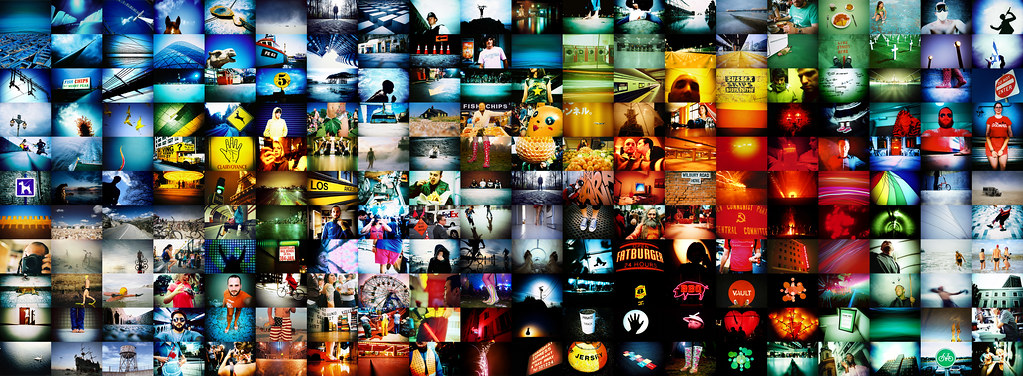
made this montage for my book as a title page, its a little bigger than the last one i made with 220 images in it. each image is 702 pixels buy 469 pixels so the resulting file was 14040 pixels by 5159 pixels with 220 layers, it made my little power book G4 work its arse off!
don't forget the brighton launch event is only a week away (23rd oct ) and the week that follows with be bristol (29th oct) and london (30th)
i have not mentioned this till now but i like to thank all the peeps that help with the book, i may of not mentioned this before but lot people involved some directly and some indirectly (this basically copied from the acknowledgments page see if you can spot the easter egg):
Thanks to Heather Champ, Derek Powazek, George Oates, Imogen Heap, Tom Phillips, Fabian Monheim, Stomp, Bostock and Pollitt, Colin Jenkinson, S. Corin, and Kim Plowright (Kim worked for moo so that should really say moo.com) for having faith in my work and helping to get it seen by a wider audience. Thanks to Yvonne Luna and Stuart Boreham for being my human spelling and grammar checkers.Thanks to the great labs I used as it can be hard to find good ones! The Vault, Brighton; US Color Labs, New York; Photoworks, San Fransisco; and Tim at Snappy Snaps in Marchmont Street, London. Thanks to Steve McNicholas for lending me photographic kit. Thanks to the following people for allowing themselves to appear in the book. Without you the book would be more words than pictures: Yvonne Luna, Emelye Leffier, Monika McClellan, Julia Langhof, Juliet Gabrielle, Mary Goldthwaite, Daniel Belli, Neil Fowler, Imogen Heap, Henry Law, Suzie Baird, Nick Baird, Janet Meredith, Sarah Pugh, Lee Cowill, Juniper Ellison, Janet Jaleh, Stuart Boreham, Sangita Morgan, David Sawyers, Tiny Masters, Tomo Hiratsuka, Julia Walter, Laura Thorne, Chris Frewin, Tom Phillips, Andrew Remedios, Steph Goralnick, Rick David, and Angus Kennedy. And a big thanks to the Flickr community for continued support and helping me research some of the content for this book. one more big for evey one a rotovision for thinking i pull it off in the 1st palce and chronicle books for bringing to the USA
i have set up a group called hot shots in the wild so once you get a book if you want one, take a photo of it and upload it, geo tag it, add it to the group then the plan is i will beable to see a map of em round the world. madye thats my ego running away with me or mabye that happened a long time ago?
Beautiful day for a sad event last passenger train on the Wye Valley line.
Due to the recent unauthorized publication of my images in a magazine. newspaper and two published books without payment I have to now make this statement. I keep attending online Railway Soc events where speakers brazenly show my images without any acknowledgment of the photographer or the fact they have just stolen them off my FLICKR site. Hence I have been forced to add a copyright sign in the corner.
This image is the copyright of © Peter Brabham or © Derek Chaplin family ; Any users, found to replicate, reproduce, circulate, distribute, download, manipulate or otherwise use my images without my written consent will be in breach of copyright laws. I will retrospectively claim £50 per print image if prior written authorization for publication has not been sought. Please contact me at pete.brabham@ntlworld.com for permission to use any of my FLICKR photographs in hard copy publication. I will usually give permission free of charge to Heritage Railways and steam loco restoration project advertising, but profit making magazines and book authors must pay a reproduction fee. Authors should know the provenance of high quality digital images that they use.
In 1959 Derek Chaplin accompanied BBC broadcaster Wynford Vaughan Thomas making a radio broadcast catching trains only from Cardiff to North Wales and calling in on both the embryonic Talyllyn and Ffestiniog railways. Subsequently, Derek made up a 35mm slide show called " Trains of Wales 1959" which he showed at railway societies. These 137 mainly Kodachrome slides have been found by his family preserved in a dry wooden storage box and I am privileged to scan them for people to see again. The notes on each slide are minimalist and with no actual dates so anybody who can add interesting information is appreciated.
Due to the recent unauthorized publication of my images in a magazine. newspaper and two published books without payment I have to now make this statement. I keep attending online Railway Soc events where speakers brazenly show my images without any acknowledgment of the photographer. Hence I have been forced to add a copyright sign in the corner.
This image is the copyright of © Peter Brabham; Any users, found to replicate, reproduce, circulate, distribute, download, manipulate or otherwise use my images without my written consent will be in breach of copyright laws. I will retrospectively claim £50 per print image if prior written authorization for publication has not been sought. Please contact me at pete.brabham@ntlworld.com for permission to use any of my FLICKR photographs in hard copy publication. I will usually give permission free of charge to Heritage Railways and steam loco restoration project advertising, but profit making magazines and book authors must pay a reproduction fee. Authors should know the provenance of high quality digital images that they use.
Coix lacryma-jobi (Job's-tears, adlay millet, acc nr 48439-H, HG-AS), Asian garden, National Herb Garden, US National Arboretum, Washington, DC
land acknowledgment: unceded Nacotchtank
The dwarf galaxy NGC 4214 is ablaze with young stars and gas clouds. Located around 10 million light-years away in the constellation of Canes Venatici (The Hunting Dogs), the galaxy's close proximity, combined with the wide variety of evolutionary stages among the stars, make it an ideal laboratory to research the triggers of star formation and evolution.
Intricate patterns of glowing hydrogen formed during the star-birthing process, cavities blown clear of gas by stellar winds, and bright stellar clusters of NGC 4214 can be seen in this optical and near-infrared image.
Observations of this dwarf galaxy have also revealed clusters of much older red supergiant stars. Additional older stars can be seen dotted all across the galaxy. The variety of stars at different stages in their evolution indicates that the recent and ongoing starburst periods are not the first, and the galaxy's abundant supply of hydrogen means that star formation will continue into the future.
This color image was taken using the Wide Field Camera 3 in December 2009.
Credit: NASA, ESA, and the Hubble Heritage (STScI/AURA)-ESA/Hubble Collaboration
Acknowledgment: R. O'Connell (University of Virginia) and the WFC3 Scientific Oversight Committee
NASA Goddard Space Flight Center enables NASA’s mission through four scientific endeavors: Earth Science, Heliophysics, Solar System Exploration, and Astrophysics. Goddard plays a leading role in NASA’s accomplishments by contributing compelling scientific knowledge to advance the Agency’s mission.
Follow us on Twitter
Like us on Facebook
Find us on Instagram
This NASA/ESA Hubble Space Telescope image features the field of stars that is NGC 1786. The globular cluster is located in the Large Magellanic Cloud (LMC), a small satellite galaxy of the Milky Way Galaxy that is approximately 160,000 light-years away from Earth. NGC 1786 itself is in the constellation Dorado. It was discovered in the year 1835 by Sir John Herschel.
The data for this image comes from an observing program that compares old globular clusters in nearby dwarf galaxies — the LMC, the Small Magellanic Cloud, and the Fornax dwarf spheroidal galaxy — to globular clusters in the Milky Way galaxy. Our galaxy contains over 150 of these old, spherical collections of tightly-bound stars, which astronomers have studied in depth — especially with Hubble images like this one, which show them in previously unattainable detail. Being very stable and long-lived, globular clusters act as galactic time capsules, preserving stars from the earliest stages of a galaxy’s formation.
Credit: ESA/Hubble & NASA, M. Monelli; Acknowledgment: M. H. Özsaraç
#NASAMarshall #NASA #NASAHubble #Hubble #NASAGoddard #GlobularCluster
NASA image release August 10, 2010
A long-exposure Hubble Space Telescope image shows a majestic face-on spiral galaxy located deep within the Coma Cluster of galaxies, which lies 320 million light-years away in the northern constellation Coma Berenices.
The galaxy, known as NGC 4911, contains rich lanes of dust and gas near its center. These are silhouetted against glowing newborn star clusters and iridescent pink clouds of hydrogen, the existence of which indicates ongoing star formation. Hubble has also captured the outer spiral arms of NGC 4911, along with thousands of other galaxies of varying sizes. The high resolution of Hubble's cameras, paired with considerably long exposures, made it possible to observe these faint details.
NGC 4911 and other spirals near the center of the cluster are being transformed by the gravitational tug of their neighbors. In the case of NGC 4911, wispy arcs of the galaxy's outer spiral arms are being pulled and distorted by forces from a companion galaxy (NGC 4911A), to the upper right. The resultant stripped material will eventually be dispersed throughout the core of the Coma Cluster, where it will fuel the intergalactic populations of stars and star clusters.
The Coma Cluster is home to almost 1,000 galaxies, making it one of the densest collections of galaxies in the nearby universe. It continues to transform galaxies at the present epoch, due to the interactions of close-proximity galaxy systems within the dense cluster. Vigorous star formation is triggered in such collisions.
Galaxies in this cluster are so densely packed that they undergo frequent interactions and collisions. When galaxies of nearly equal masses merge, they form elliptical galaxies. Merging is more likely to occur in the center of the cluster where the density of galaxies is higher, giving rise to more elliptical galaxies.
This natural-color Hubble image, which combines data obtained in 2006, 2007, and 2009 from the Wide Field Planetary Camera 2 and the Advanced Camera for Surveys, required 28 hours of exposure time.
The Hubble Space Telescope is a project of international cooperation between NASA and the European Space Agency. NASA's Goddard Space Flight Center manages the telescope. The Space Telescope Science Institute (STScI) conducts Hubble science operations. STScI is operated for NASA by the Association of Universities for Research in Astronomy, Inc. in Washington, D.C.
Credit: NASA, ESA, and the Hubble Heritage Team (STScI/AURA)
Acknowledgment: K. Cook (Lawrence Livermore National Laboratory)
To learn more about Hubble go to: www.nasa.gov/mission_pages/hubble/main/index.html
NASA Goddard Space Flight Center is home to the nation's largest organization of combined scientists, engineers and technologists that build spacecraft, instruments and new technology to study the Earth, the sun, our solar system, and the universe.
Follow us on Twitter
Join us on Facebook
Symbolism and Tradition
Traditionally, prayer flags are used to promote peace, compassion, strength, and wisdom. The flags do not carry prayers to 'gods,' a common misconception; rather, the Tibetans believe the prayers and mantras will be blown by the wind to spread the good will and compassion into all pervading space. Therefore, prayer flags are thought to bring benefit to all.
By hanging flags in high places the "Wind Horse" will carry the blessings depicted on the flags to all beings. As wind passes over the surface of the flags which are sensitive to the slightest movement of the wind, the air is purified and sanctified by the Mantras.
The prayers of a flag become a permanent part of the universe as the images fade from exposure to the elements. Just as life moves on and is replaced by new life, Tibetans renew their hopes for the world by continually mounting new flags alongside the old. This act symbolizes a welcoming of life changes and an acknowledgment that all beings are part of a greater ongoing cycle.
The Indian Buddhist Sutras, written on cloth in India, were transmitted to other regions of the world. These sutras, written on banners, were the origin of prayer flags. Legend ascribes the origin of the prayer flag to the Shakyamuni Buddha, whose prayers were written on battle flags used by the devas against their adversaries, the asuras. The legend may have given the Indian bhikku a reason for carrying the 'heavenly' banner as a way of signifying his commitment to ahimsa. This knowledge was carried into Tibet by 800 CE, and the actual flags were introduced no later than 1040 CE, where they were further modified. The Indian monk Atisha (980-1054 CE) introduced the Indian practice of printing on cloth prayer flags to Tibet and Nepal.
Traditionally, prayer flags come in sets of five, one in each of five colors. The five colors represent the elements, and the Five Pure Lights and are arranged from left to right in a specific order. Different elements are associated with different colors for specific traditions, purposes and sadhana:
* Blue (symbolizing sky/space)
* White (symbolizing air/wind)
* Red (symbolizing fire)
* Green (symbolizing water)
* Yellow (symbolizing earth)
Citrus trifoliata (hardy bitter orane, trifoliate orange, acc nr 75131-H), Asian garden, National Herb Garden, US National Arboretum, Washington, DC
land acknowledgment: unceded Nacotchtank land
This image from NASA's Hubble Space Telescope shows a glittering star cluster that contains a collection of some of the brightest stars seen in our Milky Way galaxy. Called Trumpler 14, it is located 8,000 light-years away in the Carina Nebula, a huge star-formation region. Because the cluster is only 500,000 years old, it has one of the highest concentrations of massive, luminous stars in the entire Milky Way. (The small, dark knot left of center is a nodule of gas laced with dust, and seen in silhouette.)
Diamonds are forever, but these blue-white stars are not. They are burning their hydrogen fuel so ferociously they will explode as supernovae in just a few million years. The combination of outflowing stellar "winds" and, ultimately, supernova blast waves will carve out cavities in nearby clouds of gas and dust. These fireworks will kick-start the beginning of a new generation of stars in an ongoing cycle of star birth and death.
This composite image of Trumpler 14 was made with data taken in 2005-2006 with Hubble's Advanced Camera for Surveys. Blue, visible, and infrared broadband filters combine with filters that isolate hydrogen and nitrogen emission from the glowing gas surrounding the open cluster.
Credit: NASA, ESA, and J. Maíz Apellániz (Institute of Astrophysics of Andalusia, Spain) Acknowledgment: N. Smith (University of Arizona) and J. Schmidt
I never wanted to be someone who apologized for who they are, but lately that is all I can do.
I want to express my remose for every person who has ever been forced to experience me. And for the ones who chose to.
NASA image release Feb. 17, 2011
To see a hd vidoe of this sprial galaxy go to: www.flickr.com/photos/gsfc/5453173577/
The Hubble Space Telescope revealed this majestic disk of stars and dust lanes in this view of the spiral galaxy NGC 2841.
A bright cusp of starlight marks the galaxy's center. Spiraling outward are dust lanes that are silhouetted against the population of whitish middle-aged stars. Much younger blue stars trace the spiral arms.
Notably missing are pinkish emission nebulae indicative of new star birth. It is likely that the radiation and supersonic winds from fiery, super-hot, young blue stars cleared out the remaining gas (which glows pink), and hence shut down further star formation in the regions in which they were born. NGC 2841 currently has a relatively low star formation rate compared to other spirals that are ablaze with emission nebulae.
NGC 2841 lies 46 million light-years away in the constellation of Ursa Major (The Great Bear). This image was taken in 2010 through four different filters on Hubble’s Wide Field Camera 3. Wavelengths range from ultraviolet light through visible light to near-infrared light.
NASA, ESA, and the Hubble Heritage (STScI/AURA)-ESA/Hubble Collaboration; Acknowledgment: M. Crockett and S. Kaviraj (Oxford University, UK), R. O’Connell (University of Virginia), B. Whitmore (STScI), and the WFC3 Scientific Oversight Committee
NASA Goddard Space Flight Center enables NASA’s mission through four scientific endeavors: Earth Science, Heliophysics, Solar System Exploration, and Astrophysics. Goddard plays a leading role in NASA’s accomplishments by contributing compelling scientific knowledge to advance the Agency’s mission.
Follow us on Twitter
Join us on Facebook
This image taken with the NASA/ESA Hubble Space Telescope features NGC 4826 — a spiral galaxy located 17 million light-years away in the constellation of Coma Berenices (Berenice’s Hair). This galaxy is often referred to as the “Black Eye” or “Evil Eye” galaxy because of the dark band of dust that sweeps across one side of its bright nucleus.
NGC 4826 is known by astronomers for its strange internal motion. The gas in the outer regions of this galaxy and the gas in its inner regions are rotating in opposite directions, which might be related to a recent merger. New stars are forming in the region where the counter-rotating gases collide.
This galaxy was first discovered in 1779 by the English astronomer Edward Pigott.
Text credit: European Space Agency (ESA)
Image credit: ESA/Hubble & NASA, J. Lee and the PHANGS-HST Team; Acknowledgment: Judy Schmidt
For more information: www.nasa.gov/image-feature/goddard/2021/hubble-looks-at-a...
[S134]
Very hard to recognize anything in this photo as it was transformed by the road building and demolition in the late 1970s.
Due to the recent unauthorized publication of my images in a magazine. newspaper and two published books without payment I have to now make this statement. I keep attending online Railway Soc events where speakers brazenly show my images without any acknowledgment of the photographer or the fact they have just stolen them off my FLICKR site. Hence I have been forced to add a copyright sign in the corner.
This image is the copyright of © Peter Brabham or © Derek Chaplin family ; Any users, found to replicate, reproduce, circulate, distribute, download, manipulate or otherwise use my images without my written consent will be in breach of copyright laws. I will retrospectively claim £50 per print image if prior written authorization for publication has not been sought. Please contact me at pete.brabham@ntlworld.com for permission to use any of my FLICKR photographs in hard copy publication. I will usually give permission free of charge to Heritage Railways and steam loco restoration project advertising, but profit-making magazines and book authors must pay a reproduction fee. Authors should know the provenance of high quality digital images that they use.
For the whole of my life until last month when he died at the age of 94, my grandfather, Charlie Wenn, was the patriarch of the Wenn family. We were a very close extended family (in a good way) and he was the centre of it all. I miss him more than I expected to, but feel deeply honoured to have known him. When someone's been around for that long you kind of assume they'll always be there. Now that Charlie's moved on the family dynamic will inevitably do the same.
This was taken in Charlie's room on the day of his funeral.
Polaroid land Camera 360 loaded with expired Polacolor 125i which was then stained in a coffee and Port solution in acknowledgment of two of my grandfather's favourite beverages.
This photo also features in the filmwasters.com May collaboration gallery, "Moving On": www.filmwasters.com/collaborations/v/collaboration20/
The Cat's Eye Nebula, one of the first planetary nebulae discovered, also has one of the most complex forms known to this kind of nebula. Eleven rings, or shells, of gas make up the Cat's Eye.
The full beauty of the Cat's Eye Nebula is revealed in this detailed view from NASA's Hubble Space Telescope. The image from Hubble's Advanced Camera for Surveys (ACS) shows a bull's eye pattern of eleven or even more concentric rings, or shells, around the Cat's Eye. Each 'ring' is actually the edge of a spherical bubble seen projected onto the sky -- that's why it appears bright along its outer edge.
Observations suggest the star ejected its mass in a series of pulses at 1,500-year intervals. These convulsions created dust shells, each of which contain as much mass as all of the planets in our solar system combined (still only one percent of the Sun's mass). These concentric shells make a layered, onion-skin structure around the dying star. The view from Hubble is like seeing an onion cut in half, where each skin layer is discernible.
The bull's-eye patterns seen around planetary nebulae come as a surprise to astronomers because they had no expectation that episodes of mass loss at the end of stellar lives would repeat every 1,500 years. Several explanations have been proposed, including cycles of magnetic activity somewhat similar to our own Sun's sunspot cycle, the action of companion stars orbiting around the dying star, and stellar pulsations. Another school of thought is that the material is ejected smoothly from the star, and the rings are created later on due to formation of waves in the outflowing material.
Credit: NASA, ESA, HEIC, and The Hubble Heritage Team (STScI/AURA)
Acknowledgment: R. Corradi (Isaac Newton Group of Telescopes, Spain) and Z. Tsvetanov (NASA)
The Hubble Space Telescope is a project of international cooperation between NASA and the European Space Agency. NASA's Goddard Space Flight Center manages the telescope. The Space Telescope Science Institute conducts Hubble science operations.
Goddard is responsible for HST project management, including mission and science operations, servicing missions, and all associated development activities.
To learn more about the Hubble Space Telescope go here:
www.nasa.gov/mission_pages/hubble/main/index.html
NASA Goddard Space Flight Center enables NASA’s mission through four scientific endeavors: Earth Science, Heliophysics, Solar System Exploration, and Astrophysics. Goddard plays a leading role in NASA’s accomplishments by contributing compelling scientific knowledge to advance the Agency’s mission.
Follow us on Twitter
Like us on Facebook
Find us on Instagram
Artist: Bernard Williams (American, born 1964)
Title: Black Cowboy–Bill Pickett (1995)
Material: Oil on canvas
Venue: Eiteljorg Museum, Indianapolis, Indiana
The next time you see a cowboy who grabs a bull by the horns and wrestles it to the ground, think of black cowboy Bill Picket. He invented that maneuver when working at a Texas ranch. Super cowboy Picket would later join a Wild West rodeo show. And then as movies took off, he became a Hollywood actor.
When you think of cowboys, I hope you think black. One in four cowboys were African American. That's a lot considering that the African American population in the 1870 Census was just 13 percent of America's total population. Put another way, being a cowboy is a much bigger part of black history and black lives than for whites.
The museum plaque adjacent to the painting states, "This particular work pictures the famed Oklahoma rodeo champion, Bill Pickett, and is an acknowledgment of the multi-racial story of the cowboy."