View allAll Photos Tagged ”http
Rhopalocera nihonica
Yokohama :Printed at the Office of the "Japan mail", Published by the author,1886-1889.
www.darckr.com/username.php?username=8725806@N08
Yapton is known as the village that "never closes its doors" - thought to refer to the days when smugglers making their way with their contraband from the beaches of nearby Clymping found plenty of open doors in Yapton to help them escape the pursuing excise men!
The name Yapton is thought to derive from "Eppa's ton" - Eppa being one of two priests who were left in Sussex about AD681 by Bishop St Wilfrid who bought Christianity to Sussex to continue the work of converting and baptising local people.
Nowadays Yapton is a thriving rural village. Over the last 30 years it has grown rapidly but is still an interesting and self-contained community with two Conservation Areas which include a number of listed buildings. It is centred around the King George V Playing Field and this, viewed from the main road, shows up the historic village church, set against the backdrop of the South Downs with Arundel in the distance. St Mary's, Church is a charming, 13th century rustic building which has been regularly added to through the centuries. The Tower has been buttressed due to its noticeable lean. It is a thoroughly friendly building. At present the Parish is intending to build an outside toilet and store and install running water into the church for a small kitchen. They are also hoping to make space at the back of the church to provide better access for wheel chairs and push chairs and create a welcome area.
Part of Hidden Trail to Rattlesnake Ledge Set.
This is where the shortcut for Rattlesnake Ledge starts. You can't really see it here, but a very faint single track trail snakes up the hillside. I have tried several times to follow the trail up, but ended up bushwhacking. I have succesfully come down the trail from the top once, and last time down ended up bushwhacking in the middle till I ran into the start of the trail again. This last trip I successfully navigated up and back. The key is when you start up the trail will go to the right, then come to a T-intersction at which point you go left and then you'll have one more switch back to the right and then its just up up up to the bottom of the cliffs.
Style Elements Interiors by Tonya Scheiwe.This is the best design for your home entrance.The light effect makes your home look more royal and beautiful.It will look unique in its own way.Style Elements Interiors are dealing with kitchen decorating,kitchen design,kitchen furniture,kitchen improvement,kitchen renovation,kitchen designing,interior designing,bathroom design,bathroom improvement,bathroom renovation,home builders,home decorations,home design,home furnishing,home furniture,home improvement,home renovation and so on.
GIVEAWAY Facebook ← Click here
GIVEAWAY Primfeed ← Click here
Brabos x Outernaked - Ian Skin. x MANHOOD March 27th
• Skin. Tones Compatible with Not Found and Velour Body Skins.
All BOM for Lelutka's EvoX System heads. Try DEMO 1st and I hope you like it ❤
→ TP to Booth: maps.secondlife.com/secondlife/Manhood/71/103/800
Tijarafe, La Palma.
Mi red social:
www.facebook.com/alexismartinfotos?ref=br_rs
alexismartinfotos.blogspot.com.es/
www.instagram.com/alexisjmartin/
alexismartinfotos.wordpress.com/
plus.google.com/+AlexisMart%C3%ADnFotos?hl=es%23
www.youtube.com/channel/UCKwZ6ViIwUly_i6X9oDOoDA
Cámara: Nikon D3000 + Nikkor 18-55 mm VR
Exposición: 0,02 sec (1/50)
Aperture: f/5.6
Lente: 55 mm
Velocidad ISO: 400
editorial fashion shoot for STREETFASHION MAGZZINE | Model: Franziska Funke | Location: Marstrand, Sweden
Homepage | 500px | facebook | twitter | instagram | blog | STREETFASHION MAGZZINE
Blogger | Tumblr | Wordpress | Google+ | Instagram
.
© All of my photographs are Copyrighted and All Rights Reserved. They may not be used or reproduced in any way without my explicit written permission.
© Toutes mes photographies sont protégées par droit d'auteur et tous droits réservés. Elles ne peuvent pas être utilisées ou reproduites d'aucune manière sans mon autorisation explicite et écrite.
© Tutti i diritti riservati. Non usare le immagini su siti web, blog, altri canali informatici, o qualunque utilizzo senza autorizzazione.
.
.
Please: NO GLITTERY OR BIG AWARDS ! !
.
Comments are always welcome and favs most appreciated.
Comentarios y favs son siempre bienvenidos
© Photography of Ricardo Gomez Angel
All rights reserved. All images on this website are the property of Ricardo Gomez Angel. Images may not be reproduced, copied or used in any way without written permission.
© Fotografía de Ricardo Gomez Angel
Todos los derechos reservados. Todas las imágenes contenidas en este sitio web son propiedad de Ricardo Gomez Angel. Las imágenes no se pueden reproducir, copiar o utilizar de ninguna manera sin el permiso escrito.
( www.hellopiter.ru/Puschkinnn.html )
Canon EOS 5D Mark II + Lens Canon EF 135 mm f / 2.8 SoftFocus ...
MeHoney Mina - GIFT
mellowcute - arela skirt-fatpack at Level Event
[Eternus] Starfall Top Fatpack
[AYO] Leg Warmers // Fatpack+Bonus at Anthem Event
-♥-
Show on Ebody Reborn
I am working on some Alaskan photos in Lightroom, but I found this in the process and wanted to share it. Once again, taken in Great Sand Dunes National Park on a gorgeous spring evening after a cleaning thunderstorm. I do miss scenes like this in Colorado, but I am blessed to live where I do in Alaska and look for photos of this great state coming soon. This is basically an HDR of my Sandbox photo, different takes on the same scene.
More photos from Great Sand Dunes National Park
Please show your support: ideas.lego.com/projects/d8c7085c-444b-4e99-ba2f-18afd568ddd9
Do you remember the family fun game of Beetle Drive? Or maybe you played it at your local social group or sport's club? Roll the die to collect the various body parts of your beetle to win. The beetles are each made of a head, thorax, abdomen, two eyes, two antennae and six legs.
In this LEGO version, you need a beetle for each player, with everyone selecting their own colour of a LEGO beetle. You also have a communal die and a prompt sheet to remind you which number on the die corresponds to which body part. The beetles are robustly made, fits easily and snuggly together, and are easy to break up again ready to play another round.
The body parts correspond to the rolls of the die as follows:
1 - Eyes
2 - Antennae
3 - Legs
4 - Abdomen
5 - Head
6 - Thorax
Instructions:
1. Everyone selects a beetle and breaks it up into its various body parts. Decide who is going to go first.
2. Each player rolls the die in turn, one roll per turn. They need to roll a 6 to start. If they are successful, they move their beetle's thorax into their playing space. Play then passes to their left.
3. Once a 6 has been rolled and a thorax obtained, players can add to it by rolling a 3 (leg), 4 (abdomen), or a 5 (head). One leg is added for each roll of a 3, only two legs can be added to the thorax.
4. Once a 4 (abdomen) has been rolled, that player is now also able to add four additional legs to their beetle by rolling 3s.
5. Once a 5 (head) has been rolled, that player is now also able to add to their beetle by rolling a 1 (eye) or 2 (antenna). Again, only one eye or antenna is added for each successful roll.
6. The winner is the player who completes their beetle first.
Check out this short video to see how each beetle fits together: www.youtube.com/watch?v=GYApJTUMpio
I’ve had great fun making this, so I hope you like my idea and choose to show your support in the usual way!
Miniatur Wunderland Hamburg is a spectacular Model World featuring many Land- and Cityscapes from around the world containing model trains, moving cars, ships and even a fully functional airport with starting and landing planes.
All of this is meticulously handcrafted to the smallest Detail.
Please view the photos in full resolution to see all the little Details and Scenes.
Also make sure to visit this wonderful World, whenever you are in Hamburg.
All of this is meticulously handcrafted to the smallest Detail.
Mission San Carlos Borromeo de Carmelo, also known as the Carmel Mission, is a Roman Catholic mission church in Carmel-by-the-Sea, California. It is part of the National Registry of Historic Places and a U.S. National Historic Landmark.
It was the headquarters of the original Alta California Missions headed by Father Junípero Serra from 1770 until his death in 1784. (Wikipedia)
See more photos of this, and the Wikipedia article.
Details, quoting from Smithsonian National Air and Space Museum | Vought F4U-1D Corsair:
By V-J Day, September 2, 1945, Corsair pilots had amassed an 11:1 kill ratio against enemy aircraft. The aircraft's distinctive inverted gull-wing design allowed ground clearance for the huge, three-bladed Hamilton Standard Hydromatic propeller, which spanned more than 4 meters (13 feet). The Pratt and Whitney R-2800 radial engine and Hydromatic propeller was the largest and one of the most powerful engine-propeller combinations ever flown on a fighter aircraft.
Charles Lindbergh flew bombing missions in a Corsair with Marine Air Group 31 against Japanese strongholds in the Pacific in 1944. This airplane is painted in the colors and markings of the Corsair Sun Setter, a Marine close-support fighter assigned to the USS Essex in July 1944.
Transferred from the United States Navy.
Manufacturer:
Date:
1940
Country of Origin:
United States of America
Dimensions:
Overall: 460 x 1020cm, 4037kg, 1250cm (15ft 1 1/8in. x 33ft 5 9/16in., 8900lb., 41ft 1/8in.)
Materials:
All metal with fabric-covered wings behind the main spar.
Physical Description:
R-2800 radial air-cooled engine with 1,850 horsepower, turned a three-blade Hamilton Standard Hydromatic propeller with solid aluminum blades spanning 13 feet 1 inch; wing bent gull-shaped on both sides of the fuselage.
Long Description:
On February 1, 1938, the United States Navy Bureau of Aeronautics requested proposals from American aircraft manufacturers for a new carrier-based fighter airplane. During April, the Vought Aircraft Corporation responded with two designs and one of them, powered by a Pratt & Whitney R-2800 engine, won the competition in June. Less than a year later, Vought test pilot Lyman A. Bullard, Jr., first flew the Vought XF4U-1 prototype on May 29, 1940. At that time, the largest engine driving the biggest propeller ever flown on a fighter aircraft propelled Bullard on this test flight. The R-2800 radial air-cooled engine developed 1,850 horsepower and it turned a three-blade Hamilton Standard Hydromatic propeller with solid aluminum blades spanning 13 feet 1 inch.
The airplane Bullard flew also had another striking feature, a wing bent gull-shaped on both sides of the fuselage. This arrangement gave additional ground clearance for the propeller and reduced drag at the wing-to-fuselage joint. Ironically for a 644-kph (400 mph) airplane, Vought covered the wing with fabric behind the main spar, a practice the company also followed on the OS2U Kingfisher (see NASM collection).
When naval air strategists had crafted the requirements for the new fighter, the need for speed had overridden all other performance goals. With this in mind, the Bureau of Aeronautics selected the most powerful air-cooled engine available, the R-2800. Vought assembled a team, lead by chief designer Rex Biesel, to design the best airframe around this powerful engine. The group included project engineer Frank Albright, aerodynamics engineer Paul Baker, and propulsion engineer James Shoemaker. Biesel and his team succeeded in building a very fast fighter but when they redesigned the prototype for production, they were forced to make an unfortunate compromise.
The Navy requested heavier armament for production Corsairs and Biesel redesigned each outboard folding wing panel to carry three .50 caliber machine guns. These guns displaced fuel tanks installed in each wing leading edge. To replace this lost capacity, an 897-liter (237 gal) fuselage tank was installed between the cockpit and the engine. To maintain the speedy and narrow fuselage profile, Biesel could not stack the cockpit on top of the tank, so he moved it nearly three feet aft. Now the wing completely blocked the pilot's line of sight during the most critical stages of landing. The early Corsair also had a vicious stall, powerful torque and propeller effects at slow speed, a short tail wheel strut, main gear struts that often bounced the airplane at touchdown, and cowl flap actuators that leaked oil onto the windshield. These difficulties, combined with the lack of cockpit visibility, made the airplane nearly impossible to land on the tiny deck of an aircraft carrier. Navy pilots soon nicknamed the F4U the 'ensign eliminator' for its tendency to kill these inexperienced aviators. The Navy refused to clear the F4U for carrier operations until late in 1944, more than seven years after the project started.
This flaw did not deter the Navy from accepting Corsairs because Navy and Marine pilots sorely needed an improved fighter to replace the Grumman F4F Wildcat (see NASM collection). By New Year's Eve, 1942, the service owned 178 F4U-1 airplanes. Early in 1943, the Navy decided to divert all Corsairs to land-based United States Marine Corps squadrons and fill Navy carrier-based units with the Grumman F6F Hellcat (see NASM collection). At its best speed of 612 kph (380 mph) at 6,992 m (23,000 ft), the Hellcat was about 24 kph (15 mph) slower than the Corsair but it was a joy to fly aboard the carrier. The F6F filled in splendidly until improvements to the F4U qualified it for carrier operations. Meanwhile, the Marines on Guadalcanal took their Corsairs into combat and engaged the enemy for the first time on February 14, 1943, six months before Hellcat pilots on that battle-scared island first encountered enemy aircraft.
The F4U had an immediate impact on the Pacific air war. Pilots could use the Corsair's speed and firepower to engage the more maneuverable Japanese airplanes only when the advantage favored the Americans. Unprotected by armor or self-sealing fuel tanks, no Japanese fighter or bomber could withstand for more than a few seconds the concentrated volley from the six .50 caliber machine guns carried by a Corsair. Major Gregory "Pappy" Boyington assumed command of Marine Corsair squadron VMF-214, nicknamed the 'Black Sheep' squadron, on September 7, 1943. During less than 5 months of action, Boyington received credit for downing 28 enemy aircraft. Enemy aircraft shot him down on January 3, 1944, but he survived the war in a Japanese prison camp.
In May and June 1944, Charles A. Lindbergh flew Corsair missions with Marine pilots at Green Island and Emirau. On September 3, 1944, Lindbergh demonstrated the F4U's bomb hauling capacity by flying a Corsair from Marine Air Group 31 carrying three bombs each weighing 450 kg (1,000 lb). He dropped this load on enemy positions at Wotje Atoll. On the September 8, Lindbergh dropped the first 900-kg (2,000 lb) bomb during an attack on the atoll. For the finale five days later, the Atlantic flyer delivered a 900-kg (2,000 lb) bomb and two 450-kg (1,000 lb) bombs. Lindbergh went ahead and flew these missions after the commander of MAG-31 informed him that if he was forced down and captured, the Japanese would almost certainly execute him.
As of V-J Day, September 2, 1945, the Navy credited Corsair pilots with destroying 2,140 enemy aircraft in aerial combat. The Navy and Marines lost 189 F4Us in combat and 1,435 Corsairs in non-combat accidents. Beginning on February 13, 1942, Marine and Navy pilots flew 64,051 operational sorties, 54,470 from runways and 9,581 from carrier decks. During the war, the British Royal Navy accepted 2,012 Corsairs and the Royal New Zealand Air Force accepted 364. The demand was so great that the Goodyear Aircraft Corporation and the Brewster Aeronautical Corporation also produced the F4U.
Corsairs returned to Navy carrier decks and Marine airfields during the Korean War. On September 10, 1952, Captain Jesse Folmar of Marine Fighter Squadron VMF-312 destroyed a MiG-15 in aerial combat over the west coast of Korea. However, F4U pilots did not have many air-to-air encounters over Korea. Their primary mission was to support Allied ground units along the battlefront.
After the World War II, civilian pilots adapted the speedy bent-wing bird from Vought to fly in competitive air races. They preferred modified versions of the F2G-1 and -2 originally built by Goodyear. Corsairs won the prestigious Thompson Trophy twice. In 1952, Vought manufactured 94 F4U-7s for the French Navy, and these aircraft saw action over Indochina but this order marked the end of Corsair production. In production longer than any other U.S. fighter to see service in World War II, Vought, Goodyear, and Brewster built a total of 12,582 F4Us.
The United States Navy donated an F4U-1D to the National Air and Space Museum in September 1960. Vought delivered this Corsair, Bureau of Aeronautics serial number 50375, to the Navy on April 26, 1944. By October, pilots of VF-10 were flying it but in November, the airplane was transferred to VF-89 at Naval Air Station Atlantic City. It remained there as the squadron moved to NAS Oceana and NAS Norfolk. During February 1945, the Navy withdrew the airplane from active service and transferred it to a pool of surplus aircraft stored at Quantico, Virginia. In 1980, NASM craftsmen restored the F4U-1D in the colors and markings of a Corsair named "Sun Setter," a fighter assigned to Marine Fighter Squadron VMF-114 when that unit served aboard the "USS Essex" in July 1944.
• • •
Quoting from Wikipedia | Vought F4U Corsair:
The Chance Vought F4U Corsair was a carrier-capable fighter aircraft that saw service primarily in World War II and the Korean War. Demand for the aircraft soon overwhelmed Vought's manufacturing capability, resulting in production by Goodyear and Brewster: Goodyear-built Corsairs were designated FG and Brewster-built aircraft F3A. From the first prototype delivery to the U.S. Navy in 1940, to final delivery in 1953 to the French, 12,571 F4U Corsairs were manufactured by Vought, in 16 separate models, in the longest production run of any piston-engined fighter in U.S. history (1942–1953).
The Corsair served in the U.S. Navy, U.S. Marines, Fleet Air Arm and the Royal New Zealand Air Force, as well as the French Navy Aeronavale and other, smaller, air forces until the 1960s. It quickly became the most capable carrier-based fighter-bomber of World War II. Some Japanese pilots regarded it as the most formidable American fighter of World War II, and the U.S. Navy counted an 11:1 kill ratio with the F4U Corsair.
F4U-1D (Corsair Mk IV): Built in parallel with the F4U-1C, but was introduced in April 1944. It had the new -8W water-injection engine. This change gave the aircraft up to 250 hp (190 kW) more power, which, in turn, increased performance. Speed, for example, was boosted from 417 miles per hour (671 km/h) to 425 miles per hour (684 km/h). Because of the U.S. Navy's need for fighter-bombers, it had a payload of rockets double the -1A's, as well as twin-rack plumbing for an additional belly drop tank. Such modifications necessitated the need for rocket tabs (attached to fully metal-plated underwing surfaces) and bomb pylons to be bolted on the fighter, however, causing extra drag. Additionally, the role of fighter-bombing was a new task for the Corsair and the wing fuel cells proved too vulnerable and were removed.[] The extra fuel carried by the two drop tanks would still allow the aircraft to fly relatively long missions despite the heavy, un-aerodynamic load. The regular armament of six machine guns were implemented as well. The canopies of most -1Ds had their struts removed along with their metal caps, which were used — at one point — as a measure to prevent the canopies' glass from cracking as they moved along the fuselage spines of the fighters.[] Also, the clear-view style "Malcolm Hood" canopy used initially on Supermarine Spitfire and P-51C Mustang aircraft was adopted as standard equipment for the -1D model, and all later F4U production aircraft. Additional production was carried out by Goodyear (FG-1D) and Brewster (F3A-1D). In Fleet Air Arm service, the latter was known as the Corsair III, and both had their wingtips clipped by 8" per wing to allow storage in the lower hangars of British carriers.
My interview on Google Local Guide Connect
All Photos Are Copyright To Paul Saad , Unauthorised Use Is Not Allowed Without Prior Permission. © Some rights reserved ©
| Contact Me | WadM | Facebook | Twitter | 500px | LinkedIn |
So I had to go to Antwerp for business and I hate it to go places without being able to take a few shots of the local entourage. Decided to get up *really* early to catch the Antwerp dawn (sunrise) over at the banks of the Schelde. Oh well! I've seen a lot of (wet) snow but no sun in sight - plenty of cobblestones too-uh-oo-uh-oo-uh-ooh-uh-oo... pfff... Antwerp - crazy city. ;-)
About the processing
This is 3 shots (1/25 - 1/50 - 1/100) handheld :) - ran through Photomatix Pro and PS CS6 for the final touch.
| Contact Me | WadM | Facebook | Twitter | 500px | LinkedIn |
Visita mi fotolog - Visit my photolog - http://pedroferrerfotografia.blogspot.com<
A esta reunión del grupo Rincones de Cantabria me llevé a mi hija mayor, y entre los dos pudimos bajar hasta este salto de agua (tiene unos dos metros y medio de caida) con muchas dificultades. Nos mojamos, nos pinchamos con las bardales, se puso a llover, no había manera de colocar el trípode, pero aunque la fotografía no es buena, el tiempo que pasé con Lucia trabajando esta toma los dos solos, con el sonido del agua y la lluvia, en mitad del bosque, es un momento muy especial que guardaré en mi memoria con cariño.
Ver en grande - Best view large

Cómo/How I did it
Hdr de dos tomas (la tercera se me cayó el tripode y salio movida, jeje). El derecheado funciona bastante bien y consigo recuperar casi toda la información de las luces altas debidas a la larga exposición con ayuda del filtro ND8.
Copyright © 2009 Pedro Ferrer. All Rights Reserved. Todos los derechos reservados.
Please don't use this image on websites, blogs or other media without my explicit permission.
Contact: fieraz@gmail.com
Por favor, no utilices esta imagen en páginas web, blogs u otros medios sin mi permiso explícito.
Contacto: fieraz@gmail.com
Brian picked a real winner of a night for this month's PDX Nightowls photowalk at the recently opened Darlene Hooley Pedestrian Bridge at Gibbs Street which turned out to be a wonderful platform for photographing lightning over the city. Shortly after a firery sunset the lightning began and never stopped, it seemed like hardly a minute went by without lightning from some part of the sky. Smell the electricity. N65084,117
-> Like & follow me: Google+ | Facebook | Twitter | My Blog
Today's photo is a few hours late (and not my best work!) because yesterday arvo I gave myself food poisoning. I'll spare you the details but let's just say it was one of the longest and least fun nights of my life.
I finally got to sleep around 2am and then woke up at 5am to a beautiful sunrise just starting to form. What better way to celebrate still being alive than with smiley faces made out of bokeh :)
Follow me on Twitter | Like on Facebook | Circle me on G+
One good thing about fall approaching is the sun is coming up later. Good for me at least so I do not need to wake up as early to get good sunrise photos. This was taken this morning around 7:00am.
Other Photo Gear Used: Sirui T-2005X Tripod with K-10x Tripod Head
Photo Processing Software used: Adobe Lightroom; Adobe Photoshop; Topaz Adjust;
Feel free to download the full size version of Later Sunrises from my blog for personal use. For commercial use, please contact me for pricing.
1. Along came a . . ., 2. . . . redhead, 3. one fish two fish red fish blue fish, 4. Falls on Raven Cliff Trail, 5. Three's a Crowd, 6. " . . . and black and white all over.", 7. A Bird in the Bush . . ., 8. Crossing the Color Barrier, 9. Denali Fall, 10. At the Foot of the Magic Tree, 11. Maligne Tours, 12. At Work In A Sea Of Scarlet, 13. Open Door Policy, 14. Bubbles, 15. Something Wicked This Way Comes, 16. Cedar Rock Falls
At the end of the year last year I posted a mosaic of some of my favorite posts from that year. I guess I'll make it a tradition. (You might even be able to see them if you view this large!) Thanks to all of you for your support, inspiration and kind comments over the last year. I hope you all have a Happy (and photographically rewarding) New Year!
Fujifilm X100F / Lightroom CC
Fuji X Secrets Workshops & Blog
Read the X-Pert Corner blog.
Useful (e)books on Fujifilm cameras:
The Fujifilm X-T2 – 120 X-Pert Tips
The Fujifilm X-Pro2 – 115 X-Pert Tips
The Fujifilm X-T10 – 115 X-Pert Tips
The Fujifilm X-T1 – 111 X-Pert Tips 2nd edition
The Fujifilm X-E2 – Beyond the Manual
Mastering the Fujifilm X-E1 and X-Pro1
Save 40% with coupon code XPERT40
Die Fujifilm X-T2. 120 Profitipps.
Die Fujifilm X-Pro2. 115 Profitipps.
Die Fujifilm X-T10. 115 Profitipps.
-> Like & follow me: Google+ | Facebook | Twitter | My Blog
It's crazy how much my day-to-day life has changed in the 3 weeks since I started this 365 project. I went from taking a few snaps every now and then... to spending basically every spare second either thinking about photography, or frantically writing down ideas/sketches in my notebook, or keeping an eye out for interesting locations, or planning my next shoot, or researching lighting/flash tutorials.
If anyone's thinking of doing a 365 project themselves... DO IT! Don't even take a second to think it over; just jump in and do it RIGHT NOW :) On that note, have any of you lovely people tried a 365 yourself? Would love to see the results - post your links!
blogged:
urworldsl.wordpress.com/2012/06/19/love-conquers-all-thin...
STAND4LOVE
Nothing else should matter but the love that two people share and they should have the right to express and bind that love in marriage regardless if you are Gay, Lesbian, Straight, Bisexual or Transgendered.
IT IS TIME!!!!
STAND4LOVE is an awareness charity project to promote the visibility and rights of Gay, Lesbian, Bisexual and Straight loving couples to have the right to marry and be recognized by the law across the world. It will be a picture campaign in Second Life to spread awareness and promote equality and tolerance. The best pictures with the best message will be published in a book in SL and Issuu. All the pictures will be spotlighted at the STAND4LOVE blog, flickr and facebook.
==============
HOW TO PARTICIPATE:
Each participant will take a picture of themselves in a plain (white or black) background then add the Stand4Love Logo. Put a message of support as well as your SL name and/or Title/Business (Optional) in the picture. If you have a business in SL, you may put your business logo as well in the picture. PLEASE MAKE THE PICTURES 1024×1024 or 512×512 in size. Submit your pictures to RicoRacer Flux or Editorial Clarity before July 15, 2012 to be included in the book.
All pictures received will be published in the STAND4LOVE blog as well as CSLTM and UrWorld blogs. It will also be promoted in Stand4Love Facebook page and Flickr group. We will take the best pictures with the best message of support and put it in a Stand4Love book to be published in Second Life and Issuu. Please Join us.
~~~~~~~~~~~~
PHOTOGRAPHERS:
If you want to participate in this campaign, please let me know. All you need to do is help spread awareness through your pictures. Photograph yourself and your friends who support the cause. Follow the instructions above. If you can help photograph others too, it would be fantastic.
~~~~~~~~~~~~~~~
BLOGGERS:
If you can help us advertise STAND4LOVE in your blogs and put our URL in your links, we will do the same under the staff page. Please help us promote marriage equality through your amazing blogs and flickrs.
~~~~~~~~~~~~~~~
SUPPORTERS:
Anyone who does the project above is considered a supporter and their names will be posted under The Supporter Page and their picture submission will be published in this blog. If you are a designer or business owner in Second Life, we would love to have your support as well and we can put your logo in our supporter’s page.
THANKS YOU SO MUCH.
<3 <3 <3 <3 <3<3 <3 <3 <3 <3 <3 <3<3 <3 <3 <3 <3 <3 <3<3 <3 <3 <3 <3 <3 <3<3 <3
Voyage dans l'Amérique méridionale
Paris, :Chez Pitois-Levrault et ce., libraires-éditeurs, rue de la Harpe, no. 81;1835-1847.
Margolies, John,, photographer.
Barrel, The Cafe Lounge, Central Ave and 6W, Great Falls, Montana
1987.
1 photograph : color transparency ; 35 mm (slide format).
Notes:
Title, date and keywords based on information provided by the photographer.
Purchase; John Margolies 2010 (DLC/PP-2010:191).
Credit line: John Margolies Roadside America photograph archive (1972-2008), Library of Congress, Prints and Photographs Division.
Please use digital image: original slide is kept in cold storage for preservation.
Forms part of: John Margolies Roadside America photograph archive (1972-2008).
Subjects:
Cafes--1980-1990.
Barrels--1980-1990.
United States--Montana--Great Falls.
Format: Slides--1980-1990.--Color
Rights Info: No known restrictions on publication. For more information, see "John Margolies Roadside America Photograph Archive - Rights and Restrictions Information" www.loc.gov/rr/print/res/723_marg.html
Repository: Library of Congress, Prints and Photographs Division, Washington, D.C. 20540 USA, hdl.loc.gov/loc.pnp/pp.print
Part Of: Margolies, John John Margolies Roadside America photograph archive (DLC) 2010650110
General information about the John Margolies Roadside America photograph archive is available at hdl.loc.gov/loc.pnp/pp.mrg
Higher resolution image is available (Persistent URL): hdl.loc.gov/loc.pnp/mrg.03521
Call Number: LC-MA05- 3521
Try to View The Falcon On White
Peregrine Falcon
From Wikipedia, the free encyclopedia
The Peregrine Falcon (Falco peregrinus), also known simply as the Peregrine,[2] and historically as the "Duck Hawk" in North America,[3] is a cosmopolitan bird of prey in the family Falconidae. It is a large, crow-sized falcon, with a blue-gray back, barred white underparts, and a black head and "moustache". It can reach speeds over 320 km/h (200 mph) in a dive, making it the fastest animal in the world.[4] As is common with bird-eating raptors, the female is much bigger than the male.[5][6] Experts recognize 17–19 subspecies, which vary in appearance and range; there is disagreement over whether the distinctive Barbary Falcon is a subspecies or a distinct species.
The Peregrine's breeding range includes land regions from the Arctic tundra to the Tropics. It can be found nearly everywhere on Earth, except extreme polar regions, very high mountains, and most tropical rainforests; the only major ice-free landmass from which it is entirely absent is New Zealand. This makes it the world's most widespread bird of prey.[7] Both the English and scientific names of this species mean "wandering falcon", referring to the migratory habits of many northern populations.
While its diet consists almost exclusively of medium-sized birds, the Peregrine will occasionally hunt small mammals, small reptiles or even insects. It reaches sexual maturity at one year, and mates for life. It nests in a scrape, normally on cliff edges or, in recent times, on tall human-made structures.[8] The Peregrine Falcon became an endangered species in many areas due to the use of pesticides, especially DDT. Since the ban on DDT from the beginning of the 1970s onwards, the populations recovered, supported by large scale protection of nesting places and releases to the wild.[9]
This photo has notes. Move your mouse over the photo to see them.
Visita mi fotolog - Visit my photolog - http://pedroferrerfotografia.blogspot.com<
En la concurrida calle Istiklal, un signo del pasado contribuye a completar el ambiente que se respira al callejear por ella: el histórico tranvía, instalado en el siglo XIX para unir la plaza Taksim con el barrio de Beyoglu en Tünel, uniendo con el funicular subterráneo que nos lleva hasta el puente Gálata a orillas del Cuerno de Oro.
Este simpático tranvía, fué retirado de la circulación en los años 60, pero posteriormente fué rehabilitado más como incentivo turístico que como transporte, pero desde entonces es parte del paisaje de esta calle. Lo ves pasar abarrotado de turistas, y los chavales van colgados en el exterior, sólo para jugar, puesto que los ves divertidos e imagino que se pasarán las horas subiendo y bajando la calle agarrados como pueden.
Ver en grande - Best view large
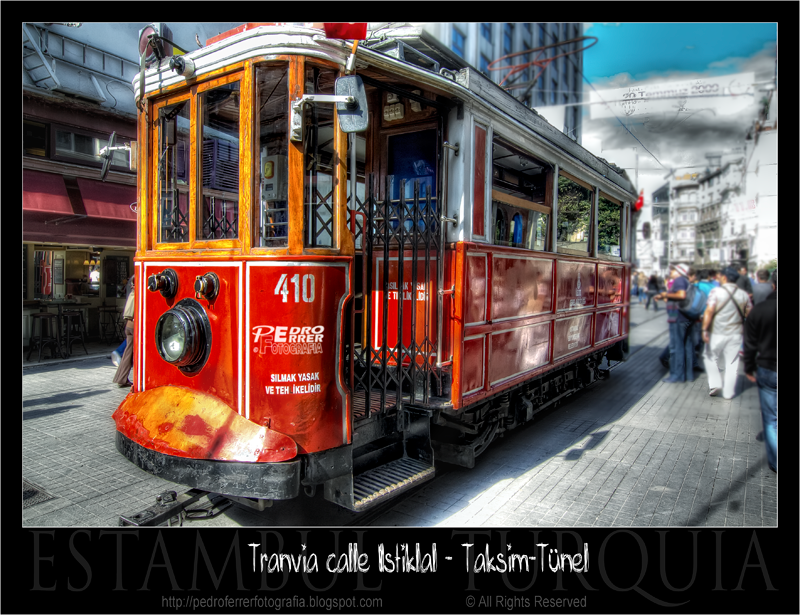
En estas dos fotografías de los tranvías he querido aprovechar al máximo las posibilidades de la técnica hdr, y creo que han quedado muy llamativos.
Copyright © 2009 Pedro Ferrer. All Rights Reserved. Todos los derechos reservados.
Please don't use this image on websites, blogs or other media without my explicit permission.
Contact: fieraz@gmail.com
Por favor, no utilices esta imagen en páginas web, blogs u otros medios sin mi permiso explícito.
Contacto: fieraz@gmail.com