View allAll Photos Tagged streamlined
The traditional wooden La-Z-Boy recliner handle has donned a new streamlined design with a sleek brushed metal finish. The new handle option will allow consumers to further customize the look of their La-Z-Boy furniture to match the style of their living spaces.
Sheffield Corporation Tramways streamlined 'Roberts' car No. 510 passes under the Bowes Lyon Bridge at the Crich Tramway Village
`The large streamlined modern house with surgery rooms on the ground floor was built in 1938 for Dr Fenton-Bowen, and designed by architects Rhys Hopkins and Shannon. It was built by J A E Humphries, the well known builder who helped create the notable Golf Links Estate in Camberwell, and father of the famous Barry Humphries. Family legend has it that he designed the house, but it seems more likely that he simply admired it..
The house is constructed of special flat dark Manganese bricks, giving it a dark brooding quality, and emphasizing the horizontal lines of the design. There is a prominent semi-circular bay on the main corner, a slim projecting concrete projection over the ground floor windows, curved corners and windows, and a flat roof combining to make a most distinctive modernist design.' (VHD, NTA) .
.
From Survey of 20th Century architecture in Victoria for the Royal Australian Institute of Architects (RAIA, Vic) by architectural historian, Graeme Butler and helpers, creating data sheets for each surveyed place, at least 1 coloured transparency and B&W negative each (about 2230 negatives). Drawn from heritage studies and publications such as Robin Boyd's 1947 `Victorian Modern'.
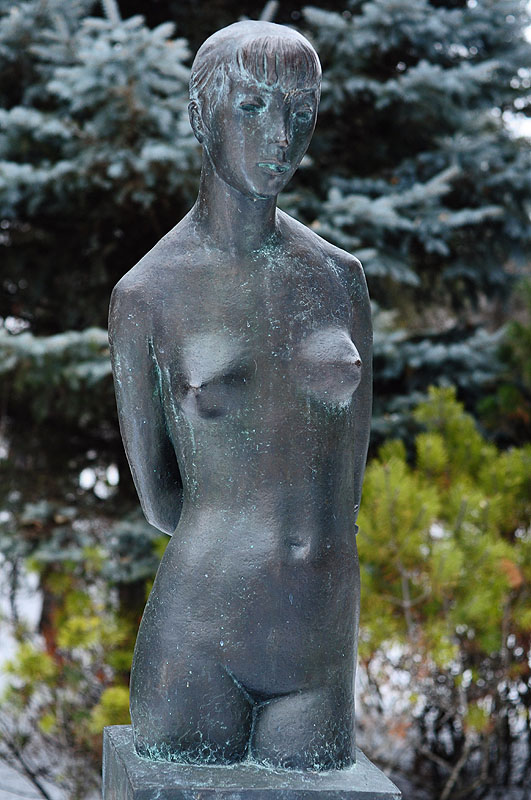
leomol-nude-dsc_3802-cln-.jpg - 2010-05-19 16:30:34
Nudity at the Leo Mol sculpture garden, Assiniboine Park.
PictionID:41567174 - Title:Republic P-43 Lancer P-43, 41-31449. The P-43 was a direct successor of the P-35 along with the XP-41 in parallel development. The P-43 was originally designed with large streamlined cowling similar to the XP-42 and suffered the same cooling problems, so the design was modified to standard radial engine cowling with the turbo-supercharger air inlet located aft of the wing. - Catalog:15_002937 - Filename:15_002937.TIF - Image from the Charles Daniels Photo Collection album "Seversky, Republic and P-47"----PLEASE TAG this image with any information you know about it, so that we can permanently store this data with the original image file in our Digital Asset Management System.----SOURCE INSTITUTION: San Diego Air and Space Museum Archive
The streamlined Amtrak California F59PH-Is have been hard at work for two decades now, introduced in 1994. They commendably still look stylish but are looking quite work weary now. It is surely only a matter of time before new MPI locos replace them, enabling longer consists. An advertising sign has been digitally removed from above the cab! The train is braking for the Oceanside stop.
The Shape of Speed
Streamlined Automobiles and Motorcycles, 1930–1942
JUN 16 – SEP 16, 2018
Portland Art Museum
The Portland Art Museum is pleased to announce The Shape of Speed: Streamlined Automobiles and Motorcycles, 1930–1942, a special exhibition debuting at the Museum in Summer 2018. Featuring 19 rare streamlined automobiles and motorcycles, The Shape of Speed opens June 16 and will be on view through September 16, 2018.
The concept of streamlining has fascinated people for generations. Beginning in the 1930s and extending until the outbreak of the World War II, automotive designers embraced the challenge of styling and building truly streamlined cars that were fast and fuel-efficient. They were encouraged by the confluence of aircraft design with the sleek shapes of fast railroad locomotives; new advanced highways such as the Autobahns; and events like the 1939 New York City World’s Fair, which showcased futuristic design.
The Shape of Speed presents a select group of rare automobiles and motorcycles that demonstrate how auto designers translated the concept of aerodynamic efficiency into exciting machines that in many cases, looked as though they were moving while at rest.
The Museum will display 17 cars and two motorcycles—the best of that era’s streamlined offerings—from Europe and the United States. Engineering drawings and period photographs will show some of the aircraft, railroad, ship and yacht designs that influenced the automakers.
Featured designers and engineers include European streamlining pioneer Paul Jaray, along with Richard Buckminster Fuller, Norman Bel Geddes, Raymond Loewy, Harley J. Earl, Hermann Ahrens, Georges Paulin, Joseph Figoni, Dr. Wunibald Kamm, Otto Kuhler, Jean Bugatti, Hans Ledwinka, Gordon Buehrig, and others.
The streamlined 52-seat coach car was built by Budd in 1940 and was given the name "Silver Glow" by the Chicago, Burlington & Quincy Railroad. The Silver Glow" was part of the Chicago, Burlington and Quincy Railroad's Silver Streak Zephyr train that ran between Kansas City-Omaha-Lincoln from 1940 to 1959. The coach car was built in 1940.
In 2007, the car was on display at a railroad museum in Atchison, Kansas. In 2014, the coach car was parked on a side track in Charles City, Iowa. To view a photograph of the car in Atchison go to: flic.kr/p/4VaZjp
This should settle a great deal of curiosity? The drivers position on the 1935 Test Streamlined stock. The drivers seat has been reversed for the photo. The gear type controls,as we all know didn't catch on. But an interesting set up and all very basic as you would expect from a trial test.
STREAMLINED VERSION OF THE 4-6-0 SANDRINGHAM/FOOTBALLER CLASS.
became 61670 and later de-streamlined.
Outfit Details
Top: H&M
Skirt: Anthropologie Abstract Greenery Skirt
Shoes: Uggs
Necklace: Anthropologie
Blogged on: tolookforstyle.blogspot.com
Whilst the LNER had their A4 streamliners, the rival LMS fitted streamlined casings to some of their locomotives. 46229, currently out of service, has been given a streamlined casing as a reminder of the LMS style.
The waterfall grille on this 1938 Dodge gasoline tanker on display at the Henry Ford Museum is a glorious symbol of the streamlined era.
Lincoln Zephyr (1937)
* Designer: John Tjaarda
* Displacement: 4380 cc
* Power: 110 CV
* Top-speed: 130 km/h
Henry Ford's sun Edsel, who was in charge of the company's LINCOLN division, was the first to introduce a marketable, mass-produced streamlined automobile: the 1936 Lincoln Zephyr.
Sweeping the market like a storm, the aerodynamic design suddenly turned into an international fashion trend.
Zeithaus Museum
Autostadt Wolfsburg
17 February 2014
Nikon D90/AF Nikkor 1:3.5-4.5 28-105 mm
"Union of South Africa" passes through Brookmans Park Station on its way to Newcastle, Brookmans Park, Herts, UK
Streamlined volcanic ejecta.
Locality: Coconino County, Arizona
Size: Specimen is 1.00 inch wide
Catalog: RBas 11
Advance publicity for the Flying Yankee streamliner, published by the Boston & Maine Railroad. The service was introduced in 1935, linking the 254 miles between Boston North station and Bangor, Maine in a journey time of 5.5-6 hours. The train comprised a single ‘shovel nose’ Winton-powered locomotive hauling three Budd stainless steel coaches. The design was similar to the Burlington Road’s ‘Pioneer Zephyr’ and was the third diesel streamlined train to the run in the United States.
After withdrawal in 1957, the Flying Yankee was set aside for preservation and currently awaits restoration on the Conway Scenic Railroad, New Hampshire.
Streamlined LMS 'Duchess of Hamilton' 6229 on Display at National Railway Museum York.
Taken 25-05-09.
Outfit Details
Top: H&M
Skirt: Anthropologie Abstract Greenery Skirt
Shoes: Uggs
Necklace: Anthropologie
Blogged on: tolookforstyle.blogspot.com
Building guide for my own Lego creation - 139 parts, size 24.6 x 3.2 x 3.8 in studs.
The model is available here: www.bricklink.com/v3/studio/design.page?idModel=815496.
The inspiration was the American steam locomotive 4-6-2 2906, but I believe that you will see another steam engine in my model :)
Carving of the Baltimore & Ohio Railroad # 5800 streamlined steam locomotive and tender from the late 1930s.
Black = ebony wood
White = elephant ivory
The artist disliked this carving and this locomotive type because it too much resembled a diesel locomotive, which "has the personality of a tomato worm".
Artist: Ernest Warther
On public display at the Warther Museum, Dover, Ohio, USA.
***UPDATE**** McCobb is off....Thanks Steve on making the big move. Full disclosure...I love a decisive buyer who DOES NOT mess around. Kick ass. 1/27/11
The streamlined former S.S. Kresge store in downtown Baltimore. Built in 1938 at the corner of Park Avenue and West Lexington Street.
Composite photograph made up of 5 images. This locomotive is at the Baltimore and Ohio museum in Baltimore located at: 39.285365, -76.631914 on google maps.
This is what she looked like before streamlining

Seen during streamlining upgrade

Streamlined Ka942 steaming through the old mining town of Dobson on the West Coast of New Zealand's South Island. This locomotive is owned and operated by Main Line Steam Heritage Trust
This is an anaglyph (3D) image taken by the High Resolution Stereo Camera (HRSC) on board Mars Express showing the mouth of the Tiu Valles channel system on the red planet. Stereoscopic glasses are required to view the image.
The pictures were taken in orbit 3103 on 10 June 2006 with a ground resolution of approximately 16 metres per pixel.
Visible in the lower part of the image are remnants of a once 'streamlined' island.
The upper part of the scene covers the Tiu Valles mouth nearly in its entire width, approximately 55 km. Its winding, meandering ridges, bound by depressions are eye-catching. The processes that formed these odd structures are unknown. Possibly, during flooding events, water or water-rich surface layers came in contact with lava from the surrounding areas, which then might have led to the formation of these mysterious ridges.
The region is located at approximately 27° North and 330° East. The sun illuminates the scene from the North West, lower left-hand side in the image.
This anaglyph image was calculated from the nadir channel and one stereo channel.
Credits: ESA/DLR/FU Berlin (G. Neukum)
The evocative shape of the streamlined Typ C must have caused a sensation in 1937. Afterward, and especially in the post war period, the curves of this car found their way onto production cars. That's because this Auto Union was specially shaped for top speed on the Avus circuit near Berlin. At the time, it was the fastest track in the world.
In 1937, Avus was facing competition from the Norisring in Nuremberg. To garner more attention, the Avus' simple layout was extended to include a high speed 43° banked turn made from brick. This launched right onto the main straight, letting cars reach nearly 248.40 mph (400 kph).
The Internationales Avus Rennen main event was held and the organizers invited record-breaking cars from both Auto Union and Mercedes-Benz. Both companies developed their cars thoroughly and did multiple tests on Avus before the race. At the time, Avus was ultimate race track and also the most dangerous. Since there was no fence at the top of the curve, it got nicknamed the 'Wall of Death'. This didn't stop 18 brave drivers from entering the race and 300,000 to 400,000 people showed up for the fastest pre-war race ever run.
The race was split into three seven-lap sprints with grids of only six or eight cars. Four streamliners were included and evenly simple split between Mercedes and Auto Union. They raced alongside the regular-season Grand Prix cars. Naturally, the Streamliners had a distinct advantage on the two long straights at Avus but the GP cars had the edge on the joining curves. At the start, Caracciola in the Mercedes and Rosemeyer in the Auto Union had a great battle. This lasted until the last lap when they were side-by-side. In the end Caracciola won just 0.7 seconds in front of Rosemeyer.
The second heat was much faster, with Brauchitsch and Fagioli in dueling streamliners. Fagioli retired with transmissions problems which left Von Brauchitsch and Mercedes the easy win. The other Mercedes-Benz Streamliner of Herman Lang suffered a tire failure at speed and Lang was lucky to keep the car straight enough to survive.
The third and final heat decided the overall victor with a combined group from the first two races. Four Streamliners were entered Brauchitsch, Caracciola and Lang in Mercedes against Rosemeyer in the Auto Union. He didn't stand a chance since his V16 was only running on 13 cylinders and he was well outnumbered. Eventually, Lang went on the win entire event. This would be the only time someone would score a victory using the full track, as it was deemed to dangerous to repeat in 1938.
By 1937, Auto Union had been actively making streamlined record cars for three years. Their first attempt was with a long-tail Typ A and later a striking Rekordwagen Typ Lucca Coupe was made. Auto Union might have considered using these designs in a a normal Grand Prix race, but this never happened. A streamlined Typ D did show up at Reims for the 1938 French GP but crashed heavily during practice. This car might have had a shorter tail than the record car pictured above.
Unfortunately, the only record of these cars exists in pictures. A replica of 1937 Avus car was made to exact specification for Audi Tradition.
Read more at www.supercars.net/cars/916.html#VjeXDFdHEUFvX5kO.99
London North Eatern Railway A4 class No.4468 'MALLARD' sits next to London Midland Scottish 6229 Coronation class 'Duchess of Hamilton' in the Grate Hall in the NRM photo took on the 30.11.12
I liked the straight on vantage of this sub-adult red-footed booby (Sula sula).
Midway Atoll National Wildlife Refuge
This Touring-bodied coupé is one of just over 100 Mille Miglias built. In November 1937 Autocar tested the model at Brooklands and it achieved 93.75mph over a flying quarter mile and 0-60 mph in 16.6 seconds.
Nine 6C-2300s were entered into the 1937 Mille Miglia with some success against Tipo B Berlinettas and a Delahaye ending an impressive fourth in a huge entry of cars. In this wet year the closed bodywork and streamlined shape must have been a boon to the drivers of these cars.
Streamlined Diesel Railcar No. 4.
In 1933 the GWR introduced the first of what was to become a very successful series of railcars, which survived in regular use into the 1960s, when they were replaced with the new British Rail "first generation" type diesel multiple units.
Vehicle no W4W, builder Park Royal, 1934.
Southern Railway operated N&W J-class 4-8-4 modern streamlined Northern steam locomotive # 611, view of bullet nose cone seen in the yard at Atlanta, Georgia, May 1983. You can see where the original headlight was replaced with a modern twin sealed beam headlight assembly. The locomotive is being cleaned and prepared for its next day assignment to a railfan excursion train.
Designed by Karim Rashid for Magppie
Tor is the same as Eros, with the added functionality of a lid to use as both a champagne bucket and an ice bucket.
This is a stunning linear, graphic and streamlined range by Karim Rashid. The pieces in the collection literally seem to emerge from the table in liquid form,
# Double wall stainless steel
A different side view of the streamlined steam locomotive that often brought the west coast section of the SAL Silver Meteor includes a nice look at the Seaboard Air Line Railway medallion near the cab. Note the fancy lettering of the original painted number 868. A crew member is in the cab of the engine, described as a Pacific class 4-6-2 manufactured by Richmond in 1913 and modified with the shroud in 1940. George W. Pettengill Jr. photo, courtesy C. K. Marsh Jr. collection