View allAll Photos Tagged sharp
Some background:
The Kawasaki Ki-78 was originally designated KEN III and was a high-speed research aircraft developed to investigate laminar profile wings with high wing loadings. Early in 1938 a high-speed research program was started at the Aeronautical Research Institute of the University of Tokyo for a small single-seat aircraft.
The KEN III, designed at the Aeronautical Research Institute and built at Kawasaki Kokuki Kogyo K.K. to investigate flying behaviour at very high speed. All-metal construction was used in combination with a small thin wing with a laminar flow profile and a sharp leading edge. Furthermore, the research aircraft featured a streamlined minimum cross-section fuselage and was fitted with a licence-built Daimler-Benz DB 601A engine. For short duration power boost methanol/water injection was used, and cooling was improved by a 45 kW (60 hp) turbine driven cooling fan for the radiators in the rear fuselage flanks, leaning the wings as clean as possible.
By the outbreak of the war, the whole project was taken over by the Imperial Japanese Army who gave it the military type designation Ki-78. Kawasaki received the order to build two prototypes of the Ki-78, construction of which was started in September 1941. The first was completed more than a year later and was flown for the first time on 26 December 1942.
The engineers had ambitious plans: beyond the experimental nature of the aircraft the Ki-78 was earmarked for the absolute flying top speed record and the IJA was highly interested in a fast fighter derivative.
However, the Ki-78 was found to be extremely difficult to fly at low speeds and had poor stall characteristics. The aircraft was heavier than the design estimates, which increased the wing loading. Even with the special flaps and drooping ailerons, takeoff and landing speeds were both high at 127 mph (205 km/h) and 106 mph (170 km/h) respectively. In addition, elevator flutter was experienced at the relatively low speed of 395 mph (635 km/h).
High-speed flight tests were started in April 1943, and during the Ki-78’s 31st flight on 27 December, the aircraft achieved its maximum speed of 434.7 mph (699.6 km/h) at 11,572 ft (3,527 m). While this was basically an impressive performance, this was considerably less than the program’s speed goal of 528 mph (850 km/h). A feasibility study to improve the Ki-78 flight performance showed that extensive airframe modifications were needed and consequently the project was officially terminated after the 32nd flight on 11 January 1944. The second Ki-78 was never completed.
The single Ki-78 survived the war, but it was crushed by American forces at Gifu Air Field in 1945.
General characteristics:
Crew: 1
Length: 8.1 m (26 ft 7 in)
Wingspan: 8 m (26 ft 3 in)
Height: 3.07 m (10 ft 1 in)
Wing area: 11 m2 (120 sq ft)
Empty weight: 1,930 kg (4,255 lb)
Gross weight: 2,300 kg (5,071 lb)
Powerplant:
1× Daimler-Benz DB 601A V-12 inverted liquid-cooled piston engine
rated at 1,160 kW (1,550 hp) with Water/Methanol injection for short durations
Performance:
Maximum speed: 700 km/h (435 mph; 378 kn) at 3,500 m (11,500 ft)
Range: 600 km (373 mi; 324 nmi)
Service ceiling: 8,000 m (26,000 ft)
Wing loading: 209 kg/m2 (43 lb/sq ft)
Power/mass: 0.373 kW/kg (0.2273 hp/lb)
Armament:
None
The kit and its assembly:
Another group build contribution, again for the Arawasi Wild Eagles Blog which ran its sixth competitionn in late 2017 under the motto "Prototypes" (no whifs). As a consequence, this is a real-world aircraft, depicting the only Ki-78 prototype late in ist career, when it eventually carried an all-orange livery with photo calibration markings.
The kit is of AZ Model’s Ki-78, and this one is actually the leftover sister ship of the early two-kit-boxings that was converted into a fictional Ki-78 Kai fighter that was thought about, but never realized.
The kit is simple and a typical short-run offering. You need some experience to get it together and expect rather mediocre fit and some putty work. Even though I built it mostly OOB I did some changes:
- A rear bulkhead was added in the cockpit
- Different main wheels were mounted
- Added struts for the landing gear covers.
- The propeller received a new, longer axis construction
Painting and markings:
AZ Models offer the prototype in two liveries, the early NMF Ki-78 and the late scheme of the aircraft in overall orange. While this sounds simple, finding an appropriate tone that resembles the IJA trainer and prototype orange is not easy. Among the choice of six potential tones I eventually settled for Humbrol's 82 (Orange Lining), and for the basic painting I added a bit of 132 (Red Satin). Evyrething was painted with brushed.
After an initial overall coat the kit received a light black ink wash and panels were highlighted through post-shading/dry-brushing, and panel lines enhanced with a thin, very soft pencil.
All interior surfaces were painted with Aodake primer - actually a clear blue lacquer. In order to mimic this look, Cockpit and landing gear wells/covers were initially painted with aluminum (Revell 99), and, once dry, overpainted with a turquise, water-based clear window paint - a great contrast to the orange.
The decals come from the OOB sheet, and I added small markings at the wing tips - since only BW pics are available from the original Ki-78 I assume that these are white? Another addition are silver heat protection shields behind the exhaust stubs, also created with generic decal sheet.
After a little exhaust soot on the flanks with graphite the kit was sealed with acrylic varnish, in this case with a 4:1 mix of matt and gloss varnish, for a light shine.
A simple kit, realized relatively quickly, since it posed no major challenges. The result looks good, though, an elegant and beefy, small aircraft, and the orange livery stands out well.
twice a day, these piers take the full force of the river Severn's second highest tidal range in the world - quite something for an ancient wooden structure.
le "bloc tombant de Sharp a été clairement du côté de L'union pendant la guerre de secession avec les Sharpshooters du colonel Berdan(regt de tireurs d'elites de l'union équipés en Sharp en partie qui pourtant était plutôt une arme de Cavalier - fait d'arme le plus connu Gettysburg) . Hélas, c'est aussi le tueur de Bison (buffalo killing) par exellence et donc de la guerre indirecte ou economique faite aux amerindiens (en tuant les bisons on tuait "volontairement" et parqué aussi ces derniers).
A toy? Not really, this lens can really deliver amazingly sharp results!
--- Lessons learned:
+ best way to get the grips is to use the lens with the cam (in liveview) tethered to a tv set via DVI
+ the lens should not be used on maximum tilt -- you cannot get sharp results with this adjustment
+ the two lenses in the Lensbaby are not coated, backlight will lead to overlit blurry results ...
+ This is a 50 mm lens, minimum object distance is approx 0,6 meters ...
+ shots were take with the 4.0 aperture, ... 5.6 has a wider sweet spot, but less wow effect
+ works fine in Av-Mode
--- This is how focusing works:
Point the optical axis of the lens **exactly** towards the spot you want to focus; adjust focus ring - if possible in zoomed liveview mode.
--- This is how it not works:
Leave the lens as-is (no tilting); try to focus on an object in the corner of the image via turning the focusing wheel.
--- One problem I came across:
The 5DMkII works fine with this lens in Av mode, even better with additional liveview, but does *not* adjust exposure in *zoomed* liveview! => Firstly wait for exposure adjustment, then zoom in, adjust focus, if possible, zoom out again, shoot. :-)
Christine portrait shoot at Daniel Stowe Botanical Gardens. Olympus E-5, Zuiko 35-100mm f/2.0 SHG Lens. ©RFL Photography 2012.
Production stills from the Grady produced music video Sharp. Filmed by University of Georgia students in Athens, GA.
www.messersmith.name/wordpress/2010/07/04/sharp-and-smooth/
Weekdays come and go. My last work week consisted of exactly one day - Friday. Wouldn't it be nice if Friday was the only work day? You could go to work in the morning knowing that when you clock in you are beginning your week and when you clock out, it's the weekend again. Pay might be a problem, however. I'm working on a plan to live without money. If I get it worked out, I'll let you know.
And following my one-day work week came Glorious Dive Day! I had nobody going out on Faded Glory this week, so I skipped all of that boat loading and unloading and just went out with Richard Jones on Sanguma. I have to admit, I really like getting picked up at my front door. It's quite a treat compared to my usual Saturday routine.
The dive was quite nice. The Eel Garden was putting on a fine show. I got some very nice underwater shots. However, as it sometimes happens, my favourite shot of the day has nothing to do with fish. Ush is one of my favourite photographic subjects, at least when she is not too shy. I kept seeing wonderful reflections in her cheeky red sunglasses. A little coaxing Got her into the mood to pose for me:
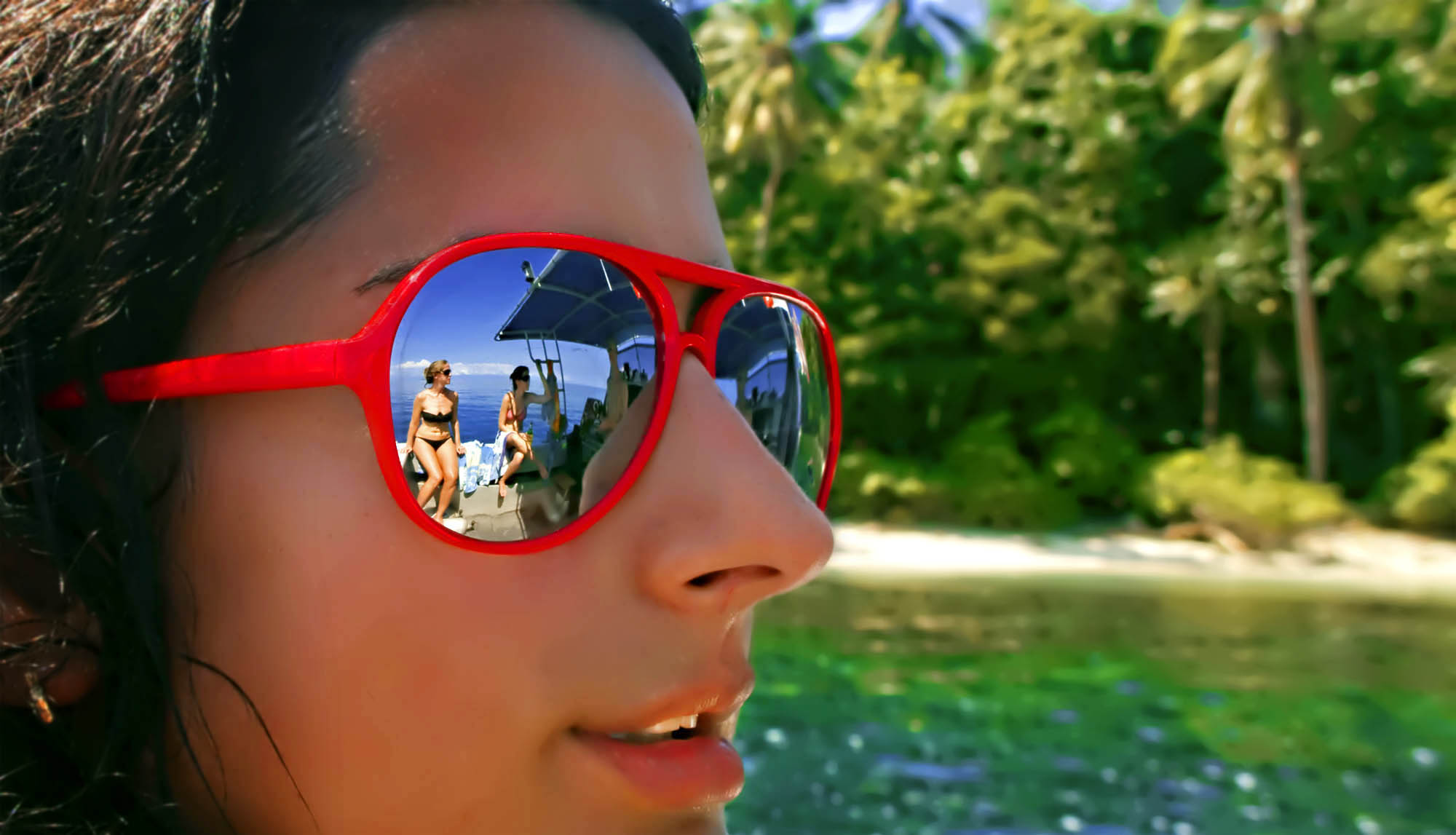
When I first saw the result on my computer screen I was not overjoyed. Though Ush gave me just what I wanted, my exposure skills were not up to snuff. It took me the better part of an hour to massage the image into what my original vision demanded. I wanted the sharpness of the sunglasses and the reflections, but I needed Ush's skin to be as soft and smooth as a baby's bottom. Well, it pretty much is in reality, but cameras are harsh to skin, as we all know. I'm happy with the finished product. It's the most fun I've gotten from a single image for quite a while.
Now this one . . . this one is a mistake. It was so bad that I nearly deleted it. However, I sometimes like to play the photographic savior and redeem otherwise worthless frames:
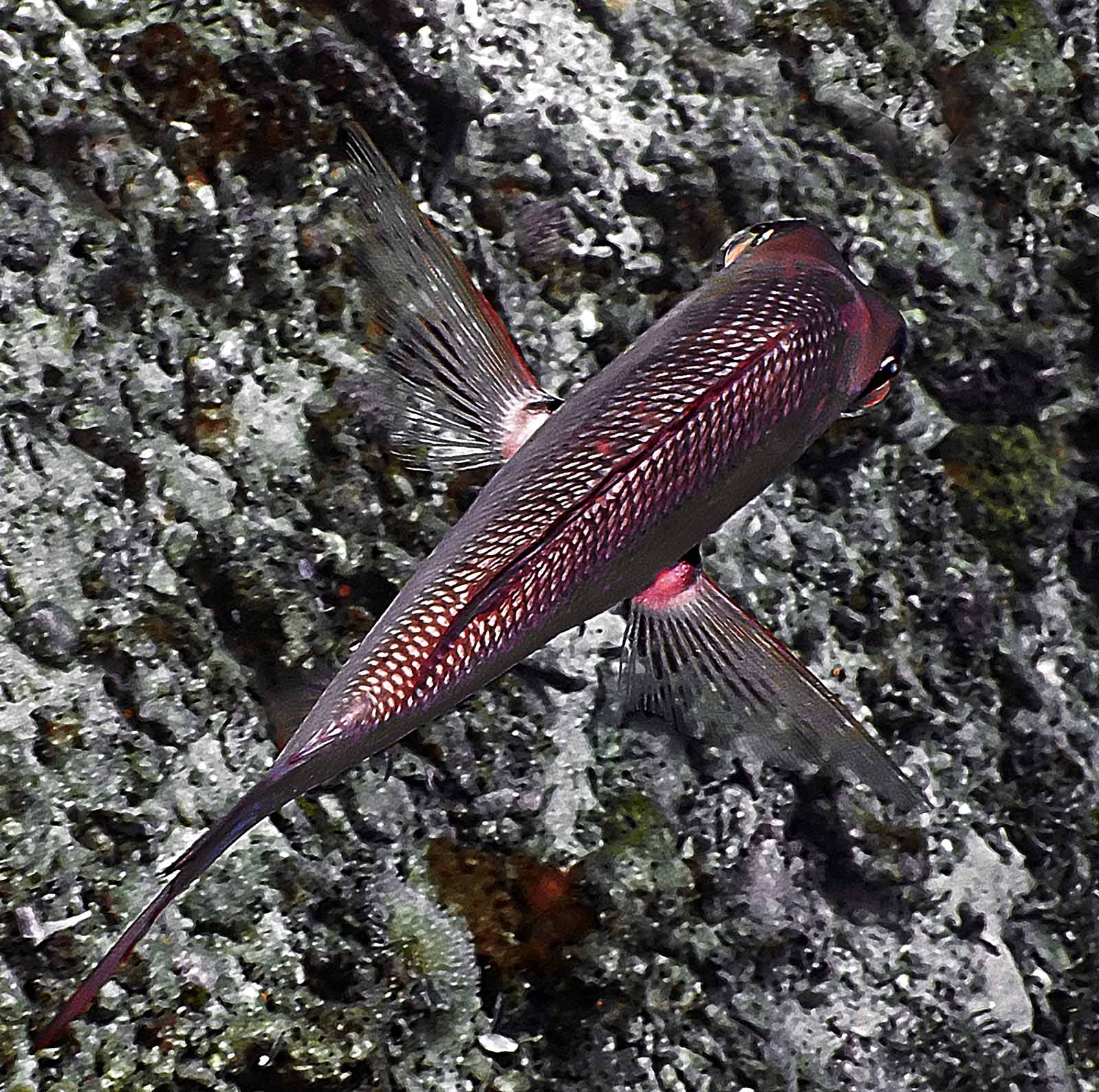
The Soldierfish was swimming away, it was too distant, and the light was all wrong. On top of that, I had my flash turned on, which threw off the colour balance. I know! I'll call it "Art'.
Richard Jones came over to me with a rock and seemed quite excited about it. It took me a moment to realise that on that rock was a nudibranch which I had never seen before. Of course, I took its picture. It's a Phyllidia ocellata:
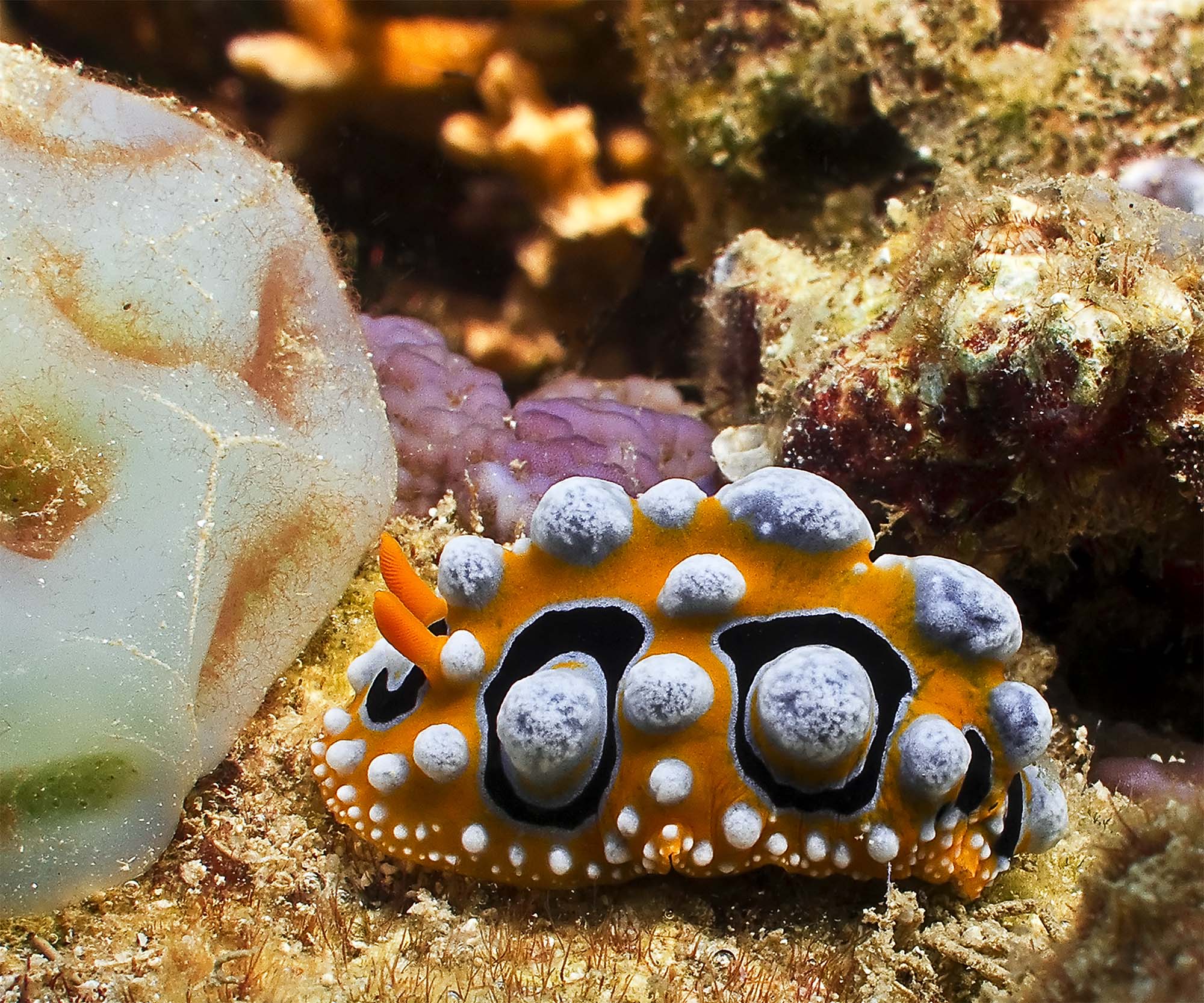
I have to say that it is probably the most humorously patterned nudibranch which I have seen. Some nudis are ethereal in their beauty. This one is wearing a clown suit.
I should know the name of this Planaria, more commonly called a flatworm. I got this shot standing on my head, because it was under a ledge. I've turned it right-side-up for you:
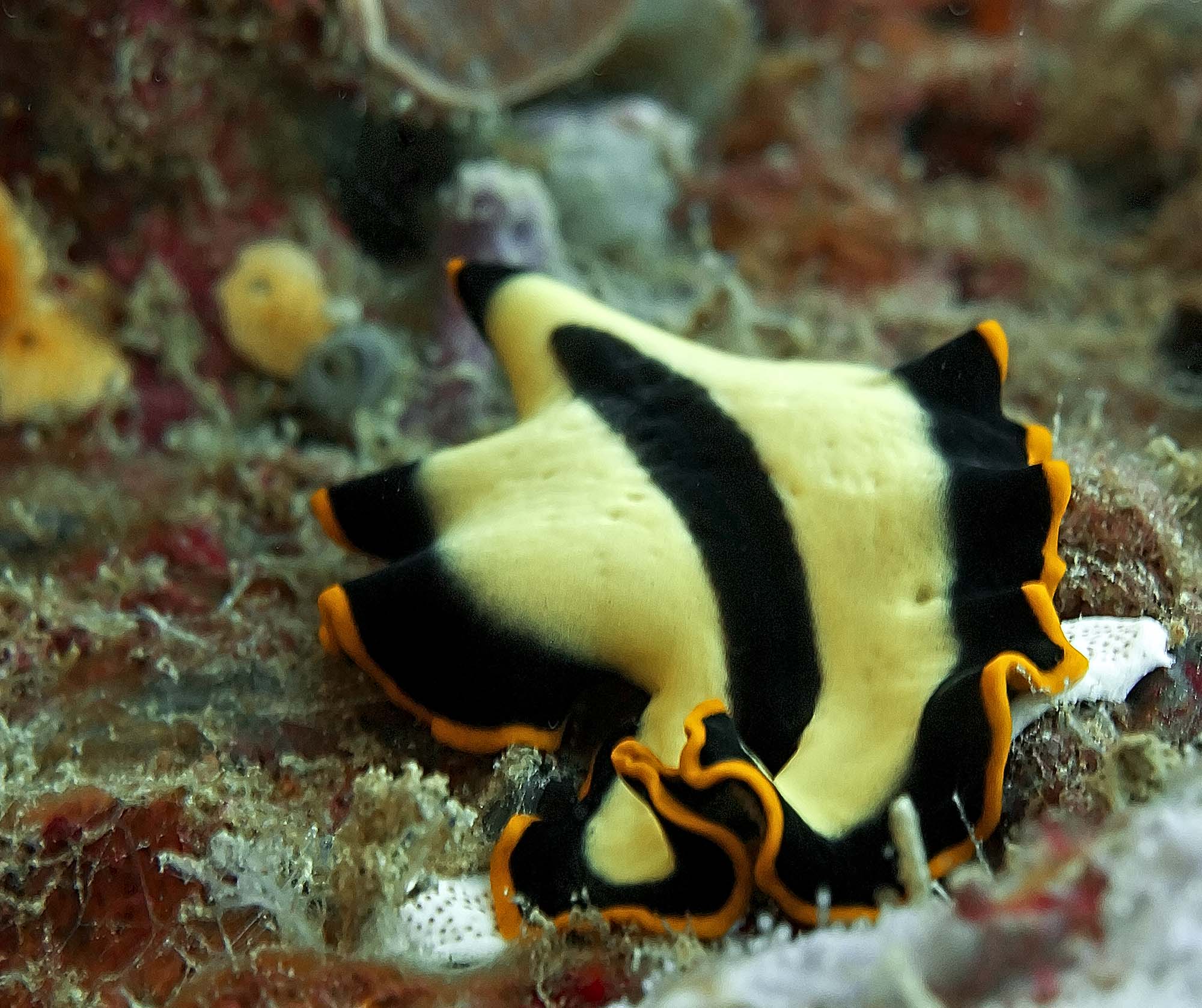
It's Sunday afternoon, and I'm not going to look it up. Somebody out there help me. It's very common here.
I'll finish up with a couple of "Deep Focus" reef scenes. As several readers have pointed out, there is nothing special about these high depth of field shots. It's just a matter of setting your camera right and having favourable shooting conditions:

However, I have noted that few underwater photographers actually do it. It seems as if nearly everybody either shoots macro shots of little things or big, gaudy scenes shot with super-wide angle lenses and multiple flashes.
I don't see many shots such as these which use a cheap camera and a normal lens stopped down to achieve maximum depth of field:
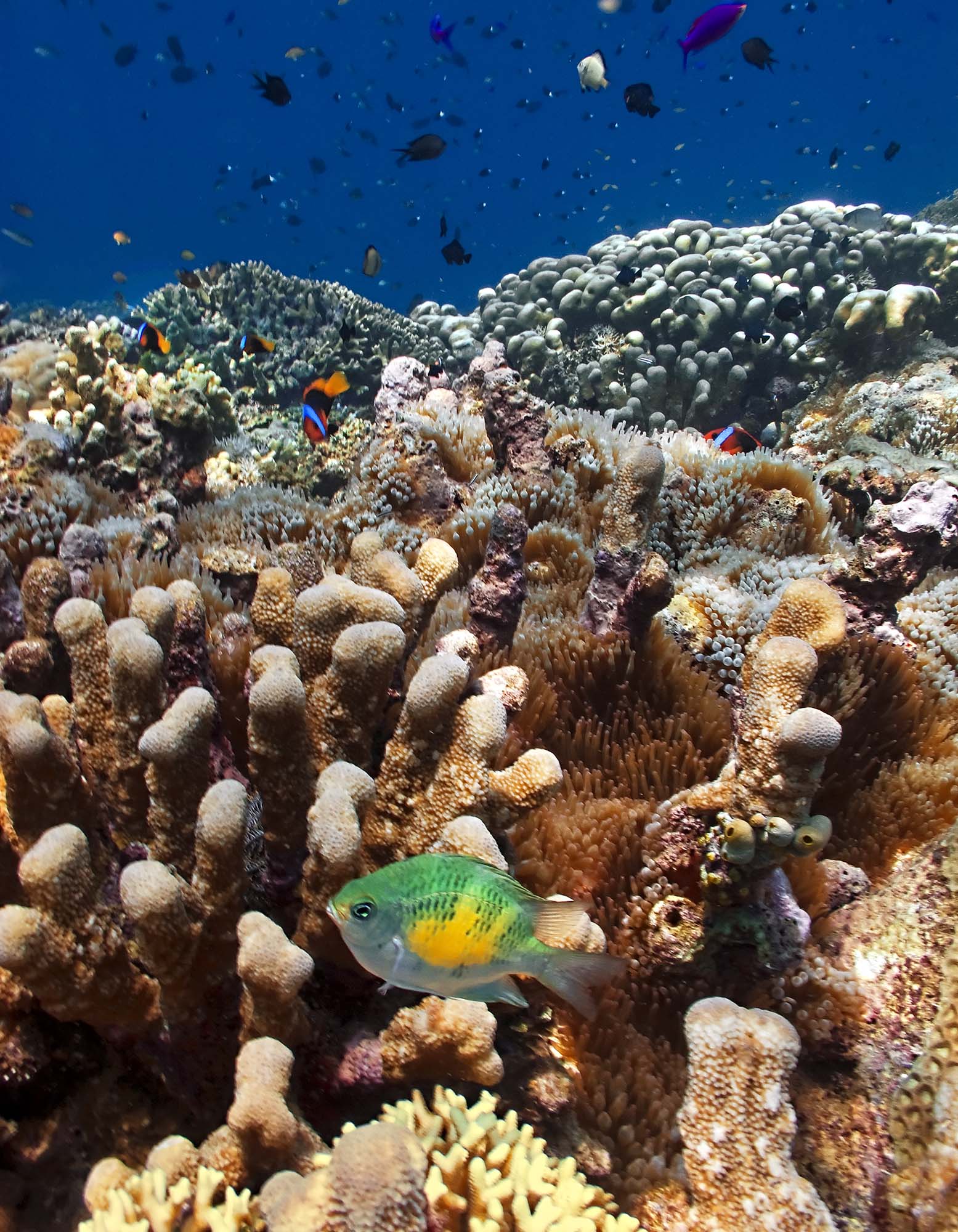
I find them pleasing, because when I seen them I can honestly say, "That's just the way it looked to me."
Someday, that is going to come in very handy for me.
This was the alternate photo for today. It actually was today's photo for about an hour or so but then I changed my mind and chose this photo instead. There are things I like and don't like about both photos and probably should have done a retake after the fact but didn't feel like getting everything out again. I like the perspective and the fact that you see both points in this shot but I think it's a little too bright. I thought the other one was too dark but I like that it has a closer crop and leaves more to the imagination. I like to keep reminding myself during this that what you don't see is often more powerful than what you do.
A Joshua Tree is not really a tree at all; it's a type of yucca with sharp, dagger-like, spiky leaves.
- Joshua Tree Forest, Yavapai County, Arizona
{ L } Lightbox view is best
© All Rights Reserved
was so surprised to look out my window and see this guy sitting in my tree !
never saw one of these before !
A tiny hawk that appears in a blur of motion—and often disappears in a flurry of feathers. That’s the Sharp-shinned Hawk, the smallest hawk in North America and a daring, acrobatic flier. These raptors have distinctive proportions: long legs, short wings, and very long tails, which they use for navigating their deep-woods homes at top speed in pursuit of songbirds and mice. They’re easiest to spot in fall on their southward migration, or occasionally at winter feeders.
Sharpes Plaxton Supreme IV bodied Volvo B58-61, STM 238W displayed at the 2021 buses Festrival held at the East of England Showground. Sun 08.08.2021.
Oops, I cropped this a bit too much when I was trying to get the feather details as close as possible, so the image isn't as sharp as it should be. My small group of three saw 77 of these Sharp-tailed Grouse during our day of birding for the Nanton Christmas Bird Count on 30 December 2012.. Sometimes, we saw just a single bird, other times quite a few perched in a tree. I think there were 17 in one of the trees. I only see this species when I'm on this Count.
One of the winning storm drain art designs from Sharp Kids after school program in Sharp Leadenhall!
Sharpes Coaches VWA 290L
AEC Reliance / Plaxton Supreme
Showbus 2018, Donnington
30th September 2018
The disused trackbed of part of the Sharpness Docks internal railway system. This section of line crossed the high level swing bridge over the entrance to the dock basing from the Gloucester & Shapness Canal. 20th July 2008.
Sharpes of Nottingham Vanhool TX11 Alicron on tradeplates at the 2021 Buses festival. Sun 08.08.2021.
Sharp-shinned hawk, checking out the bird feeders. Apparently the chickadees, who were flitting around directly beneath him weren't of interest