View allAll Photos Tagged seemingly
These seemingly endess fields of white mule ears were quite a sight. The plants are no taller than about one foot, but the flowers are large -- four to five inches across.
Along the way to Mesa Falls, we saw large fields of wildflowers. Upon arriving at the Falls, we were greeted by several Marmots, lazing on the cliff boulders. They were a bit wary, but we managed to get a few good photographs before they disappeared behind the rocks.
Ride to HELL
A short film, shot in a local train in Mumbai, uncovers the opportunist in seemingly decent human beings
Mini Pant Zachariah
Mumbai
T HE FILM ends with the line, 'Treating sex casually helps the virus' and yet The Opportunist is not a film about AIDS aware ness. In fact, this short 12-minute-long film directed by Dipk G N Nanglia, is about the base opportunist in seemingly decent human beings — the opportunist who, given an opportunity, is likely to take advantage of the less advantaged.
The theme is universal. This is probably why it was the only Indian short film selected from 1,573 entries for the Con Can Film Festival in Tokyo in March this year and, says its producer G K Desai, the first Indian short film to be released in Japan.
Nanglia uses a deserted late-night suburban train to Panvel to bring out the opportunist in the protagonist (who remains unnamed through the film). The character, played by Mohan Joshi, encounters a sobbing woman in the train and, on the pretext of consoling her, rapes her. When the train stops and a commuter enters, Joshi pre tends to comfort the woman who tells him at this point that she is crying because she and her unborn child both have AIDS.
In fact, the film begins on a note of dark humour when, waiting on the platform for the train, Joshi is about to light a cigarette. A police constable catches him, confiscates his cigarette on the ground that smoking on the platform is against the law… and then pockets the cigarette himself.
Nanglia first thought of shooting the film against the backdrop of a suburban railway platform or some deserted corner of Juhu beach but then opted for the moving train because "people will immediately connect with the local train".
The shoot was done at night when the trains are empty By the time they crew neared the end . of the shooting, it was daybreak and many commuters rushed in to the compartment. "In fact there were some 100 commuters in the compartment when we were shooting but we managed to keep them out of the frame," says Nanglia.
The story has had real-life parallels with molestation of women in deserted suburban trains in Mumbai hitting the headlines in the past. Mumbai's trains, understandably, evoke gritty stories, like the recent Ek Chalis Ki Last Local (2007), which weaves a tale around a call-centre employee who misses the last train home. The Opportunist, on the other hand, exposes the dark side of those who, emboldened by the anonymity that the city offers, let their dark side emerge.
Says Desai, "It is interesting how people from different parts of the world relate to the film. The Indians see it as the protagonist's karma - he is paying for the sin of raping a helpless woman. The Americans relate to Joshi's behaviour as a typical one-night stand. The Japanese can understand the kinkiness of the situation." Nanglia is an assistant director with Madhur Bhandarkar.
Desai, an electrical engineer and MBA, has done bit roles in Bhandarkar's Page 3, Traffic Signal and in the forthcoming film Fashion. Water Trade, the film Desai is making for US diplomat Wilson Roark, is being shot in Chicago and Tokyo and will be ready shortly .
mini.zachariah@hindustantimes.com A CONSTABLE CATCHES HIM AND CONFISCATES HIS CIGARETTE ON THE GROUND THAT SMOKING ON THE PLATFORM IS AGAINST THE LAW THE CHARACTER, PLAYED BY MOHAN JOSHI, ENCOUNTERS A SOBBING WOMAN AND, ON THE PRETEXT OF CONSOLING HER, RAPES HER
Seemingly depicting deep outer space, this wall tile is by German maker Helmut Schäffenacker. The impressed marks on the back read schäffenacker ulm/de. made in germany handgeformt 504.
As a result of family members being involved with the Festival of Thrift at the Kirkleatham Museum near Redcar I went along to provide transport, but not really knowing what I would find to keep me occupied. I certainly had no idea that this Sunbeam F4 Trolleybus was an exhibit there. New in 1950 with an East Lancs body, it was rebodied with this Roe example in 1960, thus becoming the last trolleybus body built, barring latter day one off prototypes. When trolleybus operation ceased in 1971 it became the property of the Teeside Museum Service and was put on display at Stockton. Unfortunately it was heavily vandalised, including an arson attack on the top deck. Subsequently it moved around various locations in the area but it seems none were too keen on what was now dubbed an eye-sore. Hence it was sold off privately and later some restoration work was done although this was not complete by the time the owner emigrated. It was then purchased by Langbaurgh -on- Tees Musem Service and a home was found at Kirkleatham Old Hall Museum. Further restoration work was done and most encouragingly, a purpose built "shed" (visible behind in one photo) was errected. This is also a museum store and contains various other seemingly unrelated (to each other) museum items including, I noted, a cutaway Cummins V6 diesel. Apparently there is an aspiration that one day TRTB No. 5 will provide rides around the grounds, but I wondered how much of a priority the electrical works had been during the restoration and whether the museum was prepared for the enormity of funding such a project as a whole.
Chicago Transit Authority (CTA) rapid transit car at the entrance to barn 8. Illinois Railway Museum (IRM). Union, IL.
Seemingly chaotic streets and promenades in Yokohama seen from the Yokohama Landmark tower.
© All rights reserved - No usage allowed in any form without the written consent of the photographer
seemingly always under construction the sheer volume of space within other spaces of the mosque are a wondrous sight to consider.
SOOC. Notice how one cloud is seemingly in the shape of a hand grabbing for something just out of reach. Thanks to Brian for pointing that out. :D
Nobody hurts me like you do, nobody knows me as well as you. I'm staring out into the blue;
I'm sorting files of what we knew. My future's lost - My future's torn. My disappointment knows it all
I'm stuck - I'm locked - I'm paralyzed. The gate is closed - I'm left outside.
Behind those walls - behind those gates, gardens so pure and lights so great.
Am I too high? - a step too low. I played the role; you told me so.
I'm stuck - I'm locked - I'm paralyzed. The gate is closed - I'm left outside.
And in time I will try to find the right time. At least it helps to comprehend;
Oh, silence, my best friend...
Heaven is wrapped in chains; I wanna get in - you won't let me.
Heaven is wrapped in chains, and I just cannot find the key.
RELIEF is a sculptural technique. The term relief is from the Latin verb relevo, to raise. To create a sculpture in relief is to give the impression that the sculpted material has been raised above the background plane. What is actually performed when a relief is cut in from a flat surface of stone (relief sculpture) or wood (relief carving) is a lowering of the field, leaving the unsculpted parts seemingly raised. The technique involves considerable chiselling away of the background, which is a time-consuming exercise with little artistic effect if the lowered background is left plain, as is often the case. On the other hand, a relief saves forming the rear of a subject, and is less fragile and more securely fixed than a sculpture in the round, especially one of a standing figure where the ankles are a potential weak point, especially in stone. In other materials such as metal, clay, plaster stucco, ceramics or papier-mache the form can be just added to or raised up from the background, and monumental bronze reliefs are made by casting.
There are different degrees of relief depending on the degree of projection of the sculpted form from the field, for which the Italian appellations are still sometimes used. The full range includes high relief (alto-rilievo), where more than 50% of the depth is shown and there may be undercut areas, mid-relief (mezzo-rilievo), low-relief (basso-rilievo, or French: bas-relief), and shallow-relief or rilievo schiacciato, where the plane is scarcely more than scratched in order to remove background material. There is also sunk relief, which was mainly restricted to Ancient Egypt. However the distinction between high relief and low relief is the clearest and most important, and these two are generally the only terms used to discuss most work. The definition of these terms is somewhat variable, and many works combine areas in more than one of them, sometimes sliding between them in a single figure; accordingly some writers prefer to avoid all distinctions. The opposite of relief sculpture is counter-relief, intaglio, or cavo-rilievo, where the form is cut into the field or background rather than rising from it; this is very rare in monumental sculpture.
Reliefs are common throughout the world on the walls of buildings and a variety of smaller settings, and a sequence of several panels or sections of relief may represent an extended narrative. Relief is more suitable for depicting complicated subjects with many figures and very active poses, such as battles, than free-standing "sculpture in the round". Most ancient architectural reliefs were originally painted, which helped to define forms in low relief. The subject of reliefs is for convenient reference assumed in this article to be usually figures, but sculpture in relief often depicts decorative geometrical or foliage patterns, as in the arabesques of Islamic art, and may be of any subject.
TYPES
The distinction between high and low relief is somewhat subjective, and the two are very often combined in a single work. In particular, most later "high reliefs" contain sections in low relief, usually in the background. From the Parthenon Frieze onwards, many single figures have heads in high relief, but their lower legs are in low relief; the slightly projecting figures created in this way work well in reliefs that are seen from below (see Moissac portal in gallery). As unfinished examples from various periods show, raised reliefs, whether high or low, were normally "blocked out" by marking the outline of the figure and reducing the background areas to the new background level, work no doubt performed by apprentices. Hyphens may or may not be used in all these terms, though they are rarely seen in "sunk relief" and are usual in "bas-relief" and "counter-relief". Works in the technique are described as "in relief", and, especially in monumental sculpture, the work itself is "a relief".
BAS-RELIEF OR LOW RELIEF
A bas-relief ("low relief"], from the Italian basso rilievo) or low relief is a projecting image with a shallow overall depth, for example used on coins, on which all images are in low relief. In the lowest reliefs the relative depth of the elements shown is completely distorted, and if seen from the side the image makes no sense, but from the front the small variations in depth register as a three-dimensional image. Other versions distort depth much less. It is a technique which requires less work, and is therefore cheaper to produce, as less of the background needs to be removed in a carving, or less modelling is required. In the art of Ancient Egypt and other ancient Near Eastern and Asian cultures, and also Meso-America, a very low relief was commonly used for the whole composition. These images would all be painted after carving, which helped to define the forms; today the paint has worn off in the great majority of surviving examples, but minute, invisible remains of paint can usually be discovered through chemical means.
The Ishtar Gate of Babylon, now in Berlin, has low reliefs of large animals formed from moulded bricks, glazed in colour. Plaster was sometimes used in Egypt and Rome, and probably elsewhere, but needs very good conditions to survive – Roman decorative plasterwork is mainly known from Pompeii and other sites buried by ash from Mount Vesuvius. Low relief was relatively rare in Western medieval art, but may be found, for example in wooden figures or scenes on the insides of the folding wings of multi-panel altarpieces.
Low relief is probably the most common type of relief found in Hindu-Buddhist arts of India and Southeast Asia. The low reliefs of 2nd-century BCE to 6th-century CE Ajanta Caves* and 5th to 10th-century Ellora Caves* in India are noted for they were carved out from rock-cut hill. They are probably the most exquisite examples of Buddhist, Hindu, and Jain arts in India. Most of these low reliefs are used in narrating sacred scriptures, such as those founds in 9th century Borobudur* Temple in Central Java, Indonesia, that narrating The birth of Buddha (Lalitavistara). Borobudur itself possess 1,460 panels of narrating low reliefs. Another example is low reliefs narrating Ramayana Hindu epic in Prambanan temple, also in Java. In Cambodia, the temples of Angkor* are also remarkable for their collection of low reliefs. The Samudra manthan or "Churning of Ocean of Milk" of 12th-century Angkor Wat is an example of Khmer art. Another examples are low reliefs of Apsaras adorned the walls and pillars of Angkorian temples. The low reliefs of Bayon* temple in Angkor Thom also remarkable on capturing the daily life of Khmer Empire.
The revival of low relief, which was seen as a classical style, begins early in the Renaissance; the Tempio Malatestiano in Rimini, a pioneering classicist building, designed by Leon Battista Alberti around 1450, uses low reliefs by Agostino di Duccio inside and on the external walls. Since the Renaissance plaster has been very widely used for indoor ornamental work such as cornices and ceilings, but in the 16th century it was used for large figures (many also using high relief) at the Chateau of Fontainebleau, which were imitated more crudely elsewhere, for example in the Elizabethan Hardwick Hall.
In later Western art, until a 20th-century revival, low relief was used mostly for smaller works or combined with higher relief to convey a sense of distance, or to give depth to the composition, especially for scenes with many figures and a landscape or architectural background, in the same way that lighter colours are used for the same purpose in painting. Thus figures in the foreground are sculpted in high-relief, those in the background in low-relief. Low relief may use any medium or technique of sculpture, stone carving and metal casting being most common. Large architectural compositions all in low relief saw a revival in the 20th century, being popular on buildings in Art Deco and related styles, which borrowed from the ancient low reliefs now available in museums. Some sculptors, including Eric Gill, have adopted the "squashed" depth of low relief in works that are actually free-standing.
Mid-relief, "half-relief" or mezzo-rilievo is somewhat imprecisely defined, and the term is not often used in English, the works usually being described as low relief instead. The typical traditional definition is that only up to half of the subject projects, and no elements are undercut or fully disengaged from the background field. The depth of the elements shown is normally somewhat distorted. Shallow-relief or rilievo stiacciato, used for the background areas of compositions with the main elements in low-relief, was perfected by the Italian Renaissance sculptor Donatello. It is a very shallow relief, which merges into engraving in places, and can be hard to read in photographs.
HIGH RELIEF
High relief (or altorilievo, from Italian) is where in general more than half the mass of the sculpted figure projects from the background, indeed the most prominent elements of the composition, especially heads and limbs, are often completely undercut, detaching them from the field. The parts of the subject that are seen are normally depicted at their full depth, unlike low relief where the elements seen are "squashed" flatter. High-relief thus uses essentially the same style and techniques as free-standing sculpture, and in the case of a single figure gives largely the same view as a person standing directly in front of a free-standing statue would have. All cultures and periods in which large sculptures were created used this technique in monumental sculpture and architecture.
Most of the many grand figure reliefs in Ancient Greek sculpture used a very "high" version of high-relief, with elements often fully free of the background, and parts of figures crossing over each other to indicate depth. The metopes of the Parthenon have largely lost their fully rounded elements, except for heads, showing the advantages of relief in terms of durability. High relief has remained the dominant form for reliefs with figures in Western sculpture, also being common in Indian temple sculpture. Smaller Greek sculptures such as private tombs, and smaller decorative areas such as friezes on large buildings, more often used low relief.
Hellenistic and Roman sarcophagus reliefs were cut with a drill rather than chisels, enabling and encouraging compositions extremely crowded with figures, like the Ludovisi Battle sarcophagus (250–260 CE). These are also seen in the enormous strips of reliefs that wound round Roman triumphal columns. The sarcophagi in particular exerted a huge influence on later Western sculpture. The European Middle Ages tended to use high relief for all purposes in stone, though like Ancient Roman sculpture their reliefs were typically not as high as in Ancient Greece. Very high relief reemerged in the Renaissance, and was especially used in wall-mounted funerary art and later on Neo-classical pediments and public monuments.
In Hindu-Buddhist art of India and Southeast Asia high relief can also be found, although it is not as common as low reliefs. Most of Hindu-Buddhist sculptures however also can be considered as a high relief, since these sculptures usually connected to a stella as the background to support the statue as well as provides additional elements such as aura or halo in the back of sculpture's head, or floral decoration. The examples of Indian high reliefs can be found in Khajuraho temple, that displaying voluptuous twisting figures that often describes the erotic Kamasutra positions. In 9th-century Prambanan temple, Central Java, the examples are the high reliefs of Lokapala devatas, the guardian of directions deities.
SUNK RELIEF
Sunk or sunken relief is largely restricted to the art of Ancient Egypt where it is very common, becoming after the Amarna period of Ahkenaten the dominant type used, as opposed to low relief. It had been used earlier, but mainly for large reliefs on external walls, and for hieroglyphs and cartouches. The image is made by cutting the relief sculpture itself into a flat surface. In a simpler form the images are usually mostly linear in nature, like hieroglyphs, but in most cases the figure itself is in low relief, but set within a sunken area shaped round the image, so that the relief never rises beyond the original flat surface. In some cases the figures and other elements are in a very low relief that does not rise to the original surface, but others are modeled more fully, with some areas rising to the original surface. This method minimizes the work removing the background, while allowing normal relief modelling.
The technique is most successful with strong sunlight to emphasise the outlines and forms by shadow, as no attempt was made to soften the edge of the sunk area, leaving a face at a right-angle to the surface all around it. Some reliefs, especially funerary monuments with heads or busts from ancient Rome and later Western art, leave a "frame" at the original level around the edge of the relief, or place a head in a hemispherical recess in the block (see Roman example in gallery). Though essentially very similar to Egyptian sunk relief, but with a background space at the lower level around the figure, the term would not normally be used of such works.
COUNTER RELIEF
Sunk relief technique is not to be confused with "counter-relief" or intaglio as seen on engraved gem seals—where an image is fully modeled in a "negative" manner. The image goes into the surface, so that when impressed on wax it gives an impression in normal relief. However many engraved gems were carved in cameo or normal relief.
A few very late Hellenistic monumental carvings in Egypt use full "negative" modelling as though on a gem seal, perhaps as sculptors trained in the Greek tradition attempted to use traditional Egyptian conventions.
SMALL OBJECTS
Small-scale reliefs have been carved in various materials, notably ivory, wood, and wax. Reliefs are often found in decorative arts such as ceramics and metalwork; these are less often described as "reliefs" than as "in relief". Small bronze reliefs are often in the form of "plaques", which may be set in furniture or framed. Various modelling techniques are used, such repoussé ("pushed-back") in metalwork, where a thin metal plate is shaped from behind using various metal or wood punches, producing a relief image. Casting has also been widely used in bronze and other metals. Casting and repoussé are often used in concert in to speed up production and add greater detail to the final relief. In stone, as well as engraved gems, larger hardstone carvings in semi-precious stones have been highly prestigious since ancient times in many Eurasian cultures. Reliefs in wax were produced at least from the Renaissance.
Carved ivory reliefs have been used since ancient times, and because the material, though expensive, cannot usually be reused, they have a relatively high survival rate, and for example consular diptychs represent a large proportion of the survivals of portable secular art from Late Antiquity. In the Gothic period the carving of ivory reliefs became a considerable luxury industry in Paris and other centres. As well as small diptychs and triptychs with densely packed religious scenes, usually from the New Testament, secular objects, usually in a lower relief, were also produced. These were often round mirror-cases, combs, handles, and other small items, but included a few larger caskets like the Casket with Scenes of Romances (Walters 71264) in Baltimore, Maryland, in the United States. Originally there were very often painted in bright colours. Reliefs can be impressed by stamps onto clay, or the clay pressed into a mould bearing the design, as was usual with the mass-produced terra sigillata of Ancient Roman pottery. Decorative reliefs in plaster or stucco may be much larger; this form of architectural decoration is found in many styles of interiors in the post-Renaissance West, and in Islamic architecture.
* go to my pictures of:
Ajanta Caves, Ellora Caves, Angkor Wat, Angkor Tom, Borobodur, Prambanan . . .
Some City churches seem to be open, if not all the time, then frequently. But others rarely seem to open their doors to visitors. Then there are those who seemingly don't want anyone to see inside their wonderful buildings. Which is more than a shame, really. These houses of God should be for everyone, not just the custodians.
Saying that, I must take another opportunity to thank The Friends of the City churches, and the time given by their volunteers who give up their time to ensure that these are open at least one day a week.
So, in the past two years, I think I have visited all of the churches that they are keyholders for, and so without this fine organisation, I would not have seen inside many of them.
St Benet's is open between 11:00 and 15:00 on Thursdays, and despite wondering whether it would be open as advertised, the greeters assured me it is open each and every Thursday.
St Benet's is unique in that I think I am right in saying that it is the only City Wren church that survived the Blitz undamaged. In which case, Wren would reconise this church, over all others he helped rebuild after the great fire in 1666.
It is now situated tucked in the corner of an off ramp of Queen Victoria Street, and the pedestrian has to walk through an unwelcoming subway to get to the door, which on this occasion was open.
I was greeted warmly, and given a tour of the history of the church, plus tips on visiting other churches. A wonderful visit and a fine church.
----------------------------------------------------
The Church of St Benet Paul's Wharf is a Welsh Anglican church in the City of London. Since 1556, it has also been the official church of the College of Arms in which many officers of arms have been buried. In 1666 it was destroyed in the Great Fire of London, after which it was rebuilt and merged with nearby St Peter's. The current church was designed by Sir Christopher Wren.[1] It is one of only four churches in the City of London to escape damage during World War II.
St. Benet's traces its history back to the year 1111, when a church was built on the site and dedicated to St Benedict. Over time the name was abbreviated to St. Benet. To the west of the site was the watergate of Baynard's Castle, which is referenced in the biographies of Queen Anne Boleyn and Lady Jane Grey. Both the church and the castle were destroyed in the Great Fire of 1666. It was rebuilt by the architect Christopher Wren, and reopened in 1683.
St Benet Paul's Wharf, London, taken from the top of nearby St Paul's Cathedral. Visible behind the church is the City of London School.
On 2 March 1706, Henrietta Hobart married Charles Howard, 9th Earl of Suffolk, a captain in the 6th (Inniskilling) Dragoons there. (Henrietta Howard subsequently became mistress to the future King George II.)[2]
The church was narrowly saved from destruction in the late 19th century, when its parish was merged with that of St Nicholas Cole Abbey. After an energetic campaign by its supporters, it was preserved and reconsecrated in 1879 as the London Church of the Church in Wales.[3] It is now the City's Welsh church, with services conducted in Welsh.[4]
In 2008 the church was closed for a few months due to a "dwindling congregation"[5] but reopened in time for the carol service in December that year. Welsh services are held weekly on Sundays at 11 a.m and 3.30 p.m and the church can be toured on Thursdays between 11 a.m and 3 p.m.
The church is of dark red brick, with alternate courses of Portland stone at the corners. The tower is situated to the north-west of the nave and is capped by a small lead dome, lantern and simple short spire.
The interior is almost a square. Unusually for a Wren church, the ceiling is flat rather than domed or curved. The north gallery was formerly used by the Doctors' Commons, and is now used by the College of Arms. Most of the original 17th century furnishings are still intact, including the magnificent altar table, reredos and pulpit, designed by Grinling Gibbons. The lectern and baptismal font are also original.[7]
The galleries are supported by Corinthian columns. There is a memorial to Inigo Jones, who was buried in the previous church, and a medallion bust of Sir Robert Wyseman, a benefactor of St Benet's who died in 1684.
en.wikipedia.org/wiki/St_Benet%27s,_Paul%27s_Wharf
A church has been on this site since 1111. Destroyed in the Great Fire, the present church was built by Wren and Hooke (possibly owing more to the latter) between 1677 and 1683. It was one of only four Wren churches to escape damage in the Second Word War but was vandalised in 1971: repaired and reopened in 1973. It has a long-standing connection with the College of Arms across the road. Also since 1879 the church has accommodated the Welsh Episcopalian congregation in London. It is therefore sometimes known as “the Welsh church”, though that is a misnomer. Paul’s Wharf was the wharf on the Thames from which stone and other building materials were conveyed for the Wren reconstruction of St Paul’s cathedral.
www.london-city-churches.org.uk/Churches/StBenetPaulsWhar...
There has been a church on this site, dedicated to St Benet (or Benedict), since the Twelfth Century.
Shakespeare refers to it in Twelfth Night: Feste, the Clown asking Duke Orsino to add a third to the two coins he is offering reminds him: “...the bells of St Bennet, sir, may put you in mind -– one, two, three.”
In the Sixteenth Century, because the watergate of Baynard’s Castle was close by, both Anne Boleyn and Lady Jane Grey may have received the last rites at St Benet on their way to execution at the Tower. The River Thames was, of course, an important thoroughfare at the time and the unlucky women could have completed their journey by boat.
St Benet is the only unaltered Wren church in the City. All but four were damaged in the Second World War and the other three either suffered the effects of an IRA bomb or have been restored.
The royal connection continued with Charles II having a special door at the side of the building and a private room from which he could take part in services. The Stuart arms can be seen above the west door marking the vantage point from which the king observed proceedings below.
Until 1867 St Benet was the parish church of Doctors Commons, a legal institution which, among its other activities, could provide facilities for hasty marriages. There is a record, for instance, of some 1300 weddings taking place in one year alone in the Eighteenth Century.
In 1747, Henry Fielding, the author of Tom Jones, Joseph Andrews and Shamela, married his second wife here.
In 1879 Queen Victoria removes St Benet from the list of churches to be demolished and grants the use of the church to the Welsh Anglicans for services.
The Officers of the College of Arms still have their own seats in St Benet’s and their personal banners hang from the gallery together with that of the Duke of Norfolk. At least 25 Officers are buried here.
In the 1870s the church was regarded as redundant and scheduled for demolition. Eminent Welsh Anglicans petitioned Queen Victoria to be allowed to use the building for services in Welsh. In 1879, Her Majesty granted the right to hold Welsh services here in perpetuity and this has continued ever since, with a service each Sunday morning.
In 1954, in the reorganisation of the City churches and parishes, St Benet became one of the City Guild churches as well as the Metropolitan Welsh Church.
The eminent composer Meirion Williams was the church organist in the 1960s and 1970s. As well as a Mass, Missa Cambrensis, he wrote a number of other works, including songs which are particular favourites of contemporary Welsh opera singers.
In 1971 a fire started by a vagrant damaged the north side of the church. During the repair work, necessitated mainly by smoke and heat damage, the Nineteenth Century organ was moved and rebuilt in its present (and original) position in the west gallery. When the church was reopened in May 1973, the congregation received a message from the Prince of Wales and trumpeters from the Royal Welsh Regiment blew a fanfare in celebration.
Today, the growing congregation at St Benet's remains committed to making known the good news of Jesus afresh to the current generation of the Welsh in London.
RELIEF is a sculptural technique. The term relief is from the Latin verb relevo, to raise. To create a sculpture in relief is to give the impression that the sculpted material has been raised above the background plane. What is actually performed when a relief is cut in from a flat surface of stone (relief sculpture) or wood (relief carving) is a lowering of the field, leaving the unsculpted parts seemingly raised. The technique involves considerable chiselling away of the background, which is a time-consuming exercise with little artistic effect if the lowered background is left plain, as is often the case. On the other hand, a relief saves forming the rear of a subject, and is less fragile and more securely fixed than a sculpture in the round, especially one of a standing figure where the ankles are a potential weak point, especially in stone. In other materials such as metal, clay, plaster stucco, ceramics or papier-mache the form can be just added to or raised up from the background, and monumental bronze reliefs are made by casting.
There are different degrees of relief depending on the degree of projection of the sculpted form from the field, for which the Italian appellations are still sometimes used. The full range includes high relief (alto-rilievo), where more than 50% of the depth is shown and there may be undercut areas, mid-relief (mezzo-rilievo), low-relief (basso-rilievo, or French: bas-relief), and shallow-relief or rilievo schiacciato, where the plane is scarcely more than scratched in order to remove background material. There is also sunk relief, which was mainly restricted to Ancient Egypt. However the distinction between high relief and low relief is the clearest and most important, and these two are generally the only terms used to discuss most work. The definition of these terms is somewhat variable, and many works combine areas in more than one of them, sometimes sliding between them in a single figure; accordingly some writers prefer to avoid all distinctions. The opposite of relief sculpture is counter-relief, intaglio, or cavo-rilievo, where the form is cut into the field or background rather than rising from it; this is very rare in monumental sculpture.
Reliefs are common throughout the world on the walls of buildings and a variety of smaller settings, and a sequence of several panels or sections of relief may represent an extended narrative. Relief is more suitable for depicting complicated subjects with many figures and very active poses, such as battles, than free-standing "sculpture in the round". Most ancient architectural reliefs were originally painted, which helped to define forms in low relief. The subject of reliefs is for convenient reference assumed in this article to be usually figures, but sculpture in relief often depicts decorative geometrical or foliage patterns, as in the arabesques of Islamic art, and may be of any subject.
TYPES
The distinction between high and low relief is somewhat subjective, and the two are very often combined in a single work. In particular, most later "high reliefs" contain sections in low relief, usually in the background. From the Parthenon Frieze onwards, many single figures have heads in high relief, but their lower legs are in low relief; the slightly projecting figures created in this way work well in reliefs that are seen from below (see Moissac portal in gallery). As unfinished examples from various periods show, raised reliefs, whether high or low, were normally "blocked out" by marking the outline of the figure and reducing the background areas to the new background level, work no doubt performed by apprentices. Hyphens may or may not be used in all these terms, though they are rarely seen in "sunk relief" and are usual in "bas-relief" and "counter-relief". Works in the technique are described as "in relief", and, especially in monumental sculpture, the work itself is "a relief".
BAS-RELIEF OR LOW RELIEF
A bas-relief ("low relief"], from the Italian basso rilievo) or low relief is a projecting image with a shallow overall depth, for example used on coins, on which all images are in low relief. In the lowest reliefs the relative depth of the elements shown is completely distorted, and if seen from the side the image makes no sense, but from the front the small variations in depth register as a three-dimensional image. Other versions distort depth much less. It is a technique which requires less work, and is therefore cheaper to produce, as less of the background needs to be removed in a carving, or less modelling is required. In the art of Ancient Egypt and other ancient Near Eastern and Asian cultures, and also Meso-America, a very low relief was commonly used for the whole composition. These images would all be painted after carving, which helped to define the forms; today the paint has worn off in the great majority of surviving examples, but minute, invisible remains of paint can usually be discovered through chemical means.
The Ishtar Gate of Babylon, now in Berlin, has low reliefs of large animals formed from moulded bricks, glazed in colour. Plaster was sometimes used in Egypt and Rome, and probably elsewhere, but needs very good conditions to survive – Roman decorative plasterwork is mainly known from Pompeii and other sites buried by ash from Mount Vesuvius. Low relief was relatively rare in Western medieval art, but may be found, for example in wooden figures or scenes on the insides of the folding wings of multi-panel altarpieces.
Low relief is probably the most common type of relief found in Hindu-Buddhist arts of India and Southeast Asia. The low reliefs of 2nd-century BCE to 6th-century CE Ajanta Caves* and 5th to 10th-century Ellora Caves* in India are noted for they were carved out from rock-cut hill. They are probably the most exquisite examples of Buddhist, Hindu, and Jain arts in India. Most of these low reliefs are used in narrating sacred scriptures, such as those founds in 9th century Borobudur* Temple in Central Java, Indonesia, that narrating The birth of Buddha (Lalitavistara). Borobudur itself possess 1,460 panels of narrating low reliefs. Another example is low reliefs narrating Ramayana Hindu epic in Prambanan temple, also in Java. In Cambodia, the temples of Angkor* are also remarkable for their collection of low reliefs. The Samudra manthan or "Churning of Ocean of Milk" of 12th-century Angkor Wat is an example of Khmer art. Another examples are low reliefs of Apsaras adorned the walls and pillars of Angkorian temples. The low reliefs of Bayon* temple in Angkor Thom also remarkable on capturing the daily life of Khmer Empire.
The revival of low relief, which was seen as a classical style, begins early in the Renaissance; the Tempio Malatestiano in Rimini, a pioneering classicist building, designed by Leon Battista Alberti around 1450, uses low reliefs by Agostino di Duccio inside and on the external walls. Since the Renaissance plaster has been very widely used for indoor ornamental work such as cornices and ceilings, but in the 16th century it was used for large figures (many also using high relief) at the Chateau of Fontainebleau, which were imitated more crudely elsewhere, for example in the Elizabethan Hardwick Hall.
In later Western art, until a 20th-century revival, low relief was used mostly for smaller works or combined with higher relief to convey a sense of distance, or to give depth to the composition, especially for scenes with many figures and a landscape or architectural background, in the same way that lighter colours are used for the same purpose in painting. Thus figures in the foreground are sculpted in high-relief, those in the background in low-relief. Low relief may use any medium or technique of sculpture, stone carving and metal casting being most common. Large architectural compositions all in low relief saw a revival in the 20th century, being popular on buildings in Art Deco and related styles, which borrowed from the ancient low reliefs now available in museums. Some sculptors, including Eric Gill, have adopted the "squashed" depth of low relief in works that are actually free-standing.
Mid-relief, "half-relief" or mezzo-rilievo is somewhat imprecisely defined, and the term is not often used in English, the works usually being described as low relief instead. The typical traditional definition is that only up to half of the subject projects, and no elements are undercut or fully disengaged from the background field. The depth of the elements shown is normally somewhat distorted. Shallow-relief or rilievo stiacciato, used for the background areas of compositions with the main elements in low-relief, was perfected by the Italian Renaissance sculptor Donatello. It is a very shallow relief, which merges into engraving in places, and can be hard to read in photographs.
HIGH RELIEF
High relief (or altorilievo, from Italian) is where in general more than half the mass of the sculpted figure projects from the background, indeed the most prominent elements of the composition, especially heads and limbs, are often completely undercut, detaching them from the field. The parts of the subject that are seen are normally depicted at their full depth, unlike low relief where the elements seen are "squashed" flatter. High-relief thus uses essentially the same style and techniques as free-standing sculpture, and in the case of a single figure gives largely the same view as a person standing directly in front of a free-standing statue would have. All cultures and periods in which large sculptures were created used this technique in monumental sculpture and architecture.
Most of the many grand figure reliefs in Ancient Greek sculpture used a very "high" version of high-relief, with elements often fully free of the background, and parts of figures crossing over each other to indicate depth. The metopes of the Parthenon have largely lost their fully rounded elements, except for heads, showing the advantages of relief in terms of durability. High relief has remained the dominant form for reliefs with figures in Western sculpture, also being common in Indian temple sculpture. Smaller Greek sculptures such as private tombs, and smaller decorative areas such as friezes on large buildings, more often used low relief.
Hellenistic and Roman sarcophagus reliefs were cut with a drill rather than chisels, enabling and encouraging compositions extremely crowded with figures, like the Ludovisi Battle sarcophagus (250–260 CE). These are also seen in the enormous strips of reliefs that wound round Roman triumphal columns. The sarcophagi in particular exerted a huge influence on later Western sculpture. The European Middle Ages tended to use high relief for all purposes in stone, though like Ancient Roman sculpture their reliefs were typically not as high as in Ancient Greece. Very high relief reemerged in the Renaissance, and was especially used in wall-mounted funerary art and later on Neo-classical pediments and public monuments.
In Hindu-Buddhist art of India and Southeast Asia high relief can also be found, although it is not as common as low reliefs. Most of Hindu-Buddhist sculptures however also can be considered as a high relief, since these sculptures usually connected to a stella as the background to support the statue as well as provides additional elements such as aura or halo in the back of sculpture's head, or floral decoration. The examples of Indian high reliefs can be found in Khajuraho temple, that displaying voluptuous twisting figures that often describes the erotic Kamasutra positions. In 9th-century Prambanan temple, Central Java, the examples are the high reliefs of Lokapala devatas, the guardian of directions deities.
SUNK RELIEF
Sunk or sunken relief is largely restricted to the art of Ancient Egypt where it is very common, becoming after the Amarna period of Ahkenaten the dominant type used, as opposed to low relief. It had been used earlier, but mainly for large reliefs on external walls, and for hieroglyphs and cartouches. The image is made by cutting the relief sculpture itself into a flat surface. In a simpler form the images are usually mostly linear in nature, like hieroglyphs, but in most cases the figure itself is in low relief, but set within a sunken area shaped round the image, so that the relief never rises beyond the original flat surface. In some cases the figures and other elements are in a very low relief that does not rise to the original surface, but others are modeled more fully, with some areas rising to the original surface. This method minimizes the work removing the background, while allowing normal relief modelling.
The technique is most successful with strong sunlight to emphasise the outlines and forms by shadow, as no attempt was made to soften the edge of the sunk area, leaving a face at a right-angle to the surface all around it. Some reliefs, especially funerary monuments with heads or busts from ancient Rome and later Western art, leave a "frame" at the original level around the edge of the relief, or place a head in a hemispherical recess in the block (see Roman example in gallery). Though essentially very similar to Egyptian sunk relief, but with a background space at the lower level around the figure, the term would not normally be used of such works.
COUNTER RELIEF
Sunk relief technique is not to be confused with "counter-relief" or intaglio as seen on engraved gem seals—where an image is fully modeled in a "negative" manner. The image goes into the surface, so that when impressed on wax it gives an impression in normal relief. However many engraved gems were carved in cameo or normal relief.
A few very late Hellenistic monumental carvings in Egypt use full "negative" modelling as though on a gem seal, perhaps as sculptors trained in the Greek tradition attempted to use traditional Egyptian conventions.
SMALL OBJECTS
Small-scale reliefs have been carved in various materials, notably ivory, wood, and wax. Reliefs are often found in decorative arts such as ceramics and metalwork; these are less often described as "reliefs" than as "in relief". Small bronze reliefs are often in the form of "plaques", which may be set in furniture or framed. Various modelling techniques are used, such repoussé ("pushed-back") in metalwork, where a thin metal plate is shaped from behind using various metal or wood punches, producing a relief image. Casting has also been widely used in bronze and other metals. Casting and repoussé are often used in concert in to speed up production and add greater detail to the final relief. In stone, as well as engraved gems, larger hardstone carvings in semi-precious stones have been highly prestigious since ancient times in many Eurasian cultures. Reliefs in wax were produced at least from the Renaissance.
Carved ivory reliefs have been used since ancient times, and because the material, though expensive, cannot usually be reused, they have a relatively high survival rate, and for example consular diptychs represent a large proportion of the survivals of portable secular art from Late Antiquity. In the Gothic period the carving of ivory reliefs became a considerable luxury industry in Paris and other centres. As well as small diptychs and triptychs with densely packed religious scenes, usually from the New Testament, secular objects, usually in a lower relief, were also produced. These were often round mirror-cases, combs, handles, and other small items, but included a few larger caskets like the Casket with Scenes of Romances (Walters 71264) in Baltimore, Maryland, in the United States. Originally there were very often painted in bright colours. Reliefs can be impressed by stamps onto clay, or the clay pressed into a mould bearing the design, as was usual with the mass-produced terra sigillata of Ancient Roman pottery. Decorative reliefs in plaster or stucco may be much larger; this form of architectural decoration is found in many styles of interiors in the post-Renaissance West, and in Islamic architecture.
* go to my pictures of:
Ajanta Caves, Ellora Caves, Angkor Wat, Angkor Tom, Borobodur, Prambanan . . .
RELIEF is a sculptural technique. The term relief is from the Latin verb relevo, to raise. To create a sculpture in relief is to give the impression that the sculpted material has been raised above the background plane. What is actually performed when a relief is cut in from a flat surface of stone (relief sculpture) or wood (relief carving) is a lowering of the field, leaving the unsculpted parts seemingly raised. The technique involves considerable chiselling away of the background, which is a time-consuming exercise with little artistic effect if the lowered background is left plain, as is often the case. On the other hand, a relief saves forming the rear of a subject, and is less fragile and more securely fixed than a sculpture in the round, especially one of a standing figure where the ankles are a potential weak point, especially in stone. In other materials such as metal, clay, plaster stucco, ceramics or papier-mache the form can be just added to or raised up from the background, and monumental bronze reliefs are made by casting.
There are different degrees of relief depending on the degree of projection of the sculpted form from the field, for which the Italian appellations are still sometimes used. The full range includes high relief (alto-rilievo), where more than 50% of the depth is shown and there may be undercut areas, mid-relief (mezzo-rilievo), low-relief (basso-rilievo, or French: bas-relief), and shallow-relief or rilievo schiacciato, where the plane is scarcely more than scratched in order to remove background material. There is also sunk relief, which was mainly restricted to Ancient Egypt. However the distinction between high relief and low relief is the clearest and most important, and these two are generally the only terms used to discuss most work. The definition of these terms is somewhat variable, and many works combine areas in more than one of them, sometimes sliding between them in a single figure; accordingly some writers prefer to avoid all distinctions. The opposite of relief sculpture is counter-relief, intaglio, or cavo-rilievo, where the form is cut into the field or background rather than rising from it; this is very rare in monumental sculpture.
Reliefs are common throughout the world on the walls of buildings and a variety of smaller settings, and a sequence of several panels or sections of relief may represent an extended narrative. Relief is more suitable for depicting complicated subjects with many figures and very active poses, such as battles, than free-standing "sculpture in the round". Most ancient architectural reliefs were originally painted, which helped to define forms in low relief. The subject of reliefs is for convenient reference assumed in this article to be usually figures, but sculpture in relief often depicts decorative geometrical or foliage patterns, as in the arabesques of Islamic art, and may be of any subject.
TYPES
The distinction between high and low relief is somewhat subjective, and the two are very often combined in a single work. In particular, most later "high reliefs" contain sections in low relief, usually in the background. From the Parthenon Frieze onwards, many single figures have heads in high relief, but their lower legs are in low relief; the slightly projecting figures created in this way work well in reliefs that are seen from below (see Moissac portal in gallery). As unfinished examples from various periods show, raised reliefs, whether high or low, were normally "blocked out" by marking the outline of the figure and reducing the background areas to the new background level, work no doubt performed by apprentices. Hyphens may or may not be used in all these terms, though they are rarely seen in "sunk relief" and are usual in "bas-relief" and "counter-relief". Works in the technique are described as "in relief", and, especially in monumental sculpture, the work itself is "a relief".
BAS-RELIEF OR LOW RELIEF
A bas-relief ("low relief"], from the Italian basso rilievo) or low relief is a projecting image with a shallow overall depth, for example used on coins, on which all images are in low relief. In the lowest reliefs the relative depth of the elements shown is completely distorted, and if seen from the side the image makes no sense, but from the front the small variations in depth register as a three-dimensional image. Other versions distort depth much less. It is a technique which requires less work, and is therefore cheaper to produce, as less of the background needs to be removed in a carving, or less modelling is required. In the art of Ancient Egypt and other ancient Near Eastern and Asian cultures, and also Meso-America, a very low relief was commonly used for the whole composition. These images would all be painted after carving, which helped to define the forms; today the paint has worn off in the great majority of surviving examples, but minute, invisible remains of paint can usually be discovered through chemical means.
The Ishtar Gate of Babylon, now in Berlin, has low reliefs of large animals formed from moulded bricks, glazed in colour. Plaster was sometimes used in Egypt and Rome, and probably elsewhere, but needs very good conditions to survive – Roman decorative plasterwork is mainly known from Pompeii and other sites buried by ash from Mount Vesuvius. Low relief was relatively rare in Western medieval art, but may be found, for example in wooden figures or scenes on the insides of the folding wings of multi-panel altarpieces.
Low relief is probably the most common type of relief found in Hindu-Buddhist arts of India and Southeast Asia. The low reliefs of 2nd-century BCE to 6th-century CE Ajanta Caves* and 5th to 10th-century Ellora Caves* in India are noted for they were carved out from rock-cut hill. They are probably the most exquisite examples of Buddhist, Hindu, and Jain arts in India. Most of these low reliefs are used in narrating sacred scriptures, such as those founds in 9th century Borobudur* Temple in Central Java, Indonesia, that narrating The birth of Buddha (Lalitavistara). Borobudur itself possess 1,460 panels of narrating low reliefs. Another example is low reliefs narrating Ramayana Hindu epic in Prambanan temple, also in Java. In Cambodia, the temples of Angkor* are also remarkable for their collection of low reliefs. The Samudra manthan or "Churning of Ocean of Milk" of 12th-century Angkor Wat is an example of Khmer art. Another examples are low reliefs of Apsaras adorned the walls and pillars of Angkorian temples. The low reliefs of Bayon* temple in Angkor Thom also remarkable on capturing the daily life of Khmer Empire.
The revival of low relief, which was seen as a classical style, begins early in the Renaissance; the Tempio Malatestiano in Rimini, a pioneering classicist building, designed by Leon Battista Alberti around 1450, uses low reliefs by Agostino di Duccio inside and on the external walls. Since the Renaissance plaster has been very widely used for indoor ornamental work such as cornices and ceilings, but in the 16th century it was used for large figures (many also using high relief) at the Chateau of Fontainebleau, which were imitated more crudely elsewhere, for example in the Elizabethan Hardwick Hall.
In later Western art, until a 20th-century revival, low relief was used mostly for smaller works or combined with higher relief to convey a sense of distance, or to give depth to the composition, especially for scenes with many figures and a landscape or architectural background, in the same way that lighter colours are used for the same purpose in painting. Thus figures in the foreground are sculpted in high-relief, those in the background in low-relief. Low relief may use any medium or technique of sculpture, stone carving and metal casting being most common. Large architectural compositions all in low relief saw a revival in the 20th century, being popular on buildings in Art Deco and related styles, which borrowed from the ancient low reliefs now available in museums. Some sculptors, including Eric Gill, have adopted the "squashed" depth of low relief in works that are actually free-standing.
Mid-relief, "half-relief" or mezzo-rilievo is somewhat imprecisely defined, and the term is not often used in English, the works usually being described as low relief instead. The typical traditional definition is that only up to half of the subject projects, and no elements are undercut or fully disengaged from the background field. The depth of the elements shown is normally somewhat distorted. Shallow-relief or rilievo stiacciato, used for the background areas of compositions with the main elements in low-relief, was perfected by the Italian Renaissance sculptor Donatello. It is a very shallow relief, which merges into engraving in places, and can be hard to read in photographs.
HIGH RELIEF
High relief (or altorilievo, from Italian) is where in general more than half the mass of the sculpted figure projects from the background, indeed the most prominent elements of the composition, especially heads and limbs, are often completely undercut, detaching them from the field. The parts of the subject that are seen are normally depicted at their full depth, unlike low relief where the elements seen are "squashed" flatter. High-relief thus uses essentially the same style and techniques as free-standing sculpture, and in the case of a single figure gives largely the same view as a person standing directly in front of a free-standing statue would have. All cultures and periods in which large sculptures were created used this technique in monumental sculpture and architecture.
Most of the many grand figure reliefs in Ancient Greek sculpture used a very "high" version of high-relief, with elements often fully free of the background, and parts of figures crossing over each other to indicate depth. The metopes of the Parthenon have largely lost their fully rounded elements, except for heads, showing the advantages of relief in terms of durability. High relief has remained the dominant form for reliefs with figures in Western sculpture, also being common in Indian temple sculpture. Smaller Greek sculptures such as private tombs, and smaller decorative areas such as friezes on large buildings, more often used low relief.
Hellenistic and Roman sarcophagus reliefs were cut with a drill rather than chisels, enabling and encouraging compositions extremely crowded with figures, like the Ludovisi Battle sarcophagus (250–260 CE). These are also seen in the enormous strips of reliefs that wound round Roman triumphal columns. The sarcophagi in particular exerted a huge influence on later Western sculpture. The European Middle Ages tended to use high relief for all purposes in stone, though like Ancient Roman sculpture their reliefs were typically not as high as in Ancient Greece. Very high relief reemerged in the Renaissance, and was especially used in wall-mounted funerary art and later on Neo-classical pediments and public monuments.
In Hindu-Buddhist art of India and Southeast Asia high relief can also be found, although it is not as common as low reliefs. Most of Hindu-Buddhist sculptures however also can be considered as a high relief, since these sculptures usually connected to a stella as the background to support the statue as well as provides additional elements such as aura or halo in the back of sculpture's head, or floral decoration. The examples of Indian high reliefs can be found in Khajuraho temple, that displaying voluptuous twisting figures that often describes the erotic Kamasutra positions. In 9th-century Prambanan temple, Central Java, the examples are the high reliefs of Lokapala devatas, the guardian of directions deities.
SUNK RELIEF
Sunk or sunken relief is largely restricted to the art of Ancient Egypt where it is very common, becoming after the Amarna period of Ahkenaten the dominant type used, as opposed to low relief. It had been used earlier, but mainly for large reliefs on external walls, and for hieroglyphs and cartouches. The image is made by cutting the relief sculpture itself into a flat surface. In a simpler form the images are usually mostly linear in nature, like hieroglyphs, but in most cases the figure itself is in low relief, but set within a sunken area shaped round the image, so that the relief never rises beyond the original flat surface. In some cases the figures and other elements are in a very low relief that does not rise to the original surface, but others are modeled more fully, with some areas rising to the original surface. This method minimizes the work removing the background, while allowing normal relief modelling.
The technique is most successful with strong sunlight to emphasise the outlines and forms by shadow, as no attempt was made to soften the edge of the sunk area, leaving a face at a right-angle to the surface all around it. Some reliefs, especially funerary monuments with heads or busts from ancient Rome and later Western art, leave a "frame" at the original level around the edge of the relief, or place a head in a hemispherical recess in the block (see Roman example in gallery). Though essentially very similar to Egyptian sunk relief, but with a background space at the lower level around the figure, the term would not normally be used of such works.
COUNTER RELIEF
Sunk relief technique is not to be confused with "counter-relief" or intaglio as seen on engraved gem seals—where an image is fully modeled in a "negative" manner. The image goes into the surface, so that when impressed on wax it gives an impression in normal relief. However many engraved gems were carved in cameo or normal relief.
A few very late Hellenistic monumental carvings in Egypt use full "negative" modelling as though on a gem seal, perhaps as sculptors trained in the Greek tradition attempted to use traditional Egyptian conventions.
SMALL OBJECTS
Small-scale reliefs have been carved in various materials, notably ivory, wood, and wax. Reliefs are often found in decorative arts such as ceramics and metalwork; these are less often described as "reliefs" than as "in relief". Small bronze reliefs are often in the form of "plaques", which may be set in furniture or framed. Various modelling techniques are used, such repoussé ("pushed-back") in metalwork, where a thin metal plate is shaped from behind using various metal or wood punches, producing a relief image. Casting has also been widely used in bronze and other metals. Casting and repoussé are often used in concert in to speed up production and add greater detail to the final relief. In stone, as well as engraved gems, larger hardstone carvings in semi-precious stones have been highly prestigious since ancient times in many Eurasian cultures. Reliefs in wax were produced at least from the Renaissance.
Carved ivory reliefs have been used since ancient times, and because the material, though expensive, cannot usually be reused, they have a relatively high survival rate, and for example consular diptychs represent a large proportion of the survivals of portable secular art from Late Antiquity. In the Gothic period the carving of ivory reliefs became a considerable luxury industry in Paris and other centres. As well as small diptychs and triptychs with densely packed religious scenes, usually from the New Testament, secular objects, usually in a lower relief, were also produced. These were often round mirror-cases, combs, handles, and other small items, but included a few larger caskets like the Casket with Scenes of Romances (Walters 71264) in Baltimore, Maryland, in the United States. Originally there were very often painted in bright colours. Reliefs can be impressed by stamps onto clay, or the clay pressed into a mould bearing the design, as was usual with the mass-produced terra sigillata of Ancient Roman pottery. Decorative reliefs in plaster or stucco may be much larger; this form of architectural decoration is found in many styles of interiors in the post-Renaissance West, and in Islamic architecture.
* go to my pictures of:
Ajanta Caves, Ellora Caves, Angkor Wat, Angkor Tom, Borobodur, Prambanan . . .
It is a long, long time ago that we were last here. I did manage to take about a dozen shots that day.
You'll be glad to know I took more this time.
Sheppy is other-worldly. It is an island, but now there are two bridges onto it, the last being a dual carriageway, getting you to the delights of Sheerness and Queensborough doubly quickly.
Away from the western end, the island barely rises above the waters of the Thames and Swale that surround it, except at one place; Minster, where a monastery was built to look down on the fenland all around.
As we were nearby in Iwade, it was a ten minute drive to get to Minster, find our way up the hill and a vacant parking space. The museum in the gatehouse was open, but we pass by that to the church and mister beyond, with its wide and squat tower rising from the graveyard.
I pushed the door of the church, and it swung open, revealing a huge space; once two churches, but now full of details worthy of investigating.
This is the final tranche of shots from the visit.
I suppose my over-riding memory of the visit is that we were the only ones here. We had the double church to ourselves.
It won't be a decade until we visit again, but I am now seeing the end to the Kent church project, maybe enough for two or three years, maybe another year to redo some shots, but I think some churches I might never see inside, sadly.
------------------------------------------
The large, almost square, medieval gatehouse to the west of the church tells the visitor that here is no ordinary parish church. For nearly a thousand years this was both Minster Abbey and Minster parish church. Today it is one building, but formerly the present south aisle formed the parish church, whilst the north aisle belonged to the nuns and was part of the monastic enclosure. The parish church side has a distinct nineteenth-century feel to it, the result of a much-needed restoration of 1879 by Ewan Christian to which Queen Victoria contributed. It contains some notable old monuments; especially interesting is that to Sir Robert de Shurland (d. 1310) which is an effigy of a knight under a wall recess. Between the nuns' aisle and the parish church is the Cheyne tomb, commemorating Sir Thomas Cheyne (d. 1559). This imposing marble and alabaster table tomb shows him wearing his Order of the Garter. The north aisle - or nuns' church - has altogether more atmosphere with substantial remains of the original church built by St Sexburga, widow of King Erconbert of Kent in AD 670. The arched heads of two Saxon windows survive in the southern wall, and the 'chancel' of the nuns' church has had its plaster removed to show the early rubble construction. It is separated from the rest of the church by a fine oak screen of about 1400. The whole church has a well-cared-for atmosphere and should be near the top of all visitors' lists.
www.kentchurches.info/church.asp?p=Minster+in+Sheppey
-------------------------------------------
Minster Abbey or, to give it its full title, The Abbey Church of the Blessed Virgin Mary and Saint Sexburgha, occupies the highest hilltop position on the otherwise flat Isle of Sheppey in Kent and has been a place of worship for over 1,400 years.
Founded as a nunnery by the widowed Queen Sexburgha in 664AD it was endowed with land given by her son Ercombert, King of Kent. With no stone on the island the building material was hewn at Boughton Monchelsea and brought down the River Medway and the Swale. Examples of early Saxon stone and Roman tiles, (from an earlier Roman outpost of the garrison at Reculver which earlier occupied this hilltop,) can also be found in the walls of the St Sexburgha chapel. Three still functioning wells from the priory are located by the Gatehouse, under a shop in Minster High Street and in the garden of a house in the adjacent Falcon Gardens.
The priory was badly damaged, but not destroyed, by Danish Vikings in the ninth century and was further damaged in the 11th century.
Following the Norman invasion of 1066, King William the Conqueror partly rebuilt the church and priory and allowed nuns from Newington to take up residence. It remained impoverished, though, until Archbishop de Corbeuil rebuilt it between 1123 and 1139. He is credited with the unusual arrangement of two adjacent 'churches' with the northern church for the nuns and the southern for the parishioners. It is thought curtains were originally hung to cover the arches which separate the two churches. The stone for the Norman part of the church was imported from Caen from the same quarry that provided the stone for Canterbury Cathedral
During the Dissolution of the Monasteries by Henry VIII the two adjacent churches led directly to the saving of the Abbey church. Because the two churches shared a common wall and were linked by arches in the wall, the Abbey church was spared the destruction wrought on the rest of the Abbey
Following the Dissolution, the abbey came into the ownership of Sir Thomas Cheyne (or Cheney) and he was first buried in the now lost chapel of Saint Katherine on this site in 1559. Most of the Abbey was eventually demolished except for the church and the adjacent Abbey Gatehouse. The gatehouse survived because it was used as a private residence and now contains an interesting local history museum.
Repairs to the church were neglected in the mid 19th century, but Rev William Bramston restored the church in 1881 and the Abbey is now a Grade 1 listed building which provides protection but also limits the modernisation work which can be done (e.g. the installation of a disabled toilet)
Internally there is no chancel arch in the southern aisle while the northern aisle retains both chancel arch and a carved timber screen. At the eastern end of the southern aisle there is a niche which has traces of a medieval wall painting of St. Nicholas.
The north-east Sexburgha chapel (also known as the Nuns' chapel) is separated from North aisle by a 12th century oak screen
The church has an interesting array of monuments displaying English armour from the 14th to the 16th centuries. The earliest is Baron Robert de Shurland [died 1327] who reclines on an altar tomb on the southside. At his feet is the head of his horse, Grey Dolphin. According to local legend, Sir Robert killed a monk and resolved to ask the King for a pardon. In 1326 he rode to where the King's ship was anchored, off the Isle of Sheppey, and rode out through the water to gain forgiveness from the King. Returning, he met a witch who said that de Shurland's horse, Grey Dolphin, which had borne him so bravely to the ship, would be the death of him. Sir Robert immediately killed the horse and cut off its head. A year later Sir Robert was walking along the shore when a shard of the horse's bone pierced his foot. Blood poisoning set in and Sir Robert died, killed by his horse as predicted by the witch.
In the arches between the two churches is the final resting place of Sir Thomas Cheyne KG [1485-1558]. As Sherriff of Kent from 1516 and Lord Warden of the Cinque Ports from 1536 until his death, (a position he held through the reigns of all five of the Tudor monarchs), he became one of the most powerful men in the South-East of England. For many years he served as Treasurer of the Household for Henry VIII and remarkably retained this post under Mary 1.
In the north-east corner of the northern aisle there is the effigy of a man dressed in high Gothic armour from the late 15th century. Some sources suggest it might be Sir Hugh de Badlesemere, a Yorkist soldier who fought in the War of the Roses. However others say that it might be George, 1st Duke of Clarence, as George was constable of nearby Queenborough Castle. Supposedly executed at the Tower of London by drowning in a Butt of Malmsley, there is evidence, though, that George was buried with his wife in Tewksbury. The effigy is of very high quality and clearly reflects wealth, but all the shields and heraldry have been hacked off, which might suggest Tudor vandalism of a supposed Yorkist tomb. This could support the 'Clarence' theory, but the effigy also rests with his feet on a curly haired ram and not a bull - the bull badge being traditionally associated with George, Duke of Clarence.
Another effigy of early 15th century date was dug up in the churchyard in 1833 and this lies against the north wall. Some sources suggest this is General Geronimo who appears in the Register as being buried in December 1591. He was captured in a Spanish galleon by Sir Edward Hoby in 1588 and held hostage in Queenborough Castle. The ransom was never paid and he died in captivity. He clasps a small egg shaped image in his hands which is said to represent his soul
Other rough hewn tombs recovered at this time are thought to be tombs of abbesses of the Abbey.
www.minsterabbey.org.uk/3.html
-------------------------------------------
MINSTER
IS the principal parish in the Island of Shepey. It lies on high ground near the middle of the north side of it.
The parish takes its name from the monastery founded very early within it, Minstre in the Saxon language signifying a monastery or religious house.
The manor of Newington claims over a small part of this parish, but the paramount manor over the whole of it is that of Milton.
THE PARISH of Minster is by far the largest of any in the island. The village is situated on high ground near the middle of it, with the church, and ruins of the monastery close on the northern side of it; of the latter there is little more than the gate-house remaining.
THE VILLE of Sheerness is situated at the western bounds, as well of this parish as of the whole island, a further account of which will be given hereafter. It was formerly accounted as part of this parish, but it has long since been made a ville of itself, and as to its civil jurisdiction, entirely separate from this parish.
The cliffs on the northern side of this island, are likewise the northern boundaries of this parish; Queenborough and Sheerness bound it towards the west, and the Swale and the island of Elmley southward.
In June 1756, a monstrous fish, thought to be a young whale, was driven on shore at this place. It measured thirty-six feet and upwards in length, twentytwo feet in circumserence, and eight feet from the eyes to the tip of the nose. It was supposed to yield twenty hogsheads of oil.
King Edward III. in his 17th year, granted a fair to be held here on Palm Monday, which is still continued for toys and such like merchandize.
SEXBURGA, one of the daughters of Annas, king of East Anglia, and widow of Ercombert, king of Kent, between the years 664 and 673, having obtained lands in this parish of her son king Egbert, founded A MONASTERY here, which she finished and got well endowed for seventy-seven nuns, whom she placed in it, king Egbert himself adding several lands to it, and she became herself the first abbess. Soon after which, about the year 675, she resigned her government of it to her daughter Ermenilda, who became the second abbess, and then retired, in the year 699, to the Isle of Ely, to the monastery there, over which her sister Etheldred presided. (fn. 1)
During the times of the Danish invasions, the religious of this monastery were subject to continual instances of cruelty and oppression, and at last their house was in a great measure destroyed by them, and the nuns dispersed. In which situation it seems nearly to have remained till the reign of the Conqueror, who, on the prioress of the nunnery of Newington near Sittingborne having been strangled in her bed, consiscated their possessions, and removed the few remaining nuns to this ruinated monastery, which continued but in a very mean condition till the year 1130, when it was reedified and replenished with Benedictine nuns, by archbishop Corboil, and dedicated to St. Mary and St. Sexburg.
In the 8th year of king Richard II. anno 1384, the temporalities of this monastery were valued at 66 l. 8s. and the spiritualities at 73l. 6s. 8d. Total 139l. 14s. 8d.
¶In the 27th year of king Henry VIII. an act having passed for the suppression of all religious houses, whose revenues did not amount to the clear yearly value of two hundred pounds, this monastery, whose revenues amounted to no more than 129l. 7s. 10½d. annual re venue, or 122l. 14s. 6d. clear yearly income, being then ten pounds less than they were near two hundred years before, was surrendered up to the king, at which time it was in so indigent a state, that there were but a prioress and ten nuns in it. To the former, Alicia Crane, the king granted a pension of fourteen pounds for her life, towards her proper support and maintenance.
MINSTER is within the ECCLESIASTICAL JURISDICTION of the diocese of Canterbury, and deanry of Sittingborne.
The church, which is dedicated to St. Mary and St. Sexburg, (as was the monastery) is supposed by some to have been the very church of it, but by others, that it only adjoined to it; at present it consists of two isles and two chancels. The steeple is at the west end, being a large square tower, with a turret at the top, in which there is a clock, and a ring of five bells. It was formerly higher than it is at present, as appears by the remains. There was formerly a building adjoining to the east end of the north chancel, as appears by a doorcase and some ornaments on the outside of it. In the north chancel, on the south side, is the tomb of Sir Thomas Cheney, knight of the garter, &c. who was buried with great state, in a chapel which had been the conventual church, adjoining to the north east part of this parish; but his son Henry, lord Cheney, having in 1581, anno 24 Elizabeth, obtained a licence to remove the coffins and bones of his father and ancestors from thence, he having sold the materials of the chapel to Sir Humphry Gilbert, and placed them in this parish church, the coffin of his father was, among others removed, and deposited in this chancel. On the north side, under an arch in the wall, on a grey marble, lies the figure of a man, habited in armour. In the south, or high chancel, against the south wall, is an antient tomb, with the effigies of a man lying at length crosslegged, and in armour; on his right side is the figure of a horse's head, carved alike in alabaster, and fixed to the tomb, concerning which many idle reports are current. (fn. 10) On a stone in the middle of the chancel, are the figures in brass of a man and woman; his in armour, cross-legged, with large spurs, his sword by his side, and this coat of arms, Ermine, a pale, engrailed, (perhaps it might have been originally a cross, the rest of it having been rubbed out); on her mantle, Three bars, wavy; under his feet a lion, under her's a talbot; the inscription underneath is gone, except the word Hic at the beginning of it. At the upper end of the north isle is a small stone, seemingly very antient, with a cross bottony on it.
In the year 1489, there was a chapel, dedicated to St. John Baptist, Situated within the cemetery of Minster, in Shepey.
The church of Minster seems to have been part of the endowment of the monastery at the first foundation of it.
¶This church was not many years afterwards appropriated to it, (fn. 11) the cure of it being esteemed as a donative, in which state it continued at the time of the dissolution of the monastery, when it came, together with the rest of the possessions of it, into the king's hands, where it remained till the king granted the rectory of Minster, with its rights, members, and appurtenances, and the advowson of the church there, to Sir Thomas Cheney, knight of the garter, &c. to hold in capite by knight's service, whose son Henry, lord Cheney, of Tuddington, alienated this rectory, with the advowson, to Robert Levesey, esq. in whose descendants it continued sometime afterwards, till at length it was sold to Gore, and William Gore, esq. of Boxley, died possessed of the rectory impropriate, with the advowson, in 1768. He died s.p. and by his will devised it to his relation Robert Mitchell, esq. who dying likewise. s.p. in 1779, gave his estates to his three nephews, Robert, Christopher, and Thomas, sons of his brother Thomas, the eldest of whom, Robert Mitchell, esq. became afterwards the sole proprietor of them.
The parsonage at present consists of a house, barns, &c. and one hundred and eighty-eight acres of arable, meadow, and pasture belonging to it, together with all the great and small tithes of the parish, of all kinds whatsoever.
The ecclesiastical jurisdiction of this parish extends over the ville of Sheerness, the populousness of which adds greatly to the burials in it, insomuch that in some years of late, they have amounted to between two and three hundred.
The church of Queenborough was formerly esteemed as a chapel to this church, but it has long since been independent of it. The cure of it is still esteemed as a donative, the yearly stipend of the curate being 16l. 13s. 4d. In 1578 the communicants were three hundred and eight.
In 1640 the stipend of the curate was 16l. 13s. 4d. Communicants two hundred and sixty-five. It is not in charge in the king's books.
Roger, abbot of St. Augustine's, in 1188 let to Agnes, prioress, and the convent of St. Sexburg, certain tithes within this parish, to hold in perpetual ferme at fourteen shillings yearly rent, &c. These tithes were those of Westlande; being those of Sir Adam de Shurlande, and of Adam Rusin (fn. 12)
Seemingly a long time ago - this vantage point is now closed to the public, the station too, DBR all out of service and wires and EMUs for the passenger services. A visit to a nighttime Westfield was one of the pleasures of an Auckland trip
Three seemingly ordinary gentlemen gather around the news.
"This just in! Chaos has broken over the Gotham/Metropolis trading ports tonight as domestic terrorists hold hostage a small bus of children. Police suspect super-criminals are involved in the plotting of this scheme, but when questioned, police denied answering. More to follow..."
Superman, Batman and Robin are all properties of DC comics. No copyright infringement intended.
RELIEF is a sculptural technique. The term relief is from the Latin verb relevo, to raise. To create a sculpture in relief is to give the impression that the sculpted material has been raised above the background plane. What is actually performed when a relief is cut in from a flat surface of stone (relief sculpture) or wood (relief carving) is a lowering of the field, leaving the unsculpted parts seemingly raised. The technique involves considerable chiselling away of the background, which is a time-consuming exercise with little artistic effect if the lowered background is left plain, as is often the case. On the other hand, a relief saves forming the rear of a subject, and is less fragile and more securely fixed than a sculpture in the round, especially one of a standing figure where the ankles are a potential weak point, especially in stone. In other materials such as metal, clay, plaster stucco, ceramics or papier-mache the form can be just added to or raised up from the background, and monumental bronze reliefs are made by casting.
There are different degrees of relief depending on the degree of projection of the sculpted form from the field, for which the Italian appellations are still sometimes used. The full range includes high relief (alto-rilievo), where more than 50% of the depth is shown and there may be undercut areas, mid-relief (mezzo-rilievo), low-relief (basso-rilievo, or French: bas-relief), and shallow-relief or rilievo schiacciato, where the plane is scarcely more than scratched in order to remove background material. There is also sunk relief, which was mainly restricted to Ancient Egypt. However the distinction between high relief and low relief is the clearest and most important, and these two are generally the only terms used to discuss most work. The definition of these terms is somewhat variable, and many works combine areas in more than one of them, sometimes sliding between them in a single figure; accordingly some writers prefer to avoid all distinctions. The opposite of relief sculpture is counter-relief, intaglio, or cavo-rilievo, where the form is cut into the field or background rather than rising from it; this is very rare in monumental sculpture.
Reliefs are common throughout the world on the walls of buildings and a variety of smaller settings, and a sequence of several panels or sections of relief may represent an extended narrative. Relief is more suitable for depicting complicated subjects with many figures and very active poses, such as battles, than free-standing "sculpture in the round". Most ancient architectural reliefs were originally painted, which helped to define forms in low relief. The subject of reliefs is for convenient reference assumed in this article to be usually figures, but sculpture in relief often depicts decorative geometrical or foliage patterns, as in the arabesques of Islamic art, and may be of any subject.
TYPES
The distinction between high and low relief is somewhat subjective, and the two are very often combined in a single work. In particular, most later "high reliefs" contain sections in low relief, usually in the background. From the Parthenon Frieze onwards, many single figures have heads in high relief, but their lower legs are in low relief; the slightly projecting figures created in this way work well in reliefs that are seen from below (see Moissac portal in gallery). As unfinished examples from various periods show, raised reliefs, whether high or low, were normally "blocked out" by marking the outline of the figure and reducing the background areas to the new background level, work no doubt performed by apprentices. Hyphens may or may not be used in all these terms, though they are rarely seen in "sunk relief" and are usual in "bas-relief" and "counter-relief". Works in the technique are described as "in relief", and, especially in monumental sculpture, the work itself is "a relief".
BAS-RELIEF OR LOW RELIEF
A bas-relief ("low relief"], from the Italian basso rilievo) or low relief is a projecting image with a shallow overall depth, for example used on coins, on which all images are in low relief. In the lowest reliefs the relative depth of the elements shown is completely distorted, and if seen from the side the image makes no sense, but from the front the small variations in depth register as a three-dimensional image. Other versions distort depth much less. It is a technique which requires less work, and is therefore cheaper to produce, as less of the background needs to be removed in a carving, or less modelling is required. In the art of Ancient Egypt and other ancient Near Eastern and Asian cultures, and also Meso-America, a very low relief was commonly used for the whole composition. These images would all be painted after carving, which helped to define the forms; today the paint has worn off in the great majority of surviving examples, but minute, invisible remains of paint can usually be discovered through chemical means.
The Ishtar Gate of Babylon, now in Berlin, has low reliefs of large animals formed from moulded bricks, glazed in colour. Plaster was sometimes used in Egypt and Rome, and probably elsewhere, but needs very good conditions to survive – Roman decorative plasterwork is mainly known from Pompeii and other sites buried by ash from Mount Vesuvius. Low relief was relatively rare in Western medieval art, but may be found, for example in wooden figures or scenes on the insides of the folding wings of multi-panel altarpieces.
Low relief is probably the most common type of relief found in Hindu-Buddhist arts of India and Southeast Asia. The low reliefs of 2nd-century BCE to 6th-century CE Ajanta Caves* and 5th to 10th-century Ellora Caves* in India are noted for they were carved out from rock-cut hill. They are probably the most exquisite examples of Buddhist, Hindu, and Jain arts in India. Most of these low reliefs are used in narrating sacred scriptures, such as those founds in 9th century Borobudur* Temple in Central Java, Indonesia, that narrating The birth of Buddha (Lalitavistara). Borobudur itself possess 1,460 panels of narrating low reliefs. Another example is low reliefs narrating Ramayana Hindu epic in Prambanan temple, also in Java. In Cambodia, the temples of Angkor* are also remarkable for their collection of low reliefs. The Samudra manthan or "Churning of Ocean of Milk" of 12th-century Angkor Wat is an example of Khmer art. Another examples are low reliefs of Apsaras adorned the walls and pillars of Angkorian temples. The low reliefs of Bayon* temple in Angkor Thom also remarkable on capturing the daily life of Khmer Empire.
The revival of low relief, which was seen as a classical style, begins early in the Renaissance; the Tempio Malatestiano in Rimini, a pioneering classicist building, designed by Leon Battista Alberti around 1450, uses low reliefs by Agostino di Duccio inside and on the external walls. Since the Renaissance plaster has been very widely used for indoor ornamental work such as cornices and ceilings, but in the 16th century it was used for large figures (many also using high relief) at the Chateau of Fontainebleau, which were imitated more crudely elsewhere, for example in the Elizabethan Hardwick Hall.
In later Western art, until a 20th-century revival, low relief was used mostly for smaller works or combined with higher relief to convey a sense of distance, or to give depth to the composition, especially for scenes with many figures and a landscape or architectural background, in the same way that lighter colours are used for the same purpose in painting. Thus figures in the foreground are sculpted in high-relief, those in the background in low-relief. Low relief may use any medium or technique of sculpture, stone carving and metal casting being most common. Large architectural compositions all in low relief saw a revival in the 20th century, being popular on buildings in Art Deco and related styles, which borrowed from the ancient low reliefs now available in museums. Some sculptors, including Eric Gill, have adopted the "squashed" depth of low relief in works that are actually free-standing.
Mid-relief, "half-relief" or mezzo-rilievo is somewhat imprecisely defined, and the term is not often used in English, the works usually being described as low relief instead. The typical traditional definition is that only up to half of the subject projects, and no elements are undercut or fully disengaged from the background field. The depth of the elements shown is normally somewhat distorted. Shallow-relief or rilievo stiacciato, used for the background areas of compositions with the main elements in low-relief, was perfected by the Italian Renaissance sculptor Donatello. It is a very shallow relief, which merges into engraving in places, and can be hard to read in photographs.
HIGH RELIEF
High relief (or altorilievo, from Italian) is where in general more than half the mass of the sculpted figure projects from the background, indeed the most prominent elements of the composition, especially heads and limbs, are often completely undercut, detaching them from the field. The parts of the subject that are seen are normally depicted at their full depth, unlike low relief where the elements seen are "squashed" flatter. High-relief thus uses essentially the same style and techniques as free-standing sculpture, and in the case of a single figure gives largely the same view as a person standing directly in front of a free-standing statue would have. All cultures and periods in which large sculptures were created used this technique in monumental sculpture and architecture.
Most of the many grand figure reliefs in Ancient Greek sculpture used a very "high" version of high-relief, with elements often fully free of the background, and parts of figures crossing over each other to indicate depth. The metopes of the Parthenon have largely lost their fully rounded elements, except for heads, showing the advantages of relief in terms of durability. High relief has remained the dominant form for reliefs with figures in Western sculpture, also being common in Indian temple sculpture. Smaller Greek sculptures such as private tombs, and smaller decorative areas such as friezes on large buildings, more often used low relief.
Hellenistic and Roman sarcophagus reliefs were cut with a drill rather than chisels, enabling and encouraging compositions extremely crowded with figures, like the Ludovisi Battle sarcophagus (250–260 CE). These are also seen in the enormous strips of reliefs that wound round Roman triumphal columns. The sarcophagi in particular exerted a huge influence on later Western sculpture. The European Middle Ages tended to use high relief for all purposes in stone, though like Ancient Roman sculpture their reliefs were typically not as high as in Ancient Greece. Very high relief reemerged in the Renaissance, and was especially used in wall-mounted funerary art and later on Neo-classical pediments and public monuments.
In Hindu-Buddhist art of India and Southeast Asia high relief can also be found, although it is not as common as low reliefs. Most of Hindu-Buddhist sculptures however also can be considered as a high relief, since these sculptures usually connected to a stella as the background to support the statue as well as provides additional elements such as aura or halo in the back of sculpture's head, or floral decoration. The examples of Indian high reliefs can be found in Khajuraho temple, that displaying voluptuous twisting figures that often describes the erotic Kamasutra positions. In 9th-century Prambanan temple, Central Java, the examples are the high reliefs of Lokapala devatas, the guardian of directions deities.
SUNK RELIEF
Sunk or sunken relief is largely restricted to the art of Ancient Egypt where it is very common, becoming after the Amarna period of Ahkenaten the dominant type used, as opposed to low relief. It had been used earlier, but mainly for large reliefs on external walls, and for hieroglyphs and cartouches. The image is made by cutting the relief sculpture itself into a flat surface. In a simpler form the images are usually mostly linear in nature, like hieroglyphs, but in most cases the figure itself is in low relief, but set within a sunken area shaped round the image, so that the relief never rises beyond the original flat surface. In some cases the figures and other elements are in a very low relief that does not rise to the original surface, but others are modeled more fully, with some areas rising to the original surface. This method minimizes the work removing the background, while allowing normal relief modelling.
The technique is most successful with strong sunlight to emphasise the outlines and forms by shadow, as no attempt was made to soften the edge of the sunk area, leaving a face at a right-angle to the surface all around it. Some reliefs, especially funerary monuments with heads or busts from ancient Rome and later Western art, leave a "frame" at the original level around the edge of the relief, or place a head in a hemispherical recess in the block (see Roman example in gallery). Though essentially very similar to Egyptian sunk relief, but with a background space at the lower level around the figure, the term would not normally be used of such works.
COUNTER RELIEF
Sunk relief technique is not to be confused with "counter-relief" or intaglio as seen on engraved gem seals—where an image is fully modeled in a "negative" manner. The image goes into the surface, so that when impressed on wax it gives an impression in normal relief. However many engraved gems were carved in cameo or normal relief.
A few very late Hellenistic monumental carvings in Egypt use full "negative" modelling as though on a gem seal, perhaps as sculptors trained in the Greek tradition attempted to use traditional Egyptian conventions.
SMALL OBJECTS
Small-scale reliefs have been carved in various materials, notably ivory, wood, and wax. Reliefs are often found in decorative arts such as ceramics and metalwork; these are less often described as "reliefs" than as "in relief". Small bronze reliefs are often in the form of "plaques", which may be set in furniture or framed. Various modelling techniques are used, such repoussé ("pushed-back") in metalwork, where a thin metal plate is shaped from behind using various metal or wood punches, producing a relief image. Casting has also been widely used in bronze and other metals. Casting and repoussé are often used in concert in to speed up production and add greater detail to the final relief. In stone, as well as engraved gems, larger hardstone carvings in semi-precious stones have been highly prestigious since ancient times in many Eurasian cultures. Reliefs in wax were produced at least from the Renaissance.
Carved ivory reliefs have been used since ancient times, and because the material, though expensive, cannot usually be reused, they have a relatively high survival rate, and for example consular diptychs represent a large proportion of the survivals of portable secular art from Late Antiquity. In the Gothic period the carving of ivory reliefs became a considerable luxury industry in Paris and other centres. As well as small diptychs and triptychs with densely packed religious scenes, usually from the New Testament, secular objects, usually in a lower relief, were also produced. These were often round mirror-cases, combs, handles, and other small items, but included a few larger caskets like the Casket with Scenes of Romances (Walters 71264) in Baltimore, Maryland, in the United States. Originally there were very often painted in bright colours. Reliefs can be impressed by stamps onto clay, or the clay pressed into a mould bearing the design, as was usual with the mass-produced terra sigillata of Ancient Roman pottery. Decorative reliefs in plaster or stucco may be much larger; this form of architectural decoration is found in many styles of interiors in the post-Renaissance West, and in Islamic architecture.
* go to my pictures of:
Ajanta Caves, Ellora Caves, Angkor Wat, Angkor Tom, Borobodur, Prambanan . . .
Seemingly seeking refuge from the sale of Chester to Stagecoach is Optare Solo V42 DTE that appeared at OM depot over the weekend.
www.messersmith.name/wordpress/2011/04/20/the-army-museum...
I can hardly take in the fact that I have only three days left in Honolulu. As I've said already, it has been strange and disturbing to be here without Eunie, but I realise that these intensely unhappy feelings are going to be with me for a long time and I need to learn to deal with them. More distressing yet are the seemingly unending series of meetings, appearances and presentations I must take care of in order to properly discharge my responsibilities to my supporters. These were once obligations which Eunie and I attended to with confidence. Now it is the loneliest thing in the world for me.
Still, there have been some distractions which I have enjoyed. I had decided to go to the Army Museum, forgetting that Eunie and I had been there many years ago. I had a couple of false starts finding it. People kept giving me instructions like, "It's right down there.", pointing in some vague direction or, "Keep going until you're almost to the water and look for the flags.", indicating generally in the direction of the Pacific Ocean. Having finally found it I immediately recognised that I'd been there before and the inevitable weird feeling that there was something very important missing flooded over me. I toughed it out and went through the museum. You can cover the whole thing easily in an hour.
There are many well designed displays chock full of goodies for war buffs. Here is a nicely done display of all of the Japanese war planes which participated in the attack on Pearl Harbour:

The models were very beautifully constructed down to the finest details. All of them had tail numbers of planes which were in the attack and most gave the pilot's name.
Here is a display of a period photo of Waikiki beach with a replica of one of the many machine-gun nests which were placed there in preparation for the expected invasion:

I tried in vain to find any other images of these defenses on the web - no luck.
No history of Hawaii's role in World War II could be complete without the story of the 442nd. The motto of the 442nd Regimental Combat Team was “Go for Broke.” It was composed of Japanese-American men, mostly from Hawaii. The tale is powerful and it is well told in the museum. These men proved their loyalty without doubt during their bloody battles with the German Army in Europe. They were one of the most successful and highly decorated units of the war. The price for this was paid in flesh. The casualty rate for the unit was extremely high.
I saw a couple of flame-thrower demonstrations when I was in the National Guard. My general impression was that I wanted nothing to do with them:
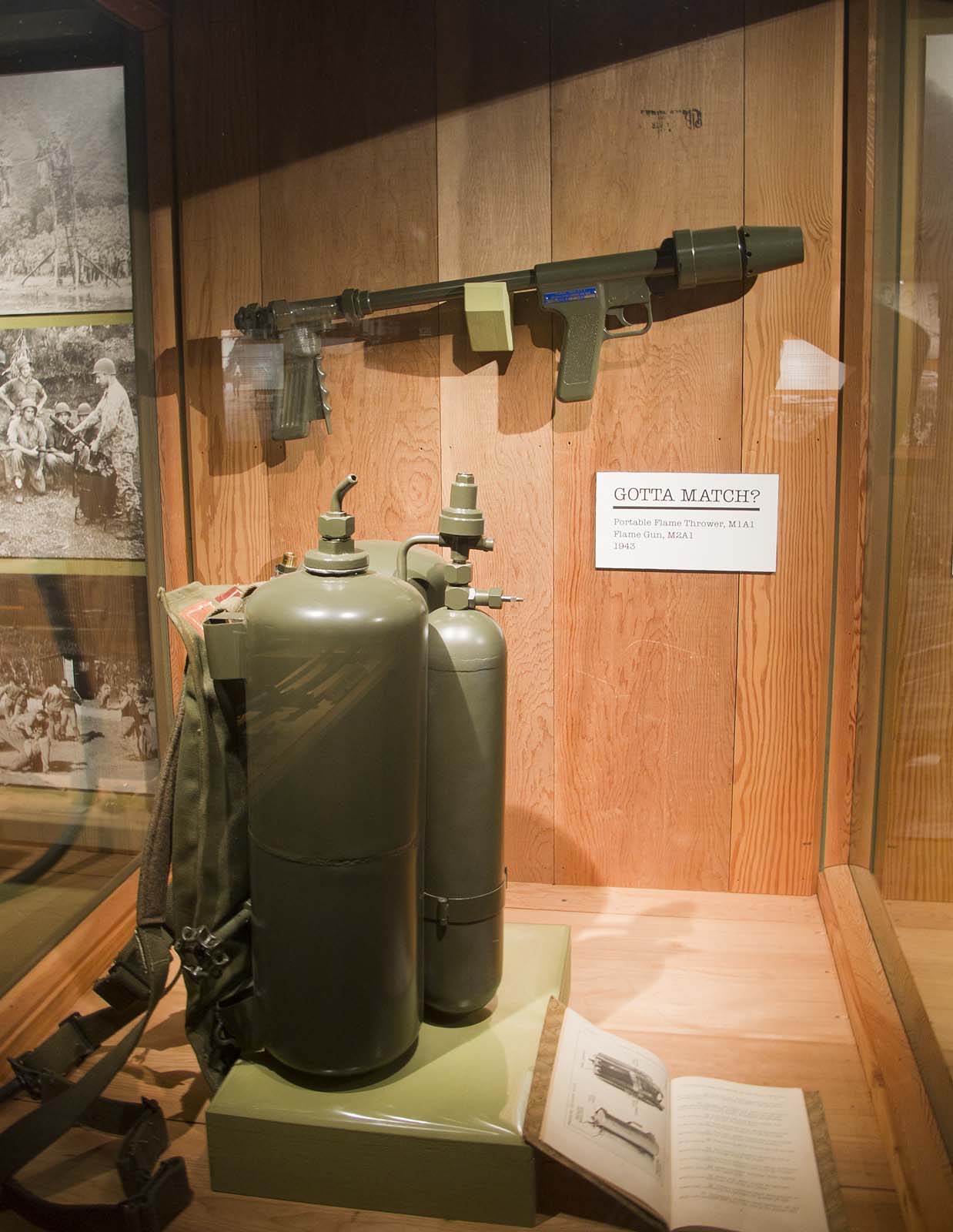
My opinion hasn't changed at all after seeing this display once again.
I have done some wandering in other places. Here is a carefully composed image of what I not-so-jokingly call The Hundred-Million Dollar Mile:
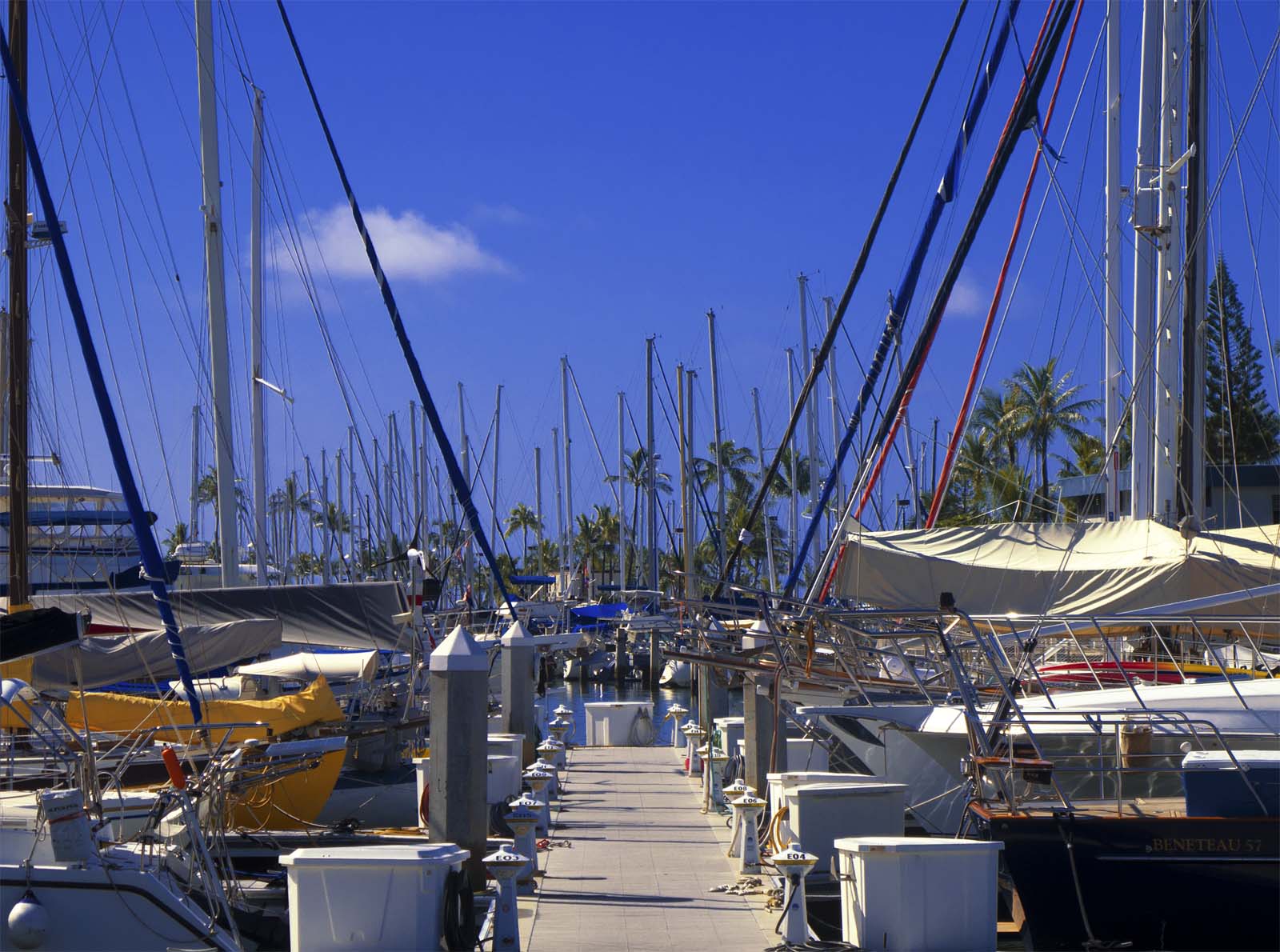
Such naked displays of wealth can be found in countless breezy ports around the world. Honolulu hasn't the glitz and sophisticated, snobbish class of the Euopean leisure nests, but it holds its head up when it comes to flamboyant spending.
I ducked my head inside the outer door of this establishment and eyed with great amusement the intimidating iron gate hidden just out of view of the aimless wandered. The stern warning, "MEMBERS ONLY" was enough to turn me away:

Ah, well, the Yacht Clubs in Lae and Port Moresby in Papua New Guinea are much more welcoming, if not so ostentatious. The Madang Club, along with the Madang Game Fishing Association is a very friendly place where visitors are gladly welcomed. Maybe the principle here is that the farther away you get from the big money, the more hospitable the atmosphere becomes.
More in line with the common man's reach and taste is this sort of yacht, the classic Hawaiian outrigger racing canoes:

This shot was taken on a Sunday morning. As you can see, it is a very popular sport.
I got all arty while composing this shot. It was a little tricky, because I was working against the rhythm of the small groups of canoes racing for the finish line. I wanted to capture the contrast of the small canoes, steeped in Hawaiian history, the glamorous yachts in the mid-distance and the cold, blank-faced buildings in the background. The image as it came from my camera was speechless. All of the elements were there, but the hues and light levels were all wrong:

It might surprise you that I spent more than an hour working on the image. The sky was all blotchy, pale white, so I made it blue. The buildings had an unnatural cyan cast and seemed very flat. I sharpened them, and the masts, warmed up the hue and boosted the contrast. It took a while to get just the look I wanted. Moving down, the larger boats behind the canoes and the dock were deeply shadowed on the sides, so I brightened them up and removed a bluish cast which made them look strange. Finally, the canoes required a lot of work to make them look the way I wanted. It's still a very ordinary photo, but it now speaks to me much more clearly. Except for the cost of a modest camera every three or four years, this hobby costs me nothing but time, which I count better spent than staring at a television set.
As my final gasp of artistic expression for the day, I'll present Buildings and Sky:
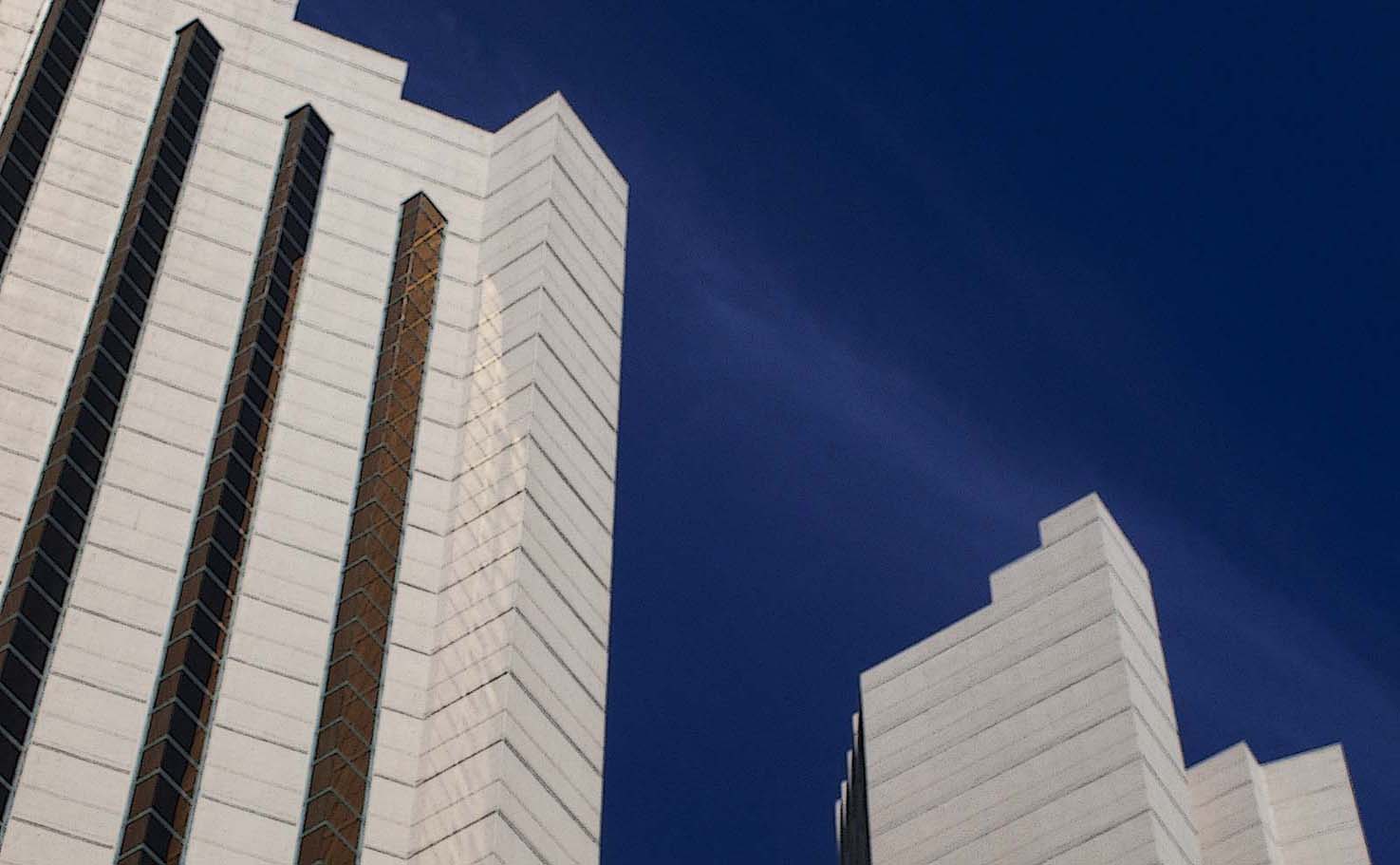
Simplicity appeals to me, mainly because my life seems to be far more complicated than it needs to be. I looked up at these buildings against the dark blue sky and listened. Little observations, sounding much like me speaking to myself, began to whisper. . . See the faint cirrus streak connecting the tops of the buildings? See the stark contrast? See all those angled lines, some strong and some faint, barely observable? See the strong black columns intruding? See the reddish glow of the sunlight reflected from the coppery windows. The width and height of this image exactly match the Golden Ratio, which is supposed to be a most pleasing shape to the human eye. The buildings follow the Rule of Thirds.
It's fun to see how much information can be crammed into such a simple picture.
RELIEF is a sculptural technique. The term relief is from the Latin verb relevo, to raise. To create a sculpture in relief is to give the impression that the sculpted material has been raised above the background plane. What is actually performed when a relief is cut in from a flat surface of stone (relief sculpture) or wood (relief carving) is a lowering of the field, leaving the unsculpted parts seemingly raised. The technique involves considerable chiselling away of the background, which is a time-consuming exercise with little artistic effect if the lowered background is left plain, as is often the case. On the other hand, a relief saves forming the rear of a subject, and is less fragile and more securely fixed than a sculpture in the round, especially one of a standing figure where the ankles are a potential weak point, especially in stone. In other materials such as metal, clay, plaster stucco, ceramics or papier-mache the form can be just added to or raised up from the background, and monumental bronze reliefs are made by casting.
There are different degrees of relief depending on the degree of projection of the sculpted form from the field, for which the Italian appellations are still sometimes used. The full range includes high relief (alto-rilievo), where more than 50% of the depth is shown and there may be undercut areas, mid-relief (mezzo-rilievo), low-relief (basso-rilievo, or French: bas-relief), and shallow-relief or rilievo schiacciato, where the plane is scarcely more than scratched in order to remove background material. There is also sunk relief, which was mainly restricted to Ancient Egypt. However the distinction between high relief and low relief is the clearest and most important, and these two are generally the only terms used to discuss most work. The definition of these terms is somewhat variable, and many works combine areas in more than one of them, sometimes sliding between them in a single figure; accordingly some writers prefer to avoid all distinctions. The opposite of relief sculpture is counter-relief, intaglio, or cavo-rilievo, where the form is cut into the field or background rather than rising from it; this is very rare in monumental sculpture.
Reliefs are common throughout the world on the walls of buildings and a variety of smaller settings, and a sequence of several panels or sections of relief may represent an extended narrative. Relief is more suitable for depicting complicated subjects with many figures and very active poses, such as battles, than free-standing "sculpture in the round". Most ancient architectural reliefs were originally painted, which helped to define forms in low relief. The subject of reliefs is for convenient reference assumed in this article to be usually figures, but sculpture in relief often depicts decorative geometrical or foliage patterns, as in the arabesques of Islamic art, and may be of any subject.
TYPES
The distinction between high and low relief is somewhat subjective, and the two are very often combined in a single work. In particular, most later "high reliefs" contain sections in low relief, usually in the background. From the Parthenon Frieze onwards, many single figures have heads in high relief, but their lower legs are in low relief; the slightly projecting figures created in this way work well in reliefs that are seen from below (see Moissac portal in gallery). As unfinished examples from various periods show, raised reliefs, whether high or low, were normally "blocked out" by marking the outline of the figure and reducing the background areas to the new background level, work no doubt performed by apprentices. Hyphens may or may not be used in all these terms, though they are rarely seen in "sunk relief" and are usual in "bas-relief" and "counter-relief". Works in the technique are described as "in relief", and, especially in monumental sculpture, the work itself is "a relief".
BAS-RELIEF OR LOW RELIEF
A bas-relief ("low relief"], from the Italian basso rilievo) or low relief is a projecting image with a shallow overall depth, for example used on coins, on which all images are in low relief. In the lowest reliefs the relative depth of the elements shown is completely distorted, and if seen from the side the image makes no sense, but from the front the small variations in depth register as a three-dimensional image. Other versions distort depth much less. It is a technique which requires less work, and is therefore cheaper to produce, as less of the background needs to be removed in a carving, or less modelling is required. In the art of Ancient Egypt and other ancient Near Eastern and Asian cultures, and also Meso-America, a very low relief was commonly used for the whole composition. These images would all be painted after carving, which helped to define the forms; today the paint has worn off in the great majority of surviving examples, but minute, invisible remains of paint can usually be discovered through chemical means.
The Ishtar Gate of Babylon, now in Berlin, has low reliefs of large animals formed from moulded bricks, glazed in colour. Plaster was sometimes used in Egypt and Rome, and probably elsewhere, but needs very good conditions to survive – Roman decorative plasterwork is mainly known from Pompeii and other sites buried by ash from Mount Vesuvius. Low relief was relatively rare in Western medieval art, but may be found, for example in wooden figures or scenes on the insides of the folding wings of multi-panel altarpieces.
Low relief is probably the most common type of relief found in Hindu-Buddhist arts of India and Southeast Asia. The low reliefs of 2nd-century BCE to 6th-century CE Ajanta Caves* and 5th to 10th-century Ellora Caves* in India are noted for they were carved out from rock-cut hill. They are probably the most exquisite examples of Buddhist, Hindu, and Jain arts in India. Most of these low reliefs are used in narrating sacred scriptures, such as those founds in 9th century Borobudur* Temple in Central Java, Indonesia, that narrating The birth of Buddha (Lalitavistara). Borobudur itself possess 1,460 panels of narrating low reliefs. Another example is low reliefs narrating Ramayana Hindu epic in Prambanan temple, also in Java. In Cambodia, the temples of Angkor* are also remarkable for their collection of low reliefs. The Samudra manthan or "Churning of Ocean of Milk" of 12th-century Angkor Wat is an example of Khmer art. Another examples are low reliefs of Apsaras adorned the walls and pillars of Angkorian temples. The low reliefs of Bayon* temple in Angkor Thom also remarkable on capturing the daily life of Khmer Empire.
The revival of low relief, which was seen as a classical style, begins early in the Renaissance; the Tempio Malatestiano in Rimini, a pioneering classicist building, designed by Leon Battista Alberti around 1450, uses low reliefs by Agostino di Duccio inside and on the external walls. Since the Renaissance plaster has been very widely used for indoor ornamental work such as cornices and ceilings, but in the 16th century it was used for large figures (many also using high relief) at the Chateau of Fontainebleau, which were imitated more crudely elsewhere, for example in the Elizabethan Hardwick Hall.
In later Western art, until a 20th-century revival, low relief was used mostly for smaller works or combined with higher relief to convey a sense of distance, or to give depth to the composition, especially for scenes with many figures and a landscape or architectural background, in the same way that lighter colours are used for the same purpose in painting. Thus figures in the foreground are sculpted in high-relief, those in the background in low-relief. Low relief may use any medium or technique of sculpture, stone carving and metal casting being most common. Large architectural compositions all in low relief saw a revival in the 20th century, being popular on buildings in Art Deco and related styles, which borrowed from the ancient low reliefs now available in museums. Some sculptors, including Eric Gill, have adopted the "squashed" depth of low relief in works that are actually free-standing.
Mid-relief, "half-relief" or mezzo-rilievo is somewhat imprecisely defined, and the term is not often used in English, the works usually being described as low relief instead. The typical traditional definition is that only up to half of the subject projects, and no elements are undercut or fully disengaged from the background field. The depth of the elements shown is normally somewhat distorted. Shallow-relief or rilievo stiacciato, used for the background areas of compositions with the main elements in low-relief, was perfected by the Italian Renaissance sculptor Donatello. It is a very shallow relief, which merges into engraving in places, and can be hard to read in photographs.
HIGH RELIEF
High relief (or altorilievo, from Italian) is where in general more than half the mass of the sculpted figure projects from the background, indeed the most prominent elements of the composition, especially heads and limbs, are often completely undercut, detaching them from the field. The parts of the subject that are seen are normally depicted at their full depth, unlike low relief where the elements seen are "squashed" flatter. High-relief thus uses essentially the same style and techniques as free-standing sculpture, and in the case of a single figure gives largely the same view as a person standing directly in front of a free-standing statue would have. All cultures and periods in which large sculptures were created used this technique in monumental sculpture and architecture.
Most of the many grand figure reliefs in Ancient Greek sculpture used a very "high" version of high-relief, with elements often fully free of the background, and parts of figures crossing over each other to indicate depth. The metopes of the Parthenon have largely lost their fully rounded elements, except for heads, showing the advantages of relief in terms of durability. High relief has remained the dominant form for reliefs with figures in Western sculpture, also being common in Indian temple sculpture. Smaller Greek sculptures such as private tombs, and smaller decorative areas such as friezes on large buildings, more often used low relief.
Hellenistic and Roman sarcophagus reliefs were cut with a drill rather than chisels, enabling and encouraging compositions extremely crowded with figures, like the Ludovisi Battle sarcophagus (250–260 CE). These are also seen in the enormous strips of reliefs that wound round Roman triumphal columns. The sarcophagi in particular exerted a huge influence on later Western sculpture. The European Middle Ages tended to use high relief for all purposes in stone, though like Ancient Roman sculpture their reliefs were typically not as high as in Ancient Greece. Very high relief reemerged in the Renaissance, and was especially used in wall-mounted funerary art and later on Neo-classical pediments and public monuments.
In Hindu-Buddhist art of India and Southeast Asia high relief can also be found, although it is not as common as low reliefs. Most of Hindu-Buddhist sculptures however also can be considered as a high relief, since these sculptures usually connected to a stella as the background to support the statue as well as provides additional elements such as aura or halo in the back of sculpture's head, or floral decoration. The examples of Indian high reliefs can be found in Khajuraho temple, that displaying voluptuous twisting figures that often describes the erotic Kamasutra positions. In 9th-century Prambanan temple, Central Java, the examples are the high reliefs of Lokapala devatas, the guardian of directions deities.
SUNK RELIEF
Sunk or sunken relief is largely restricted to the art of Ancient Egypt where it is very common, becoming after the Amarna period of Ahkenaten the dominant type used, as opposed to low relief. It had been used earlier, but mainly for large reliefs on external walls, and for hieroglyphs and cartouches. The image is made by cutting the relief sculpture itself into a flat surface. In a simpler form the images are usually mostly linear in nature, like hieroglyphs, but in most cases the figure itself is in low relief, but set within a sunken area shaped round the image, so that the relief never rises beyond the original flat surface. In some cases the figures and other elements are in a very low relief that does not rise to the original surface, but others are modeled more fully, with some areas rising to the original surface. This method minimizes the work removing the background, while allowing normal relief modelling.
The technique is most successful with strong sunlight to emphasise the outlines and forms by shadow, as no attempt was made to soften the edge of the sunk area, leaving a face at a right-angle to the surface all around it. Some reliefs, especially funerary monuments with heads or busts from ancient Rome and later Western art, leave a "frame" at the original level around the edge of the relief, or place a head in a hemispherical recess in the block (see Roman example in gallery). Though essentially very similar to Egyptian sunk relief, but with a background space at the lower level around the figure, the term would not normally be used of such works.
COUNTER RELIEF
Sunk relief technique is not to be confused with "counter-relief" or intaglio as seen on engraved gem seals—where an image is fully modeled in a "negative" manner. The image goes into the surface, so that when impressed on wax it gives an impression in normal relief. However many engraved gems were carved in cameo or normal relief.
A few very late Hellenistic monumental carvings in Egypt use full "negative" modelling as though on a gem seal, perhaps as sculptors trained in the Greek tradition attempted to use traditional Egyptian conventions.
SMALL OBJECTS
Small-scale reliefs have been carved in various materials, notably ivory, wood, and wax. Reliefs are often found in decorative arts such as ceramics and metalwork; these are less often described as "reliefs" than as "in relief". Small bronze reliefs are often in the form of "plaques", which may be set in furniture or framed. Various modelling techniques are used, such repoussé ("pushed-back") in metalwork, where a thin metal plate is shaped from behind using various metal or wood punches, producing a relief image. Casting has also been widely used in bronze and other metals. Casting and repoussé are often used in concert in to speed up production and add greater detail to the final relief. In stone, as well as engraved gems, larger hardstone carvings in semi-precious stones have been highly prestigious since ancient times in many Eurasian cultures. Reliefs in wax were produced at least from the Renaissance.
Carved ivory reliefs have been used since ancient times, and because the material, though expensive, cannot usually be reused, they have a relatively high survival rate, and for example consular diptychs represent a large proportion of the survivals of portable secular art from Late Antiquity. In the Gothic period the carving of ivory reliefs became a considerable luxury industry in Paris and other centres. As well as small diptychs and triptychs with densely packed religious scenes, usually from the New Testament, secular objects, usually in a lower relief, were also produced. These were often round mirror-cases, combs, handles, and other small items, but included a few larger caskets like the Casket with Scenes of Romances (Walters 71264) in Baltimore, Maryland, in the United States. Originally there were very often painted in bright colours. Reliefs can be impressed by stamps onto clay, or the clay pressed into a mould bearing the design, as was usual with the mass-produced terra sigillata of Ancient Roman pottery. Decorative reliefs in plaster or stucco may be much larger; this form of architectural decoration is found in many styles of interiors in the post-Renaissance West, and in Islamic architecture.
* go to my pictures of:
Ajanta Caves, Ellora Caves, Angkor Wat, Angkor Tom, Borobodur, Prambanan . . .
This picture is #65 in my 100 Strangers project;
Meet Brittany
I met Brittany with her friend seemingly scouting the area with a purpose. Just looking at her with her deep lipstick and her super enthusiastic personality - I knew she would work great for the project. On approaching her and explaining the project, Brittany happily agreed to be a part of the project and walked with me across the street for a few picks. The lady came across as a complete natural with the camera - confident and ebullient and with the rare unflinching gaze at the camera. In between the pics and some follow up conversation I learned that Brittany is a wedding planner for the last few years. That's quite a departure for a lady with a background in criminology but the stress got to her, and she found the experience of being a part of a couple's happiest moment much more satisfying. Recently, she has started venturing out into even planning traditional Indian style weddings - which I can vouch for is quite something. Besides that, Brittany
is a shopaholic and loves to catch up on the latest horror flick (definitely a rare woman in my book)
On what she loves, regrets and hates - "I love my sense of adventure. I've always been a dreamer and haven't lost it even venturing into adulthood. I wish I could change some of the difficult times that brought me to the place I am today. Although they helped shape me into who I am today, experiencing so much hardship at such a young age just isn't something I want to have. I "hate anything that causes limitation; anything that limits love, freedom, expression, personal opinion, art, personality, etc. So many people today want to put others in a box in accordance to religion, career paths, education, etc.
When asked if there was one thing she would advise her younger self Brittany came up with these wonderful words "Free yourself. I used to fear so many things-what people thought about me, not being perfect, making the wrong decisions, etc"
Lastly when asked if there was one message she'd like to share or something she felt strongly about she surprised me with "People have this stigma attached to mental illness-that those who suffer from mental illnesses are crazy or look a certain way. I've suffered from generalized anxiety disorder and depression all my life. I've been told that "I'm too pretty to have a mental illness" or been criticized for being "too dramatic" or being "weak". I want people to know that mental illness does not discriminate. It also does not mean your story is finished. I have faced my anxiety, depression, multiple failures, suicide attempts and abandonment, but I'm still here. And I love who I am and where I am in life."
I absolutely loved the insight Brittany provided and added so much more to her stand-out personality.
Thanks a lot Brittany for being a part of my project - it was terrific meeting you and indeed knowing you through this project. Best wishes and lots of success.
Find out more about the project and see pictures taken by other photographers at the 100 Strangers Flickr Group page
For my other pictures on this project: www.flickr.com/photos/vijaybrittophotography/sets/7215764...
With DRS seemingly having done a u turn on its planned rebuild,Its date with the scrapman has just been delayed into the new year,so here is what has turned out to be the final passenger fling for 37410 "Aluminium 100" which was stood down at the end of 2007 was nothing more than not having OTMR fitted,Having driven into the hills and the cloud for Pathfinders "Festive Yorkshireman" we were driving home disappointed along the A650 when we caught the tour up near Bingley as it was slowing behind a stopping unit......unsure where to dive in, a hasty stop by the Dowley Gap underbridge and a quick scramble up the bank gave us just enough time for a grab shot as the driver applied full power as 37410 leads 37417 away from Bingley running as the 1Z37 0530 Swindon-Leeds charter which had ran via Carnforth on 1st Dec 07....while 37410 never returned,37417 lasted another year before poor ews maintenance saw it blow its power unit apart.2013 will see them both in Booths together as DRS have lost interest
Seemingly quite an early one. Despite its battered condition it still has plates so there's a chance it could return to the road some day. It has a few bad dents but hardly any rust.
Have you been to Newington? The warden at the previous church asked.
Well, I did go twice: first time locked, then the next weekend, on heritage weekend, they double booked with a christening and a display of Roman artifacts, and was crowded outside as the service went on inside.
So, I vowed to return later.
And so, although not planned, I returned today, as I was driving through the town, and to my surprside i found the porch door open and two ladies inside doing flower displays.
Can I take photos, as ask?
Yes I can. Apparently.
St Mary is a large church just off the old A2, and should be better known. It has fine wall paintings, and lots of other points of interest. There is parking down a private road marked as such, but there is a large car park. As long as there isn't a christening on, of course.
--------------------------------------------
A hugely interesting and curiously little known church, although to those familiar with its location it is `the church in the orchards`. Starting life in the Norman period - a delightful capital survives in the south aisle - it was much extended in the thirteenth to fifteenth centuries. The latter is represented by the west tower which shows the familiar local peculiarity of banded flint and ragstone (see also Higham and Cliffe). Inside the enormous church one is struck by the amazing amount of medieval wall painting that survives including a huge doom on the east wall of the north aisle and a rather special Christ in Majesty in a niche in the south aisle. The octagonal font has a spectacular wooden cover dating in the main from the seventeenth century. In the north aisle chapel is a brass which (unusually) commemorates two seemingly unrelated men of the fifteenth century, whilst in the centre of the chancel is an Elizabethan brass showing an affectionate mother - a very rare find. The south chapel contains what purports to be the shrine of St Robert of Newington, the village's own saint. There is no doubt that it is medieval but how it survived the Reformation if it was regarded as a shrine, and just who St Robert was will continue to be a mystery.
www.kentchurches.info/church.asp?p=Newington+next+Sitting...
-------------------------------------------
NEWINGTON.
THE next parish southward from Halstow is Newington, written in Domesday, Newetone, which certainly took its name from its having been raised on the scite of some more antient town, perhaps built in the time of the Romans, of whom there are many vestigia in and about this place. It has the addition of next Sittingborne, to distinguish it from a parish of the same name next Hyth.
THE PARISH of Newington lies for the most part on a flat plain, extending from east to west near two miles, at the edges of which, excepting towards the north, it is surrounded by a range of high hills, most of which are covered with woods, which reach as far eastward within the boundaries of it as the high road leading from Key-street to Detling. The parish is far from being unpleasant, but the unhealthiness of it, occasioned by its being exposed to the noxious vapours arising from the large tract of marshes covered of it, as far as Standgate creek and the Medway, which are blown hither uninterrupted, through the vale, and the unwholesomeness of the water drawn from the wells for culinary uses, throughout it, make it a far from eligible situation to dwell in, and keep it thin of inhabitants, especially of the better sort; in the centre of the above plain, though on a small rise is the village, called Newington-street, containing about fifty houses, most of them antient and ill built, it is encircled by orchards of apples and cherries. In the street almost opposite to the lane leading southward to Stockbury is the old manor house of Lucies, now inhabited by a shopkeeper, and in another part of it is another oldtimbered building, much of it now in a decayed state, belonging to the estate here of Sir Beversham Filmer; bart. formerly of the Troughton's, and before that the residence of the Holbrook's.
Here was, as appears by a presentment made of the customs, &c. of the queen's manor and hundred of Milton, in 1575, a market, held weekly on a Tuesday, but the disuse of it has been beyond memory. At a small distance northward is the vicarage, and a quarter of a mile further on the parsonage and church, and close to the church-yard the manor-house of Tracies. At no great distance north-west from hence there is a spring, which produces a fresh stream, and runs from thence northward, having a small breadth of swampy poor meadow or marshes on each side, till it empties itself into the creek at Halstow, as has already been mentioned in the description of that parish.
The high road from London to Canterbury and Dover, runs across this parish, and through Newington-street, at a small distance southward from which, in the road to Stockbury, is the manor house of Cranbrooke, and about half a mile further, the ground still rising to it, the hamlet of Chesley-street, corruptly so for Checheley-street, as appears by the will of Robert Bereforth, anno 13 Edward IV. who lies buried in this church, and stiles himself of Checheley-street, devising by it his principal tenement called Frognal, and his other called Patreches, in this parish, to his three daughters and coheirs. On a green close to this hamlet there is a handsome sashed house, built not many years ago by Robert Spearman, esq. lessee of the possessions of Merton college, in this parish, in which he resides.
The parish contains about thirteen hundred acres of land, exclusive of about two hundred acres of wood, great part of it, especially in the environs of the street, was formerly planted with orchards of apples, cherries, and other kind of fruit, but these falling to decay, and the high price of hops yielding a more advantageous return, many of them were displanted, and hops raised in their stead, the scite of an old orchard, being particularly adapted for the purpose, which, with the kindliness of the soil for that plant, produced large crops of it, insomuch that there has been one particular instance here of an acre having grown after the rate of thirtyfour hundred weight of hops on it, but these grounds wearing out, and hops not bearing so good a price, tother with other disadvantages to the growers of them, orchards are again beginning to be replanted in Newington, to which these grounds afford a good nursery, till the trees by their increased size are less liable to hurt, though the hop grounds in it are still very considerable.
The soil of this parish on the plain, and towards Chesley, is very rich and fertile, consisting in general of a kindly loam, near and on the hills it is mostly a stiff clay, and to the northward of the street it becomes a sand, where on the hills it becomes poor land, and much covered with broom and furze. This tract of land called from thence Broomdown, belong most of it, as does much other land in this parish, to All Souls college, as part of their manor of Horsham, in Upchurch; in the parts near Chesley-street, at some depth, they come to the chalk, which by means of draw wells is obtained for the manure of their lands. On the continued chain of hills, from the north-east to the south-east boundaries of this parish, there are large tracts of woodland, in which are great plenty of chesnut stubs, no doubt the indigenous growth of them, these join to others of the like sort, reaching for several miles southward, those in this parish and its neighbourhood, being from the great plenty of the above wood in them, commonly known by the name of Chesnut woods, a large tract of them, within the bounds of this and the adjoining parishes, reaching as far as the turnpike road leading from Key-street to Detling, belong to the earl of Aylesford. The rents in general are high, great part of the lands being let from fifteen to twenty shillings per acre and upwards.
THE ROMAN ROAD, having crossed the river Medway at Chatham, is still visible on the top of Chathamhill, the hedge on the north side of the great road from thence to Rainham standing on it, from which place hither it seems to run on the southern side of the road, till within a very small distance of Newington-street, where it falls in with the great road, and does not appear again till it has passed Key-street, a mile and a half beyond it.
The name of Newington, as has already been mentioned, implies its having been built on, or in the lieu of, some more antient town or village; the names of places in and about it, plainly of Roman original, shew that nation to have had frequent dealings hereabouts. Keycol-hill at the 38th mile stone seems to be the same as Caii Collis, or Caius, Julius Cæsar's hill; Keystreet beyond it, Caii Stratum, or Caius's street; and Standard-hill, about half a mile southward of Newington-street, seems to have taken its name from some military standard having been placed on it in those times.
On Keycol-hill above-mentioned, at a small distance northward from the great road, is a field, in which quantities of Roman urns and vessels have continually been turned up by the plough, and otherwise, and the whole of it scattered over with the broken remains of them, from whence it has acquired the name of Crockfield. The soil of it is mostly sandy, excepting towards the north west part of it, where it consists of a wet and stiff clay.
The situation of this field is on an eminence, higher than the surrounding grounds, commanding a most extensive view on every side of it; a little to the southwest of it, in the adjoining field, there is a large mount of earth thrown up, having a very broad and deep foss on the south and west sides of it, from whence there seems to be a breast-work of earth thrown up, which extends in a line westward about forty rods, and thence in like manner again northward, making the south and western boundaries of the two fields next below Crockfield, above-mentioned.
The greatest part of the northern sides of these fields, and the eastern side of Crockfield, are adjoining to the woods, in which there are many remains of trenches and breast-works thrown up; but the coppice is so very thick, that there is no possibility of tracing their extent or form, so as to give any description of them. These vessels have been found lying in all manner of positions, as well sideways as inverted, and frequently without any ashes or bones in them, quite empty; and this has induced many to think this place to have been only a Roman pottery, and not a buryingplace, especially as some of them lay in that part which is a stiff, wet soil, and others in the dry and sandy part of it.
Notwithstanding which, several of our learned antiquarians, among which are Somner, Burton, archbishop Stillingfleet, Battely, and Dr. Thorpe, are inclined to six the Roman station, called in the second iter of Antonine, Durolevum, at or near this place. Indeed most of the copies of Antonine make the distance from the last station Durobrovis, Rochester, to Durolevum xiii or xvi miles, which would place it nearer to Greenstreet, or Judde-hill, a little on the western side of Ospringe; but the Peutingerian tables make it only vii, in which Mr. Somner seems to acquiesce, and it answers tolerably well to this place. If this distance of miles is correct, no doubt but Newington has every circumstance in its favor, to six this station here, if the number of xvi should be preferred, full as much may be said in favor of Judde-hill, or thereabouts; every other place has but mere conjecture, unsupported either by a knowledge of the country, or by any remains of Roman antiquity ever discovered in or near it.
The urns and vessels found here were first taken notice of in print by the learned Meric Casaubon, prebendary of Canterbury, whom Burton stiles incomparable for his virtues and learning, who, in his notes on his translation of the emperor Marcus Antoninus's Meditations, gives an account of the remains found in Newington, which contains many curious particulars relating to the custom of burial, though of too copious a nature to be wholly inserted in this work.
Among other observations he says, that not only the great numbers of these urns, for he does not remember an instance of so many having been found, in so small a compass of ground, was remarkable, but the manner of their lying in the ground; for those who had been present at the digging of them up observed, that where one great urn had been found, several lesser vessels had been likewise, some of them within the great one, and others round about it, each covered either with a proper cover of the like earth as the pots themselves were, or else more coarsely, but very closely, stopped up with other earth. Hence he infers that the custom seems to have been, to appoint one great urn to contain the bones and ashes of all one houshold or kindred, as often therefore as any of them died, so often they had recourse to the common urn, which was as often uncovered for the purpose.
Besides the great and common urn, it is likely that every particular person that died, had some lesser one particularly dedicated to his own memory, and it is not improbable, that there might be still another use of them, and that not an unnecessary one, which was, that by them the common greater urns might be the better known and distinguished one from another, being so much alike in shape and size, in so small a compass of ground, and so near each other; and it seems more likely, as of the many hundreds of the lesser fort which have been taken up, scarce any have been found of one and the same making. What this place has been many would certainly be glad to know; thus much may at least be concluded, that from the multitude of urns, it was once a common burial-place for the Romans, and that from the situation of it, which is upon an ascent, and for some space beyond it hilly, not far from the sea, and near the highway, it may be affirmed with great probability, that this place was once the seat of a Roman station. (fn. 1) Thus far Mr. Casaubon.
¶The great numbers of urns, and the fragments of them, found at this place from time to time, have been dispersed among the curious throughout the county, many of whom have, through curiosity and a fondness for antiquarian knowledge, dug here for that purpose. The last earl of Winchelsea searched here several times for them with success, and had a numerous collection of them; among others, one of the larger ones, which was dug up here, and held twenty-four pints, came into the hand of Dr. Battely, who says, it was dug up among many urns here, being a vessel not to hold the bones, but to be filled with wine, being pitched on the inside, which was usually done for that purpose. It had four handles, by which it might be plunged into the earth, and raised up again whenever there was oc casion, which was of no use to a sepulchral urn, which there was a religious dread of removing; it being their custom to extinguish the funeral pile with wine, to wash the bones, to sprinkle the sepulchres in their funereal sacrifices, and to pour it out as an offering to the funereal gods.
Another of these urns, which held near a bushel, came into the possession of John Godfry, esq. of Norton-court, and another into the hands of Mr. Filmer Southouse; the figures of each of which may be seen in an engraved plate in the folio edition of this history, vol. ii. p. 562.
EWINGTON is within the ECCLESIASTICAL JURISDICTION of the diocese of Canterbury, and deanry of Sittingborne.
The church, which is dedicated to St. Mary, is a handsome building, consisting of three isles and two chancels, with a square beacon tower at the west end. On the north side of the high chancel is the lower part of a square tower, which reaches at present no higher than the roof of the church, where it has a flat covering. There was some good painted glass formerly in the windows of this church, and among others, the arms of Leyborne, Azure, six lions rampant, three, two, and one, argent; of Northwood; of Lucy, as well with the croslets as without; of Burwash; Diggs impaling Monins; Norton impaling Northwood; Beresford; Diggs; Horne; of the cinque ports; of the see of Canterbury; of archbishops Becket and Warham; of Holbrooke, and of Brooke.
The south chancel of this church belongs to the parish, who keep it in repair. In it were, till within these few years, among many others now defaced, memorials of Brian Diggs and his wife, anno 1490; of Thomas Holbrook, gent, anno 1587; of Francis Holbrook, gent. of this parish, in 1581, and a tomb for Sir John Norton. A stone, with the figure of a woman, and an inscription in brass for Mary Brook, alias Cobham, widow of Edward Brook, alias Cobham, esq. obt. 1600.
Against the north wall of this chancel is a monument for Joseph Hasted, gent. of Chatham, obt. 1732, possessed of a good estate in this parish. His remains, with those of his wife Catherine, daughter of Richard Yardley, gent. lie deposited in one coffin, in a vault under this chancel, in which are likewise the remains of their only son and heir Edward Hasted, esq. of Hawley, near Dartford, obt. 1740; of Anne, his only daughter, widow of captain James Archer, and of George Hasted, gent. obt. 1787, adolescens optimæ spei, the third son of the editor of this history.
The church of Newington was given in the 25th year of Henry II. anno 1178, to the abbey of Westwood, alias Lesnes, in Erith, then founded by Richard de Lucy, which gift was confirmed, among other possessions of that monastery, by king John, in his 7th year.
¶Notwithstanding which the abbot and convent of St. Augustine's, Canterbury, to whom part of the manor of Newington had come in the above-mentioned reign, as has been already related, claimed this church from time to time, as having been given to their monastery by Richard de Lucy above-mentioned. After much dispute, during which Thorne, their chronicler, says, the abbey of St. Augustine kept possession of it, it was at last, by the interposition of their common friends, agreed between them, that the abbot of St. Augustine's should release to the abbot of Lesnes all right to the advowson of this church, for which the latter agreed to make a recompence in other matters, as mentioned in the agreement. (fn. 10) The abbot and convent of Lesnes, having thus gained the firm possession of this church, obtained a confirmation of it from the several succeeding kings, and it remained part of the revenues of their monastery till the final dissolution of it, in the 17th year of Henry VIII. when, being one of those smaller monasteries which cardinal Wolsey obtained of the king that year, for the endowment of his colleges, it was surrendered into the cardinal's hands, to whom the king granted his licence next year, to appropriate and annex this church of Newington, among others, of the cardinal's patronage, to the dean and canons of the college founded by him in the university of Oxford, &c. But this church remained with them only four years, when the cardinal being cast in præmunire, all the estates of the college, which had not as yet been firmly settled on it, were forfeited to the crown.
How long this appropriated church, with the advowson of the vicarage, remained in the crown, I have not found; but at the latter end of queen Elizabeth's reign, it was become part of the possessions of the royal college of Eton, in Buckinghamshire, where it continues at this time.
The parsonage is leased out from time to time on a beneficial lease. The advowson of the vicarage, the provost and fellows keep in their own hands.
The glebe land belonging to the parsonage contains twenty-two acres, and upwards. The family of Short were for many years tenants of it.
The vicarage is valued in the king's books at 14l. per annum, and the yearly tenths at 1l. 8s. It is now of the clear yearly certified value of seventy-two pounds.
In 1578 the dwelling-houses in this parish were seventy-seven. Communicants two hundred and thirty-six. In 1640 it was valued at seventy pounds. Communicants two hundred and five.
The glebe land belonging to the vicarage, consists of only one acre, besides the homestall. The annual value of the vicarage is very precarious, owing to the income of it arising much from fruit and hops, the latter of which have of late years much increased the value of it.
Seemingly abandoned in a local supermarket car park with a flat tyre, 157k miles at its last test in August.
Registration number: GY51 CKN
✗ Untaxed
Tax due: 21 October 2015
✔ MOT
Expires: 03 August 2016
The seemingly simple eggs have a rich nutritional profile that can boost your overall health. Eating whole eggs is vital for your health – the yolk contains over 90% of the egg’s iron and calcium content, while the white contains half of the egg’s protein. Here are 10 reasons why you should eat e...
figmedia.com/what-happens-when-you-eat-3-whole-eggs-every...
Relief is a sculptural technique where the sculpted elements remain attached to a solid background of the same material. The term relief is from the Latin verb relevo, to raise. To create a sculpture in relief is to give the impression that the sculpted material has been raised above the background plane.[1] What is actually performed when a relief is cut in from a flat surface of stone (relief sculpture) or wood (relief carving) is a lowering of the field, leaving the unsculpted parts seemingly raised. The technique involves considerable chiselling away of the background, which is a time-consuming exercise. On the other hand, a relief saves forming the rear of a subject, and is less fragile and more securely fixed than a sculpture in the round, especially one of a standing figure where the ankles are a potential weak point, especially in stone. In other materials such as metal, clay, plaster stucco, ceramics or papier-mache the form can be just added to or raised up from the background, and monumental bronze reliefs are made by casting.
There are different degrees of relief depending on the degree of projection of the sculpted form from the field, for which the Italian appellations are still sometimes used. The full range includes high relief (alto-rilievo), where more than 50% of the depth is shown and there may be undercut areas, mid-relief (mezzo-rilievo), low-relief (basso-rilievo, or French: bas-relief /ˌbɑːrɪˈliːf/), and shallow-relief or rilievo schiacciato, where the plane is only very slightly lower than the sculpted elements. There is also sunk relief, which was mainly restricted to Ancient Egypt (see below). However the distinction between high relief and low relief is the clearest and most important, and these two are generally the only terms used to discuss most work.
The definition of these terms is somewhat variable, and many works combine areas in more than one of them, sometimes sliding between them in a single figure; accordingly some writers prefer to avoid all distinctions. The opposite of relief sculpture is counter-relief, intaglio, or cavo-rilievo, where the form is cut into the field or background rather than rising from it; this is very rare in monumental sculpture. Hyphens may or may not be used in all these terms, though they are rarely seen in "sunk relief" and are usual in "bas-relief" and "counter-relief". Works in the technique are described as "in relief", and, especially in monumental sculpture, the work itself is "a relief".
Reliefs are common throughout the world on the walls of buildings and a variety of smaller settings, and a sequence of several panels or sections of relief may represent an extended narrative. Relief is more suitable for depicting complicated subjects with many figures and very active poses, such as battles, than free-standing "sculpture in the round". Most ancient architectural reliefs were originally painted, which helped to define forms in low relief. The subject of reliefs is for convenient reference assumed in this article to be usually figures, but sculpture in relief often depicts decorative geometrical or foliage patterns, as in the arabesques of Islamic art, and may be of any subject.
Rock reliefs are those carved into solid rock in the open air (if inside caves, whether natural or man-made, they are more likely to be called "rock-cut"). This type is found in many cultures, in particular those of the Ancient Near East and Buddhist countries. A stela is a single standing stone; many of these carry reliefs.
TYPES
The distinction between high and low relief is somewhat subjective, and the two are very often combined in a single work. In particular, most later "high reliefs" contain sections in low relief, usually in the background. From the Parthenon Frieze onwards, many single figures have heads in high relief, but their lower legs are in low relief; the slightly projecting figures created in this way work well in reliefs that are seen from below (see Moissac portal in gallery). As unfinished examples from various periods show, raised reliefs, whether high or low, were normally "blocked out" by marking the outline of the figure and reducing the background areas to the new background level, work no doubt performed by apprentices (see gallery).
BAS RELIEF OR LOW RELIEF
A bas-relief ("low relief", French pronunciation: [baʁəljɛf], from the Italian basso rilievo) or low relief is a projecting image with a shallow overall depth, for example used on coins, on which all images are in low relief. In the lowest reliefs the relative depth of the elements shown is completely distorted, and if seen from the side the image makes no sense, but from the front the small variations in depth register as a three-dimensional image. Other versions distort depth much less. It is a technique which requires less work, and is therefore cheaper to produce, as less of the background needs to be removed in a carving, or less modelling is required. In the art of Ancient Egypt and other ancient Near Eastern and Asian cultures, and also Meso-America, a very low relief was commonly used for the whole composition. These images would all be painted after carving, which helped to define the forms; today the paint has worn off in the great majority of surviving examples, but minute, invisible remains of paint can usually be discovered through chemical means.
The Ishtar Gate of Babylon, now in Berlin, has low reliefs of large animals formed from moulded bricks, glazed in colour. Plaster, which made the technique far easier, was widely used in Egypt and the Near East from antiquity into Islamic times (latterly for architectural decoration, as at the Alhambra), Rome, and Europe from at least the Renaissance, as well as probably elsewhere. However, it needs very good conditions to survive long in unmaintained buildings – Roman decorative plasterwork is mainly known from Pompeii and other sites buried by ash from Mount Vesuvius. Low relief was relatively rare in Western medieval art, but may be found, for example in wooden figures or scenes on the insides of the folding wings of multi-panel altarpieces.
The revival of low relief, which was seen as a classical style, begins early in the Renaissance; the Tempio Malatestiano in Rimini, a pioneering classicist building, designed by Leon Battista Alberti around 1450, uses low reliefs by Agostino di Duccio inside and on the external walls. Since the Renaissance plaster has been very widely used for indoor ornamental work such as cornices and ceilings, but in the 16th century it was used for large figures (many also using high relief) at the Chateau of Fontainebleau, which were imitated more crudely elsewhere, for example in the Elizabethan Hardwick Hall.
In later Western art, until a 20th-century revival, low relief was used mostly for smaller works or combined with higher relief to convey a sense of distance, or to give depth to the composition, especially for scenes with many figures and a landscape or architectural background, in the same way that lighter colours are used for the same purpose in painting. Thus figures in the foreground are sculpted in high-relief, those in the background in low-relief. Low relief may use any medium or technique of sculpture, stone carving and metal casting being most common. Large architectural compositions all in low relief saw a revival in the 20th century, being popular on buildings in Art Deco and related styles, which borrowed from the ancient low reliefs now available in museums. Some sculptors, including Eric Gill, have adopted the "squashed" depth of low relief in works that are actually free-standing.
Mid-relief, "half-relief" or mezzo-rilievo is somewhat imprecisely defined, and the term is not often used in English, the works usually being described as low relief instead. The typical traditional definition is that only up to half of the subject projects, and no elements are undercut or fully disengaged from the background field. The depth of the elements shown is normally somewhat distorted. Shallow-relief or rilievo stiacciato, used for the background areas of compositions with the main elements in low-relief, was perfected by the Italian Renaissance sculptor Donatello. It is a very shallow relief, which merges into engraving in places, and can be hard to read in photographs.
Mid-relief is probably the most common type of relief found in the Hindu and Buddhist art art of India and Southeast Asia. The low reliefs of 2nd-century BCE to 6th-century CE Ajanta Caves and 5th to 10th-century Ellora Caves in India are rock reliefs. Most of these reliefs are used to narrate sacred scriptures, such as the 1,460 panels of the 9th-century Borobudur temple in Central Java, Indonesia, narrating the Jataka tales or lives of the Buddha. Other examples are low reliefs narrating the Ramayana Hindu epic in Prambanan temple, also in Java, in Cambodia, the temples of Angkor, with scenes including the Samudra manthan or "Churning the Ocean of Milk" at the 12th-century Angkor Wat, and reliefs of apsaras. At Bayon temple in Angkor Thom there are scenes of daily life in the Khmer Empire.
HIGH RELIEF
High relief (or altorilievo, from Italian) is where in general more than half the mass of the sculpted figure projects from the background, indeed the most prominent elements of the composition, especially heads and limbs, are often completely undercut, detaching them from the field. The parts of the subject that are seen are normally depicted at their full depth, unlike low relief where the elements seen are "squashed" flatter. High-relief thus uses essentially the same style and techniques as free-standing sculpture, and in the case of a single figure gives largely the same view as a person standing directly in front of a free-standing statue would have. All cultures and periods in which large sculptures were created used this technique in monumental sculpture and architecture.
Most of the many grand figure reliefs in Ancient Greek sculpture used a very "high" version of high-relief, with elements often fully free of the background, and parts of figures crossing over each other to indicate depth. The metopes of the Parthenon have largely lost their fully rounded elements, except for heads, showing the advantages of relief in terms of durability. High relief has remained the dominant form for reliefs with figures in Western sculpture, also being common in Indian temple sculpture. Smaller Greek sculptures such as private tombs, and smaller decorative areas such as friezes on large buildings, more often used low relief.
Hellenistic and Roman sarcophagus reliefs were cut with a drill rather than chisels, enabling and encouraging compositions extremely crowded with figures, like the Ludovisi Battle sarcophagus (250–260 CE). These are also seen in the enormous strips of reliefs that wound round Roman triumphal columns. The sarcophagi in particular exerted a huge influence on later Western sculpture. The European Middle Ages tended to use high relief for all purposes in stone, though like Ancient Roman sculpture their reliefs were typically not as high as in Ancient Greece.[7] Very high relief reemerged in the Renaissance, and was especially used in wall-mounted funerary art and later on Neo-classical pediments and public monuments.
In Hindu-Buddhist art of India and Southeast Asia high relief can also be found, although it is not as common as low reliefs. Most of Hindu-Buddhist sculptures however also can be considered as a high relief, since these sculptures usually connected to a stella as the background to support the statue as well as provides additional elements such as aura or halo in the back of sculpture's head, or floral decoration. The examples of Indian high reliefs can be found in Khajuraho temple, that displaying voluptuous twisting figures that often describes the erotic Kamasutra positions. In 9th-century Prambanan temple, Central Java, the examples are the high reliefs of Lokapala devatas, the guardian of directions deities.
SUNK RELIEF
Sunk or sunken relief is largely restricted to the art of Ancient Egypt where it is very common, becoming after the Amarna period of Ahkenaten the dominant type used, as opposed to low relief. It had been used earlier, but mainly for large reliefs on external walls, and for hieroglyphs and cartouches. The image is made by cutting the relief sculpture itself into a flat surface. In a simpler form the images are usually mostly linear in nature, like hieroglyphs, but in most cases the figure itself is in low relief, but set within a sunken area shaped round the image, so that the relief never rises beyond the original flat surface. In some cases the figures and other elements are in a very low relief that does not rise to the original surface, but others are modeled more fully, with some areas rising to the original surface. This method minimizes the work removing the background, while allowing normal relief modelling.
The technique is most successful with strong sunlight to emphasise the outlines and forms by shadow, as no attempt was made to soften the edge of the sunk area, leaving a face at a right-angle to the surface all around it. Some reliefs, especially funerary monuments with heads or busts from ancient Rome and later Western art, leave a "frame" at the original level around the edge of the relief, or place a head in a hemispherical recess in the block (see Roman example in gallery). Though essentially very similar to Egyptian sunk relief, but with a background space at the lower level around the figure, the term would not normally be used of such works.
COUNTER-RELIEF
Sunk relief technique is not to be confused with "counter-relief" or intaglio as seen on engraved gem seals - where an image is fully modeled in a "negative" manner. The image goes into the surface, so that when impressed on wax it gives an impression in normal relief. However many engraved gems were carved in cameo or normal relief.
A few very late Hellenistic monumental carvings in Egypt use full "negative" modelling as though on a gem seal, perhaps as sculptors trained in the Greek tradition attempted to use traditional Egyptian conventions
SMALL OBJECTS
Small-scale reliefs have been carved in various materials, notably ivory, wood, and wax. Reliefs are often found in decorative arts such as ceramics and metalwork; these are less often described as "reliefs" than as "in relief". Small bronze reliefs are often in the form of "plaques" or plaquettes, which may be set in furniture or framed, or just kept as they are, a popular form for European collectors, especially in the Renaissance.
Various modelling techniques are used, such repoussé ("pushed-back") in metalwork, where a thin metal plate is shaped from behind using various metal or wood punches, producing a relief image. Casting has also been widely used in bronze and other metals. Casting and repoussé are often used in concert in to speed up production and add greater detail to the final relief. In stone, as well as engraved gems, larger hardstone carvings in semi-precious stones have been highly prestigious since ancient times in many Eurasian cultures. Reliefs in wax were produced at least from the Renaissance.
Carved ivory reliefs have been used since ancient times, and because the material, though expensive, cannot usually be reused, they have a relatively high survival rate, and for example consular diptychs represent a large proportion of the survivals of portable secular art from Late Antiquity. In the Gothic period the carving of ivory reliefs became a considerable luxury industry in Paris and other centres. As well as small diptychs and triptychs with densely packed religious scenes, usually from the New Testament, secular objects, usually in a lower relief, were also produced.
These were often round mirror-cases, combs, handles, and other small items, but included a few larger caskets like the Casket with Scenes of Romances (Walters 71264) in Baltimore, Maryland, in the United States. Originally there were very often painted in bright colours. Reliefs can be impressed by stamps onto clay, or the clay pressed into a mould bearing the design, as was usual with the mass-produced terra sigillata of Ancient Roman pottery. Decorative reliefs in plaster or stucco may be much larger; this form of architectural decoration is found in many styles of interiors in the post-Renaissance West, and in Islamic architecture.
WIKIPEDIA
With seemingly more 717 units in place working the local commuter routes on the southern end of the ECML after the continued withdrawal of the Class 313’s, Great Northern EMU 313039 is seen approaching Brookmans Park Station on the 22nd of July 2019, working the 18:42 3K56 ECS move from Gordon Hill to Welwyn Garden City.
26 - Swing
A seemingly random topic to deal with for the week. I thought about a person on a swing...swing dancing...a swing without a person on it...a rope swing...a rope swing with a lake to fall into. In the end I went with the obvious one.
On holiday with Annette, we walked past this childrens playground. Annette willingly played ball and jumped on the swing for a few swings. I shot a couple of frames from various angles and liked this one the best becuase of the motion. I wanted the blur to make the image more dynamic. If I was in charge of town planning in Fuerteventura then I would have decided not to have some many background distractions for the photo. Sadly I'm not in charge and this is what came of it.
The seemingly unloved girl from Rock'n Royals.
I am not sure to really understand the bizarre concept of "Rock'n Royals", but she's gorgeous in a more "folk-singer" style.
Among Chiang Mai's seemingly endless array of richly adorned temples, Wat Chedi Luang is one of the most unmissable, consisting of various intricate temple buildings arranged around the massive ruined chedi that gives the complex it's name, a huge brick-built stupa that has remained in it's dramatic earthquake-shattered state since medieval times.
The huge chedi was begun in 1391 and wasn't completed until 1475, at which point it's spire rose to nearly 300ft. The huge stupa only remained complete until 1545 when an earthquake brought most of the upper part crashing down, never to be rebuilt. There was some limited reconstruction in the early 1990s, restoring the form of the tower part of the structure to something like it's original state.
Some of the sculpted decoration has been restored too; originally there was a terrace of lifesize elephants halfway up the base (very little remains of the originals, though those at the south west corner have been reconstructed. The staircases on each side are guarded by the largest, most fearsome nagas we saw, more monstrous than the usual elegant serpents.
The main wihan (prayer hall) only dates from the 1920s but is a particularly beautiful building with facades covered in gilded foliate ornament, and striking Buddha sculptures within.
37425 with 37558 seemingly dit and load 17 attacking bank as it leaves Thurston behind on its Colchester- Whitemoor move...
The seemingly abstract patterns are made by this hilly rural farmland. The fallow winter fields are either brown or white with snow. The dark areas are mostly trees. The small community of Jerseytown (2020 population 175) is at the crossroads to the right of center.
IMG_8086e.
After seemingly working around Scotland, North Blythe, and Tyne Docks for the many, many months my last 66/7 for sight and photo worked up the Midland Mainline on an Engineers Train.
I had the gen from the previous night that it was working the 6G35 to Radlett Junction and so kept an eye on RTT this morning and ended up rushing out to catch it running almost 65 minutes early.
It's a shame that the sun didn't come out to play but it was a pleasant surprise that 66736 was leading the working.
GBRf Livery 66736 "Wolverhampton Wanderers" passing Furnace Lane on the 6G35 - Radlett Jn to Toton North Yard Engineers Working - 07-05-17
he pyramid-shaped building houses an unusual collection of predominantly 1950s to 1990s vehicles in various stages of customisation, hard to find in any other car museum, www.enam.ae/index.html
This museum is an amazing private collection of H.H. Sheikh Hamad Bin Hamdan Al Nahyan.
The collection houses a vast array of cars and other vehicles; some seemingly bought from owners there and then, such as a customised camper van, others received as presents from all around the world. While some have been kept as originally intended, others have been modified to suit the Sheikh's preference.
You will find several Mercedes, one in each colour of the rainbow for each day of the week. And they are all fitted with conveniences such as refrigerators and TV. A number of other vehicles are also rainbow coloured or have a rainbow logo painted on them and have matching seats and hubcaps. There are a number of military vehicles into which children are allowed to climb; one even has a golfing range on top.
The Dodge comes in all sizes but none is as impressive as the 5-metre-high model with a complete apartment under its roof. It was parked next to some dune-bashing monstrosities and a shiny see-through disco car. including:
an 8 times oversized replica of a Dodge Power Wagon truck, this is a towable caravan and has four bedrooms inside.
A very detailed replicable of an 1890s Benz three-wheeler.
A collection of 4-wheel-drive vehicles.
A small collection of identical Mercedes limousines, representing together all colours of the rainbow, are the trademark of the owner.
A number of 1950s American and 1970s European limousines with their large dimensions build a striking contrast to a sizable collection of bubble and mini cars in the adjacent row.
some 10 prototypes and racing cars.
With a workshop located behind the building, all exhibits are in excellent condition and several are roadgoing. There are also many gaps in the displays with no explanation. Only a handful of vehicles have information placards at all and even then it is simple specification info. There is no history or provenance provided.
On display outside are:
a 4:1 scale Jeep
a 4:1 scale Land Rover
Lockheed Tristar L-1011-385-1-114 MSN 193N-1093 the former British Airways Loch Fyne
A seemingly solid bald cypress tree with three large, freshly chiseled holes made by a foraging pileated woodpecker. The largest hole is probably 18 inches high - large enough for a raccoon or owl to enter.
Cornell: "Pileated Woodpeckers forage in large, dead wood -standing dead trees, stumps, or logs lying on the forest floor. They make impressive rectangular excavations that can be a foot or more long and go deep inside the wood. These holes pursue the tunnels of carpenter ants, the woodpecker's primary food."
20 Jan 2018, Old Santee Canal Park, Moncks Corner, SC, USA.
The Russian Orthodox Cathedral, Nice (Cathédrale Orthodoxe Russe Saint-Nicolas de Nice) is a Russian Orthodox cathedral, and a national monument of France, located in the city of Nice. Opened in 1912, thanks to the generosity of Tsar Nicholas II, it is the largest Russian Orthodox cathedral outside Russia. There is currently an ownership dispute over the property. The parish, which belongs to an overseas Russian Orthodox jurisdiction under the authority of the Ecumenical Patriarchate, opposes a claim on the property by the Patriarchate of Moscow, which has the backing of the Russian government(citation needed). The dispute seemingly stems from a conflict between old Russian nobility who have long since settled in Nice and newly arrived Russians. A subjective account of the dispute, favoring the current administration, can be read in the following text translated from the French, which formed the bulk of this entry prior to edit:
From a religious point of view, this claim is considered by the local noble Russian community as unlawful, since the cathedral belongs to the Orthodox Church of Constantinople and therefore has nothing to do with the Church of Moscow. They also underline that a religious matter should not be dealt with by the Russian state. What is more, this claim from Russian authorities is also linked to the arrival of newly emigrated wealthy Russians, who belong to the business Russian classes or even to the mafia. The old noble Russians who have lived in Nice for decades are unwilling to see they cathedral under the authority of a corrupt government and "invaded" by Russians whose wealth is openly known to be from illegal activities. They also noticed that the behavior of these newcomers is far from what it should be from truly religious people: indecent clothes in a very religious building, a clear tendency to show off how rich they are, a mere respct of religious dogma but no real Christian values underneath. There has also been a recent case of false accusation against the previous archbishop of the cathedral, led by newly come Russians."
Since the mid-19th century, Russian nobility visited Nice and the French Riviera, following the fashion established decades earlier by the English upper class and nobility. In 1864, immediately after the railway reached Nice, Tsar Alexander II visited by train and was attracted by the pleasant climate. Thus began an association between Russians and the French Riviera that continues to this day. The Cathedral was established to serve the large Russian community that had settled in Nice by the end of the 19th century, as well as devote visitors from the Imperial Court. Tsar Nicholas II funded the construction of the Cathedral, which was inaugurated in December 1912.
Nice (IPA: [nis]; Niçard Occitan: Niça [classical norm] or Nissa [nonstandard], Italian: Nizza or Nizza Marittima, Greek: Νίκαια, Latin: Nicaea) is a city in southern France located on the Mediterranean coast, between Marseille, France, and Genoa, Italy, with 1,197,751 inhabitants in the 2007 estimate. The city is a major tourist centre and a leading resort on the French Riviera (Côte d'Azur). It is the historical capital city of the County of Nice (Comté de Nice).
The first known human settlements in the Nice area date back approximately 400,000 years;[1] the Terra Amata archeological site shows one of the earliest uses of fire and construction of houses and flint findings are dated as around 230,000 years old.[2] Nice (Nicaea) was probably founded around 350 BC by the Greeks of Massilia (Marseille), and was given the name of Νικαία ("Nikaia") in honour of a victory over the neighbouring Ligurians (Nike is the Greek goddess of victory). The city soon became one of the busiest trading ports on the Ligurian coast; but it had an important rival in the Roman town of Cemenelum, which continued to exist as a separate city until the time of the Lombard invasions. The ruins of Cemenelum are located in Cimiez, which is now a district in Nice.
In the 7th century, Nice joined the Genoese League formed by the towns of Liguria. In 729 the city repulsed the Saracens; but in 859 and again in 880 the Saracens pillaged and burned it, and for most of the 10th century remained masters of the surrounding country.
During the Middle Ages, Nice participated in the wars and history of Italy. As an ally of Pisa it was the enemy of Genoa, and both the King of France and the Emperor endeavoured to subjugate it; but in spite of this it maintained its municipal liberties. During the course of the 13th and 14th centuries the city fell more than once into the hands of the Counts of Provence; and at length in 1388 the commune placed itself under the protection of the Counts of Savoy. Nice (called Nizza in Italian) participated - directly or indirectly - in the history of Savoy up until 1860.
The maritime strength of Nice now rapidly increased until it was able to cope with the Barbary pirates; the fortifications were largely extended and the roads to the city improved. In 1561 Emmanuel Philibert, Duke of Savoy, abolished the use of Latin as an administrative language and established the Italian language as the official language of government affairs in Nice.
During the struggle between Francis I and Charles V great damage was caused by the passage of the armies invading Provence; pestilence and famine raged in the city for several years. It was in Nice that the two monarchs in 1538 concluded, through the mediation of Pope Paul III, a truce of ten years.
In 1543, Nice was attacked by the united forces of Francis I and Barbarossa Hayreddin Pasha; and, though the inhabitants repulsed the assault which succeeded the terrible bombardment, they were ultimately compelled to surrender, and Barbarossa was allowed to pillage the city and to carry off 2,500 captives. Pestilence appeared again in 1550 and 1580.
Nice seen from Spot Satellite
In 1600, Nice was briefly taken by the duke of Guise. By the opening the ports of the countship to all nations, and proclaiming full freedom of trade (1626), the commerce of the city was given great stimulus, the noble families taking part in its mercantile enterprises. Captured by Catinat in 1691, Nice was restored to Savoy in 1696; but it was again besieged by the French in 1705, and in the following year its citadel and ramparts were demolished.
The treaty of Utrecht in 1713 once more gave the city back to the Duke of Savoy who was on that same occasion recognized as King of Sicily. In the peaceful years which followed the "new town" was built. From 1744 till the peace of Aix-la-Chapelle (1748) the French and Spaniards were again in possession. In 1775 the king,who in 1718 had swapped his souverainty of Sicily for the Kingdom of Sardinia, destroyed all that remained of the ancient liberties of the commune. Conquered in 1792 by the armies of the First French Republic, the County of Nice continued to be part of France until 1814; but after that date it reverted to the Kingdom of Sardinia-Piedmont.
By a treaty concluded in 1860 between the Sardinian king and Napoleon III, the County was again ceded to France as a territorial reward for French assistance in the Second Italian War of Independence against Austria, which saw Lombardy unified with Piedmont-Sardinia. The cession was ratified by over 25,000 electors out of a total of 30,700. Savoy was also transferred to the French crown by similar means.
Giuseppe Garibaldi, born in Nice, strongly opposed the cession to France (arguing that it was not done with a "universal" vote) and in 1866 there were even popular riots in the city, promoted by "Garibaldini" in favour of the unification of Nice to Italy. The Italian Irredentists considered Nice one of their main nationalistic requests and in 1942/3 the city was occupied and administered by Italy during World War II.
The dawn of the 20th century was the arrival of a modern mode of transport. In 1900, the Tramway de Nice electrified its horse drawn tramway and spread its network to Menton and Cagnes-sur-Mer, equipping the city of a modern mode of transport.
Starting in 1932, Nice hosted international racing in the Formula Libre (predecessor to Formula One) on the so-called Circuit Nice. The circuit started along the beach boulevard just to the south of the Jardin Albert Premier. The course headed west down the promenade des Anglais, then made a hairpin turn at the Hôtel Negresco, came back eastward and went up and around the Jardin Albert Premier, before heading again east along the beach on the Quai des Etats-Unis.
In 1932, Louis Chiron won the GP Nice race, driving a Bugatti T51, closely followed just 3.4 seconds behind by Raymond Sommer in an Alfa Romeo Monza with third place going to René Dreyfus, also in a Bugatti T51. In 1933, the race was won by Tazio Nuvolari in a Maserati 8C, followed by René Dreyfus in his Bugatti and Guy Moll in an Alfa Romeo Monza. In 1934, the race was again won by an Italian in an Alfa Romeo Tipo B, none other than the best driver of the season, Achille Varzi. The last season to feature a GP at Nice was in 1935, when the Alfa Romeo Tipo Bs dominated the circuit in the hands of Tazio Nuvolari and Louis Chiron, who placed second, and René Dreyfus, who took third.
In the second half of the 20th century, Nice bore the influence of mayor Jean Médecin (mayor for 33 years from 1928 to 1943 and 1947 to 1965) and his son Jacques (mayor for 24 years from 1966 to 1990). On October 16, 1979 23 people died when the coast of Nice was hit by a tsunami, caused by an undersea landslide. As accusations of political corruption against Jacques Médecin grew, he fled France in 1990 and was arrested in Uruguay in 1993, leading to his extradition in 1994. He was then convicted of several counts of corruption and associated crimes and sentenced to prison.
In 2003, local head prosecutor Éric de Montgolfier alleged that some judicial cases involving local personalities had been suspiciously derailed by the local judiciary, which he suspected of having unhealthy contacts, through Masonic lodges, with the very people that they are supposed to prosecute or judge. A controversial official report stated that de Montgolfier had made unwarranted accusations.
Christian Estrosi is the mayor of Nice since 2008. He is a member of the UMP party.
Source Wikipedia
Sitzende Frau mit hochgeschobenem Kleid/Seated Woman with Dress Pushed up, 1914 (Bleistift, Aquarell und Deckfarben/Pencil, watercolor and gouache), Albertina
Spraying her legs, Schiele's Seated Woman exposes her genitalia, framed by her thinly painted thighs and the folds of the pleated dress, in a seemingly unintentional and yet precisely calculated pose. The dark lap corresponds formally with the dark hair on her head. The precise foreshortening of the legs and face complicate the rhombic shape of the figure. The hombus opens from the tips of both shoes to the knees, before it converges along the contours of the arms and shoulders to the top of her head.
Die Sitzende Frau zeigt ihr Genital wie unbeabsichtigt und doch wohlkalkuliert zwischen den abgespreizten Beinen: gerahmt von den kaum aquarellierten Oberschenkeln und dem gefältelten, gerafften Kleid. Dem dunkle Schoß entspricht formal das dunkle Haupthaar. Die präzise Verkürzung der Beine und des Gesichts verkomplizieren im Inneren die rautenförmige Gestalt der Figur. Der Geometrie steigt von der Spitze der beiden Schuhe zu den Knien an, eh sie sich wieder über den Umriss der Arme und Schultern zum Kopf hin verjüngt.
The Albertina
The architectural history of the Palais
(Pictures you can see by clicking on the link at the end of page!)
Image: The oldest photographic view of the newly designed Palais Archduke Albrecht, 1869
"It is my will that the expansion of the inner city of Vienna with regard to a suitable connection of the same with the suburbs as soon as possible is tackled and at this on Regulirung (regulation) and beautifying of my Residence and Imperial Capital is taken into account. To this end I grant the withdrawal of the ramparts and fortifications of the inner city and the trenches around the same".
This decree of Emperor Franz Joseph I, published on 25 December 1857 in the Wiener Zeitung, formed the basis for the largest the surface concerning and architecturally most significant transformation of the Viennese cityscape. Involving several renowned domestic and foreign architects a "master plan" took form, which included the construction of a boulevard instead of the ramparts between the inner city and its radially upstream suburbs. In the 50-years during implementation phase, an impressive architectural ensemble developed, consisting of imperial and private representational buildings, public administration and cultural buildings, churches and barracks, marking the era under the term "ring-street style". Already in the first year tithe decided a senior member of the Austrian imperial family to decorate the facades of his palace according to the new design principles, and thus certified the aristocratic claim that this also "historicism" said style on the part of the imperial house was attributed.
Image: The Old Albertina after 1920
It was the palace of Archduke Albrecht (1817-1895), the Senior of the Habsburg Family Council, who as Field Marshal held the overall command over the Austro-Hungarian army. The building was incorporated into the imperial residence of the Hofburg complex, forming the south-west corner and extending eleven meters above street level on the so-called Augustinerbastei.
The close proximity of the palace to the imperial residence corresponded not only with Emperor Franz Joseph I and Archduke Albert with a close familial relationship between the owner of the palace and the monarch. Even the former inhabitants were always in close relationship to the imperial family, whether by birth or marriage. An exception here again proves the rule: Don Emanuel Teles da Silva Conde Tarouca (1696-1771), for which Maria Theresa in 1744 the palace had built, was just a close friend and advisor of the monarch. Silva Tarouca underpins the rule with a second exception, because he belonged to the administrative services as Generalhofbaudirektor (general court architect) and President of the Austrian-Dutch administration, while all other him subsequent owners were highest ranking military.
In the annals of Austrian history, especially those of military history, they either went into as commander of the Imperial Army, or the Austrian, later kk Army. In chronological order, this applies to Duke Carl Alexander of Lorraine, the brother-of-law of Maria Theresa, as Imperial Marshal, her son-in-law Duke Albert of Saxe-Teschen, also field marshal, whos adopted son, Archduke Charles of Austria, the last imperial field marshal and only Generalissimo of Austria, his son Archduke Albrecht of Austria as Feldmarschalil and army Supreme commander, and most recently his nephew Archduke Friedrich of Austria, who held as field marshal from 1914 to 1916 the command of the Austro-Hungarian troops. Despite their military profession, all five generals conceived themselves as patrons of the arts and promoted large sums of money to build large collections, the construction of magnificent buildings and cultural life. Charles Alexander of Lorraine promoted as governor of the Austrian Netherlands from 1741 to 1780 the Academy of Fine Arts, the Théâtre de Ja Monnaie and the companies Bourgeois Concert and Concert Noble, he founded the Academie royale et imperial des Sciences et des Lettres, opened the Bibliotheque Royal for the population and supported artistic talents with high scholarships. World fame got his porcelain collection, which however had to be sold by Emperor Joseph II to pay off his debts. Duke Albert began in 1776 according to the concept of conte Durazzo to set up an encyclopedic collection of prints, which forms the core of the world-famous "Albertina" today.
Image : Duke Albert and Archduchess Marie Christine show in family cercle the from Italy brought along art, 1776. Frederick Henry Füger.
1816 declared to Fideikommiss and thus in future indivisible, inalienable and inseparable, the collection 1822 passed into the possession of Archduke Carl, who, like his descendants, it broadened. Under him, the collection was introduced together with the sumptuously equipped palace on the Augustinerbastei in the so-called "Carl Ludwig'schen fideicommissum in 1826, by which the building and the in it kept collection fused into an indissoluble unity. At this time had from the Palais Tarouca by structural expansion or acquisition a veritable Residenz palace evolved. Duke Albert of Saxe-Teschen was first in 1800 the third floor of the adjacent Augustinian convent wing adapted to house his collection and he had after 1802 by his Belgian architect Louis de Montoyer at the suburban side built a magnificent extension, called the wing of staterooms, it was equipped in the style of Louis XVI. Only two decades later, Archduke Carl the entire palace newly set up. According to scetches of the architect Joseph Kornhäusel the 1822-1825 retreaded premises presented themselves in the Empire style. The interior of the palace testified from now in an impressive way the high rank and the prominent position of its owner. Under Archduke Albrecht the outer appearance also should meet the requirements. He had the facade of the palace in the style of historicism orchestrated and added to the Palais front against the suburbs an offshore covered access. Inside, he limited himself, apart from the redesign of the Rococo room in the manner of the second Blondel style, to the retention of the paternal stock. Archduke Friedrich's plans for an expansion of the palace were omitted, however, because of the outbreak of the First World War so that his contribution to the state rooms, especially, consists in the layout of the Spanish apartment, which he in 1895 for his sister, the Queen of Spain Maria Christina, had set up as a permanent residence.
Picture: The "audience room" after the restoration: Picture: The "balcony room" around 1990
The era of stately representation with handing down their cultural values found its most obvious visualization inside the palace through the design and features of the staterooms. On one hand, by the use of the finest materials and the purchase of masterfully manufactured pieces of equipment, such as on the other hand by the permanent reuse of older equipment parts. This period lasted until 1919, when Archduke Friedrich was expropriated by the newly founded Republic of Austria. With the republicanization of the collection and the building first of all finished the tradition that the owner's name was synonymous with the building name:
After Palais Tarouca or tarokkisches house it was called Lorraine House, afterwards Duke Albert Palais and Palais Archduke Carl. Due to the new construction of an adjacently located administration building it received in 1865 the prefix "Upper" and was referred to as Upper Palais Archduke Albrecht and Upper Palais Archduke Frederick. For the state a special reference to the Habsburg past was certainly politically no longer opportune, which is why was decided to name the building according to the in it kept collection "Albertina".
Picture: The "Wedgwood Cabinet" after the restoration: Picture: the "Wedgwood Cabinet" in the Palais Archduke Friedrich, 1905
This name derives from the term "La Collection Albertina" which had been used by the gallery Inspector Maurice von Thausing in 1870 in the Gazette des Beaux-Arts for the former graphics collection of Duke Albert. For this reason, it was the first time since the foundation of the palace that the name of the collection had become synonymous with the room shell. Room shell, hence, because the Republic of Austria Archduke Friedrich had allowed to take along all the movable goods from the palace in his Hungarian exile: crystal chandeliers, curtains and carpets as well as sculptures, vases and clocks. Particularly stressed should be the exquisite furniture, which stems of three facilities phases: the Louis XVI furnitures of Duke Albert, which had been manufactured on the basis of fraternal relations between his wife Archduchess Marie Christine and the French Queen Marie Antoinette after 1780 in the French Hofmanufakturen, also the on behalf of Archduke Charles 1822-1825 in the Vienna Porcelain Manufactory by Joseph Danhauser produced Empire furnitures and thirdly additions of the same style of Archduke Friedrich, which this about 1900 at Portois & Ffix as well as at Friedrich Otto Schmidt had commissioned.
The "swept clean" building got due to the strained financial situation after the First World War initially only a makeshift facility. However, since until 1999 no revision of the emergency equipment took place, but differently designed, primarily the utilitarianism committed office furnitures complementarily had been added, the equipment of the former state rooms presented itself at the end of the 20th century as an inhomogeneous administrative mingle-mangle of insignificant parts, where, however, dwelt a certain quaint charm. From the magnificent state rooms had evolved depots, storage rooms, a library, a study hall and several officed.
Image: The Albertina Graphic Arts Collection and the Philipphof after the American bombing of 12 März 1945.
Image: The palace after the demolition of the entrance facade, 1948-52
Worse it hit the outer appearance of the palace, because in times of continued anti-Habsburg sentiment after the Second World War and inspired by an intolerant destruction will, it came by pickaxe to a ministerial erasure of history. In contrast to the graphic collection possessed the richly decorated facades with the conspicuous insignia of the former owner an object-immanent reference to the Habsburg past and thus exhibited the monarchial traditions and values of the era of Francis Joseph significantly. As part of the remedial measures after a bomb damage, in 1948 the aristocratic, by Archduke Albert initiated, historicist facade structuring along with all decorations was cut off, many facade figures demolished and the Hapsburg crest emblems plunged to the ground. Since in addition the old ramp also had been cancelled and the main entrance of the bastion level had been moved down to the second basement storey at street level, ended the presence of the old Archduke's palace after more than 200 years. At the reopening of the "Albertina Graphic Collection" in 1952, the former Hapsburg Palais of splendour presented itself as one of his identity robbed, formally trivial, soulless room shell, whose successful republicanization an oversized and also unproportional eagle above the new main entrance to the Augustinian road symbolized. The emocratic throw of monuments had wiped out the Hapsburg palace from the urban appeareance, whereby in the perception only existed a nondescript, nameless and ahistorical building that henceforth served the lodging and presentation of world-famous graphic collection of the Albertina. The condition was not changed by the decision to the refurbishment because there were only planned collection specific extensions, but no restoration of the palace.
Image: The palace after the Second World War with simplified facades, the rudiment of the Danubiusbrunnens (well) and the new staircase up to the Augustinerbastei
This paradigm shift corresponded to a blatant reversal of the historical circumstances, as the travel guides and travel books for kk Residence and imperial capital of Vienna dedicated itself primarily with the magnificent, aristocratic palace on the Augustinerbastei with the sumptuously fitted out reception rooms and mentioned the collection kept there - if at all - only in passing. Only with the repositioning of the Albertina in 2000 under the direction of Klaus Albrecht Schröder, the palace was within the meaning and in fulfillment of the Fideikommiss of Archduke Charles in 1826 again met with the high regard, from which could result a further inseparable bond between the magnificent mansions and the world-famous collection. In view of the knowing about politically motivated errors and omissions of the past, the facades should get back their noble, historicist designing, the staterooms regain their glamorous, prestigious appearance and culturally unique equippment be repurchased. From this presumption, eventually grew the full commitment to revise the history of redemption and the return of the stately palace in the public consciousness.
Image: The restored suburb facade of the Palais Albertina suburb
The smoothed palace facades were returned to their original condition and present themselves today - with the exception of the not anymore reconstructed Attica figures - again with the historicist decoration and layout elements that Archduke Albrecht had given after the razing of the Augustinerbastei in 1865 in order. The neoclassical interiors, today called after the former inhabitants "Habsburg Staterooms", receiving a meticulous and detailed restoration taking place at the premises of originality and authenticity, got back their venerable and sumptuous appearance. From the world wide scattered historical pieces of equipment have been bought back 70 properties or could be returned through permanent loan to its original location, by which to the visitors is made experiencable again that atmosphere in 1919 the state rooms of the last Habsburg owner Archduke Frederick had owned. The for the first time in 80 years public accessible "Habsburg State Rooms" at the Palais Albertina enable now again as eloquent testimony to our Habsburg past and as a unique cultural heritage fundamental and essential insights into the Austrian cultural history. With the relocation of the main entrance to the level of the Augustinerbastei the recollection to this so valuable Austrian Cultural Heritage formally and functionally came to completion. The vision of the restoration and recovery of the grand palace was a pillar on which the new Albertina should arise again, the other embody the four large newly built exhibition halls, which allow for the first time in the history of the Albertina, to exhibit the collection throughout its encyclopedic breadh under optimal conservation conditions.
Image: The new entrance area of the Albertina
64 meter long shed roof. Hans Hollein.
The palace presents itself now in its appearance in the historicist style of the Ringstrassenära, almost as if nothing had happened in the meantime. But will the wheel of time should not, cannot and must not be turned back, so that the double standards of the "Albertina Palace" said museum - on the one hand Habsburg grandeur palaces and other modern museum for the arts of graphics - should be symbolized by a modern character: The in 2003 by Hans Hollein designed far into the Albertina square cantilevering, elegant floating flying roof. 64 meters long, it symbolizes in the form of a dynamic wedge the accelerated urban spatial connectivity and public access to the palace. It advertises the major changes in the interior as well as the huge underground extensions of the repositioned "Albertina".
Christian Benedictine
Art historian with research interests History of Architecture, building industry of the Hapsburgs, Hofburg and Zeremonialwissenschaft (ceremonial sciences). Since 1990 he works in the architecture collection of the Albertina. Since 2000 he supervises as director of the newly founded department "Staterooms" the restoration and furnishing of the state rooms and the restoration of the facades and explores the history of the palace and its inhabitants.
A seemingly shocked and annoyed gigantic Oliver Hardy finds himself looming over Civic Center Plaza while cab drivers wait and no one seems to notice, suddenly on Sunday afternoon.
Handheld hdr, tv shot, colorization and montage by me.
Seemingly abandoned in a new-ish housing estate between Basingstoke and Sherfield-on-Loddon is this car, which I've not seen another.
Apparently available in the UK from 1996 to 1998, but withdrawn due to low sales.
qui con me. nel letto con me, se chiudo gli occhi, ci sei tu:
ti sento respirare;
ti abbraccio e sento la tua pelle liscia e morbida;
sento le tue mani, riconosco la forma del palmo e delle dita;
la sensazione che mi danno quando mi tocchi ce l'ho qui nel petto.
e spesso mi impegno e ti penso intensamente, cercando di concretizzare in una sensazione reale i miei ricordi di te, cercando di materializzarti accanto a me, nell'assurda speranza che il mio pensiero ti giunga come un flash improvviso. e ti trasferisca tutta la voglia che ho di te, cosicché, in quel preciso istante possiamo stare insieme, e annullare ogni distanza.
You are looking at the face of conviction.
Today I went to Toronto’s Nathan Phillips Square to check in on the demonstrations that have been ongoing as revelations have unfolded, seemingly without end, regarding our Mayor’s illegal activities and consorting with criminals. His admissions of using crack cocaine and of falling into “drunken stupors” have enraged many in this city and around the world and yet our City Council has struggled in trying to find ways to remove Rob Ford from office or at least limit his powers.
Today was Saturday in mid-November and the weather was reasonably mild for this time of year and the skies were grey. A couple of days ago I noted that the chalked messages of anger on the protest wall in front of City Hall had been removed but today the wall was covered once again with messages – most of them demanding that the mayor resign.
It appeared that the square was not home to an organized protest today but was, rather, a gathering spot for a variety of smaller groups protesting a variety of things, not all of them directly related to the crisis at City Hall. I find this has been the case with other protest movements (Occupy, for example) as various interest groups take advantage of the presence of media to launch their own protests.
I read the messages on the protest wall and chatted with others who were doing the same. Together we shook our heads at the mess our municipal government finds itself in. I and others expressed confusion that 25% of those polled since the mayor “unravelled” before our eyes still support him and would vote for him again if given the chance. I find that not only confusing but shocking.
Before leaving the Square, I noticed this elderly woman with her orange cap and this look of determination on her face. I immediately wanted to meet her so I walked up and introduced myself. Joy gave me a firm handshake, looked me in the eye, and announced that she is 90 years old. She had come to Nathan Phillips Square to protest the mayor and also to protest our Conservative federal government. Meet Joy.
When I told Joy of my wish to photograph her for my 100 Strangers project, citing her strong face and bright cap, she said “I won’t say yes unless you swear to something.” I said “Well... what?” Joy said “No, you have to hold up your hand to make it official.” I held up my hand and waited to find out what I was swearing to. After a dramatic pause she said “I’m 90 years old. You have to swear that you will make me look 40.” I laughed and said “Joy, I can’t make MYSELF look 40!” She retorted “Well then... how about 50?” I told her that today’s protest is about integrity and I couldn’t swear to something I can’t deliver on but that I would swear to try my best to capture her in a way that will do her justice and make her look good. That seemed to be sufficient.
Joy called her friend Catherine to join us and introduced me. Catherine was considerably younger than Joy and listened to an abbreviated version of how I had met Joy and what my project is. Catherine seemed fascinated and thought it was a great project. I faced Joy directly and she pretty much faced off at me with this amazingly determined look on her face and I fired away with my camera. I didn’t have to remind her to look into the lens because her gaze was coming at me right through the camera.
Joy went on to tell me that she has been a Social Activist since before most of us were born. Her button (see comment photo) references women’s rights and the NDP (Canada’s most progressive political party). Joy said she has been an NDP supporter since before there was an NDP (New Democratic Party). Back then it was the CCF (Canadian Commonwealth Federation). Joy went on a tear about our mayor and about Stephen Harper, our current Conservative Prime Minister. She told me she avidly campaigned against both of these politicians and is very active in fighting for equity and social justice. “I’m on the internet too. Google me. I’m the “Feisty Senior” on the Operation Maple website.” I looked it up. You can view the video clip by clicking here: www.operationmaple.com/word-on-the-street/senior-stands-u....
I came away from this encounter full of admiration for this rock solid 90 year old woman who was out in the chill November air, putting her views forward. She was as sharp as a tack and full of energy. Before we parted she said she had a question for me. “Sure, I said. What do you want to know?” Joy asked “Are you married?” Not being sure where this was going, I answered “Yes, I am.” Her reply? “Oh Damn!”
I loved her sense of humour but behind her humour she was deadly serious which I think comes through in her portrait. Thank you Joy, for participating in 100 Strangers and for fighting for social justice. You are now Stranger #273 in Round 3 of my project. I hope you like your photos. You don't have to look 40 to be attractive. Age carries its own beauty.
Additional note: I received an email from Joy offering the following corrections. She said "I asked you to make me look 50... not 150.." She also explained that she was not at City Hall to protest the mayor (she said doesn't like him but if she ignores him "he seems to disappear.") Joy was, in fact, protesting Pipeline 9, a controversial pipeline through North Toronto which is being converted to carry Alberta tar sands to Maine and which many consider to be very risky environmentally. See www.stopline9-toronto.ca/. Thank you Joy for the corrections. Joy concluded with the comment "You may be a stranger but I'm glad we met." Well, the feeling is mutual, Joy.
Find out more about the project and see pictures taken by other photographers at the 100 Strangers Flickr Group page
To browse Round 1 of my 100 Strangers project click here: www.flickr.com/photos/jeffcbowen/sets/72157633145986224/
To browse Round 2 of my 100 Strangers project click here:www.flickr.com/photos/jeffcbowen/sets/72157634422850489/
With repaints seemingly stopped for the summer, various buses are running around in Cornwall in various liveries - just like any other summer then! Here is former Bristol Volvo B9TL 37328 still with an orange front for city routes 1 and 2 - now wearing Kernow branding.
Penzance bus station
25th July 2023
For all of my photos from Penzance, please visit: southernenglandbus.smugmug.com/LATEST/250723-Penzance/
Daniel
I walked passed Daniel at first, being nervous for whatever reason I don't know as I seemingly have found my groove again with the strangers of State Street. I got up the courage and changed out my lens to something a little less obtrusive (as I'd been using my Nikkor 105mm 2.5 AI for a good chunk of the morning), I went with the ever ready and reliable 50mm f/1.4 USM. I approached cautiously as to not invade any personal space, as I intiated conversation asking him how the day was going. A simple a start to conversation as any line may have it, Daniel found himself enjoying the fine weather post snowstorm on the final day of spring. He asked me if I was getting good shots of the capitol, with a slight laugh I explained to him that my photography was more based on the people/places/ and things that make of Madison. Not as much the building it's located around, while beautiful it does get old shooting from time to time.
It was at this point where I just had to express my interest in snapping a photo of him for the project, as his whole outfit just spoke to an artistic vision in my head. The hat/scarf/jacket and to top it all of the skeleton gloves. He laughed, as he was also the artistic type (of the musician variety) and explained to me that they were the obvious choice to where today. The winter of 2013-14 will go down in the record books as the coldest winter on record (at least in my book) with at least 41 of the 89 days having a low temperature below 0. If that's not bone chilling I don't know what is, but I look forward to spring and summer as it means not only warmer temperatures but many seasonal traditions on the isthmus. After a few minutes more of chat, I asked if I could take his picture to capture the seasons with a portrait. Agreeing we snapped a few frames against the wall near the coffee shop he was stationed at for the morning, just outside to enjoy a breath of mostly fresh air. Adjusting my settings, I clicked three frames with slight variations on exposure and composition. After taking one last long drag on his cigarette, I extended my hand and introduced myself as Chris and told him where he could find the photos I capture of Madison. He was Daniel, an easy enough name to remember as my brother is Dan.
A new face for my 100 more strangers project and one to be included in the 100 Strangers group here on Flickr. Maybe I'll cross paths with Daniel again someday, be it outside a coffee house or maybe at a concert where he is making music. Either way, it's a wonderful feeling getting to know more and more interesting people that make Madison a unique place to live!
053/100