View allAll Photos Tagged seemingly
37425 with 37558 seemingly dit and load 17 attacking bank as it leaves Thurston behind on its Colchester- Whitemoor move...
The seemingly abstract patterns are made by this hilly rural farmland. The fallow winter fields are either brown or white with snow. The dark areas are mostly trees. The small community of Jerseytown (2020 population 175) is at the crossroads to the right of center.
IMG_8086e.
After seemingly working around Scotland, North Blythe, and Tyne Docks for the many, many months my last 66/7 for sight and photo worked up the Midland Mainline on an Engineers Train.
I had the gen from the previous night that it was working the 6G35 to Radlett Junction and so kept an eye on RTT this morning and ended up rushing out to catch it running almost 65 minutes early.
It's a shame that the sun didn't come out to play but it was a pleasant surprise that 66736 was leading the working.
GBRf Livery 66736 "Wolverhampton Wanderers" passing Furnace Lane on the 6G35 - Radlett Jn to Toton North Yard Engineers Working - 07-05-17
Crab, seemingly lost in the chaotic aftermath of the oil spill.
Olympus Camedia (August 2006, Packard-ICOMP Study Visit). Slightly improved with Picasa.
A seemingly solid bald cypress tree with three large, freshly chiseled holes made by a foraging pileated woodpecker. The largest hole is probably 18 inches high - large enough for a raccoon or owl to enter.
Cornell: "Pileated Woodpeckers forage in large, dead wood -standing dead trees, stumps, or logs lying on the forest floor. They make impressive rectangular excavations that can be a foot or more long and go deep inside the wood. These holes pursue the tunnels of carpenter ants, the woodpecker's primary food."
20 Jan 2018, Old Santee Canal Park, Moncks Corner, SC, USA.
Sitzende Frau mit hochgeschobenem Kleid/Seated Woman with Dress Pushed up, 1914 (Bleistift, Aquarell und Deckfarben/Pencil, watercolor and gouache), Albertina
Spraying her legs, Schiele's Seated Woman exposes her genitalia, framed by her thinly painted thighs and the folds of the pleated dress, in a seemingly unintentional and yet precisely calculated pose. The dark lap corresponds formally with the dark hair on her head. The precise foreshortening of the legs and face complicate the rhombic shape of the figure. The hombus opens from the tips of both shoes to the knees, before it converges along the contours of the arms and shoulders to the top of her head.
Die Sitzende Frau zeigt ihr Genital wie unbeabsichtigt und doch wohlkalkuliert zwischen den abgespreizten Beinen: gerahmt von den kaum aquarellierten Oberschenkeln und dem gefältelten, gerafften Kleid. Dem dunkle Schoß entspricht formal das dunkle Haupthaar. Die präzise Verkürzung der Beine und des Gesichts verkomplizieren im Inneren die rautenförmige Gestalt der Figur. Der Geometrie steigt von der Spitze der beiden Schuhe zu den Knien an, eh sie sich wieder über den Umriss der Arme und Schultern zum Kopf hin verjüngt.
The Albertina
The architectural history of the Palais
(Pictures you can see by clicking on the link at the end of page!)
Image: The oldest photographic view of the newly designed Palais Archduke Albrecht, 1869
"It is my will that the expansion of the inner city of Vienna with regard to a suitable connection of the same with the suburbs as soon as possible is tackled and at this on Regulirung (regulation) and beautifying of my Residence and Imperial Capital is taken into account. To this end I grant the withdrawal of the ramparts and fortifications of the inner city and the trenches around the same".
This decree of Emperor Franz Joseph I, published on 25 December 1857 in the Wiener Zeitung, formed the basis for the largest the surface concerning and architecturally most significant transformation of the Viennese cityscape. Involving several renowned domestic and foreign architects a "master plan" took form, which included the construction of a boulevard instead of the ramparts between the inner city and its radially upstream suburbs. In the 50-years during implementation phase, an impressive architectural ensemble developed, consisting of imperial and private representational buildings, public administration and cultural buildings, churches and barracks, marking the era under the term "ring-street style". Already in the first year tithe decided a senior member of the Austrian imperial family to decorate the facades of his palace according to the new design principles, and thus certified the aristocratic claim that this also "historicism" said style on the part of the imperial house was attributed.
Image: The Old Albertina after 1920
It was the palace of Archduke Albrecht (1817-1895), the Senior of the Habsburg Family Council, who as Field Marshal held the overall command over the Austro-Hungarian army. The building was incorporated into the imperial residence of the Hofburg complex, forming the south-west corner and extending eleven meters above street level on the so-called Augustinerbastei.
The close proximity of the palace to the imperial residence corresponded not only with Emperor Franz Joseph I and Archduke Albert with a close familial relationship between the owner of the palace and the monarch. Even the former inhabitants were always in close relationship to the imperial family, whether by birth or marriage. An exception here again proves the rule: Don Emanuel Teles da Silva Conde Tarouca (1696-1771), for which Maria Theresa in 1744 the palace had built, was just a close friend and advisor of the monarch. Silva Tarouca underpins the rule with a second exception, because he belonged to the administrative services as Generalhofbaudirektor (general court architect) and President of the Austrian-Dutch administration, while all other him subsequent owners were highest ranking military.
In the annals of Austrian history, especially those of military history, they either went into as commander of the Imperial Army, or the Austrian, later kk Army. In chronological order, this applies to Duke Carl Alexander of Lorraine, the brother-of-law of Maria Theresa, as Imperial Marshal, her son-in-law Duke Albert of Saxe-Teschen, also field marshal, whos adopted son, Archduke Charles of Austria, the last imperial field marshal and only Generalissimo of Austria, his son Archduke Albrecht of Austria as Feldmarschalil and army Supreme commander, and most recently his nephew Archduke Friedrich of Austria, who held as field marshal from 1914 to 1916 the command of the Austro-Hungarian troops. Despite their military profession, all five generals conceived themselves as patrons of the arts and promoted large sums of money to build large collections, the construction of magnificent buildings and cultural life. Charles Alexander of Lorraine promoted as governor of the Austrian Netherlands from 1741 to 1780 the Academy of Fine Arts, the Théâtre de Ja Monnaie and the companies Bourgeois Concert and Concert Noble, he founded the Academie royale et imperial des Sciences et des Lettres, opened the Bibliotheque Royal for the population and supported artistic talents with high scholarships. World fame got his porcelain collection, which however had to be sold by Emperor Joseph II to pay off his debts. Duke Albert began in 1776 according to the concept of conte Durazzo to set up an encyclopedic collection of prints, which forms the core of the world-famous "Albertina" today.
Image : Duke Albert and Archduchess Marie Christine show in family cercle the from Italy brought along art, 1776. Frederick Henry Füger.
1816 declared to Fideikommiss and thus in future indivisible, inalienable and inseparable, the collection 1822 passed into the possession of Archduke Carl, who, like his descendants, it broadened. Under him, the collection was introduced together with the sumptuously equipped palace on the Augustinerbastei in the so-called "Carl Ludwig'schen fideicommissum in 1826, by which the building and the in it kept collection fused into an indissoluble unity. At this time had from the Palais Tarouca by structural expansion or acquisition a veritable Residenz palace evolved. Duke Albert of Saxe-Teschen was first in 1800 the third floor of the adjacent Augustinian convent wing adapted to house his collection and he had after 1802 by his Belgian architect Louis de Montoyer at the suburban side built a magnificent extension, called the wing of staterooms, it was equipped in the style of Louis XVI. Only two decades later, Archduke Carl the entire palace newly set up. According to scetches of the architect Joseph Kornhäusel the 1822-1825 retreaded premises presented themselves in the Empire style. The interior of the palace testified from now in an impressive way the high rank and the prominent position of its owner. Under Archduke Albrecht the outer appearance also should meet the requirements. He had the facade of the palace in the style of historicism orchestrated and added to the Palais front against the suburbs an offshore covered access. Inside, he limited himself, apart from the redesign of the Rococo room in the manner of the second Blondel style, to the retention of the paternal stock. Archduke Friedrich's plans for an expansion of the palace were omitted, however, because of the outbreak of the First World War so that his contribution to the state rooms, especially, consists in the layout of the Spanish apartment, which he in 1895 for his sister, the Queen of Spain Maria Christina, had set up as a permanent residence.
Picture: The "audience room" after the restoration: Picture: The "balcony room" around 1990
The era of stately representation with handing down their cultural values found its most obvious visualization inside the palace through the design and features of the staterooms. On one hand, by the use of the finest materials and the purchase of masterfully manufactured pieces of equipment, such as on the other hand by the permanent reuse of older equipment parts. This period lasted until 1919, when Archduke Friedrich was expropriated by the newly founded Republic of Austria. With the republicanization of the collection and the building first of all finished the tradition that the owner's name was synonymous with the building name:
After Palais Tarouca or tarokkisches house it was called Lorraine House, afterwards Duke Albert Palais and Palais Archduke Carl. Due to the new construction of an adjacently located administration building it received in 1865 the prefix "Upper" and was referred to as Upper Palais Archduke Albrecht and Upper Palais Archduke Frederick. For the state a special reference to the Habsburg past was certainly politically no longer opportune, which is why was decided to name the building according to the in it kept collection "Albertina".
Picture: The "Wedgwood Cabinet" after the restoration: Picture: the "Wedgwood Cabinet" in the Palais Archduke Friedrich, 1905
This name derives from the term "La Collection Albertina" which had been used by the gallery Inspector Maurice von Thausing in 1870 in the Gazette des Beaux-Arts for the former graphics collection of Duke Albert. For this reason, it was the first time since the foundation of the palace that the name of the collection had become synonymous with the room shell. Room shell, hence, because the Republic of Austria Archduke Friedrich had allowed to take along all the movable goods from the palace in his Hungarian exile: crystal chandeliers, curtains and carpets as well as sculptures, vases and clocks. Particularly stressed should be the exquisite furniture, which stems of three facilities phases: the Louis XVI furnitures of Duke Albert, which had been manufactured on the basis of fraternal relations between his wife Archduchess Marie Christine and the French Queen Marie Antoinette after 1780 in the French Hofmanufakturen, also the on behalf of Archduke Charles 1822-1825 in the Vienna Porcelain Manufactory by Joseph Danhauser produced Empire furnitures and thirdly additions of the same style of Archduke Friedrich, which this about 1900 at Portois & Ffix as well as at Friedrich Otto Schmidt had commissioned.
The "swept clean" building got due to the strained financial situation after the First World War initially only a makeshift facility. However, since until 1999 no revision of the emergency equipment took place, but differently designed, primarily the utilitarianism committed office furnitures complementarily had been added, the equipment of the former state rooms presented itself at the end of the 20th century as an inhomogeneous administrative mingle-mangle of insignificant parts, where, however, dwelt a certain quaint charm. From the magnificent state rooms had evolved depots, storage rooms, a library, a study hall and several officed.
Image: The Albertina Graphic Arts Collection and the Philipphof after the American bombing of 12 März 1945.
Image: The palace after the demolition of the entrance facade, 1948-52
Worse it hit the outer appearance of the palace, because in times of continued anti-Habsburg sentiment after the Second World War and inspired by an intolerant destruction will, it came by pickaxe to a ministerial erasure of history. In contrast to the graphic collection possessed the richly decorated facades with the conspicuous insignia of the former owner an object-immanent reference to the Habsburg past and thus exhibited the monarchial traditions and values of the era of Francis Joseph significantly. As part of the remedial measures after a bomb damage, in 1948 the aristocratic, by Archduke Albert initiated, historicist facade structuring along with all decorations was cut off, many facade figures demolished and the Hapsburg crest emblems plunged to the ground. Since in addition the old ramp also had been cancelled and the main entrance of the bastion level had been moved down to the second basement storey at street level, ended the presence of the old Archduke's palace after more than 200 years. At the reopening of the "Albertina Graphic Collection" in 1952, the former Hapsburg Palais of splendour presented itself as one of his identity robbed, formally trivial, soulless room shell, whose successful republicanization an oversized and also unproportional eagle above the new main entrance to the Augustinian road symbolized. The emocratic throw of monuments had wiped out the Hapsburg palace from the urban appeareance, whereby in the perception only existed a nondescript, nameless and ahistorical building that henceforth served the lodging and presentation of world-famous graphic collection of the Albertina. The condition was not changed by the decision to the refurbishment because there were only planned collection specific extensions, but no restoration of the palace.
Image: The palace after the Second World War with simplified facades, the rudiment of the Danubiusbrunnens (well) and the new staircase up to the Augustinerbastei
This paradigm shift corresponded to a blatant reversal of the historical circumstances, as the travel guides and travel books for kk Residence and imperial capital of Vienna dedicated itself primarily with the magnificent, aristocratic palace on the Augustinerbastei with the sumptuously fitted out reception rooms and mentioned the collection kept there - if at all - only in passing. Only with the repositioning of the Albertina in 2000 under the direction of Klaus Albrecht Schröder, the palace was within the meaning and in fulfillment of the Fideikommiss of Archduke Charles in 1826 again met with the high regard, from which could result a further inseparable bond between the magnificent mansions and the world-famous collection. In view of the knowing about politically motivated errors and omissions of the past, the facades should get back their noble, historicist designing, the staterooms regain their glamorous, prestigious appearance and culturally unique equippment be repurchased. From this presumption, eventually grew the full commitment to revise the history of redemption and the return of the stately palace in the public consciousness.
Image: The restored suburb facade of the Palais Albertina suburb
The smoothed palace facades were returned to their original condition and present themselves today - with the exception of the not anymore reconstructed Attica figures - again with the historicist decoration and layout elements that Archduke Albrecht had given after the razing of the Augustinerbastei in 1865 in order. The neoclassical interiors, today called after the former inhabitants "Habsburg Staterooms", receiving a meticulous and detailed restoration taking place at the premises of originality and authenticity, got back their venerable and sumptuous appearance. From the world wide scattered historical pieces of equipment have been bought back 70 properties or could be returned through permanent loan to its original location, by which to the visitors is made experiencable again that atmosphere in 1919 the state rooms of the last Habsburg owner Archduke Frederick had owned. The for the first time in 80 years public accessible "Habsburg State Rooms" at the Palais Albertina enable now again as eloquent testimony to our Habsburg past and as a unique cultural heritage fundamental and essential insights into the Austrian cultural history. With the relocation of the main entrance to the level of the Augustinerbastei the recollection to this so valuable Austrian Cultural Heritage formally and functionally came to completion. The vision of the restoration and recovery of the grand palace was a pillar on which the new Albertina should arise again, the other embody the four large newly built exhibition halls, which allow for the first time in the history of the Albertina, to exhibit the collection throughout its encyclopedic breadh under optimal conservation conditions.
Image: The new entrance area of the Albertina
64 meter long shed roof. Hans Hollein.
The palace presents itself now in its appearance in the historicist style of the Ringstrassenära, almost as if nothing had happened in the meantime. But will the wheel of time should not, cannot and must not be turned back, so that the double standards of the "Albertina Palace" said museum - on the one hand Habsburg grandeur palaces and other modern museum for the arts of graphics - should be symbolized by a modern character: The in 2003 by Hans Hollein designed far into the Albertina square cantilevering, elegant floating flying roof. 64 meters long, it symbolizes in the form of a dynamic wedge the accelerated urban spatial connectivity and public access to the palace. It advertises the major changes in the interior as well as the huge underground extensions of the repositioned "Albertina".
Christian Benedictine
Art historian with research interests History of Architecture, building industry of the Hapsburgs, Hofburg and Zeremonialwissenschaft (ceremonial sciences). Since 1990 he works in the architecture collection of the Albertina. Since 2000 he supervises as director of the newly founded department "Staterooms" the restoration and furnishing of the state rooms and the restoration of the facades and explores the history of the palace and its inhabitants.
This was our giant snowman friend last night, 24 hours after his construction, seemingly defying the laws of physics (he appears to be leaning even more this morning but as it is -12degC outside and as I am not yet dressed I haven't photographed him). As I took this shot I realised that behind it there was an occupied car, all in darkness. I beat a hasty retreat in case there was a couple inside doing private things, or it was some drug dealer waiting for trade to arrive. I could imagine the headlines, "peeping-tom beaten to death in car-park". or "A drug-deal that went horribly wrong"? Local police believe that a drugs-customer was shot-down for trying to run off with a wrap without paying. No investigation is planned!
Sadly the snowman collapsed in a heap around mid-morning (Frosty was probably drunk, or was under the influence of recreational drugs, I should imagine!.
Stop Press. Frosty has now attained a form of immortality because he appeared in a Snowman Photos section of the Fife Free Press.
Seemingly abandoned in a new-ish housing estate between Basingstoke and Sherfield-on-Loddon is this car, which I've not seen another.
Apparently available in the UK from 1996 to 1998, but withdrawn due to low sales.
You are looking at the face of conviction.
Today I went to Toronto’s Nathan Phillips Square to check in on the demonstrations that have been ongoing as revelations have unfolded, seemingly without end, regarding our Mayor’s illegal activities and consorting with criminals. His admissions of using crack cocaine and of falling into “drunken stupors” have enraged many in this city and around the world and yet our City Council has struggled in trying to find ways to remove Rob Ford from office or at least limit his powers.
Today was Saturday in mid-November and the weather was reasonably mild for this time of year and the skies were grey. A couple of days ago I noted that the chalked messages of anger on the protest wall in front of City Hall had been removed but today the wall was covered once again with messages – most of them demanding that the mayor resign.
It appeared that the square was not home to an organized protest today but was, rather, a gathering spot for a variety of smaller groups protesting a variety of things, not all of them directly related to the crisis at City Hall. I find this has been the case with other protest movements (Occupy, for example) as various interest groups take advantage of the presence of media to launch their own protests.
I read the messages on the protest wall and chatted with others who were doing the same. Together we shook our heads at the mess our municipal government finds itself in. I and others expressed confusion that 25% of those polled since the mayor “unravelled” before our eyes still support him and would vote for him again if given the chance. I find that not only confusing but shocking.
Before leaving the Square, I noticed this elderly woman with her orange cap and this look of determination on her face. I immediately wanted to meet her so I walked up and introduced myself. Joy gave me a firm handshake, looked me in the eye, and announced that she is 90 years old. She had come to Nathan Phillips Square to protest the mayor and also to protest our Conservative federal government. Meet Joy.
When I told Joy of my wish to photograph her for my 100 Strangers project, citing her strong face and bright cap, she said “I won’t say yes unless you swear to something.” I said “Well... what?” Joy said “No, you have to hold up your hand to make it official.” I held up my hand and waited to find out what I was swearing to. After a dramatic pause she said “I’m 90 years old. You have to swear that you will make me look 40.” I laughed and said “Joy, I can’t make MYSELF look 40!” She retorted “Well then... how about 50?” I told her that today’s protest is about integrity and I couldn’t swear to something I can’t deliver on but that I would swear to try my best to capture her in a way that will do her justice and make her look good. That seemed to be sufficient.
Joy called her friend Catherine to join us and introduced me. Catherine was considerably younger than Joy and listened to an abbreviated version of how I had met Joy and what my project is. Catherine seemed fascinated and thought it was a great project. I faced Joy directly and she pretty much faced off at me with this amazingly determined look on her face and I fired away with my camera. I didn’t have to remind her to look into the lens because her gaze was coming at me right through the camera.
Joy went on to tell me that she has been a Social Activist since before most of us were born. Her button (see comment photo) references women’s rights and the NDP (Canada’s most progressive political party). Joy said she has been an NDP supporter since before there was an NDP (New Democratic Party). Back then it was the CCF (Canadian Commonwealth Federation). Joy went on a tear about our mayor and about Stephen Harper, our current Conservative Prime Minister. She told me she avidly campaigned against both of these politicians and is very active in fighting for equity and social justice. “I’m on the internet too. Google me. I’m the “Feisty Senior” on the Operation Maple website.” I looked it up. You can view the video clip by clicking here: www.operationmaple.com/word-on-the-street/senior-stands-u....
I came away from this encounter full of admiration for this rock solid 90 year old woman who was out in the chill November air, putting her views forward. She was as sharp as a tack and full of energy. Before we parted she said she had a question for me. “Sure, I said. What do you want to know?” Joy asked “Are you married?” Not being sure where this was going, I answered “Yes, I am.” Her reply? “Oh Damn!”
I loved her sense of humour but behind her humour she was deadly serious which I think comes through in her portrait. Thank you Joy, for participating in 100 Strangers and for fighting for social justice. You are now Stranger #273 in Round 3 of my project. I hope you like your photos. You don't have to look 40 to be attractive. Age carries its own beauty.
Additional note: I received an email from Joy offering the following corrections. She said "I asked you to make me look 50... not 150.." She also explained that she was not at City Hall to protest the mayor (she said doesn't like him but if she ignores him "he seems to disappear.") Joy was, in fact, protesting Pipeline 9, a controversial pipeline through North Toronto which is being converted to carry Alberta tar sands to Maine and which many consider to be very risky environmentally. See www.stopline9-toronto.ca/. Thank you Joy for the corrections. Joy concluded with the comment "You may be a stranger but I'm glad we met." Well, the feeling is mutual, Joy.
Find out more about the project and see pictures taken by other photographers at the 100 Strangers Flickr Group page
To browse Round 1 of my 100 Strangers project click here: www.flickr.com/photos/jeffcbowen/sets/72157633145986224/
To browse Round 2 of my 100 Strangers project click here:www.flickr.com/photos/jeffcbowen/sets/72157634422850489/
With repaints seemingly stopped for the summer, various buses are running around in Cornwall in various liveries - just like any other summer then! Here is former Bristol Volvo B9TL 37328 still with an orange front for city routes 1 and 2 - now wearing Kernow branding.
Penzance bus station
25th July 2023
For all of my photos from Penzance, please visit: southernenglandbus.smugmug.com/LATEST/250723-Penzance/
A seemingly unlikely figure to see on "Paseo de los Heroes" in Tijuana. "Juárez and Lincoln exchanged friendly letters, and Mexico remembers Lincoln's opposition to the Mexican-American War."
Ralph* is a 28-year-old student and police officer in the Gok area of the Greater Lakes region.
But there is something wrong in this seemingly promising picture of a gainfully employed young man making progress in life. About a week ago, Ralph began to serve a six-month-long prison sentence in Cueibet. The young bachelor was caught committing adultery.
As another two men were involved in this unlawful sexual encounter, the customary fine for adultery, seven cows (paid to the woman’s husband), was divided among the culprits, with Ralph requested to provide three of the bovines due.
“I could only afford two cows, so now I’ll be here in prison for the next six months,” Ralph says, adding that finding a wife of his own would probably have been a better idea.
The latter admission elicits howls of laughter amongst a group of fellow inmates and a couple of prison wardens surrounding us.
Considering the dire conditions of those forced to spend time at the Cueibet Prison, the predominantly male prisoners are jovial and in good spirits. Ralph, who has been a police officer for four years, is hopeful of a successful return to his work, and to his community.
“I’ll use myself as a warning example. What happened to me, as a police officer, will show people that nobody is above the law.”
The prison in Cueibet, recently renovated by the United Nations Mission in South Sudan as part of its Quick Impact Project programme, holds more than 200 male and juvenile inmates and nine women.
Some 120 of them are crammed into two cells in a building measuring approximately 120 square metres in total. The no-frills structure (bare walls and a roof) was intended for 30-50 inmates, which goes to show that, with its current population, swinging a cat about is hardly an option. Another 100 or so prisoners inhabit a similar abode, with the nine women enjoying a comparatively spacious hut.
Yet, conditions used to be worse. The UNMISS-funded renovation included fitting windows (with bars) onto the cell walls.
“At least now we can breathe and not worry about suffocating or picking up respiratory diseases from each other,” one relieved inmate says.
Serving one meal a day, a late 3 pm lunch, offering no leisure or educational activities and with fourteen hours a day (from eight in the morning till six in the evening) spent inside, a night at Cueibet prison is still not likely to feature on anyone’s bucket list anytime soon.
The precarious facilities may offer an insight as to why a number of inmates have wanted, and successfully attempted, to make a dash for freedom. They have managed to escape despite the inclusion of a two-metre-tall fence, topped with a bit of barbed wire, in the Quick Impact Project renovation, and despite the eleven armed and watchful prison wardens lurking on the outside of the perimeter.
“This prison needs a higher fence, actually a high, proper wall,” Ralph says, with his peers behind bars voicing their agreement.
Prison Director Ambrose Marpel pinpoints the problem:
“The people of this area are Nilotic. They are very tall and can jump very high,” he says, adding that two prisoners escaped just a couple of days before our visit.
Overly congested cells, not enough food, insalubrious sanitary conditions, a lack of sports or other available outdoor activities and the absence of possibilities to use their time in prison to learn a new vocation are all items featuring on the inmates’ long list of grievances.
“Prisoners need to pick up new skills, like carpentry or something similarly useful, to prepare themselves for their return to civilian life. The rehabilitation part of being imprisoned is very important,” Ralph stresses.
Other, primarily younger, inmates miss being able to study, and want to go back to school.
Chol*, an 18-year-old boy, is one of them.
“I have to go back to school, because I want to become a politician and work in the local government in my area,” he says.
There is a hitch, however: Chol has been sentenced to capital punishment for murder.
A group of other prisoners approach us with a different kind of problem. Displaying a variety of skin rashes and vigorously scratching their genitalia, they are unhappy with the hygienic standards of their seemingly infection-infested ablution units.
“We want them to bring doctors to circumcise us. This will help us keep diseases away, as we share the same urinals,” one inmate believes.
According to Isaac Mayom Malek, minister of local government, better times lie ahead for those in captivity, with both sports activities and vocational trainings being considered.
“Insecurity was our biggest problem in the area. Now that we have peace, many government programmes will be implemented, including activities for the prisoners who are here,” he says, admitting that he does not, as of yet, have a time frame for this to happen.
“We have talked to doctors and they are organizing to come here to circumcise everyone who wants it done,” adds Mr. Marpel, commenting that two inmates underwent the procedure during the last medical visit to the prison.
The incarceration facilities in Cueibet hold a number of people on remand, charged with but not convicted of murder and other serious offences. Some of them have been here for more than two years without appearing before a judge, and they share a sentiment of “justice delayed is justice denied”.
The root cause of these extended detentions is that, till August this year, Cueibet did not have the kind of high court needed to try these cases.
Photo: UNMISS / Tonny Muwangala
Seemingly a nice example, this generation of XJ is hard to find here, this is the first one I've photographed.
This seemingly innocuous photo holds great potential for future generations. This location on the Sooke River has never been viewed by anyone on Flickr. It is located 400m from the northern end of the Galloping Goose Trail (GGT) which coincidentally is the northern boundary of Kapoor Regional Park (KRP). Kapoor Regional Park is for the most part undeveloped but 2014 did see the construction of a concrete-block restroom and installation of an ornate bench and an information kiosk the Capital Regional District (CRD) named Kapoor Station.
This swimming hole is accessible from the same road that leads down to Kennedy Flat (site of former goldmining town, Leechtown). There are no remnants left of Leechtown but part of the townsite was located on the eastern side of the Sooke River (lots#25-31) and lay within the boundaries of KRP.
The GPS Coordinates of the Old Swimming Hole on Sooke River are: 48°29'45.26"N 123°42'39.80"W
The GPS Coordinates of the Watershed Red Gate are: 48°29'58.38"N 123°42'36.54"W
While we're on the subject of Leechtown let me mention the three books I'm currently reading on the subject:
1.) The Gold Will Speak For Itself: Peter Leech and Leechtown, Victoria's Gold Rush (Lydon Shore Publishing 2013) ISBN 978-0-9879690-0-2.
2.) The History of Leechtown Part 1; "The VIEE and the Discovery of Gold on the Sooke and Leech Rivers - Book Summary, by Bart van den Berk ISBN 978-0-9938175-0-2
3.) The Sooke Story, The History and the Hearttbeat (3rd Edition 2007); Sooke Regional Museum, Elida Peers ISBN 0-9694942-2-2-x
The name 'Leechtown' was the moniker used to describe three different sites in the area covering a period of some 85 years. To clarify the confusion, permit to name the three sites going by the Leechtown moniker as: Leechtown One; Leechtown Two and Leechtown Three.
Leechtown One is the site of the original Leechtown at the confluence of the Sooke and Leech Rivers.
Leechtown Two is the clearing where Kapoor Station was recently named by the CRD
Leechtown Three is the Canadian National Railway (CNR) passenger station built on the eastern side of the railway at MP34 (MP designates Mile Post) -- north of Wolf Creek.
Regardless of what people remember, report and publish about a given place, the GPS coordinates of any location on earth do not change. These coordinates are taken from Google.earth satellite imagery.
The GPS Coordinates of Leechtown One: 48°29'41.40"N 123°42'47.63"W (Leechtown goldmining town site where 1928 cairn was erected)
The GPS Coordinates of Leechtown Two: 48°29'24.02"N 123°42'51.93"W (Leechtown opened after CNR railway opened this clearing ca.1930)
The GPS Coordinates of Leechtown Three: 48°29'42.42"N 123°42'35.90"W (Leechtown Station MP34 opened when railway went in ca.1920)
. . . to be continued
This seemingly innocent picture of some nicely lit brickwork was taken in Workington earlier today, shortly afterwards, whilst browsing in the nearby Wilkinson`s store, I was approached by a community officer (you know, the pretend police) and asked why I was taking pictures in the street outside Iceland (freezer shop).
None of your business, I replied.
"Well perhaps you could tell this gentleman (the manager of Iceland, who was next to her) why you were taking photos."
None of his business either, I replied.
Fine, off they went, leaving me to my shopping with my family, or so I thought. Ten minutes later a police van pulls up outside the store and in walks a real policeman, no doubt summoned by the pretend policewoman.
He approached and asked why I had been taking pictures of a door at the rear of Iceland (it wasn`t a door, but it wouldn`t have mattered if it was)
Is it illegal, I asked.
No, but we have to act if someone complains, he said.
Now, correct me if I`m wrong, but surely the community officer and the Iceland manager should have been getting told that photography is not a crime and criticised for wasting police time, rather than me being harassed for minding my own business.
But this is Britain I suppose.....
PS. even if I was casing the joint, would I stand and take pictures of the door...?
....No, I don`t think so.
Update:
I complained and got a call from the local inspector, he totally agreed with me and said he would follow it up with his staff. We`ll see....
Seemingly still a popular car round here, it even amazes me how many MKIVs seem to be in this area! Very common colour a few years ago, perhaps the one that sums up Ford in the late 80s. This Escort was in average condition, no sign of rust anywhere. This is the best car park for spotting in Basingstoke.
Unlicenced since August 2010.
Snake charming is the practice of pretending to hypnotize a snake by playing an instrument called pungi or bansuri. A typical performance may also include handling the snakes or performing other seemingly dangerous acts, as well as other street performance staples, like juggling and sleight of hand. The practice is most common in India, though other Asian nations such as Pakistan, Bangladesh, Sri Lanka, Thailand, and Malaysia are also home to performers, as are the North African countries of Egypt, Morocco and Tunisia.
Ancient Egypt was home to one form of snake charming, though the practice as it exists today likely arose in India. It eventually spread throughout Southeast Asia, the Middle East, and North Africa. Despite a sort of golden age in the 20th century, snake charming is today in danger of dying out. This is due to a variety of factors, chief among them the recent enforcement of a 1972 law in India banning ownership of snakes. In retaliation, snake charmers have organized in recent years, protesting the loss of their only means of livelihood, and the government has made some overtures to them.
Many snake charmers live a wandering existence, visiting towns and villages on market days and during festivals. With a few rare exceptions they make every effort to keep themselves from harm's way. The charmer typically sits out of biting range and the snake is sluggish and reluctant to attack anyway. More drastic means of protection include removing the creature's fangs or venom glands, or even sewing the snake's mouth shut. The most popular species are those native to the snake charmer's home region, typically various kinds of cobras, though vipers and other types are also used.
Although snakes are able to sense sound, they lack the outer ear that would enable them to hear the music. They follow the pungi that the "snake charmer" holds with their hands. The snake considers the person and pungi a threat and responds to it as if it were a predator.
HISTORY
The earliest evidence for snake charming comes from ancient Egyptian sources. Charmers there mainly acted as magicians and healers. As literate and high-status men, part of their studies involved learning the various types of snake, the gods to whom they were sacred, and how to treat those who were bitten by the reptiles. Entertainment was also part of their repertoire, and they knew how to handle the animals and charm them for their patrons.
One of the earliest records of snake charming appears in the Bible in Psalm 58:3–5: "The wicked turn aside from birth; liars go astray as soon as they are born. Their venom is like that of a snake, like a deaf serpent that does not hear, that does not respond to the magicians, or to a skilled snake-charmer."
Snake charming as it exists today probably originated in India. Hinduism has long held serpents to be sacred; the animals are believed to be related to the Nagas, and many gods are pictured under the protection of the cobra. Indians thus considered snake charmers to be holy men who were influenced by the gods.
The earliest snake charmers were likely traditional healers by trade. As part of their training, they learned to treat snake bites. Many also learned how to handle snakes, and people called on them to remove snakes from their homes. Baba Gulabgir (or Gulabgarnath) became their guru since his legend states that he taught people to revere the reptiles and not fear them. The practice eventually spread to nearby regions, ultimately reaching North Africa and Southeast Asia.
The early 20th century proved something of a golden age for snake charmers. Governments promoted the practice to draw tourism, and snake charmers were often sent overseas to perform at cultural festivals and for private patrons. In addition, the charmers provided a valuable source of snake venom for creating antivenins.T oday, cultural changes are threatening the profession of the snake charmer in India. One reason for this is the rise of cable television; nature documentaries have extinguished much of the fear and revulsion once felt toward the animals and thus demystified the snake charmer. In addition, many people have less spare time than they once did, especially children, who in previous decades could watch a charmer all day with no commitments to school. Animal-rights groups have also made an impact by decrying what they deem to be the abuse of a number of endangered species. Another factor is urbanisation and deforestation, which have made the snakes upon which the charmers rely increasingly rare. This has in turn given rise to the single most important reason snake charming is declining, at least in India: It is no longer legal.
India passed its Wildlife Protection Act in 1972. The law originally aimed at preventing the export of snakeskins, introducing a seven-year prison term for owning or selling snakes. Beginning in the late 1990s, however, animal-rights groups convinced the government to also apply the law to snake charmers. As a result, the charmers were forced to move their performances to less-travelled areas such as small villages or to pay hefty bribes when caught by police officers. The trade is hardly profitable anymore, and many practitioners must supplement their income by begging, scavenging, or working as day labourers. Children of snake charmers increasingly decide to leave the profession to pursue higher-paying work, and many fathers do not try to make them reconsider. Modern Indians often view snake charmers as little more than beggars.
Some snake charmers have struck back against this stereotype. In 2003, hundreds of them gathered at the temple of Charkhi Dadri in Haryana to bring international attention to their plight. In December of the following year, a group of snake charmers stormed the legislature of the Indian state of Odisha with their demands while brandishing their animals. The Indian government and various animal-rights groups have now acknowledged the problem. One suggested solution is to train the performers to be snake caretakers and educators. In return, they could sell their traditional medicines as souvenirs. Another proposal would try to focus attention on the snake charmers' music and treat them like other street musicians. The Indian government has also begun allowing a limited number of snake charmers to perform at specified tourist sites.
PERFORMANCE TECHNIQUE
Snake charmers typically walk the streets holding their serpents in baskets or pots hanging from a bamboo pole slung over the shoulder. Charmers cover these containers with cloths between performances. Dress in India, Pakistan and neighbouring countries is generally the same: long hair, a white turban, earrings, and necklaces of shells or beads. Once the performer finds a satisfactory location to set up, he sets his pots and baskets about him (often with the help of a team of assistants who may be his apprentices) and sits cross-legged on the ground in front of a closed pot or basket. He removes the lid, then begins playing a flute-like instrument made from a gourd, known as a been or pungi. As if drawn by the tune, a snake eventually emerges from the container; if a cobra, it may even extend its hood.
SNAKES
Traditionally, snake charmers use snakes that they have captured themselves in the wild. This task is not too difficult, as most South Asian and North African snakes tend to be slow movers. The exercise also teaches the hunter how to handle the wild reptiles. Today, however, more and more charmers buy their animals from snake dealers. A typical charmer takes in about seven animals per year.
The exact species of serpents used varies by region. In India, the Indian cobra is preferred, though some charmers may also use Russell's vipers. Indian and Burmese pythons, and even mangrove snakes are also encountered, though they are not as popular. In North Africa, the Egyptian cobra, puff adder, carpet viper and horned desert viper are commonly featured in performances.
Except for the pythons and mangrove snakes, all of these species are highly venomous.
SAFETY MEASURES
At home, snake charmers keep their animals in containers such as baskets, boxes, pots, or sacks. They then train the creatures before bringing them out into public. For those charmers who do not de-fang their pets, this may include introducing the snake to a hard object similar to the pungi. The snake supposedly learns that striking the object only causes pain.
For safety, some North African snake charmers stitch closed the mouth of their performing snakes, leaving just enough opening for the animal to be able to move its tongue in and out. Members of the audience in that region believe that the snake's ability to deliver venomous bites comes from its tongue, rather than fangs. Snakes subjected to this practice soon die of starvation or mouth infection, and must be replaced by freshly caught specimens.
Methods of dealing with the fangs include expert surgical removal of both the fangs and replacement fangs, which has been done by some Native American and African snake charmers. Barring extraordinary measures, pulled fangs are replaced within days. Fangs may also be plugged with wax or other material.
In West Africa, charmers have been observed to treat the snake's body and mouth with herbs that paralyze the jaw muscles and cause inflammation of the venom glands.
Members of the Pakkoku clan of Burma tattoo themselves with ink mixed with cobra venom on their upper body in a weekly inoculation which may protect them from the snake, though there is no scientific evidence of that.
LIFESTYLE
Snake charming is typically an inherited profession. Most would-be charmers thus begin learning the practice at a young age from their fathers. In 2007 a viral video made headlines about an infant who was playing with a defanged cobra. Members of the Sapera or Sapuakela castes, snake charmers have little other choice of profession. In fact, entire settlements of snake charmers and their families exist in some parts of India and neighbouring countries. In Bangladesh, snake charmers are typically members of the nomadic ethnic group Bede. They tend to live by rivers and use them to boat to different towns on market days and during festivals.
North African charmers usually set up in open-air markets and souks for their performances. In coastal resort towns and near major tourist destinations one can see snake charmers catering to the tourist market, but in most of the region they perform for the local audiences; an important part of their income comes from selling pamphlets containing various magic spells (in particular, of course, against snake bites).
In previous eras, snake charming was often the charmer's only source of income. This is less true today, as many charmers also scavenge, scrounge, sell items such as amulets and jewelry, or perform at private parties to make ends meet. Snake charmers are often regarded as traditional healers and magicians, as well, especially in rural areas. These charmers concoct and sell all manner of potions and unguents that purportedly do anything from curing the common cold to raising the dead. They also act as a sort of pest control, as villagers and city-dwellers alike call on them to rid homes of snakes (though some accuse snake charmers of releasing their own animals in order to receive the fee for simply catching them again).
WIKIPEDIA
Only specialist companies such as Kevala Stairs can successfully produce magnificent glass stairs which add glamour and exclusivity to any interior.
Kevala Stairs design team help and guide clients through the development process of beautiful contemporary glass stairs. Style and shape are developed in accordance with the design brief or project requirements.
Designing and manufacturing glass staircases can be a challenging task compared to the use of more conventional materials. Its unique properties need to be taken into consideration both to produce superior quality, and to exploit its unique possibilities.
Special architectural glass is used for glass stairs production. Processes such as chemical treatment, tempering and lamination ensure the integrity and safety of each glass staircase.
Only glass lets natural light to penetrate through the stair treads and balustrades allowing the soft illumination of the surrounding interior.
The marvel of engineering, the beautiful ice-like sculpture simply draws and the climb must be experienced. The levitation effect, the urge of holding on to something “solid” and the butterflies in the stomach combine with the admiration of clever engineering and excitement of being entertained.
Feature glass staircases, often spanning across several floors, are increasingly incorporated in to many interiors. Whether commercial, industrial or residential they add a clean and contemporary feel.
Despite its seemingly fragile and delicate nature, the use of glass in architecture and interior is rising.
www.messersmith.name/wordpress/2011/12/25/a-final-stroll-...
I've been keeping a low public profile since I left Sedona on a snowy day in early December. After a couple of nights of layover time in Brisbane I arrived in rainy Madang and began to trudge through the seemingly endless list of tasks which will allow me to exit my home town of thirty years. I was planning to take some pictures of the inside of my house before I left, but I watited too long. It is now in a sorry state. I have to avert my eyes from the bare walls, empty shelves and vacant bookcases. It is not the home I once thought. I discovered late in life that home is not a place or a house. The old expression seems trite - home is where the heart is - but it is profoundly true.
My garden is still a cheery place. I've enjoyed several quiet walks there, accompanied by my trusty old Canon G10. I sold my G11 and its underwater housing. I was going to sell the G10 and housing also, but I think I'll keep it. I seriously doubt if I'll ever dive again, but it's possible. The G10 will make a great camera for Grace. She wants something that will let her grow. It's a perfect camera for an enthusiastic amateur. I can't see much sense in letting it set on a shelf while spending the money on a new G12. For most shots the difference in the images is undetectable.
You won't be able to tell much about cameras from these shots. They all have been heavily Photoshopped for "artistic" purposes. This hibiscus has been smoothed, despeckled, outlined, enlarged, shrunk, posterized and massaged in other ways until it bears little resemblance to a photograph:

And the spider in this shot has been stretched, sharpened and colorized within an inch of its life:
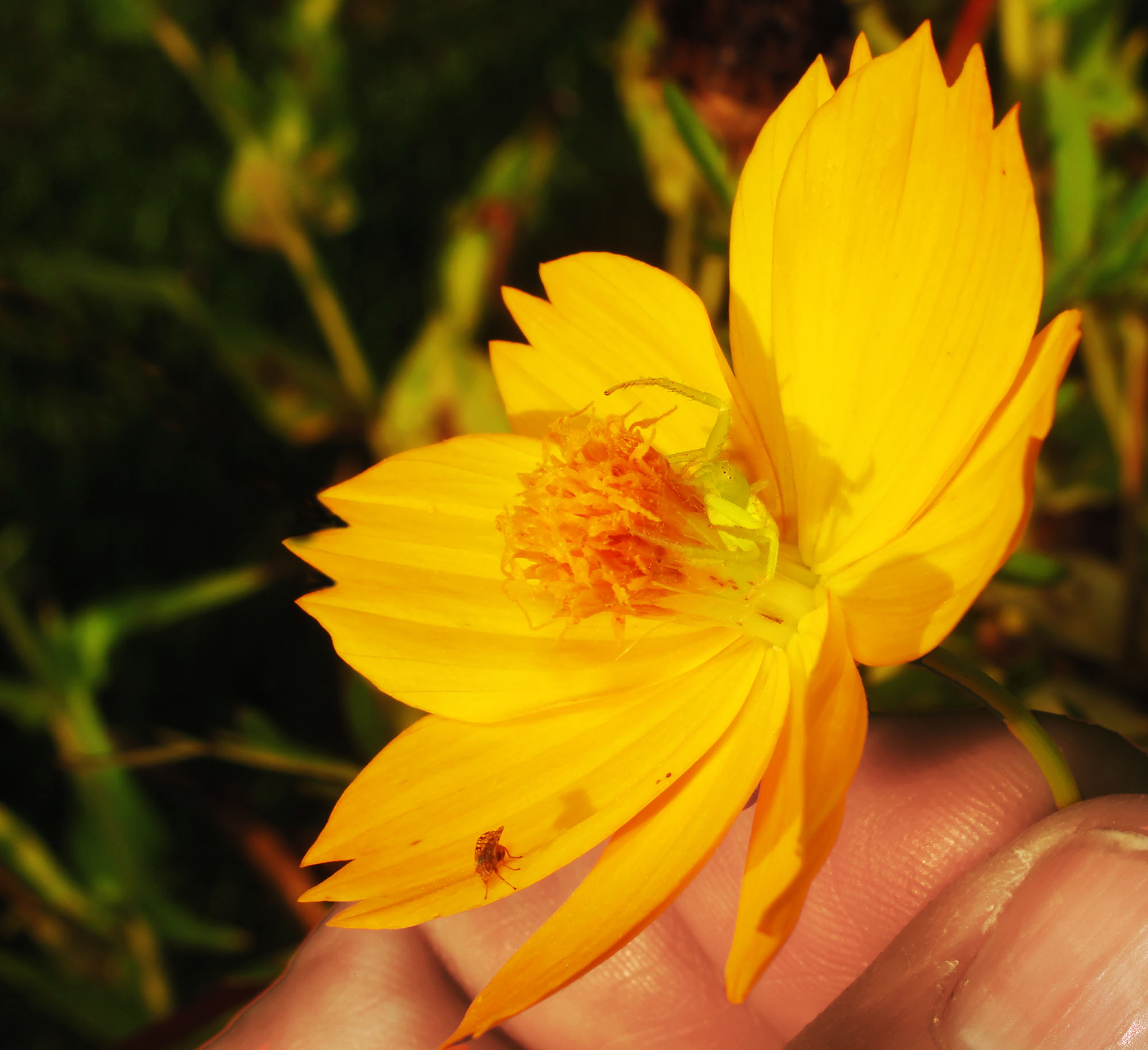
The colors in this shot are nothing like the original photo, but the grasshopper looks exactly as it does in my head:

I wanted a grasshopper which might take up residence behind the looking glass.
These jasmine flowers smell so sweet as to make the head spin. They affect me much the same as orange blossoms:
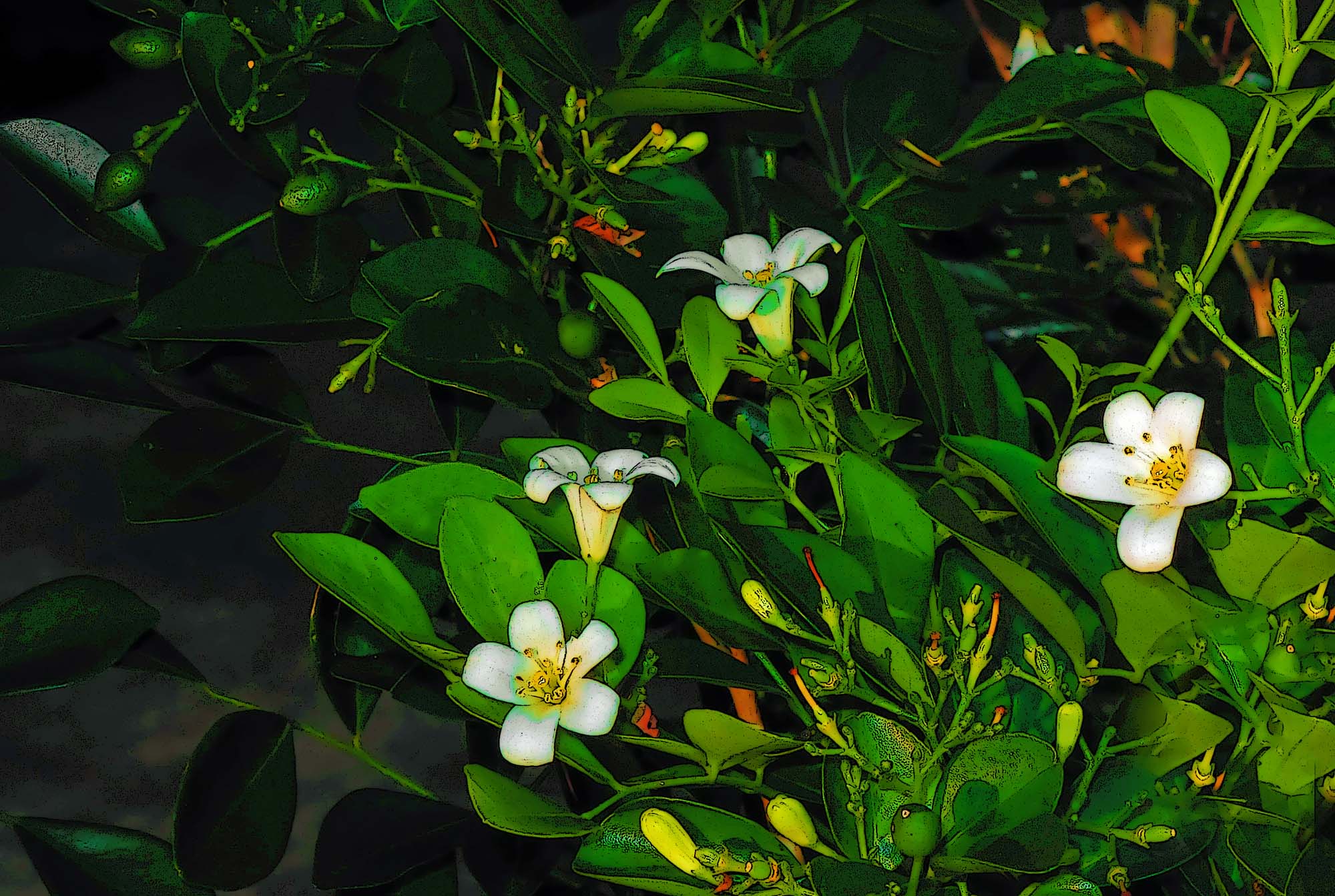
I remember driving once through an orange grove with Eunie and getting so light-headed from the intensity of the aroma that I had to ask her to drive.
This night-blooming jasmine has much the same effect on me. After nine in the evening stepping out my front door is a mind-bending experience:

Visceral experiences are common here in the belly of the tropics. Redundant as that might be linguistically, the metaphor holds true. I find the high desert austere in comparison. That is not a measure of value, but an observation upon which I need to reflect so that I may learn to appreciate it and discover its secrets. When I arrived in Madang I was a gawker. I could not appreciate it properly because I had so little knowledge. As I gain knowledge of my new environment I will come to love and appreciate it as much as I ever have loved and appreciated Madang.
Lush . . . the word which comes to mind so often. Bathed in perfume and perspiration - I'm enjoying being wet again - I stand in simple awe of the outrageous palette displayed by humble vegetation:

A little super-virgin olive oil with a dash of balsamic . . . voila! A tasty and festive salad. I wonder what coleus tastes like?
I am having little trouble bidding goodbye to most things in Madang. Friends are the hardest . . . Some things I won't miss: melting roads with potholes so deep that you have to turn your lights on, power outages that are timed by Satan himself, phones that work when you don't need them . . . the list goes on. I'll live without my boat. I can survive quite happily in the absence of the verdant landscape. Diving gave me decades of fun and learning, but I will find other pleasant pursuits. I think that when I look back over a few years to catalog the things I miss the few pages will be occupied with simple notations of things I thought of as uniquly mine. My smart, pretty dog, Sheba, my lovely house, my orchids in my garden:
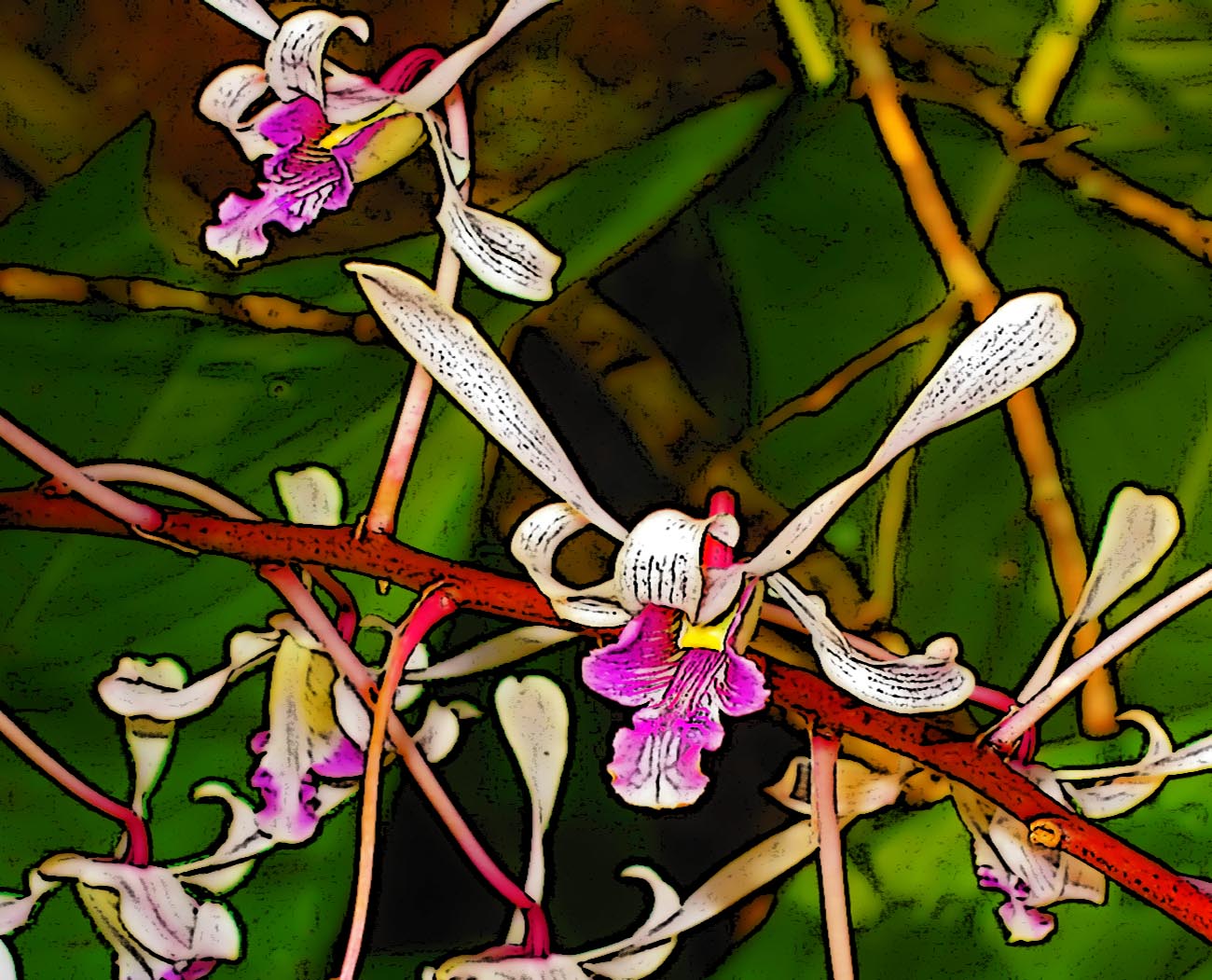
The funny thing about this is that you can't really own any of these things. The way things are going today I sometimes wonder if we can own anything. Maybe some of us are beginning to realize that is it just so much stuff. It's not the actual stuff that is of value. The value lies in the feelings we get from thinking that we own it and it is ours. It's my stuff. It's your stuff. It's good stuff . . .
Ah, well, since it's only the feelings and memories that get the endorphins flowing freely, juicing me up nicely and making me jingle like a pocket full of silver dollars, I'm going to develop a philosophy of Gratification by Means of Virtual Ownership.
I'm going to start with a virtual spin in my new virtual Corvette on the virtually smooth North Coast Road.
See you later . . .
...for 11,000 settlers, and seemingly as many quangos, on Devon greenbelt is heralded as an “eco-trail blazer” by East Devon District Council. Government seems content to wash its hands of our communities and plough promises and investment into new conurbations like Cranbrook instead.
Elsewhere, Okehampton's population is set to rise by at least one third due to West Devon Borough Council’s demands for a new-town extension. But the Dartmoor town of 6,000 was left unrepresented at the determining vote following the unexplained substitution of councillors. Little wonder that, in January 2011, the town issued a formal Petition of No Confidence in the wayward Council and its members.
COUNCIL TARGETS GROWTH 600% THE NATIONAL AVERAGE IN DEVON LAND RUSH
The 900 new houses for Okehampton and 1500 for neighbouring Tavistock represent growth consistent for towns with existing populations of up to 70,000 and will produce up to 50% growth over the term of the Strategy compared to natural growth of 7.5% nationally. Both town councils rejected the scheme as did 91% of voters at a Local Referendum.
Yet, WDBC’s urban vision of economic development demands housing beyond all community need and to create unprecedented population and demographic change to satisfy national fiscal objectives. Mass construction across miles of ‘unproductive’ greenbelt will achieve greater revenues for government as it is transferred to the developers and banks.
In 2004, The Campaign To Protect Rural England (CPRE) lauded the area as a model and voted Tavistock best market town in England www.cpre.org.uk/news/view/128. Something we have not since been allowed to forget while the planners have permitted new buildings which fail to incorporate local materials and styles, new out of town retail development, land taken from the rural economy and National Park for employment development and who seem unaware that the quality of the countryside surrounding market towns directly affects quality of life for those living here, as well as visitor attractiveness.
EXPERIENCED PLANNERS DETERMINED DEVON MUST NOT BE 'LEFT BEHIND'
The Council’s arbitrary, and improper, redesignation of the two Market Towns (def: a town of a few thousand at the heart of a wider rural community) as Main Towns (def: a major commuter centre of at least tens of thousands and comprising major transport interchanges) appears to have been an attempt to win from potential investors the infrastructure development necessary to support such rapidly swollen populations. Of course, it all depends on just how open you are to being defrauded…
Financing partner the Housing & Communities Agency is a predatory government quango armed with cash to bank roll the house building industry. With this money at stake West Devon’s farmland and open countryside, which despite comprising Areas of Outstanding Natural Beauty and Outstanding Landscape Value, a UN World Heritage Site and bordering a National Park, ‘must’ now be bulldozed.
The other partner Kilbride, which is responsible for infrastructure and has been criticised for not having been subject to normal tendering processes, turns out to be Devon County Council in private sector clothing. In plain language, it’s taxpayers money: denied to our own community, as services are cut, but readily available for thousands of settlers - or perhaps for contracts and council jobs - in the creation of make-believe towns.
Let’s face it. The £25million already spent tweaking street furniture in the name of cycling tourism was never going to be enough. These are hardened megalomaniacs.
EXPEDIANT
Initially rejected by the Planning Inspector as unsound, the scheme was given the go-ahead in March 2011 after revisions. This involved the inspector’s removal of key infrastructure - such as education, health and transport provisions - requiring expensive government investment. He also gave extra land for retail development: which will detract from historic town centres. Presumably this wheeze both appeases public spending cuts and absolves the meddling councils for the disaster that is to be inflicted on our community and environment.
A LOAD OF OLD GOVERNMENT
Council managers’ and quango execs’ heady talk about “strategic partnerships” reveals enough about the motives underscoring the schemes www.youtube.com/user/TheUndart?feature=mhee#p/f/0/Gy2nJ6T.... Even “Growth Point”, which sounds like a formula for forecasting future population needs turns out to be another Initiative: a machine issuing edicts to feed the construction industry. But this was the preoccupation of the New Labour regime (1997-2010) whose housing quotas were savaged as “Soviet” by the country’s new administration.
Now, ignoring communities who’d voted for change, the Condems want to rebrand plans devised in 2006 to construct new towns across England, already the third most densely populated country on Earth, as their own.
Subsidised mortgages for new builds, announced in the government’s 2011 Budget, will keep the construction industry sat comfortably on their fat contracts and a steady flow of settlers incoming to build ever more houses to feed the phoney economy.
Jefferson Key -- "Four United States presidents have been assassinated—in 1865, 1881, 1901, and 1963—each murder seemingly unrelated and separated by time.
But what if those presidents were all killed for the same reason: a clause in the United States Constitution—contained within Article 1, Section 8—that would shock Americans?
This question is what faces former Justice Department operative Cotton Malone in his latest adventure. When a bold assassination attempt is made against President Danny Daniels in the heart of Manhattan, Malone risks his life to foil the killing—only to find himself at dangerous odds with the Commonwealth, a secret society of pirates first assembled during the American Revolution. In their most perilous exploit yet, Malone and Cassiopeia Vitt race across the nation and take to the high seas. Along the way they break a secret cipher originally possessed by Thomas Jefferson, unravel a mystery concocted by Andrew Jackson, and unearth a centuries-old document forged by the Founding Fathers themselves, one powerful enough—thanks to that clause in the Constitution—to make the Commonwealth unstoppable." -- from www.barnesandnoble.com
This was another enjoyable book in the Cotton Malone series...I learned some things about American history that I didn't know before and I enjoyed the fact that this book was mostly set in the US instead of overseas, it was a nice change of pace.
--------------------------------------------------------------------------------------------------------------------------------------------
Persian Girls -- "For many years, heartache prevented Nahid Rachlin from turning her sharp novelist's eye inward: to tell the story of how her own life diverged from that of her closest confidante and beloved sister, Pari. Growing up in Iran, both refused to accept traditional Muslim mores, and dreamed of careers in literature and on the stage. Their lives changed abruptly when Pari was coerced by their father into marrying a wealthy and cruel suitor. Nahid narrowly avoided a similar fate, and instead negotiated with him to pursue her studies in America.
When Nahid received the unsettling and mysterious news that Pari had died after falling down a light of stairs, she traveled back to Iran-now under the Islamic regime-to find out what happened to her truest friend, confront her past, and evaluate what the future holds for the heartbroken in a tale of crushing sorrow, sisterhood, and ultimately, hope." -- from www.barnesandnoble.com
I was very moved by this book and would definitely recommend it to people who enjoy memoirs or people who really want to know more about Iranians and not just the nameless/faceless terrorist persona most people have planted on the country.
--------------------------------------------------------------------------------------------------------------------------------------------
And Furthermore -- "From London’s glittering West End to Broadway’s bright lights, from her Academy Award-winning role as Elizabeth I in Shakespeare in Love to “M” in the James Bond films, Judi Dench has treated audiences to some of the greatest performances of our time. She made her professional acting debut in 1957 with England’s Old Vic theatre company playing Ophelia in Hamlet , Katherine in Henry V (her New York debut), and then, Juliet. In 1961, she joined the Royal Shakespeare Company playing Anya in The Cherry Orchard with John Gielgud and Peggy Ashcroft. In 1968, she went beyond the classical stage to become a sensation as Sally Bowles in Cabaret, adding musical comedy to her repertoire. Over the years, Dench has given indelible performances in the classics as well as some of the greatest plays and musicals of the twentieth century including Noël Coward’s Hay Fever, Stephen Sondheim’s A Little Night Music, Kaufman and Hart’s The Royal Family and David Hare’s Amy’s View (for which she won the Tony Award). Recently, she made a triumphant return to A Midsummer Night’s Dream as Titania, a role she first played in 1962, now played as a theatre-besotted Queen Elizabeth I. Her film career has been filled with unforgettable performances of some unforgettable women: Queen Victoria in Mrs. Brown, the terrifying schoolteacher Barbara Covett in Notes on a Scandal and the writer Iris Murdoch in Iris. And, for the BBC, Dench created another unforgettable woman when she brought her great comic timing and deeply felt emotions to the role of Jean Pargetter in the long-running BBC series As Time Goes By.
And Furthermore is, however, more than the story of a great actress’s career. It is also the story of Judi Dench’s life: her early days as a child in a family that was in love with the theatre; her marriage to actor Michael Williams; the joy she takes in her daughter, the actress Finty Williams, and her grandson, Sammy." -- from www.barnesandnoble.com
I loved this book...it great learning more about her life and her amazing career in film, TV and especially the theatre...I thought I knew a lot about her until I read this book and realized how much more there has been to her life...definitely recommend! :)
The Jefferson Key -- Started: May 19, 2011 Finished: May 21, 2011
Persian Girls -- Started: May 26, 2011 Finished: May 27, 2011
And Furthermore -- Started: May 27, 2011 Finished: May 31, 2011
25 Book Challenge 2011 Books #41, #43 & #44
Fonte Official Skindred web page :
The music world may be in a permanent state of panic and flux, but one basic principle of rock’n’roll remains true: the key to longevity is to always deliver the goods. No band has better encapsulated this ethos of integrity and determination over the last decade than Skindred.
Widely acknowledged as one of the most devastating and enthralling live bands on the planet, the Newport destroyers have been a perennial force for musical invention and remorseless positivity since emerging from the ashes of frontman Benji Webbe’s former band Dub War back in 1998. Over the course of four universally praised studio albums – Babylon (2002), Roots Rock Riot (2007), Shark Bites And Dog Fights (2009) and Union Black (2011) – Skindred’s reputation for producing the ultimate spark-spraying state-of-the-art soundclash, combining all manner of seemingly disparate musical elements into an irresistibly exhilarating explosion of energy and cross-pollinated cultural fervour has rightly earned them a reputation as a band capable of uniting people from all corners of the globe and making every last one of them tear up the dancefloor with a giant shit-eating grin plastered across their faces.
With the toughest and most infectious metal riffs colliding with the biggest, phattest hip hop and reggae grooves, cutting edge electronics and a razor-sharp pop sensibility guaranteed to encourage even the most curmudgeonly music fans bellow along with rabid enthusiasm, Skindred are both the ultimate thinking man’s party band. And now, with the release of their fifth studio album Kill The Power, Benji Webbe and his loyal henchmen – bassist Dan Pugsley, guitarist Mikey Demus and drummer Arya Goggins – are poised to spread their gospel of good times and badass tunes to an even bigger global audience.
“We know that everyone recognises us as one of the best live bands around,” says Arya. “We’re really proud of all of the albums we’ve made, but we all felt that we needed to make an album that would be as powerful and effective as the live show. That’s what Kill The Power is all about. This time, we want everyone to sit up and listen and join in the party.”
“I started DJ-ing a little while ago and it’s taught me a lot,” adds Benji. “Now I feel like I wanted to make an album where every intro to every song makes kids think ‘Fucking hell, they’re playing that song!’ Every middle eight on this album is a banger. Every chorus is massive. On this album, the lyrics are deep and the songs are just bigger than ever.”
In keeping with their tradition of making people move while singing about universal issues and spreading a message of positive action and social unity, Kill The Power is an album bulging with fury at the state of the modern world. Never afraid to tackle important topics head on, while never forgetting his band’s mission to entertain and leave the world in a sweaty, sated heap, Benji’s notoriously insane energy levels seem to be creeping up with every album and Kill The Power showcases his most furious and impactful performances to date.
“The world’s getting worse so how can I get more mellow?” he laughs. “Of course I’m getting angrier! People normally stay in a bag when it comes to lyrics. Stephen King stays with horror and he’s brilliant at it, you know? With Skindred, it’s always about encouraging an uplift. It’s about a sense of unity. Lyrics can change people’s lives, you know? You can be going down one road and hear a song and have a Road To Damascus experience and become someone else.”
On an album that has no shortage of invigorating highlights, Kill The Power takes Skindred to new extremes at both ends of the lyrical spectrum, reaching a new level of fiery intensity on the lethal cautionary tale of “Playin’ With The Devil” and the euphoric end-of-the-working-week celebration of “Saturday”: both songs proving that this band’s ability to touch the heart and fire the blood remains as incisive and potent as ever. As if to enhance their songwriting chops more than ever, Kill The Power also features several songs written in collaboration with legendary songwriting guru Russ Ballard, the man behind such immortal rock staples as Since You’ve Been Gone and God Gave Rock & Roll To You, and this seemingly perverse team-up has led to Skindred’s finest set of lyrics and melodies to date.
“Basically, I try to write songs that people can interpret however they like,” says Benji. “When I wrote ‘Playin’ With The Devil’, I originally wrote some words down on a piece of paper thinking about friends I’ve had who smoke crack and live on the pipe, you know? I wrote the song about that kind of thing, but then a couple of days later the riots happened in London and so it became about that as well. When you shit on your own doorstep, your house is going to smell of shit. You’ve got to clean that up! With ‘Saturday’, it’s not a typical Skindred song; it’s a big celebration. We got Russ Ballard involved on that one and he helped me structure the lyrics in the right way so when the chorus hits, it hits like a hammer. It’s an upbeat song but when you listen to the lyrics it goes on about how people all have different reasons to be out and partying. Some people are celebrating, some people are drowning their sorrows, and we all come together on a Saturday. When this record comes out and people go to a club on a Saturday, that’s when it’s gonna go off! The chorus is huge!”
While Skindred’s previous album Union Black was dominated by the bleeps, booms and squelches of British electronic dance music, albeit balanced out by Mikey Demus’ trademark riffs, the new album sees the band return to a more organic sound that amounts to the most accurate representation of the Skindred live experience yet committed to tape. From the huge beats and stuttering samples of the opening title track and the laudably demented Ninja through to the insistent melodies and rampaging choruses of “The Kids Are Right Now” and “Saturday” and on to the thunderous, metallic throwdowns of “Proceed With Caution” and “Ruling Force” and the cool acoustic breeze of the closing More Fire, Kill The Power is Skindred cranked up to full throttle and revelling in their own febrile creativity like never before.
“It’s all about making an album that moves people in the same way that our live shows do,” says Arya. “We love what we achieved on Union Black and we still used a lot of those basic ideas on Kill The Power, but this time it’s a more organic sound. All the drum loops you hear were originally played by me before we started chopping them up, and there are a lot more guitars on this record too. We love combining all the music that we love in Skindred but we all love heavy music and we’re a rock band at heart and that really comes across this time.”
“We’ve delivered an album that’s gonna make people rock for the next few years,” states Benji. “You know what? I can’t do anything about record sales, but if people come to a Skindred show they’re gonna know they’ve been there, you know? Ha ha! The music we make is not about Christians or Muslims, straight people or gay people, black or white or any of that shit. When people are in that room together it’s just Skindred, one unity and one strength!”
Having conquered numerous countries around the world, Skindred could easily be taking a breather and resting on their laurels at this point. Instead, this most dedicated and hard-working of modern bands are preparing to launch their most exuberant assault on the world ever when Kill The Power hits the streets. Anyone that has ever seen the band live before will confirm that it is impossible not to get fired up and drawn into the joyous abandon of a Skindred show and with their greatest album to date primed and ready to explode, the best live band on the planet simply cannot fail to conquer the entire world this time round. Wherever and whoever you are, Skindred are coming. Open your ears and get your dancing feet ready…
“There’s nothing better than being on stage with these guys,” says Arya. “Skindred is my favourite band and I’m so lucky to be part of this thing we’ve created. We’ve been all over the world but there are always new places to visit and new crowds to play for. We just want to keep getting bigger and better.”
“We’re a global band. We’ve played in Colombia and India and everywhere and it’s the same energy,” Benji concludes. “I get letters from people in Hawaii and people in Turkey. It’s all the same. We resonate globally and it’s the greatest thing ever. It seems funny to us sometimes because we’re always kicking each other’s heads in and saying ‘You’re a wanker!’ to each other before we go on stage, but as soon as it’s time to play the show the oneness this band creates together and the unity we bring is unique. I’ve never experienced anything like it and we can’t wait to get back on the road and do it all again.”
Snake charming is the practice of pretending to hypnotize a snake by playing an instrument called pungi or bansuri. A typical performance may also include handling the snakes or performing other seemingly dangerous acts, as well as other street performance staples, like juggling and sleight of hand. The practice is most common in India, though other Asian nations such as Pakistan, Bangladesh, Sri Lanka, Thailand, and Malaysia are also home to performers, as are the North African countries of Egypt, Morocco and Tunisia.
Ancient Egypt was home to one form of snake charming, though the practice as it exists today likely arose in India. It eventually spread throughout Southeast Asia, the Middle East, and North Africa. Despite a sort of golden age in the 20th century, snake charming is today in danger of dying out. This is due to a variety of factors, chief among them the recent enforcement of a 1972 law in India banning ownership of snakes. In retaliation, snake charmers have organized in recent years, protesting the loss of their only means of livelihood, and the government has made some overtures to them.
Many snake charmers live a wandering existence, visiting towns and villages on market days and during festivals. With a few rare exceptions they make every effort to keep themselves from harm's way. The charmer typically sits out of biting range and the snake is sluggish and reluctant to attack anyway. More drastic means of protection include removing the creature's fangs or venom glands, or even sewing the snake's mouth shut. The most popular species are those native to the snake charmer's home region, typically various kinds of cobras, though vipers and other types are also used.
Although snakes are able to sense sound, they lack the outer ear that would enable them to hear the music. They follow the pungi that the "snake charmer" holds with their hands. The snake considers the person and pungi a threat and responds to it as if it were a predator.
HISTORY
The earliest evidence for snake charming comes from ancient Egyptian sources. Charmers there mainly acted as magicians and healers. As literate and high-status men, part of their studies involved learning the various types of snake, the gods to whom they were sacred, and how to treat those who were bitten by the reptiles. Entertainment was also part of their repertoire, and they knew how to handle the animals and charm them for their patrons.
One of the earliest records of snake charming appears in the Bible in Psalm 58:3–5: "The wicked turn aside from birth; liars go astray as soon as they are born. Their venom is like that of a snake, like a deaf serpent that does not hear, that does not respond to the magicians, or to a skilled snake-charmer."
Snake charming as it exists today probably originated in India. Hinduism has long held serpents to be sacred; the animals are believed to be related to the Nagas, and many gods are pictured under the protection of the cobra. Indians thus considered snake charmers to be holy men who were influenced by the gods.
The earliest snake charmers were likely traditional healers by trade. As part of their training, they learned to treat snake bites. Many also learned how to handle snakes, and people called on them to remove snakes from their homes. Baba Gulabgir (or Gulabgarnath) became their guru since his legend states that he taught people to revere the reptiles and not fear them. The practice eventually spread to nearby regions, ultimately reaching North Africa and Southeast Asia.
The early 20th century proved something of a golden age for snake charmers. Governments promoted the practice to draw tourism, and snake charmers were often sent overseas to perform at cultural festivals and for private patrons. In addition, the charmers provided a valuable source of snake venom for creating antivenins.T oday, cultural changes are threatening the profession of the snake charmer in India. One reason for this is the rise of cable television; nature documentaries have extinguished much of the fear and revulsion once felt toward the animals and thus demystified the snake charmer. In addition, many people have less spare time than they once did, especially children, who in previous decades could watch a charmer all day with no commitments to school. Animal-rights groups have also made an impact by decrying what they deem to be the abuse of a number of endangered species. Another factor is urbanisation and deforestation, which have made the snakes upon which the charmers rely increasingly rare. This has in turn given rise to the single most important reason snake charming is declining, at least in India: It is no longer legal.
India passed its Wildlife Protection Act in 1972. The law originally aimed at preventing the export of snakeskins, introducing a seven-year prison term for owning or selling snakes. Beginning in the late 1990s, however, animal-rights groups convinced the government to also apply the law to snake charmers. As a result, the charmers were forced to move their performances to less-travelled areas such as small villages or to pay hefty bribes when caught by police officers. The trade is hardly profitable anymore, and many practitioners must supplement their income by begging, scavenging, or working as day labourers. Children of snake charmers increasingly decide to leave the profession to pursue higher-paying work, and many fathers do not try to make them reconsider. Modern Indians often view snake charmers as little more than beggars.
Some snake charmers have struck back against this stereotype. In 2003, hundreds of them gathered at the temple of Charkhi Dadri in Haryana to bring international attention to their plight. In December of the following year, a group of snake charmers stormed the legislature of the Indian state of Odisha with their demands while brandishing their animals. The Indian government and various animal-rights groups have now acknowledged the problem. One suggested solution is to train the performers to be snake caretakers and educators. In return, they could sell their traditional medicines as souvenirs. Another proposal would try to focus attention on the snake charmers' music and treat them like other street musicians. The Indian government has also begun allowing a limited number of snake charmers to perform at specified tourist sites.
PERFORMANCE TECHNIQUE
Snake charmers typically walk the streets holding their serpents in baskets or pots hanging from a bamboo pole slung over the shoulder. Charmers cover these containers with cloths between performances. Dress in India, Pakistan and neighbouring countries is generally the same: long hair, a white turban, earrings, and necklaces of shells or beads. Once the performer finds a satisfactory location to set up, he sets his pots and baskets about him (often with the help of a team of assistants who may be his apprentices) and sits cross-legged on the ground in front of a closed pot or basket. He removes the lid, then begins playing a flute-like instrument made from a gourd, known as a been or pungi. As if drawn by the tune, a snake eventually emerges from the container; if a cobra, it may even extend its hood.
SNAKES
Traditionally, snake charmers use snakes that they have captured themselves in the wild. This task is not too difficult, as most South Asian and North African snakes tend to be slow movers. The exercise also teaches the hunter how to handle the wild reptiles. Today, however, more and more charmers buy their animals from snake dealers. A typical charmer takes in about seven animals per year.
The exact species of serpents used varies by region. In India, the Indian cobra is preferred, though some charmers may also use Russell's vipers. Indian and Burmese pythons, and even mangrove snakes are also encountered, though they are not as popular. In North Africa, the Egyptian cobra, puff adder, carpet viper and horned desert viper are commonly featured in performances.
Except for the pythons and mangrove snakes, all of these species are highly venomous.
SAFETY MEASURES
At home, snake charmers keep their animals in containers such as baskets, boxes, pots, or sacks. They then train the creatures before bringing them out into public. For those charmers who do not de-fang their pets, this may include introducing the snake to a hard object similar to the pungi. The snake supposedly learns that striking the object only causes pain.
For safety, some North African snake charmers stitch closed the mouth of their performing snakes, leaving just enough opening for the animal to be able to move its tongue in and out. Members of the audience in that region believe that the snake's ability to deliver venomous bites comes from its tongue, rather than fangs. Snakes subjected to this practice soon die of starvation or mouth infection, and must be replaced by freshly caught specimens.
Methods of dealing with the fangs include expert surgical removal of both the fangs and replacement fangs, which has been done by some Native American and African snake charmers. Barring extraordinary measures, pulled fangs are replaced within days. Fangs may also be plugged with wax or other material.
In West Africa, charmers have been observed to treat the snake's body and mouth with herbs that paralyze the jaw muscles and cause inflammation of the venom glands.
Members of the Pakkoku clan of Burma tattoo themselves with ink mixed with cobra venom on their upper body in a weekly inoculation which may protect them from the snake, though there is no scientific evidence of that.
LIFESTYLE
Snake charming is typically an inherited profession. Most would-be charmers thus begin learning the practice at a young age from their fathers. In 2007 a viral video made headlines about an infant who was playing with a defanged cobra. Members of the Sapera or Sapuakela castes, snake charmers have little other choice of profession. In fact, entire settlements of snake charmers and their families exist in some parts of India and neighbouring countries. In Bangladesh, snake charmers are typically members of the nomadic ethnic group Bede. They tend to live by rivers and use them to boat to different towns on market days and during festivals.
North African charmers usually set up in open-air markets and souks for their performances. In coastal resort towns and near major tourist destinations one can see snake charmers catering to the tourist market, but in most of the region they perform for the local audiences; an important part of their income comes from selling pamphlets containing various magic spells (in particular, of course, against snake bites).
In previous eras, snake charming was often the charmer's only source of income. This is less true today, as many charmers also scavenge, scrounge, sell items such as amulets and jewelry, or perform at private parties to make ends meet. Snake charmers are often regarded as traditional healers and magicians, as well, especially in rural areas. These charmers concoct and sell all manner of potions and unguents that purportedly do anything from curing the common cold to raising the dead. They also act as a sort of pest control, as villagers and city-dwellers alike call on them to rid homes of snakes (though some accuse snake charmers of releasing their own animals in order to receive the fee for simply catching them again).
WIKIPEDIA
Still carrying its white plastic London Buses radiator badge following its refurbishment by South Yorkshire Transport of Rotherham in July 1992, Stagecoach London's RML 2311 from the former Upton Park (U) bus garage ambles gently along a seemingly deserted Praed Street in Paddington prior to making the right turn into Eastbourne Terrace on the short remainder of its westbound journey on route 15 from Blackwall DLR station in July 2003. Originally new to the LT Country Area as a green bus based at the former Godstone (GD) bus garage on routes 409, 410 and 411 in 1965, upon its last major overhaul at Aldenham Works RML 2311 was fitted with the former body from RML 2293. Stagecoach London's RML fleets based at Bow on route 8 and at Upton Park on route 15 were unique in being the only RMLs to be fitted with Scania engines, making for a distinctive sound when they were running in service back in the early 2000s.
These seemingly everlasting coffee grinders I see almost daily at the supermarket. Because these machines look so ancient I've been thinking about. Emotionally, I thought that they exist since I am born. So I researched a bit and found, they probably must come from the eighties. The manufacturer still exists, and the machines also. And the design has not changed significantly. Despite of the wide distribution of coffee capsules, here is freshly ground. A stunning example of Swiss quality. Switzerland, Feb 25, 2013.
Relief, or relievo rilievo, is a sculptural technique. The term relief is from the Latin verb relevo, to raise. To create a sculpture in relief is to give the impression that the sculpted material has been raised above the background plane. What is actually performed when a relief is cut in from a flat surface of stone (relief sculpture) or wood (relief carving) is a lowering of the field, leaving the unsculpted parts seemingly raised. The technique involves considerable chiselling away of the background, which is a time-consuming exercise. On the other hand, a relief saves forming the rear of a subject, and is less fragile and more securely fixed than a sculpture in the round, especially one of a standing figure where the ankles are a potential weak point, especially in stone. In other materials such as metal, clay, plaster stucco, ceramics or papier-mache the form can be just added to or raised up from the background, and monumental bronze reliefs are made by casting. There are different degrees of relief depending on the degree of projection of the sculpted form from the field, for which the Italian appellations are still sometimes used. The full range includes high relief (alto-rilievo), where more than 50% of the depth is shown and there may be undercut areas, mid-relief (mezzo-rilievo), low-relief (basso-rilievo, or French: bas-relief /ˌbɑːrɪˈliːf/), and shallow-relief or rilievo schiacciato, where the plane is scarcely more than scratched in order to remove background material. There is also sunk relief, which was mainly restricted to Ancient Egypt. However the distinction between high relief and low relief is the clearest and most important, and these two are generally the only terms used to discuss most work. The definition of these terms is somewhat variable, and many works combine areas in more than one of them, sometimes sliding between them in a single figure; accordingly some writers prefer to avoid all distinctions. The opposite of relief sculpture is counter-relief, intaglio, or cavo-rilievo, where the form is cut into the field or background rather than rising from it; this is very rare in monumental sculpture.
Reliefs are common throughout the world on the walls of buildings and a variety of smaller settings, and a sequence of several panels or sections of relief may represent an extended narrative. Relief is more suitable for depicting complicated subjects with many figures and very active poses, such as battles, than free-standing "sculpture in the round". Most ancient architectural reliefs were originally painted, which helped to define forms in low relief. The subject of reliefs is for convenient reference assumed in this article to be usually figures, but sculpture in relief often depicts decorative geometrical or foliage patterns, as in the arabesques of Islamic art, and may be of any subject.
Rock reliefs are those carved into solid rock in the open air (if inside caves, whether natural or man-made, they are more likely to be called "rock-cut"). This type is found in many cultures, in particular those of the Ancient Near East and Buddhist countries. A stela is a single standing stone; many of these carry reliefs.
TYPES
The distinction between high and low relief is somewhat subjective, and the two are very often combined in a single work. In particular, most later "high reliefs" contain sections in low relief, usually in the background. From the Parthenon Frieze onwards, many single figures have heads in high relief, but their lower legs are in low relief; the slightly projecting figures created in this way work well in reliefs that are seen from below (see Moissac portal in gallery). As unfinished examples from various periods show, raised reliefs, whether high or low, were normally "blocked out" by marking the outline of the figure and reducing the background areas to the new background level, work no doubt performed by apprentices (see gallery). Hyphens may or may not be used in all these terms, though they are rarely seen in "sunk relief" and are usual in "bas-relief" and "counter-relief". Works in the technique are described as "in relief", and, especially in monumental sculpture, the work itself is "a relief".
BAS RELIEF OR LOW RELIEF
A bas-relief ("low relief", from the Italian basso rilievo) or low relief is a projecting image with a shallow overall depth, for example used on coins, on which all images are in low relief. In the lowest reliefs the relative depth of the elements shown is completely distorted, and if seen from the side the image makes no sense, but from the front the small variations in depth register as a three-dimensional image. Other versions distort depth much less. It is a technique which requires less work, and is therefore cheaper to produce, as less of the background needs to be removed in a carving, or less modelling is required. In the art of Ancient Egypt and other ancient Near Eastern and Asian cultures, and also Meso-America, a very low relief was commonly used for the whole composition. These images would all be painted after carving, which helped to define the forms; today the paint has worn off in the great majority of surviving examples, but minute, invisible remains of paint can usually be discovered through chemical means.
The Ishtar Gate of Babylon, now in Berlin, has low reliefs of large animals formed from moulded bricks, glazed in colour. Plaster was sometimes used in Egypt and Rome, and probably elsewhere, but needs very good conditions to survive – Roman decorative plasterwork is mainly known from Pompeii and other sites buried by ash from Mount Vesuvius. Low relief was relatively rare in Western medieval art, but may be found, for example in wooden figures or scenes on the insides of the folding wings of multi-panel altarpieces.
Low relief is probably the most common type of relief found in Hindu-Buddhist arts of India and Southeast Asia. The low reliefs of 2nd-century BCE to 6th-century CE Ajanta Caves and 5th to 10th-century Ellora Caves in India are noted for they were carved out from rock-cut hill. They are probably the most exquisite examples of Buddhist, Hindu, and Jain arts in India. Most of these low reliefs are used in narrating sacred scriptures, such as those founds in 9th century Borobudur temple in Central Java, Indonesia, that narrating The birth of Buddha (Lalitavistara). Borobudur itself possess 1,460 panels of narrating low reliefs. Another example is low reliefs narrating Ramayana Hindu epic in Prambanan temple, also in Java. In Cambodia, the temples of Angkor are also remarkable for their collection of low reliefs. The Samudra manthan or "Churning of Ocean of Milk" of 12th-century Angkor Wat is an example of Khmer art. Another examples are low reliefs of Apsaras adorned the walls and pillars of Angkorian temples. The low reliefs of Bayon temple in Angkor Thom also remarkable on capturing the daily life of Khmer Empire.
The revival of low relief, which was seen as a classical style, begins early in the Renaissance; the Tempio Malatestiano in Rimini, a pioneering classicist building, designed by Leon Battista Alberti around 1450, uses low reliefs by Agostino di Duccio inside and on the external walls. Since the Renaissance plaster has been very widely used for indoor ornamental work such as cornices and ceilings, but in the 16th century it was used for large figures (many also using high relief) at the Chateau of Fontainebleau, which were imitated more crudely elsewhere, for example in the Elizabethan Hardwick Hall.
In later Western art, until a 20th-century revival, low relief was used mostly for smaller works or combined with higher relief to convey a sense of distance, or to give depth to the composition, especially for scenes with many figures and a landscape or architectural background, in the same way that lighter colours are used for the same purpose in painting. Thus figures in the foreground are sculpted in high-relief, those in the background in low-relief. Low relief may use any medium or technique of sculpture, stone carving and metal casting being most common. Large architectural compositions all in low relief saw a revival in the 20th century, being popular on buildings in Art Deco and related styles, which borrowed from the ancient low reliefs now available in museums. Some sculptors, including Eric Gill, have adopted the "squashed" depth of low relief in works that are actually free-standing.
Mid-relief, "half-relief" or mezzo-rilievo is somewhat imprecisely defined, and the term is not often used in English, the works usually being described as low relief instead. The typical traditional definition is that only up to half of the subject projects, and no elements are undercut or fully disengaged from the background field. The depth of the elements shown is normally somewhat distorted. Shallow-relief or rilievo stiacciato, used for the background areas of compositions with the main elements in low-relief, was perfected by the Italian Renaissance sculptor Donatello. It is a very shallow relief, which merges into engraving in places, and can be hard to read in photographs.
HIGH RELIEF
High relief (or altorilievo, from Italian) is where in general more than half the mass of the sculpted figure projects from the background, indeed the most prominent elements of the composition, especially heads and limbs, are often completely undercut, detaching them from the field. The parts of the subject that are seen are normally depicted at their full depth, unlike low relief where the elements seen are "squashed" flatter. High-relief thus uses essentially the same style and techniques as free-standing sculpture, and in the case of a single figure gives largely the same view as a person standing directly in front of a free-standing statue would have. All cultures and periods in which large sculptures were created used this technique in monumental sculpture and architecture.
Most of the many grand figure reliefs in Ancient Greek sculpture used a very "high" version of high-relief, with elements often fully free of the background, and parts of figures crossing over each other to indicate depth. The metopes of the Parthenon have largely lost their fully rounded elements, except for heads, showing the advantages of relief in terms of durability. High relief has remained the dominant form for reliefs with figures in Western sculpture, also being common in Indian temple sculpture. Smaller Greek sculptures such as private tombs, and smaller decorative areas such as friezes on large buildings, more often used low relief.
Hellenistic and Roman sarcophagus reliefs were cut with a drill rather than chisels, enabling and encouraging compositions extremely crowded with figures, like the Ludovisi Battle sarcophagus (250–260 CE). These are also seen in the enormous strips of reliefs that wound round Roman triumphal columns. The sarcophagi in particular exerted a huge influence on later Western sculpture. The European Middle Ages tended to use high relief for all purposes in stone, though like Ancient Roman sculpture their reliefs were typically not as high as in Ancient Greece. Very high relief reemerged in the Renaissance, and was especially used in wall-mounted funerary art and later on Neo-classical pediments and public monuments.
In Hindu-Buddhist art of India and Southeast Asia high relief can also be found, although it is not as common as low reliefs. Most of Hindu-Buddhist sculptures however also can be considered as a high relief, since these sculptures usually connected to a stella as the background to support the statue as well as provides additional elements such as aura or halo in the back of sculpture's head, or floral decoration. The examples of Indian high reliefs can be found in Khajuraho temple, that displaying voluptuous twisting figures that often describes the erotic Kamasutra positions. In 9th-century Prambanan temple, Central Java, the examples are the high reliefs of Lokapala devatas, the guardian of directions deities.
SUNK RELIEF
Sunk or sunken relief is largely restricted to the art of Ancient Egypt where it is very common, becoming after the Amarna period of Ahkenaten the dominant type used, as opposed to low relief. It had been used earlier, but mainly for large reliefs on external walls, and for hieroglyphs and cartouches. The image is made by cutting the relief sculpture itself into a flat surface. In a simpler form the images are usually mostly linear in nature, like hieroglyphs, but in most cases the figure itself is in low relief, but set within a sunken area shaped round the image, so that the relief never rises beyond the original flat surface. In some cases the figures and other elements are in a very low relief that does not rise to the original surface, but others are modeled more fully, with some areas rising to the original surface. This method minimizes the work removing the background, while allowing normal relief modelling.
The technique is most successful with strong sunlight to emphasise the outlines and forms by shadow, as no attempt was made to soften the edge of the sunk area, leaving a face at a right-angle to the surface all around it. Some reliefs, especially funerary monuments with heads or busts from ancient Rome and later Western art, leave a "frame" at the original level around the edge of the relief, or place a head in a hemispherical recess in the block (see Roman example in gallery). Though essentially very similar to Egyptian sunk relief, but with a background space at the lower level around the figure, the term would not normally be used of such works.
COUNTER RELIEF
Sunk relief technique is not to be confused with "counter-relief" or intaglio as seen on engraved gem seals - where an image is fully modeled in a "negative" manner. The image goes into the surface, so that when impressed on wax it gives an impression in normal relief. However many engraved gems were carved in cameo or normal relief.
A few very late Hellenistic monumental carvings in Egypt use full "negative" modelling as though on a gem seal, perhaps as sculptors trained in the Greek tradition attempted to use traditional Egyptian conventions.
SMALL OBJECTS
Small-scale reliefs have been carved in various materials, notably ivory, wood, and wax. Reliefs are often found in decorative arts such as ceramics and metalwork; these are less often described as "reliefs" than as "in relief". Small bronze reliefs are often in the form of "plaques" or plaquettes, which may be set in furniture or framed, or just kept as they are, a popular form for European collectors, especially in the Renaissance.
Various modelling techniques are used, such repoussé ("pushed-back") in metalwork, where a thin metal plate is shaped from behind using various metal or wood punches, producing a relief image. Casting has also been widely used in bronze and other metals. Casting and repoussé are often used in concert in to speed up production and add greater detail to the final relief. In stone, as well as engraved gems, larger hardstone carvings in semi-precious stones have been highly prestigious since ancient times in many Eurasian cultures. Reliefs in wax were produced at least from the Renaissance.
Carved ivory reliefs have been used since ancient times, and because the material, though expensive, cannot usually be reused, they have a relatively high survival rate, and for example consular diptychs represent a large proportion of the survivals of portable secular art from Late Antiquity. In the Gothic period the carving of ivory reliefs became a considerable luxury industry in Paris and other centres. As well as small diptychs and triptychs with densely packed religious scenes, usually from the New Testament, secular objects, usually in a lower relief, were also produced.
These were often round mirror-cases, combs, handles, and other small items, but included a few larger caskets like the Casket with Scenes of Romances (Walters 71264) in Baltimore, Maryland, in the United States. Originally there were very often painted in bright colours. Reliefs can be impressed by stamps onto clay, or the clay pressed into a mould bearing the design, as was usual with the mass-produced terra sigillata of Ancient Roman pottery. Decorative reliefs in plaster or stucco may be much larger; this form of architectural decoration is found in many styles of interiors in the post-Renaissance West, and in Islamic architecture.
WIKIPEDIA
Unused.
Seemingly, a Landsturm infantryman from the 69th Infanterie Brigade - a Prussian formation that drew its personnel from Graudenz (now Grudziądz in Poland), but there are some questions that need answering before that moniker can be bestowed upon this fellow.
Firstly, he is wearing brigade numbers on his collar. Brigade numbers were ordered to be removed on 14th of April 1914 and replaced with battalion and Armeekorps numbers. Yet according to the information on the shell-vase, the date is 15th of April 1917.
Secondly, he is wearing a Saxon tunic, identifiable by its German (sometimes called Saxon) cuffs.
Prussian or Saxon and why is his wearing that brigade insignia?
Unit: 69th Infanterie Brigade
Rank: Landsturmmann
Headwear: --- / M.92 Landsturm Überzug
Tunic: Model 1907/10 Feldrock
Awards: None
Buckle: Indiscernible
Accoutrements: Breadbag strap
Ammunition pouches: M.89 type
Armament: Gew 98
_____________________________________________________________________________
Notes:
XVII Armee-korps (Preußen). Bezirkskommando: Graudenz.
Commentary.
Seemingly, little more than an infrequently used farm track, this trail leads from Loch Duntelchaig and Torness to Inverfarigaig,
over the “lip,” above the southern shore of Loch Ness.
Like a rocky, bumpy, knobbly “Inselberg,” Roche moutonée or mini-Sugar-loaf, capped by a single pine-tree, this hill stands starkly above seven “switchback” bends that take it down 200 metres or 650 feet to the famous loch.
Across the chasm, and in shot, is the snowy monolith
of Meall Fuar-mhonaidh, at 700 metres or 2,300 feet.
A series of varied and startling landscapes occur in rapid succession on and around the fault line, called “The Great Glen.”
Seemingly calm on the surface, these chunks of broken glacier ice aren’t serene below the frigid waters. Bobbing on the surface of Jökulsarlón, a lake carved out of the earth by a glacier whose retreat promptly filled it, these behemoth ancient islands of compacted snow continually dredge out the bottom 300 meters below as they make their advance to the ocean. Before these solemn, peaceful giants meet their end as glittery bits on the black sand beach nearby, they flaunt their ashen stripes of time trapped in frozen suspension in a final requiem of a bygone era.
One minute they don't and the next minute they do. That's how it works with toddlers.
In true Olive fashion, this week she began to seemingly understand everything we tell her. If she's heard the word before (and she's in the mood) she can react to almost any phrase we say to her. She knows all of her body parts, can fetch toys and dances, spins and stomps on command. It's fun that she now understands what we say but, again, it has made me put extra effort into being deliberate about my words. One of the hardest things not to do is ask her to do something over and over again. Specifically sitting down at the dinner table. We take turns asking her to please sit over and over again and I know as we're doing it that it's not the right thing to do, but in a situation where she can get hurt, I'm not sure what the other option is.
I love sitting in the front seat of the car with Ryan, listening to Olive chatter away in the back. We exchange a look that says, "Damn, don't you just love our child" and we reach over to squeeze an arm or a hand of the other. It's one of those moments that make you feel like how the media tells you a parent should feel. Instead of being in the trenches together, doing the dirty, unspoken things it takes to keep a kid alive, you're sweetly sharing a memory of who your child is right at that second. A few months ago she sang to herself in the car, then she told herself stories and this week she started to "count". She makes a sound that imitates how we say the numbers with an emphasis on the "threeeeee." I have no idea what she's counting. Sometimes it's part of a story she's telling herself and sometimes she does it to let us know she wants us to help her jump in the pool or walk down the stairs. Either way, it makes me want to gobble her up with a spoon.
My brother and sister-in-law met Olive for the first time this week. I was sort of nervous because he's my brother and he's seven years older and I think time might have stopped for him when I was eleven or so. Surely he sees me as the person I used to be, when he knew me best. A child or a self-centered college student. But now I am neither; I am a mom. But I needn't have worried because the visit was wonderful. And unlike a year ago, I am confident and comfortable being a mom. I don't feel like I'm pretending anymore – it's just who I am. Sometimes I'm an awesome mom and sometimes I'm mediocre but I will always be Up, I mean, Mom to Olive and that feels pretty solid.
Mark and Susan make a great Aunt and Uncle pair. Susan tirelessly pushed Olive in her beloved swing and Mark played along with all of Olive's games. They brought her a big Snoopy and she loves it. It's the first stuffed animal she has shown any real interest in since she was a young infant and it makes my heart squeeze to see her hug and kiss him. I had a Snoopy almost exactly that size when I was a little older than her. She has the same golden hair that I had as a child.
Being the youngest, and the youngest by so many years, I only know what my brothers were like as children through pictures. When Mike had the twins, I could match a facial expression to an old 70s cardboard photograph but looking at the girls never caused me to recall a memory of my brother as a boy. It's a unique situation that my brothers can watch as Olive grows up and see a shadowy reflection of my childhood.
At brunch with Susan's parents, her mother told me that she could see that I was doing a good job raising Olive and I carried that compliment with me all week. There is no praise better than that of someone telling me I'm doing a good job as a mom. Strangers now openly comment about Olive's behavior and personality when she's being sweet but I'm aware they are silently condemning us both when she's being rotten. Sometimes what's not said wiggles its way further into my thoughts than what is. So when someone hands me such a perfect compliment, I stash it away for a not so perfect day.
Willem Claesz Heda (1594-1680), active in Haarlem
Breakfast still life with lidded goblet, 1634
The from few horizontal and vertical elements (table, plate, goblet) built composition by seemingly careless symmetry appears to have been created randomly. With a few muted colors Heda on the one hand characterizes the hard shiny surface of the objects, on the other hand, he gives them a soft, plump shape. The combination of such opposites the Haarlem still life painting in the second quarter of the 17th century yielded a classical significance.
Willem Claesz Heda (1594-1680), tätig in Haarlem Frühstückstillleben mit Deckelpokal, 1634
Die aus wenigen horizontalen und vertikalen Elementen (Tisch, Teller, Pokal) gebaute Komposition erscheint durch scheinbar achtlose Symmetrie wie zufällig entstanden. Mit wenigen gedämpften Farben charakterisiert Heda einerseits die hart glänzende Oberfläche der Gegenstände, verleiht ihnen andererseits aber eine weiche, füllige Form. Die Vereinigung solcher Gegensätze brachte der Haarlemer Stilllebenmalerei im zweiten Viertel des 17. Jahrhunderts klassische Bedeutung ein.
Austria Kunsthistorisches Museum
Federal Museum
Logo KHM
Regulatory authority (ies)/organs to the Federal Ministry for Education, Science and Culture
Founded 17 October 1891
Headquartered Castle Ring (Burgring), Vienna 1, Austria
Management Sabine Haag
www.khm.at website
Main building of the Kunsthistorisches Museum at Maria-Theresa-Square
The Kunsthistorisches Museum (KHM abbreviated) is an art museum in Vienna. It is one of the largest and most important museums in the world. It was opened in 1891 and 2012 visited of 1.351.940 million people.
The museum
The Kunsthistorisches Museum is with its opposite sister building, the Natural History Museum (Naturhistorisches Museum), the most important historicist large buildings of the Ringstrasse time. Together they stand around the Maria Theresa square, on which also the Maria Theresa monument stands. This course spans the former glacis between today's ring road and 2-line, and is forming a historical landmark that also belongs to World Heritage Site Historic Centre of Vienna.
History
Archduke Leopold Wilhelm in his Gallery
The Museum came from the collections of the Habsburgs, especially from the portrait and armor collections of Ferdinand of Tyrol, the collection of Emperor Rudolf II (most of which, however scattered) and the art collection of Archduke Leopold Wilhelm into existence. Already In 1833 asked Joseph Arneth, curator (and later director) of the Imperial Coins and Antiquities Cabinet, bringing together all the imperial collections in a single building.
Architectural History
The contract to build the museum in the city had been given in 1858 by Emperor Franz Joseph. Subsequently, many designs were submitted for the ring road zone. Plans by August Sicard von Sicardsburg and Eduard van der Null planned to build two museum buildings in the immediate aftermath of the Imperial Palace on the left and right of the Heroes' Square (Heldenplatz). The architect Ludwig Förster planned museum buildings between the Schwarzenberg Square and the City Park, Martin Ritter von Kink favored buildings at the corner Währinger street/Scots ring (Schottenring), Peter Joseph, the area Bellariastraße, Moritz von Loehr the south side of the Opera ring, and Ludwig Zettl the southeast side of the Grain market (Getreidemarkt).
From 1867, a competition was announced for the museums, and thereby set their current position - at the request of the Emperor, the museum should not be too close to the Imperial Palace, but arise beyond the ring road. The architect Carl von Hasenauer participated in this competition and was able the at that time in Zürich operating Gottfried Semper to encourage to work together. The two museum buildings should be built here in the sense of the style of the Italian Renaissance. The plans got the benevolence of the imperial family. In April 1869, there was an audience of Joseph Semper with the Emperor Franz Joseph and an oral contract was concluded, in July 1870 was issued the written order to Semper and Hasenauer.
Crucial for the success of Semper and Hasenauer against the projects of other architects were among others Semper's vision of a large building complex called "Imperial Forum", in which the museums would have been a part of. Not least by the death of Semper in 1879 came the Imperial Forum not as planned for execution, the two museums were built, however.
Construction of the two museums began without ceremony on 27 November 1871 instead. Semper subsequently moved to Vienna. From the beginning on, there were considerable personal differences between him and Hasenauer, who finally in 1877 took over sole construction management. 1874, the scaffolds were placed up to the attic and the first floor completed, in 1878, the first windows installed, in 1879, the Attica and the balustrade finished, and from 1880 to 1881 the dome and the Tabernacle built. The dome is topped with a bronze statue of Pallas Athena by Johannes Benk.
The lighting and air conditioning concept with double glazing of the ceilings made the renunciation of artificial light (especially at that time, as gas light) possible, but this resulted due to seasonal variations depending on daylight to different opening times.
Dome hall
Entrance (by clicking on the link at the end of the side you can see all the pictures here indicated!)
Grand staircase
Hall
Empire
The Kunsthistorisches Museum was on 17 October 1891 officially opened by Emperor Franz Joseph I. Since 22 October 1891, the museum is accessible to the public. Two years earlier, on 3 November 1889, the collection of arms, Arms and Armour today, had their doors open. On 1 January 1890 the library service resumed its operations. The merger and listing of other collections of the Highest Imperial Family from the Upper and Lower Belvedere, the Hofburg Palace and Ambras in Tyrol needs another two years.
1891, the Court museum was organized in seven collections with three directorates:
Directorate of coins, medals and antiquities collection
The Egyptian Collection
The Antique Collection
The coins and medals collection
Management of the collection of weapons, art and industrial objects
Weapons collection
Collection of industrial art objects
Directorate of Art Gallery and Restaurieranstalt (Restoration Office)
Collection of watercolors, drawings, sketches, etc.
Restoration Office
Library
Very soon the room the Court Museum (Hofmuseum) for the imperial collections was offering became too narrow. To provide temporary help, an exhibition of ancient artifacts from Ephesus in the Theseus Temple was designed. However, additional space had to be rented in the Lower Belvedere.
1914, after the assassination of Franz Ferdinand, heir to the throne, his "Estensische Sammlung (Collection)" passed to the administration of the Court Museum. This collection, which emerged from the art collection of the house of d'Este and world travel collection of Franz Ferdinand, was placed in the New Imperial Palace since 1908. For these stocks, the present collection of old musical instruments and the Museum of Ethnology emerged.
The First World War went by, apart from the oppressive economic situation without loss. The Court museum remained during the five years of war regularly open to the public.
Until 1919 the K.K. Art Historical Court Museum was under the authority of the Oberstkämmereramt (head chamberlain office) and belonged to the House of Habsburg-Lorraine. The officials and employees were part of the royal household.
First Republic
The transition from monarchy to republic, in the museum took place in complete tranquility. On 19 November 1918 the two imperial museums on Maria Theresa Square were placed under the state protection of the young Republic of German Austria. Threatening to the stocks of the museum were the claims raised in the following weeks and months of the "successor states" of the monarchy as well as Italy and Belgium on Austrian art collection. In fact, it came on 12th February 1919 to the violent removal of 62 paintings by armed Italian units. This "art theft" left a long time trauma among curators and art historians.
It was not until the Treaty of Saint-Germain on 10 September 1919, providing in Article 195 and 196 the settlement of rights in the cultural field by negotiations. The claims of Belgium, Czechoslovakia, and Italy again could mostly being averted in this way. Only Hungary, which presented the greatest demands by far, was met by more than ten years of negotiation in 147 cases.
On 3 April 1919 was the expropriation of the House of Habsburg-Lorraine by law and the acquisition of its property, including the "Collections of the Imperial House", by the Republic. On 18 June 1920 the then provisional administration of the former imperial museums and collections of Este and the secular and clergy treasury passed to the State Office of Internal Affairs and Education, since 10 November 1920, the Federal Ministry of the Interior and Education. A few days later it was renamed the Art History Court Museum in the "Kunsthistorisches Museum, Vienna State", 1921 "Kunsthistorisches Museum" . Of 1st January 1921 the employees of the museum staff passed to the state of the Republic.
Through the acquisition of the former imperial collections owned by the state, the museum found itself in a complete new situation. In order to meet the changed circumstances in the museum area, designed Hans Tietze in 1919 the "Vienna Museum program". It provided a close cooperation between the individual museums to focus at different houses on main collections. So dominated exchange, sales and equalizing the acquisition policy in the interwar period. Thus resulting until today still valid collection trends. Also pointing the way was the relocation of the weapons collection from 1934 in its present premises in the New Castle, where since 1916 the collection of ancient musical instruments was placed.
With the change of the imperial collections in the ownership of the Republic the reorganization of the internal organization went hand in hand, too. Thus the museum was divided in 1919 into the
Egyptian and Near Eastern Collection (with the Oriental coins)
Collection of Classical Antiquities
Collection of Ancient Coins
Collection of modern Coins and Medals
Weapons collection
Collection of Sculptures and Crafts with the Collection of Ancient Musical Instruments
Picture gallery
The Museum 1938-1945
Count Philipp Ludwig Wenzel Sinzendorf according to Rigaud. Clarisse 1948 by Baroness de Rothschildt "dedicated" to the memory of Baron Alphonse de Rothschildt; restituted to the Rothschilds in 1999, and in 1999 donated by Bettina Looram Rothschild, the last Austrian heiress.
With the "Anschluss" of Austria to the German Reich all Jewish art collections such as the Rothschilds were forcibly "Aryanised". Collections were either "paid" or simply distributed by the Gestapo at the museums. This resulted in a significant increase in stocks. But the KHM was not the only museum that benefited from the linearization. Systematically looted Jewish property was sold to museums, collections or in pawnshops throughout the German Reich.
After the war, the museum struggled to reimburse the "Aryanised" art to the owners or their heirs. They forced the Rothschild family to leave the most important part of their own collection to the museum and called this "dedications", or "donations". As a reason, was the export law stated, which does not allow owners to bring certain works of art out of the country. Similar methods were used with other former owners. Only on the basis of international diplomatic and media pressure, to a large extent from the United States, the Austrian government decided to make a change in the law (Art Restitution Act of 1998, the so-called Lex Rothschild). The art objects were the Rothschild family refunded only in the 1990s.
The Kunsthistorisches Museum operates on the basis of the federal law on the restitution of art objects from the 4th December 1998 (Federal Law Gazette I, 181 /1998) extensive provenance research. Even before this decree was carried out in-house provenance research at the initiative of the then archive director Herbert Haupt. To this end was submitted in 1998 by him in collaboration with Lydia Grobl a comprehensive presentation of the facts about the changes in the inventory levels of the Kunsthistorisches Museum during the Nazi era and in the years leading up to the State Treaty of 1955, an important basis for further research provenance.
The two historians Susanne Hehenberger and Monika Löscher are since 1st April 2009 as provenance researchers at the Kunsthistorisches Museum on behalf of the Commission for Provenance Research operating and they deal with the investigation period from 1933 to the recent past.
The museum today
Today the museum is as a federal museum, with 1st January 1999 released to the full legal capacity - it was thus the first of the state museums of Austria, implementing the far-reaching self-financing. It is by far the most visited museum in Austria with 1.3 million visitors (2007).
The Kunsthistorisches Museum is under the name Kunsthistorisches Museum and Museum of Ethnology and the Austrian Theatre Museum with company number 182081t since 11 June 1999 as a research institution under public law of the Federal virtue of the Federal Museums Act, Federal Law Gazette I/115/1998 and the Museum of Procedure of the Kunsthistorisches Museum and Museum of Ethnology and the Austrian Theatre Museum, 3 January 2001, BGBl II 2/ 2001, in force since 1 January 2001, registered.
In fiscal 2008, the turnover was 37.185 million EUR and total assets amounted to EUR 22.204 million. In 2008 an average of 410 workers were employed.
Management
1919-1923: Gustav Glück as the first chairman of the College of science officials
1924-1933: Hermann Julius Hermann 1924-1925 as the first chairman of the College of the scientific officers in 1925 as first director
1933: Arpad Weixlgärtner first director
1934-1938: Alfred Stix first director
1938-1945: Fritz Dworschak 1938 as acting head, from 1938 as a chief, in 1941 as first director
1945-1949: August von Loehr 1945-1948 as executive director of the State Art Collections, in 1949 as general director of the historical collections of the Federation
1945-1949: Alfred Stix 1945-1948 as executive director of the State Art Collections, in 1949 as general director of art historical collections of the Federation
1949-1950: Hans Demel as administrative director
1950: Karl Wisoko-Meytsky as general director of art and historical collections of the Federation
1951-1952: Fritz Eichler as administrative director
1953-1954: Ernst H. Buschbeck as administrative director
1955-1966: Vincent Oberhammer 1955-1959 as administrative director, from 1959 as first director
1967: Edward Holzmair as managing director
1968-1972: Erwin Auer first director
1973-1981: Friderike Klauner first director
1982-1990: Hermann Fillitz first director
1990: George Kugler as interim first director
1990-2008: Wilfried Seipel as general director
Since 2009: Sabine Haag as general director
Collections
To the Kunsthistorisches Museum also belon the collections of the New Castle, the Austrian Theatre Museum in Palais Lobkowitz, the Museum of Ethnology and the Wagenburg (wagon fortress) in an outbuilding of Schönbrunn Palace. A branch office is also Ambras in Innsbruck.
Kunsthistorisches Museum (main building)
Picture Gallery
Egyptian and Near Eastern Collection
Collection of Classical Antiquities
Vienna Chamber of Art
Numismatic Collection
Library
New Castle
Ephesus Museum
Collection of Ancient Musical Instruments
Arms and Armour
Archive
Hofburg
The imperial crown in the Treasury
Imperial Treasury of Vienna
Insignia of the Austrian Hereditary Homage
Insignia of imperial Austria
Insignia of the Holy Roman Empire
Burgundian Inheritance and the Order of the Golden Fleece
Habsburg-Lorraine Household Treasure
Ecclesiastical Treasury
Schönbrunn Palace
Imperial Carriage Museum Vienna
Armory in Ambras Castle
Ambras Castle
Collections of Ambras Castle
Major exhibits
Among the most important exhibits of the Art Gallery rank inter alia:
Jan van Eyck: Cardinal Niccolò Albergati, 1438
Martin Schongauer: Holy Family, 1475-80
Albrecht Dürer : Trinity Altar, 1509-16
Portrait Johann Kleeberger, 1526
Parmigianino: Self Portrait in Convex Mirror, 1523/24
Giuseppe Arcimboldo: Summer 1563
Michelangelo Merisi da Caravaggio: Madonna of the Rosary 1606/ 07
Caravaggio: Madonna of the Rosary (1606-1607)
Titian: Nymph and Shepherd to 1570-75
Portrait of Jacopo de Strada, 1567/68
Raffaello Santi: Madonna of the Meadow, 1505 /06
Lorenzo Lotto: Portrait of a young man against white curtain, 1508
Peter Paul Rubens: The altar of St. Ildefonso, 1630-32
The Little Fur, about 1638
Jan Vermeer: The Art of Painting, 1665/66
Pieter Bruegel the Elder: Fight between Carnival and Lent, 1559
Kids, 1560
Tower of Babel, 1563
Christ Carrying the Cross, 1564
Gloomy Day (Early Spring), 1565
Return of the Herd (Autumn), 1565
Hunters in the Snow (Winter) 1565
Bauer and bird thief, 1568
Peasant Wedding, 1568/69
Peasant Dance, 1568/69
Paul's conversion (Conversion of St Paul), 1567
Cabinet of Curiosities:
Saliera from Benvenuto Cellini 1539-1543
Egyptian-Oriental Collection:
Mastaba of Ka Ni Nisut
Collection of Classical Antiquities:
Gemma Augustea
Treasure of Nagyszentmiklós
Gallery: Major exhibits
Giovanni Battista Moroni (about 1520/24-1578), active in Bergamo
The sculptor Aessandro Vittoria, c. 1552/53
Contrary to all attempts untertaken by the artists since the Renaissance to disguise the artisan part of their profession, faces Vittoria the observer seemingly in working clothes against a neutral background. The upturned sleeve, the disordered hair, and the moment like of the scene speak for it. But all this Moroni counteracts with the shining, almost silky character of the dark robe. Moroni met Alessandro Vittoria (1525-1608) who repeatedly collaborated with Jacopo Sansovino, Andrea Palladio and Paolo Veronese during the Council of Trent.
Giovanni Battista Moroni (um 1520/24-1578), tätig in Bergamo
Der Bildhauer Aessandro Vittoria, um 1552/53
Entgegen aller seit der Renaissance unternommenen Versuche der Künstler, den handwerklichen Teil ihrer Profession zu verschleiern, steht Vittoria vor neutralem Hintergrund scheinbar in Arbeitskleidung dem Betrachter gegenüber. Der aufgekrempelte Ärmel, die in Unordnung geratenen Haare und das Momentartige der Szene sprechen dafür. Don konterkariert Moroni all das mit der glänzenden, beinahe seidigen Charakteristik des dunklen Gewandstoffes. Moroni traf Alessandro Vittoria (1525-1608), der wiederholt mit Jacopo Sansovino, Andrea Palladio und Paolo Veronese zusammenarbeitete, während des Konzils von Trient.
Austria Kunsthistorisches Museum
Federal Museum
Logo KHM
Regulatory authority (ies)/organs to the Federal Ministry for Education, Science and Culture
Founded 17 October 1891
Headquartered Castle Ring (Burgring), Vienna 1, Austria
Management Sabine Haag
www.khm.at website
Main building of the Kunsthistorisches Museum at Maria-Theresa-Square
The Kunsthistorisches Museum (KHM abbreviated) is an art museum in Vienna. It is one of the largest and most important museums in the world. It was opened in 1891 and 2012 visited of 1.351.940 million people.
The museum
The Kunsthistorisches Museum is with its opposite sister building, the Natural History Museum (Naturhistorisches Museum), the most important historicist large buildings of the Ringstrasse time. Together they stand around the Maria Theresa square, on which also the Maria Theresa monument stands. This course spans the former glacis between today's ring road and 2-line, and is forming a historical landmark that also belongs to World Heritage Site Historic Centre of Vienna.
History
Archduke Leopold Wilhelm in his Gallery
The Museum came from the collections of the Habsburgs, especially from the portrait and armor collections of Ferdinand of Tyrol, the collection of Emperor Rudolf II (most of which, however scattered) and the art collection of Archduke Leopold Wilhelm into existence. Already In 1833 asked Joseph Arneth, curator (and later director) of the Imperial Coins and Antiquities Cabinet, bringing together all the imperial collections in a single building .
Architectural History
The contract to build the museum in the city had been given in 1858 by Emperor Franz Joseph. Subsequently, many designs were submitted for the ring road zone. Plans by August Sicard von Sicardsburg and Eduard van der Null planned to build two museum buildings in the immediate aftermath of the Imperial Palace on the left and right of the Heroes' Square (Heldenplatz). The architect Ludwig Förster planned museum buildings between the Schwarzenberg Square and the City Park, Martin Ritter von Kink favored buildings at the corner Währingerstraße/ Scots ring (Schottenring), Peter Joseph, the area Bellariastraße, Moritz von Loehr the south side of the opera ring, and Ludwig Zettl the southeast side of the grain market (Getreidemarkt).
From 1867, a competition was announced for the museums, and thereby set their current position - at the request of the Emperor, the museum should not be too close to the Imperial Palace, but arise beyond the ring road. The architect Carl von Hasenauer participated in this competition and was able the at that time in Zürich operating Gottfried Semper to encourage to work together. The two museum buildings should be built here in the sense of the style of the Italian Renaissance. The plans got the benevolence of the imperial family. In April 1869, there was an audience with of Joseph Semper at the Emperor Franz Joseph and an oral contract was concluded, in July 1870 was issued the written order to Semper and Hasenauer.
Crucial for the success of Semper and Hasenauer against the projects of other architects were among others Semper's vision of a large building complex called "Imperial Forum", in which the museums would have been a part of. Not least by the death of Semper in 1879 came the Imperial Forum not as planned for execution, the two museums were built, however.
Construction of the two museums began without ceremony on 27 November 1871 instead. Semper moved to Vienna in the sequence. From the beginning, there were considerable personal differences between him and Hasenauer, who finally in 1877 took over sole construction management. 1874, the scaffolds were placed up to the attic and the first floor completed, built in 1878, the first windows installed in 1879, the Attica and the balustrade from 1880 to 1881 and built the dome and the Tabernacle. The dome is topped with a bronze statue of Pallas Athena by Johannes Benk.
The lighting and air conditioning concept with double glazing of the ceilings made the renunciation of artificial light (especially at that time, as gas light) possible, but this resulted due to seasonal variations depending on daylight to different opening times .
Kuppelhalle
Entrance (by clicking the link at the end of the side you can see all the pictures here indicated!)
Grand staircase
Hall
Empire
The Kunsthistorisches Museum was on 17 October 1891 officially opened by Emperor Franz Joseph I. Since 22 October 1891 , the museum is accessible to the public. Two years earlier, on 3 November 1889, the collection of arms, Arms and Armour today, had their doors open. On 1 January 1890 the library service resumed its operations. The merger and listing of other collections of the Highest Imperial Family from the Upper and Lower Belvedere, the Hofburg Palace and Ambras in Tyrol will need another two years.
189, the farm museum was organized in seven collections with three directorates:
Directorate of coins, medals and antiquities collection
The Egyptian Collection
The Antique Collection
The coins and medals collection
Management of the collection of weapons, art and industrial objects
Weapons collection
Collection of industrial art objects
Directorate of Art Gallery and Restaurieranstalt (Restoration Office)
Collection of watercolors, drawings, sketches, etc.
Restoration Office
Library
Very soon the room the Court Museum (Hofmuseum) for the imperial collections was offering became too narrow. To provide temporary help, an exhibition of ancient artifacts from Ephesus in the Theseus Temple was designed. However, additional space had to be rented in the Lower Belvedere.
1914, after the assassination of Franz Ferdinand, heir to the throne, his " Estonian Forensic Collection " passed to the administration of the Court Museum. This collection, which emerged from the art collection of the house of d' Este and world travel collection of Franz Ferdinand, was placed in the New Imperial Palace since 1908. For these stocks, the present collection of old musical instruments and the Museum of Ethnology emerged.
The First World War went by, apart from the oppressive economic situation without loss. The farm museum remained during the five years of war regularly open to the public.
Until 1919 the K.K. Art Historical Court Museum was under the authority of the Oberstkämmereramt (head chamberlain office) and belonged to the House of Habsburg-Lorraine. The officials and employees were part of the royal household.
First Republic
The transition from monarchy to republic, in the museum took place in complete tranquility. On 19 November 1918 the two imperial museums on Maria Theresa Square were placed under the state protection of the young Republic of German Austria. Threatening to the stocks of the museum were the claims raised in the following weeks and months of the "successor states" of the monarchy as well as Italy and Belgium on Austrian art collection. In fact, it came on 12th February 1919 to the violent removal of 62 paintings by armed Italian units. This "art theft" left a long time trauma among curators and art historians.
It was not until the Treaty of Saint-Germain of 10 September 1919, providing in Article 195 and 196 the settlement of rights in the cultural field by negotiations. The claims of Belgium, Czechoslovakia, and Italy again could mostly being averted in this way. Only Hungary, which presented the greatest demands by far, was met by more than ten years of negotiation in 147 cases.
On 3 April 1919 was the expropriation of the House of Habsburg-Lorraine by law and the acquisition of its property, including the "Collections of the Imperial House" , by the Republic. Of 18 June 1920 the then provisional administration of the former imperial museums and collections of Este and the secular and clergy treasury passed to the State Office of Internal Affairs and Education, since 10 November 1920, the Federal Ministry of the Interior and Education. A few days later it was renamed the Art History Court Museum in the "Kunsthistorisches Museum, Vienna State", 1921 "Kunsthistorisches Museum" . Of 1st January 1921 the employees of the museum staff passed to the state of the Republic.
Through the acquisition of the former imperial collections owned by the state, the museum found itself in a complete new situation. In order to meet the changed circumstances in the museum area, designed Hans Tietze in 1919 the "Vienna Museum program". It provided a close cooperation between the individual museums to focus at different houses on main collections. So dominated exchange, sales and equalizing the acquisition policy in the interwar period. Thus resulting until today still valid collection trends. Also pointing the way was the relocation of the weapons collection from 1934 in its present premises in the New Castle, where since 1916 the collection of ancient musical instruments was placed.
With the change of the imperial collections in the ownership of the Republic the reorganization of the internal organization went hand in hand, too. Thus the museum was divided in 1919 into the
Egyptian and Near Eastern Collection (with the Oriental coins)
Collection of Classical Antiquities
Collection of ancient coins
Collection of modern coins and medals
Weapons collection
Collection of sculptures and crafts with the Collection of Ancient Musical Instruments
Picture Gallery
The Museum 1938-1945
Count Philipp Ludwig Wenzel Sinzendorf according to Rigaud. Clarisse 1948 by Baroness de Rothschildt "dedicated" to the memory of Baron Alphonse de Rothschildt; restituted to the Rothschilds in 1999, and in 1999 donated by Bettina Looram Rothschild, the last Austrian heiress.
With the "Anschluss" of Austria to the German Reich all Jewish art collections such as the Rothschilds were forcibly "Aryanised". Collections were either "paid" or simply distributed by the Gestapo at the museums. This resulted in a significant increase in stocks. But the KHM was not the only museum that benefited from the linearization. Systematically looted Jewish property was sold to museums, collections or in pawnshops throughout the empire.
After the war, the museum struggled to reimburse the "Aryanised" art to the owners or their heirs. They forced the Rothschild family to leave the most important part of their own collection to the museum and called this "dedications", or "donations". As a reason, was the export law stated, which does not allow owners to perform certain works of art out of the country. Similar methods were used with other former owners. Only on the basis of international diplomatic and media pressure, to a large extent from the United States, the Austrian government decided to make a change in the law (Art Restitution Act of 1998, the so-called Lex Rothschild). The art objects were the Rothschild family refunded only in the 1990s.
The Kunsthistorisches Museum operates on the basis of the federal law on the restitution of art objects from the 4th December 1998 (Federal Law Gazette I, 181 /1998) extensive provenance research. Even before this decree was carried out in-house provenance research at the initiative of the then archive director Herbert Haupt. This was submitted in 1998 by him in collaboration with Lydia Grobl a comprehensive presentation of the facts about the changes in the inventory levels of the Kunsthistorisches Museum during the Nazi era and in the years leading up to the State Treaty of 1955, an important basis for further research provenance.
The two historians Susanne Hehenberger and Monika Löscher are since 1st April 2009 as provenance researchers at the Kunsthistorisches Museum on behalf of the Commission for Provenance Research operating and they deal with the investigation period from 1933 to the recent past.
The museum today
Today the museum is as a federal museum, with 1st January 1999 released to the full legal capacity - it was thus the first of the state museums of Austria, implementing the far-reaching self-financing. It is by far the most visited museum in Austria with 1.3 million visitors (2007).
The Kunsthistorisches Museum is under the name Kunsthistorisches Museum and Museum of Ethnology and the Austrian Theatre Museum with company number 182081t since 11 June 1999 as a research institution under public law of the Federal virtue of the Federal Museums Act, Federal Law Gazette I/115/1998 and the Museum of Procedure of the Kunsthistorisches Museum and Museum of Ethnology and the Austrian Theatre Museum, 3 January 2001, BGBl II 2/ 2001, in force since 1 January 2001, registered.
In fiscal 2008, the turnover was 37.185 million EUR and total assets amounted to EUR 22.204 million. In 2008 an average of 410 workers were employed.
Management
1919-1923: Gustav Glück as the first chairman of the College of science officials
1924-1933: Hermann Julius Hermann 1924-1925 as the first chairman of the College of the scientific officers in 1925 as first director
1933: Arpad Weixlgärtner first director
1934-1938: Alfred Stix first director
1938-1945: Fritz Dworschak 1938 as acting head, from 1938 as a chief in 1941 as first director
1945-1949: August von Loehr 1945-1948 as executive director of the State Art Collections in 1949 as general director of the historical collections of the Federation
1945-1949: Alfred Stix 1945-1948 as executive director of the State Art Collections in 1949 as general director of art historical collections of the Federation
1949-1950: Hans Demel as administrative director
1950: Karl Wisoko-Meytsky as general director of art and historical collections of the Federation
1951-1952: Fritz Eichler as administrative director
1953-1954: Ernst H. Buschbeck as administrative director
1955-1966: Vincent Oberhammer 1955-1959 as administrative director, from 1959 as first director
1967: Edward Holzmair as managing director
1968-1972: Erwin Auer first director
1973-1981: Friderike Klauner first director
1982-1990: Hermann Fillitz first director
1990: George Kugler as interim first director
1990-2008: Wilfried Seipel as general director
Since 2009: Sabine Haag as general director
Collections
To the Kunsthistorisches Museum are also belonging the collections of the New Castle, the Austrian Theatre Museum in Palais Lobkowitz, the Museum of Ethnology and the Wagenburg (wagon fortress) in an outbuilding of Schönbrunn Palace. A branch office is also Ambras in Innsbruck.
Kunsthistorisches Museum (main building)
Picture Gallery
Egyptian and Near Eastern Collection
Collection of Classical Antiquities
Vienna Chamber of Art
Numismatic Collection
Library
New Castle
Ephesus Museum
Collection of Ancient Musical Instruments
Arms and Armour
Archive
Hofburg
The imperial crown in the Treasury
Imperial Treasury of Vienna
Insignia of the Austrian Hereditary Homage
Insignia of imperial Austria
Insignia of the Holy Roman Empire
Burgundian Inheritance and the Order of the Golden Fleece
Habsburg-Lorraine Household Treasure
Ecclesiastical Treasury
Schönbrunn Palace
Imperial Carriage Museum Vienna
Armory in Ambras Castle
Ambras Castle
Collections of Ambras Castle
Major exhibits
Among the most important exhibits of the Art Gallery rank inter alia:
Jan van Eyck: Cardinal Niccolò Albergati, 1438
Martin Schongauer: Holy Family, 1475-80
Albrecht Dürer : Trinity Altar, 1509-16
Portrait Johann Kleeberger, 1526
Parmigianino: Self Portrait in Convex Mirror, 1523/24
Giuseppe Arcimboldo: Summer 1563
Michelangelo Merisi da Caravaggio: Madonna of the Rosary 1606/ 07
Caravaggio: Madonna of the Rosary (1606-1607)
Titian: Nymph and Shepherd to 1570-75
Portrait of Jacopo de Strada, 1567/68
Raffaello Santi: Madonna of the Meadow, 1505 /06
Lorenzo Lotto: Portrait of a young man against white curtain, 1508
Peter Paul Rubens: The altar of St. Ildefonso, 1630-32
The Little Fur, about 1638
Jan Vermeer: The Art of Painting, 1665/66
Pieter Bruegel the Elder: Fight between Carnival and Lent, 1559
Kids, 1560
Tower of Babel, 1563
Christ Carrying the Cross, 1564
Gloomy Day (Early Spring), 1565
Return of the Herd (Autumn), 1565
Hunters in the Snow (Winter) 1565
Bauer and bird thief, 1568
Peasant Wedding, 1568/69
Peasant Dance, 1568/69
Paul's conversion (Conversion of St Paul), 1567
Cabinet of Curiosities:
Saliera from Benvenuto Cellini 1539-1543
Egyptian-Oriental Collection:
Mastaba of Ka Ni Nisut
Collection of Classical Antiquities:
Gemma Augustea
Treasure of Nagyszentmiklós
Gallery: Major exhibits
Seemingly not a factory van but a car with blanked out rear windows, this rather scruffy but sound looking example was for sale.
A seemingly brand new Pontiac sitting in the drive of a suburban home. The following words are handwritten on reverse: "Jack's Pontiac on Easy Avenue, Long Beach, CA. The car is registered in the state of California with 1949 licence plates.
Country of origin: USA
In my seemingly impossible search to get a PS5 and play Demon’s Souls, I noctied on Walmart’s PS5 page show the next available day on Wednesday. Not, you know, Black Friday. I have little doubt getting one will be as glitchy and difficult as it was two weeks ago, so take this with a grain […]
www.fbtb.net/video-games/2020/11/23/ps5s-at-walmart-on-we...
Seemingly the modern successor to the Lawn Jockey figures that were once a common sight outside Florida homes, very often holding a lantern.
A seemingly odd application for an asbestos cement board whereby an angle measurement scale has been imprinted. Panel measures approx. 12-inches x 18-inches x 1/4-inch thickness; made by Macalaster Bicknell Corp. on Cambridge, Massachusetts.
Seemingly abandoned and without plates. Up until last week this has been under a cover, hence its fairly clean paintwork. I first noticed it here last July and as far as I'm aware it hasn't moved in that time. Very odd.
A seemingly abandoned VW "Beetle", where the suspension looks to have gone.
All photographs are my copyright and must not be used without permission. Unauthorised use will result in my invoicing you £1,500 per photograph and, if necessary, taking legal action for recovery.
Relief, or relievo rilievo, is a sculptural technique. The term relief is from the Latin verb relevo, to raise. To create a sculpture in relief is to give the impression that the sculpted material has been raised above the background plane. What is actually performed when a relief is cut in from a flat surface of stone (relief sculpture) or wood (relief carving) is a lowering of the field, leaving the unsculpted parts seemingly raised. The technique involves considerable chiselling away of the background, which is a time-consuming exercise. On the other hand, a relief saves forming the rear of a subject, and is less fragile and more securely fixed than a sculpture in the round, especially one of a standing figure where the ankles are a potential weak point, especially in stone. In other materials such as metal, clay, plaster stucco, ceramics or papier-mache the form can be just added to or raised up from the background, and monumental bronze reliefs are made by casting. There are different degrees of relief depending on the degree of projection of the sculpted form from the field, for which the Italian appellations are still sometimes used. The full range includes high relief (alto-rilievo), where more than 50% of the depth is shown and there may be undercut areas, mid-relief (mezzo-rilievo), low-relief (basso-rilievo, or French: bas-relief /ˌbɑːrɪˈliːf/), and shallow-relief or rilievo schiacciato, where the plane is scarcely more than scratched in order to remove background material. There is also sunk relief, which was mainly restricted to Ancient Egypt. However the distinction between high relief and low relief is the clearest and most important, and these two are generally the only terms used to discuss most work. The definition of these terms is somewhat variable, and many works combine areas in more than one of them, sometimes sliding between them in a single figure; accordingly some writers prefer to avoid all distinctions. The opposite of relief sculpture is counter-relief, intaglio, or cavo-rilievo, where the form is cut into the field or background rather than rising from it; this is very rare in monumental sculpture.
Reliefs are common throughout the world on the walls of buildings and a variety of smaller settings, and a sequence of several panels or sections of relief may represent an extended narrative. Relief is more suitable for depicting complicated subjects with many figures and very active poses, such as battles, than free-standing "sculpture in the round". Most ancient architectural reliefs were originally painted, which helped to define forms in low relief. The subject of reliefs is for convenient reference assumed in this article to be usually figures, but sculpture in relief often depicts decorative geometrical or foliage patterns, as in the arabesques of Islamic art, and may be of any subject.
Rock reliefs are those carved into solid rock in the open air (if inside caves, whether natural or man-made, they are more likely to be called "rock-cut"). This type is found in many cultures, in particular those of the Ancient Near East and Buddhist countries. A stela is a single standing stone; many of these carry reliefs.
TYPES
The distinction between high and low relief is somewhat subjective, and the two are very often combined in a single work. In particular, most later "high reliefs" contain sections in low relief, usually in the background. From the Parthenon Frieze onwards, many single figures have heads in high relief, but their lower legs are in low relief; the slightly projecting figures created in this way work well in reliefs that are seen from below (see Moissac portal in gallery). As unfinished examples from various periods show, raised reliefs, whether high or low, were normally "blocked out" by marking the outline of the figure and reducing the background areas to the new background level, work no doubt performed by apprentices (see gallery). Hyphens may or may not be used in all these terms, though they are rarely seen in "sunk relief" and are usual in "bas-relief" and "counter-relief". Works in the technique are described as "in relief", and, especially in monumental sculpture, the work itself is "a relief".
BAS RELIEF OR LOW RELIEF
A bas-relief ("low relief", from the Italian basso rilievo) or low relief is a projecting image with a shallow overall depth, for example used on coins, on which all images are in low relief. In the lowest reliefs the relative depth of the elements shown is completely distorted, and if seen from the side the image makes no sense, but from the front the small variations in depth register as a three-dimensional image. Other versions distort depth much less. It is a technique which requires less work, and is therefore cheaper to produce, as less of the background needs to be removed in a carving, or less modelling is required. In the art of Ancient Egypt and other ancient Near Eastern and Asian cultures, and also Meso-America, a very low relief was commonly used for the whole composition. These images would all be painted after carving, which helped to define the forms; today the paint has worn off in the great majority of surviving examples, but minute, invisible remains of paint can usually be discovered through chemical means.
The Ishtar Gate of Babylon, now in Berlin, has low reliefs of large animals formed from moulded bricks, glazed in colour. Plaster was sometimes used in Egypt and Rome, and probably elsewhere, but needs very good conditions to survive – Roman decorative plasterwork is mainly known from Pompeii and other sites buried by ash from Mount Vesuvius. Low relief was relatively rare in Western medieval art, but may be found, for example in wooden figures or scenes on the insides of the folding wings of multi-panel altarpieces.
Low relief is probably the most common type of relief found in Hindu-Buddhist arts of India and Southeast Asia. The low reliefs of 2nd-century BCE to 6th-century CE Ajanta Caves and 5th to 10th-century Ellora Caves in India are noted for they were carved out from rock-cut hill. They are probably the most exquisite examples of Buddhist, Hindu, and Jain arts in India. Most of these low reliefs are used in narrating sacred scriptures, such as those founds in 9th century Borobudur temple in Central Java, Indonesia, that narrating The birth of Buddha (Lalitavistara). Borobudur itself possess 1,460 panels of narrating low reliefs. Another example is low reliefs narrating Ramayana Hindu epic in Prambanan temple, also in Java. In Cambodia, the temples of Angkor are also remarkable for their collection of low reliefs. The Samudra manthan or "Churning of Ocean of Milk" of 12th-century Angkor Wat is an example of Khmer art. Another examples are low reliefs of Apsaras adorned the walls and pillars of Angkorian temples. The low reliefs of Bayon temple in Angkor Thom also remarkable on capturing the daily life of Khmer Empire.
The revival of low relief, which was seen as a classical style, begins early in the Renaissance; the Tempio Malatestiano in Rimini, a pioneering classicist building, designed by Leon Battista Alberti around 1450, uses low reliefs by Agostino di Duccio inside and on the external walls. Since the Renaissance plaster has been very widely used for indoor ornamental work such as cornices and ceilings, but in the 16th century it was used for large figures (many also using high relief) at the Chateau of Fontainebleau, which were imitated more crudely elsewhere, for example in the Elizabethan Hardwick Hall.
In later Western art, until a 20th-century revival, low relief was used mostly for smaller works or combined with higher relief to convey a sense of distance, or to give depth to the composition, especially for scenes with many figures and a landscape or architectural background, in the same way that lighter colours are used for the same purpose in painting. Thus figures in the foreground are sculpted in high-relief, those in the background in low-relief. Low relief may use any medium or technique of sculpture, stone carving and metal casting being most common. Large architectural compositions all in low relief saw a revival in the 20th century, being popular on buildings in Art Deco and related styles, which borrowed from the ancient low reliefs now available in museums. Some sculptors, including Eric Gill, have adopted the "squashed" depth of low relief in works that are actually free-standing.
Mid-relief, "half-relief" or mezzo-rilievo is somewhat imprecisely defined, and the term is not often used in English, the works usually being described as low relief instead. The typical traditional definition is that only up to half of the subject projects, and no elements are undercut or fully disengaged from the background field. The depth of the elements shown is normally somewhat distorted. Shallow-relief or rilievo stiacciato, used for the background areas of compositions with the main elements in low-relief, was perfected by the Italian Renaissance sculptor Donatello. It is a very shallow relief, which merges into engraving in places, and can be hard to read in photographs.
HIGH RELIEF
High relief (or altorilievo, from Italian) is where in general more than half the mass of the sculpted figure projects from the background, indeed the most prominent elements of the composition, especially heads and limbs, are often completely undercut, detaching them from the field. The parts of the subject that are seen are normally depicted at their full depth, unlike low relief where the elements seen are "squashed" flatter. High-relief thus uses essentially the same style and techniques as free-standing sculpture, and in the case of a single figure gives largely the same view as a person standing directly in front of a free-standing statue would have. All cultures and periods in which large sculptures were created used this technique in monumental sculpture and architecture.
Most of the many grand figure reliefs in Ancient Greek sculpture used a very "high" version of high-relief, with elements often fully free of the background, and parts of figures crossing over each other to indicate depth. The metopes of the Parthenon have largely lost their fully rounded elements, except for heads, showing the advantages of relief in terms of durability. High relief has remained the dominant form for reliefs with figures in Western sculpture, also being common in Indian temple sculpture. Smaller Greek sculptures such as private tombs, and smaller decorative areas such as friezes on large buildings, more often used low relief.
Hellenistic and Roman sarcophagus reliefs were cut with a drill rather than chisels, enabling and encouraging compositions extremely crowded with figures, like the Ludovisi Battle sarcophagus (250–260 CE). These are also seen in the enormous strips of reliefs that wound round Roman triumphal columns. The sarcophagi in particular exerted a huge influence on later Western sculpture. The European Middle Ages tended to use high relief for all purposes in stone, though like Ancient Roman sculpture their reliefs were typically not as high as in Ancient Greece. Very high relief reemerged in the Renaissance, and was especially used in wall-mounted funerary art and later on Neo-classical pediments and public monuments.
In Hindu-Buddhist art of India and Southeast Asia high relief can also be found, although it is not as common as low reliefs. Most of Hindu-Buddhist sculptures however also can be considered as a high relief, since these sculptures usually connected to a stella as the background to support the statue as well as provides additional elements such as aura or halo in the back of sculpture's head, or floral decoration. The examples of Indian high reliefs can be found in Khajuraho temple, that displaying voluptuous twisting figures that often describes the erotic Kamasutra positions. In 9th-century Prambanan temple, Central Java, the examples are the high reliefs of Lokapala devatas, the guardian of directions deities.
SUNK RELIEF
Sunk or sunken relief is largely restricted to the art of Ancient Egypt where it is very common, becoming after the Amarna period of Ahkenaten the dominant type used, as opposed to low relief. It had been used earlier, but mainly for large reliefs on external walls, and for hieroglyphs and cartouches. The image is made by cutting the relief sculpture itself into a flat surface. In a simpler form the images are usually mostly linear in nature, like hieroglyphs, but in most cases the figure itself is in low relief, but set within a sunken area shaped round the image, so that the relief never rises beyond the original flat surface. In some cases the figures and other elements are in a very low relief that does not rise to the original surface, but others are modeled more fully, with some areas rising to the original surface. This method minimizes the work removing the background, while allowing normal relief modelling.
The technique is most successful with strong sunlight to emphasise the outlines and forms by shadow, as no attempt was made to soften the edge of the sunk area, leaving a face at a right-angle to the surface all around it. Some reliefs, especially funerary monuments with heads or busts from ancient Rome and later Western art, leave a "frame" at the original level around the edge of the relief, or place a head in a hemispherical recess in the block (see Roman example in gallery). Though essentially very similar to Egyptian sunk relief, but with a background space at the lower level around the figure, the term would not normally be used of such works.
COUNTER RELIEF
Sunk relief technique is not to be confused with "counter-relief" or intaglio as seen on engraved gem seals - where an image is fully modeled in a "negative" manner. The image goes into the surface, so that when impressed on wax it gives an impression in normal relief. However many engraved gems were carved in cameo or normal relief.
A few very late Hellenistic monumental carvings in Egypt use full "negative" modelling as though on a gem seal, perhaps as sculptors trained in the Greek tradition attempted to use traditional Egyptian conventions.
SMALL OBJECTS
Small-scale reliefs have been carved in various materials, notably ivory, wood, and wax. Reliefs are often found in decorative arts such as ceramics and metalwork; these are less often described as "reliefs" than as "in relief". Small bronze reliefs are often in the form of "plaques" or plaquettes, which may be set in furniture or framed, or just kept as they are, a popular form for European collectors, especially in the Renaissance.
Various modelling techniques are used, such repoussé ("pushed-back") in metalwork, where a thin metal plate is shaped from behind using various metal or wood punches, producing a relief image. Casting has also been widely used in bronze and other metals. Casting and repoussé are often used in concert in to speed up production and add greater detail to the final relief. In stone, as well as engraved gems, larger hardstone carvings in semi-precious stones have been highly prestigious since ancient times in many Eurasian cultures. Reliefs in wax were produced at least from the Renaissance.
Carved ivory reliefs have been used since ancient times, and because the material, though expensive, cannot usually be reused, they have a relatively high survival rate, and for example consular diptychs represent a large proportion of the survivals of portable secular art from Late Antiquity. In the Gothic period the carving of ivory reliefs became a considerable luxury industry in Paris and other centres. As well as small diptychs and triptychs with densely packed religious scenes, usually from the New Testament, secular objects, usually in a lower relief, were also produced.
These were often round mirror-cases, combs, handles, and other small items, but included a few larger caskets like the Casket with Scenes of Romances (Walters 71264) in Baltimore, Maryland, in the United States. Originally there were very often painted in bright colours. Reliefs can be impressed by stamps onto clay, or the clay pressed into a mould bearing the design, as was usual with the mass-produced terra sigillata of Ancient Roman pottery. Decorative reliefs in plaster or stucco may be much larger; this form of architectural decoration is found in many styles of interiors in the post-Renaissance West, and in Islamic architecture.
WIKIPEDIA