View allAll Photos Tagged rocketengine
A burst of flame from a J-2X Powerpack test-firing lights up the sky on Dec. 5, 2012 at NASA's Stennis Space Center in Mississippi. For the first time, the Space Launch System team invited Twitter followers behind-the-scenes for an all-day Tweet Chat, allowing the public to track test day activities and ask questions during this 1,286-second test.
The J-2X engine, built by Pratt & Whitney Rocketdyne of Canoga Park, Calif., will power the upper stage of NASA's Space Launch System, managed at the Marshall Space Flight Center in Huntsville, Ala. The new heavy-lift rocket system will launch the Orion spacecraft and enable humans to explore new destinations beyond low Earth orbit.
Image credit: NASA/SSC
View original image/caption:
www.nasa.gov/exploration/systems/sls/j2x/ppt_dec5_1.html
More about the J-2X Engine Development:
There's a Flickr photoset about the J-2X egnine development, if you'd like to know more: www.flickr.com/photos/28634332@N05/sets/72157625345364038/
_____________________________________________
These official NASA photographs are being made available for publication by news organizations and/or for personal use printing by the subject(s) of the photographs. The photographs may not be used in materials, advertisements, products, or promotions that in any way suggest approval or endorsement by NASA. All Images used must be credited. For information on usage rights please visit: www.nasa.gov/audience/formedia/features/MP_Photo_Guidelin...
_____________________________________________
These official NASA photographs are being made available for publication by news organizations and/or for personal use printing by the subject(s) of the photographs. The photographs may not be used in materials, advertisements, products, or promotions that in any way suggest approval or endorsement by NASA. All Images used must be credited. For information on usage rights please visit: www.nasa.gov/audience/formedia/features/MP_Photo_Guidelin...
A burst of flame from a J-2X Powerpack test-firing lights up the sky on Dec. 5, 2012 at NASA's Stennis Space Center in Mississippi. For the first time, the Space Launch System team invited Twitter followers behind-the-scenes for an all-day Tweet Chat, allowing the public to track test day activities and ask questions during this 1,286-second test.
The J-2X engine, built by Pratt & Whitney Rocketdyne of Canoga Park, Calif., will power the upper stage of NASA's Space Launch System, managed at the Marshall Space Flight Center in Huntsville, Ala. The new heavy-lift rocket system will launch the Orion spacecraft and enable humans to explore new destinations beyond low Earth orbit.
Image credit: NASA/SSC
View original image/caption:
www.nasa.gov/exploration/systems/sls/j2x/ppt_dec5_2.html
More about the J-2X Engine Development:
There's a Flickr photoset about the J-2X egnine development, if you'd like to know more: www.flickr.com/photos/28634332@N05/sets/72157625345364038/
_____________________________________________
These official NASA photographs are being made available for publication by news organizations and/or for personal use printing by the subject(s) of the photographs. The photographs may not be used in materials, advertisements, products, or promotions that in any way suggest approval or endorsement by NASA. All Images used must be credited. For information on usage rights please visit: www.nasa.gov/audience/formedia/features/MP_Photo_Guidelin...
Stennis Space Center engineers and technicians watch as the J-2X powerpack is hoisted into place in the A-1 test stand Dec. 5.
For engineers working on the J-2X engine program, installation of the upgraded J-2X powerpack on the A-1 Test Stand on Dec. 5 had to feel like a long-awaited holiday gift.
The powerpack consists of a gas generator and turbopumps and is a critical component for the new engine. It is responsible for pumping liquid hydrogen and liquid oxygen into the engine’s main combustion chamber to produce the needed thrust capability. Arrival and installation of the next-generation engine component marked the culmination of more than two years of extensive modification work to prepare the A-1 stand for the critical test series. The major work effort began after NASA engineers completed an initial series of tests on a heritage J-2 engine powerpack in mid-2008.
Read the NASA Web feature:
www.nasa.gov/mission_pages/j2x/11-152.html
Image credit: NASA/SSC
More about the J-2X Engine Development:
There's a Flickr photoset about the J-2X egnine development, if you'd like to know more: www.flickr.com/photos/28634332@N05/sets/72157625345364038/
_____________________________________________
These official NASA photographs are being made available for publication by news organizations and/or for personal use printing by the subject(s) of the photographs. The photographs may not be used in materials, advertisements, products, or promotions that in any way suggest approval or endorsement by NASA. All Images used must be credited. For information on usage rights please visit: www.nasa.gov/audience/formedia/features/MP_Photo_Guidelin...
Media and social media followers had an invitation to watch as NASA tested the RS-25 engine like those that will power the rocket that launches astronauts on missions to an asteroid and to Mars. The test took place on Thursday, August 13, at NASA’s Stennis Space Center in Mississippi.
Yes, Flying Heritage Collection is putting all it's World War II wonder weapons together for the winter. Enjoy!
PHOTO CREDIT: Joe A. Kunzler Photo, AvgeekJoe Productions, growlernoise-AT-gmail-DOT-com
Rocketdyne F-1 Rocket Engine
Five of these engines were used on the first stage of the Saturn V moon rocket.
New Mexico Museum of Space History and International Space Hall of Fame
Alamogordo, New Mexico
I am going to post this as is for now, Iteration 1. Besides USPTO issued patent on the tanks last week. What is that? SS1, Single Stage to orbit Smallsat Launches to LEO. Orbital debris removal, satellite servicing. etc. Eliminating rockets, forever.
Launch cost estimates for 200 LBS? $50,000 USD... Correct. How? Slows it's itself down to 8,000 mph before re-entry which results in very little wear on the aircraft along with very high thermal resistance. It does not use liquid fuels, and unlike the other SSTO's I have designed and ready to be built, this is not a scramjet. This does not use rocket boosters. Takes off from a runway under its own power.. hence SSTO
space, ssto, space plane, ussf, space force, smallsat, orbital debri, satellite service, hypersonics, hypersonic, hydrogen, graphene, solar electric propulsion, satellite propulsion, satellites, Space Tech, Reusable Rockets, Sustainable Space, Rocket Engine, Space flight, darpa, defwerx, sda, Virgin Orbit, Sierra Nevada Corporation, NASA, National Aeronautics and Space Administration, AFWERX, Advanced Research Projects Agency, DARPA, Air Force Research Laboratory, Firefly Aerospace, European Space Agency, ESA, SpaceX, ARIANE SPACE, Axiom Space, Airbus Defence and Space, United States Space Force, Virgin Orbit Sierra Nevada Corporation NASA - National Aeronautics and Space Administration AFWERX Defense Advanced Research Projects Agency (DARPA) Air Force Research Laboratory Firefly Aerospace European Space Agency - ESA SpaceX ARIANESPACE Axiom Space Airbus Defense and Space United States Space Force
Persistent URL: floridamemory.com/items/show/76935
Local call number: C031499
Title: Testing facility for liquid hydrogen rocket engines - West Palm Beach
Date: ca. 1960
Physical descrip: 1 photoprint - b&w - 4 x 3 in.
Series Title: Department of Commerce Collection
Repository: State Library and Archives of Florida
500 S. Bronough St., Tallahassee, FL, 32399-0250 USA, Contact: 850.245.6700, Archives@dos.myflorida.com
An underground passage at Stennis Space Center in Mississippi extends outward, as far as the eye can see, from one of the primary rocket blast test stations.
XH - Talon - 8th Gen VTOL Hypersonic UCAV (IT1 This is not a graphics design)
2022 - New level of technology developed, XH Talon 8th VTOL Hypersonic UCAV
49' Length, 25' Span, Wings Folded: 16' Span
Link to Engines/Propulsion www.ioaircraft.com/hypersonic/utbcc.php
Extreme capabilities, unseen by the humans including black programs. H2 fueled (kero based scramjet engines are not able to operate long above M6) with a kero reserve for ferry flights, subsonic, etc. It can adapt in flight from 100% kero through 100% H2 making it an advanced hybrid.
Summary technologies of the below (real, not academics) 49' length, less then 6' height, 25' span
-6000+F thermal resistance (3rd gen, normalizing high hypersonic flight and orbital re-entry making ablatives and ceramics obsolete entirely)
-graphene airframe (33X tensile strength of titanium but 1/100th the weight of styrofoam)
-VTOL (advanced vtol capabilities, which every aspect is composites)
-u-tbcc propulsion (thru m15 in atmosphere, unified turbine based combined cycle dual mode ramjet/scramjet)
-graphene based super conducting motors for the lift fans (no antiquated shaft driven lift fans)
-H2 Compressed, 1,600 gallons 16,000 PSI (already flown, and patented, publicly, 2nd gen is 16,000 PSI)
-400 gallon kero reserve (hybrid capable)
-Internal bay 154" length to accommodate 1 2,000 JDAM or 3 500 LBS and anything else in between
-3,000+NM RANGE from subsonic through hypersonic, ie Mach 9-14. Super Cruise is an estimated Mach 3. Is able to operate in ramjet mode as well, not just scramjet mode.
-The payload bay can also house a range extender tank conforming internally adding an additional 1,000+ nm range under power for longer range flights used for ferrying and also during intelligence gathering operations, mainly over russia and china.
-Folding wings (16' span folded) for naval operations + Internal tail hook
-Overall weight, at max payload of 3,000 LBS, Kero, and H2, apx 12,300 LBS (Less then the empty weight of an F-35. This is because H2 but also graphene airframe, and graphene/carbide hybrid surfacing)
-USAF version, just remove the lift fans and add more fuel capacity, give an additional 1,000+nm range internally
VTOL, ngad, ucav, arrw, hawc, glidebreaker, hypersonic, hypersonics, ksc, capecanaveral, spacecoast, spaceforce, hydrogen, graphene, darpa, airforceresearchlab, afwerx, defwerx, nasa, aviation, airbus, engineering, defense, icao, aiaa, nro, nrl, navsea, onr, afwerx, hsvtol, tbcc, darkstar, aerothermaldynamics, fighterjet, hypersonicfighter, innovation, aerospace, airplane
Virgin Orbit
Virgin Galactic
Sierra Nevada Corporation
Aevum Inc
NASA
NASA Jet Propulsion Laboratory
AFOSR, Air Force Office of Scientific Research
Defense Advanced Research Projects Agency
AFWERX
United States Air Force
Air Force Research Laboratory
Firefly Aerospace
ESA - European Space Agency
SpaceX
Axiom Space
Airbus
Airbus Defence
BAE Systems
Northrop Grumman Corporation
Lockheed Martin
Raytheon Technologies
Rolls-Royce plc
National Reconnaissance Office
The Aerospace Corporation
Collins Aerospace
BlackSky
United Launch Alliance
TÉLÉSAT
ONE.Web
ICAO - International Civil Aviation Organization
Dassault Aviation
United States Space Force
Blue Origin
Northrop Grumman Corporation
Arianespace
XH - Talon - 8th Gen VTOL Hypersonic UCAV (IT1 This is not a graphics design)
2022 - New level of technology developed, XH Talon 8th VTOL Hypersonic UCAV
49' Length, 25' Span, Wings Folded: 16' Span
Link to Engines/Propulsion www.ioaircraft.com/hypersonic/utbcc.php
Extreme capabilities, unseen by the humans including black programs. H2 fueled (kero based scramjet engines are not able to operate long above M6) with a kero reserve for ferry flights, subsonic, etc. It can adapt in flight from 100% kero through 100% H2 making it an advanced hybrid.
Summary technologies of the below (real, not academics) 49' length, less then 6' height, 25' span
-6000+F thermal resistance (3rd gen, normalizing high hypersonic flight and orbital re-entry making ablatives and ceramics obsolete entirely)
-graphene airframe (33X tensile strength of titanium but 1/100th the weight of styrofoam)
-VTOL (advanced vtol capabilities, which every aspect is composites)
-u-tbcc propulsion (thru m15 in atmosphere, unified turbine based combined cycle dual mode ramjet/scramjet)
-graphene based super conducting motors for the lift fans (no antiquated shaft driven lift fans)
-H2 Compressed, 1,600 gallons 16,000 PSI (already flown, and patented, publicly, 2nd gen is 16,000 PSI)
-400 gallon kero reserve (hybrid capable)
-Internal bay 154" length to accommodate 1 2,000 JDAM or 3 500 LBS and anything else in between
-3,000+NM RANGE from subsonic through hypersonic, ie Mach 9-14. Super Cruise is an estimated Mach 3. Is able to operate in ramjet mode as well, not just scramjet mode.
-The payload bay can also house a range extender tank conforming internally adding an additional 1,000+ nm range under power for longer range flights used for ferrying and also during intelligence gathering operations, mainly over russia and china.
-Folding wings (16' span folded) for naval operations + Internal tail hook
-Overall weight, at max payload of 3,000 LBS, Kero, and H2, apx 12,300 LBS (Less then the empty weight of an F-35. This is because H2 but also graphene airframe, and graphene/carbide hybrid surfacing)
-USAF version, just remove the lift fans and add more fuel capacity, give an additional 1,000+nm range internally
VTOL, ngad, ucav, arrw, hawc, glidebreaker, hypersonic, hypersonics, ksc, capecanaveral, spacecoast, spaceforce, hydrogen, graphene, darpa, airforceresearchlab, afwerx, defwerx, nasa, aviation, airbus, engineering, defense, icao, aiaa, nro, nrl, navsea, onr, afwerx, hsvtol, tbcc, darkstar, aerothermaldynamics, fighterjet, hypersonicfighter, innovation, aerospace, airplane
Virgin Orbit
Virgin Galactic
Sierra Nevada Corporation
Aevum Inc
NASA
NASA Jet Propulsion Laboratory
AFOSR, Air Force Office of Scientific Research
Defense Advanced Research Projects Agency
AFWERX
United States Air Force
Air Force Research Laboratory
Firefly Aerospace
ESA - European Space Agency
SpaceX
Axiom Space
Airbus
Airbus Defence
BAE Systems
Northrop Grumman Corporation
Lockheed Martin
Raytheon Technologies
Rolls-Royce plc
National Reconnaissance Office
The Aerospace Corporation
Collins Aerospace
BlackSky
United Launch Alliance
TÉLÉSAT
ONE.Web
ICAO - International Civil Aviation Organization
Dassault Aviation
United States Space Force
Blue Origin
Northrop Grumman Corporation
Arianespace
XH - Talon - 8th Gen VTOL Hypersonic UCAV (IT1 This is not a graphics design)
2022 - New level of technology developed, XH Talon 8th VTOL Hypersonic UCAV
49' Length, 25' Span, Wings Folded: 16' Span
Link to Engines/Propulsion www.ioaircraft.com/hypersonic/utbcc.php
Extreme capabilities, unseen by the humans including black programs. H2 fueled (kero based scramjet engines are not able to operate long above M6) with a kero reserve for ferry flights, subsonic, etc. It can adapt in flight from 100% kero through 100% H2 making it an advanced hybrid.
Summary technologies of the below (real, not academics) 49' length, less then 6' height, 25' span
-6000+F thermal resistance (3rd gen, normalizing high hypersonic flight and orbital re-entry making ablatives and ceramics obsolete entirely)
-graphene airframe (33X tensile strength of titanium but 1/100th the weight of styrofoam)
-VTOL (advanced vtol capabilities, which every aspect is composites)
-u-tbcc propulsion (thru m15 in atmosphere, unified turbine based combined cycle dual mode ramjet/scramjet)
-graphene based super conducting motors for the lift fans (no antiquated shaft driven lift fans)
-H2 Compressed, 1,600 gallons 16,000 PSI (already flown, and patented, publicly, 2nd gen is 16,000 PSI)
-400 gallon kero reserve (hybrid capable)
-Internal bay 154" length to accommodate 1 2,000 JDAM or 3 500 LBS and anything else in between
-3,000+NM RANGE from subsonic through hypersonic, ie Mach 9-14. Super Cruise is an estimated Mach 3. Is able to operate in ramjet mode as well, not just scramjet mode.
-The payload bay can also house a range extender tank conforming internally adding an additional 1,000+ nm range under power for longer range flights used for ferrying and also during intelligence gathering operations, mainly over russia and china.
-Folding wings (16' span folded) for naval operations + Internal tail hook
-Overall weight, at max payload of 3,000 LBS, Kero, and H2, apx 12,300 LBS (Less then the empty weight of an F-35. This is because H2 but also graphene airframe, and graphene/carbide hybrid surfacing)
-USAF version, just remove the lift fans and add more fuel capacity, give an additional 1,000+nm range internally
VTOL, ngad, ucav, arrw, hawc, glidebreaker, hypersonic, hypersonics, ksc, capecanaveral, spacecoast, spaceforce, hydrogen, graphene, darpa, airforceresearchlab, afwerx, defwerx, nasa, aviation, airbus, engineering, defense, icao, aiaa, nro, nrl, navsea, onr, afwerx, hsvtol, tbcc, darkstar, aerothermaldynamics, fighterjet, hypersonicfighter, innovation, aerospace, airplane
Virgin Orbit
Virgin Galactic
Sierra Nevada Corporation
Aevum Inc
NASA
NASA Jet Propulsion Laboratory
AFOSR, Air Force Office of Scientific Research
Defense Advanced Research Projects Agency
AFWERX
United States Air Force
Air Force Research Laboratory
Firefly Aerospace
ESA - European Space Agency
SpaceX
Axiom Space
Airbus
Airbus Defence
BAE Systems
Northrop Grumman Corporation
Lockheed Martin
Raytheon Technologies
Rolls-Royce plc
National Reconnaissance Office
The Aerospace Corporation
Collins Aerospace
BlackSky
United Launch Alliance
TÉLÉSAT
ONE.Web
ICAO - International Civil Aviation Organization
Dassault Aviation
United States Space Force
Blue Origin
Northrop Grumman Corporation
Arianespace
Well, this is certainly a first for The Huntington! This RS-18 engine, the type used in the Apollo moon missions, is on loan from Pratt & Whitney Rocketdyne for the exhibition Blue Sky Metropolis: The Aerospace Century in Southern California, opening Oct. 8, 2011, and continuing through Jan. 9, 2012, in the Library Exhibition Hall.
Engines like this one powered the ascent stages of the Apollo program's Lunar Modules, launching astronauts off the surface of the moon to rendezvous with their orbiting Command/Service Modules for the return to Earth. Displayed next to the engine is a photo of the Apollo 11 lunar module, the Eagle, carrying Neil Armstrong and Buzz Aldrin. (The photo was taken by their crewmate Michael Collins from the orbiting Command/Service Module, Columbia.) Space fans can also see a film clip, shot remotely from the surface of the moon in 1972, showing the departure of the last men to walk on the moon, Apollo 17 Commander Gene Cernan and Lunar Module Pilot Harrison Schmitt.
Lots more cool stuff is on display, including photographs, manuscripts, and archival materials from The Huntington's aerospace history holdings.
The Huntington Library, Art Collections, and Botanical Gardens
All rights reserved.
XH - Talon - 8th Gen VTOL Hypersonic UCAV (IT1 This is not a graphics design)
2022 - New level of technology developed, XH Talon 8th VTOL Hypersonic UCAV
49' Length, 25' Span, Wings Folded: 16' Span
Link to Engines/Propulsion www.ioaircraft.com/hypersonic/utbcc.php
Extreme capabilities, unseen by the humans including black programs. H2 fueled (kero based scramjet engines are not able to operate long above M6) with a kero reserve for ferry flights, subsonic, etc. It can adapt in flight from 100% kero through 100% H2 making it an advanced hybrid.
Summary technologies of the below (real, not academics) 49' length, less then 6' height, 25' span
-6000+F thermal resistance (3rd gen, normalizing high hypersonic flight and orbital re-entry making ablatives and ceramics obsolete entirely)
-graphene airframe (33X tensile strength of titanium but 1/100th the weight of styrofoam)
-VTOL (advanced vtol capabilities, which every aspect is composites)
-u-tbcc propulsion (thru m15 in atmosphere, unified turbine based combined cycle dual mode ramjet/scramjet)
-graphene based super conducting motors for the lift fans (no antiquated shaft driven lift fans)
-H2 Compressed, 1,600 gallons 16,000 PSI (already flown, and patented, publicly, 2nd gen is 16,000 PSI)
-400 gallon kero reserve (hybrid capable)
-Internal bay 154" length to accommodate 1 2,000 JDAM or 3 500 LBS and anything else in between
-3,000+NM RANGE from subsonic through hypersonic, ie Mach 9-14. Super Cruise is an estimated Mach 3. Is able to operate in ramjet mode as well, not just scramjet mode.
-The payload bay can also house a range extender tank conforming internally adding an additional 1,000+ nm range under power for longer range flights used for ferrying and also during intelligence gathering operations, mainly over russia and china.
-Folding wings (16' span folded) for naval operations + Internal tail hook
-Overall weight, at max payload of 3,000 LBS, Kero, and H2, apx 12,300 LBS (Less then the empty weight of an F-35. This is because H2 but also graphene airframe, and graphene/carbide hybrid surfacing)
-USAF version, just remove the lift fans and add more fuel capacity, give an additional 1,000+nm range internally
VTOL, ngad, ucav, arrw, hawc, glidebreaker, hypersonic, hypersonics, ksc, capecanaveral, spacecoast, spaceforce, hydrogen, graphene, darpa, airforceresearchlab, afwerx, defwerx, nasa, aviation, airbus, engineering, defense, icao, aiaa, nro, nrl, navsea, onr, afwerx, hsvtol, tbcc, darkstar, aerothermaldynamics, fighterjet, hypersonicfighter, innovation, aerospace, airplane
Virgin Orbit
Virgin Galactic
Sierra Nevada Corporation
Aevum Inc
NASA
NASA Jet Propulsion Laboratory
AFOSR, Air Force Office of Scientific Research
Defense Advanced Research Projects Agency
AFWERX
United States Air Force
Air Force Research Laboratory
Firefly Aerospace
ESA - European Space Agency
SpaceX
Axiom Space
Airbus
Airbus Defence
BAE Systems
Northrop Grumman Corporation
Lockheed Martin
Raytheon Technologies
Rolls-Royce plc
National Reconnaissance Office
The Aerospace Corporation
Collins Aerospace
BlackSky
United Launch Alliance
TÉLÉSAT
ONE.Web
ICAO - International Civil Aviation Organization
Dassault Aviation
United States Space Force
Blue Origin
Northrop Grumman Corporation
Arianespace
When Cody Jones graduated with a degree in communication arts from the University of Alabama in Huntsville (UAH) in 2011, he had no idea what he was supposed to do next.
“I graduated with my degree in a place named the Rocket City, but I never imagined myself as someone who would work with rockets,” Jones said.
However, a professor saw Cody’s potential and suggested he apply for an internship working as a payload communicator in the International Space Station Payload Operations and Integration Center at NASA’s Marshall Space Flight Center in Huntsville, Alabama. Although the position was intended for someone with a technical background, Jones’ communication skills, persistence, and willingness to learn about the aerospace industry got him the job and helped make him successful in that initial role. It led him to his current one as project manager for the ICPS (interim cryogenic propulsion stage) for NASA’s SLS (Space Launch System) Program, which is managed by Marshall, and will help NASA land the first woman and first person of color on the Moon under Artemis.
The ICPS, produced by Boeing and United Launch Alliance, is the in-space propulsion stage of the SLS rocket for the first three Artemis missions. Its single RL10 engine, made by lead SLS engines contractor Aerojet Rocketdyne, produces more than 24,750 pounds of thrust to help send Orion and its crew on their journey to the Moon. During the successful Artemis I test flight in 2022, the ICPS propelled NASA's Orion spacecraft toward the Moon after the rocket's core stage and solid rocket boosters were spent. The stage will help play a critical role during Artemis III, which will land astronauts on the surface of the Moon, by giving Orion the big propulsive boost needed to break free from Earth orbit and venture toward the Moon.
Image credit: United Launch Alliance
#NASA #NASAMarshall #sls #spacelaunchsystem #nasasls #exploration #rocket #artemis #ArtemisIII #ICPS #astronauts #RocketScience #ICPS #Moon
PictionID:55548987 - Catalog:14_036999 - Title:GD/Astronautics Testing Details: SLV Engine Boot Test Run No.1; Post Test of Boot Date: 12/15/1965 - Filename:14_036999.tif - ---- Images from the Convair/General Dynamics Astronautics Atlas Negative Collection. The processing, cataloging and digitization of these images has been made possible by a generous National Historical Publications and Records grant from the National Archives and Records Administration---Please Tag these images so that the information can be permanently stored with the digital file.---Repository: San Diego Air and Space Museum
F-1 engine during hot firing at the Edwards Field Laboratory (poss/prob Test Stand 1-A) on Leuhman Ridge, Edwards Air Force Base. Circa 1961-63?
Excellent F-1 reading:
www.thespacereview.com/article/3724/1
Credit: The Space Review website
Spuren der ehemaligen V2 Rüstungsproduktion.
Traces of the V2 Rocketengine facility.
Urbextour with JoniB, Bunkersachse, Marko Bunker and Bunkerpaule.
Rocketdyne F-1 Rocket Engine
"The F-1 is the most powerful single chamber, liquid-fuel rocket engine ever flown. Five of these engines were clustered to power the first stage of the Saturn V rocket that carried men to the moon."
- New Mexico Museum of Space History (Alamogordo, New Mexico)
This is a close-up view of the Vulcain main engine of an Ariane 5G, standing on its mobile launch table at Ariane Launch Complex No.3 (ELA-3) of the Guiana Space Centre, Kourou, French Guiana.
This photo was taken during the final preparations for the launch of flight V142, carrying ESA's Artemis advanced geostationary relay satellite, and BSAT-2b, a Japanese direct broadcasting satellite.
The Vulcain engine, powering Ariane 5's core stage, delivers 140 tons of thrust for 599 seconds and burns some 155 tons of liquid hydrogen and oxygen.
The latest version of the Ariane 5 launcher, the Ariane 5 ECA, is an improved Ariane 5G launcher. Although it has the same general design, a number of major changes were made to the basic structure to increase thrust and enable it to carry heavier payloads into orbit. With its increased capacity, Ariane 5 ECA can handle dual launches of very large satellites.
For more information:
www.esa.int/SPECIALS/Launchers_Home/index.html
Credit: CNES/Arianespace/ESA (S. Corvaja)
Rocketdyne F-1 liquid-fuel rocket engine, developed for the Saturn V rocket and the Apollo Program.
Data Sheet:
history.msfc.nasa.gov/saturn_apollo/documents/F-1_Engine.pdf
Video:
www.youtube.com/watch?v=SBmuc8kD08g
Also see:
heroicrelics.org/info/f-1/f-1-thrust-chamber.html
Infinity Science Center
Hancock County, Mississippi.
Infinity Science Center:
Stennis Space Center:
PictionID:53766380 - Catalog:14_031603 - Title:GD/Astronautics Details: Injector Plate; Sustainer Engine-Missile 36D Date: 11/03/1959 - Filename:14_031603.TIF - Images from the Convair/General Dynamics Astronautics Atlas Negative Collection. The processing, cataloging and digitization of these images has been made possible by a generous National Historical Publications and Records grant from the National Archives and Records Administration---Please Tag these images so that the information can be permanently stored with the digital file.---Repository: San Diego Air and Space Museum
PictionID:54062467 - Catalog:14_033463 - Title:GD/Astronautics Details: Space Transport; J 2 Production Date: 07/11/1969 - Filename:14_033463.tif - - Images from the Convair/General Dynamics Astronautics Atlas Negative Collection. The processing, cataloging and digitization of these images has been made possible by a generous National Historical Publications and Records grant from the National Archives and Records Administration---Please Tag these images so that the information can be permanently stored with the digital file.---Repository: San Diego Air and Space Museum
“How space “mechanics” repair a spacecraft under weightless conditions? This question was studied recently by the NASA Marshall Space Flight Center in Huntsville, and the Air Force Aerospace Medical Research Laboratory, Wright Patterson AFB, Ohio. In the experiments, technicians performed mechanical tasks on an engine during brief periods of zero gravity aboard a jet aircraft. An accumulated weightless time of about an hour was experienced in five flights. Note that the feet of man on left leave the floor during weightlessness although he is tethered to the engine.”
Looks like it might be an RL-10 rocket engine that he’s working on.
Engine repairs in space. Who knew?
The hybrid engine uses a solid fuel (HTPB) and a liquid oxidizer (nitrous oxide). This model of the Spaceplane was on display at the entrance to Spaceport America in New Mexico (2023).
Successful first test-firing of S-IC-1 (the first flight booster of the Saturn V launch vehicle - destined for Apollo 4), on 17 February 1966. The firing, lasting 40.7 seconds, met all main test objectives.
On 24 & 25 February, MSFC technicians continued captive-firing tests of the first stage Saturn V launch vehicle (S-IC-1). MSFC scheduled the 25 February static firing for 125 seconds but had to terminate it after 83.2 seconds, when a red-line observer received an incorrect reading from a faulty transducer. However, MSFC scientists determined that in this second static firing in two days all criteria for the second S-IC-1 static firing were met and that no additional static firings were required.
Above (with additional photos) paraphrased and extracted from:
history.nasa.gov/MHR-5/part-7.htm
Per Wikimedia:
"The S-IC Static Test Stand was designed and constructed with the strength of hundreds of tons of steel and cement, planted down to bedrock 40 feet below ground level, and was required to hold down the brute force of the 7,500,000-pound thrust. The structure was topped by a crane with a 135-foot boom. With the boom in the up position, the stand was given an overall height of 405 feet, placing it among the highest structures in Alabama at the time. When the Saturn V S-IC first stage was placed upright in the stand , the five F-1 engine nozzles pointed downward on a 1,900-ton, water-cooled deflector. To prevent melting damage, water was sprayed through small holes in the deflector at the rate 320,000 gallons per minute."
PictionID:53759976 - Catalog:14_031815 - Title:GD/Astronautics Details: Booster Engine Null Jig Fixture Main Engine; Sine Bar Installation Date: 05/27/1957 - Filename:14_031815.tif - Images from the Convair/General Dynamics Astronautics Atlas Negative Collection. The processing, cataloging and digitization of these images has been made possible by a generous National Historical Publications and Records grant from the National Archives and Records Administration---Please Tag these images so that the information can be permanently stored with the digital file.---Repository: San Diego Air and Space Museum
Rocketdyne F-1 liquid-fuel rocket engine, developed for the Saturn V rocket and the Apollo Program.
Data Sheet:
history.msfc.nasa.gov/saturn_apollo/documents/F-1_Engine.pdf
Video:
www.youtube.com/watch?v=SBmuc8kD08g
Also see:
heroicrelics.org/info/f-1/f-1-thrust-chamber.html
Infinity Science Center
Hancock County, Mississippi.
Infinity Science Center:
Stennis Space Center:
Persistent URL: floridamemory.com/items/show/58350
Local call number: c621418a
Title: Pratt & Whitney display in New York City
Date: February 1963
Physical descrip: 1 photoprint - b&w - 3 x 3 in.
Series Title: Department of Commerce Collection
Repository: State Library and Archives of Florida
500 S. Bronough St., Tallahassee, FL, 32399-0250 USA, Contact: 850.245.6700, Archives@dos.myflorida.com
PictionID:54844651 - Catalog:14_035676 - Title:GD/Astronautics Details: Engine RL10A-33 Date: 06/16/1967 - Filename:14_035676.tif - ---- Images from the Convair/General Dynamics Astronautics Atlas Negative Collection. The processing, cataloging and digitization of these images has been made possible by a generous National Historical Publications and Records grant from the National Archives and Records Administration---Please Tag these images so that the information can be permanently stored with the digital file.---Repository: San Diego Air and Space Museum
Six of these engines power the Saturn 5 launch vehicle 5 on the SII stage and 1 on the S IVB. Propellants are LH2 and Lo2.
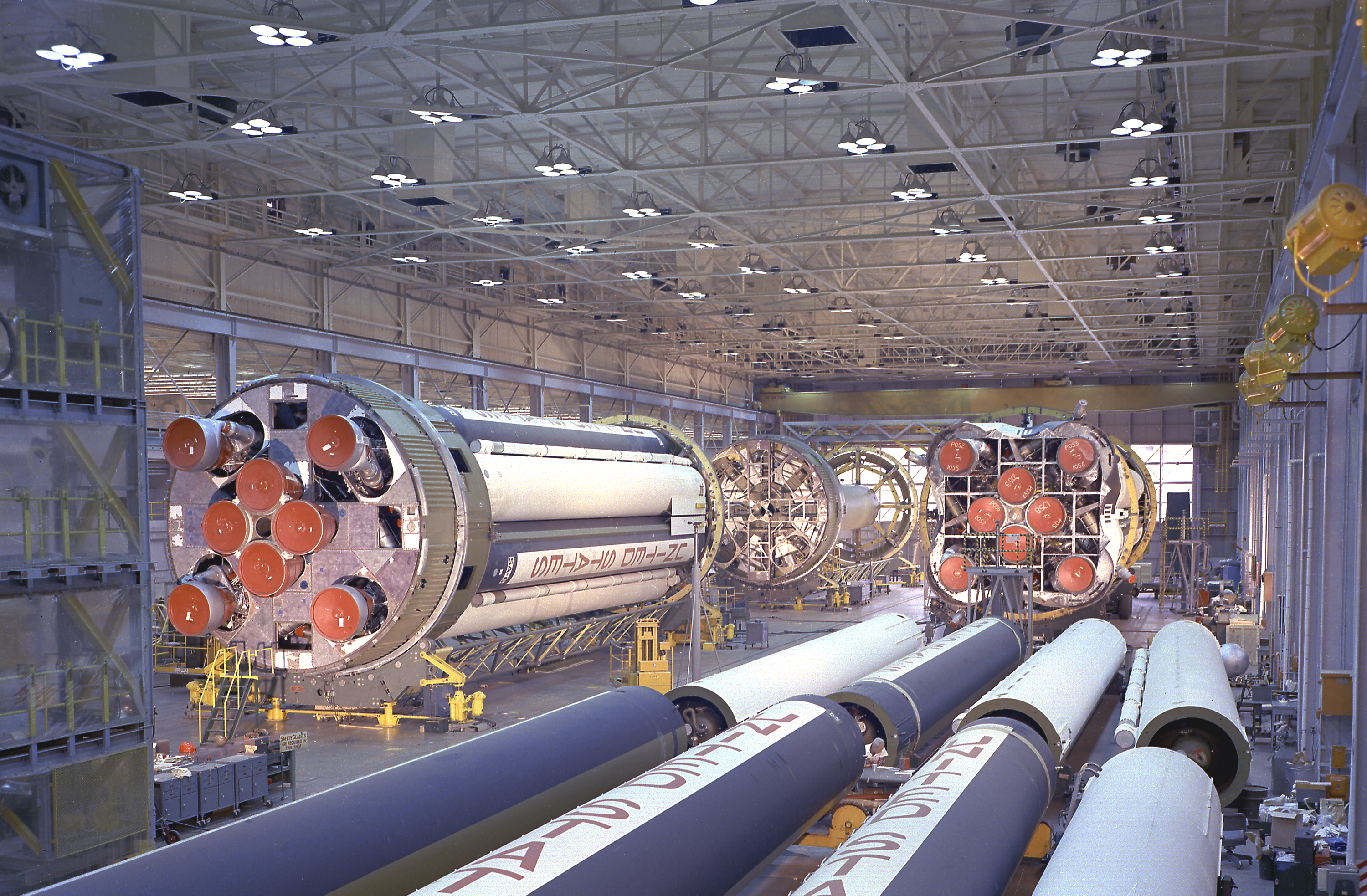
Another Unicorn: A SPECTACULAR view of the main assembly building (bldg 4705) at the Marshall Space Flight Center, Huntsville, Alabama shows three Saturn I boosters in various stages of assembly. At right, background, is the SA-4 booster which is now (24 March 1963) on the launch pedestal at Cape Canaveral. In the center background, the SA-7 booster build-up has begun. The tanks in the foreground are for the SA-7. At left is the SA-6 booster.
See also: