View allAll Photos Tagged reasoning
5/52
I absolutely hate snakes and I decided that maybe I'd get over my fears and actually take photos of one with a friend. So that's exactly what I did.
With the coming of the Meiji Emperor and the closing of the Edo rule by the Tokugawa Shoguns came a change in the calendar from lunar year to solar year. The debate and chain of reasoning of the time will have been interesting to know; probably part of a general make-over to Western styles of clothing, haircuts and footwear, foods, furniture, accounting and contracts, etc thereby perhaps to facilitate trade, and the exchange of people and ideas. The result is a time gap between dates of the old-calendar reckoning and the new-calendar reckoning. New Year begins January 1, but the lunar New Year varies from one year to the next slightly.
Other holidays were about a month different, with the older reckoning coming about a month later than the solar calendar time. So also with Tanabata (7/7 new; 8/7 old) and O-Bon (7/10-17 for the new and 8/13-15 for the old). A Buddhist priest of a sect different to the one in this video clip suggested it was a practical solution to rising population and declining numbers of priests and temples - rather than fit all households nationally into a single calendar, it turned out to be far more practical to divide the priests' house visits: July for the city, August for the countryside.
This video clip comes from the evening of 7/15 at Honkou-ji in central Echizen-city. It was advertised with flags and posters spread around the surrounding neighborhoods, so I felt welcome as outsider to visit a semi-public event. But my impression was that it was mostly a private event for families whose loved one would be recalled together with fellow parishioners during the ceremony. Each deceased loved one seems to be represented by a craft votive object that is inscribed. Then the descendants bring it to the front of the main hall to join the others during sutra chanting by the 3 robed priests. Others assist in hanging the pieces on the frame and when the time comes, a few at a time the helpers convey the pieces to the burn barrel at one side of the ceremony to be consigned to the flames.
Goal: Create logo to brand our church life groups
Direction: No direction
Reasoning behind these designs...
1st "honeycomb" logo is based on a fun fact about bees: bee colonies are typically small, with a dozen or fewer workers, on average...just like a typical life group. :)
2nd: is the first thing that comes to mind when you hear the word "life"...a plant (didn't travel too far out of the creative box)
3rd logo represents the "connection" that's developed among people in life groups.
I just need a little insight...tell me if I'm on the right track, if I should start all over...anything. Thanks!
L-R: Owain Roberts, Tony Turrell, Maria Owen, Rachel Cohen, Matthew Cohen, Jake Bradford-Sharp, Dylan Thompson
Photo by Mike Evans
we wrapped up the cows faster than I thought we would, so i used these optical coloring pages...but when i copied them, i blocked out some info and told the students they had to first draw in the rest of the worksheet and then apply color. it was surprisingly popular!
Salamieh CommunityTelecenter - Syria
Children with learning disabilities exhibit a wide range of symptoms. These include problems with reading, mathematics, comprehension, writing, spoken language, or reasoning abilities. Hyperactivity, inattention and perceptual coordination may also be associated with learning disabilities but are not learning disabilities themselves. The primary characteristic of a learning disability is a significant difference between a child's achievement in some areas and his or her overall intelligence. Learning disabilities typically affect five general areas:
Spoken language: delays, disorders, and deviations in listening and speaking.
Written language: difficulties with reading, writing and spelling.
Arithmetic: difficulty in performing arithmetic operations or in understanding basic concepts.
Reasoning: difficulty in organizing and integrating thoughts.
Memory: difficulty in remembering information and instructions.
Among the symptoms commonly related to learning disabilities are:
poor performance on group tests
difficulty discriminating size, shape, color
difficulty with temporal (time) concepts
distorted concept of body image
reversals in writing and reading
general awkwardness
poor visual-motor coordination
hyperactivity
difficulty copying accurately from a model
slowness in completing work
poor organizational skills
easily confused by instructions
difficulty with abstract reasoning and/or problem solving
disorganized thinking
often obsesses on one topic or idea
poor short-term or long-term memory
impulsive behavior; lack of reflective thought prior to action
low tolerance for frustration
excessive movement during sleep
poor peer relationships
overly excitable during group play
poor social judgment
inappropriate, unselective, and often excessive display of affection
lags in developmental milestones (e.g. motor, language)
behavior often inappropriate for situation
failure to see consequences for his actions
overly gullible; easily led by peers
excessive variation in mood and responsiveness
poor adjustment to environmental changes
overly distractible; difficulty concentrating
difficulty making decisions
lack of hand preference or mixed dominance
difficulty with tasks requiring sequencing
Best Regards
Eng. Nabil Eid
Manager of Salamieh Community Telecenter- Syria
Best Regards
4 fair
got blue at fair
the judges reasoning was that the near flower wasn't completely in focus.
went to the greenhouse that grandma and grandpa work at. It is much easier to find cool flowers in a greenhouse than wild.
Salamieh CommunityTelecenter - Syria
Children with learning disabilities exhibit a wide range of symptoms. These include problems with reading, mathematics, comprehension, writing, spoken language, or reasoning abilities. Hyperactivity, inattention and perceptual coordination may also be associated with learning disabilities but are not learning disabilities themselves. The primary characteristic of a learning disability is a significant difference between a child's achievement in some areas and his or her overall intelligence. Learning disabilities typically affect five general areas:
Spoken language: delays, disorders, and deviations in listening and speaking.
Written language: difficulties with reading, writing and spelling.
Arithmetic: difficulty in performing arithmetic operations or in understanding basic concepts.
Reasoning: difficulty in organizing and integrating thoughts.
Memory: difficulty in remembering information and instructions.
Among the symptoms commonly related to learning disabilities are:
poor performance on group tests
difficulty discriminating size, shape, color
difficulty with temporal (time) concepts
distorted concept of body image
reversals in writing and reading
general awkwardness
poor visual-motor coordination
hyperactivity
difficulty copying accurately from a model
slowness in completing work
poor organizational skills
easily confused by instructions
difficulty with abstract reasoning and/or problem solving
disorganized thinking
often obsesses on one topic or idea
poor short-term or long-term memory
impulsive behavior; lack of reflective thought prior to action
low tolerance for frustration
excessive movement during sleep
poor peer relationships
overly excitable during group play
poor social judgment
inappropriate, unselective, and often excessive display of affection
lags in developmental milestones (e.g. motor, language)
behavior often inappropriate for situation
failure to see consequences for his actions
overly gullible; easily led by peers
excessive variation in mood and responsiveness
poor adjustment to environmental changes
overly distractible; difficulty concentrating
difficulty making decisions
lack of hand preference or mixed dominance
difficulty with tasks requiring sequencing
Best Regards
Eng. Nabil Eid
Manager of Salamieh Community Telecenter- Syria
Best Regards
Silly videos with B dancing in the ruins:
1. On Clapper
3. 22/1/23 Same place..
4. Coming mid February
5. Being drunk in La Rochelle and after
And 1 from the Mont Saint Michel:
1. 23/1/23 Mont Saint Michel.
Mont Saint Michel / Ile de Ré / La Rochelle
France
Brainstorm Session with NCHD Sindh Mar6, 2015 at Karachi University
Brainstorming Session
1. Challenges for universal primary education in Pakistan.
2. Role of NCHD and PHDF to increase the literacy rate.
3. Success and Failure of Plan already implemented.
4. Reasoning for High Drop out of students.
5. Improvement of Infrastructure needed for improving literacy rate.
6. How to incorporate technology for basic education?
7. Capacity building and teachers training programs and etc.
Participants: Mr.Pervaiz Lodhie Member PHDF, Madam Humaira Hashmi Director Operations NCHD Sindh, Mr.Anees Ur Rehman Chairman Fund Raising Committee Rotery Club,Dr. Iqbal Muhammad Choudry Director HEJ Research Institute of Chemistry Karachi University.Mr.Abdul Wajid Shaikh DGM Karachi and Jamshoro, Mr.Daim Janwri DGM Thatta, Mr.Muneer Memon DGM Badin, Mr.Pir Niaz Jan DGM TM Khan, Dr Anwar Rajar DGM Matiari, Mr.Riaz Ahmed Aagro DGM Tando Allahyar, Mr.Sher Muhammad Mangrio ADGM Umer Kot,Mr.Abdul Fatah Moro DGM SBA&N.Feroz,Mr.Ayaz Shaikh DGM Larkana,Mr.Rizawan Memon ADGM Shikarpur, Mr.Javed Mangi ADGM Sukkur,Miss.Qamar u Nisa ADGM Ghotiki,Mr.Ali Madad Bozdar ADGM Jacab abad, Mr.Sajjad Ali Memon PCE, Mr.Hamza Lashari PCL,Miss.Zeesha Khuwaja Provincial Manager.
Madam Humaira Hashmi ( Director Operations NCHD Sindh ) provided detailed presentation about NCHD Programs i.e. UPE, Literacy, BBSYDP Projects and also about MALALA and OWN School initiatives. It also includes the detailed briefing of NCHD’s national and provincial achievements. The achievements and efforts were widely appreciated by the Participants.
Dr. Iqbal Muhammad Choudry Director HEJ Research Institute of Chemistry Karachi University highlighted the importance of education and appreciated the role of NCHD in bridging the gap between strategy formulation and strategy execution to enhance Literacy rate and Universal Primary Education (UPE) with a view to fulfilling Millennium Development Goals (MDGs). He further ensured his volunteer support in teachers’ training and development for the provision of intellectual volunteers for the training of teachers all across the board. He further said that socio-economic development of Brazil, South Korea and Malaysia is largely attributed to effective education systems. In addition to that he urged government to increase budget allocation for the education sector.
Anees Ur Rehman Chairman Fund Raising Committee Rotery Club explained the role of private sector for enhancement of education. He said that Rotery club is already working for improvements in education. He affirmed his support to NCHD and also ensured that they would also undertake filed visits in collaboration with NCHD aiming at enhancement of School initiatives.
Pervaiz Lodhie Member PHDF provided detailed information regarding background of PHDF its working style and the current role. He also explained the collaboration of PHDF with NCHD & Govt of Pakistan. He also conducted interactive session with the participants about the models of UPE and Literacy. He also discussed about the use of technology to improve the education and teacher’s training.
All DGMs shared the achievements of their respective districts in the UPE and Literacy and also provided feedback to further improve the execution of strategies at the district level.
Prevez Lodhi sb appreciated the work, efforts and achievement of NCHD and focused on proper showcasing of NCHD work to share with the national and international donor community to attract them to support education through NCHD. He suggested all DGMs of NCHD to share success story reports & documentaries of schools/ literacy centers on social groups.
He further shared that his meeting with Baligh ur Rehman (Minister for Professional Education and Technical Training) has been fixed in which he will discuss about NCHD.
www.youtube.com/watch?v=ls-LYas5j8U
Elorah Adrastus, My Vampire for the sim The Fallen :>
She lived a seemingly normal life in a well to do family during the 1500s. She was young, the simple age of 26 when she found herself struck with the fate of neverending time. She met a man who alluded her into thinking that their time together was years, when really it was hours. Feverishly Elorah fell in love with this man, and before she knew it her Sire turned her on a whim. His reasoning was that her beauty was far to pleasing and desired to keep her for all time, however that is one thing the Malkavian had a lot of; time, so eventually he let her go, releasing the Sire to childe bond. This painful memory brought Elorah to a frenzy, ruthless and uncaring for any who had a heart beat, bloodlust ravaged her mind but as time went on she found herself under control. She is eccentric in every way just as a Malkavian should be, but now she finds herself wanting to just live her life of forever to lay low the best she can. She is incredibly charming and persuasive. For nearly five decades she has found out that her looks can get her anything she could desire. She is quick, sickeningly so as well as strong with super-human like strength.
Elorah Hates the color blue, if she sees the color it turns her bitter and often if she sees it she goes into a fit of rage, so more often than not she runs away in fear. This is because her owner had most pure and bluest of eyes. The color triggers the memory of the years wasted with him since he left her to roam the world alone and to find out his lie to her for changing her over to the living dead.
A huge weakness to her is that she is plagued constantly with the memory of her maker leaving her, this leads to an inferiority complex at times, which can lead to the whole sadist masochist thing. She likes people to suffer since she herself suffers bitterly with the angst of her maker leaving her, and sometimes she herself enjoys suffering to make that pain go away. She has come to know though that she is a lunatic, eccentric and absurd in her mind and she is perfectly content with that fact, which only fuels her desire to live long and prosper.
Rapid strata formation in soft sand (field evidence).
Photo of strata formation in soft sand on a beach, created by tidal action of the sea.
Formed in a single, high tidal event. Stunning evidence which displays multiple strata/layers.
Why this is so important ....
It has long been assumed, ever since the 17th century, that layers/strata observed in sedimentary rocks were built up gradually, layer upon layer, over many years. It certainly seemed logical at the time, from just looking at rocks, that lower layers would always be older than the layers above them, i.e. that lower layers were always laid down first followed, in time, by successive layers on top.
This was assumed to be true and became known as the superposition principle.
It was also assumed that a layer comprising a different material from a previous layer, represented a change in environmental conditions/factors.
These changes in composition of layers or strata were considered to represent different, geological eras on a global scale, spanning millions of years. This formed the basis for the Geologic Column, which is used to date rocks and also fossils. The evolutionary, 'fossil record' was based on the vast ages and assumed geological eras of the Geologic Column.
There was also circular reasoning applied with the assumed age of 'index' fossils (based on evolutionary beliefs & preconceptions) used to date strata in the Geologic Column. Dating strata from the assumed age of (index) fossils is known as Biostratigraphy.
We now know that, although these assumptions seemed logical, they are not supported by the evidence.
At the time, the mechanics of stratification were not properly known or studied.
An additional factor was that this assumed superposition and uniformitarian model became essential, with the wide acceptance of Darwinism, for the long ages required for progressive microbes-to-human evolution. There was no incentive to question or challenge the superposition, uniformitarian model, because the presumed, fossil 'record' had become dependant on it, and any change in the accepted model would present devastating implications for Darwinism.
This had the unfortunate effect of linking the study of geology so closely to Darwinism, that any study independent of Darwinian considerations was effectively stymied. This link of geology with Darwinian preconceptions is known as biostratigraphy.
Some other field evidence, in various situations, can be observed here: www.flickr.com/photos/101536517@N06/sets/72157635944904973/
and also in the links to stunning, experimental evidence, carried out by sedimentologists, given later.
_______________________________________________
GEOLOGIC PRINCIPLES (established by Nicholas Steno in the 17th Century):
What Nicolas Steno believed about strata formation is the basis of the principle of Superposition and the principle of Original Horizontality.
dictionary.sensagent.com/Law_of_superposition/en-en/
“Assuming that all rocks and minerals had once been fluid, Nicolas Steno reasoned that rock strata were formed when particles in a fluid such as water fell to the bottom. This process would leave horizontal layers. Thus Steno's principle of original horizontality states that rock layers form in the horizontal position, and any deviations from this horizontal position are due to the rocks being disturbed later.”)
BEDDING PLANES.
'Bedding plane' describes the surface in between each stratum which are formed during sediment deposition.
science.jrank.org/pages/6533/Strata.html
“Strata form during sediment deposition, that is, the laying down of sediment. Meanwhile, if a change in current speed or sediment grain size occurs or perhaps the sediment supply is cut off, a bedding plane forms. Bedding planes are surfaces that separate one stratum from another. Bedding planes can also form when the upper part of a sediment layer is eroded away before the next episode of deposition. Strata separated by a bedding plane may have different grain sizes, grain compositions, or colours. Sometimes these other traits are better indicators of stratification as bedding planes may be very subtle.”
______________________________________________
Several catastrophic events, flash floods, volcanic eruptions etc. have forced Darwinian, influenced geologists to admit to rapid stratification in some instances. However they claim it is a rare phenomenon, which they have known about for many years, and which does nothing to invalidate the Geologic Column, the fossil record, evolutionary timescale, or any of the old assumptions regarding strata formation, sedimentation and the superposition principle. They fail to face up to the fact that rapid stratification is not an extraordinary phenonemon, but rather the prevailing and normal mechanism of sedimentary deposition whenever and wherever there is moving, sediment-laden water. The experimental evidence demonstrates the mechanism and a mass of field evidence in normal (non-catastrophic) conditions shows it is a normal everyday occurrence.
It is clear from the experimental evidence that the usual process of stratification is - that strata are not formed by horizontal layers being laid on top of each other in succession, as was assumed. But by sediment being sorted in the flowing water and laid down diagonally in the direction of flow. See diagram:
www.flickr.com/photos/truth-in-science/39821536092/in/dat...
The field evidence (in the image) presented here - of rapid, simultaneous stratification refutes the Superposition Principle and the Principle of Lateral Continuity.
We now know, the Superposition Principle only applies on a rare occasion where sedimentary deposits are laid down in still water.
Superposition is required for the long evolutionary timescale, but the evidence shows it is not the general rule, as was once believed. Most sediment is laid down in moving water, where particle segregation is the general rule, resulting in the simultaneous deposition of strata/layers as shown in the photo.
See many other examples of rapid stratification (with geological features): www.flickr.com/photos/101536517@N06/sets/72157635944904973/
Rapid, simultaneous formation of layers/strata, through particle segregation in moving water, is so easily created it has even been described by sedimentologists (working on flume experiments) as a law ...
"Upon filling the tank with water and pouring in sediments, we immediately saw what was to become the rule: The sediments sorted themselves out in very clear layers. This became so common that by the end of two weeks, we jokingly referred to Andrew's law as "It's difficult not to make layers," and Clark's law as "It's easy to make layers." Later on, I proposed the "law" that liquefaction destroys layers, as much to my surprise as that was." Ian Juby, www.ianjuby.org/sedimentation/
The example in the photo is the result of normal, everyday tidal action formed in a single incident, and subsequently eroded by water flow revealing the strata/layers.
Where the water current or movement is more turbulent, violent, or catastrophic, great depths (many metres) of stratified sediment can be laid down in a short time. Certainly not the many millions of years assumed by evolutionists.
The composition of strata formed in any deposition event. is related to whatever materials are in the sediment mix, not to any particular timescale. Whatever is in the mix will be automatically sorted into strata/layers. It could be sand, or other material added from mud slides, erosion of chalk deposits, coastal erosion, volcanic ash etc. Any organic material (potential fossils), alive or dead, engulfed by, or swept into, a turbulent sediment mix, will also be sorted and buried within the rapidly, forming layers.
See many other examples of rapid stratification with geological features: www.flickr.com/photos/101536517@N06/sets/72157635944904973/
Stratified, soft sand deposit. demonstrates the rapid, stratification principle.
Important, field evidence which supports the work of the eminent, sedimentologist Dr Guy Berthault MIAS - Member of the International Association of Sedimentologists.
(Dr Berthault's experiments (www.sedimentology.fr/)
And also the experimental work of Dr M.E. Clark (Professor Emeritus, U of Illinois @ Urbana), Andrew Rodenbeck and Dr. Henry Voss, (www.ianjuby.org/sedimentation/)
Location: Yaverland, Isle of Wight. Formed 11/10/2018 This field evidence demonstrates that multiple strata in sedimentary deposits do not need millions of years to form and can be formed rapidly. This natural example confirms the principle demonstrated by the sedimentation experiments carried out by Dr Guy Berthault and other sedimentologists. It calls into question the standard, multi-million year dating of sedimentary rocks, and the dating of fossils by depth of burial or position in the strata.
Mulltiple strata/layers are evident in this example.
Dr Berthault's experiments (www.sedimentology.fr/) and other experiments (www.ianjuby.org/sedimentation/) and field studies of floods and volcanic action show that, rather than being formed by gradual, slow deposition of sucessive layers superimposed upon previous layers, with the strata or layers representing a particular timescale, particle segregation in moving water or airborne particles can form strata or layers very quickly, frequently, in a single event.
And, most importantly, lower strata are not older than upper strata, they are the same age, having been created in the same sedimentary episode.
Such field studies confirm experiments which have shown that there is no longer any reason to conclude that strata/layers in sedimentary rocks relate to different geological eras and/or a multi-million year timescale. www.youtube.com/watch?v=5PVnBaqqQw8&feature=share&.... they also show that the relative position of fossils in rocks is not indicative of an order of evolutionary succession. Obviously, the uniformitarian principle, on which the geologic column is based, can no longer be considered valid. And the multi-million, year dating of sedimentary rocks and fossils needs to be reassessed. Rapid deposition of stratified sediments also explains the enigma of polystrate fossils, i.e. large fossils that intersect several strata. In some cases, tree trunk fossils are found which intersect the strata of sedimentary rock up to forty feet in depth. upload.wikimedia.org/wikipedia/commons/thumb/0/08/Lycopsi... They must have been buried in stratified sediment in a short time (certainly not millions, thousands, or even hundreds of years), or they would have rotted away. youtu.be/vnzHU9VsliQ
In fact, the vast majority of fossils are found in good, intact condition, which is testament to their rapid burial. You don't get good fossils from gradual burial, because they would be damaged or destroyed by decay, predation or erosion. The existence of so many fossils in sedimentary rock on a global scale is stunning evidence for the rapid depostion of sedimentary rock as the general rule. It is obvious that all rock containing good intact fossils was formed from sediment laid down in a very short time, not millions, or even thousands of years.
See set of photos of other examples of rapid stratification: www.flickr.com/photos/101536517@N06/sets/72157635944904973/
Carbon dating of coal should not be possible if it is millions of years old, yet significant amounts of Carbon 14 have been detected in coal and other fossil material, which indicates that it is less than 50,000 years old. www.ldolphin.org/sewell/c14dating.html
www.grisda.org/origins/51006.htm
Evolutionists confidently cite multi-million year ages for rocks and fossils, but what most people don't realise is that no one actually knows the age of sedimentary rocks or the fossils found within them. So how are evolutionists so sure of the ages they so confidently quote? The astonishing thing is they aren't. Sedimentary rocks cannot be dated by radiometric methods*, and fossils can only be dated to less than 50,000 years with Carbon 14 dating. The method evolutionists use is based entirely on assumptions. Unbelievably, fossils are dated by the assumed age of rocks, and rocks are dated by the assumed age of fossils, that's right ... it is known as circular reasoning.
* Regarding the radiometric dating of igneous rocks, which is claimed to be relevant to the dating of sedimentary rocks, in an occasional instance there is an igneous intrusion associated with a sedimentary deposit -
Prof. Aubouin says in his Précis de Géologie: "Each radioactive element disintegrates in a characteristic and constant manner, which depends neither on the physical state (no variation with pressure or temperature or any other external constraint) nor on the chemical state (identical for an oxide or a phosphate)."
"Rocks form when magma crystallizes. Crystallisation depends on pressure and temperature, from which radioactivity is independent. So, there is no relationship between radioactivity and crystallisation.
Consequently, radioactivity doesn't date the formation of rocks. Moreover, daughter elements contained in rocks result mainly from radioactivity in magma where gravity separates the heavier parent element, from the lighter daughter element. Thus radiometric dating has no chronological signification." Dr. Guy Berthault www.sciencevsevolution.org/Berthault.htm
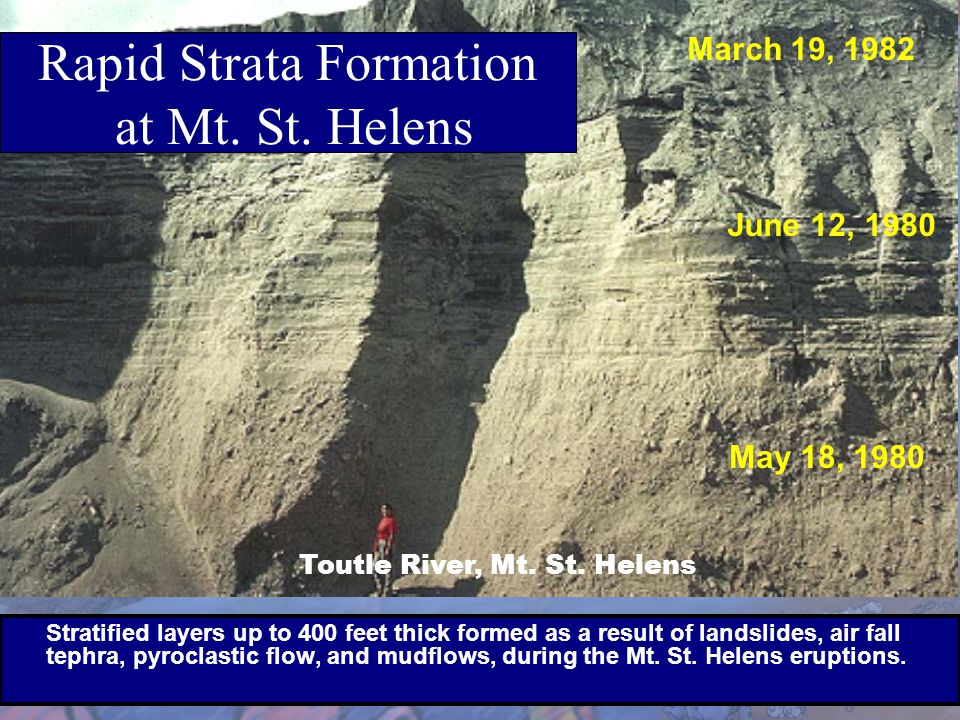
Rapid strata formation and rapid erosion at Mount St Helens.
slideplayer.com/slide/5703217/18/images/28/Rapid+Strata+F...
Visit the fossil museum:
www.flickr.com/photos/101536517@N06/sets/72157641367196613/
Just how good are peer reviews of scientific papers?
www.sciencemag.org/content/342/6154/60.full
www.examiner.com/article/want-to-publish-science-paper-ju...
The neo-Darwinian idea that the human genome consists entirely of an accumulation of billions of mutations is, quite obviously, completely bonkers. Nevertheless, it is compulsorily taught in schools and universities as 'science'.
I don't attempt to explain the reasoning behind being asked to make this other than sheer frugality...
"Just chop up the leftover chicken fingers with butter and Miracle Whip and make the sandwiches with that".
Me: 0_o
Culinary gods, forgive me.
Daddy puts pacifier on top of his dresser, thinking it's out of reach, but Hanalei is already thinking spatially. She pulled out the bottom drawer of the dresser so she could climb up and reach her goal. Yes, dangerous, but also thrilling. She's growing up!
--
This believed to be baby Black tip shark was caught off the shores of Holden Beach, North Carolina. The reasoning behind its classification is due to the dark markings starting to form on the tip of its dorsal and lower fins. Black tip sharks grow up to become predators who prey on menhaden and mullet which causes their habitat to change from the off shore ocean waters to the more shallow waters in shore and even in sounds during the summer season. Black tip sharks are geographically distributed all over the world near shores of all the continents except for Antarctica due to the extreme cold waters. Black tip sharks are more abundantly found in warmer waters such as the Gulf of Mexico and other bodies of water close to the equator. Due to the shallow waters Black tip sharks choose to hunt in, they commonly are being caught by fisherman and crossing paths with humans. This individual baby Black tip shark has an important role in the ocean ecosystem as the predator in order keep fish populations from becoming overpopulated.
Sources: ncseagrant.ncsu.edu/coastwatch/previous-issues/2014-2/spr...
www.floridamuseum.ufl.edu/fish/discover/species-profiles/...
On any list of 'smartest dog breeds,' border collies always come out on top. But smart doesn't always mean easily trained, or willing to please. Smart can just mean what it always means, and that is having a capacity for learning, reasoning, understanding, and similar forms of mental activity; aptitude in grasping truths, relationships, facts, meanings, etc. (from dictionary.com)
Einstein was smart. So was Leonardo Da Vinci, Marie Curie, Plato and Sofia Kovalevskaya to name a few. Now we're talking brain cells on level I can't even comprehend. On my best day, plenty of sleep and hydration, I don't think I could grasp meanings better than any of those people, even today, when they're all dead.
So when people say stuff like, "Oh, my dog is really smart! He's the smartest dog ever," they MUST be talking in terms of dog smart, and not people smart. Because come on, they're dogs.
Well, except of course, MY dog, Pete. He is really smart! He's the smartest dog ever. Which is really annoying because it's been my move for a long time now and I only have my king left.
Save on Using and Understanding Mathematics A Quantitative Reasoning Approach (5th Edition) Saving, Order Now! Want it delivered within 1 day? Choose One-Day Shipping at checkout.Using and Understanding Mathematics A Quantitative Reasoning Approach (5th Edition) See More Detail at this Link: Read Full Detail | Compare
Using and Understanding Mathematics A Quantitative Reasoning Approach (5th Edition)
The Charles Town history info (see below, calls this Victorian Gothic... I would argue that it is more an example of Second Empire Victorian. My reasoning, the central tower with a steep though short mansard roof, it's asymetrical with almost a townhouse feel, has a small iron trim on the tower top, and the ornamentation on the towers top and windows make the structure appear grand and imposing. Plus, it's completion date of 1876 is right smack in the time period (1865 to 1880) when Second Empire was popular. All that, coupled with windows that have no arches, and border on federal, I think take this house out of classification as Gothic or Gothic Revival.
This Victorian Gothic house, designed and built by J.C. Holmes, was completed in 1876. It was the home of William L. Wilson (1833-1900). While serving as president of West Virginia University from 1882-83, Wilson accepted a nomination for U.S. Congress from the second district of WV. He won election by 10 votes. Appointed U.S. Postmaster General in 1894, he introducted rural-free delivery of mail in Jefferson County, first in the country.
Do not vainly argue through the reasoning power of the intellect, which ignores the Self and clings to the non-Self, that ‘reality exists’; ‘it doesn’t exist’; ‘it is form’; ‘it is formless’; ‘it is dual’; ‘it is non-dual’. Only the mauna that shines forever as the unfailing experience of being-consciousness-bliss is true religion.
I really miss my EF 70-200mm f/4L IS, but not enough to buy another one.
I’ve said before that if I ever got a full-frame camera I would opt for a 70-200mm f/2.8 instead of a f/4. My reasoning is I would use a 70-200 on full-frame differently than a 70-200 on APS-C. On full-frame, 70-200mm is more or less the portrait range, and as such is designed for portraits and event photography – applications where you typically want to blur the background with a large-aperture lens. On APS-C, 70-200 is a compromise: a bit too long for event photography and too short for wildlife, but passable for both given a budget. Thus, I got an f/4 on APS-C, but now that I have a full-frame camera and no more f/4, I’m planning to replace it with an f/2.8.
I’ve been holding off for weeks, though, because of rumors of an update to the EF 70-200mm f/2.8L IS (and an unfounded hope the original 70-200 f/2.8 IS would drop in price). Indeed, last week Canon announced the EF 70-200mm f/2.8L IS II.
Improvements over the original EF 70-200mm f/2.8L IS are not earth-shaking but are comprehensive:
• sharper at all focal lengths and apertures
• more effective image stabilization (4-stop vs. 3-stop)
• shorter minimum focus distance (1.2m vs. 1.4m)
• faster AF
• stronger build
• recessed buttons
There’s no reason to doubt Canon’s claims of a one-stop improvement in image stabilization effectiveness – the EF 70-200mm f/4L IS has had this for years. The same is true for the MFD.
If the MTF charts are right (generally they are a good guide, but Canon USA has mislabeled MTF charts in the past), the new lens should be about as sharp as the 70-200mm f/4L IS wide open (but presumably sharper stopped down to f/4), sharper than the 70-200mm f/2.8L, and sharper (except in the corners) than even the 200mm f/2L IS wide open (which is again presumably sharper stopped down to f/2.8).
These improvements come at the cost of, well, cost. The official price has not yet been announced, but my money (literally) is on the range $2250-2400, making it about $550-700 more than the currently rebate-reduced price of the original 70-200mm f/2.8L IS.
Will it be worth $2400? Lots of Nikon shooters think their new 70-200mm f/2.8 VR II is worth $2400. This is definitely not priced for amateurs, though – I could get either a 5D Mk II or a TS-E 17mm f/4L for only a hundred more.
As an amateur for whom event photography is not a primary pursuit, I could not justify purchasing this lens on its own. The only way I can justify it is if, like my 70-200mm f/4 on my 450D, it can serve for all my telephoto needs. That means adding a 2x teleconverter to turn it into a 140-400mm f/5.6 IS as well. There are lots of pros and cons to choosing that over an EF 100-400mm f/4.5-5.6L IS, so I’ll tackle that chain of reasoning later.
My reasoning for this was the fact that my friend Erin is such a hard worker and she is constantly piled high with homework every night which she has sprawled across her bed. She's got the two of four cats on her bed with her as well. I thought it'd be cool to step in her place for a moment and I had her tell me what her school day is like and homework and I even took a look at the homework she had. I am not a very studious person but manage to get by, but she goes above and beyond and I admire that about her.
Today was thoroughly miserable with most of the day spent in bed.
Reasoning that it might be wise to try and move about at least a little, I rallied enough to go and pick Laura up from work.
I must admit that I started to regret it on the way home and swiftly retired to bed again. It did mean that I got this shot though. I've seen the new(ish) helipad outside the new A&E many times, but I've never yet seen it in use. Until today.
The North West Air Ambulance (rather nattily registered as G-NWAA) was making a deposit. I know that it only does daytime operations so it must have been right on the edge of it's operational envelope as we were fairly well into dusk.
Still, good job well done and let's hope the casuality made it.
After setting up camp at Indian Gardens, my brother and I decided to take a quick hike out to Plateau Point, as opposed to waiting out the afternoon heat and doing the ~3 mile roundtrip hike later in the evening. Our reasoning was that if we let the effects of the morning hike soak in deep enough, come evening, we would probably be more inclined to skip it altogether. This shot was taken at the end of the Plateau Point Trail, which, of course, leads to the Plateau Point overlook.
Interestingly, as we headed out for Plateau Point, Tony Robbins (of self-help fame) came walking right past me as I sat in the shade waiting for my brother to finish using the privy. Tony was talking excitedly to a companion about "the new strategy I'm going to roll out this year, blah, blah, blah..." I remember wondering if the guy ever turns it off. Even in the Grand Canyon, the salesmanship seemed to be at full volume. Ugh.
Then, not twenty yards behind him, another group of fellows comes down the path. One of them I think I recognize, but I can't seem to convince myself. It looked like Pierce Brosnan. He walks right past me as I was sitting on a bench and he began to fill up his canteen. Now, I'd like to think that I'm above getting all star-struck. But man, how cool would it be to chat with Pierce in the Grand Canyon? However, I figure in this place, everyone deserves a bit peace. So I tried to rope him into a conversation by speaking to an older couple sitting about ten feet away, adjacent to where Pierce was filling up. We exchanged greetings and started to chat about the Canyon. I kept my voice loud enough to be sure Pierce could hear, but he never took the bait. The most I could get out of him was a chuckle when the couple asked me how I was feeling after my second day of hiking in the Canyon, and I responded with a witty "Well, my feet sure do hurt."
Hopefully, the laugh was out of empathy, but then again, it looked like both Robbins and Brosnan were riding burrows down to Phantom Ranch. I'm sure their feet were feeling just fine.
In the end, I heard him speak to one of his companions as he walked past me again, and hearing the accent left no doubt as to his identity. I thought of taking his picture (oddly enough, I know) as my brother and I finally departed for the quick hike, but in the end I decided against it. Everyone should find a bit of peace in the Canyon.
2005-06-02_10.34.59_a95_GrandCanyonNP-PlateauPointTrail
Shown here are the title pages from two books now thought to have been printed secretly at Birchley Hall in the early 17th century.
Left: “WHYTE DYED BLACK. OR A Discovery of many most foule blemishes, impostures, and deceiptes, which D Whyte haith practysed in his book entituled 'The way to the true Church'. Devyded into 3 sortes: Corruptions, or depravations; Lyes; Impertinences, or absurd reasonings. Written by TWP. And Dedicated to the Vniuersity of Cambridge.... Cum privilegio 1615.” Consisting of 184 pages, “Whyte Dyed Black [etc]” is, chronologically, the first book to be ascribed by consensus to the secret printing-press at Birchley Hall. The author, Thomas Worthington, was born at Blainscough Hall near Wigan about 1549. His mother was Isabel Anderton of Euxton Hall, making him a distant relative of the Birchley Andertons. He was ordained at Cambrai in 1577 and became president of the English College, Douai, in 1599. Returning to England in 1615, he was made archdeacon of Nottinghamshire and Derbyshire in 1625 but died the following year. As indicated by the long title, the book was Fr Worthington's answer to Dr John White's “Way to the True Church” (1614). Following the appearance of “Whyte Dyed Black” Dr White's brother, Francis (1564-1638; bishop of Ely from 1631), retaliated with “The orthodox faith and the way to the church ... in answer to a popish treatise” (1617).
Right: “THE LYTVRGIE of THE MASSE: wherein are treated Three Principal Pointes of Faith. 1. That in the Sacrament of the Eucharist are truly and really contained the body and bloud of Christ. 2. That the Masse is a true and proper sacrifice of the body and bloud of Christ, offered to God by Priestes. 3. That Communion of the Eucharist to the Laity under one kind is lawful. The ceremonies also of the Masse now used in the Catholicke Church, are al of them derived from the Primitive Church. BY JOHN BRERELEY. PREIST..... Printed at Colen. 1620.” Including the index and “errata”, “The Lyturgie of The Masse [etc]” runs to 470 pages. A J Hawkes comments that “notwithstanding the book is said to be printed in Cologne, and that on p.468 'the printer's ignorance of our language' is offered as an excuse for the many mistakes, this is almost certainly a Birchley book; it is typographically identical with [“Whyte Dyed Black”]...” (“The Birchley Hall Secret Press”, in Transactions of the Bibliographical Society, Vol VII/Series 4, 1926). For many years there was disagreement over the true identity of the author of “The Lyturgie ...”. Mr Hawkes, in company with the Catholic historian Joseph Gillow, took the view that “John Brereley” was a pseudonym of Fr Laurence Anderton SJ (1575-1643), a cousin of the Birchley Andertons. A F Allison has since demonstrated, convincingly, that the writer was in fact James Anderton of Lostock, born in 1557 and brother of the subsequent occupiers of Birchley Hall - Thurston, Christopher and Roger.*
Images are (left) from an original copy at Ushaw College and (right) from a digitised copy of an original in the British Museum.
* “Who was John Brereley? The Identity of a Seventeenth-Century Controversialist” in “Recusant History” 16, 1982-3: “It has been found possible to reconcile all the ascertainable facts of his life with the authorship of these works and to overcome the objection that four of them appeared after his death... [On the other hand,] an investigation of the Jesuit's career and writings has demonstrated that he could not have been the author”. Mr Hawkes' objection that James had died in 1613 is countered with an assertion that the manuscript, though completed in late 1612 or early 1613, was only received at Birchley for printing after Christopher Anderton's death in 1619. The theology of the book is considered in Malcolm Hardman's “A Kingdom in Two Parishes: Lancashire Religious Writers and the English Monarchy, 1521-1689” (Fairleigh Dickinson UP, 1998).
Possibly Fringed Yellow Stargrass (Hypoxis juncea) - Hal Scott Regional Preserve, Orlando, East Orange County, Florida
The other possibility is Common Yellow Stargrass (Hypoxis curtissii).
If you have any thoughts on ID please comment with an explanation of your reasoning.
Thanks
Next time I'll take a closer look at the leaves.
The silhouette and build of this shoe reminds me of a trail shoe/boot. Hence my reasoning behind this image. This was a rock that was off into the tree area from the previous images of North Hudson Park. It took me a few tries because i only had ten seconds to get to the top and get the stance right. I was here for about 30 minutes. lol I think it paid off though...
On another note, I just created this group on Flickr. "Keep the Shoes on Your Feet" join it and start adding your shoe pictures.
I've been chastized for getting this picture on my calf. The reasoning being it should be as high on the body as possible. I respond, I inked his image for life on my body. That is disrespect?
A fairly simple solution
Reasoning apologies and constant comparison of the worst is a fairly simple solution. It makes conscious sleep away from the sleep of the law. The logic of the world is another, constantly counting on his interests, his personal interest, his profit, his comfort and his service alone. There are other elements in a saint's life: self-sacrifice, charity, altruism, tolerance, forgiveness, patience and hope.
Elder Moses Mount Athos
106/365 ― bowl
“Let us work without reasoning,' said Martin; 'it is the only way to make life endurable.” ―Voltaire, Candide
Salamieh CommunityTelecenter - Syria
Children with learning disabilities exhibit a wide range of symptoms. These include problems with reading, mathematics, comprehension, writing, spoken language, or reasoning abilities. Hyperactivity, inattention and perceptual coordination may also be associated with learning disabilities but are not learning disabilities themselves. The primary characteristic of a learning disability is a significant difference between a child's achievement in some areas and his or her overall intelligence. Learning disabilities typically affect five general areas:
Spoken language: delays, disorders, and deviations in listening and speaking.
Written language: difficulties with reading, writing and spelling.
Arithmetic: difficulty in performing arithmetic operations or in understanding basic concepts.
Reasoning: difficulty in organizing and integrating thoughts.
Memory: difficulty in remembering information and instructions.
Among the symptoms commonly related to learning disabilities are:
poor performance on group tests
difficulty discriminating size, shape, color
difficulty with temporal (time) concepts
distorted concept of body image
reversals in writing and reading
general awkwardness
poor visual-motor coordination
hyperactivity
difficulty copying accurately from a model
slowness in completing work
poor organizational skills
easily confused by instructions
difficulty with abstract reasoning and/or problem solving
disorganized thinking
often obsesses on one topic or idea
poor short-term or long-term memory
impulsive behavior; lack of reflective thought prior to action
low tolerance for frustration
excessive movement during sleep
poor peer relationships
overly excitable during group play
poor social judgment
inappropriate, unselective, and often excessive display of affection
lags in developmental milestones (e.g. motor, language)
behavior often inappropriate for situation
failure to see consequences for his actions
overly gullible; easily led by peers
excessive variation in mood and responsiveness
poor adjustment to environmental changes
overly distractible; difficulty concentrating
difficulty making decisions
lack of hand preference or mixed dominance
difficulty with tasks requiring sequencing
Best Regards
Eng. Nabil Eid
Manager of Salamieh Community Telecenter- Syria
Best Regards
Rapid strata formation in soft sand (field evidence).
Photo of strata formation in soft sand on a beach, created by tidal action of the sea.
Formed in a single, high tidal event. Stunning evidence which displays multiple strata/layers.
Why this is so important ....
It has long been assumed, ever since the 17th century, that layers/strata observed in sedimentary rocks were built up gradually, layer upon layer, over many years. It certainly seemed logical at the time, from just looking at rocks, that lower layers would always be older than the layers above them, i.e. that lower layers were always laid down first followed, in time, by successive layers on top.
This was assumed to be true and became known as the superposition principle.
It was also assumed that a layer comprising a different material from a previous layer, represented a change in environmental conditions/factors.
These changes in composition of layers or strata were considered to represent different, geological eras on a global scale, spanning millions of years. This formed the basis for the Geologic Column, which is used to date rocks and also fossils. The evolutionary, 'fossil record' was based on the vast ages and assumed geological eras of the Geologic Column.
There was also circular reasoning applied with the assumed age of 'index' fossils (based on evolutionary beliefs & preconceptions) used to date strata in the Geologic Column. Dating strata from the assumed age of (index) fossils is known as Biostratigraphy.
We now know that, although these assumptions seemed logical, they are not supported by the evidence.
At the time, the mechanics of stratification were not properly known or studied.
An additional factor was that this assumed superposition and uniformitarian model became essential, with the wide acceptance of Darwinism, for the long ages required for progressive microbes-to-human evolution. There was no incentive to question or challenge the superposition, uniformitarian model, because the presumed, fossil 'record' had become dependant on it, and any change in the accepted model would present devastating implications for Darwinism.
This had the unfortunate effect of linking the study of geology so closely to Darwinism, that any study independent of Darwinian considerations was effectively stymied. This link of geology with Darwinian preconceptions is known as biostratigraphy.
Some other field evidence, in various situations, can be observed here: www.flickr.com/photos/101536517@N06/sets/72157635944904973/
and also in the links to stunning, experimental evidence, carried out by sedimentologists, given later.
_______________________________________________
GEOLOGIC PRINCIPLES (established by Nicholas Steno in the 17th Century):
What Nicolas Steno believed about strata formation is the basis of the principle of Superposition and the principle of Original Horizontality.
dictionary.sensagent.com/Law_of_superposition/en-en/
“Assuming that all rocks and minerals had once been fluid, Nicolas Steno reasoned that rock strata were formed when particles in a fluid such as water fell to the bottom. This process would leave horizontal layers. Thus Steno's principle of original horizontality states that rock layers form in the horizontal position, and any deviations from this horizontal position are due to the rocks being disturbed later.”)
BEDDING PLANES.
'Bedding plane' describes the surface in between each stratum which are formed during sediment deposition.
science.jrank.org/pages/6533/Strata.html
“Strata form during sediment deposition, that is, the laying down of sediment. Meanwhile, if a change in current speed or sediment grain size occurs or perhaps the sediment supply is cut off, a bedding plane forms. Bedding planes are surfaces that separate one stratum from another. Bedding planes can also form when the upper part of a sediment layer is eroded away before the next episode of deposition. Strata separated by a bedding plane may have different grain sizes, grain compositions, or colours. Sometimes these other traits are better indicators of stratification as bedding planes may be very subtle.”
______________________________________________
Several catastrophic events, flash floods, volcanic eruptions etc. have forced Darwinian, influenced geologists to admit to rapid stratification in some instances. However they claim it is a rare phenomenon, which they have known about for many years, and which does nothing to invalidate the Geologic Column, the fossil record, evolutionary timescale, or any of the old assumptions regarding strata formation, sedimentation and the superposition principle. They fail to face up to the fact that rapid stratification is not an extraordinary phenonemon, but rather the prevailing and normal mechanism of sedimentary deposition whenever and wherever there is moving, sediment-laden water. The experimental evidence demonstrates the mechanism and a mass of field evidence in normal (non-catastrophic) conditions shows it is a normal everyday occurrence.
It is clear from the experimental evidence that the usual process of stratification is - that strata are not formed by horizontal layers being laid on top of each other in succession, as was assumed. But by sediment being sorted in the flowing water and laid down diagonally in the direction of flow. See diagram:
www.flickr.com/photos/truth-in-science/39821536092/in/dat...
The field evidence (in the image) presented here - of rapid, simultaneous stratification refutes the Superposition Principle and the Principle of Lateral Continuity.
We now know, the Superposition Principle only applies on a rare occasion where sedimentary deposits are laid down in still water.
Superposition is required for the long evolutionary timescale, but the evidence shows it is not the general rule, as was once believed. Most sediment is laid down in moving water, where particle segregation is the general rule, resulting in the simultaneous deposition of strata/layers as shown in the photo.
See many other examples of rapid stratification (with geological features): www.flickr.com/photos/101536517@N06/sets/72157635944904973/
Rapid, simultaneous formation of layers/strata, through particle segregation in moving water, is so easily created it has even been described by sedimentologists (working on flume experiments) as a law ...
"Upon filling the tank with water and pouring in sediments, we immediately saw what was to become the rule: The sediments sorted themselves out in very clear layers. This became so common that by the end of two weeks, we jokingly referred to Andrew's law as "It's difficult not to make layers," and Clark's law as "It's easy to make layers." Later on, I proposed the "law" that liquefaction destroys layers, as much to my surprise as that was." Ian Juby, www.ianjuby.org/sedimentation/
The example in the photo is the result of normal, everyday tidal action formed in a single incident, and subsequently eroded by water flow revealing the strata/layers.
Where the water current or movement is more turbulent, violent, or catastrophic, great depths (many metres) of stratified sediment can be laid down in a short time. Certainly not the many millions of years assumed by evolutionists.
The composition of strata formed in any deposition event. is related to whatever materials are in the sediment mix, not to any particular timescale. Whatever is in the mix will be automatically sorted into strata/layers. It could be sand, or other material added from mud slides, erosion of chalk deposits, coastal erosion, volcanic ash etc. Any organic material (potential fossils), alive or dead, engulfed by, or swept into, a turbulent sediment mix, will also be sorted and buried within the rapidly, forming layers.
See many other examples of rapid stratification with geological features: www.flickr.com/photos/101536517@N06/sets/72157635944904973/
Stratified, soft sand deposit. demonstrates the rapid, stratification principle.
Important, field evidence which supports the work of the eminent, sedimentologist Dr Guy Berthault MIAS - Member of the International Association of Sedimentologists.
(Dr Berthault's experiments (www.sedimentology.fr/)
And also the experimental work of Dr M.E. Clark (Professor Emeritus, U of Illinois @ Urbana), Andrew Rodenbeck and Dr. Henry Voss, (www.ianjuby.org/sedimentation/)
Location: Yaverland, Isle of Wight. photographed 12/10/2018 This field evidence demonstrates that multiple strata in sedimentary deposits do not need millions of years to form and can be formed rapidly. This natural example confirms the principle demonstrated by the sedimentation experiments carried out by Dr Guy Berthault and other sedimentologists. It calls into question the standard, multi-million year dating of sedimentary rocks, and the dating of fossils by depth of burial or position in the strata.
Mulltiple strata/layers are evident in this example.
Dr Berthault's experiments (www.sedimentology.fr/) and other experiments (www.ianjuby.org/sedimentation/) and field studies of floods and volcanic action show that, rather than being formed by gradual, slow deposition of sucessive layers superimposed upon previous layers, with the strata or layers representing a particular timescale, particle segregation in moving water or airborne particles can form strata or layers very quickly, frequently, in a single event.
And, most importantly, lower strata are not older than upper strata, they are the same age, having been created in the same sedimentary episode.
Such field studies confirm experiments which have shown that there is no longer any reason to conclude that strata/layers in sedimentary rocks relate to different geological eras and/or a multi-million year timescale. www.youtube.com/watch?v=5PVnBaqqQw8&feature=share&.... they also show that the relative position of fossils in rocks is not indicative of an order of evolutionary succession. Obviously, the uniformitarian principle, on which the geologic column is based, can no longer be considered valid. And the multi-million, year dating of sedimentary rocks and fossils needs to be reassessed. Rapid deposition of stratified sediments also explains the enigma of polystrate fossils, i.e. large fossils that intersect several strata. In some cases, tree trunk fossils are found which intersect the strata of sedimentary rock up to forty feet in depth. upload.wikimedia.org/wikipedia/commons/thumb/0/08/Lycopsi... They must have been buried in stratified sediment in a short time (certainly not millions, thousands, or even hundreds of years), or they would have rotted away. youtu.be/vnzHU9VsliQ
In fact, the vast majority of fossils are found in good, intact condition, which is testament to their rapid burial. You don't get good fossils from gradual burial, because they would be damaged or destroyed by decay, predation or erosion. The existence of so many fossils in sedimentary rock on a global scale is stunning evidence for the rapid depostion of sedimentary rock as the general rule. It is obvious that all rock containing good intact fossils was formed from sediment laid down in a very short time, not millions, or even thousands of years.
See set of photos of other examples of rapid stratification: www.flickr.com/photos/101536517@N06/sets/72157635944904973/
Carbon dating of coal should not be possible if it is millions of years old, yet significant amounts of Carbon 14 have been detected in coal and other fossil material, which indicates that it is less than 50,000 years old. www.ldolphin.org/sewell/c14dating.html
www.grisda.org/origins/51006.htm
Evolutionists confidently cite multi-million year ages for rocks and fossils, but what most people don't realise is that no one actually knows the age of sedimentary rocks or the fossils found within them. So how are evolutionists so sure of the ages they so confidently quote? The astonishing thing is they aren't. Sedimentary rocks cannot be dated by radiometric methods*, and fossils can only be dated to less than 50,000 years with Carbon 14 dating. The method evolutionists use is based entirely on assumptions. Unbelievably, fossils are dated by the assumed age of rocks, and rocks are dated by the assumed age of fossils, that's right ... it is known as circular reasoning.
* Regarding the radiometric dating of igneous rocks, which is claimed to be relevant to the dating of sedimentary rocks, in an occasional instance there is an igneous intrusion associated with a sedimentary deposit -
Prof. Aubouin says in his Précis de Géologie: "Each radioactive element disintegrates in a characteristic and constant manner, which depends neither on the physical state (no variation with pressure or temperature or any other external constraint) nor on the chemical state (identical for an oxide or a phosphate)."
"Rocks form when magma crystallizes. Crystallisation depends on pressure and temperature, from which radioactivity is independent. So, there is no relationship between radioactivity and crystallisation.
Consequently, radioactivity doesn't date the formation of rocks. Moreover, daughter elements contained in rocks result mainly from radioactivity in magma where gravity separates the heavier parent element, from the lighter daughter element. Thus radiometric dating has no chronological signification." Dr. Guy Berthault www.sciencevsevolution.org/Berthault.htm
"A team of Russian sedimentologists directed by Alexander Lalomov (Russian Academy of Sciences’ Institute of Ore Deposits) applied paleohydraulic analyses to geological formations in Russia. One example is the publication of a report in 2007 by the Lithology and Mineral Resources journal of the Russian Academy of Sciences. It concerns the Crimean Peninsular. It shows that the time of sedimentation of the sequence studied corresponds to a virtually instantaneous episode whilst according to stratigraphy it took several millions of years. Moreover, a recent report concerning the North-West Russian plateau in the St. Petersburg region shows that the time of sedimentation was much shorter than that attributed to it by the stratigraphic time-scale: 0.05% of the time."
www.sciencevsevolution.org/Berthault.htm
Rapid strata formation and rapid erosion at Mount St Helens.
slideplayer.com/slide/5703217/18/images/28/Rapid+Strata+F...
Visit the fossil museum:
www.flickr.com/photos/101536517@N06/sets/72157641367196613/
Just how good are peer reviews of scientific papers?
www.sciencemag.org/content/342/6154/60.full
www.examiner.com/article/want-to-publish-science-paper-ju...
The neo-Darwinian idea that the human genome consists entirely of an accumulation of billions of mutations is, quite obviously, completely bonkers. Nevertheless, it is compulsorily taught in schools and universities as 'science'.
Another illustration of the reasoning behind my exhortation to 'look up'. I also like to look through or beyond, to combine subjects in a single image. This after all is how we 'see' the constellations, imagined groups of stars which are, in reality, nowhere near each other. On an unexpectedly late sunny day in Toronto, an unblemished blue sky forms the backdrop to the inevitable CN Tower and the fall leaves on Harbourfront.
Geotagging approximate
200_2_P1010235