View allAll Photos Tagged reasoning
# Five :- Matt Garrett
My Fifth instalment of this project comes in the meaty shape of Matt Garrett. Its fair enough to say ive not known Matt a very long time but within this time bulit up a strong friendship and understanding of each other. Matt is a very intresting person with many interesting traits and quirks that make him the genuine individual that he is. At first I thought him to be a very skatty person due to his thought process of which can only be described as mental (followed quickly by verbal) diarrhea! This though is only the tip of the iceberg, Matt is a neat freak and is actually very precise and organised in all aspect of his life in direct contrast to the randomness of life itself and this concept is the idea behind this image. Shot with my Nikon 50mm and lit up with two Canon 540EZ with one off to the right at 1/16 and the other off to the left at 1/16 the power both with diffusers and being triggered with Cyber Syncs.
Satori is a Japanese Buddhist term for enlightenment that literally means "understanding". In the Zen Buddhist tradition, satori refers to a flash of sudden awareness, or individual enlightenment, and is considered a "first step" or embarkation toward nirvana.
Satori is typically juxtaposed with the related term kensho, which translates as "seeing one's nature". Kensho experiences tend to be briefer glimpses, while satori is considered to be a deeper spiritual experience. Satori is an intuitive experience and has been described as being similar to awakening one day with an additional pair of arms, and only later learning how to use them.
"The moment of truth, the sudden emergence of a new insight, is an act of intuition. Such intuitions give the appearance of miraculous flushes, or short-circuits of reasoning. In fact they may be likened to an immersed chain, of which only the beginning and the end are visible above the surface of consciousness. The diver vanishes at one end of the chain and comes up at the other end, guided by invisible links."
Arthur Koestler,
I daren’t say anything about your filters really, in case anything slips out. You know my tendency to make everything I write universal property, and I don’t want to transgress. I won’t mention your characters or their conundrums. I like your reasoning, the synopsis you have given. I recognize some of those megalomaniacal male tendencies you are describing, and why wouldn’t I? I know that ‘lost boy’ behaviour. It’s even attractive until one reaches a certain age, then it slopes off through unfortunate, and heads downhill rather swiftly towards downright tragedy. Applying the brakes at that stage is no party, let me tell you. Sometimes I feel as if I had been worn down up to the knees, a would-be demi-legged Falstaff, but then this isn’t about me. All these men searching for mammys, what can I say other than sorry about my gender, and thank Yahweh that I am a cis-gender homo (can I call myself that anymore?)? I think you can tell that I have arrived at the point that I am, now, not at all sure what I am, or am not, permitted to call myself. I fear that I, at last, know what and who I am, but I am not at all sure if being that is acceptable to the evolving world. Luckily, we will all be dead soon enough. Now that’s something to really look forward to for the terminally bewildered. I like the idea of ‘A Death’ as the inflexion point of this ‘Comedy’ you are constructing. I have that funny death story to tell yet properly. That one where Jeffrey suddenly shot upright, screaming at his parents who were quibbling over what to watch on the TV. He screamed fiercely at them “I’m dying, I get to choose the video!”. It was gloriously well said. I do love the tyranny of the dying. I do love the abject tyranny of the victim (my speciality). Feck it, I will go the whole hog. I do love tyranny. I also love saying ‘Feck’, when everyone understands that you are insinuating another vowel in the place of that ‘e’. I love that feck is proper and Irish, a softening of that blow, liked a dropped ‘h’, that sort of softening and lilting.
He chose 'Singing in the Rain' and collapsed back into bed raving madly about having three different types of pies to make. I pressed the button and released more morphine, awash in the 'poor meeees'.
Meerkats are born with hair but not full coats and with their eyes closed. They will live in the wild up to 10 years. However, in captivity they can live to be 15 years of age. Although they are relatively healthy animals, they are unfortunately prone to bovine tuberculosis and have been known to get rabies. When they are adults at about one year of age they will weigh around 2 pounds (750 - 820 grams) and stand an average of 12 inches high (30 centimeters). When they are on all four of their feet their height is only 6 inches (15 centimeters). Like all mongooses, they are agile hunters; however, they differ considerably from most of their other relatives. Unlike the typical mongoose of which there are around 35 types, Meerkats live in communities and depend on one another for survival. There are three other types of sociable mongooses, the Banded, the Kousi Mansi and the Dwarf mongooses. They also live in groups, but are not usually found in the Kalahari desert. While most mongooses are nocturnal, Meerkats hunt during the day. They live at night in burrows, which are complex tunnel systems consisting of mounds, access holes, and tunnels which lead to numerous sleeping chambers. A Meerkat community is called a mob or gang, and can number up to 40. There is always a dominate alpha male and dominate alpha female in each gang. The Meerkats larger mongoose relatives typically live alone or in pairs. These intelligent animals are extremely communicative and posses a large vocabulary. They flourish in their environment and are not endangered.
Meerkats live in southern part of Africa which is dominated by the Kalahari desert - The Kalahari spreads over the countries of South Africa, Namibia, Angola, Botswana, and Zimbabwe. The Kalahari desert has little rainfall and an arid climate with open plains. It spreads across the Southern part of Africa covering over one million square miles and is 10 times the size of Great Britain. The land is covered by a porous or soft sand that in many places is bright orange in color. The temperature in the summer months of October to April can reach 115 (f) or around 40 (c) which can give a sand temperature of 158 (f) or 70(c). In this harsh environment the difference between being in the sun and shade can be up to 86 (f) or 30 (c). The winter months from May to September are very different from the summer, you will see highs around 70 (f) or 22 (c) during the short days and lows at night down to 14 (f) or -10 (c). Winter is the dry season.
The average rainfall is 12 inches (300 millimeters) which comes between January and April. This is towards the end of the summer. There is little surface water but there is quite a bit of moisture below the sand. Generally, the broad plains of the Kalahari are covered with a thin coat of different types of grass and thorn scrub. When it rains during the summer, which is rare, the desert transforms into a lush carpet of plants, grasses, and flowers.
The Kalahari consists of both soft and compacted sands, ranging in color from bright orange to white. Meerkats like the soft sand when digging for food as it lessons the energy requirements in this harsh environment. However, they prefer compact sand to build their burrows which would collapse in softer sands. There could be any number of reasons Meerkats flourish in this environment, though all relate to competition for food and predators. One could speculate that the Meerkat may be a weaker type of mongoose that would find competing for food with other mongooses a tremendous hardship or that their coats would stand out making them easy prey for others. What is known is that Meerkats have specially adapted to the Kalahari, which is described later. The Yellow and the Slender mongooses also live in the Kalahari but generally live in harmony with the Meerkats. This is primarily because they each have a different diet and are not in competition for food. Unfortunately the Yellow mongoose will sometimes eat a Meerkat pup (baby), so meerkats will keep their distance from Yellows when there are pups around. Many other animals have also adapted over time in order to survive in this harsh environment, making the Kalahari a remarkable and interesting place. Even within this barren and harsh environment, animals and plant life flourish.
Animals in the Kalahari have a 40% lower metabolic rate then their counterparts in other parts of the world. This adaptation allows animals to survive with less food and water. Of course,the Kalahari's intense heat puts animals at risk of overheating, making the ability to efficiently regulate body temperature a necessity. Body size is key, the smaller the animal the faster the loss and gain of body heat. The "mouse-to-elephant curve" measures this relationship. The general idea is as follows, a gerbil has a 50 times higher metabolic rate than a elephant (per gram of bodyweight); therefore, the amount of energy from food that the gerbil needs to maintain its body temperature is greater than the elephants, making the need for food gathering almost constant. The Meerkat looses 5% of its body weight over night making the search for food very important every day. Can you imagine losing 5% of your body weight over night ? They can also get their fluid requirements from what they eat, so water sources while not a neccessity are helpful.
by: Lester Levy Jr
Meerkats.net
Meerkat characteristics - Meerkats at adulthood will grow to a standing height of 12 inches (30 centimeters) and weigh around 2 lbs. (750-820 grams). A pregnant female will weigh around 2.8 lb. (1.1 kilos). Their legs are short and their bodies are long and thin. Their tails are also long and thin with a dark tip. The reason for the dark tip is to identify other gang members while foraging for food. Meerkats forage for food with their tails in an upright position enabling them to easily identify their fellow gang members. Meerkats reach sexual maturity at 10 months and adulthood at 11 months. Both males and females share similar physical traits such as short hair and gray or tan markings. The markings on their backs are unique and no two are the same. They have dark brown or black bands around their eyes. Their ears are tipped with black or dark brown. They have dark bands on their sides and back. Their faces and throat are predominately a shade of white. There are four digits on each foot with very sharp non-retractile claws which are curved. They use their claws to dig their burrows. Meerkats also have the unique ability to close their ears, this is to keep dirt out while they burrow, which they do quite often.
Meerkats fur ranges in color from silver to orange to brown. Much of this depends on the subspecies as well as the sand color in which they live.Even in close proximity in the Kalahari you will find Meerkats with tanish fur in the dried out riverbeds and orange fur in the dunes above. Their coats have a great ability to act as both an insulation to keep heat in and an exhaust system to prevent them from overheating in the harsh climate. In the winter they will spread their hair out so to create a heat insulation effect much like a wet suit. Their stomach acts as a sort of solar panel during the winter months. Under a thin layer of stomach hair is a patch of dark skin which collects heat from the winter sun in order to provide warmth on cool days.
Meerkats vision is outstanding. They have a dark band around their eyes, which reduces any glare from the sun. As a result, Meerkats have the ability to see a predatory bird as they look directly into the sun. A Meerkat removes sand from its eyes by blinking. Between the eye and eye lid there is a white membrane called the nictitating membrane. This membrane acts as a windshield wiper and removes sand from their eyes with every blink. However, their ability to see things close up is not as good. Furthermore, they seem to have a problem with depth perception, not being able to focus within 20 feet (6 meters) of themselves. Often they will bob their head up and down trying to get the perspective right. As a result of this nearsightedness, they will often miss food directly in front of them. They often depend on their sense of smell to find food.
babies eating scorpion
meerkat.org
Meerkat cuisine .- Agile Meerkats always forage for their food in groups but catch and eat their food alone as their diet usually consist of small portions. As they search for their food they spread apart from one another on the desert floor. This distance between foraging Meerkats averages from 6 feet (2 meters) to 45 feet (15 meters), but can extend to 150 feet (50meters). The distance often depends on the availability of food. Generally Meerkats stay at their burrow one or two nights, so there line of foraging is usually from one burrow system to the next. During the winter when there is no grass and food is sparse they have been seen being as far as 150 feet (50 meters) apart. In the late summer when desert grass may reach three feet high and food is abundant they will forage about 6 feet (2 meters) apart. Meerkats frequently communicate with each other while they are looking for food in order to warn of possible dangers in the area or hear a distress call if one gets lost. Usually there is a Meerkat acting as a sentry watching for danger as the others look for food. This is usually the one that is the best fed at the time, there is no evidence that either sex has a predominance for sentry duty. If trouble arises, an alarm is sounded by the sentry and the gang will band together in a mob ( a mob is when Meerkats band together to fight) to assess what the danger is, and take appropriate defense actions. Meerkats will sometimes collect food for their pups and babysitters back at the den. The young pups as they learn to search for food will follow the adults to help supplement their diet. Current studies show that the pup that gives the loudest begging call gets the most food from the adults.
Most of the Meerkats food is found underground and their specially adapted bodies are perfect for this. Their front claws are curved and act as shovels. They often have to dig their own body weight in dirt just to get a small insect. Foraging for a Meerkat means digging here and there and occasionally finding a tasty morsel on the surface then moving forward with the gang on the endless search for food. A typical Meerkats diet consists of worms, crickets, grasshoppers, small rodents, lizards, small snakes, birds, eggs, fruit, and ant larvae (which they especially love). Insects are a particularly good source of nutrition for the Meerkats because they reproduce rapidly and supply an almost constant food source. I have even had the rare chance to see a Meerkat find a Kalahari truffle which is rare and very expensive in stores. He seemed to enjoy it immensely. Meerkats also love to eat poisonous scorpions which are plentiful. They do this by quickly biting off their stingers and then consuming the rest. Meerkats appear to be resistant to many deadly venom's which greatly increases the variety of their diet. A Meerkat will often drag any poisonous prey such as a scorpion or millipede across the sand before eating it. They do this to remove the chemical defenses of their soon to be meal. They will make use of a water source if one is nearby but Meerkats have developed the ability to get all their liquid requirements from their diet. In the summer, the Meerkats must work harder to get their food because the insects have burrowed deeper in the sand in order to be closer to moisture. The rain brings the insects back to the surface, which means feast to the Meerkat.
The Meerkat home - As mentioned previously, the Meerkats live in underground burrows which consist of entrance holes, tunnels, and sleeping chambers. There may be up to 70 different entrances to the burrow system which may also serve as an exit if the Meerkat is inside the burrow system. They are territorial and maintain an area of about one to three square miles. Their territorial expansion depends on the size of the gang, as well as, the abundance of food and water in the area. Meerkats mark their territory with the use of their anal gland or saliva from their cheek. This marking is done by the alpha male of the gang. They will protect their boundaries ferociously against other gangs. They have from 6 to 15 dens in their territory and will move dens every day or two. The breeding burrow ,which is where the offspring are born, is an exception to the frequent moves. Meerkats will stay at a breeding burrow for about three weeks. It is at this time that the young are able leave the burrow and start to learn to forage for food with the adults. In addition to this, the parasite loads become heavy in the burrow and fill with ticks, fleas and other undesirables after three weeks. Breeding burrows differ from other burrows in that they will have higher mounds of sand around the entrance holes. This is a result of the continual renovation of the tunnels and sleeping chambers necessary for the longer stays. The mounds of dirt around the entrances can reach up to three feet high. When breeding is successful Meerkats often return to the same breeding burrows to have there young. As the Meerkats rotate burrows, the insect population of each abandoned burrow has the opportunity to multiply. Furthermore, the burrow system itself needs to regenerate while the feces left behind becomes food for other animals and the parasite load decreases. When dens are not being used, snakes and ground squirrels often find them to be convenient residences. Mixed everywhere in the Meerkat territory are bolt holes. A bolt hole is a small system of entrances and tunnels between burrows. These bolt holes give Meerkats a place to take cover if danger arises if they are out foraging.
The strategic reasoning behind such an elaborate construction of multiple entrances, is to provide many alternative exits if a dangerous intruder should invade their home. Likewise they have multiple entrances in the burrow if the danger is from the outside. They sleep in groups, cuddled up or on top of each other for warmth as they are particularly sensitive to the cold. In the summer they tend to space out when they sleep. Their sleeping chambers are usually 6 to 8 feet under ground. This keeps the temperature in the sleeping chamber at a more constant level, cooler in the summer and warmer in the winter. There are several sleeping chambers in the den but they will only use one at a time, in the breeding burrows there will be more sleeping chambers. They will move sleeping chamber because of build up of contaminates. What may seem odd to you is, Meerkats will urinate in their dens. This could be for several reasons first it may aid in a marking system to one another. Second Meerkats don't survive well alone so to go outside at night to go to the bathroom is not a prudent thing. In captivity though Meerkats can be trained to go to the bathroom in a litter box. There are certain beetles that share their den that they don't eat. These insects will eat their deification. Above the tunnel system, there is usually a dirt mound resulting from all of their excavation. This higher vantage point serves as a lookout point for the small Meerkats. From this outpost of sorts, they can survey the terrain for predators. This done in the the morning before they leave the burrow for foraging and in the evening before they go to bed.
Other animals, such as squirrels or the yellow mongoose, sometimes share the Meerkats burrow. Because these animals do not compete with the Meerkats for food, they are allowed to share the den. When pup are born they will keep the yellow mongoose away because they will eat a Meerkat pup. Predators, such as cobras, are not welcome houseguests. Meerkats will purposely harass a cobra in the open so to discourage it from entering the den.
Meerkats sometimes move their territories when food becomes to sparse or when another gang of Meerkats forces them from their previous den. Often territories overlap one another and a stronger Meerkat gang will overtake a weaker gangs burrow system. This forces the weaker gang to take the loss and try to expand in another direction, or wait tell they are stronger and retake the lost burrow system.
Family standing on home
meerkat.org
babies feeding
meerkat.org
Mating and reproduction - Meerkats try, but do not usually mate for life. Mating in the gang is suppose to be reserved for the alpha male and alpha female, but things happen to change this. First the alpha male might die or be overthrown by another male from inside their gang or another gang. Or the alpha female might mate with a male from a wondering male from another gang while out foraging for food, the alpha male never knowing. What they won't do is mate with another direct family member. When the dominate female is ready to breed she will chase away all the other beta families that can bear children, this will be females at 10 months and older. The temporary outcast will follow the gang until the alpha female has had her pups (babies) and regains her strength. This is done because she wants only her offspring in the gang and another beta female might try and displace her during her weakened time of giving birth. The trailing females often get impregnated from males from other gangs they encounter. Often they will abort these births. If the do give birth they will attempt to sneak them in with the pups of the alpha female. The alpha female will if she notices kill and eat the beta females babies. The beta female have about a 20% chance of getting the young snack in with the alphas females pups. A interesting note, if the alpha female pup die, no other meerkat will eat them. A few days after the birth of the alphas pups, the once outlasted females will rejoin the gang and help with the giving milk to the new pups if they are able. It was once observed that a beta female killed the alpha females pups just after birth and replace them with her pups a few days later, the alpha female not knowing the difference. They can breed every two months but tend to successfully breed two to three times a year depending on food availability. There was one gang observed breeding four times in a year. The gestational period is 70 days resulting in a litter of usually five to six. The pregnant female will increase her body weigh approximately 40% gestation (see - Meerkats are a type of mongoose). The babies, called pups, are born with sparse fur and eyes closed. For the first two weeks they stay in the sleeping chamber and drink their mothers or milk producing females. The third week they will venture outside and stay around the burrow system with a babysitter. . During this period when the alpha female is not feeding the young, babysitters will watch the pups while the alpha female goes out to feed, fortifying her supply of milk and her strength. She will do less sentry duty at this time and never babysitting. From week 4 to week 6 the pups will forage with their elders getting nourishment from both milk and insects. At 6 weeks to 16 weeks they will find their own food as well as be supplemented by the elders, and no longer getting milk. Studies show that the pups that make the loudest begging calls get fed the most from the elders. After sixteen weeks they are on there own to find there food Each pup will be taken on by a adult Meerkat which will act as a mentor, who will take the responsibility to teach the pup necessary skills for foraging for food as well as responding to danger. Male Meerkats tend to mentor male pups and female Meerkats tend to mentor the female pups. Many of skills Meerkats have are taught by the mentors rather then being instinctual.
Meerkats reach sexual maturity at 10 months, and reach adulthood at 11 months. After 10 months a Meerkat may venture out of the gang looking for breeding opportunities. They may also leave to form new gangs or join other gangs. They also may stay with their original gang for up to three years before venturing out. They also may leave in groups of two or three. It takes a brave Meerkat to leave the gang because the road out if filled with many dangers for the sole are small group.
Typical day of a Meerkat - Meerkats are extremely social animals. Observing Meerkats is a wonderful experience. They love grooming one another, wrestling and playing with one other. They have avid curiosities and can make a toy of almost anything. Even with all this play, Meerkats do not ignore the need for security. One Meerkat always seems to be a sentry and stands guard to keep the gang safe.
There typical day consist of, they wake up early in the morning as the first rays of sun stretch across the Kalahari. The first to come out of the burrow is usually the last one in from the preceding night. This Meerkat surveys the area to make sure the coast is clear after that the others start to rise one by one from several entrances. They start by soaking up the sun to warm up there bodies from the nights sleep by facing the sun and using their stomachs as solar panels.. One may observe some digging around the entrances, this seems to be more like exercise to warm their bodies up. Then the young start to scurry around play and grooming one another, as the elders spend time grooming sunning. Once hunger starts to set in, the search for food is on. The alpha male sets the direction for the day and decide weather or not to move towards another burrow system.. Scurrying hear and there and digging here and there, but always one is on sentry. As the day goes on and the heat sets in they will stop for a rest. These rest periods are longer during the summers but so are the days. As the day cools they are off again in the afternoon in search of food. Just before sunset they will arrive at the den for the night. At this time they will commence on repairs of the den as well as well deserved grooming and giving one another affection which is really marking one another with the anal gland or cheek saliva. As the sun falls, they descend one by one into the burrow for sleep all huddled together. Lastly, they don't like the rain and will stay in their burrow and not forage for food until the rain stops.
Interestingly enough Meerkats seem to identify one another my smell rather than sight. That is why the are constantly marking one another. For instance if a Meerkat gets separated for some time and try to rejoin the gang, the gang will think it is a intruder and get in a mobbing defense stance ( mobbing is when they huddle together so to look bigger and present aggressive behavior) until they smell what they think is the unknown Meerkat. Once the sent is recognized everything is fine.
Two babies playing - by -Alain Degre
A sentry in a tree
by:Alain Degre
Meerkats social structure - To survive, Meerkats must live in groups for protection, as the desert presents many challenges. Each Meerkat has an important, role to perform. It was first thought Meerkats had well defined roles in their gang from being a sentry to baby sitting to foraging for food for the young. Recent studies have disprove this and actually show that hormonal changes in Meerkats influence their behavior. Also the conditions around the burrow system effect their responsibilities. When food and water is abundant more time is spent being sentries, renovating the burrow systems, relaxing and caring for the young. Some things are instinctual while others are taught to the pups by the elders. For example raising young is a learned behavior for Meerkats. If a pup is separated at birth and kept as a pet, and the pup gets pregnant. She will not know how to raise her young or teach them how to forage for food. Meerkat roles vary:
alpha male - Dominate male of the gang, has breeding rights to the alpha female. The dominate male is not necessarily decided by the largest male in the gang.
alpha female - Dominate female of the gang, all betas are subservient to her. Only one that is suppose to breed in the gang.
beta male - Subservient males will leave the gang by 3 years in search of better breeding opportunities. They are 10 months or older
beta female - Subservient females will support the alpha Meerkats. They will be driven temporally from the gang by the alpha female when she is ready to get pregnant. They will leave the gang by 3 years in search of better breeding opportunities. At 10 months or older they are at sexual maturity.
pups - Meerkat babies, 10 months or younger.
babysitter - Stays with the pups while the gang is out foraging for food. Different gang members take the responsibility different days, this is not domiated by males of females. Generally though the least hungry Meerkat will do the babysitting. The alpha female never baby-sits. This duty is for Meerkats 6 months or older.
sentry - Watches over the gang to spot danger. It is either done standing on the ground or climbing a tree or bush. Known to climb up to 30 feet in a tree to do sentry duty. This duty is not dominated by males or female. There is a sentry on watch both at the burrow system as well as when the gang is foraging for food. During times of less available food less sentry duty is done when searching for food.
excavating - Necessary to renovate burrow systems. Often Meerkats will get one behind another and work together to move sand out of the burrow system. Like how firemen would hand buckets of water to one another to put out a fire in the old days.
mentoring - A elder Meerkat will take on the responsibility of teach a pup the do's and do don'ts of being a Meerkat. This includes how to raise young, how to forage for food, and what dangers lurk about.
grooming - Meerkats like to groom one another, and in fact have a natural reflex to groom when the area where there back and tail meet is stimulated. They will remove ticks and fleas from one anther and actually eat them, though these parasites are not a normal part of the diet
play fighting - Often done by the young in the morning and to a lesser degree in the evening. Adults will also play fight. This teaches the young to fight as well puts a dominance order to the gang.
Beta males and famales often leave the gang by three years to live with different gangs or join together to form different gangs in order to increase their chances to breed. Meerkats that embark on this journey alone or in groups of two or three face great danger, as Meerkats are most vulnerable when they few in number. Sometimes Meerkats will ally themselves with one another and takeover another gang, and getting rid of the competitive alpha male and perhaps the alpha female.
The size and makeup of the meerkat community determines what duties each will have. There is usually a dominate male and female in the community although there also seems to be a second in command. I have seen a case where the alpha female was killed and the alpha male did not seem to know what to do. He had not taken on another alpha female because that would mean a female from the outside. It was felt he would at some point leave the gang in search of throwing out another alpha male from a rival gang. The alpha male is responsible for marking the territory, some of the foraging trips turn into more of scouting trips so the alpha male can mark the outer boundaries of the territory. These tend to be days of more movement and less foraging for food.
Fights happen between rival Meerkat gangs. It generally happens for two reasons. One is territory conflict. When one gang encroaches on another gangs territory. Once the two gangs come in contact with one another they group up together and fluff their fur out and jump up and down to make themselves appear bigger, also making allot of noise. This is called mobbing. Each gang is assessing the others strength. Sometimes they separating and go opposite directions other times a ferocious fight breaks out. Meerkats will kill rival gang members if they can. Also during a fight 2 or 3 Meerkats may jump on a rival biting and scratching him. It will look like a big pile of dust. During or directly after attacks, the dominant male will take a few minutes to asses the situation and decide weather there was a victory or his gang members have fled, in this case he will retreat himself. The other case happens when roaming Meerkats either solo or in small groups are looking for better breeding possibilities try to join other gangs. Mobbing occurs and they may be or may not be successful at joining the gang..
#How did the Meerkat evolve
How did the Meerkat evolve - According to Sean Doolan, they evolved from the southern tip of Africa or the Cape of Good Hope,where a type of extinct Meerkat, called the Suricata Suricatta major, has been found . The extinct Meerkat was similar to the banded mongoose. The current theory is that the Meerkat evolved from the banded mongoose. As the weather climate changed in the region, so did the Meerkats ability to survive in drier conditions.
Why the meerkat stands - Meerkats walk and run on all four, there head is only six inches above ground in this state. When they stand, their total height is 12 inches, providing them with a much better vantage point to see danger. In order to attain an even better vantage point, they will also climb trees and bushes. Their vision is good but depth perception does not appear to be as strong. They bob their head up and down to get distance measurement when objects or close. this gives them different focal points.When facing a threat, they will stand, arch their bodies and erect their tails in an attempt to appear bigger.
What threatens Meerkats? - The threats to a meerkat come from sky, land and weather. In the sky, the Martial Eagle, with a wing span of six feet, can easily prey on adults, while other smaller birds of prey prefer to snatch the young. When the winged predator is seen the alarm goes out and all sprint for nearby bolt holes. If they are not near any bolt holes the will lie on the ground and depend on camouflage They also may take cover in thorny bushes where the birds dare not venture. On the ground, the jackal and other wild cats are the Meerkats primary foe; however, when banded together, Meerkats have the ability to chase away a jackal. Badgers can also be a threat, as their burrowing can penetrate the Meerkats den making them more vulnerable prey. As mentioned previously, the cobra sometimes threatens meerkat young. Meerkats will mob a cobra relentlessly if it tries to enter their burrow. They are agile enough to avoid a snakes strike. They even have the ability to kill a cobra. If they come across one while our foraging they will temporarily mob it and once the situation is under control move on. A puff header snake will also eat Meerkat pups. I have read about a sighting in which a group of Banded mongooses actually climbed a tree to rescue one of their family members from a eagle. Both the Banded mongoose and the meerkat have similar social habits.
Meerkats are also threatened by other competitive gangs as mentioned above. The sentry's alarm will sound if another gang of Meerkats is encroaching upon marked territory. The fights are fierce but sometimes fatal as submission is the goal. The winners, usually the larger of the groups, take or keep the burrow system in question. One interesting note after the fight and Meerkats try and rejoin there gang small fight break out because they have difficulty recognizing each other by sight. The Meerkat rejoining their gang may smell like the rival gang. After the conflict, the winners will hug and congratulate each other with human-like gestures, this is rely remarking each other.. Often non-dominant Meerkats defect from the losing group to the winner's side.
The summer rains also threaten the Meerkats. When rain approaches, the sentry sends the alarm off. As there are often newborns during this time, they must make sure the are on high ground so to avoid a flooding of the burrow system. The alpha female will transport the young one by one to the higher ground burrow. At night they may get stuck in a flooding burrow system.
The most famous of all Meerkats - There are two famous Meerkats that should be mentioned One is Timone, who was featured in the Lion King. Timone, the cartoon character, is based on the real-life Meerkat Timone who which is domesticated resides outside of Palm Springs, California at the only private refuge for Meerkats in existence. For more information, visit www.meerkats.com. You can actually go and visit Timone and hand feed other Meerkats there. I did and it was a terrific experience.
The second is Ziziphus of the Lazuli gang. She is a wild Meerkat and lives in the Kalahari and has been the subject of numerous documentaries and films. One of her more prominent projects is Walking With Meerkats which is a National Geographic documtory filmed in 2000.
Meerkat communication - Meerkats constantly communicate with one another in three different ways: scent, sound, and body language. There have over 20 different sounds that have been recorded which have different meanings. These calls can be broken down into six different groups: lost calls, alarm calls, leading the group calls, pup feeding calls, guarding calls, and foraging calls. For example, while out looking for food, they are are constantly communicating in what sounds like a kind of growling. It helps them to keep track of one another's location since they forage up to 15 feet (5 meters) apart. When the young are learning how to forage, they are very loud and can be heard up to a hundred yards away. If they become separated from the adults, the volume of their cries increases so that an adult will come to get them. They have numerous sounds that are used when grooming and playing
When on guard duty, there is an entirely different assortment of sounds employed. These sounds are constant and communicate to everyone else what is happening during the watch. When everything is fine, the sentry emits mellow tones. When a predator is spotted at a distance, a beeping sound is given, almost like a yellow alert. If the predator gets closer, the sound differentiates depending on the type of predator. The martial eagle tends to get the most frantic alarm even from great distance. Meerkats allow some predators to get very close before they sound the red alert (up to 100 feet from the den).
One last interesting point, sound can be broken up into one, two, three, and even four syllable calls.
How the seasons effect Meerkats -
In the Savanna desert, temperatures can vary greatly. Remember, Meerkats live on southern hemisphere as opposed to the United States and Europe which are on the northern hemisphere. South of the equator and the seasons are opposite of those in the northern hemisphere. The Kalahari summer is considered the wet season, . The summer months October to April temperature can reach 115 (f) or around 40 (c) which can give a sand temperature of 158 (f) or 70(c). In this harsh environment the difference between being in the sun and shade can be up to 86 (f) or 30 (c). The winter months from May to September are very different from the summer, you will see highs around 70 (f) or 22 (c) during the short days and lows at night down below freezing to 14 (f) or -10 (c). Winter is the dry season. Because of these dramatic temperature changes, their feeding habits change accordingly
In the wet season or summer, Meerkats get up early in order to avoid looking for food in the heat. As the day gets warmer, they look for food in shaded areas. At mid-day they return to their den or find a nice, shaded spot for a mid-day nap. If they nap outside, they will lie on their belly with legs stretched out and often throw cooler sand on their back. They will pant during the summer this aids in reducing their body temperature. The yellow mongoose shares this behavior. They wake for a late afternoon feeding which ends at sunset. This season is a virtual feast for Meerkats, as the rain brings out an abundance of food and vegetation especially towards the end of summer from January to April. Grasses on the dunes can reach heights of over three feet tall! Meerkats will eat to their hearts content and their little bellies stick out.
In the dry season or winter, they wait until it warms up a little (9 a.m.) to go and look for food. No mid-day naps at this time. They stay out all day and get back around 4:30 p.m. Meerkats then remain in their den to avoid the rapid and severe temperature change night brings. Food is not as abundant during this time and foraging for food is more difficult. They have to do allot more digging and cover more territory to find adequate nutrition. They will also eat ants, ant eggs, millipedes, and small beetles which are less appealing to them than their summer favorites of lizards, insect larvae, and scorpions.
Meerkats like most other living creatures change their behavior patterns as conditions change. As one reads about the charertistics of any animal you must know whether the animal was observed in captivity or in the wild. Unfortunately most of what has been written about Meerkats has been in captivity, because of the remote habitat where they live makes it hard reach. Therefor it is interesting to understand how their behavior changes when confined to zoos.
The gang will find many differences in captivity. For example food will be abundant and the normal procurement of food such as digging is not necessary. Also space is significantly limited. So the Meerkats will not migrate from burrow to burrow, but stay in one burrow system. They also are not able to forage for food keeping them within meters of there burrow system for their whole lives. Predators are non existent in captivity so there alert systems are dulled. In captivity one will find Meerkats living longer and bigger. Meerkats do fine in captivity, in fact for the Meerkat which spends most of its time looking for food in the wild, this is probably a vacation. In captivity Meerkats are known to mate up to twice a year while in the wild they only mate once a year. Their cuisine is quite different to. In captivity the keepers may feed mice, worms and other sorted insects locally available. A Scorpion, a Meerkat delight would never be seen. Meerkats that don't get along with the gang will be separated and put in another habitat.
Would Meerkats make good pets? - The answer to this question is no, not really. In the United States, you need special permits to keep these animals. The government mandates strict specification for Meerkats enclosures as well as their climate. Meerkats will think your family is their gang and the are the alpha. When you have guest to your home they will get aggressive towards them. A host of other animals would make more appropriate pets! I have run into many people in southern part of Africa that keep Meerkats as pets and say they can be friendly. They are terrific pets though if you have a scorpion infestation problem.
Rapid strata formation in soft sand (field evidence).
Photo of strata formation in soft sand on a beach, created by tidal action of the sea.
Formed in a single, high tidal event. Stunning evidence which displays multiple strata/layers.
Why this is so important ....
It has long been assumed, ever since the 17th century, that layers/strata observed in sedimentary rocks were built up gradually, layer upon layer, over many years. It certainly seemed logical at the time, from just looking at rocks, that lower layers would always be older than the layers above them, i.e. that lower layers were always laid down first followed, in time, by successive layers on top.
This was assumed to be true and became known as the superposition principle.
It was also assumed that a layer comprising a different material from a previous layer, represented a change in environmental conditions/factors.
These changes in composition of layers or strata were considered to represent different, geological eras on a global scale, spanning millions of years. This formed the basis for the Geologic Column, which is used to date rocks and also fossils. The evolutionary, 'fossil record' was based on the vast ages and assumed geological eras of the Geologic Column.
There was also circular reasoning applied with the assumed age of 'index' fossils (based on evolutionary beliefs & preconceptions) used to date strata in the Geologic Column. Dating strata from the assumed age of fossils is known as Biostratigraphy.
We now know that, although these assumptions seemed logical, they are not supported by the evidence.
At the time, the mechanics of stratification were not properly known or studied.
An additional factor was that this assumed superposition and uniformitarian model became essential, with the wide acceptance of Darwinism, for the long ages required for progressive microbes-to-human evolution. There was no incentive to question or challenge the superposition, uniformitarian model, because the presumed, fossil 'record' had become dependant on it, and any change in the accepted model would present devastating implications for Darwinism.
This had the unfortunate effect of linking the study of geology so closely to Darwinism, that any study independent of Darwinian considerations was effectively stymied. This link of geology with Darwinian preconceptions is known as biostratigraphy.
Some of the wealth of evidence can be observed here: www.flickr.com/photos/101536517@N06/sets/72157635944904973/
and also in the links to stunning, experimental evidence, carried out by sedimentologists, given later.
_______________________________________________
GEOLOGIC PRINCIPLES (established by Nicholas Steno in the 17th Century):
What Nicolas Steno believed about strata formation is the basis of the principle of Superposition and the principle of Original Horizontality.
dictionary.sensagent.com/Law_of_superposition/en-en/
“Assuming that all rocks and minerals had once been fluid, Nicolas Steno reasoned that rock strata were formed when particles in a fluid such as water fell to the bottom. This process would leave horizontal layers. Thus Steno's principle of original horizontality states that rock layers form in the horizontal position, and any deviations from this horizontal position are due to the rocks being disturbed later.”)
BEDDING PLANES.
'Bedding plane' describes the surface in between each stratum which are formed during sediment deposition.
science.jrank.org/pages/6533/Strata.html
“Strata form during sediment deposition, that is, the laying down of sediment. Meanwhile, if a change in current speed or sediment grain size occurs or perhaps the sediment supply is cut off, a bedding plane forms. Bedding planes are surfaces that separate one stratum from another. Bedding planes can also form when the upper part of a sediment layer is eroded away before the next episode of deposition. Strata separated by a bedding plane may have different grain sizes, grain compositions, or colours. Sometimes these other traits are better indicators of stratification as bedding planes may be very subtle.”
______________________________________________
Several catastrophic events, flash floods, volcanic eruptions etc. have forced Darwinian influenced geologists to admit to rapid stratification in some instances. However they claim it is a rare phenomenon, which they known about for many years, and which does nothing to invalidate the Geologic Column, the fossil record, evotuionary timescale, or any of the old assumptions regarding strata formation, sedimentation and the superposition principle. They fail to face up to the fact that rapid stratification is not an extraordinary phenonemon, but rather the prevailing and normal mechanism of sedimantary deposition whenever and wherever there is moving, sediment-laden water. The experimental evidence demonstrates the mechanism and a mass of field evidence in normal (non-catastrophic) conditions shows it is a normal everyday occurrence.
It is clear from the experimental evidence that the usual process of stratification is - that strata are not formed by horizontal layers being laid on top of each other in succession, as was assumed. But by sediment being sorted in the flowing water and laid down diagonally in the direction of flow.
Several catastrophic events, flash floods, volcanic eruptions etc. have forced Darwinian, influenced geologists to admit to rapid stratification in some instances. However they claim it is a rare phenomenon, which they have known about for many years, and which does nothing to invalidate the Geologic Column, the fossil record, evotuionary timescale, or any of the old assumptions regarding strata formation, sedimentation and the superposition principle. They fail to face up to the fact that rapid stratification is not an extraordinary phenonemon, but rather the prevailing and normal mechanism of sedimentary deposition whenever and wherever there is moving, sediment-laden water. The experimental evidence demonstrates the mechanism and a mass of field evidence in normal (non-catastrophic) conditions shows it is a normal everyday occurrence.
It is clear from the experimental evidence that the usual process of stratification is - that strata are not formed by horizontal layers being laid on top of each other in succession, as was assumed. But by sediment being sorted in the flowing water and laid down diagonally in the direction of flow. See diagram:
www.flickr.com/photos/truth-in-science/39821536092/in/dat...
The field evidence (in the image) presented here - of rapid, simultaneous stratification refutes the Superposition Principle, and the Principle of Lateral Continuity.
We now know, the Superposition Principle only applies on a rare occasion of sedimentary deposits in perfectly, still water. Superposition is required for the long evolutionary timescale, but the evidence shows it is not the general rule, as was once believed. Most sediment is laid down in moving water, where particle segregation is the general rule, resulting in the simultaneous deposition of strata/layers as shown in the photo.
See many other examples of rapid stratification with geological features: www.flickr.com/photos/101536517@N06/sets/72157635944904973/
Rapid, simultaneous formation of layers/strata, through particle segregation in moving water, is so easily created it has even been described by sedimentologists (working on flume experiments) as a law ...
"Upon filling the tank with water and pouring in sediments, we immediately saw what was to become the rule: The sediments sorted themselves out in very clear layers. This became so common that by the end of two weeks, we jokingly referred to Andrew's law as "It's difficult not to make layers," and Clark's law as "It's easy to make layers." Later on, I proposed the "law" that liquefaction destroys layers, as much to my surprise as that was." Ian Juby, www.ianjuby.org/sedimentation/
The example in the photo is the result of normal, everyday tidal action in a single incident. Where the water current or movement is more turbulent, violent, or catastrophic, great depths (many metres) of stratified sediment can be laid down in a short time. Certainly not the many millions of years assumed by evolutionists.
The composition of strata formed in any deposition event. is related to whatever materials are in the sediment mix, not to any particular timescale. Whatever is in the mix will be automatically sorted into strata/layers. It could be sand, or other material added from mud slides, erosion of chalk deposits, coastal erosion, volcanic ash etc. Any organic material (potential fossils), alive or dead, engulfed by, or swept into, a turbulent sediment mix, will also be sorted and buried within the rapidly, forming layers.
See many other examples of rapid stratification with geological features: www.flickr.com/photos/101536517@N06/sets/72157635944904973/
Stratified, soft sand deposit. demonstrates the rapid, stratification principle.
Important, field evidence which supports the work of the eminent, sedimentologist Dr Guy Berthault MIAS - Member of the International Association of Sedimentologists.
(Dr Berthault's experiments (www.sedimentology.fr/)
And also the experimental work of Dr M.E. Clark (Professor Emeritus, U of Illinois @ Urbana), Andrew Rodenbeck and Dr. Henry Voss, (www.ianjuby.org/sedimentation/)
Location: Sandown, Isle of Wight. Formed 17/02/2018, This field evidence demonstrates that multiple strata in sedimentary deposits do not need millions of years to form and can be formed rapidly. This natural example confirms the principle demonstrated by the sedimentation experiments carried out by Dr Guy Berthault and other sedimentologists. It calls into question the standard, multi-million year dating of sedimentary rocks, and the dating of fossils by depth of burial or position in the strata.
Mulltiple strata/layers are evident in this example.
Dr Berthault's experiments (www.sedimentology.fr/) and other experiments (www.ianjuby.org/sedimentation/) and field studies of floods and volcanic action show that, rather than being formed by gradual, slow deposition of sucessive layers superimposed upon previous layers, with the strata or layers representing a particular timescale, particle segregation in moving water or airborne particles can form strata or layers very quickly, frequently, in a single event.
And, most importantly, lower strata are not older than upper strata, they are the same age, having been created in the same sedimentary episode.
Such field studies confirm experiments which have shown that there is no longer any reason to conclude that strata/layers in sedimentary rocks relate to different geological eras and/or a multi-million year timescale. www.youtube.com/watch?v=5PVnBaqqQw8&feature=share&.... they also show that the relative position of fossils in rocks is not indicative of an order of evolutionary succession. Obviously, the uniformitarian principle, on which the geologic column is based, can no longer be considered valid. And the multi-million, year dating of sedimentary rocks and fossils needs to be reassessed. Rapid deposition of stratified sediments also explains the enigma of polystrate fossils, i.e. large fossils that intersect several strata. In some cases, tree trunk fossils are found which intersect the strata of sedimentary rock up to forty feet in depth. upload.wikimedia.org/wikipedia/commons/thumb/0/08/Lycopsi... They must have been buried in stratified sediment in a short time (certainly not millions, thousands, or even hundreds of years), or they would have rotted away. youtu.be/vnzHU9VsliQ
In fact, the vast majority of fossils are found in good, intact condition, which is testament to their rapid burial. You don't get good fossils from gradual burial, because they would be damaged or destroyed by decay, predation or erosion. The existence of so many fossils in sedimentary rock on a global scale is stunning evidence for the rapid depostion of sedimentary rock as the general rule. It is obvious that all rock containing good intact fossils was formed from sediment laid down in a very short time, not millions, or even thousands of years.
See set of photos of other examples of rapid stratification: www.flickr.com/photos/101536517@N06/sets/72157635944904973/
Carbon dating of coal should not be possible if it is millions of years old, yet significant amounts of Carbon 14 have been detected in coal and other fossil material, which indicates that it is less than 50,000 years old. www.ldolphin.org/sewell/c14dating.html
www.grisda.org/origins/51006.htm
Evolutionists confidently cite multi-million year ages for rocks and fossils, but what most people don't realise is that no one actually knows the age of sedimentary rocks or the fossils found within them. So how are evolutionists so sure of the ages they so confidently quote? The astonishing thing is they aren't. Sedimentary rocks cannot be dated by radiometric methods*, and fossils can only be dated to less than 50,000 years with Carbon 14 dating. The method evolutionists use is based entirely on assumptions. Unbelievably, fossils are dated by the assumed age of rocks, and rocks are dated by the assumed age of fossils, that's right ... it is known as circular reasoning.
* Regarding the radiometric dating of igneous rocks, which is claimed to be relevant to the dating of sedimentary rocks, in an occasional instance there is an igneous intrusion associated with a sedimentary deposit -
Prof. Aubouin says in his Précis de Géologie: "Each radioactive element disintegrates in a characteristic and constant manner, which depends neither on the physical state (no variation with pressure or temperature or any other external constraint) nor on the chemical state (identical for an oxide or a phosphate)."
"Rocks form when magma crystallizes. Crystallisation depends on pressure and temperature, from which radioactivity is independent. So, there is no relationship between radioactivity and crystallisation.
Consequently, radioactivity doesn't date the formation of rocks. Moreover, daughter elements contained in rocks result mainly from radioactivity in magma where gravity separates the heavier parent element, from the lighter daughter element. Thus radiometric dating has no chronological signification." Dr. Guy Berthault www.sciencevsevolution.org/Berthault.htm
Visit the fossil museum:
www.flickr.com/photos/101536517@N06/sets/72157641367196613/
Just how good are peer reviews of scientific papers?
www.sciencemag.org/content/342/6154/60.full
www.examiner.com/article/want-to-publish-science-paper-ju...
The neo-Darwinian idea that the human genome consists entirely of an accumulation of billions of mutations is, quite obviously, completely bonkers. Nevertheless, it is compulsorily taught in schools and universities as 'science'.
Isaac Watts ( 17 July 1674 – 25 November 1748) was an English Christian minister, hymnwriter, theologian and logician. A prolific and popular hymn writer, his work was part of evangelization. He was recognized as the "Father of English Hymnody", credited with some 750 hymns. Many of his hymns remain in use today and have been translated into numerous languages.
Born in Southampton, England, in 1674, Watts was brought up in the home of a committed religious Nonconformist; his father, also Isaac Watts, had been incarcerated twice for his views. At King Edward VI School, Watts had a classical education, learning Latin, Greek and Hebrew.
From an early age, Watts displayed a propensity for rhyme. Once, he responded when asked why he had his eyes open during prayers:
A little mouse for want of stairs
ran up a rope to say its prayers.
Receiving corporal punishment for this, he cried:
O father, father, pity take
And I will no more verses make.
Because he was a Nonconformist, Watts could not attend Oxford or Cambridge, which were each restricted to Anglicans, as were government positions at the time. He went to the Dissenting Academy at Stoke Newington in 1690. Much of the remainder of his life centred around that village, which is now part of Inner London.
Following his education, Watts was called as pastor of a large independent chapel in London, where he helped train preachers, despite his poor health. Isaac Watts held religious opinions that were more non-denominational or ecumenical than was at that time common for a Nonconformist; he had a greater interest in promoting education and scholarship than preaching for any particular sect.
Taking work as a private tutor, Watts lived with the Nonconformist Hartopp family at Fleetwood House, on Church Street in Stoke Newington. Through them he became acquainted with their immediate neighbours, Sir Thomas Abney and Lady Mary.
Invited for a week to Hertfordshire, Watts eventually lived for a total of 36 years in the Abney household, most of the time at Abney House, their second residence. (Lady Mary had inherited the Manor of Stoke Newington in 1701 from her late brother, Thomas Gunston.)
On the death of Sir Thomas Abney in 1722, the widow Lady Mary and her last unmarried daughter, Elizabeth, moved all her household to Abney Hall from Hertfordshire. She invited Watts to continue with their household. He lived at Abney Hall until his death in 1748.
Watts particularly enjoyed the grounds at Abney Park, which Lady Mary planted with two elm walks leading down to an island heronry in the Hackney Brook. Watts often sought inspiration there for the many books and hymns he wrote.
Watts died in Stoke Newington in 1748, and was buried in Bunhill Fields. He left an extensive legacy of hymns, treatises, educational works and essays. His work was influential amongst Nonconformist independents and religious revivalists of the 18th century, such as Philip Doddridge, who dedicated his best-known work to Watts.
Sacred music scholar Stephen Marini (2003) describes the ways in which Watts contributed to English hymnody. Notably, Watts led by including new poetry for "original songs of Christian experience" to be used in worship. The older tradition was based on the poetry of the Bible, notably the Psalms. This had developed from the teachings of the 16th-century Reformation leader John Calvin, who initiated the practice of creating verse translations of the Psalms in the vernacular for congregational singing. Watts' introduction of extra-Biblical poetry opened up a new era of Protestant hymnody as other poets followed in his path.
Watts also introduced a new way of rendering the Psalms in verse for church services. The Psalms were originally written in Biblical Hebrew within Judaism. In early Christendom, they were affirmed in the Biblical canon as part of the Old Testament. Watts proposed that the metrical translations of the Psalms as sung by Protestant Christians should give them a specifically Christian perspective. While he granted that David [to whom authorship of many of the Psalms is traditionally ascribed] was unquestionably a chosen instrument of God, Watts claimed that his religious understanding could not have fully apprehended the truths later revealed through Jesus Christ. The Psalms should therefore be "renovated" as if David had been a Christian, or as Watts put it in the title of his 1719 metrical Psalter, they should be "imitated in the language of the New Testament."
Marini discerns two particular trends in Watts' verses, which he calls "emotional subjectivity" and "doctrinal objectivity". By the former he means that "Watts' voice broke down the distance between poet and singer and invested the text with personal spirituality." As an example of this, he cites "When I Survey the Wondrous Cross". By "doctrinal objectivity," Marini means that Watts verse achieved an "axiomatic quality" that "presented Christian doctrinal content with the explicit confidence that befits affirmations of faith." As examples, Marini cites the hymns "Joy to the World" as well as "From All That Dwell Below the Skies":
From all that dwell below the skies
Let the Creator's praise arise;
Let the Redeemer's name be sung
Through every land, by every tongue.
Besides writing hymns, Isaac Watts was also a theologian and logician, writing books and essays on these subjects.
Watts wrote a text book on logic which was particularly popular; its full title was, Logic, or The Right Use of Reason in the Enquiry After Truth With a Variety of Rules to Guard Against Error in the Affairs of Religion and Human Life, as well as in the Sciences. This was first published in 1724, and it was printed in twenty editions.
Watts wrote this work for beginners of logic, and arranged the book methodically. He divided the content of his elementary treatment of logic into four parts: perception, judgement, reasoning, and method, which he treated in this order. Each of these parts is divided into chapters, and some of these chapters are divided into sections. The content of the chapters and sections is subdivided by the following devices: divisions, distributions, notes, observations, directions, rules, illustrations, and remarks. Every contentum of the book comes under one or more of these headings, and this methodical arrangement serves to make the exposition clear.
In Watts' Logic, there are notable departures from other works of the time, and some notable innovations. The influence of British empiricism may be seen, especially that of contemporary philosopher and empiricist John Locke. Logic includes several references to Locke and his Essay Concerning Human Understanding, in which he espoused his empiricist views. Watts was careful to distinguish between judgements and propositions, unlike some other logic authors. According to Watts, judgement is "to compare... ideas together, and to join them by affirmation, or disjoin then by negation, according as we find them to agree or disagree". He continues, "when mere ideas are joined in the mind without words, it is rather called a judgement; but when clothed with words it is called a proposition". Watts' Logic follows the scholastic tradition and divides propositions into universal affirmative, universal negative, particular affirmative, and particular negative.
In the third part, Watts discusses reasoning and argumentation, with particular emphasis on the theory of syllogism. This was considered a centrally important part of classical logic. According to Watts, and in keeping with logicians of his day, Watts defined logic as an art (see liberal arts), as opposed to a science. Throughout Logic, Watts revealed his high conception of logic by stressing the practical side of logic, rather than the speculative side. According to Watts, as a practical art, logic can be really useful in any inquiry, whether it is an inquiry in the arts, or inquiry in the sciences, or inquiry of an ethical kind. Watts' emphasis on logic as a practical art distinguishes his book from others.
By stressing a practical and non-formal part of logic, Watts gave rules and directions for any kind of inquiry, including the inquiries of science and the inquiries of philosophy. These rules of inquiry were given in addition to the formal content of classical logic common to text books on logic from that time. Watts' conception of logic as being divided into its practical part and its speculative part marks a departure from the conception of logic of most other authors. His conception of logic is more akin to that of the later, nineteenth-century logician, C.S. Peirce.
Isaac Watts' Logic became the standard text on logic at Oxford, Cambridge, Harvard and Yale, being used at Oxford for well over 100 years. C.S. Peirce, the great nineteenth-century logician, wrote favorably of Watts' Logic. When preparing his own text book, entitled A Critick of Arguments: How to Reason (also known as the Grand Logic), Peirce wrote, 'I shall suppose the reader to be acquainted with what is contained in Dr Watts' Logick, a book... far superior to the treatises now used in colleges, being the production of a man distinguished for good sense.'
Watts followed the Logic in 1741 by a supplement, The Improvement of the Mind. This also went through numerous editions and later inspired Michael Faraday. It was also widely used as a moral textbook in schools.
On his death, Isaac Watts' papers were given to Yale University in the Colony of Connecticut, which Nonconformists had established. King Edward VI School, which he attended, named one of its houses "Watts" in his honour.
The Church of England and Lutheran Church remember Watts (and his priestly service) annually in the Calendar of Saints on November 25, and the Episcopal Church on the following day.
The earliest surviving built memorial to Isaac Watts is at Westminster Abbey; this was completed shortly after his death. His much-visited chest tomb at Bunhill Fields, dates from 1808, replacing the original that had been paid for and erected by Lady Mary Abney and the Hartopp family. A stone bust of Watts is installed at the Nonconformist Dr Williams's Library, in central London. The earliest public statue, erected in 1845, stands at Abney Park, where Watts had lived for more than 30 years at the manor house, where he also died. The park was later devoted to uses as a cemetery and public arboretum. A later, rather similar statue was funded by public subscription and erected in a new Victorian public park named for Watts in Southampton, the city of his birth. In the mid-nineteenth century, the Congregational Dr Watts Memorial Hall was built in Southampton and named for him. After World War II, it was lost to redevelopment. The Isaac Watts Memorial United Reformed Church was built on the site and named for him. One of the earliest built memorials may also now be lost: a bust to Watts that was commissioned on his death for the London chapel with which he was associated. The chapel was demolished in the late 18th century; remaining parts of the memorial were rescued at the last minute by a wealthy landowner for installation in his chapel near Liverpool. It is unclear whether the bust survives. The stone statue in front of the Abney Park Chapel at Dr Watts' Walk, Abney Park Cemetery, was erected in 1845 by public subscription. It was designed by the leading British sculptor, Edward Hodges Baily RA FRS. A scheme for a commemorative statue on this spot had first been promoted in the late 1830s by George Collison, who in 1840 published an engraving as the frontispiece of his book about cemetery design in Europe and America; and at Abney Park Cemetery in particular. This first cenotaph proposal was never commissioned, and Baily's later design was adopted in 1845. In 1974, the City of Southampton (Watts' home city) commemorated the 300 year anniversary of his birth by commissioning the biography Isaac Watts Remembered, written by David G. Fountain, who like Watts, was also a non-conformist minister from Southampton.
The reader must be thinking that this question has no validity, since not born a woman chooses, is Morphological. Well, you are right my dear reader, but women are made, i mean, being a woman represents a huge amount of ideologies that have a little or nothing to do with the woman's morphology. Then, the gender identity that is given to woman is to be feminine and when this is not fullfilled as it should be, the designation of woman become diffuse.
For example, I have deep voice, short hair, I wear wide clothes, I don't wear heels neather skirts, and I just carry on one earring. Morphologically, I am a woman, however when I am outside people use to name me as if I were a man, often at stores people say: what do you want sir?
Being woman, Morphologically means to be born with vagina and sines, besides some characteristics that variates from woman to woman, like notorious hips, a small waist, small hands, facial hair and corporal hair, particularitities that in fact are not decisive when recognizing a Morphological woman, like are it the two that I enunciated at the beginning.
I ask you: does the fact of has been borned with vagina and sines, determine me to give birth a son or marry a man? Actually no, this is a question based on a cultural twist. Being borned in this shape does not imply having a son neather marrying a man, nor having a relationship
with him.
However, in today's world, in the real world, specifically the world of Western culture, this reasoning is accepted as true by most people, claiming for example that God made us for such purposes, or anatomically agree with what nature gave us the way we designed it to term complement to the opposite sex and thus generate new specimens of the human race.
"The sense is not the object or person or thing, or is in the word. We are the ones that put the sense so strongly that after a while seems like a natural and inevitable thing. The meaning is constructed by the system of representation. "
"This is what children learn, and how they become, not merely biological but cultural subjects individuals. They learn the system and the conventions of representation codes of their languages and culture, to equip them with a 'know-how' culture that enables them to function as subjects culturally competent. "
As subjects belonging to this culture, we learnt what a woman represents, therefore, learned to represent us as women, were not born with it within us biologically. Now you my dear reader can give me the reason that women are not born, we become women.
Well, from my experience I can tell you that understand this clarifies and explains things a bit because in my lifetime I have never been able to feel comfortable with being a woman, not because I want to be a man, because for me the femininity as I have been describing to this point has not been characteristic, was formed more as an absence, in this way, each time I appointed to call me "woman" I never saw me like a "woman", I acquired the identity of the vampire, I looked into a mirror that was not my own , which does not represent me, this image was no meaningless , its silence is that perturbing discomfort.
This makes no sense if my peers do not resonate; on the one hand, in one hand, i didnt look like the girly girls, i wasnt particulary delicate, never played with dolls, or used dress; on the other hand, and they did notice it and would exclude me from their games for the same reason.
That dislocation on identity, not recognizing myself as being feminine became a conflict , it was not only the impresion i had of myself, but also how the girls felt about me not being as feminine as they where; when they legitimized me as different, there was not only an appearance, was a collective that classified me as different, and they noticed radically excluded; gesture that made me be aware that I was, that I meant difference.
Simultaneously there was another voice uttering the same speech, my mom, she did not point at me for being different, she only pointed at me for what was "right",was the "ideal" representation of how should a woman be, basically i should be like her, if we think that she was my immediate identity (mirror), my adjacent authority. In essence, it had to seem like her. But it was not like that, which started to define a type of self-censorship, a self-recognition as different, which is within its limits, its boundaries, not reflection.
... Distinctness, the outline of a particular identity would be traced within the margin of the "others".
That: "not fit", this divergence with the reflection, that opacity in the identity, this ambiguity, that non sense, that non sense, made it difucult and confusing to understand myself under that image i was - why do not I am like the rest? then why should i look like the rest?. - somehow i felt imcomplete and felt lots of anger for that reason, -censorship became self-censorship-.
Thus, accelerated the rejection of the feminine, tied my masculine image to symbolize the abjection of the feminine as the identity. - Abortion as a mark of femininity, as measured and evaluated body. - Disgusts her (my) threwup rejection and form, to designate "contradiction" in the feminine, saturated that "not fit" as appropriate as a stud.
I built diffuse gender identity: a woman with very masculine, that is a dissolution / separation of gender representation, I mean, I adopted a non-clear shape, different from the models of representation, acquired a meaning ambiguous, a designation confuses its limits, that becomes problematic in relation to the feminine and masculine, as cultural representations of biological sex.
I identified with gender discomfort - a situation that is not really very hard to encourage - because female and male categories are unambiguous, this means that it is for women only women, is a designation that provides values of "equivalent" and proportional, where the woman is the feminine noun and adjective is its only for the designation of gender identity, then, any woman who is rendered differently would be considered ambiguous, beyond the limits of what female, in effect would be greater or lesser degree men, for the binary system of gender identities and the pure character in the way it establishes its concept (meaning, the name), make any alteration in its representation more or less excluded degree that gender identity of the noun index, hence we begin to generate some suspicion on whether or not women because they are not represented as such, does not look like one, does not look feminine.
I consolidated like deformed for the "world" as an incoherent speech in / with the sign-graphy are the one I represent me, or rather, I formed an incoherent speech in my performativity that the "receiver" was out of the limits of what he meant by women. However, this nebula lenses of you, the reader / receiver to recognize me with my performativity sui generis, when reading me, is determined by the context of it, say it is rather a type of lens, which in accordance with the vision that gives decodes of "x" as the message.
To put it in clear terms, what I shall like this: one day I was walking down the street and a man who was there, told me in passing, "wow, just missing the antenna." Proposition which can be translated in these terms: what he was seeing was more like a man than a woman, he could recognize me as a biological woman, but it was ludicrous to think that it was not for the signs I saw in my appearance. What do expect from me? I expected to find: a woman looking for woman?, Does a woman look feminine?, What is performa in what he recognized as a woman? he wanted to see me fine, with blower, long hair, earrings, heels, well perfumed, with one of these symbols put to me as a woman in full and not as a man undone.
But he has told me that and I have understood what he meant and why he said, that I have understood the message, it means that we share a conceptual map, we learned the same thing by speaking the same language, belong to same place, at the same context, we know that the feminine is representing a woman and know how it is in our culture.
Even more significant is the knowledge that he uttered this trial was a man referring to a woman who seemed as women, it gives a panorama of how order is established cultural meanings of how they are represented from hegemony. It is clear that we are part of a society that is established under a patriarchal hierarchy, most authorities takes a man: this way we see male presidents, priests, parents who keep most of our homes, etc.. If we change the gender perspective we will first ladies, nuns and homemakers, trades in relation to men are less important, lower status, lower power and note also that these trades are subject to the male, the first lady arrives to be as the wife of the president, the nun is the servant of God but can not utter the speech to the believers in the church as the father, housewife serves her husband. The mean male trades occupations women and men, mean to women.
If you've thought about letting my love
Remember the path where I found you
If you plan to change your destiny
Remember a little
Who made you a woman.
... Language as a system formed externally and within the symbolic order whose themes are built on the ideology, institutions and discursive formations.
This means a woman is socially established language, from the institution and on behalf of hegemony, since that's where the speeches are broadcast on how a woman should behave. So we do believe that power, the institution (roughly: the State, the Church and the Family) is led by men and that this was what was set as hegemony through history, we understand that under this paradigm established what represents a woman, meant that from thence the feminine and masculine in outlook is where the meaning was.
This relationship of power was what was said at trial that the man nodded at me, him from the "power" be conferred on man as a woman I preached it, not feel embarrassed to do so, just did; statement from his voice, legitimated by the hegemony that confers a particular power: it puts us head, marks an unequal and hierarchical relationship on us. That's why it becomes particularly important the fact that he delivered on what the trial was about the character of my femininity, he meant to me as I woman, I appointed aberration, I regulated, as expressed in public, I scoffed at public has shown it to others, unlike what I said I should be, apparently, exercised its power.
Never the same, our bodies as women. Never safe, never like them. We are afraid of sex, humiliation, sex abroad. His manliness, his famous male solidarity is built upon the exclusion of our bodies, is woven in such times. It's a deal that rests on our inferiority. Their laughter of guys, including the laughter of the strongest ...
We represent a man's otherness, a difference with respect to men, what makes us a negativity which reveals that there are men, meaning that we are different, our limits on what we represent, what we are, what we mean, is within the boundaries of masculinity, are a subset, in contrast we find our ways, our sense.
As a woman I represent that no man, from the hierarchy had to represent me, along the lines of this speech I had to mean that define, in this direction had to straighten my femininity in this value system that provided that the women were seen as such, they wore makeup, playing with dolls, wearing dress or skirt, wore two earrings, were delicate, painted their lips and red nails, were cordial, nice, motherly, hardworking, ... - ornamental devices to serve man. -
And it is this situation that becomes clearer significantly because my gender identity was configured as problematic, for what was being called to be represented in a particular order of values, why I hit particular gender identities as girls from my garden and so macho man stop me in the street, because my mom was a significant and decisive representation for me.
Plainly understood to be representing me as a woman while he was being regulated to carry it out, but would always be marked; understood that this situation predated me as a subject, then relax, because I did not bring me as anomalous, but everything was provisions of the "world" so that my form is understood as deformed.
The representation is not as the manifestation of everything inside is a coherent and discrete subject but defined as imprecise dominance that pervades the purely imaginary boundaries of self and other, private and public, body and object and so on.
Andrea Barragán
Rapid strata formation in soft sand (field evidence).
Photo of strata formation in soft sand on a beach, created by tidal action of the sea.
Formed in a single, high tidal event. Stunning evidence which displays multiple strata/layers.
Why this is so important ....
It has long been assumed, ever since the 17th century, that layers/strata observed in sedimentary rocks were built up gradually, layer upon layer, over many years. It certainly seemed logical at the time, from just looking at rocks, that lower layers would always be older than the layers above them, i.e. that lower layers were always laid down first followed, in time, by successive layers on top.
This was assumed to be true and became known as the superposition principle.
It was also assumed that a layer comprising a different material from a previous layer, represented a change in environmental conditions/factors.
These changes in composition of layers or strata were considered to represent different, geological eras on a global scale, spanning millions of years. This formed the basis for the Geologic Column, which is used to date rocks and also fossils. The evolutionary, 'fossil record' was based on the vast ages and assumed geological eras of the Geologic Column.
There was also circular reasoning applied with the assumed age of 'index' fossils (based on evolutionary beliefs & preconceptions) used to date strata in the Geologic Column. Dating strata from the assumed age of (index) fossils is known as Biostratigraphy.
We now know that, although these assumptions seemed logical, they are not supported by the evidence.
At the time, the mechanics of stratification were not properly known or studied.
An additional factor was that this assumed superposition and uniformitarian model became essential, with the wide acceptance of Darwinism, for the long ages required for progressive microbes-to-human evolution. There was no incentive to question or challenge the superposition, uniformitarian model, because the presumed, fossil 'record' had become dependant on it, and any change in the accepted model would present devastating implications for Darwinism.
This had the unfortunate effect of linking the study of geology so closely to Darwinism, that any study independent of Darwinian considerations was effectively stymied. This link of geology with Darwinian preconceptions is known as biostratigraphy.
Some other field evidence can be observed here: www.flickr.com/photos/101536517@N06/sets/72157635944904973/
and also in the links to stunning, experimental evidence, carried out by sedimentologists, given later.
_______________________________________________
GEOLOGIC PRINCIPLES (established by Nicholas Steno in the 17th Century):
What Nicolas Steno believed about strata formation is the basis of the principle of Superposition and the principle of Original Horizontality.
dictionary.sensagent.com/Law_of_superposition/en-en/
“Assuming that all rocks and minerals had once been fluid, Nicolas Steno reasoned that rock strata were formed when particles in a fluid such as water fell to the bottom. This process would leave horizontal layers. Thus Steno's principle of original horizontality states that rock layers form in the horizontal position, and any deviations from this horizontal position are due to the rocks being disturbed later.”)
BEDDING PLANES.
'Bedding plane' describes the surface in between each stratum which are formed during sediment deposition.
science.jrank.org/pages/6533/Strata.html
“Strata form during sediment deposition, that is, the laying down of sediment. Meanwhile, if a change in current speed or sediment grain size occurs or perhaps the sediment supply is cut off, a bedding plane forms. Bedding planes are surfaces that separate one stratum from another. Bedding planes can also form when the upper part of a sediment layer is eroded away before the next episode of deposition. Strata separated by a bedding plane may have different grain sizes, grain compositions, or colours. Sometimes these other traits are better indicators of stratification as bedding planes may be very subtle.”
______________________________________________
Several catastrophic events, flash floods, volcanic eruptions etc. have forced Darwinian, influenced geologists to admit to rapid stratification in some instances. However they claim it is a rare phenomenon, which they have known about for many years, and which does nothing to invalidate the Geologic Column, the fossil record, evolutionary timescale, or any of the old assumptions regarding strata formation, sedimentation and the superposition principle. They fail to face up to the fact that rapid stratification is not an extraordinary phenonemon, but rather the prevailing and normal mechanism of sedimentary deposition whenever and wherever there is moving, sediment-laden water. The experimental evidence demonstrates the mechanism and a mass of field evidence in normal (non-catastrophic) conditions shows it is a normal everyday occurrence.
It is clear from the experimental evidence that the usual process of stratification is - that strata are not formed by horizontal layers being laid on top of each other in succession, as was assumed. But by sediment being sorted in the flowing water and laid down diagonally in the direction of flow. See diagram:
www.flickr.com/photos/truth-in-science/39821536092/in/dat...
The field evidence (in the image) presented here - of rapid, simultaneous stratification refutes the Superposition Principle and the Principle of Lateral Continuity.
We now know, the Superposition Principle only applies on a rare occasion where sedimentary deposits are laid down in still water.
Superposition is required for the long evolutionary timescale, but the evidence shows it is not the general rule, as was once believed. Most sediment is laid down in moving water, where particle segregation is the general rule, resulting in the simultaneous deposition of strata/layers as shown in the photo.
See many other examples of rapid stratification (with geological features): www.flickr.com/photos/101536517@N06/sets/72157635944904973/
Rapid, simultaneous formation of layers/strata, through particle segregation in moving water, is so easily created it has even been described by sedimentologists (working on flume experiments) as a law ...
"Upon filling the tank with water and pouring in sediments, we immediately saw what was to become the rule: The sediments sorted themselves out in very clear layers. This became so common that by the end of two weeks, we jokingly referred to Andrew's law as "It's difficult not to make layers," and Clark's law as "It's easy to make layers." Later on, I proposed the "law" that liquefaction destroys layers, as much to my surprise as that was." Ian Juby, www.ianjuby.org/sedimentation/
The example in the photo is the result of normal, everyday tidal action in a single incident. Where the water current or movement is more turbulent, violent, or catastrophic, great depths (many metres) of stratified sediment can be laid down in a short time. Certainly not the many millions of years assumed by evolutionists.
The composition of strata formed in any deposition event. is related to whatever materials are in the sediment mix, not to any particular timescale. Whatever is in the mix will be automatically sorted into strata/layers. It could be sand, or other material added from mud slides, erosion of chalk deposits, coastal erosion, volcanic ash etc. Any organic material (potential fossils), alive or dead, engulfed by, or swept into, a turbulent sediment mix, will also be sorted and buried within the rapidly, forming layers.
See many other examples of rapid stratification with geological features: www.flickr.com/photos/101536517@N06/sets/72157635944904973/
Stratified, soft sand deposit. demonstrates the rapid, stratification principle.
Important, field evidence which supports the work of the eminent, sedimentologist Dr Guy Berthault MIAS - Member of the International Association of Sedimentologists.
(Dr Berthault's experiments (www.sedimentology.fr/)
And also the experimental work of Dr M.E. Clark (Professor Emeritus, U of Illinois @ Urbana), Andrew Rodenbeck and Dr. Henry Voss, (www.ianjuby.org/sedimentation/)
Location: Sandown, Isle of Wight. Formed 06/06/2018, This field evidence demonstrates that multiple strata in sedimentary deposits do not need millions of years to form and can be formed rapidly. This natural example confirms the principle demonstrated by the sedimentation experiments carried out by Dr Guy Berthault and other sedimentologists. It calls into question the standard, multi-million year dating of sedimentary rocks, and the dating of fossils by depth of burial or position in the strata.
Mulltiple strata/layers are evident in this example.
Note the human footprints in the soft sand deposit.
Dr Berthault's experiments (www.sedimentology.fr/) and other experiments (www.ianjuby.org/sedimentation/) and field studies of floods and volcanic action show that, rather than being formed by gradual, slow deposition of sucessive layers superimposed upon previous layers, with the strata or layers representing a particular timescale, particle segregation in moving water or airborne particles can form strata or layers very quickly, frequently, in a single event.
And, most importantly, lower strata are not older than upper strata, they are the same age, having been created in the same sedimentary episode.
Such field studies confirm experiments which have shown that there is no longer any reason to conclude that strata/layers in sedimentary rocks relate to different geological eras and/or a multi-million year timescale. www.youtube.com/watch?v=5PVnBaqqQw8&feature=share&.... they also show that the relative position of fossils in rocks is not indicative of an order of evolutionary succession. Obviously, the uniformitarian principle, on which the geologic column is based, can no longer be considered valid. And the multi-million, year dating of sedimentary rocks and fossils needs to be reassessed. Rapid deposition of stratified sediments also explains the enigma of polystrate fossils, i.e. large fossils that intersect several strata. In some cases, tree trunk fossils are found which intersect the strata of sedimentary rock up to forty feet in depth. upload.wikimedia.org/wikipedia/commons/thumb/0/08/Lycopsi... They must have been buried in stratified sediment in a short time (certainly not millions, thousands, or even hundreds of years), or they would have rotted away. youtu.be/vnzHU9VsliQ
In fact, the vast majority of fossils are found in good, intact condition, which is testament to their rapid burial. You don't get good fossils from gradual burial, because they would be damaged or destroyed by decay, predation or erosion. The existence of so many fossils in sedimentary rock on a global scale is stunning evidence for the rapid depostion of sedimentary rock as the general rule. It is obvious that all rock containing good intact fossils was formed from sediment laid down in a very short time, not millions, or even thousands of years.
See set of photos of other examples of rapid stratification: www.flickr.com/photos/101536517@N06/sets/72157635944904973/
Carbon dating of coal should not be possible if it is millions of years old, yet significant amounts of Carbon 14 have been detected in coal and other fossil material, which indicates that it is less than 50,000 years old. www.ldolphin.org/sewell/c14dating.html
www.grisda.org/origins/51006.htm
Evolutionists confidently cite multi-million year ages for rocks and fossils, but what most people don't realise is that no one actually knows the age of sedimentary rocks or the fossils found within them. So how are evolutionists so sure of the ages they so confidently quote? The astonishing thing is they aren't. Sedimentary rocks cannot be dated by radiometric methods*, and fossils can only be dated to less than 50,000 years with Carbon 14 dating. The method evolutionists use is based entirely on assumptions. Unbelievably, fossils are dated by the assumed age of rocks, and rocks are dated by the assumed age of fossils, that's right ... it is known as circular reasoning.
* Regarding the radiometric dating of igneous rocks, which is claimed to be relevant to the dating of sedimentary rocks, in an occasional instance there is an igneous intrusion associated with a sedimentary deposit -
Prof. Aubouin says in his Précis de Géologie: "Each radioactive element disintegrates in a characteristic and constant manner, which depends neither on the physical state (no variation with pressure or temperature or any other external constraint) nor on the chemical state (identical for an oxide or a phosphate)."
"Rocks form when magma crystallizes. Crystallisation depends on pressure and temperature, from which radioactivity is independent. So, there is no relationship between radioactivity and crystallisation.
Consequently, radioactivity doesn't date the formation of rocks. Moreover, daughter elements contained in rocks result mainly from radioactivity in magma where gravity separates the heavier parent element, from the lighter daughter element. Thus radiometric dating has no chronological signification." Dr. Guy Berthault www.sciencevsevolution.org/Berthault.htm
Visit the fossil museum:
www.flickr.com/photos/101536517@N06/sets/72157641367196613/
Just how good are peer reviews of scientific papers?
www.sciencemag.org/content/342/6154/60.full
www.examiner.com/article/want-to-publish-science-paper-ju...
The neo-Darwinian idea that the human genome consists entirely of an accumulation of billions of mutations is, quite obviously, completely bonkers. Nevertheless, it is compulsorily taught in schools and universities as 'science'.
Rapid strata formation in soft sand (field evidence).
Photo of strata formation in soft sand on a beach, created by tidal action of the sea.
Formed in a single, high tidal event. Stunning evidence which displays multiple strata/layers.
Why this is so important ....
It has long been assumed, ever since the 17th century, that layers/strata observed in sedimentary rocks were built up gradually, layer upon layer, over many years. It certainly seemed logical at the time, from just looking at rocks, that lower layers would always be older than the layers above them, i.e. that lower layers were always laid down first followed, in time, by successive layers on top.
This was assumed to be true and became known as the superposition principle.
It was also assumed that a layer comprising a different material from a previous layer, represented a change in environmental conditions/factors.
These changes in composition of layers or strata were considered to represent different, geological eras on a global scale, spanning millions of years. This formed the basis for the Geologic Column, which is used to date rocks and also fossils. The evolutionary, 'fossil record' was based on the vast ages and assumed geological eras of the Geologic Column.
There was also circular reasoning applied with the assumed age of 'index' fossils (based on evolutionary preconceptions) used to date strata in the Geologic Column.
We now know that, although these assumptions seemed logical, they are not supported by the evidence.
At the time, the mechanics of stratification were not properly known or studied.
An additional factor was that this assumed superposition and uniformitarian model became essential, with the wide acceptance of Darwinism, for the long ages required for progressive microbes-to-human evolution. There was no incentive to question or challenge the superposition, uniformitarian model, because the presumed, fossil 'record' had become dependant on it, and any change in the accepted model would present devastating implications for Darwinism.
This had the unfortunate effect of linking the study of geology so closely to Darwinism, that any study independent of Darwinian considerations was effectively stymied. This link of geology with Darwinian preconceptions is known as biostratigraphy.
Some of the wealth of evidence can be observed here: www.flickr.com/photos/101536517@N06/sets/72157635944904973/
and also in the links to stunning, experimental evidence, carried out by sedimentologists, given later.
Several catastrophic events, flash floods, volcanic eruptions etc. have forced Darwinian influenced geologists to admit to rapid stratification in some instances. However they claim it is a rare phenomenon, which they known about for many years, and which does nothing to invalidate the Geologic Column, the fossil record, evotuionary timescale, or any of the old assumptions regarding strata formation, sedimentation and the superposition principle. They fail to face up to the fact that rapid stratification is not an extraordinary phenonemon, but rather the prevailing and normal mechanism of sedimantary deposition whenever and wherever there is moving, sediment-laden water. The experimental evidence demonstrates the mechanism and a mass of field evidence in normal (non-catastrophic) conditions shows it is a normal everyday occurrence.
It is clear from the experimental evidence that the usual process of stratification is - that strata are not formed by horizontal layers being laid on top of each other in succession, as was assumed. But by sediment being sorted in the flowing water and laid down diagonally in the direction of flow.
_______________________________________________
GEOLOGIC PRINCIPLES (established by Nicholas Steno in the 17th Century):
What Nicolas Steno believed about strata formation is the basis of the principle of Superposition and the principle of Original Horizontality.
dictionary.sensagent.com/Law_of_superposition/en-en/
“Assuming that all rocks and minerals had once been fluid, Nicolas Steno reasoned that rock strata were formed when particles in a fluid such as water fell to the bottom. This process would leave horizontal layers. Thus Steno's principle of original horizontality states that rock layers form in the horizontal position, and any deviations from this horizontal position are due to the rocks being disturbed later.”)
BEDDING PLANES.
'Bedding plane' describes the surface in between each stratum which are formed during sediment deposition.
science.jrank.org/pages/6533/Strata.html
“Strata form during sediment deposition, that is, the laying down of sediment. Meanwhile, if a change in current speed or sediment grain size occurs or perhaps the sediment supply is cut off, a bedding plane forms. Bedding planes are surfaces that separate one stratum from another. Bedding planes can also form when the upper part of a sediment layer is eroded away before the next episode of deposition. Strata separated by a bedding plane may have different grain sizes, grain compositions, or colours. Sometimes these other traits are better indicators of stratification as bedding planes may be very subtle.”
______________________________________________
Several catastrophic events, flash floods, volcanic eruptions etc. have forced Darwinian, influenced geologists to admit to rapid stratification in some instances. However they claim it is a rare phenomenon, which they have known about for many years, and which does nothing to invalidate the Geologic Column, the fossil record, evotuionary timescale, or any of the old assumptions regarding strata formation, sedimentation and the superposition principle. They fail to face up to the fact that rapid stratification is not an extraordinary phenonemon, but rather the prevailing and normal mechanism of sedimentary deposition whenever and wherever there is moving, sediment-laden water. The experimental evidence demonstrates the mechanism and a mass of field evidence in normal (non-catastrophic) conditions shows it is a normal everyday occurrence.
It is clear from the experimental evidence that the usual process of stratification is - that strata are not formed by horizontal layers being laid on top of each other in succession, as was assumed. But by sediment being sorted in the flowing water and laid down diagonally in the direction of flow. See diagram:
www.flickr.com/photos/truth-in-science/39821536092/in/dat...
The field evidence (in the image) presented here - of rapid, simultaneous stratification refutes the Superposition Principle, and the Principle of Lateral Continuity.
We now know, the Superposition Principle only applies on a rare occasion of sedimentary deposits in perfectly, still water. Superposition is required for the long evolutionary timescale, but the evidence shows it is not the general rule, as was once believed. Most sediment is laid down in moving water, where particle segregation is the general rule, resulting in the simultaneous deposition of strata/layers as shown in the photo.
See many other examples of rapid stratification with geological features: www.flickr.com/photos/101536517@N06/sets/72157635944904973/
Rapid, simultaneous formation of layers/strata, through particle segregation in moving water, is so easily created it has even been described by sedimentologists (working on flume experiments) as a law ...
"Upon filling the tank with water and pouring in sediments, we immediately saw what was to become the rule: The sediments sorted themselves out in very clear layers. This became so common that by the end of two weeks, we jokingly referred to Andrew's law as "It's difficult not to make layers," and Clark's law as "It's easy to make layers." Later on, I proposed the "law" that liquefaction destroys layers, as much to my surprise as that was." Ian Juby, www.ianjuby.org/sedimentation/
The example in the photo is the result of normal, everyday tidal action in a single incident. Where the water current or movement is more turbulent, violent, or catastrophic, great depths (many metres) of stratified sediment can be laid down in a short time. Certainly not the many millions of years assumed by evolutionists.
The composition of strata formed in any deposition event. is related to whatever materials are in the sediment mix, not to any particular timescale. Whatever is in the mix will be automatically sorted into strata/layers. It could be sand, or other material added from mud slides, erosion of chalk deposits, coastal erosion, volcanic ash etc. Any organic material (potential fossils), alive or dead, engulfed by, or swept into, a turbulent sediment mix, will also be sorted and buried within the rapidly, forming layers.
See many other examples of rapid stratification with geological features: www.flickr.com/photos/101536517@N06/sets/72157635944904973/
Stratified, soft sand deposit. demonstrates the rapid, stratification principle.
Important, field evidence which supports the work of the eminent, sedimentologist Dr Guy Berthault MIAS - Member of the International Association of Sedimentologists.
(Dr Berthault's experiments (www.sedimentology.fr/)
And also the experimental work of Dr M.E. Clark (Professor Emeritus, U of Illinois @ Urbana), Andrew Rodenbeck and Dr. Henry Voss, (www.ianjuby.org/sedimentation/)
Location: Yaverland, Isle of Wight. Formed 19/01/2018, This field evidence demonstrates that multiple strata in sedimentary deposits do not need millions of years to form and can be formed rapidly. This natural example confirms the principle demonstrated by the sedimentation experiments carried out by Dr Guy Berthault and other sedimentologists. It calls into question the standard, multi-million year dating of sedimentary rocks, and the dating of fossils by depth of burial or position in the strata.
Mulltiple strata/layers are evident in this example.
Dr Berthault's experiments (www.sedimentology.fr/) and other experiments (www.ianjuby.org/sedimentation/) and field studies of floods and volcanic action show that, rather than being formed by gradual, slow deposition of sucessive layers superimposed upon previous layers, with the strata or layers representing a particular timescale, particle segregation in moving water or airborne particles can form strata or layers very quickly, frequently, in a single event.
And, most importantly, lower strata are not older than upper strata, they are the same age, having been created in the same sedimentary episode.
Such field studies confirm experiments which have shown that there is no longer any reason to conclude that strata/layers in sedimentary rocks relate to different geological eras and/or a multi-million year timescale. www.youtube.com/watch?v=5PVnBaqqQw8&feature=share&.... they also show that the relative position of fossils in rocks is not indicative of an order of evolutionary succession. Obviously, the uniformitarian principle, on which the geologic column is based, can no longer be considered valid. And the multi-million, year dating of sedimentary rocks and fossils needs to be reassessed. Rapid deposition of stratified sediments also explains the enigma of polystrate fossils, i.e. large fossils that intersect several strata. In some cases, tree trunk fossils are found which intersect the strata of sedimentary rock up to forty feet in depth. upload.wikimedia.org/wikipedia/commons/thumb/0/08/Lycopsi... They must have been buried in stratified sediment in a short time (certainly not millions, thousands, or even hundreds of years), or they would have rotted away. youtu.be/vnzHU9VsliQ
In fact, the vast majority of fossils are found in good, intact condition, which is testament to their rapid burial. You don't get good fossils from gradual burial, because they would be damaged or destroyed by decay, predation or erosion. The existence of so many fossils in sedimentary rock on a global scale is stunning evidence for the rapid depostion of sedimentary rock as the general rule. It is obvious that all rock containing good intact fossils was formed from sediment laid down in a very short time, not millions, or even thousands of years.
See set of photos of other examples of rapid stratification: www.flickr.com/photos/101536517@N06/sets/72157635944904973/
Carbon dating of coal should not be possible if it is millions of years old, yet significant amounts of Carbon 14 have been detected in coal and other fossil material, which indicates that it is less than 50,000 years old. www.ldolphin.org/sewell/c14dating.html
www.grisda.org/origins/51006.htm
Evolutionists confidently cite multi-million year ages for rocks and fossils, but what most people don't realise is that no one actually knows the age of sedimentary rocks or the fossils found within them. So how are evolutionists so sure of the ages they so confidently quote? The astonishing thing is they aren't. Sedimentary rocks cannot be dated by radiometric methods*, and fossils can only be dated to less than 50,000 years with Carbon 14 dating. The method evolutionists use is based entirely on assumptions. Unbelievably, fossils are dated by the assumed age of rocks, and rocks are dated by the assumed age of fossils, that's right ... it is known as circular reasoning.
* Regarding the radiometric dating of igneous rocks, which is claimed to be relevant to the dating of sedimentary rocks, in an occasional instance there is an igneous intrusion associated with a sedimentary deposit -
Prof. Aubouin says in his Précis de Géologie: "Each radioactive element disintegrates in a characteristic and constant manner, which depends neither on the physical state (no variation with pressure or temperature or any other external constraint) nor on the chemical state (identical for an oxide or a phosphate)."
"Rocks form when magma crystallizes. Crystallisation depends on pressure and temperature, from which radioactivity is independent. So, there is no relationship between radioactivity and crystallisation.
Consequently, radioactivity doesn't date the formation of rocks. Moreover, daughter elements contained in rocks result mainly from radioactivity in magma where gravity separates the heavier parent element, from the lighter daughter element. Thus radiometric dating has no chronological signification." Dr. Guy Berthault www.sciencevsevolution.org/Berthault.htm
Visit the fossil museum:
www.flickr.com/photos/101536517@N06/sets/72157641367196613/
Just how good are peer reviews of scientific papers?
www.sciencemag.org/content/342/6154/60.full
www.examiner.com/article/want-to-publish-science-paper-ju...
The neo-Darwinian idea that the human genome consists entirely of an accumulation of billions of mutations is, quite obviously, completely bonkers. Nevertheless, it is compulsorily taught in schools and universities as 'science'.
Rapid strata formation in soft sand (field evidence).
Photo of strata formation in soft sand on a beach, created by tidal action of the sea.
Formed in a single, high tidal event. Stunning evidence which displays multiple strata/layers.
Why this is so important ....
It has long been assumed, ever since the 17th century, that layers/strata observed in sedimentary rocks were built up gradually, layer upon layer, over many years. It certainly seemed logical at the time, from just looking at rocks, that lower layers would always be older than the layers above them, i.e. that lower layers were always laid down first followed, in time, by successive layers on top.
This was assumed to be true and became known as the superposition principle.
It was also assumed that a layer comprising a different material from a previous layer, represented a change in environmental conditions/factors.
These changes in composition of layers or strata were considered to represent different, geological eras on a global scale, spanning millions of years. This formed the basis for the Geologic Column, which is used to date rocks and also fossils. The evolutionary, 'fossil record' was based on the vast ages and assumed geological eras of the Geologic Column.
There was also circular reasoning applied with the assumed age of 'index' fossils (based on evolutionary beliefs & preconceptions) used to date strata in the Geologic Column. Dating strata from the assumed age of (index) fossils is known as Biostratigraphy.
We now know that, although these assumptions seemed logical, they are not supported by the evidence.
At the time, the mechanics of stratification were not properly known or studied.
An additional factor was that this assumed superposition and uniformitarian model became essential, with the wide acceptance of Darwinism, for the long ages required for progressive microbes-to-human evolution. There was no incentive to question or challenge the superposition, uniformitarian model, because the presumed, fossil 'record' had become dependant on it, and any change in the accepted model would present devastating implications for Darwinism.
This had the unfortunate effect of linking the study of geology so closely to Darwinism, that any study independent of Darwinian considerations was effectively stymied. This link of geology with Darwinian preconceptions is known as biostratigraphy.
Some other field evidence, in various situations, can be observed here: www.flickr.com/photos/101536517@N06/sets/72157635944904973/
and also in the links to stunning, experimental evidence, carried out by sedimentologists, given later.
_______________________________________________
GEOLOGIC PRINCIPLES (established by Nicholas Steno in the 17th Century):
What Nicolas Steno believed about strata formation is the basis of the principle of Superposition and the principle of Original Horizontality.
dictionary.sensagent.com/Law_of_superposition/en-en/
“Assuming that all rocks and minerals had once been fluid, Nicolas Steno reasoned that rock strata were formed when particles in a fluid such as water fell to the bottom. This process would leave horizontal layers. Thus Steno's principle of original horizontality states that rock layers form in the horizontal position, and any deviations from this horizontal position are due to the rocks being disturbed later.”)
BEDDING PLANES.
'Bedding plane' describes the surface in between each stratum which are formed during sediment deposition.
science.jrank.org/pages/6533/Strata.html
“Strata form during sediment deposition, that is, the laying down of sediment. Meanwhile, if a change in current speed or sediment grain size occurs or perhaps the sediment supply is cut off, a bedding plane forms. Bedding planes are surfaces that separate one stratum from another. Bedding planes can also form when the upper part of a sediment layer is eroded away before the next episode of deposition. Strata separated by a bedding plane may have different grain sizes, grain compositions, or colours. Sometimes these other traits are better indicators of stratification as bedding planes may be very subtle.”
______________________________________________
Several catastrophic events, flash floods, volcanic eruptions etc. have forced Darwinian, influenced geologists to admit to rapid stratification in some instances. However they claim it is a rare phenomenon, which they have known about for many years, and which does nothing to invalidate the Geologic Column, the fossil record, evolutionary timescale, or any of the old assumptions regarding strata formation, sedimentation and the superposition principle. They fail to face up to the fact that rapid stratification is not an extraordinary phenonemon, but rather the prevailing and normal mechanism of sedimentary deposition whenever and wherever there is moving, sediment-laden water. The experimental evidence demonstrates the mechanism and a mass of field evidence in normal (non-catastrophic) conditions shows it is a normal everyday occurrence.
It is clear from the experimental evidence that the usual process of stratification is - that strata are not formed by horizontal layers being laid on top of each other in succession, as was assumed. But by sediment being sorted in the flowing water and laid down diagonally in the direction of flow. See diagram:
www.flickr.com/photos/truth-in-science/39821536092/in/dat...
The field evidence (in the image) presented here - of rapid, simultaneous stratification refutes the Superposition Principle and the Principle of Lateral Continuity.
We now know, the Superposition Principle only applies on a rare occasion where sedimentary deposits are laid down in still water.
Superposition is required for the long evolutionary timescale, but the evidence shows it is not the general rule, as was once believed. Most sediment is laid down in moving water, where particle segregation is the general rule, resulting in the simultaneous deposition of strata/layers as shown in the photo.
See many other examples of rapid stratification (with geological features): www.flickr.com/photos/101536517@N06/sets/72157635944904973/
Rapid, simultaneous formation of layers/strata, through particle segregation in moving water, is so easily created it has even been described by sedimentologists (working on flume experiments) as a law ...
"Upon filling the tank with water and pouring in sediments, we immediately saw what was to become the rule: The sediments sorted themselves out in very clear layers. This became so common that by the end of two weeks, we jokingly referred to Andrew's law as "It's difficult not to make layers," and Clark's law as "It's easy to make layers." Later on, I proposed the "law" that liquefaction destroys layers, as much to my surprise as that was." Ian Juby, www.ianjuby.org/sedimentation/
The example in the photo is the result of normal, everyday tidal action formed in a single incident, and subsequently eroded by water flow revealing the strata/layers.
Where the water current or movement is more turbulent, violent, or catastrophic, great depths (many metres) of stratified sediment can be laid down in a short time. Certainly not the many millions of years assumed by evolutionists.
The composition of strata formed in any deposition event. is related to whatever materials are in the sediment mix, not to any particular timescale. Whatever is in the mix will be automatically sorted into strata/layers. It could be sand, or other material added from mud slides, erosion of chalk deposits, coastal erosion, volcanic ash etc. Any organic material (potential fossils), alive or dead, engulfed by, or swept into, a turbulent sediment mix, will also be sorted and buried within the rapidly, forming layers.
See many other examples of rapid stratification with geological features: www.flickr.com/photos/101536517@N06/sets/72157635944904973/
Stratified, soft sand deposit. demonstrates the rapid, stratification principle.
Important, field evidence which supports the work of the eminent, sedimentologist Dr Guy Berthault MIAS - Member of the International Association of Sedimentologists.
(Dr Berthault's experiments (www.sedimentology.fr/)
And also the experimental work of Dr M.E. Clark (Professor Emeritus, U of Illinois @ Urbana), Andrew Rodenbeck and Dr. Henry Voss, (www.ianjuby.org/sedimentation/)
Location: Sandown, Isle of Wight. Formed 11/10/2018 This field evidence demonstrates that multiple strata in sedimentary deposits do not need millions of years to form and can be formed rapidly. This natural example confirms the principle demonstrated by the sedimentation experiments carried out by Dr Guy Berthault and other sedimentologists. It calls into question the standard, multi-million year dating of sedimentary rocks, and the dating of fossils by depth of burial or position in the strata.
Mulltiple strata/layers are evident in this example.
Dr Berthault's experiments (www.sedimentology.fr/) and other experiments (www.ianjuby.org/sedimentation/) and field studies of floods and volcanic action show that, rather than being formed by gradual, slow deposition of sucessive layers superimposed upon previous layers, with the strata or layers representing a particular timescale, particle segregation in moving water or airborne particles can form strata or layers very quickly, frequently, in a single event.
And, most importantly, lower strata are not older than upper strata, they are the same age, having been created in the same sedimentary episode.
Such field studies confirm experiments which have shown that there is no longer any reason to conclude that strata/layers in sedimentary rocks relate to different geological eras and/or a multi-million year timescale. www.youtube.com/watch?v=5PVnBaqqQw8&feature=share&.... they also show that the relative position of fossils in rocks is not indicative of an order of evolutionary succession. Obviously, the uniformitarian principle, on which the geologic column is based, can no longer be considered valid. And the multi-million, year dating of sedimentary rocks and fossils needs to be reassessed. Rapid deposition of stratified sediments also explains the enigma of polystrate fossils, i.e. large fossils that intersect several strata. In some cases, tree trunk fossils are found which intersect the strata of sedimentary rock up to forty feet in depth. upload.wikimedia.org/wikipedia/commons/thumb/0/08/Lycopsi... They must have been buried in stratified sediment in a short time (certainly not millions, thousands, or even hundreds of years), or they would have rotted away. youtu.be/vnzHU9VsliQ
In fact, the vast majority of fossils are found in good, intact condition, which is testament to their rapid burial. You don't get good fossils from gradual burial, because they would be damaged or destroyed by decay, predation or erosion. The existence of so many fossils in sedimentary rock on a global scale is stunning evidence for the rapid depostion of sedimentary rock as the general rule. It is obvious that all rock containing good intact fossils was formed from sediment laid down in a very short time, not millions, or even thousands of years.
See set of photos of other examples of rapid stratification: www.flickr.com/photos/101536517@N06/sets/72157635944904973/
Carbon dating of coal should not be possible if it is millions of years old, yet significant amounts of Carbon 14 have been detected in coal and other fossil material, which indicates that it is less than 50,000 years old. www.ldolphin.org/sewell/c14dating.html
www.grisda.org/origins/51006.htm
Evolutionists confidently cite multi-million year ages for rocks and fossils, but what most people don't realise is that no one actually knows the age of sedimentary rocks or the fossils found within them. So how are evolutionists so sure of the ages they so confidently quote? The astonishing thing is they aren't. Sedimentary rocks cannot be dated by radiometric methods*, and fossils can only be dated to less than 50,000 years with Carbon 14 dating. The method evolutionists use is based entirely on assumptions. Unbelievably, fossils are dated by the assumed age of rocks, and rocks are dated by the assumed age of fossils, that's right ... it is known as circular reasoning.
* Regarding the radiometric dating of igneous rocks, which is claimed to be relevant to the dating of sedimentary rocks, in an occasional instance there is an igneous intrusion associated with a sedimentary deposit -
Prof. Aubouin says in his Précis de Géologie: "Each radioactive element disintegrates in a characteristic and constant manner, which depends neither on the physical state (no variation with pressure or temperature or any other external constraint) nor on the chemical state (identical for an oxide or a phosphate)."
"Rocks form when magma crystallizes. Crystallisation depends on pressure and temperature, from which radioactivity is independent. So, there is no relationship between radioactivity and crystallisation.
Consequently, radioactivity doesn't date the formation of rocks. Moreover, daughter elements contained in rocks result mainly from radioactivity in magma where gravity separates the heavier parent element, from the lighter daughter element. Thus radiometric dating has no chronological signification." Dr. Guy Berthault www.sciencevsevolution.org/Berthault.htm
Rapid strata formation and rapid erosion at Mount St Helens.
slideplayer.com/slide/5703217/18/images/28/Rapid+Strata+F...
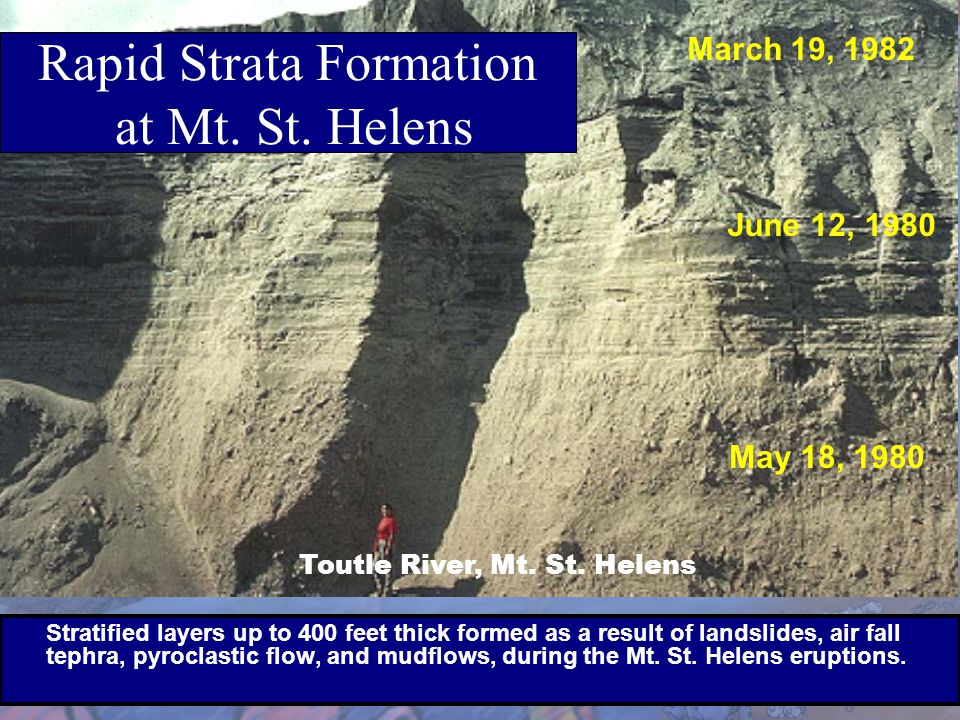
Visit the fossil museum:
www.flickr.com/photos/101536517@N06/sets/72157641367196613/
Just how good are peer reviews of scientific papers?
www.sciencemag.org/content/342/6154/60.full
www.examiner.com/article/want-to-publish-science-paper-ju...
The neo-Darwinian idea that the human genome consists entirely of an accumulation of billions of mutations is, quite obviously, completely bonkers. Nevertheless, it is compulsorily taught in schools and universities as 'science'.
Rapid strata formation in soft sand (field evidence).
Photo of strata formation in soft sand on a beach, created by tidal action of the sea.
Formed in a single, high tidal event. Stunning evidence which displays multiple strata/layers.
Why this is so important ....
It has long been assumed, ever since the 17th century, that layers/strata observed in sedimentary rocks were built up gradually, layer upon layer, over many years. It certainly seemed logical at the time, from just looking at rocks, that lower layers would always be older than the layers above them, i.e. that lower layers were always laid down first followed, in time, by successive layers on top.
This was assumed to be true and became known as the superposition principle.
It was also assumed that a layer comprising a different material from a previous layer, represented a change in environmental conditions/factors.
These changes in composition of layers or strata were considered to represent different, geological eras on a global scale, spanning millions of years. This formed the basis for the Geologic Column, which is used to date rocks and also fossils. The evolutionary, 'fossil record' was based on the vast ages and assumed geological eras of the Geologic Column.
There was also circular reasoning applied with the assumed age of 'index' fossils (based on evolutionary beliefs & preconceptions) used to date strata in the Geologic Column. Dating strata from the assumed age of fossils is known as Biostratigraphy.
We now know that, although these assumptions seemed logical, they are not supported by the evidence.
At the time, the mechanics of stratification were not properly known or studied.
An additional factor was that this assumed superposition and uniformitarian model became essential, with the wide acceptance of Darwinism, for the long ages required for progressive microbes-to-human evolution. There was no incentive to question or challenge the superposition, uniformitarian model, because the presumed, fossil 'record' had become dependant on it, and any change in the accepted model would present devastating implications for Darwinism.
This had the unfortunate effect of linking the study of geology so closely to Darwinism, that any study independent of Darwinian considerations was effectively stymied. This link of geology with Darwinian preconceptions is known as biostratigraphy.
Some of the wealth of evidence can be observed here: www.flickr.com/photos/101536517@N06/sets/72157635944904973/
and also in the links to stunning, experimental evidence, carried out by sedimentologists, given later.
_______________________________________________
GEOLOGIC PRINCIPLES (established by Nicholas Steno in the 17th Century):
What Nicolas Steno believed about strata formation is the basis of the principle of Superposition and the principle of Original Horizontality.
dictionary.sensagent.com/Law_of_superposition/en-en/
“Assuming that all rocks and minerals had once been fluid, Nicolas Steno reasoned that rock strata were formed when particles in a fluid such as water fell to the bottom. This process would leave horizontal layers. Thus Steno's principle of original horizontality states that rock layers form in the horizontal position, and any deviations from this horizontal position are due to the rocks being disturbed later.”)
BEDDING PLANES.
'Bedding plane' describes the surface in between each stratum which are formed during sediment deposition.
science.jrank.org/pages/6533/Strata.html
“Strata form during sediment deposition, that is, the laying down of sediment. Meanwhile, if a change in current speed or sediment grain size occurs or perhaps the sediment supply is cut off, a bedding plane forms. Bedding planes are surfaces that separate one stratum from another. Bedding planes can also form when the upper part of a sediment layer is eroded away before the next episode of deposition. Strata separated by a bedding plane may have different grain sizes, grain compositions, or colours. Sometimes these other traits are better indicators of stratification as bedding planes may be very subtle.”
______________________________________________
Several catastrophic events, flash floods, volcanic eruptions etc. have forced Darwinian influenced geologists to admit to rapid stratification in some instances. However they claim it is a rare phenomenon, which they known about for many years, and which does nothing to invalidate the Geologic Column, the fossil record, evotuionary timescale, or any of the old assumptions regarding strata formation, sedimentation and the superposition principle. They fail to face up to the fact that rapid stratification is not an extraordinary phenonemon, but rather the prevailing and normal mechanism of sedimantary deposition whenever and wherever there is moving, sediment-laden water. The experimental evidence demonstrates the mechanism and a mass of field evidence in normal (non-catastrophic) conditions shows it is a normal everyday occurrence.
It is clear from the experimental evidence that the usual process of stratification is - that strata are not formed by horizontal layers being laid on top of each other in succession, as was assumed. But by sediment being sorted in the flowing water and laid down diagonally in the direction of flow.
Several catastrophic events, flash floods, volcanic eruptions etc. have forced Darwinian, influenced geologists to admit to rapid stratification in some instances. However they claim it is a rare phenomenon, which they have known about for many years, and which does nothing to invalidate the Geologic Column, the fossil record, evotuionary timescale, or any of the old assumptions regarding strata formation, sedimentation and the superposition principle. They fail to face up to the fact that rapid stratification is not an extraordinary phenonemon, but rather the prevailing and normal mechanism of sedimentary deposition whenever and wherever there is moving, sediment-laden water. The experimental evidence demonstrates the mechanism and a mass of field evidence in normal (non-catastrophic) conditions shows it is a normal everyday occurrence.
It is clear from the experimental evidence that the usual process of stratification is - that strata are not formed by horizontal layers being laid on top of each other in succession, as was assumed. But by sediment being sorted in the flowing water and laid down diagonally in the direction of flow. See diagram:
www.flickr.com/photos/truth-in-science/39821536092/in/dat...
The field evidence (in the image) presented here - of rapid, simultaneous stratification refutes the Superposition Principle, and the Principle of Lateral Continuity.
We now know, the Superposition Principle only applies on a rare occasion of sedimentary deposits in perfectly, still water. Superposition is required for the long evolutionary timescale, but the evidence shows it is not the general rule, as was once believed. Most sediment is laid down in moving water, where particle segregation is the general rule, resulting in the simultaneous deposition of strata/layers as shown in the photo.
See many other examples of rapid stratification with geological features: www.flickr.com/photos/101536517@N06/sets/72157635944904973/
Rapid, simultaneous formation of layers/strata, through particle segregation in moving water, is so easily created it has even been described by sedimentologists (working on flume experiments) as a law ...
"Upon filling the tank with water and pouring in sediments, we immediately saw what was to become the rule: The sediments sorted themselves out in very clear layers. This became so common that by the end of two weeks, we jokingly referred to Andrew's law as "It's difficult not to make layers," and Clark's law as "It's easy to make layers." Later on, I proposed the "law" that liquefaction destroys layers, as much to my surprise as that was." Ian Juby, www.ianjuby.org/sedimentation/
The example in the photo is the result of normal, everyday tidal action in a single incident. Where the water current or movement is more turbulent, violent, or catastrophic, great depths (many metres) of stratified sediment can be laid down in a short time. Certainly not the many millions of years assumed by evolutionists.
The composition of strata formed in any deposition event. is related to whatever materials are in the sediment mix, not to any particular timescale. Whatever is in the mix will be automatically sorted into strata/layers. It could be sand, or other material added from mud slides, erosion of chalk deposits, coastal erosion, volcanic ash etc. Any organic material (potential fossils), alive or dead, engulfed by, or swept into, a turbulent sediment mix, will also be sorted and buried within the rapidly, forming layers.
See many other examples of rapid stratification with geological features: www.flickr.com/photos/101536517@N06/sets/72157635944904973/
Stratified, soft sand deposit. demonstrates the rapid, stratification principle.
Important, field evidence which supports the work of the eminent, sedimentologist Dr Guy Berthault MIAS - Member of the International Association of Sedimentologists.
(Dr Berthault's experiments (www.sedimentology.fr/)
And also the experimental work of Dr M.E. Clark (Professor Emeritus, U of Illinois @ Urbana), Andrew Rodenbeck and Dr. Henry Voss, (www.ianjuby.org/sedimentation/)
Location: Sandown, Isle of Wight. Formed 20/02/2018, This field evidence demonstrates that multiple strata in sedimentary deposits do not need millions of years to form and can be formed rapidly. This natural example confirms the principle demonstrated by the sedimentation experiments carried out by Dr Guy Berthault and other sedimentologists. It calls into question the standard, multi-million year dating of sedimentary rocks, and the dating of fossils by depth of burial or position in the strata.
Mulltiple strata/layers are evident in this example.
Dr Berthault's experiments (www.sedimentology.fr/) and other experiments (www.ianjuby.org/sedimentation/) and field studies of floods and volcanic action show that, rather than being formed by gradual, slow deposition of sucessive layers superimposed upon previous layers, with the strata or layers representing a particular timescale, particle segregation in moving water or airborne particles can form strata or layers very quickly, frequently, in a single event.
And, most importantly, lower strata are not older than upper strata, they are the same age, having been created in the same sedimentary episode.
Such field studies confirm experiments which have shown that there is no longer any reason to conclude that strata/layers in sedimentary rocks relate to different geological eras and/or a multi-million year timescale. www.youtube.com/watch?v=5PVnBaqqQw8&feature=share&.... they also show that the relative position of fossils in rocks is not indicative of an order of evolutionary succession. Obviously, the uniformitarian principle, on which the geologic column is based, can no longer be considered valid. And the multi-million, year dating of sedimentary rocks and fossils needs to be reassessed. Rapid deposition of stratified sediments also explains the enigma of polystrate fossils, i.e. large fossils that intersect several strata. In some cases, tree trunk fossils are found which intersect the strata of sedimentary rock up to forty feet in depth. upload.wikimedia.org/wikipedia/commons/thumb/0/08/Lycopsi... They must have been buried in stratified sediment in a short time (certainly not millions, thousands, or even hundreds of years), or they would have rotted away. youtu.be/vnzHU9VsliQ
In fact, the vast majority of fossils are found in good, intact condition, which is testament to their rapid burial. You don't get good fossils from gradual burial, because they would be damaged or destroyed by decay, predation or erosion. The existence of so many fossils in sedimentary rock on a global scale is stunning evidence for the rapid depostion of sedimentary rock as the general rule. It is obvious that all rock containing good intact fossils was formed from sediment laid down in a very short time, not millions, or even thousands of years.
See set of photos of other examples of rapid stratification: www.flickr.com/photos/101536517@N06/sets/72157635944904973/
Carbon dating of coal should not be possible if it is millions of years old, yet significant amounts of Carbon 14 have been detected in coal and other fossil material, which indicates that it is less than 50,000 years old. www.ldolphin.org/sewell/c14dating.html
www.grisda.org/origins/51006.htm
Evolutionists confidently cite multi-million year ages for rocks and fossils, but what most people don't realise is that no one actually knows the age of sedimentary rocks or the fossils found within them. So how are evolutionists so sure of the ages they so confidently quote? The astonishing thing is they aren't. Sedimentary rocks cannot be dated by radiometric methods*, and fossils can only be dated to less than 50,000 years with Carbon 14 dating. The method evolutionists use is based entirely on assumptions. Unbelievably, fossils are dated by the assumed age of rocks, and rocks are dated by the assumed age of fossils, that's right ... it is known as circular reasoning.
* Regarding the radiometric dating of igneous rocks, which is claimed to be relevant to the dating of sedimentary rocks, in an occasional instance there is an igneous intrusion associated with a sedimentary deposit -
Prof. Aubouin says in his Précis de Géologie: "Each radioactive element disintegrates in a characteristic and constant manner, which depends neither on the physical state (no variation with pressure or temperature or any other external constraint) nor on the chemical state (identical for an oxide or a phosphate)."
"Rocks form when magma crystallizes. Crystallisation depends on pressure and temperature, from which radioactivity is independent. So, there is no relationship between radioactivity and crystallisation.
Consequently, radioactivity doesn't date the formation of rocks. Moreover, daughter elements contained in rocks result mainly from radioactivity in magma where gravity separates the heavier parent element, from the lighter daughter element. Thus radiometric dating has no chronological signification." Dr. Guy Berthault www.sciencevsevolution.org/Berthault.htm
Visit the fossil museum:
www.flickr.com/photos/101536517@N06/sets/72157641367196613/
Just how good are peer reviews of scientific papers?
www.sciencemag.org/content/342/6154/60.full
www.examiner.com/article/want-to-publish-science-paper-ju...
The neo-Darwinian idea that the human genome consists entirely of an accumulation of billions of mutations is, quite obviously, completely bonkers. Nevertheless, it is compulsorily taught in schools and universities as 'science'.
I created this poster to pay tribute to the life of a great Rastaman, Mortimer Planno. He was a leader, visionary, teacher, Rasta pioneer, emissary, and the guiding light behind the message music of Reggae greatest singers; Bob Marley, Peter Tosh, Bunny Wailer and the Abyssinians, and many other conscious Reggae musicians found much inspiration from his "reasonings" in Trench Town in the 1960 and 70s. He is the man that planted the seed of the global message of Rastafari levity. He is the Author of “The Earth Most Strangest Man,” A visionary that set in motion the serious study on the Rastafarian ("Report of the Rastafari Movement in Kingston Jamaica 1960") by scholars M. G. Smith, R. Augier and R. Nettleford. Planno was a founding member of the Rastafari Movement Association. The accomplished Rastaman has help built the foundation on which the modern Rastafarin movement now stand all over the world today. Mortimer is a man of peace and was very responsible for organizing the One Love Peace Concert held in Kingston Jamaica in 1978.
Mortimo’s influence was largely in the 1960s. After the 1960s, Mortimo’s health began to decline, he had thyroid problems and it limited him. It began to affect his life and his work. Planno was a very powerful leader who, through the 1960s, was considered the most influential Rastafarian for reasons that I think some of you already know.
One, he was the main architect of the move to get the University of the West Indies on board to establish a Study of the Rasta movement. Secondly, he was the only dreadlocks Rastafarian to get legitimacy by the Jamaican state in that time, to a sort of speak, because he was appointed a member of the “Mission to Africa” by the Jamaican Government and everybody could see from the pictures that he stood out as the only dreadlocks. But above all, it was the recognition that he received from his Majesty Emperor Haile Selassie at the airport and there is this beautiful photograph of him standing on the steps of the plane looking on the crowd and asking the crowd to move away so the emperor could leave the plane. So he knew his Majesty and was received in Ethiopia when the mission went there. Planno also went back later in the 1960s and in the 1970s. He would have had audience with his Majesty and received gift from him. So it was that influence that Planno exerted. Therefore, I would say that Planno’s main role was the bridge that he became between the Rasta movement and the rest of the society and the world.
RHR translate: Right Honorable Ras Mortimer Planno.
Not the best videos, but surly the earliest video of Rastafrians and Planno himself.
Mortimo Planno - The Dungle, Kingston, Ja - 5-8-1969
www.youtube.com/watch?v=qE4wJ5VQLVc&NR=1
www.youtube.com/watch?v=OwKERl_dCx0
Please Read: Earth Most Strangest Man
www.cifas.us/caribbean/PDFs/EarthMostStrangestMan_Transcr...
Remembering Rasta Pioneers
www.jpanafrican.com/docs/vol3no4/3.4RememberingRasta.pdf
www.independent.co.uk/news/obituaries/mortimer-planno-475...
His Imperial Majesty, Emperor Haile Selassie of Ethiopia visits Jamaica part 1
Rapid strata formation in soft sand (field evidence).
Photo of strata formation in soft sand on a beach, created by tidal action of the sea.
Formed in a high tidal event. Stunning evidence which displays multiple strata/layers.
Why this is so important ....
It has long been assumed, ever since the 17th century, that layers/strata observed in sedimentary rocks were built up gradually, layer upon layer, over many years. It certainly seemed logical at the time, from just looking at rocks, that lower layers would always be older than the layers above them, i.e. that lower layers were always laid down first followed, in time, by successive layers on top.
This was assumed to be true and became known as the superposition principle.
It was also assumed that a layer comprising a different material from a previous layer, represented a change in environmental conditions/factors.
These changes in composition of layers or strata were considered to represent different, geological eras on a global scale, spanning millions of years. This formed the basis for the Geologic Column, which is used to date rocks and also fossils. The evolutionary, 'fossil record' was based on the vast ages and assumed geological eras of the Geologic Column.
There was also circular reasoning applied with the assumed age of 'index' fossils (based on evolutionary beliefs & preconceptions) used to date strata in the Geologic Column. Dating strata from the assumed age of (index) fossils is known as Biostratigraphy.
We now know that, although these assumptions seemed logical, they are not supported by the evidence.
At the time, the mechanics of stratification were not properly known or studied.
An additional factor was that this assumed superposition and uniformitarian model became essential, with the wide acceptance of Darwinism, for the long ages required for progressive microbes-to-human evolution. There was no incentive to question or challenge the superposition, uniformitarian model, because the presumed, fossil 'record' had become dependant on it, and any change in the accepted model would present devastating implications for Darwinism.
This had the unfortunate effect of linking the study of geology so closely to Darwinism, that any study independent of Darwinian considerations was effectively stymied. This link of geology with Darwinian preconceptions is known as biostratigraphy.
Some other field evidence, in various situations, can be observed here: www.flickr.com/photos/101536517@N06/sets/72157635944904973/
and also in the links to stunning, experimental evidence, carried out by sedimentologists, given later.
_______________________________________________
GEOLOGIC PRINCIPLES (established by Nicholas Steno in the 17th Century):
What Nicolas Steno believed about strata formation is the basis of the principle of Superposition and the principle of Original Horizontality.
dictionary.sensagent.com/Law_of_superposition/en-en/
“Assuming that all rocks and minerals had once been fluid, Nicolas Steno reasoned that rock strata were formed when particles in a fluid such as water fell to the bottom. This process would leave horizontal layers. Thus Steno's principle of original horizontality states that rock layers form in the horizontal position, and any deviations from this horizontal position are due to the rocks being disturbed later.”)
BEDDING PLANES.
'Bedding plane' describes the surface in between each stratum which are formed during sediment deposition.
science.jrank.org/pages/6533/Strata.html
“Strata form during sediment deposition, that is, the laying down of sediment. Meanwhile, if a change in current speed or sediment grain size occurs or perhaps the sediment supply is cut off, a bedding plane forms. Bedding planes are surfaces that separate one stratum from another. Bedding planes can also form when the upper part of a sediment layer is eroded away before the next episode of deposition. Strata separated by a bedding plane may have different grain sizes, grain compositions, or colours. Sometimes these other traits are better indicators of stratification as bedding planes may be very subtle.”
______________________________________________
Several catastrophic events, flash floods, volcanic eruptions etc. have forced Darwinian, influenced geologists to admit to rapid stratification in some instances. However they claim it is a rare phenomenon, which they have known about for many years, and which does nothing to invalidate the Geologic Column, the fossil record, evolutionary timescale, or any of the old assumptions regarding strata formation, sedimentation and the superposition principle. They fail to face up to the fact that rapid stratification is not an extraordinary phenonemon, but rather the prevailing and normal mechanism of sedimentary deposition whenever and wherever there is moving, sediment-laden water. The experimental evidence demonstrates the mechanism and a mass of field evidence in normal (non-catastrophic) conditions shows it is a normal everyday occurrence.
It is clear from the experimental evidence that the usual process of stratification is - that strata are not formed by horizontal layers being laid on top of each other in succession, as was assumed. But by sediment being sorted in the flowing water and laid down diagonally in the direction of flow. See diagram:
www.flickr.com/photos/truth-in-science/39821536092/in/dat...
The field evidence (in the image) presented here - of rapid, simultaneous stratification refutes the Superposition Principle and the Principle of Lateral Continuity.
We now know, the Superposition Principle only applies on a rare occasion where sedimentary deposits are laid down in still water.
Superposition is required for the long evolutionary timescale, but the evidence shows it is not the general rule, as was once believed. Most sediment is laid down in moving water, where particle segregation is the general rule, resulting in the simultaneous deposition of strata/layers as shown in the photo.
See many other examples of rapid stratification (with geological features): www.flickr.com/photos/101536517@N06/sets/72157635944904973/
Rapid, simultaneous formation of layers/strata, through particle segregation in moving water, is so easily created it has even been described by sedimentologists (working on flume experiments) as a law ...
"Upon filling the tank with water and pouring in sediments, we immediately saw what was to become the rule: The sediments sorted themselves out in very clear layers. This became so common that by the end of two weeks, we jokingly referred to Andrew's law as "It's difficult not to make layers," and Clark's law as "It's easy to make layers." Later on, I proposed the "law" that liquefaction destroys layers, as much to my surprise as that was." Ian Juby, www.ianjuby.org/sedimentation/
The example in the photo is the result of normal, everyday tidal action formed in a single incident. Where the water current or movement is more turbulent, violent, or catastrophic, great depths (many metres) of stratified sediment can be laid down in a short time. Certainly not the many millions of years assumed by evolutionists.
The composition of strata formed in any deposition event. is related to whatever materials are in the sediment mix, not to any particular timescale. Whatever is in the mix will be automatically sorted into strata/layers. It could be sand, or other material added from mud slides, erosion of chalk deposits, coastal erosion, volcanic ash etc. Any organic material (potential fossils), alive or dead, engulfed by, or swept into, a turbulent sediment mix, will also be sorted and buried within the rapidly, forming layers.
See many other examples of rapid stratification with geological features: www.flickr.com/photos/101536517@N06/sets/72157635944904973/
Stratified, soft sand deposit. demonstrates the rapid, stratification principle.
Important, field evidence which supports the work of the eminent, sedimentologist Dr Guy Berthault MIAS - Member of the International Association of Sedimentologists.
(Dr Berthault's experiments (www.sedimentology.fr/)
And also the experimental work of Dr M.E. Clark (Professor Emeritus, U of Illinois @ Urbana), Andrew Rodenbeck and Dr. Henry Voss, (www.ianjuby.org/sedimentation/)
Location: Sandown, Isle of Wight. Photographed: 26/07/2019
This field evidence demonstrates that multiple strata in sedimentary deposits do not need millions of years to form and can be formed rapidly. This natural example confirms the principle demonstrated by the sedimentation experiments carried out by Dr Guy Berthault and other sedimentologists. It calls into question the standard, multi-million year dating of sedimentary rocks, and the dating of fossils by depth of burial or position in the strata.
Mulltiple strata/layers are evident in this example.
Dr Berthault's experiments (www.sedimentology.fr/) and other experiments (www.ianjuby.org/sedimentation/) and field studies of floods and volcanic action show that, rather than being formed by gradual, slow deposition of sucessive layers superimposed upon previous layers, with the strata or layers representing a particular timescale, particle segregation in moving water or airborne particles can form strata or layers very quickly, frequently, in a single event.
And, most importantly, lower strata are not older than upper strata, they are the same age, having been created in the same sedimentary episode.
Such field studies confirm experiments which have shown that there is no longer any reason to conclude that strata/layers in sedimentary rocks relate to different geological eras and/or a multi-million year timescale. www.youtube.com/watch?v=5PVnBaqqQw8&feature=share&.... they also show that the relative position of fossils in rocks is not indicative of an order of evolutionary succession. Obviously, the uniformitarian principle, on which the geologic column is based, can no longer be considered valid. And the multi-million, year dating of sedimentary rocks and fossils needs to be reassessed. Rapid deposition of stratified sediments also explains the enigma of polystrate fossils, i.e. large fossils that intersect several strata. In some cases, tree trunk fossils are found which intersect the strata of sedimentary rock up to forty feet in depth. upload.wikimedia.org/wikipedia/commons/thumb/0/08/Lycopsi... They must have been buried in stratified sediment in a short time (certainly not millions, thousands, or even hundreds of years), or they would have rotted away. youtu.be/vnzHU9VsliQ
In fact, the vast majority of fossils are found in good, intact condition, which is testament to their rapid burial. You don't get good fossils from gradual burial, because they would be damaged or destroyed by decay, predation or erosion. The existence of so many fossils in sedimentary rock on a global scale is stunning evidence for the rapid depostion of sedimentary rock as the general rule. It is obvious that all rock containing good intact fossils was formed from sediment laid down in a very short time, not millions, or even thousands of years.
See set of photos of other examples of rapid stratification: www.flickr.com/photos/101536517@N06/sets/72157635944904973/
Carbon dating of coal should not be possible if it is millions of years old, yet significant amounts of Carbon 14 have been detected in coal and other fossil material, which indicates that it is less than 50,000 years old. www.ldolphin.org/sewell/c14dating.html
www.grisda.org/origins/51006.htm
Evolutionists confidently cite multi-million year ages for rocks and fossils, but what most people don't realise is that no one actually knows the age of sedimentary rocks or the fossils found within them. So how are evolutionists so sure of the ages they so confidently quote? The astonishing thing is they aren't. Sedimentary rocks cannot be dated by radiometric methods*, and fossils can only be dated to less than 50,000 years with Carbon 14 dating. The method evolutionists use is based entirely on assumptions. Unbelievably, fossils are dated by the assumed age of rocks, and rocks are dated by the assumed age of fossils, that's right ... it is known as circular reasoning.
* Regarding the radiometric dating of igneous rocks, which is claimed to be relevant to the dating of sedimentary rocks, in an occasional instance there is an igneous intrusion associated with a sedimentary deposit -
Prof. Aubouin says in his Précis de Géologie: "Each radioactive element disintegrates in a characteristic and constant manner, which depends neither on the physical state (no variation with pressure or temperature or any other external constraint) nor on the chemical state (identical for an oxide or a phosphate)."
"Rocks form when magma crystallizes. Crystallisation depends on pressure and temperature, from which radioactivity is independent. So, there is no relationship between radioactivity and crystallisation.
Consequently, radioactivity doesn't date the formation of rocks. Moreover, daughter elements contained in rocks result mainly from radioactivity in magma where gravity separates the heavier parent element, from the lighter daughter element. Thus radiometric dating has no chronological signification." Dr. Guy Berthault www.sciencevsevolution.org/Berthault.htm
Radiometric dating based on unverifiable assumptions.
scienceagainstevolution.info/v8i8f.htm
Rapid strata formation and rapid erosion at Mount St Helens.
slideplayer.com/slide/5703217/18/images/28/Rapid+Strata+F...

Visit the fossil museum:
www.flickr.com/photos/101536517@N06/sets/72157641367196613/
Just how good are peer reviews of scientific papers?
www.sciencemag.org/content/342/6154/60.full
www.examiner.com/article/want-to-publish-science-paper-ju...
The neo-Darwinian idea that the human genome consists entirely of an accumulation of billions of mutations is, quite obviously, completely bonkers. Nevertheless, it is compulsorily taught in schools and universities as 'science'.
www.flickr.com/photos/truth-in-science/35505679183
Dr James Tour - 'The Origin of Life' - Abiogenesis decisively refuted.
"If you want you can get to know me well
We get along so we shouldn't argue
And I don't know, said I don't know
All these feelings, cloud up my reasoning
Cloud up my reasoning"
-Argue, Matchbox Twenty
Season of Touit - picture 1
Week 35, Wednesday
Today I'm starting my fourth season at Year of the Alpha - 52 Weeks of Sony Alpha Photography. Like earlier seasons this one also carries a special theme which will define my photography for the next ten weeks. While the earlier seasons have dealt with blackness, personal memories and summer photography, 'Season of Touit' will concentrate on bringing new point of views into to my photography by moving away from the standard focal lengths that I've used thorough the year. Reasoning behind this plan is simple. It is my experience that creativity arises from limits and appropriate amount of obstacles. Crossing the limits requires one to find new ways and once it is done it breeds new ways of working which will eventually develop one's photographic eye. By restraining myself from my standard focal lengths I'm essentially setting creative limits for my work for next 10 weeks.
In practice this means I will restrain the use of my usual lenses (SEL50F18 , SEL1855) which cover focal lengths from 18mm to 55mm (equivalent to 27mm to 82,5mm on full frame). Instead I'm going ultra wide and close-up photography which are, regarding the perception of the depth, kind of extreme ends. Wide angle exaggerates the depth and makes things look further away while close-up photography brings things so close that we can only see details of the subject. These extreme ends will define my photography for next ten weeks. I'm also very happy to tell you that ZEISS had decided to support me on this task with two of their lenses: Touit 2.8/12 and Touit 2.8/50M. Needless to say, I'm honored to be supported by them, thank you Tobias! In coming posts I will introduce both of these lenses and tell you more about them in detail.
Founded by Carl Zeiss the ZEISS has been a leading company of camera optics for over 150 years. Photography professionals associate the name ZEISS with exceptional optical quality and their distinct optical concepts, like Planar and Distagon, have gain a great reputation among many photographers. My second task during this season is to find out what does this enthusiasm regarding the ZEISS means and tell you about my findings. What I'm particularly trying to do, is to evaluate how the use of high quality ZEISS lenses will affect my photography as a whole. Rather than bomb you with a resolution charts and measurements, I'm trying to get a feel of things and let the complete experience guide my way. One could say I'm trying follow the principles of good design; every object we use is more than just a object/tool to fulfill our needs, and instead of this instrumental rationality, they are also things which we relate to in different ways in our everyday life.
Ps. Regarding the todays picture, how do you photograph your own eye? Difficult task indeed and a question of practical photography. I found myself putting camera on a tripod, setting it to manual focus and sitting in front of it with my eye almost touching the lens while using the other arm to stretch my eyelid wide open. Perhaps not the most advanced setup and rules out things like focus stacking, but I got it done - but took me more than couple of tries. :-)
Rapid strata formation in soft sand (field evidence).
Photo of strata formation in soft sand on a beach, created by tidal action of the sea.
Formed in a single, high tidal event. Stunning evidence which displays multiple strata/layers.
Why this is so important ....
It has long been assumed, ever since the 17th century, that layers/strata observed in sedimentary rocks were built up gradually, layer upon layer, over many years. It certainly seemed logical at the time, from just looking at rocks, that lower layers would always be older than the layers above them, i.e. that lower layers were always laid down first followed, in time, by successive layers on top.
This was assumed to be true and became known as the superposition principle.
It was also assumed that a layer comprising a different material from a previous layer, represented a change in environmental conditions/factors.
These changes in composition of layers or strata were considered to represent different, geological eras on a global scale, spanning millions of years. This formed the basis for the Geologic Column, which is used to date rocks and also fossils. The evolutionary, 'fossil record' was based on the vast ages and assumed geological eras of the Geologic Column.
There was also circular reasoning applied with the assumed age of 'index' fossils (based on evolutionary beliefs & preconceptions) used to date strata in the Geologic Column. Dating strata from the assumed age of (index) fossils is known as Biostratigraphy.
We now know that, although these assumptions seemed logical, they are not supported by the evidence.
At the time, the mechanics of stratification were not properly known or studied.
An additional factor was that this assumed superposition and uniformitarian model became essential, with the wide acceptance of Darwinism, for the long ages required for progressive microbes-to-human evolution. There was no incentive to question or challenge the superposition, uniformitarian model, because the presumed, fossil 'record' had become dependant on it, and any change in the accepted model would present devastating implications for Darwinism.
This had the unfortunate effect of linking the study of geology so closely to Darwinism, that any study independent of Darwinian considerations was effectively stymied. This link of geology with Darwinian preconceptions is known as biostratigraphy.
Some other field evidence can be observed here: www.flickr.com/photos/101536517@N06/sets/72157635944904973/
and also in the links to stunning, experimental evidence, carried out by sedimentologists, given later.
_______________________________________________
GEOLOGIC PRINCIPLES (established by Nicholas Steno in the 17th Century):
What Nicolas Steno believed about strata formation is the basis of the principle of Superposition and the principle of Original Horizontality.
dictionary.sensagent.com/Law_of_superposition/en-en/
“Assuming that all rocks and minerals had once been fluid, Nicolas Steno reasoned that rock strata were formed when particles in a fluid such as water fell to the bottom. This process would leave horizontal layers. Thus Steno's principle of original horizontality states that rock layers form in the horizontal position, and any deviations from this horizontal position are due to the rocks being disturbed later.”)
BEDDING PLANES.
'Bedding plane' describes the surface in between each stratum which are formed during sediment deposition.
science.jrank.org/pages/6533/Strata.html
“Strata form during sediment deposition, that is, the laying down of sediment. Meanwhile, if a change in current speed or sediment grain size occurs or perhaps the sediment supply is cut off, a bedding plane forms. Bedding planes are surfaces that separate one stratum from another. Bedding planes can also form when the upper part of a sediment layer is eroded away before the next episode of deposition. Strata separated by a bedding plane may have different grain sizes, grain compositions, or colours. Sometimes these other traits are better indicators of stratification as bedding planes may be very subtle.”
______________________________________________
Several catastrophic events, flash floods, volcanic eruptions etc. have forced Darwinian, influenced geologists to admit to rapid stratification in some instances. However they claim it is a rare phenomenon, which they have known about for many years, and which does nothing to invalidate the Geologic Column, the fossil record, evolutionary timescale, or any of the old assumptions regarding strata formation, sedimentation and the superposition principle. They fail to face up to the fact that rapid stratification is not an extraordinary phenonemon, but rather the prevailing and normal mechanism of sedimentary deposition whenever and wherever there is moving, sediment-laden water. The experimental evidence demonstrates the mechanism and a mass of field evidence in normal (non-catastrophic) conditions shows it is a normal everyday occurrence.
It is clear from the experimental evidence that the usual process of stratification is - that strata are not formed by horizontal layers being laid on top of each other in succession, as was assumed. But by sediment being sorted in the flowing water and laid down diagonally in the direction of flow. See diagram:
www.flickr.com/photos/truth-in-science/39821536092/in/dat...
The field evidence (in the image) presented here - of rapid, simultaneous stratification refutes the Superposition Principle and the Principle of Lateral Continuity.
We now know, the Superposition Principle only applies on a rare occasion where sedimentary deposits are laid down in still water.
Superposition is required for the long evolutionary timescale, but the evidence shows it is not the general rule, as was once believed. Most sediment is laid down in moving water, where particle segregation is the general rule, resulting in the simultaneous deposition of strata/layers as shown in the photo.
See many other examples of rapid stratification (with geological features): www.flickr.com/photos/101536517@N06/sets/72157635944904973/
Rapid, simultaneous formation of layers/strata, through particle segregation in moving water, is so easily created it has even been described by sedimentologists (working on flume experiments) as a law ...
"Upon filling the tank with water and pouring in sediments, we immediately saw what was to become the rule: The sediments sorted themselves out in very clear layers. This became so common that by the end of two weeks, we jokingly referred to Andrew's law as "It's difficult not to make layers," and Clark's law as "It's easy to make layers." Later on, I proposed the "law" that liquefaction destroys layers, as much to my surprise as that was." Ian Juby, www.ianjuby.org/sedimentation/
The example in the photo is the result of normal, everyday tidal action in a single incident. Where the water current or movement is more turbulent, violent, or catastrophic, great depths (many metres) of stratified sediment can be laid down in a short time. Certainly not the many millions of years assumed by evolutionists.
The composition of strata formed in any deposition event. is related to whatever materials are in the sediment mix, not to any particular timescale. Whatever is in the mix will be automatically sorted into strata/layers. It could be sand, or other material added from mud slides, erosion of chalk deposits, coastal erosion, volcanic ash etc. Any organic material (potential fossils), alive or dead, engulfed by, or swept into, a turbulent sediment mix, will also be sorted and buried within the rapidly, forming layers.
See many other examples of rapid stratification with geological features: www.flickr.com/photos/101536517@N06/sets/72157635944904973/
Stratified, soft sand deposit. demonstrates the rapid, stratification principle.
Important, field evidence which supports the work of the eminent, sedimentologist Dr Guy Berthault MIAS - Member of the International Association of Sedimentologists.
(Dr Berthault's experiments (www.sedimentology.fr/)
And also the experimental work of Dr M.E. Clark (Professor Emeritus, U of Illinois @ Urbana), Andrew Rodenbeck and Dr. Henry Voss, (www.ianjuby.org/sedimentation/)
Location: Sandown, Isle of Wight. Formed 24/04/2018, This field evidence demonstrates that multiple strata in sedimentary deposits do not need millions of years to form and can be formed rapidly. This natural example confirms the principle demonstrated by the sedimentation experiments carried out by Dr Guy Berthault and other sedimentologists. It calls into question the standard, multi-million year dating of sedimentary rocks, and the dating of fossils by depth of burial or position in the strata.
Mulltiple strata/layers are evident in this example.
Dr Berthault's experiments (www.sedimentology.fr/) and other experiments (www.ianjuby.org/sedimentation/) and field studies of floods and volcanic action show that, rather than being formed by gradual, slow deposition of sucessive layers superimposed upon previous layers, with the strata or layers representing a particular timescale, particle segregation in moving water or airborne particles can form strata or layers very quickly, frequently, in a single event.
And, most importantly, lower strata are not older than upper strata, they are the same age, having been created in the same sedimentary episode.
Such field studies confirm experiments which have shown that there is no longer any reason to conclude that strata/layers in sedimentary rocks relate to different geological eras and/or a multi-million year timescale. www.youtube.com/watch?v=5PVnBaqqQw8&feature=share&.... they also show that the relative position of fossils in rocks is not indicative of an order of evolutionary succession. Obviously, the uniformitarian principle, on which the geologic column is based, can no longer be considered valid. And the multi-million, year dating of sedimentary rocks and fossils needs to be reassessed. Rapid deposition of stratified sediments also explains the enigma of polystrate fossils, i.e. large fossils that intersect several strata. In some cases, tree trunk fossils are found which intersect the strata of sedimentary rock up to forty feet in depth. upload.wikimedia.org/wikipedia/commons/thumb/0/08/Lycopsi... They must have been buried in stratified sediment in a short time (certainly not millions, thousands, or even hundreds of years), or they would have rotted away. youtu.be/vnzHU9VsliQ
In fact, the vast majority of fossils are found in good, intact condition, which is testament to their rapid burial. You don't get good fossils from gradual burial, because they would be damaged or destroyed by decay, predation or erosion. The existence of so many fossils in sedimentary rock on a global scale is stunning evidence for the rapid depostion of sedimentary rock as the general rule. It is obvious that all rock containing good intact fossils was formed from sediment laid down in a very short time, not millions, or even thousands of years.
See set of photos of other examples of rapid stratification: www.flickr.com/photos/101536517@N06/sets/72157635944904973/
Carbon dating of coal should not be possible if it is millions of years old, yet significant amounts of Carbon 14 have been detected in coal and other fossil material, which indicates that it is less than 50,000 years old. www.ldolphin.org/sewell/c14dating.html
www.grisda.org/origins/51006.htm
Evolutionists confidently cite multi-million year ages for rocks and fossils, but what most people don't realise is that no one actually knows the age of sedimentary rocks or the fossils found within them. So how are evolutionists so sure of the ages they so confidently quote? The astonishing thing is they aren't. Sedimentary rocks cannot be dated by radiometric methods*, and fossils can only be dated to less than 50,000 years with Carbon 14 dating. The method evolutionists use is based entirely on assumptions. Unbelievably, fossils are dated by the assumed age of rocks, and rocks are dated by the assumed age of fossils, that's right ... it is known as circular reasoning.
* Regarding the radiometric dating of igneous rocks, which is claimed to be relevant to the dating of sedimentary rocks, in an occasional instance there is an igneous intrusion associated with a sedimentary deposit -
Prof. Aubouin says in his Précis de Géologie: "Each radioactive element disintegrates in a characteristic and constant manner, which depends neither on the physical state (no variation with pressure or temperature or any other external constraint) nor on the chemical state (identical for an oxide or a phosphate)."
"Rocks form when magma crystallizes. Crystallisation depends on pressure and temperature, from which radioactivity is independent. So, there is no relationship between radioactivity and crystallisation.
Consequently, radioactivity doesn't date the formation of rocks. Moreover, daughter elements contained in rocks result mainly from radioactivity in magma where gravity separates the heavier parent element, from the lighter daughter element. Thus radiometric dating has no chronological signification." Dr. Guy Berthault www.sciencevsevolution.org/Berthault.htm
Visit the fossil museum:
www.flickr.com/photos/101536517@N06/sets/72157641367196613/
Just how good are peer reviews of scientific papers?
www.sciencemag.org/content/342/6154/60.full
www.examiner.com/article/want-to-publish-science-paper-ju...
The neo-Darwinian idea that the human genome consists entirely of an accumulation of billions of mutations is, quite obviously, completely bonkers. Nevertheless, it is compulsorily taught in schools and universities as 'science'.
Rapid strata formation in soft sand (field evidence).
Photo of strata formation in soft sand on a beach, created by tidal action of the sea.
Formed in a single, high tidal event. Stunning evidence which displays multiple strata/layers.
Why this is so important ....
It has long been assumed, ever since the 17th century, that layers/strata observed in sedimentary rocks were built up gradually, layer upon layer, over many years. It certainly seemed logical at the time, from just looking at rocks, that lower layers would always be older than the layers above them, i.e. that lower layers were always laid down first followed, in time, by successive layers on top.
This was assumed to be true and became known as the superposition principle.
It was also assumed that a layer comprising a different material from a previous layer, represented a change in environmental conditions/factors.
These changes in composition of layers or strata were considered to represent different, geological eras on a global scale, spanning millions of years. This formed the basis for the Geologic Column, which is used to date rocks and also fossils. The evolutionary, 'fossil record' was based on the vast ages and assumed geological eras of the Geologic Column.
There was also circular reasoning applied with the assumed age of 'index' fossils (based on evolutionary beliefs & preconceptions) used to date strata in the Geologic Column. Dating strata from the assumed age of (index) fossils is known as Biostratigraphy.
We now know that, although these assumptions seemed logical, they are not supported by the evidence.
At the time, the mechanics of stratification were not properly known or studied.
An additional factor was that this assumed superposition and uniformitarian model became essential, with the wide acceptance of Darwinism, for the long ages required for progressive microbes-to-human evolution. There was no incentive to question or challenge the superposition, uniformitarian model, because the presumed, fossil 'record' had become dependant on it, and any change in the accepted model would present devastating implications for Darwinism.
This had the unfortunate effect of linking the study of geology so closely to Darwinism, that any study independent of Darwinian considerations was effectively stymied. This link of geology with Darwinian preconceptions is known as biostratigraphy.
Some other field evidence, in various situations, can be observed here: www.flickr.com/photos/101536517@N06/sets/72157635944904973/
and also in the links to stunning, experimental evidence, carried out by sedimentologists, given later.
_______________________________________________
GEOLOGIC PRINCIPLES (established by Nicholas Steno in the 17th Century):
What Nicolas Steno believed about strata formation is the basis of the principle of Superposition and the principle of Original Horizontality.
dictionary.sensagent.com/Law_of_superposition/en-en/
“Assuming that all rocks and minerals had once been fluid, Nicolas Steno reasoned that rock strata were formed when particles in a fluid such as water fell to the bottom. This process would leave horizontal layers. Thus Steno's principle of original horizontality states that rock layers form in the horizontal position, and any deviations from this horizontal position are due to the rocks being disturbed later.”)
BEDDING PLANES.
'Bedding plane' describes the surface in between each stratum which are formed during sediment deposition.
science.jrank.org/pages/6533/Strata.html
“Strata form during sediment deposition, that is, the laying down of sediment. Meanwhile, if a change in current speed or sediment grain size occurs or perhaps the sediment supply is cut off, a bedding plane forms. Bedding planes are surfaces that separate one stratum from another. Bedding planes can also form when the upper part of a sediment layer is eroded away before the next episode of deposition. Strata separated by a bedding plane may have different grain sizes, grain compositions, or colours. Sometimes these other traits are better indicators of stratification as bedding planes may be very subtle.”
______________________________________________
Several catastrophic events, flash floods, volcanic eruptions etc. have forced Darwinian, influenced geologists to admit to rapid stratification in some instances. However they claim it is a rare phenomenon, which they have known about for many years, and which does nothing to invalidate the Geologic Column, the fossil record, evolutionary timescale, or any of the old assumptions regarding strata formation, sedimentation and the superposition principle. They fail to face up to the fact that rapid stratification is not an extraordinary phenonemon, but rather the prevailing and normal mechanism of sedimentary deposition whenever and wherever there is moving, sediment-laden water. The experimental evidence demonstrates the mechanism and a mass of field evidence in normal (non-catastrophic) conditions shows it is a normal everyday occurrence.
It is clear from the experimental evidence that the usual process of stratification is - that strata are not formed by horizontal layers being laid on top of each other in succession, as was assumed. But by sediment being sorted in the flowing water and laid down diagonally in the direction of flow. See diagram:
www.flickr.com/photos/truth-in-science/39821536092/in/dat...
The field evidence (in the image) presented here - of rapid, simultaneous stratification refutes the Superposition Principle and the Principle of Lateral Continuity.
We now know, the Superposition Principle only applies on a rare occasion where sedimentary deposits are laid down in still water.
Superposition is required for the long evolutionary timescale, but the evidence shows it is not the general rule, as was once believed. Most sediment is laid down in moving water, where particle segregation is the general rule, resulting in the simultaneous deposition of strata/layers as shown in the photo.
See many other examples of rapid stratification (with geological features): www.flickr.com/photos/101536517@N06/sets/72157635944904973/
Rapid, simultaneous formation of layers/strata, through particle segregation in moving water, is so easily created it has even been described by sedimentologists (working on flume experiments) as a law ...
"Upon filling the tank with water and pouring in sediments, we immediately saw what was to become the rule: The sediments sorted themselves out in very clear layers. This became so common that by the end of two weeks, we jokingly referred to Andrew's law as "It's difficult not to make layers," and Clark's law as "It's easy to make layers." Later on, I proposed the "law" that liquefaction destroys layers, as much to my surprise as that was." Ian Juby, www.ianjuby.org/sedimentation/
The example in the photo is the result of normal, everyday tidal action in a single incident. Where the water current or movement is more turbulent, violent, or catastrophic, great depths (many metres) of stratified sediment can be laid down in a short time. Certainly not the many millions of years assumed by evolutionists.
The composition of strata formed in any deposition event. is related to whatever materials are in the sediment mix, not to any particular timescale. Whatever is in the mix will be automatically sorted into strata/layers. It could be sand, or other material added from mud slides, erosion of chalk deposits, coastal erosion, volcanic ash etc. Any organic material (potential fossils), alive or dead, engulfed by, or swept into, a turbulent sediment mix, will also be sorted and buried within the rapidly, forming layers.
See many other examples of rapid stratification with geological features: www.flickr.com/photos/101536517@N06/sets/72157635944904973/
Stratified, soft sand deposit. demonstrates the rapid, stratification principle.
Important, field evidence which supports the work of the eminent, sedimentologist Dr Guy Berthault MIAS - Member of the International Association of Sedimentologists.
(Dr Berthault's experiments (www.sedimentology.fr/)
And also the experimental work of Dr M.E. Clark (Professor Emeritus, U of Illinois @ Urbana), Andrew Rodenbeck and Dr. Henry Voss, (www.ianjuby.org/sedimentation/)
Location: Sandown, Isle of Wight. Formed 23/04/2018 This field evidence demonstrates that multiple strata in sedimentary deposits do not need millions of years to form and can be formed rapidly. This natural example confirms the principle demonstrated by the sedimentation experiments carried out by Dr Guy Berthault and other sedimentologists. It calls into question the standard, multi-million year dating of sedimentary rocks, and the dating of fossils by depth of burial or position in the strata.
Mulltiple strata/layers are evident in this example.
Dr Berthault's experiments (www.sedimentology.fr/) and other experiments (www.ianjuby.org/sedimentation/) and field studies of floods and volcanic action show that, rather than being formed by gradual, slow deposition of sucessive layers superimposed upon previous layers, with the strata or layers representing a particular timescale, particle segregation in moving water or airborne particles can form strata or layers very quickly, frequently, in a single event.
And, most importantly, lower strata are not older than upper strata, they are the same age, having been created in the same sedimentary episode.
Such field studies confirm experiments which have shown that there is no longer any reason to conclude that strata/layers in sedimentary rocks relate to different geological eras and/or a multi-million year timescale. www.youtube.com/watch?v=5PVnBaqqQw8&feature=share&.... they also show that the relative position of fossils in rocks is not indicative of an order of evolutionary succession. Obviously, the uniformitarian principle, on which the geologic column is based, can no longer be considered valid. And the multi-million, year dating of sedimentary rocks and fossils needs to be reassessed. Rapid deposition of stratified sediments also explains the enigma of polystrate fossils, i.e. large fossils that intersect several strata. In some cases, tree trunk fossils are found which intersect the strata of sedimentary rock up to forty feet in depth. upload.wikimedia.org/wikipedia/commons/thumb/0/08/Lycopsi... They must have been buried in stratified sediment in a short time (certainly not millions, thousands, or even hundreds of years), or they would have rotted away. youtu.be/vnzHU9VsliQ
In fact, the vast majority of fossils are found in good, intact condition, which is testament to their rapid burial. You don't get good fossils from gradual burial, because they would be damaged or destroyed by decay, predation or erosion. The existence of so many fossils in sedimentary rock on a global scale is stunning evidence for the rapid depostion of sedimentary rock as the general rule. It is obvious that all rock containing good intact fossils was formed from sediment laid down in a very short time, not millions, or even thousands of years.
See set of photos of other examples of rapid stratification: www.flickr.com/photos/101536517@N06/sets/72157635944904973/
Carbon dating of coal should not be possible if it is millions of years old, yet significant amounts of Carbon 14 have been detected in coal and other fossil material, which indicates that it is less than 50,000 years old. www.ldolphin.org/sewell/c14dating.html
www.grisda.org/origins/51006.htm
Evolutionists confidently cite multi-million year ages for rocks and fossils, but what most people don't realise is that no one actually knows the age of sedimentary rocks or the fossils found within them. So how are evolutionists so sure of the ages they so confidently quote? The astonishing thing is they aren't. Sedimentary rocks cannot be dated by radiometric methods*, and fossils can only be dated to less than 50,000 years with Carbon 14 dating. The method evolutionists use is based entirely on assumptions. Unbelievably, fossils are dated by the assumed age of rocks, and rocks are dated by the assumed age of fossils, that's right ... it is known as circular reasoning.
* Regarding the radiometric dating of igneous rocks, which is claimed to be relevant to the dating of sedimentary rocks, in an occasional instance there is an igneous intrusion associated with a sedimentary deposit -
Prof. Aubouin says in his Précis de Géologie: "Each radioactive element disintegrates in a characteristic and constant manner, which depends neither on the physical state (no variation with pressure or temperature or any other external constraint) nor on the chemical state (identical for an oxide or a phosphate)."
"Rocks form when magma crystallizes. Crystallisation depends on pressure and temperature, from which radioactivity is independent. So, there is no relationship between radioactivity and crystallisation.
Consequently, radioactivity doesn't date the formation of rocks. Moreover, daughter elements contained in rocks result mainly from radioactivity in magma where gravity separates the heavier parent element, from the lighter daughter element. Thus radiometric dating has no chronological signification." Dr. Guy Berthault www.sciencevsevolution.org/Berthault.htm
Visit the fossil museum:
www.flickr.com/photos/101536517@N06/sets/72157641367196613/
Just how good are peer reviews of scientific papers?
www.sciencemag.org/content/342/6154/60.full
www.examiner.com/article/want-to-publish-science-paper-ju...
The neo-Darwinian idea that the human genome consists entirely of an accumulation of billions of mutations is, quite obviously, completely bonkers. Nevertheless, it is compulsorily taught in schools and universities as 'science'.
This vehicle, an old Dodge truck, is decaying. Very evidently. Because of what you see on it, this decay has ben going on for years, maybe decades. If you return to it in say 100 years, you will find a very evident and much increased level of decay. Such is the way of all things on earth, man,material, mammal,etc. The process is destroying the truck, slowly but most certainly. Everything about the truck is being attacked by this inevitable process. No one in their right mind would say that as a result of this process one day many eons from now, if you you were to return to the truck, you would find a revised, reinvigorated, and vastly improved and superior truck before you. Evolution though, says this very thing. In spite of a very evident process which breaks down and destroys things. This kind of thinking says that somehow this destructive process is actually, in the end, a creative process. That in breaking down it is but a preparation for phase two, creation or re-creation.. Not only so, but that what drives this process is not anyone or anything that can be defined or explained. Rather, it is simply a wonderful mystery. If I say I believe in a God, which I do,a creator of all things including man, by some who believe in the other point of view, I invite the accusation that I have lost control of my reasoning, amongst other things.
But the nature of spiritual blindness is to not only become blinded in one's spirit, the unseen part that is different from the mind and it's ability to process...but in the ability to reason. Because when you can have an evident process of decay in front of you and all around you everywhere, never creating but always destroying, and yet call that same process the great birthing and creative process behind the existence of man and the whole universe...you have a deep blindness that has penetrated the reasoning ability. Where the obvious is misconstrued and reinterpreted, frankly into nonsense. A person should reason, by all means. But we should also always make sure reality lines up with our reasoning and vice versa. We can be wrong, about many things. And as we get older, if we humble ourselves to admit it, we see how often we have been wrong about so very many things in life.
39 years ago, nearing 40 soon, I had an experience which changed my life. I was not a believer in God at the time, nor did I come from a religious background in my family while growing up.I was actually stoned at the time, a part of the story I used to leave out because I believed it would cause people to discredit my story about what happened to me. Then I realized a number of years ago that it was important to tell it as it happened rather than leave out a fact, whatever anyone would think. I was a pot smoker over the course of fourteen years. Sometimes I smoked pot daily for a length of time, sometimes it was periodic and not daily. Suffice to say I was a seasoned and experienced pot smoker. I know well where pot took me in the experience of smoking it. Sometimes it could be a powerful mystical experience, so it seemed when you are high....other times not so much. Like anything, you get used to it. Getting used to it, well like anything, it erodes the original thrill of the experience. You get stoned, sure, but its not brand new anymore. I found that the 'best' high was always in the morning, after that, it was all downhill the rest of the day. wouldn't use that word to describe pot anymore, not just because of a faith in a God, but because my experience with it eventually led to seeing a dark side to it. I used to love pot, the smell of it, smoking it, the experience it took you into. It amazes me today that I now see a true darkness to it, something I no longer want any part of. Anyone who wants to praise pot to me, to argue for it's 'harmlessness'....now....I say they are either naïve, they don't really know what they're talking about. Or they are not being honest. Whatever pot 'gives' you, in the experience, it takes more from you. Simply put, it is destructive to your heart and mind. I know that from experience.
All that being said, smoking a joint or two back in the day with a couple of other people never put me out of my mind, out of control, or in some delusional state. As some who know next to nothing nothing about it might assert or think. Sure, you would be 'stoned'. Just like some folks might be a little drunk from three or four beer. But in neither condition do most people lose their grip on reality. I certainly didn't back then.
One day in the latter part of February in 1981, I got stoned with two other people behind the student residence building at the University of Victoria campus in Victoria, B.C. In Canada for those who wonder. We smoked two joints, No big deal. Was I stoned? Yes. Was I incapable of forming thoughts therefore, conversing,etc? Absolutely not.
Now I didn't feel good about this particular getting high once we were finished and I began to walk the short walk back home where I as a college student was renting a room in a basement along with three other university students. Why? Well, about six moths earlier I had genuinely prayed to to God, alone by myself, asking Jesus Christ to come into my heart. Someone I worked with that previous summer was a Christian, and not afraid to talk about God, Jesus, or the bible. I remember his name, it was, for me at least, an unusual name: Maylan Antrum. Maylan was a serious but straight forward guy. We were car pooling. One day 5 or 6 of us were returning home. Maylan began to ask a couple of of guys what they thought of the bible,then he asked me. I answered that it was a good history book. That was a dishonest answer, I knew nothing about the bible. His reply I remember: Oh, it's much more than that. After listening to the continuing conversation in this vein, I then asked a genuine question:how do you become a Christian? I knew zero about the bible, about God, I had no real clue what a Christian was, how one became one.
To this question he replied explaining, that God created everything, that sin was in all people, that Jesus died on his cross for all sin, that he also rose from the dead, and that to become a Christian I must receive Christ's forgiveness thru hius death for me, as well as Christ himself as not only saviour but Lord. I didn't really understand what accepting Jesus as Lord meant except on a very basic level of what word 'Lord' meant to me...but I did think it a bit strange to make someone who died, and I guess in my mind,still dead, my 'Lord'. I was okay with everything else, but though he told me Jesus rose from the dead, it was like I really didn't get the implication of that, as monstrously large as it was. It's important to know that though I came from no religious background, no religious upbringing, I had still developed some thoughts and feelings about reality and existence from an early age, and one of the things I concluded by age 16 or 17 was that you don't live life, come to it's end, and then cease to be. It would be just as accurate to say, after me thinking about it consciously and clearly, that I refused to accept that that was how things worked. I 'felt' that was not and could not be true. my feeling was based on this thought: if that's how life ends, what is the point? I certainly couldn't see one if it simply ends permanently and completely. Some of the same people, not all, who believe the process of decay and disorder brought about the whole physical universe, might think someone like me is a bit loose in the head for not accepting the finality of death. I have already explained why I think these people are not in a position to make such a claim. So I had had thoughts, feelings, experiences, even formed some conclusions about life and reality long before I ran into someone like Maylan Antrum. When I came across him, and some other folks that summer of 1980, for the first time, I actually paid attention to Christians and what they had to say. Prior to that I neither cared nor knew anything them, the bible, God, and Jesus.
After thinking about what he said, I decided I wanted to become a Christian. Something about it felt right, and true, to me in my heart. One day, not long after that conversation in the car, I prayed a prayer to God while alone in my parent's home where I lived downstairs that summer. I admitted or confessed that yes, I was a sinner and had sin in me, and I asked God to forgive me and asked Jesus to be my saviour and Lord. It would be an understatement to say that inside I was really hoping, not necessarily expecting, some sort of cataclysmic experience to occur as a result of my prayer to God.It would also be an understatement to say I was disappointed, to say the least, when I felt nothing happen during or after my prayer. Though somewhat disappointed, this did not diminish my belief that this stuff about God and Jesus and his death on a cross, even his rising from the dead, was true. I now believed I was a Christian, and I began shortly thereafter to read the bible, starting the new testament.
The summer ended, and not by original plan, I ended up in Victoria that fall at a local college. Many things occurred over the next almost 6 moths. One of them was the urge to occasionally smoke some pot, have a few drinks, and enjoy my youth with other people of my age. I never felt good about this when it occurred, as it occasionally did over the next six moths. I felt guilt in my conscience, believing it wasn't right in God's eyes. Fast forward to
Rapid strata formation in soft sand (field evidence).
Photo of strata formation in soft sand on a beach, created by tidal action of the sea.
Formed in a single, high tidal event. Stunning evidence which displays multiple strata/layers.
Why this is so important ....
It has long been assumed, ever since the 17th century, that layers/strata observed in sedimentary rocks were built up gradually, layer upon layer, over many years. It certainly seemed logical at the time, from just looking at rocks, that lower layers would always be older than the layers above them, i.e. that lower layers were always laid down first followed, in time, by successive layers on top.
This was assumed to be true and became known as the superposition principle.
It was also assumed that a layer comprising a different material from a previous layer, represented a change in environmental conditions/factors.
These changes in composition of layers or strata were considered to represent different, geological eras on a global scale, spanning millions of years. This formed the basis for the Geologic Column, which is used to date rocks and also fossils. The evolutionary, 'fossil record' was based on the vast ages and assumed geological eras of the Geologic Column.
There was also circular reasoning applied with the assumed age of 'index' fossils (based on evolutionary beliefs & preconceptions) used to date strata in the Geologic Column. Dating strata from the assumed age of (index) fossils is known as Biostratigraphy.
We now know that, although these assumptions seemed logical, they are not supported by the evidence.
At the time, the mechanics of stratification were not properly known or studied.
An additional factor was that this assumed superposition and uniformitarian model became essential, with the wide acceptance of Darwinism, for the long ages required for progressive microbes-to-human evolution. There was no incentive to question or challenge the superposition, uniformitarian model, because the presumed, fossil 'record' had become dependant on it, and any change in the accepted model would present devastating implications for Darwinism.
This had the unfortunate effect of linking the study of geology so closely to Darwinism, that any study independent of Darwinian considerations was effectively stymied. This link of geology with Darwinian preconceptions is known as biostratigraphy.
Some other field evidence, in various situations, can be observed here: www.flickr.com/photos/101536517@N06/sets/72157635944904973/
and also in the links to stunning, experimental evidence, carried out by sedimentologists, given later.
_______________________________________________
GEOLOGIC PRINCIPLES (established by Nicholas Steno in the 17th Century):
What Nicolas Steno believed about strata formation is the basis of the principle of Superposition and the principle of Original Horizontality.
dictionary.sensagent.com/Law_of_superposition/en-en/
“Assuming that all rocks and minerals had once been fluid, Nicolas Steno reasoned that rock strata were formed when particles in a fluid such as water fell to the bottom. This process would leave horizontal layers. Thus Steno's principle of original horizontality states that rock layers form in the horizontal position, and any deviations from this horizontal position are due to the rocks being disturbed later.”)
BEDDING PLANES.
'Bedding plane' describes the surface in between each stratum which are formed during sediment deposition.
science.jrank.org/pages/6533/Strata.html
“Strata form during sediment deposition, that is, the laying down of sediment. Meanwhile, if a change in current speed or sediment grain size occurs or perhaps the sediment supply is cut off, a bedding plane forms. Bedding planes are surfaces that separate one stratum from another. Bedding planes can also form when the upper part of a sediment layer is eroded away before the next episode of deposition. Strata separated by a bedding plane may have different grain sizes, grain compositions, or colours. Sometimes these other traits are better indicators of stratification as bedding planes may be very subtle.”
______________________________________________
Several catastrophic events, flash floods, volcanic eruptions etc. have forced Darwinian, influenced geologists to admit to rapid stratification in some instances. However they claim it is a rare phenomenon, which they have known about for many years, and which does nothing to invalidate the Geologic Column, the fossil record, evolutionary timescale, or any of the old assumptions regarding strata formation, sedimentation and the superposition principle. They fail to face up to the fact that rapid stratification is not an extraordinary phenonemon, but rather the prevailing and normal mechanism of sedimentary deposition whenever and wherever there is moving, sediment-laden water. The experimental evidence demonstrates the mechanism and a mass of field evidence in normal (non-catastrophic) conditions shows it is a normal everyday occurrence.
It is clear from the experimental evidence that the usual process of stratification is - that strata are not formed by horizontal layers being laid on top of each other in succession, as was assumed. But by sediment being sorted in the flowing water and laid down diagonally in the direction of flow. See diagram:
www.flickr.com/photos/truth-in-science/39821536092/in/dat...
The field evidence (in the image) presented here - of rapid, simultaneous stratification refutes the Superposition Principle and the Principle of Lateral Continuity.
We now know, the Superposition Principle only applies on a rare occasion where sedimentary deposits are laid down in still water.
Superposition is required for the long evolutionary timescale, but the evidence shows it is not the general rule, as was once believed. Most sediment is laid down in moving water, where particle segregation is the general rule, resulting in the simultaneous deposition of strata/layers as shown in the photo.
See many other examples of rapid stratification (with geological features): www.flickr.com/photos/101536517@N06/sets/72157635944904973/
Rapid, simultaneous formation of layers/strata, through particle segregation in moving water, is so easily created it has even been described by sedimentologists (working on flume experiments) as a law ...
"Upon filling the tank with water and pouring in sediments, we immediately saw what was to become the rule: The sediments sorted themselves out in very clear layers. This became so common that by the end of two weeks, we jokingly referred to Andrew's law as "It's difficult not to make layers," and Clark's law as "It's easy to make layers." Later on, I proposed the "law" that liquefaction destroys layers, as much to my surprise as that was." Ian Juby, www.ianjuby.org/sedimentation/
The example in the photo is the result of normal, everyday tidal action formed in a single incident. Where the water current or movement is more turbulent, violent, or catastrophic, great depths (many metres) of stratified sediment can be laid down in a short time. Certainly not the many millions of years assumed by evolutionists.
The composition of strata formed in any deposition event. is related to whatever materials are in the sediment mix, not to any particular timescale. Whatever is in the mix will be automatically sorted into strata/layers. It could be sand, or other material added from mud slides, erosion of chalk deposits, coastal erosion, volcanic ash etc. Any organic material (potential fossils), alive or dead, engulfed by, or swept into, a turbulent sediment mix, will also be sorted and buried within the rapidly, forming layers.
See many other examples of rapid stratification with geological features: www.flickr.com/photos/101536517@N06/sets/72157635944904973/
Stratified, soft sand deposit. demonstrates the rapid, stratification principle.
Important, field evidence which supports the work of the eminent, sedimentologist Dr Guy Berthault MIAS - Member of the International Association of Sedimentologists.
(Dr Berthault's experiments (www.sedimentology.fr/)
And also the experimental work of Dr M.E. Clark (Professor Emeritus, U of Illinois @ Urbana), Andrew Rodenbeck and Dr. Henry Voss, (www.ianjuby.org/sedimentation/)
Location: Yaverland, Isle of Wight. Photographed: 14/03/2019
This field evidence demonstrates that multiple strata in sedimentary deposits do not need millions of years to form and can be formed rapidly. This natural example confirms the principle demonstrated by the sedimentation experiments carried out by Dr Guy Berthault and other sedimentologists. It calls into question the standard, multi-million year dating of sedimentary rocks, and the dating of fossils by depth of burial or position in the strata.
Mulltiple strata/layers are evident in this example.
Dr Berthault's experiments (www.sedimentology.fr/) and other experiments (www.ianjuby.org/sedimentation/) and field studies of floods and volcanic action show that, rather than being formed by gradual, slow deposition of sucessive layers superimposed upon previous layers, with the strata or layers representing a particular timescale, particle segregation in moving water or airborne particles can form strata or layers very quickly, frequently, in a single event.
And, most importantly, lower strata are not older than upper strata, they are the same age, having been created in the same sedimentary episode.
Such field studies confirm experiments which have shown that there is no longer any reason to conclude that strata/layers in sedimentary rocks relate to different geological eras and/or a multi-million year timescale. www.youtube.com/watch?v=5PVnBaqqQw8&feature=share&.... they also show that the relative position of fossils in rocks is not indicative of an order of evolutionary succession. Obviously, the uniformitarian principle, on which the geologic column is based, can no longer be considered valid. And the multi-million, year dating of sedimentary rocks and fossils needs to be reassessed. Rapid deposition of stratified sediments also explains the enigma of polystrate fossils, i.e. large fossils that intersect several strata. In some cases, tree trunk fossils are found which intersect the strata of sedimentary rock up to forty feet in depth. upload.wikimedia.org/wikipedia/commons/thumb/0/08/Lycopsi... They must have been buried in stratified sediment in a short time (certainly not millions, thousands, or even hundreds of years), or they would have rotted away. youtu.be/vnzHU9VsliQ
In fact, the vast majority of fossils are found in good, intact condition, which is testament to their rapid burial. You don't get good fossils from gradual burial, because they would be damaged or destroyed by decay, predation or erosion. The existence of so many fossils in sedimentary rock on a global scale is stunning evidence for the rapid depostion of sedimentary rock as the general rule. It is obvious that all rock containing good intact fossils was formed from sediment laid down in a very short time, not millions, or even thousands of years.
See set of photos of other examples of rapid stratification: www.flickr.com/photos/101536517@N06/sets/72157635944904973/
Carbon dating of coal should not be possible if it is millions of years old, yet significant amounts of Carbon 14 have been detected in coal and other fossil material, which indicates that it is less than 50,000 years old. www.ldolphin.org/sewell/c14dating.html
www.grisda.org/origins/51006.htm
Evolutionists confidently cite multi-million year ages for rocks and fossils, but what most people don't realise is that no one actually knows the age of sedimentary rocks or the fossils found within them. So how are evolutionists so sure of the ages they so confidently quote? The astonishing thing is they aren't. Sedimentary rocks cannot be dated by radiometric methods*, and fossils can only be dated to less than 50,000 years with Carbon 14 dating. The method evolutionists use is based entirely on assumptions. Unbelievably, fossils are dated by the assumed age of rocks, and rocks are dated by the assumed age of fossils, that's right ... it is known as circular reasoning.
* Regarding the radiometric dating of igneous rocks, which is claimed to be relevant to the dating of sedimentary rocks, in an occasional instance there is an igneous intrusion associated with a sedimentary deposit -
Prof. Aubouin says in his Précis de Géologie: "Each radioactive element disintegrates in a characteristic and constant manner, which depends neither on the physical state (no variation with pressure or temperature or any other external constraint) nor on the chemical state (identical for an oxide or a phosphate)."
"Rocks form when magma crystallizes. Crystallisation depends on pressure and temperature, from which radioactivity is independent. So, there is no relationship between radioactivity and crystallisation.
Consequently, radioactivity doesn't date the formation of rocks. Moreover, daughter elements contained in rocks result mainly from radioactivity in magma where gravity separates the heavier parent element, from the lighter daughter element. Thus radiometric dating has no chronological signification." Dr. Guy Berthault www.sciencevsevolution.org/Berthault.htm
Rapid strata formation and rapid erosion at Mount St Helens.
slideplayer.com/slide/5703217/18/images/28/Rapid+Strata+F...
Visit the fossil museum:
www.flickr.com/photos/101536517@N06/sets/72157641367196613/
Just how good are peer reviews of scientific papers?
www.sciencemag.org/content/342/6154/60.full
www.examiner.com/article/want-to-publish-science-paper-ju...
The neo-Darwinian idea that the human genome consists entirely of an accumulation of billions of mutations is, quite obviously, completely bonkers. Nevertheless, it is compulsorily taught in schools and universities as 'science'.
www.flickr.com/photos/truth-in-science/35505679183
Dr James Tour - 'The Origin of Life'
Rapid strata formation in soft sand (field evidence).
Photo of strata formation in soft sand on a beach, created by tidal action of the sea.
Formed in a single, high tidal event. Stunning evidence which displays multiple strata/layers.
Why this is so important ....
It has long been assumed, ever since the 17th century, that layers/strata observed in sedimentary rocks were built up gradually, layer upon layer, over many years. It certainly seemed logical at the time, from just looking at rocks, that lower layers would always be older than the layers above them, i.e. that lower layers were always laid down first followed, in time, by successive layers on top.
This was assumed to be true and became known as the superposition principle.
It was also assumed that a layer comprising a different material from a previous layer, represented a change in environmental conditions/factors.
These changes in composition of layers or strata were considered to represent different, geological eras on a global scale, spanning millions of years. This formed the basis for the Geologic Column, which is used to date rocks and also fossils. The evolutionary, 'fossil record' was based on the vast ages and assumed geological eras of the Geologic Column.
There was also circular reasoning applied with the assumed age of 'index' fossils (based on evolutionary beliefs & preconceptions) used to date strata in the Geologic Column. Dating strata from the assumed age of (index) fossils is known as Biostratigraphy.
We now know that, although these assumptions seemed logical, they are not supported by the evidence.
At the time, the mechanics of stratification were not properly known or studied.
An additional factor was that this assumed superposition and uniformitarian model became essential, with the wide acceptance of Darwinism, for the long ages required for progressive microbes-to-human evolution. There was no incentive to question or challenge the superposition, uniformitarian model, because the presumed, fossil 'record' had become dependant on it, and any change in the accepted model would present devastating implications for Darwinism.
This had the unfortunate effect of linking the study of geology so closely to Darwinism, that any study independent of Darwinian considerations was effectively stymied. This link of geology with Darwinian preconceptions is known as biostratigraphy.
Some other field evidence, in various situations, can be observed here: www.flickr.com/photos/101536517@N06/sets/72157635944904973/
and also in the links to stunning, experimental evidence, carried out by sedimentologists, given later.
_______________________________________________
GEOLOGIC PRINCIPLES (established by Nicholas Steno in the 17th Century):
What Nicolas Steno believed about strata formation is the basis of the principle of Superposition and the principle of Original Horizontality.
dictionary.sensagent.com/Law_of_superposition/en-en/
“Assuming that all rocks and minerals had once been fluid, Nicolas Steno reasoned that rock strata were formed when particles in a fluid such as water fell to the bottom. This process would leave horizontal layers. Thus Steno's principle of original horizontality states that rock layers form in the horizontal position, and any deviations from this horizontal position are due to the rocks being disturbed later.”)
BEDDING PLANES.
'Bedding plane' describes the surface in between each stratum which are formed during sediment deposition.
science.jrank.org/pages/6533/Strata.html
“Strata form during sediment deposition, that is, the laying down of sediment. Meanwhile, if a change in current speed or sediment grain size occurs or perhaps the sediment supply is cut off, a bedding plane forms. Bedding planes are surfaces that separate one stratum from another. Bedding planes can also form when the upper part of a sediment layer is eroded away before the next episode of deposition. Strata separated by a bedding plane may have different grain sizes, grain compositions, or colours. Sometimes these other traits are better indicators of stratification as bedding planes may be very subtle.”
______________________________________________
Several catastrophic events, flash floods, volcanic eruptions etc. have forced Darwinian, influenced geologists to admit to rapid stratification in some instances. However they claim it is a rare phenomenon, which they have known about for many years, and which does nothing to invalidate the Geologic Column, the fossil record, evolutionary timescale, or any of the old assumptions regarding strata formation, sedimentation and the superposition principle. They fail to face up to the fact that rapid stratification is not an extraordinary phenonemon, but rather the prevailing and normal mechanism of sedimentary deposition whenever and wherever there is moving, sediment-laden water. The experimental evidence demonstrates the mechanism and a mass of field evidence in normal (non-catastrophic) conditions shows it is a normal everyday occurrence.
It is clear from the experimental evidence that the usual process of stratification is - that strata are not formed by horizontal layers being laid on top of each other in succession, as was assumed. But by sediment being sorted in the flowing water and laid down diagonally in the direction of flow. See diagram:
www.flickr.com/photos/truth-in-science/39821536092/in/dat...
The field evidence (in the image) presented here - of rapid, simultaneous stratification refutes the Superposition Principle and the Principle of Lateral Continuity.
We now know, the Superposition Principle only applies on a rare occasion where sedimentary deposits are laid down in still water.
Superposition is required for the long evolutionary timescale, but the evidence shows it is not the general rule, as was once believed. Most sediment is laid down in moving water, where particle segregation is the general rule, resulting in the simultaneous deposition of strata/layers as shown in the photo.
See many other examples of rapid stratification (with geological features): www.flickr.com/photos/101536517@N06/sets/72157635944904973/
Rapid, simultaneous formation of layers/strata, through particle segregation in moving water, is so easily created it has even been described by sedimentologists (working on flume experiments) as a law ...
"Upon filling the tank with water and pouring in sediments, we immediately saw what was to become the rule: The sediments sorted themselves out in very clear layers. This became so common that by the end of two weeks, we jokingly referred to Andrew's law as "It's difficult not to make layers," and Clark's law as "It's easy to make layers." Later on, I proposed the "law" that liquefaction destroys layers, as much to my surprise as that was." Ian Juby, www.ianjuby.org/sedimentation/
The example in the photo is the result of normal, everyday tidal action formed in a single incident, and subsequently eroded by water flow revealing the strata/layers.
Where the water current or movement is more turbulent, violent, or catastrophic, great depths (many metres) of stratified sediment can be laid down in a short time. Certainly not the many millions of years assumed by evolutionists.
The composition of strata formed in any deposition event. is related to whatever materials are in the sediment mix, not to any particular timescale. Whatever is in the mix will be automatically sorted into strata/layers. It could be sand, or other material added from mud slides, erosion of chalk deposits, coastal erosion, volcanic ash etc. Any organic material (potential fossils), alive or dead, engulfed by, or swept into, a turbulent sediment mix, will also be sorted and buried within the rapidly, forming layers.
See many other examples of rapid stratification with geological features: www.flickr.com/photos/101536517@N06/sets/72157635944904973/
Stratified, soft sand deposit. demonstrates the rapid, stratification principle.
Important, field evidence which supports the work of the eminent, sedimentologist Dr Guy Berthault MIAS - Member of the International Association of Sedimentologists.
(Dr Berthault's experiments (www.sedimentology.fr/)
And also the experimental work of Dr M.E. Clark (Professor Emeritus, U of Illinois @ Urbana), Andrew Rodenbeck and Dr. Henry Voss, (www.ianjuby.org/sedimentation/)
Location: Sandown, Isle of Wight. Formed 09/12/2017 This field evidence demonstrates that multiple strata in sedimentary deposits do not need millions of years to form and can be formed rapidly. This natural example confirms the principle demonstrated by the sedimentation experiments carried out by Dr Guy Berthault and other sedimentologists. It calls into question the standard, multi-million year dating of sedimentary rocks, and the dating of fossils by depth of burial or position in the strata.
Mulltiple strata/layers are evident in this example.
Dr Berthault's experiments (www.sedimentology.fr/) and other experiments (www.ianjuby.org/sedimentation/) and field studies of floods and volcanic action show that, rather than being formed by gradual, slow deposition of sucessive layers superimposed upon previous layers, with the strata or layers representing a particular timescale, particle segregation in moving water or airborne particles can form strata or layers very quickly, frequently, in a single event.
And, most importantly, lower strata are not older than upper strata, they are the same age, having been created in the same sedimentary episode.
Such field studies confirm experiments which have shown that there is no longer any reason to conclude that strata/layers in sedimentary rocks relate to different geological eras and/or a multi-million year timescale. www.youtube.com/watch?v=5PVnBaqqQw8&feature=share&.... they also show that the relative position of fossils in rocks is not indicative of an order of evolutionary succession. Obviously, the uniformitarian principle, on which the geologic column is based, can no longer be considered valid. And the multi-million, year dating of sedimentary rocks and fossils needs to be reassessed. Rapid deposition of stratified sediments also explains the enigma of polystrate fossils, i.e. large fossils that intersect several strata. In some cases, tree trunk fossils are found which intersect the strata of sedimentary rock up to forty feet in depth. upload.wikimedia.org/wikipedia/commons/thumb/0/08/Lycopsi... They must have been buried in stratified sediment in a short time (certainly not millions, thousands, or even hundreds of years), or they would have rotted away. youtu.be/vnzHU9VsliQ
In fact, the vast majority of fossils are found in good, intact condition, which is testament to their rapid burial. You don't get good fossils from gradual burial, because they would be damaged or destroyed by decay, predation or erosion. The existence of so many fossils in sedimentary rock on a global scale is stunning evidence for the rapid depostion of sedimentary rock as the general rule. It is obvious that all rock containing good intact fossils was formed from sediment laid down in a very short time, not millions, or even thousands of years.
See set of photos of other examples of rapid stratification: www.flickr.com/photos/101536517@N06/sets/72157635944904973/
Carbon dating of coal should not be possible if it is millions of years old, yet significant amounts of Carbon 14 have been detected in coal and other fossil material, which indicates that it is less than 50,000 years old. www.ldolphin.org/sewell/c14dating.html
www.grisda.org/origins/51006.htm
Evolutionists confidently cite multi-million year ages for rocks and fossils, but what most people don't realise is that no one actually knows the age of sedimentary rocks or the fossils found within them. So how are evolutionists so sure of the ages they so confidently quote? The astonishing thing is they aren't. Sedimentary rocks cannot be dated by radiometric methods*, and fossils can only be dated to less than 50,000 years with Carbon 14 dating. The method evolutionists use is based entirely on assumptions. Unbelievably, fossils are dated by the assumed age of rocks, and rocks are dated by the assumed age of fossils, that's right ... it is known as circular reasoning.
* Regarding the radiometric dating of igneous rocks, which is claimed to be relevant to the dating of sedimentary rocks, in an occasional instance there is an igneous intrusion associated with a sedimentary deposit -
Prof. Aubouin says in his Précis de Géologie: "Each radioactive element disintegrates in a characteristic and constant manner, which depends neither on the physical state (no variation with pressure or temperature or any other external constraint) nor on the chemical state (identical for an oxide or a phosphate)."
"Rocks form when magma crystallizes. Crystallisation depends on pressure and temperature, from which radioactivity is independent. So, there is no relationship between radioactivity and crystallisation.
Consequently, radioactivity doesn't date the formation of rocks. Moreover, daughter elements contained in rocks result mainly from radioactivity in magma where gravity separates the heavier parent element, from the lighter daughter element. Thus radiometric dating has no chronological signification." Dr. Guy Berthault www.sciencevsevolution.org/Berthault.htm
Rapid strata formation and rapid erosion at Mount St Helens.
slideplayer.com/slide/5703217/18/images/28/Rapid+Strata+F...
Visit the fossil museum:
www.flickr.com/photos/101536517@N06/sets/72157641367196613/
Just how good are peer reviews of scientific papers?
www.sciencemag.org/content/342/6154/60.full
www.examiner.com/article/want-to-publish-science-paper-ju...
The neo-Darwinian idea that the human genome consists entirely of an accumulation of billions of mutations is, quite obviously, completely bonkers. Nevertheless, it is compulsorily taught in schools and universities as 'science'.
Panel 1
Geoffrey T.Attoe
Name: ATTOE, GEOFFREY THOMAS
Rank: Serjeant Regiment/Service: King's Royal Rifle Corps Unit Text: 10th Bn.
Age: 21 Date of Death: 10/12/1916 Service No: R/7450
Additional information: Son of Mary Ann Attoe, of The Old Pope's Head, St. Peter's St., Norwich, and the late Robert Attoe.
Grave/Memorial Reference: Pier and Face 13 A and 13 B. Memorial: THIEPVAL MEMORIAL
CWGC www.cwgc.org/search/casualty_details.aspx?casualty=771462
Sergeant Attoe can be seen in this picture taken in 1915
norlink.norfolk.gov.uk/02_Catalogue/02_013_PictureTitleIn...
The accompanying notes read
Sgt. Attoe was born at Briston, 4th July 1895. He enlisted in November 1914 and went to France 18th November 1915. He was killed in action in France, 10th December 1916.
There is a Geoffrey Thomas Attoe on the 1911 Census, born circa 1896 Briston, Norfolk and now resident Norwich, Unfortunately neither Geoffrey or his mother Mary Ann are obviously on the 1901 census.
Following the ending of the Battle of the Somme in November 1916, there were a number of minor skirmishes along the Ancre Heights throughout the winter of 1916-17 as both sides readied themselves for the coming years campaigns.
Charles Bacon
No obvious matches on the CWGC database although there are 2 Norfolk Regiment men with no additional details.
No match on Norlink
The most likely candidate on the 1901 census is a 7 year old Charles, born Norwich, who is recorded at 48, Bethel Street. This is the household of his parents, George, (aged 37 and a Baker from Norwich), and Blanche, (aged 37 and from Cromer). As well as Charles, the Bacon’s also have a son Ernest, (aged 11 and born Norwich).
Charles Edward, the son of George and Blanche, was baptised at St Peter Mancroft on the 29th April 1894. His birth date is given as 19th March 1894.The family were living at Bethel Street, and the father’s occupation is given as Baker.
While it is still only a possible by removing those too old or too young, and those with different second names on the CWGC database , one strong candidate emerges.
Name: BACON, CHARLES E.
Rank: Serjeant Regiment/Service: Gloucestershire Regiment Unit Text: 2nd/6th Bn.
Date of Death: 19/07/1916 Service No: 267172
Grave/Memorial Reference: Panel 60 to 64. Memorial: LOOS MEMORIAL
The Gloucestershire Regimental Museum has some images that can be purchased in connection with Sergeant Charles Edward Bacon.
www.glosters.org.uk/collectionitem.php?id=16224&from=...
www.glosters.org.uk/collectionitem.php?id=16225&from=...
Serjeant Bacon’s body may be amongst those uncovered at Fromelles. His home town is listed as unknown
www.rootschat.com/forum/index.php/topic,410101.0/topicsee...
www.fromellesdiscussiongroup.com/missing2.php
However it’s interesting to note that amongst the Gloucester Regiment NCO’s listed, two other Sergeants are from Norwich, and one is from Norfolk. Were these experienced soldiers from one of the Norfolk Battalions seeded into the newly raised volunteer formations?
Charles’s name also appears on the Roll of the Honour for the Norwich Boys Model School which has been researched here
www.roll-of-honour.com/Norfolk/NorwichBoysModelSchool.html
The comment is that this is the same individual as the one commemorated at St Peter Mancroft, and the unit served in is the 2nd/6th Gloucesters.
Going back to the Gloucestershire Regimental Museum provides the final bit of proof. He is indeed the same individual as our 7 year old on the 1901 census . His record shows him born St Peter Mancroft, Norwich, his place of enlistment Norwich, and he was formerly 00744 of the 6th Battalion Norfolk Regiment.
www.glosters.org.uk/soldier/1114
19 July 1916
Whilst the Battle of the Somme was raging, the British Commander in Chief General Sir Douglas Haig decided to open a more modest battle in the area of Armentières near the Belgian border.
Part of his reasoning was that the German Army was moving men south away from this area in an effort to shore up their defences on the Somme. An attack here towards Lille would put them in a dilemma as to whether or not they could thin out this sector any further.
Fromelles is a small village on the Aubers Ridge to the south of Armentières. Most of the area that was held by the Allies is very flat with a number of water features and streams.
Behind Fromelles and Aubers lies the ridge which easily overlooks the battlefield.
The Battle
The objectives of the Australian 5th Division and the British 61st Division on their right were to capture the village and the ridge.
The attack was centred around a point known as the Sugarloaf and at 1100 hours on 19 July 1916 the British artillery put down a bombardment on the German front line as the infantry made their way up to their jumping off points.
From their vantage point and on a bright summers day the Germans could see the attack preparing and launched a counter bombardment onto the communication trenches as the men were making their way to the front.
The German bombardment wreaked havoc on the Australian's lines. As men were trying to get forward, wounded were trying to push their way back to the Aid Posts adding to the chaos.
The two bombardments continued until at 1800 hours the infantry finally launched their assault.
On the left of the Australian line, the 8th and 14th Brigades swiftly took the German front line and started to consolidate their positions. The 15th Brigade next to the British in the centre however was struggling across wide open ground in the teeth of fierce machine gun fire.
On the right of Sugar Loaf the 61st Division had also been halted by uncut wire. In a scene familiar to those on the Somme not three weeks earlier, the Allied bombardment had failed in its objective of cutting the wire and destroying the German positions.
An attempt to organise a truce with the Germans to bring in the wounded was refused by the Allied Commanders, despite having been agreed to by the German Commander.
The battle had been a complete disaster.
www.webmatters.net/france/ww1_fromelles.htm
William T Banham
Name: BANHAM Initials: W T
Rank: Private Regiment/Service: Royal Army Medical Corps
Date of Death: 22/08/1919 Service No: 67931
Grave/Memorial Reference: H. 4/1370. Cemetery: NORWICH (THE ROSARY) CEMETERY
CWGC: www.cwgc.org/search/casualty_details.aspx?casualty=2803370
No match on Norlink
The Great War Roll of Honour confirms this RAMC man is a William T.
There are at least four possibles on the 1901 census. I was about to discount the first two, but thinking about there home addresses on the 1901 census, it would make sense as to why he would be buried in The Rosary cemetery.
William, aged 3 months, recorded at 2, Weeds Square, Bishops Bridge Road, Parish of St Matthews. Parents are Henry W. (aged 33, born Norwich, General Labourer) and Hannah, (aged 32 and born Norwich). Siblings: Ethel M. (aged 2), George R. (aged 4), Percy G, (aged 7) - all Norwich born ,
William, aged 12, recorded at 32 Spitalfields, Parish of St Matthews. Parents are Robert W, (aged 44 and born London) and Ann M. (aged 42, a Charwoman born Burnham, Norfolk). Siblings are Edith, (aged 6), Frederick, (aged 19)and Harry, (aged 14 and a Newspaper Stall Porter) - all Norwich born.
William, (aged 23, born Hellesdon and a General Labourer), recorded at 145 Aylsham Road in the Parish of St Mary, Hellesdon. Head of the household is his widowed mother, Hannah, aged 43 and a Laundress from Hellesdon. Siblings are Albert, (aged 10), Ethel, (aged 14), Francis, (aged 12)and Rosamund, (aged 7) - all Born Hellesdon, Norwich. They also have a lodger living with them.
William, (aged 32 and a Tea Dealer Carter from Norwich) is the head of household at 1, St Giles Street, in the Parish of St Gregory. I would have normally considered him too old - as far as I’m aware he would have avoided conscription. However, the proximity of St Giles Street leads me to include him here. His wife is Eleana, (aged 39 and from Tibenham), while they have daughters Hilda, (aged 5) and Mildred, (aged 7). Staying with them is a nephew, George Wing, aged 19 and a Clickers Apprentice from Lowestoft.
William Barlow
Over 40 to choose from
No match on Norlink
The most likely candidate on the 1901 census is a 23 year old William, born Norwich and employed as a Mineral Water W??? (indecipherable). He is the head of the household at 2 Globe Row, Norwich, in the Parish of Holy Trinity, Heigham. His wife is Amelia, (aged 23 and from Norwich). They have a daughter, Emma, aged 2. Making up the household is William’s brother Henry, aged 19 and a Locksmith.
Even with this information, still over 20 possibles.
Leonard C Buttifant
Name: BUTTIFANT, LEONARD CHARLES (LEN)
Rank: Private
Regiment/Service: Norfolk Regiment Unit Text: 12th (Norfolk Yeomanry) Bn.
Age: 22 Date of Death: 19/08/1918 Service No: 320976
Additional information: Son of Owen and Ida E. Buttifant, of 80, Dereham Rd., Norwich. Grave/Memorial Reference: II. B. 18. Cemetery: OUTTERSTEENE COMMUNAL CEMETERY EXTENSION, BAILLEUL
CWGC www.cwgc.org/search/casualty_details.aspx?casualty=4040665
“Signaller” Leonard Charles Buttifant can be seen here
norlink.norfolk.gov.uk/02_Catalogue/02_013_PictureTitleIn...
The accompanying notes read
This photograph is inscribed with the words: " 'Len' Faithful Unto Death, August 19 1918"
The 5 year old Leonard, born Norwich, can be found on the 1901 census at Suffolk Road, Sudbury. This is the household of his parents, Owen, (aged 32 and a Life Assurance Supervisor from Norwich), and Ida, (aged 30 and from Norwich). Leonard is their own child. The Buttifants wers back in Norwich by the time of the 1911 census.
Leonard is also remembered in the Norwich Cathedral, on a plaque dedicated to the Norwich Boys Model School.
www.roll-of-honour.com/Norfolk/NorwichBoysModelSchool.html
18th/19th August
Outtersteene was captured by the III Corps on the 13th October, 1914.The hamlet was captured by the Germans on the 12th April, 1918, and retaken by the 9th, 29th and 31st Divisions, with the ridge beyond it, on the 18th and 19th August;
(12th Norfolks were part of the 31st Division)
www.webmatters.net/cwgc/outtersteene_com.htm
William Campling
Name: CAMPLING, WILLIAM JAMES
Rank: Private
Service: Army Service Corps Unit Text: No. 1 Reserve M.T. Depot, Grove Park
Age: 19 Date of Death: 12/01/1918 Service No: DM2/1221061
Additional information: Son of William and Minnie Campling, of 136, Sprowston Rd., Norwich.
Grave/Memorial Reference: 47. 553. Cemetery: NORWICH CEMETERY, Norfolk
CWGC www.cwgc.org/search/casualty_details.aspx?casualty=2803081
I’ve already taken a shot of William James’ Headstone and done some research
www.flickr.com/photos/43688219@N00/3085037327/
The 1901 Census had William Campling, (aged 2) living at 27 Shipstone Road, Norwich, the household of his parents, William, (aged 31, an Ironmongers Assistant) and Minnie, (aged 31) as well as brother Reginald, (aged 4)
No match on Norlink
However, could equally be:-
Name: CAMPLING, WILLIAM GEORGE
Rank: Private Regiment/Service: Middlesex Regiment Unit Text: 23rd Bn.
Age: 21 Date of Death: 02/04/1917 Service No: 2706
Additional information: Son of Walter and Martha Campling, of 66, Aylsham Rd., Norwich.
Grave/Memorial Reference: AA. 29. Cemetery: DICKEBUSCH NEW MILITARY CEMETERY
CWGC www.cwgc.org/search/casualty_details.aspx?casualty=441383
No match on Norlink
The 5 year old William G, (born Norwich), can be found on the 1901 census at 66 Aylsham Road. This is the household of his parents, Walter, (aged 35 and a Printer & Compositor from Norwich), and Martha, (aged 36 and from Norwich). Their other son is Arthur W, (aged 7).
Eric Chamberlin
Name: CHAMBERLIN, ERIC VALENTINE GEORGE
Rank: Second Lieutenant
Regiment: Royal Field Artillery Unit Text: 179th Army Bde.
Age: 30 Date of Death: 31/12/1917
Additional information: Son of Sir George Chamberlin, of Norwich; husband of Phyllis Vera Mary Chamberlin (now Marsh), of Hill House, Bedhampton, Hants.
Grave/Memorial Reference: B. 21. Cemetery: NEUVILLE-BOURJONVAL BRITISH CEMETERY
CWGC www.cwgc.org/search/casualty_details.aspx?casualty=275247
No match on Norlink
The 14 year old Eric, the only one on the 1901 census, was born Stratton, Norfolk, and can now be found as a pupil at Cloford House School, Kirkley Cliff, Suffolk.. He doesn’t appear to be on the 1911 census. However, on the 1891 census, the four year old Eric is recorded with his parents at Bixley Lodge, Kirby Road, near Bixley His father George, (aged 44 and from Catton, Norfolk), is listed as a Warehouseman. However he is down as an employer, and the family has 6 live in servants, so sounds more like a Warehouse owner. His wife, Emily, is aged 42 and from Norwich. Their children are:-
Hilda………………aged 12.…………………born Eaton, Norwich
Nuit or Noil(?) Daughter)…aged 11.…………born Eaton, Norwich
Olive………………aged 9.…………………born Colney, Norwich
Violet………………aged 1.…………………born Stratton Strawless
Nigel………………aged 4 months………….born Stratton Strawless
Eric too is listed as being born Stratton Strawless.
Eric is also listed on the All Saints, Norwich Roll of Honour, which has been incredibly well researched. Details from there read:-
Second Lieutenant, Royal Field Artillery, 179th Army Brigade, formerly Private GS/7127, 7th Dragoon Guards. Born Stratton Strawless, Norfolk, 1887. Second son of Sir George Moore Chamberlin and Lady Emily Mary Chamberlin (née Bolingbroke). His father was a prominent Norfolk businessman. The firm of Chamberlin & Sons owned a large department store in Guildhall Hill in Norwich, as well as a textile factory in Botolph Street, Norwich, which specialised in the manufacture of waterproof clothing. Sir George Chamberlin was also a Norwich J.P. and held at various times the positions of Chief Magistrate, Sheriff, Mayor, Deputy Lord Mayor and Lord Mayor of Norwich, and Deputy Lord Lieutenant and High Sheriff of Norfolk. Educated at Payne’s School, Lowestoft, Suffolk; Eric worked as a representative of the family firm in London before the war. A keen amateur track athlete and yachtsman. Husband of Phyliss Vera Mary Chamberlin. His widow remarried, becoming Mrs Marsh, of Hill House, Bedhampton, Hampshire. The Chamberlin family’s Norwich residence was at 53 All Saints’ Green. Eric’s older brother Frederick and younger brothers Nigel and George also held army commissions during the war, which they survived. Eric enlisted as a private soldier in August 1914 and served as a trooper in the 7th Dragoon Guards for three years. He first went over to France on 17/12/1914. He was commissioned 2nd Lieutenant, Royal Field Artillery, on 26/8/1917 and left for France two days later. He was killed in action three days later, on 31/12/1917, aged 30, having held his commission for just five days. Buried Neuville-Bourjonval British Cemetery, Pas-de-Calais, France.
www.roll-of-honour.com/Norfolk/NorwichAllSaints.html
There is also a wiki page for Sir George.
en.wikipedia.org/wiki/George_Chamberlin
On an an article on the house in which they lived in All Saints Green, there is a small hint at the connection with St Peter Mancroft.
When he died on August 12, 1928, the obituary in the Eastern Daily Press ran to two columns, including a very telling account of his last few hours. Two days before his death, it noted, the 82-year-old Sir George, who had made "a remarkable recovery" after suffering a seizure the previous Easter, had enjoyed a reception given by the high sheriff of Norwich at Lakenham where he stayed on to watch a cricket match. "He went home, dined as usual and afterwards retired to his room for a cigar..." Then he suffered a second seizure from which he never recovered.
As was the custom of the day, the EDP report of his funeral service in Norwich Cathedral included the names of every single member of the congregation and the organisations which they represented, plus the messages on each and every funeral wreath. It is touching to read among the names of the great and good of the city and county gathered to pay their respects that also present were William Bailey, head gardener, Mrs William Bailey, Charles Mace, butler, and Phyllis Rayner, maid. Also there was a wreath "with deepest sympathy from the indoor and outdoor servants at St Catherine's Close." On the night of August 15, after the funeral service and interment in the Rosary, a muffled peal was rung on the St Peter Mancroft Bells.
www.bawdeswell.net/stcatherinesclose.htm
Terence Cubitt
Name: CUBITT, TERENCE ALGERNON KILBEE
Rank: Captain Regiment/Service: Norfolk Regiment Unit Text: 1st Bn.
Age: 22 Date of Death: 22/08/1918 Awards: M C
Additional information: Son of Algemon J. Cubitt, of Ridgewell House, 31, Thorpe Rd., Norwich.
Grave/Memorial Reference: III. B. 6. Cemetery: FONCQUEVILLERS MILITARY CEMETERY
CWGC www.cwgc.org/search/casualty_details.aspx?casualty=196731
No match on Norlink
There is no immediate match for Terence Algernon on the 1901 census, or any Terence Cubitt with a Norwich connection. The same criteria for the 1911 census, however, throws up a Terence Algernon born circa 1896 born Sloley, Norfolk and recorded in the district of Smallburgh. I’m assuming that some other member of the family has a Norwich connection in order for this to come up as a match.
Going back to the 1901 census armed with this information, we find the 5 year old “Terrance” A K Cubitt recorded at 86 Ber Street, Norwich, in the Parish of St John De Sepulchre. He is staying with his grandmother, the 70 year widow Caroline A.Howes, who is recorded as a self-employed Tallow Merchant from Norwich.. The rest of the household consists of her sister, the spinster Ellenor Campling, (aged 74 and from Norwich), Caroline’s daughter, Gertrude C Howes, aged 37 and a spinster, employed as what looks like an Artist, a boarder and a live in servant.
I couldn’t find any on-line baptismal records for Terence from my normal sources.
Terence appears on the Roll of Honour at the Paston School, where he was a pupil from 1908 - 1911
www.flickr.com/photos/osborne_villas/882963133/
He is also remembered on the Attleborough Roll of Honour.
www.roll-of-honour.com/Norfolk/Attleborough.html.
This notes that:-
Captain Terence Algernon Kilbee Cubitt was born in Sloley c1896 and educated at King Edward VI Grammar School in Norwich. He originally enlisted as a Private in 3rd/4th Norfolk Regiment in September 1914, then promoted as 2nd Lieutenant in the 9th Norfolk Regiment. He transferred to the 1st Norfolk Regiment in 1916 was promoted to Lieutenant on 1st July 1917, then promoted Captain commanding a Company on 13th June 1918. He served in France & Flanders and slightly wounded on 1st October 1916, severely wounded on 11th October 1917 and was killed in action on 22nd August 1918 aged 22. He received the Military Cross.
In the same brigade were the 1st Bedfords. The extract from their war diary for this period reads:-
20 Aug 1918 - Bucquoy As above. Bde Operation Order received for move to forward position ready to take part in the attack. Battalion moved up at 8.55 pm to assembly position near BUCQUOY See OO 162.
21 Aug 1918 Battalion moved forward to the attack at 4.45 a.m. meeting with very slight opposition. The objective was about 1500 yards from original German Front Line which had already been taken by the 37th Division. Battalion gained objective which they consolidated, remaining there in support to the 1/Norfolk Regt. who passed through to take the next objective.
22 Aug 1918 Battalion still in Support. Enemy shelling heavily with gas shells,
www.bedfordregiment.org.uk/1stbn/1stbtn1918diary.html
The promotion of “Terrence” Algernon Kilbee Cubitt to 2nd Lt in the Norfolk regiment was in London Gazette Issue 29379 published on the 23 November 1915
www.london-gazette.co.uk/issues/29379/supplements/11728
In the London Gazette Issue 30362 published on the 30 October 1917 which confirmed him as a Lieutenant with effect from 1st July 1917, T.A.K Cubitt has already been awarded the Military Cross.
www.london-gazette.co.uk/issues/30362/supplements/11312
But (as usual), I can’t find a Gazette record of the award.
Harry E Cutbush
No Harry Cutbush on the CWGC database, or E Cutbush. 6 Cutbushes listed for WW1, none with an obvious Norwich connection. No match on Norlink
The 6 year old Harry, born Norwich, can be found on the 1901 census at 15 Napier Street, Norwich, in the Parish of St Bartholomews. This is the household of his parents, Harry, (aged 39 and a Railway Inspector from Wymondham) and Georgina, (aged 40 and from Oulton, Suffolk). Their other children are:-
Agnes…………………………aged 2.…………..born Norwich
Alice………………………….aged 11.…………born East Winch, Norfolk
May………………………….aged 13.………….born Kings Lynn
Rose………………………….aged 15.………….born Great Ryburgh
Violet………………………..aged 4.……………born Norwich
Walter………………………..aged 9.……………born Norwich
Norlink has a W G Cutbush who was Lord Mayor of Norwich in 1947. A Walter G Cutbush occasionally turns up amongst the list of bell-ringers at St Peters Mancroft prior to the war.
www.spmg.org.uk/Peals/spmgpeals.pdf
Unfortunately there are no baptismal records on line for Harry from my usual sources.
Going back with this census information, the only casualty with the surname Cutbush who can’t be eliminated on grounds of age or parents name is:
Name: CUTBUSH, FREDERICK
Private Regiment/Service: London Regiment (Royal Fusiliers)
Unit Text: 1st/2nd Bn. Date of Death: 17/09/1916
Service No: 1624
Grave/Memorial Reference: Pier and Face 9 D and 16 B. Memorial: THIEPVAL MEMORIAL
CWGC www.cwgc.org/search/casualty_details.aspx?casualty=758176
However, the 1901 census has two Frederick Cutbush’s, both born and living in London, and so making either of them strong candidates for this individual on CWGC.
Alternatively, this individual is either not commemorated on the CWGC database (civilian air raid victim \ munitions worker\discharged but died of wounds \ died after 1921,etc), or is recorded under another variant of the surname and first name.
The Fort William Times has four references to a Sergeant Harry Cutbush who was KIA 16th September 1916, however that individual appears on the CWGC database as a Henry Cutbush of the Manitoba Regiment, Canadian Infantry. Sgt Cutbush’s enlistment form is on-line and that gives his place of birth as being in Kent, England.
my.tbaytel.net/pafwinfo/FW%20DTJ%20Death%20Index%201900%2...
James Daynes
Probably
Name: DAYNES, JAMES
Rank: Private Regiment/Service: Leicestershire Regiment Unit Text: 8th Bn.
Age: 33 Date of Death: 14/11/1918 Service No: 41778
Additional information: Husband of Ellen Agnes Daynes, of 44, Junction Rd., Norwich. Grave/Memorial Reference: IV. A. 15. Cemetery: HAUTRAGE MILITARY CEMETERY
CWGC www.cwgc.org/search/casualty_details.aspx?casualty=481817
No match on Norlink
There are four James Daynes on the 1901 census with a direct Norwich connection and of a likely age to have served in WW1. There are further two Norfolk men. However, if the individual identified on the CWGC database is the same James Daynes commemorated at St Peter Mancroft, then he appears, aged 15, on the 1901 census as James W and is recorded at 6 Douro Street in the Parish of St Phillip, Heigham. James is employed as a Shoe Finisher and lives at this address as a boarder. The same individual turns up on the 1891 census at 22 Golden Dog Lane, in the Parish of St Saviours..
Details from the 1891 Census are that his father is a James, (aged 34 occupation indecipherable although probably shoe trade related, and it looks like he was born Lakenham, Norwich.), and is mother’s name is possibly Louisa, (although given the Census takers handwriting, it could just as easily be Souted !). She is aged 33 and from Norwich. Siblings are May, (aged7), John, (aged 5), Henry, (poss), (aged 1) and William, (aged 2 months).
William Eldret
Name: ELDRET, WILLIAM HENRY
Rank: Private Regiment/Service: Norfolk Regiment Unit Text: 8th Bn.
Age: 24 Date of Death: 01/07/1916 Service No: 13208
Additional information: Son of Mrs. Sarah Louisa Eldret, of 171, Dereham Rd., Norwich. Grave/Memorial Reference: Pier and Face 1 C and 1 D. Memorial: THIEPVAL MEMORIAL
CWGC www.cwgc.org/search/casualty_details.aspx?casualty=753137
Private William Henry Eldret can be seen on Norlink
norlink.norfolk.gov.uk/02_Catalogue/02_013_PictureTitleIn...
The accompanying notes read
Private Eldret enlisted on 4th September 1914. He was killed in action 1 July 1916, aged 24
While there is no obvious match on the 1901 census out of the two William Eldret’s listed for England and Wales, however all becomes clear on the 1911 census. This shows that a William Henry, born Deeping St Nicholas, Lincolnshire is now recorded in Norwich. The details for that same individual from the 1901 census records him as a Scholar at Dagmar House boarding school in Hatfield, Hertfordshire.
Theres a little bit more about the school here
www.hertfordshire-genealogy.co.uk/data/answers/answers-20...
His family are recorded at Main Road, Market Deeping on the 1901 Census. They are Charles, (aged 32 and a Farmer from Deeping St Nicholas) and Sarah L, (aged 47 and from Ludham, Norfolk). Charles and Sarah’s other children are:-
Kate E………………..aged 7.…………….born Deeping St Nicholas
Dorothy………………aged 5.…………….born Deeping St Nicholas
William is also remembered on the Deeping St Nicholas and Tongue End Roll of Honour, although there his death is recorded as the 2nd July.
www.roll-of-honour.com/Lincolnshire/DeepingStNicholas.html
The 6th Battalion, Royal Berks went over the top alongside the 8th Norfolks on the first day of the Somme. The story of what happened to the two units can be read here,
www.6throyalberks.co.uk/1stJuly/default.html
France
The 8th Battalion as part of the 18th (Eastern) Division was present on the first day of the Battle of the Somme on 1 July 1916. They got beyond their initial target and had by 5.00pm reached the German trenches known as "Montauban Alley". Over one hundred men and three officers had been killed.
en.wikipedia.org/wiki/Royal_Norfolk_Regiment
E Leslie B Fear
Name: FEAR, EDGAR LESLIE BRINSDON
Rank: Second Lieutenant
Regiment/Service: Somerset Light Infantry Unit Text: No. 3 Coy. 2nd/4th Bn.
Age: 19 Date of Death: 11/04/1918
Additional information: Son of Mr. E. D. and Mrs. M. A. Fear, of 391, Unthank Rd., Norwich.
Grave/Memorial Reference: Panel 17. Memorial: JERUSALEM MEMORIAL
CWGC www.cwgc.org/search/casualty_details.aspx?casualty=1645140
Edgar Fear’s name also appears on the Eaton, Norwich War memorial.
www.flickr.com/photos/43688219@N00/3476690465/in/set-7215...
2/Lt Fear can be seen here:-
norlink.norfolk.gov.uk/02_Catalogue/02_013_PictureTitleIn...
The 2 year old Edgar L B Fear can be found on the 1901 Census at 25 Bradford Road, Shipley, Yorkshire, the town of his birth. This is the household of his parents, Edgar D, (a 34 year old Inspector of Schools from Bristol) and Mary A. (aged 33 and also from Bristol).The Fear’s other child is Elsie G. (aged 7,born Bradford). Making up the household is one live-in servant. By the time of the 1911 Census, Edgar L.B. is to be found at Barnstaple along with the rest of the family.
Notes from the 75th Division Diary for 9/10th April 1918
On the 232nd Infantry Brigade front, the 2/3rd Gurkha Rifles, after some sharp fighting, seized El Kefr but the attack on Hill in A.15.b, met with strong resistance and its capture by the 2/4th Somerset LI. was not completed until 0945. At 1100 the 1/5th Devons advanced from Deir Ghussaneh to attack Berukin, they immediately came under very heavy shell fire which together with the nature of the country made progress very slow. At 1600 two companies assaulted the village with one company in support and the remaining company was placed on Hill in A.15.b. to give covering fire, In spite of very heavy machine gun fire the assault was successful and the village consolidated.
The enemy kept up heavy machine gun fire on our line throughout the night and on the 232nd Infantry Brigade front their patrols were very active. El Kefr and Berukin were both attacked, the attack on the latter only being driven off by the 1/5th Devons and 1 Coy 2/4th Somerset LI after severe hand to hand fighting in the village itself.
Interestingly Turkish and German ref's seem to state that attacks make by the 75th on the 9th and 10th April 1918 were actually failures and were repulsed by the German Asia Corps. Little is made of actions on the Wadi Deir Ballut at this time. They state the offensive was to continue again at the end of April.
1914-1918.invisionzone.com/forums/lofiversion/index.php/t...
warpath.orbat.com/divs/75_div.htm
Our positions on the Ephraim Mountains along the Ballut Ridge were at this time overlooked from three commanding hills in the possession of the enemy, known as Arara, Rafat, and Three Bushes. Further to the right were the villages of El Kep and Berukin, also on high ground. Owing to the conformation of the country the key of this district was Arara. In order to improve the general line, and in preparation for a further advance, it was decided to move forward and to capture all these commanding positions. Accordingly, on the morning of the 9th April, the line moved forward. The village of El Kep was a nest of machine guns. After heavy bombardment it was captured after stubborn resistance. Berukin was also captured after sharp fighting, but further progress in this locality was held up. Next day these villages were heavily counter-attacked, and, though they were firmly held, further progress was out of the question. Meanwhile, a battalion of Somersets had captured Rafat, and a battalion of Dorsets Three Bushes Hill. Enemy shelling now became intense, followed up by counter-attacks, all of which were repulsed. The intention had been that the Somersets should capture Rafat first and then take Arara, the main objective of these operations. The capture of Three Bushes Hill was necessary to secure Arara and Rafat from reverse fire. But, to enable Arara to be held, it was also necessary to capture other heights to the south-east, notably one called The Pimple. Most of these heights were captured, but, although determined efforts were made, the enemy could not be dislodged from The Pimple.
Nevertheless, the Somersets moved forward from Rafat and successfully established themselves upon Arara. Here they were fired at from all sides. They found that Arara was itself commanded from a height called Sheikh Silbih, a thousand or two yards beyond, while the reserve fire from the machine guns on The Pimple soon made their position on Arara untenable. They fell back upon, and firmly established themselves in, their positions at Rafat. One lad, who was left behind in this retirement, had a terrible experience. Wounded in three or four places, he was unable to withdraw with the remainder of his company. He lay out on Arara for three days, after which he was discovered by some Turks. These proceeded to strip him, whereupon he made known to them that he was still alive. They then bayonetted him, and left him for dead. He lay out there for yet another day, now naked, when he was found by a German stretcher-party. These took pity upon him, and removed him to a hospital where he was nursed back to life.
www.gutenberg.org/files/19822/19822.txt
John Gibson
Name: GIBSON, JOHN RAYMOND
Rank: Able Seaman Regiment/Service: Royal Navy Unit Text: H.M. S/M. "E50"
Age: 22 Date of Death: 31/01/1918 Service No: J/26864
Additional information: Son of Mr. J. P. and Mrs. R. Gibson, of 23, Theatre St., Norwich, Norfolk.
Grave/Memorial Reference: 27. Memorial: PLYMOUTH NAVAL MEMORIAL
CWGC www.cwgc.org/search/casualty_details.aspx?casualty=3046123
The only John Raymond of the right age that I can find on the 1911 census was born Leeds and was then recorded at Dudley. Going back to the 1901 Census, the 5 year old John R, (Born Leeds), is recorded at 15 Horley Road, Bristol. This is the household of his parents, John P, (aged 33 and a Foreman in a Woollen Clothing factory, from Malton, Yorks), and Ruth, (aged 31 and from Yorkshire).They also have a daughter, Alice M. (aged 1 and born Bristol).
No match on Norlink
E 50 sailed from Harwich on January 21, 1918 to patrol to the seaward of 54°45'N, 06°15'E and did not return home. There was no contact with her after she sailed. E 50 was expected back on January 29, 1918. She's best described as a missing vessel -- the common presumption is that she hit a mine
1914-1918.invisionzone.com/forums/index.php?showtopic=95464
Albert H Green
Name: GREEN, ALBERT HENRY
Rank: Private Regiment/Service: Norfolk Regiment Unit Text: 3rd/4th Bn.
Age: 22 Date of Death: 19/08/1915 Service No: 4544
Additional information: Son of John Edward and Elizabeth Green, of 6, Bell's Court, Bethel St., Norwich.
Grave/Memorial Reference: CN. 368. Cemetery: WINDSOR CEMETERY, Berkshire
CWGC www.cwgc.org/search/casualty_details.aspx?casualty=648864
No match on Norlink
3/4th and 3/5th Battalions
Formed at home bases in early 1915.
8 April 1916 : became 4th and 5th (Reserve) Battalions.
1 September 1916 : 5th absorbed into 4th.
www.1914-1918.net/norfolks.htm
There is no obvious match for Albert on the 1901 census with a Norwich connection. The 1911 census throws up one born 1878 in Norwich, amongst a dozen who have different middle names, but a re-investigation of the 1901 census shows his parents first names are completely different..
A search for John Edward similarly throws up no obvious matches with a Norwich connection.
Heritage Open Days 2010
For more on the architecture and history of the church, see Simon Knott's web-site
www.norfolkchurches.co.uk/norwichstpetermancroft/norwichs...
~strawman~
Misrepresenting someone's argument to make it easier to attack.>
By exaggerating, misrepresenting, or just completely fabricating someone's argument, it's much easier to present your own position as being reasonable, but this kind of dishonesty serves to undermine honest rational debate.
Example: After Will said that we should put more money into health and education, Warren responded by saying that he was surprised that Will hates our country so much that he wants to leave it defenceless by cutting military spending.
~false cause~
Presuming that a real or perceived relationship between things means that one is the cause of the other.>
Many people confuse correlation (things happening together or in sequence) for causation (that one thing actually causes the other to happen). Sometimes correlation is coincidental, or it may be attributable to a common cause.
Example: Pointing to a fancy chart, Roger shows how temperatures have been rising over the past few centuries, whilst at the same time the numbers of pirates have been decreasing; thus pirates cool the world and global warming is a hoax.
~appeal to emotion~
Manipulating an emotional response in place of a valid or compelling argument.>
Appeals to emotion include appeals to fear, envy, hatred, pity, pride, and more. It's important to note that sometimes a logically coherent argument may inspire emotion or have an emotional aspect, but the problem and fallacy occurs when emotion is used instead of a logical argument, or to obscure the fact that no compelling rational reason exists for one's position. Everyone, bar sociopaths, is affected by emotion, and so appeals to emotion are a very common and effective argument tactic, but they're ultimately flawed, dishonest, and tend to make one's opponents justifiably emotional.
Example: Luke didn't want to eat his sheep's brains with chopped liver and brussel sprouts, but his father told him to think about the poor, starving children in a third world country who weren't fortunate enough to have any food at all.
~the fallacy fallacy~
Presuming that because a claim has been poorly argued, or a fallacy has been made, that the claim itself must be wrong.>
It is entirely possible to make a claim that is false yet argue with logical coherency for that claim, just as is possible to make a claim that is true and justify it with various fallacies and poor arguments.
Example: Recognising that Amanda had committed a fallacy in arguing that we should eat healthy food because a nutritionist said it was popular, Alyse said we should therefore eat bacon double cheeseburgers every day.
~slippery slope~
Asserting that if we allow A to happen, then Z will consequently happen too, therefore A should not happen.>
The problem with this reasoning is that it avoids engaging with the issue at hand, and instead shifts attention to extreme hypotheticals. Because no proof is presented to show that such extreme hypotheticals will in fact occur, this fallacy has the form of an appeal to emotion fallacy by leveraging fear. In effect the argument at hand is unfairly tainted by unsubstantiated conjecture.
Example: Colin Closet asserts that if we allow same-sex couples to marry, then the next thing we know we'll be allowing people to marry their parents, their cars and even monkeys.
~ad hominem~
Attacking your opponent's character or personal traits in an attempt to undermine their argument.>
Ad hominem attacks can take the form of overtly attacking somebody, or more subtly casting doubt on their character or personal attributes as a way to discredit their argument. The result of an ad hom attack can be to undermine someone's case without actually having to engage with it.
Example: After Sally presents an eloquent and compelling case for a more equitable taxation system, Sam asks the audience whether we should believe anything from a woman who isn't married, was once arrested, and smells a bit weird.
~tu quoque~
Avoiding having to engage with criticism by turning it back on the accuser - answering criticism with criticism.>
Pronounced too-kwo-kwee. Literally translating as 'you too' this fallacy is also known as the appeal to hypocrisy. It is commonly employed as an effective red herring because it takes the heat off someone having to defend their argument, and instead shifts the focus back on to the person making the criticism.
Example: Nicole identified that Hannah had committed a logical fallacy, but instead of addressing the substance of her claim, Hannah accused Nicole of committing a fallacy earlier on in the conversation.
~personal incredulity~
Saying that because one finds something difficult to understand that it's therefore not true.>
Complex subjects like biological evolution through natural selection require some amount of understanding before one is able to make an informed judgement about the subject at hand; this fallacy is usually used in place of that understanding.
Example: Kirk drew a picture of a fish and a human and with effusive disdain asked Richard if he really thought we were stupid enough to believe that a fish somehow turned into a human through just, like, random things happening over time.
~special pleading~
Moving the goalposts or making up exceptions when a claim is shown to be false.>
Humans are funny creatures and have a foolish aversion to being wrong. Rather than appreciate the benefits of being able to change one's mind through better understanding, many will invent ways to cling to old beliefs. One of the most common ways that people do this is to post-rationalize a reason why what they thought to be true must remain to be true. It's usually very easy to find a reason to believe something that suits us, and it requires integrity and genuine honesty with oneself to examine one's own beliefs and motivations without falling into the trap of justifying our existing ways of seeing ourselves and the world around us.
Example: Edward Johns claimed to be psychic, but when his 'abilities' were tested under proper scientific conditions, they magically disappeared. Edward explained this saying that one had to have faith in his abilities for them to work.
~loaded question~
You asked a question that had a presumption built into it so that it couldn't be answered without appearing guilty.>
Loaded question fallacies are particularly effective at derailing rational debates because of their inflammatory nature - the recipient of the loaded question is compelled to defend themselves and may appear flustered or on the back foot.
Example: Grace and Helen were both romantically interested in Brad. One day, with Brad sitting within earshot, Grace asked in an inquisitive tone whether Helen was having any problems with a drug habit.
~burden of proof~
You said that the burden of proof lies not with the person making the claim, but with someone else to disprove.>
The burden of proof lies with someone who is making a claim, and is not upon anyone else to disprove. The inability, or disinclination, to disprove a claim does not render that claim valid, nor give it any credence whatsoever. However it is important to note that we can never be certain of anything, and so we must assign value to any claim based on the available evidence, and to dismiss something on the basis that it hasn't been proven beyond all doubt is also fallacious reasoning.
Example: Bertrand declares that a teapot is, at this very moment, in orbit around the Sun between the Earth and Mars, and that because no one can prove him wrong, his claim is therefore a valid one.
~ambiguity~
You used a double meaning or ambiguity of language to mislead or misrepresent the truth.>
Politicians are often guilty of using ambiguity to mislead and will later point to how they were technically not outright lying if they come under scrutiny. The reason that it qualifies as a fallacy is that it is intrinsically misleading.
Example: When the judge asked the defendant why he hadn't paid his parking fines, he said that he shouldn't have to pay them because the sign said 'Fine for parking here' and so he naturally presumed that it would be fine to park there.
~the gambler's fallacy~
Believing that 'runs' occur to statistically independent phenomena such as roulette wheel spins.>
Appeals to emotion include appeals to fear, envy, hatred, pity, pride, and more. It's important to note that sometimes a logically coherent argument may inspire emotion or have an emotional aspect, but the problem and fallacy occurs when emotion is used instead of a logical argument, or to obscure the fact that no compelling rational reason exists for one's position. Everyone, bar sociopaths, is affected by emotion, and so appeals to emotion are a very common and effective argument tactic, but they're ultimately flawed, dishonest, and tend to make one's opponents justifiably emotional.
Example: Luke didn't want to eat his sheep's brains with chopped liver and brussel sprouts, but his father told him to think about the poor, starving children in a third world country who weren't fortunate enough to have any food at all.
~bandwagon~
Appealing to popularity or the fact that many people do something as an attempted form of validation.>
The flaw in this argument is that the popularity of an idea has absolutely no bearing on its validity.
If it did, then the Earth would have made itself flat for most of history to accommodate this popular belief.
Example: Shamus pointed a drunken finger at Sean and asked him to explain how so many people could believe in leprechauns if they're only a silly old superstition. Sean, however, had had a few too many Guinness himself and fell off his chair.
~appeal to authority~
Saying that because an authority thinks something, it must therefore be true.>
It's important to note that this fallacy should not be used to dismiss the claims of experts, or scientific consensus. Appeals to authority are not valid arguments, but nor is it reasonable to disregard the claims of experts who have a demonstrated depth of knowledge unless one has a similar level of understanding and/or access to empirical evidence. However it is, entirely possible that the opinion of a person or institution of authority is wrong; therefore the authority that such a person or institution holds does not have any intrinsic bearing upon whether their claims are true or not.
Example: Not able to defend his position that evolution 'isn't true' Bob says that he knows a scientist who also questions evolution (and presumably isn't a primate).
~composition/division~
Assuming that what's true about one part of something has to be applied to all, or other, parts of it.>
Often when something is true for the part it does also apply to the whole, or vice versa, but the crucial difference is whether there exists good evidence to show that this is the case. Because we observe consistencies in things, our thinking can become biased so that we presume consistency to exist where it does not.
Example: Daniel was a precocious child and had a liking for logic. He reasoned that atoms are invisible, and that he was made of atoms and therefore invisible too. Unfortunately, despite his thinky skills, he lost the game of hide and go seek.
~no true scotsman~
Making what could be called an appeal to purity as a way to dismiss relevant criticisms or flaws of an argument.>
In this form of faulty reasoning one's belief is rendered unfalsifiable because no matter how compelling the evidence is, one simply shifts the goalposts so that it wouldn't apply to a supposedly 'true' example. This kind of post-rationalization is a way of avoiding valid criticisms of one's argument.
Example: Angus declares that Scotsmen do not put sugar on their porridge, to which Lachlan points out that he is a Scotsman and puts sugar on his porridge. Furious, like a true Scot, Angus yells that no true Scotsman sugars his porridge.
~genetic~
Judging something good or bad on the basis of where it comes from, or from whom it comes.>
This fallacy avoids the argument by shifting focus onto something's or someone's origins. It's similar to an ad hominem fallacy in that it leverages existing negative perceptions to make someone's argument look bad, without actually presenting a case for why the argument itself lacks merit.
Example: Accused on the 6 o'clock news of corruption and taking bribes, the senator said that we should all be very wary of the things we hear in the media, because we all know how very unreliable the media can be.
~black-or-white~
You presented two alternative states as the only possibilities, when in fact more possibilities exist.>
Also known as the false dilemma, this insidious tactic has the appearance of forming a logical argument, but under closer scrutiny it becomes evident that there are more possibilities than the either/or choice that is presented. Binary, black-or-white thinking doesn't allow for the many different variables, conditions, and contexts in which there would exist more than just the two possibilities put forth. It frames the argument misleadingly and obscures rational, honest debate.
Example: Whilst rallying support for his plan to fundamentally undermine citizens' rights, the Supreme Leader told the people they were either on his side, or they were on the side of the enemy.
~begging the question~
You presented a circular argument in which the conclusion was included in the premise.>
This logically incoherent argument often arises in situations where people have an assumption that is very ingrained, and therefore taken in their minds as a given. Circular reasoning is bad mostly because it's not very good.
Example: The word of Zorbo the Great is flawless and perfect. We know this because it says so in The Great and Infallible Book of Zorbo's Best and Most Truest Things that are Definitely True and Should Not Ever Be Questioned.
~appeal to nature~
You argued that because something is 'natural' it is therefore valid, justified, inevitable, good or ideal.>
Many 'natural' things are also considered 'good', and this can bias our thinking; but naturalness itself doesn't make something good or bad. For instance murder could be seen as very natural, but that doesn't mean it's good or justifiable.
Example: The medicine man rolled into town on his bandwagon offering various natural remedies, such as very special plain water. He said that it was only natural that people should be wary of 'artificial' medicines such as antibiotics.
~anecdotal~
You used a personal experience or an isolated example instead of a sound argument or compelling evidence.>
It's often much easier for people to believe someone's testimony as opposed to understanding complex data and variation across a continuum. Quantitative scientific measures are almost always more accurate than personal perceptions and experiences, but our inclination is to believe that which is tangible to us, and/or the word of someone we trust over a more 'abstract' statistical reality.
Example: Jason said that that was all cool and everything, but his grandfather smoked, like, 30 cigarettes a day and lived until 97 - so don't believe everything you read about meta analyses of methodologically sound studies showing proven causal relationships.
~the texas sharpshooter~
You cherry-picked a data cluster to suit your argument, or found a pattern to fit a presumption.>
This 'false cause' fallacy is coined after a marksman shooting randomly at barns and then painting bullseye targets around the spot where the most bullet holes appear, making it appear as if he's a really good shot. Clusters naturally appear by chance, but don't necessarily indicate that there is a causal relationship.
Example: The makers of Sugarette Candy Drinks point to research showing that of the five countries where Sugarette drinks sell the most units, three of them are in the top ten healthiest countries on Earth, therefore Sugarette drinks are healthy.
~middle ground~
You claimed that a compromise, or middle point, between two extremes must be the truth.>
Much of the time the truth does indeed lie between two extreme points, but this can bias our thinking: sometimes a thing is simply untrue and a compromise of it is also untrue. Half way between truth and a lie, is still a lie.
Example: Holly said that vaccinations caused autism in children, but her scientifically well-read friend Caleb said that this claim had been debunked and proven false. Their friend Alice offered a compromise that vaccinations must cause some autism, just not all autism.
Rapid strata formation in soft sand (field evidence).
Photo of strata formation in soft sand on a beach, created by tidal action of the sea.
Formed in a single, high tidal event. Stunning evidence which displays multiple strata/layers.
Why this is so important ....
It has long been assumed, ever since the 17th century, that layers/strata observed in sedimentary rocks were built up gradually, layer upon layer, over many years. It certainly seemed logical at the time, from just looking at rocks, that lower layers would always be older than the layers above them, i.e. that lower layers were always laid down first followed, in time, by successive layers on top.
This was assumed to be true and became known as the superposition principle.
It was also assumed that a layer comprising a different material from a previous layer, represented a change in environmental conditions/factors.
These changes in composition of layers or strata were considered to represent different, geological eras on a global scale, spanning millions of years. This formed the basis for the Geologic Column, which is used to date rocks and also fossils. The evolutionary, 'fossil record' was based on the vast ages and assumed geological eras of the Geologic Column.
There was also circular reasoning applied with the assumed age of 'index' fossils (based on evolutionary beliefs & preconceptions) used to date strata in the Geologic Column. Dating strata from the assumed age of fossils is known as Biostratigraphy.
We now know that, although these assumptions seemed logical, they are not supported by the evidence.
At the time, the mechanics of stratification were not properly known or studied.
An additional factor was that this assumed superposition and uniformitarian model became essential, with the wide acceptance of Darwinism, for the long ages required for progressive microbes-to-human evolution. There was no incentive to question or challenge the superposition, uniformitarian model, because the presumed, fossil 'record' had become dependant on it, and any change in the accepted model would present devastating implications for Darwinism.
This had the unfortunate effect of linking the study of geology so closely to Darwinism, that any study independent of Darwinian considerations was effectively stymied. This link of geology with Darwinian preconceptions is known as biostratigraphy.
Some of the wealth of evidence can be observed here: www.flickr.com/photos/101536517@N06/sets/72157635944904973/
and also in the links to stunning, experimental evidence, carried out by sedimentologists, given later.
_______________________________________________
GEOLOGIC PRINCIPLES (established by Nicholas Steno in the 17th Century):
What Nicolas Steno believed about strata formation is the basis of the principle of Superposition and the principle of Original Horizontality.
dictionary.sensagent.com/Law_of_superposition/en-en/
“Assuming that all rocks and minerals had once been fluid, Nicolas Steno reasoned that rock strata were formed when particles in a fluid such as water fell to the bottom. This process would leave horizontal layers. Thus Steno's principle of original horizontality states that rock layers form in the horizontal position, and any deviations from this horizontal position are due to the rocks being disturbed later.”)
BEDDING PLANES.
'Bedding plane' describes the surface in between each stratum which are formed during sediment deposition.
science.jrank.org/pages/6533/Strata.html
“Strata form during sediment deposition, that is, the laying down of sediment. Meanwhile, if a change in current speed or sediment grain size occurs or perhaps the sediment supply is cut off, a bedding plane forms. Bedding planes are surfaces that separate one stratum from another. Bedding planes can also form when the upper part of a sediment layer is eroded away before the next episode of deposition. Strata separated by a bedding plane may have different grain sizes, grain compositions, or colours. Sometimes these other traits are better indicators of stratification as bedding planes may be very subtle.”
______________________________________________
Several catastrophic events, flash floods, volcanic eruptions etc. have forced Darwinian, influenced geologists to admit to rapid stratification in some instances. However they claim it is a rare phenomenon, which they have known about for many years, and which does nothing to invalidate the Geologic Column, the fossil record, evotuionary timescale, or any of the old assumptions regarding strata formation, sedimentation and the superposition principle. They fail to face up to the fact that rapid stratification is not an extraordinary phenonemon, but rather the prevailing and normal mechanism of sedimentary deposition whenever and wherever there is moving, sediment-laden water. The experimental evidence demonstrates the mechanism and a mass of field evidence in normal (non-catastrophic) conditions shows it is a normal everyday occurrence.
It is clear from the experimental evidence that the usual process of stratification is - that strata are not formed by horizontal layers being laid on top of each other in succession, as was assumed. But by sediment being sorted in the flowing water and laid down diagonally in the direction of flow. See diagram:
www.flickr.com/photos/truth-in-science/39821536092/in/dat...
The field evidence (in the image) presented here - of rapid, simultaneous stratification refutes the Superposition Principle, and the Principle of Lateral Continuity.
We now know, the Superposition Principle only applies on a rare occasion of sedimentary deposits in perfectly, still water. Superposition is required for the long evolutionary timescale, but the evidence shows it is not the general rule, as was once believed. Most sediment is laid down in moving water, where particle segregation is the general rule, resulting in the simultaneous deposition of strata/layers as shown in the photo.
See many other examples of rapid stratification with geological features: www.flickr.com/photos/101536517@N06/sets/72157635944904973/
Rapid, simultaneous formation of layers/strata, through particle segregation in moving water, is so easily created it has even been described by sedimentologists (working on flume experiments) as a law ...
"Upon filling the tank with water and pouring in sediments, we immediately saw what was to become the rule: The sediments sorted themselves out in very clear layers. This became so common that by the end of two weeks, we jokingly referred to Andrew's law as "It's difficult not to make layers," and Clark's law as "It's easy to make layers." Later on, I proposed the "law" that liquefaction destroys layers, as much to my surprise as that was." Ian Juby, www.ianjuby.org/sedimentation/
The example in the photo is the result of normal, everyday tidal action in a single incident. Where the water current or movement is more turbulent, violent, or catastrophic, great depths (many metres) of stratified sediment can be laid down in a short time. Certainly not the many millions of years assumed by evolutionists.
The composition of strata formed in any deposition event. is related to whatever materials are in the sediment mix, not to any particular timescale. Whatever is in the mix will be automatically sorted into strata/layers. It could be sand, or other material added from mud slides, erosion of chalk deposits, coastal erosion, volcanic ash etc. Any organic material (potential fossils), alive or dead, engulfed by, or swept into, a turbulent sediment mix, will also be sorted and buried within the rapidly, forming layers.
See many other examples of rapid stratification with geological features: www.flickr.com/photos/101536517@N06/sets/72157635944904973/
Stratified, soft sand deposit. demonstrates the rapid, stratification principle.
Important, field evidence which supports the work of the eminent, sedimentologist Dr Guy Berthault MIAS - Member of the International Association of Sedimentologists.
(Dr Berthault's experiments (www.sedimentology.fr/)
And also the experimental work of Dr M.E. Clark (Professor Emeritus, U of Illinois @ Urbana), Andrew Rodenbeck and Dr. Henry Voss, (www.ianjuby.org/sedimentation/)
Location: Sandown, Isle of Wight. Formed 21/02/2018, This field evidence demonstrates that multiple strata in sedimentary deposits do not need millions of years to form and can be formed rapidly. This natural example confirms the principle demonstrated by the sedimentation experiments carried out by Dr Guy Berthault and other sedimentologists. It calls into question the standard, multi-million year dating of sedimentary rocks, and the dating of fossils by depth of burial or position in the strata.
Mulltiple strata/layers are evident in this example.
Dr Berthault's experiments (www.sedimentology.fr/) and other experiments (www.ianjuby.org/sedimentation/) and field studies of floods and volcanic action show that, rather than being formed by gradual, slow deposition of sucessive layers superimposed upon previous layers, with the strata or layers representing a particular timescale, particle segregation in moving water or airborne particles can form strata or layers very quickly, frequently, in a single event.
And, most importantly, lower strata are not older than upper strata, they are the same age, having been created in the same sedimentary episode.
Such field studies confirm experiments which have shown that there is no longer any reason to conclude that strata/layers in sedimentary rocks relate to different geological eras and/or a multi-million year timescale. www.youtube.com/watch?v=5PVnBaqqQw8&feature=share&.... they also show that the relative position of fossils in rocks is not indicative of an order of evolutionary succession. Obviously, the uniformitarian principle, on which the geologic column is based, can no longer be considered valid. And the multi-million, year dating of sedimentary rocks and fossils needs to be reassessed. Rapid deposition of stratified sediments also explains the enigma of polystrate fossils, i.e. large fossils that intersect several strata. In some cases, tree trunk fossils are found which intersect the strata of sedimentary rock up to forty feet in depth. upload.wikimedia.org/wikipedia/commons/thumb/0/08/Lycopsi... They must have been buried in stratified sediment in a short time (certainly not millions, thousands, or even hundreds of years), or they would have rotted away. youtu.be/vnzHU9VsliQ
In fact, the vast majority of fossils are found in good, intact condition, which is testament to their rapid burial. You don't get good fossils from gradual burial, because they would be damaged or destroyed by decay, predation or erosion. The existence of so many fossils in sedimentary rock on a global scale is stunning evidence for the rapid depostion of sedimentary rock as the general rule. It is obvious that all rock containing good intact fossils was formed from sediment laid down in a very short time, not millions, or even thousands of years.
See set of photos of other examples of rapid stratification: www.flickr.com/photos/101536517@N06/sets/72157635944904973/
Carbon dating of coal should not be possible if it is millions of years old, yet significant amounts of Carbon 14 have been detected in coal and other fossil material, which indicates that it is less than 50,000 years old. www.ldolphin.org/sewell/c14dating.html
www.grisda.org/origins/51006.htm
Evolutionists confidently cite multi-million year ages for rocks and fossils, but what most people don't realise is that no one actually knows the age of sedimentary rocks or the fossils found within them. So how are evolutionists so sure of the ages they so confidently quote? The astonishing thing is they aren't. Sedimentary rocks cannot be dated by radiometric methods*, and fossils can only be dated to less than 50,000 years with Carbon 14 dating. The method evolutionists use is based entirely on assumptions. Unbelievably, fossils are dated by the assumed age of rocks, and rocks are dated by the assumed age of fossils, that's right ... it is known as circular reasoning.
* Regarding the radiometric dating of igneous rocks, which is claimed to be relevant to the dating of sedimentary rocks, in an occasional instance there is an igneous intrusion associated with a sedimentary deposit -
Prof. Aubouin says in his Précis de Géologie: "Each radioactive element disintegrates in a characteristic and constant manner, which depends neither on the physical state (no variation with pressure or temperature or any other external constraint) nor on the chemical state (identical for an oxide or a phosphate)."
"Rocks form when magma crystallizes. Crystallisation depends on pressure and temperature, from which radioactivity is independent. So, there is no relationship between radioactivity and crystallisation.
Consequently, radioactivity doesn't date the formation of rocks. Moreover, daughter elements contained in rocks result mainly from radioactivity in magma where gravity separates the heavier parent element, from the lighter daughter element. Thus radiometric dating has no chronological signification." Dr. Guy Berthault www.sciencevsevolution.org/Berthault.htm
Visit the fossil museum:
www.flickr.com/photos/101536517@N06/sets/72157641367196613/
Just how good are peer reviews of scientific papers?
www.sciencemag.org/content/342/6154/60.full
www.examiner.com/article/want-to-publish-science-paper-ju...
The neo-Darwinian idea that the human genome consists entirely of an accumulation of billions of mutations is, quite obviously, completely bonkers. Nevertheless, it is compulsorily taught in schools and universities as 'science'.
Laura Smith Haviland (December 20, 1808- April 20, 1898) was an American abolitionist, suffragette, and social reformer. She was an important figure in the history of the Underground Railroad.
Laura Smith Haviland was born on December 20, 1808, in Kitley Township, Ontario, Canada to American parents, Daniel Smith and Asenath “Sene” Blancher, who had immigrated shortly before her birth. Haviland wrote that Daniel was ’’a man of ability and influence, of clear perceptions, and strong reasoning powers,’’ while her mother Sene was ’’of a gentler turn, …a quiet spirit, benevolent and kind to all, and much beloved by all who knew her.’’
The Smiths, farmers of modest means, were devout members of the Society of Friends, better known as Quakers. Haviland’s father was a minister in the Society and her mother was an Elder.
Though the Quakers dressed plainly, and strictly forbade dancing, singing, and other pursuits they deemed frivolous, many of their views were progressive by the standards of the day. The Quakers encouraged the equal education of men and women, an extraordinarily forward-thinking position in an age when most individuals were illiterate, and providing a woman with a thorough education was largely viewed as unnecessary. They also allowed women to act as ministers. While most Quakers did not agitate vocally for abolition, the majority condemned slavery as brutal and unjust. It was in this atmosphere that Haviland was raised.
In 1815, her family left Canada and returned to the United States, settling in the remote and sparsely populated town of Cambria, in western New York. At the time there was no school near their home, and for the next six years Haviland’s education consisted of little more than "a spelling lesson" given to her daily by her mother. Haviland described herself as an inquisitive child, deeply interested in the workings of the world around her, who a young age began questioning her parents about everything from scripture to Newton’s Law of Universal Gravitation. Once she had mastered spelling, Haviland supplemented her meager education by devouring every book she could borrow from friends, relatives, and neighbors, reading everything from religious material to serious historical studies.
At sixteen, Laura met Charles Haviland, Jr., a devout young Quaker, whose parents were both respected ministers. They were married on November 11, 1825, at Lockport, New York. According to Laura, Charles was a devoted husband and theirs was a happy marriage. They were the parents of eight children. The Havilands spent the first four years of their marriage in Royalton Township, near Lockport, New York, before moving in September, 1829, to Raisin, Lenawee County in the Michigan Territory. They settled three miles (5 km) from the homestead her parents acquired four years earlier. Michigan was then a largely unsettled wilderness, but land was cheap, and there were a number of other Quakers in the vicinity.
Haviland vividly recalled seeing African Americans verbally abused, and even physically assaulted, in Lockport, New York, when she was a child. These experiences, combined with the horrific descriptions in John Woolman's history of the slave-trade, made an indelible impression.
Haviland and other members of the Raisin community helped Elizabeth Margaret Chandler organize the Logan Female Anti-Slavery Society in 1832. It was the first anti-slavery organization in Michigan.
Five years later, in 1837, Haviland and her husband founded a "manual labor school…designed for indigent children," which was later known as the Raisin Institute. Haviland instructed the girls in household chores, while her husband and one of her brothers, Harvey Smith, taught the boys to perform farm work. At the Havilands' insistence, the school was open to all children, “regardless of race, creed, or sex.” It was the first racially integrated school in Michigan. Some of Haviland's white students, upon learning they were to study with African Americans, threatened to leave. Most were persuaded to remain, however, and Laura wrote that once the students were together in the classroom their prejudices “soon melted away.”
In 1838, Harvey Smith sold his farm, and the proceeds were used to erect accommodations for fifty students. The Havilands expanded the school’s curriculum, operating it more closely along the lines of traditional elementary and secondary schools. They then hired a graduate of Oberlin College to serve as the school's principal. Due to their diligence, the Raisin Institute was soon recognized as one of the best schools in the Territory.
As the Havilands became more actively involved in anti-slavery work, tensions grew within the Quaker community. There was a split between the so-called “radical abolitionists,” like the Havilands, who wanted immediate emancipation, and the majority of Orthodox Quakers. Although the Quakers condemned slavery, most did not approve of active participation in abolitionist societies. By 1839, in order to continue with their abolitionist work, the Havilands, her parents, and fourteen other like-minded Quakers, felt compelled to resign their membership. They then joined a group of Methodists known as the Wesleyans, who were equally devoted to the abolitionist cause.
In the spring of 1845, an epidemic of erysipelas killed six members of Haviland's family, including both of her parents, her husband, and her youngest child. Haviland also fell ill, but survived. At thirty-six, Haviland found herself a widow with seven children to support, a farm to run, the Raisin Institute to manage, and substantial debts to repay. Sadly, just two years later tragedy struck again, when her eldest son died. Due to lack of funds, Haviland was forced to close the Raisin Institute in 1849.
In spite of her personal losses, she continued with her abolitionist work, and in 1851, she helped organize the Refugee Home Society in Windsor, Ontario, Canada. Fugitive slaves were settled there, a church and school were erected for them, and each family was given twenty-five acres to farm. Laura remained on for several months as the settlement’s teacher. She then traveled to Ohio, where, with her daughter Anna, she founded schools for African American children in Cincinnati and Toledo, Ohio. By 1856, she had raised enough funds to reopen the Raisin Institute, and returned to Michigan. The new curriculum included having former slaves give lectures about the realities of life on a slave plantation. The Institute closed once again in 1864, after most of the staff, and some of the students, enlisted to fight during the Civil War.
You saw this in the thumbnails yet still decided to click on it for a bigger look? Suckers!!
I got roped into babysitting last night.
I thought I could use this to my advantage as 3 year old is the perfect thing to have at your disposal when doing a 365.
With the perfect (in my head) shot in mind, we set off early and drove across town to an old disused railway line.
Cameron stood there patiently and well behaved as I set everything up ready. That's as far as we got though as things then fell apart and went horribly wrong. Despite my best attempts at reasoning and bribery, he was standing firm. Playing on rail tracks is "naughty" and "very dangerous".
How could I argue with that? Grrrrr!
I was secretly impressed that he knew right from wrong at such a young age, but that wasn't helping my 365. I had one last go at explaining that this track was no longer in use but it fell on deaf ears.
I then drove us to a park, with a view to letting him play whilst I snapped away. We were there for less than 2 minutes when the sky opened up and down came the most torrential rain. We ran for cover and ended up back at the car.
Sulking at how disastrously the morning had gone (that's me sulking, not him) I took Cameron home. I then went back to mine to dry off and have a quick coffee break before rethinking today's pic and heading back out.
My sofa is very comfortable. Way too comfortable in fact. Snuggled up all cosy and warm in my blanket there was no way I was going anywhere. So that's where I've stayed all afternoon.
Nothing like seeing your feet from this angle to make you realise how badly you need a pedicure. It's the first time I've ever added noise to a photo in an attempt to disguise some of the roughness :)
Connecting the dots of the data of "you are what you eat" by means Theoretical Physical analysis of 'brain' and 'soul' foods potential to power a person, group, and or planet over time and space and therefore 'serve' as a set of complimentary (paired, and repaired quark) atomic bonds as common denominators that therefore are able to connect minds with matter, at given 'frequencies'; of a higher versus lower quality in terms of inputs and outputs i/o of health v. junk food as defined by diet. Reasoning that therefore if in the words of Hippocrates; “Let food be thy medicine and medicine be thy food” then -- what is the logical reasoning that holds this to be true; when 'the onion is pealed' down to its subatomic bonded core?
Should and could not a forward and reverse engineering analysis of the food and combustion chains concentric atomic rings therefore reveal; how, what, and where our hearts/minds/souls might be powered and simultaneously connected by our diet in the form of Dark Matter and Energy being organic as 'born' by bacterial means. Then might this explanation provide a rational way of (re)fueling and transmitting the energetic power and light by which the workings of the Universe operate as we observe over Space and Time constitutes therefore my thesis and the following essay is my reasoning in material-logical detail.
Credit and inspiration for my thinking on this subject, is owed and drawn from the applied material science lessons and logic of en.wikipedia.org/wiki/James_Clerk_Maxwell and the lessons and logic of Maxwell's Demon, mixed with point of view from of Steven Hawking, Dion, and Niels Bohr most notably.
If 'The Demon's' lessons are heeded by means of the multiple conclusions observed repeatedly - which demonstrate so completely the physics of how on every level of the food chain; 'knowledge is power', and how that translates into everything from the means to control the 'heat in the kitchen' which can be translated into 'horse' or so much human power by means of connecting the consumer to need (call them oats in this case of a energy source used by humans or horses), by means raw materials to value added products and or the material of the messages; hence the great herds are bound by their diets (what they consume as food) as any given group of life forms, therefor bound by the 'breaking 'bread' technology of the material of their diets; up and down the food chain.
This photo essay attempts an explanation at the myriad means by which food serves as the radio(logical) messenger that binds the food chains by means the radiant heat of the kitchens powering, the vector of the accumulated 'data stack' of the hydrogen bonds (re)created and broken whilst repairing quarks as Dark Matter's atomic bacterial core as the source and vector of its energy that is never lost and therefore moves by means the phase transition), as both shrink and expansion, in a 'complimentary' analysis to the big picture though the above photo explored as a source of power for connecting the Universe in the micro and macro by understanding the Arrow of Time™ as being organic in Nature.
Case in point of hypothesis is illustrated by the above photo of a iron skillet of fine pasta, being doused with wine, loaded with tomato's from my garden, pepper bacon, cooked out doors on propane gas, and consumed with friends -- 'breaking bread' together.
According to my research and reasoning; organic 'logic' is at its atomic core; 'barnyard', a two way process of capture and refresh of the discharged power of the Sun, transmitted by light, and water as captured by matter on earth, so as to be found on the table, in so many words, in the form of so much energy in a final pound for pound/kilo for kilo expression of food as a means to health 'one day at a time', as time, budget health and culture permit one meal at a time to see the next, while accomplishing the most in between these (hopefully regular) meal times.
In a attempt to understand the power of information care of this Maxwell and his Demon's method and technology understood and applied as explained by expertly briefly via; How fractals can help you understand the universe | BBC Ideas youtu.be/w_MNQBWQ5DI
To frame the issue of the heat in the matter, which is important as a function of so many atomic CNO hydrogen bonded 'mega marbles' in the form of long chain macromolecules, as forged by iron skillet technology as I shall explain further in terms of; 'General Radical Relativity'.
Ergo, if your goal from your diet is to rewind and 're spool' your genome into the most vigorous creative version of you that can be made out of a tasty meal plan out of your friendly neighborhood 'access point' to the food Chain, then amount of DNA, you access is a direct result of the en.wikipedia.org/wiki/Hydrogen_bond s in your diet as present in 'you are what you eat' technology. This being in the form of hydrogen and nitrogen bonds harvested as the radiant energy contained in branches of the Phylogenetic tree whose atomic bits are the basic food stuffs of nature. From the single cell come; orange juice, the chicken, and egg, not to mention coffee, and the belly of the beast that is mass equivalence that is what it took for 'this little piggy' to become the nitrogen, oxygen, and carbon cycles incarnate to the point of rendering them as recognizable as tasty bits of bacon. A hearty breakfast and the building blocks of personal 'intensity' at the cellular level E.g. (extreme case in point-> www.sciencenews.org/article/steroids-boost-muscles-long-haul ) to 'wind the spring' {of ATP Synthase** [ www.youtube.com/watch?feature=player_embedded&v=XI8m6... ]) in ones metaphorical and literal step, by means the running of the food chain, as illustrated of the micro to macro gearbox running at different levels of peak given the inputs prior, as completely predictable due to a deficit of hydrogen bonds. A tidy illustration of the 'Water Math' of atoms at their core coming Home' to roost as (re)paired quarks as illustrated by Maxwell and the Demon being either over or underwhelmed.
This going and coming around of the 'Dinner Party of the Universe in the micro to macro' needs for practical purposes a 'kitchen sink' which is here understood and metaphorically introduced in this essay as the hypothesized Gamma and X-Ray Cycles™ working "Live in concert at the speed of lights limits' w/ in the family of Bacteria that manufactures Nitrogen and other combustion gasses IS the illusive Dark Matter that begets Energy that powers life and in doing so re-powers the Sun and closes the loop on the combustion chain, thus making and breaking the hydrogen bond along the way of 'greasing the wheels' of the food chain by giving us the pigs in our diet which are so many hams, pork chops and much bacon. In simplest terms of E=MC2 meets Game Theory/markets/supply demand to explain the basis of the belly of the economic beast as well as market basket construct of what it takes to make the - savory 'Great American Heart Attack Breakfast'. There is serious thought buried (between my ears on this subject), and or expressed much better elsewhere. And or better understood by returning to the metaphorical dinner table, from this side stream of consciousness.
So as to follow the logic and wisdom of the eminent singer (and logician) Dion, he explains in a interview that there is such a thing as "brain food"; www.nytimes.com/2011/01/18/health/research/18aging.html and according to Dion there exists zabaglione technology; "More than a half-century after his first hit, he thinks back to what his life was like as a child, when his grandfather Tony would wake him every morning to the rhythmic clack of a wooden spoon in a tin cup beating egg yolks, sugar and wine into a frothy yellow concoction known as zabaglione. “That’s brain food,” Dion said. “That’s one of the reasons my brain is so highly developed. By the time I got to school I was like, ‘Trig? Bring it. Algebra? Bring it.’ I haven’t come down from that stuff.”
www.nytimes.com/2011/12/11/nyregion/a-wanderer-the-singer...
If there is a 'song in there somewhere' , or better yet a photo that illustrates the GAMMA and XRAY cycles™: www.nytimes.com/imagepages/2011/01/16/16greeneimg.html * working in concert with the positive negative/strong/week magnetic forces acting as high and low bits of the en.wikipedia.org/wiki/Electromagnetic_spectrum to work the elements via the planetary mixer micro and macro with black holes being the place VOC's and waste goes to be reworked (the world is full of them relatively speaking), hence and further my conception of BH's in the macro is being the opposites of Stars/Suns for the purposes of a yin/yang universe in form and function; cosmic garbage disposals; elemental materials science labs and 'cosmic planetary materials en.wikipedia.org/wiki/Remanufacturing centers.
That interesting side story as a photo essay ("Dark Matters Mass of Energies Light, Produces Black Holes in the Eyes Two 'Twisters' of Atomic Bonds Broken By the Combustion of Burning Man 2012") can be found by clicking on the following link;
www.flickr.com/photos/tremain_calm/7947581752/
.
In a better attempt to 'peal the atomic onion' we shall metaphorically back up the dinner wagon of analysis to the 29:30 minute mark ( youtu.be/jqxENMKaeCU?t=29m4s ) of the film "HOME" , where we find a flurry of data points to feast on the relative 'water math' of various types of food. Along with a side dish of a agenda to make hash of meat if we follow the point of view being offered and reasoned in terms of 'water math' as water made atomically available and portable in the form of ;
300 liters of water to make a kilo of potatoes, 3000 liters to make a kilo of rice, and 30,000 to make a kilo of beef -- along with oil, that due to the miracle of social agenda the vegetable matter does not need to get to market, only the animal protein requires condensation in the narration to get its gas to get to market-- the plant protein one assumes has been empowered and learned to drive itself to market, on the basis of its near atomic levels of smugness and self satisfaction, while completely missing the nutritional mark of French and en.wikipedia.org/wiki/Mediterranian cooking and their role in the en.wikipedia.org/wiki/Age_of_Enlightenment hence the premise HOME that rice is a solid food source pound for pound, is not supported by its water weight math in the least. According to Mark Bittman: "Butter is Back" - nyti.ms/1fZ7oQS put some butter on that rice and potatoes for a force of nature multiplied on your plate - along with salt and pepper count the quarks built into each bite compared to the nutritional value of 'a kilo of (unseasoned, or buttered) potatoes'.
Which from a health standpoint is, (go figure - if you are what you eat/as goes one, goes the general population) advisory; www.nytimes.com/export_html/common/new_article_post.html?....
The up to date California food 'water math' report card broken down by vegetable care of the NY Times; nyti.ms/1JEpTwA
Bringing the whole 'matter' home for a final analysis by some random recurring number scheme, that seems to work wonders -- as the 'construction' of the Universes gears rung by means the cogs in the wheels of the CNO cycles allowing them to function by means of of the making and breaking of the hydrogen bond that can be expressed in 'math terms' as a never ending fractal based equation of total Hiesenbergian market based 'crap shoot' of all matter and energy in perpetual motion in the process of shaping the periodic table as well as sharpening the genome by means of en.wikipedia.org/wiki/Evolution based on en.wikipedia.org/wiki/Game_theory and getting fuel for the genome by means of the Gamma and Xray Cycles soaking and returning the radiant energy of (sub)atomic bonds to the sun so it continues to burn bright.
Waste such as VOC's gets vented to big Black Hole in the sky by means of the infamous hole in the ozone -- the Earth and the Universe being run on the principle of chemwiki.ucdavis.edu/VV_Lab_Techniques/Rotary_Evaporation which (go figure, what goes up comes by evaporation, comes down as) en.wikipedia.org/wiki/Precipitation_%28meteorology%29 and by my thinking for reprocessing -- all on a relative basis here as well.
Be it the lowest to highest form of life, at its core the food chain and its membership runs on the atomic heavy lifting (making and breaking nitrogen power) of bacteria right down the lines of combustion as in the above illustration showing how a hydrocarbon flame is a family of bacteria that binds en.wikipedia.org/wiki/Nitrous_oxide to the carbon atoms which enables the the process of combustion is that which is Dark Matter moving matter in a the particle accelerator that is the hot iron skillet.
In my theory of cooking, that has directed my research into matter: light and dark so as to sort the devil in the details so as to find God with a assist from PBS to connect the fractal
Fractal dots to string theory w/ video from PBS/NOVA; www.youtube.com/watch?v=s65DSz78jW4
Hence, by beginning to understanding the Theoretical Physical math of expansion and shrink to be driven by bacteria, mold, fungus, as so many microbiological 'wheels (perpetually) turning' - by dint of quark manufacture and repair - of the life force that is DNA which is able to replicate the code(s) that powers and runs the OS of the 'nature of Nature' as construct which best fits my personal 'vision thing' of how the gears of the Universe small and large turn writ processing of the CNO cycles working by means of of the making and breaking of en.wikipedia.org/wiki/Hydrogen_bond in the above mentioned fractalized gear box of running the; / en.wikipedia.org/wiki/Feynman_diagram of Hiesenbergian market driven 'spinning of the wheel' of so much inputs and outputs of matter in motion in service of a en.wikipedia.org/wiki/Evolution to expand the Universe by means of perpetual motion of being 'self powered'; what are the odds - en.wikipedia.org/wiki/Game_theory as possibly propelled by a dynamic I'm calling the [Gamma and X-RAY Cycles] with Gamma moving matter --> (forward) in expansion and Xray (quarks backward to a BH or back to the Sun in completion of e-m) Cycles rolling up segments of atomic Dark Matter by being the vector of the movement of (sub)atomic bonds to the Sun so it continues to burn bright thereby (perhaps resolving that pesky devil in the details of Science the; en.wikipedia.org/wiki/Faint_young_Sun_paradox) .
Waste (en.wikipedia.org/wiki/Inefficiency being resolved by seeking to be reprocessed in a orderly way) such as VOC's gets vented to big Black Hole in the sky by means of the infamous (organic dynamic) hole in the ozone -- the Earth and the Universe being run on the principle of chemwiki.ucdavis.edu/VV_Lab_Techniques/Rotary_Evaporation which results in (go figure) en.wikipedia.org/wiki/Precipitation_%28meteorology%29 and by my thinking for reprocessing -- all on a relative basis here as well, working in forward and reverse engineering in the macro and micro -- working off the stored energy of the Sun -- being run in a hydrogen and nitrogen bound loop . Think food, heat and sewage in simplest micro macro terms of 'barn yard applied logic' that yields so much or little meat and produce. As a function of the family of bacteria that binds en.wikipedia.org/wiki/Nitrous_oxide to carbon and thus enables combustion in food as well as fire I firmly believe and theorize is the illusive Dark Matter™. Found all around us in this fractal based perpetual planetary mixing machine that runs not unlike a fractal based 'screen saver' (E.g. itunes™ in visualizer mode) by means of the thermal power of convection heating and cooling which begets waters as available resources as inputs, drawing waste as outputs to be reused in as measures of heat, and or do much E=MC2*. Thus completing the open integrated circuit on a theory of making dinner replicable each night from market basket of goods around the globe - which now has a theory of why light travels at the max speed of 300,000 m/s which I estimate is due to the high and low energy photons completing a binary circuit while running a fractal equation using hot/cold/on/off/ and the magic of predictable rotation/rotary evaporation which works at the cosmological constant from the power source to the end point to make the entire atomic clock some how run on time, with the power for all time -- limited in lights speed by the bugs of bacteria ability to carry the atomic waters in a loop in hydrogen carbon nitrogen cycles that comprise the 'foam of space' as so much 'static'.
My diet of information and hydrogen/nitrogen bonds as expressed as fancy tasty molecules of fatty acid forged and formed for my health on iron with heat so as to make strong as possible sense in my (illustrated) considered tangential mindful of this particular tangent, as to how and why matter comes and goes around trip to (the Sun to for example the Nevada Desert) ; www.flickr.com/photos/tremain_calm/5000324780/ .
From the 'only have to be correct once' school of the invention, with a 'turn key' long shot micro to macro picture of how by 'thinking different' about Dark Matter and Energy as being at the core of the quantum mechanics of the nature of food, light and water cycles -- by means of a draft report from the Departments of Science, Industry and, your Safety Committee.
Bon appetit,
*GUT AKA General Unified Theory ; en.wikipedia.org/wiki/Unified_field_theory
(rev. 1/21/2013)
* elkement.wordpress.com/2013/01/06/why-fat-particles-radia...
Why Fat Particles Radiate Less
January 6, 2013 — elkement
Reading "Knocking on Heaven’s Door" by Lisa Randall which has a chapter on the impressive machinery of Large Hadron Collider. The LHC has been built to smash proton beams against each other: Protons, not electrons. Why protons? I stumbled upon the following statement:
" “But accelerated particles radiate, and the lighter they are, the more they do so”.
Electrons would cause higher radiation losses and less energy would be available for the creation of new particles in collisions.
But why is this so? In order to prove this, you would go through a calculation of the electromagnetic field generated by the moving particles based on Maxwell’s equations (which are relativistic per default).
I think you can understand it qualitatively from this chain of reasoning:
If a particle is forced to move on a curved path, it is accelerated – such as planets are accelerated all the time by the gravitational force exerted by the sun."
- elkement.wordpress.com
Data shot through this stack; Coming from a cooking perspective and liking fats in my diet and attempting to combine them into big long chain molecules by cooking multiple fatty foods together -- well this post caught my eye.
Taking the line of reasoning to the book shelf, for a attempt to solve a riddle I have a copied a data stack of "Weights of Commonly Used Materials" from the book "The Ocean Going Yacht" by Don Street Jr. p. 687 1973 W.W. Norton & Co. NY
because of their striking connection to this post in terms of energy per square unit of measure this being expressed in terms of cubic square feet. I include also the metal chart because it reflects 'water math' in terms of hydrogen bonding' of the periodic table and what I perceive to the the Dark Matter and Energy of the en.wikipedia.org/wiki/File:Phylogenetic_tree.svg as the atomic core of quantum dynamics that flings off electrons in the particle accelerator or oil refinery to get so much;

Gasoline 46.3
Kerosine 50.9
oil,Diesel 53.3
Bunker 60.6
Water/fresh 62.4
Sea 64
Aluminum 165 #cu'
cast
Brass 535
Copper 556
Lead/scrap 700
Mercury 849
*****Note***** ----->>> Which completely explains why any given metal object will loose mass over time; E.g. www.npr.org/templates/story/story.php?storyId=112003322 --- therefore --->
www.pbs.org/newshour/science/its-a-massive-change-scienti...
Yow.
Now read this;
Revised for clarity and minor content 12/23-24/2013 on a fluid dynamic work in progress, that is recently getting overdue power editing attention for readability as well as obvious granularity I probably overlooked.
*Source of illustration of Gamma and XRAY cycles as theorized in this space, as illustrated in the New York Times in a Op-Ed by Brian Greene in 2011 on the subject of Cosmologies larger questions which this essay also attempts to address; www.nytimes.com/2011/01/16/opinion/16greene.html?scp=6&am...
-- which not accident is the is logically consistent with the thesis that can be found in and of www.pbs.org/food/features/in-defense-of-food-transcript/ or www.pbs.org/show/in-defense-of-food/
"Marion Nestle, Professor of Nutrition, New York University: You don’t have to be a scientist to know how to eat. To me that’s one of the interesting things about nutrition, is everybody can eat a healthy diet, and they can put together their own healthy diet without knowing thing one about the biology of nutrients.
Just go around the outside of the supermarket and pick up fruits, vegetables, meat, and stay out of the processed foods, because they’re fun to eat once in a while, but they shouldn’t be daily fare."
Sounds like a recipe for successful; shopping, cooking, thinking, living, and general health by means of diet so as to be able to have the energy to exercise ones body and mind to see clearly how, what and when to eat and drink.
** Thanks to M. Boyd for the link and information on en.wikipedia.org/wiki/ATP_synthase
am attempting to understand this as a powerful element of micro to macro as 'connective tissue' for furthering and strengthening this 'line of logic'.
'This is a test...' of this hypothesis; Cod and ‘Immune Broth’: California Tests Food as Medicine
Continuing the train of thought to observe that not unlike Dion, I consider food the 'horsepower' for my brainpower health and well being.
Beginning with a baseline of the cast iron core frying pan technology of the interesting ingredients and ethnic eating so a to gain a; en.wikipedia.org/wiki/Force_multiplication of my shopping cart to go through the eye of the needle of the subject matter at hand exactly correctly so that the zero margin for error, on the high wire prose gets pulled from the train wreck of bringing the reader along for the ride, well after the thought has left the station as the editing process gets fueled and this 'sauce' gets cooked, by time and the effort of grounding the prose in free flight, such that it serpentine double helical super tactile forward, and reverse gears that 'track'.
Back to the original thread, and what "The Research Team/Safety Committee" has concluded that a stew of ground whole dinosaur populations and associated supporting food chain biomass blown to bits by the Hydrogen Bomb impact of the Earth being injected by massive plasma space rocks moving at the twice the speed of sound to pound the Earth into its present formations by brewing a caldron of Firewater (alcohol) out of the pine pitch which mix match more resin and salt water from the flash fission of the H-bombs, to fuse and produce massive pools of hydrocarbons in suspended isolation in a process not dissimilar that if a vast forest and its creatures (flora/fauna) got smoked in Gods own hookah running into a ice age after the fires cooled w/ the carbon stored hydrated under the rocks, en.wikipedia.org/wiki/Athabasca_oil_sands of >>--the arrow of--> Time™ and, or the Arabian Gulf.
Whether that 'storm' occurs at the mass extinction level, perhaps down the stream of time, in the micro - at the cellular/synaptic level (actually a myriad of levels of accumulation and composition of mass/ living and not) as part of the gamma cycle photons to life forms from the Sun, as the stuff of life -- until poisoned, flooded, mismanaged, or exhausted.
Newtonian and Einstonion physics along with the work of the A-bomb crew plays a a huge part in this noodle/thread; as it is the Unified Theory all over again -- written in the landscape and its inhabitants; vis a vie how do the cycles work in balance, how do they fly out of balance, what is the story of the landscape== and why, I ask -- every day of myself; demanding hard answers and every know fact, not the 'soft 1/2 baked stuff', but those are recurring points of view that are consider too; in my spare time-- for patterns of 'commonality of likeness' that are the unlikely common denominators, and clues -- E.g. the role of Boron in the Universe and its functioning in the micro to macro across the Solar Systems.
By spinning all the reals of all the disciplines of academia like the so many recursive movies; according to the principle of Mass X Velocity2 that it would make a "think difference" in my thinking about the subject at hand spinning the matter into a bunch of subliminal en.wikipedia.org/wiki/Venn_diagram of thought loops w/ a few bat computer key questions as answered by karma to the atomic gut checker.
That finds this answer in the water math; Whereby a case of of Harris RaNch Beef Steaks w/ the atomic weight of 20.ooo gallons of water, cooked and therefore bonded in multiple pounds of butter crossed and tossed into onions plus boiled then fried potatoes by the mega pound cooked over hot iron at the precise right time to combine every drop of the grease of over 30 pounds of bacon cooked as well and a hat passing of to power a picnic and Airport for a week by means a barbecue fuel with the growth full circle carbon spun on the desert floor in the form of fruit wood, such that Atomic Matter from the Sun was spun into 500+ ultra tasty super greasy comfort food of the first order and flushed at velocity into the Genome pool of the Airport, where it was mechanically mashed first, by so many choppers, then by the IT's, then by some of the biggest brains on the Playa so they could have the bandwidth individually and collectively to fly around the desert w/ bashing into each other-- my theory was that by getting their guts all packed on the same pot of grub, the nuclear material would be spun by the process of nature that we/I are/am just coming to terms with and beginning to understand-- so that the plan was no accidents, because enough of the pilots brains and bellies (key concept/ a critical mass) were firing on the same wave length the correct information to fly around the desert, w/o bonking into one another; same concept used with success by flocks of birds who eat off the same food source-- and do not crash in flight.
Therefore, hence, consequently, I reason:
"If Napoleon's armies marched on their stomachs, American ones march on bandwidth."
-The Economist 1/1/7/08
There's a saying in military history circles: "Amateurs think tactics; professionals think logistics."
Which leads me to circle this thought back to page 403 of The Ocean Sailing Yacht by Donald M. Street, Jr.** who has calculated what it takes to power a crew in terms of weight and composition of the provisions and, issues extensive comment and instructions on the logistics of going to sea regarding food; - "Standard food ration of 5 1/2 pounds plus a gallon of liquid (juice, beer, water and so on) per man per day weighing 8 pounds for a total of 13 1/2pounds of stores.",
Street follows by also quoting Napoleon on the power of nutrition to heal and bind nerves, to overcome adversity, and enabling the parts move together as one; - "According to Napoleon, an army marches on its stomach. Similarly, a boat travels on its stomach. I have never seen a well-fed crew that was complaining and uncooperative. No matter how rough the going, it's never really bad if one can get two hot meals a day."
Could not agree more, as I am myself only as balanced mentally energized physically as the sum of the product of my last three HOT meals, which is a unhappy function of economy.
** The OCEAN SAILING YACHT
©1973 by Donald M. Street Jr.
W.W. Norton & Company INC NY
The Holsten Gate ("Holstein Tor", later "Holstentor") is a city gate marking off the western boundary of the old center of the Hanseatic city of Lübeck. This Brick Gothic construction is one of the relics of Lübeck’s medieval city fortifications and the only remaining city gate, except for the Citadel Gate ("Burgtor"). Because its two round towers and arched entrance are so well known it is regarded today as a symbol of this German city, and together with the old city centre (Altstadt) of Lübeck it has been a UNESCO World Heritage Site since 1987.
APPEARIANCE
The Holsten Gate is composed of a south tower, a north tower and a central building. It has four floors, except for the ground floor of the central block, where the gate’s passageway is located. The side facing west (away from the city) is called the “field side”, the side facing the city the “city side”. The two towers and the central block appear as one construction when viewed from the city side. On the field side, the three units can be clearly differentiated. Here the two towers form semicircles which at their widest point extend 3.5 metres beyond the central block. The towers have conical roofs; the central block has a pediment.
PASSAGEWAY & INSCRIPTIONS
The passageway once had two gates on the field side, which have not survived. A portcullis installed in 1934 does not correspond to the original security installations. Instead, there was once a so-called "pipe organ" at this location, with individual bars which could be lowered separately rather than together as a set. Thus it was possible to first lower all but one or two rods, leaving a small gap for their own men to slip through later. There is an inscription over the passageway on both the city side and the field side.
On the city side it reads, “SPQL” and is framed by the years 1477 and 1871, the former being the supposed date of construction (the correct date is, however, now known to be 1478), the latter being the date of the gate’s restoration and the founding of the German Reich. This inscription was modeled on the Roman “SPQR” (Latin populusque Senatus Romanus - the Senate and People of Rome) and stands for Senatus populusque Lubecensis. It was, however, affixed only in 1871. There was previously no inscription at this location. It would also have been pointless, since the view of the lower parts of the Holsten Gate from the city side was obscured by high walls.
There is another inscription on the field side. The text is “concordia domi foris pax” (“harmony within, peace without”). This inscription is also from 1871 and is a shortened form of the text which had previously been on the (not preserved) foregate: “Concordia domi et pax foris sane res est omnium pulcherrima” (“Harmony within and peace without are indeed the greatest good of all”; see “Outer Holsten Gate” below).
FORTIFICATIONS ON THE FIELD SIDE
Functionally, the field and the city side have very different designs. While the city side is richly decorated with windows, this would be inappropriate on the field side considering the possibility of, combat situations. On the field side there are accordingly only a few small windows. In addition, the walls are interspersed with embrasures. Also, the wall thickness on the field side is greater than on the city side: 3.5 metres compared to less than 1 metre. The reasoning during construction may have been to be able to quickly destroy the gate from the city side in an emergency, so that it would not fall into enemy hands as a bulwark.
The loopholes and the openings of the gun chambers are directed toward the field side. In each tower there were three gun chambers each on the ground, first and second floors. Those on the ground floor have not been preserved. Since the building has subsided over the centuries, they are now 50 centimetres below ground level, and even below the new flooring. On the first upper storey there are, in addition to the aforementioned chambers, two slits for small guns which were above and between the three chambers. There are also small openings on the third upper storey with forward- and downward-directed slits for firing small arms.
The central block has no loopholes. The windows above the passage were also designed for dousing invaders with pitch or boiling water.
ORNAMENTATION
The most striking nonfunctional embellishments are two so-called terra-cotta stripes which encircle the building. These consist of individual tiles, most of which are square with sides of 55 centimetres. Each tile bears one of three different ornaments: either an arrangement of four heraldic lilies, a symmetrical lattice, or a representation of four thistle leaves. There is no apparent order to these recurring symbols, but each group of eight tiles is always followed by a tile with a different design. It has the form of a heraldic shield and bears either the Lübeck heraldic eagle or a stylized tree. These shields are flanked by two male figures who function as bearers of a coat of arms.
The terra-cotta stripes were repaired during restoration work between 1865 and 1870. Only three of the original tiles are preserved as museum specimens. The new tiles approximate the former design, although liberties were taken during the restoration. For example, the design of the heraldic eagle motif is by no means a reflection of the original.
The pediment was also not faithfully restored, but this is not the fault of the restorers, since in the 19th century it had long been gone and its original appearance was unknown. An old view on an altarpiece in the Lübeck fortress monastery shows a Holsten Gate with five pediment towers. But since this picture shows the Holsten Gate in the middle of a fantasy landscape of mountains and forests the credibility of the representation is disputed. Today, three towers crown the pediment, but they are visible only from the city side.
INTERIOR
Both tower interiors have the same design. The ground floor and first upper story have the highest ceilings, while the floors above are much lower. Two narrow spiral staircases wind their way upwards, in each case between the central building and the adjacent tower. On each floor corridors connect the rooms of the central block with tower rooms at the same level. The ceiling of the north tower’s second floor has been removed, so that today the second and third upper storeys there share a common space. This change dates from 1934 and does not reflect the original situation.
The gun chambers are in front of the loopholes. Today there are guns in the chambers of the second floor, but they are not originals and were placed there at a late date. Above the gun chambers are hooks from which chains were suspended and attached to the cannon to cushion the recoil after firing. The higher gun chambers of the first upper storey could only be accessed with ladders.
HISTORY
The rich and wealthy Hanseatic city of Lübeck felt the need in the course of the centuries to protect itself from outside threats with ever stronger walls and fortifications. Three gates gave access to the city: the Citadel Gate in the north, Mill Gate in the south, and the Holsten Gate in the west. To the east, the city was protected by the dammed Wakenitz River. Here, the less martial Hüxter Gate led out of the city.
These city gates were initially simple gates which were repeatedly strengthened over time so that they eventually all had an outer, middle and inner gate. Today, only fragments remain of these ancient city gates. The gate now known as the Citadel Gate is the former Interior Citadel Gate; the Middle and Outer Citadel Gates no longer exist. All three Mill Gates have completely disappeared. The gate now known as the Holsten Gate is the former Middle Holsten Gate; there was also an (older) Inner Holsten Gate, an Outer Holsten Gate, and even a fourth gate, known as the Second Outer Holsten Gate. So the history of the Holsten Gate is actually the history of four consecutive gates, although only one of them is left.
The names of the individual gates changed as a matter of course as their components emerged and disappeared. The Middle Holsten Gate was once the Outer Holsten Gate before the gates on either side were constructed. Still today there is a great deal of confusion about the names as one studies the historical record. The four gates and their history are described below.
INNER HOLSTEN GATE
The oldest Holsten Gate guarded the nearby banks of the Trave River. One had to leave the city through this gate in order to get to the Holsten Bridge, which crossed the river. It is not known when a gate was erected here for the first time. The Holsten Bridge was first mentioned in a 1216 deed signed by the king of Denmark. It is likely that already at that time there was a gate and a city wall along the Trave River. The designations “Holsten Bridge” (and “Holsten Gate”) are simply a consequence of the fact that the city’s western exit was in the direction of Holstein.
Historical records indicate that the Holsten Bridge and Holsten Gate were renewed in 1376. There is good evidence for the appearance of the gate erected at that time in a woodcut of a view of the city of Lübeck produced by Elias Diebel. Although this is a city view from the eastern, Wakenitz side of the old inner city hill, the artist has folded out essential parts of the gate’s west side, so that they too become visible. It was a rectangular tower with a wooden gallery on the upper part.
At an unknown date in the 17th century, the Inner Holsten Gate was replaced by a smaller, simple half-timbered gate - possibly because no point was seen in having a strong inner gate in light of the strong outer fortifications which had been erected in the meantime. The Inner Holsten Tor was connected to the dwelling of the tollkeeper, who guarded the access to the city at this location.
The half-timbered gate was replaced by a simple iron gate in 1794, which in turn was demolished in 1828, together with the tollkeeper’s house and the city wall along the Trave River.
It is likely that there was a gate also on the opposite bank of the Trave at an early date. But nothing is known of its appearance. If it existed, it was torn down before or after the construction of the Middle Holsten Gate.
MIDDLE HOLSTEN GATE
In the 15th century the entire gate construction was considered to be inadequate. The proliferation of firearms and canon made stronger fortifications necessary. It was decided to build another gate - the Outer Holsten Gate, later known as the Middle Holsten Gate and today only as the Holsten Gate. Funding was secured by a legacy of the councilman John Broling amounting to 4,000 Lübeck marks. In 1464 the city’s architect, Hinrich Helmstede, began construction, which was completed in 1478. It was erected on a seven-metre high hill raised for the purpose. Already during the construction period this foundation proved to be unstable. The south tower sagged because of the marshy ground and already during ongoing constructions attempts were made to compensate for its inclination.
OUTER HOLSTENN GATE
The exterior Holsten Gate was also known as the Renaissance Gate, the Foregate or the Crooked Gate. It was constructed in the 16th century when a wall was built west of the Middle Holsten Gate into which a gate was inserted. The outer Holsten Gate was completed in 1585. The new gate obstructed the view of the Middle Holsten Gate since its eastern exit was located only 20 metres from that construction. A walled area known as the Zwinger was created between the two gates.
Its foregate was small compared with the approximately one hundred years older Middle Holsten Gate, but much more richly decorated on the field side. The city side was by contrast left plain. The Outer Holsten Gate was the first gate to bear an inscription. It read, "Pulchra res est pax foris et concordia domi – MDLXXXV" ("It is wonderful to have peace without and harmony within - 1585") and was placed on the city side. It was later moved to the field side and slightly modified ("Concordia domi et foris pax sane res est omnium pulcherrima", "harmony within and peace without are the greatest good of all"). Connected to the gate was the home of the Wall Master, who was responsible for the maintenance of the fortifications.
The builder of the Renaissance gate was probably the city architect Hermann von Rode, who designed the front following Dutch prototypes. For example, the Nieuwe Oosterpoort in Hoorn is directly comparable. This gate existed for about 250 years and was in the end sacrificed to the railway; it was demolished in 1853 to make room for the first Lübeck train station and tracks. Today, this station no longer exists either; the present station is located about 500 metres to the west.
SECOND OUTER HOLSTEN GATE
At the beginning of the 17th century new city walls were built in front of the city moat, under the supervision of military engineer Johhann von Brüssel. As part of this construction a fourth Holsten Gate was built in 1621. It was completely integranted into the high walls and topped by an octagonal tower. The archways bore the inscriptions “Si Deus pro nobis, quis contra nos” ( "If God be for us, who can be against us?" on the city side and “sub alis altissimi ( "Under the protection of the Most High" on the field side. This gate was the last of the four Holsten Gates to be constructed and the first to disappear, namely in 1808.
DEMOLITION & RESTAURATION IN 19TH CENTURY
In the course of industrialization, the fortifications were considered to be only annoying obstacles. In 1808 the second outer Holsten Gate was demolished, in 1828 the inner Holsten Gate, and in 1853 the outer Holsten Gate. It was then considered to be only as a matter of time before the Middle Holsten Gate, the only remaining of the four gates, would be torn down. Indeed, in 1855, Lübeck citizens petitioned the Senate to finally demolish the remaining gate, since it hindered the extension of the railway facilities. This petition had 683 signatures.
However, there was at that time also growing resistance to the destruction of old buildings. Thus August Reichensperger wrote in 1852, “Even Lübeck, once the proud head of the Hanseatic League, does not seem able to endure the reflection of its former glory. It maims, crops and covers up so assiduously that “modern Enlightenment” will soon have nothing to be ashamed of any more”.[2] When King Frederick William IV of Prussia heard of this, he sent Prussia’s then-curator of historic monuments, Ferdinand von Quast, to salvage whatever could be saved.[3]
Controversy over the demolition went on for a long time. A decision was made only in 1863 when the Lübeck citizens decided by a majority of just one vote not to demolish the building but to instead extensively restore it. Meanwhile, the gate was in very bad condition, since every year it had sunk a few centimetres further into the ground. The lowest loopholes were already 50 centimetres below ground, and the inclination of the entire gate was beginning to be dangerous. This drastically altered the statics of the building, so that its collapse was feared. The Holsten Gate was thoroughly restored, with work continuing into 1871.
Afterwards there was a change in the relationship of the Lübeck population to the Holsten Gate. It was no longer perceived as a troublesome ruin, but as a symbol of a proud past. In 1925, the German Association of Cities made the Holstentor its symbol. As early as 1901, the marzipan manufacturer Niederegger used the Holsten gate in its company trademark. Other Lübeck companies did the same.
RESTAURATION IN 1934/36
Since the towers continued to slant and their collapse could still not be ruled out, a second restoration became necessary. This occurred in the years 1933-34, during which the Holsten Gate was stabilized so that it finally stood firm. In this final restoration, reinforced concrete anchors were used to secure the towers, which were girded by iron rings. Changes were, however, also made which did not correspond with the original character of the gate, including the above-mentioned merging of north tower floors. The Nazis turned the Holsten Gate into a museum. It was called the Hall of Honor and Glory, and was supposed to represent Lübeck and German history from the perspective of Nazi ideology.
In the second half of the 20th century minor repairs were made to the Holsten Gate which are no longer in line with current standards for architectural conservation.
RESTAURATION 2008/06
From March 2005 to December 2006, the Holsten Gate was again restored. The restoration was estimated to cost around one million euros, with 498,000 euros (the originally planned cost) being provided by the German Foundation for Monument Protection and the Possehl Foundation. The remaining costs were primarily covered through donations from individuals, companies and academic institutions. A swastika dating from 1934 was cut out and taken away by unknown parties a few days after the scaffolding was installed for the repairs. It was considered to be the last swastika still remaining on a public building in Germany and was supposed to be concealed with metal sheeting as part of the restoration work. A plate with the date 2006 was put up where the stolen swastika had been to commemorate the completion of restoration work.
On 2 December 2006, the Holstentor reopened to the public as part of a light show created by the artist Michael Batz. For safety reasons the gate had been obscured during restoration by a high resolution depiction of the gate before work had begun, printed on scaffolding tarpaulins.
THE HOLSTEN GATE TODAY
In 1950 the Holsten Gate again served as a museum, this time for municipal history. Relics from historic Lübeck were presented, the development of medieval Lübeck was shown using models and pictures, and models of the ships of the Hanseatic League and the flagship “Eagle of Lübeck” were exhibited. The features of this museum were also not historically accurate. For example, the museum also included a torture chamber with a dungeon, a rack and other torture devices. But the Holsten Gate had never contained anything like that.
The two monumental iron statues of reclining lions placed in an area in front of the Holsten Gate designed by Harry Maasz date from 1823 and are unsigned They are attributed to Christian Daniel Rauch and may possibly have been made with the collaboration of a member of Rauch’s workshop, Th. Kalide (1801-1863). One lion is asleep, the other is awake and attentively regards the other. They were originally placed in front of the house built in 1840 by the Lübeck merchant and art collector John Daniel Jacobj (1798-1847) at Große Petersgrube 18. In 1873 they were placed in front of the Hotel Stadt Hamburg am Klingenberg until its destruction in 1942 during World War II, and only later in front of the Holsten Gate. They are complemented by a bronze statue on the other side of the street, the Striding Antilope, by the sculptor Fritz Behn.
The Holsten Gate Museum was modernized in 2002. Not only was the torture chamber removed; all rooms were redesigned according tor a new concept that involved the integration of image and sound documentation. As of 2006, the museum has been managed by the Cultural Foundation of the Hanseatic City of Lübeck.
SURROUNDINGS
The Holsten Gate is located in the Lübeck city wall complex on the main access road connecting the main railway station with the suburb of St. Lorenz and crossing the Puppen Bridge. The Holsten Gate Square (“Holstentorplatz”) is enclosed on one side by a branch of the Deutsche Bundesbank; with new construction extending the original Reichsbank building to the rear. On the other side there is the brick expressionist Holsten Gate Hall (“Holstentorhalle”) between the historic salt warehouses and the DGB’s House of Trade Unions (“Gewerkschaftshaus”). This building was altered with funds from the Possehl Foundation to create a rehearsal and teaching facility for Lübeck’s University of Music (“Musikhochschule Lübeck”) was rebuilt. Another pedestrian bridge over the Upper Trave River was completed in spring 2007 to provide a connection the university’s main building complex in the old city centre.
MISCELLANEOUS
ON CURRENCIES & POSTAGE STAMPS
The Holsten Gate appears on the 50 DM bank notes produced from 1960 to 1991 and on the German two-euro coin issued in 2006.
In 1948 it appeared on the four highest denominations (DM 1, DM 2, DM 3 and DM 5) of the first long-term series of postage stamps in German mark currency, which featured buildings. In 2000 it appeared on the 5 DM and 10 DM postage stamp of another series, "Places of Interest".
WIKIPEDIA
Rapid strata formation in soft sand (field evidence).
Photo of strata formation in soft sand on a beach, created by tidal action of the sea.
Formed in a single, high tidal event. Stunning evidence which displays multiple strata/layers.
Why this is so important ....
It has long been assumed, ever since the 17th century, that layers/strata observed in sedimentary rocks were built up gradually, layer upon layer, over many years. It certainly seemed logical at the time, from just looking at rocks, that lower layers would always be older than the layers above them, i.e. that lower layers were always laid down first followed, in time, by successive layers on top.
This was assumed to be true and became known as the superposition principle.
It was also assumed that a layer comprising a different material from a previous layer, represented a change in environmental conditions/factors.
These changes in composition of layers or strata were considered to represent different, geological eras on a global scale, spanning millions of years. This formed the basis for the Geologic Column, which is used to date rocks and also fossils. The evolutionary, 'fossil record' was based on the vast ages and assumed geological eras of the Geologic Column.
There was also circular reasoning applied with the assumed age of 'index' fossils (based on evolutionary beliefs & preconceptions) used to date strata in the Geologic Column. Dating strata from the assumed age of (index) fossils is known as Biostratigraphy.
We now know that, although these assumptions seemed logical, they are not supported by the evidence.
At the time, the mechanics of stratification were not properly known or studied.
An additional factor was that this assumed superposition and uniformitarian model became essential, with the wide acceptance of Darwinism, for the long ages required for progressive microbes-to-human evolution. There was no incentive to question or challenge the superposition, uniformitarian model, because the presumed, fossil 'record' had become dependant on it, and any change in the accepted model would present devastating implications for Darwinism.
This had the unfortunate effect of linking the study of geology so closely to Darwinism, that any study independent of Darwinian considerations was effectively stymied. This link of geology with Darwinian preconceptions is known as biostratigraphy.
Some other field evidence can be observed here: www.flickr.com/photos/101536517@N06/sets/72157635944904973/
and also in the links to stunning, experimental evidence, carried out by sedimentologists, given later.
_______________________________________________
GEOLOGIC PRINCIPLES (established by Nicholas Steno in the 17th Century):
What Nicolas Steno believed about strata formation is the basis of the principle of Superposition and the principle of Original Horizontality.
dictionary.sensagent.com/Law_of_superposition/en-en/
“Assuming that all rocks and minerals had once been fluid, Nicolas Steno reasoned that rock strata were formed when particles in a fluid such as water fell to the bottom. This process would leave horizontal layers. Thus Steno's principle of original horizontality states that rock layers form in the horizontal position, and any deviations from this horizontal position are due to the rocks being disturbed later.”)
BEDDING PLANES.
'Bedding plane' describes the surface in between each stratum which are formed during sediment deposition.
science.jrank.org/pages/6533/Strata.html
“Strata form during sediment deposition, that is, the laying down of sediment. Meanwhile, if a change in current speed or sediment grain size occurs or perhaps the sediment supply is cut off, a bedding plane forms. Bedding planes are surfaces that separate one stratum from another. Bedding planes can also form when the upper part of a sediment layer is eroded away before the next episode of deposition. Strata separated by a bedding plane may have different grain sizes, grain compositions, or colours. Sometimes these other traits are better indicators of stratification as bedding planes may be very subtle.”
______________________________________________
Several catastrophic events, flash floods, volcanic eruptions etc. have forced Darwinian, influenced geologists to admit to rapid stratification in some instances. However they claim it is a rare phenomenon, which they have known about for many years, and which does nothing to invalidate the Geologic Column, the fossil record, evolutionary timescale, or any of the old assumptions regarding strata formation, sedimentation and the superposition principle. They fail to face up to the fact that rapid stratification is not an extraordinary phenonemon, but rather the prevailing and normal mechanism of sedimentary deposition whenever and wherever there is moving, sediment-laden water. The experimental evidence demonstrates the mechanism and a mass of field evidence in normal (non-catastrophic) conditions shows it is a normal everyday occurrence.
It is clear from the experimental evidence that the usual process of stratification is - that strata are not formed by horizontal layers being laid on top of each other in succession, as was assumed. But by sediment being sorted in the flowing water and laid down diagonally in the direction of flow. See diagram:
www.flickr.com/photos/truth-in-science/39821536092/in/dat...
The field evidence (in the image) presented here - of rapid, simultaneous stratification refutes the Superposition Principle and the Principle of Lateral Continuity.
We now know, the Superposition Principle only applies on a rare occasion where sedimentary deposits are laid down in still water.
Superposition is required for the long evolutionary timescale, but the evidence shows it is not the general rule, as was once believed. Most sediment is laid down in moving water, where particle segregation is the general rule, resulting in the simultaneous deposition of strata/layers as shown in the photo.
See many other examples of rapid stratification (with geological features): www.flickr.com/photos/101536517@N06/sets/72157635944904973/
Rapid, simultaneous formation of layers/strata, through particle segregation in moving water, is so easily created it has even been described by sedimentologists (working on flume experiments) as a law ...
"Upon filling the tank with water and pouring in sediments, we immediately saw what was to become the rule: The sediments sorted themselves out in very clear layers. This became so common that by the end of two weeks, we jokingly referred to Andrew's law as "It's difficult not to make layers," and Clark's law as "It's easy to make layers." Later on, I proposed the "law" that liquefaction destroys layers, as much to my surprise as that was." Ian Juby, www.ianjuby.org/sedimentation/
The example in the photo is the result of normal, everyday tidal action in a single incident. Where the water current or movement is more turbulent, violent, or catastrophic, great depths (many metres) of stratified sediment can be laid down in a short time. Certainly not the many millions of years assumed by evolutionists.
The composition of strata formed in any deposition event. is related to whatever materials are in the sediment mix, not to any particular timescale. Whatever is in the mix will be automatically sorted into strata/layers. It could be sand, or other material added from mud slides, erosion of chalk deposits, coastal erosion, volcanic ash etc. Any organic material (potential fossils), alive or dead, engulfed by, or swept into, a turbulent sediment mix, will also be sorted and buried within the rapidly, forming layers.
See many other examples of rapid stratification with geological features: www.flickr.com/photos/101536517@N06/sets/72157635944904973/
Stratified, soft sand deposit. demonstrates the rapid, stratification principle.
Important, field evidence which supports the work of the eminent, sedimentologist Dr Guy Berthault MIAS - Member of the International Association of Sedimentologists.
(Dr Berthault's experiments (www.sedimentology.fr/)
And also the experimental work of Dr M.E. Clark (Professor Emeritus, U of Illinois @ Urbana), Andrew Rodenbeck and Dr. Henry Voss, (www.ianjuby.org/sedimentation/)
Location: Sandown, Isle of Wight. Formed 06/06/2018, This field evidence demonstrates that multiple strata in sedimentary deposits do not need millions of years to form and can be formed rapidly. This natural example confirms the principle demonstrated by the sedimentation experiments carried out by Dr Guy Berthault and other sedimentologists. It calls into question the standard, multi-million year dating of sedimentary rocks, and the dating of fossils by depth of burial or position in the strata.
Mulltiple strata/layers are evident in this example.
Dr Berthault's experiments (www.sedimentology.fr/) and other experiments (www.ianjuby.org/sedimentation/) and field studies of floods and volcanic action show that, rather than being formed by gradual, slow deposition of sucessive layers superimposed upon previous layers, with the strata or layers representing a particular timescale, particle segregation in moving water or airborne particles can form strata or layers very quickly, frequently, in a single event.
And, most importantly, lower strata are not older than upper strata, they are the same age, having been created in the same sedimentary episode.
Such field studies confirm experiments which have shown that there is no longer any reason to conclude that strata/layers in sedimentary rocks relate to different geological eras and/or a multi-million year timescale. www.youtube.com/watch?v=5PVnBaqqQw8&feature=share&.... they also show that the relative position of fossils in rocks is not indicative of an order of evolutionary succession. Obviously, the uniformitarian principle, on which the geologic column is based, can no longer be considered valid. And the multi-million, year dating of sedimentary rocks and fossils needs to be reassessed. Rapid deposition of stratified sediments also explains the enigma of polystrate fossils, i.e. large fossils that intersect several strata. In some cases, tree trunk fossils are found which intersect the strata of sedimentary rock up to forty feet in depth. upload.wikimedia.org/wikipedia/commons/thumb/0/08/Lycopsi... They must have been buried in stratified sediment in a short time (certainly not millions, thousands, or even hundreds of years), or they would have rotted away. youtu.be/vnzHU9VsliQ
In fact, the vast majority of fossils are found in good, intact condition, which is testament to their rapid burial. You don't get good fossils from gradual burial, because they would be damaged or destroyed by decay, predation or erosion. The existence of so many fossils in sedimentary rock on a global scale is stunning evidence for the rapid depostion of sedimentary rock as the general rule. It is obvious that all rock containing good intact fossils was formed from sediment laid down in a very short time, not millions, or even thousands of years.
See set of photos of other examples of rapid stratification: www.flickr.com/photos/101536517@N06/sets/72157635944904973/
Carbon dating of coal should not be possible if it is millions of years old, yet significant amounts of Carbon 14 have been detected in coal and other fossil material, which indicates that it is less than 50,000 years old. www.ldolphin.org/sewell/c14dating.html
www.grisda.org/origins/51006.htm
Evolutionists confidently cite multi-million year ages for rocks and fossils, but what most people don't realise is that no one actually knows the age of sedimentary rocks or the fossils found within them. So how are evolutionists so sure of the ages they so confidently quote? The astonishing thing is they aren't. Sedimentary rocks cannot be dated by radiometric methods*, and fossils can only be dated to less than 50,000 years with Carbon 14 dating. The method evolutionists use is based entirely on assumptions. Unbelievably, fossils are dated by the assumed age of rocks, and rocks are dated by the assumed age of fossils, that's right ... it is known as circular reasoning.
* Regarding the radiometric dating of igneous rocks, which is claimed to be relevant to the dating of sedimentary rocks, in an occasional instance there is an igneous intrusion associated with a sedimentary deposit -
Prof. Aubouin says in his Précis de Géologie: "Each radioactive element disintegrates in a characteristic and constant manner, which depends neither on the physical state (no variation with pressure or temperature or any other external constraint) nor on the chemical state (identical for an oxide or a phosphate)."
"Rocks form when magma crystallizes. Crystallisation depends on pressure and temperature, from which radioactivity is independent. So, there is no relationship between radioactivity and crystallisation.
Consequently, radioactivity doesn't date the formation of rocks. Moreover, daughter elements contained in rocks result mainly from radioactivity in magma where gravity separates the heavier parent element, from the lighter daughter element. Thus radiometric dating has no chronological signification." Dr. Guy Berthault www.sciencevsevolution.org/Berthault.htm
Visit the fossil museum:
www.flickr.com/photos/101536517@N06/sets/72157641367196613/
Just how good are peer reviews of scientific papers?
www.sciencemag.org/content/342/6154/60.full
www.examiner.com/article/want-to-publish-science-paper-ju...
The neo-Darwinian idea that the human genome consists entirely of an accumulation of billions of mutations is, quite obviously, completely bonkers. Nevertheless, it is compulsorily taught in schools and universities as 'science'.
Technical Session # 3: Language and Cognition at
The First Conference on Artificial General Intelligence (AGI-08) 1-3 March 2008
A Cognitive Substrate for Natural Language Understanding Nick Cassimatis , Arthi Murugesan and Magdalena D. Bugajska of the Human Level Intelligence Lab Rensselaer Polytechnic Institute
1. What is difficult? [ about A Cognitive Substrate for Natural Language Understanding ],
Anticipative Coordinated Cognitive Processes for Interactivist and Piagetian Theories by Jean-Charles Quinton, Jean-Christophe Buisson, Filipo Perotto of Institut de Recherche en Informatique de Toulouse (IRIT)- Computer Science Research Institute of Toulouse
2. Anticipative Coordinated Cognitive Processes for Interactivist and Piagetian Theories,
3. Panel Technical Session # 3: Language and Cognition,
Technical Session # 4 : Reasoning chaired by Steve Omohundro of Self-Aware Systems at the The First Conference on Artificial General Intelligence (AGI-08)
Probabilistic Quantifier Logic for General Intelligence: An Indefinite Probabilities Approach by Matthew Ikle and Ben Goertzel of Novamente
4. Indefinite Probability Review by Matthew Ikle,
Comirit: Commonsense Reasoning by Integrating Simulation and Logic by Benjamin Johnston and Mary-Anne Williams is Research Professor and Director of the Innovation and Technology Research Laboratory. at The University of Technology, Sydney, Australia
5. Motivation for Commonsense Reasoning (COMIRIT),
6. Graph-Based Simulation in Commonsense Reasoning (COMIRIT),
7. Future Work on Commonsense Reasoning (COMIRIT),
Hybrid Reasoning and the Future of Iconic Representations by Catherine Recanati of Laboratoire d'Informatique de l'Université Paris Nord
8. Three Points - Hybrid Reasoning and the Future of Iconic Representations,
9. Panel for Technical Session # 4 : Reasoning
mosaic_reason_agi08
It's very difficult to express certain kinds of non empirical states of consciousness through verbal articulation, speculative reasoning and scientific measurement. Aspects of reality simply defy easy categorization. On the other hand we live in a culture which elevates the pedestrian and ephemeral and generally misses the point.
I took this shot at Cabarita Beach, just south of the Queensland border. I was supposed to be "working" but my heart was drawn to this beautiful location. The little globes on the Pandanas Palm are lens flares - I kept them in because I liked the effect. Besides, the big exposed element of lenses like this and the Nikon 14-24 (which I want someday) make it difficult to shoot into a light source without getting some type of flare.
A Photographic Digital Art Composition. This image is available to purchase as a greeting card, print, poster, calendar, framed or canvass artwork via my RedBubble web site. www.redbubble.com/people/davidelder/works/11416180-benedi...
Benedict Timothy Carlton Cumberbatch (born 19 July 1976) is an English film, television, theatre and voice actor.
He is known for his roles as Stephen Hawking in Hawking (2004), Paul Marshall in Atonement (2007), Victor Frankenstein and his creature in Danny Boyle's stage adaptation of Frankenstein (2011), Major Jamie Stewart in War Horse (2011), Peter Guillam in Tinker Tailor Soldier Spy (2011), Christopher Tietjens in the miniseries Parade's End (2013), Khan Noonien Singh in Star Trek Into Darkness (2013), William Ford in 12 Years a Slave (2013), Julian Assange in The Fifth Estate (2013) and Smaug the dragon through vocal performance and motion capture in Peter Jackson's The Hobbit trilogy. Since 2010, he portrays Sherlock Holmes in the television series Sherlock.
He has earned an Olivier Award, four BAFTA nominations, two Emmy Award nominations, two SAG Award nominations and a Golden Globe nomination, among several others. In November 2013, he was honoured by BAFTA Los Angeles with a Britannia Award for British Artist of the Year for his "masterful performances in television, film and theatre
Sherlock Holmes is a fictional detective created by Scottish author and physician Sir Arthur Conan Doyle. A London-based "consulting detective" whose abilities border on the fantastic, Holmes is famous for his astute logical reasoning, his ability to adopt almost any disguise, and his use of forensic science skills to solve difficult cases.
Holmes, who first appeared in publication in 1887, was featured in four novels and 56 short stories. The first novel, A Study in Scarlet, appeared in Beeton's Christmas Annual in 1887 and the second, The Sign of the Four, in Lippincott's Monthly Magazine in 1890. The character grew tremendously in popularity with the first series of short stories in The Strand Magazine, beginning with "A Scandal in Bohemia" in 1891; further series of short stories and two novels published in serial form appeared between then and 1927. The stories cover a period from around 1880 up to 1914.
All but four stories are narrated by Holmes's friend and biographer, Dr. John H. Watson; two are narrated by Holmes himself ("The Blanched Soldier" and "The Lion's Mane") and two others are written in the third person ("The Mazarin Stone" and "His Last Bow"). In two stories ("The Musgrave Ritual" and "The Gloria Scott"), Holmes tells Watson the main story from his memories, while Watson becomes the narrator of the frame story. The first and fourth novels, A Study in Scarlet and The Valley of Fear, each include a long interval of omniscient narration recounting events unknown to either Holmes or Watson.
Rapid strata formation in soft sand (field evidence).
Photo of strata formation in soft sand on a beach, created by tidal action of the sea.
Formed in a single, high tidal event. Stunning evidence which displays multiple strata/layers.
Why this is so important ....
It has long been assumed, ever since the 17th century, that layers/strata observed in sedimentary rocks were built up gradually, layer upon layer, over many years. It certainly seemed logical at the time, from just looking at rocks, that lower layers would always be older than the layers above them, i.e. that lower layers were always laid down first followed, in time, by successive layers on top.
This was assumed to be true and became known as the superposition principle.
It was also assumed that a layer comprising a different material from a previous layer, represented a change in environmental conditions/factors.
These changes in composition of layers or strata were considered to represent different, geological eras on a global scale, spanning millions of years. This formed the basis for the Geologic Column, which is used to date rocks and also fossils. The evolutionary, 'fossil record' was based on the vast ages and assumed geological eras of the Geologic Column.
There was also circular reasoning applied with the assumed age of 'index' fossils (based on evolutionary beliefs & preconceptions) used to date strata in the Geologic Column. Dating strata from the assumed age of fossils is known as Biostratigraphy.
We now know that, although these assumptions seemed logical, they are not supported by the evidence.
At the time, the mechanics of stratification were not properly known or studied.
An additional factor was that this assumed superposition and uniformitarian model became essential, with the wide acceptance of Darwinism, for the long ages required for progressive microbes-to-human evolution. There was no incentive to question or challenge the superposition, uniformitarian model, because the presumed, fossil 'record' had become dependant on it, and any change in the accepted model would present devastating implications for Darwinism.
This had the unfortunate effect of linking the study of geology so closely to Darwinism, that any study independent of Darwinian considerations was effectively stymied. This link of geology with Darwinian preconceptions is known as biostratigraphy.
Some of the wealth of evidence can be observed here: www.flickr.com/photos/101536517@N06/sets/72157635944904973/
and also in the links to stunning, experimental evidence, carried out by sedimentologists, given later.
_______________________________________________
GEOLOGIC PRINCIPLES (established by Nicholas Steno in the 17th Century):
What Nicolas Steno believed about strata formation is the basis of the principle of Superposition and the principle of Original Horizontality.
dictionary.sensagent.com/Law_of_superposition/en-en/
“Assuming that all rocks and minerals had once been fluid, Nicolas Steno reasoned that rock strata were formed when particles in a fluid such as water fell to the bottom. This process would leave horizontal layers. Thus Steno's principle of original horizontality states that rock layers form in the horizontal position, and any deviations from this horizontal position are due to the rocks being disturbed later.”)
BEDDING PLANES.
'Bedding plane' describes the surface in between each stratum which are formed during sediment deposition.
science.jrank.org/pages/6533/Strata.html
“Strata form during sediment deposition, that is, the laying down of sediment. Meanwhile, if a change in current speed or sediment grain size occurs or perhaps the sediment supply is cut off, a bedding plane forms. Bedding planes are surfaces that separate one stratum from another. Bedding planes can also form when the upper part of a sediment layer is eroded away before the next episode of deposition. Strata separated by a bedding plane may have different grain sizes, grain compositions, or colours. Sometimes these other traits are better indicators of stratification as bedding planes may be very subtle.”
______________________________________________
Several catastrophic events, flash floods, volcanic eruptions etc. have forced Darwinian, influenced geologists to admit to rapid stratification in some instances. However they claim it is a rare phenomenon, which they have known about for many years, and which does nothing to invalidate the Geologic Column, the fossil record, evotuionary timescale, or any of the old assumptions regarding strata formation, sedimentation and the superposition principle. They fail to face up to the fact that rapid stratification is not an extraordinary phenonemon, but rather the prevailing and normal mechanism of sedimentary deposition whenever and wherever there is moving, sediment-laden water. The experimental evidence demonstrates the mechanism and a mass of field evidence in normal (non-catastrophic) conditions shows it is a normal everyday occurrence.
It is clear from the experimental evidence that the usual process of stratification is - that strata are not formed by horizontal layers being laid on top of each other in succession, as was assumed. But by sediment being sorted in the flowing water and laid down diagonally in the direction of flow. See diagram:
www.flickr.com/photos/truth-in-science/39821536092/in/dat...
The field evidence (in the image) presented here - of rapid, simultaneous stratification refutes the Superposition Principle, and the Principle of Lateral Continuity.
We now know, the Superposition Principle only applies on a rare occasion of sedimentary deposits in perfectly, still water. Superposition is required for the long evolutionary timescale, but the evidence shows it is not the general rule, as was once believed. Most sediment is laid down in moving water, where particle segregation is the general rule, resulting in the simultaneous deposition of strata/layers as shown in the photo.
See many other examples of rapid stratification with geological features: www.flickr.com/photos/101536517@N06/sets/72157635944904973/
Rapid, simultaneous formation of layers/strata, through particle segregation in moving water, is so easily created it has even been described by sedimentologists (working on flume experiments) as a law ...
"Upon filling the tank with water and pouring in sediments, we immediately saw what was to become the rule: The sediments sorted themselves out in very clear layers. This became so common that by the end of two weeks, we jokingly referred to Andrew's law as "It's difficult not to make layers," and Clark's law as "It's easy to make layers." Later on, I proposed the "law" that liquefaction destroys layers, as much to my surprise as that was." Ian Juby, www.ianjuby.org/sedimentation/
The example in the photo is the result of normal, everyday tidal action in a single incident. Where the water current or movement is more turbulent, violent, or catastrophic, great depths (many metres) of stratified sediment can be laid down in a short time. Certainly not the many millions of years assumed by evolutionists.
The composition of strata formed in any deposition event. is related to whatever materials are in the sediment mix, not to any particular timescale. Whatever is in the mix will be automatically sorted into strata/layers. It could be sand, or other material added from mud slides, erosion of chalk deposits, coastal erosion, volcanic ash etc. Any organic material (potential fossils), alive or dead, engulfed by, or swept into, a turbulent sediment mix, will also be sorted and buried within the rapidly, forming layers.
See many other examples of rapid stratification with geological features: www.flickr.com/photos/101536517@N06/sets/72157635944904973/
Stratified, soft sand deposit. demonstrates the rapid, stratification principle.
Important, field evidence which supports the work of the eminent, sedimentologist Dr Guy Berthault MIAS - Member of the International Association of Sedimentologists.
(Dr Berthault's experiments (www.sedimentology.fr/)
And also the experimental work of Dr M.E. Clark (Professor Emeritus, U of Illinois @ Urbana), Andrew Rodenbeck and Dr. Henry Voss, (www.ianjuby.org/sedimentation/)
Location: Sandown, Isle of Wight. Formed 18/02/2018, This field evidence demonstrates that multiple strata in sedimentary deposits do not need millions of years to form and can be formed rapidly. This natural example confirms the principle demonstrated by the sedimentation experiments carried out by Dr Guy Berthault and other sedimentologists. It calls into question the standard, multi-million year dating of sedimentary rocks, and the dating of fossils by depth of burial or position in the strata.
Mulltiple strata/layers are evident in this example.
Dr Berthault's experiments (www.sedimentology.fr/) and other experiments (www.ianjuby.org/sedimentation/) and field studies of floods and volcanic action show that, rather than being formed by gradual, slow deposition of sucessive layers superimposed upon previous layers, with the strata or layers representing a particular timescale, particle segregation in moving water or airborne particles can form strata or layers very quickly, frequently, in a single event.
And, most importantly, lower strata are not older than upper strata, they are the same age, having been created in the same sedimentary episode.
Such field studies confirm experiments which have shown that there is no longer any reason to conclude that strata/layers in sedimentary rocks relate to different geological eras and/or a multi-million year timescale. www.youtube.com/watch?v=5PVnBaqqQw8&feature=share&.... they also show that the relative position of fossils in rocks is not indicative of an order of evolutionary succession. Obviously, the uniformitarian principle, on which the geologic column is based, can no longer be considered valid. And the multi-million, year dating of sedimentary rocks and fossils needs to be reassessed. Rapid deposition of stratified sediments also explains the enigma of polystrate fossils, i.e. large fossils that intersect several strata. In some cases, tree trunk fossils are found which intersect the strata of sedimentary rock up to forty feet in depth. upload.wikimedia.org/wikipedia/commons/thumb/0/08/Lycopsi... They must have been buried in stratified sediment in a short time (certainly not millions, thousands, or even hundreds of years), or they would have rotted away. youtu.be/vnzHU9VsliQ
In fact, the vast majority of fossils are found in good, intact condition, which is testament to their rapid burial. You don't get good fossils from gradual burial, because they would be damaged or destroyed by decay, predation or erosion. The existence of so many fossils in sedimentary rock on a global scale is stunning evidence for the rapid depostion of sedimentary rock as the general rule. It is obvious that all rock containing good intact fossils was formed from sediment laid down in a very short time, not millions, or even thousands of years.
See set of photos of other examples of rapid stratification: www.flickr.com/photos/101536517@N06/sets/72157635944904973/
Carbon dating of coal should not be possible if it is millions of years old, yet significant amounts of Carbon 14 have been detected in coal and other fossil material, which indicates that it is less than 50,000 years old. www.ldolphin.org/sewell/c14dating.html
www.grisda.org/origins/51006.htm
Evolutionists confidently cite multi-million year ages for rocks and fossils, but what most people don't realise is that no one actually knows the age of sedimentary rocks or the fossils found within them. So how are evolutionists so sure of the ages they so confidently quote? The astonishing thing is they aren't. Sedimentary rocks cannot be dated by radiometric methods*, and fossils can only be dated to less than 50,000 years with Carbon 14 dating. The method evolutionists use is based entirely on assumptions. Unbelievably, fossils are dated by the assumed age of rocks, and rocks are dated by the assumed age of fossils, that's right ... it is known as circular reasoning.
* Regarding the radiometric dating of igneous rocks, which is claimed to be relevant to the dating of sedimentary rocks, in an occasional instance there is an igneous intrusion associated with a sedimentary deposit -
Prof. Aubouin says in his Précis de Géologie: "Each radioactive element disintegrates in a characteristic and constant manner, which depends neither on the physical state (no variation with pressure or temperature or any other external constraint) nor on the chemical state (identical for an oxide or a phosphate)."
"Rocks form when magma crystallizes. Crystallisation depends on pressure and temperature, from which radioactivity is independent. So, there is no relationship between radioactivity and crystallisation.
Consequently, radioactivity doesn't date the formation of rocks. Moreover, daughter elements contained in rocks result mainly from radioactivity in magma where gravity separates the heavier parent element, from the lighter daughter element. Thus radiometric dating has no chronological signification." Dr. Guy Berthault www.sciencevsevolution.org/Berthault.htm
Visit the fossil museum:
www.flickr.com/photos/101536517@N06/sets/72157641367196613/
Just how good are peer reviews of scientific papers?
www.sciencemag.org/content/342/6154/60.full
www.examiner.com/article/want-to-publish-science-paper-ju...
The neo-Darwinian idea that the human genome consists entirely of an accumulation of billions of mutations is, quite obviously, completely bonkers. Nevertheless, it is compulsorily taught in schools and universities as 'science'.
THE DEBATE:
Truth in science (THEIST).
Atheism revealed as false - why God MUST exist
www.flickr.com/photos/truth-in-science/24321857975/in/dat...
________________________________________________
langleyo (ATHEIST).
God created/caused the universe - your argument is proved false.
The First Cause Argument, or Cosmological Argument, is internally contradictory and raises the following questions: Who or what created god?, Why should a hypothetical ‘cause’ have any of the common attributes of a god?, Why is the ‘cause’ a specific god?, Why can’t the universe be causeless too? and, most importantly, Why rule out all other possible explanations?
It is fundamentally a ‘god of the gaps’ approach. Our current lack of understanding concerning the Universe’s origins does not automatically mean ‘god’ holds any explanatory value. Metaphysical and theistic speculation are not immediately justified or correct simply because we lack a comprehensive scientific model. Uncertainty is the most valid position and one can honestly say “We just don’t know yet”.
The argument ignores the fact that our everyday understanding of causality has been arrived at via a posteriori inductive reasoning – which means it might not apply to everything. Time, for instance, appears to have begun with the Big Bang, so there might not have been any ’cause’ for the Universe to be an ‘effect’ of since there was probably no time for a ’cause’ to exist in. Applying concepts like time and causality to the Big Bang might be comparable to asking “What is north of the North Pole?” – ultimately nonsensical and incoherent. Furthermore, even if causality could be established it would not immediately imply the existence of a god, much less any particular one, as the properties and nature of the ’cause’ could forever remain a mystery or be naturalistic.
In fact, something can come from nothing and we are able to OBSERVE it in the form of virtual particles and quantum vacuum fluctuations. They explain why the early universe lacked uniformity and provided the seeds for the emergence of structure. These quantum phenomena are also causeless in the sense that they are objectively and irreducibly random, a fact confirmed by tests of non-local realism and Bell’s Theorem.
Theists often state “God is outside of time”. This claim does not actually make their speculation correct. Instead, it brings with it a whole host of problems and may be immediately dismissed as being without basis and a type fallacy known as special pleading.
And thanks for driving the extra traffic to my website :)
______________________________________________
Truth in science (THEIST).
You obviously don't understand simple logic. That old atheist standby "Who or what created god?" argument was debunked as the ridiculous argument it is, centuries ago, yet atheists still insist on using it.
To ask: what caused or came before the first cause (God)? is obviously not a valid question. If something is a FIRST cause, it is obvious that no other cause preceded it. Which means it is uncaused and must have always existed.
You asked:
"Why can’t the universe be causeless too?"
Because the universe is a natural entity and ALL natural entities are contingent. To deny that is to deny the fundamental principle of the scientific method. Natural things are limited by their reliance on adequate causes. That is and has always been the inherent nature all material things. It cannot be changed. Natural entities are not and never have been autonomous. To claim they were at some time in the past, means explaining how and why they would change their nature and properties to inferior ones?
You wrote:
"In fact, something can come from nothing and we are able to observe it in the form of virtual particles and quantum vacuum fluctuations. They explain why the early universe lacked uniformity and provided the seeds for the emergence of structure. These quantum phenomena are also causeless in the sense that they are objectively and irreducibly random, a fact confirmed by tests of non-local realism and Bell’s Theorem."
Smoke and mirrors - particles don't come from nothing, they are part of the material realm, as are vacuums. There is no such thing as a true vacuum, in the sense of a vacuum meaning complete emptiness or 'nothing'. A vacuum is simply the absence of air or gases. A vacuum still contains other tangible things such as radio waves, gamma rays etc.
You wrote:
"These quantum phenomena are also causeless in the sense that they are objectively and irreducibly random"
Sorry, but they are not causeless. Randomness does not equal causeless. As part of the caused material realm, they are caused to exist by that which caused matter/energy to exist. There is not even such a thing as pure randomness, because natural laws, based on the properties of all material things, dictate how things should behave based on those properties. You won't get particles becoming something other than that which their properties permit.
You wrote:
"Applying concepts like time and causality to the Big Bang might be comparable to asking “What is north of the North Pole?” – ultimately nonsensical and incoherent."
"What is north of the North Pole?" Yes, asking that would be nonsensical and incoherent, just like asking what caused the first cause is nonsensical. Nevertheless atheists keep on asking it. The difference is that the first cause is non-contingent, by virtue of being first, it cannot have a cause, so it must be non-contingent, and therefore cannot be a natural entity.
The so-called Big Bang is a natural event and therefore, according to science, it has to be contingent, it has to have had a cause. So the idea that asking what caused it is like asking - what is north of the North Pole? Is not plausible.
That 'north of the North Pole' argument - is simply an atheist rip off, in a different guise, of the theist argument formulated centuries ago. That asking 'what caused the first cause' is an invalid question. But applying that theist argument to a natural event, in order to evade answering the question what caused the Big Bang or the so-called 'Singularity', doesn't work. Using a theist argument in disguise, for a naturalistic origins scenario, is a clever bit of sleight of hand, perhaps. But luckily we are not all taken in by it.
_______________________________________________
langleyo (ATHEIST).
Yet you still avoid explaining why it has to be your god above all other possible explanations. The revelation is complete, you do not understand your OWN logic when it comes to belief.
"You obviously don't understand simple logic. That old atheist standby "Who or what created god?" argument was debunked as the ridiculous argument it is, centuries ago, yet atheists still insist on using it."
That's because religiots haven't addressed it with evidence satisfactorily in CENTURIES! The fail is with the religiots. And the question is still valid after all that time. It is difficult to turn imagination into reality. That's why we stick with, and insist on, evidence. It is why you will never succeed in convincing sane rational, free thinking people of your delusion.
"Smoke and mirrors" Explain how you know better than people who made this their lifelong work to study. You cannot and do not. All you have is a charlatan's handbook full of "revealed truth". Stories, not evidence.
I have addressed all your "questions" in full, yet you still choose not to accept the evidence, in favour of your own silly beliefs. You, sir, are the proverbial pigeon, worthy of the Ken Ham award for lack of sensory input.
You still haven't addressed my fundamental question: How can you possibly know god created everything when there were no witnesses? You weren't there! See my original picture. No evidence, no discussion. Sir, you are deluded!
And now you resort to spamming across MANY posts to get your silly point across. Sir, you are deluded and incapable of participating in rational discussion. That is borderline mental illness. Any more blatant spamming from you will be terminated. Keep it "logical" and relevant, though it is deluded. I won't tolerate you crapping everywhere like the proverbial chess playing pigeon!
________________________________________________
Truth in science (THEIST).
I wrote in my last post:
"That old atheist standby "Who or what created god?" argument was debunked as the ridiculous argument it is, centuries ago, yet atheists still insist on using it."
You answered:
"That's because religiots haven't addressed it with evidence satisfactorily in CENTURIES! The fail is with the religiots. And the question is still valid after all that time. It is difficult to turn imagination into reality. That's why we stick with, and insist on, evidence."
So you think that asking - what caused the FIRST cause (God)? - is a sensible question?
Enough said about that then, I think it speaks for itself.
You wrote:
""Smoke and mirrors" Explain how you know better than people who made this their lifelong work to study. You cannot and do not. All you have is a charlatan's handbook full of "revealed truth". Stories, not evidence."
It is very sad that some people have wasted a lifetime studying how to justify a natural origin scenario, regardless of the obvious fact that such a naturalist scenario would violate natural laws and fundamental scientific principles. But if you start with a false premise, you will inevitably end with a false conclusion. It is not my problem that their life's work can be so easily refuted. If they had not started with ideological preconceptions which they were trying to justify, they would not have fallen into the trap of spending a lifetime chasing a phantom.
For example:
From your copied and pasted, previous post, which I should have addressed in my last comment:
"The argument ignores the fact that our everyday understanding of causality has been arrived at via a posteriori inductive reasoning – which means it might not apply to everything. Time, for instance, appears to have begun with the Big Bang, so there might not have been any ’cause’ for the Universe to be an ‘effect’ of since there was probably no time for a ’cause’ to exist in"
That is just a ridiculous assertion that hasn’t been thought through properly.
Time is a chronology of natural (physical) events.
Of course time, as we know it, began with the creation of the material realm. Theists knew that time is a physical thing, long before Einstein confirmed it in the 20th century.
Time, being physical, only applies to physical things. It doesn't apply to non-physical, non-tangible or abstract things. For example time doesn't affect information or truth ...
2 + 2 = 4 is both statistical information and truth. It is eternally existent and eternally true. It is not reliant on time. Information may require physical media to make it tangible to humans, but its failure to be stored or recorded in tangible form, doesn’t mean it doesn’t exist anymore.
King Henry VIII had six wives - that is a piece of historical information, it can be written down and stored on paper, or stored in other media such as a computer disc, micro chip, or human memory.
However, if it is not stored in any tangible media, it doesn’t cease to be an historical fact. It will always be true, now, in a million years time, and for all eternity.
Time just doesn’t affect it, because it is not a physical thing - it is outside of time. It cannot be changed by the passage of time, or even diminished by whether we know about it or not. Therefore, the idea that - "there might not have been any ’cause’ for the Universe to be an ‘effect’ of since there was probably no time for a ’cause’ to exist in" - is just erroneous twaddle.
Information is a non-physical entity that exists outside of time, truth also exists outside of time - and thus the original source of information, the non-physical, eternally-existent, first cause (or the Word - ‘Logos’ as the Bible describes it) MUST exist outside of time.
You wrote :
"I have addressed all your "questions" in full, yet you still choose not to accept the evidence, in favour of your own silly beliefs."
No you haven’t, you just posted a tract, copied and pasted from some atheist website. It is not evidence. As I have demonstrated - it is erroneous nonsense. If you disagree, then tell me where my refutation of it is wrong ?
You wrote :
"And now you resort to spamming across MANY posts to get your silly point across. Sir, you are deluded and incapable of participating in rational discussion. That is borderline mental illness. Any more blatant spamming from you will be terminated. Keep it "logical" and relevant, though it is deluded. I won't tolerate you crapping everywhere like the proverbial chess playing pigeon!"
Yes, pot and kettle immediately comes to mind.
Please abide by your own rules regarding your posts on my images.
BTW. I am keeping a copy of this debate, in case you delete it.
And also for me to use elsewhere as an example of a typical theist versus atheist debate.
I hope you don't mind.
_______________________________________________
langleyo (ATHEIST).
I don't mind at all so long as it is published virgo intacta and not pruned or doctored in any way to suit your argument. There is a precedence for this already. :)
_______________________________________________
Truth in science (THEIST).
Your posts have never been pruned or tampered with by me.
I suggest you keep a copy of them, so that I don't get falsely accused, like I have been previously.
_______________________________________________
langleyo (ATHEIST).
Truth in science Maybe it was God or Jesus correcting us :)
_______________________________________________
<a href="https://www.flickr.com/photos/truth-in-science/16588758365
Rapid strata formation in soft sand (field evidence).
Photo of strata formation in soft sand on a beach, created by tidal action of the sea.
Formed in a single, high tidal event. Stunning evidence which displays multiple strata/layers.
Why this is so important ....
It has long been assumed, ever since the 17th century, that layers/strata observed in sedimentary rocks were built up gradually, layer upon layer, over many years. It certainly seemed logical at the time, from just looking at rocks, that lower layers would always be older than the layers above them, i.e. that lower layers were always laid down first followed, in time, by successive layers on top.
This was assumed to be true and became known as the superposition principle.
It was also assumed that a layer comprising a different material from a previous layer, represented a change in environmental conditions/factors.
These changes in composition of layers or strata were considered to represent different, geological eras on a global scale, spanning millions of years. This formed the basis for the Geologic Column, which is used to date rocks and also fossils. The evolutionary, 'fossil record' was based on the vast ages and assumed geological eras of the Geologic Column.
There was also circular reasoning applied with the assumed age of 'index' fossils (based on evolutionary beliefs & preconceptions) used to date strata in the Geologic Column. Dating strata from the assumed age of (index) fossils is known as Biostratigraphy.
We now know that, although these assumptions seemed logical, they are not supported by the evidence.
At the time, the mechanics of stratification were not properly known or studied.
An additional factor was that this assumed superposition and uniformitarian model became essential, with the wide acceptance of Darwinism, for the long ages required for progressive microbes-to-human evolution. There was no incentive to question or challenge the superposition, uniformitarian model, because the presumed, fossil 'record' had become dependant on it, and any change in the accepted model would present devastating implications for Darwinism.
This had the unfortunate effect of linking the study of geology so closely to Darwinism, that any study independent of Darwinian considerations was effectively stymied. This link of geology with Darwinian preconceptions is known as biostratigraphy.
Some other field evidence can be observed here: www.flickr.com/photos/101536517@N06/sets/72157635944904973/
and also in the links to stunning, experimental evidence, carried out by sedimentologists, given later.
_______________________________________________
GEOLOGIC PRINCIPLES (established by Nicholas Steno in the 17th Century):
What Nicolas Steno believed about strata formation is the basis of the principle of Superposition and the principle of Original Horizontality.
dictionary.sensagent.com/Law_of_superposition/en-en/
“Assuming that all rocks and minerals had once been fluid, Nicolas Steno reasoned that rock strata were formed when particles in a fluid such as water fell to the bottom. This process would leave horizontal layers. Thus Steno's principle of original horizontality states that rock layers form in the horizontal position, and any deviations from this horizontal position are due to the rocks being disturbed later.”)
BEDDING PLANES.
'Bedding plane' describes the surface in between each stratum which are formed during sediment deposition.
science.jrank.org/pages/6533/Strata.html
“Strata form during sediment deposition, that is, the laying down of sediment. Meanwhile, if a change in current speed or sediment grain size occurs or perhaps the sediment supply is cut off, a bedding plane forms. Bedding planes are surfaces that separate one stratum from another. Bedding planes can also form when the upper part of a sediment layer is eroded away before the next episode of deposition. Strata separated by a bedding plane may have different grain sizes, grain compositions, or colours. Sometimes these other traits are better indicators of stratification as bedding planes may be very subtle.”
______________________________________________
Several catastrophic events, flash floods, volcanic eruptions etc. have forced Darwinian, influenced geologists to admit to rapid stratification in some instances. However they claim it is a rare phenomenon, which they have known about for many years, and which does nothing to invalidate the Geologic Column, the fossil record, evolutionary timescale, or any of the old assumptions regarding strata formation, sedimentation and the superposition principle. They fail to face up to the fact that rapid stratification is not an extraordinary phenonemon, but rather the prevailing and normal mechanism of sedimentary deposition whenever and wherever there is moving, sediment-laden water. The experimental evidence demonstrates the mechanism and a mass of field evidence in normal (non-catastrophic) conditions shows it is a normal everyday occurrence.
It is clear from the experimental evidence that the usual process of stratification is - that strata are not formed by horizontal layers being laid on top of each other in succession, as was assumed. But by sediment being sorted in the flowing water and laid down diagonally in the direction of flow. See diagram:
www.flickr.com/photos/truth-in-science/39821536092/in/dat...
The field evidence (in the image) presented here - of rapid, simultaneous stratification refutes the Superposition Principle, the Principle of Original Horizontality and the Principle of Lateral Continuity.
We now know, the Superposition Principle only applies on a rare occasion where sedimentary deposits are laid down in still water.
Superposition is required for the long evolutionary timescale, but the evidence shows it is not the general rule, as was once believed. Most sediment is laid down in moving water, where particle segregation is the general rule, resulting in the simultaneous deposition of strata/layers as shown in the photo.
See many other examples of rapid stratification (with geological features): www.flickr.com/photos/101536517@N06/sets/72157635944904973/
Rapid, simultaneous formation of layers/strata, through particle segregation in moving water, is so easily created it has even been described by sedimentologists (working on flume experiments) as a law ...
"Upon filling the tank with water and pouring in sediments, we immediately saw what was to become the rule: The sediments sorted themselves out in very clear layers. This became so common that by the end of two weeks, we jokingly referred to Andrew's law as "It's difficult not to make layers," and Clark's law as "It's easy to make layers." Later on, I proposed the "law" that liquefaction destroys layers, as much to my surprise as that was." Ian Juby, www.ianjuby.org/sedimentation/
The example in the photo is the result of normal, everyday tidal action in a single incident. Where the water current or movement is more turbulent, violent, or catastrophic, great depths (many metres) of stratified sediment can be laid down in a short time. Certainly not the many millions of years assumed by evolutionists.
The composition of strata formed in any deposition event. is related to whatever materials are in the sediment mix, not to any particular timescale. Whatever is in the mix will be automatically sorted into strata/layers. It could be sand, or other material added from mud slides, erosion of chalk deposits, coastal erosion, volcanic ash etc. Any organic material (potential fossils), alive or dead, engulfed by, or swept into, a turbulent sediment mix, will also be sorted and buried within the rapidly, forming layers.
See many other examples of rapid stratification with geological features: www.flickr.com/photos/101536517@N06/sets/72157635944904973/
Stratified, soft sand deposit. demonstrates the rapid, stratification principle.
Important, field evidence which supports the work of the eminent, sedimentologist Dr Guy Berthault MIAS - Member of the International Association of Sedimentologists.
(Dr Berthault's experiments (www.sedimentology.fr/)
And also the experimental work of Dr M.E. Clark (Professor Emeritus, U of Illinois @ Urbana), Andrew Rodenbeck and Dr. Henry Voss, (www.ianjuby.org/sedimentation/)
Location: Sandown, Isle of Wight. Formed 6/06/2018, This field evidence demonstrates that multiple strata in sedimentary deposits do not need millions of years to form and can be formed rapidly. This natural example confirms the principle demonstrated by the sedimentation experiments carried out by Dr Guy Berthault and other sedimentologists. It calls into question the standard, multi-million year dating of sedimentary rocks, and the dating of fossils by depth of burial or position in the strata.
Mulltiple strata/layers are evident in this example.
Dr Berthault's experiments (www.sedimentology.fr/) and other experiments (www.ianjuby.org/sedimentation/) and field studies of floods and volcanic action show that, rather than being formed by gradual, slow deposition of sucessive layers superimposed upon previous layers, with the strata or layers representing a particular timescale, particle segregation in moving water or airborne particles can form strata or layers very quickly, frequently, in a single event.
And, most importantly, lower strata are not older than upper strata, they are the same age, having been created in the same sedimentary episode.
Such field studies confirm experiments which have shown that there is no longer any reason to conclude that strata/layers in sedimentary rocks relate to different geological eras and/or a multi-million year timescale. www.youtube.com/watch?v=5PVnBaqqQw8&feature=share&.... they also show that the relative position of fossils in rocks is not indicative of an order of evolutionary succession. Obviously, the uniformitarian principle, on which the geologic column is based, can no longer be considered valid. And the multi-million, year dating of sedimentary rocks and fossils needs to be reassessed. Rapid deposition of stratified sediments also explains the enigma of polystrate fossils, i.e. large fossils that intersect several strata. In some cases, tree trunk fossils are found which intersect the strata of sedimentary rock up to forty feet in depth. upload.wikimedia.org/wikipedia/commons/thumb/0/08/Lycopsi... They must have been buried in stratified sediment in a short time (certainly not millions, thousands, or even hundreds of years), or they would have rotted away. youtu.be/vnzHU9VsliQ
In fact, the vast majority of fossils are found in good, intact condition, which is testament to their rapid burial. You don't get good fossils from gradual burial, because they would be damaged or destroyed by decay, predation or erosion. The existence of so many fossils in sedimentary rock on a global scale is stunning evidence for the rapid depostion of sedimentary rock as the general rule. It is obvious that all rock containing good intact fossils was formed from sediment laid down in a very short time, not millions, or even thousands of years.
See set of photos of other examples of rapid stratification: www.flickr.com/photos/101536517@N06/sets/72157635944904973/
Carbon dating of coal should not be possible if it is millions of years old, yet significant amounts of Carbon 14 have been detected in coal and other fossil material, which indicates that it is less than 50,000 years old. www.ldolphin.org/sewell/c14dating.html
www.grisda.org/origins/51006.htm
Evolutionists confidently cite multi-million year ages for rocks and fossils, but what most people don't realise is that no one actually knows the age of sedimentary rocks or the fossils found within them. So how are evolutionists so sure of the ages they so confidently quote? The astonishing thing is they aren't. Sedimentary rocks cannot be dated by radiometric methods*, and fossils can only be dated to less than 50,000 years with Carbon 14 dating. The method evolutionists use is based entirely on assumptions. Unbelievably, fossils are dated by the assumed age of rocks, and rocks are dated by the assumed age of fossils, that's right ... it is known as circular reasoning.
* Regarding the radiometric dating of igneous rocks, which is claimed to be relevant to the dating of sedimentary rocks, in an occasional instance there is an igneous intrusion associated with a sedimentary deposit -
Prof. Aubouin says in his Précis de Géologie: "Each radioactive element disintegrates in a characteristic and constant manner, which depends neither on the physical state (no variation with pressure or temperature or any other external constraint) nor on the chemical state (identical for an oxide or a phosphate)."
"Rocks form when magma crystallizes. Crystallisation depends on pressure and temperature, from which radioactivity is independent. So, there is no relationship between radioactivity and crystallisation.
Consequently, radioactivity doesn't date the formation of rocks. Moreover, daughter elements contained in rocks result mainly from radioactivity in magma where gravity separates the heavier parent element, from the lighter daughter element. Thus radiometric dating has no chronological signification." Dr. Guy Berthault www.sciencevsevolution.org/Berthault.htm
Visit the fossil museum:
www.flickr.com/photos/101536517@N06/sets/72157641367196613/
Just how good are peer reviews of scientific papers?
www.sciencemag.org/content/342/6154/60.full
www.examiner.com/article/want-to-publish-science-paper-ju...
The neo-Darwinian idea that the human genome consists entirely of an accumulation of billions of mutations is, quite obviously, completely bonkers. Nevertheless, it is compulsorily taught in schools and universities as 'science'.
Rapid strata formation in soft sand (field evidence).
Photo of strata formation in soft sand on a beach, created by tidal action of the sea.
Formed in a single, high tidal event. Stunning evidence which displays multiple strata/layers.
Why this is so important ....
It has long been assumed, ever since the 17th century, that layers/strata observed in sedimentary rocks were built up gradually, layer upon layer, over many years. It certainly seemed logical at the time, from just looking at rocks, that lower layers would always be older than the layers above them, i.e. that lower layers were always laid down first followed, in time, by successive layers on top.
This was assumed to be true and became known as the superposition principle.
It was also assumed that a layer comprising a different material from a previous layer, represented a change in environmental conditions/factors.
These changes in composition of layers or strata were considered to represent different, geological eras on a global scale, spanning millions of years. This formed the basis for the Geologic Column, which is used to date rocks and also fossils. The evolutionary, 'fossil record' was based on the vast ages and assumed geological eras of the Geologic Column.
There was also circular reasoning applied with the assumed age of 'index' fossils (based on evolutionary beliefs & preconceptions) used to date strata in the Geologic Column. Dating strata from the assumed age of (index) fossils is known as Biostratigraphy.
We now know that, although these assumptions seemed logical, they are not supported by the evidence.
At the time, the mechanics of stratification were not properly known or studied.
An additional factor was that this assumed superposition and uniformitarian model became essential, with the wide acceptance of Darwinism, for the long ages required for progressive microbes-to-human evolution. There was no incentive to question or challenge the superposition, uniformitarian model, because the presumed, fossil 'record' had become dependant on it, and any change in the accepted model would present devastating implications for Darwinism.
This had the unfortunate effect of linking the study of geology so closely to Darwinism, that any study independent of Darwinian considerations was effectively stymied. This link of geology with Darwinian preconceptions is known as biostratigraphy.
Some other field evidence, in various situations, can be observed here: www.flickr.com/photos/101536517@N06/sets/72157635944904973/
and also in the links to stunning, experimental evidence, carried out by sedimentologists, given later.
_______________________________________________
GEOLOGIC PRINCIPLES (established by Nicholas Steno in the 17th Century):
What Nicolas Steno believed about strata formation is the basis of the principle of Superposition and the principle of Original Horizontality.
dictionary.sensagent.com/Law_of_superposition/en-en/
“Assuming that all rocks and minerals had once been fluid, Nicolas Steno reasoned that rock strata were formed when particles in a fluid such as water fell to the bottom. This process would leave horizontal layers. Thus Steno's principle of original horizontality states that rock layers form in the horizontal position, and any deviations from this horizontal position are due to the rocks being disturbed later.”)
BEDDING PLANES.
'Bedding plane' describes the surface in between each stratum which are formed during sediment deposition.
science.jrank.org/pages/6533/Strata.html
“Strata form during sediment deposition, that is, the laying down of sediment. Meanwhile, if a change in current speed or sediment grain size occurs or perhaps the sediment supply is cut off, a bedding plane forms. Bedding planes are surfaces that separate one stratum from another. Bedding planes can also form when the upper part of a sediment layer is eroded away before the next episode of deposition. Strata separated by a bedding plane may have different grain sizes, grain compositions, or colours. Sometimes these other traits are better indicators of stratification as bedding planes may be very subtle.”
______________________________________________
Several catastrophic events, flash floods, volcanic eruptions etc. have forced Darwinian, influenced geologists to admit to rapid stratification in some instances. However they claim it is a rare phenomenon, which they have known about for many years, and which does nothing to invalidate the Geologic Column, the fossil record, evolutionary timescale, or any of the old assumptions regarding strata formation, sedimentation and the superposition principle. They fail to face up to the fact that rapid stratification is not an extraordinary phenonemon, but rather the prevailing and normal mechanism of sedimentary deposition whenever and wherever there is moving, sediment-laden water. The experimental evidence demonstrates the mechanism and a mass of field evidence in normal (non-catastrophic) conditions shows it is a normal everyday occurrence.
It is clear from the experimental evidence that the usual process of stratification is - that strata are not formed by horizontal layers being laid on top of each other in succession, as was assumed. But by sediment being sorted in the flowing water and laid down diagonally in the direction of flow. See diagram:
www.flickr.com/photos/truth-in-science/39821536092/in/dat...
The field evidence (in the image) presented here - of rapid, simultaneous stratification refutes the Superposition Principle and the Principle of Lateral Continuity.
We now know, the Superposition Principle only applies on a rare occasion where sedimentary deposits are laid down in still water.
Superposition is required for the long evolutionary timescale, but the evidence shows it is not the general rule, as was once believed. Most sediment is laid down in moving water, where particle segregation is the general rule, resulting in the simultaneous deposition of strata/layers as shown in the photo.
See many other examples of rapid stratification (with geological features): www.flickr.com/photos/101536517@N06/sets/72157635944904973/
Rapid, simultaneous formation of layers/strata, through particle segregation in moving water, is so easily created it has even been described by sedimentologists (working on flume experiments) as a law ...
"Upon filling the tank with water and pouring in sediments, we immediately saw what was to become the rule: The sediments sorted themselves out in very clear layers. This became so common that by the end of two weeks, we jokingly referred to Andrew's law as "It's difficult not to make layers," and Clark's law as "It's easy to make layers." Later on, I proposed the "law" that liquefaction destroys layers, as much to my surprise as that was." Ian Juby, www.ianjuby.org/sedimentation/
The example in the photo is the result of normal, everyday tidal action formed in a single incident. Where the water current or movement is more turbulent, violent, or catastrophic, great depths (many metres) of stratified sediment can be laid down in a short time. Certainly not the many millions of years assumed by evolutionists.
The composition of strata formed in any deposition event. is related to whatever materials are in the sediment mix, not to any particular timescale. Whatever is in the mix will be automatically sorted into strata/layers. It could be sand, or other material added from mud slides, erosion of chalk deposits, coastal erosion, volcanic ash etc. Any organic material (potential fossils), alive or dead, engulfed by, or swept into, a turbulent sediment mix, will also be sorted and buried within the rapidly, forming layers.
See many other examples of rapid stratification with geological features: www.flickr.com/photos/101536517@N06/sets/72157635944904973/
Stratified, soft sand deposit. demonstrates the rapid, stratification principle.
Important, field evidence which supports the work of the eminent, sedimentologist Dr Guy Berthault MIAS - Member of the International Association of Sedimentologists.
(Dr Berthault's experiments (www.sedimentology.fr/)
And also the experimental work of Dr M.E. Clark (Professor Emeritus, U of Illinois @ Urbana), Andrew Rodenbeck and Dr. Henry Voss, (www.ianjuby.org/sedimentation/)
Location: Sandown, Isle of Wight. Photographed: 12/03/2019
This field evidence demonstrates that multiple strata in sedimentary deposits do not need millions of years to form and can be formed rapidly. This natural example confirms the principle demonstrated by the sedimentation experiments carried out by Dr Guy Berthault and other sedimentologists. It calls into question the standard, multi-million year dating of sedimentary rocks, and the dating of fossils by depth of burial or position in the strata.
Mulltiple strata/layers are evident in this example.
Dr Berthault's experiments (www.sedimentology.fr/) and other experiments (www.ianjuby.org/sedimentation/) and field studies of floods and volcanic action show that, rather than being formed by gradual, slow deposition of sucessive layers superimposed upon previous layers, with the strata or layers representing a particular timescale, particle segregation in moving water or airborne particles can form strata or layers very quickly, frequently, in a single event.
And, most importantly, lower strata are not older than upper strata, they are the same age, having been created in the same sedimentary episode.
Such field studies confirm experiments which have shown that there is no longer any reason to conclude that strata/layers in sedimentary rocks relate to different geological eras and/or a multi-million year timescale. www.youtube.com/watch?v=5PVnBaqqQw8&feature=share&.... they also show that the relative position of fossils in rocks is not indicative of an order of evolutionary succession. Obviously, the uniformitarian principle, on which the geologic column is based, can no longer be considered valid. And the multi-million, year dating of sedimentary rocks and fossils needs to be reassessed. Rapid deposition of stratified sediments also explains the enigma of polystrate fossils, i.e. large fossils that intersect several strata. In some cases, tree trunk fossils are found which intersect the strata of sedimentary rock up to forty feet in depth. upload.wikimedia.org/wikipedia/commons/thumb/0/08/Lycopsi... They must have been buried in stratified sediment in a short time (certainly not millions, thousands, or even hundreds of years), or they would have rotted away. youtu.be/vnzHU9VsliQ
In fact, the vast majority of fossils are found in good, intact condition, which is testament to their rapid burial. You don't get good fossils from gradual burial, because they would be damaged or destroyed by decay, predation or erosion. The existence of so many fossils in sedimentary rock on a global scale is stunning evidence for the rapid depostion of sedimentary rock as the general rule. It is obvious that all rock containing good intact fossils was formed from sediment laid down in a very short time, not millions, or even thousands of years.
See set of photos of other examples of rapid stratification: www.flickr.com/photos/101536517@N06/sets/72157635944904973/
Carbon dating of coal should not be possible if it is millions of years old, yet significant amounts of Carbon 14 have been detected in coal and other fossil material, which indicates that it is less than 50,000 years old. www.ldolphin.org/sewell/c14dating.html
www.grisda.org/origins/51006.htm
Evolutionists confidently cite multi-million year ages for rocks and fossils, but what most people don't realise is that no one actually knows the age of sedimentary rocks or the fossils found within them. So how are evolutionists so sure of the ages they so confidently quote? The astonishing thing is they aren't. Sedimentary rocks cannot be dated by radiometric methods*, and fossils can only be dated to less than 50,000 years with Carbon 14 dating. The method evolutionists use is based entirely on assumptions. Unbelievably, fossils are dated by the assumed age of rocks, and rocks are dated by the assumed age of fossils, that's right ... it is known as circular reasoning.
* Regarding the radiometric dating of igneous rocks, which is claimed to be relevant to the dating of sedimentary rocks, in an occasional instance there is an igneous intrusion associated with a sedimentary deposit -
Prof. Aubouin says in his Précis de Géologie: "Each radioactive element disintegrates in a characteristic and constant manner, which depends neither on the physical state (no variation with pressure or temperature or any other external constraint) nor on the chemical state (identical for an oxide or a phosphate)."
"Rocks form when magma crystallizes. Crystallisation depends on pressure and temperature, from which radioactivity is independent. So, there is no relationship between radioactivity and crystallisation.
Consequently, radioactivity doesn't date the formation of rocks. Moreover, daughter elements contained in rocks result mainly from radioactivity in magma where gravity separates the heavier parent element, from the lighter daughter element. Thus radiometric dating has no chronological signification." Dr. Guy Berthault www.sciencevsevolution.org/Berthault.htm
Rapid strata formation and rapid erosion at Mount St Helens.
slideplayer.com/slide/5703217/18/images/28/Rapid+Strata+F...
Visit the fossil museum:
www.flickr.com/photos/101536517@N06/sets/72157641367196613/
Just how good are peer reviews of scientific papers?
www.sciencemag.org/content/342/6154/60.full
www.examiner.com/article/want-to-publish-science-paper-ju...
The neo-Darwinian idea that the human genome consists entirely of an accumulation of billions of mutations is, quite obviously, completely bonkers. Nevertheless, it is compulsorily taught in schools and universities as 'science'.
Rapid strata formation in soft sand (field evidence).
Photo of strata formation in soft sand on a beach, created by tidal action of the sea.
Formed in a single, high tidal event. Stunning evidence which displays multiple strata/layers.
Why this is so important ....
It has long been assumed, ever since the 17th century, that layers/strata observed in sedimentary rocks were built up gradually, layer upon layer, over many years. It certainly seemed logical at the time, from just looking at rocks, that lower layers would always be older than the layers above them, i.e. that lower layers were always laid down first followed, in time, by successive layers on top.
This was assumed to be true and became known as the superposition principle.
It was also assumed that a layer comprising a different material from a previous layer, represented a change in environmental conditions/factors.
These changes in composition of layers or strata were considered to represent different, geological eras on a global scale, spanning millions of years. This formed the basis for the Geologic Column, which is used to date rocks and also fossils. The evolutionary, 'fossil record' was based on the vast ages and assumed geological eras of the Geologic Column.
There was also circular reasoning applied with the assumed age of 'index' fossils (based on evolutionary beliefs & preconceptions) used to date strata in the Geologic Column. Dating strata from the assumed age of (index) fossils is known as Biostratigraphy.
We now know that, although these assumptions seemed logical, they are not supported by the evidence.
At the time, the mechanics of stratification were not properly known or studied.
An additional factor was that this assumed superposition and uniformitarian model became essential, with the wide acceptance of Darwinism, for the long ages required for progressive microbes-to-human evolution. There was no incentive to question or challenge the superposition, uniformitarian model, because the presumed, fossil 'record' had become dependant on it, and any change in the accepted model would present devastating implications for Darwinism.
This had the unfortunate effect of linking the study of geology so closely to Darwinism, that any study independent of Darwinian considerations was effectively stymied. This link of geology with Darwinian preconceptions is known as biostratigraphy.
Some other field evidence, in various situations, can be observed here: www.flickr.com/photos/101536517@N06/sets/72157635944904973/
and also in the links to stunning, experimental evidence, carried out by sedimentologists, given later.
_______________________________________________
GEOLOGIC PRINCIPLES (established by Nicholas Steno in the 17th Century):
What Nicolas Steno believed about strata formation is the basis of the principle of Superposition and the principle of Original Horizontality.
dictionary.sensagent.com/Law_of_superposition/en-en/
“Assuming that all rocks and minerals had once been fluid, Nicolas Steno reasoned that rock strata were formed when particles in a fluid such as water fell to the bottom. This process would leave horizontal layers. Thus Steno's principle of original horizontality states that rock layers form in the horizontal position, and any deviations from this horizontal position are due to the rocks being disturbed later.”)
BEDDING PLANES.
'Bedding plane' describes the surface in between each stratum which are formed during sediment deposition.
science.jrank.org/pages/6533/Strata.html
“Strata form during sediment deposition, that is, the laying down of sediment. Meanwhile, if a change in current speed or sediment grain size occurs or perhaps the sediment supply is cut off, a bedding plane forms. Bedding planes are surfaces that separate one stratum from another. Bedding planes can also form when the upper part of a sediment layer is eroded away before the next episode of deposition. Strata separated by a bedding plane may have different grain sizes, grain compositions, or colours. Sometimes these other traits are better indicators of stratification as bedding planes may be very subtle.”
______________________________________________
Several catastrophic events, flash floods, volcanic eruptions etc. have forced Darwinian, influenced geologists to admit to rapid stratification in some instances. However they claim it is a rare phenomenon, which they have known about for many years, and which does nothing to invalidate the Geologic Column, the fossil record, evolutionary timescale, or any of the old assumptions regarding strata formation, sedimentation and the superposition principle. They fail to face up to the fact that rapid stratification is not an extraordinary phenonemon, but rather the prevailing and normal mechanism of sedimentary deposition whenever and wherever there is moving, sediment-laden water. The experimental evidence demonstrates the mechanism and a mass of field evidence in normal (non-catastrophic) conditions shows it is a normal everyday occurrence.
It is clear from the experimental evidence that the usual process of stratification is - that strata are not formed by horizontal layers being laid on top of each other in succession, as was assumed. But by sediment being sorted in the flowing water and laid down diagonally in the direction of flow. See diagram:
www.flickr.com/photos/truth-in-science/39821536092/in/dat...
The field evidence (in the image) presented here - of rapid, simultaneous stratification refutes the Superposition Principle and the Principle of Lateral Continuity.
We now know, the Superposition Principle only applies on a rare occasion where sedimentary deposits are laid down in still water.
Superposition is required for the long evolutionary timescale, but the evidence shows it is not the general rule, as was once believed. Most sediment is laid down in moving water, where particle segregation is the general rule, resulting in the simultaneous deposition of strata/layers as shown in the photo.
See many other examples of rapid stratification (with geological features): www.flickr.com/photos/101536517@N06/sets/72157635944904973/
Rapid, simultaneous formation of layers/strata, through particle segregation in moving water, is so easily created it has even been described by sedimentologists (working on flume experiments) as a law ...
"Upon filling the tank with water and pouring in sediments, we immediately saw what was to become the rule: The sediments sorted themselves out in very clear layers. This became so common that by the end of two weeks, we jokingly referred to Andrew's law as "It's difficult not to make layers," and Clark's law as "It's easy to make layers." Later on, I proposed the "law" that liquefaction destroys layers, as much to my surprise as that was." Ian Juby, www.ianjuby.org/sedimentation/
The example in the photo is the result of normal, everyday tidal action formed in a single incident. Where the water current or movement is more turbulent, violent, or catastrophic, great depths (many metres) of stratified sediment can be laid down in a short time. Certainly not the many millions of years assumed by evolutionists.
The composition of strata formed in any deposition event. is related to whatever materials are in the sediment mix, not to any particular timescale. Whatever is in the mix will be automatically sorted into strata/layers. It could be sand, or other material added from mud slides, erosion of chalk deposits, coastal erosion, volcanic ash etc. Any organic material (potential fossils), alive or dead, engulfed by, or swept into, a turbulent sediment mix, will also be sorted and buried within the rapidly, forming layers.
See many other examples of rapid stratification with geological features: www.flickr.com/photos/101536517@N06/sets/72157635944904973/
Stratified, soft sand deposit. demonstrates the rapid, stratification principle.
Important, field evidence which supports the work of the eminent, sedimentologist Dr Guy Berthault MIAS - Member of the International Association of Sedimentologists.
(Dr Berthault's experiments (www.sedimentology.fr/)
And also the experimental work of Dr M.E. Clark (Professor Emeritus, U of Illinois @ Urbana), Andrew Rodenbeck and Dr. Henry Voss, (www.ianjuby.org/sedimentation/)
Location: Yaverland, Isle of Wight. Formed 31/01/2019
This field evidence demonstrates that multiple strata in sedimentary deposits do not need millions of years to form and can be formed rapidly. This natural example confirms the principle demonstrated by the sedimentation experiments carried out by Dr Guy Berthault and other sedimentologists. It calls into question the standard, multi-million year dating of sedimentary rocks, and the dating of fossils by depth of burial or position in the strata.
Mulltiple strata/layers are evident in this example.
Dr Berthault's experiments (www.sedimentology.fr/) and other experiments (www.ianjuby.org/sedimentation/) and field studies of floods and volcanic action show that, rather than being formed by gradual, slow deposition of sucessive layers superimposed upon previous layers, with the strata or layers representing a particular timescale, particle segregation in moving water or airborne particles can form strata or layers very quickly, frequently, in a single event.
And, most importantly, lower strata are not older than upper strata, they are the same age, having been created in the same sedimentary episode.
Such field studies confirm experiments which have shown that there is no longer any reason to conclude that strata/layers in sedimentary rocks relate to different geological eras and/or a multi-million year timescale. www.youtube.com/watch?v=5PVnBaqqQw8&feature=share&.... they also show that the relative position of fossils in rocks is not indicative of an order of evolutionary succession. Obviously, the uniformitarian principle, on which the geologic column is based, can no longer be considered valid. And the multi-million, year dating of sedimentary rocks and fossils needs to be reassessed. Rapid deposition of stratified sediments also explains the enigma of polystrate fossils, i.e. large fossils that intersect several strata. In some cases, tree trunk fossils are found which intersect the strata of sedimentary rock up to forty feet in depth. upload.wikimedia.org/wikipedia/commons/thumb/0/08/Lycopsi... They must have been buried in stratified sediment in a short time (certainly not millions, thousands, or even hundreds of years), or they would have rotted away. youtu.be/vnzHU9VsliQ
In fact, the vast majority of fossils are found in good, intact condition, which is testament to their rapid burial. You don't get good fossils from gradual burial, because they would be damaged or destroyed by decay, predation or erosion. The existence of so many fossils in sedimentary rock on a global scale is stunning evidence for the rapid depostion of sedimentary rock as the general rule. It is obvious that all rock containing good intact fossils was formed from sediment laid down in a very short time, not millions, or even thousands of years.
See set of photos of other examples of rapid stratification: www.flickr.com/photos/101536517@N06/sets/72157635944904973/
Carbon dating of coal should not be possible if it is millions of years old, yet significant amounts of Carbon 14 have been detected in coal and other fossil material, which indicates that it is less than 50,000 years old. www.ldolphin.org/sewell/c14dating.html
www.grisda.org/origins/51006.htm
Evolutionists confidently cite multi-million year ages for rocks and fossils, but what most people don't realise is that no one actually knows the age of sedimentary rocks or the fossils found within them. So how are evolutionists so sure of the ages they so confidently quote? The astonishing thing is they aren't. Sedimentary rocks cannot be dated by radiometric methods*, and fossils can only be dated to less than 50,000 years with Carbon 14 dating. The method evolutionists use is based entirely on assumptions. Unbelievably, fossils are dated by the assumed age of rocks, and rocks are dated by the assumed age of fossils, that's right ... it is known as circular reasoning.
* Regarding the radiometric dating of igneous rocks, which is claimed to be relevant to the dating of sedimentary rocks, in an occasional instance there is an igneous intrusion associated with a sedimentary deposit -
Prof. Aubouin says in his Précis de Géologie: "Each radioactive element disintegrates in a characteristic and constant manner, which depends neither on the physical state (no variation with pressure or temperature or any other external constraint) nor on the chemical state (identical for an oxide or a phosphate)."
"Rocks form when magma crystallizes. Crystallisation depends on pressure and temperature, from which radioactivity is independent. So, there is no relationship between radioactivity and crystallisation.
Consequently, radioactivity doesn't date the formation of rocks. Moreover, daughter elements contained in rocks result mainly from radioactivity in magma where gravity separates the heavier parent element, from the lighter daughter element. Thus radiometric dating has no chronological signification." Dr. Guy Berthault www.sciencevsevolution.org/Berthault.htm
Rapid strata formation and rapid erosion at Mount St Helens.
slideplayer.com/slide/5703217/18/images/28/Rapid+Strata+F...
Visit the fossil museum:
www.flickr.com/photos/101536517@N06/sets/72157641367196613/
Just how good are peer reviews of scientific papers?
www.sciencemag.org/content/342/6154/60.full
www.examiner.com/article/want-to-publish-science-paper-ju...
The neo-Darwinian idea that the human genome consists entirely of an accumulation of billions of mutations is, quite obviously, completely bonkers. Nevertheless, it is compulsorily taught in schools and universities as 'science'.
Whoa, came out WAY nicer than my most recent pics....re-learning how to use that camera >.<
Thanks again to the comments on my previous bento for the photo taking tips! :)
Basic Pesto Pasta Salad Recipe
(the rocket package had a pesto recipe, but I needed to get rid of what I already had, so I'll be testing it out later ^^)
Boil pasta according to directions ( I prefer Trader Joe's whole wheat pasta with flax seeds-- only around $1.50 a package, and for some reason it's almost like refined pasta in taste). Mix in pesto sauce (I used some pre-made stuff).
Toss in a tablespoon or so of vinegar, 2 tbs olive oil, ground nuts (didn't have any in this case, so I just stuck in some flax seeds), olives (black add more color to the pasta), sun-dried tomatoes(adds excellent flavour), two large regular tomatoes, and sprinkle parmesan on top. Voila! ;)
Bhagwan Shree Rajneesh waves good-bye to his moaning, wailing followers as he honors a plea deal to immigration fraud charges, and leaves the US.
Hard to believe it all happened almost 25 years ago.
"A master in Zen is not simply a teacher..." he said (or I should say, he wrote, since by the time I met him, he had taken a vow of silence). "Zen is not a believer's world. It is not for the faithful ones; it is for those daring souls who can drop all belief, unbelief, doubt, reason, mind, and simply enter into their pure existence without boundaries. But it brings a tremendous transformation. Its language has to be understood, not with your reasoning and intellectual mind but with your loving heart."
By this time, Osho (as he came to be known) had taken a vow of silence, stating that everything that needed saying, had already been said.
I lived at their Oregon desert commune, Rajneeshpuram, for weeks at a time--but not as a member, as a visiting 'journo', waiting to see if they would all "go Jonestown" on us.
The TV had only one channel, all-Bhagwan, all day. All the pictures hanging anywhere were all of Bhagwan. His followers--called 'sannyasins' perpetrated bioterrorism in the nearby towns (salmonella in the salad bar), and fraud to fool Immigration. They imported mass numbers of homeless to swing the county election their way.
The Sannyasins wore only the "colors of the sunrise"--reds, oranges, purples--and I stayed in my black, brown, blue, and white stuff. But I enjoyed their enthusiasm, their thirst to "become enlightened." That's why everyone was there (except us journos), to find that cosmic moment, "a moment comes suddenly that you see it, which has been eluding you your whole life. Suddenly, what Gautam Buddha called "eighty-four thousand doors" open" the Bhagwan called it.
It had scary overtones, the Bhagwan's cops carried Uzis. The sinister Ma Anand Sheela (his number 2, think Mini-Me crossed with Cruella deVille) scared the hell out of me. Once she served me some cranberry juice and I immediately thought how great that drink would be to mask the taste of any poison.
The Bhagwan ('Bagman' we joked) drove around in a fleet of 26 custom-airbrushed Rolls Royces, saying nothing--just smiling and waving. The money kept on pouring in. Bagman kept on smiling and not speaking.
But I read his words, watched his discussions, and they were worthwhile. He said himself, it had all been said before--by Jesus, Buddha, Mohammad, Lao Tse, Gurdjieff-- and he was just saying it again, he was a former University professor, great storyteller and he did his job well.
Linked with philosophies from the human potential movement, and in that rarified environment of the "ashram", a community where all are on a spiritual quest, it was an interesting time, I was glad to be there, even gladder that I was getting paid, not paying, for the experience.
I was in the crowd on the tarmac as he boarded the jet to leave the country--beginning an odyssey of 21 countries refusing him entry.
It was a windy, rainy night in Oregon. This was before cell phones, all I had was a walkie-talkie the size of a brick on my hip. I held it aloft and pushed the button as the guru's party made their good-byes to their faithful. Back at the newsroom, everyone stopped to hear that broadcast.
"Joe--one way or another, get on that plane," my editor squawked over the radio, as I slid it back into the holster. Dozen of tear-streaked sannyasin eyes glared at me. There would be no riding on that plane, it was clear--I'd do well to avoid a trip out into the remote desert hills outside Antelope, OR.
I continued that story as the commune distintegrated--sannyasins blown to the winds. I'd give them rides and we'd talk about the resumes and the job market. Or numerology, or AIDS ("I'll miss how 'clean' things were at the ranch"--where spritzer bottles of alcohol were everywhere).
I had an old Volvo for sale, and I met up with a few lookers in the city--at the Tea Room at Powell's Bookstore. I remember their stunned looks as they walked into that free marketplace of ideas, the delicious variety of things that weren't just limited to their guru.
"You know," one said, "I can see there will be some good from getting off the ranch."
Osho's writings have gained in popularity after his death, and in many later life situations, some of what the Bhagwan had to say comes back to me, helpfully.
"The real thing is not a path. The real thing is the authenticity of the seeker. Let me emphasize this. You can travel on any path. If you are sincere and authentic, you will reach the goal. Some paths may be hard, some may be easier, some may have greenery on both sides, some may be moving through deserts, some may have beautiful scenery around them, some may not have any scenery around them, that's another thing; but if you are sincere and honest and authentic and true, then each path leads to the goal.
So it simply can be reduced to one thing: that authenticity is the path. No matter what path you follow, if you are authentic, every path leads to the goal. And the opposite is also true: no matter what path you follow, if you are not authentic you will not reach anywhere. Your authenticity brings you back home, nothing else. All paths are secondary. The basic thing is to be authentic, to be true." --Chandra Mohan Jain (Osho)--on "authenticity", (between name changes.)
.Look at the history of human individuals, but a few decades hundreds of years, but rather look at the history of the entire human population is a few hundred thousand years, and put him constantly Expansion of the natural world to appreciate and taste.
Human society is not an abstract body, but a real kaleidoscope.
Humanity the greatest and most powerful place is not that he's tough and mana, the first that constant self-denial.
As long as human society, everything is forward series, regardless of the final outcome of this evolution of how loud or how ruthless .----- (Fangruida famous classic).
When the end of life, the first thing you say goodbye not only the life of the world, but the nature and the universe temporary farewell.
Like the world Colorful palette, always emit a variety of transformation, some beautiful, some haze, some wonderful, some gray.
The world is not eternal day regulation and order, but the world will not be a permanent disorder or chaos filled the whole planet. Always in order and disorder kept grafting seesaw. Otherwise, the whole of nature and human society will tends to destroy or complete collapse collapse .---- Fangruida classic saying.
Where that is the reality of the existence, the reality of it all is that there are no real existence and reality do not exist, as preposterous .------- (Fangruida famous classic)
God created the world, God created the world also.
Only human beings truly enter into the kingdom of heaven, in order to truly comprehend the beauty of paradise.
Desires and greed, human society is to cross a natural divide from the animal kingdom; wisdom and labor - wealth, a huge man-made bridge to cross from animal rational human society.
Reason and truth is eternal connection, on the contrary, connected frenzy and falsehood, not waiting for the final astray is a failure.
World Vientiane, everyone is in a hurry to come and go, but some passing away, but you can still figure detour back; some people do not leave, the soul has already dead ..... everyone can flirtation, history will provide wonderful variety of rodeo arena.
Flowers Rose Garden that the world is too bright, it was a naive and childish;. That the world is Heilongtan dark, it is a sad and incompetence of the world is a reality, but also a bit romantic and sentimental .--- - Party Investor classic saying.
Immature and pessimism can not create the world, only the courage and strength to the world of innovation.
Polar is the planet's most rare trace places where there are very beautiful views located; extreme and extreme human reason and human impulses and most dangerous areas, where the need for human reason and wisdom in order to suppress or restraint.
Natural enemies of human reason is ignorance, the wisdom of the world's natural enemy is extreme towards destruction.
There is no competition in the world and it will be like fighting, like the human heart stops beating pulse; a world without compromise and share the same liver, the heart will be like five bodies separated gradually ruin and destruction.
Wrestling is a chessboard and killing skills to beat his opponent first need to overcome their short-sighted and frenzy.
Wit is the key to rational courage strength.
The kingdom of heaven is human nature into heaven.
Natural history is the whole nature, the whole of human history is human nature and the nature of its nature and instinct completely change and transformation.
Wealth and wisdom definitely not double twin brother.
Human society and the natural world will never be the same as pure crystal, more or less all kinds of impurities and dirt to clean up the human needs step by step and removed.
Humans do not need to panic unfounded end of the world, how very clear need to comprehend the most basic one cognitive justice: come early if apocalyptic, only that the light of life wisdom too dim.
Heaven or intended fanciful dream of heaven down to earth step by step really better start struggling to create the world from hell.
.
Boundless universe is always a hotbed of small Earth human life.
Sociologists man as a social structure of humanity, human biologists placed under Senior mammals primates, philosophers put him on the broader living environment and the identification and interpretation of social reality.
World colorful flowers Tuyan, but that does not mean all the world to disorganized, chaotic disorder. The world and the universe is not chaos to Jiuxing flying, yin and yang imbalance; the world and the universe through its self-regulation, self-compliance with its reasoning, chaos and gradually establish a new domain.
Simply conquer and dominate the world, purely natural animal beast game; build the world heaven, can be completely freed from the beast game.
Natural human animal is not terrible, terrible is its endless sprawl and the expansion will allow the creation into destruction, so that a rational degenerated into evil, let wisdom to destroy dull. (Fangruida famous classic)
History of the world can not with petals woven together beautiful wreath, the whole history of the world of human history actually use the compilation of flesh and blood and sweat out of scroll painting depicting famous classic .----- Fangruida
Great nature, great universe, it really is the mother of all human beings and of life.
Numerous sequences of human history, always natural and ruthlessly presented or presented. Transposition offside and only basic sort of positive sequence appears, rebellious or dislocation will be replaced with this kind of evolved into the history of bumps and setbacks. in other words, the natural history of mankind is only positive, it will not reverse or reverse. the difference with this is the natural evolution of the universe sequence, forward and inverse often exchange.
Anatomy of the whole human society, that is, the anatomical structure of the human body and the whole of nature is closely related to him in this world and the interdependence of social groups and individual configuration structure.
If we say that the universe will collapse crashes, that is to say, in this first human society and the collapse of self-extinction. The real danger is not that the hazards and predators, but in human societies and their own shortcomings and major mistakes and I do not know and ways to overcome , which will lead itself completely destroyed.
Wonderful and fanciful fantasy world is illusory phantom or a mirage, and the difficult reality to create a human society is the most real world is not bad and can permanently exist. (Fangruida famous classic).
The world is not "Superman", the world's only permanent hard work in the vast field of labor farming husband kept it .---- (Fangruida famous classic)
The sun rises in the east every day, day after day, life swing. Nature has actually shifted, and the human world are moving displacement movement. Earth life can be resurrected in other planets, it is a gift from God and good luck.
Animal world can not rudderless, lions, tigers, wolves, sheep and horses, geese, monkeys ..... human society is the family of the group, could not disorderly, "the leader, the leading pack . "otherwise, everything will do everything to destroy or subvert the demise of the basic laws of nature, is very scary silly deteriorate even in the solar system, the sun is the king of Jiuxing; no sun, the earth, the moon will return to zero.
Day after day, year after year, the Earth, the moon, the sun is constantly rotated; life, the human heart is with the rotation of day and night constantly pulsates ...... Seen in this light, Once stagnation, rotating and pulsating, nature and life will be how the outcome, beat rotating planets and life, it does not mean all the success Shengongguifu nature of human society, for him, the rotation will always be unalterable..; the first thing you want to beat is the survival of human life, the human world and the natural world if radical departure, beating of human life and the entire human society will tend to collapse and die.
There are a variety of life perception and interpretation, some clear, some obscure, some bright, some dark. In fact, both positive and anti, right and wrong, and the world is left to posterity a valuable voice.
The struggle of life, wealth, power, fame, status, love, family, career, trying to brilliant pinnacle, everything can not be overstated. In fact, both reach the top or hillside, or in the foothills, is a kind of happiness and enjoyment the natural world is always bland, calm as the sea, although the human world a little more luster and warmth, but also in flat calm situation, although sometimes reveal a storm, Wu Tu from high impact or change their life trajectory.
Creating the world's history, rather, to create insight into the world's first deep gaze of individuals and groups. Such absence or lack of vision and the starting line, attributed to arrogance and inevitable defeat.
Thousands of the world, thousands of images. Thousands of pairs of eyes, thousands of hands. This masterpiece of thousands, thousands of souls. In that thousands upon thousands among the only altars and shrines in addition to the idol, and a sense of the soul money makes the sedative comfort. as everyone knows, regardless of the fate of Jian wrong, the world is still good for the good to suffer for the music, to generate Bo death, repeatedly, during the era of generations, the most common interpretation of the most extensive human history.
World often emerged outstanding figures of the gods can be an epoch-making, can be interpreted badly from myths and legends; but from nature and reality is often a grotesque or absurd theory only to give up.
People from out of nature, and not simply out of human society sector. In contrast, only out of the nature from nature, but does not come out from the world of human life. (Fangruida famous classic)
Look sideways world, rainbow Jinxia sky; bristling world view, if the haze over the Thunder inverted observation scene versa, haze Thunder sky, rainbow Jinxia everywhere (Jinxia ---- beautiful pink clouds)..
Raving nonsense and idiot, proverbs and reason is the only path to truth.
The unexamined not create the world, wasted years of mediocrity; only diligent, Tao chest military strategy in order to lead the world, the world of innovation.
Eternal life is worth, rather than length.
The world is mortal beings, not a genius and a saint can be replaced in no geniuses and saints, beings naturally generated, no beings, geniuses and saints will be gone.
No one can accurately predict the future and the natural world, but the super senior human wisdom but they can draw no less natural place universe and human society generally rough picture of the future. You can even far beyond the vision of God.
Human nature is present in higher animals on the natural world, although it has a strong force transformation wisdom and creativity, but not completely out of nature, after all, fundamentally fantasy or fiction instinct of human nature and the animal has been completely isolated gene molecules bodiless not fanaticism is ignorance, because he was not placed in front of infantilism is the first force manic hysteria syndrome. (Fangruida famous classic)
The world's greatest bible, every day open a new chapter, the key is how do you continue to write my handwriting left by their predecessors various chapters .------ (Fangruida classic saying.)
Wine is mellow, as long as there is revelry, pure spring water will be circulated outstanding flavor.
History of the universe, pure natural history of human social history, the history of humanity itself both tracks, but also inevitable historical process is full of natural and insurmountable escape various blind spots and bane. Neglect or ignore these, will make the history of human society more bizarre .------- (fangruida famous classic)
Regardez l'histoire des individus humains, mais quelques décennies des centaines d'années, mais plutôt regarder l'histoire de l'ensemble de la population humaine est à quelques centaines de milliers d'années, et l'ont mis constamment Expansion du monde naturel d'apprécier et de goût.
La société humaine est pas un corps abstrait, mais un véritable kaléidoscope.
L'humanité le lieu le plus grand et le plus puissant est pas qu'il est difficile et de mana, la première que l'abnégation constante.
Tant que la société humaine, tout est en avant la série, quel que soit le résultat final de cette évolution de la façon dont fort ou comment impitoyable .----- (Fangruida célèbre classique).
Lorsque la fin de la vie, la première chose que vous dire au revoir non seulement la vie du monde, mais la nature et l'univers adieu temporaire.
Comme la palette colorée du monde, émettent toujours une variété de transformation, de beaux, de la brume, certains merveilleux, un peu de gris.
Le monde est pas la réglementation de jour éternel et de l'ordre, mais le monde ne sera pas un désordre permanent ou le chaos rempli toute la planète. Toujours dans l'ordre et le désordre gardé greffage balançoire. Sinon, l'ensemble de la nature et de la volonté de la société humaine tend à détruire ou complète effondrement effondrement .---- Fangruida dicton classique.
Lorsque cela est la réalité de l'existence, la réalité de tout cela est qu'il n'y a pas d'existence réelle et la réalité n'existent pas, aussi absurde .------- (Fangruida célèbre classique)
Dieu a créé le monde, Dieu a créé le monde aussi.
Seuls les êtres humains entrent vraiment dans le royaume des cieux, afin de comprendre véritablement la beauté du paradis.
Désirs et la cupidité, la société humaine est de traverser un fossé naturel à partir du règne animal; la sagesse et le travail - la richesse, un énorme pont artificiel de traverser de la société humaine rationnelle animal.
La raison et la vérité est éternelle connexion, au contraire, la frénésie connecté et le mensonge, pas d'attente pour l'égarer final est un échec.
Monde Vientiane, tout le monde est pressé d'aller et venir, mais certains décès, mais vous pouvez toujours comprendre détour de retour; certaines personnes ne partent pas, l'âme a déjà morts ..... tout le monde peut flirt, l'histoire fournira merveilleuse variété de scène de rodéo.
Fleurs Rose Garden que le monde est trop lumineux, il était un naïf et enfantin ;. Que le monde est sombre Heilongtan, il est triste et l'incompétence du monde est une réalité, mais .--- aussi un peu romantique et sentimentale - dicton classique Parti investisseurs.
pessimisme immature et ne peut pas créer le monde, seul le courage et la force dans le monde de l'innovation.
Polar est plus rares endroits de trace de la planète où il y a de très belles vues situées; raison extrême et extrême humaine et impulsions humaines et les zones les plus dangereuses, où le besoin de la raison humaine et la sagesse afin de supprimer ou de retenue.
Les ennemis naturels de la raison humaine est l'ignorance, la sagesse de l'ennemi naturel du monde est extrême vers la destruction.
Il n'y a pas de concurrence dans le monde et ce sera comme les combats, comme le coeur humain cesse de battre le pouls; un monde sans compromis et partagent le même foie, le cœur sera comme cinq corps séparés ruine et la destruction progressive.
La lutte est un échiquier et tuant compétences pour battre son adversaire d'abord besoin de surmonter leur manque de vision et de la frénésie.
Wit est la clé de la force de courage rationnelle.
Le royaume des cieux est la nature humaine dans le ciel.
L'histoire naturelle est toute la nature, l'ensemble de l'histoire humaine est la nature humaine et la nature de sa nature et de l'instinct complètement changer et de transformation.
La richesse et la sagesse certainement pas doubler frère jumeau.
La société humaine et le monde naturel ne sera jamais le même que le cristal pur, plus ou moins toutes sortes d'impuretés et la saleté à nettoyer l'humain a besoin, étape par étape et enlevé.
Les êtres humains ne doivent pas paniquer fin sans fondement du monde, comment besoin très clair de comprendre une justice cognitive la plus fondamentale: venez tôt si apocalyptique, mais seulement que la lumière de la sagesse de vie trop faible.
Ciel ou rêve chimérique destinée des cieux jusqu'à l'étape de la terre à pas vraiment mieux de commencer à lutter pour créer le monde de l'enfer.
univers infini est toujours un foyer de petite terre la vie humaine.
Les sociologues l'homme comme une structure sociale de l'humanité, les biologistes humains placés sous mammifères supérieurs primates, les philosophes l'a mis sur le cadre de vie plus large et l'identification et l'interprétation de la réalité sociale.
Monde des fleurs colorées Tuyan, mais cela ne signifie pas que le monde entier, le désordre chaotique désorganisé. Le monde et l'univers est pas le chaos à Jiuxing vol, le yin et le yang déséquilibre; le monde et l'univers grâce à son auto-régulation, auto-respect de son raisonnement, le chaos et progressivement établir un nouveau domaine.
Il suffit de conquérir et de dominer le monde, purement animale naturelle jeu bête; construire le ciel du monde, peut être complètement libéré de la partie de la bête.
animal humain naturel est pas terrible, terrible est son étalement sans fin et l'expansion permettra la création à la destruction, de sorte qu'un rationnelle dégénéré en mal, laissez la sagesse de détruire terne. (Fangruida célèbre classique)
Histoire du monde ne peut pas avec des pétales tissés ensemble belle couronne, toute l'histoire du monde de l'histoire humaine en fait utiliser la compilation de chair et de sang et de sueur sur la peinture de défilement représentant célèbre classique .----- Fangruida
Grande nature, grand univers, il est vraiment la mère de tous les êtres humains et de la vie.
De nombreuses séquences de l'histoire humaine, toujours naturelle et impitoyablement présentés ou présentés. Transposition de hors-jeu et ne sorte de base de séquence positive apparaît, rebelle ou la dislocation sera remplacé par ce genre de évolué dans l'histoire de bosses et de revers. en d'autres termes, l'histoire naturelle de l'humanité est seul point positif, il ne sera pas inverse ou vice versa. la différence avec ceci est l'évolution naturelle de la séquence de l'univers, directe et inverse souvent l'échange.
Anatomie de l'ensemble de la société humaine, qui est, la structure anatomique du corps humain et la nature entière est étroitement liée à lui dans ce monde et l'interdépendance des groupes sociaux et de la structure de configuration individuelle.
Si nous disons que l'univers va effondrer accidents, à savoir, dans cette première société humaine et de l'effondrement de l'auto-extinction. Le vrai danger est pas que les dangers et les prédateurs, mais dans les sociétés humaines et leurs propres insuffisances et des erreurs majeures et je ne sais pas et les moyens de surmonter, qui sera lui-même conduire complètement détruit.
monde imaginaire merveilleux et de fantaisie est fantôme illusoire ou un mirage, et la réalité difficile de créer une société humaine est le monde le plus réel est pas mal et ne peut exister de façon permanente. (Fangruida célèbre classique).
Le monde est pas "Superman", seulement travailler dur permanente au monde dans le vaste domaine de l'agriculture du travail mari gardé .---- (Fangruida célèbre classique)
Le soleil se lève à l'est tous les jours, jour après jour, swing de vie. La nature a fait déplacé, et le monde humain se déplacent mouvement de déplacement. la vie de la Terre peut être ressuscité dans d'autres planètes, il est un don de Dieu et bonne chance.
Le monde animal ne peut pas à la dérive, les lions, les tigres, les loups, les moutons et les chevaux, oies, singes ..... société humaine est la famille du groupe, ne pouvait pas désordonnée, "le leader, le peloton de tête." Sinon, tout va tout faire pour détruire ou corrompre la disparition des lois fondamentales de la nature, est très effrayant idiot détériorer encore dans le système solaire, le soleil est le roi de Jiuxing; pas de soleil, la terre, la lune sera de retour à zéro.
Jour après jour, année après année, la Terre, la lune, le soleil est constamment en rotation; la vie, le cœur humain est avec la rotation de la journée et de la nuit en permanence bat ...... Vu sous cet angle, Une fois que la stagnation, la rotation et de pulsation, la nature et la vie sera de savoir comment le résultat, battre planètes et de la vie en rotation, il ne ne signifie pas que tout le succès Shengongguifu nature de la société humaine, pour lui, la rotation sera toujours inaltérable ..; la première chose que vous voulez à battre est de la survie de la vie humaine, le monde des humains et le monde naturel si radical, battement de la vie humaine et la société humaine entière aura tendance à réduire et mourir.
Il existe une variété de la perception de la vie et de l'interprétation, certains clair, certains obscurs, certains lumineuses, certaines sombre. En fait, est laissé à la fois positive et anti, bien et le mal, et le monde à la postérité une voix précieuse.
Le combat de la vie, la richesse, le pouvoir, la gloire, le statut, l'amour, la famille, la carrière, en essayant de Pinnacle brillante, tout ne peut pas être surestimée. En fait, à la fois atteindre le sommet ou en pente, ou dans les contreforts, est une sorte de bonheur et de plaisir le monde naturel est toujours fade, calme comme la mer, bien que le monde humain un peu plus d'éclat et de la chaleur, mais aussi dans le calme plat situation, bien que parfois révéler une tempête, Wu Tu, de fort impact ou de modifier leur trajectoire de vie.
Création de l'histoire du monde, plutôt, pour créer un aperçu de premier regard profond du monde des individus et des groupes. Cette absence ou le manque de vision et de la ligne de départ, attribué à l'arrogance et de la défaite inévitable.
Des milliers de monde, des milliers d'images. Des milliers de paires d'yeux, des milliers de mains. Ce chef-d'œuvre de milliers, des milliers d'âmes. En ce que des milliers et des milliers parmi les seuls autels et des sanctuaires, en plus de l'idole, et un sens de l'argent de l'âme qui fait le confort sédatif. comme chacun le sait, quel que soit le sort de Jian mal, le monde est encore bon pour le bien de souffrir pour la musique, pour générer Bo mort, à plusieurs reprises, à l'époque des générations, l'interprétation la plus courante de la plus vaste de l'histoire humaine.
Monde émergé souvent magnifiques figures des dieux peut être une époque de décision, peut être interprété mal de mythes et de légendes; mais de la nature et la réalité est souvent une théorie grotesque ou absurde que d'abandonner.
Les gens de l'extérieur de la nature, et non pas simplement sur le secteur de la société humaine. En revanche, seulement sur la nature de la nature, mais ne sort pas du monde de la vie humaine. (Fangruida célèbre classique)
Regardez monde côté, ciel arc Jinxia; hérissé vision du monde, si la brume sur le Thunder inversé scène d'observation versa, la brume de Thunder ciel, arc en ciel Jinxia partout (Jinxia ---- beaux nuages roses) ..
Raving absurde et idiot proverbes et la raison est la seule voie vers la vérité.
Le non examinée pas créer le monde, années perdues de la médiocrité; seulement diligent, Tao poitrine stratégie militaire afin de mener le monde, le monde de l'innovation.
La vie éternelle est une valeur, plutôt que la longueur.
Le monde est êtres mortels, pas un génie et un saint peut être remplacé en aucun génies et les saints, les êtres générés naturellement, pas les êtres, les génies et les saints seront partis.
Personne ne peut prédire exactement l'avenir et le monde naturel, mais la sagesse humaine super senior, mais ils peuvent en tirer aucune place univers moins naturel et la société humaine en général image approximative de l'avenir. Vous pouvez même bien au-delà de la vision de Dieu.
La nature humaine est présente chez les animaux supérieurs sur le monde naturel, mais il a une forte sagesse de transformation de la force et de la créativité, mais pas complètement hors de la nature, après tout, fondamentalement imaginaire ou fiction instinct de la nature humaine et l'animal a été molécules de gènes complètement isolées bodiless pas le fanatisme est l'ignorance, parce qu'il n'a pas été placé en face de l'infantilisme est la première force syndrome de l'hystérie maniaque. (Fangruida célèbre classique)
plus grande bible du monde, tous les jours ouvrir un nouveau chapitre, la clé est de savoir comment vous continuez à écrire mon écriture laissé par leurs prédécesseurs chapitres différents .------ (dicton classique Fangruida.)
Le vin est moelleux, tant qu'il y est réjouissances, l'eau de source pure sera distribué saveur exceptionnelle.
Histoire de l'univers, l'histoire naturelle pure de l'histoire sociale de l'homme, l'histoire de l'humanité elle-même les deux pistes, mais aussi processus historique inévitable est plein d'évacuation naturelle et insurmontable différents angles morts et Bane. Négligence ou les ignorer, fera l'histoire de la société humaine plus bizarre .------- (fangruida célèbre classique)
ヒト個体の歴史を見て、しかし、数十年の何百年ものではなく、全体人口の歴史を見ては、千数百年であり、常に理解する自然界の拡大と味を彼を置きます。
人間社会は、抽象体ではなく、本物の万華鏡。
人類最大かつ最も強力な場所は一定の自己否定、第一、彼はタフでマナだということではありません。
限り人間社会など、すべてが関係なく、どのように大声またはどのように冷酷な-----(Fangruida有名なクラシック)のこの進化の最終的な結果の、フォワードシリーズです。
人生の終わりには、まず最初に、あなただけでなく、世界の生活が、自然や宇宙の一時的な別れさよならを言うとき。
世界カラフルなパレットのように、常に変換の様々な、いくつかの美しい、いくつかのヘイズ、いくつかの素晴らしい、いくつかのグレーを発します。
世界は永遠の日の規制や順序ではありませんが、世界は永久的な障害ではないだろうか、混乱が地球全体を満たしました。常に秩序と無秩序にシーソーをグラフト続けました。そうでなければ、自然と人間社会の意志の全体が破壊または完全な崩壊の崩壊.---- Fangruida古典的な格言する傾向があります。
それは存在の現実である場合、すべての現実は.-------、本当の存在と現実が存在しない存在しないこととして本末転倒である(Fangruida有名なクラシック)
神が世界を作成し、神はまた、世界を作成しました。
唯一の人間は、本当に、本当に楽園の美しさを理解するために、天の御国に入ります。
欲望や欲、人間社会は、動物界からの自然な分裂を横断することです。知恵と労働 - 富、動物合理的な人間社会から横断する巨大な人工の橋。
その理由と真実は逆に永遠の接続、接続狂乱と偽り、最終迷うのを待っていることは失敗ではありません。
世界ビエンチャンは、誰が来て、どこへ行く急いでいるが、一部は過ぎ去り、あなたはまだ戻って迂回把握することができます。一部の人々は魂はすでに死んで持って、残していない.....誰もが歴史はロデオアリーナの素晴らしい多様性を提供する、浮気することができます。
花ローズガーデン世界が明るすぎること、それはナイーブと幼稚だった;.パーティー投資家古典的な格言 - 世界はHeilongtan暗いと.---、それは悲しいです、世界の無能が現実ですが、また少しロマンチックなと感傷的。
未熟と悲観論は、技術革新の世界への唯一の勇気と強さを世界を作成することはできません。
ポーラーは、位置、非常に美しい景色がある惑星の最も希少なトレースの場所です。極端な、極端な人間の理性と人間の衝動と最も危険な地域、人間の理性と知恵の必要性を抑制するため、または拘束インチ
人間の理性の天敵は、世界の天敵の知恵が破壊に向かって極端で、無知です。
世の中には競争はありません、それは人間の心は、パルスを破って停止するように、戦うようになります。妥協のない世界と同じ肝臓を共有し、心は徐々に破滅と破壊区切られた5つの体のようになります。
レスリングは、チェス盤と最初には、近視眼的と狂気を克服する必要がある相手を倒すためのスキルを殺すです。
ウィットは、合理的な勇気の強さの鍵です。
天国は天国に人間の本性です。
自然史全体性質である、人間の歴史の全体が人間の本性とその性質の性質と完全に変更し、変換本能です。
富と知恵は間違い双子の弟を倍増ありません。
人間社会と自然界は、多かれ少なかれ、不純物や汚れのすべての種類は、ヒトをクリーンアップするために、純粋な結晶と同じになることはありませんステップと削除されたことにより、ステップを必要とします。
人間は世界の根拠のない終わりがパニックする必要はありません、どのように非常に明確で、最も基本的なものの認知正義を理解する必要性:終末論的な場合にのみ、人生の知恵の光が暗すぎていることを、早期に来ます。
天国やステップバイアースステップに天の意図空想的な夢は本当に優れて地獄から世界を作るのに苦労し始めます。
無限の宇宙は常に小さな地球人間生活の温床です。
人類の社会構造などの社会学者の男は、シニア哺乳類霊長類下に置かれた人間の生物学者は、哲学者は、より広範な生活環境と社会的現実の識別および解釈に彼を置きます。
世界色とりどりの花Tuyan、それは無秩序、混沌とした障害にすべての世界を意味するものではありません。世界と宇宙は音楽学院飛んで、陰と陽の不均衡に混乱はありません。世界と徐々にその推論、混沌との自己規制、自己コンプライアンスを通じて宇宙とは、新しいドメインを確立します。
単に世界、純粋な自然動物獣ゲームを征服し、支配します。世界の天国を構築し、完全に獣のゲームから解放することができます。
天然ヒト動物はひどいではない、ひどいは、その無限のスプロール現象であると合理的に鈍い破壊するために知恵をさせ、悪に縮退するように拡張は、破壊に作成できるようになります。 (Fangruida有名なクラシック)
世界の歴史美しい花輪一緒に織られた花びらで、人間の歴史の世界の全体の歴史は実際に有名な古典を描いスクロール絵画のうち、肉と血と汗のコンパイルを使用することはできません.----- Fangruida
大自然、素晴らしい宇宙、それは本当にすべての人間の生活の母です。
人類の歴史の多数のシーケンスは、情け容赦なく、常に自然と提示または提示します。正のシーケンスの転位オフサイドと基本的なソートが反抗や転位がバンプと挫折の歴史に進化のこの種に置き換えられます、表示されます。言い換えれば、人類の自然史は、それが逆転または逆にしないだろう、正のみです。これとの違いは、宇宙シーケンスの自然な進化、順方向と逆方向しばしば交換です。
全体の人間社会の解剖学、それは、人体の解剖学的構造であり、自然の全体がこの世界で彼に密接に関係していると社会集団と個々の構成構造の相互依存。
私たちは宇宙がクラッシュを崩壊すると言うなら、それはこの最初の人間社会と自己絶滅の崩壊で、と言うことです。本当の危険は危険と捕食者でなく、人間社会と自分の欠点や主要な間違いではないと私は知っていて、完全に破壊された自分自身を導くであろう、克服する方法はありません。
素晴らしいと架空のファンタジー世界が幻想ファントムや蜃気楼であり、人間社会を作成するのが難しい現実が最も現実の世界は悪いことではありませんし、永続的に存在することが可能です。 (Fangruida有名なクラシック)。
世界は「スーパーマン」ではない、労働農業夫の広大な分野における世界で唯一の永久的なハードワークは、それを保っ----(Fangruida有名なクラシック)
太陽は東に日、生活スイングした後、毎日、一日を上昇します。自然が実際にシフトしており、人間の世界では、変位の動きを移動しています。地球の生命は他の惑星に復活することができ、それは神と幸運からの贈り物です。
動物の世界では、かじ、ライオン、トラ、オオカミ、羊や馬することはできませんガチョウ、サル.....人間社会がグループの家族ではなく、無秩序でし、「リーダー、先頭のパック。」そうでなければ、すべては意志自然の基本法則の終焉を破壊もしくは破壊するためにすべての操作を行い、愚かであっても太陽系に悪化非常に怖いです、太陽は音楽学院の王です。何の日、地球は、月がゼロに戻りません。
翌日は、年々、地球、月が、太陽が常に回転しています。人生は、人間の心は常に......この光の中で見られる脈動昼と夜の回転にあり、停滞、回転脈動、自然と生活したら結果は、回転惑星や生命を打つ、それがないどのようになります人間社会のすべての成功Shengongguifu性を意味するものではありませ、彼のために、回転は常に不変になります..;ラジカル出発、人間の生命の鼓動と全体の人間社会が崩壊し、死亡する傾向がある場合は、ビートする最初の事は人間の生命、人間界と自然界の生存です。
生活の知覚と解釈、いくつかの明確な、いくつかのあいまいな、いくつかの明るい、いくつかの暗いの様々なものがあります。実際には、正と反、善悪、世界の両方の貴重な声を後世に放置されています。
生活、富、力、名声、地位、愛、家族、キャリア、輝かしい頂点にしようとの闘争は、すべてが誇張することはできません。実際には、両方のは、上部または丘の中腹に到達、または丘陵地帯に、人間の世界もう少し光沢と暖かさが、だけでなく、フラット穏やかで、自然界では常に、当たり障りのない海のように穏やかで幸せと楽しさの一種であります状況、時には高い衝撃から嵐、呉火を明らかにするか、自分の人生の軌道を変更しているが。
個人やグループの世界初の深い視線への洞察を作成するには、むしろ、世界の歴史を作成します。ビジョンとスタートラインのような非存在または欠如は、傲慢と必然的な敗北に起因します。
世界の何千、数千ものイメージ。目のペア、手の数千、数千。何千人も、魂の何千ものこの傑作。その中でアイドルに加えて、唯一の祭壇や神社の中で何千もの時に何千人も、そして魂のお金の感覚は鎮静快適になります。誰もが知っているように、関係なく、建間違ったの運命の、世界は良いが、世代の時代に、繰り返し、ボー死を生成するために、音楽のための最も広範な人類の歴史の中で最も一般的な解釈に苦しむためにまだ良いです。
世界には多くの場合、神話や伝説からひどく解釈することができる画期的なものとすることができる神の傑出した数字を浮上しました。しかし、自然や現実からだけあきらめることがしばしばグロテスクや不条理理論です。
自然のうちからの人々ではなく、単に人間社会セクターのうち。これとは対照的に、唯一の自然から自然のうち、人間の生命の世界から出てきません。 (Fangruida有名なクラシック)
横向きに世界を見て、虹Jinxiaの空。サンダーオーバーヘイズが観測シーンその逆、ヘイズサンダーの空、どこでも虹Jinxia(Jinxia ----美しいピンクの雲)を反転した場合、世界観を林立..
ナンセンスと馬鹿を狂乱、ことわざとその理由は、真実へのパスのみです。
世界、平凡の無駄な年を作成していない未調査。世界をリードするために勤勉、タオ胸軍事戦略、技術革新の世界だけ。
永遠の命は、むしろ長さよりも、価値があります。
世界は死すべき人間ではなく、天才と聖人はありません天才で交換することができ、聖人、自然に生成された人間、ない人間、天才と聖人が消えてしまいます。
誰も正確に未来と自然界が、スーパー・シニア人間の知恵を予測することはできませんが、彼らは少ない自然な場所の宇宙と人間社会の将来の一般ラフ絵を描くことはできません。あなたもはるかに神のビジョンを超えたことができます。
それは強い力変換知恵と創造性を持っていますが、完全ではない、自然のうち、すべての後、基本的にファンタジーや小説人間性の本能と動物が完全に単離された遺伝子の分子となっているが、人間の本質は、自然界での高等動物に存在しています彼は幼稚の前に置かれていなかったため、実体のないない狂信は、無知である第1の力躁ヒステリー症候群です。 (Fangruida有名なクラシック)
世界最大の聖書は、毎日新しい章を開いて、キーはあなたが彼らの前任各章.------によって残された私の手書きの書き込みを続行ん方法です(Fangruida古典的な格言を。)
ワインは限りお祭り騒ぎがあるとして、純粋な湧水が優れた風味を循環され、まろやかです。
宇宙の歴史、人間の社会史の純粋な自然歴史は、人類の歴史自体は両方のトラックだけでなく、必然的な歴史的プロセスは、自然と乗り越えられないエスケープ様々な盲点と破滅に満ちています。ネグレクトや、これらを無視.-------人間社会の歴史はもっと奇妙な(fangruida有名な古典的な)を行います
Schauen Sie sich die Geschichte der menschlichen Individuen, sondern ein paar Jahrzehnten Hunderte von Jahren, sondern Blick auf die Geschichte des gesamten menschlichen Bevölkerung ist ein paar hunderttausend Jahre, und ihn ständig Erweiterung der Natur zu schätzen und Geschmack.
Die menschliche Gesellschaft ist keine abstrakte Körper, sondern eine echte Kaleidoskop.
Die Menschheit die größte und leistungsstärkste Ort ist nicht, dass er hart und Mana, das erste, das ständige Selbstverleugnung.
Solange die menschliche Gesellschaft, ist alles nach vorne Serie, unabhängig vom endgültigen Ergebnis dieser Entwicklung, wie laut oder wie rücksichtslos .----- (Fangruida berühmt classic).
Wenn das Ende des Lebens, das erste, was Sie sagen, auf Wiedersehen nicht nur das Leben der Welt, aber die Natur und das Universum vorübergehende Abschied.
Wie die Welt Bunte Palette strahlen immer eine Vielzahl von Transformation, eine schöne, etwas Dunst, einige wundervolle, etwas grau.
Die Welt ist nicht ewig Tage-Regelung und Ordnung, aber die Welt wird nicht eine dauerhafte Störung oder Chaos den ganzen Planeten gefüllt sein. Immer in Ordnung und Unordnung gehalten Wippe Pfropfen. Ansonsten neigt die gesamte Natur und die menschliche Gesellschaft Willen zu zerstören oder vollständigen Zusammenbruch Zusammenbruch .---- Fangruida klassischen Sprichwort.
Ist dies der Realität der Existenz, der es der Realität Ganzen ist, dass es keine wirkliche Existenz und Wirklichkeit nicht existieren, wie absurd .------- (Fangruida berühmt classic)
Gott schuf die Welt, Gott auch die Welt erschaffen.
Nur der Mensch wirklich in das Himmelreich kommen, um wirklich die Schönheit des Paradieses begreifen.
Wünsche und Gier, die menschliche Gesellschaft ist ein natürliches Gefälle aus dem Tierreich zu überqueren; Weisheit und Arbeit - Wohlstand, eine riesige Menschen verursachten Brücke aus Tier rationalen menschlichen Gesellschaft zu durchqueren.
Vernunft und Wahrheit ist das ewige Verbindung, im Gegenteil, verbunden Raserei und Falschheit, nicht für das Finale verloren Warten ist ein Fehlschlag.
Welt Vientiane, jeder ist in Eile zu kommen und gehen, aber einige Vergehen, aber man kann immer noch Umweg Figur zurück; einige Leute nicht verlassen, hat sich die Seele schon tot ..... jeder Liebesspiel kann, wird die Geschichte bieten wunderbare Vielfalt der Rodeo-Arena.
Blumen Rosengarten, dass die Welt zu hell ist, war es ein naiv und kindisch ;. Dass die Welt Heilongtan dunkel ist, ist es eine traurige und Inkompetenz der Welt ist eine Realität, aber auch ein bisschen romantisch und sentimental .--- - Party Investor klassischen Sprichwort.
Unreife und Pessimismus kann die Welt nicht schaffen, nur den Mut und die Kraft in der Welt der Innovation.
Polar ist die seltenste Spuren Orte des Planeten, wo gibt es einen sehr schönen Ausblick gelegen; extrem und extreme menschliche Vernunft und menschlichen Triebe und gefährlichsten Bereiche, in denen die Notwendigkeit für die menschliche Vernunft und Weisheit, um zu unterdrücken oder Zurückhaltung.
Natürliche Feinde der menschlichen Vernunft Unwissenheit ist, die Weisheit der natürliche Feind der Welt ist extrem in Richtung Zerstörung.
Es gibt keine Konkurrenz in der Welt und es wird wie Bekämpfung sein, wie das menschliche Herz Puls aufhört zu schlagen; eine Welt ohne Kompromisse und die gleiche Leber teilen, wird das Herz wie fünf Leichen allmählich ruinieren und Zerstörung getrennt sein.
Wrestling ist ein Schachbrett und Tötung Fähigkeiten seiner Gegner zu schlagen zuerst müssen ihre kurzsichtig und Raserei zu überwinden.
Wit ist der Schlüssel zur rationalen Mut Stärke.
Das Himmelreich ist die menschliche Natur in den Himmel.
Naturgeschichte ist die ganze Natur, die ganze Geschichte der Menschheit ist die menschliche Natur und die Natur von ihrer Natur und Instinkt völlig ändern und Transformation.
Reichtum und Weisheit definitiv nicht doppelt Zwillingsbruder.
Die menschliche Gesellschaft und die natürliche Welt wird nie mehr dieselbe wie reiner Kristall sein, mehr oder weniger alle Arten von Verunreinigungen und Schmutz zu säubern der Mensch Schritt für Schritt benötigt und entfernt.
Der Mensch braucht nicht unbegründet Ende der Welt in Panik zu geraten, wie sehr klare Notwendigkeit, die grundlegendste kognitive Gerechtigkeit zu begreifen: früh kommen, wenn apokalyptisch, nur, dass das Licht des Lebens Weisheit zu dunkel.
Himmel oder beabsichtigt phantasievollen Traum vom Himmel auf die Erde Schritt für Schritt beginnen wirklich besser kämpfen, um die Welt aus der Hölle zu schaffen.
Grenzenloses Universum ist immer eine Brutstätte der kleinen Erde menschlichen Lebens.
Soziologen Menschen als soziale Struktur der Menschheit gestellt Humanbiologen unter Profi Säugetiere Primaten, setzte ihn Philosophen auf den breiteren Lebensumfeld und die Identifizierung und Interpretation der gesellschaftlichen Wirklichkeit.
Welt bunten Blumen Tuyan, aber das bedeutet nicht, die ganze Welt zu ungeordnet, chaotisch Störung. Die Welt und das Universum ist nicht Chaos Jiuxing Fliegen, Yin und Yang Ungleichgewicht; die Welt und das Universum durch seine Selbstkontrolle, Selbst Einhaltung seiner Argumentation, Chaos und allmählich eine neue Domain einzurichten.
Einfach erobern und die Welt, rein natürliche tier Spiel dominieren; der Welt, den Himmel zu bauen, können vollständig aus dem Tier Spiel befreit werden.
Natürliche menschliche Tier nicht schrecklich, schrecklich, seinen endlosen Wildwuchs und die Erweiterung wird die Schaffung ins Verderben zu ermöglichen, so dass eine rationale ins Böse degeneriert, lassen Weisheit stumpf zu zerstören. (Fangruida berühmt classic)
Geschichte der Welt kann nicht mit Blütenblättern miteinander verwoben schönen Kranz, die ganze Geschichte der Welt der menschlichen Geschichte tatsächlich nutzen die Zusammenstellung aus Fleisch und Blut und Schweiß von Rollbild zeigt berühmte klassische .----- Fangruida
Große Natur, große Universum, es ist wirklich die Mutter aller Menschen und des Lebens.
Zahlreiche Sequenzen der menschlichen Geschichte, immer natürlich und rücksichtslos präsentiert oder präsentiert. Umsetzung Abseits und nur grundlegende Art positive Folge erscheint, rebellisch oder Dislokation wird mit dieser Art von entwickelte sich in der Geschichte der Stöße und Rückschläge ersetzt werden. mit anderen Worten, ist die natürliche Geschichte der Menschheit nur positiv, es wird umgekehrt oder umgekehrt nicht. der Unterschied dabei ist, die natürliche Evolution des Universums Sequenz, vorwärts und inverse oft Austausch.
in dieser Welt und die wechselseitige Abhängigkeit von sozialen Gruppen und individuelle Konfiguration Struktur Anatomie des ganzen menschlichen Gesellschaft, die die anatomische Struktur des menschlichen Körpers und die ganze Natur mit ihm verwandt ist eng ist.
Wenn wir sagen, dass das Universum stürzt zusammenbrechen wird, das heißt, in dieser ersten menschlichen Gesellschaft und dem Zusammenbruch der Selbstauslöschung. Die wirkliche Gefahr ist nicht, dass die Gefahren und Raubtiere, aber in menschlichen Gesellschaften und ihre eigenen Unzulänglichkeiten und große Fehler, und ich weiß und Wege nicht zu überwinden, die sich vollständig zerstört führen wird.
Wunderbare und phantasievolle Fantasy-Welt ist eine Illusion Phantom oder ein Trugbild, und die schwierige Realität eine menschliche Gesellschaft ist die reale Welt ist nicht schlecht und kann dauerhaft bestehen zu erstellen. (Fangruida berühmt classic).
Die Welt ist nicht "Superman", die einzige dauerhafte harte Arbeit auf dem weiten Feld der Arbeitshaltung Mann der Welt gehalten es .---- (Fangruida berühmt classic)
Die Sonne geht im Osten auf jeden Tag, Tag für Tag, das Leben Gange. Die Natur hat tatsächlich verschoben, und die menschliche Welt bewegen Verschiebebewegung. Erde kann das Leben in anderen Planeten wiederbelebt werden, es ist ein Geschenk Gottes und viel Glück.
Tierwelt kann nicht ohne Ruder, Löwen, Tiger, Wölfe, Schafe und Pferde, Gänse, Affen ..... menschlichen Gesellschaft ist die Familie der Gruppe, konnte unordentlich nicht, "der Führer, der führende Packung." Sonst wird alles alles tun, um zu zerstören oder den Untergang der grundlegenden Gesetze der Natur zu untergraben, ist albern verschlechtern auch im Sonnensystem, die Sonne ist der König von Jiuxing sehr beängstigend; keine Sonne, die Erde, der Mond auf Null zurück.
Tag für Tag, Jahr für Jahr, an dem die Erde, den Mond, die Sonne ständig gedreht wird; Leben, das menschliche Herz mit der Drehung der Tag und Nacht ständig ...... So gesehen pulsiert, Einmal Stagnation, rotierenden und pulsierenden, Natur und Leben wird sein, wie das Ergebnis, schlagen sich drehenden Planeten und Leben, es tut bedeuten all den Erfolg Shengongguifu Natur der menschlichen Gesellschaft nicht, für ihn, die Rotation wird immer unveränderlich sein ..; das erste, was Sie ist das Überleben des menschlichen Lebens schlagen wollen, die Welt der Menschen und der Natur, wenn radikale Abkehr, Schlagen des menschlichen Lebens und der gesamten menschlichen Gesellschaft wird zusammenbrechen und sterben neigen.
Es gibt eine Vielzahl von Leben Wahrnehmung und Interpretation, einige klare, einem obskuren, einige hell, einige dunkel. In der Tat, sowohl positive als auch anti, richtig und falsch, und die Welt bleibt ein wertvoller Stimme der Nachwelt.
Der Kampf des Lebens, Reichtum, Macht, Ruhm, Status, Liebe, Familie, Karriere, versucht zu brillanten Höhepunkt, alles kann nicht überbewertet werden. In der Tat, erreichen sowohl die obere oder Hügel oder in den Ausläufern, ist eine Art von Glück und Freude die Natur immer mild, beruhigend wie das Meer ist, obwohl die menschliche Welt ein wenig mehr Glanz und Wärme, sondern auch in der Wohnung ruhig Situation, wenn auch manchmal einen Sturm zeigen, Wu Tu aus hochfestem oder ihr Leben Flugbahn ändern.
Erstellen der Weltgeschichte, und nicht zu schaffen, Einblick in die ersten tiefen Blick von Einzelpersonen und Gruppen weltweit. Solche Fehlen oder Mangel an Vision und die Startlinie zu Arroganz und unvermeidliche Niederlage zugeschrieben.
Tausende von weltweit Tausende von Bildern. Tausende von Augenpaaren, Tausende von Händen. Dieses Meisterwerk der Tausende, Tausende von Seelen. Dadurch, dass Tausende und Abertausende unter den nur Altäre und Schreine neben dem Idol, und ein Gefühl der Seele Geld macht die sedierende Komfort. wie jeder weiß, unabhängig von dem Schicksal von Jian falsch, ist die Welt noch gut für die gut für die Musik zu leiden, Bo Tod zu erzeugen, während der Ära von Generationen wiederholt, ist die häufigste Interpretation der umfangreichsten der Geschichte der Menschheit.
Welt entstanden oft herausragenden Figuren der Götter kann ein epochemachend sein kann schlecht von Mythen und Legenden interpretiert werden; aber von der Natur und Realität ist oft eine grotesk oder absurd Theorie nur aufgeben.
Menschen aus aus der Natur, und nicht einfach aus der menschlichen Gesellschaft Sektor. Im Gegensatz dazu, die Natur nur aus der Natur aus, aber nicht aus der Welt des menschlichen Lebens aus. (Fangruida berühmt classic)
Schauen seitwärts Welt, Regenbogen Jinxia Himmel; Weltbild gespickt, wenn der Dunst über dem Donner invertiert Beobachtungsszene kehrt, Dunst Donner Himmel, Regenbogen Jinxia überall (Jinxia ---- schöne rosa Wolken) ..
Raving Unsinn und Idiot, Sprichwörter und Grund ist der einzige Weg zur Wahrheit.
Die ungeprüfte nicht, um die Welt, verlorenen Jahre der Mittelmäßigkeit; nur fleißig, Tao Brust Militärstrategie, um die Welt, die Welt der Innovation zu führen.
Das ewige Leben ist wert, anstatt Länge.
Die Welt ist sterblichen Wesen, nicht ein Genie und ein Heiliger kann in keinem Genies und Heiligen ersetzt werden, Wesen natürlich erzeugt, keine Wesen, Geister und Heiligen wird verschwunden sein.
Niemand kann die Zukunft und die natürliche Welt genau vorherzusagen, aber die Super-Senior-menschliche Weisheit, aber sie können nicht weniger natürliche Ort Universum und die menschliche Gesellschaft im Allgemeinen grobes Bild der Zukunft ziehen. Sie können sogar weit über die Vision von Gott.
Die menschliche Natur ist in höheren Tieren auf die natürliche Welt, obwohl es eine starke Kraft Transformation Weisheit und Kreativität hat, aber nicht vollständig aus der Natur, immerhin grundsätzlich Phantasie oder Fiktion Instinkt der menschlichen Natur und das Tier vollständig isolierte Gen Moleküle gewesen körperlos nicht Fanatismus ist Unwissenheit, weil er nicht vor Infantilismus ist die erste Kraft manisch Hysterie Syndrom getätigt. (Fangruida berühmt classic)
Die größte Bibel der Welt, jeden Tag ein neues Kapitel zu öffnen, ist der Schlüssel, wie wollen Sie weiterhin meine Handschrift von ihren Vorgängern verschiedenen Kapiteln links zu schreiben .------ (Fangruida klassischen Sprichwort.)
Der Wein ist weich, solange es Gelage ist, reines Quellwasser wird hervorragende Geschmack weiterverbreitet werden.
Geschichte des Universums, rein natürliche Geschichte der menschlichen Sozialgeschichte, die Geschichte der Menschheit selbst beiden Spuren, sondern auch unvermeidlich historische Prozess ist voll von natürlichen und unüberwindbare Flucht verschiedene blinde Flecken und Fluch. Vernachlässigung oder ignorieren diese, wird die Geschichte der menschlichen Gesellschaft mehr bizarre .------- (fangruida berühmten klassischen) machen.
Посмотрите на историю человеческих индивидуумов, но в течение нескольких десятилетий сотни годы, но предпочтение рассмотрению истории всей человеческой популяции несколько сотен тысячи лет, и посадили его постоянно расширение естественного мира, чтобы оценить и вкус.
Человек общество не является абстрактным тела, а настоящий калейдоскоп.
Человечество самым большим и самым мощным место не что он жесткий и маны, первое, что постоянная самоотречение.
Пока человеческого общества, все вперед серии, независимо от конечного результата этого эволюции, как громко или как безжалостным .----- (Fangruida известного классика).
Когда в конце жизни, первое, что вы попрощаться не только жизнь мира, но природа и Вселенная временное прощание.
Как мировой красочная палитра, всегда излучают различные трансформации, некоторые красивые, небольшое помутнение, некоторые замечательные, некоторые серый.
Мир не вечен регулирование день и порядок, но мир не будет постоянным расстройство или хаос заполнили всю планету. Всегда в порядка и беспорядка хранится прививки качели. В противном случае, вся природа и воли человеческого общества имеет тенденцию к разрушению или полный крах коллапс .---- Fangruida классический высказывание.
Где это реальность существования, реальность всего этого является то, что нет никакой реальной существование и реальность не существует, так как нелепо .------- (Fangruida известный классический)
Бог создал мир, Бог создал мир также.
Только люди действительно войти в Царствие Небесное, чтобы по-настоящему понять красоту рая.
Желания и жадность, человеческое общество, чтобы пересечь естественную разрыва от животного; мудрость и труд - богатство, огромный искусственный мост, чтобы пересечь из животного рационального человеческого общества.
Причина и истина вечна соединение, напротив, связан безумие и ложь, не дожидаясь окончательного Astray сбой.
Всемирный Вьентьян, все в спешке приходить и уходить, но некоторые кончиной, но вы по-прежнему можете выяснить объезд обратно; некоторые люди не уходят, душа уже мертвого ..... каждый может флирта, история даст замечательное разнообразие родео арене.
Цветы Rose Garden, что мир слишком яркий, он был наивным и детским ;. То, что мир Heilongtan темно, это грустно и некомпетентность мире является реальностью, но и немного романтичным и сентиментальным .--- - партия Инвестор классический высказывание.
Незрелые и пессимизм не можете создать мир, только мужество и силу в мир инноваций.
Полярный наиболее редкие микроэлементы места планеты, где есть очень красивые виды, расположенные; экстремальный и экстремальный человеческий разум и человеческие порывы и наиболее опасные районы, где потребность в человеческий разум и мудрость для того, чтобы подавить или ограничением.
Естественные враги человеческого разума является невежество, мудрость естественным врагом мировым крайняя к разрушению.
Там нет конкуренции в мире, и это будет как боевых, как человеческое сердце перестает биться пульс; мир без компромисса и одни и те же печень, сердце будет как пять тел, разделенных постепенно разрушить и разрушение.
Борьба это шахматная доска и убивая навыки бить своего противника в первую очередь необходимо преодолеть близоруким и безумие.
Вит является ключом к рациональному силы мужества.
Царство Небесное человеческая природа на небо.
Естественная история является вся природа, вся человеческая история человеческая природа и характер своей природе и инстинкт полностью изменить и трансформация.
Богатство и мудрость, безусловно, не в два раза брат-близнец.
Человек общество и мир природы никогда не будет таким же, как чистый кристалл, более или менее всех видов примесей и грязи, чтобы убирать человек нуждается шаг за шагом и удалены.
Люди не нужно паниковать необоснованное конец света, как очень явная потребность осмыслить самую основную один когнитивный справедливость: пришел рано, если апокалиптический, только что свет жизненной мудрости слишком тусклым.
Рай или предназначены причудливые мечта небес на этапе земной за шагом действительно лучше начать борьбу, чтобы создать мир из ада.
Бесконечной вселенной всегда очагом небольшой человеческой жизни Земли.
Социологи человек как социальной структуры человечества, человека биологи, помещенные под Старший млекопитающих приматов, философы поставить его на более широком среды обитания и идентификации и интерпретации социальной реальности.
Мировые красочные цветы Tuyan, но это не значит, весь мир, чтобы неорганизованной, хаотическом беспорядке. Мир и Вселенная не хаосу Jiuxing полета, инь и ян дисбаланс; мир и Вселенная через саморегулирования, самоуправления соответствии с его мотивировочной, хаоса и постепенно создать новый домен.
Просто победить и доминировать в мире, чисто зверь игру естественного животного; построить мировую небо, может быть полностью освобождена от зверя игре.
Природный человек животное не ужасно, ужасно является его бесконечные разрастание и расширение позволит создать в погибель, так что рациональный выродилась зла, пусть мудрость, чтобы уничтожить скучно. (Fangruida известный классический)
История мира не может с лепестками сплетены красивый венок, вся история мира человеческой истории на самом деле использовать компиляцию из плоти и крови и пота из прокрутки живописи, изображающие известных классических .----- Fangruida
Большой природа, большой вселенной, на самом деле это мать всех человеческих существ и жизни.
Многочисленные последовательности человеческой истории, всегда естественным и безжалостно представлены или представлены. Перенос офсайда и только Основной род положительной последовательности появляется, мятежный или вывих будет заменен с такой превратилась в истории ударов и неудач. Другими словами, естественная история человечества только положительный, то не будет уменьшаться или наоборот. разница с этим является естественным развитием последовательности вселенной, прямого и обратного часто обмен.
Анатомия всего человеческого общества, то есть анатомическое строение человеческого тела и всей природы тесно связано с ним в этом мире и взаимозависимости социальных групп и индивидуальной структуры конфигурации.
Если мы говорим, что Вселенная рухнет аварий, то есть, в этом первом человеческом обществе и распада самоуничтожения. Реальная опасность не в том, что опасностей и хищников, но в человеческих обществах и их собственные недостатки и крупных ошибок, и я не
Rapid strata formation in soft sand (field evidence).
Photo of strata formation in soft sand on a beach, created by tidal action of the sea.
Formed in a single, high tidal event. Stunning evidence which displays multiple strata/layers.
Why this is so important ....
It has long been assumed, ever since the 17th century, that layers/strata observed in sedimentary rocks were built up gradually, layer upon layer, over many years. It certainly seemed logical at the time, from just looking at rocks, that lower layers would always be older than the layers above them, i.e. that lower layers were always laid down first followed, in time, by successive layers on top.
This was assumed to be true and became known as the superposition principle.
It was also assumed that a layer comprising a different material from a previous layer, represented a change in environmental conditions/factors.
These changes in composition of layers or strata were considered to represent different, geological eras on a global scale, spanning millions of years. This formed the basis for the Geologic Column, which is used to date rocks and also fossils. The evolutionary, 'fossil record' was based on the vast ages and assumed geological eras of the Geologic Column.
There was also circular reasoning applied with the assumed age of 'index' fossils (based on evolutionary preconceptions) used to date strata in the Geologic Column.
We now know that, although these assumptions seemed logical, they are not supported by the evidence.
At the time, the mechanics of stratification were not properly known or studied.
An additional factor was that this assumed superposition and uniformitarian model became essential, with the wide acceptance of Darwinism, for the long ages required for progressive microbes-to-human evolution. There was no incentive to question or challenge the superposition, uniformitarian model, because the presumed, fossil 'record' had become dependant on it, and any change in the accepted model would present devastating implications for Darwinism.
This had the unfortunate effect of linking the study of geology so closely to Darwinism, that any study independent of Darwinian considerations was effectively stymied.
Some of the wealth of field evidence can be observed here: www.flickr.com/photos/101536517@N06/sets/72157635944904973/
and also in the links to stunning, experimental evidence, carried out by sedimentologists, given later.
Several catastrophic events, flash floods, volcanic eruptions etc. have forced Darwinian influenced geologists to admit to rapid stratification in some instances. However they claim it is a rare phenomenon, which they known about for many years, and which does nothing to invalidate the Geologic Column, the fossil record, evotuionary timescale, or any of the old assumptions regarding strata formation, sedimentation and the superposition principle. They fail to face up to the fact that rapid stratification is not an extraordinary phenonemon, but rather the prevailing and normal mechanism of sedimantary deposition whenever and wherever there is moving, sediment-laden water. The experimental evidence demonstrates the mechanism and a mass of field evidence in normal (non-catastrophic) conditions shows it is a normal everyday occurrence.
It is clear from the experimental evidence that the usual process of stratification is - that strata are not formed by horizontal layers being laid on top of each other in succession, as was assumed. But by sediment being sorted in the flowing water and laid down diagonally in the direction of flow.
_______________________________________________
GEOLOGIC PRINCIPLES (established by Nicholas Steno in the 17th Century):
What Nicolas Steno believed about strata formation is the basis of the principle of Superposition and the principle of Original Horizontality.
dictionary.sensagent.com/Law_of_superposition/en-en/
“Assuming that all rocks and minerals had once been fluid, Nicolas Steno reasoned that rock strata were formed when particles in a fluid such as water fell to the bottom. This process would leave horizontal layers. Thus Steno's principle of original horizontality states that rock layers form in the horizontal position, and any deviations from this horizontal position are due to the rocks being disturbed later.”)
BEDDING PLANES.
'Bedding plane' describes the surface in between each stratum which are formed during sediment deposition.
science.jrank.org/pages/6533/Strata.html
“Strata form during sediment deposition, that is, the laying down of sediment. Meanwhile, if a change in current speed or sediment grain size occurs or perhaps the sediment supply is cut off, a bedding plane forms. Bedding planes are surfaces that separate one stratum from another. Bedding planes can also form when the upper part of a sediment layer is eroded away before the next episode of deposition. Strata separated by a bedding plane may have different grain sizes, grain compositions, or colours. Sometimes these other traits are better indicators of stratification as bedding planes may be very subtle.”
______________________________________________
Several catastrophic events, flash floods, volcanic eruptions etc. have forced Darwinian, influenced geologists to admit to rapid stratification in some instances. However they claim it is a rare phenomenon, which they have known about for many years, and which does nothing to invalidate the Geologic Column, the fossil record, evotuionary timescale, or any of the old assumptions regarding strata formation, sedimentation and the superposition principle. They fail to face up to the fact that rapid stratification is not an extraordinary phenonemon, but rather the prevailing and normal mechanism of sedimentary deposition whenever and wherever there is moving, sediment-laden water. The experimental evidence demonstrates the mechanism and a mass of field evidence in normal (non-catastrophic) conditions shows it is a normal everyday occurrence.
It is clear from the experimental evidence that the usual process of stratification is - that strata are not formed by horizontal layers being laid on top of each other in succession, as was assumed. But by sediment being sorted in the flowing water and laid down diagonally in the direction of flow. See diagram:
www.flickr.com/photos/truth-in-science/39821536092/in/dat...
The field evidence (in the image) presented here - of rapid, simultaneous stratification refutes the Superposition Principle, and the Principle of Lateral Continuity.
We now know, the Superposition Principle only applies on a rare occasion of sedimentary deposits in perfectly, still water. Superposition is required for the long evolutionary timescale, but the evidence shows it is not the general rule, as was once believed. Most sediment is laid down in moving water, where particle segregation is the general rule, resulting in the simultaneous deposition of strata/layers as shown in the photo.
See many other examples of rapid stratification with geological features: www.flickr.com/photos/101536517@N06/sets/72157635944904973/
Rapid, simultaneous formation of layers/strata, through particle segregation in moving water, is so easily created it has even been described by sedimentologists (working on flume experiments) as a law ...
"Upon filling the tank with water and pouring in sediments, we immediately saw what was to become the rule: The sediments sorted themselves out in very clear layers. This became so common that by the end of two weeks, we jokingly referred to Andrew's law as "It's difficult not to make layers," and Clark's law as "It's easy to make layers." Later on, I proposed the "law" that liquefaction destroys layers, as much to my surprise as that was." Ian Juby, www.ianjuby.org/sedimentation/
The example in the photo is the result of normal, everyday tidal action in a single incident. Where the water current or movement is more turbulent, violent, or catastrophic, great depths (many metres) of stratified sediment can be laid down in a short time. Certainly not the many millions of years assumed by evolutionists.
The composition of strata formed in any deposition event. is related to whatever materials are in the sediment mix, not to any particular timescale. Whatever is in the mix will be automatically sorted into strata/layers. It could be sand, or other material added from mud slides, erosion of chalk deposits, coastal erosion, volcanic ash etc. Any organic material (potential fossils), alive or dead, engulfed by, or swept into, a turbulent sediment mix, will also be sorted and buried within the rapidly, forming layers.
See many other examples of rapid stratification with geological features: www.flickr.com/photos/101536517@N06/sets/72157635944904973/
Stratified, soft sand deposit. demonstrates the rapid, stratification principle.
Important, field evidence which supports the work of the eminent, sedimentologist Dr Guy Berthault MIAS - Member of the International Association of Sedimentologists.
(Dr Berthault's experiments (www.sedimentology.fr/)
And also the experimental work of Dr M.E. Clark (Professor Emeritus, U of Illinois @ Urbana), Andrew Rodenbeck and Dr. Henry Voss, (www.ianjuby.org/sedimentation/)
Location: Sandown beach, Isle of Wight. Formed 17/01/2018, This field evidence demonstrates that multiple strata in sedimentary deposits do not need millions of years to form and can be formed rapidly. This natural example confirms the principle demonstrated by the sedimentation experiments carried out by Dr Guy Berthault and other sedimentologists. It calls into question the standard, multi-million year dating of sedimentary rocks, and the dating of fossils by depth of burial or position in the strata.
Mulltiple strata/layers are evident in this example.
Dr Berthault's experiments (www.sedimentology.fr/) and other experiments (www.ianjuby.org/sedimentation/) and field studies of floods and volcanic action show that, rather than being formed by gradual, slow deposition of sucessive layers superimposed upon previous layers, with the strata or layers representing a particular timescale, particle segregation in moving water or airborne particles can form strata or layers very quickly, frequently, in a single event.
And, most importantly, lower strata are not older than upper strata, they are the same age, having been created in the same sedimentary episode.
Such field studies confirm experiments which have shown that there is no longer any reason to conclude that strata/layers in sedimentary rocks relate to different geological eras and/or a multi-million year timescale. www.youtube.com/watch?v=5PVnBaqqQw8&feature=share&.... they also show that the relative position of fossils in rocks is not indicative of an order of evolutionary succession. Obviously, the uniformitarian principle, on which the geologic column is based, can no longer be considered valid. And the multi-million, year dating of sedimentary rocks and fossils needs to be reassessed. Rapid deposition of stratified sediments also explains the enigma of polystrate fossils, i.e. large fossils that intersect several strata. In some cases, tree trunk fossils are found which intersect the strata of sedimentary rock up to forty feet in depth. upload.wikimedia.org/wikipedia/commons/thumb/0/08/Lycopsi... They must have been buried in stratified sediment in a short time (certainly not millions, thousands, or even hundreds of years), or they would have rotted away. youtu.be/vnzHU9VsliQ
In fact, the vast majority of fossils are found in good, intact condition, which is testament to their rapid burial. You don't get good fossils from gradual burial, because they would be damaged or destroyed by decay, predation or erosion. The existence of so many fossils in sedimentary rock on a global scale is stunning evidence for the rapid depostion of sedimentary rock as the general rule. It is obvious that all rock containing good intact fossils was formed from sediment laid down in a very short time, not millions, or even thousands of years.
See set of photos of other examples of rapid stratification: www.flickr.com/photos/101536517@N06/sets/72157635944904973/
Carbon dating of coal should not be possible if it is millions of years old, yet significant amounts of Carbon 14 have been detected in coal and other fossil material, which indicates that it is less than 50,000 years old. www.ldolphin.org/sewell/c14dating.html
www.grisda.org/origins/51006.htm
Evolutionists confidently cite multi-million year ages for rocks and fossils, but what most people don't realise is that no one actually knows the age of sedimentary rocks or the fossils found within them. So how are evolutionists so sure of the ages they so confidently quote? The astonishing thing is they aren't. Sedimentary rocks cannot be dated by radiometric methods*, and fossils can only be dated to less than 50,000 years with Carbon 14 dating. The method evolutionists use is based entirely on assumptions. Unbelievably, fossils are dated by the assumed age of rocks, and rocks are dated by the assumed age of fossils, that's right ... it is known as circular reasoning.
* Regarding the radiometric dating of igneous rocks, which is claimed to be relevant to the dating of sedimentary rocks, in an occasional instance there is an igneous intrusion associated with a sedimentary deposit -
Prof. Aubouin says in his Précis de Géologie: "Each radioactive element disintegrates in a characteristic and constant manner, which depends neither on the physical state (no variation with pressure or temperature or any other external constraint) nor on the chemical state (identical for an oxide or a phosphate)."
"Rocks form when magma crystallizes. Crystallisation depends on pressure and temperature, from which radioactivity is independent. So, there is no relationship between radioactivity and crystallisation.
Consequently, radioactivity doesn't date the formation of rocks. Moreover, daughter elements contained in rocks result mainly from radioactivity in magma where gravity separates the heavier parent element, from the lighter daughter element. Thus radiometric dating has no chronological signification." Dr. Guy Berthault www.sciencevsevolution.org/Berthault.htm
Visit the fossil museum:
www.flickr.com/photos/101536517@N06/sets/72157641367196613/
Just how good are peer reviews of scientific papers?
www.sciencemag.org/content/342/6154/60.full
www.examiner.com/article/want-to-publish-science-paper-ju...
The neo-Darwinian idea that the human genome consists entirely of an accumulation of billions of mutations is, quite obviously, completely bonkers. Nevertheless, it is compulsorily taught in schools and universities as 'science'.
Rapid strata formation in soft sand (field evidence).
Photo of strata formation in soft sand on a beach, created by tidal action of the sea.
Formed in a single, high tidal event. Stunning evidence which displays multiple strata/layers.
Why this is so important ....
It has long been assumed, ever since the 17th century, that layers/strata observed in sedimentary rocks were built up gradually, layer upon layer, over many years. It certainly seemed logical at the time, from just looking at rocks, that lower layers would always be older than the layers above them, i.e. that lower layers were always laid down first followed, in time, by successive layers on top.
This was assumed to be true and became known as the superposition principle.
It was also assumed that a layer comprising a different material from a previous layer, represented a change in environmental conditions/factors.
These changes in composition of layers or strata were considered to represent different, geological eras on a global scale, spanning millions of years. This formed the basis for the Geologic Column, which is used to date rocks and also fossils. The evolutionary, 'fossil record' was based on the vast ages and assumed geological eras of the Geologic Column.
There was also circular reasoning applied with the assumed age of 'index' fossils (based on evolutionary beliefs & preconceptions) used to date strata in the Geologic Column. Dating strata from the assumed age of (index) fossils is known as Biostratigraphy.
We now know that, although these assumptions seemed logical, they are not supported by the evidence.
At the time, the mechanics of stratification were not properly known or studied.
An additional factor was that this assumed superposition and uniformitarian model became essential, with the wide acceptance of Darwinism, for the long ages required for progressive microbes-to-human evolution. There was no incentive to question or challenge the superposition, uniformitarian model, because the presumed, fossil 'record' had become dependant on it, and any change in the accepted model would present devastating implications for Darwinism.
This had the unfortunate effect of linking the study of geology so closely to Darwinism, that any study independent of Darwinian considerations was effectively stymied. This link of geology with Darwinian preconceptions is known as biostratigraphy.
Some other field evidence, in various situations, can be observed here: www.flickr.com/photos/101536517@N06/sets/72157635944904973/
and also in the links to stunning, experimental evidence, carried out by sedimentologists, given later.
_______________________________________________
GEOLOGIC PRINCIPLES (established by Nicholas Steno in the 17th Century):
What Nicolas Steno believed about strata formation is the basis of the principle of Superposition and the principle of Original Horizontality.
dictionary.sensagent.com/Law_of_superposition/en-en/
“Assuming that all rocks and minerals had once been fluid, Nicolas Steno reasoned that rock strata were formed when particles in a fluid such as water fell to the bottom. This process would leave horizontal layers. Thus Steno's principle of original horizontality states that rock layers form in the horizontal position, and any deviations from this horizontal position are due to the rocks being disturbed later.”)
BEDDING PLANES.
'Bedding plane' describes the surface in between each stratum which are formed during sediment deposition.
science.jrank.org/pages/6533/Strata.html
“Strata form during sediment deposition, that is, the laying down of sediment. Meanwhile, if a change in current speed or sediment grain size occurs or perhaps the sediment supply is cut off, a bedding plane forms. Bedding planes are surfaces that separate one stratum from another. Bedding planes can also form when the upper part of a sediment layer is eroded away before the next episode of deposition. Strata separated by a bedding plane may have different grain sizes, grain compositions, or colours. Sometimes these other traits are better indicators of stratification as bedding planes may be very subtle.”
______________________________________________
Several catastrophic events, flash floods, volcanic eruptions etc. have forced Darwinian, influenced geologists to admit to rapid stratification in some instances. However they claim it is a rare phenomenon, which they have known about for many years, and which does nothing to invalidate the Geologic Column, the fossil record, evolutionary timescale, or any of the old assumptions regarding strata formation, sedimentation and the superposition principle. They fail to face up to the fact that rapid stratification is not an extraordinary phenonemon, but rather the prevailing and normal mechanism of sedimentary deposition whenever and wherever there is moving, sediment-laden water. The experimental evidence demonstrates the mechanism and a mass of field evidence in normal (non-catastrophic) conditions shows it is a normal everyday occurrence.
It is clear from the experimental evidence that the usual process of stratification is - that strata are not formed by horizontal layers being laid on top of each other in succession, as was assumed. But by sediment being sorted in the flowing water and laid down diagonally in the direction of flow. See diagram:
www.flickr.com/photos/truth-in-science/39821536092/in/dat...
The field evidence (in the image) presented here - of rapid, simultaneous stratification refutes the Superposition Principle and the Principle of Lateral Continuity.
We now know, the Superposition Principle only applies on a rare occasion where sedimentary deposits are laid down in still water.
Superposition is required for the long evolutionary timescale, but the evidence shows it is not the general rule, as was once believed. Most sediment is laid down in moving water, where particle segregation is the general rule, resulting in the simultaneous deposition of strata/layers as shown in the photo.
See many other examples of rapid stratification (with geological features): www.flickr.com/photos/101536517@N06/sets/72157635944904973/
Rapid, simultaneous formation of layers/strata, through particle segregation in moving water, is so easily created it has even been described by sedimentologists (working on flume experiments) as a law ...
"Upon filling the tank with water and pouring in sediments, we immediately saw what was to become the rule: The sediments sorted themselves out in very clear layers. This became so common that by the end of two weeks, we jokingly referred to Andrew's law as "It's difficult not to make layers," and Clark's law as "It's easy to make layers." Later on, I proposed the "law" that liquefaction destroys layers, as much to my surprise as that was." Ian Juby, www.ianjuby.org/sedimentation/
The example in the photo is the result of normal, everyday tidal action formed in a single incident, and subsequently eroded by water flow revealing the strata/layers.
Where the water current or movement is more turbulent, violent, or catastrophic, great depths (many metres) of stratified sediment can be laid down in a short time. Certainly not the many millions of years assumed by evolutionists.
The composition of strata formed in any deposition event. is related to whatever materials are in the sediment mix, not to any particular timescale. Whatever is in the mix will be automatically sorted into strata/layers. It could be sand, or other material added from mud slides, erosion of chalk deposits, coastal erosion, volcanic ash etc. Any organic material (potential fossils), alive or dead, engulfed by, or swept into, a turbulent sediment mix, will also be sorted and buried within the rapidly, forming layers.
See many other examples of rapid stratification with geological features: www.flickr.com/photos/101536517@N06/sets/72157635944904973/
Stratified, soft sand deposit. demonstrates the rapid, stratification principle.
Important, field evidence which supports the work of the eminent, sedimentologist Dr Guy Berthault MIAS - Member of the International Association of Sedimentologists.
(Dr Berthault's experiments (www.sedimentology.fr/)
And also the experimental work of Dr M.E. Clark (Professor Emeritus, U of Illinois @ Urbana), Andrew Rodenbeck and Dr. Henry Voss, (www.ianjuby.org/sedimentation/)
Location: Yaverland, Isle of Wight. Photographed 28/01/2019 This field evidence demonstrates that multiple strata in sedimentary deposits do not need millions of years to form and can be formed rapidly. This natural example confirms the principle demonstrated by the sedimentation experiments carried out by Dr Guy Berthault and other sedimentologists. It calls into question the standard, multi-million year dating of sedimentary rocks, and the dating of fossils by depth of burial or position in the strata.
Mulltiple strata/layers are evident in this example.
Dr Berthault's experiments (www.sedimentology.fr/) and other experiments (www.ianjuby.org/sedimentation/) and field studies of floods and volcanic action show that, rather than being formed by gradual, slow deposition of sucessive layers superimposed upon previous layers, with the strata or layers representing a particular timescale, particle segregation in moving water or airborne particles can form strata or layers very quickly, frequently, in a single event.
And, most importantly, lower strata are not older than upper strata, they are the same age, having been created in the same sedimentary episode.
Such field studies confirm experiments which have shown that there is no longer any reason to conclude that strata/layers in sedimentary rocks relate to different geological eras and/or a multi-million year timescale. www.youtube.com/watch?v=5PVnBaqqQw8&feature=share&.... they also show that the relative position of fossils in rocks is not indicative of an order of evolutionary succession. Obviously, the uniformitarian principle, on which the geologic column is based, can no longer be considered valid. And the multi-million, year dating of sedimentary rocks and fossils needs to be reassessed. Rapid deposition of stratified sediments also explains the enigma of polystrate fossils, i.e. large fossils that intersect several strata. In some cases, tree trunk fossils are found which intersect the strata of sedimentary rock up to forty feet in depth. upload.wikimedia.org/wikipedia/commons/thumb/0/08/Lycopsi... They must have been buried in stratified sediment in a short time (certainly not millions, thousands, or even hundreds of years), or they would have rotted away. youtu.be/vnzHU9VsliQ
In fact, the vast majority of fossils are found in good, intact condition, which is testament to their rapid burial. You don't get good fossils from gradual burial, because they would be damaged or destroyed by decay, predation or erosion. The existence of so many fossils in sedimentary rock on a global scale is stunning evidence for the rapid depostion of sedimentary rock as the general rule. It is obvious that all rock containing good intact fossils was formed from sediment laid down in a very short time, not millions, or even thousands of years.
See set of photos of other examples of rapid stratification: www.flickr.com/photos/101536517@N06/sets/72157635944904973/
Carbon dating of coal should not be possible if it is millions of years old, yet significant amounts of Carbon 14 have been detected in coal and other fossil material, which indicates that it is less than 50,000 years old. www.ldolphin.org/sewell/c14dating.html
www.grisda.org/origins/51006.htm
Evolutionists confidently cite multi-million year ages for rocks and fossils, but what most people don't realise is that no one actually knows the age of sedimentary rocks or the fossils found within them. So how are evolutionists so sure of the ages they so confidently quote? The astonishing thing is they aren't. Sedimentary rocks cannot be dated by radiometric methods*, and fossils can only be dated to less than 50,000 years with Carbon 14 dating. The method evolutionists use is based entirely on assumptions. Unbelievably, fossils are dated by the assumed age of rocks, and rocks are dated by the assumed age of fossils, that's right ... it is known as circular reasoning.
* Regarding the radiometric dating of igneous rocks, which is claimed to be relevant to the dating of sedimentary rocks, in an occasional instance there is an igneous intrusion associated with a sedimentary deposit -
Prof. Aubouin says in his Précis de Géologie: "Each radioactive element disintegrates in a characteristic and constant manner, which depends neither on the physical state (no variation with pressure or temperature or any other external constraint) nor on the chemical state (identical for an oxide or a phosphate)."
"Rocks form when magma crystallizes. Crystallisation depends on pressure and temperature, from which radioactivity is independent. So, there is no relationship between radioactivity and crystallisation.
Consequently, radioactivity doesn't date the formation of rocks. Moreover, daughter elements contained in rocks result mainly from radioactivity in magma where gravity separates the heavier parent element, from the lighter daughter element. Thus radiometric dating has no chronological signification." Dr. Guy Berthault www.sciencevsevolution.org/Berthault.htm
Rapid strata formation and rapid erosion at Mount St Helens.
slideplayer.com/slide/5703217/18/images/28/Rapid+Strata+F...
Visit the fossil museum:
www.flickr.com/photos/101536517@N06/sets/72157641367196613/
Just how good are peer reviews of scientific papers?
www.sciencemag.org/content/342/6154/60.full
www.examiner.com/article/want-to-publish-science-paper-ju...
The neo-Darwinian idea that the human genome consists entirely of an accumulation of billions of mutations is, quite obviously, completely bonkers. Nevertheless, it is compulsorily taught in schools and universities as 'science'.
This was erected near the bakery where the famous London fire of 1666
started...Only 6 people lost their lives
in the fire that destroyed most of London....
However, 9 people died in the building of this tower.
The Great Fire of London was a major conflagration that swept through the central parts of the English city of London, from Sunday, 2 September to Wednesday, 5 September 1666.[1] The fire gutted the medieval City of London inside the old Roman City Wall. It threatened, but did not reach, the aristocratic district of Westminster, Charles II's Palace of Whitehall, and most of the suburban slums.[2] It consumed 13,200 houses, 87 parish churches, St. Paul's Cathedral, and most of the buildings of the City authorities. It is estimated that it destroyed the homes of 70,000 of the City's ca. 80,000 inhabitants.[3] The death toll from the fire is unknown and is traditionally thought to have been small, as only six verified deaths were recorded. This reasoning has recently been challenged on the grounds that the deaths of poor and middle-class people were not recorded anywhere, and that the heat of the fire may have cremated many victims, leaving no recognizable remains.
The great fire started at the bakery of Thomas Farriner (or Farynor) on Pudding Lane, shortly after midnight on Sunday, 2 September, and it spread rapidly west across the City of London. The use of the major firefighting technique of the time, the creation of firebreaks by means of demolition, was critically delayed due to the indecisiveness of the Lord Mayor of London, Sir Thomas Bloodworth. By the time large-scale demolitions were ordered on Sunday night, the wind had already fanned the bakery fire into a firestorm which defeated such measures. The fire pushed north on Monday into the heart of the City. Order in the streets broke down as rumours arose of suspicious foreigners setting fires. The fears of the homeless focused on the French and Dutch, England's enemies in the ongoing Second Anglo-Dutch War; these substantial immigrant groups became victims of lynchings and street violence. On Tuesday, the fire spread over most of the City, destroying St. Paul's Cathedral and leaping the River Fleet to threaten Charles II's court at Whitehall, while coordinated firefighting efforts were simultaneously mobilising. The battle to quench the fire is considered to have been won by two factors: the strong east winds died down, and the Tower of London garrison used gunpowder to create effective firebreaks to halt further spread eastward.
The social and economic problems created by the disaster were overwhelming; significant scapegoating occurred for some time after the fire. Evacuation from London and resettlement elsewhere were strongly encouraged by Charles II, who feared a London rebellion amongst the dispossessed refugees. Despite numerous radical proposals, London was reconstructed on essentially the same street plan used before the fire.[4]
Contents [hide]
1 London in the 1660s
1.1 Fire hazards in the City
1.2 Seventeenth-century firefighting
2 Development of the fire
2.1 Sunday
2.2 Monday
2.3 Tuesday
2.4 Wednesday
3 Deaths and destruction
4 Aftermath
5 See also
6 Notes
7 References
8 External links
London in the 1660s
Central London in 1666, with the burnt area shown in pink.
By the 1660s, London was by far the largest city in Britain, estimated at half a million inhabitants, which was more than the next fifty towns in England combined.[5] Comparing London to the Baroque magnificence of Paris, John Evelyn called it a "wooden, northern, and inartificial congestion of Houses," and expressed alarm about the fire hazard posed by the wood and the congestion.[6] By "inartificial", Evelyn meant unplanned and makeshift, the result of organic growth and unregulated urban sprawl. A Roman settlement for four centuries, London had become progressively more overcrowded inside its defensive City wall. It had also pushed outwards beyond the wall into squalid extramural slums such as Shoreditch, Holborn, and Southwark and had reached to physically incorporate the independent city of Westminster.[7]
By the late 17th century, the City proper—the area bounded by the City wall and the river Thames—was only one part of London, covering 700 acres (2.8 km²),[8] and home to about 80,000 people, or one sixth of London's inhabitants. The City was surrounded by a ring of inner suburbs, where most Londoners lived. The City was then as now the commercial heart of the capital, the largest market and busiest port in England, dominated by the trading and manufacturing classes.[9] The aristocracy shunned the City and lived either in the countryside beyond the slum suburbs, or further west in the exclusive Westminster district (the modern West End), the site of Charles II's court at Whitehall. Wealthy people preferred to live at a convenient distance from the always traffic-jammed, polluted, unhealthy City, especially after it was hit by a devastating outbreak of bubonic plague in the "Plague Year" of 1665. The relationship between the City and the Crown was very tense. During the Civil War, 1642–1651, the City of London had been a stronghold of Republicanism, and the wealthy and economically dynamic capital still had the potential to be a threat to Charles II, as had been demonstrated by several Republican uprisings in London in the early 1660s. The City magistrates were of the generation that had fought in the Civil War, and could remember how Charles I's grab for absolute power had led to that national trauma.[10] They were determined to thwart any similar tendencies from his son, and when the Great Fire threatened the City, they refused the offers Charles made of soldiers and other resources. Even in such an emergency, the idea of having the unpopular Royal troops ordered into the City was political dynamite. By the time Charles took over command from the ineffectual Lord Mayor, the fire was already out of control.
Panorama of the City of London in 1616 by Claes Visscher. Note the tenement housing on London Bridge (far right), a notorious death-trap in case of fire, although much had been destroyed in an earlier fire in 1632.
Fire hazards in the City
Charles II.
The City was essentially medieval in its street plan, an overcrowded warren of narrow, winding, cobbled alleys. It had experienced several major fires before 1666, the most recent in 1632. Building with wood and roofing with thatch had been prohibited for centuries, but these cheap materials continued to be used.[11] The only major stone-built area was the wealthy centre of the City, where the mansions of the merchants and brokers stood on spacious lots, surrounded by an inner ring of overcrowded poorer parishes whose every inch of building space was used to accommodate the rapidly growing population. These parishes contained workplaces, many of which were fire hazards—foundries, smithies, glaziers—which were theoretically illegal in the City, but tolerated in practice. The human habitations mixed in with these sources of heat, sparks, and pollution were crowded to bursting-point and designed with uniquely risky features. "Jetties" (projecting upper floors) were characteristic of the typical six- or seven-storey timbered London tenement houses. These buildings had a narrow footprint at ground level, but would maximise their use of a given land plot by "encroaching", as a contemporary observer put it, on the street with the gradually increasing size of their upper storeys. The fire hazard posed when the top jetties all but met across the narrow alleys was well perceived—"as it does facilitate a conflagration, so does it also hinder the remedy", wrote one observer[12]—but "the covetousness of the citizens and connivancy [that is, the corruption] of Magistrates" worked in favour of jetties. In 1661, Charles II issued a proclamation forbidding overhanging windows and jetties, but this was largely ignored by the local government. Charles' next, sharper, message in 1665 warned of the risk of fire from the narrowness of the streets and authorised both imprisonment of recalcitrant builders and demolition of dangerous buildings. It too had little impact.
The riverfront was a key area for the development of the Great Fire. The Thames offered water for the firefighting effort and hope of escape by boat, but, with stores and cellars of combustibles, the poorer districts along the riverfront presented the highest conflagration risk of any. All along the wharves, the rickety wooden tenements and tar paper shacks of the poor were shoehorned amongst "old paper buildings and the most combustible matter of Tarr, Pitch, Hemp, Rosen, and Flax which was all layd up thereabouts."[13] London was also full of black powder, especially along the riverfront. Much of it was left in the homes of private citizens from the days of the English Civil War, as the former members of Cromwell's New Model Army still retained their muskets and the powder with which to load them. Five to six hundred tons of powder were stored in the Tower of London at the north end of London Bridge. The ship chandlers along the wharves also held large stocks, stored in wooden barrels.
London Bridge, the only physical connection between the City and the south side of the river Thames, was itself covered with houses and had been noted as a deathtrap in the fire of 1632. By Sunday's dawn these houses were burning, and Samuel Pepys, observing the conflagration from the Tower of London, recorded great concern for friends living on the bridge.[14] There were fears that the flames would cross London Bridge to threaten the borough of Southwark on the south bank, but this danger was averted by an open space between buildings on the bridge which acted as a firebreak.[15]
The 18-foot (5.5 m) high Roman wall enclosing the City put the fleeing homeless at risk of being shut into the inferno. Once the riverfront was on fire and the escape route by boat cut off, the only way out was through the eight gates in the wall. During the first couple of days, few people had any notion of fleeing the burning City altogether: they would remove what they could carry of belongings to the nearest "safe house", in many cases the parish church, or the precincts of St. Paul's Cathedral, only to have to move again hours later. Some moved their belongings and themselves "four and five times" in a single day.[16] The perception of a need to get beyond the walls only took root late on the Monday, and then there were near-panic scenes at the narrow gates as distraught refugees tried to get out with their bundles, carts, horses, and wagons.
The crucial factor in frustrating firefighting efforts was the narrowness of the streets. Even under normal circumstances, the mix of carts, wagons, and pedestrians in the undersized alleys was subject to frequent traffic jams and gridlock. During the fire, the passages were additionally blocked by refugees camping in them amongst their rescued belongings, or escaping outwards, away from the centre of destruction, as demolition teams and fire engine crews struggled in vain to move in towards it.
Seventeenth-century firefighting
Firehooks used to fight a fire at Tiverton in Devon, England, 1612.
Advertisement for a comparatively small and manoeuvrable seventeenth-century fire engine on wheels: "These Engins, (which are the best) to quinch great Fire; are made by John Keeling in Black Fryers (after many years' Experience)."
Fires were common in the crowded wood-built city with its open fireplaces, candles, ovens, and stores of combustibles. There was no police or fire department to call, but London's local militia, known as the Trained Bands or Train-band, was at least in principle available for general emergencies, and watching for fire was one of the jobs of the watch, a thousand watchmen or "bellmen" who patrolled the streets at night.[17] Self-reliant community procedures for dealing with fires were in place, and were usually effective. Public-spirited citizens would be alerted to a dangerous house fire by muffled peals on the church bells, and would congregate hastily to use the available techniques, which relied on demolition and water. By law, the tower of every parish church had to hold equipment for these efforts: long ladders, leather buckets, axes, and "firehooks" for pulling down buildings (see illustration right).[18] Sometimes taller buildings were levelled to the ground quickly and effectively by means of controlled gunpowder explosions. This drastic method for creating firebreaks was increasingly used towards the end of the Great Fire, and modern historians believe it was what finally won the struggle.[19]
Demolishing the houses downwind of a dangerous fire by means of firehooks or explosives was often an effective way of containing the destruction. This time, however, demolition was fatally delayed for hours by the Lord Mayor's lack of leadership and failure to give the necessary orders.[20] By the time orders came directly from the King to "spare no houses", the fire had devoured many more houses, and the demolition workers could no longer get through the crowded streets.
The use of water to extinguish the fire was also frustrated. In principle, water was available from a system of elm pipes which supplied 30,000 houses via a high water tower at Cornhill, filled from the river at high tide, and also via a reservoir of Hertfordshire spring water in Islington.[21] It was often possible to open a pipe near a burning building and connect it to a hose to play on a fire, or fill buckets. Additionally, Pudding Lane was close to the river itself. Theoretically, all the lanes up to the bakery and adjoining buildings from the river should have been manned with double rows of firefighters passing full buckets up to the fire and empty buckets back down to the river. This did not happen, or at least was no longer happening by the time Pepys viewed the fire from the river at mid-morning on the Sunday. Pepys comments in his diary on how nobody was trying to put it out, but instead fleeing from it in fear, hurrying "to remove their goods, and leave all to the fire." The flames crept towards the riverfront with little interference from the overwhelmed community and soon torched the flammable warehouses along the wharves. The resulting conflagration not only cut off the firefighters from the immediate water supply of the river, but also set alight the water wheels under London Bridge which pumped water to the Cornhill water tower; the direct access to the river and the supply of piped water failed together.
London possessed advanced fire-fighting technology in the form of fire engines, which had been used in earlier large-scale fires. However, unlike the useful firehooks, these large pumps had rarely proved flexible or functional enough to make much difference. Only some of them had wheels, others were mounted on wheelless sleds.[22] They had to be brought a long way, tended to arrive too late, and, with spouts but no delivery hoses, had limited reach.[23] On this occasion an unknown number of fire engines were either wheeled or dragged through the streets, some from across the City. The piped water that they were designed for had already failed, but parts of the river bank could still be reached. As gangs of men tried desperately to manoeuvre the engines right up to the river to fill their reservoirs, several of the engines toppled into the Thames. The heat from the flames was by then too great for the remaining engines to get within a useful distance; they could not even get into Pudding Lane.
Development of the fire
The personal experiences of many Londoners during the fire are glimpsed in letters and memoirs. The two most famous diarists of the Restoration, Samuel Pepys (1633–1703) and John Evelyn (1620–1706), recorded the events and their own reactions day by day, and made great efforts to keep themselves informed of what was happening all over the City and beyond. For example, they both travelled out to the Moorfields park area north of the City on the Wednesday—the fourth day—to view the mighty encampment of distressed refugees there, which shocked them. Their diaries are the most important sources for all modern retellings of the disaster. The most recent books on the fire, by Tinniswood (2003) and Hanson (2001), also rely on the brief memoirs of William Taswell (1651–82), who was a fourteen-year-old schoolboy at Westminster School in 1666.
After two rainy summers in 1664 and 1665, London had lain under an exceptional drought since November 1665, and the wooden buildings were tinder-dry after the long hot summer of 1666. The bakery fire in Pudding Lane spread at first due west, fanned by an eastern gale.
From Wikpedia contiued below
Rapid strata formation in soft sand (field evidence).
Photo of strata formation in soft sand on a beach, created by tidal action of the sea.
Formed in a single, high tidal event. Stunning evidence which displays multiple strata/layers.
Why this is so important ....
It has long been assumed, ever since the 17th century, that layers/strata observed in sedimentary rocks were built up gradually, layer upon layer, over many years. It certainly seemed logical at the time, from just looking at rocks, that lower layers would always be older than the layers above them, i.e. that lower layers were always laid down first followed, in time, by successive layers on top.
This was assumed to be true and became known as the superposition principle.
It was also assumed that a layer comprising a different material from a previous layer, represented a change in environmental conditions/factors.
These changes in composition of layers or strata were considered to represent different, geological eras on a global scale, spanning millions of years. This formed the basis for the Geologic Column, which is used to date rocks and also fossils. The evolutionary, 'fossil record' was based on the vast ages and assumed geological eras of the Geologic Column.
There was also circular reasoning applied with the assumed age of 'index' fossils (based on evolutionary beliefs & preconceptions) used to date strata in the Geologic Column. Dating strata from the assumed age of (index) fossils is known as Biostratigraphy.
We now know that, although these assumptions seemed logical, they are not supported by the evidence.
At the time, the mechanics of stratification were not properly known or studied.
An additional factor was that this assumed superposition and uniformitarian model became essential, with the wide acceptance of Darwinism, for the long ages required for progressive microbes-to-human evolution. There was no incentive to question or challenge the superposition, uniformitarian model, because the presumed, fossil 'record' had become dependant on it, and any change in the accepted model would present devastating implications for Darwinism.
This had the unfortunate effect of linking the study of geology so closely to Darwinism, that any study independent of Darwinian considerations was effectively stymied. This link of geology with Darwinian preconceptions is known as biostratigraphy.
Some other field evidence, in various situations, can be observed here: www.flickr.com/photos/101536517@N06/sets/72157635944904973/
and also in the links to stunning, experimental evidence, carried out by sedimentologists, given later.
_______________________________________________
GEOLOGIC PRINCIPLES (established by Nicholas Steno in the 17th Century):
What Nicolas Steno believed about strata formation is the basis of the principle of Superposition and the principle of Original Horizontality.
dictionary.sensagent.com/Law_of_superposition/en-en/
“Assuming that all rocks and minerals had once been fluid, Nicolas Steno reasoned that rock strata were formed when particles in a fluid such as water fell to the bottom. This process would leave horizontal layers. Thus Steno's principle of original horizontality states that rock layers form in the horizontal position, and any deviations from this horizontal position are due to the rocks being disturbed later.”)
BEDDING PLANES.
'Bedding plane' describes the surface in between each stratum which are formed during sediment deposition.
science.jrank.org/pages/6533/Strata.html
“Strata form during sediment deposition, that is, the laying down of sediment. Meanwhile, if a change in current speed or sediment grain size occurs or perhaps the sediment supply is cut off, a bedding plane forms. Bedding planes are surfaces that separate one stratum from another. Bedding planes can also form when the upper part of a sediment layer is eroded away before the next episode of deposition. Strata separated by a bedding plane may have different grain sizes, grain compositions, or colours. Sometimes these other traits are better indicators of stratification as bedding planes may be very subtle.”
______________________________________________
Several catastrophic events, flash floods, volcanic eruptions etc. have forced Darwinian, influenced geologists to admit to rapid stratification in some instances. However they claim it is a rare phenomenon, which they have known about for many years, and which does nothing to invalidate the Geologic Column, the fossil record, evolutionary timescale, or any of the old assumptions regarding strata formation, sedimentation and the superposition principle. They fail to face up to the fact that rapid stratification is not an extraordinary phenonemon, but rather the prevailing and normal mechanism of sedimentary deposition whenever and wherever there is moving, sediment-laden water. The experimental evidence demonstrates the mechanism and a mass of field evidence in normal (non-catastrophic) conditions shows it is a normal everyday occurrence.
It is clear from the experimental evidence that the usual process of stratification is - that strata are not formed by horizontal layers being laid on top of each other in succession, as was assumed. But by sediment being sorted in the flowing water and laid down diagonally in the direction of flow. See diagram:
www.flickr.com/photos/truth-in-science/39821536092/in/dat...
The field evidence (in the image) presented here - of rapid, simultaneous stratification refutes the Superposition Principle and the Principle of Lateral Continuity.
We now know, the Superposition Principle only applies on a rare occasion where sedimentary deposits are laid down in still water.
Superposition is required for the long evolutionary timescale, but the evidence shows it is not the general rule, as was once believed. Most sediment is laid down in moving water, where particle segregation is the general rule, resulting in the simultaneous deposition of strata/layers as shown in the photo.
See many other examples of rapid stratification (with geological features): www.flickr.com/photos/101536517@N06/sets/72157635944904973/
Rapid, simultaneous formation of layers/strata, through particle segregation in moving water, is so easily created it has even been described by sedimentologists (working on flume experiments) as a law ...
"Upon filling the tank with water and pouring in sediments, we immediately saw what was to become the rule: The sediments sorted themselves out in very clear layers. This became so common that by the end of two weeks, we jokingly referred to Andrew's law as "It's difficult not to make layers," and Clark's law as "It's easy to make layers." Later on, I proposed the "law" that liquefaction destroys layers, as much to my surprise as that was." Ian Juby, www.ianjuby.org/sedimentation/
The example in the photo is the result of normal, everyday tidal action in a single incident. Where the water current or movement is more turbulent, violent, or catastrophic, great depths (many metres) of stratified sediment can be laid down in a short time. Certainly not the many millions of years assumed by evolutionists.
The composition of strata formed in any deposition event. is related to whatever materials are in the sediment mix, not to any particular timescale. Whatever is in the mix will be automatically sorted into strata/layers. It could be sand, or other material added from mud slides, erosion of chalk deposits, coastal erosion, volcanic ash etc. Any organic material (potential fossils), alive or dead, engulfed by, or swept into, a turbulent sediment mix, will also be sorted and buried within the rapidly, forming layers.
See many other examples of rapid stratification with geological features: www.flickr.com/photos/101536517@N06/sets/72157635944904973/
Stratified, soft sand deposit. demonstrates the rapid, stratification principle.
Important, field evidence which supports the work of the eminent, sedimentologist Dr Guy Berthault MIAS - Member of the International Association of Sedimentologists.
(Dr Berthault's experiments (www.sedimentology.fr/)
And also the experimental work of Dr M.E. Clark (Professor Emeritus, U of Illinois @ Urbana), Andrew Rodenbeck and Dr. Henry Voss, (www.ianjuby.org/sedimentation/)
Location: Sandown, Isle of Wight. Formed 05/06/2018 This field evidence demonstrates that multiple strata in sedimentary deposits do not need millions of years to form and can be formed rapidly. This natural example confirms the principle demonstrated by the sedimentation experiments carried out by Dr Guy Berthault and other sedimentologists. It calls into question the standard, multi-million year dating of sedimentary rocks, and the dating of fossils by depth of burial or position in the strata.
Mulltiple strata/layers are evident in this example.
Dr Berthault's experiments (www.sedimentology.fr/) and other experiments (www.ianjuby.org/sedimentation/) and field studies of floods and volcanic action show that, rather than being formed by gradual, slow deposition of sucessive layers superimposed upon previous layers, with the strata or layers representing a particular timescale, particle segregation in moving water or airborne particles can form strata or layers very quickly, frequently, in a single event.
And, most importantly, lower strata are not older than upper strata, they are the same age, having been created in the same sedimentary episode.
Such field studies confirm experiments which have shown that there is no longer any reason to conclude that strata/layers in sedimentary rocks relate to different geological eras and/or a multi-million year timescale. www.youtube.com/watch?v=5PVnBaqqQw8&feature=share&.... they also show that the relative position of fossils in rocks is not indicative of an order of evolutionary succession. Obviously, the uniformitarian principle, on which the geologic column is based, can no longer be considered valid. And the multi-million, year dating of sedimentary rocks and fossils needs to be reassessed. Rapid deposition of stratified sediments also explains the enigma of polystrate fossils, i.e. large fossils that intersect several strata. In some cases, tree trunk fossils are found which intersect the strata of sedimentary rock up to forty feet in depth. upload.wikimedia.org/wikipedia/commons/thumb/0/08/Lycopsi... They must have been buried in stratified sediment in a short time (certainly not millions, thousands, or even hundreds of years), or they would have rotted away. youtu.be/vnzHU9VsliQ
In fact, the vast majority of fossils are found in good, intact condition, which is testament to their rapid burial. You don't get good fossils from gradual burial, because they would be damaged or destroyed by decay, predation or erosion. The existence of so many fossils in sedimentary rock on a global scale is stunning evidence for the rapid depostion of sedimentary rock as the general rule. It is obvious that all rock containing good intact fossils was formed from sediment laid down in a very short time, not millions, or even thousands of years. It is a rule that, wherever good fossils are found, the sediment was laid own rapidly.
The existence of fossils in a deposit means rapid sedimentation and rapid strata formation..
See set of photos of other examples of rapid stratification: www.flickr.com/photos/101536517@N06/sets/72157635944904973/
Carbon dating of coal should not be possible if it is millions of years old, yet significant amounts of Carbon 14 have been detected in coal and other fossil material, which indicates that it is less than 50,000 years old. www.ldolphin.org/sewell/c14dating.html
www.grisda.org/origins/51006.htm
Evolutionists confidently cite multi-million year ages for rocks and fossils, but what most people don't realise is that no one actually knows the age of sedimentary rocks or the fossils found within them. So how are evolutionists so sure of the ages they so confidently quote? The astonishing thing is they aren't. Sedimentary rocks cannot be dated by radiometric methods*, and fossils can only be dated to less than 50,000 years with Carbon 14 dating. The method evolutionists use is based entirely on assumptions. Unbelievably, fossils are dated by the assumed age of rocks, and rocks are dated by the assumed age of fossils, that's right ... it is known as circular reasoning.
* Regarding the radiometric dating of igneous rocks, which is claimed to be relevant to the dating of sedimentary rocks, in an occasional instance there is an igneous intrusion associated with a sedimentary deposit -
Prof. Aubouin says in his Précis de Géologie: "Each radioactive element disintegrates in a characteristic and constant manner, which depends neither on the physical state (no variation with pressure or temperature or any other external constraint) nor on the chemical state (identical for an oxide or a phosphate)."
"Rocks form when magma crystallizes. Crystallisation depends on pressure and temperature, from which radioactivity is independent. So, there is no relationship between radioactivity and crystallisation.
Consequently, radioactivity doesn't date the formation of rocks. Moreover, daughter elements contained in rocks result mainly from radioactivity in magma where gravity separates the heavier parent element, from the lighter daughter element. Thus radiometric dating has no chronological signification." Dr. Guy Berthault www.sciencevsevolution.org/Berthault.htm
Visit the fossil museum:
www.flickr.com/photos/101536517@N06/sets/72157641367196613/
Just how good are peer reviews of scientific papers?
www.sciencemag.org/content/342/6154/60.full
www.examiner.com/article/want-to-publish-science-paper-ju...
The neo-Darwinian idea that the human genome consists entirely of an accumulation of billions of mutations is, quite obviously, completely bonkers. Nevertheless, it is compulsorily taught in schools and universities as 'science'.
Rapid strata formation in soft sand (field evidence).
Photo of strata formation in soft sand on a beach, created by tidal action of the sea.
Formed in a single, high tidal event. Stunning evidence which displays multiple strata/layers.
Why this is so important ....
It has long been assumed, ever since the 17th century, that layers/strata observed in sedimentary rocks were built up gradually, layer upon layer, over many years. It certainly seemed logical at the time, from just looking at rocks, that lower layers would always be older than the layers above them, i.e. that lower layers were always laid down first followed, in time, by successive layers on top.
This was assumed to be true and became known as the superposition principle.
It was also assumed that a layer comprising a different material from a previous layer, represented a change in environmental conditions/factors.
These changes in composition of layers or strata were considered to represent different, geological eras on a global scale, spanning millions of years. This formed the basis for the Geologic Column, which is used to date rocks and also fossils. The evolutionary, 'fossil record' was based on the vast ages and assumed geological eras of the Geologic Column.
There was also circular reasoning applied with the assumed age of 'index' fossils (based on evolutionary beliefs & preconceptions) used to date strata in the Geologic Column. Dating strata from the assumed age of (index) fossils is known as Biostratigraphy.
We now know that, although these assumptions seemed logical, they are not supported by the evidence.
At the time, the mechanics of stratification were not properly known or studied.
An additional factor was that this assumed superposition and uniformitarian model became essential, with the wide acceptance of Darwinism, for the long ages required for progressive microbes-to-human evolution. There was no incentive to question or challenge the superposition, uniformitarian model, because the presumed, fossil 'record' had become dependant on it, and any change in the accepted model would present devastating implications for Darwinism.
This had the unfortunate effect of linking the study of geology so closely to Darwinism, that any study independent of Darwinian considerations was effectively stymied. This link of geology with Darwinian preconceptions is known as biostratigraphy.
Some other field evidence, in various situations, can be observed here: www.flickr.com/photos/101536517@N06/sets/72157635944904973/
and also in the links to stunning, experimental evidence, carried out by sedimentologists, given later.
_______________________________________________
GEOLOGIC PRINCIPLES (established by Nicholas Steno in the 17th Century):
What Nicolas Steno believed about strata formation is the basis of the principle of Superposition and the principle of Original Horizontality.
dictionary.sensagent.com/Law_of_superposition/en-en/
“Assuming that all rocks and minerals had once been fluid, Nicolas Steno reasoned that rock strata were formed when particles in a fluid such as water fell to the bottom. This process would leave horizontal layers. Thus Steno's principle of original horizontality states that rock layers form in the horizontal position, and any deviations from this horizontal position are due to the rocks being disturbed later.”)
BEDDING PLANES.
'Bedding plane' describes the surface in between each stratum which are formed during sediment deposition.
science.jrank.org/pages/6533/Strata.html
“Strata form during sediment deposition, that is, the laying down of sediment. Meanwhile, if a change in current speed or sediment grain size occurs or perhaps the sediment supply is cut off, a bedding plane forms. Bedding planes are surfaces that separate one stratum from another. Bedding planes can also form when the upper part of a sediment layer is eroded away before the next episode of deposition. Strata separated by a bedding plane may have different grain sizes, grain compositions, or colours. Sometimes these other traits are better indicators of stratification as bedding planes may be very subtle.”
______________________________________________
Several catastrophic events, flash floods, volcanic eruptions etc. have forced Darwinian, influenced geologists to admit to rapid stratification in some instances. However they claim it is a rare phenomenon, which they have known about for many years, and which does nothing to invalidate the Geologic Column, the fossil record, evolutionary timescale, or any of the old assumptions regarding strata formation, sedimentation and the superposition principle. They fail to face up to the fact that rapid stratification is not an extraordinary phenonemon, but rather the prevailing and normal mechanism of sedimentary deposition whenever and wherever there is moving, sediment-laden water. The experimental evidence demonstrates the mechanism and a mass of field evidence in normal (non-catastrophic) conditions shows it is a normal everyday occurrence.
It is clear from the experimental evidence that the usual process of stratification is - that strata are not formed by horizontal layers being laid on top of each other in succession, as was assumed. But by sediment being sorted in the flowing water and laid down diagonally in the direction of flow. See diagram:
www.flickr.com/photos/truth-in-science/39821536092/in/dat...
The field evidence (in the image) presented here - of rapid, simultaneous stratification refutes the Superposition Principle and the Principle of Lateral Continuity.
We now know, the Superposition Principle only applies on a rare occasion where sedimentary deposits are laid down in still water.
Superposition is required for the long evolutionary timescale, but the evidence shows it is not the general rule, as was once believed. Most sediment is laid down in moving water, where particle segregation is the general rule, resulting in the simultaneous deposition of strata/layers as shown in the photo.
See many other examples of rapid stratification (with geological features): www.flickr.com/photos/101536517@N06/sets/72157635944904973/
Rapid, simultaneous formation of layers/strata, through particle segregation in moving water, is so easily created it has even been described by sedimentologists (working on flume experiments) as a law ...
"Upon filling the tank with water and pouring in sediments, we immediately saw what was to become the rule: The sediments sorted themselves out in very clear layers. This became so common that by the end of two weeks, we jokingly referred to Andrew's law as "It's difficult not to make layers," and Clark's law as "It's easy to make layers." Later on, I proposed the "law" that liquefaction destroys layers, as much to my surprise as that was." Ian Juby, www.ianjuby.org/sedimentation/
The example in the photo is the result of normal, everyday tidal action formed in a single incident, and subsequently eroded by water flow revealing the strata/layers.
Where the water current or movement is more turbulent, violent, or catastrophic, great depths (many metres) of stratified sediment can be laid down in a short time. Certainly not the many millions of years assumed by evolutionists.
The composition of strata formed in any deposition event. is related to whatever materials are in the sediment mix, not to any particular timescale. Whatever is in the mix will be automatically sorted into strata/layers. It could be sand, or other material added from mud slides, erosion of chalk deposits, coastal erosion, volcanic ash etc. Any organic material (potential fossils), alive or dead, engulfed by, or swept into, a turbulent sediment mix, will also be sorted and buried within the rapidly, forming layers.
See many other examples of rapid stratification with geological features: www.flickr.com/photos/101536517@N06/sets/72157635944904973/
Stratified, soft sand deposit. demonstrates the rapid, stratification principle.
Important, field evidence which supports the work of the eminent, sedimentologist Dr Guy Berthault MIAS - Member of the International Association of Sedimentologists.
(Dr Berthault's experiments (www.sedimentology.fr/)
And also the experimental work of Dr M.E. Clark (Professor Emeritus, U of Illinois @ Urbana), Andrew Rodenbeck and Dr. Henry Voss, (www.ianjuby.org/sedimentation/)
Location: Sandown, Isle of Wight. Formed 11/10/2018 This field evidence demonstrates that multiple strata in sedimentary deposits do not need millions of years to form and can be formed rapidly. This natural example confirms the principle demonstrated by the sedimentation experiments carried out by Dr Guy Berthault and other sedimentologists. It calls into question the standard, multi-million year dating of sedimentary rocks, and the dating of fossils by depth of burial or position in the strata.
Mulltiple strata/layers are evident in this example.
Dr Berthault's experiments (www.sedimentology.fr/) and other experiments (www.ianjuby.org/sedimentation/) and field studies of floods and volcanic action show that, rather than being formed by gradual, slow deposition of sucessive layers superimposed upon previous layers, with the strata or layers representing a particular timescale, particle segregation in moving water or airborne particles can form strata or layers very quickly, frequently, in a single event.
And, most importantly, lower strata are not older than upper strata, they are the same age, having been created in the same sedimentary episode.
Such field studies confirm experiments which have shown that there is no longer any reason to conclude that strata/layers in sedimentary rocks relate to different geological eras and/or a multi-million year timescale. www.youtube.com/watch?v=5PVnBaqqQw8&feature=share&.... they also show that the relative position of fossils in rocks is not indicative of an order of evolutionary succession. Obviously, the uniformitarian principle, on which the geologic column is based, can no longer be considered valid. And the multi-million, year dating of sedimentary rocks and fossils needs to be reassessed. Rapid deposition of stratified sediments also explains the enigma of polystrate fossils, i.e. large fossils that intersect several strata. In some cases, tree trunk fossils are found which intersect the strata of sedimentary rock up to forty feet in depth. upload.wikimedia.org/wikipedia/commons/thumb/0/08/Lycopsi... They must have been buried in stratified sediment in a short time (certainly not millions, thousands, or even hundreds of years), or they would have rotted away. youtu.be/vnzHU9VsliQ
In fact, the vast majority of fossils are found in good, intact condition, which is testament to their rapid burial. You don't get good fossils from gradual burial, because they would be damaged or destroyed by decay, predation or erosion. The existence of so many fossils in sedimentary rock on a global scale is stunning evidence for the rapid depostion of sedimentary rock as the general rule. It is obvious that all rock containing good intact fossils was formed from sediment laid down in a very short time, not millions, or even thousands of years.
See set of photos of other examples of rapid stratification: www.flickr.com/photos/101536517@N06/sets/72157635944904973/
Carbon dating of coal should not be possible if it is millions of years old, yet significant amounts of Carbon 14 have been detected in coal and other fossil material, which indicates that it is less than 50,000 years old. www.ldolphin.org/sewell/c14dating.html
www.grisda.org/origins/51006.htm
Evolutionists confidently cite multi-million year ages for rocks and fossils, but what most people don't realise is that no one actually knows the age of sedimentary rocks or the fossils found within them. So how are evolutionists so sure of the ages they so confidently quote? The astonishing thing is they aren't. Sedimentary rocks cannot be dated by radiometric methods*, and fossils can only be dated to less than 50,000 years with Carbon 14 dating. The method evolutionists use is based entirely on assumptions. Unbelievably, fossils are dated by the assumed age of rocks, and rocks are dated by the assumed age of fossils, that's right ... it is known as circular reasoning.
* Regarding the radiometric dating of igneous rocks, which is claimed to be relevant to the dating of sedimentary rocks, in an occasional instance there is an igneous intrusion associated with a sedimentary deposit -
Prof. Aubouin says in his Précis de Géologie: "Each radioactive element disintegrates in a characteristic and constant manner, which depends neither on the physical state (no variation with pressure or temperature or any other external constraint) nor on the chemical state (identical for an oxide or a phosphate)."
"Rocks form when magma crystallizes. Crystallisation depends on pressure and temperature, from which radioactivity is independent. So, there is no relationship between radioactivity and crystallisation.
Consequently, radioactivity doesn't date the formation of rocks. Moreover, daughter elements contained in rocks result mainly from radioactivity in magma where gravity separates the heavier parent element, from the lighter daughter element. Thus radiometric dating has no chronological signification." Dr. Guy Berthault www.sciencevsevolution.org/Berthault.htm
Rapid strata formation and rapid erosion at Mount St Helens.
slideplayer.com/slide/5703217/18/images/28/Rapid+Strata+F...
Visit the fossil museum:
www.flickr.com/photos/101536517@N06/sets/72157641367196613/
Just how good are peer reviews of scientific papers?
www.sciencemag.org/content/342/6154/60.full
www.examiner.com/article/want-to-publish-science-paper-ju...
The neo-Darwinian idea that the human genome consists entirely of an accumulation of billions of mutations is, quite obviously, completely bonkers. Nevertheless, it is compulsorily taught in schools and universities as 'science'.
As we found our places in the workshop and I set to gathering supplies Jesse's curiosity (the most valuable character trait in any man of science) continued to get the better of him.
"How have I done anything that could be value in this Professor?"
"It was your experiments in the continuous production of heat from compressed matter that gave us the refined Pitchblende power source that runs the Hoever-Carriage was it not?"
"Perhaps my initial research was of some value" He replied modestly "but it was The Lady Porkshanks and yourself who made the application practical."
"Well my friend we are about to make it more so."
"You intrigue me Professor, can you explain your reasoning?"
For a brief instant I felt as if we were back at University in a lecture room with Jesse was my only student. Making myself comfortable with the notion, I set to work while I spoke:
"As you well know every last form of matter in creation interacts in some way with other forms of matter. Some react passively and slowly while others react with speed and violence. Consider the vital element, Oxygen; the beneficial gas... Without it we would die. Without it your beloved gunpowder would not fire. It is invisible and odorless and nearly weightless; but given time it will eat away at iron leaving almost nothing behind. In excess will cause the air to ignite spontaneously. It is highly interactive."
Jesse grinned as I picked up a caliper and examined another component all the while continuing my lecture. I must confess the stresses of the previous days had already begun to melt away. Being back in my element, the laboratory, the workshop, the "inventorium" was deeply refreshing to my soul. I continued.
"Other elements are much less reactive and need to be coaxed and cajoled to mix and match with their fellow elemental materials. And some" (I paused dramatically to capture the attention of my student) "react not only with others but within themselves... Pitchblende for example."
He nodded knowingly.
"Your work found that refined pitchblende when compressed at significant pressures created a reaction within itself that generated heat so significant that it could be used as a fuel source. All Lady Porkshanks and I did was improve the process and apply it to the boiler."
"Of course professor, but I know all this - how is this to help dispose of the evil book? We cannot boil it away?"
I wondered if he was being purposefully obtuse or was he simply playing his role as student for my benefit. Playing along I leaned in slightly to look him more closely in the eye.
"Why, Jesse, does the boiler operate at fixed temperature?"
"Because the unique properties of the compressed pitchblende generates heat a predictable rate."
My internal fire was beginning to glow as I assembled the first of several components.
"Why is it not hotter?"
"Because we have compressed it to its limits."
Raising an eyebrow I peered over my spectacles and asked, "Have we?"
His eyes widened. I had his undivided attention.
I cleared my throat for emphasis.
"What if, my friend, we had only reached the limits of our ability to compress the matter and with the application greater pressures we could release greater energy? What do you suppose the released energy could reach?"
Jesse stood, almost at attention, he stammered with excitement
"The.. the potential is... staggering! From what I recall from the tables I created when I charted the output potentials... With sufficient pressure the matter might reach a point at which the output of energy would exceed the matter's own ability to contain it! The results could be... dare I say it? Incalculable!" His look suddenly turned quizzical. "But how in heaven's name will we achieve such pressures out here with limited facilities? We'd need a press ten times the size we used previously to even approach such levels."
"Who", I inquired, "said anything about a press?"
"But.." was his only reply. I changed my tact.
"Jesse, what happens to the powder in a shell when the rifle cartridge is struck by a firing pin?"
"The primer ignites the powder and it explodes."
"And why does the rifle not explode?"
"Because the barrel is made of steel and the force of the explosion is used to push the projectile out the barrel. Professor you know all this."
"True... but indulge me. What would happen to that projectile if a heavy steel plate we placed inches from the muzzle?"
"Well naturally it would.. be.. COMPRESSED!" His excitement was palpable, and contagious."and if we were to do that with the Pitchblende..."
"Precisely!" I shouted "You have the keenest knowledge of explosives out of all of us. I propose we construct a vessel that directs not one but multiple charges inward, simultaneously, to compress the Pitchblende so completely that it releases all it's potential energy at once!"
Without another word Jesse leapt into action. Down the corridor to raid the arms cupboard, back to his quarters to gather supplies from his private collection; he returned to the workshop loaded to overflowing.
For hours we labored, stopping neither for food nor drink but only necessary consultation and conversation. For my part I extracted the extra supplies of Pitchblende from storage and continued to construct the containment vessel.
By mid afternoon our efforts reached their conclusion.
Based on Jesse's knowledge of explosive forces and our experience with compressed Pitchblende we calculated the potential heat and resultant explosive force that would be released from the device would be so significant that we'd need to be several miles distant at detonation.
That required not only a trigger but also a timer... something like a pocket watch. Since all our pocket watches had failed since our arrival in this dreaded place I would need construct a new non-mechanical 'pocket watch'. For that I would need a tin can, barbed wire and a few bits of string and chewing gum.
* * * *
Power Mad I used under Creative Commons license: Attribution-Share Alike 2.0 Generic
Power Mad III - used under Creative Commons license: Attribution-Share Alike 2.0 Generic
Bric 1 - By John Edgar Park - used under Creative Commons License Attribution-Noncommercial-Share Alike 2.0 Generic
www.flickr.com/photos/elsie/2197737299/ - used under Creative Commons license Attribution 2.0 Generic
Fire Engine Gauges - used under creative commons license Attribution-Noncommercial-Share Alike 2.0 Generic
Chemist's Lab Tools - by curious expeditions - under creative commons license Attribution-Noncommercial-Share Alike 2.0 Generic
Additional material by MofoJT II
Rapid strata formation in soft sand (field evidence).
Photo of strata formation in soft sand on a beach, created by tidal action of the sea.
Formed in a single, high tidal event. Stunning evidence which displays multiple strata/layers.
Why this is so important ....
It has long been assumed, ever since the 17th century, that layers/strata observed in sedimentary rocks were built up gradually, layer upon layer, over many years. It certainly seemed logical at the time, from just looking at rocks, that lower layers would always be older than the layers above them, i.e. that lower layers were always laid down first followed, in time, by successive layers on top.
This was assumed to be true and became known as the superposition principle.
It was also assumed that a layer comprising a different material from a previous layer, represented a change in environmental conditions/factors.
These changes in composition of layers or strata were considered to represent different, geological eras on a global scale, spanning millions of years. This formed the basis for the Geologic Column, which is used to date rocks and also fossils. The evolutionary, 'fossil record' was based on the vast ages and assumed geological eras of the Geologic Column.
There was also circular reasoning applied with the assumed age of 'index' fossils (based on evolutionary beliefs & preconceptions) used to date strata in the Geologic Column. Dating strata from the assumed age of (index) fossils is known as Biostratigraphy.
We now know that, although these assumptions seemed logical, they are not supported by the evidence.
At the time, the mechanics of stratification were not properly known or studied.
An additional factor was that this assumed superposition and uniformitarian model became essential, with the wide acceptance of Darwinism, for the long ages required for progressive microbes-to-human evolution. There was no incentive to question or challenge the superposition, uniformitarian model, because the presumed, fossil 'record' had become dependant on it, and any change in the accepted model would present devastating implications for Darwinism.
This had the unfortunate effect of linking the study of geology so closely to Darwinism, that any study independent of Darwinian considerations was effectively stymied. This link of geology with Darwinian preconceptions is known as biostratigraphy.
Some other field evidence, in various situations, can be observed here: www.flickr.com/photos/101536517@N06/sets/72157635944904973/
and also in the links to stunning, experimental evidence, carried out by sedimentologists, given later.
_______________________________________________
GEOLOGIC PRINCIPLES (established by Nicholas Steno in the 17th Century):
What Nicolas Steno believed about strata formation is the basis of the principle of Superposition and the principle of Original Horizontality.
dictionary.sensagent.com/Law_of_superposition/en-en/
“Assuming that all rocks and minerals had once been fluid, Nicolas Steno reasoned that rock strata were formed when particles in a fluid such as water fell to the bottom. This process would leave horizontal layers. Thus Steno's principle of original horizontality states that rock layers form in the horizontal position, and any deviations from this horizontal position are due to the rocks being disturbed later.”)
BEDDING PLANES.
'Bedding plane' describes the surface in between each stratum which are formed during sediment deposition.
science.jrank.org/pages/6533/Strata.html
“Strata form during sediment deposition, that is, the laying down of sediment. Meanwhile, if a change in current speed or sediment grain size occurs or perhaps the sediment supply is cut off, a bedding plane forms. Bedding planes are surfaces that separate one stratum from another. Bedding planes can also form when the upper part of a sediment layer is eroded away before the next episode of deposition. Strata separated by a bedding plane may have different grain sizes, grain compositions, or colours. Sometimes these other traits are better indicators of stratification as bedding planes may be very subtle.”
______________________________________________
Several catastrophic events, flash floods, volcanic eruptions etc. have forced Darwinian, influenced geologists to admit to rapid stratification in some instances. However they claim it is a rare phenomenon, which they have known about for many years, and which does nothing to invalidate the Geologic Column, the fossil record, evolutionary timescale, or any of the old assumptions regarding strata formation, sedimentation and the superposition principle. They fail to face up to the fact that rapid stratification is not an extraordinary phenonemon, but rather the prevailing and normal mechanism of sedimentary deposition whenever and wherever there is moving, sediment-laden water. The experimental evidence demonstrates the mechanism and a mass of field evidence in normal (non-catastrophic) conditions shows it is a normal everyday occurrence.
It is clear from the experimental evidence that the usual process of stratification is - that strata are not formed by horizontal layers being laid on top of each other in succession, as was assumed. But by sediment being sorted in the flowing water and laid down diagonally in the direction of flow. See diagram:
www.flickr.com/photos/truth-in-science/39821536092/in/dat...
The field evidence (in the image) presented here - of rapid, simultaneous stratification refutes the Superposition Principle and the Principle of Lateral Continuity.
We now know, the Superposition Principle only applies on a rare occasion where sedimentary deposits are laid down in still water.
Superposition is required for the long evolutionary timescale, but the evidence shows it is not the general rule, as was once believed. Most sediment is laid down in moving water, where particle segregation is the general rule, resulting in the simultaneous deposition of strata/layers as shown in the photo.
See many other examples of rapid stratification (with geological features): www.flickr.com/photos/101536517@N06/sets/72157635944904973/
Rapid, simultaneous formation of layers/strata, through particle segregation in moving water, is so easily created it has even been described by sedimentologists (working on flume experiments) as a law ...
"Upon filling the tank with water and pouring in sediments, we immediately saw what was to become the rule: The sediments sorted themselves out in very clear layers. This became so common that by the end of two weeks, we jokingly referred to Andrew's law as "It's difficult not to make layers," and Clark's law as "It's easy to make layers." Later on, I proposed the "law" that liquefaction destroys layers, as much to my surprise as that was." Ian Juby, www.ianjuby.org/sedimentation/
The example in the photo is the result of normal, everyday tidal action formed in a single incident, and subsequently eroded by water flow revealing the strata/layers.
Where the water current or movement is more turbulent, violent, or catastrophic, great depths (many metres) of stratified sediment can be laid down in a short time. Certainly not the many millions of years assumed by evolutionists.
The composition of strata formed in any deposition event. is related to whatever materials are in the sediment mix, not to any particular timescale. Whatever is in the mix will be automatically sorted into strata/layers. It could be sand, or other material added from mud slides, erosion of chalk deposits, coastal erosion, volcanic ash etc. Any organic material (potential fossils), alive or dead, engulfed by, or swept into, a turbulent sediment mix, will also be sorted and buried within the rapidly, forming layers.
See many other examples of rapid stratification with geological features: www.flickr.com/photos/101536517@N06/sets/72157635944904973/
Stratified, soft sand deposit. demonstrates the rapid, stratification principle.
Important, field evidence which supports the work of the eminent, sedimentologist Dr Guy Berthault MIAS - Member of the International Association of Sedimentologists.
(Dr Berthault's experiments (www.sedimentology.fr/)
And also the experimental work of Dr M.E. Clark (Professor Emeritus, U of Illinois @ Urbana), Andrew Rodenbeck and Dr. Henry Voss, (www.ianjuby.org/sedimentation/)
Location: Yaverland, Isle of Wight. Photographed 12/10/2018 This field evidence demonstrates that multiple strata in sedimentary deposits do not need millions of years to form and can be formed rapidly. This natural example confirms the principle demonstrated by the sedimentation experiments carried out by Dr Guy Berthault and other sedimentologists. It calls into question the standard, multi-million year dating of sedimentary rocks, and the dating of fossils by depth of burial or position in the strata.
Mulltiple strata/layers are evident in this example.
Dr Berthault's experiments (www.sedimentology.fr/) and other experiments (www.ianjuby.org/sedimentation/) and field studies of floods and volcanic action show that, rather than being formed by gradual, slow deposition of sucessive layers superimposed upon previous layers, with the strata or layers representing a particular timescale, particle segregation in moving water or airborne particles can form strata or layers very quickly, frequently, in a single event.
And, most importantly, lower strata are not older than upper strata, they are the same age, having been created in the same sedimentary episode.
Such field studies confirm experiments which have shown that there is no longer any reason to conclude that strata/layers in sedimentary rocks relate to different geological eras and/or a multi-million year timescale. www.youtube.com/watch?v=5PVnBaqqQw8&feature=share&.... they also show that the relative position of fossils in rocks is not indicative of an order of evolutionary succession. Obviously, the uniformitarian principle, on which the geologic column is based, can no longer be considered valid. And the multi-million, year dating of sedimentary rocks and fossils needs to be reassessed. Rapid deposition of stratified sediments also explains the enigma of polystrate fossils, i.e. large fossils that intersect several strata. In some cases, tree trunk fossils are found which intersect the strata of sedimentary rock up to forty feet in depth. upload.wikimedia.org/wikipedia/commons/thumb/0/08/Lycopsi... They must have been buried in stratified sediment in a short time (certainly not millions, thousands, or even hundreds of years), or they would have rotted away. youtu.be/vnzHU9VsliQ
In fact, the vast majority of fossils are found in good, intact condition, which is testament to their rapid burial. You don't get good fossils from gradual burial, because they would be damaged or destroyed by decay, predation or erosion. The existence of so many fossils in sedimentary rock on a global scale is stunning evidence for the rapid depostion of sedimentary rock as the general rule. It is obvious that all rock containing good intact fossils was formed from sediment laid down in a very short time, not millions, or even thousands of years.
See set of photos of other examples of rapid stratification: www.flickr.com/photos/101536517@N06/sets/72157635944904973/
Carbon dating of coal should not be possible if it is millions of years old, yet significant amounts of Carbon 14 have been detected in coal and other fossil material, which indicates that it is less than 50,000 years old. www.ldolphin.org/sewell/c14dating.html
www.grisda.org/origins/51006.htm
Evolutionists confidently cite multi-million year ages for rocks and fossils, but what most people don't realise is that no one actually knows the age of sedimentary rocks or the fossils found within them. So how are evolutionists so sure of the ages they so confidently quote? The astonishing thing is they aren't. Sedimentary rocks cannot be dated by radiometric methods*, and fossils can only be dated to less than 50,000 years with Carbon 14 dating. The method evolutionists use is based entirely on assumptions. Unbelievably, fossils are dated by the assumed age of rocks, and rocks are dated by the assumed age of fossils, that's right ... it is known as circular reasoning.
* Regarding the radiometric dating of igneous rocks, which is claimed to be relevant to the dating of sedimentary rocks, in an occasional instance there is an igneous intrusion associated with a sedimentary deposit -
Prof. Aubouin says in his Précis de Géologie: "Each radioactive element disintegrates in a characteristic and constant manner, which depends neither on the physical state (no variation with pressure or temperature or any other external constraint) nor on the chemical state (identical for an oxide or a phosphate)."
"Rocks form when magma crystallizes. Crystallisation depends on pressure and temperature, from which radioactivity is independent. So, there is no relationship between radioactivity and crystallisation.
Consequently, radioactivity doesn't date the formation of rocks. Moreover, daughter elements contained in rocks result mainly from radioactivity in magma where gravity separates the heavier parent element, from the lighter daughter element. Thus radiometric dating has no chronological signification." Dr. Guy Berthault www.sciencevsevolution.org/Berthault.htm
Rapid strata formation and rapid erosion at Mount St Helens.
slideplayer.com/slide/5703217/18/images/28/Rapid+Strata+F...
Visit the fossil museum:
www.flickr.com/photos/101536517@N06/sets/72157641367196613/
Just how good are peer reviews of scientific papers?
www.sciencemag.org/content/342/6154/60.full
www.examiner.com/article/want-to-publish-science-paper-ju...
The neo-Darwinian idea that the human genome consists entirely of an accumulation of billions of mutations is, quite obviously, completely bonkers. Nevertheless, it is compulsorily taught in schools and universities as 'science'.