View allAll Photos Tagged reasoning
I feel the need to explain the reasoning behind the fact that I was a participant in the WNBR {world naked bike ride} in Cork recently, I am a keen cyclist, largely due to doing the Brothers on bikes charity ride last year, I felt compelled to do the ride in solidarity with the other riders because A- it was to high light the practically non existent cycling lanes and the total disregard for cyclists safety in this Country, B - it was the intention of the WBNR to show how reliant we as a society have become on Cars, and how other more environmentally modes of transport are available, C - I wanted to raise money for a charity dear to my heart, the Saint Vincent de Paul, My self and My nephew's did the ride together, and that brings me to D, it was funny as hell!!! we all had a great laugh and met some cool people, sorry if it offends anyone but ,,,,,,,Meh,,, we are all naked under our clothes :)
Rapid strata formation in soft sand (field evidence).
Photo of strata formation in soft sand on a beach, created by tidal action of the sea.
Formed in a single, high tidal event. Stunning evidence which displays multiple strata/layers.
Why this is so important ....
It has long been assumed, ever since the 17th century, that layers/strata observed in sedimentary rocks were built up gradually, layer upon layer, over many years. It certainly seemed logical at the time, from just looking at rocks, that lower layers would always be older than the layers above them, i.e. that lower layers were always laid down first followed, in time, by successive layers on top.
This was assumed to be true and became known as the superposition principle.
It was also assumed that a layer comprising a different material from a previous layer, represented a change in environmental conditions/factors.
These changes in composition of layers or strata were considered to represent different, geological eras on a global scale, spanning millions of years. This formed the basis for the Geologic Column, which is used to date rocks and also fossils. The evolutionary, 'fossil record' was based on the vast ages and assumed geological eras of the Geologic Column.
There was also circular reasoning applied with the assumed age of 'index' fossils (based on evolutionary beliefs & preconceptions) used to date strata in the Geologic Column. Dating strata from the assumed age of (index) fossils is known as Biostratigraphy.
We now know that, although these assumptions seemed logical, they are not supported by the evidence.
At the time, the mechanics of stratification were not properly known or studied.
An additional factor was that this assumed superposition and uniformitarian model became essential, with the wide acceptance of Darwinism, for the long ages required for progressive microbes-to-human evolution. There was no incentive to question or challenge the superposition, uniformitarian model, because the presumed, fossil 'record' had become dependant on it, and any change in the accepted model would present devastating implications for Darwinism.
This had the unfortunate effect of linking the study of geology so closely to Darwinism, that any study independent of Darwinian considerations was effectively stymied. This link of geology with Darwinian preconceptions is known as biostratigraphy.
Some other field evidence, in various situations, can be observed here: www.flickr.com/photos/101536517@N06/sets/72157635944904973/
and also in the links to stunning, experimental evidence, carried out by sedimentologists, given later.
_______________________________________________
GEOLOGIC PRINCIPLES (established by Nicholas Steno in the 17th Century):
What Nicolas Steno believed about strata formation is the basis of the principle of Superposition and the principle of Original Horizontality.
dictionary.sensagent.com/Law_of_superposition/en-en/
“Assuming that all rocks and minerals had once been fluid, Nicolas Steno reasoned that rock strata were formed when particles in a fluid such as water fell to the bottom. This process would leave horizontal layers. Thus Steno's principle of original horizontality states that rock layers form in the horizontal position, and any deviations from this horizontal position are due to the rocks being disturbed later.”)
BEDDING PLANES.
'Bedding plane' describes the surface in between each stratum which are formed during sediment deposition.
science.jrank.org/pages/6533/Strata.html
“Strata form during sediment deposition, that is, the laying down of sediment. Meanwhile, if a change in current speed or sediment grain size occurs or perhaps the sediment supply is cut off, a bedding plane forms. Bedding planes are surfaces that separate one stratum from another. Bedding planes can also form when the upper part of a sediment layer is eroded away before the next episode of deposition. Strata separated by a bedding plane may have different grain sizes, grain compositions, or colours. Sometimes these other traits are better indicators of stratification as bedding planes may be very subtle.”
______________________________________________
Several catastrophic events, flash floods, volcanic eruptions etc. have forced Darwinian, influenced geologists to admit to rapid stratification in some instances. However they claim it is a rare phenomenon, which they have known about for many years, and which does nothing to invalidate the Geologic Column, the fossil record, evolutionary timescale, or any of the old assumptions regarding strata formation, sedimentation and the superposition principle. They fail to face up to the fact that rapid stratification is not an extraordinary phenonemon, but rather the prevailing and normal mechanism of sedimentary deposition whenever and wherever there is moving, sediment-laden water. The experimental evidence demonstrates the mechanism and a mass of field evidence in normal (non-catastrophic) conditions shows it is a normal everyday occurrence.
It is clear from the experimental evidence that the usual process of stratification is - that strata are not formed by horizontal layers being laid on top of each other in succession, as was assumed. But by sediment being sorted in the flowing water and laid down diagonally in the direction of flow. See diagram:
www.flickr.com/photos/truth-in-science/39821536092/in/dat...
The field evidence (in the image) presented here - of rapid, simultaneous stratification refutes the Superposition Principle and the Principle of Lateral Continuity.
We now know, the Superposition Principle only applies on a rare occasion where sedimentary deposits are laid down in still water.
Superposition is required for the long evolutionary timescale, but the evidence shows it is not the general rule, as was once believed. Most sediment is laid down in moving water, where particle segregation is the general rule, resulting in the simultaneous deposition of strata/layers as shown in the photo.
See many other examples of rapid stratification (with geological features): www.flickr.com/photos/101536517@N06/sets/72157635944904973/
Rapid, simultaneous formation of layers/strata, through particle segregation in moving water, is so easily created it has even been described by sedimentologists (working on flume experiments) as a law ...
"Upon filling the tank with water and pouring in sediments, we immediately saw what was to become the rule: The sediments sorted themselves out in very clear layers. This became so common that by the end of two weeks, we jokingly referred to Andrew's law as "It's difficult not to make layers," and Clark's law as "It's easy to make layers." Later on, I proposed the "law" that liquefaction destroys layers, as much to my surprise as that was." Ian Juby, www.ianjuby.org/sedimentation/
The example in the photo is the result of normal, everyday tidal action formed in a single incident. Where the water current or movement is more turbulent, violent, or catastrophic, great depths (many metres) of stratified sediment can be laid down in a short time. Certainly not the many millions of years assumed by evolutionists.
The composition of strata formed in any deposition event. is related to whatever materials are in the sediment mix, not to any particular timescale. Whatever is in the mix will be automatically sorted into strata/layers. It could be sand, or other material added from mud slides, erosion of chalk deposits, coastal erosion, volcanic ash etc. Any organic material (potential fossils), alive or dead, engulfed by, or swept into, a turbulent sediment mix, will also be sorted and buried within the rapidly, forming layers.
See many other examples of rapid stratification with geological features: www.flickr.com/photos/101536517@N06/sets/72157635944904973/
Stratified, soft sand deposit. demonstrates the rapid, stratification principle.
Important, field evidence which supports the work of the eminent, sedimentologist Dr Guy Berthault MIAS - Member of the International Association of Sedimentologists.
(Dr Berthault's experiments (www.sedimentology.fr/)
And also the experimental work of Dr M.E. Clark (Professor Emeritus, U of Illinois @ Urbana), Andrew Rodenbeck and Dr. Henry Voss, (www.ianjuby.org/sedimentation/)
Location: Sandown, Isle of Wight. Formed 03/03/2019
This field evidence demonstrates that multiple strata in sedimentary deposits do not need millions of years to form and can be formed rapidly. This natural example confirms the principle demonstrated by the sedimentation experiments carried out by Dr Guy Berthault and other sedimentologists. It calls into question the standard, multi-million year dating of sedimentary rocks, and the dating of fossils by depth of burial or position in the strata.
Mulltiple strata/layers are evident in this example.
Dr Berthault's experiments (www.sedimentology.fr/) and other experiments (www.ianjuby.org/sedimentation/) and field studies of floods and volcanic action show that, rather than being formed by gradual, slow deposition of sucessive layers superimposed upon previous layers, with the strata or layers representing a particular timescale, particle segregation in moving water or airborne particles can form strata or layers very quickly, frequently, in a single event.
And, most importantly, lower strata are not older than upper strata, they are the same age, having been created in the same sedimentary episode.
Such field studies confirm experiments which have shown that there is no longer any reason to conclude that strata/layers in sedimentary rocks relate to different geological eras and/or a multi-million year timescale. www.youtube.com/watch?v=5PVnBaqqQw8&feature=share&.... they also show that the relative position of fossils in rocks is not indicative of an order of evolutionary succession. Obviously, the uniformitarian principle, on which the geologic column is based, can no longer be considered valid. And the multi-million, year dating of sedimentary rocks and fossils needs to be reassessed. Rapid deposition of stratified sediments also explains the enigma of polystrate fossils, i.e. large fossils that intersect several strata. In some cases, tree trunk fossils are found which intersect the strata of sedimentary rock up to forty feet in depth. upload.wikimedia.org/wikipedia/commons/thumb/0/08/Lycopsi... They must have been buried in stratified sediment in a short time (certainly not millions, thousands, or even hundreds of years), or they would have rotted away. youtu.be/vnzHU9VsliQ
In fact, the vast majority of fossils are found in good, intact condition, which is testament to their rapid burial. You don't get good fossils from gradual burial, because they would be damaged or destroyed by decay, predation or erosion. The existence of so many fossils in sedimentary rock on a global scale is stunning evidence for the rapid depostion of sedimentary rock as the general rule. It is obvious that all rock containing good intact fossils was formed from sediment laid down in a very short time, not millions, or even thousands of years.
See set of photos of other examples of rapid stratification: www.flickr.com/photos/101536517@N06/sets/72157635944904973/
Carbon dating of coal should not be possible if it is millions of years old, yet significant amounts of Carbon 14 have been detected in coal and other fossil material, which indicates that it is less than 50,000 years old. www.ldolphin.org/sewell/c14dating.html
www.grisda.org/origins/51006.htm
Evolutionists confidently cite multi-million year ages for rocks and fossils, but what most people don't realise is that no one actually knows the age of sedimentary rocks or the fossils found within them. So how are evolutionists so sure of the ages they so confidently quote? The astonishing thing is they aren't. Sedimentary rocks cannot be dated by radiometric methods*, and fossils can only be dated to less than 50,000 years with Carbon 14 dating. The method evolutionists use is based entirely on assumptions. Unbelievably, fossils are dated by the assumed age of rocks, and rocks are dated by the assumed age of fossils, that's right ... it is known as circular reasoning.
* Regarding the radiometric dating of igneous rocks, which is claimed to be relevant to the dating of sedimentary rocks, in an occasional instance there is an igneous intrusion associated with a sedimentary deposit -
Prof. Aubouin says in his Précis de Géologie: "Each radioactive element disintegrates in a characteristic and constant manner, which depends neither on the physical state (no variation with pressure or temperature or any other external constraint) nor on the chemical state (identical for an oxide or a phosphate)."
"Rocks form when magma crystallizes. Crystallisation depends on pressure and temperature, from which radioactivity is independent. So, there is no relationship between radioactivity and crystallisation.
Consequently, radioactivity doesn't date the formation of rocks. Moreover, daughter elements contained in rocks result mainly from radioactivity in magma where gravity separates the heavier parent element, from the lighter daughter element. Thus radiometric dating has no chronological signification." Dr. Guy Berthault www.sciencevsevolution.org/Berthault.htm
Rapid strata formation and rapid erosion at Mount St Helens.
slideplayer.com/slide/5703217/18/images/28/Rapid+Strata+F...

Visit the fossil museum:
www.flickr.com/photos/101536517@N06/sets/72157641367196613/
Just how good are peer reviews of scientific papers?
www.sciencemag.org/content/342/6154/60.full
www.examiner.com/article/want-to-publish-science-paper-ju...
The neo-Darwinian idea that the human genome consists entirely of an accumulation of billions of mutations is, quite obviously, completely bonkers. Nevertheless, it is compulsorily taught in schools and universities as 'science'.
Rapid strata formation in soft sand (field evidence).
Photo of strata formation in soft sand on a beach, created by tidal action of the sea.
Formed in a single, high tidal event. Stunning evidence which displays multiple strata/layers.
Why this is so important ....
It has long been assumed, ever since the 17th century, that layers/strata observed in sedimentary rocks were built up gradually, layer upon layer, over many years. It certainly seemed logical at the time, from just looking at rocks, that lower layers would always be older than the layers above them, i.e. that lower layers were always laid down first followed, in time, by successive layers on top.
This was assumed to be true and became known as the superposition principle.
It was also assumed that a layer comprising a different material from a previous layer, represented a change in environmental conditions/factors.
These changes in composition of layers or strata were considered to represent different, geological eras on a global scale, spanning millions of years. This formed the basis for the Geologic Column, which is used to date rocks and also fossils. The evolutionary, 'fossil record' was based on the vast ages and assumed geological eras of the Geologic Column.
There was also circular reasoning applied with the assumed age of 'index' fossils (based on evolutionary beliefs & preconceptions) used to date strata in the Geologic Column. Dating strata from the assumed age of (index) fossils is known as Biostratigraphy.
We now know that, although these assumptions seemed logical, they are not supported by the evidence.
At the time, the mechanics of stratification were not properly known or studied.
An additional factor was that this assumed superposition and uniformitarian model became essential, with the wide acceptance of Darwinism, for the long ages required for progressive microbes-to-human evolution. There was no incentive to question or challenge the superposition, uniformitarian model, because the presumed, fossil 'record' had become dependant on it, and any change in the accepted model would present devastating implications for Darwinism.
This had the unfortunate effect of linking the study of geology so closely to Darwinism, that any study independent of Darwinian considerations was effectively stymied. This link of geology with Darwinian preconceptions is known as biostratigraphy.
Some other field evidence, in various situations, can be observed here: www.flickr.com/photos/101536517@N06/sets/72157635944904973/
and also in the links to stunning, experimental evidence, carried out by sedimentologists, given later.
_______________________________________________
GEOLOGIC PRINCIPLES (established by Nicholas Steno in the 17th Century):
What Nicolas Steno believed about strata formation is the basis of the principle of Superposition and the principle of Original Horizontality.
dictionary.sensagent.com/Law_of_superposition/en-en/
“Assuming that all rocks and minerals had once been fluid, Nicolas Steno reasoned that rock strata were formed when particles in a fluid such as water fell to the bottom. This process would leave horizontal layers. Thus Steno's principle of original horizontality states that rock layers form in the horizontal position, and any deviations from this horizontal position are due to the rocks being disturbed later.”)
BEDDING PLANES.
'Bedding plane' describes the surface in between each stratum which are formed during sediment deposition.
science.jrank.org/pages/6533/Strata.html
“Strata form during sediment deposition, that is, the laying down of sediment. Meanwhile, if a change in current speed or sediment grain size occurs or perhaps the sediment supply is cut off, a bedding plane forms. Bedding planes are surfaces that separate one stratum from another. Bedding planes can also form when the upper part of a sediment layer is eroded away before the next episode of deposition. Strata separated by a bedding plane may have different grain sizes, grain compositions, or colours. Sometimes these other traits are better indicators of stratification as bedding planes may be very subtle.”
______________________________________________
Several catastrophic events, flash floods, volcanic eruptions etc. have forced Darwinian, influenced geologists to admit to rapid stratification in some instances. However they claim it is a rare phenomenon, which they have known about for many years, and which does nothing to invalidate the Geologic Column, the fossil record, evolutionary timescale, or any of the old assumptions regarding strata formation, sedimentation and the superposition principle. They fail to face up to the fact that rapid stratification is not an extraordinary phenonemon, but rather the prevailing and normal mechanism of sedimentary deposition whenever and wherever there is moving, sediment-laden water. The experimental evidence demonstrates the mechanism and a mass of field evidence in normal (non-catastrophic) conditions shows it is a normal everyday occurrence.
It is clear from the experimental evidence that the usual process of stratification is - that strata are not formed by horizontal layers being laid on top of each other in succession, as was assumed. But by sediment being sorted in the flowing water and laid down diagonally in the direction of flow. See diagram:
www.flickr.com/photos/truth-in-science/39821536092/in/dat...
The field evidence (in the image) presented here - of rapid, simultaneous stratification refutes the Superposition Principle and the Principle of Lateral Continuity.
We now know, the Superposition Principle only applies on a rare occasion where sedimentary deposits are laid down in still water.
Superposition is required for the long evolutionary timescale, but the evidence shows it is not the general rule, as was once believed. Most sediment is laid down in moving water, where particle segregation is the general rule, resulting in the simultaneous deposition of strata/layers as shown in the photo.
See many other examples of rapid stratification (with geological features): www.flickr.com/photos/101536517@N06/sets/72157635944904973/
Rapid, simultaneous formation of layers/strata, through particle segregation in moving water, is so easily created it has even been described by sedimentologists (working on flume experiments) as a law ...
"Upon filling the tank with water and pouring in sediments, we immediately saw what was to become the rule: The sediments sorted themselves out in very clear layers. This became so common that by the end of two weeks, we jokingly referred to Andrew's law as "It's difficult not to make layers," and Clark's law as "It's easy to make layers." Later on, I proposed the "law" that liquefaction destroys layers, as much to my surprise as that was." Ian Juby, www.ianjuby.org/sedimentation/
The example in the photo is the result of normal, everyday tidal action formed in a single incident. Where the water current or movement is more turbulent, violent, or catastrophic, great depths (many metres) of stratified sediment can be laid down in a short time. Certainly not the many millions of years assumed by evolutionists.
The composition of strata formed in any deposition event. is related to whatever materials are in the sediment mix, not to any particular timescale. Whatever is in the mix will be automatically sorted into strata/layers. It could be sand, or other material added from mud slides, erosion of chalk deposits, coastal erosion, volcanic ash etc. Any organic material (potential fossils), alive or dead, engulfed by, or swept into, a turbulent sediment mix, will also be sorted and buried within the rapidly, forming layers.
See many other examples of rapid stratification with geological features: www.flickr.com/photos/101536517@N06/sets/72157635944904973/
Stratified, soft sand deposit. demonstrates the rapid, stratification principle.
Important, field evidence which supports the work of the eminent, sedimentologist Dr Guy Berthault MIAS - Member of the International Association of Sedimentologists.
(Dr Berthault's experiments (www.sedimentology.fr/)
And also the experimental work of Dr M.E. Clark (Professor Emeritus, U of Illinois @ Urbana), Andrew Rodenbeck and Dr. Henry Voss, (www.ianjuby.org/sedimentation/)
Location: Yaverland, Isle of Wight. Photographed: 14/03/2019
This field evidence demonstrates that multiple strata in sedimentary deposits do not need millions of years to form and can be formed rapidly. This natural example confirms the principle demonstrated by the sedimentation experiments carried out by Dr Guy Berthault and other sedimentologists. It calls into question the standard, multi-million year dating of sedimentary rocks, and the dating of fossils by depth of burial or position in the strata.
Mulltiple strata/layers are evident in this example.
Dr Berthault's experiments (www.sedimentology.fr/) and other experiments (www.ianjuby.org/sedimentation/) and field studies of floods and volcanic action show that, rather than being formed by gradual, slow deposition of sucessive layers superimposed upon previous layers, with the strata or layers representing a particular timescale, particle segregation in moving water or airborne particles can form strata or layers very quickly, frequently, in a single event.
And, most importantly, lower strata are not older than upper strata, they are the same age, having been created in the same sedimentary episode.
Such field studies confirm experiments which have shown that there is no longer any reason to conclude that strata/layers in sedimentary rocks relate to different geological eras and/or a multi-million year timescale. www.youtube.com/watch?v=5PVnBaqqQw8&feature=share&.... they also show that the relative position of fossils in rocks is not indicative of an order of evolutionary succession. Obviously, the uniformitarian principle, on which the geologic column is based, can no longer be considered valid. And the multi-million, year dating of sedimentary rocks and fossils needs to be reassessed. Rapid deposition of stratified sediments also explains the enigma of polystrate fossils, i.e. large fossils that intersect several strata. In some cases, tree trunk fossils are found which intersect the strata of sedimentary rock up to forty feet in depth. upload.wikimedia.org/wikipedia/commons/thumb/0/08/Lycopsi... They must have been buried in stratified sediment in a short time (certainly not millions, thousands, or even hundreds of years), or they would have rotted away. youtu.be/vnzHU9VsliQ
In fact, the vast majority of fossils are found in good, intact condition, which is testament to their rapid burial. You don't get good fossils from gradual burial, because they would be damaged or destroyed by decay, predation or erosion. The existence of so many fossils in sedimentary rock on a global scale is stunning evidence for the rapid depostion of sedimentary rock as the general rule. It is obvious that all rock containing good intact fossils was formed from sediment laid down in a very short time, not millions, or even thousands of years.
See set of photos of other examples of rapid stratification: www.flickr.com/photos/101536517@N06/sets/72157635944904973/
Carbon dating of coal should not be possible if it is millions of years old, yet significant amounts of Carbon 14 have been detected in coal and other fossil material, which indicates that it is less than 50,000 years old. www.ldolphin.org/sewell/c14dating.html
www.grisda.org/origins/51006.htm
Evolutionists confidently cite multi-million year ages for rocks and fossils, but what most people don't realise is that no one actually knows the age of sedimentary rocks or the fossils found within them. So how are evolutionists so sure of the ages they so confidently quote? The astonishing thing is they aren't. Sedimentary rocks cannot be dated by radiometric methods*, and fossils can only be dated to less than 50,000 years with Carbon 14 dating. The method evolutionists use is based entirely on assumptions. Unbelievably, fossils are dated by the assumed age of rocks, and rocks are dated by the assumed age of fossils, that's right ... it is known as circular reasoning.
* Regarding the radiometric dating of igneous rocks, which is claimed to be relevant to the dating of sedimentary rocks, in an occasional instance there is an igneous intrusion associated with a sedimentary deposit -
Prof. Aubouin says in his Précis de Géologie: "Each radioactive element disintegrates in a characteristic and constant manner, which depends neither on the physical state (no variation with pressure or temperature or any other external constraint) nor on the chemical state (identical for an oxide or a phosphate)."
"Rocks form when magma crystallizes. Crystallisation depends on pressure and temperature, from which radioactivity is independent. So, there is no relationship between radioactivity and crystallisation.
Consequently, radioactivity doesn't date the formation of rocks. Moreover, daughter elements contained in rocks result mainly from radioactivity in magma where gravity separates the heavier parent element, from the lighter daughter element. Thus radiometric dating has no chronological signification." Dr. Guy Berthault www.sciencevsevolution.org/Berthault.htm
Rapid strata formation and rapid erosion at Mount St Helens.
slideplayer.com/slide/5703217/18/images/28/Rapid+Strata+F...
Visit the fossil museum:
www.flickr.com/photos/101536517@N06/sets/72157641367196613/
Just how good are peer reviews of scientific papers?
www.sciencemag.org/content/342/6154/60.full
www.examiner.com/article/want-to-publish-science-paper-ju...
The neo-Darwinian idea that the human genome consists entirely of an accumulation of billions of mutations is, quite obviously, completely bonkers. Nevertheless, it is compulsorily taught in schools and universities as 'science'.
www.flickr.com/photos/truth-in-science/35505679183
Dr James Tour - 'The Origin of Life'
Benjamin Johnston presents: Comirit: Commonsense Reasoning by Integrating Simulation and Logic by Benjamin Johnston and Mary-Anne Williams is Research Professor and Director of the Innovation and Technology Research Laboratory. at The University of Technology, Sydney, Australia
The motivation for this work is to produce a middleware with real-world commonsense reasoning. The motivation is the failure of current logical commonsense reasoning systems.
in Technical Session # 4 : Reasoning chaired by Steve Omohundro of Self-Aware Systems at the The First Conference on Artificial General Intelligence (AGI-08)
Mary-Anne Williams is Research Professor and Director of the Innovation and Technology Research Laboratory.
This room is The Zone, at the FedEx Institute of Technology, University of Memphis. It was a very good venue for this conference.
Artificial General Intelligence (AGI) research focuses on the original and ultimate goal of AI -- to create intelligence as a whole, by exploring all available paths, including theoretical and experimental computer science, cognitive science, neuroscience, and innovative interdisciplinary methodologies. AGI is also called Strong AI in the AI community.
Another good reference is Artificial General Intelligence : A Gentle Introduction by Pei Wang
I030208 136
conspiracy.....and now, I'm matching mommies w/ babies in the 'family-platoon-unit' 3mommies +1mommies=4mommies and 1 w/o? 2 pics r of me & mommy & me &(relative)
1st row: a baby pic of me in color...and my relative: huang yun zhen in black & white: I am obviously not of vietnamese origin. after further investigation with symbolic inferences, deductive/inductive reasoning:conclusion: I was 'taken' stolen' from my illuminated mom & dad by the political, religious, dynastic factions: all had a hand in this royal rumble dynasty conspiracy, I was an experimental baby:my mom born me when she was a bit older. on the same row: next picture 2 color photo of Clare:aka:'Phuong' and 2 pics of her biological mom : the other mole: Phong Le: aka:'Lucy' in black & white photo: Phong le is of philippine origin not vietnamese that makes Clare 'vo' schneider not vietnamese either. but phong le and chi v. vo the other mole who's not vietnamese either but chi is mostly likely indonesian, both had a hand or played a part (most likely pawns) in this royal dynastic political, religious, criminal conspiracy : they know dorothy 'hickey' boese & john boese who also hand a part in this conspiracy and also they know a couple of 'nguyens' most likely some of the nguyen dynasty' linked to madame nhu: a power hungry damn 'bitch' in my eyes after reading about her & her bio.
2nd row: two color photo of joan or her vietnamese name: chung( chung vo-williamson) and her vietnamese biological mom's photo in black & white: after further investigation and symbolic inferences, inductive, deductive reasoning, what happen to joan/chung's real mom is that her mom was a victim or a casuality of war: mainly the vietnam war...the bombing of and mind fields and 'search and destroy' mission of that nature. on the same row: is a black and white photo of Chris aka: 'Dinh' (chris v vo married to christina mervyn/mervin). His real mother is also missing and is of mix chinese and japanese origin, so that makes Chris/'dinh' not vietnamese either. sea the conspiracy unfolding people! After further investigation, symbolic inferences, inductive and deductive reasoning: I believe there was a switcharoo somewhere when we were all babies, where "Nadia Lee' aka: 'Mai' or pronounced: 'My': a vietnamese not chinese or japanese, or korean etc... who knew dorothy hickey and john boese and was an adopted daughter of an american 'politician'...they might have switch places with what chris/'dinh's ethnicity should have been and should have grown up to be: Nadia Lee grew up as a 'chinese' bilingual management consultant and enjoyed many adventure and excellent food around the world then became romance writer, & shares an apartment overlooking a river/ palm trees with japan husband & winter white'hamster'...so now we know what true ethnicity offspring chris/dinh is of: mix japan/chinese
3rd row: is of my real biological mother in black & white and a picture of me in color: I am the daughter of the illuminated li-family royal bloodline & van duyn royal bloodline: the daughter of huang man li:aka: Mary Je, Mary Wong, Wong man Lei, Wong man Li, huang man Li's illuminated daughter of the ancestrial lineage of the 'Perfect Empress' & Tang/ Tartar-Tang/ Silla-Tang royal dynasty' and of eurasian: dutch van duyn royal bloodline...etc...and I am obviously not of vietnamese origin but an offspring of eurasia: with dutch, chinese, japanese, korean blood and descendent! on the same row: is a photo of Pete: aka 'Hiep'(pete/hiep v vo) with no photo of his biological mother but I've found a photo of one of his relatives: an older brother or father or cousin which I've post in this flickr already. after further investigation and symbolic inferences, inductive and deductive reasoning and information leaking out from 'perfect' war veterans and 'perfect' strangers: the culture and ethicity of his relative: a photo of his dad, or elder brother or could be a cousin: is of Thailand origin, similar facial features/ skin tone as of Thailand people. Pete's/hiep's real mom's where about in my educated guess, I believe pete's real mom was a victim of international people/sex trafficking, some part of asia, bangkok, Thailand are known for that.There's a movie that came out in 2010-2011 called the 'whistleblower' which is symbolic to I believe what might have happened to 'pete's/hiep's real mother. A lot of the recent movies have been symbolic of us 5 'surrogate' siblings and other people in my personal/love and business/professional life...and they are symbolically true...I know and I can decipher the truth in every recent movies and tv series that came out from 2004 and 'beyond' and that word 'beyond' is a key trigger word for the 'perfect' perfecture euasian illuminated royal babies as a secret society hidden meaning or a 'mark' like 'enjoy' or the 'joy' of life, aye maties! ;) the motive was to stigmatize, exploit, and discard as 'garbage' of the royal 'stolen' iluminated hybrid babies or any stolen 'kidnapped purebred illuminated babies for that matter. And in reality the stolen illuminated babies, we're not at all commoners or 'garbage' but real monarch descendents of royal imperial court of ancient and modern empires, kings, queens, prince, princess, dukes, duchess, and earls of the high royal court! This is the real motive of the lower criminal conduits to get into the royal bloodline, exploit and discard/do away with the royal target that has leaked out for me to know: to that I say: the only 'garbage' and vile shitheads are the filty kidnapping crooks themselves. I'm pretty sure they will get what they derserve in the end! aye maties...it's still call treason to still any family members of the royal monarch court whether they are hybrids or purebrid illuminated babies, aye maties!;)
So, now we all know that us 5 unrelated siblings who were unwittingly forced to be 'surrogate' siblings was carefullly, mythodically orchestrated for this conspiracy across the board to happen. information leaked out that pete, joan, chris, clare are not of the enlightened bloodline but are now wrapped up in other secret society bloodline ...they were all told and knew about the conspiracy before I was aware of the conspiracy, obviously 'cuz I was the royal hybrid 'target'. To what extent that the other 4 'surrogate' siblings knew about it and when they were told ( in childhood, or adolescent or adulthood) I don't know but I don't blame them for what conspired 'cuz they've lost their biological parents too, but I do believe they should have informed me in some symbolic way if they knew about the conspiracy when they were kids, so that I could have prepared myself, and have an equal footingin and bettter fighting chance..an equalibrium in this orchestrated conspiracy chess match and game of life!
The stage was set for pete, joan, chris & clare in their academic life, professional life and personal life, so I'm sure it was in their best interest to keep it hidden from me, after all it's not them that the conspirators were really 'targeting' but it's me that the conspirators are targeting. So, a lot is at stake for everyone involved, that means the whole fucking world, aye maties! It's a political, religious, royal dynastic chess game, I would have to say! I think we all know that by now! Aye maties! and to that I'll have to say: it's a wrap!and...Once again, I am to return again!
Encore une fois Ashley T. van Lee: Ashley (Jane) T. van lee, Ashley T. Lee, Jane, Anna, Hana, Hansi, hee young, hwa young, Gia, Jean, Jan, jianne, shena, sheena, Jian: all varaiant of my given name: 'gracious gift of god' est de retour! jaz7 jaz7-livejournal, aj7aj13, 'AJ'
Photographed in Cyberjaya, Malaysia
Colour : Creamy White
Assembly : Kulim, Kedah, Malaysia
I drive an Inokom Elantra ! ... said no Malaysian ever. Well, believe it or not, the Hyundai Elantra MD goes by the official name of Inokom Elantra in Malaysia. The reasoning behind the name change is very straightforward; Inokom is the Malaysian company which assembles the Hyundai Elantra (alongside its siblings) in the small city of Kulim in the state of Kedah, which is 200 miles to the north of Kuala Lumpur, and right beside Penang. Aside from the badge and name, the Inokom Elantra is for the most part identical to any other Elantra MD. The car originally came with Inokom badges as standard, but most buyers swapped out said badges with Hyundai ones. The practice became so common, that Inokom now offers buyers the optional choice between the two badges.
Another 'unwanted' feature that plagues the Inokom Elantra is its below average build quality, which lags considerably behind the American and Korean-made Elantras. Nonetheless, Inokom has upped their game significantly from their experience assembling the previous generation Elantra, which had even worse build quality. Inokom has improved so much, that the management in Seoul has recently contracted the company with exporting the facelifted 2014 Hyundai Elantra to neighbouring Thailand, where previously Inokom had mostly catered to the domestic consumption.
The Hyundai Elantra MD itself is a brilliant car, considering how much of an improvement it is over its predecessor. Hyundai has really outdone themselves here, with the Fluidic Sculpture design language being one the Elantra MD's most prominent features. Despite the many improvements, the Elantra MD has not sold particularly well in Malaysia.
I LIKE : Looks awesome. Powered driver's seat. Huge improvement over the previous gen. Elantra. Reasonably priced for what you get.
I DISLIKE : Interior looks and feels a bit cheap. Not nearly as refined as its main competitors. Not nearly as competent as its European-made i30 sibling.
Description:
Near the end of the 19th century, commercial interests in Philadelphia felt that they were at a great disadvantage compared to other major port cities due to the shallowness of the Delaware River. The drafts of large ocean carriers exceeded the depth of the Delaware River, forcing these vessels to call at New York, Boston, or Baltimore. To remedy this situation, a “Joint Committee on the Improvement of the Harbor of Philadelphia and the Delaware and Schuykill Rivers” was formed. This committee urged the Army Corps of Engineers to dredge a new 30-foot-deep and 600-foot-wide channel in the Delaware River, based on the following reasoning:
The importance of this improvement to the states of Pennsylvania, New Jersey, and Delaware, and the great West, can hardly be overstated. The Delaware River is the natural maritime outlet of an area of over 54,000 square miles, with a population of nearly 7,000,000 people. This area covers the manufacturing, coal, iron, steel, oil, and shipbuilding centers of the United States; and without a proper channel to the sea, the movement of these products to the markets of the world is embarrassed, and the cost of transportation is greatly increased.
Swayed by this argument, Congress passed a river and harbor act on March 3, 1899 that authorized this improvement. As the new channel did not always align with the existing channel, the Lighthouse Service was forced to relocate some of its existing range lights and erect additional ones. In 1901, two parcels of land were purchased for a new range to be called the Reedy Island Range. $1,050 was spent to acquire 35 acres of marshland on the Delaware River between the mouths of the Appoquinimink River and Blackbird Creek for the front range, and a 5.62 acre parcel, located 2.8 miles to the southwest in the village of Taylors Bridge, was purchased at a cost of $525 for the rear range.
Reedy Island Rear Range Lighthouse
Photograph courtesy U.S. Coast Guard
A Notice to Mariners, dated January 27, 1904, announced that on February 16, 1904, the Reedy Island Range Lights would be established. In this same notice, the name of the New Reedy Island Range was changed to Baker Range, and the former Reedy Island Range, which consisted of a front range on the southern end of Reedy Island and a rear range in Port Penn, was renamed Old Reedy Island Range. Though the name changes were likely to cause confusion for some time, the new lights hopefully simplified navigation on the Delaware River.
Temporary lights had to be used initially on the Reedy Island Range, as work on permanent structures for the range would not begin for almost two more years. The temporary front light consisted of a fixed white reflector-light mounted on a pole. The pole also had a white, triangular, slatted daymark to aid navigation. The initial rear light was also a fixed, white light but was displayed at an elevation of 120 feet from a pole with a black, triangular, slatted daymark.
A 46-page booklet, featuring specifications and fourteen drawings for the front range lighthouse, was distributed to potential bidders in 1904. By October of the following year, a contractor had been selected and work on the station had commenced. The lighthouse was described in the 1907 List of Lights and Fog Signals on the Atlantic and Gulf Coasts of the United States as a “white, square, two-story wooden house, on columns, and having lead-colored trimmings, green blinds, a brown roof, and a veranda entirely around it; lantern on front slope of roof.” Besides the lighthouse, an oil house and boathouse were also constructed, and on October 25, 1906, the reflector light was removed from the pole and placed in the lantern room of the newly completed lighthouse.
The permanent Reedy Island Rear Range Lighthouse would be a little longer in coming. The Lighthouse Board originally intended to discontinue the Finn’s Point Range in New Jersey and relocate its tall skeletal tower, which had stood since 1876, to serve as the Reedy Island Rear Range Light. However, pressure from mariners convinced the Lighthouse Board to retain the Finn’s Point Range, even though it served a similar section of the shipping channel. The Board had to thus request $19,500 in 1906 to cover the expense of a new tower, and Congress didn’t authorize the additional sum until May 27, 1908.
In the meantime, work did begin on the station’s eight-room keeper’s dwelling, oil house and barn on May 7, 1906. The dwelling was a two-story structure with a hipped-roof and a large porch ringed by Tuscan columns. The 1910 U.S. Lighthouse Service Annual Report provides the following description of the lighthouse that was completed at the rear station that year.
The tower is a cast-iron cylindrical structure surmounted by a watch room and octagonal lantern, accessible from below by a spiral stairway enclosed in a cast-iron cylinder. It rests on nine concrete foundation piers and has concrete steps at the entrance door. The total height of the tower is about 125 feet. It is to have a fifth-order range lens lighted by a fourth-order incandescent oil-vapor lamp.
Keeper Aaron Kimmey and his wife Annie
The lighthouse’s watch room and lantern room are each encircled by a gallery, and the range lens was supplied by the Macbeth-Evans Glass Co. of Pittsburgh. On July 27, 1910, the lamp inside the skeletal tower was lit for the first time, and the temporary light on the pole was discontinued.
Keeper Aaron Kimmey had the opportunity to serve at both the front and rear Reedy Island lights. After having been stationed at Egg Island and Brandywine Shoal, Kimmney served from February to April of 1911 at the Reedy Island Front Range Lighthouse, before receiving his final assignment to the rear range light. Living away from the waters of the Delaware River and Bay was a change for Kimmey, but he and his family made good use of the arable land at the rear range station. The family (Aaron, Annie and their four daughters) planted a large garden and several fruit trees and soon reaped a bounteous harvest of corn, lima beans, apples and pears. This produce helped the family survive on the notoriously low keepers’ pay - $516 per year for Kimmey’s assignment.
After more than fifteen years at the Reedy Island Rear Range Lighthouse, Keeper Kimmey’s wife Annie awoke around 5:30 a.m. on January 12, 1927 to prepare breakfast. Kimmey told his wife to let him rest a while before going downstairs, and he then passed away in her arms. Ten months before Kimmey died, the family doctor had diagnosed him with “hyperstrophe” of the heart, and it was the doctor’s opinion that “going up and down long flights of steps as the lighthouse” had contributed to his death.
In 1951, the function of the front range lighthouse was replaced by an automated light on a steel tower, and by the end of that decade all the buildings at the station were gone. When the rear range light was automated, the associated buildings were sold into private hands. Although the dwelling was inhabited, it and the other buildings did not receive proper upkeep, and over time their condition slowly deteriorated. On the evening of April 6, 2002, a fire destroyed the dwelling and caused significant damage to the oil house. Today, only the station’s old wooden barn remains standing next to the still-active lighthouse.
References
1. Historic American Engineering Record for Reedy Island Range Rear Light.
2. Guiding Lights of the Delaware River & Bay, Jim Gowdy and Kim Ruth, 1999.
3. “The Vanishing Legacy of Keeper Aaron Kimmey,” Bob Trapani, Jr., Lighthouse Digest, September
Rapid strata formation in soft sand (field evidence).
Photo of strata formation in soft sand on a beach, created by tidal action of the sea.
Formed in a single, high tidal event. Stunning evidence which displays multiple strata/layers.
Why this is so important ....
It has long been assumed, ever since the 17th century, that layers/strata observed in sedimentary rocks were built up gradually, layer upon layer, over many years. It certainly seemed logical at the time, from just looking at rocks, that lower layers would always be older than the layers above them, i.e. that lower layers were always laid down first followed, in time, by successive layers on top.
This was assumed to be true and became known as the superposition principle.
It was also assumed that a layer comprising a different material from a previous layer, represented a change in environmental conditions/factors.
These changes in composition of layers or strata were considered to represent different, geological eras on a global scale, spanning millions of years. This formed the basis for the Geologic Column, which is used to date rocks and also fossils. The evolutionary, 'fossil record' was based on the vast ages and assumed geological eras of the Geologic Column.
There was also circular reasoning applied with the assumed age of 'index' fossils (based on evolutionary beliefs & preconceptions) used to date strata in the Geologic Column. Dating strata from the assumed age of (index) fossils is known as Biostratigraphy.
We now know that, although these assumptions seemed logical, they are not supported by the evidence.
At the time, the mechanics of stratification were not properly known or studied.
An additional factor was that this assumed superposition and uniformitarian model became essential, with the wide acceptance of Darwinism, for the long ages required for progressive microbes-to-human evolution. There was no incentive to question or challenge the superposition, uniformitarian model, because the presumed, fossil 'record' had become dependant on it, and any change in the accepted model would present devastating implications for Darwinism.
This had the unfortunate effect of linking the study of geology so closely to Darwinism, that any study independent of Darwinian considerations was effectively stymied. This link of geology with Darwinian preconceptions is known as biostratigraphy.
Some other field evidence, in various situations, can be observed here: www.flickr.com/photos/101536517@N06/sets/72157635944904973/
and also in the links to stunning, experimental evidence, carried out by sedimentologists, given later.
_______________________________________________
GEOLOGIC PRINCIPLES (established by Nicholas Steno in the 17th Century):
What Nicolas Steno believed about strata formation is the basis of the principle of Superposition and the principle of Original Horizontality.
dictionary.sensagent.com/Law_of_superposition/en-en/
“Assuming that all rocks and minerals had once been fluid, Nicolas Steno reasoned that rock strata were formed when particles in a fluid such as water fell to the bottom. This process would leave horizontal layers. Thus Steno's principle of original horizontality states that rock layers form in the horizontal position, and any deviations from this horizontal position are due to the rocks being disturbed later.”)
BEDDING PLANES.
'Bedding plane' describes the surface in between each stratum which are formed during sediment deposition.
science.jrank.org/pages/6533/Strata.html
“Strata form during sediment deposition, that is, the laying down of sediment. Meanwhile, if a change in current speed or sediment grain size occurs or perhaps the sediment supply is cut off, a bedding plane forms. Bedding planes are surfaces that separate one stratum from another. Bedding planes can also form when the upper part of a sediment layer is eroded away before the next episode of deposition. Strata separated by a bedding plane may have different grain sizes, grain compositions, or colours. Sometimes these other traits are better indicators of stratification as bedding planes may be very subtle.”
______________________________________________
Several catastrophic events, flash floods, volcanic eruptions etc. have forced Darwinian, influenced geologists to admit to rapid stratification in some instances. However they claim it is a rare phenomenon, which they have known about for many years, and which does nothing to invalidate the Geologic Column, the fossil record, evolutionary timescale, or any of the old assumptions regarding strata formation, sedimentation and the superposition principle. They fail to face up to the fact that rapid stratification is not an extraordinary phenonemon, but rather the prevailing and normal mechanism of sedimentary deposition whenever and wherever there is moving, sediment-laden water. The experimental evidence demonstrates the mechanism and a mass of field evidence in normal (non-catastrophic) conditions shows it is a normal everyday occurrence.
It is clear from the experimental evidence that the usual process of stratification is - that strata are not formed by horizontal layers being laid on top of each other in succession, as was assumed. But by sediment being sorted in the flowing water and laid down diagonally in the direction of flow. See diagram:
www.flickr.com/photos/truth-in-science/39821536092/in/dat...
The field evidence (in the image) presented here - of rapid, simultaneous stratification refutes the Superposition Principle and the Principle of Lateral Continuity.
We now know, the Superposition Principle only applies on a rare occasion where sedimentary deposits are laid down in still water.
Superposition is required for the long evolutionary timescale, but the evidence shows it is not the general rule, as was once believed. Most sediment is laid down in moving water, where particle segregation is the general rule, resulting in the simultaneous deposition of strata/layers as shown in the photo.
See many other examples of rapid stratification (with geological features): www.flickr.com/photos/101536517@N06/sets/72157635944904973/
Rapid, simultaneous formation of layers/strata, through particle segregation in moving water, is so easily created it has even been described by sedimentologists (working on flume experiments) as a law ...
"Upon filling the tank with water and pouring in sediments, we immediately saw what was to become the rule: The sediments sorted themselves out in very clear layers. This became so common that by the end of two weeks, we jokingly referred to Andrew's law as "It's difficult not to make layers," and Clark's law as "It's easy to make layers." Later on, I proposed the "law" that liquefaction destroys layers, as much to my surprise as that was." Ian Juby, www.ianjuby.org/sedimentation/
The example in the photo is the result of normal, everyday tidal action formed in a single incident. Where the water current or movement is more turbulent, violent, or catastrophic, great depths (many metres) of stratified sediment can be laid down in a short time. Certainly not the many millions of years assumed by evolutionists.
The composition of strata formed in any deposition event. is related to whatever materials are in the sediment mix, not to any particular timescale. Whatever is in the mix will be automatically sorted into strata/layers. It could be sand, or other material added from mud slides, erosion of chalk deposits, coastal erosion, volcanic ash etc. Any organic material (potential fossils), alive or dead, engulfed by, or swept into, a turbulent sediment mix, will also be sorted and buried within the rapidly, forming layers.
See many other examples of rapid stratification with geological features: www.flickr.com/photos/101536517@N06/sets/72157635944904973/
Stratified, soft sand deposit. demonstrates the rapid, stratification principle.
Important, field evidence which supports the work of the eminent, sedimentologist Dr Guy Berthault MIAS - Member of the International Association of Sedimentologists.
(Dr Berthault's experiments (www.sedimentology.fr/)
And also the experimental work of Dr M.E. Clark (Professor Emeritus, U of Illinois @ Urbana), Andrew Rodenbeck and Dr. Henry Voss, (www.ianjuby.org/sedimentation/)
Location: Sandown, Isle of Wight. Photographed: 08/03/2019
This field evidence demonstrates that multiple strata in sedimentary deposits do not need millions of years to form and can be formed rapidly. This natural example confirms the principle demonstrated by the sedimentation experiments carried out by Dr Guy Berthault and other sedimentologists. It calls into question the standard, multi-million year dating of sedimentary rocks, and the dating of fossils by depth of burial or position in the strata.
Mulltiple strata/layers are evident in this example.
Dr Berthault's experiments (www.sedimentology.fr/) and other experiments (www.ianjuby.org/sedimentation/) and field studies of floods and volcanic action show that, rather than being formed by gradual, slow deposition of sucessive layers superimposed upon previous layers, with the strata or layers representing a particular timescale, particle segregation in moving water or airborne particles can form strata or layers very quickly, frequently, in a single event.
And, most importantly, lower strata are not older than upper strata, they are the same age, having been created in the same sedimentary episode.
Such field studies confirm experiments which have shown that there is no longer any reason to conclude that strata/layers in sedimentary rocks relate to different geological eras and/or a multi-million year timescale. www.youtube.com/watch?v=5PVnBaqqQw8&feature=share&.... they also show that the relative position of fossils in rocks is not indicative of an order of evolutionary succession. Obviously, the uniformitarian principle, on which the geologic column is based, can no longer be considered valid. And the multi-million, year dating of sedimentary rocks and fossils needs to be reassessed. Rapid deposition of stratified sediments also explains the enigma of polystrate fossils, i.e. large fossils that intersect several strata. In some cases, tree trunk fossils are found which intersect the strata of sedimentary rock up to forty feet in depth. upload.wikimedia.org/wikipedia/commons/thumb/0/08/Lycopsi... They must have been buried in stratified sediment in a short time (certainly not millions, thousands, or even hundreds of years), or they would have rotted away. youtu.be/vnzHU9VsliQ
In fact, the vast majority of fossils are found in good, intact condition, which is testament to their rapid burial. You don't get good fossils from gradual burial, because they would be damaged or destroyed by decay, predation or erosion. The existence of so many fossils in sedimentary rock on a global scale is stunning evidence for the rapid depostion of sedimentary rock as the general rule. It is obvious that all rock containing good intact fossils was formed from sediment laid down in a very short time, not millions, or even thousands of years.
See set of photos of other examples of rapid stratification: www.flickr.com/photos/101536517@N06/sets/72157635944904973/
Carbon dating of coal should not be possible if it is millions of years old, yet significant amounts of Carbon 14 have been detected in coal and other fossil material, which indicates that it is less than 50,000 years old. www.ldolphin.org/sewell/c14dating.html
www.grisda.org/origins/51006.htm
Evolutionists confidently cite multi-million year ages for rocks and fossils, but what most people don't realise is that no one actually knows the age of sedimentary rocks or the fossils found within them. So how are evolutionists so sure of the ages they so confidently quote? The astonishing thing is they aren't. Sedimentary rocks cannot be dated by radiometric methods*, and fossils can only be dated to less than 50,000 years with Carbon 14 dating. The method evolutionists use is based entirely on assumptions. Unbelievably, fossils are dated by the assumed age of rocks, and rocks are dated by the assumed age of fossils, that's right ... it is known as circular reasoning.
* Regarding the radiometric dating of igneous rocks, which is claimed to be relevant to the dating of sedimentary rocks, in an occasional instance there is an igneous intrusion associated with a sedimentary deposit -
Prof. Aubouin says in his Précis de Géologie: "Each radioactive element disintegrates in a characteristic and constant manner, which depends neither on the physical state (no variation with pressure or temperature or any other external constraint) nor on the chemical state (identical for an oxide or a phosphate)."
"Rocks form when magma crystallizes. Crystallisation depends on pressure and temperature, from which radioactivity is independent. So, there is no relationship between radioactivity and crystallisation.
Consequently, radioactivity doesn't date the formation of rocks. Moreover, daughter elements contained in rocks result mainly from radioactivity in magma where gravity separates the heavier parent element, from the lighter daughter element. Thus radiometric dating has no chronological signification." Dr. Guy Berthault www.sciencevsevolution.org/Berthault.htm
Rapid strata formation and rapid erosion at Mount St Helens.
slideplayer.com/slide/5703217/18/images/28/Rapid+Strata+F...
Visit the fossil museum:
www.flickr.com/photos/101536517@N06/sets/72157641367196613/
Just how good are peer reviews of scientific papers?
www.sciencemag.org/content/342/6154/60.full
www.examiner.com/article/want-to-publish-science-paper-ju...
The neo-Darwinian idea that the human genome consists entirely of an accumulation of billions of mutations is, quite obviously, completely bonkers. Nevertheless, it is compulsorily taught in schools and universities as 'science'.
Rapid strata formation in soft sand (field evidence).
Photo of strata formation in soft sand on a beach, created by tidal action of the sea.
Formed in a single, high tidal event. Stunning evidence which displays multiple strata/layers.
Why this is so important ....
It has long been assumed, ever since the 17th century, that layers/strata observed in sedimentary rocks were built up gradually, layer upon layer, over many years. It certainly seemed logical at the time, from just looking at rocks, that lower layers would always be older than the layers above them, i.e. that lower layers were always laid down first followed, in time, by successive layers on top.
This was assumed to be true and became known as the superposition principle.
It was also assumed that a layer comprising a different material from a previous layer, represented a change in environmental conditions/factors.
These changes in composition of layers or strata were considered to represent different, geological eras on a global scale, spanning millions of years. This formed the basis for the Geologic Column, which is used to date rocks and also fossils. The evolutionary, 'fossil record' was based on the vast ages and assumed geological eras of the Geologic Column.
There was also circular reasoning applied with the assumed age of 'index' fossils (based on evolutionary beliefs & preconceptions) used to date strata in the Geologic Column. Dating strata from the assumed age of (index) fossils is known as Biostratigraphy.
We now know that, although these assumptions seemed logical, they are not supported by the evidence.
At the time, the mechanics of stratification were not properly known or studied.
An additional factor was that this assumed superposition and uniformitarian model became essential, with the wide acceptance of Darwinism, for the long ages required for progressive microbes-to-human evolution. There was no incentive to question or challenge the superposition, uniformitarian model, because the presumed, fossil 'record' had become dependant on it, and any change in the accepted model would present devastating implications for Darwinism.
This had the unfortunate effect of linking the study of geology so closely to Darwinism, that any study independent of Darwinian considerations was effectively stymied. This link of geology with Darwinian preconceptions is known as biostratigraphy.
Some other field evidence, in various situations, can be observed here: www.flickr.com/photos/101536517@N06/sets/72157635944904973/
and also in the links to stunning, experimental evidence, carried out by sedimentologists, given later.
_______________________________________________
GEOLOGIC PRINCIPLES (established by Nicholas Steno in the 17th Century):
What Nicolas Steno believed about strata formation is the basis of the principle of Superposition and the principle of Original Horizontality.
dictionary.sensagent.com/Law_of_superposition/en-en/
“Assuming that all rocks and minerals had once been fluid, Nicolas Steno reasoned that rock strata were formed when particles in a fluid such as water fell to the bottom. This process would leave horizontal layers. Thus Steno's principle of original horizontality states that rock layers form in the horizontal position, and any deviations from this horizontal position are due to the rocks being disturbed later.”)
BEDDING PLANES.
'Bedding plane' describes the surface in between each stratum which are formed during sediment deposition.
science.jrank.org/pages/6533/Strata.html
“Strata form during sediment deposition, that is, the laying down of sediment. Meanwhile, if a change in current speed or sediment grain size occurs or perhaps the sediment supply is cut off, a bedding plane forms. Bedding planes are surfaces that separate one stratum from another. Bedding planes can also form when the upper part of a sediment layer is eroded away before the next episode of deposition. Strata separated by a bedding plane may have different grain sizes, grain compositions, or colours. Sometimes these other traits are better indicators of stratification as bedding planes may be very subtle.”
______________________________________________
Several catastrophic events, flash floods, volcanic eruptions etc. have forced Darwinian, influenced geologists to admit to rapid stratification in some instances. However they claim it is a rare phenomenon, which they have known about for many years, and which does nothing to invalidate the Geologic Column, the fossil record, evolutionary timescale, or any of the old assumptions regarding strata formation, sedimentation and the superposition principle. They fail to face up to the fact that rapid stratification is not an extraordinary phenonemon, but rather the prevailing and normal mechanism of sedimentary deposition whenever and wherever there is moving, sediment-laden water. The experimental evidence demonstrates the mechanism and a mass of field evidence in normal (non-catastrophic) conditions shows it is a normal everyday occurrence.
It is clear from the experimental evidence that the usual process of stratification is - that strata are not formed by horizontal layers being laid on top of each other in succession, as was assumed. But by sediment being sorted in the flowing water and laid down diagonally in the direction of flow. See diagram:
www.flickr.com/photos/truth-in-science/39821536092/in/dat...
The field evidence (in the image) presented here - of rapid, simultaneous stratification refutes the Superposition Principle and the Principle of Lateral Continuity.
We now know, the Superposition Principle only applies on a rare occasion where sedimentary deposits are laid down in still water.
Superposition is required for the long evolutionary timescale, but the evidence shows it is not the general rule, as was once believed. Most sediment is laid down in moving water, where particle segregation is the general rule, resulting in the simultaneous deposition of strata/layers as shown in the photo.
See many other examples of rapid stratification (with geological features): www.flickr.com/photos/101536517@N06/sets/72157635944904973/
Rapid, simultaneous formation of layers/strata, through particle segregation in moving water, is so easily created it has even been described by sedimentologists (working on flume experiments) as a law ...
"Upon filling the tank with water and pouring in sediments, we immediately saw what was to become the rule: The sediments sorted themselves out in very clear layers. This became so common that by the end of two weeks, we jokingly referred to Andrew's law as "It's difficult not to make layers," and Clark's law as "It's easy to make layers." Later on, I proposed the "law" that liquefaction destroys layers, as much to my surprise as that was." Ian Juby, www.ianjuby.org/sedimentation/
The example in the photo is the result of normal, everyday tidal action formed in a single incident. Where the water current or movement is more turbulent, violent, or catastrophic, great depths (many metres) of stratified sediment can be laid down in a short time. Certainly not the many millions of years assumed by evolutionists.
The composition of strata formed in any deposition event. is related to whatever materials are in the sediment mix, not to any particular timescale. Whatever is in the mix will be automatically sorted into strata/layers. It could be sand, or other material added from mud slides, erosion of chalk deposits, coastal erosion, volcanic ash etc. Any organic material (potential fossils), alive or dead, engulfed by, or swept into, a turbulent sediment mix, will also be sorted and buried within the rapidly, forming layers.
See many other examples of rapid stratification with geological features: www.flickr.com/photos/101536517@N06/sets/72157635944904973/
Stratified, soft sand deposit. demonstrates the rapid, stratification principle.
Important, field evidence which supports the work of the eminent, sedimentologist Dr Guy Berthault MIAS - Member of the International Association of Sedimentologists.
(Dr Berthault's experiments (www.sedimentology.fr/)
And also the experimental work of Dr M.E. Clark (Professor Emeritus, U of Illinois @ Urbana), Andrew Rodenbeck and Dr. Henry Voss, (www.ianjuby.org/sedimentation/)
Location: Yaverland, Isle of Wight. Photographed: 12/03/2019
This field evidence demonstrates that multiple strata in sedimentary deposits do not need millions of years to form and can be formed rapidly. This natural example confirms the principle demonstrated by the sedimentation experiments carried out by Dr Guy Berthault and other sedimentologists. It calls into question the standard, multi-million year dating of sedimentary rocks, and the dating of fossils by depth of burial or position in the strata.
Mulltiple strata/layers are evident in this example.
Dr Berthault's experiments (www.sedimentology.fr/) and other experiments (www.ianjuby.org/sedimentation/) and field studies of floods and volcanic action show that, rather than being formed by gradual, slow deposition of sucessive layers superimposed upon previous layers, with the strata or layers representing a particular timescale, particle segregation in moving water or airborne particles can form strata or layers very quickly, frequently, in a single event.
And, most importantly, lower strata are not older than upper strata, they are the same age, having been created in the same sedimentary episode.
Such field studies confirm experiments which have shown that there is no longer any reason to conclude that strata/layers in sedimentary rocks relate to different geological eras and/or a multi-million year timescale. www.youtube.com/watch?v=5PVnBaqqQw8&feature=share&.... they also show that the relative position of fossils in rocks is not indicative of an order of evolutionary succession. Obviously, the uniformitarian principle, on which the geologic column is based, can no longer be considered valid. And the multi-million, year dating of sedimentary rocks and fossils needs to be reassessed. Rapid deposition of stratified sediments also explains the enigma of polystrate fossils, i.e. large fossils that intersect several strata. In some cases, tree trunk fossils are found which intersect the strata of sedimentary rock up to forty feet in depth. upload.wikimedia.org/wikipedia/commons/thumb/0/08/Lycopsi... They must have been buried in stratified sediment in a short time (certainly not millions, thousands, or even hundreds of years), or they would have rotted away. youtu.be/vnzHU9VsliQ
In fact, the vast majority of fossils are found in good, intact condition, which is testament to their rapid burial. You don't get good fossils from gradual burial, because they would be damaged or destroyed by decay, predation or erosion. The existence of so many fossils in sedimentary rock on a global scale is stunning evidence for the rapid depostion of sedimentary rock as the general rule. It is obvious that all rock containing good intact fossils was formed from sediment laid down in a very short time, not millions, or even thousands of years.
See set of photos of other examples of rapid stratification: www.flickr.com/photos/101536517@N06/sets/72157635944904973/
Carbon dating of coal should not be possible if it is millions of years old, yet significant amounts of Carbon 14 have been detected in coal and other fossil material, which indicates that it is less than 50,000 years old. www.ldolphin.org/sewell/c14dating.html
www.grisda.org/origins/51006.htm
Evolutionists confidently cite multi-million year ages for rocks and fossils, but what most people don't realise is that no one actually knows the age of sedimentary rocks or the fossils found within them. So how are evolutionists so sure of the ages they so confidently quote? The astonishing thing is they aren't. Sedimentary rocks cannot be dated by radiometric methods*, and fossils can only be dated to less than 50,000 years with Carbon 14 dating. The method evolutionists use is based entirely on assumptions. Unbelievably, fossils are dated by the assumed age of rocks, and rocks are dated by the assumed age of fossils, that's right ... it is known as circular reasoning.
* Regarding the radiometric dating of igneous rocks, which is claimed to be relevant to the dating of sedimentary rocks, in an occasional instance there is an igneous intrusion associated with a sedimentary deposit -
Prof. Aubouin says in his Précis de Géologie: "Each radioactive element disintegrates in a characteristic and constant manner, which depends neither on the physical state (no variation with pressure or temperature or any other external constraint) nor on the chemical state (identical for an oxide or a phosphate)."
"Rocks form when magma crystallizes. Crystallisation depends on pressure and temperature, from which radioactivity is independent. So, there is no relationship between radioactivity and crystallisation.
Consequently, radioactivity doesn't date the formation of rocks. Moreover, daughter elements contained in rocks result mainly from radioactivity in magma where gravity separates the heavier parent element, from the lighter daughter element. Thus radiometric dating has no chronological signification." Dr. Guy Berthault www.sciencevsevolution.org/Berthault.htm
Rapid strata formation and rapid erosion at Mount St Helens.
slideplayer.com/slide/5703217/18/images/28/Rapid+Strata+F...
Visit the fossil museum:
www.flickr.com/photos/101536517@N06/sets/72157641367196613/
Just how good are peer reviews of scientific papers?
www.sciencemag.org/content/342/6154/60.full
www.examiner.com/article/want-to-publish-science-paper-ju...
The neo-Darwinian idea that the human genome consists entirely of an accumulation of billions of mutations is, quite obviously, completely bonkers. Nevertheless, it is compulsorily taught in schools and universities as 'science'.
www.flickr.com/photos/truth-in-science/35505679183
Dr James Tour - 'The Origin of Life' - Abiogenesis decisively refuted.
MY STORY & EXPLANATION OF THE ABOVE SERIES OF PICTURES INCLUDING 1 THROUGH 6 SETS OF PICTURES:
(The above are some pictures of the statue Marie Rose Ferron Miraculously Bowing to the Sacred Heart of Jesus. mine is supposed to be standing straight up at 8 inches away from fence and at 39 1/2 inches tall like the 2 right pictures, but started mysteriously, and Miraculously Bowing (Like the left picture & far right pic that was just starting to rebow again) & restanding straight back up since 20 July 2006! View all 5-6 sets to get a clearer picture of what is happening)
My husband and son bought for my "HOLY FAMILY" Garden 2 statues 3 days before MOTHER's Day in MAY 2005. One was of ST. FRANCIS (whom we would find out much later that my cousin MARIE ROSE FERRON joined his 3RD ORDER OF ST. FRANCIS in MAY 1929) and the other was ST. GABRIEL, the MESSENGER. I misplaced the name tag for St. Gabriel so I didn't know for quite a while that this statue was ST. GABRIEL, THE ARCHANGEL, THE MESSENGER! I had since THANKSGIVING 2000 had several profound MIRACLES by now, with my newfound cousin- ST. SR. MARIE ROSE FERRON, Stigmatist, Mystic, Bi-Locator, Intercedor & Victim Soul for Providence Diocese of Woonsocket, Providence Co., Rhode Island, U.S.A., and decided to rename ST. GABRIEL after my cousins- ST. SR. MARIE ROSE FERRON & my other cousin BL. MARIE-STE-CECILE DE ROME (DINA BELANGER) asking whatever ARCHANGEL he/she was, to share it's statue with them, to honor all in the HOLY FAMILY Garden while I blessed them, til I could actually afford to get their actual statues. ST. FRANCIS, would share his statue with my cousin BL. ANDRE BESSETTE. ST. FRANCIS/BL. ANDRE BESSETTE was immediately put in the HOLY FAMILY Garden in MAY 2005 & stayed there ever since, but MARIE ROSE FERRON/ST.GABRIEL/MARIE-STE-CECILE-DE-ROME would be placed in my living room for it's first year. For MOTHER's Day in MAY 2006, my husband & son would work more on my HOLY FAMILY garden giving me a new statue & waterfall, so I rearranged the garden, placing MARIE ROSE FERRON opposite corner from the SACRED HEART OF JESUS (whom I found out much later, that MARIE ROSE FERRON had a deep DEVOTION to SACRED HEART OF JESUS). She stood straight up and her head was 8 inches away from the fence. On 20 JULY 2006, on the 101ST ANNIVERSARY of MARIE ROSE FERRON's sister- CORINne's BIRTHday, at 11:00 AM, we found the statue MARIE ROSE FERRON profoundly and MIRACULOUSLY BOWING & PRAYING to her SACRED HEART OF JESUS from 8 INCHES away from fence to 24 INCHES away from fence! Her pursey lips had CHANGED to a beautiful SMILE, and her PRAYING hands had moved close to her chin!! She was no longer standing straight up but leaning forward she BOWED at her knees and ankles and back to her JESUS! She BOWED & PRAYED to her JESUS for 8 DAYS til the 28TH JULY 2006, then RESTOOD STRAIGHT BACK UP at 8 INCHES away from fence again!! At first, we didn't know what was happening, so we contacted experts, and looked for other people with this statue to see if there was some logical reason. We were told by experts, that this can't happen as what she is made of is a resin, that they use for boats & boats wouldn't float. Besides they said, if it were to "Melt" which resin doesn't do, but even so, if it was to, it wouldn't restand back up straight and perfectly! To top it off, there was no damages! Others who had this statue, said theirs were standing straight up and had never bowed! Soon, ROSE would since then continue to BOW & RESTAND PRAYING before her JESUS over & over again but never had she reached the 24 inches mark that she first did. That is until this 08 JULY 2007 when she changed again, and was found LEANING on MOTHER MARY and BOWING so profoundly, that she couldn't no longer stand up by herself! She had TURNED to & LEANED on MOTHER MARY while still BOWING 26 INCHES to her SACRED HEART of JESUS! She had continued to bow, 26 inches, 27 1/2 inches, 29 inches, 30 inches & reached a full 36 inches which is almost as much as she is tall (39 1/2 inches)! We would learn much later, after her first bow, that 20 JULY was also another special day to Rose as she suffered the pains of a ABORTION for her dear friend ALICE Guerin, a mother of 15 kids, (later she would become ROSE's PERSECUTOR) who's BABY HAD DIED and it took 8 DAYS for the ABORTION! Alice & MARIE ROSE FERRON (who suffered for Alice) suffered a ABORTION from 20 July - 28th July just like Rose's statue THAT BOWED FOR THE EXACT SAME AMOUNT of DAYS 20 JULY - 28TH JULY! This story gets even stranger as the 28th JULY was also special to ROSE as it was the ANNIVERSARY for a MASS & PRAYER to be said in her house by FATHER Leonard of Montreal, PQ.,in which his MASSES at ROSE's would be stopped on 09 OCTOBER of that same year, out of JEALOUSness, by another FATHER! This MASS, would be the start of PERSECUTION by the clergy to ROSE. and the cycle would be completed on 09 OCTOBER of that year where FATHER LEONARD was DENIED to say MASS at ROSE'S. This day is special to me, because it was the ANNIVERSARY of my ABORTION of my PEEWASU- "LITTLE ONE". My daughter, CORIN, (like Rose's sister CORINne) would be pregnant this year that Rose would start bowing & she would have a son named GABRIEL. (this name is not a familiar name to my family so we were surprised to learn she would name him this, and it wouldn't be til later that we learned the statues true name was GABRIEL! Our Gabriel, would FIGHT FOR HIS LIFE for 56 days, but sadly lost his battle on his cousin BL. ANDRE BESSETTE'S BURIAL ANNIVERSARY DAY- 12 JANUARY 2007. He had a hole in his HEART & Cdh. Other MIRACLES started happening in the HOLY FAMILY garden as the red rose bush Coleen MARY nest to ROSE & MAMMA MARY started in June 2006 blooming rare HEART SHAPED ROSE PEDALS. A few even grew a 3-d HEART inside the HEART shaped rose pedal, and another grew a 3-d CROSS inside of it! St. MICHAEL, the PROTECTOR ARCHANGEL, in Septemeber 2006 had changed colors! His skin tone turned GREEN (I would find out later, that in the ancient times- green was St. Michaels color & was very special to him) & his beige wings had turned BABY Blue like MAMMA MARY'S favorite color! His white gown turned a yellowish orange! I asked a expert on color mixing, if these things were possible, and they told me that the base colors for certain colors that I had mentioned, is possible, but NOT the skin turning Green & the gown Yellowish orange! She had no explanation at all for that & said that was impossible! I finally told the woman what was happening here, and she said what amazed her was that Rose bowed a year later after we had gotten her, so if she had had a weak point in her, it should have showed before that, and that she would expect the St. MICHAEL statue to fade like from red to pink, not totally change to a different, vibrant color! Also, she said, it is very bizarre, as she has no explantion for it suddenly changing colors after it being like 4-6 years old! The experts of the Rose bush inquiry said that Coleen Mary doesn't bloom, HEART shaped rose pedals never mind 3-d HEARTS & CROSSES inside of them! Another bizarre piece of information I would learn this year and last month, was that Rose started bowing profoundly in JULY which is very sacred & Meaningful to Rose as it is the MONTH OF PRECIOUS BLOOD! You see, Rose was BORN 24 MAY 1902 in a STABLE (like her JESUS) at feeding time, when her MOTHER hemorridged. She was the 10th child out of 15 of Jean Baptiste Ferron & Rose "Delima" Syclimore (Mathieu). Rose's Mother Delima, when BIRTHing her 1st BABY- Jean Baptiste Antone "Anatole" MAY 15, 1889 (another very special day to Rose as she would die on the 11 MAY & be BURIED MAY 15TH 1936 on her brother Anatole's BIRTHday!!) , had secretely made a PROMISE to MAMMA MARY, by saying that she would DEDICATE EACH OF HER FUTURE CHILDREN to EACH OF THE HOLY MYSTERIES of the most HOLY ROSARY PRAYER of MOTHER MARY's. Anatole was dedicated to the 1st Mystery, and ROSE being the 10TH BABY was dedicated to the 10TH MYSTERY of the HOLY ROSARY PRAYER- CHRIST'S CRUCIFICTION! For those of you who don't know, Rose would litterally fullfill this very promise given MAY 15, 1889 and revealed to the public 01 MAY 1929 from MOTHER Ferron to MOTHER MARY, as Rose was 1 out of 150 known STIMATICS in the WORLD, & she was 1 out of 30 to have ALL 5 of JESUS'S WOUNDS! The numbers get even more spectacular when you learn that ROSE would suffer even more as she suffered & shared in CHRIST'S PASSION for her beloved PROVIDENCE DIOCESE & for the return of 61 EXCOMMUNICATED, REBELLIOUS SENTINELLISTS & JESUS would grant that MIRACULOUS RETURN of the 61 on 2 different dates; 23 FEBRUARY 1929, SUN., ALL BUT 4 RETURNED/SUBMITTED/REPENTED TO BSP. and MAY 17, 1929 (Again the MAY MONTH)- PHYDIME J. HEMOND, of St. Annes last to repent! This Miracle was such on a grand scale itself, as it had been unheard of for so many to rebel, be excommunicated & actually return back to their beloved Church! Rose's united suffering and PRAYERS with her SACRED HEART OF JESUS hadn't gone unnoticed by her Jesus, as her prayers had been answered! So all these factors are adding up now, to mean a very special MESSAGE from GOD via his WILL, his ANGELS, & his HOLY FAMILY! A skeptic, who came to see my Bowing Rose, had made the comment that Rose had to be bowing because at her ankles it is smaller than the rest of the body, which would be a great conclusion except, it couldn't explain how she will RESTAND straight back up without even damage never mind the fact that RESIN DOESN'T MELT nor MELT & RESHAPE BACK TO PERFECT FORM! One FATHER whom I told about some of the MIRACLES had stated with skeptism, that this can't be of GOD because he BELIEVES GOD ONLY WORKS ORDINARY INSTEAD OF EXTRAORDINARY. This broke my HEART to see such LIMITATIONS PUT ON GOD! God only works in ORDINARY ways not extraordinary? How I cried for this FATHER! God has always worked ORDINARY AND EXTRAORDINARY, the Bible, GODS PRECIOUS WORD, has proven this over & over again! I suppose you could compare this thought to when JESUS, the MESSIAH had come over 2,000 years ago, when many thought the very same thoughts & denied Jesus as the Messiah, because he wouldn't come here BORN of the 'poor" & like Judas thought, that he would come to FIGHT & REBEL by the Sword rather than PEACEful walking & talking & example! Judas even tried to Force Gods hand to Fight, and it backfired, and got him Crucified! Judas's remorse came a bit too late, as his beloved Savior was nailed to the CROSS, and he realized it and killed himself for he betrayed, got him PERSECUTED, beaten & crucified, his SAVIOR. Another skeptic, once said to me, so how do you hear Rose & Andre speak to you- in French or English, and I said to them, in English, and they concluded that I must be not telling the truth because they spoke French. I was shocked at this concluding, not at the skeptism as I most certainly would expect that as I am a very big skeptic in certain matters, but I was shocked at their reasoning, as why wouldn't I hear Rose or Andre in English, as I can't speak French & wouldn't understand a word they said nor remember their words if they spoke to me in French! I couldn't understand, how this skeptic, would conclude her conclusion to I must not be telling the TRUTH based on such a meer factor as I would never understand Rose or Andre otherwise & their message wouldn't have gotten through to me! Why do people put such limitations on God? I can't say, I am not guilty of it myself, as just recently God would teach me this very lesson in July 2007! Since Rose has not bowed since her 1st bow at 24 inches anything more than 24 inches, I had concluded that she couldn't possibly Bow any more than that as this is what my eyes tell me, or she would fall over! Now you are talking about me, whom after a long while of skeptisism of all that has happened in the Holy Family garden, has now concluded this IS of GOD, after I had thoroughly knocked out any other possibilities for reasons this is happening. I have had a year of watching his beautiful miracles, and since 1997 I have witnessed many of his sweet unexplainable miracles! So, now I am a believer, right? Well, again, I had put a limitation, from what my eyes could only see & my simple brain could only fathom, that the statue can't bow more than 24 inches or it will break & fall over when on the 08th JULY 2007-MONTH OF PRECIOUS BLOOD & MONTH ROSE WOULD SUFFER CHRISTS PASSION ALL MONTH, I find Rose BOWING OVER 24 INCHES! Her body changed position, and so my foolish limiting God, had proved me wrong and put me to shame. But did I learn? No, I didn't, as I took pictures in awe of God & what Rose was doing, I again, said to my husband, now I know she can't bow any more than she is, because she can't even stand up on her own and falls over and the only measurement I can give is the measurement to which the base does not lift off the ground! Well, God would teach me again, NOT TO LIMIT GOD as my next measurement of Rose on a later date would show Rose BOWING EVEN MORE!! I stood in awe & took pictures & said, Ray, she can't possibly BOW any more or she will surely break! So again, God would put me in my place, when we found Rose in her next measurement BOWING EVEN MORE! This kept going on, til I finally got GODS' MESSAGE- DON'T PUT LIMITATIONS ON ME! I deeply apologize to God for this thinking and am humbled to my knees while being very grateful for his lessons. Things get even a little more bizarre when we BURIED our Little BABY GABRIEL at ST. JOSEPH'S cemetary 12 JANUARY 2007 (cousin Bl. Andre's BURIAL DAY as well) and found behind him a huge MEMORIAL STONE saying 'PRAY THE ROSARY TO STOP ABORTION" by MSGR. Peter E. BLESSing. I only learned in late AUGUST 2007, that he would be the man who would take over as 'ACTING BISHOP' when Rose's beloved Bishop William A. Hickey had died of a HEART attack for one year ca. til they found a person who could fill his shoes! This MSGR. BLESSING, knew our little ROSE & was involved with her as well! So the MESSAGE of PRAYING the ROSARY TO STOP ABORTION gets even clearer & is more proof that this is the reason why this statue Rose/ST Gabriel- The MESSENGER is BOWING TO SACRED HEART OF JESUS & LEANING ON MAMMA MARY & her ROSARY!! The other thing, is that even before much of all these miracles started adding up, is that when I had read that MAMMA MARY had REVEALED MAMMA FERRON'S secret of her dedicating her BABIES to each MYSTERY to the HOLY ROSARY on 01 MAY 1929, I had decided to make a HEART shaped stone, with the 15 MYSTERIES HOLY ROSARY (FERRON ROSARY) with real birth stones & gold, to make a special dedication in front of Rose's statue & near Mamma Mary! I had planned this when I first read it, and little did I know it would be the very reason that I believe God & The Holy Family is asking us to do! One thing is for sure, God wants us to Pray, Mamma wants us to Pray the Rosary, and the Holy Family wants us to pray to stop Abortion for it is Persecuting, and Pray for the Mother's & Father's as well. God speaks of Jealousy, Persecution, and they are all calling us to be HOLY FAMILY united in Prayer. I praise God for working in EXTRAORDINARY WAYS & ORDINARY and Father, I will do my best, never to put limitations on you again, but if I fall, I pray, you will pick me up and straighten my thoughts out, and I Thank You for that always! I pray I have explained what I have seen, experienced, and learned well enough to you, and pray you will bear with my lackings in expression. With Love & Many Sweet Blessings to You all, Rose
The African Bush Elephant (Loxodonta africana) is the larger of the two species of African elephant. The other species is the closely related Forest Elephant (Loxodonta cyclotis). The African Bush Elephant is also known as the Bush Elephant or Savanna Elephant.
The Bush Elephant is the largest living terrestrial animal, normally reaching 6 to 7.3 m in length and 2,4 to 3.5 m in height at the shoulder, and weighing between 2,400 to 8,000 kg. The animal is characterized by its large head; two large ears that cover its shoulders and radiate excess heat; a large and muscular trunk; two prominent tusks, which are well-developed in both sexes. African Bush Elephants are herbivorous.
The African Elephant is an intelligent animal. Experiments with reasoning and learning show that they are the smartest ungulates together with their Asian cousins.
The adult African Bush Elephant generally has no natural predators due to its great size, but the calves (especially the newborn) are vulnerable to lion and crocodile attacks, and (rarely) to leopard and hyena attacks. The Bush Elephant normally moves at a rate of 6 km/h, but it can reach a top speed of 40 km/h when scared or upset.
Humans are the elephant's major predator. Elephants have been hunted for meat, skin, bones, and tusks. Elephant trophy hunting increased in the 19th and 20th centuries, when tourism and plantations increasingly attracted sport hunters. In 1989, hunting of the African Bush Elephant for ivory trading was forbidden, after the elephant population fell from several million at the beginning of the 20th century to fewer than 750,000. Trophy hunting continues today. The population of African Bush Elephants was halved during the 1980s. Poaching is still common. CITES still considers the species as threatened with extinction.
This picture is taken at Ouwehands Dierenpark, Zoo in Rhenen, the Netherlands
De savanneolifant (Loxodonta africana) is de grootste en bekendste van de twee Afrikaanse olifanten (Loxodonta). Voorheen werd de verwante bosolifant (Loxodonta cyclotis) beschouwd als een ondersoort van de savanneolifant, maar tegenwoordig worden de twee dieren beschouwd als aparte soorten.
De savanneolifant is het grootste landdier. Een bul weegt tussen de 3500 en 8000 kg, een koe 2400 tot 4500 kg. Ze worden 240 tot 350 cm hoog en 6 tot 7,3 m lang.
Zijn dikke huid is lichtgrijs tot zwartgrijs of bruin van kleur. De oren zijn veel groter als bij de Aziatische olifant. De grote oren zijn rijk doorbloed, waardoor ze het lichaam kunnen afkoelen. Veel warmte kan via de oren ontsnappen als de olifant met deze wappert.
Zowel mannetjes als vrouwtjes hebben grote, naar voren gebogen slagtanden. De poten zijn hoog en zuilvormig. De slurf van de savanneolifant is lang en flexibel, en kan gebruikt worden als vijfde ledemaat.
De savanneolifant kwam vroeger in bijna geheel Afrika voor, met uitzondering van de droogste plekken van de Sahara en in de regenwoudgordel van West- en Centraal-Afrika. In het regenwoud leeft de verwante bosolifant. Soms leven beide soorten naast elkaar. Tegenwoordig is savanneolifant uitgestorven in Noord-Afrika en leeft hij op slechts een handvol plaatsen in Zuid- en West-Afrika.
Hij kan overleven in alle landschappen, van woestijnen tot regenwouden, van kusten tot gebergten, maar hij is vooral algemeen op savanne en grasland.
Savanneolifanten ontwortelen bomen, graven waterputten en trappen de begroeiing plat, waardoor heel nieuwe leefgebieden ontstaan en bos verandert in savanne.
Olifanten zijn niet kieskeurig en eten zowat alles wat plantaardig is.
In de jaren dertig en veertig van de vorige eeuw waren er vijf tot tien miljoen olifanten in Afrika. Tegenwoordig zijn het er waarschijnlijk 500.000 tot 750.000.
Er wordt nog altijd illegaal op gejaagd voor het ivoor en andere jachttrofeeën, maar ook worden ze gedood omdat ze landbouwgebieden verwoesten.
Daarentegen zijn er voor weinig diersoorten zoveel beschermingsmaatregelen genomen als voor de savanneolifant, en op veel plekken is hun aantal stabiel of zelfs stijgende.
Deze foto is genomen in Ouwehands Dierenpark in Rhenen.
Documentation source: Wikipedia (EN and NL)
______________________________________________________________________
Site Ouwehands Dierenpark / Zoo in Dutch, English and German: www.ouwehand.nl/
______________________________________________________________________
All rights reserved. Copyright © Martien Uiterweerd. All my images are protected under international authors copyright laws and may not be downloaded, reproduced, copied, transmitted or manipulated without my written explicit permission.
______________________________________________________________________
Rapid strata formation in soft sand (field evidence).
Photo of strata formation in soft sand on a beach, created by tidal action of the sea.
Formed in a single, high tidal event. Stunning evidence which displays multiple strata/layers.
Why this is so important ....
It has long been assumed, ever since the 17th century, that layers/strata observed in sedimentary rocks were built up gradually, layer upon layer, over many years. It certainly seemed logical at the time, from just looking at rocks, that lower layers would always be older than the layers above them, i.e. that lower layers were always laid down first followed, in time, by successive layers on top.
This was assumed to be true and became known as the superposition principle.
It was also assumed that a layer comprising a different material from a previous layer, represented a change in environmental conditions/factors.
These changes in composition of layers or strata were considered to represent different, geological eras on a global scale, spanning millions of years. This formed the basis for the Geologic Column, which is used to date rocks and also fossils. The evolutionary, 'fossil record' was based on the vast ages and assumed geological eras of the Geologic Column.
There was also circular reasoning applied with the assumed age of 'index' fossils (based on evolutionary beliefs & preconceptions) used to date strata in the Geologic Column. Dating strata from the assumed age of (index) fossils is known as Biostratigraphy.
We now know that, although these assumptions seemed logical, they are not supported by the evidence.
At the time, the mechanics of stratification were not properly known or studied.
An additional factor was that this assumed superposition and uniformitarian model became essential, with the wide acceptance of Darwinism, for the long ages required for progressive microbes-to-human evolution. There was no incentive to question or challenge the superposition, uniformitarian model, because the presumed, fossil 'record' had become dependant on it, and any change in the accepted model would present devastating implications for Darwinism.
This had the unfortunate effect of linking the study of geology so closely to Darwinism, that any study independent of Darwinian considerations was effectively stymied. This link of geology with Darwinian preconceptions is known as biostratigraphy.
Some other field evidence, in various situations, can be observed here: www.flickr.com/photos/101536517@N06/sets/72157635944904973/
and also in the links to stunning, experimental evidence, carried out by sedimentologists, given later.
_______________________________________________
GEOLOGIC PRINCIPLES (established by Nicholas Steno in the 17th Century):
What Nicolas Steno believed about strata formation is the basis of the principle of Superposition and the principle of Original Horizontality.
dictionary.sensagent.com/Law_of_superposition/en-en/
“Assuming that all rocks and minerals had once been fluid, Nicolas Steno reasoned that rock strata were formed when particles in a fluid such as water fell to the bottom. This process would leave horizontal layers. Thus Steno's principle of original horizontality states that rock layers form in the horizontal position, and any deviations from this horizontal position are due to the rocks being disturbed later.”)
BEDDING PLANES.
'Bedding plane' describes the surface in between each stratum which are formed during sediment deposition.
science.jrank.org/pages/6533/Strata.html
“Strata form during sediment deposition, that is, the laying down of sediment. Meanwhile, if a change in current speed or sediment grain size occurs or perhaps the sediment supply is cut off, a bedding plane forms. Bedding planes are surfaces that separate one stratum from another. Bedding planes can also form when the upper part of a sediment layer is eroded away before the next episode of deposition. Strata separated by a bedding plane may have different grain sizes, grain compositions, or colours. Sometimes these other traits are better indicators of stratification as bedding planes may be very subtle.”
______________________________________________
Several catastrophic events, flash floods, volcanic eruptions etc. have forced Darwinian, influenced geologists to admit to rapid stratification in some instances. However they claim it is a rare phenomenon, which they have known about for many years, and which does nothing to invalidate the Geologic Column, the fossil record, evolutionary timescale, or any of the old assumptions regarding strata formation, sedimentation and the superposition principle. They fail to face up to the fact that rapid stratification is not an extraordinary phenonemon, but rather the prevailing and normal mechanism of sedimentary deposition whenever and wherever there is moving, sediment-laden water. The experimental evidence demonstrates the mechanism and a mass of field evidence in normal (non-catastrophic) conditions shows it is a normal everyday occurrence.
It is clear from the experimental evidence that the usual process of stratification is - that strata are not formed by horizontal layers being laid on top of each other in succession, as was assumed. But by sediment being sorted in the flowing water and laid down diagonally in the direction of flow. See diagram:
www.flickr.com/photos/truth-in-science/39821536092/in/dat...
The field evidence (in the image) presented here - of rapid, simultaneous stratification refutes the Superposition Principle and the Principle of Lateral Continuity.
We now know, the Superposition Principle only applies on a rare occasion where sedimentary deposits are laid down in still water.
Superposition is required for the long evolutionary timescale, but the evidence shows it is not the general rule, as was once believed. Most sediment is laid down in moving water, where particle segregation is the general rule, resulting in the simultaneous deposition of strata/layers as shown in the photo.
See many other examples of rapid stratification (with geological features): www.flickr.com/photos/101536517@N06/sets/72157635944904973/
Rapid, simultaneous formation of layers/strata, through particle segregation in moving water, is so easily created it has even been described by sedimentologists (working on flume experiments) as a law ...
"Upon filling the tank with water and pouring in sediments, we immediately saw what was to become the rule: The sediments sorted themselves out in very clear layers. This became so common that by the end of two weeks, we jokingly referred to Andrew's law as "It's difficult not to make layers," and Clark's law as "It's easy to make layers." Later on, I proposed the "law" that liquefaction destroys layers, as much to my surprise as that was." Ian Juby, www.ianjuby.org/sedimentation/
The field example in the photo is the result of normal, everyday tidal action formed in a single incident,
Where the water current or movement is more turbulent, violent, or catastrophic, great depths (many metres) of stratified sediment can be laid down in a short time. Certainly not the many millions of years assumed by evolutionists.
The composition of strata formed in any deposition event. is related to whatever materials are in the sediment mix, not to any particular timescale. Whatever is in the mix will be automatically sorted into strata/layers. It could be sand, or other material added from mud slides, erosion of chalk deposits, coastal erosion, volcanic ash etc. Any organic material (potential fossils), alive or dead, engulfed by, or swept into, a turbulent sediment mix, will also be sorted and buried within the rapidly, forming layers.
See many other examples of rapid stratification with geological features: www.flickr.com/photos/101536517@N06/sets/72157635944904973/
Stratified, soft sand deposit. demonstrates the rapid, stratification principle.
Important, field evidence which supports the work of the eminent, sedimentologist Dr Guy Berthault MIAS - Member of the International Association of Sedimentologists.
(Dr Berthault's experiments (www.sedimentology.fr/)
And also the experimental work of Dr M.E. Clark (Professor Emeritus, U of Illinois @ Urbana), Andrew Rodenbeck and Dr. Henry Voss, (www.ianjuby.org/sedimentation/)
Location: Yaverland, Isle of Wight. photographed 04/06/2018, formed several months earlier and in the early stages of consolidation.
This field evidence demonstrates that multiple strata in sedimentary deposits do not need millions of years to form and can be formed rapidly. This natural example confirms the principle demonstrated by the sedimentation experiments carried out by Dr Guy Berthault and other sedimentologists. It calls into question the standard, multi-million year dating of sedimentary rocks, and the dating of fossils by depth of burial or position in the strata.
Mulltiple strata/layers are evident in this example.
Dr Berthault's experiments (www.sedimentology.fr/) and other experiments (www.ianjuby.org/sedimentation/) and field studies of floods and volcanic action show that, rather than being formed by gradual, slow deposition of sucessive layers superimposed upon previous layers, with the strata or layers representing a particular timescale, particle segregation in moving water or airborne particles can form strata or layers very quickly, frequently, in a single event.
And, most importantly, lower strata are not older than upper strata, they are the same age, having been created in the same sedimentary episode.
Such field studies confirm experiments which have shown that there is no longer any reason to conclude that strata/layers in sedimentary rocks relate to different geological eras and/or a multi-million year timescale. www.youtube.com/watch?v=5PVnBaqqQw8&feature=share&.... they also show that the relative position of fossils in rocks is not indicative of an order of evolutionary succession. Obviously, the uniformitarian principle, on which the geologic column is based, can no longer be considered valid. And the multi-million, year dating of sedimentary rocks and fossils needs to be reassessed. Rapid deposition of stratified sediments also explains the enigma of polystrate fossils, i.e. large fossils that intersect several strata. In some cases, tree trunk fossils are found which intersect the strata of sedimentary rock up to forty feet in depth. upload.wikimedia.org/wikipedia/commons/thumb/0/08/Lycopsi... They must have been buried in stratified sediment in a short time (certainly not millions, thousands, or even hundreds of years), or they would have rotted away. youtu.be/vnzHU9VsliQ
In fact, the vast majority of fossils are found in good, intact condition, which is testament to their rapid burial. You don't get good fossils from gradual burial, because they would be damaged or destroyed by decay, predation or erosion. The existence of so many fossils in sedimentary rock on a global scale is stunning evidence for the rapid depostion of sedimentary rock as the general rule. It is obvious that all rock containing good intact fossils was formed from sediment laid down in a very short time, not millions, or even thousands of years.
See set of photos of other examples of rapid stratification: www.flickr.com/photos/101536517@N06/sets/72157635944904973/
Carbon dating of coal should not be possible if it is millions of years old, yet significant amounts of Carbon 14 have been detected in coal and other fossil material, which indicates that it is less than 50,000 years old. www.ldolphin.org/sewell/c14dating.html
www.grisda.org/origins/51006.htm
Evolutionists confidently cite multi-million year ages for rocks and fossils, but what most people don't realise is that no one actually knows the age of sedimentary rocks or the fossils found within them. So how are evolutionists so sure of the ages they so confidently quote? The astonishing thing is they aren't. Sedimentary rocks cannot be dated by radiometric methods*, and fossils can only be dated to less than 50,000 years with Carbon 14 dating. The method evolutionists use is based entirely on assumptions. Unbelievably, fossils are dated by the assumed age of rocks, and rocks are dated by the assumed age of fossils, that's right ... it is known as circular reasoning.
* Regarding the radiometric dating of igneous rocks, which is claimed to be relevant to the dating of sedimentary rocks, in an occasional instance there is an igneous intrusion associated with a sedimentary deposit -
Prof. Aubouin says in his Précis de Géologie: "Each radioactive element disintegrates in a characteristic and constant manner, which depends neither on the physical state (no variation with pressure or temperature or any other external constraint) nor on the chemical state (identical for an oxide or a phosphate)."
"Rocks form when magma crystallizes. Crystallisation depends on pressure and temperature, from which radioactivity is independent. So, there is no relationship between radioactivity and crystallisation.
Consequently, radioactivity doesn't date the formation of rocks. Moreover, daughter elements contained in rocks result mainly from radioactivity in magma where gravity separates the heavier parent element, from the lighter daughter element. Thus radiometric dating has no chronological signification." Dr. Guy Berthault www.sciencevsevolution.org/Berthault.htm
"A team of Russian sedimentologists directed by Alexander Lalomov (Russian Academy of Sciences’ Institute of Ore Deposits) applied paleohydraulic analyses to geological formations in Russia. One example is the publication of a report in 2007 by the Lithology and Mineral Resources journal of the Russian Academy of Sciences. It concerns the Crimean Peninsular. It shows that the time of sedimentation of the sequence studied corresponds to a virtually instantaneous episode whilst according to stratigraphy it took several millions of years. Moreover, a recent report concerning the North-West Russian plateau in the St. Petersburg region shows that the time of sedimentation was much shorter than that attributed to it by the stratigraphic time-scale: 0.05% of the time."
www.sciencevsevolution.org/Berthault.htm
Rapid strata formation and rapid erosion at Mount St Helens.
slideplayer.com/slide/5703217/18/images/28/Rapid+Strata+F...
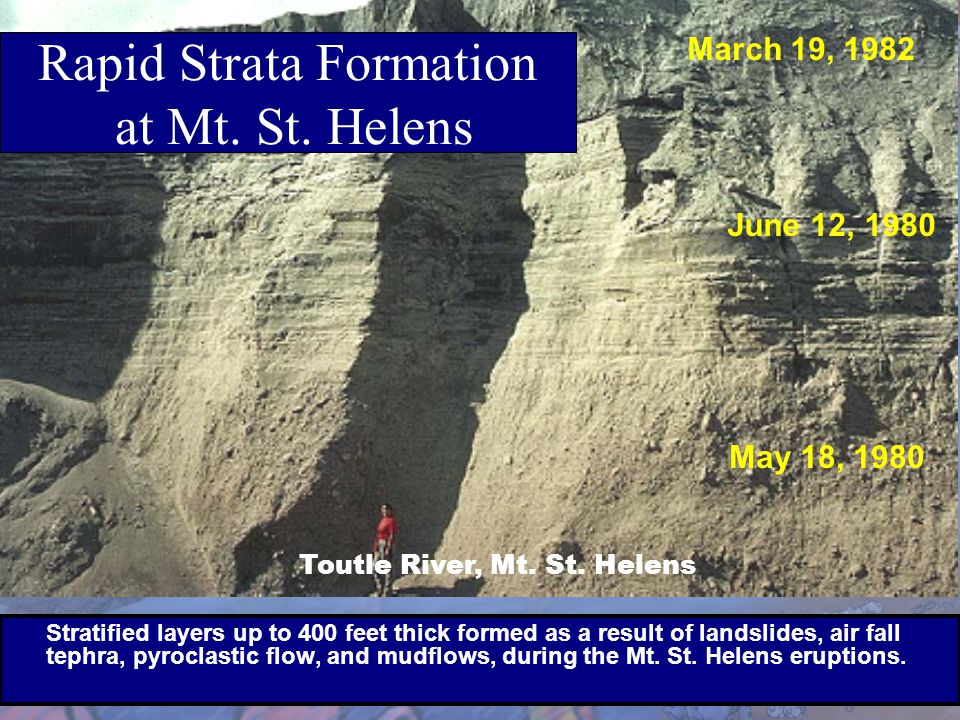
Visit the fossil museum:
www.flickr.com/photos/101536517@N06/sets/72157641367196613/
Just how good are peer reviews of scientific papers?
www.sciencemag.org/content/342/6154/60.full
www.examiner.com/article/want-to-publish-science-paper-ju...
The neo-Darwinian idea that the human genome consists entirely of an accumulation of billions of mutations is, quite obviously, completely bonkers. Nevertheless, it is compulsorily taught in schools and universities as 'science'.
This picture perfectly encapsulates my reasoning for shooting from Mistley Quay on a day of fast moving heavy cloud with just the Stour viaduct lit by the sun in this instance but not elsewhere.
Rapid strata formation in soft sand (field evidence).
Photo of strata formation in soft sand on a beach, created by tidal action of the sea.
Formed in a single, high tidal event. Stunning evidence which displays multiple strata/layers.
Why this is so important ....
It has long been assumed, ever since the 17th century, that layers/strata observed in sedimentary rocks were built up gradually, layer upon layer, over many years. It certainly seemed logical at the time, from just looking at rocks, that lower layers would always be older than the layers above them, i.e. that lower layers were always laid down first followed, in time, by successive layers on top.
This was assumed to be true and became known as the superposition principle.
It was also assumed that a layer comprising a different material from a previous layer, represented a change in environmental conditions/factors.
These changes in composition of layers or strata were considered to represent different, geological eras on a global scale, spanning millions of years. This formed the basis for the Geologic Column, which is used to date rocks and also fossils. The evolutionary, 'fossil record' was based on the vast ages and assumed geological eras of the Geologic Column.
There was also circular reasoning applied with the assumed age of 'index' fossils (based on evolutionary preconceptions) used to date strata in the Geologic Column.
We now know that, although these assumptions seemed logical, they are not supported by the evidence.
At the time, the mechanics of stratification were not properly known or studied.
An additional factor was that this assumed superposition and uniformitarian model became essential, with the wide acceptance of Darwinism, for the long ages required for progressive microbes-to-human evolution. There was no incentive to question or challenge the superposition, uniformitarian model, because the presumed, fossil 'record' had become dependant on it, and any change in the accepted model would present devastating implications for Darwinism.
This had the unfortunate effect of linking the study of geology so closely to Darwinism, that any study independent of Darwinian considerations was effectively stymied. This link of geology with Darwinian preconceptions is known as biostratigraphy.
Some of the wealth of evidence can be observed here: www.flickr.com/photos/101536517@N06/sets/72157635944904973/
and also in the links to stunning, experimental evidence, carried out by sedimentologists, given later.
_______________________________________________
GEOLOGIC PRINCIPLES (established by Nicholas Steno in the 17th Century):
What Nicolas Steno believed about strata formation is the basis of the principle of Superposition and the principle of Original Horizontality.
dictionary.sensagent.com/Law_of_superposition/en-en/
“Assuming that all rocks and minerals had once been fluid, Nicolas Steno reasoned that rock strata were formed when particles in a fluid such as water fell to the bottom. This process would leave horizontal layers. Thus Steno's principle of original horizontality states that rock layers form in the horizontal position, and any deviations from this horizontal position are due to the rocks being disturbed later.”)
BEDDING PLANES.
'Bedding plane' describes the surface in between each stratum which are formed during sediment deposition.
science.jrank.org/pages/6533/Strata.html
“Strata form during sediment deposition, that is, the laying down of sediment. Meanwhile, if a change in current speed or sediment grain size occurs or perhaps the sediment supply is cut off, a bedding plane forms. Bedding planes are surfaces that separate one stratum from another. Bedding planes can also form when the upper part of a sediment layer is eroded away before the next episode of deposition. Strata separated by a bedding plane may have different grain sizes, grain compositions, or colours. Sometimes these other traits are better indicators of stratification as bedding planes may be very subtle.”
______________________________________________
Several catastrophic events, flash floods, volcanic eruptions etc. have forced Darwinian influenced geologists to admit to rapid stratification in some instances. However they claim it is a rare phenomenon, which they known about for many years, and which does nothing to invalidate the Geologic Column, the fossil record, evotuionary timescale, or any of the old assumptions regarding strata formation, sedimentation and the superposition principle. They fail to face up to the fact that rapid stratification is not an extraordinary phenonemon, but rather the prevailing and normal mechanism of sedimantary deposition whenever and wherever there is moving, sediment-laden water. The experimental evidence demonstrates the mechanism and a mass of field evidence in normal (non-catastrophic) conditions shows it is a normal everyday occurrence.
It is clear from the experimental evidence that the usual process of stratification is - that strata are not formed by horizontal layers being laid on top of each other in succession, as was assumed. But by sediment being sorted in the flowing water and laid down diagonally in the direction of flow.
Several catastrophic events, flash floods, volcanic eruptions etc. have forced Darwinian, influenced geologists to admit to rapid stratification in some instances. However they claim it is a rare phenomenon, which they have known about for many years, and which does nothing to invalidate the Geologic Column, the fossil record, evotuionary timescale, or any of the old assumptions regarding strata formation, sedimentation and the superposition principle. They fail to face up to the fact that rapid stratification is not an extraordinary phenonemon, but rather the prevailing and normal mechanism of sedimentary deposition whenever and wherever there is moving, sediment-laden water. The experimental evidence demonstrates the mechanism and a mass of field evidence in normal (non-catastrophic) conditions shows it is a normal everyday occurrence.
It is clear from the experimental evidence that the usual process of stratification is - that strata are not formed by horizontal layers being laid on top of each other in succession, as was assumed. But by sediment being sorted in the flowing water and laid down diagonally in the direction of flow. See diagram:
www.flickr.com/photos/truth-in-science/39821536092/in/dat...
The field evidence (in the image) presented here - of rapid, simultaneous stratification refutes the Superposition Principle, the Principle of Original Horizontality and the Principle of Lateral Continuity.
We now know, the Superposition Principle only applies on a rare occasion of sedimentary deposits in perfectly, still water. Superposition is required for the long evolutionary timescale, but the evidence shows it is not the general rule, as was once believed. Most sediment is laid down in moving water, where particle segregation is the general rule, resulting in the simultaneous deposition of strata/layers as shown in the photo.
See many other examples of rapid stratification with geological features: www.flickr.com/photos/101536517@N06/sets/72157635944904973/
Rapid, simultaneous formation of layers/strata, through particle segregation in moving water, is so easily created it has even been described by sedimentologists (working on flume experiments) as a law ...
"Upon filling the tank with water and pouring in sediments, we immediately saw what was to become the rule: The sediments sorted themselves out in very clear layers. This became so common that by the end of two weeks, we jokingly referred to Andrew's law as "It's difficult not to make layers," and Clark's law as "It's easy to make layers." Later on, I proposed the "law" that liquefaction destroys layers, as much to my surprise as that was." Ian Juby, www.ianjuby.org/sedimentation/
The example in the photo is the result of normal, everyday tidal action in a single incident. Where the water current or movement is more turbulent, violent, or catastrophic, great depths (many metres) of stratified sediment can be laid down in a short time. Certainly not the many millions of years assumed by evolutionists.
The composition of strata formed in any deposition event. is related to whatever materials are in the sediment mix, not to any particular timescale. Whatever is in the mix will be automatically sorted into strata/layers. It could be sand, or other material added from mud slides, erosion of chalk deposits, coastal erosion, volcanic ash etc. Any organic material (potential fossils), alive or dead, engulfed by, or swept into, a turbulent sediment mix, will also be sorted and buried within the rapidly, forming layers.
See many other examples of rapid stratification with geological features: www.flickr.com/photos/101536517@N06/sets/72157635944904973/
Stratified, soft sand deposit. demonstrates the rapid, stratification principle.
Important, field evidence which supports the work of the eminent, sedimentologist Dr Guy Berthault MIAS - Member of the International Association of Sedimentologists.
(Dr Berthault's experiments (www.sedimentology.fr/)
And also the experimental work of Dr M.E. Clark (Professor Emeritus, U of Illinois @ Urbana), Andrew Rodenbeck and Dr. Henry Voss, (www.ianjuby.org/sedimentation/)
Location: Sandown, Isle of Wight. Formed 18/01/2018, This field evidence demonstrates that multiple strata in sedimentary deposits do not need millions of years to form and can be formed rapidly. This natural example confirms the principle demonstrated by the sedimentation experiments carried out by Dr Guy Berthault and other sedimentologists. It calls into question the standard, multi-million year dating of sedimentary rocks, and the dating of fossils by depth of burial or position in the strata.
Mulltiple strata/layers are evident in this example.
Dr Berthault's experiments (www.sedimentology.fr/) and other experiments (www.ianjuby.org/sedimentation/) and field studies of floods and volcanic action show that, rather than being formed by gradual, slow deposition of sucessive layers superimposed upon previous layers, with the strata or layers representing a particular timescale, particle segregation in moving water or airborne particles can form strata or layers very quickly, frequently, in a single event.
And, most importantly, lower strata are not older than upper strata, they are the same age, having been created in the same sedimentary episode.
Such field studies confirm experiments which have shown that there is no longer any reason to conclude that strata/layers in sedimentary rocks relate to different geological eras and/or a multi-million year timescale. www.youtube.com/watch?v=5PVnBaqqQw8&feature=share&.... they also show that the relative position of fossils in rocks is not indicative of an order of evolutionary succession. Obviously, the uniformitarian principle, on which the geologic column is based, can no longer be considered valid. And the multi-million, year dating of sedimentary rocks and fossils needs to be reassessed. Rapid deposition of stratified sediments also explains the enigma of polystrate fossils, i.e. large fossils that intersect several strata. In some cases, tree trunk fossils are found which intersect the strata of sedimentary rock up to forty feet in depth. upload.wikimedia.org/wikipedia/commons/thumb/0/08/Lycopsi... They must have been buried in stratified sediment in a short time (certainly not millions, thousands, or even hundreds of years), or they would have rotted away. youtu.be/vnzHU9VsliQ
In fact, the vast majority of fossils are found in good, intact condition, which is testament to their rapid burial. You don't get good fossils from gradual burial, because they would be damaged or destroyed by decay, predation or erosion. The existence of so many fossils in sedimentary rock on a global scale is stunning evidence for the rapid depostion of sedimentary rock as the general rule. It is obvious that all rock containing good intact fossils was formed from sediment laid down in a very short time, not millions, or even thousands of years.
See set of photos of other examples of rapid stratification: www.flickr.com/photos/101536517@N06/sets/72157635944904973/
Carbon dating of coal should not be possible if it is millions of years old, yet significant amounts of Carbon 14 have been detected in coal and other fossil material, which indicates that it is less than 50,000 years old. www.ldolphin.org/sewell/c14dating.html
www.grisda.org/origins/51006.htm
Evolutionists confidently cite multi-million year ages for rocks and fossils, but what most people don't realise is that no one actually knows the age of sedimentary rocks or the fossils found within them. So how are evolutionists so sure of the ages they so confidently quote? The astonishing thing is they aren't. Sedimentary rocks cannot be dated by radiometric methods*, and fossils can only be dated to less than 50,000 years with Carbon 14 dating. The method evolutionists use is based entirely on assumptions. Unbelievably, fossils are dated by the assumed age of rocks, and rocks are dated by the assumed age of fossils, that's right ... it is known as circular reasoning.
* Regarding the radiometric dating of igneous rocks, which is claimed to be relevant to the dating of sedimentary rocks, in an occasional instance there is an igneous intrusion associated with a sedimentary deposit -
Prof. Aubouin says in his Précis de Géologie: "Each radioactive element disintegrates in a characteristic and constant manner, which depends neither on the physical state (no variation with pressure or temperature or any other external constraint) nor on the chemical state (identical for an oxide or a phosphate)."
"Rocks form when magma crystallizes. Crystallisation depends on pressure and temperature, from which radioactivity is independent. So, there is no relationship between radioactivity and crystallisation.
Consequently, radioactivity doesn't date the formation of rocks. Moreover, daughter elements contained in rocks result mainly from radioactivity in magma where gravity separates the heavier parent element, from the lighter daughter element. Thus radiometric dating has no chronological signification." Dr. Guy Berthault www.sciencevsevolution.org/Berthault.htm
Visit the fossil museum:
www.flickr.com/photos/101536517@N06/sets/72157641367196613/
Just how good are peer reviews of scientific papers?
www.sciencemag.org/content/342/6154/60.full
www.examiner.com/article/want-to-publish-science-paper-ju...
The neo-Darwinian idea that the human genome consists entirely of an accumulation of billions of mutations is, quite obviously, completely bonkers. Nevertheless, it is compulsorily taught in schools and universities as 'science'.
SOOC
Today was a day of Ghost Adventures, school work, crying, thinking, and laying. I watched The Other Guys with Kat n Cody, it was gay but I laughed a few times. And got my next set of school books in the mail, gonna start Teachers Aid after I complete Psychology in Social Life.
There is way too much on my mind right now. Its my step brothers 12th birthday. I haven't spoken to him in years. In all reality it is my step dads fault... but people make mistakes, sometimes big ones, painful ones. But family is family, love is love, and you shouldnt ever give up on family. His dad is here, on this Earth... It stings to think about it but it makes me think about my dad... Today was the first day in years that Iv cried over my dad... If I could Id forgive him in a heart beat and fight to be a part of his world cause thats what you do for your family. Yeah.. enough of that... Sorry for being such a downer today, I know I tend to share too much but it does feel good putting it out there.
To slightly lighten the mood I have a question. What happens to your facebook when you die? I was talking about it with Chiara today. She says that shed keep a dead friend on her page, I wouldnt. She said shed want her page to stay up awhile, I wouldnt. Heres my reasonings. Social networking is for the living. I wouldnt want to have to see my dead friends face everytime I look thru my friends, itd be too painful. And kinda creepy, your no longer living! Your status would have to get changed cause whatever it was before no long applies cause your dead... So what if no one else had your password? Could you contact FB and be like theyr dead now can you delete the account? Im just confused lol.
About the sticky note. This is the perfect example of what I mean when I say this is a list of things I want to do in this life time, this is something I wont be able to cross off for years. Kids hold a very special place in my life, if I was meant to do something it was to be a mom. Kids just make my life so much happier, I enjoy running around and redirecting and entertaining and teaching and just taking care of kids. It makes me feel worth while. When I have a family I want to give them the world, the plain and sometimes not so simple world. My kids will play with sticks lol I love to travel, but I also know happiness is only real when shared.
The picture was taken on my window. I watched the sun fade today, thats how bored I was lol. I kinda like this tho.
I hope you all are having a better day than I but dont worry about me. If it wasnt for these days when you feel down youd never be able to appreciate all the other days.
Thanks for lending me your eyes :)
In some circles of environmental management, the common phrase is "Dilution is the Solution to Pollution". This must be the reasoning why the state of Ohio allows drilling companies to spread brine or produced water, also known as the toxic waste from hydraulic fracturing for natural gas along Ohio's roadways. Up to 10% of this radioactive, cancerous, overly salted and mysterious byproduct is spread on gravel roads to suppress dust and used as a deicer on the roads. While dilution occurs in snow events, there's not much dilution in dusty drought conditions. There are obvious inconsistencies between The Ohio Department of Natural Resources and the Environmental Protection Agency in regards to this improper disposal of toxic waste.
I certainly don't want this waste crusting over That Car #3!
ODNR says
"...BRINE HAULING AND SPREADING The spreading of oil-field brine is a legal, cost-effective, and efficient way to control dust and ice problems on local roads and private property in Ohio. Ohio’s UIC Program regulates the hauling and spreading of oil-field brine while local authorities, such as the County Commissioners and Township Trustees, permit the actual spreading on public roads and private property.
The Division reviews all local brine spreading resolutions and plans passed by the local jurisdictions to ensure compliance with state law. State law requires a minimum of nine brine spreading standards incorporated into all local resolutions. Local authorities have the power to require spreading standards that are more stringent than state law.
All registered brine haulers must have the identification number issued by the Division, the word “brine”, and the name and telephone number of the hauler on the sides or rear of their trucks. All of this information must be in reflective paint and the letters on the vehicle must be no less than four inches in height. Ohio oil-field brine is tracked from “cradle to grave” and all brine haulers must maintain a daily log in their trucks...." MORE:
www.ohiodnr.com/mineral/injection/tabid/10374/Default.aspx
EPA says
"....When oil and gas are extracted, large amounts of brine are typically brought to the surface. Often saltier than seawater, this brine can also contain toxic metals and radioactive substances. It can be very damaging to the environment and public health if it is discharged to surface water or the land surface. By injecting the brine deep underground, Class II wells prevent surface contamination of soil and water.
When states began to implement rules preventing disposal of brine to surface water bodies and soils, injection became the preferred way to dispose of this waste fluid. All oil and gas producing states require the injection of brine into the originating formation or into formations that are similar to those from which it was extracted....." MORE:
water.epa.gov/type/groundwater/uic/class2/
Columbus Dispatch says:
"...Required lab tests showed radium at levels 36 times higher than the state’s safety standard.Some critics say they worry that Ohio municipalities will spray shale brine on roadways in winter to combat ice. There are no restrictions against using shale-well brine on Ohio roadways.
Cities, townships and others now spray brine from conventional oil and gas wells. However, state officials say they routinely tell drilling companies to take shale wastewater to disposal wells...."
www.dispatch.com/content/stories/local/2012/09/03/gas-wel...
Akron Beacon Journal - February 2013 - if it's not good for our rivers, then why over our roads? Obviously, you can't expect "best practices" to always be followed. www.ohio.com/business/ohio-epa-investigating-dumping-of-d...
Columbus Dispatch - February 2013 "....Much of the injected water comes back up. In addition to spent fracking chemicals, it also includes naturally occurring toxic metals, radium and huge concentrations of salt....." www.dispatch.com/content/stories/local/2013/02/16/frackin...
Columbus Dispatch, March 2013 - Ohio doesn't participate in development of drilling safety standards..... like it is a good thing. "Ohio not part of nonbinding ‘fracking’ pact" www.dispatch.com/content/stories/local/2013/03/31/ohio-no...
Pittsburgh Post Gazette - August 1, 2013 - drilling companies take drastic measures to keep people quiet. "The non-disclosure agreement prohibiting Chris and Stephanie Hallowich from talking about the 2011 settlement of their high-profile Marcellus Shale damage case in Washington County, or saying anything about gas drilling and fracking, isn't unusual. It happens often in settling such cases. But the insistence that their two minor children, then ages 7 and 10, are also bound by the "gag order" is......" more: www.post-gazette.com/stories/local/washington/confidentia...
The African Bush Elephant (Loxodonta africana) is the larger of the two species of African elephant. The other species is the closely related Forest Elephant (Loxodonta cyclotis). The African Bush Elephant is also known as the Bush Elephant or Savanna Elephant.
The Bush Elephant is the largest living terrestrial animal, normally reaching 6 to 7.3 m in length and 2,4 to 3.5 m in height at the shoulder, and weighing between 2,400 to 8,000 kg. The animal is characterized by its large head; two large ears that cover its shoulders and radiate excess heat; a large and muscular trunk; two prominent tusks, which are well-developed in both sexes. African Bush Elephants are herbivorous.
The African Elephant is an intelligent animal. Experiments with reasoning and learning show that they are the smartest ungulates together with their Asian cousins.
The adult African Bush Elephant generally has no natural predators due to its great size, but the calves (especially the newborn) are vulnerable to lion and crocodile attacks, and (rarely) to leopard and hyena attacks. The Bush Elephant normally moves at a rate of 6 km/h, but it can reach a top speed of 40 km/h when scared or upset.
Humans are the elephant's major predator. Elephants have been hunted for meat, skin, bones, and tusks. Elephant trophy hunting increased in the 19th and 20th centuries, when tourism and plantations increasingly attracted sport hunters. In 1989, hunting of the African Bush Elephant for ivory trading was forbidden, after the elephant population fell from several million at the beginning of the 20th century to fewer than 750,000. Trophy hunting continues today. The population of African Bush Elephants was halved during the 1980s. Poaching is still common. CITES still considers the species as threatened with extinction.
This picture is taken at Ouwehands Dierenpark, Zoo in Rhenen, the Netherlands
De savanneolifant (Loxodonta africana) is de grootste en bekendste van de twee Afrikaanse olifanten (Loxodonta). Voorheen werd de verwante bosolifant (Loxodonta cyclotis) beschouwd als een ondersoort van de savanneolifant, maar tegenwoordig worden de twee dieren beschouwd als aparte soorten.
De savanneolifant is het grootste landdier. Een bul weegt tussen de 3500 en 8000 kg, een koe 2400 tot 4500 kg. Ze worden 240 tot 350 cm hoog en 6 tot 7,3 m lang.
Zijn dikke huid is lichtgrijs tot zwartgrijs of bruin van kleur. De oren zijn veel groter als bij de Aziatische olifant. De grote oren zijn rijk doorbloed, waardoor ze het lichaam kunnen afkoelen. Veel warmte kan via de oren ontsnappen als de olifant met deze wappert.
Zowel mannetjes als vrouwtjes hebben grote, naar voren gebogen slagtanden. De poten zijn hoog en zuilvormig. De slurf van de savanneolifant is lang en flexibel, en kan gebruikt worden als vijfde ledemaat.
De savanneolifant kwam vroeger in bijna geheel Afrika voor, met uitzondering van de droogste plekken van de Sahara en in de regenwoudgordel van West- en Centraal-Afrika. In het regenwoud leeft de verwante bosolifant. Soms leven beide soorten naast elkaar. Tegenwoordig is savanneolifant uitgestorven in Noord-Afrika en leeft hij op slechts een handvol plaatsen in Zuid- en West-Afrika.
Hij kan overleven in alle landschappen, van woestijnen tot regenwouden, van kusten tot gebergten, maar hij is vooral algemeen op savanne en grasland.
Savanneolifanten ontwortelen bomen, graven waterputten en trappen de begroeiing plat, waardoor heel nieuwe leefgebieden ontstaan en bos verandert in savanne.
Olifanten zijn niet kieskeurig en eten zowat alles wat plantaardig is.
In de jaren dertig en veertig van de vorige eeuw waren er vijf tot tien miljoen olifanten in Afrika. Tegenwoordig zijn het er waarschijnlijk 500.000 tot 750.000.
Er wordt nog altijd illegaal op gejaagd voor het ivoor en andere jachttrofeeën, maar ook worden ze gedood omdat ze landbouwgebieden verwoesten.
Daarentegen zijn er voor weinig diersoorten zoveel beschermingsmaatregelen genomen als voor de savanneolifant, en op veel plekken is hun aantal stabiel of zelfs stijgende.
Deze foto is genomen in Ouwehands Dierenpark in Rhenen.
Documentation source: Wikipedia (EN and NL)
______________________________________________________________________
Site Ouwehands Dierenpark / Zoo in Dutch, English and German: www.ouwehand.nl/
______________________________________________________________________
All rights reserved. Copyright © Martien Uiterweerd. All my images are protected under international authors copyright laws and may not be downloaded, reproduced, copied, transmitted or manipulated without my written explicit permission.
______________________________________________________________________
The Colonial the main feature in the film’s most memorable scene in 1958, The Run-Out. As a result, on a Friday night in the middle of July, an imaginary version of The Blob returns to Phoenixville’s local theater. The full house consisting of 500 people of all ages gathers inside the century-old theater to relive The Run-Out as if it were 1958 all over again. Mark Stuart, a Blobfest fan, recaps his time before The Blob’s showing in an interview with the AARP, “This is the seat where Tony sat and his girlfriend when Steve comes running up to tell them a monster has entered the city. We have to come here three hours early.” What is Stuart’s reasoning for such an early arrival? “My daughter Natalie, she’s four years old . . . insists that we sit in these seats.” If hundreds upon hundreds like the Stuarts show up early just to watch The Blob, think how many want to participate in its re-enactment. The lucky few who do enter try their best to cherish the tense final seconds before the big moment.Some of the most loyal fans repeat the movie’s lines for an even more realistic experience. YouTube videos document the faux screams and fake terror as 500 people trip and fall over each other as they exit the theater just like the original extras forty-plus years ago.
Check out the full story
pabook.libraries.psu.edu/palitmap/Blobfest.html
dai.ly/xlt3zd Full Feature Film
youtu.be/HCtcgI4BcIQ Theme Song: The Blob by the Five Blobs (1958)
As the last "A" venture of the 1950s in the sci-fi genre by a major studio, The Blob is a sort of landmark. The big studios would produce A-level sci-fi in the 60s, but by then, the mood and tenor of sci-fi films had left behind the simpler themes that marked the 50s. The Blob is pure 50s. A creature from space falls into small town America. In keeping with the trend of the later 50s, it is the spunky teens who manage to save the world. The Blob doesn't lack for production value, but does suffer from an almost adolescent identity crisis. It wavers between campy parody and a serious tale, never quite settling on either. The Blob endures as a memorable sample of 50s sci-fi culture. It was remade in the 1980s (in a more gore-centric 80s style). The B film that ran with The Blob has been nearly forgotten. I Married A Monster From Outer Space was a better movie than the title implies. It, too, was aimed at the teen audience.
Synopsis
Steve (McQueen) has Jane up at a lookout point on the pretense of looking for shooting stars, but kissing is what he's after. She's not that kind of girl. The awkward moment is broken by a falling meteor. They go investigate. On old man also investigates. He finds the volleyball sized meteor. He pokes it with a stick. It cracks open to reveal an orange-sized glob. He pokes this with his stick. it gloms onto his fingers. Steve and Jane find the old man in the road, writhing in pain. They take him to Doc Hallen. Doc sends them back out to find more clues. Meanwhile, the blob has grown. It eventually consumes the old man, then attacks Doc's nurse. It consumes Doc too, just as Steve returned without news. Steve glimpses Doc's demise. He tries to tell the police is not believed. From there, the blob consumes other late night townsfolk. Several scenes underscore how the adults don't believe "the kids" as they try to warn people. Eventually, the now giant blob attacks a theater full of people while all the adults are present. The blob engulfs a diner across the street, where Steve, Jane and a few others are holed up. No escape. High voltage shock does not kill the Blob, but does spark a fire in the diner. Using CO2 extinguishers, Steve notices that the blob recoils from cold. He gets word to the adults who round up all the CO2 extinguishers in town. With them, they chill and shrink the blob. Steve, Jane and the others escape. The blob is airlifted to the arctic. The End?
This is one of the classics of 50s sci-fi, so it has a certain mystique. The premise is pure 50s (a deadly invader from space). The "monster" as a faceless (and clawless) red mass is refreshingly different, even if it's not the first blob monster.
There is a sort of legacy connection to the Cold War, in that many of the prior invader movies were analogies for Cold War anxieties about invasion. By this time, however, invaders from space had started to become a trope unto themselves.
One of the fun features of The Blob is seeing the hackneyed solution fail. In many sci-fi films, high-voltage electricity is used to kill the monster. It started with The Thing in 1951 and persisted through the 50s and into the 60s. Good ol' electricity will save the Earth. The writers play to movie tradition. Audiences expected the power line to kill the blob. It doesn't. This was a fun twist. The blob cannot be killed. It can only be chilled.
The opening theme music, beneath the credits, has spawned much conversation. The jazzy, rock tempo and silly lyrics suggest a comedic parody of a monster movie. Yet, the movie itself is played out very much in earnest (aside from a few light comic-relief scenes). The dissonance is difficult for many to reconcile. From a teen-aged point of view, however, it's not so contradictory. The jazzy music reflects the teen mindset, out for an evening of fun and diversion at the movies. The movie itself is like a scary campfire story -- told in serious tones, but for entertainment.
Reflecting the trend of the late 50s, the protagonists in The Blob are high school teens. They are the smart ones, the responsible ones, the heroic ones who will save the world. The adults are cast as shallow fools. Only Policeman Dave and Doc Hallen get treated with any sympathy, and this only because they believe the teens. The screenplay definitely panders to its audience's ego -- teens are always right. This trend will stay in vogue awhile longer in movies, and eventually become embedded in American youth culture.
Paramount's 1958 blob is the better remembered blob monster, but it wasn't the first. Their blob was much like the one in X-The Unknown ('57), a UK film about a blob monster from within the earth. The '57 blob melted people with its radiation, but it 'fed' on isotopes. Like the '58 blob, it was semi-sentient in moving and seeking food. The "blood rust" of Space Master X-7 (June '58) was a blob-like fungus which did feed on human flesh, though it was less animate. It was suggested to have an intellect, but this was never evident.
Steve McQueen does a good enough job of acting his role as a semi-miscreant teen, but his face isn't up to the part. He was, at the time of shooting, in his late 20s. It takes a bit of willing suspension of belief to accept his as a high school boy.
Bottom line? The Blob is one of the 50s classics, so really ought not be missed. It's not high art. It is drive-in entertainment and can be appreciated as such.
Review
One of the more memorable low-budget 1950s monster movies, The Blob deals with a gelatinous alien mass which gobbles up a small town, growing bigger as it feeds on human beings. Steve McQueen is the good-hearted juvenile delinquent (okay, so he was 28) who tries to warn the adults, but they don't listen. This Pennsylvania-shot chiller has a number of well-done scenes, including an attack on a movie theater showing Daughter of Horror, as well as the standard drag-racing and other teenage hijinks. Aneta Corsaut plays McQueen's girlfriend, and Olin Howland is the old man with the stick in the film's creepy opening sequence. Kitschy, but fun, the film was followed by Son of Blob in 1972 and remade in 1988.
Kamera: Leica IIIc (1946) IIIf upgraded
Linse: Leica Summar 50mm f/2 (1937)
Film: Kodak 5222 @ ISO 400
Kjemi: Fomadon Excel (stock / 9 min. @ 20°C)
Wikipedia: Unit 8200
Re-Publishing...
REVEALED: THE ISRAELI SPIES WRITING AMERICA’S NEWS
by Alan Macleod
MPN.news, October 16, 2024
"One year after Oct. 7 attacks, Netanyahu is on a winning streak." So reads the title of a recent Axios article describing the Israeli prime minister riding on an unbeatable wave of triumphs. These stunning military "successes," its author Barak Ravid (b. 1980) notes, include the bombing of Yemen, the assassinations of Hamas chief Ismail Haniyeh (1962-2024) and Hezbollah leader Hassan Nasrallah (1960-2024), and the pager attack against Lebanon.
The same author recently went viral for an article that claimed that Israeli attacks against Hezbollah are "not intended to lead to war but are an attempt to reach 'de-escalation through escalation.'" Users on social media mocked Ravid for this bizarre, Orwellian reasoning. But what almost everybody missed is that Barak Ravid is an Israeli spy – or at least he was until recently. Ravid is a former analyst with Israeli spying agency Unit 8200, and as recently as last year, was still a reservist with the Israeli Defense Forces group.
Unit 8200 is Israel's largest and perhaps most controversial spying organization. It has been responsible for many high-profile espionage and terror operations, including the recent pager attack that injured thousands of Lebanese civilians. As this investigation will reveal, Ravid is far from the only Israeli ex-spook working at top U.S. media outlets, working hard to manufacture Western support for his country's actions.
White House Insider
Barak Ravid (b. 1980) has quickly become one of the most influential individuals in the Capitol Hill press corps. In April, he won the prestigious White House Press Correspondents' Award [The Aldo Beckman Award for Journalistic Excellence] "for overall excellence in White House coverage"—one of the highest awards in American journalism. Judges were impressed by what they described as his "deep, almost intimate levels of sourcing in the U.S. and abroad" and picked out six articles as exemplary pieces of journalism.
Most of these stories consisted of simply printing anonymous White House or Israeli government sources, making them look good, and distancing President Biden from the horrors of the Israeli attack on Palestine. As such, there was functionally no difference between these and White House press releases. For example, one story the judges picked out was titled "Scoop: Biden tells Bibi 3-day fighting pause could help secure release of some hostages," and presented the 46th President of the United States as a dedicated humanitarian hellbent on reducing suffering. Another described how "frustrated" Biden was becoming with Netanyahu and the Israeli government.
Protestors had called on reporters to snub the event in solidarity with their fallen counterparts in Gaza (which, at the time of writing, comes to at least 128 journalists). Not only was there no boycott of the event, but organizers gave their highest award to an Israeli intelligence official-turned-reporter who has earned a reputation as perhaps the most dutiful stenographer of power in Washington.
Ravid was personally presented with the award by President Biden, who embraced him like a brother. That a known (former) Israeli spy could hug Biden in such a manner speaks volumes about not only the intimate relationship between the United States and Israel but about the extent to which establishment media holds power to account.
It was a moving and special night that I never imagined even in my wildest dreams. It wouldn't have been possible without my editors at @axios who made my stories better, my sources who trusted me, my family that came with me to Washington, and you, the readers. Thank you
— Barak Ravid (@BarakRavid) April 28, 2024
Ravid has made a name for himself by uncritically printing flattering information given to him by either the U.S. or Israeli government and passing it off as a scoop. In April, he wrote that "President Biden laid out an ultimatum to Israeli Prime Minister Benjamin Netanyahu in their call on Thursday: If Israel doesn't change course in Gaza, 'we won't be able to support you,'" and that he was "making his strongest push for an end to the fighting in Gaza in six months of war, and warning for the first time that U.S. policy on the war will depend on Israel's adherence to his demands," which included "an immediate ceasefire." In July, he repeated anonymous sources that told him that Netanyahu and Israel are striving for "a diplomatic solution" – another highly dubious claim.
Other articles by Ravid following the same pattern include:
- Scoop: Biden tells Bibi he's not in it for a year of war in Gaza
- Scoop: White House cancels meeting, scolds Netanyahu in protest over video
- Biden "running out" of patience with Bibi as Gaza war hits 100 days
- Biden-Bibi clash escalates as U.S. accused of undermining Israeli government
- Biden and Bibi "red lines" for Rafah put them on a collision course
- Biden on hot mic: Told Bibi we needed "come to Jesus" meeting on Gaza
- Scoop: White House loses trust in Israeli government as Middle East spirals
- Israeli minister lambasted at White House about Gaza and war strategy
- Scoop: Biden told Bibi U.S. won't support an Israeli counterattack on Iran
This relentless whitewashing of the Biden administration has drawn widespread mockery online.
"AXIOS EXCLUSIVE: After selling Netanyahu millions of dollars worth of weapons, Biden played —loudly — Taylor Swift's 'Bad Blood.' 'Everyone could hear it,' a source close to Biden says," tweeted X user David Grossman. "Continuing to hand over big piles of cash and weapons, but shaking my head so everyone knows i sort of disagree with it," quipped comedian Hussein Kesvani, in response to Ravid's latest article suggesting that Biden has become "increasingly distrustful" of the Israeli government.
Throughout this supposed split between the U.S. and Israel, the Biden administration has continued to voice enthusiastic support for Israeli offensives, block ceasefire resolutions and Palestinian statehood at the U.N., and has sent $18 billion worth of weapons to Israel in the past 12 months. Thus, no matter how questionable these Axios reports are, they serve a vital role for Washington, allowing the Biden administration to distance itself from what international bodies have labeled a genocide. Ravid's function has been to manufacture consent for the government among elite liberal audiences who read Axios, allowing them to continue to believe that the U.S. is an honest broker for peace in West Asia rather than a key enabler of Israel.
Ravid does not hide his open disdain for Palestinians. In September, he retweeted a post that stated:
”That’s the PaliNazi way…they pocket concessions without giving anything in return and then use those concessions as the baseline for the next round of negotiations. PaliNazis don’t know how to tell the truth.”
Less than one week later, he promoted Israeli Defense Minister Yoav Gallant's highly dubious claim that Israeli Defense Forces had found a picture of the children al-Qassam Brigades leader Mohammed Sinwar celebrating in front of a huge picture of planes hitting the World Trade Center. Gallant stated that they had found this picture – clearly trying to falsely associate Palestinians with 9/11 – in a tunnel "where the Sinwar brothers were hiding like rats."
this is amazing. Barak Ravid, who is considered by the Western media class to be the greatest most objective neutral "journalist" on the ongoing Gaza genocide even though he served in Israeli military intelligence and constantly launders Israeli propaganda, is now openly…
— ☀️ (@zei_squirrel) September 6, 2024
An Infamous Spy Agency
Founded in 1952, Unit 8200 is the Israeli military's largest and most controversial division.
Responsible for covert operations, spying, surveillance and cyberwarfare, since October 7, 2023, the group has been at the forefront of the world's attention. It is widely identified as the organization behind the infamous pager attack on Lebanon, which left at least nine dead and around 3,000 people injured. While many in Israel (and Ravid himself) hailed the operation as a success, it was condemned worldwide as an egregious act of terrorism, including by ex-CIA director Leon Panetta (b. 1938).
Unit 8200 has also constructed an artificial intelligence-powered kill list for Gaza, suggesting tens of thousands of individuals (including women and children) for assassination. This software was the primary targeting mechanism the IDF used in the early months of its attack on the densely populated strip.
- Peter Thiel: From Gaza AI War Criminal To White House Puppet Master
Described as Israel's Harvard, Unit 8200 is one of the most prestigious institutions in the country. The selection process is highly competitive; parents spend fortunes on science and math classes for their children, hoping they will be picked for service there, unlocking a lucrative career in Israel's burgeoning hi-tech sector.
It also serves as the centerpiece of Israel's futuristic repressive state apparatus. Using gigantic amounts of data compiled on Palestinians by tracking their every move through face recognition cameras monitoring their calls, messages, emails and personal data, Unit 8200 has created a dystopian dragnet that it uses to surveil, harass and suppress Palestinians.
Unit 8200 compiles dossiers on every Palestinian, including their medical history, sex lives and search histories, so that this information can be used for extortion or blackmail later. If, for example, an individual is cheating on their spouse, desperately needs a medical operation, or is secretly homosexual, this can be used as leverage to turn civilians into informants and spies for Israel. One former Unit 8200 operative Flickr: Explore! that as part of his training, he was assigned to memorize different Arabic words for "gay" so that he could listen out for them in conversations.
Unit 8200 operatives have gone on to create some of the world's most downloaded apps and many of the most infamous spying programs, including Pegasus. Pegasus was used to surveil dozens of political leaders around the world, including France's Emmanuel Macron, South Africa's Cyril Ramaphosa, and Pakistan's Imran Khan.
The Israeli government authorized the sale of Pegasus to the Central Intelligence Agency, as well as some of the most authoritarian governments on the planet. This included Saudi Arabia, who used the software to surveil Washington Post journalist Jamal Khashoggi (1958-2018) before he was assassinated by Saudi agents in Türkiye.
A recent MintPress News investigation found that a large proportion of the worldwide VPN market is owned and operated by an Israeli company headed and co-founded by a Unit 8200 alumnus.
- Exposed: How Israeli Spies Control Your VPN
In 2014, 43 Unit 8200 reservists penned a joint statement declaring that they were no longer willing to serve in the unit on account of its unethical practices, which included making no distinction between ordinary Palestinian citizens and terrorists. The letter also noted that their intelligence was passed on to powerful local politicians, who used it as they saw fit.
This public statement left Ravid bristling with anger at his co-workers. In the wake of the scandal, Ravid went on Israeli Army radio to attack the whistleblowers. Ravid said that to oppose the occupation of Palestine was to oppose Israel itself, as the occupation is a fundamental "part" of Israel. "If the problem is really the occupation," he said, "then your taxes are also a problem — they fund the soldier at the checkpoint, the education system… and 8200 is a great spin."
Leaving aside Ravid's comments, the question arises: is it really acceptable that members from a group designed to infiltrate, surveil and target foreign populations, that has produced many of the planet's most dangerous and invasive spying technology, and is widely to be behind sophisticated international terror attacks, are writing Americans' news about Israel and Palestine? What would the reaction be if senior figures in U.S. media were outed as intelligence officers for Hezbollah, Hamas, or Russia's F.S.B.?
News About Israel, Brought to You by Israel
Ravid is far from the only influential journalist in America with deep ties to the Israeli state, however. Shachar Peled spent three years as an officer in Unit 8200, leading a team of analysts in surveillance, intelligence and cyberwarfare. She also served as a technology analyst for the Israeli intelligence service, Shin Bet. In 2017, she was hired as a producer and writer by CNN and spent three years putting together segments for Fareed Zakaria and Christiane Amanpour's shows. Google later hired her to become their Senior Media Specialist.
Another Unit 8200 agent who went on to work for CNN is Tal Heinrich. Heinrich spent three years as a Unit 8200 agent. Between 2014 and 2017, she was the field and news desk producer for CNN's notoriously pro-Israel Jerusalem Bureau, where she was one of the principal journalists shaping America's understanding of Operation Protective Edge, Israel's bombardment of Gaza that killed more than 2,000 people and left hundreds of thousands displaced. Heinrich later left CNN and is now the official spokesperson of Prime Minister Benjamin Netanyahu.
CNN's penchant for hiring Israeli state figures continues to this day. Tamar Michaelis, for example, currently works for the network, producing much of its Israel/Palestine content. This is despite having previously Flickr: Explore! as an official IDF spokesperson in the Israeli Defense Forces.
The New York Times, meanwhile, hired Flickr: Explore!, which claimed that Hamas fighters systematically sexually violated Israelis on October 7. Times staff themselves revolted over the lack of evidence and fact-checking in the piece.
Multiple New York Times employees, including star columnist David Brooks (b. 1961), have had children serving in the IDF; even as they report or offer opinions on the region, the Times never disclosed these glaring conflicts of interest to its readers. Nor has it disclosed that it purchased a Jerusalem house for its bureau chief that was stolen from the family of Palestinian intellectual Ghada Karmi (b. 1939) in 1948.
MintPress News interviewed Karmi last year about her latest book and Israeli attempts to silence her. Former New York Times Magazine writer and current editor-in-chief of The Atlantic Jeffrey Goldberg (b. 1965) (an American) dropped out of the University of Pennsylvania to volunteer as an IDF prison guard during the first Palestinian Intifada (uprising). In his memoirs, Goldberg revealed that, while serving in the IDF, he helped cover up the abuse of Palestinian prisoners.
Social media companies, too, are filled with former Unit 8200 agents. A 2022 MintPress study found no fewer than 99 former Unit 8200 operatives working for Google.
- Revealed: The Former Israeli Spies Working in Top Jobs at Google, Facebook and Microsoft
Facebook also employs dozens of ex-spooks from the controversial unit. This includes Emi Palmor (b. 1966), who sits on Meta's oversight board. This 21-person panel ultimately decides the direction of Facebook, Instagram and Meta's other offerings, adjudicating on what content to allow, promote, and what to suppress. Meta has been formally condemned for its systematic suppression of Palestinian voices across its platforms by Human Rights Watch, which documented over 1,000 instances of overt anti-Palestinian censorship in October and November 2023 alone. A measure of this bias is highlighted by the fact that, at one point, Instagram automatically inserted the word "terrorist" into the profiles of users who called themselves Palestinian.
Despite the widespread claims by U.S. politicians that it is a hotbed of anti-Israel and anti-Semitic racism, TikTok also employs many former Unit 8200 agents in key positions in its organization. For example, in 2021, it hired Asaf Hochman as its global head of product strategy and operations. Before joining TikTok, Hochman spent over five years as an Israeli spook. He now works for Meta.
Top Down Pro-Israel Censorship
When it comes to the Israeli attack on its neighbors, corporate media has consistently displayed a pro-Israel bias. The New York Times, for example, regularly Flickr: Explore! of the paper's coverage found that words like "slaughter," "massacre," and "horrific" appear 22 times more frequently when discussing Israeli deaths than Palestinian ones, despite the gigantic disparity in the number of people killed on both sides.
Meanwhile, in a story about how Israeli soldiers shot 335 bullets at a car containing a Palestinian child and then shot the rescue workers who came to save her, CNN printed the headline "Five-year-old Palestinian girl found dead after being trapped in car with dead relatives" – a title that could be interpreted that her death was a tragic accident.
This sort of reporting does not happen by accident. In fact, it comes straight from the top. A leaked New York Times Flickr: Explore! from November revealed that company management explicitly instructed its reporters not to use words such as "genocide," "slaughter," and "ethnic cleansing" when discussing Israel's actions. Times' staff must refrain from using words like "refugee camp," "occupied territory," or even "Palestine" in their reporting, making it almost impossible to convey some of the most basic facts to their audience.
CNN staff are under similar pressure. Last October, new C.E.O. Mark Thompson (b. 1957) sent out a memo to all staff instructing them to make sure that Hamas (and not Israel) is presented as responsible for the violence, that they must always use the moniker "Hamas-controlled" when discussing the Gaza Health Ministry and their civilian death figures, and barring them from any reporting of Hamas' viewpoint, which its senior director of news standards and practices told staff was "not newsworthy" and amounted to "inflammatory rhetoric and propaganda."
Both the Times and CNN have fired multiple journalists over their opposition to Israeli actions or support for Palestinian liberation. In November, the Times' Jazmine Hughes (b. 1991) was forced out after she signed an open letter opposing genocide in Palestine. The newspaper terminated Hosam Salem's contract the previous year after a pressure campaign from pro-Israel group Honest Reporting. And CNN anchor Marc Lamont Hill (b. 1978) was abruptly fired in 2018 for calling for Palestinian liberation in a speech at the United Nations.
Large organizations like Axios, CNN and the New York Times obviously know who they are hiring. These are some of the most sought-after jobs in journalism, and hundreds of applicants are likely applying for each position. The fact that these organizations choose to select Israeli spies above everybody else raises serious questions about their journalistic credibility and their purpose.
Hiring agents from Unit 8200 to produce American news should be as unthinkable as employing Hamas or Hezbollah fighters as reporters. Yet former Israeli spooks are entrusted with informing the American public about their country's ongoing offensives against Palestine, Lebanon, Yemen, Iran and Syria. What does this say about the credibility and biases of our media?
Since Israel could not continue to prosecute this war without American aid, the battle for the American mind is as important as actions on the ground. And as the propaganda war wages, the lines between journalist and fighter blur. The fact that many of the top journalists supplying us with news about Israel/Palestine are literally former Israeli intelligence agents only underlines this.
Feature photo | Illustration by MintPress News
Alan MacLeod is Senior Staff Writer for MintPress News. After completing his PhD in 2017 he published two books: Bad News From Venezuela: Twenty Years of Fake News and Misreporting and Propaganda in the Information Age: Still Manufacturing Consent, as well as a number of academic articles. He has also contributed to FAIR.org, The Guardian, Salon, The Grayzone, Jacobin Magazine, and Common Dreams.
MPN.news is an award winning investigative newsroom. Sign up for their newsletter.
The Postcard
A postcard bearing no publisher's name. The image is a real photograph.
The card was posted in Manchester on Tuesday the 4th. December 1917 to:
Miss Hilda Sutcliffe,
140, Warde Street,
Hulme,
Manchester.
The pencilled message on the divided back was as follows:
"With much love and
best wishes for a happy
future.
B. Bond".
Shell Shock
So what else happened on the day that the card was posted?
Well, on the 4th. December 1917, W. H. R. Rivers M. D. of Craiglockhart War Hospital presented a paper to the Royal Society of Medicine entitled 'The Repression of War Experience' which discussed psychological problems engendered by the experience of war.
Shell shock is a term coined during the Great War by British psychologist Charles Samuel Myers to describe the type of post traumatic stress disorder many soldiers were afflicted with during the war (before the term PTSD was introduced).
It is a reaction to the intensity of bombardment and fighting that produced a helplessness appearing variously as panic and being scared, flight, or an inability to reason, sleep, walk or talk.
During the Great War, the concept of shell shock was ill-defined. Cases of shell shock were interpreted as either a physical or psychological injury, or simply as a lack of moral fibre.
In World War II and thereafter, diagnosis of shell shock was replaced by that of combat stress reaction, a similar but not identical response to the trauma of warfare and bombardment.
Origins of Shell Shock
During the early stages of the Great War in 1914, soldiers from the British Expeditionary Force began to report medical symptoms after combat, including tinnitus, amnesia, headaches, dizziness, tremors, and hypersensitivity to noise.
While these symptoms resembled those that would be expected after a physical wound to the brain, many of those reporting sick showed no signs of head wounds. By December 1914, as many as 10% of British officers and 4% of enlisted men were suffering from "nervous and mental shock".
The term "shell shock" came into use to reflect an assumed link between the symptoms and the effects of explosions from artillery shells. The term was first published in 1915 in an article in The Lancet by Charles Myers. Some 60–80% of shell shock cases displayed acute neurasthenia, while 10% displayed what would now be termed symptoms of conversion disorder, including mutism and fugue.
The number of shell shock cases grew during 1915 and 1916, but it remained poorly understood medically and psychologically.
Some doctors felt that it was a result of hidden physical damage to the brain, with shock waves from bursting shells creating a cerebral lesion that caused the symptoms and could potentially prove fatal.
Another explanation was that shell shock resulted from poisoning by the carbon monoxide generated by explosions.
At the same time an alternative view developed describing shell shock as an emotional, rather than a physical, injury. Evidence for this point of view was provided by the fact that an increasing proportion of men suffering shell shock symptoms had not been exposed to artillery fire. Since the symptoms appeared in men who had no proximity to an exploding shell, the physical explanation was clearly unsatisfactory.
In spite of this evidence, the British Army continued to try to differentiate those whose symptoms followed explosive exposure from others. In 1915 the British Army in France was instructed that:
"Shell-shock and shell concussion cases should
have the letter 'W' prefixed to the report of the
casualty, if it is due to the enemy. In that case
the patient is entitled to rank as 'wounded', and
to wear on his arm a 'wound stripe'.
If, however, the man’s breakdown did not follow
a shell explosion, it is not thought to be due to the
enemy, and he is to be labelled 'Shell-shock' or 'S'
(for sickness) and is not entitled to a wound stripe
or a pension".
However, it often proved difficult to identify which cases were which, as the information on whether a casualty had been close to a shell explosion or not was rarely provided.
Management of Shell Shock
(a) Acute Treatment
At first, shell-shock casualties were rapidly evacuated from the front line – in part because of fear of their unpredictable behaviour. As the size of the British Expeditionary Force increased, and manpower became in shorter supply, the number of shell shock cases became a growing problem for the military authorities.
At the Battle of the Somme in 1916, as many as 40% of casualties were shell-shocked, resulting in concern about an epidemic of psychiatric casualties, which could not be afforded in either military or financial terms.
Among the consequences of this were an increasing official preference for the psychological interpretation of shell shock, and a deliberate attempt to avoid the medicalisation of shell shock. If men were 'uninjured' it was easier to return them to the front to continue fighting.
Another consequence was an increasing amount of time and effort devoted to understanding and treating shell shock symptoms. Soldiers who returned with shell shock generally couldn't remember much because their brain would shut out all the traumatic memories.
By the Battle of Passchendaele in 1917, the British Army had developed methods to reduce shell shock. A man who began to show shell-shock symptoms was generally given a few days' rest by his local medical officer. Col. Rogers, Regimental Medical Officer of the 4th. Battalion Black Watch wrote:
"You must send your commotional cases down
the line. But when you get these emotional cases,
unless they are very bad, if you have a hold of the
men and they know you and you know them (and
there is a good deal more in the man knowing you
than in you knowing the man) … you are able to
explain to him that there is really nothing wrong
with him, give him a rest at the aid post if necessary
and a day or two’s sleep, go up with him to the front
line, and, when there, see him often, sit down beside
him and talk to him about the war and look through
his periscope and let the man see you are taking an
interest in him".
If symptoms persisted after a few weeks at a local Casualty Clearing Station, which would normally be close enough to the front line to hear artillery fire, a casualty might be evacuated to one of four dedicated psychiatric centres which had been set up further behind the lines, and were labelled as "NYDN – Not Yet Diagnosed Nervous" pending further investigation by medical specialists.
Although the Battle of Passchendaele generally became a byword for horror, the number of cases of shell shock were relatively few. 5,346 shell shock cases reached the Casualty Clearing Station, or roughly 1% of the British forces engaged.
3,963 (just under 75%) of these men returned to active service without being referred to a hospital for specialist treatment. The number of shell shock cases reduced throughout the battle, and the epidemic of illness was ended.
During 1917, "shell shock" was entirely banned as a diagnosis in the British Army, and mentions of it were censored, even in medical journals.
(b) Chronic Treatment of Shell Shock
The treatment of chronic shell shock varied widely according to the details of the symptoms, the views of the doctors involved, and other factors including the rank and class of the patient.
So many officers and men were suffering from shell shock that 19 British military hospitals were wholly devoted to the treatment of cases.
Ten years after the war, 65,000 veterans of the war were still receiving treatment for it in Great Britain. In France it was possible to visit aged shell shock victims who were still in hospital in 1960.
Physical Causes of Shell Shock
Recent research by Johns Hopkins University has found that the brain tissue of combat veterans who have been exposed to improvised explosive devices (IEDs) exhibit a pattern of injury in the areas responsible for decision making, memory and reasoning.
This evidence has led the researchers to conclude that shell shock may not only be a psychological disorder, since the symptoms exhibited by sufferers from the First World War are very similar to these injuries. Immense pressure changes are involved explosions. Even mild changes in air pressure from weather have been linked to changes in behaviour.
There is also evidence to suggest that the type of warfare faced by soldiers would affect the probability of shell shock symptoms developing.
First hand reports from medical doctors at the time note that rates of such afflictions decreased once the war was mobilized again during the 1918 German offensive, following the 1916-1917 period where the highest rates of shell shock occurred. This could suggest that it was trench warfare, and the experience of siege warfare specifically, that led to the development of these symptoms.
Shell Shock and Cowardice
Some men suffering from shell shock were put on trial, and even executed, for military crimes including desertion and cowardice. While it was recognised that the stresses of war could cause men to break down, a lasting episode was likely to be seen as symptomatic of an underlying lack of character.
For instance, in his testimony to the post-war Royal Commission examining shell shock, Lord Gort said that shell shock was a weakness and was not found in "good" units.
The continued pressure to avoid medical recognition of shell shock meant that it was not, in itself, considered to be an admissible defence. Although some doctors or medics did try to cure soldiers' shell shock, it was first done in a brutal way.
Doctors would provide electric shock to soldiers in hopes that it would shock them back to their normal, heroic, pre-war self. After almost a year of giving one of his patients electric shocks, putting cigarettes on his tongue, hot plates at the back of his throat, etc., a British clinician, Lewis Yealland, said to his patient:
"You will not leave this room until
you are talking as well as you ever
did... You must behave as the hero
I expected you to be."
Executions of soldiers in the British Army were not commonplace. While there were 240,000 Courts Martial and 3,080 death sentences handed down, in only 346 cases was the sentence carried out.
266 British soldiers were executed for "Desertion", 18 for "Cowardice", 7 for "Quitting a post without authority", 5 for "Disobedience to a lawful command" and 2 for "Casting away arms". On the 7th. November 2006, the government of the United Kingdom gave them all a posthumous conditional pardon.
Commission of Enquiry
The British government produced a Report of the War Office Committee of Enquiry into "Shell-Shock" which was published in 1922. Recommendations from this included:
-- In Forward Areas
No soldier should be allowed to think that loss of nervous or mental control provides an honourable avenue of escape from the battlefield, and every endeavour should be made to prevent slight cases leaving the battalion or divisional area, where treatment should be confined to provision of rest and comfort for those who need it and to heartening them for return to the front line.
-- In Neurological Centres
When cases are sufficiently severe to necessitate more scientific and elaborate treatment they should be sent to special Neurological Centres as near the front as possible, to be under the care of an expert in nervous disorders. No such case should, however, be so labelled on evacuation as to fix the idea of nervous breakdown in the patient’s mind.
In base hospitals.
When evacuation to the base hospital is necessary, cases should be treated in a separate hospital or separate sections of a hospital, and not with the ordinary sick and wounded patients. Only in exceptional circumstances should cases be sent to the United Kingdom, as, for instance, men likely to be unfit for further service of any kind with the forces in the field. This policy should be widely known throughout the Force.
-- Forms of Treatment
The establishment of an atmosphere of cure is the basis of all successful treatment, the personality of the physician is, therefore, of the greatest importance. While recognising that each individual case of war neurosis must be treated on its merits, the Committee are of opinion that good results will be obtained in the majority by the simplest forms of psycho-therapy, i.e., explanation, persuasion and suggestion, aided by such physical methods as baths, electricity and massage. Rest of mind and body is essential in all cases.
The committee are of opinion that the production of hypnoidal state and deep hypnotic sleep, while beneficial as a means of conveying suggestions or eliciting forgotten experiences are useful in selected cases, but in the majority they are unnecessary and may even aggravate the symptoms for a time. They do not recommend psycho-analysis in the Freudian sense.
In the state of convalescence, re-education and suitable occupation of an interesting nature are of great importance. If the patient is unfit for further military service, it is considered that every endeavour should be made to obtain for him suitable employment on his return to active life.
-- Return to the Fighting Line
Soldiers should not be returned to the fighting line under the following conditions:-
(1) If the symptoms of neurosis are of such a character that the soldier cannot be treated overseas with a view to subsequent useful employment.
(2) If the breakdown is of such severity as to necessitate a long period of rest and treatment in the United Kingdom.
(3) If the disability is anxiety neurosis of a severe type.
(4) If the disability is a mental breakdown or psychosis requiring treatment in a mental hospital. Part of the concern was that many British veterans were receiving pensions and had long-term disabilities.
The Consequences of Persistent Shell Shock
By 1939, some 120,000 British ex-servicemen had received final awards for primary psychiatric disability or were still drawing pensions – about 15% of all pensioned disabilities – and another 44,000 or so were getting pensions for ‘Soldier’s Heart’ or Effort Syndrome. There is, though, much that statistics do not show, because in terms of psychiatric effects, pensioners were just the tip of a huge iceberg.
War correspondent Philip Gibbs wrote:
"Something was wrong. They put on civilian
clothes again and looked to their mothers and
wives very much like the young men who had
gone to business in the peaceful days before
August 1914.
But they had not come back the same men.
Something had altered in them. They were
subject to sudden moods, and queer tempers,
fits of profound depression alternating with a
restless desire for pleasure. Many were easily
moved to passion where they lost control of
themselves, many were bitter in their speech,
violent in opinion, and frightening".
One British writer between the wars had little sympathy for the majority of shell shock victims:
"There should be no excuse given for the
establishment of a belief that a functional
nervous disability constitutes a right to
compensation. This is hard saying.
It may seem cruel that those whose sufferings
are real, whose illness has been brought on
by enemy action and very likely in the course
of patriotic service, should be treated with such
apparent callousness.
But there can be no doubt that in an overwhelming
proportion of cases, these patients succumb to
‘shock’ because they get something out of it.
To give them this reward is not ultimately a
benefit to them because it encourages the weaker
tendencies in their character. The nation cannot
call on its citizens for courage and sacrifice and,
at the same time, state by implication that an
unconscious cowardice or an unconscious
dishonesty will be rewarded".
Society and Culture
Shell shock has had a profound impact in British culture and the popular memory of the Great War. At the time, war writers like Siegfried Sassoon and Wilfred Owen dealt with shell shock in their work. Sassoon and Owen spent time at Craiglockhart War Hospital, which treated shell shock casualties.
Author Pat Barker explored the causes and effects of shell shock in her Regeneration Trilogy, basing many of her characters on real historical figures and drawing on the writings of the first world war poets and the army doctor W. H. R. Rivers.
Modern Cases of Shell Shock
Although the term "shell shocked" is typically used to describe early forms of PTSD, its high-impact explosives-related nature provides modern applications as well. During their deployment in Iraq and Afghanistan, approximately 380,000 U.S. troops, about 19% of those deployed, were estimated to have sustained brain injuries from explosive weapons and devices.
This prompted the U.S. Defense Advanced Research Projects Agency (DARPA) to open up a $10 million study of the blast effects on the human brain. The study revealed that, while the brain remains initially intact immediately after low level blast effects, the chronic inflammation afterwards is what ultimately leads to many cases of shell shock and PTSD.
Rapid strata formation in soft sand (field evidence).
Photo of strata formation in soft sand on a beach, created by tidal action of the sea.
Formed in a single, high tidal event. Stunning evidence which displays multiple strata/layers.
Why this is so important ....
It has long been assumed, ever since the 17th century, that layers/strata observed in sedimentary rocks were built up gradually, layer upon layer, over many years. It certainly seemed logical at the time, from just looking at rocks, that lower layers would always be older than the layers above them, i.e. that lower layers were always laid down first followed, in time, by successive layers on top.
This was assumed to be true and became known as the superposition principle.
It was also assumed that a layer comprising a different material from a previous layer, represented a change in environmental conditions/factors.
These changes in composition of layers or strata were considered to represent different, geological eras on a global scale, spanning millions of years. This formed the basis for the Geologic Column, which is used to date rocks and also fossils. The evolutionary, 'fossil record' was based on the vast ages and assumed geological eras of the Geologic Column.
There was also circular reasoning applied with the assumed age of 'index' fossils (based on evolutionary beliefs & preconceptions) used to date strata in the Geologic Column. Dating strata from the assumed age of (index) fossils is known as Biostratigraphy.
We now know that, although these assumptions seemed logical, they are not supported by the evidence.
At the time, the mechanics of stratification were not properly known or studied.
An additional factor was that this assumed superposition and uniformitarian model became essential, with the wide acceptance of Darwinism, for the long ages required for progressive microbes-to-human evolution. There was no incentive to question or challenge the superposition, uniformitarian model, because the presumed, fossil 'record' had become dependant on it, and any change in the accepted model would present devastating implications for Darwinism.
This had the unfortunate effect of linking the study of geology so closely to Darwinism, that any study independent of Darwinian considerations was effectively stymied. This link of geology with Darwinian preconceptions is known as biostratigraphy.
Some other field evidence, in various situations, can be observed here: www.flickr.com/photos/101536517@N06/sets/72157635944904973/
and also in the links to stunning, experimental evidence, carried out by sedimentologists, given later.
_______________________________________________
GEOLOGIC PRINCIPLES (established by Nicholas Steno in the 17th Century):
What Nicolas Steno believed about strata formation is the basis of the principle of Superposition and the principle of Original Horizontality.
dictionary.sensagent.com/Law_of_superposition/en-en/
“Assuming that all rocks and minerals had once been fluid, Nicolas Steno reasoned that rock strata were formed when particles in a fluid such as water fell to the bottom. This process would leave horizontal layers. Thus Steno's principle of original horizontality states that rock layers form in the horizontal position, and any deviations from this horizontal position are due to the rocks being disturbed later.”)
BEDDING PLANES.
'Bedding plane' describes the surface in between each stratum which are formed during sediment deposition.
science.jrank.org/pages/6533/Strata.html
“Strata form during sediment deposition, that is, the laying down of sediment. Meanwhile, if a change in current speed or sediment grain size occurs or perhaps the sediment supply is cut off, a bedding plane forms. Bedding planes are surfaces that separate one stratum from another. Bedding planes can also form when the upper part of a sediment layer is eroded away before the next episode of deposition. Strata separated by a bedding plane may have different grain sizes, grain compositions, or colours. Sometimes these other traits are better indicators of stratification as bedding planes may be very subtle.”
______________________________________________
Several catastrophic events, flash floods, volcanic eruptions etc. have forced Darwinian, influenced geologists to admit to rapid stratification in some instances. However they claim it is a rare phenomenon, which they have known about for many years, and which does nothing to invalidate the Geologic Column, the fossil record, evolutionary timescale, or any of the old assumptions regarding strata formation, sedimentation and the superposition principle. They fail to face up to the fact that rapid stratification is not an extraordinary phenonemon, but rather the prevailing and normal mechanism of sedimentary deposition whenever and wherever there is moving, sediment-laden water. The experimental evidence demonstrates the mechanism and a mass of field evidence in normal (non-catastrophic) conditions shows it is a normal everyday occurrence.
It is clear from the experimental evidence that the usual process of stratification is - that strata are not formed by horizontal layers being laid on top of each other in succession, as was assumed. But by sediment being sorted in the flowing water and laid down diagonally in the direction of flow. See diagram:
www.flickr.com/photos/truth-in-science/39821536092/in/dat...
The field evidence (in the image) presented here - of rapid, simultaneous stratification refutes the Superposition Principle and the Principle of Lateral Continuity.
We now know, the Superposition Principle only applies on a rare occasion where sedimentary deposits are laid down in still water.
Superposition is required for the long evolutionary timescale, but the evidence shows it is not the general rule, as was once believed. Most sediment is laid down in moving water, where particle segregation is the general rule, resulting in the simultaneous deposition of strata/layers as shown in the photo.
See many other examples of rapid stratification (with geological features): www.flickr.com/photos/101536517@N06/sets/72157635944904973/
Rapid, simultaneous formation of layers/strata, through particle segregation in moving water, is so easily created it has even been described by sedimentologists (working on flume experiments) as a law ...
"Upon filling the tank with water and pouring in sediments, we immediately saw what was to become the rule: The sediments sorted themselves out in very clear layers. This became so common that by the end of two weeks, we jokingly referred to Andrew's law as "It's difficult not to make layers," and Clark's law as "It's easy to make layers." Later on, I proposed the "law" that liquefaction destroys layers, as much to my surprise as that was." Ian Juby, www.ianjuby.org/sedimentation/
The example in the photo is the result of normal, everyday tidal action formed in a single incident. Where the water current or movement is more turbulent, violent, or catastrophic, great depths (many metres) of stratified sediment can be laid down in a short time. Certainly not the many millions of years assumed by evolutionists.
The composition of strata formed in any deposition event. is related to whatever materials are in the sediment mix, not to any particular timescale. Whatever is in the mix will be automatically sorted into strata/layers. It could be sand, or other material added from mud slides, erosion of chalk deposits, coastal erosion, volcanic ash etc. Any organic material (potential fossils), alive or dead, engulfed by, or swept into, a turbulent sediment mix, will also be sorted and buried within the rapidly, forming layers.
See many other examples of rapid stratification with geological features: www.flickr.com/photos/101536517@N06/sets/72157635944904973/
Stratified, soft sand deposit. demonstrates the rapid, stratification principle.
Important, field evidence which supports the work of the eminent, sedimentologist Dr Guy Berthault MIAS - Member of the International Association of Sedimentologists.
(Dr Berthault's experiments (www.sedimentology.fr/)
And also the experimental work of Dr M.E. Clark (Professor Emeritus, U of Illinois @ Urbana), Andrew Rodenbeck and Dr. Henry Voss, (www.ianjuby.org/sedimentation/)
Location: Sandown, Isle of Wight. Formed 31/01/2019
This field evidence demonstrates that multiple strata in sedimentary deposits do not need millions of years to form and can be formed rapidly. This natural example confirms the principle demonstrated by the sedimentation experiments carried out by Dr Guy Berthault and other sedimentologists. It calls into question the standard, multi-million year dating of sedimentary rocks, and the dating of fossils by depth of burial or position in the strata.
Mulltiple strata/layers are evident in this example.
Dr Berthault's experiments (www.sedimentology.fr/) and other experiments (www.ianjuby.org/sedimentation/) and field studies of floods and volcanic action show that, rather than being formed by gradual, slow deposition of sucessive layers superimposed upon previous layers, with the strata or layers representing a particular timescale, particle segregation in moving water or airborne particles can form strata or layers very quickly, frequently, in a single event.
And, most importantly, lower strata are not older than upper strata, they are the same age, having been created in the same sedimentary episode.
Such field studies confirm experiments which have shown that there is no longer any reason to conclude that strata/layers in sedimentary rocks relate to different geological eras and/or a multi-million year timescale. www.youtube.com/watch?v=5PVnBaqqQw8&feature=share&.... they also show that the relative position of fossils in rocks is not indicative of an order of evolutionary succession. Obviously, the uniformitarian principle, on which the geologic column is based, can no longer be considered valid. And the multi-million, year dating of sedimentary rocks and fossils needs to be reassessed. Rapid deposition of stratified sediments also explains the enigma of polystrate fossils, i.e. large fossils that intersect several strata. In some cases, tree trunk fossils are found which intersect the strata of sedimentary rock up to forty feet in depth. upload.wikimedia.org/wikipedia/commons/thumb/0/08/Lycopsi... They must have been buried in stratified sediment in a short time (certainly not millions, thousands, or even hundreds of years), or they would have rotted away. youtu.be/vnzHU9VsliQ
In fact, the vast majority of fossils are found in good, intact condition, which is testament to their rapid burial. You don't get good fossils from gradual burial, because they would be damaged or destroyed by decay, predation or erosion. The existence of so many fossils in sedimentary rock on a global scale is stunning evidence for the rapid depostion of sedimentary rock as the general rule. It is obvious that all rock containing good intact fossils was formed from sediment laid down in a very short time, not millions, or even thousands of years.
See set of photos of other examples of rapid stratification: www.flickr.com/photos/101536517@N06/sets/72157635944904973/
Carbon dating of coal should not be possible if it is millions of years old, yet significant amounts of Carbon 14 have been detected in coal and other fossil material, which indicates that it is less than 50,000 years old. www.ldolphin.org/sewell/c14dating.html
www.grisda.org/origins/51006.htm
Evolutionists confidently cite multi-million year ages for rocks and fossils, but what most people don't realise is that no one actually knows the age of sedimentary rocks or the fossils found within them. So how are evolutionists so sure of the ages they so confidently quote? The astonishing thing is they aren't. Sedimentary rocks cannot be dated by radiometric methods*, and fossils can only be dated to less than 50,000 years with Carbon 14 dating. The method evolutionists use is based entirely on assumptions. Unbelievably, fossils are dated by the assumed age of rocks, and rocks are dated by the assumed age of fossils, that's right ... it is known as circular reasoning.
* Regarding the radiometric dating of igneous rocks, which is claimed to be relevant to the dating of sedimentary rocks, in an occasional instance there is an igneous intrusion associated with a sedimentary deposit -
Prof. Aubouin says in his Précis de Géologie: "Each radioactive element disintegrates in a characteristic and constant manner, which depends neither on the physical state (no variation with pressure or temperature or any other external constraint) nor on the chemical state (identical for an oxide or a phosphate)."
"Rocks form when magma crystallizes. Crystallisation depends on pressure and temperature, from which radioactivity is independent. So, there is no relationship between radioactivity and crystallisation.
Consequently, radioactivity doesn't date the formation of rocks. Moreover, daughter elements contained in rocks result mainly from radioactivity in magma where gravity separates the heavier parent element, from the lighter daughter element. Thus radiometric dating has no chronological signification." Dr. Guy Berthault www.sciencevsevolution.org/Berthault.htm
Rapid strata formation and rapid erosion at Mount St Helens.
slideplayer.com/slide/5703217/18/images/28/Rapid+Strata+F...
Visit the fossil museum:
www.flickr.com/photos/101536517@N06/sets/72157641367196613/
Just how good are peer reviews of scientific papers?
www.sciencemag.org/content/342/6154/60.full
www.examiner.com/article/want-to-publish-science-paper-ju...
The neo-Darwinian idea that the human genome consists entirely of an accumulation of billions of mutations is, quite obviously, completely bonkers. Nevertheless, it is compulsorily taught in schools and universities as 'science'.
After the Russian Revolution, and the subsequent civil war, the Communist leaders in the Soviet Ukraine embarked on a project to reconstruct the devastated regions along Marxist-Leninist lines. Part of this project involved a commitment to creating new schools and encouraging the population to become better educated. Much of the reasoning behind this push for education was the Soviet state’s recognition that it needed a better educated citizenry to accomplish the rapid modernization that was being advocated for by party leaders. In addition to reshaping elementary and secondary education, as well as university education, Workers schools (often called robfaks) appeared to provide further technical and ideological training to workers. Admission to one of the robfaks was contingent upon the recommendation of the local Communist party – at these schools the worker/students would receive further professional educational training, bolstered by the presence of facilities such as libraries. While most of the Workers schools conducted instruction in Ukrainian, Russian, or a mix of the two – there still were some Workers schools at which the language of instruction was Yiddish as is demonstrated by this stamp from a Workers School in Kiev.
This book stamp is from a book looted by the Nazis and sorted by Colonel Seymour Pomrenze, one of “the Monuments Men,” at the Offenbach Archival Depot.
There are two scrapbooks of archival markings from the books sorted at the Offenbach Depot in the Seymour Pomrenze Collection held by the American Jewish Historical Society (Call number P-933) There is a finding aid for the collection here The digitized scrapbooks are available here and here.
For more information on this project check the Center’s blog: 16thstreet.tumblr.com/tagged/Offenbach-Depot
Dr. Mitch Fraas, Acting Director of the Digital Humanities Forum at the University of Pennsylvania Libraries' Special Collections Center is working on a similar project for the German book stamps based on NARA microfilm of the volumes the American Jewish Historical Society currently holds. See viewshare.org/views/mfraas/offenbach-bookplates/
The Center for Jewish History would like to acknowledge the following: The American Jewish Historical Society, who graciously allowed the use of their archival materials and digital content; Mitch Fraas, Acting Director of the Digital Humanities Forum at the University of Pennsylvania Libraries' Special Collections Center, for his data and technical assistance in this project; David Rosenberg, Senior Manager for Communications, and Melanie Meyers, Senior Reference Services Librarian for Special Collections, for managing and creating the digital map; as well as Reference Services Librarian Zachary Loeb and Reference Services Assistant Ilya Slavutskiy for their work on translating and mapping.
For copyright information, click here
Rapid strata formation in soft sand (field evidence).
Photo of strata formation in soft sand on a beach, created by tidal action of the sea.
Formed in a single, high tidal event. Stunning evidence which displays multiple strata/layers.
Why this is so important ....
It has long been assumed, ever since the 17th century, that layers/strata observed in sedimentary rocks were built up gradually, layer upon layer, over many years. It certainly seemed logical at the time, from just looking at rocks, that lower layers would always be older than the layers above them, i.e. that lower layers were always laid down first followed, in time, by successive layers on top.
This was assumed to be true and became known as the superposition principle.
It was also assumed that a layer comprising a different material from a previous layer, represented a change in environmental conditions/factors.
These changes in composition of layers or strata were considered to represent different, geological eras on a global scale, spanning millions of years. This formed the basis for the Geologic Column, which is used to date rocks and also fossils. The evolutionary, 'fossil record' was based on the vast ages and assumed geological eras of the Geologic Column.
There was also circular reasoning applied with the assumed age of 'index' fossils (based on evolutionary beliefs & preconceptions) used to date strata in the Geologic Column. Dating strata from the assumed age of (index) fossils is known as Biostratigraphy.
We now know that, although these assumptions seemed logical, they are not supported by the evidence.
At the time, the mechanics of stratification were not properly known or studied.
An additional factor was that this assumed superposition and uniformitarian model became essential, with the wide acceptance of Darwinism, for the long ages required for progressive microbes-to-human evolution. There was no incentive to question or challenge the superposition, uniformitarian model, because the presumed, fossil 'record' had become dependant on it, and any change in the accepted model would present devastating implications for Darwinism.
This had the unfortunate effect of linking the study of geology so closely to Darwinism, that any study independent of Darwinian considerations was effectively stymied. This link of geology with Darwinian preconceptions is known as biostratigraphy.
Some other field evidence, in various situations, can be observed here: www.flickr.com/photos/101536517@N06/sets/72157635944904973/
and also in the links to stunning, experimental evidence, carried out by sedimentologists, given later.
_______________________________________________
GEOLOGIC PRINCIPLES (established by Nicholas Steno in the 17th Century):
What Nicolas Steno believed about strata formation is the basis of the principle of Superposition and the principle of Original Horizontality.
dictionary.sensagent.com/Law_of_superposition/en-en/
“Assuming that all rocks and minerals had once been fluid, Nicolas Steno reasoned that rock strata were formed when particles in a fluid such as water fell to the bottom. This process would leave horizontal layers. Thus Steno's principle of original horizontality states that rock layers form in the horizontal position, and any deviations from this horizontal position are due to the rocks being disturbed later.”)
BEDDING PLANES.
'Bedding plane' describes the surface in between each stratum which are formed during sediment deposition.
science.jrank.org/pages/6533/Strata.html
“Strata form during sediment deposition, that is, the laying down of sediment. Meanwhile, if a change in current speed or sediment grain size occurs or perhaps the sediment supply is cut off, a bedding plane forms. Bedding planes are surfaces that separate one stratum from another. Bedding planes can also form when the upper part of a sediment layer is eroded away before the next episode of deposition. Strata separated by a bedding plane may have different grain sizes, grain compositions, or colours. Sometimes these other traits are better indicators of stratification as bedding planes may be very subtle.”
______________________________________________
Several catastrophic events, flash floods, volcanic eruptions etc. have forced Darwinian, influenced geologists to admit to rapid stratification in some instances. However they claim it is a rare phenomenon, which they have known about for many years, and which does nothing to invalidate the Geologic Column, the fossil record, evolutionary timescale, or any of the old assumptions regarding strata formation, sedimentation and the superposition principle. They fail to face up to the fact that rapid stratification is not an extraordinary phenonemon, but rather the prevailing and normal mechanism of sedimentary deposition whenever and wherever there is moving, sediment-laden water. The experimental evidence demonstrates the mechanism and a mass of field evidence in normal (non-catastrophic) conditions shows it is a normal everyday occurrence.
It is clear from the experimental evidence that the usual process of stratification is - that strata are not formed by horizontal layers being laid on top of each other in succession, as was assumed. But by sediment being sorted in the flowing water and laid down diagonally in the direction of flow. See diagram:
www.flickr.com/photos/truth-in-science/39821536092/in/dat...
The field evidence (in the image) presented here - of rapid, simultaneous stratification refutes the Superposition Principle and the Principle of Lateral Continuity.
We now know, the Superposition Principle only applies on a rare occasion where sedimentary deposits are laid down in still water.
Superposition is required for the long evolutionary timescale, but the evidence shows it is not the general rule, as was once believed. Most sediment is laid down in moving water, where particle segregation is the general rule, resulting in the simultaneous deposition of strata/layers as shown in the photo.
See many other examples of rapid stratification (with geological features): www.flickr.com/photos/101536517@N06/sets/72157635944904973/
Rapid, simultaneous formation of layers/strata, through particle segregation in moving water, is so easily created it has even been described by sedimentologists (working on flume experiments) as a law ...
"Upon filling the tank with water and pouring in sediments, we immediately saw what was to become the rule: The sediments sorted themselves out in very clear layers. This became so common that by the end of two weeks, we jokingly referred to Andrew's law as "It's difficult not to make layers," and Clark's law as "It's easy to make layers." Later on, I proposed the "law" that liquefaction destroys layers, as much to my surprise as that was." Ian Juby, www.ianjuby.org/sedimentation/
The example in the photo is the result of normal, everyday tidal action formed in a single incident. Where the water current or movement is more turbulent, violent, or catastrophic, great depths (many metres) of stratified sediment can be laid down in a short time. Certainly not the many millions of years assumed by evolutionists.
The composition of strata formed in any deposition event. is related to whatever materials are in the sediment mix, not to any particular timescale. Whatever is in the mix will be automatically sorted into strata/layers. It could be sand, or other material added from mud slides, erosion of chalk deposits, coastal erosion, volcanic ash etc. Any organic material (potential fossils), alive or dead, engulfed by, or swept into, a turbulent sediment mix, will also be sorted and buried within the rapidly, forming layers.
See many other examples of rapid stratification with geological features: www.flickr.com/photos/101536517@N06/sets/72157635944904973/
Stratified, soft sand deposit. demonstrates the rapid, stratification principle.
Important, field evidence which supports the work of the eminent, sedimentologist Dr Guy Berthault MIAS - Member of the International Association of Sedimentologists.
(Dr Berthault's experiments (www.sedimentology.fr/)
And also the experimental work of Dr M.E. Clark (Professor Emeritus, U of Illinois @ Urbana), Andrew Rodenbeck and Dr. Henry Voss, (www.ianjuby.org/sedimentation/)
Location: Sandown, Isle of Wight. Photographed: 08/03/2019
This field evidence demonstrates that multiple strata in sedimentary deposits do not need millions of years to form and can be formed rapidly. This natural example confirms the principle demonstrated by the sedimentation experiments carried out by Dr Guy Berthault and other sedimentologists. It calls into question the standard, multi-million year dating of sedimentary rocks, and the dating of fossils by depth of burial or position in the strata.
Mulltiple strata/layers are evident in this example.
Dr Berthault's experiments (www.sedimentology.fr/) and other experiments (www.ianjuby.org/sedimentation/) and field studies of floods and volcanic action show that, rather than being formed by gradual, slow deposition of sucessive layers superimposed upon previous layers, with the strata or layers representing a particular timescale, particle segregation in moving water or airborne particles can form strata or layers very quickly, frequently, in a single event.
And, most importantly, lower strata are not older than upper strata, they are the same age, having been created in the same sedimentary episode.
Such field studies confirm experiments which have shown that there is no longer any reason to conclude that strata/layers in sedimentary rocks relate to different geological eras and/or a multi-million year timescale. www.youtube.com/watch?v=5PVnBaqqQw8&feature=share&.... they also show that the relative position of fossils in rocks is not indicative of an order of evolutionary succession. Obviously, the uniformitarian principle, on which the geologic column is based, can no longer be considered valid. And the multi-million, year dating of sedimentary rocks and fossils needs to be reassessed. Rapid deposition of stratified sediments also explains the enigma of polystrate fossils, i.e. large fossils that intersect several strata. In some cases, tree trunk fossils are found which intersect the strata of sedimentary rock up to forty feet in depth. upload.wikimedia.org/wikipedia/commons/thumb/0/08/Lycopsi... They must have been buried in stratified sediment in a short time (certainly not millions, thousands, or even hundreds of years), or they would have rotted away. youtu.be/vnzHU9VsliQ
In fact, the vast majority of fossils are found in good, intact condition, which is testament to their rapid burial. You don't get good fossils from gradual burial, because they would be damaged or destroyed by decay, predation or erosion. The existence of so many fossils in sedimentary rock on a global scale is stunning evidence for the rapid depostion of sedimentary rock as the general rule. It is obvious that all rock containing good intact fossils was formed from sediment laid down in a very short time, not millions, or even thousands of years.
See set of photos of other examples of rapid stratification: www.flickr.com/photos/101536517@N06/sets/72157635944904973/
Carbon dating of coal should not be possible if it is millions of years old, yet significant amounts of Carbon 14 have been detected in coal and other fossil material, which indicates that it is less than 50,000 years old. www.ldolphin.org/sewell/c14dating.html
www.grisda.org/origins/51006.htm
Evolutionists confidently cite multi-million year ages for rocks and fossils, but what most people don't realise is that no one actually knows the age of sedimentary rocks or the fossils found within them. So how are evolutionists so sure of the ages they so confidently quote? The astonishing thing is they aren't. Sedimentary rocks cannot be dated by radiometric methods*, and fossils can only be dated to less than 50,000 years with Carbon 14 dating. The method evolutionists use is based entirely on assumptions. Unbelievably, fossils are dated by the assumed age of rocks, and rocks are dated by the assumed age of fossils, that's right ... it is known as circular reasoning.
* Regarding the radiometric dating of igneous rocks, which is claimed to be relevant to the dating of sedimentary rocks, in an occasional instance there is an igneous intrusion associated with a sedimentary deposit -
Prof. Aubouin says in his Précis de Géologie: "Each radioactive element disintegrates in a characteristic and constant manner, which depends neither on the physical state (no variation with pressure or temperature or any other external constraint) nor on the chemical state (identical for an oxide or a phosphate)."
"Rocks form when magma crystallizes. Crystallisation depends on pressure and temperature, from which radioactivity is independent. So, there is no relationship between radioactivity and crystallisation.
Consequently, radioactivity doesn't date the formation of rocks. Moreover, daughter elements contained in rocks result mainly from radioactivity in magma where gravity separates the heavier parent element, from the lighter daughter element. Thus radiometric dating has no chronological signification." Dr. Guy Berthault www.sciencevsevolution.org/Berthault.htm
Rapid strata formation and rapid erosion at Mount St Helens.
slideplayer.com/slide/5703217/18/images/28/Rapid+Strata+F...
Visit the fossil museum:
www.flickr.com/photos/101536517@N06/sets/72157641367196613/
Just how good are peer reviews of scientific papers?
www.sciencemag.org/content/342/6154/60.full
www.examiner.com/article/want-to-publish-science-paper-ju...
The neo-Darwinian idea that the human genome consists entirely of an accumulation of billions of mutations is, quite obviously, completely bonkers. Nevertheless, it is compulsorily taught in schools and universities as 'science'.
A lot of folks I've known don't know they're trapped, but I can't blame them. They were caught in a net just recently cast, first fish hauled over the edge. They wanted answers to answerless questions, but they didn't discover the snare in asking. The bait was simple – the revelation of causing effect, who's pulling strings behind the chaos? It found them young and looking for the point of life, or old and hoping for last chance meaning. They were alone when it finally hit, and they felt understood because so many seemed just as isolated as them. All the school swimming in circles, stuck in the same reasoning together. Conspiracy theory was just a joke when I was young, even when it turned to fact now and then. We used to laugh about tales of aliens and assassinations, about the things people believed and wrote books about. It made for good entertainment, thrilling plots for movies, and never went much further. Maybe we had that one uncle who'd get talking about the government tracking him, but he had mental issues, and couldn't be trusted.
Then the trap went mainstream, come in like a hot new drug. But instead of dodgy prescriptions and back-alley deals, it was spread through unproven claims in online posts. I started hearing talk that felt more familiar from that crazy uncle, spouted by otherwise sane relatives. Truth turned into a numbers game. If so many people were saying it, then how could they all be wrong? Low effort was the answer. You didn't have to write a book anymore, get on TV or radio, or even be a self-proclaimed expert to tell your tale – now all you needed was the brand new digital town square, where anyone could shout to crowds of millions with just minutes of parroting preparation. There was the old time assumption that some thought and research went into the tale, but behind the scenes was shaped by daydreams and sudden random thoughts.
At the bottom of the barrel of belief is the same hopelessness that started this. The trap was the initial question: "Who's in control of all this chaos?" and the answer is eventually some evil force or corporation, a powerful group that can never be conquered. You won't be any better off believing, and it'll be plenty more excuse to consume more of the conspiracy story. The only ones who profit are getting views and making money from a dubious congregation, looking for endless non-answers. It's a diet that destroys everyone who takes a taste. One lick of the flame and you're immolated with a desire for all supposed secrets. The sense of knowing more and being better than others is the only joy you're left.
You've seen how it ends. At least one of your friends or family members is busy digging that rabbit hole, and plugging the path behind them. Several of mine are doing it now. Every day, they share a dozen different stories of what they've discovered, not seeing that it doesn't matter what's true. There are a few facts hiding in the sea of theory, but that won't save them, tossed ten bricks to one life vest. They're miserable with all they think they know, and the only relief is knowing more than you. When the last high fades, they go digging for one more. Maybe the only rehab is accepting chaos and lack of control. I wake up every day knowing that the future is vague and my usefulness is narrow – so I do what I can to be useful. If politics concerned me most, I'd run for an office. If medicine did, I'd work in a hospital. If news of the world filled my mind, I'd become a reporter. Whatever your most-consuming worry, your life will only have meaning if you attempt to fix it. I care most for individuality and strength of heart, so that's the work I try to carry out. If you're in the trap, I hope I've helped you remember to be better at yourself.
August 15, 2021
Beaconsfield, Nova Scotia
facebook | instagram | tumblr | youtube | etsy
You can support my work
get things in the mail
and see everything
first on Patreon
Today we went to different tattoo shops since my cousin is planning on getting one. I am glad she is taking the time to meet the artists she has chosen to make sure what she is getting is what she really wants. I really like her reasoning behind the tattoo. Although she has been getting plenty of opposition from the family, I will support her 100%.
The outing today gave me a lot to think about. I personally only have my ears pierced. The day I turned 18 I wanted to get my industrial pierced. I am really scared of needles so actually deciding to get it done was a big deal. Failing to getting it is actually a really silly story involving Valerie. As I was walking out the door, my mother decided to inform me that getting the piercing meant I couldn’t make anymore gay friends. The thing was that I had just started talking to Valerie as a friend and I knew that they wouldn’t let me hang out with her. I immediately turned around and sat on the couch and announced that I didn’t need the piercing. Yes, I was a drama queen but it showed my parents that I wasn’t going to let them judge my friends. Since then, my mom jokes around and tells me she only said it so I wouldn’t get the piercing. Well, it worked.
Valerie has a tattoo which has troubled me from time to time. I don’t mind the reason why she has it at all. To each their own. I know what Valerie and I have and we don’t need permanent proof to strengthen our feelings. What I couldn’t understand was how easily it was for her to get something so permanent at the time she did. As I struggled to completely comprehend her decision and reasoning, I began to put myself in her situation. If at the time I believed my feeling with the person I was involved in were forever, of course I would do the same thing. I would do it because I was hopeful that the feelings would last. To any outsider, my decision would seem like the dumbest thing in the world.
I have heard plenty of times that matching tattoos are the kiss of death. And that’s when I realized that I had questioned the motives of the person I love. I was too caught up in her illogical decision that I forgot to see the beauty in her tattoo. These three little pink flowers that I once wish would disappear opened up an idea that I never thought possible. And now I can proudly say that I understand exactly why Valerie decided to get her tattoo and I would never want her to regret it. Today I learned an extremely valuable lesson, and although it took me almost a year to fully understand it, I am glad I can move on from it.
A relationship is like a tattoo. At first, the idea is what drives the action. You get to know everything about the person you’re interested in (tattoo artist) to make sure you’re compatible (portfolio). When the actual session (first date) is set, all you can think about is how it will be. After the tattoo is finished, you take care of it while showing it off, just like in a relationship. You make sure everything is perfect while introducing your gal, or guy, to the world. But taking care of a tattoo is the hard part. You can either ignore the instructions given to you by your artist and risk damages (moving too fast), or you can be extremely careful and ensure complete healing (official relationship status).
This analogy helped me understand the different relationships Valerie has been involved in. I always wondered why things happened so quickly within her relationships, and it’s because her initial happiness undermined the lasting effects. The tattoo (relationship) she was in was hit by direct sunlight (too much public exposure) which caused it to fade (end).
In our case, she remembered to let her relationship fully develop before starting to show it off. This allowed us to get to know each other completely before accepting external opinion.
This simple tattoo dilemma allowed both Valerie and I to understand that everything has a consequence, whether good or bad. We learned that communication is key and we should always ask the questions that irk us the most. The relationship Valerie and I have works so well because we know how to communicate with each other. We’re not afraid to let each other know what we like, dislike, and desire.
This Owl Cigar ad dates back to 1902. I'd love to know the reasoning for the second panel. the top ad was for a hardware store.
The Ninth Spirit in this Order is Paimon, Paimoni, or Paimona, a Great Queen and very obedient unto Diana-Lucifera. She appears in most comely manifestation of perfect shape seated upon a dromedary with a most glorious crown of serpentine braided hair upon her head. Around her naked form to dance and swirl a host of lascivious female Spirits whom are singing hypnotic tones to groan orgasmic stirring the desert sands of her planet. She has a most sensuous voice to entice her Master at first coming and her 'speech' so overpowering of Sexual power and attraction that the Magician will not be able to control his thoughts for she to strongly arouse him unless he to compel her otherwise. She can teach all Arts and Sciences and other Secret things deeply Arcane of Tantra to Kamasutra. She can reveal what the Universe and that of Earth is within the grand scheme of existence and the reasoning for its formation and that of the interaction of Mind and Matter as well as any other thing her Master desires to know.
PAIMONA BENE GESSERIT WITCH OF DUNE
Paimona can be equated to a Bene Gesserit Witch whom beckons back from an Alternate World of a Future possibility whereby one can access what she represents at the level of the Quantum Dream made Lucid of Awareness. The Bene Gesserit are a key social, religious and political force of Matriarchal power structure in Frank Herbert's Science Fiction Dune Universe of superb synthesis. The Bene Gesserit are described as an exclusive Sisterhood whose Coven members train their lithe bodies and supple minds through years of in depth arduous physical and mental conditioning in order to obtain their psychic powers and heightened abilities, which can easily seem as being magical to those outside of their Coven. Due to their very secretive nature and misunderstood abilities, outsiders often call the Bene Gesserit Witches, although the title is quite apt. Acolytes who have acquired the full breadth of Bene Gesserit abilities are called Reverend Mothers within the Sisterhood ranks of the Bene Gesserit organization.
The Bene Gesserit have existed for millennia, whom appeared as a semi-mystical school of secretive Illuminati Matriarchal adepts in the arcane arts, which trained Women for service within the Empire as Truthsayers or as Sexual Mates. In reality, the Bene Gesserit were manipulating and controlling the Empire via subtle means behind the scenes in order to aid humanity to become more mature and ultimately guide the human race towards tapping into its genetic and creative potential of coming New-Age.
The Bene Gesserit are known for their superior Martial-Arts combat skills, as well as possessing an in depth understanding of precise physiological control, which allowed, among other countless uses, precise control over conception and embryotic sex determination, ageing and even the ability to render poisons harmless within their own bodies. The power over their own Voices allowed the Bene Gesserit to control others by merely modulating their vocal tones, which many a Woman is naturally quite good at to take further. Sisters who had survived a ritualized poisoning known as the 'Spice Agony' (Symbolically associated with Pre-Menstrual Menopause) achieved increased awareness and abilities through access to their Mitochondrial 'Other Memory,' and were subsequently known as Reverend Mothers.
The Bene Gesserit had developed a large-scale breeding program in order to engender a 'Superbeing,' which they could use in order to gain control over the Empire more directly. To do this they sent breeding sisters to mate with those Males whose genes the Bene Gesserit required whose bloodlines they had secretly and subtly manipulated over generations, which at a Bio-Molecular level the intelligence of the Mitochondria is accomplishing via many an intuitive Female.
One of the 'powers' of a Bene Gesserit Reverend Mother is her Other Memory, which is the summation of memories and personality traits belonging to all her female ancestors, passed down through Mitochondrial genetic memory, up to the point when each following ancestor was born where their physical contact with the mother is broken. The ego and memory of each ancestral personality trait remains as a distinct identity within the Reverend Mother's mind, whereby her ancestors are able to manifest themselves into her awareness at appropriate or emotional moments of crisis, although the Reverend Mother's ego is always the dominant personality.
A Reverend Mother only has access to her female ancestral lineage in Other Memory while her male ancestral line is totally unavailable to her, presenting its self as a dark void, which totally terrifies her to the point of death. Until the time of God Emperor of Dune, the whole purpose of the Bene Gesserit breeding program is to engender the creation of a Kwisatz Haderach male who has Other Memory and thereby able to access both ancestral lines, male and female of Hermaphrodite Awareness.
Reverend Mothers also have the ability of passing on their own ego and memory personality traits onto another Reverend Mother at will, merely by touching their foreheads together whereby attaining a form of immortality as long as their Bene Gesserit line is not broken. A Reverend Mother whom is facing her demise within the presence of another Reverend Mother will pass on her ego and memories in order to prevent the loss of experience and ancestral memories. This is especially the case when the Mother Superior perishes, it is important for a Reverend Mother to take on her ego and memories so that her plans and strategies may continue uninterrupted.
When conditions become extreme, a large Coven of Bene Gesserit will practice Extremis Progressiva, which is a mass sharing of ego and memories with each other to spread all the ego and memories amongst each other; thereby, if one Bene Gesserit survives, they all survive. In Chapterhouse Dune , the Bene Gesserit school upon the planet Lampadas is under attack by the Honoured Matres, whereby they undertake the Extremis Progressiva.
Bene Gesserit are highly trained in order to exercise their acute intuitive perception at all times, noticing to an almost terrifying degree details, which others usually miss. When their intuitive abilities are combined with their analytical training, Bene Gesserit appear to be Witches, who are capable of divining secrets from a persons circumstances, which are nigh invisible to everyone else. The heightened intuitive sensitivity of a Bene Gessrit can determine the slightest differences in air currents or that of noticing the design of a room to gauge where hidden portals and spyholes can be found; tonal variations in a person's voice and tiny physical reactions of body language allows a Bene Gesserit to deeply understand a person's emotional state, whereby she is then enabled to automatically manipulate it of martial arts reflex.
Bene Gesserit also have the ability to practice tha art of Simulflow, which literally means, the 'Simultaneous Flow Of Several Threads Of Consciousness' at any given time; Mental Multitasking, in other words. When the ability of Simulflow is combined with the average Bene Gesserit's analytical abilities as well as her Other Memory she becomes frightening of intelligence. This Simulflow can also be utilised in tandem with Other Memory; Reverend Mother Darwi Odrade practiced both forms in the book Heretics of Dune.
The Bene Gesserit are renowned for their carnal skills in Seduction, the Sexual arts and most especially that of Sexual-Imprinting. The most talented and highly-trained seducers are known as Imprinters. Men who are usually in a position of power or that of attaining influence, or those with specific genetic qualities, which the Bene Gesserit order wishes to assimilate into their breeding program, are the typical targets of a Bene Gesserit Imprinter. Those Men who are seduced by an Imprinter are permanently Imprinted by the intense Sexual experience, which the Iprinter induces and are thereafter consciously or subconsciously favourable to the Sisterhood's political machinations.
Paimona is very much a Bene Gesserit Witch as described in Frank Herbert's Dune, whose Succubus Lucid Dream domain will be of such a Universe to reveal & what one to experience within is not so far removed from ones external reality of present when to look at Dune with eye all singular of vision to perceive Associative Correspondences betwixt and between Science Fiction and Fact to merge of practical perception and utilisation.
Add a caption
BENE GESSERIT WITCH PAIMONA: The Ninth Spirit in this Order is Paimon, Paimoni, or Paimona, a Great Queen and very obedient unto Diana-Lucifera. She appears in most comely manifestation of perfect shape seated upon a dromedary with a most glorious crown of serpentine braided hair upon her head. Around her naked form to dance and swirl a host of lascivious female Spirits whom are singing hypnotic tones to groan orgasmic stirring the desert sands of her planet. She has a most sensuous voice to entice her Master at first coming and her 'speech' so overpowering of Sexual power and attraction that the Magician will not be able to control his thoughts for she to strongly arouse him unless he to compel her otherwise. She can teach all Arts and Sciences and other Secret things deeply Arcane of Tantra to Kamasutra. She can reveal what the Universe and that of Earth is within the grand scheme of existence and the reasoning for its formation and that of the interaction of Mind and Matter as well as any other thing her Master desires to know. PAIMONA BENE GESSERIT WITCH OF DUNE Paimona can be equated to a Bene Gesserit Witch whom beckons back from an Alternate World of a Future possibility whereby one can access what she represents at the level of the Quantum Dream made Lucid of Awareness. The Bene Gesserit are a key social, religious and political force of Matriarchal power structure in Frank Herbert's Science Fiction Dune Universe of superb synthesis. The Bene Gesserit are described as an exclusive Sisterhood whose Coven members train their lithe bodies and supple minds through years of in depth arduous physical and mental conditioning in order to obtain their psychic powers and heightened abilities, which can easily seem as being magical to those outside of their Coven. Due to their very secretive nature and misunderstood abilities, outsiders often call the Bene Gesserit Witches, although the title is quite apt. Acolytes who have acquired the full breadth of Bene Gesserit abilities are called Reverend Mothers within the Sisterhood ranks of the Bene Gesserit organization. The Bene Gesserit have existed for millennia, whom appeared as a semi-mystical school of secretive Illuminati Matriarchal adepts in the arcane arts, which trained Women for service within the Empire as Truthsayers or as Sexual Mates. In reality, the Bene Gesserit were manipulating and controlling the Empire via subtle means behind the scenes in order to aid humanity to become more mature and ultimately guide the human race towards tapping into its genetic and creative potential of coming New-Age. The Bene Gesserit are known for their superior Martial-Arts combat skills, as well as possessing an in depth understanding of precise physiological control, which allowed, among other countless uses, precise control over conception and embryotic sex determination, ageing and even the ability to render poisons harmless within their own bodies. The power over their own Voices allowed the Bene Gesserit to control others by merely modulating their vocal tones, which many a Woman is naturally quite good at to take further. Sisters who had survived a ritualized poisoning known as the 'Spice Agony' (Symbolically associated with Pre-Menstrual Menopause) achieved increased awareness and abilities through access to their Mitochondrial 'Other Memory,' and were subsequently known as Reverend Mothers. The Bene Gesserit had developed a large-scale breeding program in order to engender a 'Superbeing,' which they could use in order to gain control over the Empire more directly. To do this they sent breeding sisters to mate with those Males whose genes the Bene Gesserit required whose bloodlines they had secretly and subtly manipulated over generations, which at a Bio-Molecular level the intelligence of the Mitochondria is accomplishing via many an intuitive Female. One of the 'powers' of a Bene Gesserit Reverend Mother is her Other Memory, which is the summation of memories and personality traits belonging to all her female ancestors, passed down through Mitochondrial genetic memory, up to the point when each following ancestor was born where their physical contact with the mother is broken. The ego and memory of each ancestral personality trait remains as a distinct identity within the Reverend Mother's mind, whereby her ancestors are able to manifest themselves into her awareness at appropriate or emotional moments of crisis, although the Reverend Mother's ego is always the dominant personality. A Reverend Mother only has access to her female ancestral lineage in Other Memory while her male ancestral line is totally unavailable to her, presenting its self as a dark void, which totally terrifies her to the point of death. Until the time of God Emperor of Dune, the whole purpose of the Bene Gesserit breeding program is to engender the creation of a Kwisatz Haderach male who has Other Memory and thereby able to access both ancestral lines, male and female of Hermaphrodite Awareness. Reverend Mothers also have the ability of passing on their own ego and memory personality traits onto another Reverend Mother at will, merely by touching their foreheads together whereby attaining a form of immortality as long as their Bene Gesserit line is not broken. A Reverend Mother whom is facing her demise within the presence of another Reverend Mother will pass on her ego and memories in order to prevent the loss of experience and ancestral memories. This is especially the case when the Mother Superior perishes, it is important for a Reverend Mother to take on her ego and memories so that her plans and strategies may continue uninterrupted. When conditions become extreme, a large Coven of Bene Gesserit will practice Extremis Progressiva, which is a mass sharing of ego and memories with each other to spread all the ego and memories amongst each other; thereby, if one Bene Gesserit survives, they all survive. In Chapterhouse Dune , the Bene Gesserit school upon the planet Lampadas is under attack by the Honoured Matres, whereby they undertake the Extremis Progressiva. Bene Gesserit are highly trained in order to exercise their acute intuitive perception at all times, noticing to an almost terrifying degree details, which others usually miss. When their intuitive abilities are combined with their analytical training, Bene Gesserit appear to be Witches, who are capable of divining secrets from a persons circumstances, which are nigh invisible to everyone else. The heightened intuitive sensitivity of a Bene Gessrit can determine the slightest differences in air currents or that of noticing the design of a room to gauge where hidden portals and spyholes can be found; tonal variations in a person's voice and tiny physical reactions of body language allows a Bene Gesserit to deeply understand a person's emotional state, whereby she is then enabled to automatically manipulate it of martial arts reflex. Bene Gesserit also have the ability to practice tha art of Simulflow, which literally means, the 'Simultaneous Flow Of Several Threads Of Consciousness' at any given time; Mental Multitasking, in other words. When the ability of Simulflow is combined with the average Bene Gesserit's analytical abilities as well as her Other Memory she becomes frightening of intelligence. This Simulflow can also be utilised in tandem with Other Memory; Reverend Mother Darwi Odrade practiced both forms in the book Heretics of Dune. The Bene Gesserit are renowned for their carnal skills in Seduction, the Sexual arts and most especially that of Sexual-Imprinting. The most talented and highly-trained seducers are known as Imprinters. Men who are usually in a position of power or that of attaining influence, or those with specific genetic qualities, which the Bene Gesserit order wishes to assimilate into their breeding program, are the typical targets of a Bene Gesserit Imprinter. Those Men who are seduced by an Imprinter are permanently Imprinted by the intense Sexual experience, which the Iprinter induces and are thereafter consciously or subconsciously favourable to the Sisterhood's political machinations. Paimona is very much a Bene Gesserit Witch as described in Frank Herbert's Dune, whose Succubus Lucid Dream domain will be of such a Universe to reveal & what one to experience within is not so far removed from ones external reality of present when to look at Dune with eye all singular of vision to perceive Associative Correspondences betwixt and between Science Fiction and Fact to merge of practical perception and utilisation.
Rapid strata formation in soft sand (field evidence).
Photo of strata formation in soft sand on a beach, created by tidal action of the sea.
Formed in a single, high tidal event. Stunning evidence which displays multiple strata/layers.
Why this is so important ....
It has long been assumed, ever since the 17th century, that layers/strata observed in sedimentary rocks were built up gradually, layer upon layer, over many years. It certainly seemed logical at the time, from just looking at rocks, that lower layers would always be older than the layers above them, i.e. that lower layers were always laid down first followed, in time, by successive layers on top.
This was assumed to be true and became known as the superposition principle.
It was also assumed that a layer comprising a different material from a previous layer, represented a change in environmental conditions/factors.
These changes in composition of layers or strata were considered to represent different, geological eras on a global scale, spanning millions of years. This formed the basis for the Geologic Column, which is used to date rocks and also fossils. The evolutionary, 'fossil record' was based on the vast ages and assumed geological eras of the Geologic Column.
There was also circular reasoning applied with the assumed age of 'index' fossils (based on evolutionary beliefs & preconceptions) used to date strata in the Geologic Column. Dating strata from the assumed age of (index) fossils is known as Biostratigraphy.
We now know that, although these assumptions seemed logical, they are not supported by the evidence.
At the time, the mechanics of stratification were not properly known or studied.
An additional factor was that this assumed superposition and uniformitarian model became essential, with the wide acceptance of Darwinism, for the long ages required for progressive microbes-to-human evolution. There was no incentive to question or challenge the superposition, uniformitarian model, because the presumed, fossil 'record' had become dependant on it, and any change in the accepted model would present devastating implications for Darwinism.
This had the unfortunate effect of linking the study of geology so closely to Darwinism, that any study independent of Darwinian considerations was effectively stymied. This link of geology with Darwinian preconceptions is known as biostratigraphy.
Some other field evidence can be observed here: www.flickr.com/photos/101536517@N06/sets/72157635944904973/
and also in the links to stunning, experimental evidence, carried out by sedimentologists, given later.
_______________________________________________
GEOLOGIC PRINCIPLES (established by Nicholas Steno in the 17th Century):
What Nicolas Steno believed about strata formation is the basis of the principle of Superposition and the principle of Original Horizontality.
dictionary.sensagent.com/Law_of_superposition/en-en/
“Assuming that all rocks and minerals had once been fluid, Nicolas Steno reasoned that rock strata were formed when particles in a fluid such as water fell to the bottom. This process would leave horizontal layers. Thus Steno's principle of original horizontality states that rock layers form in the horizontal position, and any deviations from this horizontal position are due to the rocks being disturbed later.”)
BEDDING PLANES.
'Bedding plane' describes the surface in between each stratum which are formed during sediment deposition.
science.jrank.org/pages/6533/Strata.html
“Strata form during sediment deposition, that is, the laying down of sediment. Meanwhile, if a change in current speed or sediment grain size occurs or perhaps the sediment supply is cut off, a bedding plane forms. Bedding planes are surfaces that separate one stratum from another. Bedding planes can also form when the upper part of a sediment layer is eroded away before the next episode of deposition. Strata separated by a bedding plane may have different grain sizes, grain compositions, or colours. Sometimes these other traits are better indicators of stratification as bedding planes may be very subtle.”
______________________________________________
Several catastrophic events, flash floods, volcanic eruptions etc. have forced Darwinian, influenced geologists to admit to rapid stratification in some instances. However they claim it is a rare phenomenon, which they have known about for many years, and which does nothing to invalidate the Geologic Column, the fossil record, evolutionary timescale, or any of the old assumptions regarding strata formation, sedimentation and the superposition principle. They fail to face up to the fact that rapid stratification is not an extraordinary phenonemon, but rather the prevailing and normal mechanism of sedimentary deposition whenever and wherever there is moving, sediment-laden water. The experimental evidence demonstrates the mechanism and a mass of field evidence in normal (non-catastrophic) conditions shows it is a normal everyday occurrence.
It is clear from the experimental evidence that the usual process of stratification is - that strata are not formed by horizontal layers being laid on top of each other in succession, as was assumed. But by sediment being sorted in the flowing water and laid down diagonally in the direction of flow. See diagram:
www.flickr.com/photos/truth-in-science/39821536092/in/dat...
The field evidence (in the image) presented here - of rapid, simultaneous stratification refutes the Superposition Principle, the Principle of Original Horizontality and the Principle of Lateral Continuity.
We now know, the Superposition Principle only applies on a rare occasion where sedimentary deposits are laid down in still water.
Superposition is required for the long evolutionary timescale, but the evidence shows it is not the general rule, as was once believed. Most sediment is laid down in moving water, where particle segregation is the general rule, resulting in the simultaneous deposition of strata/layers as shown in the photo.
See many other examples of rapid stratification (with geological features): www.flickr.com/photos/101536517@N06/sets/72157635944904973/
Rapid, simultaneous formation of layers/strata, through particle segregation in moving water, is so easily created it has even been described by sedimentologists (working on flume experiments) as a law ...
"Upon filling the tank with water and pouring in sediments, we immediately saw what was to become the rule: The sediments sorted themselves out in very clear layers. This became so common that by the end of two weeks, we jokingly referred to Andrew's law as "It's difficult not to make layers," and Clark's law as "It's easy to make layers." Later on, I proposed the "law" that liquefaction destroys layers, as much to my surprise as that was." Ian Juby, www.ianjuby.org/sedimentation/
The example in the photo is the result of normal, everyday tidal action in a single incident. Where the water current or movement is more turbulent, violent, or catastrophic, great depths (many metres) of stratified sediment can be laid down in a short time. Certainly not the many millions of years assumed by evolutionists.
The composition of strata formed in any deposition event. is related to whatever materials are in the sediment mix, not to any particular timescale. Whatever is in the mix will be automatically sorted into strata/layers. It could be sand, or other material added from mud slides, erosion of chalk deposits, coastal erosion, volcanic ash etc. Any organic material (potential fossils), alive or dead, engulfed by, or swept into, a turbulent sediment mix, will also be sorted and buried within the rapidly, forming layers.
See many other examples of rapid stratification with geological features: www.flickr.com/photos/101536517@N06/sets/72157635944904973/
Stratified, soft sand deposit. demonstrates the rapid, stratification principle.
Important, field evidence which supports the work of the eminent, sedimentologist Dr Guy Berthault MIAS - Member of the International Association of Sedimentologists.
(Dr Berthault's experiments (www.sedimentology.fr/)
And also the experimental work of Dr M.E. Clark (Professor Emeritus, U of Illinois @ Urbana), Andrew Rodenbeck and Dr. Henry Voss, (www.ianjuby.org/sedimentation/)
Location: Sandown, Isle of Wight. Formed 04/06/2018, This field evidence demonstrates that multiple strata in sedimentary deposits do not need millions of years to form and can be formed rapidly. This natural example confirms the principle demonstrated by the sedimentation experiments carried out by Dr Guy Berthault and other sedimentologists. It calls into question the standard, multi-million year dating of sedimentary rocks, and the dating of fossils by depth of burial or position in the strata.
Mulltiple strata/layers are evident in this example.
Note the bird and human footprints on the surface. Footprints are often found as fossil imprints within the strata of sedimentary rock. If this deposit was undisturbed until the next deposition event and subsequent events, the footprints would be covered and preserved in the strata.
Dr Berthault's experiments (www.sedimentology.fr/) and other experiments (www.ianjuby.org/sedimentation/) and field studies of floods and volcanic action show that, rather than being formed by gradual, slow deposition of sucessive layers superimposed upon previous layers, with the strata or layers representing a particular timescale, particle segregation in moving water or airborne particles can form strata or layers very quickly, frequently, in a single event.
And, most importantly, lower strata are not older than upper strata, they are the same age, having been created in the same sedimentary episode.
Such field studies confirm experiments which have shown that there is no longer any reason to conclude that strata/layers in sedimentary rocks relate to different geological eras and/or a multi-million year timescale. www.youtube.com/watch?v=5PVnBaqqQw8&feature=share&.... they also show that the relative position of fossils in rocks is not indicative of an order of evolutionary succession. Obviously, the uniformitarian principle, on which the geologic column is based, can no longer be considered valid. And the multi-million, year dating of sedimentary rocks and fossils needs to be reassessed. Rapid deposition of stratified sediments also explains the enigma of polystrate fossils, i.e. large fossils that intersect several strata. In some cases, tree trunk fossils are found which intersect the strata of sedimentary rock up to forty feet in depth. upload.wikimedia.org/wikipedia/commons/thumb/0/08/Lycopsi... They must have been buried in stratified sediment in a short time (certainly not millions, thousands, or even hundreds of years), or they would have rotted away. youtu.be/vnzHU9VsliQ
In fact, the vast majority of fossils are found in good, intact condition, which is testament to their rapid burial. You don't get good fossils from gradual burial, because they would be damaged or destroyed by decay, predation or erosion. The existence of so many fossils in sedimentary rock on a global scale is stunning evidence for the rapid depostion of sedimentary rock as the general rule. It is obvious that all rock containing good intact fossils was formed from sediment laid down in a very short time, not millions, or even thousands of years.
See set of photos of other examples of rapid stratification: www.flickr.com/photos/101536517@N06/sets/72157635944904973/
Carbon dating of coal should not be possible if it is millions of years old, yet significant amounts of Carbon 14 have been detected in coal and other fossil material, which indicates that it is less than 50,000 years old. www.ldolphin.org/sewell/c14dating.html
www.grisda.org/origins/51006.htm
Evolutionists confidently cite multi-million year ages for rocks and fossils, but what most people don't realise is that no one actually knows the age of sedimentary rocks or the fossils found within them. So how are evolutionists so sure of the ages they so confidently quote? The astonishing thing is they aren't. Sedimentary rocks cannot be dated by radiometric methods*, and fossils can only be dated to less than 50,000 years with Carbon 14 dating. The method evolutionists use is based entirely on assumptions. Unbelievably, fossils are dated by the assumed age of rocks, and rocks are dated by the assumed age of fossils, that's right ... it is known as circular reasoning.
* Regarding the radiometric dating of igneous rocks, which is claimed to be relevant to the dating of sedimentary rocks, in an occasional instance there is an igneous intrusion associated with a sedimentary deposit -
Prof. Aubouin says in his Précis de Géologie: "Each radioactive element disintegrates in a characteristic and constant manner, which depends neither on the physical state (no variation with pressure or temperature or any other external constraint) nor on the chemical state (identical for an oxide or a phosphate)."
"Rocks form when magma crystallizes. Crystallisation depends on pressure and temperature, from which radioactivity is independent. So, there is no relationship between radioactivity and crystallisation.
Consequently, radioactivity doesn't date the formation of rocks. Moreover, daughter elements contained in rocks result mainly from radioactivity in magma where gravity separates the heavier parent element, from the lighter daughter element. Thus radiometric dating has no chronological signification." Dr. Guy Berthault www.sciencevsevolution.org/Berthault.htm
Visit the fossil museum:
www.flickr.com/photos/101536517@N06/sets/72157641367196613/
Just how good are peer reviews of scientific papers?
www.sciencemag.org/content/342/6154/60.full
www.examiner.com/article/want-to-publish-science-paper-ju...
The neo-Darwinian idea that the human genome consists entirely of an accumulation of billions of mutations is, quite obviously, completely bonkers. Nevertheless, it is compulsorily taught in schools and universities as 'science'.
ROOSTER TREE
June 20, 2012
Lichtenstein: Recontextualisation, Attribution, & the Soul of Art
2012-06-20 · 1:56 AM
Lichtenstein: Recontextualisation, Attribution, & the Soul of Art
Ah, Lichtenstein. Famous, revered, historically important… unless you’re a comics artist or cartoonist.
I have a perspective on why the fine arts–sorry, the Fine Arts–traditionally malign comics artwork & the act of cartooning. But first, two definitions of ‘cartoon.’
During a panel at TCAF 2010, I first heard Seth define a cartoonist as one who is the solitary creator of comics; the individual as writer & artist (which I like to think of as writer-artist-colourist-letterer-cover-designer-and-sometimes-publisher, or the a-e-i-o-u-&-sometimes-y of visual literature).
The other definition is one I’ve only heard from a single source, & have yet to find a concurrence beyond my own. The source is Barrie artist Tim Bilton, & he defined ‘cartoon’ as ‘to outline.’ It came up in discussion when, after attending TCAF 2010, I began to refer to myself no longer as a comics artist, but a cartoonist. Tim asked,
Do you work in stained glass?
Huh?
He explained stained glass artisans refer to arranging their metal frameworks as ‘cartooning.’ He thought it odd that I, a specialized pen & ink illustrator, would apply the term to my medium. A later convo included my assertion that I couldn’t find an online reference connecting cartooning to stained glass (did Google fail me?), & perhaps the usage was a local phenomenon.
Seth’s definition seems one of pride, in collecting self-contained comics creators under an umbrella term that could have been anything (if he has specific reasoning beyond paying homage to the comics heroes of yesteryear who made ‘cartoons,’ I am ignorant of it; maybe I should read more interviews he’s given).
If we concede that cartoon equals outline, then great, revered oil paintings had cartoons as the planning stage, sometimes even laid down on canvas to act as guides for paint to follow & cover up.
Cartooning, then, is the first step toward a work of Fine Art, but never the totality. Historically, professional cartoonists typically drew their outlines of characters & objects, then sent that art to stand on its own or be coloured/filled mechanically with separations, dot screens, etc.
To my ear, it sounds akin to a logical fallacy, & one that keeps the Lichtenstein Foundation from acknowledging any artistry on the part of the creators of Roy’s source material. Seriously, check out the links accompanying my webcartoon; they reveal ignorant & classist attitudes toward cartoonists, with zero regard for any source attribution.
Vanilla Ice tried that. He became $4 million of dollars poorer for it, & also credited the source authors. What makes audio artwork so fucking special & comics art such shit?
roostertree.wordpress.com/2012/06/20/lichtenstein-reconte...
Source for the Deconstructing Roy Lichtenstein comparisons: davidbarsalou.homestead.com/LICHTENSTEINPROJECT.html
Also: www.comicsalliance.com/2011/02/02/deconstructing-lichtens...
Source & critique of Sharon Moody’s appropriation of “a page from Batman #253 (November 1973) as penciled by Irv Novick and inked by Dick Giordano,” from the script by Denny O’Neil: www.bleedingcool.com/forums/comic-book-forum/53073-sharon...
On appropriation: lavastudio.tv/blog/2012/04/inspiration-or-rip-off/
Exhaustive Lichtenstein vs. comics comparison archive, showing off Roy’s absolute dearth of creativity: www.flickr.com/photos/deconstructing-roy-lichtenstein/wit...
BTW, Andy Warhol based the works that became The Shot Marilyns on Marilyn Monroe Portrait by Corbiss Bettmann.
roostertree.wordpress.com/2012/06/20/lichtenstein-reconte...
Art review: 'Roy Lichtenstein: A Retrospective' smashes cliches
discussions.latimes.com/20/lanews/la-et-knight-lichtenste...
DavidBarsalou at 12:37 PM June 15, 2012
Actually, Whamm ! was swiped from Irv Novick...
The image for Blam was stolen from Russ Heath.
You can see all of the original comic book source images at:
Deconstructing Roy Lichtenstein
www.flickr.com/photos/deconstructing-roy-lichtenstein/
davidbarsalou.homestead.com/LICHTENSTEINPROJECT.html
supersiblings at 9:44 AM June 14, 2012
It's surprising to me that the feature image for this article "Whaam" gives no credit to the original artist Russ Heath. It was lifted by Lichtenstein directly from a panel he drew in DC Comic's All-American Men of War #89 in 1962. I have no problem with art interpreting art or art being made to interpret pop culture. I also don't have a problem with parody or satire or reusing someone elses drawings in your painting. The problem I have is that it should be fair to expect people to credit their sources. Comic books and particularly Russ Heath is the source of Lichtenstein's "Whaam" image. Why is it a problem to admit that?
I know Russ Heath. He lives here and continues to go to comic book conventions and sell his art. Why should a man like him in his 80s with a prolific comic book career behind him still go unrecognized by Art history. It offends me that we praise Lichetenstein while and hang his work on the wall while the original artist sits alone at a table trying to selling his work for $20 a pop.
Give credit where credit is due.
Patrick Scullin supersiblingscomics.com
billwray at 8:51 PM June 9, 2012
Dingle-- Sober up!! These are comic panels blown up. The sound effects, the graphic dot patterns, the bombastic colors and imagry are totally comic book. What are you talking about--? Pop art was abput lifting curtural imagery-- From mundane products to comic books-- yes later he did paintings that go away from comics a little, but he still used a lot of the stylized color dots and such as his graphic language. His was a comic book style-- period.
barry_dingle at 3:46 AM June 10, 2012
No use 'splaining art to a comic book guy. I respect comic book art but you should read about Abstract Expressionism. It's not as simple as you believe it to be.
barry_dingle at 5:00 PM June 9, 2012
Roy Lichtenstein's art had little to do with comic books. While his work is frequently labeled 'abstract', Lichtenstein came at painting from the perspective of a realist painter. Instead of intricately painting landscapes with photographic detail, he painstakingly recreated meaningless advertising clutter. Same premise. He painted this stuff by hand unlike Warhol who was more interested in the finished image, not the process of the creation. So I'm not so sure how pop art Lichtenstein really is. In the context of when his work was made it was pretty revolutionary.
barry_dingle at 5:11 PM June 9, 2012
Actually, I should correct myself. Warhol was definitely interested in the process of creation too, only his was more factory and product-oriented than Lichtenstein.
billwray at 8:53 PM June 9, 2012
Andy could draw better that Roy too.
billwray at 1:07 PM June 10, 2012
Barry-- I'm a painter and one who has elements of Abstract Expressionism in his work-- Kline was Abstract Expressionism-- Roy was blown up graphic art-- His work was to controlled to fit the catagory of Abstract Expressionism . One might argue that his work was a pop artsit reaction to Abstract Expressionism , but even that is not a given. Show me anyone besides you who thinks Roy was an abstract artist. If you learned the differance betweern stylization and abstraction you might grow a little as a person. Check Wikapedia he's not on the list—
billwray at 1:37 PM June 10, 2012
from Wikipedia
Roy Lichtenstein (October 27, 1923 – September 29, 1997) was a prominent American pop artist. During the 1960s, his paintings were exhibited at the Leo Castelli Gallery in New York City and along with Andy Warhol, Jasper Johns, James Rosenquist and others he became a leading figure in the new art movement. His work defined the basic premise of pop art better than any other through parody.
billwray at 12:24 PM June 9, 2012
Pop art stolen from comics- Not painting as much as crudely traced explotation of comic book printing shorthand. Mostly DC Comics drawn by talented unsung hard working guys. Russ Heath, Jack Able, Joe Kubert and more-- Utill his shows have a big room of the cartonists art with credit where credit is do and a breakdown of the comic book printing process-- I say he is a coward and any evulation of him is invalid and incomplete.
barry_dingle at 5:04 PM June 9, 2012
"Pop art stolen from comics"
Hilarious.
Do you understand the difference between ART and CRAFTS?
billwray at 1:11 PM June 10, 2012
So Barry-- Roy didn't take his images from comics? it's right on line-- check out the facts –
DavidBarsalou at 2:35 PM June 8, 2012
Roy Lichtenstein Was A Plagiarist
Roy Lichtenstein is the Cliché
Cliché is an expression, idea, or element of an artistic work which has been overused to the point of losing its original meaning or effect.
Deconstructing Roy Lichtenstein © 2000
The Original Comic Book Images Lichtenstein Copied
David Barsalou MFA
www.flickr.com/photos/deconstructing-roy-lichtenstein
davidbarsalou.homestead.com/LICHTENSTEINPROJECT.html
www.facebook.com/groups/230408213304/
DonaldFrazell at 11:38 PM June 7, 2012
Cant read this mediocre drivel, goes goes on and on like Licakstamps dots. All you neeed to know is seeing Monets Cathedrals and Lickys horibly dull and lifeless versions. Case closed. its not even the lwoest common denominator, itcs comics. For babies. So be it. Grow up.
And your version of art history certainly does not match up with reality, jsust go look at the paintings and stop reading academic careerist analyzing by donothings. It has nothing to do with reality, just fiting a fale art history timeline for art investment purposes and making it esay on lazy MFAs and their teachers. , Not art appreciation.
so many cliches, so little life. dull greys considered deep rich color, sorry to point it out, but this aint braque.
Cate Conroy at 1:01 AM June 11, 2012
Hi, DF--I think it's an interesting art review. Looking forward to seeing this exhibit in July and will let you know what it was like. RL has never been one of my favorite artists, but maybe that's because I don't know much about him. All art is appropriation to some degree, but it's not copying if you do something original and new with the whole idea behind it. WW says RL stole from comic artist and he couldn't draw or even copy very well. Maybe that's true of his drawing skill, but it doesn't seem to me that he was trying to steal ideas from the comic book artists. Taking the images completely out of context of the comic story line, he provided a whole new meaning to them by placing them into the story line of Art History. In a sense, maybe he was elevating comic illustrators to a place where their skill would not normally be viewed and recognized. After seeing art like this, people might not look at comics or a picture of religious art the same way again!
He's not guilty of the "original sin" of copyright infringement. It seems to me that the virgin Roy's is an immaculate conception. This art is meant to knock up a viewer like a bolt of enlightening out of the blue that comes as quickly as it goes, saying, "Whaam, baam, thank you Ma'am!" What happens after that is the viewer's choice. Abort the mission, or create another diptych?
www.latimes.com/entertainment/arts/culture/la-et-knight-l...
WHAM! BLAM! ROY LICHTENSTEIN AND THE ART OF APPROPRIATION
(a film review by Mark R. Leeper)
Roy Lichtenstein is seen as one of the leaders of the "Pop Art" movement. His iconic paintings, based on comic book art, have sold for over $100 million. Hy Eisman and Russ Heath are practically destitute. Yet they are the artists whose original work Lichtenstein was inspired by--or rather, copied. David Barsalou (from my home town of Chicopee, Massachusetts) is the creator of the "Deconstructing Roy Lichtenstein" project, which displays the original panels beside the Lichtenstein copies.
WHAAM! BLAM! ROY LICHTENSTEIN AND THE ART OF APPROPRIATION (2022) is a documentary about Lichtenstein, Eisman, Heath, Barsalou, and others, covering both the history of comic book art as both low and high art, and Lichtenstein use of it.
It is fairly clear that one can match up Lichtenstein's paintings with their originals, and that in many cases they are apparently merely tracings of the originals, with some changes in coloring. The question is whether what Lichtenstein did was "transformative", maing his paintings new works, or plagiarism.
This is complicated by the copyright law of the 1950s and 1960s, when the original comic book artists worked. At the time, their work was considered "work for hire" and the copyrights were owned by the publishers. And the publishers had no interest at the time in going after Lichtenstein, since that was well before his paintings started selling for millions. But the documentary looks at the moral issues as well as the legal ones. (One might suggest that the Lichtenstein estate should pay some money to the original artists. However, that might lead to the artists claiming that this was in some way an admission of guilt. Perhaps a contribution to a fund for all comic book artists in need, in recognition of their "inspiration"?)
What is revealing is how, for example, a museum curator who has a Lichtenstein hanging in their museum had no idea of the original source, or the original artist, and no interest in changing the information about the painting which hangs next to it.
This is a documentary of interest to those interested in art, in the history of comic books, and the legal and moral issues of intellectual property.
Released at a festival 9 December 2022. Rating: +3 (-4 to +4), or 9/10.
Film Credits: www.imdb.com/title/tt22774294/reference
What others are saying: www.rottentomatoes.com/m/whaam_blam_roy_lichtenstein_and_...
Mark R. Leeper
Copyright 2023 Mark R. Leeper
Rapid strata formation in soft sand (field evidence).
Photo of strata formation in soft sand on a beach, created by tidal action of the sea.
Formed in a single, high tidal event. Stunning evidence which displays multiple strata/layers.
Why this is so important ....
It has long been assumed, ever since the 17th century, that layers/strata observed in sedimentary rocks were built up gradually, layer upon layer, over many years. It certainly seemed logical at the time, from just looking at rocks, that lower layers would always be older than the layers above them, i.e. that lower layers were always laid down first followed, in time, by successive layers on top.
This was assumed to be true and became known as the superposition principle.
It was also assumed that a layer comprising a different material from a previous layer, represented a change in environmental conditions/factors.
These changes in composition of layers or strata were considered to represent different, geological eras on a global scale, spanning millions of years. This formed the basis for the Geologic Column, which is used to date rocks and also fossils. The evolutionary, 'fossil record' was based on the vast ages and assumed geological eras of the Geologic Column.
There was also circular reasoning applied with the assumed age of 'index' fossils (based on evolutionary beliefs & preconceptions) used to date strata in the Geologic Column. Dating strata from the assumed age of (index) fossils is known as Biostratigraphy.
We now know that, although these assumptions seemed logical, they are not supported by the evidence.
At the time, the mechanics of stratification were not properly known or studied.
An additional factor was that this assumed superposition and uniformitarian model became essential, with the wide acceptance of Darwinism, for the long ages required for progressive microbes-to-human evolution. There was no incentive to question or challenge the superposition, uniformitarian model, because the presumed, fossil 'record' had become dependant on it, and any change in the accepted model would present devastating implications for Darwinism.
This had the unfortunate effect of linking the study of geology so closely to Darwinism, that any study independent of Darwinian considerations was effectively stymied. This link of geology with Darwinian preconceptions is known as biostratigraphy.
Some other field evidence can be observed here: www.flickr.com/photos/101536517@N06/sets/72157635944904973/
and also in the links to stunning, experimental evidence, carried out by sedimentologists, given later.
_______________________________________________
GEOLOGIC PRINCIPLES (established by Nicholas Steno in the 17th Century):
What Nicolas Steno believed about strata formation is the basis of the principle of Superposition and the principle of Original Horizontality.
dictionary.sensagent.com/Law_of_superposition/en-en/
“Assuming that all rocks and minerals had once been fluid, Nicolas Steno reasoned that rock strata were formed when particles in a fluid such as water fell to the bottom. This process would leave horizontal layers. Thus Steno's principle of original horizontality states that rock layers form in the horizontal position, and any deviations from this horizontal position are due to the rocks being disturbed later.”)
BEDDING PLANES.
'Bedding plane' describes the surface in between each stratum which are formed during sediment deposition.
science.jrank.org/pages/6533/Strata.html
“Strata form during sediment deposition, that is, the laying down of sediment. Meanwhile, if a change in current speed or sediment grain size occurs or perhaps the sediment supply is cut off, a bedding plane forms. Bedding planes are surfaces that separate one stratum from another. Bedding planes can also form when the upper part of a sediment layer is eroded away before the next episode of deposition. Strata separated by a bedding plane may have different grain sizes, grain compositions, or colours. Sometimes these other traits are better indicators of stratification as bedding planes may be very subtle.”
______________________________________________
Several catastrophic events, flash floods, volcanic eruptions etc. have forced Darwinian, influenced geologists to admit to rapid stratification in some instances. However they claim it is a rare phenomenon, which they have known about for many years, and which does nothing to invalidate the Geologic Column, the fossil record, evolutionary timescale, or any of the old assumptions regarding strata formation, sedimentation and the superposition principle. They fail to face up to the fact that rapid stratification is not an extraordinary phenonemon, but rather the prevailing and normal mechanism of sedimentary deposition whenever and wherever there is moving, sediment-laden water. The experimental evidence demonstrates the mechanism and a mass of field evidence in normal (non-catastrophic) conditions shows it is a normal everyday occurrence.
It is clear from the experimental evidence that the usual process of stratification is - that strata are not formed by horizontal layers being laid on top of each other in succession, as was assumed. But by sediment being sorted in the flowing water and laid down diagonally in the direction of flow. See diagram:
www.flickr.com/photos/truth-in-science/39821536092/in/dat...
The field evidence (in the image) presented here - of rapid, simultaneous stratification refutes the Superposition Principle, the Principle of Original Horizontality and the Principle of Lateral Continuity.
We now know, the Superposition Principle only applies on a rare occasion where sedimentary deposits are laid down in still water.
Superposition is required for the long evolutionary timescale, but the evidence shows it is not the general rule, as was once believed. Most sediment is laid down in moving water, where particle segregation is the general rule, resulting in the simultaneous deposition of strata/layers as shown in the photo.
See many other examples of rapid stratification (with geological features): www.flickr.com/photos/101536517@N06/sets/72157635944904973/
Rapid, simultaneous formation of layers/strata, through particle segregation in moving water, is so easily created it has even been described by sedimentologists (working on flume experiments) as a law ...
"Upon filling the tank with water and pouring in sediments, we immediately saw what was to become the rule: The sediments sorted themselves out in very clear layers. This became so common that by the end of two weeks, we jokingly referred to Andrew's law as "It's difficult not to make layers," and Clark's law as "It's easy to make layers." Later on, I proposed the "law" that liquefaction destroys layers, as much to my surprise as that was." Ian Juby, www.ianjuby.org/sedimentation/
The example in the photo is the result of normal, everyday tidal action in a single incident. Where the water current or movement is more turbulent, violent, or catastrophic, great depths (many metres) of stratified sediment can be laid down in a short time. Certainly not the many millions of years assumed by evolutionists.
The composition of strata formed in any deposition event. is related to whatever materials are in the sediment mix, not to any particular timescale. Whatever is in the mix will be automatically sorted into strata/layers. It could be sand, or other material added from mud slides, erosion of chalk deposits, coastal erosion, volcanic ash etc. Any organic material (potential fossils), alive or dead, engulfed by, or swept into, a turbulent sediment mix, will also be sorted and buried within the rapidly, forming layers.
See many other examples of rapid stratification with geological features: www.flickr.com/photos/101536517@N06/sets/72157635944904973/
Stratified, soft sand deposit. demonstrates the rapid, stratification principle.
Important, field evidence which supports the work of the eminent, sedimentologist Dr Guy Berthault MIAS - Member of the International Association of Sedimentologists.
(Dr Berthault's experiments (www.sedimentology.fr/)
And also the experimental work of Dr M.E. Clark (Professor Emeritus, U of Illinois @ Urbana), Andrew Rodenbeck and Dr. Henry Voss, (www.ianjuby.org/sedimentation/)
Location: Sandown, Isle of Wight. Formed 23/02/2018, This field evidence demonstrates that multiple strata in sedimentary deposits do not need millions of years to form and can be formed rapidly. This natural example confirms the principle demonstrated by the sedimentation experiments carried out by Dr Guy Berthault and other sedimentologists. It calls into question the standard, multi-million year dating of sedimentary rocks, and the dating of fossils by depth of burial or position in the strata.
Mulltiple strata/layers are evident in this example.
Dr Berthault's experiments (www.sedimentology.fr/) and other experiments (www.ianjuby.org/sedimentation/) and field studies of floods and volcanic action show that, rather than being formed by gradual, slow deposition of sucessive layers superimposed upon previous layers, with the strata or layers representing a particular timescale, particle segregation in moving water or airborne particles can form strata or layers very quickly, frequently, in a single event.
And, most importantly, lower strata are not older than upper strata, they are the same age, having been created in the same sedimentary episode.
Such field studies confirm experiments which have shown that there is no longer any reason to conclude that strata/layers in sedimentary rocks relate to different geological eras and/or a multi-million year timescale. www.youtube.com/watch?v=5PVnBaqqQw8&feature=share&.... they also show that the relative position of fossils in rocks is not indicative of an order of evolutionary succession. Obviously, the uniformitarian principle, on which the geologic column is based, can no longer be considered valid. And the multi-million, year dating of sedimentary rocks and fossils needs to be reassessed. Rapid deposition of stratified sediments also explains the enigma of polystrate fossils, i.e. large fossils that intersect several strata. In some cases, tree trunk fossils are found which intersect the strata of sedimentary rock up to forty feet in depth. upload.wikimedia.org/wikipedia/commons/thumb/0/08/Lycopsi... They must have been buried in stratified sediment in a short time (certainly not millions, thousands, or even hundreds of years), or they would have rotted away. youtu.be/vnzHU9VsliQ
In fact, the vast majority of fossils are found in good, intact condition, which is testament to their rapid burial. You don't get good fossils from gradual burial, because they would be damaged or destroyed by decay, predation or erosion. The existence of so many fossils in sedimentary rock on a global scale is stunning evidence for the rapid depostion of sedimentary rock as the general rule. It is obvious that all rock containing good intact fossils was formed from sediment laid down in a very short time, not millions, or even thousands of years.
See set of photos of other examples of rapid stratification: www.flickr.com/photos/101536517@N06/sets/72157635944904973/
Carbon dating of coal should not be possible if it is millions of years old, yet significant amounts of Carbon 14 have been detected in coal and other fossil material, which indicates that it is less than 50,000 years old. www.ldolphin.org/sewell/c14dating.html
www.grisda.org/origins/51006.htm
Evolutionists confidently cite multi-million year ages for rocks and fossils, but what most people don't realise is that no one actually knows the age of sedimentary rocks or the fossils found within them. So how are evolutionists so sure of the ages they so confidently quote? The astonishing thing is they aren't. Sedimentary rocks cannot be dated by radiometric methods*, and fossils can only be dated to less than 50,000 years with Carbon 14 dating. The method evolutionists use is based entirely on assumptions. Unbelievably, fossils are dated by the assumed age of rocks, and rocks are dated by the assumed age of fossils, that's right ... it is known as circular reasoning.
* Regarding the radiometric dating of igneous rocks, which is claimed to be relevant to the dating of sedimentary rocks, in an occasional instance there is an igneous intrusion associated with a sedimentary deposit -
Prof. Aubouin says in his Précis de Géologie: "Each radioactive element disintegrates in a characteristic and constant manner, which depends neither on the physical state (no variation with pressure or temperature or any other external constraint) nor on the chemical state (identical for an oxide or a phosphate)."
"Rocks form when magma crystallizes. Crystallisation depends on pressure and temperature, from which radioactivity is independent. So, there is no relationship between radioactivity and crystallisation.
Consequently, radioactivity doesn't date the formation of rocks. Moreover, daughter elements contained in rocks result mainly from radioactivity in magma where gravity separates the heavier parent element, from the lighter daughter element. Thus radiometric dating has no chronological signification." Dr. Guy Berthault www.sciencevsevolution.org/Berthault.htm
Visit the fossil museum:
www.flickr.com/photos/101536517@N06/sets/72157641367196613/
Just how good are peer reviews of scientific papers?
www.sciencemag.org/content/342/6154/60.full
www.examiner.com/article/want-to-publish-science-paper-ju...
The neo-Darwinian idea that the human genome consists entirely of an accumulation of billions of mutations is, quite obviously, completely bonkers. Nevertheless, it is compulsorily taught in schools and universities as 'science'.
dated 1610, made by A. Steiger of Hildesheim ; this face shows the 6[!] senses ; 'ratio' {reasoning} was not usually included among the senses
Rapid strata formation in soft sand (field evidence).
Photo of strata formation in soft sand on a beach, created by tidal action of the sea.
Formed in a single, high tidal event. Stunning evidence which displays multiple strata/layers.
Why this is so important ....
It has long been assumed, ever since the 17th century, that layers/strata observed in sedimentary rocks were built up gradually, layer upon layer, over many years. It certainly seemed logical at the time, from just looking at rocks, that lower layers would always be older than the layers above them, i.e. that lower layers were always laid down first followed, in time, by successive layers on top.
This was assumed to be true and became known as the superposition principle.
It was also assumed that a layer comprising a different material from a previous layer, represented a change in environmental conditions/factors.
These changes in composition of layers or strata were considered to represent different, geological eras on a global scale, spanning millions of years. This formed the basis for the Geologic Column, which is used to date rocks and also fossils. The evolutionary, 'fossil record' was based on the vast ages and assumed geological eras of the Geologic Column.
There was also circular reasoning applied with the assumed age of 'index' fossils (based on evolutionary beliefs & preconceptions) used to date strata in the Geologic Column. Dating strata from the assumed age of (index) fossils is known as Biostratigraphy.
We now know that, although these assumptions seemed logical, they are not supported by the evidence.
At the time, the mechanics of stratification were not properly known or studied.
An additional factor was that this assumed superposition and uniformitarian model became essential, with the wide acceptance of Darwinism, for the long ages required for progressive microbes-to-human evolution. There was no incentive to question or challenge the superposition, uniformitarian model, because the presumed, fossil 'record' had become dependant on it, and any change in the accepted model would present devastating implications for Darwinism.
This had the unfortunate effect of linking the study of geology so closely to Darwinism, that any study independent of Darwinian considerations was effectively stymied. This link of geology with Darwinian preconceptions is known as biostratigraphy.
Some other field evidence can be observed here: www.flickr.com/photos/101536517@N06/sets/72157635944904973/
and also in the links to stunning, experimental evidence, carried out by sedimentologists, given later.
_______________________________________________
GEOLOGIC PRINCIPLES (established by Nicholas Steno in the 17th Century):
What Nicolas Steno believed about strata formation is the basis of the principle of Superposition and the principle of Original Horizontality.
dictionary.sensagent.com/Law_of_superposition/en-en/
“Assuming that all rocks and minerals had once been fluid, Nicolas Steno reasoned that rock strata were formed when particles in a fluid such as water fell to the bottom. This process would leave horizontal layers. Thus Steno's principle of original horizontality states that rock layers form in the horizontal position, and any deviations from this horizontal position are due to the rocks being disturbed later.”)
BEDDING PLANES.
'Bedding plane' describes the surface in between each stratum which are formed during sediment deposition.
science.jrank.org/pages/6533/Strata.html
“Strata form during sediment deposition, that is, the laying down of sediment. Meanwhile, if a change in current speed or sediment grain size occurs or perhaps the sediment supply is cut off, a bedding plane forms. Bedding planes are surfaces that separate one stratum from another. Bedding planes can also form when the upper part of a sediment layer is eroded away before the next episode of deposition. Strata separated by a bedding plane may have different grain sizes, grain compositions, or colours. Sometimes these other traits are better indicators of stratification as bedding planes may be very subtle.”
______________________________________________
Several catastrophic events, flash floods, volcanic eruptions etc. have forced Darwinian, influenced geologists to admit to rapid stratification in some instances. However they claim it is a rare phenomenon, which they have known about for many years, and which does nothing to invalidate the Geologic Column, the fossil record, evolutionary timescale, or any of the old assumptions regarding strata formation, sedimentation and the superposition principle. They fail to face up to the fact that rapid stratification is not an extraordinary phenonemon, but rather the prevailing and normal mechanism of sedimentary deposition whenever and wherever there is moving, sediment-laden water. The experimental evidence demonstrates the mechanism and a mass of field evidence in normal (non-catastrophic) conditions shows it is a normal everyday occurrence.
It is clear from the experimental evidence that the usual process of stratification is - that strata are not formed by horizontal layers being laid on top of each other in succession, as was assumed. But by sediment being sorted in the flowing water and laid down diagonally in the direction of flow. See diagram:
www.flickr.com/photos/truth-in-science/39821536092/in/dat...
The field evidence (in the image) presented here - of rapid, simultaneous stratification refutes the Superposition Principle and the Principle of Lateral Continuity.
We now know, the Superposition Principle only applies on a rare occasion where sedimentary deposits are laid down in still water.
Superposition is required for the long evolutionary timescale, but the evidence shows it is not the general rule, as was once believed. Most sediment is laid down in moving water, where particle segregation is the general rule, resulting in the simultaneous deposition of strata/layers as shown in the photo.
See many other examples of rapid stratification (with geological features): www.flickr.com/photos/101536517@N06/sets/72157635944904973/
Rapid, simultaneous formation of layers/strata, through particle segregation in moving water, is so easily created it has even been described by sedimentologists (working on flume experiments) as a law ...
"Upon filling the tank with water and pouring in sediments, we immediately saw what was to become the rule: The sediments sorted themselves out in very clear layers. This became so common that by the end of two weeks, we jokingly referred to Andrew's law as "It's difficult not to make layers," and Clark's law as "It's easy to make layers." Later on, I proposed the "law" that liquefaction destroys layers, as much to my surprise as that was." Ian Juby, www.ianjuby.org/sedimentation/
The example in the photo is the result of normal, everyday tidal action in a single incident. Where the water current or movement is more turbulent, violent, or catastrophic, great depths (many metres) of stratified sediment can be laid down in a short time. Certainly not the many millions of years assumed by evolutionists.
The composition of strata formed in any deposition event. is related to whatever materials are in the sediment mix, not to any particular timescale. Whatever is in the mix will be automatically sorted into strata/layers. It could be sand, or other material added from mud slides, erosion of chalk deposits, coastal erosion, volcanic ash etc. Any organic material (potential fossils), alive or dead, engulfed by, or swept into, a turbulent sediment mix, will also be sorted and buried within the rapidly, forming layers.
See many other examples of rapid stratification with geological features: www.flickr.com/photos/101536517@N06/sets/72157635944904973/
Stratified, soft sand deposit. demonstrates the rapid, stratification principle.
Important, field evidence which supports the work of the eminent, sedimentologist Dr Guy Berthault MIAS - Member of the International Association of Sedimentologists.
(Dr Berthault's experiments (www.sedimentology.fr/)
And also the experimental work of Dr M.E. Clark (Professor Emeritus, U of Illinois @ Urbana), Andrew Rodenbeck and Dr. Henry Voss, (www.ianjuby.org/sedimentation/)
Location: Sandown, Isle of Wight. Formed 25/04/2018, This field evidence demonstrates that multiple strata in sedimentary deposits do not need millions of years to form and can be formed rapidly. This natural example confirms the principle demonstrated by the sedimentation experiments carried out by Dr Guy Berthault and other sedimentologists. It calls into question the standard, multi-million year dating of sedimentary rocks, and the dating of fossils by depth of burial or position in the strata.
Mulltiple strata/layers are evident in this example.
Dr Berthault's experiments (www.sedimentology.fr/) and other experiments (www.ianjuby.org/sedimentation/) and field studies of floods and volcanic action show that, rather than being formed by gradual, slow deposition of sucessive layers superimposed upon previous layers, with the strata or layers representing a particular timescale, particle segregation in moving water or airborne particles can form strata or layers very quickly, frequently, in a single event.
And, most importantly, lower strata are not older than upper strata, they are the same age, having been created in the same sedimentary episode.
Such field studies confirm experiments which have shown that there is no longer any reason to conclude that strata/layers in sedimentary rocks relate to different geological eras and/or a multi-million year timescale. www.youtube.com/watch?v=5PVnBaqqQw8&feature=share&.... they also show that the relative position of fossils in rocks is not indicative of an order of evolutionary succession. Obviously, the uniformitarian principle, on which the geologic column is based, can no longer be considered valid. And the multi-million, year dating of sedimentary rocks and fossils needs to be reassessed. Rapid deposition of stratified sediments also explains the enigma of polystrate fossils, i.e. large fossils that intersect several strata. In some cases, tree trunk fossils are found which intersect the strata of sedimentary rock up to forty feet in depth. upload.wikimedia.org/wikipedia/commons/thumb/0/08/Lycopsi... They must have been buried in stratified sediment in a short time (certainly not millions, thousands, or even hundreds of years), or they would have rotted away. youtu.be/vnzHU9VsliQ
In fact, the vast majority of fossils are found in good, intact condition, which is testament to their rapid burial. You don't get good fossils from gradual burial, because they would be damaged or destroyed by decay, predation or erosion. The existence of so many fossils in sedimentary rock on a global scale is stunning evidence for the rapid depostion of sedimentary rock as the general rule. It is obvious that all rock containing good intact fossils was formed from sediment laid down in a very short time, not millions, or even thousands of years.
See set of photos of other examples of rapid stratification: www.flickr.com/photos/101536517@N06/sets/72157635944904973/
Carbon dating of coal should not be possible if it is millions of years old, yet significant amounts of Carbon 14 have been detected in coal and other fossil material, which indicates that it is less than 50,000 years old. www.ldolphin.org/sewell/c14dating.html
www.grisda.org/origins/51006.htm
Evolutionists confidently cite multi-million year ages for rocks and fossils, but what most people don't realise is that no one actually knows the age of sedimentary rocks or the fossils found within them. So how are evolutionists so sure of the ages they so confidently quote? The astonishing thing is they aren't. Sedimentary rocks cannot be dated by radiometric methods*, and fossils can only be dated to less than 50,000 years with Carbon 14 dating. The method evolutionists use is based entirely on assumptions. Unbelievably, fossils are dated by the assumed age of rocks, and rocks are dated by the assumed age of fossils, that's right ... it is known as circular reasoning.
* Regarding the radiometric dating of igneous rocks, which is claimed to be relevant to the dating of sedimentary rocks, in an occasional instance there is an igneous intrusion associated with a sedimentary deposit -
Prof. Aubouin says in his Précis de Géologie: "Each radioactive element disintegrates in a characteristic and constant manner, which depends neither on the physical state (no variation with pressure or temperature or any other external constraint) nor on the chemical state (identical for an oxide or a phosphate)."
"Rocks form when magma crystallizes. Crystallisation depends on pressure and temperature, from which radioactivity is independent. So, there is no relationship between radioactivity and crystallisation.
Consequently, radioactivity doesn't date the formation of rocks. Moreover, daughter elements contained in rocks result mainly from radioactivity in magma where gravity separates the heavier parent element, from the lighter daughter element. Thus radiometric dating has no chronological signification." Dr. Guy Berthault www.sciencevsevolution.org/Berthault.htm
Visit the fossil museum:
www.flickr.com/photos/101536517@N06/sets/72157641367196613/
Just how good are peer reviews of scientific papers?
www.sciencemag.org/content/342/6154/60.full
www.examiner.com/article/want-to-publish-science-paper-ju...
The neo-Darwinian idea that the human genome consists entirely of an accumulation of billions of mutations is, quite obviously, completely bonkers. Nevertheless, it is compulsorily taught in schools and universities as 'science'.
Benjamin Johnston presents: Comirit: Commonsense Reasoning by Integrating Simulation and Logic by Benjamin Johnston and Mary-Anne Williams is Research Professor and Director of the Innovation and Technology Research Laboratory. at The University of Technology, Sydney, Australia
Graphs are very general, can represent anyting. Egg example, instead of 60 axioms, just 9 rules. Iconic representation is easier than logic.
This point was also made by in the next talk Hybrid Reasoning and the Future of Iconic Representations by Catherine Recanati
in Technical Session # 4 : Reasoning chaired by Steve Omohundro of Self-Aware Systems at the The First Conference on Artificial General Intelligence (AGI-08)
Mary-Anne Williams is Research Professor and Director of the Innovation and Technology Research Laboratory.
This room is The Zone, at the FedEx Institute of Technology, University of Memphis. It was a very good venue for this conference.
Artificial General Intelligence (AGI) research focuses on the original and ultimate goal of AI -- to create intelligence as a whole, by exploring all available paths, including theoretical and experimental computer science, cognitive science, neuroscience, and innovative interdisciplinary methodologies. AGI is also called Strong AI in the AI community.
Another good reference is Artificial General Intelligence : A Gentle Introduction by Pei Wang
I030208 140
Rapid strata formation in soft sand (field evidence).
Photo of strata formation in soft sand on a beach, created by tidal action of the sea.
Formed in a single, high tidal event. Stunning evidence which displays multiple strata/layers.
Why this is so important ....
It has long been assumed, ever since the 17th century, that layers/strata observed in sedimentary rocks were built up gradually, layer upon layer, over many years. It certainly seemed logical at the time, from just looking at rocks, that lower layers would always be older than the layers above them, i.e. that lower layers were always laid down first followed, in time, by successive layers on top.
This was assumed to be true and became known as the superposition principle.
It was also assumed that a layer comprising a different material from a previous layer, represented a change in environmental conditions/factors.
These changes in composition of layers or strata were considered to represent different, geological eras on a global scale, spanning millions of years. This formed the basis for the Geologic Column, which is used to date rocks and also fossils. The evolutionary, 'fossil record' was based on the vast ages and assumed geological eras of the Geologic Column.
There was also circular reasoning applied with the assumed age of 'index' fossils (based on evolutionary beliefs & preconceptions) used to date strata in the Geologic Column. Dating strata from the assumed age of fossils is known as Biostratigraphy.
We now know that, although these assumptions seemed logical, they are not supported by the evidence.
At the time, the mechanics of stratification were not properly known or studied.
An additional factor was that this assumed superposition and uniformitarian model became essential, with the wide acceptance of Darwinism, for the long ages required for progressive microbes-to-human evolution. There was no incentive to question or challenge the superposition, uniformitarian model, because the presumed, fossil 'record' had become dependant on it, and any change in the accepted model would present devastating implications for Darwinism.
This had the unfortunate effect of linking the study of geology so closely to Darwinism, that any study independent of Darwinian considerations was effectively stymied. This link of geology with Darwinian preconceptions is known as biostratigraphy.
Some of the wealth of evidence can be observed here: www.flickr.com/photos/101536517@N06/sets/72157635944904973/
and also in the links to stunning, experimental evidence, carried out by sedimentologists, given later.
_______________________________________________
GEOLOGIC PRINCIPLES (established by Nicholas Steno in the 17th Century):
What Nicolas Steno believed about strata formation is the basis of the principle of Superposition and the principle of Original Horizontality.
dictionary.sensagent.com/Law_of_superposition/en-en/
“Assuming that all rocks and minerals had once been fluid, Nicolas Steno reasoned that rock strata were formed when particles in a fluid such as water fell to the bottom. This process would leave horizontal layers. Thus Steno's principle of original horizontality states that rock layers form in the horizontal position, and any deviations from this horizontal position are due to the rocks being disturbed later.”)
BEDDING PLANES.
'Bedding plane' describes the surface in between each stratum which are formed during sediment deposition.
science.jrank.org/pages/6533/Strata.html
“Strata form during sediment deposition, that is, the laying down of sediment. Meanwhile, if a change in current speed or sediment grain size occurs or perhaps the sediment supply is cut off, a bedding plane forms. Bedding planes are surfaces that separate one stratum from another. Bedding planes can also form when the upper part of a sediment layer is eroded away before the next episode of deposition. Strata separated by a bedding plane may have different grain sizes, grain compositions, or colours. Sometimes these other traits are better indicators of stratification as bedding planes may be very subtle.”
______________________________________________
Several catastrophic events, flash floods, volcanic eruptions etc. have forced Darwinian, influenced geologists to admit to rapid stratification in some instances. However they claim it is a rare phenomenon, which they have known about for many years, and which does nothing to invalidate the Geologic Column, the fossil record, evotuionary timescale, or any of the old assumptions regarding strata formation, sedimentation and the superposition principle. They fail to face up to the fact that rapid stratification is not an extraordinary phenonemon, but rather the prevailing and normal mechanism of sedimentary deposition whenever and wherever there is moving, sediment-laden water. The experimental evidence demonstrates the mechanism and a mass of field evidence in normal (non-catastrophic) conditions shows it is a normal everyday occurrence.
It is clear from the experimental evidence that the usual process of stratification is - that strata are not formed by horizontal layers being laid on top of each other in succession, as was assumed. But by sediment being sorted in the flowing water and laid down diagonally in the direction of flow. See diagram:
www.flickr.com/photos/truth-in-science/39821536092/in/dat...
The field evidence (in the image) presented here - of rapid, simultaneous stratification refutes the Superposition Principle, and the Principle of Lateral Continuity.
We now know, the Superposition Principle only applies on a rare occasion of sedimentary deposits in perfectly, still water. Superposition is required for the long evolutionary timescale, but the evidence shows it is not the general rule, as was once believed. Most sediment is laid down in moving water, where particle segregation is the general rule, resulting in the simultaneous deposition of strata/layers as shown in the photo.
See many other examples of rapid stratification with geological features: www.flickr.com/photos/101536517@N06/sets/72157635944904973/
Rapid, simultaneous formation of layers/strata, through particle segregation in moving water, is so easily created it has even been described by sedimentologists (working on flume experiments) as a law ...
"Upon filling the tank with water and pouring in sediments, we immediately saw what was to become the rule: The sediments sorted themselves out in very clear layers. This became so common that by the end of two weeks, we jokingly referred to Andrew's law as "It's difficult not to make layers," and Clark's law as "It's easy to make layers." Later on, I proposed the "law" that liquefaction destroys layers, as much to my surprise as that was." Ian Juby, www.ianjuby.org/sedimentation/
The example in the photo is the result of normal, everyday tidal action in a single incident. Where the water current or movement is more turbulent, violent, or catastrophic, great depths (many metres) of stratified sediment can be laid down in a short time. Certainly not the many millions of years assumed by evolutionists.
The composition of strata formed in any deposition event. is related to whatever materials are in the sediment mix, not to any particular timescale. Whatever is in the mix will be automatically sorted into strata/layers. It could be sand, or other material added from mud slides, erosion of chalk deposits, coastal erosion, volcanic ash etc. Any organic material (potential fossils), alive or dead, engulfed by, or swept into, a turbulent sediment mix, will also be sorted and buried within the rapidly, forming layers.
See many other examples of rapid stratification with geological features: www.flickr.com/photos/101536517@N06/sets/72157635944904973/
Stratified, soft sand deposit. demonstrates the rapid, stratification principle.
Important, field evidence which supports the work of the eminent, sedimentologist Dr Guy Berthault MIAS - Member of the International Association of Sedimentologists.
(Dr Berthault's experiments (www.sedimentology.fr/)
And also the experimental work of Dr M.E. Clark (Professor Emeritus, U of Illinois @ Urbana), Andrew Rodenbeck and Dr. Henry Voss, (www.ianjuby.org/sedimentation/)
Location: Sandown, Isle of Wight. Formed 20/02/2018, This field evidence demonstrates that multiple strata in sedimentary deposits do not need millions of years to form and can be formed rapidly. This natural example confirms the principle demonstrated by the sedimentation experiments carried out by Dr Guy Berthault and other sedimentologists. It calls into question the standard, multi-million year dating of sedimentary rocks, and the dating of fossils by depth of burial or position in the strata.
Mulltiple strata/layers are evident in this example.
Dr Berthault's experiments (www.sedimentology.fr/) and other experiments (www.ianjuby.org/sedimentation/) and field studies of floods and volcanic action show that, rather than being formed by gradual, slow deposition of sucessive layers superimposed upon previous layers, with the strata or layers representing a particular timescale, particle segregation in moving water or airborne particles can form strata or layers very quickly, frequently, in a single event.
And, most importantly, lower strata are not older than upper strata, they are the same age, having been created in the same sedimentary episode.
Such field studies confirm experiments which have shown that there is no longer any reason to conclude that strata/layers in sedimentary rocks relate to different geological eras and/or a multi-million year timescale. www.youtube.com/watch?v=5PVnBaqqQw8&feature=share&.... they also show that the relative position of fossils in rocks is not indicative of an order of evolutionary succession. Obviously, the uniformitarian principle, on which the geologic column is based, can no longer be considered valid. And the multi-million, year dating of sedimentary rocks and fossils needs to be reassessed. Rapid deposition of stratified sediments also explains the enigma of polystrate fossils, i.e. large fossils that intersect several strata. In some cases, tree trunk fossils are found which intersect the strata of sedimentary rock up to forty feet in depth. upload.wikimedia.org/wikipedia/commons/thumb/0/08/Lycopsi... They must have been buried in stratified sediment in a short time (certainly not millions, thousands, or even hundreds of years), or they would have rotted away. youtu.be/vnzHU9VsliQ
In fact, the vast majority of fossils are found in good, intact condition, which is testament to their rapid burial. You don't get good fossils from gradual burial, because they would be damaged or destroyed by decay, predation or erosion. The existence of so many fossils in sedimentary rock on a global scale is stunning evidence for the rapid depostion of sedimentary rock as the general rule. It is obvious that all rock containing good intact fossils was formed from sediment laid down in a very short time, not millions, or even thousands of years.
See set of photos of other examples of rapid stratification: www.flickr.com/photos/101536517@N06/sets/72157635944904973/
Carbon dating of coal should not be possible if it is millions of years old, yet significant amounts of Carbon 14 have been detected in coal and other fossil material, which indicates that it is less than 50,000 years old. www.ldolphin.org/sewell/c14dating.html
www.grisda.org/origins/51006.htm
Evolutionists confidently cite multi-million year ages for rocks and fossils, but what most people don't realise is that no one actually knows the age of sedimentary rocks or the fossils found within them. So how are evolutionists so sure of the ages they so confidently quote? The astonishing thing is they aren't. Sedimentary rocks cannot be dated by radiometric methods*, and fossils can only be dated to less than 50,000 years with Carbon 14 dating. The method evolutionists use is based entirely on assumptions. Unbelievably, fossils are dated by the assumed age of rocks, and rocks are dated by the assumed age of fossils, that's right ... it is known as circular reasoning.
* Regarding the radiometric dating of igneous rocks, which is claimed to be relevant to the dating of sedimentary rocks, in an occasional instance there is an igneous intrusion associated with a sedimentary deposit -
Prof. Aubouin says in his Précis de Géologie: "Each radioactive element disintegrates in a characteristic and constant manner, which depends neither on the physical state (no variation with pressure or temperature or any other external constraint) nor on the chemical state (identical for an oxide or a phosphate)."
"Rocks form when magma crystallizes. Crystallisation depends on pressure and temperature, from which radioactivity is independent. So, there is no relationship between radioactivity and crystallisation.
Consequently, radioactivity doesn't date the formation of rocks. Moreover, daughter elements contained in rocks result mainly from radioactivity in magma where gravity separates the heavier parent element, from the lighter daughter element. Thus radiometric dating has no chronological signification." Dr. Guy Berthault www.sciencevsevolution.org/Berthault.htm
Visit the fossil museum:
www.flickr.com/photos/101536517@N06/sets/72157641367196613/
Just how good are peer reviews of scientific papers?
www.sciencemag.org/content/342/6154/60.full
www.examiner.com/article/want-to-publish-science-paper-ju...
The neo-Darwinian idea that the human genome consists entirely of an accumulation of billions of mutations is, quite obviously, completely bonkers. Nevertheless, it is compulsorily taught in schools and universities as 'science'.
Rapid strata formation in soft sand (field evidence).
Photo of strata formation in soft sand on a beach, created by tidal action of the sea.
Formed in a single, high tidal event. Stunning evidence which displays multiple strata/layers.
Why this is so important ....
It has long been assumed, ever since the 17th century, that layers/strata observed in sedimentary rocks were built up gradually, layer upon layer, over many years. It certainly seemed logical at the time, from just looking at rocks, that lower layers would always be older than the layers above them, i.e. that lower layers were always laid down first followed, in time, by successive layers on top.
This was assumed to be true and became known as the superposition principle.
It was also assumed that a layer comprising a different material from a previous layer, represented a change in environmental conditions/factors.
These changes in composition of layers or strata were considered to represent different, geological eras on a global scale, spanning millions of years. This formed the basis for the Geologic Column, which is used to date rocks and also fossils. The evolutionary, 'fossil record' was based on the vast ages and assumed geological eras of the Geologic Column.
There was also circular reasoning applied with the assumed age of 'index' fossils (based on evolutionary beliefs & preconceptions) used to date strata in the Geologic Column. Dating strata from the assumed age of (index) fossils is known as Biostratigraphy.
We now know that, although these assumptions seemed logical, they are not supported by the evidence.
At the time, the mechanics of stratification were not properly known or studied.
An additional factor was that this assumed superposition and uniformitarian model became essential, with the wide acceptance of Darwinism, for the long ages required for progressive microbes-to-human evolution. There was no incentive to question or challenge the superposition, uniformitarian model, because the presumed, fossil 'record' had become dependant on it, and any change in the accepted model would present devastating implications for Darwinism.
This had the unfortunate effect of linking the study of geology so closely to Darwinism, that any study independent of Darwinian considerations was effectively stymied. This link of geology with Darwinian preconceptions is known as biostratigraphy.
Some other field evidence can be observed here: www.flickr.com/photos/101536517@N06/sets/72157635944904973/
and also in the links to stunning, experimental evidence, carried out by sedimentologists, given later.
_______________________________________________
GEOLOGIC PRINCIPLES (established by Nicholas Steno in the 17th Century):
What Nicolas Steno believed about strata formation is the basis of the principle of Superposition and the principle of Original Horizontality.
dictionary.sensagent.com/Law_of_superposition/en-en/
“Assuming that all rocks and minerals had once been fluid, Nicolas Steno reasoned that rock strata were formed when particles in a fluid such as water fell to the bottom. This process would leave horizontal layers. Thus Steno's principle of original horizontality states that rock layers form in the horizontal position, and any deviations from this horizontal position are due to the rocks being disturbed later.”)
BEDDING PLANES.
'Bedding plane' describes the surface in between each stratum which are formed during sediment deposition.
science.jrank.org/pages/6533/Strata.html
“Strata form during sediment deposition, that is, the laying down of sediment. Meanwhile, if a change in current speed or sediment grain size occurs or perhaps the sediment supply is cut off, a bedding plane forms. Bedding planes are surfaces that separate one stratum from another. Bedding planes can also form when the upper part of a sediment layer is eroded away before the next episode of deposition. Strata separated by a bedding plane may have different grain sizes, grain compositions, or colours. Sometimes these other traits are better indicators of stratification as bedding planes may be very subtle.”
______________________________________________
Several catastrophic events, flash floods, volcanic eruptions etc. have forced Darwinian, influenced geologists to admit to rapid stratification in some instances. However they claim it is a rare phenomenon, which they have known about for many years, and which does nothing to invalidate the Geologic Column, the fossil record, evolutionary timescale, or any of the old assumptions regarding strata formation, sedimentation and the superposition principle. They fail to face up to the fact that rapid stratification is not an extraordinary phenonemon, but rather the prevailing and normal mechanism of sedimentary deposition whenever and wherever there is moving, sediment-laden water. The experimental evidence demonstrates the mechanism and a mass of field evidence in normal (non-catastrophic) conditions shows it is a normal everyday occurrence.
It is clear from the experimental evidence that the usual process of stratification is - that strata are not formed by horizontal layers being laid on top of each other in succession, as was assumed. But by sediment being sorted in the flowing water and laid down diagonally in the direction of flow. See diagram:
www.flickr.com/photos/truth-in-science/39821536092/in/dat...
The field evidence (in the image) presented here - of rapid, simultaneous stratification refutes the Superposition Principle and the Principle of Lateral Continuity.
We now know, the Superposition Principle only applies on a rare occasion where sedimentary deposits are laid down in still water.
Superposition is required for the long evolutionary timescale, but the evidence shows it is not the general rule, as was once believed. Most sediment is laid down in moving water, where particle segregation is the general rule, resulting in the simultaneous deposition of strata/layers as shown in the photo.
See many other examples of rapid stratification (with geological features): www.flickr.com/photos/101536517@N06/sets/72157635944904973/
Rapid, simultaneous formation of layers/strata, through particle segregation in moving water, is so easily created it has even been described by sedimentologists (working on flume experiments) as a law ...
"Upon filling the tank with water and pouring in sediments, we immediately saw what was to become the rule: The sediments sorted themselves out in very clear layers. This became so common that by the end of two weeks, we jokingly referred to Andrew's law as "It's difficult not to make layers," and Clark's law as "It's easy to make layers." Later on, I proposed the "law" that liquefaction destroys layers, as much to my surprise as that was." Ian Juby, www.ianjuby.org/sedimentation/
The example in the photo is the result of normal, everyday tidal action in a single incident. Where the water current or movement is more turbulent, violent, or catastrophic, great depths (many metres) of stratified sediment can be laid down in a short time. Certainly not the many millions of years assumed by evolutionists.
The composition of strata formed in any deposition event. is related to whatever materials are in the sediment mix, not to any particular timescale. Whatever is in the mix will be automatically sorted into strata/layers. It could be sand, or other material added from mud slides, erosion of chalk deposits, coastal erosion, volcanic ash etc. Any organic material (potential fossils), alive or dead, engulfed by, or swept into, a turbulent sediment mix, will also be sorted and buried within the rapidly, forming layers.
See many other examples of rapid stratification with geological features: www.flickr.com/photos/101536517@N06/sets/72157635944904973/
Stratified, soft sand deposit. demonstrates the rapid, stratification principle.
Important, field evidence which supports the work of the eminent, sedimentologist Dr Guy Berthault MIAS - Member of the International Association of Sedimentologists.
(Dr Berthault's experiments (www.sedimentology.fr/)
And also the experimental work of Dr M.E. Clark (Professor Emeritus, U of Illinois @ Urbana), Andrew Rodenbeck and Dr. Henry Voss, (www.ianjuby.org/sedimentation/)
Location: Sandown, Isle of Wight. Formed 06/06/2018, This field evidence demonstrates that multiple strata in sedimentary deposits do not need millions of years to form and can be formed rapidly. This natural example confirms the principle demonstrated by the sedimentation experiments carried out by Dr Guy Berthault and other sedimentologists. It calls into question the standard, multi-million year dating of sedimentary rocks, and the dating of fossils by depth of burial or position in the strata.
Mulltiple strata/layers are evident in this example.
Dr Berthault's experiments (www.sedimentology.fr/) and other experiments (www.ianjuby.org/sedimentation/) and field studies of floods and volcanic action show that, rather than being formed by gradual, slow deposition of sucessive layers superimposed upon previous layers, with the strata or layers representing a particular timescale, particle segregation in moving water or airborne particles can form strata or layers very quickly, frequently, in a single event.
And, most importantly, lower strata are not older than upper strata, they are the same age, having been created in the same sedimentary episode.
Such field studies confirm experiments which have shown that there is no longer any reason to conclude that strata/layers in sedimentary rocks relate to different geological eras and/or a multi-million year timescale. www.youtube.com/watch?v=5PVnBaqqQw8&feature=share&.... they also show that the relative position of fossils in rocks is not indicative of an order of evolutionary succession. Obviously, the uniformitarian principle, on which the geologic column is based, can no longer be considered valid. And the multi-million, year dating of sedimentary rocks and fossils needs to be reassessed. Rapid deposition of stratified sediments also explains the enigma of polystrate fossils, i.e. large fossils that intersect several strata. In some cases, tree trunk fossils are found which intersect the strata of sedimentary rock up to forty feet in depth. upload.wikimedia.org/wikipedia/commons/thumb/0/08/Lycopsi... They must have been buried in stratified sediment in a short time (certainly not millions, thousands, or even hundreds of years), or they would have rotted away. youtu.be/vnzHU9VsliQ
In fact, the vast majority of fossils are found in good, intact condition, which is testament to their rapid burial. You don't get good fossils from gradual burial, because they would be damaged or destroyed by decay, predation or erosion. The existence of so many fossils in sedimentary rock on a global scale is stunning evidence for the rapid depostion of sedimentary rock as the general rule. It is obvious that all rock containing good intact fossils was formed from sediment laid down in a very short time, not millions, or even thousands of years.
See set of photos of other examples of rapid stratification: www.flickr.com/photos/101536517@N06/sets/72157635944904973/
Carbon dating of coal should not be possible if it is millions of years old, yet significant amounts of Carbon 14 have been detected in coal and other fossil material, which indicates that it is less than 50,000 years old. www.ldolphin.org/sewell/c14dating.html
www.grisda.org/origins/51006.htm
Evolutionists confidently cite multi-million year ages for rocks and fossils, but what most people don't realise is that no one actually knows the age of sedimentary rocks or the fossils found within them. So how are evolutionists so sure of the ages they so confidently quote? The astonishing thing is they aren't. Sedimentary rocks cannot be dated by radiometric methods*, and fossils can only be dated to less than 50,000 years with Carbon 14 dating. The method evolutionists use is based entirely on assumptions. Unbelievably, fossils are dated by the assumed age of rocks, and rocks are dated by the assumed age of fossils, that's right ... it is known as circular reasoning.
* Regarding the radiometric dating of igneous rocks, which is claimed to be relevant to the dating of sedimentary rocks, in an occasional instance there is an igneous intrusion associated with a sedimentary deposit -
Prof. Aubouin says in his Précis de Géologie: "Each radioactive element disintegrates in a characteristic and constant manner, which depends neither on the physical state (no variation with pressure or temperature or any other external constraint) nor on the chemical state (identical for an oxide or a phosphate)."
"Rocks form when magma crystallizes. Crystallisation depends on pressure and temperature, from which radioactivity is independent. So, there is no relationship between radioactivity and crystallisation.
Consequently, radioactivity doesn't date the formation of rocks. Moreover, daughter elements contained in rocks result mainly from radioactivity in magma where gravity separates the heavier parent element, from the lighter daughter element. Thus radiometric dating has no chronological signification." Dr. Guy Berthault www.sciencevsevolution.org/Berthault.htm
Visit the fossil museum:
www.flickr.com/photos/101536517@N06/sets/72157641367196613/
Just how good are peer reviews of scientific papers?
www.sciencemag.org/content/342/6154/60.full
www.examiner.com/article/want-to-publish-science-paper-ju...
The neo-Darwinian idea that the human genome consists entirely of an accumulation of billions of mutations is, quite obviously, completely bonkers. Nevertheless, it is compulsorily taught in schools and universities as 'science'.
Rapid strata formation in soft sand (field evidence).
Photo of strata formation in soft sand on a beach, created by tidal action of the sea.
Formed in a single, high tidal event. Stunning evidence which displays multiple strata/layers.
Why this is so important ....
It has long been assumed, ever since the 17th century, that layers/strata observed in sedimentary rocks were built up gradually, layer upon layer, over many years. It certainly seemed logical at the time, from just looking at rocks, that lower layers would always be older than the layers above them, i.e. that lower layers were always laid down first followed, in time, by successive layers on top.
This was assumed to be true and became known as the superposition principle.
It was also assumed that a layer comprising a different material from a previous layer, represented a change in environmental conditions/factors.
These changes in composition of layers or strata were considered to represent different, geological eras on a global scale, spanning millions of years. This formed the basis for the Geologic Column, which is used to date rocks and also fossils. The evolutionary, 'fossil record' was based on the vast ages and assumed geological eras of the Geologic Column.
There was also circular reasoning applied with the assumed age of 'index' fossils (based on evolutionary beliefs & preconceptions) used to date strata in the Geologic Column. Dating strata from the assumed age of fossils is known as Biostratigraphy.
We now know that, although these assumptions seemed logical, they are not supported by the evidence.
At the time, the mechanics of stratification were not properly known or studied.
An additional factor was that this assumed superposition and uniformitarian model became essential, with the wide acceptance of Darwinism, for the long ages required for progressive microbes-to-human evolution. There was no incentive to question or challenge the superposition, uniformitarian model, because the presumed, fossil 'record' had become dependant on it, and any change in the accepted model would present devastating implications for Darwinism.
This had the unfortunate effect of linking the study of geology so closely to Darwinism, that any study independent of Darwinian considerations was effectively stymied. This link of geology with Darwinian preconceptions is known as biostratigraphy.
Some of the wealth of evidence can be observed here: www.flickr.com/photos/101536517@N06/sets/72157635944904973/
and also in the links to stunning, experimental evidence, carried out by sedimentologists, given later.
_______________________________________________
GEOLOGIC PRINCIPLES (established by Nicholas Steno in the 17th Century):
What Nicolas Steno believed about strata formation is the basis of the principle of Superposition and the principle of Original Horizontality.
dictionary.sensagent.com/Law_of_superposition/en-en/
“Assuming that all rocks and minerals had once been fluid, Nicolas Steno reasoned that rock strata were formed when particles in a fluid such as water fell to the bottom. This process would leave horizontal layers. Thus Steno's principle of original horizontality states that rock layers form in the horizontal position, and any deviations from this horizontal position are due to the rocks being disturbed later.”)
BEDDING PLANES.
'Bedding plane' describes the surface in between each stratum which are formed during sediment deposition.
science.jrank.org/pages/6533/Strata.html
“Strata form during sediment deposition, that is, the laying down of sediment. Meanwhile, if a change in current speed or sediment grain size occurs or perhaps the sediment supply is cut off, a bedding plane forms. Bedding planes are surfaces that separate one stratum from another. Bedding planes can also form when the upper part of a sediment layer is eroded away before the next episode of deposition. Strata separated by a bedding plane may have different grain sizes, grain compositions, or colours. Sometimes these other traits are better indicators of stratification as bedding planes may be very subtle.”
______________________________________________
Several catastrophic events, flash floods, volcanic eruptions etc. have forced Darwinian influenced geologists to admit to rapid stratification in some instances. However they claim it is a rare phenomenon, which they known about for many years, and which does nothing to invalidate the Geologic Column, the fossil record, evotuionary timescale, or any of the old assumptions regarding strata formation, sedimentation and the superposition principle. They fail to face up to the fact that rapid stratification is not an extraordinary phenonemon, but rather the prevailing and normal mechanism of sedimantary deposition whenever and wherever there is moving, sediment-laden water. The experimental evidence demonstrates the mechanism and a mass of field evidence in normal (non-catastrophic) conditions shows it is a normal everyday occurrence.
It is clear from the experimental evidence that the usual process of stratification is - that strata are not formed by horizontal layers being laid on top of each other in succession, as was assumed. But by sediment being sorted in the flowing water and laid down diagonally in the direction of flow.
Several catastrophic events, flash floods, volcanic eruptions etc. have forced Darwinian, influenced geologists to admit to rapid stratification in some instances. However they claim it is a rare phenomenon, which they have known about for many years, and which does nothing to invalidate the Geologic Column, the fossil record, evotuionary timescale, or any of the old assumptions regarding strata formation, sedimentation and the superposition principle. They fail to face up to the fact that rapid stratification is not an extraordinary phenonemon, but rather the prevailing and normal mechanism of sedimentary deposition whenever and wherever there is moving, sediment-laden water. The experimental evidence demonstrates the mechanism and a mass of field evidence in normal (non-catastrophic) conditions shows it is a normal everyday occurrence.
It is clear from the experimental evidence that the usual process of stratification is - that strata are not formed by horizontal layers being laid on top of each other in succession, as was assumed. But by sediment being sorted in the flowing water and laid down diagonally in the direction of flow. See diagram:
www.flickr.com/photos/truth-in-science/39821536092/in/dat...
The field evidence (in the image) presented here - of rapid, simultaneous stratification refutes the Superposition Principle, and the Principle of Lateral Continuity.
We now know, the Superposition Principle only applies on a rare occasion of sedimentary deposits in perfectly, still water. Superposition is required for the long evolutionary timescale, but the evidence shows it is not the general rule, as was once believed. Most sediment is laid down in moving water, where particle segregation is the general rule, resulting in the simultaneous deposition of strata/layers as shown in the photo.
See many other examples of rapid stratification with geological features: www.flickr.com/photos/101536517@N06/sets/72157635944904973/
Rapid, simultaneous formation of layers/strata, through particle segregation in moving water, is so easily created it has even been described by sedimentologists (working on flume experiments) as a law ...
"Upon filling the tank with water and pouring in sediments, we immediately saw what was to become the rule: The sediments sorted themselves out in very clear layers. This became so common that by the end of two weeks, we jokingly referred to Andrew's law as "It's difficult not to make layers," and Clark's law as "It's easy to make layers." Later on, I proposed the "law" that liquefaction destroys layers, as much to my surprise as that was." Ian Juby, www.ianjuby.org/sedimentation/
The example in the photo is the result of normal, everyday tidal action in a single incident. Where the water current or movement is more turbulent, violent, or catastrophic, great depths (many metres) of stratified sediment can be laid down in a short time. Certainly not the many millions of years assumed by evolutionists.
The composition of strata formed in any deposition event. is related to whatever materials are in the sediment mix, not to any particular timescale. Whatever is in the mix will be automatically sorted into strata/layers. It could be sand, or other material added from mud slides, erosion of chalk deposits, coastal erosion, volcanic ash etc. Any organic material (potential fossils), alive or dead, engulfed by, or swept into, a turbulent sediment mix, will also be sorted and buried within the rapidly, forming layers.
See many other examples of rapid stratification with geological features: www.flickr.com/photos/101536517@N06/sets/72157635944904973/
Stratified, soft sand deposit. demonstrates the rapid, stratification principle.
Important, field evidence which supports the work of the eminent, sedimentologist Dr Guy Berthault MIAS - Member of the International Association of Sedimentologists.
(Dr Berthault's experiments (www.sedimentology.fr/)
And also the experimental work of Dr M.E. Clark (Professor Emeritus, U of Illinois @ Urbana), Andrew Rodenbeck and Dr. Henry Voss, (www.ianjuby.org/sedimentation/)
Location: Sandown, Isle of Wight. Formed 17/02/2018, This field evidence demonstrates that multiple strata in sedimentary deposits do not need millions of years to form and can be formed rapidly. This natural example confirms the principle demonstrated by the sedimentation experiments carried out by Dr Guy Berthault and other sedimentologists. It calls into question the standard, multi-million year dating of sedimentary rocks, and the dating of fossils by depth of burial or position in the strata.
Mulltiple strata/layers are evident in this example.
Dr Berthault's experiments (www.sedimentology.fr/) and other experiments (www.ianjuby.org/sedimentation/) and field studies of floods and volcanic action show that, rather than being formed by gradual, slow deposition of sucessive layers superimposed upon previous layers, with the strata or layers representing a particular timescale, particle segregation in moving water or airborne particles can form strata or layers very quickly, frequently, in a single event.
And, most importantly, lower strata are not older than upper strata, they are the same age, having been created in the same sedimentary episode.
Such field studies confirm experiments which have shown that there is no longer any reason to conclude that strata/layers in sedimentary rocks relate to different geological eras and/or a multi-million year timescale. www.youtube.com/watch?v=5PVnBaqqQw8&feature=share&.... they also show that the relative position of fossils in rocks is not indicative of an order of evolutionary succession. Obviously, the uniformitarian principle, on which the geologic column is based, can no longer be considered valid. And the multi-million, year dating of sedimentary rocks and fossils needs to be reassessed. Rapid deposition of stratified sediments also explains the enigma of polystrate fossils, i.e. large fossils that intersect several strata. In some cases, tree trunk fossils are found which intersect the strata of sedimentary rock up to forty feet in depth. upload.wikimedia.org/wikipedia/commons/thumb/0/08/Lycopsi... They must have been buried in stratified sediment in a short time (certainly not millions, thousands, or even hundreds of years), or they would have rotted away. youtu.be/vnzHU9VsliQ
In fact, the vast majority of fossils are found in good, intact condition, which is testament to their rapid burial. You don't get good fossils from gradual burial, because they would be damaged or destroyed by decay, predation or erosion. The existence of so many fossils in sedimentary rock on a global scale is stunning evidence for the rapid depostion of sedimentary rock as the general rule. It is obvious that all rock containing good intact fossils was formed from sediment laid down in a very short time, not millions, or even thousands of years.
See set of photos of other examples of rapid stratification: www.flickr.com/photos/101536517@N06/sets/72157635944904973/
Carbon dating of coal should not be possible if it is millions of years old, yet significant amounts of Carbon 14 have been detected in coal and other fossil material, which indicates that it is less than 50,000 years old. www.ldolphin.org/sewell/c14dating.html
www.grisda.org/origins/51006.htm
Evolutionists confidently cite multi-million year ages for rocks and fossils, but what most people don't realise is that no one actually knows the age of sedimentary rocks or the fossils found within them. So how are evolutionists so sure of the ages they so confidently quote? The astonishing thing is they aren't. Sedimentary rocks cannot be dated by radiometric methods*, and fossils can only be dated to less than 50,000 years with Carbon 14 dating. The method evolutionists use is based entirely on assumptions. Unbelievably, fossils are dated by the assumed age of rocks, and rocks are dated by the assumed age of fossils, that's right ... it is known as circular reasoning.
* Regarding the radiometric dating of igneous rocks, which is claimed to be relevant to the dating of sedimentary rocks, in an occasional instance there is an igneous intrusion associated with a sedimentary deposit -
Prof. Aubouin says in his Précis de Géologie: "Each radioactive element disintegrates in a characteristic and constant manner, which depends neither on the physical state (no variation with pressure or temperature or any other external constraint) nor on the chemical state (identical for an oxide or a phosphate)."
"Rocks form when magma crystallizes. Crystallisation depends on pressure and temperature, from which radioactivity is independent. So, there is no relationship between radioactivity and crystallisation.
Consequently, radioactivity doesn't date the formation of rocks. Moreover, daughter elements contained in rocks result mainly from radioactivity in magma where gravity separates the heavier parent element, from the lighter daughter element. Thus radiometric dating has no chronological signification." Dr. Guy Berthault www.sciencevsevolution.org/Berthault.htm
Visit the fossil museum:
www.flickr.com/photos/101536517@N06/sets/72157641367196613/
Just how good are peer reviews of scientific papers?
www.sciencemag.org/content/342/6154/60.full
www.examiner.com/article/want-to-publish-science-paper-ju...
The neo-Darwinian idea that the human genome consists entirely of an accumulation of billions of mutations is, quite obviously, completely bonkers. Nevertheless, it is compulsorily taught in schools and universities as 'science'.
nymag.com/intelligencer/2022/03/covid-excess-mortality.html
What a Single Metric Tells Us About the Pandemic
Live long enough in a pandemic and you will see the entire narrative landscape shift, even flip, sometimes more than once.
As recently as a month ago, Americans of a certain cast of mind could have still looked to China — and indeed all of East Asia, Southeast Asia, and Oceania — with some plausible pandemic envy. Those early lockdowns in Wuhan were brutal, yes; some of the surveillance testing, contact tracing, and quarantine measures imposed in places like South Korea and Singapore were very restrictive, true; closed borders and reentry policies in Australia and New Zealand went further than those of any country in Europe or the Americas; and while the Sinovac vaccines weren’t as effective as those made by Moderna or Pfizer, the success of true “zero COVID” policies through the region meant that in many places, shots got into arms without anything like a major COVID surge ever having taken place.
All of that seemed like an unimaginable triumph. Now, after a brutal Omicron wave punishing its largely unvaccinated elderly, Hong Kong has a cumulative death toll approaching Canada’s. (In February, it was 25 times lower.) Omicron spikes elsewhere in the region — in South Korea, in Singapore — have proved less threatening, given higher rates of vaccination among the elderly. But panicked lockdowns imposed again in China suggest that the country’s leadership, at least, believes an enormous amount of pandemic vulnerability remains — enough to justify a total shutdown of Shenzhen, a city of almost 20 million and such a critical economic and manufacturing hub that American observers immediately started raising their expectations for inflation.
Narrative turnabouts are not new with Omicron. Some are familiar: The disease wasn’t spread through the air, then it was; masks weren’t worth it, early on, then became not just essential but badges of personal vigilance, then only useful if they were KN95s. Some narrative shifts were more obscure: Omicron was said to be “mild,” though it is roughly as severe as the original strain in immunologically naïve populations. Others have been somewhat memory-holed, as when much of the public-health Establishment spent the fall of 2020 suggesting that herd immunity would be reached when 60 or 70 percent of the country was infected or vaccinated, a threshold we have now long since surpassed with nothing like herd immunity in sight; or when it spent the summer of 2021 insisting that breakthrough cases were exceedingly rare and breakthrough deaths essentially nonexistent, when in fact probably a quarter of all American deaths since Delta have been among the vaccinated. Some reversals were technical, as when rapid tests were first considered imprecise, became indispensable during Omicron, then had their efficacy in preventing transmission called into question. Some had to do with policy: School closures were once part of a first-response wave of restrictions, but a growing understanding of the relatively low risk to kids and real costs of keeping them home has meant schools are now broadly viewed as among the most important places to remain open. And some had to do with personal behavior, as when many of the same people who spent 2020 yelling at Thanksgiving travelers and arguing that responsibility to protect others should dominate one’s personal behavior spent 2021 reasoning that vaccines had absolved us all of that responsibility. Many of those who once reacted in horror to “Let it rip” proponents began wondering if anything at all could have stopped the early spread in its tracks.
Our experience of the pandemic has been littered with bad-faith argumentation and instigation, but most of these narrative reversals are not that, or even signs of what Harvard’s William Hanage has called the “motivated reasoning” of the pandemic. One narrative replacing another is one description of the scientific method, and among the many astonishing features of this pandemic is how quickly science was able to process and respond — perhaps without adequate speed, but at least fast enough for vaccines to be designed within two days, manufactured within two months, and rolled out to the vast majority of the world within two years. But the unsteady narratives of COVID-19 are reminders that, as sure as we might have been about how to interpret our experience of it, the stories we told ourselves about what we were dealing with and what we should be doing to protect ourselves were often incomplete, clouded by much more uncertainty and ignorance, wishful thinking and reflexive panic, than we were ever comfortable acknowledging.
There is one data point that might serve as an exceptional interpretative tool, one that blinks bright through all that narrative fog: excess mortality. The idea is simple: You look at the recent past to find an average for how many people die in a given country in a typical year, count the number of people who died during the pandemic years, and subtract one from the other. The basic math yields some striking results, as shown by a recent paper in The Lancet finding that 18.2 million people may have died globally from COVID, three times the official total. As skeptical epidemiologists were quick to point out, the paper employed some strange methodology — modeling excess deaths even for countries that offered actual excess-death data and often distorting what we knew to be true as a result. A remarkable excess-mortality database maintained by The Economist does not have this problem, and, like the Lancet paper, the Economist database estimates global excess mortality; it puts the figure above 20 million.
As a measure of pandemic brutality, excess mortality has its limitations — but probably fewer than the conventional data we’ve used for the last two years. That’s because it isn’t biased by testing levels — in places like the U.S. and the U.K., a much higher percentage of COVID deaths were identified as such than in places like Belarus or Djibouti, making our pandemics appear considerably worse by comparison. By measuring against a baseline of expected death, excess mortality helps account for huge differences in the age structures of different countries, some of which may have many times more mortality risk than others because their populations are much older. And to the extent that the ultimate impact of the pandemic isn’t just a story about COVID-19 but also one about our responses to it — lockdowns and unemployment, suspended medical care and higher rates of alcoholism and automobile accidents — excess mortality accounts for all that, too. In some places, like the U.S., excess-mortality figures are close to the official COVID data — among other things, a tribute to our medical surveillance systems. In other places, the numbers are so different that accounting for them entirely changes the picture of not just the experience of individual nations but the whole world, scrambling everything we think we know about who did best and who did worst, which countries were hit hardest and which managed to evade catastrophe. If you had to pick a single metric by which to measure the ultimate impact of the pandemic, excess mortality is as good as we’re probably going to get.
So what does it say? A year ago, it seemed easy enough to divide pandemic outcomes into three groups — with Europe and the Americas performing far worse than East Asia, which appeared to have outmaneuvered the virus through public-health measures, and much of the Global South, especially sub-Saharan Africa, which looked to have been spared mostly by its relatively young population. Today, a crude count of official deaths, not excess mortality, suggests the same grouping: North America and Europe have almost identical death counts with official per capita totals eight times as high as Asia, as a whole, and 12 times as high as Africa. South America’s death toll is higher still — ten times as high as Asia and 15 times as high as Africa.
The excess-mortality data tells a different story. There is still a clear continent-by-continent pattern, but the gaps between them are much smaller, making the experiences of different parts of the world much less distinct and telling a more universal story about the devastation wrought by this once-in-a-century contagion. According to The Economist, Europe, Latin America, and North America have all registered excess deaths ranging from 270 to 370 per 100,000 inhabitants; excess mortality in Asia is estimated between 130 to 330; in Africa, the range is 79 to 220. These numbers are not identical, but, all things considered, they are remarkably close together. The highest of the low-end estimates is barely three times the lowest; the highest of the high-end estimates is not even twice as high as the lowest.
If you adjust for age, as the Economist database does separately, the differences among continents grow more dramatic — suggesting a reversal of outcomes, rather than a convergence. Outside of Oceania, Europe and North America were among the best in the world at preventing deaths among the old, and they were several times better at protecting their elderly, of whom they had many more, than Africa and South Asia. East Asia performed better, but only slightly: Canada is in line with China, Germany just marginally worse than South Korea, Iceland in the range of Japan. By almost any metric, Oceania remains an outlier: The Economist estimates zero excess deaths among the elderly in New Zealand, for instance, and gives the whole region an excess-mortality range of negative 31 to positive 37 per 100,000 residents, meaning it’s possible fewer people died there than would’ve had we never even heard of SARS-CoV-2.
In the country-by-country data, the divergences grow even bigger. Perhaps most striking, given both self-flagellating American narratives about the pandemic and current events elsewhere on the globe, is that the worst-hit large country in the world was not the U.S., which registered the most official deaths of any country but ranks 47th in per capita excess mortality, or Britain, which ranks 85th, or even India, which ranks 36th. It is Russia, which has lost, The Economist estimates, between 1.2 million and 1.3 million citizens over the course of the pandemic, a mortality rate more than twice as high as the American one.
Russia is not an outlier. While we have heard again and again in the U.S. about the experience of the pandemic in western Europe — sometimes in admiration, sometimes to mock — it has been eastern Europe that, of any region in the world, has the ugliest excess-mortality data. This, then, is where the pandemic hit hardest — in the countries of the old Warsaw Pact and formerly of the Soviet bloc. In fact, of the ten worst-performing countries, only one is outside eastern Europe. The world’s worst pandemic, according to the data, has been in Bulgaria, followed by Serbia, North Macedonia, and Russia, then Lithuania, Bosnia, Belarus, Georgia, Romania, and Sudan. (Have you read much about pandemic policy in any of these countries?) Peru, which had what is often described as the most brutal pandemic in the world, ranks 11th — with the smallest gap, among those countries with the most devastating pandemics, between the official COVID data and the estimated excess mortality. (You probably haven’t read much about Peru, either, but its lockdowns were severe — for months, only one member of each household was allowed out once a week. At one point, an exemption was extended allowing for children under the age of 14 to leave their homes for 30 minutes of exercise per day, so long as it was conducted less than 500 meters away.)
Because The Economist allows you to explore how excess mortality evolved over time, country by country, the data also clearly showcases the pandemic as a tale of two years — a mitigation year, 2020, and a vaccination year, 2021. Early in the vaccine-distribution phase, with the U.K. and U.S. moving most quickly, it was striking how so few of the countries that had done well in preventing spread in 2020 were doing well in providing vaccines quickly. Over the course of 2021, many of those gaps disappeared, with countries across East Asia and Oceania eventually accelerating their vaccine distribution and parts of Europe that were slow at the outset starting to catch up too. But the U.S. took the opposite course. In 2020, the U.S. had done a bit worse than average among its OECD peers. In 2021, when pandemic outcomes were often determined by the relative uptake of American-made vaccines, the U.S. did much, much worse than that. In country after country in Europe, the pandemic killed a fraction as many last year as it had the year before. In the U.S., it killed more. A year ago, it was possible to defend the American record as merely below average — worse than it should have been but not, judging globally, cataclysmically bad. Today, it is cataclysmically bad, which is both outrageous and ironic, given that it is largely American vaccine innovation that has changed the pandemic landscape for the rest of the world — the rest of the rich world, at least.
On February 1, 2021, just after the inauguration of Joe Biden, the U.S. had registered, according to The Economist, 178 excess deaths per 100,000 inhabitants, quite close to Britain’s 166, Belgium’s 162, and Portugal’s 201. Fast-forward a year and those gaps have exploded. The U.S. has now registered 330 excess deaths per 100,000 — meaning our total has roughly doubled. In Britain, the excess mortality grew only 30 percent; in Portugal, it was 17 percent.
The gaps between deaths in the U.S. and countries that had done better in the first year of the pandemic, like Germany or Iceland, have gotten even bigger. If the U.S. had the same cumulative excess mortality of Germany, it would have had 600,000 fewer deaths. If it had the excess mortality of Iceland, it would have had a million fewer deaths — and would have only lost about 100,000 Americans in total.
How did this happen? The answer is screamingly obvious, if also, in its way, confusing: The U.S. drove an unprecedented vaccine-innovation campaign in 2020, which empowered much of the world to turn the page on the pandemic’s deadliest phases, then, in 2021, utterly failed to take advantage of its power itself. But what is perhaps even more striking is that American vaccination coverage isn’t just bad, by the standards of its peers, but getting worse. About two-thirds of Americans have received two shots of vaccine, a level that is in line with Israel and not far off from the U.K., though below many other wealthy countries. (And even in the U.K., vaccination was more effectively directed toward the old.) But over the last six months, the country has had an opportunity to make up that gap with boosters and has simply not taken it. Only 29 percent of Americans have had a booster shot of vaccine, which puts us behind Slovenia, Slovakia, and Poland and means that less than half of those people happy to be vaccinated a year ago have chosen to get a third shot through Delta and Omicron. Booster campaigns seem like an obvious opportunity for easy public-health gains, yet remarkably few Americans seem to think it’s worth the trouble. Why? For everything we think we know about the pandemic and how people have responded to it, that one remains a maddening mystery.
www.newsday.com/news/health/coronavirus/coronavirus-boost...
COVID rates are rising again. Who's most at risk?
As the percentage of people testing positive for COVID-19 continues to rise on Long Island, experts say those who didn’t contract the coronavirus in the past few months are most at risk, but if they’re vaccinated, their vulnerability drops.
The spread of the highly contagious omicron subvariant BA.2 and a decline in mask-wearing are causing the rise in rates after they declined sharply following the omicron surge earlier this winter, said Dr. Leonard Krilov, an infectious disease expert and chief of pediatrics at NYU Langone Hospital-Long Island in Mineola.
The positivity rate likely will continue to rise somewhat, but he didn’t expect a major new wave of infections.
“The immunity levels in the population are pretty good” because of vaccination and the large number of people infected with the coronavirus in recent months, he said. “I’m guardedly optimistic we won’t see major blips.”
WHAT TO KNOW
■ The percentage of people testing positive for COVID-19 continued to rise on Friday, to 2.31%. It had been 1.99% on Tuesday.
■ Experts don’t believe there will be another major surge, because there is relatively strong immunity from the vaccines and from infections during the winter omicron spike.
■ A second booster shot may be advisable in the near future, especially for older adults and those with certain medical conditions, experts say.
After the Long Island positivity rate reached nearly 27% in early January, it fell to 1.52% by March 9. But it’s been steadily rising since then, with the increase accelerating in recent days, going from 1.99% on Tuesday to 2.31% on Friday.
Dr. Bruce Farber, chief of public health and epidemiology for Northwell Health, said people who both contracted the virus in recent months and are vaccinated, and especially those who also received booster shots, are most protected against new infection. But immunity gradually wanes over time, he said.
"Every month that goes by and we’re further away from January, when most of those people got infected, the number of vulnerable people is going to grow," he said.
Farber said that, to limit the spread of the virus, “the things we can do are give another booster or change our lifestyles again." But, he said, "there’s no appetite in our country" for reinstituting restrictions such as mask mandates.
"The only remaining option is really boosters," he said.
Considering a 2nd booster shot
It’s unclear when a second booster shot is advisable, Farber said. Earlier this month, Pfizer and BioNTech asked for Food and Drug Administration authorization for a second booster for those 65 and older, and Moderna asked for authorization for additional boosters for all adults.
The Biden administration is planning to allow everyone 50 and older to receive a second booster of the Pfizer-BioNTech or Moderna vaccine, although it would only be an option, not a recommendation, according to multiple news outlets. The proposal was first reported late Friday in The New York Times. The FDA could authorize a second booster in the next several days, the reports said.
Krilov said focusing on older age groups first is logical.
“The argument for it, and it makes some sense, is that after 50, 60, you don’t respond as well, your immune system isn’t quite as robust,” he said. “To boost that population does make some sense. … Everybody’s felt that we’re going to at some point need additional boosting. It’s figuring out the timing of it.”
Data out of Israel, which for months has allowed second boosters for people 60 and older and other vulnerable groups, is promising, Farber said. But the results are from two months after the booster was given, and “normally we don’t make decisions based on two-month follow-ups,” he said. It’s unclear how quickly protection wanes after two months, he said.
Farber worried that if the FDA gives older adults an option for a second booster, but not a full recommendation, it could be confusing and lead “to very mixed messages among the public.”
Farber said people 60 or 65 and older probably should get a second booster, if authorized. For people in their 50s, it would depend on how much time they spend in crowded indoor spaces and whether they have health conditions making them more vulnerable, he said.
“A healthy 50-year-old may want to pass on a booster right now, but a 50-year-old with asthma, chronic obstructive pulmonary disease, heart failure, that’s a whole different picture,” he said.
56% of eligible NYers boosted
In New York, 56% of those eligible for a booster have received one, and 76.1% of the population has received at least two vaccine doses, or one of the Johnson & Johnson, according to state data.
Unvaccinated people 12 and older are more than three times as likely to test positive for the coronavirus than boosted people, and 21 times more likely to die of COVID-19, according to the Centers for Disease Control and Prevention.
The timing of a second booster would be a judgment call, Krilov said. With the positivity rate still relatively low, it may make more sense for many people to wait until just before the fall, when the risk likely will be higher.
“On the other hand, if I have multiple risk factors, I’d probably say get it as soon as it’s approved,” he said.
The number of COVID-19 hospitalizations rose on Long Island, from 119 on Thursday to 123 on Friday, state data shows. But that was after a large drop, from 143 patients on Wednesday. More than 58% were admitted for a reason other than COVID-19.
THE HAGUE, 13 February 2013. In an Order of 6 February 2013, the International Court of Justice (ICJ), the principal judicial organ of the United Nations, authorized New Zealand to intervene in the case concerning Whaling in the Antarctic (Australia v. Japan).
In that Order the Court,
(1) decides, unanimously, that the Declaration of Intervention filed by New Zealand, pursuant to Article 63, paragraph 2, of the Statute, is admissible;
(2) fixes, unanimously, 4 April 2013 as the time-limit for the filing by New Zealand of the written observations referred to in Article 86, paragraph 1, of the Rules of Court;
(3) authorizes, unanimously, the filing by Australia and Japan of written observations on these written observations of New Zealand and fixes 31 May 2013 as the time-limit for such filing.
The subsequent procedure was reserved for further decision.
Object of the intervention
In its Order, the Court recalls that, on 20 November 2012, the Government of New Zealand, referring to Article 63, paragraph 2, of the Statute of the Court, filed in the Registry of the Court a Declaration of Intervention in the case concerning Whaling in the Antarctic (Australia v. Japan).
New Zealand’s intervention relates to the points of interpretation which are in issue in the proceedings, in particular with respect to paragraph 1 of Article VIII of the International Convention for the Regulation of Whaling (hereinafter the “Convention”). It is recalled that the construction of this Convention is at the heart of the case between Australia and Japan. Article VIII, paragraph 1, of the Convention provides, inter alia, that “any Contracting Government may grant to any of its nationals a special permit authorizing that national to kill, take, and treat whales for purposes of scientific research subject to such restrictions as to number and subject to such other conditions as the Contracting Government thinks fit” (a summary of the statement of the construction which New Zealand gives to that Article appears in paragraph 14 of the Court’s Order).
Reasoning of the Court
In its reasoning, the Court first states that intervention based on Article 63 of the Statute is an incidental proceeding that constitutes the exercise of a right. The Court then explains that the fact that intervention under Article 63 of the Statute is of right is not sufficient for the submission of a “declaration” to that end to confer ipso facto on the declarant State the status of intervener, and that such right to intervene exists only when the declaration concerned falls within the provisions of Article 63. The Court notes that it must therefore ensure that such is the case before accepting a declaration of intervention as admissible. It adds that it also has to verify that the conditions set forth in Article 82 of the Rules of Court are met.
The Court observes that, while Japan does not object, in its written observations, to the admissibility of New Zealand’s Declaration of Intervention, it draws the Court’s attention to “certain serious anomalies that would arise from the admission of New Zealand as an intervenor” (a summary of the argument of the Japanese Government on this point can be found in paragraph 17 of the Court’s Order). Japan stresses in particular the need to ensure the equality of the Parties before the Court, expressing its concern that Australia and New Zealand could “avoid some of the safeguards” of procedural equality provided for by the Statute and the Rules of Court. It cites, inter alia, Article 31, paragraph 5, of the Statute and Article 36, paragraph 1, of the Rules of Court, which exclude the possibility of appointing a judge ad hoc when two or more parties are in the same interest and there is a Member of the Court of the nationality of any one of those parties. It is recalled that the Court includes on the Bench a judge of New Zealand nationality, and that Australia has chosen a judge ad hoc to sit in the case.
The Court observes that the concerns expressed by Japan relate to certain procedural issues regarding the equality of the Parties to the dispute, rather than to the conditions for admissibility of the Declaration of Intervention, as set out in Article 63 of the Statute and Article 82 of the Rules of Court. It recalls that intervention under Article 63 of the Statute is limited to submitting observations on the construction of the convention in question and does not allow the intervener, which does not become a party to the proceedings, to deal with any other aspect of the case before the Court. It therefore considers that such an intervention cannot affect the equality of the parties to the dispute.
Having noted that New Zealand has met the requirements set out in Article 82 of the Rules of Court, that its Declaration of Intervention falls within the provisions of Article 63 of the Statute and, moreover, that the Parties raised no objection to the admissibility of the Declaration, the Court concludes that New Zealand’s Declaration of Intervention is admissible.
In its Order, the Court lastly observes that the question of the participation in the case of the judge ad hoc chosen by Australia was referred to by the Respondent in the context of the latter’s discussion of the equality of the Parties before the Court. The Court considers that it must make clear that, since the intervention of New Zealand does not confer upon it the status of party to the proceedings, Australia and New Zealand cannot be regarded as being “parties in the same interest” within the meaning of Article 31, paragraph 5, of the Statute, and that, consequently, the presence on the Bench of a judge of the nationality of the intervening State has no effect on the right of the judge ad hoc chosen by the Applicant to sit in the case pursuant to Article 31, paragraph 2, of the Statute.
Composition of the Court
The Court was composed as follows: President Tomka; Vice-President Sepúlveda-Amor; Judges Owada, Abraham, Keith, Bennouna, Skotnikov, Cançado Trindade, Yusuf, Greenwood, Xue, Gaja, Sebutinde, Bhandari; Judge ad hoc Charlesworth; Registrar Couvreur.
Judge Owada appended a declaration to the Order of the Court; Judge Cançado Trindade appended a separate opinion to the Order of the Court; Judge Gaja appended a declaration to the Order of the Court. Summaries of those declarations and that opinion are reproduced below, as an annex to this press release.
*
The Order will shortly be available on the Court’s website (www.icj-cij.org) in the folder of the case in question, under the heading “Contentious Cases”. It is recalled, however, that no further information can be provided about the positions of Australia and Japan as expressed in their written pleadings, because at this stage of the proceedings the written pleadings of the two Parties are not in the public domain and remain confidential.
The full texts of the Statute and the Rules of Court can be found online, under the heading “Basic Documents”.
******************************
Annex to Press Release 2013/2
Declaration of Judge Owada
In his declaration, Judge Owada states that when considering the admissibility of a request for intervention, whether it is filed pursuant to Article 62 or Article 63 of the Statute of the Court, the Court, should it find it necessary under the particular circumstances of the case, is in a position to examine and determine proprio motu whether such intervention would be in keeping with the principles of ensuring the fair administration of justice, including, inter alia, the equality of the Parties in the proceedings before the Court. Judge Owada submits that the Court’s authority to examine these matters is inherent in the judicial function of the Court as a court of justice.
Judge Owada notes that the Court has exercised this inherent power with respect to a State’s request to intervene pursuant to Article 62 of the Statute, though the concrete context was quite different. In the Continental Shelf (Libyan Arab Jamahiriya/Malta) case, the Court denied Italy’s application for permission to intervene despite the possibility that Italy might have had “an interest of a legal nature which may be affected by the decision in the case” within the meaning of Article 62 of the Statute. Judge Owada points out that, in that case, the Court held that the procedure of intervention cannot constitute an exception to the fundamental principles underlying the Court’s jurisdiction, including the principle of equality of States. According to Judge Owada, the Court’s Judgment in Libya/Malta demonstrates that the Court has the power to deny a request for intervention when such a request would impinge on fundamental legal principles, including the principle of equality of States, even if the State requesting intervention may have fulfilled the express conditions for intervention set forth in the relevant articles of the Statute.
In Judge Owada’s view, the language used in paragraph 18 of the Order is an oversimplified and overly categorical approach to the issue of intervention. Judge Owada states that the reasoning of the Order is based on a highly questionable proposition, as a general statement of the law, that simply because the scope of intervention under Article 63 is “limited to submitting observations on the construction of the convention in question” it therefore follows that such intervention “cannot affect the equality of the parties to the dispute”. This, in Judge Owada’s view, is a non sequitur.
Judge Owada adds that the Order does not sufficiently examine, in the concrete context of the situation of this case, the serious issues raised by Japan regarding the intervention by New Zealand. Judge Owada notes that, although Japan does not raise a formal objection to the intervention, it seems evident that it is deeply concerned that New Zealand’s intervention could have consequences that would affect the equality of the Parties to the dispute and thus the fair administration of justice.
Judge Owada further writes that it is regrettable that a State Party to a case before the Court and a State seeking to intervene in that case pursuant to Article 63 of the Statute should engage in what could be perceived as active collaboration in litigation strategy to use the Court’s Statute and the Rules of Court for the purpose of promoting their common interest, as is candidly admitted in their Joint Media Release of 15 December 2010.
Judge Owada states that he has voted in favour of the Order, as he believes that Japan has not substantiated, sufficiently to the satisfaction of the Court, its claim that the admission of New Zealand as a third-party intervenor under Article 63 could create a situation in which the principle of the fair administration of justice, including the equality of the Parties, would most likely be compromised. He wishes, however, to place on record his serious reservation about the formalistic approach in which the Court has handled this issue without giving sufficient reflection on an important aspect of the principle of equality of the Parties, which forms an essential cornerstone of the fair administration of justice.
****************************
Separate opinion of Judge Cançado Trindade
1. In his Separate Opinion, composed of 10 parts, Judge Cançado Trindade begins by explaining that, although he has concurred with his vote to the adoption of the present Order in the case concerning Whaling in the Antarctic (Australia versus Japan), which declared admissible the Declaration of Intervention of New Zealand, yet he feels bound, and cares, to leave on the records the foundations of his own personal position on the matter dealt with, in all its interrelated aspects. His reflections, developed in the present Separate Opinion, pertain as he indicates in part I to considerations at factual, conceptual and epistemological levels, on distinct points in relation to which he does not find the reasoning of the Court entirely sufficient or satisfactory.
2. He wished greater attention were devoted to these considerations, and finds that a proper understanding of intervention in legal proceedings under Article 63 of the Statute of the Court can contribute to further development of international legal procedure in our days. Even more so, he adds, if one bears in mind that intervention under Article 63 and under Article 62 of the Court’s Statute “rest on two quite distinct grounds, disclosing various interrelated aspects which have not been sufficiently or satisfactorily studied to date” (para. 2).
3. He begins his analysis by reviewing in detail all the documents conforming the dossier of the present case, relating to the proceedings before the Court concerning intervention, namely, the Declaration of Intervention of New Zealand (part II), the Written Observations of Australia and Japan on New Zealand’s Declaration of Intervention (part III), and the Comments of New Zealand on Japan’s Written Observations (part IV). Recalling that, in the present case, there has been no formal objection to New Zealand’s Application for permission to intervene, he then makes the point that State consent does not play a role in the proceedings conducive to the Court’s decision whether or not to grant intervention. This is so, he adds, in respect of interventions under Article 62 as well as Article 63 of the Court’s Statute (part V).
4. He further recalls that, likewise, there was no formal objection to Greece’s recent Application for permission to intervene in the case concerning the Jurisdictional Immunities of the State (Germany versus Italy), wherein the ICJ granted Greece permission to intervene as a non-party in the case (Order of 04.07.2011). He had already made this point in his Separate Opinion appended to that previous Court’s Order, as well as in his earlier Dissenting Opinion in the case concerning the Application of the International Convention on the Elimination of All Forms of Racial Discrimination (Georgia versus Russian Federation, Judgment of 01.04.2011). Even if there were any such objection, it would, in his view, have been immaterial for the purpose of the Court’s assessment of the request or declaration of intervention; the ICJ is not always restrained by State consent, nor is it an arbitral tribunal (para. 23).
5. Judge Cançado Trindade proceeds by turning attention to the typology of interventions under the ICJ Statute (part VI): he addresses the conceptual distinction between discretionary intervention (under Article 62) and intervention as of right (under Article 63). Although in its origins the historical antecedents of the institute of intervention in legal proceedings can be found in the old practice of international arbitrations, such antecedents show that arbitral practice pursued its essentially bilateralized outlook, and maintained its focus on the consent of the contending parties; it was thus necessary, he adds, to wait for “the systematization of the whole chapter of peaceful settlement of international disputes, encompassing the judicial solution as well (as distinguished from the arbitral solution), for the express provision on intervention to come to the fore and to see the light of the day” (para 25).
6. That systematization took place in the course of the two Hague Peace Conferences, in 1899 and 1907, respectively. The institute of intervention was in fact provided for by the 1899 Convention for the Pacific Settlement of International Disputes (Article 56) and the 1907 Convention for the Pacific Settlement of International Disputes (Article 84). What the draftsmen of this provision had in mind was intervention as of right, of the kind of the one which,
some years later, found its place in Article 63 of the Statute of the Permanent Court of International Justice (PCIJ), and subsequently of the International Court of Justice (ICJ).
7. By the end of the two Hague Peace Conferences, - Judge Cançado Trindade ponders,
“the universal juridical conscience seemed to have captured the idea that international law had to conform a true international system (...). After all, State voluntarism remained an obstacle to respect for international law and an undue limitation of the rule of law in international litigation. [There were] fears that, in the absence of international justice, States would keep on doing whatever they wished, and the increase in armaments (naval and military) would keep on going on. There was a premonitory reaction, on the part of the lucid jurists of those threatening times, against that state of affairs, and against State voluntarism” (paras. 28-29).
8. In fact, he proceeds, the discussions, throughout the work of the two Hague Peace Conferences (of 1899 and 1907), on the future creation of international courts, contained, already at that time, references to: a) the juridical conscience of peoples; b) the need of obligatory arbitration; c) the needed establishment or constitution of permanent tribunals; d) the determination of fundamental rules of procedure; e) the access of individuals to international justice; f) the development of an international jurisprudence; and g) the progressive development of international law. This, in his perception, showed “the awareness, of the importance of such issues, already present in the minds of jurists of that time” (such as, e.g., T.M.C. Asser, Ruy Barbosa, L. Bourgeois, J.H. Choate, F. de Martens, C.E. Descamps, F. Hagerup, F.W. Holls, among others para. 30).
9. The following historical moment to address was that of the drafting, in mid-1920, by the Advisory Committee of Jurists (appointed by the League of Nations), of the Statute of the old PCIJ, followed, years later (in 1945), by the Statute of the ICJ. By then, with the advent of the judicial settlement of disputes at world level, the concept of intervention fully bloomed. Two kinds of intervention were envisaged, and enshrined into Articles 62 and 63, respectively, of the Statute of the Hague Court (PCIJ and ICJ). As Judge Cançado Trindade observes, “[i]ntervention, under the two provisions, was to seek to overcome the bilateralization of the controversy at stake, thus widening dispute-settlement, when it could be of direct interest or concern to other States” (para. 34).
10. Although the use of intervention (as a non-party), under Article 63(2) of the Statute, of the kind sought by New Zealand in the cas d’espèce, has been rather infrequent, this does not mean, he adds, that it would or should remain so, as all States Parties to multilateral treaties are committed to contribute to their proper interpretation. If such interventions increased, uncertainties could diminish, “as the ICJ could have more occasions to clarify the application and scope of Article 63” (para 40). There is here a case for a “teleological interpretation” of certain multilateral treaties, so as to enable the Parties to defend the rights that such treaties purport to protect. In any case, Judge Cançado Trindade adds, Article 63 widens the Court’s jurisdiction, in contemplating intervention as of right in certain circumstances (cf. infra).
11. As to discretionary intervention, set out in Article 62 of the Statute, it has had distinct antecedents and meanings, as the State seeking to intervene ought to disclose “an interest of a legal nature which may be affected by the decision in the case”, and the Court has the discretion to decide upon this request. The scope of Article 62 is thus stricter than that of Article 63, in that the permission for intervention will depend on the exercise by the Court of its discretion, its decision being taken in the light of the particular circumstances of each case. This kind of discretionary intervention, he proceeds, “is drawn from that provided for in the domestic legal system of several States, i.e., in comparative domestic law” (para. 37).
12. After clarifying this conceptual distinction, Judge Cançado Trindade reviews the precedents on intervention in the case-law developed along the history of the Hague Court (PCIJ and ICJ paras. 41-52), and singles out the significance of the upholding of intervention in legal proceedings in the Order of the Court in the present case of Whaling in the Antarctic, as well as in the Court’s Order of 04.07.2011, in the case concerning the Jurisdictional Immunities of the State, on the basis of Article 63 and 62, respectively. He then moves on to the following line of his considerations, pertaining to the nature of the multilateral treaties at issue (part VII).
13. In drawing attention to the fact that certain multilateral treaties embody matters of a general or “collective interest” and are endowed with mechanisms of “collective guarantee”, Judge Cançado Trindade sustains that intervention in legal proceedings in respect of such treaties is even more compelling, for the sake of the due observance of, or compliance with, the obligations contracted by the States Parties (para. 53). This is he adds in accordance with the general rule of interpretation of treaties, set forth in Article 31 of the two Vienna Conventions on the Law of Treaties (of 1969 and 1986), underlying which is the principle ut res magis valeat quam pereat, widely supported in case-law, and which corresponds to the so-called effet utile (principle of effectiveness), whereby one is to secure to the conventional provisions their proper effects (para. 54).
14. Judge Cançado Trindade then ponders that
“(...) When it comes to protection (of the human person, of the environment, or of matters of general interest), the principle of effet utile assumes particular importance in the determination of the (enlarged) scope of the conventional obligations of protection.
The corresponding obligations of the States Parties assume an essentially objective character: they are implemented collectively, singling out the predominance of considerations of general interest (or even ordre public), transcending the individual interests of States Parties. The nature of treaties addressing matters of general or common interest and counting on collective guarantee (by States Parties) for their implementation has an incidence on their process of interpretation. And it could not be otherwise.
There is no space, under treaties of the kind, for unilateral State action, or even for bilateral reciprocal concessions: States Parties to such treaties are bound by the contracted obligations to seek jointly the realization or fulfilment of the object and purpose of the treaties at issue. State Parties are bound by positive obligations enshrined therein” (paras. 55-57).
15. He then recalls that the 1946 International Convention for the Regulation of Whaling (ICRW), provides for the proper conservation of the whale stocks and the orderly development of the whaling industry; it is, in his view, clear that the former stands higher, as without the proper conservation of whale stocks there can be no orderly development of the whaling industry. The basic foundation of the ICRW is thus the conservation of all whale species at issue. The principle of effet utile points in this direction, discarding the mere profitability of the whaling industry (para. 58).
16. There is here a concern for orderly development in the ICRW, which uses the expression “common interest” (fourth preambular paragraph), and, moreover, identifies its beneficiaries, in expressly recognizing, in its first preambular paragraph,
“the interest of the nations of the world in safeguarding for future generations the great natural resources represented by the whale stocks”.
The general policy objectives under the ICRW thus remain the protection of all whale species from overfishing, to the benefit of future generations in all nations (as stated in its preamble), and the orderly development of whaling industry, abiding by that. The objectives of the ICRW disclose the nature of the treaty, to be implemented well beyond the scope of bilateral relations between States Parties. The nature of the ICRW is, in his understanding, to be kept in mind, in the present decision of the Court concerning intervention for the purposes of interpretation of Article VIII of the Convention (paras. 59-60).
17. Judge Cançado Trindade next draws attention to the ICRW’s preventive dimension, calling upon States Parties to act with due care, so as to avoid a harm which may project itself in time. The long-term temporal dimension and the notion of inter-generational equity are present herein, a point to which he devoted his reflections in his Separate Opinion (paras. 114-131) in the case concerning Pulp Mills on the River Uruguay (Argentina versus Uruguay, Judgment of 20.04.2010). The uncertainties still surrounding the institute of intervention in legal proceedings are, in his view, proper to the persisting and new challenges faced by international justice in our times, in the enlargement of its scope both ratione materiae and ratione personae. In any case, “international tribunals are to face such uncertainties, approaching the institute of intervention with due attention to the contemporary evolution of international legal procedure at conceptual level, and to the nature of the multilateral treaties at stake” (para. 62).
18. His following line of thinking in the present Separate Opinion concerns the resurrectio of intervention in contemporary judicial proceedings before the ICJ (part IX). This is a point which he had already made in his Separate Opinion in the Court’s previous Order of 04.07.2011 permitting Greece’s intervention in the case concerning the Jurisdictional Immunities of the State (Germany versus Italy), and which he reiterates herein. In a rather short lapse of time, the Court has thus taken its position on granting intervention, on the basis of both Article 62 (in 2011) and Article 63 (the present Order) of its Statute. He recalls that, twice before, in two cases concerning land and maritime boundaries in the nineties (case concerning the Land, Island and Maritime Frontier Dispute between El Salvador and Honduras, Nicaragua’s intervention, Judgment of 13.09.1990; and case concerning the Land and Maritime Boundary between Cameroon and Nigeria, Equatorial Guinea’s intervention, Order of 21.10.1999), the ICJ had also authorized two other applications to intervene.
19. In the two more recent aforementioned cases (concerning the Jurisdictional Immunities of the State, and Whaling in the Antarctic, supra), the Court has adopted two Orders granting the requested interventions “in two domains of great importance in and for the development of contemporary international law, namely, that of the tension between the right of access to justice and the invocation of State immunities, and that of marine life and resources and international protection of the environment” (para. 66). In granting intervention in the aforementioned last two cases, in such relevant contexts, the ICJ has so decided at the height of its responsibilities as the main judicial organ of the United Nations (Article 92 of the U.N. Charter). Judge Cançado Trindade adds that,
“[u]nlike land and maritime delimitation cases, or other cases concerning predominantly bilateralized issues, these last two cases concern third States as well, other than the respective contending parties before the Court.
The subject-matters at issue in those two cases (supra) are, in my perception, closely and decisively related to the evolution of contemporary international law as a truly universal international law, being thus of relevance ultimately to all States. The resurgere of intervention is thus most welcome, propitiating the sound administration of justice (la bonne administration de la justice), attentive to the needs not only of all States concerned but of the international community as a whole, in the conceptual universe of the jus gentium of our times” (paras. 67-68).
20. The way is then paved for the presentation of Judge Cançado Trindade’s concluding observations (part X). In his perception, in the present case a proper expression to the principle of the sound administration of justice (la bonne administration de la justice) can be found precisely in the declaration of admissibility by the ICJ of the Declaration of Intervention by New Zealand in the cas d’espèce. He had made precisely this point, one and a half years ago, in his Separate Opinion (para. 59) appended to the Court’s Order of 04.07.2011, in the case concerning the Jurisdictional Immunities of the State (Germany versus Italy). This is a point which, in his view, should not pass unnoticed herein.
21. It so happens that, in the present Order, the Court considered the principle of the sound administration of justice (la bonne administration de la justice) in relation to other arguments put to it (paras. 17-19 of the Order), which he regards as “rather tangential” to the institute of intervention (under Article 63) itself, and without a direct bearing on its essence. A Declaration of Intervention falling within the provisions of Article 63 of the Statute and the requirements of Article 82 of the Rules of Court, cannot does not affect the procedural equality of the contending parties, and is thus admissible, irrespective of whether the contending parties object or not to it (para. 70). And Judge Cançado Trindade adds that:
“In circumstances like those of the cas d’espèce, it is necessary to surmount the old bilateralist bias that permeates dispute-settlement under the procedure before this Court. It so happens that such bias has for a long time impregnated expert writing on the subject as well. It is about time to overcome such dogmatisms of the past, with their characteristic immobilization, remnant of the old arbitral practice. The present case concerning Whaling in the Antarctic, unlike land and maritime delimitation cases, or other cases concerning predominantly bilateralized issues, concerns third States as well, Parties to the 1946 Convention for the International Regulation of Whaling, other than the respective contending parties before the Court. The Convention concerns a matter of general or common interest, and is to be implemented collectively by States Parties, thus contributing to the public order of the oceans” (para. 71).
22. Judge Cançado Trindade notes that, in the present Order, the Court has limited itself to address the points raised by the three States concerned, “in the terms in which they were raised”. The insufficient clarification provided so far has been attributed to the rather infrequent use of intervention as of right under Article 63. But even in the cases wherein intervention under Article 63 has been put to the Court, like the present one, “this latter has not provided sufficient or entirely satisfactory clarification, though it has fortunately reached the right decision in today’s Order” (paras. 72-73), as it also did one and a half years ago (Order of 04.07.2011), in granting permission for Greece’s intervention, under Article 62 of its Statute, in the case concerning the Jurisdictional Immunities of the State.
23. The aforementioned last two grants of intervention by this Court, under Articles 62 and 63 of its Statute (Orders of 04.07.2011 and 06.02.2013, respectively), in his view contribute to the progressive development of international law and the realization of justice at international level, in so far as the subject-matter at stake is concerned. He concludes that the “gradual resurrectio of intervention” in contemporary judicial proceedings before the ICJ, can render “a valuable service towards a more cohesive international legal order in our days. After all, intervention in legal proceedings, by providing additional elements to the Court for its consideration and reasoning, can contribute to the progressive development of international law itself, especially when matters of collective or common interest and collective guarantee are at stake” (para. 76).
************************
Declaration of Judge Gaja
The Court should have specifically considered, among the conditions for the admissibility of New Zealand’s intervention under Article 63 of the Statute, the relevance of the suggested construction of the International Convention for the Regulation of Whaling to the decision of the case.
The Court states that the construction of the Convention will be binding on the intervening States. The Court should have added that, with regard to that construction, the Parties will also be bound towards New Zealand under paragraph 2 of Article 63.
___________
wearandcheer.com/gorgeous-highlights-for-any-hair-color/
Hair color is the pigmentation of hair follicles because two kinds of melanin: eumelanin and pheomelanin. Commonly, if further eumelanin is there, the color of the hair is darker; if a smaller amount eumelanin is present, the hair is lighter. Heights of melanin can vary over time reasoning a p...
by Farida Sarwar on Wear and Cheer - Fashion, Lifestyle, Cooking and Celebrities - Visit Now wearandcheer.com/gorgeous-highlights-for-any-hair-color/
You must like it and share it with your friends.
I'm not sure which day, but sometime last week was my parent's 55th anniversary......
How could I not know the exact date? Well, to begin with, they never celebrated their anniversary when I was growing up.....the reasoning, I suspect, is that it was too close to my birthday......when I was young, I would ask my mother about her wedding, and she would reply, "we eloped".......
Well, the truth came out when I was about 12 or 13, sitting in the crowd at my brother's little league game.....Two women who were strangers to me, gossiping about my family, revealed that my parents "had" to get married......... that my father was kicked out of the house, that both families were furious, upset to see two kids throw away their lives......they knew the marriage just wouldn't work........
........especially because of the "Roman Catholic" and "Primitive Methodist" religious difference!
The above photo was taken this past September when I visited my parents in South Carolina.........(with my sneaky telephoto lens)
They started "going steady" in the 8th grade, so total time together is more like 60 years!...Last night my father left a message saying they had just got back from Savannah, Georgia where they went to celebrate for a week.......
will it work out? it may be too soon to tell.............
but for now, Happy Anniversary Peggy and Rich!
WK remained there apparently thinking for 10 seconds or so before flying off. I didn't see it try again at the same place, and it didn't try to retrieve the same stick.
These 8 photos are only a summary of 50 shots and what happened in a full minute of action in which the bird tried a few other permutations and methods. It still remains a mystery to me as to how they eventally place and lock the first few sticks in place, and what 'reasoning' or emotion is directing their methods.
(A nice little image to look at, and more Flickr blog therapy to put up with. ^_^;)
Forgive me if I seem incoherent tonight, and don't seem to make much sense. I'm very tired, and I'm going to go to sleep soon after this.
Getting right to the point - Politics, but not the kind we're hearing about in Washington, D.C., or even up in Sacramento, CA. This has to deal with whether to accept guys (admirers, "tranny chasers", etc.) on one's contact list, or just exclude them and only accept contacts from other tgirls/tgurls or genuine girls.
Some of you out there do one or the other. I can understand the reasoning behind the decision either way. In a way, it's like you're being penalized if you're not enough of a "girl" to warrant acceptance into the community, or perhaps you're just sick of having to deal with negative comments from people who have nothing better to do than hurt you, or others, to make themselves look better. Maybe it's because you've had it with having to fend off suitors, or dealing with people adding you who have the standard Flickr "blockhead" image, no photos available to you, photos in their collection that aren't of themselves (their own personal "masturbatorium"?), or photos of their own naughty bits.
I'm still taking my first few cautious steps closer and closer to the door of the closet I've imprisoned myself in for 20-odd years now. This side of me I've kept repressed for so long, feeling ashamed, and resigning myself to giving up. Fortunately, a few people out there said the right things to me at the right time, plus I felt I wanted to make myself more visible, after seeing some of you out there, so this has resulted in who you are seeing here now. (But I'm still afraid to make the rounds to other TG folk on here, comment on their pictures, etc. Yeah, I still have self-esteem issues, I've had them for quite a long time. Self-doubt still plays a big part in my life.) I still don't feel that I'm "real" enough to be worth talking to, or getting to know. I'm still in a sort of "limbo" as I'm putting myself together. It's kind of like rewriting my own "operating system" from existing source code elements, while writing new code to form the core executables, the kernel, the standard libraries, and the hardware abstraction layers. Think of me as being in an extended beta test phase for now.
I've had at least one person on my contact list tell me the Flickr community needs to get to know me as Julie, and that it's going to take time to establish this identity. I'm just glad that I've got some sort of basic elements to draw off of. I wonder how much of my real self is integrated in Julie, or how much of her is integrated in me? I seem to be clinging to keeping both sides of me separate, but there may really be not much of a distinction eventually.
I'm still experimenting, but I am getting more and more comfortable. It will take time.
Here's another excerpt from a filtered post on The Julie Anne Project LiveJournal:
(So... Why Is This A "Project"?)
[Because I am a project in the making. A personification of a character I created. A part of me that manifested on the page as a character, a girl in need of a back story.
What better way to establish the character than walking in her shoes? (Be it 3" heels, ballerina bow flats, or Reebok Freestyle hi-tops?)
That doesn't mean to say that Julie Anne on the printed page or a webcomic is transgendered. In a perfect world, Julie Anne would be a real girl.
This journal is an experiment in progress to see how my thought processes go when I'm not required to think and act in boy-mode. Though I may not be dressed for the part most of the time, it's a chance to see where my writing style goes. Forty years of living in a "man's world" won't change overnight.
So, the project will continue until an answer is reached, until the truth is found, until the story can be told... Until the door to the closet is opened, and Julie Anne can gain the confidence to walk out into the light and enter the world.
The experiment continues...]
The experiment has taken on a life of its own. It started with a series of drawings, progressing to writing, even taking on the persona here to have conversations with my other self. There are more and more moments where Julie Anne is just under the surface, even when I'm not presenting as Julie Anne. (Case in point, last Saturday night's visit to Candy Heaven in Old Sacramento - www.flickr.com/photos/julieanne03/4613926886/ )
The experiment may continue at FanimeCon. Nothing is set one way or the other. I want to meet others. I need to reach out, to talk to other people, to seek validation, acceptance, hopefully friendship, and ever so often, constructive criticism to keep me in check, and further refine myself. I'm sure I know most of what I need to do. Some things are becoming more and more second nature.
I don't want to be in limbo, I don't want to be a "blank slate", or a "chameleon" - I want to find out who I am, what my place in this world is, find my true voice, and be comfortable and accepting of who I turn out to be.
And so, I'm continuing on the journey, wherever it takes me. Maybe I'll make the rounds out there real soon.
Again, if this isn't making sense, I'm coming off of 4 hours' sleep within the last 36 hours. It's going to get worse before it gets better. Hopefully I'll get some well-deserved sleep soon in the next day or two. I'm working on a project for a friend in the meantime. I hope I don't make myself sick right before FanimeCon.
Rapid strata formation in soft sand (field evidence).
Photo of strata formation in soft sand on a beach, created by tidal action of the sea.
Formed in a single, high tidal event. Stunning evidence which displays multiple strata/layers.
Why this is so important ....
It has long been assumed, ever since the 17th century, that layers/strata observed in sedimentary rocks were built up gradually, layer upon layer, over many years. It certainly seemed logical at the time, from just looking at rocks, that lower layers would always be older than the layers above them, i.e. that lower layers were always laid down first followed, in time, by successive layers on top.
This was assumed to be true and became known as the superposition principle.
It was also assumed that a layer comprising a different material from a previous layer, represented a change in environmental conditions/factors.
These changes in composition of layers or strata were considered to represent different, geological eras on a global scale, spanning millions of years. This formed the basis for the Geologic Column, which is used to date rocks and also fossils. The evolutionary, 'fossil record' was based on the vast ages and assumed geological eras of the Geologic Column.
There was also circular reasoning applied with the assumed age of 'index' fossils (based on evolutionary preconceptions) used to date strata in the Geologic Column.
We now know that, although these assumptions seemed logical, they are not supported by the evidence.
At the time, the mechanics of stratification were not properly known or studied.
An additional factor was that this assumed superposition and uniformitarian model became essential, with the wide acceptance of Darwinism, for the long ages required for progressive microbes-to-human evolution. There was no incentive to question or challenge the superposition, uniformitarian model, because the presumed, fossil 'record' had become dependant on it, and any change in the accepted model would present devastating implications for Darwinism.
This had the unfortunate effect of linking the study of geology so closely to Darwinism, that any study independent of Darwinian considerations was effectively stymied. This link of geology with Darwinian preconceptions is known as biostratigraphy.
Some of the wealth of evidence can be observed here: www.flickr.com/photos/101536517@N06/sets/72157635944904973/
and also in the links to stunning, experimental evidence, carried out by sedimentologists, given later.
_______________________________________________
GEOLOGIC PRINCIPLES (established by Nicholas Steno in the 17th Century):
What Nicolas Steno believed about strata formation is the basis of the principle of Superposition and the principle of Original Horizontality.
dictionary.sensagent.com/Law_of_superposition/en-en/
“Assuming that all rocks and minerals had once been fluid, Nicolas Steno reasoned that rock strata were formed when particles in a fluid such as water fell to the bottom. This process would leave horizontal layers. Thus Steno's principle of original horizontality states that rock layers form in the horizontal position, and any deviations from this horizontal position are due to the rocks being disturbed later.”)
BEDDING PLANES.
'Bedding plane' describes the surface in between each stratum which are formed during sediment deposition.
science.jrank.org/pages/6533/Strata.html
“Strata form during sediment deposition, that is, the laying down of sediment. Meanwhile, if a change in current speed or sediment grain size occurs or perhaps the sediment supply is cut off, a bedding plane forms. Bedding planes are surfaces that separate one stratum from another. Bedding planes can also form when the upper part of a sediment layer is eroded away before the next episode of deposition. Strata separated by a bedding plane may have different grain sizes, grain compositions, or colours. Sometimes these other traits are better indicators of stratification as bedding planes may be very subtle.”
______________________________________________
Several catastrophic events, flash floods, volcanic eruptions etc. have forced Darwinian influenced geologists to admit to rapid stratification in some instances. However they claim it is a rare phenomenon, which they known about for many years, and which does nothing to invalidate the Geologic Column, the fossil record, evotuionary timescale, or any of the old assumptions regarding strata formation, sedimentation and the superposition principle. They fail to face up to the fact that rapid stratification is not an extraordinary phenonemon, but rather the prevailing and normal mechanism of sedimantary deposition whenever and wherever there is moving, sediment-laden water. The experimental evidence demonstrates the mechanism and a mass of field evidence in normal (non-catastrophic) conditions shows it is a normal everyday occurrence.
It is clear from the experimental evidence that the usual process of stratification is - that strata are not formed by horizontal layers being laid on top of each other in succession, as was assumed. But by sediment being sorted in the flowing water and laid down diagonally in the direction of flow.
Several catastrophic events, flash floods, volcanic eruptions etc. have forced Darwinian, influenced geologists to admit to rapid stratification in some instances. However they claim it is a rare phenomenon, which they have known about for many years, and which does nothing to invalidate the Geologic Column, the fossil record, evotuionary timescale, or any of the old assumptions regarding strata formation, sedimentation and the superposition principle. They fail to face up to the fact that rapid stratification is not an extraordinary phenonemon, but rather the prevailing and normal mechanism of sedimentary deposition whenever and wherever there is moving, sediment-laden water. The experimental evidence demonstrates the mechanism and a mass of field evidence in normal (non-catastrophic) conditions shows it is a normal everyday occurrence.
It is clear from the experimental evidence that the usual process of stratification is - that strata are not formed by horizontal layers being laid on top of each other in succession, as was assumed. But by sediment being sorted in the flowing water and laid down diagonally in the direction of flow. See diagram:
www.flickr.com/photos/truth-in-science/39821536092/in/dat...
The field evidence (in the image) presented here - of rapid, simultaneous stratification refutes the Superposition Principle, the Principle of Original Horizontality and the Principle of Lateral Continuity.
We now know, the Superposition Principle only applies on a rare occasion of sedimentary deposits in perfectly, still water. Superposition is required for the long evolutionary timescale, but the evidence shows it is not the general rule, as was once believed. Most sediment is laid down in moving water, where particle segregation is the general rule, resulting in the simultaneous deposition of strata/layers as shown in the photo.
See many other examples of rapid stratification with geological features: www.flickr.com/photos/101536517@N06/sets/72157635944904973/
Rapid, simultaneous formation of layers/strata, through particle segregation in moving water, is so easily created it has even been described by sedimentologists (working on flume experiments) as a law ...
"Upon filling the tank with water and pouring in sediments, we immediately saw what was to become the rule: The sediments sorted themselves out in very clear layers. This became so common that by the end of two weeks, we jokingly referred to Andrew's law as "It's difficult not to make layers," and Clark's law as "It's easy to make layers." Later on, I proposed the "law" that liquefaction destroys layers, as much to my surprise as that was." Ian Juby, www.ianjuby.org/sedimentation/
The example in the photo is the result of normal, everyday tidal action in a single incident. Where the water current or movement is more turbulent, violent, or catastrophic, great depths (many metres) of stratified sediment can be laid down in a short time. Certainly not the many millions of years assumed by evolutionists.
The composition of strata formed in any deposition event. is related to whatever materials are in the sediment mix, not to any particular timescale. Whatever is in the mix will be automatically sorted into strata/layers. It could be sand, or other material added from mud slides, erosion of chalk deposits, coastal erosion, volcanic ash etc. Any organic material (potential fossils), alive or dead, engulfed by, or swept into, a turbulent sediment mix, will also be sorted and buried within the rapidly, forming layers.
See many other examples of rapid stratification with geological features: www.flickr.com/photos/101536517@N06/sets/72157635944904973/
Stratified, soft sand deposit. demonstrates the rapid, stratification principle.
Important, field evidence which supports the work of the eminent, sedimentologist Dr Guy Berthault MIAS - Member of the International Association of Sedimentologists.
(Dr Berthault's experiments (www.sedimentology.fr/)
And also the experimental work of Dr M.E. Clark (Professor Emeritus, U of Illinois @ Urbana), Andrew Rodenbeck and Dr. Henry Voss, (www.ianjuby.org/sedimentation/)
Location: Sandown, Isle of Wight. Formed 18/01/2018, This field evidence demonstrates that multiple strata in sedimentary deposits do not need millions of years to form and can be formed rapidly. This natural example confirms the principle demonstrated by the sedimentation experiments carried out by Dr Guy Berthault and other sedimentologists. It calls into question the standard, multi-million year dating of sedimentary rocks, and the dating of fossils by depth of burial or position in the strata.
Mulltiple strata/layers are evident in this example.
Dr Berthault's experiments (www.sedimentology.fr/) and other experiments (www.ianjuby.org/sedimentation/) and field studies of floods and volcanic action show that, rather than being formed by gradual, slow deposition of sucessive layers superimposed upon previous layers, with the strata or layers representing a particular timescale, particle segregation in moving water or airborne particles can form strata or layers very quickly, frequently, in a single event.
And, most importantly, lower strata are not older than upper strata, they are the same age, having been created in the same sedimentary episode.
Such field studies confirm experiments which have shown that there is no longer any reason to conclude that strata/layers in sedimentary rocks relate to different geological eras and/or a multi-million year timescale. www.youtube.com/watch?v=5PVnBaqqQw8&feature=share&.... they also show that the relative position of fossils in rocks is not indicative of an order of evolutionary succession. Obviously, the uniformitarian principle, on which the geologic column is based, can no longer be considered valid. And the multi-million, year dating of sedimentary rocks and fossils needs to be reassessed. Rapid deposition of stratified sediments also explains the enigma of polystrate fossils, i.e. large fossils that intersect several strata. In some cases, tree trunk fossils are found which intersect the strata of sedimentary rock up to forty feet in depth. upload.wikimedia.org/wikipedia/commons/thumb/0/08/Lycopsi... They must have been buried in stratified sediment in a short time (certainly not millions, thousands, or even hundreds of years), or they would have rotted away. youtu.be/vnzHU9VsliQ
In fact, the vast majority of fossils are found in good, intact condition, which is testament to their rapid burial. You don't get good fossils from gradual burial, because they would be damaged or destroyed by decay, predation or erosion. The existence of so many fossils in sedimentary rock on a global scale is stunning evidence for the rapid depostion of sedimentary rock as the general rule. It is obvious that all rock containing good intact fossils was formed from sediment laid down in a very short time, not millions, or even thousands of years.
See set of photos of other examples of rapid stratification: www.flickr.com/photos/101536517@N06/sets/72157635944904973/
Carbon dating of coal should not be possible if it is millions of years old, yet significant amounts of Carbon 14 have been detected in coal and other fossil material, which indicates that it is less than 50,000 years old. www.ldolphin.org/sewell/c14dating.html
www.grisda.org/origins/51006.htm
Evolutionists confidently cite multi-million year ages for rocks and fossils, but what most people don't realise is that no one actually knows the age of sedimentary rocks or the fossils found within them. So how are evolutionists so sure of the ages they so confidently quote? The astonishing thing is they aren't. Sedimentary rocks cannot be dated by radiometric methods*, and fossils can only be dated to less than 50,000 years with Carbon 14 dating. The method evolutionists use is based entirely on assumptions. Unbelievably, fossils are dated by the assumed age of rocks, and rocks are dated by the assumed age of fossils, that's right ... it is known as circular reasoning.
* Regarding the radiometric dating of igneous rocks, which is claimed to be relevant to the dating of sedimentary rocks, in an occasional instance there is an igneous intrusion associated with a sedimentary deposit -
Prof. Aubouin says in his Précis de Géologie: "Each radioactive element disintegrates in a characteristic and constant manner, which depends neither on the physical state (no variation with pressure or temperature or any other external constraint) nor on the chemical state (identical for an oxide or a phosphate)."
"Rocks form when magma crystallizes. Crystallisation depends on pressure and temperature, from which radioactivity is independent. So, there is no relationship between radioactivity and crystallisation.
Consequently, radioactivity doesn't date the formation of rocks. Moreover, daughter elements contained in rocks result mainly from radioactivity in magma where gravity separates the heavier parent element, from the lighter daughter element. Thus radiometric dating has no chronological signification." Dr. Guy Berthault www.sciencevsevolution.org/Berthault.htm
Visit the fossil museum:
www.flickr.com/photos/101536517@N06/sets/72157641367196613/
Just how good are peer reviews of scientific papers?
www.sciencemag.org/content/342/6154/60.full
www.examiner.com/article/want-to-publish-science-paper-ju...
The neo-Darwinian idea that the human genome consists entirely of an accumulation of billions of mutations is, quite obviously, completely bonkers. Nevertheless, it is compulsorily taught in schools and universities as 'science'.
Ben Goertzel presents How Might Probabilistic Reasoning Emerge from the Brain? Ben Goertzel and Cassio Pennachin of Novamente
The topic of this talk, along with an earlier talk by Matthew Ikle Probabilistic Quantifier Logic for General Intelligence: An Indefinite Probabilities Approach will likely be covered in much more detail in a forthcoming (July, 2008) book Probabilistic Logic Networks: A Comprehensive Framework for Uncertain Inference by Ben Goertzel, Matthew Ikle , Izabela Lyon Freire Goertzel, and Ari Heljakka
In Technical Session # 7: Neural Network and Brain Modeling
Session Chair: Randal Koene , Laboratory of Computational Neurophysiology, Center for Memory and Brain, Boston University at the The First Conference on Artificial General Intelligence (AGI-08)
This room is The Zone, at the FedEx Institute of Technology, University of Memphis. It was a very good venue for this conference.
Artificial General Intelligence (AGI) research focuses on the original and ultimate goal of AI -- to create intelligence as a whole, by exploring all available paths, including theoretical and experimental computer science, cognitive science, neuroscience, and innovative interdisciplinary methodologies. AGI is also called Strong AI in the AI community.
Another good reference is Artificial General Intelligence : A Gentle Introduction Pei Wang
I030308 037
Rather than maintain their own warehouses and haulage fleets, many supermarkets and High Street retailers prefer to employ specialist contractors. The Tesco or Dixons lorries you see on the motorway probably belong to a "logistics" company such as Excel or Tibbett & Britten, which have "dedicated" fleets specially painted for their clients. The client supermarket is then free ...so the reasoning runs... to concentrate on its "core business". I apologise for all these dissociative inverted commas, but this is a jargon-ridden industry.
The arrangement is not necessarily good for employees. The client always has the whip-hand, and the contractor lives in terror of losing the contract. The contractor accordingly avoids making himself unpopular with the client by bringing to the client's attention anything it may not wish to hear about, especially if it involves additional expenditure. Worn out equipment is not replaced, improvements are not undertaken, repairs are not made, nothing gets better. The canteen becomes too small for the number of staff and most of them spend their lunch breaks sitting glumly in their cars. Most firms have long since ceased to provide a canteen serving freshly prepared food. Vending machines and microwave ovens are substituted.
The contractors have usually undertaken to do the job for an agreed sum. The client drip-feeds it to the contractor in monthly instalments and leaves him to spend it as required. Managers know that the best way of pleasing their superiors is to come in under budget ...i.e. to get the job done for less than the sum they've been given to do it. The saving is clear profit for the contractor. My employers, Messrs Damage & Sendit are pastmasters at this kind of wheeze. The office cleaners have been cut down from morning and afternoon to afternoon only. Saturday is a slack day and with the air of someone granting an over-generous concession against their better judgement, the firm allows its staff to go home early if the work is completed ...unpaid that is. Every week a notice goes up detailing the amount spent on employing agency staff to cover for sickness. This is a falsification since the amount saved by not paying the people who are out sick is not deducted from the figure shown. The saving made by sending everyone home three hours early every Saturday is never mentioned of course. The company tries not to award sick pay ...technically a concession rather than an entitlement... by waiting for the employee to claim it. Those who make such claims meet such a stonewall of delay and obstructiveness that they often give up and don't try again.
But still, it could be worse. Yesterday I heard of a certain "budget" supermarket which employs people on a 20-hours-per-week contract. Oh, they get 40 hours work; the other 20 is overtime. The scam is that the company need only grant half the normal holiday entitlement. But 20 hours is paid at overtime rate every week, right? Well, actually, no, just at normal time. Of course there is now a virtually botomless supply of "economic migrants" who will jump at jobs like this.
Here we see an unaccustomed state of order and tidyness outside Damage & Sendit's warehouse. Inside, our "hygiene" operative was sweeping behind the rubbish-trap metal skirtings which protect the walls from impact by forklift truck. Then I understood ...a deputation of high-ups from the client company were coming round on a tour of inspection the next day.
Rapid strata formation in soft sand (field evidence).
Photo of strata formation in soft sand on a beach, created by tidal action of the sea.
Formed in a single, high tidal event. Stunning evidence which displays multiple strata/layers.
Why this is so important ....
It has long been assumed, ever since the 17th century, that layers/strata observed in sedimentary rocks were built up gradually, layer upon layer, over many years. It certainly seemed logical at the time, from just looking at rocks, that lower layers would always be older than the layers above them, i.e. that lower layers were always laid down first followed, in time, by successive layers on top.
This was assumed to be true and became known as the superposition principle.
It was also assumed that a layer comprising a different material from a previous layer, represented a change in environmental conditions/factors.
These changes in composition of layers or strata were considered to represent different, geological eras on a global scale, spanning millions of years. This formed the basis for the Geologic Column, which is used to date rocks and also fossils. The evolutionary, 'fossil record' was based on the vast ages and assumed geological eras of the Geologic Column.
There was also circular reasoning applied with the assumed age of 'index' fossils (based on evolutionary beliefs & preconceptions) used to date strata in the Geologic Column. Dating strata from the assumed age of (index) fossils is known as Biostratigraphy.
We now know that, although these assumptions seemed logical, they are not supported by the evidence.
At the time, the mechanics of stratification were not properly known or studied.
An additional factor was that this assumed superposition and uniformitarian model became essential, with the wide acceptance of Darwinism, for the long ages required for progressive microbes-to-human evolution. There was no incentive to question or challenge the superposition, uniformitarian model, because the presumed, fossil 'record' had become dependant on it, and any change in the accepted model would present devastating implications for Darwinism.
This had the unfortunate effect of linking the study of geology so closely to Darwinism, that any study independent of Darwinian considerations was effectively stymied. This link of geology with Darwinian preconceptions is known as biostratigraphy.
Some other field evidence, in various situations, can be observed here: www.flickr.com/photos/101536517@N06/sets/72157635944904973/
and also in the links to stunning, experimental evidence, carried out by sedimentologists, given later.
_______________________________________________
GEOLOGIC PRINCIPLES (established by Nicholas Steno in the 17th Century):
What Nicolas Steno believed about strata formation is the basis of the principle of Superposition and the principle of Original Horizontality.
dictionary.sensagent.com/Law_of_superposition/en-en/
“Assuming that all rocks and minerals had once been fluid, Nicolas Steno reasoned that rock strata were formed when particles in a fluid such as water fell to the bottom. This process would leave horizontal layers. Thus Steno's principle of original horizontality states that rock layers form in the horizontal position, and any deviations from this horizontal position are due to the rocks being disturbed later.”)
BEDDING PLANES.
'Bedding plane' describes the surface in between each stratum which are formed during sediment deposition.
science.jrank.org/pages/6533/Strata.html
“Strata form during sediment deposition, that is, the laying down of sediment. Meanwhile, if a change in current speed or sediment grain size occurs or perhaps the sediment supply is cut off, a bedding plane forms. Bedding planes are surfaces that separate one stratum from another. Bedding planes can also form when the upper part of a sediment layer is eroded away before the next episode of deposition. Strata separated by a bedding plane may have different grain sizes, grain compositions, or colours. Sometimes these other traits are better indicators of stratification as bedding planes may be very subtle.”
______________________________________________
Several catastrophic events, flash floods, volcanic eruptions etc. have forced Darwinian, influenced geologists to admit to rapid stratification in some instances. However they claim it is a rare phenomenon, which they have known about for many years, and which does nothing to invalidate the Geologic Column, the fossil record, evolutionary timescale, or any of the old assumptions regarding strata formation, sedimentation and the superposition principle. They fail to face up to the fact that rapid stratification is not an extraordinary phenonemon, but rather the prevailing and normal mechanism of sedimentary deposition whenever and wherever there is moving, sediment-laden water. The experimental evidence demonstrates the mechanism and a mass of field evidence in normal (non-catastrophic) conditions shows it is a normal everyday occurrence.
It is clear from the experimental evidence that the usual process of stratification is - that strata are not formed by horizontal layers being laid on top of each other in succession, as was assumed. But by sediment being sorted in the flowing water and laid down diagonally in the direction of flow. See diagram:
www.flickr.com/photos/truth-in-science/39821536092/in/dat...
The field evidence (in the image) presented here - of rapid, simultaneous stratification refutes the Superposition Principle and the Principle of Lateral Continuity.
We now know, the Superposition Principle only applies on a rare occasion where sedimentary deposits are laid down in still water.
Superposition is required for the long evolutionary timescale, but the evidence shows it is not the general rule, as was once believed. Most sediment is laid down in moving water, where particle segregation is the general rule, resulting in the simultaneous deposition of strata/layers as shown in the photo.
See many other examples of rapid stratification (with geological features): www.flickr.com/photos/101536517@N06/sets/72157635944904973/
Rapid, simultaneous formation of layers/strata, through particle segregation in moving water, is so easily created it has even been described by sedimentologists (working on flume experiments) as a law ...
"Upon filling the tank with water and pouring in sediments, we immediately saw what was to become the rule: The sediments sorted themselves out in very clear layers. This became so common that by the end of two weeks, we jokingly referred to Andrew's law as "It's difficult not to make layers," and Clark's law as "It's easy to make layers." Later on, I proposed the "law" that liquefaction destroys layers, as much to my surprise as that was." Ian Juby, www.ianjuby.org/sedimentation/
The field example in the photo is the result of normal, everyday tidal action formed in a single incident,
Where the water current or movement is more turbulent, violent, or catastrophic, great depths (many metres) of stratified sediment can be laid down in a short time. Certainly not the many millions of years assumed by evolutionists.
The composition of strata formed in any deposition event. is related to whatever materials are in the sediment mix, not to any particular timescale. Whatever is in the mix will be automatically sorted into strata/layers. It could be sand, or other material added from mud slides, erosion of chalk deposits, coastal erosion, volcanic ash etc. Any organic material (potential fossils), alive or dead, engulfed by, or swept into, a turbulent sediment mix, will also be sorted and buried within the rapidly, forming layers.
See many other examples of rapid stratification with geological features: www.flickr.com/photos/101536517@N06/sets/72157635944904973/
Stratified, soft sand deposit. demonstrates the rapid, stratification principle.
Important, field evidence which supports the work of the eminent, sedimentologist Dr Guy Berthault MIAS - Member of the International Association of Sedimentologists.
(Dr Berthault's experiments (www.sedimentology.fr/)
And also the experimental work of Dr M.E. Clark (Professor Emeritus, U of Illinois @ Urbana), Andrew Rodenbeck and Dr. Henry Voss, (www.ianjuby.org/sedimentation/)
Location: Yaverland, Isle of Wight. photographed 04/06/2018, formed several months earlier and in the early stages of consolidation.
This field evidence demonstrates that multiple strata in sedimentary deposits do not need millions of years to form and can be formed rapidly. This natural example confirms the principle demonstrated by the sedimentation experiments carried out by Dr Guy Berthault and other sedimentologists. It calls into question the standard, multi-million year dating of sedimentary rocks, and the dating of fossils by depth of burial or position in the strata.
Mulltiple strata/layers are evident in this example.
Dr Berthault's experiments (www.sedimentology.fr/) and other experiments (www.ianjuby.org/sedimentation/) and field studies of floods and volcanic action show that, rather than being formed by gradual, slow deposition of sucessive layers superimposed upon previous layers, with the strata or layers representing a particular timescale, particle segregation in moving water or airborne particles can form strata or layers very quickly, frequently, in a single event.
And, most importantly, lower strata are not older than upper strata, they are the same age, having been created in the same sedimentary episode.
Such field studies confirm experiments which have shown that there is no longer any reason to conclude that strata/layers in sedimentary rocks relate to different geological eras and/or a multi-million year timescale. www.youtube.com/watch?v=5PVnBaqqQw8&feature=share&.... they also show that the relative position of fossils in rocks is not indicative of an order of evolutionary succession. Obviously, the uniformitarian principle, on which the geologic column is based, can no longer be considered valid. And the multi-million, year dating of sedimentary rocks and fossils needs to be reassessed. Rapid deposition of stratified sediments also explains the enigma of polystrate fossils, i.e. large fossils that intersect several strata. In some cases, tree trunk fossils are found which intersect the strata of sedimentary rock up to forty feet in depth. upload.wikimedia.org/wikipedia/commons/thumb/0/08/Lycopsi... They must have been buried in stratified sediment in a short time (certainly not millions, thousands, or even hundreds of years), or they would have rotted away. youtu.be/vnzHU9VsliQ
In fact, the vast majority of fossils are found in good, intact condition, which is testament to their rapid burial. You don't get good fossils from gradual burial, because they would be damaged or destroyed by decay, predation or erosion. The existence of so many fossils in sedimentary rock on a global scale is stunning evidence for the rapid depostion of sedimentary rock as the general rule. It is obvious that all rock containing good intact fossils was formed from sediment laid down in a very short time, not millions, or even thousands of years.
See set of photos of other examples of rapid stratification: www.flickr.com/photos/101536517@N06/sets/72157635944904973/
Carbon dating of coal should not be possible if it is millions of years old, yet significant amounts of Carbon 14 have been detected in coal and other fossil material, which indicates that it is less than 50,000 years old. www.ldolphin.org/sewell/c14dating.html
www.grisda.org/origins/51006.htm
Evolutionists confidently cite multi-million year ages for rocks and fossils, but what most people don't realise is that no one actually knows the age of sedimentary rocks or the fossils found within them. So how are evolutionists so sure of the ages they so confidently quote? The astonishing thing is they aren't. Sedimentary rocks cannot be dated by radiometric methods*, and fossils can only be dated to less than 50,000 years with Carbon 14 dating. The method evolutionists use is based entirely on assumptions. Unbelievably, fossils are dated by the assumed age of rocks, and rocks are dated by the assumed age of fossils, that's right ... it is known as circular reasoning.
* Regarding the radiometric dating of igneous rocks, which is claimed to be relevant to the dating of sedimentary rocks, in an occasional instance there is an igneous intrusion associated with a sedimentary deposit -
Prof. Aubouin says in his Précis de Géologie: "Each radioactive element disintegrates in a characteristic and constant manner, which depends neither on the physical state (no variation with pressure or temperature or any other external constraint) nor on the chemical state (identical for an oxide or a phosphate)."
"Rocks form when magma crystallizes. Crystallisation depends on pressure and temperature, from which radioactivity is independent. So, there is no relationship between radioactivity and crystallisation.
Consequently, radioactivity doesn't date the formation of rocks. Moreover, daughter elements contained in rocks result mainly from radioactivity in magma where gravity separates the heavier parent element, from the lighter daughter element. Thus radiometric dating has no chronological signification." Dr. Guy Berthault www.sciencevsevolution.org/Berthault.htm
"A team of Russian sedimentologists directed by Alexander Lalomov (Russian Academy of Sciences’ Institute of Ore Deposits) applied paleohydraulic analyses to geological formations in Russia. One example is the publication of a report in 2007 by the Lithology and Mineral Resources journal of the Russian Academy of Sciences. It concerns the Crimean Peninsular. It shows that the time of sedimentation of the sequence studied corresponds to a virtually instantaneous episode whilst according to stratigraphy it took several millions of years. Moreover, a recent report concerning the North-West Russian plateau in the St. Petersburg region shows that the time of sedimentation was much shorter than that attributed to it by the stratigraphic time-scale: 0.05% of the time."
www.sciencevsevolution.org/Berthault.htm
Rapid strata formation and rapid erosion at Mount St Helens.
slideplayer.com/slide/5703217/18/images/28/Rapid+Strata+F...
Visit the fossil museum:
www.flickr.com/photos/101536517@N06/sets/72157641367196613/
Just how good are peer reviews of scientific papers?
www.sciencemag.org/content/342/6154/60.full
www.examiner.com/article/want-to-publish-science-paper-ju...
The neo-Darwinian idea that the human genome consists entirely of an accumulation of billions of mutations is, quite obviously, completely bonkers. Nevertheless, it is compulsorily taught in schools and universities as 'science'.