View allAll Photos Tagged reasoning
"If you persist in trying
To attain what is never attained
(It is Tao's gift)
If you persist in making an effort
To obtain what effort cannot get;
If you persist in reasoning
About what cannot be understood,
You will be destroyed
By the very thing you seek.
To know when to stop
To know when you can get no further
By your own action,
This is the right beginning!
-Merton, Keng's Disciple, Way of Chuang Tzu
Rapid strata formation in soft sand (field evidence).
Photo of strata formation in soft sand on a beach, created by tidal action of the sea.
Formed in a single, high tidal event. Stunning evidence which displays multiple strata/layers.
Why this is so important ....
It has long been assumed, ever since the 17th century, that layers/strata observed in sedimentary rocks were built up gradually, layer upon layer, over many years. It certainly seemed logical at the time, from just looking at rocks, that lower layers would always be older than the layers above them, i.e. that lower layers were always laid down first followed, in time, by successive layers on top.
This was assumed to be true and became known as the superposition principle.
It was also assumed that a layer comprising a different material from a previous layer, represented a change in environmental conditions/factors.
These changes in composition of layers or strata were considered to represent different, geological eras on a global scale, spanning millions of years. This formed the basis for the Geologic Column, which is used to date rocks and also fossils. The evolutionary, 'fossil record' was based on the vast ages and assumed geological eras of the Geologic Column.
There was also circular reasoning applied with the assumed age of 'index' fossils (based on evolutionary beliefs & preconceptions) used to date strata in the Geologic Column. Dating strata from the assumed age of (index) fossils is known as Biostratigraphy.
We now know that, although these assumptions seemed logical, they are not supported by the evidence.
At the time, the mechanics of stratification were not properly known or studied.
An additional factor was that this assumed superposition and uniformitarian model became essential, with the wide acceptance of Darwinism, for the long ages required for progressive microbes-to-human evolution. There was no incentive to question or challenge the superposition, uniformitarian model, because the presumed, fossil 'record' had become dependant on it, and any change in the accepted model would present devastating implications for Darwinism.
This had the unfortunate effect of linking the study of geology so closely to Darwinism, that any study independent of Darwinian considerations was effectively stymied. This link of geology with Darwinian preconceptions is known as biostratigraphy.
Some other field evidence, in various situations, can be observed here: www.flickr.com/photos/101536517@N06/sets/72157635944904973/
and also in the links to stunning, experimental evidence, carried out by sedimentologists, given later.
_______________________________________________
GEOLOGIC PRINCIPLES (established by Nicholas Steno in the 17th Century):
What Nicolas Steno believed about strata formation is the basis of the principle of Superposition and the principle of Original Horizontality.
dictionary.sensagent.com/Law_of_superposition/en-en/
“Assuming that all rocks and minerals had once been fluid, Nicolas Steno reasoned that rock strata were formed when particles in a fluid such as water fell to the bottom. This process would leave horizontal layers. Thus Steno's principle of original horizontality states that rock layers form in the horizontal position, and any deviations from this horizontal position are due to the rocks being disturbed later.”)
BEDDING PLANES.
'Bedding plane' describes the surface in between each stratum which are formed during sediment deposition.
science.jrank.org/pages/6533/Strata.html
“Strata form during sediment deposition, that is, the laying down of sediment. Meanwhile, if a change in current speed or sediment grain size occurs or perhaps the sediment supply is cut off, a bedding plane forms. Bedding planes are surfaces that separate one stratum from another. Bedding planes can also form when the upper part of a sediment layer is eroded away before the next episode of deposition. Strata separated by a bedding plane may have different grain sizes, grain compositions, or colours. Sometimes these other traits are better indicators of stratification as bedding planes may be very subtle.”
______________________________________________
Several catastrophic events, flash floods, volcanic eruptions etc. have forced Darwinian, influenced geologists to admit to rapid stratification in some instances. However they claim it is a rare phenomenon, which they have known about for many years, and which does nothing to invalidate the Geologic Column, the fossil record, evolutionary timescale, or any of the old assumptions regarding strata formation, sedimentation and the superposition principle. They fail to face up to the fact that rapid stratification is not an extraordinary phenonemon, but rather the prevailing and normal mechanism of sedimentary deposition whenever and wherever there is moving, sediment-laden water. The experimental evidence demonstrates the mechanism and a mass of field evidence in normal (non-catastrophic) conditions shows it is a normal everyday occurrence.
It is clear from the experimental evidence that the usual process of stratification is - that strata are not formed by horizontal layers being laid on top of each other in succession, as was assumed. But by sediment being sorted in the flowing water and laid down diagonally in the direction of flow. See diagram:
www.flickr.com/photos/truth-in-science/39821536092/in/dat...
The field evidence (in the image) presented here - of rapid, simultaneous stratification refutes the Superposition Principle and the Principle of Lateral Continuity.
We now know, the Superposition Principle only applies on a rare occasion where sedimentary deposits are laid down in still water.
Superposition is required for the long evolutionary timescale, but the evidence shows it is not the general rule, as was once believed. Most sediment is laid down in moving water, where particle segregation is the general rule, resulting in the simultaneous deposition of strata/layers as shown in the photo.
See many other examples of rapid stratification (with geological features): www.flickr.com/photos/101536517@N06/sets/72157635944904973/
Rapid, simultaneous formation of layers/strata, through particle segregation in moving water, is so easily created it has even been described by sedimentologists (working on flume experiments) as a law ...
"Upon filling the tank with water and pouring in sediments, we immediately saw what was to become the rule: The sediments sorted themselves out in very clear layers. This became so common that by the end of two weeks, we jokingly referred to Andrew's law as "It's difficult not to make layers," and Clark's law as "It's easy to make layers." Later on, I proposed the "law" that liquefaction destroys layers, as much to my surprise as that was." Ian Juby, www.ianjuby.org/sedimentation/
The example in the photo is the result of normal, everyday tidal action formed in a single incident, and subsequently eroded by water flow revealing the strata/layers.
Where the water current or movement is more turbulent, violent, or catastrophic, great depths (many metres) of stratified sediment can be laid down in a short time. Certainly not the many millions of years assumed by evolutionists.
The composition of strata formed in any deposition event. is related to whatever materials are in the sediment mix, not to any particular timescale. Whatever is in the mix will be automatically sorted into strata/layers. It could be sand, or other material added from mud slides, erosion of chalk deposits, coastal erosion, volcanic ash etc. Any organic material (potential fossils), alive or dead, engulfed by, or swept into, a turbulent sediment mix, will also be sorted and buried within the rapidly, forming layers.
See many other examples of rapid stratification with geological features: www.flickr.com/photos/101536517@N06/sets/72157635944904973/
Stratified, soft sand deposit. demonstrates the rapid, stratification principle.
Important, field evidence which supports the work of the eminent, sedimentologist Dr Guy Berthault MIAS - Member of the International Association of Sedimentologists.
(Dr Berthault's experiments (www.sedimentology.fr/)
And also the experimental work of Dr M.E. Clark (Professor Emeritus, U of Illinois @ Urbana), Andrew Rodenbeck and Dr. Henry Voss, (www.ianjuby.org/sedimentation/)
Location: Sandown, Isle of Wight. Photographed 17/11/2018 This field evidence demonstrates that multiple strata in sedimentary deposits do not need millions of years to form and can be formed rapidly. This natural example confirms the principle demonstrated by the sedimentation experiments carried out by Dr Guy Berthault and other sedimentologists. It calls into question the standard, multi-million year dating of sedimentary rocks, and the dating of fossils by depth of burial or position in the strata.
Mulltiple strata/layers are evident in this example.
Dr Berthault's experiments (www.sedimentology.fr/) and other experiments (www.ianjuby.org/sedimentation/) and field studies of floods and volcanic action show that, rather than being formed by gradual, slow deposition of sucessive layers superimposed upon previous layers, with the strata or layers representing a particular timescale, particle segregation in moving water or airborne particles can form strata or layers very quickly, frequently, in a single event.
And, most importantly, lower strata are not older than upper strata, they are the same age, having been created in the same sedimentary episode.
Such field studies confirm experiments which have shown that there is no longer any reason to conclude that strata/layers in sedimentary rocks relate to different geological eras and/or a multi-million year timescale. www.youtube.com/watch?v=5PVnBaqqQw8&feature=share&.... they also show that the relative position of fossils in rocks is not indicative of an order of evolutionary succession. Obviously, the uniformitarian principle, on which the geologic column is based, can no longer be considered valid. And the multi-million, year dating of sedimentary rocks and fossils needs to be reassessed. Rapid deposition of stratified sediments also explains the enigma of polystrate fossils, i.e. large fossils that intersect several strata. In some cases, tree trunk fossils are found which intersect the strata of sedimentary rock up to forty feet in depth. upload.wikimedia.org/wikipedia/commons/thumb/0/08/Lycopsi... They must have been buried in stratified sediment in a short time (certainly not millions, thousands, or even hundreds of years), or they would have rotted away. youtu.be/vnzHU9VsliQ
In fact, the vast majority of fossils are found in good, intact condition, which is testament to their rapid burial. You don't get good fossils from gradual burial, because they would be damaged or destroyed by decay, predation or erosion. The existence of so many fossils in sedimentary rock on a global scale is stunning evidence for the rapid depostion of sedimentary rock as the general rule. It is obvious that all rock containing good intact fossils was formed from sediment laid down in a very short time, not millions, or even thousands of years.
See set of photos of other examples of rapid stratification: www.flickr.com/photos/101536517@N06/sets/72157635944904973/
Carbon dating of coal should not be possible if it is millions of years old, yet significant amounts of Carbon 14 have been detected in coal and other fossil material, which indicates that it is less than 50,000 years old. www.ldolphin.org/sewell/c14dating.html
www.grisda.org/origins/51006.htm
Evolutionists confidently cite multi-million year ages for rocks and fossils, but what most people don't realise is that no one actually knows the age of sedimentary rocks or the fossils found within them. So how are evolutionists so sure of the ages they so confidently quote? The astonishing thing is they aren't. Sedimentary rocks cannot be dated by radiometric methods*, and fossils can only be dated to less than 50,000 years with Carbon 14 dating. The method evolutionists use is based entirely on assumptions. Unbelievably, fossils are dated by the assumed age of rocks, and rocks are dated by the assumed age of fossils, that's right ... it is known as circular reasoning.
* Regarding the radiometric dating of igneous rocks, which is claimed to be relevant to the dating of sedimentary rocks, in an occasional instance there is an igneous intrusion associated with a sedimentary deposit -
Prof. Aubouin says in his Précis de Géologie: "Each radioactive element disintegrates in a characteristic and constant manner, which depends neither on the physical state (no variation with pressure or temperature or any other external constraint) nor on the chemical state (identical for an oxide or a phosphate)."
"Rocks form when magma crystallizes. Crystallisation depends on pressure and temperature, from which radioactivity is independent. So, there is no relationship between radioactivity and crystallisation.
Consequently, radioactivity doesn't date the formation of rocks. Moreover, daughter elements contained in rocks result mainly from radioactivity in magma where gravity separates the heavier parent element, from the lighter daughter element. Thus radiometric dating has no chronological signification." Dr. Guy Berthault www.sciencevsevolution.org/Berthault.htm
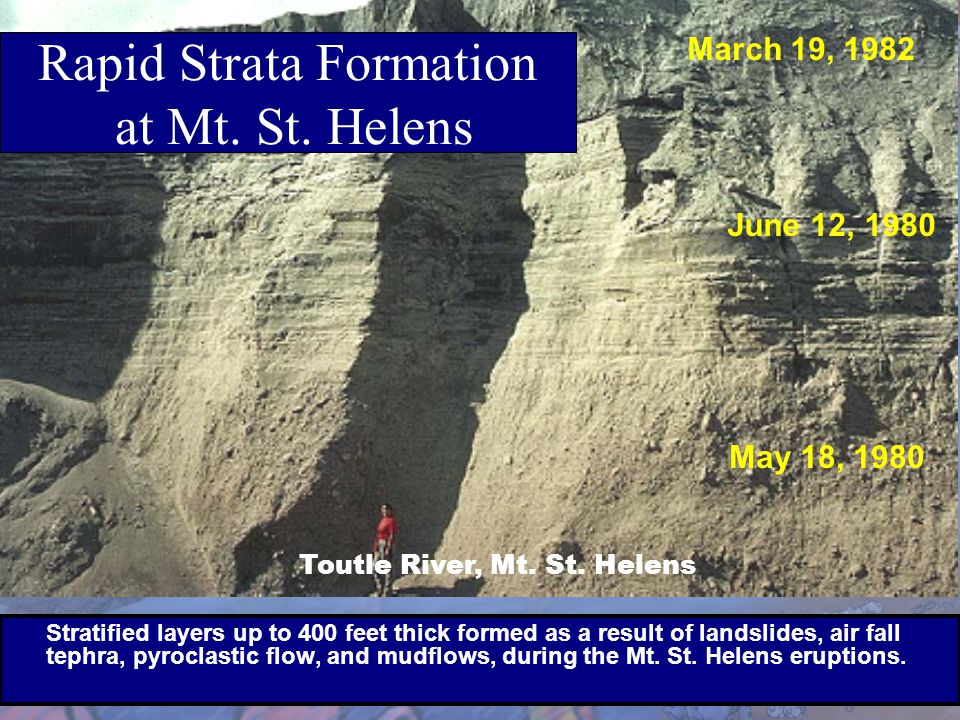
Rapid strata formation and rapid erosion at Mount St Helens.
slideplayer.com/slide/5703217/18/images/28/Rapid+Strata+F...
Visit the fossil museum:
www.flickr.com/photos/101536517@N06/sets/72157641367196613/
Just how good are peer reviews of scientific papers?
www.sciencemag.org/content/342/6154/60.full
www.examiner.com/article/want-to-publish-science-paper-ju...
The neo-Darwinian idea that the human genome consists entirely of an accumulation of billions of mutations is, quite obviously, completely bonkers. Nevertheless, it is compulsorily taught in schools and universities as 'science'.
Dichotomies in action...
and diagonal reaction...
each one with its shadow
looking for the ball to play *
Rapid strata formation in soft sand (field evidence).
Photo of strata formation in soft sand on a beach, created by tidal action of the sea.
Formed in a single, high tidal event. Stunning evidence which displays multiple strata/layers.
Why this is so important ....
It has long been assumed, ever since the 17th century, that layers/strata observed in sedimentary rocks were built up gradually, layer upon layer, over many years. It certainly seemed logical at the time, from just looking at rocks, that lower layers would always be older than the layers above them, i.e. that lower layers were always laid down first followed, in time, by successive layers on top.
This was assumed to be true and became known as the superposition principle.
It was also assumed that a layer comprising a different material from a previous layer, represented a change in environmental conditions/factors.
These changes in composition of layers or strata were considered to represent different, geological eras on a global scale, spanning millions of years. This formed the basis for the Geologic Column, which is used to date rocks and also fossils. The evolutionary, 'fossil record' was based on the vast ages and assumed geological eras of the Geologic Column.
There was also circular reasoning applied with the assumed age of 'index' fossils (based on evolutionary beliefs & preconceptions) used to date strata in the Geologic Column. Dating strata from the assumed age of (index) fossils is known as Biostratigraphy.
We now know that, although these assumptions seemed logical, they are not supported by the evidence.
At the time, the mechanics of stratification were not properly known or studied.
An additional factor was that this assumed superposition and uniformitarian model became essential, with the wide acceptance of Darwinism, for the long ages required for progressive microbes-to-human evolution. There was no incentive to question or challenge the superposition, uniformitarian model, because the presumed, fossil 'record' had become dependant on it, and any change in the accepted model would present devastating implications for Darwinism.
This had the unfortunate effect of linking the study of geology so closely to Darwinism, that any study independent of Darwinian considerations was effectively stymied. This link of geology with Darwinian preconceptions is known as biostratigraphy.
Some other field evidence, in various situations, can be observed here: www.flickr.com/photos/101536517@N06/sets/72157635944904973/
and also in the links to stunning, experimental evidence, carried out by sedimentologists, given later.
_______________________________________________
GEOLOGIC PRINCIPLES (established by Nicholas Steno in the 17th Century):
What Nicolas Steno believed about strata formation is the basis of the principle of Superposition and the principle of Original Horizontality.
dictionary.sensagent.com/Law_of_superposition/en-en/
“Assuming that all rocks and minerals had once been fluid, Nicolas Steno reasoned that rock strata were formed when particles in a fluid such as water fell to the bottom. This process would leave horizontal layers. Thus Steno's principle of original horizontality states that rock layers form in the horizontal position, and any deviations from this horizontal position are due to the rocks being disturbed later.”)
BEDDING PLANES.
'Bedding plane' describes the surface in between each stratum which are formed during sediment deposition.
science.jrank.org/pages/6533/Strata.html
“Strata form during sediment deposition, that is, the laying down of sediment. Meanwhile, if a change in current speed or sediment grain size occurs or perhaps the sediment supply is cut off, a bedding plane forms. Bedding planes are surfaces that separate one stratum from another. Bedding planes can also form when the upper part of a sediment layer is eroded away before the next episode of deposition. Strata separated by a bedding plane may have different grain sizes, grain compositions, or colours. Sometimes these other traits are better indicators of stratification as bedding planes may be very subtle.”
______________________________________________
Several catastrophic events, flash floods, volcanic eruptions etc. have forced Darwinian, influenced geologists to admit to rapid stratification in some instances. However they claim it is a rare phenomenon, which they have known about for many years, and which does nothing to invalidate the Geologic Column, the fossil record, evolutionary timescale, or any of the old assumptions regarding strata formation, sedimentation and the superposition principle. They fail to face up to the fact that rapid stratification is not an extraordinary phenonemon, but rather the prevailing and normal mechanism of sedimentary deposition whenever and wherever there is moving, sediment-laden water. The experimental evidence demonstrates the mechanism and a mass of field evidence in normal (non-catastrophic) conditions shows it is a normal everyday occurrence.
It is clear from the experimental evidence that the usual process of stratification is - that strata are not formed by horizontal layers being laid on top of each other in succession, as was assumed. But by sediment being sorted in the flowing water and laid down diagonally in the direction of flow. See diagram:
www.flickr.com/photos/truth-in-science/39821536092/in/dat...
The field evidence (in the image) presented here - of rapid, simultaneous stratification refutes the Superposition Principle and the Principle of Lateral Continuity.
We now know, the Superposition Principle only applies on a rare occasion where sedimentary deposits are laid down in still water.
Superposition is required for the long evolutionary timescale, but the evidence shows it is not the general rule, as was once believed. Most sediment is laid down in moving water, where particle segregation is the general rule, resulting in the simultaneous deposition of strata/layers as shown in the photo.
See many other examples of rapid stratification (with geological features): www.flickr.com/photos/101536517@N06/sets/72157635944904973/
Rapid, simultaneous formation of layers/strata, through particle segregation in moving water, is so easily created it has even been described by sedimentologists (working on flume experiments) as a law ...
"Upon filling the tank with water and pouring in sediments, we immediately saw what was to become the rule: The sediments sorted themselves out in very clear layers. This became so common that by the end of two weeks, we jokingly referred to Andrew's law as "It's difficult not to make layers," and Clark's law as "It's easy to make layers." Later on, I proposed the "law" that liquefaction destroys layers, as much to my surprise as that was." Ian Juby, www.ianjuby.org/sedimentation/
The example in the photo is the result of normal, everyday tidal action formed in a single incident. Where the water current or movement is more turbulent, violent, or catastrophic, great depths (many metres) of stratified sediment can be laid down in a short time. Certainly not the many millions of years assumed by evolutionists.
The composition of strata formed in any deposition event. is related to whatever materials are in the sediment mix, not to any particular timescale. Whatever is in the mix will be automatically sorted into strata/layers. It could be sand, or other material added from mud slides, erosion of chalk deposits, coastal erosion, volcanic ash etc. Any organic material (potential fossils), alive or dead, engulfed by, or swept into, a turbulent sediment mix, will also be sorted and buried within the rapidly, forming layers.
See many other examples of rapid stratification with geological features: www.flickr.com/photos/101536517@N06/sets/72157635944904973/
Stratified, soft sand deposit. demonstrates the rapid, stratification principle.
Important, field evidence which supports the work of the eminent, sedimentologist Dr Guy Berthault MIAS - Member of the International Association of Sedimentologists.
(Dr Berthault's experiments (www.sedimentology.fr/)
And also the experimental work of Dr M.E. Clark (Professor Emeritus, U of Illinois @ Urbana), Andrew Rodenbeck and Dr. Henry Voss, (www.ianjuby.org/sedimentation/)
Location: Yaverland, Isle of Wight. Photographed: 14/03/2019
This field evidence demonstrates that multiple strata in sedimentary deposits do not need millions of years to form and can be formed rapidly. This natural example confirms the principle demonstrated by the sedimentation experiments carried out by Dr Guy Berthault and other sedimentologists. It calls into question the standard, multi-million year dating of sedimentary rocks, and the dating of fossils by depth of burial or position in the strata.
Mulltiple strata/layers are evident in this example.
Dr Berthault's experiments (www.sedimentology.fr/) and other experiments (www.ianjuby.org/sedimentation/) and field studies of floods and volcanic action show that, rather than being formed by gradual, slow deposition of sucessive layers superimposed upon previous layers, with the strata or layers representing a particular timescale, particle segregation in moving water or airborne particles can form strata or layers very quickly, frequently, in a single event.
And, most importantly, lower strata are not older than upper strata, they are the same age, having been created in the same sedimentary episode.
Such field studies confirm experiments which have shown that there is no longer any reason to conclude that strata/layers in sedimentary rocks relate to different geological eras and/or a multi-million year timescale. www.youtube.com/watch?v=5PVnBaqqQw8&feature=share&.... they also show that the relative position of fossils in rocks is not indicative of an order of evolutionary succession. Obviously, the uniformitarian principle, on which the geologic column is based, can no longer be considered valid. And the multi-million, year dating of sedimentary rocks and fossils needs to be reassessed. Rapid deposition of stratified sediments also explains the enigma of polystrate fossils, i.e. large fossils that intersect several strata. In some cases, tree trunk fossils are found which intersect the strata of sedimentary rock up to forty feet in depth. upload.wikimedia.org/wikipedia/commons/thumb/0/08/Lycopsi... They must have been buried in stratified sediment in a short time (certainly not millions, thousands, or even hundreds of years), or they would have rotted away. youtu.be/vnzHU9VsliQ
In fact, the vast majority of fossils are found in good, intact condition, which is testament to their rapid burial. You don't get good fossils from gradual burial, because they would be damaged or destroyed by decay, predation or erosion. The existence of so many fossils in sedimentary rock on a global scale is stunning evidence for the rapid depostion of sedimentary rock as the general rule. It is obvious that all rock containing good intact fossils was formed from sediment laid down in a very short time, not millions, or even thousands of years.
See set of photos of other examples of rapid stratification: www.flickr.com/photos/101536517@N06/sets/72157635944904973/
Carbon dating of coal should not be possible if it is millions of years old, yet significant amounts of Carbon 14 have been detected in coal and other fossil material, which indicates that it is less than 50,000 years old. www.ldolphin.org/sewell/c14dating.html
www.grisda.org/origins/51006.htm
Evolutionists confidently cite multi-million year ages for rocks and fossils, but what most people don't realise is that no one actually knows the age of sedimentary rocks or the fossils found within them. So how are evolutionists so sure of the ages they so confidently quote? The astonishing thing is they aren't. Sedimentary rocks cannot be dated by radiometric methods*, and fossils can only be dated to less than 50,000 years with Carbon 14 dating. The method evolutionists use is based entirely on assumptions. Unbelievably, fossils are dated by the assumed age of rocks, and rocks are dated by the assumed age of fossils, that's right ... it is known as circular reasoning.
* Regarding the radiometric dating of igneous rocks, which is claimed to be relevant to the dating of sedimentary rocks, in an occasional instance there is an igneous intrusion associated with a sedimentary deposit -
Prof. Aubouin says in his Précis de Géologie: "Each radioactive element disintegrates in a characteristic and constant manner, which depends neither on the physical state (no variation with pressure or temperature or any other external constraint) nor on the chemical state (identical for an oxide or a phosphate)."
"Rocks form when magma crystallizes. Crystallisation depends on pressure and temperature, from which radioactivity is independent. So, there is no relationship between radioactivity and crystallisation.
Consequently, radioactivity doesn't date the formation of rocks. Moreover, daughter elements contained in rocks result mainly from radioactivity in magma where gravity separates the heavier parent element, from the lighter daughter element. Thus radiometric dating has no chronological signification." Dr. Guy Berthault www.sciencevsevolution.org/Berthault.htm
Rapid strata formation and rapid erosion at Mount St Helens.
slideplayer.com/slide/5703217/18/images/28/Rapid+Strata+F...

Visit the fossil museum:
www.flickr.com/photos/101536517@N06/sets/72157641367196613/
Just how good are peer reviews of scientific papers?
www.sciencemag.org/content/342/6154/60.full
www.examiner.com/article/want-to-publish-science-paper-ju...
The neo-Darwinian idea that the human genome consists entirely of an accumulation of billions of mutations is, quite obviously, completely bonkers. Nevertheless, it is compulsorily taught in schools and universities as 'science'.
www.flickr.com/photos/truth-in-science/35505679183
Dr James Tour - 'The Origin of Life' - Abiogenesis decisively refuted.
Holga 120N
Los Angeles, California
December 2010
Flickr Explore #208!
The reasoning behind the burnt edges roots back to my childhood ultimately; I always had a fascination with flames. The true reason for this particular photograph is that I had accidentally whited out the edges of the print while using the enlarger. This resulted in useless prints. By burning the edges I created an interesting finish to the print and made the flaws unnoticable. RC paper has more than one layer, so I was able to make "tears" in the paper. I browned the white space by holding the flame about a half-inch from the paper. All in all, the print turned out much better than expected.
The KOM League
Flash Report
For week of
August 7 thru 13, 2016
Introduction:
Time passes rapidly and keeping up with all the surviving members of the KOM league is a daunting task. In this section of obituaries are death dates of; April 10, 1949, February 25, 2015, July 25, 2015, and January 29, 2016. The most recent death came as a shock for I found and spoke with the gentleman, for the first time in December of 2015, following a two decade attempt at doing so. Within a month of that conversation he died and it took me eight months to find out about his passing.
Each time I read an obituary the Bible verse found in Hebrew 9:27 comes to mind. I could recite it here but if you look it up on your own it will stay with you longer. I am thankful that judgement is in the hands of a Higher Power not talking media heads, politicans, pollsters or voters. That is my political statement of the week.
****
Richard E. Sager –1946 Pittsburg, Kansas Browns
To date, Richard Sager was the most difficult former KOM leaguer to locate or determine their fate. When he reported to Pittsburg, Kans. in 1946, as a pitcher, his hometown was listed as West Coxsackie, New York. Over the two decades of searching for him there weren’t many clues. It was established, to my satisfaction, that he enlisted in the U. S. Army or December 12, 1942 at Albany, New York and that his father worked in either a pharmacy or a medical laboratory in 1925.
On August 4, 2016 I somehow came across a newspaper in the New York State Library. The name of the publication was the Green County Examiner Recorder which was published weekly in Catskill, New York. The April 14th 1949 edition was printed on Thursday which gave me the answer to the day of Sager’s passing. Here is the obituary and you’ll see he had to die on April 11th even though that fact wasn’t stated specifically. No date of his birth was given but by deductive reasoning he was born in 1924. The Pittsburg, Kansas Morning Sun listed his age as 22 when the St. Louis Browns assigned him to the KOM league. Later I located Sager’s tombstone and it lists his year of birth as 1924 and that he served in the Army Air Corps. www.findagrave.com/cgi-bin/fg.cgi?page=gr&GRid=161047716 Thus, his birthday would have come after April 14 of 1924.
The obituary:
Robert E. Sager-24, son of the late Fred and Elizabeth Young Sager passed away at Memorial Hospital, Catskill on Monday. Funeral services will be held from his late home on Hailey Street, Coxsackie, this afternoon at 2:30 p. m.. Burial will be in Riverside Cemetery. Full military rites will be accorded to the deceased who was a veteran of WW 2. Surviving are a sister, Mrs. Dorothy Schoonmaker and a brother, Donald, both of Coxsackie.
Comment:
Sager is another of the many former KOM leaguers who never appeared in any record book. Honestly, after all the years of searching I never expected to find a trace of him. However, it has been a challenge to document the coming and going of every person to have worn the uniform of a KOM league team and now the list of guys still not found, or their fate determined, is down to 90 out of around 1600 who played in at least one game.
****
Elden Edgar McHugh – Miami Blues 1946
www.legacy.com/obituaries/dodgeglobe/obituary.aspx?page=l...
Photo of deceased is on the aforementioned site. Compare it with the link I have for him in the introduction to this article.
Introduction:
Since the start of searching for former KOM leaguers I had no success in locating Elden Edgar McHugh who played for the Miami, OK Blues in 1946. Then came December of 2015 and in the last Flash Report of the year I wrote an article about finding McHugh, in Kansas City, Mo. and even included a photo of him with his Dodge City, Kans. High School basketball team. www.flickr.com/photos/60428361@N07/23565523889/ How thankful I am that I found him for just over a month after doing so he passed away. I just located his obituary on August, 1, 2016. His obituary matches the story he related in our interview with the interview information being a bit more descriptive.
Obituary:
Elden Edgar McHugh, 92, was called to his Heavenly home on Friday, January 29, 2016. A celebration of Elden's life will be held 1:00 PM, Friday, February 5, 2016 at the Avondale United Methodist Church. Visitation will held from 12:00-1:00 PM. Burial in Dodge City Cemetery at a later date. In lieu of flowers, memorial contributions may be made to Avandale United Methodist Church.
Elden was born September 20, 1923 in Bucklin, KS to Anna and Perry McHugh. The fourth son of 5 boys, Elden and his family moved to Dodge City, KS where he and his brothers grew up together during the Great Depression. Elden loved to play sports of all kinds and was the first All State Tackle for his high school team, the Dodge City Red Demons. After high school, Elden joined the Army Air Corps where he served in the European theater of WWII as a tail gunner in a bombing squadron. From November 1944 to March 1945, Elden's unit flew 27 missions over Europe and North Africa.
When Elden returned home he met and married Frances Jean Carey. Together they raised two children and shared over 67 years of marriage. The family moved to Pineville, LA when Elden was transferred by Farmland Industries to manage the office of their newly built ammonia plan in nearby Pollock, LA. Later he was transferred to Kansas City's home office in 1979 where he later retired. Elden and Frances stayed in Kansas City for the remainder of his life. Elden was long-time member of the Avondale United Methodist Church.
He was preceded in death by: parents; older brothers, Orville, Harold and Virgil McHugh and younger brother, Noble McHugh. Elden is survived by; wife, Frances (Cary) McHugh, Kansas City, MO; son & daughter-in-law, Tim & Susan McHugh, Covington, LA; daughter, Sandra McHugh-DeAtley, Kansas City, MO; grandsons, Nick DeAtley, Hunter, Cole and Wesley McHugh as well as eleven nieces and nephews. (arr. Heartland Cremation 816-313-1677)
Published in Dodge City Daily Globe on Feb. 3, 2016
Ed note:
With the passing of Elden McHugh the lone surviving member of the 1946 Miami, Okla. Blues is Robert E. Field of Hutchinson, Kansas. On August 27th he will celebrate his 94th birthday. I have known Field for many years. In his youth he was the batboy for the Hutchinson Pirates of the Western Association during the 1937-38 seasons. One of the players during his batboy tenure was Frankie Gustine who encouraged him to try out for professional baseball when he was old enough. www.google.com/webhp?sourceid=chrome-instant&ion=1&am...
__________________________________________________________________________
****
William Frederick Conroy Jr.-- Carthage Cubs 1950
www.legacy.com/obituaries/chicagotribune/obituary.aspx?pi...
William Conroy Jr, 81, of Palos Park at rest Feb. 25, 2013. Veteran of the United States Army. Devoted husband of 56 years to Dorothy (nee Griffin). Father of William III (Karen), Kathleen (John) Steed, Kevin (Helen), James (Roseanne), Gregory (Roseann), and Jean (Mark) Link. Cherished grandfather of Jennifer (Adam) Cresse, William IV (Patricia), Timothy, Maura, Meghan, Daniel, Kerry, Kylan, Erin, Abigail, Patrick, Ryan, Emily (Landon) Thomas, Brenna, Kaitlyn, Michael, Meghan, Colleen, Devin, and Sean. Great-grandfather of Andrew, William V, Patrick, and Alex. Dear brother of the late Rosalie (late John) O'Brien, Marguerite (John) Knoebel, the late Thomas (Diane), and Patrick (Kathy). Fond uncle and friend of many. Mass celebrating the life of William Conroy Jr March 16, 2013 at 10:00 AM. Our Lady of the Woods Church 10731 W 131st Street Orland Park, IL 60462.
Published in a Chicago Tribune Media Group Publication on Feb. 28, 2013
Ed comment:
Conroy was an 18-year old third baseman when he reported to Carthage for the 1950 season. He was born October 7, 1931 in Chicago, Ill. He was left Carthage on May 25th of that year and went to Nazareth, Penn. in the North Atlantic league. He spent time with Danville, Ill. of the Mississippi Ohio, Janesville, Wisc. and Visalia, Calif. of the California leagues in 1951.
Conroy was another of the former KOM leaguers with who I communicated and like most of the guys they were thrilled to have been able to play baseball and then to be remembered a half century later.
____________________________________________________________________________
****
Frederick Stephens Carthage Cubs 1949
qctimes.com/news/local/obituaries/frederick-stephens/arti...
ROCK ISLAND — Frederick Stephens, 83, passed away peacefully at his home in Rock Island, surrounded by his loving family on July 25, 2015.
Cremation will take place at Trimble Crematory, and there will be no services. The Cremation Society of the Quad-Cities served the family.
Fred was born Aug. 9, 1931, to Alvin and Myrtle Stephens. He graduated from Wilton High School in 1948.
He was united in marriage to Bonnie Johansen in 1950 at the Little Brown Church in the Vale.
Those left to honor his memory include his wife of 64 years, Bonnie; their children, Randall Stephens of California, Gregory Stephens of Moline and Vicki (Barry) Neal of Bloominton, Minn.; grandsons, Derek Neal and Kevin Neal (fiancé, Laura Johnson); brothers, Alvin Stephens of Sun City, Calif., and Douglas (Jean) Stephens of Gilbert, Ariz.; and sisters, Glenda Johnson of Moscow, Iowa, and Rea Kay Bohnsack of Wilton, Iowa. He was preceded in death by his parents; a brother, Russell Stephens; and a sister, Sylvia Jacobs.
The family wishes to extend a special thank you to Genesis Hospice.
Ed comment:
Contact had been made with Stephens a number of years ago. He was a shortstop, for a brief time with the Carthage Cubs in 1949. Upon reporting to the team his hometown was listed as Wilton Junction, Iowa in the local newspaper. However he was born in Cranston, Iowa. During his first season in professional baseball he also played for Clinton, Iowa in the Central Association.
After his one year in the Chicago Cub chain he was picked up by the Philadelphia Phillies and played for that organization at Bradford, Penn., Lima, Ohio and Salina, Kansas. His major handicap was hitting the baseball. He was a 185 pounder who hit his weight exactly at Salina--.185 and came close to it with Clinton, Iowa when he hit .182. He hit .060 below that figure while at Carthage. But, when I last spoke with him he said he was having better luck at his favorite pastime, going to the local casinos.
______________________________________________________________________________
A Flash Report reader gets won bobble head
For the past couple of years one of my most frequent contributors of stories and comments has been Bernie Gerl of Joliet, Illinois. He was a survivor of the Duluth , Minn. Dukes bus crash in 1948 that stands alone as the worst incident in the history of professional baseball. Recently, he was awarded with his own bobble head. To see it and Bernie go to this site:
www.duluthnewstribune.com/sports/baseball/4084640-former-...
______________________________________________________________________________
Former Iola Cub bares the naked truth (really)
This is a message from Shawna Clough written for her father, Russell White. A few months ago I located the three-game performer for the 1946 Iola Cubs. That story was carried in the Flash Report at the time White was located.
Hello John, after reading these KOM reports, some of them have been rather down lately, so I convinced my Dad to tell you a little about himself. (Ed note: Down as in depressing due to obituaries much like this report.)
Here is what Russell White had to say:
I have been a little lax in writing to you as so many things happening, you'd think we were in the prime of our lives.
So, to settle things down and get on with the story, "This is my life."
(I was) Born April 27, 1926 on an Indian reservation in Oakville, WA. Wasn't there too long, only until the age of two when my Dad got a job in another town.
At six, we had moved and rented a house in Home, WA (a nudist colony). At seven (we) had moved to Longbranch, WA where I attended grade school. Proceeded to Vaughn to attend high school and where my short baseball career was started.
Having started in centerfield, I soon was called to pitch and did so until I graduated. In high school at that time, a scout from the Chicago Cubs was sitting in the stands and interviewed me and I was off to Visalia, CA to play with the Visalia Cubs (C), then was sent to Iola, Kansas (D) league where I pitched for the Iola Cubs to get prepared for the jump to the "Big League".
Unfortunately, this did not happen, as the story goes I found out later, my mother said she needed me home rather than me playing baseball. I regret that it happened that way, but - I would not have met Lauretta Murphy the love of my life. I had, before going to Visalia, drove school bus at the school where she went to, and taken a post grad course presumably wanting to be an archeologist.
After coming back from Iola, I played some baseball with the Cammarano Bros. in Tacoma, WA, the Gig Harbor Merchants, Port Townsend and Longbranch teams.
I then got a job working on a 65' freight boat trucking hay and feed to co-ops on the Sound (Puget), also became an engineer for a while. It had a 1912 steam landing barge motor in it. Like you John, I could go on forever about it but that's another story. It ran aground on a reef in the Sound and was then retired.
After that, I had begun cementing a relationship with this little Irish gal that I had met before, then I got a job as a meter reader for the local light company and retired from it in 1988 after 38 years. And to make a long story short, we tied the knot August 14, 1948 and on that date August 14, 2016 we will have been together for 68 years.
I may be leaving out a lot of my life story but the only thing that really matters to me is your "stab in the dark" and the "blast from the past" that brought my short story out of hiding.
I thank you again John for the call that made my day for the rest of my life. Russell White
__________________________________________________________________________
Mistakes become opportunities
In the previous edition of this publication I enclosed a link for Jerry Staab which announced the former Blackwell Bronco and his wife had celebrated their 60th wedding anniversary. Well that story was true, mostly.
Shortly, like within ten seconds of it reaching Walter Babcock, on Cape Cod, Mass., he sent me a note that it was Ed Staab, not Jerry, who pitched for the Ft. Leonard Wood Hilltoppers in 1953 and led the team to the National Baseball Congress Tournament in Wichita, Kansas. Of course, being of superior intellect and memory I knew Babcock was right. Moments later Babcock advised me to locate Ed Staab for him and this is the sequence in which the “search” unfolded.
JOHN, THANKS FOR THE INFORMATION, BUT IT IS THE WRONG STAAB. DARLEEN AND ED WERE FROM BROKEN BOW, NEBRASKA THEY MOVED TO CALIF. AND WE VISITED THEM THERE. THAN THEY MOVED TO ARKANSAS TO BE NEAR THEIR SON. THAT IS THE LAST WE HAVE EVER HEARD FROM THEM. WE HAVE TRIED TO LOCATE THEM BUT WE HAVE NEVER SUCCEEDED. MAYBE YOU CAN FIND THEM FOR ME. WALT
Ed reply:
Huh!! I must have lost my mind. The Staab's I communicated with over the years had moved to Colorado and were from Wichita. Mrs. Staab was from the Blasi family who were amateur and professional baseball players from Wichita and a couple are in the Kansas Baseball Hall of Fame. Richard Blasi played in the first game Bartlesville ever played in 1946, he had a triple and never played in another game.
Send me everything you have on Staab and I'll apologize in the next Flash Report to my five or six readers and then go in search of the "real" Staabs.
Gerald Raymond Staab played for Blackwell, OK in 1952 and then went into the Army. Obviously, he isn't the same guy who pitched for Ft. Wood. Do you have Ed's middle name. My Staab was from Wichita and moved to Longmont, Colorado.
I think I mentioned Edward Staab to Gerald Staab's wife a long time ago and if I'm not mistaken I think they were cousins.
Ed note to Babcock a few minutes later
Edward and Darleen Staab were living in Kearney, Nebraska in 1955 and he was enrolled in college. I can find a Darleen Alethia Staab who once lived in Orange, Calif. and now resides in Clarksville, Tenn. This Edward Staab has the middle initial "R."
The only other Darleen or Darlene Staab listed anywhere is in the State of Wisconsin.
There are still a lot of Staab's in Broken Bow. Here is a link to those with telephones. www.switchboard.com/name/staab/broken-bow-neb
Ed note to Babcock in an attempt to get feedback on efforts to date
I guess you got my message about the Staabs. If they lived in Nebraska and then went to California they are now in Clarksville, Tenn.
Babcock’s reply:
JOHN, THAT IS CORRECT INFO. HOW DO I GET A PHONE NUMBER? WALT
Ed reply:
You can get the information in various ways such as; going on Switchboard.com, operator information, guessing or wait to see if I can find one.
Ed reply about five minutes later
Try 913 552-_ _ _ _. The address is 215 Uffelman Drive. Clarksville, TN
Ask him if he is any kin to Jerry Staab who used to live in Wichita, Kansas. I think they are cousins. That's about it. Ed is now 85 so call him soon.
Babcock’s reply
JOHN, THANKS FOR YOUR EFFORT. IT WAS A WRONG TELEPHONE NUMBER, BUT I WILL WRITE HIM A LETTER AND HOPE I GET IN TOUCH WITH HIM. THANKS, WALT
Ed reply:
I'll try another way to find it. Try 931 648 _ _ _ _. If that doesn't work try 931 362 _ _ _ _. I believe that will get you his son.
Babcock’s reply:
JOHN, THANKS A LOT. I GOT IN TOUCH WITH MARK, ED’S SON, AND HE GAVE ME ED’S NUMBER. HAD A SHORT TALK WITH HIS SON AND ED ALSO. ED’S WIFE HAD A STROKE AND HE MOVED INTO AN ASSISTED LIVING PLACE WHERE THEY CAN HELP HIM CARE FOR HER. HE SAID HE WAS USING A CANE FOR BALANCE. IT WAS NICE TO CHAT WITH AN OLD FRIEND. I FELT HE MAY HAVE A FEW HEALTH PROBLEMS THE WAY HIS VOICE SOUNDED. THANKS AGAIN. WALT
Ed reply:
See what happens when I made a mistake and had Jerry in the role of Ed. I think there were about a half dozen of the Staabs who were cousins that played professional baseball in the 50's and even into the mid 60's. They were from places like Wichita and Catharine, Kansas into the Broken Bow and Lincoln, Nebraska areas. I think one of those boys even lived for a time in Paris. That isn't the place where they speak French but in Missouri where they speak the local tongue.
Ed note:
Edwin Roy Staab began his baseball career in 1951 with Duluth, Minn. in the Northern league. He started off with a 5-6 record his initial year and in 1952 he posted a 16-5 record. When he was drafted into the Army he was sent to Ft. Leonard Wood, Missouri where he picked up the same pitching form he had demonstrated with Duluth in 1952.
______________________________________________________________________________
Extra credit reading assignment
One in a while I come across an interesting tale of a former KOM leaguer who went on to make his mark in life in a field other than baseball. A shortstop who stopped off briefly Carthage, Missouri, in 1949, later became a highly successful assistant and head coach in Wisconsin.
Bruce Knapton’s exploits are contained in the following story:
www.beloit.edu/archives/documents/archival_collections/fa...
____________________________________________________________________________
Midweek quiz results.
Well, the quiz I shared in mid-week about a former KOM leaguer doing a bunch of things resulted in the same outcome as when I shared it six years ago. Everyone responding was incorrect except for the person who stated “I don’t know.” He really wasn’t alone for no one else came up with the correct answer, either.
That quiz can be chalked up to my reporting over the years not being very good or else people can’t remember what was shared in past reports. That quiz was in a KOM League Remembered newsletter when it was still being printed, stapled, folded, addressed, stamped and taken to the United States Postal Service where it was mutilated and very often not delivered. That quiz was also featured in three editions of the Flash Reports during January of 2010. As I recall there were only two readers who came up with the correct answer. One was former Carthage Cub pitcher, Paul Hoffmeister and Larry Gilmore of Arkansas City, Kansas who was the son-in-law of Howard Scheurich . Scheurich was mentioned in a recent Flash Report as having passed away and was one local ballplayer Mickey Mantle couldn’t hit.
I had to mention Mickey Mantle for every response received, sans one, with regard to the quiz thought it was him. Here are the quiz questions and answers.
ANSWER IS JOE STANKA
The response to each of the points regarding the quiz.:
• Born in a small Oklahoma town in 1931. --- Born in Waynoka, Okla. July 23, 1931
• An all-around athlete. Played basketball, football and baseball in high school. Waynoka
High School.
• Signed with a New York affiliated Major League team. ---Signed with Brooklyn Dodgers in 1950
• Played in KOM league during first year. His initial foray into the league was anything but spectacular. --- Played for Ponca City Dodgers and also with Shawnee of the Sooner State league.
• Played on a pennant winning and league playoff championship KOM league team. Played for both the 1950 and 1951 champion Ponca City Dodgers.
• Married his high school sweetheart after her graduation. --- He had graduated prior to her. The wedding was in December. Married Jean McDaniel on December 13, 1949.
• His wife wrote a book which now brings over $100 a copy on e-bay. ---Title of book "Character, Culture and Crises." A great story of the hardships of a family of a baseball player struggling to make it to the big-time. This book carries the haunting account of how a gift Stanka won for being the MVP of the 1964 Japanese Series was instrumental in the death of one of his son’s. Hey folks, this is a great book.
• Was the father of four.--- Three sons and a daughter
• Recruited heavily by a major Oklahoma university.--- Recruited by the legendary Henry Iba to play basketball for Oklahoma A &M. That is now Oklahoma State Univ. He attended college for one year playing on the freshman team.
• Made it to the Major Leagues.--- (American League) Joined the Chicago White Sox in late 1959.
• Loved the taste of alcohol and in his later years finally gave it up along with cigarettes.--- He gave up alcohol before giving up "the weed."
• A baseball field in his home town is named for him.--- Field was named in his honor at Waynoka.
• A bona-fide .300 hitter. --- Hit .333 for the White Sox in 1959. Had one hit in three at bats.
• Was the star of a Championship Series.--- Japanese Major League series in 1964.
• Won a MVP award.---- Pitching hero of the 1964 Japan Series throwing three shutouts
• Was an idol of millions. ----Kids in Japan worshipped Stanka as much as Mantle was idolized in America .
• Appeared on the popular TV show “What’s My Line” after the 1964 Series of which this Editor has a copy of that telecast. --- One of the panelist even guessed that the mystery guest was Mickey Mantle.
• After baseball career ended moved from his native Oklahoma to Texas.--- Resides in Fulshear, Texas
Some of you might be curious as to why I would rerun an old quiz. Quite simply I was wondering if anyone out there ever reads the Flash Reports. I learned by the quiz that a few people still do. The first time I released the quiz I received some disgruntled comments that I “tricked” the readers and the second time around elicited the same remarks.
______________________________________________________________________________
Now comes the best part of any of these reports—the end.
Each week starts with a clean slate and I have no idea if a Flash Report will be prepared or not. Like the Maytag repairman I wait by the telephone or my computer terminal to see if anyone has anything to share. With the transmission of this report I’m back to a clean slate and there will only be another report if someone has a question or comment to share with Gordon Jump. Who’s Mr. Jump, you ask? He was a staff personality who was with WIBW in Topeka, Kansas whose big role came in the national syndicated sitcom WKRP in Cincinnati. After that show breathed his last breath Jump was hired as the Maytag repairman who sat around all day hoping to get a telephone call. I know a Maytag owner who said Jump attended all of the company’s conventions and if he ever met you he never forgot your name. In that comparison “John Hall is no Gordon Jump.”
There is something between our brains, something mysterious… .., beyond logical reasoning. the energy is there and feels ....where we we can use it to the dimension of unlimited imagination...
-----------------------------rant 73 Febro. 09,2021
This man was very obviously mentally ill and homeless. There are so many homeless people living in San Diego, CA. The mentally ill here really have no assistance and if they need medication, they wouldnt have the means to be assessed and the reasoning to do so, it is a big problem here. I have talked to many homeless people in San Diego, most arent on the streets by choice.
Kindness is the pervasive tendency to be nice to people. Kindness is compassion, concern for the welfare of others, a propensity to do favors for them, to take care of them, and to perform good deeds. Acts of kindness may be expressed in fleeting acts directed towards strangers and in profound acts directed to friends and family. Kind people go beyond smiles and pleasantries and choose to go out of their way to assist others in unfortunate circumstances. There is a real caring and concern for others. Kindness has a powerful effect on others. Research has shown that merely seeing someone else act in an altruistic way leads others to do the same, at least in the short run. An altruist intentionally acts for another’s sake as an end in itself. Those who score high for kindness will likely score high in other-oriented emotions and strengths and may have a sophisticated and developed ability for moral reasoning. It is also likely that they have a personal ethic of responsibility to care for the welfare of others.
“The meaning of life is to find your gift. The purpose of life is to give it away.”
- Pablo Picasso
Don't sell yourself short, maximise your presence in life by making use of your top strengths. But first, you need to know what they are. To take the only free scientifically backed personality test available today visit www.revisedperception.com/
David Luddy
Revised Perception
YOKOSUKA, Japan - (June 7, 2016) CommanderSeventh Fleet, Vice Adm. Joseph Aucoin and Commander Naval Forces Japan, Rear Adm. Matthew Carter hold an all hands call for all khaki leaders (E-7 and above) on board Fleet Activities Yokosuka, Japan, June 7. The two admirals explained to the assembled leaders the reasoning behind a temporary liberty curtailment and alcohol restriction in Japan and challenged the khakis to take ownership in the recent spike in alcohol related incidents. Both leaders plan on conducting similar discussions throughout Japan. (U.S. Navy photo by ABH2 Vincent Arnuco/RELEASED)
Rapid strata formation in soft sand (field evidence).
Photo of strata formation in soft sand on a beach, created by tidal action of the sea.
Formed in a single, high tidal event. Stunning evidence which displays multiple strata/layers.
Why this is so important ....
It has long been assumed, ever since the 17th century, that layers/strata observed in sedimentary rocks were built up gradually, layer upon layer, over many years. It certainly seemed logical at the time, from just looking at rocks, that lower layers would always be older than the layers above them, i.e. that lower layers were always laid down first followed, in time, by successive layers on top.
This was assumed to be true and became known as the superposition principle.
It was also assumed that a layer comprising a different material from a previous layer, represented a change in environmental conditions/factors.
These changes in composition of layers or strata were considered to represent different, geological eras on a global scale, spanning millions of years. This formed the basis for the Geologic Column, which is used to date rocks and also fossils. The evolutionary, 'fossil record' was based on the vast ages and assumed geological eras of the Geologic Column.
There was also circular reasoning applied with the assumed age of 'index' fossils (based on evolutionary beliefs & preconceptions) used to date strata in the Geologic Column. Dating strata from the assumed age of (index) fossils is known as Biostratigraphy.
We now know that, although these assumptions seemed logical, they are not supported by the evidence.
At the time, the mechanics of stratification were not properly known or studied.
An additional factor was that this assumed superposition and uniformitarian model became essential, with the wide acceptance of Darwinism, for the long ages required for progressive microbes-to-human evolution. There was no incentive to question or challenge the superposition, uniformitarian model, because the presumed, fossil 'record' had become dependant on it, and any change in the accepted model would present devastating implications for Darwinism.
This had the unfortunate effect of linking the study of geology so closely to Darwinism, that any study independent of Darwinian considerations was effectively stymied. This link of geology with Darwinian preconceptions is known as biostratigraphy.
Some other field evidence, in various situations, can be observed here: www.flickr.com/photos/101536517@N06/sets/72157635944904973/
and also in the links to stunning, experimental evidence, carried out by sedimentologists, given later.
_______________________________________________
GEOLOGIC PRINCIPLES (established by Nicholas Steno in the 17th Century):
What Nicolas Steno believed about strata formation is the basis of the principle of Superposition and the principle of Original Horizontality.
dictionary.sensagent.com/Law_of_superposition/en-en/
“Assuming that all rocks and minerals had once been fluid, Nicolas Steno reasoned that rock strata were formed when particles in a fluid such as water fell to the bottom. This process would leave horizontal layers. Thus Steno's principle of original horizontality states that rock layers form in the horizontal position, and any deviations from this horizontal position are due to the rocks being disturbed later.”)
BEDDING PLANES.
'Bedding plane' describes the surface in between each stratum which are formed during sediment deposition.
science.jrank.org/pages/6533/Strata.html
“Strata form during sediment deposition, that is, the laying down of sediment. Meanwhile, if a change in current speed or sediment grain size occurs or perhaps the sediment supply is cut off, a bedding plane forms. Bedding planes are surfaces that separate one stratum from another. Bedding planes can also form when the upper part of a sediment layer is eroded away before the next episode of deposition. Strata separated by a bedding plane may have different grain sizes, grain compositions, or colours. Sometimes these other traits are better indicators of stratification as bedding planes may be very subtle.”
______________________________________________
Several catastrophic events, flash floods, volcanic eruptions etc. have forced Darwinian, influenced geologists to admit to rapid stratification in some instances. However they claim it is a rare phenomenon, which they have known about for many years, and which does nothing to invalidate the Geologic Column, the fossil record, evolutionary timescale, or any of the old assumptions regarding strata formation, sedimentation and the superposition principle. They fail to face up to the fact that rapid stratification is not an extraordinary phenonemon, but rather the prevailing and normal mechanism of sedimentary deposition whenever and wherever there is moving, sediment-laden water. The experimental evidence demonstrates the mechanism and a mass of field evidence in normal (non-catastrophic) conditions shows it is a normal everyday occurrence.
It is clear from the experimental evidence that the usual process of stratification is - that strata are not formed by horizontal layers being laid on top of each other in succession, as was assumed. But by sediment being sorted in the flowing water and laid down diagonally in the direction of flow. See diagram:
www.flickr.com/photos/truth-in-science/39821536092/in/dat...
The field evidence (in the image) presented here - of rapid, simultaneous stratification refutes the Superposition Principle and the Principle of Lateral Continuity.
We now know, the Superposition Principle only applies on a rare occasion where sedimentary deposits are laid down in still water.
Superposition is required for the long evolutionary timescale, but the evidence shows it is not the general rule, as was once believed. Most sediment is laid down in moving water, where particle segregation is the general rule, resulting in the simultaneous deposition of strata/layers as shown in the photo.
See many other examples of rapid stratification (with geological features): www.flickr.com/photos/101536517@N06/sets/72157635944904973/
Rapid, simultaneous formation of layers/strata, through particle segregation in moving water, is so easily created it has even been described by sedimentologists (working on flume experiments) as a law ...
"Upon filling the tank with water and pouring in sediments, we immediately saw what was to become the rule: The sediments sorted themselves out in very clear layers. This became so common that by the end of two weeks, we jokingly referred to Andrew's law as "It's difficult not to make layers," and Clark's law as "It's easy to make layers." Later on, I proposed the "law" that liquefaction destroys layers, as much to my surprise as that was." Ian Juby, www.ianjuby.org/sedimentation/
The example in the photo is the result of normal, everyday tidal action formed in a single incident. Where the water current or movement is more turbulent, violent, or catastrophic, great depths (many metres) of stratified sediment can be laid down in a short time. Certainly not the many millions of years assumed by evolutionists.
The composition of strata formed in any deposition event. is related to whatever materials are in the sediment mix, not to any particular timescale. Whatever is in the mix will be automatically sorted into strata/layers. It could be sand, or other material added from mud slides, erosion of chalk deposits, coastal erosion, volcanic ash etc. Any organic material (potential fossils), alive or dead, engulfed by, or swept into, a turbulent sediment mix, will also be sorted and buried within the rapidly, forming layers.
See many other examples of rapid stratification with geological features: www.flickr.com/photos/101536517@N06/sets/72157635944904973/
Stratified, soft sand deposit. demonstrates the rapid, stratification principle.
Important, field evidence which supports the work of the eminent, sedimentologist Dr Guy Berthault MIAS - Member of the International Association of Sedimentologists.
(Dr Berthault's experiments (www.sedimentology.fr/)
And also the experimental work of Dr M.E. Clark (Professor Emeritus, U of Illinois @ Urbana), Andrew Rodenbeck and Dr. Henry Voss, (www.ianjuby.org/sedimentation/)
Location: Sandown, Isle of Wight. Photographed: 12/03/2019
This field evidence demonstrates that multiple strata in sedimentary deposits do not need millions of years to form and can be formed rapidly. This natural example confirms the principle demonstrated by the sedimentation experiments carried out by Dr Guy Berthault and other sedimentologists. It calls into question the standard, multi-million year dating of sedimentary rocks, and the dating of fossils by depth of burial or position in the strata.
Mulltiple strata/layers are evident in this example.
Dr Berthault's experiments (www.sedimentology.fr/) and other experiments (www.ianjuby.org/sedimentation/) and field studies of floods and volcanic action show that, rather than being formed by gradual, slow deposition of sucessive layers superimposed upon previous layers, with the strata or layers representing a particular timescale, particle segregation in moving water or airborne particles can form strata or layers very quickly, frequently, in a single event.
And, most importantly, lower strata are not older than upper strata, they are the same age, having been created in the same sedimentary episode.
Such field studies confirm experiments which have shown that there is no longer any reason to conclude that strata/layers in sedimentary rocks relate to different geological eras and/or a multi-million year timescale. www.youtube.com/watch?v=5PVnBaqqQw8&feature=share&.... they also show that the relative position of fossils in rocks is not indicative of an order of evolutionary succession. Obviously, the uniformitarian principle, on which the geologic column is based, can no longer be considered valid. And the multi-million, year dating of sedimentary rocks and fossils needs to be reassessed. Rapid deposition of stratified sediments also explains the enigma of polystrate fossils, i.e. large fossils that intersect several strata. In some cases, tree trunk fossils are found which intersect the strata of sedimentary rock up to forty feet in depth. upload.wikimedia.org/wikipedia/commons/thumb/0/08/Lycopsi... They must have been buried in stratified sediment in a short time (certainly not millions, thousands, or even hundreds of years), or they would have rotted away. youtu.be/vnzHU9VsliQ
In fact, the vast majority of fossils are found in good, intact condition, which is testament to their rapid burial. You don't get good fossils from gradual burial, because they would be damaged or destroyed by decay, predation or erosion. The existence of so many fossils in sedimentary rock on a global scale is stunning evidence for the rapid depostion of sedimentary rock as the general rule. It is obvious that all rock containing good intact fossils was formed from sediment laid down in a very short time, not millions, or even thousands of years.
See set of photos of other examples of rapid stratification: www.flickr.com/photos/101536517@N06/sets/72157635944904973/
Carbon dating of coal should not be possible if it is millions of years old, yet significant amounts of Carbon 14 have been detected in coal and other fossil material, which indicates that it is less than 50,000 years old. www.ldolphin.org/sewell/c14dating.html
www.grisda.org/origins/51006.htm
Evolutionists confidently cite multi-million year ages for rocks and fossils, but what most people don't realise is that no one actually knows the age of sedimentary rocks or the fossils found within them. So how are evolutionists so sure of the ages they so confidently quote? The astonishing thing is they aren't. Sedimentary rocks cannot be dated by radiometric methods*, and fossils can only be dated to less than 50,000 years with Carbon 14 dating. The method evolutionists use is based entirely on assumptions. Unbelievably, fossils are dated by the assumed age of rocks, and rocks are dated by the assumed age of fossils, that's right ... it is known as circular reasoning.
* Regarding the radiometric dating of igneous rocks, which is claimed to be relevant to the dating of sedimentary rocks, in an occasional instance there is an igneous intrusion associated with a sedimentary deposit -
Prof. Aubouin says in his Précis de Géologie: "Each radioactive element disintegrates in a characteristic and constant manner, which depends neither on the physical state (no variation with pressure or temperature or any other external constraint) nor on the chemical state (identical for an oxide or a phosphate)."
"Rocks form when magma crystallizes. Crystallisation depends on pressure and temperature, from which radioactivity is independent. So, there is no relationship between radioactivity and crystallisation.
Consequently, radioactivity doesn't date the formation of rocks. Moreover, daughter elements contained in rocks result mainly from radioactivity in magma where gravity separates the heavier parent element, from the lighter daughter element. Thus radiometric dating has no chronological signification." Dr. Guy Berthault www.sciencevsevolution.org/Berthault.htm
Rapid strata formation and rapid erosion at Mount St Helens.
slideplayer.com/slide/5703217/18/images/28/Rapid+Strata+F...
Visit the fossil museum:
www.flickr.com/photos/101536517@N06/sets/72157641367196613/
Just how good are peer reviews of scientific papers?
www.sciencemag.org/content/342/6154/60.full
www.examiner.com/article/want-to-publish-science-paper-ju...
The neo-Darwinian idea that the human genome consists entirely of an accumulation of billions of mutations is, quite obviously, completely bonkers. Nevertheless, it is compulsorily taught in schools and universities as 'science'.
Rapid strata formation in soft sand (field evidence).
Photo of strata formation in soft sand on a beach, created by tidal action of the sea.
Formed in a single, high tidal event. Stunning evidence which displays multiple strata/layers.
Why this is so important ....
It has long been assumed, ever since the 17th century, that layers/strata observed in sedimentary rocks were built up gradually, layer upon layer, over many years. It certainly seemed logical at the time, from just looking at rocks, that lower layers would always be older than the layers above them, i.e. that lower layers were always laid down first followed, in time, by successive layers on top.
This was assumed to be true and became known as the superposition principle.
It was also assumed that a layer comprising a different material from a previous layer, represented a change in environmental conditions/factors.
These changes in composition of layers or strata were considered to represent different, geological eras on a global scale, spanning millions of years. This formed the basis for the Geologic Column, which is used to date rocks and also fossils. The evolutionary, 'fossil record' was based on the vast ages and assumed geological eras of the Geologic Column.
There was also circular reasoning applied with the assumed age of 'index' fossils (based on evolutionary beliefs & preconceptions) used to date strata in the Geologic Column. Dating strata from the assumed age of (index) fossils is known as Biostratigraphy.
We now know that, although these assumptions seemed logical, they are not supported by the evidence.
At the time, the mechanics of stratification were not properly known or studied.
An additional factor was that this assumed superposition and uniformitarian model became essential, with the wide acceptance of Darwinism, for the long ages required for progressive microbes-to-human evolution. There was no incentive to question or challenge the superposition, uniformitarian model, because the presumed, fossil 'record' had become dependant on it, and any change in the accepted model would present devastating implications for Darwinism.
This had the unfortunate effect of linking the study of geology so closely to Darwinism, that any study independent of Darwinian considerations was effectively stymied. This link of geology with Darwinian preconceptions is known as biostratigraphy.
Some other field evidence, in various situations, can be observed here: www.flickr.com/photos/101536517@N06/sets/72157635944904973/
and also in the links to stunning, experimental evidence, carried out by sedimentologists, given later.
_______________________________________________
GEOLOGIC PRINCIPLES (established by Nicholas Steno in the 17th Century):
What Nicolas Steno believed about strata formation is the basis of the principle of Superposition and the principle of Original Horizontality.
dictionary.sensagent.com/Law_of_superposition/en-en/
“Assuming that all rocks and minerals had once been fluid, Nicolas Steno reasoned that rock strata were formed when particles in a fluid such as water fell to the bottom. This process would leave horizontal layers. Thus Steno's principle of original horizontality states that rock layers form in the horizontal position, and any deviations from this horizontal position are due to the rocks being disturbed later.”)
BEDDING PLANES.
'Bedding plane' describes the surface in between each stratum which are formed during sediment deposition.
science.jrank.org/pages/6533/Strata.html
“Strata form during sediment deposition, that is, the laying down of sediment. Meanwhile, if a change in current speed or sediment grain size occurs or perhaps the sediment supply is cut off, a bedding plane forms. Bedding planes are surfaces that separate one stratum from another. Bedding planes can also form when the upper part of a sediment layer is eroded away before the next episode of deposition. Strata separated by a bedding plane may have different grain sizes, grain compositions, or colours. Sometimes these other traits are better indicators of stratification as bedding planes may be very subtle.”
______________________________________________
Several catastrophic events, flash floods, volcanic eruptions etc. have forced Darwinian, influenced geologists to admit to rapid stratification in some instances. However they claim it is a rare phenomenon, which they have known about for many years, and which does nothing to invalidate the Geologic Column, the fossil record, evolutionary timescale, or any of the old assumptions regarding strata formation, sedimentation and the superposition principle. They fail to face up to the fact that rapid stratification is not an extraordinary phenonemon, but rather the prevailing and normal mechanism of sedimentary deposition whenever and wherever there is moving, sediment-laden water. The experimental evidence demonstrates the mechanism and a mass of field evidence in normal (non-catastrophic) conditions shows it is a normal everyday occurrence.
It is clear from the experimental evidence that the usual process of stratification is - that strata are not formed by horizontal layers being laid on top of each other in succession, as was assumed. But by sediment being sorted in the flowing water and laid down diagonally in the direction of flow. See diagram:
www.flickr.com/photos/truth-in-science/39821536092/in/dat...
The field evidence (in the image) presented here - of rapid, simultaneous stratification refutes the Superposition Principle and the Principle of Lateral Continuity.
We now know, the Superposition Principle only applies on a rare occasion where sedimentary deposits are laid down in still water.
Superposition is required for the long evolutionary timescale, but the evidence shows it is not the general rule, as was once believed. Most sediment is laid down in moving water, where particle segregation is the general rule, resulting in the simultaneous deposition of strata/layers as shown in the photo.
See many other examples of rapid stratification (with geological features): www.flickr.com/photos/101536517@N06/sets/72157635944904973/
Rapid, simultaneous formation of layers/strata, through particle segregation in moving water, is so easily created it has even been described by sedimentologists (working on flume experiments) as a law ...
"Upon filling the tank with water and pouring in sediments, we immediately saw what was to become the rule: The sediments sorted themselves out in very clear layers. This became so common that by the end of two weeks, we jokingly referred to Andrew's law as "It's difficult not to make layers," and Clark's law as "It's easy to make layers." Later on, I proposed the "law" that liquefaction destroys layers, as much to my surprise as that was." Ian Juby, www.ianjuby.org/sedimentation/
The example in the photo is the result of normal, everyday tidal action formed in a single incident, and subsequently eroded by water flow revealing the strata/layers.
Where the water current or movement is more turbulent, violent, or catastrophic, great depths (many metres) of stratified sediment can be laid down in a short time. Certainly not the many millions of years assumed by evolutionists.
The composition of strata formed in any deposition event. is related to whatever materials are in the sediment mix, not to any particular timescale. Whatever is in the mix will be automatically sorted into strata/layers. It could be sand, or other material added from mud slides, erosion of chalk deposits, coastal erosion, volcanic ash etc. Any organic material (potential fossils), alive or dead, engulfed by, or swept into, a turbulent sediment mix, will also be sorted and buried within the rapidly, forming layers.
See many other examples of rapid stratification with geological features: www.flickr.com/photos/101536517@N06/sets/72157635944904973/
Stratified, soft sand deposit. demonstrates the rapid, stratification principle.
Important, field evidence which supports the work of the eminent, sedimentologist Dr Guy Berthault MIAS - Member of the International Association of Sedimentologists.
(Dr Berthault's experiments (www.sedimentology.fr/)
And also the experimental work of Dr M.E. Clark (Professor Emeritus, U of Illinois @ Urbana), Andrew Rodenbeck and Dr. Henry Voss, (www.ianjuby.org/sedimentation/)
Location: Sandown, Isle of Wight. Formed 15/01/2018 This field evidence demonstrates that multiple strata in sedimentary deposits do not need millions of years to form and can be formed rapidly. This natural example confirms the principle demonstrated by the sedimentation experiments carried out by Dr Guy Berthault and other sedimentologists. It calls into question the standard, multi-million year dating of sedimentary rocks, and the dating of fossils by depth of burial or position in the strata.
Mulltiple strata/layers are evident in this example.
Dr Berthault's experiments (www.sedimentology.fr/) and other experiments (www.ianjuby.org/sedimentation/) and field studies of floods and volcanic action show that, rather than being formed by gradual, slow deposition of sucessive layers superimposed upon previous layers, with the strata or layers representing a particular timescale, particle segregation in moving water or airborne particles can form strata or layers very quickly, frequently, in a single event.
And, most importantly, lower strata are not older than upper strata, they are the same age, having been created in the same sedimentary episode.
Such field studies confirm experiments which have shown that there is no longer any reason to conclude that strata/layers in sedimentary rocks relate to different geological eras and/or a multi-million year timescale. www.youtube.com/watch?v=5PVnBaqqQw8&feature=share&.... they also show that the relative position of fossils in rocks is not indicative of an order of evolutionary succession. Obviously, the uniformitarian principle, on which the geologic column is based, can no longer be considered valid. And the multi-million, year dating of sedimentary rocks and fossils needs to be reassessed. Rapid deposition of stratified sediments also explains the enigma of polystrate fossils, i.e. large fossils that intersect several strata. In some cases, tree trunk fossils are found which intersect the strata of sedimentary rock up to forty feet in depth. upload.wikimedia.org/wikipedia/commons/thumb/0/08/Lycopsi... They must have been buried in stratified sediment in a short time (certainly not millions, thousands, or even hundreds of years), or they would have rotted away. youtu.be/vnzHU9VsliQ
In fact, the vast majority of fossils are found in good, intact condition, which is testament to their rapid burial. You don't get good fossils from gradual burial, because they would be damaged or destroyed by decay, predation or erosion. The existence of so many fossils in sedimentary rock on a global scale is stunning evidence for the rapid depostion of sedimentary rock as the general rule. It is obvious that all rock containing good intact fossils was formed from sediment laid down in a very short time, not millions, or even thousands of years.
See set of photos of other examples of rapid stratification: www.flickr.com/photos/101536517@N06/sets/72157635944904973/
Carbon dating of coal should not be possible if it is millions of years old, yet significant amounts of Carbon 14 have been detected in coal and other fossil material, which indicates that it is less than 50,000 years old. www.ldolphin.org/sewell/c14dating.html
www.grisda.org/origins/51006.htm
Evolutionists confidently cite multi-million year ages for rocks and fossils, but what most people don't realise is that no one actually knows the age of sedimentary rocks or the fossils found within them. So how are evolutionists so sure of the ages they so confidently quote? The astonishing thing is they aren't. Sedimentary rocks cannot be dated by radiometric methods*, and fossils can only be dated to less than 50,000 years with Carbon 14 dating. The method evolutionists use is based entirely on assumptions. Unbelievably, fossils are dated by the assumed age of rocks, and rocks are dated by the assumed age of fossils, that's right ... it is known as circular reasoning.
* Regarding the radiometric dating of igneous rocks, which is claimed to be relevant to the dating of sedimentary rocks, in an occasional instance there is an igneous intrusion associated with a sedimentary deposit -
Prof. Aubouin says in his Précis de Géologie: "Each radioactive element disintegrates in a characteristic and constant manner, which depends neither on the physical state (no variation with pressure or temperature or any other external constraint) nor on the chemical state (identical for an oxide or a phosphate)."
"Rocks form when magma crystallizes. Crystallisation depends on pressure and temperature, from which radioactivity is independent. So, there is no relationship between radioactivity and crystallisation.
Consequently, radioactivity doesn't date the formation of rocks. Moreover, daughter elements contained in rocks result mainly from radioactivity in magma where gravity separates the heavier parent element, from the lighter daughter element. Thus radiometric dating has no chronological signification." Dr. Guy Berthault www.sciencevsevolution.org/Berthault.htm
Rapid strata formation at Mount St Helens.
slideplayer.com/slide/5703217/18/images/28/Rapid+Strata+F...
Visit the fossil museum:
www.flickr.com/photos/101536517@N06/sets/72157641367196613/
Just how good are peer reviews of scientific papers?
www.sciencemag.org/content/342/6154/60.full
www.examiner.com/article/want-to-publish-science-paper-ju...
The neo-Darwinian idea that the human genome consists entirely of an accumulation of billions of mutations is, quite obviously, completely bonkers. Nevertheless, it is compulsorily taught in schools and universities as 'science'.
Funny how i find myself in love with you
If i could buy my reasoning I'd would pay to lose
One half won't do
I've asked myself
How much do you commit yourself?
It's my life
Don't you forget
It's my life
It never ends
Funny how i blind myself
I never knew if i was sometimes played upon
Afraid to lose
I'd tell myself what good you do
Convince myself
It's my life
Don't you forget
It's my life
It never ends
I've asked myself
How much do you commit yourself?
It's my life
Don't you forget
Caught in the crowd
It never ends.
Students rated their enjoyment of cookies in short supply more than those cookies described as plentiful in supply. They were also willing to pay more for the short-supply cookies. They reasoned that other people must know something they didn’t.
(Worchel, Lee & Adewole, 1975)
Slowly but surely the Nocturn moc I am making is coming together.
The largest obstacle for myself was the legs, with everything I created prior being unsatisfactory or looking out of place. However I believe these legs fit perfectly with the vision I have for this moc.
Also for those who might ask, I am completely removing the green from Nocturn's color scheme, with "Lore" reasoning to come when the moc is finished. I'll give ya a hint, his tentacle plays a large part in why the green is removed.
Rapid strata formation in soft sand (field evidence).
Photo of strata formation in soft sand on a beach, created by tidal action of the sea.
Formed in a single, high tidal event. Stunning evidence which displays multiple strata/layers.
Why this is so important ....
It has long been assumed, ever since the 17th century, that layers/strata observed in sedimentary rocks were built up gradually, layer upon layer, over many years. It certainly seemed logical at the time, from just looking at rocks, that lower layers would always be older than the layers above them, i.e. that lower layers were always laid down first followed, in time, by successive layers on top.
This was assumed to be true and became known as the superposition principle.
It was also assumed that a layer comprising a different material from a previous layer, represented a change in environmental conditions/factors.
These changes in composition of layers or strata were considered to represent different, geological eras on a global scale, spanning millions of years. This formed the basis for the Geologic Column, which is used to date rocks and also fossils. The evolutionary, 'fossil record' was based on the vast ages and assumed geological eras of the Geologic Column.
There was also circular reasoning applied with the assumed age of 'index' fossils (based on evolutionary beliefs & preconceptions) used to date strata in the Geologic Column. Dating strata from the assumed age of fossils is known as Biostratigraphy.
We now know that, although these assumptions seemed logical, they are not supported by the evidence.
At the time, the mechanics of stratification were not properly known or studied.
An additional factor was that this assumed superposition and uniformitarian model became essential, with the wide acceptance of Darwinism, for the long ages required for progressive microbes-to-human evolution. There was no incentive to question or challenge the superposition, uniformitarian model, because the presumed, fossil 'record' had become dependant on it, and any change in the accepted model would present devastating implications for Darwinism.
This had the unfortunate effect of linking the study of geology so closely to Darwinism, that any study independent of Darwinian considerations was effectively stymied. This link of geology with Darwinian preconceptions is known as biostratigraphy.
Some of the wealth of evidence can be observed here: www.flickr.com/photos/101536517@N06/sets/72157635944904973/
and also in the links to stunning, experimental evidence, carried out by sedimentologists, given later.
_______________________________________________
GEOLOGIC PRINCIPLES (established by Nicholas Steno in the 17th Century):
What Nicolas Steno believed about strata formation is the basis of the principle of Superposition and the principle of Original Horizontality.
dictionary.sensagent.com/Law_of_superposition/en-en/
“Assuming that all rocks and minerals had once been fluid, Nicolas Steno reasoned that rock strata were formed when particles in a fluid such as water fell to the bottom. This process would leave horizontal layers. Thus Steno's principle of original horizontality states that rock layers form in the horizontal position, and any deviations from this horizontal position are due to the rocks being disturbed later.”)
BEDDING PLANES.
'Bedding plane' describes the surface in between each stratum which are formed during sediment deposition.
science.jrank.org/pages/6533/Strata.html
“Strata form during sediment deposition, that is, the laying down of sediment. Meanwhile, if a change in current speed or sediment grain size occurs or perhaps the sediment supply is cut off, a bedding plane forms. Bedding planes are surfaces that separate one stratum from another. Bedding planes can also form when the upper part of a sediment layer is eroded away before the next episode of deposition. Strata separated by a bedding plane may have different grain sizes, grain compositions, or colours. Sometimes these other traits are better indicators of stratification as bedding planes may be very subtle.”
______________________________________________
Several catastrophic events, flash floods, volcanic eruptions etc. have forced Darwinian, influenced geologists to admit to rapid stratification in some instances. However they claim it is a rare phenomenon, which they have known about for many years, and which does nothing to invalidate the Geologic Column, the fossil record, evotuionary timescale, or any of the old assumptions regarding strata formation, sedimentation and the superposition principle. They fail to face up to the fact that rapid stratification is not an extraordinary phenonemon, but rather the prevailing and normal mechanism of sedimentary deposition whenever and wherever there is moving, sediment-laden water. The experimental evidence demonstrates the mechanism and a mass of field evidence in normal (non-catastrophic) conditions shows it is a normal everyday occurrence.
It is clear from the experimental evidence that the usual process of stratification is - that strata are not formed by horizontal layers being laid on top of each other in succession, as was assumed. But by sediment being sorted in the flowing water and laid down diagonally in the direction of flow. See diagram:
www.flickr.com/photos/truth-in-science/39821536092/in/dat...
The field evidence (in the image) presented here - of rapid, simultaneous stratification refutes the Superposition Principle, and the Principle of Lateral Continuity.
We now know, the Superposition Principle only applies on a rare occasion of sedimentary deposits in perfectly, still water. Superposition is required for the long evolutionary timescale, but the evidence shows it is not the general rule, as was once believed. Most sediment is laid down in moving water, where particle segregation is the general rule, resulting in the simultaneous deposition of strata/layers as shown in the photo.
See many other examples of rapid stratification with geological features: www.flickr.com/photos/101536517@N06/sets/72157635944904973/
Rapid, simultaneous formation of layers/strata, through particle segregation in moving water, is so easily created it has even been described by sedimentologists (working on flume experiments) as a law ...
"Upon filling the tank with water and pouring in sediments, we immediately saw what was to become the rule: The sediments sorted themselves out in very clear layers. This became so common that by the end of two weeks, we jokingly referred to Andrew's law as "It's difficult not to make layers," and Clark's law as "It's easy to make layers." Later on, I proposed the "law" that liquefaction destroys layers, as much to my surprise as that was." Ian Juby, www.ianjuby.org/sedimentation/
The example in the photo is the result of normal, everyday tidal action in a single incident. Where the water current or movement is more turbulent, violent, or catastrophic, great depths (many metres) of stratified sediment can be laid down in a short time. Certainly not the many millions of years assumed by evolutionists.
The composition of strata formed in any deposition event. is related to whatever materials are in the sediment mix, not to any particular timescale. Whatever is in the mix will be automatically sorted into strata/layers. It could be sand, or other material added from mud slides, erosion of chalk deposits, coastal erosion, volcanic ash etc. Any organic material (potential fossils), alive or dead, engulfed by, or swept into, a turbulent sediment mix, will also be sorted and buried within the rapidly, forming layers.
See many other examples of rapid stratification with geological features: www.flickr.com/photos/101536517@N06/sets/72157635944904973/
Stratified, soft sand deposit. demonstrates the rapid, stratification principle.
Important, field evidence which supports the work of the eminent, sedimentologist Dr Guy Berthault MIAS - Member of the International Association of Sedimentologists.
(Dr Berthault's experiments (www.sedimentology.fr/)
And also the experimental work of Dr M.E. Clark (Professor Emeritus, U of Illinois @ Urbana), Andrew Rodenbeck and Dr. Henry Voss, (www.ianjuby.org/sedimentation/)
Location: Sandown, Isle of Wight. Formed 23/02/2018, This field evidence demonstrates that multiple strata in sedimentary deposits do not need millions of years to form and can be formed rapidly. This natural example confirms the principle demonstrated by the sedimentation experiments carried out by Dr Guy Berthault and other sedimentologists. It calls into question the standard, multi-million year dating of sedimentary rocks, and the dating of fossils by depth of burial or position in the strata.
Mulltiple strata/layers are evident in this example.
Dr Berthault's experiments (www.sedimentology.fr/) and other experiments (www.ianjuby.org/sedimentation/) and field studies of floods and volcanic action show that, rather than being formed by gradual, slow deposition of sucessive layers superimposed upon previous layers, with the strata or layers representing a particular timescale, particle segregation in moving water or airborne particles can form strata or layers very quickly, frequently, in a single event.
And, most importantly, lower strata are not older than upper strata, they are the same age, having been created in the same sedimentary episode.
Such field studies confirm experiments which have shown that there is no longer any reason to conclude that strata/layers in sedimentary rocks relate to different geological eras and/or a multi-million year timescale. www.youtube.com/watch?v=5PVnBaqqQw8&feature=share&.... they also show that the relative position of fossils in rocks is not indicative of an order of evolutionary succession. Obviously, the uniformitarian principle, on which the geologic column is based, can no longer be considered valid. And the multi-million, year dating of sedimentary rocks and fossils needs to be reassessed. Rapid deposition of stratified sediments also explains the enigma of polystrate fossils, i.e. large fossils that intersect several strata. In some cases, tree trunk fossils are found which intersect the strata of sedimentary rock up to forty feet in depth. upload.wikimedia.org/wikipedia/commons/thumb/0/08/Lycopsi... They must have been buried in stratified sediment in a short time (certainly not millions, thousands, or even hundreds of years), or they would have rotted away. youtu.be/vnzHU9VsliQ
In fact, the vast majority of fossils are found in good, intact condition, which is testament to their rapid burial. You don't get good fossils from gradual burial, because they would be damaged or destroyed by decay, predation or erosion. The existence of so many fossils in sedimentary rock on a global scale is stunning evidence for the rapid depostion of sedimentary rock as the general rule. It is obvious that all rock containing good intact fossils was formed from sediment laid down in a very short time, not millions, or even thousands of years.
See set of photos of other examples of rapid stratification: www.flickr.com/photos/101536517@N06/sets/72157635944904973/
Carbon dating of coal should not be possible if it is millions of years old, yet significant amounts of Carbon 14 have been detected in coal and other fossil material, which indicates that it is less than 50,000 years old. www.ldolphin.org/sewell/c14dating.html
www.grisda.org/origins/51006.htm
Evolutionists confidently cite multi-million year ages for rocks and fossils, but what most people don't realise is that no one actually knows the age of sedimentary rocks or the fossils found within them. So how are evolutionists so sure of the ages they so confidently quote? The astonishing thing is they aren't. Sedimentary rocks cannot be dated by radiometric methods*, and fossils can only be dated to less than 50,000 years with Carbon 14 dating. The method evolutionists use is based entirely on assumptions. Unbelievably, fossils are dated by the assumed age of rocks, and rocks are dated by the assumed age of fossils, that's right ... it is known as circular reasoning.
* Regarding the radiometric dating of igneous rocks, which is claimed to be relevant to the dating of sedimentary rocks, in an occasional instance there is an igneous intrusion associated with a sedimentary deposit -
Prof. Aubouin says in his Précis de Géologie: "Each radioactive element disintegrates in a characteristic and constant manner, which depends neither on the physical state (no variation with pressure or temperature or any other external constraint) nor on the chemical state (identical for an oxide or a phosphate)."
"Rocks form when magma crystallizes. Crystallisation depends on pressure and temperature, from which radioactivity is independent. So, there is no relationship between radioactivity and crystallisation.
Consequently, radioactivity doesn't date the formation of rocks. Moreover, daughter elements contained in rocks result mainly from radioactivity in magma where gravity separates the heavier parent element, from the lighter daughter element. Thus radiometric dating has no chronological signification." Dr. Guy Berthault www.sciencevsevolution.org/Berthault.htm
Visit the fossil museum:
www.flickr.com/photos/101536517@N06/sets/72157641367196613/
Just how good are peer reviews of scientific papers?
www.sciencemag.org/content/342/6154/60.full
www.examiner.com/article/want-to-publish-science-paper-ju...
The neo-Darwinian idea that the human genome consists entirely of an accumulation of billions of mutations is, quite obviously, completely bonkers. Nevertheless, it is compulsorily taught in schools and universities as 'science'.
Emotion is more powerful than reason. Emotion is the driving force behind thinking and reasoning. Emotional intelligence increases the mind’s ability to make positive, brilliant decisions.
Don't try to escape your emotions. Just learn to deal with them in a positive way. Our emotions shape who we are as people. Most important learn to NEVER apologize for showing your emotions. It shows you care it shows you have a heart, it shows you are reaching your strength and desires.
Just learn to balance them. There's always a positive in a negative. Embrace your emotions and you will grow.
I used to be ashamed of showing any sort of sadness or anger. Once I learned to embrace it and realize anytime I showed emotion it was just because I cared deeply about something. I saw that is was shaping me into the positive person I am today and shaping me into someone who is trying to move forward from a deeply powerful past. I was learning my depths and seeing who I wanted to be and where I wanted to go. My path is chosen now I just have to work on perfecting it and guiding me in a continued good direction. Holding in and ignoring your emotions and embracing in the negative will destroy you and your dreams. Emotion is a good thing. It lets you express who you are. If you use them in the right ways...
Rapid strata formation in soft sand (field evidence).
Photo of strata formation in soft sand on a beach, created by tidal action of the sea.
Formed in a single, high tidal event. Stunning evidence which displays multiple strata/layers.
Why this is so important ....
It has long been assumed, ever since the 17th century, that layers/strata observed in sedimentary rocks were built up gradually, layer upon layer, over many years. It certainly seemed logical at the time, from just looking at rocks, that lower layers would always be older than the layers above them, i.e. that lower layers were always laid down first followed, in time, by successive layers on top.
This was assumed to be true and became known as the superposition principle.
It was also assumed that a layer comprising a different material from a previous layer, represented a change in environmental conditions/factors.
These changes in composition of layers or strata were considered to represent different, geological eras on a global scale, spanning millions of years. This formed the basis for the Geologic Column, which is used to date rocks and also fossils. The evolutionary, 'fossil record' was based on the vast ages and assumed geological eras of the Geologic Column.
There was also circular reasoning applied with the assumed age of 'index' fossils (based on evolutionary beliefs & preconceptions) used to date strata in the Geologic Column. Dating strata from the assumed age of (index) fossils is known as Biostratigraphy.
We now know that, although these assumptions seemed logical, they are not supported by the evidence.
At the time, the mechanics of stratification were not properly known or studied.
An additional factor was that this assumed superposition and uniformitarian model became essential, with the wide acceptance of Darwinism, for the long ages required for progressive microbes-to-human evolution. There was no incentive to question or challenge the superposition, uniformitarian model, because the presumed, fossil 'record' had become dependant on it, and any change in the accepted model would present devastating implications for Darwinism.
This had the unfortunate effect of linking the study of geology so closely to Darwinism, that any study independent of Darwinian considerations was effectively stymied. This link of geology with Darwinian preconceptions is known as biostratigraphy.
Some other field evidence, in various situations, can be observed here: www.flickr.com/photos/101536517@N06/sets/72157635944904973/
and also in the links to stunning, experimental evidence, carried out by sedimentologists, given later.
_______________________________________________
GEOLOGIC PRINCIPLES (established by Nicholas Steno in the 17th Century):
What Nicolas Steno believed about strata formation is the basis of the principle of Superposition and the principle of Original Horizontality.
dictionary.sensagent.com/Law_of_superposition/en-en/
“Assuming that all rocks and minerals had once been fluid, Nicolas Steno reasoned that rock strata were formed when particles in a fluid such as water fell to the bottom. This process would leave horizontal layers. Thus Steno's principle of original horizontality states that rock layers form in the horizontal position, and any deviations from this horizontal position are due to the rocks being disturbed later.”)
BEDDING PLANES.
'Bedding plane' describes the surface in between each stratum which are formed during sediment deposition.
science.jrank.org/pages/6533/Strata.html
“Strata form during sediment deposition, that is, the laying down of sediment. Meanwhile, if a change in current speed or sediment grain size occurs or perhaps the sediment supply is cut off, a bedding plane forms. Bedding planes are surfaces that separate one stratum from another. Bedding planes can also form when the upper part of a sediment layer is eroded away before the next episode of deposition. Strata separated by a bedding plane may have different grain sizes, grain compositions, or colours. Sometimes these other traits are better indicators of stratification as bedding planes may be very subtle.”
______________________________________________
Several catastrophic events, flash floods, volcanic eruptions etc. have forced Darwinian, influenced geologists to admit to rapid stratification in some instances. However they claim it is a rare phenomenon, which they have known about for many years, and which does nothing to invalidate the Geologic Column, the fossil record, evolutionary timescale, or any of the old assumptions regarding strata formation, sedimentation and the superposition principle. They fail to face up to the fact that rapid stratification is not an extraordinary phenonemon, but rather the prevailing and normal mechanism of sedimentary deposition whenever and wherever there is moving, sediment-laden water. The experimental evidence demonstrates the mechanism and a mass of field evidence in normal (non-catastrophic) conditions shows it is a normal everyday occurrence.
It is clear from the experimental evidence that the usual process of stratification is - that strata are not formed by horizontal layers being laid on top of each other in succession, as was assumed. But by sediment being sorted in the flowing water and laid down diagonally in the direction of flow. See diagram:
www.flickr.com/photos/truth-in-science/39821536092/in/dat...
The field evidence (in the image) presented here - of rapid, simultaneous stratification refutes the Superposition Principle and the Principle of Lateral Continuity.
We now know, the Superposition Principle only applies on a rare occasion where sedimentary deposits are laid down in still water.
Superposition is required for the long evolutionary timescale, but the evidence shows it is not the general rule, as was once believed. Most sediment is laid down in moving water, where particle segregation is the general rule, resulting in the simultaneous deposition of strata/layers as shown in the photo.
See many other examples of rapid stratification (with geological features): www.flickr.com/photos/101536517@N06/sets/72157635944904973/
Rapid, simultaneous formation of layers/strata, through particle segregation in moving water, is so easily created it has even been described by sedimentologists (working on flume experiments) as a law ...
"Upon filling the tank with water and pouring in sediments, we immediately saw what was to become the rule: The sediments sorted themselves out in very clear layers. This became so common that by the end of two weeks, we jokingly referred to Andrew's law as "It's difficult not to make layers," and Clark's law as "It's easy to make layers." Later on, I proposed the "law" that liquefaction destroys layers, as much to my surprise as that was." Ian Juby, www.ianjuby.org/sedimentation/
The example in the photo is the result of normal, everyday tidal action in a single incident. Where the water current or movement is more turbulent, violent, or catastrophic, great depths (many metres) of stratified sediment can be laid down in a short time. Certainly not the many millions of years assumed by evolutionists.
The composition of strata formed in any deposition event. is related to whatever materials are in the sediment mix, not to any particular timescale. Whatever is in the mix will be automatically sorted into strata/layers. It could be sand, or other material added from mud slides, erosion of chalk deposits, coastal erosion, volcanic ash etc. Any organic material (potential fossils), alive or dead, engulfed by, or swept into, a turbulent sediment mix, will also be sorted and buried within the rapidly, forming layers.
See many other examples of rapid stratification with geological features: www.flickr.com/photos/101536517@N06/sets/72157635944904973/
Stratified, soft sand deposit. demonstrates the rapid, stratification principle.
Important, field evidence which supports the work of the eminent, sedimentologist Dr Guy Berthault MIAS - Member of the International Association of Sedimentologists.
(Dr Berthault's experiments (www.sedimentology.fr/)
And also the experimental work of Dr M.E. Clark (Professor Emeritus, U of Illinois @ Urbana), Andrew Rodenbeck and Dr. Henry Voss, (www.ianjuby.org/sedimentation/)
Location: Sandown, Isle of Wight. Formed 08/12/2017 This field evidence demonstrates that multiple strata in sedimentary deposits do not need millions of years to form and can be formed rapidly. This natural example confirms the principle demonstrated by the sedimentation experiments carried out by Dr Guy Berthault and other sedimentologists. It calls into question the standard, multi-million year dating of sedimentary rocks, and the dating of fossils by depth of burial or position in the strata.
Mulltiple strata/layers are evident in this example.
Dr Berthault's experiments (www.sedimentology.fr/) and other experiments (www.ianjuby.org/sedimentation/) and field studies of floods and volcanic action show that, rather than being formed by gradual, slow deposition of sucessive layers superimposed upon previous layers, with the strata or layers representing a particular timescale, particle segregation in moving water or airborne particles can form strata or layers very quickly, frequently, in a single event.
And, most importantly, lower strata are not older than upper strata, they are the same age, having been created in the same sedimentary episode.
Such field studies confirm experiments which have shown that there is no longer any reason to conclude that strata/layers in sedimentary rocks relate to different geological eras and/or a multi-million year timescale. www.youtube.com/watch?v=5PVnBaqqQw8&feature=share&.... they also show that the relative position of fossils in rocks is not indicative of an order of evolutionary succession. Obviously, the uniformitarian principle, on which the geologic column is based, can no longer be considered valid. And the multi-million, year dating of sedimentary rocks and fossils needs to be reassessed. Rapid deposition of stratified sediments also explains the enigma of polystrate fossils, i.e. large fossils that intersect several strata. In some cases, tree trunk fossils are found which intersect the strata of sedimentary rock up to forty feet in depth. upload.wikimedia.org/wikipedia/commons/thumb/0/08/Lycopsi... They must have been buried in stratified sediment in a short time (certainly not millions, thousands, or even hundreds of years), or they would have rotted away. youtu.be/vnzHU9VsliQ
In fact, the vast majority of fossils are found in good, intact condition, which is testament to their rapid burial. You don't get good fossils from gradual burial, because they would be damaged or destroyed by decay, predation or erosion. The existence of so many fossils in sedimentary rock on a global scale is stunning evidence for the rapid depostion of sedimentary rock as the general rule. It is obvious that all rock containing good intact fossils was formed from sediment laid down in a very short time, not millions, or even thousands of years.
See set of photos of other examples of rapid stratification: www.flickr.com/photos/101536517@N06/sets/72157635944904973/
Carbon dating of coal should not be possible if it is millions of years old, yet significant amounts of Carbon 14 have been detected in coal and other fossil material, which indicates that it is less than 50,000 years old. www.ldolphin.org/sewell/c14dating.html
www.grisda.org/origins/51006.htm
Evolutionists confidently cite multi-million year ages for rocks and fossils, but what most people don't realise is that no one actually knows the age of sedimentary rocks or the fossils found within them. So how are evolutionists so sure of the ages they so confidently quote? The astonishing thing is they aren't. Sedimentary rocks cannot be dated by radiometric methods*, and fossils can only be dated to less than 50,000 years with Carbon 14 dating. The method evolutionists use is based entirely on assumptions. Unbelievably, fossils are dated by the assumed age of rocks, and rocks are dated by the assumed age of fossils, that's right ... it is known as circular reasoning.
* Regarding the radiometric dating of igneous rocks, which is claimed to be relevant to the dating of sedimentary rocks, in an occasional instance there is an igneous intrusion associated with a sedimentary deposit -
Prof. Aubouin says in his Précis de Géologie: "Each radioactive element disintegrates in a characteristic and constant manner, which depends neither on the physical state (no variation with pressure or temperature or any other external constraint) nor on the chemical state (identical for an oxide or a phosphate)."
"Rocks form when magma crystallizes. Crystallisation depends on pressure and temperature, from which radioactivity is independent. So, there is no relationship between radioactivity and crystallisation.
Consequently, radioactivity doesn't date the formation of rocks. Moreover, daughter elements contained in rocks result mainly from radioactivity in magma where gravity separates the heavier parent element, from the lighter daughter element. Thus radiometric dating has no chronological signification." Dr. Guy Berthault www.sciencevsevolution.org/Berthault.htm
Visit the fossil museum:
www.flickr.com/photos/101536517@N06/sets/72157641367196613/
Just how good are peer reviews of scientific papers?
www.sciencemag.org/content/342/6154/60.full
www.examiner.com/article/want-to-publish-science-paper-ju...
The neo-Darwinian idea that the human genome consists entirely of an accumulation of billions of mutations is, quite obviously, completely bonkers. Nevertheless, it is compulsorily taught in schools and universities as 'science'.
I moved to Ocean City, realizing how different it is from Bucks County, Pennsylvania, and reasoning that my approach to photography may need to change. The ocean and a bay are very different than farms, a river, and canals.
On our first tired walk from the apartment, this afternoon, Janice and I watched as this gull pulled a starfish from the water, transported to a nearby dock, and ate it. The bird seemed excited about his catch. If he could talk, perhaps he would even brag.
The experience suggested that the scenery may have changed, but perhaps my approach needs to be the same as always: to allow the beauty to find me.
2022 Reading List
•Top Fiction: The Periodic Table, Primo Levi; These are just such a lovely set of stories of life great (war) and small (little relations) mixed in with a very personal and practical view of chemistry.
•Top Non-Fiction: Science and Human Behavior, B.F. Skinner; Even though this is dated and abandoned by modern psychology I find myself referring to this book more than others as it is so relevant to modern issues of AI, A/B Testing, and social media.
•Top Business: Treasure Islands, Nicholas Shaxson; I find this book persuasive on how financial malfeasance really does effect the real world we all have to live in.
www.icloud.com/pages/0de1rgmN8YVR0hCsqZWMdNPMg#rss-2022-r...
Full List
1.Being Ram Dass, Ram Dass; A history of the counterculture by one of its icons. The mix of psychology, Buhdism, and Hinduism is peculiar and western and deeply personal to Ram Dass. It gave me insights and context into many personalities that influenced my early life: Leary, Muktanada, Keasey, Sai Baba, and ZBS productions. I was disappointed in his reliance on miracles to explain is devotion to Mittenanda, but it did show what was best in the self actualization movement and how to end well.
2.How to Read a Book, Mortimer J Adler; This time I spent quite a bit of attention on the notion of meaning, truth, and tradition. I believe if you read for meaning then Truth must be important to you, otherwise it is just entertainment. “Terms” can only achieve meaning and work within a given tradition or literature. Not all traditions are equal, and believe that just as mathematics is an overly specific language, you can reason and find truth within a tradition, but you can assess the falsity of a tradition by comparing it to pragmatic concerns with the physical world. This brings up concerns with a post modernists view has real consequences for reasoning about the natural world.
3.Paradise Lost, John Milton; This is the story we all know of the Bible that isn’t in the Bible. The ultimate sin is “pride,” Satan is the serpent and the seducer, Eve is blonde, and Jesus is doubly a king (of heaven and earth). The book does show off its time, clearly responding to the Glorious Revolution and anti-Catholic in nature, not mention Satan’s use of canon.
4.Science and Human Behavior, B.F. Skinner; This book encourages a purely external black box view of human being with consciousness and cognition as unimportant characteristics. What is impressive is not the shortcoming of this technique found in the last 70 years (CBT, Neural Imaging, Deep-Learning) but the shear efficacy of the approach at predicting and controlling human behavior. His lessons on the failures of punishment, and the importance of distributed control structures have become increasingly important as behavior controlling power has become much more centralized through entertainment and advertising companies.
5.The Rise of Rome, Anthony Everett; I modern telling of Republican Rome, that always starts with the myth and then explains the confirmation and differences of modern scholarship, but keeps to the classical narrative of Rome as that is what drives its importance to us. The importance of civilian Militia to Rome and their obsession with order and ambivalence to Greece are well described, the section on Hannibal was very good to make some sense of Punic/Phonetian/Catheginian/Spanish all fit together as the semetic rival of Rome.
6.The Aeneid, Virgil, tr. Cecil Day-Lewis; A great epic poem that feels a bit like a Greek epic remix with so many of Ulysses and other Greek adventures revisited, but characters have so many more inner voices and are so much more psychologically modern.
7.Great Courses Aeneid, prof Elizabeth Vandiver; It was interesting the degree the book was meant to justify Augustus Caesar, from simple examples like the Trojan Games, to explain the war on Carthage, and to justify the importance of Piety/Duty. Also the idea that he mixes both the Odyssey and the Iliad in reverse order to bring those stories to a wider audience is fascinating, and how this is the only details extent of the Trojan Horse.
8.The Perfect Storm, Sebastian Junger; A surprisingly amusing journalistic book of how to write a story about a lost boat in which we don’t know what happened and the whole story is done by simile of the similar stories. The stories of modern fishing and how hard and brutal life can still be due to weather and the realities of the sea.
9.Children of Gebelawi, Naguib Mahfouz; A story that mostly uses ordinary people in a realistic violent patriarchy as metaphor for the Judo-Christian-Islamic tradition and by extension our modern world. The story creates an emotional understanding of the middle eastern cultures of what is both loved and hated within their own culture, but with a desire for freedom and fairness that externally we assume means independence.
10.A True History of the United States: Indigenous Genocide, Racialized Slavery, Hyper-Capitalism, Militarist Imperialism and Other Overlooked Aspects of American Exceptionalism, Daniel A. Sjursen; An attempt at a 21st century Progressive’s history of the United States. It feels a bit awkward as it tells the story of America through its military conflicts, which doesn’t always align well with the important events for its oppressed peoples, also the book does not define nore justify concern about equity or hyper-capitalism. More complete than Zinn’s book but still not a stand-alone history and starts to feel journalistic starting with George Bush Jr. The pre-Bill of rights section is by far the best covering the complexities of colonial times and an unusually in-depth analysis of the Spanish American war. FDR and Russian apologist tendencies are mediocre.
11.Economics Facts and Fallacies, Thomas Sowell; Fairly basic economic analysis of tradeoffs and incentives, from a very conservative African American Economist. Generally well argued and very clear, though not always covering all the data. Not very persuasive on executive pay, excellent examples of the problems with statistical comparisons for economic development for wages, women, and blacks around non-comparable demographics age, education, marriage status. I agree with his analysis that the real problem with gender pay inequality is a problem with marriage and motherhood, I disagree that this is not a problem.
12.Arabian Nights and Days, Mafouz Naguib; A selection of 1001 nights stories, converted to a slightly more modern and real world and given specific moral meanings. The themes of the corruption of power from position, wealth, or invisibility caps is very present. The Sultan is ultimately creating corruption through his abuse of power, the book leaves unanswered to what degree we can ever achieve forgiveness for our sins.
13.The Koran, Mohamed tr. N.J. Dawood; A much more clear and prescriptive religious text than the bible. The retold stories include Adam and Satan, where Satan denies man's dominion over the earth, Moses where even clear miracles are denied, Jesus has a virgin mother but got has no son nor wife. Alms/Charity are always repeated ass is the care of orphans.
14.Cleopatra: A Biography, Michael Grant; Tries to tell the story from Cleopatra’s point of view, relying heavily on an optimistic strategic view of what could have been to her interest. In this story Cleopatra is the Hellenic Queen and represents the traditions of Alexander. She becomes a competent extension of the Tolomeis traditions working hard with vision and ruthlessness to maintain the power of her family within its own traditions. Relied surprisingly heavily on coin evidence and it was fun though not inherently convincing to mix in poetry through the ages to describe the possible scenes.
15.The Canterbury Tales, Geofrey Chaucer; Modern spelling and pronunciation, but original words. Was excellent storytelling, a collection of short stories that speak to each other as a series. Curious mixture of baudy and pious that feels surprisingly like Shakespeare (also the overlap of historic and classical themes). Many if not most of the stories are taken from other sources and are reset to give them a specific impact, that still resonates until today with the humor~ and lessons even if we moderns miss the stereotypes of the time.
16.Cleopatra: A Life, Stacy Schiff; This was a specific attempt at a positive view of Cleopatra as a competent ruler. The author correctly interprets that the primary stories we have have all been tainted by a conqueror who needed to have a villain to justify his war. Her arguments are convincing that Cleopatra was an active and judicious ruler working for her own self interest, she expanded her empire substantially, she reduced her own infighting, increased wealth and power though she eventually lost the entire kindgdom.
17.Immune, Philipp Dettmer; This is narrative biology, really optimized for kids to learn their first cellular system. It is up to date and current on the science but eliminates the biochemistry on the immune system, I learned about feedback loop of Macrophages/Neutrophil, Dendritic messengers, Lymphocyte (T&B) activation with silly analogies that are memorable.
18.The Bhagavad Gita, Traditional tr. Swami Swarupananda; It is interesting to read the raw text with its curious mixtures of things. I was most surprised by the mixing of caste called out as one of the obvious and greatest sins. I also found the mixing of the ideas that I am more familiar with from Chinese traditions such as the importance of duty (confucianism) and unattachment (buddhism). The lesson I took the most was the focus on accomplishment of duty without the aim for attaining Glory of the universe even if evil actions are taken, they can be forgiven if they follow the glorification of god. This produces a strong social structure without revenge and incrimination. This is a very un-Christian solution to the problem of Evil, as it always exists with us, and it exists without intent, but we can only overcome it (not individually) by maintaining society/duty.
19.A Short History of Artificial Intelligence, Michael Wooldridge; This books feels weak when compared to Mitchel’s AI book as it fails to really explain how different techniques work and covers a bit of the same history. This book is more in the history and makes it much more clear how much AI has always been part of mainstream software history, as the “Intelligence” has never been precise, the best insight of this book was the importance of computation complexity theory on the limits of AI, and why a combination of deep neural nets and monte-carlo strategies have only superficially solved the problem for some very deterministic cases like games. The second big insight was how much Brook’s strategy of interactive “intelligence” (roomba like) produces powerful results, but has no theoretical structure for progression.
20.The Sandman (01-75) & Audio Book, Neil Gaiman; Literary Horror, but still a comic book. The audiobook felt so much darker than the comic. It is a writers book, it is about the power of stories, both to create the gods and let them live on, the stories we create to punish ourselves (hell, furies) and the nightmares to guide us, and how end of each story is a little death that doesn’t
21.The Peloponnesian War, Thucydides tr. Benjamin Jowett; this almost feels like a modern history other than the unquoted speeches that are one the best parts of the book, the various rhetorical devices are masterworks. For Thucydides the war is a conflict between the slow alliance building oligarchs of Sparta and the mercurial imperialists of Athens. One offering honor and stability and other wealth and democracy. Nicias is my favorite General who doesn’t want to go to war but tries and fails. It feels a bit like a modern history book, and it is a great adventure story in its own right with detailed local politics with twisting alliances.
22.Treasure Islands, Nicholas Shaxson; I do prefer the author's term secrecy jurisdiction s over Tax havens. It makes it clear it is a way to legally hide things from laws. Tax is lost which while that has negative consequences especially for the poor and weak it is side story from the evasion of legislation, and encouraging crime and corruption. The author's pro legislation, kaysien, labour movement opinions distract from how lack of rule of law hurt us all, even Delaware, Zürich, and the city of London.
23.Old Man's War Series (Old Man’s War, The Ghost Brigades, The Last Colony, Zoe’s Tale, The Human Division, The End of All Things), John Scalzi; The series has too much plot and not enough character or setting, it goes from super soldier, to frontier, to teenage team, to band of misfits save the world adventure stories. The world is a screed against sectionalism, and panegyric to individualism and the power of choice. The tension between these drives the relationships with the Aliens and development of human society.
24.Do Dice Play God, Ian Stewart; This is a book of practical mathematics, it focuses on statistics, unlike Taleb who really focuses on the meaning of uncertainty, this explains a difference between randomness (true incompressible information) and unpredictability (deterministic chaos). It goes well beyond the history of statistics and into dynamic equations and partial differential estimations and the how and why these techniques have been developed. Basically the practical side of the most advanced mathematics I studied. Stewart is determinist and makes an argument we should look for deterministic chaos in systems such as quantum.
25.Superior: the return of race science, Angela Saini; The book is a journalist look into biological racism's history, disproof, and revival. The author approaches the subject as a Briton of Indian decent, points out the two biggest proponents of eugenics we're the USA and Nazi Germany, how statistically there is more variation within any identified racial group than between any of them and how race consciousness especially in medicine combined with new national narratives is bringing back biological (scientific) racism.
26.Under the Volcano, Malcolm Lowery; This is a very lyrical novel, that has great depth of character stuffed into 1 day and 1 hour a year later. The story is set with the tension of 1938 as an implicit background, and individuals whose horrible fate seems avoidable if they could just for a moment be something other than their ordinary selves. The Consul can observe and analyze the world in detail, but cannot make even simple choices in his anxiety and alcoholism, Yvonne has independently struck upon the same idea as the Consul to escape but cannot articulate it to him in his malaise to force it to reality, Hugh wants desperately to make his mark on the world, but always chooses the hopeless irrelevant path of history, when opportunity is so close but he cannot know. It leaves me thinking of how many decisions in our life are close to something that could make us better, but the default is to remain stuck where we are.
27.American Cartel, Scott Higham, Sari Horwitz; It is a two part story, starts with a crime novel and switches to an unfinished courtroom drama. I can almost sympathize with the manufacturers and distributors' claim that they are not responsible for prescribing or handing out the drugs, but the ‘71 controlled substance act gave the distributors the impossible task of regulating the distribution of what made them money. The story doesn’t explain why those groups went to Trump, but the ineffectiveness of the law to curb the distribution and death (even when doctors and pharmacists could be jailed), the revolving door of regulators and advisors, the lobbying to make it impossible to enforce the laws left many communities with nothing but anger and woe.
28.Understanding Power, Noam Chomsky; A primer on American leftist ideology, and a guidebook for Q-Anon. I did not know Chomsky’s past in the peace movement, or the American Communist party. Fundamentally he is an Anrcho-Syndicalist who has extreme faith in the ability of planners. He is very good at guiding a reader through institutional analysis, but as the book progresses he takes to much of the aims and institutions as responsibility for the outcomes. “they” must of planned it and made it happen. He is well read in history but provides a sometimes bizarre but not unsupportable view of facts, like people forced off farms into industry. His anti-Expert views, then demanding that aims can easily become results creates a perfect motte-bailey argument pattern for conspiracy theories, now popularized by the far right.
29.The Hunchback of Notre Dame, Victor Hugo; An ode to Medieval Paris, with a believable world with ridiculously over the top operatic characters and plot. Esmerelda and Frolio are both entirely corrupted by lust, there is no real redemption for Quasimodo who overcomes his position in society that believes that the soul must follow the body, leaving everything in tragedy. Even while maudlin over the top the details and dialog are fantastic, the philosophizing on architecture and poets is hilarious and insightful, I am left of thinking how the times and place make the man.
30.How Numbers Work, New Scientist; Fun superficial survey of modern mathematics, some little history like base10 and decimals moving from China to India to Europe, a very consise explanation ofhow set theory can ground numbers, cute applications of stats to the real world, the big names like Hilbert and Weil get little vignettes, the phycs and philosophy was just weak, casual read I recommend it to my kids
31.Proof: The Science of Booze, Adam Rogers; This was a fun book, mycology and biochemistry. The importance of the yeast, how the enzymes of malt work, good fun casual science read with a little bit of politics and history thrown in.
32.Invisible Man, Ralph Ellison; re-read last time I read it I was in high school, and I barely remember it but it is fantastic, I would classify it more as a middle-age book than a coming of age book. It is deeply about the African American experience that still exists today, but that is used to show sharp relief of more general problems of how we find our place in society,. The anonymous author is invisible in many ways, the biggest is that he cannot be recognized for who he is, unlike the modern focus on identitarian politics. This focus is on how our history must effect us but we still desire freedom and recognition as individuals, not live other peoples dreams for them. I find the section on the inadequacy of the freedom of the duplicitous hipster Rinehart as inadequate, interesting and convincing.
33.Che Guevara: A Revolutionary Life, Jon Lee Anderson; This was an excellent biography that gives strong historical perspective and evaluates the existing controversies. Che comes out as an amazing leader through his passion for a fair society for socialist man Well done biography giving a sense of characters and balancing the historic controversies of the subject. I very much appreciated the level of context of the Americas in the ‘50s as a background setting. Che comes through as a quirky and unique individual, who provided leadership through strong conviction, and unflinching dedication to his ideals. The story is ultimately tragic, not due to the death and horror that he wrought, but how in life we can only learn one set of hard won lessons of loyalty and universally high standards for mankind that served Che so well in Cuba failed utterly in the Congo and Bolivia leading to his failure and death. His thesis of “Gorilla war as the crucible to forge the socialist man” is both true and inadequate. It was true as only extreme hardship could provide an environment to force people to work together wholeheartedly as one without conventions and institutions, but inadequate for creating a complete society.
34.The World According to Physics, Jim Al-Khalili; This a book about physics in 2020’s, it explains the 3 foundations of Relativity, Quantum, and Thermodynamics at their current state for the non-mathematical. I think the failure to address the dimensionality problems of Superstrings and the divide by 0 problems of merging Relativity and Quantum was sad even for a non-mathematical summary, but he does a great job of addressing the big problems of physics why unified theories are hard and desirable, why quantum is so important to the real world, the realists demands, why esoteric particles are so important to find, why holographic theory is important for cross-over from the large to the small.
35.The Periodic Table, Primo Levi; a beautiful collection of stories about life, work, the material world, growing up, and growing old. The background of his experience in concentration camp keeps the story somber, but his playful look at his youth and becoming a chemist, and making friends keeps the collection cheerful and insightful to human characters. Vanadium is such a short and concise look at many of the complexities of coming to terms with the ordinary horror of IG Farben employees and the inability to fully appreciate the enormity of the camps.
36.Talent is Overrated, Geoff Colvin; I was looking for ideas to improve underperforming teams, what I got was a refresher on the importance of deliberate practice: intentional, responsive, specific, and repeatable practice is what makes great performance. General skills/IQ allow people to get to a basic level fast, but does not speed up specific performance, also specific practice can even overcome much of the general failures of aging. The ability to apply this to teams was only through simile and didn‘t provide direct guidance. But is a good reminder of just how important intentionality is any result.
37.101 Wilderness Survival Skills, Kevin Estell; This was 80% covered in the old Boy Scout handbook, it reminded me of a set of skills that do make me feel more comfortable outside even if I rarely use them. I agree with the incredible nature of 550 paracord, but it is a bit more “survivalist” oriented than my relationship with the outside. It did make me think about emergency preparedness and the basic usefulness of knife, “cord”, and fire skills. I don’t really know how to teach fire skills to my kids in our modern low fire world.
38.Baltasar and Blimunda, José Saramago; The compelling plot is driven by the magical realism narrative and love of Baltasar and Blimunda, but the main thrust of the book is the condemnation of the church & monarchy failing to take care of the people and the great waste of wealth. The naive and omniscient across time narrator sets a sarcastic tone to the book to offset the saccharin love of the main characters, but their relationships with others are subtle and realistic: the monk, the music master, the sister, the father, and the workers are all beautiful vignettes.
39.The New Puritans: How the Religion of Social Justice Captured the Western World, Andrew Doyle; A very contemporary work with an obnoxious beginning. The worst parts of the book are the complaints and examples of Woke aggression, the best part is the intellectual history of related topics and terms. I am unpersuaded that calling people their preferred pronouns is anything other than polite, but I do agree it should not be legally enforced, which leads to my strong sympathies with defense of Liberal Enlightenment ideology and primacy of reasoned argument as a method of social and material progress that must be defended and encouraged.
40.What I Didn’t Learn in Business School, Jay B. Barney; A fictional novel of management consultants as a pedagogical tool for business. It works OK, to explain the importance of real world experience to utilize NPV, 5-Forces, etc…, the need for diverse experiences to get at data, and the unrelenting importance of relationships and teamwork.
41.The Golden Notebook, Doris Lessing; This is surprisingly readable, technically complicated book, the divisions into a writer’s versions of herself and multiple fictionalized versions of the characters lives, reactions and experience divided up by themes. The themes that left an impression on me were those of the communists and feminism. The focus on ideology that is supposed to be good but became corrupt echos of itself, self aware and embarrassed of its own failure. The relations between genders is deeply personal leaving open tradeoffs of independence and community, the social needs and expectations that come bundled in ways that even when the law allows cannot be taken apart leaving individuals unsatisfied. Watching the world the views of an empath who knows what everyone feels from the their body languages and is intellectual aware of how she is influenced by others but incapable of resisting was well portrayed.
“I am quite sure now that often, very often, in matters concerning religion and politics a man's reasoning powers are not above the monkey's” ~ Mark Twain
Part 3
[this particular section was difficult to write in a way that made sense especially the part when i'm describing the shape of the rock outcropping, sorry if its confusing]
From here I knew I needed to stay high as I traversed the mountainside before dropping down into Bench Canyon. I stood surveying what lay ahead. I don't remember my reasoning for my next decision, maybe it was the heat and fatigue setting in, maybe it appeared to be too steep to safely cross, but whatever it was my next decision made the whole situation worse. I decided to climb down where this slopes and the adjacent one converged.
At one point on the climb down I came to a forested area on my left that offered shade. While I was within the trees a feeling of being watched fell over me and all my hairs stood up as goosebumps traveled down my spine. Looking around as well as up into the canopy I didn't see anything but I hurriedly left the shade of the trees behind for more openness.
Eventually I stopped and pulled out my map to figure out where I was. According to my map I had just descended almost 800 ft in about half a mile and to get back on course I would need to go back up what I just came down, however, to my right was a steep talus and scree slope that if I climbed it, it would take me to where I needed to be without retracing my steps. So that is what I decided to do.
This slope was extremely steep and was mostly covered by small talus blocks sitting atop scree that, under my weight, would slide downhill a few inches or was just loose scree that would slow any forward progress because for every three steps forward I took I would slide one step back. Because of this I tried to climb where the vegetation grew, but even that was difficult as stickers and twigs kept getting in my shoes and stuck in my socks.
Ahead of me rock outcroppings rose out of the scree and talus, so I started heading for the closest one. I finally reached the outcropping that I had been aiming for. Once I climbed onto it I was relieved of my ordeal of loose, steep scree. I took a short break here on solid rock before continuing.
The outcropping rose steeply out of the mountainside and a ledge wrapped around it to the other side, while the rock continued above the ledge before tapering off on top. Below the ledge the rock was almost straight vertical and below that the slope I had just climbed fell steeply down and away. After the short break to catch my breath I got up and walked along the ledge to get around and to the top of the rock, but while doing this simple task my camera almost killed me. I had it around my neck and slung over one shoulder so it was on my left side, the side that was facing the rock. As I was walking along the ledge, with the steep drop off on my right side, the lens my camera bumped the rock, causing me to loose my balance and lean towards the right. For a brief few seconds, but what felt like a lot longer I was teetering precariously between falling down the steep mountainside and regaining my balance, my heavy pack trying to pull me further over the edge. I was able to regain my balance and save myself from what would have been certain doom. I reached the other side and a safe place to sit. I was shaking but relived I was still alive. I checked my camera lens and was glad the lens cap was still on (it has a habit of popping off) otherwise the scratched lens cap would have been a scratched glass lens and an expensive repair or replacement.
From here I could see the top a short distance away. I climbed over a few more large rocks outcroppings, then I was at the top or so I thought. It was a false summit. It was however solid earth, not scree, not talus or rock of any kind but hard packed dirt and the actual top was just a few tens of paces away. I climbed the rest of the way up to it and finally I was where I was suppose to be. But a steep downhill climb to my destination lay before me.
According to my map I had just ascended almost 900 ft in just over half a mile.
From here I saw my destination below, Bench Canyon (9680); a creek meandering through a glacial carved valley scattered with small pines growing around the it. The valley made an S-curve as it gently sloped up in the direction of Blue Lake and Blue Pass. (photo)
I began descending to an area of white granite slabs where a small pond had formed on top of them as the creek meandered over their polished surfaces. As I climbed down I came across an unexpected sight, a trail. A primitive trail but a trail nonetheless. I have never before been so happy to see a trail. I followed it down most of the way to the pond, then just as soon as it appeared it vanished but I didn't care because it was all down hill from here. The downhill terrain then leveled out onto glacial polished, white granite and after a few more steps I reached the pool.
I finally made it. I dropped my pack, literally this time, and collapsed next to the tranquil water. I mustered what little energy I had left to remove my shoes and socks and the rest of my clothes, then I lied down in the cool, clear, shallow water to soaked my weary, tired body...
Rapid strata formation in soft sand (field evidence).
Photo of strata formation in soft sand on a beach, created by tidal action of the sea.
Formed in a single, high tidal event. Stunning evidence which displays multiple strata/layers.
Why this is so important ....
It has long been assumed, ever since the 17th century, that layers/strata observed in sedimentary rocks were built up gradually, layer upon layer, over many years. It certainly seemed logical at the time, from just looking at rocks, that lower layers would always be older than the layers above them, i.e. that lower layers were always laid down first followed, in time, by successive layers on top.
This was assumed to be true and became known as the superposition principle.
It was also assumed that a layer comprising a different material from a previous layer, represented a change in environmental conditions/factors.
These changes in composition of layers or strata were considered to represent different, geological eras on a global scale, spanning millions of years. This formed the basis for the Geologic Column, which is used to date rocks and also fossils. The evolutionary, 'fossil record' was based on the vast ages and assumed geological eras of the Geologic Column.
There was also circular reasoning applied with the assumed age of 'index' fossils (based on evolutionary beliefs & preconceptions) used to date strata in the Geologic Column. Dating strata from the assumed age of (index) fossils is known as Biostratigraphy.
We now know that, although these assumptions seemed logical, they are not supported by the evidence.
At the time, the mechanics of stratification were not properly known or studied.
An additional factor was that this assumed superposition and uniformitarian model became essential, with the wide acceptance of Darwinism, for the long ages required for progressive microbes-to-human evolution. There was no incentive to question or challenge the superposition, uniformitarian model, because the presumed, fossil 'record' had become dependant on it, and any change in the accepted model would present devastating implications for Darwinism.
This had the unfortunate effect of linking the study of geology so closely to Darwinism, that any study independent of Darwinian considerations was effectively stymied. This link of geology with Darwinian preconceptions is known as biostratigraphy.
Some other field evidence, in various situations, can be observed here: www.flickr.com/photos/101536517@N06/sets/72157635944904973/
and also in the links to stunning, experimental evidence, carried out by sedimentologists, given later.
_______________________________________________
GEOLOGIC PRINCIPLES (established by Nicholas Steno in the 17th Century):
What Nicolas Steno believed about strata formation is the basis of the principle of Superposition and the principle of Original Horizontality.
dictionary.sensagent.com/Law_of_superposition/en-en/
“Assuming that all rocks and minerals had once been fluid, Nicolas Steno reasoned that rock strata were formed when particles in a fluid such as water fell to the bottom. This process would leave horizontal layers. Thus Steno's principle of original horizontality states that rock layers form in the horizontal position, and any deviations from this horizontal position are due to the rocks being disturbed later.”)
BEDDING PLANES.
'Bedding plane' describes the surface in between each stratum which are formed during sediment deposition.
science.jrank.org/pages/6533/Strata.html
“Strata form during sediment deposition, that is, the laying down of sediment. Meanwhile, if a change in current speed or sediment grain size occurs or perhaps the sediment supply is cut off, a bedding plane forms. Bedding planes are surfaces that separate one stratum from another. Bedding planes can also form when the upper part of a sediment layer is eroded away before the next episode of deposition. Strata separated by a bedding plane may have different grain sizes, grain compositions, or colours. Sometimes these other traits are better indicators of stratification as bedding planes may be very subtle.”
______________________________________________
Several catastrophic events, flash floods, volcanic eruptions etc. have forced Darwinian, influenced geologists to admit to rapid stratification in some instances. However they claim it is a rare phenomenon, which they have known about for many years, and which does nothing to invalidate the Geologic Column, the fossil record, evolutionary timescale, or any of the old assumptions regarding strata formation, sedimentation and the superposition principle. They fail to face up to the fact that rapid stratification is not an extraordinary phenonemon, but rather the prevailing and normal mechanism of sedimentary deposition whenever and wherever there is moving, sediment-laden water. The experimental evidence demonstrates the mechanism and a mass of field evidence in normal (non-catastrophic) conditions shows it is a normal everyday occurrence.
It is clear from the experimental evidence that the usual process of stratification is - that strata are not formed by horizontal layers being laid on top of each other in succession, as was assumed. But by sediment being sorted in the flowing water and laid down diagonally in the direction of flow. See diagram:
www.flickr.com/photos/truth-in-science/39821536092/in/dat...
The field evidence (in the image) presented here - of rapid, simultaneous stratification refutes the Superposition Principle and the Principle of Lateral Continuity.
We now know, the Superposition Principle only applies on a rare occasion where sedimentary deposits are laid down in still water.
Superposition is required for the long evolutionary timescale, but the evidence shows it is not the general rule, as was once believed. Most sediment is laid down in moving water, where particle segregation is the general rule, resulting in the simultaneous deposition of strata/layers as shown in the photo.
See many other examples of rapid stratification (with geological features): www.flickr.com/photos/101536517@N06/sets/72157635944904973/
Rapid, simultaneous formation of layers/strata, through particle segregation in moving water, is so easily created it has even been described by sedimentologists (working on flume experiments) as a law ...
"Upon filling the tank with water and pouring in sediments, we immediately saw what was to become the rule: The sediments sorted themselves out in very clear layers. This became so common that by the end of two weeks, we jokingly referred to Andrew's law as "It's difficult not to make layers," and Clark's law as "It's easy to make layers." Later on, I proposed the "law" that liquefaction destroys layers, as much to my surprise as that was." Ian Juby, www.ianjuby.org/sedimentation/
The example in the photo is the result of normal, everyday tidal action formed in a single incident. Where the water current or movement is more turbulent, violent, or catastrophic, great depths (many metres) of stratified sediment can be laid down in a short time. Certainly not the many millions of years assumed by evolutionists.
The composition of strata formed in any deposition event. is related to whatever materials are in the sediment mix, not to any particular timescale. Whatever is in the mix will be automatically sorted into strata/layers. It could be sand, or other material added from mud slides, erosion of chalk deposits, coastal erosion, volcanic ash etc. Any organic material (potential fossils), alive or dead, engulfed by, or swept into, a turbulent sediment mix, will also be sorted and buried within the rapidly, forming layers.
See many other examples of rapid stratification with geological features: www.flickr.com/photos/101536517@N06/sets/72157635944904973/
Stratified, soft sand deposit. demonstrates the rapid, stratification principle.
Important, field evidence which supports the work of the eminent, sedimentologist Dr Guy Berthault MIAS - Member of the International Association of Sedimentologists.
(Dr Berthault's experiments (www.sedimentology.fr/)
And also the experimental work of Dr M.E. Clark (Professor Emeritus, U of Illinois @ Urbana), Andrew Rodenbeck and Dr. Henry Voss, (www.ianjuby.org/sedimentation/)
Location: Yaverland, Isle of Wight. Photographed: 14/03/2019
This field evidence demonstrates that multiple strata in sedimentary deposits do not need millions of years to form and can be formed rapidly. This natural example confirms the principle demonstrated by the sedimentation experiments carried out by Dr Guy Berthault and other sedimentologists. It calls into question the standard, multi-million year dating of sedimentary rocks, and the dating of fossils by depth of burial or position in the strata.
Mulltiple strata/layers are evident in this example.
Dr Berthault's experiments (www.sedimentology.fr/) and other experiments (www.ianjuby.org/sedimentation/) and field studies of floods and volcanic action show that, rather than being formed by gradual, slow deposition of sucessive layers superimposed upon previous layers, with the strata or layers representing a particular timescale, particle segregation in moving water or airborne particles can form strata or layers very quickly, frequently, in a single event.
And, most importantly, lower strata are not older than upper strata, they are the same age, having been created in the same sedimentary episode.
Such field studies confirm experiments which have shown that there is no longer any reason to conclude that strata/layers in sedimentary rocks relate to different geological eras and/or a multi-million year timescale. www.youtube.com/watch?v=5PVnBaqqQw8&feature=share&.... they also show that the relative position of fossils in rocks is not indicative of an order of evolutionary succession. Obviously, the uniformitarian principle, on which the geologic column is based, can no longer be considered valid. And the multi-million, year dating of sedimentary rocks and fossils needs to be reassessed. Rapid deposition of stratified sediments also explains the enigma of polystrate fossils, i.e. large fossils that intersect several strata. In some cases, tree trunk fossils are found which intersect the strata of sedimentary rock up to forty feet in depth. upload.wikimedia.org/wikipedia/commons/thumb/0/08/Lycopsi... They must have been buried in stratified sediment in a short time (certainly not millions, thousands, or even hundreds of years), or they would have rotted away. youtu.be/vnzHU9VsliQ
In fact, the vast majority of fossils are found in good, intact condition, which is testament to their rapid burial. You don't get good fossils from gradual burial, because they would be damaged or destroyed by decay, predation or erosion. The existence of so many fossils in sedimentary rock on a global scale is stunning evidence for the rapid depostion of sedimentary rock as the general rule. It is obvious that all rock containing good intact fossils was formed from sediment laid down in a very short time, not millions, or even thousands of years.
See set of photos of other examples of rapid stratification: www.flickr.com/photos/101536517@N06/sets/72157635944904973/
Carbon dating of coal should not be possible if it is millions of years old, yet significant amounts of Carbon 14 have been detected in coal and other fossil material, which indicates that it is less than 50,000 years old. www.ldolphin.org/sewell/c14dating.html
www.grisda.org/origins/51006.htm
Evolutionists confidently cite multi-million year ages for rocks and fossils, but what most people don't realise is that no one actually knows the age of sedimentary rocks or the fossils found within them. So how are evolutionists so sure of the ages they so confidently quote? The astonishing thing is they aren't. Sedimentary rocks cannot be dated by radiometric methods*, and fossils can only be dated to less than 50,000 years with Carbon 14 dating. The method evolutionists use is based entirely on assumptions. Unbelievably, fossils are dated by the assumed age of rocks, and rocks are dated by the assumed age of fossils, that's right ... it is known as circular reasoning.
* Regarding the radiometric dating of igneous rocks, which is claimed to be relevant to the dating of sedimentary rocks, in an occasional instance there is an igneous intrusion associated with a sedimentary deposit -
Prof. Aubouin says in his Précis de Géologie: "Each radioactive element disintegrates in a characteristic and constant manner, which depends neither on the physical state (no variation with pressure or temperature or any other external constraint) nor on the chemical state (identical for an oxide or a phosphate)."
"Rocks form when magma crystallizes. Crystallisation depends on pressure and temperature, from which radioactivity is independent. So, there is no relationship between radioactivity and crystallisation.
Consequently, radioactivity doesn't date the formation of rocks. Moreover, daughter elements contained in rocks result mainly from radioactivity in magma where gravity separates the heavier parent element, from the lighter daughter element. Thus radiometric dating has no chronological signification." Dr. Guy Berthault www.sciencevsevolution.org/Berthault.htm
Rapid strata formation and rapid erosion at Mount St Helens.
slideplayer.com/slide/5703217/18/images/28/Rapid+Strata+F...
Visit the fossil museum:
www.flickr.com/photos/101536517@N06/sets/72157641367196613/
Just how good are peer reviews of scientific papers?
www.sciencemag.org/content/342/6154/60.full
www.examiner.com/article/want-to-publish-science-paper-ju...
The neo-Darwinian idea that the human genome consists entirely of an accumulation of billions of mutations is, quite obviously, completely bonkers. Nevertheless, it is compulsorily taught in schools and universities as 'science'.
www.flickr.com/photos/truth-in-science/35505679183
Dr James Tour - 'The Origin of Life'
Branches of the subconscious capture in photography, linking photographs together and constantly questioning the reasonings of the composition.
For who I am and want to be
more than just a
Time Freeze moment in time
but a continuous movement
in the flow of life in being,
wanting to experience
the joy of sharing
caring and learning more
by the marvellous ability
of all my senses involved
In exploring and learning
the feeling of being human
being in love and living
being alive, with a little lust
a lot of laughter,
loads of illuminate luster
of pure intentions
a radiant energy of sincerity
with a warm glow of compassion
from the fire of passion
the light of understanding
with a point of view
looking from all angles
seeing different dimensions
reasoning multiple perceptions
numerous interpretations
in reasoning to the point of
comprehension and understanding
leaving enough room for an open mind
not having a definite answer
to every question or reason but
clearness about conveying the message
about personal expectations and limits
dreams, thoughts and wants
in a clear understanding of
being respected for who I am
my views, choices and wishes
for mutualistic relationships provide
a kind of social interaction
developing balance and harmony
between all involved
producing calming music to all ears
being tuned in and in tune...
By Marina vd B 19 February 2014 All Rights Reserved ©
Rapid strata formation in soft sand (field evidence).
Photo of strata formation in soft sand on a beach, created by tidal action of the sea.
Formed in a single, high tidal event. Stunning evidence which displays multiple strata/layers.
Why this is so important ....
It has long been assumed, ever since the 17th century, that layers/strata observed in sedimentary rocks were built up gradually, layer upon layer, over many years. It certainly seemed logical at the time, from just looking at rocks, that lower layers would always be older than the layers above them, i.e. that lower layers were always laid down first followed, in time, by successive layers on top.
This was assumed to be true and became known as the superposition principle.
It was also assumed that a layer comprising a different material from a previous layer, represented a change in environmental conditions/factors.
These changes in composition of layers or strata were considered to represent different, geological eras on a global scale, spanning millions of years. This formed the basis for the Geologic Column, which is used to date rocks and also fossils. The evolutionary, 'fossil record' was based on the vast ages and assumed geological eras of the Geologic Column.
There was also circular reasoning applied with the assumed age of 'index' fossils (based on evolutionary beliefs & preconceptions) used to date strata in the Geologic Column. Dating strata from the assumed age of (index) fossils is known as Biostratigraphy.
We now know that, although these assumptions seemed logical, they are not supported by the evidence.
At the time, the mechanics of stratification were not properly known or studied.
An additional factor was that this assumed superposition and uniformitarian model became essential, with the wide acceptance of Darwinism, for the long ages required for progressive microbes-to-human evolution. There was no incentive to question or challenge the superposition, uniformitarian model, because the presumed, fossil 'record' had become dependant on it, and any change in the accepted model would present devastating implications for Darwinism.
This had the unfortunate effect of linking the study of geology so closely to Darwinism, that any study independent of Darwinian considerations was effectively stymied. This link of geology with Darwinian preconceptions is known as biostratigraphy.
Some other field evidence, in various situations, can be observed here: www.flickr.com/photos/101536517@N06/sets/72157635944904973/
and also in the links to stunning, experimental evidence, carried out by sedimentologists, given later.
_______________________________________________
GEOLOGIC PRINCIPLES (established by Nicholas Steno in the 17th Century):
What Nicolas Steno believed about strata formation is the basis of the principle of Superposition and the principle of Original Horizontality.
dictionary.sensagent.com/Law_of_superposition/en-en/
“Assuming that all rocks and minerals had once been fluid, Nicolas Steno reasoned that rock strata were formed when particles in a fluid such as water fell to the bottom. This process would leave horizontal layers. Thus Steno's principle of original horizontality states that rock layers form in the horizontal position, and any deviations from this horizontal position are due to the rocks being disturbed later.”)
BEDDING PLANES.
'Bedding plane' describes the surface in between each stratum which are formed during sediment deposition.
science.jrank.org/pages/6533/Strata.html
“Strata form during sediment deposition, that is, the laying down of sediment. Meanwhile, if a change in current speed or sediment grain size occurs or perhaps the sediment supply is cut off, a bedding plane forms. Bedding planes are surfaces that separate one stratum from another. Bedding planes can also form when the upper part of a sediment layer is eroded away before the next episode of deposition. Strata separated by a bedding plane may have different grain sizes, grain compositions, or colours. Sometimes these other traits are better indicators of stratification as bedding planes may be very subtle.”
______________________________________________
Several catastrophic events, flash floods, volcanic eruptions etc. have forced Darwinian, influenced geologists to admit to rapid stratification in some instances. However they claim it is a rare phenomenon, which they have known about for many years, and which does nothing to invalidate the Geologic Column, the fossil record, evolutionary timescale, or any of the old assumptions regarding strata formation, sedimentation and the superposition principle. They fail to face up to the fact that rapid stratification is not an extraordinary phenonemon, but rather the prevailing and normal mechanism of sedimentary deposition whenever and wherever there is moving, sediment-laden water. The experimental evidence demonstrates the mechanism and a mass of field evidence in normal (non-catastrophic) conditions shows it is a normal everyday occurrence.
It is clear from the experimental evidence that the usual process of stratification is - that strata are not formed by horizontal layers being laid on top of each other in succession, as was assumed. But by sediment being sorted in the flowing water and laid down diagonally in the direction of flow. See diagram:
www.flickr.com/photos/truth-in-science/39821536092/in/dat...
The field evidence (in the image) presented here - of rapid, simultaneous stratification refutes the Superposition Principle and the Principle of Lateral Continuity.
We now know, the Superposition Principle only applies on a rare occasion where sedimentary deposits are laid down in still water.
Superposition is required for the long evolutionary timescale, but the evidence shows it is not the general rule, as was once believed. Most sediment is laid down in moving water, where particle segregation is the general rule, resulting in the simultaneous deposition of strata/layers as shown in the photo.
See many other examples of rapid stratification (with geological features): www.flickr.com/photos/101536517@N06/sets/72157635944904973/
Rapid, simultaneous formation of layers/strata, through particle segregation in moving water, is so easily created it has even been described by sedimentologists (working on flume experiments) as a law ...
"Upon filling the tank with water and pouring in sediments, we immediately saw what was to become the rule: The sediments sorted themselves out in very clear layers. This became so common that by the end of two weeks, we jokingly referred to Andrew's law as "It's difficult not to make layers," and Clark's law as "It's easy to make layers." Later on, I proposed the "law" that liquefaction destroys layers, as much to my surprise as that was." Ian Juby, www.ianjuby.org/sedimentation/
The example in the photo is the result of normal, everyday tidal action formed in a single incident. Where the water current or movement is more turbulent, violent, or catastrophic, great depths (many metres) of stratified sediment can be laid down in a short time. Certainly not the many millions of years assumed by evolutionists.
The composition of strata formed in any deposition event. is related to whatever materials are in the sediment mix, not to any particular timescale. Whatever is in the mix will be automatically sorted into strata/layers. It could be sand, or other material added from mud slides, erosion of chalk deposits, coastal erosion, volcanic ash etc. Any organic material (potential fossils), alive or dead, engulfed by, or swept into, a turbulent sediment mix, will also be sorted and buried within the rapidly, forming layers.
See many other examples of rapid stratification with geological features: www.flickr.com/photos/101536517@N06/sets/72157635944904973/
Stratified, soft sand deposit. demonstrates the rapid, stratification principle.
Important, field evidence which supports the work of the eminent, sedimentologist Dr Guy Berthault MIAS - Member of the International Association of Sedimentologists.
(Dr Berthault's experiments (www.sedimentology.fr/)
And also the experimental work of Dr M.E. Clark (Professor Emeritus, U of Illinois @ Urbana), Andrew Rodenbeck and Dr. Henry Voss, (www.ianjuby.org/sedimentation/)
Location: Sandown, Isle of Wight. Formed 31/01/2019
This field evidence demonstrates that multiple strata in sedimentary deposits do not need millions of years to form and can be formed rapidly. This natural example confirms the principle demonstrated by the sedimentation experiments carried out by Dr Guy Berthault and other sedimentologists. It calls into question the standard, multi-million year dating of sedimentary rocks, and the dating of fossils by depth of burial or position in the strata.
Mulltiple strata/layers are evident in this example.
Dr Berthault's experiments (www.sedimentology.fr/) and other experiments (www.ianjuby.org/sedimentation/) and field studies of floods and volcanic action show that, rather than being formed by gradual, slow deposition of sucessive layers superimposed upon previous layers, with the strata or layers representing a particular timescale, particle segregation in moving water or airborne particles can form strata or layers very quickly, frequently, in a single event.
And, most importantly, lower strata are not older than upper strata, they are the same age, having been created in the same sedimentary episode.
Such field studies confirm experiments which have shown that there is no longer any reason to conclude that strata/layers in sedimentary rocks relate to different geological eras and/or a multi-million year timescale. www.youtube.com/watch?v=5PVnBaqqQw8&feature=share&.... they also show that the relative position of fossils in rocks is not indicative of an order of evolutionary succession. Obviously, the uniformitarian principle, on which the geologic column is based, can no longer be considered valid. And the multi-million, year dating of sedimentary rocks and fossils needs to be reassessed. Rapid deposition of stratified sediments also explains the enigma of polystrate fossils, i.e. large fossils that intersect several strata. In some cases, tree trunk fossils are found which intersect the strata of sedimentary rock up to forty feet in depth. upload.wikimedia.org/wikipedia/commons/thumb/0/08/Lycopsi... They must have been buried in stratified sediment in a short time (certainly not millions, thousands, or even hundreds of years), or they would have rotted away. youtu.be/vnzHU9VsliQ
In fact, the vast majority of fossils are found in good, intact condition, which is testament to their rapid burial. You don't get good fossils from gradual burial, because they would be damaged or destroyed by decay, predation or erosion. The existence of so many fossils in sedimentary rock on a global scale is stunning evidence for the rapid depostion of sedimentary rock as the general rule. It is obvious that all rock containing good intact fossils was formed from sediment laid down in a very short time, not millions, or even thousands of years.
See set of photos of other examples of rapid stratification: www.flickr.com/photos/101536517@N06/sets/72157635944904973/
Carbon dating of coal should not be possible if it is millions of years old, yet significant amounts of Carbon 14 have been detected in coal and other fossil material, which indicates that it is less than 50,000 years old. www.ldolphin.org/sewell/c14dating.html
www.grisda.org/origins/51006.htm
Evolutionists confidently cite multi-million year ages for rocks and fossils, but what most people don't realise is that no one actually knows the age of sedimentary rocks or the fossils found within them. So how are evolutionists so sure of the ages they so confidently quote? The astonishing thing is they aren't. Sedimentary rocks cannot be dated by radiometric methods*, and fossils can only be dated to less than 50,000 years with Carbon 14 dating. The method evolutionists use is based entirely on assumptions. Unbelievably, fossils are dated by the assumed age of rocks, and rocks are dated by the assumed age of fossils, that's right ... it is known as circular reasoning.
* Regarding the radiometric dating of igneous rocks, which is claimed to be relevant to the dating of sedimentary rocks, in an occasional instance there is an igneous intrusion associated with a sedimentary deposit -
Prof. Aubouin says in his Précis de Géologie: "Each radioactive element disintegrates in a characteristic and constant manner, which depends neither on the physical state (no variation with pressure or temperature or any other external constraint) nor on the chemical state (identical for an oxide or a phosphate)."
"Rocks form when magma crystallizes. Crystallisation depends on pressure and temperature, from which radioactivity is independent. So, there is no relationship between radioactivity and crystallisation.
Consequently, radioactivity doesn't date the formation of rocks. Moreover, daughter elements contained in rocks result mainly from radioactivity in magma where gravity separates the heavier parent element, from the lighter daughter element. Thus radiometric dating has no chronological signification." Dr. Guy Berthault www.sciencevsevolution.org/Berthault.htm
Rapid strata formation and rapid erosion at Mount St Helens.
slideplayer.com/slide/5703217/18/images/28/Rapid+Strata+F...
Visit the fossil museum:
www.flickr.com/photos/101536517@N06/sets/72157641367196613/
Just how good are peer reviews of scientific papers?
www.sciencemag.org/content/342/6154/60.full
www.examiner.com/article/want-to-publish-science-paper-ju...
The neo-Darwinian idea that the human genome consists entirely of an accumulation of billions of mutations is, quite obviously, completely bonkers. Nevertheless, it is compulsorily taught in schools and universities as 'science'.
This toad did not move at all during the macro photo shoot. The biological reasoning likely being that if I don't move the predator with the camera won't see me. My subject is only about 4 or 5 cm long.
The tilting screen of my GX7 was very hand for this photo as it allowed me to hold the camera almost on the ground with me having to lie down in the mud.
One of the interesting aspects about posting photos of critters on Flickr is that I get to learn something about them. Today I learned that the recognition of the genus Anaxyrus as distinct from Bufo is "highly controversial" so I hope I have not offended anyone by using Anaxyrus rather than Bufo.
Petro Canada Park, Oakville, Ontario
ROMA ARCHEOLOGICA & RESTAURO ARCHITETTURA 2020. Rome, a New Museum of Fascism. Mayor Raggi blocks the proposal. La Repubblica (03/08/2020). The blocking of the new Museum, Not so much for Political or Idealogical Reasonings. But More Realistically, Because Rome's City Museums are in a State of Neglect, Underfunded and Periodically Looted (1995-2020). wp.me/pbMWvy-rT
1). ROME: A Museum of Fascism in Rome, the Jewish community: "Useless for memory." And Mayor Raggi Blocks the motion. La Repubblica (03/08/2020).
The debate on the 'Museum of Fascism' erupted following the earlier article in the La Repubblica (03/08/2020). From the Jewish community in Rome to the members of the anti-Fascists ANPI organization asking Mayor Raggi to block the proposal by three council members of the City of Rome to develop a new Museum of Fascism in Rome. With Mayor Raggi stating: "Rome is an anti-Fascist city, make no doubt about it..."
Fonte / source:
--- Museo del fascismo a Roma, comunità ebraica: "inutile per la Memoria". E la Raggi stoppa la mozione.
La Repubblica (03/08/2020).
roma.repubblica.it/cronaca/2020/08/03/news/museo_del_fasc...
2). ROME: A Museum of Fascism in Rome, Rome Town-Counsel member Gemma Guerrini, reply to Mayor Raggi: "I am proposing the new Museum, first as a historian and secondly as a politician." La Repubblica (03/08/2020).
The City of Rome and other institutions in Rome have proposed a new Museum of Fascism (see: Storia in Rete [01/2012] & IL TEMPO [27/11/2011]) for a decade or more. Counsel member Dr. Gemma Guerrini, said technically Mayor Raggi cannot block the motion or ask the majority of the her fellow party members not to vote agianst the the proposal. (...) Dr. Guerrini, went on to say: "...History must be written without prejudice. If I want to write an essay on fascism, I do not call it an anti-fascist essay. If we read and study the documentary materials, as historians (Dr. Guerrini - a paleontologist), we must face uncomfortable pages on fascism."
Fonte / source:
--- Museo del fascismo a Roma, Guerrini fa dietrofront: "Ho ragionato prima da storica e poi da politica."
La Repubblica (03/08/2020).
roma.repubblica.it/cronaca/2020/08/03/news/roma_guerrini_...
Foto / fonte / source:
--- Mauro Pagliai, “Son of the Century.” SKYPIXEL (29 Jan. 2020), in:
ROMA ARCHEOLOGICA e RESTAURO ARCHITETTURA: Dario Franceschini / MIBACT – SELEZIONE PUBBLICA PER I DIRETTORI DEI MUSEI ITALIANI | BANDO INTERNAZIONALE 2020 / CALL FOR APPLICATIONS – DIRECTORS OF ITALIAN MUSEUMS. The MIBACT & The Times London U.K. (01 Feb. 2020). [Italiano & English].
S.v.,
3). ROMA ARCHEOLOGICA & RESTAURO ARCHITETTURA 2020. Un Museo sul fascismo a Roma, in Aula la mozione della consigliera 5 Stelle. Agenzia Nova & La Repubblica (03/08/2020), Storia in Rete (01/2012) & IL TEMPO (27/11/2011). wp.me/pbMWvy-rH
4). ROME - A New Museum of Fascism in Rome. Dr. Gemma Guerrini & Mayor Virginia Raggi have not addressed the serious issues confronting the City of Rome's current or planned Museums which are Seriously Neglected, Unfunded and Periodically Looted (03/08/2020).
4.1). Rome - City Museums Neglected, Underfunded and Periodically Looted.
--- Museum of Roman Civilization / EUR district: The Museum of Roman Civilization located in the EUR district of Rome, although construction began in the late 1930s and continued up until the early 1940s, after after a delay was not opened to the public in 1955-56. The Museum of Roman Civilization has stored in its basement 500 crates of articfacts and related archivial records of the important from the Fascist era urban and archaeological systemization of Rome starting in the late 1920s and up-to the early 1940s. Many of these crates contain important artifacts unearthed (early Rome thru Renaissance Rome) in the area of the Imperial Fora and the Velia hill during the construction of the Via dell' Impero (now Via dei Fori Imperiali). In the late 2000s, the city of Rome began re-examining, studying and cataloguing this important artifacts. As of today 2020, the status of the these artifacts and un-edited archivial records from the 1930s have not been published? The large sections of the Museum of Roman Civilization has been closed to the public and has not recieved the funding needed t0 properly care for the museum and or the important artifacts housed in the museum and the crates of artifacts from the 1930s.
ROMA ARCHEOLOGIA e RESTAURO ARCHITETTURA: Museo della Civiltà Romana e del Planetario, ripartono i lavori, COMUNE DI ROMA (27/04/2017) & FOTO di Dott.ssa Elizabetta Rossi, Riapriamo Il Museo della Civiltà Romana / FACEBOOK (01/05/2017).
www.flickr.com/photos/imperial_fora_of_rome/33577303773
ROMA ARCHEOLOGIA e RESTAURO ARCHITETTURA: L' abbondono del Museo della Civilta` Romana, di Emanuela Verga. Corriere Della Sera (26/05/2011): 14.
www.flickr.com/photos/imperial_fora_of_rome/5760864225
ROMA ARCHEOLOGIA e RESTAURO ARCHITETTURA: Via dell' Impero / Fori Imperiali - Una piage del Archeologia Italiana - gli scavi inediti (1939-2009) - Indiana Jones ai Fori Imperiali, il Mistero delle 500 casse, Riemergono il reperti catalogati nel 1939. C.d.S.(12/09/2010): 3
www.flickr.com/photos/imperial_fora_of_rome/4988366532
www.flickr.com/photos/imperial_fora_of_rome/4988355704
Also see:
ROMA ARCHEOLOGIA e RESTAURO ARCHITETTURA: 618 stolen archaeological artifacts recovered, etc. Including a fragment of the FORMA URBIS ROMAE [area of the Tempio di Minerva Calcidica in the Campius Marius]. Il Messaggero (06/02/2008).
www.flickr.com/photos/imperial_fora_of_rome/2515127737
--- The Antiquarium on the Celian Hill: in the late 1880s thru 1939, the Antiquarium on the Celian Hill would serve as a collection site administered by the city of Rome to house the vast volume of archaeological materials or fragmentary architectural elements (dating from Roman Antiquity to the Renaissance era) unearthed throughout the city. In 1939-40, the Antiquarium on the Celian Hill was closed due to structure damage to building during the construction of the nearby Rome - Metro B 'Colosseum' subway line. In the late 1950s or early 1960s, various artifacts held in several dozen or more crates where transformed to various other museum sites administered by the city of Rome, and finally in the 1990s (?) ending up in the basement of the Museum of Roman Civilization / EUR district. Today 2020, the Antiquarium on the Celian Hill is closed and in a sad state of decay; see:
ROMA ARCHEOLOGIA & RESTAURO ARCHITETTURA: Manlio Lilli, Beni culturali: a Roma la Sovraintendenza cerca volontari. IL FATTO QUOTIDIANO (14|11|2014).
www.flickr.com/photos/imperial_fora_of_rome/15789195072
Also see:
ROMA ARCHEOLOGIA e RESTAURO ARCHITETTURA: The Hidden Treasures of Rome | Capitoline Project Publication | the University of Missouri | Comune di Roma (2014 | 2017) & Confederazione Italiana Archeologi (11|11|2014).
www.flickr.com/photos/imperial_fora_of_rome/34247622354
--- The Palazzo Rivaldi / Velia Hill: in the mid-1990s, Mayor of Rome Francesco Rutelli proposed that Palazzo Rivaldi / Velia Hill would serve as a new museum for the Imperial Fora. The Palazzo partially survived following the demolition and clearing of the Velia hill in the late 1920s and early 1930s during the construction of the Via dell' Impero (now the Via dei Fori Imperiali). Today as of 2020, the Palazzo Rivaldi is still closed and abandoned overlooking the now ongoing construction of the new Metro C 'Fori Imperiali' Subway station (2015-20); see:
ROMA ARCHEOLOGIA e RESTAURO ARCHITETTURA: Italia - Agenzia del Demanio: the 16th cent. "Palazzo Silvestri-Rivaldi" along the Via dei Fori to be Sold for Private Development. CORRIERE DELLA SERA (25/01/2017) & LA REPUBBLICA (06/02/2004), 5.
www.flickr.com/photos/imperial_fora_of_rome/31929062353
--- The Visitor Center of the Imperial Fora: In 1999, the City of Rome opened the New Visitor Center of the Imperial Fora on the corner of the Via Cavour and the Via dei Fori Imperiali. In 2002, the small Visitor Center was transfered to its permanent site located next to the Palazzo Rivaldi / Velia Hill. Between 2002-12; the small Visitor Center was one of the most interesting and innovation site's in Rome because if offered the visitor to the Imperial Fora a unique array of information on the ancient-thru-modern history of the Imperial Fora (available in both Italian and English). Including a detailed new model of the monumental complex of the ancient Imperial Fora in antiquity, in the scale of 1:500 meters.
After 2012, the visitor center was transformed into a "PIT Fori Imperiali, Punto Informativo Turistico", then afterwards it was somwhat abandoned and neglected; see:
ROMA ARCHEOLOGICA e RESTAURO ARCHITETTURA: “PIT Fori Imperiali, Punto Informativo Turistico / Il Visitor Center dei Fori Imperiali e` SUK.” Remo Tagliacozzo CEO ZETEMA & Sindaca Virginia Raggi, in: Zètema Progetto Cultura S.r.l. & TRIPADVISOR (2019).
www.flickr.com/photos/imperial_fora_of_rome/49364314908
Also see:
ROMA ARCHEOLOGIA e RESTAURO ARCHITETTURA: A Roma il Visitor Center su via dei Fori Imperiali - Fori, nell' oasi per turisti solo topo e immondizia, Laura Larcan - Facebook | Il Messaggero (09/08/2016).
www.flickr.com/photos/imperial_fora_of_rome/33654383164
--- The Museum of the City of Rome from 'Romolo ad Albertone' (2010 - onwards).
In the late 2000s, the City of Rome proposed creating a new Museum of the City of Rome from 'Romulas to Aberto Sordi', with the new Museum located on the former site of the closed and former 'Museo dell’Impero Romano' (1927); located adjacent at the base of the Palatine Hill and the nearby Circus Maximus. The new museum would be a modern state-of-art-museum merging tradtional museum settings with internet and then new 'innovative' social media resources. Problematically, besides the restoration of the former 'Museo dell’Impero Romano', the city of Rome also proposed transforming sections of the building to include a new 5-star hotel and resturant. Today, the planning and funding status of the new and or former museum, hotel and resturant is unknown?
ROMA ARCHEOLOGICA & RESTAURO ARCHITETTURA: Il Museo della Città? Apre nel 2012. Ecco il progetto in via dei Cerchi: 54 sale da Romolo ad Albertone. IL MESSAGGERO (05/01/2010): 1 & 33.
www.flickr.com/photos/imperial_fora_of_rome/4247766393/
Also see:
ROMA ARCHEOLOGICA & RESTAURO ARCHITETTURA: Enrico Silverio, “21 aprile 1927: l’inaugurazione del Museo dell’Impero Romano,” in: CIVILTÀ ROMANA III (2016) & BOLLETTINO DEI MUSEI COMUNALI DI ROMA (2014).
www.flickr.com/photos/imperial_fora_of_rome/28066495009/
www.flickr.com/photos/imperial_fora_of_rome/39845719671/
--- The Ara Pacis Museum: in the early to mid 1990s, former Mayor Francesco Rutelli proposed creating a new Museum for the Ara Pacis Monument in Rome, with the new Ara Pacis museum to be completed in time for the Jubilee Year 2000 celebration in Rome (Dec. 1999 - Jan. 2001). Problematically, Mayor Rutelli was less concerned about protecting the Ara Pacis Monument; but, more concerned with transforming the monument into a museum show place which included "...a library, a bookstore, a café, and an auditorium capable of seating about a hundred and fifty people." In which added additional cost to the new museum, but also considerably delayed the official opening of the new museum, years after the end of the Jubilee Year 2000 celebration; see:
ROMA, "NON FATELO", in: John Seabrook, “Rome Renovation - Can Richard Meier undo what Augustus and Mussolini wrought?” in: THE NEW YORKER, Vol. 81, No. 11 (2 May 2005): 56-64 [in PDF].
www.flickr.com/photos/imperial_fora_of_rome/14997011141/
4.2). Rome - The Italian State Museums Neglected & Underfunded; see:
--- The Museum of the Roman Forum: Between 1900-12, Italian Architect Giacomo Boni (Archaeological Director of the Roman Forum [1898-1925]) created the Museum of the Roman Forum. The Museum would serve as museum, but also a library and archive for the history of the Roman Forum. In 1939-40, the Museum of the Roman Forum was closed due to the wartime emergency. Now 70 years later the Museum is still closed to the public and scholars alike; see:
Dr. Alfonsina Russo (ed.), Parco archeologico del Colosseo. Rome: Electra (2018-20), pp. 1-61 [in PDF].
www.flickr.com/photos/imperial_fora_of_rome/49359261982
Also see:
Rome - Excavating The Centre of Rome's Great Civilisation - Revealing the Story of the Forum - The Results of Commendatore Boni's Nine Years Work in Rome, in: Suppliment to the Sphere, 21 September (1907).
www.flickr.com/photos/imperial_fora_of_rome/24875845892
--- The Museum of the Palatine Hill (2011): In early August 2011, Dr. Rossella Rea reported that several employee's from the Museum of the Palatine Hill stole 40.000 Euro's / or nearly $50,ooo USD in museum entrance fee's; see:
Il Messaggero (08/08/2011) & Corriere della Sera (09/08/2011).
www.flickr.com/photos/imperial_fora_of_rome/6025744682
S.v.,
--- ROMA ARCHEOLOGICA & RESTAURO ARCHITETTURA 2020. Sindaca Raggi & ex-Sindaco Rutelli (1995) gioca a fare politica con il patrimonio urbano di Roma. Raggi: "La fermata Amba Aradam della Metro C sarà intitola a Giorgio Marincola." La Repubblica (01/08/2020) & (13-19/09/1995). wp.me/pbMWvy-rD
I haven't posted a planet in a while, so here we go. Normally planets are inside out, but this one has been made outside in so the people don't fall off. Hopefully you understand my reasoning :)
Rapid strata formation in soft sand (field evidence).
Photo of strata formation in soft sand on a beach, created by tidal action of the sea.
Formed in a single, high tidal event. Stunning evidence which displays multiple strata/layers.
Why this is so important ....
It has long been assumed, ever since the 17th century, that layers/strata observed in sedimentary rocks were built up gradually, layer upon layer, over many years. It certainly seemed logical at the time, from just looking at rocks, that lower layers would always be older than the layers above them, i.e. that lower layers were always laid down first followed, in time, by successive layers on top.
This was assumed to be true and became known as the superposition principle.
It was also assumed that a layer comprising a different material from a previous layer, represented a change in environmental conditions/factors.
These changes in composition of layers or strata were considered to represent different, geological eras on a global scale, spanning millions of years. This formed the basis for the Geologic Column, which is used to date rocks and also fossils. The evolutionary, 'fossil record' was based on the vast ages and assumed geological eras of the Geologic Column.
There was also circular reasoning applied with the assumed age of 'index' fossils (based on evolutionary beliefs & preconceptions) used to date strata in the Geologic Column. Dating strata from the assumed age of (index) fossils is known as Biostratigraphy.
We now know that, although these assumptions seemed logical, they are not supported by the evidence.
At the time, the mechanics of stratification were not properly known or studied.
An additional factor was that this assumed superposition and uniformitarian model became essential, with the wide acceptance of Darwinism, for the long ages required for progressive microbes-to-human evolution. There was no incentive to question or challenge the superposition, uniformitarian model, because the presumed, fossil 'record' had become dependant on it, and any change in the accepted model would present devastating implications for Darwinism.
This had the unfortunate effect of linking the study of geology so closely to Darwinism, that any study independent of Darwinian considerations was effectively stymied. This link of geology with Darwinian preconceptions is known as biostratigraphy.
Some other field evidence, in various situations, can be observed here: www.flickr.com/photos/101536517@N06/sets/72157635944904973/
and also in the links to stunning, experimental evidence, carried out by sedimentologists, given later.
_______________________________________________
GEOLOGIC PRINCIPLES (established by Nicholas Steno in the 17th Century):
What Nicolas Steno believed about strata formation is the basis of the principle of Superposition and the principle of Original Horizontality.
dictionary.sensagent.com/Law_of_superposition/en-en/
“Assuming that all rocks and minerals had once been fluid, Nicolas Steno reasoned that rock strata were formed when particles in a fluid such as water fell to the bottom. This process would leave horizontal layers. Thus Steno's principle of original horizontality states that rock layers form in the horizontal position, and any deviations from this horizontal position are due to the rocks being disturbed later.”)
BEDDING PLANES.
'Bedding plane' describes the surface in between each stratum which are formed during sediment deposition.
science.jrank.org/pages/6533/Strata.html
“Strata form during sediment deposition, that is, the laying down of sediment. Meanwhile, if a change in current speed or sediment grain size occurs or perhaps the sediment supply is cut off, a bedding plane forms. Bedding planes are surfaces that separate one stratum from another. Bedding planes can also form when the upper part of a sediment layer is eroded away before the next episode of deposition. Strata separated by a bedding plane may have different grain sizes, grain compositions, or colours. Sometimes these other traits are better indicators of stratification as bedding planes may be very subtle.”
______________________________________________
Several catastrophic events, flash floods, volcanic eruptions etc. have forced Darwinian, influenced geologists to admit to rapid stratification in some instances. However they claim it is a rare phenomenon, which they have known about for many years, and which does nothing to invalidate the Geologic Column, the fossil record, evolutionary timescale, or any of the old assumptions regarding strata formation, sedimentation and the superposition principle. They fail to face up to the fact that rapid stratification is not an extraordinary phenonemon, but rather the prevailing and normal mechanism of sedimentary deposition whenever and wherever there is moving, sediment-laden water. The experimental evidence demonstrates the mechanism and a mass of field evidence in normal (non-catastrophic) conditions shows it is a normal everyday occurrence.
It is clear from the experimental evidence that the usual process of stratification is - that strata are not formed by horizontal layers being laid on top of each other in succession, as was assumed. But by sediment being sorted in the flowing water and laid down diagonally in the direction of flow. See diagram:
www.flickr.com/photos/truth-in-science/39821536092/in/dat...
The field evidence (in the image) presented here - of rapid, simultaneous stratification refutes the Superposition Principle and the Principle of Lateral Continuity.
We now know, the Superposition Principle only applies on a rare occasion where sedimentary deposits are laid down in still water.
Superposition is required for the long evolutionary timescale, but the evidence shows it is not the general rule, as was once believed. Most sediment is laid down in moving water, where particle segregation is the general rule, resulting in the simultaneous deposition of strata/layers as shown in the photo.
See many other examples of rapid stratification (with geological features): www.flickr.com/photos/101536517@N06/sets/72157635944904973/
Rapid, simultaneous formation of layers/strata, through particle segregation in moving water, is so easily created it has even been described by sedimentologists (working on flume experiments) as a law ...
"Upon filling the tank with water and pouring in sediments, we immediately saw what was to become the rule: The sediments sorted themselves out in very clear layers. This became so common that by the end of two weeks, we jokingly referred to Andrew's law as "It's difficult not to make layers," and Clark's law as "It's easy to make layers." Later on, I proposed the "law" that liquefaction destroys layers, as much to my surprise as that was." Ian Juby, www.ianjuby.org/sedimentation/
The example in the photo is the result of normal, everyday tidal action formed in a single incident, and subsequently eroded by water flow revealing the strata/layers.
Where the water current or movement is more turbulent, violent, or catastrophic, great depths (many metres) of stratified sediment can be laid down in a short time. Certainly not the many millions of years assumed by evolutionists.
The composition of strata formed in any deposition event. is related to whatever materials are in the sediment mix, not to any particular timescale. Whatever is in the mix will be automatically sorted into strata/layers. It could be sand, or other material added from mud slides, erosion of chalk deposits, coastal erosion, volcanic ash etc. Any organic material (potential fossils), alive or dead, engulfed by, or swept into, a turbulent sediment mix, will also be sorted and buried within the rapidly, forming layers.
See many other examples of rapid stratification with geological features: www.flickr.com/photos/101536517@N06/sets/72157635944904973/
Stratified, soft sand deposit. demonstrates the rapid, stratification principle.
Important, field evidence which supports the work of the eminent, sedimentologist Dr Guy Berthault MIAS - Member of the International Association of Sedimentologists.
(Dr Berthault's experiments (www.sedimentology.fr/)
And also the experimental work of Dr M.E. Clark (Professor Emeritus, U of Illinois @ Urbana), Andrew Rodenbeck and Dr. Henry Voss, (www.ianjuby.org/sedimentation/)
Location: Sandown, Isle of Wight. Photographed 12/10/2018 This field evidence demonstrates that multiple strata in sedimentary deposits do not need millions of years to form and can be formed rapidly. This natural example confirms the principle demonstrated by the sedimentation experiments carried out by Dr Guy Berthault and other sedimentologists. It calls into question the standard, multi-million year dating of sedimentary rocks, and the dating of fossils by depth of burial or position in the strata.
Mulltiple strata/layers are evident in this example.
Dr Berthault's experiments (www.sedimentology.fr/) and other experiments (www.ianjuby.org/sedimentation/) and field studies of floods and volcanic action show that, rather than being formed by gradual, slow deposition of sucessive layers superimposed upon previous layers, with the strata or layers representing a particular timescale, particle segregation in moving water or airborne particles can form strata or layers very quickly, frequently, in a single event.
And, most importantly, lower strata are not older than upper strata, they are the same age, having been created in the same sedimentary episode.
Such field studies confirm experiments which have shown that there is no longer any reason to conclude that strata/layers in sedimentary rocks relate to different geological eras and/or a multi-million year timescale. www.youtube.com/watch?v=5PVnBaqqQw8&feature=share&.... they also show that the relative position of fossils in rocks is not indicative of an order of evolutionary succession. Obviously, the uniformitarian principle, on which the geologic column is based, can no longer be considered valid. And the multi-million, year dating of sedimentary rocks and fossils needs to be reassessed. Rapid deposition of stratified sediments also explains the enigma of polystrate fossils, i.e. large fossils that intersect several strata. In some cases, tree trunk fossils are found which intersect the strata of sedimentary rock up to forty feet in depth. upload.wikimedia.org/wikipedia/commons/thumb/0/08/Lycopsi... They must have been buried in stratified sediment in a short time (certainly not millions, thousands, or even hundreds of years), or they would have rotted away. youtu.be/vnzHU9VsliQ
In fact, the vast majority of fossils are found in good, intact condition, which is testament to their rapid burial. You don't get good fossils from gradual burial, because they would be damaged or destroyed by decay, predation or erosion. The existence of so many fossils in sedimentary rock on a global scale is stunning evidence for the rapid depostion of sedimentary rock as the general rule. It is obvious that all rock containing good intact fossils was formed from sediment laid down in a very short time, not millions, or even thousands of years.
See set of photos of other examples of rapid stratification: www.flickr.com/photos/101536517@N06/sets/72157635944904973/
Carbon dating of coal should not be possible if it is millions of years old, yet significant amounts of Carbon 14 have been detected in coal and other fossil material, which indicates that it is less than 50,000 years old. www.ldolphin.org/sewell/c14dating.html
www.grisda.org/origins/51006.htm
Evolutionists confidently cite multi-million year ages for rocks and fossils, but what most people don't realise is that no one actually knows the age of sedimentary rocks or the fossils found within them. So how are evolutionists so sure of the ages they so confidently quote? The astonishing thing is they aren't. Sedimentary rocks cannot be dated by radiometric methods*, and fossils can only be dated to less than 50,000 years with Carbon 14 dating. The method evolutionists use is based entirely on assumptions. Unbelievably, fossils are dated by the assumed age of rocks, and rocks are dated by the assumed age of fossils, that's right ... it is known as circular reasoning.
* Regarding the radiometric dating of igneous rocks, which is claimed to be relevant to the dating of sedimentary rocks, in an occasional instance there is an igneous intrusion associated with a sedimentary deposit -
Prof. Aubouin says in his Précis de Géologie: "Each radioactive element disintegrates in a characteristic and constant manner, which depends neither on the physical state (no variation with pressure or temperature or any other external constraint) nor on the chemical state (identical for an oxide or a phosphate)."
"Rocks form when magma crystallizes. Crystallisation depends on pressure and temperature, from which radioactivity is independent. So, there is no relationship between radioactivity and crystallisation.
Consequently, radioactivity doesn't date the formation of rocks. Moreover, daughter elements contained in rocks result mainly from radioactivity in magma where gravity separates the heavier parent element, from the lighter daughter element. Thus radiometric dating has no chronological signification." Dr. Guy Berthault www.sciencevsevolution.org/Berthault.htm
Rapid strata formation and rapid erosion at Mount St Helens.
slideplayer.com/slide/5703217/18/images/28/Rapid+Strata+F...
Visit the fossil museum:
www.flickr.com/photos/101536517@N06/sets/72157641367196613/
Just how good are peer reviews of scientific papers?
www.sciencemag.org/content/342/6154/60.full
www.examiner.com/article/want-to-publish-science-paper-ju...
The neo-Darwinian idea that the human genome consists entirely of an accumulation of billions of mutations is, quite obviously, completely bonkers. Nevertheless, it is compulsorily taught in schools and universities as 'science'.
Rapid strata formation in soft sand (field evidence).
Photo of strata formation in soft sand on a beach, created by tidal action of the sea.
Formed in a single, high tidal event. Stunning evidence which displays multiple strata/layers.
Why this is so important ....
It has long been assumed, ever since the 17th century, that layers/strata observed in sedimentary rocks were built up gradually, layer upon layer, over many years. It certainly seemed logical at the time, from just looking at rocks, that lower layers would always be older than the layers above them, i.e. that lower layers were always laid down first followed, in time, by successive layers on top.
This was assumed to be true and became known as the superposition principle.
It was also assumed that a layer comprising a different material from a previous layer, represented a change in environmental conditions/factors.
These changes in composition of layers or strata were considered to represent different, geological eras on a global scale, spanning millions of years. This formed the basis for the Geologic Column, which is used to date rocks and also fossils. The evolutionary, 'fossil record' was based on the vast ages and assumed geological eras of the Geologic Column.
There was also circular reasoning applied with the assumed age of 'index' fossils (based on evolutionary beliefs & preconceptions) used to date strata in the Geologic Column. Dating strata from the assumed age of (index) fossils is known as Biostratigraphy.
We now know that, although these assumptions seemed logical, they are not supported by the evidence.
At the time, the mechanics of stratification were not properly known or studied.
An additional factor was that this assumed superposition and uniformitarian model became essential, with the wide acceptance of Darwinism, for the long ages required for progressive microbes-to-human evolution. There was no incentive to question or challenge the superposition, uniformitarian model, because the presumed, fossil 'record' had become dependant on it, and any change in the accepted model would present devastating implications for Darwinism.
This had the unfortunate effect of linking the study of geology so closely to Darwinism, that any study independent of Darwinian considerations was effectively stymied. This link of geology with Darwinian preconceptions is known as biostratigraphy.
Some other field evidence, in various situations, can be observed here: www.flickr.com/photos/101536517@N06/sets/72157635944904973/
and also in the links to stunning, experimental evidence, carried out by sedimentologists, given later.
_______________________________________________
GEOLOGIC PRINCIPLES (established by Nicholas Steno in the 17th Century):
What Nicolas Steno believed about strata formation is the basis of the principle of Superposition and the principle of Original Horizontality.
dictionary.sensagent.com/Law_of_superposition/en-en/
“Assuming that all rocks and minerals had once been fluid, Nicolas Steno reasoned that rock strata were formed when particles in a fluid such as water fell to the bottom. This process would leave horizontal layers. Thus Steno's principle of original horizontality states that rock layers form in the horizontal position, and any deviations from this horizontal position are due to the rocks being disturbed later.”)
BEDDING PLANES.
'Bedding plane' describes the surface in between each stratum which are formed during sediment deposition.
science.jrank.org/pages/6533/Strata.html
“Strata form during sediment deposition, that is, the laying down of sediment. Meanwhile, if a change in current speed or sediment grain size occurs or perhaps the sediment supply is cut off, a bedding plane forms. Bedding planes are surfaces that separate one stratum from another. Bedding planes can also form when the upper part of a sediment layer is eroded away before the next episode of deposition. Strata separated by a bedding plane may have different grain sizes, grain compositions, or colours. Sometimes these other traits are better indicators of stratification as bedding planes may be very subtle.”
______________________________________________
Several catastrophic events, flash floods, volcanic eruptions etc. have forced Darwinian, influenced geologists to admit to rapid stratification in some instances. However they claim it is a rare phenomenon, which they have known about for many years, and which does nothing to invalidate the Geologic Column, the fossil record, evolutionary timescale, or any of the old assumptions regarding strata formation, sedimentation and the superposition principle. They fail to face up to the fact that rapid stratification is not an extraordinary phenonemon, but rather the prevailing and normal mechanism of sedimentary deposition whenever and wherever there is moving, sediment-laden water. The experimental evidence demonstrates the mechanism and a mass of field evidence in normal (non-catastrophic) conditions shows it is a normal everyday occurrence.
It is clear from the experimental evidence that the usual process of stratification is - that strata are not formed by horizontal layers being laid on top of each other in succession, as was assumed. But by sediment being sorted in the flowing water and laid down diagonally in the direction of flow. See diagram:
www.flickr.com/photos/truth-in-science/39821536092/in/dat...
The field evidence (in the image) presented here - of rapid, simultaneous stratification refutes the Superposition Principle and the Principle of Lateral Continuity.
We now know, the Superposition Principle only applies on a rare occasion where sedimentary deposits are laid down in still water.
Superposition is required for the long evolutionary timescale, but the evidence shows it is not the general rule, as was once believed. Most sediment is laid down in moving water, where particle segregation is the general rule, resulting in the simultaneous deposition of strata/layers as shown in the photo.
See many other examples of rapid stratification (with geological features): www.flickr.com/photos/101536517@N06/sets/72157635944904973/
Rapid, simultaneous formation of layers/strata, through particle segregation in moving water, is so easily created it has even been described by sedimentologists (working on flume experiments) as a law ...
"Upon filling the tank with water and pouring in sediments, we immediately saw what was to become the rule: The sediments sorted themselves out in very clear layers. This became so common that by the end of two weeks, we jokingly referred to Andrew's law as "It's difficult not to make layers," and Clark's law as "It's easy to make layers." Later on, I proposed the "law" that liquefaction destroys layers, as much to my surprise as that was." Ian Juby, www.ianjuby.org/sedimentation/
The field example in the photo is the result of normal, everyday tidal action formed in a single incident,
Where the water current or movement is more turbulent, violent, or catastrophic, great depths (many metres) of stratified sediment can be laid down in a short time. Certainly not the many millions of years assumed by evolutionists.
The composition of strata formed in any deposition event. is related to whatever materials are in the sediment mix, not to any particular timescale. Whatever is in the mix will be automatically sorted into strata/layers. It could be sand, or other material added from mud slides, erosion of chalk deposits, coastal erosion, volcanic ash etc. Any organic material (potential fossils), alive or dead, engulfed by, or swept into, a turbulent sediment mix, will also be sorted and buried within the rapidly, forming layers.
See many other examples of rapid stratification with geological features: www.flickr.com/photos/101536517@N06/sets/72157635944904973/
Stratified, soft sand deposit. demonstrates the rapid, stratification principle.
Important, field evidence which supports the work of the eminent, sedimentologist Dr Guy Berthault MIAS - Member of the International Association of Sedimentologists.
(Dr Berthault's experiments (www.sedimentology.fr/)
And also the experimental work of Dr M.E. Clark (Professor Emeritus, U of Illinois @ Urbana), Andrew Rodenbeck and Dr. Henry Voss, (www.ianjuby.org/sedimentation/)
Location: Yaverland, Isle of Wight. photographed 25/04/2018, formed several months earlier and in the early stages of consolidation.
This field evidence demonstrates that multiple strata in sedimentary deposits do not need millions of years to form and can be formed rapidly. This natural example confirms the principle demonstrated by the sedimentation experiments carried out by Dr Guy Berthault and other sedimentologists. It calls into question the standard, multi-million year dating of sedimentary rocks, and the dating of fossils by depth of burial or position in the strata.
Mulltiple strata/layers are evident in this example.
Dr Berthault's experiments (www.sedimentology.fr/) and other experiments (www.ianjuby.org/sedimentation/) and field studies of floods and volcanic action show that, rather than being formed by gradual, slow deposition of sucessive layers superimposed upon previous layers, with the strata or layers representing a particular timescale, particle segregation in moving water or airborne particles can form strata or layers very quickly, frequently, in a single event.
And, most importantly, lower strata are not older than upper strata, they are the same age, having been created in the same sedimentary episode.
Such field studies confirm experiments which have shown that there is no longer any reason to conclude that strata/layers in sedimentary rocks relate to different geological eras and/or a multi-million year timescale. www.youtube.com/watch?v=5PVnBaqqQw8&feature=share&.... they also show that the relative position of fossils in rocks is not indicative of an order of evolutionary succession. Obviously, the uniformitarian principle, on which the geologic column is based, can no longer be considered valid. And the multi-million, year dating of sedimentary rocks and fossils needs to be reassessed. Rapid deposition of stratified sediments also explains the enigma of polystrate fossils, i.e. large fossils that intersect several strata. In some cases, tree trunk fossils are found which intersect the strata of sedimentary rock up to forty feet in depth. upload.wikimedia.org/wikipedia/commons/thumb/0/08/Lycopsi... They must have been buried in stratified sediment in a short time (certainly not millions, thousands, or even hundreds of years), or they would have rotted away. youtu.be/vnzHU9VsliQ
In fact, the vast majority of fossils are found in good, intact condition, which is testament to their rapid burial. You don't get good fossils from gradual burial, because they would be damaged or destroyed by decay, predation or erosion. The existence of so many fossils in sedimentary rock on a global scale is stunning evidence for the rapid depostion of sedimentary rock as the general rule. It is obvious that all rock containing good intact fossils was formed from sediment laid down in a very short time, not millions, or even thousands of years.
See set of photos of other examples of rapid stratification: www.flickr.com/photos/101536517@N06/sets/72157635944904973/
Carbon dating of coal should not be possible if it is millions of years old, yet significant amounts of Carbon 14 have been detected in coal and other fossil material, which indicates that it is less than 50,000 years old. www.ldolphin.org/sewell/c14dating.html
www.grisda.org/origins/51006.htm
Evolutionists confidently cite multi-million year ages for rocks and fossils, but what most people don't realise is that no one actually knows the age of sedimentary rocks or the fossils found within them. So how are evolutionists so sure of the ages they so confidently quote? The astonishing thing is they aren't. Sedimentary rocks cannot be dated by radiometric methods*, and fossils can only be dated to less than 50,000 years with Carbon 14 dating. The method evolutionists use is based entirely on assumptions. Unbelievably, fossils are dated by the assumed age of rocks, and rocks are dated by the assumed age of fossils, that's right ... it is known as circular reasoning.
* Regarding the radiometric dating of igneous rocks, which is claimed to be relevant to the dating of sedimentary rocks, in an occasional instance there is an igneous intrusion associated with a sedimentary deposit -
Prof. Aubouin says in his Précis de Géologie: "Each radioactive element disintegrates in a characteristic and constant manner, which depends neither on the physical state (no variation with pressure or temperature or any other external constraint) nor on the chemical state (identical for an oxide or a phosphate)."
"Rocks form when magma crystallizes. Crystallisation depends on pressure and temperature, from which radioactivity is independent. So, there is no relationship between radioactivity and crystallisation.
Consequently, radioactivity doesn't date the formation of rocks. Moreover, daughter elements contained in rocks result mainly from radioactivity in magma where gravity separates the heavier parent element, from the lighter daughter element. Thus radiometric dating has no chronological signification." Dr. Guy Berthault www.sciencevsevolution.org/Berthault.htm
"A team of Russian sedimentologists directed by Alexander Lalomov (Russian Academy of Sciences’ Institute of Ore Deposits) applied paleohydraulic analyses to geological formations in Russia. One example is the publication of a report in 2007 by the Lithology and Mineral Resources journal of the Russian Academy of Sciences. It concerns the Crimean Peninsular. It shows that the time of sedimentation of the sequence studied corresponds to a virtually instantaneous episode whilst according to stratigraphy it took several millions of years. Moreover, a recent report concerning the North-West Russian plateau in the St. Petersburg region shows that the time of sedimentation was much shorter than that attributed to it by the stratigraphic time-scale: 0.05% of the time."
www.sciencevsevolution.org/Berthault.htm
Rapid strata formation and rapid erosion at Mount St Helens.
slideplayer.com/slide/5703217/18/images/28/Rapid+Strata+F...
Visit the fossil museum:
www.flickr.com/photos/101536517@N06/sets/72157641367196613/
Just how good are peer reviews of scientific papers?
www.sciencemag.org/content/342/6154/60.full
www.examiner.com/article/want-to-publish-science-paper-ju...
The neo-Darwinian idea that the human genome consists entirely of an accumulation of billions of mutations is, quite obviously, completely bonkers. Nevertheless, it is compulsorily taught in schools and universities as 'science'.
The Holsten Gate ("Holstein Tor", later "Holstentor") is a city gate marking off the western boundary of the old center of the Hanseatic city of Lübeck. This Brick Gothic construction is one of the relics of Lübeck’s medieval city fortifications and the only remaining city gate, except for the Citadel Gate ("Burgtor"). Because its two round towers and arched entrance are so well known it is regarded today as a symbol of this German city, and together with the old city centre (Altstadt) of Lübeck it has been a UNESCO World Heritage Site since 1987.
APPEARIANCE
The Holsten Gate is composed of a south tower, a north tower and a central building. It has four floors, except for the ground floor of the central block, where the gate’s passageway is located. The side facing west (away from the city) is called the “field side”, the side facing the city the “city side”. The two towers and the central block appear as one construction when viewed from the city side. On the field side, the three units can be clearly differentiated. Here the two towers form semicircles which at their widest point extend 3.5 metres beyond the central block. The towers have conical roofs; the central block has a pediment.
PASSAGEWAY & INSCRIPTIONS
The passageway once had two gates on the field side, which have not survived. A portcullis installed in 1934 does not correspond to the original security installations. Instead, there was once a so-called "pipe organ" at this location, with individual bars which could be lowered separately rather than together as a set. Thus it was possible to first lower all but one or two rods, leaving a small gap for their own men to slip through later. There is an inscription over the passageway on both the city side and the field side.
On the city side it reads, “SPQL” and is framed by the years 1477 and 1871, the former being the supposed date of construction (the correct date is, however, now known to be 1478), the latter being the date of the gate’s restoration and the founding of the German Reich. This inscription was modeled on the Roman “SPQR” (Latin populusque Senatus Romanus - the Senate and People of Rome) and stands for Senatus populusque Lubecensis. It was, however, affixed only in 1871. There was previously no inscription at this location. It would also have been pointless, since the view of the lower parts of the Holsten Gate from the city side was obscured by high walls.
There is another inscription on the field side. The text is “concordia domi foris pax” (“harmony within, peace without”). This inscription is also from 1871 and is a shortened form of the text which had previously been on the (not preserved) foregate: “Concordia domi et pax foris sane res est omnium pulcherrima” (“Harmony within and peace without are indeed the greatest good of all”; see “Outer Holsten Gate” below).
FORTIFICATIONS ON THE FIELD SIDE
Functionally, the field and the city side have very different designs. While the city side is richly decorated with windows, this would be inappropriate on the field side considering the possibility of, combat situations. On the field side there are accordingly only a few small windows. In addition, the walls are interspersed with embrasures. Also, the wall thickness on the field side is greater than on the city side: 3.5 metres compared to less than 1 metre. The reasoning during construction may have been to be able to quickly destroy the gate from the city side in an emergency, so that it would not fall into enemy hands as a bulwark.
The loopholes and the openings of the gun chambers are directed toward the field side. In each tower there were three gun chambers each on the ground, first and second floors. Those on the ground floor have not been preserved. Since the building has subsided over the centuries, they are now 50 centimetres below ground level, and even below the new flooring. On the first upper storey there are, in addition to the aforementioned chambers, two slits for small guns which were above and between the three chambers. There are also small openings on the third upper storey with forward- and downward-directed slits for firing small arms.
The central block has no loopholes. The windows above the passage were also designed for dousing invaders with pitch or boiling water.
ORNAMENTATION
The most striking nonfunctional embellishments are two so-called terra-cotta stripes which encircle the building. These consist of individual tiles, most of which are square with sides of 55 centimetres. Each tile bears one of three different ornaments: either an arrangement of four heraldic lilies, a symmetrical lattice, or a representation of four thistle leaves. There is no apparent order to these recurring symbols, but each group of eight tiles is always followed by a tile with a different design. It has the form of a heraldic shield and bears either the Lübeck heraldic eagle or a stylized tree. These shields are flanked by two male figures who function as bearers of a coat of arms.
The terra-cotta stripes were repaired during restoration work between 1865 and 1870. Only three of the original tiles are preserved as museum specimens. The new tiles approximate the former design, although liberties were taken during the restoration. For example, the design of the heraldic eagle motif is by no means a reflection of the original.
The pediment was also not faithfully restored, but this is not the fault of the restorers, since in the 19th century it had long been gone and its original appearance was unknown. An old view on an altarpiece in the Lübeck fortress monastery shows a Holsten Gate with five pediment towers. But since this picture shows the Holsten Gate in the middle of a fantasy landscape of mountains and forests the credibility of the representation is disputed. Today, three towers crown the pediment, but they are visible only from the city side.
INTERIOR
Both tower interiors have the same design. The ground floor and first upper story have the highest ceilings, while the floors above are much lower. Two narrow spiral staircases wind their way upwards, in each case between the central building and the adjacent tower. On each floor corridors connect the rooms of the central block with tower rooms at the same level. The ceiling of the north tower’s second floor has been removed, so that today the second and third upper storeys there share a common space. This change dates from 1934 and does not reflect the original situation.
The gun chambers are in front of the loopholes. Today there are guns in the chambers of the second floor, but they are not originals and were placed there at a late date. Above the gun chambers are hooks from which chains were suspended and attached to the cannon to cushion the recoil after firing. The higher gun chambers of the first upper storey could only be accessed with ladders.
HISTORY
The rich and wealthy Hanseatic city of Lübeck felt the need in the course of the centuries to protect itself from outside threats with ever stronger walls and fortifications. Three gates gave access to the city: the Citadel Gate in the north, Mill Gate in the south, and the Holsten Gate in the west. To the east, the city was protected by the dammed Wakenitz River. Here, the less martial Hüxter Gate led out of the city.
These city gates were initially simple gates which were repeatedly strengthened over time so that they eventually all had an outer, middle and inner gate. Today, only fragments remain of these ancient city gates. The gate now known as the Citadel Gate is the former Interior Citadel Gate; the Middle and Outer Citadel Gates no longer exist. All three Mill Gates have completely disappeared. The gate now known as the Holsten Gate is the former Middle Holsten Gate; there was also an (older) Inner Holsten Gate, an Outer Holsten Gate, and even a fourth gate, known as the Second Outer Holsten Gate. So the history of the Holsten Gate is actually the history of four consecutive gates, although only one of them is left.
The names of the individual gates changed as a matter of course as their components emerged and disappeared. The Middle Holsten Gate was once the Outer Holsten Gate before the gates on either side were constructed. Still today there is a great deal of confusion about the names as one studies the historical record. The four gates and their history are described below.
INNER HOLSTEN GATE
The oldest Holsten Gate guarded the nearby banks of the Trave River. One had to leave the city through this gate in order to get to the Holsten Bridge, which crossed the river. It is not known when a gate was erected here for the first time. The Holsten Bridge was first mentioned in a 1216 deed signed by the king of Denmark. It is likely that already at that time there was a gate and a city wall along the Trave River. The designations “Holsten Bridge” (and “Holsten Gate”) are simply a consequence of the fact that the city’s western exit was in the direction of Holstein.
Historical records indicate that the Holsten Bridge and Holsten Gate were renewed in 1376. There is good evidence for the appearance of the gate erected at that time in a woodcut of a view of the city of Lübeck produced by Elias Diebel. Although this is a city view from the eastern, Wakenitz side of the old inner city hill, the artist has folded out essential parts of the gate’s west side, so that they too become visible. It was a rectangular tower with a wooden gallery on the upper part.
At an unknown date in the 17th century, the Inner Holsten Gate was replaced by a smaller, simple half-timbered gate - possibly because no point was seen in having a strong inner gate in light of the strong outer fortifications which had been erected in the meantime. The Inner Holsten Tor was connected to the dwelling of the tollkeeper, who guarded the access to the city at this location.
The half-timbered gate was replaced by a simple iron gate in 1794, which in turn was demolished in 1828, together with the tollkeeper’s house and the city wall along the Trave River.
It is likely that there was a gate also on the opposite bank of the Trave at an early date. But nothing is known of its appearance. If it existed, it was torn down before or after the construction of the Middle Holsten Gate.
MIDDLE HOLSTEN GATE
In the 15th century the entire gate construction was considered to be inadequate. The proliferation of firearms and canon made stronger fortifications necessary. It was decided to build another gate - the Outer Holsten Gate, later known as the Middle Holsten Gate and today only as the Holsten Gate. Funding was secured by a legacy of the councilman John Broling amounting to 4,000 Lübeck marks. In 1464 the city’s architect, Hinrich Helmstede, began construction, which was completed in 1478. It was erected on a seven-metre high hill raised for the purpose. Already during the construction period this foundation proved to be unstable. The south tower sagged because of the marshy ground and already during ongoing constructions attempts were made to compensate for its inclination.
OUTER HOLSTENN GATE
The exterior Holsten Gate was also known as the Renaissance Gate, the Foregate or the Crooked Gate. It was constructed in the 16th century when a wall was built west of the Middle Holsten Gate into which a gate was inserted. The outer Holsten Gate was completed in 1585. The new gate obstructed the view of the Middle Holsten Gate since its eastern exit was located only 20 metres from that construction. A walled area known as the Zwinger was created between the two gates.
Its foregate was small compared with the approximately one hundred years older Middle Holsten Gate, but much more richly decorated on the field side. The city side was by contrast left plain. The Outer Holsten Gate was the first gate to bear an inscription. It read, "Pulchra res est pax foris et concordia domi – MDLXXXV" ("It is wonderful to have peace without and harmony within - 1585") and was placed on the city side. It was later moved to the field side and slightly modified ("Concordia domi et foris pax sane res est omnium pulcherrima", "harmony within and peace without are the greatest good of all"). Connected to the gate was the home of the Wall Master, who was responsible for the maintenance of the fortifications.
The builder of the Renaissance gate was probably the city architect Hermann von Rode, who designed the front following Dutch prototypes. For example, the Nieuwe Oosterpoort in Hoorn is directly comparable. This gate existed for about 250 years and was in the end sacrificed to the railway; it was demolished in 1853 to make room for the first Lübeck train station and tracks. Today, this station no longer exists either; the present station is located about 500 metres to the west.
SECOND OUTER HOLSTEN GATE
At the beginning of the 17th century new city walls were built in front of the city moat, under the supervision of military engineer Johhann von Brüssel. As part of this construction a fourth Holsten Gate was built in 1621. It was completely integranted into the high walls and topped by an octagonal tower. The archways bore the inscriptions “Si Deus pro nobis, quis contra nos” ( "If God be for us, who can be against us?" on the city side and “sub alis altissimi ( "Under the protection of the Most High" on the field side. This gate was the last of the four Holsten Gates to be constructed and the first to disappear, namely in 1808.
DEMOLITION & RESTAURATION IN 19TH CENTURY
In the course of industrialization, the fortifications were considered to be only annoying obstacles. In 1808 the second outer Holsten Gate was demolished, in 1828 the inner Holsten Gate, and in 1853 the outer Holsten Gate. It was then considered to be only as a matter of time before the Middle Holsten Gate, the only remaining of the four gates, would be torn down. Indeed, in 1855, Lübeck citizens petitioned the Senate to finally demolish the remaining gate, since it hindered the extension of the railway facilities. This petition had 683 signatures.
However, there was at that time also growing resistance to the destruction of old buildings. Thus August Reichensperger wrote in 1852, “Even Lübeck, once the proud head of the Hanseatic League, does not seem able to endure the reflection of its former glory. It maims, crops and covers up so assiduously that “modern Enlightenment” will soon have nothing to be ashamed of any more”.[2] When King Frederick William IV of Prussia heard of this, he sent Prussia’s then-curator of historic monuments, Ferdinand von Quast, to salvage whatever could be saved.[3]
Controversy over the demolition went on for a long time. A decision was made only in 1863 when the Lübeck citizens decided by a majority of just one vote not to demolish the building but to instead extensively restore it. Meanwhile, the gate was in very bad condition, since every year it had sunk a few centimetres further into the ground. The lowest loopholes were already 50 centimetres below ground, and the inclination of the entire gate was beginning to be dangerous. This drastically altered the statics of the building, so that its collapse was feared. The Holsten Gate was thoroughly restored, with work continuing into 1871.
Afterwards there was a change in the relationship of the Lübeck population to the Holsten Gate. It was no longer perceived as a troublesome ruin, but as a symbol of a proud past. In 1925, the German Association of Cities made the Holstentor its symbol. As early as 1901, the marzipan manufacturer Niederegger used the Holsten gate in its company trademark. Other Lübeck companies did the same.
RESTAURATION IN 1934/36
Since the towers continued to slant and their collapse could still not be ruled out, a second restoration became necessary. This occurred in the years 1933-34, during which the Holsten Gate was stabilized so that it finally stood firm. In this final restoration, reinforced concrete anchors were used to secure the towers, which were girded by iron rings. Changes were, however, also made which did not correspond with the original character of the gate, including the above-mentioned merging of north tower floors. The Nazis turned the Holsten Gate into a museum. It was called the Hall of Honor and Glory, and was supposed to represent Lübeck and German history from the perspective of Nazi ideology.
In the second half of the 20th century minor repairs were made to the Holsten Gate which are no longer in line with current standards for architectural conservation.
RESTAURATION 2008/06
From March 2005 to December 2006, the Holsten Gate was again restored. The restoration was estimated to cost around one million euros, with 498,000 euros (the originally planned cost) being provided by the German Foundation for Monument Protection and the Possehl Foundation. The remaining costs were primarily covered through donations from individuals, companies and academic institutions. A swastika dating from 1934 was cut out and taken away by unknown parties a few days after the scaffolding was installed for the repairs. It was considered to be the last swastika still remaining on a public building in Germany and was supposed to be concealed with metal sheeting as part of the restoration work. A plate with the date 2006 was put up where the stolen swastika had been to commemorate the completion of restoration work.
On 2 December 2006, the Holstentor reopened to the public as part of a light show created by the artist Michael Batz. For safety reasons the gate had been obscured during restoration by a high resolution depiction of the gate before work had begun, printed on scaffolding tarpaulins.
THE HOLSTEN GATE TODAY
In 1950 the Holsten Gate again served as a museum, this time for municipal history. Relics from historic Lübeck were presented, the development of medieval Lübeck was shown using models and pictures, and models of the ships of the Hanseatic League and the flagship “Eagle of Lübeck” were exhibited. The features of this museum were also not historically accurate. For example, the museum also included a torture chamber with a dungeon, a rack and other torture devices. But the Holsten Gate had never contained anything like that.
The two monumental iron statues of reclining lions placed in an area in front of the Holsten Gate designed by Harry Maasz date from 1823 and are unsigned They are attributed to Christian Daniel Rauch and may possibly have been made with the collaboration of a member of Rauch’s workshop, Th. Kalide (1801-1863). One lion is asleep, the other is awake and attentively regards the other. They were originally placed in front of the house built in 1840 by the Lübeck merchant and art collector John Daniel Jacobj (1798-1847) at Große Petersgrube 18. In 1873 they were placed in front of the Hotel Stadt Hamburg am Klingenberg until its destruction in 1942 during World War II, and only later in front of the Holsten Gate. They are complemented by a bronze statue on the other side of the street, the Striding Antilope, by the sculptor Fritz Behn.
The Holsten Gate Museum was modernized in 2002. Not only was the torture chamber removed; all rooms were redesigned according tor a new concept that involved the integration of image and sound documentation. As of 2006, the museum has been managed by the Cultural Foundation of the Hanseatic City of Lübeck.
SURROUNDINGS
The Holsten Gate is located in the Lübeck city wall complex on the main access road connecting the main railway station with the suburb of St. Lorenz and crossing the Puppen Bridge. The Holsten Gate Square (“Holstentorplatz”) is enclosed on one side by a branch of the Deutsche Bundesbank; with new construction extending the original Reichsbank building to the rear. On the other side there is the brick expressionist Holsten Gate Hall (“Holstentorhalle”) between the historic salt warehouses and the DGB’s House of Trade Unions (“Gewerkschaftshaus”). This building was altered with funds from the Possehl Foundation to create a rehearsal and teaching facility for Lübeck’s University of Music (“Musikhochschule Lübeck”) was rebuilt. Another pedestrian bridge over the Upper Trave River was completed in spring 2007 to provide a connection the university’s main building complex in the old city centre.
MISCELLANEOUS
ON CURRENCIES & POSTAGE STAMPS
The Holsten Gate appears on the 50 DM bank notes produced from 1960 to 1991 and on the German two-euro coin issued in 2006.
In 1948 it appeared on the four highest denominations (DM 1, DM 2, DM 3 and DM 5) of the first long-term series of postage stamps in German mark currency, which featured buildings. In 2000 it appeared on the 5 DM and 10 DM postage stamp of another series, "Places of Interest".
WIKIPEDIA
Rapid strata formation in soft sand (field evidence).
Photo of strata formation in soft sand on a beach, created by tidal action of the sea.
Formed in a single, high tidal event. Stunning evidence which displays multiple strata/layers.
Why this is so important ....
It has long been assumed, ever since the 17th century, that layers/strata observed in sedimentary rocks were built up gradually, layer upon layer, over many years. It certainly seemed logical at the time, from just looking at rocks, that lower layers would always be older than the layers above them, i.e. that lower layers were always laid down first followed, in time, by successive layers on top.
This was assumed to be true and became known as the superposition principle.
It was also assumed that a layer comprising a different material from a previous layer, represented a change in environmental conditions/factors.
These changes in composition of layers or strata were considered to represent different, geological eras on a global scale, spanning millions of years. This formed the basis for the Geologic Column, which is used to date rocks and also fossils. The evolutionary, 'fossil record' was based on the vast ages and assumed geological eras of the Geologic Column.
There was also circular reasoning applied with the assumed age of 'index' fossils (based on evolutionary beliefs & preconceptions) used to date strata in the Geologic Column. Dating strata from the assumed age of (index) fossils is known as Biostratigraphy.
We now know that, although these assumptions seemed logical, they are not supported by the evidence.
At the time, the mechanics of stratification were not properly known or studied.
An additional factor was that this assumed superposition and uniformitarian model became essential, with the wide acceptance of Darwinism, for the long ages required for progressive microbes-to-human evolution. There was no incentive to question or challenge the superposition, uniformitarian model, because the presumed, fossil 'record' had become dependant on it, and any change in the accepted model would present devastating implications for Darwinism.
This had the unfortunate effect of linking the study of geology so closely to Darwinism, that any study independent of Darwinian considerations was effectively stymied. This link of geology with Darwinian preconceptions is known as biostratigraphy.
Some other field evidence, in various situations, can be observed here: www.flickr.com/photos/101536517@N06/sets/72157635944904973/
and also in the links to stunning, experimental evidence, carried out by sedimentologists, given later.
_______________________________________________
GEOLOGIC PRINCIPLES (established by Nicholas Steno in the 17th Century):
What Nicolas Steno believed about strata formation is the basis of the principle of Superposition and the principle of Original Horizontality.
dictionary.sensagent.com/Law_of_superposition/en-en/
“Assuming that all rocks and minerals had once been fluid, Nicolas Steno reasoned that rock strata were formed when particles in a fluid such as water fell to the bottom. This process would leave horizontal layers. Thus Steno's principle of original horizontality states that rock layers form in the horizontal position, and any deviations from this horizontal position are due to the rocks being disturbed later.”)
BEDDING PLANES.
'Bedding plane' describes the surface in between each stratum which are formed during sediment deposition.
science.jrank.org/pages/6533/Strata.html
“Strata form during sediment deposition, that is, the laying down of sediment. Meanwhile, if a change in current speed or sediment grain size occurs or perhaps the sediment supply is cut off, a bedding plane forms. Bedding planes are surfaces that separate one stratum from another. Bedding planes can also form when the upper part of a sediment layer is eroded away before the next episode of deposition. Strata separated by a bedding plane may have different grain sizes, grain compositions, or colours. Sometimes these other traits are better indicators of stratification as bedding planes may be very subtle.”
______________________________________________
Several catastrophic events, flash floods, volcanic eruptions etc. have forced Darwinian, influenced geologists to admit to rapid stratification in some instances. However they claim it is a rare phenomenon, which they have known about for many years, and which does nothing to invalidate the Geologic Column, the fossil record, evolutionary timescale, or any of the old assumptions regarding strata formation, sedimentation and the superposition principle. They fail to face up to the fact that rapid stratification is not an extraordinary phenonemon, but rather the prevailing and normal mechanism of sedimentary deposition whenever and wherever there is moving, sediment-laden water. The experimental evidence demonstrates the mechanism and a mass of field evidence in normal (non-catastrophic) conditions shows it is a normal everyday occurrence.
It is clear from the experimental evidence that the usual process of stratification is - that strata are not formed by horizontal layers being laid on top of each other in succession, as was assumed. But by sediment being sorted in the flowing water and laid down diagonally in the direction of flow. See diagram:
www.flickr.com/photos/truth-in-science/39821536092/in/dat...
The field evidence (in the image) presented here - of rapid, simultaneous stratification refutes the Superposition Principle and the Principle of Lateral Continuity.
We now know, the Superposition Principle only applies on a rare occasion where sedimentary deposits are laid down in still water.
Superposition is required for the long evolutionary timescale, but the evidence shows it is not the general rule, as was once believed. Most sediment is laid down in moving water, where particle segregation is the general rule, resulting in the simultaneous deposition of strata/layers as shown in the photo.
See many other examples of rapid stratification (with geological features): www.flickr.com/photos/101536517@N06/sets/72157635944904973/
Rapid, simultaneous formation of layers/strata, through particle segregation in moving water, is so easily created it has even been described by sedimentologists (working on flume experiments) as a law ...
"Upon filling the tank with water and pouring in sediments, we immediately saw what was to become the rule: The sediments sorted themselves out in very clear layers. This became so common that by the end of two weeks, we jokingly referred to Andrew's law as "It's difficult not to make layers," and Clark's law as "It's easy to make layers." Later on, I proposed the "law" that liquefaction destroys layers, as much to my surprise as that was." Ian Juby, www.ianjuby.org/sedimentation/
The example in the photo is the result of normal, everyday tidal action in a single incident. Where the water current or movement is more turbulent, violent, or catastrophic, great depths (many metres) of stratified sediment can be laid down in a short time. Certainly not the many millions of years assumed by evolutionists.
The composition of strata formed in any deposition event. is related to whatever materials are in the sediment mix, not to any particular timescale. Whatever is in the mix will be automatically sorted into strata/layers. It could be sand, or other material added from mud slides, erosion of chalk deposits, coastal erosion, volcanic ash etc. Any organic material (potential fossils), alive or dead, engulfed by, or swept into, a turbulent sediment mix, will also be sorted and buried within the rapidly, forming layers.
See many other examples of rapid stratification with geological features: www.flickr.com/photos/101536517@N06/sets/72157635944904973/
Stratified, soft sand deposit. demonstrates the rapid, stratification principle.
Important, field evidence which supports the work of the eminent, sedimentologist Dr Guy Berthault MIAS - Member of the International Association of Sedimentologists.
(Dr Berthault's experiments (www.sedimentology.fr/)
And also the experimental work of Dr M.E. Clark (Professor Emeritus, U of Illinois @ Urbana), Andrew Rodenbeck and Dr. Henry Voss, (www.ianjuby.org/sedimentation/)
Location: Sandown, Isle of Wight. Formed 16/01/2018 This field evidence demonstrates that multiple strata in sedimentary deposits do not need millions of years to form and can be formed rapidly. This natural example confirms the principle demonstrated by the sedimentation experiments carried out by Dr Guy Berthault and other sedimentologists. It calls into question the standard, multi-million year dating of sedimentary rocks, and the dating of fossils by depth of burial or position in the strata.
Mulltiple strata/layers are evident in this example.
Dr Berthault's experiments (www.sedimentology.fr/) and other experiments (www.ianjuby.org/sedimentation/) and field studies of floods and volcanic action show that, rather than being formed by gradual, slow deposition of sucessive layers superimposed upon previous layers, with the strata or layers representing a particular timescale, particle segregation in moving water or airborne particles can form strata or layers very quickly, frequently, in a single event.
And, most importantly, lower strata are not older than upper strata, they are the same age, having been created in the same sedimentary episode.
Such field studies confirm experiments which have shown that there is no longer any reason to conclude that strata/layers in sedimentary rocks relate to different geological eras and/or a multi-million year timescale. www.youtube.com/watch?v=5PVnBaqqQw8&feature=share&.... they also show that the relative position of fossils in rocks is not indicative of an order of evolutionary succession. Obviously, the uniformitarian principle, on which the geologic column is based, can no longer be considered valid. And the multi-million, year dating of sedimentary rocks and fossils needs to be reassessed. Rapid deposition of stratified sediments also explains the enigma of polystrate fossils, i.e. large fossils that intersect several strata. In some cases, tree trunk fossils are found which intersect the strata of sedimentary rock up to forty feet in depth. upload.wikimedia.org/wikipedia/commons/thumb/0/08/Lycopsi... They must have been buried in stratified sediment in a short time (certainly not millions, thousands, or even hundreds of years), or they would have rotted away. youtu.be/vnzHU9VsliQ
In fact, the vast majority of fossils are found in good, intact condition, which is testament to their rapid burial. You don't get good fossils from gradual burial, because they would be damaged or destroyed by decay, predation or erosion. The existence of so many fossils in sedimentary rock on a global scale is stunning evidence for the rapid depostion of sedimentary rock as the general rule. It is obvious that all rock containing good intact fossils was formed from sediment laid down in a very short time, not millions, or even thousands of years.
See set of photos of other examples of rapid stratification: www.flickr.com/photos/101536517@N06/sets/72157635944904973/
Carbon dating of coal should not be possible if it is millions of years old, yet significant amounts of Carbon 14 have been detected in coal and other fossil material, which indicates that it is less than 50,000 years old. www.ldolphin.org/sewell/c14dating.html
www.grisda.org/origins/51006.htm
Evolutionists confidently cite multi-million year ages for rocks and fossils, but what most people don't realise is that no one actually knows the age of sedimentary rocks or the fossils found within them. So how are evolutionists so sure of the ages they so confidently quote? The astonishing thing is they aren't. Sedimentary rocks cannot be dated by radiometric methods*, and fossils can only be dated to less than 50,000 years with Carbon 14 dating. The method evolutionists use is based entirely on assumptions. Unbelievably, fossils are dated by the assumed age of rocks, and rocks are dated by the assumed age of fossils, that's right ... it is known as circular reasoning.
* Regarding the radiometric dating of igneous rocks, which is claimed to be relevant to the dating of sedimentary rocks, in an occasional instance there is an igneous intrusion associated with a sedimentary deposit -
Prof. Aubouin says in his Précis de Géologie: "Each radioactive element disintegrates in a characteristic and constant manner, which depends neither on the physical state (no variation with pressure or temperature or any other external constraint) nor on the chemical state (identical for an oxide or a phosphate)."
"Rocks form when magma crystallizes. Crystallisation depends on pressure and temperature, from which radioactivity is independent. So, there is no relationship between radioactivity and crystallisation.
Consequently, radioactivity doesn't date the formation of rocks. Moreover, daughter elements contained in rocks result mainly from radioactivity in magma where gravity separates the heavier parent element, from the lighter daughter element. Thus radiometric dating has no chronological signification." Dr. Guy Berthault www.sciencevsevolution.org/Berthault.htm
Visit the fossil museum:
www.flickr.com/photos/101536517@N06/sets/72157641367196613/
Just how good are peer reviews of scientific papers?
www.sciencemag.org/content/342/6154/60.full
www.examiner.com/article/want-to-publish-science-paper-ju...
The neo-Darwinian idea that the human genome consists entirely of an accumulation of billions of mutations is, quite obviously, completely bonkers. Nevertheless, it is compulsorily taught in schools and universities as 'science'.
Rapid strata formation in soft sand (field evidence).
Photo of strata formation in soft sand on a beach, created by tidal action of the sea.
Formed in a single, high tidal event. Stunning evidence which displays multiple strata/layers.
Why this is so important ....
It has long been assumed, ever since the 17th century, that layers/strata observed in sedimentary rocks were built up gradually, layer upon layer, over many years. It certainly seemed logical at the time, from just looking at rocks, that lower layers would always be older than the layers above them, i.e. that lower layers were always laid down first followed, in time, by successive layers on top.
This was assumed to be true and became known as the superposition principle.
It was also assumed that a layer comprising a different material from a previous layer, represented a change in environmental conditions/factors.
These changes in composition of layers or strata were considered to represent different, geological eras on a global scale, spanning millions of years. This formed the basis for the Geologic Column, which is used to date rocks and also fossils. The evolutionary, 'fossil record' was based on the vast ages and assumed geological eras of the Geologic Column.
There was also circular reasoning applied with the assumed age of 'index' fossils (based on evolutionary beliefs & preconceptions) used to date strata in the Geologic Column. Dating strata from the assumed age of (index) fossils is known as Biostratigraphy.
We now know that, although these assumptions seemed logical, they are not supported by the evidence.
At the time, the mechanics of stratification were not properly known or studied.
An additional factor was that this assumed superposition and uniformitarian model became essential, with the wide acceptance of Darwinism, for the long ages required for progressive microbes-to-human evolution. There was no incentive to question or challenge the superposition, uniformitarian model, because the presumed, fossil 'record' had become dependant on it, and any change in the accepted model would present devastating implications for Darwinism.
This had the unfortunate effect of linking the study of geology so closely to Darwinism, that any study independent of Darwinian considerations was effectively stymied. This link of geology with Darwinian preconceptions is known as biostratigraphy.
Some other field evidence, in various situations, can be observed here: www.flickr.com/photos/101536517@N06/sets/72157635944904973/
and also in the links to stunning, experimental evidence, carried out by sedimentologists, given later.
_______________________________________________
GEOLOGIC PRINCIPLES (established by Nicholas Steno in the 17th Century):
What Nicolas Steno believed about strata formation is the basis of the principle of Superposition and the principle of Original Horizontality.
dictionary.sensagent.com/Law_of_superposition/en-en/
“Assuming that all rocks and minerals had once been fluid, Nicolas Steno reasoned that rock strata were formed when particles in a fluid such as water fell to the bottom. This process would leave horizontal layers. Thus Steno's principle of original horizontality states that rock layers form in the horizontal position, and any deviations from this horizontal position are due to the rocks being disturbed later.”)
BEDDING PLANES.
'Bedding plane' describes the surface in between each stratum which are formed during sediment deposition.
science.jrank.org/pages/6533/Strata.html
“Strata form during sediment deposition, that is, the laying down of sediment. Meanwhile, if a change in current speed or sediment grain size occurs or perhaps the sediment supply is cut off, a bedding plane forms. Bedding planes are surfaces that separate one stratum from another. Bedding planes can also form when the upper part of a sediment layer is eroded away before the next episode of deposition. Strata separated by a bedding plane may have different grain sizes, grain compositions, or colours. Sometimes these other traits are better indicators of stratification as bedding planes may be very subtle.”
______________________________________________
Several catastrophic events, flash floods, volcanic eruptions etc. have forced Darwinian, influenced geologists to admit to rapid stratification in some instances. However they claim it is a rare phenomenon, which they have known about for many years, and which does nothing to invalidate the Geologic Column, the fossil record, evolutionary timescale, or any of the old assumptions regarding strata formation, sedimentation and the superposition principle. They fail to face up to the fact that rapid stratification is not an extraordinary phenonemon, but rather the prevailing and normal mechanism of sedimentary deposition whenever and wherever there is moving, sediment-laden water. The experimental evidence demonstrates the mechanism and a mass of field evidence in normal (non-catastrophic) conditions shows it is a normal everyday occurrence.
It is clear from the experimental evidence that the usual process of stratification is - that strata are not formed by horizontal layers being laid on top of each other in succession, as was assumed. But by sediment being sorted in the flowing water and laid down diagonally in the direction of flow. See diagram:
www.flickr.com/photos/truth-in-science/39821536092/in/dat...
The field evidence (in the image) presented here - of rapid, simultaneous stratification refutes the Superposition Principle and the Principle of Lateral Continuity.
We now know, the Superposition Principle only applies on a rare occasion where sedimentary deposits are laid down in still water.
Superposition is required for the long evolutionary timescale, but the evidence shows it is not the general rule, as was once believed. Most sediment is laid down in moving water, where particle segregation is the general rule, resulting in the simultaneous deposition of strata/layers as shown in the photo.
See many other examples of rapid stratification (with geological features): www.flickr.com/photos/101536517@N06/sets/72157635944904973/
Rapid, simultaneous formation of layers/strata, through particle segregation in moving water, is so easily created it has even been described by sedimentologists (working on flume experiments) as a law ...
"Upon filling the tank with water and pouring in sediments, we immediately saw what was to become the rule: The sediments sorted themselves out in very clear layers. This became so common that by the end of two weeks, we jokingly referred to Andrew's law as "It's difficult not to make layers," and Clark's law as "It's easy to make layers." Later on, I proposed the "law" that liquefaction destroys layers, as much to my surprise as that was." Ian Juby, www.ianjuby.org/sedimentation/
The example in the photo is the result of normal, everyday tidal action in a single incident. Where the water current or movement is more turbulent, violent, or catastrophic, great depths (many metres) of stratified sediment can be laid down in a short time. Certainly not the many millions of years assumed by evolutionists.
The composition of strata formed in any deposition event. is related to whatever materials are in the sediment mix, not to any particular timescale. Whatever is in the mix will be automatically sorted into strata/layers. It could be sand, or other material added from mud slides, erosion of chalk deposits, coastal erosion, volcanic ash etc. Any organic material (potential fossils), alive or dead, engulfed by, or swept into, a turbulent sediment mix, will also be sorted and buried within the rapidly, forming layers.
See many other examples of rapid stratification with geological features: www.flickr.com/photos/101536517@N06/sets/72157635944904973/
Stratified, soft sand deposit. demonstrates the rapid, stratification principle.
Important, field evidence which supports the work of the eminent, sedimentologist Dr Guy Berthault MIAS - Member of the International Association of Sedimentologists.
(Dr Berthault's experiments (www.sedimentology.fr/)
And also the experimental work of Dr M.E. Clark (Professor Emeritus, U of Illinois @ Urbana), Andrew Rodenbeck and Dr. Henry Voss, (www.ianjuby.org/sedimentation/)
Location: Sandown, Isle of Wight. Formed 16/01/2018 This field evidence demonstrates that multiple strata in sedimentary deposits do not need millions of years to form and can be formed rapidly. This natural example confirms the principle demonstrated by the sedimentation experiments carried out by Dr Guy Berthault and other sedimentologists. It calls into question the standard, multi-million year dating of sedimentary rocks, and the dating of fossils by depth of burial or position in the strata.
Mulltiple strata/layers are evident in this example.
Dr Berthault's experiments (www.sedimentology.fr/) and other experiments (www.ianjuby.org/sedimentation/) and field studies of floods and volcanic action show that, rather than being formed by gradual, slow deposition of sucessive layers superimposed upon previous layers, with the strata or layers representing a particular timescale, particle segregation in moving water or airborne particles can form strata or layers very quickly, frequently, in a single event.
And, most importantly, lower strata are not older than upper strata, they are the same age, having been created in the same sedimentary episode.
Such field studies confirm experiments which have shown that there is no longer any reason to conclude that strata/layers in sedimentary rocks relate to different geological eras and/or a multi-million year timescale. www.youtube.com/watch?v=5PVnBaqqQw8&feature=share&.... they also show that the relative position of fossils in rocks is not indicative of an order of evolutionary succession. Obviously, the uniformitarian principle, on which the geologic column is based, can no longer be considered valid. And the multi-million, year dating of sedimentary rocks and fossils needs to be reassessed. Rapid deposition of stratified sediments also explains the enigma of polystrate fossils, i.e. large fossils that intersect several strata. In some cases, tree trunk fossils are found which intersect the strata of sedimentary rock up to forty feet in depth. upload.wikimedia.org/wikipedia/commons/thumb/0/08/Lycopsi... They must have been buried in stratified sediment in a short time (certainly not millions, thousands, or even hundreds of years), or they would have rotted away. youtu.be/vnzHU9VsliQ
In fact, the vast majority of fossils are found in good, intact condition, which is testament to their rapid burial. You don't get good fossils from gradual burial, because they would be damaged or destroyed by decay, predation or erosion. The existence of so many fossils in sedimentary rock on a global scale is stunning evidence for the rapid depostion of sedimentary rock as the general rule. It is obvious that all rock containing good intact fossils was formed from sediment laid down in a very short time, not millions, or even thousands of years.
See set of photos of other examples of rapid stratification: www.flickr.com/photos/101536517@N06/sets/72157635944904973/
Carbon dating of coal should not be possible if it is millions of years old, yet significant amounts of Carbon 14 have been detected in coal and other fossil material, which indicates that it is less than 50,000 years old. www.ldolphin.org/sewell/c14dating.html
www.grisda.org/origins/51006.htm
Evolutionists confidently cite multi-million year ages for rocks and fossils, but what most people don't realise is that no one actually knows the age of sedimentary rocks or the fossils found within them. So how are evolutionists so sure of the ages they so confidently quote? The astonishing thing is they aren't. Sedimentary rocks cannot be dated by radiometric methods*, and fossils can only be dated to less than 50,000 years with Carbon 14 dating. The method evolutionists use is based entirely on assumptions. Unbelievably, fossils are dated by the assumed age of rocks, and rocks are dated by the assumed age of fossils, that's right ... it is known as circular reasoning.
* Regarding the radiometric dating of igneous rocks, which is claimed to be relevant to the dating of sedimentary rocks, in an occasional instance there is an igneous intrusion associated with a sedimentary deposit -
Prof. Aubouin says in his Précis de Géologie: "Each radioactive element disintegrates in a characteristic and constant manner, which depends neither on the physical state (no variation with pressure or temperature or any other external constraint) nor on the chemical state (identical for an oxide or a phosphate)."
"Rocks form when magma crystallizes. Crystallisation depends on pressure and temperature, from which radioactivity is independent. So, there is no relationship between radioactivity and crystallisation.
Consequently, radioactivity doesn't date the formation of rocks. Moreover, daughter elements contained in rocks result mainly from radioactivity in magma where gravity separates the heavier parent element, from the lighter daughter element. Thus radiometric dating has no chronological signification." Dr. Guy Berthault www.sciencevsevolution.org/Berthault.htm
Visit the fossil museum:
www.flickr.com/photos/101536517@N06/sets/72157641367196613/
Just how good are peer reviews of scientific papers?
www.sciencemag.org/content/342/6154/60.full
www.examiner.com/article/want-to-publish-science-paper-ju...
The neo-Darwinian idea that the human genome consists entirely of an accumulation of billions of mutations is, quite obviously, completely bonkers. Nevertheless, it is compulsorily taught in schools and universities as 'science'.
Day 311
FGR invades "Action!" today, so I give you some upside-down action. I have no deep reasoning behind this shot. Just having some good old-fashioned fun in front of the camera.
;D
@Newcastle on service X71 to Consett. this is particularly odd for a Sunday. The allocation is a red spare Citaro (5337/8) or 5419. Since 5419 was on loan to Chester depot due to vehicle shortages, and 5338 off road for misc. reasonings, 5254 came into action.
15/1/17.
Reasoning that a building with a clock tower was going to look like a church no matter what he did, Withers decided to add church-like touches with non-religious content, such as the tympanum which shows a scene from The Merchant of Venice instead of the usual scene of Christ sitting in judgment.
Rapid strata formation in soft sand (field evidence).
Photo of strata formation in soft sand on a beach, created by tidal action of the sea.
Formed in a single, high tidal event. Stunning evidence which displays multiple strata/layers.
Why this is so important ....
It has long been assumed, ever since the 17th century, that layers/strata observed in sedimentary rocks were built up gradually, layer upon layer, over many years. It certainly seemed logical at the time, from just looking at rocks, that lower layers would always be older than the layers above them, i.e. that lower layers were always laid down first followed, in time, by successive layers on top.
This was assumed to be true and became known as the superposition principle.
It was also assumed that a layer comprising a different material from a previous layer, represented a change in environmental conditions/factors.
These changes in composition of layers or strata were considered to represent different, geological eras on a global scale, spanning millions of years. This formed the basis for the Geologic Column, which is used to date rocks and also fossils. The evolutionary, 'fossil record' was based on the vast ages and assumed geological eras of the Geologic Column.
There was also circular reasoning applied with the assumed age of 'index' fossils (based on evolutionary beliefs & preconceptions) used to date strata in the Geologic Column. Dating strata from the assumed age of (index) fossils is known as Biostratigraphy.
We now know that, although these assumptions seemed logical, they are not supported by the evidence.
At the time, the mechanics of stratification were not properly known or studied.
An additional factor was that this assumed superposition and uniformitarian model became essential, with the wide acceptance of Darwinism, for the long ages required for progressive microbes-to-human evolution. There was no incentive to question or challenge the superposition, uniformitarian model, because the presumed, fossil 'record' had become dependant on it, and any change in the accepted model would present devastating implications for Darwinism.
This had the unfortunate effect of linking the study of geology so closely to Darwinism, that any study independent of Darwinian considerations was effectively stymied. This link of geology with Darwinian preconceptions is known as biostratigraphy.
Some other field evidence, in various situations, can be observed here: www.flickr.com/photos/101536517@N06/sets/72157635944904973/
and also in the links to stunning, experimental evidence, carried out by sedimentologists, given later.
_______________________________________________
GEOLOGIC PRINCIPLES (established by Nicholas Steno in the 17th Century):
What Nicolas Steno believed about strata formation is the basis of the principle of Superposition and the principle of Original Horizontality.
dictionary.sensagent.com/Law_of_superposition/en-en/
“Assuming that all rocks and minerals had once been fluid, Nicolas Steno reasoned that rock strata were formed when particles in a fluid such as water fell to the bottom. This process would leave horizontal layers. Thus Steno's principle of original horizontality states that rock layers form in the horizontal position, and any deviations from this horizontal position are due to the rocks being disturbed later.”)
BEDDING PLANES.
'Bedding plane' describes the surface in between each stratum which are formed during sediment deposition.
science.jrank.org/pages/6533/Strata.html
“Strata form during sediment deposition, that is, the laying down of sediment. Meanwhile, if a change in current speed or sediment grain size occurs or perhaps the sediment supply is cut off, a bedding plane forms. Bedding planes are surfaces that separate one stratum from another. Bedding planes can also form when the upper part of a sediment layer is eroded away before the next episode of deposition. Strata separated by a bedding plane may have different grain sizes, grain compositions, or colours. Sometimes these other traits are better indicators of stratification as bedding planes may be very subtle.”
______________________________________________
Several catastrophic events, flash floods, volcanic eruptions etc. have forced Darwinian, influenced geologists to admit to rapid stratification in some instances. However they claim it is a rare phenomenon, which they have known about for many years, and which does nothing to invalidate the Geologic Column, the fossil record, evolutionary timescale, or any of the old assumptions regarding strata formation, sedimentation and the superposition principle. They fail to face up to the fact that rapid stratification is not an extraordinary phenonemon, but rather the prevailing and normal mechanism of sedimentary deposition whenever and wherever there is moving, sediment-laden water. The experimental evidence demonstrates the mechanism and a mass of field evidence in normal (non-catastrophic) conditions shows it is a normal everyday occurrence.
It is clear from the experimental evidence that the usual process of stratification is - that strata are not formed by horizontal layers being laid on top of each other in succession, as was assumed. But by sediment being sorted in the flowing water and laid down diagonally in the direction of flow. See diagram:
www.flickr.com/photos/truth-in-science/39821536092/in/dat...
The field evidence (in the image) presented here - of rapid, simultaneous stratification refutes the Superposition Principle and the Principle of Lateral Continuity.
We now know, the Superposition Principle only applies on a rare occasion where sedimentary deposits are laid down in still water.
Superposition is required for the long evolutionary timescale, but the evidence shows it is not the general rule, as was once believed. Most sediment is laid down in moving water, where particle segregation is the general rule, resulting in the simultaneous deposition of strata/layers as shown in the photo.
See many other examples of rapid stratification (with geological features): www.flickr.com/photos/101536517@N06/sets/72157635944904973/
Rapid, simultaneous formation of layers/strata, through particle segregation in moving water, is so easily created it has even been described by sedimentologists (working on flume experiments) as a law ...
"Upon filling the tank with water and pouring in sediments, we immediately saw what was to become the rule: The sediments sorted themselves out in very clear layers. This became so common that by the end of two weeks, we jokingly referred to Andrew's law as "It's difficult not to make layers," and Clark's law as "It's easy to make layers." Later on, I proposed the "law" that liquefaction destroys layers, as much to my surprise as that was." Ian Juby, www.ianjuby.org/sedimentation/
The example in the photo is the result of normal, everyday tidal action formed in a single incident, and subsequently eroded by water flow revealing the strata/layers.
Where the water current or movement is more turbulent, violent, or catastrophic, great depths (many metres) of stratified sediment can be laid down in a short time. Certainly not the many millions of years assumed by evolutionists.
The composition of strata formed in any deposition event. is related to whatever materials are in the sediment mix, not to any particular timescale. Whatever is in the mix will be automatically sorted into strata/layers. It could be sand, or other material added from mud slides, erosion of chalk deposits, coastal erosion, volcanic ash etc. Any organic material (potential fossils), alive or dead, engulfed by, or swept into, a turbulent sediment mix, will also be sorted and buried within the rapidly, forming layers.
See many other examples of rapid stratification with geological features: www.flickr.com/photos/101536517@N06/sets/72157635944904973/
Stratified, soft sand deposit. demonstrates the rapid, stratification principle.
Important, field evidence which supports the work of the eminent, sedimentologist Dr Guy Berthault MIAS - Member of the International Association of Sedimentologists.
(Dr Berthault's experiments (www.sedimentology.fr/)
And also the experimental work of Dr M.E. Clark (Professor Emeritus, U of Illinois @ Urbana), Andrew Rodenbeck and Dr. Henry Voss, (www.ianjuby.org/sedimentation/)
Location: Sandown, Isle of Wight. Photographed 17/11/2018 This field evidence demonstrates that multiple strata in sedimentary deposits do not need millions of years to form and can be formed rapidly. This natural example confirms the principle demonstrated by the sedimentation experiments carried out by Dr Guy Berthault and other sedimentologists. It calls into question the standard, multi-million year dating of sedimentary rocks, and the dating of fossils by depth of burial or position in the strata.
Mulltiple strata/layers are evident in this example.
Dr Berthault's experiments (www.sedimentology.fr/) and other experiments (www.ianjuby.org/sedimentation/) and field studies of floods and volcanic action show that, rather than being formed by gradual, slow deposition of sucessive layers superimposed upon previous layers, with the strata or layers representing a particular timescale, particle segregation in moving water or airborne particles can form strata or layers very quickly, frequently, in a single event.
And, most importantly, lower strata are not older than upper strata, they are the same age, having been created in the same sedimentary episode.
Such field studies confirm experiments which have shown that there is no longer any reason to conclude that strata/layers in sedimentary rocks relate to different geological eras and/or a multi-million year timescale. www.youtube.com/watch?v=5PVnBaqqQw8&feature=share&.... they also show that the relative position of fossils in rocks is not indicative of an order of evolutionary succession. Obviously, the uniformitarian principle, on which the geologic column is based, can no longer be considered valid. And the multi-million, year dating of sedimentary rocks and fossils needs to be reassessed. Rapid deposition of stratified sediments also explains the enigma of polystrate fossils, i.e. large fossils that intersect several strata. In some cases, tree trunk fossils are found which intersect the strata of sedimentary rock up to forty feet in depth. upload.wikimedia.org/wikipedia/commons/thumb/0/08/Lycopsi... They must have been buried in stratified sediment in a short time (certainly not millions, thousands, or even hundreds of years), or they would have rotted away. youtu.be/vnzHU9VsliQ
In fact, the vast majority of fossils are found in good, intact condition, which is testament to their rapid burial. You don't get good fossils from gradual burial, because they would be damaged or destroyed by decay, predation or erosion. The existence of so many fossils in sedimentary rock on a global scale is stunning evidence for the rapid depostion of sedimentary rock as the general rule. It is obvious that all rock containing good intact fossils was formed from sediment laid down in a very short time, not millions, or even thousands of years.
See set of photos of other examples of rapid stratification: www.flickr.com/photos/101536517@N06/sets/72157635944904973/
The law of superposition falsified:
malagabay.files.wordpress.com/2013/07/law-of-superpositio...

Carbon dating of coal should not be possible if it is millions of years old, yet significant amounts of Carbon 14 have been detected in coal and other fossil material, which indicates that it is less than 50,000 years old. www.ldolphin.org/sewell/c14dating.html
www.grisda.org/origins/51006.htm
Evolutionists confidently cite multi-million year ages for rocks and fossils, but what most people don't realise is that no one actually knows the age of sedimentary rocks or the fossils found within them. So how are evolutionists so sure of the ages they so confidently quote? The astonishing thing is they aren't. Sedimentary rocks cannot be dated by radiometric methods*, and fossils can only be dated to less than 50,000 years with Carbon 14 dating. The method evolutionists use is based entirely on assumptions. Unbelievably, fossils are dated by the assumed age of rocks, and rocks are dated by the assumed age of fossils, that's right ... it is known as circular reasoning.
* Regarding the radiometric dating of igneous rocks, which is claimed to be relevant to the dating of sedimentary rocks, in an occasional instance there is an igneous intrusion associated with a sedimentary deposit -
Prof. Aubouin says in his Précis de Géologie: "Each radioactive element disintegrates in a characteristic and constant manner, which depends neither on the physical state (no variation with pressure or temperature or any other external constraint) nor on the chemical state (identical for an oxide or a phosphate)."
"Rocks form when magma crystallizes. Crystallisation depends on pressure and temperature, from which radioactivity is independent. So, there is no relationship between radioactivity and crystallisation.
Consequently, radioactivity doesn't date the formation of rocks. Moreover, daughter elements contained in rocks result mainly from radioactivity in magma where gravity separates the heavier parent element, from the lighter daughter element. Thus radiometric dating has no chronological signification." Dr. Guy Berthault www.sciencevsevolution.org/Berthault.htm
Rapid strata formation and rapid erosion at Mount St Helens.
slideplayer.com/slide/5703217/18/images/28/Rapid+Strata+F...
Visit the fossil museum:
www.flickr.com/photos/101536517@N06/sets/72157641367196613/
Just how good are peer reviews of scientific papers?
www.sciencemag.org/content/342/6154/60.full
www.examiner.com/article/want-to-publish-science-paper-ju...
The neo-Darwinian idea that the human genome consists entirely of an accumulation of billions of mutations is, quite obviously, completely bonkers. Nevertheless, it is compulsorily taught in schools and universities as 'science'.
In part, anyway. :-) He complimented my shoulders and back, saying I should show them off. Perhaps I look a little less than delicate from that viewpoint... ;-D
Beaten down by the regulations imposed by the Chinese Government, this woman's pain is shed for the protection of others, in body and spirit.
For information regarding the reasoning behind the pain, please visit Wikipedia here.
ViaMoi using Canon products / Ottawa, Canada
Rapid strata formation in soft sand (field evidence).
Photo of strata formation in soft sand on a beach, created by tidal action of the sea.
Formed in a single, high tidal event. Stunning evidence which displays multiple strata/layers.
Why this is so important ....
It has long been assumed, ever since the 17th century, that layers/strata observed in sedimentary rocks were built up gradually, layer upon layer, over many years. It certainly seemed logical at the time, from just looking at rocks, that lower layers would always be older than the layers above them, i.e. that lower layers were always laid down first followed, in time, by successive layers on top.
This was assumed to be true and became known as the superposition principle.
It was also assumed that a layer comprising a different material from a previous layer, represented a change in environmental conditions/factors.
These changes in composition of layers or strata were considered to represent different, geological eras on a global scale, spanning millions of years. This formed the basis for the Geologic Column, which is used to date rocks and also fossils. The evolutionary, 'fossil record' was based on the vast ages and assumed geological eras of the Geologic Column.
There was also circular reasoning applied with the assumed age of 'index' fossils (based on evolutionary beliefs & preconceptions) used to date strata in the Geologic Column. Dating strata from the assumed age of (index) fossils is known as Biostratigraphy.
We now know that, although these assumptions seemed logical, they are not supported by the evidence.
At the time, the mechanics of stratification were not properly known or studied.
An additional factor was that this assumed superposition and uniformitarian model became essential, with the wide acceptance of Darwinism, for the long ages required for progressive microbes-to-human evolution. There was no incentive to question or challenge the superposition, uniformitarian model, because the presumed, fossil 'record' had become dependant on it, and any change in the accepted model would present devastating implications for Darwinism.
This had the unfortunate effect of linking the study of geology so closely to Darwinism, that any study independent of Darwinian considerations was effectively stymied. This link of geology with Darwinian preconceptions is known as biostratigraphy.
Some other field evidence, in various situations, can be observed here: www.flickr.com/photos/101536517@N06/sets/72157635944904973/
and also in the links to stunning, experimental evidence, carried out by sedimentologists, given later.
_______________________________________________
GEOLOGIC PRINCIPLES (established by Nicholas Steno in the 17th Century):
What Nicolas Steno believed about strata formation is the basis of the principle of Superposition and the principle of Original Horizontality.
dictionary.sensagent.com/Law_of_superposition/en-en/
“Assuming that all rocks and minerals had once been fluid, Nicolas Steno reasoned that rock strata were formed when particles in a fluid such as water fell to the bottom. This process would leave horizontal layers. Thus Steno's principle of original horizontality states that rock layers form in the horizontal position, and any deviations from this horizontal position are due to the rocks being disturbed later.”)
BEDDING PLANES.
'Bedding plane' describes the surface in between each stratum which are formed during sediment deposition.
science.jrank.org/pages/6533/Strata.html
“Strata form during sediment deposition, that is, the laying down of sediment. Meanwhile, if a change in current speed or sediment grain size occurs or perhaps the sediment supply is cut off, a bedding plane forms. Bedding planes are surfaces that separate one stratum from another. Bedding planes can also form when the upper part of a sediment layer is eroded away before the next episode of deposition. Strata separated by a bedding plane may have different grain sizes, grain compositions, or colours. Sometimes these other traits are better indicators of stratification as bedding planes may be very subtle.”
______________________________________________
Several catastrophic events, flash floods, volcanic eruptions etc. have forced Darwinian, influenced geologists to admit to rapid stratification in some instances. However they claim it is a rare phenomenon, which they have known about for many years, and which does nothing to invalidate the Geologic Column, the fossil record, evolutionary timescale, or any of the old assumptions regarding strata formation, sedimentation and the superposition principle. They fail to face up to the fact that rapid stratification is not an extraordinary phenonemon, but rather the prevailing and normal mechanism of sedimentary deposition whenever and wherever there is moving, sediment-laden water. The experimental evidence demonstrates the mechanism and a mass of field evidence in normal (non-catastrophic) conditions shows it is a normal everyday occurrence.
It is clear from the experimental evidence that the usual process of stratification is - that strata are not formed by horizontal layers being laid on top of each other in succession, as was assumed. But by sediment being sorted in the flowing water and laid down diagonally in the direction of flow. See diagram:
www.flickr.com/photos/truth-in-science/39821536092/in/dat...
The field evidence (in the image) presented here - of rapid, simultaneous stratification refutes the Superposition Principle and the Principle of Lateral Continuity.
We now know, the Superposition Principle only applies on a rare occasion where sedimentary deposits are laid down in still water.
Superposition is required for the long evolutionary timescale, but the evidence shows it is not the general rule, as was once believed. Most sediment is laid down in moving water, where particle segregation is the general rule, resulting in the simultaneous deposition of strata/layers as shown in the photo.
See many other examples of rapid stratification (with geological features): www.flickr.com/photos/101536517@N06/sets/72157635944904973/
Rapid, simultaneous formation of layers/strata, through particle segregation in moving water, is so easily created it has even been described by sedimentologists (working on flume experiments) as a law ...
"Upon filling the tank with water and pouring in sediments, we immediately saw what was to become the rule: The sediments sorted themselves out in very clear layers. This became so common that by the end of two weeks, we jokingly referred to Andrew's law as "It's difficult not to make layers," and Clark's law as "It's easy to make layers." Later on, I proposed the "law" that liquefaction destroys layers, as much to my surprise as that was." Ian Juby, www.ianjuby.org/sedimentation/
The example in the photo is the result of normal, everyday tidal action in a single incident. Where the water current or movement is more turbulent, violent, or catastrophic, great depths (many metres) of stratified sediment can be laid down in a short time. Certainly not the many millions of years assumed by evolutionists.
The composition of strata formed in any deposition event. is related to whatever materials are in the sediment mix, not to any particular timescale. Whatever is in the mix will be automatically sorted into strata/layers. It could be sand, or other material added from mud slides, erosion of chalk deposits, coastal erosion, volcanic ash etc. Any organic material (potential fossils), alive or dead, engulfed by, or swept into, a turbulent sediment mix, will also be sorted and buried within the rapidly, forming layers.
See many other examples of rapid stratification with geological features: www.flickr.com/photos/101536517@N06/sets/72157635944904973/
Stratified, soft sand deposit. demonstrates the rapid, stratification principle.
Important, field evidence which supports the work of the eminent, sedimentologist Dr Guy Berthault MIAS - Member of the International Association of Sedimentologists.
(Dr Berthault's experiments (www.sedimentology.fr/)
And also the experimental work of Dr M.E. Clark (Professor Emeritus, U of Illinois @ Urbana), Andrew Rodenbeck and Dr. Henry Voss, (www.ianjuby.org/sedimentation/)
Location: Sandown, Isle of Wight. Formed 21/02/2018 This field evidence demonstrates that multiple strata in sedimentary deposits do not need millions of years to form and can be formed rapidly. This natural example confirms the principle demonstrated by the sedimentation experiments carried out by Dr Guy Berthault and other sedimentologists. It calls into question the standard, multi-million year dating of sedimentary rocks, and the dating of fossils by depth of burial or position in the strata.
Mulltiple strata/layers are evident in this example.
Dr Berthault's experiments (www.sedimentology.fr/) and other experiments (www.ianjuby.org/sedimentation/) and field studies of floods and volcanic action show that, rather than being formed by gradual, slow deposition of sucessive layers superimposed upon previous layers, with the strata or layers representing a particular timescale, particle segregation in moving water or airborne particles can form strata or layers very quickly, frequently, in a single event.
And, most importantly, lower strata are not older than upper strata, they are the same age, having been created in the same sedimentary episode.
Such field studies confirm experiments which have shown that there is no longer any reason to conclude that strata/layers in sedimentary rocks relate to different geological eras and/or a multi-million year timescale. www.youtube.com/watch?v=5PVnBaqqQw8&feature=share&.... they also show that the relative position of fossils in rocks is not indicative of an order of evolutionary succession. Obviously, the uniformitarian principle, on which the geologic column is based, can no longer be considered valid. And the multi-million, year dating of sedimentary rocks and fossils needs to be reassessed. Rapid deposition of stratified sediments also explains the enigma of polystrate fossils, i.e. large fossils that intersect several strata. In some cases, tree trunk fossils are found which intersect the strata of sedimentary rock up to forty feet in depth. upload.wikimedia.org/wikipedia/commons/thumb/0/08/Lycopsi... They must have been buried in stratified sediment in a short time (certainly not millions, thousands, or even hundreds of years), or they would have rotted away. youtu.be/vnzHU9VsliQ
In fact, the vast majority of fossils are found in good, intact condition, which is testament to their rapid burial. You don't get good fossils from gradual burial, because they would be damaged or destroyed by decay, predation or erosion. The existence of so many fossils in sedimentary rock on a global scale is stunning evidence for the rapid depostion of sedimentary rock as the general rule. It is obvious that all rock containing good intact fossils was formed from sediment laid down in a very short time, not millions, or even thousands of years.
See set of photos of other examples of rapid stratification: www.flickr.com/photos/101536517@N06/sets/72157635944904973/
Carbon dating of coal should not be possible if it is millions of years old, yet significant amounts of Carbon 14 have been detected in coal and other fossil material, which indicates that it is less than 50,000 years old. www.ldolphin.org/sewell/c14dating.html
www.grisda.org/origins/51006.htm
Evolutionists confidently cite multi-million year ages for rocks and fossils, but what most people don't realise is that no one actually knows the age of sedimentary rocks or the fossils found within them. So how are evolutionists so sure of the ages they so confidently quote? The astonishing thing is they aren't. Sedimentary rocks cannot be dated by radiometric methods*, and fossils can only be dated to less than 50,000 years with Carbon 14 dating. The method evolutionists use is based entirely on assumptions. Unbelievably, fossils are dated by the assumed age of rocks, and rocks are dated by the assumed age of fossils, that's right ... it is known as circular reasoning.
* Regarding the radiometric dating of igneous rocks, which is claimed to be relevant to the dating of sedimentary rocks, in an occasional instance there is an igneous intrusion associated with a sedimentary deposit -
Prof. Aubouin says in his Précis de Géologie: "Each radioactive element disintegrates in a characteristic and constant manner, which depends neither on the physical state (no variation with pressure or temperature or any other external constraint) nor on the chemical state (identical for an oxide or a phosphate)."
"Rocks form when magma crystallizes. Crystallisation depends on pressure and temperature, from which radioactivity is independent. So, there is no relationship between radioactivity and crystallisation.
Consequently, radioactivity doesn't date the formation of rocks. Moreover, daughter elements contained in rocks result mainly from radioactivity in magma where gravity separates the heavier parent element, from the lighter daughter element. Thus radiometric dating has no chronological signification." Dr. Guy Berthault www.sciencevsevolution.org/Berthault.htm
Visit the fossil museum:
www.flickr.com/photos/101536517@N06/sets/72157641367196613/
Just how good are peer reviews of scientific papers?
www.sciencemag.org/content/342/6154/60.full
www.examiner.com/article/want-to-publish-science-paper-ju...
The neo-Darwinian idea that the human genome consists entirely of an accumulation of billions of mutations is, quite obviously, completely bonkers. Nevertheless, it is compulsorily taught in schools and universities as 'science'.
Snowy Owl (Bubo scandiacus) photographed in a Seattle neighborhood last winter (2012) with my Olympus E-3 + 50-200mm. We take regular walks in this area, it's not far from home, so we'd always look up to see if there was a Snowy on the rooftop. There were three regular winter Snowy Owl residents there this year.
The Snowies often perched and slept near chimneys this winter in Seattle and we weren't sure if it was for a wind break, warmth or protection from the crows who like to mob them. Perhaps all three reasons ... or other, more mysterious owl reasonings.
Rapid strata formation in soft sand (field evidence).
Photo of strata formation in soft sand on a beach, created by tidal action of the sea.
Formed in a single, high tidal event. Stunning evidence which displays multiple strata/layers.
Why this is so important ....
It has long been assumed, ever since the 17th century, that layers/strata observed in sedimentary rocks were built up gradually, layer upon layer, over many years. It certainly seemed logical at the time, from just looking at rocks, that lower layers would always be older than the layers above them, i.e. that lower layers were always laid down first followed, in time, by successive layers on top.
This was assumed to be true and became known as the superposition principle.
It was also assumed that a layer comprising a different material from a previous layer, represented a change in environmental conditions/factors.
These changes in composition of layers or strata were considered to represent different, geological eras on a global scale, spanning millions of years. This formed the basis for the Geologic Column, which is used to date rocks and also fossils. The evolutionary, 'fossil record' was based on the vast ages and assumed geological eras of the Geologic Column.
There was also circular reasoning applied with the assumed age of 'index' fossils (based on evolutionary beliefs & preconceptions) used to date strata in the Geologic Column. Dating strata from the assumed age of (index) fossils is known as Biostratigraphy.
We now know that, although these assumptions seemed logical, they are not supported by the evidence.
At the time, the mechanics of stratification were not properly known or studied.
An additional factor was that this assumed superposition and uniformitarian model became essential, with the wide acceptance of Darwinism, for the long ages required for progressive microbes-to-human evolution. There was no incentive to question or challenge the superposition, uniformitarian model, because the presumed, fossil 'record' had become dependant on it, and any change in the accepted model would present devastating implications for Darwinism.
This had the unfortunate effect of linking the study of geology so closely to Darwinism, that any study independent of Darwinian considerations was effectively stymied. This link of geology with Darwinian preconceptions is known as biostratigraphy.
Some other field evidence, in various situations, can be observed here: www.flickr.com/photos/101536517@N06/sets/72157635944904973/
and also in the links to stunning, experimental evidence, carried out by sedimentologists, given later.
_______________________________________________
GEOLOGIC PRINCIPLES (established by Nicholas Steno in the 17th Century):
What Nicolas Steno believed about strata formation is the basis of the principle of Superposition and the principle of Original Horizontality.
dictionary.sensagent.com/Law_of_superposition/en-en/
“Assuming that all rocks and minerals had once been fluid, Nicolas Steno reasoned that rock strata were formed when particles in a fluid such as water fell to the bottom. This process would leave horizontal layers. Thus Steno's principle of original horizontality states that rock layers form in the horizontal position, and any deviations from this horizontal position are due to the rocks being disturbed later.”)
BEDDING PLANES.
'Bedding plane' describes the surface in between each stratum which are formed during sediment deposition.
science.jrank.org/pages/6533/Strata.html
“Strata form during sediment deposition, that is, the laying down of sediment. Meanwhile, if a change in current speed or sediment grain size occurs or perhaps the sediment supply is cut off, a bedding plane forms. Bedding planes are surfaces that separate one stratum from another. Bedding planes can also form when the upper part of a sediment layer is eroded away before the next episode of deposition. Strata separated by a bedding plane may have different grain sizes, grain compositions, or colours. Sometimes these other traits are better indicators of stratification as bedding planes may be very subtle.”
______________________________________________
Several catastrophic events, flash floods, volcanic eruptions etc. have forced Darwinian, influenced geologists to admit to rapid stratification in some instances. However they claim it is a rare phenomenon, which they have known about for many years, and which does nothing to invalidate the Geologic Column, the fossil record, evolutionary timescale, or any of the old assumptions regarding strata formation, sedimentation and the superposition principle. They fail to face up to the fact that rapid stratification is not an extraordinary phenonemon, but rather the prevailing and normal mechanism of sedimentary deposition whenever and wherever there is moving, sediment-laden water. The experimental evidence demonstrates the mechanism and a mass of field evidence in normal (non-catastrophic) conditions shows it is a normal everyday occurrence.
It is clear from the experimental evidence that the usual process of stratification is - that strata are not formed by horizontal layers being laid on top of each other in succession, as was assumed. But by sediment being sorted in the flowing water and laid down diagonally in the direction of flow. See diagram:
www.flickr.com/photos/truth-in-science/39821536092/in/dat...
The field evidence (in the image) presented here - of rapid, simultaneous stratification refutes the Superposition Principle and the Principle of Lateral Continuity.
We now know, the Superposition Principle only applies on a rare occasion where sedimentary deposits are laid down in still water.
Superposition is required for the long evolutionary timescale, but the evidence shows it is not the general rule, as was once believed. Most sediment is laid down in moving water, where particle segregation is the general rule, resulting in the simultaneous deposition of strata/layers as shown in the photo.
See many other examples of rapid stratification (with geological features): www.flickr.com/photos/101536517@N06/sets/72157635944904973/
Rapid, simultaneous formation of layers/strata, through particle segregation in moving water, is so easily created it has even been described by sedimentologists (working on flume experiments) as a law ...
"Upon filling the tank with water and pouring in sediments, we immediately saw what was to become the rule: The sediments sorted themselves out in very clear layers. This became so common that by the end of two weeks, we jokingly referred to Andrew's law as "It's difficult not to make layers," and Clark's law as "It's easy to make layers." Later on, I proposed the "law" that liquefaction destroys layers, as much to my surprise as that was." Ian Juby, www.ianjuby.org/sedimentation/
The field example in the photo is the result of normal, everyday tidal action formed in a single incident,
Where the water current or movement is more turbulent, violent, or catastrophic, great depths (many metres) of stratified sediment can be laid down in a short time. Certainly not the many millions of years assumed by evolutionists.
The composition of strata formed in any deposition event. is related to whatever materials are in the sediment mix, not to any particular timescale. Whatever is in the mix will be automatically sorted into strata/layers. It could be sand, or other material added from mud slides, erosion of chalk deposits, coastal erosion, volcanic ash etc. Any organic material (potential fossils), alive or dead, engulfed by, or swept into, a turbulent sediment mix, will also be sorted and buried within the rapidly, forming layers.
See many other examples of rapid stratification with geological features: www.flickr.com/photos/101536517@N06/sets/72157635944904973/
Stratified, soft sand deposit. demonstrates the rapid, stratification principle.
Important, field evidence which supports the work of the eminent, sedimentologist Dr Guy Berthault MIAS - Member of the International Association of Sedimentologists.
(Dr Berthault's experiments (www.sedimentology.fr/)
And also the experimental work of Dr M.E. Clark (Professor Emeritus, U of Illinois @ Urbana), Andrew Rodenbeck and Dr. Henry Voss, (www.ianjuby.org/sedimentation/)
Location: Yaverland, Isle of Wight. photographed 25/04/2018, formed several months earlier and in the early stages of consolidation.
This field evidence demonstrates that multiple strata in sedimentary deposits do not need millions of years to form and can be formed rapidly. This natural example confirms the principle demonstrated by the sedimentation experiments carried out by Dr Guy Berthault and other sedimentologists. It calls into question the standard, multi-million year dating of sedimentary rocks, and the dating of fossils by depth of burial or position in the strata.
Mulltiple strata/layers are evident in this example.
Dr Berthault's experiments (www.sedimentology.fr/) and other experiments (www.ianjuby.org/sedimentation/) and field studies of floods and volcanic action show that, rather than being formed by gradual, slow deposition of sucessive layers superimposed upon previous layers, with the strata or layers representing a particular timescale, particle segregation in moving water or airborne particles can form strata or layers very quickly, frequently, in a single event.
And, most importantly, lower strata are not older than upper strata, they are the same age, having been created in the same sedimentary episode.
Such field studies confirm experiments which have shown that there is no longer any reason to conclude that strata/layers in sedimentary rocks relate to different geological eras and/or a multi-million year timescale. www.youtube.com/watch?v=5PVnBaqqQw8&feature=share&.... they also show that the relative position of fossils in rocks is not indicative of an order of evolutionary succession. Obviously, the uniformitarian principle, on which the geologic column is based, can no longer be considered valid. And the multi-million, year dating of sedimentary rocks and fossils needs to be reassessed. Rapid deposition of stratified sediments also explains the enigma of polystrate fossils, i.e. large fossils that intersect several strata. In some cases, tree trunk fossils are found which intersect the strata of sedimentary rock up to forty feet in depth. upload.wikimedia.org/wikipedia/commons/thumb/0/08/Lycopsi... They must have been buried in stratified sediment in a short time (certainly not millions, thousands, or even hundreds of years), or they would have rotted away. youtu.be/vnzHU9VsliQ
In fact, the vast majority of fossils are found in good, intact condition, which is testament to their rapid burial. You don't get good fossils from gradual burial, because they would be damaged or destroyed by decay, predation or erosion. The existence of so many fossils in sedimentary rock on a global scale is stunning evidence for the rapid depostion of sedimentary rock as the general rule. It is obvious that all rock containing good intact fossils was formed from sediment laid down in a very short time, not millions, or even thousands of years.
See set of photos of other examples of rapid stratification: www.flickr.com/photos/101536517@N06/sets/72157635944904973/
Carbon dating of coal should not be possible if it is millions of years old, yet significant amounts of Carbon 14 have been detected in coal and other fossil material, which indicates that it is less than 50,000 years old. www.ldolphin.org/sewell/c14dating.html
www.grisda.org/origins/51006.htm
Evolutionists confidently cite multi-million year ages for rocks and fossils, but what most people don't realise is that no one actually knows the age of sedimentary rocks or the fossils found within them. So how are evolutionists so sure of the ages they so confidently quote? The astonishing thing is they aren't. Sedimentary rocks cannot be dated by radiometric methods*, and fossils can only be dated to less than 50,000 years with Carbon 14 dating. The method evolutionists use is based entirely on assumptions. Unbelievably, fossils are dated by the assumed age of rocks, and rocks are dated by the assumed age of fossils, that's right ... it is known as circular reasoning.
* Regarding the radiometric dating of igneous rocks, which is claimed to be relevant to the dating of sedimentary rocks, in an occasional instance there is an igneous intrusion associated with a sedimentary deposit -
Prof. Aubouin says in his Précis de Géologie: "Each radioactive element disintegrates in a characteristic and constant manner, which depends neither on the physical state (no variation with pressure or temperature or any other external constraint) nor on the chemical state (identical for an oxide or a phosphate)."
"Rocks form when magma crystallizes. Crystallisation depends on pressure and temperature, from which radioactivity is independent. So, there is no relationship between radioactivity and crystallisation.
Consequently, radioactivity doesn't date the formation of rocks. Moreover, daughter elements contained in rocks result mainly from radioactivity in magma where gravity separates the heavier parent element, from the lighter daughter element. Thus radiometric dating has no chronological signification." Dr. Guy Berthault www.sciencevsevolution.org/Berthault.htm
"A team of Russian sedimentologists directed by Alexander Lalomov (Russian Academy of Sciences’ Institute of Ore Deposits) applied paleohydraulic analyses to geological formations in Russia. One example is the publication of a report in 2007 by the Lithology and Mineral Resources journal of the Russian Academy of Sciences. It concerns the Crimean Peninsular. It shows that the time of sedimentation of the sequence studied corresponds to a virtually instantaneous episode whilst according to stratigraphy it took several millions of years. Moreover, a recent report concerning the North-West Russian plateau in the St. Petersburg region shows that the time of sedimentation was much shorter than that attributed to it by the stratigraphic time-scale: 0.05% of the time."
www.sciencevsevolution.org/Berthault.htm
Rapid strata formation and rapid erosion at Mount St Helens.
slideplayer.com/slide/5703217/18/images/28/Rapid+Strata+F...
Visit the fossil museum:
www.flickr.com/photos/101536517@N06/sets/72157641367196613/
Just how good are peer reviews of scientific papers?
www.sciencemag.org/content/342/6154/60.full
www.examiner.com/article/want-to-publish-science-paper-ju...
The neo-Darwinian idea that the human genome consists entirely of an accumulation of billions of mutations is, quite obviously, completely bonkers. Nevertheless, it is compulsorily taught in schools and universities as 'science'.
Local author Pemerika Tauiliili held a launching ceremony for his four books on 1-19-11. One of them was "The Rat & The Bat and Other Stories", pictured here.
NONE OF THE POEMS THAT FOLLOW APPEAR IN OR HAVE ANYTHING TO DO WITH THE PUBLICATION SHOWN ABOVE - I'M JUST RUNNING OUT OF ROOM BECAUSE THERE ARE SO MANY OF THEM
If you'd like to hear the work of someone who I think really works magic with words, go listen to the late Dan Hicks sing "News From Up The Street". Just a suggestion.
LONG DISTANCE DEMONS
Most esteemed monsignor,
exorcise my phone – those long
distance demons won’t leave me
alone. It shakes the foundations
of my faith as a believer when
hell’s banshees beckon through
my phone receiver. Unreasonable
reasoning, and when that fails,
they scream like a train flying
off of the rails. Firmly convinced,
puffed up at their proudest, they’ll
win hearts and minds just by
screaming the loudest. Tweet
goes the ring tone, straight up
goes my hair – the rest of my
head spins just like Linda Blair.
Speech too obscene for me
to even tape – it ain’t like phone
sex, no, it’s more like phone
rape. Cut the line, you advise -
but I hope in vain that an angel
might call, not the demons again.
ONE NIGHT
One night two lizards got it on
right in front of me, beneath
the living room lamp where
their kind congregate to catch
flying termites. How brazen,
shameless and graceless,
those two! From behind,
one mounted, teeth buried
in the other’s neck, a reptile
ritual old as time. Yeah, but
not in my house! I pondered
disruption by force to assert
moral authority, but then
it dawned on me, what does
it profit a man to dominate
lizards so uncultured they
could care less for subtlety?
One night I said whatever,
still mysteriously pissed about
the rude, ill-timed reminder
of what I might have missed.
LIT FEST
No, they wouldm't like a lit fest
unless the lit was green with
a dead president's portrait.
They might like a lit fest
as long as the lit expressed
their exhaulted history qute
extravagantly, tracing a line
from Nafanua to heroes in
World War Two to winning
the Superbowl. They might
provide a grant for a lit fest
as long as the lit kept
a respectable distance
from topics like poverty
in paradise, pockets full
of federal funds, even
children with a different
last name who somehow
have the greedy elite eyes
of some distinguished clan.
So let's do a lit fest just
to articulate and celebrate
the irony of being free
within certain restrictions.
UKULELE ANGELS
A band called Ukulele Angels
entertaining at the mall. Shop
to the soothing sounds, stop
to watch. Ascend, serenaded
by Ukulele Angels, to shopping
heaven where everything’s
30% off. In the mall, Camelot
of plenty, customers are royalty
and locals just here to serve.
Happy campers do a consumer
hula as Ukulele Angels strum
rhythmically. See paramedics
scurry across the mall with
some urgency. It’s alright –
just too much excitement for
some tourist eyeing his wife’s
store receipts. No one notices
the heartbroken provider exit
the mall on a stretcher while
Ukulele Angels sing happy
trails to you until we meet
again.
BLOOM
The sun in Aquarius caused
a bloom of poetry like a bloom
of algae in the sea. Oh, that’s
very convenient for me. I like
excuses handed to me on
a platter. The earth in Leo
caused a boost to the ego
that was truthfully much
needed. Sometimes it’s like
no one appreciates my genius.
The moon in whatever very
often makes me wonder why
I get so possessed. Uranus
in Sagittarius usually leads me
to guess inspiration will just
remain a mystery.
LITTLE BREEZES
Undo these restraints,
I want to be a hurricane -
brewing off your shores,
gathering anger to show
you what you’re asking
for when you push thin
air around. Air, by nature
thin, seeks out similar
energy – do you feel held
back unfairly, like me?
Then let’s marry forces
to restore the balance.
When the little breezes
have felt big long enough,
caused enough mayhem
to really feel tough, they
go their separate ways,
unity dissipated. Small
wonder they part as
unhappy as they started –
even their power can’t
make them feel together.
ROCKABILLY
Rockabilly - more personality
than Punk, and like Dracula it
just needs fresh blood mixed
with its dust to rise up again.
It waits patiently in its voodoo
cave, poised to seduce youth
culture, with Elvis as its new
Pied Piper. Kids tune in to his
rhythms, new way of talking.
Now nobody feels like doing
much besides rocking. Aliens
have landed, contaminating
our DNA –Rockabilly’s turning
the youth away from tradition,
and on to cosmic awareness.
Life shifts from claustrophobic
to limitless. You can forget
Russians invading -Rockabilly
overthrew the USA while you
weren’t looking.
PURITY
Old familiar roles. A villain with
intentions impure, whose desires
threaten disaster. A hero fated
to slay the proverbial dragon,
a knight in waiting, forced to be
brave. A convincing hero saves
the day, but a convincing villain
can’t just fail as if by design. His
defeat needs to reveal a moral
weakness, unlike the purity that
guides a hero to victory. Same
story told a thousand ways –
same message we’re reminded
of every day. Purity - a quality
we’re not inclined to naturally,
otherwise heroes would be
a dime a dozen.
ASKING FOR TROUBLE
Might be unwise to walk
up to a dragon and sing
Light My Fire. That would
be asking for trouble,
inviting yourself to the last
supper you’ll ever be part of.
Dragons just assume you’re
a threat – they haven’t
exactly made many friends
throughout history. You
probably won’t get as far
as saying you’ve come to
apologize for stereotyping
slashing claws as morally
flawed – hello breakfast –
make like bacon and get
ready to fry. You have to
admire the simplicity –
mutual dislike and distrust
accepted unquestioningly.
Either party surprising the
other with an unexpected
olive branch would clearly
be asking for trouble.
CHART
Number one this week – good
on you. Don’t take the chart
too seriously – next week it
could be me. Or some sibling
ensemble who we privately
think are terrible. Or some
has-been on the comeback
trail, like McArthur who told
the Philippines, I shall return,
and damn if he didn’t keep
his word. What determines
the results of this chart? It
mirrors of our fickle nature,
the shifting sands of what
fascinates the rank and file.
Freaks or solid citizens, our
chart lets everyone in, true
equality in popularity, maybe
our only real democracy. So
if you make number one,
congratulations. Just don’t
take the chart too seriously,
because next week it could
be me.
GREEN CERTIFICATES
You make it so someone can
take it from you, earn it just so
you can burn it. I wish I wasn’t
so concerned about these green
certificates. You need it if you
want to have any fun – if you’ve
got any time when your work day
is done. Someone might rob you
with a gun for green certificates.
You can trade it for just about
any old thing, but when it runs
out, what a sad song you sing.
And so we consider everything
in terms of green certificates.
It can make you assured when
you’re growing old and feeble –
unless you’ve got vices like
gambling or needles. People
connive, lie, and wheedle for
their green certificates. My
blood isn’t red now, I think
it’s turned green. No longer
my choice if I’m generous
or mean. All of my thoughts
and my dreams are of these
green certificates.
PUSHING FOOTWEAR
With no facts accessible,
it’s rumors to the rescue,
riding into the picture on
a bullshit brown horse,
here to force the hand
of that enigma called truth.
It’s none of your business,
but you’ll still get plenty
attention demonstrating
your superior reasoning
and unparalleled insight
by spreading rumors. So
what if it seems likely?
Likely to who? If it seems
so likely to you, shouldn’t
you be the one doing it?
Like some kind of tout
pushing footwear, we
try to match shoes to
feet they seem to fit.
MOON
You were named after the moon,
and like it you shine when it’s time
to shine and fade when it’s time
to fade. You’re always there, you
just appear different, going through
a phase – circular nature. Chasing
your own tail for eternity? Oh no,
be more complimentary – this is
balance in action, arranged so
dark and light both have their time.
Moon proves you can show both,
just never together. Delicate not
dominant, moonlight won’t try
to burn you, just illuminate your
path through the night.
BUILDINGS
Ground zero again - everything
built up now gone. Back to just
bones, muscle, and blood, back
to memories, living history.
They say don’t build on sand,
but even solid rock trembles,
shaking off our vanity as if it
were dandruff. Man builds
to celebrate himself – castles
to keep animals out, keep us
contained in comfort. Wood,
brick and steel, transformed
by ideas into buildings, made
to last, or so we believe. Then
most buildings collapse, circle
back to just an idea awaiting
realization. Ground zero again -
now a garden, just as it began.
Returning knows something
buildings don’t.
AN ULTIMATE GOOD (FOR STEPHEN HAWKING)
I won’t swim in the ocean,
I won’t rock and roll, I won’t
climb up a mountain, or dig
a small hole for the roses I’ll
never grow. Won’t explore
on my own going wherever
I please, never hammer
a nail nor chainsaw a tree
fallen in the path of the car
I’ll never drive. Never any
of this – why even bother
staying alive? My body’s
betrayed me, but I’ve still
got a mind that’s never
forgotten there’s so much
left to find. My runaway
speech left so much unsaid,
but I’ll still find a way to
share what’s in my head.
Can’t touch you with hands,
only with my belief there’s
an ultimate good more
for you than for me.
RISK BEING RIGHT
Uncertainty holds some kind
of safety, a sort of comfort,
a weary spirit’s last resort.
You can always say you just
don’t know, and no one can
argue with that. And if you’re
not sure if anything needs
doing, then who can blame
you for doing nothing? I’m
not even sure what your
name is anymore – I mean,
you may have changed it.
Since yesterday, you may
be different too – continuity
isn’t guaranteed. Sorry, I
can’t recall whether I ever
took you seriously. Define
yourself for me one more
time, please – that might
reverse my uncertainty.
No one wants to be wrong,
nor will they risk being right.
Just a symptom of our times.
PRESTIGE
Please don’t die – I can’t afford
the family crisis. Please don’t die
- make me demonstrate a love
I never felt. Please don’t die
- make me return all the favors
you never did for my family.
Please don’t die and make us
pay for respect. Is it the man
you want us to honor, or just
his imagined prestige? Will
Heaven be impressed by the
size of a funeral? Do the angels
all expect an envelope? Until
our land is blessed with money
growing on trees like coconuts,
please make an issue with my
employers why they don’t pay
me as much as you want me
to donate. Please don’t die –
those with little have to empty
their pockets to fill the purses
of those who already have
plenty. Before I die, please
strip my name of any prestige –
spare the loved ones I leave
behind this final exploitation.
YARDMEN
We’re not at war with nature,
but yardmen still serve as soldiers
in the battle to make something
beautiful. This beauty will only
be temporary, a mostly green
mandala, changing even while
you’re cleaning off the blades.
Chaos forced into order, ugly
transformed from a pumpkin
Into a princess, but only till
midnight – plants formenting
rebellion, writing their green
constitution till they tremble
at approaching Robespierre
wielding a weed eater. From
a casual glance, you’d never
see the drama of managing
plants – they’ll be back, it’s
force of habit, but so will you.
How plant-like, we humans –
maybe by nature we’re not
so beautiful, but with work
we can emerge as at least
half-presentable.
SUN
Sun, you life-giver, why do you
drain me so? Pass the kava,
Oliver Twist, twist that machete
at a cleaner angle, look how
much better the cut. Dance
in the ballroom of your mind
as you waltz the lawn mower
round again – the square gets
smaller. Weed eaters will get
you immediate results. If you’d
prefer a task more intimate,
take the clippers and trade
gossip with the shrubs while
sculpting their details. It looks
very nice in the end, but like
Hamlet, I’m too much in the
sun. Someone get this Dane
a decent pair of shades.
HUMPTY DUMPTY
Humpty Dumpty sitting merrily
on his wall, a celebrity, ready
to serenade all and sundry with
a happy tune. Why is it you can
always tell it's the friendly ones
headed for a fall? Humpty courts
disaster, perched precariously –
neither one side nor the other –
beaming neutrality. Forgets
his own fragility, how easily
he could fly out of the frying
pan into the fire, end up just
another omelet. I’m late for
breakfast with destiny, he
remembers suddenly from
high on his wall – she’ll just
have to wait till I’m ready.
Mortality dismissed as trivial,
but meanwhile the suspense
is killing me. How long more
can you balance like that,
Humpty? Fatalistic company
can be fun, he opines, better
catch this heart and mind
before it expires. Humpty
Dumpty’s already a memory,
though he’s not even gone.
Why wait till it’s all over, he
wonders, to join in the fun?
SUMMER
Summer again and I’m still waiting
for the world to catch up with me.
So many summers come and gone,
some with others, some alone.
Always the promise of starting
again – time for whatever was
yesterday to end. Again I find
I couldn’t finish something, only
defend my emotional Alamo till
summer brought reinforcements.
AREN'T WE ALL
Imagine a Hobbes without
a Calvin - he can be a bright,
shining presence, but needs
someone it means something
to, or else all that brightness
can't ignite. Aren't we all like
Peter Pan - able to amaze
and delight when we know
someone cares, but crippled
inside, a hollow echo of all
we can be, when we doubt
that anyone does.
FARM ANIMAL VALENTINE
Nature takes out insurance
every species will survive,
if not thrive. If thrive means
proliferate, it would appear
we’ve achieved our quota,
though there’s no future
for our fine young piglets,
save at breakfast tables
across the USA, where we
make sure America stays
on the go, and fuel national
expansion of your borders
and your waistbands. Eat
America, eat – we’ve
sacrificed our flesh, our
essence – just like some
Saint Valentine you’d find
In the supermarket.
POKER
It isn’t the hand that I wanted,
but the luck of the draw leaves
no other play. Losing at poker
while some wiser player takes
the prize. Hate the game all
you want, but one cannot win
being unwilling to risk it. Cards
just confuse me – representing
royalty – kings and queens with
their underlings, all competing
to outrank. Together forming
a narrative played out again
and again as long as anyone
can remember – wish for luck,
test your skill, kill or be killed.
SACRED
No, no, no, you’ve got it all
wrong – there’s lots of things
I think are sacred. Truth told
without putting in the boot
A smile without a price tag.
Puppies happy to see me.
Something actually good
on TV. A song’s that’s not
a carbon copy. Fine days,
fine people, fine music,
fine wine, finding there’s
as much joy as suffering.
All of this and more, all
sacred to me. The biggest
profanity is you thinking
I’m fooled so easily.
BUILDINGS
Beautiful buildings, if you look
at them right. Beautiful buildings
best seen from afar, the way
they interact with the landscape.
Beautiful buildings, see how
they reflect off the water
at night. The closer you get,
the less you sense their true
majesty. Beautiful buildings
can’t be judged by just one
door or window. You have
to see them in total. Kind of
like some people who’ll stun
you from a distance but don’t
seem beautiful at all up close.
OLD EUROPE
I want culture. I want history.
I want philosophy. I want
justification for not being
a barbarian. I want the best
that’s survived all the wars
since they started recording
this primal beast’s progress.
Progress always throwing up
something new but seldom
something lasting. Nothing
worthy of replacing all that
stays timeless in old Europe.
THE DEAL
Got no idea what the deal
really is, only so many
thoughts about what it
could be. Don't know for
sure what the deal really
means, only that if feels
like something's changed.
Wish I knew what the deal
is, because I try to take
care of my own, and let
those who don't want
to be my own go free.
TALKING DOG
I’m a talking dog, but I’ve
learned to keep quiet. I’m
a talking dog hurting for
good conversation, some
meaningful interaction,
cause with no one to talk
to, what’s the point being
able to talk at all? All this
buzz about magic lately -
vampires are chic, shape
shifters are cool, regular
people with superpowers
rule – must be symbolic
of something, like how
we have the gifts inside
us to rise up, overcome,
break free. So now I’ve
cast off the shackles of
animal speech and still,
no one wants to listen
to me. A bone for some
beautiful poetry…
HAPPINESS
Strange how you attract so
many enemies when you’re
happy. You’re seen as either
a total fool or as having some
unfair advantage. Oh woe all
the wrongs in the world, so
many hurting, it’s unfair that
anyone should be happy, it’s
an insult to all the suffering,
all the rapes, killing, stealing,
that anyone should find life
full of joy. Mea culpa, I didn’t
mean to, I was suffering just
like you, and then a beautiful
person said something that
changed my point of view
and I knew that if happiness
is really so rare, then we’d
better grab it. We’ll keep
it safe until it can come out
for more of you.
ZOMBIES
Now I know why zombies
are so popular. Deep down
inside, we know it’s really us
who are the zombies – we
stumble through life with
minds scrambled by poison
drugs, poison food and
worst of all, poison ideas.
Once in awhile someone
remembers they’re human,
but waking up to global
warming, world hunger,
economic disaster, racial
profiling, Al-Quida, school
shootings and Trump sends
them running right back
to the comfort of poison
oblivion. So in those high
rated shows, the zombies
might be the bad guys, but
somewhere inside we’re
thinking – go, zombies, go.
BLUES DONE BADLY
Blues done badly – let it
remain just a private joke
between friends. Cause
blues done really well
makes you feel, if not
forgiven, like at least
we still have moments
we transcend our flaws.
Blues don’t cast stones,
just eloquently screams
at humanity, hey, you
cut me open.
APIA SEAWALL
Apia - crazy rich or crazy poor,
no in-between. But both rich
and poor know not to go late
at night to the seawall – that’s
inviting trouble. Joe Foreigner,
loaded on liquid cheer, missing
home, doesn’t know better.
Hopes the ocean will restore
something. Crazy poor street
denizen sees money, not
a person. If he ever speaks
of this night, he’ll say it was
need. Feed a family, feed
a habit, feed resentment –
whatever. Joe Foreigner,
looking down on himself,
the seawall a launching pad
spring-boarding his soul
somewhere there’s no crazy
rich or crazy poor. Wonders -
I thought this was paradise –
what happened?
SWEET, SWEET, SWEET
I’m told it’s just a trick of history
the Indians didn’t eat the Pilgrims
instead of feeding them. British
flavor, I’m told, is bitter, unlike us
islanders, so sweet, sweet, sweet.
Our people here had apprehensions
of being eaten by Fijians – oral
histories of traumatic emotions
not so sweet, sweet, sweet. Bad
conflicts back then over food, over
women, land and titles, chiefs and
children, even men all made up as
maidens, appearing sweet, sweet,
sweet. Now such crude hunger’s
consigned to the past – these days
we do battle for money and class.
Back then we had muscles, now
we have gas – our cars are sweet,
sweet, sweet.
BETWEEN THE TREEES AND THE FLAMES
Smoke forcing us from our homes –
anywhere we can breathe. Guilty
of the sin of being flakey, we
preview the afterlife we’ll have
if we don’t change our too-cool-
for-school demeanor. California
has no answer to global warming –
danger won't just meditate forever.
This smoke is like a home invasion,
unconstitutional, but I don’t know
who to sue. I screwed over lots
of people to live comfortably,
and if that freak Mother Nature
thinks she can just move in with
me, then her huggers can go stand
between the trees and the flames.
MOMENT
Well, it was a thrill at the
moment. Facing pressure
to be amazing, you get
what you pay for, and
this isn’t Vegas. I pick
apart all the little flaws
in the performance, all
the moments some
different assumption
would have resulted
in something more
triumphant, and tell
myself what the hell,
that was me in that
moment just like this
is me in this one.
IN MY RADIO MIND
Beach Boys playing in my
radio mind, knowing Surfer
Girl’s answer is “no”. Waves
will still crash on the beach,
crabs will still scramble like
good professionals, suntan
lotion will still gob up in
quiet waters, lifeguards
will still lord it over guys
going to seed, kids will still
dig up buried treasure left
in the sand by dogs,
the beach will still need
attention from otherwise
good citizens compelled
into community service
on the weekends. It will
all still look the same – just
not to me in my radio mind.
BODY REBELLION
Body rebellion, even among
dear ones who always tried
to be strong for us. All this
time, were you crumbling
inside? My own weakness
was more to the surface,
but in you strength was all
I ever saw. Now, in your
time of need, it’s a familiar
helplessness I feel against
your body rebellion. Like
Marie Antoinette backed
into a corner by mobs, you
feel painfully aware of your
body’s demands, but know
it asks for more than you
have left to give.
NO LIMIT
No limit except the words
at your disposal to describe
your horizons. Get me that
dictionary, I want not only
to expand, but also to tell
it on the mountain.
SEALED
It’s sealed, not with a kiss,
but by the court. No one
will know but the lawyers.
Prejudicial, not beneficial
to anyone, now it’s sealed
like Pandora’s Box, for only
the foolish to open. Bury
it deep underground like
nuclear matter. Be clear
that this is a menace, not
a power. Delete the public
records, and let the only
mention of it be written
in Latin and stored deep
in the Vatican. Sure, there
may be speculation, but
mystery’s soon forgotten,
exposed as invention, as
obviously preposterous.
But for now, take masking
tape, wrap it with care -
just make sure it remains
sealed.
IF WE KNEW ALL THERE IS TO KNOW
We filter what we see through
our own particular lens, often
missing the big picture, but
maybe it's all for the better.
For if we knew all there is
to know, we might recoil
at how much danger we're
in just getting out of bed.
If we knew all there is to
know, we'd realize there
must be a God because
things don't always go
as wrong as they might.
We love and hate based
on what we think we know,
and emotion will call logic
into question, but maybe
it's all for the better.
LANGUAGE
We were given language
not just to build endless
towers to nowhere, but
to build bridges between
minds. A bridge between
hearts is a matter more
complicated, but it can
be accomplished. It can,
it can, it can, it can, it can.
Language, I'm counting
on you - get a message
across the wide canyons
of disbelief for me.
BIG FENCE
Big fence, not even built yet
but turning our country into
a gated community. You can
be master or slave, depending
on your wages, depending
on your tax breaks. Big fence –
not as nature intended, but
as reassurance of our purity.
Dirty hands won’t besmirch
a system working so perfectly
for us. If they want prosperity,
let them clean up their act.
We kicked out the British –
let them banish the Spanish,
decolonize their mentality.
The land of the free doesn’t
just mean charity, but we’re
still really nice guys from
behind our big fence.
I MUST BE ON DRUGS
Why is everybody on drugs?
Little drugs, big drugs, legal
drugs or otherwise, we’re all,
to some degree, on drugs.
You take drugs when you’re
sick, and we’re sick to death
of fear. Fear of Mexicans, fear
of Russians, fear of cops, fear
of robbers, fear of failure,
fear of success, fear of Satan,
fear of Jesus, fear of being
poor, fear of being rich, the
list goes on and on. Stop using
drugs and you won’t be afraid
any longer. You might still be
aware of all these scary things,
but you’ll just say whatever.
So if I just say whatever, don’t
do a Nancy Reagan and jump
to the conclusion I must be
on drugs.
SHREDS
Shreds – all that’s left of love
after the dogs of doubt have
had their way. Enemies smell
the same as friends, and to
the dogs of doubt, all comers
are deceivers. At the first sign
of threat to the heart, they’ll
attack regardless of innocence
or guilt. Shreds – lifeless, torn,
defenseless, ghosts of what
might have grown threatening
or glorious. If you must feed
the dogs of doubt, keep them
on a tight leash, lest your own
defense become your undoing.
ADVANCE
Such a slow advance -
molasses, moving by the
fraction. Any movement
is better than becoming
hard like a rock time’s
hammer can’t crack.
Such a slow advance –
not like Cong retaking
Saigon, driven by a zeal
bordering on the holy.
Such a slow advance –
Sherlock Holmes puzzled
at clues that don’t fit,
while crime thrives in
corners unlit. Such a slow
advance – the stone
at the top of the hill once
more. What separates
patience from insanity?
Only purpose, the free
choice to advance, no
matter how blindly, no
matter how slowly.
REFUND COUNTER
I take offense that I’m expending
all this love on you but you don’t
respond in kind. I take umbrage
and insist you owe me something.
My feelings don’t come cheap,
but I offered them at a discount,
then was injured beyond belief
when you decided you could
do without them. Do you shop
with your heart and love within
your budget? You do me great
dishonor taking my love to the
refund counter, returning it
unopened – denying it without
even trying it. No more will you
squeeze my merchandise then
leave it abandoned. Your status
of preferred customer is stripped,
and your credit’s no longer valid
at my outlet.
TRUE ONE
Over and over, through and
through - you don't recognize
the true one until after you've
been untrue. The true one
still believes after it seems
there's nothing left to believe
in. The true one makes you
feel forgiven by everyone
but yourself. The true one
conceals their true nature,
just to level the playing field.
but when you stop playing
around, inside the truth's
revealed. The true one
emerges as obvious, but
seldom at first. The true
one often wonders why
they even bother with you -
try to recognize the true one
before you've been untrue.
ONE-SIDED
How long do you think
a one-sided building
can stand? At the first
sign of adversity, see
it shake, foundations
swaying. A one-sided
building may put on
a brave front, but
even the blind see
through it. Life goes
on public display –
none but an egotist
can take it. Nature
abhors a one-sided
building, would deny
you a permit to even
design it like that.
A one-sided building,
like a house divided,
questions itself – is it
right that I even exist?
So before you break
ground – make sure
your structure includes
two sides, or alas it
may tower in sweet
dreams but collapse
in cold daylight.
TRAVEL COMPANIONS
A little piece of galaxy dust
drifting all alone. Once part
of something bigger, now
barely a memory, unaware
of its own history. Over time,
longer than we can imagine,
tiny specks in an infinite void
might find each other, turn
into a cloud, become solid,
achieve mass, explode into
a new sun. Events happen
slowly, longer than we have
time to wait. Our fate is to
go the way of dust in space,
maybe drift alone forever,
or maybe be lucky enough
to connect and perpetuate.
No matter how long it takes,
our nature is to find travel
companions while we wait
for something to happen.
SUN
Sun might come out, but
inside the night never ends.
Better to sleep through
the night than to listen –
darkness is voiceless for
a reason. Sun might come
up on a ravaged landscape,
a purgatory city populated
by fallen angels with bills
to pay, debts to negotiate,
old scores they’re hoping
eternity will settle. Sun,
we turn away from you
half the time, you divide
us by nature. Inside, still
waitiing for the dawn
to break, as if my flesh
and and bones could
ever be that transparent.
SUPPOSE
I can suppose good
things or bad. Damn,
these choices can be
so inconvenient. I go
by what's right in front
of my nose. Smell will
help me tell, I suppose.
WATCH MY FLOWERS
Alas, now’s your season
of returning to the soil.
You flowered, bloomed,
matured, then withered.
Now nature begins its
process all over, some
younger thing dreaming
of lasting forever. As I
watch my flowers thrive
and decline, their cycle
just going much quicker
than mine, I’m reminded
it’s all natural and there’s
no reason to feel I asked
for it, that this somehow
is punishment.
This was a special request from a regular contributor who wrote "my reasoning for this being that a batch of AEC Swift chassis with the Alexander W-Type body intended for South Wales Transport were transferred to London Country Bus Services by the National Bus Company". Here it is proving that the Y-Type looks right in just about any livery (14-May-11).
STRICTLY COPYRIGHT: You may download a copy of any image for your personal use, but it would be an offence to remove the copyright information or to post it elsewhere without the express permission of the copyright owner