View allAll Photos Tagged positioning
With the N&W era Color Position Lights on the old Virginian main between Roanoke and Abilene on limited time, I decided to make a day trip out to the Altavista District with a friend to see what we could find.
Although being qualified on the territory, I have never once been out here to shoot trains in my almost 2 years of living in the area.
Westbound NS 811 barrels through CP Seneca, once a siding, now ripped up and single tracked, the signals still retain their control point names, and make a great place for dispatchers to hold trains out in case of congestion. These buckets passed 77A in the siding at Brookneal waiting for a re-crew, and would meet eastbound Norfolk coal loads at Altavista.
I was rather pleased with what we shot, this is probably my favorite one from the whole day, except for that pesky PTC pole.....
The fabulous, smokey MiG-29 Fulcrum of the Polish Air Force at RIAT 2015. On the aircraft are images in tribute to Polish Ace fighter pilot Marian Pisarek.
Nikon D810 and my amazing 300mm VR f/2.8 lens.
For my brother Tim.
In Explore thank you
Copyright © 2015 Martyn William
Explored 02-01-2014. Highest position #132.
Happy New Year Everyone, I hope you all had a good Christmas.
This is normally a field full of grazing sheep, but the river Thame has flooded due to the recent heavy rain. As there are not many large areas of water close by to me, I thought I would take advantage of the flooding.
I didn't manage to get out with my camera much over the holidays, so it might be few days before I'm back with something.
A U.S. Army tank moves into position during a World War Two battle re-enactment at the 2018 Stuart Airshow in Stuart, Florida. Prints, and many other items, are available with this image on my website at www.tom-claud.pixels.com.Thanks for Visiting!!
*
"The traditional Chinese calendar is a lunisolar calendar, based on astronomical observations of the Sun’s position in the sky and the Moon’s phases. This ancient calendar dates back to 14th century BCE (whereas the Gregorian calendar was introduced in 1582).
Because the Chinese calendar defines the lunar month containing the winter solstice as the 11th month, Lunar New Year usually falls on the second new moon after the winter solstice.
Lunar New Year, also known as the Spring Festival, is the most celebrated and longest of all Asian festivals, and is observed by millions of people around the world.
There are dragon dances, performances, and festival parades with music and acrobatics. The festivities continue for two weeks, finishing with a special lantern festival, which signals the end of the New Year celebration period.
In 2023, we ring in the Year of the Rabbit, one of 12 animals in the Chinese zodiac. The animal designations of the zodiac follow a 12-year cycle and are always used in the same sequence."
Source: www.almanac.com/content/chinese-new-year-chinese-zodiac
Explore Highest Position #129 on Friday, January 16, 2009
Parrots are one of the most colorful members of the entire bird kingdom. They can be cute and cuddly, and sometimes, simply awe you with their majesty and elegance. Parrots have many sub-species. Macaws, cockatoos, cockatiels and budgies are some examples. They are often referred to as winged rainbows...
Thank you for your views, comments and faves...
Explore - Highest Position #39
Wow, long time no see guys! Haven't had much of a chance to do any photography lately but I figured I'd post this shot before I hop on a plane to Oahu with my girlfriend. That's right, I'm going to Hawaii baby! Ashley and I have had this trip planned for a few months now and we're ready to ditch the stress and say hello to the beaches, sun, alcohol and fun! I can't wait to get on that plane!
And of course while I'm there I plan to do a little photography. If you know any good locales on Oahu let me know in the comments.
This shot comes from our last trip to Monterey. I snuck out to catch a rather lackluster sunset at Garrapata Beach. I probably should have dragged Ashley with me though, as I came close to serious injury a couple times. Those rocks are DAMN slippery and I probably looked ridiculous slipping and sliding around on them. Even managed to fall on my ass at one point! The walk down to the beach wasn't exactly easy either. Ah well, this is what we live for, right?
See you all when we get back!
Positioned underneath the A56 in Frodsham makes for a decent vantage point to capture trains crossing the elegant bridge over the River Weaver a few hundred yards downstream. In this shot a class 175 unit works the 06.50 Manchester Piccadilly - Llandudno Junction (1D31) Arriva Trains Wales service on 24th March 2014.
EXPLORE - Highest Position: #18 on June 16 2009. Many Thanks.
Strobist info: SB-600 camera left. Shot CLS using the on board flash.
© All Rights Reserved
When we first started to see the aurora borealis during twilight, we could still sunset color on the horizon!
The moon set a little bit north of west, so the bands of green aurora stretched east-west overhead, converging on the east and west horizons. That pattern continued all night. The brightest band often ran across the sky to the south of us (as in this photo).
This image has been featured in Flickr's Explore!
Highest position: 24 on Sunday, May 27, 2024.
You can find the rest of my photos that have been selected for Explore via a search on Scout:
My Photos Selected for Explore. To find your own photos featured in Explore, substitute your screen name (or Flickr ID number) at that link.
Although I don't believe "pole position" has anything to do with horse racing, they were the first words that came to my mind while thinking of a title, obviously due to the intrusive poles in the frame.
[ EXPLORE Highest position: 34 on Saturday, May 24, 2008 ]
Took this 10 minutes before the sun went up, still trying to work out the kinks of HDR
12/14/08 - It's funny, this photo was probably one of the first 100 I ever took after I figured out how to work my Canon S5 camera almost 7 months ago, and yet it's still one of my most viewed and interesting photos. Goes to show that experience, technique, camera equipment and skill have nothing on just having an eye and the random chance at finding colors like this in nature.
Thanks for viewing!
Explored- Highest Position May 27th 2010 # 139.
To Waterfall Wednesday :)
Best Viewed Large - farm5.static.flickr.com/4045/4642382778_5382879c3c_b.jpg
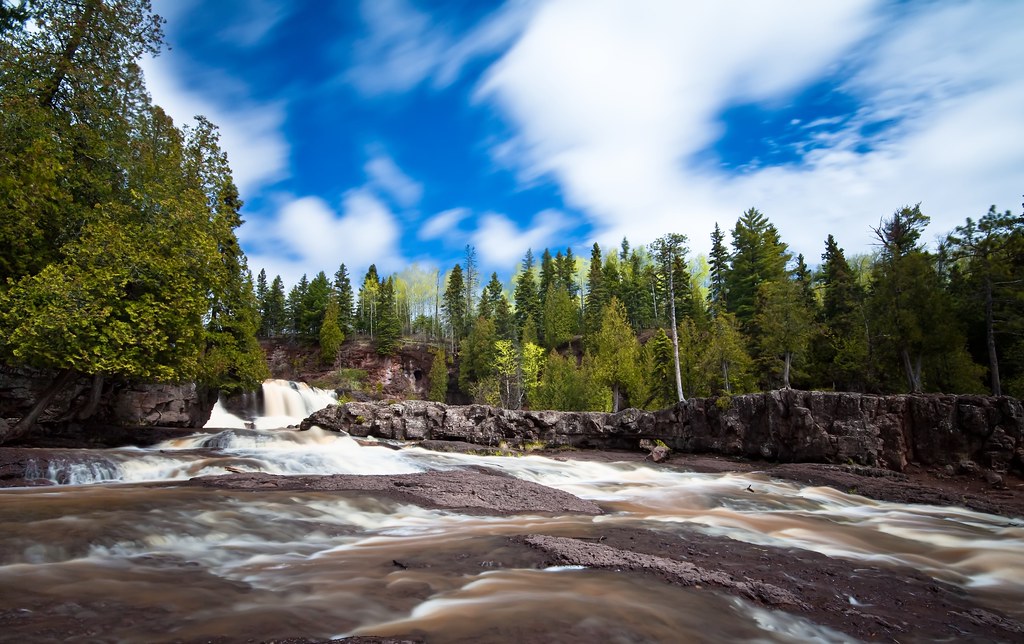
This is a image from the middle falls at Gooseberry Falls State Park. Taken on a beautiful spring day, way up north.
As you can see there was quite a bit of spring runoff coming from the hills. This is why the water has a brownish tinge to it.
Canon 50d
Sigma 10-20mm
B&W F-Pro CPL
HOYA ND400( 9-stops)
Single RAW exposure @ 11mm
ISO 100
f/11
6 seconds
Explored on Tuesday, January 29, 2019. Highest position: 35
Taken on a cold, grey, and windy day in December...mist is seen rising from the falls, one of the most photographed sites in th country. There is very little grass as such in Iceland due to the volcanic nature of the country. There is moss that grows and covers the red volcanic rock...the moss can take up to 100 years to cover the areas completely. My photo does not do justice to the falls, there are far better ones on Flickr, but I experienced a sense of wonder and awe in this magnificent place that needed to be shared.
Gullfoss (Golden Waterfall) is an iconic waterfall of Iceland offering a spectacular view of the forces and beauty of untouched nature. Gullfoss is part of the Golden Circle tour, located in South Iceland on the Hvítá (White) river which is fed by Iceland´s second biggest glacier, the Langjökull. The water plummets down 32 meters in two stages into a rugged canyon which walls reach up to 70 meters in height. On a sunny day shimmering rainbow can be seen over the falls.
SO MUCH MORE THAN JUST A PRETTY WATERFALL
Gullfoss is more than just a pretty waterfall, it has a story to tell. In the early 20th century foreign investors wanted to harness the power of Gullfoss to produce electricity. In 1907 Howells, an Englishman wanted to buy Gullfoss from Tómas Tómasson, a farmer who owned Gullfoss at this time. Tómas declined Howells´ offer to buy the waterfall but later he leased it to him. The farmer´s daughter, Sigriður Tómasdóttir who grew up on her father´s sheep farm sought to have the rental contract voided. Sigriður using her own saving hired a lawyer in Reykjavik to defend her case. The trial lasted years and Sigriður went several times barefoot on traitorous terrain to Reykjavik to follow up on her case. She even threatened to throw herself into the waterfall if the construction would begin. Her attempts failed in court but before any damage was done to the waterfall the contract was disposed due to the lack of payments of the rent fee. The struggles of Sigriður to preserve the waterfall brought to people´s attention the importance of preserving nature and therefore she is often called Iceland´s first environmentalist. There is a plaque of her profile on site.
In 1940 the adopted son of Sigriður acquired the waterfall from Sigriður´s father and later sold it to the Icelandic government. Gullfoss and its environs was designated as nature reserve in 1979 to permanently protect the waterfall and allow the public to enjoy this unique area.
In the middle of a "Pea Souper" of a foggy and cold December evening Position Light Signal 1345 shines bright at Retford Station.
This shot taken several years ago predicted the early demise of this tree limb. It is still there today undisturbed.
Best position in Explore (December 14, 2010) is # 220.
______________________________________________
Another Danbo fun shot for all of you my good friends! ;-)
2/28/2017 Tornado warned storm near Rutland, IL...
The Blue Hour
Full story via fb from that day: Finally got a chance to edit a few photos from 2/28/17. This storm was the last storm of the day & produced an EF-3 tornado near Washburn, IL. Had I not had a Dr's appt. in Springfield that day, I would not have had to play catch up & would have been able to easily position myself & just wait for this beauty to grace me & my camera with it's presence. It was tough to watch it to my west while it was on the ground & at it's peak before I could pull over as I was northbound on I-39. It was a beast. By the time I got to an exit & got set up just south of Rutland, the tornado was dissipating. Surprise, surprise, lol. It still had some nice structure regardless. After I got blasted with some insane RFD (70-80 estimated winds) I decided to continue to stay on it for awhile due to the crazy rotation it was still displaying. While en route driving, it dropped another tornado to my east, I missed it once again at it's peak. Was able to get a few shots of it before it dissipated. It was nearing dark, hauling butt & I was almost on E at that time so I had to call it, but hey, I will take it for February in Illinois especially considering I was not expecting to be able to capture anything that day due to circumstances.
These trucks are owned by a man who has a wonderful property and loves to show off his truck collection. These are two of around 7 he owns (I think), and he places them in wonderful positions around the grounds, perfect for photographers, I must say!
Explore Highest position # 94 on Sunday, May 10, 2009
The above photo is the scene of the Tamarama beach. There were some small yellow flowers at the spot I took the shot, wave texture, blue sea water color and cloud formation are very nice. This shot used high exposure speed to freeze the wave texture.:)
Tamarama is a beachside, eastern suburb of Sydney, in the state of New South Wales, Australia. Tamarama is located 7 kilometres east of the Sydney central business district. Tamarama has a small but perfectly formed ocean beach located about 1 kilometre south of the world famous Bondi Beach and a couple of hundred metres north of Bronte Beach.
หาด Tamarama เป็นชายหาดชานเมืองซิดนีย์ ในรัฐนิวเซาท์เวลส์ ออสเตรเลีย หาด Tamarama อยู่ 7 กิโลเมตรทางตะวันออกของย่านธุรกิจใจกลางนครซิดนีย์
Exposure: 1/1500 sec, Aperture: f/6.7, Focal Length:14 mm, ISO: 320
Nikon D700, Nikkor AF-S 14-24mm f/2.8G ED
Single shot. Light and color work in PS.
(No multi invitations please.:))
Explore Highest position # 134 on Sunday, September 7, 2008
Butterfly in Bangkok, Thailand. Don't know the name, I'm still practicing for a nice butterfly macro one.:)
ผีเสื้อที่สวนรถไฟ กทม.
Exposure: 1/180, Aperture: f/27, Focal Length: 105 mm, ISO: 400
Nikon D80, Nikkor 105mm f/2.8G ED-IF AF-S VR Micro
Red Deer - Cervus elaphus
Hinds scrapping for herd position?
London Royal Parks
The red deer (Cervus elaphus) is one of the largest deer species. The red deer inhabits most of Europe, the Caucasus Mountains region, Asia Minor, Iran, parts of western Asia, and central Asia. It also inhabits the Atlas Mountains region between Morocco and Tunisia in northwestern Africa, being the only species of deer to inhabit Africa. Red deer have been introduced to other areas, including Australia, New Zealand, United States, Canada, Peru, Uruguay, Chile and Argentina. In many parts of the world, the meat (venison) from red deer is used as a food source.
The red deer is the fourth-largest deer species behind moose, elk and sambar deer. It is a ruminant, eating its food in two stages and having an even number of toes on each hoof, like camels, goats and cattle. European red deer have a relatively long tail compared to their Asian and North American relatives. Subtle differences in appearance are noted between the various subspecies of red deer, primarily in size and antlers, with the smallest being the Corsican red deer found on the islands of Corsica and Sardinia and the largest being the Caspian red deer (or maral) of Asia Minor and the Caucasus Region to the west of the Caspian Sea. The deer of central and western Europe vary greatly in size, with some of the largest deer found in the Carpathian Mountains in Central Europe.Western European red deer, historically, grew to large size given ample food supply (including people's crops), and descendants of introduced populations living in New Zealand and Argentina have grown quite large in both body and antler size. Large red deer stags, like the Caspian red deer or those of the Carpathian Mountains, may rival the wapiti in size. Female red deer are much smaller than their male counterparts.
The European red deer is found in southwestern Asia (Asia Minor and Caucasus regions), North Africa and Europe. The red deer is the largest non-domesticated land mammal still existing in Ireland. The Barbary stag (which resembles the western European red deer) is the only member of the deer family represented in Africa, with the population centred in the northwestern region of the continent in the Atlas Mountains. As of the mid-1990s, Morocco, Tunisia and Algeria were the only African countries known to have red deer.
In the Netherlands, a large herd (ca. 3000 animals counted in late 2012) lives in the Oostvaarders Plassen, a nature reserve. Ireland has its own unique subspecies. In France the population is thriving, having multiplied fivefold in the last half-century, increasing from 30,000 in 1970 to approximately 160,000 in 2014. The deer has particularly expanded its footprint into forests at higher altitudes than before. In the UK, indigenous populations occur in Scotland, the Lake District, and the South West of England (principally on Exmoor). Not all of these are of entirely pure bloodlines, as some of these populations have been supplemented with deliberate releases of deer from parks, such as Warnham or Woburn Abbey, in an attempt to increase antler sizes and body weights. The University of Edinburgh found that, in Scotland, there has been extensive hybridisation with the closely related sika deer.
Several other populations have originated either with "carted" deer kept for stag hunts being left out at the end of the hunt, escapes from deer farms, or deliberate releases. Carted deer were kept by stag hunts with no wild red deer in the locality and were normally recaptured after the hunt and used again; although the hunts are called "stag hunts", the Norwich Staghounds only hunted hinds (female red deer), and in 1950, at least eight hinds (some of which may have been pregnant) were known to be at large near Kimberley and West Harling; they formed the basis of a new population based in Thetford Forest in Norfolk. Further substantial red deer herds originated from escapes or deliberate releases in the New Forest, the Peak District, Suffolk, Lancashire, Brecon Beacons, and North Yorkshire, as well as many other smaller populations scattered throughout England and Wales, and they are all generally increasing in numbers and range. A census of deer populations in 2007 and again in 2011 coordinated by the British Deer Society records the red deer as having continued to expand their range in England and Wales since 2000, with expansion most notable in the Midlands and East Anglia.
Mahagoni-Hochzeitstag nächstes Jahr
Highest position: 213 on Wednesday, June 27, 2018 on Explore
-
bighugelabs.com/scout.php?mode=history&id=42114681255
-
Der Aussichtsturm in Dürrenmettstetten ist ein inzwischen auch überregional sehr bekannter Aussichtsturm am Rande des Schwarzwalds, ähnlich dem Vogteiturm in Loßburg.
Er wurde 1998 von den Natur- und Wanderfreunden Dürrenmettstetten mit viel Eigenleistung und Spenden errichtet. Der Standpunkt des Turms ist genau 676 Meter über NN und mit einer Turmhöhe von 24 Metern befindet sich die Aussichtsplattform genau auf 700 Meter über NN.
Schon aus der Weite ist der imposante Turm auf dem Höhenplateau zwischen Oberiflingen und Dürrenmettstetten zu sehen.
Um so weiter ist jedoch die Sicht auf dem Turm, welcher ein lückenloses 360° Panorama ermöglicht!
Dabei reicht die Sicht vom Heckengäu über den Schönbuch bis nach Tübingen. Hier folgt das Panorama der Achalm (707 Meter über NN) bei Reutlingen in Richtung des Albtrauf der schwäbischen Alb. Über den Blick auf die Burg Hohenzollern geht es weiter in Richtung des Plettenbergs bei Balingen. Von hier aus ist bei sehr guter Sicht auch das Panorama der Alpen in der Zentralschweiz sichtbar. Über den Verlauf des Neckartals geht es dann weiter Richtung Südschwarzwald, wo unter anderem bei guter Sicht der Feldbergturm gut erkennbar ist. Dazwischen ist bei sehr guten Sichtverhältnissen der Blick auf das Berner Oberland mit den bekannten Gipfeln Mönch und Jungfrau gegeben. Das letzte Stück des Panoramas folgt vom Südschwarzwals in Richtung Nordschwarzwald. Hier ist unter anderem Freudenstadt erkennbar und ein Stück weiter der Gipfelrücken der Hornisgrinde mit Aussichtsturm.
Das gesamte Panorama (inklusive markanter Orientierungspunkten) wird über vier Aussichtstafeln beschrieben.
Wer mehr zum Turmbau und dessen Entstehung auch in Bildern erfahren möchte, kann dies auf der Homepage der Natur- und Wanderfreunde Dürrenmettstetten tun.
Explore highest Position: 90 on Dec 6, 2007
Press the key "L" to see full screen size - press the same key again to return to the original size.
www.istockphoto.com/au/portfolio/francisco_martins?exclud...
www.instagram.com/bettadesignphoto/
A perfect sunset on the one and only (Straight from the camera - no Photoshop)
Perfeito pôr do sol no famoso e único, Taj Mahal
More info: / Mais informação:
Photos are not allowed inside the monument so this link to a virtual tour is worth it.
This for a virtual tour: www.taj-mahal.net/
en.wikipedia.org/wiki/Taj_Mahal
-Added to theCream of the Crop pool as most favorited.
To browse through my photos of India using flickriver/ Para ver minhas fotos da India com o flickriver
Or here to see photos with descriptions / ou aqui para ler as descrições das fotos
Press the key "L" to see full screen size - press the same key again to return to the original size.