View allAll Photos Tagged paperfolding
Explored!
7 units
Designer: Francesco Mancini
Folder: Francesco Mancini
Paper: Kraft
Unit size: Square
Diagram: origamiusa.org/catalog/products/stella-pitti-pdf
Original model Stella Pitti
30 units
Designer: jun Maekawa, Francesco Mancini and others
Folder: Francesco Mancini
Paper: Favini special events
Unit size: 1:sqrt2
Repeating the molecule and then you get a flower-circle tessellation.
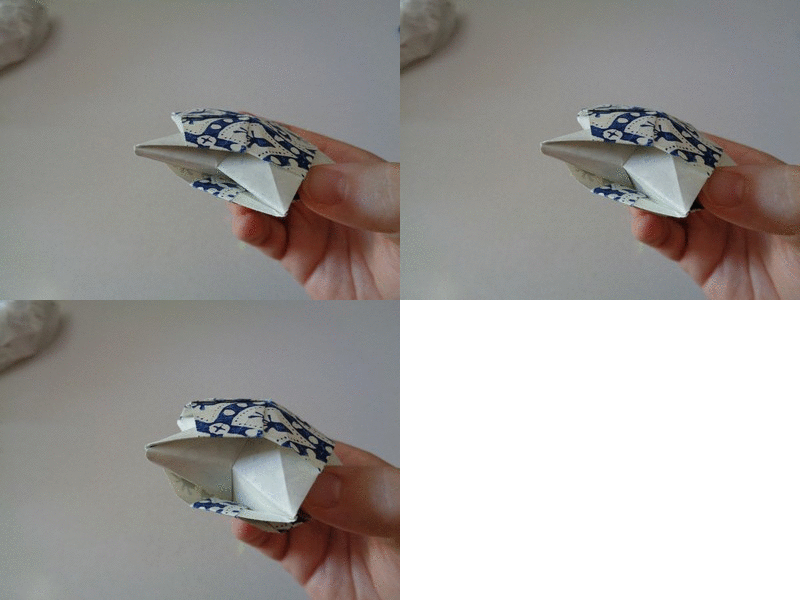
Hexagon about 17cm, copy paper with dot motive . Finished model about 7,5 cm.
Model: Origami Flower-circle
Design by Marjan Smeijsters
Midjourney prompt:
paperfold art of a ghost miku hatsune with beautiful light, in the style of ghostly forms, face with pale skin, long light blue and pale blue hairs, mini skirt and 60s style, luminous hues, dark tone, dollcore, 8k, complete body view, Princess-like, origami, black background, fine art, Highly detailed paper structure--ar 5:4 --v 5
Thank you for the inspiration
Kris Kashtanova
@icreatelife
Origami Cat designed and folded by Ivan Svatko.
Paper: EH 30x30cm
Origanal design which I'm pretty satisfied with (at least now). However I have to rethink whole folding sequence once again to make it as clean as possible.
Pinwheel Flower ball
Designed by me
Published in Origami USA's online magazine The Fold issue 26
30 units
Rectangles - 1:2
Update- Just now saw that my pic was in Explore; the reason for so many faves! :D
Antares 60-degrees variations
Designer: Vladimir Frolov
Left: Antares-60-60 (2:√3 ratio)
Right: Antares-60-60t (1:√3 ratio)
30 units
No glue
Left one created 01/6/2015
Happy Easter!
Easter Hen designed by Pierre-Yves Gallard.
Free tutorial on his website.
Thank you very much for sharing!
Level 4 Sierpinski's triangle made with Modulosca boxes
81 unit + 43 links
Designer: Francesco Mancini
Folder: Francesco Mancini
Paper: Tassotti
Unit size: 1.sqrt2
Final height: 90cm
I admit………….. I'm a backlight-addict ;-D
Folded this model Origami 'Before the Big Bang' by Thoki Yenn from handmade paper, started with a square 70x70 cm and then folded this 'face'.
Diagrams in the book 'Extreme Origami' by Kunihiko Kasahara
Explored!
12 units
Designer: Francesco Mancini
Folder: Francesco Mancini
Paper: Tant
Unit size: Square
Original model Stella Pitti
Not Sadako Sasaki!
Folded from a sheet of 25 x 80 cm of sketch paper (Sadako and white part of the screen) and a sheet of 14 x 26 cm of black paper (screen frame).
The model is designed to handle color changes, but the white paper is very transparent, and didn't show as white as I wanted for the body and arms. So, only the hair part is actually double-sided. The rest of the paper is uni-colored.
I like that the transparency of the white paper makes the screen grayish though!
For the year of boar (or pig)
It's been while since I post the last pic. Sorry for my absence
Designed and folded by Gen Hagiwara
From 30cm uncut square paper.
5 units
Designer: Francesco Mancini
Folder: Francesco Mancini
Paper: Tassotti
Unit size: 1:sqrt2
Pulsar effect i.picasion.com/pic80/6f07bc6a6e74352abfdb28f8a37babc8.gif
As said before, I wanted to see what the pattern would look like if I did all the same folding steps of the "Kathy Flower" on one side. This is "Phase 2".
I did the closest distance and then it turns out to be more related to the second one in "Growth".
You can see it "here", if you want. It's the second column.
Phase 1 looks like this, a whole field of "Swirling Stars".
"Dictator" meaning an arrogant man with the long arms and hollow breast (heart).
Folded: 2011
From one uncut square paper.
*Intended to be a rough sketch.
As mentioned before, I like the triangle-like hexagon a lot, here you see two results. There are more possibilities......
In the upper row front and back using the little triangle-like hexagon. In the lower row a bigger one.
I'm probably not the first one who discovers this, but I found it independently.
Here you can see a highlighted version of both frontsides.
Both folded from a hexagon of soft, fine-textured paper, about 18 cm, grid 1:32.
If you want you see more about this project, check out my origami 'Origami - Tessellation Progression' album.
Yet another variant of Star Ananke. Variants of this star were designed independently by myself and by others before me: Wei Fu, and Robin Glynn.
Leaving this pic here in this Flickr album also for record purpose.
I came up with a similar image with the relevant text for Ronald Koh to post on FB for Mother's Day 2023 (May 14) and I also commented on his post that the inspiration came from watching his son giving him a hug each time he was about to go home after visiting Ron at the hospital where Ron was hospitalised several years ago.
I had wanted to express that somehow in origami and in June 2022, while I was being grounded by Covid and let's just say had a fair bit of time on my hands, I decided to try to realise an idea I had. Test folded quite a few wabbits and I was hoping to have the folds and a photo in time for Father's Day 2022 (June 19) but couldn't come up with satisfactory renderings although I had more or less figured out how to realise the idea. Largely because I didn't have access to my stash of Elephant Hide paper and camera gear.
As usual, I forgot about the whole thing after I was 'un-grounded' until Mother's Day 2023 was just around the corner although similar poses/'spin-offs' were used in the video we made for year end 2022 and also the video for Chinese New Year 2023
Folded from a 100 x 33 cm sheet of sketch paper.
This is the Angel holding a flower from Andersen's fairy tale. The model is based on my usual human pattern for the arms and shoulder parts, but the skirt is inspired by the Girl in a Dress by Stefan Weiss. The wings are a simple tweak on the accordion fold, and the hair was obtained by crumpling the paper, a first for me!
Created for Origami Deutschland's 2016 competition on the theme Fairy Tales. It is part of the larger scene 13 Tales.
I'm not sure if you can really repeat it ;) I mean without glue ;)
The units hold only due to the structure, no flaps, no pockets.
The unit shows exactly 50% of the initial square ;)
Mirage
Designer: Ekaterina Lukasheva
Created: 2015
Folder: Ekaterina Lukasheva
Parts: 30
Paper's size: 7.5 cm
Paper: tant
Joined with : nothing
Final height: 12 cm
The CP is available www.flickr.com/gp/kusudama-me/6HN548
Folded and designed by me. Without using sciossors or glue.
Folded from a 65 x 102 cm piece of 356 g/m² watercolor paper.
Folded from a single uncut sheet of sketch paper (33 x 363 cm).
When thinking of the people who inspire me the most, my parents immediately come to mind before anyone else. They have taught me much more than traditional comic book heroes. We all learn wealths of knowledge from just interacting with each other, and I wanted to show that from a mother who is her son's heroine, to the son who is his mother's world, everyone can be a hero.
Folded for the Paper Heroes exhibition 2017.
Arrow Corrugation, designed independently with Polly Verity. Viewed at an angle and in direct sunlight, this model displays the arrows quite prominently. Read more in my previous posts or at origami.kosmulski.org/models/arrow-corrugation
148/365
This is one of my most recent models from my 365-day origami mask challenge on Instagram.
www.instagram.com/jacksons_origami/
Folded from a single rectangle. I've colored the model, for more depth and aliveness with a metallic finish.
Whirlwind tessellation molecule, as seen on the Whirlwind Box (top-down view). The design is closely related to my Woven Triangles family, but I gave it a different name since all Woven Triangles variants are flat while this one is 3D and looks best with curved folds.
This is actually the back side, but put this way it's surely hypnotising.
Quadra-A tessellation
1 sheet of paper
Normally I don't like Montroll's designes a lot but this one is the exception... ...I used a 30cm square of Nicolas Terry's tissue foil paper... and...
...I hope you like it...
This is one of Fujimoto’s _translucent designs_, a name he used for many of his tessellations. Folded from rare blue Elephant Hide paper, this work is not very much translucent, but on the other hand this thick paper shows the texture of the model well in reflected light.
Front and back feature somewhat different patterns, both involving equilateral triangles. The way I know which side should be considered front and which back is I got my hands on a picture of this design folded by Fujimoto (see below) and since he used duo paper, I assumed front was the color side.
There are no instructions for this model in Fujimoto’s books apart from pictures of finished model in strong back-light and of rather poor quality (Twist Origami I, page 33; Introduction to Creative Playing with Origami, page 163). Fortunately, thanks to Satoko Saito, I also got hold of a picture of another fold by Fujimoto himself, and that one was a color picture, in reflected light, and of much higher quality, making the reverse-engineering much easier. In a way, this design can be viewed as a triangle twist tessellation with modified pleat assignment.
Link: origami.kosmulski.org/models/translucent-design-cfw-58
The horseption 2 from big to small
There's no enough horse's yet
Horse
Design: Hideo komatsu
Fold: Aarón Ramírez
Papers:
45x45 cm triple tissue
35x35 cm triple tissue
30x30 cm triple tissue
25x25 cm double tissue
20x20 cm double tissue
15x15 cm double tissue
10x10 cm double tissue
I don't know if I gonna make the 1,000 horses but certainly am closer to that number, I really enjoy the folding sequence of this design and don't have to say it but anyway this is my favorite horse design.
#origami #horse #paperfold #paperfolding #paperart #art #papiroflexia #arte #caballo #blue #azul #negro #orange #naranja #brown #cafe #gray #gris #wildlife #animal #dog #折り紙