View allAll Photos Tagged lowering
Post image of four lovely asses in a row, however we still have all four girls present in the picture. Yay! IMG_1487
Rapid strata formation in soft sand (field evidence).
Photo of strata formation in soft sand on a beach, created by tidal action of the sea.
Formed in a single, high tidal event. Stunning evidence which displays multiple strata/layers.
Why this is so important ....
It has long been assumed, ever since the 17th century, that layers/strata observed in sedimentary rocks were built up gradually, layer upon layer, over many years. It certainly seemed logical at the time, from just looking at rocks, that lower layers would always be older than the layers above them, i.e. that lower layers were always laid down first followed, in time, by successive layers on top.
This was assumed to be true and became known as the superposition principle.
It was also assumed that a layer comprising a different material from a previous layer, represented a change in environmental conditions/factors.
These changes in composition of layers or strata were considered to represent different, geological eras on a global scale, spanning millions of years. This formed the basis for the Geologic Column, which is used to date rocks and also fossils. The evolutionary, 'fossil record' was based on the vast ages and assumed geological eras of the Geologic Column.
There was also circular reasoning applied with the assumed age of 'index' fossils (based on evolutionary beliefs & preconceptions) used to date strata in the Geologic Column. Dating strata from the assumed age of (index) fossils is known as Biostratigraphy.
We now know that, although these assumptions seemed logical, they are not supported by the evidence.
At the time, the mechanics of stratification were not properly known or studied.
An additional factor was that this assumed superposition and uniformitarian model became essential, with the wide acceptance of Darwinism, for the long ages required for progressive microbes-to-human evolution. There was no incentive to question or challenge the superposition, uniformitarian model, because the presumed, fossil 'record' had become dependant on it, and any change in the accepted model would present devastating implications for Darwinism.
This had the unfortunate effect of linking the study of geology so closely to Darwinism, that any study independent of Darwinian considerations was effectively stymied. This link of geology with Darwinian preconceptions is known as biostratigraphy.
Some other field evidence, in various situations, can be observed here: www.flickr.com/photos/101536517@N06/sets/72157635944904973/
and also in the links to stunning, experimental evidence, carried out by sedimentologists, given later.
_______________________________________________
GEOLOGIC PRINCIPLES (established by Nicholas Steno in the 17th Century):
What Nicolas Steno believed about strata formation is the basis of the principle of Superposition and the principle of Original Horizontality.
dictionary.sensagent.com/Law_of_superposition/en-en/
“Assuming that all rocks and minerals had once been fluid, Nicolas Steno reasoned that rock strata were formed when particles in a fluid such as water fell to the bottom. This process would leave horizontal layers. Thus Steno's principle of original horizontality states that rock layers form in the horizontal position, and any deviations from this horizontal position are due to the rocks being disturbed later.”)
BEDDING PLANES.
'Bedding plane' describes the surface in between each stratum which are formed during sediment deposition.
science.jrank.org/pages/6533/Strata.html
“Strata form during sediment deposition, that is, the laying down of sediment. Meanwhile, if a change in current speed or sediment grain size occurs or perhaps the sediment supply is cut off, a bedding plane forms. Bedding planes are surfaces that separate one stratum from another. Bedding planes can also form when the upper part of a sediment layer is eroded away before the next episode of deposition. Strata separated by a bedding plane may have different grain sizes, grain compositions, or colours. Sometimes these other traits are better indicators of stratification as bedding planes may be very subtle.”
______________________________________________
Several catastrophic events, flash floods, volcanic eruptions etc. have forced Darwinian, influenced geologists to admit to rapid stratification in some instances. However they claim it is a rare phenomenon, which they have known about for many years, and which does nothing to invalidate the Geologic Column, the fossil record, evolutionary timescale, or any of the old assumptions regarding strata formation, sedimentation and the superposition principle. They fail to face up to the fact that rapid stratification is not an extraordinary phenonemon, but rather the prevailing and normal mechanism of sedimentary deposition whenever and wherever there is moving, sediment-laden water. The experimental evidence demonstrates the mechanism and a mass of field evidence in normal (non-catastrophic) conditions shows it is a normal everyday occurrence.
It is clear from the experimental evidence that the usual process of stratification is - that strata are not formed by horizontal layers being laid on top of each other in succession, as was assumed. But by sediment being sorted in the flowing water and laid down diagonally in the direction of flow. See diagram:
www.flickr.com/photos/truth-in-science/39821536092/in/dat...
The field evidence (in the image) presented here - of rapid, simultaneous stratification refutes the Superposition Principle and the Principle of Lateral Continuity.
We now know, the Superposition Principle only applies on a rare occasion where sedimentary deposits are laid down in still water.
Superposition is required for the long evolutionary timescale, but the evidence shows it is not the general rule, as was once believed. Most sediment is laid down in moving water, where particle segregation is the general rule, resulting in the simultaneous deposition of strata/layers as shown in the photo.
See many other examples of rapid stratification (with geological features): www.flickr.com/photos/101536517@N06/sets/72157635944904973/
Rapid, simultaneous formation of layers/strata, through particle segregation in moving water, is so easily created it has even been described by sedimentologists (working on flume experiments) as a law ...
"Upon filling the tank with water and pouring in sediments, we immediately saw what was to become the rule: The sediments sorted themselves out in very clear layers. This became so common that by the end of two weeks, we jokingly referred to Andrew's law as "It's difficult not to make layers," and Clark's law as "It's easy to make layers." Later on, I proposed the "law" that liquefaction destroys layers, as much to my surprise as that was." Ian Juby, www.ianjuby.org/sedimentation/
The example in the photo is the result of normal, everyday tidal action formed in a single incident, and subsequently eroded by water flow revealing the strata/layers.
Where the water current or movement is more turbulent, violent, or catastrophic, great depths (many metres) of stratified sediment can be laid down in a short time. Certainly not the many millions of years assumed by evolutionists.
The composition of strata formed in any deposition event. is related to whatever materials are in the sediment mix, not to any particular timescale. Whatever is in the mix will be automatically sorted into strata/layers. It could be sand, or other material added from mud slides, erosion of chalk deposits, coastal erosion, volcanic ash etc. Any organic material (potential fossils), alive or dead, engulfed by, or swept into, a turbulent sediment mix, will also be sorted and buried within the rapidly, forming layers.
See many other examples of rapid stratification with geological features: www.flickr.com/photos/101536517@N06/sets/72157635944904973/
Stratified, soft sand deposit. demonstrates the rapid, stratification principle.
Important, field evidence which supports the work of the eminent, sedimentologist Dr Guy Berthault MIAS - Member of the International Association of Sedimentologists.
(Dr Berthault's experiments (www.sedimentology.fr/)
And also the experimental work of Dr M.E. Clark (Professor Emeritus, U of Illinois @ Urbana), Andrew Rodenbeck and Dr. Henry Voss, (www.ianjuby.org/sedimentation/)
Location: Yaverland, Isle of Wight. Photographed 12/10/2018 This field evidence demonstrates that multiple strata in sedimentary deposits do not need millions of years to form and can be formed rapidly. This natural example confirms the principle demonstrated by the sedimentation experiments carried out by Dr Guy Berthault and other sedimentologists. It calls into question the standard, multi-million year dating of sedimentary rocks, and the dating of fossils by depth of burial or position in the strata.
Mulltiple strata/layers are evident in this example.
Dr Berthault's experiments (www.sedimentology.fr/) and other experiments (www.ianjuby.org/sedimentation/) and field studies of floods and volcanic action show that, rather than being formed by gradual, slow deposition of sucessive layers superimposed upon previous layers, with the strata or layers representing a particular timescale, particle segregation in moving water or airborne particles can form strata or layers very quickly, frequently, in a single event.
And, most importantly, lower strata are not older than upper strata, they are the same age, having been created in the same sedimentary episode.
Such field studies confirm experiments which have shown that there is no longer any reason to conclude that strata/layers in sedimentary rocks relate to different geological eras and/or a multi-million year timescale. www.youtube.com/watch?v=5PVnBaqqQw8&feature=share&.... they also show that the relative position of fossils in rocks is not indicative of an order of evolutionary succession. Obviously, the uniformitarian principle, on which the geologic column is based, can no longer be considered valid. And the multi-million, year dating of sedimentary rocks and fossils needs to be reassessed. Rapid deposition of stratified sediments also explains the enigma of polystrate fossils, i.e. large fossils that intersect several strata. In some cases, tree trunk fossils are found which intersect the strata of sedimentary rock up to forty feet in depth. upload.wikimedia.org/wikipedia/commons/thumb/0/08/Lycopsi... They must have been buried in stratified sediment in a short time (certainly not millions, thousands, or even hundreds of years), or they would have rotted away. youtu.be/vnzHU9VsliQ
In fact, the vast majority of fossils are found in good, intact condition, which is testament to their rapid burial. You don't get good fossils from gradual burial, because they would be damaged or destroyed by decay, predation or erosion. The existence of so many fossils in sedimentary rock on a global scale is stunning evidence for the rapid depostion of sedimentary rock as the general rule. It is obvious that all rock containing good intact fossils was formed from sediment laid down in a very short time, not millions, or even thousands of years.
See set of photos of other examples of rapid stratification: www.flickr.com/photos/101536517@N06/sets/72157635944904973/
Carbon dating of coal should not be possible if it is millions of years old, yet significant amounts of Carbon 14 have been detected in coal and other fossil material, which indicates that it is less than 50,000 years old. www.ldolphin.org/sewell/c14dating.html
www.grisda.org/origins/51006.htm
Evolutionists confidently cite multi-million year ages for rocks and fossils, but what most people don't realise is that no one actually knows the age of sedimentary rocks or the fossils found within them. So how are evolutionists so sure of the ages they so confidently quote? The astonishing thing is they aren't. Sedimentary rocks cannot be dated by radiometric methods*, and fossils can only be dated to less than 50,000 years with Carbon 14 dating. The method evolutionists use is based entirely on assumptions. Unbelievably, fossils are dated by the assumed age of rocks, and rocks are dated by the assumed age of fossils, that's right ... it is known as circular reasoning.
* Regarding the radiometric dating of igneous rocks, which is claimed to be relevant to the dating of sedimentary rocks, in an occasional instance there is an igneous intrusion associated with a sedimentary deposit -
Prof. Aubouin says in his Précis de Géologie: "Each radioactive element disintegrates in a characteristic and constant manner, which depends neither on the physical state (no variation with pressure or temperature or any other external constraint) nor on the chemical state (identical for an oxide or a phosphate)."
"Rocks form when magma crystallizes. Crystallisation depends on pressure and temperature, from which radioactivity is independent. So, there is no relationship between radioactivity and crystallisation.
Consequently, radioactivity doesn't date the formation of rocks. Moreover, daughter elements contained in rocks result mainly from radioactivity in magma where gravity separates the heavier parent element, from the lighter daughter element. Thus radiometric dating has no chronological signification." Dr. Guy Berthault www.sciencevsevolution.org/Berthault.htm
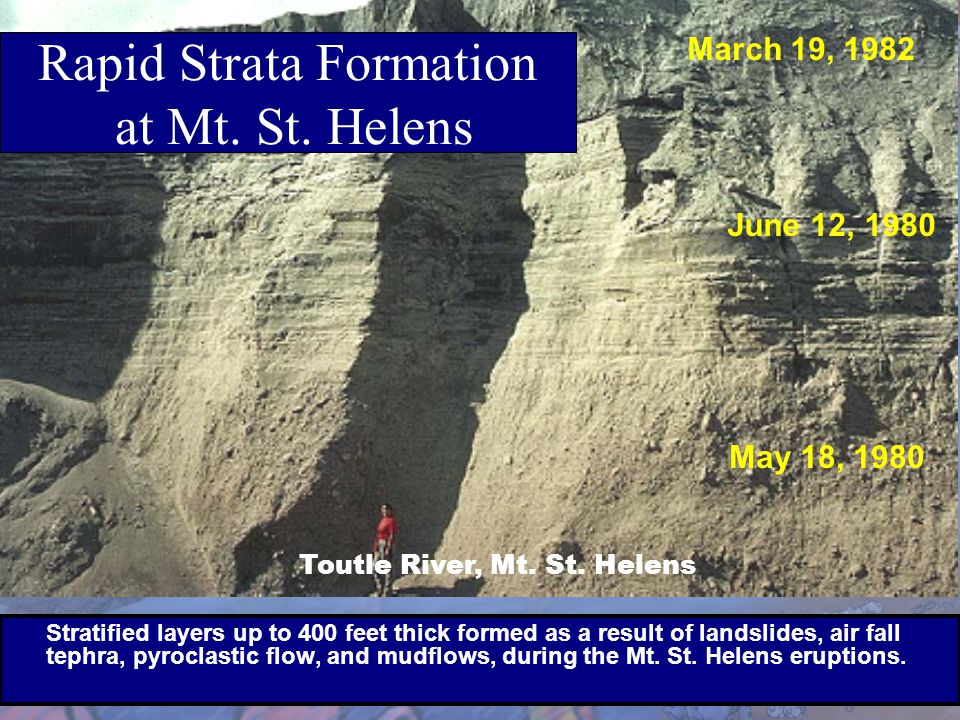
Rapid strata formation and rapid erosion at Mount St Helens.
slideplayer.com/slide/5703217/18/images/28/Rapid+Strata+F...
Visit the fossil museum:
www.flickr.com/photos/101536517@N06/sets/72157641367196613/
Just how good are peer reviews of scientific papers?
www.sciencemag.org/content/342/6154/60.full
www.examiner.com/article/want-to-publish-science-paper-ju...
The neo-Darwinian idea that the human genome consists entirely of an accumulation of billions of mutations is, quite obviously, completely bonkers. Nevertheless, it is compulsorily taught in schools and universities as 'science'.
Shot while leading a photo tour along the Grand Canyon of the Yellowstone from Artist Point www.gerlachnaturephoto.com
------------------------------------------------------------------------------------------------
If you would like to use this picture in any sort of form, please send me a Flickrmail or send me an email at natehenderson6@gmail.com.
South aisle altar tomb of Joanna, Lady Clopton who died in December 1430. After her husband's death she became a vowess (taking perpetual vows of widowhood before a bishop ) For a widow of ample means, this was a safeguard against unwelcome suitors. Her desire was to give her life to good works. She is shown wearing the habit of a vowess, with a wimple and widow's barbe under her chin.
Possibly marred by bat droppings, she stands beneath a crocketted canopy Above her head is a scroll with an inscription taken from Psalm 40 v 14 & Psalm 71 v2- "Be pleased O Lord to deliver me: O Lord make haste to help me" (Complaceat tibi, D(omi)ne, • uti eripias me! D(omi)ne, ad adiuvandu(m) me refpice)
Around the edge is an inscription in latin the verse ends marked with a pear. which translates:
"Christ, Anna's grandson, have pity on Joan Clopton !
After having vowed herself to Thee when she became a widow she is now entombed here.
The Knight, her spouse, having died, she became even that to Thee, your bride Jesus
Being magnanimous - and gladly, too ! - to strangers and generous to the unfortunate,
She showered upon the venerable churches as well as upon the needy her riches,
So that she might send up to Heaven this her wealth which she obtained from there.
For such great merits mayest Thou grant her the blessed realm,
And may the dark destiny of the tomb not weigh her down, but let the forecourt of God enrich and delight her"
Alternatively:
“Vowed to a holy life when ceased her knightly husband’s breath,
Joan Clopton here, Anne’s grandchild dear implores Thy grace in death;
O Christ, for Thee, O Jesu blest, how largely hath she shed
Her bounteous gifts on poor and sick — how hath she garnished
Thy stately shrines with splendour meet—how hath she sent before
Her earthly wealth to Thee above, to swell her heavenly store,
For such blest fruits of faith, O grant, in Thine own house her home:
Soft lies an earthly tomb on those to whom these heavenly blessings come.”
She was the 2nd daughter & co-heiress of Alexander Pearsford alias Besford 1403 of Besford, Worc by 1st wife Beatrix daughter of Sir Peter Pierce Thornton of Thornton Cheshire & Lucia Hellesby
(Her nephew Thomas Throckmorton is at Fladbury www.flickr.com/gp/52219527@N00/6w32Gz )
She m Sir William Clopton 1419 www.flickr.com/gp/52219527@N00/Sa309V , lord of the manors of Radbrooke & Quinton whose effigy once lay beside her here until it was moved under the south arcade in 1739.
Joanna brought him the manors of More Fladford and
Hull, and the sixth part of the Manor of Chaddeswych and Wyllynwych, and the advowson of the Church of Fleford
William was the son of Mary Charlton & John Clopton, who was later 1st husband of Juliana 1411 daughter of John Morehall and Agnes Beysin; who m2 (1st wife) Thomas Crewe / Cruwe 1418 MP of Wixford flic.kr/p/aimLwe
Children
1. Thomas - b1403 , living 1419 - died young
2. Agnes b1405 m Roger Harewell 1430 of Wootton Wawen Warks, son of John Harewell flic.kr/p/Q9YUxm and 3rd wife Margery daughter of Margaret & Thomas Beaupyne, MP
3. Joanna / Jane his eventual heir m Sir John de Burgh 1471 of Wattlesborough son of Hugh Burgh, Esq. and Elizabeth Mouthe, having 3 co-heiress daughters Elizabeth / Isabella Burgh flic.kr/p/e2HLRW 1522 wife of Sir John Lingen, Ankeret wife of John Leighton & Elizabeth wife of Thomas Mytton
Husband William Clopton died on 7th Sept 1419, Thomas their heir was aged 16 at the time
Three years later Joan made an enfeoffment of her estates - possibly after the death of son Thomas, taking her vows shortly after.
The 2 shields at the top of the brass are Argent two bars gules fretty or [Clopton] Gules a fess between six pears or Besford / Pearsford; Below are [Clopton] impaling [ Besford]; & [Clopton], with a blank canton.
In the corners are medallions containing the symbols of the Evangelists
www.ebooksread.com/authors-eng/bristol-and-gloucestershir...
Thomas Lingen, www.flickr.com/gp/52219527@N00/hj7YLn her 7 x great grandson whose name appears on the tomb, repaired it in 1739. - Church St Swithin, Lower Quinton Warwickshire,
This lower-spec Mercedes A-class from Belgium was driving passed where i was staying in Winchelsea Beach. It was purchased from a chain of Mercedes dealers located all around Belgium.
Winchelsea Beach, East Sussex, United Kingdom
Rapid strata formation in soft sand (field evidence).
Photo of strata formation in soft sand on a beach, created by tidal action of the sea.
Formed in a single, high tidal event. Stunning evidence which displays multiple strata/layers.
Why this is so important ....
It has long been assumed, ever since the 17th century, that layers/strata observed in sedimentary rocks were built up gradually, layer upon layer, over many years. It certainly seemed logical at the time, from just looking at rocks, that lower layers would always be older than the layers above them, i.e. that lower layers were always laid down first followed, in time, by successive layers on top.
This was assumed to be true and became known as the superposition principle.
It was also assumed that a layer comprising a different material from a previous layer, represented a change in environmental conditions/factors.
These changes in composition of layers or strata were considered to represent different, geological eras on a global scale, spanning millions of years. This formed the basis for the Geologic Column, which is used to date rocks and also fossils. The evolutionary, 'fossil record' was based on the vast ages and assumed geological eras of the Geologic Column.
There was also circular reasoning applied with the assumed age of 'index' fossils (based on evolutionary beliefs & preconceptions) used to date strata in the Geologic Column. Dating strata from the assumed age of (index) fossils is known as Biostratigraphy.
We now know that, although these assumptions seemed logical, they are not supported by the evidence.
At the time, the mechanics of stratification were not properly known or studied.
An additional factor was that this assumed superposition and uniformitarian model became essential, with the wide acceptance of Darwinism, for the long ages required for progressive microbes-to-human evolution. There was no incentive to question or challenge the superposition, uniformitarian model, because the presumed, fossil 'record' had become dependant on it, and any change in the accepted model would present devastating implications for Darwinism.
This had the unfortunate effect of linking the study of geology so closely to Darwinism, that any study independent of Darwinian considerations was effectively stymied. This link of geology with Darwinian preconceptions is known as biostratigraphy.
Some other field evidence, in various situations, can be observed here: www.flickr.com/photos/101536517@N06/sets/72157635944904973/
and also in the links to stunning, experimental evidence, carried out by sedimentologists, given later.
_______________________________________________
GEOLOGIC PRINCIPLES (established by Nicholas Steno in the 17th Century):
What Nicolas Steno believed about strata formation is the basis of the principle of Superposition and the principle of Original Horizontality.
dictionary.sensagent.com/Law_of_superposition/en-en/
“Assuming that all rocks and minerals had once been fluid, Nicolas Steno reasoned that rock strata were formed when particles in a fluid such as water fell to the bottom. This process would leave horizontal layers. Thus Steno's principle of original horizontality states that rock layers form in the horizontal position, and any deviations from this horizontal position are due to the rocks being disturbed later.”)
BEDDING PLANES.
'Bedding plane' describes the surface in between each stratum which are formed during sediment deposition.
science.jrank.org/pages/6533/Strata.html
“Strata form during sediment deposition, that is, the laying down of sediment. Meanwhile, if a change in current speed or sediment grain size occurs or perhaps the sediment supply is cut off, a bedding plane forms. Bedding planes are surfaces that separate one stratum from another. Bedding planes can also form when the upper part of a sediment layer is eroded away before the next episode of deposition. Strata separated by a bedding plane may have different grain sizes, grain compositions, or colours. Sometimes these other traits are better indicators of stratification as bedding planes may be very subtle.”
______________________________________________
Several catastrophic events, flash floods, volcanic eruptions etc. have forced Darwinian, influenced geologists to admit to rapid stratification in some instances. However they claim it is a rare phenomenon, which they have known about for many years, and which does nothing to invalidate the Geologic Column, the fossil record, evolutionary timescale, or any of the old assumptions regarding strata formation, sedimentation and the superposition principle. They fail to face up to the fact that rapid stratification is not an extraordinary phenonemon, but rather the prevailing and normal mechanism of sedimentary deposition whenever and wherever there is moving, sediment-laden water. The experimental evidence demonstrates the mechanism and a mass of field evidence in normal (non-catastrophic) conditions shows it is a normal everyday occurrence.
It is clear from the experimental evidence that the usual process of stratification is - that strata are not formed by horizontal layers being laid on top of each other in succession, as was assumed. But by sediment being sorted in the flowing water and laid down diagonally in the direction of flow. See diagram:
www.flickr.com/photos/truth-in-science/39821536092/in/dat...
The field evidence (in the image) presented here - of rapid, simultaneous stratification refutes the Superposition Principle and the Principle of Lateral Continuity.
We now know, the Superposition Principle only applies on a rare occasion where sedimentary deposits are laid down in still water.
Superposition is required for the long evolutionary timescale, but the evidence shows it is not the general rule, as was once believed. Most sediment is laid down in moving water, where particle segregation is the general rule, resulting in the simultaneous deposition of strata/layers as shown in the photo.
See many other examples of rapid stratification (with geological features): www.flickr.com/photos/101536517@N06/sets/72157635944904973/
Rapid, simultaneous formation of layers/strata, through particle segregation in moving water, is so easily created it has even been described by sedimentologists (working on flume experiments) as a law ...
"Upon filling the tank with water and pouring in sediments, we immediately saw what was to become the rule: The sediments sorted themselves out in very clear layers. This became so common that by the end of two weeks, we jokingly referred to Andrew's law as "It's difficult not to make layers," and Clark's law as "It's easy to make layers." Later on, I proposed the "law" that liquefaction destroys layers, as much to my surprise as that was." Ian Juby, www.ianjuby.org/sedimentation/
The example in the photo is the result of normal, everyday tidal action formed in a single incident. Where the water current or movement is more turbulent, violent, or catastrophic, great depths (many metres) of stratified sediment can be laid down in a short time. Certainly not the many millions of years assumed by evolutionists.
The composition of strata formed in any deposition event. is related to whatever materials are in the sediment mix, not to any particular timescale. Whatever is in the mix will be automatically sorted into strata/layers. It could be sand, or other material added from mud slides, erosion of chalk deposits, coastal erosion, volcanic ash etc. Any organic material (potential fossils), alive or dead, engulfed by, or swept into, a turbulent sediment mix, will also be sorted and buried within the rapidly, forming layers.
See many other examples of rapid stratification with geological features: www.flickr.com/photos/101536517@N06/sets/72157635944904973/
Stratified, soft sand deposit. demonstrates the rapid, stratification principle.
Important, field evidence which supports the work of the eminent, sedimentologist Dr Guy Berthault MIAS - Member of the International Association of Sedimentologists.
(Dr Berthault's experiments (www.sedimentology.fr/)
And also the experimental work of Dr M.E. Clark (Professor Emeritus, U of Illinois @ Urbana), Andrew Rodenbeck and Dr. Henry Voss, (www.ianjuby.org/sedimentation/)
Location: Yaverland, Isle of Wight. Photographed: 14/03/2019
This field evidence demonstrates that multiple strata in sedimentary deposits do not need millions of years to form and can be formed rapidly. This natural example confirms the principle demonstrated by the sedimentation experiments carried out by Dr Guy Berthault and other sedimentologists. It calls into question the standard, multi-million year dating of sedimentary rocks, and the dating of fossils by depth of burial or position in the strata.
Mulltiple strata/layers are evident in this example.
Dr Berthault's experiments (www.sedimentology.fr/) and other experiments (www.ianjuby.org/sedimentation/) and field studies of floods and volcanic action show that, rather than being formed by gradual, slow deposition of sucessive layers superimposed upon previous layers, with the strata or layers representing a particular timescale, particle segregation in moving water or airborne particles can form strata or layers very quickly, frequently, in a single event.
And, most importantly, lower strata are not older than upper strata, they are the same age, having been created in the same sedimentary episode.
Such field studies confirm experiments which have shown that there is no longer any reason to conclude that strata/layers in sedimentary rocks relate to different geological eras and/or a multi-million year timescale. www.youtube.com/watch?v=5PVnBaqqQw8&feature=share&.... they also show that the relative position of fossils in rocks is not indicative of an order of evolutionary succession. Obviously, the uniformitarian principle, on which the geologic column is based, can no longer be considered valid. And the multi-million, year dating of sedimentary rocks and fossils needs to be reassessed. Rapid deposition of stratified sediments also explains the enigma of polystrate fossils, i.e. large fossils that intersect several strata. In some cases, tree trunk fossils are found which intersect the strata of sedimentary rock up to forty feet in depth. upload.wikimedia.org/wikipedia/commons/thumb/0/08/Lycopsi... They must have been buried in stratified sediment in a short time (certainly not millions, thousands, or even hundreds of years), or they would have rotted away. youtu.be/vnzHU9VsliQ
In fact, the vast majority of fossils are found in good, intact condition, which is testament to their rapid burial. You don't get good fossils from gradual burial, because they would be damaged or destroyed by decay, predation or erosion. The existence of so many fossils in sedimentary rock on a global scale is stunning evidence for the rapid depostion of sedimentary rock as the general rule. It is obvious that all rock containing good intact fossils was formed from sediment laid down in a very short time, not millions, or even thousands of years.
See set of photos of other examples of rapid stratification: www.flickr.com/photos/101536517@N06/sets/72157635944904973/
Carbon dating of coal should not be possible if it is millions of years old, yet significant amounts of Carbon 14 have been detected in coal and other fossil material, which indicates that it is less than 50,000 years old. www.ldolphin.org/sewell/c14dating.html
www.grisda.org/origins/51006.htm
Evolutionists confidently cite multi-million year ages for rocks and fossils, but what most people don't realise is that no one actually knows the age of sedimentary rocks or the fossils found within them. So how are evolutionists so sure of the ages they so confidently quote? The astonishing thing is they aren't. Sedimentary rocks cannot be dated by radiometric methods*, and fossils can only be dated to less than 50,000 years with Carbon 14 dating. The method evolutionists use is based entirely on assumptions. Unbelievably, fossils are dated by the assumed age of rocks, and rocks are dated by the assumed age of fossils, that's right ... it is known as circular reasoning.
* Regarding the radiometric dating of igneous rocks, which is claimed to be relevant to the dating of sedimentary rocks, in an occasional instance there is an igneous intrusion associated with a sedimentary deposit -
Prof. Aubouin says in his Précis de Géologie: "Each radioactive element disintegrates in a characteristic and constant manner, which depends neither on the physical state (no variation with pressure or temperature or any other external constraint) nor on the chemical state (identical for an oxide or a phosphate)."
"Rocks form when magma crystallizes. Crystallisation depends on pressure and temperature, from which radioactivity is independent. So, there is no relationship between radioactivity and crystallisation.
Consequently, radioactivity doesn't date the formation of rocks. Moreover, daughter elements contained in rocks result mainly from radioactivity in magma where gravity separates the heavier parent element, from the lighter daughter element. Thus radiometric dating has no chronological signification." Dr. Guy Berthault www.sciencevsevolution.org/Berthault.htm
Rapid strata formation and rapid erosion at Mount St Helens.
slideplayer.com/slide/5703217/18/images/28/Rapid+Strata+F...

Visit the fossil museum:
www.flickr.com/photos/101536517@N06/sets/72157641367196613/
Just how good are peer reviews of scientific papers?
www.sciencemag.org/content/342/6154/60.full
www.examiner.com/article/want-to-publish-science-paper-ju...
The neo-Darwinian idea that the human genome consists entirely of an accumulation of billions of mutations is, quite obviously, completely bonkers. Nevertheless, it is compulsorily taught in schools and universities as 'science'.
www.flickr.com/photos/truth-in-science/35505679183
Dr James Tour - 'The Origin of Life'
This is the amazing Lower Antelope Canyon, near Page in Northern Arizona.
This is a completely experimental processing of the image that I've done and I cant make my mind up whether it has created something interesting or just plain stupid and ugly!
Either way, I was struck at the time by the rock formation that looks like there are a pair of eyes watching you, like something out of an Indiana Jones movie.
Located in the eastern central portion of Yellowstone National Park in the Canyon area, the Lower Falls of the Yellowstone River is perhaps the most inspiring of the waterfalls in Yellowstone National Park. The waterfall's mighty roar can be heard throughout the Grand Canyon of the Yellowstone.
This cataract, long believed to be the park's tallest at 308 feet, is also one of the great waterfalls of the North American continent. It has had more words written about it than any other park waterfall. Nearly half the historic visitor stories about Yellowstone's waterfalls were written about Lower Falls and its upstream companion, Upper Falls.
Early visitors also referred to it as the "Great Fall" or "Grand Fall" of the Yellowstone. A note in William Clark's journal of his famous 1802-07 expedition stated that the Yellowstone River had "a considerable fall" somewhere in the mountains. Clark then wrote "No" after it, an indication that even he did not believe what he had heard.
But the waterfall was real. Native Americans had probably seen it for years. We may never know what Americans first looked upon it, but many explorers, trappers and prospectors brought stories back to the Montana Territory of a huge waterfall on the Yellowstone River that appeared in frontier newspapers. One such article claimed the falls was "thousands of feet" high while another said it was 1,500 feet and called it "the most sublime spot on earth."
A notch in the riverbed causes the green color of the water that extends partway down from the top of the falls. This allows the river to retain some of its green color instead of immediately breaking into spray.
The Palais Theatre, on the corner of the Lower Esplanade and Cavell Street in the seaside Melbourne suburb of St Kilda, was constructed in 1927 as the Palais Pictures, a picture theatre, to a design by prominent Sydney based theatre and cinema architect, Henry E. White. It was built on leased Crown land for the American entrepreneurs, Herman, Harold and Leon Phillips, who had previously established Luna Park in 1912 and the St Kilda Palais de Danse in 1913.
The Palais Pictures building replaced an earlier Palais Pictures designed by American architect Walter Burley Griffin (1876 – 1937) which was commenced in 1920 and destroyed by fire in 1926, just before its opening. It was designed to seat up to 3000 patrons and incorporated generous backstage facilities and a broad proscenium. Like its predecessor, the form of the new Palais Pictures conformed to that of the adjacent Palais de Danse, with the adoption of a curved, aircraft hangar-type structure.
The Palais Theatre is a free-standing, rendered, concrete encased steel frame building, with brick infill walls. The roof is a two level, shallow-curved corrugated iron roof, supported on steel trusses. Extensive use was made of steel framing, with the dress circle cantilevered from a steel frame, to minimise the number of columns required in the auditorium.
The design of the Palais Theatre is highly eclectic in style, and reflects a wide range of influences, some relating to the local St Kilda context, others to broad developments in architectural thinking of the day, and still others that are specific to cinema and theatre design. The highly visible side and rear facades of the free-standing building have minimal decoration, placing emphasis on the front facade. Conceived as a signboard, the central section of this main facade incorporates a large descriptive sign on a curved, rendered parapet. Domed towers flank the facade in a similar manner to the Luna Park entrance and the Palais de Danse facade.
Wanting to convey a sense of modernity, Henry White stated that he adopted no particular style in the design of the Palais Pictures building. He used Baroque, Modern Gothic and Neoclassical elements to heighten the perceived emotional effect of the cinema interior on an audience. Henry White’s interest in Modern Gothic design was combined with a striking Spanish-Baroque influence in the detailing, leaving the interior described at times as Spanish, French and Oriental. The Palais Theatre has a large, double-height entrance foyer with giant order columns, and two sweeping staircases to the dress circle foyer above. Walls are decorated with a disc-like surface pattern and columns have a scagliola finish. Two open wells in the upper foyer, a rectangular one over the lower foyer and an elliptical one over the back stalls, are an important aspect of the design.
The Palais Theatre is one of the few theatres with a foyer in the true sense of the word. The Paris Opera House was the first theatre to include fireplaces on its landings. The French word for fire is “feu”, and it was this that led for the landings to be subsequently known as foyers. The Palais Theatre has two Rococo style fireplaces located on the first level foyer. They have imitation plaster logs that were fired by gas to create an atmosphere of cosy warmth for patrons. The internal early or original decorative scheme of the Palais Theatre, designed mainly by Melbourne firm A. E. Higgins, is still substantially intact. The interior of the Palais Theatre is adorned by a variety of lighting, including candelabras, wall lamps and illuminated glazed panels. The lighting is either part of the A. E. Higgins decorative scheme or is part of a suite of light fittings manufactured especially for the Palais Theatre by Victoria's pre-eminent manufacturer of lighting and hardware, William Bedford Pty Ltd. Some of the William Bedford light fittings are now located off-site. A switchboard located in the dome originally controlled the lighting in the theatre. In addition to the light fittings, the building retains many other carefully resolved original or early design features including: illuminated glass directional signs to the ladies and gentlemen's cloakrooms; illuminated exit signs; tip-up theatre seating, associated foot warmers and attendant piping; arm chair style seating and carved timber benches; wall-mounted usher's seating; stage curtains and wall and door drapes; and moulded spotlight housings. The Palais Theatre also contains an array of original and early service equipment and some remnants of orchestra pit balustrading that contributes to an understanding of how the theatre originally operated. The carved benches located on the first floor foyer, made especially by a Melbourne furniture manufacturer, were created for the original Walter Burley Griffin building of 1920, which was far more Art Deco in style.
After World War II some alterations were made to the building to enable large live performances. The Palais Theatre subsequently became home to the Elizabethan Theatre Trust's ballet and opera seasons, and home to the Melbourne Film Festival from 1962 to 1981. In 1973 the outdoor promenade to the upper foyer was infilled across the front facade, significantly altering the building's external appearance. Affected by the opening of the Arts Centre theatres in the 1980s, the use of the Palais Theatre became sporadic, and it has been used largely as a live music venue since this time.
The Palais Theatre is of historical significance for its association with the development of St Kilda as an important seaside resort and as an integral part of the St Kilda foreshore entertainment complex. Its vast scale and solid construction reflect the confidence in the location and the medium of film, by the 1920s. The Palais Theatre is of historical significance for its continuous association with a major form of popular entertainment in the twentieth century. This includes its original association with American entrepreneurs, the Phillips brothers, and its continued operation through the 1960s-1980s when many other amusements in the vicinity were closed, demolished or burnt down.
I think it will be a while before I go out to this spot again. It's a great spot, every time I've gone, 2-3x, there's always been other "Train people" there. That's not the issue. The way the tracks are laid out, if I want to be able to flick graff on all of the tracks, not facing the sun, it's going to be a lot of running.
I don't know how many of you follow me and also bench, but if you do, you'll understand that there's great spots, there's good spots, and then there's difficult spots. All of them can have lots of action, but some spots are WAY better than others for getting flicks. This is one of those spots where it's super chill, other train people there, but getting flicks of graff is difficult for me. We get a lot of stackers, and if shooting with the sun, the tracks are progressively lower.... Hard to explain, but this is a great spot, just not easy. I'll visit again in the coming months and see if I can get it to work for me, but as it is right now, I like to go there, I don't like to get flicks there.
Fun Story: I drove down in-between the tracks today for the first time. Everything was fine. Most people stop to watch the trains from the access road above. Probably 25ft. higher and 50ft. from the closest track. Whatever.
I'm there for maybe an hour at this point, lots of cars and trucks coming and going. One stops, some small SUV thing. Father/Son. Son about 12-14yrs. I'm about 40 yards away, but down the hill from them, and I can clearly hear everything they are talking about. Father seems very supportive of the son's interest in trains. Cool ! First train (for them) starts down the tracks and I hear a train whistle, but it's not from a train, it's from the kid. He's got one of those wooden train whistles and he starts blowing it when he sees the train.
Gave me a smile. I could clearly her the kid talking about the UP, and then the BNSF, etc etc.. Kid seemed to know his stuff. We had one NS train come through and he spotted it from a mile away. The kid filmed every train that came through while they were there, and the father was telling him something about his intro's on YouTube, so I'm sure he's a YouTuber. I really wanted to go up and talk to them before they left and see if they were from around here or not. If not, I have some fun spots they might want to check, but they left before I could.
Getting ready to leave after only a couple hours and I can see there's some graff on one of the small train bridges. Decided to check it out before leaving. F-ing cool spot. Lots of writer's monikers, and quite a few larger pieces. Had a lot of fun trudging through the weeds, and the small stream to catch some flicks of all the goodies under and around the bridges. If I go back there, it will be to check out the bridge graff.
As always, Had fun, and saw some cool pieces.
Thanks to all of the writers. Stay safe out there, both writers, and fellow benchers.
To see my freight graffiti videos click here: www.youtube.com/playlist?list=PLOdGrtyTsyWVhLVHkwY0_-iu8P...
COMM 335 Photojournalism in COMM 335 - Fall 2013 Photojournalism Benedictine University, Springfield, “We decide what is real and what is an illusion”
Class Objectives:
In today’s media landscape, an understanding of photography is crucial to most jobs. Copy editors, page designers, web designers and photographers have to create and evaluate images on a daily basis. The purpose of this class is to give you those skills.This class will stress many different skills. Learning the technical tools and software of a photographer will be covered at the start. We will focus on the creation of the highest quality still images. The class will focus on storytelling, since this is the primary purpose of professional photojournalism and many other specialized areas of photography. Anyone seeking employment in media must possess the ability to create and discern quality images and effective content. This class will stress actual production of photojournalistic material. Instructor Information:
Instructor: Gerald SchneiderOffice: lower level of Becker Library, extension 245 /Capital Area Career Center 2201 Toronto Road room 206 phone 529-5431 ext.162Email: jschneider@caccschool.org gschneider@ben.edu Office hours: 11:30 am - 3:00 pm M-F at the CACC office photography lab (217) 529-5431 ext 162 or by appointment MTW 8am-9amClass website: www.classes.
Required Material:
Text: Photojournalism6th Editionby Ken KobreISBN: 978-0-7506-8593-1
SLR or equivalent camera (digital preferred). The university does have a few cameras that can be checked out.USB Device with min. 2gb capacity, Proper Memory card.
Grades:
•Portrait photo - 100 points•Coverage photo - 200 points•Photo essay - 150 points•Shoot off - 50 points•Final - 85 points•Attendance - 15 points Photojournalist -50 points
Total: 500 points
Grading scale
500 - 450 A449 - 400 B399 - 350C349 - 300 D299 - 0 F
There is no rounding up of pointsAttendance policy:• Two or less classes missed - 15 points• Three classes missed - 7 points• Four or more classes missed - 0 points
I do not differentiate between excused and unexcused absences. Save your two “free” days for when you really need them.
There will be an attendance sheet for you to sign every day. The sheet is the arbiter on missed classes, so don’t forget to sign in.
Assignments
Benedictine Magazine - This will be a semester long project which will use photographs the class has created about our University.Cover design, articles about students and staff, sports, activities and school architecture will be the content to be published at the end of the semester. This will become a regular publication for the University with proper funding as generated by the class marketing activities. Most assignments will contribute to this final publication project. The students will learn from the actual production of a photojournalistic publication.
Portrait photo(s) - This is an image of a person that conveys something about that person. The photo should be done as an environmental portrait, not a canned one (like your senior photo). Proper lighting, composition, focus and exposure are part of the grade as well. An accurate cutline should also be included.This assignment will be one of our first in order to identify with each other and will be repeated for other University staff and students. You will also present your photo(s) to the class; it will count towards the grade.
Coverage photo(s) - This can be photos from a news event or a sporting event. Benedictine events are fine, as are any other venues (community activities, intramural sports, etc.) The key moment(s) should be presented as well as good lighting, composition, focus and exposure. An accurate cutline should also be included. You will have several of these assignments with multiple subjects or themes. You will also present your photo(s) to the class; it will count towards the grade.
Architecture - This project will capture the rich historical building on campus. You will also present your photo(s) to the class; it will count towards the grade.
Seasonal - This project will have a theme relative to a season or celebration. October, November and December are times when seasonal atmosphere can really effect the creative process. You will also present your photo(s) to the class; it will count towards the grade.
Photo essay - Each student will choose an event or person and record an in-depth photographic story. This assignment should contain quality images. It should be between ten and fifteen frames, effective lighting, composition, and editing (enhancement) are part of the grade as well. You will also present your photo essay to the class; it will count towards the grade.
Shoot today - Student will be assigned a topic at the start of class and then have the rest of the period to wander around campus to fulfill that assignment. The following class period, students will edit their shoot and present their images to the class. There will be several of these assignments when conditions allow. You will also present your photo(s) to the class; it will count towards the grade.
Photo Journalist research - This assignment each student will research a specific photojournalist and discuss his best photograph with the class
Quiz - Multiple choice, fill in the blank and short answer questions, which will cover the material from class as well as the material in the textbook. The quiz will be open book.
- Students need to have a decent camera; a SLR or equivalent. The university does have a few that can be checked out. Film cameras are OK, but processing costs are the student’s responsibility. All projects must be turned in as digital files, as well as all photos from a student’s shoot. Most film processors can burn you a CD with digital copies of your prints. You may also use the darkrooms at the Capital Area Career Center under the direction of lab assistants. See your instructor for details.
- All photos can be uploaded to the class Flickr site: www.flickr.com/groups/benedictinephotojournalism335/ (click to join the group) this is so we can learn from each other and get the experience of actually producing something. We will spend class time examining everyone’s projects. This website will be live to the world; anybody will be able to see your work. Being able to critique other photographers work and to benefit from others who critique your work is most critical. You must also have your original projects and photographs available for critique during class on your camera media card or USB device. The quality of your work and your participation during critiques is the most import part of this class.
About your instructor
Mr. Schneider has been a photographer for 35 years. He has served on the faculty at Southern Illinois University, University of Illinois, District 186 Springfield,Lincoln Land Community College, The Lincoln Institute, Lincoln Scholars, the Capital Area Career Center and the Springfield Art Association. He has administered a private photography business for 35 years. He has attended Southern Illinois University, University of Illinois, Illinois StateUniversity, Chicago State University, Royal Academy London, University ofNotre Dame . University Policies1. The search for truth and the dissemination of knowledge are the central missions of a university. Benedictine University pursues these missions in an environment guided by our Roman Catholic tradition and our Benedictine heritage. Integrity and honesty are therefore expected of all members of the University community, including students, faculty members, administration, and staff.Actions such as cheating, plagiarism, collusion, fabrication, forgery, falsification, destruction, multiple submission, solicitation, and misrepresentation, are violations of these expectations and constitute unacceptable behavior in the University community. The penalties for such actions can range from a private verbal warning, all the way to expulsion from the University. The University’s Academic Honesty Policy is available at http:/www.ben.edu/AHP and students are expected to read it.2. A student whose religious obligation conflicts with a course requirement may request an academic accommodation from the instructor.Students must make such requests in writing by theend of the first week of the class.
3. Benedictine University at Springfield strives to provide individuals with disabilities reasonable accommodations to participate in educational programs, activities and services. Students with a documented permanent or temporary disability requiring accommodations should contact Disability Services as early in the semester as possible. Disability Services works with students, faculty and other campus personnel in a cooperative and confidential effort to find appropriate solutions to each individual’s special needs.
To request an appointment or for further information please contact Disability Services at 217-525-1420 X 3306 or email springaccess@ben.edu. If you need help Email me jschneider@caccschool.org or gschneider@ben.edu Class Policies•All assignments must be turned in on the day they are due and at the beginning of class. Late work will not be accepted and there are no extra credit assignments. Assignments notturned in when they are due will result in a score of zero points for that assignment.
•Turn OFF all cell phones, beepers,.mp3 players, etc. If you are waiting for an emergency phone call, see me before class. Do not check messages during class time, but before class is fine.
•Please do not bring laptops/netbooks into class unless we are working with photoshop.Do not surf the Internet during class time. If you need to take notes on a computer, please clearit with me first.
•Respect your fellow students and teacher.Disruptions (such as talking with friends during class, doing homework during class, reading newspapers during class, etc.) will not be tolerated. • Do not be tardy to class. If you cannot make the start of class regularly, see me. There will be an attendance sheet for you to sign. Remember to sign in each class period.
•You are responsible for the material if you miss a class; either get the notes from a fellow student or see me during office hours. Do not email me something like: “Did I miss anything important?”
•Your campus email address will be the official way I contact you with course and/or academic performance information. Check your email often. “I didn’t get your email,” is not an excuse for missed work and/or information.
•Check D2L, the Twitter feed and the class website often. Your grades will be posted on D2L.
•Feedback on your projects will be during critique sessions.
Class schedule - COMM 335 MW 9:00 am - 10:15 am (3) (3105) room D 220
Week 1Aug. 26: Intro, class expectationsAug. 28: Camera basics / Photo gear/check out procedures/-Chapter 1
Week 2Sept. 2: Labor Day, no classSept. 4: 35mm SLR basics /Picture editing workshop/Chapter 2/research a photojournalist choose his best photograph and be prepared to discuss it at next class
Week 3Sept. 9: Quiz on camera operation and care/discuss photojournalistSept. 11: Project # 1 Shoot a portrait of someone in the class and write a brief biography about that student./-Chapter 3/research a photojournalist choose his best photograph and be prepared to discuss it at next class
Week 4Sept. 16: Basic composition and lighting - critique project 1/Chapter 4/discuss photojournalistSept. 18: Basic composition and lighting - Project # 2 Coverage of an event, activity, Benedictine staff or student story, Historical building on or off campus/research a photojournalist choose his best photograph and be prepared to discuss it at next class
Week 5Sept. 23: PhotoShop basics - critique project 2 /-Chapter 5/discuss photojournalistSept. 25: PhotoShop basics-Project # 3 Coverage of an event, activity, Benedictine staff or student story, Historical building on or off campus/research a photojournalist choose his best photograph and be prepared to discuss it at next class
Week 6Sept. 30: Portrait - Chapter 5/critique project #3/photoShop basics cont./-Chapter 6/discuss photojournalistOct. 2: In-class: Portraits / Photoshop / Project # 4 Coverage of an event, activity, Benedictine staff or student story, Historical building on or off campus/research a photojournalist choose his best photograph and be prepared to discuss it at next class
Week 7Oct. 7: Fall break, no class Oct. 9: Portrait photo due/critique project # 4/photoshop practice/-Chapter 7/research a photojournalist choose his best photograph and be prepared to discuss it at next class/discuss photojournalist
Week 8Oct. 14:Midsemester Break Oct. 16: Event coverage — Sports - Chapter 6 /Project # 5 Coverage of an event, activity, Benedictine staff or student story, Historical building on or off campus/photoShop practice/discuss photojournalistcritique project # 4/PhotoShop practice/-Chapter 8/research a photojournalist choose his best photograph and be prepared to discuss it at next class
Week 9 Oct. 21: Seasonal project #6 /Chapter 9/critique project # 5 /PhotoShop practice /research a photojournalist choose his best photograph and be prepared to discuss it at next class//discuss photojournalist Oct. 23: No class,
Week 10 Oct. 28: PhotoShop practice / Critique project # 6 /discuss photojournalist Oct. 30: Photo essay - Chapter 10/photoShop practice/research a photojournalist choose his best photograph and be prepared to discuss it at next class Week 11 Nov. 4: Shoot-today, project #7 / Chapter 11//discuss photojournalist Nov. 6: Shoot-today , photoshop project #7
Week 12 Nov. 11:Critique Project #7 / Chapter 12 Nov. 13: Final project presentation and discussion
Week 13 Nov. 18: Photo essay of seasonal activity/-Chapter 13 Nov. 20: In-class: write cut lines for photo essay
Week 14 Nov. 25: Photoshop lab/- Chapter 14 Nov. 27: Photoshop lab
Week 15 Dec. 2: Career Day Dec. 4: Open day (work on make up assignments) photoshop lab/-Chapter 15&16/Final Exam presentation Week 16 : Dec. 9 : Final Exam presentation Dec.11: Final Exam due
*Note: Changes to the schedule may occur during the semester, depending on access to labs and equipment.
Grading scale
500 - 450 A449 - 400 B399 - 350C349 - 300 D299 - 0 F•Portrait photo/pohtojournalist discussions - 100 points•Coverage photo - 250 points•Shoot off - 50 points•Final Exam - 85 points•Attendance - 15 points
Total: 500 points
First light at the lower lake Glendalough
Taken in Summer 2015, early morning light drapes over the lower lake at Glendalough. Get yourself a print here: www.keithmalone.com/-/galleries/landscapes/ireland/wicklo...
Thank you for viewing my images.
You can also follow me on:
Facebook www.facebook.com/RobHarrisPhotography/
Instagram www.instagram.com/harristotle_65
Yosemite National Park, CA - USA
A small teaser of a work I did in Yosemite Valley.
follow @carlos_seo