View allAll Photos Tagged indication
Lüneburg (officially the Hanseatic Town of Lüneburg, German: Hansestadt Lüneburg, pronounced [ˈhan.zə.ʃtat ˈlyː.nə.bʊɐk], Low German Lümborg, Latin Luneburgum or Lunaburgum, Old High German Luneburc, Old Saxon Hliuni, Polabian Glain), also called Lunenburg in English, is a town in the German state of Lower Saxony. It is located about 50 km southeast of another Hanseatic city, Hamburg. It is part of the Hamburg Metropolitan Region. The capital of the district of Lüneburg, its population is around 72,000 people. Lüneburg's urban area, which includes the surrounding communities like Adendorf, Bardowick, Bleckede, Amelinghausen and Reppenstedt, has a population of around 103,000. Lüneburg has been allowed to use the title "Hansestadt" (Hanseatic Town) in its name since 2007, in recognition of its membership in the former Hanseatic League. Lüneburg is also a university town.
GEOGRAPHY
LOCATION
Lüneburg lies on the river Ilmenau, about 30 kilometres from its confluence with the Elbe. The river flows through the town and is featured in its song; it was formerly traversed by cogs taking salt from the town to the other, larger, ports of the Hanseatic League nearby.
To the south of the town stretches the 7,400-square-kilometre Lüneburg Heath which emerged as a result of widespread tree-felling, forest fires and grazing. The tradition that the heath arose from centuries of logging undertaken to meet the constant need of the Lüneburg salt works for wood is not historically confirmed. More likely, the heath was originally formed by clearances during the Bronze Age. The old town (Altstadt) of Lüneburg lies above a salt dome which is the town's original source of prosperity. However, the constant mining of the salt deposits over which the town stands has also resulted in the sometimes gradual, sometimes dramatically pronounced, sinking of various areas of the town. On the western edge of the town is the Kalkberg, a small hill and former gypsum quarry.
TOWN LAYOUT
HISTORICAL QUARTERS
The motto Mons, Pons, Fons ("Hill, bridge, spring") characterised the development of the town from the 8th century as it coalesced from initially three, and later four, areas of settlement. These areas were the refuge castle on the — at that time considerably higher — Kalkberg, together with its adjoining settlement (the Marktviertel or "Market Quarter"), the village of Modestorpe between the bridge over the river Ilmenau and the large square, Am Sande (the Sandviertel or "Sand Quarter"), and the saline with its walled settlement for the work force (the Sülzviertel or "Salt Quarter"). Not until the 13th century was the river port settlement (the Wasserviertel or "Waterside Quarter") built between the market place and the Ilmenau. The resulting shape of the town thus formed did not change until its expansion in the late 19th century and it is still clearly visible today. Lüneburg's six historic town gates were the Altenbrücker Tor, the Bardowicker Tor, the Rote Tor, the Sülztor, the Lüner Tor and the Neue Tor.
NEIGHBOURHOODS
Luneburg has the following Stadtteile: Altstadt, Bockelsberg, Ebensberg, Goseburg-Zeltberg, Häcklingen, Kaltenmoor (the largest Statdteil, with around 8,000 inhabitants), Kreideberg, Lüne, Moorfeld, Mittelfeld, Neu Hagen, Ochtmissen, Oedeme, Rettmer, Rotes Feld, Schützenplatz, Weststadt and Wilschenbruch.
Jüttkenmoor, Klosterkamp, Bülows Kamp, In den Kämpen, Krähornsberg, Schäferfeld, Volgershall and Zeltberg are the names of individual blocks within a single Stadtteil.
SUBSIDENCE
The houses in the historic quarter between the Lüneburg Saltworks (today the German Salt Museum) and the Kalkberg were built above a salt dome that was excavated by the saltworks and which extended to just below the surface of the ground. As a result of the increasing quantities of salt mined with improved technical equipment after 1830, the ground began to sink by several metres. This resulted in the so-called Senkungsgebiet or "subsidence area". The houses there and the local church (St. Lambert's) lost their stability and had to be demolished. Because of this subsidence, and because salt mining was increasingly unprofitable, the saltworks were finally closed in 1980. Today, only small amounts of brine are extracted for the health spa in the Lüneburg Thermal Salt Baths (the Salztherme Lüneburg or SaLü). One side of the saltworks now houses a supermarket, while the other is the German Salt Museum.
The subsidence has been monitored at about 240 stations since 1946 every two years. The land has not quite stopped subsiding yet, but it is stable enough that new construction has taken place on it, and several historic buildings which had previously been damaged or demolished have been restored. The subsidence can still be clearly seen even today. Those who walk from Am Sande to the end of the Grapengießerstraße can clearly sense the degree of subsidence for themselves: the hollow in front of them was formerly at the same level as the Grapengießerstraße. This depression extends as far as the Lambertiplatz square.
In the Frommestraße, another sign of earth movements caused by salt mining may be seen: the Tor zur Unterwelt ("Door to the Underworld"), where two cast iron doors have been pushed on top of one another.
Near St. Michael's Church (Michaeliskirche) other consequences of the subsidence can be seen in its sloping columns and the west wing of the nave. Current subsidence movements can be seen in the road known as Ochtmisser Kirchsteig.
HISTORY
PREHISTORY
The first signs of human presence in the area of Lüneburg date back to the time of Neanderthal Man: 56 axes, estimated at 150,000 years old, were uncovered during the construction in the 1990s of the autobahn between Ochtmissen and Bardowick. The site of the discovery at Ochtmissen was probably a Neanderthal hunting location where huntsmen skinned and cut up the animals they had caught.
The area was almost certainly not continuously inhabited at that time, however, due to the various glaciations that lasted for millennia. The first indication of a permanent, settled farming culture in the area was found not far from the site of the Neanderthal discovery in the river Ilmenau between Lüne and Bardowick. This was an axe that is described as a Schuhleistenkeil or "shoe last wedge" due to its shape. It dates to the 6th century BC and is now in the collection of the Lüneburg Museum.
Since the Bronze Age, the Lüneburg hill known as the Zeltberg has concealed a whole range of prehistoric and early historic graves, which were laid out by people living in the area of the present-day town of Lüneburg. One of the oldest finds from this site is a so-called Unetice flanged axe (Aunjetitzer Randleistenbeil) which dates to 1900 BC.
The land within the town itself has also yielded a number of ice age urns that were already being reported in the 18th century. These discoveries are, however, like those from the Lüneburger Kalkberg — they went into the private collections of several 18th century scholars and, with a few exceptions, were lost when the scholars died.
Also worth mentioning in this regard are the Lombard Urnfield graves on the Lüneburg Zeltberg and Oedeme from the first few centuries AD. In the Middle Ages, there several discoveries were made on the site of the town, for example on the site of the old village of Modestorpe not far from St. John's Church (Johanniskirche), at the Lambertiplatz near the saltworks and in the old Waterside Quarter.
The ancient town may be that identified as Leufana or Leuphana (Greek: Λευφάνα), a town listed in Ptolemy (2.10) in the north of Germany on the west of the Elbe.
FROM VILLAG ETO COMMERCIAL TOWN
Lüneburg was first mentioned in medieval records in a deed signed on 13 August, 956 AD, in which Otto I, Holy Roman Emperor granted "the tax from Lüneburg to the monastery built there in honour of Saint Michael" (German den Zoll zu Lüneburg an das zu Ehren des heiligen Michaels errichtete Kloster, Latin: teloneum ad Luniburc ad monasterium sancti Michahelis sub honore constructum). An older reference to the place in the Frankish imperial annals dated 795 states:...ad fluvium Albim pervenit ad locum, qui dicitur Hliuni i.e. on the river Elbe, at the location, which is called "Hliuni") and refers to one of the three core settlements of Lüneburg; probably the castle on the Kalkburg which was the seat of the Billunger nobles from 951. The Elbe-Germanic name Hliuni corresponds to the Lombard word for "refuge site".
From archaeological finds, it is clear that the area around Lüneburg had already been settled (in the museum of the Principality of Lüneburg, for example, there is a whole range of artefacts that were found here) and the saltworks had already started production.
According to tradition, the salt was first discovered by a hunter who observed a wild boar bathing in a pool of water, shot and killed it, and hung the coat up to dry. When it was dry, he discovered white crystals in the bristles — salt. Later he returned to the site of the kill and located the salt pool, the first production of salt on the site took place. In the town hall is a bone preserved in a glass case; legend has it that this is the preserved leg-bone of the boar. It was here that the Lüneburg Saltworks was subsequently established for many centuries.
In spite of its lucrative saltworks, Lüneburg was originally subordinated to the town of Bardowick only a few miles to the north. Bardowick was older and was an important trading post for the Slavs. Bardowick's prosperity – it had seven churches – was based purely on the fact that no other trading centres were tolerated. Only when Bardowick refused to pay allegiance to Henry the Lion was it destroyed by him in 1189, whereupon Lüneburg was given town privileges (Stadtrechte) and developed into the central trading post in the region in place of Bardowick.
The Polabian name for Lüneburg is Glain (written as Chlein or Glein in older German sources), probably derived from glaino (Slavonic: glina) which means "clay". In the Latin texts Lüneburg surfaces not only as the Latinised Lunaburgum, but also as Selenopolis.
HANSEATIC PERIOD
As a consequence of the monopoly that Lüneburg had for many years as a supplier of salt within the North German region, a monopoly not challenged until much later by French imports, it very quickly became a member of the Hanseatic League. The League was formed in 1158 in Lübeck, initially as a union of individual merchants, but in 1356 it met as a federation of trading towns at the first general meeting of the Hansetag. Lüneburg's salt was needed in order to pickle the herring caught in the Baltic Sea and the waters around Norway so that it could be preserved for food inland during periods of fasting when fish (not meat) was permitted.
The Scania Market at Scania in Sweden was a major fish market for herring and became one of the most important trade events in Northern Europe in the Middle Ages. Lüneburg's salt was in great demand and the town quickly became one of the wealthiest and most important towns in the Hanseatic League, together with Bergen and Visby (the fish suppliers) and Lübeck (the central trading post between the Baltic and the interior). In the Middle Ages salt was initially conveyed overland up the Old Salt Road to Lübeck. With the opening of the Stecknitz Canal in 1398 salt could be transported by cog from the Lübeck salt warehouses, the Salzspeicher.
Around the year 1235, the Duchy of Brunswick-Lüneburg emerged, ruled by a family whose aristocratic lines repeatedly divided and re-united. The smaller states that kept re-appearing as a result, and which ranked as principalities, were usually named after the location of the ducal seat. Thus between 1267 and 1269 a Principality of Lüneburg was created for the first time, with Lüneburg as the seat of the royal Residenz. In 1371, in the wake of the Lüneburg War of Succession, rebel citizens threw the princes out of the town and destroyed their royal castle on the Kalkberg along with the nearby monastery. The state peace treaty in 1392 granted their demand to become a free imperial town, a status they were able to defend until 1637. The money now stayed in the town, enabling fine houses and churches to be built.
In 1392 Lüneburg was accorded the staple right. This forced merchants who travelled through the area with their carts to stop in Lüneburg, unload their wares, and offer them for sale for a certain period. So that merchants could not go around Lüneburg, an impassable defensive barrier was built west of the town in 1397; a similar barrier was built east of the town in 1479.
The Lüneburg Prelates' War caused a crisis from 1446 to 1462. This was not a war in the proper sense, but rather a bitter dispute between the town council and those members of the clergy who were also part-owners of the town's saltworks. It was not resolved until the intervention of the Danish King Christian I, the Bishop of Schwerin and the Lübeck Bishop, Arnold Westphal.
In 1454 the citizens demanded even more influence over public life.
Since 2007, Lüneburg has once again held the title of a Hanseatic town.
MODERN PERIOD TO THE END OF SECOND WORLD WAR
With the demise of the Hanseatic League – and the absence of herrings around 1560 around Falsterbo in Scania – the biggest customers of Lüneburg's salt broke away and the town rapidly became impoverished. Hardly any new houses were built in central Lüneburg after this time, which is why the historical appearance of the town centre has remained almost unchanged until the present day.
The town became part of the Electorate of Hanover in 1708, the Kingdom of Westphalia in 1807, the First French Empire in 1810, the Kingdom of Hanover in 1814, and the Prussian Province of Hanover in 1866.
In the centuries after the collapse of the League, it was as if Lüneburg had fallen into a Sleeping Beauty slumber. Heinrich Heine, whose parents lived in Lüneburg from 1822 to 1826, called it his "residence of boredom" (Residenz der Langeweile). Near the end of the 19th century Lüneburg evolved into a garrison town, and it remained so until the 1990s.
In the Lüneburg Special Children's Ward, part of the Lüneburg State Mental Hospital, it is suspected that over 300 children were killed during the Second World War as part of the official Nazi child euthanasia programme.
In 1945 Lüneburg surfaced once again in the history books when, south of the town on the hill known as the Timeloberg (near the village of Wendisch Evern) the German Instrument of Surrender was signed that brought the Second World War in Europe to an end. The location is presently inaccessible to the general public as it lies within a military out-of-bounds area. Only a small monument on a nearby track alludes to the event. On 23 May 1945 Reichsführer SS Heinrich Himmler took his own life in Lüneburg whilst in British Army custody by biting into a potassium cyanide capsule embedded in his teeth before he could be properly interrogated. He was subsequently buried in an unmarked location in a nearby forest.
POST-WAR PERIOD
Even before the Nuremberg Trials took place, the first war crimes trial, the so-called Belsen Trial (Bergen-Belsen-Prozess), began in Lüneburg on 17 September 1945 conducted against 45 former SS men, women and kapos (prisoner functionaries) from the Bergen-Belsen and Auschwitz concentration camps.
After World War II, Lüneburg became part of the new state of Lower Saxony. But the dilapidated state of its buildings led to various plans to try to improve living conditions. One proposition that was seriously discussed was to tear down the entire Altstadt and replace it with modern buildings. The ensuing public protest resulted in Lüneburg becoming the focal point for a new concept: cultural heritage conservation. Since the early 1970s the town has been systematically restored. A leading figure in this initiative since the late 1960s has been Curt Pomp: against much opposition from politicians and councillors he founded and championed the Lüneburg Altstadt Working Group (Arbeitskreis Lüneburger Altstadt) for the preservation of historic buildings. His engagement was rewarded with the German Prize for Cultural Heritage Conservation and the German Order of Merit. Today Lüneburg is a tourist attraction as a result of the restoration and important sectors of the town's economy also depend on tourism.
Between Lüneburg and Soltau to the southwest, a large military training area, the Soltau-Lüneburg Training Area (SLTA), was established by the British and Canadian military, which was used from 1963 to 1994. It was governed by the Soltau-Lüneburg Agreement between the Federal Republic of Germany, the United Kingdom and Canada. The area was located on the Lüneburg Heath and was heavily used particularly by tanks and other armoured vehicles.
The salt mine was closed in 1980, ending the thousand-year tradition of salt mining, although small amounts are still mined for ceremonial purposes. Small bags of salt may be purchased in the town hall, and bags are given as a gift from the town to all couples married in the town. After the closing of the salt mines, the town gained new relevance from its university, which was founded in 1989.
As part of the restructuring of Defence in 1990 two of the three Bundeswehr barracks in the town were closed and the remaining one reduced in size. The Bundesgrenzschutz barracks was also closed. Lüneburg University moved to the site of the old Scharnhorst barracks. The university grew out of the new economics and cultural studies departments set up in the 1980s and their amalgamation with the College of Education (Pädagogischen Hochschule or PH) that took place in 1989. Since its move to the former barracks site the university has enrolled increasing numbers of students. The expansion of the university is an important contribution to the restructuring of the town into a service centre.
Today an industrial estate, the Lünepark, has been built on the terrain of the old Bundesgrenzschutz barracks with its new industrial premises for entrepreneurs. The promotion of trade and industry has resulted in many firms from the ICT area locating themselves there. In May 2006 the nearby Johannes Westphal Bridge was opened to traffic. This links the newly created Lünepark with the suburb of Goseburg on the far side of the Ilmenau. Since 5 October 2007 Lüneburg has been able to call itself a Hanseatic Town; together with Stade it is one of only two towns in Lower Saxony to bear the title.
AMALGAMATED VILLAGES/COMMUNITIES
1943: Hagen and Lüne
1974: Häcklingen, Ochtmissen, Oedeme and Rettmer as well as the Ortsteile of Alt-Hagen, Ebensberg and Pflegerdorf/Gut Wienebüttel.
DEMOGRAPHICS
Lüneburg already had about 14,000 inhabitants in the Late Middle Ages and beginning of the Modern Period and was one of the largest 'cities' of its time, but its population shrank with the economic downturn to just 9,400 in 1757; then rose again to 10,400 in 1813. With the onset of industrialisation in the 19th century, population growth accelerated. If 13,000 were living in the town in 1855, by 1939 there were as many as 35,000. Shortly after the Second World War, refugees and displaced persons from Germany's eastern territories brought an increase in population within just a few months of around 18,000 people so that the total number in December 1945 was 53,000. In 2003 the 70,000 level was exceeded for the first time.
The town of Lüneburg, its eponymous district and the neighbouring district of Harburg belong to the few regions in Germany that have experienced such a massive growth. The reasons for this include the growth of areas around the Hamburg Metropolitan Region and the consequent shift of people to those areas. The Lower Saxon State Office for Statistics has forecast that the town of Lüneburg will have a population of 89,484 by the year 2021. More realistic estimates, however, put the future size Lüneburg at between 75,000 and 79,000 in that time frame.
On 31 December 2008, according to the Statistics Office, the official census for Lüneburg recorded 72,492 people (those who had their main residence in the town and after adjustments with other states offices) – the highest number in its history. Currently Lüneburg is the eleventh largest centre of population in Lower Saxony. In addition Lüneburg has particularly close relations with its adjacent municipalities which are also growing and with which it is forming an agglomeration. The town, together with the nearby villages of Adendorf, Bardowick, Deutsch Evern, Reppenstedt, Vögelsen and Wendisch Evern, has a total population of about 103,000 and, on that basis, would qualify as a city (in Germany cities or Großstädte are defined as settlements with a population of over 100,000). The town council has the plan to extend the population by adding these villages to the town area.
The following overview shows the population figures based on the situation at the time. Up to 1813 they were mostly estimates; thereafter based on censuses (*) or official projections by the State Office of Statistics. From 1871 the figures were based on those 'present in the town', from 1925 on those 'living in the town' and since 1987 on the 'population who have their main residence in the town'. Before 1871 the numbers were based on inconsistent survey methods.
ECONOMY
At one time Lüneburg had over 80 breweries. The Lüneburger Kronen Brewery of 1485 in Heiligengeiststraße brewed beers such as Lüneburger Kronen-Pilsener and Moravia Pilsener that were very well known in North Germany. These beers are brewed today by the Holsten Brewery in Hamburg, although the original yeast stock (Hefestämme) was destroyed when the Kronen Brewery was taken over. Only the original Lüneburger Pilsener is still produced as before, although it is now made by the Holsten Brewery and only sold on tap. Today there are just two small inn breweries left in Lüneburg. In the Nolte Inn Brewery (Gasthausbrauerei Nolte) some distance from the centre on the Dahlenburger Landstraße and in the Brau- und Tafelhaus Mälzer in Heiligengeiststraße the tradition of Lüneburger breweries lives on.
Recently Lüneburg has increasingly developed into a venue for tourists. Nevertheless, medium-sized and small businesses still play a major role in Lüneburg's economy. The University of Lüneburg has also generated changes which, together with its student population, have stimulated the economy of the region.
ARTS AND CULTURE
THEATRE
The Lüneburg Theatre (Theater Lüneburg) is one of the smallest, three-stage theatres in Germany. Not only are plays of all styles put on, but also operas, operettas, musicals and ballets. Although the financial means of the Lüneburg Theatre are comparatively limited, it is no 'provincial stage' and can hold its ground successfully against the many theatres in nearby Hamburg. In addition Lüneburg has a large number of amateur theatres, that also produce regular performances. Such a variety in amateur drama is otherwise only found in large cities like Hamburg or Hanover. Examples include (arranged in order of year founded):
Niederdeutsche Bühne Sülfmeister
Kleines Keller Theater e. V.
Amateurtheater Rampenlicht e. V.
Theater Spotlight
theater im e.novum'
In addition there are amateur theatres in the surrounding communities such as the Puschentheater in Melbeck, the Plattsnack Widsbold in Marxen am Berge and the Kleine Salzhäuser Theater (KleiST) in Salzhausen.
MUSEUMS
The historic town is itself a kind of open-air museum (a "Rothenburg of the North"), but there are numerous museums and old churches (St. Michael's, St. John's, St. Nicholas'). The most important museums are the German Salt Museum in the premises of the old Lüneburg Saltworks, in which the significance of salt in the Middle Ages and the extraction of salt is portrayed, and the Museum of the Principality of Lüneburg, in which the town's history and the history of the surrounding area is captured. Also worthy of mention are the East Prussian State Museum, the nearby North German Brewery Museum with a gallery of valuable drinking vessels (over 1200 years), the 1485 Kronen Brewery of Lüneburg and the Lüneburg Nature Museum on the edge of the subsidence zone.
TOWN ARCHITECTURE
Lüneburg is one of the few towns in North Germany whose historic centre was not destroyed during the Second World War. Nevertheless, the general neglect of its buildings until the 1960s and the damage in the area of subsidence has led to gaps in the historic architecture of the town. In addition the demolition of ramshackle buildings in the 1950s and 1960s and the construction of shops with a contemporary design broke up the historic appearance of many rows of houses. Since the beginning of the 1970s, however, Lüneburg has been carefully restored. The restoration process revealed hitherto hidden ceiling frescos, medieval pottery workshops and many historic soakaways (Sickergruben) from which a considerably better picture of life in the Middle Ages resulted.
In the Lüneburg Stadtteil of Kaltenmoor is St. Stephen's (St. Stephanus), the oldest ecumenical building in the town, with Protestant and Catholic churches under one roof. Other buildings worthy of mention are the three remaining town churches: St. John (St. Johannis am Sande, completed 1370), St. Michael (Michaeliskirche), where Johann Sebastian Bach was a choirboy from 1700 to 1702, and the relatively 'modern' St. Nicholas (Nikolaikirche), which was built in 1407. The Church of St. Lambertus (Lambertikirche) was demolished in 1850 due to its dilapidated state; it stood in the subsidence area.
In addition there are the Glockenhaus ("Bell House", an old armoury) on the Glockenhof, the Rathsapotheke (town chemist's), dating to 1598, in Große Bäckerstraße and the historic town hall or Rathaus with its famous town council meeting room, the Gerichtslaube. The Luna Fountain (Lunabrunnen) in front of the town hall is graced by a bronze statue of the moon goddess with bow and arrow; the original dating to 1532 was stolen in 1970 and melted down; the present statue is a replica dating to 1972. In the area of the old port can still be seen the Baroque façade of the "Old Store" (Altes Kaufhaus), most of the rest of which was burned down and had to be replaced by one that was more suitable for a fire station. The port is also home to the "Old Crane" (Alter Kran), a wooden, medieval riverside crane that is still in working order today and which has two large wheels inside that enable the crane cable to be raised and lowered. The fire station moved in autumn 2007 to a new building on the edge of the town centre; the Altes Kaufhaus has since (2009) been converted into a hotel.
On the southern edge of the town centre is the Lüneburg Water Tower which now acts as an observation tower.
In front of the gates of the old town is Lüne Abbey, a former Benedictine nunnery. It was built in 1172 and has been restored.
About 2 kilometres west of Lüneburg, in the villages of Reppenstedt and Vögelsen, is a well-preserved section of the historic Lüneburg Landwehr, a boundary embankment and ditch, that can be walked.
EDUCATION
The town has one university, the Leuphana Universität Lüneburg (previously known only as the Universität Lüneburg). There are 14 high schools in the town: 5 Gymnasien, 4 Realschulen, and 5 Hauptschulen; there is currently 1 Gesamtschule, the "IGS Lüneburg" founded in 2009. There are 6 vocational schools, 3 special schools, 3 private schools, and 12 elementary schools.
Leuphana Universität Lüneburg has more than 7,000 students.
WIKIPEDIA
The display may read 'Betws-y-Coed', but there is no route number on show, so I'll only guess that this was an S6 working. N1 ED arrives into Betws-y-Coed.
16th February 2009.
The Thirty-Sixth Session of WIPO's Standing Committee on the Law of Trademarks, Industrial Designs and Geographical Indications (SCT) took place in Geneva, Switzerland from October 17 to October 19, 2016.
Copyright: WIPO. Photo: Emmanuel Berrod. This work is licensed under a Creative Commons Attribution-NonCommercial-NoDerivs 3.0 IGO License.
The Terracotta Army or the "Terracotta Warriors and Horses" is a collection of terracotta sculptures depicting the armies of Qin Shi Huang, the first Emperor of China. It is a form of funerary art buried with the emperor in 210–209 BCE and whose purpose was to protect the emperor in his afterlife.The figures, dating from approximately the late third century BCE, were discovered in 1974 by local farmers in Lintong District, Xi'an, Shaanxi province. The figures vary in height according to their roles, with the tallest being the generals. The figures include warriors, chariots and horses. Estimates from 2007 were that the three pits containing the Terracotta Army held more than 8,000 soldiers, 130 chariots with 520 horses and 150 cavalry horses, the majority of which remained buried in the pits nearby Qin Shi Huang's mausoleum. Other terracotta non-military figures were found in other pits, including officials, acrobats, strongmen and musicians.
BACKGROUND
The Terracotta Army was discovered on 29 March 1974 to the east of Xi'an in Shaanxi province by farmers digging a water well approximately 1.6 kilometres east of the Qin Emperor's tomb mound at Mount Li (Lishan), a region riddled with underground springs and watercourses. For centuries, occasional reports mentioned pieces of terracotta figures and fragments of the Qin necropolis – roofing tiles, bricks and chunks of masonry. This discovery prompted Chinese archaeologists to investigate, revealing the largest pottery figurine group ever found in China.
NECROPROLIS
In addition to the warriors, an entire necropolis built for the emperor was found surrounding the first emperor's tomb mound. The earthen tomb mound is located at the foot of Mount Li and built in a pyramidal shape with Qin Shi Huang’s necropolis complex constructed as a microcosm of his imperial palace or compound.
It consists of several offices, halls, stables, and other structures placed around the tomb mound, which is surrounded by two solidly built rammed earth walls with gateway entrances. Up to 5 metres of reddish, sandy soil had accumulated over the site in the two millennia following its construction, but archaeologists found evidence of earlier disturbances at the site. During the excavations near the Mount Li burial mound, archaeologists found several graves dating from the eighteenth and nineteenth centuries, where diggers had apparently struck terracotta fragments. These were discarded as worthless and used along with soil to back fill the excavations.
HISTORY
According to the writings of historian Sima Qian (145–90 BCE), work on the mausoleum began in 246 BCE soon after Emperor Qin (then aged 13) ascended the throne. The project eventually involved 700,000 workers. Geographer Li Daoyuan, writing six centuries after the First Emperor's death, recorded in Shui Jing Zhu that Mount Li was a favoured location due to its auspicious geology, "famed for its jade mines, its northern side was rich in gold, and its southern side rich in beautiful jade; the First Emperor, covetous of its fine reputation, therefore chose to be buried there". Sima Qian, in his most noted work, Shiji, finished a century after the mausoleum's completion, wrote that the First Emperor was buried with palaces, towers, officials, valuable artifacts and wondrous objects. According to this account, 100 rivers had their flow simulated by mercury, and above them the ceiling was decorated with heavenly bodies below which were the features of the land. Some translations of this passage refer to "models" or "imitations," however those words were not used in the original text, which makes no mention of the terracotta army.
High levels of mercury were found in the soil of the tomb mound, giving credence to Sima Qian's account.
Later historical accounts suggested that the tomb had been looted by Xiang Yu, a contender for the throne after the death of the first emperor, however, there are indications that the tomb may not have been plundered.
CONSTRUCTION
The terracotta army figures were manufactured in workshops by government laborers and local craftsmen using local materials. Heads, arms, legs, and torsos were created separately and then assembled. Eight face moulds were most likely used, with clay added after assembly to provide individual facial features.
It is believed that the warriors' legs were made in much the same way that terracotta drainage pipes were manufactured at the time. This would classify the process as assembly line production, with specific parts manufactured and assembled after being fired, as opposed to crafting one solid piece and subsequently firing it. In those times of tight imperial control, each workshop was required to inscribe its name on items produced to ensure quality control. This has aided modern historians in verifying which workshops were commandeered to make tiles and other mundane items for the terracotta army. Upon completion, the terracotta figures were placed in the pits in precise military formation according to rank and duty.
The terracotta figures are life-sized. They vary in height, uniform, and hairstyle in accordance with rank. Most originally held real weapons such as spears, swords, or crossbows. Originally, the figures were also painted with bright pigments, variously coloured pink, red, green, blue, black, brown, white and lilac. The coloured lacquer finish, individual facial features, and weapons used in producing these figures increased the figures' realism. Most of the original weapons were looted shortly after the creation of the army, or have rotted away, while the colour coating flaked off or greatly faded.
THE TOMB
The tomb appears to be a hermetically-sealed space the size of a football pitch. The tomb remains unopened, given concerns about preserving its artifacts. For example, after their excavation, the painted surface present on some terracotta figures began to flake and fade. The lacquer covering the paint can curl in fifteen seconds once exposed to Xi'an's dry air and can flake off in just four minutes. There is speculation of a possible Hellenistic link to these sculptures, due to the lack of life-sized and realistic sculptures prior to the Qin dynasty according to some scholars.
EXCAVATION SITE
PITS
Four main pits approximately 7 metres deep have been excavated. These are located approximately 1.5 kilometres east of the burial mound. The soldiers within were laid out as if to protect the tomb from the east, where all the Qin Emperor's conquered states lay.
PIT ONE
Pit one, which is 230 metres long and 62 metres wide,contains the main army of more than 6,000 figures. Pit one has 11corridors, most of which are more than 3 metres wide and paved with small bricks with a wooden ceiling supported by large beams and posts. This design was also used for the tombs of nobles and would have resembled palace hallways when built. The wooden ceilings were covered with reed mats and layers of clay for waterproofing, and then mounded with more soil raising them about 2 to 3 metres above the surrounding ground level when completed.
OTHERS
Pit two has cavalry and infantry units as well as war chariots and is thought to represent a military guard. Pit three is the command post, with high-ranking officers and a war chariot. Pit four is empty, perhaps left unfinished by its builders.
Some of the figures in pit one and two show fire damage, while remains of burnt ceiling rafters have also been found.
These, together with the missing weapons, have been taken as evidence of the reported looting by Xiang Yu and the subsequent burning of the site, which is thought to have caused the roof to collapse and crush the army figures below. The terracotta figures currently on display have been restored from the fragments.Other pits that formed the necropolis also have been excavated. These pits lie within and outside the walls surrounding the tomb mound. They variously contain bronze carriages, terracotta figures of entertainers such as acrobats and strongmen, officials, stone armour suits, burials sites of horses, rare animals and labourers, as well as bronze cranes and ducks set in an underground park.
WEAPONRY
Weapons such as swords, spears, battle-axes, scimitars, shields, crossbows, and arrowheads were found in the pits. Some of these weapons, such as the swords are sharp and were coated with a 10–15 micrometre layer of chromium dioxide and kept the swords rust-free for 2,000 years. The swords contain an alloy of copper, tin, and other elements including nickel, magnesium, and cobalt. Some carry inscriptions that date manufacture between 245 and 228 BCE, indicating they were used as weapons before their burials.
An important element of the army is the chariot, of which four types were found. In battle the fighting chariots form pairs at the head of a unit of infantry. The principal weapon of the charioteers was the ge or dagger-axe, an L-shaped bronze blade mounted on a long shaft used for sweeping and hooking at the enemy. Infantrymen also carried ge on shorter shafts, ji or halberds and spears and lances. For close fighting and defence, both charioteers and infantrymen carried double-edged straight swords. The archers carried crossbows, with sophisticated trigger mechanisms, capable of firing arrows farther than 800 metres.
EXHIBITIONS
A collection of 120 objects from the mausoleum and 20 terracotta warriors were displayed at the British Museum in London as its special exhibition "The First Emperor: China's Terracotta Army" from 13 September 2007 to April 2008. This exhibition made 2008 the British Museum's most successful year and made the British Museum the United Kingdom's top cultural attraction between 2007 and 2008. The exhibition brought the most visitors to the museum since the King Tutankhamun exhibition in 1972. It was reported that the initial batch of tickets sold out so fast that the museum extended its opening hours until midnight on Thursdays to Sundays. According to The Times, many people had to be turned away, despite the extended hours. During the day of events to mark the Chinese New Year, the crush was so intense that the gates to the museum had to be shut. The Terracotta Army has been described as the only other set of historic artifacts (along with the remnants of wreck of the RMS Titanic) that can draw a crowd by the name alone.
Warriors and other artifacts were exhibited to the public at the Forum de Barcelona in Barcelona between 9 May and 26 September 2004. It was their most successful exhibition ever. The same exhibition was presented at the Fundación Canal de Isabel II in Madrid between October 2004 and January 2005, their most successful ever. From December 2009 to May 2010 the exhibition was shown in the Centro Cultural La Moneda in Santiago de Chile.
The exhibition traveled to North America and visited museums such as the Asian Art Museum of San Francisco, Bowers Museum in Santa Ana, California, Houston Museum of Natural Science, High Museum of Art in Atlanta, National Geographic Society Museum in Washington, D.C. and the Royal Ontario Museum in Toronto. Subsequently the exhibition traveled to Sweden and was hosted in the Museum of Far Eastern Antiquities between 28 August 2010 and 20 January 2011. An exhibition entitled 'The First Emperor – China's Entombed Warriors', presenting 120 artifacts was hosted at the Art Gallery of New South Wales, between 2 December 2010 and 13 March 2011. An exhibition entitled "L'Empereur guerrier de Chine et son armée de terre cuite" ("The Warrior-Emperor of China and his terracotta army"), featuring artifacts including statues from the mausoleum, was hosted by the Montreal Museum of Fine Arts from 11 February 2011 to 26 June 2011. In Italy, from July 2008 to November 16, 2008, five of the warriors of the terracotta army were exposed in Turin at the Museum of Antiquities, and from 16 April 2010 to 5 September 2010 were exposed nine warriors in Milan, at the Royal Palace, at the exhibition entitled "The Two Empires". The group consisted of a horse, a counselor, an archer and 6 Lancers. The "Treasures of Ancient China" exhibition, showcasing two terracotta soldiers and other artifacts, including the Longmen Grottoes Buddhist statues, was held between 19 February 2011 and 7 November 2011 in four locations in India: National Museum of New Delhi, Prince of Wales Museum in Mumbai, Salar Jung Museum in Hyderabad and National Library of India in Kolkata.
Soldiers and related items were on display from March 15, 2013, to November 17, 2013, at the Historical Museum of Bern.
SCIENTIFIC RESEARCH
In 2007, scientists at Stanford University and the Advanced Light Source facility in Berkeley, California reported that powder diffraction experiments combined with energy-dispersive X-ray spectroscopy and micro-X-ray fluorescence analysis showed that the process of producing Terracotta figures colored with Chinese purple dye consisting of barium copper silicate was derived from the knowledge gained by Taoist alchemists in their attempts to synthesize jade ornaments.
Since 2006, an international team of researchers at the UCL Institute of Archaeology have been using analytical chemistry techniques to uncover more details about the production techniques employed in the creation of the Terracotta Army. Using X-ray fluorescence spectrometry of 40,000 bronze arrowheads bundled in groups of 100, the researchers reported that the arrowheads within a single bundle formed a relatively tight cluster that was different from other bundles. In addition, the presence or absence of metal impurities was consistent within bundles. Based on the arrows’ chemical compositions, the researchers concluded that a cellular manufacturing system similar to the one used in a modern Toyota factory, as opposed to a continuous assembly line in the early days of automobile industry, was employed.
Grinding and polishing marks visible under a scanning electron microscope provide evidence for the earliest industrial use of lathes for polishing.
WIKIPEDIA
By T. W. Windeatt. (Read at Torquay, July, 1893.)
The little town and ancient borough of Totnes has during its lengthened history been the birthplace of men, not a few of whom have made their mark in the world, and not the least of these is one born in the present century – Wills, the Australian explorer – whose name deserves to be enshrined in the Transactions of this Association.
William John Wills was born in Totnes on the 5th January, 1834, being the son of William Wills, a surgeon then practising in Totnes, and Sarah, youngest daughter of William Galley, an old and respected inhabitant.* They both spent the latter part of their lives in and died at Torquay. As a boy Wills seems to have early developed an enquiring and thoughtful mind. His father says he was never a child in the common acceptation of the term, as he gave early indication of diligence and discretion scarcely compatible with the helplessness and simplicity of such tender years. He was educated at the Ashburton Grammar School, where he went as a boarder when eleven years of age, and of which school Mr. Paige, who still survives, was then the head master. A deep cutting in one of the benches in the old chapel of St Lawrence, then and now the schoolhouse, “W. J. WILLS” is still to be seen and records his sojourn there. Mr. Fabyan Amery, one of his schoolfellows, speaks of him as having always been a very scientific boy, and very observant of natural phenomena, which he always tried to get some scientific reason for. There appears to have been nothing remarkable in his progress at school, though his master commended his steady diligence and uniform propriety of conduct Mr. Paige remarked on one occasion to his father, “It vexes me that John does not take a top prize, for I see by his countenance that he understands as much, if not more, than any boy in my school; yet from want of readiness in answering he allows very inferior lads to win the tickets from him.”
* Henry Le Visconte, who was first lieutenant in the Erebus, and perished in the Franklin Expedition, was first cousin to Mrs. Wills.
He left school when sixteen and commenced to study medicine in his father’s surgery. In 1852 he studied practical chemistry under Dr. John Stenhouse at St. Bartholomew’s Hospital, who spoke of him as one of his most promising pupils, and ventured the assurance that in two years he would be second to none in England in practical chemistry.
In 1852 Dr. Wills determined to join the exodus then pouring out from England to Australia, engaged as medical attendant on board the Ballaarat, and arranged to take out the subject of my sketch, and a younger brother Tom with him. A few days after this arrangement was made Wills came to his father, and with that expression in his countenance so peculiarly his own, said, “My dear father, I have a favour to ask of you. I see my mother is grieving, although she says nothing, at our all leaving her together. Let Tom and me go alone. I will pledge myself to take care of him.” After a consultation this new plan was agreed upon. Dr. Wills released himself from his engagement with Messrs. Simpkins and Marshall for the Ballaarat, and secured two berths for the boys in one of Mr. W. S. Lindsay’s ships, which at that time were conveying living freights to Melbourne, their Channel port of departure being Dartmouth.
Wills’s love of knowledge in its details is evidenced by a story told by his father of him at this time. “I found,” he said, “that William had shortly before sailing expended some money on a quantity of stuff rolled up like balls of black rope-yarn, and exclaimed with astonishment, ‘In the name of goodness, are you going to chew or smoke all the way to Australia?'” for the commodity was the good old pigtail tobacco. He said smiling, “This is to make friends with the sailors. I intend to learn something about a ship by the time we reach our destination.” His mode of proceeding, as he told his father, was first to secure the good graces of the crew through the persuasive medium of the pigtail; then to learn the name and use of every rope, and of every part of the ship’s tackle from stem to stern. He thus soon acquired the art of splicing and reefing, and was amongst the first to go aloft in a storm, and to lend a hand in taking in topsails.
On arriving in Australia the two lads obtained situations as shepherds at Deniliquin, about 200 miles from Melbourne, at £30 a year and their rations. In August, 1853, Dr. Wills reached Melbourne, but it was some two months after landing before he ascertained his sons’ location, and joined them at their sheep station. William subsequently removed to Ballarat with his father, where he remained twelve months attending to patients in his father’s absence, and opening a gold office, where he perfected a plan of his own for weighing specimens containing quartz and gold in water, so as to find the quantity of each component. His thoughts and conversation were, however, constantly reverting to the interior of the great continent, and to the hope that he would some day undertake the journey to the Gulf of Carpentaria. In 1856 Wills obtained an appointment under Mr. F. Byerly, a gentleman in the Survey Department, and under him he commenced to learn surveying. A letter of advice as to the study of science written to his youngest brother at Totnes while he was engaged on a survey at an out station (St. Arnaud) evidenced his earnest love of science, and the following paragraph in it, referring to the study of astronomy, which I venture to think worth quoting, shows he had no difficulty in reconciling science and religion:
“As the great object of the science is the correction of error and the investigation of truth, it necessarily leads all those that feel an interest in it to a higher appreciation and desire for truth; and you will easily perceive that a man having a knowledge of all these vast worlds, so much more extensive than our own, must be capable of forming a far higher estimate of that Almighty Being who created all these wonders than one who knows nothing more than the comparatively trifling things that surround us on earth.”
Another paragraph at the end of this letter speaks for itself, and gives us the key to the man:
“One other piece of advice I must give you before I shut up; that is, never try to show off your knowledge, especially in scientific matters. It is a sin that certain persons we know have been guilty of. The first step is to learn your own ignorance, and if ever you feel inclined to make a display, you may be sure you have as yet learned nothing.”
In 1860 an expedition was organized by the colony of Victoria for the exploration of Australia, and to ascertain the nature of the interior of the great continent, which was then a sealed book; for up to that time the efforts towards exploration had been confined to lonely wanderings through the outer boundaries of the unknown continent, and opinions varied as to whether the interior was a vast inland sea, as Oxley and the first of the explorers believed, or whether it was a stony desert unfit for man and beast, as Sturt concluded.
Mr. Ambrose Kyte, whose name was, however, concealed from the public at the time, offered £1,000 as an inducement to the Government and others to come forward and raise funds for the exploration. Parliament voted £6,000, and subscriptions from the public raised the fund to £9,000. A Committee of the Royal Society undertook the superintendence of the arrangements. Twenty-four camels were imported from India with native drivers, and provisions and stores for twelve months were provided. After considerable delay the choice of a leader fell upon Robert O’Hara Burke. He was forty years of age, an Irishman from county Galway. When quite a youth he served in an Austrian cavalry regiment, and subsequently in the Irish Constabulary and the Police Force of Victoria; possessing bravery and dauntless courage, he had no special aptitude or scientific training to lead such an Expedition. He was enthusiastic and impulsive but was unfortunately without the indispensable experience of a seasoned bushman.
The appointment of second in command fell upon Mr. G. I. Landells, who owed his preferment to the circumstance of his having been employed to bring the camels from India, an appointment, however, which, as the sequel shows, was a most unfortunate one. Wills, who by this time was a seasoned bushman, with great powers of endurance, tendered his services as astronomer and guide without thinking of any distinct post of command, his object being exclusively scientific. Dr. Ludwick Becker was appointed naturalist and artist, Dr. Herman Beckler as botanist and medical adviser. Ten white men, among whom was John King (a private soldier) and three sepoys, were appointed to accompany the Expedition.
The explorers left Melbourne on the 20th August, 1860, amid considerable enthusiasm; nearly the whole population suspending ordinary business, and turning out to witness the start. The mayor of Melbourne publicly addressed them, and wished them God-speed, and through the settled districts their progress, which was slow, was a kind of triumphal march. The route marked out for them was to strike the river Darling, then the lower Barcoo (Cooper’s Creek), and from that point to go northwards to the Gulf of Carpentaria.
Swan Hill, on the Murray, which, properly speaking, was the northern boundary of the colony of Victoria, was reached on September 8th. At Balranald, beyond the Murray, Burke found it impossible to get on any longer with his foreman (Ferguson) and discharged him. He had, however, no sooner rid himself of this troublesome man than Mr. Landells, his second in command, began to sow dissension, and to exhibit insubordination in an unmistakable manner. This reached a crisis by the time they came to Menindie, on the Darling, and after a violent scene Landells resigned, returning to Melbourne full of violent complaints against Burke, and Dr. Beckler was foolish enough to follow Landells’ example of resigning, on the alleged ground that he did not like the way Burke spoke to Landells. Fortunately for Burke’s reputation a very full account of all that took place was written at the time by Wills to Professor Neumayer, and the committee expressed their entire approbation of Burke’s conduct, an opinion shared in by the general public, as evidenced by the newspapers of that date. Burke, on the resignation of Mr. Landells, immediately promoted Wills to the post he had vacated, which appointment the committee confirmed. Here there was perfect union and reciprocal understanding. Neither had petty jealousies or reserved views. The success of the expedition was their object, not personal glory their aim. The leader had every confidence in his second, and the second was proud of his leader. But Mr. Burke committed an error in the selection of Mr. Wright for the third position in command, without any previous knowledge or experience of his capabilities. In this he acted from his impulsive nature, and the consequences bore heavily on his own and Wills’ fate.
Burke then made his second mistake by dividing his party, and on 19th October left Menindie, where he had formed a depot, with about one half of his number, leaving the others behind, and made a rush to the Barcoo. He reached Torowota on 29th October, and from that encampment forwarded a despatch, and an exhaustive surveying report from Wills, to the secretary of the expedition. In his own despatch Burke said:
“I consider myself very fortunate in having Mr, Wills as my second in command. He is a capital officer, zealous and untiring in the performance of his duties, and I trust he will remain my second as long as I am in charge of the expedition.”
Burke sent Wright back to Menindie with instructions to follow him up with the remainder of the camels to Cooper’s Creek, and Wright himself admitted he gave Burke his word to take the remainder of the party out as soon as he arrived at Menindie. This, however, he omitted to do, and unaccountably delayed making any start until the 26th January, 1861, and to this criminal delay may be attributed the whole of the crushing disaster which subsequently overtook the expedition.
Cooper’s Creek, where a camp was formed, was reached on the 11th November. In a letter to one of his sisters from there Wills describes the place as follows:–
“To give you an idea of Cooper’s Creek, fancy extensive flat, sandy plains, covered with herbs dried like hay, and imagine a creek or river, somewhat similar in appearance and size to the Dart above the Weir, winding its way through these flats, having its banks densely clothed with gum trees and other evergreens. So far there appears to be a considerable resemblance, but now for the difference. The water of Cooper’s Creek is only a number of waterholes. In some places it entirely disappears, the water in flood-time spreading all over the flats, and forming no regular channel.”
While awaiting the arrival of the tardy Wright, short explorations of the adjoining country were made, chiefly by Wills, with the view of examining two or three promising routes to the Gulf of Carpentaria. On the last of these trips Wills penetrated eighty miles, and would have gone further, but the men in charge of the camels fell asleep and let them escape, and the return had to be done on foot in a broiling sun of 146 degrees, no shade, and very little water.
Impatient at Wright’s delay, and irritated almost to madness in waiting for him, and seeing the time slipping by, Burke and Wills determined to make a dash for the Gulf of Carpentaria while the opportunity still remained to them.
Burke again divided his small party, and taking Wills, King, and Grey, one horse, six camels, and three months’ provisions, started on Sunday, the 16th December, for a dash across the continent. Four men – Brahe, Patten, McDonnough, and Dost Mahomet – with six camels and twelve horses, were left at the camp at Cooper’s Creek, which was made a depot, and Brahe placed in charge until the arrival of Wright or some other person duly appointed by the committee to take command of the remainder of the expedition at Menindie. A surveyor was expected to be sent on to assist Wills, and plenty of work was laid out for all until the return of Burke and Wills – Brahe receiving the most positive orders to remain at Cooper’s Creek until this took place, three or four months being named as the possible time of absence.
Wills strongly advised a direct course northward for the exploring party, but Burke hesitated to adopt it unless he could feel confident of a supply of water. The more westerly course was therefore adopted at the commencement of the journey; but after a day or two they turned to the east, and scarcely deviated throughout from the 141st degree of east longitude.
Wills kept a diary giving a full account of the journey to the Gulf from the start to February, 1861, which contains very interesting details of each day’s progress. The first point the explorers made for was Eyre’s Creek, and on their first day’s journey they came upon a large tribe of blacks, who, Wills says, came pestering them to go to their camp and have a dance, and nothing but a threat to shoot them would keep them away. They were fine-looking men, but decidedly not of a warlike nature. The explorers crossed Sturt’s supposed “stony desert”, and did not find it the melancholy waste or bad travelling they were led to expect.
On 20th December they came upon a large camp of not less that forty or fifty blacks, who brought them presents of fish, for which they gave them beads and matches. On Christmas-eve they reached Gray’s Creek, and took a day’s rest to celebrate the festival. Their camp was really an agreeable place, an oasis in the desert; for there they had all the advantage of food and water attendant on the position of a large creek or river, free from the annoyance of the ants, flies, and mosquitoes invariably met with amongst timber or heavy scrub. The following day they struck a magnificent creek coming from the N.N.W., and this they followed until the 30th, by which time it had tended considerably to the N.E. This stream has since received the name of “Burke’s Creek”. The country adjacent they found an alternation of sand ridges and grassy plains. On 8th January they came into green and luxuriant country, improving at every step. Flocks of pigeons rose and flew, and fresh plants and rich vegetation met the eye on every side. On the 10th, passing over fine open plains, they came to the main creek in those flats, “Patten’s Creek”, flowing along the foot of a stony range. From here they pushed on over fairly good country, coming repeatedly upon blacks in their way, some of whom, being surprised by the explorers coming suddenly upon them, fled, dreadfully frightened. On the 30th January, 1861, having got to within a comparatively short distance of the shores of Carpentaria, Burke and Wills determined to leave Gray and King in charge of the camels, one of whom, having got logged in the creek, had already been left behind, and to proceed onwards on foot, leading the horse. The river or creek down which they passed, and which was quite salt, is named in the journal the Cloncurry. The channel making a sudden turn. Wills remarked that it might be a new river. “If it should prove so,” said Burke, “we will call it after my old friend Lord Cloncurry.”
In crossing Billy’s Creek the horse got bogged in a quicksand, and was with difficulty rescued. They came again on blacks, who shuffled off, and near their fire was a fine hut, the best they had ever seen, built on the same principle as those at Cooper’s Creek, but much larger and more complete. Hundreds of wild geese, plovers, and pelicans were enjoying themselves in the watercourses on the marshes, the water of which was too brackish to be drunk. They then soon came to a channel through which the sea-water entered. Here they passed three blacks, who pointed out unasked the best way down. Next morning they started at daybreak for the sea, leaving the horse behind short hobbled. Here Wills’ diary, from which I have been quoting, abruptly ends, and was not resumed until the 19th February, when they had already started on their fatal homeward journey. Burke did not keep any regular journal, but in his notes, under date of the 28th March, 1861, he says: “At the conclusion of the report it would be as well to say that we reached the sea, but could not obtain a view of the open ocean, although we made every endeavour to do so.” There is no doubt whatever that the two explorers reached the verge of the northern ocean.*
* In the account of McKinlay’s Expedition from Adelaide, in August, 1861, it is mentioned that when he, in the following February, found himself on the Gulf of Carpentaria, dense walls of mangrove barred his way to the shore, and there can he little doubt that it was the same obstacle which prevented Burke and Wills from viewing the open sea.
Having thus accomplished the grand object of their expedition Burke and Wills rejoined Gray and King, where they had left them with the camels, and the four proceeded together on the return journey on the 13th February. Wills’ notes on their scamper back to Cooper’s Creek are brief but powerful. An incessant rainfall made the country boggy, and added to their troubles. On the 2nd March, at Salt-bush Camp, they found Golah, the camel which they had been obliged to leave behind on the outward journey. It was thin and miserable, and had fretted at finding itself left behind, but began to eat as soon as it saw the other camels.
On 5th March Burke became ill from eating part of a large snake which they had killed, and poor Golah, being completely done up, and unable to come on, even when pack and saddle were taken off, had to be finally left behind. On 13th March it rained so heavily that Wills had to put his watch and field-book in the pack to keep them dry. All the creeks became flooded, and the poor travellers had to seek shelter under some fallen rocks. Their journey was now slow, as they had to keep on the stony ridge instead of following the flats, which were very boggy owing to the rain. On the 20th they commenced to lighten the loads of the camels by leaving 60 lbs. weight of things behind. Rain continued to fall in torrents, and the ground they passed over was at times either full of water or covered with slimy mud. The names given to some of their camps by Wills – viz., “Humid Camp”, “Muddy Camp”, “Mosquito Camp”, show some of the trials they had to encounter. Gray, who had been complaining of dysentery, stole some of the flour, and was punished by Burke. Five days after this (March 30th) the camel Boocha was killed for food at a place which by gentle irony they called “Boocha’s Rest”; and on the 10th April the horse, which was reduced and knocked up from want of food, was killed also. Down to the 17th nothing very noteworthy is recorded.
On that day – the beginning of the end – Wills records the death of Gray, whom the others had thought to be shamming. The survivors sorrowfully buried him in the lonely bush: they were so weak that it was with difficulty they could dig a grave sufficiently deep to lay him in. After a day’s delay to rest their wearied limbs they pushed on, but in a most exhausted state, straining every nerve to reach the goal of their arduous labours, their legs almost paralysed, so that it was a trying task to walk a few yards. Four days afterwards they were cheered by the sight of the familiar landmarks of their old camp at Cooper’s Creek. King describes in vivid language the delight of Burke when he thought he saw the depot camp. “There they are!” he shouted. “I see them.” But, alas! the wish was father to the thought. There was no one there. Lost and bewildered in amazement, he appeared like one stupefied when the horrible truth that the camp had been deserted burst upon him. He was quite overwhelmed, and flung himself on the ground broken-hearted. Wills looked about him in all directions, and presently turning to King said, “They are gone”, and pointing a short way off added, “There are the things they have left.” Calm and quiet as ever, he never once, as King testified, showed the slightest anger or loss of command of himself.
On a tree was marked “Dig 21st April”, and from under it a box was extracted containing provisions, and a bottle with a note from Brahe conveying the mortifying intelligence that he had only seven hours before abandoned the depot, and was encamped fourteen miles away, that he had remained four months at Cooper’s Creek, and that Wright had not turned up with the supplies. The explorers felt that, exhausted as they were, it was useless to attempt to overtake Brahe. They rested for two days, and on the morning of Thursday, April 23rd, Burke, Wills, and King, strengthened by the provisions they had found, resumed their journey. Wills and King were desirous of following their track out from Menindie, but unfortunately Burke preferred striking for the South Australian stations, having heard it positively stated at a meeting of the Royal Society that there were settlers within 100 miles of Cooper’s Creek. Wills deferred to his leader, and so they went to their destruction, making for Adelaide via Mount Hopeless (ominous name). There was, in fact, nothing to commend this route, while everything was in favour of that by the Darling. The one road they knew nothing of, the other was familiar to them, and as a matter of fact the nearest police station on the Adelaide line of march was distant between four and five hundred miles. Before starting Wills’ journals were buried in the cache, with the following note from Burke:
“Depot No. 2, Cooper’s Creek Camp, 65.
“The return party from Carpentaria, consisting of myself, Wills, and King (Grey dead), arrived here last night and found that the depot party had only started on the same day. We proceed on to-morrow, slowly down the creek towards Adelaide by Mount Hopeless, and shall endeavour to follow Gregory’s track; but we are very weak. The two camels are done up, and we shall not be able to travel faster than four or five miles a day. Grey died on the road from exhaustion and fatigue. We have all suffered much from hunger. The provisions left here will, I think, restore our strength. We have discovered a practicable route to Carpentaria, the chief position of which lies in the 140° of east longitude. There is some good country between this and the Stony Desert. From thence to the tropics the land is dry and stony. Between the Carpentaria a considerable portion is rangy, but well watered and richly grassed. We reached the shores of Carpentaria on the 11th of February, 1861. Greatly disappointed at finding the party here gone.
“(Signed) Robert O’Hara Burke, Leader.
“April 22nd, 1861.
“P.S. – The camels cannot travel, and we cannot walk, or we should follow the other party. We shall move very slowly down the creek.”
By slow stages the doomed explorers moved on day by day through what was little better than a desert. The second and third days they came upon some friendly blacks, who gave them fish. On 28th April one of the two remaining camels got bogged by the side of a water hole, and it being impossible to get him out, he was shot the next day, his flesh providing them with food. On May 7th the remaining camel would not rise even without any load on its back, and after making every attempt to get him up they had to leave him to himself. Burke and Wills then went down the creek to reconnoitre, and fortunately fell in with some blacks fishing, who gave them food and took them to their camp, where they passed two nights. Some days after, being pressed for food, several excursions were made to find the blacks again, but without success. On May 17th, however, King unexpectedly came upon the nardoo plant, the seed of which is powdered by the natives and baked into a cake. This discovery raised their spirits, as they considered that with this food they would be able to support themselves, even if they had to remain on the creek and wait for assistance from town. On 27th May Wills started alone to the depot at Cooper’s Creek to see if any relief had arrived.
Brahe – who, it will be remembered, deserted his post at the depot only seven hours before the wearied explorers returned there – fell in with Wright’s party at Balloo on his way to the Darling on the 28th or 29th April, and on the 3rd May Wright started with him for the depot, which they actually reached on the 9th. It seemed fated, however, that blunder should succeed blunder, for here they remained but a quarter of an hour, and casting but a hurried glance around came to the conclusion that the depot had not been visited in the interval, and with fatal and criminal neglect never even opened the cache. Had they done so the papers and letters deposited would have been found, and all would yet have been well. Wills, who had met natives on the way, and been given food by them, arrived at Cooper’s Creek on this return visit on the 30th May, and naturally enough failed to discover it had been re-visited by Wright and Brahe, who had left no record behind them. He opened the cache, buried the remainder of his journal and letters, with the following touching note:–
“Depot Camp, May 30th.
“We have been unable to leave the creek. Both camels are dead, and our provisions are exhausted. Mr. Burke and King are down the lower part of the creek. I am about to return to them, when we shall probably come up this way. We are trying to live the best way we can, like the blacks, but find it hard work. Our clothes are going to pieces fast. Send provisions and clothes as soon as possible.
“W. J. Wills.”
“The depot party having left contrary to instructions, has put us in this fix. I have deposited some of my journals here for fear of accident. “W. J. W.”
Wills then started to rejoin Burke and King. He received kindly assistance on the way from the blacks, and rejoined his companions on 6th June. His diary which he continued to keep was brief but expressive. They had little but nardoo to live upon, and though it allayed the pangs of hunger, it contained little nourishment; the poor fellows were literally starving to death. In his diary under date of 21st June Wills says:–
“I feel much weaker than ever, and can scarcely crawl out of the mia-mia. Unless relief comes in some form or other I cannot possibly last more than a fortnight. It is a great consolation at least, in this position of ours, to know that we have done all we could, and that our deaths were rather be the result of the mismanagement of others than of any rash act of our own. Had we come to grief elsewhere, we could only have blamed ourselves; but here we are returned to Cooper’s Creek, where we had every reason to look for provisions and clothing, and yet have to die of starvation, in spite of the explicit instructions given by Mr. Burke, that the depot party should await our return, and the strong recommendation by the Committee ‘that we should be followed up by a party from Menindie.'”
He suffered much from cold, his clothing was reduced to a wide awake, a merino shirt, a regatta shirt without sleeves, the remains of a pair of flannel trousers, two pairs of socks in rags, and a waistcoat. Wills finding his weakness increasing, it was resolved that Burke and King, as the only chance of saving the party, should go in search of natives, and having collected and pounded sufficient nardoo seed to last Wills for eight days, they constructed a rude shelter of boughs for him, placed water and firewood within his reach, and took a sorrowful farewell of him, Wills giving Burke a letter and his watch for his father, and telling King if he survived Burke to carry out his last wishes. In a postscript to this letter Wills says, “I think to live about four or five days. My spirits are excellent.” On the 29th June Wills made his last entry in his diary, shewing that he maintained his calmness of spirit and resignation to the last.
“Friday, 29th June, 1861. — Clear, cold night; slight breeze from the east; day beautifully warm and pleasant. Mr. Burke suffers greatly from the cold, and is getting extremely weak. He and King start to-morrow up the creek to look for the blacks; it is the only chance we have of being saved from starvation. I am weaker than ever, although I have a good appetite, and relish the nardoo much; but it seems to give us no nutriment, and the birds here are so shy as not to be got at. Even if we got a good supply of fish, I doubt whether we could do much work on them and the nardoo alone. Nothing now but the greatest good luck can save any of us; and as for myself I may live four or five days if the weather continues warm. My pulse is at forty-eighty and very weak, and my legs and arms are nearly skin and bone. I can only look out, like Mr. Micawber, ‘for something to turn up.’ Starvation on nardoo is by no means very unpleasant, but for the weakness one feels, and the utter inability to move one’s self; for as far as the appetite is concerned it gives the greatest satisfaction. Certainly fat and sugar would be more to one’s taste; in fact, those seem to me to be the great stand-by for one in this extraordinary continent – not that I mean to depreciate the farinaceous food, but the want of sugar and fat in all substances obtainable here is so great that they become almost valueless to us as articles of food without the addition of something else.
(Signed) “W. J. Wills.”
We are now, alas ! nearing the end of this ill-fated expedition. Burke and King had not travelled many miles when, on the second day from leaving Wills, Burke gave in from sheer weakness, and died early the next morning. King remained two days to recover strength, and then returned to where they had left Wills, taking back with him three crows he had shot, and nardoo he had discovered, and was shocked to find Wills lying dead in his gunwah, where he would appear to have sunk quietly to rest, but in utter loneliness, a few hours after Burke and King had left him. King buried the corpse with sand, and remained there some days prostrated at the death of his companions, and at being left alone in the vast wilderness. The nardoo running short, and being unable to gather it, he tracked some of the natives by their footprints in the sand, and eventually fell in with a number of them, who were kindly disposed, and so was preserved from the fate of his companions.
The Exploration Committee at Melbourne seem by their supineness to have helped on the final catastrophe. Although informed of the criminal delay of Wright at Menindie, they took no steps to urge his departure from there. Dr. Wills, our hero’s father, unable to bear the suspense in the month of June, walked with a small pack on his shoulders, and a stick in his hand, from Ballarat to Melbourne, a distance of seventy-five miles, and his energetic appeals led to a search party, under Mr. A. W. Howitt, being sent out.
Two of the three camels lost on one of the excursions at Cooper’s Creek on the way out were discovered in South Australia and brought to Adelaide. News of this reaching Melbourne excited the interest of the public, and doubtless contributed to the awakened energy of the Committee. In connection with this Mr. Fabyan Amery has contributed a strange and interesting story. He tells me that a Mr. James Wills, who had been a servant at the Ashburton Grammar School, in special attendance upon the boarders, whilst Wills was a pupil there, was, in 1861, residing with his wife, whom he had married in the Colony, on the banks of the Murray river; and one morning Mrs. Wills, casting her eyes around the horizon, spied in the far distance two animals, which with quick feminine decision she declared to be camels. This she mentioned to her husband, who ridiculed the idea, as no camels were ever known in Australia. She persisted in her opinion, and started towards them to satisfy her curiosity. Sure enough they proved to be two camels, undoubtedly two of those who had escaped from the ill-fated expedition, and which, with the wonderful instinct of their species, had sniffed the water at a great distance, and in an almost exhausted state were making for the river. Mrs. Wills went up to them, when the youngest came and ate out of her hand. Her husband immediately gave information to the police, which he understood was forwarded to the Governor of Victoria, and which he always believed led to the despatch of the Relief Expedition. Howitt started early in July, 1861, taking Brahe with him, who had come down with Wright’s despatches, and made all speed to Cooper’s Creek. On 13th September he arrived at the fatal depot, and on the 15th King was discovered sitting in a hut which the natives had made for him. He presented a melancholy appearance, wasted to a shadow, and only distinguishable as a civilized being by the remnants of clothes upon him. As soon as King was well enough to accompany them the relief party proceeded down to the place where Wills died. The remains were found, carefully collected, and interred where they lay, Howitt reading that sublime chapter – 1 Corinthians xi. – and cutting the following inscription on a tree close by to mark the spot:
W. J. WILLS
XLV Yds
W.N.W.
A. H.
Burke’s remains were subsequently discovered and buried, wrapped in a Union Jack. Howitt then returned to Melbourne, taking King with him. He subsequently went back again, disinterred the remains of Burke and Wills, and brought them to Melbourne, where, after lying solemnly in state, they were accorded a public funeral, and so –
“After life’s fitful fever they sleep well.”
No one who has read the simple records of this great expedition, with all its blunders – so successful as far as its great object was concerned, but so fatal as regards the precious lives of the explorers – but must admire the character, actions, and quiet heroism of Wills. None of the blunders which led to the disaster which befell the Expedition are traceable to him. Throughout the toilsome journey he maintained his quiet, equable temperament. Loyal to his leader he deferred to his wishes, never complained of or reflected on others, continued and carefully recorded his scientific observations to the last, and laid himself down to die in utter loneliness in the vast wilderness with perfect resignation and calmness, as if he were but falling asleep in his father’s arms; and “his works do follow him”; for they opened up the way to the march of civilization, and have been rich in results. The greater part of the country he explored is now in a state of cultivation, with homesteads containing prosperous settlers in all directions, and so early as 1867 a stage coach was running not many miles from where he and Burke laid down their lives. The testimony of the colonists to Wills was on all sides that of admiration for his devoted heroism, appreciation of the scientific results achieved by him, and deep regret at the sacrifice of his young and promising life.
Sir Henry Barkly, the Governor of Victoria, in a letter to his mother, said of Wills: “You may rely upon it that the name of William John Wills will go down to posterity, both at home and in this colony, amongst the brightest of those who have sacrificed their lives for the advancement of scientific knowledge and the good of their fellow-creatures.” Dr. Mueller, of the Melbourne Botanical Gardens, who as a tribute to his memory named a new plant in the Australian Flora Eremophila Willsii, “to record by botany the glory never to be forgotten of the intrepid and talented but most unfortunate Wills”, maintained that it was only by his skilful guidance and scientific talents that the great geographic success of the expedition was achieved.
A portion of the city was directed to be thereafter named Wills Street by order of the Governor. A massive obelisk was erected to the memory of the two martyrs in the cemetery where they were buried; and on April 21st, 1866, a monument raised to them by the Victorian Legislature at a cost of £4,000, consisting of a statue of each of these two distinguished explorers, was unveiled by the Governor in Collins Street, one of the principal thoroughfares of Melbourne. The day chosen for the ceremony was the fourth anniversary of the return of Burke and Wills to Cooper’s Creek, and their surviving companion King was present on the occasion, which to him must have been one of mingled sorrow and pleasure.
Wills was not forgotten in his native town. The inhabitants, aided by the contributions of Devonshire men in Australia, erected a granite obelisk on the plains containing this inscription:Inscription on obelisk to W. J. Wills in Totnes
And though more than thirty years have passed since his death Wills is not forgotten in the colony; for only last year one of the colonists from Devon, Mr. Angel, who returned from South Australia on a visit to Totnes, and to his native parish of Littlehempstone, finding the inscription on the memorial becoming obliterated had it renewed on a tablet of white marble let into the granite,* that the coming race may not be unmindful of the patient and courageous life and heroic death of this Devonshire hero, the martyred Wills.
* Since this paper was written Mr. F. Horn, marble mason, of Totnes, has executed a successful medallion of Wills, which has been let into the obelisk above the tablet."
devonassoc.org.uk/devoninfo/wills-the-australian-explorer...
The Thirty-Fifth Session of WIPO's Standing Committee on the Law of Trademarks, Industrial Designs and Geographical Indications (SCT) took place in Geneva, Switzerland from April 25 to April 27, 2016.
Copyright: WIPO. Photo: Emmanuel Berrod. This work is licensed under a Creative Commons Attribution-NonCommercial-NoDerivs 3.0 IGO License.
By T. W. Windeatt. (Read at Torquay, July, 1893.)
The little town and ancient borough of Totnes has during its lengthened history been the birthplace of men, not a few of whom have made their mark in the world, and not the least of these is one born in the present century – Wills, the Australian explorer – whose name deserves to be enshrined in the Transactions of this Association.
William John Wills was born in Totnes on the 5th January, 1834, being the son of William Wills, a surgeon then practising in Totnes, and Sarah, youngest daughter of William Galley, an old and respected inhabitant.* They both spent the latter part of their lives in and died at Torquay. As a boy Wills seems to have early developed an enquiring and thoughtful mind. His father says he was never a child in the common acceptation of the term, as he gave early indication of diligence and discretion scarcely compatible with the helplessness and simplicity of such tender years. He was educated at the Ashburton Grammar School, where he went as a boarder when eleven years of age, and of which school Mr. Paige, who still survives, was then the head master. A deep cutting in one of the benches in the old chapel of St Lawrence, then and now the schoolhouse, “W. J. WILLS” is still to be seen and records his sojourn there. Mr. Fabyan Amery, one of his schoolfellows, speaks of him as having always been a very scientific boy, and very observant of natural phenomena, which he always tried to get some scientific reason for. There appears to have been nothing remarkable in his progress at school, though his master commended his steady diligence and uniform propriety of conduct Mr. Paige remarked on one occasion to his father, “It vexes me that John does not take a top prize, for I see by his countenance that he understands as much, if not more, than any boy in my school; yet from want of readiness in answering he allows very inferior lads to win the tickets from him.”
* Henry Le Visconte, who was first lieutenant in the Erebus, and perished in the Franklin Expedition, was first cousin to Mrs. Wills.
He left school when sixteen and commenced to study medicine in his father’s surgery. In 1852 he studied practical chemistry under Dr. John Stenhouse at St. Bartholomew’s Hospital, who spoke of him as one of his most promising pupils, and ventured the assurance that in two years he would be second to none in England in practical chemistry.
In 1852 Dr. Wills determined to join the exodus then pouring out from England to Australia, engaged as medical attendant on board the Ballaarat, and arranged to take out the subject of my sketch, and a younger brother Tom with him. A few days after this arrangement was made Wills came to his father, and with that expression in his countenance so peculiarly his own, said, “My dear father, I have a favour to ask of you. I see my mother is grieving, although she says nothing, at our all leaving her together. Let Tom and me go alone. I will pledge myself to take care of him.” After a consultation this new plan was agreed upon. Dr. Wills released himself from his engagement with Messrs. Simpkins and Marshall for the Ballaarat, and secured two berths for the boys in one of Mr. W. S. Lindsay’s ships, which at that time were conveying living freights to Melbourne, their Channel port of departure being Dartmouth.
Wills’s love of knowledge in its details is evidenced by a story told by his father of him at this time. “I found,” he said, “that William had shortly before sailing expended some money on a quantity of stuff rolled up like balls of black rope-yarn, and exclaimed with astonishment, ‘In the name of goodness, are you going to chew or smoke all the way to Australia?'” for the commodity was the good old pigtail tobacco. He said smiling, “This is to make friends with the sailors. I intend to learn something about a ship by the time we reach our destination.” His mode of proceeding, as he told his father, was first to secure the good graces of the crew through the persuasive medium of the pigtail; then to learn the name and use of every rope, and of every part of the ship’s tackle from stem to stern. He thus soon acquired the art of splicing and reefing, and was amongst the first to go aloft in a storm, and to lend a hand in taking in topsails.
On arriving in Australia the two lads obtained situations as shepherds at Deniliquin, about 200 miles from Melbourne, at £30 a year and their rations. In August, 1853, Dr. Wills reached Melbourne, but it was some two months after landing before he ascertained his sons’ location, and joined them at their sheep station. William subsequently removed to Ballarat with his father, where he remained twelve months attending to patients in his father’s absence, and opening a gold office, where he perfected a plan of his own for weighing specimens containing quartz and gold in water, so as to find the quantity of each component. His thoughts and conversation were, however, constantly reverting to the interior of the great continent, and to the hope that he would some day undertake the journey to the Gulf of Carpentaria. In 1856 Wills obtained an appointment under Mr. F. Byerly, a gentleman in the Survey Department, and under him he commenced to learn surveying. A letter of advice as to the study of science written to his youngest brother at Totnes while he was engaged on a survey at an out station (St. Arnaud) evidenced his earnest love of science, and the following paragraph in it, referring to the study of astronomy, which I venture to think worth quoting, shows he had no difficulty in reconciling science and religion:
“As the great object of the science is the correction of error and the investigation of truth, it necessarily leads all those that feel an interest in it to a higher appreciation and desire for truth; and you will easily perceive that a man having a knowledge of all these vast worlds, so much more extensive than our own, must be capable of forming a far higher estimate of that Almighty Being who created all these wonders than one who knows nothing more than the comparatively trifling things that surround us on earth.”
Another paragraph at the end of this letter speaks for itself, and gives us the key to the man:
“One other piece of advice I must give you before I shut up; that is, never try to show off your knowledge, especially in scientific matters. It is a sin that certain persons we know have been guilty of. The first step is to learn your own ignorance, and if ever you feel inclined to make a display, you may be sure you have as yet learned nothing.”
In 1860 an expedition was organized by the colony of Victoria for the exploration of Australia, and to ascertain the nature of the interior of the great continent, which was then a sealed book; for up to that time the efforts towards exploration had been confined to lonely wanderings through the outer boundaries of the unknown continent, and opinions varied as to whether the interior was a vast inland sea, as Oxley and the first of the explorers believed, or whether it was a stony desert unfit for man and beast, as Sturt concluded.
Mr. Ambrose Kyte, whose name was, however, concealed from the public at the time, offered £1,000 as an inducement to the Government and others to come forward and raise funds for the exploration. Parliament voted £6,000, and subscriptions from the public raised the fund to £9,000. A Committee of the Royal Society undertook the superintendence of the arrangements. Twenty-four camels were imported from India with native drivers, and provisions and stores for twelve months were provided. After considerable delay the choice of a leader fell upon Robert O’Hara Burke. He was forty years of age, an Irishman from county Galway. When quite a youth he served in an Austrian cavalry regiment, and subsequently in the Irish Constabulary and the Police Force of Victoria; possessing bravery and dauntless courage, he had no special aptitude or scientific training to lead such an Expedition. He was enthusiastic and impulsive but was unfortunately without the indispensable experience of a seasoned bushman.
The appointment of second in command fell upon Mr. G. I. Landells, who owed his preferment to the circumstance of his having been employed to bring the camels from India, an appointment, however, which, as the sequel shows, was a most unfortunate one. Wills, who by this time was a seasoned bushman, with great powers of endurance, tendered his services as astronomer and guide without thinking of any distinct post of command, his object being exclusively scientific. Dr. Ludwick Becker was appointed naturalist and artist, Dr. Herman Beckler as botanist and medical adviser. Ten white men, among whom was John King (a private soldier) and three sepoys, were appointed to accompany the Expedition.
The explorers left Melbourne on the 20th August, 1860, amid considerable enthusiasm; nearly the whole population suspending ordinary business, and turning out to witness the start. The mayor of Melbourne publicly addressed them, and wished them God-speed, and through the settled districts their progress, which was slow, was a kind of triumphal march. The route marked out for them was to strike the river Darling, then the lower Barcoo (Cooper’s Creek), and from that point to go northwards to the Gulf of Carpentaria.
Swan Hill, on the Murray, which, properly speaking, was the northern boundary of the colony of Victoria, was reached on September 8th. At Balranald, beyond the Murray, Burke found it impossible to get on any longer with his foreman (Ferguson) and discharged him. He had, however, no sooner rid himself of this troublesome man than Mr. Landells, his second in command, began to sow dissension, and to exhibit insubordination in an unmistakable manner. This reached a crisis by the time they came to Menindie, on the Darling, and after a violent scene Landells resigned, returning to Melbourne full of violent complaints against Burke, and Dr. Beckler was foolish enough to follow Landells’ example of resigning, on the alleged ground that he did not like the way Burke spoke to Landells. Fortunately for Burke’s reputation a very full account of all that took place was written at the time by Wills to Professor Neumayer, and the committee expressed their entire approbation of Burke’s conduct, an opinion shared in by the general public, as evidenced by the newspapers of that date. Burke, on the resignation of Mr. Landells, immediately promoted Wills to the post he had vacated, which appointment the committee confirmed. Here there was perfect union and reciprocal understanding. Neither had petty jealousies or reserved views. The success of the expedition was their object, not personal glory their aim. The leader had every confidence in his second, and the second was proud of his leader. But Mr. Burke committed an error in the selection of Mr. Wright for the third position in command, without any previous knowledge or experience of his capabilities. In this he acted from his impulsive nature, and the consequences bore heavily on his own and Wills’ fate.
Burke then made his second mistake by dividing his party, and on 19th October left Menindie, where he had formed a depot, with about one half of his number, leaving the others behind, and made a rush to the Barcoo. He reached Torowota on 29th October, and from that encampment forwarded a despatch, and an exhaustive surveying report from Wills, to the secretary of the expedition. In his own despatch Burke said:
“I consider myself very fortunate in having Mr, Wills as my second in command. He is a capital officer, zealous and untiring in the performance of his duties, and I trust he will remain my second as long as I am in charge of the expedition.”
Burke sent Wright back to Menindie with instructions to follow him up with the remainder of the camels to Cooper’s Creek, and Wright himself admitted he gave Burke his word to take the remainder of the party out as soon as he arrived at Menindie. This, however, he omitted to do, and unaccountably delayed making any start until the 26th January, 1861, and to this criminal delay may be attributed the whole of the crushing disaster which subsequently overtook the expedition.
Cooper’s Creek, where a camp was formed, was reached on the 11th November. In a letter to one of his sisters from there Wills describes the place as follows:–
“To give you an idea of Cooper’s Creek, fancy extensive flat, sandy plains, covered with herbs dried like hay, and imagine a creek or river, somewhat similar in appearance and size to the Dart above the Weir, winding its way through these flats, having its banks densely clothed with gum trees and other evergreens. So far there appears to be a considerable resemblance, but now for the difference. The water of Cooper’s Creek is only a number of waterholes. In some places it entirely disappears, the water in flood-time spreading all over the flats, and forming no regular channel.”
While awaiting the arrival of the tardy Wright, short explorations of the adjoining country were made, chiefly by Wills, with the view of examining two or three promising routes to the Gulf of Carpentaria. On the last of these trips Wills penetrated eighty miles, and would have gone further, but the men in charge of the camels fell asleep and let them escape, and the return had to be done on foot in a broiling sun of 146 degrees, no shade, and very little water.
Impatient at Wright’s delay, and irritated almost to madness in waiting for him, and seeing the time slipping by, Burke and Wills determined to make a dash for the Gulf of Carpentaria while the opportunity still remained to them.
Burke again divided his small party, and taking Wills, King, and Grey, one horse, six camels, and three months’ provisions, started on Sunday, the 16th December, for a dash across the continent. Four men – Brahe, Patten, McDonnough, and Dost Mahomet – with six camels and twelve horses, were left at the camp at Cooper’s Creek, which was made a depot, and Brahe placed in charge until the arrival of Wright or some other person duly appointed by the committee to take command of the remainder of the expedition at Menindie. A surveyor was expected to be sent on to assist Wills, and plenty of work was laid out for all until the return of Burke and Wills – Brahe receiving the most positive orders to remain at Cooper’s Creek until this took place, three or four months being named as the possible time of absence.
Wills strongly advised a direct course northward for the exploring party, but Burke hesitated to adopt it unless he could feel confident of a supply of water. The more westerly course was therefore adopted at the commencement of the journey; but after a day or two they turned to the east, and scarcely deviated throughout from the 141st degree of east longitude.
Wills kept a diary giving a full account of the journey to the Gulf from the start to February, 1861, which contains very interesting details of each day’s progress. The first point the explorers made for was Eyre’s Creek, and on their first day’s journey they came upon a large tribe of blacks, who, Wills says, came pestering them to go to their camp and have a dance, and nothing but a threat to shoot them would keep them away. They were fine-looking men, but decidedly not of a warlike nature. The explorers crossed Sturt’s supposed “stony desert”, and did not find it the melancholy waste or bad travelling they were led to expect.
On 20th December they came upon a large camp of not less that forty or fifty blacks, who brought them presents of fish, for which they gave them beads and matches. On Christmas-eve they reached Gray’s Creek, and took a day’s rest to celebrate the festival. Their camp was really an agreeable place, an oasis in the desert; for there they had all the advantage of food and water attendant on the position of a large creek or river, free from the annoyance of the ants, flies, and mosquitoes invariably met with amongst timber or heavy scrub. The following day they struck a magnificent creek coming from the N.N.W., and this they followed until the 30th, by which time it had tended considerably to the N.E. This stream has since received the name of “Burke’s Creek”. The country adjacent they found an alternation of sand ridges and grassy plains. On 8th January they came into green and luxuriant country, improving at every step. Flocks of pigeons rose and flew, and fresh plants and rich vegetation met the eye on every side. On the 10th, passing over fine open plains, they came to the main creek in those flats, “Patten’s Creek”, flowing along the foot of a stony range. From here they pushed on over fairly good country, coming repeatedly upon blacks in their way, some of whom, being surprised by the explorers coming suddenly upon them, fled, dreadfully frightened. On the 30th January, 1861, having got to within a comparatively short distance of the shores of Carpentaria, Burke and Wills determined to leave Gray and King in charge of the camels, one of whom, having got logged in the creek, had already been left behind, and to proceed onwards on foot, leading the horse. The river or creek down which they passed, and which was quite salt, is named in the journal the Cloncurry. The channel making a sudden turn. Wills remarked that it might be a new river. “If it should prove so,” said Burke, “we will call it after my old friend Lord Cloncurry.”
In crossing Billy’s Creek the horse got bogged in a quicksand, and was with difficulty rescued. They came again on blacks, who shuffled off, and near their fire was a fine hut, the best they had ever seen, built on the same principle as those at Cooper’s Creek, but much larger and more complete. Hundreds of wild geese, plovers, and pelicans were enjoying themselves in the watercourses on the marshes, the water of which was too brackish to be drunk. They then soon came to a channel through which the sea-water entered. Here they passed three blacks, who pointed out unasked the best way down. Next morning they started at daybreak for the sea, leaving the horse behind short hobbled. Here Wills’ diary, from which I have been quoting, abruptly ends, and was not resumed until the 19th February, when they had already started on their fatal homeward journey. Burke did not keep any regular journal, but in his notes, under date of the 28th March, 1861, he says: “At the conclusion of the report it would be as well to say that we reached the sea, but could not obtain a view of the open ocean, although we made every endeavour to do so.” There is no doubt whatever that the two explorers reached the verge of the northern ocean.*
* In the account of McKinlay’s Expedition from Adelaide, in August, 1861, it is mentioned that when he, in the following February, found himself on the Gulf of Carpentaria, dense walls of mangrove barred his way to the shore, and there can he little doubt that it was the same obstacle which prevented Burke and Wills from viewing the open sea.
Having thus accomplished the grand object of their expedition Burke and Wills rejoined Gray and King, where they had left them with the camels, and the four proceeded together on the return journey on the 13th February. Wills’ notes on their scamper back to Cooper’s Creek are brief but powerful. An incessant rainfall made the country boggy, and added to their troubles. On the 2nd March, at Salt-bush Camp, they found Golah, the camel which they had been obliged to leave behind on the outward journey. It was thin and miserable, and had fretted at finding itself left behind, but began to eat as soon as it saw the other camels.
On 5th March Burke became ill from eating part of a large snake which they had killed, and poor Golah, being completely done up, and unable to come on, even when pack and saddle were taken off, had to be finally left behind. On 13th March it rained so heavily that Wills had to put his watch and field-book in the pack to keep them dry. All the creeks became flooded, and the poor travellers had to seek shelter under some fallen rocks. Their journey was now slow, as they had to keep on the stony ridge instead of following the flats, which were very boggy owing to the rain. On the 20th they commenced to lighten the loads of the camels by leaving 60 lbs. weight of things behind. Rain continued to fall in torrents, and the ground they passed over was at times either full of water or covered with slimy mud. The names given to some of their camps by Wills – viz., “Humid Camp”, “Muddy Camp”, “Mosquito Camp”, show some of the trials they had to encounter. Gray, who had been complaining of dysentery, stole some of the flour, and was punished by Burke. Five days after this (March 30th) the camel Boocha was killed for food at a place which by gentle irony they called “Boocha’s Rest”; and on the 10th April the horse, which was reduced and knocked up from want of food, was killed also. Down to the 17th nothing very noteworthy is recorded.
On that day – the beginning of the end – Wills records the death of Gray, whom the others had thought to be shamming. The survivors sorrowfully buried him in the lonely bush: they were so weak that it was with difficulty they could dig a grave sufficiently deep to lay him in. After a day’s delay to rest their wearied limbs they pushed on, but in a most exhausted state, straining every nerve to reach the goal of their arduous labours, their legs almost paralysed, so that it was a trying task to walk a few yards. Four days afterwards they were cheered by the sight of the familiar landmarks of their old camp at Cooper’s Creek. King describes in vivid language the delight of Burke when he thought he saw the depot camp. “There they are!” he shouted. “I see them.” But, alas! the wish was father to the thought. There was no one there. Lost and bewildered in amazement, he appeared like one stupefied when the horrible truth that the camp had been deserted burst upon him. He was quite overwhelmed, and flung himself on the ground broken-hearted. Wills looked about him in all directions, and presently turning to King said, “They are gone”, and pointing a short way off added, “There are the things they have left.” Calm and quiet as ever, he never once, as King testified, showed the slightest anger or loss of command of himself.
On a tree was marked “Dig 21st April”, and from under it a box was extracted containing provisions, and a bottle with a note from Brahe conveying the mortifying intelligence that he had only seven hours before abandoned the depot, and was encamped fourteen miles away, that he had remained four months at Cooper’s Creek, and that Wright had not turned up with the supplies. The explorers felt that, exhausted as they were, it was useless to attempt to overtake Brahe. They rested for two days, and on the morning of Thursday, April 23rd, Burke, Wills, and King, strengthened by the provisions they had found, resumed their journey. Wills and King were desirous of following their track out from Menindie, but unfortunately Burke preferred striking for the South Australian stations, having heard it positively stated at a meeting of the Royal Society that there were settlers within 100 miles of Cooper’s Creek. Wills deferred to his leader, and so they went to their destruction, making for Adelaide via Mount Hopeless (ominous name). There was, in fact, nothing to commend this route, while everything was in favour of that by the Darling. The one road they knew nothing of, the other was familiar to them, and as a matter of fact the nearest police station on the Adelaide line of march was distant between four and five hundred miles. Before starting Wills’ journals were buried in the cache, with the following note from Burke:
“Depot No. 2, Cooper’s Creek Camp, 65.
“The return party from Carpentaria, consisting of myself, Wills, and King (Grey dead), arrived here last night and found that the depot party had only started on the same day. We proceed on to-morrow, slowly down the creek towards Adelaide by Mount Hopeless, and shall endeavour to follow Gregory’s track; but we are very weak. The two camels are done up, and we shall not be able to travel faster than four or five miles a day. Grey died on the road from exhaustion and fatigue. We have all suffered much from hunger. The provisions left here will, I think, restore our strength. We have discovered a practicable route to Carpentaria, the chief position of which lies in the 140° of east longitude. There is some good country between this and the Stony Desert. From thence to the tropics the land is dry and stony. Between the Carpentaria a considerable portion is rangy, but well watered and richly grassed. We reached the shores of Carpentaria on the 11th of February, 1861. Greatly disappointed at finding the party here gone.
“(Signed) Robert O’Hara Burke, Leader.
“April 22nd, 1861.
“P.S. – The camels cannot travel, and we cannot walk, or we should follow the other party. We shall move very slowly down the creek.”
By slow stages the doomed explorers moved on day by day through what was little better than a desert. The second and third days they came upon some friendly blacks, who gave them fish. On 28th April one of the two remaining camels got bogged by the side of a water hole, and it being impossible to get him out, he was shot the next day, his flesh providing them with food. On May 7th the remaining camel would not rise even without any load on its back, and after making every attempt to get him up they had to leave him to himself. Burke and Wills then went down the creek to reconnoitre, and fortunately fell in with some blacks fishing, who gave them food and took them to their camp, where they passed two nights. Some days after, being pressed for food, several excursions were made to find the blacks again, but without success. On May 17th, however, King unexpectedly came upon the nardoo plant, the seed of which is powdered by the natives and baked into a cake. This discovery raised their spirits, as they considered that with this food they would be able to support themselves, even if they had to remain on the creek and wait for assistance from town. On 27th May Wills started alone to the depot at Cooper’s Creek to see if any relief had arrived.
Brahe – who, it will be remembered, deserted his post at the depot only seven hours before the wearied explorers returned there – fell in with Wright’s party at Balloo on his way to the Darling on the 28th or 29th April, and on the 3rd May Wright started with him for the depot, which they actually reached on the 9th. It seemed fated, however, that blunder should succeed blunder, for here they remained but a quarter of an hour, and casting but a hurried glance around came to the conclusion that the depot had not been visited in the interval, and with fatal and criminal neglect never even opened the cache. Had they done so the papers and letters deposited would have been found, and all would yet have been well. Wills, who had met natives on the way, and been given food by them, arrived at Cooper’s Creek on this return visit on the 30th May, and naturally enough failed to discover it had been re-visited by Wright and Brahe, who had left no record behind them. He opened the cache, buried the remainder of his journal and letters, with the following touching note:–
“Depot Camp, May 30th.
“We have been unable to leave the creek. Both camels are dead, and our provisions are exhausted. Mr. Burke and King are down the lower part of the creek. I am about to return to them, when we shall probably come up this way. We are trying to live the best way we can, like the blacks, but find it hard work. Our clothes are going to pieces fast. Send provisions and clothes as soon as possible.
“W. J. Wills.”
“The depot party having left contrary to instructions, has put us in this fix. I have deposited some of my journals here for fear of accident. “W. J. W.”
Wills then started to rejoin Burke and King. He received kindly assistance on the way from the blacks, and rejoined his companions on 6th June. His diary which he continued to keep was brief but expressive. They had little but nardoo to live upon, and though it allayed the pangs of hunger, it contained little nourishment; the poor fellows were literally starving to death. In his diary under date of 21st June Wills says:–
“I feel much weaker than ever, and can scarcely crawl out of the mia-mia. Unless relief comes in some form or other I cannot possibly last more than a fortnight. It is a great consolation at least, in this position of ours, to know that we have done all we could, and that our deaths were rather be the result of the mismanagement of others than of any rash act of our own. Had we come to grief elsewhere, we could only have blamed ourselves; but here we are returned to Cooper’s Creek, where we had every reason to look for provisions and clothing, and yet have to die of starvation, in spite of the explicit instructions given by Mr. Burke, that the depot party should await our return, and the strong recommendation by the Committee ‘that we should be followed up by a party from Menindie.'”
He suffered much from cold, his clothing was reduced to a wide awake, a merino shirt, a regatta shirt without sleeves, the remains of a pair of flannel trousers, two pairs of socks in rags, and a waistcoat. Wills finding his weakness increasing, it was resolved that Burke and King, as the only chance of saving the party, should go in search of natives, and having collected and pounded sufficient nardoo seed to last Wills for eight days, they constructed a rude shelter of boughs for him, placed water and firewood within his reach, and took a sorrowful farewell of him, Wills giving Burke a letter and his watch for his father, and telling King if he survived Burke to carry out his last wishes. In a postscript to this letter Wills says, “I think to live about four or five days. My spirits are excellent.” On the 29th June Wills made his last entry in his diary, shewing that he maintained his calmness of spirit and resignation to the last.
“Friday, 29th June, 1861. — Clear, cold night; slight breeze from the east; day beautifully warm and pleasant. Mr. Burke suffers greatly from the cold, and is getting extremely weak. He and King start to-morrow up the creek to look for the blacks; it is the only chance we have of being saved from starvation. I am weaker than ever, although I have a good appetite, and relish the nardoo much; but it seems to give us no nutriment, and the birds here are so shy as not to be got at. Even if we got a good supply of fish, I doubt whether we could do much work on them and the nardoo alone. Nothing now but the greatest good luck can save any of us; and as for myself I may live four or five days if the weather continues warm. My pulse is at forty-eighty and very weak, and my legs and arms are nearly skin and bone. I can only look out, like Mr. Micawber, ‘for something to turn up.’ Starvation on nardoo is by no means very unpleasant, but for the weakness one feels, and the utter inability to move one’s self; for as far as the appetite is concerned it gives the greatest satisfaction. Certainly fat and sugar would be more to one’s taste; in fact, those seem to me to be the great stand-by for one in this extraordinary continent – not that I mean to depreciate the farinaceous food, but the want of sugar and fat in all substances obtainable here is so great that they become almost valueless to us as articles of food without the addition of something else.
(Signed) “W. J. Wills.”
We are now, alas ! nearing the end of this ill-fated expedition. Burke and King had not travelled many miles when, on the second day from leaving Wills, Burke gave in from sheer weakness, and died early the next morning. King remained two days to recover strength, and then returned to where they had left Wills, taking back with him three crows he had shot, and nardoo he had discovered, and was shocked to find Wills lying dead in his gunwah, where he would appear to have sunk quietly to rest, but in utter loneliness, a few hours after Burke and King had left him. King buried the corpse with sand, and remained there some days prostrated at the death of his companions, and at being left alone in the vast wilderness. The nardoo running short, and being unable to gather it, he tracked some of the natives by their footprints in the sand, and eventually fell in with a number of them, who were kindly disposed, and so was preserved from the fate of his companions.
The Exploration Committee at Melbourne seem by their supineness to have helped on the final catastrophe. Although informed of the criminal delay of Wright at Menindie, they took no steps to urge his departure from there. Dr. Wills, our hero’s father, unable to bear the suspense in the month of June, walked with a small pack on his shoulders, and a stick in his hand, from Ballarat to Melbourne, a distance of seventy-five miles, and his energetic appeals led to a search party, under Mr. A. W. Howitt, being sent out.
Two of the three camels lost on one of the excursions at Cooper’s Creek on the way out were discovered in South Australia and brought to Adelaide. News of this reaching Melbourne excited the interest of the public, and doubtless contributed to the awakened energy of the Committee. In connection with this Mr. Fabyan Amery has contributed a strange and interesting story. He tells me that a Mr. James Wills, who had been a servant at the Ashburton Grammar School, in special attendance upon the boarders, whilst Wills was a pupil there, was, in 1861, residing with his wife, whom he had married in the Colony, on the banks of the Murray river; and one morning Mrs. Wills, casting her eyes around the horizon, spied in the far distance two animals, which with quick feminine decision she declared to be camels. This she mentioned to her husband, who ridiculed the idea, as no camels were ever known in Australia. She persisted in her opinion, and started towards them to satisfy her curiosity. Sure enough they proved to be two camels, undoubtedly two of those who had escaped from the ill-fated expedition, and which, with the wonderful instinct of their species, had sniffed the water at a great distance, and in an almost exhausted state were making for the river. Mrs. Wills went up to them, when the youngest came and ate out of her hand. Her husband immediately gave information to the police, which he understood was forwarded to the Governor of Victoria, and which he always believed led to the despatch of the Relief Expedition. Howitt started early in July, 1861, taking Brahe with him, who had come down with Wright’s despatches, and made all speed to Cooper’s Creek. On 13th September he arrived at the fatal depot, and on the 15th King was discovered sitting in a hut which the natives had made for him. He presented a melancholy appearance, wasted to a shadow, and only distinguishable as a civilized being by the remnants of clothes upon him. As soon as King was well enough to accompany them the relief party proceeded down to the place where Wills died. The remains were found, carefully collected, and interred where they lay, Howitt reading that sublime chapter – 1 Corinthians xi. – and cutting the following inscription on a tree close by to mark the spot:
W. J. WILLS
XLV Yds
W.N.W.
A. H.
Burke’s remains were subsequently discovered and buried, wrapped in a Union Jack. Howitt then returned to Melbourne, taking King with him. He subsequently went back again, disinterred the remains of Burke and Wills, and brought them to Melbourne, where, after lying solemnly in state, they were accorded a public funeral, and so –
“After life’s fitful fever they sleep well.”
No one who has read the simple records of this great expedition, with all its blunders – so successful as far as its great object was concerned, but so fatal as regards the precious lives of the explorers – but must admire the character, actions, and quiet heroism of Wills. None of the blunders which led to the disaster which befell the Expedition are traceable to him. Throughout the toilsome journey he maintained his quiet, equable temperament. Loyal to his leader he deferred to his wishes, never complained of or reflected on others, continued and carefully recorded his scientific observations to the last, and laid himself down to die in utter loneliness in the vast wilderness with perfect resignation and calmness, as if he were but falling asleep in his father’s arms; and “his works do follow him”; for they opened up the way to the march of civilization, and have been rich in results. The greater part of the country he explored is now in a state of cultivation, with homesteads containing prosperous settlers in all directions, and so early as 1867 a stage coach was running not many miles from where he and Burke laid down their lives. The testimony of the colonists to Wills was on all sides that of admiration for his devoted heroism, appreciation of the scientific results achieved by him, and deep regret at the sacrifice of his young and promising life.
Sir Henry Barkly, the Governor of Victoria, in a letter to his mother, said of Wills: “You may rely upon it that the name of William John Wills will go down to posterity, both at home and in this colony, amongst the brightest of those who have sacrificed their lives for the advancement of scientific knowledge and the good of their fellow-creatures.” Dr. Mueller, of the Melbourne Botanical Gardens, who as a tribute to his memory named a new plant in the Australian Flora Eremophila Willsii, “to record by botany the glory never to be forgotten of the intrepid and talented but most unfortunate Wills”, maintained that it was only by his skilful guidance and scientific talents that the great geographic success of the expedition was achieved.
A portion of the city was directed to be thereafter named Wills Street by order of the Governor. A massive obelisk was erected to the memory of the two martyrs in the cemetery where they were buried; and on April 21st, 1866, a monument raised to them by the Victorian Legislature at a cost of £4,000, consisting of a statue of each of these two distinguished explorers, was unveiled by the Governor in Collins Street, one of the principal thoroughfares of Melbourne. The day chosen for the ceremony was the fourth anniversary of the return of Burke and Wills to Cooper’s Creek, and their surviving companion King was present on the occasion, which to him must have been one of mingled sorrow and pleasure.
Wills was not forgotten in his native town. The inhabitants, aided by the contributions of Devonshire men in Australia, erected a granite obelisk on the plains containing this inscription:Inscription on obelisk to W. J. Wills in Totnes
And though more than thirty years have passed since his death Wills is not forgotten in the colony; for only last year one of the colonists from Devon, Mr. Angel, who returned from South Australia on a visit to Totnes, and to his native parish of Littlehempstone, finding the inscription on the memorial becoming obliterated had it renewed on a tablet of white marble let into the granite,* that the coming race may not be unmindful of the patient and courageous life and heroic death of this Devonshire hero, the martyred Wills.
* Since this paper was written Mr. F. Horn, marble mason, of Totnes, has executed a successful medallion of Wills, which has been let into the obelisk above the tablet."
devonassoc.org.uk/devoninfo/wills-the-australian-explorer...
An indication of the current slump in the North Sea oil industry - three jack-up drilling rigs stacked on the Firth of Tay in Dundee.
Later on in the week I also saw 6 more jack-ups and 2 semi-subs stacked in the Cromarty Firth!
On the horizon are the Sidlaws, a range of volcanic hills to the north of Dundee.
We can almost certainly all agree that relationships are difficult at the worst possible times. You shouldn't just get married just because you two are together. Not every relationship results in marriage, or even starts with marriage. In reality, it could take weeks, months, or even years of experiencing various situations with him before you decide whether or not you should get married. medium.com/@amethystbeck21/indications-to-determine-if-he...
The red box on the rear of the bus gives a indication that it was previously used on TfL work.
Arriva the Shires 6000 KL52 CWN is seen parked in the Aylesbury depot waiting its next duty.
If you are trying for a get rid of for constipation, property cures frequently operate. Constipation can happen for a range of considerations quite often connected to your food regimen or pressure. If you have suddenly started off currently being constipated you will want to seek the advice of your medical professional as it can be a indication of a way more severe sickness. He will give you a thorough examination to rule out ailments this kind of as hypothyroidism and other issues linked with the enormous and small-scale intestines.
The decent information is that you can deal with this predicament particularly comfortably when you know how. You have to commence as shortly as you start to experience as failure to offer with blockages can lead to a not ever ending circle of problems. You could induce piles if you strain also sometimes when heading to the toilet. If you already have piles you might be subconsciously triggering your constipation in an effort to steer clear of suffering.
Most sufferers try out a thing new but really don't preserve the treatment solution heading and so imagine it does not labor. If you follow these points your system should commence functioning additional efficiently as a result getting rid of the constipation.
Increasing the amount of h2o you drink will aid your internal organs to become significantly more successful at doing away with waste. You ought to purpose to drink at minimum one.5 liters a day and more if the weather conditions is exceptionally warm.
Expanding the amount of fiber in your food plan will also allow. We all might try to eat a lot more fruit and veggies but if you are constipated you may very well want to avoid bananas in the short term. You may want to goal to have five or 6 tiny meals a day to get your process relocating. Each and every of these meals should certainly be made up primarily of fruit and veggies with some top notch protein and carbohydrates. White bread is notorious for producing bowel difficulties so do away with it from your procuring list. Substitute with full meal and do the identical with pasta and rice.
Valuable residence remedies for constipation consist of chewing your food properly. In our time bad society, we more often than not come to feel below pressure to consume our meals too rather quickly. We have to chew accurately as the digestion plan begins in your mouth with saliva breaking down the food. If your digestion program doesn't job the right way you can develop into constipated.
Are you doing exercises consistently? If not, you should really be. Some many people dislike heading to the health and fitness center and use this as an excuse not to training. You do not have to abide by a gym regime, you can doing exercises anyplace you like together with your individual your home. It is finest to get out into the new air if you can but even managing up and down your stairs will assist to boost your total fitness levels.
Do you routinely take medication? Have a glance at the elements as this may perhaps be the result in of your difficulty. A straightforward your home remedy for constipation is to give up applying medicines with codeine in them. Not surprisingly you will want to examine with your medical doctor but if you reveal your predicament, he can typically prescribe an alternate. When treating constipation, family home treatments will need to be attempted initially right before resorting to more treatment.
Here are two constipation solutions that you can use for a mild circumstance of constipation and for a persistent circumstance of constipation.
Apple and Pear Juice
If you have a gentle circumstance of constipation, you can use this treatment to get effects.
Prepare equal amounts of refreshing apple and pear juice. Drink this combo when you for starters wake up and 1 hour earlier than bedtime.
Juice the pears that are a bit complicated. If the pear is ripe, it is finest to blend it complete with apple juice to generate a thick drink. Working with the complete pear will give you supplemental fiber. Just eliminate the seeds but do not peel the natural sort.
Pears have minerals, nutritional vitamins, and chemical compounds that aid to thoroughly clean out your colon, kidney and to regenerate your blood cells.
Apple Juice and Prune Juice
Here's a constipation remedy that you can use if you have chronic constipation. In addition to just consuming apple juice, you can accelerate your peristaltic action with prune juice.
Here's how to do it.
If you have a juicer you can make fresh new apple juice and drink 3-4 glasses a day. You can also consume shop-bought apple juice but test to get new squeezed and not the form that has been flash pasteurized or pasteurized. If you can find fresh new apple juice then use flash pasteurized.
Buy your juice in glass containers if conceivable.
Plastic containers are processed by using solvents that stay in the container partitions and step by step outgas into the apple juice. This out gassing is a lot more serious when plastic containers are saved in hot destinations.
To velocity up the laxative results of apple juice, get the next mixture initial thing in the early morning previously you have breakfast,
Drink 2-3 cups of prune juice.<br>When ½ hour, consume just one cup of apple juice<br>Then, 1-hour later on drink one more cup of apple juice.
I often invest in my prune juice in a bottle and fresh squeeze my apple juice.
Be prepared to head for the rest room just after you drink your prune juice and your first glass of apple juice. You might possibly require to head to the bathroom quickly after you consume prune juice, everybody under the sun is varied. I have implemented this combo and have encouraged it to my shoppers and have had wonderful success.
Prune juice by itself is fantastic for constipation. It is a safe, light and an effective laxative. Drink a cup in the early morning and a cup in the night. Prune juice incorporate the substance dihydrophenylisatin, which is liable for the laxative action. Prunes are also higher in iron and are a terrific supplement if you are anemic or lower on iron.
If you include prune juice to your diet program, do not consume as much of it as you would when you have constipation. Drink ½ glass in the early morning and conceivably ½ glass in the night.
Cats make terrific companions and should have the optimum treatment and health care prevention plan attainable. Constipation in cats is a familiar event that has various causing reasons these as inadequate weight loss program, hairball ingestion, intestinal obstruction or dehydration. Happily, there is a cat constipation treatment that can alleviate the pain your companion experiences. Prior to administering a remedy, you may want to be confident your cat is suffering from constipation. You will need to also contemplate consulting with a veterinarian acquainted with your cat's health-related historical past to make sure there is no fundamental contribute to. Recognizing the indications of constipation is the very first phase to efficiently treating the ailment.
Cats present a number of clues to constipation. There can be physical alterations, variations in your cat's bowel actions or a switch in the cat's demeanor. If you discover your cat straining to use the restroom or if the abdomen is tense to the touch, she will probably be suffering from constipation. Furthermore, a cat's feces will seem laborious and dry if she is able to obtain a bowel movement. On the other hand, the feces can be mistaken for diarrhea, which is a highly free bowel. As a final point, your cat could possibly lose her appetite, which can be a indication of one additional problem, but can come about because of to a feeling of fullness. When you are guaranteed the cat is constipated, you have a couple of choices to treatment the constipation.
Metamucil - a human dietary complement - works perfectly for cats. Because of to the psyllium husk in the merchandise, acquire treatment to thoroughly blend one/four to one teaspoon in canned foods at every feeding. Psyllium is a bulking laxative that absorbs intestinal moisture earning a bowel movement less difficult to pass. Make sure you grant an sufficient supply of water, which can assist your cat pass the Metamucil.
Significant-fiber cat meals can initiate simpler bowel movements. Check-out your neighborhood pet offer shop and evaluate your present meals label to huge-fiber articles choices. This way could possibly get a very little for a longer time, but the cat might have to have a shift in weight-reduction plan to protect against long run flare-ups.
Pureed or unseasoned canned pumpkin can relieve constipation. A person to two teaspoons combined into your cat's meals for each feeding should return humidity to your cat's bowel and promote a nutritious bowel movement. Most cats like the style of pumpkin and will most probably value the deal with.
When all else fails, a drop by to the veterinarian for Laxatone - a bowel stimulant for cats - is warranted. The item is obtainable by using a veterinarian prescription and is engineered to shift bowels in cats that have hairball connected constipation, but it will work for other resources of constipation as well. The products tastes like tuna and ought to be given when the cat's abdomen is empty. In addition, the manufacturer's or veterinarian's instructions should preferably be closely followed when administering the product.
A cat constipation treatment is effective at the onset of the concern and only when the cat is in otherwise great health and wellbeing. Vomiting, lethargy or otherwise abnormal conduct needs an instant consultation with a veterinarian. If you really feel unpleasant about your cat's situation, do not hesitate to get enable right away.
There comes a time in everyone's lifetime when constipation rears its unpleasant head. The very same retains correct for canines, alas. Absence of training and good weight loss plan can lead to bouts of constipation (sound familiar?). Even though you may perhaps search for a wide variety of techniques to "eliminate" this difficulty in your unique everyday living, let us look into some residence remedies for canine constipation which can be utilized in the eventuality it happens in theirs.
As talked about earlier, a right diet program and training are key element elements in ensuring your puppy has the capability to move his bowels as often as needed. Household dogs frequently need to be walked 2 times a day although maintaining a correct diet. If your dog will become constipated, an individual approach to alleviate this dilemma is by adding 1 to two teaspoons of bran to his meal. This lets for excess moisture in the stool.
Another process to soften the stool would be to include psyllium (Metamucil in the adult globe) to his eating routine. 50 percent a teaspoon two times a day, in addition to drinking a lot of h2o, will suffice. A third solution would be mineral oil. This could be employed in circumstances the place there is a enormous develop-up of challenging stool. Two teaspoons, 2 times a day should really be extra to his meal, but for only a week. There are a few other guidelines you can acquire to relieve your dog's constipation. Retain his foods moist by including a bit of h2o. If your dog is having on in years, add some raw meat and vegetables to his weight-reduction plan.
There are sure indicators which can inform you to likely issues, and for which you can acquire rapid tips. Prolonged hair on puppies can contribute to feces to turn out to be entangled consequently, continue to keep your canine accurately groomed. Dogs are inclined to eat all in sight, be sure no bones or other material has been ingested. Just as we practical experience constipation because of to specific drugs, canines are no exception. Psychological stress and anxiety is a second indicator relating to constipation.
Despite the fact that it has been recommended that all breeds and puppies of any age are prone to constipation, there are other elements which you could require to bear in mind, and for which a large number of dog proprietors are culpable. Practically never feed your puppy from the dinner table. Even when you may well indulge the canine with a couple of scraps right here and there, you are contributing to his constipation.
Meals that contain flour, sugar, rice, dairy and higher protein are the essential source of the challenge. Ice cream, cookies, bread, chocolate, or other unhealthy meals goods can induce your puppy unwanted discomfort. As outlined before, a lack of fiber and dehydration are prevalent brings about. An extra bring about for worry would be a affliction recognised as mega colon. This only would mean your dog has an inflamed colon which prevents the discharge of feces.
The time to go to the vet will developed into evident when your dog's inability to defecate is hampered by a diminished appetite, passing blood in minimal amounts, and over-all lethargy. Maintain in thoughts, contributing to the all round health and wellbeing of your canine will need to be of the utmost benefits. A dog's absolutely adore is unconditional, because of this, he or she is completely dependent upon you to preserve a healthier and harmonious existence. Be actually vigilant to any symptoms of tension and guarantee his weight loss program and physical exercise routine is acceptable and on-going.
[caption id="attachment_234" align="alignleft" width="300" caption="Constipation"][/caption]
ger @box @expono @gdocs @photobucket @pingfm @sonico @youtube constipation home remedy
Durand Jones & The Indications performing at the AT&T Center in San Antonio, Texas on November 5, 2022.
The Forty-Fifth Session of WIPO's Standing Committee on the Law of Trademarks, Industrial Designs and Geographical Indications (SCT) took place in Geneva, Switzerland from March 28 to March 30, 2022.
Copyright: WIPO. Photo: Emmanuel Berrod. This work is licensed under a Creative Commons Attribution-NonCommercial-NoDerivs 3.0 IGO License.
CDV by Hurlbut, West Greenville, PA
period pencil inscription on back
Mark L. Weastcott
David Minnis
C. N. Failes
Sarah Jane Westcott
Anna L. Failes
At first glance this CDV appears to be an ordinary photo of a small group of family or friends. Additional research reveals some exciting details as well as a minor mystery. On its face, the photo shows three young men and two women, all in civilian clothing. These people are identified in pencil on the reverse as Mark L. Weastcott (sic), David Minnis, C. N. Failes, Sarah Jane Westcott, and Anna L. Failes. Unfortunately there is no indication which name on the reverse of the photo corresponds to each person of the front. The photo was taken by Hurlbut, in West Greenville, Pennsylvania.
A preliminary search of the National Park's online Civil War Soldiers and Sailors Database revealed that all three men served in the Union Army from Pennsylvania: Mark Westcott and David Minnis in the 57th PA, and C. N. Failes in the 141st PA Infantry. Further research showed that Westcott was actually a common misspelled version of Westcoatt's actual name by omitting the "a", and that a typo on the website mistakenly identified Failes' unit as the 141st PA -- it actually was the 140th PA. But I still did not know who on the CDV was who.
I found the Westcoatt family in Trumbull County Ohio in 1850, Mercer County Pennsylvania in 1860 and Johnson County Iowa in 1870. The parents were Oliver P and Christiana Westcoatt. The children in the family were, in order of age Mary, Mark, Ann, Ezra, Amanda, John, Ida, Oliver Jr., William and Ambrose. Birth years ranged from about 1842 for Mary down to 1868 for Ambrose. The Minnis family showed up in Mercer County Pennsylvania in 1850, 1860 and 1870. The parents were Samuel and Narcissa Minnis. The children here were, in order, David born in 1844, William, John, Cynthia, James, Clara and Mary born in 1863. I had no such luck for finding census records for Failes or his family until he shows up in the 1880 census as head of his own household.
Next, I tried to put a name to a specific face on the photo. Through military records, I discovered that C. N. Failes was Caleb N. Failes and he was born in 1840. Westcoatt was born about 1843 and Minnis in 1844. So Failes was the oldest of the men by 3 or 4 years. That was clue number one. Next I noticed that one of the men appeared to be wearing what looks like a diamond shaped pin with a second circular pin and ribbon below it. This could be a Third Corps badge with a round ID tag hanging below it. Regardless of the nature of the lower pin, the upper one clearly reminds me of the diamond shaped lozenge used by the Third Corps. This was clue number two. Lastly, on close inspection, I could not decide if there was a photographic defect showing up on the cheek of the man on the left, or if the blemish was actually a scar. This was clue number three.
A trip to the National Archives in Washington, DC allowed me to pull the military, medical and pension records of all three men. (All three men's military biographies are presented in more detail below.) Here I learned that Failes did not serve in the 141st PA as I had been led to believe, but in the 140th PA instead. The 140th PA was assigned to the 5th Corps for the first few months, and then was transferred to the 2nd Corps. Failes thus did not seem to be a candidate for the man wearing the diamond shaped pin. But the 57th PA was part of the 3rd Corps at the time the other two men enlisted in February 1864. Even though the regiment was soon transferred out of the 3rd Corps, it is reasonable to assume that a new recruit could have been talked into buying an ID pin and corps badge before the transfer was announced. Therefore the man standing at the rear could be either Minnis or Westcoatt. The final piece of the puzzle fell into place when the medical and pension records for Westcoatt revealed that he had indeed been shot in the face, and was left with a rather large scar on his right cheek, matching what appears in the photo of the clean-shaven man seated on the left. Therefore, by process of elimination I have tentatively identified the three men in the photo as Mark Westcoatt seated at left, David Minnis standing in rear with lapel pin, and Caleb Failes, the oldest of the three, wearing a beard and seated in front.
The only times when all three men could have been together in West Greenville, Pennsylvania where the photo was taken, would have been either before August 1862 when C. N. Failes enlisted, or after June 1865 when all three men were discharged. At no time during their military service were all three men listed as absent at the same time. The presence of Westcoatt's scar and the Third Corps Badge worn by Minnis places this image in the post war period. The lack of a tax stamp on the reverse of the photo may further indicate that it was taken after August 1866 when the tax was repealed. However there is a faint stain that may be the result of a former tax stamp affixed to the back thus possibly dating this to the period 1864-1866, or it could just be the mark of a stamp on an adjoining CDV while held back to back in an album.
While I have an idea who the men in the photo are, I still have no clue as to the women. It is clear from the records than neither woman was a wife of Mark Westcoatt or C. N. Failes. Anna Failes might very well be a sister of C. N. Failes. Indeed, the woman sitting in the center seems to have a bit of a resemblance to the man with the goatee that I suspect is Failes, but so far I have found no census records for the Failes family prior to the Civil War. Sarah Jane Westcott remains a mystery. Her name does not correspond to any of Mark's sisters as listed in the census records for the Wesctoatt family. Although the woman at left bears a striking resemblance to the man sitting in front of her whom I believe is Mark Westcoatt I have not been able to figure out who she is. There is also the possibility that the first and last names of the women were inadvertently switched by whoever wrote the names on the back of the card. In that case, Ann L. could be Anna the sister of Mark L. Westcoatt, and Sarah Jane could be somehow related to C. N. Failes.
Military Biographies
Caleb N. Failes (1840-1921)
Caleb N. Failes was born October 22, 1840 in Mercer County, Pennsylvania. On August 15, 1862 he enlisted at Mercer County for 3 years in Company B, 140th Pennsylvania Volunteer Infantry. This regiment was assigned to the 5th Army Corps until December 1862, at which time it was transferred to the 2nd Army Corps. The new regiment was ordered to join the Army of the Potomac in the field, and reached Aquia Creek, Virginia on December 15, 1862. But Failes failed to make it that far. On December 10, he had been sent from the hospital camp at Seward, Maryland to the U.S. Army General Hospital at York, Pennsylvania suffering from Typhoid Fever. Luckily he recovered enough to be returned to duty on February 11, 1863. His health did not last long, however, and on April 10 he was back in the regimental hospital and for the next two weeks he is listed as variously suffering from diarrhea, bronchitis, pains and rheumatism. Then, on April 21, 1863 he was admitted to the hospital of the 1st Division, 2nd Army Corps, Army of the Potomac near Falmouth, Virginia due to "Continued Fever." From there, on June 14, 1863 he was transferred to Carver U.S. Army General Hospital in Washington, DC and was finally returned to duty on August 8. Thus he missed the early fighting of his regiment at Chancellorsville and Gettysburg.
By the fall of 1863 it appears Caleb Failes had finally kicked the sick bug. He was back in the ranks for the advance on the Rappahannock in late 1863 and for the spring campaign in early 1864. The 140th PA fought its way through from the Wilderness to Petersburg. By this time the regiment's effective strength was down to about 150 enlisted men, with companies that once numbered 100 men reduced to little bands of 10 or 12 now clustered around a tattered and powder-grimed stand of colors.
In the June 18, 1864 attack on Petersburg Failes was wounded in action when he was felled by a large piece of artillery shell. The metal fragment must have been nearly spent because it bounced off his right shoulder rather than perforate his body. Failes was evacuated from the battlefield, and with nearly 600 other wounded was packed onto the steamer Connecticut to be transferred to the Division Number 1 U.S.A. General Hospital at Annapolis, Maryland where he was admitted on June 20. The wound was diagnosed as a "contusion of the right shoulder caused by a piece of shell" and the medical records indicate that it "Requires no treatment." But in those days before x-rays and MRIs, there may well have been internal bone or ligament damage, because it took a very long time for the injury to heal and for him to regain useful movement and strength in his right arm. On July 3, 1864 Failes was transferred from Division No. 1 Hospital to the General Hospital at Camp Parole, just outside the city of Annapolis, where he remained for some time, still listed as suffering from a gunshot wound of the right shoulder. He was granted a two-week furlough on October 31, 1864, presumably to visit his home, and was readmitted to Camp Parole Hospital from furlough on Nov 14, 1864. He was again granted a furlough on January 6, 1865, this time for 30 days, and "Returned on time" by February 3.
The 140th PA had finished out the war at Appomattox Court House and returned to Washington, DC in May 1865. Its members were mustered out of the army at Alexandria, Virginia on May 31. But Caleb Failes was still recuperating in the hospital at Annapolis at that time and missed the regimental discharge. He received his individual muster out at Annapolis on June 8, 1865. Discharged from the service, he returned home to Pennsylvania. About two years later, in 1867 he married Mary C. ("Lottie") Unger and the couple raised several children. Caleb N. Failes died on December 15, 1921 at Warren, Ohio.
Mark L. Wesctoatt (~1843-1902) & David A. Minnis (1844-1919)
Mark L. Westcoatt was listed as 20 years old and a laborer when he enlisted in Company B, 57th PA Infantry at West Greenville, Mercer County, Pennsylvania, on February 10, 1864. This was the same company in which his father, Oliver P. Westcoatt, had enlisted on October 21, 1861. At the time, the elder Westcoatt had given his occupation as a blacksmith and his age as 44 (one year below maximum military draft age). In the spring of 1862 Oliver was detailed as an ordnance guard. But army life was hard on the older man, and he was given a disability discharge for being "debilitated" while at White's Ford, Maryland, on October 28, 1862. Although only one year had elapsed since Oliver's enlistment, his age as listed in army records had inexplicably advanced from 44 to 51 years old. In early 1864, the veterans of the regiment came home on furlough and apparently took the opportunity to enlist new recruits, and among the new enlistees was Mark Westcoatt. Perhaps the younger man wanted to follow the example of his father, or maybe he felt the need to redeem the family's honor after his father's discharge. Mark Westcoatt was described as six feet tall with dark hair and dark or hazel eyes.
David Andrew Minnis was born on September 26, 1844 in Sheakleyville, Mercer County, Pennsylvania. He was 19 and a farmer when he enlisted just two days after Mark Westcoatt in the same company on February 12, 1864. Minnis was described as 5 feet 8 inches tall with gray eyes and light hair. Both men had signed on for a three-year term of enlistment and were mustered into Federal service with the 57th PA Infantry on March 1, 1864. The 57th PA had been part of the 3rd Army Corps up till now, but in March 1864 it was transferred to the 2nd Army Corps.
In early March the veterans and new recruits arrived in Virginia in preparation of the spring campaign. The new men would presumably have been given cursory military instruction in an attempt to bring them up to speed with the veterans. It would have been a tough introduction to life in the field for the new men, but within 60 days the regiment would be thrown into the meat grinder of combat at the Wilderness. David Minnis survived the battle unscathed. But in this, his first fight, Mark Westcoatt was seriously wounded. The regimental casualty sheet noted Westcoatt received a gunshot wound of the face on May 5, 1864. He was hit by a .58 caliber minie ball that struck "him in left cheek passing through & knocking out ten of his teeth, the ball coming out at the right side. Said shot fired by the enemy." Had the bullet hit him two inches behind and above, it would have penetrated his temple and killed him instantly.
Westcoatt was evacuated from the field and admitted to Stanton U.S. Army General Hospital in Washington, DC, on May 11, 1864. His treatment consisted of a "water dressing" in which the bandages were kept wet in the belief that it promoted healing. He was diagnosed with a gunshot wound to the face with fractured upper jaw. In fact, the front portion of his upper jawbone was completely missing. The bullet "passed latterly through the face carrying away the incisors canine & bicuspid teeth together with the alveolar process of superior maxillary bone. Ball entered left cheek just in front and below malar bone, making its exit at same point in right cheek." Not surprisingly, after blasting its way through his face and carrying away a large chunk of bone and several teeth with it, the bullet tore a much bigger hole on its exit through the right cheek than when it entered on the left side. Westcoatt had "a small round scar (of entrance) upon the left side of face a little posterior to the angle of the mouth: a large stellate scar upon the right side of face into angle of mouth and upward and back 2 1/2 inches and again back and down about the same distance." In all, Westcoatt lost all of his upper teeth "except two molars and the wisdom tooth on the left side and one molar and the wisdom tooth on the right side," either because they and the bone supporting them were directly carried away by the bullet or as a result of being loosened by the shock.
After a couple of weeks at Stanton Hospital, Westcoatt was transferred on May 27 to Saterlee U.S. Army General Hospital in West Philadelphia, being admitted there on May 28, 1864. It took six months of convalescence, but Westcoatt, although somewhat impaired in eating and chewing, was returned to duty with his regiment on November 26, 1864.
Meanwhile David Minnis survived the brutal fighting in Virginia through the spring and summer of 1864 before the 57th PA settled in for the siege of Petersburg. But life in the trenches was not healthy for other reasons besides enemy bullets. On September 29, 1864 Minnis was admitted to the 3rd Division Depot Field Hospital, 2nd Army Corps, Army of the Potomac due to remittent fever. On October 4, 1864, he was sent on to an army general hospital and arrived at the U.S. Army General Hospital at Beverly, New Jersey on October 7. Two months later, on December 3, 1864, Minnis was transferred to the U.S.A. Gen Hospital at 16th and Filbert Streets in Philadelphia with what was described as "Functional Cardiac Disorder." He too was eventually returned to duty with the 57th PA, arriving back with his regiment on February 8, 1865. The regiment was present at Appomattox Court House on April 9, 1865 when Robert E. Lee surrendered the Confederate Army of Northern Virginia. David Minnis was promoted to corporal on May 1, 1865. And the regiment marched to Washington, DC and did duty at Alexandria until the men were mustered out on June 29, 1865. With the war over, the government no longer needed thousands stands of arms and the former soldiers were allowed to purchase their weapons and take them home with them. David Minnis apparently decided to keep his army issued musket and accouterments in exchange for a $6 stoppage of his pay "for gun and equipment." He returned home to Salem Township, PA and became a boot and shoe maker.
Many years after the war, about 1885, David Minnis married Mary Elizabeth Porter who was about 22 years younger than him. In fact she would not even be born until 1867, almost two years after he was discharged from the army. David Minnis died October 4, 1919 at Franklin, Venango County, Pennsylvania. He was 55. His widow lived until 1954.
Mark Westcoatt moved to Scott Township, Johnson County, Iowa after the war with his parents and siblings. A few years later, he had moved out of his parent's home and shows up in the 1870 census as a 26 year old farmer living with Caroline Westcott, age 25, and Helen S. Westcott, age 2. However, ten yeas later he appears in the 1880 census at a boarding house in Cedar Township, Benton County, Iowa and is listed as single and a laborer. This raises the question, who were Caroline and Helen, and what happened to them?
Mark lived for a time in Mt. Auburn, Barton County, Iowa. The 1885 Iowa state census shows Mark living with his mother and his youngest brother, William Westcoatt, who was about 20 years younger than him.
Wescoatt's pension records indicate that he continued to have trouble due to his old wound. After examining him in 1881, a doctor wrote to the Pension Bureau stating, "The teeth of superior maxillary bone are all gone. His face is disfigured and mouth so deformed as to be unable to have a plate and false teeth fitted. Being unable to properly masticate his food for a long time he has now some dyspeptic trouble. While his wound in no way interferes with manual labor I am quite unable to fix the amount of pension which is justly due him. Taking the disfigurement of face and condition of mouth and inability to masticate food or wear false teeth into consideration I believe he is justly entitled to an increase."
Over the years, other doctors weighed in as well. "...he incurred gunshot wound of his face which carried away his upper front teeth and the alveolar process so he cannot make artificial teeth do duty. It impairs biting and chewing." 1881
"The exit of the missile tore the right upper lip and cheek as shown in the diagram. These scars are normal and cause no disability. We think the disability resulting from the loss of the upper teeth is rated correctly." 1886
"That at a result of G.S.W. of upper jaw he is unable to thoroughly and satisfactorily masticate his food and that his digestion is to some extent impaired as a result. That on account of condition of jaw he has been unable to secure a plate that he could wear...in our opinion a satisfactory plate is an impossibility." 1891
Pension records also indicate that on August 14, 1893, Mark Westcoatt married Elizabeth R. Kinsie, who at 50 was about three or four years older than him. Notwithstanding the prior census records linking Mark Westcoatt with Caroline Westcott in 1870, his pension records indicate that this was his first marriage. Elizabeth Kinsie, on the other hand, was a widow (her maiden name was Noble) and her 16-year-old son, William Kinsey, lived with them after they were married. Elizabeth died sometime before 1900. Mark Westcoatt passed away on July 24, 1902 in Blackhawk County, Iowa. He was about 58 years old.
References:
U.S. Census records for 1850, 1860, 1870, and 1880.
Iowa State Census for 1885
Military, Pension and Medical records United States Archive and Record Administration
Dyer, Frederick H., A Compendium of the War of the Rebellion, Vol. III, Regimental Histories
No indication on the photo who this is, only that she was there at my grandparent's house that Easter while my father was home on leave from the USMC.
This photo appeared in the following ideotrope albums:
Biking the Mojave Fall 2007 - Introduction
I biked through Death Valley in October 1996. It was 109°F at Furnace Creek. The area is beautiful, but it was way too hot at that time of year. I knew I wanted to come back on my bicycle when it was cooler. This year it worked out to take about 3 weeks after Thanksgiving. I ended up spending 18 days to cycle from Palm Springs to Las Vegas. I spent about half of that time in Death Valley NP. In Baker I met a group of cyclists on racing bikes with a support vehicle. They were cycling from Palm Springs to Las Vegas in 2 days. I saw a lot more desert than they did.
Coachella Valley and Joshua Tree National Park
I crossed the Coachella Valley on Ramon Rd. It was over 70°F, probably the warmest day of the trip. It wasn't 'til I turned onto Thousand Palms Rd. that I felt like I was heading out into the desert on my own. The San Andreas Fault system runs along the northern end of the Coachella Valley. The faults allow groundwater to rise to the surface resulting in a number of California fan palm oases. It's wonderful to see oases in the desert.
It was a 1300m climb on Berdoo Canyon Rd. to the Coachella Valley-Pleasant Valley saddle in Joshua Tree NP. I didn't see a single person or vehicle in Berdoo Canyon. Climbing out of Pleasant Valley I saw the first person, a fellow adventurer. Patrick was walking solo across Joshua Tree NP from west to east. That's a heck of a trek. That park is huge and has only one known spring. Patrick had set up two water caches before his trip.
Amboy Road and Mojave National Preserve
I bought enough food in 29 Palms to last 4 days to Baker. Heading east on the Amboy Rd. I met the only other touring cyclist of the trip. He had come down from Bishop through Death Valley NP, Baker, Kelso, Amboy - much the same route I was planning to take. When I met him, he had run out of food. I shared some almonds with him but didn't have much sympathy with his plight. The reason he didn't buy food in Baker was because there wasn't a health food store! Well, I told him there was a grocery store in 29 Palms, but it might not be up to his standard.
One of the things I was looking forward to on this trip was experiencing the transition zone between the Sonoran Desert (lower, farther south) and the Mojave Desert (higher, farther north). Creosote bushes grow in both, but most other flora is limited to one ecosystem or the other. In the transition zones you can see a mix of vegetation. What I saw ended up being less dramatic than Washington County, Utah where the Colorado Plateau, the Basin and Range country, and the Mojave Desert all come together. Joshua Trees were the main ecosystem indicator for me. I knew I was climbing high when I started to see them.
I was surprised how much traffic there was on the Amboy Rd. It wasn't much, but a lot of the paved roads that I was on during the trip would have one car every 10-30 minutes and perhaps none all night. The only truly busy roads were the road north out of Baker (on a Saturday morning) and the Pahrump-Las Vegas superhighway which has a wonderful bicycle lane.
I climbed Sheep Hole Pass to get into the Amboy Valley. It was in the Amboy Valley where I became accustomed two aspects important to cyclists in the Mojave:
Distances are deceiving. You can see really far. It takes much longer to cross these valleys that it appears that it would.
The slight inclines up alluvial fans or other fill climb a lot more than they appear to. In Colorado I'm not accustomed to seeing the whole climb since there are usually canyon climbs here. Leaving Amboy, for example, I climbed over 3000 ft. on a slowly rising alluvial plane. It took hours.
I enjoyed time off the bike to walk out to and up Amboy Crater. The following day I climbed to the top of the Kelso Dunes. And one day later I climbed one of the cinder cones east of Baker. I enjoyed having a diversion each day. Each of those areas is beautiful in its own way. The creosote bushes in the Amboy Valley are particularly green because of the shallow water table. Kelso Dunes are simply fantastic, and the cinder cone area with over 30 cinder cones and not another person felt like another planet.
In Baker I bought enough food to last 10 days and ate at the Mad Greek at my brother's recommendation. I had taken a rest day the previous day because of rain, and Baker was a bit flooded. Folks were out pushing water around with brooms. At the store the locals were telling each other how much their roofs leaked.
Death Valley National Park
Heading north of Baker the saddle that separates the Silurian Valley from Death Valley is only about a 50' climb. From there I left the pavement and stopped at Saratoga Springs to see the incredible wetlands in the desert. I had planned on climbing the Ibex Dunes, but wind was blowing sand off the top of the dunes and everything was still a bit wet from the rain. The following day I reached the pavement, took it for 5 miles and then headed west up Warm Springs Canyon.
The 1400m climb up Warm Springs Canyon was not the longest of the trip, but it was the toughest. The climb started out hard from below sea level in Death Valley and continued to be hard all the way to the saddle leading into Butte Valley. I struggled in my easiest gear (which is really low) the whole way. Surprisingly I walked very little. It always seemed to be just slightly easier to pedal than to walk.
Butte Valley felt remote. The views to the east were phenomenal giving Greater View Spring its name. I could see range after range. I stopped at Stella Anderson's place and cut some chicken wire to repair my glasses. The rattling had loosened a screw which I couldn't find. It was important to get a good fix since I wore those glasses a lot riding in the early morning and late afternoon. I found I had about 10 hours of light to ride in with perhaps 45 minutes of twilight on either end to mess around in camp. The sun was theoretically up for 8 or 9 hours, but it was often a lot less than that in the canyons. My repair job worked well, and I didn't even strip the threads so the glasses are good as new again :)
Mengel Pass is rough and keeps too many people from taking this route between Death Valley and Panamint Valley. Down in Goler Wash I met Rock(y), one of two residents of Ballarat. His father is the other. Rocky was poking around Goler Wash with his girlfriend who was visiting from LA. He had worked with various mining operations in the area, and I enjoyed his stories. It was also fun to talk with his Isreali girlfriend. We compared this desert with the eastern Mediterranean desert where I have also cycled.
In Ballarat the following day I talked with Rocky some more, but the girlfriend had already returned to LA. There are a surprising number of springs on the west side of the Panamints (due to faults, I'm sure) and a surprising number of fighter jets playing overhead. I scared a coyote into some bushes near a spring and then was scared myself by the jet passing just overhead. Once the quiet returned I could hear the coyotes, packs of them, howling and yipping in the bushes. The yipping made it sound like there were a lot of youngsters. Fun to hear the bushes make such unusual noises.
Hunter Mountain to Racetrack Playa
I was pretty tired this day and finally made it to Panamint Springs where I had planned to get water. There's a store as well, but they really only have candy bars. The restaurant, however, was able to sell me some bread and cheese. I bought a veggie burger for lunch as well. That rejuvenated me enough to climb about half of the 1100m paved climb that afternoon.
I was lucky that the following day was stunningly warm since I climbed to over 7000 ft. The 1100m paved climb was followed by 600m of climbing on a dirt road. I'm sure it ended up being more than that since there were a number of descents thrown in as well. To give an idea of the terrain the only two flat places I went through that day were named: Lee Flat and Ulida Flat! Lee Flat was filled with the most Joshua trees I've ever seen in one place. I camped in Ulida Flat next to one of the only Joshua trees out there.
I made it over Hunter Mountain, through Hidden Valley, down Lost Burro Gap, and arrived at Teakettle Junction with enough water to be able to make the ~16 mile detour to Racetrack Playa. Of course I'd seen photos of the moving rocks at Racetrack Playa, but I was absolutely blown away being at the site in person. It's not simply the amazement of seeing the evidence of the moving rocks and all the different directions and shapes of the tracks, but also how well preserved the area is. It wouldn't take too many people moving rocks from the tracks, driving on the playa, or walking out there when the surface is wet to really ruin the magic of the place. Additionally Racetrack Playa is so big and so flat. The flat playa blends in in the distance with the hills miles away. I loved this place. I was lucky enough to be there when I was. The rain from 5 days earlier had completely dried out, and it rained some more just 10 hours after I was there.
I recovered my stashed gear and water at Teakettle Junction and headed uphill into a cold, stiff wind climbing out of Racetrack Valley. By this point in the trip I had started to associate Joshua trees with cold weather. At the saddle in the twilight I made it my goal to descend far enough down to get away from the Joshua trees and perhaps into warmer weather. It was practically dark by the time I got off my bike, but I succeeded! It sprinkled off and on all night, but I was dry and fairly warm.
Through the bottom of Death Valley
The downhill continued all the way to the pavement at Ubehebe Crater, but I had to push the bike a bit once I got to the lava/cinder area. The black sand of the roadbed was much finer and deeper than the surface of most of the descent. Getting to Ubehebe concluded what I had planned for this trip. The only thing left was to get to Las Vegas. Berdoo Canyon, Mengel Pass, and Hunter Mountain had all been hard excursions, but each took about a day less than I had (conservatively) expected. I had time to make it a pleasant, easy ride to Vegas. I hiked around Ubehebe Crater and relaxed in the wind at the parking lot. Only two cars plus a ranger came by during the ~3 hours I was there. Each car stopped, the occupants got out, took a couple photos, and were driving away less than 2 minutes later. Incredible! This place is the middle of nowhere. I couldn't understand why anyone would drive so far and spend so little time. It turns out though that Ubehebe is only a 10 mile detour from the Scotty's Castle road.
I didn't make much distance this day even though it was flat and I had a tailwind after Ubehebe. I camped illegally near the paved road but was careful to avoid washes since I could tell it was going to storm. Storm it did. The wind bent my tent sideways, and rain poured down for hours. Death Valley received about a third of their annual average rainfall in this ~6 hour period. It was December 7, and it rained almost as much as it had from January 1 to December 6. The nice flat sandy spot I had chosen for my tent was just a bit lower than the surrounding area. The whole area was really quite flat, but the soil there can't absorb water very quickly. In the middle of the night I found my tent sitting in an inch or so of water. Only my thermarest was above it. I moved the tent in the pouring rain, but it was too late. Most of my stuff was pretty wet. Both pairs of socks and the bottom of my down bag were soaked. I wrapped my feet in a wool scarf like a Ace bandage and tried to get some sleep.
I was up early in the morning. I had managed to keep my down coat fairly dry so I put that over my damp clothes to ride away in the morning. Tons of rocks up to the size of softballs had poured across the 2-lane paved highway out of washes that were only a foot or two wide. It had snowed down to 4000'. In every direction were snow-covered peaks. I was so lucky to be down low, near pavement. The dirt roads that I had spent much of the last week on were probably impassable that morning. Ulida Flat where I had camped two nights earlier was probably covered in snow. I was able to keep warm biking in my down coat, but I was down at sea level, the warmest place around!
The sun came out. Everything warmed up. The views were phenomenal. In spite of the damp clothes it was a fantastic day to be cycling. At Furnace Creek I was directed to the sunny employee picnic area where I pulled everything out of my bags and dried everything out while enjoying lunch and wine from the grocery store. I hung out there for 2-3 hours before anyone else showed up. It was Herb, the night maintenance man. Enthralled with the bike he asked lots of questions about touring and the LHT specifically. He kept getting calls on his radio but continued to talk with me. Herb plans to live on his bike for a while and had been researching bicycles. I enthusiastically encouraged him since I know from experience that a lot of folks discourage that kind of crazy plan. Before he left to finally answer one of his calls, he asked me, "did you find the free showers?" I hadn't. Hohoho, that shower felt wonderful.
I spent a rest day at Furnace Creek and talked to Herb to 2 or 3 more times. I also met Mary and Paul from Rogue River, Oregon, who invited me to dinner at their campsite. I didn't carry a stove on this trip. The hot meal that Mary put together was the best meal of the trip. She had dried tomatoes and zucchini from their garden, a hot sauce with peppers that they grew, a jalepeno artichoke dip as an appetizer, and plenty of red wine. Was I ever a happy camper!
And on to Las Vegas
Back on the bike I rode south with a tailwind past Badwater all the way to the 5 miles of paved road that I had ridden between Saratoga Springs and Warm Springs Canyon over a week earlier. Instead of heading south to Baker I climbed Jubilee Pass. The following day I climbed Salsberry Pass on the coldest day of the trip. I simply couldn't warm up since I couldn't get away from the wind. And then I came to Tecopa Hot Springs! That cut the chill even though the wind was so fierce that I was dry within minutes of getting out of the pool. Around the corner I stopped at a RV park to get some water and ended up spending an hour talking with the 75-year-old man who runs the place with his wife. He ran an ultra-marathon when he was 55, had biked from Las Vegas to Sedona, had run a bunch of marathons. In the summer they leave Tecopa Hot Springs and explore the country in their 35' motorhome.
Later that afternoon I came upon Victor. Stopped at the side of the road, he handed me a Guinness and two granola bars. We chatted for a while using his car as a windbreak. He's taking a break from his 'round the world bicycle trip on a crazy rig that he built himself.
The following morning the only indication that I entered Nevada was a sign reading "Inyo County Line". Lower down on the same post was a smaller sign at an angle because it was falling off. That sign said "leaving". About 3 cars passed me in an hour, and then a car stopped. It was the couple from RV park in Tecopa Hot Springs. She had baked muffins that morning, put together a package of them for me, and handed them to me! They were still warm! Oh, I was cycling with a big smile yet again! I was on a gradual climb that continued all the way to Mountain Springs Pass. To get an idea of how long the climb was, consider that the couple drove all the way to Las Vegas, went to the dentist, drove back, and passed me just one minute before I crested the pass. They honked, smiled, and waved as did I. The first 2000' of descent was fast and cold, but I was warm and happy in my down coat.
My last excursion before Las Vegas was to ride through the scenic Red Rock Canyon National Conservation Area. The cliffs and cemented sand dunes in that area reminded me much more of the Colorado Plateau than anything I'd seen on my journey through the Mojave Desert. In the morning I rolled into Vegas, found a bike shop, boxed my stuff, and took a taxi to the downtown Greyhound station. In Denver a day later I rebuilt my bike at the Greyhound station for the short ride to Market St. Station. I took the bus to Boulder and rode through the snow to get home.
Usually there's not this much water in the Amargosa River, but it had just rained the day before.
This photo appeared in the following ideotrope albums:
Biking the Mojave Fall 2007 - Introduction
I biked through Death Valley in October 1996. It was 109°F at Furnace Creek. The area is beautiful, but it was way too hot at that time of year. I knew I wanted to come back on my bicycle when it was cooler. This year it worked out to take about 3 weeks after Thanksgiving. I ended up spending 18 days to cycle from Palm Springs to Las Vegas. I spent about half of that time in Death Valley NP. In Baker I met a group of cyclists on racing bikes with a support vehicle. They were cycling from Palm Springs to Las Vegas in 2 days. I saw a lot more desert than they did.
Coachella Valley and Joshua Tree National Park
I crossed the Coachella Valley on Ramon Rd. It was over 70°F, probably the warmest day of the trip. It wasn't 'til I turned onto Thousand Palms Rd. that I felt like I was heading out into the desert on my own. The San Andreas Fault system runs along the northern end of the Coachella Valley. The faults allow groundwater to rise to the surface resulting in a number of California fan palm oases. It's wonderful to see oases in the desert.
It was a 1300m climb on Berdoo Canyon Rd. to the Coachella Valley-Pleasant Valley saddle in Joshua Tree NP. I didn't see a single person or vehicle in Berdoo Canyon. Climbing out of Pleasant Valley I saw the first person, a fellow adventurer. Patrick was walking solo across Joshua Tree NP from west to east. That's a heck of a trek. That park is huge and has only one known spring. Patrick had set up two water caches before his trip.
Amboy Road and Mojave National Preserve
I bought enough food in 29 Palms to last 4 days to Baker. Heading east on the Amboy Rd. I met the only other touring cyclist of the trip. He had come down from Bishop through Death Valley NP, Baker, Kelso, Amboy - much the same route I was planning to take. When I met him, he had run out of food. I shared some almonds with him but didn't have much sympathy with his plight. The reason he didn't buy food in Baker was because there wasn't a health food store! Well, I told him there was a grocery store in 29 Palms, but it might not be up to his standard.
One of the things I was looking forward to on this trip was experiencing the transition zone between the Sonoran Desert (lower, farther south) and the Mojave Desert (higher, farther north). Creosote bushes grow in both, but most other flora is limited to one ecosystem or the other. In the transition zones you can see a mix of vegetation. What I saw ended up being less dramatic than Washington County, Utah where the Colorado Plateau, the Basin and Range country, and the Mojave Desert all come together. Joshua Trees were the main ecosystem indicator for me. I knew I was climbing high when I started to see them.
I was surprised how much traffic there was on the Amboy Rd. It wasn't much, but a lot of the paved roads that I was on during the trip would have one car every 10-30 minutes and perhaps none all night. The only truly busy roads were the road north out of Baker (on a Saturday morning) and the Pahrump-Las Vegas superhighway which has a wonderful bicycle lane.
I climbed Sheep Hole Pass to get into the Amboy Valley. It was in the Amboy Valley where I became accustomed two aspects important to cyclists in the Mojave:
Distances are deceiving. You can see really far. It takes much longer to cross these valleys that it appears that it would.
The slight inclines up alluvial fans or other fill climb a lot more than they appear to. In Colorado I'm not accustomed to seeing the whole climb since there are usually canyon climbs here. Leaving Amboy, for example, I climbed over 3000 ft. on a slowly rising alluvial plane. It took hours.
I enjoyed time off the bike to walk out to and up Amboy Crater. The following day I climbed to the top of the Kelso Dunes. And one day later I climbed one of the cinder cones east of Baker. I enjoyed having a diversion each day. Each of those areas is beautiful in its own way. The creosote bushes in the Amboy Valley are particularly green because of the shallow water table. Kelso Dunes are simply fantastic, and the cinder cone area with over 30 cinder cones and not another person felt like another planet.
In Baker I bought enough food to last 10 days and ate at the Mad Greek at my brother's recommendation. I had taken a rest day the previous day because of rain, and Baker was a bit flooded. Folks were out pushing water around with brooms. At the store the locals were telling each other how much their roofs leaked.
Death Valley National Park
Heading north of Baker the saddle that separates the Silurian Valley from Death Valley is only about a 50' climb. From there I left the pavement and stopped at Saratoga Springs to see the incredible wetlands in the desert. I had planned on climbing the Ibex Dunes, but wind was blowing sand off the top of the dunes and everything was still a bit wet from the rain. The following day I reached the pavement, took it for 5 miles and then headed west up Warm Springs Canyon.
The 1400m climb up Warm Springs Canyon was not the longest of the trip, but it was the toughest. The climb started out hard from below sea level in Death Valley and continued to be hard all the way to the saddle leading into Butte Valley. I struggled in my easiest gear (which is really low) the whole way. Surprisingly I walked very little. It always seemed to be just slightly easier to pedal than to walk.
Butte Valley felt remote. The views to the east were phenomenal giving Greater View Spring its name. I could see range after range. I stopped at Stella Anderson's place and cut some chicken wire to repair my glasses. The rattling had loosened a screw which I couldn't find. It was important to get a good fix since I wore those glasses a lot riding in the early morning and late afternoon. I found I had about 10 hours of light to ride in with perhaps 45 minutes of twilight on either end to mess around in camp. The sun was theoretically up for 8 or 9 hours, but it was often a lot less than that in the canyons. My repair job worked well, and I didn't even strip the threads so the glasses are good as new again :)
Mengel Pass is rough and keeps too many people from taking this route between Death Valley and Panamint Valley. Down in Goler Wash I met Rock(y), one of two residents of Ballarat. His father is the other. Rocky was poking around Goler Wash with his girlfriend who was visiting from LA. He had worked with various mining operations in the area, and I enjoyed his stories. It was also fun to talk with his Isreali girlfriend. We compared this desert with the eastern Mediterranean desert where I have also cycled.
In Ballarat the following day I talked with Rocky some more, but the girlfriend had already returned to LA. There are a surprising number of springs on the west side of the Panamints (due to faults, I'm sure) and a surprising number of fighter jets playing overhead. I scared a coyote into some bushes near a spring and then was scared myself by the jet passing just overhead. Once the quiet returned I could hear the coyotes, packs of them, howling and yipping in the bushes. The yipping made it sound like there were a lot of youngsters. Fun to hear the bushes make such unusual noises.
Hunter Mountain to Racetrack Playa
I was pretty tired this day and finally made it to Panamint Springs where I had planned to get water. There's a store as well, but they really only have candy bars. The restaurant, however, was able to sell me some bread and cheese. I bought a veggie burger for lunch as well. That rejuvenated me enough to climb about half of the 1100m paved climb that afternoon.
I was lucky that the following day was stunningly warm since I climbed to over 7000 ft. The 1100m paved climb was followed by 600m of climbing on a dirt road. I'm sure it ended up being more than that since there were a number of descents thrown in as well. To give an idea of the terrain the only two flat places I went through that day were named: Lee Flat and Ulida Flat! Lee Flat was filled with the most Joshua trees I've ever seen in one place. I camped in Ulida Flat next to one of the only Joshua trees out there.
I made it over Hunter Mountain, through Hidden Valley, down Lost Burro Gap, and arrived at Teakettle Junction with enough water to be able to make the ~16 mile detour to Racetrack Playa. Of course I'd seen photos of the moving rocks at Racetrack Playa, but I was absolutely blown away being at the site in person. It's not simply the amazement of seeing the evidence of the moving rocks and all the different directions and shapes of the tracks, but also how well preserved the area is. It wouldn't take too many people moving rocks from the tracks, driving on the playa, or walking out there when the surface is wet to really ruin the magic of the place. Additionally Racetrack Playa is so big and so flat. The flat playa blends in in the distance with the hills miles away. I loved this place. I was lucky enough to be there when I was. The rain from 5 days earlier had completely dried out, and it rained some more just 10 hours after I was there.
I recovered my stashed gear and water at Teakettle Junction and headed uphill into a cold, stiff wind climbing out of Racetrack Valley. By this point in the trip I had started to associate Joshua trees with cold weather. At the saddle in the twilight I made it my goal to descend far enough down to get away from the Joshua trees and perhaps into warmer weather. It was practically dark by the time I got off my bike, but I succeeded! It sprinkled off and on all night, but I was dry and fairly warm.
Through the bottom of Death Valley
The downhill continued all the way to the pavement at Ubehebe Crater, but I had to push the bike a bit once I got to the lava/cinder area. The black sand of the roadbed was much finer and deeper than the surface of most of the descent. Getting to Ubehebe concluded what I had planned for this trip. The only thing left was to get to Las Vegas. Berdoo Canyon, Mengel Pass, and Hunter Mountain had all been hard excursions, but each took about a day less than I had (conservatively) expected. I had time to make it a pleasant, easy ride to Vegas. I hiked around Ubehebe Crater and relaxed in the wind at the parking lot. Only two cars plus a ranger came by during the ~3 hours I was there. Each car stopped, the occupants got out, took a couple photos, and were driving away less than 2 minutes later. Incredible! This place is the middle of nowhere. I couldn't understand why anyone would drive so far and spend so little time. It turns out though that Ubehebe is only a 10 mile detour from the Scotty's Castle road.
I didn't make much distance this day even though it was flat and I had a tailwind after Ubehebe. I camped illegally near the paved road but was careful to avoid washes since I could tell it was going to storm. Storm it did. The wind bent my tent sideways, and rain poured down for hours. Death Valley received about a third of their annual average rainfall in this ~6 hour period. It was December 7, and it rained almost as much as it had from January 1 to December 6. The nice flat sandy spot I had chosen for my tent was just a bit lower than the surrounding area. The whole area was really quite flat, but the soil there can't absorb water very quickly. In the middle of the night I found my tent sitting in an inch or so of water. Only my thermarest was above it. I moved the tent in the pouring rain, but it was too late. Most of my stuff was pretty wet. Both pairs of socks and the bottom of my down bag were soaked. I wrapped my feet in a wool scarf like a Ace bandage and tried to get some sleep.
I was up early in the morning. I had managed to keep my down coat fairly dry so I put that over my damp clothes to ride away in the morning. Tons of rocks up to the size of softballs had poured across the 2-lane paved highway out of washes that were only a foot or two wide. It had snowed down to 4000'. In every direction were snow-covered peaks. I was so lucky to be down low, near pavement. The dirt roads that I had spent much of the last week on were probably impassable that morning. Ulida Flat where I had camped two nights earlier was probably covered in snow. I was able to keep warm biking in my down coat, but I was down at sea level, the warmest place around!
The sun came out. Everything warmed up. The views were phenomenal. In spite of the damp clothes it was a fantastic day to be cycling. At Furnace Creek I was directed to the sunny employee picnic area where I pulled everything out of my bags and dried everything out while enjoying lunch and wine from the grocery store. I hung out there for 2-3 hours before anyone else showed up. It was Herb, the night maintenance man. Enthralled with the bike he asked lots of questions about touring and the LHT specifically. He kept getting calls on his radio but continued to talk with me. Herb plans to live on his bike for a while and had been researching bicycles. I enthusiastically encouraged him since I know from experience that a lot of folks discourage that kind of crazy plan. Before he left to finally answer one of his calls, he asked me, "did you find the free showers?" I hadn't. Hohoho, that shower felt wonderful.
I spent a rest day at Furnace Creek and talked to Herb to 2 or 3 more times. I also met Mary and Paul from Rogue River, Oregon, who invited me to dinner at their campsite. I didn't carry a stove on this trip. The hot meal that Mary put together was the best meal of the trip. She had dried tomatoes and zucchini from their garden, a hot sauce with peppers that they grew, a jalepeno artichoke dip as an appetizer, and plenty of red wine. Was I ever a happy camper!
And on to Las Vegas
Back on the bike I rode south with a tailwind past Badwater all the way to the 5 miles of paved road that I had ridden between Saratoga Springs and Warm Springs Canyon over a week earlier. Instead of heading south to Baker I climbed Jubilee Pass. The following day I climbed Salsberry Pass on the coldest day of the trip. I simply couldn't warm up since I couldn't get away from the wind. And then I came to Tecopa Hot Springs! That cut the chill even though the wind was so fierce that I was dry within minutes of getting out of the pool. Around the corner I stopped at a RV park to get some water and ended up spending an hour talking with the 75-year-old man who runs the place with his wife. He ran an ultra-marathon when he was 55, had biked from Las Vegas to Sedona, had run a bunch of marathons. In the summer they leave Tecopa Hot Springs and explore the country in their 35' motorhome.
Later that afternoon I came upon Victor. Stopped at the side of the road, he handed me a Guinness and two granola bars. We chatted for a while using his car as a windbreak. He's taking a break from his 'round the world bicycle trip on a crazy rig that he built himself.
The following morning the only indication that I entered Nevada was a sign reading "Inyo County Line". Lower down on the same post was a smaller sign at an angle because it was falling off. That sign said "leaving". About 3 cars passed me in an hour, and then a car stopped. It was the couple from RV park in Tecopa Hot Springs. She had baked muffins that morning, put together a package of them for me, and handed them to me! They were still warm! Oh, I was cycling with a big smile yet again! I was on a gradual climb that continued all the way to Mountain Springs Pass. To get an idea of how long the climb was, consider that the couple drove all the way to Las Vegas, went to the dentist, drove back, and passed me just one minute before I crested the pass. They honked, smiled, and waved as did I. The first 2000' of descent was fast and cold, but I was warm and happy in my down coat.
My last excursion before Las Vegas was to ride through the scenic Red Rock Canyon National Conservation Area. The cliffs and cemented sand dunes in that area reminded me much more of the Colorado Plateau than anything I'd seen on my journey through the Mojave Desert. In the morning I rolled into Vegas, found a bike shop, boxed my stuff, and took a taxi to the downtown Greyhound station. In Denver a day later I rebuilt my bike at the Greyhound station for the short ride to Market St. Station. I took the bus to Boulder and rode through the snow to get home.
The Postcard
A postally unused postcard that was published by E. Clapham of the Ferney Lee Studio, Todmorden. The card has a divided back.
There are no indications as to the identity of the man or the date of the photograph.
Todmorden
Todmorden is a market town in the Upper Calder Valley in Calderdale, West Yorkshire, England. It is 17 miles (27 kilometres) north-east of Manchester, 8 miles (13 km) south-east of Burnley and 9 miles (14 km) west of Halifax. In 2011 had a population of 15,481.
Todmorden is at the confluence of three steep-sided Pennine valleys, and is surrounded by moorlands with outcrops of sandblasted gritstone.
The historic boundary between Yorkshire and Lancashire is the River Calder and its tributary, Walsden Water, which run through the town. The administrative border was altered by the Local Government Act 1888, placing the whole of the town within the West Riding.
The Industrial Revolution caused a concentration of industry and settlement along the valley floor and a switch from woollens to cotton. One family in the area was particularly influential on the town; the Fielden family. They created a "dynasty" that changed the town forever by establishing several large mills, putting up assorted impressive buildings and bringing about social and educational change.
Notable Murders in Todmorden
Miles Weatherhill
A double murder took place at Christ Church, Todmorden on the 2nd. March 1868. The victims' graves lie in the churchyard. Miles Weatherhill, a 23-year-old weaver from the town, was forbidden from seeing his housemaid sweetheart, Sarah Bell, by the Reverend Anthony John Plow.
Armed with four pistols and an axe, Weatherhill took revenge first on the vicar and then on Jane Smith, another maid who had informed Plow of the secret meetings. Miss Smith died at the scene, while the vicar survived another week before succumbing to his injuries. Weatherhill also seriously injured the vicar's wife.
On the 4th. April 1868 Weatherhill became the last person to be publicly hanged in Manchester, at the New Bailey prison. Local legend has it that the face of a young woman is sometimes seen in the window of the vicarage, now in private ownership.
Zigmund Adamski
In 1980, Todmorden found itself at the centre of a celebrated murder enquiry. On the 11th. June that year police were called to J. W. Parker's coal yard in Todmorden after the discovery of a body, subsequently identified as 56-year-old Zigmund Adamski from Tingley, near Wakefield.
The former coal miner had not been seen since setting out on a local shopping trip five days earlier. Although still wearing a suit, his shirt, watch and wallet were missing. A post mortem established that he died of a heart attack earlier that day, and discovered burns on his neck, shoulders and back of his head.
The burns appeared to have been treated with a green ointment, which toxicology tests were unable to identify. Adamski's case has never been solved, no suspect was ever arrested and in a television documentary the coroner, James Turnbull, described it as:
"One of the most puzzling cases
I've come across in 25 years".
Among the explanations to gain currency was that Adamski was the victim of extraterrestrial abduction, following comments by police officer Alan Godfrey about what he saw on the 29th. November 1980, described in Jenny Randles' 1983 book The Pennine UFO Mystery.
After intense media interest, the Todmorden police force were forbidden from talking further to the press about the case. On the 17th. June 2017, Blurry Photos host Dave Stecco claimed that Adamski could have been a Nazi before immigrating from Poland.
Harold Shipman
Harold Shipman, the General Practitioner who is believed to have killed over 200 patients in the 1970's, 1980's and 1990's, claimed at least one of his victims while working as a doctor at the Abraham Ormerod Medical Centre in Todmorden between March 1974 and September 1975.
His first known victim, 70-year-old Eva Lyons, lived at Keswick Close in the town. Shipman had initially been charged with 15 murders committed around Hyde, Greater Manchester, between 1995 and 1998 when he went on trial in late 1999. However Lyons was only identified as a victim of Shipman when the inquiry into his crimes was completed in July 2002.
Shipman was found guilty on the 31st. January 2000 and hanged himself at HM Wakefield Prison on the 13th. January 2004.
I had this photo taken 'cause I was about to go shave off my very first attempt at growing a beard. I was 18 years old, and nowhere near as hairy as I wanted to be.
I remember telling all my family and friends there in the Lodge's dining room that the snowshoes needed to be in the photo, so that my family and friends down in Maryland could see them. At Katahdin Lodge, Fin, Marty, me, some of our family and friends, and a few paying guests used those snowshoes now and then. But only for recreational snowshoeing. It was mostly two mile round trips into the woods behind the Lodge to Hale Pond and back.
Professionally speaking, this photo needs to have the left side cropped in some so that a viewer's eyes don't try to focus in on what's on the other side of that room divider. And the left side curve of the snowshoes to the far left tends to draw a person's eye that way. The right side needs to come in a fraction, so we don't see that little strip of darkness from that inner section of the dining room. This picture cropping knowledge is basic Photo 101.
The photograph is cropped that way because it allows other snowshoers an opportunity to get a kick out of checkin' out what may very well be some handmade, moose hide, 1960's era Aroostook County snowshoes.
Our closest neighbor, and my tea drinking buddy, who lived about a mile away, had made a pair of handmade moose hide snowshoes for my Uncle Finley. I believe the neighbor's name was Tillie. Or was his wife named Tillie? I don't know anymore.
That were nigh onto forty year' ago.
You gotta' treat and store snowshoes right. Or they'll have y'ur lazy arse stranded and freezin' way out in the woods.
Various sections of the world have their own particular way of building their own snowshoes and maintaining them.
Maybe some snowshoe loving Scandinavians or one of them crazy Russians doing time up in Siberia might see this photo one day and enjoy seeing the details of how the snowshoes are constructed.
In the photo, it looks like a pair of inexpensive neoprenes on the right, and the real thing, the moose hide shoes, are on the left.
Both pairs of snowshoes were serviceable aids to snow top transportation, in the woods, and they never let me down.
My face in this photo not only looks like it needs me to stand a little closer to the razor next time I shave, it looks like I haven't been anywhere near a bar of soap for quite awhile.
But that ain't dirt darkening my formerly comely mug.
When I uploaded that photograph for this article, I noticed that from my hairline down about two inches on my forehead, I look rather pale. Then from there, about two inches above my eyebrow, on down to my neck the surface of my skin looks kinda' smudgey-brown.
Then I remembered that this was my Northern Maine wintertime tan line. All professional outdoorsmen up there get wintertime tans every year.
I had been living and working at the Lodge for five months, when this shot was taken, and all the while had worked outside during many an hour of daylight. There was snow all over the ground the entire time. The sun was often shining healthy, wholesome, vitamin D deliverin' sunrays down hard on me from up in the wide skies over the Katahdin Valley, while some of it was also simultaneously being reflected back up at me off the shiny surface of the pure white, often hard crusted and gleaming, snow. That set of wintertime conditions creates a natural version of a tanning salon.
I always wore a hat when working outside, and that's a wintertime tan line running across my forehead.
I was complimented on it and kidded about it by several of the folks there who saw it as a clear indication that their young relative or friend from the suburbs of Baltimore was becoming a tried and true outdoorsman.
That winter it snowed about the most that it ever has up there. There was plenty of snow on the ground from before Thanksgiving week of 1968, when I arrived at the Lodge, till way into April.
The very first snowfall had covered the ground completely, and that blanket of snow endured the entire winter long. The first snow didn't come any earlier than was normal. It's just that the first few snowfalls usually melt away, then finally the substantial snows hit numerous times, and that succession of heavy snows often keeps the ground well covered for several months.
In the early fall of '68, the ground didn't have time to freeze, before the insulating properties of snow took full effect. Consequently, there was none of the normal layer of frost deep into the surface of the earth there that winter. Which made it a wicked bad mud season the following springtime. And I had the memorable pleasure of working out in it. While it worked against my Uncle Finley and I, at Katahdin Lodge, the entire time the mud was drying out. It was a formidable foe for Fin and me and our shovels to contend with. We scooped out and maintained little canals all through the yards and driveways everyday.
Ask any Mainer about the yearly mud season up there. It's mud, mud everywhere, and no dry land in sight.
The Lodge's post office was in Patten, but the Lodge actually sat about ten or eleven miles up Rural Route 11 from P-town, in the Township of Moro Plantation--Moro, Maine.
In Maine, plantations are simply chunks of local geography that are mapped out in square sections, with six miles to each four sides.
Moro, Maine was, and maybe still is, in a regional snowbelt.
This snowbelt began somewhere just over to the west of the Lodge, where the very most northern one hundred mile section of the Appalachian Mountains lay there all sprawled out nice and comfy like; while generously blessing that part of God's Country with majestic beauty, and the finest kind of nature's wealth. The snowbelt ended somewhere to the east of the Lodge, about two-thirds of the way over to Houlton, Maine and Woodstock, Canada. How far north or south the limits of that snowbelt reached, I never knew.
I do know that right there about in the middle of it was right where I wanted to be at the time.
Northern Maine Adventures
"Stay in your own movie". Neal Cassady, the Merry Prankster who skillfully drove the bus—Further.
© David Robert Crews {a.k.a. ursusdave}
email: ursusdave{at}yahoo{dot}com
This shot brought to you by a weird cat metaphor and some other nonsense that passes for direction in my head. Whatever works, that's what I say.
That's probably a very good indication of a successful shoot for me: I'm trying to get a model to channel felines and I still end up getting results.
Silverton:
The first indication of silver–lead mineralisation in the Barrier Rangers came in late 1875 with the discovery of galena by Julius Charles Nickel and Dan McLean while they were well sinking on Thackaringa Station, near the South Australian - New South Wales border.
In 1879 John Stokie established a store at Umberumberka, 19 km north of Thackaringa. He continued prospecting and discovered silver–lead veins nearby, which he pegged with Edward Pegler in November 1881. A 100 ton parcel of ore was shipped to England for a 40% profit. The following October the Umberumberka Silver Lead Mining Company Ltd was floated with nominal capital of £20 000. Umberumberka was the second area of silver–lead mineralisation discovered in the Barrier Ranges and the new company was the first to be publicly floated. The town of Silverton soon developed close to the mine and became the main settlement of the growing silver field.
Silverton was surveyed in 1883, by which time Australia had a population of 2, 250, 194. By September that year, the population of Silverton was 250, and by December 1883 it had doubled. That year the Day Dream Mine opened and attracted an additional population of 400 - 500 people. In 1884 1,222 mineral leases, 937 business permits and 114 miners' rights were issued. That same year 6,000 tonnes of ore were extracted and the town acquired its own newspaper, the Silver Age.
By 1885 - 1886 the town's population had reached 3,000. Silverton was proclaimed a township in 1885 and a municipality the following year. In 1885 a short-lived smelter was established at Day Dream Mine, operating for only a year. In 1892 the Umberumberka Mine closed, followed by the Day Dream Mine. The Pioneer Mine at Thackaringa closed in 1897. By 1901, after miners had moved to the richer fields at Broken Hill, the town went into decline and only 286 people remained. Today the town has a population of around 50 people, most of whom work in tourism.
The Silverton Tramway Company:
The Silverton Tramway Company, a rare private railway of 50klms in length, was incorporated in New South Wales October 14, 1886 and the line was completed and opened for traffic on January 12, 1888. One of only two privately owned railways in the state, the tramway was originally founded to transport ore from local mines in the Broken Hill and Silverton region into South Australia. The company soon branched out, not only carrying ore from the mines but freighted other goods and offered a passenger service which accounted for a third of their business.
The company serviced travellers on long trips heading interstate to Semaphore (Adelaide) to the Largs Bay Holiday Camp and excursions for local community groups often conveying passengers to Silverton and McCulloch Park (at Stephens Creek) for the day and returning to Broken Hill in the afternoon. When traveling to South Australia the train would travel from Broken Hill, through Silverton and then to Burns which is on the New South Wales side of the border of Cockburn (a town divided by the NSW/SA border).
In 1927 the New South Wales government completed the railway from Sydney to Broken Hill, thus joining the Silverton Tramway and completing the link from Sydney to Adelaide. It played a strategic role in the trans-Australia network until 1970, when it was surpassed by the New South Wales Government Railways (Indian-Pacific). From 1888-1970 it was critical to the economic functioning of Broken Hill, by providing the key transport of ore to the Port Pirie smelters. It played a significant role in the politics and recreation of Broken Hill, and a crucial role at times of water shortage in Broken Hill.
Today, Silverton resides in the Unincorporated Area of New South Wales (NSW) and so does not feature a City Council. It is run by the Silverton Village Committee, who to this day hold their quarterly meetings in the Silverton Municipal Chambers.
Source: Discover Broken Hill: Historic Buildings of Silverton, Silverton NSW (www.aussietowns.com.au/town/silverton-nsw), New South Wales Heritage Register & Discover Broken Hill (discoverbrokenhill.com.au/silverton-nsw/historic-building...), "The pathway to Broken Hill: Early discoveries in the Barrier Ranges, New South Wales, Australia" by Kenneth George McQueen, and 'Aplin, Graeme; S.G. Foster; Michael McKernan, eds. (1987). Australians: Events and Places. Broadway, New South Wales, Australia: Fairfax, Syme & Weldon Associates. p. 97'
Minerva's head
The gilt bronze head of the goddess Sulis Minerva is one of the best known objects from Roman Britain. Its discovery in 1727 was an early indication that the Roman site at Bath was not a typical settlement. Gilt bronze sculptures are rare finds from Roman Britain as only two other fragments are known.
The head is probably from the cult statue of the deity which would have stood within her Temple beside the Sacred Spring. From there she may have looked out across the Temple courtyard to the site of the great altar, the site of sacrifice, which stood at the heart of that sacred space. The statue may well be an original object from the foundation of the site in the later first century AD, which means that it was probably well over three hundred years old when it met its demise.
www.romanbaths.co.uk/walkthrough/6_temple_courtyard/miner...
The Roman Baths complex is a site of historical interest in the English city of Bath. The house is a well-preserved Roman site for public bathing.
The Roman Baths themselves are below the modern street level. There are four main features: the Sacred Spring, the Roman Temple, the Roman Bath House and the Museum holding finds from Roman Bath. The buildings above street level date from the 19th century.
The water which bubbles up from the ground at Bath falls as rain on the nearby Mendip Hills. It percolates down through limestone aquifers to a depth of between 2,700 and 4,300 metres (8,900 and 14,100 ft) where geothermal energy raises the water temperature to between 64 and 96 °C (147.2 and 204.8 °F). Under pressure, the heated water rises to the surface along fissures and faults in the limestone. This process is similar to an artificial one known as Enhanced Geothermal System which also makes use of the high pressures and temperatures below the Earth's crust. Hot water at a temperature of 46 °C (114.8 °F) rises here at the rate of 1,170,000 litres (257,364 imp gal) every day, from a geological fault (the Pennyquick fault).
In 1983 a new spa water bore-hole was sunk, providing a clean and safe supply of spa water for drinking in the Pump Room.
The first shrine at the site of the hot springs was built by Celts, and was dedicated to the goddess Sulis, whom the Romans identified with Minerva. Geoffrey of Monmouth in his largely fictional Historia Regum Britanniae describes how in 836 BC the spring was discovered by the British king Bladud who built the first baths.
The baths have been modified on several occasions, including the 12th century when John of Tours built a curative bath over the King's Spring reservoir and the 16th century when the city corporation built a new bath (Queen's Bath) to the south of the Spring. The spring is now housed in 18th-century buildings, designed by architects John Wood, the Elder and John Wood, the Younger, father and son.
The thermal waters contain sodium, calcium, chloride and sulphate ions in high concentrations.
The water that flows through the Roman Baths is considered unsafe for bathing, partly due to its having passed through the still-functioning original lead pipes, and up until World War II, it was advertised on the basis of the radioactivity it contained. However, the more significant danger is now considered to be infectious diseases.
The newly constructed Thermae Bath Spa nearby, designed by Nicholas Grimshaw and Partners, and the refurbished Cross Bath allow modern-day bathers to experience the waters via a series of more recently drilled boreholes.
The museum houses artefacts from the Roman period including objects which were thrown into the Sacred Spring, presumably as offerings to the goddess. These include more than 12,000 Roman currency coins which is the largest collective votive deposit known from Britain.
Collection highlights include remains from the Temple of Sulis Minerva - the hybrid deity combining Minerva, the Roman goddess of healing, with Sulis, the Celtic goddess of healing and sacred waters. The museum holds fragments of the imposing temple pediment, as well as the gilt bronze head of the goddess, which was discovered nearby in 1727.
Also on display are the remains of the elaborate hypocaust heating system which served the sweat rooms, items of jewellery, hair accessories, jugs, cooking implements and curses that were dropped into the sacred water by vengeful citizens.
The Forty-Sixth Session of WIPO's Standing Committee on the Law of Trademarks, Industrial Designs and Geographical Indications (SCT) took place in Geneva from November 21 to November 23, 2022 in hybrid form – with delegates and observers attending physically in Geneva, Switzerland, and via remote participation from around the world.
Copyright: WIPO. Photo: Emmanuel Berrod. This work is licensed under a Creative Commons Attribution-NonCommercial-NoDerivatives 4.0 International License.
The first indication of silver–lead mineralisation in the Barrier Ranges came in late 1875 with the discovery of galena by Julius Charles Nickel and Dan McLean while they were well sinking on Thackaringa Station, near the South Australian - New South Wales border. John Stokie, hotel keeper at Thackaringa, learnt of the find and had a sample assayed to reveal 72% lead and 49 oz/t of silver. He applied for a lease in June 1876 and later, with Menindee storekeeper Patrick Green, developed the Pioneer Mine. About 35 tons of ore were mined and transported to Menindee, shipped to Adelaide by paddle steamer and then sent to England as ballast on a wool ship. However, most of the ore was thrown overboard when the vessel sprang a leak and it was thought that the hull had been strained by the dead weight. Five tons were saved and tested in England to reveal the ore was payable. Before receiving the news, Stokie had been persuaded to abandon the enterprise, particularly given the transport and other difficulties, and Green had died.
The mine remained idle until 1881 when the Mount Browne gold rush occurred, 250 km to the north. Stokie and hotelier Richard Green (Patrick’s brother) applied for several new claims over the site. Mining recommenced with two miners in April 1881 and by September, 100 tons of ore had been raised and shipped to England. News of silver mining in the Barrier Ranges attracted more prospectors, including Cornish miners from the declining copper mines of South Australia. More than 30 silver-bearing lodes were discovered at Thackaringa and the narrow (<2m) veins of galena, siderite and quartz were worked in small quarries and shallow shafts. All ore was bagged and taken by bullock dray 320 km to Terowie in South Australia, then by train to Port Adelaide and shipped overseas for processing. By 1888, the population of Thackaringa was between 200 and 300 people.
The Thackaringa district is most famous for containing several large pegmatites that were selectively mined for feldspar and beryl - the best known being the Triple Chance Mine. The northern part of the district is cut by a large retrograde shear zone containing large garnets and minerals for fire resistance use.
The western edge of the Thackaringa Hills has the first site of mining in the Broken Hill silver fields with the Pioneer Mine. This along with many other small silver lead mines occur over a 10km north-south strike where numerous quartz veins contain silver and lead mineralisation. There are many other small mineral deposits found in the Thackaringa district where quartz veins and/or granitic rocks have crystallised including the Thackaringa davidite belt and pods of large rutile crystals.
Source: The pathway to Broken Hill: Early discoveries in the Barrier Ranges, New South Wales, Australia Kenneth G. McQueen, IAE, University of Canberra, mindat.org & Trove.
Silverton:
The first indication of silver–lead mineralisation in the Barrier Rangers came in late 1875 with the discovery of galena by Julius Charles Nickel and Dan McLean while they were well sinking on Thackaringa Station, near the South Australian - New South Wales border.
In 1879 John Stokie established a store at Umberumberka, 19 km north of Thackaringa. He continued prospecting and discovered silver–lead veins nearby, which he pegged with Edward Pegler in November 1881. A 100 ton parcel of ore was shipped to England for a 40% profit. The following October the Umberumberka Silver Lead Mining Company Ltd was floated with nominal capital of £20 000. Umberumberka was the second area of silver–lead mineralisation discovered in the Barrier Ranges and the new company was the first to be publicly floated. The town of Silverton soon developed close to the mine and became the main settlement of the growing silver field.
Silverton was surveyed in 1883, by which time Australia had a population of 2, 250, 194. By September that year, the population of Silverton was 250, and by December 1883 it had doubled. That year the Day Dream Mine opened and attracted an additional population of 400 - 500 people. In 1884 1,222 mineral leases, 937 business permits and 114 miners' rights were issued. That same year 6,000 tonnes of ore were extracted and the town acquired its own newspaper, the Silver Age.
By 1885 - 1886 the town's population had reached 3,000. Silverton was proclaimed a township in 1885 and a municipality the following year. In 1885 a short-lived smelter was established at Day Dream Mine, operating for only a year. In 1892 the Umberumberka Mine closed, followed by the Day Dream Mine. The Pioneer Mine at Thackaringa closed in 1897. By 1901, after miners had moved to the richer fields at Broken Hill, the town went into decline and only 286 people remained. Today the town has a population of around 50 people, most of whom work in tourism.
The Silverton Tramway Company:
The Silverton Tramway Company, a rare private railway of 50klms in length, was incorporated in New South Wales October 14, 1886 and the line was completed and opened for traffic on January 12, 1888. One of only two privately owned railways in the state, the tramway was originally founded to transport ore from local mines in the Broken Hill and Silverton region into South Australia. The company soon branched out, not only carrying ore from the mines but freighted other goods and offered a passenger service which accounted for a third of their business.
The company serviced travellers on long trips heading interstate to Semaphore (Adelaide) to the Largs Bay Holiday Camp and excursions for local community groups often conveying passengers to Silverton and McCulloch Park (at Stephens Creek) for the day and returning to Broken Hill in the afternoon. When traveling to South Australia the train would travel from Broken Hill, through Silverton and then to Burns which is on the New South Wales side of the border of Cockburn (a town divided by the NSW/SA border).
In 1927 the New South Wales government completed the railway from Sydney to Broken Hill, thus joining the Silverton Tramway and completing the link from Sydney to Adelaide. It played a strategic role in the trans-Australia network until 1970, when it was surpassed by the New South Wales Government Railways (Indian-Pacific). From 1888-1970 it was critical to the economic functioning of Broken Hill, by providing the key transport of ore to the Port Pirie smelters. It played a significant role in the politics and recreation of Broken Hill, and a crucial role at times of water shortage in Broken Hill.
Today, Silverton resides in the Unincorporated Area of New South Wales (NSW) and so does not feature a City Council. It is run by the Silverton Village Committee, who to this day hold their quarterly meetings in the Silverton Municipal Chambers.
Source: Silverton NSW (www.aussietowns.com.au/town/silverton-nsw), New South Wales Heritage Register & Discover Broken Hill (discoverbrokenhill.com.au/silverton-nsw/historic-building...), "The pathway to Broken Hill: Early discoveries in the Barrier Ranges, New South Wales, Australia" by Kenneth George McQueen, and 'Aplin, Graeme; S.G. Foster; Michael McKernan, eds. (1987). Australians: Events and Places. Broadway, New South Wales, Australia: Fairfax, Syme & Weldon Associates. p. 97'
No indication as to why the young lady kneeling in the foreground got stuck with wearing the dog mask. C.1920s.
These images were created using Google Maps
© Google, 2011.
The notes illustrate the confusion about where the Dominicans were in Trim
------------------------------------
A VISIT TO Trim Abbey brought me nothing but wonder, puzzlement and disbelief. The site of the old Dominican ruin lies just to the north of the old town walls and there is little evidence of anything today other than a few stumps.
The field is known locally as Blackfriars but the site does not inspire any memory of a great Dominican foundation. Unlike other houses and churches built by and for the Dominicans this site is quite small and the remaining stonework implies that it probably wasn’t a tall building either. The size of the stones and the narrowness of the fragments above ground level indicate a building that was probably no more than one storey high. The foundations are buried but give some indication that this could be a series of small buildings. The grant of the priory land in 1540 was given as seventy-two acres. (That would equate to the area of about twenty-five large city blocks) the present site is less than three acres so the field called Blackfriars is only a tiny portion of the original Dominican holding.
The lands leading north 400 meters of the site to Steeplestown, are referred to as Blackfriary in early nineteenth century maps. This area would easily cover 72 acres but aerial images show no striations indicating any ruins in that area at all. The boundaries of Blackfriary however stretch down to the river at Porchfield. The area between the supposed Augustinian Friary of Saint Mary’s and the River Boyne is in the electoral division of Blackfriary. This would indicate that the Dominican lands came down as far as the river. That would be consistent with the location of all our other houses in the 13th century.
Considering its claimed historical importance Blackfriars is a rather modest site; the great priories built in that era include (and of which have ruins still visible) include Athenry, Roscommon, Sligo, Lorrha, Straide, Rathfran and Killmallock. All of these dwarf the site at Trim. In the middle of the 18th century Father Burke’s “Hibernia Dominicana” described the Trim priory as magnificent. This is certainly a site – but it is equally certain that it is not the site of a magnificent priory. Locally it is still called Blackfriars so, logically, this could give the impression that this is the site of the old priory but that is not necessarily so. The possibility of it being a farm attached to the priory, staffed by lay-brothers with a chapel, dormitory, refectory and stockade is not impossible. Admittedly, there is space north of the exposed remnants where striations indicate a long narrow building that could have been the site of a larger structure – the land certainly hints that there were buildings there – until a dig takes place there is no way of demonstrating that this was the actual site of the Dominican church. I would think that it is unlikely. The rise on the land north of the remains is quite narrow and indicates a building with a footprint no wider than four meters. It is quite long however and could indicate a high narrow church building, but it runs north/south and Catholic churches are traditionally east/west.
I should explain that I have something else that in mind that hints that this might not be the full site. The supposed seal of the priory indicates that it was under the patronage of Saint Mary. Traditionally the Dominicans list the name of the priory as Saint Mary’s and it has also been referred to as the convent of Saint Mary Assumed into Heaven. However, the Augustinian canons lived about two hundred meters away in their church and priory of Saint Mary! That there were two churches dedicated to Saint Mary side-by-side is incredible. Should a dig at Blackfriars reveal the existence of a church fit as the burial place of the Lords of Meath we would still have the problem of two churches, side-by-side under the same patronage.
Maybe the name of Saint Mary for the Dominicans was taken from Mary Magdalene. If the original friars who came to Trim were from Drogheda they could have easily adopted her patronage for the new community as did the friars of Athenry when they moved to Portumna and Straide. The accepted name is Mary Assumed into Heaven but there is nothing to confirm or deny this absolutely.
Or maybe Saint Mary’s was the Dominican house and the Augustinian Canons lived on its grounds. People can get confused easily by the language, terms and jargon of religious orders. How many people can distinguish between a canon, a friar, a monk, a priest – priors, abbots, superiors, bishops, archbishops – abbeys, friaries, priories, convents – black friars, white friars, grey friars... yet local names mix and confuse these regularly.
Starting in Trim we can first announce that there is no Abbey in Trim. There’s an Abbey Street and Saint Mary’s Abbey – but, it was inhabited by either Augustinian Canons or Dominican Friars. There was no specific name given to houses that Canons lived in. They were bound by vows of poverty, chastity, obedience and stability – their superior was the Bishop and he was represented by a Dean. The house was almost invariably attached physically to a cathedral and was sometimes called a clergyhouse or a chapterhouse but mostly went unnamed. The Canons said the Divine Office in the Cathedral and staff the Cathedral. The formal name for a Dominican house is a Convent; this is never used in English and most were called priories although some towns call their Dominican convent, “the friary.” Canons resisted any confusion with monks and so would never have referred to their house as an abbey but local people would have called a priory an abbey without vexing its inhabitants. With no history of Cistercians in the town the name of Abbey Street would indicate a hose of friars; Augustinian or Dominican – but not canons!
Geographical structures near religious communities were often named after the community. Whitefriar Street in Dublin, Blackfriar’s Bridge in London, Sunday’s Well in Cork (St Dominic = Domingo = Sunday) Patrick Street in Trim and so on. But these names were often nicknames that came into official use. Much as many saints were canonised by popular acclaim rather than by formal canonisation; many places were named by popular usage rather than by referring to strict facts. Whilst Francis Street and Dominic Street might be clearly indicative of a Franciscan or Dominican church the nicknames and house names are not reliable. The Canons at Trim would have been known as Black Canons and they wore black habits. The Dominicans were known as the Black Friars although their habit was made of undyed wool and would have been white/grey in colour. The Dominican also wears a black mantle cloak and those who know the order know that this is where the name comes from. The confusion is no less common today. I am regularly referred to as an abbot or a superior whereas I am actually only a prior – primer inter pares.
There is equal confusion as to who occupied Saint John’s Priory on the other side of the town. Most reports seem to indicate that it was Augustinian but some say they were Crutched Friars. The Crutched Friars followed the rule of Saint Augustine – the Dominicans also follow his rule. The white-habited Blackfriars follow the rule of Saint Augustine so you can see how easily a non-Catholic could get confused. Exhausted copyists are not the only source of historical unreliability. Even local memory becomes unreliable. Ask any Dubliner where the Plaza Cinema was and you’ll get plenty of confident answers but they won’t all be consistent with each other.
In my own confusion I turned my attention to the site of Saint Mary’s and the locally-named Yellow Tower. The tower itself was impressive but maybe too impressive to be the tower of a Dominican church. The Franciscans of Claregalway had an amazing tower in the chancel of their church but Dominican houses generally had quite modest towers. Even to this day; the only Dominican church in Ireland with a steeple is Saint Catherine’s in Newry. On approaching the tower it didn’t appear to be an ecclesiastical structure anyway. There is a large vaulted inset into the wall that appears to be a blocked gate/door and the tower was composed of seven levels of rooms. The thickness of the stone at the base could be interpreted as an altar but I would think it more of a fortification. There is no decoration of the stone to indicate that it is either a high altar or a church entrance. The large windows in the uppermost room would have commanded a spectacular view over the plains of Meath – it would be likely that this was a military structure and really looks, to all intents and purposes, like a multi-storey tower house. Maybe it’s an early example of a ‘folly’?
A few meters to the south east there is a square rise in the land that takes in the area from the present pathway along to the wall, north of the Sheep-Gate, as far as the gate just east of the castle. The area covered is almost perfectly square measuring about eighty meters and would have been impossible to roof but could indicate an old cloister garth. There is a small gate in the town wall just north of this site. Burke said that the priory was outside the wall near the Athboy gate. This square is inside a wall but just north of a wall too. It’s nowhere near the supposed site of the Athboy Gate, which is presumed to be just west of the Blackfriars site – but no trace has been found of that gate in the supposed site; there is a small gate in the wall above this square.
Confusing isn’t it?
•Trim had two churches side-by-side dedicated to Our Lady – but then there are two churches in the town dedicated to Saint Patrick!
•The Dominican Priory appears quite modest but should have been on the scale of nearby Newtown Abbey.
•The Augustinian Canons lived in a townland called Porchfield which is situate in the Blackfriary area whereas they should have lived in a house adjoining the cathedral.
•Burke’s description of the Abbey fits the site of Saint Mary’s better than the site at Blackfriary.
•Saint John’s Priory is also given to the Augustinian Friars and the Crutched by different accounts. Of course the Augustinian Friars could have moved in as the Crutched Friars moved out.
SUGGESTION:
•Saint John’s Priory was originally occupied by the Crutched Friars but later occupied by the Augustinian Friars when they arrived in Trim from Drogheda.
•The site of Saint Mary’s was home to the Dominicans with the Augustinian Canons living at Peter & Paul’s and not in Saint Mary’s
•The site at Blackfriars will reveal a Norman farmyard, stables and possibly a residence but no major church.
•A dig in the south-eastern part of the site of Saint Mary’s will reveal a well designed foundation.
•The ‘Yellow Tower’ – which has no reliable evidence of a being part of a church – would be a later construction built when Parliaments were sitting in the Dominican Abbey; it may have housed a bell but was probably just built to impress ... the high upper window could have served to see invaders coming down from Gaelic south-Ulster but would have been a wonderful place to entertain those attending the Parliaments of the late 15th century.
However, this daft theory does not identify the site of the church itself. Finding the graves of the de Geneville family would do this. Burke says that the stones of the church were carried away in the 1750s; but even the heathen Georgians did not disturb the graves of their aristocratic ancestors. Blackfriars is unlikely to reveal the site of a magnificent church. The square in Porchfield should reveal some interesting foundations and, probably, a priory. The Yellow Tower could be built on the western end of a magnificent church. However, there are no striations in the land to indicate that today.
But, maybe we should consider Saint Patrick’s Cathedral first. The site has an ancient tradition of Christianity and could have been the site of the Dominican Church. There is unlikely to have been anything very impressive built by the Gaelic Irish on the site. So, a large church was built here during the Norman era; it fell into disrepair; was dismantled in the mid eighteenth century and a new cathedral built for the Church of Ireland and dedicated to Saint Patrick.
That however should have implied that the Dominican Church would have been called Saint Patrick’s. Renaming and dedicating churches was not unknown. In Gortanumera the dedication of the Gaelic Church of Molaise to the Norman Church of Saint Michael in the fifteenth century is still remembered locally. Patrick would not have been popular among the Normans. The Gaelic Church followed the Stowe Missal and, it appears that the Normans were keen to establish Roman usage in Ireland. In the peaceful lands of the southeast they established numerous Cistercian Abbeys. On the borders where Gael met Norman they preferred the Franciscans or the Dominicans. This site would have been suited to a Parliament and to aristocratic burials. So if this was the Dominican Church it was rededicated to Our Lady rather than to the almost-schismatic Saint Patrick, became an important venue, housed a statue for pilgrimage and was near the Athboy Gate. Its ruins were dismantled and rebuilt in the late eighteenth century. Apart from the name everything else fits in.
When the Anglicans built their cathedral in the town they returned to the original dedication of Saint Patrick. From this point on Saint Patrick was the patron of the parish and so the local Catholic parish church is dedicated to Saint Patrick too.
And Blackfriars?
Blackfriars is Dominican but probably a filial house designed as a place where the familiarii (and maybe the lay-brothers) who worked on the farm lived. It might reveal a dormitory no more than four meters wide and running north to south! But the field has no striations indicating anything spectacular enough to house a parliament but, we think the canons lived near the cathedral that never really was and not at the place where there was a cathedral, so the Dominicans must have lived elsewhere – that field there was theirs and there’s some ruins in it so that’s probably it!
I think my wonder, puzzlement and disbelief remain.
100% brand new 19V DC, 4.74A, 90W Laptop adapter for Toshiba Acer Gateway HP laptops.
(Compatible with 19V, 3.95A & 19V, 3.42A)
Specifications:
* Input: 100-240V AC, 50/60Hz
* Output: 19V DC, 4.74A, 90W
* Laptop Plug Size: 5.5*2.5mm
* LED indication
* Short-circuit protection
* Compatible with AC Adapter P/N.:
Gateway 0220A1990,Gateway ADP45CB,Gateway 0220A1990,HP/Compaq PA-1900-05,HP/Compaq 308745-001,HP/Compaq 247050-001,HP/Compaq 246437-002, HP/Compaq 246437-001,HP/Compaq 196345-B22,Fujitsu FMV-AC314,Fujitsu FPCAC33, Fujitsu CA01007-0920,Fujitsu CP145081-01,Fujitsu FMV-AC314,Fujitsu FPCAC33,Fujitsu FPCAC33AP,Toshiba PA3165U-1ACA,Toshiba PA3097U-1ACA,Toshiba PA3032U-1ACA,Toshiba PA3395U-1BRS, Toshiba PA3421U-1BRS,Alienware 20217-1038,Alienware LSE9901A2070,Asus Averatec LSE9802B2060,IBM 02K6900
[ Gateway ]
* Gateway 3000 Series: 3000, 3018, 3018GZ, 3040, 3040GZ, 3500, 3520, 3520GZ, 3522, 3522GZ, 3525, 3525GB, 3545, 3545GZ, 3550, 3550GZ, 3550GH, 3610, 3610GZ
* Gateway 4000 Series: 4000, 4010, 4012, 4012GZ, 4014, 4014GB, 4016, 4024, 4024GZ, 4025, 4025GZ, 4026, 4026GZ, 4028, 4028GZ, 4028JP, 4030, 4030GH, 4030GZ, 4520, 4520GZ, 4525, 4525GZ, 4528, 4528MX, 4530, 4530GH, 4530GZ, 4532, 4534, 4535, 4535GZ, 4536GZ, 4538, 4538GZ, 4540, 4540GZ, 4541, 4541BZ, 4542, 4542GP, 4543, 4543BZ
* Gateway 6000 Series: 6000 , 6010 , 6010GZ , 6510 , 6510GZ , 6021 , 6021GH , 6021GZ , 6018 , 6018GH , 6018GZ , 6018GX , 6022 , 6022GZ , 6020 , 6020GZ , 6023 , 6023GP , 6530 , 6531 , 6531GZ , 6518 , 6518GZ , 6520 , 6520GZ , 6525 , 6525GP
* Gateway CX Series: CX200, CX200S, CX200X
* Gateway M Series: M210, M250, M250A, M250B, M250E, M250G, M250ES, M250GS, M255, M280, M285, M320, M325, M350CRV, M360, M460, M460S, M460X, M460XL, M500, M505, M505, M2, M520, M520S, M520X, M520XL, M680
* Gateway MX Series: MX3000, MX3042, MX3044, MX3044h, MX3558, MX3558h, MX3560, MX3560h, MX3562, MX3563h, MX3563, MX3610, MX6000, MX6420, MX6421, MX6423, MX7300m
* Gateway ML3000 Series: ML3000, ML3704, ML3706
Gateway MT3000 Series: MT3000, MT3400, MT3418, MT3700, MT3705, MT3707
Gateway MT6700 Series: MT6700, MT6704, MT6704h, MT6705, MT6707
Gateway MT6800 Series: MT6800, MT6821, MT6828, MT6828h
Gateway NX Series: NX200, NX200S, NX200X, NX250X, NX850
Gateway NX100X
Gateway NX200 Series: NX200, NX200S, NX200X, NX210, NX250, NX250X, NX260, NX260X
* Gateway NX500 Series: NX500, NX500S, NX500X, NX510, NX510S, NX510X, NX550, NX550X, NX550XL, NX560, NX560X, NX560XL, NX570, NX570QS, NX570X, NX570XL
* Gateway S Series: S-7200, S-7200C, S-7200N, S-7500, S-7500N.
* Gateway Solo 1000 Series: 1200, 1400, 1450
* Gateway Solo 2000 Series: 2100, 2150, 2200, 2300, 2300LS, 2300XL, 2500, 2500LS, 2500SE, 2500XL, 2550
* Gateway Solo 3000 Series: 3100, 3150, 5100
* Gateway Solo 5000 Series: 5100XL, 5150LS, 5150SE, 5150XL, 5300, 5350
* Gateway Solo 9000 Series: 9100, 9100SE, 9100LS, 9100XL, 9150, 9300, 9300CX, 9500, 9550
* Gateway 450
* Gateway 600
[ Hp/Compaq ]
* Compaq eMachines notebook AC adapter for M6805, M6807, M6809, M6810, M6811, M6410, M6412 series
* Compaq Presario 1800 Series: 1800T-850, 1800T-800 , 1800T , 1800
* Compaq Presario 17XL Series: 17XL570, 17XL475 , 17XL465 , 17XL460 , 17XL375 , 17XL365 , 17XL362 , 17XL360 , 17XL275 , 17XL265
* Compaq Presario 1700 Series: 1720US, 1714EA, 1710SB, 1710LA, 1710, 1700XL573, 1700T, 1700
* Compaq Presario 1600 Series: 1694 , 1693 , 1692 , 1690 , 1688 , 1687 , 1685 , 1682 , 1681 , 1680 , 1675 , 1672 , 1670 , 1665 , 1655 , 1650 , 1640 , 1635 , 1630 , 1626 , 1625 , 1622 , 1621 , 1620 , 1615 , 1611 , 1610 , 1600XL145
* Compaq Presario 14XL Series: 14XL345 , 14XL340 , 14XL245 , 14XL240
* Compaq Presario 1400 Series: 1456 , 1400T
* Compaq Presario 12XL Series: 12XL510 , 12XL505 , 12XL500 , 12XL430 , 12XL427 , 12XL426 , 12XL420 , 12XL410 , 12XL405 , 12XL401 , 12XL400 , 12XL4 , 12XL327, 12XL326 , 12XL325 , 12XL310 , 12XL300 , 12XL125 , 12XL115
* Compaq Presario 1200 Series: 1280, 1279 , 1278 , 1277 , 1275 , 1274 , 1273 , 1272 , 1270 , 1267 , 1266 , 1262 , 1260 , 1256 , 1255 , 1250 , 1247 , 1246 , 1245 , 1244 , 1242 , 1240 , 1237 , 1236 , 1235 , 1234 , 1232 , 1230 , 1221 , 1220 , 1216 , 1215 , 1214SR, 1214 , 1210 , 1207 , 1201Z, 1201AP
* Compaq Presario 1200XL Series: 1200XL526, 1200XL515 , 1200XL510 , 1200XL505 , 1200XL500 , 1200XL423 , 1200XL420 , 1200XL409 , 1200XL408 , 1200XL406 , 1200XL404 , 1200XL401 , 1200XL325 , 1200XL300 , 1200XL3 , 1200XL127, 1200XL126 , 1200XL125 , 1200XL119 , 1200XL118 , 1200XL111 , 1200XL110 , 1200XL109 , 1200XL106 , 1200XL105 , 1200XL104 , 1200XL103 , 1200XL102 , 1200XL101 , 1200XL
* Compaq Presario 1000 Series: 1200US, 1200T , 1200 , 1090ES, 1090 , 1081 , 1080 , 1075 , 1070 , 1065 , 1060 , 1050 , 1040 , 1030 , 1020 , 1010 , 1000
* Compaq Evo N Series: N180 , N160 , N115 , N105
* Compaq 725CA
* Compaq Prosignia 150
* Compaq Presario 80XL550
* Compaq Presario 800
* Compaq Presario 800XL
* Compaq Presario 700 Series: 725US , 725 , 723RSH, 721CL , 715 , 711CL, 710 , 700 , 701, 705US, 705 , 700Z, 700US
* Compaq Presario 2700 Series: 3000, 2800 , 2700T
* Compaq Presario 2100 Series: 2175EA , 2173EA , 2172EA , 2170US , 2169EA , 2167EA , 2166EA , 2165EA , 2164EA , 2163EA , 2162EA , 2161EA , 2160US , 2160EA , 2158EA , 2158AP , 2157AP , 2156EA , 2156AP , 2155US , 2155EA , 2155AP , 2154EA , 2154AP , 2153AP , 2152EA , 2151EA , 2151AD , 2150US , 2150AP , 2149EA , 2149AD , 2148EA , 2148AD , 2147EA , 2147AD , 2146EA , 2146AD , 2145US , 2145EA , 2145CA , 2145AP , 2145AD , 2144EA , 2144AD , 2143AP , 2143AD , 2142EA , 2141EA , 2141AD , 2141AC , 2140US , 2140CA , 2140AP , 2140AD , 2140AC , 2139AD , 2139AC , 2138EA , 2138AD , 2138AC , 2137EA , 2137AD , 2137AC , 2136RSH, 2136EA , 2136AD , 2136AC , 2135US , 2135EA , 2135CA , 2135AP , 2135AD , 2135AC , 2134EA , 2134AD , 2133EA , 2133AP , 2133AD , 2133AC , 2132RS , 2132AC , 2131EA , 2131AD , 2131AC , 2130EA , 2130AP , 2130AD , 2130AC , 2129EA , 2129AD , 2128EA , 2128AD , 2128AC , 2127EA , 2127AD , 2127AC , 2126EA , 2126AD , 2126AC , 2125EA , 2125AP , 2125AD , 2125AC , 2124AP , 2124AD , 2123AP , 2123AD , 2122AD , 2120US , 2120LA , 2120EA , 2120AP , 2120AD , 2119EA , 2119AD , 2118EA , 2118AD , 2117EA , 2117AP , 2116AP , 2115EA , 2115AP , 2114EA , 2114AP , 2113AP , 2112EA , 2112AP , 2111EA , 2111AP , 2110US , 2110LA , 2110EA , 2110CA , 2110AP , 2109EA , 2108EA , 2107EA , 2107AP , 2106US , 2106EA , 2106AP , 2105US , 2105LA , 2105EA , 2105CA , 2105AP , 2104AP , 2103EA , 2103AP , 2102US , 2102EA , 2102AP , 2101US , 2101AP , 2100US , 2100LA , 2100CA , 2100AP
* Compaq Presario 18XL Series: 18XL590 , 18XL580 , 18XL390 , 18XL380 , 18XL280
* Compaq Presario 1800 Series: 1830, 1827 , 1825 , 1810 , 1805 , 1800XL481, 1800XL390 , 1800XL380 , 1800XL280 , 1800XL190 , 1800XL
* Compaq Evo N115 Series
* Compaq Evo N105 Series
* Hp Pavilion ZU Series: ZU1000, ZU175
* Hp Pavilion ZT Series: ZT1290 , ZT1260 , ZT1250 , ZT1201 , ZT1195 , ZT1190 , ZT1185 , ZT1180 , ZT1175 , ZT1171 , ZT1170 , ZT1162 , ZT1161 , ZT1155 , ZT1152 , ZT1151 , ZT1150 , ZT1145 , ZT1141 , ZT1135 , ZT1131s, ZT1130 , ZT1125 , ZT1121s, ZT1114 , ZT1000
* Hp Pavilion ZE Series: ZE5490US , ZE5395US, ZE5279 , ZE4455EA , ZE4420CA , ZE4335US , ZE4325US , ZE4325CA , ZE4315US , ZE4315CA , ZE4307 , ZE4300 , ZE4240 , ZE4239 , ZE4236 , ZE4230 , ZE4229 , ZE4224 , ZE4219 , ZE4210 , ZE1110
* Hp Pavilion XZ Series: XZ355 , XZ295 , XZ275 , XZ185
* Hp Pavilion XT Series: XT595 , XT236 , XT155 , XT118 XT5477WM , XT537QV , XT4345QV
* Hp Pavilion XH Series: XH675 , XH555 , XH485 , XH455 , XH395 , XH365 , XH350 , XH260 , XH226 , XH176 , XH156
* Hp Pavilion XF145
* Hp Pavilion N6000 Series: N6195 , N6490 , N6100
* Hp Pavilion N5500 Series: N5584 , N5511L
* Hp Pavilion N5400 Series: N5495, N5491 , N5490 , N5475 , N5474 , N5470 , N5455 , N5451 , N5450 , N5445 , N5441 , N5440 , N5435 , N5430 , N5425 , N5421L, N5420L, N5401 , N5415
* Hp Pavilion N5300 Series: N5390, N5350, N5340, N5310
* Hp Pavilion N5200 Series: N5295 , N5290 , N5270 , N5250 , N5240 , N5210M, N5210
* Hp Pavilion N5100 Series: N5195 , N5190 , N5170 , N5150 , N5130 , N5125 , N5000
* Hp Pavilion N3400 Series: N3490, N3478, N3438, N3410, N3402
* Hp Pavilion N3300 Series: N3390 , N3370 , N3350 , N3330 , N3310
[ Toshiba]
* Toshiba Satellite A130-ST1312
* Toshiba Portege M600
* Toshiba Dynabook AW2 series
* Toshiba Dynabook AX2 series
* Toshiba Satellite 1600 series
* Toshiba Satellite 1715XCDS series
* Toshiba Satellite 3000 series
* Toshiba Satellite A65 series
* Toshiba Satellite A70 series
* Toshiba Satellite A75 series
* Toshiba Satellite A80 series
* Toshiba Satellite P30 series
* Toshiba Satellite P35 series
* Toshiba Satellite Pro L100 series
* Toshiba Satellite Pro M50 series
* Toshiba Satellite Pro M70 series
* Toshiba Tecra A7 series
* Toshiba Equium A100-549
* Toshiba Equium L100-186
* Toshiba Equium M70 Series: M70-173, M70-337, M70-339, M70-364
* Toshiba Portege M600 Series: M601, M602, M603
* Toshiba Qosmio F45 Series: F45-AV410, F45-AV411, F45-AV412, F45-AV413, F45-AV423
* Toshiba Satellite 1100 Series: 1100, 1100 Z4, 1100-A210, 1135-S125, 1135-S1552
* Toshiba Satellite 1700 Series: 1710CDS, 1735, 1750
* Toshiba Satellite 1900 Series: 1900, 1900-SP303, 1905, 1905-S301, 1955-S801
* Toshiba Satellite 2435
* Toshiba Satellite A60-S156
* Toshiba Satellite A85-S107
* Toshiba Satellite A100 Series: A100-151, A100-163, A100-188, A100-209, A100-259, A100-295, A100-500, A100-507, A100-508, A100-521, A100-522, A100-523, A100-525, A100-533, A100-570, A100-649, A100-S2211TD, A100-S3211TD, A100-S8111TD, A100-ST3211
* Toshiba Satellite A105 Series: A105-S101, A105-S101X, A105-S171, A105-S171x, A105-S271, A105-S271X, A105-S361, A105-S361X, A105-S2236, A105-S2712, A105-S2713, A105-S2716, A105-S2717, A105-S3611
* Toshiba Satellite A110 Series: A110-101, A110-177, A110-178, A110-203, A110-260, A110-289, A110-339, A110-370
* Toshiba Satellite A135 Series: A135-S2326, A135-S2336, A135-S2346, A135-S2356, A135-S2376, A135-S2386, A135-S2426, A135-S4499, A135-S4517, A135-S4527, A135-S4656, A135-S4666, A135-S4677, A135-S4727, A135-S4827
* Toshiba Satellite A200 Series: A200-10W, A200-10X, A200-10Z, A200-11C, A200-12F, A200-13L, A200-13O, A200-13R, A200-13T, A200-13U, A200-14D, A200-14E, A200-180, A200-18T, A200-19I, A200-19K, A200-19M, A200-1A9, A200-1AA, A200-1AB, A200-1AE, A200-1Ai, A200-1BP, A200-1BW, A200-1CC, A200-1CR, A200-1DA, A200-1DN, A200-1DQ, A200-1FJ, A200-1G6, A200-1GD, A200-1HU, A200-1M7, A200-ST2041, A200-ST2043
* Toshiba Satellite A205 Series: A205-S4537, A205-S4557, A205-S4567, A205-S4577, A205-S4578, A205-S4587, A205-S4597, A205-S4607, A205-S4617, A205-S4618, A205-S4629, A205-S4638, A205-S4639, A205-S4707, A205-S4777, A205-S4787, A205-S4797
* Toshiba Satellite A215 Series: A215-S4697, A215-S4717, A215-S4737, A215-S4747, A215-S4757, A215-S4767, A215-S4807, A215-S4817
* Toshiba Satellite L10 Series: L10-100, L10-101, L10-104, L10-105, L10-130, L10-154, L10-190, L10-194, L10-226, L10-272, L10-SP104
* Toshiba Satellite L15-S104
* Toshiba Satellite L20 Series: L20-101, L20-112, L20-118, L20-120, L20-121, L20-135, L20-155, L20-157, L20-159, L20-173, L20-188, L20-205, L20-256, L20-S310TD, P205-S6237, L20-SP119, L20-SP131
* Toshiba Satellite L25 Series: L25, L25-S1216
* Toshiba Satellite L30 Series: L30, L30-10P, L30-114, L30-115, L30-11E, L30-11H, L30-134, L30-134, L30-140, L30-142
* Toshiba Satellite L35 Series: L35-S1054, L35-S2151, L35-S2161, L35-S2171, L35-S2174, L35-S2316, L35-S2366, L35-SP1011, L35-SP2011
* Toshiba Satellite L40 Series: L40-10O, L40-12X, L40-13G
* Toshiba Satellite L45 Series: L45-S2416, L45-S4687
* Toshiba Satellite L100 Series: L100-103, L100-104, L100-105, L100-140, L100-141, L100-165, L100-170, L100-171, L100-179
* Toshiba Satellite L400 Series: L401, L402
* Toshiba Satellite M30X Series: M30X-S114, M30X-S171ST, M30X-S214, M30X-S234, M30X-SP111
* Toshiba Satellite M35X Series: M35X-S149, M35X-S161,M35X-S171, M35X-S309, M35X-S311,M35X-S329, M35X-S349, M35X-S1491, M35X-S1611, M35X-S3091, M35X-S3111,M35X-S3291, M35X-S3491
* Toshiba Satellite M40-S312TD
* Toshiba Satellite M45 Series: M45-S165, M45-S1651, M45-S1691
* Toshiba Satellite M50 Series: M50-130, M50-157, M50-159, M50-161, M50-180, M50-215, M50-227, M50-228
* Toshiba Satellite M55 Series: M55-S1001, M55-S139, M55-S139X, M55-S141
* Toshiba Satellite M65 Series: M65-S821, M65-S8211
* Toshiba Satellite M70 Series: M70-144, M70-151, M70-152, M70-168, M70-169, M70-175, M70-181, M70-186, M70-187, M70-189, M70-194, M70-196, M70-212, M70-217, M70-236, M70-238, M70-239, M70-267, M70-343, M70-348, M70-356, M70-394, M70-395, M70-396
* Toshiba Satellite M200 Series: M200-ST200, M200-ST2002
* Toshiba Satellite M205 Series: M205-S3207, M205-S3217
* Toshiba Satellite P200 Series: P200-10C, P200-13Z, P200-140, P200-143, P200-144, P200-14O, P200-155, P200-156, P200-ST2061, P200-ST2071
* Toshiba Satellite P205 Series: P205-S6237, P205-S6247, P205-S6257, P205-S6267, P205-S6277, P205-S6287, P205-S6297, P205-S6298, P205-S6307, P205-S6327, P205-S6337, P205-S6347
* Toshiba Satellite U300 Series: U300, U300-10M, U300-111, U300-114, U300-115, U300-ST3091, U300-ST3094, U300-ST5107, U300-ST5127
* Toshiba Satellite U305 Series: U305-S5077, U305-S5087, U305-S5097, U305-S57402, U305-S7448, U305-S7467, U305-S7477, U305-S7449, U305-S7432, U305-S7446
* Toshiba Satellite Pro A100 Series: Pro A100-622, Pro A100-722, Pro A100-848, Pro A100-908, Pro A100-00K, Pro A100-00Y, Pro A100-01A, Pro A100-03R
* Toshiba Satellite Pro L10 Series: L10-113, L10-271
* Toshiba Satellite Pro L20 Series: L20-102, L20-103, L20-137, L20-211, L20-258, L20-259
* Toshiba Satellite Pro L40-135
* Toshiba Tecra L2 Series: L2-S011, L2-S022
* Toshiba Satellite 1000 Series
* Toshiba Satellite 1100 Series: 1100-S101, 1105, 1110-S153, 110CT, 1115-S103, 1115-S123
* Toshiba Satellite 1200 series
* Toshiba Satellite 1130 series
* Toshiba Satellite 1600 series
* Toshiba Satellite 1700 series
* Toshiba Satellite 1715XCDS series
* Toshiba Satellite 1900 Series: 1900-S305, 1900-0FS, 1900-101
* Toshiba Satellite 1905 Series: 1905-S277, 1905-S301, 1905-S302, 1905-S303, 1905-S304.
* Toshiba Satellite 1950, 1955 Series: Covers Satellite Models 1950, 1950-801, 1955-S801, 1955-S802, 1955-S803, 1955-S804, 1955-S805, 1955-S806, 1955-S807
* Toshiba Satellite 2430 Series: 2430-S255, 2430-S256
* Toshiba Satellite 2435-S256
* Toshiba Satellite 3000 series
[ Acer ]
* Acer TravelMate Series: 529, 527, 525, 524, 521, 520, 365
* Acer Extensa Series: 900, 690, 517, 516, 515, 514, 513, 512, 395, 394, 393, 392, 391, 390, 360
* Acer AcerNote Series: 382, 380, 370, 3680, 367
* Acer AcerNote Light Series: 374, 373, 372, 371, 370, 373
[Asus]
* Asus A6 Series: A6, A6JA, A6JC, A6Jm, A6K, A6KM, A6KT, A6M, A6T, A6Ta, A6Tc, A6R, A6VA, A6VM
* Asus A7 Series: A7C, A7D, A7F, A7G, A7J, A7Jc, A7M, A7S, A7Tc, A7V, A7Vc
* Asus A8 Series: A8F, A8Jc, A8Jp, A8Jr, A8Js, A8M, A8Sc
* Asus F2 Series: F2J, F2Je
* Asus F3 Series: F3Ja, F3Jc, F3Jm, F3Jp, F3Jr, F3M, F3P, F3Sc, F3T, F3Tc
* Asus F9 Series: F9F, F9J
* Asus G Series: G1, G1S, G2, G2S
* Asus M2 Series: M2000, M2000N
* Asus M6 Series: M6000N, M6700N, M6800N, M6B00N, M6N, M6V, M6VA
* Asus W3 Series: W3N,Asus W3,Asus W3V,Asus W3000,Asus W3000V
* Asus W5 Series: W5F, W5V
* Asus U5 Series: U5A, U5F
* Asus V1 Series: V1J, V1Jp
* Asus W2 Series: W2J, W2Pc, W2V
[Dell]PA-16
* Dell Inspiron 3000 series
* Dell Inspiron 3200 series
* Dell Inspiron 3500 series
* Dell Inspiron 7000 series
* Dell Latitude 110L series
* Dell Inspiron 1000 Series: 1000, 1200, 1300
* Dell Inspiron 2200 series
* Dell Inspiron B Series: B120, B130
[Hitachi]
* Hitachi Flora 270W
* Hitachi VisionBook Pro 7700 series
* Hitachi VisionBook Pro 7600 series
* Hitachi VisionBook Pro 7500 series
* Hitachi VisionBook Pro 7300 series
* Hitachi VisionBook Pro 7000 series
* Hitachi VisionBook Pro 6300 series
* Hitachi VisionBook Pro 6000 series
* Hitachi VisionBook Plus 5200 series
* Hitachi VisionBook Plus 5000 series
* Hitachi VisionBook Plus 4300 series
* Hitachi VisionBook Plus 4100 series
* Hitachi VisionBook Plus 4000 series
* Hitachi VisionBook Elite 8560
* Hitachi MX series
* Hitachi E series
[ Lenovo/IBM ]
* Lenovo 3000 G400
* Lenovo 3000 Y300 Series: 3000 Y300 7759
* Lenovo 3000 Y400 Series: 3000 Y400 9454, 3000 Y410a, 3000 Y410a 7757
* Lenovo 3000 Y500 Series: 3000 Y500 7761
* IBM Thinkpad i2611
* IBM Thinkpad T22
* IBM Thinkpad 2647
* IBM ThinkPad i1400 Series: i1400, i1442, i1460, i1480, i1482
* IBM ThinkPad i1500 Series: i1500, i1522
* IBM ThinkPad i1700 Series: i1700, i1720
[Twinhead]
* Twinhead SlimNote Series: P88TE, P88, VXE3, VXE, VX, 9166TZ, 9150TZ, 9133, 910CV, VXE3, VXE, VX, 9166TZ, 9150TZ, 9133, 910CV, 9100, 9, 890, 875, 8100, 6100, 600D, 575, 550S, 5100, 5, P88TE, P88
[ Viewsonic]
* Viewsonic AirSync V Series: V210
* Viewsonic Airpanel V Series: V150P, V110P, V150, V110
* Viewsonic Tablet PC V Series: V1250S, V1250P, V1250
[ Winbook]:
* Winbook W Series: W160, W140
* Winbook N series
* Winbook C Series: C170, C140, C120
[Fujitsu ]:
* Fujitsu Siemens Amilo A Series: A1600, A1640, A1645, A1645G, A1650, A1650G, A1667, A1667G, A1840, A2200+, A6600, A6660, A7600, A7620, A7640, A7645, A8600, A8620, A8625
* Fujitsu Siemens Amilo L Series: L1300, L1300G, L1310G, L6810, L6820, L6825, L7300, L7310, L7320
* Fujitsu Siemens Amilo M Series: M1425, M7405
* Fujitsu Siemens Amilo Pro V1000
* Fujitsu Siemens Amilo Pro V2 Series: V2000, V2010, V2020, V2030, V2035, V2040, V2045, V2055, V2060, V2065, V2085
* Fujitsu Siemens Amilo Pro V3 Series: V3205, V3405, V3505, V3515, V3525, V3545
* Fujitsu Siemens Amilo Pro V7 Series: V7010
* Fujitsu Siemens Amilo Pro V8 Series: V8010, V8210
* Fujitsu Siemens Celcius H Series: H210, H230, H240
* Fujitsu Siemens Celcius Mobile Series: Mobile, Mobile 2, Mobile A, Mobile H, Mobile S
* Fujitsu Siemens LifeBook C1000 Series: C1010, C1020, C1110, C1110D, C1211, C1211D, C1212, C1212D, C1320, C1320D, C1321, C1410
* Fujitsu Siemens LifeBook C2000 Series: C2000, C2010, C2032, C2100, C2110, C2111, C2210, C2220, C2230, C2240, C2310, C2320, C2330, C2340
* Fujitsu Siemens LifeBook C6000 Series: C6632, C6659, C6661
* Fujitsu Siemens LifeBook E2000 Series E2000, E2010
* Fujitsu Siemens LifeBook E4000 Series: E4000D, E4010, E4010D
* Fujitsu Siemens LifeBook E6000 Series: E6180, E6624, E6634, E6644, E6646, E6654, E6664
* Fujitsu Siemens LifeBook E7000 Series: E7010, E7110
* Fujitsu Siemens LifeBook E8000 Series: E8010, E8020, E8020D, E8110
* Fujitsu Lifebook N Series: N3511, N3520, N3530, N6110, N6210, N6410, N6420
* Fujitsu Lifebook S Series: S2210, S6310, S6311, S6410, S7010, S7010D, S7020, S7020B, S7020D, S7020E, S7021, S7025, S7110, S7111
* Fujitsu Lifebook T Series: T4020A, T4020B, T4020D
National Power 59203 "Vale of Pickering" runs light at Monk Fryston - c.03/1996.
The actual date the image was made is unknown; the indication given is based on the film processing date imprinted on the original slide.
simply too many indications out there....
(FILTER: Center Clear; no PS at all.)
.
Note: This vintage camera (Yashica Electro 35 GSN) might be of glitches, inaccurate meter migth be the reason behind... or perhaps, it was due to expired cine file but I'm not sure. I'll be doing some test by setting camera ISO 1 stop over with a fresh color negative loaded, then I'll know.
註:唉呀呀~~ 我這部老 RF 相機 (Yashica Electro 35 GSN) 的測光可能有點故障…,也有可能是電影底片 500D 實在是過期太久了!?總之,下次得做個實驗 (用新鮮的彩負 over 1 格來拍),看看會不會正常些。
.
* PS - This roll got exposed on 2015/01/14, developed by a local studio 天虹數位影像 2015/02/13, and scanned with my "Epson Perfection V600 Photo" on 2015/05/18.
+++ DISCLAIMER +++
Nothing you see here is real, even though the conversion or the presented background story might be based on historical facts. BEWARE!
Some background:
Military aircraft development made huge leaps in the 50ies, and it was around 1955 that the successful, transsonic MiG-19 was to be replaced by a next generation fighter - which was to attain more than Mach 2. At that time, these speed and performance figures were terra incognita, but OKB Mikoyan tackled the official request for a new light tactical fighter, which was primarily intended to be used against high flying bombers, guided by ground radar.
Since it was unclear which basic wing design would be most appropriate for the new high speeds, OKB MiG hesitantly brought forth several test aircraft which sported different wing shapes, so that direct comparison could be done. These were the Ye-1, which featured 57° swept wings, much like the MiG-19, the Ye-4, which featured a delta wing with an identical sweep, and finally the Ye-3, which featured a very thin but moderately swept wing - certainly inspired by the contemporary development of the radical F-104 Starfighter in the USA, which featured a duty profile which was very similar to the new Soviet tactical fighter's requirements.
All three aircraft did not go unnoticed from NATO intelligence, and since it was not clear whether these machines would eventually end up in front service, all received code names, which were, respectively, 'Faceplate', 'Fishbed' and 'Filbert'. As a side note, NATO expected the 'Faceplate' design to be the most likely to enter front service - but eventually it became the 'Fishbed'!
The original Ye-3 used a fuselage and tail of the other prototypes. Beyond the different wings, it featured a modified landing gear which had to be completely retracted into the fuselage, due to the wings' thinness. Since the internal space inside of these thin wings also restricted internal fuel capacity - compared to the Ye-1 and Ye-4 - the aircraft carried drop tanks on its wing tips, while the armament, two IR-guided short range missiles, would be carried under the wings on two hardpoints. These could alternatively carry pods with unguided missiles or iron bombs of up to 1.100 lb calibre. Two NR-30 30mm guns with 50 belt-fed RPG in the lower fuselage complemented the missile ordnance.
The original Ye-3 prototype was powered by an AM-11 engine rated at 8.580 lbf dry thrust and 11.200 lbf at full afterburner. It was the last of the test machine trio to fly: aptly coded "31 Blue" it made its maiden flight on 4th of April 1956 with OKB Mikoyan's chief test pilot Gheorgiy K. Mosolov at the controls. It was immediately clear that the aircraft had poor directional stability. It tended to spin at lower speeds, and at higher speeds the tailplane became ineffective. Handling was hazardous, and after just four test flights the aircraft had to be grounded.
It took until December 1956 that a satisfactory control surface solution could be found. Wind tunnel test had suggested that the horizontal stabilizer had to be moved much higher - higher than on the other prototypes, which already progressed in their test programs. The reworked Ye-3/1 featured a completely new T-tail arrangement with trapezoidal stabilizers which had little left in common with the other test types and made the aircraft look even more like a F-104 copy.In order to enhance the stability problem further, the ventral strakes had been enlarged and the fin chord slightly deepened. This new configuration was successfully tested on 21st 1956 of December.
At that time, a second Ye-3/1 was close to completion. Featuring the tactical code "32 Blue", this aircraft was powered by the new R-11 engine, an uprated AM-11 rated at 8.536 lbf dry and 12.686 lbf with afterburner. The same engine was soon re-fitted to "31 Blue", too, and during 1956 and 1957 both machines took part in the extensive trials program for the MiG-21, how the new fighter should be known in service.
"31 Blue" crashed on 30th of May 1958 due to hydraulic failure, even though the pilot was able to escape unharmed - just one day before another test aircraft, a Ye-6/1 (a modified swept-wing aircraft) crashed, too. Anyway, it was already becoming clear that the delta wing offered the best overall performance, being slightly superior to the swept-wing design. The straight, thin wing, though, was considered unsatisfactory and a dead end. The Ye-3/1 remained a touchy aircraft and was not popular among the test pilots. Compared to the swept or delta wing, the aircraft's agility was good, but it did not offer any significant benefit in speed, rate of climb or range and its poor directional stability was the biggest shortcoming. Additionally, the fact that starting and landing from improvised air strips was much more hazardous than with the other design types if not impossible with the small wings and tires) the Ye-3 was axed in January 1960 with no further development perspectives.
"32 Blue" survived the test phase, but eventually ended up as an instrcutional airframe at the Kharkov Aviation Institute without wings and fin.
General characteristics:
Crew: One
Length (incl. pitot): 16.05 m (53 ft)
Wingspan (incl. drop tanks): 8,18 m (21 ft 6 in)
Height: 3.81 m (12 ft 6 1/3 in)
Wing area: 18 m² (196,1 ft²)
Aspect ratio: 7.3:1
Empty weight: 4.820 kg (10.617 lb)
Loaded weight: 7.844 kg (17.277 lb)
Max. take-off weight: 8.625 kg (19.000 lb)
Powerplant: 1 × Tumanskiy R-11F-300 turbojet, rated at 3875 kgp (8.536 lbf) dry and 5.760 kgp (12.686 lbf) with afterburner
Performance
Maximum speed: 725 mph (1.167 km/h) at sea level, 1.190 mph (1.917km/h) at 13.000m (42.640 ft)
Combat radius: 450 km (245 nm, 280 mi)
Range: 850 ml (1.370 km)
Service ceiling: 19.000 m (62.320 ft)
Rate of climb: 38 m/s (7.480 ft/min)
Armament:
2× Nudelmann-Richter NR-30 30mm cannons with 50 RPG;
1.500 kg (3.300 lb) of payload on four external hardpoints, including:
- 2x PTB-350 wing tip drop tanks (fitted as standard)
- 2× K-13/R-3S (AA-2/"Atoll") AAMs on underwing pylons
- Alternatively, the two underwing pylons could carry pods with unguided missiles or iron bombs of up to 1.100 lb calibre.
The kit and its assembly:
Another whif, based on vague indications that this Starfighter-like design was seriouly considered at OKB MiG in the early 50ies because there exists a (crude) desktop model which shows a MiG-21 fuselage with F-104 wings and tail. An appealing design, and a good story to tell with a model. Anyway, AFAIK the 'Ye-3' designation was never used in the MiG-21 development phase or anywhere else at OKB MiG, so I borrowed it for the kit. The NATO code 'Filbert' is also a fantasy product.
Basically, this model is a kit-bashing. It consists of a Hasegawa MiG-21F-13 fuselage with new wings. The Hasegawa kit is ancient, I guess it is from the early 70ies. It has several flaws, so it is good fodder for such a project. For example, the MiG-21 lacks any serious interior, the landing gear is not even a joke and the prominent Soviet Red Stars have been molded onto the parts as raised panel lines! The area-ruled fuselage is pretty, though, very sleek.
Much room for improvements and improvisation, though. Hence, I built a cockpit interior from scartch and added an Airfix pilot, since these figures look very Soviet. As a side benefit, the figure is rather voluminous, so it covers much of the primitive cockpit interior...
Another modification is the landing gear - I wanted to incorporate much of the aforementioned F-16's landing gear, so that new wells had to be cut into the fuselage. This turned out to be easier than expected, and I did not waste too much effort on it. The F-16 landing gear is shorter than the MiG-21's, so the Ye-3 is closer to the ground than its real world cousins.
For the new thin wings I considered at first butchering an Airfix F-104G Starfighter as donation kit, but eventually found the wings being simply too small for my taste and for what the desktop model paradigm shows. I eventually ended up with wings from an Italeri F-16, which - believe it or not - have the SAME leading and trailing edge angles as the F-104, you just have make angled cuts at the wing tips and the wing roots... I just had to cover up the original flap engravings and fit them to the fuselage. The F-16's horizontal stabilizers were taken, too, but shortened in order to match the smaller dimensions for a Starfighter-like look.
The fin was clipped on top and a new upper end created from the single MiG-21 under-fuselage stabilizer. The latter was replaced by two splayed fins, an arrangement which was featured on the original Ye-prototypes but were later replaced by the single fin.
The missiles and their launch rails are leftover pieces from my recent MiG-21G conversion (from a Hobby Master kit), they were painted orange as dummies, according to Soviet practice.
As extra equipment for a test airfcraft, a small camera pod (based on real life picture of other MiG prototypes and test aircraft) was added under the front fuselage - for recording live missile launch tests.
Painting:
I wanted, according to the background story, keep this a prototype aircraft. Unfortunately, this means that I'd be limited to a natural metal finish - and I hate such surfaces, because they are a great challenge, esp. with the manual brush technique I use...
But I tried to make the best of it and painted the model with a plethora of metal tones - ranging from Testors/Model Master Metallizer (Polished Aluminum, Polished Steel, Titanium, Exhaust) through Humbrol enamels (Aluminum, Gun Metal, Chrome Silver) up to Revell Aqua Acryllics (Aluminum). Additionally, some service flaps were painted in light grey (Humbrol 64), the nose cone (which would have been a metal piece, not a plastic radome) was painted in Humbrol 140.
The kit also received a wash with black ink - not to make it look worn, but to add to a "metallic" look with more contrast at edges and raised panel lines. To enhance this metallic look further, the kit received a treatment with a 'graphite rubbing'.
To make the machine look even more interesting (but not out of style), I added some phototheodolyte calibration markings on fuselage and fin: simple, black stripes, but, again, based on real test aircraft of that era. Additionally, "31 Blue" received four stars under the cockpit as mission markers - not for shot-down aircraft, but for successful live missile launches.
After the decals were applied - puzzled together from the scrap box and several aftermarket sheets for Russian/Soviet aircraft - everything was sealed under a coat of semi-matte acryllic varnish (Tamiya TS-79).
In the end a rather simple conversion, but quite effective and convincing. I think that this potential MiG-21 layout does not look out of place - but there certainly were reasons why the thin, unswept wings did not make it to the hardware stage at OKB MiG...
Delegates to the WIPO Assemblies, which met in Geneva from October 3 to 11, 2016, enjoyed a performance of traditional Turkish music on October 4, 2016. The performance was part of a cultural event co-organized by WIPO and Turkey on the sidelines of the WIPO Assemblies.
The exhibition entitled “Turkish Culture and Geographical Indications” showcased a snapshot of Turkey’s rich culture and geographical indications.
Inaugurated on October 4, 2016, it featured examples of Turkey’s protected geographic indications, including Afyon marble, Antep Kutnu cloth, Gaziantep mother-of-pearl inlaying and Safranbolu Turkish delight. The inauguration also featured a performance of traditional Turkish music.
Copyright: WIPO. Photo: Violaine Martin. This work is licensed under a Creative Commons Attribution-NonCommercial-NoDerivs 3.0 IGO License.
Directions to the NAC entrance (on Albert Street towards Mackenzie King Bridge) / Indications vers l'entrée du CNA (sur la rue Albert en diretion du pont Mackenzie King)
WIPO Director General Daren Tang opened on November 23, 2020 the 43rd session of the Standing Committee on the Law of Trademarks, Industrial Designs and Geographical Indications
The SCT met in a hybrid format from November 23-26, 2020.
Link: Full opening remarks.
Copyright: WIPO. Photo: Emmanuel Berrod. This work is licensed under a Creative Commons Attribution-NonCommercial-NoDerivs 3.0 IGO License.
Holden Monaro Second generation (1971–1977)
HQ
A completely new generation body design emerged with the HQ series in July 1971, including the new Monaro 'LS' (commonly believed to mean "Luxury Sports") model which featured four headlights and chrome trim rings taken from the Holden Premier sedan. There were no longer any six-cylinder versions of the Monaro GTS, just 253 or optional 308 V8s or the top level GTS350 coupe. The base model Monaro standard engine was enlarged to 173 in3 (2,830 cc) whilst the Monaro LS had a broad spectrum of engine options from a 202 in3 (3,310 cc) six to the 350 in3 (5,700 cc) V8. The new coupe design had a much larger rear window and a squarer rear quarter window; it was somehow seen as not as sporty looking compared to the earlier HK-HT-HG series, but is often now considered one of the best looking body designs to come from an Australian producer.
Up until 1973, the HQ Monaro GTS did not wear any body stripe ornamentation and the 350 cubic inch (5.74 L) Chevrolet Small-Block V8 engine was a little less potent than in previous HT/HG versions, especially with the optional Turbo-hydramatic 3-speed automatic transmission. This, and the fact that the same 350 engine was also available as on option in the large Statesman luxury sedan, probably contributed to a downgrade of the Monaro GTS range in muscular image terms, as did the replacement of the bigger coupes with the six-cylinder Holden Torana GTR XU-1 as the chosen GM car for Australian touring car racing. The introduction of bonnet and bootlid paint-outs in 1973 coincided with the release of the HQ Monaro GTS in four-door-sedan configuration. It is generally considered that Holden created the bold contrasting paint-outs in order that the new Monaro GTS sedan would not be mistaken for the humble Kingswood sedan upon which it was based.
The continued erosion of the GTS350 cachet was compounded by the deletion of specific '350' decals on the post-1973 cars, with all Monaro GTS coupes and sedans now being externally labelled with the generic HQ series 'V8' bootlid badge. In the final year of HQ production, i.e. 1974, the manual transmission version of the GTS350 was discontinued and sales of the automatic version were minimal prior to the engine option being quietly and unceremoniously deleted.
A factory 350 HQ GTS Monaro is very valuable today, with a 350 sedan fetching as much as AUD$50,000, and close to AUD$100,000 for a 350 GTS Coupe.
[Text from Wikipedia]
en.wikipedia.org/wiki/Holden_Monaro
Mad Max Cars
The Nightrider's 1972 HQ Monaro
This car was a Holden HQ Monaro, two door, either a straight 6 or V8, 1972 model. The car is described in the film as being a "Pursuit Special", although the only real external indication of it being an MFP car is the MFP logo on the lower rear quarter panels of the car, and the faint MFP outline painted on the boot (or "trunk" for you non-Australians). Internally you can also see that it has the standard MFP radio.
The single headlight front identifies the car as either a Monaro, Monaro GTS or GTS350 (not an LS, as has been previously mentioned here and elsewhere). The dash is the basic dash for this model - in the car the black Belmont / Kingswood facia can be seen around the gauges, and the Monaro badge can be seen also. The LS model would have had a wood grain facia, and an actual "Monaro LS" badge. A GTS model should have a machine turned finish to the facia, and there would be a small temperature gauge and battery gauge on the top right, where the Monaro badge can be seen on the film car - making this a base model Monaro.
The white indicators and parking lights in the front bumper bar make it a 1971 or 1972 model. A 1972 ADR (Australian Design Rule) on head restraints identifies this car as having been built between mid-1972 and December 1972 (remembering that cars from January 1973 had amber indicators fitted as per an additional ADR, and parking lights incorporated into the headlamps). The trim appears to be Antique Brown (code 19X). The car itself is painted a very dark shade of blue - I'm unsure if this was a factory colour. The base HQ Monaro was available with a choice of 173 or 202 cubic inch 6 cylinder motors; or 253 or 308 ci V8 motors.
The Nightrider manages to avoid his MFP pursuers pretty well, until he comes across Max, and then it's all over for him. In the scene where the car crashes out, the engine has actually been removed from the car, and it is being propelled by a solid fuel rocket - there's no sped up film here, the car is really going that fast, and with good reason! If you look at the film you can see the exhaust plume from the rocket, and you can also see that there are no passengers in the car.
{Text from 'Mad max Cars']
madmaxmovies.com/mad-max/mad-max-cars/nightrider-hq-monar...
This miniland-scale Lego Holden Monaro MFP Interceptor has been created for Flickr LUGNuts' 91st Build Challenge, - "Anger Management", - all about cars with some link to being angry.
The car has also been built as part of a buddy challenge with Ralph Savelsberg, who has created the matching MFP Ford Falcon, driven by Max in pursuit of the Monaro, after it has been stolen by the character 'Night Rider'.
www.messersmith.name/wordpress/2010/11/16/making-pancakes/
I am amazed daily by how busy I am. This was not something which I expected - another indication which demonstrates that I was paying little attention to the mundane details of life. Eunie was so competent and took care of so many things so efficiently and transparently that she seldom seemed to be busy. Oh, what an illusion that was! As part of my self-reprogramming to appreciate once again the potential humour of life situations, I'm trying to understand how this highlights my basic lazy attitude when it comes to things which I perceive as "work" compared to things which I find more amusing, such as "play".
So, these days I wonder how she did it all, how she did it without seeming to be doing much of anything. I hope that I'll learn to manage my time better. I can't believe how much time I waste doing things which are not productive. In the meantime, while I'm absorbing this and readjusting my priorities, I'm making some moves in the direction of creating opportunities to combine work with play. My first target is cooking.
Last night, I came home from work an hour early because I had guests coming for dinner. I had been thinking about making pancakes, because it's safe. Some people think that it's strange to have pancakes for dinner, but I felt willing to take the risk. I'm making a concerted effort to have guests to dinner at least one night a week. It softens the loneliness and gives me opportunities for enjoyment instead of working all evening until I find that it's two o'clock in the morning and I haven't felt sleepy yet. Yes, there is something funny in that, when I stop to think about it. Funny-stupid. The work will be there in the morning, but the sleep can't be retrieved. It's better to lay down with a really bad book and allow myself to be bored into slumber.
The thing about making pancakes is that you can't use just any old recipe. Since I can't smell anything any more, I have to depend on recipes. I have to have something which tells me exactly what to add, because I can't judge seasoning, especially aromatic spices. Pancakes are dead easy if you have a good recipe. I have the finest on the planet.
This is Eunie's ancient, venerable Betty Crocker Cookbook. Of course, there never was a real Betty Crocker. She was a fictitious person made up by the marketing gurus at General Mills. Over the years Eunie had several editions of the Betty Crocker Cookbook on her cookbook shelf upon which rests, as I counted last night, eighteen volumes of cooking variety. It's too bad that I'm not very adventuresome. I couldn't appreciate most of it anyway:
I remember one Betty Crocker Cookbook which Eunie had years ago which was a giant three-ring binder with a similar cover to the one above. This book was widely known as "The Big Red."
On page thirty of the cookbook above you will find the best pancake recipe in the world:
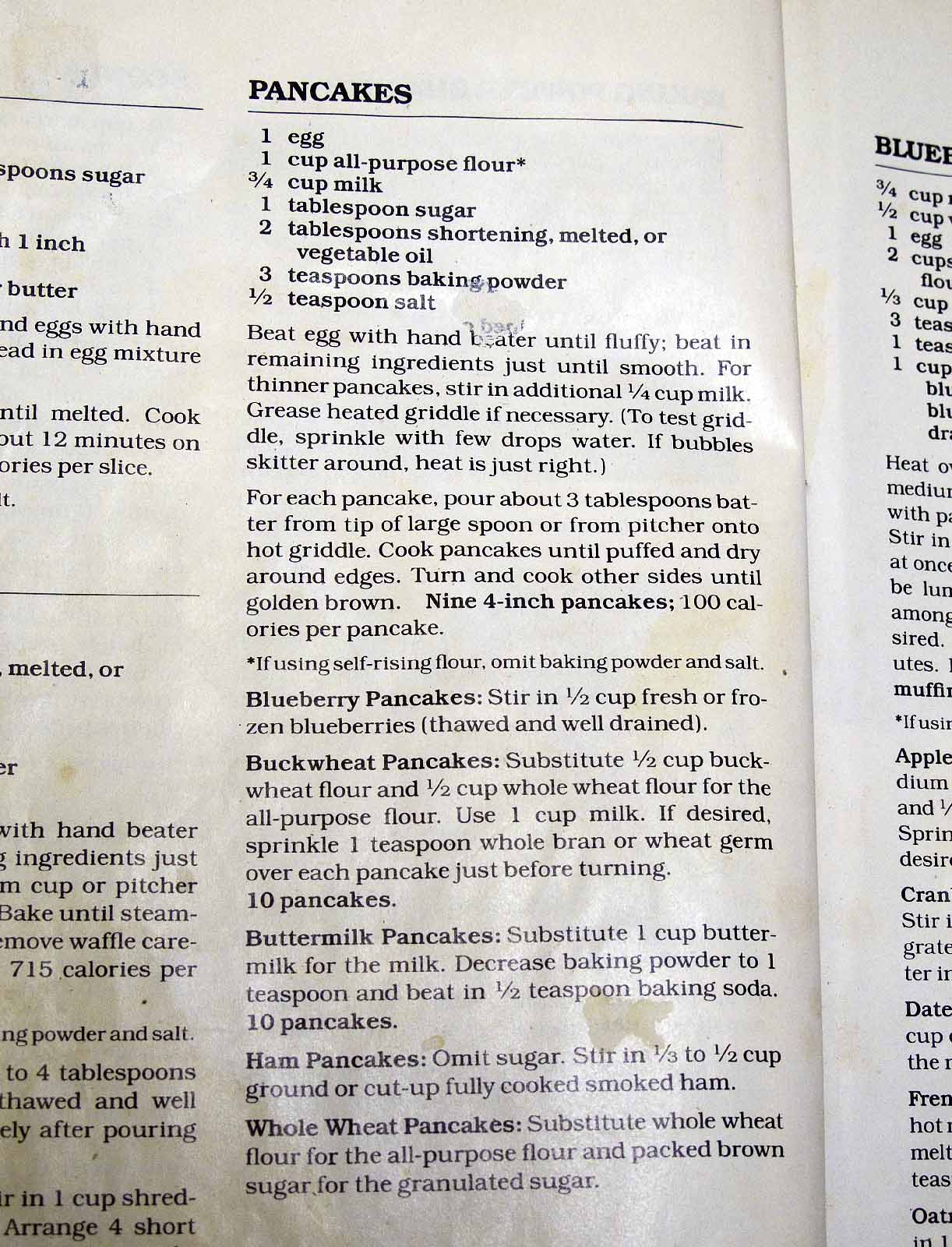
I've reproduced it here with enough pixels that you can read it or print it out, if you want to try it.
Since there is a slim possibility that you are an even worse cook than I, here are some elementary instructions to help you along the road to pancake nirvana. First you have to gather your ingredients. I was making a double batch of batter. That explains the two eggs. I have already added the flour and milk to the mixing bowl. So far, the mess is minimal:

Very efficient, eh? Give it time. It will become progressively more messy.
Okay , now it starts to get serious. I've added the eggs, baking powder, oil, salt and sugar. The table is getting cluttered and blobs of egg white and puffs of flour are already attracting my herd of ants. My bare feet are sticking to the floor. Sheba is standing in the kitchen door whining. She knows there are tasty spots to be licked:
My dad taught me that one secret of making pancakes is to not over mix the batter. He always told me to leave a few lumps. So, that's the way I have always done it. I don't know if it really makes any difference. I do cheat a little also on the recipe. I put in twice as much sugar and twice as much salt. I use a whisk instead of an electric mixer because I'm far too lazy to get the thing out and plug it into the wall:
Okay, we're all mixed up now and it's time to cook up some pancakes. Here is my stove ready for a serious session of cooking:
I like Teflon skillets, because I don't have to wash them. I just put them under the spigot, rinse and wipe and then dry. As you can see, I'm also making scrambled eggs. I have onions, tomatoes and Colby cheese cubes ready to add. I'll fry the onions a little first, then add the eggs, milk, salt and pepper mixture. When the eggs are almost cooked, I'll put in the tomatoes and cheese and give it a final stir.
So, the pancakes and scrambled eggs are cooked now and it's time to sit down and (hopefully) enjoy the meal. I've even managed to enjoy the cooking experience, since I waited until my guests arrived and allowed my new friends from the highlands to help out as they wished. But, wait! Pancakes are not so fine without some sort of syrup, eh? Maple syrup is my favourite, but I can't abide an artificial taste - ugh! One can occasionally find Real Maple Syrup here in Madang, but it is far too pricey to fit into my new austerity budget, a necessary concession to my enormous, recently incurred debt load. Well, that will go away with time. I refuse to fret about it any longer. It's such a waste of valuable time. I tell myself twenty times a day, "Stop thinking about that. Money is not your security."
So, what to do about syrup? I pulled out another trick from my hazy memories of youth, most of which I'd rather not revisit. I cooked up a batch of home-made syrup before my guests arrived. One can make a very tasty caramel syrup so easily and inexpensively that I can't imagine why anyone buys the stuff. Here is an example:
I hope this doesn't bore anyone, but I'm forging on nevertheless. I have come this far. I may as well finish it.
Put a cup or two or three of plain sugar into a saucepan and turn up the heat. After a while, you will notice that it is melting. Amazing! Sugar melts all by itself. Now comes the tricky part. You have to stir and stir and stir while it's melting until the whole mess turns into a very hot amber liquid. This is the part when you want to be very careful. It will burn you until the tears flow if you get any on you, especially on your tummy if you cook as I do as bare as is appropriate considering the sensibilities of my guests. I find this necessary to tolerate the mini-hell of my kitchen in the tropical heat.
So, being careful, you allow the sugar to go all gooey until it's mostly melted, possibly allowing for a few stubborn lumps. Do not, please, allow it to become too dark. If you do it will quickly acquire a burnt taste which is not at all pleasant. You will have to feed it to the pigs. Once it is sufficiently melted and has the darkish amber colour which is desirable you add some water. How much is anybody's guess. Add enough to turn it all into a syrup. If you add too much you will have to boil it down, which takes too much time. Be very careful adding the water as it is going to boil up like crazy because the melted sugar is blazing hot. I recommend that you stand back.
Keep stirring until all of the hard-candy like sugar is melted into the water. You should end up with something like a thin syrup while it is still hot. You can test the viscosity of it by putting some in a spoon and then carefully holding the bottom of the spoon barely touching some cold water. The contents of the spoon will thicken and give you an idea of how syrupy the final concoction will be.
At this stage it is very sugary and has no flavour except the caramel. I usually like to add some flavouring after it cools. I happened to have some home-made vanilla extract. It worked a treat. It is a blessing that we are able to get vanilla beans here at a very modest price. Soaking them in vodka for a few weeks makes an excellent vanilla flavouring. We have another advantage here in PNG because the quality of our sugar is very poor. It's more like raw sugar - very strongly tasting of molasses. It actually makes a better syrup than completely refined sugar.
I didn't take a picture of the finished meal, because I was too busy enjoying it and the fine company. I was hungry, too.
Bon appétit.
Red-crowned Barbet (Psilopogon Rafflesii)
The red-crowned barbet belongs to the order Piciformes (woodpeckers and relatives), family Capitonidae (barbets), subfamily Megalaimatinae (typical Asian barbets) (Shorts & Horne, 2002). According to Shorts & Horne (2002), there are currently three subspecies of Megalaima rafflesii recognised. Megalaima rafflesii malayensis occurs from southern Myannmar to the Malay Peninsula, Megalaima rafflesii billitonis from the Belitung and Mendanau Islands, Megalaima rafflesii borneensis from Borneo but made not indication of the range of the nominate subspecies Megalaima rafflesii rafflesi. Subspecies of this barbet have been rejected on the basis that variations in body size, and tone of blue parts were found to be age- rather than geographically linked (Wells, 1999).
The red-crowned barbet has a smaller, yellow malar-patch, and has a blood-red cap stretching from the bill to the nape. It also has a blood-red spot below the eye, and two larger spots at the side of the throat. There are also bright light blue markings on the chin, throat as well as a long supercilium with black lores and ear-coverts. The remainder of the bird such as the mantle, back, rump, uppertail coverts, tail feathers, and the wing are generally bright leaf-green. The legs are a dull ash-grey.
The red-crowned barbet, is a lowland species always found below 600 m altitude (Shorts & Horne, 2002) and usually found in the canopy of lowland evergreen rain forest including peat swamp forest as well as mature secondary forest and younger regenerated forest after disturbance (Wells, 1999). In comparison the brown barbet, and the blue-eared barbet are only found in pristine primary forest or in areas were disturbed forest have regenerated and reaching its climax (Wells, 1999) and as such have been extirpated from Singapore (Jeyarajasingam & Pearson, 1999). Today, the red-crowned barbet has nearly been eradicated from Thailand owing to forest clearance, and in Singapore, only persists because of its tolerance for secondary growth (Wells, 1999).
The red-crowned barbet usually feeds in the canopy on fruits from trees as well as vines. The red-crowned barbet was seen feeding from a fruiting canopy-height vine at Pasoh Forest in Negri Sembilan, Peninsular Malaysia. Canopy-level strangler fig trees’s syconia such as those of the Malayan banyan (Ficus microcarpa) are the favourite food menu of this species, so often seen at mass-fruiting Malayan banyan trees in Taman Negara, although none were seen at a fruiting grey fig (Ficus virens) tree, where other Megalaima species were observed. The red-crowned barbet has also been recorded taking animal food such as borer grubs excavated with its strong bill from rotting wood and has also been recorded feeding on an arboreal snail (Amphidromus species) in the Central Catchment forest of Singapore. The red-crowned barbet has also been known to follow mixed-species foraging flocks of mainly insectivorous passerines searching the canopy foliage for insects and fruit. This ability to interact with other species, and to exploit other food sources other than fruit on a regular basis could also be the reason why this species has been able to survive in Singapore, when the other two forest barbets have gone extinct (Shorts & Horne, 2002). The blue-eared barbet, like red-crowned barbet, is reportedly a strict canopy feeder, visiting only fig tree crowns in the main canopy and not visiting lower fig plants. The blue-eared barbet has been observed to take syconia in the diameter range for 5.4–27.7 mm, with utilisation increasing towards the lower end, with most activity observed at the diameter of 11.6 mm. The blue-eared barbet is more territorial with respect to food sources and are observed to defend patches of fruit in a crown, chasing away even larger frugivorous species. This behaviour could be the reason why this species went extinct, owing to over-competition, and lack of a suitable number of fruiting fig plants at any point of time. The brown barbet has similar preferences to both red-crowned barbet and blue-eared barbet with respect to fig size, and seems to be as flexible as red-crowned barbet with respect to exploiting animal foods. We have observed brown barbet at Bukit Tinggi, Malay Peninsular searching foliage and the surface and crevices of bark on branches and trunks for animal foods as well as eating flowers of trees or vines.
Like other barbet species, a prerequisite for the red-crowned barbet habitat seems to be the presence of trees with sufficient dead wood in their branches, which is suitable for excavating cavities, which are required for nesting (Shorts & Horne, 2002). Previously, very little was known about the breeding habits of red-crowned barbet, except for the fact that they prefers to nest in rot-softened wood (Fig. 4) including entire dead trees usually around 5–8 m up with broods of one to two fledglings and clutch size that is undescribed (Wells, 1999). Excavation of the nest holes are reportedly done by both members of the pair and usually with more than one hole being constructed. No other information is available on the courtship behaviour of this species. The blue-eared barbet, on the other hand, tends to nest higher, also in dead tree trunks but between 3–25 m up, with a nest hole of around 3 cm in diameter. A clutch size of 2–4 eggs is reportedly common (Shorts & Horne, 2002). Courtship of this species includes incessant singing by both members in the pair, with much head bobbing, and side to side movements of the tail with courtship feeding observed. The brown barbet, unlike th red-crowned barbet and blue-eared barbet, are communal nesters, with three or more pairs nesting together in dead tree trunks and branches, but also in arboreal termitaria, 1–20 m up (Wells, 1999), and in the bottom of a bird’s nest fern (Asplenium nidus). The brown barbet usually has a clutch size of 2–3 eggs with broods of two or three nestlings (Wells, 1999; Shorts & Horne, 2002).
The red-crowned barbet call consists of a sequence of 10–15, even-toned, mellow hoots delivered at a steady rate of three per second except for a noticeably longer pause after the second, or first and second notes: “hoop, hoop, hoophoop-hoop-hoop……..” usually from a high perch in deep foliage (Wells, 1999).
NATURE IN SINGAPORE 2009
PAST AND PRESENT RECORDS
In Singapore, the red-crowned barbet is an uncommon resident and is only observed in the Bukit Timah Nature Reserve (BTNR) and the Central Catchment Nature Reserve (CCNR) in mature secondary and primary forest, and because of its restricted range in Singapore, was listed as nationally rare in the 1st edition of the Singapore Red Data Book and nationally-near threatened (Wang & Hails, 2007). In the latest (2nd) edition of the Singapore Red Data Book, this species has not been of conservation concern, so unlisted. However, we feel that because it is solely restricted to the BTNR and CCNR, and has almost disappeared altogether in Thailand owing to lack of a good forest habitat, it should be conferred at least a status of nationally vulnerable. We have observed the red-crowned barbet taking a variety of foods including the usual fig syconia from a regularly fruiting Malayan banyan trees at the summit of Bukit Timah and the Upper Seletar Reservoir Park. Others included fruits from oil fruit (Elaeocarpus species), MacArthur’s palm (Ptychosperma macarthurii) (Fig. 5), fishtail palm (Caryota mitis), turn-in-the-wind (Mallotus paniculatus), wild cinnamon (Cinnamomum iners), salam (Syzygium polyanthum) (Chan & Chan, 2006; Wee, 2006b; our observations). Insects are also eaten quite regularly with a mantis observed being brought back to the nest (Chan & Chan, 2006) as well as moths and katydids caught in the foliage of trees. The red-crowned barbet has also been recorded feeding on arboreal snails (Amphidromus species) in the Central Catchment Nature Reserve forest (Wee, 2006a). The blue-eared barbet, on the other hand, was formerly only found in small numbers from the BTNR and Pulau Ubin with young birds collected on Pulau Ubin (Wang & Hails, 2007). The brown barbet, like the blue-eared barbet, is also now extinct and was previously recorded from the Woodlands area and Pulau Ubin in small populations in freshwater swamp forest and swampy coastal forest.
Nesting records of the red-crowned barbet in Singapore are rare and was first recorded in 1979 at Peirce Reservoir (Wells, 1984). A more recent nesting was observed by a few people from the CCNR. On 12 May 2006, a red-crowned barbet was spotted in the CCNR forest at Track 7 near the Upper Seletar Reservoir Park, picking fruits from a tree and was tracked back to a hole in a dead tree trunk. Both the male and female were observed entering the nest with fruits in their beaks and exiting the nest with faecal waste material, indicating that the eggs have hatched and the chick(s) have began to feed. Both adults were seen at the nest together only once, thereafter were observed taking turns entering the nest regularly with fruits (oil fruit, and salam) in their beaks, and exiting the nest with faecal waste in their beaks. The returning parents would perch on a nearby branch to survey the surroundings for a period of time, presumably to look out for predators before flying into the nest. This same nest was also observed by Chan & Chan (2006), and Wee (2006b), who observed a variety of fruits being brought back to the nest including fruits of sendudok (Melastoma malabathricum), wild cinnamon, oil fruit, and salam which were carried back in twos or threes as well as the occasional insect which included a mantis. The larger fruits such as the fruits of oil fruit, which were too large for the chicks, were observed to be crushed and regurgitated for the young (Wee, 2006b). This routine was observed for a period of 16 days. On the 17th day, the chick began to pop its head out frequently and feeding was performed outside the nest entrance. On the 26th day after the start of the observations, a chick was observed to have fledged, and flew to a nearby branch, after which one of the parents continued to feed the chick until it finally flew off, and was never seen again. No definitive breeding records are available for both blue-eared barbet and brown barbet for Singapore, except for the fact that young birds were collected from Pulau Ubin, suggesting breeding there, without a single nest reported (Wang & Hails, 2007).
CONCLUSIONS
Although the red-crowned barbet was reported to only feed on main canopy crown fruiting trees as mentioned earlier, this species has shown great adaptability in Singapore, by learning to exploit other food sources such as sub-canopy fruiting palms (both native and exotic species) such as the fishtail palm, and MacArthur’s palm, as well as animal foods such as insects and molluscs, and as such has been able to escape extinction, unlike the blue-eared barbet and brown barbet. The future of this species is intrinsically linked to the health of the forest at both the BTNR and CCNR. It has so far not been observed anywhere else such as the Bukit Batok Nature Park, which is only short distance from the BTNR. We therefore suggest that this species should at least be conferred the status of nationally vulnerable.
ACKNOWLEDGEMENTS
We would also like to thank Mark Chua, Johnny Wee and Lee Tiah Kee for providing photographs of this beautiful forest barbet species.
LITERATURE CITED
Chan, M. & Y. M. Chan, 2006. red-crowned barbet: Feeding of nestlings. besgroup.talfrynature.com/2006/07/19/red-crowned-barbet-f.... (Accessed 19 Dec. 2008).
[Credit: lkcnhm.nus.edu.sg]
Original Caption: Coal Car Flower Planter in Front of the Town Hall, Is an Indication of the Importance of the Industry in the Southeastern Part of the State. 07/1974
U.S. National Archives’ Local Identifier: 412-DA-13133
Photographer: Calonius, Erik
Subjects:
Cadiz (Harrison county, Ohio, United States) inhabited place
Environmental Protection Agency
Project DOCUMERICA
Persistent URL: research.archives.gov/description/555585
Repository: Still Picture Records Section, Special Media Archives Services Division (NWCS-S), National Archives at College Park, 8601 Adelphi Road, College Park, MD, 20740-6001.
For information about ordering reproductions of photographs held by the Still Picture Unit, visit: www.archives.gov/research/order/still-pictures.html
Reproductions may be ordered via an independent vendor. NARA maintains a list of vendors at www.archives.gov/research/order/vendors-photos-maps-dc.html
Access Restrictions: Unrestricted
Use Restrictions: Unrestricted
© sergione infuso - all rights reserved
follow me on www.sergione.info
You may not modify, publish or use any files on
this page without written permission and consent.
-----------------------------
Quidam
Quidam ha debuttato sotto il tendone ad aprile 1996 a Montreal. Da allora, la produzione ha visitato cinque continenti ed ha emozionato milioni di persone. Nel dicembre 2010, Quidam ha intrapreso un nuovo viaggio, presentare la stessa entusiasmante produzione nei palazzetti, partendo dal Nord America. Il cast internazionale comprende 45 acrobati, musicisti, cantanti e artisti di prima classe.
La giovane Zoé è annoiata; i suoi genitori, distanti e apatici, la ignorano. La sua vita ha perso qualsiasi significato. Cercando di riempire il vuoto della sua esistenza, scivola in un mondo immaginario - il mondo di Quidam - dove incontra dei personaggi che la incoraggiano a liberare la sua anima.
Cirque du Soleil
Dai circa 20 artisti di strada di cui la compagnia era formata al suo inizio nel 1984, il Cirque du Soleil, basato in Quebec, è oggi la società leader nel settore dell’entertainment. Il gruppo conta 4.000 lavoratori, di cui oltre 1.200 artisti di oltre 50 nazionalità diverse.
Cast
The cast of Quidam has over 50 acrobats, musicians, singers, and characters, some of which are detailed below.
Zoé: She is the principal character in Quidam. Although average in nature, she longs for excitement.
Father: Completely, though unwittingly, self-absorbed. His white shoes are the only indication of a hidden personality.
Mother: Conveys an air of absence and alienation. Inside her lie fear, frustration, and desire.
Quidam: The show's titular character, who is anonymous, everyone, and no one. He may have stepped out of a surrealist painting or been conjured up out of Zoé's imagination.
John: Part game-show host and part substitute teacher who is the guide through the world of Quidam. Also is represented as a father figure to Zoé hence him stepping into her father's shoes.
Target: A living human bullseye fired at by everyone but is always smiling.
Chiennes Blanches: The silent chorus, the nameless and the faceless, the dehumanized, mechanical crowd, simultaneously leading and following. They also accompany the principal characters as they make their entrances and exits.
Boum-Boum: Enjoys screaming at the audience and walking away proudly, but will run away if an audience member screams back.
Rabbit: A minor character who chases and gets chased by other characters.
Aviator: A character who has skeletal wings who looks like he is not ready to take off.
Les Égarés: Lost individuals who gather together in the streets and abandoned buildings of Quidam. They perform in the banquine act.
Acts
Quidam combines a mix of acrobatic skills and traditional circus acts.
German Wheel: An acrobat performs tricks within a German wheel.
Diabolo: A performer manipulates diabolos (i.e., Chinese yo-yo), which are two sticks linked by a string on which a wooden spool balances.
Aerial contortion in silk: Intensity, power and grace combine when a young woman becomes one with the column of red fabric which supports and cradles her.
Skipping ropes: Drawing inspiration from dance, acrobatics, and the art of manipulation, a group of 20 acrobats performs this familiar child's game in a steady stream of solo, duo, and group jumps and figures.
Aerial hoops: Two performers use hoops attached to the ceiling to perform tricks.
Handbalancing: Using strength and balance, a performer contorts into poses while on balancing canes.
Spanish webs: Artists fly over the stage, attached to trolleys on the overhead tracks. In turn or as a group, they occasionally perform a sudden drop, stopped only by the ropes looped around their waists or ankles.
Statue: Never losing contact, two strong, flexible performers move almost imperceptibly, assuming positions impossible without an impeccable sense of balance.
Banquine: An Italian acrobatic tradition going back to the Middle Ages that combines gymnastics and ballet. Showcasing the agility of the human body, up to 15 artists perform sequences of feats and human pyramids with their perfectly synchronized movements.
Juggling: Up to five balls fly through the air, with additional manipulation of a briefcase, umbrella, and bowler hat.
The recent withdrawal of Lothian’s bus service 6 in Edinburgh was another indication of ongoing difficulties in trying to provide a suitable bus service to the Dumbiedykes corner of the city. Ongoing changes to a previous service over 40 years ago indicate this is nothing new. This Dumbiedykes Circle service was introduced on 28 January 1973 from Saint Andrew Square via North Bridge, High Street, St Mary’s Street, Holyrood Road and Viewcraig Street, returning to High Street, then via Bank Street, Mound, Hanover Street and George Street. It was operated by a Seddon Midibus every 20 minutes during the day all week (Sundays only from 1200) with a flat fare of 3p. Hunter states that the midibus proved unpopular and was replaced by a normal single decker. The next timetable print (22nd July 1973) indicates the route has been pulled from Viewcraig Street and the terminus is shown as Holyrood Palace at foot of Holyrood Road. There was a further timetable dated 6th January 1974 and the route now starts at Waverley Bridge via Princes Street, Mound, Bank Street, High Street, Canongate, Horse Wynd, Holyrood Road, St. Mary’s Street, High Street, Bank Street, Market Street and Waverley Bridge. A further timetable dated 6th October 1974 now describes it as Waverley and Meadowbank Circle with frequency reduced to every 30 minutes and flat fare now 5p. The route was the same between Waverley Bridge and Canongate but it then continued outwards via Abbeyhill, Abbeymount, Montrose Terrace, London Road, Meadowbank Terrace, Royal Park Terrace, and Spring Gardens. The return to the city then proceeded via Abbeyhill, Horse Wynd, Holyrood Road, St Mary’s Street, High Street and as before back to Waverley Bridge. The service was taken over by LRT at regionalisation on 16th May 1975 but I am not sure how long it survived after that. There was certainly a service 60 between Dumbiedykes/Holyrood and Bristo Square around 2008 when it was being operated by Lothian under the Mac Tours brand and later that year it seems to have been taken over by Edinburgh Coach Lines. A 2008 photo can be seen here flic.kr/p/W1i4U8
Triangulum Galaxy
From Wikipedia, the free encyclopedia
Jump to navigationJump to search
Triangulum Galaxy
VST snaps a very detailed view of the Triangulum Galaxy.jpg
Galaxy Messier 33 in Triangulum
Observation data (J2000 epoch)
Pronunciation/traɪˈæŋɡjʊləm/
ConstellationTriangulum
Right ascension01h 33m 50.02s[1]
Declination+30° 39′ 36.7″[1]
Redshift-0.000607 ± 0.000010[1]
Helio radial velocity-179 ± 3 km/s[2]
Galactocentric velocity-44 ± 6 km/s[2]
Distance (comoving)970 kpc (3.2 Mly)[3]
Apparent magnitude (V)5.72[1]
Characteristics
TypeSA(s)cd[2]
Mass5 × 1010[4] M☉
Number of stars40 billion (4×10¹⁰)[6]
Size18.74 kpc (61,120 ly)
(diameter; 25.0 mag/arcsec2 B-band isophote)[5][6]
Apparent size (V)70.8 × 41.7 moa[1]
Other designations
NGC 0598, MCG+05-04-069, UGC 1117, PGC 5818[2]
The Triangulum Galaxy is a spiral galaxy 2.73 million light-years (ly) from Earth in the constellation Triangulum. It is catalogued as Messier 33 or NGC (New General Catalogue) 598. With the D25 isophotal diameter of 18.74 kiloparsecs (61,100 light-years), the Triangulum Galaxy is the third-largest member of the Local Group of galaxies, behind the Andromeda Galaxy and the Milky Way. It is one of the most distant permanent objects that can be viewed with the naked eye.[7]
The galaxy is the smallest spiral galaxy in the Local Group (although the smaller Large and Small Magellanic Clouds may have been spirals before their encounters with the Milky Way), and is believed to be a satellite of the Andromeda Galaxy or on its rebound into the latter due to their interactions, velocities,[8] and proximity to one another in the night sky. It also has an H II nucleus.[9]
Contents
1Etymology
2Visibility
3Observation history
4Properties
4.1Location – distance – motion
4.2Structure
4.3Star formation
4.4Discrete features
4.5Relationship with the Andromeda Galaxy
4.6Planetary nebulae
5See also
6References
7Further reading
8External links
Etymology
The galaxy gets its name from the constellation Triangulum, where it can be spotted.
It is sometimes informally referred to as the "Pinwheel Galaxy" by some astronomy references,[10] in some computerized telescope software, and in some public outreach websites.[11] However, the SIMBAD Astronomical Database, a professional database, collates formal designations for astronomical objects and indicates that Pinwheel Galaxy refers to Messier 101,[12] which several amateur astronomy resources including public outreach websites identify by that name, and that is within the bounds of Ursa Major.[13][14]
Visibility
Under exceptionally good viewing conditions with no light pollution, the Triangulum Galaxy can be seen with the 20/20 vision naked eye;[15] to those viewers, it will sometimes be the farthest permanent entity visible without magnification.[16][17] Its light diffuses (spreads) across a little more than a pinprick of the unmagnified sky, the cause of which is its broadness – this astronomers term a diffuse, rather than compact, object.
Observers range from finding the galaxy easily visible by direct vision in a truly dark (and impliedly dry, cloud-free) sky to needing to use averted vision in rural or suburban skies with good viewing conditions.[15] It has been chosen as one of the critical sky marks of the Bortle Dark-Sky Scale,[18] supported by its relative invariability, reasonable northern declination, and brightness described.
Observation history
The Triangulum Galaxy was probably discovered by the Italian astronomer Giovanni Battista Hodierna before 1654. In his work De systemate orbis cometici; deque admirandis coeli caracteribus ("About the systematics of the cometary orbit, and about the admirable objects of the sky"), he listed it as a cloud-like nebulosity or obscuration and gave the cryptic description, "near the Triangle hinc inde". This is in reference to the constellation Triangulum as a pair of triangles. The magnitude of the object matches M33, so it is most likely a reference to the Triangulum Galaxy.[19]
The galaxy was independently discovered by Charles Messier on the night of August 25–26, 1764. It was published in his Catalog of Nebulae and Star Clusters (1771) as object number 33; hence the name M33.[20] William Herschel compiled his extensive catalog of nebulae, he was careful not to include most of the objects identified by Messier.[21] However, M33 was an exception, and he cataloged this object on September 11, 1784, as H V-17.[22]
Herschel also cataloged the Triangulum Galaxy's brightest and largest H II region (diffuse emission nebula containing ionized hydrogen) as H III.150 separately from the galaxy itself; the nebula eventually obtained NGC number 604. As seen from Earth, NGC 604 is located northeast of the galaxy's central core. It is one of the largest H II regions known, with a diameter of nearly 1500 light-years and a spectrum similar to that of the Orion Nebula. Herschel also noted three other smaller H II regions (NGC 588, 592, and 595).
It was among the first "spiral nebulae" identified as such by Lord Rosse in 1850. In 1922–23, John Charles Duncan and Max Wolf discovered variable stars in the nebulae. Edwin Hubble showed in 1926 that 35 of these stars were classical Cepheids, thereby allowing him to estimate their distances. The results were consistent with the concept of spiral nebulae being independent galactic systems of gas and dust, rather than just nebulae in the Milky Way.[23]
NGC 604 in the Triangulum Galaxy
NGC 604 in the Triangulum Galaxy
Composite of about 54 different pointings with Hubble's Advanced Camera for Surveys.[24]
Composite of about 54 different pointings with Hubble's Advanced Camera for Surveys.[24]
Properties
The Triangulum Galaxy is the third largest member of the Local Group of galaxies. It has a diameter measured through the D25 standard - the isophote where the surface brightness of the galaxy reaches 25 mag/arcsec2, to be about 18.74 kiloparsecs (61,100 light-years),[5] making it roughly 60% the size of the Milky Way. It may be a gravitationally bound companion of the Andromeda Galaxy. Triangulum may be home to 40 billion stars, compared to 400 billion for the Milky Way, and 1 trillion stars for Andromeda Galaxy.[6]
The disk of Triangulum has an estimated mass of (3–6) × 109 solar masses, while the gas component is about 3.2 × 10⁹ solar masses. Thus, the combined mass of all baryonic matter in the galaxy may be 1010 solar masses. The contribution of the dark matter component out to a radius of 55×103 ly (17 kpc) is equivalent to about 5 × 10¹⁰ solar masses.[4]
Location – distance – motion
Triangulum (M33; lower left of center) and Andromeda Galaxy (M31; above center)
Estimates of the distance from the Milky Way to the Triangulum Galaxy range from 2,380×103 to 3,070×103 ly (730 to 940 kpc) (or 2.38 to 3.07 Mly), with most estimates since the year 2000 lying in the middle portion of this range,[25][26] making it slightly more distant than the Andromeda Galaxy (at 2,540,000 light-years). At least three techniques have been used to measure distances to M 33. Using the Cepheid variable method, an estimate of 2,770×103 ± 130×103 ly (849 ± 40 kpc) was achieved in 2004.[27][28] In the same year, the tip of the red-giant branch (TRGB) method was used to derive a distance estimate of 2,590×103 ± 80×103 ly (794 ± 25 kpc).[29] The Triangulum Galaxy is around 750,000 light years from the Andromeda Galaxy.[30]
In 2006, a group of astronomers announced the discovery of an eclipsing binary star in the Triangulum Galaxy. By studying the eclipses of the stars, astronomers were able to measure their sizes. Knowing the sizes and temperatures of the stars, they were able to measure the absolute magnitude of the stars. When the visual and absolute magnitudes are known, the distance to the star can be measured. The stars lie at the distance of 3,070×103 ± 240×103 ly (941 ± 74 kpc).[25] The average of 102 distance estimates published since 1987 gives a distance modulus of 24.69, or .883 Mpc (2,878,000 light-years).[31]
The Triangulum Galaxy is a source of H2O maser emission.[32] In 2005, using observations of two water masers on opposite sides of Triangulum via the VLBA, researchers were, for the first time, able to estimate the angular rotation and proper motion of Triangulum. A velocity of 190 ± 60 km/s relative to the Milky Way was computed, which means Triangulum is moving towards Andromeda Galaxy and suggesting it may be a satellite of the larger galaxy (depending on their relative distances and margins of error).[8]
In 2004, evidence was announced of a clumpy stream of hydrogen gas linking the Andromeda Galaxy with Triangulum, suggesting that the two may have tidally interacted in the past. This discovery was confirmed in 2011.[33] A distance of less than 300 kiloparsecs between the two supports this hypothesis.[34]
The Pisces Dwarf (LGS 3), one of the small Local Group member galaxies, is located 2,022×103 ly (620 kpc) from the Sun. It is 20° from the Andromeda Galaxy and 11° from Triangulum. As LGS 3 lies at a distance of 913×103 ly (280 kpc) from both galaxies, it could be a satellite galaxy of either Andromeda or Triangulum. LGS 3 has a core radius of 483 ly (148 pc) and 2.6 × 10⁷ solar masses.[35]
Pisces VII/Triangulum (Tri) III may be another satellite of Triangulum.[36]
Structure
Infrared image of M33 taken with the Spitzer Space Telescope
Ultraviolet image of M33 by GALEX observatory
In the French astronomer Gérard de Vaucouleurs' revised Hubble Sandage (VRHS) system of galaxy morphological classification, the Triangulum Galaxy is classified as type SA(s)cd. The S prefix indicates that it is a disk-shaped galaxy with prominent arms of gas and dust that spiral out from the nucleus—what is commonly known as a spiral galaxy. The A is assigned when the galactic nucleus lacks a bar-shaped structure, in contrast to SB class barred spiral galaxies. American astronomer Allan Sandage's "(s)" notation is used when the spiral arms emerge directly from the nucleus or central bar, rather than from an inner ring as with an (r)-type galaxy. Finally, the cd suffix represents a stage along the spiral sequence that describes the openness of the arms. A rating of cd indicates relatively loosely wound arms.[37]
This galaxy has an inclination of 54° to the line of sight from Earth, allowing the structure to be examined without significant obstruction by gas and dust.[38][39] The disk of the Triangulum Galaxy appears warped out to a radius of about 8 kpc. There may be a halo surrounding the galaxy, but there is no bulge at the nucleus.[40] This is an isolated galaxy and there are no indications of recent mergers or interactions with other galaxies,[39] and it lacks the dwarf spheroidals or tidal tails associated with the Milky Way.[41]
Triangulum is classified as unbarred, but an analysis of the galaxy's shape shows what may be a weak bar-like structure about the galactic nucleus. The radial extent of this structure is about 0.8 kpc.[42]
The nucleus of this galaxy is an H II region,[32] and it contains an ultraluminous X-ray source with an emission of 1.2 × 1039 erg s−1, which is the most luminous source of X-rays in the Local Group of galaxies. This source is modulated by 20% over a 106-day cycle.[43] However, the nucleus does not appear to contain a supermassive black hole, as an upper limit of 3,000 solar masses is placed on the mass of a central black hole based upon the velocity of stars in the core region.[44]
The inner part of the galaxy has two luminous spiral arms, along with multiple spurs that connect the inner to the outer spiral features.[38][39] The main arms are designated IN (north) and IS (south).[45]
Star formation
NGC 604, a star-forming region in the Triangulum Galaxy, as imaged by the Hubble Space Telescope.
In the central 4′ region of this galaxy, atomic gas is being efficiently converted to molecular gas, resulting in a strong spectral emission of CO. This effect occurs as giant molecular clouds condense out of the surrounding interstellar medium. A similar process is taking place outside the central 4′, but at a less efficient pace. About 10% of the gas content in this galaxy is in the molecular form.[38][39]
Star formation is taking place at a rate that is strongly correlated with local gas density, and the rate per unit area is higher than in the neighboring Andromeda Galaxy. (The rate of star formation is about 3.4 Gyr−1 pc−2 in the Triangulum Galaxy, compared to 0.74 in Andromeda.[46]) The total integrated rate of star formation in the Triangulum Galaxy is about 0.45 ± 0.1 solar masses per year. It is uncertain whether this net rate is currently decreasing or remaining constant.[38][39]
Based on analysis of the chemical composition of this galaxy, it appears to be divided into two distinct components with differing histories. The inner disk within a radius of 30×103 ly (9 kpc) has a typical composition gradient that decreases linearly from the core. Beyond this radius, out to about 82×103 ly (25 kpc), the gradient is much flatter. This suggests a different star formation history between the inner disk and the outer disk and halo, and may be explained by a scenario of "inside-out" galaxy formation.[40] This occurs when gas is accumulated at large radii later in a galaxy's life space, while the gas at the core becomes exhausted. The result is a decrease in the average age of stars with increasing radius from the galaxy core.[47]
Discrete features
Using infrared observations from the Spitzer Space Telescope, a total of 515 discrete candidate sources of 24 μm emission within the Triangulum Galaxy have been catalogued as of 2007. The brightest sources lie within the central region of the galaxy and along the spiral arms.
Many of the emission sources are associated with H II regions of star formation.[48] The four brightest HII regions are designated NGC 588, NGC 592, NGC 595, and NGC 604. These regions are associated with molecular clouds containing (1.2–4) × 105 solar masses. The brightest of these regions, NGC 604, may have undergone a discrete outburst of star formation about three million years ago.[49] This nebula is the second most luminous HII region within the Local Group of galaxies, at (4.5 ± 1.5) × 107 times the luminosity of the Sun.[46] Other prominent HII regions in Triangulum include IC 132, IC 133, and IK 53.[45]
The northern main spiral arm contains four large HII regions, while the southern arm has greater concentrations of young, hot stars.[45] The estimated rate of supernova explosions in the Triangulum Galaxy is 0.06 Type Ia and 0.62 Type Ib/Type II per century. This is equivalent to a supernova explosion every 147 years, on average.[50] As of 2008, a total of 100 supernova remnants have been identified in the Triangulum Galaxy,[51] the majority of which lies in the southern half of the spiral galaxy. Similar asymmetries exist for H I and H II regions, plus highly luminous concentrations of massive, O type stars. The center of the distribution of these features is offset about two arc minutes to the southwest.[45] M33 being a local galaxy, the Central Bureau for Astronomical Telegrams (CBAT) tracks novae in it along with M31 and M81.[52]
About 54 globular clusters have been identified in this galaxy, but the actual number may be 122 or more.[41] The confirmed clusters may be several billion years younger than globular clusters in the Milky Way, and cluster formation appears to have increased during the past 100 million years. This increase is correlated with an inflow of gas into the center of the galaxy. The ultraviolet emission of massive stars in this galaxy matches the level of similar stars in the Large Magellanic Cloud.[53]
In 2007, a black hole about 15.7 times the mass of the Sun was detected in this galaxy using data from the Chandra X-ray Observatory. The black hole, named M33 X-7, orbits a companion star which it eclipses every 3.5 days. It is the largest stellar mass black hole known.[54][55]
Unlike the Milky Way and Andromeda galaxies, the Triangulum Galaxy does not appear to have a supermassive black hole at its center. This may be because the mass of a galaxy's central supermassive black hole correlates with the size of the galaxy's central bulge, and unlike the Milky Way and Andromeda, the Triangulum Galaxy is a pure disk galaxy with no bulge.[56]
Relationship with the Andromeda Galaxy
Triangulum on the collision paths of the Milky Way and Andromeda galaxies.
As mentioned above, M33 is linked to M31 by several streams of neutral hydrogen[57] and stars,[57] which suggests that a past interaction between these two galaxies took place from 2 to 8 billion years ago,[58][59] and a more violent encounter will occur 2.5 billion years in the future.[57]
The fate of M33 was uncertain in 2009 beyond seeming to be linked to its larger neighbor M31. Suggested scenarios include being torn apart and absorbed by the greater companion, fueling the latter with hydrogen to form new stars; eventually exhausting all of its gas, and thus the ability to form new stars;[60] or participating in the collision between the Milky Way and M31, likely ending up orbiting the merger product and fusing with it much later. Two other possibilities are a collision with the Milky Way before the Andromeda Galaxy arrives or an ejection out of the Local Group.[61] Astrometric data from Gaia appears in 2019 to rule out the possibility that M33 and M31 are in orbit. If correct, M33 is on its first infall proper into the Andromeda Galaxy (M31).[62]
Planetary nebulae
Planetary nebulae are not only important contributors to the chemical enrichment of galaxies, but provide valuable information on single and binary stellar evolution. In addition, these objects seem to always produce very bright planetary nebulae with consistent luminosities, regardless of the galaxy's mass, age, or metallicity. This feature is very useful as a standard candle for distance measurements.
Large systematic research on this topic has been done by Rebeca Galera-Rosillo and co-authors in 2018.[63] This work benefited from the use of the INT and WHT telescopes located at La Palma island. As a result of this study, three new planetary nebulae were discovered.
Newly discovered PNe (2018), Rebeca named the PNe after her closest family members.
GCM 1 (Ovejisaurio),01:34:48.86+31:05:14.8
GCM 2, (Cuchilla Andante)01:33:45.20+30:21:22.0
GCM 3, (Sewi)01:33:52.30+30:21:12.0
The Thirty-Fourth Session of WIPO's Standing Committee on the Law of Trademarks, Industrial Designs and Geographical Indications (SCT) took place in Geneva, Switzerland from November 16 to November 18, 2015.
Copyright: WIPO. Photo: Emmanuel Berrod. This work is licensed under a Creative Commons Attribution-NonCommercial-NoDerivs 3.0 IGO License.
The Forty-Sixth Session of WIPO's Standing Committee on the Law of Trademarks, Industrial Designs and Geographical Indications (SCT) took place in Geneva from November 21 to November 23, 2022 in hybrid form – with delegates and observers attending physically in Geneva, Switzerland, and via remote participation from around the world.
Copyright: WIPO. Photo: Emmanuel Berrod. This work is licensed under a Creative Commons Attribution-NonCommercial-NoDerivatives 4.0 International License.
A 'Grand Tour' and no mistake; with indications that this is to be a 'Farewell' for two D.R>S. class 20s, the dynamic duo of Autumn R.H.T.T. 'fame'. With an early in the day heading through this area with two D.R.S. blue class 57s, 57002, 'Rail Express' & 57003 in double-header format, but decided to wait for what I hoped would be a prompt return back south, as sunset is around 16:20 and the 20s would be on in-lieu of the 57s. With a member of the younger contingent in tow, the safest location I thought appropriate, was here at Chapeltown Station, on the Midland's Blackburn Valley line, north of Sheffield and it wasn't too long before some unlooked for traction appeared instead of the more mundane Northern class 144s and 158s. At left, on Platform 2 in matching livery, Casper asks 'is that it', shame to disappoint but have to say 'no, our special train has set off 20 mins late from Leeds, and wont be here quite yet'. Passing south along platform 1 towards Meadowhall and on to Sheffield is a Northern Rail, 'CAF, Construcciones y Auxiliar de Ferrocarriles, S.A.' class 195, 'Civity', 195012 on the semi-fast, 1Y23, from Leeds via Barnsley & Sheffield to Nottingham service; and a fine show it makes running through this station. This passenger service passed through at around the Charter was due, which has now picked up around 10 mins on its way from Leeds, Wakefield and on to Barnsley. Unfortunately this timing meant it would pass south along platform 1 as a Northern Rail 158 was due to make a stop on platform 2, so the 'team' decided to move quickly to the north end of platform 2, to be in front of the stopping service, and Casper was given the job of 'spotting the 158 coming around the corner behind us' job, so we could make a hasty move. In fact he alerted me it had appeared and it did arrive on platform 2 at the wrong time, disgorging what seemed like an endless 'crowd' of passengers, fortunately, the Charter appeared to have been slowed up slightly in the Elsecar/Wombwell area to the north of us, and the 158 cleared out of the way in good time; so, back to the south end of the platform for the arrival...
Silverton:
The first indication of silver–lead mineralisation in the Barrier Rangers came in late 1875 with the discovery of galena by Julius Charles Nickel and Dan McLean while they were well sinking on Thackaringa Station, near the South Australian - New South Wales border.
In 1879 John Stokie established a store at Umberumberka, 19 km north of Thackaringa. He continued prospecting and discovered silver–lead veins nearby, which he pegged with Edward Pegler in November 1881. A 100 ton parcel of ore was shipped to England for a 40% profit. The following October the Umberumberka Silver Lead Mining Company Ltd was floated with nominal capital of £20 000. Umberumberka was the second area of silver–lead mineralisation discovered in the Barrier Ranges and the new company was the first to be publicly floated. The town of Silverton soon developed close to the mine and became the main settlement of the growing silver field.
Silverton was surveyed in 1883, by which time Australia had a population of 2, 250, 194. By September that year, the population of Silverton was 250, and by December 1883 it had doubled. That year the Day Dream Mine opened and attracted an additional population of 400 - 500 people. In 1884 1,222 mineral leases, 937 business permits and 114 miners' rights were issued. That same year 6,000 tonnes of ore were extracted and the town acquired its own newspaper, the Silver Age.
By 1885 - 1886 the town's population had reached 3,000. Silverton was proclaimed a township in 1885 and a municipality the following year. In 1885 a short-lived smelter was established at Day Dream Mine, operating for only a year. In 1892 the Umberumberka Mine closed, followed by the Day Dream Mine. The Pioneer Mine at Thackaringa closed in 1897. By 1901, after miners had moved to the richer fields at Broken Hill, the town went into decline and only 286 people remained. Today the town has a population of around 50 people, most of whom work in tourism.
The Silverton Tramway Company:
The Silverton Tramway Company, a rare private railway of 50klms in length, was incorporated in New South Wales October 14, 1886 and the line was completed and opened for traffic on January 12, 1888. One of only two privately owned railways in the state, the tramway was originally founded to transport ore from local mines in the Broken Hill and Silverton region into South Australia. The company soon branched out, not only carrying ore from the mines but freighted other goods and offered a passenger service which accounted for a third of their business.
The company serviced travellers on long trips heading interstate to Semaphore (Adelaide) to the Largs Bay Holiday Camp and excursions for local community groups often conveying passengers to Silverton and McCulloch Park (at Stephens Creek) for the day and returning to Broken Hill in the afternoon. When traveling to South Australia the train would travel from Broken Hill, through Silverton and then to Burns which is on the New South Wales side of the border of Cockburn (a town divided by the NSW/SA border).
In 1927 the New South Wales government completed the railway from Sydney to Broken Hill, thus joining the Silverton Tramway and completing the link from Sydney to Adelaide. It played a strategic role in the trans-Australia network until 1970, when it was surpassed by the New South Wales Government Railways (Indian-Pacific). From 1888-1970 it was critical to the economic functioning of Broken Hill, by providing the key transport of ore to the Port Pirie smelters. It played a significant role in the politics and recreation of Broken Hill, and a crucial role at times of water shortage in Broken Hill.
Today, Silverton resides in the Unincorporated Area of New South Wales (NSW) and so does not feature a City Council. It is run by the Silverton Village Committee, who to this day hold their quarterly meetings in the Silverton Municipal Chambers.
Source: Silverton NSW (www.aussietowns.com.au/town/silverton-nsw), New South Wales Heritage Register & Discover Broken Hill (discoverbrokenhill.com.au/silverton-nsw/historic-building...), "The pathway to Broken Hill: Early discoveries in the Barrier Ranges, New South Wales, Australia" by Kenneth George McQueen, and 'Aplin, Graeme; S.G. Foster; Michael McKernan, eds. (1987). Australians: Events and Places. Broadway, New South Wales, Australia: Fairfax, Syme & Weldon Associates. p. 97'
The Thirty-Fifth Session of WIPO's Standing Committee on the Law of Trademarks, Industrial Designs and Geographical Indications (SCT) took place in Geneva, Switzerland from April 25 to April 27, 2016.
Copyright: WIPO. Photo: Emmanuel Berrod. This work is licensed under a Creative Commons Attribution-NonCommercial-NoDerivs 3.0 IGO License.