View allAll Photos Tagged impartial
Europe Trip 2010 - Day 13
January 5, 2010
The Royal Courts of Justice, commonly called the Law Courts, is the building in London which houses the Court of Appeal of England and Wales and the High Court of Justice of England and Wales. Courts within the building are open to the public although there may be some restrictions depending upon the nature of the cases being heard. The building is a large grey stone edifice in the Victorian Gothic style and was designed by George Edmund Street, a solicitor turned architect. It was built in the 1870s. The Royal Courts of Justice were opened by Queen Victoria in December 1882. It is on The Strand, in the City of Westminster, near the border with the City of London (Temple Bar) and the London Borough of Camden. It is surrounded by the four Inns of Court andLondon School of Economics. The nearest tube stations are Chancery Lane and Temple.
Those who do not have legal representation may receive some assistance within the court building. There is a Citizens Advice Bureau based within the Main Hall, which provides free, confidential, and impartial advice by appointment to anyone who is a litigant in person in the courts. There is also a Personal Support Unit where litigants in person can get emotional support and practical information about what happens in court.
The Central Criminal Court, popularly known as the Old Bailey, is situated about half a mile to the East. It has no other connection with the Royal Courts of Justice.
Higher quality image to follow on our designer's return from Japan.
We shortened a long name down to AEC Archaeo Environmental Consulting and then down to:
It was of upmost importance to include the key services in the name. This evolved from ARC - Archaeo Research & Consultancy Services Limited.
Having shortened it, we then included Environmental as it was a core part of the business previously not included in the name.
Dr. Smith was a great client to have worked for, and we enjoyed every minute of this web and branding design project. His professionalism and honest personality are probably a big part of why AEC are in huge demand.
From AEC:
Archaeo-Environmental Consulting (AEC)
Archaeo-Environmental Consulting (AEC) provides independent and commercially aware advice to our clients in the fields of archaeology and environmental management.
The company offers a range of high quality commercial and consultancy services which are based upon many years of experience in both the public and private sector. Our services are individually tailored in order to suit the changing needs of our clients, who include national companies, smaller niche companies, local authorities and government agencies.
AEC Aim:
To provide cost effective, independent, impartial, and confidential advice to clients on archaeological and environmental issues. We ensure that all the objectives of our clients projects are met within the agreed budgetary requirements and time scales.
www.dailyrecord.co.uk/news/scottish-news/2012/05/20/citiz...
Citizens Advice Bureau bosses launch probe into one of their lawyers
May 20 2012 By Russell Findlay
A LAWYER who works for the Citizens Advice Bureau is being probed after it’s claimed he targeted vulnerable clients for a crooked legal firm.
Margaret Sneddon, 48, was involved in a rent dispute when she turned to CAB lawyer Gilbert Anderson, who is based atHamilton Sheriff Court and whose salary is paid by taxpayers.
But the ex-Royal Marine sent her and a friend into the clutches of John O’Donnell, who didn’t have a practising certificate.
O’Donnell broke the law by acting as lawyer for the firm Davidson Fraser.
Margaret, from Lanark, said: “Anderson told us that he was a silent partner in Davidson Fraser and he phoned them from his office to make an appointment for us.
“O’Donnell came to meet us and took on our cases.
“We had no idea that he was banned from practising.”
Last month, we told how Elizabeth Campbell was also referred to Davidson Fraser by 53-year-old Anderson.
He was listed as an associate on a Davidson Fraser letter but he claimed that he merely provided Elizabeth with a list of lawyers.
She said: “That is untrue, there was no list. I’m furious that the CAB seem to have taken the view that Anderson has done nothing wrong.”
Elizabeth and another client, Joan Hoblyn, have been interviewed by Elaine Motion who is probing Davidson Fraser on behalf of the Law Society of Scotland.
Margaret and her friend also plan to complain to the CAB.
Anderson declined to comment.
A CAB spokesman said: “It’s vital that the public have full confidence in the impartiality of the CAB service and we take allegations of this nature very seriously.”
This Athenian kylix (drinking cup) depicts a pale-skinned, winged woman, with her name written below: Eris, goddess of discord. When she was not invited to the wedding of Peleus and Thetis (because who would want Discord at their wedding?), a furious Eris took her revenge, throwing a golden apple among the guests to stir up trouble.
The apple (from the Garden of the Hesperides) was inscribed ΤΗΙ ΚΑΛΛΙΣΤΗΙ: ‘to the most beautiful’, Three goddesses sought to claim the apple: the goddess of marriage and family, Hera; the goddess of wisdom and justice, Athena; and the goddess of beauty and love, Aphrodite. Zeus was called to select who should get the apple, but he wasn’t stupid and didn’t want two other goddesses furious at him. So, he called for an impartial judge, a human - Prince Paris of Troy. To make a long story short, each goddess attempted to bribe the young man, but Aphrodite put her finger on the scales more forcefully by promising Paris the hand of the most beautiful woman in the world - Helen, wife of Menelaus.
Yes, this is what started the Trojan War: a golden apple.
Athenian drinking cup (kylix), 550-540 BCE
Pottery
Staatliche Museen zu Berlin, Antikensammlung
Drug Dealer And Development Deceiver Equally Human Resource Killer
Development Deceivers’ Defined Civil Society
Omnivorous Entity NGOs Promote New Version of Slavery
The very emergence of NGO (Nurturing Grim openly) in Bangladesh aimed at robbed up the spirit of Bangladesh Freedom Fight 1971. The NGOs targeted the youth aged 15 to 35 those who stirred up the love, friendship, fellow feelings and sacrifice by the 1971[that they inherited from the Sufi, Dervish, Alem, Ulama and Sheikh since 12th century. Where it was the righteousness, spirituality, honesty, modesty, integrity, impartiality, morality, civility, sincerity, love, fellow feelings, friendship, care and service for all indiscriminately.]
The crook tried lot against the freedom of a nation shamelessly. The complete failure of 1971 instigate them to put a vicious trap ie the NGO to mitigate their pain, sobs, sorrows etc or create a new version of slavery.
Local and international crook jointly generate this disaster for the nation and spread it subcontinent. Yes we must say there were some good souls merged here on good faith and those also converted to the crook created main stream follow the trend of criminals’ traps. This is the time to assess and reassess the contribution NGO, INGO and UN body in the subcontinent.
Development Deceivers’ Defined Civil Society
Omnivorous Entity NGOs Promote New Version of Slavery
www.facebook.com/photo.php?fbid=1920495804872958&set=...
www.facebook.com/photo.php?fbid=1846292615626611&set=...
www.facebook.com/sasraiMovement.2004/photos/a.41005159235...
Yo www.facebook.com/photo.php?fbid=1834108870178319&set=...
BRA www.facebook.com/fgaleeb/posts/1838859509703255?notif_t=l...
www.facebook.com/photo.php?fbid=1853707584885114&set=...
I www.facebook.com/photo.php?fbid=1838016359787570&set=...
www.facebook.com/photo.php?fbid=1844572662465273&set=...
www.facebook.com/photo.php?fbid=1838016359787570&set=...
www.facebook.com/sasraiMovement.2004/photos/a.41005159235...
www.facebook.com/photo.php?fbid=1839088763013663&set=...
www.facebook.com/photo.php?fbid=1839330712989468&set=...
www.facebook.com/photo.php?fbid=1837620653160474&set=...
www.facebook.com/photo.php?fbid=1797971197125420&set=...
www.facebook.com/photo.php?fbid=1844572662465273&set=...
www.facebook.com/photo.php?fbid=1845152082407331&set=...
Omnivorous ICS CSP Created NGO Disaster for the Mass
www.facebook.com/photo.php?fbid=1838016359787570&set=...
www.facebook.com/sasraiMovement.2004/photos/a.41005159235...
Rani Shaheba
www.facebook.com/photo.php?fbid=1851467645109108&set=...
www.facebook.com/photo.php?fbid=1797971197125420&set=...
www.facebook.com/photo.php?fbid=1797971197125420&set=...
Khushi Kabir is Simply NGO owner in Bangladesh and she will do that other NGO owner do
www.facebook.com/photo.php?fbid=1724316080926950&set=...
NGO owner cannot establish Justice
www.thedailystar.net/backpage/want-justice-not-relief-141...
Sultana Kamal is Simply NGO owner in Bangladesh and she will do that other NGO owner do
www.facebook.com/photo.php?fbid=1912672565655282&set=...
www.facebook.com/photo.php?fbid=1912643148991557&set=...
www.facebook.com/fgaleeb/media_set?set=a.1914493612139844...
Natural Disaster Means Business for Riches and so called leader and their Chamchas
NGO Owner and their staffs enjoy lot
So called foreign expert (?) come „mw advice so many things
Impact none on Poorers' life.
Poorers are Looser and the Rich are gainer in many Way.
www.facebook.com/photo.php?fbid=1912679612321244&set=...
www.facebook.com/photo.php?fbid=1910715385851000&set=...
www.facebook.com/photo.php?fbid=1910715392517666&set=...
www.facebook.com/photo.php?fbid=1910715389184333&set=...
www.facebook.com/photo.php?fbid=1687660721259153&set=...
www.facebook.com/sasraiMovement.2004/photos/rpp.410048385...
www.facebook.com/photo.php?fbid=1689069474451611&set=...
The Story of so called Civil Society that Defined by the Monstrous Devil
Vampire, Monster for the Bangladeshi Poorer
Most Ruinous Havoc in Bangladesh NGO and Peer Business
NGO omnivorous monster Cheat of Sudhkhur of Bangladesh
www.facebook.com/photo.php?fbid=1839088763013663&set=...
www.facebook.com/photo.php?fbid=1839330712989468&set=...
www.facebook.com/photo.php?fbid=1837620653160474&set=...
www.facebook.com/photo.php?fbid=1834108870178319&set=...
www.facebook.com/photo.php?fbid=1797971197125420&set=...
www.facebook.com/photo.php?fbid=1838016359787570&set=...
www.facebook.com/fgaleeb/posts/1838859509703255?notif_t=l...
Haitians Protest Outside Hillary Clinton’s Office Over ‘Billions Stolen’ by Clinton Foundation
bients.com/haitians-protest-outside-hillary-clintons-offi...
Truth from Trump
www.facebook.com/photo.php?fbid=1845152082407331&set=...
www.facebook.com/photo.php?fbid=1829365950652611&set=...
www.veteransnewsnow.com/2016/12/25/1012891cia-has-interfe...
www.facebook.com/photo.php?fbid=1831512123771327&set=...
www.facebook.com/photo.php?fbid=1831294033793136&set=...
Monument in the north Bassett chapel / organ chamber
"Sacred to the memory to Lady Elizabeth Bassett wife of Robert Bassett, knight, arisen from a famous stock, daughter and co-heiress of William Peryam, knight, Lord Chief Justice of the Royal Treasury, (he was) most impartial and duty-bound, (she was) pious, prudent, just, long-suffering, modest, chaste, temperant, constant, hospitable, compassionate, kind, a mother and healer of the poor , a preserver of her own family. Arthur Bassett, Esquire, her sorrowing first-born son, of a duty of gratitude and respect therefore placed this monument to his mother in the year of Our Lord 1635 of her age 64 may she remain to the Lord...Thus does gold come forth into an oven"
Should monuments goe by merit then surely thine,
With pretious stone and orient pearle should shine, But since thy world of worth ye world doth know, This marble stone may serve thy name to show.
Many are the afflictions of the righteous but the Lord delivereth him out of them all". Psal. 34.19".
Elizabeth 1571-1635 second co-heiress daughter of Sir William Periham / Periam of Crediton 1604 by 2nd wife Ann www.flickr.com/photos/52219527@N00/11669251276/ daughter of John Parker of North Molton
Her elder sister Mary Pole is a Colyton www.flickr.com/photos/52219527@N00/11650514043/
She m Sir Robert Bassett 1574-1641 www.flickr.com/gp/52219527@N00/9N7NC4200F of Heanton Punchardon, Devon son of Arthur Bassett (died of typhus (goal fever) 1586 flic.kr/p/2nY6zjB along with Sir Bernard Drake www.flickr.com/photos/52219527@N00/11644190666/ at the Exeter Black assizes) by Eleanor 1585 daughter of Sir John Chichester 1569 of Raleigh Pilton www.flickr.com/photos/52219527@N00/11609796764/
Children
1. Colonel Arthur 1672 www.flickr.com/gp/52219527@N00/7j1H6U54TR m Agnes daughter of Sir William Leigh of Shobrook & Northam
2. William 1602-1634
1, Anne 1595-1636 m Jonathan son of John Rashleigh of Menabilly Cornwall (daughter Elizabeth m John son of Robert Rashleigh widower of Mary Trefusis www.flickr.com/photos/52219527@N00/4499931660/ )
2. Elizabeth m George Yeo of North Petherwin, son of Leonard Yeo & Margaret Kestell
3. Elienor
4. Mary
Husband Sir Robert Bassett proved to be somewhat unstable. Having begun to ‘waste and consume his estate’, he was prevailed upon to settle his property on his wife and children in 1601, but then recovered it due to continuing financial difficulties. Pushed into conveying his lands to his father-in-law Sir William Peryam in 1603 in return for an annual allowance, he fled to Italy, blaming ‘that damned filthy old judge’ for his troubles. Under suspicion of Catholicism and treason, he was denied leave to return to England for 8 years, and once back in Devon remained under surveillance until 1614.
In this insecure environment, his heir Arthur and his mother turned to their extended family for support. Peryam died in 1604, but 2 years later the bulk of the estates were conveyed in trust or mortgaged to Sir Robert’s uncle Sir Arthur Chichester the recently appointed Lord Deputy of Ireland., who seems to have adopted the role of patron to the family, also promoting the career of Sir Robert’s brother Arthur, who seems to have been the recipient of a three-year grant of feudal dues from six Irish counties in 1615
During the 1614 Parliament a bill was introduced to enable Sir Robert to clear his debts, presumably by land sales, but it proceeded no further than its first reading. Drifting ever deeper into debt, around 1615 he sold one of his Devon manors to Sir Thomas Monck in breach of the 1606 trust. Monck sought to secure his title by persuading Chancery to overturn the earlier settlement, and finally obtained a new ruling in 1618 from the lord chancellor (Sir Francis Bacon). By this decree, 3 manors passed to fresh trustees, some land was freed for sale or lease to satisfy Monck and other creditors, and existing trust agreements were cancelled as appropriate. Almost immediately, Sir Robert breached this settlement also, conveying the 3 trust manors to Monck and Sir Henry Helmes another major creditor, and this seems to have convinced his son Arthur that his inheritance was under serious threat. When in 1621 the impeachment proceedings against Bacon generated allegations that Sir Robert and Monck had bribed Bacon, through Helmes, to obtain the 1618 decree, Arthur petitioned the House of Lords to investigate the charge more vigorously Bacon’s submission on 24 Apr. brought the Lords’ inquiry to a halt, but Arthur transferred his complaints to the Commons with a private bill repeating the allegations and seeking a return to the pre-1618 settlement. However, the bill failed to proceed beyond its first reading on 8 May.
The next few years witnessed a downward spiral in the Bassett fortunes. By early 1622 Sir Robert was imprisoned for debt in the Fleet, where he remained for at least 3 years. From prison he sought to reach terms with his son, and a new Chancery decree followed in February 1622, which guaranteed Arthur inheritance of the 3 trust manors in return for £3,000 to clear the outstanding debt. Unable to raise this sum by himself, Arthur turned to his old protector Lord Chichester, who provided the money on security of the same 3 manors. However, the financial agents to whom the £3,000 was entrusted failed to observe the terms agreed for its disposal. Sir Robert remained unable to obtain his release, and an evermore-complicated legal battle developed over who possessed the best title to the disputed manors. Chichester died in February 1625 while still attempting to recover his money. Deprived of his principal ally, Arthur attempted to take on his father and all other parties in Chancery, but Sir Robert countered with a King’s Bench suit apparently alleging Arthur's failure to honour his side of the 1622 bargain. Arrested and unable to secure bail for such a huge debt, Arthur also found himself in prison.
Salvation this time came in the form of Jonathan Rashleigh, husband of his sister Anne . That the family could rely on his support is clear from the fact that in March 1625 his mother Elizabeth confidently arranged for Rashleigh to take over one of their leases without first consulting him. Rashleigh was the dominant political patron in Fowey, and it must have been with his backing that Arthur though still in prison, was returned for the borough on 26 April. There followed a careful examination of his entitlement to parliamentary privilege. A petition from Arthur was delivered by Sir John Eliot to the Commons on 28 June, and referred to the committee for privileges; and his case was raised again on 4 July by the Barnstaple MP John Delbridge, one of the Bassett trustees. Four days later the committee reported back favourably, and following debate privilege was granted, on the grounds that Arthur had not been convicted, and could have been released on bail to stand for election in the normal fashion. Although one speaker argued that the case set a precedent for men entering Parliament primarily to avoid their debts, the view prevailed that to refuse privilege in this case would encourage candidates in contested elections to use similar charges as a weapon against their rivals. Arthur was delivered to the House on 9 July, and thereafter disappears from the records of that Parliament. He was returned for Fowey again in 1626 without similar controversy, and is not mentioned by name in the proceedings of that year. As a port-town burgess he would, however, have been entitled to sit on bill committees dealing with the export of ordnance (13 Feb.), the customs projector Edmund Nicholson (18 Feb.), and the sale of sea-coals (20 Feb.); also on committees considering petitions from London merchants trading in France (16 Mar.), the ship-wrecked merchant John Heaman (22 Mar.) and framing a bill on shipping and mariners (15 April).
The squabbles over the family estates dragged on for several more years, and Arthur spent some time in the early 1630s resident in property belonging to his wife Agnes’s family. However, there is also evidence of him starting to redeem mortgages, and in the later 1630s he began to participate in local government. In 1639 he promised £10 towards the costs of the First Bishops’ War. Two years later, what remained of his inheritance finally came to him on his father Robert's death in 1641 and in January 1642 he was chosen to help deliver Devon’s petition against popery to London. Despite this concern over royal policies, the king, at the outbreak of the Civil War, instructed him to take command of Sir Samuel Rolle’s* regiment of Devon militia and disband it. Arthur thereby incurred the wrath of Parliament, which ordered his arrest. In the events which followed, his career needs to be distinguished from that of his Cornish cousin Sir Arthur Bassett of Tehidy, a professional soldier who fought in the north and in Cornwall. Arthur himself is not known to have played an active part in the war. He compounded in 1648 only for having been a commissioner of array, though he was named as a notorious delinquent and stood accused of attempting to murder the agent sent to sequester his estates in 1646. The sequestration process was complicated by the fact that some of his properties were still mortgaged, but a partial re-sequestration in 1650 amid claims that he had undervalued his estate suggests harassment by the county committee. He was not finally discharged until 1654.
The Restoration brought a return to local government, but also a period of conflict with the corporation of Barnstaple. Arthur was employed first in reorganizing the town’s trained band, despite protests by the borough, and then in purging the corporation in 1662. By this time, although not known to have been a barrister, he had also been installed as its recorder, but the corporation succeeded in removing him in 1665. Arthur was proposed for the order of the Royal Oak in 1660 with an estimated annual income of £1,000, but when he made his last will on 13 Apr. 1672 his key manors of Umberleigh and Heanton Punchardon were still mortgaged.
His eldest son John Bassett had predeceased him in 1660, and when Arthur died in January 1673 his principal heir was his grandson John (d1721)
(Robert's grandmother being a Plantagenet, he also made what turned out to be a foolish and costly decision to offer himself as one of the many claimants to the throne of England after the death of Queen Elizabeth, perhaps encouraged by his father-in-law Peryam. He suffered a heavy fine for his action which according to the biographer John Prince involved the sale of 30 of the family's manors)
- Church of St. Augustine, Heanton Punchardon Devon
Picture with thanks - copyright Ian www.cornishchurches.com/Heanton%20Punchendon%20Church%20D... www.historyofparliamentonline.org/volume/1604-1629/member...
On Dec. 13, 2011 at 6 p.m., the Fairfax County Board of Supervisors, Fairfax County constitutional officers, and the Northern Virginia Soil and Water Conservation District directors all took their oath of office in the Government Center forum.
Fairfax Circuit Court Judge Jan L. Brodie administered the oath of office to 15 elected officials, who each swore to support the Constitution of the United States, and the Constitution of the commonwealth of Virginia, and to faithfully and impartially discharge all the duties incumbent upon them as officials of Fairfax County.
All elected officials will take office on Jan. 1, 2012.
More information:
Home of Rangers - to maintain impartiality, as soon as i fly again, i will try to get a picture of Parkhead
On Dec. 13, 2011 at 6 p.m., the Fairfax County Board of Supervisors, Fairfax County constitutional officers, and the Northern Virginia Soil and Water Conservation District directors all took their oath of office in the Government Center forum.
Fairfax Circuit Court Judge Jan L. Brodie administered the oath of office to 15 elected officials, who each swore to support the Constitution of the United States, and the Constitution of the commonwealth of Virginia, and to faithfully and impartially discharge all the duties incumbent upon them as officials of Fairfax County.
All elected officials will take office on Jan. 1, 2012.
More information:
In the wake of the announcement on Monday by the Independent Election Commission (IEC) of the preliminary results for the country’s 2014 Presidential election run-off, the United Nations Assistance Mission in Afghanistan (UNAMA) has noted that the results are not final and are subject to change, and that it would be premature for either of the candidates to claim victory. In a statement, the UN Mission also encouraged the electoral institutions – the IEC and the Independent Electoral Complaints Commission (IECC) – to demonstrate their commitment to the future of the country by taking the responsibility to fully discharge their mandates while demonstrating the utmost impartiality, transparency and responsibility. UNAMA also reiterated its call for the Presidential candidates to exercise restraint and take all steps necessary to control their supporters to prevent them from making any irresponsible statements and from taking steps that could lead to civil disorder and instability.
Photo: Fardin Waezi / UNAMA
17th century chapel
It is placed on the wild coast, and is a jewel of our religious heritage. Thanks to the action of the association, it can be often open and very many visitors, hikers (the chapel is located on the edge of the GR 34), and tourists can thus gather there for a few moments.
The chapel is open every day from 10 a.m. to 6 p.m., from Palm Sunday to All Saints' Day and during the Christmas holidays. Outside these periods, the chapel is open every Sunday.
This small chapel isolated on the moor a few steps from a superb coast attracts many visitors.
But it is not alone: a Gallic stele stands not far from the entrance and a fountain, visible along the coastal path, attest to the antiquity of a cult at this location. Moreover, the water from the spring is always supposed to cure rheumatism and eye diseases. This heptagonal Iron Age stele was reused as a cross stand.
Note that it bears an inscription engraved on one of the sides:
TP ST GONVEL 1757.
The spring water is captured by a fountain just before flowing into the sea. It is likely that it was Christianized by the presence of a cross long before the chapel was built.
This chapel, built in 1785, was able to replace an older one. She was traditionally the goal of a Pardon of the Sea.
The interior is very sober
Two polychrome statues dominate the altar. On the left, Saint Samson wears the episcopal mitre.
Of all the many monks who came from the British Isles in the 6th century to evangelize Brittany, Saint Samson is one of the few who are well attested by history since he signed the acts of the Council of Paris around 555.1
Originally from Wales, and pupil of Saint Ildut who gave his name to Lanildut, he would have landed in Plougasnou, in the north of Finistère, where the foundation of the monastery of Lanmeur is attributed to him. He had been ordained a bishop, without a bishopric, before coming to the continent. Appointed Bishop of Dol by King Childebert 1st, he died there around the year 565. His influence throughout Brittany was such that many localities or Breton religious buildings bear his name. It is not impossible that he came to see his friend Ildut in the Pays d'Iroise.
Two other statues catch the eye in this chapel
On the left wall, Saint Isidore, the modest Spanish plowman, represents a model of a peasant who is both hardworking and very pious.
To the right of the altar, Saint Yves is dressed as a magistrate. His gaze directed towards the litigants shows them his listening while with his raised hands, he indicates to them his impartiality 2 during his judgments.
We will also take a look at the modern stained glass windows dating from 1993. On the left, Saint Anne, the mother of the Virgin, with her daughter. On the right, Saint Samson, whose bishop's crozier can be seen, heals a patient.
Ultimately, a small, modest chapel full of charm, located in an environment that is both wild and grandiose, which gives it all the qualities of a real postcard subject.
Sources: www.chapelleslandunvez.fr/
BBC impartiality was challenged today by several hundred Pro Palestine protesters who gathered outside the Birmingham studios located in the Mailbox. Several speakers highlighted the disproportionality of coverage and just days after 4 Palestinian children were bombed on a beach in Gaza.
The protesters held an impromptu march to a scheduled Stop the War meeting. When it became clear that the Council House could not accomodate the number of protesters wishing to attend a sound system was hastily put together and a mass public meeting was held in the city's Chamberlain Square.
Protest against abduction and assault of journalist Keith Noyahr – journalists demand open, speedy and impartial inquiry (23rd May 2008 Colombo)
- photos by Uvidu K. for FMM
Paul SIGNAC
Le Sentier de douane 1905
Huile sur toile Dim. avec cadre : 87 x 106 x 4,7 cm
né le 11 novembre 1863 à Paris et décédé le 15 août 1935 à Paris, est l'un des principaux peintres paysagistes français qui a développé la technique du pointillisme avec son ami Georges Seurat.
Vie et œuvre
Paul Victor Jules Signac, fils de commerçants d'Asnières, perd son père alors qu'il est très jeune. Esprit anticonformiste, Signac est adoré de sa mère qui respecte ses choix. Il quitte ainsi le lycée en 1880 pour se consacrer à une vie d'artiste. La même année, il peint à Montmartre, loue un atelier et rencontre Berthe Roblès, une cousine éloignée de Pissarro. Il l'épousera 10 ans plus tard.
Il commence à peindre en 1882 à Montmartre (atelier d'Émile Bin) et se perfectionne seul sous l'influence des impressionnistes, particulièrement de Claude Monet.
Il devient ami de Seurat en 1883-1884, avec qui il cofonde la Société des artistes indépendants avec également Redon et Dubois-Pillet en 1884.
Signac construit le tableau de façon plus spontanée et intuitive, sa couleur est plus lumineuse que celle de Seurat. Il a été l'ami de Van Gogh peu avant le suicide de ce dernier.
Au cours des années 1890, il s'essaye à la grande peinture décorative, surtout pour un immense tableau, depuis 1938 propriété de la mairie de Montreuil, Au temps d'harmonie. Néanmoins, s'il est vrai que Signac a de bonnes relations personnelles avec les Nabis, notamment Bonnard, il ne partage pas du tout leurs vues esthétiques, et n'adhère pas au credo religieux de Maurice Denis.
Il se veut personnalité impartiale, au-dessus des écoles, ami des uns et des autres, souple et convivial, et devient président de la Société des artistes indépendants en 1908. La plupart des peintres importants font une sorte de pèlerinage chez Signac à Saint-Tropez (villa La Hune), avec des personnalités aussi différentes que Matisse et Denis. Il est passionné de mer et possède un petit yacht qui l'amène sur les différentes côtes françaises. Il se replie ensuite sur des paysages sans figure humaine, avec une palette de plus en plus libre et une grande passion des couleurs.
Il fut nommé peintre officiel de la Marine en 1915. À partir de 1913, il séjourne régulièrement à Antibes avec son amie peintre Jeanne Selmersheim-Desgranges. En 1913, leur fille Ginette Signac naît. Cette période est troublée pour Signac car il vit très douloureusement la Première Guerre mondiale.
En 1929, il débute une série d'aquarelles des ports de France. Ce projet l'oblige à visiter de nombreuses régions côtières.
En 1930, il loue une maison de pêcheur à Barfleur, rue Saint-Nicolas.
Il meurt en 1935 à Paris, à l'âge de 72 ans, d'une longue maladie. Il repose au cimetière du Père-Lachaise.
Alter ego clothing will give the hold that twists need to shape them and support them. A nice steel-boned corset will be made of a twofold layered surface and have in any event 12 steel bones running impartially all through it. To know more visit here: www.pinterest.com/1fanceegirl/aec-west-coast-waisted/
Practicing with makeup and trying new outfits while traveling. I arrived at the resort on the weekend before the week-long conference and had the weekend to practice. I took many photos that weekend, and surprisingly most of them turned out very well, so there are 38 (out of 61) photos in this series! (Photo selection was done by two impartial reviewers.)
This is one of the casual outfits. I wore this outfit for a walk around the the resort, but with a jacket as it was a chilly evening.
The creation of the Industrial Strategy Council was a commitment in the UK government’s Industrial Strategy white paper, published in November 2017.
The Council’s remit is to provide impartial and expert evaluation of the government’s progress in delivering the aims of the Industrial Strategy – a long-term plan to boost the productivity and earning power of people throughout the UK.
The Council provides external, independent challenge to government on whether the Industrial Strategy is having a positive impact.
This event discussed the Council’s first annual report, which set out its evaluation of the policies contained within the 2017 Industrial Strategy white paper.
The panel:
Andy Haldane, Chair of the Industrial Strategy Council
Dame Kate Barker, member of the Industrial Strategy Council and National Infrastructure Commission
Matthew Taylor, member of the Industrial Strategy Council and Chief Executive of the RSA
The event was chaired by Gemma Tetlow, Chief Economist at the Institute for Government.
#IFGEconomy
Photos by Candice McKenzie
© All rights reserved. Larger versions available on request.
The New Supreme Court building was designed by British architectural firm Foster and Partners in partnership with local architectural consultants CPG Corporation.
The disc is supposed to represent the impartiality of justice and is a modern interpretation of the dome on the old building.
I was really excited to get this phone and when I opened it I was delighted to see what all it came with. The box included a manual, the phone, a battery (already inside the phone but with insulation tape across the prongs), a USB charger and a set of headphones. I got it in black, because I figured I did not really want anything to flashy and I love the way it looks. The back of the phone is made up of little small squares that look a lot like little pixels. It's adorable.
I turned it on without the SIM card in it the first time and it booted up pretty fast, faster than my Nokia Lumia 521. I played around with it and looked at the Installed Apps. There are certain questionable apps on the phone, but I plan on rooting it so I can get those off the device. I dislike most pre-installed applications and this is something I do with almost all phones that come into my possession.
When I finally went to insert the SIM card, me being the "brilliant" person I am was not paying to much attention to what I was doing. This phone has dual SIM card slots and one (SIM 1) is for a normal, standard SIM card and it appears that (SIM 2) is for a NANO SIM card, which is what I have. I stuck my SIM up in the (SIM 1) slot and got it stuck. Yay me! Please be careful and pay attention to wear you are sticking your SIM, ensure it goes into the right slot. It is pretty obvious. I am not honestly sure why or how I missed it. Totally a user error. After I got the SIM card up I rebooted it and I called my mom. We had a very nice one hour phone call with no issues. I then ended the call and put it on charge and it became my daily use phone after that and it did not let me down! I did NOT root this phone before testing it. This review is of an un-rooted phone.
The call quality remained amazing and it never had any issues with dropping calls unexpectedly. I did manage to hang up a few times using my cheek, but I have that issue with almost every touch screen I use. It was able to send and receive messages no problem, including multimedia messages. The one issue I had with it was the adware. Every time I opened the browser it would try to get me to download something or try to convince me that I had won something. It was rather annoying. The phone had only enough room for one app, I used it for my Fitness Tracker, but it worked amazingly with the phone. I did not insert an external micro-SD card, but there was a slot for it and when you went to Settings - Apps there was an option for you to move certain apps to your Micro-SD card, if you had one inserted. I will be buying a micro-SD card and testing this out in a few weeks. (I will update this review).
Another thing I really liked about this phone was the location of the charging port. With most of my devices, I have had to replace the charging ports because they were located on bottom. I have a bad habit of using my device while it charges and it puts strain on the port itself due to the location. With this phone, it is on top and it makes it super easy to use the device without placing strain on the port itself and the charging cable. The design on the back of the phone is pretty awesome itself. It looks like a collection of little pixels to me. I love it!
This device is good and handy for any one who needs a good working phone. It is fast, responsive and light weight and it is able to do everything that my Samsung Galaxy could do. It could do with an upgrade of the camera (0.3 MP front facing and rear facing both), but it is still capable of taking pictures. I am probably going to end up ordering another of these for my husband. I don't want to share my new phone!
I received this product at a discounted price in exchange for my honest and unbiased review. All opinions expressed are genuine, truthful and impartial.
It is sold by IPRO & FACTORY on Amazon and you can find their store here: www.amazon.com/s?marketplaceID=ATVPDKIKX0DER&me=A34VJ...
I've learned a new lesson today.
Some people who you think are real, aren't always truly real.
Some abandon you, some will stab you in the back and walk away without looking back.
Some will always stay impartial just to be nice to everyone. But that piece of some will get it's bread with regret as it's filling.
But some day, in my mind, is keeping my head high.
I've been through a lot till now.
But I have a dream.
I'm gonna rise above all those people who abandone.
I am Imke,
And I'm going to make it.
Anti-fascist protesters broke into BBC Television centre ahead of British National Party leader Nick Griffin's appearance on Question Time.
About 25 people were thrown out by police after breaking through a gate at the main entrance.
There are several hundred protesters outside the West London building.
Deputy director general Mark Byford earlier defended the BBC's decision saying it was part of the corporation's "responsibility of due impartiality".
Mr Griffin is now inside television centre after being driven in through another entrance.
As he walked towards the studio for the recording, he said he expected it to be a "fair old political rough and tumble".
Source: BBC News
The creation of the Industrial Strategy Council was a commitment in the UK government’s Industrial Strategy white paper, published in November 2017.
The Council’s remit is to provide impartial and expert evaluation of the government’s progress in delivering the aims of the Industrial Strategy – a long-term plan to boost the productivity and earning power of people throughout the UK.
The Council provides external, independent challenge to government on whether the Industrial Strategy is having a positive impact.
This event discussed the Council’s first annual report, which set out its evaluation of the policies contained within the 2017 Industrial Strategy white paper.
The panel:
Andy Haldane, Chair of the Industrial Strategy Council
Dame Kate Barker, member of the Industrial Strategy Council and National Infrastructure Commission
Matthew Taylor, member of the Industrial Strategy Council and Chief Executive of the RSA
The event was chaired by Gemma Tetlow, Chief Economist at the Institute for Government.
#IFGEconomy
Photos by Candice McKenzie
L IMPARTIAL
GISORS
JEUDI 8 OCTOBRE 2009
LA 3E EDITION DE BOUTIQU’ART EST LANCEE
L’art dans la rue et les magasins
L’association Plein Ph’Art a lancé samedi la troisième édition de son événement : Boutiqu’Art, à contempler dans les enseignes participantes jusqu’au 10 octobre.
Si le principe demeure inchangé, à savoir qu’un artiste prend place dans chaque boutique participante, l’événement est agrandi, puisque de 20 artistes l’an passé, il y en a maintenant 40, Place Blanmont, Rues de Vienne, Cappeville, Paris, Daupine, des Frères Planquais.
Les œuvres présentées, sont contemporaines, associant sculpteurs, peintres ou représentant du figuratif. La fanfare Mona Lisa Klaxon, donnait au public, quelques moments fameux de son répertoire, rue de Vienne et Place de la mairie.
Le député Franck Gilard, grand amateur d’art, était accueilli par le président Pierre Marcel fameux artiste peintre, qui guidait son hôte de marque dans la rue de Vienne, afin de lui faire découvrir le graphiste « Le Pixx » à la boutique Disc Gisors, le peintre Lino de Giuli à l’Agence Peters, le sculpteur Bernard Pellet chez AD Natura décoration, Hidzaki Shimada peintre japonais, installé à Vision Games, Patricia Rabeux peintre au bar Why Not ?etc.
Il était amusant et sympathique de découvrir l’art, dans des endroits inattendus, comme une pharmacie, un opticien, une maroquinerie, un chocolatier, un huissier de justice ou un salon de coiffure…
Légende photos :
Les musiciens de la fanfare
Hideaki Shimada, aux côtés de Pierre Marcel et du député Franck Gilard.
Théopompe (en grec ancien Θεόπομπος / Theópompos), né à Chios v. 378, est un historien grec.
Il fut l'élève d'Isocrate. Sa famille fut contrainte de quitter la cité en raison de la préférence affichée de son père pour Sparte. Il se fit orateur et remporta de nombreux succès. En particulier, il remporta le premier prix du concours organisé par Artémise II, reine de Carie, en l'honneur de feu Mausole son époux. Il rencontra Alexandre le Grand, dont la faveur lui permit de regagner sa cité natale. À la mort de ce dernier, il fut contraint une nouvelle fois de fuir en raison de ses sympathies pour Sparte. Il se réfugia d'abord à Alexandrie auprès de Ptolémée Ier, mais l'accueil plus que réservé qu'il rencontra le mit de nouveau sur la route. Nous ne savons rien de sa carrière ultérieure.
Il fut de son temps très apprécié pour ses qualités d'orateur. Il rédigea de nombreux discours, essentiellement des panégyriques. Son œuvre essentielle, néanmoins, est historique. Ses Helléniques (Ἑλληνικαὶ Ἱστορίαι / Hellênikaì Historíai), en douze volumes, continuent l'ouvrage de Thucydide. Elles couvrent la période allant de 411 à 394. Ses Philippiques (Φιλιππικά / Philippiká) en 58 volumes décrivent la vie et le règne de Philippe II de Macédoine. Ses œuvres historiques furent très influencées par la technique rhétorique qui surchargeaient le cours du récit, notamment par l'usage de nombreuses digressions morales et géographiques, et l'emploi de nombreux discours reconstitués.
......................................
A far more elaborate work was the history of Philip's reign (360‑336), with digressions on the names and customs of the various races and countries of which he had occasion to speak, which were so numerous that Philip V of Macedon reduced the bulk of the history from 58 to 16 books by cutting out those parts which had no connection with Macedonia. It was from this history that Trogus Pompeius (of whose Historiae Philippicae we possess the epitome by Justin) derived much of his material. Fifty-three books were extant in the time of Photius (9th century), who read them, and has left us an epitome of the 12th book. Several fragments, chiefly anecdotes and strictures of various kinds upon the character of nations and individuals, are preserved by Athenaeus, Plutarch and others. Of the Letter to Alexander we possess one or two fragments cited by Athenaeus, criticizing severely the immorality and dissipations of Harpalus.
The artistic unity of his work suffered severely from the frequent and lengthy digressions, of which the most important was On the Athenian Demagogues in the 10th book of the Philippica, containing a bitter attack on many of the chief Athenian statesmen, and generally recognized as having been freely used by Plutarch in several of the Lives.
Another fault of Theopompus was his excessive fondness for romantic and incredible stories; a collection of some of these was afterwards made and published under his name. He was also severely blamed in antiquity for his censoriousness, and throughout his fragments no feature is more striking than this. On the whole, however, he appears to have been fairly impartial. Philip himself he censures severely for drunkenness and immorality, while Demosthenes receives his warm praise.
(Wikipedia)
blog.limkitsiang.com/2009/07/22/teoh-beng-hock-must-not-d...
LARGER view: farm4.static.flickr.com/3516/3775543978_30ffcab56c_b.jpg
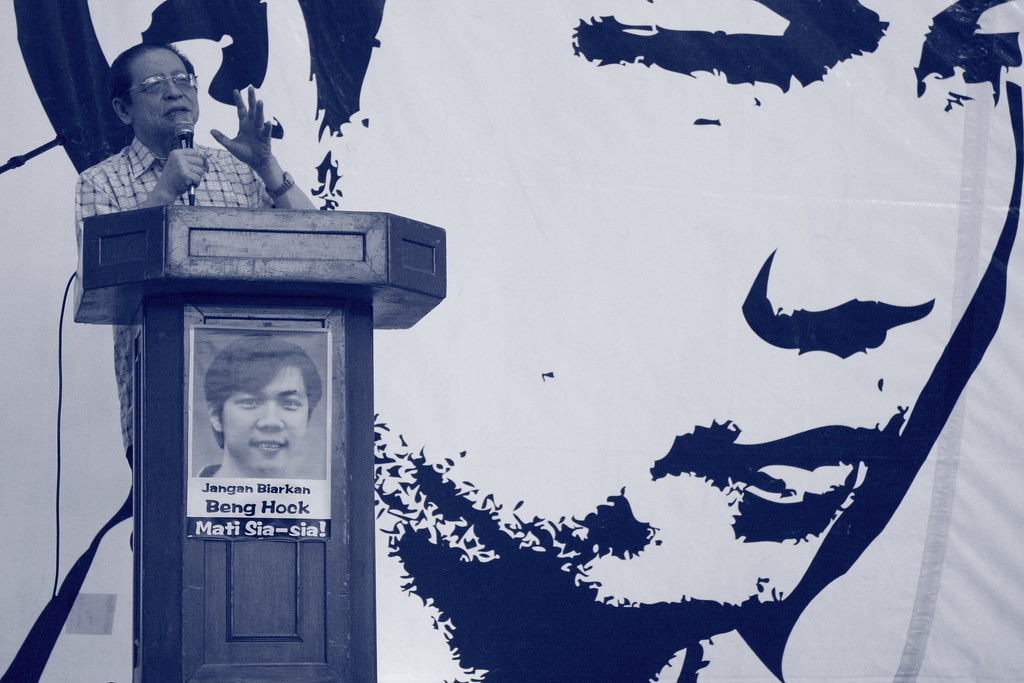
Don’t let Teoh’s death be in vain
By Oon Yeoh
Much has been said and written about the tragic death of DAP political aide Teoh Beng Hock. There is anger, sadness and confusion over what has happened.
The calls for a Royal Commission of Inquiry are growing louder. Perhaps in due time we will be able to find out the truth of what actually happened, and, if some heads have to roll, let them roll.
But that alone will not stop situations like this from reoccurring, just as the Royal Commission of Inquiry into Datuk Seri Anwar Ibrahim’s black eye has not stopped police brutality from persisting. Similarly, the Royal Commission of Inquiry into the Lingam video has done nothing to bolster people’s confidence in the judiciary.
That’s because the underlying causes of these various problems have not been addressed, only the specific incidences of wrongdoing.
What we need are institutions that are truly independent and apolitical. The police force might claim it is above politics but its behaviour leading to, and during, the May 7 Perak state assembly sitting doesn’t make a strong case for its neutrality.
Likewise the MACC might claim to investigate graft allegations without fear or favour but, the fact that it has gone after a bunch of Selangor state representatives for allegations of corruption on relatively minor amounts (RM2,400 for the purchase of flags, for example) while not batting an eyelid over a former menteri besar’s luxury mansion, doesn’t exactly paint an image of impartiality either.
We also need our enforcement agencies to be more humane. Every one of these officers – from the top down – needs to take courses not just on civil liberties but also the Malaysian constitution. Far too often, those detained or questioned have their fundamental rights trampled all over.
Unless there is some CCTV footage of his interrogation, we might never know what exactly transpired during Teoh’s marathon grilling session which lasted from 5pm to 3.45 am. But if it’s anything like what Kajang municipal councillor, Tan Boon Hwa, says he endured, it’s certainly something that should be of grave concern to all right-thinking people.
Tan, who was also brought into questioning as a witness, says he was forced to stand for four hours, was threatened with physical violence and had to endure racial epithets. He claims there were even threats made concerning his family.
Such interrogation techniques are the kind of thing you would expect to happen when someone is detained under the dreaded ISA – which in itself is a gross violation of human rights and civil liberties – but certainly not during the questioning of witnesses.
We don’t know if Tan’s account is accurate or not, and if it is, whether Teoh was subjected to the same harsh treatment. It’s certainly something that an independent inquiry must look into.
Any independent inquiry must also shed light on whether such interrogation techniques, if indeed they were used, are part of MACC’s standard operating procedures or whether they were the actions of rogue MACC officials.
If they were the action of officials who had overstepped their boundaries, questions then need to be asked why there was no effective oversight mechanism or checks and balances to ensure such things do not happen.
The irony of the MACC, which is now viewed with total cynicism and distrust by the broader public, is that it was supposed to be a better version of the ACA, which was largely seen as ineffective. The MACC was given more powers to really go after graft but it seems to be using those powers for political persecution; to conduct unfair investigations using accusatory methods that are reminiscent of McCarthyism in the US in the 1950s.
Teoh’s death is tragic but it won’t be in vain if it brings about positive change. If Prime Minister Datuk Seri Najib Razak believes that economic reforms are all that’s necessary to appease an increasingly educated and demanding public, Teoh’s death should open his eyes. And if it doesn’t, his very savvy and capable political secretary, Oh Ei Sun, should tell him that if he wants his 1Malaysia concept to really work, he needs to buck up on civil liberties as well.
Justice for Beng Hock; Justice for Teoh Beng Hock; J4BH; J4TBH;
Truth for Beng Hock; Truth for Teoh Beng Hock; T4BH; T4TBH
2009_07_31_IMG_6688-r1
Page from the programme for musical play "Rio Rita", performed by Keighley Amateur Operatic & Dramatic Society at the Hippodrome theatre in Keighley between 20th and 25th October 1947. The music was by Harry Tierney, with words by Joseph McCarthy, from the book by Guy Bolton and Fred Thompson. The original 1927 stage musical was turned into a RKO film in 1929, directed by Luther Reed.
The story is set on the US/Mexico border, where cabaret singer Rita Ferguson falls for Texas Ranger Captain Jim Stewart, while pursued by Mexican General Esteban. Meanwhile, Captain Stewart is seeking the notorious bandit Kinkajou, whose real identity is unknown (but could be Rita's brother Roberto!). The climax is reached onboard the pirate barge owned by Esteban, which serves as a floating cabaret...
The Keighley production starred Hylda Saville Smith as Rio Rita, Arthur Day as Captain Jim Stewart, Eric B. Boster as General Esteban, and Fred W. Pye as Roberto. Supporting roles were played by Albert E. Shepherd, Arthur Shackleton, Ernest Marsden, Dorothy M. Williams, Betty Phillips, Keith Marsden, John H. Crabtree, Pamela Fitzjohn, Victor J. Wood, Frank Hopkinson, Margaret Best and Marjorie Riley. It was produced by T. C. Wray.
The 48-page programme measures approximately 183 mm by 248 mm. It contains details of the production, with cast photographs taken by John Tobin of Keighley, and many adverts for local businesses. It was printed by The Keighley Printers Ltd. of High Street.
This page features an advert for the Keighley News newspaper - "Read in more than 25,600 homes" and "contains full, accurate and impartial reports of all that is going on in Keighley and the surrounding districts".
The item was donated to Keighley and District Local History Society by Tim Neal in 2022. The History Society also holds a second copy of the programme in its collection, given by an anonymous donor later in 2022.
Henry M. Teller (1830-1914), U.S. Senator from Colorado; Secretary of the Interior.
Image from "The Parties and The Men, or, Political Issues of 1896 ... The Issues of the Day Impartially Reviewed."
Contrast digitally enhanced.
My grandfather was a philosopher of sorts, a man who dispensed little gems and peals of wisdom so seemingly effortlessly. But by the time he entered his late 60s, this being a time when he had influenced my young life, he was already a man who had stormed life, it’s high and low points and came out on the other end a better and wiser man. I gained so much from this brilliant and kind man from direct interaction with him, but I was also privileged to possess his words in journal form long after he had passed away.
One of the principles that my father extolled was critical thinking, a principle he took pin to paper to clarify his own thoughts about.
The ideal of critical thinking is central in my grandfather’s journals. My grandfather had a humanistic conception of education, which views the student as an independent person whose development is threatened by indoctrination. My grandfather’s concern was to protect the child's freedom to exercise individual judgment on intellectual and moral questions. He claimed that schooling all too often encourages the “herd mentality”--with its fanaticism, dogmatism and bigotry, failing to develop what my grandfather called a "critical habit of mind". It appears as though the majority of mankind holds their beliefs because their elders told them they were true when they were young, and in addition to potential unhappiness for believing otherwise, FEAR is what often chains them to their beliefs.
The threat of indoctrination, the importance of individual judgment, and the prevalence of fanatical beliefs all point up the need for what nowadays is called critical thinking.
My grandfather’s ideas of critical thinking engage reference to a wide range of skills, dispositions and attitudes which together characterize a virtue which has both intellectual and moral aspects, and which serves to prevent the emergence of numerous vices: dogmatism and prejudice, to name a few.
Such critical skills, grounded in knowledge, include:
(A) the ability to form an opinion for oneself which involves being able to recognize what is intended to mislead and becoming adept at asking and determining if there is any reason to think that our beliefs are true.
B: the ability to find an impartial solution which involves learning to recognize and control our own biases, coming to view our own beliefs with the same supposed detachment with which we view the beliefs of others, judging issues on their merits, trying to ascertain the relevant facts, and the power of weighing arguments and the ability to identify and question assumptions which involves learning not to be credulous. "Our most unquestioned convictions,” my grandfather wrote, “may be as mistaken as those of Galileo's opponents."
What makes a Free Thinker, my grandfather stated, is not his beliefs per se, but the way in which he holds them: If he holds them because his elders told him they were true when he was young, or if he holds them because if he did not he would be unhappy, his thought is not free. But if he holds them because, after careful thought and an examination of the evidence, he finds a balance of evidence in their favor, then his thought is free, however odd his conclusions may seem to others. To hold a belief other than one arrived at by reason is to be, as Plato said, “a coward before reality.”
****
I had posted a short essay about Mother Teresa, a truly horrible person, and the evidence is provided here:
www.youtube.com/watch?v=p3tUuA7WBRE&feature=related
Now we all have the opportunity to practice the virtues my grandfather extolled, and follow the evidence and facts where they lead us.
many lives were lost that day, but that which goes around, comes around, and the hands that kill shall fear death itself when it comes, and those that are impartial to the means of how their food is produced shall be impartial to the aura of fear that grips them from the inside
Northern Virginia Firefighter's Emerald Society Pipe Band
On Dec. 13, 2011 at 6 p.m., the Fairfax County Board of Supervisors, Fairfax County constitutional officers, and the Northern Virginia Soil and Water Conservation District directors all took their oath of office in the Government Center forum.
Fairfax Circuit Court Judge Jan L. Brodie administered the oath of office to 15 elected officials, who each swore to support the Constitution of the United States, and the Constitution of the commonwealth of Virginia, and to faithfully and impartially discharge all the duties incumbent upon them as officials of Fairfax County.
All elected officials will take office on Jan. 1, 2012.
More information:
17th century chapel
It is placed on the wild coast, and is a jewel of our religious heritage. Thanks to the action of the association, it can be often open and very many visitors, hikers (the chapel is located on the edge of the GR 34), and tourists can thus gather there for a few moments.
The chapel is open every day from 10 a.m. to 6 p.m., from Palm Sunday to All Saints' Day and during the Christmas holidays. Outside these periods, the chapel is open every Sunday.
This small chapel isolated on the moor a few steps from a superb coast attracts many visitors.
But it is not alone: a Gallic stele stands not far from the entrance and a fountain, visible along the coastal path, attest to the antiquity of a cult at this location. Moreover, the water from the spring is always supposed to cure rheumatism and eye diseases. This heptagonal Iron Age stele was reused as a cross stand.
Note that it bears an inscription engraved on one of the sides:
TP ST GONVEL 1757.
The spring water is captured by a fountain just before flowing into the sea. It is likely that it was Christianized by the presence of a cross long before the chapel was built.
This chapel, built in 1785, was able to replace an older one. She was traditionally the goal of a Pardon of the Sea.
The interior is very sober
Two polychrome statues dominate the altar. On the left, Saint Samson wears the episcopal mitre.
Of all the many monks who came from the British Isles in the 6th century to evangelize Brittany, Saint Samson is one of the few who are well attested by history since he signed the acts of the Council of Paris around 555.1
Originally from Wales, and pupil of Saint Ildut who gave his name to Lanildut, he would have landed in Plougasnou, in the north of Finistère, where the foundation of the monastery of Lanmeur is attributed to him. He had been ordained a bishop, without a bishopric, before coming to the continent. Appointed Bishop of Dol by King Childebert 1st, he died there around the year 565. His influence throughout Brittany was such that many localities or Breton religious buildings bear his name. It is not impossible that he came to see his friend Ildut in the Pays d'Iroise.
Two other statues catch the eye in this chapel
On the left wall, Saint Isidore, the modest Spanish plowman, represents a model of a peasant who is both hardworking and very pious.
To the right of the altar, Saint Yves is dressed as a magistrate. His gaze directed towards the litigants shows them his listening while with his raised hands, he indicates to them his impartiality 2 during his judgments.
We will also take a look at the modern stained glass windows dating from 1993. On the left, Saint Anne, the mother of the Virgin, with her daughter. On the right, Saint Samson, whose bishop's crozier can be seen, heals a patient.
Ultimately, a small, modest chapel full of charm, located in an environment that is both wild and grandiose, which gives it all the qualities of a real postcard subject.
Sources: www.chapelleslandunvez.fr/
Church of St Mary and St Peter, Monument to Thomas (d.1730) and Mary (d. 1754) Russell, Marble.
The monument is set on the wall of the south aisle, near the altar. It looks like an over the top fireplace, with a coat of arms in a cartouche topped by a helmet surrounded by canons, flags, swords, drums, rifles and shields, incongruously flanking the inscription devoted to Mrs Mary Russell, described as a ‘good woman and pattern to her sex who died in 1754, aged 83’. That the inscription was placed so inappropriately suggests that it was added later to the monument which had been commissioned on her husband’s death in 1730.
The military equipment is explained by the inscription on dark marble set in what should be the grate, flanked by fluted columns under a black marble cornice. It describes Thomas Russell: born in 1669 in Belturbet (just south of Enniskillen) in the County of Cavan, Ireland, he spent his younger years defending Enniskillen and continued in service until that kingdom was entirely subdued by King William. The rest of his life was spent doing good, as an impartial distributor of justice, tender husband, true friend and good master, he died in 1730.
Enniskillen had been one of the centres of Catholic support for King James II after the proclamation of William and Mary’s joint rule in 1689. Recognition of William in Ireland began (grudgingly) with his victory at the battle of Boyne in 1690, and ended with the Treaty of Limerick late in 1691 (Wikipedia, William III of England, accessed 24/05/2014). That Russell chose celebrate his role in the establishment of protestant rule, long after he must have left Ireland for Kelsale, underlines the bitter religious divisions which are still so corrosive in Northern Ireland.
detail
17th century chapel
It is placed on the wild coast, and is a jewel of our religious heritage. Thanks to the action of the association, it can be often open and very many visitors, hikers (the chapel is located on the edge of the GR 34), and tourists can thus gather there for a few moments.
The chapel is open every day from 10 a.m. to 6 p.m., from Palm Sunday to All Saints' Day and during the Christmas holidays. Outside these periods, the chapel is open every Sunday.
This small chapel isolated on the moor a few steps from a superb coast attracts many visitors.
But it is not alone: a Gallic stele stands not far from the entrance and a fountain, visible along the coastal path, attest to the antiquity of a cult at this location. Moreover, the water from the spring is always supposed to cure rheumatism and eye diseases. This heptagonal Iron Age stele was reused as a cross stand.
Note that it bears an inscription engraved on one of the sides:
TP ST GONVEL 1757.
The spring water is captured by a fountain just before flowing into the sea. It is likely that it was Christianized by the presence of a cross long before the chapel was built.
This chapel, built in 1785, was able to replace an older one. She was traditionally the goal of a Pardon of the Sea.
The interior is very sober
Two polychrome statues dominate the altar. On the left, Saint Samson wears the episcopal mitre.
Of all the many monks who came from the British Isles in the 6th century to evangelize Brittany, Saint Samson is one of the few who are well attested by history since he signed the acts of the Council of Paris around 555.1
Originally from Wales, and pupil of Saint Ildut who gave his name to Lanildut, he would have landed in Plougasnou, in the north of Finistère, where the foundation of the monastery of Lanmeur is attributed to him. He had been ordained a bishop, without a bishopric, before coming to the continent. Appointed Bishop of Dol by King Childebert 1st, he died there around the year 565. His influence throughout Brittany was such that many localities or Breton religious buildings bear his name. It is not impossible that he came to see his friend Ildut in the Pays d'Iroise.
Two other statues catch the eye in this chapel
On the left wall, Saint Isidore, the modest Spanish plowman, represents a model of a peasant who is both hardworking and very pious.
To the right of the altar, Saint Yves is dressed as a magistrate. His gaze directed towards the litigants shows them his listening while with his raised hands, he indicates to them his impartiality 2 during his judgments.
We will also take a look at the modern stained glass windows dating from 1993. On the left, Saint Anne, the mother of the Virgin, with her daughter. On the right, Saint Samson, whose bishop's crozier can be seen, heals a patient.
Ultimately, a small, modest chapel full of charm, located in an environment that is both wild and grandiose, which gives it all the qualities of a real postcard subject.
Sources: www.chapelleslandunvez.fr/
On Saturday 5 August, activists gathered in central London to protest the ongoing brutal and illegal occupation of Jammu and Kashmir by India and its use of extrajudicial killings, forced disappearances, intimidation and censorship to maintain its control.
Many of those present were also angry at Britain's continued support of India and failure to take action in support of the Kashmiri people's struggle for independence. India has forcibly occupied the region for over 75 years in open defiance of UN resolutions calling for a fair and impartial plebiscite under UN auspices to determine the area's status.
The protest marked four years since the Indian government, on 5 August 2019, revoked the autonomy of Jammu and Kashmir, previously guaranteed by the constitution, and instead imposed direct rule from Delhi. As Human Rights Watch (HRW) reported, "The government action was accompanied by serious rights violations including arbitrary detention of hundreds of people, a total communications blackout and severe restrictions on freedom of movement and peaceful assembly."
www.hrw.org/news/2022/08/02/india-repression-persists-jam...
In their most recent report on Jammu and Kashmir, HRW noted that "the government's repressive policies and failure to investigate and prosecute alleged security force abuses have increased insecurity among Kashmiris," and added that "journalists in Kashmir face increasing harassment by security forces, including raids and arbitrary arrests on terrorism charges. Authorities in India have shut down the internet more often than anywhere else in the world. A majority of those shutdowns have been in Kashmir, where they are used to curb protests and access to information."
www.hrw.org/news/2022/08/02/india-repression-persists-jam...
Enforced disappearances also continue as freelance journalist Mir Aiyaz reported in Fair Planet (23 February 2023). He interviewed Khera Begum about the arrest of her son, Abdul Rashid Dar, by over forty Indian army soldiers, with no police officer attending as is legally required. An officer reportedly told his older brother, Shabir, that the police had been "informed" and that he would be released the next morning. He was not. When the family and other locals went to enquire at the nearest army base, initially they were asked to return later, and then eventually told that he had "escaped from custody." As Aiyaz notes
'Rashid's family and community members do not believe the army's version of events. "How can a man escape in the presence of ever vigilant army men?" rued Shabir. "He was too meek a person to escape, and there was no possibility of running away in the forest where he was taken."
It seems equally difficult to believe that if the army had openly stated its intention to hold him for just 24 hours, that he would have risked everything on attempting to flee.
Aiyaz observes that 'locals, particularly youths living in Kunan Poshpora have altered their daily habits due to their fear of being abducted,' and he quotes a student who while 'staring at the fenced playground (of a school), which used to be brimming with kids but has recently been mostly desolate,' told him that "boys head home after the maghrib prayers, and time spent in the playground has been slashed down."
www.fairplanet.org/story/whats-behind-the-forced-disappea...
The Indian Army has deployed a huge military force in Jammu and Kashmir which some estimates suggest might be as high as 900,000 troops. One soldier for every eight civilians. According to journalist Munir Akram writing in the Pakistan Observer (6 August 2023), the Indian military has "perpetrated a vicious campaign of repressive actions, including extrajudicial killings of innocent Kashmiris in fake encounters, custodial killings and "cordon-and-search" operations; use of pellet guns to kill, maim and blind peaceful protestors, abduction and enforced disappearances and "collective punishments," with the destruction and burning of entire villages and urban neighborhoods.'
pakobserver.net/whats-going-on-in-kashmir-is-not-normal/
www.eureporter.co/world/pakistan/2023/08/06/seminar-on-hu...
Despite India's ongoing brutal occupation of Jammu and Kashmir and despite the continued tension and risk of war with Pakistan, Britain continues to grant licenses for the export of arms to both Pakistan and India.
On 23 February 2023, Politico reported that in the wake of the Ukraine war, 'Britain's defense and aerospace firms now see an opportunity to chip away at Russia's share (of India's military imports)', adding that 'Rolls-Royce and BAE Systems are part of a delegation to Aero India, Asia's biggest airshow which is taking place this week.'
The same report also seemed to suggest that rather than attempt to limit arms exports to maintain some leverage on the shocking human rights situation in Jammu and Kashmir and limit the arms race between the two regional nuclear powers - India and her neighbour Pakistan, the British government appears instead intent on promoting arms exports to India. According to Politico, "Last year the UK put India on its defense equipment fast-track - the first such move offered to an Indo-Pacific nation - in a shift that will reduce red tape and shorten delivery times for defense procurement."
www.politico.eu/article/india-pursues-russian-military-bu...
It should also be noted that the United Kingdom is already one of India's largest suppliers of weapons. According to the UK House of Commons Library arms exports update in January 2023, on a "10 year rolling basis the UK is Europe's largest and the world's second largest defence exporter' beaten only by the United States (p10) and the report ranks India as the fourth largest importer of arms from the UK after Saudi Arabia, Oman and the United States, based on arms transfers between 2012 and 2021. (p21).
researchbriefings.files.parliament.uk/documents/CBP-8310/...
via Tumblr lawrence9gold.tumblr.com/post/117370358187
The practice of somatic education arrives at a number of “layers” of habituation.
When used as a supportive adjunct to clinical sessions involving pandiculation, somatic education exercises serve to reinforce the changes of that session, which has entailed disappearance of patterns of habituation (or dis-intensification/relaxation of memory). In that case, the way has been cleared ahead of time for that new patterning.
When used by themselves, however, somatic education exercises must accomplish both the disappearance of old patterns and the emrgence or development of new patterns.
In that case, the first patterns to go are those that are obsolete remainders of previous adaptations – injuries that have healed, emotionally traumatic situations that are long past, conditioning from family life or exposure to institutions with a “culture” (e.g., “corporate culture”, “military culture”). All of these, because they are not actively called for and actively used in daily life, are subject to easier release. They are not being reinforcced by use, but only persist by memory’s tendency to persist.
The next patterns to go are those that now surface. Those patterns are patterns we enact in daily life – including our mood and attitude of approach to somatic “clean-up”. Let me make that point more vividly: The sense of self that is doing “clean-up” comes from a habituated and remembered entire characer that may or may not yet have been subject to exposure and conscious integration.
If not yet integrated, it is “the one” doing the clean-up, and as such, its own pattern is never subject to clean-up; it’s always “behind the scenes”.
So, the person tends first to lose the obsolete remainders and then to reinforce, more and more, the mood and attitude of approach (or remembered way of being in the world’s situations) characteristic of the daily self. That means that there are “areas” of S-MA that are untouched and seemingly untouchable, and actually, we find, of which we are almost entirely unconscious – but which others may recognize.
To get at that next layer of habituations, we need to take another angle of approach.
That approach is, on the basis of attention freed up by releasing obsolete remainders, to notice, to catch ourselves at it, in the patterns we live on a daily basis. Since the second layer consists of all the attitudes and moments of reaction of our daily self, to notice those patterns gives us access to the layer of “self” that is doing the clean-up.
Generally, that layer of self consists of emotional tendencies, attitudes, and self-talk by which we activate ourself in life – rather than merely reflexive after-patterns from injury or long-term stress, which are primitive kinds of reactivity – typically called, S-MA. For that second layer of self, another term is appropriate: A-IA: attentional-intentional amnesia.
As such, these patterns must be addressed on their own terms and in their own “language” – the language of feeling, the language of “I” and of “I’s” meaningful terms.
It involves not merely a psychological process of analysis, which is but a start; it involves distinguishing those patterns in terms of the four basic facets of somatic existence: attention, imagination, intention, and memory – or attending, imagining, intending, and remembering.
There exist specific procedures that use all four of those four facets at once to develop or recover conscious integration of those daily patterns. I present those in detail, elsewhere, in usable form. Ask.
What happens in integration is that the grip of a “daily pattern” that “has” us suddenly loosens and softens, and as that happens, somatic changes occur that might be interpreted as neuro-muscular or sensory-motor, but which are actualy attentional and intentional; we feel our old postural set and we feel how we could be to feel more “ourselves.” Our memory set changes, and with that change, our personal quality in the world also changes. We experience the world differently and the world experiences us differently. The old “daily pattern” no longer “has” us, no longer automatically springs into action when circumstances might before have triggered it. A freer response allows for a more spontaneously and more finely tuned, even more ingenious, response.
In the process of dissolving the second layer, we touch repeatedly into what is “beneath” or what pervades that second layer (and also, the first, residual layer); that “what is beneath or pervades” is a kind of formless, impartially present, conscious space. It is not seen, in itself, to be of any particular quality – other than a kind of radiant presence – and it’s “felt” radiant, not seen radiant. It could be termed, “self-existing”, since it has no particular quality and there is nothing in evidence to be creating it as an effect of something else. It is continuous with and gives rise to all things particular. It is their substance. They are a play upon or play of it. It is our experience of “now”.
Memory stores the impressions of its shape-shifting and so gives it the sense of duration in time. Attention gets absorbed in it. Imagination anticipates its developments, guided by memory, more or less. And intention reacts to all of that and proels our movement.
Such is the second layer: the deeper layer that persists after somatic education exercises have done what they can in the hands of the “daily self”; and touchings into the intuition of the free, undefined (infinite) condition.
So, the second layer of de-habituation consists of a differently shaped, differently organized, differently responsive self-pattern. But it’s still a habituated self-pattern, a pattern of A-IA, attentional-intentional amnesia. Coming out of it reveals something unexpected.
A third development.
That third development consists of integration of the second layer, “daily self”; what we integrate of ourselves ceases to be an “it” to us; it ceases to have any weight, to us, any mass, or so little as to be negligible. Those patterns, before, unconscious and running the show, have been made conscious, lost their automaticity, lost their sense of grip and become more freely available for spontaneous, more subtly fitting responsiveness without a sense of “hard self”. They have been both streamlined and freed from internal conflict, so they are “tuned to the harmonic of the formless ground of being” and simultaneously express their responsiveness to conditions and communicate the formless ground from which they emerge and of which they are actually made.
One term for this is “Wei Wu Wei” or spontaneous right action. Another term is “The Fair State” – although that kind of fairness is not an opinion; it’s an experience of action experienced as “no action” – and if it’s a state, it’s a state of flow. It’s the foot dipping into the pond without a ripple, unless the dipper wants to make a ripple. The conceptual mind cannot grasp that kind of functioning, but that kind of functioning is recognizable in the instant of its happening, by feel. It draws observers into its own state (or drives them off as an insult to their habituation).
Thus, somatic education first dissolves the residues of obsolete memory, then dissolves the current “do-er” of all things, then itself dissolves to reveal the paradox of embodiment: that our lives emerge from and exist in the continuity of all existence, that before, our habituation and all our efforts did obscure.http://ifttt.com/images/no_image_card.png via Blogger lawrencegoldsomatics.blogspot.com/2015/04/the-layers-of-s...
A wedding in Perivolos beach Santorini and Grace Hotel featured on Grace Ormonde www.weddingstylemagazine.com/real-weddings/impartial-and-.... Photographer Vasilis Pasioudis
Villa Yiali Glossa
Property description
Villa Yiali has one air-conditioned bedroom (with extra fold-down bed or cot), and is fully self-contained with kitchen, one bathroom, sitting area, large balcony and private outside space. Enjoying stunning views over the adjacent islands of Skiathos and Evia, the gardens and pool area are a haven of relaxation. In addition, the location at the edge of the village of Glossa means that shops, bakery, cafes and tavernas are within a few minutes walk. Otherwise the beautiful area to the north of Skopelos island is also within easy reach with many walks and trails accessible. The west facing aspect delivers the most breathtaking sunsets from the garden, whilst the sun traverses from the south giving all-day sunshine – the terrace and trees giving shade and cool when required.Glossa is situated on the northwest coast of Skopelos, 10 minutes from the port of Loutraki where the ferry docks from the neighboring island of Skiathos and the nearest airport. The ferry journey is about 25 minutes.
Accommodation description:
Bedrooms:
Bedroom. King sized bed and open traditional beamed ceiling and wooden floors. Air conditioned with dressing area and double access to large balcony. Ample storage, hairdryer, full length mirror, sofa-bed or cot if required. Quality bed linen from M&S
Bathrooms:
Located on the ground floor, with shower cabinet, washbasin and wc. Quality towels and locally made olive oil soap, complimentary gels from L'Occitane and Body Shop provided.
Kitchen:
Whirlpool appliances. Oven and ceramic hob, microwave, fridge freezer. Ample kitchen storage with quality pans, crockery and cutlery. Fully equipped. Laundry machine (detergent provided). Complimentary welcome pack. Tea, coffee, bread, cheese, wine etc.
Living Rooms:
Wooden floor, fold down dining table, open fire place. TV, DVD, iPod dock, WiFi, satellite TV, comfortable furniture. Most living is outdoors and there is a patio table and 6 chairs under a shady verandah, as well as a morning coffee set on the balcony.
Cleaning/Towels/Linen/Maid service:
All towels/beach towels/pool towels and linen provided. The house is cleaned and
changed twice each week. Outside BBQ, pool shower, sunbeds. Don't use valuable luggage space with towels as they are all provided.
Amenities/Facilities:
Barbecue, Private Pool, Garden.
Fridge/Freezer, Hob/Stove, Iron, Microwave, Oven, Washing Machine.
Air Conditioning, Cot, High Chair, Internet Access, Room Fans, Satellite, TV.
Location Type:
Beach, Village.
Important notes on accommodation
This former ‘kalivi’ was painstakingly restored in the traditional village style and is finished to a high standard of craftsmanship. The private garden, pool area and planted terraces provide a ‘home from home’ feel.
We make sure that we provide most kitchen essentials that many rental house lack such as condiments, some spices , sugar, coffee and tea together with our own olive oil for the kitchen. Soap powder, washing up liquid, in fact most kitchen comforts that we feel you shouldn't have to worry about on your holidays.
We also provide all towels including beach towels and pool towels. There are even beach mats and an umbrella available for that inevitable visit to one of Skopelos’s enviable beaches.
If you visit in June / July / August, as a highlight to your stay your holiday price will include dinner for two on one night at the acclaimed Agnanti restaurant (5 minutes walk away). Please ask us for details.
About the area
Accessibility
Glossa is unfortunately not wheelchair friendly due to the steps. However, it is possible to walk (within 10 minutes) from the main road to Villa Yiali with only 1 or 2 inclines and no steps. Parking can be arranged close by. Pets accepted by prior arrangement.
Outside
There is a private garden area approx 400 sq. mtrs. with a swimming pool of 7m by 4m, gently sloping to a depth of 1.6m. Along two sides of the pool are underwater seating areas allowing relaxation and refreshment at the same time. The private gardens are not overlooked and offer stunning views over the Aegean to Skiathos, Pilion, towards Mount Olympus in the north and even towards Athens.
Coast/Beach
The closest beach is at Loutraki, with a few tavernas / cafe’s. This is 10 minutes drive or a pleasant 25 minute downhill walk. Within 20 minutes drive are the beaches on Armenopetra, Elios, Milia, Kastani and Panormos. Glossa enjoys a unique position between both sides of the island, and the famous Mamma Mia church at Aghios Ioanni is only 15 minutes drive, as is the beach at Perivoliou. Buses run about every 2 hours in the high season. Skopelos town and the south of the island are 35 mins away
Special Interest Holidays
We have friends on the island who are running sea kayaking tours for all levels of experience and there are mountain bikes to hire to explore the beautiful deserted tracks that lead through the mountains. With a license and an off-road motorbike you can take a guided trail ride up the mountains, jeep, 4x4 or quad bike, or you can rent a motor boat or yacht or go on a sea fishing trip. Walking, birdwatching, painting and local crafts are all available. Also at the villa we have a telescope for stargazing, which on a balmy summer evening opens up the whole universe.
How to get there
Nearest airport is Skiathos which is 25 minutes by boat from the local port of Loutraki (Glossa). Volos airport is on the mainland then its 2hrs 20 by boat to Glossa. Athens and Thessaloniki both connect through. Out of season there is an air connection from Athens to Skiathos which takes only 25 minutes with Olympic Air. We can advise you on flights and also book you a car at discount rates from a small family company on the island (the car will be waiting for you next to the boat as it docks)
Distances
Glossa town is a traditional hill village with shops, cafe’s, bakeries and tavernas. Villa Yiali is on the edge of the village and all amenities are within 10 minutes walk.
Skopelos Town, the main center of the island is about 35 minutes drive away, from where day trips to Alonissos and the World Marine Park are available. Loutraki (10 mins) has much of archaeological interest, including remains of Roman baths and a hill fort. Ancient ruins remain on Mount Delphi and surrounding areas.
Further Details
Glossa has a selection of tavernas,cafe’s and restaurants including one regarded as the best in the Aegean, a number of local supermarkets, bakeries and butchers. Fish is sold from vans or straight from the port of Glossa (known as Loutraki).
Loutraki also has a number of tavernas on the waterfront, and cafes. We will be happy to help you with recommendations and advise on travel arrangements. We will collect you from the port and lead you to the house, introducing you to the wonderful wood fired bakery and friendly little supermarket on the way and demonstrate all the features of the house before leaving you to relax in this beautiful environment. As the English owners, we live next door! Unlike some villa owners, we do not charge commissions or receive payments from restaurants, car hire companies and the like. Our advice is impartial and geared to the needs of the holidaymaker. During June, July and August we offer an included meal for two at the renowned Agnanti restaurant for one night of your stay. Otherwise we have arrangements to have quality restaurant food delivered to your holiday villa so that you can enjoy the local cuisine without the trouble of leaving your comfortable surroundings.
Booking notes
Please contact us for booking details. A deposit of 20% is required to confirm booking. Deposits received will confirm booking and remainder to be payed 6 weeks in advance of arrival. If you wish to pay in € that isn't a problem we use the National Bank of Greece rates on the day of
booking confirmation and set that as your personal rate so there are no surprises with rate fluctuations. Cancellation will forfeit 10% of the booking cost if it is more than 6 weeks, otherwise the full is payable.
Monument to Lady Elizabeth †1651 and Sir Francis †1657 Bacon. Alabaster. Commissioned by their son, Francis Bacon.
The wall monument at the east end of the south nave, in the chapel of St Thomas, is above a tomb chest, now invisible under the contents of a very dull attic. Black Ionic columns support a cornice with coats of arms surmounted by a skull above a grave digger’s spade crossed with a sceptre, balanced beneath by the winged head of an angel. The roundel with the inscription is framed by strapwork, with festoons besides the columns.
Sir Francis Bacon (c.1587–1657), born in King’s Lynn, commenced his legal studies at Barnard's Inn, moved to Gray's Inn in February 1607, and was called to the bar in 1615. About 1621 he married Elizabeth (1595–1651) Robinson of Norwich and the family was firmly settled in the parish of St Gregory. In 1634 Bacon was appointed autumn reader at Gray’s Inn, steward of Norwich in 1639 and recorder in 1642, the year that he was appointed to the king's bench and knighted by the king at Bridgnorth. He was known for his impartiality but refused to continue after the the king's execution, retiring to Norwich, where his wife died in 1651, aged fifty-six.
ODNB: Oxford Dictionary of National Biography, Oxford University Press, 2004; online edn, Oct 2009, G. V. Benson, rev. J. M. Blatchly
Yasin Malik is the chairman of the now banned Kashmir Liberation Front and most objective analysts agree that, as Wikipedia itself notes, 'Malik renounced violence in 1994 and adopted peaceful methods to come to a settlement of the Kashmir conflict.'
Despite having renounced violence for many years, he was arrested in 2019 and kept in what a petition presented by Labour MP Debbie Abrahams to the British parliament has described as "inhumane conditions" preceding an unfair trial. Three years later, on 22 May 2022 Malik was sentenced by an Indian court to life imprisonment on what the petition points out was a 'contrived' charge of terror funding.
hansard.parliament.uk/commons/2022-07-20/debates/6348A1D0...
www.globalvillagespace.com/yasin-malik-verdict-another-ep...
www.aljazeera.com/news/2022/5/25/iconic-kashmir-rebel-yas...
On Saturday 5 August, activists gathered in central London to protest the ongoing brutal and illegal occupation of Jammu and Kashmir by India and its use of extrajudicial killings, forced disappearances, intimidation and censorship to maintain its control.
Many of those present were also angry at Britain's continued support of India and failure to take action in support of the Kashmiri people's struggle for independence. India has forcibly occupied the region for over 75 years in open defiance of UN resolutions calling for a fair and impartial plebiscite under UN auspices to determine the area's status.
The protest marked four years since the Indian government, on 5 August 2019, revoked the autonomy of Jammu and Kashmir, previously guaranteed by the constitution, and instead imposed direct rule from Delhi. As Human Rights Watch (HRW) reported, "The government action was accompanied by serious rights violations including arbitrary detention of hundreds of people, a total communications blackout and severe restrictions on freedom of movement and peaceful assembly."
www.hrw.org/news/2022/08/02/india-repression-persists-jam...
In their most recent report on Jammu and Kashmir, HRW noted that "the government's repressive policies and failure to investigate and prosecute alleged security force abuses have increased insecurity among Kashmiris," and added that "journalists in Kashmir face increasing harassment by security forces, including raids and arbitrary arrests on terrorism charges. Authorities in India have shut down the internet more often than anywhere else in the world. A majority of those shutdowns have been in Kashmir, where they are used to curb protests and access to information."
www.hrw.org/news/2022/08/02/india-repression-persists-jam...
Enforced disappearances also continue as freelance journalist Mir Aiyaz reported in Fair Planet (23 February 2023). He interviewed Khera Begum about the arrest of her son, Abdul Rashid Dar, by over forty Indian army soldiers, with no police officer attending as is legally required. An officer reportedly told his older brother, Shabir, that the police had been "informed" and that he would be released the next morning. He was not. When the family and other locals went to enquire at the nearest army base, initially they were asked to return later, and then eventually told that he had "escaped from custody." As Aiyaz notes
'Rashid's family and community members do not believe the army's version of events. "How can a man escape in the presence of ever vigilant army men?" rued Shabir. "He was too meek a person to escape, and there was no possibility of running away in the forest where he was taken."
It seems equally difficult to believe that if the army had openly stated its intention to hold him for just 24 hours, that he would have risked everything on attempting to flee.
Aiyaz observes that 'locals, particularly youths living in Kunan Poshpora have altered their daily habits due to their fear of being abducted,' and he quotes a student who while 'staring at the fenced playground (of a school), which used to be brimming with kids but has recently been mostly desolate,' told him that "boys head home after the maghrib prayers, and time spent in the playground has been slashed down."
www.fairplanet.org/story/whats-behind-the-forced-disappea...
The Indian Army has deployed a huge military force in Jammu and Kashmir which some estimates suggest might be as high as 900,000 troops. One soldier for every eight civilians. According to journalist Munir Akram writing in the Pakistan Observer (6 August 2023), the Indian military has "perpetrated a vicious campaign of repressive actions, including extrajudicial killings of innocent Kashmiris in fake encounters, custodial killings and "cordon-and-search" operations; use of pellet guns to kill, maim and blind peaceful protestors, abduction and enforced disappearances and "collective punishments," with the destruction and burning of entire villages and urban neighborhoods.'
pakobserver.net/whats-going-on-in-kashmir-is-not-normal/
www.eureporter.co/world/pakistan/2023/08/06/seminar-on-hu...
Despite India's ongoing brutal occupation of Jammu and Kashmir and despite the continued tension and risk of war with Pakistan, Britain continues to grant licenses for the export of arms to both Pakistan and India.
On 23 February 2023, Politico reported that in the wake of the Ukraine war, 'Britain's defense and aerospace firms now see an opportunity to chip away at Russia's share (of India's military imports)', adding that 'Rolls-Royce and BAE Systems are part of a delegation to Aero India, Asia's biggest airshow which is taking place this week.'
The same report also seemed to suggest that rather than attempt to limit arms exports to maintain some leverage on the shocking human rights situation in Jammu and Kashmir and limit the arms race between the two regional nuclear powers - India and her neighbour Pakistan, the British government appears instead intent on promoting arms exports to India. According to Politico, "Last year the UK put India on its defense equipment fast-track - the first such move offered to an Indo-Pacific nation - in a shift that will reduce red tape and shorten delivery times for defense procurement."
www.politico.eu/article/india-pursues-russian-military-bu...
It should also be noted that the United Kingdom is already one of India's largest suppliers of weapons. According to the UK House of Commons Library arms exports update in January 2023, on a "10 year rolling basis the UK is Europe's largest and the world's second largest defence exporter' beaten only by the United States (p10) and the report ranks India as the fourth largest importer of arms from the UK after Saudi Arabia, Oman and the United States, based on arms transfers between 2012 and 2021. (p21).
researchbriefings.files.parliament.uk/documents/CBP-8310/...
BBC impartiality was challenged today by several hundred Pro Palestine protesters who gathered outside the Birmingham studios located in the Mailbox. Several speakers highlighted the disproportionality of coverage and just days after 4 Palestinian children were bombed on a beach in Gaza.
The protesters held an impromptu march to a scheduled Stop the War meeting. When it became clear that the Council House could not accomodate the number of protesters wishing to attend a sound system was hastily put together and a mass public meeting was held in the city's Chamberlain Square.
This is the occasion of the wedding of Princess Elizabeth (HM The Queen) and Prince Philip (Duke of Edinburgh) November 1947.
The police officers would be attached to famous Central London Police Station, Cannon Row 'AD' assisted by officers 'Aid To 'A' from outlying areas of the Metropolitan Police District.
Cannon Row officers always provided 'local guidance' to the 'Aid To 'A' contingent when these ceremonial occasions took place.
One would assume that the Royal carriages had passed through from Whitehall for the wedding at Westminster Abbey and the large crowd following was the result and had to be stopped at this junction.
Hopefully the return journey to the Palace was via Birdcage Walk and not over the forward route as there were a lot of people to be re positioned.
Most of Central London's large public occasions were dealt with by Cannon Row Police Station officers and overseen by the expert Ceremonials Office based at the station and always handled with complete impartiality.
One of the many ceremonial occasions dealt with by Metropolitan Police officers attached to the famous Central London police station, Cannon Row (Alpha Delta), Headquarters of 'A' or Whitehall Division of the Metropolitan Police.
Most of Central London's large public occasions were dealt with by Cannon Row Police Station officers and overseen by the expert Ceremonials Office based at the station and always handled with complete impartiality.
More about Cannon Row Police Station (Alpha Delta) Here:
www.flickr.com/groups/884772@N20
and here:
On Dec. 13, 2011 at 6 p.m., the Fairfax County Board of Supervisors, Fairfax County constitutional officers, and the Northern Virginia Soil and Water Conservation District directors all took their oath of office in the Government Center forum.
Fairfax Circuit Court Judge Jan L. Brodie administered the oath of office to 15 elected officials, who each swore to support the Constitution of the United States, and the Constitution of the commonwealth of Virginia, and to faithfully and impartially discharge all the duties incumbent upon them as officials of Fairfax County.
All elected officials will take office on Jan. 1, 2012.
More information:
The creation of the Industrial Strategy Council was a commitment in the UK government’s Industrial Strategy white paper, published in November 2017.
The Council’s remit is to provide impartial and expert evaluation of the government’s progress in delivering the aims of the Industrial Strategy – a long-term plan to boost the productivity and earning power of people throughout the UK.
The Council provides external, independent challenge to government on whether the Industrial Strategy is having a positive impact.
This event discussed the Council’s first annual report, which set out its evaluation of the policies contained within the 2017 Industrial Strategy white paper.
The panel:
Andy Haldane, Chair of the Industrial Strategy Council
Dame Kate Barker, member of the Industrial Strategy Council and National Infrastructure Commission
Matthew Taylor, member of the Industrial Strategy Council and Chief Executive of the RSA
The event was chaired by Gemma Tetlow, Chief Economist at the Institute for Government.
#IFGEconomy
Photos by Candice McKenzie
William Darrah Kelley (April 12, 1814 - January 9, 1890) was a Republican member of the U.S. House of Representatives from Pennsylvania. Kelley was a lifelong advocate of civil rights, social reform, and labor protection.
William Darrah Kelley was born in Philadelphia, Pennsylvania, the son of Hannah and David Kelley; his father died when he was two. He had been a watch and clock-maker, and later in life, William Kelley bought one of those clocks to adorn his library. His daughter Florence Kelley told of an incident immediately after the death. Since the law at the time said that all a man's possessions must be sold to discharge his debts, with no exemptions allowed for widows or orphans, all of the family's treasures were spread out on tables to be auctioned off. A "substantial" Quaker woman appeared with two large baskets, filled them with as much as she could carry, and walked away expressing indignation that "Friend Hannah Kelley should not have returned precious heirlooms" to her. Weeks later, after the auction, the woman sneaked the treasures back to the Kelley family.
His mother opened a boarding house to support her children. William Kelley started working at eleven to support the family, apprenticing as a jeweller and educating himself in law. Later, a reporter described him in the United States House as "slightly noticeable for the disfigurement of the lid of one of his eyes, received in a machine shop in which his youth was educated -- a man who literally hammered his way up in life, and who is capable of hammering his representative way through life, on whatsoever paths social tyranny or political injustice seek to bar man's progress to a pure democracy."
Kelley was admitted to the bar in Philadelphia in 1841. In 1846 Governor Shunk of Pennsylvania appointed him a judge of the Court of Common Pleas. He served as a judge of the Philadelphia County Court of Common Pleas from 1846-1856.
William D. Kelley came to national attention after his 1854 speech against the slave trade, "Slavery in the Territories", was published and widely read.
After the repeal of the Missouri Compromise by the Kansas-Nebraska Act in 1854, Kelley quit the Democratic Party.
In 1854 Kelley was one of the founders of the Republican Party. Kelley was elected as a Republican to Congress in 1860 and served from March 4, 1861, until his death in Washington, D.C..
Friendly with Abraham Lincoln, he had served on the committee that went to Springfield to inform the Republican that he had been nominated by the Chicago convention in 1860. He became one of the most prominent figures in the Union League in Philadelphia and an early advocate of enlisting black soldiers on the Union side.
As a member of Congress, Kelley was exempt from military service. Nevertheless, during the American Civil War he volunteered and would head out from his Philadelphia home in his blue coat whenever the Reserves were called up
At the war's end, when the United States flag was raised over Fort Sumter again, Kelley was one of the delegation sent to attend the ceremony. He spoke often on the justice and necessity of "impartial suffrage", or voting rights for African-Americans, introduced a bill (which passed into law) in the 39th United States Congress which gave the right to vote to African-Americans in the District of Columbia, and spoke in favor of impeaching President Johnson, who had vetoed the Civil Rights Act of 1866 and the Freedmen's Bureau Bill .
In 1871, Kelley was the first Washington politician to suggest of what would later become Yellowstone National Park, as reported by Jay Cooke: "Let Congress pass a bill reserving the Great Geyser Basin as a public park forever--just as it has reserved that far inferior wonder the Yosemite Valley ."
In his later career, Kelley was best known as an advocate of a high protective tariff. His support for high duties on two Pennsylvania products, iron and steel, earned him the nickname, "Pig-Iron" Kelley. His belief was sincere, and so strong that he would never let himself wear any garment made from an imported product or use any article made in a foreign country, and often lectured his friends for using goods that foreign labor had fashioned..
An inveterate smoker, he died from complications arising from mouth and throat cancer, from which he had suffered for some six years.
I was really excited to get this phone and when I opened it I was delighted to see what all it came with. The box included a manual, the phone, a battery (already inside the phone but with insulation tape across the prongs), a USB charger and a set of headphones. I got it in black, because I figured I did not really want anything to flashy and I love the way it looks. The back of the phone is made up of little small squares that look a lot like little pixels. It's adorable.
I turned it on without the SIM card in it the first time and it booted up pretty fast, faster than my Nokia Lumia 521. I played around with it and looked at the Installed Apps. There are certain questionable apps on the phone, but I plan on rooting it so I can get those off the device. I dislike most pre-installed applications and this is something I do with almost all phones that come into my possession.
When I finally went to insert the SIM card, me being the "brilliant" person I am was not paying to much attention to what I was doing. This phone has dual SIM card slots and one (SIM 1) is for a normal, standard SIM card and it appears that (SIM 2) is for a NANO SIM card, which is what I have. I stuck my SIM up in the (SIM 1) slot and got it stuck. Yay me! Please be careful and pay attention to wear you are sticking your SIM, ensure it goes into the right slot. It is pretty obvious. I am not honestly sure why or how I missed it. Totally a user error. After I got the SIM card up I rebooted it and I called my mom. We had a very nice one hour phone call with no issues. I then ended the call and put it on charge and it became my daily use phone after that and it did not let me down! I did NOT root this phone before testing it. This review is of an un-rooted phone.
The call quality remained amazing and it never had any issues with dropping calls unexpectedly. I did manage to hang up a few times using my cheek, but I have that issue with almost every touch screen I use. It was able to send and receive messages no problem, including multimedia messages. The one issue I had with it was the adware. Every time I opened the browser it would try to get me to download something or try to convince me that I had won something. It was rather annoying. The phone had only enough room for one app, I used it for my Fitness Tracker, but it worked amazingly with the phone. I did not insert an external micro-SD card, but there was a slot for it and when you went to Settings - Apps there was an option for you to move certain apps to your Micro-SD card, if you had one inserted. I will be buying a micro-SD card and testing this out in a few weeks. (I will update this review).
Another thing I really liked about this phone was the location of the charging port. With most of my devices, I have had to replace the charging ports because they were located on bottom. I have a bad habit of using my device while it charges and it puts strain on the port itself due to the location. With this phone, it is on top and it makes it super easy to use the device without placing strain on the port itself and the charging cable. The design on the back of the phone is pretty awesome itself. It looks like a collection of little pixels to me. I love it!
This device is good and handy for any one who needs a good working phone. It is fast, responsive and light weight and it is able to do everything that my Samsung Galaxy could do. It could do with an upgrade of the camera (0.3 MP front facing and rear facing both), but it is still capable of taking pictures. I am probably going to end up ordering another of these for my husband. I don't want to share my new phone!
I received this product at a discounted price in exchange for my honest and unbiased review. All opinions expressed are genuine, truthful and impartial.
It is sold by IPRO & FACTORY on Amazon and you can find their store here: www.amazon.com/s?marketplaceID=ATVPDKIKX0DER&me=A34VJ...
BBC impartiality was challenged today by several hundred Pro Palestine protesters who gathered outside the Birmingham studios located in the Mailbox. Several speakers highlighted the disproportionality of coverage and just days after 4 Palestinian children were bombed on a beach in Gaza.
The protesters held an impromptu march to a scheduled Stop the War meeting. When it became clear that the Council House could not accomodate the number of protesters wishing to attend a sound system was hastily put together and a mass public meeting was held in the city's Chamberlain Square.