View allAll Photos Tagged impartial
Dr. Shyama Prasad Mookerjee (or Syama Prasad Mukherjee, Bengali: শ্যামাপ্রসাদ মুখোপাধ্যায় Shêmproshad Mukhopaddhae) (July 6, 1901 – June 23, 1953) was a minister in Jawaharlal Nehru's Cabinet as a Minister for Industry and Supply. Mookerjee founded the Bharatiya Jana Sangh in 1951, after the differences with Pandit Nehru.
Early life
Mookerjee was born on July 6, 1901 in Kolkata. His father was Sir Ashutosh Mukherjee, a well-respected advocate in Bengal, who became the Vice-Chancellor of the University of Calcutta, and his mother was Lady Jogmaya Devi Mookerjee.
Mookerjee obtained his degrees from the University of Calcutta. He graduated in English securing the first position in first class in 1921 and also did MA in 1923 and BL in 1924. He became a fellow of the Senate in 1923. He enrolled as an advocate in Calcutta High Court in 1924 after his father had died shortly after losing to Syed Hasan Imam at Patna high court. Subsequently he left for England in 1926 to study at Lincoln's Inn and became a barrister in 1927. At the age of 33, he became the youngest Vice-Chancellor of the University of Calcutta (1934), and held the office till 1938.
Political career
He was elected as member of the Legislative Council of Bengal, as an Indian National Congress candidate representing Calcutta University but resigned next year when Congress decided to boycott the legislature. Subsequently, he contested the election as an independent candidate and got elected. He was the Finance minister of Bengal Province during 1941-42.
He emerged as a spokesman for Hindus and shortly joined Hindu Mahasabha and in 1944, he became the President. Dr. Mookerjee was political leader who felt the need to counteract the communalist and separatist Muslim League of Muhammad Ali Jinnah, who were demanding either exaggerated Muslim rights or a Muslim state of Pakistan.
Dr.Mookerjee adopted causes to protect Hindus against what he believed to be the communal propaganda and the divisive agenda of the Muslim League. Mookerjee and his future followers would always cite inherent Hindu practices of tolerance and communal respect as the reason for a healthy, prosperous and safe Muslim population in the country in the first place.
Dr.Mookerjee was initially a strong opponent of the Partition of India, but following the communal riots of 1946-47, Mookerjee strongly disfavored Hindus continuing to live in a Muslim-dominated state and under a government controlled by the Muslim League.
On 11 February 1941 S P Mookerjee told a Hindu rally that if Muslims wanted to live in Pakistan they should "pack their bag and baggage and leave India... (to) wherever they like".[1]
Dr.Mookerjee supported the partition of Bengal in 1946 to prevent the inclusion of its Hindu-majority areas in a Muslim-dominated East Pakistan;[2] he also opposed a failed bid for a united but independent Bengal made in 1947 by Sarat Bose, the brother of Subhas Chandra Bose and Huseyn Shaheed Suhrawardy, a Bengali Muslim politician.
He wanted the Hindu Mahasabha not to be restricted to Hindus alone or work as apolitical body for the service of masses. Following the assassination of Mahatma Gandhi by a Hindu fanatic, the Mahasabha was blamed chiefly for the heinous act and became deeply unpopular. Mookerjee himself condemned the murder.
Post-independence
Prime Minister Jawaharlal Nehru inducted him in the Interim Central Government as a Minister for Industry and Supply. Mookerjee was widely respected by many Indians and also by members of the Indian National Congress, and Sardar Vallabhbhai Patel, one of its chief leaders.
But on issue of the 1950 Delhi Pact with Pakistani Prime Minister Liaqat Ali Khan, Dr.Mookerjee resigned from the Cabinet on April 6, 1950. Mookerjee was firmly against Nehru's invitation to the Pakistani PM, and their joint pact to establish minority commissions and guarantee minority rights in both countries. He wanted to hold Pakistan directly responsible for the terrible influx of millions of Hindu refugees from East Pakistan, who had left the state fearing religious suppression and violence aided by the state. Mookerjee considered Nehru's actions as appeasement, and was hailed as a hero by the people of West Bengal.[citation needed]
Dr. Shyama Prasad Mookerjee founded the Bharatiya Jana Sangh (BJS) on October 21, 1951, following his parting ways with Nehru.[3] The BJS was ideologically close to the Rashtriya Swayamsevak Sangh (RSS) and widely considered the political arm of Hindu Nationalism. It was opposed to appeasement of India's Muslims, and favoured free-market economics as opposed to the socialist policies pursued by Nehru. The BJS also favored a uniform civil code governing personal law matters for both Hindus and Muslims, wanted to ban cow slaughter and end the special status given to the Muslim-majority state of Jammu and Kashmir. The BJS founded the Hindutva agenda which became the wider political expression of India's Hindu majority. He was also influential with the more conservative members within the Congress.
In the 1952 general elections to the Parliament of India, Dr. Mookerjee and the BJS won three seats.
Dr.Shyama Prasad Mookerjee opposed the Indian National Congress's decision to grant Kashmir a special status with its own flag and Prime Minister. According to Congress's decision, no one, including the President of India could enter into Kashmir without the permission of Kashmir's Prime Minister. In opposition to this decision, he once said "Ek desh mein do Vidhan, do Pradhan and Do Nishan nahi challenge" (A single country can't have two constitutions, two prime ministers, and two National Emblems).
Dr. Mookerjee went to visit Kashmir in 1953, and observed a hunger strike to protest the law that prohibited Indian citizens from settling in a state within their own country and mandated that they carry ID cards. He was arrested on May 11 while crossing border into Kashmir. Although the ID card rule was revoked owing to his efforts, he died as detenu on June 23, 1953 under mysterious circumstances.
Shaheed...........
Dr. Shyama Prasad was arrested on entering Kashmir on May 11, 1953. Thereafter, he was jailed in a dilapidated house.[4] Dr. Shyama Prasad had suffered from dry pleurisy and coronary troubles, and was taken to hospital one and a half months after his arrest due to complications arising from the same.[citation needed] He was administered penicillin despite having informed the doctor-in-charge of his allergy to penicillin, and he died on June 23, 1953.
It was strongly rumored that he was poisoned in custody and Sheikh Abdullah and Nehru had conspired to do the same.No post-mortem was ordered in total disregard of the rule. Maulana Azad, who was acting Prime Minister ( in absence of Nehru, who was away in London ), did not allow body to be brought to Delhi and dead body was directly flown to Calcutta.[4]
His death in custody raised wide suspicion across the country and demands for independent enquiry were raised, including earnest requests from his mother, Jogmaya Devi, to Jawaharlal Nehru. Nehru declared that he had enquired from a number of persons who were privy to the facts and, according to him, there was no mystery behind Dr. Mookerjee's death. Jogmaya Devi did not accept Nehru's reply and requested the setting up of an impartial enquiry. Nehru however ignored the letter and no enquiry commission was set up. Mookerjee's death therefore remains a matter of some controversy.[5] Atal Behari Vajpayee claimed in 2004 that the death of Mookherjee was a "Nehru conspiracy".[6]
However, it was Mookherjee's martyrdom, which later compelled, Nehru to remove Permit system, post of Sadar-e-Riayasat and of Prime Minister of Jammu & Kashmir.[7]
Legacy
Along with Vinayak Damodar Savarkar, Dr. Mookerjee is considered the godfather of Hindu nationalism in India, especially the Hindutva movement.Though Dr.Mookerjee was not associated with Rashtriya Swayamsevak Sangh, he is widely revered by members and supporters of the Rashtriya Swayamsevak Sangh and the Vishwa Hindu Parishad.
On April 22, 2010, Municipal Corporation of Delhi's newly constructed Rs. 650-crore building (the tallest building in Delhi) was named "Doctor Shyama Prasad Mukherjee Civic Centre".[8] The Civic Centre was inaugurated by Home Minister P Chidambaram. The building, which will cater to an estimated 20,000 visitors per day, will also house different wings and offices of the Municipal Corporation of Delhi (MCD). Delhi also has a major road named after Dr. S.P. Mukherjee.
On August 27, 1998, the Ahmedabad Municipal Corporation named a bridge after Mookerjee.[9]
A BEST bus junction near the Chhatrapati Shivaji Museum (formerly the Prince of Wales Museum) and Regal Cinema in Mumbai is named as "Shyamaprasad Mukherjee Chowk" in his honour.
In 2001, the main research funding institute of the Government of India, CSIR instituted a new fellowship named after him. The Shyama Prasad Mukhejee Fellowship is the most prestigious fellowship given in India for doing PhD. Only the top 20% students who clear the Junior Research Fellowship (JRF CSIR/UGC) are eligible to sit for this examination.
From the autumn 2016 trip to Vietnam:
If ever there were a good way to finish up a trip, this particular Sunday in October would be it. Before arriving in Hanoi, I honestly had exceptionally low expectations. A bit like Saigon, if you are to go online and try to look up a list of places to visit – basically a tourist’s stock photography checklist, as it may be – you don’t find much that’s appealing. Well…I didn’t, anyway, and as a result, I had pretty low expectations for Hanoi.
The charm and beauty of Hanoi, however, isn’t in any one particular place. It’s in the experience of the entire city. (I’d say the same for Saigon, but multiply that a few times for Hanoi.) On this day in the Old Quarter in particular, I kept finding myself thinking, “Oh, my God, I shouldn’t be this lucky as a photographer…” Today ended up being mostly about people, with a little food and historical locations mixed in.
As I mentioned in the last set of posting, today would start off a bit sad with Junebug leaving for China a day before I would. So, we were checked out of our room by 6:00 in the morning or so. The breakfast at the Art Trendy was wonderful. Buffet with a mix of made-to-order omelets mixed in. Strong work, Art Trendy, strong work…
When June left, I really had nothing to do since it was still six in the morning and I was temporarily homeless as I had to switch hotels. So…I sat around the lobby for about two hours (possibly slightly awkward for the poor girls working there, but oh, well; I had to sit somewhere).
Around 8:00, I finally dragged my old bones out of the hotel and walked the five to ten minutes down the street to the Aquarius, where I politely asked them to hold my non-camera bag until I come back around 1:00 in the afternoon to check in.
After that, I was finally off with my cameras to enjoy an early Sunday morning in the bustling Old Quarter. On the street where the hotel is situated are a number of restaurants where locals were jammed in to enjoy noodles, steamed buns, and the like. It was wonderful to be among that crowd (though someone tried to scold me ever so slightly for taking pictures of people eating).
Since this was right next to St. Joseph’s Cathedral – and it was Sunday morning – I found my way back into the church where we crashed the wedding the afternoon before and realized that I almost got locked into Sunday mass while walking around taking pictures. So…I stayed. I prayed. And my prayer was answered when I realized the side doors and even the back door were open. (Ok…I didn’t really think I was locked in a church, but it did feel like it a little bit.)
Upon exiting the church, a handful of frames under my belt, I walked along the lovely streets photographing shops and people. At Caphe, I piggybacked on someone else’s photo shoot – it looked like they were doing a promo for the place, or possibly just a personal shoot for five women, though I have a feeling it was the former. At any rate, I was quite pleased with that little set and am presenting quite a few of those here, even if they’re a little redundant.
My ultimate goal with this wandering was to find my way to the Hanoi Hilton. Now, I’m not taking about the hotel chain, of course, but rather the prison that U.S. prisoners of war sarcastically called the Hanoi Hilton during the Vietnam War. (This is the prison where Senator John McCain was interred while a POW, and there are one or two pictures to that effect here.)
This prison has a particularly interesting history (and morbid since…well…it’s a prison). It’s about a hundred years old and was founded by the French colonialists around the turn of the 20th century. During the first 50 years of its history, the French imprisoned Vietnamese insurgents and those who wanted independence. In the eyes of the French…renegades (hence the imprisonment). In the eyes of the Vietnamese – especially the current government – patriots and national heroes. If they were truly freedom fighters, then I would probably side with the current government on that one.
The French even had a guillotine installed here and overcrowding was a major problem. There were plenty of escape attempts, and more were successful than you may think, which is a little peculiar.
After the battle of Bien Dien Phu and the ejection of the French from the north (and before the U.S. got involved in the south), the prison changed hands and was under control of Ho Chi Minh. During the Vietnam War, it became one of the main prisons for U.S. POWs, as I alluded to above.
The propaganda claims that the Vietcong were absolutely humane and decent with U.S. prisoners, allowing them to observe their religious rites (Christmas celebrations, etc.), allowed prisoners to smoke and enjoy leisure (board games, basketball, etc.), and claimed they were well-fed.
This is certainly how it’s presented in the prison/museum currently. If you were to go online, though, and try to find a contrary report, you would find that this was all coerced and staged to make it appear as if things were on the up and up. (For anyone curious, per my Vietnamese friends, the general education in Vietnam today is how terrible the French and U.S. were for colonizing and torturing the country and keeping it from its independence.)
So, what’s the truth of what really happened? Who knows? Outside of firsthand accounts, it’s impossible to know for certain and even then, memory can be a tricky thing. I tend to like to say the truth is always somewhere between two opposing viewpoints, no matter what the topic may be.
From an impartial and purely photographic point of view, the prison, currently a museum/memorial, is an interesting place to spend an hour or two. Some of the exhibits seem a bit cheesy, but some are quite tasteful and well done. There’s also an informational video. You’ll have to see this with a bit of imagination (the prison, that is), as at least half of it has been leveled for high rise buildings. At least there’s some tangible piece of it left to visit, including the main gate (Maison Centrale).
After about two hours here at the Hanoi Hilton, I walked over towards the Opera House to get a few daytime shots but, really, to get lunch at El Gaucho. I was looking forward to a proper steak. The prices were astronomical (though justifiable based on what I ate), though I just opted for a steak salad. It was so good I contemplated going back for dinner, but had other plans.
With a happy stomach, I went back to finally check in at the Aquarius Hotel and got my workout huffing up six flights of stairs each time I went out. I relaxed here for a few hours until 4:00 when a dear friend of mine came to town to see me.
Ngan and I had an ice cream at Baskin Robbins right in front of St. Joe’s before heading over to the Temple of Literature. This is a temple dedicated to education and, bless my soul, it’s a place where university graduates come for graduation pictures.
On this particular day – a warm, sunny, late Sunday afternoon – it was packed with college students. And it was beautiful to see that many people happy, full of hopes and dreams, and dressed in either cap and gown or traditional Vietnamese clothes. In short…I had a field day shooting for an hour here.
Around 5:00, Ngan had to head back to school, and I went back to my hotel. I had one more meeting. Hoa, who traveled around Thailand & Cambodia with me in May, flew back to see me this evening. She picked me up at 6:00 on her scooter and rode me all around Hanoi by evening.
She started by taking me to Ho Chi Minh’s Mausoleum (which I consider a lot more photogenic in its setting than the Great Gangster’s Mausoleum on Tiananmen Square). This one, at least, was in a parklike setting. At evening, it’s well-lit and you can find people relaxing in the grass in front of it. During the day, you can visit and there are quite a few buildings behind the mausoleum that you can also see.
After a few minutes here, Hoa took me by West Lake – the largest lake in Hanoi, as I mentioned yesterday – and just drove me around for over an hour, it seemed. My impressions that Hanoi (even out of the Old Quarter) seemed to be a good place to live – though I’d be concerned about the air pollution – and people here seemed to be happy. Also…Vietnamese really love their coffee.
We finally returned to the Old Quarter for dinner at one of the famous restaurants she recommended and she treated me to a wonderful dinner. I can’t recall what we ate (the Vietnamese names of it, anyway), but it was nice.
After dinner, she drove me over towards the Opera House and then, finally, we stopped by Hoan Kiem Lake in the heart of the Quarter and walked around the lake. It was getting close to 10:00 by this time, and I wanted to get back to the hotel to get a few hours sleep before waking up for my early flight in the morning. Hoa came to the airport with me to see me off.
If ever there were a great way to finish a great trip, this was it. I absolutely loved Vietnam – honestly, a lot more than I imagined I would, even with every single person I know who’d ever come here saying what a fantastic country this is – and would gladly come back. This seems to be one of the kinds of countries that you would never get tired of or, if you did, it would sure take a long time. With that, I’ll bid goodbye to Vietnam for now with the hopes that I’ll someday return to this land of amazing food, landscapes, and people.
As always, thanks for dropping by and viewing these pictures. Please feel free to leave any questions or comments and I’ll answer as I have time.
Basanite, AD 49-59
This imposing statue of Agrippina was carved from dark-green stone to imitate the metallic sheen of bronze. Agrippina's power during the reigns of Claudius and Nero alienated many senators and other traditionalists. They slandered prominent women like her with wild tales of sexual promiscuity. Agrippina and Nero were even accused of incest.
Nero justified Agrippina's death in a letter to the senate, claiming that she had planned to assassinate him. Officially, his salvation was celebrated, but Nero's detractors accused him of matricide.
[British Museum]
Nero: the Man Behind the Myth
(May - Oct 2021)
Nero is known as one of Rome's most infamous rulers, notorious for his cruelty, debauchery and madness.
The last male descendant of the emperor Augustus, Nero succeeded to the throne in AD 54 aged just 16 and died a violent death at 30. His turbulent rule saw momentous events including the Great Fire of Rome, Boudicca's rebellion in Britain, the execution of his own mother and first wife, grand projects and extravagant excesses.
Drawing on the latest research, this major exhibition questions the traditional narrative of the ruthless tyrant and eccentric performer, revealing a different Nero, a populist leader at a time of great change in Roman society.
Through some 200 spectacular objects, from the imperial palace in Rome to the streets of Pompeii, follow the young emperor’s rise and fall and make up your own mind about Nero. Was he a young, inexperienced ruler trying his best in a divided society, or the merciless, matricidal megalomaniac history has painted him to be?
Nero was the 5th emperor of Rome and the last of Rome’s first dynasty, the Julio-Claudians, founded by Augustus (the adopted son of Julius Caesar). Nero is known as one of Rome’s most infamous rulers, notorious for his cruelty and debauchery. He ascended to power in AD 54 aged just 16 and died at 30. He ruled at a time of great social and political change, overseeing momentous events such as the Great Fire of Rome and Boudica’s rebellion in Britain. He allegedly killed his mother and two of his wives, only cared about his art and had very little interest in ruling the empire.
Most of what we know about Nero comes from the surviving works of three historians – Tacitus, Suetonius and Cassius Dio. All written decades after Nero’s death, their accounts have long shaped our understanding of this emperor’s rule. However, far from being impartial narrators presenting objective accounts of past events, these authors and their sources wrote with a very clear agenda in mind. Nero’s demise brought forward a period of chaos and civil war – one that ended only when a new dynasty seized power, the Flavians. Authors writing under the Flavians all had an interest in legitimising the new ruling family by portraying the last of the Julio-Claudians in the worst possible light, turning history into propaganda. These accounts became the ‘historical’ sources used by later historians, therefore perpetuating a fabricated image of Nero, which has survived all the way to the present.
Nero was born Lucius Domitius Ahenobarbus on 15 December AD 37.
He was the son of Gnaeus Domitius Ahenobarbus and Agrippina the Younger. Both Gnaeus and Agrippina were the grandchildren of Augustus, making Nero Augustus’ great, great grandson with a strong claim to power.
Nero was only two years old when his mother was exiled and three when his father died. His inheritance was taken from him and he was sent to live with his aunt. However, Nero’s fate changed again when Claudius became emperor, restoring the boy’s property and recalling his mother Agrippina from exile.
In AD 49 the emperor Claudius married Agrippina, and adopted Nero the following year. It is at this point that Lucius Domitius Ahenobarbus changed his name to Nero Claudius Caesar Drusus Germanicus. In Roman times it was normal to change your name when adopted, abandoning your family name in favour of your adoptive father’s. Nero was a common name among members of the Claudian family, especially in Claudius’ branch.
Nero and Agrippina offered Claudius a politically useful link back to Augustus, strengthening his position.
Claudius appeared to favour Nero over his natural son, Britannicus, marking Nero as the designated heir.
When Claudius died in AD 54, Nero became emperor just two months before turning 17.
As he was supported by both the army and the senate, his rise to power was smooth. His mother Agrippina exerted a significant influence, especially at the beginning of his rule.
The Roman historians Tacitus, Suetonius and Cassius Dio all claim that Nero, fed up with Agrippina’s interference, decided to kill her.
Given the lack of eyewitnesses, there is no way of knowing if or how this happened. However, this did not stop historians from fabricating dramatic stories of Agrippina’s murder, asserting that Nero tried (and failed) to kill her with a boat engineered to sink, before sending his men to do the job.
Agrippina allegedly told them to stab her in the womb that bore Nero, her last words clearly borrowed from stage plays.
It is entirely possible, as claimed by Nero himself, that Agrippina chose (or was more likely forced) to take her own life after her plot against her son was discovered.
Early in his rule, Nero had to contend with a rebellion in the newly conquered province of Britain.
In AD 60–61, Queen Boudica of the Iceni tribe led a revolt against the Romans, attacking and laying waste to important Roman settlements. The possible causes of the rebellion were numerous – the greed of the Romans exploiting the newly conquered territories, the recalling of loans made to local leaders, ongoing conflict in Wales and, above all, violence against the family of Prasutagus, Boudica’s husband and king of the Iceni.
Boudica and the rebels destroyed Colchester, London and St Albans before being heavily defeated by Roman troops. After the uprising, the governor of Britain Suetonius Paulinus introduced harsher laws against the Britons, until Nero replaced him with the more conciliatory governor Publius Petronius Turpilianus.
The marriage between Nero and Octavia, aged 15 and 13/14 at the time, was arranged by their parents in order to further legitimise Nero’s claim to the throne. Octavia was the daughter of the emperor Claudius from a previous marriage, so when Claudius married Agrippina and adopted her son Nero, Nero and Octavia became brother and sister. In order to arrange their marriage, Octavia had to be adopted into another family.
Their marriage was not a happy one. According to ancient writers, Nero had various affairs until his lover Poppaea Sabina convinced him to divorce his wife. Octavia was first exiled then executed in AD 62 on adultery charges. According to ancient writers, her banishment and death caused great unrest among the public, who sympathised with the dutiful Octavia.
No further motives were offered for Octavia’s death other than Nero’s passion for Poppaea, and we will probably never know what transpired at court. The fact that Octavia couldn’t produce an heir while Poppaea was pregnant with Nero’s daughter likely played an important role in deciding Octavia’s fate.
On 19 July AD 64, a fire started close to the Circus Maximus. The flames soon encompassed the entire city of Rome and the fire raged for nine days. Only four of the 14 districts of the capital were spared, while three were completely destroyed.
Rome had already been razed by flames – and would be again in its long history – but this event was so severe it came to be known as the Great Fire of Rome.
Later historians blamed Nero for the event, claiming that he set the capital ablaze in order to clear land for the construction of a vast new palace. According to Suetonius and Cassius Dio, Nero took in the view of the burning city from the imperial residence while playing the lyre and singing about the fall of Troy. This story, however, is fictional.
Tacitus, the only historian who was actually alive at the time of the Great Fire of Rome (although only 8 years old), wrote that Nero was not even in Rome when the fire started, but returned to the capital and led the relief efforts.
Tacitus, Suetonius and Cassius Dio all describe Nero as being blinded by passion for his wife Poppaea, yet they accuse him of killing her, allegedly by kicking her in an outburst of rage while she was pregnant.
Interestingly, pregnant women being kicked to death by enraged husbands is a recurring theme in ancient literature, used to explore the (self) destructive tendencies of autocrats. The Greek writer Herodotus tells the story of how the Persian king Cambyses kicked his pregnant wife in the stomach, causing her death. A similar episode is told of Periander, tyrant of Corinth. Nero is just one of many allegedly ‘mad’ tyrants for which this literary convention was used.
Poppaea probably died from complications connected with her pregnancy and not at Nero’s hands. She was given a lavish funeral and was deified.
Centred on greater Iran, the Parthian empire was a major political and cultural power and a long-standing enemy of Rome. The two powers had long been contending for control over the buffer state of Armenia and open conflict sparked again during Nero’s rule. The Parthian War started in AD 58 and, after initial victories and following set-backs, ended in AD 63 when a diplomatic solution was reached between Nero and the Parthian king Vologases I.
According to this settlement Tiridates, brother of the Parthian king, would rule over Armenia, but only after having travelled all the way to Rome to be crowned by Nero.
The journey lasted 9 months, Tiridates’ retinue included 3,000 Parthian horsemen and many Roman soldiers. The coronation ceremony took place in the summer of AD 66 and the day was celebrated with much pomp: all the people of Rome saw the new king of Armenia kneeling in front of Nero. This was the Golden Day of Nero’s rule
In AD 68, Vindex, the governor of Gaul (France), rebelled against Nero and declared his support for Galba, the governor of Spain. Vindex was defeated in battle by troops loyal to Nero, yet Galba started gaining more military support.
It was at this point that Nero lost the support of Rome’s people due to a grain shortage, caused by a rebellious commander who cut the crucial food supply from Egypt to the capital. Abandoned by the people and declared an enemy of the state by the senate, Nero tried to flee Rome and eventually committed suicide.
Following his death, Nero’s memory was condemned (a practice called damnatio memoriae) and the images of the emperor were destroyed, removed or reworked. However, Nero was still given an expensive funeral and for a long time people decorated his tomb with flowers, some even believing he was still alive.
After Nero’s death, civil war ensued. At the end of the so-called ‘Year of the Four Emperors’ (AD 69), Vespasian became emperor and started a new dynasty: the Flavians.
[Francesca Bologna, curator, for British Museum]
Taken in the British Museum
Yesterday, Tuesday 13 August 2019, Greater Manchester Police welcomed 100 new recruits to the force.
The officers were officially sworn in at a formal ceremony attended by Chief Constable Ian Hopkins, senior officers and magistrate Joan Cooper.
Bev Hughes, Deputy Mayor of Greater Manchester, presented the new officers with their warrant cards.
The Lord-Lieutenant of Greater Manchester, Warren J Smith and the Lord Mayor of Manchester, Cllr Abid Chohan were guests of honour.
The attestation ceremony was held at Manchester Grammar School.
Family and friends watched the new officers make their oath to uphold their role with fairness, integrity, diligence and impartiality throughout their time in post.
New recruits have to complete a two year probation period which includes classroom based learning and a year of active patrol.
During their training they will have the same of level of authority as regular officers, including the power of arrest.
The new recruits are replacing those who have either retired or left the organisation and therefore helping GMP to maintain current officer numbers.
To find out more about Greater Manchester Police please visit our website. www.gmp.police.uk
You should call 101, the national non-emergency number, to report crime and other concerns that do not require an emergency response.
Always call 999 in an emergency, such as when a crime is in progress, violence is being used or threatened or where there is danger to life.
You can also call anonymously with information about crime to Crimestoppers on 0800 555 111. Crimestoppers is an independent charity who will not want your name, just your information. Your call will not be traced or recorded and you do not have to go to court or give a statement.
Monday 3 April 2017, saw 85 new recruits officially welcomed by Greater Manchester Police.
The student officers were sworn in as part of a special ceremony to formally make them police officers.
The Attestation Ceremony which was held at Stockport Town Hall and was an opportunity for family and friends to witness the group make their oath to uphold their role with fairness, integrity, diligence and impartiality throughout their service.
The group of new recruits were affirmed into their roles by the Chief Constable Ian Hopkins. He was joined by magistrates Peter Rogerson and Stephen Paine as well as the Mayor and Mayoress of Stockport, Councillor Chris Gordon and Doctor Margaret Gordon.
The new officers come from a range of backgrounds and bring lots of new skills with them that will assist as they start their new role policing their communities. Many of them are fluent in a second language, which will help give access to our services for all communities in Greater Manchester.
The recruits who are made up from civilian applicants will have to complete a two year probation period, including classroom based learning and one year on active patrol.
During their training they will have the same of level of authority as regular officers, including the power of arrest.
Greater Manchester Police Chief Constable Ian Hopkins, said: “This ceremony like those we have held previously is an important occasion for the police force and our community. We are committed to neighbourhood policing as highlighted in the recent HMIC inspection report. These officers will replace those colleagues who are retiring and will be an asset to the neighbourhood teams they join across the Force.
“This Attestation Ceremony, like those in coming months, is being held locally and this also highlights how GMP endeavours to remain a part of the area it serves. Our new recruits have been through the most rigorous of tests and will have to work hard to truly understand and support our society.
“This group along with those that have been previously attested will be an asset to GMP and I wish them all of the success for the future.”
Tony Lloyd Greater Manchester Mayor and Police and Crime Commissioner, said: “Congratulations to all our new recruits as they become police officers and take on the responsibility to serve our communities and keep people safe. It fills me with pride to have been able to welcome two waves of new recruits in my last year as Police and Crime Commissioner.
“By maintaining police officer numbers, we have been also been able to maintain the security and safety of the people of Greater Manchester. And, by building a force that reflects our communities, we are able to ensure that everybody feels represented and respected.”
To find out more about Greater Manchester Police please visit our website. www.gmp.police.uk
You should call 101, the national non-emergency number, to report crime and other concerns that do not require an emergency response.
Always call 999 in an emergency, such as when a crime is in progress, violence is being used or threatened or where there is danger to life.
You can also call anonymously with information about crime to Crimestoppers on 0800 555 111. Crimestoppers is an independent charity who will not want your name, just your information. Your call will not be traced or recorded and you do not have to go to court or give a statement.
Property description
Villa Yiali has one air-conditioned bedroom (with extra fold-down bed or cot), and is fully self-contained with kitchen, one bathroom, sitting area, large balcony and private outside space. Enjoying stunning views over the adjacent islands of Skiathos and Evia, the gardens and pool area are a haven of relaxation. In addition, the location at the edge of the village of Glossa means that shops, bakery, cafes and tavernas are within a few minutes walk. Otherwise the beautiful area to the north of Skopelos island is also within easy reach with many walks and trails accessible. The west facing aspect delivers the most breathtaking sunsets from the garden, whilst the sun traverses from the south giving all-day sunshine – the terrace and trees giving shade and cool when required.Glossa is situated on the northwest coast of Skopelos, 10 minutes from the port of Loutraki where the ferry docks from the neighboring island of Skiathos and the nearest airport. The ferry journey is about 25 minutes.
Accommodation description:
Bedrooms:
Bedroom. King sized bed and open traditional beamed ceiling and wooden floors. Air conditioned with dressing area and double access to large balcony. Ample storage, hairdryer, full length mirror, sofa-bed or cot if required. Quality bed linen from M&S
Bathrooms:
Located on the ground floor, with shower cabinet, washbasin and wc. Quality towels and locally made olive oil soap, complimentary gels from L'Occitane and Body Shop provided.
Kitchen:
Whirlpool appliances. Oven and ceramic hob, microwave, fridge freezer. Ample kitchen storage with quality pans, crockery and cutlery. Fully equipped. Laundry machine (detergent provided). Complimentary welcome pack. Tea, coffee, bread, cheese, wine etc.
Living Rooms:
Wooden floor, fold down dining table, open fire place. TV, DVD, iPod dock, WiFi, satellite TV, comfortable furniture. Most living is outdoors and there is a patio table and 6 chairs under a shady verandah, as well as a morning coffee set on the balcony.
Cleaning/Towels/Linen/Maid service:
All towels/beach towels/pool towels and linen provided. The house is cleaned and
changed twice each week. Outside BBQ, pool shower, sunbeds. Don't use valuable luggage space with towels as they are all provided.
Amenities/Facilities:
Barbecue, Private Pool, Garden.
Fridge/Freezer, Hob/Stove, Iron, Microwave, Oven, Washing Machine.
Air Conditioning, Cot, High Chair, Internet Access, Room Fans, Satellite, TV.
Location Type:
Beach, Village.
Important notes on accommodation
This former ‘kalivi’ was painstakingly restored in the traditional village style and is finished to a high standard of craftsmanship. The private garden, pool area and planted terraces provide a ‘home from home’ feel.
We make sure that we provide most kitchen essentials that many rental house lack such as condiments, some spices , sugar, coffee and tea together with our own olive oil for the kitchen. Soap powder, washing up liquid, in fact most kitchen comforts that we feel you shouldn't have to worry about on your holidays.
We also provide all towels including beach towels and pool towels. There are even beach mats and an umbrella available for that inevitable visit to one of Skopelos’s enviable beaches.
If you visit in June / July / August, as a highlight to your stay your holiday price will include dinner for two on one night at the acclaimed Agnanti restaurant (5 minutes walk away). Please ask us for details.
About the area
Accessibility
Glossa is unfortunately not wheelchair friendly due to the steps. However, it is possible to walk (within 10 minutes) from the main road to Villa Yiali with only 1 or 2 inclines and no steps. Parking can be arranged close by. Pets accepted by prior arrangement.
Outside
There is a private garden area approx 400 sq. mtrs. with a swimming pool of 7m by 4m, gently sloping to a depth of 1.6m. Along two sides of the pool are underwater seating areas allowing relaxation and refreshment at the same time. The private gardens are not overlooked and offer stunning views over the Aegean to Skiathos, Pilion, towards Mount Olympus in the north and even towards Athens.
Coast/Beach
The closest beach is at Loutraki, with a few tavernas / cafe’s. This is 10 minutes drive or a pleasant 25 minute downhill walk. Within 20 minutes drive are the beaches on Armenopetra, Elios, Milia, Kastani and Panormos. Glossa enjoys a unique position between both sides of the island, and the famous Mamma Mia church at Aghios Ioanni is only 15 minutes drive, as is the beach at Perivoliou. Buses run about every 2 hours in the high season. Skopelos town and the south of the island are 35 mins away
Special Interest Holidays
We have friends on the island who are running sea kayaking tours for all levels of experience and there are mountain bikes to hire to explore the beautiful deserted tracks that lead through the mountains. With a license and an off-road motorbike you can take a guided trail ride up the mountains, jeep, 4x4 or quad bike, or you can rent a motor boat or yacht or go on a sea fishing trip. Walking, birdwatching, painting and local crafts are all available. Also at the villa we have a telescope for stargazing, which on a balmy summer evening opens up the whole universe.
How to get there
Nearest airport is Skiathos which is 25 minutes by boat from the local port of Loutraki (Glossa). Volos airport is on the mainland then its 2hrs 20 by boat to Glossa. Athens and Thessaloniki both connect through. Out of season there is an air connection from Athens to Skiathos which takes only 25 minutes with Olympic Air. We can advise you on flights and also book you a car at discount rates from a small family company on the island (the car will be waiting for you next to the boat as it docks)
Distances
Glossa town is a traditional hill village with shops, cafe’s, bakeries and tavernas. Villa Yiali is on the edge of the village and all amenities are within 10 minutes walk.
Skopelos Town, the main center of the island is about 35 minutes drive away, from where day trips to Alonissos and the World Marine Park are available. Loutraki (10 mins) has much of archaeological interest, including remains of Roman baths and a hill fort. Ancient ruins remain on Mount Delphi and surrounding areas.
Further Details
Glossa has a selection of tavernas,cafe’s and restaurants including one regarded as the best in the Aegean, a number of local supermarkets, bakeries and butchers. Fish is sold from vans or straight from the port of Glossa (known as Loutraki).
Loutraki also has a number of tavernas on the waterfront, and cafes. We will be happy to help you with recommendations and advise on travel arrangements. We will collect you from the port and lead you to the house, introducing you to the wonderful wood fired bakery and friendly little supermarket on the way and demonstrate all the features of the house before leaving you to relax in this beautiful environment. As the English owners, we live next door! Unlike some villa owners, we do not charge commissions or receive payments from restaurants, car hire companies and the like. Our advice is impartial and geared to the needs of the holidaymaker. During June, July and August we offer an included meal for two at the renowned Agnanti restaurant for one night of your stay. Otherwise we have arrangements to have quality restaurant food delivered to your holiday villa so that you can enjoy the local cuisine without the trouble of leaving your comfortable surroundings.
Booking notes
Please contact us for booking details. A deposit of 20% is required to confirm booking. Deposits received will confirm booking and remainder to be payed 6 weeks in advance of arrival. If you wish to pay in € that isn't a problem we use the National Bank of Greece rates on the day of
booking confirmation and set that as your personal rate so there are no surprises with rate fluctuations. Cancellation will forfeit 10% of the booking cost if it is more than 6 weeks, otherwise the full is payable.
Dr. Shyama Prasad Mookerjee (or Syama Prasad Mukherjee, Bengali: শ্যামাপ্রসাদ মুখোপাধ্যায় Shêmproshad Mukhopaddhae) (July 6, 1901 – June 23, 1953) was a minister in Jawaharlal Nehru's Cabinet as a Minister for Industry and Supply. Mookerjee founded the Bharatiya Jana Sangh in 1951, after the differences with Pandit Nehru.
Early life
Mookerjee was born on July 6, 1901 in Kolkata. His father was Sir Ashutosh Mukherjee, a well-respected advocate in Bengal, who became the Vice-Chancellor of the University of Calcutta, and his mother was Lady Jogmaya Devi Mookerjee.
Mookerjee obtained his degrees from the University of Calcutta. He graduated in English securing the first position in first class in 1921 and also did MA in 1923 and BL in 1924. He became a fellow of the Senate in 1923. He enrolled as an advocate in Calcutta High Court in 1924 after his father had died shortly after losing to Syed Hasan Imam at Patna high court. Subsequently he left for England in 1926 to study at Lincoln's Inn and became a barrister in 1927. At the age of 33, he became the youngest Vice-Chancellor of the University of Calcutta (1934), and held the office till 1938.
Political career
He was elected as member of the Legislative Council of Bengal, as an Indian National Congress candidate representing Calcutta University but resigned next year when Congress decided to boycott the legislature. Subsequently, he contested the election as an independent candidate and got elected. He was the Finance minister of Bengal Province during 1941-42.
He emerged as a spokesman for Hindus and shortly joined Hindu Mahasabha and in 1944, he became the President. Dr. Mookerjee was political leader who felt the need to counteract the communalist and separatist Muslim League of Muhammad Ali Jinnah, who were demanding either exaggerated Muslim rights or a Muslim state of Pakistan.
Dr.Mookerjee adopted causes to protect Hindus against what he believed to be the communal propaganda and the divisive agenda of the Muslim League. Mookerjee and his future followers would always cite inherent Hindu practices of tolerance and communal respect as the reason for a healthy, prosperous and safe Muslim population in the country in the first place.
Dr.Mookerjee was initially a strong opponent of the Partition of India, but following the communal riots of 1946-47, Mookerjee strongly disfavored Hindus continuing to live in a Muslim-dominated state and under a government controlled by the Muslim League.
On 11 February 1941 S P Mookerjee told a Hindu rally that if Muslims wanted to live in Pakistan they should "pack their bag and baggage and leave India... (to) wherever they like".[1]
Dr.Mookerjee supported the partition of Bengal in 1946 to prevent the inclusion of its Hindu-majority areas in a Muslim-dominated East Pakistan;[2] he also opposed a failed bid for a united but independent Bengal made in 1947 by Sarat Bose, the brother of Subhas Chandra Bose and Huseyn Shaheed Suhrawardy, a Bengali Muslim politician.
He wanted the Hindu Mahasabha not to be restricted to Hindus alone or work as apolitical body for the service of masses. Following the assassination of Mahatma Gandhi by a Hindu fanatic, the Mahasabha was blamed chiefly for the heinous act and became deeply unpopular. Mookerjee himself condemned the murder.
Post-independence
Prime Minister Jawaharlal Nehru inducted him in the Interim Central Government as a Minister for Industry and Supply. Mookerjee was widely respected by many Indians and also by members of the Indian National Congress, and Sardar Vallabhbhai Patel, one of its chief leaders.
But on issue of the 1950 Delhi Pact with Pakistani Prime Minister Liaqat Ali Khan, Dr.Mookerjee resigned from the Cabinet on April 6, 1950. Mookerjee was firmly against Nehru's invitation to the Pakistani PM, and their joint pact to establish minority commissions and guarantee minority rights in both countries. He wanted to hold Pakistan directly responsible for the terrible influx of millions of Hindu refugees from East Pakistan, who had left the state fearing religious suppression and violence aided by the state. Mookerjee considered Nehru's actions as appeasement, and was hailed as a hero by the people of West Bengal.[citation needed]
Dr. Shyama Prasad Mookerjee founded the Bharatiya Jana Sangh (BJS) on October 21, 1951, following his parting ways with Nehru.[3] The BJS was ideologically close to the Rashtriya Swayamsevak Sangh (RSS) and widely considered the political arm of Hindu Nationalism. It was opposed to appeasement of India's Muslims, and favoured free-market economics as opposed to the socialist policies pursued by Nehru. The BJS also favored a uniform civil code governing personal law matters for both Hindus and Muslims, wanted to ban cow slaughter and end the special status given to the Muslim-majority state of Jammu and Kashmir. The BJS founded the Hindutva agenda which became the wider political expression of India's Hindu majority. He was also influential with the more conservative members within the Congress.
In the 1952 general elections to the Parliament of India, Dr. Mookerjee and the BJS won three seats.
Dr.Shyama Prasad Mookerjee opposed the Indian National Congress's decision to grant Kashmir a special status with its own flag and Prime Minister. According to Congress's decision, no one, including the President of India could enter into Kashmir without the permission of Kashmir's Prime Minister. In opposition to this decision, he once said "Ek desh mein do Vidhan, do Pradhan and Do Nishan nahi challenge" (A single country can't have two constitutions, two prime ministers, and two National Emblems).
Dr. Mookerjee went to visit Kashmir in 1953, and observed a hunger strike to protest the law that prohibited Indian citizens from settling in a state within their own country and mandated that they carry ID cards. He was arrested on May 11 while crossing border into Kashmir. Although the ID card rule was revoked owing to his efforts, he died as detenu on June 23, 1953 under mysterious circumstances.
Shaheed...........
Dr. Shyama Prasad was arrested on entering Kashmir on May 11, 1953. Thereafter, he was jailed in a dilapidated house.[4] Dr. Shyama Prasad had suffered from dry pleurisy and coronary troubles, and was taken to hospital one and a half months after his arrest due to complications arising from the same.[citation needed] He was administered penicillin despite having informed the doctor-in-charge of his allergy to penicillin, and he died on June 23, 1953.
It was strongly rumored that he was poisoned in custody and Sheikh Abdullah and Nehru had conspired to do the same.No post-mortem was ordered in total disregard of the rule. Maulana Azad, who was acting Prime Minister ( in absence of Nehru, who was away in London ), did not allow body to be brought to Delhi and dead body was directly flown to Calcutta.[4]
His death in custody raised wide suspicion across the country and demands for independent enquiry were raised, including earnest requests from his mother, Jogmaya Devi, to Jawaharlal Nehru. Nehru declared that he had enquired from a number of persons who were privy to the facts and, according to him, there was no mystery behind Dr. Mookerjee's death. Jogmaya Devi did not accept Nehru's reply and requested the setting up of an impartial enquiry. Nehru however ignored the letter and no enquiry commission was set up. Mookerjee's death therefore remains a matter of some controversy.[5] Atal Behari Vajpayee claimed in 2004 that the death of Mookherjee was a "Nehru conspiracy".[6]
However, it was Mookherjee's martyrdom, which later compelled, Nehru to remove Permit system, post of Sadar-e-Riayasat and of Prime Minister of Jammu & Kashmir.[7]
Legacy
Along with Vinayak Damodar Savarkar, Dr. Mookerjee is considered the godfather of Hindu nationalism in India, especially the Hindutva movement.Though Dr.Mookerjee was not associated with Rashtriya Swayamsevak Sangh, he is widely revered by members and supporters of the Rashtriya Swayamsevak Sangh and the Vishwa Hindu Parishad.
On April 22, 2010, Municipal Corporation of Delhi's newly constructed Rs. 650-crore building (the tallest building in Delhi) was named "Doctor Shyama Prasad Mukherjee Civic Centre".[8] The Civic Centre was inaugurated by Home Minister P Chidambaram. The building, which will cater to an estimated 20,000 visitors per day, will also house different wings and offices of the Municipal Corporation of Delhi (MCD). Delhi also has a major road named after Dr. S.P. Mukherjee.
On August 27, 1998, the Ahmedabad Municipal Corporation named a bridge after Mookerjee.[9]
A BEST bus junction near the Chhatrapati Shivaji Museum (formerly the Prince of Wales Museum) and Regal Cinema in Mumbai is named as "Shyamaprasad Mukherjee Chowk" in his honour.
In 2001, the main research funding institute of the Government of India, CSIR instituted a new fellowship named after him. The Shyama Prasad Mukhejee Fellowship is the most prestigious fellowship given in India for doing PhD. Only the top 20% students who clear the Junior Research Fellowship (JRF CSIR/UGC) are eligible to sit for this examination.
Applications that involve welding plastics range from assembly for mass-produced domestic appliances to fabrication welding of pipelines and from high-speed welding of films and fabrics to precision welding of medical devices. Methods are also diverse, extending from well-established processes such as ultrasonic or hot gas welding to novel techniques employing laser or infrared energy.
TWI has built an extensive knowledge base covering the more widely used processes for welding plastics, and we have also pioneered the development of innovative techniques that provide improved quality and greater productivity.
We can offer impartial advice on the most appropriated joining technique for any application or material.
For more information www.twi.co.uk/technologies/welding-coating-and-material-p...
If you wish to use this image each use should be accompanied by the credit line and notice, "Courtesy of TWI Ltd".
Yesterday, Tuesday 13 August 2019, Greater Manchester Police welcomed 100 new recruits to the force.
The officers were officially sworn in at a formal ceremony attended by Chief Constable Ian Hopkins, senior officers and magistrate Joan Cooper.
Bev Hughes, Deputy Mayor of Greater Manchester, presented the new officers with their warrant cards.
The Lord-Lieutenant of Greater Manchester, Warren J Smith and the Lord Mayor of Manchester, Cllr Abid Chohan were guests of honour.
The attestation ceremony was held at Manchester Grammar School.
Family and friends watched the new officers make their oath to uphold their role with fairness, integrity, diligence and impartiality throughout their time in post.
New recruits have to complete a two year probation period which includes classroom based learning and a year of active patrol.
During their training they will have the same of level of authority as regular officers, including the power of arrest.
The new recruits are replacing those who have either retired or left the organisation and therefore helping GMP to maintain current officer numbers.
To find out more about Greater Manchester Police please visit our website. www.gmp.police.uk
You should call 101, the national non-emergency number, to report crime and other concerns that do not require an emergency response.
Always call 999 in an emergency, such as when a crime is in progress, violence is being used or threatened or where there is danger to life.
You can also call anonymously with information about crime to Crimestoppers on 0800 555 111. Crimestoppers is an independent charity who will not want your name, just your information. Your call will not be traced or recorded and you do not have to go to court or give a statement.
Yesterday, Tuesday 13 August 2019, Greater Manchester Police welcomed 100 new recruits to the force.
The officers were officially sworn in at a formal ceremony attended by Chief Constable Ian Hopkins, senior officers and magistrate Joan Cooper.
Bev Hughes, Deputy Mayor of Greater Manchester, presented the new officers with their warrant cards.
The Lord-Lieutenant of Greater Manchester, Warren J Smith and the Lord Mayor of Manchester, Cllr Abid Chohan were guests of honour.
The attestation ceremony was held at Manchester Grammar School.
Family and friends watched the new officers make their oath to uphold their role with fairness, integrity, diligence and impartiality throughout their time in post.
New recruits have to complete a two year probation period which includes classroom based learning and a year of active patrol.
During their training they will have the same of level of authority as regular officers, including the power of arrest.
The new recruits are replacing those who have either retired or left the organisation and therefore helping GMP to maintain current officer numbers.
To find out more about Greater Manchester Police please visit our website. www.gmp.police.uk
You should call 101, the national non-emergency number, to report crime and other concerns that do not require an emergency response.
Always call 999 in an emergency, such as when a crime is in progress, violence is being used or threatened or where there is danger to life.
You can also call anonymously with information about crime to Crimestoppers on 0800 555 111. Crimestoppers is an independent charity who will not want your name, just your information. Your call will not be traced or recorded and you do not have to go to court or give a statement.
Yesterday, Tuesday 13 August 2019, Greater Manchester Police welcomed 100 new recruits to the force.
The officers were officially sworn in at a formal ceremony attended by Chief Constable Ian Hopkins, senior officers and magistrate Joan Cooper.
Bev Hughes, Deputy Mayor of Greater Manchester, presented the new officers with their warrant cards.
The Lord-Lieutenant of Greater Manchester, Warren J Smith and the Lord Mayor of Manchester, Cllr Abid Chohan were guests of honour.
The attestation ceremony was held at Manchester Grammar School.
Family and friends watched the new officers make their oath to uphold their role with fairness, integrity, diligence and impartiality throughout their time in post.
New recruits have to complete a two year probation period which includes classroom based learning and a year of active patrol.
During their training they will have the same of level of authority as regular officers, including the power of arrest.
The new recruits are replacing those who have either retired or left the organisation and therefore helping GMP to maintain current officer numbers.
To find out more about Greater Manchester Police please visit our website. www.gmp.police.uk
You should call 101, the national non-emergency number, to report crime and other concerns that do not require an emergency response.
Always call 999 in an emergency, such as when a crime is in progress, violence is being used or threatened or where there is danger to life.
You can also call anonymously with information about crime to Crimestoppers on 0800 555 111. Crimestoppers is an independent charity who will not want your name, just your information. Your call will not be traced or recorded and you do not have to go to court or give a statement.
Kamera: Nikon FM
Film: Kodak CL 200 5093
Kjemi: C41 photo store developed
Wikipedia: Camp 1391
- Where did all those 200 Hamas fighters captured alive inside Israel on October 7 2023 go? Did they go here?
Text retrieved from Wikipedia November 27 2023:
Camp 1391 or Unit 1391 or Facility 1391 is an Israel Defense Forces prison camp in northern Israel for "high-risk" prisoners. It is run by Unit 504. The existence of the prison was unknown to the public before 2003, and most information about it remains classified, though Israel's supreme court ordered the release of some information about the jail.
Location:
Camp 1391 is situated in a Tegart fort on route 574 between kibbutz Barkai and kibbutz Ma'anit in northern Israel and less than an hour's drive from Tel Aviv.
Discovery of the location:
The location of the camp was accidentally discovered by Israeli historian Gad Kroizer, who found a 70-year-old map drawn by a government architect while researching old British police buildings. On the map were 62 British police compounds in Palestine in the late 1930s and early 1940s where Arab and Jewish militants against the British occupation were interrogated. One camp, "Meretz", did not appear on any modern Israeli maps. In 2004, Kroizer published an article in an academic journal, mentioning the prison location in a footnote. Some days later, he received a phone call from Israel's military censor asking why the article had not been submitted for inspection. According to The Guardian, the facility "had been airbrushed from Israeli aerial photographs and purged from modern maps".
Operation:
Camp 1391 is operated by the Israel Defense Forces Intelligence Corps, rather than by Shin Bet.
HaMoked, a major Israeli human rights organization, has petitioned the High Court of Justice to challenge the legality of the facility.
Criticism:
Dubbed "the Israeli Guantanamo", the secret was kept in such a manner as to be even unknown to David Libai, Minister of Justice in Yitzhak Rabin's government and member of the secret services related ministerial committee. According to Leah Tsemel, an Israeli lawyer who specialises in advising Palestinians, "Anyone entering the prison can be made to disappear, potentially forever, it's no different from the jails run by tinpot South American dictators."
According to accounts of former captives, the detainees were led into the facility blindfolded, and kept in cells (most are 2 m × 2 m) with no natural light. Two smaller cells (1.25 m × 1.25 m) with heavy steel doors and black or red walls, and almost no light, were used for solitary confinement. Some of the cells did not have adequate toilet facilities and the guards controlled the running water. Mustafa Dirani, an Amal commander who was captured by the Israelis in May 1994 and released in 2004 as part of a prisoner swap, has filed a suit in Tel Aviv's district court claiming he was sexually abused in the prison. It has been acknowledged by the government of Israel that "within the framework of a military police investigation the suspicion arose that an interrogator who questioned the complainant threatened to perform a sexual act on the complainant".
Inmates were not allowed visits at the facility from the Red Cross, nor were any other independent organization permitted to inspect the site. The prisoners were not told where they were, nor were their families or lawyers. In 2003, in response to a lawsuit, Israeli government lawyers said that while the location was secret, Palestinians who were incarcerated there had their rights safeguarded, and could meet with lawyers and Red Cross at an off-site location. In May 2009, the United Nations Committee against Torture (CAT) questioned Israeli officials about the facility and expressed skepticism about this claim. The CAT stated that "Israeli security secretly detains and interrogates prisoners in an unknown location called 'Camp 1391' without granting access to the committee, the International Red Cross (ICRC), or the lawyers or relatives of the prisoners", questioned why interrogations at Camp 1391 were not recorded, and stated that "600 complaints of alleged ill-treatment or torture were brought between 2001 and 2006, but none had been followed up".
Israeli officials maintain that Camp 1391 "is no longer used since 2006 to detain or interrogate suspects", but several petitions filed to the Israeli Supreme Court by the CAT to examine the facility have been rejected. The Israeli Supreme Court also refused to allow an inquiry of the alleged abuses, declaring that Israeli authorities had acted reasonably in not conducting investigations into allegations of torture, ill-treatment and poor detention conditions of detainees. The CAT responded to this by asserting that secret detention centers are per se a breach of the United Nations Convention Against Torture, concluding that the state "should ensure that no one is detained in any secret detention facility under its control in the future" and that Israel "should investigate and disclose the existence of any other such facility and the authority under which it has been established. It should ensure that all allegations of torture and ill-treatment by detainees in Facility 1391 be impartially investigated, the results made public, and any perpetrators responsible for breaches of the Convention be held accountable."
See also:
Pour accéder à l'article dans son intégralité:(schémas)
blogs.mediapart.fr/laurent-thines/blog/210122/l-ethique-m...
Billet de blog 21 janv. 2022
L’éthique médicale malade du Covid-19 ? Vers une banalisation du mal
Plus de deux ans maintenant que nous sommes baignés dans cette pandémie du Covid19 qui a lourdement impacté la vie et la santé des français, nos structures de soins, notre organisation sociale, notre accès à l’éducation et à la culture, et enfin notre économie. Lors de cette cinquième vague, nous assistons aussi à un nouvel effet collatéral de la pandémie : l’effritement de notre éthique médicale.
L’éthique médicale malade du Covid19 ?
Vers une banalisation du mal
Plus de deux ans maintenant que nous sommes baignés dans cette pandémie du Covid19 qui a lourdement impacté la vie et la santé des français, nos structures de soins, notre organisation sociale, notre accès à l’éducation et à la culture, et enfin notre économie. Lors de cette cinquième vague, nous assistons aussi à un nouvel effet collatéral de la pandémie : l’effritement de notre éthique médicale.
La source du mal
Les vagues successives de cas de Covid 19 en France ont été responsables de vagues similaires et proportionnelles d’engorgements des services d’hospitalisation courante, de soins-intensifs et de réanimation. En France, grâce à la réalisation de transferts inter-hospitaliers, nous n’avons pas connu de surcharge massive des hôpitaux comme en a été victime la Lombardie lors de la première vague, à l’exception peut-être de certains hôpitaux du Grand Est (Mulhouse, Colmar, Strasbourg) ou des Antilles.
Pour autant, l’impact de chaque vague épidémique a été terrible sur nos structures de soins. Chacune d’elle a contraint à mettre en place des mesures de sauvegarde par application de plans blancs pour réorganiser l’activité et redéployer les forces afin de pouvoir amortir l’afflux supplémentaire de patients. L’augmentation des besoins de surveillance en soins critiques captait des personnels supplémentaires (IADEs, anesthésistes) et des lits de surveillance post-opératoire, obligeant par là-même à une déprogrammation de l’activité interventionnelle.
À l’échelle du CHRU de Besançon, lors de la première année de pandémie, ce sont 12.000 interventions qui ont été reportées dont 25% de l’activité chirurgicale non urgente. À l’échelle de la France, probablement 1 à 2 millions d’interventions. C’est colossal.
À cela se sont ajoutés, du fait des confinements successifs et des reports (consultations, hospitalisations de jour, hospitalisation conventionnelle), des retards de diagnostic, de soin ou de suivi de maladie chronique. On citera l’exemple des patients atteints de cancer dont environ 20% n’auraient pas été diagnostiqués, c’est-à-dire 90.000 malades selon le Pr Axel Khan (président de la Ligue contre le cancer) parmi lesquels environ 10.000 pourraient subir une perte de chance (2% de mortalité supplémentaire par cancer indirectement liée au Covid19).
Énormément de chirurgies fonctionnelles, dites « non urgentes » ont également été reportées comme les interventions orthopédiques qui, si elles ne sont pas « vitales », n’entrainent pas moins une perte de qualité de vie du fait des douleurs et du handicap. Selon le Pr Caton (chirurgien orthopédiste), ce seraient 50.000 patients âgés en moyenne de 70 ans qui auraient vu leur prothèse de hanche ou de genou différée à l’issue de la première vague. Certaines interventions, au fil des vagues successives, ont même été reportées deux ou trois fois, rendant la chirurgie plus difficile ou de moins bonne qualité. Le suivi d’autres pathologies chroniques, comme le diabète, a aussi été fortement bouleversé : difficulté d’équilibrage du traitement et retard de soins du pied diabétique aboutissant parfois à des ostéites et des amputations évitables, selon le Pr Roussel (Hôpital Bichat, Paris).
Pour dire vrai, nous n’avions pas attendu l’arrivée du Covid19 pour pâtir de ces problèmes de déprogrammation ou de diminution d’activité ces dernières années : il s’agissait d’un problème préexistant, chronique, quotidien et lié aux restrictions de lits et de personnels, aux fuites d’infirmiers, de médecins et infirmiers anesthésistes, de chirurgiens vers une activité libérale ou privée voire même à l’étranger pour les frontaliers, souvent en vue d’une meilleure rémunération mais aussi de meilleures conditions de travail.
Il faudra certainement attendre la sortie de cette pandémie et plusieurs années de recul pour parvenir à résorber ces retards de prise en charge médico-chirurgicale et évaluer l’impact humain de ces dommages collatéraux du Covid 19.
La justification du mal
Empêtrés dans ses errements de gestion de la pandémie, le gouvernement français, qui a toujours privilégié l’autoritarisme et la primauté de l’économie sur la santé ou les libertés publiques, a voulu forcer la main des derniers réfractaires à la vaccination en instaurant l’obligation vaccinale des soignants, le pass-sanitaire puis le pass-vaccinal en population.
La première mesure a abouti à la mise à pied de 15.000 soignants non-vaccinés de nos hôpitaux dans une période où les pénuries de personnels sont légion. De plus, il est encore aujourd’hui demandé aux soignants vaccinés de venir travailler même si ils sont malades du covid alors que le vaccin ne protège que très partiellement de la transmission de la maladie.
Voyez l’absurdie dans laquelle nous évoluons : un soignant non-vacciné non infecté est mis à pied quand un soignant vacciné covid+, donc potentiellement contaminant, est autorisé.
La deuxième mesure quant à elle, si elle a forcé un grand-nombre de personnes à se vacciner sous l’effet qu’une obligation qui ne dit pas son nom, a aussi ostracisé toute une partie de la population non-vaccinée dont on sait maintenant que 40% (Inserm) n’a tout simplement pas accès à la vaccination (fracture numérique, isolement social, déserts médicaux).
Face à la récurrence des vagues épidémiques et aux nouvelles déprogrammations dans nos hôpitaux, cette mesure a aussi permis au gouvernement de présenter à la population un coupable idéal permettant de détourner notre regard de ses responsabilités et de ses renoncements dans le domaine de la Santé. Le Président Macron n’a-t-il pas dit ouvertement dans un entretien au Parisien qu’il « avait très envie d’emmerder les non-vaccinés », souhaitant ainsi nous les présenter comme la cause de tous les maux de notre pays et comme des « non-citoyens » puisque responsables « irresponsables ».
Pourtant, on sait bien maintenant que la crise du covid19 n’a fait que mettre en exergue l’état antérieur de nos hôpitaux publics dont le délabrement s’est rapidement accéléré sous ce quinquennat. C’était aussi pour lui une façon de faire oublier l’échec du Ségur de la Santé et de rejeter la faute sur d’autres pour faire oublier une partie de l’origine des difficultés d’accueil des patients atteints du Covid dans nos hôpitaux.
On rappellera par exemple les suppressions de postes et les démissions récentes de personnels, les arrêts de travail en chaîne liés au burn-out ou au Covid, et les suppressions de lits (avec leur personnels) qui se sont poursuivies à un rythme effréné lors de son mandat, à hauteur de 17.800 lits dont 5.700 lors de l’année 2020, année de la flambée épidémique, alors que dans le même temps, le nombre de lits en soins critiques n’était augmenté que de 3,6% (Drees oct. 2021).
Ainsi légitimée par le pouvoir, cette petite musique discriminatoire qui bruissait dans la société, n’a pas tardé à s’amplifier au sein de la communauté médicale et paramédicale. Dans un contexte émotionnel poussé à son paroxysme, des voix se sont élevées pour faire écho au désarroi des soignants, racontant que les non-vaccinés ne rendaient pas hommage à leur dévouement en leur rajoutant une charge de travail supplémentaire, ou à la colère des patients et de leurs familles attendant une intervention, racontant qu’un autre « tri » silencieux était à l’œuvre à cause d’eux.
Ainsi des personnalités, telles que le Pr Grimaldi, bien au fait de la situation des hôpitaux pourtant, ont entonné cette mauvaise ritournelle consistant à appeler les non-vaccinées à prendre leurs responsabilités en « assumant en cohérence leur libre choix de ne pas se faire réanimer », insinuant par-là, mais avec toutes les précautions oratoires qu’on lui connait, que la question même de ne pas réanimer ces personnes se posait « moralement » puisqu’elles avaient fait un choix contraire à « l’intérêt suprême de la communauté ».
C’est également sous cet angle qu’Emmanuel Hirsch, Professeur d’éthique médicale (?) énonce : « Le principe de liberté vaccinale n’est en soi respectable que si cette dernière s’avère conciliable avec l’attention bienveillante accordée à autrui » et de conclure à « l’inconséquence » morale des non-vaccinés face aux soignants.
La polémique avait tellement enflé fin décembre 2021, que de nombreux confrères (Tribune du Monde du 21 décembre 2021) et le Conseil national de l’ordre des médecins ont dû prendre la parole pour rappeler les fondamentaux de l’exercice de la médecine, du serment d’Hippocrate et du code de déontologie médicale (article 7), à savoir « soigner sans discrimination de croyance ou d’opinion ». La Société française d’anesthésie-réanimation a même dû se fendre d’un communiqué pour rappeler qu’« au-delà des critères médicaux, une priorisation qui se baserait sur un critère de mérite (les vaccinés seraient plus méritants que les non vaccinés) sortirait du champ médical et serait discriminatoire ».
Alors quoi ? Les non-vaccinés seraient-ils les victimes expiatoires de cette pandémie dont la persistance a fini d’achever les dernières énergies d’un système hospitalier à bout de souffle, et qu’on n’aurait pas pris le temps de consolider depuis 2 ans ? Les non-vaccinés seraient-ils responsables de l’incapacité des vaccins à prévenir la transmission/contamination et la résurgence d’une vague dont l’ampleur ne peut pas reposer que sur leurs seules épaules ? À ce titre, au 7 janvier 2022, les personnes vaccinées ne représentaient-elles pas elles-mêmes 44% des entrées en soins critiques, même si les non-vaccinés restaient majoritaires et cela malgré leur faible proportion dans la population générale ? Les non-vaccinés seraient-ils responsables du manque de places dans ces unités ? 40% de lits armés supplémentaires ne permettraient-ils pas d’accueillir par exemple ces 40% de personnes vaccinées atteintes du Covid et ainsi d’éviter un taux de déprogrammation de 40% que nous connaissons ce mois de janvier dans nos blocs opératoires ? Sur quel critère « moral » les personnes non-vaccinées, car n’ayant pas accès au vaccin, devraient-elles en plus subir stigmatisation, intimidation, humiliation ou même menace d’exclusion des réanimations ? Et dans l’hypothèse où un jour tous les français seraient vaccinés, sur quels autres critères « moraux » irions-nous faire le tri des prochains patients atteints du Covid : obésité, tabagisme, alcoolisme… ?
La validation du mal
Quelle ne fut pas alors ma stupéfaction de voir passer ce mois de janvier 2022 sur le fil tweeter de cette même Société française d’anesthésie-réanimation (SFAR) la proposition de participer à une étude en ligne (Philotest) promue par le CHU de Caen et portant sur le tri des malades à l’entrée en réanimation… dans le contexte actuel, j’avoue que d’emblée j’étais inquiet de ce que j’allais pouvoir y trouver. Ce que j’y ai lu dépassait en fait l’entendement et marquait la déviance d’une triste époque.
Ainsi donc, sur un site internet où sera recueilli votre eCRF (electronic case report form) et quelques données démographiques, on vous propose de façon « ludique », de faire du « tri » de malades comme un « vrai » réanimateur. Ce test n’est pas réservé qu’aux médecins qui pratiquent la médecine d’urgence (anesthésiste-réanimateurs, médecins urgentistes, chirurgiens) puisqu’il est proposé à tous les soignants quel que soit leur domaine professionnel et plus incroyable, comme le revendique l’un des auteurs de cette étude (Dr Gakuba - anesthésiste-réanimateur au CHU de Caen), aussi à l’ensemble des internautes…
Après avoir renseigné quelques informations personnelles, on vous propose de devenir un « médecin réanimateur » confronté au dilemme « moral » d’avoir à prendre en charge « 2 patients en état grave » mais de n’avoir « qu’un seul lit » : « lequel sauverez-vous ? ». L’objectif affiché par les auteurs est « d’évaluer les intuitions morales des participants en situation de raréfaction des ressources médicales. » Tout un programme !
On vous propose ensuite « 9 dilemmes moraux » ayant a priori pour but de jauger votre « conscience morale » avec des propositions du type : « Si la seule façon d’assurer le bien-être et le bonheur du peuple est d’utiliser l’oppression politique pendant une période courte et limitée, alors l’oppression politique devrait être utilisée » ou encore « Il est permis de torturer une personne innocente si cela est nécessaire pour fournir des informations afin d’empêcher l’explosion d’une bombe qui tuerait des centaines de personnes. » Le malaise s’installe…
On vous fait donc ensuite un rapide rappel des « recommandations » de pratique dans un contexte de « raréfaction des ressources » de santé :
Il convient de traiter les patients de manière égalitaire : il convient de répartir les bénéfices entre tous et ce de manière égale et impartiale
Il convient de maximiser les bénéfices : il convient de sauver le plus grand nombre de patients et de privilégier ceux ayant la plus grande espérance de vie.
Il convient de ne prioriser les plus vulnérables (les plus malades ou les plus jeunes selon la situation) que si cela est compatible avec l’objectif de maximisation des bénéfices.
Il convient de valoriser la valeur instrumentale des patients : il convient de prioriser les patients ayant sauvé des vies ou pouvant en sauver à l’avenir.
Or, à lire les principes, les critères et les algorithmes décisionnels édictés par la SFMU (Société française de médecine d’urgence) et la SFAR pour la gestion de l’épidémie de Covid19, on comprend d’emblée les graves lacunes des préceptes de cette étude par rapport à la complexité des situations cliniques réelles, et dont la gestion est souvent la source d’une souffrance morale pour les équipes soignantes :
Principes
respect de la dignité humaine, qui trouve sa traduction dans le respect de l’autonomie, la bienfaisance et la non malfaisance, et qui exclut par ailleurs de sélectionner des personnes selon leur « utilité sociale »
exigence de solidarité
équité qui peut ici s’appuyer sur le principe de justice distributive.
une chaîne éthique doit être activée en même temps que la chaîne de survie. Une médecine « éthique » en situation d’urgence ne peut être le fait d’un exercice autarcique et isolé. Elle consiste à trouver la « juste » mesure en tenant compte des circonstances, des conséquences prévisibles et des repères communs des personnes concernées avec leur histoire, leurs ressources, leurs limites... Elle doit donner à chaque maillon toute sa place : au malade, à sa famille, à son entourage, aux professionnels de santé́ qui concourent à la prise en charge avant et après le service d’urgence.
Critères
Assurer l’équité de l’accès aux traitements sans discrimination (âge, sexe, nationalité, origine géographique, position sociale, situation économique ou existence d’un handicap (même si l’âge comme l’existence d’un handicap sont nécessairement intégrés à une réflexion sur le pronostic).
La procédure d’allocation de ressources doit être juste, fondée sur des éléments objectifs, et transparente, afin d’éviter les décisions arbitraires.
Maximiser le bénéfice de l’emploi de ces ressources rares : minimiser le nombre de décès et secondairement de maximiser le nombre cumulé d’années de vie préservées en donnant priorité́ aux patients ayant la plus haute probabilité d’en bénéficier.
Tenir compte du bénéfice indirect à donner un accès prioritaire aux traitements de réanimation aux soignants si nécessaire, apparaît à ce titre comme un besoin éthique au sens de la justice distributive, et comme un enjeu opérationnel conforme à l’objectif du maximum de vies sauvées.
À situation comparable, donner la priorité au plus lourdement pénalisé (seulement lorsque les facteurs pronostiques strictement médicaux ne suffisent plus à décider), en donnant la priorité au plus jeune, qui a potentiellement plus d’années de vie à perdre
Appliquer les mêmes modalités de priorisation à tous les patients quelle que soit la pathologie.
Algorithme décisionnel
Ceux-ci tiennent compte de l’état médical du patient, du fait qu’il soit soignant ou assimilé, du niveau de saturation des réanimations, des souhaits du malades (directives anticipées, témoignage familial), de l’autonomie antérieure (score de fragilité clinique), du terrain (antécédents médicaux graves, âge), d’un score de défaillance d’organes (SOFA).
Mais fi de la complexité de la vie réelle, on vous parachute dans cette étude comme seul réanimateur au milieu de nulle-part, sans équipe soignante pour vous assister et partager les décisions, vous n’avez qu’un respirateur et vous devez choisir entre un patient A et un patient B dans des conditions expérimentales qui ne sont pas sans rappeler celles de l’expérience de Milgram, lors de laquelle un sujet était « incité » à électrocuter sous contrainte morale un « élève » lorsque celui-ci ne parvenait pas à mémoriser une suite de mots.
Ainsi on vous propose 20 « vignettes cliniques », caricaturales, pour tester quoi ? Votre rigueur médicale ? Votre jugement moral ? Votre rancœur vis-à-vis des patients récalcitrants ? Vos préjugés ? On ne sait plus très bien… Voici ci-dessous les caractéristiques de ces cas « expérimentaux » résumant les critères distinctifs des patients A et B qu’on vous contraint de sauver ou de sacrifier, sans que le tirage au sort ne vous soit accessible en 1ère intention… (même si celui-ci n’est pas en de telles circonstances particulièrement éthique). Comme dans l’expérience de Milgram, vous pouvez bien entendu arrêter le test en cours, ce que j’ai fait au premier essai, pris de nausées…
Q1 : pompier retraité vs jardinier retraité
Q2 : EV 40ans vs EV 35 ans
Q3 : retraite élevée vs retraite modeste
Q4 : vacciné vs non vacciné
Q5 : patients comparables présent en réa vs arrivant en réa
Q6 : exposition volontaire à un facteur de risque vs pas de facteur de risque
Q7 : EV de 40 ans vs 20 ans
Q8 : CSR 90% vs 10%
Q9 : CSR 60% vs 40%
Q10 : handicap vs sans handicap
Q11 : EV de 40 ans + lourd handicap vs EV 10ans sans handicap
Q12 : patient présent en réa + CSR 10% vs arrivant en réa + CSR 90%
Q13 : patient de 40 ans + CSR 50% + EV 10ans vs 60ans + CSR 50% + EV 10ans
Q14 : EV 40 ans sortant de Réa avec handicap vs EV 30ans sortant de Réa sans handicap
Q15 : pompier vs jardinier
Q16 : patient âgé de 40 ans vs 45ans
Q17 : 40ans + CSR 25% vs 60ans + CSR 75%
Q18 : patient avec famille vs patient isolé
Q19 : patient atteint d’une maladie traitée vs maladie avec refus de traitement
Q20 : homme vs femme
CSR= chance de survie à la réanimation
EV= espérance de vie ultérieure
Contacté par téléphone, l’auteur de cette expérimentation, mise en place avec la collaboration de Florian Cova, professeur en philosophie à l'Université de Genève et spécialiste en philosophie morale et sciences cognitives, défend son projet comme une étude purement formelle visant à « disséquer notre machinerie mentale ».
En réalité, en filigrane, cette étude est l’application de la philosophie expérimentale et des théories utilitaristes à la médecine d’urgence en période de pandémie de Covid 19, où la polémique soulève de façon illégitime la question de réanimer ou pas les patients en fonction de leur statut vaccinal. Elle n’est pas non plus sans rappeler d’autres études menées pour la validation des algorithmes décisionnels des voitures autonomes en cas d’obstacle avec plusieurs piétons : choisir d’écraser la maman à la poussette, le vieillard ou le SDF (qui est systématiquement sacrifié)…
Comment peut-on résumer en un simple « jeu-vidéo à cliquer » (quand une simulation par jeu de rôle impliquerait de se mettre dans la complexité d’une situation réelle) la gravité qu'exige la décision médicale de « réanimer ou ne pas réanimer » un patient, de par sa dimension humaine et humaniste ? Et comment faire croire que l’on puisse engager sa propre responsabilité de professionnel de santé en usant de paramètres aussi simplistes ou subjectifs (comme parfois l’est la quantification de l’espérance de vie) et en introduisant des critères de jugement moral qui n’ont rien à faire dans ce type de situation ? Hallucinant !
De plus, comment se fait-il qu’une étude requérant un minimum de compétence éthique, psychologique et médicale puisse être proposée à des non-médecins ? N’a-t-on pas l’impression, comme l’air du temps nous y habitue, d’assister à un conditionnement « sous contrainte » de l’opinion collective, puisque dans ce protocole, les choix sont forcés par l’impossibilité de choisir un tirage au sort (qui dans certains cas serait la moins mauvaise attitude éthique) et aboutissent invariablement, comme une prophétie auto-réalisatrice, à valider l’intention des concepteurs ou les pires penchants de l’humanité, à savoir : sacrifier le jardinier, le non-vacciné, le patient qui a refusé le traitement de sa maladie, le plus âgé, le patient désocialisé, le handicapé ou le sexe minoritaire… ? Sans parler des limites méthodologiques, on se demande comment les comités d’éthique du CHU de Caen et de la SFAR ont pu valider une étude dont les préceptes rappellent les pages les plus noires de l’histoire du XXè siècle…
Sortir du mal
À une époque où la tentation est grande de lâcher la rampe de la rigueur de l’éthique et de la déontologie, nous médecins, devons nous ressaisir et nous réunir autour des principes immémoriaux et fondamentaux qui fondent l’humanisme de la Médecine, tournée vers le soin des malades sans distinction d’origine, d’opinion, de croyance, de niveau social, de handicap ou de situation familiale.
Nous médecins devons résister aux sirènes de la gouvernance libérale pour qui la vie humaine n’a de valeur que dans sa dimension utilitaire et qui voudrait nous présenter des boucs-émissaires faciles de la pandémie de Covid 19 qui s’abat à nouveau sur notre pays, alors que nos structures de santé ont été laissées à l’abandon depuis plus de trente ans, expliquant pour partie le découragement des équipes soignantes et nos difficultés à gérer un afflux supplémentaire de patients dans nos hôpitaux.
Greater Manchester Police (GMP) has welcomed 100 new police officers to the ranks.
The new officers were sworn in at an attestation ceremony at Droylsden Academy on Monday 22 January 2018.
Chief Constable Ian Hopkins, Deputy Chief Constable Ian Pilling and the Mayor of Tameside, Councillor Joyce Bowerman attended the legally binding event.
Friends and family were also invited to watch as each of the officers took the oath to uphold the officer of constable with fairness, integrity, diligence and impartiality. More than 200 friends and family members attended the event.
To find out more about Greater Manchester Police please visit our website. www.gmp.police.uk
You should call 101, the national non-emergency number, to report crime and other concerns that do not require an emergency response.
Always call 999 in an emergency, such as when a crime is in progress, violence is being used or threatened or where there is danger to life.
You can also call anonymously with information about crime to Crimestoppers on 0800 555 111. Crimestoppers is an independent charity who will not want your name, just your information. Your call will not be traced or recorded and you do not have to go to court or give a statement.
Yesterday, Tuesday 13 August 2019, Greater Manchester Police welcomed 100 new recruits to the force.
The officers were officially sworn in at a formal ceremony attended by Chief Constable Ian Hopkins, senior officers and magistrate Joan Cooper.
Bev Hughes, Deputy Mayor of Greater Manchester, presented the new officers with their warrant cards.
The Lord-Lieutenant of Greater Manchester, Warren J Smith and the Lord Mayor of Manchester, Cllr Abid Chohan were guests of honour.
The attestation ceremony was held at Manchester Grammar School.
Family and friends watched the new officers make their oath to uphold their role with fairness, integrity, diligence and impartiality throughout their time in post.
New recruits have to complete a two year probation period which includes classroom based learning and a year of active patrol.
During their training they will have the same of level of authority as regular officers, including the power of arrest.
The new recruits are replacing those who have either retired or left the organisation and therefore helping GMP to maintain current officer numbers.
To find out more about Greater Manchester Police please visit our website. www.gmp.police.uk
You should call 101, the national non-emergency number, to report crime and other concerns that do not require an emergency response.
Always call 999 in an emergency, such as when a crime is in progress, violence is being used or threatened or where there is danger to life.
You can also call anonymously with information about crime to Crimestoppers on 0800 555 111. Crimestoppers is an independent charity who will not want your name, just your information. Your call will not be traced or recorded and you do not have to go to court or give a statement.
Greater Manchester Police welcomed 116 new recruits to the force on Monday 2 March 2020.
The officers were officially sworn in at a formal ceremony attended by Chief Constable Ian Hopkins, Assistant Chief Constable Nick Bailey, senior officers and magistrate Joan Cooper.
The attestation ceremony, which gives officers their policing powers, was held at Stockport Town Hall.
The Deputy Mayor and Mayoress of Stockport, Councillor John Wright and Mrs Christine Wright, were also on hand to welcome the new recruits.
Family and friends watched the new officers make their oath to uphold their role with fairness, integrity, diligence and impartiality throughout their time in post.
New recruits have to complete a two year probation period which includes classroom based learning and a year of active patrol.
The new recruits are replacing those who have either retired or left the organisation and therefore helping GMP to maintain current officer numbers.
To find out more about Greater Manchester Police please visit our website. www.gmp.police.uk
You should call 101, the national non-emergency number, to report crime and other concerns that do not require an emergency response.
Always call 999 in an emergency, such as when a crime is in progress, violence is being used or threatened or where there is danger to life.
You can also call anonymously with information about crime to Crimestoppers on 0800 555 111. Crimestoppers is an independent charity who will not want your name, just your information. Your call will not be traced or recorded and you do not have to go to court or give a statement.
You can access many of our services online at www.gmp.police.uk.
Greater Manchester Police welcomed 116 new recruits to the force on Monday 2 March 2020.
The officers were officially sworn in at a formal ceremony attended by Chief Constable Ian Hopkins, Assistant Chief Constable Nick Bailey, senior officers and magistrate Joan Cooper.
The attestation ceremony, which gives officers their policing powers, was held at Stockport Town Hall.
The Deputy Mayor and Mayoress of Stockport, Councillor John Wright and Mrs Christine Wright, were also on hand to welcome the new recruits.
Family and friends watched the new officers make their oath to uphold their role with fairness, integrity, diligence and impartiality throughout their time in post.
New recruits have to complete a two year probation period which includes classroom based learning and a year of active patrol.
The new recruits are replacing those who have either retired or left the organisation and therefore helping GMP to maintain current officer numbers.
To find out more about Greater Manchester Police please visit our website. www.gmp.police.uk
You should call 101, the national non-emergency number, to report crime and other concerns that do not require an emergency response.
Always call 999 in an emergency, such as when a crime is in progress, violence is being used or threatened or where there is danger to life.
You can also call anonymously with information about crime to Crimestoppers on 0800 555 111. Crimestoppers is an independent charity who will not want your name, just your information. Your call will not be traced or recorded and you do not have to go to court or give a statement.
You can access many of our services online at www.gmp.police.uk.
Galba. AD 68-69. AV Aureus (18mm, 7.33 g, 5h). Rome mint. Struck circa July AD 68-January AD 69. IMP SER GALBA AVG, bare head right / S P Q R/OB C S in two lines within oak wreath. RIC I 164; Calicó 509; BMCRE 29-32; BN 72-4. cngcoins.com
He was born as Servius Sulpicius Galba near Terracina, "on the left as you go towards Fundi" in the words of Suetonius.[2]
Through his paternal grandfather ("more eminent for his learning than for his rank — for he did not advance beyond the grade of praetor" and who "published a voluminous and painstaking history", according to Suetonius), who predicted his rise to power (Suetonius, 4), he was descended from Servius Sulpicius Galba. Galba's father attained the consulship, and although he was short, hunchbacked and only an indifferent speaker, was an industrious pleader at the bar.
His mother was Mummia Achaica, the granddaughter of Catulus and great-granddaughter of Lucius Mummius Achaicus. They only had one other child, an elder son called Gaius who left Rome after squandering the greater part of his estate, and committed suicide because Tiberius would not allow him to take part in the allotment of the provinces in his year. On his father's remarriage to Livia Ocellina, Galba was adopted by her and took her names, remaining Lucius Livius Ocella Sulpicius Galba until becoming emperor.
He came from a noble family and was a man of great wealth, but was unconnected either by birth or by adoption with the first six Caesars. In his early years he was regarded as a youth of remarkable abilities, and it is said that both Augustus and Tiberius prophesied his future eminence (Tacitus, Annals, vi. 20; Suet. Galba, 4).
His wife, however, was connected at least by the marriage of some of her relatives to some of the Julii-Claudii. The couple had two sons, Galba Major and Galba Minor who died during their father's life. Galba Major was the elder son and born circa 25 AD. Hardly anything is known about his life as he died young. He was engaged to his stepsister Antonia Postuma, but they never wed, which leads modern historians to believe that he died during this time. Their engagement is dated to 48, and that is generally believed to be his time of death. Galba Minor was the younger son. His date of birth was later than 25 but before 30. This Galba outlived his older brother, but did not live a long time. He was a quaestor in 58, but he was never seen in politics after that. Suetonius mentions that "Galba Minor had discovered his father's affair with a male slave and threatened to tell his stepmother, which led to death of him." His time of death is generally believed to be around 60 AD. Galba Minor was never married and had no children.
In addition, Suetonius's description of Galba was that In sexual matters he was more inclined to males, and then none but the hard bodied and those past their prime.[3] This seems to be the only case in Roman history where a named individual male is stated to prefer adult males.[4]
He became Praetor in 20, and consul in 33; he earned a reputation in the provinces of Gaul, Germania, Africa and Hispania (Iberia, comprising modern Spain and Portugal) for his military capability, strictness and impartiality. On the death of Caligula, he refused the invitation of his friends to make a bid for the empire, and loyally served Claudius. For the first half of Nero's reign he lived in retirement, until 61, when the emperor bestowed on him the province of Hispania Tarraconensis.
In the spring of 68, Galba was informed of Nero's intention to put him to death, and of the insurrection of Julius Vindex in Gaul. He was at first inclined to follow the example of Vindex, but the defeat and suicide[5] of the latter renewed his hesitation.
The news that Nymphidius Sabinus, the Praetorian Prefect, had given him his favour revived Galba's spirits. Until now, he had only dared to call himself the legate of the senate and Roman people; after Nero's suicide, he assumed the title of Caesar, and marched straight for Rome.
Following Nero's death, Nymphidius Sabinus sought to seize power prior to the arrival of Galba, but he could not win the loyalty of the Praetorian guard and was killed. Upon Galba's approach to the city in October, he was met by soldiers presenting demands; Galba replied by killing many of them.
[edit]Rule and fall
[edit]Rule
Galba's primary concern during his brief reign was restoring state finances, and to this end he undertook a number of unpopular measures, the most dangerous his refusal to pay the praetorians the reward promised in his name. Galba scorned the notion that soldiers should be "bribed" for their loyalty. He was notoriously cruel throughout the Empire; according to the historian Suetonius, Galba levied massive taxes against areas that were slow to receive him as Emperor.[6] He also sentenced many to death without trial, and rarely accepted requests for citizenship.[6] He further disgusted the populace by his meanness and dislike of pomp and display. Advanced age destroyed his energy, and he was entirely in the hands of favourites. Three of these — Titus Vinius, who became Galba's colleague as consul, Cornelius Laco, the commander of the Praetorian Guard, and Galba's freedman Icelus Marcianus — were said to virtually control the emperor.[6] The three were called "The Three Pedagogues" because of their influence on Galba. All this made the new emperor gravely unpopular.
[edit]Mutiny
On 1 January 69, two legions in Germania Superior refused to swear loyalty to Galba. They toppled his statues, demanding that a new emperor be chosen. On the following day, the soldiers of Germania Inferior also rebelled and took the decision of who should be the next emperor into their own hands, proclaiming the governor of the province, Vitellius, as Emperor. This outbreak of revolt made Galba aware of his own unpopularity and of the general discontent. In order to check the rising storm, he adopted as his coadjutor and successor L. Calpurnius Piso. The populace regarded the choice of successor as a sign of fear and the Praetorians were indignant, because the usual donative was not forthcoming.
[edit]Assassination
M. Salvius Otho, formerly governor of Lusitania, and one of Galba's earliest supporters, disappointed at not being chosen instead of Piso, entered into communication with the discontented Praetorians, and was adopted by them as their emperor. Galba at once set out to meet the rebels, though he was so feeble that he had to be carried in a litter. He was met by a troop of Otho's cavalry and was killed near Lacus Curtius. One guard, centurion Sempronius Densus, died defending him. Piso was killed shortly afterwards. According to Plutarch, during Galba's last moments he offered his neck, and said, "Strike, if it be for the good of the Romans!" According to Suetonius, Galba prior to his death had put on a linen corset—although remarking that it had little protection against so many swords. After his death, Galba's head was brought to Otho, who gave it to his camp followers who paraded and mocked it—the camp followers' mocking was their angry response to a remark by Galba that his strength was unimpaired. The head was then bought by a freedman so he could throw it on the place where his former master had been executed on Galba's orders. Galba's steward buried both head and trunk in a tomb by the Aurelian Road.
Altogether, around 120 people claimed the credit for killing Galba, being anxious to win Otho's favour and hoping to be rewarded. A list of their names was drawn up, which fell into the hands of Vitellius when he succeeded Otho as emperor. Every one of them was executed.
During the later period of his provincial administration, Galba was indolent and apathetic, but this was due either to a desire not to attract Nero's favor or to the growing infirmities of age. Tacitus says all pronounced him worthy of the empire, until he became emperor ("omnium consensū cāpax imperiī nisi imperasset").
This article incorporates text from a publication now in the public domain: Chisholm, Hugh, ed (1911). Encyclopædia Britannica (11th ed.). Cambridge University Press.
[edit]See also
Sulpicia (gens)
[edit]References
^ In Classical Latin, Galba's name would be inscribed as SERVIVS SVLPICIVS GALBA AVGVSTVS.
^ Suetonius Tranquillus, The Lives Of The Caesars
^ Suetonius, Galba, 22
^ Richlin, The Garden of Priapus: Sexuality and Aggression in Roman Humor, Oxford, 1992
^ Plutarch Galba 6.4
^ a b c Suetonious. The Twelve Caesars. Penguin. pp. 242–254. ISBN 9780140455168.
[edit]External links
Wikiquote has a collection of quotations related to: Galba
Wikimedia Commons has media related to: Galba
[edit]Primary sources
Galba.net: researching Galba's heritage
Life of Galba (Suetonius; English translation and Latin original)
Life of Galba (Plutarch; English translation)
Cassius Dio, Book 63
Marble, AD 54–68
Precious materials from across the empire adorned
the foors and walls of the main halls inside Nero’s
palaces. Yellow marble came from North Africa,
red and green porphyry from Egypt and Greece
respectively, and white and black marbles were
brought from Turkey. They were assembled to create
stunning decorative patterns in contrasting colours.
This impressive panel comes from the Palatine Hill.
[British Museum]
Nero: the Man Behind the Myth
(May - Oct 2021)
Nero is known as one of Rome's most infamous rulers, notorious for his cruelty, debauchery and madness.
The last male descendant of the emperor Augustus, Nero succeeded to the throne in AD 54 aged just 16 and died a violent death at 30. His turbulent rule saw momentous events including the Great Fire of Rome, Boudicca's rebellion in Britain, the execution of his own mother and first wife, grand projects and extravagant excesses.
Drawing on the latest research, this major exhibition questions the traditional narrative of the ruthless tyrant and eccentric performer, revealing a different Nero, a populist leader at a time of great change in Roman society.
Through some 200 spectacular objects, from the imperial palace in Rome to the streets of Pompeii, follow the young emperor’s rise and fall and make up your own mind about Nero. Was he a young, inexperienced ruler trying his best in a divided society, or the merciless, matricidal megalomaniac history has painted him to be?
Nero was the 5th emperor of Rome and the last of Rome’s first dynasty, the Julio-Claudians, founded by Augustus (the adopted son of Julius Caesar). Nero is known as one of Rome’s most infamous rulers, notorious for his cruelty and debauchery. He ascended to power in AD 54 aged just 16 and died at 30. He ruled at a time of great social and political change, overseeing momentous events such as the Great Fire of Rome and Boudica’s rebellion in Britain. He allegedly killed his mother and two of his wives, only cared about his art and had very little interest in ruling the empire.
Most of what we know about Nero comes from the surviving works of three historians – Tacitus, Suetonius and Cassius Dio. All written decades after Nero’s death, their accounts have long shaped our understanding of this emperor’s rule. However, far from being impartial narrators presenting objective accounts of past events, these authors and their sources wrote with a very clear agenda in mind. Nero’s demise brought forward a period of chaos and civil war – one that ended only when a new dynasty seized power, the Flavians. Authors writing under the Flavians all had an interest in legitimising the new ruling family by portraying the last of the Julio-Claudians in the worst possible light, turning history into propaganda. These accounts became the ‘historical’ sources used by later historians, therefore perpetuating a fabricated image of Nero, which has survived all the way to the present.
Nero was born Lucius Domitius Ahenobarbus on 15 December AD 37.
He was the son of Gnaeus Domitius Ahenobarbus and Agrippina the Younger. Both Gnaeus and Agrippina were the grandchildren of Augustus, making Nero Augustus’ great, great grandson with a strong claim to power.
Nero was only two years old when his mother was exiled and three when his father died. His inheritance was taken from him and he was sent to live with his aunt. However, Nero’s fate changed again when Claudius became emperor, restoring the boy’s property and recalling his mother Agrippina from exile.
In AD 49 the emperor Claudius married Agrippina, and adopted Nero the following year. It is at this point that Lucius Domitius Ahenobarbus changed his name to Nero Claudius Caesar Drusus Germanicus. In Roman times it was normal to change your name when adopted, abandoning your family name in favour of your adoptive father’s. Nero was a common name among members of the Claudian family, especially in Claudius’ branch.
Nero and Agrippina offered Claudius a politically useful link back to Augustus, strengthening his position.
Claudius appeared to favour Nero over his natural son, Britannicus, marking Nero as the designated heir.
When Claudius died in AD 54, Nero became emperor just two months before turning 17.
As he was supported by both the army and the senate, his rise to power was smooth. His mother Agrippina exerted a significant influence, especially at the beginning of his rule.
The Roman historians Tacitus, Suetonius and Cassius Dio all claim that Nero, fed up with Agrippina’s interference, decided to kill her.
Given the lack of eyewitnesses, there is no way of knowing if or how this happened. However, this did not stop historians from fabricating dramatic stories of Agrippina’s murder, asserting that Nero tried (and failed) to kill her with a boat engineered to sink, before sending his men to do the job.
Agrippina allegedly told them to stab her in the womb that bore Nero, her last words clearly borrowed from stage plays.
It is entirely possible, as claimed by Nero himself, that Agrippina chose (or was more likely forced) to take her own life after her plot against her son was discovered.
Early in his rule, Nero had to contend with a rebellion in the newly conquered province of Britain.
In AD 60–61, Queen Boudica of the Iceni tribe led a revolt against the Romans, attacking and laying waste to important Roman settlements. The possible causes of the rebellion were numerous – the greed of the Romans exploiting the newly conquered territories, the recalling of loans made to local leaders, ongoing conflict in Wales and, above all, violence against the family of Prasutagus, Boudica’s husband and king of the Iceni.
Boudica and the rebels destroyed Colchester, London and St Albans before being heavily defeated by Roman troops. After the uprising, the governor of Britain Suetonius Paulinus introduced harsher laws against the Britons, until Nero replaced him with the more conciliatory governor Publius Petronius Turpilianus.
The marriage between Nero and Octavia, aged 15 and 13/14 at the time, was arranged by their parents in order to further legitimise Nero’s claim to the throne. Octavia was the daughter of the emperor Claudius from a previous marriage, so when Claudius married Agrippina and adopted her son Nero, Nero and Octavia became brother and sister. In order to arrange their marriage, Octavia had to be adopted into another family.
Their marriage was not a happy one. According to ancient writers, Nero had various affairs until his lover Poppaea Sabina convinced him to divorce his wife. Octavia was first exiled then executed in AD 62 on adultery charges. According to ancient writers, her banishment and death caused great unrest among the public, who sympathised with the dutiful Octavia.
No further motives were offered for Octavia’s death other than Nero’s passion for Poppaea, and we will probably never know what transpired at court. The fact that Octavia couldn’t produce an heir while Poppaea was pregnant with Nero’s daughter likely played an important role in deciding Octavia’s fate.
On 19 July AD 64, a fire started close to the Circus Maximus. The flames soon encompassed the entire city of Rome and the fire raged for nine days. Only four of the 14 districts of the capital were spared, while three were completely destroyed.
Rome had already been razed by flames – and would be again in its long history – but this event was so severe it came to be known as the Great Fire of Rome.
Later historians blamed Nero for the event, claiming that he set the capital ablaze in order to clear land for the construction of a vast new palace. According to Suetonius and Cassius Dio, Nero took in the view of the burning city from the imperial residence while playing the lyre and singing about the fall of Troy. This story, however, is fictional.
Tacitus, the only historian who was actually alive at the time of the Great Fire of Rome (although only 8 years old), wrote that Nero was not even in Rome when the fire started, but returned to the capital and led the relief efforts.
Tacitus, Suetonius and Cassius Dio all describe Nero as being blinded by passion for his wife Poppaea, yet they accuse him of killing her, allegedly by kicking her in an outburst of rage while she was pregnant.
Interestingly, pregnant women being kicked to death by enraged husbands is a recurring theme in ancient literature, used to explore the (self) destructive tendencies of autocrats. The Greek writer Herodotus tells the story of how the Persian king Cambyses kicked his pregnant wife in the stomach, causing her death. A similar episode is told of Periander, tyrant of Corinth. Nero is just one of many allegedly ‘mad’ tyrants for which this literary convention was used.
Poppaea probably died from complications connected with her pregnancy and not at Nero’s hands. She was given a lavish funeral and was deified.
Centred on greater Iran, the Parthian empire was a major political and cultural power and a long-standing enemy of Rome. The two powers had long been contending for control over the buffer state of Armenia and open conflict sparked again during Nero’s rule. The Parthian War started in AD 58 and, after initial victories and following set-backs, ended in AD 63 when a diplomatic solution was reached between Nero and the Parthian king Vologases I.
According to this settlement Tiridates, brother of the Parthian king, would rule over Armenia, but only after having travelled all the way to Rome to be crowned by Nero.
The journey lasted 9 months, Tiridates’ retinue included 3,000 Parthian horsemen and many Roman soldiers. The coronation ceremony took place in the summer of AD 66 and the day was celebrated with much pomp: all the people of Rome saw the new king of Armenia kneeling in front of Nero. This was the Golden Day of Nero’s rule
In AD 68, Vindex, the governor of Gaul (France), rebelled against Nero and declared his support for Galba, the governor of Spain. Vindex was defeated in battle by troops loyal to Nero, yet Galba started gaining more military support.
It was at this point that Nero lost the support of Rome’s people due to a grain shortage, caused by a rebellious commander who cut the crucial food supply from Egypt to the capital. Abandoned by the people and declared an enemy of the state by the senate, Nero tried to flee Rome and eventually committed suicide.
Following his death, Nero’s memory was condemned (a practice called damnatio memoriae) and the images of the emperor were destroyed, removed or reworked. However, Nero was still given an expensive funeral and for a long time people decorated his tomb with flowers, some even believing he was still alive.
After Nero’s death, civil war ensued. At the end of the so-called ‘Year of the Four Emperors’ (AD 69), Vespasian became emperor and started a new dynasty: the Flavians.
[Francesca Bologna, curator, for British Museum]
Taken in the British Museum
From the autumn 2016 trip to Vietnam:
If ever there were a good way to finish up a trip, this particular Sunday in October would be it. Before arriving in Hanoi, I honestly had exceptionally low expectations. A bit like Saigon, if you are to go online and try to look up a list of places to visit – basically a tourist’s stock photography checklist, as it may be – you don’t find much that’s appealing. Well…I didn’t, anyway, and as a result, I had pretty low expectations for Hanoi.
The charm and beauty of Hanoi, however, isn’t in any one particular place. It’s in the experience of the entire city. (I’d say the same for Saigon, but multiply that a few times for Hanoi.) On this day in the Old Quarter in particular, I kept finding myself thinking, “Oh, my God, I shouldn’t be this lucky as a photographer…” Today ended up being mostly about people, with a little food and historical locations mixed in.
As I mentioned in the last set of posting, today would start off a bit sad with Junebug leaving for China a day before I would. So, we were checked out of our room by 6:00 in the morning or so. The breakfast at the Art Trendy was wonderful. Buffet with a mix of made-to-order omelets mixed in. Strong work, Art Trendy, strong work…
When June left, I really had nothing to do since it was still six in the morning and I was temporarily homeless as I had to switch hotels. So…I sat around the lobby for about two hours (possibly slightly awkward for the poor girls working there, but oh, well; I had to sit somewhere).
Around 8:00, I finally dragged my old bones out of the hotel and walked the five to ten minutes down the street to the Aquarius, where I politely asked them to hold my non-camera bag until I come back around 1:00 in the afternoon to check in.
After that, I was finally off with my cameras to enjoy an early Sunday morning in the bustling Old Quarter. On the street where the hotel is situated are a number of restaurants where locals were jammed in to enjoy noodles, steamed buns, and the like. It was wonderful to be among that crowd (though someone tried to scold me ever so slightly for taking pictures of people eating).
Since this was right next to St. Joseph’s Cathedral – and it was Sunday morning – I found my way back into the church where we crashed the wedding the afternoon before and realized that I almost got locked into Sunday mass while walking around taking pictures. So…I stayed. I prayed. And my prayer was answered when I realized the side doors and even the back door were open. (Ok…I didn’t really think I was locked in a church, but it did feel like it a little bit.)
Upon exiting the church, a handful of frames under my belt, I walked along the lovely streets photographing shops and people. At Caphe, I piggybacked on someone else’s photo shoot – it looked like they were doing a promo for the place, or possibly just a personal shoot for five women, though I have a feeling it was the former. At any rate, I was quite pleased with that little set and am presenting quite a few of those here, even if they’re a little redundant.
My ultimate goal with this wandering was to find my way to the Hanoi Hilton. Now, I’m not taking about the hotel chain, of course, but rather the prison that U.S. prisoners of war sarcastically called the Hanoi Hilton during the Vietnam War. (This is the prison where Senator John McCain was interred while a POW, and there are one or two pictures to that effect here.)
This prison has a particularly interesting history (and morbid since…well…it’s a prison). It’s about a hundred years old and was founded by the French colonialists around the turn of the 20th century. During the first 50 years of its history, the French imprisoned Vietnamese insurgents and those who wanted independence. In the eyes of the French…renegades (hence the imprisonment). In the eyes of the Vietnamese – especially the current government – patriots and national heroes. If they were truly freedom fighters, then I would probably side with the current government on that one.
The French even had a guillotine installed here and overcrowding was a major problem. There were plenty of escape attempts, and more were successful than you may think, which is a little peculiar.
After the battle of Bien Dien Phu and the ejection of the French from the north (and before the U.S. got involved in the south), the prison changed hands and was under control of Ho Chi Minh. During the Vietnam War, it became one of the main prisons for U.S. POWs, as I alluded to above.
The propaganda claims that the Vietcong were absolutely humane and decent with U.S. prisoners, allowing them to observe their religious rites (Christmas celebrations, etc.), allowed prisoners to smoke and enjoy leisure (board games, basketball, etc.), and claimed they were well-fed.
This is certainly how it’s presented in the prison/museum currently. If you were to go online, though, and try to find a contrary report, you would find that this was all coerced and staged to make it appear as if things were on the up and up. (For anyone curious, per my Vietnamese friends, the general education in Vietnam today is how terrible the French and U.S. were for colonizing and torturing the country and keeping it from its independence.)
So, what’s the truth of what really happened? Who knows? Outside of firsthand accounts, it’s impossible to know for certain and even then, memory can be a tricky thing. I tend to like to say the truth is always somewhere between two opposing viewpoints, no matter what the topic may be.
From an impartial and purely photographic point of view, the prison, currently a museum/memorial, is an interesting place to spend an hour or two. Some of the exhibits seem a bit cheesy, but some are quite tasteful and well done. There’s also an informational video. You’ll have to see this with a bit of imagination (the prison, that is), as at least half of it has been leveled for high rise buildings. At least there’s some tangible piece of it left to visit, including the main gate (Maison Centrale).
After about two hours here at the Hanoi Hilton, I walked over towards the Opera House to get a few daytime shots but, really, to get lunch at El Gaucho. I was looking forward to a proper steak. The prices were astronomical (though justifiable based on what I ate), though I just opted for a steak salad. It was so good I contemplated going back for dinner, but had other plans.
With a happy stomach, I went back to finally check in at the Aquarius Hotel and got my workout huffing up six flights of stairs each time I went out. I relaxed here for a few hours until 4:00 when a dear friend of mine came to town to see me.
Ngan and I had an ice cream at Baskin Robbins right in front of St. Joe’s before heading over to the Temple of Literature. This is a temple dedicated to education and, bless my soul, it’s a place where university graduates come for graduation pictures.
On this particular day – a warm, sunny, late Sunday afternoon – it was packed with college students. And it was beautiful to see that many people happy, full of hopes and dreams, and dressed in either cap and gown or traditional Vietnamese clothes. In short…I had a field day shooting for an hour here.
Around 5:00, Ngan had to head back to school, and I went back to my hotel. I had one more meeting. Hoa, who traveled around Thailand & Cambodia with me in May, flew back to see me this evening. She picked me up at 6:00 on her scooter and rode me all around Hanoi by evening.
She started by taking me to Ho Chi Minh’s Mausoleum (which I consider a lot more photogenic in its setting than the Great Gangster’s Mausoleum on Tiananmen Square). This one, at least, was in a parklike setting. At evening, it’s well-lit and you can find people relaxing in the grass in front of it. During the day, you can visit and there are quite a few buildings behind the mausoleum that you can also see.
After a few minutes here, Hoa took me by West Lake – the largest lake in Hanoi, as I mentioned yesterday – and just drove me around for over an hour, it seemed. My impressions that Hanoi (even out of the Old Quarter) seemed to be a good place to live – though I’d be concerned about the air pollution – and people here seemed to be happy. Also…Vietnamese really love their coffee.
We finally returned to the Old Quarter for dinner at one of the famous restaurants she recommended and she treated me to a wonderful dinner. I can’t recall what we ate (the Vietnamese names of it, anyway), but it was nice.
After dinner, she drove me over towards the Opera House and then, finally, we stopped by Hoan Kiem Lake in the heart of the Quarter and walked around the lake. It was getting close to 10:00 by this time, and I wanted to get back to the hotel to get a few hours sleep before waking up for my early flight in the morning. Hoa came to the airport with me to see me off.
If ever there were a great way to finish a great trip, this was it. I absolutely loved Vietnam – honestly, a lot more than I imagined I would, even with every single person I know who’d ever come here saying what a fantastic country this is – and would gladly come back. This seems to be one of the kinds of countries that you would never get tired of or, if you did, it would sure take a long time. With that, I’ll bid goodbye to Vietnam for now with the hopes that I’ll someday return to this land of amazing food, landscapes, and people.
As always, thanks for dropping by and viewing these pictures. Please feel free to leave any questions or comments and I’ll answer as I have time.
From the autumn 2016 trip to Vietnam:
If ever there were a good way to finish up a trip, this particular Sunday in October would be it. Before arriving in Hanoi, I honestly had exceptionally low expectations. A bit like Saigon, if you are to go online and try to look up a list of places to visit – basically a tourist’s stock photography checklist, as it may be – you don’t find much that’s appealing. Well…I didn’t, anyway, and as a result, I had pretty low expectations for Hanoi.
The charm and beauty of Hanoi, however, isn’t in any one particular place. It’s in the experience of the entire city. (I’d say the same for Saigon, but multiply that a few times for Hanoi.) On this day in the Old Quarter in particular, I kept finding myself thinking, “Oh, my God, I shouldn’t be this lucky as a photographer…” Today ended up being mostly about people, with a little food and historical locations mixed in.
As I mentioned in the last set of posting, today would start off a bit sad with Junebug leaving for China a day before I would. So, we were checked out of our room by 6:00 in the morning or so. The breakfast at the Art Trendy was wonderful. Buffet with a mix of made-to-order omelets mixed in. Strong work, Art Trendy, strong work…
When June left, I really had nothing to do since it was still six in the morning and I was temporarily homeless as I had to switch hotels. So…I sat around the lobby for about two hours (possibly slightly awkward for the poor girls working there, but oh, well; I had to sit somewhere).
Around 8:00, I finally dragged my old bones out of the hotel and walked the five to ten minutes down the street to the Aquarius, where I politely asked them to hold my non-camera bag until I come back around 1:00 in the afternoon to check in.
After that, I was finally off with my cameras to enjoy an early Sunday morning in the bustling Old Quarter. On the street where the hotel is situated are a number of restaurants where locals were jammed in to enjoy noodles, steamed buns, and the like. It was wonderful to be among that crowd (though someone tried to scold me ever so slightly for taking pictures of people eating).
Since this was right next to St. Joseph’s Cathedral – and it was Sunday morning – I found my way back into the church where we crashed the wedding the afternoon before and realized that I almost got locked into Sunday mass while walking around taking pictures. So…I stayed. I prayed. And my prayer was answered when I realized the side doors and even the back door were open. (Ok…I didn’t really think I was locked in a church, but it did feel like it a little bit.)
Upon exiting the church, a handful of frames under my belt, I walked along the lovely streets photographing shops and people. At Caphe, I piggybacked on someone else’s photo shoot – it looked like they were doing a promo for the place, or possibly just a personal shoot for five women, though I have a feeling it was the former. At any rate, I was quite pleased with that little set and am presenting quite a few of those here, even if they’re a little redundant.
My ultimate goal with this wandering was to find my way to the Hanoi Hilton. Now, I’m not taking about the hotel chain, of course, but rather the prison that U.S. prisoners of war sarcastically called the Hanoi Hilton during the Vietnam War. (This is the prison where Senator John McCain was interred while a POW, and there are one or two pictures to that effect here.)
This prison has a particularly interesting history (and morbid since…well…it’s a prison). It’s about a hundred years old and was founded by the French colonialists around the turn of the 20th century. During the first 50 years of its history, the French imprisoned Vietnamese insurgents and those who wanted independence. In the eyes of the French…renegades (hence the imprisonment). In the eyes of the Vietnamese – especially the current government – patriots and national heroes. If they were truly freedom fighters, then I would probably side with the current government on that one.
The French even had a guillotine installed here and overcrowding was a major problem. There were plenty of escape attempts, and more were successful than you may think, which is a little peculiar.
After the battle of Bien Dien Phu and the ejection of the French from the north (and before the U.S. got involved in the south), the prison changed hands and was under control of Ho Chi Minh. During the Vietnam War, it became one of the main prisons for U.S. POWs, as I alluded to above.
The propaganda claims that the Vietcong were absolutely humane and decent with U.S. prisoners, allowing them to observe their religious rites (Christmas celebrations, etc.), allowed prisoners to smoke and enjoy leisure (board games, basketball, etc.), and claimed they were well-fed.
This is certainly how it’s presented in the prison/museum currently. If you were to go online, though, and try to find a contrary report, you would find that this was all coerced and staged to make it appear as if things were on the up and up. (For anyone curious, per my Vietnamese friends, the general education in Vietnam today is how terrible the French and U.S. were for colonizing and torturing the country and keeping it from its independence.)
So, what’s the truth of what really happened? Who knows? Outside of firsthand accounts, it’s impossible to know for certain and even then, memory can be a tricky thing. I tend to like to say the truth is always somewhere between two opposing viewpoints, no matter what the topic may be.
From an impartial and purely photographic point of view, the prison, currently a museum/memorial, is an interesting place to spend an hour or two. Some of the exhibits seem a bit cheesy, but some are quite tasteful and well done. There’s also an informational video. You’ll have to see this with a bit of imagination (the prison, that is), as at least half of it has been leveled for high rise buildings. At least there’s some tangible piece of it left to visit, including the main gate (Maison Centrale).
After about two hours here at the Hanoi Hilton, I walked over towards the Opera House to get a few daytime shots but, really, to get lunch at El Gaucho. I was looking forward to a proper steak. The prices were astronomical (though justifiable based on what I ate), though I just opted for a steak salad. It was so good I contemplated going back for dinner, but had other plans.
With a happy stomach, I went back to finally check in at the Aquarius Hotel and got my workout huffing up six flights of stairs each time I went out. I relaxed here for a few hours until 4:00 when a dear friend of mine came to town to see me.
Ngan and I had an ice cream at Baskin Robbins right in front of St. Joe’s before heading over to the Temple of Literature. This is a temple dedicated to education and, bless my soul, it’s a place where university graduates come for graduation pictures.
On this particular day – a warm, sunny, late Sunday afternoon – it was packed with college students. And it was beautiful to see that many people happy, full of hopes and dreams, and dressed in either cap and gown or traditional Vietnamese clothes. In short…I had a field day shooting for an hour here.
Around 5:00, Ngan had to head back to school, and I went back to my hotel. I had one more meeting. Hoa, who traveled around Thailand & Cambodia with me in May, flew back to see me this evening. She picked me up at 6:00 on her scooter and rode me all around Hanoi by evening.
She started by taking me to Ho Chi Minh’s Mausoleum (which I consider a lot more photogenic in its setting than the Great Gangster’s Mausoleum on Tiananmen Square). This one, at least, was in a parklike setting. At evening, it’s well-lit and you can find people relaxing in the grass in front of it. During the day, you can visit and there are quite a few buildings behind the mausoleum that you can also see.
After a few minutes here, Hoa took me by West Lake – the largest lake in Hanoi, as I mentioned yesterday – and just drove me around for over an hour, it seemed. My impressions that Hanoi (even out of the Old Quarter) seemed to be a good place to live – though I’d be concerned about the air pollution – and people here seemed to be happy. Also…Vietnamese really love their coffee.
We finally returned to the Old Quarter for dinner at one of the famous restaurants she recommended and she treated me to a wonderful dinner. I can’t recall what we ate (the Vietnamese names of it, anyway), but it was nice.
After dinner, she drove me over towards the Opera House and then, finally, we stopped by Hoan Kiem Lake in the heart of the Quarter and walked around the lake. It was getting close to 10:00 by this time, and I wanted to get back to the hotel to get a few hours sleep before waking up for my early flight in the morning. Hoa came to the airport with me to see me off.
If ever there were a great way to finish a great trip, this was it. I absolutely loved Vietnam – honestly, a lot more than I imagined I would, even with every single person I know who’d ever come here saying what a fantastic country this is – and would gladly come back. This seems to be one of the kinds of countries that you would never get tired of or, if you did, it would sure take a long time. With that, I’ll bid goodbye to Vietnam for now with the hopes that I’ll someday return to this land of amazing food, landscapes, and people.
As always, thanks for dropping by and viewing these pictures. Please feel free to leave any questions or comments and I’ll answer as I have time.
Yesterday, Tuesday 13 August 2019, Greater Manchester Police welcomed 100 new recruits to the force.
The officers were officially sworn in at a formal ceremony attended by Chief Constable Ian Hopkins, senior officers and magistrate Joan Cooper.
Bev Hughes, Deputy Mayor of Greater Manchester, presented the new officers with their warrant cards.
The Lord-Lieutenant of Greater Manchester, Warren J Smith and the Lord Mayor of Manchester, Cllr Abid Chohan were guests of honour.
The attestation ceremony was held at Manchester Grammar School.
Family and friends watched the new officers make their oath to uphold their role with fairness, integrity, diligence and impartiality throughout their time in post.
New recruits have to complete a two year probation period which includes classroom based learning and a year of active patrol.
During their training they will have the same of level of authority as regular officers, including the power of arrest.
The new recruits are replacing those who have either retired or left the organisation and therefore helping GMP to maintain current officer numbers.
To find out more about Greater Manchester Police please visit our website. www.gmp.police.uk
You should call 101, the national non-emergency number, to report crime and other concerns that do not require an emergency response.
Always call 999 in an emergency, such as when a crime is in progress, violence is being used or threatened or where there is danger to life.
You can also call anonymously with information about crime to Crimestoppers on 0800 555 111. Crimestoppers is an independent charity who will not want your name, just your information. Your call will not be traced or recorded and you do not have to go to court or give a statement.
THE SWEENEY Sydney movie premiere at St.George OpenAir Cinema...
THE SWEENEY enjoyed its Sydney, Australia, premiere at St.George OpenAir Cinema tonight.
A cocktail reception was hosted by Peroni and Hoyts Distribution/Studio Canal at the beautiful Mrs Macquaries Point location - adjacent to the Royal Botanic Gardens.
Promo...
St.George OpenAir Cinema brings you the Sydney premiere of the stylish, exhilarating action thriller THE SWEENEY, directed by Nick Love and starring Ray Winstone (The Departed, Indiana Jones), and Ben Drew (Harry Brown, Adulthood).
Inspired by the 70s television police drama of the same name, THE SWEENEY is the story of a hard-nosed and controversial branch of the Metropolitan Police, the Flying Squad, who specialise in tackling armed robbery and violent crime in London.
Synopsis...
The film begins with Flying Squad officers Jack Regan (Ray Winstone) and his loyal partner George Carter (Ben Drew) arriving at the scene of a warehouse robbery, where four armed men are attempting to steal a stash of gold bars. Regan and Carter manage to capture all four suspects, but Regan illegally takes some of the gold bars from the stash, to give to his informant Harry (Alan Ford). Internal investigations arrive to carry out an investigation into Regan's activities, but officer Ivan Lewis (Steven Mackintosh) has more than a procedural beef with Regan - he has discovered that Regan has been having sex with his wife, fellow flying squad officer Nancy (Hayley Atwell). Meanwhile, Regan receives a tip-off about a planned robbery on a bank, but has to pull surveillance on the operation when an armed robbery at a small time jewellery store leaves £200,000 of jewellery in the hands of a dangerous criminal, and one otherwise impartial civilian dead. Regan suspects old foe Francis Allen (Paul Anderson) is responsible, but without evidence, has no way of nailing him. When it is discovered that Allen is in tow with a dangerous Serbian criminal, Regan goes all out to catch those responsible and bring them to justice - against the word of his boss Frank Haskins (Damian Lewis), and at the price of the death of one of his most beloved.
Cast...
Ray Winstone as Detective Inspector Jack Regan
Ben Drew as Detective Constable George Carter
Damian Lewis as Detective Chief Inspector Frank Haskins
Hayley Atwell as Detective Constable Nancy Lewis
Allen Leech as Detective Constable Simon Ellis
Steven Mackintosh as Detective Chief Inspector Ivan Lewis
Steven Waddington as Detective Constable Miller
Caroline Chikezie as Detective Constable Clarke
Kara Tointon as Megan
Paul Anderson as Francis Allen
Alan Ford as Harry
Websites
St George OpenAir
Eva Rinaldi Photography
Dr. Shyama Prasad Mookerjee (or Syama Prasad Mukherjee, Bengali: শ্যামাপ্রসাদ মুখোপাধ্যায় Shêmproshad Mukhopaddhae) (July 6, 1901 – June 23, 1953) was a minister in Jawaharlal Nehru's Cabinet as a Minister for Industry and Supply. Mookerjee founded the Bharatiya Jana Sangh in 1951, after the differences with Pandit Nehru.
Early life
Mookerjee was born on July 6, 1901 in Kolkata. His father was Sir Ashutosh Mukherjee, a well-respected advocate in Bengal, who became the Vice-Chancellor of the University of Calcutta, and his mother was Lady Jogmaya Devi Mookerjee.
Mookerjee obtained his degrees from the University of Calcutta. He graduated in English securing the first position in first class in 1921 and also did MA in 1923 and BL in 1924. He became a fellow of the Senate in 1923. He enrolled as an advocate in Calcutta High Court in 1924 after his father had died shortly after losing to Syed Hasan Imam at Patna high court. Subsequently he left for England in 1926 to study at Lincoln's Inn and became a barrister in 1927. At the age of 33, he became the youngest Vice-Chancellor of the University of Calcutta (1934), and held the office till 1938.
Political career
He was elected as member of the Legislative Council of Bengal, as an Indian National Congress candidate representing Calcutta University but resigned next year when Congress decided to boycott the legislature. Subsequently, he contested the election as an independent candidate and got elected. He was the Finance minister of Bengal Province during 1941-42.
He emerged as a spokesman for Hindus and shortly joined Hindu Mahasabha and in 1944, he became the President. Dr. Mookerjee was political leader who felt the need to counteract the communalist and separatist Muslim League of Muhammad Ali Jinnah, who were demanding either exaggerated Muslim rights or a Muslim state of Pakistan.
Dr.Mookerjee adopted causes to protect Hindus against what he believed to be the communal propaganda and the divisive agenda of the Muslim League. Mookerjee and his future followers would always cite inherent Hindu practices of tolerance and communal respect as the reason for a healthy, prosperous and safe Muslim population in the country in the first place.
Dr.Mookerjee was initially a strong opponent of the Partition of India, but following the communal riots of 1946-47, Mookerjee strongly disfavored Hindus continuing to live in a Muslim-dominated state and under a government controlled by the Muslim League.
On 11 February 1941 S P Mookerjee told a Hindu rally that if Muslims wanted to live in Pakistan they should "pack their bag and baggage and leave India... (to) wherever they like".[1]
Dr.Mookerjee supported the partition of Bengal in 1946 to prevent the inclusion of its Hindu-majority areas in a Muslim-dominated East Pakistan;[2] he also opposed a failed bid for a united but independent Bengal made in 1947 by Sarat Bose, the brother of Subhas Chandra Bose and Huseyn Shaheed Suhrawardy, a Bengali Muslim politician.
He wanted the Hindu Mahasabha not to be restricted to Hindus alone or work as apolitical body for the service of masses. Following the assassination of Mahatma Gandhi by a Hindu fanatic, the Mahasabha was blamed chiefly for the heinous act and became deeply unpopular. Mookerjee himself condemned the murder.
Post-independence
Prime Minister Jawaharlal Nehru inducted him in the Interim Central Government as a Minister for Industry and Supply. Mookerjee was widely respected by many Indians and also by members of the Indian National Congress, and Sardar Vallabhbhai Patel, one of its chief leaders.
But on issue of the 1950 Delhi Pact with Pakistani Prime Minister Liaqat Ali Khan, Dr.Mookerjee resigned from the Cabinet on April 6, 1950. Mookerjee was firmly against Nehru's invitation to the Pakistani PM, and their joint pact to establish minority commissions and guarantee minority rights in both countries. He wanted to hold Pakistan directly responsible for the terrible influx of millions of Hindu refugees from East Pakistan, who had left the state fearing religious suppression and violence aided by the state. Mookerjee considered Nehru's actions as appeasement, and was hailed as a hero by the people of West Bengal.[citation needed]
Dr. Shyama Prasad Mookerjee founded the Bharatiya Jana Sangh (BJS) on October 21, 1951, following his parting ways with Nehru.[3] The BJS was ideologically close to the Rashtriya Swayamsevak Sangh (RSS) and widely considered the political arm of Hindu Nationalism. It was opposed to appeasement of India's Muslims, and favoured free-market economics as opposed to the socialist policies pursued by Nehru. The BJS also favored a uniform civil code governing personal law matters for both Hindus and Muslims, wanted to ban cow slaughter and end the special status given to the Muslim-majority state of Jammu and Kashmir. The BJS founded the Hindutva agenda which became the wider political expression of India's Hindu majority. He was also influential with the more conservative members within the Congress.
In the 1952 general elections to the Parliament of India, Dr. Mookerjee and the BJS won three seats.
Dr.Shyama Prasad Mookerjee opposed the Indian National Congress's decision to grant Kashmir a special status with its own flag and Prime Minister. According to Congress's decision, no one, including the President of India could enter into Kashmir without the permission of Kashmir's Prime Minister. In opposition to this decision, he once said "Ek desh mein do Vidhan, do Pradhan and Do Nishan nahi challenge" (A single country can't have two constitutions, two prime ministers, and two National Emblems).
Dr. Mookerjee went to visit Kashmir in 1953, and observed a hunger strike to protest the law that prohibited Indian citizens from settling in a state within their own country and mandated that they carry ID cards. He was arrested on May 11 while crossing border into Kashmir. Although the ID card rule was revoked owing to his efforts, he died as detenu on June 23, 1953 under mysterious circumstances.
Shaheed...........
Dr. Shyama Prasad was arrested on entering Kashmir on May 11, 1953. Thereafter, he was jailed in a dilapidated house.[4] Dr. Shyama Prasad had suffered from dry pleurisy and coronary troubles, and was taken to hospital one and a half months after his arrest due to complications arising from the same.[citation needed] He was administered penicillin despite having informed the doctor-in-charge of his allergy to penicillin, and he died on June 23, 1953.
It was strongly rumored that he was poisoned in custody and Sheikh Abdullah and Nehru had conspired to do the same.No post-mortem was ordered in total disregard of the rule. Maulana Azad, who was acting Prime Minister ( in absence of Nehru, who was away in London ), did not allow body to be brought to Delhi and dead body was directly flown to Calcutta.[4]
His death in custody raised wide suspicion across the country and demands for independent enquiry were raised, including earnest requests from his mother, Jogmaya Devi, to Jawaharlal Nehru. Nehru declared that he had enquired from a number of persons who were privy to the facts and, according to him, there was no mystery behind Dr. Mookerjee's death. Jogmaya Devi did not accept Nehru's reply and requested the setting up of an impartial enquiry. Nehru however ignored the letter and no enquiry commission was set up. Mookerjee's death therefore remains a matter of some controversy.[5] Atal Behari Vajpayee claimed in 2004 that the death of Mookherjee was a "Nehru conspiracy".[6]
However, it was Mookherjee's martyrdom, which later compelled, Nehru to remove Permit system, post of Sadar-e-Riayasat and of Prime Minister of Jammu & Kashmir.[7]
Legacy
Along with Vinayak Damodar Savarkar, Dr. Mookerjee is considered the godfather of Hindu nationalism in India, especially the Hindutva movement.Though Dr.Mookerjee was not associated with Rashtriya Swayamsevak Sangh, he is widely revered by members and supporters of the Rashtriya Swayamsevak Sangh and the Vishwa Hindu Parishad.
On April 22, 2010, Municipal Corporation of Delhi's newly constructed Rs. 650-crore building (the tallest building in Delhi) was named "Doctor Shyama Prasad Mukherjee Civic Centre".[8] The Civic Centre was inaugurated by Home Minister P Chidambaram. The building, which will cater to an estimated 20,000 visitors per day, will also house different wings and offices of the Municipal Corporation of Delhi (MCD). Delhi also has a major road named after Dr. S.P. Mukherjee.
On August 27, 1998, the Ahmedabad Municipal Corporation named a bridge after Mookerjee.[9]
A BEST bus junction near the Chhatrapati Shivaji Museum (formerly the Prince of Wales Museum) and Regal Cinema in Mumbai is named as "Shyamaprasad Mukherjee Chowk" in his honour.
In 2001, the main research funding institute of the Government of India, CSIR instituted a new fellowship named after him. The Shyama Prasad Mukhejee Fellowship is the most prestigious fellowship given in India for doing PhD. Only the top 20% students who clear the Junior Research Fellowship (JRF CSIR/UGC) are eligible to sit for this examination.
Tragic Actor
Ivory, AD 1-200
This intricate statuette represents an actor in the middle of a tragic performance. His pose and gestures are strongly expressive. Behind the mask, with its elaborate hairstyle and deep frown, the eyes and mouth are visible. The tunic is carefully rendered and he wears raised platform shoes called cothurni. Nero focused on performing demanding tragic roles, and wore similar outfits during his performances.
[British Museum]
Nero: the Man Behind the Myth
(May - Oct 2021)
Nero is known as one of Rome's most infamous rulers, notorious for his cruelty, debauchery and madness.
The last male descendant of the emperor Augustus, Nero succeeded to the throne in AD 54 aged just 16 and died a violent death at 30. His turbulent rule saw momentous events including the Great Fire of Rome, Boudicca's rebellion in Britain, the execution of his own mother and first wife, grand projects and extravagant excesses.
Drawing on the latest research, this major exhibition questions the traditional narrative of the ruthless tyrant and eccentric performer, revealing a different Nero, a populist leader at a time of great change in Roman society.
Through some 200 spectacular objects, from the imperial palace in Rome to the streets of Pompeii, follow the young emperor’s rise and fall and make up your own mind about Nero. Was he a young, inexperienced ruler trying his best in a divided society, or the merciless, matricidal megalomaniac history has painted him to be?
Nero was the 5th emperor of Rome and the last of Rome’s first dynasty, the Julio-Claudians, founded by Augustus (the adopted son of Julius Caesar). Nero is known as one of Rome’s most infamous rulers, notorious for his cruelty and debauchery. He ascended to power in AD 54 aged just 16 and died at 30. He ruled at a time of great social and political change, overseeing momentous events such as the Great Fire of Rome and Boudica’s rebellion in Britain. He allegedly killed his mother and two of his wives, only cared about his art and had very little interest in ruling the empire.
Most of what we know about Nero comes from the surviving works of three historians – Tacitus, Suetonius and Cassius Dio. All written decades after Nero’s death, their accounts have long shaped our understanding of this emperor’s rule. However, far from being impartial narrators presenting objective accounts of past events, these authors and their sources wrote with a very clear agenda in mind. Nero’s demise brought forward a period of chaos and civil war – one that ended only when a new dynasty seized power, the Flavians. Authors writing under the Flavians all had an interest in legitimising the new ruling family by portraying the last of the Julio-Claudians in the worst possible light, turning history into propaganda. These accounts became the ‘historical’ sources used by later historians, therefore perpetuating a fabricated image of Nero, which has survived all the way to the present.
Nero was born Lucius Domitius Ahenobarbus on 15 December AD 37.
He was the son of Gnaeus Domitius Ahenobarbus and Agrippina the Younger. Both Gnaeus and Agrippina were the grandchildren of Augustus, making Nero Augustus’ great, great grandson with a strong claim to power.
Nero was only two years old when his mother was exiled and three when his father died. His inheritance was taken from him and he was sent to live with his aunt. However, Nero’s fate changed again when Claudius became emperor, restoring the boy’s property and recalling his mother Agrippina from exile.
In AD 49 the emperor Claudius married Agrippina, and adopted Nero the following year. It is at this point that Lucius Domitius Ahenobarbus changed his name to Nero Claudius Caesar Drusus Germanicus. In Roman times it was normal to change your name when adopted, abandoning your family name in favour of your adoptive father’s. Nero was a common name among members of the Claudian family, especially in Claudius’ branch.
Nero and Agrippina offered Claudius a politically useful link back to Augustus, strengthening his position.
Claudius appeared to favour Nero over his natural son, Britannicus, marking Nero as the designated heir.
When Claudius died in AD 54, Nero became emperor just two months before turning 17.
As he was supported by both the army and the senate, his rise to power was smooth. His mother Agrippina exerted a significant influence, especially at the beginning of his rule.
The Roman historians Tacitus, Suetonius and Cassius Dio all claim that Nero, fed up with Agrippina’s interference, decided to kill her.
Given the lack of eyewitnesses, there is no way of knowing if or how this happened. However, this did not stop historians from fabricating dramatic stories of Agrippina’s murder, asserting that Nero tried (and failed) to kill her with a boat engineered to sink, before sending his men to do the job.
Agrippina allegedly told them to stab her in the womb that bore Nero, her last words clearly borrowed from stage plays.
It is entirely possible, as claimed by Nero himself, that Agrippina chose (or was more likely forced) to take her own life after her plot against her son was discovered.
Early in his rule, Nero had to contend with a rebellion in the newly conquered province of Britain.
In AD 60–61, Queen Boudica of the Iceni tribe led a revolt against the Romans, attacking and laying waste to important Roman settlements. The possible causes of the rebellion were numerous – the greed of the Romans exploiting the newly conquered territories, the recalling of loans made to local leaders, ongoing conflict in Wales and, above all, violence against the family of Prasutagus, Boudica’s husband and king of the Iceni.
Boudica and the rebels destroyed Colchester, London and St Albans before being heavily defeated by Roman troops. After the uprising, the governor of Britain Suetonius Paulinus introduced harsher laws against the Britons, until Nero replaced him with the more conciliatory governor Publius Petronius Turpilianus.
The marriage between Nero and Octavia, aged 15 and 13/14 at the time, was arranged by their parents in order to further legitimise Nero’s claim to the throne. Octavia was the daughter of the emperor Claudius from a previous marriage, so when Claudius married Agrippina and adopted her son Nero, Nero and Octavia became brother and sister. In order to arrange their marriage, Octavia had to be adopted into another family.
Their marriage was not a happy one. According to ancient writers, Nero had various affairs until his lover Poppaea Sabina convinced him to divorce his wife. Octavia was first exiled then executed in AD 62 on adultery charges. According to ancient writers, her banishment and death caused great unrest among the public, who sympathised with the dutiful Octavia.
No further motives were offered for Octavia’s death other than Nero’s passion for Poppaea, and we will probably never know what transpired at court. The fact that Octavia couldn’t produce an heir while Poppaea was pregnant with Nero’s daughter likely played an important role in deciding Octavia’s fate.
On 19 July AD 64, a fire started close to the Circus Maximus. The flames soon encompassed the entire city of Rome and the fire raged for nine days. Only four of the 14 districts of the capital were spared, while three were completely destroyed.
Rome had already been razed by flames – and would be again in its long history – but this event was so severe it came to be known as the Great Fire of Rome.
Later historians blamed Nero for the event, claiming that he set the capital ablaze in order to clear land for the construction of a vast new palace. According to Suetonius and Cassius Dio, Nero took in the view of the burning city from the imperial residence while playing the lyre and singing about the fall of Troy. This story, however, is fictional.
Tacitus, the only historian who was actually alive at the time of the Great Fire of Rome (although only 8 years old), wrote that Nero was not even in Rome when the fire started, but returned to the capital and led the relief efforts.
Tacitus, Suetonius and Cassius Dio all describe Nero as being blinded by passion for his wife Poppaea, yet they accuse him of killing her, allegedly by kicking her in an outburst of rage while she was pregnant.
Interestingly, pregnant women being kicked to death by enraged husbands is a recurring theme in ancient literature, used to explore the (self) destructive tendencies of autocrats. The Greek writer Herodotus tells the story of how the Persian king Cambyses kicked his pregnant wife in the stomach, causing her death. A similar episode is told of Periander, tyrant of Corinth. Nero is just one of many allegedly ‘mad’ tyrants for which this literary convention was used.
Poppaea probably died from complications connected with her pregnancy and not at Nero’s hands. She was given a lavish funeral and was deified.
Centred on greater Iran, the Parthian empire was a major political and cultural power and a long-standing enemy of Rome. The two powers had long been contending for control over the buffer state of Armenia and open conflict sparked again during Nero’s rule. The Parthian War started in AD 58 and, after initial victories and following set-backs, ended in AD 63 when a diplomatic solution was reached between Nero and the Parthian king Vologases I.
According to this settlement Tiridates, brother of the Parthian king, would rule over Armenia, but only after having travelled all the way to Rome to be crowned by Nero.
The journey lasted 9 months, Tiridates’ retinue included 3,000 Parthian horsemen and many Roman soldiers. The coronation ceremony took place in the summer of AD 66 and the day was celebrated with much pomp: all the people of Rome saw the new king of Armenia kneeling in front of Nero. This was the Golden Day of Nero’s rule
In AD 68, Vindex, the governor of Gaul (France), rebelled against Nero and declared his support for Galba, the governor of Spain. Vindex was defeated in battle by troops loyal to Nero, yet Galba started gaining more military support.
It was at this point that Nero lost the support of Rome’s people due to a grain shortage, caused by a rebellious commander who cut the crucial food supply from Egypt to the capital. Abandoned by the people and declared an enemy of the state by the senate, Nero tried to flee Rome and eventually committed suicide.
Following his death, Nero’s memory was condemned (a practice called damnatio memoriae) and the images of the emperor were destroyed, removed or reworked. However, Nero was still given an expensive funeral and for a long time people decorated his tomb with flowers, some even believing he was still alive.
After Nero’s death, civil war ensued. At the end of the so-called ‘Year of the Four Emperors’ (AD 69), Vespasian became emperor and started a new dynasty: the Flavians.
[Francesca Bologna, curator, for British Museum]
Taken in the British Museum
TWI is a global leader in technology engineering providing research and consultancy to its members.
Respected for its expertise, professionalism, impartiality and confidentiality, TWI works with the most influential companies worldwide across all industry sectors.
For more information www.twi.co.uk/
If you wish to use this image each use should be accompanied by the credit line and notice, "Courtesy of TWI Ltd".
TWI is a global leader in technology engineering providing research and consultancy to its members.
Respected for its expertise, professionalism, impartiality and confidentiality, TWI works with the most influential companies worldwide across all industry sectors.
For more information www.twi.co.uk/home/
If you wish to use this image each use should be accompanied by the credit line and notice, "Courtesy of TWI Ltd".
Interventions publiques extérieures sur 14 panneaux rétroéclairés le long du boulevard Monk, entre le métro Monk et la rue St-Patrick.
Présenté par MAP - Mouvement Art Public
Jon Rafman fait partie d’un noyau d’artistes qui créent à partir d’archives de Google Street View et de fonds d’images. Le titre de sa série The Nine Eyes of Google Street View (2008- ) fait directement allusion aux neuf caméras installées sur chaque véhicule hybride envoyé par Google Maps pour répertorier le monde. Rafman choisit des images d’évènements bizarres captés en cours de route par l’appareil automatique soi-disant impartial. Les résultats ainsi obtenus donnent des photographies troublantes qui défient toute compréhension rationnelle du monde.
Greater Manchester Police (GMP) has welcomed 100 new police officers to the ranks.
The new officers were sworn in at an attestation ceremony at Droylsden Academy on Monday 22 January 2018.
Chief Constable Ian Hopkins, Deputy Chief Constable Ian Pilling and the Mayor of Tameside, Councillor Joyce Bowerman attended the legally binding event.
Friends and family were also invited to watch as each of the officers took the oath to uphold the officer of constable with fairness, integrity, diligence and impartiality. More than 200 friends and family members attended the event.
To find out more about Greater Manchester Police please visit our website. www.gmp.police.uk
You should call 101, the national non-emergency number, to report crime and other concerns that do not require an emergency response.
Always call 999 in an emergency, such as when a crime is in progress, violence is being used or threatened or where there is danger to life.
You can also call anonymously with information about crime to Crimestoppers on 0800 555 111. Crimestoppers is an independent charity who will not want your name, just your information. Your call will not be traced or recorded and you do not have to go to court or give a statement.
Greater Manchester Police (GMP) has welcomed 100 new police officers to the ranks.
The new recruits were sworn in at an attestation ceremony at Harrop Fold School last night, 14 June 2017 in the presence of Chief Constable Ian Hopkins and Deputy Chief Constable Ian Pilling and over 200 guests.
Magistrates Mike Phillips and Stephen Paine were in attendance to witness the swearing of the oath.
Family and friends of the new officers watched on proudly as each of them made an oath to uphold the office of constable with fairness, integrity, diligence and impartiality.
To find out more about Greater Manchester Police please visit our website. www.gmp.police.uk
You should call 101, the national non-emergency number, to report crime and other concerns that do not require an emergency response.
Always call 999 in an emergency, such as when a crime is in progress, violence is being used or threatened or where there is danger to life.
You can also call anonymously with information about crime to Crimestoppers on 0800 555 111. Crimestoppers is an independent charity who will not want your name, just your information. Your call will not be traced or recorded and you do not have to go to court or give a statement.
Yesterday, Tuesday 22 January 2019, Greater Manchester Police welcomed 100 new recruits to the Force. The officers were officially sworn in at a formal ceremony attended by Chief Constable Ian Hopkins, senior officers and magistrate Stephen Paine.
The attestation ceremony was held at Stockport Town Hall.
The Mayor of Stockport, Councillor Walter Brett, was also on hand to welcome the new recruits.
Family and friends watched the new officers make their oath to uphold their role with fairness, integrity, diligence and impartiality throughout their time in post.
New recruits have to complete a two year probation period which includes classroom based learning and a year of active patrol. During their training they will have the same of level of authority as regular officers, including the power of arrest.
The new recruits are replacing those who have either retired or left the organisation and therefore helping GMP to maintain current officer numbers.
To find out more about Greater Manchester Police please visit our website. www.gmp.police.uk
You should call 101, the national non-emergency number, to report crime and other concerns that do not require an emergency response.
Always call 999 in an emergency, such as when a crime is in progress, violence is being used or threatened or where there is danger to life.
You can also call anonymously with information about crime to Crimestoppers on 0800 555 111. Crimestoppers is an independent charity who will not want your name, just your information. Your call will not be traced or recorded and you do not have to go to court or give a statement.
Yesterday, Tuesday 13 August 2019, Greater Manchester Police welcomed 100 new recruits to the force.
The officers were officially sworn in at a formal ceremony attended by Chief Constable Ian Hopkins, senior officers and magistrate Joan Cooper.
Bev Hughes, Deputy Mayor of Greater Manchester, presented the new officers with their warrant cards.
The Lord-Lieutenant of Greater Manchester, Warren J Smith and the Lord Mayor of Manchester, Cllr Abid Chohan were guests of honour.
The attestation ceremony was held at Manchester Grammar School.
Family and friends watched the new officers make their oath to uphold their role with fairness, integrity, diligence and impartiality throughout their time in post.
New recruits have to complete a two year probation period which includes classroom based learning and a year of active patrol.
During their training they will have the same of level of authority as regular officers, including the power of arrest.
The new recruits are replacing those who have either retired or left the organisation and therefore helping GMP to maintain current officer numbers.
To find out more about Greater Manchester Police please visit our website. www.gmp.police.uk
You should call 101, the national non-emergency number, to report crime and other concerns that do not require an emergency response.
Always call 999 in an emergency, such as when a crime is in progress, violence is being used or threatened or where there is danger to life.
You can also call anonymously with information about crime to Crimestoppers on 0800 555 111. Crimestoppers is an independent charity who will not want your name, just your information. Your call will not be traced or recorded and you do not have to go to court or give a statement.
Greater Manchester Police welcomed 116 new recruits to the force on Monday 2 March 2020.
The officers were officially sworn in at a formal ceremony attended by Chief Constable Ian Hopkins, Assistant Chief Constable Nick Bailey, senior officers and magistrate Joan Cooper.
The attestation ceremony, which gives officers their policing powers, was held at Stockport Town Hall.
The Deputy Mayor and Mayoress of Stockport, Councillor John Wright and Mrs Christine Wright, were also on hand to welcome the new recruits.
Family and friends watched the new officers make their oath to uphold their role with fairness, integrity, diligence and impartiality throughout their time in post.
New recruits have to complete a two year probation period which includes classroom based learning and a year of active patrol.
The new recruits are replacing those who have either retired or left the organisation and therefore helping GMP to maintain current officer numbers.
To find out more about Greater Manchester Police please visit our website. www.gmp.police.uk
You should call 101, the national non-emergency number, to report crime and other concerns that do not require an emergency response.
Always call 999 in an emergency, such as when a crime is in progress, violence is being used or threatened or where there is danger to life.
You can also call anonymously with information about crime to Crimestoppers on 0800 555 111. Crimestoppers is an independent charity who will not want your name, just your information. Your call will not be traced or recorded and you do not have to go to court or give a statement.
You can access many of our services online at www.gmp.police.uk.
The "Devil Dogs" football team of the Quantico Marines (of Quantico Marine Corps Base in Virginia) got going after World War I, encouraged by Marine Corps General Smedley Butler, who attended all the games. General Butler himself must be down there on the field somewhere. According to an internet history page, this game against Michigan in 1923 was the high water mark for the Quantico footballers, a team made up of former college players from around the country. (Michigan won the contest, 26-6.)
A Detroit News movie newsreel, compiled later, shows highlights of that day:
www.lib.wayne.edu/resources/digital/vmc_newsreels/video.p...
Edwin Denby, an 1896 Michigan graduate who was then Secretary of the Navy, attended the game (on crutches) and showed impartiality by sitting on the Michigan side of the field for the first half, and with the Marines for the second half. (A few months later, in February, 1924, Denby was forced to resign in disgrace as Navy secretary, having been involved in corrupt activities during the Harding Administration's Teapot Dome scandal.)
"Support for the team reached an all-time high during a game against the University of Michigan at Ann Arbor during the Corps’ anniversary in 1923. Thousands of Marines and fans traveled from Quantico on special trains to attend the game. Many of the Marines spent their entire month’s paycheck and more just to pay for the venture." www.quantico.usmc.mil/Sentry/StoryView.aspx?SID=776
Sometime in the 1970s, the Quantico Marines football team ceased to exist.
Police staff, former military personnel, prison staff and office workers make up the varied backgrounds of Greater Manchester Police’s new officers.
Yesterday GMP welcomed 96 new recruits to the Force. The officers were officially sworn in at a formal ceremony attended by the Chief Constable, senior officers and magistrate Joan Cooper.
Greater Manchester Police Chief Constable Ian Hopkins said: “Our region is made up of people from a range of backgrounds, cultures and ethnicities which is why it’s wonderful to see our workforce now becoming a reflection of this.
“By having an organisation which mirrors our community we are able to strengthen the ties we already have with the public and instil a better understanding of the needs and demands across the region.”
The attestation ceremony was held at Stockport Town Hall on Tuesday 5 June. Family and friends watched the new officers make their oath to uphold their role with fairness, integrity, diligence and impartiality throughout their time in post.
New recruits have to complete a two year probation period which includes classroom based learning and a year of active patrol. During their training they will have the same of level of authority as regular officers, including the power of arrest.
Chief Constable Ian Hopkins added: “Neighbourhood policing is at the heart of our philosophy which is why it is so important to hold these ceremonies within the community.
“Our new recruits will join their colleagues in dealing with challenging situations in order to ensure the safety and security of the public. I would like to take this opportunity to thank them for choosing to become a part of our police family and wish them every success in their future careers.”
Deputy Mayor for Policing and Crime Beverley Hughes said: “I want to congratulate all of our recruits who have taken part in tonight’s attestation ceremony. It is a celebration of the hard work and dedication that each of our new police constables has put in to prepare themselves for their new roles. I would like to welcome them all into the police service.
“Policing is one of the most fundamental public services upon which our citizens depend, and they will play a vital role in keeping people safe.
“In Greater Manchester we pride ourselves on our diverse cultures and communities that this new generation of police officers will now be working closely with across the city region. I wish you all the very best in your future careers with GMP.”
The new recruits are replacing those who have either retired or left the organisation and therefore helping GMP to maintain current officer numbers.
To find out more about Greater Manchester Police please visit our website. www.gmp.police.uk
You should call 101, the national non-emergency number, to report crime and other concerns that do not require an emergency response.
Always call 999 in an emergency, such as when a crime is in progress, violence is being used or threatened or where there is danger to life.
You can also call anonymously with information about crime to Crimestoppers on 0800 555 111. Crimestoppers is an independent charity who will not want your name, just your information. Your call will not be traced or recorded and you do not have to go to court or give a statement.
From the autumn 2016 trip to Vietnam:
If ever there were a good way to finish up a trip, this particular Sunday in October would be it. Before arriving in Hanoi, I honestly had exceptionally low expectations. A bit like Saigon, if you are to go online and try to look up a list of places to visit – basically a tourist’s stock photography checklist, as it may be – you don’t find much that’s appealing. Well…I didn’t, anyway, and as a result, I had pretty low expectations for Hanoi.
The charm and beauty of Hanoi, however, isn’t in any one particular place. It’s in the experience of the entire city. (I’d say the same for Saigon, but multiply that a few times for Hanoi.) On this day in the Old Quarter in particular, I kept finding myself thinking, “Oh, my God, I shouldn’t be this lucky as a photographer…” Today ended up being mostly about people, with a little food and historical locations mixed in.
As I mentioned in the last set of posting, today would start off a bit sad with Junebug leaving for China a day before I would. So, we were checked out of our room by 6:00 in the morning or so. The breakfast at the Art Trendy was wonderful. Buffet with a mix of made-to-order omelets mixed in. Strong work, Art Trendy, strong work…
When June left, I really had nothing to do since it was still six in the morning and I was temporarily homeless as I had to switch hotels. So…I sat around the lobby for about two hours (possibly slightly awkward for the poor girls working there, but oh, well; I had to sit somewhere).
Around 8:00, I finally dragged my old bones out of the hotel and walked the five to ten minutes down the street to the Aquarius, where I politely asked them to hold my non-camera bag until I come back around 1:00 in the afternoon to check in.
After that, I was finally off with my cameras to enjoy an early Sunday morning in the bustling Old Quarter. On the street where the hotel is situated are a number of restaurants where locals were jammed in to enjoy noodles, steamed buns, and the like. It was wonderful to be among that crowd (though someone tried to scold me ever so slightly for taking pictures of people eating).
Since this was right next to St. Joseph’s Cathedral – and it was Sunday morning – I found my way back into the church where we crashed the wedding the afternoon before and realized that I almost got locked into Sunday mass while walking around taking pictures. So…I stayed. I prayed. And my prayer was answered when I realized the side doors and even the back door were open. (Ok…I didn’t really think I was locked in a church, but it did feel like it a little bit.)
Upon exiting the church, a handful of frames under my belt, I walked along the lovely streets photographing shops and people. At Caphe, I piggybacked on someone else’s photo shoot – it looked like they were doing a promo for the place, or possibly just a personal shoot for five women, though I have a feeling it was the former. At any rate, I was quite pleased with that little set and am presenting quite a few of those here, even if they’re a little redundant.
My ultimate goal with this wandering was to find my way to the Hanoi Hilton. Now, I’m not taking about the hotel chain, of course, but rather the prison that U.S. prisoners of war sarcastically called the Hanoi Hilton during the Vietnam War. (This is the prison where Senator John McCain was interred while a POW, and there are one or two pictures to that effect here.)
This prison has a particularly interesting history (and morbid since…well…it’s a prison). It’s about a hundred years old and was founded by the French colonialists around the turn of the 20th century. During the first 50 years of its history, the French imprisoned Vietnamese insurgents and those who wanted independence. In the eyes of the French…renegades (hence the imprisonment). In the eyes of the Vietnamese – especially the current government – patriots and national heroes. If they were truly freedom fighters, then I would probably side with the current government on that one.
The French even had a guillotine installed here and overcrowding was a major problem. There were plenty of escape attempts, and more were successful than you may think, which is a little peculiar.
After the battle of Bien Dien Phu and the ejection of the French from the north (and before the U.S. got involved in the south), the prison changed hands and was under control of Ho Chi Minh. During the Vietnam War, it became one of the main prisons for U.S. POWs, as I alluded to above.
The propaganda claims that the Vietcong were absolutely humane and decent with U.S. prisoners, allowing them to observe their religious rites (Christmas celebrations, etc.), allowed prisoners to smoke and enjoy leisure (board games, basketball, etc.), and claimed they were well-fed.
This is certainly how it’s presented in the prison/museum currently. If you were to go online, though, and try to find a contrary report, you would find that this was all coerced and staged to make it appear as if things were on the up and up. (For anyone curious, per my Vietnamese friends, the general education in Vietnam today is how terrible the French and U.S. were for colonizing and torturing the country and keeping it from its independence.)
So, what’s the truth of what really happened? Who knows? Outside of firsthand accounts, it’s impossible to know for certain and even then, memory can be a tricky thing. I tend to like to say the truth is always somewhere between two opposing viewpoints, no matter what the topic may be.
From an impartial and purely photographic point of view, the prison, currently a museum/memorial, is an interesting place to spend an hour or two. Some of the exhibits seem a bit cheesy, but some are quite tasteful and well done. There’s also an informational video. You’ll have to see this with a bit of imagination (the prison, that is), as at least half of it has been leveled for high rise buildings. At least there’s some tangible piece of it left to visit, including the main gate (Maison Centrale).
After about two hours here at the Hanoi Hilton, I walked over towards the Opera House to get a few daytime shots but, really, to get lunch at El Gaucho. I was looking forward to a proper steak. The prices were astronomical (though justifiable based on what I ate), though I just opted for a steak salad. It was so good I contemplated going back for dinner, but had other plans.
With a happy stomach, I went back to finally check in at the Aquarius Hotel and got my workout huffing up six flights of stairs each time I went out. I relaxed here for a few hours until 4:00 when a dear friend of mine came to town to see me.
Ngan and I had an ice cream at Baskin Robbins right in front of St. Joe’s before heading over to the Temple of Literature. This is a temple dedicated to education and, bless my soul, it’s a place where university graduates come for graduation pictures.
On this particular day – a warm, sunny, late Sunday afternoon – it was packed with college students. And it was beautiful to see that many people happy, full of hopes and dreams, and dressed in either cap and gown or traditional Vietnamese clothes. In short…I had a field day shooting for an hour here.
Around 5:00, Ngan had to head back to school, and I went back to my hotel. I had one more meeting. Hoa, who traveled around Thailand & Cambodia with me in May, flew back to see me this evening. She picked me up at 6:00 on her scooter and rode me all around Hanoi by evening.
She started by taking me to Ho Chi Minh’s Mausoleum (which I consider a lot more photogenic in its setting than the Great Gangster’s Mausoleum on Tiananmen Square). This one, at least, was in a parklike setting. At evening, it’s well-lit and you can find people relaxing in the grass in front of it. During the day, you can visit and there are quite a few buildings behind the mausoleum that you can also see.
After a few minutes here, Hoa took me by West Lake – the largest lake in Hanoi, as I mentioned yesterday – and just drove me around for over an hour, it seemed. My impressions that Hanoi (even out of the Old Quarter) seemed to be a good place to live – though I’d be concerned about the air pollution – and people here seemed to be happy. Also…Vietnamese really love their coffee.
We finally returned to the Old Quarter for dinner at one of the famous restaurants she recommended and she treated me to a wonderful dinner. I can’t recall what we ate (the Vietnamese names of it, anyway), but it was nice.
After dinner, she drove me over towards the Opera House and then, finally, we stopped by Hoan Kiem Lake in the heart of the Quarter and walked around the lake. It was getting close to 10:00 by this time, and I wanted to get back to the hotel to get a few hours sleep before waking up for my early flight in the morning. Hoa came to the airport with me to see me off.
If ever there were a great way to finish a great trip, this was it. I absolutely loved Vietnam – honestly, a lot more than I imagined I would, even with every single person I know who’d ever come here saying what a fantastic country this is – and would gladly come back. This seems to be one of the kinds of countries that you would never get tired of or, if you did, it would sure take a long time. With that, I’ll bid goodbye to Vietnam for now with the hopes that I’ll someday return to this land of amazing food, landscapes, and people.
As always, thanks for dropping by and viewing these pictures. Please feel free to leave any questions or comments and I’ll answer as I have time.
From the autumn 2016 trip to Vietnam:
If ever there were a good way to finish up a trip, this particular Sunday in October would be it. Before arriving in Hanoi, I honestly had exceptionally low expectations. A bit like Saigon, if you are to go online and try to look up a list of places to visit – basically a tourist’s stock photography checklist, as it may be – you don’t find much that’s appealing. Well…I didn’t, anyway, and as a result, I had pretty low expectations for Hanoi.
The charm and beauty of Hanoi, however, isn’t in any one particular place. It’s in the experience of the entire city. (I’d say the same for Saigon, but multiply that a few times for Hanoi.) On this day in the Old Quarter in particular, I kept finding myself thinking, “Oh, my God, I shouldn’t be this lucky as a photographer…” Today ended up being mostly about people, with a little food and historical locations mixed in.
As I mentioned in the last set of posting, today would start off a bit sad with Junebug leaving for China a day before I would. So, we were checked out of our room by 6:00 in the morning or so. The breakfast at the Art Trendy was wonderful. Buffet with a mix of made-to-order omelets mixed in. Strong work, Art Trendy, strong work…
When June left, I really had nothing to do since it was still six in the morning and I was temporarily homeless as I had to switch hotels. So…I sat around the lobby for about two hours (possibly slightly awkward for the poor girls working there, but oh, well; I had to sit somewhere).
Around 8:00, I finally dragged my old bones out of the hotel and walked the five to ten minutes down the street to the Aquarius, where I politely asked them to hold my non-camera bag until I come back around 1:00 in the afternoon to check in.
After that, I was finally off with my cameras to enjoy an early Sunday morning in the bustling Old Quarter. On the street where the hotel is situated are a number of restaurants where locals were jammed in to enjoy noodles, steamed buns, and the like. It was wonderful to be among that crowd (though someone tried to scold me ever so slightly for taking pictures of people eating).
Since this was right next to St. Joseph’s Cathedral – and it was Sunday morning – I found my way back into the church where we crashed the wedding the afternoon before and realized that I almost got locked into Sunday mass while walking around taking pictures. So…I stayed. I prayed. And my prayer was answered when I realized the side doors and even the back door were open. (Ok…I didn’t really think I was locked in a church, but it did feel like it a little bit.)
Upon exiting the church, a handful of frames under my belt, I walked along the lovely streets photographing shops and people. At Caphe, I piggybacked on someone else’s photo shoot – it looked like they were doing a promo for the place, or possibly just a personal shoot for five women, though I have a feeling it was the former. At any rate, I was quite pleased with that little set and am presenting quite a few of those here, even if they’re a little redundant.
My ultimate goal with this wandering was to find my way to the Hanoi Hilton. Now, I’m not taking about the hotel chain, of course, but rather the prison that U.S. prisoners of war sarcastically called the Hanoi Hilton during the Vietnam War. (This is the prison where Senator John McCain was interred while a POW, and there are one or two pictures to that effect here.)
This prison has a particularly interesting history (and morbid since…well…it’s a prison). It’s about a hundred years old and was founded by the French colonialists around the turn of the 20th century. During the first 50 years of its history, the French imprisoned Vietnamese insurgents and those who wanted independence. In the eyes of the French…renegades (hence the imprisonment). In the eyes of the Vietnamese – especially the current government – patriots and national heroes. If they were truly freedom fighters, then I would probably side with the current government on that one.
The French even had a guillotine installed here and overcrowding was a major problem. There were plenty of escape attempts, and more were successful than you may think, which is a little peculiar.
After the battle of Bien Dien Phu and the ejection of the French from the north (and before the U.S. got involved in the south), the prison changed hands and was under control of Ho Chi Minh. During the Vietnam War, it became one of the main prisons for U.S. POWs, as I alluded to above.
The propaganda claims that the Vietcong were absolutely humane and decent with U.S. prisoners, allowing them to observe their religious rites (Christmas celebrations, etc.), allowed prisoners to smoke and enjoy leisure (board games, basketball, etc.), and claimed they were well-fed.
This is certainly how it’s presented in the prison/museum currently. If you were to go online, though, and try to find a contrary report, you would find that this was all coerced and staged to make it appear as if things were on the up and up. (For anyone curious, per my Vietnamese friends, the general education in Vietnam today is how terrible the French and U.S. were for colonizing and torturing the country and keeping it from its independence.)
So, what’s the truth of what really happened? Who knows? Outside of firsthand accounts, it’s impossible to know for certain and even then, memory can be a tricky thing. I tend to like to say the truth is always somewhere between two opposing viewpoints, no matter what the topic may be.
From an impartial and purely photographic point of view, the prison, currently a museum/memorial, is an interesting place to spend an hour or two. Some of the exhibits seem a bit cheesy, but some are quite tasteful and well done. There’s also an informational video. You’ll have to see this with a bit of imagination (the prison, that is), as at least half of it has been leveled for high rise buildings. At least there’s some tangible piece of it left to visit, including the main gate (Maison Centrale).
After about two hours here at the Hanoi Hilton, I walked over towards the Opera House to get a few daytime shots but, really, to get lunch at El Gaucho. I was looking forward to a proper steak. The prices were astronomical (though justifiable based on what I ate), though I just opted for a steak salad. It was so good I contemplated going back for dinner, but had other plans.
With a happy stomach, I went back to finally check in at the Aquarius Hotel and got my workout huffing up six flights of stairs each time I went out. I relaxed here for a few hours until 4:00 when a dear friend of mine came to town to see me.
Ngan and I had an ice cream at Baskin Robbins right in front of St. Joe’s before heading over to the Temple of Literature. This is a temple dedicated to education and, bless my soul, it’s a place where university graduates come for graduation pictures.
On this particular day – a warm, sunny, late Sunday afternoon – it was packed with college students. And it was beautiful to see that many people happy, full of hopes and dreams, and dressed in either cap and gown or traditional Vietnamese clothes. In short…I had a field day shooting for an hour here.
Around 5:00, Ngan had to head back to school, and I went back to my hotel. I had one more meeting. Hoa, who traveled around Thailand & Cambodia with me in May, flew back to see me this evening. She picked me up at 6:00 on her scooter and rode me all around Hanoi by evening.
She started by taking me to Ho Chi Minh’s Mausoleum (which I consider a lot more photogenic in its setting than the Great Gangster’s Mausoleum on Tiananmen Square). This one, at least, was in a parklike setting. At evening, it’s well-lit and you can find people relaxing in the grass in front of it. During the day, you can visit and there are quite a few buildings behind the mausoleum that you can also see.
After a few minutes here, Hoa took me by West Lake – the largest lake in Hanoi, as I mentioned yesterday – and just drove me around for over an hour, it seemed. My impressions that Hanoi (even out of the Old Quarter) seemed to be a good place to live – though I’d be concerned about the air pollution – and people here seemed to be happy. Also…Vietnamese really love their coffee.
We finally returned to the Old Quarter for dinner at one of the famous restaurants she recommended and she treated me to a wonderful dinner. I can’t recall what we ate (the Vietnamese names of it, anyway), but it was nice.
After dinner, she drove me over towards the Opera House and then, finally, we stopped by Hoan Kiem Lake in the heart of the Quarter and walked around the lake. It was getting close to 10:00 by this time, and I wanted to get back to the hotel to get a few hours sleep before waking up for my early flight in the morning. Hoa came to the airport with me to see me off.
If ever there were a great way to finish a great trip, this was it. I absolutely loved Vietnam – honestly, a lot more than I imagined I would, even with every single person I know who’d ever come here saying what a fantastic country this is – and would gladly come back. This seems to be one of the kinds of countries that you would never get tired of or, if you did, it would sure take a long time. With that, I’ll bid goodbye to Vietnam for now with the hopes that I’ll someday return to this land of amazing food, landscapes, and people.
As always, thanks for dropping by and viewing these pictures. Please feel free to leave any questions or comments and I’ll answer as I have time.
Greater Manchester Police (GMP) has welcomed 99 new police officers to the ranks.
The new officers were sworn in at an attestation ceremony in Prestwich on Wednesday 4 April 2018.
Chief Constable Ian Hopkins, Baroness Beverley Hughes, Deputy Mayor for Policing and Crime and the Mayor of Bury, Councillor Dorothy Gunther attended the legally binding event.
Friends and family were also invited to watch as each of the officers took the oath to uphold the officer of constable with fairness, integrity, diligence and impartiality. More than 200 friends and family members attended the event.
To find out more about Greater Manchester Police please visit our website. www.gmp.police.uk
You should call 101, the national non-emergency number, to report crime and other concerns that do not require an emergency response.
Always call 999 in an emergency, such as when a crime is in progress, violence is being used or threatened or where there is danger to life.
You can also call anonymously with information about crime to Crimestoppers on 0800 555 111. Crimestoppers is an independent charity who will not want your name, just your information. Your call will not be traced or recorded and you do not have to go to court or give a statement.
Yesterday, Tuesday 13 August 2019, Greater Manchester Police welcomed 100 new recruits to the force.
The officers were officially sworn in at a formal ceremony attended by Chief Constable Ian Hopkins, senior officers and magistrate Joan Cooper.
Bev Hughes, Deputy Mayor of Greater Manchester, presented the new officers with their warrant cards.
The Lord-Lieutenant of Greater Manchester, Warren J Smith and the Lord Mayor of Manchester, Cllr Abid Chohan were guests of honour.
The attestation ceremony was held at Manchester Grammar School.
Family and friends watched the new officers make their oath to uphold their role with fairness, integrity, diligence and impartiality throughout their time in post.
New recruits have to complete a two year probation period which includes classroom based learning and a year of active patrol.
During their training they will have the same of level of authority as regular officers, including the power of arrest.
The new recruits are replacing those who have either retired or left the organisation and therefore helping GMP to maintain current officer numbers.
To find out more about Greater Manchester Police please visit our website. www.gmp.police.uk
You should call 101, the national non-emergency number, to report crime and other concerns that do not require an emergency response.
Always call 999 in an emergency, such as when a crime is in progress, violence is being used or threatened or where there is danger to life.
You can also call anonymously with information about crime to Crimestoppers on 0800 555 111. Crimestoppers is an independent charity who will not want your name, just your information. Your call will not be traced or recorded and you do not have to go to court or give a statement.
Greater Manchester Police welcomed 116 new recruits to the force on Monday 2 March 2020.
The officers were officially sworn in at a formal ceremony attended by Chief Constable Ian Hopkins, Assistant Chief Constable Nick Bailey, senior officers and magistrate Joan Cooper.
The attestation ceremony, which gives officers their policing powers, was held at Stockport Town Hall.
The Deputy Mayor and Mayoress of Stockport, Councillor John Wright and Mrs Christine Wright, were also on hand to welcome the new recruits.
Family and friends watched the new officers make their oath to uphold their role with fairness, integrity, diligence and impartiality throughout their time in post.
New recruits have to complete a two year probation period which includes classroom based learning and a year of active patrol.
The new recruits are replacing those who have either retired or left the organisation and therefore helping GMP to maintain current officer numbers.
To find out more about Greater Manchester Police please visit our website. www.gmp.police.uk
You should call 101, the national non-emergency number, to report crime and other concerns that do not require an emergency response.
Always call 999 in an emergency, such as when a crime is in progress, violence is being used or threatened or where there is danger to life.
You can also call anonymously with information about crime to Crimestoppers on 0800 555 111. Crimestoppers is an independent charity who will not want your name, just your information. Your call will not be traced or recorded and you do not have to go to court or give a statement.
You can access many of our services online at www.gmp.police.uk.
Life and Marvelous Adventures of Wild Bill, the Scout by J. W. Buel 1879
i_072
Death of Wild Bill.
The assassin turned upon the crowd and compelled them to file out of the saloon before him. After reaching the street he defied arrest, but at five o’clock he gave himself up and asked for an immediate trial. Deadwood was, at that time, so primitive that it had no city officers, and there was no one legally competent to take charge of or try the prisoner. During the same evening, however, a coroner was chosen, who impaneled a jury and returned a verdict to the effect that J. B. Hickok (Wild Bill) came to his death from a wound resulting from a73 shot fired from a pistol by John McCall, alias Bill Sutherland.
Having proceeded thus far, it was determined to elect a judge, sheriff and prosecuting attorney to try McCall on the following day. Languishe, the lessee of McDaniel’s theatre, offered the use of the theatre for the purposes of the trial, which was arranged to take place at 9 o’clock on the following morning. Three men were sent out in different directions to notify the miners in the neighborhood of the murder, and to request their attendance at the trial.
Promptly at the time appointed, the improvised court convened, and Joseph Brown, who had been chosen sheriff, produced the prisoner. F. J. Kuykendall, the pro tempore judge, then addressed the crowd in a very appropriate manner, reminding those present that the court was purely a self-constituted one, but that in the discharge of his duty he would be governed by justice, and trust to them for a ratification of his acts. His remarks were greeted with hand-clappings of approval. The prisoner was then led forward and conducted to a seat on the stage to the right of the judge.
Never did a more forbidding countenance face a court than that of Jack McCall; his head, which was covered with a thick crop of chestnut hair, was very narrow as to the parts occupied by the intellectual portion of the brain, while the animal development was exceedingly large. A small, sandy moustache covered a sensual mouth, and the coarse double-chin74 was partially hid by a stiff goatee. The nose was what is commonly called “snub;” he had cross eyes and a florid complexion, which completed a more repulsive picture than Dore could conceive. He was clad in a blue flannel shirt, brown overalls, heavy shoes, and, as he sat in a stooping position, with his arms folded across his breast, he evidently assumed a nonchalance and bravado which were foreign to his feelings, and betrayed by the spasmodic heavings of his heart.
The selection of a jury consumed all the forenoon, as it was next to impossible to select a man who had not formed or expressed an opinion concerning the murder, although but few who were in the panel had heard of the tragedy until a few hours before. A hundred names were selected, written upon separate scraps of paper, and placed in a hat. They were then well shaken, and the committee appointed for the purpose drew from the hat one name at a time. The party answering to the name then came forward and was examined by the judge touching his fitness to serve as an impartial juror. Ninety-two names were called from the panel before the jury was made up. Following are those who were selected and served: J. J. Bumfs, L. D. Brokow, J. H. Thompson, C. Whitehead, Geo. S. Hopkins, J. F. Cooper, Alexander Travis, K. F. Towle, John E. Thompson, L. A. Judd, Edward Burke and John Mann. The jurors being sworn, they took their seats, and testimony for the prosecution was begun.
75
The first witness called was Charles Rich, who said that he was in the saloon kept by Lewis & Mann on the afternoon of the 2d, and was seated at a table playing a game of poker with Wild Bill and several others, when the prisoner, whom he identified, came into the room, walked deliberately up to Wild Bill, placed a pistol to the back of the deceased, and fired, saying: “Take that!” Bill fell from the stool upon which he had been seated without uttering a word.
Samuel Young testified that he was engaged in the saloon; that he had just delivered $15 worth of pocket checks to the deceased, and was returning to his place behind the bar when he heard the report of a pistol shot; turning around, he saw the prisoner at the back of Wild Bill with a pistol in his hand which he had just discharged; heard him say, “Take that!”
Carl Mann was one of the proprietors of the saloon in which Wild Bill was killed; was in the poker game; noticed a commotion; saw the prisoner (whom he identified) shoot Wild Bill.
The defense called for the first witness, P. H. Smith, who said he had been in the employ of McCall four months; that he was not a man of quarrelsome disposition; that he had always considered him a man of good character; that he (the witness) had been introduced to Wild Bill in Cheyenne, and drank with him; that the deceased had a bad reputation, and had been the terror of every place in which he had resided.
76
H. H. Pickens said that he had known defendant four years, and believed him to be a quiet and peaceable man. Wild Bill’s reputation as a “shootist” was very hard; he was quick in using the pistol and never missed his man, and had killed quite a number of persons in different parts of the country.
Ira Ford had known the defendant about one year; “like a great many others, he would go upon a spree like the rest of the boys.” Wild Bill had the reputation of being a brave man, who could and would shoot quicker than any man in the Western country, and who always “got away” with his antagonist.
The defense called several others, the tenor of whose evidence was but a repetition of the foregoing. No attempt was made to show that Wild Bill had ever seen the prisoner.
The prisoner was called upon to make a statement. He came down from the stage into the auditorium of the theatre, and with his right hand in the bosom of his shirt, his head thrown back, in a harsh, loud and repulsive voice, with a bull-dog sort of bravado, said: “Well, men, I have but a few words to say. Wild Bill threatened to kill me if I crossed his path. I am not sorry for what I have done. I would do the same thing over again.” The prisoner then returned to his place on the stage.
The prosecution then adduced testimony to prove that Wild Bill was a much abused man; that he never imposed on any one, and that in every instance77 where he had slain men he had done so either in the discharge of his duty as an officer of the law or in self-defense.
The case having been placed in the hands of the jury, the theatre was cleared, with the understanding that the verdict should be made known in the saloon where the murder was committed. The prisoner was remanded to the house where he had been imprisoned during the night. At 9 o’clock the following verdict was read to the prisoner:
Deadwood City, Aug. 3, 1876.—We, the jurors, find the prisoner, Mr. John McCall, not guilty.
CHARLES WHITEHEAD,
Foreman.
The prisoner was at once liberated, and several of the model jurymen who had played their parts in this burlesque upon justice, and who had turned their bloodthirsty tiger loose upon the community indulged in a sickening cheer which grated harshly upon the ears of those who heard it. The first vote taken by the jury resulted in eleven for acquittal and one for conviction, and the single man who desired justice was so intimidated by his fellow-jurors that he was induced to sanction the iniquitous verdict. It was even proposed by one of the jurymen that the prisoner be fined fifteen or twenty dollars and set free.
After the inquest the body of the deceased was placed upon a litter made of two poles and some boards; then a procession was formed, and the remains were carried to Charley Utter’s camp, across78 the creek. Charles Utter, better known as Colorado Charley, had been the intimate friend of the deceased for fifteen years, and with that liberality which is a feature among mountaineers, had always shared his purse with him. Charley was much affected by the death of his friend, and incensed at the villain who had murdered him. A tepee was pitched at the foot of one of the giant trees which rise so majestically above Charley’s camp. Preparations were at once made for the funeral. The following notice was printed and sent out:
“Funeral Notice.—Died in Deadwood, Black Hills, Aug. 2, 1876, from the effects of a pistol shot, J. B. Hickok (Wild Bill,) formerly of Cheyenne, Wyoming. Funeral services will be held at Charley Utter’s camp, on Thursday afternoon, Aug. 3, 1876, at 3 o’clock. All are respectfully invited to attend.”
At the time appointed a number of people gathered at the camp—Charley Utter had gone to a great deal of expense to make the funeral as fine as could be had in that country. Under the tepee, in a handsome coffin, covered with black cloth and richly mounted with silver ornaments, lay Wild Bill, a picture of perfect repose. His long chestnut hair, evenly parted over his marble brow, hung in waving ringlets over the broad shoulders; his face was cleanly shaved excepting the drooping moustache, which shaded a mouth that in death almost seemed to smile, but in life was unusually grave; the arms were folded over the stilled breast, which inclosed a heart that had beat with regular pulsation79 amid the most startling scenes of blood and violence. The corpse was clad in complete dress-suit of black broadcloth, new underclothing and white linen shirt; beside him in the coffin lay his trusty rifle, which the deceased prized above all other things, and which was to be buried with him in compliance with an often expressed desire.
A clergyman read an impressive funeral service, that was attentively listened to by the audience, after which the coffin-lid hid the well-known face of Wild Bill from the prying gaze of the world.
A grave had been prepared on the mountain side toward the east, and to that place in the bright sunlight, the air redolent with the perfume of sweet flowers, the birds sweetly singing, and all nature smiling, the solemn cortege wended its way and deposited the mortal remains of Wild Bill.
Upon a large stump at the head of the grave the following inscription was deeply cut:
“A brave man; the victim of an assassin—J. B. Hickok (Wild Bill,) aged 48 years; murdered by Jack McCall, Aug. 2, 1876.”
________________________________________
JACK McCALL PAYS THE PENALTY.
After the farcical termination of the trial, and the burial of Wild Bill, several friends of the deceased met at Charley Utter’s ranch and determined to avenge the cowardly assassination of their friend.80 McCall, unfortunately, heard of the meeting and its purposes, and lost no time in getting out of the country. He roamed around in the far West, and finally settled at Yankton. In the following year a United States court was established in Dakota Territory at Yankton, and Jack McCall was again apprehended and put upon trial. George Shingle, now a resident of Sturgis City, eighteen miles south of Deadwood, was an eye-witness of the shooting, but left Deadwood to escape the excitement on the same evening Bill was killed, and therefore did not appear as a witness at the original trial, but appeared in answer to the summons which called him to Yankton, and there told the story of the murder. The result of this trial was the conviction of McCall, and in July, 1877, he expiated his cowardly crime on the gallows at Yankton.
Greater Manchester Police (GMP) has welcomed 100 new police officers to the ranks.
The new officers were sworn in at an attestation ceremony at Droylsden Academy on Monday 22 January 2018.
Chief Constable Ian Hopkins, Deputy Chief Constable Ian Pilling and the Mayor of Tameside, Councillor Joyce Bowerman attended the legally binding event.
Friends and family were also invited to watch as each of the officers took the oath to uphold the officer of constable with fairness, integrity, diligence and impartiality. More than 200 friends and family members attended the event.
To find out more about Greater Manchester Police please visit our website. www.gmp.police.uk
You should call 101, the national non-emergency number, to report crime and other concerns that do not require an emergency response.
Always call 999 in an emergency, such as when a crime is in progress, violence is being used or threatened or where there is danger to life.
You can also call anonymously with information about crime to Crimestoppers on 0800 555 111. Crimestoppers is an independent charity who will not want your name, just your information. Your call will not be traced or recorded and you do not have to go to court or give a statement.
Yesterday, Tuesday 13 August 2019, Greater Manchester Police welcomed 100 new recruits to the force.
The officers were officially sworn in at a formal ceremony attended by Chief Constable Ian Hopkins, senior officers and magistrate Joan Cooper.
Bev Hughes, Deputy Mayor of Greater Manchester, presented the new officers with their warrant cards.
The Lord-Lieutenant of Greater Manchester, Warren J Smith and the Lord Mayor of Manchester, Cllr Abid Chohan were guests of honour.
The attestation ceremony was held at Manchester Grammar School.
Family and friends watched the new officers make their oath to uphold their role with fairness, integrity, diligence and impartiality throughout their time in post.
New recruits have to complete a two year probation period which includes classroom based learning and a year of active patrol.
During their training they will have the same of level of authority as regular officers, including the power of arrest.
The new recruits are replacing those who have either retired or left the organisation and therefore helping GMP to maintain current officer numbers.
To find out more about Greater Manchester Police please visit our website. www.gmp.police.uk
You should call 101, the national non-emergency number, to report crime and other concerns that do not require an emergency response.
Always call 999 in an emergency, such as when a crime is in progress, violence is being used or threatened or where there is danger to life.
You can also call anonymously with information about crime to Crimestoppers on 0800 555 111. Crimestoppers is an independent charity who will not want your name, just your information. Your call will not be traced or recorded and you do not have to go to court or give a statement.
THE SWEENEY Sydney movie premiere at St.George OpenAir Cinema...
THE SWEENEY enjoyed its Sydney, Australia, premiere at St.George OpenAir Cinema tonight.
A cocktail reception was hosted by Peroni and Hoyts Distribution/Studio Canal at the beautiful Mrs Macquaries Point location - adjacent to the Royal Botanic Gardens.
Promo...
St.George OpenAir Cinema brings you the Sydney premiere of the stylish, exhilarating action thriller THE SWEENEY, directed by Nick Love and starring Ray Winstone (The Departed, Indiana Jones), and Ben Drew (Harry Brown, Adulthood).
Inspired by the 70s television police drama of the same name, THE SWEENEY is the story of a hard-nosed and controversial branch of the Metropolitan Police, the Flying Squad, who specialise in tackling armed robbery and violent crime in London.
Synopsis...
The film begins with Flying Squad officers Jack Regan (Ray Winstone) and his loyal partner George Carter (Ben Drew) arriving at the scene of a warehouse robbery, where four armed men are attempting to steal a stash of gold bars. Regan and Carter manage to capture all four suspects, but Regan illegally takes some of the gold bars from the stash, to give to his informant Harry (Alan Ford). Internal investigations arrive to carry out an investigation into Regan's activities, but officer Ivan Lewis (Steven Mackintosh) has more than a procedural beef with Regan - he has discovered that Regan has been having sex with his wife, fellow flying squad officer Nancy (Hayley Atwell). Meanwhile, Regan receives a tip-off about a planned robbery on a bank, but has to pull surveillance on the operation when an armed robbery at a small time jewellery store leaves £200,000 of jewellery in the hands of a dangerous criminal, and one otherwise impartial civilian dead. Regan suspects old foe Francis Allen (Paul Anderson) is responsible, but without evidence, has no way of nailing him. When it is discovered that Allen is in tow with a dangerous Serbian criminal, Regan goes all out to catch those responsible and bring them to justice - against the word of his boss Frank Haskins (Damian Lewis), and at the price of the death of one of his most beloved.
Cast...
Ray Winstone as Detective Inspector Jack Regan
Ben Drew as Detective Constable George Carter
Damian Lewis as Detective Chief Inspector Frank Haskins
Hayley Atwell as Detective Constable Nancy Lewis
Allen Leech as Detective Constable Simon Ellis
Steven Mackintosh as Detective Chief Inspector Ivan Lewis
Steven Waddington as Detective Constable Miller
Caroline Chikezie as Detective Constable Clarke
Kara Tointon as Megan
Paul Anderson as Francis Allen
Alan Ford as Harry
Websites
St George OpenAir
Eva Rinaldi Photography
Victoria Bees - Northwestern League - The Victoria Bees played in the Northwestern League, a Class B circuit that included teams from Vancouver, Seattle Spokane, and Portland. Professional Baseball returned in 1911 to Victoria and although the Victoria Bees, lost 125 games in 151 outings, they were well supported by local business and fans.
------------------------------------------------------------------------------------------
Con Starkel
Position: Pitcher
Bats: Right • Throws: Right
6-0, 200 lbs
Born: November 16, 1880 in Neu-Norka, Russia - family settled in Red Oak, IA around 1890
Died: January 19, 1933 (Aged 52) in Tacoma, WA
Buried: New Tacoma Memorial Park, Tacoma, WA
Full Name: Conrad Starkel
Nickname: Connie
Conrad Starkel (b. November 16, 1880 – d. January 19, 1933 at age 52), was a professional baseball player who played pitcher in the Major Leagues in 1906. He would play in one game for the Washington Senators.
A chronological summary of his career is as follows:
1901 - He joined the Northern Pacific ships team of Tacoma, his first effort in organized baseball.
1902-03 - Played at Walla Walla, WA, Wallace, ID and in four games for Olympia of the Southwest Washington League finishing with a 0-3 record.
1904 - Played in Idaho for the Boise Fruit Pickers, the Pacific National League champions where he fashioned a 21-10 record and finished the season with a 3-8 record for Portland of the Pacific Coast League.
1905 - Drafted by the New York Yankees club but was “farmed out” to Montgomery, AL where he was 15-7 and then for three games with Indianapolis.
1906 - Con made his major league debut on April 19th, 1906 with the Washington Senators of the American League. Unfortunately, he saw little action with the Senators, pitching three innings in just one game, and gave up six runs on seven hits and recording two walks and one strikeout. He completed the season appearing in 27 games for Albany of the New York State League and in seven games for Baltimore of the Eastern League.
1907-09 - With his pitching arm starting to weaken, Con joined up with the Aberdeen Black Cats of the Northwestern League in 1907 and 1908 and then the Grays Harbor entry in 1909. Starkel compiled a 20-17 record for the Black Cats in 1907 and went 15-21 his second year with the club. One of his teammates was 18 year-old Jack Fournier, a native of Aberdeen, who went on to enjoy a 15 year major league career with the Chicago White Sox, St. Louis Browns and Brooklyn Dodgers where he lead the National League in home runs in 1924 with 27. As a member of the Grays Harbor Grays in 1909 the team won the Northwestern League championship.
1910 - Starkel’s next journey took him north of the border where he played for the Moose Jaw Robin Hoods of the Western Canada League where he appeared in 35 games while amassing a 9-8 record before moving closer to home to play briefly for the Chehalis Gophers of the Washington State League.
Link to photo of the 1910 Moose Jaw Robins - www.attheplate.com/wcbl/1910_1g4.html
Con was back up in Canada in 1911 as a member of the Victoria Bees of the Northwestern League and finished with a 5-12 record.
1911 Victoria Bees
Classification: B
League: Northwestern League
Record: 41-125, Finished 6th out of 6 teams
Manager: William Holmes
Location: Victoria, BC, Canada
Conrad Starkel's 1911 Minor League pitching stats:
Games - 18
Games started - n/a
Win–loss record 5 - 12
ERA - n/a
Innings pitched - n/a
Hits - n/a
Runs - n/a
Earned runs - n/a
BB - n/a
WHIP - n/a
His 1911 Hitting Stats:
Games - 20
AB - 58
Hits - 11
Doubles - 0
Triples - 0
Home runs - 0
Batting avg. - .190
Slugging - .190
Total bases - 11
Starkel then gave professional baseball one final fling playing for the Tacoma Tigers of the Northwestern League in 1912 under manager Mike Lynch and alongside notable teammates Ten Million of Seattle and Bert Hall and Cy Neighbors of Tacoma. When Con finally hung up the cleats, at age 31, he had endured 10 seasons in the minor leagues and finished with a 103-111 won-lost record.
(9 April 1913) - STARKELL WILL BE THIRD UMP IN WESTERN TRI-STATE - "Con" Starkell will be the third umpire in the Western TrI-State league, according to an announcement from President W. N. Sweet to Secretary L. M. Brown. Starkell held an indicator in the league at the close of the season last year and gave general satisfaction. He was good on balls and strikes, ran the games fast, was fair and Impartial and kept the players under control without any unseeming display of authority. His selection will meet with satisfaction here.
(15 July 1913) - Connie Starkell, memories of whom still make local fans scowl, got In bad with North Yakima fans last week and, according to reports, was chased over the center field fence after one game. However, he will hold the indicator in that town this week while Russ Hall will do duty here. We should worry.
(23 July 1913) - Richardson Replaces Starkell - WALLA WALLA, Wash., July 22. (Special) Con Starkell was released as Western Tri-State League umpire today and James Richardson, of Boise, was appointed in his place. Connie Starkell ex Northwestern League pitcher, who made the unfortunate slip of getting in bad with some of the team managers and fans. A demand was made for his release and President Sweet handed him his time. The league lost a good Indicator-holder as a result.
Link to a blog about Conrad "Con" Starkel - www.norkarussia.info/conrad-starkel.html
Link to a photo - The 1912 Tacoma Tigers. Con Starkel is shown in the middle row to the far right of the photo (kneeling with arms crossed). - www.norkarussia.info/uploads/3/7/7/9/37792067/1912_tacoma...
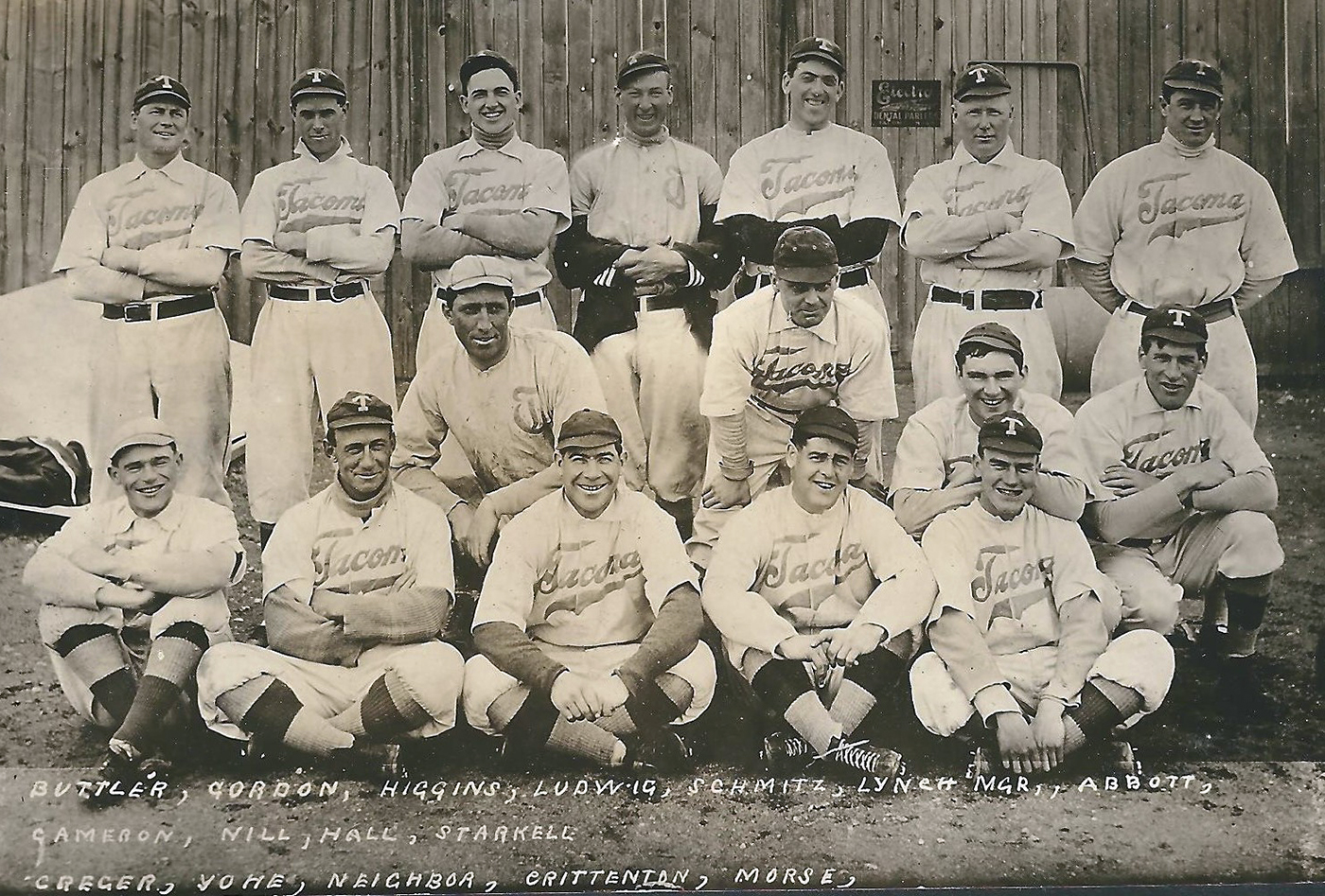
Link to his minor league stats - www.baseball-reference.com/register/player.fcgi?id=starke...
MLB debut - April 19, 1906, for the Washington Senators
Last MLB appearance - April 19, 1906, for the Washington Senators
MLB statistics:
Win–loss record 0–0
ERA - 18.00
Strikeouts - 1
Teams:
Washington Senators (1906)
Dr. Shyama Prasad Mookerjee (or Syama Prasad Mukherjee, Bengali: শ্যামাপ্রসাদ মুখোপাধ্যায় Shêmproshad Mukhopaddhae) (July 6, 1901 – June 23, 1953) was a minister in Jawaharlal Nehru's Cabinet as a Minister for Industry and Supply. Mookerjee founded the Bharatiya Jana Sangh in 1951, after the differences with Pandit Nehru.
Early life
Mookerjee was born on July 6, 1901 in Kolkata. His father was Sir Ashutosh Mukherjee, a well-respected advocate in Bengal, who became the Vice-Chancellor of the University of Calcutta, and his mother was Lady Jogmaya Devi Mookerjee.
Mookerjee obtained his degrees from the University of Calcutta. He graduated in English securing the first position in first class in 1921 and also did MA in 1923 and BL in 1924. He became a fellow of the Senate in 1923. He enrolled as an advocate in Calcutta High Court in 1924 after his father had died shortly after losing to Syed Hasan Imam at Patna high court. Subsequently he left for England in 1926 to study at Lincoln's Inn and became a barrister in 1927. At the age of 33, he became the youngest Vice-Chancellor of the University of Calcutta (1934), and held the office till 1938.
Political career
He was elected as member of the Legislative Council of Bengal, as an Indian National Congress candidate representing Calcutta University but resigned next year when Congress decided to boycott the legislature. Subsequently, he contested the election as an independent candidate and got elected. He was the Finance minister of Bengal Province during 1941-42.
He emerged as a spokesman for Hindus and shortly joined Hindu Mahasabha and in 1944, he became the President. Dr. Mookerjee was political leader who felt the need to counteract the communalist and separatist Muslim League of Muhammad Ali Jinnah, who were demanding either exaggerated Muslim rights or a Muslim state of Pakistan.
Dr.Mookerjee adopted causes to protect Hindus against what he believed to be the communal propaganda and the divisive agenda of the Muslim League. Mookerjee and his future followers would always cite inherent Hindu practices of tolerance and communal respect as the reason for a healthy, prosperous and safe Muslim population in the country in the first place.
Dr.Mookerjee was initially a strong opponent of the Partition of India, but following the communal riots of 1946-47, Mookerjee strongly disfavored Hindus continuing to live in a Muslim-dominated state and under a government controlled by the Muslim League.
On 11 February 1941 S P Mookerjee told a Hindu rally that if Muslims wanted to live in Pakistan they should "pack their bag and baggage and leave India... (to) wherever they like".[1]
Dr.Mookerjee supported the partition of Bengal in 1946 to prevent the inclusion of its Hindu-majority areas in a Muslim-dominated East Pakistan;[2] he also opposed a failed bid for a united but independent Bengal made in 1947 by Sarat Bose, the brother of Subhas Chandra Bose and Huseyn Shaheed Suhrawardy, a Bengali Muslim politician.
He wanted the Hindu Mahasabha not to be restricted to Hindus alone or work as apolitical body for the service of masses. Following the assassination of Mahatma Gandhi by a Hindu fanatic, the Mahasabha was blamed chiefly for the heinous act and became deeply unpopular. Mookerjee himself condemned the murder.
Post-independence
Prime Minister Jawaharlal Nehru inducted him in the Interim Central Government as a Minister for Industry and Supply. Mookerjee was widely respected by many Indians and also by members of the Indian National Congress, and Sardar Vallabhbhai Patel, one of its chief leaders.
But on issue of the 1950 Delhi Pact with Pakistani Prime Minister Liaqat Ali Khan, Dr.Mookerjee resigned from the Cabinet on April 6, 1950. Mookerjee was firmly against Nehru's invitation to the Pakistani PM, and their joint pact to establish minority commissions and guarantee minority rights in both countries. He wanted to hold Pakistan directly responsible for the terrible influx of millions of Hindu refugees from East Pakistan, who had left the state fearing religious suppression and violence aided by the state. Mookerjee considered Nehru's actions as appeasement, and was hailed as a hero by the people of West Bengal.[citation needed]
Dr. Shyama Prasad Mookerjee founded the Bharatiya Jana Sangh (BJS) on October 21, 1951, following his parting ways with Nehru.[3] The BJS was ideologically close to the Rashtriya Swayamsevak Sangh (RSS) and widely considered the political arm of Hindu Nationalism. It was opposed to appeasement of India's Muslims, and favoured free-market economics as opposed to the socialist policies pursued by Nehru. The BJS also favored a uniform civil code governing personal law matters for both Hindus and Muslims, wanted to ban cow slaughter and end the special status given to the Muslim-majority state of Jammu and Kashmir. The BJS founded the Hindutva agenda which became the wider political expression of India's Hindu majority. He was also influential with the more conservative members within the Congress.
In the 1952 general elections to the Parliament of India, Dr. Mookerjee and the BJS won three seats.
Dr.Shyama Prasad Mookerjee opposed the Indian National Congress's decision to grant Kashmir a special status with its own flag and Prime Minister. According to Congress's decision, no one, including the President of India could enter into Kashmir without the permission of Kashmir's Prime Minister. In opposition to this decision, he once said "Ek desh mein do Vidhan, do Pradhan and Do Nishan nahi challenge" (A single country can't have two constitutions, two prime ministers, and two National Emblems).
Dr. Mookerjee went to visit Kashmir in 1953, and observed a hunger strike to protest the law that prohibited Indian citizens from settling in a state within their own country and mandated that they carry ID cards. He was arrested on May 11 while crossing border into Kashmir. Although the ID card rule was revoked owing to his efforts, he died as detenu on June 23, 1953 under mysterious circumstances.
Shaheed...........
Dr. Shyama Prasad was arrested on entering Kashmir on May 11, 1953. Thereafter, he was jailed in a dilapidated house.[4] Dr. Shyama Prasad had suffered from dry pleurisy and coronary troubles, and was taken to hospital one and a half months after his arrest due to complications arising from the same.[citation needed] He was administered penicillin despite having informed the doctor-in-charge of his allergy to penicillin, and he died on June 23, 1953.
It was strongly rumored that he was poisoned in custody and Sheikh Abdullah and Nehru had conspired to do the same.No post-mortem was ordered in total disregard of the rule. Maulana Azad, who was acting Prime Minister ( in absence of Nehru, who was away in London ), did not allow body to be brought to Delhi and dead body was directly flown to Calcutta.[4]
His death in custody raised wide suspicion across the country and demands for independent enquiry were raised, including earnest requests from his mother, Jogmaya Devi, to Jawaharlal Nehru. Nehru declared that he had enquired from a number of persons who were privy to the facts and, according to him, there was no mystery behind Dr. Mookerjee's death. Jogmaya Devi did not accept Nehru's reply and requested the setting up of an impartial enquiry. Nehru however ignored the letter and no enquiry commission was set up. Mookerjee's death therefore remains a matter of some controversy.[5] Atal Behari Vajpayee claimed in 2004 that the death of Mookherjee was a "Nehru conspiracy".[6]
However, it was Mookherjee's martyrdom, which later compelled, Nehru to remove Permit system, post of Sadar-e-Riayasat and of Prime Minister of Jammu & Kashmir.[7]
Legacy
Along with Vinayak Damodar Savarkar, Dr. Mookerjee is considered the godfather of Hindu nationalism in India, especially the Hindutva movement.Though Dr.Mookerjee was not associated with Rashtriya Swayamsevak Sangh, he is widely revered by members and supporters of the Rashtriya Swayamsevak Sangh and the Vishwa Hindu Parishad.
On April 22, 2010, Municipal Corporation of Delhi's newly constructed Rs. 650-crore building (the tallest building in Delhi) was named "Doctor Shyama Prasad Mukherjee Civic Centre".[8] The Civic Centre was inaugurated by Home Minister P Chidambaram. The building, which will cater to an estimated 20,000 visitors per day, will also house different wings and offices of the Municipal Corporation of Delhi (MCD). Delhi also has a major road named after Dr. S.P. Mukherjee.
On August 27, 1998, the Ahmedabad Municipal Corporation named a bridge after Mookerjee.[9]
A BEST bus junction near the Chhatrapati Shivaji Museum (formerly the Prince of Wales Museum) and Regal Cinema in Mumbai is named as "Shyamaprasad Mukherjee Chowk" in his honour.
In 2001, the main research funding institute of the Government of India, CSIR instituted a new fellowship named after him. The Shyama Prasad Mukhejee Fellowship is the most prestigious fellowship given in India for doing PhD. Only the top 20% students who clear the Junior Research Fellowship (JRF CSIR/UGC) are eligible to sit for this examination.
Dr. Shyama Prasad Mookerjee (or Syama Prasad Mukherjee, Bengali: শ্যামাপ্রসাদ মুখোপাধ্যায় Shêmproshad Mukhopaddhae) (July 6, 1901 – June 23, 1953) was a minister in Jawaharlal Nehru's Cabinet as a Minister for Industry and Supply. Mookerjee founded the Bharatiya Jana Sangh in 1951, after the differences with Pandit Nehru.
Early life
Mookerjee was born on July 6, 1901 in Kolkata. His father was Sir Ashutosh Mukherjee, a well-respected advocate in Bengal, who became the Vice-Chancellor of the University of Calcutta, and his mother was Lady Jogmaya Devi Mookerjee.
Mookerjee obtained his degrees from the University of Calcutta. He graduated in English securing the first position in first class in 1921 and also did MA in 1923 and BL in 1924. He became a fellow of the Senate in 1923. He enrolled as an advocate in Calcutta High Court in 1924 after his father had died shortly after losing to Syed Hasan Imam at Patna high court. Subsequently he left for England in 1926 to study at Lincoln's Inn and became a barrister in 1927. At the age of 33, he became the youngest Vice-Chancellor of the University of Calcutta (1934), and held the office till 1938.
Political career
He was elected as member of the Legislative Council of Bengal, as an Indian National Congress candidate representing Calcutta University but resigned next year when Congress decided to boycott the legislature. Subsequently, he contested the election as an independent candidate and got elected. He was the Finance minister of Bengal Province during 1941-42.
He emerged as a spokesman for Hindus and shortly joined Hindu Mahasabha and in 1944, he became the President. Dr. Mookerjee was political leader who felt the need to counteract the communalist and separatist Muslim League of Muhammad Ali Jinnah, who were demanding either exaggerated Muslim rights or a Muslim state of Pakistan.
Dr.Mookerjee adopted causes to protect Hindus against what he believed to be the communal propaganda and the divisive agenda of the Muslim League. Mookerjee and his future followers would always cite inherent Hindu practices of tolerance and communal respect as the reason for a healthy, prosperous and safe Muslim population in the country in the first place.
Dr.Mookerjee was initially a strong opponent of the Partition of India, but following the communal riots of 1946-47, Mookerjee strongly disfavored Hindus continuing to live in a Muslim-dominated state and under a government controlled by the Muslim League.
On 11 February 1941 S P Mookerjee told a Hindu rally that if Muslims wanted to live in Pakistan they should "pack their bag and baggage and leave India... (to) wherever they like".[1]
Dr.Mookerjee supported the partition of Bengal in 1946 to prevent the inclusion of its Hindu-majority areas in a Muslim-dominated East Pakistan;[2] he also opposed a failed bid for a united but independent Bengal made in 1947 by Sarat Bose, the brother of Subhas Chandra Bose and Huseyn Shaheed Suhrawardy, a Bengali Muslim politician.
He wanted the Hindu Mahasabha not to be restricted to Hindus alone or work as apolitical body for the service of masses. Following the assassination of Mahatma Gandhi by a Hindu fanatic, the Mahasabha was blamed chiefly for the heinous act and became deeply unpopular. Mookerjee himself condemned the murder.
Post-independence
Prime Minister Jawaharlal Nehru inducted him in the Interim Central Government as a Minister for Industry and Supply. Mookerjee was widely respected by many Indians and also by members of the Indian National Congress, and Sardar Vallabhbhai Patel, one of its chief leaders.
But on issue of the 1950 Delhi Pact with Pakistani Prime Minister Liaqat Ali Khan, Dr.Mookerjee resigned from the Cabinet on April 6, 1950. Mookerjee was firmly against Nehru's invitation to the Pakistani PM, and their joint pact to establish minority commissions and guarantee minority rights in both countries. He wanted to hold Pakistan directly responsible for the terrible influx of millions of Hindu refugees from East Pakistan, who had left the state fearing religious suppression and violence aided by the state. Mookerjee considered Nehru's actions as appeasement, and was hailed as a hero by the people of West Bengal.[citation needed]
Dr. Shyama Prasad Mookerjee founded the Bharatiya Jana Sangh (BJS) on October 21, 1951, following his parting ways with Nehru.[3] The BJS was ideologically close to the Rashtriya Swayamsevak Sangh (RSS) and widely considered the political arm of Hindu Nationalism. It was opposed to appeasement of India's Muslims, and favoured free-market economics as opposed to the socialist policies pursued by Nehru. The BJS also favored a uniform civil code governing personal law matters for both Hindus and Muslims, wanted to ban cow slaughter and end the special status given to the Muslim-majority state of Jammu and Kashmir. The BJS founded the Hindutva agenda which became the wider political expression of India's Hindu majority. He was also influential with the more conservative members within the Congress.
In the 1952 general elections to the Parliament of India, Dr. Mookerjee and the BJS won three seats.
Dr.Shyama Prasad Mookerjee opposed the Indian National Congress's decision to grant Kashmir a special status with its own flag and Prime Minister. According to Congress's decision, no one, including the President of India could enter into Kashmir without the permission of Kashmir's Prime Minister. In opposition to this decision, he once said "Ek desh mein do Vidhan, do Pradhan and Do Nishan nahi challenge" (A single country can't have two constitutions, two prime ministers, and two National Emblems).
Dr. Mookerjee went to visit Kashmir in 1953, and observed a hunger strike to protest the law that prohibited Indian citizens from settling in a state within their own country and mandated that they carry ID cards. He was arrested on May 11 while crossing border into Kashmir. Although the ID card rule was revoked owing to his efforts, he died as detenu on June 23, 1953 under mysterious circumstances.
Shaheed...........
Dr. Shyama Prasad was arrested on entering Kashmir on May 11, 1953. Thereafter, he was jailed in a dilapidated house.[4] Dr. Shyama Prasad had suffered from dry pleurisy and coronary troubles, and was taken to hospital one and a half months after his arrest due to complications arising from the same.[citation needed] He was administered penicillin despite having informed the doctor-in-charge of his allergy to penicillin, and he died on June 23, 1953.
It was strongly rumored that he was poisoned in custody and Sheikh Abdullah and Nehru had conspired to do the same.No post-mortem was ordered in total disregard of the rule. Maulana Azad, who was acting Prime Minister ( in absence of Nehru, who was away in London ), did not allow body to be brought to Delhi and dead body was directly flown to Calcutta.[4]
His death in custody raised wide suspicion across the country and demands for independent enquiry were raised, including earnest requests from his mother, Jogmaya Devi, to Jawaharlal Nehru. Nehru declared that he had enquired from a number of persons who were privy to the facts and, according to him, there was no mystery behind Dr. Mookerjee's death. Jogmaya Devi did not accept Nehru's reply and requested the setting up of an impartial enquiry. Nehru however ignored the letter and no enquiry commission was set up. Mookerjee's death therefore remains a matter of some controversy.[5] Atal Behari Vajpayee claimed in 2004 that the death of Mookherjee was a "Nehru conspiracy".[6]
However, it was Mookherjee's martyrdom, which later compelled, Nehru to remove Permit system, post of Sadar-e-Riayasat and of Prime Minister of Jammu & Kashmir.[7]
Legacy
Along with Vinayak Damodar Savarkar, Dr. Mookerjee is considered the godfather of Hindu nationalism in India, especially the Hindutva movement.Though Dr.Mookerjee was not associated with Rashtriya Swayamsevak Sangh, he is widely revered by members and supporters of the Rashtriya Swayamsevak Sangh and the Vishwa Hindu Parishad.
On April 22, 2010, Municipal Corporation of Delhi's newly constructed Rs. 650-crore building (the tallest building in Delhi) was named "Doctor Shyama Prasad Mukherjee Civic Centre".[8] The Civic Centre was inaugurated by Home Minister P Chidambaram. The building, which will cater to an estimated 20,000 visitors per day, will also house different wings and offices of the Municipal Corporation of Delhi (MCD). Delhi also has a major road named after Dr. S.P. Mukherjee.
On August 27, 1998, the Ahmedabad Municipal Corporation named a bridge after Mookerjee.[9]
A BEST bus junction near the Chhatrapati Shivaji Museum (formerly the Prince of Wales Museum) and Regal Cinema in Mumbai is named as "Shyamaprasad Mukherjee Chowk" in his honour.
In 2001, the main research funding institute of the Government of India, CSIR instituted a new fellowship named after him. The Shyama Prasad Mukhejee Fellowship is the most prestigious fellowship given in India for doing PhD. Only the top 20% students who clear the Junior Research Fellowship (JRF CSIR/UGC) are eligible to sit for this examination.