View allAll Photos Tagged featured
This photo was taken from a sequence of images used to create a time-lapse of the sunset. The time-lapse is viewable online here: www.youtube.com/watch?v=G6pbSU9eZQE
Those of us fortunate enough to live and work at Hume Lake have the opportunity to simply walk outside each day at sunset and see this amazing display of God's creation. The crazy this is that we don't always take advantage of that opportunity. You may not live near our nation's deepest canyon or largest tree like we do, but you're still surrounded by God's creation. Take a few moments today to walk outside and take note of the beauty of God's creation and give Him the praise He deserves!
An invaluable mobile app helping Kenyan pastoralists beat the drought
ITU photos are subject to copyright by ITU (and the photographer, if indicated). ITU photos are shared for information purposes and may be re-used under the Creative Commons license CC BY-NC-ND: This license allows reusers to copy and distribute the material in any medium or format in unadapted form only, for noncommercial purposes only, and only so long as attribution is given to the creator/s. More details on Creative Commons licenses are available at www.creativecommons.org.
©ITU/Trans.Lieu
Tim Holdsclaw, a Pittsburg State University senior, lines up his shot at the Phi Sigma Kappa recruitment event on Wednesday, January 16, 2013. Every semester, all of the Greek organizations on campus organize events to try and recruit more members. (Photo by Kelsey Kirkpatrick)
An invaluable mobile app helping Kenyan pastoralists beat the drought
ITU photos are subject to copyright by ITU (and the photographer, if indicated). ITU photos are shared for information purposes and may be re-used under the Creative Commons license CC BY-NC-ND: This license allows reusers to copy and distribute the material in any medium or format in unadapted form only, for noncommercial purposes only, and only so long as attribution is given to the creator/s. More details on Creative Commons licenses are available at www.creativecommons.org.
©ITU/Trans.Lieu
ICT Discovery
ITU photos are subject to copyright by ITU (and the photographer, if indicated). ITU photos are shared for information purposes and may be re-used under the Creative Commons license CC BY-NC-ND: This license allows reusers to copy and distribute the material in any medium or format in unadapted form only, for noncommercial purposes only, and only so long as attribution is given to the creator/s. More details on Creative Commons licenses are available at www.creativecommons.org.
©ITU/Rowan Farrell
[►] SADNESS form ENIGMA
List of Effected family form my contacts are shown below :
,
,
,This is a dedication to All Norwegian's through my Flickr friends
1. .Bjarne
2. johnsundal
Pay Visit to my: Getty Image // Face Book// Red Bubble // My Album at National Geography [NGA]
And also visit my Images fromFrame BANGLADESH Here
NO Graphics and Invitations / Self promotion by Image / HTML or WEB Links
Image Serial No#593622072011-PS
Description Credit to Gulf news,com
Description :
Oslo, Norway: The suspect in Norway's twin attacks that killed at least 92 people says he acted alone, police said Sunday, after some witness accounts said a second gunman had taken part in a mass shooting.
But police are still trying to establish whether there was "one or several" shooters at Friday's attack on a Labour Party youth meeting on Utoeya island, northwest of Oslo, police commissioner Sveinung Sponheim told journalists.
Norway suspect 'deemed killings necessary'
A suspected right-wing fanatic accused of killing at least 92 people deemed his acts "atrocious" yet "necessary" as Norway mourned victims of the nation's worst attacks since World War Two.
Police were hunting on Sunday to see if a possible second gunman took part in the shooting massacre and bomb attack on Friday that traumatised a normally peaceful Nordic country.
Anders Behring Breivik comments
In his first comment via a lawyer since he was arrested, 32-year-old Norwegian Anders Behring Breivik expressed willingness to explain himself in court at a hearing likely to be held on Monday about extending protective custody.
"He has said that he believed the actions were atrocious, but that in his head they were necessary," lawyer Geir Lippestad told independent TV2 news.
Police said Breivik gave himself up after admitting to a massacre in which at least 85 people died, mostly young people attending a summer camp of the youth wing of Norway's ruling Labour Party on an idyllic island.
Breivik was also arrested for the bombing of Oslo's government district that killed seven people hours earlier. Norway's toughest sentence is 21 years in jail. Survivors, relatives of those killed and supporters planned a procession to mourn the dead at Sundvollen on Sunday, near the island where the massacre took place.
Police defend delays
The comments from Breivik came as reports said police arrived at the island massacre about an hour and a half after he first opened fire, slowed because they didn't have quick access to a helicopter and then couldn't find a boat to make their way to the scene just several hundred yards offshore.
Survivors of the shooting spree have described hiding and fleeing into the water to escape the gunman, but a police briefing Saturday detailed for the first time how long the terror lasted - and how long victims waited for help.
Manifesto and video against multiculturalism
King Harald would attend a service in Oslo cathedral, a few hundred metres (yards) from where a bomb devastated government buildings including the offices of Labour Prime Minister Jens Stoltenberg.
Breivik hated "cultural marxists", wanted a "crusade" against the spread of Islam and liked guns and weightlifting, web postings, acquaintances and officials said.
A video posted to the YouTube website showed several pictures of Breivik, including one of him in a Navy Seal type scuba diving outfit pointing an automatic weapon. "Before we can start our crusade we must do our duty by decimating cultural marxism," said a caption under the video called "Knights Templar 2083" on the YouTube website, which took down the video on Saturday.
A Norwegian website provided a link to a 1,500 page electronic manifesto which says Breivik was the author. It was not possible to verify who posted the video or wrote the book.
"Once you decide to strike, it is better to kill too many than not enough, or you risk reducing the desired ideological impact of the strike," the book said.
Norway has traditionally been open to immigration, which has been criticised by the Progress Party, of which Breivik was for a short time a member. The Labour Party, whose youth camp Breivik attacked, has long been in favour of immigration.
About 100 people stood solemnly early on Sunday at a makeshift vigil near Oslo's main church, laying flowers and lighting candles. Soldiers with guns and wearing bullet-proof vests blocked streets leading to the government district.
"We are all in sorrow, everybody is scared," said Imran Shah, a Norwegian taxi driver of Pakistani heritage, as a light summer drizzle fell on unusually empty Oslo streets.
Some terrified survivors of the shooting rampage said bullets came from at least two sides. "We are not at all certain" about whether he acted alone, police chief Sveinung Sponheim said. "That is one of the things that the investigation will concentrate on."
Witnesses
Witnesses said the gunman, wearing a police uniform, was able to shoot unchallenged for a prolonged period. He picked off his victims on Utoeya island northwest of Oslo forcing youngsters to scatter in panic or to jump into the lake to swim for the mainland.
"I heard screams. I heard people begging for their lives and I heard shots. He just blew them away," Labour Party youth member Erik Kursetgjerde, 18, told Reuters.
"I was certain I was going to die," he said. "People ran everywhere. They panicked and climbed into trees. People got trampled."
Home-grown militant
The suspect, tall and blond, owned an organic farming company called Breivik Geofarm, which a supply firm said he had used to buy fertiliser -- possibly to make the Oslo bomb.
Home-grown anti-government militants have struck elsewhere in the past, notably in the United States, where Timothy McVeigh killed 168 people with a truck bomb in Oklahoma City in 1995.
The district attacked is the heart of power in Norway. But security is not tight in a country unused to such violence and better known for awarding the Nobel Peace Prize and mediating in conflicts, including the Middle East and Sri Lanka.
_______________________________________
.POST box
,
If you Think you want to draw My Attention / Appreciate/ Critic / Even put a comment not suitable for this Image ,
and Still you want a note / message for me .
Feel free & Drop it to my
POST BOX Here
If you are Unable to reach me there plz do click Post Box -2 Here
Earth Designs Garden Design and Build were asked to created a landscape and propose garden design in Acton, London*. Here are the details of the project
Brief: The plot for this design was a mid-size family garden, which had recently benefited from the addition of a large sunroom on the back of the property. It was a fairly blank canvas, with nothing of note to be retained in the re-design. The garden had side access and worn boundary fences which required replacing. There was no clear brief other than that the design include a seating area and some lawn, and that the transition from sunroom to garden be fairly seamless.
Solution: The focus of this design was to create an exterior space that serves as an extension to the interior, featuring several distinct and versatile areas that can be adapted to a variety of uses.
The garden's boundaries were replaced with new fencing to provide a uniform and attractive backdrop to the transformation within, while the long sideway down the right of the house was renovated with the addition of attractive 'bamboo' slate tile flooring in a random lay pattern.
The first section of the space comprises a large area of Western Red Cedar decking adjoining the house, and offers ample room for entertaining, with a long L-shaped fixed-bench seat stretching width-ways across the space from the left-hand side to the centre. This was backed with a rendered block raised bed, planted with fragrant lavender and capped with 'bamboo' slate tile, to provide a sense of enclosure and separation from the rest of the garden.
A decked walkway running down the right hand side of the space provides access to a 'spa' area, featuring a large square hot tub housed upon a reinforced paved hard-standing and nestled between existing and additional trees, shrubs and foliage to provide a secluded and intimate area for bathing throughout the seasons. Hidden behind mature and new planting in the bottom left corner, a large shed provides ample storage for the client's garden accessories. The middle of the space has been given over to a large lawn edges with slate.
A purple and yellow planting scheme of soft, cottage-style evergreen shrubs and flowering perennials will help to bring year round lightness and subtle colouring to the space.
After-dark hot tub bathing is enhanced by several strings of pea-lights woven through the existing shrubbery. Deck lights demark the main area of decking and guide one's journey along the decked walkway. Finally, spot lights in the beds highlight certain area while providing a gentle wash throughout the space.
Testimonial: "After months of planning and a full year of having builders everywhere, we had finally got the house into good shape but the garden was a nightmare. It had been somewhat overgrown before the builders moved in, but after a year of being used as a builders yard, it needed shock treatment.
We needed help fast so we searched the web. We were looking for garden designers with creative ideas for smaller London gardens. We didn't want anything too traditional but at the same time, nothing too extreme.
Earth Designs fitted the bill and after a design session with Katrina, we engaged them for the project. They had offered us a design service only, but as we only had a 4 week window in which to complete the job, we gave them the whole project.
We had built a new extension with wide glass doors that opened out into the garden, so the brief to Earth Designs was to "bring the outside, inside" and create a strong link between the new room and the garden beyond. The actual garden space was not large so we wanted to use the space as an extension of the living space - to be an "outside room".
Monday 18th April and three very charming men arrived on our doorstep at 8.0am sharp. Arlo was the project manager, ably aided and abetted by Paul and Phillip. They worked brilliantly as a team and always hit all the deadlines. In particular they did a great job in working with our neighbours to ensure the whole project ran smoothly.
The first week involved clearing the site - no mean feat with 30-year-old ivy stems that looked more like tree trunks.
The second week involved levelling the garden, putting up new fencing, building the corner seating base and planters, plus marking out the garden shape. It was good to be able to make minor changes to the design on the ground at this stage. The hot tub arrived too and was winched into place for connection later.
Week 3 saw the decking and seating built.
Then in week four the turf arrived, the lawn went down and on the last day, Katrina arrived with a truckload of wonderful specimens (and Matt) and we had a wonderful time planting. Ground Force Mk II - a complete garden from start to finish in just 4 weeks!
There were a few things that needed to be sorted out after the main work was complete. Earth Designs were great about coming back until all was complete and finished.
Our thanks to Katrina, Matt, Arlo, Paul and Phillip for a great job, completed on time and on budget with a great looking result."
If you dig this and would like to find out more about this or any of other of our designs, please stop by our web-site and have a look at our work.
Earth Designs is a bespoke London Garden Design and build company specialising in classic, funky and urban contemporary garden design.
Our Landscape and Garden build teams cover London, Essex and parts of South East England, while garden designs are available nationwide.
Please visit www.earthdesigns.co.uk to see our full portfolio. If you would like a garden designer in London or have an idea of what you want and are looking for a landscaper London to come and visit your garden, please get in touch.
Follow our Bespoke Garden Design and Build and Blog to see what we get up to week by week, our free design clinic as well as tips and products we recommend for your garden projects www.earthdesigns.co.uk/blog/.
Earth Designs is located in East London, but has built gardens in Essex , gardens in Hertfordshire Hertfordshire and all over the South East. Earth Designs was formed by Katrina Wells in Spring 2003 and has since gone from strength to strength to develop a considerable portfolio of garden projects. Katrina, who is our Senior Garden Designer, has travelled all over the UK designing gardens. However we can design worldwide either through our postal garden design service or by consultation with our senior garden designer. Recent worldwide projects have included garden designs in Romania. Katrina’s husband. Matt, heads up the build side of the company, creating a unique service for all our clients.
If you a not a UK resident, but would like an Earth Designs garden, Earth Designs has a worldwide design service through our Garden Design Postal Design Vouchers. If you are looking for an unique birthday present or original anniversary present and would like to buy one of our Garden Design Gift Vouchers for yourself or as a present please our sister site www.gardenpresents.co.uk. We do also design outside of the UK, please contact us for details.
The mills are an important feature of Maynard's development. The earliest saw and grist mills were built in the early 18th century. Two of the earliest mills were the Puffer Mill and the Asa Smith's Mill, which were located on Taylor Brook and Mill Street, respectively. These were the first mills to use the Assabet River for power; therefore, they were very slow and sluggish. The grist and saw mill were then followed by paper mills, which were built starting in 1820.
The Mill is easily Maynard's most prominent feature. The complex takes up 11 acres in the middleof what we call downtown. The Mill complex began in 1847 as set of wooden buildings used to manufacture carpets and carpet yarn. Amory Maynard helped construct this mill. His partner, William H. Knight, helped him build a dam across the Assabet and dug a canal channeling a portion of the river into what is called Mill Pond. The Mill changed hands a few times but it would eventually become the largest woolen factory in the world till the 1930s.
The 1950's ushered in a change from textiles to businesses like computer manufacturing. With the start of the final decade of the century the Mill is on the cusp of being transformed again.
It is said that "as the Mill goes, so goes Maynard". While the town isn't as dependent on the Mill as it was in 19th century it continues to play an important role in shaping the character of the town.
We hope you enjoy this historical perspective of the Mill. It has been pieced together from a variety of sources and continues to be enriched as we discover new materials to include, increase the number of hyperlinks and add pictures, diagrams, and sound..
The Mill from 1847 to 1977
The site of the mill was once part of the town of Sudbury, while the opposite bank of the Assabet River belonged to Stow. The present town, formed in 1871, was named for the man most responsible for its development, Amory Maynard.
Born in 1804, Maynard was running his own sawmill business at the age of sixteen. In the 1840's, he went into partnership with a carpet manufacturer for whom he'd done contracting. They dammed up the Assabet and diverted water into a millpond to provide power for a new mill, which opened in 1847, producing carpet yarn and carpets. Only one of the original mill buildings survives: it was moved across Main Street and now is an apartment house.
Amory Maynard's carpet firm failed in the business panic of 1857. But the Civil War allowed the Assabet Manufacturing Company, organized in 1862 with Maynard as the managing "agent", to prosper by producing woolens, flannels and blankets for the army. This work was carried on in new brick mill buildings.
Expansion of the mill over many years is evidenced by the variations in the architecture of the structures still standing.
The oldest portion of Building 3 dates from 1859, making it the oldest part of the mill in existence today, but several additions were made afterwards. Buildings constructed in the late 1800's frequently featured brick arches over the windows, and at times new additions were made to match neighboring structures.
The best-known feature is the clock donated in memory of Amory Maynard by his son Lorenzo in 1892. Its four faces, each nine feet in diameter, are mechanically controlled by a small timer inside the tower. Neither the timer nor the bell mechanism has ever been electrified; custodians still climb 120 steps to wind the clock every week- 90 turns for the timer and 330 turns for the striker.
Amory Maynard died in 1890, but his son and grandson still held high positions in the mill's management. The family's local popularity plummeted, however, when the Assabet Manufacturing Company failed late in 1898. Workers lost nearly half of their savings which they had deposited with the company, since there were no banks in town. Their disillusionment nearly resulted in changing the town's name from Maynard to Assabet.
Prosperity returned in 1899 when the American Woolen Company, an industrial giant, bought the Assabet Mills and began to expand them, adding most of the structures now standing. The biggest new unit was Building 5, 610 feet long which contained more looms than any other woolen mill in the world. Building 1, completed in 1918, is the newest; the mill pond had been drained to permit construction of its foundation. These buildings have little decoration, but their massiveness is emphasized by the buttress-like brick columns between their windows.
The turn of the century saw a changeover from gas to electric lights at the mill. Until the 1930's the mill generated not only its own power but also electricity for Maynard and several other towns. For years the mill used 40-cycle current. Into the late 1960's power produced by a water wheel was used for outdoor lighting, including the Christmas tree near Main Street. The complex system of shafts and belts once used to distribute power from a central source was rendered obsolete by more efficient small electric motors, just as inexpensive minicomputers have often replaced terminals tied to one large processor.
As the mill grew, so did the town. Even in 1871, the nearly 2,000 people who became Maynard's first citizens outnumbered the people left in either Sudbury or Stow. Maynard's first population almost doubled in the decade between 1895 and 1905, when reached nearly 7,000 people. Most of the workers lived in houses owned by the company, many of which have been refurbished and are used today. The trains that served th town and the mill, however, are long gone - the depot site is now occupied by a gas station.
Most of the original mill workers had been local Yankees and Irish immigrants. But by the early 1900's, the Assabet Mills were employing large numbers of newcomers from Finland, Poland, Russia and Italy. The latest arrivals were often escorted to their relatives or friends by obliging post office workers. The immigrants made Maynard a bustling, multi-ethnic community while Stow, Sudbury and Acton remained small, rural villages. Farmers and their families rode the trolley to Maynard to shop and to visit urban attractions then unknown in their own towns, including barrooms and movie houses.
Wages were low and the hours were long. Early payrolls show wages of four cents an hour for a sixty hour week. Ralph Sheridan of the Maynard Historical Society confirmed that in 1889 his eldest brother was making 5 1/2 cents an hour in the mill's rag shop at the age of fourteen, while their father was earning 16 1/2 cents per hour in the boiler room. (As of 1891 one-eighth of the workers were less than 16 years old, and one-quarter were women.)
Sheridan's own first job at the mill, in the summer of 1915, paid $6.35 for a work week limited to 48 hours by child labor laws. The indestructible "bullseye" safe still remains in the old Office Building.
Sheridan remembers the bell that was perched on top of Building 3:
"...the whistle on the engine room gave one blast at quarter of the hour, and then at about five minutes of the hour the gave one blast again. And everyone was supposed to be inside the gate when that second whistle blew. And then at one minute of the hour this bell rang just once, a quick ring- and we referred to it as "The Tick" because of that..... everybody was supposed to start work at that time, at that moment."
A worker was sent home if he'd forgotten to wear his employee's button, marked "A.W.Co.,Assabet".
The millhands really had to work, too. Sheridan recalls one winter evening when there was such a rush to get out an order of cloth for Henry Ford that the men were ordered to invoice it from the warehouse, now Building 21, instead of from the usual shipping room:
"There was no heat in the building, never had been. And it was so cold that I remember that I had to cut the forefinger and the thumb from the glove that I was wearing in order to handle the pencil to do the invoicing....the yard superintendant at the time brought in some kerosene lanterns and put 'em under our chairs to keep our feet warm."
Building 21, built out over the pond, remained unheated until DIGITAL took it over.
As in most Northern mill towns, labor relations were often troubled. In 1911 the company used Poles to break the strike of Finnish workers. When no longer able to play off one nationality against another, management for years took advantage of rivalries between different unions. The Great Depression hit the company hard, however. In 1934 it sold all the houses it owned, mostly to the employees who lived in them; and New Deal labor laws encouraged the workers to form a single industrial union, which joined the C.I.O.
World War II brought a final few years of good times to the woolens industry. The mill in Maynard operated around the clock with over two thousand employees producing such items as blankets and cloth for overcoats for the armed forces. But when peace returned, the long-term trends resumed their downward drift, and in 1950 the American Woolen Company shut down its Assabet Mills entirely. Like many New England mills, Maynard's had succumbed to a combination of Southern and foreign competition, relatively high costs and low productivity, and the growing use of synthetic fibers.
'Til then a one-industry town, Maynard was in trouble. In 1953, however, ten Worcester businessmen bought the mill and began leasing space to tenants, some of which were established firms, while others were just getting started. One of the new companies which found the low cost of Maynard Industries' space appealing was Digital Equipment Corporation, which started operations in 8,680 square feet in the mill in 1957.
A Mill Chronology
1846 Amory Maynard and William Knight form Assabet Mills.
1847 Maynard and Knight install a water wheel and build a new factory on the banks of the Assabet River.
1848 The Assabet Mills business is valued at $150,000.
The Lowell and Framingham Railroad carries passengers over branch road.
1855 The Mill now has three buildings on the site. Massachusetts is producing one-third of the textiles in the United States.
1857 Assabet Mills collapses after a business panic. The Mill complex is sold at an auction.
1862 The Mills are reorganized as Assabet Manufacturing Company. This involve replacing wooden buildings with brick, and the installation of new machinery. To fulfill contracts to the government during the Civil War production is switched from carpets to woolen cloth, blankets, and flannel.
The first tenement for employees are also constructed.
1869 Millhands peition President Ulysses S. Grant for a shorter work week ... 55 hours.
1871 The Town of Maynard incorporates. The population stands at 2,000
1888 A reservoir is installed for $70,000 to supply a growing population.
1890 The Assabet Manufacturing Company is valued at $1,500,000.
1892 Lorenzo Maynard donates clock in his father's name.
The Mill Complex contains seven buildings.
1898 Assabet Manufacturing Company declares bankruptcy. Many people in town lose much of their savings as banks have not yet been established.
1899 American Woolen Company purchases the Mill complex for $400,000. This company would eventually control 20% of the woolen textile market in the U.S. Wool was shipped all over the country to keep up with demand.
1901 160 additional tenements are constructed with their own sewage system. The streets are named after U.S. presidents.
The first electric trolley in Maynard begins service.
Building Number 5, the Mill complex's largest, is built in nine months. Electric power is introduced with the addition of dynamos on site.
1906 The Mill complex now has 13 buildings.
1910 The Mill complex grows to 25 buildings. Floor space is at 421,711 square feet. The property takes up 75 acres.
1918 With the addition of three new buildings the American Wollen Company and the Mill are in their heyday. The fortunes of the industry begin to decline over the next 30 years.
1947 After a brief spell of prosperity during World War II, the Mill phases out production as demand for woolen goods declines.
1950 Mill closes. 1,200 employees lose their jobs.
1953 Maynard Industries, Inc. purchases the Mill for $200,000. Space is rented to business and industrial tenants.
1957 Three engineers set up shop on the second floor of Building 12. With $70,000 and 8,600 square feet of rented space Digital Equipment Corporation is formed.
1960 Over thirty firms are located within the Mill complex.
1974 Digital Equipment Corporation purchases the entire Mill complex for $2.2 million. The Mill has over 1 million square feet in 19 buildings residing on 11 acres.
1992 The 100th anniversary of the Mill Clock is celebrated.
1993 Digital Equipment Corporation announces that it plans to leave the Mill complex. A search for a new tenant is started.
1995 Franklin Life Care purchases the Mill. Digital continues to rent space in Building 5.
1998 Mill purchased by Clock Tower Place.
Sources
* "Digital's Mill 1847-1977", a brochure published by Digital Equipment Corporation in 1977.
* "A Walk Through the Mill...", published by Digital Equipment Corporation for the Mill Clock Centennial.
✰ This photo was featured on The Epic Global Showcase here: flavoredtape.com/post/161433638975
-------------
✰ Now Featuring Luisa Azevedo ✰
-Explore @hey.luisa here and on instagram for more!
Flying away 🍃✨
Yes, this is THE iconic, original Little Deuce Coupe featured on the Beach Boys' album cover! (Seen here)
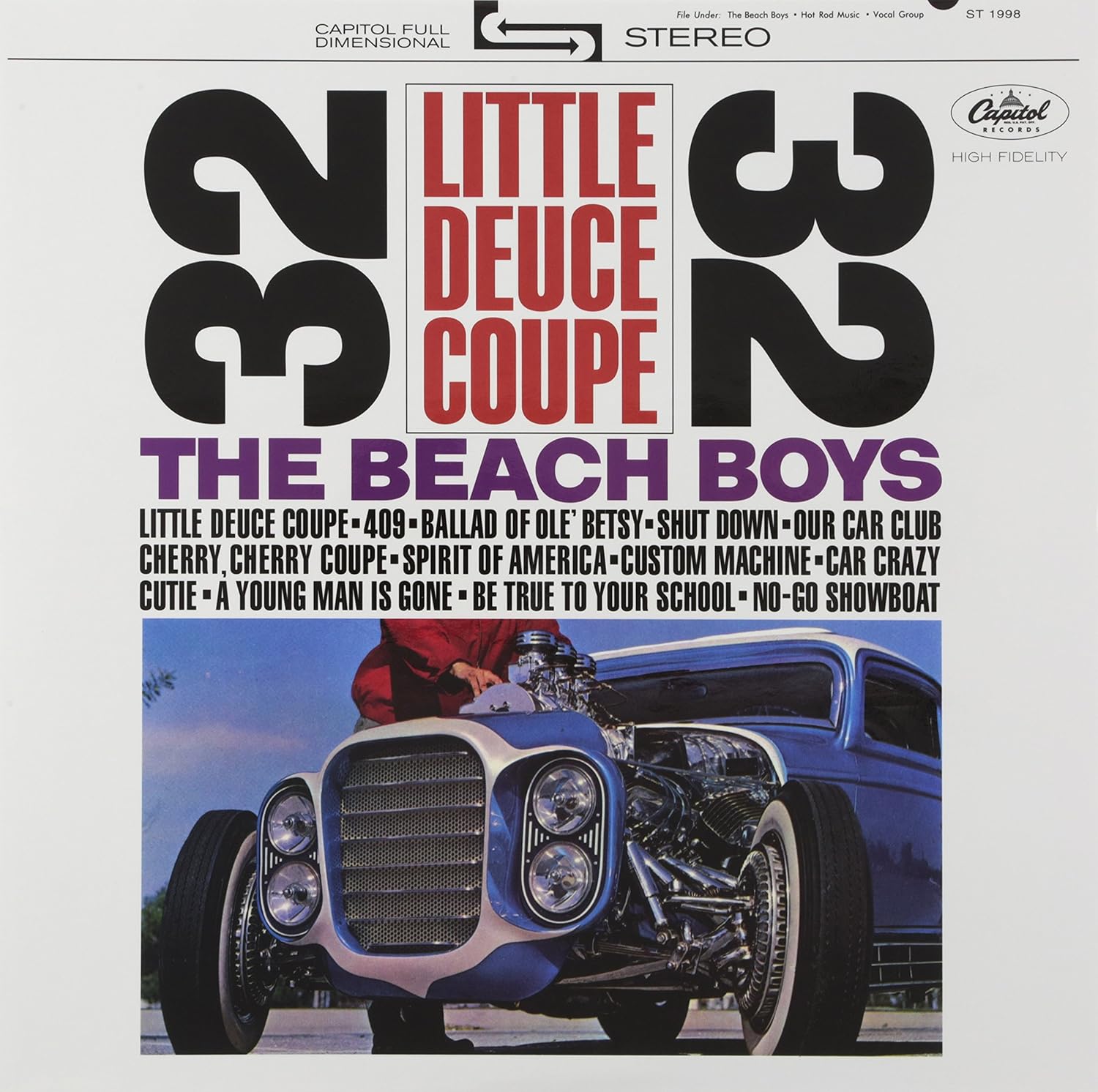
From Wikipedia:"The picture featured on the front cover of the album was supplied by Hot Rod magazine, and features the body (with his head cropped in the photo) of hod-rod owner Clarence 'Chili' Catallo and his own customized three-window 1932 Ford Coupe - known forevermore amongst hot rod enthusiasts as "the lil' deuce coupe". A full shot of Catallo and his car from the same photo shoot appeared on the front cover of the July 1961 edition of Hot Rod magazine, and whilst Catallo himself died in 1998 the car still tours the showrooms and exhibitions to this day.
Catallo bought the vehicle in 1956 for $75 in Michigan when he was 15 years old. Catallo replaced the original stock Ford engine (unlike The Beach Boys song lyrics, which mention "a flathead mill") with a newer Oldsmobile V-8, and lowered the height of the coupe by six inches. Much of the original customizing work, including the stacked headlights, side trim, and front grille was done by an auto shop owned by Mike and Larry Alexander in the Detroit suburb of Southfield.
After Catallo moved to Southern California, additional work, including the 'chopping' or lowering of the roof, was done in 1960-61 at 'Kustom City', George Barris's noted North Hollywood auto customizing shop. This led to the magazine cover and two years later, the shot was featured as the cover for The Beach Boys' fourth album.
Catallo sold the coupe a few years later, but at the urging of his son Curt was able to buy it back in the late 90s for $40,000. The car had since been additionally modified but was restored by Catallo with many of the original parts the coupe had in the early 1960s, so that it now is again virtually identical to the famous photo. In 2000, the hot rod won the 'People's Choice' award at the Meadow Brook Concours d'Elegance."
Read the amazing detailed history of the car here:
Taken at the 17th Annual Keels & Wheels Concours d'Elegance
Lakewood Yacht Club
Seabrook, Texas
May 2012
© COPYRIGHT
ALL RIGHTS RESERVED
Featuring flattering mesh and solid panels in just the right places, our Shaper Legging will enhance your curves. Slimming lines for your legs, your waist and your behind.
fitnessfashions.com/collections/onzie-hot-yoga/products/o...
Deboxing the Rapunzel Feature Doll. Rapunzel's inner box slides out from the bottom, not the top of the box. First you have to detach the 'try me' switch from the front window by undoing two layers of tape. Once freed from the tape, it can be pushed back through a hole in the box to fall inside the box. The other end of the switch plugs into a socket in the back of the doll, and is detachable once the doll is deboxed. Then the doll is removed from the box, still attached to the inner backing. The backing can free stand, and now the doll is in the clear.
The recently released Disney Store Deluxe Feature Rapunzel Doll. She is part of the line of new 16 inch singing Princess dolls for 2015. They not only sing, but each also comes with an accessory and have other special features. They also come in a sturdy reusable box with a satin carrying handle. They are available online and in stores in North America, and cost $49.95 each. Rapunzel I think is the most impressive doll in the line, and the most different from previous singing dolls of the same character.
Once the 'try me' switch is detached, you trigger the sound and lights by sliding the lantern back and forth a little way along her hand. There is a LED light in the palm of her hand that flickers while she is singing, and lights up the lantern. She sings about 35 seconds of the 'Healing Incantation' song very clearly and just the right volume. The sound is better than any previous DS singing doll that I have heard. The gentleness of the song, with accompanying lights, and the beauty of the doll, makes for a very moving experience. I don't think I will get tired of hearing the song and seeing the lights on this doll.
It has been awesome to feature this beauty for a week. I had fun sharing with you 7 images from her photo shoot. Check us tomorrow to see the next featured model!
It may not be a major photo or anything, but the fact my photo got into Playboy is a big deal to me. Maybe one day all this work will pay off
At Piccadilly Circus in London.
The main feature here is the Shaftesbury Memorial Fountain aka Eros.
TQ 2980 NE CITY OF WESTMINSTER PICCADILLY CIRCUS, Wl
71/73
Shaftesbury Memorial
Fountain "Eros"
24.2.58
GV I
Memorial Fountain. 1892-93 by Alfred Gilbert commemorating the philanthropist
Lord Shaftesbury. Bronze octagonal fountain on stepped platform surmounted by
winged archer in aluminium representing the Angel of Christian Charity but always
popularly identified as Eros. The sculpture of the fountain itself is of remark-
able naturalistic proto-Art Nouveau invention, hence Pevsner's quotation "fishes
of all kinds, and every class of molluscous and crustacean life, the crab, the
lobster and such like".
Survey of London; Vol XIX.
London Volume 1 N Pevsner
Grade I listed.
Was a protest going through Piccadilly Circus during the day time, so we headed down to the Underground to get away from here (and on to the Sherlock Holmes Museum).
Some kind of African thing. One thing said "Kabila must go"
We got the Bakerloo line to Baker Street.
Building behind is The Sting.
Grade II listed building.
TQ 2980 NW & NE CITY OF WESTMINSTER REGENT STREET, W1
70/86 ; 71/2 (West side)
30.5.72 Nos. 49 to 63 odd.
The Quadrant
(including Nos. 9 to
18 consec. Piccadilly)
G.V. II
Quadrant of offices and shops and stores. Part of the south western half
of Sir Reginald Blomfield's grandiose rebuilding of Nash's Quadrant,
designed from c.1910 taking Norman Shaw's neo-Baroque set piece of the
quadrant elevation of his Piccadilly Hotel (Piccadilly q.v.) as key and
scale and completed 1920-23. Stone-faced, slate roofs. Podium embracing
ground floor and mezzanine, 3 storeys above and dormered steep mansard.
The podium has bold pulvinated rustication to its articulated piers, ashlar
upper floors with windows in flat surrounds; rich modillion eaves cornice,
continuous range of dormers in roof which has bronze ridge cresting;
prominent banded and corniced stone stacks. The penetration of Air Street
is marked by a rusticated semicircular arched bridge with open giant 3
storey Doric columned loggia over, a la Somerset House. The Quadrant
composition is terminated by slightly advanced pavilions with concave
pyramidal cupola roofs. The eastern end of the Quadrant includes the
former Swan and Edgar's store (Nos. 9 to 18 Piccadilly) in which Blomfield
develops the pavilion design towards Piccadilly Circus with 3 bays and a 9
bay return to Piccadilly. To the Circus, a pulvinated and channelled
podium with an arcade embracing ground floor and mezzanine, above which are
3 storeys read as 1 ½ with tall, through storey, segment headed and hooded
windows, ashlar faced with giant rusticated pilaster strips. Rich
modillion cornice and attic storey with swags and festoons; close set
dormers. The first return bay to Piccadilly is similarly treated. Beyond,
the 8 bay composition differs in the treatment of podium and attic; the end
bays are slightly advanced as pavilions with elevations similar to those
facing the Circus and the Quadrant terminal pavilions, crowned with the
same concave cupola roofs.
www.youtube.com/watch?v=vt7PvTwYF3E&feature=share&...
Full Feature in 9 Parts
American International Pictures lived up to its name on this project. Terrore nello spazio was a Spanish/Italian/American effort. The American release title, Planet of the Vampires (PoV) suggests a campier film than it is. There actually aren't any vampires in the usual sense. Yet, it is still a horror/sci-fi hybrid. Director Mario Bava (famous for horror pictures) gives the dark screenplay by Ib Melchior a good presentation, despite a low budget.
Synopsis
Mysterious signals received from a distant planet named Aura suggest some intelligent life, perhaps a distress call. Two interplanetary space ships are sent to investigate. The Galliot goes in first, but seems to crash. The crew of the Argos go lower to check on them. A sudden increase of gravity pins everyone to the floors and the Argos seems to be doomed to crash. At the last minute, the gravity normalizes and Captain Mark Markary is able to land the Argos. When various members of the crew awaken, they go viciously homicidal temporarily. Captain Mark is able to restore order. The Galliot is found near by, perfectly intact. When a team of the Argos investigate, they find the entire crew of the Galliot dead. They killed each other. The Galliot's "Meteor Rejector" device is smashed, making the ship unspaceworthy. The Argos team return later to find no bodies. (They are rising from the dead, but the Argos crew don't know this yet.) A team from the Argos find a derelict alien ship with a huge alien skeleton out front. Mark and Sanya check it out and almost become trapped inside. Various crewmen, usually given lone sentry jobs, disappear one by one. Two Galliot crewmen appear with a story of being unconscious after the landing. They are taken aboard the Argos, but it was a trick. They were zombies who came to steal the Argos's "Meteor Rejector" device. One zombie explains that Aura is inhabited by a race of energy beings. The Auran sun is dying but they cannot construct spaceships. So, they lured other race's ships to Aura to hijack their bodies and flee. The takeover can be done willingly too. Captain Mark says "Never". Mark, Sanya and Wess steal back the Meteor Rejector and plant bombs aboard the Galliot. They take off in the Argos. Wess discovers that Mark and Sanya are possessed by the Aurans. He smashes the Meteor Rejector, thinking he's stopping the Aurans. He dies in the process. Possessed Mark and Sanya decide to set down on an obscure little planet: Earth. The End.
PoV has the quirky charm typical of Italian sci-fi, but also some visual fun via Bava's sense of art.
The American title is a misnomer, but probably deemed better (by A.I.P.) for marketing. The dead bodies, re-animated by the Auran energy beings, were more the classic zombie than the classic vampire. There is no sucking of blood or needing of human blood, etc. The whole rising-from-the-grave scene is clearly in the zombie idiom. Mixed into the zombie trope is the familiar 50s theme of alien-takeover.
Like many B movies, the production budget for PoV was very tight. Modern viewers could easily scoff at the modest special effects and simple sets. Yet, fans of B sci-fi can appreciate how much mileage Bava got from his shoestring budget. He made an entire alien planet out of a few "rock" props left over from a prior sword-and-sandal film, making use of lots of dry ice fog to disguise how sparse things were. The ship models were quite small (and therefore cheaper), but he manages to make them look larger. To save on matte art and optical effects, Bava used mirrors to put actors and small models into the same shot. Of course, having the Argos and Galliot be identical ships meant handy double use. The giant alien skeleton was probably his biggest expense, but well worth it.
Bava also made ample use of strong color to make things look "alien." Pairs of red-green, or red-blue, or green-orange lights add a vivid other-worldliness. The lighting is reminiscent of that used in the soviet film: Mechte Navstrechu ('62) ("A Dream Come True"). American audiences wouldn't get to see the soviet footage until 1966 when A.I.P. created another of their mash-ups, this one entitled: Queen of Blood.
Some viewers see an inspiration for Ridley Scott's famous Alien (1979). Certainly the scene in which Mark and Sanya discover and explore the derelict alien ship bears a strong resemblance. Even though this scene in PoV is more of a sidetrack than pivotal, it is certainly possible that Scott drew upon it as a portion of his story.
Screenwriter Ib Melchior was fond of the notion that alien planets harbored mysterious danger. His dark vision was quite the opposite of the almost glib notion that alien beings would be pretty women in short skirts. Melchior's Angry Red Planet ('60) featured ominous unseen Martians who tell the earthlings to get lost and never ever come back. Journey to the Seventh Planet ('62) featured a malicious intellect being that messed with the earthlings' minds and was trying to get off its cold, dark moon, to a better planet -- like earth.
The ending of PoV is decidedly un-hollywood. Most of the crew die. Even the last uncompromised humans (Wess) dies trying to stop the Aurans. He fails, despite his heroic sacrifice. Auran-Mark and Auran-Sanya fly down to an unsuspecting earth. The danger of the mind-controlling energy being Aurans was about to be loosed on our simple civilization. On its own, such an ending does have nihilist overtones. It also smacks of a potential sequel along the Body Snatchers line.
Bottom line? PoV will not impress modern viewers who rate movies by how lavish the effects are. It is still a budget film. It also suffers some of the usual pitfalls of foreign films repackaged for American release. There are almost too many characters who are easy to mix up (everyone wore identical leather suits) Nonetheless, it one of the better B movies of the 60s.
On October 21, 2014, CSIS and USAID/DCHA's Office of Transition Initiatives (OTI) will host a major event, Advances and Challenges in Political Transitions. In honor of OTI's 20th anniversary, this conference will feature more than 40 experts and senior officials focusing on the challenges and opportunities of working in conflicts, crises, and political transitions. What will new conflicts look like, region by region? What role will extremism, organized crime, and chaotic violence play? What contributions will youth, women, the private sector, and technology make to prevention, mitigation, and recovery? And what tools, approaches, resources, and support will be needed to build more resilient societies in the coming years?
Agenda
Welcome and Opening Remarks
John Hamre, President, CEO, and Pritzker, CSIS
Nancy Lindborg, Assistant Administrator, Bureau for Democracy, Conflict, and Humanitarian Assistance, USAID
Keynote Address
Ambassador Alfonso E. Lenhardt, Deputy Administrator, USAID
Opening Presentation
Robert Lamb, Visiting Research Professor, U.S. Army War College, and Director and Senior Fellow (on leave), Program on Crisis, Conflict, and Cooperation, CSIS
Morning Plenary: Conflict Response and Recovery in Complex Environments
Moderator: Stephen Del Rosso, Program Director, International Peace and Security Program, Carnegie Corporation of New York
Panelists:
Stephen Lennon, Acting Director, OTI, USAID
Ambassador William Swing, Director General, International Organization for Migration
David Yang, Deputy Assistant Administrator, DCHA Bureau, USAID
Morning Breakout Panels
Track 1: Violent Extremism in MENA
Moderator: Tom Sanderson, Codirector, Transnational Threats Project, CSIS
Panelists:
Robbie Harris, Senior Transition Advisor, USAID/OTI
David Hunsicker, Senior Conflict Advisor, USAID/CMM
Hunter Keith, Development Specialist, DAI
Mona Yacoubian, Deputy Assistant Administrator, Middle East Bureau, USAID
Track 2: Geography, Technology, and Data
Moderator: Amy Noreuil, Data Analysis Support, USAID/OTI
Panelists:
Noel Dickover, Senior Program Officer, PeaceTech Initiative, USIP
Ian Schuler, CEO and President, Development Seed
Jessica Heinzelman, Manager, ICT Strategic Initiatives, DAI
Ivan Sigal, Executive Director, Global Voices
Track 3: Urban Violence and Organized Crime
Moderator: Lt. Col. (Retired) Scott Mann, CEO and Founder, Stability Institute
Panelists:
Miguel Reabold, Honduras Country Representative, USAID/OTI
Scott Aughenbaugh, Fellow, International Security Program and Deputy Director, Strategic Futures, CSIS
Enrique Roig, Coordinator, Central America Regional Security Initiative, USAID
Lunchtime Plenary: Looking Back and Looking Ahead
Moderator: Jim Kunder, Senior Transatlantic Fellow, German Marshall Fund of the United States
Panelists:
Robert Jenkins, Deputy Assistant Administrator, DCHA Bureau, USAID
Rick Barton, Former Assistant Secretary, Bureau for Conflict and Stabilization Operations, Department of State
Johanna Mendelson Forman, Scholar in Residence, American University, and Senior Associate, CSIS
Steve Morrison, Senior Vice President and Director, Global Health Policy Center, CSIS
Afternoon Breakout Panels
Track 1: Future of Conflict in Africa
Moderator: Jennifer Cooke, Director, Africa Program, CSIS
Panelists:
John Langlois, Africa Advisor, USAID/OTI
Pauline Baker, President Emeritus, Fund for Peace
Track 2: Future of Conflict in Eurasia/Pacific
Moderator: Susan Kosinski Fritz, Senior Deputy Assistant Administrator, Europe and Eurasia Bureau, USAID
Panelists:
Oren Murphy, Ukraine Country Representative, USAID/OTI
John R. Deni, Research Professor of Joint, Interagency, Intergovernmental, and Multinational Security Studies, Strategic Studies Institute of the U.S. Army War College
Track 3: Future of Conflict in Latin America
Moderator: Katie Prud'homme, Latin America and Caribbean Team Leader, USAID/OTI
Panelists:
Beth Hogan, Senior Deputy Assistant Administrator LAC, USAID
Steven Dudley, Codirector, InSight Crime
Douglas Farah, President, IBI Counsultants, and Senior Fellow, International Assessment and Strategy Center
Afternoon Plenary: Evolution of Agencies and Resources
Moderator: Kathleen Hicks, Senior Vice President; Henry A. Kissinger Chair; Director, International Security Program, CSIS
Panelists:
William Brownfield, Assistant Secretary, Bureau of International Narcotics and Law Enforcement Affairs, Department of State
Tom Perriello, Special Representative for the Quadrennial Diplomacy and Development Review, Department of State
Melissa Brown, Director, Office of Conflict Management and Mitigation, USAID
OTI in Transition: A Brief Oral History (film)
Programs
PROGRAM ON CRISIS, CONFLICT, AND COOPERATION (C3)
Topics
DEFENSE AND SECURITY, INTERNATIONAL SECURITY, ECONOMIC DEVELOPMENT AND RECONSTRUCTION, GOVERNANCE, DEVELOPMENT POLICY
✰ This photo was featured on The Epic Global Showcase here: flavoredtape.com/post/158219880604
-------------
✰ Featuring Lisa Ryan Artist on Artfinder ✰
-Explore @lisaryanstudio here and on instagram for more!
More detail
This photo feature was prepared c2008 for a magazine specialising in Maltese transport, and subsequently re-formatted for a personal project. The full text follows:
"A development of the Dennis Lance, the SLF (super low floor) model was built between 1993 and 1996. Most of the 105 built had Wright Pathfinder bodies, including 38 dual-door buses delivered to London Buses in 1994. Amongst the last buses bought before the company was privatised, they were one of the first low-floor types supplied to a British operator. They were later operated by UK North in Manchester, but stored after that operator’s demise. Closely following the initial four Leyland Lynxes, three of the former London Dennis Lance SLFs (L32/4/8 WLH) were imported into Malta in April 2007, introducing the products of a bodybuilder new to the Maltese market. Two found immediate buyers, whilst the third spend some time in a dealer’s yard. Having reportedly arrived in very poor condition, all three have benefited from major rebuilding, which has included removal of the centre door. DBY 337 (L34 WLH) was the first to enter service in November 2007 after extensive rebuilding at Scarnif Coachworks; it is owned by ‘Bananeno’ of Mellieha. FBY 699 (L38 WLH) also spent some time at Scarnif but much of the work was carried out by owner, Albert Camilleri of Naxxar. FBY 732 (L32 WLH) was rebuilt by John Galea of St Paul's Bay and sprayed by Cancu; it is owned by Nenu Abela. The Lances were in turn followed by a pair of Alexander-bodied Volvo B6Rs, giving rise to much debate about which of the three new types are best suited to Maltese operating conditions. All pictures were taken by Peter Skerry and Stuart Harvey".
All rights reserved. For the avoidance of doubt, this means that it would be a criminal offence to post this image on Facebook or elsewhere (please post a link instead). Please follow the link below for further information about my Flickr collection:
www.flickr.com/photos/northernblue109/6046035749/in/set-7...
The Malvern hills feature again as HST Powercars 43088 with 43053 on the rear depart Malvern Link on 4-1-19
It is the only remaining HST daytime working beyond Worcester and is the 1P51 1213 Hereford to London Paddington. The outward working being the 1W00 0821 London Paddington to Hereford Great Western Railway service.
"The Berca Mud Volcanoes are a geological and botanical reservation located in the Berca commune in the Buzău County in Romania. Its most spectacular feature is the mud volcanoes, small volcano-shaped structures typically a few meters high caused by the eruption of mud and natural gases.
As the gases erupt from 3000 meters-deep towards the surface, through the underground layers of clay and water, they push up underground salty water and mud, so that they overflow through the mouths of the volcanoes, while the gas emerges as bubbles. The mud dries off at the surface, creating a relatively solid conical structure, resembling a real volcano. The mud expelled by them is cold, as it comes from inside the Earth's continental crust layers, and not from the mantle.
The reservation is unique in Romania. The mud volcanoes create a strange lunar landscape, due to the absence of vegetation around the cones. Vegetation is scarce because the soil is very salty, an environmental condition in which few plants can survive." (Wikipedia)
ARIA Resort & Casino is CityCenter's central feature. Designed by Pelli Clarke Pelli Architects, the 60-story two curvilinear glass towers house 4,004 rooms (including 568 suites) totaling 4,000,000 sq ft (370,000 m2). At its base is a 150,000 sq ft (14,000 m2) casino (the first in Las Vegas that allows a substantial amount of natural light) and a three-story lobby that uses natural materials including lush foliage, wood, and stone.
The ARIA Resort and Casino was opened on December 16, 2009.
The resort includes lounges, bars, nightclubs and a variety of casual to upscale restaurants, including New York's Masa and Sirio Maccioni's Sirio.
All of the rooms and suites have floor-to-ceiling windows and corner-window views and incorporate integrated technologies never before used in the hospitality industry. Corridors allow in natural light through areas of enclosed glass, allowing for city and mountain views.
ARIA's 80,000 sq ft (7,400 m2) spa includes 62 individual treatment rooms, three spa suites (for couple's treatments, bachelorette parties or small group events), and a co-ed balcony overlooking the pool. Adjacent to the spa is a full-service salon, barbershop, fitness room and group exercise studio.
A three-story 300,000 sq ft (28,000 m2) convention center includes four ballrooms (three with fully functioning theatrical stages), 38 meeting rooms and the largest glass-curtain wall in a public building overlooking the pool. The three story tall window is 400 feet (120 m) long.
At the north valet is artist Jenny Holzer's 250 ft (76 m) LED sign welcoming visitors to the hotel.
ARIA is the first hotel in the world to manage energy usage with the Control4 automation system. The system remembers guests' preferences. When guests swipe their room card, it restores their preferences for temperature, lights, window coverings and greets the guest by name.
Within the reception area, artist Maya Lin is creating an approximately 133 ft (41 m) silver cast of the Colorado River. Lin is incorporating reclaimed silver in the spirit of CityCenter's commitment to sustainability and in light of Nevada's standing as the Silver State.
en.wikipedia.org/wiki/ARIA_Resort_&_Casino
en.wikipedia.org/wiki/Wikipedia:Text_of_Creative_Commons_...
Various Artists
Wednesday 6 November, 7:00pm - 9:00pm
George Orwell
168 Perth Road
Dundee, DD1 4JS
Join us for a curated evening of Artist short films from around the globe. Based on this year’s festival theme REACT; NEoN has selected a series of films covering topics such as gender, environment and immigration.
Featuring work by BOM Fellow Emily Mulenga and other artists Georgie Roxby Smith, Jenny odell, Elaine Hoey, Chloé Galibert-Laîné, Shelley Lake, John Butler, Kevin B Lee, shawné michaelain holloway, Jennifer Chan, Shelly Lake and Greg Bath.
Full screening notes:
Max Almy, Perfect leader, (1983), 4 mins. 15 secs.
A satire of the political television spot, Perfect Leader shows that ideology is the product and power is the payoff. The process of political image making and the marketing of a candidate is revealed, as an omnipotent computer manufactures the perfect candidate, offering up three political types: Mr. Nice Guy, an evangelist, and an Orwellian Big Brother. Behind the candidates, symbols of political promises quickly degenerate into icons of oppression and nuclear war.
Greg Barth, Epic Fail, (2017), 5 mins. 32 secs.
Epic Fail is an avant-garde essay that questions what happens when political discourse fails to connect with voters, and truth is impacted by fake news. Based on the political events that shook 2016, the film imagines a reality that is both forged and blurred depending on how we perceive it; using existential currents inspired by Jean Paul Sartre’s Nausea.
The result is a surreal political satire that revolves around a vote for world peace that has dramatic consequences.
John Butler, Xerox’s Paradox, (2018), 2 mins.
A new workwear collection for the age of intelligent supertasking. Xerox’s fear of a paperless office led to the GUI, which, in turn, led to an explosion in the amount of printed matter. Xerox’s Paradox is about technology’s broken promises. The more we automate, the harder we must work.
Jennifer Chan, *A Total Jizzfest*, (2012), 3 mins. 22 secs.
A sample of the richest, sexiest men in computer and internet history.
Chloé Galibert-Laîné, My Crush was a Superstar, (2017), 12 mins. 30 secs.
This desktop documentary follows an ISIS fighter through a trail of messages, videos and postings to uncover his existence in both social media and reality. Part of Bottled Songs, a series of video letters investigating desire, power and terrorism in online and social media. The videos, recorded from the researchers’ desktops, depict and interrogate their subjects’ compulsive engagement in the production of everyday myths and fictions about themselves and others.
Elaine Hoey, Animated Positions, (2019), 9 mins. 47 secs.
This work draws reference from 19th century European nationalist paintings and explores the role of art in the portrayal of jingoistic patriotic ideals that have become culturally symbolic in the formation of the nation state. This piece re-animates the war like stances and positions of bodies found within these paintings, using character animation taken from the video game Call of Duty. The work challenges notions of nostalgia for the nation state, creating a contemporary critique of the underlying violence that underpins much of todays nationalistic ideologies.
Shawné Michaelain Holloway, GEAR-REVIEW(1)__BEGINNERS-VEST.MP4, (2016), 1 min. 55 secs.
GEAR-REVIEW(1)__BEGINNERS-VEST.MP4 is a response to internet’s “Gear Review” video genre. Using a video sourced from Youtube’s preparedness community alongside a video of the artist performing live for her leather community, this work asks questions about the ways we get to know, use, and care for our objects. Whether them for war, for sex, or both, we’re obsessed with function and feature, forcing fetish into the realm of the domestic and accessible.
Shelley Lake, Polly Gone, (1988), 3 min. 9 secs.
A day in the life of a robot.
Kevin B. Lee, The Spokesman, (2018), 12 mins. 30 secs.
The Spokesman investigates the online traces of John Cantlie, a British news reporter who was kidnapped in 2012 and later appeared in several Islamic State propaganda videos. Responding to Cantlie’s videos, Kevin analyzes Cantlie’s British accent and professional composure, constructed over many years of media appearances. Part of Bottled Songs, a series of video letters investigating desire, power and terrorism in online and social media. The videos, recorded from the researchers’ desktops, depict and interrogate their subjects’ compulsive engagement in the production of everyday myths and fictions about themselves and others.
Emily Mulenga, Now that we know the world is ending soon…what are you gonna wear?, (2019), 4 mins. 5 secs
Religious imagery and symbols of capitalist excess intertwine under the ever-watchful eye of CCTV cameras. Loneliness occurs even in the most crowded, noisy and colourful of rooms. Fractured identities span the online and offline worlds. Late-stage capitalism has left us with a disconnect from others and from a spiritual centre, and consumerism purports to fill the void; but never truly satisfies. There’s a condition of perpetual information overload in an oversaturated, neon, dystopian cityscape. There’s also a rabbit.
Jenny Odell, Polly Returns, (2017), 3 mins. 2 secs.
Polly Returns is based on Shelley Lake’s 1988 computer animation, Polly Gone, which features an isolated female robot doing everyday tasks inside a futuristic dome house. In my version, the robot has returned in 2017. The soundtrack is inspired by the original from Polly Gone, which itself was based on the soundtrack from The Day the Earth Stood Still.
Georgie Roxby Smith, Lara Croft Domestic Goddess I & II, (2013), 2 mins. 14 secs.
Georgie Roxby Smith’s hacked Lara Croft Tomb Raider video game shows the familiar icon for violent femme fatale bad-assery in the throes of orgasmic housekeeping, a scene that could be read as neo-Friedan, with her “domestic goddess” subject trapped between the banally physical and the extraordinarily virtual. The value judgments are unclear, the equation destabilized, as Croft joyfully irons shirts with a bow and arrow slung over her back, letting out cries that are undiscernibly battle grunts or orgiastic moans.
Photography Kathryn Rattray
My feature of this 1966 Volkswagen Kombi is the cover feature for Volkswagen Camper & Commercial Magazine issue 100.
Facebook | www.facebook.com/EricArnoldPhotography
Website | www.ericarnoldphotography.com