View allAll Photos Tagged expecting
As expected... 85mm on a m4/3 body is supper cropped~!!! But love the colors that the lens renders...
Although it's not meant close ups... with closest distance 1m, this lens can take close ups since it's magnifying capabilities... :)
These are my personal notes taken during a geology presentation. I give them here because they may be of some interest. Do not expect the notes to always be in complete sentences, etc.
-----------------------------------
Planet Earth and Its Moon
Presented by: Robert Malcuit (Denison University, Granville, Ohio, USA) (denison.edu/people/robert-malcuit)
24 May 2011
----------
The Moon has been melted down to 600 km. It has an anorthosite crust (light-colored) - ~all plagioclase feldspar-rock. It also has mare with basalts (dark-colored). The Moon is basically black and white. The astronauts who visited observed that the Moon was “black and white and gray” - no colors.
(www.flickr.com/photos/silversolo/16875006978)
(www.flickr.com/photos/jsjgeology/16602236679)
Earth’s composition indicates it is made of chondritic meteorites.
Most scientists have considered the Moon to have had little significance to the history of Earth. This is now known not to be the case.
Without the Moon, Earth’s rotation rate today would be 12 to 14 hours per day.
Earth’s actual 24 hours per day rotation rate is due to tidal friction from the presence of the Moon.
What is the origin of the Moon? Most advocate the impact model. Here, Malcuit is presenting a different view.
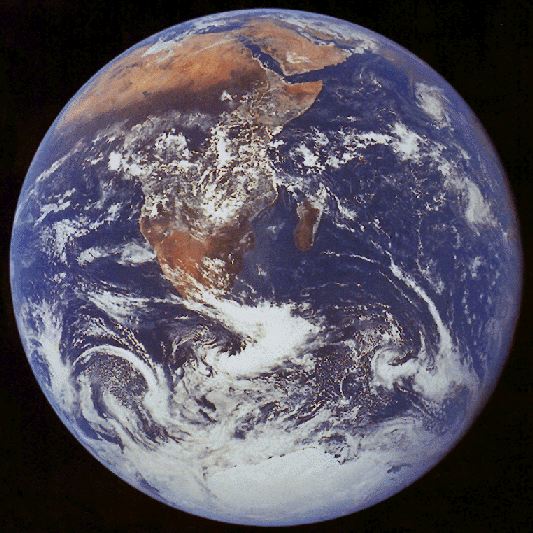
Earth is special - it has liquid water at the surface, it has free oxygen in the atmosphere, it has a highly developed biologic system, it has a strong magnetic field (Jupiter and the Sun have way stronger magnetic fields), it has a very large Moon (mass ratio of 1:81), it’s the only planet with true granite, it’s the only planet with continental crust, it’s the only planet with operational plate tectonics.
(nssdc.gsfc.nasa.gov/image/planetary/earth/apollo17_earth.jpg)
Moon’s mare deposits (younger) have a weaker magnetic signature than the anorthosite crustal rocks (older). This means that the lunar magnetic field died out from 3.9 to 3.6 Ga.
Earth’s continental crust mostly formed over subduction zones.
Earth plate tectonics have been operating since the beginning of the Earth, some say. Others say modern plate tectonics didn’t start until 1 billion years ago. Before that, Earth was too hot to get subduction. But, there are volcanic arcs that predate 1 billion years. However, a different plate tectonics style probably operated then.
If Earth did not have the Moon, Earth’s rotation rate would be ~12 hours/day, there would be no significant tides (only 10 to 15 centimeters from solar tides), there would be no granite and no continents, there would probably be some ocean water, and Earth would have an all-enclosing basaltic crust. Earth would probably develop bacterial life, and maybe algal life. It would have been difficult to have higher forms of life.
If the Moon was larger than it is, Earth would have 36 hours per day, resulting in extremely cold nights.
If the Moon was smaller than it is, Earth would be very different.
Earth is truly in a goldilocks zone.
Harold Urey (1893-1981), the discoverer of heavy hydrogen, said this: the Moon was a very primitive planetoid; it was a “survivor” of a class of planetoids that did not get consumed by collision with other bodies; the Moon is a major recorder of solar system events; the Moon is a captured satellite; the Moon is the “Rosetta Stone of the Solar System”.
Well, the Moon is as old as the Earth, so it is primitive. The Moon may be a little older than the Earth.
The Moon’s maria are in a straight line - the largest is first, the next largest is next, the next largest is next.
--------
The origin of the Moon - 4 models.
1) fission models
2) co-formation models
3) capture models - a minority view; calculations demonstrating capture have only been done at Denison University in Granville, Ohio.
4) giant impact models - a popular view; there’s actually not much evidence for it; proponents can’t make a lunar-sized body from the impact debris; if they can, they can’t get the Moon to be the right composition.
-------
Fission model - Darwin (1880) proposed the fission model. Early Earth spun so fast that the Moon pinched off and orbited Earth. See Wise (1963). Problem with the fission model - how does Earth get to be spinning so quickly for this to happen?
Co-formation model - was popular from 1930 to 1975, after the fission idea died out. Earth and the Moon formed from the same material. Calculations showed that this model didn’t provide a Moon in stable orbit. Plus, Earth & the Moon have different compositions.
Prograde capture model - calculations have been done by Malcuit and others. The Moon moved from a Sun-centered orbit to a geocentric orbit. The energy generated by the Moon capture event was 2.2 x 10 to the 28th power Joules.
Giant impact model - first seriously proposed in 1984 at a Hawaii conference. It has been favored ever since. It doesn’t relate to the geology of Earth or the Moon very well. The model has a Mars-mass body smashing into Proto-Earth. The impact event melts Proto-Earth completely. The debris coalesced into the Moon, which originally formed at 3 Earth radii distance, according to the model. It was 24 hours between the impact and the embryonic Moon. Earth initially rotated ~5 hours per day. No one has made a Moon from the debris, though.
Capture calculations have been done at Denison University since 1987.
---------
A viable Moon origin model has to explain the following:
1) anhydrous nature of the Moon
2) Potassium index (K index) for Solar System bodies (“banana index”) - the potassium content of planetary bodies decreases in a regular way in the Solar System
3) volatile element depletion patterns for Solar System bodies - water and other volatile element contents of planetary bodies decrease in a regular way in the Solar System
4) body density differences - the Moon has a 5 grams/cubic centimeter density; the Earth has a 3.3 g/cc density
5) lunar crust & mare rock dates
6) maria origin
7) asymmetry of lunar mass distribution
8) temporal patterns of lunar rock magnetization
--------
The discovery of Moon water was much hyped - it wasn’t quite a hoax, but it was very overstated - wishful thinking. The very thin, scattered coating of water ice on the Moon was mostly implanted by solar wind. People can’t live on the amount of water there.
--------
The giant impact model talking points:
1) it accounts for the masses of the Moon and the Earth (actually, it doesn’t)
2) it accounts for the angular momentum of the Earth-Moon system (actually, it doesn’t)
3) it accounts for the iron depletion of the Moon (yes, it does)
---------
The tidal capture model talking points:
1) it accounts for the masses of the Moon and the Earth (yes)
2) it accounts for the angular momentum of the Earth-Moon system (yes, it does) - a 10 hours/day rotating Earth that captures the Moon results in an angular momentum that we have now
3) it accounts for iron depletion of the Moon, relative to Earth (this is now explained by the capture model since 2003 understandings)
-------
The Earth-Moon system is unique. Moon origin models require an unusual explanation. Uncommon objects, like the Moon, require an uncommon origin.
Leaning toward the capture model - it was the default explanation from 1975 to 1984.
Capture vs. collision models - a David vs. Goliath scenario.
Tens of millions of dollars have been spent on computer simulations of the giant impact model, mainly at Los Alamos. There’s lots of investment in the impact model.
Earth can’t dissipate the high amounts of energy generated by the capture event over short periods of time. The Moon can.
If capture happened, where did the Moon come from? Didn’t know, originally.
When Malcuit retired in 1999, he still didn’t have an answer.
The capture scenario turns out to be far more complex and fascinating than realized 15 years ago.
Compare the Moon capture model with plate tectonics and Milankovitch climate cyclicity. It took 60 years for plate tectonics to be accepted (1912 to 1972) - a long incubation period for the concept. It took 64 years for the Milankovitch model of Ice Ages to be accepted (1912-1976) - also a long incubation period.
The capture model is simple in principle but complex in the details.
---------
Where did the Moon come from?
Possibilities:
1) near Earth’s orbit. If so, would get a Moon with the same composition as Earth. (which it isn’t)
2) in the inner part of the Asteroid Belt. If so, would get a Moon with ices/water. (which it doesn’t)
3) in the inner part of the Solar System, near the Sun - a near-Sun origin for the Moon was first suggested in the 1970s.
-----------
Relevant ideas - X-Wind Model, Cool Early Earth Model, K Index for Solar System Bodies, calculations by Evans & Tabachnik (1999)
The X-Wind Model allows for an iron-poor Moon forming near the Sun. Calcium-aluminum inclusions (CAIs) in carbonaceous chondrite meteorites are also explained by the X-Wind Model. The giant impact model can’t explain CAIs.
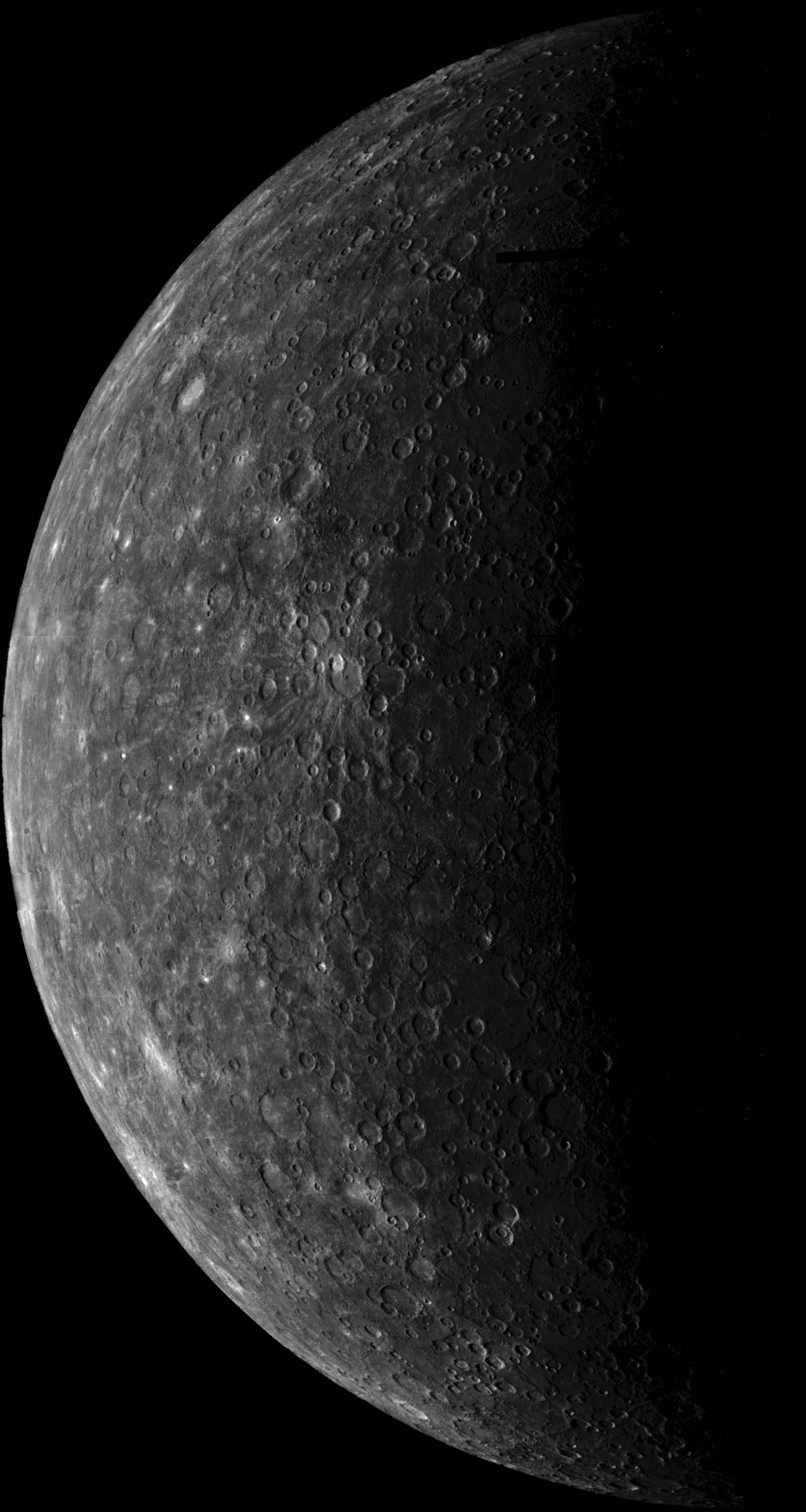
The most stable orbits in the Solar System have been found to occur at 0.1 to 0.2 AU (astronomical units). Orbits at this distance from the Sun are stable for up to 1 billion years. Objects that orbited the Sun at this distance (= closer than Mercury - solarviews.com/raw/merc/mercury.jpg) have been called Vulcanoids. No one has seen a Vulcanoid, it’s been thought. Let’s start the Moon in a Vulcanoid orbit.
Potassium (K) depletion trends:
carbonaceous chondrite meteorites (CI, CM, CV chondrites) have high K contents.
(www.flickr.com/photos/jsjgeology/albums/72157645997754616)
From there, in order of decreasing K content:
Mars (mysite.du.edu/~jcalvert/astro/mars2003.jpg)

Earth
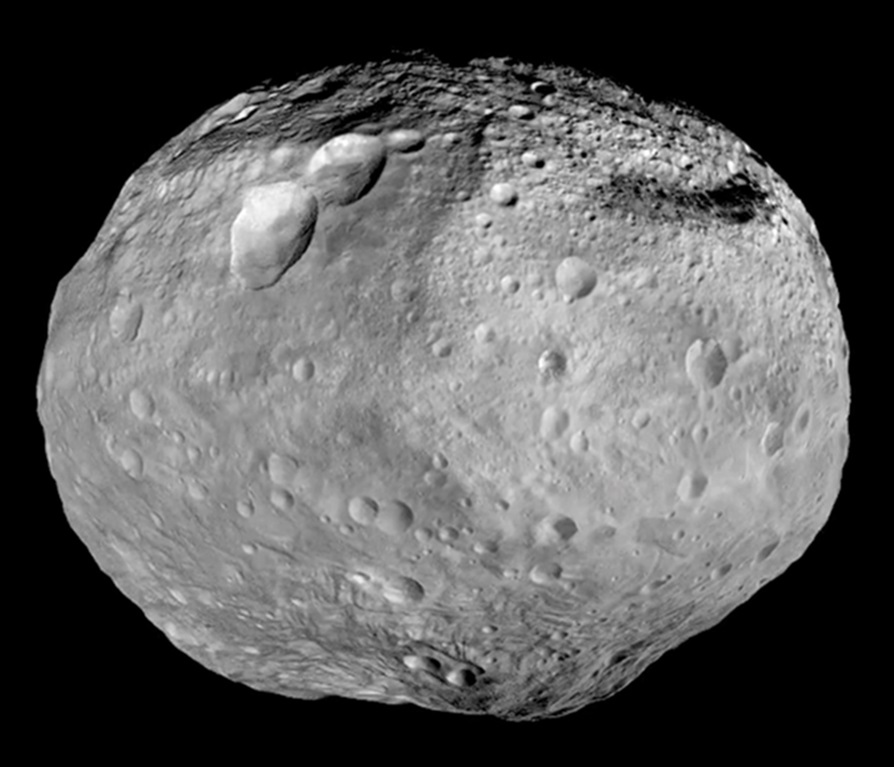
Vesta (= parent body of eucrite meteorites) (upload.wikimedia.org/wikipedia/commons/1/14/Vesta_full_mo...) (www.flickr.com/photos/jsjgeology/14785947504)
Moon
Angra (= parent body of angrite meteorites - not yet identified, but probably in the Asteroid Belt now - www.flickr.com/photos/jsjgeology/5867996330).
The Moon is chemically associated with Vesta and Angra (eucrites & angrites).
Primitive meteorites have chondrules, calcium-aluminum inclusions (CAIs), and matrix. Chondrules are 1-5 mm spherical structures in primitive meteorites (www.flickr.com/photos/jsjgeology/14778331004). Calcium-aluminum inclusions (CAIs) are 1-3 mm spherical structures in primitive meteorites (www.flickr.com/photos/jsjgeology/14787764392). They are rare, except in a meteorite that fell in 1969. The matrix is fine dust - it has element ratios very similar to the Sun.
Compositions of planets & planetoids - Mars is ~90% matrix material. Earth and Venus are a combination of chondrules and matrix + some CAI material. The Moon, Vesta, and Angra have ~90% CAI compositions.
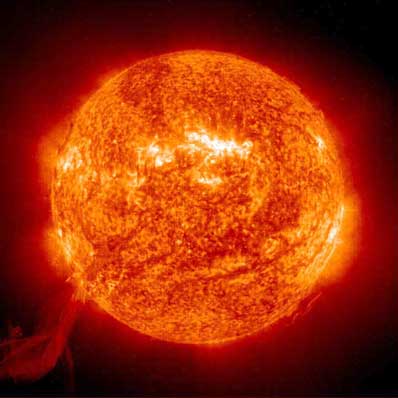
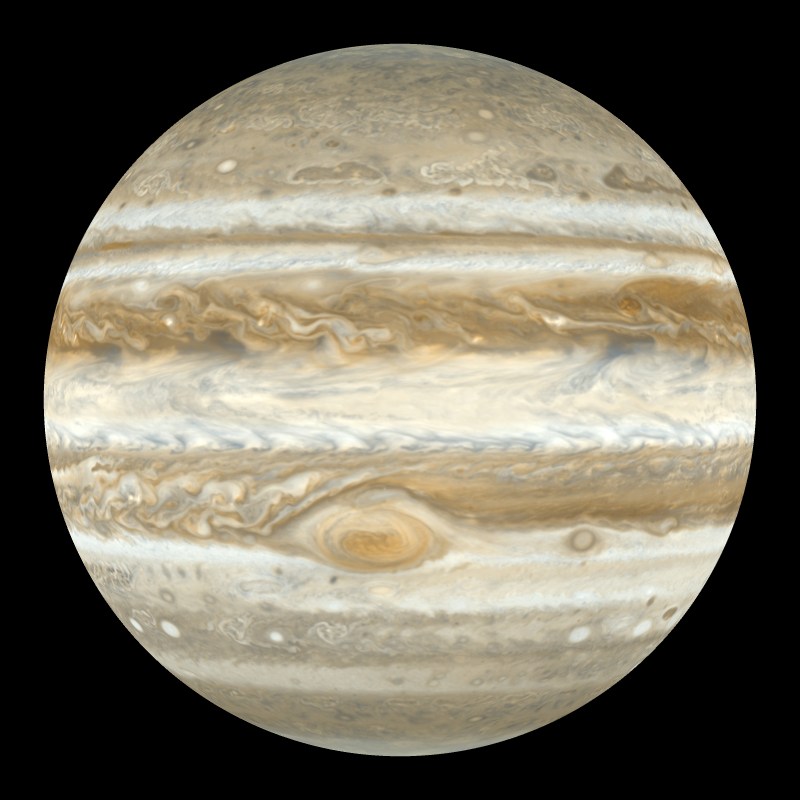
When the Sun formed (very hot) (www.daviddarling.info/images/Sun_021203.jpg), it pushed water and all other volatiles out to the snowline, at 5 AU. Jupiter picked up that material and grew like mad. (sos.noaa.gov/images/Solar_System/jupiter.jpg)
The iron line is at 0.4 AU, where Mercury orbits. ~1200° C. Get a concentration of iron at 0.4 AU - this is why Mercury is so Fe-rich (huge Fe core, compared to planet size).
~0.15 AU is where the Moon formed - inside the iron line, resulting in an Fe-depleted Moon (which it is). ~0.15 AU is a stable orbit zone.
The X-Wind Model explains CAIs - they formed at the reconnection ring shown in an X-Wind diagram and then they got swept elsewhere in the Solar System.
(www.sciencemag.org/content/277/5331/1475/F1.large.jpg)

Cool Early Earth - proposed by John Valley et al. (2002).
4.4 billion year old zircons from the Jack Hills, Australia were discovered in 1986. The zircons indicate Earth was cool at 4.4 Ga - cool enough to have surface water. Many Earth geologic time scales start with the Hadean - Earth was supposed to have been hotter-than-hell back then. 4.4 Ga zircons indicate that wasn’t the case.
The Moon capture event occurred at 3.95 billion years ago. The older lunar maria rocks came into existence then.
Earth’s primitive crust got recycled at 3.95 Ga - this is seen in Australia, Greenland, and South Africa.
Earth was moonless for 600 million years after its formation. Lunar capture started at 3.95 Ga.
Looking at the relationship between Mercury, the Moon, and Vesta. The spacecraft Dawn will orbit Vesta soon.
SPZ - the stable planetoid zone inside Mercury’s orbit. Angra was closest to the Sun, Luna (the Moon) was a bit farther out, and Vesta was a bit farther than that - all inside the orbit of Mercury. The reconnection ring (= CAI formation locality) is inside the orbit of Angra. The area had fluctuating ~1600° K temperatures. There were other bodies in the SPZ - “No Names”.
Why did the Moon get melted to a depth of 600 km? The same thing happened to Mercury.
The Sun entered a T-Tauri stage, after the X-Wind stage. X-Wind involved generation of x-rays and more powerful radiation. The T-Tauri stage was a slow burn - microwave radiation. Luna (Moon), Vesta, and Angra were heated & baked from the outside-in by the T-Tauri event. This melted the top 600 km of the Moon. Luna then had a stronger electromagnetic field.
Luna formed at 0.15 AU and ended up as a Moon of the Earth at 1 AU by prograde gravitational capture - a “benign estrangement” scenario.
Capture models in general - captured bodies can enter a retrograde orbit or a prograde orbit - there’s a 50-50 chance for each. Happily for us, the Moon was captured in a prograde orbit - it has been getting farther away from Earth through time. If it was captured in a retrograde orbit, the Moon would be getting closer to Earth through time - that would be bad.
Vesta was born at 0.19 AU and ended up at 2.4 AU, in the Asteroid Belt. Vesta was tossed around Mercury and Venus. Vesta is too small to have been captured. Options for Vesta - collision with larger bodies or passed by larger bodies. The latter is what happened - it's now in the Asteroid Belt.
Angra was born at 0.1 AU - it’s current location is unknown, but it is probably in the Asteroid Belt.
Adonis - a 0.5 Moon-mass body born at ~0.22 AU. Was gravitationally captured by Venus (0.7 AU) into a retrograde orbit. Adonis approached Venus through geologic time, and eventually coalesced with Venus at ~1 billion years to ~500 million years ago. This is why Venus is a basalt cauldron - a smoldering mass - campfire.andycamper.com/wp-content/media/2011/05/venus.jpg. This is a “fatal attraction” scenario - retrograde capture + coalescence at half a billion to a billion years ago.

Earth would have been like Venus & Adonis if the Moon was captured in retrograde orbit.
So, looking at the Moon as a vulcanoid. Vulcanoids were named in 1978. No one’s seen a vulcanoid. Well, we have been seeing a vulcanoid all this time.
The Moon has a blow-out hole (Mare Orientale - cumbriansky.files.wordpress.com/2012/12/screenshot_2012-1...) - material necked out by tidal disruption and fell back to the Moon’s surface to form the maria in a great circle pattern. ~18 orbits after Moon capture, there was possibly a solar perturbation that pushed the Moon closer to Earth - got maria splashes.

The X-Wind Model well explains CAIs and dehydration events. It doesn’t explain chondrules. The T-Tauri phase microwaved the Moon.
Where did chondrules form? After the dehydration event, the entire inner Solar System must have been chondrules. Chondrules formed by shock waves in the inner Solar System. The shock waves may have originated during Jupiter planetesimal coalescence events. Jupiter formed from large balls of hydrogen and helium and solid material. If two of these balls collided, would get a shock wave. With another ball collision, another shock wave was generated. Chondrules formed by melting of material by the shock waves, like a lightning strike, resulting in droplets in space. They cooled quickly into glass and later crystallized. Very rapid formation for chondrules.
The potassium index pattern developed before chondrules formed.
Earth and Venus are ~the same.
Moon, Adonis, Vesta, Angra - 4 vulcanoids.
Capture is simple in principle. Capture is complex in detail.
Earth has a large Moon - prograde capture.
Triton, a moon of Neptune, was captured for sure - it’s going the wrong way, orbit-wise.
Most of the energy generated by the Moon capture event was absorbed by the Moon.
--------------
See Professor Malcuit's new book, published in 2015: "The Twin Sister Planets Venus and Earth, Why Are They So Different?" (www.springer.com/us/book/9783319113876)
This book summarizes the contents of the above talk.
________________________________________
Summary of talk provided by Professor Malcuit: The origin of the Moon is still an unsolved problem in the natural sciences. In recent years many investigators have jumped onto the “bandwagon” to espouse the merits of the Giant Impact Model. This model proposes that the Moon was formed as a result of a collision of a mars-mass body with the primitive earth about 30 million years after the formation of the Earth. Although the Giant Impact Model appears to be physically possible, at least in part, the model does not relate very well to the rock records of the Earth or the Moon.
The other physically possible model is the Gravitational Capture Model. Most of the recent work, 1972 to present, has been done at Denison University as a combined geology and physics project. Our Capture Model is now undergoing a “renaissance” in light of (1) the Potassium Index for solar system bodies (~1995), (2) the discovery of a multitude of stable planetoid orbits between the orbits of planet Mercury and the Sun (~1999), and (3) the Cool Early Earth Model (~2002). In other words, the Gravitational Capture Model does relate to a number of features of the rock records of both the Earth and the Moon.
This presentation will summarize some of the scientific evidence in favor of the Gravitational Capture Model and compare and contrast this information with the main features of Giant Impact Model.
________________________________________
Biographical information on Professor Malcuit: Bob Malcuit received his Bachelor and Master degrees in Geology from Kent State Univeristy in 1968 and 1970 and his Ph.D in Geology from Michigan State University in 1973. Bob’s current research is in Planetary Geology and one of the themes of several of his projects is that “THE MOON IS THE ROSETTA STONE OF THE SOLAR SYSTEM”. He inherited this concept from Harold Urey (American chemist) and Zdenek Kopal (Czech astronomer). In other words, Bob thinks that the Earth’s Moon is one of the most important recorders of scientific information in the Solar System (a minority view at the present time). He is also promoting the view that without a large satellite like our Moon, planet Earth would be very different from what it is today. For example, without the Moon and the associated rock and ocean tidal action, the Earth would probably not be habitable for life forms higher than bacteria and algae.
--------------
Expected Opening 2030, stay alive!
Above ground construction signs of the new METRO underground line from Chatswood to Bankstown. Looking across intersection of Hunter and Castlereagh Street.
We decided to escape from Hurricane Irma by traveling to someplace high and dry, so we flew to New Mexico. Our first day we observed the famous "Bird Log" at the Capulin Springs picnic area in Cibola National Forest in the Sandia Mountains just east of Albuquerque. For me this was a homecoming of sorts, as in the early 1990s I had worked with a crew of US Forest Service volunteers to rehabilitate an old hollow log which had served as a wildlife drinker. The pipe from the spring had frozen and cracked and the stone wall which enclosed it had to be reassembled and cemented. The log had a large hole whcih we covered with a rubber sheet. It finally fell apart and the volunteers created a new log and replaced the old just last year, They did a great job. Since this is the only constant water source for a large area, one an observer should expect to see just about every species of bird and mammal that inhabits the forest. I traveled with my new mirrorless camera and the photos are mostly of poor quality, but they document a really engaging two hours of just sitting and clicking as the show went on before my eyes.
--------
Visit :
Blog - Eagle FORUM - Rosy-Finch FORUM - Facebook - Shutterfly
concept&stylist / KTNT PHOTOGRAPHY
fotos by / KIEUTRINHNGUYENTON
model / HAN GLX
assistant / MOL TRAN
Like My Fanpage : www.facebook.com/pages/Kieutrinh-Nguyenton-Photography/18...
My Facebook : www.facebook.com/nguoimechuphinh
2017 Mid-Season Invitational Finals at Jeunesse Arena in Rio de Janeiro, Rio de Janeiro, Brazil, on 21 May 2017.
How We Learn
NPR's "Tell Me More" 8:30 - 9:00 AM doors open, breakfast served; 9:00 - 10:00 AM LIVE SHOW
8:30 am - 10:00 am MDT on Tuesday, July 2, 2013
(Tickets Required) Join NPR's "Tell Me More" for three captivating discussions: In the first, we look at the ways innovations in education are transforming learning experiences for today’s students. Gone are the days when music class was just about listening to Mozart and math class was taught the same way to every student. For the second discussion, we hear from Shabana Basij-Rasikh, who was willing to risk her life in her native Afghanistan for an education. She would finish high school in the United States, eventually graduating from Middlebury College two years ago. Now she speaks about a school she co-founded in Afghanistan that helps young women access education at home and abroad. And finally, we address parenting your twentysomething. No shortage of articles have been written about young people in their twenties, who aren’t making enough money but are making less-than-stellar life decisions. Yet, some suggest that rather than expecting the worst from our 20-year-olds, we ought to set the bar high.
Jessie Woolley-Wilson Lawrence Scripp Joseph P. Parkes Meg Jay Michel Martin Shabana Basij-Rasikh Pamela Cantor Danny Kim
Hotel Jerome Ballroom
New bridge expected to be ready by July 2017
Work started in Sept/Oct 2014
Video: Status as on date
www.youtube.com/watch?v=5GcwV4mJrIE
more info, pics etc
joegoauk.blogspot.in/2015/04/new-mandovi-bridge-etc.html
pier pillar
First of the 4 pilars in the river almost ready
Well I didnt expect to see one of these here! It was a very tidy top of the range example with 75,000 miles on the clock (which was more than I was expecting it to have done). I never saw anyone standing with it in all the times I visited it today (and of course I spent a lot of time with it), so unfortunately I didnt see the owner or get to chat with him/her. They obviously cherish it if they've gone to the trouble of entering it into a show.
Original number plates and rear window sticker from Fred Coupe Nissan in Preston, which is where my mum's C-reg Micra which she had from 1994-98 came from. That was the car that started my love for these fantastic cars.
It did get better than this though...
I expect most people have heard of the conic sections, the circle, ellipse, parabola and hyperbola which can all be formed by slicing a cone with a plane. I've just learned of this geometric method which can be used to find the two foci which are a separate way of defining or constructing an ellipse.
It turns out that if you take two spheres, such that they are tangent to the surface of the cone on a circle, and also tangent to the plane slicing through the cube at one point, those points where each sphere is tangent to the plane will coincide with the foci necessary to construct the same ellipse by finding the curve that is the sum of the distance from any point on the curve to the two foci.
In this image I've taken an overhead perspective view showing the surface area of the ellipse and the two small green spheres I've used to mark its foci or the points at which the spheres embedded in the cone were tangent to its surface.
You know, I think I would really like to study geometry more deeply, best yet as the mathematics of computer graphics. But I would want to study it à la carte, just choose whichever topics seem interesting and fruitful to me, without having to do things in the order someone else decided was best. No prerequisites either. Because if I have to know the math before I can use it then I will never use most of it, because I won't find most of it to be worth my time until I have an application to which it is an essential tool.
That's how I think math and physics should be taught, as the tools you need in order to construct your own video game.
Leica MP
Leica Summicron 35mm f/2 IV "King of Bokeh"
Fuji Neopan Acros II
Zero Imaging 510-Pyro (1+100)
7 min 45 sec 20°C
Scan from negative film
On the 11th April 2018 I visited Hythe village for the very first time. Not really knowing what to expect I found it a very beautiful village on the banks of the Southampton water. Hythe is a town near Southampton, Hampshire. It is located by the shore of Southampton Water, and has a ferry service connecting it to Southampton. Hythe has a small shopping area, a pier, and a very picturesque marina for yachts.
The name Hythe means landing place or haven. Hythe is recorded in a Parliamentary roll from 1293. The Hythe ferry to Southampton is marked on a map by Christopher Saxton of 1575, and on a map by John Harrison in 1788. Hythe was part of the parish of Fawley, although it became a separate parish in 1841. The current church, of Saint John the Baptist, was erected in 1874. It is of red brick with Bath Stone dressings. There were at one time even stocks in the village.
Thanks in part to the British Power Boat Company and it’s excellent access to the English Channel, during World War II Hythe was used as a port for the little ships of the Royal Navy as they were then known, the Motor Torpedo Boats and the RAF Air Sea Rescue Boats. In 1960, The Hovercraft Development Company and Sir Christopher Cockerell, who was the founder, moved to Hythe, he did in fact live in one of the houses near to the marina. There was also a small Royal Air Force base in Hythe known as RAF Hythe. Until its closure in September 2006 it was used by the United States Army to service and maintain watercraft.
Hythe was a village up to the 1950’s, but the expansion of Fawley Refinery, now closed, led to a demand for more houses for workers, and Hythe and Dibden Purlieu were allowed to expand into a small town. In 1983, following the growth of Hythe, the parish of Dibden was renamed to Hythe and Dibden, to reflect the importance of Hythe as a new focal point of the Parish
Hythe has a small shopping area clustered around the High Street, which includes a Waitrose Supermarket, a public library, several charity shops, and various small independent retail shops and cafes. The Hythe Pier, Railway and Ferry operates across Southampton Water to Southampton, and is the oldest working pier train in the world. Hythe's position makes it a good viewing point for watching ocean liners arriving and departing at the port of Southampton, which attracts ship spotters to the area. Hythe has a marina, at which a large number of yachts and boats are moored. Large and expensive houses are situated around the marina, overlooking the waterside. This is controlled by large lock gates at the entrance leading out to Southampton Water.
The pier, railway and ferry service are currently operated by Blue Funnel Ferries of Southampton. In October 2016 the previous owners ( White Horse Ferries ) warned their staff of potential redundancy which suggested an uncertain future from the pier and ferry service. After months of talks, Mr. Lee Rayment of Blue Funnel Ferries completed negotiations to acquire the Pier, Train and Ferry with operations starting on 21 April 2017. The railway is the oldest continuously operating public pier train in the world. Hythe Pier stretches 700 yards ( 640 metres ) from the centre of Hythe to the deep water channel of Southampton Water. It is approximately 16 feet ( 4.9 metres) wide, and carries a pedestrian walkway and cycle~way on its northern side and the Hythe Pier Railway on its southern side. During normal high tides the pier is 4 feet ( 1.2 metres ) above the surface of the water. In 1922 the railway was finally reconstructed and electrified, attaining its current form as seen today. The track is laid to 2 ft ( 610 mm ) narrow gauge and is electrified at 250 V DC by a third rail on the seaward side of the track.
I had a five hour stopover in Saskatoon the other day. Rather than sit in the airport, I grabbed a rental car and drove around a bit. It's far less ugly than I expected.
Lo! where the rosy-bosomed Hours,
Fair Venus' train, appear,
Disclose the long-expecting flowers,
And wake the purple year!
extract from 'Ode on the Spring' by Thomas Gray
Must find out how to cut rounded corners in PSE6!
Just playing with layers - you can tell its the school holidays!
Florabella overlay Milk and Texture Cappucino - Thank you Shana.
Fishing boat in the harbour in Palamós with metal parts covered in paint rust and grease. Just the sort of things you would expect to find on working vessels.
(Not As You Would Expect) Fairy Tales on the Fourth Plinth (One and Other) performance art in Trafalgar Square, London.
Once upon a time, there was a little princess, who sat upon a big stone plinth in the square and told deliciously dark fairy tales, just because everybody likes storytime
in the afternoon. She took her dearest companion, Mr Teddy, with his very best black satin bow, and wore her favourite green taffeta party dress, and had a nice cup
of tea and some ginger beer.
Miss Leanna (From The One and Other site - edited)
Kids blew up their balloons, and stood in the middle of the street to greet the parade coming this way....
Expected to be complete in the fall of 2020, the first phase, which broke ground in October 2018, will again bring a variety of businesses to the site. Expected to cost about $225 million it will include 306 luxury apartments, 196-room boutique hotel, a 1,100 space parking garage, 40,000 square feet devoted to retail, food and beverage and 80,000 square feet of Class A office space. Full build-out of the development will be done by 2026
I dropped it off at Blue City Cycles in Bridgeport (Chicago) so he could weld it back together.
It broke about 2 blocks after leaving Jewel on Des Plaines (home of one of the worst bike parking configurations).
I expected this to happen and I decided to continue riding my Prestige until it broke. Then, I would know it as broken and that I could then take it to someone to fix. I was not injured when it broke - the bike just kind of wiggled and I stopped and my friend picked up me and the bike. :(
The evening before the expected release of new methane regulations by the European Commission, the Gastivists Collective and local ally Tegengas organized a “guerrilla projection” action at the Vilvoorde gas plant on the outskirts of Brussels. The action highlighted new infrared videos of methane leakage taken by Clean Air Task Force from fossil fuel infrastructure sites across Europe.
“Just weeks ago, at the COP26 conference, the EU signed the ‘Methane Pledge’ to reduce methane emissions. Despite this, there are still billions of euros of public money that is slated to go to new fossil gas projects. If we are committed to reducing methane emissions, we need to stop importing methane and start leaving it in the ground,” said Kevin Buckland of the Gastivists Collective.
Methane, sold conventionally as fossil gas (“natural gas’), is quickly being recognized as a false solution to the global climate crisis, and incompatible with the Paris Agreement. Furthermore, the continued expansion of fossil gas infrastructure is only possible through massive investments of public money that is obtained through relentless industry greenwashing and lobbying that tries to pass off methane as a climate solution. Fossil gas is blocking real climate action, and the reliable, decentralized, and renewable energy systems the people most vulnerable to global price shocks and fossil fuel extraction so desperately need.
Europe is the world's largest importer of fossil gas (much of which comes from fracking). New EU legislation, however, only calculates methane emissions of this dirty energy source from inside Europe, while ignoring the massive leaks from extraction and transport outside of EU borders. Europe needs to own up to its responsibility to the full lifecycle emissions of the energy it consumes, and move away from false solutions such as nuclear, hydrogen, and fossil gas.
Groups across Europe are demanding legislation that listens to climate science, and not the fossil fuel industry, and thus a full fossil gas phase-out by 2035. Any new fossil gas infrastructure that is approved today will either become a climate menace or a stranded asset. Our public money should be going to pay for a just climate transition, not to maintain industry share prices.
The current energy situation across Europe, from the conflict between Morocco and Algeria to Russia’s leverage of gas as a geopolitical tool, proves to us that energy is too important to be left in the hands of for-profit industry and rogue politicians and kings. The EU needs to have transparent and reliable methane emissions reporting, and make policy based on science - not by industry lobby groups such as ENTSOG. It is time for Europe to lead the world in developing locally-owned, reliable, and resilient energy systems, instead of continuing to burn public money through the relentless combustion of fossil fuels.
Photos by Jonas Van Gaubergen
We never expect to watch the president of Colombia and the chief of the FARC together in one stage asking for peace. We never expect that the whole world were asking for just one word...peace.
We were so close to the ceremony, in the middle of the Old Town of Cartagena. The people were dressed in white, celebrating and living in a dream. We cheer, we shout, we celebrate....together we were one
Many days after that night the country said "No". There are many explanations but the best one is to said that the country wants a better agreement. Is not a "no" but maybe a "not like this"