View allAll Photos Tagged emulators
There is more information available on this device on this blog post. wp.me/p11CVu-rJ
Please take a look at www.retrocomputers.eu for more info about my retro computer collection.
Dunedin.
The Edinburgh of the South was surveyed and laid out with its distinctive Octagon Park and surrounding streets by Charles Kettle who wanted to emulate the “Romantic” design of Edinburgh. He succeeded. He selected a fine site of rising ground just at the top of Otago Harbour. Here were built the early important buildings- the First Church of Otago - the major Presbyterian Church of NZ built in weatherboard in 1848, then replaced with a stone church in 1850, and the impressive Gothic masterpiece of today was erected in 1873 with the 177 feet high tower and spire. The architect who is credited with designing the First Church and so many of Dunedin’s fine stone buildigns was Robert Lawson ( 1833-1902) a Scot who emigrated to Australia in 1854 and then on to Dunedin in 1862. Robert Lawson also designed Larnach Castle (the only castle in NZ, 1871), the Knox Presbyterian Church (1876), the Dunedin Wesleyan Methodist Church – now the Fortune Theatre (1869), the Otago Boys High School (1885), the ANZ Bank 319 Princes St.(1874), the Hanover Street Baptist Church (1865 now demolished and replaced 1912) and the Municipal Chambers (1880). Many of Lawson’s buildings are built of white Oamaru limestone.
Other significant and heritage listed city buildings include: The Octagon is the centre, Moray Place surrounds it.
Around The Octagon:- Dunedin Athenaeum and Mechanics' Institute 1870, 22 The Octagon; Regent Theatre 1904, 17 The Octagon; St Paul’s Anglican Cathedral 1914, 36 Moray Place; Municipal Chambers 1880, 38 The Octagon;
Moray Place :- First Church of Otago 1873, 410 Moray Place; former Dunedin Synagogue dating from 1864 is NZ’s oldest synagogue – extended 1872 and sold 1881 to the Masonic Lodge but now a residence, 29 Moray Place; Moray Terrace building about 1910, 63 Moray Place; Moray Place Congregational Church (former) 1865, 81 Moray Place; former Dunedin Public Library built around 1905, 110 Moray Place; Dunedin Town Hall 1929 in neo-classical style;
Princes Street:- Cargill’s Monument 1864; ; Wains Hotel 1878, 310 Princes St – with carved figures of Neptune and other gods above the doors; Bank of NZ 1879, 205 Princes St; Dunedin Chief Post Office 1937, 283 Princes St; the National Bank of NZ 1911, 193 Princes St;
Queens Gardens:- NZ Insurance Building 1897, 49 Queens Gardens; Union Bank 1874, 319 Queens Gardens;
Dowling Street:- Imperial Building Dunedin’s answer to the Flatiron building of NY – about 1910, corner Cowling and Lower High St; ; Garrison Hall 1872 (former) 8 Dowling St;
Stuart Street:- Dunedin Law Courts 1902, 1 Stuart St; Wesleyan Church now Fortune Theatre 1869, 231 Stuart St;
Other locations:- All Saints Anglican Church 1865, 786 Cumberland St; the Otago Museum 1877, 419 King St; St Joseph’s Catholic Cathedral 1878-86 and St Dominic’s Priory 1877, 288 Rattray St; Dunedin Police Station 1898 (former), 21 Dunbar St; the Otago Girls High School 1910, 41 Tennyson St; Dunedin Prison 1898 (former), 2 Castle St; the Southern Cross Hotel 118 High St (former) 1883; the Guardian Royal Exchange Assurance Building, 7 Liverpool St 1882; the Otago Boys High School 1885, 18 Arthur St; and many fine mansions line High Street numbered 400 onwards. It is a bit of a climb but gives you good views across Otago Harbour towards St Kilda too. Buses go along the street so take a bus out and walk back down the hill!
Central Otago Railway and the Taieri Gorge train.
The impressive Dunedin railway station, the most photographer building in NZ, was completed in 1906. It was designed by a government architect with tower, gables and dormer windows in an Edwardian Flemish extravaganza style reflecting the importance of rail travel at that time. Inside the pretty flour tiles are by Royal Doulton. The line from Christchurch reached Dunedin in 1878. But one of the first railway lines in NZ originated here on a narrow gauge line to Port Chalmers in 1873. The steam engine that opened the line is housed in the Otago Settlers Museum in Dunedin. But even before the railway came from Christchurch the Otago Central Railway was formed in 1877 with the first 27 km section opening in 1889. That line which we travel on today through Taieri Gorge was extended to Middlemarch in 1891. The line was extended every few years opening up land for sheep farmers until it reached Alexandra in 1906. The following year it was extended to Clyde and finally to Cromwell it’s most westerly point in 1921. Fat lambs and sheep were then railed to meat processing works at Pareora and later Mosgiel in Dunedin. This all came to a decline (but not a cessation) in the 1970s when Britain entered the European Common Market and road transport become cheaper. The western part of the rail line was closed by a new dam in 1980 and finally along its entire length in 1990. The Taieri Gorge section of the line climbs quickly to 437 metres (1,434 feet) with curves, a 200 metre tunnel and a long viaduct. The viaduct is the longest and tallest wrought iron structure in NZ. The line between Dunedin and Middlemarch has 10 tunnels, 16 major bridges and 4 major viaducts. Dunedin not only had trains but also cable trams like San Francisco. Its cable car operated from 1881 to 1957 being one of the first and last in the world to operate.
Assignment 7 - My Studio and Location class was given the task to emulate Annie Leibovitz's photographs.
Original: goo.gl/4nT6Ht
A test of the new Mac application which processes your images and emulates a Polaroid print, very cute interface. www.poladroid.net/
el.kingdomsalvation.org/videos/emulate-the-Lord-Jesus-hym...
I
Ο Ιησούς έφερε εις πέρας
τη λύτρωση των ανθρώπων
κάνοντας το θέλημα του Θεού,
χωρίς ίχνος εγωισμού.
Το σχέδιο του Πατρός Του
έγινε και δικός Του σκοπός,
προσευχήθηκε σε Εκείνον,
να γίνει το θέλημά Του.
Αν πάρετε σαν παράδειγμα τον Ιησού
και αγνοείτε τη σάρκα,
ο Θεός θα σας εμπιστευτεί καθήκοντα (καθήκοντα)
για να Τον υπηρετήσετε.
II
Προσευχήθηκε και είπε
“Ας γίνει το θέλημά Σου!
Δε μετράν οι προθέσεις Μου,
το σχέδιό Σου πάνω από όλα.
Γιατί να φροντίζεις τον αδύναμο,
που είναι σαν μυρμήγκι στο χέρι;
Το θέλημά Σου και μόνο θα πράξω.
Όπως Μου υποδείξεις Εσύ."
III
Στον δρόμο για την Ιερουσαλήμ,
σφίχτηκε η καρδιά του Ιησού.
Όμως συνέχισε τον δρόμο Του
μέχρι την τελική σταύρωση.
Μαρτύρησε πάνω στον σταυρό,
έγινε εικόνα της αμαρτωλής σάρκας,
έπραξε έργο λύτρωσης,
πατάσσοντας τον θάνατο.
Αν πάρετε σαν παράδειγμα τον Ιησού
και αγνοείτε τη σάρκα,
ο Θεός θα σας εμπιστευτεί καθήκοντα (καθήκοντα)
για να Τον υπηρετήσετε.
IV
Έζησε τριάντα τρία χρόνια,
όπως το θέλησε ο Θεός,
δε σκέφτηκε τον εαυτό Του
τι θα χάσει, τι θα κερδίσει.
Του Κυρίου Ιησού η υπηρεσία
ήταν πάντα με το θέλημα σε συμφωνία.
Έτσι το βάρος της λύτρωσης
ικανός στάθηκε να σηκώσει.
Πόσες πολλές φορές υπέμεινε,
πόσες φορές Τον δελέασε ο Σατανάς.
Μα δεν έχασε το θάρρος Του.
Μ' αγάπη ο Θεός το έργο Τού ανέθεσε (ανέθεσε).
Αν πάρετε σαν παράδειγμα τον Ιησού
και αγνοείτε τη σάρκα,
ο Θεός θα σας εμπιστευτεί καθήκοντα (καθήκοντα)
για να Τον υπηρετήσετε.
Και μοναχά τέτοιες στιγμές
αφήνεστε στο θέλημά Του,
εκπληρώνετε την αποστολή Του,
κι αληθινά υπηρετείτε τον Θεό, τον Θεό.
από το βιβλίο «Ακολουθήστε τον Αμνό και τραγουδήστε νέα τραγούδια»
Πηγή εικόνας: Εκκλησία του Παντοδύναμου Θεού
Όροι Χρήσης: el.kingdomsalvation.org/disclaimer.html
PRO 90 - Ruth Bernhard
Emulation 08 (one Month) Due Sunday, December 27, 2009
Mission: To Emulate the work of Ruth Bernhard.
"Each time I make a photograph I celebrate the life I love and the beauty I know and the happiness I have experienced. All my photographs are made like that ~ responding to my intuition... After all these years, I am still motivated by the radiance that light creates when it transforms an object into something magical. What the eye sees is an illusion of what is real. The black-and-white image is yet another transformation. What exactly exists, we may never know." ~Ruth Bernhard
In this world, too often we decline the opportunity to unveil beauty. That's what I'm looking for here; the unveiling of beauty.
This woman was deeply moved by light and it's magic in hiding and revealing details. Shadows were not empty to her; they were boundries to hold the light in place. She died at the age of 101 in 2006, so she had access to color photograhy, but she used black / white photography.
The understanding of her work may rest in comprehending the nature of light. It's not so much about the subject, but what the light can do to that subject.
Most likely the reason she avoided color photography is because the eye can be fooled by the colors instead of searching for the forms of the subject.
dWIT
I set up an impromptu studio at home with some natural light from the window, our regular overhead lights and a standard lamp to fill in. I used the built-in flash with a $20 Gary Fong diffuser on it. In post I did some cleanup, dodge and burn and used noiseware to remove some noise (and soften the skin).
1. I was inspired by Ruth's view of the beauty of the female form in her nude studies. My model is not a typical nude model and I wanted to try to use light and the lines of her curves to keep the image simple and clean. This particular image that influenced this was Perspective 2
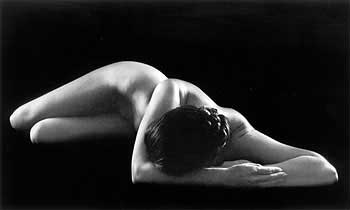
2. what you like and/or don't like about Bernhard's work
I love her nude studies. I don't think I saw an image of hers that I don't like. I love the spirit that she brought to her work.
3. your thoughts and/or thought process behind your assignment submission
I was in two minds about using a nude for the submission, but I really like how the image came out and it seemed appropriate.
4. how your photo reflects Bernhard's work
Ruth was interested in how light can be used to isolate and simplify an image. I believe that this image does that and also offers a homage to her love of the female form.
5. what you gained as a photographer from studying Ruth Bernhard's work
I had not heard of her before. She is an inspiration.
Lastest Body News
Tracee Ellis Ross Emulates Mom Diana Ross in Remake of 1981's 'Work That Body …
Blackish's Tracee Ellis Ross paid tribute to her mother Diana Ross by recreating the 71-year-old's 1981 music video for "Work That Body" in a new clip. The popular...
tsceleb.com/tracee-ellis-ross-emulates-mom-diana-ross-in-...
Emulative of a magazine from the 1980's advertising a simple prism:
More at blakew.smugmug.com/art/PRISM
An emulator that plugs into the TV, with 10 original Atari games on it
Like my photos? Buy me a coffee!
Mission: To emulate the style of an iconic photographer.
The photographer for this assignment is Uta Barth (1958-)
Born in Berlin, Germany, Uta Barth now lives and photographs in Los Angeles, California.
According to wikipedia:
"Barth has used photography exclusively in her aesthetic projects, experimenting with depth of field, focus and framing to take photographs that are suggestive rather than descriptive, alluding to places rather than describing them explicitly[...]. Barth’s images of interiors, buildings, suburban roads or natural environments are often out of focus, cropped and apparently empty of any foreground subject. What emerges from this reduction and abstraction of subject matter is a body of photographs evocative of great moments in the history of painting, or of a cinematic ambience."
Uta Barth typically works in color. Many of her images take on an ethereal and dreamlike quality with her use of very shallow DoF and blurriness as a compositional element. She typically uses normal (everyday) saturation and always uses her light advantageously. She rarely shoots nighttime shots and prefers to use ambient environmental light. Compositional elements are extremely important and when viewing her photography, a big factor to consider is how she uses her negative space. She works in a minimal style, however, her out of focus elements are just as important as her "in-focus" subjects (if there is one).
For Uta Barth, the suggestion of the subject is more important than the subject itself. She tends to not work in a literal photographic sense, rather allowing the viewer to become an active participant in the "creation" of the photograph. Without the viewer, the photograph becomes a massive blur of light and shadows or a cut-off in-focus subject. The viewer adds to the photograph by taking the suggestive lights and shadows to "create" and "discern" the scene. This does not necessarily mean that you need to photograph something in an abstract way -- it means that your photograph should be suggestive rather than literal. The lazy photographer will click the lens to manual focus, blur out a scene, and press the shutter. The successful photographer will take all the abovementioned elements into account and "see" how the out-of-focus elements (and/or lights and shadows) interact with one another to create the image as a whole.
You are challenged to take a Uta Barth-style photograph using the elements outlined above (DoF, blurriness, negative space, saturation, ambient light, etc). Suggestion is the key to this assignment. Your submission needs to bring the viewer along for the ride as an active participant in creating the photograph (interesting trick, I know). A successful submission will look as if Uta Barth took the photograph while also retaining your own photographic style or voice.
Hopefully, we will all learn a new tool to pull out of the photography bag of tricks after this assignment.
WIT:
Held the puffball at arms length and manually set the focus. Found a nice spot of light filtering down through the trees and put the puffball right in it. Blew as hard as I could and depressed the shutter on continuous; I kept slowing things down until I got some motion blur w/o blowing things out too much (I went through several dandelions too ;)
DWIT:
1. which photo(s) inspired you:
2006.11 2006.9 etc. I really enjoyed her triptychs .


2. what you liked and/or didn't like about Uta Barth's style:
I like that she find beauty in the ordinary in the plain, in what is. She puts effect into those ordinary situations -defocusing, toning, motion blur, DOF etc. to make her photos something to contemplate from a balance and color point of view - her series installations are even more so. The part I didn't like wasn't even about her photos - it's about how pretentious and small minded some people seemed to get discussing her work or style. I think it is more accessible and aesthetic than some folks would like it to be ( if that makes sense)
3. your thoughts and/or thought process behind your assignment submission
I wanted to do something that used light to highlight a subject clearly and to introduce controlled blur that added to the image (instead of obfuscated) and i wanted to use colors to highlight the composition. I know my submission isn't a great emulation, but after a week of experimentation it felt like an extrapolation of her style into what I see and photograph. The center shot is what the camera recorded - that green is really the shot with AWB - the other two images are extensions of that strongly colored theme,
4. how your photo reflects elements of Uta Barth's style
See above.
5. what you gained as a photographer from studying Uta Barth's work.
More of an appreciation of the abstract and a stronger sense that photography isn't always representational and not always about a beautiful subject even if that's what we tend to be more comfortable with presenting to viewers.
Rachid Darbali-Zamora examines Sandia National Laboratories’ new wind turbine motor, which will allow the distributed energy team to study how wind farms will behave under a variety of conditions and in different locations.
Learn more at bit.ly/2NYuwNw
Photo by Bret Latter
.… two young boys, who wish to emulate the hero of the town of Mezzojuso, the Master of Field ......
.… l'anello di congiunzione: due giovanissimi emuli dell'eroe di Mezzojuso, il Mastro di Campo ....
-----------------------------------------------------
--------------------------------------------------------------------------
Mezzojuso was built by the Albanians, Arbëreshëc, mostly military people established near an uninhabited house, during the migration of Albanians in Italy; on1501 they came from Albania and they had brought with them their language, customs and the Orthodox rite. From 2 to 4 August 1862 Mezzojuso welcomes Garibaldi: this is to reconnect this long and short at the same time my report, to some passages of this feast: the characteristic carnival of Mezzojuso. The "Master of Field" is the name of this carnival representation and it take the name from the principal character: this is a love story, albeit in key easygoing, which contains the re-enactment of the assault the Count of Modica made to the Castle to capture the White Queen of Navarra. The representation begins with the arrival of the royal procession, made up of the King, the Queen, by the dignitaries of the Court, from the Dame, the Secretary, by guards and by the Moors, and the "Master of Home" soul procession . Performed a dance in the square, the group go up on a stage (which is the castle); after inside the "castle" begins a dance party; therefore appear masks tied to tradition, u Rimitu, the Wizards, the gardener; comes the Master of Field, wearing a red wax mask with a hooked nose and prominent lower lip, a white shirt full of colored ribbons, pants and red coat, he squirms and shake, with his left arm to the side and in the right arm he brings a short wooden sword. Appear numerous characters, the Drummer, the Ambassador, Garibaldi and his Boys, the Captain of Artillery, the Baron and Baroness on two donkeys, followed by their men on horses and mules loaded with firewood, trunks, various paraphernalia for manufacturing cheese, so the gardener, with laurel wreaths, then the Cavalry, formed by a dozen knights who throw sweets over the spectators.The "Foforio" kidnap the wealthy and releases them after paying a small ransom (in return will be able to eat and drink at will). There are Magicians who go in search of "Treasure" and they finally found it: a bedpan full of macaroni and sausage, shouting "forio forio maccarrunario" eat them with their hands. The war rages, with Garibaldi and his Boys clashes against the Saracens (with imaginative alienation of historical periods); The Master of Field goes up on the scale that leads to the castle, meets with the King that hurts him on the head, and he falls backward (from a good height ...) to be taken from the boys that in the meantime they were prepared under the stairs; But the Master of Field is not dead and he healed his wounds, he with army of Garibaldi climb stealthily for "fake scale" and, taking advantage of the moment of confusion, they surrounding the Court and bind the King: the Field of Master removes the mask, finally embracing the Queen, managing to crown their secret dream of love, and so ends the great feast of Mezzojuso, with the procession that will march in the streets the country and ... the king in chains....
-----------------------------------------
Mezzojuso fu costruito dagli albanesi, gli arbëreshë, principalmente militari stabilitisi nelle vicinanze di un casale disabitato, durante la migrazione degli albanesi in Italia; essi provenivano dall'Albania e avevano portato con se lingua, usi e il rito ortodosso, nel 1501 stabilizzarono la loro posizione nella zona. Dal 2 al 4 agosto 1862 Mezzojuso accoglie Garibaldi: questo per ricollegare questo breve incipt su alcuni passaggi di questo report, lungo e breve al tempo stesso, sul caratteristico carnevale di Mezzojuso, unico nel suo genere. Il "Mastro di Campo", questo il nome della rappresentazione carnascialesca, è il personaggio dal quale prende il nome questa storia d'amore, seppur in chiave scanzonata, che racchiude in sè la rievocazione dell'assalto che il Conte di Modica fece al Castello per conquistare la regina Bianca di Navarra. La rappresentazione inizia con l'arrivo del corteo reale, composto dal Re, dalla Regina, dai Dignitari di Corte, dalle Dame, dal Segretario, dall’Artificiere, da alcune guardie e dai Mori, mentre Il "Mastru ri Casa" anima il corteo. Eseguita una danza nella piazza, il gruppo sale su un palco che ne rappresenta il castello, e subito dopo sul "castello" ha inizio una festa danzante; appaiono quindi le maschere legate alla tradizione, u Rimitu, i Maghi, le Giardiniere; arriva il Mastro di Campo a cavallo, che indossa una maschera di cera rossa con il naso adunco ed il labbro inferiore prominente, una camicia bianca piena di nastri colorati, pantaloni e mantello rosso: egli si dimena, si agita, con la testa ben alta, il braccio sinistro al fianco e nel destro una piccola spada di legno. Compaiono numerosi personaggi, il Tammurinaru, l’Ambasciatore, Garibaldi con i Garibaldini, il Capitano d’Artiglieria, il Barone e la Baronessa su due asini, seguiti dai loro uomini sopra cavalli e muli carichi di legna, bauli, armamentari vari per la produzione del formaggio, quindi le Giardiniere, con le corone di alloro, infine la Cavalleria, formata da una decina di cavalieri che lanciano sopra gli spettatori confetti a più non posso, mentre nella piazza l'artiglieria spara "colpi di cannone". Il Foforio sequestra i più abbienti e li rilascia dietro il pagamento di un piccolo riscatto (in cambio potranno mangiare e bere a volontà). Ci sono i Maghi che vanno in cerca della "truvatura", scavano ed ecco finalmente la trovano: un cantaru pieno di maccheroni e salsiccia che, al grido di “forio forio maccarrunario”, mangiano con le mani. La guerra impazza, Garibaldi coi Garibaldini si scontra contro i Saraceni (con fantasiosa alienazione dei periodi storici); il Mastro di Campo sale sulla scala che conduce al castello, si scontra con il Re e rimane ferito in fronte, ed ecco che braccia allargate cade all'indietro (da una buona altezza...) per essere preso dai figuranti che nel frattempo si erano preparati sotto la scala; però Il Mastro di Campo non è morto e, guarito dalle ferite, si riporta in piazza con il suo esercito di Garibaldini, quindi salgono furtivamente per la "scala fausa"(un'ingrsso posteriore e nascosto)e, approfittando dell’attimo di confusione, circondano la Corte e incatenano il Re: il Mastro di Campo, tolta la maschera, finalmente abbraccia la Regina, riuscendo a coronare il loro segreto sogno d'amore, e termina così la grande festa di Mezzojuso, col corteo che sfilerà per le strade del paese ed...il re in catene.
Image of "anglepoise" Apple iMac with default desktop (now emulated by Vista) against coloured stained glass windows in Fabrica Art Gallery - a former church - in Brighton, East Sussex. Weak colours outside of the window and computer screen have been selectively desaturated to enhance the image.
An attempt to emulate that classic scene in Indiana Jones, with that long sweeping nose and Spirit stood tall above its chrome perch.
For many, Rolls Royce's attachment to unqualified luxury and style was given its initial perfection here, with the illusive and curious 20/25. Although the Silver Ghost established Rolls Royce as a world beating brand, the 20/25, together with the much larger Phantom, gave the gentry and the affluent families of Britain and indeed the world their chauffeur driven chariot of excellence to do away with the horses and carriages of yesteryear.
Launched in 1929, the 20/25 was built to replace Rolls Royce's previous smaller model, the 20hp. In keeping with custom at the time, only the chassis and mechanical parts were made by Rolls-Royce. The body was made and fitted by a coachbuilder selected by the owner. Amongst the most famous coachbuilders who produced bodies for Rolls Royce cars are Park Ward, Thrupp & Maberly, Mulliner and Hooper.
Power came from an in-line 6-cylinder overhead-valve engine which was similar to that used in the 20hp but was enlarged to 3669 cc by increasing the bore from 76mm to 82mm, with the stroke remaining at 114 mm. A single Rolls-Royce carburettor was used, and both coil and magneto ignition were fitted. The four-speed gearbox was mounted in unit with the engine and a traditional right-hand change used. Synchromesh was fitted to third and top gears from 1932.
The substantial chassis had rigid front and rear axles suspended by half-elliptic springs with braking on all four wheels assisted by a mechanical servo. Separate rear brakes were fitted for the handbrake. The famous Rolls-Royce radiator with triangular top was used with vertical louvres, the angle of which could be adjusted to control engine cooling. To begin with, the radiator shutters were operated manually via a lever on the dash; later cars were fitted with automatic control via a thermostat.
The larger engine allowed the top speed to increase to 75mph, but many owners had large limousine bodies fitted to the chassis, with the predictable degradation of performance.
The car was built until 1936, of which 3,800 examples were constructed, ranging from Limousines, to Fixedhead Coupés, to Saloons and Drophead Coupés such as this. The Three-Position design for the soft-top roof was common in this time period, with the stylish bend in the frame on the sides becoming a design staple of the time.
Since then the 20/25 has often been featured in movies and TV shows, often doubling as a cheaper alternative stand-in for the larger Phantom. The most jarring appearance for one of these cars was in 1989's Indiana Jones and the Last Crusade, where the Sultan of the fictional Kingdom of Hatay takes preference of the villain's Rolls Royce Phantom II over plundered jewels and luxury items (although why a German officer would have a Rolls Royce when Mercedes-Benz and Maybach were in existence is a matter of debate.) Either way, the car featured in this movie was in fact not a Phantom II, but instead a 20/25 Saloon, with coachwork by Barker. This doesn't detract from the movie in anyway, it's still one of my favourite films of all time, but as a car buff I can't help but comment on that scene every time (because I'm that sort of boy!)
This particular car was recently sold at auction for a price range between £60,000 and £80,000, but eventually went for £64625, a little bit more than what I could possibly afford (knock about three zeros off that price tag and we'll talk!)
The Eden Project is a visitor attraction in Cornwall, England, UK. The project is located in a reclaimed china clay pit, located 2 km (1.2 mi) from the town of St Blazey and 5 km (3 mi) from the larger town of St Austell.
The complex is dominated by two huge enclosures consisting of adjoining domes that house thousands of plant species, and each enclosure emulates a natural biome. The biomes consist of hundreds of hexagonal and pentagonal ethylene tetrafluoroethylene (ETFE) inflated cells supported by geodesic tubular steel domes. The larger of the two biomes simulates a rainforest environment (and is the largest indoor rainforest in the world) and the second, a Mediterranean environment. The attraction also has an outside botanical garden which is home to many plants and wildlife native to Cornwall and the UK in general; it also has many plants that provide an important and interesting backstory, for example, those with a prehistoric heritage.
There are plans to build an Eden Project North in the seaside town of Morecambe, Lancashire, with a focus on the marine environment.
The clay pit in which the project is sited was in use for over 160 years. In 1981, the pit was used by the BBC as the planet surface of Magrathea in the TV series the Hitchhiker's Guide to the Galaxy. By the mid-1990s the pit was all but exhausted.
The initial idea for the project dates back to 1996, with construction beginning in 1998. The work was hampered by torrential rain in the first few months of the project, and parts of the pit flooded as it sits 15 m (49 ft) below the water table.
The first part of the Eden Project, the visitor centre, opened to the public in May 2000. The first plants began arriving in September of that year,[8] and the full site opened on 17 March 2001.
To counter criticism from environmental groups, the Eden Project committed to investigate a rail link to the site. The rail link was never built, and car parking on the site is still funded from revenue generated from general admission ticket sales.
The Eden Project was used as a filming location for the 2002 James Bond film Die Another Day. On 2 July 2005 The Eden Project hosted the "Africa Calling" concert of the Live 8 concert series. It has also provided some plants for the British Museum's Africa garden.
In 2005, the Project launched "A Time of Gifts" for the winter months, November to February. This features an ice rink covering the lake, with a small café-bar attached, as well as a Christmas market. Cornish choirs regularly perform in the biomes.
In 2007, the Eden Project campaigned unsuccessfully for £50 million in Big Lottery Fund money for a proposed desert biome.[10][11] It received just 12.07% of the votes, the lowest for the four projects being considered. As part of the campaign, the Eden Project invited people all over Cornwall to try to break the world record for the biggest ever pub quiz as part of its campaign to bring £50 million of lottery funds to Cornwall.
In December 2009, much of the project, including both greenhouses, became available to navigate through Google Street View.
The Eden Trust revealed a trading loss of £1.3 million for 2012–13, on a turnover of £25.4 million. The Eden Project had posted a surplus of £136,000 for the previous year. In 2014 Eden accounts showed a surplus of £2 million.
The World Pasty Championships, an international competition to find the best Cornish pasties and other pasty-type savoury snacks, have been held at the Eden Project since 2012.
The Eden Project is said to have contributed over £1 billion to the Cornish economy. In 2016, Eden became home to Europe's second-largest redwood forest (after the Giants Grove at Birr Castle, Birr Castle, Ireland) when forty saplings of coast redwoods, Sequoia sempervirens, which could live for 4,000 years and reach 115 metres in height, were planted there.
The Eden Project received 1,010,095 visitors in 2019.
In December 2020 the project was closed after heavy rain caused several landslips at the site. Managers at the site are assessing the damage and will announce when the project will reopen on the company's website. Reopening became irrelevant as Covid lockdown measures in the UK indefinitely closed the venue from early 2021, though it had reopened by May 2021 after remedial works had taken place. The site was used for an event during the 2021 G7 Summit, hosted by the United Kingdom.
The project was conceived by Tim Smit and Jonathan Ball, and designed by Grimshaw Architects and structural engineering firm Anthony Hunt Associates (now part of Sinclair Knight Merz). Davis Langdon carried out the project management, Sir Robert McAlpine and Alfred McAlpine did the construction, MERO jointly designed and built the biome steel structures, the ETFE pillows that build the façade were realized by Vector Foiltec, and Arup was the services engineer, economic consultant, environmental engineer and transportation engineer. Land Use Consultants led the masterplan and landscape design. The project took 2½ years to construct and opened to the public on 17 March 2001.
Once into the attraction, there is a meandering path with views of the two biomes, planted landscapes, including vegetable gardens, and sculptures that include a giant bee and previously The WEEE Man (removed in 2016), a towering figure made from old electrical appliances and was meant to represent the average electrical waste used by one person in a lifetime.
At the bottom of the pit are two covered biomes:
The Tropical Biome, covers 1.56 ha (3.9 acres) and measures 55 m (180 ft) high, 100 m (328 ft) wide, and 200 m (656 ft) long. It is used for tropical plants, such as fruiting banana plants, coffee, rubber and giant bamboo, and is kept at a tropical temperature and moisture level.
The Mediterranean Biome covers 0.654 ha (1.6 acres) and measures 35 m (115 ft) high, 65 m (213 ft) wide, and 135 m (443 ft) long. It houses familiar warm temperate and arid plants such as olives and grape vines and various sculptures.
The Outdoor Gardens represent the temperate regions of the world with plants such as tea, lavender, hops, hemp, and sunflowers, as well as local plant species.
The covered biomes are constructed from a tubular steel (hex-tri-hex) with mostly hexagonal external cladding panels made from the thermoplastic ETFE. Glass was avoided due to its weight and potential dangers. The cladding panels themselves are created from several layers of thin UV-transparent ETFE film, which are sealed around their perimeter and inflated to create a large cushion. The resulting cushion acts as a thermal blanket to the structure. The ETFE material is resistant to most stains, which simply wash off in the rain. If required, cleaning can be performed by abseilers. Although the ETFE is susceptible to punctures, these can be easily fixed with ETFE tape. The structure is completely self-supporting, with no internal supports, and takes the form of a geodesic structure. The panels vary in size up to 9 m (29.5 ft) across, with the largest at the top of the structure.
The ETFE technology was supplied and installed by the firm Vector Foiltec, which is also responsible for ongoing maintenance of the cladding. The steel spaceframe and cladding package (with Vector Foiltec as ETFE subcontractor) was designed, supplied and installed by MERO (UK) PLC, who also jointly developed the overall scheme geometry with the architect, Nicholas Grimshaw & Partners.
The entire build project was managed by McAlpine Joint Venture.
The Core is the latest addition to the site and opened in September 2005. It provides the Eden Project with an education facility, incorporating classrooms and exhibition spaces designed to help communicate Eden's central message about the relationship between people and plants. Accordingly, the building has taken its inspiration from plants, most noticeable in the form of the soaring timber roof, which gives the building its distinctive shape.
Grimshaw developed the geometry of the copper-clad roof in collaboration with a sculptor, Peter Randall-Page, and Mike Purvis of structural engineers SKM Anthony Hunts. It is derived from phyllotaxis, which is the mathematical basis for nearly all plant growth; the "opposing spirals" found in many plants such as the seeds in a sunflower's head, pine cones and pineapples. The copper was obtained from traceable sources, and the Eden Project is working with Rio Tinto Group to explore the possibility of encouraging further traceable supply routes for metals, which would enable users to avoid metals mined unethically. The services and acoustic, mechanical, and electrical engineering design was carried out by Buro Happold.
The Core is also home to art exhibitions throughout the year. A permanent installation entitled Seed, by Peter Randall-Page, occupies the anteroom. Seed is a large, 70 tonne egg-shaped stone installation standing some 13 feet (4.0 m) tall and displaying a complex pattern of protrusions that are based upon the geometric and mathematical principles that underlie plant growth.
Environmental aspects
The biomes provide diverse growing conditions, and many plants are on display.
The Eden Project includes environmental education focusing on the interdependence of plants and people; plants are labelled with their medicinal uses. The massive amounts of water required to create the humid conditions of the Tropical Biome, and to serve the toilet facilities, are all sanitised rain water that would otherwise collect at the bottom of the quarry. The only mains water used is for hand washing and for cooking. The complex also uses Green Tariff Electricity – the energy comes from one of the many wind turbines in Cornwall, which were among the first in Europe.
In December 2010 the Eden Project received permission to build a geothermal electricity plant which will generate approx 4MWe, enough to supply Eden and about 5000 households. The project will involve geothermal heating as well as geothermal electricity. Cornwall Council and the European Union came up with the greater part of £16.8m required to start the project. First a well will be sunk nearly 3 miles (4.5 km) into the granite crust underneath Eden.
Eden co-founder, Sir Tim Smit said, "Since we began, Eden has had a dream that the world should be powered by renewable energy. The sun can provide massive solar power and the wind has been harnessed by humankind for thousands of years, but because both are intermittent and battery technology cannot yet store all we need there is a gap. We believe the answer lies beneath our feet in the heat underground that can be accessed by drilling technology that pumps water towards the centre of the Earth and brings it back up superheated to provide us with heat and electricity".
Drilling began in May 2021, and it was expected the project would be completed by 2023
Other projects
Eden Project Morecambe
In 2018, the Eden Project revealed its design for a new version of the project, located on the seafront in Morecambe, Lancashire. There will be biomes shaped like mussels and a focus on the marine environment. There will also be reimagined lidos, gardens, performance spaces, immersive experiences, and observatories.
Grimshaw are the architects for the project, which is expected to cost £80 million. The project is a partnership with the Lancashire Enterprise Partnership, Lancaster University, Lancashire County Council, and Lancaster City Council. In December 2018, the four local partners agreed to provide £1 million to develop the idea, which allowed the development of an outline planning application for the project. It is expected that there will be 500 jobs created and 8,000 visitors a day to the site.
Having been granted planning permission in January 2022 and with £50 million of levelling-up funding granted in January 2023, it is due to open in 2026 and predicted to benefit the North West economy by £200 million per year.
Eden Project Dundee
In May 2020, the Eden Project revealed plans to establish their first attraction in Scotland, and named Dundee as the proposed site of the location. The city's Camperdown Park was widely touted to be the proposed location of the new attraction however in May 2021, it was announced that the Eden Project had chosen the site of the former gasworks in Dundee as the location. It was planned that the new development would result in 200 new jobs and "contribute £27m a year to the regional economy". The project is in partnership with Dundee City Council, the University of Dundee and the Northwood Charitable Trust.
In 2021, Eden Project announced that they would establish fourteen hectares of new wildflower habitat in areas across Dundee, including Morgan Academy and Caird Park.
In July 2023, new images were released depicting what the Dundee attraction would look which accompanied the planning permission documents for the new attraction which would be submitted by autumn 2023.
South Downs
In 2020, Eastbourne Borough Council and the Eden Project announced a joint project to explore the viability of a new Eden site in the South Downs National Park.
Qingdao, China
In 2015, the Eden Project announced that it had reached an agreement to construct an Eden site in Qingdao, China. While the site had originally been slated to open by 2020, construction fell behind schedule due to the COVID-19 pandemic and the opening date was delayed to 2023. The new site is expected to focus on "water" and its central role in civilization and nature.
Eden Project New Zealand
A planned Eden Project for the New Zealand city of Christchurch, to be called Eden Project New Zealand/Eden Project Aotearoa, is expected to be inaugurated in 2025. It is to be centred close to the Avon River, on a site largely razed as a result of the 2011 Christchurch Earthquake.
Eden Sessions
Since 2002, the Project has hosted a series of musical performances, called the Eden Sessions, usually held during the summer.
The 2024 sessions will be headlined by Fatboy Slim, Suede, Manic Street Preachers, The National, JLS, Crowded House, Rick Astley, Tom Grennan and Paolo Nutini.
In the media
The Eden Project has appeared in various television shows and films such as the James Bond film Die Another Day, The Bad Education Movie, in the Netflix series The Last Bus, and in the CBeebies show Andy's Aquatic Adventure.
A weekly radio show called The Eden Radio Project is held every Thursday afternoon on Radio St Austell Bay.
On 18 November 2019, on the Trees A Crowd podcast, David Oakes would interview the Eden Project's Head of Interpretation, Dr Jo Elworthy, about the site.
Art is a diverse range of human activity and its resulting product that involves creative or imaginative talent generally expressive of technical proficiency, beauty, emotional power, or conceptual ideas.
There is no generally agreed definition of what constitutes art, and its interpretation has varied greatly throughout history and across cultures. In the Western tradition, the three classical branches of visual art are painting, sculpture, and architecture. Theatre, dance, and other performing arts, as well as literature, music, film and other media such as interactive media, are included in a broader definition of the arts. Until the 17th century, art referred to any skill or mastery and was not differentiated from crafts or sciences. In modern usage after the 17th century, where aesthetic considerations are paramount, the fine arts are separated and distinguished from acquired skills in general, such as the decorative or applied arts.
The nature of art and related concepts, such as creativity and interpretation, are explored in a branch of philosophy known as aesthetics. The resulting artworks are studied in the professional fields of art criticism and the history of art.
In the perspective of the history of art, artistic works have existed for almost as long as humankind: from early prehistoric art to contemporary art; however, some theorists think that the typical concept of "artistic works" does not fit well outside modern Western societies. One early sense of the definition of art is closely related to the older Latin meaning, which roughly translates to "skill" or "craft", as associated with words such as "artisan". English words derived from this meaning include artifact, artificial, artifice, medical arts, and military arts. However, there are many other colloquial uses of the word, all with some relation to its etymology.
Over time, philosophers like Plato, Aristotle, Socrates and Immanuel Kant, among others, questioned the meaning of art. Several dialogues in Plato tackle questions about art: Socrates says that poetry is inspired by the muses, and is not rational. He speaks approvingly of this, and other forms of divine madness (drunkenness, eroticism, and dreaming) in the Phaedrus (265a–c), and yet in the Republic wants to outlaw Homer's great poetic art, and laughter as well. In Ion, Socrates gives no hint of the disapproval of Homer that he expresses in the Republic. The dialogue Ion suggests that Homer's Iliad functioned in the ancient Greek world as the Bible does today in the modern Christian world: as divinely inspired literary art that can provide moral guidance, if only it can be properly interpreted.
With regards to the literary art and the musical arts, Aristotle considered epic poetry, tragedy, comedy, Dithyrambic poetry and music to be mimetic or imitative art, each varying in imitation by medium, object, and manner. For example, music imitates with the media of rhythm and harmony, whereas dance imitates with rhythm alone, and poetry with language. The forms also differ in their object of imitation. Comedy, for instance, is a dramatic imitation of men worse than average; whereas tragedy imitates men slightly better than average. Lastly, the forms differ in their manner of imitation—through narrative or character, through change or no change, and through drama or no drama. Aristotle believed that imitation is natural to mankind and constitutes one of mankind's advantages over animals.
The more recent and specific sense of the word art as an abbreviation for creative art or fine art emerged in the early 17th century. Fine art refers to a skill used to express the artist's creativity, or to engage the audience's aesthetic sensibilities, or to draw the audience towards consideration of more refined or finer works of art.
Within this latter sense, the word art may refer to several things: (i) a study of a creative skill, (ii) a process of using the creative skill, (iii) a product of the creative skill, or (iv) the audience's experience with the creative skill. The creative arts (art as discipline) are a collection of disciplines which produce artworks (art as objects) that are compelled by a personal drive (art as activity) and convey a message, mood, or symbolism for the perceiver to interpret (art as experience). Art is something that stimulates an individual's thoughts, emotions, beliefs, or ideas through the senses. Works of art can be explicitly made for this purpose or interpreted on the basis of images or objects. For some scholars, such as Kant, the sciences and the arts could be distinguished by taking science as representing the domain of knowledge and the arts as representing the domain of the freedom of artistic expression.
Often, if the skill is being used in a common or practical way, people will consider it a craft instead of art. Likewise, if the skill is being used in a commercial or industrial way, it may be considered commercial art instead of fine art. On the other hand, crafts and design are sometimes considered applied art. Some art followers have argued that the difference between fine art and applied art has more to do with value judgments made about the art than any clear definitional difference. However, even fine art often has goals beyond pure creativity and self-expression. The purpose of works of art may be to communicate ideas, such as in politically, spiritually, or philosophically motivated art; to create a sense of beauty (see aesthetics); to explore the nature of perception; for pleasure; or to generate strong emotions. The purpose may also be seemingly nonexistent.
The nature of art has been described by philosopher Richard Wollheim as "one of the most elusive of the traditional problems of human culture". Art has been defined as a vehicle for the expression or communication of emotions and ideas, a means for exploring and appreciating formal elements for their own sake, and as mimesis or representation. Art as mimesis has deep roots in the philosophy of Aristotle. Leo Tolstoy identified art as a use of indirect means to communicate from one person to another. Benedetto Croce and R. G. Collingwood advanced the idealist view that art expresses emotions, and that the work of art therefore essentially exists in the mind of the creator. The theory of art as form has its roots in the philosophy of Kant, and was developed in the early 20th century by Roger Fry and Clive Bell. More recently, thinkers influenced by Martin Heidegger have interpreted art as the means by which a community develops for itself a medium for self-expression and interpretation. George Dickie has offered an institutional theory of art that defines a work of art as any artifact upon which a qualified person or persons acting on behalf of the social institution commonly referred to as "the art world" has conferred "the status of candidate for appreciation". Larry Shiner has described fine art as "not an essence or a fate but something we have made. Art as we have generally understood it is a European invention barely two hundred years old."
Art may be characterized in terms of mimesis (its representation of reality), narrative (storytelling), expression, communication of emotion, or other qualities. During the Romantic period, art came to be seen as "a special faculty of the human mind to be classified with religion and science".
A shell engraved by Homo erectus was determined to be between 430,000 and 540,000 years old. A set of eight 130,000 years old white-tailed eagle talons bear cut marks and abrasion that indicate manipulation by neanderthals, possibly for using it as jewelry. A series of tiny, drilled snail shells about 75,000 years old—were discovered in a South African cave. Containers that may have been used to hold paints have been found dating as far back as 100,000 years.
The oldest piece of art found in Europe is the Riesenhirschknochen der Einhornhöhle, dating back 51,000 years and made by Neanderthals.
Sculptures, cave paintings, rock paintings and petroglyphs from the Upper Paleolithic dating to roughly 40,000 years ago have been found, but the precise meaning of such art is often disputed because so little is known about the cultures that produced them.
The first undisputed sculptures and similar art pieces, like the Venus of Hohle Fels, are the numerous objects found at the Caves and Ice Age Art in the Swabian Jura UNESCO World Heritage Site, where the oldest non-stationary works of human art yet discovered were found, in the form of carved animal and humanoid figurines, in addition to the oldest musical instruments unearthed so far, with the artifacts dating between 43,000 and 35,000 BC, so being the first centre of human art.
Cave paintings, Lascaux, France, c. 17,000 BCE
Many great traditions in art have a foundation in the art of one of the great ancient civilizations: Ancient Egypt, Mesopotamia, Persia, India, China, Ancient Greece, Rome, as well as Inca, Maya, and Olmec. Each of these centers of early civilization developed a unique and characteristic style in its art. Because of the size and duration of these civilizations, more of their art works have survived and more of their influence has been transmitted to other cultures and later times. Some also have provided the first records of how artists worked. For example, this period of Greek art saw a veneration of the human physical form and the development of equivalent skills to show musculature, poise, beauty, and anatomically correct proportions.
In Byzantine and Medieval art of the Western Middle Ages, much art focused on the expression of subjects about biblical and religious culture, and used styles that showed the higher glory of a heavenly world, such as the use of gold in the background of paintings, or glass in mosaics or windows, which also presented figures in idealized, patterned (flat) forms. Nevertheless, a classical realist tradition persisted in small Byzantine works, and realism steadily grew in the art of Catholic Europe.
Renaissance art had a greatly increased emphasis on the realistic depiction of the material world, and the place of humans in it, reflected in the corporeality of the human body, and development of a systematic method of graphical perspective to depict recession in a three-dimensional picture space.
In the east, Islamic art's rejection of iconography led to emphasis on geometric patterns, calligraphy, and architecture. Further east, religion dominated artistic styles and forms too. India and Tibet saw emphasis on painted sculptures and dance, while religious painting borrowed many conventions from sculpture and tended to bright contrasting colors with emphasis on outlines. China saw the flourishing of many art forms: jade carving, bronzework, pottery (including the stunning terracotta army of Emperor Qin), poetry, calligraphy, music, painting, drama, fiction, etc. Chinese styles vary greatly from era to era and each one is traditionally named after the ruling dynasty. So, for example, Tang dynasty paintings are monochromatic and sparse, emphasizing idealized landscapes, but Ming dynasty paintings are busy and colorful, and focus on telling stories via setting and composition. Japan names its styles after imperial dynasties too, and also saw much interplay between the styles of calligraphy and painting. Woodblock printing became important in Japan after the 17th century.
The western Age of Enlightenment in the 18th century saw artistic depictions of physical and rational certainties of the clockwork universe, as well as politically revolutionary visions of a post-monarchist world, such as Blake's portrayal of Newton as a divine geometer, or David's propagandistic paintings. This led to Romantic rejections of this in favor of pictures of the emotional side and individuality of humans, exemplified in the novels of Goethe. The late 19th century then saw a host of artistic movements, such as academic art, Symbolism, impressionism and fauvism among others.
The history of 20th-century art is a narrative of endless possibilities and the search for new standards, each being torn down in succession by the next. Thus the parameters of Impressionism, Expressionism, Fauvism, Cubism, Dadaism, Surrealism, etc. cannot be maintained very much beyond the time of their invention. Increasing global interaction during this time saw an equivalent influence of other cultures into Western art. Thus, Japanese woodblock prints (themselves influenced by Western Renaissance draftsmanship) had an immense influence on impressionism and subsequent development. Later, African sculptures were taken up by Picasso and to some extent by Matisse. Similarly, in the 19th and 20th centuries the West has had huge impacts on Eastern art with originally western ideas like Communism and Post-Modernism exerting a powerful influence.
Modernism, the idealistic search for truth, gave way in the latter half of the 20th century to a realization of its unattainability. Theodor W. Adorno said in 1970, "It is now taken for granted that nothing which concerns art can be taken for granted any more: neither art itself, nor art in relationship to the whole, nor even the right of art to exist." Relativism was accepted as an unavoidable truth, which led to the period of contemporary art and postmodern criticism, where cultures of the world and of history are seen as changing forms, which can be appreciated and drawn from only with skepticism and irony. Furthermore, the separation of cultures is increasingly blurred and some argue it is now more appropriate to think in terms of a global culture, rather than of regional ones.
In The Origin of the Work of Art, Martin Heidegger, a German philosopher and seminal thinker, describes the essence of art in terms of the concepts of being and truth. He argues that art is not only a way of expressing the element of truth in a culture, but the means of creating it and providing a springboard from which "that which is" can be revealed. Works of art are not merely representations of the way things are, but actually produce a community's shared understanding. Each time a new artwork is added to any culture, the meaning of what it is to exist is inherently changed.
Historically, art and artistic skills and ideas have often been spread through trade. An example of this is the Silk Road, where Hellenistic, Iranian, Indian and Chinese influences could mix. Greco Buddhist art is one of the most vivid examples of this interaction. The meeting of different cultures and worldviews also influenced artistic creation. An example of this is the multicultural port metropolis of Trieste at the beginning of the 20th century, where James Joyce met writers from Central Europe and the artistic development of New York City as a cultural melting pot.
The Yuzu Team has improved yuzu emulator dramatically that it can now fully emulate and play pokemon sword and shield without any performance issue. The game is 100% playable in yuzu pc.
Pokemon SWSH XCI/NSP ROM: bit.ly/pokeswshyuzupc
Official Yuzu Emulator: yuzu-emu.org/
System Requirements:
CPU: Atleast 4 cores (Higher Core count = better performance)
GPU: atleast GTX 1060 or amd equivalent
RAM: 8GB RAM (16GB is recommended)
Storage: atleast 1TB since Switch games are large in file size
Related Tags:
pokemon sword and shield
pokemon sword and shield the isle of armor
pokemon sword and shield expansion pass
pokemon sword and shield gameplay
pokemon sword and shield yuzu emulator
pokemon sword and shield pc gameplay
pokemon sword and shield dlc download
pokémon sword and shield expansion pass download
pokémon sword and shield pc
pokémon sword and shield the isle of armor download
pokémon sword usa version download xci
pokémon shield usa version download xci
how to download pokemon sword and shield on pc
how to setup pokemon sword and shield on pc
how to play pokemon sword and shield on pc
how to install pokemon sword and shield on pc
how to get pokemon sword and shield on pc
#pokemonswordandshield #pokemonswshexpansionpass #pokemonswordandshielddlc
Chinese dao synthetic trainer.
Once again my Lack coffee table is pressed into service as background but this time I had help from a Fenix LED flashlight shining through a red Softsoap body wash bottle. Most weapons in Diablo III are ridicules but they all have interesting visual effects I wouldn't mind emulating.
Synthetic Dao Review
This 34.5” long, 1.5 lbs. Chinese dao synthetic trainer or waster is made in Taiwan and was ordered from Kult of Athena for about $35 USD after shipping and tax. Also known as a Chinese broadsword or saber I first heard about this while looking through Swordsage's YouTube channel through his duel wielding and spinning attacks discussions with Skallagrim. The videos are a bit long but they show his passion for Chinese martial arts and his sparring videos against longsword trainers using a jian trainer is interesting to watch.
The parts I decided to get for the Rawlings longsword trainer was to have it weigh 3 lbs. with a center of balance of 1” from the guard for realism, but the issue was that I ran the risk and in fact did slightly injured myself by misjudging the inertia doing one-handed strength building drills such as wiggles and windscreen wiper exercises. The solution was to do the exercises with an even larger safety margin to prevent hitting the movement limits of the joints; doing so repeatedly is a good way to destroy them. To get around this compromise with range of movement something with less mass was needed which was where this dao trainer came in
So basically I know nothing of Chinese martial arts and I don't have the time to properly practice. Hopefully that will change later but the dao right now will be used for strength building and conditioning if the longsword can't be used. It's also something different as a saber being used in Eastern martial arts with Middle Eastern and Indian design influences. Out of curiosity I wanted to try this using some basic drills for Western military saber, another thing I know absolutely nothing about. For clarity strength is important but skill and speed are usually more important. I'm starting from almost nothing in terms of physical fitness so strength building is needed for stamina that will help with speed and accuracy.
A funny thing about the word “dao” is that it's used to describe everything from pocket knives to single edge swords, similar to “messer” in German. I think that when the broad blade, the slightly angled grip, and a guard making everything except a hammerfist grip difficult become obstacles for basic drills and exercises, it will be time to switch to something that's more historically accurate for Western saber fencing or alternatively funnel into a martial art that's tailored to this particular weapon.
This is the first time I ordered anything from Kult of Athena and their processing and shipping were quick and trouble-free.
Blade
The blade is 25.75” long and is highly ornamental with a very deep curving fuller on each side. I'm not sure whether these are just deep fullers or if they represent openings for rolling pearls. The name is written in Chinese meaning something along the lines of very fast wind from what I've been told. At the base of the blade is a molded simulation of a tunkou metal collar which is a very nice touch.
The thickness is the same as the Rawlings longsword but it is extremely rigid. I'm at the point where flop can be an issue with the longsword but this dao has absolutely none. This is excellent for forms but it can be very dangerous for sparring in the thrust.
Guard
The very small guard is meant to prevent the hand from slipping onto the blade rather than protect it from other blades. In fact the very tall ornamental protrusions on the sides can make it uncomfortable with some grip positions or hand geometries.
Grip and Pommel
This is a hand-and-a-half grip with half the bottom hand covering the pommel. It's nicely textured and the molding flash is very smooth. The molding injection point is located at the very bottom just above the pommel will need to be lightly sanded. The grip is not straight but angled slightly to increase chopping movements. More leverage can be had if the bottom hand is slid down by half a hand's width and because the pommel is somewhat round it can rotate in the palm aiding in changing blade direction quickly.
Some tape or gloves is highly recommended to prevent excessive wear of the hands. Thick gloves will make it difficult to keep blade alignment.
Handling
It's a saber so it's tip heavy with the center of balance 7” away from the hilt. One-handed I can move it about as fast changing directions as my longsword using two hands, but it doesn't feel substantially quicker compared to using the longsword one-handed even without the aid of fingering the guard. The dao can accelerate quicker because it's half the weight and shorter although the forward center of balance has adverse effects. Obviously using the same movement for both trainers means I'm actually fighting against the dao, slowing it down. If there was someone else to pressure test I'm sure the results would be different so this is an initial handling impression.
Wait a minute - aren't these things suppose to be floppy? Yes they are for performing where the waving blade catches light and creates audible cues for the audience. The floppy ones are also used for form drills or during sparring for safety which I will get to in a bit. Real daos like many blade weapons are much more rigid in comparison because floppiness will cause edge alignment issues that will degrade the cut or make the thrust ineffective. It's surprising to read stories of modern martial art practitioners convinced that sharpened blade weapons were as floppy as their theatrical and simulation cousins.
In contrast this trainer is very rigid with no flex at all. The dao is so rigid that it should be treated with the same respect as a wooden waster in the thrust, sparring at half speed or less with an experienced partner or full protection especially a separate gorget. The point is rounded but the stiffness and the forward center of balance greatly increase the risk of injury. For solo drills the rigidity is quite excellent.
Drills and Exercises
I take no responsibility for injuries, damaged property, or weird looks. These drills and exercises are what I personally do as an amateur. I'm just another voice on the internet so verify everything here with other sources before attempting.
Someone jokingly told me that warming up is pointless because an attacker isn't going to wait 5 minutes. There's some truth to that but we're not being attacked right now. We have time so take it to raise body temperature and increase blood flow while trying not to over-stretch. In time warmups won't be as necessary for particular movements. That's when more challenging drills and exercises should be attempted, which to prepare for them of course requires warmups.
The entire dao is shorter than the longsword's blade which means that it can be used for basic drills without risk of damage to the apartment. Of course if I were to seriously pursue Western military saber training then I would get a saber trainer optimized for the task. For now I am using this to wiggle the sword forward and backwards, followed by windshield wiping side-to side at about 45° using points of reference to check on form.
Points of reference can be anything stationary that aids with visualizing vertical, horizontal, and diagonal cuts. This may include Meyer cutting diagrams on walls, corners and window sills, or even just a series of Post-it notes. The goal is to increase accuracy while strength building. There's no point in beating oneself up for missing a distant target, start with trying to “hit” large areas with the point of the sword. When it gets consistently easy to hit switch to smaller areas, then to lines, and finally points over several sessions. With a set number of repetition as a goal count only the ones that are accurate. For me starting out it's more important to do the exercises to not only build strength but to overcome mental inertia that naturally prefers a state of rest from a sedentary lifestyle; perfection can always follow later.
I also added a vertical cutting motion where instead of fighting against the center of balance using only the wrist like what was done during the straight comparison with the longsword trainer, the wrist is flicking the sword forward. The elbow is brought up pushing the arm which is extending rapidly in a punching motion to take advantage of the dao's forward center of balance. In addition some basic military saber solo drills from Scholagladiatoria's channel are used such as figure eights cuts from above and below and guard drills.
Throughout all this there is a firm hold on the grip but it's not a desperate locked-bathroom death-grip. An overly tight hold on the grip amplifies vibrations from tense muscles reducing accuracy and increasing fatigue. So with a firm hold as the sword arm is near it's maximum extension the hand may squeeze the grip that in theory when timed correctly increases the speed of the blade slightly while increasing the rigidity of the hold with minimum fatigue. I think this is more effecive with something lighter or balanced closer to the guard. A number of people fence with the thumbs up either for control or in the case of longswords protecting their thumbs. This waster seems to be built around a hammerfist grip with the thumb wrapped to the side.
The dao's short length also allows me to do some basic footwork with it without having it crash into things. Yes it lunge-centric compared to the long sword's shuffling but the forward foot is typically pointed toward the target and it will condition the lower body and back.
Body Mechanics
The arms and legs exercises combined together like Voltron to allow practicing what George Silver calls “True Time” from his book Paradoxes of Defense. In brief ideally the hand should lead followed by the arm, body, legs and foot. To attack by moving the feet first is slow as it supports the body weight and telegraphs intent, that is False Time. Attacking with the hand and foot moving together can be as quick as the ideal movements of True Time but since the foot and therefore body is already committed there is no margin for error and it is susceptible to counters. Of course there are exceptions according to the situation and employment of psychological manipulations such as deception, 2nd and 3rd intent, etc. In general the hand should lead followed by the arm, body, legs and foot.
For this body mechanics exercise a thick rug is thrown over the back of an old chair to serve as a poor-man's pell. Yeah bashing is quite fun and will make the neighbors think the building's Dovakhiin is hard at work dragon shouts and all. The actual goal is to gently tap the pell by practicing form. Speed and strength can come later and when it does swinging close to full speed and stopping just before impact or only giving light impacts on the pell has great value in increasing control so that a sparring partner can survive my whirl-wind barbarian move from Diablo 3.
The tip shouldn't be doing the tapping. Instead the sword's center of percussion meaning the most effective part of the blade transferring energy should be used. Think of it like chopping vegetables or trying to hit a ball with a bat. Usually the center of percussion can be figured out by holding up a sword and seeing which part of the blade vibrate the least when the pommel is hit by the other hand. Another way is to hold up the sword with a hand and with a loose hold on the grip rapidly moving the hilt left and right to pivot around the top half of the blade. The center of percussion should be the part that the sword is naturally pivoting around. For this dao it's roughly a hand's-width area on the broadest curved portion of the blade.
Update 2015-06-14:
The center of percussion can also be found holding the sword the other way around with the grip up, tip down while again moving the hilt.
www.youtube.com/watch?v=P8w1bAmZ-Pc
First just tap the pell using only the wrist building up speed but always stopping short or hit gently. Now move back by about a foot-length so that the arm needs to extend to hit the pell and hit with the same intent. Move back by another foot-length to have the body lean with the arm. Another foot-length back and a step needs to be taken as well. Yet another foot-length back will require a lunge.
An argument can be made that we have finite time and that it's more efficient to train only the arm that's to be used most often. My view is what's the rush? There are times when off-hand centric use is required such as exploring the impact of handiness on techniques or a friendly off-hand duel resulting from a drunken bet the night before. Therefore when feasible I train left and right and found I have more strength on one side but more accuracy with the other.
Conclusion
From a few very brief sessions it's clear that this is a good way to build arm strength to supplement longsword use as well as hone body mechanics. The military saber drills for me anyway uses more of the upper arm and back muscles which is absolutely fine but was slightly surprising. These saber drills and exercise will be useful when drilling with the longsword won't be possible. I absolutely had to use work gloves to avoid excessive wear. Again I stress that this is for basic strength building and fun.
I went into this with a preference of an arming sword or at least something that's balanced closer to the guard and that opinion hasn't changed. But a saber trainer is challenging and the novelty from the many differences the dao offers from the longsword will stave off burn out. The dao trainer is ridiculously affordable and is even good looking enough to be a wall hanger. No matter what you can't go wrong with it. Thanks for reading, stay safe and have a good fight.
Resources
My excessively long write up on the Rawlings synthetic longsword waster:
www.flickr.com/photos/vmax137/16203485475/
The dao's size comparison shot with the longsword and a Fender Stratocaster:
www.flickr.com/photos/vmax137/16586773631/
Swordsage's Basic Sword Drill: Snapping the Sword. The Jian is lighter and balanced closer to the guard but the dao can be used for these exercises as long as speed and range of motion is kept in check to prevent injury. Some interesting bits using a polearm or a long stick for active training as well.
www.youtube.com/watch?v=XiRChqq_ZNY
Swordsage's Sword Arts: Manipulation via the Point of Balance. He uses a one-handed Jian but this works well with the longsword waster.
www.youtube.com/watch?v=HNMju-uvov0
Scholagladiatoria's military saber solo drill:
www.youtube.com/watch?v=CYGLtIDc1vQ&index=3&list=...
Scholagladiatoria's military saber solo footwork drill:
www.youtube.com/watch?v=qla_16L7PSU&list=PLMUtS78Zxry...
Scholagladiatoria's basic lunge:
www.youtube.com/watch?v=7sTibCWaues&index=35&list...
Roland Warzecha's Tactics 2: Fighting in True Times:
www.youtube.com/watch?v=L0LpsnO0E4U
Additional Resources
I figure it would be appropriate to put resources I missed in my longsword waster review here.
From information of the old masters to specific images from illuminated manuscripts this Historic European Martial Arts (HEMA) wiki has it all:
This forum has some very helpful and deep discussions:
hemaalliance.com/discussion/index.php?sid=af30b19a5709afc...
I hesitated to include this because the forum has some extremely strong opinions. However many participants are knowledgeable and are helpful to the curious. The HEMA subreddit is at the time of this article inactive which is why this is under Western Martial Arts:
Resources for learning Western military sabers:
www.reddit.com/r/wma/comments/2e5kfl/so_im_trying_to_lear...
Dutch postcard. Photo: Phonogram.
Dusty Springfield (1939-1999) was a British singer whose style and husky voice emulated the Motown sounds she adored. Hailed as Britain's 'best ever pop singer' by Rolling Stone, she charted several 1960s hits, including I Only Want to Be With You and Son of a Preacher Man. Her peroxide blonde bouffant hairstyle, evening gowns, heavy make-up, and flamboyant performances on the black and white television of the 1960s, made her an icon of the Swinging Sixties.
Dusty Springfield was born Mary Isabel Catherine Bernadette O'Brien in London, England, in 1939. She was given the nickname 'Dusty' for playing football with boys in the street, and was described as a tomboy. Born in a family that enjoyed music, Springfield learned to sing at home. She teamed up with her older brother Dion (later known as Tom), singing with him in their parents' garage. At the age of twelve, she made a recording of herself performing the Irving Berlin song 'When the Midnight Choo Choo Leaves for Alabam' at a local record shop in Ealing. After finishing school, Springfield sang with Tom in local folk clubs. In 1958 she joined her first professional group, The Lana Sisters. With her brother and a friend, she formed a pop-folk vocal trio, The Springfields, in 1960. The Springfields disbanded in late 1963, allowing Dusty to launch a successful solo career. The run of success began just months after The Springfields ended, with the January 1964 hit I Only Want to Be With You, which reached no. 4 in Britain and no. 12 in the U.S. It sold over one million copies and was awarded a gold disc in the UK. In 1964, Springfield recorded two Burt Bacharach songs: Wishin' and Hopin' – a US Top 10 hit – and the emotional I Just Don't Know What to Do with Myself, which reached No. 3 on the UK chart. Her other hits include Some of Your Lovin' (1965), You Don't Have to Say You Love Me (1966) and Son of a Preacher Man (1969).
As a fan of US pop music, Dusty Springfield brought many little-known soul singers to the attention of a wider UK record-buying audience by hosting the first national TV performance of many top-selling Motown artists beginning in 1965. She adored singers like Mavis Staples and Aretha Franklin. Springfield went to the US to work on an album with legendary music producer Jerry Wexler, the man behind albums by Franklin and Ray Charles. The album, Dusty in Memphis (1969), would be the pinnacle of her success. It has been ranked among the greatest albums of all time by the US magazine Rolling Stone and in polls by New Musical Express readers, and Channel 4 viewers. Springfield's career following Dusty in Memphis proved inconsistent and her private life was also a turmoil. From mid-1966 to the early 1970s Springfield lived in a domestic partnership with fellow singer Norma Tanega. From late 1972 to 1978, Springfield had a relationship with Faye Harris, a US photojournalist. In 1981 she had a six-month love affair with singer-musician Carole Pope of the rock band Rough Trade. During periods of psychological and professional instability, Springfield's involvement in some intimate relationships, influenced by addiction, resulted in episodes of personal injury. In 1982 Springfield met American actress Teda Bracci, at an Alcoholics Anonymous meeting. In 1983, they exchanged vows at a wedding ceremony which was not legally recognised under California law. The pair had a tempestuous relationship which led to an altercation with both Springfield and Bracci hospitalised – Springfield had been smashed in the mouth by Bracci wielding a saucepan and had teeth knocked out requiring plastic surgery. The pair had separated within two years. After a bout with drugs and alcohol, she saw her career resurrected with the Pet Shop Boys song What Have I Done to Deserve This? (1987) and the soundtrack to the film Scandal (1988). In 1989, she had two other UK hits with Nothing Has Been Proved and In Private. Subsequently in the mid-1990s, owing to the inclusion of Son of a Preacher Man on the Pulp Fiction soundtrack, interest in her early output was revived.Springfield, who returned to England in the early 1990s, released her final studio album, A Very Fine Love, in 1995. That same year, she was diagnosed with cancer. From there on out, health problems were a constant in her life. Dusty Sprinfield passed away from cancer, in 1999.
Source: Biography.com and Wikipedia.
Emulating The Flash on your scooter might not have been a very smart idea...
Nikon D7100
AF-S DX Nikkor 35mm f/1.8G
For this assignment, I decided to emulate Nadar and some of his stylistic qualities found in his photographs. It took a while for me to decide at how to approach this as I have never been into taking photographs of people, my expertise and passion only lies in photographing nature and landscapes versus the "artificial". A big factor in this photograph that I applied from Nadar was the need to concentrate on the facial feature and the soft tonal qualities. I chose to photograph my subject with the afternoon sun behind me, while he sat below the branches of a tree. This helped to simplify the tonal qualities and the simplistic, natural soft light. I strongly agree with this method of playing with light as it really resonates with how I view landscape and nature photography, wherein the light can tell us a lot about the image. This strongly connected with the next factor of facial texture and a feeling of some connection based on the direct and simple attention given by the subject. Moreover, this simplicity and naturalness can be found through the plain, monochromatic background - with nearly no props - that is not cluttered as well as a perceived feeling of reality; the direct eye-contact and the way the light and tone is reflecting the facial expression seems to tell us more about my subject's character than what meets the eye, that is, not just the likeness.
After taking two shots with different focus points, I thought about Lytro.
Lens: Sigma APO MACRO 150mm F2.8 EX DG OS HSM
Looking for the right and updated method on how to install Yuzu Emulator with Pokemon Scarlet and Violet on PC? Then this is the perfect video tutorial for you. It will guide you through everything you need from installation, setup and game optimization for PC. Just follow everything step by step and you are ready to play this game without any issues at all.
Official Site approms.com/pokesvryuzu
What are the system requirements for Yuzu?
Yuzu currently requires an OpenGL 4.6 capable GPU and a CPU that has high single-core performance. It also requires a minimum of 8 GB of RAM.
Yuzu runs on Windows and Linux OS.
#PokemonScarlet #PokemonViolet #yuzu
For this photograph, I emulated Julia Margaret Cameron's photography style. Julia Margaret Cameron had many close-up photographs which I had "somewhat mimicked." Furthermore, Julia was an expert at manipulating light and shadows. So, I used a desktop lamp and set the lighting to dim (but not too dim), set the lighting to be slightly low, and used the environment I was in. Julia used a dark room or a garden (?) as her background. So, I used a dark room with blue walls and took it in the evening. Using my phone, I utilized the portrait feature to give it the slight blurriness to emulate the stylistic qualities of Julia's use of emphasized blur. In addition, I tried using a bit of the soft focus that she had in her photographs. Despite her using many negative photographs, I've decided not to, since I wanted to express the colors in the photograph. Using the featured photo edits provided by the phone itself, I lowered the exposure between -70 to -80, the brilliance to -45 to -50, the highlights between 15 to 20, shadows to -6 or -7, contrast 2 or 3, brightness at 30, black point between -60 to -65, the saturation between -24 and -30, vibrance to 100, warmth somewhere at 55 to 60, tint either at 45 to 50, the sharpness at 61, definition at 100, noise reduction at 100, and vignette at 50. I'm not much of a professional at this and didn't have any sort of knowledge on what those features do, but I tried to mimic the features of the photograph to be similar to Julia Margaret Cameron. Therefore, making the lighting and shadows to seem more dramatic. She used props as a type of imagery to create a story. The props I used were a paint brush and towels as a make-up brush and cloaks. Most of her photographs were vertical compositions, so I imagined the rule of thirds and placed myself and little sister near those points of the method. I really admire Julia's stylistic qualities (e.g., close ups, dramatic lighting, subjects weren't the ideal people in the photographs, selective focus, implemented stories in the photos, use of negatives, accidental soft exposures and emphasized blurs, etc.) that stand out to give the romantic literatures, and some royal core vibes or other vibes. One of her qualities in her works that inspired this photograph was her use of allegory, narratives, and literatures. The photographs of hers gave a story for us to implement and understand. So, I used those qualities of hers to make a story of my own in this photo. The photo is called "Painting Expectations." This is kind of like a reference towards the Disney movie, Mulan. Where many expectations were placed onto her to bring honor to her family. In this photo though, it was similar to that. The little girl on the bottom left side (my little sister), is the one who has to hold onto all the expectations given to her to make her family proud. The paint brush that I (the one on the right side) held, is used as imagery and a metaphor that I am the one placing expectations on her and is expecting great things about her. It illustrates families that expect many things from their children, which was my intentions of this photograph. I really love and feel inspired by the beautiful qualities of Julia's photographs.
Gertrude Berg (Molly, the Goldbergs)
She and her family spoke as we heard our neighbors, friends and family. She was the ideal Jewish American mama. We’d mimic and emulate her expressions and slang. It fit to our life and helped us to identify with being Jews in the Bronx. From Gertrude Berg/Molly Goldberg: "Vat's de matter, so late, Sammy? Let me look at your hands. Playing marbles, ha? A marble shooter, you're gonna be? A beautiful business for a Jewish boy!"
For every American who never lived in New York, and every New Yorker who never had a Jewish mother, not to worry: Molly Goldberg of Apartment 3-B, 1030 E. Tremont Ave., the Bronx, would fill you in. America met Molly and her family on radio's Blue Network in November 1929, three weeks after Black Friday. Jake was the husband, a "cloak-and-suit operator." Sammy was the son; Rosalie, the daughter. Uncle David and a dozen friends bobbed in and around the apartment. Mostly there was mother, Molly, dispenser of exasperation, love and wisdom. Sammy would come home from school with a report card. Rosalie wanted to cut her hair. The point was Molly's response, usually some combination of bewilderment and loving concern. "Come will and come may, I must face it," she would sigh.
Jake's role, where appropriate, might be to add, "You're breaking your father's heart."
By show's end, Sammy and Rosalie would have a lesson that they would one day dust off and pass along to their own Sammy and Rosalie. That the lesson was modest – don't tell a lie, don't let your friends push you into mischief – was the point and the genius of Molly's alter ego, Gertrude Berg, who created Molly, wrote all her lines, played her for two decades on radio and another five years on television, and precisely defined the boundaries of her world. It wasn't the whole Bronx. It was her intersection, her market, her park, Mrs. Herman across the Hall and Mrs. Bloom, as in, "Yoooooo hooooo, Mrs. Bloooooom."
Through the worst of times – the Depression, the war – Gertrude Berg held Molly Goldberg's perimeter. Inside 1030 E. Tremont, a little chicken soup, literal or figurative, restored a measure of control. The local club needed a show to raise money? Molly put on "Die Fledermaus." Jake working too hard? He should listen to Molly: "It's late, Jake, and time to expire." One of our favorite lines was when they referred in a sentence to a person as “also” being coming to eat. They would immediately say, “and I’m an also?” We used this expression in our vocabulary to refer to someone who was a second choice.
Only come the bright days of the 1950s, ironically, did the outside world finally break into the place Gertrude Berg had built for Molly. And soon thereafter, the Goldbergs' time had passed. The Bronx tenements were being emptied and the mythical context of the neighborhoods were likewise being scorched and seared. As I was growing and relocating to Pelham Parkway and looking yonder beyond the Bronx, those street and stoop days were disintegrating and fading, becoming ghosts and vague memories. Finally, my street became “Fort Apache.”
But such a time it was. Long after Berg was an established writer and well-to-do star – $2,000 a week in the Depression – she would wander the peddlers' stalls of the Lower East Side to stay fresh on the voices, the cadence of the conversation. She would make scripts of this in her kitchen at 5 a.m., or in the reading room of the 42nd Street library. She specialized in four-wall drama, a well-established staple of the Yiddish theater along lower Second Avenue. Actors in Yiddish theater productions wrung their hands constantly over children assimilating and casting aside the old ways. Berg's winning move was to realize this had longer legs and broader appeal as comedy than as "The Jazz Singer."
In fact, laughter and trepidation were twins in Molly's world. Lost in Central Park once, Molly approached a mounted policeman, "Mr. Policeman, officer of the law, your honor, could you be so kindly if you would inform me of the location of where is 14th Street?" After he obliged, Molly was not only happy, but also relieved at not being arrested for violating some sort of rule she should have known about in this big, scary new country.
But if Gertrude Berg understood the immigrant's terror, she did not live it. Gertrude Edelstein was born in the Jewish section of Harlem on Oct. 3, 1899, probably in the same neighborhood as my father’s parents. Her family owned the Catskills Resort, Fleischmann's, where as a teenager she wrote sketches for guests. When she was 14, she entertained a meeting of lawyers with skits about a character called Maltke Talnitzky, a woman with a "no-goodnik" husband. As time passed, Maltke became Molly and Gertrude Edelstein became, at 19, Mrs. Lewis Berg, housewife and mother.
In the mid-1920s, she began submitting radio scripts. She could turn a one-liner, "If it's nobody, I'll call back," "Give me a swallow, the glass," and after several years of rejections, she was offered a one-month contract at $75 a week, from which she paid the cast of a show she called "The Rise of the Goldbergs."
I also read and find humor in books. When I attended public school, we were taught to read and appreciated books. One of the books we read for several years was The Good Earth. We found it funny that when, after the settlers stopped, prayed, and read the bible, they always ate porridge. It was reported with such clarify and simplicity. The predictability and mundane nature of the report and their diet seemed funny to us little children.
Other favorites on the screen were Charlie Chaplin, Marx Brothers, Abbot and Costello, Laurel and Hardy, Fred Allen, Jack Benny, Bob Hope, Edgar Bergen, Martin and Lewis, Peter Sellers, Woody Allen, Carl Reiner, Sid Caesar, Gene Wilder, Zero Mostel, Jackie Mason, etc.
Broadway shows and music of the time included New York, New York, Chicago and San Francisco. All urban jazz taught us the virtues of urbanity. They lamented, personified, portrayed, pictured, and overlayed the sticks and stones with emotion, color, tone, attitude and personality.
They personified the cosmopolitan urban mind. It was the content and subject of their humor. They would observe and reveal our obvious behaviors and help us see them and agree by our laughter that our behavior was at variance with good sense and logic. It was always hilarious. The key to their success was their writers for the material and the timing of their delivery of the material.
Some of them dared to point out the absurdity and bedlam of our choices to perpetrate urbanity and its inevitable pitfalls. I was able to see parallels to our home life and my parent’s situation. I realized that my parents were preparing me for the foul play and farce of much of life’s challenges.
The late ’50s and early ’60s brought the humor of Henry Morgan, Lenny Bruce and Nat Hentoff. Lenny was a metaphysical philosopher whose method of expressions defied the first amendment and got him ruled off limits, so ruining his career. Others and I enjoyed his insights and revelations, but not his use of vulgar language. It was this language that caused the problems. In December 2003, the governor of New York pardoned Lenny Bruce, who died at age 37 so many years before.
I have come up with a number of humorous and occasionally funny lines, such as:
I only smoke when I’m burning.
The real world – where nothing makes sense like nonsense.
My own experience with using Indian and Pakistani vocabulary and accents mirrors those of the actor and comedian Peter Sellers. In so doing, I gained an identity and manner that is comfortable and clear. In this guise and accent, I use such expressions as “very terrible,” “namis de,” etc. I also find it very easy to wag my head in compliance and acceptance during a conversation.