View allAll Photos Tagged designing
"Monticello (/ˌmɒntɪˈtʃɛloʊ/ MON-tih-CHEL-oh) was the primary plantation of Founding Father Thomas Jefferson, the third president of the United States, who began designing Monticello after inheriting land from his father at age 26. Located just outside Charlottesville, Virginia, in the Piedmont region, the plantation was originally 5,000 acres (20 km2), with Jefferson using the labor of enslaved African people for extensive cultivation of tobacco and mixed crops, later shifting from tobacco cultivation to wheat in response to changing markets. Due to its architectural and historic significance, the property has been designated a National Historic Landmark. In 1987, Monticello and the nearby University of Virginia, also designed by Jefferson, were together designated a UNESCO World Heritage Site. The current nickel, a United States coin, features a depiction of Monticello on its reverse side.
Jefferson designed the main house using neoclassical design principles described by Italian Renaissance architect Andrea Palladio and reworking the design through much of his presidency to include design elements popular in late 18th-century Europe and integrating numerous ideas of his own. Situated on the summit of an 850 ft (260 m)-high peak in the Southwest Mountains south of the Rivanna Gap, the name Monticello derives from Italian meaning "little mountain". Along a prominent lane adjacent to the house, Mulberry Row, the plantation came to include numerous outbuildings for specialized functions, e.g., a nailery; quarters for enslaved Africans who worked in the home; gardens for flowers, produce, and Jefferson's experiments in plant breeding—along with tobacco fields and mixed crops. Cabins for enslaved Africans who worked in the fields were farther from the mansion.
At Jefferson's direction, he was buried on the grounds, in an area now designated as the Monticello Cemetery. The cemetery is owned by the Monticello Association, a society of his descendants through Martha Wayles Skelton Jefferson.[5] After Jefferson's death, his daughter Martha Jefferson Randolph, apart from the small cemetery, sold Monticello. In 1834, it was bought by Uriah P. Levy, a commodore in the U.S. Navy, who admired Jefferson and spent his own money to preserve the property. His nephew Jefferson Monroe Levy took over the property in 1879; he also invested considerable money to restore and preserve it. In 1923, Monroe Levy sold it to the Thomas Jefferson Foundation (TJF), which operates it as a house museum and educational institution." - info from Wikipedia.
The fall of 2022 I did my 3rd major cycling tour. I began my adventure in Montreal, Canada and finished in Savannah, GA. This tour took me through the oldest parts of Quebec and the 13 original US states. During this adventure I cycled 7,126 km over the course of 2.5 months and took more than 68,000 photos. As with my previous tours, a major focus was to photograph historic architecture.
Now on Instagram.
Become a patron to my photography on Patreon.
Hair: Dichotomy // creeper hair @ Sanarae
Mesh head: .offbeat. Tokyo girl head blood face (for hunt) at Panic of Pumpkins
Bat headband: ?
Eyes: {Demicon} pumpkin eyes gift
Binidi: [La Baguette] satanic sign bini gift for Halloween @ Sanarae
Choker: Kustom9 3rd Anniversary gift - [Pumpkin]
Dress: Bell Epoque {Dark Grace}
Shoes: Gift at Sanarae by Garbaggio
James Watt, inventor of the steam engine.
Sculpture by Francis Chantrey
National Museum of Scotland, Edinburgh.
Demo video: www.youtube.com/watch?v=PcOEK_G6T5g
This is a project that I worked on mainly in February 2017, but didn’t release until June. Initially the bulk of the Game Boy Color functionality was designed in LEGO Digital Designer, and the game cartridge was created via trial and error. I halted on releasing this whole project in the spring since I was focused on numerous other projects, in addition I ran into some problems with my professional career which shifted attention away from LEGO building. I found a new freelance job in late April, and thus resumed production of this project.
By May, some of the major issues involved fitting the game cartridge into the Game Boy’s back, making articulated hands/fingers, refining the game cartridge’s size, and finally creating a removable battery case for the bottom. In between these engineering obstacles, I gradually worked on my Nickelodeon MOCs and some stop-motion animation tests. Another major issue was the lack of available pieces in lime green: this forced me to alter the ascetics to conform to the proper pieces I could use. For example, certain sizes of tiles in lime green were expensive and in limited quantities, whereas some small, rare pieces don’t exist in lime whatsoever. I was considering making the Game Boy yellow — since the Game Boy Color came in a variety of colors — but wanted to make it appear in a more iconic, jarring color as opposed to something basic. It’s for this same reason that I had trouble building my Game Boy Advance “Vantage” in rare purple pieces, as opposed to going through the cheap route of making it in a primary color.
I actually constructed two games to accompany this model: I did in fact build a yellow clone robot, but wasn’t able to find high-res photos of the Pokémon Yellow cartidge to make custom labels. Thus, I’ve omitted the yellow robot and only used the light grey one with a Pokémon Silver label. The label for Argentum was provided by one of my Instagram followers @gameboyswag: I adjusted it a bit in Photoshop, printed it on glossy photo paper, cut it up, and glued the print outs to the outer tiles of the cartridge.
I also spent a great deal of time coming up with a name for the Game Boy Color itself — in fact, I didn’t decide on a name until right before I exported the promotional video. I chose Prismatis since it’s a conjugation of the ancient Greek root word for prism. The working name for the robot was “Chroma” — and most of my photos and video footage for this project are still labeled with that name. Argentum is of course the Latin word for silver.
Prismatis and Argentum both don’t contain weapons, aside from the two battery rockets. Quite frankly I didn’t feel like designing new guns for the robots or anything, so just use your imagination and pretend they can store a variety of arsenal in their subspace storage pockets à la Transformers. To be fair, my mightiest LEGOformer Ultra Hexacon the N64 doesn’t contain any external weapons either, and relies on a shoulder-mounted cannon built into the console.
Well, recently I have a kind of creative slump, so I'm approaching different subjects and seeing whether it will be something acceptable or not. Outside of the Tornado, another promising project turned out to be Yak-141M, an often forgotten supersonic VTOL aircraft, designed in the late 80'. Similarly, as in the case of Tornado, the available technical drawings are rather inaccurate, especially in the cockpit area. Unfortunately, it is impossible to find a really good side view photo of this plane to compensate for that, as the available data is really limited. So there is a lot of guesswork when designing this model. I am not really sold on its overall look, however, some solutions are quite interesting, so maybe they will be useful for somebody. The introduction of the 2x6 wedges really allows for getting nice angling in the canopy section. Also, I was able to get the cockpit opening to the side, even though the canopy is only 3 studs wide. What I don't like about this model is a bit too massive radome, and the air intakes - they should start a plate lower, but then it becomes impossible to use the curved slopes, as all of them are 2 or 3 plates high, while here one needs a 4-plate high solution. I don't expect to finish this project, at least in the upcoming months, but I would say that it is possible to get a nice Lego Yak-141M if one is willing to make a few compromises here and there.
So this is the way I went with my latest engines (P2, Atlantic, Gladstone) to get the dimensions about right.
Tried to get a bit further away with the camera and zoom in so the outer parts of the picture aren't distorted by the angle (compared to the paper)
The grid is from brickguns
www.brickgun.com/Dimensions/images/BrickGun_LEGO_Dimensio...
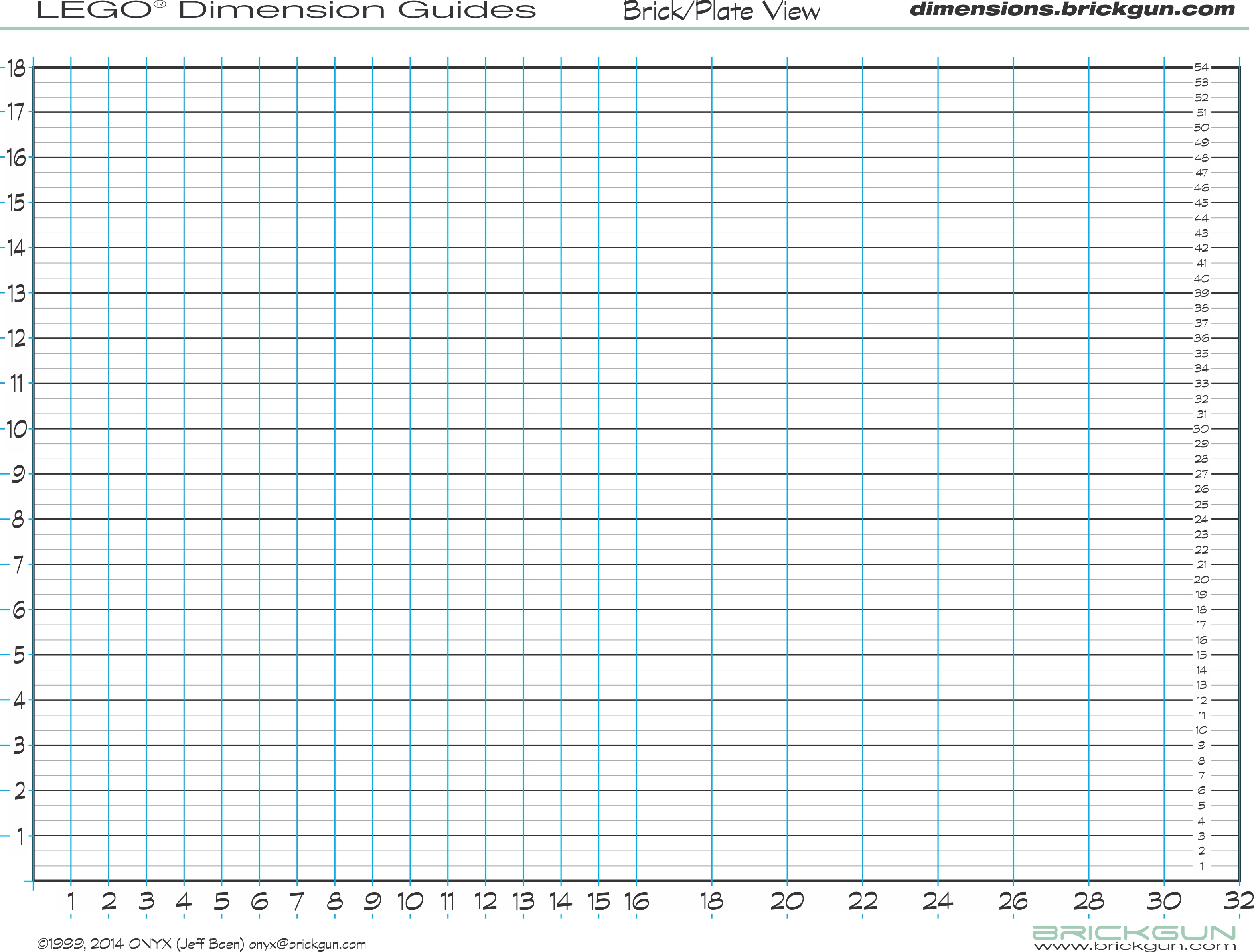
from this page
www.brickgun.com/Dimensions/BrickGun_Dimension_Guides.html
I used photoshop to enlarge the grid and lay it over the engine's drawing. Really helpful to get the proportions right!
Inspired by Stuart Jones' Romsey layout with working signalling and great looking multiple-units, I started designing a layout set in the Southern region from the 1950s to 1970s that incorporates two stations with full signalling between them. so far I've started designing the 205 units that will be part of the primary motive power for the layout along with some loco hauled trains for variety.
The station in this image is a rough build for just this image but will be loosely designed on Skegness's station and its architecture once i build it fully.
Photographed December 2017 / Ricoh 500 rangefinder & RIKEN RIKOMAT 4.5cm/2.8. Rollei RPX 400 rated ASA 320 developed in Pyrocat-HD (5mlA & 25ml B > 600ml, 7min @ 20*C). Negative 'scanned' in a JUMBL scanner box unit. Image processed & finished in Flickr.
Started designing this van last week to add to my police fleet and slowly bring the vehicles in line with my current scaling and building techniques. This particular vehicle is based on the Hyundai iLoad's dimensions which puts it at 13 studs long, 5 wide and 15 plates high. This allows two minifigs and any equipment needed for responses to fit inside.
To get the bonnet and windscreen to have realistic angles a few frowned upon techniques had to be used. The bonnet parts are connected by clips to the anti-stud areas underneath but the windscreen is floating in place. The windscreen is locked from side to side movement bar a 3L bar attached the dash and its angle is held while the vehicle is upright by the cheese slopes and the slide plate.
I need to make some stickers for headlights and police markings for this to be considered done. I'd also like to try and make a cage that can fit a minifig on the back but given the low roof and the way the rear fender attaches it's not possible so I may have to cheat and just have a torso and head in there.
Comments, criticism and questions are welcome, and keep an eye out for more.
web design, web designers, ecommerce web development, professional website design, professional website designers, web design firms, website design companies, website design company, website design firms, asp hosting net web, cheap web hosting service, design hosting, ecommerce website design hosting, free html code, free html tags, free website design, how to a website, how to webdesign, professional web design, professional web designers, professional website designs, small business web design, small business web hosting services, tags in html, top website design, web design companies, web design firm, web design hosting, web design jobs, web designer, web designer hosting, web designing companies, web designs, web hosting and design, web hosting business, web hosting provider, web hosting server, web hosting service, web hosting services, webdesign company, website design prices, website designing, website hosting services, website ptimization, website webdesign, creating a web page, create domain free, cheap websites, cheap website design and hosting, cheap website design, cheap web hosting services, cheap web development, cheap web design and hosting, cheap hosting service
Inside Delaware Park, just east of Buffalo History Museum, is this Japanese Garden.
xxxxxx
Partial and edited quote from PBS (America's Public Broadcasting Service)'s program on Frederick Law Olmsted: Designing America.
www.pbs.org/wned/frederick-law-olmsted/learn-more/olmsted...
"Frederick Law Olmsted (1822–1903) is most well-known as being the landscape designer of New York City's Central Park, yet Central Park is only a single block (OK, a massive block) of parkland in the heart of Manhattan, but in Buffalo, he was given the space and freedom and budget to build a series of parks that are linked by connecting parkways and tree-lined circles. Buffalo is regarded as the best-planned city in all of America by many. Buffalo is not merely a city with parks, but a city within a park system.
Love designing, can't sew. Anyway, thought I'd give JEM an addition to the Glitter'n Gold collection. A glittery bronze number for frolicking on the last few Summer nights before Fall sets in.
Sol Sender and Scott Thomas stopped by in San Francisco to discuss the Obama campaign logo and website and how graphic design and new media has revolutionized politics.
Ken Billington is a two-time Tony award winning Broadway lighting designer - world famous and wildly successful. Also has a long history of designing club lighting to the extent of revolutionizing it in the early '80s. He brought the theatre to nightclubs.
G Lounge was itself a revolutionary "gay bar" in the '90s in that it has a glass front on the street. No longer hiding in the shadows G Lounge was a DESIGNED, thoughtful, elegant nightclub for men to meet men. Featured in Interior Design magazine back in the day. And all these years later still a staple in Chelsea. (The painted lines all over the walls and ceiling - a more recent addition. NOT the original nightclub design.) !! I would have been reticent to add these lines, fearing their execution. But you know what - they were done well.
Years later some of the people involved in G also opened Here in L.A. and Ken had / has involvement with that nightclub, as well.
Anyway. I've known Ken for - 16 years now? Been to Europe with him. Travelled with him more than once. Many parties and dinners and shows. He's my friend and a really fabulous designer. Pretty fabulous guy just in general.
One can clearly see the Broadway influence in these custom sconces. In the round 'cruising zone' around the bar Ken designed these to highlight the DRAMA of queers being queer.
They remind me a little bit of Harry Gitlin track light fixtures from the '70s. And I think we can understand the reference of the more recently added lines, more of an '80s motif.
VERY COOL.
I appreciate your feedback. And thanks to Dr. Purrington for the valuable advice he has posted on his web site.
Anita says, the thing she likes most is cake-styling.
I'd say, for me... it's designing new lighting setups. :-))
This one could be a good and trusty setup for food shots for cooks with as less money as I have.
It's designed in the style of the light tent from Lastolite, the ePhotomaker, but costs far not as much money.
One flash, two cheap 5-in1-reflectors, one flash-transceiver-combo, that's it.
Notes: cmp text boxes in the shot.
Sinéad Burke, Founder, Sinéad Burke, Ireland; Cultural Leader.Caroline Baumann, Director, Cooper Hewitt, Smithsonian Design Museum, USA; Cultural Leader.Susannah Rodgers, Paralympian and Director, Spirit of 2012, United Kingdom; Young Global Leader, Cultural Leader,.speaking during the Session "Designing for Everyone" at the Annual Meeting 2019 of the World Economic Forum in Davos, January 22, 2019. Congress Centre - Betazone
Copyright by World Economic Forum / Mattias Nutt
Hmm, so another relatively large build just one week after a battleship. Must be a record for something......
Anyways, welcome to Okapanochie CS space OPS, which is a major CS operations and divisions center here on Earth. It was originally an American missile base in Missouri, but, of course, that was some time ago. It now is a major hub of for the logistics division for the CS fleet.
Yeah, so this has an interesting back story. I was designing a bomber aircraft, and the next thing I new, I happened to push together a few slope elements, and realized that it looked a bit like rock work. Yeah. I had always been inspired by LukeClarenceVan's Launch Facility, which is clearly was translated into this creation.
After designing and building the 5571 Giant Truck remake I wanted to tackle more Model Team vehicles. The natural next vehicle to try my hand at was the Highway Rig. Which, ironically is the model that inspired me to start this project to begin with. I used my Giant Truck MOC as a basis, but this isn't a simple palette swap. The chassis has been lengthened by 1 stud, the roof was completely redesigned and rebuilt, the cab has kept some techniques but has been changed significantly to accommodate for details on the original set, and many other things. I've had alot of fun designing this MOC and I am really looking forward to showing y'all the rest of the models I'm working on!
Instructions can be found here:
rebrickable.com/mocs/MOC-163098/IBrickedItUp/highway-rig-...
Some background:
The idea for a heavy infantry support vehicle capable of demolishing heavily defended buildings or fortified areas with a single shot came out of the experiences of the heavy urban fighting in the Battle of Stalingrad in 1942. At the time, the Wehrmacht had only the Sturm-Infanteriegeschütz 33B available for destroying buildings, a Sturmgeschütz III variant armed with a 15 cm sIG 33 heavy infantry gun. Twelve of them were lost in the fighting at Stalingrad. Its successor, the Sturmpanzer IV, also known by Allies as Brummbär, was in production from early 1943. This was essentially an improved version of the earlier design, mounting the same gun on the Panzer IV chassis with greatly improved armour protection.
While greatly improved compared to the earlier models, by this time infantry anti-tank weapons were improving dramatically, too, and the Wehrmacht still saw a need for a similar, but more heavily armoured and armed vehicle. Therefore, a decision was made to create a new vehicle based on the Tiger tank and arm it with a 210 mm howitzer. However, this weapon turned out not to be available at the time and was therefore replaced by a 380 mm rocket launcher, which was adapted from a Kriegsmarine depth charge launcher.
The 380 mm Raketen-Werfer 61 L/5.4 was a breech-loading barrel, which fired a short-range, rocket-propelled projectile roughly 1.5 m (4 ft 11 in) long. The gun itself existed in two iterations at the time. One, the RaG 43 (Raketenabschuss-Gerät 43), was a ship-mounted anti-aircraft weapon used for firing a cable-spooled parachute-anchor creating a hazard for aircraft. The second, the RTG 38 (Raketen Tauch-Geschoss 38), was a land-based system, originally planned for use in coastal installations by the Kriegsmarine firing depth-charges against submarines with a range of about 3.000 m. For use in a vehicle, the RTG 38 was to find use as a demolition gun and had to be modified for that role. This modification work was carried out by Rheinmetall at their Sommerda works.
The design of the rocket system caused some problems. Modified for use in a vehicle, the recoil from the modified rocket-mortar was enormous, about 40-tonnes, and this meant that only a heavy chassis could be used to mount the gun. The hot rocket exhaust could not be vented into the fighting compartment nor could the barrel withstand the pressure if the gasses were not vented. Therefore, a ring of ventilation shafts was put around the barrel which channeled the exhaust and gave the weapon something of a pepperbox appearance.
The shells for the weapon were extremely heavy, far too heavy for a man to load manually. As a result, each of them had to be carried by means of a ceiling-mounted trolley from their rack to a roller-mounted tray at the breech. Once on the tray, four soldiers could then push it into the breech to load it. The whole process took 10 minutes per shot from loading, aiming, elevating and, finally, to firing.
There were a variety of rocket-assisted round types with a weight of up to 376 kg (829 lb), and a maximum range of up to 6,000 m (20,000 ft), which either contained a high explosive charge of 125 kg (276 lb) or a shaped charge for use against fortifications, which could penetrate up to 2.5 m (8 ft 2 in) of reinforced concrete. The stated range of the former was 5,650 m (6,180 yd). A normal charge first accelerated the projectile to 45 m/s (150 ft/s) to leave the short, rifled barrel, the 40 kg (88 lb) rocket charge then boosted this to about 250 m/s (820 ft/s).
In September 1943 plans were made for Krupp to fabricate new Tiger I armored hulls for the Sturmtiger. The Tiger I hulls were to be sent to Henschel for chassis assembly and then to Alkett, where the superstructures would be mounted. The first prototype was ready and presented in October 1943. By May 1944, the Sturmtiger prototype had been kept busy with trials and firing tests for the development of range tables, but production had still not started yet and the concept was likely to be scrapped. Rather than ditch the idea though, orders were given that, instead of interrupting the production of the Tiger I, the Sturmtigers would be built on the chassis of Tiger I tanks which had already been in action and suffered serious damage. Twelve superstructures and RW 61 weapons were prepared and mounted on rebuilt Tiger I chassis. However, by August 1944 the dire need for this kind of vehicle led to the adaptation of another chassis to the 380 mm Sturmmörser: the SdKfz. 184, better known as “Ferdinand” (after its designer’s forename) and later, in an upgraded version, “Elefant”.
The Elefant (German for "elephant") was actually a heavy tank destroyer and the result of mismanagement and poor planning: Porsche GmbH had manufactured about 100 chassis for their unsuccessful proposal for the Tiger I tank, the so-called "Porsche Tiger". Both the successful Henschel proposal and the Porsche design used the same Krupp-designed turret—the Henschel design had its turret more-or-less centrally located on its hull, while the Porsche design placed the turret much closer to the front of the superstructure. Since the competing Henschel Tiger design was chosen for production, the Porsche chassis were no longer required for the Tiger tank project, and Porsche was left with 100 unfinished heavy tank hulls.
It was therefore decided that the Porsche chassis were to be used as the basis of a new heavy tank hunter, the Ferdinand, mounting Krupp's newly developed 88 mm (3.5 in) Panzerjägerkanone 43/2 (PaK 43) anti-tank gun with a new, long L71 barrel. This precise long-range weapon was intended to destroy enemy tanks before they came within their own range of effective fire, but in order to mount the very long and heavy weapon on the Porsche hull, its layout had to be completely redesigned.
Porsche’s SdKfz. 184’s unusual petrol-electric transmission made it much easier to relocate the engines than would be the case on a mechanical-transmission vehicle, since the engines could be mounted anywhere, and only the length of the power cables needed to be altered, as opposed to re-designing the driveshafts and locating the engines for the easiest routing of power shafts to the gearbox. Without the forward-mounted turret of the Porsche Tiger prototype, the twin engines were relocated to the front, where the turret had been, leaving room ahead of them for the driver and radio operator. As the engines were placed in the middle, the driver and the radio operator were isolated from the rest of the crew and could be addressed only by intercom. The now empty rear half of the hull was covered with a heavily armored, full five-sided casemate with slightly sloped upper faces and armored solid roof, and turned into a crew compartment, mounting a single 8.8 cm Pak 43 cannon in the forward face of the casemate.
From this readily available basis, the SdKfz. 184/1 was hurriedly developed. It differed from the tank hunter primarily through its new casemate that held the 380 mm Raketenwerfer. Since the SdKfz. 184/1 was intended for use in urban areas in close range street fighting, it needed to be heavily armoured to survive. Its front plate had a greater slope than the Ferdinand while the sides were more vertical and the roof was flat. Its sloped (at 47° from vertical) frontal casemate armor was 150 mm (5.9 in) thick, while its superstructure side and rear plates had a strength of 82 mm (3.2 in). The SdKfz.184/1 also received add-on armor of 100 mm thickness, bolted to the hull’s original vertical front plates, increasing the thickness to 200 mm but adding 5 tons of weight. All these measures pushed the weight of the vehicle up from the Ferdinand’s already bulky 65 t to 75 t, limiting the vehicle’s manoeuvrability even further. Located at the rear of the loading hatch was a Nahverteidigungswaffe launcher which was used for close defense against infantry with SMi 35 anti-personnel mines, even though smoke grenades or signal flares could be fired with the device in all directions, too. For close-range defense, a 7.92 mm MG 34 machine gun was carried in a ball mount in the front plate, an addition that was introduced to the Elefant tank hunters, too, after the SdKfz. 184 had during its initial deployments turned out to be very vulnerable to infantry attacks.
Due to the size of the RW 61 and the bulkiness of the ammunition, only fourteen rounds could be carried internally, of which one was already loaded, with another stored in the loading tray, and the rest were carried in two storage racks, leaving only little space for the crew of four in the rear compartment. To help with the loading of ammunition into the vehicle, a loading crane was fitted at the rear of the superstructure next to the loading hatch on the roof.
Due to the internal limits and the tactical nature of the vehicle, it was intended that each SdKfz. 184/1 (as well as each Sturmtiger) would be accompanied by an ammunition carrier, typically based on the Panzer IV chassis, but the lack of resources did not make this possible. There were even plans to build a dedicated, heavily armored ammunition carrier on the Tiger I chassis, but only one such carrier was completed and tested, it never reached production status.
By the time the first RW 61 carriers had become available, Germany had lost the initiative, with the Wehrmacht being almost exclusively on the defensive rather than the offensive, and this new tactical situation significantly weakened the value of both Sturmtiger and Sturmelefant, how the SdKfz 184/1 was semi-officially baptized. Nevertheless, three new Panzer companies were raised to operate the Sturmpanzer types: Panzer Sturmmörser Kompanien (PzStuMrKp) ("Armored Assault Mortar Company") 1000, 1001 and 1002. These originally were supposed to be equipped with fourteen vehicles each, but this figure was later reduced to four each, divided into two platoons, consisting of mixed vehicle types – whatever was available and operational.
PzStuMrKp 1000 was raised on 13 August 1944 and fought during the Warsaw Uprising with two vehicles, as did the prototype in a separate action, which may have been the only time the Sturmtiger was used in its intended role. PzStuMrKp 1001 and 1002 followed in September and October. Both PzStuMrKp 1000 and 1001 served during the Ardennes Offensive, with a total of four Sturmtiger and three Sturmelefanten.
After this offensive, the Sturmpanzer were used in the defence of Germany, mainly on the Western Front. During the battle for the bridge at Remagen, German forces mobilized Sturmmörserkompanie 1000 and 1001 (with a total of 7 vehicles, five Sturmtiger and two Sturmelefanten) to take part in the battle. The tanks were originally tasked with using their mortars against the bridge itself, though it was discovered that they lacked the accuracy needed to hit the bridge and cause significant damage with precise hits to vital structures. During this action, one of the Sturmtigers in Sturmmörserkompanie 1001 near Düren and Euskirchen allegedly hit a group of stationary Shermans tanks in a village with a 380mm round, resulting in nearly all the Shermans being put out of action and their crews killed or wounded - the only recorded tank-on-tank combat a Sturmtiger was ever engaged in. After the bridge fell to the Allies, Sturmmörserkompanie 1000 and 1001 were tasked with bombardment of Allied forces to cover the German retreat, as opposed to the bunker busting for which they had originally been designed for. None was actually destroyed through enemy fire, but many vehicles had to be given up due to mechanical failures or the lack of fuel. Most were blown up by their crews, but a few fell into allied hands in an operational state.
Total production numbers of the SdKfz. 184/1 are uncertain but, being an emergency product and based on a limited chassis supply, the number of vehicles that left the Nibelungenwerke in Austria was no more than ten – also because the tank hunter conversion had top priority and the exotic RW 61 launcher was in very limited supply. As a consequence, only a total of 18 Sturmtiger had been finished by December 1945 and put into service, too. However, the 380 mm Raketen-Werfer 61 remained in production and was in early 1946 adapted to the new Einheitspanzer E-50/75 chassis.
Specifications:
Crew: Six (driver, radio operator/machine gunner in the front cabin,
commander, gunner, 2× loader in the casemate section)
Weight: 75 tons
Length: 7,05 m (23 ft 1½ in)
Width: 3,38 m (11 ft 1 in)
Height w/o crane: 3,02 m (9 ft 10¾ in)
Ground clearance: 1ft 6¾ in (48 cm)
Climbing: 2 ft 6½ in (78 cm)
Fording depth: 3 ft 3¼ (1m)
Trench crossing: 8 ft 7 ¾ in (2,64 m)
Suspension: Longitudinal torsion-bar
Fuel capacity: 1.050 liters
Armour:
62 to 200 mm (2.44 to 7.87 in)
Performance:
30 km/h (19 mph) on road
15 km/h (10 miles per hour () off road
Operational range: 150 km (93 mi) on road
90 km (56 mi) cross-country
Power/weight: 8 hp/ton
Engine:
2× Maybach HL120 TRM petrol engines with 300 PS (246 hp, 221 kW) each, powering…
2× Siemens-Schuckert D1495a 500 Volt electric engines with 320 PS (316 hp, 230 kW) each
Transmission:
Electric
Armament:
1x 380 mm RW 61 rocket launcher L/5.4 with 14 rounds
1x 7.92 mm (0.312 in) MG 34 machine gun with 600 rounds
1x 100 mm grenade launcher (firing anti-personnel mines, smoke grenades or signal flares)
The kit and its assembly:.
This fictional tank model is not my own idea, it is rather based on a picture of a similar kitbashing of an Elefant with a Sturmtiger casemate and its massive missile launcher – even though it was a rather crude model, with a casemate created from cardboard. However, I found the idea charming, even more so because the Ferdinand/Elefant was rather a rolling bunker than an agile tank hunter, despite its powerful weapon. Why not use the same chassis as a carrier for the Sturmtiger’s huge mortar as an assault SPG?
The resulting Sturmelefant was created as a kitbashing: the chassis is an early boxing of the Trumpeter Elefant, which comes not only with IP track segments but also alternative vinyl tracks (later boxing do not feature them), and casemate parts come from a Trumpeter Sturmtiger.
While one would think that switching the casemate would be straightforward affair, the conversion turned out to be more complex than expected. Both Elefant and Sturmtiger come with separate casemate pieces, but they are not compatible. The Sturmtiger casemate is 2mm wider than the Elefant’s hull, and its glacis plate is deeper than the Elefant’s, leaving 4mm wide gaps at the sides and the rear. One option could have been to trim down the glacis plate, but I found the roofline to become much too low – and the casemate’s length would have been reduced.
So, I used the Sturmtiger casemate “as is” and filled the gaps with styrene sheet strips. This worked, but the casemate’s width created now inward-bent sections that looked unplausible. Nobody, even grazed German engineers, would not have neglected the laws of structural integrity. What to do? Tailoring the casemate’s sides down would have been one route, but this would have had created a strange shape. The alternative I chose was to widen the flanks of the Elefant’s hull underneath the casemate, which was achieved with tailored 0.5 mm styrene sheet panels and some PSR – possible through the Elefant’s simple shape and the mudguards that run along the vehicle’s flanks.
Some more PSR was necessary to blend the rear into a coherent shape and to fill a small gap at the glacis plate’s base. Putty was also used to fill/hide almost all openings on the glacis plate, since no driver sight or ball mount for a machine gun was necessary anymore. New bolts between hull and casemate were created with small drops of white glue. The rest of the surface details were taken from the respective donor kits.
Painting and markings:
This was not an easy choice. A classic Hinterhalt scheme would have been a natural choice, but since the Sturmelefant would have been converted from existing hulls with new parts, I decided to emphasize this heritage through a simple, uniform livery: all Ferdinand elements would be painted/left in a uniform Dunkelgelb (RAL, 7028, Humbrol 83), while the new casemate as well as the bolted-on front armor were left in a red primer livery, in two different shades (Humbrol 70 and 113). This looked a little too simple for my taste, so that I eventually added snaky lines in Dunkelgelb onto the primer-painted sections, blurring the contrast between the two tones.
Markings remained minimal, just three German crosses on the flanks and at the rear and a tactical code on the casemate – the latter in black and in a hand-written style, as if the vehicle had been rushed into frontline service.
After the decals had been secured under sone varnish the model received an overall washing with dark brown, highly thinned acrylic paint, some dry-brushing with light grey and some rust traces, before it was sealed overall with matt acrylic varnish and received some dirt stains with mixed watercolors and finally, after the tracks had been mounted, some artist pigments as physical dust on the lower areas.
Again a project that appeared simple but turned out to be more demanding because the parts would not fit as well as expected. The resulting bunker breaker looks plausible, less massive than the real Sturmtiger but still a menacing sight.
Mori Autumn.
Something new. Fur trim on the hem of the underskirt. A mohair pompom as hair accessory. A black velvet - embroidered vest. And a quirky fabric combo :D
The 1980's and 1990's TV series Designing Women was set in Atlanta, GA. The houses for the characters were actually in Little Rock, Arkansas.
Julia's home and the site of Sugarbakers & Associates was the Villa Marre house. It is a Second Empire house built in 1881. It is located in the MacArthur Park Historic District.
The house is at 1321 Scott Street.
Caroline Baumann, Director, Cooper Hewitt, Smithsonian Design Museum, USA; Cultural Leader,.speaking during the Session "Designing for Everyone" at the Annual Meeting 2019 of the World Economic Forum in Davos, January 22, 2019. Congress Centre - Betazone
Copyright by World Economic Forum / Mattias Nutt