View allAll Photos Tagged cabling
Factory built in around 1912 for local man Harold W. Smith, specialising in cables and cabling for the mining industry. One of only four works in the country that could produce braided electrical cables at the outbreak of the First World War, as a result was awarded contracts from the Ministry of War producing parts for the 'D mk III' field telephone.
The workforce grew from 40 [1912] to 650 as well as works operating on a double shift pattern for the duration of the war. By 1918, 15,000 miles of electrical cable had been produced.
Post war slump resulted in the 'H. W. Smith & Co' works going into administration. Works bought by 'Edison Swan Electric Co' [later 'Associated Electrical Company' and Siemens] to produce power lines cabling.
During the Second World War, the works had [again!] one of the four machines in the country able to produce lead tubes. These tubes were used in the construction of 'PLUTO' 'Pipe-Line Underwater Transportation of Oil' / 'Pipe-Lines Under the Ocean' which were fuel lines between the Isle of Wight and France to support the invasion of Normandy, 'Operation Overlord'.
The cable works closed in 1966 and was bought by a paper & cardboard company 'Reed Paper Group' who manufactured packaging.
The factory closed in the mid-1990s.
Further reading;
rcsigs.ca/index.php/Telephone_Set_D_Mk_III
wikipedia.org/wiki/Operation_Pluto
forest-of-dean.net/fodmembers/index.php?mode=thread&id=6614#p6626
Industrial Ethernet is growing as the accepted network in the industrial environment due to its speed and data visibility. While Cat5E is the base requirement for industrial Ethernet, when working with a specific network like EtherNet/IP or PROFINET, higher requirements are a must with the components in the network. What really helps or hinders the quality of the network is the cables - they connect everything together. Available with M12 D-coded and/or RJ45 connectors, Balluff’s 4 conductor cables are great for almost any industrial Ethernet application.
Saturday was my last full day in San Francisco, so I decided to go for one last photo session in the streets before going to bed.
I used my last roll, Neopan 400, which wasn't quite sensitive enough for most of my shots, but was also all I had left. I learned since then that film can be "pushed" beyond its rated iso, which I will have to try with this one because on those shots that worked out, I found it to have very little grain.
The giant wheels move the cables of MUNI's famed cable cars. From left to right, Hyde, California, Mason, and Powell are the primary streets under which the cables travel.
This is Washington/Mason cable car barn and powerhouse, which is also the home of the Cable car Museum. This should be the first stop on any transit fan's visit to San Francisco.
Factory built in around 1912 for local man Harold W. Smith, specialising in cables and cabling for the mining industry. One of only four works in the country that could produce braided electrical cables at the outbreak of the First World War, as a result was awarded contracts from the Ministry of War producing parts for the 'D mk III' field telephone.
The workforce grew from 40 [1912] to 650 as well as works operating on a double shift pattern for the duration of the war. By 1918, 15,000 miles of electrical cable had been produced.
Post war slump resulted in the 'H. W. Smith & Co' works going into administration. Works bought by 'Edison Swan Electric Co' [later 'Associated Electrical Company' and Siemens] to produce power lines cabling.
During the Second World War, the works had [again!] one of the four machines in the country able to produce lead tubes. These tubes were used in the construction of 'PLUTO' 'Pipe-Line Underwater Transportation of Oil' / 'Pipe-Lines Under the Ocean' which were fuel lines between the Isle of Wight and France to support the invasion of Normandy, 'Operation Overlord'.
The cable works closed in 1966 and was bought by a paper & cardboard company 'Reed Paper Group' who manufactured packaging.
The factory closed in the mid-1990s.
Further reading;
rcsigs.ca/index.php/Telephone_Set_D_Mk_III
wikipedia.org/wiki/Operation_Pluto
forest-of-dean.net/fodmembers/index.php?mode=thread&id=6614#p6626
I have three cables now; power, keyboard/mouse and FW800 for my 500GB LaCie (Time Machine).
Sent from my iPhone.
Direct United States Cable, c. 1880
Siemens Brothers, London
5 different cable samples with lacquered-brass collars
Mahogany case
Purchase of the Museum
HKMM2010.0318.0001
A surprisingly empty Shanghai street with telephone and eletric bus cables shimmering in the evening light, seen from a pedestrian bridge.
sha_041030_34
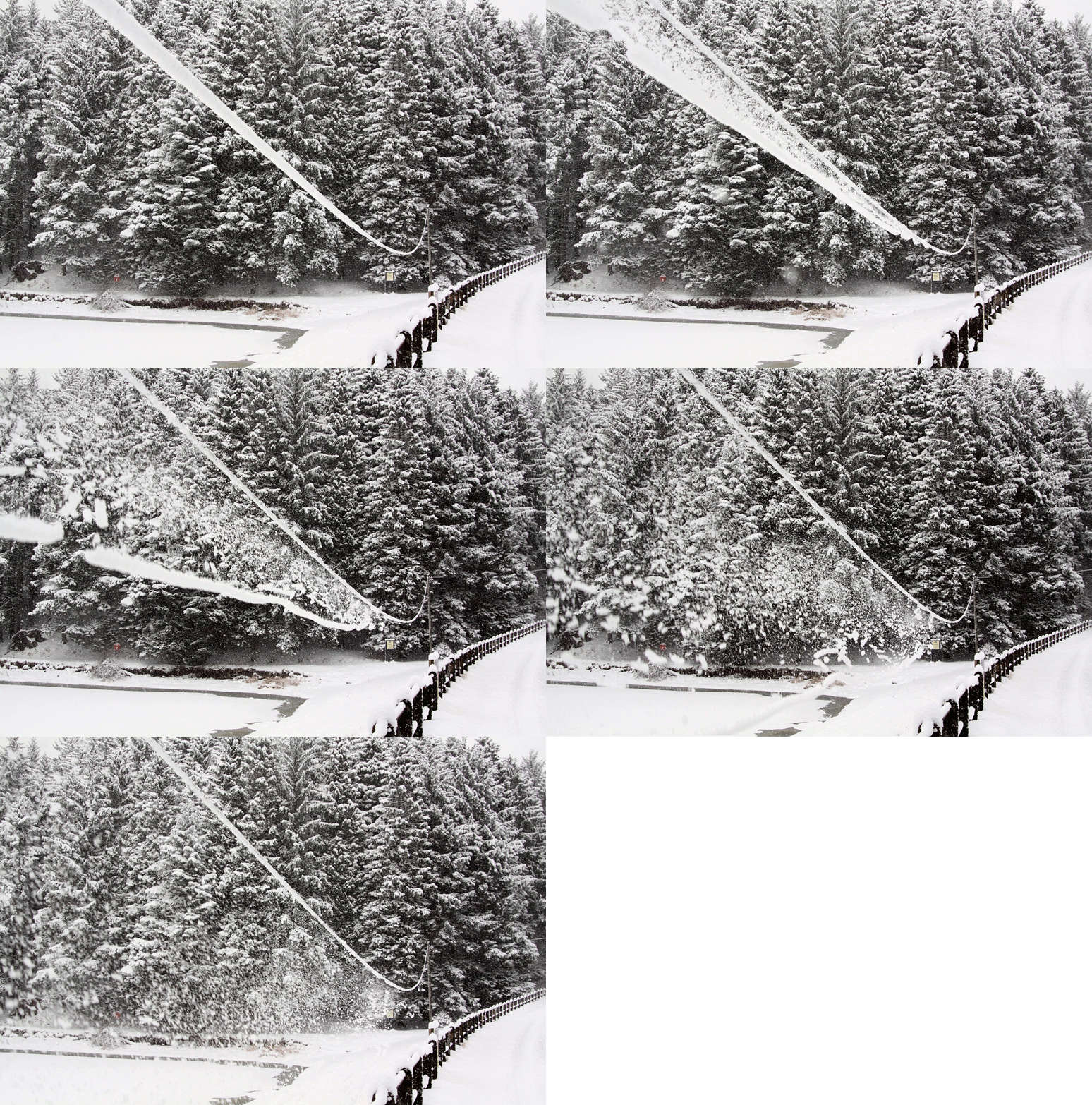
The same telephone cable after some snow was encouraged to fall off.
I made an animated GIF of it, as it happened. It is very big (1600x1080) and 7.1MB in size, but is well worth watching if you can afford the bandwidth.
This bag is a pattern from Cables Untangled. The original pattern is on the diagonal, but I altered it to be straight. A nice Berrocco yarn.
Before I visited San Francisco, some people told me “If you take a cable car, do not stand in it. First time visitor may fall from the car on a slope.” Well, I do not surprise if those people fall off the car even on a flat road.
Save Cable Bay - 24 images - Olympus E-510 with Zuiko Digital 1:3.5-5.6 14-42mm (4/3 mount) & Polarizer - Photographer Russell McNeil PhD (Physics) lives on Vancouver Island, where he works as a writer.
An explanation, in Hebrew, of the cable car that traveled over the Ben Hinnom Valley to Mount Zion during Israel's War of Independence. My translation follows:
"During the War of Independence (1947–1979), the Israel Defense Forces captured the building, which until that time served as an opthalmology hospital. A steel cable was attached to the roof for a cable car that contained equipment and supplies for the IDF troops on Mount Zion, under threat by troops of the Jordanian Legion who were in positions on the wall. The cable car operated at night, and as morning approached, it was lowered to the ground in the valley in order to conceal it from the Jordanian troops."
The name of the cable car's creator was Uriel Hefetz.
Factory built in around 1912 for local man Harold W. Smith, specialising in cables and cabling for the mining industry. One of only four works in the country that could produce braided electrical cables at the outbreak of the First World War, as a result was awarded contracts from the Ministry of War producing parts for the 'D mk III' field telephone.
The workforce grew from 40 [1912] to 650 as well as works operating on a double shift pattern for the duration of the war. By 1918, 15,000 miles of electrical cable had been produced.
Post war slump resulted in the 'H. W. Smith & Co' works going into administration. Works bought by 'Edison Swan Electric Co' [later 'Associated Electrical Company' and Siemens] to produce power lines cabling.
During the Second World War, the works had [again!] one of the four machines in the country able to produce lead tubes. These tubes were used in the construction of 'PLUTO' 'Pipe-Line Underwater Transportation of Oil' / 'Pipe-Lines Under the Ocean' which were fuel lines between the Isle of Wight and France to support the invasion of Normandy, 'Operation Overlord'.
The cable works closed in 1966 and was bought by a paper & cardboard company 'Reed Paper Group' who manufactured packaging.
The factory closed in the mid-1990s.
Further reading;
rcsigs.ca/index.php/Telephone_Set_D_Mk_III
wikipedia.org/wiki/Operation_Pluto
forest-of-dean.net/fodmembers/index.php?mode=thread&id=6614#p6626
Anleitung/pattern: Cable Rib Socks from Favorite Socks by Erica Alexander
Garn/yarn: sockyarn by SuperGarne
On Ravelry: Rote Zöpfe
Factory built in around 1912 for local man Harold W. Smith, specialising in cables and cabling for the mining industry. One of only four works in the country that could produce braided electrical cables at the outbreak of the First World War, as a result was awarded contracts from the Ministry of War producing parts for the 'D mk III' field telephone.
The workforce grew from 40 [1912] to 650 as well as works operating on a double shift pattern for the duration of the war. By 1918, 15,000 miles of electrical cable had been produced.
Post war slump resulted in the 'H. W. Smith & Co' works going into administration. Works bought by 'Edison Swan Electric Co' [later 'Associated Electrical Company' and Siemens] to produce power lines cabling.
During the Second World War, the works had [again!] one of the four machines in the country able to produce lead tubes. These tubes were used in the construction of 'PLUTO' 'Pipe-Line Underwater Transportation of Oil' / 'Pipe-Lines Under the Ocean' which were fuel lines between the Isle of Wight and France to support the invasion of Normandy, 'Operation Overlord'.
The cable works closed in 1966 and was bought by a paper & cardboard company 'Reed Paper Group' who manufactured packaging.
The factory closed in the mid-1990s.
Further reading;
rcsigs.ca/index.php/Telephone_Set_D_Mk_III
wikipedia.org/wiki/Operation_Pluto
forest-of-dean.net/fodmembers/index.php?mode=thread&id=6614#p6626
El Foc al Cable! Els diables i les bèsties de foc al seu pas per davant del Cable en la Processó de Sant Bartomeu Festa Major Sitges 2018
PROGRAMA I FOTOS FESTA MAJOR SITGES 2018 A www.visitsitges.com/ca/festa-major-sitges-2018
#fmsitges18
Daniels College of Business IMBA/MBA Spring 2013 Academic Hood Presentation Ceremony - The Cable Center, June 7, 2013
Factory built in around 1912 for local man Harold W. Smith, specialising in cables and cabling for the mining industry. One of only four works in the country that could produce braided electrical cables at the outbreak of the First World War, as a result was awarded contracts from the Ministry of War producing parts for the 'D mk III' field telephone.
The workforce grew from 40 [1912] to 650 as well as works operating on a double shift pattern for the duration of the war. By 1918, 15,000 miles of electrical cable had been produced.
Post war slump resulted in the 'H. W. Smith & Co' works going into administration. Works bought by 'Edison Swan Electric Co' [later 'Associated Electrical Company' and Siemens] to produce power lines cabling.
During the Second World War, the works had [again!] one of the four machines in the country able to produce lead tubes. These tubes were used in the construction of 'PLUTO' 'Pipe-Line Underwater Transportation of Oil' / 'Pipe-Lines Under the Ocean' which were fuel lines between the Isle of Wight and France to support the invasion of Normandy, 'Operation Overlord'.
The cable works closed in 1966 and was bought by a paper & cardboard company 'Reed Paper Group' who manufactured packaging.
The factory closed in the mid-1990s.
Further reading;
rcsigs.ca/index.php/Telephone_Set_D_Mk_III
wikipedia.org/wiki/Operation_Pluto
forest-of-dean.net/fodmembers/index.php?mode=thread&id=6614#p6626