View allAll Photos Tagged automating
The ArmourDyne automated defence pod takes care of the perimeter without the need for constant patrols, the A.I system can detect hostile troops and make the kill without the need of a human operator. A multi phase dual plasma cannon comes fitted as standard but other options are available. Whilst the system is fully automated the pod also has extendable battlements for additional firepower, this could be provided by troops or by adding additional AD Systems auto weaponry.
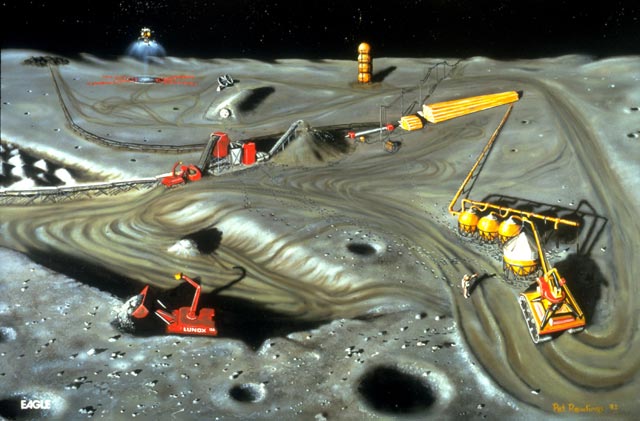
“Photo S83-28324 shows a strip mine on the Moon. Bulk soil is delivered by front-end loaders to an automated processing facility where the mineral ilmenite (FeTiO₃) is separated out and then chemically reduced by heating in the presence of hydrogen. The products of the reaction are metallic iron, titanium oxide, and water. The water is piped to an electrolysis facility where the hydrogen is recovered and the oxygen is stored in spherical tanks. In the foreground on the right, a filled tank is about to be carried to the landing pad where the lunar transfer vehicle is landing (left background). In the upper center sits a stack of imported hydrogen tanks. Power lines stretch over the ridge to undefined power station.”
Despite there being something a little wonky about the perspective, the depictions of objects relative to the perspective, apparent distance to the horizon (yes, I know it’s the moon, thereby relatively close), along with its rather abrupt/sharp terminus…it’s by Pat Rawlings…so it’s still gorgeous. Enjoy, in all its glorious 1200 dpi resolution.
Okay, so I think I’ve figured it out; there are two different “view angles” going on here. The left ½ - ⅔ of the image is shallower/more oblique, especially noticeable in the depiction of the excavated pit. The right half/third starts with a much steeper perspective of the nearer/foreground area, evident in the depiction of the tracked vehicle. Note also the softer transition from horizon-to-void to the right, starting at the power lines. To me, even the regolith on the right looks to be a shade lighter.
I can’t help but think Mr. Rawlings entirely reworked that side for some reason. But, maybe it’s just me.
www.patrawlings.com/images/large/E006.jpg
Credit: Pat Rawlings' website
www.reddit.com/media?url=https://preview.redd.it/what-the...

Credit: Andy-roo77/reddit
Also, the image & following, as contained within NASA SP-509, Volume 4/"SPACE RESOURCES: Social Concerns":
"Lunar Mining and Processing
Though international law prohibits the annexation of any part of the Moon, it would allow the use of raw materials mined at a lunar base. In this concept, based on a model by Hubert Davis of Eagle Engineering, bulk soil from a strip mine is delivered by front-end loaders to an automated processing facility. The oxygen won from the process is liquefied and piped to the storage tanks on the right. One filled tank is being loaded now, perhaps to be used at the lunar base, perhaps to be shipped to orbit. The slag is carried by conveyor belt to a dump in the background to the left. Near it, a lunar lighter can be seen landing. The tanks stacked to the right of the buried habitat module contain hydrogen for use in the process and as propellant. Power lines stretch over the ridge to a power station, possibly a nuclear reactor."
At/From:
www.lpi.usra.edu/lunar/strategies/SP509-4-Social.pdf
Credit: LPI website
And finally, from The Man himself! I knew I wasn’t crazy.
Just makes you respect & appreciate him that much more. An immensely talented class act:
www.patrawlings.com/article/learning-the-hard-way
Credit: Pat Rawlings blog/website
In addition to Time magazine. I assume also to his chagrin…featured on the cover:
historycollection.jsc.nasa.gov/JSCHistoryPortal/history/r...
A revolution in phenomic is taking place, using non-invasive technologies based on spectral reflectance from plant tissue.
Photo by Alfonso Cortés/CIMMYT.
ISS036-E-007844 (15 June 2013) --- Surrounded by the blackness of space, the European Space Agency's Automated Transfer Vehicle-4 (ATV-4) “Albert Einstein” approaches the International Space Station. The spacecraft went on to successfully dock to the orbital outpost at 2:07 GMT, June 15, 2013, following a ten-day period of free-flight.
Production: 1997 - 2007 (156 range)
Engine: 3,2 litre V6 (petrol)
Power: 250 PS
Gearbox: 6 speed Selespeed automated manual
Layout: front engine, front drive
Location:Hockenheim, Deutschland (Germany)
Total made: 1.973 saloons (+ 1.678 Sportwagons)
At Sama Brokers, we offer the most reliable and trusted automatic forex trading system services at competitive prices. Our automated forex trading software relies on the facts that are accurate and well researched. Contact us to get details....@ www.samabrokers.com/best-automated-forex-trading-system-a...
Adena Friedman, President and Chief Executive Officer, Nasdaq, USA speaking during the Session "Automated Markets" at the Annual Meeting 2019 of the World Economic Forum in Davos, January 22, 2019. Congress Center / Aspen 2. Copyright by World Economic Forum / Faruk Pinjo
Sandia National Laboratories materials scientist Brad Boyce watches as the Alinstante robotic work cell scans a 3D-printed part to compare what was made to the original design. This test part was devised to push the limits of 3D printing technology. The goal of Alinstante is to speed up the testing of 3D-printed parts and materials science research.
Learn more at share-ng.sandia.gov/news/resources/news_releases/instant_....
Photo by Randy Montoya.
Our automated drink dispenser. Uses a GUI programed in C# and uses a Rabbit 2000 microprocessor to control valves/sensors.
This man needs three hands. Juggling a camera, cigarette and an iPod, he walks down Queen street with his head up.
Visit my portfolio at www.urbanlight.ca
This is a 1:16 scale model of HX3 Tactical Truck. The model features a 4-axles chassis, up-armored cab, automated load handling system and a replica of 20ft shipping container. Modular design of this model allows to replace the cab as well as a payload in order to demonstrate more options and capabilities.
The model was developed in 3D software. The parts were produced by rapid prototyping from increased durability plastic, manually assembled and painted.
The model is mounted on painted base with acrylic clear protective cover and packed in heavy duty military grade Rotomold transit case.
It was first exhibited at 2022 AUSA trade show where it earned positive feedback for its accuracy, level of detailing and realism.
The Dubai Metro is a driverless, fully automated metro network in the United Arab Emirates city of Dubai. The Red Line and Green Line are operational, with three further lines are planned. These first two lines run underground in the city centre and on elevated viaducts elsewhere (Elevated railway).[2] All trains and stations are air conditioned with platform edge doors to make this possible.
The first section of the Red Line, covering 10 stations, was ceremonially inaugurated at 9:09:09 PM on September 9, 2009, by Mohammed bin Rashid Al Maktoum, Ruler of Dubai,[3] with the line opening to the public at 6 AM on September 10.[4] The Dubai Metro is the first urban train network in the Arabian Peninsula.[5] More than 110,000 people, which is nearly 10 per cent of Dubai’s population, used the Metro in its first two days of operation.[6] The Dubai Metro carried 10 million passengers from launch on 9 September 2009 to 9 February 2010 with 11 stations operational on the Red Line.[7]
At 75 km, the Dubai Metro is frequently cited as the world's longest fully automated metro network.[8]
An automated pipe welder for large-diameter steel pipe.
Terms of Use: Our images are freely and publicly available for use with the credit line, "Courtesy of Pacific Northwest National Laboratory"; Please use provided caption information for use in appropriate context.
The 2017 SkillsUSA National Leadership and Skills Conference Competition Medalists were announced Friday, June 23, 2017 at Freedom Hall in Louisville.
Automated Manufacturing Technology
Team I (consisting of Salvador Alcala, William Kipp, Madison Gigliotti)
High School McCann Technical High School
Gold North Adams, MA
Automated Manufacturing TechnologyTeam B (consisting of Logan Bruneau, Tobias Schmidt, Jake Stein)
High School S & W Washtenaw Consortium
Silver Saline, MI
Automated Manufacturing TechnologyTeam H (consisting of Sudarshan Kadalazhi, Tomas Ponce, Dylan Hulstedt)
High School Paradise Valley High School
Bronze Phoenix, AZ
Automated Manufacturing TechnologyTeam J (consisting of Peter Prombo-Cates, Matthew Roderick, Patrick McDermott)
College Ranken Tech College
Gold Saint Louis, MO
Automated Manufacturing TechnologyTeam O (consisting of Quacy Wilson, Jason Hall, Tucker Hildreth)
College Gillette College
Silver Gillette, WY
Automated Manufacturing TechnologyTeam D (consisting of Trevor Purdy, Elijah Buist, Andrew Ketchum)
College Ferris State University
Bronze Big Rapids, MI
The 2017 SkillsUSA National Leadership and Skills Conference Competition Medalists were announced Friday, June 23, 2017 at Freedom Hall in Louisville.
Automated Manufacturing Technology
Team I (consisting of Salvador Alcala, William Kipp, Madison Gigliotti)
High School McCann Technical High School
Gold North Adams, MA
Automated Manufacturing TechnologyTeam B (consisting of Logan Bruneau, Tobias Schmidt, Jake Stein)
High School S & W Washtenaw Consortium
Silver Saline, MI
Automated Manufacturing TechnologyTeam H (consisting of Sudarshan Kadalazhi, Tomas Ponce, Dylan Hulstedt)
High School Paradise Valley High School
Bronze Phoenix, AZ
Automated Manufacturing TechnologyTeam J (consisting of Peter Prombo-Cates, Matthew Roderick, Patrick McDermott)
College Ranken Tech College
Gold Saint Louis, MO
Automated Manufacturing TechnologyTeam O (consisting of Quacy Wilson, Jason Hall, Tucker Hildreth)
College Gillette College
Silver Gillette, WY
Automated Manufacturing TechnologyTeam D (consisting of Trevor Purdy, Elijah Buist, Andrew Ketchum)
College Ferris State University
Bronze Big Rapids, MI
You just gotta get this App for the kitchen... Wife 6.2, all the bugs have been fixed, the patch for earache works well and the dinner clock has been regulated. Installing plug-ins like 'G&T ice-and-a-slice' or Bottle-of-red' come jam packed with bonus features!!!
A high-throughput screening system handling and dispensing liquids. Additional Information: Liquids are handled and dispensed in nanoliter volumes.
Credit: National Center for Advancing Translational Sciences
The 2017 SkillsUSA National Leadership and Skills Conference Competition Medalists were announced Friday, June 23, 2017 at Freedom Hall in Louisville.
Automated Manufacturing Technology
Team I (consisting of Salvador Alcala, William Kipp, Madison Gigliotti)
High School McCann Technical High School
Gold North Adams, MA
Automated Manufacturing TechnologyTeam B (consisting of Logan Bruneau, Tobias Schmidt, Jake Stein)
High School S & W Washtenaw Consortium
Silver Saline, MI
Automated Manufacturing TechnologyTeam H (consisting of Sudarshan Kadalazhi, Tomas Ponce, Dylan Hulstedt)
High School Paradise Valley High School
Bronze Phoenix, AZ
Automated Manufacturing TechnologyTeam J (consisting of Peter Prombo-Cates, Matthew Roderick, Patrick McDermott)
College Ranken Tech College
Gold Saint Louis, MO
Automated Manufacturing TechnologyTeam O (consisting of Quacy Wilson, Jason Hall, Tucker Hildreth)
College Gillette College
Silver Gillette, WY
Automated Manufacturing TechnologyTeam D (consisting of Trevor Purdy, Elijah Buist, Andrew Ketchum)
College Ferris State University
Bronze Big Rapids, MI
Manage your calls instantly without leaving patients on hold with medical answering service. Our system can handle urgent call flows, patient information, message taking, paging, call transferring, and receptionist services.
The driverless two-coach unit #110 comes into Bangsar Station, Kuala Lumpur. The Kuala Jana Line runs for 29kms across the city. The return fares are cheap by European standards, less than £1 /$1.50. Carrying thousands of people every day, the already extensive metro system is being expanded to counter KL's horrendous rush-hour traffic chaos. Bus travel is also cheap, clean and efficient. However without many dedicated bus lanes they get caught up in the car traffic and journeys can be very slow. A monorail also runs across the city. However, it is the metro system (and local rail lines) that the government are putting their money into.
Xiaohu Zhang, M.D., puts assay plates into the robot plate carousel in one of NCATS laboratories.
Credit: Daniel Soñé Photography, LLC
KARR (Knight Automated Roving Robot) is the name of a fictional, automated, prototype vehicle featured as a major antagonist in two episodes of the television series Knight Rider and was part of a multi-episode story arc in the 2008 revived series.
Origin and background
KARR is the prototype version of KITT, originally designed by Wilton Knight and built by his company Knight Industries. Upon completion of the vehicle, KARR's CPU was installed and activated. However, a programming error made the computer unstable and potentially dangerous. The project was put on hold and KARR was placed in storage until a solution could be found.
Unlike KITT, whose primary directive is to protect human life, KARR was programmed for self-preservation, making him a ruthless and unpredictable threat. He does not appear as streetwise as KITT, being very naive and inexperienced and having a childlike perception of the world. This has occasionally allowed people to take advantage of his remarkable capabilities for their own gain; however, due to his ruthless nature he sometimes uses people's weaknesses and greed as a way to manipulate them for his own goals. Despite this, he does ultimately consider himself superior (always referring to KITT as "the inferior production line model") as well as unstoppable, and due to his programming the villains don't usually get very far. KARR demonstrates a complete lack of respect or loyalty - on one occasion ejecting his passenger to reduce weight and increase his chances of escape.
KARR first appeared in the Season One episode "Trust Doesn't Rust" aired on NBC on November 19, 1982, where he seemingly met his demise at the end. However, he was so popular with viewers that he was brought back again in the Season Three episode "K.I.T.T. vs. K.A.R.R.", aired on NBC on November 4, 1984 (marking him as one of the very few villains in the original series to make a return appearance).
Appearances in the original series
"Trust Doesn't Rust" - Season 1, Episode 9
Once KITT was constructed, it was presumed that his prototype KARR had been deactivated and dismantled. However, the latter did not occur and KARR was placed in storage and forgotten following the death of Wilton Knight. When two thieves, Tony (Michael MacRae) and The Rev (William Sanderson), break into the warehouse where KARR is "sleeping", they unwittingly reactivate him, and he escapes.
When the two thieves realize how useful the vehicle could be, they use KARR to go on a crime spree, whilst Michael and KITT frantically try to catch up with KARR and stop him before anyone is seriously hurt. Bonnie devises a high-powered laser, the only known way to stop KARR, which must be fired from KITT directly into KARR's scanner. However, when KARR needs maintenance, Tony kidnaps Bonnie before the laser can fully be calibrated. Although Michael rescues Bonnie, she is unable to get a clear shot at KARR with the laser and he escapes.
KARR's only weakness is his primary directive of self-preservation and Michael uses this to his advantage. When KARR threatens to destroy KITT in a head-on collision, Michael plays chicken with him, on a hunch that KARR will veer out of KITT's path in order to protect himself. KARR indeed swerves out of the way, but unable to stop in time, he drives off a cliff and seemingly explodes in the ocean (using footage of the climactic scene from the 1977 film The Car, footage that was also used for KITT on a couple of other occasions). KARR was voiced by well known Canadian voice actor, Peter Cullen.
Trust Doesn't Rust was also printed in book form, written by Roger Hill and Glen A. Larson, following the story and general script of the original television episode, expanding some areas of the plot and adding several extra secondary characters.
"K.I.T.T. vs. K.A.R.R." - Season 3, Episode 6
KARR was only believed to have been destroyed. He was damaged and ended up buried in the sand on the beach below the cliffs. When the tide had gone out, a young couple, John and Mandy, stumble upon the partially buried car, dig him out, and reactivate him. This time, KARR is furious and has only one clear motive: revenge against Michael and KITT.
KARR is still damaged after the last encounter with KITT and forces John to serve as his driver, and also to carry out some cosmetic modifications to his paintwork. In a ravine, KARR challenges Michael and KITT to a final showdown. After releasing the young couple, KARR fires a stolen laser and damages KITT. However, Michael and KITT destroy KARR's laser by reflecting the beam back to the emitter. Damaged, KARR prepares for another attack. KITT and KARR both turbo boost and collide in mid-air. KARR is blown to pieces, but Michael and KITT survive the impact. At the end of the episode, however, KARR's motherboard — i.e. KARR himself — can be seen lying undamaged on the ground amongst the wreckage, its LED's still blinking - suggesting to the viewer that KARR is still "alive."
Production changes[edit]
Originally, KARR appeared identical to KITT, with a red light scan bar, and the only physical difference was a greenish-yellow LED voice modulator on his dash (for the first half of the first season, KITT's voice modulator is a red square that blinks on and off as he talks; KARR's voice modulator is the prototype to the one seen on KITT from the mid first season onwards, after it was received well by viewers). When KARR returns in "K.I.T.T. vs. K.A.R.R.", KARR's scan bar is now amber.
KARR later gets a two-tone paint job incorporating a silver lower body into his familiar all-black finish. KARR's scanner originally made a low droning noise, but in the comeback episode it sounds similar to KITT's but with a slight reverb audio effect added to it. The sound of KARR's engine, originally sounding rough and "fierce", here sounds similar to KITT's, again effected by a reverb. In "Trust Doesn't Rust," KARR had no license plates. In KARR's second appearance, he had a California license plate that read "KARR". Despite various other changes, KARR's dashboard remains correct with continuity - he still has the earlier version of the dash as previously seen on KITT, whereas by the time of 'KITT Vs KARR', Bonnie had updated KITT's dash and various functions at the start of the third season.
KARR's personality is also somewhat different in the comeback episode. His childlike perceptions are diminished into a more devious personality, completely cold and bent on revenge. His self-preservation directive is no longer in play when KARR is close to exploding after receiving severe damage; he willingly turbo-jumps into a mid-air collision with KITT hoping that his own destruction would also spell his counterpart's. Even KARR's modus operandi is different; serviceful enough in the first episode, he aims to actually make use of other persons, anyone, to serve his own needs. One explanation of this change could be as a result of the damage he received after falling over the cliff at the end of "Trust Doesn't Rust", which further malfunctioned his programming. Indeed, KITT himself is seen to malfunction and suffer change of personality as a result of damage in several other episodes.
In "Trust Doesn't Rust" and the 2008 series, the voice of KARR was provided by voice actor Peter Cullen, better known as the voice of Optimus Prime in the Transformers cartoon series, and whom had a previous working relationship with series creator Glen A. Larson after voicing several Cylon characters in the original Battlestar Galactica. In "K.I.T.T. vs K.A.R.R.", KARR was voiced by Paul Frees, best known as the voice of Boris Badenov in the popular series The Rocky and Bullwinkle Show and as the voice of Ludwig Von Drake in the popular anthology series, Walt Disney's Wonderful World of Color. As with William Daniels, the voice of KITT, who was never credited on-screen, Frees was uncredited on-screen for his role, leading Cullen to sometimes be mistakenly credited as providing KARR's voice in "K.I.T.T. vs K.A.R.R." Peter Cullen reprised his role as the voice of KARR in the 2009 Knight Rider episode, "Knight to King's Pawn."
[Text from Wikipedia]
en.wikipedia.org/wiki/KARR_%28Knight_Rider%29
As corny as Knight Rider seems now, this show well and truley captured the imagination of my 11-year old self. Many of the 'futuristic' technologies incorporated into K.I.T.T. are now becoming commonplace.
This miniland-scale Lego Pontiac 1982 Firebird Trans Am 'K.A.R.R.' (Knight Rider TV Series - 1984) has been created for Flickr LUGNuts' 91st Build Challenge, - "Anger Management", - all about cars with some link to being angry.
To commemorate Ferrari's 16th victory in the Formula 1 Constructor's World Championship 2008, Ferrari unveiled the Scuderia Spider 16M at World Finals in Mugello. It is a convertible version of the 430 Scuderia.
The engine produces 510 PS (375 kW; 503 hp) at 8500 rpm and 470 N·m (350 lb·ft) torque at 5250 rpm. The car has a dry weight of 1,340 kg (2,954 lb) (80 kg lighter than the F430 Spider) and a curb weight of 1,440 kg (3,175 lb). It accelerates from 0-100 km/h (62 mph) in 3.7 seconds, with a top speed of 315 km/h (196 mph).
499 vehicles were released beginning early 2009.
VEHICLE TYPE: mid-engine, rear-wheel-drive, 2-passenger, 2-door roadster
BASE PRICE: $313,350
ENGINE TYPE: DOHC 32-valve V-8, aluminum block and heads, port fuel injection
Displacement: 263 cu in, 4308cc
Power: 503 bhp @ 8500 rpm
Torque: 347 lb-ft @ 5250 rpm
TRANSMISSION: 6-speed manual with automated shifting and clutch
DIMENSIONS:
Wheelbase: 102.4 in
Length: 177.6 in
Width: 75.7 in Height: 47.9 in
Curb weight (C/D est): 3300 lb
PERFORMANCE (C/D EST):
Zero to 60 mph: 3.4 sec
Standing ¼-mile: 11.5 sec
Top speed (redline limited): 196 mph
FUEL ECONOMY (C/D EST):
EPA city/highway: 11/16 mpg
Ferrari Ownership Requirements 12/7/2020
To own a Ferrari would fulfill the fantasy of many car enthusiasts. The famous Italian automaker excels in delivering luxury sports cars that bear a signature and unique exterior without sacrificing performance. This is only half of what makes the cars special though.
Ferrari's culture separates the company from other automakers in huge ways, affecting both its owners and the workers behind these miraculous machines. Although the company is one of the most valuable, it cares about something more than just earning money: it’s about making special cars that offer a driving experience unlike any other. When examining the company and its owners, it’s clear they’ve achieved this milestone, even after all these years.
Owners have to go to great lengths if they want the latest and greatest cars Ferrari churns out. Employees have to follow rules and regulations if they want to uphold the most important thing to Ferrari—which is not about making cars, but the brand itself. Whether one is a Ferrari owner or an employee that works at their factory plant, everyone has to follow the "Ferrari code."
It’s because of these rules that the brand is exclusive and widely coveted among car gurus today. If someone wants to own a Ferrari, they’re going to have to play by the company’s rules. The same goes for employees if they want to work at, what Autoblog notes, a company that won the award for Best Place to Work in Europe for 2007. We’re going to take a look at known rules both owners and employees have to follow if they want to remain in the good graces of Ferrari.
--------------------------------------------------------------------------------------
20 - Owner Rule: Forced To Sign Contract Agreeing Not To Sell Car
People today become bombarded with agreements written in fine print. Most people don’t have the time or patience to read all that agreements detail though and decide to sign on the line regardless. According to Autoweek, Ferrari in the US makes their customers sign a contract upon purchasing a new vehicle.
In that agreement is a clause that prevents owners from reselling their car in the first year. The automaker makes buyers sign this in an attempt to discourage owners from flipping their cars. This is both a reminder to read the fine print and further demonstrates the automaker’s stringent protocol placed upon new owners.
19 - Employee Rule: Forbidden From Buying New Cars
Last September, Ferrari unveiled a pair of Roadsters long-time employees can appreciate. Even if the employees want the cars though and can afford them—tough luck. The Drive reports that the company makes their vehicles first and foremost available to the public.
One of Ferrari’s executives, Enrico Galliera, had this to say about employees getting second dibs on new cars: “The philosophy is that with such limited production and clients waiting so long to get their car, it's not nice if the car is delivered to employees.” The only exception to this rule are Scuderia Ferrari F1 drivers who can buy one from the company.
18 - Owner Rule: Leave The Logos Alone
Ferrari believes that as soon as their car rolls off the production line, it's perfect as is. There’s no shortage of Ferrari owners who feel differently though; here’s photographic proof of owners who took their Ferrari rides for granted. If Ferrari had it their way, they’d opt for owners to leave their iconic logos untouched.
According to Tech Dirt, the electronic DJ and artist Deadmau5 got in trouble for covering up his Ferrari logos with custom ones. His 458 Italia “Purrari” sports a blue vinyl wrap that has a Nyan cat painted on the side. It’s a move Ferrari supposedly issued a cease and desist order over.
17 - Employee Rule: Communicate On Their Terms
Ferrari has gone to extremes to sell cars before by tampering with some odometers on used cars, so it’s only natural they’d apply radical policies in the workplace as well. It appears that too many employees were reaching for the keyboard on too many occasions instead of opting for old fashioned face-to-face communication.
According to The Guardian, the executives at Ferrari advised their employees to “talk to each other more and write less.” Since it should be pretty easy for supervisors to monitor their employees’ computer activity, it's safe to assume workers adhere to this directive in order to stick around.
16 - Owner Rule: No Pink Ferraris
Ferrari isn’t fond of pink Ferraris. That’s what Executive Lifestyle reports, despite the company tolerating some customer paint jobs. The disapproval of pink came directly from Herbert Appleroth, the President and CEO of Ferrari Australia. “We do reject the exterior color pink,” Appleroth said, as per the same source.
He went on to say that Ferrari would never produce a pink car. Without a doubt, red is the most iconic color they wrap their cars in. At the same time, the company promotes the idea that no two Ferrari rides should be identical, they just wouldn't go so far as to stand out with a pink paint job.
15 - Employee Rule: No Discounts On Cars
Working for certain companies has its perks. For one, it allows employees to buy products made and sold by that company at a discounted rate. This luxury, however, is too generous to bestow upon Ferrari employees.
According to The Drive, should Scuderia Ferrari F1 drivers choose to purchase a personal Ferrari, they're required to pay full price for it. That puts them in an awkward position, considering it’d be hard to spot team members driving in anything else but a Ferrari; in a way, it forces their employees to invest back into the company without a price concession if they want to properly represent the brand.
14 - Owner Rule: Accept Ferrari’s Right To Buy Back Car
In an earlier entry, we noted that Ferrari in the US has made buyers sign a special contract. While that contract discouraged owners from selling their new Ferrari, it also adds another stipulation: the automaker can buy the vehicle back.
According to the site Car Keys, if someone wanted to get rid of their LaFerrari Aperta, it’s pursuant for Ferrari to purchase the vehicle back from the owner. It would appear that on the surface, Ferrari would rather the car go to someone who wants it instead of someone who doesn't. This is all part of that special contract owners may sign at the time of their purchase.
13 - Employee Rule: Sworn To Prevent Security Leaks
Whether someone is an actor in an upcoming Avengers movie or an employee at Apple, the bigwigs in charge want to keep details under lock and key—that includes any plot spoilers and future product releases. Ferrari is a similar company that’s always making new vehicles while wishing to work in secrecy.
To maintain a level of mystery, the whole operation depends on trustworthy employees. According to Kaspersky Lab Daily, something as simple as copying data to a USB drive has to go through an approval process. This in turn discourages employees from going routes that may lead to a security breach and exercises a higher level of caution.
12 - Owner Rule: Must Love The Ferrari Brand
The world is full of sides, clubs and camps. Those who are outside of them get picked on unless they join a team, while those inside a base pledge undying loyalty. Ferrari is no different. It’s more than just an automaker—it’s a special culture with its own philosophy, style and following.
As the site Car Guy points out, the company sifts through applicants and chooses who gets to buy certain models because they want to make sure their cars are properly taken care of. It’s a sure bet they’re going to pick someone who’s not just a Ferrari fan, but also lives and bleeds the brand.
11 - Employee Rule: Prohibited From Sending Certain Group Emails
Expanding further on an earlier point, Ferrari went to great lengths to crack down on employees emailing more instead of talking to each other. As a means to curb digital communication so that employees would talk to each other directly, they added terms to sending emails.
As per The Guardian, a spokesman for Ferrari said, “From now on, each Ferrari employee will only be able to send the same email to three people in-house.” This must have been a wake up call for employees at the time and discouraged them from falling into old habits of CCing everyone in the whole company on a single thread.
10 - Owner Rule: Buy Not One, Not Two, But Multiple Ferraris
Owning a Ferrari isn’t exactly enough to be a part of the club. As the site Car Guypoints out, it’s more suitable to own several Ferrari cars before one feels part of the bunch. That narrows down the list of potential owners to only a handful around the world with how much they cost.
Even older models are going up in value, as the 1964 Ferrari Prototype demonstrates. The same source points out that the most committed owners, at minimum, are the ones who upgrade their old Ferrari to a newer model. It’s not enough to purchase a one-off Ferrari and call it a day if someone wants to be a true fan.
9 - Employee Rule: Required To Wear Red And White Uniforms
An amusement park can make its employees wear costumes that match the park’s theme; a restaurant may have its employees wear a vest and bow tie; an office requires business casual attire. Ferrari is like most jobs, requiring its employees adhere to a dress code.
According to Freep, those on the manufacturing campus must wear red and white uniforms. They have the company’s iconic yellow logo stitched on, which unites all the employees under the same banner and purpose. There are plenty of people around the world who would love to wear these uniforms, but only a select number ever get to suit up in one.
8 - Owner Rule: Be Older Than 40
Despite Ferrari being one of the most famous car brands today, many people aren’t aware of its history or the automaker's philosophy. There are so many facts about the legendary automaker, we dedicated a whole piece to things most people don't know about Ferrari.
It’s not unusual for potential owners to go through a rigorous process that feels commensurate to a background check. According to the site Car Keys, automaker won’t hesitate to request a customer’s history of ownership for review. Even more, the same source suggests that Ferrari dealers are more likely to sell a car to a new owner who’s over the age of 40.
7 - Employee Rule: Formula 1 Team Must Win
When Scuderia Ferrari struggles, it affects the whole company. The site News.com.au reports that despite being the "most iconic team” in Formula 1 racing, Ferrari was unable to secure a Grand Prix win in 2016. The team only has one remedy when this happens: winning.
As F1-Fansite points out, they were able to bounce back in early 2017, with Vettel winning the first race and securing 5 race wins. The Formula 1 team not only represents the automaker but carries the pride of the entire brand. It’s important that they do well in order for the brand to continue thriving.
6 - Owner Rule: Treat Fellow Ferrari Owners Like Family
Buying a car from certain automakers, such as Tesla, Porsche or Ferrari, feels like joining a family. When someone purchases a Ferrari, they enter into a brotherhood and sisterhood alongside fellow owners. As the site the Car Guy notes, entering into the Ferrari fraternity means that owners help each other when the need arises.
This is one of those unspoken rules the automaker hopes and expects its customers will follow. Even outsiders who don’t own one may find it easy to support someone who does as an expression of their admiration towards the brand. Ferrari owners got to stick together.
5 - Employee Rule: Must Adopt The “Formula Uomo” Philosophy
The company not only cares about its customers, but its employees too. They recognize that these are the people that make it all possible. Autoblog reports that Ferrari launched a project called “Formula Uomo” in the 1990s which lays down many of the tenants employees live and breathe by.
The same source notes that this philosophy deals with the working conditions, one’s professional growth and personal benefits. Each individual is important and must embody these principles in order for the whole enterprise to work properly. As a Ferrari employee, “Formula Uomo” lays the groundwork for one’s success while working there.
4 - Owner Rule: Must Have Fame, Fortune And More
To own some of the world’s best supercars, all it takes is a lot of dough. If that wasn’t enough though, Ferrari raises the bar on what they expect from their owners. Part of what makes their cars so exclusive are the limited number they make. Take the LaFerrari for example, which Wired reports only 499 exist.
In order for their cars to get attention, they have to give them to owners who can not only afford them but put them in the spotlight. The same source notes that even high-profile buyers who applied for the vehicle weren't able to land one.
3 - Employee Rule: “Clients First”
Ferrari cares about its customers. The company doesn’t treat its clientele as a dollar sign—although they do get a lot of money for the cars they deliver—but instead seeks to make a bond with its owners. The company is like a father who’s entrusted his child with the keys to the treasured car.
They want to know their cars are in good hands, which is possible through respect. That’s why they make clients a priority. The Drive reports that Enrico Galliera, a Ferrari executive said, “It is clients first.” Behind those words is a whole company of employees who live by this aim.
2 - Owner Rule: Respect Ferrari’s Way Of Doing Things
No one likes obeying rules. If there’s a realm with enough rules as it is, it’s driving on the road. The last thing people want is more rules they have to follow as a car owner. Under the Ferrari umbrella though, there are lots of expectations one has to follow as an owner.
That means going with their unique way of doing things. The site Car Keys reports that the automaker’s politics, including their selection process for who they deem is eligible to purchase limited edition cars, is one such rule owners have to follow. It may not be easy to accept, but it’s part of playing the game.
1 - Employee Rule: Protect The Brand At All Times
Ferrari has managed to be an independent automaker over the years while still making loads of money. Part of what makes them so successful is the brand’s reputation, which is about making flawless cars that perform well.
One of the executives, Stefano Lai, as per Freep said, “My job ... is to protect the brand as much as possible.” This is a principal that trickles down to employees, affecting their conduct and the image they project in and out of the workplace. Many employees likely have the Ferrari logo on them throughout the day, making them an extension of the company wherever they go. That means they have to watch what they say and do since they represent the company’s image.
Sources: Autoblog , Tech Dirt , Wired , Executive Lifestyle , Car Guy , Car Keys , Autoweek , The Drive , Freep , The Guardian , Kaspersky Lab Daily , News.com.au , F1-Fansite.
www.hotcars.com/rules-ferrari-owners-must-follow-and-the-...
The National Ignition Facility laser bay transporter, an automated guided vehicle, is used to install canisters containing amplifier slab cassettes, known as line replaceable units, into the main amplifier frame assembly units at Lawrence Livermore National Laboratory.
An automated weather station collects data near the LeConte Glacier, Alaska. Credit: Twila Moon, NSIDC
My makeshift automated panorama rig. Mostly made from spare parts and junk.
[updated 2012.07.24] It seems this made it on hackaday: hackaday.com/2012/07/24/motorized-camera-rig-makes-panora... Greetings! I'll try to get some documentation together and post the code somewhere in the coming weeks.
Movement is handled by two servos at the top, mounted to some scrap wood using screws and wood glue. That mounts to the tripod via a 1/4-20 clawed T-bolt. The camera secures to a set of overpriced plastic servo pan/tilt plates.
The servos are controlled via an Arduino Nano (Atmel AVR 328p) powered by a 9v battery for the microcontroller(μc), and 4xAA batteries for the servos. The clear housing was saved from the trash, and holes for the wires and switch were cut by using a heat gun on an exacto knife. The case secures to the tripod using velcro and elastic. An IR receiver, mounted on top of the case, takes input from a small generic remote control(not pictured).
Several quick programs are accessible with only 2 key presses for the most commonly used angles. Manual angle input and adjustment are also available, as are startup delays and repeating functions. It can also be re-configured in the field, via the remote, and allows the changing of camera specs, such as horizontal and vertical field of view, h/v overlaps, servo speed and end stops. The μc is programed to, on it's own, determine the number of shots, and the best angles to shoot, in order to capture the requested area. There's also some rudimentary duplicate avoidance written in, which skips photographing areas that would significantly overlap with previous photos, such as in the polar regions.
There are plenty of problems with the version as shown. For starters, it doesn't center its rotation around the shutter, which causes parallax errors. The current servos aren't strong enough for anything heavier than a compact point-and-shoot. There's no shutter control yet. A third servo lead is tucked in back, and the code written, but at the moment, it's just synced with the camera's internal 10 second repeat auto timer. The code was quick and sloppy, but it does the job. I should probably clean it up and open source it at some point. So far, though, it has performed far better than I expected. Most issues could be resolved without much work, but at the moment, I'm just going to enjoy using it.
Except for the Marigot Bay panorama and the Marblehead harbor fireworks panorama(which were done by hand) most of the panoramas and stereographic "little planets" in this photostream were taken using this rig with a casio ex-g1 point-and-shoot.
You can check out some of the interactive and immersive 360º images it has produced using the viewer at fieldofview here , or just check out the rest of the photostream here.
Testing software projects manually may require great deal of time and lots of effort. The amount of resources required is also more, because of the same or similar test cases needed to be rerun frequently. However, sometimes it may not be feasible to rerun the test cases to the desired extent because of the shortage of time. In such cases automation testing should be done. Automation testing reduces testing cycle time, drives greater predictability, provides higher productivity and hence helps to minimize time to market. If you are looking for automation testing services please visit: www.qainfotech.com/automation_component_scripting.html
Emden
The Volkswagen plant in Emden has been a production site of Volkswagen AG in the city of Emden since 1964. It was built especially because of its proximity to the port for Beetle production. The VW Passat was produced from 1977, and one year later the last Beetle produced in Emden rolled off the assembly line.
In the early 1960s, Volkswagen decided on Emden as its new production location because the port of Emden is Germany's westernmost seaport and therefore offers the shortest transport routes overseas. Another reason was the high unemployment rate in East Frisia. The plant was built primarily for the export of the successful VW Beetle. In addition, the city had over 200 hectares of polded land and thus sufficient reserves of land for business expansions, which could be purchased cheaply if necessary.
The plant was inaugurated after nine months of construction. Production of the VW Beetle began on December 8, 1964. [6] In 1965 Volkswagen bought the production facility on the Larrelter polder, which it had acquired from the truck manufacturer Büssing in 1960; However, the area is counted as part of the Port Arthur / Transvaal district by the city's statistical office. In June 1964, after only two and a half years of production, Büssing had to stop manufacturing truck transmissions in the 120,000 m² halls.
The last Beetle built in Germany left the assembly line in Emden on January 19, 1978. The Beetle Cabriolet was built by Karmann in Osnabrück until January 1980.
The VW Passat has also been produced in Emden since 1978. The factory in the seaport city is the “lead factory” for this model. In addition to the sedan, the estate version Variant also rolls off the assembly line. After the end of production of the VW CC, the successor VW Arteon has been produced since 2016. Sheet metal parts for various vehicles of the Volkswagen Group are also produced in the company's own press shop.
The Volkswagen plant in Emden is the "godfather" of the new plant opened in April 2011 by the Volkswagen Group of America Chattanooga Operations. In Chattanooga (Tennessee), the VW Passat (NMS) specially tailored to the American market is being built.
In August 2019, VW announced that the Emden plant would be converted into a purely electric car plant. From 2022, models will be built there based on the so-called modular electric drive kit (MEB).
Emden will be the first plant in Lower Saxony to produce a large number of electric cars. The ID.4, the fully electric compact SUV from Volkswagen, will go into production there in 2022, followed by other fully electric models. Production of the Passat sedan and variant, the Arteon and the new Arteon Shooting Brake will continue for a transition period of several years. In the final phase of development, the plant will have a production capacity of up to 300,000 electric cars per year.
The core of the transformation project is the construction of a new factory hall with an area of almost 50,000 square meters, in which only electric cars are produced. The press shop and the body shop are also expanded by 23,000 square meters. The paint shop is being modernized and has a new 6,000 square meter "two-tone hall" for the black painting of car roofs. The two-tone color is one of the characteristics of the ID. Family. In addition, a new high-rise rack and an automated parts warehouse are being planned. The buildings are expected to be ready for occupancy in summer 2021.
Colleagues from Emden have been supporting the installation of devices and the start of production in Zwickau since autumn 2019. You will soon be able to apply the know-how acquired in Zwickau in the renovated factory in Emden. All factory employees will be retrained in the coming years. In total, the factory's employees completed more than 60,000 days of training at the start of production.