View allAll Photos Tagged Synchronous
Highest Explore Position #253 ~ On December 19th 2008.
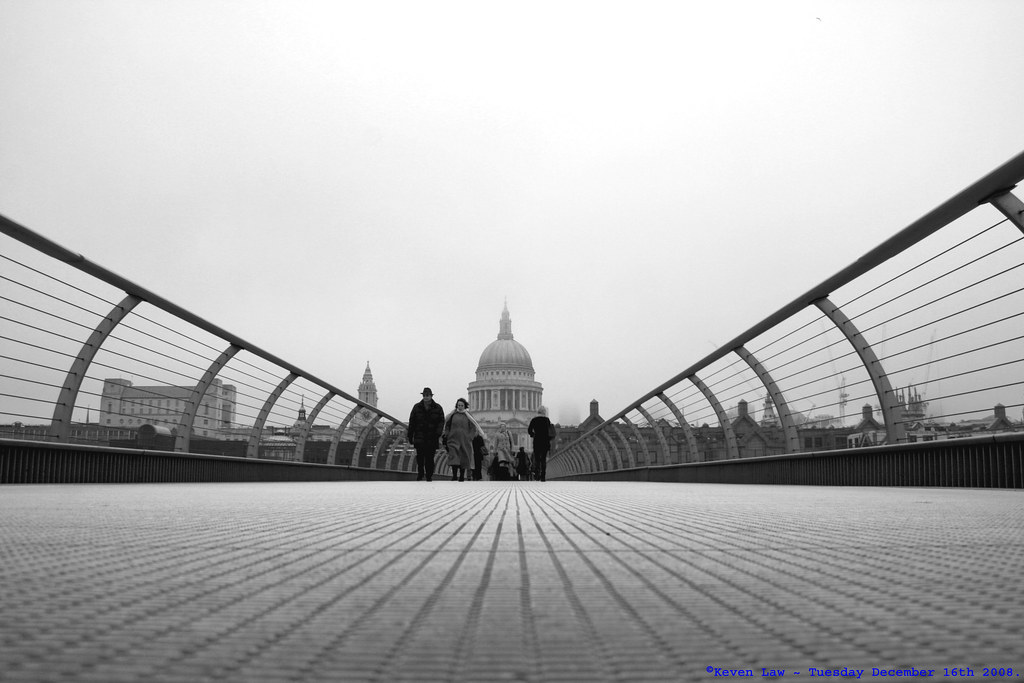
Millenium Bridge / St Paul's Cathedral, London, England - Tuesday December 16th 2008.
Click here to see the Larger image
Click here to see My most interesting images
Unlike yesterday when we have sun and blue sky's here in London, Tuesday it was dull grey and foggy...so as it was pretty much devoid of colour, I've made this image Black n White..:O))
Today's weather was also dull and grey again, although it wasn't foggy...I have one day left at work before Christmas...so I hope the weather will be kind after tomorrow, as I will be off for two weeks...:O)))
I hope you are all having an awesome Thursday...:O)))
From Wikipedia, the free encyclopedia ~ The London Millennium Footbridge is a pedestrian-only steel suspension bridge crossing the River Thames in London, England, linking Bankside with the City. It is located between Southwark Bridge (downstream) and Blackfriars Bridge (upstream). With construction beginning in 1998, it is owned and maintained by the Bridge House Estates a charitable trust overseen by the City of London Corporation.
Londoners nicknamed the bridge the Wobbly Bridge after crowds of pedestrians felt an unexpected swaying motion on the first two days after the bridge opened. The bridge was closed and modified, and further modifications eliminated the "wobble" entirely.
The southern end of the bridge is near Globe Theatre, the Bankside Gallery and Tate Modern, the north end next to the City of London School below St Paul's Cathedral. The bridge alignment is such that a clear view of St Paul's south facade is presented from across the river, framed by the bridge supports, thus providing a scenic view of the cathedral.
The nearest London Underground station is Blackfriars.
Design ~ The design of the bridge was the subject of a competition organised in 1996 by Southwark council. The winning entry was an innovative "blade of light" effort from Arup, Foster and Partners and Sir Anthony Caro. Due to height restrictions, and to improve the view, the bridge's suspension design had the supporting cables below the deck level, giving a very shallow profile. The bridge has two river piers and is made of three main sections of 81 metres (266 ft), 144 metres (472 ft) and 108 metres (354 ft) (North to South) with a total structure length of 325 metres (1,066 ft); the aluminium deck is 4 metres (13 ft) wide. The eight suspension cables are tensioned to pull with a force of 2,000 tons against the piers set into each bank — enough to support a working load of 5,000 people on the bridge at one time.
Construction ~ The bridge from St Paul's CathedralConstruction began in late 1998 with the main works beginning on 28 April 1999 by Monberg Thorsen and Sir Robert McAlpine.[1] The bridge was completed at a cost of £18.2m (£2.2m over budget) and opened on 10 June 2000 (2 months late). Unexpected lateral vibration (resonant structural response) caused the bridge to be closed on 12 June for modifications.
Attempts were made to limit the number of people crossing the bridge: this led to long queues, but dampened neither public enthusiasm for what was something of a white-knuckle ride, nor the vibrations themselves. The closure of the bridge only three days after opening attracted public criticism, as another high-profile British millennium project suffered an embarrassing setback, akin to how many saw the Millennium Dome.
Further modifications to the bridge successfully eliminated the "wobble," which has not recurred since the bridge reopened in February 2002.
The bridge was temporarily closed on 18 January 2007, during the Kyrill storm due to strong winds and a risk of pedestrians being blown off the bridge.
Resonance ~ The bridge from St Paul's after opening: long queues formed as attempts were made to limit vibrationsThe bridge's movements were caused by a 'positive feedback' phenomenon, known as Synchronous Lateral Excitation. The natural sway motion of people walking caused small sideways oscillations in the bridge, which in turn caused people on the bridge to sway in step, increasing the amplitude of the bridge oscillations and continually reinforcing the effect.
The bridge opened on an exceptionally fine day, and it was included on the route of a major charity walk. On the day of opening the bridge was crossed by 90,000 people, with up to 2,000 on the bridge at any one time.
Resonant vibrational modes due to vertical loads (such as trains, traffic, pedestrians) and wind loads are well understood in bridge design. In the case of the Millennium Bridge, because the lateral motion caused the pedestrians loading the bridge to directly participate with the bridge, the vibrational modes had not been anticipated by the designers (Arup).
BMW i8 (2014-20) Engine 1499cc S3 I3 turbo B38A15T0 plus hybrid synchronous motor
Production 20,465 (16,581 coupés 3,884 roadsters)
Registration Number M 6 DDV (Cherished number, originally circa 1994 and now transferred to a BMW M2, first issued from Exeter)
BMW ALBUM
www.flickr.com/photos/45676495@N05/sets/72157623759864432...
The BMW i8 is a plug-in hybrid sports car developed by BMW. The i8 is part of BMW's electric fleet Project i being marketed as a new sub-brand, BMW i.
The production version was designed by Benoit Jacob and unveiled at the 2013 International Motor Show Germany. It features butterfly doors, head-up display, rear-view cameras and partially false engine noise. Series production began in April 2014 at Leipzig, Saxony, Germany. The overall weight is 1485kg with a low drag coefficient of 0.26
Powered by an electric two speed powertrain developed by GKN featuring a hybrid synchronous motor of 129bhp and a three cylinder 1499cc turbocharged engine of 288bhp. The 2015 model year BMW i8 has a 7.1 kWh lithium-ion battery pack that delivers an all-electric range of 37 km under the European cycle and 24 km under the United States Environmental Protection Agency cycle with a small amount of petrol. In all-electric mode the BMW i8 has a top speed of 120 km/h (75 mph). In Sport mode the i8 delivers a mid-range acceleration from 80 to 120 km/h (50 to 75 mph) in 2.6 seconds. The electronically controlled top speed is 250 km/h (155 mph)
Diolch am 84,197,998 o olygfeydd anhygoel, mae pob un yn 90cael ei werthfawrogi'n fawr.
Thanks for 84,197,998 amazing views, every one is greatly appreciated.
Shot 01.08-2021 exiting the Silverstone Festival 01.08.2021 Ref 149-092
Manufacturer: Chrysler Group LLC for Plymouth, Auburn Hills, Michigan - USA
Type: Fury III Series DP-2 2-door Hardtop PM23
Engine: 5204cc V-8 overhead valve (by Chrysler)
Power: 230 bhp / 4.400 rpm
Speed: 185 km/h
Production time: 1968
Production outlet: 60,472
Curb weight: 1916 kg
Special:
- The word "fury" denotes a type of anger, inspired by the Furies, mythological creatures in Ancient Greek and Ancient Roman mythology.
- The ’68 design is the so called “coke-bottle profiles” design.
- It has a three-speed manual gearbox (synchronous in 2nd & 3rd), a Carter Ball and Ball BBD 4607S dual downdraft carburettor, distributor and coil ignition system, a 12-Volts electric system, a 91 liter fuel tank, single exhaust system and rear wheel drive.
- The chassis with all-steel body has a 119.5 inch wheelbase, recirculating ball steering, independent torsion bar front suspension, semi-elliptic Hotchkiss type leaf spring rear suspension, a semi-floating type rear axle and hydraulic self-adjusting 11 inch drum brakes all round.
- The Fury III series was available as this 2-door Hardtop, as 4-door Hardtop (45,147 units built), as 4-door Sedan (57,899 units built), as VIP 4-door Hartop Sedan (10,745 units built), as Fast Top Coupé PX23 (22,738 units built), as 2-door Convertible (4,483 units built), as 4-door Station Wagon 2-seats (9,203 units built), and as 4-door Station Wagon 3-seats (13,224 units built).
- A Hemi “B” 426 cu in (6974cc) V-8, a three-speed Torque Flite automatic transmission, a four-speed manual gearbox, walnut dashboard and door-panel trim, a thicker grade of carpeting, full courtesy lighting, two-tone colouring, power steering, power windows, power brakes, power seats, radio and air conditioning were optional.
Garden Village, Burnaby, British Columbia
The EQS is the first EQ model that is based on the technical platform specific to the electric models, called the MEA. The car's drag coefficient is as low as 0.20, making it the most aerodynamic car in production at the time of its introduction.
The car is powered by a water-cooled permanent magnet synchronous motor from Valeo Siemens in the EQS 450+ model, and by two of these motors in the EQS 580 4MATIC model. The torque is sent from the motor(s) to the wheels through a single-speed reduction gearbox. In the single-motor EQS 450+ model, the motor has a rated power of 245 kW (329 hp), and a braking power of 186 kW (249 hp), allowing a deceleration of 5 m·s−2. German motor journalist Alexander Bloch from auto motor und sport found the energy consumption to be 150…160 W·h/km at 130 km/h (81 mph), and the average energy consumption to be 158 W·h/km. With the 107.8 kW·h secondary cell, the car has a range of more than 638 km. The average recharging power is 163 kW with a peak of >200 kW, allowing the car to reach a 79 % state of charge in about half an hour.
Moon Facts
The Moon (or Luna) is the Earth’s only natural satellite and was formed 4.6 billion years ago around some 30–50 million years after the formation of the solar system. The Moon is in synchronous rotation with Earth meaning the same side is always facing the Earth. The first unmanned mission to the Moon was in 1959 by the Soviet Lunar Program with the first manned landing being Apollo 11 in 1969.
The Moon
Moon Profile
Diameter:3,475 km
Mass:7.35 × 10^22 kg (0.01 Earths)
Orbits:The Earth
Orbit Distance:384,400 km
Orbit Period:27.3 days
Surface Temperature: -233 to 123 °C
Facts about the Moon
The dark side of the moon is a myth.
In reality both sides of the Moon see the same amount of sunlight however only one face of the Moon is ever seen from Earth. This is because the Moon rotates around on its own axis in exactly the same time it takes to orbit the Earth, meaning the same side is always facing the Earth. The side facing away from Earth has only been seen by the human eye from spacecraft.
The rise and fall of the tides on Earth is caused by the Moon.
There are two bulges in the Earth due to the gravitational pull that the Moon exerts; one on the side facing the Moon, and the other on the opposite side that faces away from the Moon, The bulges move around the oceans as the Earth rotates, causing high and low tides around the globe.
The Moon is drifting away from the Earth.
The Moon is moving approximately 3.8 cm away from our planet every year. It is estimated that it will continue to do so for around 50 billion years. By the time that happens, the Moon will be taking around 47 days to orbit the Earth instead of the current 27.3 days.
A person would weigh much less on the Moon.
The Moon has much weaker gravity than Earth, due to its smaller mass, so you would weigh about one sixth (16.5%) of your weight on Earth. This is why the lunar astronauts could leap and bound so high in the air.
The Moon has only been walked on by 12 people; all American males.
The first man to set foot on the Moon in 1969 was Neil Armstrong on the Apollo 11 mission, while the last man to walk on the Moon in 1972 was Gene Cernan on the Apollo 17 mission. Since then the Moon has only be visited by unmanned vehicles.
The Moon has no atmosphere.
This means that the surface of the Moon is unprotected from cosmic rays, meteorites and solar winds, and has huge temperature variations. The lack of atmosphere means no sound can be heard on the Moon, and the sky always appears black.
The Moon has quakes.
These are caused by the gravitational pull of the Earth. Lunar astronauts used seismographs on their visits to the Moon, and found that small moonquakes occurred several kilometres beneath the surface, causing ruptures and cracks. Scientists think the Moon has a molten core, just like Earth.
The first spacecraft to reach the Moon was Luna 1 in 1959.
This was a Soviet craft, which was launched from the USSR. It passed within 5995 km of the surface of the Moon before going into orbit around the Sun.
The Moon is the fifth largest natural satellite in the Solar System.
At 3,475 km in diameter, the Moon is much smaller than the major moons of Jupiter and Saturn. Earth is about 80 times the volume than the Moon, but both are about the same age. A prevailing theory is that the Moon was once part of the Earth, and was formed from a chunk that broke away due to a huge object colliding with Earth when it was relatively young.
The Moon will be visited by man in the near future.
NASA plans to return astronauts to the moon to set up a permanent space station. Mankind may once again walk on the moon in 2019, if all goes according to plan.
During the 1950’s the USA considered detonating a nuclear bomb on the Moon.
The secret project was during the height cold war was known as “A Study of Lunar Research Flights” or “Project A119” and meant as a show of strength at a time they were lagging behind in the space race.
Source: space-facts.com/the-moon/
Photo captured via Minolta MD Zoom Rokkor-X 24-50mm F/4 lens. Columbia Plateau Region. Inland Northwest. Lincoln County, Washington. Late November 2017.
Exposure Time: 1/200 sec. * ISO Speed: ISO-160 * Aperture: F/4 * Bracketing: None * Color Temperature: 5204 K * Film Plug-In: Fuji Velvia 100
en.wikipedia.org/wiki/Eurasian_skylark
The Eurasian skylark (Alauda arvensis) is a passerine bird in the lark family Alaudidae. It is a widespread species found across Europe and Asia with introduced populations in New Zealand, Australia and on the Hawaiian Islands. It is a bird of open farmland and heath, known for the song of the male, which is delivered in hovering flight from heights of 50 to 100 metres (160 to 330 ft). The sexes are alike. It is streaked greyish-brown above and on the breast and has a buff-white belly.
The female Eurasian skylark builds an open nest in a shallow depression on open ground well away from trees, bushes and hedges. She lays three to five eggs which she incubates for around 11 days. The chicks are fed by both parents but leave the nest after eight to ten days, well before they can fly. They scatter and hide in the vegetation but continue to be fed by the parents until they can fly at 18 to 20 days of age. Nests are subject to high predation rates by larger birds and small mammals. The parents can have several broods in a single season.
Taxonomy and systematics
The Eurasian skylark was described by the Swedish naturalist Carl Linnaeus in 1758 in the tenth edition of his Systema Naturae and retains its original binomial name of Alauda arvensis.[2] It is one of the four species placed in the genus Alauda.[3] The genus name is from the Latin alauda, "lark". Pliny thought the word was originally of Celtic origin. The specific arvensis is also Latin, and means "of the field".[4] The results of a molecular phylogenetic study of the lark family Alaudidae published in 2013 suggested that Eurasian skylark is most closely related to the Oriental skylark Alauda gulgula.[5]
Formerly, many authorities considered the Japanese skylark as a separate species. It is now usually considered a subspecies of the Eurasian skylark.[6] Alternate names for the Eurasian skylark include northern skylark and sky lark.[7]
Subspecies
Eleven subspecies are recognized:[3]
•A. a. arvensis Linnaeus, 1758 – northern, western and central Europe
•A. a. sierrae Weigold, 1913 – Portugal, central and southern Spain
•A. a. harterti Whitaker, 1904 – north-western Africa
•A. a. cantarella Bonaparte, 1850 – southern Europe from north-eastern Spain to Turkey and the Caucasus
•A. a. armenica Bogdanov, 1879 – south-eastern Turkey to Iran
•A. a. dulcivox Hume, 1872 – south-eastern European Russia and western Siberia to north-western China and south-western Mongolia
•A. a. kiborti Zaliesski, 1917 – southern Siberia, northern and eastern Mongolia and north-eastern China
•A. a. intermedia Swinhoe, 1863 – north-central Siberia to north-eastern China and Korea
•A. a. pekinensis Swinhoe, 1863 – north-eastern Siberia, Kamchatka Peninsula and the Kuril Islands
•A. a. lonnbergi Hachisuka, 1926 – northern Sakhalin Island
•A. a. japonica Temminck & Schlegel, 1848 – southern Sakhalin Island, southern Kuril Island, Japan and the Ryukyu Islands: the Japanese skylark
Some authorities recognise the subspecies A. a. scotia Tschusi, 1903 and A. a. guillelmi Witherby, 1921.[8] In the above list scotia is included in the nominate subspecies A. a. arvensis and guillelmi is included in A. a. sierrae.
Description
The Eurasian skylark is 18–19 cm (7.1–7.5 in) in length.[9] Like most other larks, the Eurasian skylark is a rather dull-looking species, being mainly brown above and paler below. It has a short blunt crest on the head, which can be raised and lowered. In flight it shows a short tail and short broad wings. The tail and the rear edge of the wings are edged with white, which are visible when the bird is flying away, but not if it is heading towards the observer. The male has broader wings than the female. This adaptation for more efficient hovering flight may have evolved because of female Eurasian skylarks' preference for males that sing and hover for longer periods and so demonstrate that they are likely to have good overall fitness.
It is known for the song of the male, which is delivered in hovering flight from heights of 50 to 100 m, when the singing bird may appear as just a dot in the sky from the ground. The long, unbroken song is a clear, bubbling warble delivered high in the air while the bird is rising, circling or hovering.[10] The song generally lasts two to three minutes, but it tends to last longer later in the mating season, when songs can last for 20 minutes or more. At wind farm sites, male skylarks have been found to sing at higher frequencies as a result of wind turbine noise.[11]
Distribution and habitat
This lark breeds across most of Europe and Asia and in the mountains of north Africa. It is mainly resident in the west of its range, but eastern populations are more migratory, moving further south in winter. Even in the milder west of its range, many birds move to lowlands and the coast in winter. Asian birds, subspecies A. a. pekinensis, appear as vagrants in Alaska.[12]
Introduced population
In the 19th century multiple batches of Eurasian skylarks were released in New Zealand beginning in 1864 in Nelson (in the South Island) and in 1867 in Auckland (in the North Island). The wild population increased rapidly and had spread throughout both the North and South Islands by the 1920s.[13][14]
In Australia the Eurasian skylark was introduced on multiple occasions beginning in 1850.[14] It is now widespread in the southeast of the continent. In New South Wales it mostly occurs south of 33°S. It is widespread throughout Victoria and Tasmania and also occurs in the south-eastern corner of South Australia around Adelaide.[15]
The Eurasian skylark was introduced to the southeastern Hawaiian Islands beginning in 1865. Although once common, it has declined in abundance on Oahu and is no longer found on Kauai. A study published in 1986 found European skylarks remained only on the islands of Hawaii and Maui and estimated a total population of 10,000 individuals.[16][17]
The Eurasian skylark was introduced to Vancouver Island off the west coast of Canada in 1903; additional birds were introduced in 1913.[18] The population grew and by 1962 there were around 1000 individuals.[19] The numbers have subsequently declined due to loss of habitat, and in 2007 there were estimated to be only around 100 individuals spread over four small areas of the Saanich Peninsula.[20][21]
Behaviour and ecology
Breeding
Eurasian skylarks first breed when they are one year of age. Nesting may start in late March or early April. The nest is probably built by the female alone and is a shallow depression in the ground lined with grasses. The clutch is 3 to 5 eggs. The eggs of the nominate subspecies average 23.4 mm × 16.8 mm (0.92 in × 0.66 in) in size and weigh around 3.35 g (0.118 oz). They have a grey-white or greenish background and are covered in brown or olive spots. They are incubated only by the female beginning after the last egg is laid and hatch synchronously after 11 days.[22] The altricial young are cared for by both parents and for the first week are fed almost exclusively on insects.[23] The nestlings fledge after 18 to 20 days but they usually leave the nest after 8 to 10 days. They are independent of their parents after around 25 days. The parents can have up to 4 broods in a season.[22]
Feeding[edit]
The Eurasian skylark walks over the ground searching for food on the soil surface. Its diet consists of insects and plant material such as seeds and young leaves. Unlike a finch (family Fringillidae) it swallows seeds without removing the husk. Insects form an important part of the diet in summer.[24]
Threats
In the UK, Eurasian skylark numbers have declined over the last 30 years, as determined by the Common Bird Census started in the early 1960s by the British Trust for Ornithology. There are now only 10% of the numbers that were present 30 years ago. The RSPB have shown that this large decline is mainly due to changes in farming practices and only partly due to pesticides. In the past cereals were planted in the spring, grown through the summer and harvested in the early autumn. Cereals are now planted in the autumn, grown through the winter and are harvested in the early summer. The winter grown fields are much too dense in summer for the Eurasian skylark to be able to walk and run between the wheat stems to find its food.
English farmers are now encouraged and paid to maintain and create biodiversity for improving the habitat for Eurasian skylarks. Natural England's Environmental Stewardship Scheme offers 5 and 10-year grants for various beneficial options. For example, there is an option where the farmer can opt to grow a spring cereal instead of a winter one, and leave the stubble untreated with pesticide over the winter. The British Trust for Ornithology likens the stubbles to "giant bird tables" – providing spilt grain and weed seed to foraging birds.[25]
The RSPB's research, over a six-year period, of winter-planted wheat fields has shown that suitable nesting areas for Eurasian skylarks can be made by turning the seeding machine off (or lifting the drill) for a 5 to 10 metres stretch as the tractor goes over the ground to briefly stop the seeds being sown. This is repeated in several areas within the same field to make about two skylark plots per hectare. Subsequent spraying and fertilising can be continuous over the entire field. DEFRA suggests that Eurasian skylark plots should not be nearer than 24 m to the perimeter of the field, should not be near to telegraph poles, and should not be enclosed by trees.
When the crop grows, the Eurasian skylark plots (areas without crop seeds) become areas of low vegetation where Eurasian skylarks can easily hunt insects, and can build their well camouflaged ground nests. These areas of low vegetation are just right for skylarks, but the wheat in the rest of the field becomes too closely packed and too tall for the bird to seek food. At the RSPB's research farm in Cambridgeshire skylark numbers have increased threefold (from 10 pairs to 30 pairs) over six years. Fields where Eurasian skylarks were seen the year before (or nearby) would be obvious good sites for skylark plots. Farmers have reported that skylark plots are easy to make and the RSPB hope that this simple effective technique can be copied nationwide.
In culture
When the word "lark" is used without specification, it usually refers to this species.[26] A collective noun for Eurasian skylarks is an "exaltation". Although the Oxford English Dictionary describes this usage as "fanciful", it traces it back to a quotation from John Lydgate dating from about 1430.[27] The verb "skylark", originally used by sailors, means "play tricks or practical jokes; indulge in horseplay, frolic". The verb and noun "lark", with similar meaning, may be related to "skylark" or to the dialect word "laik" (New Shorter OED).
The bird is the subject of poems by Percy Bysshe Shelley (To a Skylark), George Meredith (The Lark Ascending), Ted Hughes (Skylarks), and numerous others; of a play by Henrik Ibsen entitled "A Doll's House" and of pieces of music including The Lark Ascending by Ralph Vaughan Williams (inspired by the eponymous poem). It is also the bird emblem of Kumamoto Prefecture.[28] The Skylark of Space is a series of four science fiction novels by E.E. "Doc" Smith.
There's a story behind every leaf. There's an explanation for why it grows where it grows when it grows. It's just a really complicated explanation with a million factors, like the openings in the surrounding canopy that allow light to sneak in, the age of the surrounding trees, the nutrients in the soil, the surrounding fauna, the weather, etc. Somehow it all adds up and makes a leaf on a tree. Maybe my worldview is influenced too much by my math classes from school, but I am confident that if you take into account all the variables, there is some complicated formula that we can generate that will spit out the tree in front of me. My little human brain just can't do the math on its own, so it feels mysterious.
This type of mystery presents opportunities for discovery in nature. I love making these small discoveries with my camera. I am drawn to photos that display this mystery and hint at the loosely ordered chaos that suggests that underneath all of the disarray there is some semblance of structure. Not a neat and tidy structure, but something. With this image here, I was captivated by the chaotic mess of colorful beech leaves. They remind me of the photos I have seen of synchronous fireflies down in the Smokies. I tried to "tame" the madness of nature by framing the mess of yellow leaves with a tidy group of vertical tree trunks.
Highest Explore Position #150 ~ On May 29th 2009.
Atlantic Puffins - Farne Islands, Northumberland, England - Tuesday May 27th 2009.
Click here to see My most interesting images
From Wikipedia, the free encyclopedia ~ The Atlantic Puffin (Fratercula arctica) is a seabird species in the auk family. It is a pelagic bird that feeds primarily by diving for fish, but also eats other sea creatures, such as squid and crustaceans. Its most obvious characteristic is its brightly coloured beak during the breeding seasons. Also known as the Common Puffin, it is the only puffin species which is found in the Atlantic Ocean. The curious appearance of the bird, with its colourful huge bill and its striking piebald plumage, has given rise to nicknames such as "clown of the ocean" and "sea parrot".
Description ~ The Atlantic Puffin is 28–34 cm (11-13.5 in) in length, with a 50–60 cm (20-24 in) wingspan. The male is generally slightly larger than the female, but they are coloured alike. This bird is mainly black above and white below, with gray to white cheeks and red-orange legs. The bill is large and triangular, and during the breeding season is bright orange with a patch of blue bordered by yellow at the rear. The characteristic bright orange bill plates grow before the breeding season and are shed after breeding. The bills are used in courtship rituals, such as the pair tapping their bills together. During flight, it appears to have grey round underwings and a white body; it has a direct flight low over the water. The related Horned Puffin (Fratercula corniculata) from the North Pacific looks very similar but has slightly different head ornaments.
The Atlantic Puffin is typically silent at sea, except for soft purring sounds it sometimes makes in flight. At the breeding colonies the birds make a deep growl
Distribution and ecology ~ This species breeds on the coasts of northern Europe, the Faroe Islands, Iceland and eastern North America, from well within the Arctic Circle to northern France and Maine. The winter months are spent at sea far from land - in Europe as far south as the Mediterranean, and in North America to North Carolina.
About 95% of the Atlantic puffins in North America breed around Newfoundland's coastlines. The largest puffin colony in the western Atlantic (estimated at more than 260,000 pairs) can be found at the Witless Bay Ecological Reserve, south of St. John's, Newfoundland and Labrador.
Predators of the Atlantic Puffin include the Great Black-backed Gull (Larus marinus), the Great Skua (Stercorarius skua), and similar-sized species, which can catch a puffin in flight, or pick off one separated from the colony. Smaller gull species like the Herring Gull (L. argentatus) which are hardly able to bring down a healthy adult puffin, take eggs or recently hatched chicks, and will also steal fish.
Diet ~ Feeding areas are often located 100 km (60 mi) offshore from the nest or more, though when provisioning young the birds venture out only half that distance. Atlantic Puffins can dive for distances of up to 70 m (200 ft) and are propelled by their powerful wings, which are adapted for swimming. They use their webbed feet as a rudder while submerged. Puffins collect several small fish, such as herring, sprats, zooplankton, fish (shellfish), sand eels, when hunting. They use their tongues to hold the fish against spines in their palate, leaving their beaks free to open and catch more fish. A popular, but untrue, story claims that puffins neatly line up the fish in their bills with the heads facing alternate ways. Additional components of their diet are crustaceans and mollusks. A puffin can sometimes have a dozen or more fish in its beak at once.
Reproduction ~ Atlantic Puffins are colonial nesters, using burrows on grassy cliffs. They can face competition from other burrow nesting animals such as Rabbits, Manx Shearwaters and occasionally Razorbills. They will also nest amongst rocks and scree. Male puffins perform most of the work of clearing out the nest area, which is sometimes lined with grass, feathers or seaweed. The only time spent on land is to nest. Mates are found prior to arriving at the colonies, and mating takes place at sea.
The Atlantic Puffin is sexually mature at the age of 4–5 years. The species is monogamous and has biparental care. A single-egg clutch is produced each year, and incubation responsibilities are shared between both parents. Total incubation time is around 39–45 days, and the chick takes about 49 days to fledge. At fledging, the chick leaves the burrow alone, and flies/swims out to sea, usually during the evening. Contrary to popular belief, young puffins are not abandoned by their parents (although this does occur in some other seabirds, such as shearwaters). Synchronous laying of eggs is found in Atlantic Puffins in adjacent burrows.
1971 Fiat 500.
The Fiat 500 (Italian: Cinquecento, pronounced [ˌtʃiŋkweˈtʃɛnto]) is an economy / city car that was manufactured and marketed by Fiat Automobiles from 1957 until 1975. It was sold as a two-door semi-convertible or saloon car and as a three-door panel van or estate car.
Launched as the Nuova (new) 500 in July 1957,[3] as a successor to the 500 "Topolino",
Also called Puch 500
Production 1957–1975
3,893,294 units
Assembly, Italy: Turin, Italy: Desio, Italy: Termini Imerese, Austria: Graz (Steyr Puch) and New Zealand: Ōtāhuhu (Torino Motors)
Designe rDante Giacosa
ClassCity car (A)
Body styles, 2-door saloon, 2-door semi-convertible, 3-door estate ('Giardiniera') and 3-door panel van
Layout Rear-engine, rear-wheel drive
Doors, Suicide (1957–1965) and Conventional (1965–1975)
Related, Autobianchi Bianchina, NSU/Fiat Weinsberg 500
Vignale Gamine and Autobianchi Giardiniera
Powertrain
Engines, 479 cc, 499 cc I2 and 594 cc I2
Transmission4-speed manual (non-synchronous)
Wheelbase 1,840 mm (72.4 in) and 1,940 mm (76.4 in) (Giardiniera)
Length 2,970 mm (116.9 in) and 3,185 mm (125.4 in) (Giardiniera)
Width 1,320 mm (52.0 in)
Height 1,320 mm (52.0 in)
Kerb weight 499 kg (1,100 lb)
Predecessor Fiat 500 "Topolino"
SuccessorFiat 126 and Fiat 500 (2007).
Bolex B8 VS with Orwo UP21 black and white reversal film, process before date of November 1982. Rated 24 EI, developed (as negative) in Ilfotec LC29, diluted 1+9, 20 minutes at 20ºC. Non-synchronous audio recorded concurrently.
Fun fact: The moon is in synchronous rotation with the earth which means the same side of the moon always faces the earth!
tonight it is one year since my lovelight mom had to fly away
i have no words for how this feels to my heart.
yet one of the countless joys mom & i synchronously adored is the fresh, new moon.. which we called 'the baby moon'
so now when i see a baby moon, i talk with mom from here to There ~ feeling her within its Light, shining Love on me and on everyone.
am ever-thankful for being able to see her bright glow in the heavens
even as she is now, as rumi so beautifully expressed ..
boundless, without limits, like the kindness of God *
≈ ♡ ≈
en.wikipedia.org/wiki/Cinereous_vulture
The cinereous vulture (Aegypius monachus) is a large raptorial bird that is distributed through much of Eurasia. It is also known as the black vulture, monk vulture, or Eurasian black vulture. It is a member of the family Accipitridae, which also includes many other diurnal raptors such as kites, buzzards and harriers. It is one of the two largest Old World vultures, attaining a maximum size of 14 kg, (roughly 30 lbs), 1.2 m long (almost 4 ft) and 3.1 m (a bit over 10 ft) across the wings.
Taxonomy
The genus name Aegypius is a Greek word (αἰγυπιός) for 'vulture', or a bird not unlike one; Aelian describes the aegypius as "halfway between a vulture (gyps) and an eagle". Some authorities think this a good description of a lammergeier; others do not. Aegypius is the eponym of the species, whatever it was.[2] The English name 'black vulture' refers to the plumage colour, while 'monk vulture', a direct translation of its German name Mönchsgeier, refers to the bald head and ruff of neck feathers like a monk's cowl. 'Cinereous vulture' (Latin cineraceus, ash-coloured; pale, whitish grey), was a deliberate attempt to rename it with a new name distinct from the American black vulture.[3]
This bird is an Old World vulture, and is only distantly related to the New World vultures, which are in a separate family, Cathartidae, of the same order. It is therefore not directly related to the much smaller American black vulture (Coragyps atratus) despite the similar name and coloration.
Description
The cinereous vulture measures 98–120 cm (3 ft 3 in–3 ft 11 in) long with a 2.5–3.1 m (8 ft 2 in–10 ft 2 in) wingspan. Males can weigh from 6.3 to 11.5 kg (14 to 25 lb), whereas females can weigh from 7.5 to 14 kg (17 to 31 lb). It is thus one of the world's heaviest flying birds.[4][5][6] Females are slightly larger than males.[5] Despite limited genetic variation in the species, body size increases from west to east, with the birds from southwest Europe (Spain and south France) averaging about 10% smaller than the vultures from central Asia (Manchuria, Mongolia and northern China).[4] Among standard measurements, the wing chord is 73–89 cm (29–35 in), the tail is 33–41 cm (13–16 in) and the tarsus is 12–14.6 cm (4.7–5.7 in).[4]
The cinereous vulture is distinctly dark, with the whole body being brown excepting the pale head in adults, which is covered in fine blackish down. This down is absent in the closely related lappet-faced vulture (Torgos tracheliotos).[4][5] The skin of the head and neck is bluish-gray and a paler whitish color above the eye. The adult has brown eyes, a purplish cere, a blue-gray bill and pale blue-gray legs.[4][5] The primary quills are often actually black.[5] From a distance, flying birds can easily appear all black. The immature plumage is sepia-brown above, with a much paler underside than in adults. Immature cinereous vultures have grey down on the head, a pale mauve cere and grey legs.[5] The massive bill is the largest of any living accipiterid, a feature enhanced by the relatively small skull of the species. The exposed culmen of the cinereous vulture measures 8–9 cm (3.1–3.5 in).[7] The wings, with serrated leading edges, are held straight or slightly arched in flight and are broad, sometimes referred to as "barn door wings". Their flight is slow and buoyant, with deep, heavy flaps when necessary. The combination of huge size and dark coloration renders the cinereous vulture relatively distinct, especially against smaller raptors such as eagles or hawks. The most similar-shaped species, the lappet-faced vulture (with which there might be limited range overlap in the southern Middle East), is distinguished by its bare, pinkish head and contrasting plumage. On the lappet-face, the thighs and belly are whitish in adult birds against black to brownish over the remainder of the plumage. All potential Gyps vultures are distinguished by having paler, often streaky plumage, with bulging wing primaries giving them a less evenly broad-winged form.[4] Cinereous vultures are generally very silent, with a few querulous mewing, roaring or guttural cries solely between adults and their offspring at the nest site.[5]
Distribution and habitat
The cinereous vulture is a Eurasian species. The western limits of its range are in Spain and inland Portugal, with a reintroduced population in south France. They are found discontinuously to Greece, Turkey and throughout the central Middle East. Their range continues through Afghanistan eastwards to northern India to its eastern limits in central Asia, where they breed in northern Manchuria, Mongolia and Korea. Their range is fragmented especially throughout their European range. It is generally a permanent resident except in those parts of its range where hard winters cause limited altitudinal movement and for juveniles when they reach breeding maturity. In the eastern limits of its range, birds from the northernmost reaches may migrate down to southern Korea and China. A limited migration has also been reported in the Middle East but is not common.[4][8][9]
This vulture is a bird of hilly, mountainous areas, especially favoring dry semi-open habitats such as meadows at high altitudes over much of the range. Nesting usually occurs near the tree line in the mountains.[5] They are always associated with undisturbed, remote areas with limited human disturbance. They forage for carcasses over various kinds of terrain, including steppe, grasslands, open woodlands, along riparian habitats or any kind of mountainous habitat. In their current European range and through the Caucasus and Middle East, cinereous vultures are found from 100 to 2,000 m (330 to 6,560 ft) in elevation, while in their Asian distribution, they are typically found at higher elevations.[4] Two habitat types were found to be preferred by the species in China and Tibet. Some cinereous vultures in these areas live in mountainous forests and shrubland from 800 to 3,800 m (2,600 to 12,500 ft), while the others preferred arid or semi-arid alpine meadows and grasslands at 3,800 to 4,500 m (12,500 to 14,800 ft) in elevation.[9][10][11] This species can fly at a very high altitude. One cinereous vulture was observed at an elevation of 6,970 m (22,870 ft) on Mount Everest.[5] It has a specialised haemoglobin alphaD subunit of high oxygen affinity which makes it possible to take up oxygen efficiently despite the low partial pressure in the upper troposphere.[12] Juvenile and immature cinereous vultures, especially those in the northern stretches of the species range, may move large distances across undeveloped open-dry habitats in response to snowfall or high summer temperatures.[5][13]
Behaviour
The cinereous vulture is a largely solitary bird, being found alone or in pairs much more frequently than most other Old World vultures. At large carcasses or feeding sites, small groups may congregate. Such groups can rarely include up to 12 to 20 vultures, with some older reports of up to 30 or 40.
Breeding
In Europe, the cinereous vulture return to the nesting ground in January or February.[5] In Spain and Algeria, they start nesting in February in March, in Crimea in early March, in northwestern India in February or April, in northeastern India in January, and in Turkestan in January.[5] They breed in loose colonies, with nests rarely being found in the same tree or rock formation, unlike other Old World vultures which often nest in tight-knit colonies. In Spain, nests have been found from 300 m (980 ft) to 2 km (6,600 ft) apart from each other.[9] The cinereous vulture breeds in high mountains and large forests, nesting in trees or occasionally on cliff ledges. The breeding season lasts from February until September or October. The most common display consists of synchronous flight movements by pairs. However, flight play between pairs and juveniles is not unusual, with the large birds interlocking talons and spiraling down through the sky. The birds use sticks and twigs as building materials, and males and females cooperate in all matters of rearing the young.[14] The huge nest is 1.45–2 m (4.8–6.6 ft) across and 1–3 m (3.3–9.8 ft) deep. The nest increases in size as a pair uses it repeatedly over the years and often comes to be decorated with dung and animal skins.[4] The nests can range up to 1.5 to 12 m (4.9 to 39.4 ft) high in a large tree such as an oak, juniper,[15] wild pear,[15] almond or pine trees. Most nesting trees are found along cliffs. In a few cases, cinereous vultures have been recorded as nesting directly on cliffs. One cliff nest completely filled a ledge that was 3.63 m (11.9 ft) wide and 2.5 m (8.2 ft) in depth.[5] The egg clutch typically only a single egg, though 2 may be exceptionally laid. The eggs have a white or pale buff base color are often overlaid with red, purplish or red-brown marks, being almost as spotted as the egg of a falcon. Eggs measure from 83.4 to 104 mm (3.28 to 4.09 in) in height and 58 to 75 mm (2.3 to 3.0 in) in width, with an average of 90 mm × 69.7 mm (3.54 in × 2.74 in).[5] The incubation period can range from 50 to 62 days, averaging 50–56 days. Normally hatching occurs in April or May in Europe.[5] The newly hatched young are semi-altricial.[citation needed] The young are covered in greyish-white to grey-brown colored down which becomes paler with age. The first flight feathers start growing from the same sockets as the down when the nestling is around 30 days old and completely cover the down by 60 days of age.[5] The parents feed the young by regurgitation and an active nests reportedly becomes very foul and stinking.[5] Weights of nestlings in Mongolia increased from as little as 2 kg (4.4 lb) when they are around a month old in early June to being slightly more massive than their parents at up to nearly 16 kg (35 lb) shortly before fledging in early autumn.[16] Fledging is reported when the nestlings are 104–120 days old, though dependence on parents can continue for another 2 months. Radio-satellite tracking suggests the age of independence of juveniles from their parents to be 5.7–7 months after hatching (i.e. 2–3 months after fledging).[13]
The nesting success of cinereous vultures is relatively high, with around 90% of eggs successfully hatching and more than half of yearling birds known to survive to adulthood. They are devoted, active parents, with both members of a breeding pair protecting the nest and feeding the young in shifts via regurgitation.[9] In Mongolia, Pallas's cat (Otocolobus manul) and common raven (Corvus corax) are considered potential predators of eggs in potentially both tree and cliff nests. Gray wolf (Canis lupus) and foxes are also mentioned as potential nest predators but since neither climb trees and there are also no incidents of predation on inaccessible cliff nests, this seems unlikely.[16] There have been witnessed accounts of bearded vultures (Gypaetus barbatus) and Spanish imperial eagles (Aquila adalberti) attempting to kill nestlings but in both cases were chased off by the parent vultures.[17] There is a single case of a Spanish imperial eagle attacking and killing a cinereous vulture in an act of defense of its own nest in Spain.[18] Golden eagles and Eurasian eagle-owls may rarely attempt to dispatch an older nestling or even adults in an ambush but the species is not verified prey for either and would be a rare event in all likelihood if it does occur. This species may live for up to 39 years, though 20 years or less is probably more common, with no regular predators of adults other than man.
Feeding
Like all vultures, the cinereous vulture eats mostly carrion. The cinereous vulture feeds on carrion of almost any type, from the largest mammals available to fish and reptiles.[14] In Tibet, commonly eaten carcasses can include both wild and domestic yaks (Bos grunniens), Bharal, Tibetan gazelles (Pseudois nayaur), kiangs (Equus kiang), woolly hares (Lepus oiostolus), Himalayan marmots (Marmota himalayana), domestic sheep (Ovis aries), and even humans, mainly those at their celestial burial grounds.[9] Reportedly in Mongolia, Tarbagan marmots (Marmota sibirica) comprised the largest part of the diet, although that species is now endangered as it is preferred in the diet of local people, wild prey ranging from corsac fox (Vulpes corsac) to Argali (Ovis ammon) may be eaten additionally in Mongolia.[9][19] Historically, cinereous vultures in the Iberian Peninsula fed mostly on European rabbit (Oryctolagus cuniculus) carcasses, but since viral hemorrhagic pneumonia (VHP) devastated the once abundant rabbit population there, the vultures now rely on the carrion of domestic sheep, supplemented by pigs (Sus scrofa domesticus) and deer.[20] In Turkey, the dietary preferences were argali (Ovis ammon) (92 carrion items), wild boar (Sus scrofa) (53 items), chickens (Gallus gallus domesticus) (27 items), gray wolf (13 items) and red fox (Vulpes vulpes) (13 items). Unusually, a large amount of plant material was found in pellets from Turkey, especially pine cones.[21] Among the vultures in its range, the cinereous is best equipped to tear open tough carcass skins thanks to its powerful bill. It can even break apart bones, such as ribs, to access the flesh of large animals. It is dominant over other scavengers in its range, even over other large vultures such as Gyps vultures, bearded vulture or fierce ground predators such as foxes.[5] While noisy Gyps vultures squawk and fly around, the often silent cinereous will keep them well at bay until they are satisfied and have had their own fill.[7][11] A series of photos taken recently show a cinereous vulture attacking a Himalayan griffon in flight for unknown reasons, although the griffon was not seriously injured.[22] Cinereous vultures frequently bully and dominate steppe eagles (Aquila nipalensis) when the two species are attracted to the same prey and carrion while wintering in Asia.[23] A rare successful act of kleptoparasitism on a cinereous vulture was filmed in Korea when a Steller's sea eagle (Haliaeetus pelagicus) stole from a vulture.[24]
Its closest living relative is probably the lappet-faced vulture, which takes live prey on occasion.[4] Occasionally, the cinereous vulture has been recorded as preying on live prey as well. Live animals reportedly taken by cinereous vultures include calves of yak and domestic cattle (Bos primigenius taurus), piglets, domestic lambs and puppies (Canis lupus familiaris), fox, lambs of wild sheep, together with nestling and fledglings of large birds such as goose, swan and pheasant, various rodents and rarely amphibians and reptiles.[25] This species has hunted tortoises, which the vultures are likely to kill by carrying in flight and dropping on rocks to penetrate the shell, and lizards.[9] Although rarely observed in the act of killing ungulates, cinereous vultures have been recorded as flying low around herds and feeding on recently killed wild ungulates they are believed to have killed. Mainly neonatal lambs or calves are hunted, especially sickly ones. Although not normally thought to be a threat to healthy domestic lambs, rare predation on apparently healthy lambs has been confirmed.[26] Species believed to be hunted by cinereous vultures have including argali, saiga antelope (Saiga tatarica), Mongolian gazelle (Procapra gutturosa) and Tibetan antelope (Pantholops hodgsonii).[27][28][29]
Status and conservation
The cinereous vulture has declined over most of its range in the last 200 years in part due to poisoning by eating poisoned bait put out to kill dogs and other predators, and to higher hygiene standards reducing the amount of available carrion; it is currently listed as Near Threatened. Vultures of all species, although not the target of poisoning operations, may be shot on sight by locals. Trapping and hunting of cinereous vultures is particularly prevalent in China and Russia,[9] although the poaching for trophy hunting are also known for Armenia, and probably other countries in Caucasus.[15] Perhaps an even greater threat to this desolation-loving species is development and habitat destruction. Nests, often fairly low in the main fork of a tree, are relatively easy to access and thus have been historically compromised by egg and firewood collectors regularly.[9][10] The decline has been the greatest in the western half of the range, with extinction in many European countries (France, Italy, Austria, Poland, Slovakia, Albania, Moldova, Romania) and its entire breeding range in northwest Africa (Morocco and Algeria). They no longer nest in Israel. More recently, protection and deliberate feeding schemes have allowed some local recoveries in numbers, particularly in Spain, where numbers increased to about 1,000 pairs by 1992 after an earlier decline to 200 pairs in 1970. This colony have now spread its breeding grounds to Portugal. Elsewhere in Europe, very small but increasing numbers breed in Bulgaria and Greece, and a re-introduction scheme is under way in France. Trends in the small populations in Ukraine (Crimea) and European Russia, and in Asian populations, are not well recorded. In the former USSR, it is still threatened by illegal capture for zoos, and in Tibet by rodenticides. It is a regular winter visitor around the coastal areas of Pakistan in small numbers. As of the turn of the 21st century, the worldwide population of cinereous vultures is estimated at 4500–5000 individuals.[4][8][9]
Culture and Mythology
The hebrew word for "eagle" is also used for the Cinereous vulture.[30] As such, biblical passages alluding to eagles might actually be referring to this bird instead.
The Moon (or Luna) is the Earth’s only natural satellite and was formed 4.6 billion years ago around some 30–50 million years after the formation of the solar system. The Moon is in synchronous rotation with Earth meaning the same side is always facing the Earth. The first unmanned mission to the Moon was in 1959 by the Soviet Lunar Program with the first manned landing being Apollo 11 in 1969.
The dark side of the moon is a myth.
In reality both sides of the Moon see the same amount of sunlight however only one face of the Moon is ever seen from Earth. This is because the Moon rotates around on its own axis in exactly the same time it takes to orbit the Earth, meaning the same side is always facing the Earth. The side facing away from Earth has only been seen by the human eye from spacecraft.
The rise and fall of the tides on Earth is caused by the Moon.
There are two bulges in the Earth due to the gravitational pull that the Moon exerts; one on the side facing the Moon, and the other on the opposite side that faces away from the Moon, The bulges move around the oceans as the Earth rotates, causing high and low tides around the globe. The first man to set foot on the Moon in 1969 was Neil Armstrong on the Apollo 11 mission, while the last man to walk on the Moon in 1972 was Gene Cernan on the Apollo 17 mission. Since then the Moon has only be visited by unmanned vehicles. At 3,475 km in diameter, the Moon is much smaller than the major moons of Jupiter and Saturn. Earth is about 80 times the volume than the Moon, but both are about the same age. A prevailing theory is that the Moon was once part of the Earth, and was formed from a chunk that broke away due to a huge object colliding with Earth when it was relatively young. NASA plans to return astronauts to the moon to set up a permanent space station. Mankind may once again walk on the moon in 2019, if all goes according to plan.
Two Greylag Geese in flight.
Seen near the look-out (Westturm) of the nature-sanctuary Steinhuder Meer - Niedersachsen - Germany.
Zwei Graugänse im Flug.
Gesehen beim Beobachtungsturm (Westturm) im Naturschutzgebiet am Steinhuder Meer - Niedersachsen.
This is an older wide-angle view of our home theater system from the bridge between the bedroom and the music studio. The exposure has been non-linearly adjusted: I pushed the shadow detail up so you could see a little more (which kind of screwed up the image on the screen); the walls aren't really that bright and the projector's blacks are solid; this is a DLP-based projector. We do need to paint those side walls black, but that's on a to-do list along with everything else, I'm afraid. [done now]
The last time I tried this, I didn't have a lens that could take it all in. The fixture at the top hangs from a ceiling fan; we watch from the far right (bedroom) or from down below, from the 8-person couch in front of the electronics, so the fan doesn't interfere in the least.
The system is presently 7.1 surround using a Marantz AV-7005 pre-pro and 9 MA-700 Marantz monoblocks configured as 7x200 watts RMS, plus a pair bridged for 600 watts RMS to the sub, a dual 18" single-cabinet Yamaha unit. It presently features a Mac (as media librarian), 16-channel IR/color 1 TB security DVR, Apple TV, Roku, HD OTA receiver, PS3/BD/SACD, XBox, XBox360/HD-DVD, Wii, and the projector is an Optoma HD-80. There is also a secondary 17" LCD monitor for working with audio-only modes (so we don't burn the projector bulb unnecessarily.)
The front speakers are Marantz HD-880s, absolutely primo 4-element designs with 12" optional port bass drivers; the center, mid pair and rear pair are box and tower lineaum designs respectively. The subs consists of a pair of dual-coil passive 12" units wired in series-parallel for 8 ohms to satisfy the bridged MA-700 pair. The HD-880s do bass support work (they go just as low as the subs do... they're really outstanding speakers) and are phase aligned (via a sensitive microphone and a spectrum analyzer) for the sweet spot at center seating, so the system has about a kilowatt RMS of time-synchronous bass capability. Explosions are downright thunderous.
I do a lot of listening in stereo; to that end, the classic HD-880's and the Marantz pre-pro (in 2-channel + sub mode) and the monoblocks make a spectacular combination. The space, being a church pulpit after all, was actually designed to do a good job with sound, and the combination is most pleasing.
Deb and I built and finished the audio cabinetry, and I put the electronics together.
All those guitar controllers are from Rockband and Guitar Hero. Everyone in the family likes those games, including us. The wifi versions are by far the best controllers. Less susceptible to damage by static, too.
Canon EOS 40D, Canon EF-S 18-55mm ƒ/3.5-5.6 IS zoom @ 21mm, ƒ/8, 10s exposure, ISO 400, tripod, 10s delayed fire (to give me time to get off the bridge so I wouldn't make the tripod tremble.) Edited with Aperture and WinImages.
A flock of Lapwings, flying not only synchronously but in a long line across the sky.
Seen in Achim near Bremen - Lower Saxony - Germany.
Ein Kiebitzschwarm, der nicht nur mit synchronen Bewegungen flog, sondern auch noch alle schön der Reihe nach als langes Band am Himmel.
Gesehen in Achim bei Bremen.
The closest that I have got to the twins starting to smoke synchronously. KZJ DG3A twins clear the T/P at HFZ and starts to accelerate with the empty rake of 12734 towards SC. The same twins will continue with the rake to GNT before a p4 / p7 takes charge till TPTY. via 500px ift.tt/2HyqHWo
A spectacular image from the Hinode spacecraft show the May 2012 solar eclipse, which darkened the sky in parts of the Western United States and Southeast Asia.
View more images here:
www.nasa.gov/mission_pages/hinode/eclipse_120520.html
Hinode is in a low-Earth (630km altitude - about 400 miles) sun-synchronous polar orbit that permits nearly continuous observations of the sun. So, in effect, Hinode has the same perspective as Earth-bound observers since the angle subtended is very small between the Earth and Hinode relative to the moon. However, Hinode's unique orbit has the spacecraft sweaping through the area occulted by the Sun once per orbit, and did so 4 separate times.
Images of the eclipse, from Hinode, enable scientists to develop an improved model of the telescope performance. This can be used to obtain significantly enhanced observations in high resolution of faint features of the solar corona. This will allow scientists to study the extended solar corona and the structure of the high temperature solar atmosphere.
An annular eclipse occurs when the moon, slightly more distant from Earth than on average, moves directly between Earth and the Sun, thus appearing slightly smaller to observers' eyes; the effect is a bright ring around the silhouette of the moon.
Image credit: JAXA/Hinode
Original image: www.nasa.gov/mission_pages/hinode/eclipse_120520.html
Read more about Hinode:
www.nasa.gov/mission_pages/hinode/index.html
p.s. You can see all of our Hinode photos in the Hinode Group in Flickr at: www.flickr.com/photos/28634332@N05/sets/72157606297030945/
_____________________________________________
These official NASA photographs are being made available for publication by news organizations and/or for personal use printing by the subject(s) of the photographs. The photographs may not be used in materials, advertisements, products, or promotions that in any way suggest approval or endorsement by NASA. All Images used must be credited. For information on usage rights please visit: www.nasa.gov/audience/formedia/features/MP_Photo_Guidelin...
This is the Cock Pheasant with its brilliantly colourful plumage.
The Common or Ring Pheasant: Phasianus colchicus
It’s thought that the Romans brought the pheasant to Britain and the Roman villa at Woodchester (c.AD 325) in Gloucestershire shows a recognisable ringneck pheasant. However, the earliest documentary evidence dates back to about 1177, suggesting that the first birds were introduced during the early part of the reign of Edward the Confessor (1042-1066).
The pheasants short and rounded wings allow rapid acceleration and reach speeds of 60mph but are not suited to sustained flights, so pheasants are non-migratory.
Cock pheasants have nothing to do with either incubation or rearing the chicks. Wild hen pheasants lay a clutch of between eight to 14 eggs, though clutches of up to 17 are not exceptional. The incubation period is around 23-24 days, with the chicks all hatching at once (synchronous hatching).
« If you appreciate my work and would like to support me becoming an independent photographer, become a Patreon supporter at www.patreon.com/alexdehaas, or buy me a coffee at www.buymeacoffee.com/alexdehaas :) »
Electrique concept-car of Mercedes showed in Paris Auto show 2016.
This long (5,7 metres long) 2+2 seater is a hommage to the glorious age of the "aero coupe" in the 30's with a modern powertrain: this 4-wheel drive vehicule is composed of 4 compact permanent magnet synchronous electric motors delivered 750HP.
It allows an acceleration from 0-100 km/h under 4s and a range of over 500 kilometers.
----------------------------------------------------------------------------------------------
Concept Car de Mercedes-Benz au salon de l'automobile de Paris 2016.
Ce coupé 2+2, mesurant 5,7m de long, est un hommage aux lignes des aéros coupés des années 30.
Il est équipé de 4 moteurs électriques délivrant en tout 750ch permettant une accélération 0-100 en moins de 4s et 500 kilomètres d'autonomie.
en.wikipedia.org/wiki/Mediterranean_Sea
The Mediterranean Sea is a sea connected to the Atlantic Ocean surrounded by the Mediterranean region and almost completely enclosed by land: on the north by Europe and Anatolia, on the south by North Africa, and on the east by the Levant. The sea is sometimes considered a part of the Atlantic Ocean, although it is usually identified as a completely separate body of water.
The name Mediterranean is derived from the Latin mediterraneus, meaning "inland" or "in the middle of the land" (from medius, "middle" and terra, "land"). It covers an approximate area of 2.5 million km² (965,000 sq mi), but its connection to the Atlantic (the Strait of Gibraltar) is only 14 km (8.7 mi) wide. In oceanography, it is sometimes called the Eurafrican Mediterranean Sea or the European Mediterranean Sea to distinguish it from mediterranean seas elsewhere.[3][4]
The Mediterranean Sea has an average depth of 1,500 m (4,900 ft) and the deepest recorded point is 5,267 m (17,280 ft) in the Calypso Deep in the Ionian Sea.
It was an important route for merchants and travellers of ancient times that allowed for trade and cultural exchange between emergent peoples of the region. The history of the Mediterranean region is crucial to understanding the origins and development of many modern societies.
Name
The term Mediterranean derives from the Latin word mediterraneus, meaning "in the middle of earth" or "between lands" (medi-; adj. medius, -um -a "middle, between" + terra f., "land, earth"): as it is between the continents of Africa, Asia and Europe. The Greek name Mesogeios (Μεσόγειος), is similarly from μέσο, "middle" + γη, "land, earth").[5]
The Mediterranean Sea has historically had several names. For example the Romans commonly called it Mare Nostrum (Latin, "Our Sea"), and occasionally Mare Internum (Sallust, Jug. 17).
In the Bible, it was primarily known as הים הגדול (HaYam HaGadol), the "Great Sea", (Num. 34:6,7; Josh. 1:4, 9:1, 15:47; Ezek. 47:10,15,20), or simply "The Sea" (1 Kings 5:9; comp. 1 Macc. 14:34, 15:11); however, it has also been called the "Hinder Sea", due to its location on the west coast of the Holy Land, and therefore behind a person facing the east, sometimes translated as "Western Sea", (Deut. 11:24; Joel 2:20). Another name was the "Sea of the Philistines" (Exod. 23:31), from the people occupying a large portion of its shores near the Israelites.
In Modern Hebrew, it has been called HaYam HaTikhon (הַיָּם הַתִּיכוֹן), "the Middle Sea", reflecting the Sea's name in ancient Greek (Mesogeios), Latin (Mare internum) and modern languages in both Europe and the Middle East (Mediterranean, etc.). Similarly, in Modern Arabic, it is known as al-Baḥr [al-Abyaḍ] al-Mutawassiṭ (البحر [الأبيض] المتوسط), "the [White] Medium Sea", while in Islamic and older Arabic literature, it was referenced as Baḥr al-Rūm (بحر الروم), or "the Roman/Byzantine Sea." In Turkish, it is known as Akdeniz,[6] "the White Sea" since among Turks the white color (ak) represents the west.
History
Several ancient civilizations were located around its shores; thus it has had a major influence on those cultures. It provided routes for trade, colonization and war, and provided food (by fishing and the gathering of other seafood) for numerous communities throughout the ages.[7]
The sharing of similar climate, geology and access to a common sea led to numerous historical and cultural connections between the ancient and modern societies around the Mediterranean.
Two of the most notable Mediterranean civilizations in classical antiquity were the Greek city states and the Phoenicians. When[citation needed] Augustus founded the Roman Empire, the Mediterranean Sea began to be called Mare Nostrum (literally:"Our Sea") by the Romans.
Darius I of Persia, who conquered Ancient Egypt, built a canal linking the Mediterranean to the Red Sea. Darius's canal was wide enough for two triremes to pass each other with oars extended, and required four days to traverse.[8]
The western Roman empire collapsed around AD 476. Temporarily the east was again dominant as the Byzantine Empire formed from the eastern half of the Roman empire. Another power soon arose in the east: Islam. At its greatest extent, the Arab Empire controlled 75% of the Mediterranean region.
Europe was reviving, however, as more organized and centralized states began to form in the later Middle Ages after the Renaissance of the 12th century.
Ottoman power continued to grow, and in 1453, the Byzantine Empire was extinguished with the Conquest of Constantinople. Ottomans gained control of much of the sea in the 16th century and maintained naval bases in southern France, Algeria and Tunisia. Barbarossa, the famous Ottoman captain is a symbol of this domination with the victory of the Battle of Preveza. The Battle of Djerba marked the apex of Ottoman naval domination in the Mediterranean. However, as naval prowess of the European powers grew, they confronted Ottoman expansion in the region when the Battle of Lepanto checked the power of the Ottoman Navy. This was the last naval battle to be fought primarily between galleys.
The Barbary pirates of North Africa preyed on Christian shipping in the western Mediterranean Sea.[9] According to Robert Davis, from the 16th to 19th century, pirates captured 1 million to 1.25 million Europeans as slaves.[10]
The development of oceanic shipping began to affect the entire Mediterranean. Once, all trade from the east had passed through the region, but now the circumnavigation of Africa allowed spices and other goods to be imported through the Atlantic ports of western Europe.[11][12][13] The Malta president described the Mediterranean sea as a "cemetery" due to the large amounts of migrants who drown there.
Geography
With its highly indented coastline and large number of islands, Greece has the longest Mediterranean coastline.
The Mediterranean Sea is connected to the Atlantic Ocean by the Strait of Gibraltar in the west and to the Sea of Marmara and the Black Sea, by the Dardanelles and the Bosporus respectively, in the east. The Sea of Marmara is often considered a part of the Mediterranean Sea, whereas the Black Sea is generally not. The 163 km (101 mi) long man-made Suez Canal in the southeast connects the Mediterranean Sea to the Red Sea.
Large islands in the Mediterranean include Cyprus, Crete, Euboea, Rhodes, Lesbos, Chios, Kefalonia, Corfu, Limnos, Samos, Naxos and Andros in the eastern Mediterranean; Sardinia, Corsica, Sicily, Cres, Krk, Brač, Hvar, Pag, Korčula and Malta in the central Mediterranean; and Ibiza, Majorca and Minorca (the Balearic Islands) in the western Mediterranean.
The typical Mediterranean climate has hot, dry summers and mild, rainy winters. Crops of the region include olives, grapes, oranges, tangerines, and cork.
Extent
The International Hydrographic Organization defines the limits of the Mediterranean Sea as follows:[15]
Stretching from the Strait of Gibraltar in the West to the entrances to the Dardanelles and the Suez Canal in the East, the Mediterranean Sea is bounded by the coasts of Europe, Africa and Asia, and is divided into two deep basins:
Western Basin:
On the west: A line joining the extremities of Cape Trafalgar (Spain) and Cape Spartel (Africa).
On the northeast: The West Coast of Italy. In the Strait of Messina a line joining the North extreme of Cape Paci (15°42'E) with Cape Peloro, the East extreme of the Island of Sicily. The North Coast of Sicily.
On the east: A line joining Cape Lilibeo the Western point of Sicily (37°47′N 12°22′E), through the Adventure Bank to Cape Bon (Tunisia).
Eastern Basin:
On the west: The Northeastern and Eastern limits of the Western Basin.
On the northeast: A line joining Kum Kale (26°11'E) and Cape Helles, the Western entrance to the Dardanelles.
On the southeast: The entrance to the Suez Canal.
On the east: The coasts of Syria, Israel, Lebanon, and Gaza Strip.
Oceanography
Being nearly landlocked affects conditions in the Mediterranean Sea: for instance, tides are very limited as a result of the narrow connection with the Atlantic Ocean. The Mediterranean is characterized and immediately recognised by its deep blue colour.
Evaporation greatly exceeds precipitation and river runoff in the Mediterranean, a fact that is central to the water circulation within the basin.[16] Evaporation is especially high in its eastern half, causing the water level to decrease and salinity to increase eastward.[17] This pressure gradient pushes relatively cool, low-salinity water from the Atlantic across the basin; it warms and becomes saltier as it travels east, then sinks in the region of the Levant and circulates westward, to spill over the Strait of Gibraltar.[18] Thus, seawater flow is eastward in the Strait's surface waters, and westward below; once in the Atlantic, this chemically distinct Mediterranean Intermediate Water can persist thousands of kilometres away from its source.
Coastal countries
Twenty-two countries have a coastline on the Mediterranean Sea. They are:
Northern shore (from west to east): Spain, France, Monaco, Italy, Slovenia, Croatia,
Bosnia and Herzegovina, Montenegro, Albania, Greece and Turkey.
Eastern shore (from north to south): Syria, Lebanon, Israel, Flag of Palestine.svg Palestine (limited recognition).
Southern shore (from west to east): Morocco, Algeria, Tunisia, Libya, Egypt.
Island nations: Malta, Cyprus, Flag of the Turkish Republic of Northern Cyprus.svg Northern Cyprus (limited recognition).
Several other territories also border the Mediterranean Sea (from west to east): The British overseas territory of Gibraltar, the Spanish autonomous cities of Ceuta and Melilla and nearby islands, and the Sovereign Base Areas on Cyprus
Major cities (municipalities) with populations larger than 200,000 people bordering the Mediterranean Sea are:
CountryCities
AlbaniaDurrës
AlgeriaAlgiers, Annaba, Oran
CroatiaSplit, Rijeka
EgyptAlexandria, Port Said
FranceMarseille, Nice
GreeceAthens, Patras, Thessaloniki
IsraelAshdod, Haifa, Tel Aviv
ItalyBari, Catania, Genoa, Messina, Naples, Palermo, Rome, Taranto, Trieste, Venice
LebanonBeirut, Tripoli
LibyaBenghazi, Khoms, Misrata, Tripoli, Zawiya, Zliten
MoroccoTétouan, Tangier
SpainAlicante, Badalona, Barcelona, Cartagena, Málaga, Palma, Valencia
State of PalestineGaza City
SyriaLatakia
TunisiaBizerte, Sfax, Tunis
TurkeyAntalya, İskenderun, İzmir, Mersin
Subdivisions
According to the International Hydrographic Organization (IHO), the Mediterranean Sea is subdivided into a number of smaller waterbodies, each with their own designation (from west to east):[15]
the Strait of Gibraltar;
the Alboran Sea, between Spain and Morocco;
the Balearic Sea, between mainland Spain and its Balearic Islands;
the Ligurian Sea between Corsica and Liguria (Italy);
the Tyrrhenian Sea enclosed by Sardinia, Italian peninsula and Sicily;
the Ionian Sea between Italy, Albania and Greece;
the Adriatic Sea between Italy, Slovenia, Croatia, Bosnia and Herzegovina, Montenegro and Albania;
the Aegean Sea between Greece and Turkey.
Other seas
Although not recognised by the IHO treaties, there are some other seas whose names have been in common use from the ancient times, or in the present:
the Sea of Sardinia, between Sardinia and Balearic Islands, as a part of the Balearic Sea
the Sea of Sicily between Sicily and Tunisia,
the Libyan Sea between Libya and Crete,
In the Aegean Sea,
the Thracian Sea in its north,
the Myrtoan Sea between the Cyclades and the Peloponnese,
the Sea of Crete north of Crete,
the Icarian Sea between Kos and Chios
the Cilician Sea between Turkey and Cyprus
the Levantine Sea at the eastern end of the Mediterranean
Other features
Many of these smaller seas feature in local myth and folklore and derive their names from these associations. In addition to the seas, a number of gulfs and straits are also recognised:
the Saint George Bay in Beirut, Lebanon
the Ras Ibn Hani cape in Latakia, Syria
the Ras al-Bassit cape in northern Syria.
the Minet el-Beida ("White Harbour") bay near ancient Ugarit, Syria
the Strait of Gibraltar, connects the Atlantic Ocean to the Mediterranean Sea and separates Spain from Morocco
the Bay of Gibraltar, at the southern end of the Iberian Peninsula
the Gulf of Corinth, an enclosed sea between the Ionian Sea and the Corinth Canal
the Pagasetic Gulf, the gulf of Volos, south of the Thermaic Gulf, formed by the Mount Pelion peninsula
the Saronic Gulf, the gulf of Athens, between the Corinth Canal and the Mirtoan Sea
the Thermaic Gulf, the gulf of Thessaloniki, located in the northern Greek region of Macedonia
the Kvarner Gulf, Croatia
the Gulf of Lion, south of France
the Gulf of Valencia, east of Spain
the Strait of Messina, between Sicily and the toe of Italy
the Gulf of Genoa, northwestern Italy
the Gulf of Venice, northeastern Italy
the Gulf of Trieste, northeastern Italy
the Gulf of Taranto, southern Italy
The Adriatic Sea contains over 1200 islands and islets.
the Gulf of Salerno, southwestern Italy
the Gulf of Gaeta, southwestern Italy
the Gulf of Squillace, southern Italy
the Strait of Otranto, between Italy and Albania
the Gulf of Haifa, northern Israel
the Gulf of Sidra, between Tripolitania (western Libya) and Cyrenaica (eastern Libya)
the Strait of Sicily, between Sicily and Tunisia
the Corsica Channel, between Corsica and Italy
the Strait of Bonifacio, between Sardinia and Corsica
the Gulf of İskenderun, between İskenderun and Adana (Turkey)
the Gulf of Antalya, between west and east shores of Antalya (Turkey)
the Bay of Kotor, in south-western Montenegro and south-eastern Croatia
the Malta Channel, between Sicily and Malta
the Gozo Channel, between Malta Island and Gozo
Sea temperature
Mean sea temperature (°C)
JanFebMarAprMayJunJulAugSepOctNovDecØ/Year
Marseille[21]13131314161821222118161416.6
Venice[22]11101113182225262320161417.4
Barcelona[23]13131314172023252320171517.8
Valencia[24]14131415172124262421181518.5
Málaga[25]16151516172022232220181618.3
Gibraltar[26]16151616172022222220181718.4
Naples[27]15141415182225272522191619.3
Athens[28]16151516182124242421191819.3
Heraklion[29]16151516192224252422201819.7
Malta[30]16161516182124262523211819.9
Larnaca[31]18171718202426272725221921.7
Limassol[32]18171718202426272725221921.7
Antalya17171718212427282725221921.8
Alexandria[33]18171718202325262625222021.4
Tel Aviv[34]18171718212426282726232022.1
Geology
The geologic history of the Mediterranean is complex. It was involved in the tectonic break-up and then collision of the African and Eurasian plates. The Messinian Salinity Crisis occurred in the late Miocene (12 million years ago to 5 million years ago) when the Mediterranean dried up. Geologically the Mediterranean is underlain by oceanic crust.
The Mediterranean Sea has an average depth of 1,500 m (4,900 ft) and the deepest recorded point is 5,267 m (17,280 ft) in the Calypso Deep in the Ionian Sea. The coastline extends for 46,000 km (29,000 mi). A shallow submarine ridge (the Strait of Sicily) between the island of Sicily and the coast of Tunisia divides the sea in two main subregions (which in turn are divided into subdivisions), the Western Mediterranean and the Eastern Mediterranean. The Western Mediterranean covers an area of about 0.85 million km² (0.33 million mi²) and the Eastern Mediterranean about 1.65 million km² (0.64 million mi²). A characteristic of the Mediterranean Sea are submarine karst springs or vruljas, which mainly occur in shallow waters[35] and may also be thermal.
Tectonic evolution
The geodynamic evolution of the Mediterranean Sea was provided by the convergence of European and African plates and several smaller microplates. This process was driven by the differential seafloor spreading along the Mid-Atlantic Ridge, which led to the closure of the Tethys Ocean and eventually to the Alpine orogenesis. However, the Mediterranean also hosts wide extensional basins and migrating tectonic arcs, in response to its land-locked configuration.
According to a report published by Nature in 2009, some scientists think that the Mediterranean Sea was mostly filled during a time period of less than two years, in a major flood (the Zanclean flood) that happened approximately 5.33 million years ago, in which water poured in from the Atlantic Ocean and through the Strait of Gibraltar, at a rate three times the current flow of the Amazon River.[37] However, the sea basins had been filled for many millions of years before the prior closure of the Strait of Gibraltar.
Eastern Mediterranean
In middle Miocene times, the collision between the Arabian microplate and Eurasia led to the separation between the Tethys and the Indian oceans. This process resulted in profound changes in the oceanic circulation patterns, which shifted global climates towards colder conditions. The Hellenic arc, which has a land-locked configuration, underwent a widespread extension for the last 20 Ma due to a slab roll-back process. In addition, the Hellenic Arc experienced a rapid rotation phase during the Pleistocene, with a counterclockwise component in its eastern portion and a clockwise trend in the western segment.
Central Mediterranean
The opening of small oceanic basins of the central Mediterranean follows a trench migration and back-arc opening process that occurred during the last 30 Myr. This phase was characterised by the anticlockwise rotation of the Corsica-Sardinia block, which lasted until the Langhian (ca.16 Ma), and was in turn followed by a slab detachment along the northern African margin. Subsequently, a shift of this active extensional deformation led to the opening of the Tyrrenian basin.
Western Mediterranean[edit]
The Betic-Rif mountain belts developed during Mesozoic and Cenozoic times, as Africa and Iberia converged. Tectonic models for its evolution include: rapid motion of Alboran Domain, subduction zone and radial extensional collapse caused by convective removal of lithospheric mantle. The development of these intramontane Betic and Rif basins led to the onset of two marine gateways which were progressively closed during the late Miocene by an interplay of tectonic and glacio-eustatic processes.
Paleoenvironmental analysis
Its semi-enclosed configuration makes the oceanic gateways critical in controlling circulation and environmental evolution in the Mediterranean Sea. Water circulation patterns are driven by a number of interactive factors, such as climate and bathymetry, which can lead to precipitation of evaporites. During late Miocene times, a so-called "Messinian Salinity Crisis" (MSC hereafter) occurred, where the Mediterranean entirely or almost entirely dried out, which was triggered by the closure of the Atlantic gateway. Evaporites accumulated in the Red Sea Basin (late Miocene), in the Carpatian foredeep (middle Miocene) and in the whole Mediterranean area (Messinian). An accurate age estimate of the MSC—5.96 Ma—has recently been astronomically achieved; furthermore, this event seems to have occurred synchronously. The beginning of the MSC is supposed to have been of tectonic origin; however, an astronomical control (eccentricity) might also have been involved. In the Mediterranean basin, diatomites are regularly found underneath the evaporite deposits, thus suggesting (albeit not clearly so far) a connection between their geneses.
The present-day Atlantic gateway, i.e. the Strait of Gibraltar, finds its origin in the early Pliocene. However, two other connections between the Atlantic Ocean and the Mediterranean Sea existed in the past: the Betic Corridor (southern Spain) and the Rifian Corridor (northern Morocco). The former closed during Tortonian times, thus providing a "Tortonian Salinity Crisis" well before the MSC; the latter closed about 6 Ma, allowing exchanges in the mammal fauna between Africa and Europe. Nowadays, evaporation is more relevant than the water yield supplied by riverine water and precipitation, so that salinity in the Mediterranean is higher than in the Atlantic. These conditions result in the outflow of warm saline Mediterranean deep water across Gibraltar, which is in turn counterbalanced by an inflow of a less saline surface current of cold oceanic water.
The Mediterranean was once thought to be the remnant of the Tethys Ocean. It is now known to be a structurally younger ocean basin known as Neotethys. The Neotethys formed during the Late Triassic and Early Jurassic rifting of the African and Eurasian plates.
Paleoclimate
Because of its latitudinal position and its land-locked configuration, the Mediterranean is especially sensitive to astronomically induced climatic variations, which are well documented in its sedimentary record. Since the Mediterranean is involved in the deposition of eolian dust from the Sahara during dry periods, whereas riverine detrital input prevails during wet ones, the Mediterranean marine sapropel-bearing sequences provide high-resolution climatic information. These data have been employed in reconstructing astronomically calibrated time scales for the last 9 Ma of the Earth's history, helping to constrain the time of past Geomagnetic Reversals.[38] Furthermore, the exceptional accuracy of these paleoclimatic records have improved our knowledge of the Earth's orbital variations in the past.
Ecology and biota
As a result of the drying of the sea during the Messinian salinity crisis,[39] the marine biota of the Mediterranean are derived primarily from the Atlantic Ocean. The North Atlantic is considerably colder and more nutrient-rich than the Mediterranean, and the marine life of the Mediterranean has had to adapt to its differing conditions in the five million years since the basin was reflooded.
The Alboran Sea is a transition zone between the two seas, containing a mix of Mediterranean and Atlantic species. The Alboran Sea has the largest population of Bottlenose Dolphins in the western Mediterranean, is home to the last population of harbour porpoises in the Mediterranean, and is the most important feeding grounds for Loggerhead Sea Turtles in Europe. The Alboran sea also hosts important commercial fisheries, including sardines and swordfish. The Mediterranean monk seals live in the Aegean Sea in Greece. In 2003, the World Wildlife Fund raised concerns about the widespread drift net fishing endangering populations of dolphins, turtles, and other marine animals.
Environmental threats
Biodiversity
Invasive species
The Reticulate whipray is one of the species that colonised the eastern Mediterranean through the Suez Canal.
The opening of the Suez Canal in 1869 created the first salt-water passage between the Mediterranean and Red Sea. The Red Sea is higher than the Eastern Mediterranean, so the canal serves as a tidal strait that pours Red Sea water into the Mediterranean. The Bitter Lakes, which are hyper-saline natural lakes that form part of the canal, blocked the migration of Red Sea species into the Mediterranean for many decades, but as the salinity of the lakes gradually equalized with that of the Red Sea, the barrier to migration was removed, and plants and animals from the Red Sea have begun to colonise the Eastern Mediterranean. The Red Sea is generally saltier and more nutrient-poor than the Atlantic, so the Red Sea species have advantages over Atlantic species in the salty and nutrient-poor Eastern Mediterranean. Accordingly, Red Sea species invade the Mediterranean biota, and not vice versa; this phenomenon is known as the Lessepsian migration (after Ferdinand de Lesseps, the French engineer) or Erythrean invasion. The construction of the Aswan High Dam across the Nile River in the 1960s reduced the inflow of freshwater and nutrient-rich silt from the Nile into the Eastern Mediterranean, making conditions there even more like the Red Sea and worsening the impact of the invasive species.
Invasive species have become a major component of the Mediterranean ecosystem and have serious impacts on the Mediterranean ecology, endangering many local and endemic Mediterranean species. A first look at some groups of exotic species show that more than 70% of the non-indigenous decapods and about 63% of the exotic fishes occurring in the Mediterranean are of Indo Pacific origin,[40] introduced into the Mediterranean through the Suez Canal. This makes the Canal as the first pathway of arrival of "alien" species into the Mediterranean. The impacts of some lessepsian species have proven to be considerable mainly in the Levantine basin of the Mediterranean, where they are replacing native species and becoming a "familiar sight".
According to the International Union for Conservation of Nature definition, as well as Convention on Biological Diversity (CBD) and Ramsar Convention terminologies, they are alien species, as they are non-native (non-indigenous) to the Mediterranean Sea, and they are outside their normal area of distribution which is the Indo-Pacific region. When these species succeed in establishing populations in the Mediterranean sea, compete with and begin to replace native species they are "Alien Invasive Species", as they are an agent of change and a threat to the native biodiversity. In the context of CBD, "introduction" refers to the movement by human agency, indirect or direct, of an alien species outside of its natural range (past or present). The Suez Canal, being an artificial (man made) canal, is a human agency. Lessepsian migrants are therefore "introduced" species (indirect, and unintentional). Whatever wording is chosen, they represent a threat to the native Mediterranean biodiversity, because they are non-indigenous to this sea. In recent years, the Egyptian government's announcement of its intentions to deepen and widen the canal have raised concerns from marine biologists, fearing that such an act will only worsen the invasion of Red Sea species into the Mediterranean, facilitating the crossing of the canal for yet additional species.
Arrival of new tropical Atlantic species
In recent decades, the arrival of exotic species from the tropical Atlantic has become a noticeable feature. Whether this reflects an expansion of the natural area of these species that now enter the Mediterranean through the Gibraltar strait, because of a warming trend of the water caused by Global Warming; or an extension of the maritime traffic; or is simply the result of a more intense scientific investigation, is still an open question. While not as intense as the "lessepsian" movement, the process may be scientific interest and may therefore warrant increased levels of monitoring.
Sea-level rise
By 2100, the overall level of the Mediterranean could rise between 3 to 61 cm (1.2 to 24.0 in) as a result of the effects of climate change.[42] This could have adverse effects on populations across the Mediterranean:
Rising sea levels will submerge parts of Malta. Rising sea levels will also mean rising salt water levels in Malta's groundwater supply and reduce the availability of drinking water.[43]
A 30 cm (12 in) rise in sea level would flood 200 square kilometres (77 sq mi) of the Nile Delta, displacing over 500,000 Egyptians.[44]
Coastal ecosystems also appear to be threatened by sea level rise, especially enclosed seas such as the Baltic, the Mediterranean and the Black Sea. These seas have only small and primarily east-west movement corridors, which may restrict northward displacement of organisms in these areas.[45] Sea level rise for the next century (2100) could be between 30 cm (12 in) and 100 cm (39 in) and temperature shifts of a mere 0.05-0.1°C in the deep sea are sufficient to induce significant changes in species richness and functional diversity.
Pollution
Pollution in this region has been extremely high in recent years.[when?] The United Nations Environment Programme has estimated that 650,000,000 t (720,000,000 short tons) of sewage, 129,000 t (142,000 short tons) of mineral oil, 60,000 t (66,000 short tons) of mercury, 3,800 t (4,200 short tons) of lead and 36,000 t (40,000 short tons) of phosphates are dumped into the Mediterranean each year.[47] The Barcelona Convention aims to 'reduce pollution in the Mediterranean Sea and protect and improve the marine environment in the area, thereby contributing to its sustainable development.'[48] Many marine species have been almost wiped out because of the sea's pollution. One of them is the Mediterranean Monk Seal which is considered to be among the world's most endangered marine mammals.[49]
The Mediterranean is also plagued by marine debris. A 1994 study of the seabed using trawl nets around the coasts of Spain, France and Italy reported a particularly high mean concentration of debris; an average of 1,935 items per km². Plastic debris accounted for 76%, of which 94% was plastic bags.
Shipping
Some of the world's busiest shipping routes are in the Mediterranean Sea. It is estimated that approximately 220,000 merchant vessels of more than 100 tonnes cross the Mediterranean Sea each year—about one third of the world's total merchant shipping. These ships often carry hazardous cargo, which if lost would result in severe damage to the marine environment.
The discharge of chemical tank washings and oily wastes also represent a significant source of marine pollution. The Mediterranean Sea constitutes 0.7% of the global water surface and yet receives seventeen percent of global marine oil pollution. It is estimated that every year between 100,000 t (98,000 long tons) and 150,000 t (150,000 long tons) of crude oil are deliberately released into the sea from shipping activities.
Approximately 370,000,000 t (360,000,000 long tons) of oil are transported annually in the Mediterranean Sea (more than 20% of the world total), with around 250-300 oil tankers crossing the Sea every day. Accidental oil spills happen frequently with an average of 10 spills per year. A major oil spill could occur at any time in any part of the Mediterranean.
Tourism
With a unique combination of pleasant climate, beautiful coastline, rich history and diverse culture the Mediterranean region is the most popular tourist destination in the world—attracting approximately one third of the world's international tourists.
Tourism is one of the most important sources of income for many Mediterranean countries. It also supports small communities in coastal areas and islands by providing alternative sources of income far from urban centres. However, tourism has also played major role in the degradation of the coastal and marine environment. Rapid development has been encouraged by Mediterranean governments to support the large numbers of tourists visiting the region each year. But this has caused serious disturbance to marine habitats such as erosion and pollution in many places along the Mediterranean coasts.
Tourism often concentrates in areas of high natural wealth, causing a serious threat to the habitats of endangered Mediterranean species such as sea turtles and monk seals. Reductions in natural wealth may reduce incentives for tourists to visit
Overfishing
Fish stock levels in the Mediterranean Sea are alarmingly low. The European Environment Agency says that over 65% of all fish stocks in the region are outside safe biological limits and the United Nations Food and Agriculture Organisation, that some of the most important fisheries—such as albacore and bluefin tuna, hake, marlin, swordfish, red mullet and sea bream—are threatened.[date missing]
There are clear indications that catch size and quality have declined, often dramatically, and in many areas larger and longer-lived species have disappeared entirely from commercial catches.
Large open water fish like tuna have been a shared fisheries resource for thousands of years but the stocks are now dangerously low. In 1999, Greenpeace published a report revealing that the amount of bluefin tuna in the Mediterranean had decreased by over 80% in the previous 20 years and government scientists warn that without immediate action the stock will collapse.
Aquacultur
Aquaculture is expanding rapidly—often without proper environmental assessment—and currently accounts for 30% of the fish protein consumed worldwide. The industry claims that farmed seafood lessens the pressure on wild fish stocks, yet many of the farmed species are carnivorous, consuming up to five times their weight in wild fish.
Mediterranean coastal areas are already over exposed to human influence, with pristine areas becoming ever scarcer. The aquaculture sector adds to this pressure, requiring areas of high water quality to set up farms. The installation of fish farms close to vulnerable and important habitats such as seagrass meadows is particularly concerning.
Saturday Self Challenge: sport en spel
De beweging van het hardlopen, beide lopers ‘zweven’ nog net boven de grond.
– – –
Saturday Self Challenge: sports and games
The movement of running, both runners are 'hovering' just above the ground.
– – –
Dank voor het bekijken, commentaren, favorieten en kritiek. Geen verder gebruik zonder mijn uitdrukkelijke toestemming.
Thanks for watching, comments, favourites and critique. No further use without my explicit consent.
This is either the fastest bird in the world or I don't know what I am doing. I have been testing settings for bird picture taking at my feeding station. This was taken at 1/1600 s with flash in the manual mode at full power. Frequently, birds flinched like this in the response to the flash. The mystery is that with these settings and in the absence of the pre-flash they should have no chance to respond fast enough to be captured in the photo! Assuming synchronous onset of the flash and opening of the shutter, this bird would have to respond in approximately 0.6 ms! This seems to be physically impossible.
Any ideas what is going on?
Anyway, I like the feather structure in this photo.

Automated drone deployed on Mars, printing habitats, moving slowly in precise, crab-like movements. Guided by synchronous GPS and local field markers. When the filament tanks are empty, another drone replaces the pallet with fresh tanks. Astronaut added for scale.
I highly recommend listening to some dubstep while building Lego robots!
Here's an alarm clock that I remember was on my father’s night stand as long ago as the late 1950s when we lived in Los Angeles. Thus it was about 65+ years old when this photo was taken. I acquired it as my own I believe some time during the 1970s when my folks bought a nice clock radio.
This General Electric 'Telechron' model was stored away in a box for I don't know how long, outdated when it was functionally replaced by a battery powered quartz timepiece. This clock was most likely put away in the early 1980s.
Earlier this year (2025) it resurfaced so out of curiosity I plugged it into an outlet and found that it still operated. And because it employed a synchronous AC motor (which kept time with the ever-consistent 60Hz line frequency in the US) its accuracy was still infallible!
The only shortcoming was that after decades of sitting within a storage box the insulation on the power cord had taken an impractically serpentine set and was threatening to disintegrate if straightened beyond its current limits of resiliency! Therefore, replacement of the power cord was needed if it was to be used again safely.
When I explored within a local hardware store I found that they do not sell lamp replacement cords anymore, the type with twin exposed leads on one end and a power plug already molded on at the other end. The only ones they offered nowadays were those rated at 15-20 amps meant to replace on heavier duty power tools that may have been damaged from strenuous use at construction sites! Its overall diameter was much too large to be threaded through the hole for the power cord on the back of the clock. What I did instead was to adapt an orphaned power cord that once belonged to a long lost radio that had expired years ago.
Upon disassembling the clock I found that the two power leads were soldered onto small tabs attached to the coil for the motor, both covered over with green copper oxide. It only appeared more challenging than it really was because the heat of the soldering iron loosened the oxide and released the power leads without trouble or damage. The two new leads were soldered on with only minor difficulty! I plugged it in for a test and, as my UK friends say, "Bob's yer Uncle!" I finished the job with shrink tube insulation and stuffed the works back into its case, what you see in the photo above.
The map location shows one location where we lived in Los Angeles, the earliest spot where I remember seeing the clock.