View allAll Photos Tagged SeattleMariners
The new Alaska Airlines special scheme "Fly, Fly Away" Mariners special featuring the Mariners Moose on a Boeing 737-9. Seen here departing for PVR.
N710AL
Alaska Airlines
Boeing 737-9 MAX
"Fly, Fly Away"
KSEA - Seattle-Tacoma International Airport
October 13, 2024
The Seattle Mariners came to be officially in 1977, but it wasn't until 1989 that they became something. The Kid, The Natural, Junior showed up and hit a home run in the Kingdome with his first SWING. Once hit a home run in eight consecutive games, glided across the outfield effortlessly and his smile and enthusiasm lit up a room. Tireless around children, he donated money and time as often as he could and in 1995 saved baseball in Seattle. They call Safeco Field 'the house that Griffey built' for good reason and now he will be the first person to wear the hat of the Seattle Mariners in the Baseball Hall of Fame with more votes than anyone in history.
That's mom and pop behind him as he was inducted into the Mariners HOF August 10, 2013.
"Griffey's coming around third, their gonna wave him in and the throw will be......LATE! The Mariners are going to play for the American League Pennant!!!" Goosebumps over here. Wish Dave coulda seen it.
Ichiro Suzuki (b. 22 October 1973), also known mononymously as Ichiro (イチロー, Ichirō), is a Japanese former professional baseball outfielder who played 28 seasons combined in top-level professional leagues. He spent the bulk of his career with two teams: nine seasons with the Orix BlueWave of Nippon Professional Baseball in Japan, where he began his career, and 14 with the Seattle Mariners of Major League Baseball in the United States. After playing the first 12 years of his MLB career for the Mariners, Suzuki played two and a half seasons with the New York Yankees before signing with the Miami Marlins. He played three seasons with the Marlins before returning to the Mariners in 2018.
Suzuki established a number of batting records, including MLB's single-season record for hits with 262. He achieved 10 consecutive 200-hit seasons, the longest streak by any player in history. Between his major league career in both Japan and the United States, Suzuki has the most hits by any player in top-tier professional leagues. He also has recorded the most hits of all Japanese-born players in MLB history.
In his combined playing time in the NPB and MLB, Suzuki received 17 consecutive selections both as an All-Star and Gold Glove winner, won nine league batting titles, and was MVP four times. In the NPB, he won seven consecutive batting titles and three consecutive Pacific League MVP Awards. In 2001, Suzuki became the first Japanese-born position player to be posted and signed to an MLB club. He led the American League in batting average and stolen bases en route to being named AL Rookie of the Year and AL MVP.
Suzuki was the first MLB player to enter the Japanese Baseball Hall of Fame (The Golden Players Club). He was a ten-time MLB All-Star and won the 2007 All-Star Game MVP Award for a three-hit performance that included the event's first-ever inside-the-park home run. Suzuki won a Rawlings Gold Glove Award in each of his first 10 years in the majors and had an American League–record seven hitting streaks of 20 or more games, with a high of 27. He is also noted for his longevity, continuing to produce at a high level with slugging, and on-base percentages above .300 in 2016, while approaching 43 years of age. In 2016, Suzuki notched the 3,000th hit of his MLB career, against Chris Rusin of the Colorado Rockies at Coors Field, becoming only the 30th player ever to do so. In total, he finished with 4,367 hits in his professional career across Japan and the United States.
Professional debut:
NPB: 11 July, 1992, for the Orix BlueWave
MLB: 2 April, 2001, for the Seattle Mariners
Last appearance
NPB: 13 October, 2000, for the Orix BlueWave
MLB: 21 March, 2019, for the Seattle Mariners
NPB statistics:
Batting average - .353
Hits - 1,278
Home runs - 118
Runs batted in - 529
Stolen bases - 199
MLB statistics
Batting average - .311
Hits - 3,089
Home runs - 117
Runs batted in - 780
Stolen bases - 509
Teams:
Orix BlueWave (1992–2000)
Seattle Mariners (2001–2012)
New York Yankees (2012–2014)
Miami Marlins (2015–2017)
Seattle Mariners (2018–2019)
Career highlights and awards - NPB:
7× All-Star (1994–2000)
Japan Series champion (1996)
3× Pacific League MVP (1994–1996)
7× Golden Glove Award (1994–2000)
7× Best Nine Award (1994–2000)
2× Matsutaro Shoriki Award (1994, 1995)
7× Pacific League batting champion (1994–2000)
Pacific League RBI leader (1995)
Pacific League stolen base leader (1995)
MLB:
10× All-Star (2001–2010)
AL MVP (2001)
AL Rookie of the Year (2001)
10× Gold Glove Award (2001–2010)
3× Silver Slugger Award (2001, 2007, 2009)
2× AL batting champion (2001, 2004)
AL stolen base leader (2001)
MLB record 262 hits, single season
-------------------------------------------------------------------------------------
2002 Topps 206's also comes with the one-per-pack tobacco mini parallels. There are five different card backs to each 180-card parallel set, ranging from the common Polar Bears to the ultra rare Bazooka backs. The shrunken size really sharpens the images of the cards, giving them an even classier appeal. Plus the chase factor is tough, as it would take 15 boxes with perfect collation to build the common Polar Bear set.
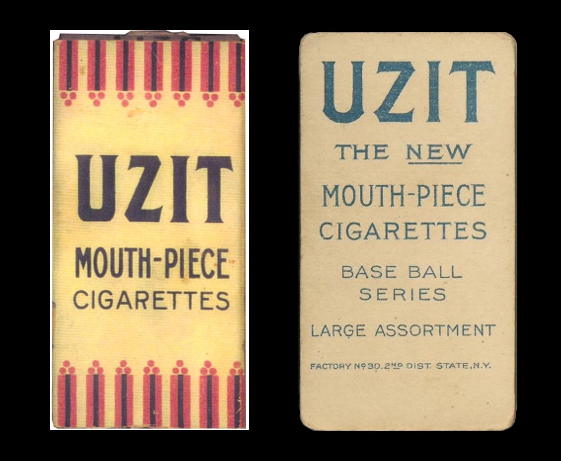
These three sets parallel the full Series One (Cycle), Series Two (Carolina Brights), and Series Three (Uzit) sets.
Series Three - 2002 Topps 206 - Uzit - Link to checklist - www.tcdb.com/Checklist.cfm/sid/9052/2002-Topps-206---Uzit...
Here is the average mini backs break down of the Series 3 box - 20 Packs, 1 mini per pack: (#308 to 456 / 165 cards)
13 Polar Bear
3 Sweet Caporal Red
2 Sweet Caporal Blue
1 Sweet Caporal Black
1 Uzit
Link to the original UZIT cigarettes (Uzit Cigarettes 10-count slide & shell box) - t206resource.com/images/Packs/PacksUzit.jpg Uzit cigarettes were yet another mouthpiece brand that was reminiscent of Eastern European brands like Tolstoi cigarettes.
Ichiro Suzuki (b. 22 October 1973), also known mononymously as Ichiro (イチロー, Ichirō), is a Japanese former professional baseball outfielder who played 28 seasons combined in top-level professional leagues. He spent the bulk of his career with two teams: nine seasons with the Orix BlueWave of Nippon Professional Baseball in Japan, where he began his career, and 14 with the Seattle Mariners of Major League Baseball in the United States. After playing the first 12 years of his MLB career for the Mariners, Suzuki played two and a half seasons with the New York Yankees before signing with the Miami Marlins. He played three seasons with the Marlins before returning to the Mariners in 2018.
Suzuki established a number of batting records, including MLB's single-season record for hits with 262. He achieved 10 consecutive 200-hit seasons, the longest streak by any player in history. Between his major league career in both Japan and the United States, Suzuki has the most hits by any player in top-tier professional leagues. He also has recorded the most hits of all Japanese-born players in MLB history.
In his combined playing time in the NPB and MLB, Suzuki received 17 consecutive selections both as an All-Star and Gold Glove winner, won nine league batting titles, and was MVP four times. In the NPB, he won seven consecutive batting titles and three consecutive Pacific League MVP Awards. In 2001, Suzuki became the first Japanese-born position player to be posted and signed to an MLB club. He led the American League in batting average and stolen bases en route to being named AL Rookie of the Year and AL MVP.
Suzuki was the first MLB player to enter the Japanese Baseball Hall of Fame (The Golden Players Club). He was a ten-time MLB All-Star and won the 2007 All-Star Game MVP Award for a three-hit performance that included the event's first-ever inside-the-park home run. Suzuki won a Rawlings Gold Glove Award in each of his first 10 years in the majors and had an American League–record seven hitting streaks of 20 or more games, with a high of 27. He is also noted for his longevity, continuing to produce at a high level with slugging, and on-base percentages above .300 in 2016, while approaching 43 years of age. In 2016, Suzuki notched the 3,000th hit of his MLB career, against Chris Rusin of the Colorado Rockies at Coors Field, becoming only the 30th player ever to do so. In total, he finished with 4,367 hits in his professional career across Japan and the United States.
Professional debut:
NPB: 11 July, 1992, for the Orix BlueWave
MLB: 2 April, 2001, for the Seattle Mariners
Last appearance
NPB: 13 October, 2000, for the Orix BlueWave
MLB: 21 March, 2019, for the Seattle Mariners
NPB statistics:
Batting average - .353
Hits - 1,278
Home runs - 118
Runs batted in - 529
Stolen bases - 199
MLB statistics
Batting average - .311
Hits - 3,089
Home runs - 117
Runs batted in - 780
Stolen bases - 509
Teams:
Orix BlueWave (1992–2000)
Seattle Mariners (2001–2012)
New York Yankees (2012–2014)
Miami Marlins (2015–2017)
Seattle Mariners (2018–2019)
Career highlights and awards - NPB:
7× All-Star (1994–2000)
Japan Series champion (1996)
3× Pacific League MVP (1994–1996)
7× Golden Glove Award (1994–2000)
7× Best Nine Award (1994–2000)
2× Matsutaro Shoriki Award (1994, 1995)
7× Pacific League batting champion (1994–2000)
Pacific League RBI leader (1995)
Pacific League stolen base leader (1995)
MLB:
10× All-Star (2001–2010)
AL MVP (2001)
AL Rookie of the Year (2001)
10× Gold Glove Award (2001–2010)
3× Silver Slugger Award (2001, 2007, 2009)
2× AL batting champion (2001, 2004)
AL stolen base leader (2001)
MLB record 262 hits, single season
-------------------------------------------------------------------------------------
2002 Topps 206's also comes with the one-per-pack tobacco mini parallels. There are five different card backs to each 180-card parallel set, ranging from the common Polar Bears to the ultra rare Bazooka backs. The shrunken size really sharpens the images of the cards, giving them an even classier appeal. Plus the chase factor is tough, as it would take 15 boxes with perfect collation to build the common Polar Bear set.
These three sets parallel the full Series One (Cycle), Series Two (Carolina Brights), and Series Three (Uzit) sets.
Series Three - 2002 Topps 206 - Uzit - Link to checklist - www.tcdb.com/Checklist.cfm/sid/9052/2002-Topps-206---Uzit...
Here is the average mini backs break down of the Series 3 box - 20 Packs, 1 mini per pack: (#308 to 456 / 165 cards)
13 Polar Bear
3 Sweet Caporal Red
2 Sweet Caporal Blue
1 Sweet Caporal Black
1 Uzit
LINK to Net54 - 2002 Topps 206 Odds and Oddities - www.net54baseball.com/showthread.php?t=238088
Link to the original UZIT cigarettes (Uzit Cigarettes 10-count slide & shell box) - t206resource.com/images/Packs/PacksUzit.jpg Uzit cigarettes were yet another mouthpiece brand that was reminiscent of Eastern European brands like Tolstoi cigarettes.
The starting pitcher warms up in the bullpen, as others take to the main field ahead of the day's tilt.
The whole impetus for going to Japan in the first place with travel companions / family members Gary Glanz, Tom Glanz, and Michael Rance was to watch the MLB Japan Opener Games between the Seattle Mariners and Oakland Athletics. What a blast! The Japanese baseball experience was really amazing down to the cheering, the food, and even the beverage offerings/performances in the Tokyo Dome. I loved it; and, I would go again.
Taken before the Chicago White Sox faced the Seattle Mariners in the Kingdome on August 12, 1988.
This panorama was created using the three previously posted images in Photoshop using Photomerge cylindrical template. The final image was derived after using creative cropping and quite a bit of copy and paste. The dimensions of the image (28x8) were chosen to maximize the viewing area.
This image was processed in Adobe Photoshop CC 2020 using plug-ins from onOne and Topaz Labs software.
Cal Raleigh has had a season for the ages. He hit 60 home runs this year, following his home run derby title back in July at the All-Star Game. He helped lead his team to a division title, and an upcoming appearance in the 2025 postseason.
Seattle, Washington, USA
Mariner's Tickets from my son for my birthday so off to T-Mobile Park in Seattle for a little taste of the boys of summer. T-Mobile Park (formerly Safeco Field), Seattle, Washington
Went to the Mariners game on Monday. It was Star Wars Night and this was the shirt that came with our ticket.
Taken before the Chicago White Sox faced the Seattle Mariners in the Kingdome on August 12, 1988.
This image was processed in Adobe Photoshop CC 2020 using plug-ins from onOne software and Topaz Labs.
Shot during the Seattle Mariners vs Texas Rangers MLB game.
Another failure for the Mariners, get Hernandez out guys...
Mayor Greg Nickels is pictured with Martinez. Item 169598, Legislative Department Digital Photographs (Record Series 4600-11), Seattle Municipal Archives.
Safeco Field, located in Seattle, Washington, is the home of the Seattle Mariners since 1999.
This photo was shot on July 8, 2017 during the Oakland Athletics vs. Seattle Mariners. In this photo, Mariners fans cheer after Mariner's pitcher Nick Vincent strikes out A's outfielder, Khris Davis to end the top of the 8th inning.
© 2017 Ashley D. Cristal, All Rights Reserved. Use of this photograph in ANY form is NOT permitted without permission from the author.
Back in the usual seats (my cousin splits season tickets with one of the investors) for the first Opening Day here since 2018, the Sox defeated the Mariners, 3-2, before 36,948 fans. This was my 17th Opening Day; my first was in 1977 (despite seeing my first game in 1954) and second in 1990, the last in the old ballpark. After seeing the first Opening Day in the new ballpark (my seat no longer exists after several rows were sheared off the upper deck) the following season, I didn't attend another until 2001.
Oct. 17, 2017: Seattle Mariners prospect Eric Filia dives for a fly ball during an Arizona Fall League game.
Taken before the Chicago White Sox faced the Seattle Mariners in the Kingdome on August 12, 1988.
This image was processed in Adobe Photoshop CC 2020 using plug-ins from onOne software and Topaz Labs.
The shortstop has played excellent baseball this season, lighting up the scoreboard in the 8th inning.
... From the man (left) photographing the Seattle city skyline to the Grandpa playing hide and seek with his grandson under the table to the folks (right side) ordering food - the scene before me was changing every second.
Spike Dee Owen (b. April 19, 1961 in Cleburne, Texas) is a former shortstop in Major League Baseball who played for the Seattle Mariners, Boston Red Sox, Montreal Expos, New York Yankees and California Angels (1994–95).
A switch-hitter, he attended The University of Texas at Austin and was the All-Tournament Team shortstop in the 1982 College World Series. He was drafted by the Seattle Mariners in the first round (the sixth overall pick) of the 1982 amateur draft.
On June 25, 1983 he went 1 for 4 against the Toronto Blue Jays in his major league debut with the Mariners. His first hit came off Jim Gott. On July 13, 1983, he hit his first big league home run against Boston Red Sox pitcher Doug Bird at Fenway Park.
In 1986, he was named team captain of the Mariners. On August 19, Owen and center fielder Dave Henderson were traded to the Boston Red Sox for Rey Quiñones and cash. In his third game with the Red Sox, he tied a major league record with six runs scored in a game. In the 1986 American League Championship Series, he hit .429 as the Red Sox, one scant strike away from elimination in Game 5, came back (starting with Henderson's go-ahead homer against closer Donnie Moore) and upended the California Angels 4 games to 3. In the 1986 World Series he hit .300 in a Boston loss to the New York Mets 4 games to 3 after having the Mets down to their last strike twice in extra innings of Game 6.
On December 8, 1988, the Red Sox traded him to the Montreal Expos for pitcher John Dopson and shortstop Luís Rivera.
In 1990, he set a National League record with 63 consecutive errorless games at shortstop. Despite hitting only .234, he showed some decent power with 24 doubles, five triples and five home runs among his 106 hits.
Owen's most productive season was 1992, with career highs in average (.269), home runs (7), stolen bases (7) and slugging percentage (.381). In addition, he had a healthy .348 on-base percentage and hit well in the clutch at .319 in 91 at-bats with runners in scoring position. He also led the NL in fielding percentage twice. A hard-nosed competitor, he quickly established himself as a leader in the Montreal clubhouse and helped rookie Delino DeShields transition to second base.
After the 1992 season, Owen was supplanted as Montreal shortstop by the emergence of Wil Cordero and became a free agent. On December 4, 1992, he signed a three-year contract with the New York Yankees, aspiring to anchor their infield and provide team leadership, but in 1993 he led a horde of AL middle infielders in one category and one only; i.e., salary. Not surprisingly, the Yanks traded him after 1993 to the California Angels for a mere minor leaguer.
In 1994 he hit a career-high .310 in 82 games for the Angels, basically as an infield backup and eventually as a DH.
In 1996, he was demoted to the Texas Rangers' Triple A affiliate, the Oklahoma City 89ers and soon afterward, still in April, announced his retirement.
MLB debut - June 25, 1983, for the Seattle Mariners
Last MLB appearance - October 2, 1995, for the California Angels
MLB statistics:
Batting average - .246
Home runs - 46
RBI - 439
Teams:
Seattle Mariners (1983–1986)
Boston Red Sox (1986–1988)
Montreal Expos (1989–1992)
New York Yankees (1993)
California Angels (1994–1995)
Link to all of his issued baseball cards - www.tradingcarddb.com/Person.cfm/pid/4429/col/1/yea/0/Spi...
Spike Dee Owen (b. April 19, 1961 in Cleburne, Texas) is a former shortstop in Major League Baseball who played for the Seattle Mariners, Boston Red Sox, Montreal Expos, New York Yankees and California Angels (1994–95).
A switch-hitter, he attended The University of Texas at Austin and was the All-Tournament Team shortstop in the 1982 College World Series. He was drafted by the Seattle Mariners in the first round (the sixth overall pick) of the 1982 amateur draft.
On June 25, 1983 he went 1 for 4 against the Toronto Blue Jays in his major league debut with the Mariners. His first hit came off Jim Gott. On July 13, 1983, he hit his first big league home run against Boston Red Sox pitcher Doug Bird at Fenway Park.
In 1986, he was named team captain of the Mariners. On August 19, Owen and center fielder Dave Henderson were traded to the Boston Red Sox for Rey Quiñones and cash. In his third game with the Red Sox, he tied a major league record with six runs scored in a game. In the 1986 American League Championship Series, he hit .429 as the Red Sox, one scant strike away from elimination in Game 5, came back (starting with Henderson's go-ahead homer against closer Donnie Moore) and upended the California Angels 4 games to 3. In the 1986 World Series he hit .300 in a Boston loss to the New York Mets 4 games to 3 after having the Mets down to their last strike twice in extra innings of Game 6.
On December 8, 1988, the Red Sox traded him to the Montreal Expos for pitcher John Dopson and shortstop Luís Rivera.
In 1990, he set a National League record with 63 consecutive errorless games at shortstop. Despite hitting only .234, he showed some decent power with 24 doubles, five triples and five home runs among his 106 hits.
Owen's most productive season was 1992, with career highs in average (.269), home runs (7), stolen bases (7) and slugging percentage (.381). In addition, he had a healthy .348 on-base percentage and hit well in the clutch at .319 in 91 at-bats with runners in scoring position. He also led the NL in fielding percentage twice. A hard-nosed competitor, he quickly established himself as a leader in the Montreal clubhouse and helped rookie Delino DeShields transition to second base.
After the 1992 season, Owen was supplanted as Montreal shortstop by the emergence of Wil Cordero and became a free agent. On December 4, 1992, he signed a three-year contract with the New York Yankees, aspiring to anchor their infield and provide team leadership, but in 1993 he led a horde of AL middle infielders in one category and one only; i.e., salary. Not surprisingly, the Yanks traded him after 1993 to the California Angels for a mere minor leaguer.
In 1994 he hit a career-high .310 in 82 games for the Angels, basically as an infield backup and eventually as a DH.
In 1996, he was demoted to the Texas Rangers' Triple A affiliate, the Oklahoma City 89ers and soon afterward, still in April, announced his retirement.
MLB debut - June 25, 1983, for the Seattle Mariners
Last MLB appearance - October 2, 1995, for the California Angels
MLB statistics:
Batting average - .246
Home runs - 46
RBI - 439
Teams:
Seattle Mariners (1983–1986)
Boston Red Sox (1986–1988)
Montreal Expos (1989–1992)
New York Yankees (1993)
California Angels (1994–1995)
Link to all of his issued baseball cards - www.tradingcarddb.com/Person.cfm/pid/4429/col/1/yea/0/Spi...
Taken before the Chicago White Sox faced the Seattle Mariners in the Kingdome on August 12, 1988.
This image was processed in Adobe Photoshop CC 2020 using plug-ins from onOne software and Topaz Labs.
See the whole film on YouTube and subscribe to our channel! Item 489, Engineering Department Motion Picture Film (Record Series 2613-09), Seattle Municipal Archives.
Oct. 23, 2017: Seattle Mariners prospect Kyle Lewis bats for the Peoria Javelinas during an Arizona Fall League game.
South of Downtown, or SoDo, is the northwest part of Seattle's Industrial District home to Safeco Field and CenturyLink Field. This photo was shot from Safeco Field with downtown Seattle and CenturyLink Field in the background.
© 2017 Ashley D. Cristal, All Rights Reserved. Use of this photograph in ANY form is NOT permitted without permission from the author.