View allAll Photos Tagged SIZES
File: 2016003-0053
Previous scaled down size replaced with full resolution 3872 x 2592, the maximum size of the Nikon D200.
Portmeirion, a tourist village in Gwynedd, North Wales, United Kingdom. Photos were taken on Wednesday 20th April 2016.
Portmeirion. Pentref twristiaeth yng Ngogledd Cymru. Wedi’I gymryd ar ddydd Mercher 20 Ebrill 2016.
NOTE: I apologise if the Welsh language is misspelt as I’m using Google’s translation.
About the photograph.
Am y llum
The photograph was taken from the footpath between the Amis Reunis boat and the Observatory Tower on the southern part of the village, right next to the River Dwyryd, and looking toward north.
In the photograph, the tall building is known as the Bell Tower, and parts of the buildings to the right of the photo is known as The Watch House. In the background, you could see The Dome.
About Portmeirion.
Portmeirion is a tourist and historical coastal village located on the estuary of the River Dwyryd, about 2 miles south east of Porthmadog, in North Wales, and owned by a charitable trust.
Some of the buildings already existed around the middle of the 1800s, such as the hotel, along with Castell Deudraeth.
Sir Clough Williams-Ellis, the chief architect bought most of the buildings. Between 1925 and 1975, he designed, built, and improved the area into an exquisite village, in the style of a Mediterranean feel.
It had since become a most popular tourist location, and often used as on-location filming site for various television shows.
Nowadays, most of the buildings are used as hotels or self-catering cottages, while tourists have a day-out looking around.
About the television show called The Prisoner.
Ynglŷn â'r sioe deledu o'r enw The Prisoner.
The Prisoner is a 1967 British television series about an unnamed British agent who chose to resign from Intelligence services.
In the series, he was imprisoned in a mysterious retirement village at a secret location. Although the village was used for retired secret agents, he was placed there because his superiors and bosses wanted to know why he chose to resign.
In the show, his name was never used, and he was referred to as ”Number Six, as everyone else were given numerical codenames. The mysterious village was overseen by an administrator whom was often referred as Number Two.
Number Six was played by the actor Patrick McGoohan, whom also created the show, as well as writing and directing some of the episodes. He played the main character in 16 out of the 17 episodes. Only played his character in a minor role in one episode, because at that time, he took time off from The Prisoner, to attend a filming of a movie.
In each episodes, different actors played Number Two, and each tried their own attempts to get Number Six to reveal his reasons for resigning. This was often done by means of tricks, drugging, brainwashing, identity theft, and so on.
The usual plot of each episode would have Number Two attempting to use their own means, bring Number Six close to the breaking point, where Six could finally reveal his reasons, but often in the end, Number Six often saw through the attempts, and rebuffed the attempts.
Portmeirion was used as a stand-in filming location for the mysterious village due to its unique style.
You are welcome to comment on my photographs about the shots, about the subject, or about your similar experience. The Comment Box is NOT an adverting billboard for copy-and-paste comment codes for the groups. They will be deleted as clickable spam. If you want to promote the groups, do so in YOUR own Photostream.
When i was walking yesterday, i saw this dish sized red hibiscus. And looked for an angle that will give me a very nice bokeh. I had my canon 70d and the 100mm f/2.8 macro lens. Thanks to those who view, comment and fave my photo. It will be highly appreciated.
An inch-wide garnet crystal from Wrangell Alaska. Forms nice crystals but not gemmy. Site once mined for industrial abrasive, specimens now sold to cruiseship tourists by local Boy Scout troop.
Sexy Sexy Lingerie providing Plus Size Lingerie, erotic lingerie, corsets, babydolls, bustiers and much much more. Lingerie, Plus Size Lingerie, Sexy Lingerie, erotic lingerie, corsets, babydolls, bustiers
SIZE 13 (but fit like 12.5)
Been worn only a few times, great condition.
Looking for Trade or offer.
Crow in the spotlight ...
Sony ILCE-7R
300mm F2.8 G
The mandarin duck (Aix galericulata) is a perching duck species found in East Asia. It is medium-sized, at 41–49 cm (16–19 in) long with a 65–75 cm (26–30 in) wingspan. It is closely related to the North American wood duck, the only other member of the genus Aix. Aix is an Ancient Greek word used by Aristotle to refer to an unknown diving bird, and galericulata is the Latin for a wig, derived from galerum, a cap or bonnet.
The adult male is a striking and unmistakable bird. It has a red bill, large white crescent above the eye and reddish face and "whiskers". The breast is purple with two vertical white bars, and the flanks ruddy, with two orange "sails" at the back. The female is similar to female wood duck, with a white eye-ring and stripe running back from the eye, but is paler below, has a small white flank stripe, and a pale tip to its bill.
Both the males and females have crests, but the crest is more pronounced on the male.
Like many other species of ducks, the male undergoes a moult after the mating season into eclipse plumage. When in eclipse plumage, the male looks similar to the female, but can be told apart by their bright yellow-orange beak, lack of any crest, and a less-pronounced eye-stripe.
Mandarin ducklings are almost identical in appearance to wood ducklings, and very similar to mallard ducklings. The ducklings can be distinguished from mallard ducklings because the eye-stripe of mandarin ducklings (and wood ducklings) stops at the eye, while in mallard ducklings it reaches all the way to the bill.
The hooded crow (Corvus cornix) (also called hoodie is a Eurasian bird species in the Corvus genus. Widely distributed, it is also known locally as Scotch crow and Danish crow. In Ireland it is called grey crow, just as in the Slavic languages and in Danish. In German it is called "mist crow" ("Nebelkrähe"). Found across Northern, Eastern, and Southeastern Europe, as well as parts of the Middle East, it is an ashy grey bird with black head, throat, wings, tail, and thigh feathers, as well as a black bill, eyes, and feet. Like other corvids, it is an omnivorous and opportunistic forager and feeder.
It is so similar in morphology and habits to the carrion crow (Corvus corone), for many years they were considered by most authorities to be geographical races of one species. Hybridization observed where their ranges overlapped added weight to this view. However, since 2002, the hooded crow has been elevated to full species status after closer observation; the hybridisation was less than expected and hybrids had decreased vigour. Within the hooded crow species, four subspecies are recognized, with one, the Mesopotamian crow, possibly distinct enough to warrant species status itself.
Except for the head, throat, wings, tail, and thigh feathers, which are black and mostly glossy, the plumage is ash-grey, the dark shafts giving it a streaky appearance. The bill and legs are black; the iris dark brown. Only one moult occurs, in autumn, as in other crow species. The male is the larger bird, otherwise the sexes are alike. Their flight is slow and heavy and usually straight. Their length varies from 48 to 52 cm (19 to 20 in). When first hatched, the young are much blacker than the parents. Juveniles have duller plumage with bluish or greyish eyes and initially a red mouth. Wingspan is 98 cm (39 in) and weight is on average 510 g.
The mallard or wild duck (Anas platyrhynchos) is a dabbling duck which breeds throughout the temperate and subtropical Americas, Europe, Asia, and North Africa, and has been introduced to New Zealand, Australia, Peru, Brazil, Uruguay, Argentina, Chile, the Falkland Islands and South Africa. This duck belongs to the subfamily Anatinae of the waterfowl family Anatidae.
The male birds (drakes) have a glossy green head and are grey on wings and belly, while the females (hens or ducks) have mainly brown-speckled plumage. Both sexes have an area of white-bordered black speculum feathers which commonly also include iridescent blue feathers especially among males. Mallards live in wetlands, eat water plants and small animals, and are social animals preferring to congregate in groups or flocks of varying sizes. This species is the main ancestor of most breeds of domesticated ducks.
The mallard is a medium-sized waterfowl species although it is often slightly heavier than most other dabbling ducks. It is 50–65 cm (20–26 in) long (of which the body makes up around two-thirds), has a wingspan of 81–98 cm (32–39 in),[16] and weighs 0.72–1.58 kg (1.6–3.5 lb). Among standard measurements, the wing chord is 25.7 to 30.6 cm (10.1 to 12.0 in), the bill is 4.4 to 6.1 cm (1.7 to 2.4 in) and the tarsus is 4.1 to 4.8 cm (1.6 to 1.9 in).
The breeding male mallard is unmistakable, with a glossy bottle-green head and white collar which demarcates the head from the purple-tinged brown breast, grey brown wings, and a pale grey belly. The rear of the male is black, with the dark tail having white borders. The bill of the male is a yellowish orange tipped with black while that of the female is generally darker ranging from black to mottled orange. The female mallard is predominantly mottled with each individual feather showing sharp contrast from buff to very dark brown, a coloration shared by most female dabbling ducks, and has buff cheeks, eyebrow, throat and neck with a darker crown and eye-stripe.
Owing to their highly 'malleable' genetic code, Mallards can display a large amount of variation, as seen here with this female, who displays faded or 'apricot' plumage.
Both male and female mallards have distinct iridescent purple blue speculum feathers edged with white, prominent in flight or at rest, though temporarily shed during the annual summer moult. Upon hatching, the plumage colouring of the duckling is yellow on the underside and face (with streaks by the eyes) and black on the back (with some yellow spots) all the way to the top and back of the head. Its legs and bill are also black. As it nears a month in age, the duckling's plumage will start becoming drab, looking more like the female (though its plumage is more streaked) and its legs will lose their dark grey colouring. Two months after hatching, the fledgling period has ended and the duckling is now a juvenile. Between three and four months of age, the juvenile can finally begin flying as its wings are fully developed for flight (which can be confirmed by the sight of purple speculum feathers). Its bill will soon lose its dark grey colouring and its sex can finally be distinguished visually by three factors. The bill colouring is yellow in males, black and orange for females. The breast feathers are reddish-brown for males, brown for females. The centre tail feather is curled for males (called a drake feather), straight for females.[citation needed]
During the final period of maturity leading up to adulthood (6–10 months of age), the plumage of female juveniles remains the same while the plumage of male juveniles slowly changes to its characteristic colours.[citation needed] This plumage change also applies to adult mallard males when they transition in and out of their non-breeding eclipse plumage at the beginning and the end of the summer moulting period. The adulthood age for mallards is 14 months and the average life expectancy is 3 years, but they can live to twenty.
In captivity, domestic ducks come in wild-type plumages, white, and other colours. Most of these colour variants are also known in domestic mallards not bred as livestock, but kept as pets, aviary birds, etc., where they are rare but increasing in availability.
A noisy species, the female has a deeper quack stereotypically associated with ducks. Male mallards also make a sound which is phonetically similar to that of the female, but it is a deep and raspy sound which can also sound like mek or whak. When incubating a nest, or when offspring are present, Females vocalise differently, making a call which sounds like a truncated version of the usual quack. They will also hiss if the nest or their offspring are threatened or interfered with.
The mallard is a rare example of both Allen's Rule and Bergmann's Rule in birds. Bergmann's Rule, which states that polar forms tend to be larger than related ones from warmer climates, has numerous examples in birds. Allen's Rule says that appendages like ears tend to be smaller in polar forms to minimize heat loss, and larger in tropical and desert equivalents to facilitate heat diffusion, and that the polar taxa are stockier overall. Examples of this rule in birds are rare, as they lack external ears. However, the bill of ducks is very well supplied with blood vessels and is vulnerable to cold.[citation needed]
Due to the malleability of the mallard's genetic code, which gives it its vast interbreeding capability, mutations in the genes that decide plumage colour are very common and have resulted in a wide variety of hybrids such as Brewer's duck (mallard × gadwall, Anas strepera).
Source:
Wikipedia
Crazy Tuesday Theme: Different sizes
Metric thread gauges
Thanks to everyone who took the time to view, comment, and fave my photo. It’s really appreciated. 😊
Did sliders for the kids.
Well, they´re actually smaller than sliders.
The pickled cucumbers under the top reveals the size of it.
Company: Tomy/Pokemon Center
Set: Big Size
Year: 2001
Size: 3 feet
Made in: Japan/US
Extras-
This GIANT plush was available only for a very limited time for sale in the New York and Japanese Pokemon Centers. It retailed for about $150, and sells secondhand for 4-20x that much.
Have any info we left out? Care to donate better pictures? Let us know at pokeplushproject(at)yahoo(dot)com!
I was driving out of Kananaskis country (lots of trees) when I noticed that cloud. As I left the forest, and entered the rolling hills, that cloud grew bigger and bigger. I snapped a few pictures and then embraced myself as I drove back home, hidden somewhere in that mess. Needless to say, this was amazing to witness and an honour to capture.
I've learned that it doesn't matter how big your house is, apparently, it is not big enough. ^_^
Thank you everyone for the appreciation, time and comments!!
Side note: Ignore the grass and it's a house on the ocean.
Cape Cod Bay as seen from the beach at North Truro, Massachusetts.
The schooner is the “Bay Lady II” out of Provincetown. It was built in 1984 by Washburn and Doughty of Woolwich, Maine.
Choose your size and have a nice adventure.
Praia de Armação, Búzios, Brasil.
My Explore #41. Thank you all. Merci. Gracias. Grazie. Obrigado!
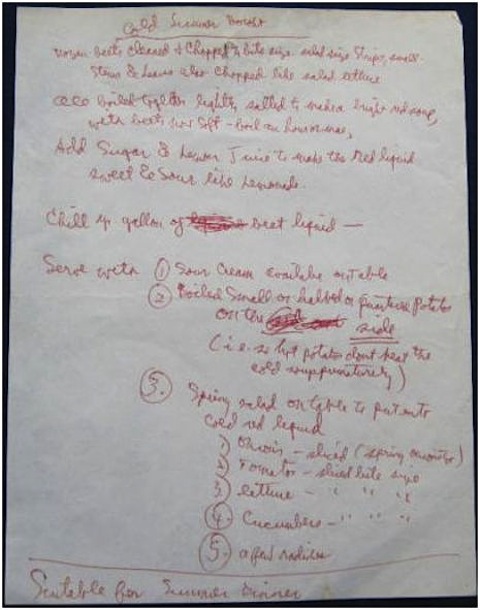
COLD SUMMER BORSCHT
Dozen beets cleaned & chopped to bite size salad-size Strips
Stems & leaves also chopped like salad lettuce
All boiled together lightly salted to make a bright red soup,
with beets now soft – boil an hour or more
Add Sugar & Lemon Juice to make the red liquid
sweet & sour like Lemonade
Chill 4 gallon(s) of beet liquid –
Serve with (1) Sour Cream on table
(2) Boiled small or halved potato
on the side
(i.e., so hot potatoes don’t heat the
cold soup prematurely)
(3) Spring salad on table to put into
cold red liquid
1) Onions – sliced (spring onions)
2) Tomatoes – sliced bite-sized
3) Lettuce – ditto
4) Cucumbers – ditto
5) a few radishes
__________________________________
Suitable for Summer Dinner cdn8.openculture.com/wp-content/uploads/2013/06/ginsbergs... Now is not the right time for cold borscht, but it is one of my mom’s fav dishes in the summer. Mine too.