View allAll Photos Tagged Represents
Huile sur toile, 144 × 96 cm, 1950, Galerie Art City, Fukuoka (Japon).
La toile représente une Vierge à l'enfant ou Madone avec le visage de Gala, la femme du peintre. La Vierge possède une ouverture rectangulaire dans son tronc dans lequel on peut voir l'enfant Jésus, qui a également une ouverture dans le thorax, dans laquelle se trouve un morceau de pain. Dali le décrit comme "un tabernacle dans le corps de Jésus qui contient le pain sacré. Les deux personnages sont sur un piédestal sous une arche. Les divers éléments du tableau sont représentés sans se toucher les uns les autres, comme dans Leda atomica, maintenus en équilibre comme les éléments qui constituent l'atome.
Dans la partie supérieure du tableau, se trouve un coquillage duquel coule un fil qui soutient un œuf. Ces objets sont pour Dali des symboles de vie et ceux qui se rapprochent le plus de la perfection euclidienne. L'arche blanche au-dessus de Gala est divisée en quatre parties et semble esquissée ou mal peinte en plusieurs endroits. Avec la tête de la Vierge, des bas-reliefs sont représentés et possèdent deux petites sphères flottantes. Sur une des arches un fil est cloué et soutient un morceau de chair crue.
Aux côtés de Gala, deux tables de bois sont représentées. Un panier de pain et un escargot de mer s'en détachent. Sur le piédestal figurent plusieurs symboles importants pour Dali : de gauche à droite un chiffon, un coquillage, une fleur blanche fanée et l'autre épanouie, le poisson, deux haricots et un panier. Le piédestal possède une ouverture frontale divisée en trois parties. Sur la partie gauche figure un rhinocéros divisé en plusieurs morceaux, au centre un œuf accompagné par quatre morceaux et à droite une espèce de buste qui subit une explosion dans le visage et flotte comme en apesanteur.
Le fond est très clair et des mariées flottent dans l'espace. Enfin, Dali représente comme dans une scène de théâtre les sommets de collines flottants dans l'espace. Le peintre réutilise de nombreux éléments de ses précédentes toiles dans La Madone de Port Lligat, Gala y est ipeinte deux fois en costume de mariée avec la baie de Port Lligat, le poisson, les coquillages et le morceau de liège suspendu au clou. D'autres éléments constituent les futures obsessions du peintre, tel le rhinocéros à corne coupée qu'il considère comme un symbole de chasteté (cf. wikipédia)..
"'Port-Mahon sculptures' - Models representing the Port-Mahon palace in the main city on Minorca [Maó-Mahón, sometimes written in English as Mahon] in the Balearic Islands. Made from 1777 - 1782, they were sculpted by memory by one of the first workers in the quarry inspections, Decure ['dit Beausejour'], who was imprisoned in the fort opposite the palace for a long time. He was killed from a cave-in while trying to build an access stairway at this location." (plaque). Wow.
- This harbour was "one of the most strategically important in the western Mediterranean... Menorca was captured in 1708 by a joint British-Dutch force on behalf of Holy Roman Emperor Charles VI, during the War of the Spanish Succession. The British saw the island's potential as a naval base and sought to take full control. Its status as a British possession was confirmed by the Treaty of Utrecht in 1713. During the island's years as a British dependency, the capital was moved from Ciutadella de Menorca to Maó-Mahón, which then served as residence for the governor...
The island was lost to the French in 1756 following the naval Battle of Minorca and the final Siege of Fort St Philip, which took place several miles from the town. After their defeat in the 7 years' war, France returned the island to the British in 1763." (Wikipedia). The islands have belonged to Spain since 1802.
- Could this be the site of that palace today? www.cruiseportatlas.com/Ports/MHN-Images/MHN-Altstadt_Hen... (From a site advertising cruises: "Mahon [sometimes called Port Mahon] is a city with a strong 18th cent. British character, including many Georgian buildings in its old center, a Gin distillery, and an impressive English fortress.")

- So this quarry worker had been a prisoner of the Brits, trapped for years with a view of this scene through the bars of his cell-window, and was trapped forever near this, his creation, when he died in that cave-in.
Manufactura Musica @ Represent Festival Balingen 2018
[<a href="https://lamertz.pics">Homepage</a>] - [<a href="https://instagram.com/indie.and.more">Instagram</a>] - [<a href="https://facebook.com/MichaelLamertzFotografie">Facebook</a>]
Long Legged Liars @ Represent Festival Balingen 2018
[<a href="https://lamertz.pics">Homepage</a>] - [<a href="https://instagram.com/indie.and.more">Instagram</a>] - [<a href="https://facebook.com/MichaelLamertzFotografie">Facebook</a>]
Icon representing the Outcome: Greater prosperity
This icon is freely available for use in any library publicity or advocacy material. You can download it in a range of sizes using the down pointing arrow on the right hand side of the screen below the image.
Priyanka Chopra proud to represent Girl Up campaign at the UN Global Leadership Dinner! - www.bolegaindia.com/gossips/Priyanka_Chopra_proud_to_repr...
faure/macassar, western cape- kramat of sheikh yussuf
A Kramat is a shrine or mausoleum that has been built over the burial place of a Muslim who's particular piety and practice of the teachings of Islam is recognised by the community. I have been engaged in documenting these sites around Cape Town over several visits at different times over the last few years. They range widely from graves marked by an edge of stones to more elaborate tombs sheltered by buildings of various styles. They are cultural markers that speak of a culture was shaped by life at the Cape and that infuses Cape Town at large.
In my searches used the guide put out by the Cape Masaar Society as a basic guide to locate some recognised sites. Even so some were not that easy to find.
In the context of the Muslims at the Cape, historically the kramats represented places of focus for the faithful and were/are often places of local pilgrimage. When the Dutch and the VOC (United East India Company aka Vereenigde Oostindische Compagnie) set up a refuelling station and a settlement at the Cape, Muslims from their territories in the East Indies and Batavia were with them from the start as soldiers, slaves and 'Vryswarten'; (freemen). As the settlement established itself as a colony the Cape became a useful place to banish political opponents from the heart of their eastern empire. Some exiles were of royal lineage and there were also scholars amongst them. One of the most well known of these exiles was Sheik Yusuf who was cordially received by Govenor van der Stel as befitted his rank (he and his entourage where eventually housed on an estate away from the main settlement so that he was less likely to have an influence over the local population), others were imprisoned for a time both in Cape Town and on Robben island. It is said that the first Koran in the Cape was first written out from memory by Sheik Yusuf after his arrival. There were several Islamic scholars in his retinue and these men encouraged something of an Islamic revival amoung the isolated community. Their influence over the enslaved “Malay” population who were already nominally Muslim was considerable and through the ministrations of other teachers to the underclasses the influence of Islam became quite marked. As political opponents to the governing powers the teachers became focus points for escaped slaves in the outlying areas.
Under the VOC it was forbidden to practice any other faith other than Christianity in public which meant that there was no provision for mosques or madrasas. The faith was maintained informally until the end of the C18th when plans were made for the first mosque and promises of land to be granted for a specific burial ground in the Bo Kaap were given in negotiations for support against an imminent British invasion. These promises were honoured by the British after their victory.
There is talk of a prophecy of a protective circle of Islam that would surround Cape Town. I cannot find the specifics of this prophecy but the 27 kramats of the “Auliyah” or friends of Allah, as these honoured individuals are known, do form a loose circle of saints. Some of the Auliyah are credited with miraculous powers in legends that speak of their life and works. Within the folk tradition some are believed to be able to intercede on behalf of supplicants (even though this more part of a mystical philosophy (keramat) and is not strictly accepted in mainstream contemporary Islamic teaching) and even today some visitors may offer special prayers at their grave sites in much the same way as Christians might direct prayer at the shrine of a particular saint.
photographer's note-
sheikh yussuf was the brother of the king of Goa (Gowa) with it's capital of Makassar. yussuf fought in battles against the Dutch and was eventually captured. he was transferred to the cape of good hope in 1693. he died in 1699. he had 2 wives, 2 concubines, 12 children and 14 male and female slaves.
*********************************************
Die Kramat van Sjeg Yusuf, Faure
Die Kramat1 van Sjeg Yusuf (Abadin Tadia Tjoessoep)2 op 'n klein heuwel naby die mond van die Eersterivier in Makassar, Faure, is 'n terrein waarheen Kaapse Moslems oor die laaste drie eeue pelgrimstogte onderneem. Yusuf is op 23 April 1699 oorlede en op die heuwel begrawe. Volgens predikant en skrywer, Francois Valentyn (1666-1727), wat sy graf in 1705 besoek het, was dit "een cierlyke Mohammedaansch tombe, wat van zeer hoog opgezette steenen, verheerlykt was".3 Dit is nie heeltemal duidelik of hy van 'n hoog opgeboude graf of 'n struktuur daaroor praat nie.
Dié tombe moes mettertyd veranderings en verbouings het en volgens Biskop Patrick Griffith (1798-1862) wat dit meer as 'n eeu later op 25 Januarie 1839 besoek het, het dit heel anders daar uitgesien...
and proceeded to a Mr Cloete's where we took horses and road (sic) to a Malay Mosque [i.e. the kramat] situated on the summit of a hill, to which we ascended by a rude Stone Stair Case, rather Circular and partly cut out of Limestone rock, by an hundred steps. We left our horses below tied to the door of a Caravansery where the Pilgrims who come every year from Cape Town and all around, lodge while they go thro' their devotions. Both Lodging House and Mosque are at present deserted and we cd. only see the Exterior of both. The Mosque has a small Mineret (sic) in the centre and contains the Tomb of some Prince and Priest of the Sect. The Building is square and low with a portico: the windows are screened within and all that could be seen through some chinks in the walls was some drapery. A curious sight, however, exists outside: graves covered with white Clothes, five or six of which graves are enclosed together with a low wall round them; two or three more are apart; each has a round black stone at the head round which a Malay handkerchief is tied, with another black stone at foot, represents the feet, so that with the white sheet over the body, one wd. imagine at first view that it was a corpse was directly before him, the representation of it is so like reality. These White cloths (of calico) are renewed every year and we found some sixty or more rotten ones under each of the last white Coverings."1
Die terrein is in 1862 deur die imam van die Jamia-moskee in Chiappinistraat, Abdol Wahab, aangekoop,5 maar die gebou het tot vroeg in die 20ste eeu bewaar gebly, hoewel dit by verskeie geleenthede klein veranderings en herstelwerk moes ondergaan het.
Die Oostenrykse wetenskaplike, diplomaat en ontdekkingsreisiger, Karl Ritter von Scherzer (1821-1903) het die Kaap in Oktober 1857 aan boord die Novara, op 'n omseilingstog van die wêreld, aangedoen. Hy het die volgende waardevolle beskrywing, deurdrenk met sy eie voor- en afkeure, nagelaat:
"The following morning we drove to a hill, ahout a mile and a half distant from Zandvliet, known as Macassar Downs, on which is the spot of interment, (Krammat or Brammat), of a Malay prophet.
This individual, so honoured in death, was, if we are to believe the Malays, a direct descendant of Mahomet, named Sheikh Joseph, who, expelled from Batavia by the Dutch Government for political reasons, settled in the colony about a century and a half ago, and died and was buried in the neighbourhood of Zandvliet. An especial deputation came over from Malacca to Cape Colony to fetch away the corpse of the defunct prophet, for conveyance to the land of his birth; but at the disinterment it happened that the little finger of the prophet, in spite of the most persevering research, could nowhere be found. This circumstance appeared to those simple believers sufficient reason for erecting a monument over the spot in which the finger of a Malay prophet lay hid from view. Even to this day the Malays from time to time perform a pilgrimage to the Colony and celebrate their religious ceremonies at the Mausoleum. Four followers of the prophet are buried with him, two of them Mahometan priests, who are regarded with much veneration by the Malays.
An extensive flight of stone steps leads to the tomb, the exterior of which is very insignificant, and, but for a small pointed turret, hardly differs from an ordinary dwelling-house. On entering, a low-roofed vault is visible, a sort of front outhouse, which rather disfigures the facade, and much more resembles a cellar than the portal of a Mausoleum. Above the arch of this vault an Arabic inscription has been engraved with a stylus but this is so painted over in brick colour that it has already become almost illegible. Judging by the few words that have been deciphered, it seems to consist of the first propositions of the Koran.
The inner room, provided on two sides with modern glazed windows at irregular intervals, is about the size of an ordinary room of 12 feet long, 9 wide, and 7 high (3.66m long, 2.74 wide, and 2.13 high). In the middle rises the monument, to which access is had by some more brick steps. Immense quantities of unwashed white linen cloth are heaped upon it, which seem occasionally sprinkled with a brown odoriferous liquid (dupa). As at the head of Sheikh Joseph, so at his feet several figures, resembling those in enamel used to ornament tarts, are drawn upon the linen cloth with the overflowings of the unguent. These have undoubtedly been formed accidentally, and it appears wrong and unfair to attribute to them any more recondite significance. The monument rests upon four wooden pillars, with pyramidal pinnacles or ornaments, and is richly decorated with fine white muslin, which gives to the whole very much the appearance of an old-fashioned English "fourposter," with its costly drapery and curtains. While the curtains are spread out all around, several small green and white bannerets stand at the upper and lower end of the sarcophagus. The whole interior is, as it were, impregnated with the incense which devout Malay pilgrims from time to time burn here, especially after the forty days' fast (Ramadan), or leave behind upon the steps of the tomb in flasks or in paper-boxes. On such occasions, they always bring wax-candles and linen cloth as an offering, with the latter of which they deck the tomb afresh, so that a perfect mountain of white linen rises above the stone floor. During their devotions they unceasingly kiss this white mass of stuff, and as they are continually chewing tobacco, this filthy habit produces disgustingly loathsome stains.
On the same hill which boasts the tomb of Sheikh Joseph, there are also, in ground that is common property, nine other graves of eminent Malays, enclosed with carefully-selected stones, and likewise covered over with large broad strips of bleached linen cloth, protected by stones from any injury by weather or violence. At the head and foot of each individual interred, is a single stone of larger size. Formerly the black inhabitants of the neighbourhood made use of this store of linen cloth to make shirts for themselves, without further thought upon the propriety of the matter. Latterly, however, a shrewd Malay priest spread a report that one of these ebony linen stealers had lost all the fingers off one hand, since which the graves of those departed worthies remain inviolate and unprofaned.
At the foot of the hill are some small half-fallen-in buildings, near a large hall, painted white, red, and yellow, consisting of a small apartment and a kitchen, the whole in a most dirty, neglected, and desolate condition. At this point the Moslems must have accomplished certain prayers, before they can climb the hill and proceed to visit the tomb. Over the door of this singular house of prayer some words are likewise engraved in the Arabic character, which, however, are now entirely illegible.
On quitting the Malay Krammat, we next undertook a tolerably difficult walk to the Downs or sand-dunes, which at this point extend along the entire coast line, on which the wax-berry shrub, as already mentioned, grows wild in vast quantities, and visibly prevents the further encroachments of the moving sand. The Eerst Rivier (First River) may be regarded as the limit of demarcation between the sand-dunes and the soil adapted for vegetation."6
'n Britse joernalis en historikus, Ian Duncan Colvin (1877-1938), beskryf sy besoek aan die Kramat vyftig jaar later in die begin van die 20ste eeu:
"It was in springtime that we made the pilgrimage, in October, the springtime of the south... We passed through cow-scented pasture and the cornlands of Zandvliet, and so towards the sea, guided by the white star of the tomb.
It stands upon a sandstone rock which the Eerste River bends round on its way to the sea, and you can hear the breakers roaring, though unseen behind the sand-dunes. A little wooden bridge crosses the river beside the drift... On the farther side the little hill rises steeply, and under it nestles a row of very ancient and dilapidated cottages. One of them is used as a stable by the pilgrims and another as a mosque, and upon its porch you will see a little notice in English that 'women are not allowed inside the church', a warning signed with all the weight and authority of the late Haji Abdul Kalil... Inside, this little chapel is touchingly primitive and simple, with blue sky showing through the thatched roof, and a martin's nest plastered on the ceiling of the little alcove. Between these cottages and the stream is a field of sweet marjoram, no doubt grown for the service of the shrine, and the way up the hill is made easy by a flight of steps build perhaps centuries ago, and ruinous with age. With their white balustrades, and overgrown as they are with grass and wild-flowers, they are very beautiful, and in pilgrimage-time we may suppose them bright with Malays ascending and descending. We mounted them to the top, where they open on a little courtyard roughly paved and encinctured by a low white wall. On the farther side, opposite the top of the stairs, is the tomb itself, a little white building with an archway leading into a porch. Beyond is a door, of the sort common in Cape farm-houses, divided into two across the middle. Of course, we did not dare to open it and peep inside; but I am told by a Mahomedan friend that the inner tomb is of white stucco with four pillars of a pleasant design. It is upholstered in bright-coloured plush, and copies of the Koran lie open upon it. The inside of the room is papered in the best Malay fashion, and over the window is a veil of tinselled green gauze. From the roof several ostrich eggs hang on strings, and altogether it is the gayest and brightest little shrine. The ostrich eggs hanging on their strings made me think of a much more splendid tomb which Akbar, the first greatest of the Moguls, build for his friend Selim Chisti, a humble ascetic, in the centre of the mosque at Fatehpur Sikri.7 If any of my readers have made a pilgrimage to that wonderful deserted city, they will remember the tomb build of fretted marble, white and delicate as lace, in the centre of the great silent mosque of red sandstone – surely the finest testimonial to disinterested and spiritual friendship that exists in the world. And, if they look inside, they will recollect that around the inner shrine of mother o’pearl hang ostrich eggs just as they hang in Sheik Joseph’s tomb on the Cape Flats. But this digression is only to show that the Malay of Cape Town knows what is proper to the ornamentation of kramats. The shrine is tended with pious care, kept clean and white by the good Malays – a people of whom it may be said truly that they hold cleanliness as a virtue next to godliness."8
Hierdie beskrywing kom ooreen met dié van Scherzer en 'n foto in die Elliot-versameling in die Kaapse argief. Die minaret wat deur Biskop Griffith genoem en deur Scherzer geïllustreer is, en moontlik van hout gemaak was, het intussen verdwyn.
In 1925 het die Indiese filantroop, Hadji Sulaiman Sjah Mohamed Ali, opdrag vir 'n nuwe tombe gegee en is die huidige vierkantige en gekoepelde Moghul- of Delhi-inspireerde struktuur opgerig. Die argitek was F.K. KENDALL wat van 1896 tot 1918 in vennootskap met Herbert BAKER praktiseer het.
Die kramat vorm deel van die sogenaamde beskermende "Heilige Sirkel van Islam" wat strek van die kramatte teen die hange van Seinheuwel bo die klipgroef waar die eerste openbare Moslemgebede aan die Kaap gehou is, deur die kramatte op die rug van die heuwel en die kramat van Sjeg Noorul Mubeen by Oudekraal, en om die berg na die kramatte van Constantia, Faure, Robbeneiland, terug na Seinheuwel.
Sjeg Yusuf van Makassar (1626-1699)
Sjeg Yusuf (Abadin Tadia Tjoesoep) is in 1626 te Gowa by Makassar (Mangkasara), op die suidwestelike punt van die Sulawesi-eiland (voorheen Celebes) langs die Straat van Makassar, gebore. Toe die Portugese dit vroeg in die sestiende eeu bereik het, was dit 'n besige handelshawe waar Arabiese, Indiese, Javaanse, Maleise Siamese en Chinese skepe aangedoen en hulle produkte geruil en verkoop het. Met die koms van die Nederlanders, wat die speseryhandel wou monopoliseer en Britse deelname daaraan wou stuit, is die tradisie van vrye handel aan die begin van die 17de eeu omvergewerp. Nadat hulle die fort van Makassar ingeneem het, is dit herbou en as Fort Rotterdam herdoop. Van hier het hulle die vestings van die Sultan van Gowa geteiken.
Toe hy agtien jaar oud was, het Yusuf op 'n pelgrims- en studietog na Mekka vertrek waar hy verskeie jare deurgebring het. Met sy terugkeer het hy die Nederlanders in Makassar vermy en hom in Bantam in Wes-Java aan die hof van Sultan Ageng (Abulfatah Agung, 1631-1695) as onderwyser en geestelike rigter gevestig. Hy het die sultan se seuns onderrig en met een van sy dogters getrou. Hy was deeglik in die Shari'ah (Moslem kode en godsdienstige wet) onderlê en diep betrokke by die mistieke aspekte van sy geloof met die gevolg dat sy reputasie as 'n vrome persoon en heilige kenner en geleerde vinnig versprei het.
Hoewel die Nederlanders die handel op Java beheer het, het Bantam 'n sterk mate van onafhanklikheid behou. Yusuf was 'n vurige teenstander van die VOC en het en ook 'n rebellie teen die Europeërs gelei toe 'n ouer vredesooreenkoms tussen hulle in 1656 gebreek is. 'n Nuwe ooreenkoms is in 1659 bereik, maar 'n interne tweestryd in die Sultanaat het in die VOC se kraam gepas. Die sultan se seun, later as Sultan Hadji bekend, het met die hulle saamgespan teen sy vader en jonger broer wat voorkeur aan die Britse en Deense handelaars gegee het. Die breuk het in 1680 gekom toe Ageng oorlog teen Batavia (Jakarta) verklaar het. Hadji het 'n opstand teen sy vader gelei wat Ageng tot sy woning beperk het. Hoewel sy volgelinge teruggeveg het, het die Nederlanders Hadji te hulp gesnel en is Ageng na die hooglande verdryf waar hy in Maart 1683 oorgegee het. Hierna is hy na Batavia geneem waar hy oorlede is.
Yusuf het die verset voortgesit en is eers teen die einde van 1683 gevange geneem waarna hy ook na Batavia geneem is. Sy invloed in die Moslemgemeenskap van die VOC se hoofkwartier in die Ooste, waar hy as heilige vereer is, asook die aandrang op sy vrystelling deur die vorste van Gowa (Makassar) – wat toe bondgenote van die VOC was – het daartoe gelei dat Yusuf en sy gevolg eers na Ceylon (Sri Lanka) en daarna na die Kaap verban is. Sjeg Yusuf en sy "aanhang", soos in die notules van die Politieke Raad aangedui is, het op 31 Maart 1694 aan boord die Voetboog in Tafelbaai aangekom. Hier is hulle gul deur goewerneur Simon van der Stel ontvang, maar in die Kasteel gehou totdat daar in Junie besluit is om hulle na die mond van die Eersterivier, wat oor die plaas Zandvliet van ds P. Kalden uitgekyk het, te stuur.9
Hier in die duine, wat later as Makassar en Makassarstrand bekend sou word, het Yusuf en sy gevolg hulle gevestig. Volgens oorlewering was dit die eerste sentrum van Islam en Islamitiese onderrig in Suid-Afrika en het die terrein 'n sakrosante ereplek gebly na Yusuf se afsterwe op 23 April 1699 en sy begrafnis op die heuwel. Hoewel sommige skrywers nie oortuig is dat ook Yusuf se oorskot na die Ooste terug is nie, argumenteer André van Rensburg dat dit wel gebeur het.
"Hoewel 'n aanvanklike versoek van 31 Desember 1701 dat Yusuf se oorskot opgegrawe en na Indonesië gestuur word, geweier is, is in 'n verslag van 26 Februarie 1703 deur die Here XVII gelas dat die sjeg se naasbestaandes en sy oorskot na Indonesië weggebring moes word.
Op 26 Februarie 1704 het die amptelike geskrewe instruksies van die VOC in die Kaap aangekom. Die weduwee van Yusuf, hul jong kinders en ander lede van sy gevolg moes toegelaat word om na Indonesië terug te keer.
Daar is ook bepaal dat die oorskot van Yusuf onopsigtelik opgegrawe moes word sodat die naasbestaandes dit kon saamneem. Voorsorg moes egter getref word dat ander Oosterse bannelinge nie ontsnap deur voor te gee dat hulle naasbestaandes van sjeg Yusuf is nie."10
Die gevolg van Sjeg Yusuf het op 5 Oktober 1704 aan boord van De Spiegel uit Tafelbaai met sy oorskot vertrek en op 10 Desember in Batavia anker gegooi. Hierna is sy hulle na Makassar waar sy oorskot op 6 April 1705 op Lakiung in Ujung Pandang herbegrawe is. Bo-oor Yusuf se nuwe graf is 'n kramat of ko'bang deur die Chinese bouer Dju Kian Kiu opgerig. Ook hierdie Kramat word druk deur pelgrims besoek.
________________________________
Kramat is die algemeen Kaapse term vir die tombe van 'n [Moslem] heilige of Wali van Allah; in Urdu verwys karamat of keramat na die wonderwerking van 'n heilige, soms word dit ook as sinoniem vir heilige gebruik.
Die meer algemeen gebruikte spelling word hier in plaas van die erkende Afrikaanse "Joesoef" gebruik.
Raidt, E.H. 1971. François Valentyn Beshryvinge van de Kaap der Goede Hoop met de zaaken daar toe behoorende. Kaapstad: Van Riebeeck Vereniging, Vol. 1, p. 198.
Brain, J.S. (ed.). 1988. The Cape diary of bishop Patrick Raymond Griffith for the years 1837-1839. Cape Town: Southern African Catholic Bishops' Conference, pp. 189-90.
Aktekantoor, Kaapstad, Akte 6/3/1862, no. 121.
Scherzer, K. 1861. Narrative of the circumnavigation of the globe by the Austrian frigate Novara, (commodore b. Von Wullerstorf-Urbair,): undertaken by order of the imperial government, in the years l857,1858, & 1859. London: Saunders, Otley & Co, pp. 244-248.
Seremoniële hoofstad [Fatehpur = stad van oorwinning] van 1569 tot 1574 deur die Mughale Keiser Akbar (1542-1605) by Sikri, die hermitage van sy spirituele gids, Sjeg Salim Chisti, opgerig. Die tombe wat deur Colvin beskryf word, is deur Shah Jahan (1592-1666) herbou.
Colvin, I.D. 1909. Romance of Empire, South Africa. London: TC & EL Jack, pp. 16168.
Böeseken, A.J. 1961. Resolusies van die Politieke Raad III 1681-1707. Kaapstad: Argiefkomitee, p. 283 (14.06.1694).
Van Rensburg, A. & Van Bart, M. 2004. Waar rus Sjeg Yusuf: van die Kaap tot in Makassar. Kultuurkroniek, Bylae by Die Burger, 10 Julie, pp. 12-13
Van Rensburg, A. & Van Bart, M. 2004. Waar rus Sjeg Yusuf: van die Kaap tot in Makassar. Kultuurkroniek, Bylae by Die Burger, 10 Julie, p.13.
________________________________
Schalk W le Roux, Gordonsbaai, Februarie 2013
See also Van Bart, M. & Van Rensburg A.
________________________________
Wording on Minaret:
IN MEMORY OF
SHEIKH YUSUF
MARTYR & HERO
OF BANTAM
1629 - 1699
THIS MINARET
WAS ERECTED BY
HAJEE SULLAIMAN
SHAHMAHOMED
IN THE REIGN OF
KING GEORGE V
MAY 1925
_____________________
THIS MEMORIAL WAS UNVEILED
19TH DECEMBER 1925 BY
SIR FREDERIC DE WAAL
KCMG:LLD:FIRST ADMINISTRATOR
OF THE CAPE PROVINCE
IN THE YEAR WHEN THIS
DISTRICT WAS VISITED BY
HIS ROYAL HIGNESS
THE PRINCE OF WALES
4TH MAY 1925
_____________________
THE "DARGAN" OF ASHBAT
[COMPANIONS] OF SAINT SHEIKH YUSSUF
[GALERAN TUANSE] OF MACASSAR.
_____
HERE LIE THE REMAINS OF FOUR OF FORTY-NINE
FAITHFUL FOLLOWERS WHO AFTER SERVING
IN THE BANTAM WAR OF 1682-83, ARRIVED WITH
SHEIKH YUSSUF AT THE CAPE FROM CEYLON,
IN THE SHIP "VOETBOOG" IN THE YEAR 1694.
_____
THIS COMMEMORATION TABLET WAS ERECTED
DURING THE GREAT WAR ON 8 JANUARY 1918.
BY HAJEE SULLAIMAN SHAHMAHOMED.
SENIOR TRUSTEE.
Wording on plaque:
PRESIDENT SOEHARTO
OF THE REPUBLIC OF INDONESIA
VISITED THIS SHRINE ON 21 NOVEMBER 1997
TO PAY RESPECT TO THE LATE SHEIKH YUSSUF OF
MACASSAR UPON WHOM THE TITLE OF NATIONAL
HERO WAS CONFERRED BY THE INDONESIAN GOVERNMENT
ON 7 AUGUST 1995
Writings about this Kramat of Sheikh Yusuf
Davids, Achmat. 1980. The Mosques of Bo-Kaap - A social history of Islam at the Cape. Athlone, Cape: The South African Institute of Arabic and Islamic Research. pp 37-40.
_______________________________________________
De Bosdari, C. 1971. Cape Dutch Houses and Farms. Cape Town: AA Balkema. pp 73.
_______________________________________________
De Kock, WJ. 1976. Suid-Afrikaanse biografiese woordeboek : Deel 1. Kaapstad: RGN/Tafelberg. pp 429-430.
_______________________________________________
Du Plessis, Izak David. 1944. The Cape Malays. Cape Town: Maskew Miller. pp 4-7.
_______________________________________________
Jaffer, M. 2001. Guide to the Kramats of the Western Cape. Cape Town: Cape Mazaar (Kramat) Society. pp 17-19.
_______________________________________________
Jaffer, Mansoor. 1996. Guide to the Kramats of the Western Cape. Cape Town: Cape Mazaar Kramat Society. pp 17.
_______________________________________________
Le Roux, SW. 1992. Vormgewende invloede op die ontwikkeling van moskee-argitektuur binne die Heilige Sirkel aan die Kaap tot 1950 . Pretoria: PhD-verhandeling: Universiteit van Pretoria. pp 201-202.
_______________________________________________
Oxley, John. 1992. Places of Worship in South Africa. Halfway House: Southern Book Publishers. pp 63-64.
_______________________________________________
Potgieter, DJ (Editor-in-chief). 1975. Standard Encyclopaedia of South Africa [SESA] Volume 11 Tur-Zwe. Cape Town: Nasou. pp 567.
_______________________________________________
Potgieter, DJ (Editor-in-chief). 1972. Standard Encyclopaedia of South Africa [SESA] Volume 6 Hun-Lit. Cape Town: Nasou. pp 454-455.
_______________________________________________
Rhoda, E. 2010. Hajee Sullaiman Shahmahomed and the shrine of Shayk Yusuf of Macassar at Faure. : Unpublished manuscript.
_______________________________________________
Van Selms, A. Joesoef, Sjeik: in De Kock, WJ. 1976. Suid-Afrikaanse biografiese woordeboek : Deel 1: pp 429-430
________________________________________
Shaykh Yusuf was born at Macassar in 1626. He was also known as Abadin Tadia Tjoessoep. He was of noble birth, a maternal nephew of King Biset of Goa. He studied in Arabia under the tutelage of several pious teachers.
When Shaykh Yusuf arrives at the Cape, on the Voetboeg, he was royally welcomed by Governor Simon van de Stel. His Indonesian background necessitated that he and his 49 followers be settled well away from Cape Town. They were housed on the farm Zandvliet, near the mouth of the Eeste River, in the general area now called Macassar. He received an allowance of 12rix dollars from the Cape authorities for support of himself and his party. At Zandvliet Shaykh Yusuf’s settlement soon became a sanctuary for fugitive slaves. It was here that the first cohesive Muslim community in S.A. was established. The first settlement of Muslims in South Africa was a vibrant one, despite its isolation. It was from here that the message of Islam was disseminated to the slave community living in Cape Town. When Shaykh Yusuf died on 23 May 1699, he was buried on the hill overlooking Macassar at Faure. A shrine was constructed over his grave. Over the years this shrine has been rebuilt and renewed. Today it remains a place of pilgrimage.
Page 6 in the Series.
These series of pages represent, in my opinion, the ten most exotic, beautifully styled automobiles of the 1930’s era. The general theme or styling of each car in this series is representative of again, what I feel, as Art Deco styling.
Let me also make it clear that the title of this series “Curves of Steel” is not of my originality but rather, plagiarized from the official catalog produced for the April 2007 automotive exhibit at the Phoenix Museum of Art.
In April of 2007, The Phoenix Art Museum presented 22 streamlined American and European automobiles that demonstrated the intersection of style and aerodynamics in 20th century automotive design. The exhibition was widely celebrated in the media, from The New York Times to Architectural Digest to CBS Sunday Morning, and in virtually every leading automobile magazine.
“Coachbuilt Press" was honored to be selected by the Phoenix Art Museum to create Curves of Steel as the exhibition's premium catalog. The exhibition tracked the evolution of the streamlined shape from the 1930s to the 1990s. Edited and co-written by historian Jonathan A. Stein, Curves of Steel includes essays from many of the world's great automotive writers including Beverly Rae Kimes, Ken Gross, Phil Patton, Richard Adatto and Diana Meredith. Each car is presented with historic images and elegant, modern photographs by Michael Furman”.
The catalog was published as a Limited Edition standard hardbound book. Although now out of print since its museum edition sold out in 2007, this remarkable edition remains available, along with an array of superior quality limited edition prints through COACHBUILT PRESS.
COACHBUILT PRESS-Philadelphia
www.coachbuiltpress.com/bookpage-curves.html
With this clarified, the series being posted on flickr is strictly for non-commercial purpose. The various images (cars) were downloaded from the internet (none of the pictures contained were taken by me). Likewise descriptive text included in each page was, in large part, “copied and pasted” from sources found on the internet (with some editing in part). Where noted, source material has been credited.
The graphical layout for this series was assembled using Adobe In-Design and saved as a pdf document. The images viewed on flickr are “screen shots” taken from the pdf document, imported into Adobe Photoshop and then saved as .jpg images for up-loading to flickr.
Enjoy folks and feel free to offer your choices and/or preferences as to what you may feel as an appropriate candidate for one of the most exotic, beautiful cars of the 30’s. Keep in mind, that I am looking at automotive styling that would typify Art Deco design. You may also feel that one or more of the cars contained in this series should not, in your opinion, be included. In such case, please so indicate along with a brief explanation.
“Quiero darle las gracias al Gobernador, al Secretario de Seguridad Pública, todo el municipio de Sáric, la población, se los vamos a agradecer”.
Noé Varela Castillo.
Presidente Municipal de Sáric.
Ver boletín en:
es.scribd.com/doc/251960365/09-01-2014-El-Gobernador-Guil...
www.slideshare.net/GuillermoPadres/b011428
Instala Gobernador Padrés Mando Único Policial en la Región del Gran Desierto y Río Altar
· El Presidente Enrique Peña Nieto, a través de su representante personal, extendió un reconocimiento al trabajo de Sonora en materia de seguridad.
TUBUTAMA, SONORA, ENERO 09 DE 2014.- Con el reconocimiento del Presidente de la República y el Gobierno Federal por el buen trabajo realizado en materia de seguridad, el Gobernador Guillermo Padrés encabezó la instalación del Mando Único Policial en la Región del Gran Desierto y Río Altar, que abarca a 7 municipios del Estado.
De esta manera, los ciudadanos que habitan en esta región ven cumplida su petición de contar con más seguridad para ellos y sus familias con elementos bien entrenados, que aprobaron las pruebas de control de confianza.
“El día de hoy quedará establecido aquí el Mando Único Policial en los siete municipios que históricamente han sido parte de la cultura del desierto de Sonora, en Altar, Átil, Oquitoa, Pitiquito, Sáric, Trincheras y Tubutama, estos siete municipios ya tienen un Mando Único y lo vamos a poner en marcha y lo vamos a aprovechar a favor de toda la gente”, enfatizó.
Monte Alejandro Rubido García, Secretario Ejecutivo del Sistema Nacional de Seguridad Pública, afirmó en nombre del Presidente Enrique Peña Nieto que el Gobernador Padrés está trabajando de la mejor manera posible en materia de seguridad y prueba de ello es que, precisamente por los buenos resultados, en 2013 Sonora fue beneficiado con las dos bolsas concursables de recursos federales extraordinarios para la seguridad pública.
“Reitero, es una prueba fehaciente de que el Gobierno del Gobernador Padrés está haciendo las cosas de la mejor manera”, aseveró.
Rubido García calificó la instalación del Mando Único Policial en Sonora como un hecho sin precedentes en la historia de Sonora, toda vez que la suma de esfuerzos entre Federación, Estado y Municipios en materia de seguridad ayudará a que la región y por supuesto sus ciudadanos estén mejor protegidos.
Durante su mensaje, el Gobernador recordó que el 21 de julio de 2011 el Congreso del Estado de Sonora se trasladó al municipio de Tubutama para aprobar la Ley de Seguridad Pública del Estado de Sonora y desde 2012 se comenzó a trabajar para llevar el Mando Único a esta región.
“Vamos a protegerlos, vamos a garantizarles su derecho constitucional a la seguridad, a la paz y al desarrollo armónico de esta región y lo vamos a hacer apegados a la ley, a esa ley de seguridad pública que se aprobó el 21 de julio de 2011 en este municipio”, aseveró el mandatario estatal.
Frente a presidentes municipales, elementos de seguridad y funcionarios de los tres niveles de Gobierno, entre ellos los representantes personales del Presidente Enrique Peña Nieto y el Secretario Miguel Ángel Osorio Chong, el Gobernador entregó la Bandera de México al Jefe de Grupo Alejandro Coronado Miranda, Comandante Regional del Río Altar.
Bajo el Mando Único Policial, elementos de la Policía Estatal Acreditable, Ejército Mexicano, Marina de México y Fuerzas Especiales, tendrán la responsabilidad de vigilar la seguridad de los habitantes de Altar, Átil, Oquitoa, Pitiquito, Sáric, Trincheras y Tubutama.
La base desde donde operarán tiene la característica de ser móvil, para un mayor dinamismo; y cuenta con dormitorios, sanitarios, regaderas, comedor, área de entrenamiento y centro de control.
En la instalación del Mando Único Policial, el Gobernador Padrés también estuvo acompañado por Ernesto Munro Palacio, Secretario Ejecutivo de Seguridad Pública; Enrique Francisco Galindo Ceballos, Comisionado General de la Policía Federal; Fernando Schutte Elguero, Secretario Técnico de la Conferencia Nacional de Secretarios de Seguridad Pública; Gonzalo de la Fuente Escobar, Coordinador Regional del Noroeste de la Comisión Nacional de Seguridad; Juan Sebastián Soto Mayor Tovar, Presidente del Supremo Tribunal de Justicia del Estado; Karina García Gutiérrez, Representante de la Mesa Directiva del Congreso del Estado; Perla Zuzuki Aguilar Lugo, Presidenta de la Comisión de Seguridad del Congreso del Estado; Raúl Ramírez Ramírez, Presidente de la Comisión Estatal de los Derechos Humanos; Hilario Mata Tinoco, Comandante de la 45 Zona Militar y Adrián Arriaga Artiaga, Comandante del Sector Naval de Puerto Peñasco.
Así como los presidentes municipales Jesús Rivera Celaya, de Tubutama; Martha Elsa Vidrio Federico, de Altar; Carla Enett Celaya Gortari, de Átil; José Aurelio Ortiz Gortari, de Oquitoa; Andrés Lara Velásquez, de Pitiquito; Luz María Portillo Trejo, de Trincheras y Noé Varela Castillo, de Sáric.
Opinan los alcaldes:
“Con este establecimiento en nuestra región estamos seguros de que vamos a recuperar nuestros territorios, nuestros caminos, y lo más importante, la seguridad y tranquilidad de nuestras familias”
Jesús Rivera Celaya
Presidente Municipal de Tubutama
“Vienen a dar más seguridad, esperemos que con esto venga a fortalecer más la seguridad de nuestros ciudadanos, la población. Le estamos apostando los tres niveles de Gobierno a que vuelva la seguridad, el turismo a esta zona”
José Aurelio Ortiz Gortari
Presidente Municipal de Oquitoa
“Esto representa tranquilidad y estamos viendo adelante, es un privilegio para nosotros que este municipio, esta región, sea la primera en el Estado”
Martha Elsa Vidrio Federico
Presidenta Municipal de Altar
“Representa seguridad, lo más importante, que las personas que tengamos fuera sigan viniendo con la confianza. Ahora con las fiestas decembrinas y las fiestas de fin de año ya la gente vimos que están volviendo otra vez, les di la bienvenida, les expliqué el Mando Único y están súper interesados y muy contentos, que felicitará al señor Gobernador por esto tan importante que va a hacer por nuestra región”
Carla Enett Celaya Gortari
Presidenta Municipal de Átil
“Pues es un gran avance, para nosotros la seguridad de nuestros ciudadanos es lo principal. Le voy a dar las gracias al Gobernador y felicitarlo por este nuevo avance”
Luz María Portillo Trejo
Presidenta Municipal de Trincheras
“Quiero darle las gracias al Gobernador, al Secretario de Seguridad Pública, todo el municipio de Sáric, la población, se los vamos a agradecer”
Noé Varela Castillo
Presidente Municipal de Sáric
“Una gran seguridad, una seguridad que la hemos buscado de muchos años anteriores y que va a ser un pleno éxito. Le doy las gracias por estas decisiones de que está haciendo las cosas, mirando las necesidades de los municipios”
Andrés Lara Velásquez
Presidente Municipal de Pitiquito
Artifacts representing Michael Anderson, who served as payload commander on space shuttle mission STS-107, are displayed in a new, permanent memorial, "Forever Remembered," opening June 27 in the Space Shuttle Atlantis exhibit at the Kennedy Space Center Visitor Complex in Florida. NASA and astronaut families collaborated on the memorial designed to honor the crews lost on missions STS-51L and STS-107, pay tribute to shuttle vehicles Challenger and Columbia, and emphasize the importance of learning from the past. Encompassing nearly 2,000 square feet, the memorial contains the largest collection of memorabilia and personal items of both flight crews. It also includes recovered hardware from both Challenger and Columbia, never before displayed for the public. Photo credit: NASA/Kim Shiflett
In 2013 Thierry Geoffroy / Colonel is represented at the Malives pavilion at the Venice Biennale and then went further and received hospitality at the Zimbabwe pavilion with the Emergency Room Mobile
www.emergencyrooms.org/biennalist.html
Meanwhile Thierry Geoffroy is in Copenhagen the work about todays emergencies continue at the gallery Marianne Friis on the WARM UP Wall established for this occasion
--------------------------------------------------------------------------------------------------------------------------------------------
lists of artists participating at the Venice Biennale :
Hilma af Klint, Victor Alimpiev, Ellen Altfest, Paweł Althamer, Levi Fisher Ames, Yuri Ancarani, Carl Andre, Uri Aran, Yüksel Arslan, Ed Atkins, Marino Auriti, Enrico Baj, Mirosław Bałka, Phyllida Barlow, Morton Bartlett, Gianfranco Baruchello, Hans Bellmer, Neïl Beloufa, Graphic Works of Southeast Asia and Melanesia, Hugo A. Bernatzik Collection, Ștefan Bertalan, Rossella Biscotti, Arthur Bispo do Rosário, John Bock, Frédéric Bruly Bouabré, Geta Brătescu, KP Brehmer, James Lee Byars, Roger Caillois, Varda Caivano, Vlassis Caniaris, James Castle, Alice Channer, George Condo, Aleister Crowley & Frieda Harris, Robert Crumb, Roberto Cuoghi, Enrico David, Tacita Dean, John De Andrea, Thierry De Cordier, Jos De Gruyter e Harald Thys, Walter De Maria, Simon Denny, Trisha Donnelly, Jimmie Durham, Harun Farocki, Peter Fischli & David Weiss, Linda Fregni Nagler, Peter Fritz, Aurélien Froment, Phyllis Galembo, Norbert Ghisoland, Yervant Gianikian & Angela Ricci Lucchi, Domenico Gnoli, Robert Gober, Tamar Guimarães and Kasper Akhøj, Guo Fengyi, João Maria Gusmão & Pedro Paiva, Wade Guyton, Haitian Vodou Flags, Duane Hanson, Sharon Hayes, Camille Henrot, Daniel Hesidence, Roger Hiorns, Channa Horwitz, Jessica Jackson Hutchins, René Iché, Hans Josephsoh, Kan Xuan, Bouchra Khalili, Ragnar Kjartansson, Eva Kotátková, Evgenij Kozlov, Emma Kunz, Maria Lassnig, Mark Leckey, Augustin Lesage, Lin Xue, Herbert List, José Antonio Suárez Londoño, Sarah Lucas, Helen Marten, Paul McCarthy, Steve McQueen, Prabhavathi Meppayil, Marisa Merz, Pierre Molinier, Matthew Monahan, Laurent Montaron, Melvin Moti, Matt Mullican, Ron Nagle, Bruce Nauman, Albert Oehlen, Shinro Ohtake, J.D. ‘Okhai Ojeikere, Henrik Olesen, John Outterbridg, Paño Drawings, Marco Paolini, Diego Perrone, Walter Pichler, Otto Piene, Eliot Porter, Imran Qureshi, Carol Rama, Charles Ray, James Richards, Achilles G. Rizzoli, Pamela Rosenkranz, Dieter Roth, Viviane Sassen, Shinichi Sawada, Hans Schärer, Karl Schenker, Michael Schmidt, Jean-Frédéric Schnyder, Friedrich Schröder-Sonnenstern, Tino Sehgal, Richard Serra, Shaker Gift Drawings, Jim Shaw, Cindy Sherman, Laurie Simmons e Allan McCollum, Drossos P. Skyllas, Harry Smith, Xul Solar, Christiana Soulou, Eduard Spelterini, Rudolf Steiner, Hito Steyerl, Papa Ibra Tall, Dorothea Tanning, Anonymous Tantric Paintings, Ryan Trecartin, Rosemarie Trockel, Andra Ursuta, Patrick Van Caeckenbergh, Stan VanDerBeek, Erik van Lieshout, Danh Vo, Eugene Von Bruenchenhein, Günter Weseler, Jack Whitten, Cathy Wilkes, Christopher Williams, Lynette Yiadom-Boakye, Kohei YoshiyUKi, Sergey Zarva, Anna Zemánková, Jakub Julian Ziółkowski ,Artur Żmijewski.
Encyclopedic Palace is curated by Massimiliano Gioni
--------------------------------------------------------------------------------------------------------------------------------------------
other pavilions at Venice Biennale
Andorra Artists: Javier Balmaseda, Samantha Bosque, Fiona Morrison
Commissioner: Henry Périer Deputy Commissioners: Francesc Rodríguez, Ermengol Puig, Ruth Casabella
Curators: Josep M. Ubach, Paolo De Grandis
Angola Artist: Edson Chagas Commissioner: Ministry of Culture
Curators: Beyond Entropy (Paula Nascimento, Stefano Rabolli Pansera), Jorge Gumbe, Feliciano dos Santos
Argentina Artist: Nicola Costantino Commissioner: Magdalena Faillace Curator: Fernando Farina
Armenia Artist: Ararat SarkissianCurator: Arman Grogoryan
AustraliaArtist: Simryn Gill Commissioner: Simon Mordant Deputy Commissioner: Penelope Seidler Curator: Catherine de Zegher
AustriaArtist: Mathias Poledna ,Curator: Jasper Sharp
AzerbaijanArtists: Rashad Alakbarov, Sanan Aleskerov, Chingiz Babayev, Butunay Hagverdiyev, Fakhriyya Mammadova, Farid Rasulov
Commissioner: Heydar Aliyev FoundationCurator: Hervé Mikaeloff
Bahamas Artist: Tavares Strachan Commissioner: Nalini Bethel, Ministry of Tourism Curators: Jean Crutchfield, Robert HobbsDeputy Curator: Stamatina Gregory
BangladeshChhakka Artists’ Group: Mokhlesur Rahman, Mahbub Zamal, A. K. M. Zahidul Mustafa, Ashok Karmaker, Lala Rukh Selim, Uttam Kumar Karmaker. Dhali Al Mamoon, Yasmin Jahan Nupur, Gavin Rain, Gianfranco Meggiato, Charupit School
Commissioner/Curator: Francesco Elisei. , Curator: Fabio Anselmi.
BahrainArtists: Mariam Haji, Waheeda Malullah, Camille Zakharia
Commissioner: Mai bint Mohammed Al Khalifa, Minister of Culture
Curator: Melissa Enders-Bhatiaa
BelgiumArtist: Berlinde De Bruyckere
Commissioner: Joke Schauvliege, Flemish Minister for Environment, Nature and Culture .Curator: J. M. Coetzee ,Deputy Curator: Philippe Van Cauteren
Bosnia and Herzegovina
Artist: Mladen Miljanovic .Commissioners: Sarita Vujković, Irfan Hošić
Brazil Artists: Hélio Fervenza, Odires Mlászho, Lygia Clark, Max Bill, Bruno Munari
Commissioner: Luis Terepins, Fundação Bienal de São Paulo,Curator: Luis Pérez-Oramas ,Deputy Curator: André Severo
CanadaArtist: Shary Boyle
Commissioner: National Gallery of Canada / Musée des beaux-arts du Canada ,Curator: Josée Drouin-Brisebois
Central AsiaArtists: Vyacheslav Akhunov, Sergey Chutkov, Saodat Ismailova, Kamilla Kurmanbekova, Ikuru Kuwajima, Anton Rodin, Aza Shade, Erlan Tuyakov
Commissioner: HIVOS (Humanist Institute for Development Cooperation)
Deputy Commissioner: Dean Vanessa Ohlraun (Oslo National Academy of the Arts/The Academy of Fine Art)
Curators: Ayatgali Tuleubek, Tiago Bom
Scientific Committee: Susanne M. Winterling
ChileArtist: Alfredo JaarCommissioner: CNCA, National Council of Culture and the Arts Curator: Madeleine Grynsztejn
ChinaArtists: He Yunchang, Hu Yaolin, Miao Xiaochun, Shu Yong, Tong Hongsheng, Wang Qingsong, Zhang Xiaotao
Commissioner: China Arts and Entertainment Group (CAEG) ,Curator: Wang Chunchen
Costa Rica Artists: Priscilla Monge, Esteban Piedra, Rafael Ottón Solís, Cinthya Soto
Commissioner: Francesco EliseiCurator: Francisco Córdoba, Museo de Arte y Diseño Contemporáneo (Fiorella Resenterra)
Croatia Artist: Kata Mijatovic ,Commissioner/Curator: Branko Franceschi.
CubaArtists: Liudmila and Nelson, Maria Magdalena Campos & Neil Leonard, Sandra Ramos, Glenda León, Lázaro Saavedra, Tonel, Hermann Nitsch, Gilberto Zorio, Wang Du, H.H.Lim, Pedro Costa, Rui Chafes, Francesca Leone ,Commissioner: Miria Vicini
Curators: Jorge Fernández Torres, Giacomo Zaza
CyprusArtists: Lia Haraki, Maria Hassabi, Phanos Kyriacou, Constantinos Taliotis, Natalie Yiaxi, Morten Norbye Halvorsen, Jason Dodge, Gabriel Lester, Dexter Sinister
Commissioner: Louli Michaelidou
Deputy Commissioners: Angela Skordi, Marika Ioannou
Curator: Raimundas Malašauskas
Czech Republic & Slovak RepublicArtists: Petra Feriancova, Zbynek Baladran ,Commissioner: Monika Palcova, Curator: Marek Pokorny
DenmarkArtist: Jesper Just in collaboration with Project ProjectsEgypt
Artists: Mohamed Banawy, Khaled Zaki
EstoniaArtist: Dénes Farkas ,Commissioner: Maria Arusoo ,Curator: Adam Budak
FinlandArtist: Antti Laitinen , Commissioner: Raija Koli , Curators: Marko Karo, Mika Elo, Harri Laakso
FranceArtist: Anri Sala ,Curator: Christine Macel
GeorgiaArtists: Bouillon Group,Thea Djordjadze, Nikoloz Lutidze, Gela Patashuri with Ei Arakawa and Sergei Tcherepnin, Gio Sumbadze
Commissioner: Marine Mizandari, First Deputy Minister of Culture Curator: Joanna Warsza
GermanyArtists: Ai Weiwei, Romuald Karmakar, Santu Mofokeng, Dayanita Singh Commissioner/Curator: Susanne Gaensheimer
Great BritainArtist: Jeremy Deller ,Commissioner: Andrea Rose , Curator: Emma Gifford-Mead
Holy SeeArtists: Lawrence Carroll, Josef Koudelka, Studio Azzurro ,Curator: Antonio Paolucci
Hungary , Artist: Zsolt Asztalos , Curator: Gabriella Uhl
Iceland , Artist: Katrín Sigurðardóttir ,Commissioner: Dorotheé Kirch
Curators: Mary Ceruti , Ilaria Bonacossa
IndonesiaArtists: Albert Yonathan Setyawan, Eko Nugroho, Entang Wiharso, Rahayu Supanggah, Sri Astari, Titarubi
Deputy Commissioner: Achille Bonito Oliva , Assistant Commissioner: Mirah M. Sjarif
Curators: Carla Bianpoen, Rifky Effendy
IraqArtists: Abdul Raheem Yassir, Akeel Khreef, Ali Samiaa, Bassim Al-Shaker, Cheeman Ismaeel, Furat al Jamil, Hareth Alhomaam, Jamal Penjweny, Kadhim Nwir, WAMI (Yaseen Wami, Hashim Taeeh)
Commissioner: Tamara Chalabi (Ruya Foundation for Contemporary Culture)Curator: Jonathan Watkins.
IrelandArtist: Richard MosseCommissioner, Curator: Anna O’Sullivan
Israel , Artist: Gilad Ratman , Commissioners: Arad Turgeman, Michael GovCurator: Sergio Edelstein
ItalyArtists: Francesco Arena, Massimo Bartolini, Gianfranco Baruchello, Elisabetta Benassi, Flavio Favelli, Luigi Ghirri, Piero Golia, Francesca Grilli, Marcello Maloberti, Fabio Mauri, Giulio Paolini, Marco Tirelli, Luca Vitone, Sislej Xhafa ,Commissioner: Maddalena Ragni
Curator: Bartolomeo Pietromarchi
Ivory Coast Artists: Frédéric Bruly Bouabré, Tamsir Dia, Jems Koko Bi, Franck Fanny
Commissioner: Paolo De Grandis , Curator: Yacouba Konaté
Japan ,Artist: Koki Tanaka ,Curator: Mika Kuraya
KenyaArtists: Kivuthi Mbuno, Armando Tanzini, Chrispus Wangombe Wachira, Fan Bo, Luo Ling & Liu Ke, Lu Peng, Li Wei, He Weiming, Chen Wenling, Feng Zhengjie, César MeneghettiCommissioner: Paola Poponi ,Curators: Sandro Orlandi, Paola Poponi
Korea (Republic of)Artist: Kimsooja
KosovoArtist: Petrit Halilaj ,Commissioner: Erzen Shkololli ,Curator: Kathrin Rhomberg
KuwaitArtists: Sami Mohammad, Tarek Al-Ghoussein
Commissioner: Mohammed Al-Asoussi ,Curator: Ala Younis
Latin AmericaIstituto Italo-Latino Americano
Artists:Marcos Agudelo, Miguel Alvear & Patricio Andrade, Susana Arwas, François Bucher, Fredi Casco, Colectivo Quintapata (Pascal Meccariello, Raquel Paiewonsky, Jorge Pineda, Belkis Ramírez), Humberto Díaz, Sonia Falcone, León & Cociña, Lucía Madriz, Jhafis Quintero, Martín Sastre, Guillermo Srodek-Hart, Juliana Stein, Simón Vega, Luca Vitone, David Zink Yi.
Harun Farocki & Antje Ehmann. In collaboration with: Cristián Silva-Avária, Anna Azevedo, Paola Barreto, Fred Benevides, Anna Bentes, Hermano Callou, Renata Catharino, Patrick Sonni Cavalier, Lucas Ferraço Nassif, Luiz Garcia, André Herique, Bruna Mastrogiovanni, Cezar Migliorin, Felipe Ribeiro, Roberto Robalinho, Bruno Vianna, Beny Wagner, Christian Jankowski ,Commissioner: Sylvia Irrazábal ,Curator: Alfons Hug
Deputy Curator: Paz Guevara
Latvia Artists: Kaspars Podnieks, Krišs Salmanis ,Commissioners: Zane Culkstena, Zane Onckule ,Curators: Anne Barlow, Courtenay Finn, Alise Tifentale
LithuaniaArtist: Gintaras Didžiapetris, Elena Narbutaite, Liudvikas Buklys, Kazys Varnelis, Vytaute Žilinskaite, Morten Norbye Halvorsen, Jason Dodge, Gabriel Lester, Dexter SinisterCommissioners: Jonas Žokaitis, Aurime Aleksandraviciute . Curator: Raimundas Malašauskas
LuxembourgArtist: Catherine LorentCommissioner: Clément Minighetti Curator: Anna Loporcaro
MexicoArtist: Ariel Guzik ,Commissioner: Gastón Ramírez Feltrín ,Curator: Itala Schmelz
Montenegro ,Artist: Irena Lagator Pejovic .Commissioner/Curator: Nataša Nikcevic
The Netherlands ,Artist: Mark Manders
Commissioner: Mondriaan Fund ,Curator: Lorenzo Benedetti
New Zealand Artist: Bill Culbert ,Commissioner: Jenny Harper ,Deputy Commissioner: Heather Galbraith ,Curator: Justin Paton
Venue: Santa Maria della Pietà, Calle della Pietà, Castello
Finland: ,Artist: Terike Haapoja ,Commissioner: Raija Koli ,Curators: Marko Karo, Mika Elo, Harri Laakso
Norway:Artists: Edvard Munch, Lene Berg
Curators: Marta Kuzma, Pablo Lafuente, Angela Vettese
Paraguay Artists: Pedro Barrail, Felix Toranzos, Diana Rossi, Daniel Milessi ,Commissioner: Elisa Victoria Aquino Laterza
Deputy Commissioner: Nori Vaccari Starck , Curator: Osvaldo González Real
Poland Artist: Konrad Smolenski Commissioner: Hanna Wróblewska Curators: Agnieszka Pindera, Daniel Muzyczuk
Portugal Artist: Joana Vasconcelos Curator: Miguel Amado
RomaniaArtists: Maria Alexandra Pirici, Manuel Pelmus Commissioner: Monica Morariu Deputy Commissioner: Alexandru Damia Curator: Raluca Voinea
Artists: Anca Mihulet, Apparatus 22 (Dragos Olea, Maria Farcas,Erika Olea), Irina Botea, Nicu Ilfoveanu, Karolina Bregula, Adi Matei, Olivia Mihaltianu, Sebastian MoldovanCommissioner: Monica Morariu ,Deputy Commissioner: Alexandru Damian ,Curator: Anca Mihulet
Russia Artist: Vadim Zakharov ,Commissioner: Stella Kasaeva ,Curator: Udo Kittelmann
Serbia Artists: Vladimir Peric, Miloš Tomic .Commissioner: Maja Ciric
SloveniaArtist: Jasmina CibicCommissioner: Blaž Peršin ,Curator: Tevž Logar
South Africa Commissioner: Saul Molobi ,Curator: Brenton Maart
Spain Artist: Lara Almarcegui , Commissioner/Curator: Octavio Zaya
Switzerland Artist: Valentin Carron Commissioners: Pro Helvetia - Sandi Paucic and Marianne Burki
Curator: Giovanni CarmineVenue: Pavilion at Giardini
Syrian Arab RepublicArtists: Giorgio De Chirico, Miro George, Makhowl Moffak, Al Samman Nabil, Echtai Shaffik, Giulio Durini, Dario Arcidiacono, Massimiliano Alioto, Felipe Cardena, Roberto Paolini, Concetto Pozzati, Sergio Lombardo, Camilla Ancilotto, Lucio Micheletti, Lidia Bachis, Cracking Art Group, Hannu Palosuo
Commissioner: Christian Maretti Curator: Duccio Trombadori
Taiwan Artists: Bernd Behr, Chia-Wei Hsu, Kateřina Šedá + BATEŽO MIKILU Curator: Esther Lu
Thailand Artists: Wasinburee Supanichvoraparch, Arin Rungjang
Curators: Penwadee Nophaket Manont, Worathep Akkabootara
Turkey Artist: Ali Kazma Commissioner: Istanbul Foundation for Culture and Arts Curator: Emre Baykal
Venue: Forte Marghera, via Forte Marghera, 30
Ukraine Artists: Ridnyi Mykola, Zinkovskyi Hamlet, Kadyrova Zhanna Commissioner: Victor Sydorenko
Curators: Soloviov Oleksandr, Burlaka Victoria
United Arab Emirates Artist: Mohammed Kazem
Commissioner: Dr. Lamees Hamdan Curator: Reem Fadda
Uruguay Artist: Wifredo Díaz Valdéz
Commissioner: Ricardo Pascale Curators: Carlos Capelán, Verónica Cordeiro
USA Artist: Sarah Sze Commissioners/Curators: Carey Lovelace, Holly Block
Venezuela Colectivo de Artistas Urbanos Venezolanos , Commissioner: Edgar Ernesto González Curator: Juan Calzadilla
In 2013 Thierry Geoffroy / Colonel is represented at the Malives pavilion at the Venice Biennale and then went further and received hospitality at the Zimbabwe pavilion with the Emergency Room Mobile .
He ask in his installationmade of different steps : "IS CLIMATE CHANGE STILL AN EMERGENCY ? "
www.emergencyrooms.org/biennalist.html .
He also converge with his work on emergencies : www.emergencyrooms.org
The exhibition update is from the 25/9/2013( please ask permission for use of photos =1@colonel.dk )
--------------------------------------------------------------------------------------------------------------------------------------------
lists of artists participating at the Venice Biennale :
Hilma af Klint, Victor Alimpiev, Ellen Altfest, Paweł Althamer, Levi Fisher Ames, Yuri Ancarani, Carl Andre, Uri Aran, Yüksel Arslan, Ed Atkins, Marino Auriti, Enrico Baj, Mirosław Bałka, Phyllida Barlow, Morton Bartlett, Gianfranco Baruchello, Hans Bellmer, Neïl Beloufa, Graphic Works of Southeast Asia and Melanesia, Hugo A. Bernatzik Collection, Ștefan Bertalan, Rossella Biscotti, Arthur Bispo do Rosário, John Bock, Frédéric Bruly Bouabré, Geta Brătescu, KP Brehmer, James Lee Byars, Roger Caillois, Varda Caivano, Vlassis Caniaris, James Castle, Alice Channer, George Condo, Aleister Crowley & Frieda Harris, Robert Crumb, Roberto Cuoghi, Enrico David, Tacita Dean, John De Andrea, Thierry De Cordier, Jos De Gruyter e Harald Thys, Walter De Maria, Simon Denny, Trisha Donnelly, Jimmie Durham, Harun Farocki, Peter Fischli & David Weiss, Linda Fregni Nagler, Peter Fritz, Aurélien Froment, Phyllis Galembo, Norbert Ghisoland, Yervant Gianikian & Angela Ricci Lucchi, Domenico Gnoli, Robert Gober, Tamar Guimarães and Kasper Akhøj, Guo Fengyi, João Maria Gusmão & Pedro Paiva, Wade Guyton, Haitian Vodou Flags, Duane Hanson, Sharon Hayes, Camille Henrot, Daniel Hesidence, Roger Hiorns, Channa Horwitz, Jessica Jackson Hutchins, René Iché, Hans Josephsoh, Kan Xuan, Bouchra Khalili, Ragnar Kjartansson, Eva Kotátková, Evgenij Kozlov, Emma Kunz, Maria Lassnig, Mark Leckey, Augustin Lesage, Lin Xue, Herbert List, José Antonio Suárez Londoño, Sarah Lucas, Helen Marten, Paul McCarthy, Steve McQueen, Prabhavathi Meppayil, Marisa Merz, Pierre Molinier, Matthew Monahan, Laurent Montaron, Melvin Moti, Matt Mullican, Ron Nagle, Bruce Nauman, Albert Oehlen, Shinro Ohtake, J.D. ‘Okhai Ojeikere, Henrik Olesen, John Outterbridg, Paño Drawings, Marco Paolini, Diego Perrone, Walter Pichler, Otto Piene, Eliot Porter, Imran Qureshi, Carol Rama, Charles Ray, James Richards, Achilles G. Rizzoli, Pamela Rosenkranz, Dieter Roth, Viviane Sassen, Shinichi Sawada, Hans Schärer, Karl Schenker, Michael Schmidt, Jean-Frédéric Schnyder, Friedrich Schröder-Sonnenstern, Tino Sehgal, Richard Serra, Shaker Gift Drawings, Jim Shaw, Cindy Sherman, Laurie Simmons e Allan McCollum, Drossos P. Skyllas, Harry Smith, Xul Solar, Christiana Soulou, Eduard Spelterini, Rudolf Steiner, Hito Steyerl, Papa Ibra Tall, Dorothea Tanning, Anonymous Tantric Paintings, Ryan Trecartin, Rosemarie Trockel, Andra Ursuta, Patrick Van Caeckenbergh, Stan VanDerBeek, Erik van Lieshout, Danh Vo, Eugene Von Bruenchenhein, Günter Weseler, Jack Whitten, Cathy Wilkes, Christopher Williams, Lynette Yiadom-Boakye, Kohei YoshiyUKi, Sergey Zarva, Anna Zemánková, Jakub Julian Ziółkowski ,Artur Żmijewski.
--------------------------------------------------------------------------------------------------------------------------------------------
other pavilions at Venice Biennale
Andorra Artists: Javier Balmaseda, Samantha Bosque, Fiona Morrison
Commissioner: Henry Périer Deputy Commissioners: Francesc Rodríguez, Ermengol Puig, Ruth Casabella
Curators: Josep M. Ubach, Paolo De GrandisAngola Artist: Edson Chagas Commissioner: Ministry of Culture
Curators: Beyond Entropy (Paula Nascimento, Stefano Rabolli Pansera), Jorge Gumbe, Feliciano dos Santos
Argentina Artist: Nicola Costantino Commissioner: Magdalena Faillace Curator: Fernando Farina
Armenia Artist: Ararat SarkissianCurator: Arman Grogoryan /AustraliaArtist: Simryn Gill Commissioner: Simon Mordant Deputy Commissioner: Penelope Seidler Curator: Catherine de Zegher /AustriaArtist: Mathias Poledna ,Curator: Jasper Sharp /AzerbaijanArtists: Rashad Alakbarov, Sanan Aleskerov, Chingiz Babayev, Butunay Hagverdiyev, Fakhriyya Mammadova, Farid Rasulov /Commissioner: Heydar Aliyev FoundationCurator: Hervé Mikaeloff
Bahamas Artist: Tavares Strachan Commissioner: Nalini Bethel, Ministry of Tourism Curators: Jean Crutchfield, Robert HobbsDeputy Curator: Stamatina Gregory/BangladeshChhakka Artists’ Group: Mokhlesur Rahman, Mahbub Zamal, A. K. M. Zahidul Mustafa, Ashok Karmaker, Lala Rukh Selim, Uttam Kumar Karmaker. Dhali Al Mamoon, Yasmin Jahan Nupur, Gavin Rain, Gianfranco Meggiato, Charupit School/Commissioner/Curator: Francesco Elisei. , Curator: Fabio Anselmi./BahrainArtists: Mariam Haji, Waheeda Malullah, Camille Zakharia /Commissioner: Mai bint Mohammed Al Khalifa, Minister of Culture /Curator: Melissa Enders-Bhatiaa/BelgiumArtist: Berlinde De Bruyckere
Commissioner: Joke Schauvliege, Flemish Minister for Environment, Nature and Culture .Curator: J. M. Coetzee ,Deputy Curator: Philippe Van Cauteren /Bosnia and Herzegovina
Artist: Mladen Miljanovic .Commissioners: Sarita Vujković, Irfan Hošić
Brazil Artists: Hélio Fervenza, Odires Mlászho, Lygia Clark, Max Bill, Bruno Munari
Commissioner: Luis Terepins, Fundação Bienal de São Paulo,Curator: Luis Pérez-Oramas ,Deputy Curator: André Severo
CanadaArtist: Shary Boyle /Commissioner: National Gallery of Canada / Musée des beaux-arts du Canada ,Curator: Josée Drouin-Brisebois/Central AsiaArtists: Vyacheslav Akhunov, Sergey Chutkov, Saodat Ismailova, Kamilla Kurmanbekova, Ikuru Kuwajima, Anton Rodin, Aza Shade, Erlan Tuyakov
Commissioner: HIVOS (Humanist Institute for Development Cooperation)
Deputy Commissioner: Dean Vanessa Ohlraun (Oslo National Academy of the Arts/The Academy of Fine Art)
Curators: Ayatgali Tuleubek, Tiago Bom
Scientific Committee: Susanne M. Winterling
ChileArtist: Alfredo JaarCommissioner: CNCA, National Council of Culture and the Arts Curator: Madeleine Grynsztejn
ChinaArtists: He Yunchang, Hu Yaolin, Miao Xiaochun, Shu Yong, Tong Hongsheng, Wang Qingsong, Zhang Xiaotao
Commissioner: China Arts and Entertainment Group (CAEG) ,Curator: Wang Chunchen
Costa Rica Artists: Priscilla Monge, Esteban Piedra, Rafael Ottón Solís, Cinthya Soto
Commissioner: Francesco EliseiCurator: Francisco Córdoba, Museo de Arte y Diseño Contemporáneo (Fiorella Resenterra)
Croatia Artist: Kata Mijatovic ,Commissioner/Curator: Branko Franceschi.
CubaArtists: Liudmila and Nelson, Maria Magdalena Campos & Neil Leonard, Sandra Ramos, Glenda León, Lázaro Saavedra, Tonel, Hermann Nitsch, Gilberto Zorio, Wang Du, H.H.Lim, Pedro Costa, Rui Chafes, Francesca Leone ,Commissioner: Miria ViciniCurators: Jorge Fernández Torres, Giacomo Zaza
CyprusArtists: Lia Haraki, Maria Hassabi, Phanos Kyriacou, Constantinos Taliotis, Natalie Yiaxi, Morten Norbye Halvorsen, Jason Dodge, Gabriel Lester, Dexter Sinister /Louli Michaelidou
Deputy Commissioners: Angela Skordi, Marika Ioannou/Curator: Raimundas Malašauskas
Czech Republic & Slovak RepublicArtists: Petra Feriancova, Zbynek Baladran ,Commissioner: Monika Palcova, Curator: Marek Pokorny /DenmarkArtist: Jesper Just in collaboration with Project ProjectsEgypt
Artists: Mohamed Banawy, Khaled Zaki
EstoniaArtist: Dénes Farkas ,Commissioner: Maria Arusoo ,Curator: Adam Budak
FinlandArtist: Antti Laitinen , Commissioner: Raija Koli , Curators: Marko Karo, Mika Elo, Harri Laakso
FranceArtist: Anri Sala ,Curator: Christine Macel
GeorgiaArtists: Bouillon Group,Thea Djordjadze, Nikoloz Lutidze, Gela Patashuri with Ei Arakawa and Sergei Tcherepnin, Gio Sumbadze/Commissioner: Marine Mizandari, First Deputy Minister of Culture Curator: Joanna Warsza
GermanyArtists: Ai Weiwei, Romuald Karmakar, Santu Mofokeng, Dayanita Singh Commissioner/Curator: Susanne Gaensheimer /Great BritainArtist: Jeremy Deller ,Commissioner: Andrea Rose , Curator: Emma Gifford-Mead
Holy SeeArtists: Lawrence Carroll, Josef Koudelka, Studio Azzurro ,Curator: Antonio Paolucci
Hungary , Artist: Zsolt Asztalos , Curator: Gabriella Uhl
Iceland , Artist: Katrín Sigurðardóttir ,Commissioner: Dorotheé Kirch
Curators: Mary Ceruti , Ilaria Bonacossa/IndonesiaArtists: Albert Yonathan Setyawan, Eko Nugroho, Entang Wiharso, Rahayu Supanggah, Sri Astari, Titarubi
Deputy Commissioner: Achille Bonito Oliva , Assistant Commissioner: Mirah M. Sjarif
Curators: Carla Bianpoen, Rifky Effendy
IraqArtists: Abdul Raheem Yassir, Akeel Khreef, Ali Samiaa, Bassim Al-Shaker, Cheeman Ismaeel, Furat al Jamil, Hareth Alhomaam, Jamal Penjweny, Kadhim Nwir, WAMI (Yaseen Wami, Hashim Taeeh)
Commissioner: Tamara Chalabi (Ruya Foundation for Contemporary Culture)Curator: Jonathan Watkins.
IrelandArtist: Richard MosseCommissioner, Curator: Anna O’Sullivan
Israel , Artist: Gilad Ratman , Commissioners: Arad Turgeman, Michael GovCurator: Sergio Edelstein
ItalyArtists: Francesco Arena, Massimo Bartolini, Gianfranco Baruchello, Elisabetta Benassi, Flavio Favelli, Luigi Ghirri, Piero Golia, Francesca Grilli, Marcello Maloberti, Fabio Mauri, Giulio Paolini, Marco Tirelli, Luca Vitone, Sislej Xhafa ,Commissioner: Maddalena Ragni
Curator: Bartolomeo Pietromarchi /Ivory Coast Artists: Frédéric Bruly Bouabré, Tamsir Dia, Jems Koko Bi, Franck Fanny
Commissioner: Paolo De Grandis , Curator: Yacouba Konaté
Japan ,Artist: Koki Tanaka ,Curator: Mika Kuraya
KenyaArtists: Kivuthi Mbuno, Armando Tanzini, Chrispus Wangombe Wachira, Fan Bo, Luo Ling & Liu Ke, Lu Peng, Li Wei, He Weiming, Chen Wenling, Feng Zhengjie, César MeneghettiCommissioner: Paola Poponi ,Curators: Sandro Orlandi, Paola Poponi /Korea (Republic of)Artist: Kimsooja
KosovoArtist: Petrit Halilaj ,Commissioner: Erzen Shkololli ,Curator: Kathrin Rhomberg
KuwaitArtists: Sami Mohammad, Tarek Al-Ghoussein
Commissioner: Mohammed Al-Asoussi ,Curator: Ala Younis /Latin AmericaIstituto Italo-Latino Americano
Artists:Marcos Agudelo, Miguel Alvear & Patricio Andrade, Susana Arwas, François Bucher, Fredi Casco, Colectivo Quintapata (Pascal Meccariello, Raquel Paiewonsky, Jorge Pineda, Belkis Ramírez), Humberto Díaz, Sonia Falcone, León & Cociña, Lucía Madriz, Jhafis Quintero, Martín Sastre, Guillermo Srodek-Hart, Juliana Stein, Simón Vega, Luca Vitone, David Zink Yi. /Harun Farocki & Antje Ehmann. In collaboration with: Cristián Silva-Avária, Anna Azevedo, Paola Barreto, Fred Benevides, Anna Bentes, Hermano Callou, Renata Catharino, Patrick Sonni Cavalier, Lucas Ferraço Nassif, Luiz Garcia, André Herique, Bruna Mastrogiovanni, Cezar Migliorin, Felipe Ribeiro, Roberto Robalinho, Bruno Vianna, Beny Wagner, Christian Jankowski ,Commissioner: Sylvia Irrazábal ,Curator: Alfons Hug
Deputy Curator: Paz Guevara /Latvia Artists: Kaspars Podnieks, Krišs Salmanis ,Commissioners: Zane Culkstena, Zane Onckule ,Curators: Anne Barlow, Courtenay Finn, Alise Tifentale
LithuaniaArtist: Gintaras Didžiapetris, Elena Narbutaite, Liudvikas Buklys, Kazys Varnelis, Vytaute Žilinskaite, Morten Norbye Halvorsen, Jason Dodge, Gabriel Lester, Dexter SinisterCommissioners: Jonas Žokaitis, Aurime Aleksandraviciute Curator: Raimundas Malašauskas /LuxembourgArtist: Catherine LorentCommissioner: Clément Minighetti Curator: Anna Loporcaro /MexicoArtist: Ariel Guzik ,Commissioner: Gastón Ramírez Feltrín ,Curator: Itala Schmelz
Montenegro ,Artist: Irena Lagator Pejovic .Commissioner/Curator: Nataša Nikcevic
The Netherlands ,Artist: Mark Manders
Commissioner: Mondriaan Fund ,Curator: Lorenzo Benedetti
New Zealand Artist: Bill Culbert ,Commissioner: Jenny Harper ,Deputy Commissioner: Heather Galbraith ,Curator: Justin Paton /Finland: ,Artist: Terike Haapoja ,Commissioner: Raija Koli ,Curators: Marko Karo, Mika Elo, Harri Laakso
Norway:Artists: Edvard Munch, Lene Berg
Curators: Marta Kuzma, Pablo Lafuente, Angela Vettese
Paraguay Artists: Pedro Barrail, Felix Toranzos, Diana Rossi, Daniel Milessi ,Commissioner: Elisa Victoria Aquino Laterza
Deputy Commissioner: Nori Vaccari Starck , Curator: Osvaldo González Real
Poland Artist: Konrad Smolenski Commissioner: Hanna Wróblewska Curators: Agnieszka Pindera, Daniel Muzyczuk
Portugal Artist: Joana Vasconcelos Curator: Miguel Amado
RomaniaArtists: Maria Alexandra Pirici, Manuel Pelmus Commissioner: Monica Morariu Deputy Commissioner: Alexandru Damia Curator: Raluca VoineaArtists: Anca Mihulet, Apparatus 22 (Dragos Olea, Maria Farcas,Erika Olea), Irina Botea, Nicu Ilfoveanu, Karolina Bregula, Adi Matei, Olivia Mihaltianu, Sebastian MoldovanCommissioner: Monica Morariu ,Deputy Commissioner: Alexandru Damian ,Curator: Anca Mihulet
Russia Artist: Vadim Zakharov ,Commissioner: Stella Kasaeva ,Curator: Udo Kittelmann
Serbia Artists: Vladimir Peric, Miloš Tomic .Commissioner: Maja Ciric
SloveniaArtist: Jasmina CibicCommissioner: Blaž Peršin ,Curator: Tevž Logar
South Africa Commissioner: Saul Molobi ,Curator: Brenton Maart
Spain Artist: Lara Almarcegui , Commissioner/Curator: Octavio Zaya
Switzerland Artist: Valentin Carron Commissioners: Pro Helvetia - Sandi Paucic and Marianne Burki
Curator: Giovanni CarmineVenue: Pavilion at Giardini
Syrian Arab RepublicArtists: Giorgio De Chirico, Miro George, Makhowl Moffak, Al Samman Nabil, Echtai Shaffik, Giulio Durini, Dario Arcidiacono, Massimiliano Alioto, Felipe Cardena, Roberto Paolini, Concetto Pozzati, Sergio Lombardo, Camilla Ancilotto, Lucio Micheletti, Lidia Bachis, Cracking Art Group, Hannu Palosuo
Commissioner: Christian Maretti Curator: Duccio Trombadori
Taiwan Artists: Bernd Behr, Chia-Wei Hsu, Kateřina Šedá + BATEŽO MIKILU Curator: Esther Lu
Thailand Artists: Wasinburee Supanichvoraparch, Arin Rungjang
Curators: Penwadee Nophaket Manont, Worathep Akkabootara
Turkey Artist: Ali Kazma Commissioner: Istanbul Foundation for Culture and Arts Curator: Emre Baykal
Ukraine Artists: Ridnyi Mykola, Zinkovskyi Hamlet, Kadyrova Zhanna Commissioner: Victor Sydorenko
Curators: Soloviov Oleksandr, Burlaka Victoria
United Arab Emirates Artist: Mohammed Kazem /Commissioner: Dr. Lamees Hamdan Curator: Reem Fadda
Uruguay Artist: Wifredo Díaz Valdéz
Commissioner: Ricardo Pascale Curators: Carlos Capelán, Verónica Cordeiro
USA Artist: Sarah Sze Commissioners/Curators: Carey Lovelace, Holly Block
Venezuela Colectivo de Artistas Urbanos Venezolanos , Commissioner: Edgar Ernesto González Curator: Juan Calzadilla
----------------------------------------------------------------------------------------------------------------------------------------------
Encyclopedic Palace is curated by Massimiliano Gioni
---------------------------------------------------------------------------------------------------------------------------------------------------------------
Other Biennales (Biennials ) : Venice Biennial , Documenta Havana Biennial,Istanbul Biennial ( Istanbuli),Biennale de Lyon ,Dak'Art Berlin Biennial,Mercosul Visual Arts Biennial ,Bienal do Mercosul Porto Alegre.,Berlin Biennial ,Echigo-Tsumari Triennial .Yokohama Triennial Aichi Triennale,manifesta ,Copenhagen Biennale,Aichi Triennale
Yokohama Triennial,Echigo-Tsumari Triennial.Sharjah Biennial ,Biennale of Sydney, Liverpool , São Paulo Biennial ; Athens Biennale , Bienal do Mercosul ,Göteborg International Biennial for Contemporary Art
-----------------------------------------------------------------------
in preparation of the COP 19 to be held in Warsaw Poland 2013 ( climate change conference on global warming ) . Can artist performa and activate a debate ?
IR HDR. IR converted Canon Rebel XTi. AEB +/-2 total of 3 exposures processed with Photomatix. Levels adjusted in PSE.
High Dynamic Range (HDR)
High-dynamic-range imaging (HDRI) is a high dynamic range (HDR) technique used in imaging and photography to reproduce a greater dynamic range of luminosity than is possible with standard digital imaging or photographic techniques. The aim is to present a similar range of luminance to that experienced through the human visual system. The human eye, through adaptation of the iris and other methods, adjusts constantly to adapt to a broad range of luminance present in the environment. The brain continuously interprets this information so that a viewer can see in a wide range of light conditions.
HDR images can represent a greater range of luminance levels than can be achieved using more 'traditional' methods, such as many real-world scenes containing very bright, direct sunlight to extreme shade, or very faint nebulae. This is often achieved by capturing and then combining several different, narrower range, exposures of the same subject matter. Non-HDR cameras take photographs with a limited exposure range, referred to as LDR, resulting in the loss of detail in highlights or shadows.
The two primary types of HDR images are computer renderings and images resulting from merging multiple low-dynamic-range (LDR) or standard-dynamic-range (SDR) photographs. HDR images can also be acquired using special image sensors, such as an oversampled binary image sensor.
Due to the limitations of printing and display contrast, the extended luminosity range of an HDR image has to be compressed to be made visible. The method of rendering an HDR image to a standard monitor or printing device is called tone mapping. This method reduces the overall contrast of an HDR image to facilitate display on devices or printouts with lower dynamic range, and can be applied to produce images with preserved local contrast (or exaggerated for artistic effect).
In photography, dynamic range is measured in exposure value (EV) differences (known as stops). An increase of one EV, or 'one stop', represents a doubling of the amount of light. Conversely, a decrease of one EV represents a halving of the amount of light. Therefore, revealing detail in the darkest of shadows requires high exposures, while preserving detail in very bright situations requires very low exposures. Most cameras cannot provide this range of exposure values within a single exposure, due to their low dynamic range. High-dynamic-range photographs are generally achieved by capturing multiple standard-exposure images, often using exposure bracketing, and then later merging them into a single HDR image, usually within a photo manipulation program). Digital images are often encoded in a camera's raw image format, because 8-bit JPEG encoding does not offer a wide enough range of values to allow fine transitions (and regarding HDR, later introduces undesirable effects due to lossy compression).
Any camera that allows manual exposure control can make images for HDR work, although one equipped with auto exposure bracketing (AEB) is far better suited. Images from film cameras are less suitable as they often must first be digitized, so that they can later be processed using software HDR methods.
In most imaging devices, the degree of exposure to light applied to the active element (be it film or CCD) can be altered in one of two ways: by either increasing/decreasing the size of the aperture or by increasing/decreasing the time of each exposure. Exposure variation in an HDR set is only done by altering the exposure time and not the aperture size; this is because altering the aperture size also affects the depth of field and so the resultant multiple images would be quite different, preventing their final combination into a single HDR image.
An important limitation for HDR photography is that any movement between successive images will impede or prevent success in combining them afterwards. Also, as one must create several images (often three or five and sometimes more) to obtain the desired luminance range, such a full 'set' of images takes extra time. HDR photographers have developed calculation methods and techniques to partially overcome these problems, but the use of a sturdy tripod is, at least, advised.
Some cameras have an auto exposure bracketing (AEB) feature with a far greater dynamic range than others, from the 3 EV of the Canon EOS 40D, to the 18 EV of the Canon EOS-1D Mark II. As the popularity of this imaging method grows, several camera manufactures are now offering built-in HDR features. For example, the Pentax K-7 DSLR has an HDR mode that captures an HDR image and outputs (only) a tone mapped JPEG file. The Canon PowerShot G12, Canon PowerShot S95 and Canon PowerShot S100 offer similar features in a smaller format.. Nikon's approach is called 'Active D-Lighting' which applies exposure compensation and tone mapping to the image as it comes from the sensor, with the accent being on retaing a realistic effect . Some smartphones provide HDR modes, and most mobile platforms have apps that provide HDR picture taking.
Camera characteristics such as gamma curves, sensor resolution, noise, photometric calibration and color calibration affect resulting high-dynamic-range images.
Color film negatives and slides consist of multiple film layers that respond to light differently. As a consequence, transparent originals (especially positive slides) feature a very high dynamic range
Tone mapping
Tone mapping reduces the dynamic range, or contrast ratio, of an entire image while retaining localized contrast. Although it is a distinct operation, tone mapping is often applied to HDRI files by the same software package.
Several software applications are available on the PC, Mac and Linux platforms for producing HDR files and tone mapped images. Notable titles include
Adobe Photoshop
Aurora HDR
Dynamic Photo HDR
HDR Efex Pro
HDR PhotoStudio
Luminance HDR
MagicRaw
Oloneo PhotoEngine
Photomatix Pro
PTGui
Information stored in high-dynamic-range images typically corresponds to the physical values of luminance or radiance that can be observed in the real world. This is different from traditional digital images, which represent colors as they should appear on a monitor or a paper print. Therefore, HDR image formats are often called scene-referred, in contrast to traditional digital images, which are device-referred or output-referred. Furthermore, traditional images are usually encoded for the human visual system (maximizing the visual information stored in the fixed number of bits), which is usually called gamma encoding or gamma correction. The values stored for HDR images are often gamma compressed (power law) or logarithmically encoded, or floating-point linear values, since fixed-point linear encodings are increasingly inefficient over higher dynamic ranges.
HDR images often don't use fixed ranges per color channel—other than traditional images—to represent many more colors over a much wider dynamic range. For that purpose, they don't use integer values to represent the single color channels (e.g., 0-255 in an 8 bit per pixel interval for red, green and blue) but instead use a floating point representation. Common are 16-bit (half precision) or 32-bit floating point numbers to represent HDR pixels. However, when the appropriate transfer function is used, HDR pixels for some applications can be represented with a color depth that has as few as 10–12 bits for luminance and 8 bits for chrominance without introducing any visible quantization artifacts.
History of HDR photography
The idea of using several exposures to adequately reproduce a too-extreme range of luminance was pioneered as early as the 1850s by Gustave Le Gray to render seascapes showing both the sky and the sea. Such rendering was impossible at the time using standard methods, as the luminosity range was too extreme. Le Gray used one negative for the sky, and another one with a longer exposure for the sea, and combined the two into one picture in positive.
Mid 20th century
Manual tone mapping was accomplished by dodging and burning – selectively increasing or decreasing the exposure of regions of the photograph to yield better tonality reproduction. This was effective because the dynamic range of the negative is significantly higher than would be available on the finished positive paper print when that is exposed via the negative in a uniform manner. An excellent example is the photograph Schweitzer at the Lamp by W. Eugene Smith, from his 1954 photo essay A Man of Mercy on Dr. Albert Schweitzer and his humanitarian work in French Equatorial Africa. The image took 5 days to reproduce the tonal range of the scene, which ranges from a bright lamp (relative to the scene) to a dark shadow.
Ansel Adams elevated dodging and burning to an art form. Many of his famous prints were manipulated in the darkroom with these two methods. Adams wrote a comprehensive book on producing prints called The Print, which prominently features dodging and burning, in the context of his Zone System.
With the advent of color photography, tone mapping in the darkroom was no longer possible due to the specific timing needed during the developing process of color film. Photographers looked to film manufacturers to design new film stocks with improved response, or continued to shoot in black and white to use tone mapping methods.
Color film capable of directly recording high-dynamic-range images was developed by Charles Wyckoff and EG&G "in the course of a contract with the Department of the Air Force". This XR film had three emulsion layers, an upper layer having an ASA speed rating of 400, a middle layer with an intermediate rating, and a lower layer with an ASA rating of 0.004. The film was processed in a manner similar to color films, and each layer produced a different color. The dynamic range of this extended range film has been estimated as 1:108. It has been used to photograph nuclear explosions, for astronomical photography, for spectrographic research, and for medical imaging. Wyckoff's detailed pictures of nuclear explosions appeared on the cover of Life magazine in the mid-1950s.
Late 20th century
Georges Cornuéjols and licensees of his patents (Brdi, Hymatom) introduced the principle of HDR video image, in 1986, by interposing a matricial LCD screen in front of the camera's image sensor, increasing the sensors dynamic by five stops. The concept of neighborhood tone mapping was applied to video cameras by a group from the Technion in Israel led by Dr. Oliver Hilsenrath and Prof. Y.Y.Zeevi who filed for a patent on this concept in 1988.
In February and April 1990, Georges Cornuéjols introduced the first real-time HDR camera that combined two images captured by a sensor3435 or simultaneously3637 by two sensors of the camera. This process is known as bracketing used for a video stream.
In 1991, the first commercial video camera was introduced that performed real-time capturing of multiple images with different exposures, and producing an HDR video image, by Hymatom, licensee of Georges Cornuéjols.
Also in 1991, Georges Cornuéjols introduced the HDR+ image principle by non-linear accumulation of images to increase the sensitivity of the camera: for low-light environments, several successive images are accumulated, thus increasing the signal to noise ratio.
In 1993, another commercial medical camera producing an HDR video image, by the Technion.
Modern HDR imaging uses a completely different approach, based on making a high-dynamic-range luminance or light map using only global image operations (across the entire image), and then tone mapping the result. Global HDR was first introduced in 19931 resulting in a mathematical theory of differently exposed pictures of the same subject matter that was published in 1995 by Steve Mann and Rosalind Picard.
On October 28, 1998, Ben Sarao created one of the first nighttime HDR+G (High Dynamic Range + Graphic image)of STS-95 on the launch pad at NASA's Kennedy Space Center. It consisted of four film images of the shuttle at night that were digitally composited with additional digital graphic elements. The image was first exhibited at NASA Headquarters Great Hall, Washington DC in 1999 and then published in Hasselblad Forum, Issue 3 1993, Volume 35 ISSN 0282-5449.
The advent of consumer digital cameras produced a new demand for HDR imaging to improve the light response of digital camera sensors, which had a much smaller dynamic range than film. Steve Mann developed and patented the global-HDR method for producing digital images having extended dynamic range at the MIT Media Laboratory. Mann's method involved a two-step procedure: (1) generate one floating point image array by global-only image operations (operations that affect all pixels identically, without regard to their local neighborhoods); and then (2) convert this image array, using local neighborhood processing (tone-remapping, etc.), into an HDR image. The image array generated by the first step of Mann's process is called a lightspace image, lightspace picture, or radiance map. Another benefit of global-HDR imaging is that it provides access to the intermediate light or radiance map, which has been used for computer vision, and other image processing operations.
21st century
In 2005, Adobe Systems introduced several new features in Photoshop CS2 including Merge to HDR, 32 bit floating point image support, and HDR tone mapping.
On June 30, 2016, Microsoft added support for the digital compositing of HDR images to Windows 10 using the Universal Windows Platform.
HDR sensors
Modern CMOS image sensors can often capture a high dynamic range from a single exposure. The wide dynamic range of the captured image is non-linearly compressed into a smaller dynamic range electronic representation. However, with proper processing, the information from a single exposure can be used to create an HDR image.
Such HDR imaging is used in extreme dynamic range applications like welding or automotive work. Some other cameras designed for use in security applications can automatically provide two or more images for each frame, with changing exposure. For example, a sensor for 30fps video will give out 60fps with the odd frames at a short exposure time and the even frames at a longer exposure time. Some of the sensor may even combine the two images on-chip so that a wider dynamic range without in-pixel compression is directly available to the user for display or processing.
en.wikipedia.org/wiki/High-dynamic-range_imaging
Infrared Photography
In infrared photography, the film or image sensor used is sensitive to infrared light. The part of the spectrum used is referred to as near-infrared to distinguish it from far-infrared, which is the domain of thermal imaging. Wavelengths used for photography range from about 700 nm to about 900 nm. Film is usually sensitive to visible light too, so an infrared-passing filter is used; this lets infrared (IR) light pass through to the camera, but blocks all or most of the visible light spectrum (the filter thus looks black or deep red). ("Infrared filter" may refer either to this type of filter or to one that blocks infrared but passes other wavelengths.)
When these filters are used together with infrared-sensitive film or sensors, "in-camera effects" can be obtained; false-color or black-and-white images with a dreamlike or sometimes lurid appearance known as the "Wood Effect," an effect mainly caused by foliage (such as tree leaves and grass) strongly reflecting in the same way visible light is reflected from snow. There is a small contribution from chlorophyll fluorescence, but this is marginal and is not the real cause of the brightness seen in infrared photographs. The effect is named after the infrared photography pioneer Robert W. Wood, and not after the material wood, which does not strongly reflect infrared.
The other attributes of infrared photographs include very dark skies and penetration of atmospheric haze, caused by reduced Rayleigh scattering and Mie scattering, respectively, compared to visible light. The dark skies, in turn, result in less infrared light in shadows and dark reflections of those skies from water, and clouds will stand out strongly. These wavelengths also penetrate a few millimeters into skin and give a milky look to portraits, although eyes often look black.
Until the early 20th century, infrared photography was not possible because silver halide emulsions are not sensitive to longer wavelengths than that of blue light (and to a lesser extent, green light) without the addition of a dye to act as a color sensitizer. The first infrared photographs (as distinct from spectrographs) to be published appeared in the February 1910 edition of The Century Magazine and in the October 1910 edition of the Royal Photographic Society Journal to illustrate papers by Robert W. Wood, who discovered the unusual effects that now bear his name. The RPS co-ordinated events to celebrate the centenary of this event in 2010. Wood's photographs were taken on experimental film that required very long exposures; thus, most of his work focused on landscapes. A further set of infrared landscapes taken by Wood in Italy in 1911 used plates provided for him by CEK Mees at Wratten & Wainwright. Mees also took a few infrared photographs in Portugal in 1910, which are now in the Kodak archives.
Infrared-sensitive photographic plates were developed in the United States during World War I for spectroscopic analysis, and infrared sensitizing dyes were investigated for improved haze penetration in aerial photography. After 1930, new emulsions from Kodak and other manufacturers became useful to infrared astronomy.
Infrared photography became popular with photography enthusiasts in the 1930s when suitable film was introduced commercially. The Times regularly published landscape and aerial photographs taken by their staff photographers using Ilford infrared film. By 1937 33 kinds of infrared film were available from five manufacturers including Agfa, Kodak and Ilford. Infrared movie film was also available and was used to create day-for-night effects in motion pictures, a notable example being the pseudo-night aerial sequences in the James Cagney/Bette Davis movie The Bride Came COD.
False-color infrared photography became widely practiced with the introduction of Kodak Ektachrome Infrared Aero Film and Ektachrome Infrared EIR. The first version of this, known as Kodacolor Aero-Reversal-Film, was developed by Clark and others at the Kodak for camouflage detection in the 1940s. The film became more widely available in 35mm form in the 1960s but KODAK AEROCHROME III Infrared Film 1443 has been discontinued.
Infrared photography became popular with a number of 1960s recording artists, because of the unusual results; Jimi Hendrix, Donovan, Frank and a slow shutter speed without focus compensation, however wider apertures like f/2.0 can produce sharp photos only if the lens is meticulously refocused to the infrared index mark, and only if this index mark is the correct one for the filter and film in use. However, it should be noted that diffraction effects inside a camera are greater at infrared wavelengths so that stopping down the lens too far may actually reduce sharpness.
Most apochromatic ('APO') lenses do not have an Infrared index mark and do not need to be refocused for the infrared spectrum because they are already optically corrected into the near-infrared spectrum. Catadioptric lenses do not often require this adjustment because their mirror containing elements do not suffer from chromatic aberration and so the overall aberration is comparably less. Catadioptric lenses do, of course, still contain lenses, and these lenses do still have a dispersive property.
Infrared black-and-white films require special development times but development is usually achieved with standard black-and-white film developers and chemicals (like D-76). Kodak HIE film has a polyester film base that is very stable but extremely easy to scratch, therefore special care must be used in the handling of Kodak HIE throughout the development and printing/scanning process to avoid damage to the film. The Kodak HIE film was sensitive to 900 nm.
As of November 2, 2007, "KODAK is preannouncing the discontinuance" of HIE Infrared 35 mm film stating the reasons that, "Demand for these products has been declining significantly in recent years, and it is no longer practical to continue to manufacture given the low volume, the age of the product formulations and the complexity of the processes involved." At the time of this notice, HIE Infrared 135-36 was available at a street price of around $12.00 a roll at US mail order outlets.
Arguably the greatest obstacle to infrared film photography has been the increasing difficulty of obtaining infrared-sensitive film. However, despite the discontinuance of HIE, other newer infrared sensitive emulsions from EFKE, ROLLEI, and ILFORD are still available, but these formulations have differing sensitivity and specifications from the venerable KODAK HIE that has been around for at least two decades. Some of these infrared films are available in 120 and larger formats as well as 35 mm, which adds flexibility to their application. With the discontinuance of Kodak HIE, Efke's IR820 film has become the only IR film on the marketneeds update with good sensitivity beyond 750 nm, the Rollei film does extend beyond 750 nm but IR sensitivity falls off very rapidly.
Color infrared transparency films have three sensitized layers that, because of the way the dyes are coupled to these layers, reproduce infrared as red, red as green, and green as blue. All three layers are sensitive to blue so the film must be used with a yellow filter, since this will block blue light but allow the remaining colors to reach the film. The health of foliage can be determined from the relative strengths of green and infrared light reflected; this shows in color infrared as a shift from red (healthy) towards magenta (unhealthy). Early color infrared films were developed in the older E-4 process, but Kodak later manufactured a color transparency film that could be developed in standard E-6 chemistry, although more accurate results were obtained by developing using the AR-5 process. In general, color infrared does not need to be refocused to the infrared index mark on the lens.
In 2007 Kodak announced that production of the 35 mm version of their color infrared film (Ektachrome Professional Infrared/EIR) would cease as there was insufficient demand. Since 2011, all formats of color infrared film have been discontinued. Specifically, Aerochrome 1443 and SO-734.
There is no currently available digital camera that will produce the same results as Kodak color infrared film although the equivalent images can be produced by taking two exposures, one infrared and the other full-color, and combining in post-production. The color images produced by digital still cameras using infrared-pass filters are not equivalent to those produced on color infrared film. The colors result from varying amounts of infrared passing through the color filters on the photo sites, further amended by the Bayer filtering. While this makes such images unsuitable for the kind of applications for which the film was used, such as remote sensing of plant health, the resulting color tonality has proved popular artistically.
Color digital infrared, as part of full spectrum photography is gaining popularity. The ease of creating a softly colored photo with infrared characteristics has found interest among hobbyists and professionals.
In 2008, Los Angeles photographer, Dean Bennici started cutting and hand rolling Aerochrome color Infrared film. All Aerochrome medium and large format which exists today came directly from his lab. The trend in infrared photography continues to gain momentum with the success of photographer Richard Mosse and multiple users all around the world.
Digital camera sensors are inherently sensitive to infrared light, which would interfere with the normal photography by confusing the autofocus calculations or softening the image (because infrared light is focused differently from visible light), or oversaturating the red channel. Also, some clothing is transparent in the infrared, leading to unintended (at least to the manufacturer) uses of video cameras. Thus, to improve image quality and protect privacy, many digital cameras employ infrared blockers. Depending on the subject matter, infrared photography may not be practical with these cameras because the exposure times become overly long, often in the range of 30 seconds, creating noise and motion blur in the final image. However, for some subject matter the long exposure does not matter or the motion blur effects actually add to the image. Some lenses will also show a 'hot spot' in the centre of the image as their coatings are optimised for visible light and not for IR.
An alternative method of DSLR infrared photography is to remove the infrared blocker in front of the sensor and replace it with a filter that removes visible light. This filter is behind the mirror, so the camera can be used normally - handheld, normal shutter speeds, normal composition through the viewfinder, and focus, all work like a normal camera. Metering works but is not always accurate because of the difference between visible and infrared refraction. When the IR blocker is removed, many lenses which did display a hotspot cease to do so, and become perfectly usable for infrared photography. Additionally, because the red, green and blue micro-filters remain and have transmissions not only in their respective color but also in the infrared, enhanced infrared color may be recorded.
Since the Bayer filters in most digital cameras absorb a significant fraction of the infrared light, these cameras are sometimes not very sensitive as infrared cameras and can sometimes produce false colors in the images. An alternative approach is to use a Foveon X3 sensor, which does not have absorptive filters on it; the Sigma SD10 DSLR has a removable IR blocking filter and dust protector, which can be simply omitted or replaced by a deep red or complete visible light blocking filter. The Sigma SD14 has an IR/UV blocking filter that can be removed/installed without tools. The result is a very sensitive digital IR camera.
While it is common to use a filter that blocks almost all visible light, the wavelength sensitivity of a digital camera without internal infrared blocking is such that a variety of artistic results can be obtained with more conventional filtration. For example, a very dark neutral density filter can be used (such as the Hoya ND400) which passes a very small amount of visible light compared to the near-infrared it allows through. Wider filtration permits an SLR viewfinder to be used and also passes more varied color information to the sensor without necessarily reducing the Wood effect. Wider filtration is however likely to reduce other infrared artefacts such as haze penetration and darkened skies. This technique mirrors the methods used by infrared film photographers where black-and-white infrared film was often used with a deep red filter rather than a visually opaque one.
Another common technique with near-infrared filters is to swap blue and red channels in software (e.g. photoshop) which retains much of the characteristic 'white foliage' while rendering skies a glorious blue.
Several Sony cameras had the so-called Night Shot facility, which physically moves the blocking filter away from the light path, which makes the cameras very sensitive to infrared light. Soon after its development, this facility was 'restricted' by Sony to make it difficult for people to take photos that saw through clothing. To do this the iris is opened fully and exposure duration is limited to long times of more than 1/30 second or so. It is possible to shoot infrared but neutral density filters must be used to reduce the camera's sensitivity and the long exposure times mean that care must be taken to avoid camera-shake artifacts.
Fuji have produced digital cameras for use in forensic criminology and medicine which have no infrared blocking filter. The first camera, designated the S3 PRO UVIR, also had extended ultraviolet sensitivity (digital sensors are usually less sensitive to UV than to IR). Optimum UV sensitivity requires special lenses, but ordinary lenses usually work well for IR. In 2007, FujiFilm introduced a new version of this camera, based on the Nikon D200/ FujiFilm S5 called the IS Pro, also able to take Nikon lenses. Fuji had earlier introduced a non-SLR infrared camera, the IS-1, a modified version of the FujiFilm FinePix S9100. Unlike the S3 PRO UVIR, the IS-1 does not offer UV sensitivity. FujiFilm restricts the sale of these cameras to professional users with their EULA specifically prohibiting "unethical photographic conduct".
Phase One digital camera backs can be ordered in an infrared modified form.
Remote sensing and thermographic cameras are sensitive to longer wavelengths of infrared (see Infrared spectrum#Commonly used sub-division scheme). They may be multispectral and use a variety of technologies which may not resemble common camera or filter designs. Cameras sensitive to longer infrared wavelengths including those used in infrared astronomy often require cooling to reduce thermally induced dark currents in the sensor (see Dark current (physics)). Lower cost uncooled thermographic digital cameras operate in the Long Wave infrared band (see Thermographic camera#Uncooled infrared detectors). These cameras are generally used for building inspection or preventative maintenance but can be used for artistic pursuits as well.
21 representantes estudiantiles y 17 de los profesores a los Comités Curriculares, así como el representante estudiantil y de los profesores al Consejo Directivo, con sus respectivos suplentes, recibieron dicha acreditación de manos de la rectora de Utadeo, Cecilia María Vélez White, la vicerrectora académica, Margarita Peña, y la vicerrectora administrativa, Nohemy Arias.
Fotografía Laura Vega - Oficina de Comunicación
Más información aquí goo.gl/cfnma2
Plaque représentant un cheval recroquevillé, la tête tournée
Tadjikistan, nécropole de Beshkent
1er-2ème siècle après J.-C.
Or
Douchanbé, musée national des antiquités du Tadjikistan
Cet objet d'art achéménide traduit l'influence de l'art des steppes.
Oeuvre présentée dans l'exposition : "Tadjikistan. Au pays des Fleuves d'or", Musée national des arts asiatiques - Guimet (MNAAG), Paris
www.guimet.fr/event/nepal-art-de-la-vallee-de-katmandou/
Le Musée national des arts asiatiques – Guimet propose la plus grande exposition jamais consacrée en occident au Tadjikistan. Elle révèle la richesse
culturelle de ce pays méconnu, resté dans l’ombre de ses voisins davantage médiatisés que sont l’Afghanistan et l’Ouzbékistan, avec des pièces exceptionnelles et rares. Par sa situation stratégique sur les voies de passage et de conquête entre Moyen-Orient, ancien monde des steppes, sous-continent indien et oasis de l’Asie centrale chinoise, le Tadjikistan est au cœur des réseaux d’échanges depuis la plus haute antiquité. Extrait du site de l'exposition
In 2013 Thierry Geoffroy / Colonel is represented at the Malives pavilion at the Venice Biennale and then went further and received hospitality at the Zimbabwe pavilion with the Emergency Room Mobile .
He ask in his installationmade of different steps : "IS CLIMATE CHANGE STILL AN EMERGENCY ? "
www.emergencyrooms.org/biennalist.html .
He also converge with his work on emergencies : www.emergencyrooms.org
The exhibition update is from the 25/9/2013( please ask permission for use of photos =1@colonel.dk )
--------------------------------------------------------------------------------------------------------------------------------------------
lists of artists participating at the Venice Biennale :
Hilma af Klint, Victor Alimpiev, Ellen Altfest, Paweł Althamer, Levi Fisher Ames, Yuri Ancarani, Carl Andre, Uri Aran, Yüksel Arslan, Ed Atkins, Marino Auriti, Enrico Baj, Mirosław Bałka, Phyllida Barlow, Morton Bartlett, Gianfranco Baruchello, Hans Bellmer, Neïl Beloufa, Graphic Works of Southeast Asia and Melanesia, Hugo A. Bernatzik Collection, Ștefan Bertalan, Rossella Biscotti, Arthur Bispo do Rosário, John Bock, Frédéric Bruly Bouabré, Geta Brătescu, KP Brehmer, James Lee Byars, Roger Caillois, Varda Caivano, Vlassis Caniaris, James Castle, Alice Channer, George Condo, Aleister Crowley & Frieda Harris, Robert Crumb, Roberto Cuoghi, Enrico David, Tacita Dean, John De Andrea, Thierry De Cordier, Jos De Gruyter e Harald Thys, Walter De Maria, Simon Denny, Trisha Donnelly, Jimmie Durham, Harun Farocki, Peter Fischli & David Weiss, Linda Fregni Nagler, Peter Fritz, Aurélien Froment, Phyllis Galembo, Norbert Ghisoland, Yervant Gianikian & Angela Ricci Lucchi, Domenico Gnoli, Robert Gober, Tamar Guimarães and Kasper Akhøj, Guo Fengyi, João Maria Gusmão & Pedro Paiva, Wade Guyton, Haitian Vodou Flags, Duane Hanson, Sharon Hayes, Camille Henrot, Daniel Hesidence, Roger Hiorns, Channa Horwitz, Jessica Jackson Hutchins, René Iché, Hans Josephsoh, Kan Xuan, Bouchra Khalili, Ragnar Kjartansson, Eva Kotátková, Evgenij Kozlov, Emma Kunz, Maria Lassnig, Mark Leckey, Augustin Lesage, Lin Xue, Herbert List, José Antonio Suárez Londoño, Sarah Lucas, Helen Marten, Paul McCarthy, Steve McQueen, Prabhavathi Meppayil, Marisa Merz, Pierre Molinier, Matthew Monahan, Laurent Montaron, Melvin Moti, Matt Mullican, Ron Nagle, Bruce Nauman, Albert Oehlen, Shinro Ohtake, J.D. ‘Okhai Ojeikere, Henrik Olesen, John Outterbridg, Paño Drawings, Marco Paolini, Diego Perrone, Walter Pichler, Otto Piene, Eliot Porter, Imran Qureshi, Carol Rama, Charles Ray, James Richards, Achilles G. Rizzoli, Pamela Rosenkranz, Dieter Roth, Viviane Sassen, Shinichi Sawada, Hans Schärer, Karl Schenker, Michael Schmidt, Jean-Frédéric Schnyder, Friedrich Schröder-Sonnenstern, Tino Sehgal, Richard Serra, Shaker Gift Drawings, Jim Shaw, Cindy Sherman, Laurie Simmons e Allan McCollum, Drossos P. Skyllas, Harry Smith, Xul Solar, Christiana Soulou, Eduard Spelterini, Rudolf Steiner, Hito Steyerl, Papa Ibra Tall, Dorothea Tanning, Anonymous Tantric Paintings, Ryan Trecartin, Rosemarie Trockel, Andra Ursuta, Patrick Van Caeckenbergh, Stan VanDerBeek, Erik van Lieshout, Danh Vo, Eugene Von Bruenchenhein, Günter Weseler, Jack Whitten, Cathy Wilkes, Christopher Williams, Lynette Yiadom-Boakye, Kohei YoshiyUKi, Sergey Zarva, Anna Zemánková, Jakub Julian Ziółkowski ,Artur Żmijewski.
--------------------------------------------------------------------------------------------------------------------------------------------
other pavilions at Venice Biennale
Andorra Artists: Javier Balmaseda, Samantha Bosque, Fiona Morrison
Commissioner: Henry Périer Deputy Commissioners: Francesc Rodríguez, Ermengol Puig, Ruth Casabella
Curators: Josep M. Ubach, Paolo De GrandisAngola Artist: Edson Chagas Commissioner: Ministry of Culture
Curators: Beyond Entropy (Paula Nascimento, Stefano Rabolli Pansera), Jorge Gumbe, Feliciano dos Santos
Argentina Artist: Nicola Costantino Commissioner: Magdalena Faillace Curator: Fernando Farina
Armenia Artist: Ararat SarkissianCurator: Arman Grogoryan /AustraliaArtist: Simryn Gill Commissioner: Simon Mordant Deputy Commissioner: Penelope Seidler Curator: Catherine de Zegher /AustriaArtist: Mathias Poledna ,Curator: Jasper Sharp /AzerbaijanArtists: Rashad Alakbarov, Sanan Aleskerov, Chingiz Babayev, Butunay Hagverdiyev, Fakhriyya Mammadova, Farid Rasulov /Commissioner: Heydar Aliyev FoundationCurator: Hervé Mikaeloff
Bahamas Artist: Tavares Strachan Commissioner: Nalini Bethel, Ministry of Tourism Curators: Jean Crutchfield, Robert HobbsDeputy Curator: Stamatina Gregory/BangladeshChhakka Artists’ Group: Mokhlesur Rahman, Mahbub Zamal, A. K. M. Zahidul Mustafa, Ashok Karmaker, Lala Rukh Selim, Uttam Kumar Karmaker. Dhali Al Mamoon, Yasmin Jahan Nupur, Gavin Rain, Gianfranco Meggiato, Charupit School/Commissioner/Curator: Francesco Elisei. , Curator: Fabio Anselmi./BahrainArtists: Mariam Haji, Waheeda Malullah, Camille Zakharia /Commissioner: Mai bint Mohammed Al Khalifa, Minister of Culture /Curator: Melissa Enders-Bhatiaa/BelgiumArtist: Berlinde De Bruyckere
Commissioner: Joke Schauvliege, Flemish Minister for Environment, Nature and Culture .Curator: J. M. Coetzee ,Deputy Curator: Philippe Van Cauteren /Bosnia and Herzegovina
Artist: Mladen Miljanovic .Commissioners: Sarita Vujković, Irfan Hošić
Brazil Artists: Hélio Fervenza, Odires Mlászho, Lygia Clark, Max Bill, Bruno Munari
Commissioner: Luis Terepins, Fundação Bienal de São Paulo,Curator: Luis Pérez-Oramas ,Deputy Curator: André Severo
CanadaArtist: Shary Boyle /Commissioner: National Gallery of Canada / Musée des beaux-arts du Canada ,Curator: Josée Drouin-Brisebois/Central AsiaArtists: Vyacheslav Akhunov, Sergey Chutkov, Saodat Ismailova, Kamilla Kurmanbekova, Ikuru Kuwajima, Anton Rodin, Aza Shade, Erlan Tuyakov
Commissioner: HIVOS (Humanist Institute for Development Cooperation)
Deputy Commissioner: Dean Vanessa Ohlraun (Oslo National Academy of the Arts/The Academy of Fine Art)
Curators: Ayatgali Tuleubek, Tiago Bom
Scientific Committee: Susanne M. Winterling
ChileArtist: Alfredo JaarCommissioner: CNCA, National Council of Culture and the Arts Curator: Madeleine Grynsztejn
ChinaArtists: He Yunchang, Hu Yaolin, Miao Xiaochun, Shu Yong, Tong Hongsheng, Wang Qingsong, Zhang Xiaotao
Commissioner: China Arts and Entertainment Group (CAEG) ,Curator: Wang Chunchen
Costa Rica Artists: Priscilla Monge, Esteban Piedra, Rafael Ottón Solís, Cinthya Soto
Commissioner: Francesco EliseiCurator: Francisco Córdoba, Museo de Arte y Diseño Contemporáneo (Fiorella Resenterra)
Croatia Artist: Kata Mijatovic ,Commissioner/Curator: Branko Franceschi.
CubaArtists: Liudmila and Nelson, Maria Magdalena Campos & Neil Leonard, Sandra Ramos, Glenda León, Lázaro Saavedra, Tonel, Hermann Nitsch, Gilberto Zorio, Wang Du, H.H.Lim, Pedro Costa, Rui Chafes, Francesca Leone ,Commissioner: Miria ViciniCurators: Jorge Fernández Torres, Giacomo Zaza
CyprusArtists: Lia Haraki, Maria Hassabi, Phanos Kyriacou, Constantinos Taliotis, Natalie Yiaxi, Morten Norbye Halvorsen, Jason Dodge, Gabriel Lester, Dexter Sinister /Louli Michaelidou
Deputy Commissioners: Angela Skordi, Marika Ioannou/Curator: Raimundas Malašauskas
Czech Republic & Slovak RepublicArtists: Petra Feriancova, Zbynek Baladran ,Commissioner: Monika Palcova, Curator: Marek Pokorny /DenmarkArtist: Jesper Just in collaboration with Project ProjectsEgypt
Artists: Mohamed Banawy, Khaled Zaki
EstoniaArtist: Dénes Farkas ,Commissioner: Maria Arusoo ,Curator: Adam Budak
FinlandArtist: Antti Laitinen , Commissioner: Raija Koli , Curators: Marko Karo, Mika Elo, Harri Laakso
FranceArtist: Anri Sala ,Curator: Christine Macel
GeorgiaArtists: Bouillon Group,Thea Djordjadze, Nikoloz Lutidze, Gela Patashuri with Ei Arakawa and Sergei Tcherepnin, Gio Sumbadze/Commissioner: Marine Mizandari, First Deputy Minister of Culture Curator: Joanna Warsza
GermanyArtists: Ai Weiwei, Romuald Karmakar, Santu Mofokeng, Dayanita Singh Commissioner/Curator: Susanne Gaensheimer /Great BritainArtist: Jeremy Deller ,Commissioner: Andrea Rose , Curator: Emma Gifford-Mead
Holy SeeArtists: Lawrence Carroll, Josef Koudelka, Studio Azzurro ,Curator: Antonio Paolucci
Hungary , Artist: Zsolt Asztalos , Curator: Gabriella Uhl
Iceland , Artist: Katrín Sigurðardóttir ,Commissioner: Dorotheé Kirch
Curators: Mary Ceruti , Ilaria Bonacossa/IndonesiaArtists: Albert Yonathan Setyawan, Eko Nugroho, Entang Wiharso, Rahayu Supanggah, Sri Astari, Titarubi
Deputy Commissioner: Achille Bonito Oliva , Assistant Commissioner: Mirah M. Sjarif
Curators: Carla Bianpoen, Rifky Effendy
IraqArtists: Abdul Raheem Yassir, Akeel Khreef, Ali Samiaa, Bassim Al-Shaker, Cheeman Ismaeel, Furat al Jamil, Hareth Alhomaam, Jamal Penjweny, Kadhim Nwir, WAMI (Yaseen Wami, Hashim Taeeh)
Commissioner: Tamara Chalabi (Ruya Foundation for Contemporary Culture)Curator: Jonathan Watkins.
IrelandArtist: Richard MosseCommissioner, Curator: Anna O’Sullivan
Israel , Artist: Gilad Ratman , Commissioners: Arad Turgeman, Michael GovCurator: Sergio Edelstein
ItalyArtists: Francesco Arena, Massimo Bartolini, Gianfranco Baruchello, Elisabetta Benassi, Flavio Favelli, Luigi Ghirri, Piero Golia, Francesca Grilli, Marcello Maloberti, Fabio Mauri, Giulio Paolini, Marco Tirelli, Luca Vitone, Sislej Xhafa ,Commissioner: Maddalena Ragni
Curator: Bartolomeo Pietromarchi /Ivory Coast Artists: Frédéric Bruly Bouabré, Tamsir Dia, Jems Koko Bi, Franck Fanny
Commissioner: Paolo De Grandis , Curator: Yacouba Konaté
Japan ,Artist: Koki Tanaka ,Curator: Mika Kuraya
KenyaArtists: Kivuthi Mbuno, Armando Tanzini, Chrispus Wangombe Wachira, Fan Bo, Luo Ling & Liu Ke, Lu Peng, Li Wei, He Weiming, Chen Wenling, Feng Zhengjie, César MeneghettiCommissioner: Paola Poponi ,Curators: Sandro Orlandi, Paola Poponi /Korea (Republic of)Artist: Kimsooja
KosovoArtist: Petrit Halilaj ,Commissioner: Erzen Shkololli ,Curator: Kathrin Rhomberg
KuwaitArtists: Sami Mohammad, Tarek Al-Ghoussein
Commissioner: Mohammed Al-Asoussi ,Curator: Ala Younis /Latin AmericaIstituto Italo-Latino Americano
Artists:Marcos Agudelo, Miguel Alvear & Patricio Andrade, Susana Arwas, François Bucher, Fredi Casco, Colectivo Quintapata (Pascal Meccariello, Raquel Paiewonsky, Jorge Pineda, Belkis Ramírez), Humberto Díaz, Sonia Falcone, León & Cociña, Lucía Madriz, Jhafis Quintero, Martín Sastre, Guillermo Srodek-Hart, Juliana Stein, Simón Vega, Luca Vitone, David Zink Yi. /Harun Farocki & Antje Ehmann. In collaboration with: Cristián Silva-Avária, Anna Azevedo, Paola Barreto, Fred Benevides, Anna Bentes, Hermano Callou, Renata Catharino, Patrick Sonni Cavalier, Lucas Ferraço Nassif, Luiz Garcia, André Herique, Bruna Mastrogiovanni, Cezar Migliorin, Felipe Ribeiro, Roberto Robalinho, Bruno Vianna, Beny Wagner, Christian Jankowski ,Commissioner: Sylvia Irrazábal ,Curator: Alfons Hug
Deputy Curator: Paz Guevara /Latvia Artists: Kaspars Podnieks, Krišs Salmanis ,Commissioners: Zane Culkstena, Zane Onckule ,Curators: Anne Barlow, Courtenay Finn, Alise Tifentale
LithuaniaArtist: Gintaras Didžiapetris, Elena Narbutaite, Liudvikas Buklys, Kazys Varnelis, Vytaute Žilinskaite, Morten Norbye Halvorsen, Jason Dodge, Gabriel Lester, Dexter SinisterCommissioners: Jonas Žokaitis, Aurime Aleksandraviciute Curator: Raimundas Malašauskas /LuxembourgArtist: Catherine LorentCommissioner: Clément Minighetti Curator: Anna Loporcaro /MexicoArtist: Ariel Guzik ,Commissioner: Gastón Ramírez Feltrín ,Curator: Itala Schmelz
Montenegro ,Artist: Irena Lagator Pejovic .Commissioner/Curator: Nataša Nikcevic
The Netherlands ,Artist: Mark Manders
Commissioner: Mondriaan Fund ,Curator: Lorenzo Benedetti
New Zealand Artist: Bill Culbert ,Commissioner: Jenny Harper ,Deputy Commissioner: Heather Galbraith ,Curator: Justin Paton /Finland: ,Artist: Terike Haapoja ,Commissioner: Raija Koli ,Curators: Marko Karo, Mika Elo, Harri Laakso
Norway:Artists: Edvard Munch, Lene Berg
Curators: Marta Kuzma, Pablo Lafuente, Angela Vettese
Paraguay Artists: Pedro Barrail, Felix Toranzos, Diana Rossi, Daniel Milessi ,Commissioner: Elisa Victoria Aquino Laterza
Deputy Commissioner: Nori Vaccari Starck , Curator: Osvaldo González Real
Poland Artist: Konrad Smolenski Commissioner: Hanna Wróblewska Curators: Agnieszka Pindera, Daniel Muzyczuk
Portugal Artist: Joana Vasconcelos Curator: Miguel Amado
RomaniaArtists: Maria Alexandra Pirici, Manuel Pelmus Commissioner: Monica Morariu Deputy Commissioner: Alexandru Damia Curator: Raluca VoineaArtists: Anca Mihulet, Apparatus 22 (Dragos Olea, Maria Farcas,Erika Olea), Irina Botea, Nicu Ilfoveanu, Karolina Bregula, Adi Matei, Olivia Mihaltianu, Sebastian MoldovanCommissioner: Monica Morariu ,Deputy Commissioner: Alexandru Damian ,Curator: Anca Mihulet
Russia Artist: Vadim Zakharov ,Commissioner: Stella Kasaeva ,Curator: Udo Kittelmann
Serbia Artists: Vladimir Peric, Miloš Tomic .Commissioner: Maja Ciric
SloveniaArtist: Jasmina CibicCommissioner: Blaž Peršin ,Curator: Tevž Logar
South Africa Commissioner: Saul Molobi ,Curator: Brenton Maart
Spain Artist: Lara Almarcegui , Commissioner/Curator: Octavio Zaya
Switzerland Artist: Valentin Carron Commissioners: Pro Helvetia - Sandi Paucic and Marianne Burki
Curator: Giovanni CarmineVenue: Pavilion at Giardini
Syrian Arab RepublicArtists: Giorgio De Chirico, Miro George, Makhowl Moffak, Al Samman Nabil, Echtai Shaffik, Giulio Durini, Dario Arcidiacono, Massimiliano Alioto, Felipe Cardena, Roberto Paolini, Concetto Pozzati, Sergio Lombardo, Camilla Ancilotto, Lucio Micheletti, Lidia Bachis, Cracking Art Group, Hannu Palosuo
Commissioner: Christian Maretti Curator: Duccio Trombadori
Taiwan Artists: Bernd Behr, Chia-Wei Hsu, Kateřina Šedá + BATEŽO MIKILU Curator: Esther Lu
Thailand Artists: Wasinburee Supanichvoraparch, Arin Rungjang
Curators: Penwadee Nophaket Manont, Worathep Akkabootara
Turkey Artist: Ali Kazma Commissioner: Istanbul Foundation for Culture and Arts Curator: Emre Baykal
Ukraine Artists: Ridnyi Mykola, Zinkovskyi Hamlet, Kadyrova Zhanna Commissioner: Victor Sydorenko
Curators: Soloviov Oleksandr, Burlaka Victoria
United Arab Emirates Artist: Mohammed Kazem /Commissioner: Dr. Lamees Hamdan Curator: Reem Fadda
Uruguay Artist: Wifredo Díaz Valdéz
Commissioner: Ricardo Pascale Curators: Carlos Capelán, Verónica Cordeiro
USA Artist: Sarah Sze Commissioners/Curators: Carey Lovelace, Holly Block
Venezuela Colectivo de Artistas Urbanos Venezolanos , Commissioner: Edgar Ernesto González Curator: Juan Calzadilla
----------------------------------------------------------------------------------------------------------------------------------------------
Encyclopedic Palace is curated by Massimiliano Gioni
---------------------------------------------------------------------------------------------------------------------------------------------------------------
Other Biennales (Biennials ) : Venice Biennial , Documenta Havana Biennial,Istanbul Biennial ( Istanbuli),Biennale de Lyon ,Dak'Art Berlin Biennial,Mercosul Visual Arts Biennial ,Bienal do Mercosul Porto Alegre.,Berlin Biennial ,Echigo-Tsumari Triennial .Yokohama Triennial Aichi Triennale,manifesta ,Copenhagen Biennale,Aichi Triennale
Yokohama Triennial,Echigo-Tsumari Triennial.Sharjah Biennial ,Biennale of Sydney, Liverpool , São Paulo Biennial ; Athens Biennale , Bienal do Mercosul ,Göteborg International Biennial for Contemporary Art
-----------------------------------------------------------------------
in preparation of the COP 19 to be held in Warsaw Poland 2013 ( climate change conference on global warming ) . Can artist performa and activate a debate ?
~*Photography Originally Taken By: www.CrossTrips.Com Under God*~
The flag of the United States of America consists of 13 equal horizontal stripes of red (top and bottom) alternating with white, with a blue rectangle in the canton bearing 50 small, white, five-pointed stars arranged in nine offset horizontal rows of six stars (top and bottom) alternating with rows of five stars. The 50 stars on the flag represent the 50 U.S. states and the 13 stripes represent the original Thirteen Colonies that rebelled against the British Crown and became the first states in the Union.[1] Nicknames for the flag include the stars and stripes, Old Glory,[2] the American flag, and the star-spangled banner (also the name of the country's official national anthem).
Because of its symbolism, the starred blue canton is called the "union". This part of the national flag can stand alone as a maritime flag called the Union Jack.
Symbolism
The flag of the United States is one of the nation's widely recognized and used symbols. Within the U.S. it is frequently displayed, not only on public buildings, but on private residences, as well as iconically in forms such as decals for car windows, and clothing ornaments such as badges and lapel pins. Throughout the world it is used in public discourse to refer to the U.S., both as a nation state, government, and set of policies, but also as an ideology and set of ideas.
Many understand the flag to represent the freedoms and rights guaranteed in the U.S. Constitution and its Bill of Rights and perhaps most of all to be a symbol of individual and personal liberty as set forth in the Declaration of Independence. The flag is a complex and contentious symbol, around which emotions run high.
Apart from the numbers of stars and stripes representing the number of current and original states, respectively, and the union with its stars representing a constellation, there is no legally defined symbolism to the colors and shapes on the flag. However, folk theories and traditions abound; for example, that the stripes refer to rays of sunlight and that the stars refer to the heavens, the highest place that a person could aim to reach.[4] Tradition holds that George Washington proclaimed: "We take the stars from Heaven, the red from our mother country, separating it by white stripes, thus showing that we have separated from her, and the white stripes shall go down to posterity representing Liberty."
Design
Specification
The basic design of the current flag is specified by 4 U.S.C. § 1; 4 U.S.C. § 2 outlines the addition of new stars to represent new states. The specification gives the following values:
* Hoist (width) of the flag: A = 1.0
* Fly (length) of the flag: B = 1.9[6]
* Hoist (width) of the Union: C = 0.5385 (A x 7/13, spanning seven stripes)
* Fly (length) of the Union: D = 0.76 (B × 2/5, two fifths of the flag length)
* E = F = 0.0538 (C/10, One tenth the height of the field of stars)
* G = H = 0.0633 (D/12, One twelfth the width of the field of stars)
* Diameter of star: K = 0.0616
* Width of stripe: L = 0.0769 (A/13, One thirteenth of the flag width)
Colors
The exact shades of red, white, and blue to be used in the flag are specified as follows:
Dark Red 70180 193 C #BF0A30 (191,10,48)
White 70001 Safe #FFFFFF (255,255,255)
Navy Blue 70075 281 C #002868 (0,40,104)
The 49- and 50-star unions
When Alaska and Hawaii were being considered for statehood in the 1950s, more than 1,500 designs were spontaneously submitted to President Dwight D. Eisenhower. Although some of them were 49-star versions, the vast majority were 50-star proposals. At least three, and probably more, of these designs were identical to the present design of the 50-star flag.[10] At the time, credit was given by the Executive Department to the United States Army Institute of Heraldry for the design.
Of these proposals, one created by 18-year old Robert G. Heft in 1958 as a school project has received the most publicity. His mother was a seamstress, but refused to do any of the work for him. He originally received a B- for the project. After discussing the grade with his teacher, it was agreed (somewhat jokingly) that if the flag was accepted by Congress, the grade would be reconsidered. Heft's flag design was chosen and adopted by presidential proclamation after Alaska and before Hawaii was admitted into the union in 1959. He got an A.
Decoration
Traditionally, the flag may be decorated with golden fringe surrounding the perimeter of the flag as long as it does not deface the flag proper. Ceremonial displays of the flag, such as those in parades or on indoor posts, often utilize fringe to enhance the beauty of the flag. The first recorded use of fringe on a flag dates from 1835, and the Army used it officially in 1895. No specific law governs the legality of fringe, but a 1925 opinion of the attorney general addresses the use of fringe (and the number of stars) "...is at the discretion of the Commander in Chief of the Army and Navy..." as quoted from footnote in previous volumes of Title 4 of the United States Code law books and is a source for claims that such a flag is a military ensign not civilian. However, according to the Army Institute of Heraldry, which has official custody of the flag designs and makes any change ordered, there are no implications of symbolism in the use of fringe.
Flag etiquette
Main article: United States Flag Code
The United States Flag Code outlines certain guidelines for the use, display, and disposal of the flag. For example, the flag should never be dipped to any person or thing, unless it is the ensign responding to a salute from a ship of a foreign nation. (This tradition comes from the 1908 Summer Olympics in London, where countries were asked to dip their flag to King Edward VII: the American team captain Martin Sheridan refused, famously proclaiming that "this flag dips to no earthly king."[13]). The flag should never be allowed to touch the ground and, if flown at night, must be illuminated. If the edges become tattered through wear, the flag should be repaired or replaced. When a flag is so tattered that can no longer serve as a symbol of the United States, it should be destroyed in a dignified manner, preferably by burning. The American Legion and other organizations regularly conduct dignified flag-burning ceremonies, often on Flag Day, June 14. It is a common myth that if a flag touches the ground or a flag that is soiled must be burned as well. While a flag that is currently touching the ground and a soiled flag are unfit for display, neither situation is permanent and thus the flag does not need to be burned if the unfit situation is remedied. [14]
Although US Flag Code states that "The flag should not be used as part of a costume or athletic uniform, except that a flag patch may be used on the uniform of military personnel, firefighters, police officers, and members of patriotic organizations", many athletic teams have worn the flag as a part of their uniform. Notably, Major League Baseball placed the flag on the back of all uniforms following the 9/11 attacks, and the US team in the 2006 World Baseball Classic wore a flag patch on their left sleeve. For Independence Day and 9/11 2008, with the exception of the Toronto Blue Jays, All MLB teams will wear navy-blue versions of their hats, with an American flag imposed inside their own logo.
Although the Flag Code is U.S. Federal law, there is no penalty for failure to comply with the Flag Code and it is not widely enforced—indeed, punitive enforcement would conflict with the First Amendment right to freedom of speech. Passage of the proposed Flag Desecration Amendment would overrule legal precedent that has been established in this area.
Folding the flag
Though not part of the official Flag Code, according to military custom flags should be folded into a triangular shape when not in use. (The Philippines, a former American territory, also has this custom for folding its flag.) To properly fold the flag:
1. Begin by holding it waist-high with another person so that its surface is parallel to the ground.
2. Fold the lower half of the stripe section lengthwise over the field of stars, holding the bottom and top edges securely.
3. Fold the flag again lengthwise with the blue field on the outside.
4. Make a rectangular fold then a triangular fold by bringing the striped corner of the folded edge to meet the open top edge of the flag. Starting the fold from the left side over to the right
5. Turn the outer end point inward, parallel to the open edge, to form a second triangle.
6. The triangular folding is continued until the entire length of the flag is folded in this manner (usually thirteen triangular folds, as shown at right). On the final fold, any remnant that does not neatly fold into a triangle (or in the case of exactly even folds, the last triangle) is tucked into the previous fold.
7. When the flag is completely folded, only a triangular blue field of stars should be visible.
Display
The flag is customarily flown year-round at most public buildings, and it is not unusual to find private houses flying full-size flags. Some private use is year-round, but becomes widespread on civic holidays like Memorial Day, Veterans Day, Presidents' Day, Flag Day, and on Independence Day. On Memorial Day it is common to place small flags by war memorials and next to the graves of U.S. war veterans.
Places of continuous display
By presidential proclamation, acts of Congress, and custom, American flags are displayed continuously at certain locations.
* Replicas of the Star Spangled Banner Flag (15 stars, 15 stripes) are flown at two sites in Baltimore, Maryland: Fort McHenry National Monument and Historic Shrine (Presidential Proclamation No. 2795, July 2, 1948) and Flag House Square (Public Law 83-319, approved March 26, 1954).
* United States Marine Corps War Memorial (Raising the Flag on Iwo Jima), Arlington, Virginia (Presidential Proclamation No. 3418, June 12, 1961).
* Lexington, Massachusetts Town Green (Public Law 89-335, approved November 8, 1965).
* The White House, Washington, DC (Presidential Proclamation No. 4000, September 4, 1970).
* Fifty U.S. Flags are displayed continuously at the Washington Monument, Washington, DC. (Presidential Proclamation No. 4064, July 6, 1971, effective July 4, 1971).
* By order of Richard Nixon at United States Customs Service Ports of Entry that are continuously open (Presidential Proclamation No. 4131, May 5, 1972).
* By Congressional decree, a Civil War era flag (for the year 1863) flies above Pennsylvania Hall (Old Dorm) at Gettysburg College. This building, occupied by both sides at various points of the Battle of Gettysburg, served as a lookout and battlefield hospital.
* Grounds of the National Memorial Arch in Valley Forge NHP, Valley Forge, Pennsylvania (Public Law 94-53, approved July 4, 1975).
* Mount Slover limestone quarry (Colton Liberty Flag), in Colton, California (Act of Congress). First raised July 4, 1917.[15]
* Washington Camp Ground, part of the former Middlebrook encampment, Bridgewater, New Jersey, Thirteen Star Flag, by Act of Congress.
* By custom, at the Maryland home, birthplace, and grave of Francis Scott Key; at the Worcester, Massachusetts war memorial; at the plaza in Taos, New Mexico (since 1861); at the United States Capitol (since 1918); and at Mount Moriah Cemetery in Deadwood, South Dakota.
* On the south pole, in the center of the Antarctic, an American flag is posted separate from the cluster of worldwide flags.
* In addition, the American flag is on continuous display on the surface of the Moon, having been placed there by the astronauts of Apollo 11, Apollo 12, Apollo 14, Apollo 15, Apollo 16, and Apollo 17. It is possible that Apollo 11's flag was knocked down by the exhaust force of liftoff for return to lunar orbit.
Particular days of display
The flag should especially be displayed at full staff on the following days:
* January 1 - New Year's Day
* January 20 - Inauguration Day
* February 12 - Lincoln's Birthday
* Third Monday in February - Presidents' Day, originally Washington's birthday
* Third Saturday in May - Armed Forces Day
* Last Monday in May - Memorial Day (half-staff until noon)
* June 14 - Flag Day
* July 4 - Independence Day
* First Monday in September - Labor Day
* September 11 - Patriot Day
* September 17 - Constitution Day
* Second Monday in October - Columbus Day
* October 27 - Navy Day
* November 11 - Veterans Day
* Fourth Thursday in November - Thanksgiving Day
* and such other days as may be proclaimed by the President of the United States; the birthdays of States (date of admission); and on State holidays.
When Displaying the flag at half staff
The US Flag is displayed at half staff as a sign of respect or mourning. Nationwide, this action is proclaimed by the president of the United States; state-wide or territory-wide, the proclamation is made by the governor. In addition, there is no prohibition against municipal governments, private businesses or citizens flying the flag at half staff as a local sign of respect and mourning. President Dwight D. Eisenhower issued the first proclamation on March 1, 1954 standardizing the dates and time periods for flying the flag at half staff from all federal buildings, grounds, and naval vessels; other congressional resolutions and presidential proclamations ensued. However, they are only guidelines to all other entities: typically followed at state and local government facilities, and encouraged of private businesses and citizens. It is worthy of note that the rules regarding the display of the flag are the "Flag Code", not the Flag Law or Flag Act: there are no legal penalties for flying the flag at half staff (or upside down) improperly.
To properly fly the US flag at half staff, the protocol is to first hoist it briskly to full staff, then reverently (slowly) lower it to half-staff. Similarly, when the flag is to be lowered from half staff, it should be first hoisted briskly to full staff, then lowered reverently to the base of the flagpole.
Federal guidelines state the flag should be flown at half staff at the following dates/times:
* May 15 - Peace Officers Memorial Day
* Last Monday in May - Memorial Day (until noon)
* July 27 - Korean War Veterans Day
* September 11 - Patriot Day[16]
* December 7 - Pearl Harbor Remembrance Day
* For 30 days - Death of a US President or former President
* For 10 days - Death of a US Vice President, Supreme Court Chief Justice/retired Chief Justice, or Speaker of the House of Representatives.
* From death until the day of interment - US Supreme Court Associate Justice, member of the Cabinet, former Vice President, President pro-tempore of the Senate, or the majority and minority leaders of the Senate and House of Representatives. Also for federal facilities within a state or territory, for the governor.
* On the day after the death - US Senators, Members of Congress, territorial delegates or the resident commissioner of the commonwealth of Puerto Rico
History
See also: Timeline of the Flag of the United States
The flag has been changed 26 times since the new, 13-state union adopted it. The 48-star version went unchanged for 47 years, the longest time the flag went unmodified until July 4, 2007, when the current 50-star flag broke the record.
First flag
At the time of the signing of the Declaration of Independence, July 4, 1776, the United States had no official national flag. The Grand Union Flag has historically been referred to as the "First National Flag"; although it has never had any official status, it was used throughout the American Revolutionary War by George Washington and formed the basis for the design of the first official US flag.
This flag is properly considered the de facto first naval ensign of the United States. It was first raised aboard Continental Navy Commodore Esek Hopkins' flagship Alfred on the Delaware River on December 3, 1775,[17] possibly (according to his claim) by the ship's senior lieutenant John Paul Jones.
The origins of the design are unclear. It closely resembles the British East India Company (BEIC) flag of the same era, and an argument dating to Sir Charles Fawcett in 1937 holds that the BEIC flag indeed inspired the design.[18] However, the BEIC flag could have from 9 to 13 stripes, and was not allowed to be flown outside the Indian Ocean.[19] Both flags could have been easily constructed by adding white stripes to a British Red Ensign, a common flag throughout Britain and its colonies.
Another theory holds that the red-and-white stripe—and later, stars-and-stripes—motif of the flag may have been based on the Washington family coat-of-arms, which consisted of a shield "argent, two bars gules, above, three mullets gules" (a white shield with two red bars below three red stars).[20]
More likely it was based on a flag of the Sons of Liberty, one of which consisted of 13 red and white alternating horizontal stripes.
See also: Flags of the American Revolution
The Flag Resolution of 1777
On June 14, 1777, the Marine Committee of the Second Continental Congress passed the Flag Resolution which stated: "Resolved, That the flag of the United States be thirteen stripes, alternate red and white; that the union be thirteen stars, white in a blue field, representing a new Constellation."[21] Flag Day is now observed on June 14 of each year. A false tradition holds that the new flag was first hoisted in June of 1777 by the Continental Army at the Middlebrook encampment.[22]
The 1777 resolution was probably meant to define a naval ensign, rather than a national flag. It appears between other resolutions from the Marine Committee. On 10 May 1779 Secretary of the Board of War Richard Peters, Jr. expressed concern "it is not yet settled what is the Standard of the United States."[23]
The Flag Resolution did not specify any particular arrangement, number of points, nor orientation for the stars. The pictured flag shows thirteen outwardly-oriented five-pointed stars arranged in a circle, the so-called Betsy Ross flag. Although the Betsy Ross legend is not taken seriously by many historians, the design itself is the oldest version of any U.S. flag to appear on any physical relic[citation needed], since it is historically referenced in contemporary battlefield paintings by John Trumbull and Charles Willson Peale, which depict the circular star arrangement. Popular designs at the time were varied and most were individually crafted rather than mass-produced. Other examples of 13-star arrangements can be found on the Francis Hopkinson flag, the Cowpens flag, and the Brandywine flag. Given the scant archaeological and written evidence, it is unknown which design was the most popular at that time.
The origin of the stars and stripes design cannot be fully documented. A popular story credits Betsy Ross for sewing the first flag from a pencil sketch by George Washington who personally commissioned her for the job. However, no evidence for this theory exists beyond Ross' descendants' much later recollections of what she told her family. Another woman, Rebecca Young, has also been credited as having made the first flag by later generations of her family. Rebecca Young's daughter was Mary Pickersgill, who made the Star Spangled Banner Flag.
It is likely that Francis Hopkinson of New Jersey, a signer of the Declaration of Independence, designed the 1777 flag while he was the Chairman of the Continental Navy Board's Middle Department, sometime between his appointment to that position in November of 1776 and the time that the flag resolution was adopted in June of 1777. This contradicts the Betsy Ross legend, which suggests that she sewed the first Stars and Stripes flag by request of the government in the Spring of 1776.[21][24] Hopkinson was the only person to have made such a claim during his own lifetime, when he sent a bill to Congress for his work. He asked for a "Quarter Cask of the Public Wine" as payment initially. The payment was not made, however, because it was determined he had already received a salary as a member of Congress, and he was not the only person to have contributed to the design. It should be noted that no one else contested his claim at the time.
Later flag acts
In 1795, the number of stars and stripes was increased from 13 to 15 (to reflect the entry of Vermont and Kentucky as states of the union). For a time the flag was not changed when subsequent states were admitted, probably because it was thought that this would cause too much clutter. It was the 15-star, 15-stripe flag that inspired Francis Scott Key to write "The Star-Spangled Banner," now the national anthem.
On April 4, 1818, a plan was passed by Congress at the suggestion of U.S. Naval Captain Samuel C. Reid[25] in which the flag was changed to have 20 stars, with a new star to be added when each new state was admitted, but the number of stripes would remain at thirteen to honor the original colonies. The act specified that new flag designs should become official on the first July 4 (Independence Day) following admission of one or more new states. The most recent change, from 49 stars to 50, occurred in 1960 when the present design was chosen, after Hawaii gained statehood in August 1959. Before that, the admission of Alaska in January 1959 prompted the debut of a short-lived 49-star flag.
As of July 4, 2007, the 50-star flag has become the longest rendition in use.
First salute
The Netherlands was the first country to salute the Grand Union flag, when gun salutes by American ships were returned by officials on Dutch islands in the West Indies in late 1776: on St. Croix in October, and on St. Eustatius in November. (Though later, the better documented St. Eustatius incident involving the USS Andrew Doria is traditionally regarded as the "first salute".) France was the first country to salute the Stars and Stripes, when a fleet off the French mainland returned a gun salute by Captain John Paul Jones commanding USS Ranger on February 14, 1778.
Historical progression of designs
See also: List of U.S. states by date of statehood
In the following table depicting the 28 various designs of the United States flag, the star patterns for the flags are merely the usual patterns, often associated with the United States Navy. Canton designs, prior to the proclamation of the 48-star flag by President William Howard Taft on 29 October 1912, had no official arrangement of the stars. Furthermore, the exact colors of the flag were not standardized until 1934.
Future of the flag
The United States Army Institute of Heraldry has plans for flags with up to 56 stars, using a similar staggered star arrangement should additional states accede. There are political movements supporting statehood in Puerto Rico and the District of Columbia, among other areas.
Non-standard flags
A number of non-standard flags appeared in the early years of American independence. One example is the design approximated here, of a flag traditionally believed to have been carried by the American troops at the Battle of Guilford Court House in 1781. This is disputed by some other historians who think it dates to the nineteenth century. The original flag is at the North Carolina Historical Museum.
Similar flags
The flag of Liberia bears a close resemblance, showing the ex–American-slave origin of the country. The Liberian flag has similar red and white stripes, though only 11 of them, as well as a blue square for the union, but with only a single large white star.
The flag of Malaysia also has a striking resemblance, with red and white stripes (14 total), and a blue canton, but displaying instead of stars a star and crescent emblem. This might be due, however, to the great influence of the British East India Company, rather than the later United States flag
The flag of Hawaii, in use since it was a kingdom in the 19th century, with eight stripes in red, white, and blue, and the British Union Flag in the canton, has some resemblance to the U.S. Grand Union Flag of the 18th century.
The flag of Amazonas was adopted by law No. 1513 of January 14, 1982. The 25 stars in the topleft corner represent the 25 municipalities which existed on August 4, 1897. The bigger star represents the capital Manaus. The two horizontal white bars represent hope, while the red bar in the middle represents the struggles overcome.
The flag of Ohio was adopted in 1902 and designed by John Eisemann. The large blue triangle represent Ohio's hills and valleys, and the stripes represent roads and waterways. 17 stars symbolize that Ohio was the 17th state admitted to the union. The white circle with its red center not only represents the first letter of the state name, but also its nickname "the Buckeye State".
The flag of Georgia was adopted on May 8, 2003. The flag has three red and white stripes, with the state coat of arms (taken from the state seal) on a blue field in the upper left corner. In the coat of arms, the arch symbolizes the state's Constitution and the pillars represent the three branches of government: legislative, executive, and judicial. The words of the state motto, "Wisdom, Justice, Moderation," are wrapped around the pillars, guarded by a male figure dressed in Colonial attire like a soldier of the War of Independence, with a drawn sword representing the defense of the Constitution. An additional motto, In God We Trust, appears under these elements, though it is not part of the state seal nor coat of arms. The flag has thirteen stars, representing Georgia and the 12 other original states that formed the United States of America.
The flag of Piaui was created on 24 July 1922. The blue canton and a star represents the state itself and the green and yellow bars represent Piauí's union with Brazil. It is similar to an old flag of Brazil used for four days after the republican coup that established the United States of Brazil in November 1889.
The flags of Chile and of Texas have similar simplified designs, each with a single red and white stripe, and a "lone star" in the canton.
Today's Chile flag was conceived by Bernardo O'Higgins's Minister of War José Ignacio Zenteno and designed by Antonio Arcos, although some claim that is was Gregorio de Andía y Varela who drew it.
Though more dissimilar in appearance, the flag of Cuba was also inspired by the flag of the United States. Its origins date from 1849, when Cuban liberation movements emerged among Cuban exiles in the U.S.[28]
Another flag design tied to that of the U.S. flag is the flag of Puerto Rico. There are specific shades of red and blue for the construction of the flag, however there might be slight variations depending on the flag-flyer's political beliefs. The pro-independence groups use sky blue, while the pro-statehood groups use a darker shade of blue more similar to that of the U.S. flag. The official version uses an intermediate shade, so as not to take sides.
The green bars in the flag of Goiás symbolize the spring and the yellow bars gold. The blue rectangle in the topleft corner symbolizes the sky, with the five stars forming the constellation of the Southern Cross. The flag was adopted on July 30, 1919. It is a toned down version of the original Republican flag of Brazil, in itself not original.
Silver has been deboxed and all packaging restraints removed. He is posed free standing, except for the bottom view, where is he laid on his side.
Action figure toy representing the Lone Ranger's horse Silver, from the Disney live action movie The Lone Ranger (to be released on July 3, 2013 in the USA). First look. Photographed boxed, during deboxing, and fully deboxed.
He emits three separate sound effects when his head is pressed downward. First is a galloping sound, for about 10 seconds. Next is a heavy breathing sound, for about a second (reminded me of Darth Vader). Finally he neighs for a couple of seconds. Good volume, not too loud, but clearly audible. Since he stands on only three of his legs, one in the front and two in the back, it's a good idea to hold his back with one hand while pressing his head with the other, so he doesn't tip over. When he is free standing, he is quite stable.
The bridal, reins and saddle are all removable. His mane shed a few hairs when I combed it to make it neater, and I also trimmed a few hairs to make it more even. It is pure white, and quite soft. His body is a dirty white, with fine black speckles over white. The ankles are colored pink, over his dark gray hooves. He has black painted eyes, with pink areas over his muzzle, eyes and ears. I think he is very handsome, with a serious look. He appears to be of very solid construction. However, he has a major drawback of only being 10 1/2 inches tall, so he looks like a pony next to 12 inch male dolls, such as a Disney Prince or the Lone Ranger.
Purchased on May 23, 2013 from my local Disney Store. It was due to be put out on the shelves tomorrow (May 24), but I asked specifically for it, and the store manager brought it out from the back room and let me to buy it today. I also bought spare PNK dolls and the PNK trifold journal. Also some Disney Princes (John Smith, Prince Naveen, Li Shang), so I could complete my Disney Princess Movie Cast photoshoots. I was happy to be able to get a 15% discount on all the merchandise using my D23 card.
Silver Deluxe Action Figure - The Lone Ranger - 10 1/2''
US Disney Store
$29.50
Released online 2013-05-22
Purchased in store 2013-05-23
Product information from US Disney Store website:
Silver Deluxe Action Figure - The Lone Ranger - 10 1/2''
$29.50
Item No. 6172037920005P
Hi-Yo, Silver!
With the speed of light, a cloud of dust and a hearty ''Hi-Yo, Silver,'' the Lone Ranger rides his fiery steed to seek justice for all! A Disney Store exclusive, this finely crafted horse emits sounds when his head is bowed.
Magic in the details...
•Highly detailed sculpturing
•Rooted mane and tail
•Press Silver's head down to hear horse whinny and galloping sounds
•Includes reins and saddle
•Match to The Lone Ranger and Tonto Deluxe Action Figures - 12'', sold separately
The bare necessities
•Ages 3+
•Requires 3 AG13/LR44 1.5V batteries, included
•Plastic / polyester
•10 1/2'' H (ear to front hoof) x 2 1/2'' W x 11'' L (nose to rear hoof)
•Imported
Safety
WARNING: CHOKING HAZARD - Small Parts. Not for children under 3 years.
representing eddie izzard quotes in hand-drawn typography. for a dvd booklet as part of a box set i designed for my college final major project
Venice Biennale / Colonel at the MALDIVES PAVILION : "IS CLIMATE CHANGE STILL AN EMERGENCY ? " ( part 2)
In 2013 Thierry Geoffroy / Colonel is represented at the Malives pavilion at the Venice Biennale and then went further and received hospitality at the Zimbabwe pavilion with the Emergency Room Mobile .
He ask in his installation made of different steps : "IS CLIMATE CHANGE STILL AN EMERGENCY ? "
www.emergencyrooms.org/biennalist.html .
at the Zimbabwe pavilion he open an Emergency Room mobile open to all emergencies around the tent was the Delay museum
www.emergencyrooms.org ( please ask permission for use of photos =1@colonel.dk )
---------------------------------------------------------------------- ----------------------------------------------------------------------
lists of artists participating at the Venice Biennale :
Hilma af Klint, Victor Alimpiev, Ellen Altfest, Paweł Althamer, Levi Fisher Ames, Yuri Ancarani, Carl Andre, Uri Aran, Yüksel Arslan, Ed Atkins, Marino Auriti, Enrico Baj, Mirosław Bałka, Phyllida Barlow, Morton Bartlett, Gianfranco Baruchello, Hans Bellmer, Neïl Beloufa, Graphic Works of Southeast Asia and Melanesia, Hugo A. Bernatzik Collection, Ștefan Bertalan, Rossella Biscotti, Arthur Bispo do Rosário, John Bock, Frédéric Bruly Bouabré, Geta Brătescu, KP Brehmer, James Lee Byars, Roger Caillois, Varda Caivano, Vlassis Caniaris, James Castle, Alice Channer, George Condo, Aleister Crowley & Frieda Harris, Robert Crumb, Roberto Cuoghi, Enrico David, Tacita Dean, John De Andrea, Thierry De Cordier, Jos De Gruyter e Harald Thys, Walter De Maria, Simon Denny, Trisha Donnelly, Jimmie Durham, Harun Farocki, Peter Fischli & David Weiss, Linda Fregni Nagler, Peter Fritz, Aurélien Froment, Phyllis Galembo, Norbert Ghisoland, Yervant Gianikian & Angela Ricci Lucchi, Domenico Gnoli, Robert Gober, Tamar Guimarães and Kasper Akhøj, Guo Fengyi, João Maria Gusmão & Pedro Paiva, Wade Guyton, Haitian Vodou Flags, Duane Hanson, Sharon Hayes, Camille Henrot, Daniel Hesidence, Roger Hiorns, Channa Horwitz, Jessica Jackson Hutchins, René Iché, Hans Josephsoh, Kan Xuan, Bouchra Khalili, Ragnar Kjartansson, Eva Kotátková, Evgenij Kozlov, Emma Kunz, Maria Lassnig, Mark Leckey, Augustin Lesage, Lin Xue, Herbert List, José Antonio Suárez Londoño, Sarah Lucas, Helen Marten, Paul McCarthy, Steve McQueen, Prabhavathi Meppayil, Marisa Merz, Pierre Molinier, Matthew Monahan, Laurent Montaron, Melvin Moti, Matt Mullican, Ron Nagle, Bruce Nauman, Albert Oehlen, Shinro Ohtake, J.D. ‘Okhai Ojeikere, Henrik Olesen, John Outterbridg, Paño Drawings, Marco Paolini, Diego Perrone, Walter Pichler, Otto Piene, Eliot Porter, Imran Qureshi, Carol Rama, Charles Ray, James Richards, Achilles G. Rizzoli, Pamela Rosenkranz, Dieter Roth, Viviane Sassen, Shinichi Sawada, Hans Schärer, Karl Schenker, Michael Schmidt, Jean-Frédéric Schnyder, Friedrich Schröder-Sonnenstern, Tino Sehgal, Richard Serra, Shaker Gift Drawings, Jim Shaw, Cindy Sherman, Laurie Simmons e Allan McCollum, Drossos P. Skyllas, Harry Smith, Xul Solar, Christiana Soulou, Eduard Spelterini, Rudolf Steiner, Hito Steyerl, Papa Ibra Tall, Dorothea Tanning, Anonymous Tantric Paintings, Ryan Trecartin, Rosemarie Trockel, Andra Ursuta, Patrick Van Caeckenbergh, Stan VanDerBeek, Erik van Lieshout, Danh Vo, Eugene Von Bruenchenhein, Günter Weseler, Jack Whitten, Cathy Wilkes, Christopher Williams, Lynette Yiadom-Boakye, Kohei YoshiyUKi, Sergey Zarva, Anna Zemánková, Jakub Julian Ziółkowski ,Artur Żmijewski.
---------------------------------------------------------------------- ----------------------------------------------------------------------
other pavilions at Venice Biennale
Andorra Artists: Javier Balmaseda, Samantha Bosque, Fiona Morrison
Commissioner: Henry Périer Deputy Commissioners: Francesc Rodríguez, Ermengol Puig, Ruth Casabella
Curators: Josep M. Ubach, Paolo De GrandisAngola Artist: Edson Chagas Commissioner: Ministry of Culture
Curators: Beyond Entropy (Paula Nascimento, Stefano Rabolli Pansera), Jorge Gumbe, Feliciano dos Santos
Argentina Artist: Nicola Costantino Commissioner: Magdalena Faillace Curator: Fernando Farina
Armenia Artist: Ararat SarkissianCurator: Arman Grogoryan /AustraliaArtist: Simryn Gill Commissioner: Simon Mordant Deputy Commissioner: Penelope Seidler Curator: Catherine de Zegher /AustriaArtist: Mathias Poledna ,Curator: Jasper Sharp /AzerbaijanArtists: Rashad Alakbarov, Sanan Aleskerov, Chingiz Babayev, Butunay Hagverdiyev, Fakhriyya Mammadova, Farid Rasulov /Commissioner: Heydar Aliyev FoundationCurator: Hervé Mikaeloff
Bahamas Artist: Tavares Strachan Commissioner: Nalini Bethel, Ministry of Tourism Curators: Jean Crutchfield, Robert HobbsDeputy Curator: Stamatina Gregory/BangladeshChhakka Artists’ Group: Mokhlesur Rahman, Mahbub Zamal, A. K. M. Zahidul Mustafa, Ashok Karmaker, Lala Rukh Selim, Uttam Kumar Karmaker. Dhali Al Mamoon, Yasmin Jahan Nupur, Gavin Rain, Gianfranco Meggiato, Charupit School/Commissioner/Curator: Francesco Elisei. , Curator: Fabio Anselmi./BahrainArtists: Mariam Haji, Waheeda Malullah, Camille Zakharia /Commissioner: Mai bint Mohammed Al Khalifa, Minister of Culture /Curator: Melissa Enders-Bhatiaa/BelgiumArtist: Berlinde De Bruyckere
Commissioner: Joke Schauvliege, Flemish Minister for Environment, Nature and Culture .Curator: J. M. Coetzee ,Deputy Curator: Philippe Van Cauteren /Bosnia and Herzegovina
Artist: Mladen Miljanovic .Commissioners: Sarita Vujković, Irfan Hošić
Brazil Artists: Hélio Fervenza, Odires Mlászho, Lygia Clark, Max Bill, Bruno Munari
Commissioner: Luis Terepins, Fundação Bienal de São Paulo,Curator: Luis Pérez-Oramas ,Deputy Curator: André Severo
CanadaArtist: Shary Boyle /Commissioner: National Gallery of Canada / Musée des beaux-arts du Canada ,Curator: Josée Drouin-Brisebois/Central AsiaArtists: Vyacheslav Akhunov, Sergey Chutkov, Saodat Ismailova, Kamilla Kurmanbekova, Ikuru Kuwajima, Anton Rodin, Aza Shade, Erlan Tuyakov
Commissioner: HIVOS (Humanist Institute for Development Cooperation)
Deputy Commissioner: Dean Vanessa Ohlraun (Oslo National Academy of the Arts/The Academy of Fine Art)
Curators: Ayatgali Tuleubek, Tiago Bom
Scientific Committee: Susanne M. Winterling
ChileArtist: Alfredo JaarCommissioner: CNCA, National Council of Culture and the Arts Curator: Madeleine Grynsztejn
ChinaArtists: He Yunchang, Hu Yaolin, Miao Xiaochun, Shu Yong, Tong Hongsheng, Wang Qingsong, Zhang Xiaotao
Commissioner: China Arts and Entertainment Group (CAEG) ,Curator: Wang Chunchen
Costa Rica Artists: Priscilla Monge, Esteban Piedra, Rafael Ottón Solís, Cinthya Soto
Commissioner: Francesco EliseiCurator: Francisco Córdoba, Museo de Arte y Diseño Contemporáneo (Fiorella Resenterra)
Croatia Artist: Kata Mijatovic ,Commissioner/Curator: Branko Franceschi.
CubaArtists: Liudmila and Nelson, Maria Magdalena Campos & Neil Leonard, Sandra Ramos, Glenda León, Lázaro Saavedra, Tonel, Hermann Nitsch, Gilberto Zorio, Wang Du, H.H.Lim, Pedro Costa, Rui Chafes, Francesca Leone ,Commissioner: Miria ViciniCurators: Jorge Fernández Torres, Giacomo Zaza
CyprusArtists: Lia Haraki, Maria Hassabi, Phanos Kyriacou, Constantinos Taliotis, Natalie Yiaxi, Morten Norbye Halvorsen, Jason Dodge, Gabriel Lester, Dexter Sinister /Louli Michaelidou
Deputy Commissioners: Angela Skordi, Marika Ioannou/Curator: Raimundas Malašauskas
Czech Republic & Slovak RepublicArtists: Petra Feriancova, Zbynek Baladran ,Commissioner: Monika Palcova, Curator: Marek Pokorny /DenmarkArtist: Jesper Just in collaboration with Project ProjectsEgypt
Artists: Mohamed Banawy, Khaled Zaki
EstoniaArtist: Dénes Farkas ,Commissioner: Maria Arusoo ,Curator: Adam Budak
FinlandArtist: Antti Laitinen , Commissioner: Raija Koli , Curators: Marko Karo, Mika Elo, Harri Laakso
FranceArtist: Anri Sala ,Curator: Christine Macel
GeorgiaArtists: Bouillon Group,Thea Djordjadze, Nikoloz Lutidze, Gela Patashuri with Ei Arakawa and Sergei Tcherepnin, Gio Sumbadze/Commissioner: Marine Mizandari, First Deputy Minister of Culture Curator: Joanna Warsza
GermanyArtists: Ai Weiwei, Romuald Karmakar, Santu Mofokeng, Dayanita Singh Commissioner/Curator: Susanne Gaensheimer /Great BritainArtist: Jeremy Deller ,Commissioner: Andrea Rose , Curator: Emma Gifford-Mead
Holy SeeArtists: Lawrence Carroll, Josef Koudelka, Studio Azzurro ,Curator: Antonio Paolucci
Hungary , Artist: Zsolt Asztalos , Curator: Gabriella Uhl
Iceland , Artist: Katrín Sigurðardóttir ,Commissioner: Dorotheé Kirch
Curators: Mary Ceruti , Ilaria Bonacossa/IndonesiaArtists: Albert Yonathan Setyawan, Eko Nugroho, Entang Wiharso, Rahayu Supanggah, Sri Astari, Titarubi
Deputy Commissioner: Achille Bonito Oliva , Assistant Commissioner: Mirah M. Sjarif
Curators: Carla Bianpoen, Rifky Effendy
IraqArtists: Abdul Raheem Yassir, Akeel Khreef, Ali Samiaa, Bassim Al-Shaker, Cheeman Ismaeel, Furat al Jamil, Hareth Alhomaam, Jamal Penjweny, Kadhim Nwir, WAMI (Yaseen Wami, Hashim Taeeh)
Commissioner: Tamara Chalabi (Ruya Foundation for Contemporary Culture)Curator: Jonathan Watkins.
IrelandArtist: Richard MosseCommissioner, Curator: Anna O’Sullivan
Israel , Artist: Gilad Ratman , Commissioners: Arad Turgeman, Michael GovCurator: Sergio Edelstein
ItalyArtists: Francesco Arena, Massimo Bartolini, Gianfranco Baruchello, Elisabetta Benassi, Flavio Favelli, Luigi Ghirri, Piero Golia, Francesca Grilli, Marcello Maloberti, Fabio Mauri, Giulio Paolini, Marco Tirelli, Luca Vitone, Sislej Xhafa ,Commissioner: Maddalena Ragni
Curator: Bartolomeo Pietromarchi /Ivory Coast Artists: Frédéric Bruly Bouabré, Tamsir Dia, Jems Koko Bi, Franck Fanny
Commissioner: Paolo De Grandis , Curator: Yacouba Konaté
Japan ,Artist: Koki Tanaka ,Curator: Mika Kuraya
KenyaArtists: Kivuthi Mbuno, Armando Tanzini, Chrispus Wangombe Wachira, Fan Bo, Luo Ling & Liu Ke, Lu Peng, Li Wei, He Weiming, Chen Wenling, Feng Zhengjie, César MeneghettiCommissioner: Paola Poponi ,Curators: Sandro Orlandi, Paola Poponi /Korea (Republic of)Artist: Kimsooja
KosovoArtist: Petrit Halilaj ,Commissioner: Erzen Shkololli ,Curator: Kathrin Rhomberg
KuwaitArtists: Sami Mohammad, Tarek Al-Ghoussein
Commissioner: Mohammed Al-Asoussi ,Curator: Ala Younis /Latin AmericaIstituto Italo-Latino Americano
Artists:Marcos Agudelo, Miguel Alvear & Patricio Andrade, Susana Arwas, François Bucher, Fredi Casco, Colectivo Quintapata (Pascal Meccariello, Raquel Paiewonsky, Jorge Pineda, Belkis Ramírez), Humberto Díaz, Sonia Falcone, León & Cociña, Lucía Madriz, Jhafis Quintero, Martín Sastre, Guillermo Srodek-Hart, Juliana Stein, Simón Vega, Luca Vitone, David Zink Yi. /Harun Farocki & Antje Ehmann. In collaboration with: Cristián Silva-Avária, Anna Azevedo, Paola Barreto, Fred Benevides, Anna Bentes, Hermano Callou, Renata Catharino, Patrick Sonni Cavalier, Lucas Ferraço Nassif, Luiz Garcia, André Herique, Bruna Mastrogiovanni, Cezar Migliorin, Felipe Ribeiro, Roberto Robalinho, Bruno Vianna, Beny Wagner, Christian Jankowski ,Commissioner: Sylvia Irrazábal ,Curator: Alfons Hug
Deputy Curator: Paz Guevara /Latvia Artists: Kaspars Podnieks, Krišs Salmanis ,Commissioners: Zane Culkstena, Zane Onckule ,Curators: Anne Barlow, Courtenay Finn, Alise Tifentale
LithuaniaArtist: Gintaras Didžiapetris, Elena Narbutaite, Liudvikas Buklys, Kazys Varnelis, Vytaute Žilinskaite, Morten Norbye Halvorsen, Jason Dodge, Gabriel Lester, Dexter SinisterCommissioners: Jonas Žokaitis, Aurime Aleksandraviciute Curator: Raimundas Malašauskas /LuxembourgArtist: Catherine LorentCommissioner: Clément Minighetti Curator: Anna Loporcaro /MexicoArtist: Ariel Guzik ,Commissioner: Gastón Ramírez Feltrín ,Curator: Itala Schmelz
Montenegro ,Artist: Irena Lagator Pejovic .Commissioner/Curator: Nataša Nikcevic
The Netherlands ,Artist: Mark Manders
Commissioner: Mondriaan Fund ,Curator: Lorenzo Benedetti
New Zealand Artist: Bill Culbert ,Commissioner: Jenny Harper ,Deputy Commissioner: Heather Galbraith ,Curator: Justin Paton /Finland: ,Artist: Terike Haapoja ,Commissioner: Raija Koli ,Curators: Marko Karo, Mika Elo, Harri Laakso
Norway:Artists: Edvard Munch, Lene Berg
Curators: Marta Kuzma, Pablo Lafuente, Angela Vettese
Paraguay Artists: Pedro Barrail, Felix Toranzos, Diana Rossi, Daniel Milessi ,Commissioner: Elisa Victoria Aquino Laterza
Deputy Commissioner: Nori Vaccari Starck , Curator: Osvaldo González Real
Poland Artist: Konrad Smolenski Commissioner: Hanna Wróblewska Curators: Agnieszka Pindera, Daniel Muzyczuk
Portugal Artist: Joana Vasconcelos Curator: Miguel Amado
RomaniaArtists: Maria Alexandra Pirici, Manuel Pelmus Commissioner: Monica Morariu Deputy Commissioner: Alexandru Damia Curator: Raluca VoineaArtists: Anca Mihulet, Apparatus 22 (Dragos Olea, Maria Farcas,Erika Olea), Irina Botea, Nicu Ilfoveanu, Karolina Bregula, Adi Matei, Olivia Mihaltianu, Sebastian MoldovanCommissioner: Monica Morariu ,Deputy Commissioner: Alexandru Damian ,Curator: Anca Mihulet
Russia Artist: Vadim Zakharov ,Commissioner: Stella Kasaeva ,Curator: Udo Kittelmann
Serbia Artists: Vladimir Peric, Miloš Tomic .Commissioner: Maja Ciric
SloveniaArtist: Jasmina CibicCommissioner: Blaž Peršin ,Curator: Tevž Logar
South Africa Commissioner: Saul Molobi ,Curator: Brenton Maart
Spain Artist: Lara Almarcegui , Commissioner/Curator: Octavio Zaya
Switzerland Artist: Valentin Carron Commissioners: Pro Helvetia - Sandi Paucic and Marianne Burki
Curator: Giovanni CarmineVenue: Pavilion at Giardini
Syrian Arab RepublicArtists: Giorgio De Chirico, Miro George, Makhowl Moffak, Al Samman Nabil, Echtai Shaffik, Giulio Durini, Dario Arcidiacono, Massimiliano Alioto, Felipe Cardena, Roberto Paolini, Concetto Pozzati, Sergio Lombardo, Camilla Ancilotto, Lucio Micheletti, Lidia Bachis, Cracking Art Group, Hannu Palosuo
Commissioner: Christian Maretti Curator: Duccio Trombadori
Taiwan Artists: Bernd Behr, Chia-Wei Hsu, Kateřina Šedá + BATEŽO MIKILU Curator: Esther Lu
Thailand Artists: Wasinburee Supanichvoraparch, Arin Rungjang
Curators: Penwadee Nophaket Manont, Worathep Akkabootara
Turkey Artist: Ali Kazma Commissioner: Istanbul Foundation for Culture and Arts Curator: Emre Baykal
Ukraine Artists: Ridnyi Mykola, Zinkovskyi Hamlet, Kadyrova Zhanna Commissioner: Victor Sydorenko
Curators: Soloviov Oleksandr, Burlaka Victoria
United Arab Emirates Artist: Mohammed Kazem /Commissioner: Dr. Lamees Hamdan Curator: Reem Fadda
Uruguay Artist: Wifredo Díaz Valdéz
Commissioner: Ricardo Pascale Curators: Carlos Capelán, Verónica Cordeiro
USA Artist: Sarah Sze Commissioners/Curators: Carey Lovelace, Holly Block
Venezuela Colectivo de Artistas Urbanos Venezolanos , Commissioner: Edgar Ernesto González Curator: Juan Calzadilla
---------------------------------------------------------------------- ---------------------------------------------------------------------- --
Encyclopedic Palace is curated by Massimiliano Gioni
---------------------------------------------------------------------- ---------------------------------------------------------------------- -------------------
Other Biennales (Biennials ) : Venice Biennial , Documenta Havana Biennial,Istanbul Biennial ( Istanbuli),Biennale de Lyon ,Dak'Art Berlin Biennial,Mercosul Visual Arts Biennial ,Bienal do Mercosul Porto Alegre.,Berlin Biennial ,Echigo-Tsumari Triennial .Yokohama Triennial Aichi Triennale,manifesta ,Copenhagen Biennale,Aichi Triennale
Yokohama Triennial,Echigo-Tsumari Triennial.Sharjah Biennial ,Biennale of Sydney, Liverpool , São Paulo Biennial ; Athens Biennale , Bienal do Mercosul ,Göteborg International Biennial for Contemporary Art
---------------------------------------------------------------------- -
in preparation of the COP 19 to be held in Warsaw Poland 2013 ( climate change conference on global warming ) . Can artist performa and activate a debate ?
Venice Biennale / Colonel at the MALDIVES PAVILION : "IS CLIMATE CHANGE STILL AN EMERGENCY ? " ( part 2)
In 2013 Thierry Geoffroy / Colonel is represented at the Malives pavilion at the Venice Biennale and then went further and received hospitality at the Zimbabwe pavilion with the Emergency Room Mobile .
He ask in his installation made of different steps : "IS CLIMATE CHANGE STILL AN EMERGENCY ? "
www.emergencyrooms.org/biennalist.html .
at the Zimbabwe pavilion he open an Emergency Room mobile open to all emergencies around the tent was the Delay museum
www.emergencyrooms.org ( please ask permission for use of photos =1@colonel.dk )
---------------------------------------------------------------------- ----------------------------------------------------------------------
lists of artists participating at the Venice Biennale :
Hilma af Klint, Victor Alimpiev, Ellen Altfest, Paweł Althamer, Levi Fisher Ames, Yuri Ancarani, Carl Andre, Uri Aran, Yüksel Arslan, Ed Atkins, Marino Auriti, Enrico Baj, Mirosław Bałka, Phyllida Barlow, Morton Bartlett, Gianfranco Baruchello, Hans Bellmer, Neïl Beloufa, Graphic Works of Southeast Asia and Melanesia, Hugo A. Bernatzik Collection, Ștefan Bertalan, Rossella Biscotti, Arthur Bispo do Rosário, John Bock, Frédéric Bruly Bouabré, Geta Brătescu, KP Brehmer, James Lee Byars, Roger Caillois, Varda Caivano, Vlassis Caniaris, James Castle, Alice Channer, George Condo, Aleister Crowley & Frieda Harris, Robert Crumb, Roberto Cuoghi, Enrico David, Tacita Dean, John De Andrea, Thierry De Cordier, Jos De Gruyter e Harald Thys, Walter De Maria, Simon Denny, Trisha Donnelly, Jimmie Durham, Harun Farocki, Peter Fischli & David Weiss, Linda Fregni Nagler, Peter Fritz, Aurélien Froment, Phyllis Galembo, Norbert Ghisoland, Yervant Gianikian & Angela Ricci Lucchi, Domenico Gnoli, Robert Gober, Tamar Guimarães and Kasper Akhøj, Guo Fengyi, João Maria Gusmão & Pedro Paiva, Wade Guyton, Haitian Vodou Flags, Duane Hanson, Sharon Hayes, Camille Henrot, Daniel Hesidence, Roger Hiorns, Channa Horwitz, Jessica Jackson Hutchins, René Iché, Hans Josephsoh, Kan Xuan, Bouchra Khalili, Ragnar Kjartansson, Eva Kotátková, Evgenij Kozlov, Emma Kunz, Maria Lassnig, Mark Leckey, Augustin Lesage, Lin Xue, Herbert List, José Antonio Suárez Londoño, Sarah Lucas, Helen Marten, Paul McCarthy, Steve McQueen, Prabhavathi Meppayil, Marisa Merz, Pierre Molinier, Matthew Monahan, Laurent Montaron, Melvin Moti, Matt Mullican, Ron Nagle, Bruce Nauman, Albert Oehlen, Shinro Ohtake, J.D. ‘Okhai Ojeikere, Henrik Olesen, John Outterbridg, Paño Drawings, Marco Paolini, Diego Perrone, Walter Pichler, Otto Piene, Eliot Porter, Imran Qureshi, Carol Rama, Charles Ray, James Richards, Achilles G. Rizzoli, Pamela Rosenkranz, Dieter Roth, Viviane Sassen, Shinichi Sawada, Hans Schärer, Karl Schenker, Michael Schmidt, Jean-Frédéric Schnyder, Friedrich Schröder-Sonnenstern, Tino Sehgal, Richard Serra, Shaker Gift Drawings, Jim Shaw, Cindy Sherman, Laurie Simmons e Allan McCollum, Drossos P. Skyllas, Harry Smith, Xul Solar, Christiana Soulou, Eduard Spelterini, Rudolf Steiner, Hito Steyerl, Papa Ibra Tall, Dorothea Tanning, Anonymous Tantric Paintings, Ryan Trecartin, Rosemarie Trockel, Andra Ursuta, Patrick Van Caeckenbergh, Stan VanDerBeek, Erik van Lieshout, Danh Vo, Eugene Von Bruenchenhein, Günter Weseler, Jack Whitten, Cathy Wilkes, Christopher Williams, Lynette Yiadom-Boakye, Kohei YoshiyUKi, Sergey Zarva, Anna Zemánková, Jakub Julian Ziółkowski ,Artur Żmijewski.
---------------------------------------------------------------------- ----------------------------------------------------------------------
other pavilions at Venice Biennale
Andorra Artists: Javier Balmaseda, Samantha Bosque, Fiona Morrison
Commissioner: Henry Périer Deputy Commissioners: Francesc Rodríguez, Ermengol Puig, Ruth Casabella
Curators: Josep M. Ubach, Paolo De GrandisAngola Artist: Edson Chagas Commissioner: Ministry of Culture
Curators: Beyond Entropy (Paula Nascimento, Stefano Rabolli Pansera), Jorge Gumbe, Feliciano dos Santos
Argentina Artist: Nicola Costantino Commissioner: Magdalena Faillace Curator: Fernando Farina
Armenia Artist: Ararat SarkissianCurator: Arman Grogoryan /AustraliaArtist: Simryn Gill Commissioner: Simon Mordant Deputy Commissioner: Penelope Seidler Curator: Catherine de Zegher /AustriaArtist: Mathias Poledna ,Curator: Jasper Sharp /AzerbaijanArtists: Rashad Alakbarov, Sanan Aleskerov, Chingiz Babayev, Butunay Hagverdiyev, Fakhriyya Mammadova, Farid Rasulov /Commissioner: Heydar Aliyev FoundationCurator: Hervé Mikaeloff
Bahamas Artist: Tavares Strachan Commissioner: Nalini Bethel, Ministry of Tourism Curators: Jean Crutchfield, Robert HobbsDeputy Curator: Stamatina Gregory/BangladeshChhakka Artists’ Group: Mokhlesur Rahman, Mahbub Zamal, A. K. M. Zahidul Mustafa, Ashok Karmaker, Lala Rukh Selim, Uttam Kumar Karmaker. Dhali Al Mamoon, Yasmin Jahan Nupur, Gavin Rain, Gianfranco Meggiato, Charupit School/Commissioner/Curator: Francesco Elisei. , Curator: Fabio Anselmi./BahrainArtists: Mariam Haji, Waheeda Malullah, Camille Zakharia /Commissioner: Mai bint Mohammed Al Khalifa, Minister of Culture /Curator: Melissa Enders-Bhatiaa/BelgiumArtist: Berlinde De Bruyckere
Commissioner: Joke Schauvliege, Flemish Minister for Environment, Nature and Culture .Curator: J. M. Coetzee ,Deputy Curator: Philippe Van Cauteren /Bosnia and Herzegovina
Artist: Mladen Miljanovic .Commissioners: Sarita Vujković, Irfan Hošić
Brazil Artists: Hélio Fervenza, Odires Mlászho, Lygia Clark, Max Bill, Bruno Munari
Commissioner: Luis Terepins, Fundação Bienal de São Paulo,Curator: Luis Pérez-Oramas ,Deputy Curator: André Severo
CanadaArtist: Shary Boyle /Commissioner: National Gallery of Canada / Musée des beaux-arts du Canada ,Curator: Josée Drouin-Brisebois/Central AsiaArtists: Vyacheslav Akhunov, Sergey Chutkov, Saodat Ismailova, Kamilla Kurmanbekova, Ikuru Kuwajima, Anton Rodin, Aza Shade, Erlan Tuyakov
Commissioner: HIVOS (Humanist Institute for Development Cooperation)
Deputy Commissioner: Dean Vanessa Ohlraun (Oslo National Academy of the Arts/The Academy of Fine Art)
Curators: Ayatgali Tuleubek, Tiago Bom
Scientific Committee: Susanne M. Winterling
ChileArtist: Alfredo JaarCommissioner: CNCA, National Council of Culture and the Arts Curator: Madeleine Grynsztejn
ChinaArtists: He Yunchang, Hu Yaolin, Miao Xiaochun, Shu Yong, Tong Hongsheng, Wang Qingsong, Zhang Xiaotao
Commissioner: China Arts and Entertainment Group (CAEG) ,Curator: Wang Chunchen
Costa Rica Artists: Priscilla Monge, Esteban Piedra, Rafael Ottón Solís, Cinthya Soto
Commissioner: Francesco EliseiCurator: Francisco Córdoba, Museo de Arte y Diseño Contemporáneo (Fiorella Resenterra)
Croatia Artist: Kata Mijatovic ,Commissioner/Curator: Branko Franceschi.
CubaArtists: Liudmila and Nelson, Maria Magdalena Campos & Neil Leonard, Sandra Ramos, Glenda León, Lázaro Saavedra, Tonel, Hermann Nitsch, Gilberto Zorio, Wang Du, H.H.Lim, Pedro Costa, Rui Chafes, Francesca Leone ,Commissioner: Miria ViciniCurators: Jorge Fernández Torres, Giacomo Zaza
CyprusArtists: Lia Haraki, Maria Hassabi, Phanos Kyriacou, Constantinos Taliotis, Natalie Yiaxi, Morten Norbye Halvorsen, Jason Dodge, Gabriel Lester, Dexter Sinister /Louli Michaelidou
Deputy Commissioners: Angela Skordi, Marika Ioannou/Curator: Raimundas Malašauskas
Czech Republic & Slovak RepublicArtists: Petra Feriancova, Zbynek Baladran ,Commissioner: Monika Palcova, Curator: Marek Pokorny /DenmarkArtist: Jesper Just in collaboration with Project ProjectsEgypt
Artists: Mohamed Banawy, Khaled Zaki
EstoniaArtist: Dénes Farkas ,Commissioner: Maria Arusoo ,Curator: Adam Budak
FinlandArtist: Antti Laitinen , Commissioner: Raija Koli , Curators: Marko Karo, Mika Elo, Harri Laakso
FranceArtist: Anri Sala ,Curator: Christine Macel
GeorgiaArtists: Bouillon Group,Thea Djordjadze, Nikoloz Lutidze, Gela Patashuri with Ei Arakawa and Sergei Tcherepnin, Gio Sumbadze/Commissioner: Marine Mizandari, First Deputy Minister of Culture Curator: Joanna Warsza
GermanyArtists: Ai Weiwei, Romuald Karmakar, Santu Mofokeng, Dayanita Singh Commissioner/Curator: Susanne Gaensheimer /Great BritainArtist: Jeremy Deller ,Commissioner: Andrea Rose , Curator: Emma Gifford-Mead
Holy SeeArtists: Lawrence Carroll, Josef Koudelka, Studio Azzurro ,Curator: Antonio Paolucci
Hungary , Artist: Zsolt Asztalos , Curator: Gabriella Uhl
Iceland , Artist: Katrín Sigurðardóttir ,Commissioner: Dorotheé Kirch
Curators: Mary Ceruti , Ilaria Bonacossa/IndonesiaArtists: Albert Yonathan Setyawan, Eko Nugroho, Entang Wiharso, Rahayu Supanggah, Sri Astari, Titarubi
Deputy Commissioner: Achille Bonito Oliva , Assistant Commissioner: Mirah M. Sjarif
Curators: Carla Bianpoen, Rifky Effendy
IraqArtists: Abdul Raheem Yassir, Akeel Khreef, Ali Samiaa, Bassim Al-Shaker, Cheeman Ismaeel, Furat al Jamil, Hareth Alhomaam, Jamal Penjweny, Kadhim Nwir, WAMI (Yaseen Wami, Hashim Taeeh)
Commissioner: Tamara Chalabi (Ruya Foundation for Contemporary Culture)Curator: Jonathan Watkins.
IrelandArtist: Richard MosseCommissioner, Curator: Anna O’Sullivan
Israel , Artist: Gilad Ratman , Commissioners: Arad Turgeman, Michael GovCurator: Sergio Edelstein
ItalyArtists: Francesco Arena, Massimo Bartolini, Gianfranco Baruchello, Elisabetta Benassi, Flavio Favelli, Luigi Ghirri, Piero Golia, Francesca Grilli, Marcello Maloberti, Fabio Mauri, Giulio Paolini, Marco Tirelli, Luca Vitone, Sislej Xhafa ,Commissioner: Maddalena Ragni
Curator: Bartolomeo Pietromarchi /Ivory Coast Artists: Frédéric Bruly Bouabré, Tamsir Dia, Jems Koko Bi, Franck Fanny
Commissioner: Paolo De Grandis , Curator: Yacouba Konaté
Japan ,Artist: Koki Tanaka ,Curator: Mika Kuraya
KenyaArtists: Kivuthi Mbuno, Armando Tanzini, Chrispus Wangombe Wachira, Fan Bo, Luo Ling & Liu Ke, Lu Peng, Li Wei, He Weiming, Chen Wenling, Feng Zhengjie, César MeneghettiCommissioner: Paola Poponi ,Curators: Sandro Orlandi, Paola Poponi /Korea (Republic of)Artist: Kimsooja
KosovoArtist: Petrit Halilaj ,Commissioner: Erzen Shkololli ,Curator: Kathrin Rhomberg
KuwaitArtists: Sami Mohammad, Tarek Al-Ghoussein
Commissioner: Mohammed Al-Asoussi ,Curator: Ala Younis /Latin AmericaIstituto Italo-Latino Americano
Artists:Marcos Agudelo, Miguel Alvear & Patricio Andrade, Susana Arwas, François Bucher, Fredi Casco, Colectivo Quintapata (Pascal Meccariello, Raquel Paiewonsky, Jorge Pineda, Belkis Ramírez), Humberto Díaz, Sonia Falcone, León & Cociña, Lucía Madriz, Jhafis Quintero, Martín Sastre, Guillermo Srodek-Hart, Juliana Stein, Simón Vega, Luca Vitone, David Zink Yi. /Harun Farocki & Antje Ehmann. In collaboration with: Cristián Silva-Avária, Anna Azevedo, Paola Barreto, Fred Benevides, Anna Bentes, Hermano Callou, Renata Catharino, Patrick Sonni Cavalier, Lucas Ferraço Nassif, Luiz Garcia, André Herique, Bruna Mastrogiovanni, Cezar Migliorin, Felipe Ribeiro, Roberto Robalinho, Bruno Vianna, Beny Wagner, Christian Jankowski ,Commissioner: Sylvia Irrazábal ,Curator: Alfons Hug
Deputy Curator: Paz Guevara /Latvia Artists: Kaspars Podnieks, Krišs Salmanis ,Commissioners: Zane Culkstena, Zane Onckule ,Curators: Anne Barlow, Courtenay Finn, Alise Tifentale
LithuaniaArtist: Gintaras Didžiapetris, Elena Narbutaite, Liudvikas Buklys, Kazys Varnelis, Vytaute Žilinskaite, Morten Norbye Halvorsen, Jason Dodge, Gabriel Lester, Dexter SinisterCommissioners: Jonas Žokaitis, Aurime Aleksandraviciute Curator: Raimundas Malašauskas /LuxembourgArtist: Catherine LorentCommissioner: Clément Minighetti Curator: Anna Loporcaro /MexicoArtist: Ariel Guzik ,Commissioner: Gastón Ramírez Feltrín ,Curator: Itala Schmelz
Montenegro ,Artist: Irena Lagator Pejovic .Commissioner/Curator: Nataša Nikcevic
The Netherlands ,Artist: Mark Manders
Commissioner: Mondriaan Fund ,Curator: Lorenzo Benedetti
New Zealand Artist: Bill Culbert ,Commissioner: Jenny Harper ,Deputy Commissioner: Heather Galbraith ,Curator: Justin Paton /Finland: ,Artist: Terike Haapoja ,Commissioner: Raija Koli ,Curators: Marko Karo, Mika Elo, Harri Laakso
Norway:Artists: Edvard Munch, Lene Berg
Curators: Marta Kuzma, Pablo Lafuente, Angela Vettese
Paraguay Artists: Pedro Barrail, Felix Toranzos, Diana Rossi, Daniel Milessi ,Commissioner: Elisa Victoria Aquino Laterza
Deputy Commissioner: Nori Vaccari Starck , Curator: Osvaldo González Real
Poland Artist: Konrad Smolenski Commissioner: Hanna Wróblewska Curators: Agnieszka Pindera, Daniel Muzyczuk
Portugal Artist: Joana Vasconcelos Curator: Miguel Amado
RomaniaArtists: Maria Alexandra Pirici, Manuel Pelmus Commissioner: Monica Morariu Deputy Commissioner: Alexandru Damia Curator: Raluca VoineaArtists: Anca Mihulet, Apparatus 22 (Dragos Olea, Maria Farcas,Erika Olea), Irina Botea, Nicu Ilfoveanu, Karolina Bregula, Adi Matei, Olivia Mihaltianu, Sebastian MoldovanCommissioner: Monica Morariu ,Deputy Commissioner: Alexandru Damian ,Curator: Anca Mihulet
Russia Artist: Vadim Zakharov ,Commissioner: Stella Kasaeva ,Curator: Udo Kittelmann
Serbia Artists: Vladimir Peric, Miloš Tomic .Commissioner: Maja Ciric
SloveniaArtist: Jasmina CibicCommissioner: Blaž Peršin ,Curator: Tevž Logar
South Africa Commissioner: Saul Molobi ,Curator: Brenton Maart
Spain Artist: Lara Almarcegui , Commissioner/Curator: Octavio Zaya
Switzerland Artist: Valentin Carron Commissioners: Pro Helvetia - Sandi Paucic and Marianne Burki
Curator: Giovanni CarmineVenue: Pavilion at Giardini
Syrian Arab RepublicArtists: Giorgio De Chirico, Miro George, Makhowl Moffak, Al Samman Nabil, Echtai Shaffik, Giulio Durini, Dario Arcidiacono, Massimiliano Alioto, Felipe Cardena, Roberto Paolini, Concetto Pozzati, Sergio Lombardo, Camilla Ancilotto, Lucio Micheletti, Lidia Bachis, Cracking Art Group, Hannu Palosuo
Commissioner: Christian Maretti Curator: Duccio Trombadori
Taiwan Artists: Bernd Behr, Chia-Wei Hsu, Kateřina Šedá + BATEŽO MIKILU Curator: Esther Lu
Thailand Artists: Wasinburee Supanichvoraparch, Arin Rungjang
Curators: Penwadee Nophaket Manont, Worathep Akkabootara
Turkey Artist: Ali Kazma Commissioner: Istanbul Foundation for Culture and Arts Curator: Emre Baykal
Ukraine Artists: Ridnyi Mykola, Zinkovskyi Hamlet, Kadyrova Zhanna Commissioner: Victor Sydorenko
Curators: Soloviov Oleksandr, Burlaka Victoria
United Arab Emirates Artist: Mohammed Kazem /Commissioner: Dr. Lamees Hamdan Curator: Reem Fadda
Uruguay Artist: Wifredo Díaz Valdéz
Commissioner: Ricardo Pascale Curators: Carlos Capelán, Verónica Cordeiro
USA Artist: Sarah Sze Commissioners/Curators: Carey Lovelace, Holly Block
Venezuela Colectivo de Artistas Urbanos Venezolanos , Commissioner: Edgar Ernesto González Curator: Juan Calzadilla
---------------------------------------------------------------------- ---------------------------------------------------------------------- --
Encyclopedic Palace is curated by Massimiliano Gioni
---------------------------------------------------------------------- ---------------------------------------------------------------------- -------------------
Other Biennales (Biennials ) : Venice Biennial , Documenta Havana Biennial,Istanbul Biennial ( Istanbuli),Biennale de Lyon ,Dak'Art Berlin Biennial,Mercosul Visual Arts Biennial ,Bienal do Mercosul Porto Alegre.,Berlin Biennial ,Echigo-Tsumari Triennial .Yokohama Triennial Aichi Triennale,manifesta ,Copenhagen Biennale,Aichi Triennale
Yokohama Triennial,Echigo-Tsumari Triennial.Sharjah Biennial ,Biennale of Sydney, Liverpool , São Paulo Biennial ; Athens Biennale , Bienal do Mercosul ,Göteborg International Biennial for Contemporary Art
---------------------------------------------------------------------- -
in preparation of the COP 19 to be held in Warsaw Poland 2013 ( climate change conference on global warming ) . Can artist performa and activate a debate ?
In 2013 Thierry Geoffroy / Colonel is represented at the Malives pavilion at the Venice Biennale and then went further and received hospitality at the Zimbabwe pavilion with the Emergency Room Mobile
www.emergencyrooms.org/biennalist.html
Meanwhile Thierry Geoffroy is in Copenhagen the work about todays emergencies continue at the gallery Marianne Friis on the
ULTRACONTEMPOARY WARM UP Wall established for this occasion since 6sept 2013
thierrygeoffroy.blogspot.dk/2013/09/colonel-s-warm-up-wal...
--------------------------------------------------------------------------------------------------------------------------------------------
lists of artists participating at the Venice Biennale :
Hilma af Klint, Victor Alimpiev, Ellen Altfest, Paweł Althamer, Levi Fisher Ames, Yuri Ancarani, Carl Andre, Uri Aran, Yüksel Arslan, Ed Atkins, Marino Auriti, Enrico Baj, Mirosław Bałka, Phyllida Barlow, Morton Bartlett, Gianfranco Baruchello, Hans Bellmer, Neïl Beloufa, Graphic Works of Southeast Asia and Melanesia, Hugo A. Bernatzik Collection, Ștefan Bertalan, Rossella Biscotti, Arthur Bispo do Rosário, John Bock, Frédéric Bruly Bouabré, Geta Brătescu, KP Brehmer, James Lee Byars, Roger Caillois, Varda Caivano, Vlassis Caniaris, James Castle, Alice Channer, George Condo, Aleister Crowley & Frieda Harris, Robert Crumb, Roberto Cuoghi, Enrico David, Tacita Dean, John De Andrea, Thierry De Cordier, Jos De Gruyter e Harald Thys, Walter De Maria, Simon Denny, Trisha Donnelly, Jimmie Durham, Harun Farocki, Peter Fischli & David Weiss, Linda Fregni Nagler, Peter Fritz, Aurélien Froment, Phyllis Galembo, Norbert Ghisoland, Yervant Gianikian & Angela Ricci Lucchi, Domenico Gnoli, Robert Gober, Tamar Guimarães and Kasper Akhøj, Guo Fengyi, João Maria Gusmão & Pedro Paiva, Wade Guyton, Haitian Vodou Flags, Duane Hanson, Sharon Hayes, Camille Henrot, Daniel Hesidence, Roger Hiorns, Channa Horwitz, Jessica Jackson Hutchins, René Iché, Hans Josephsoh, Kan Xuan, Bouchra Khalili, Ragnar Kjartansson, Eva Kotátková, Evgenij Kozlov, Emma Kunz, Maria Lassnig, Mark Leckey, Augustin Lesage, Lin Xue, Herbert List, José Antonio Suárez Londoño, Sarah Lucas, Helen Marten, Paul McCarthy, Steve McQueen, Prabhavathi Meppayil, Marisa Merz, Pierre Molinier, Matthew Monahan, Laurent Montaron, Melvin Moti, Matt Mullican, Ron Nagle, Bruce Nauman, Albert Oehlen, Shinro Ohtake, J.D. ‘Okhai Ojeikere, Henrik Olesen, John Outterbridg, Paño Drawings, Marco Paolini, Diego Perrone, Walter Pichler, Otto Piene, Eliot Porter, Imran Qureshi, Carol Rama, Charles Ray, James Richards, Achilles G. Rizzoli, Pamela Rosenkranz, Dieter Roth, Viviane Sassen, Shinichi Sawada, Hans Schärer, Karl Schenker, Michael Schmidt, Jean-Frédéric Schnyder, Friedrich Schröder-Sonnenstern, Tino Sehgal, Richard Serra, Shaker Gift Drawings, Jim Shaw, Cindy Sherman, Laurie Simmons e Allan McCollum, Drossos P. Skyllas, Harry Smith, Xul Solar, Christiana Soulou, Eduard Spelterini, Rudolf Steiner, Hito Steyerl, Papa Ibra Tall, Dorothea Tanning, Anonymous Tantric Paintings, Ryan Trecartin, Rosemarie Trockel, Andra Ursuta, Patrick Van Caeckenbergh, Stan VanDerBeek, Erik van Lieshout, Danh Vo, Eugene Von Bruenchenhein, Günter Weseler, Jack Whitten, Cathy Wilkes, Christopher Williams, Lynette Yiadom-Boakye, Kohei YoshiyUKi, Sergey Zarva, Anna Zemánková, Jakub Julian Ziółkowski ,Artur Żmijewski.
--------------------------------------------------------------------------------------------------------------------------------------------
other pavilions at Venice Biennale
Andorra Artists: Javier Balmaseda, Samantha Bosque, Fiona Morrison
Commissioner: Henry Périer Deputy Commissioners: Francesc Rodríguez, Ermengol Puig, Ruth Casabella
Curators: Josep M. Ubach, Paolo De GrandisAngola Artist: Edson Chagas Commissioner: Ministry of Culture
Curators: Beyond Entropy (Paula Nascimento, Stefano Rabolli Pansera), Jorge Gumbe, Feliciano dos Santos
Argentina Artist: Nicola Costantino Commissioner: Magdalena Faillace Curator: Fernando Farina
Armenia Artist: Ararat SarkissianCurator: Arman Grogoryan /AustraliaArtist: Simryn Gill Commissioner: Simon Mordant Deputy Commissioner: Penelope Seidler Curator: Catherine de Zegher /AustriaArtist: Mathias Poledna ,Curator: Jasper Sharp /AzerbaijanArtists: Rashad Alakbarov, Sanan Aleskerov, Chingiz Babayev, Butunay Hagverdiyev, Fakhriyya Mammadova, Farid Rasulov /Commissioner: Heydar Aliyev FoundationCurator: Hervé Mikaeloff
Bahamas Artist: Tavares Strachan Commissioner: Nalini Bethel, Ministry of Tourism Curators: Jean Crutchfield, Robert HobbsDeputy Curator: Stamatina Gregory/BangladeshChhakka Artists’ Group: Mokhlesur Rahman, Mahbub Zamal, A. K. M. Zahidul Mustafa, Ashok Karmaker, Lala Rukh Selim, Uttam Kumar Karmaker. Dhali Al Mamoon, Yasmin Jahan Nupur, Gavin Rain, Gianfranco Meggiato, Charupit School/Commissioner/Curator: Francesco Elisei. , Curator: Fabio Anselmi./BahrainArtists: Mariam Haji, Waheeda Malullah, Camille Zakharia /Commissioner: Mai bint Mohammed Al Khalifa, Minister of Culture /Curator: Melissa Enders-Bhatiaa/BelgiumArtist: Berlinde De Bruyckere
Commissioner: Joke Schauvliege, Flemish Minister for Environment, Nature and Culture .Curator: J. M. Coetzee ,Deputy Curator: Philippe Van Cauteren /Bosnia and Herzegovina
Artist: Mladen Miljanovic .Commissioners: Sarita Vujković, Irfan Hošić
Brazil Artists: Hélio Fervenza, Odires Mlászho, Lygia Clark, Max Bill, Bruno Munari
Commissioner: Luis Terepins, Fundação Bienal de São Paulo,Curator: Luis Pérez-Oramas ,Deputy Curator: André Severo
CanadaArtist: Shary Boyle /Commissioner: National Gallery of Canada / Musée des beaux-arts du Canada ,Curator: Josée Drouin-Brisebois/Central AsiaArtists: Vyacheslav Akhunov, Sergey Chutkov, Saodat Ismailova, Kamilla Kurmanbekova, Ikuru Kuwajima, Anton Rodin, Aza Shade, Erlan Tuyakov
Commissioner: HIVOS (Humanist Institute for Development Cooperation)
Deputy Commissioner: Dean Vanessa Ohlraun (Oslo National Academy of the Arts/The Academy of Fine Art)
Curators: Ayatgali Tuleubek, Tiago Bom
Scientific Committee: Susanne M. Winterling
ChileArtist: Alfredo JaarCommissioner: CNCA, National Council of Culture and the Arts Curator: Madeleine Grynsztejn
ChinaArtists: He Yunchang, Hu Yaolin, Miao Xiaochun, Shu Yong, Tong Hongsheng, Wang Qingsong, Zhang Xiaotao
Commissioner: China Arts and Entertainment Group (CAEG) ,Curator: Wang Chunchen
Costa Rica Artists: Priscilla Monge, Esteban Piedra, Rafael Ottón Solís, Cinthya Soto
Commissioner: Francesco EliseiCurator: Francisco Córdoba, Museo de Arte y Diseño Contemporáneo (Fiorella Resenterra)
Croatia Artist: Kata Mijatovic ,Commissioner/Curator: Branko Franceschi.
CubaArtists: Liudmila and Nelson, Maria Magdalena Campos & Neil Leonard, Sandra Ramos, Glenda León, Lázaro Saavedra, Tonel, Hermann Nitsch, Gilberto Zorio, Wang Du, H.H.Lim, Pedro Costa, Rui Chafes, Francesca Leone ,Commissioner: Miria ViciniCurators: Jorge Fernández Torres, Giacomo Zaza
CyprusArtists: Lia Haraki, Maria Hassabi, Phanos Kyriacou, Constantinos Taliotis, Natalie Yiaxi, Morten Norbye Halvorsen, Jason Dodge, Gabriel Lester, Dexter Sinister /Louli Michaelidou
Deputy Commissioners: Angela Skordi, Marika Ioannou/Curator: Raimundas Malašauskas
Czech Republic & Slovak RepublicArtists: Petra Feriancova, Zbynek Baladran ,Commissioner: Monika Palcova, Curator: Marek Pokorny /DenmarkArtist: Jesper Just in collaboration with Project ProjectsEgypt
Artists: Mohamed Banawy, Khaled Zaki
EstoniaArtist: Dénes Farkas ,Commissioner: Maria Arusoo ,Curator: Adam Budak
FinlandArtist: Antti Laitinen , Commissioner: Raija Koli , Curators: Marko Karo, Mika Elo, Harri Laakso
FranceArtist: Anri Sala ,Curator: Christine Macel
GeorgiaArtists: Bouillon Group,Thea Djordjadze, Nikoloz Lutidze, Gela Patashuri with Ei Arakawa and Sergei Tcherepnin, Gio Sumbadze/Commissioner: Marine Mizandari, First Deputy Minister of Culture Curator: Joanna Warsza
GermanyArtists: Ai Weiwei, Romuald Karmakar, Santu Mofokeng, Dayanita Singh Commissioner/Curator: Susanne Gaensheimer /Great BritainArtist: Jeremy Deller ,Commissioner: Andrea Rose , Curator: Emma Gifford-Mead
Holy SeeArtists: Lawrence Carroll, Josef Koudelka, Studio Azzurro ,Curator: Antonio Paolucci
Hungary , Artist: Zsolt Asztalos , Curator: Gabriella Uhl
Iceland , Artist: Katrín Sigurðardóttir ,Commissioner: Dorotheé Kirch
Curators: Mary Ceruti , Ilaria Bonacossa/IndonesiaArtists: Albert Yonathan Setyawan, Eko Nugroho, Entang Wiharso, Rahayu Supanggah, Sri Astari, Titarubi
Deputy Commissioner: Achille Bonito Oliva , Assistant Commissioner: Mirah M. Sjarif
Curators: Carla Bianpoen, Rifky Effendy
IraqArtists: Abdul Raheem Yassir, Akeel Khreef, Ali Samiaa, Bassim Al-Shaker, Cheeman Ismaeel, Furat al Jamil, Hareth Alhomaam, Jamal Penjweny, Kadhim Nwir, WAMI (Yaseen Wami, Hashim Taeeh)
Commissioner: Tamara Chalabi (Ruya Foundation for Contemporary Culture)Curator: Jonathan Watkins.
IrelandArtist: Richard MosseCommissioner, Curator: Anna O’Sullivan
Israel , Artist: Gilad Ratman , Commissioners: Arad Turgeman, Michael GovCurator: Sergio Edelstein
ItalyArtists: Francesco Arena, Massimo Bartolini, Gianfranco Baruchello, Elisabetta Benassi, Flavio Favelli, Luigi Ghirri, Piero Golia, Francesca Grilli, Marcello Maloberti, Fabio Mauri, Giulio Paolini, Marco Tirelli, Luca Vitone, Sislej Xhafa ,Commissioner: Maddalena Ragni
Curator: Bartolomeo Pietromarchi /Ivory Coast Artists: Frédéric Bruly Bouabré, Tamsir Dia, Jems Koko Bi, Franck Fanny
Commissioner: Paolo De Grandis , Curator: Yacouba Konaté
Japan ,Artist: Koki Tanaka ,Curator: Mika Kuraya
KenyaArtists: Kivuthi Mbuno, Armando Tanzini, Chrispus Wangombe Wachira, Fan Bo, Luo Ling & Liu Ke, Lu Peng, Li Wei, He Weiming, Chen Wenling, Feng Zhengjie, César MeneghettiCommissioner: Paola Poponi ,Curators: Sandro Orlandi, Paola Poponi /Korea (Republic of)Artist: Kimsooja
KosovoArtist: Petrit Halilaj ,Commissioner: Erzen Shkololli ,Curator: Kathrin Rhomberg
KuwaitArtists: Sami Mohammad, Tarek Al-Ghoussein
Commissioner: Mohammed Al-Asoussi ,Curator: Ala Younis /Latin AmericaIstituto Italo-Latino Americano
Artists:Marcos Agudelo, Miguel Alvear & Patricio Andrade, Susana Arwas, François Bucher, Fredi Casco, Colectivo Quintapata (Pascal Meccariello, Raquel Paiewonsky, Jorge Pineda, Belkis Ramírez), Humberto Díaz, Sonia Falcone, León & Cociña, Lucía Madriz, Jhafis Quintero, Martín Sastre, Guillermo Srodek-Hart, Juliana Stein, Simón Vega, Luca Vitone, David Zink Yi. /Harun Farocki & Antje Ehmann. In collaboration with: Cristián Silva-Avária, Anna Azevedo, Paola Barreto, Fred Benevides, Anna Bentes, Hermano Callou, Renata Catharino, Patrick Sonni Cavalier, Lucas Ferraço Nassif, Luiz Garcia, André Herique, Bruna Mastrogiovanni, Cezar Migliorin, Felipe Ribeiro, Roberto Robalinho, Bruno Vianna, Beny Wagner, Christian Jankowski ,Commissioner: Sylvia Irrazábal ,Curator: Alfons Hug
Deputy Curator: Paz Guevara /Latvia Artists: Kaspars Podnieks, Krišs Salmanis ,Commissioners: Zane Culkstena, Zane Onckule ,Curators: Anne Barlow, Courtenay Finn, Alise Tifentale
LithuaniaArtist: Gintaras Didžiapetris, Elena Narbutaite, Liudvikas Buklys, Kazys Varnelis, Vytaute Žilinskaite, Morten Norbye Halvorsen, Jason Dodge, Gabriel Lester, Dexter SinisterCommissioners: Jonas Žokaitis, Aurime Aleksandraviciute Curator: Raimundas Malašauskas /LuxembourgArtist: Catherine LorentCommissioner: Clément Minighetti Curator: Anna Loporcaro /MexicoArtist: Ariel Guzik ,Commissioner: Gastón Ramírez Feltrín ,Curator: Itala Schmelz
Montenegro ,Artist: Irena Lagator Pejovic .Commissioner/Curator: Nataša Nikcevic
The Netherlands ,Artist: Mark Manders
Commissioner: Mondriaan Fund ,Curator: Lorenzo Benedetti
New Zealand Artist: Bill Culbert ,Commissioner: Jenny Harper ,Deputy Commissioner: Heather Galbraith ,Curator: Justin Paton /Finland: ,Artist: Terike Haapoja ,Commissioner: Raija Koli ,Curators: Marko Karo, Mika Elo, Harri Laakso
Norway:Artists: Edvard Munch, Lene Berg
Curators: Marta Kuzma, Pablo Lafuente, Angela Vettese
Paraguay Artists: Pedro Barrail, Felix Toranzos, Diana Rossi, Daniel Milessi ,Commissioner: Elisa Victoria Aquino Laterza
Deputy Commissioner: Nori Vaccari Starck , Curator: Osvaldo González Real
Poland Artist: Konrad Smolenski Commissioner: Hanna Wróblewska Curators: Agnieszka Pindera, Daniel Muzyczuk
Portugal Artist: Joana Vasconcelos Curator: Miguel Amado
RomaniaArtists: Maria Alexandra Pirici, Manuel Pelmus Commissioner: Monica Morariu Deputy Commissioner: Alexandru Damia Curator: Raluca VoineaArtists: Anca Mihulet, Apparatus 22 (Dragos Olea, Maria Farcas,Erika Olea), Irina Botea, Nicu Ilfoveanu, Karolina Bregula, Adi Matei, Olivia Mihaltianu, Sebastian MoldovanCommissioner: Monica Morariu ,Deputy Commissioner: Alexandru Damian ,Curator: Anca Mihulet
Russia Artist: Vadim Zakharov ,Commissioner: Stella Kasaeva ,Curator: Udo Kittelmann
Serbia Artists: Vladimir Peric, Miloš Tomic .Commissioner: Maja Ciric
SloveniaArtist: Jasmina CibicCommissioner: Blaž Peršin ,Curator: Tevž Logar
South Africa Commissioner: Saul Molobi ,Curator: Brenton Maart
Spain Artist: Lara Almarcegui , Commissioner/Curator: Octavio Zaya
Switzerland Artist: Valentin Carron Commissioners: Pro Helvetia - Sandi Paucic and Marianne Burki
Curator: Giovanni CarmineVenue: Pavilion at Giardini
Syrian Arab RepublicArtists: Giorgio De Chirico, Miro George, Makhowl Moffak, Al Samman Nabil, Echtai Shaffik, Giulio Durini, Dario Arcidiacono, Massimiliano Alioto, Felipe Cardena, Roberto Paolini, Concetto Pozzati, Sergio Lombardo, Camilla Ancilotto, Lucio Micheletti, Lidia Bachis, Cracking Art Group, Hannu Palosuo
Commissioner: Christian Maretti Curator: Duccio Trombadori
Taiwan Artists: Bernd Behr, Chia-Wei Hsu, Kateřina Šedá + BATEŽO MIKILU Curator: Esther Lu
Thailand Artists: Wasinburee Supanichvoraparch, Arin Rungjang
Curators: Penwadee Nophaket Manont, Worathep Akkabootara
Turkey Artist: Ali Kazma Commissioner: Istanbul Foundation for Culture and Arts Curator: Emre Baykal
Ukraine Artists: Ridnyi Mykola, Zinkovskyi Hamlet, Kadyrova Zhanna Commissioner: Victor Sydorenko
Curators: Soloviov Oleksandr, Burlaka Victoria
United Arab Emirates Artist: Mohammed Kazem /Commissioner: Dr. Lamees Hamdan Curator: Reem Fadda
Uruguay Artist: Wifredo Díaz Valdéz
Commissioner: Ricardo Pascale Curators: Carlos Capelán, Verónica Cordeiro
USA Artist: Sarah Sze Commissioners/Curators: Carey Lovelace, Holly Block
Venezuela Colectivo de Artistas Urbanos Venezolanos , Commissioner: Edgar Ernesto González Curator: Juan Calzadilla
----------------------------------------------------------------------------------------------------------------------------------------------
Encyclopedic Palace is curated by Massimiliano Gioni
---------------------------------------------------------------------------------------------------------------------------------------------------------------
Other Biennales (Biennials ) : Venice Biennial , Documenta Havana Biennial,Istanbul Biennial ( Istanbuli),Biennale de Lyon ,Dak'Art Berlin Biennial,Mercosul Visual Arts Biennial ,Bienal do Mercosul Porto Alegre.,Berlin Biennial ,Echigo-Tsumari Triennial .Yokohama Triennial Aichi Triennale,manifesta ,Copenhagen Biennale,Aichi Triennale
Yokohama Triennial,Echigo-Tsumari Triennial.Sharjah Biennial ,Biennale of Sydney, Liverpool , São Paulo Biennial ; Athens Biennale , Bienal do Mercosul ,Göteborg International Biennial for Contemporary Art
--
+++ DISCLAIMER +++
Nothing you see here is real, even though the model, the conversion or the presented background story might be based historical facts. BEWARE!
Some background:
The AMD Mystère S represents one of the many evolutionary steps in French 2nd generation jet fighter aircraft design, which began with the straight-wing Dassault Ouragan and progressed through the Mystère II/III and Mystère IV to the supersonic Super Mystère SM2B. Internally designated AMD 461 and originally called the Mystère X (Roman numeral “10”, not the letter “X”), the new aircraft was the attempt to improve the successful Mystère IV from 1953 in many respects, following Marcel Dassaults strategy to take small, evolutionary steps instead of radical quantum leaps. While the overall outlines were similar and followed the proven layout of the former Dassault jet fighters, the AMD 461 was a completely new design, though.
First of all, the machine was from the start designed around the indigenous axial-flow Atar 101 jet engine, since it had become obvious that the former radial-flow engines used in Dassault’s fighters, like the Rolls-Royce Tay and its French-built version, the Hispano-Suiza Verdon 350, did not offer the potential for sustained supersonic performance in level flight. As a result, the fuselage became thinner and the aircraft had a less tubby look. Furthermore, in order to achieve the ambitious performance goals, a new wing was devised, and it incorporated leading edges made from novel composite materials. The wing shape was more complex than previous AMD designs: unlike the simple trapezoid Mystère II and IV wing designs, the AMD 461’s wings had kinked wing leading edges at about half span, so that the wing root sections were extended forward and had a slightly stronger sweep than the outer wing sections (47° vs. 45°), resulting in a crescent planform with rounded tips. Dogteeth at the kinks’ position increased the wings’ critical Mach number, augmented by small boundary layer fences. A novelty were power-operated ailerons. The tail surfaces were swept, too, and featured a variable-incidence tail plane.
The Mystère IV’s circular nose air intake arrangement was retained, but the intake received a sharper lip for better aerodynamic efficiency at high speed. The intake ducts were split deeper down inside of the fuselage, flanking the cockpit and the weapon bay behind it (see below) on both sides. The small ranging radar, originally developed for the upgraded Mystère IVB (which never made it into series production due to a fatal prototype crash and the progress of AMD’s other supersonic projects), was relocated and now mounted on top of the intake section, reminiscent of the F-86’s arrangement. A gun camera was placed outside of the intake in a small fairing on the starboard side. Two pitots under the air intake (one main and a secondary sensor) replaced the Mystère IV’s single wing-mounted sensor boom.
Being a classic “gunfighter”, the AMD 461’s main armament comprised a pair of 30mm DEFA cannon in the lower front fuselage, taken over from the Mystère IV, and a retractable Type 103 pannier for 45 unguided MATRA missiles against air or ground targets behind the front wheel well. Four underwing hardpoints could carry a total payload of 1.500 kg (3.300 lb), including a pair of supersonic 625 l drop tanks on the inner pair of pylons. A typical fighter weapon were lightweight Matra Type 116M launchers, each with 19 unguided SNEB-68 air-to-air rockets. Up to four could be carried under the wings. In a secondary attack/fighter bomber role, bombs of various caliber (up to 500 kg/1.100 lb on the inner and 250 kg/550 lb on the outer hardpoints) and other unguided missiles/pods were possible, too.
The first Mystère X prototype was powered by the Atar 101D with 29,420 N (6,610 lbf) of thrust, and it flew successfully in June 1953. However, due to the lack of an afterburner at this stage, the machine could only become supersonic in a dive, just like the former Mystère fighters, and it offered in this guise only minimal performance improvements – even though the handling near Mach 1 was already noticeably better. The initial flight test program was successful, though, and the Armée de l’Air immediately placed an order for 100 Mystère X aircraft, intended to improve the Armée de l’Air’s interception capabilities as soon as possible. Serial production started instantaneously, even while the flight tests were still ongoing, and the production machines were powered by the newly developed Atar 101F, which had just been cleared for production and operation on the Mystère X prototype. The Atar 101F was basically a D model with an afterburner added to it, to produce a temporary thrust of 37,300 N (8,400 lbf) and ensure the desired top speed in level flight of more than Mach 1. As a result, the Mystère X’s tail section had to be modified to accommodate the new engine’s longer tailpipe, which did not feature an adjustable nozzle yet – it was simply extended beyond the fin’s trailing edge, and even then the longer jet pipe protruded from the hull. However, this modification was successful and incorporated into the serial aircraft. With the Atar 101F, the serial production Mystère X’s performance was appreciably improved: beyond supersonic top speed, initial rate of climb was almost doubled in comparison with the Mystère IV, but the thirsty afterburner engine almost nullified any gain in range from the new type’s higher internal fuel capacity. Drop tanks had to be carried almost all the time.
The quick (if not hastened) order for the Mystère X also served as an insurance policy in the event of the AMD effort failing to produce an even more capable supersonic aircraft with the Mystère XX, a project that had been under development as a private venture in parallel, but with a time lag of about two years and benefitting from the research that had been done for the AMD 461. However, both designs turned out to be successful and both were adopted for service. They became known to the public as the Mystère S (for ‘supersonique’) and the Super Mystère, respectively. The first Super Mystère prototype, powered by a Rolls-Royce Avon RA.7R, took to the air on 2 March 1955, and the promising aircraft already broke the sound barrier in level flight the following day. The Super Mystère turned out to be the more capable and modern aircraft thanks to its new, more powerful Atar 109G-2 engine.
The more capable Super Mystère was immediately favored and, as a consequence, the running Mystère S order was cancelled in May 1955 and its initial production run limited to a mere 54 airframes - the number that had been completed until that point. The Super Mystère became the Armée de l’Air’s standard fighter for the late Fifties and production was quickly switched to the new type, 180 specimen were eventually built. Since a mix of types in the operational fighter squadrons was not economical, the Armée de l’Air decided to separate them and find a different role for the young but relatively small Mystère S fleet. Since the aircraft had a rugged airframe and had shown very good handling characteristics at medium to low altitude, and because the Armée de l’Air was lacking a fast, tactical and indigenous reconnaissance aircraft at that time (the standard type was the RF-84F), the Armée de l’Air decided in 1956 to convert the Mystère S fighters accordingly.
This modification was a relatively easy task: The retractable missile pannier (which was hardly ever used) was removed and its well behind the cockpit offered sufficient internal space for optical reconnaissance equipment in a conditioned compartment. This comprised four OMERA cameras (less than the RF-84F’s six cameras), covered by a ventral canoe fairing. One camera was facing forward, two were set on mounts that allowed vertical photography or camera orientation to either port or starboard, and the fourth camera had a panoramic field of view. After these modifications, the machines were re-designated Mystère SR to reflect their new role and capabilities.
Initially, the converted machines retained the twin DEFA cannon armament and full external stores capability. Typical load in the new photo-recce role was the standard pair of drop tanks, plus optional flares for night photography. In this guise the Mystère SR fleet was distributed among two reconnaissance units, ER 2/33 “Savoie” and ER 3/33 “Moselle” in Eastern France, close to the German border, starting service in April 1957.
Later in their career, the Mystère SR’s guns and also the ranging radar equipment (even though the empty small radome was retained) were often removed. This was initially a weight-saving measure for better performance, but due to their short legs many Mystère SRs had extra fuel tanks added to the former gun and ammunition bays. In some cases the space was used to house additional mission equipment, the aircrafts’ designation did not change, though. The integration of the new Matra R.550 Magic AAM was considered briefly in 1970, but not deemed relevant for the Mystère SR’s mission profile. However, eight late-production Mystère SRs received a new, bigger panoramic OMERA camera, which necessitated a larger ventral fairing and some other internal changes. These machines were re-designated Mystère SRP (‘panoramique’). Another early Mystère SR was used for the development of indigenous infra-red linescan and side looking airborne radar systems, which were both later incorporated in an under-fuselage pod for the Mirage IIIR.
Having become quickly obsolete through the introduction of 3rd generation jet fighters in the early Sixties – namely the Mirage III – the Mystère SR’s active career only lasted a mere 10 years, and the Mirage III’s fighter variants quickly replaced the Super Mystère, too. Due to its many limitations, the Mystère SR was soon replaced by the Mirage IIIR reconnaissance version, by 1974 all aircraft had been retired. Another reason for this early operational end were durability problems with the composite elements on the aircraft’s wings – there had been no long-term experience with the new material, but the elements tended to become brittle and collapse under stress or upon bird strikes. AMD conceived a plan to replace the affected panels with light metal sheets, but this update, which would have prolonged service life for 10 more years, was not carried out. After spending 5 years in mothballed storage, all surviving Mystère SR airframes were scrapped between 1980 and 1981.
General characteristics:
Crew: 1
Length: 42 ft 3 in (12.88 m) overall
42 ft 3 in (12.88 m) w/o pitots
Wingspan: 32 ft 4 in (9.86 m)
Height: 3.75 m (12 ft 4 in)
Wing area: 345.5 sq ft (32.2 m²)
Empty weight: 13,435 lb (6,094 kg)
Gross weight: 21,673 lb (9,831 kg)
Fuel capacity: 3,540 l (778 imp gal; 934 US gal) internally
plus 2x 625 l (72 imp gal; 165 US gal) drop tanks
Powerplant:
1× Atar 101F turbojet, rated at 29.42 kN (6,610 lbf) dry thrust
and with 37.3 kN (8,400 lbf) with afterburner
Performance:
Maximum speed: 1,110 km/h (600 kn, 690 mph) at sea level
1,180 km/h (637 kn 732 mph,) at 11,000 m (36,089 ft)
Combat range: 915 km (494 nmi, 570 mi) with internal fuel only
Maximum range: 1,175 km (730 mi, 634 nmi)
Service ceiling: 45,800 ft (14,000 m)
Rate of climb: 14,660 ft/min (74.5 m/s)
Time to altitude: 40,000 ft (12,000 m) in 4 minutes 41 seconds
Armament:
2x 30mm (1.18 in) DEFA 552 cannon with 150 rounds per gun (later frequently deleted)
Four underwing hardpoints for 1.500 kg (3.300 lb) of ordnance,
including a pair of 625 liter drop tanks, flares and various unguided missiles and iron bombs
The kit and its assembly:
A project I had on my idea list for a long time – there were so many AMD jet fighter designs (both that entered service but also many paper projects and prototypes) during the Fifties and Sixties that I wondered if I could smuggle a what-if type somewhere into the lineage. A potential basis appeared when I recognized that the British Supermarine Swift had a fuselage shape quite similar to the contemporary French fighters, and from this impression the idea was born to “Frenchize” a Swift.
This called for a kitbash, and I used a Matchbox Mystère IV (Revell re-boxing) for the French donor elements that would be grafted onto an Xtrakit FR.5 model, which looks good in the box but has serious fit issues, e.g. between the rear fuselage halves or when the wings have to be mated with the completed fuselage.
The transplantations from the rather primitive/blunt Matchbox Mystère included the whole cockpit section except for the interior, which was taken from the in this respect much better Swift, the glazing, the spine and the whole tail with fin and stabilizers. The Swift provided most of the fuselage, the wings and the landing gear, even though I used the Mystère’s main wheels because of their characteristic hub caps/brake arrangement.
Mating the fuselage sections from the two models became a major stunt, though, because the diameters and shapes were rather different. Three-dimensional gaps and steps behihd the cockpit had to be bridged, initially with 2C putty for the rough overall shape and then with NC putty for a smooth finish. A gap in the spine in front of the fin had to be improvised/filled, too, and the Mystère’s fin had to be tailored to the different Swift rear fuselage shape, too.
The result looks a little odd, though, the Swift’s original air intake ducts now look from certain angles like hamster cheeks – but after all, the ducts have to pass the central cockpit section on both sides somehow, so that the arrangement makes nonetheless sense. And the small dorsal spine taken over from the Mystère changes the Swift’s profile considerably, as well as the shorter Dassault-style canopy.
The small ranging radar radome is just a piece of sprue from the Mystère kit, blended into the rest of the fuselage with putty. The interior of the air intake was heavily modified – the original splitter, positioned directly inside of the intake, was deleted and the walls trimmed down for a much thinner/sharper lip. Inside of the intake a bulkhead was added as a sight blocker, and a new splitter was mounted to the new bulkhead in a much deeper position. The gun camera fairing is a piece of styrene profile, the new twin pitots (reminiscent of the SM2B’s arrangement) were made from heated sprue material.
The camera fairing is the lower half from a P-47 drop tank, left over from a Hobby Boss kit, IIRC, and in order to fit the Swift’s cockpit tub into the Mystère’s fuselage the rear bulkhead had to be re-created with the help of paper tissue drenched with white glue.
The drop tanks come from a KP MiG-19, which had the benefit of integral, thin pylons at a suitable position for the Mystère SR. For a different look I just canted their fins downwards.
Painting and markings:
For a subtle impression I settled for an authentic livery: the French rendition of the USAF SEA scheme for the F-100 with local CELOMER tones, which was not only applied to the Armée de l’Air’s F-100s (these were originally delivered in NMF and camouflaged later in the Sixties), but also to the Super Mystères - the SM2Bs actually carried a quite faithful adaptation of the USAF’s F-100 pattern! However, the indigenous CELOMER paints differed from the original U.S. Federal Standard tones (FS 30219, 34102, 34079 and 36622, respectively), esp. the reddish light tan was more of an earth tone, and the dark green had a more bluish hue.
This offered some freedom – even more so because real life pictures of French reference aircraft show a wide range of shades of these basic tones and frequent serious weathering. Instead of the U.S. tan I went for RAF Dark Earth (Humbrol 29), the dark Forest Green was replaced with Humbrol 75 (Bronze Green). The light green became a 2:1 mix of Humbrol 117 (the original FS 34102) with Humbrol 78 (RAF Cockpit Green), for more contrast and less yellow in the tone. The undersides were painted with Humbrol 166 (RAF Light Aircraft Grey).
After a black ink wash I gave the model a thorough panel post-shading and recreated some lost panel lines with the help of silver paint, too. I also added some paint patches and touch-ups, for a rather worn look of the aircraft.
The black areas around the gun muzzles were created with the help of decal material, generic black decal sheet material was also used to create the camera windows. Grey (Revell 75) dielectric panels were added to the fin tip and behind the cockpit. The cockpit interior became very dark grey (Revell 09, Anthracite, with some dry-painted medium grey on top), while the landing gear and the respective wells were left in aluminum (Humbrol 56).
The decals are a mix from various sources. The ER 2/33 markings came from a Heller Mirage III sheet, which offers an optional IIIR from 1984. I also settled for relatively small roundels (from a Mirage F.1C) – a trend which started in the Armée de l’Air in the early Seventies and also comprised the deletion of the fin flash. Contemporary real world SM2Bs with the French SEA cammo frequently carried a similar type of subdued markings instead of earlier, bigger roundels found on the machines in NMF finish or on the aircraft from EC 1/12 "Cambresis" with their unique and different camouflage in two shades of green and a rather sandy tan, almost like a desert paint scheme. The white tactical code “33-PS” was improvised with single 4mm letters from TL Modellbau. The stencils were puzzled together from various Mirage III/V/F.1C sheets and also from an IAI Kfir.
The kit received some additional dry-painting with silver to simulate more wear, and was finally sealed with a coat of matt acrylic varnish.
Another “missing link” build, but I think that my Mystère S fits stylistically well into the (non-existent, though) gap between the Mystère IV and the Super Mystère, sporting vintage details like the round air intake but coupled with highly swept wings and the Swift’s elegant lines. The “traditional” French paint scheme adds to the realism - and, when put in the right background/landscape context, turns out to be very effective. Not a spectacular model, despite serious body work around the cockpit, but a convincing result.
FILE
FILE SÃO PAULO 2009
Festival Internacional de Linguagem Eletrônica
Electronic Language International Festival
FILE 10 NURBS PROTO 4KT
10 anos de FILE, 10 anos de eventos realizados na cidade de São Paulo, 10 anos de discussão sobre arte e tecnologia no Brasil.
1. NURBS (Non Uniform Rational Basis Spline) é uma técnica muito conhecida de computação gráfica para representar curvas e superfícies, e que segundo o teórico russo Lev Manovich, no texto inédito que abre o catálogo desta edição, pode ser a nova ferramenta para a teoria cultural do sec. 21 juntamente com outras ferramentas de computação gráfica e visualização de dados. Lev Manovich participará do FILE Labo Workshop, no Mezanino do Centro Cultural Fiesp - Ruth Cardoso dia 30/07, das 9h às 13h.
2. PROTO de “Protomembrana”, performance do artista catalão Marcel.lí Antunez Roca, que acontecerá na abertura do evento (27/07) e dia 29/07, no Teatro do SESI – São Paulo.
3. 4KT, a primeira transmissão transcontinental em superalta definição, que está será feita no mundo do longa-metragem “Enquanto a Noite não Chega”, com direção de Beto Souza, dia 30/07, às 19 horas, no Teatro do SESI – São Paulo.
FILE 10 Highlights
10 years of FILE, 10 years of events accomplished in the city of São Paulo, 10 years of discussions on art and technology in Brazil.
1. NURBS (Non Uniform Rational Basis Spline) is the concept developed by Russian theoretician Lev Manovich in the unpublished text that opens this edition's catalog. Lev Manovich will participate in FILE Labo Workshop, at the Mezzanine of Fiesp - Ruth Cardoso Cultural Center, on July 30, from 9 a.m. to 1 p.m.
2. PROTO from “Protomembrane”, performance by Catalan artist Marcel.lí Antúnez Roca, will happen in the event's opening (07/27) and on 07/29, at the SESI – São Paulo Theater.
3. 4KT, the first transcontinental broadcasting in super-high definition that will happen in the world of the feature film “While the Night Doesn't Come”, directed by Beto Souza, on 07/30, 7 p.m., at the SESI – São Paulo Theater.
INSTALAÇÕES
Abraham Manzanares (colorsound) _ Boreal Painte _ Espanha
Alexandra Dementieva_ Drama House _ Bélgica
Andreas Muxel e Martin Hesselmeier _ Capacitive Body _ Alemanha
3kta - Directed by André Rangel and Anne-Kathrin Siegel _ Graffonic _ Portugal e Alemanha
Christa Erickson _ Climate Shifts _ Estados Unidos
Daan Brinkmann _ Skinstrument _ Holanda
Blendid (Tim Olden e David Kousemaker) _ TouchMe _ Holanda
Emiliano Causa, Tarcisio Pirotta e Matías Costas _ Sensible _ Argentina
EunJoo Shin _ Vocal Trio _ Coréia do Sul
Fabiano Onça e Colméia _ Stogrepock _ Brasil
Giselle Beiguelman e Mauricio Fleury _ Suíte para Mobile Tags - Movimento #1 _ Brasil
Graziele Lautenschlaeger _ Don't Give Up! About a history that doesn't want to be told _ Brasil
Hakeem B. _ Once Upon a Time _ França
Hugues Bruyère _ Presence _ França
Jorge Luis Crowe _ Estero _ Argentina
Jörg Niehag _ samplingplong _ Alemanha
Juliana Cerqueira _ Corpo Digitalizado _ Brasil
the Demos _ Moving Mario _ China
Leo Nuñez _ Game of Life _ Argentina
Luis Felipe Carli _ Complexidade Organizada _ Brasil
He-Lin Luo _ Maelstrom _ China
Magdalena Pederin _ The Voice From the Loudspeaker _ Croácia
Marcel•lí Antúnez Roca_ Metamembrana _ Espanha
Marina Chernikova _ Urban Surfing Moscow _ Holanda
Masato Takahashi, Sho Hashimoto _ The Noses: Communication Organs _ Japão
Motomichi Nakamura _ Red Eyes _ Estados Unidos
Naomi Kaly _ Dualogue _ Estados Unidos
Nina Tommasi _ Biological Instrumentation _ Áustria
Nina Waisman; with pd programming by Marius Schebella_ Between Bodies (Tijuana), Estados Unidos
Phillip Stearns (Pixel Form) _ c. 15:33 _ Estados Unidos
Ricardo Nascimento _ Authority _ Áustria
Seokhwan Cheon _ Pondang _ Estados Unidos
Tim Coe _ Volatile Nexus _ Alemanha
Deletere // redSugar _ Augmented Reality _ França
Ebru Kurbak e Jona Hoier _ Hot & Cold Whisperer _ Áustria
Yonakani: Young ah Seong, Takuji Narumi, Tomohiro Akagawa _ Thermotaxis _ Japão
Artemis Moroni, Jônatas Manzolli, Mariana Shellard e Sidney Cunha _ AURAL _ Brasil
MÍDIA ARTE
Norberto Idiart Ritter, Rosario Lázaro Igoa, Andrew Orihuela e Cesar Funk _ La Palabra _ Brasil
A. Bill Miller _ gridworks2000-anim09 _ Estados Unidos
Jackson Marinho - Victor Valentim - Anibal Alexandre - Adriana Prado _ Autonomia Duvidosa _ Brasil
Agricola de Cologne _ SILENT CRY _ Alemanha
Agricola de Cologne _ TIMED OUT _ Alemanha
Alan Bigelow _ Deep Philosophical Questions _ Estados Unidos
Alan Bigelow _ What They Said _ Estados Unidos
Alex Hetherington _ SARAH WINCHESTER MADE ME HARDCORE _ Reino Unido
Aline X _ DVD Golpes - Uma investigação interativa _ Brasil
Alisson R. Ribeiro, Bruna Ongaro, Eric Notarnicola, Magda Martins, Marcel Melfi, Michel Adão Teixeira, Rafael Nery _ Metadoxo - O sentir e interpretar da trilogia das cores _ Brasil
Ana Genduso, Bernardo Duca, Denise Brito, Mariana Roncalli, Renan Petrecca, Robson Silva e Victor Hugo Luz _ Universo Visceral _ Brasil
André Anaya de Carvalho, Beatriz Castanho,Denisson de Sousa, Diego Gregor Martins, Fabrício Novak, Kleber Nunes Domingues e Nelson Rico Gutierres Junior _ Espaço e Movimento _ Brasil
André Sier _ Corrida Espacial #1 _ Portugal
André Sier _ Corrida Espacial #3 _ Portugal
Andrei Thomaz _ Somewhere in Time _ Brasil
Andrei Thomaz _ A caça e o caçador _ Brasil
Anibal Diniz, Colaboração de Victor Valentim na Programação Sonora _ Caixa de Dados _ Brasil
Anis _ 109 _ Estados Unidos
Antoine Schmitt _ Time Slip _ França
Audrei Carvalho _ E-poetamentos (tradução intersemiótica de poemas de Augusto de Campos) _ Brasil
Bárbara de Azevedo _ O oculto do planeta azul_ Brasil
Bárbara de Azevedo _ Substância _ Brasil
blackhole-factory e David Bickerstaff _ SONG _ Alemanha e Reino Unido
Brian Maniere _ Sandbox Project _ Estados Unidos
Brit Bunkley _ Floral _ Nova Zelândia
calin man _ _ Romênia
Carlindo da Conceição Barbosa, Guilerme Tetsuo Takei, Kauê de Oliveira Souza, Renato Michalischen, Ricardo Rodrigues Martins, Tássia Deusdará Manso e Thalyta de Almeida Barbosa _ Stickerlog - um registro da história, produção e disseminação dos stickers _ Brasil
carlo sansolo _ art conquest _ Brasil
Carlos Praude _ stratus _ Brasil
Carolien Hermans _ BODY IN BITS AND PIECES _ Holanda
casadalapa (Julio Dojscar, Pedro Noizyman e Newber) _ Bem me quer, mal me quer _ Brasil
Céline TROUILLET _ SONG N°7 _ França
Céline TROUILLET _ SONG N°8 _ França
Céline TROUILLET _ SONG N°10 _ França
Claudia Sandoval _ Living Cemetery _ Brasil
cristine de bem e canto _ cartão postal _ Brasil
cyriaco lopes _ CORRESPONDENCES _ Estados Unidos
DANIEL HANAI _ KINDER PROJEKT _ Brasil
David Muth _ Counterclockwise _ Reino Unido
David Muth _ Up And Down _ Reino Unido
Denise Agassi e Nacho Durán _ Virtual Velázquez _ Brasil
Eric Schockmel _ Syscapes # Interlude _ Luxemburgo
Fernando Velázquez, Bruno Favaretto, Francisco Lapetina _ Your life, our movie _ Brasil/Uruguai
Gabriela Canale Miola e Guilherme Baracat _ ANEMIC CINEMA, MESMO _ Brasil
Ger Ger _ Luxor 22.145 _ Alemanha
Ger Ger _ Black Balloons _ Alemanha
Ger Ger _ What the Fuck _ Alemanha
grégoire zabé _ sharedscapes - points of view on landscapes _ França
Hugo Solís _ Ojos Te Vean _ Estados Unidos
Intermedia Writing Systems: Matthew Butler e Aaron Sachs _ A Box Full of Angels _ Estados Unidos
Jorn Ebner _ (»Feuerland«) _ Alemanha
José Luis de Vicente, Irma Vilà e Bestiario _ The Atlas of Electromagnetic Space _ Espanha
Julian Konczak _ J9 _ Reino Unido
Karel Doing _ Antipode136 _ Holanda
Karla Muner e Claudio Bitencourt _ Saudade _ Brasil
lemeh42 _ Illusion for movements _ Itália
Mateus Knelsen, Felipe Szulc, Ana Claudia Pátria, Mileine Assai Ishii, Renata Nogueira de Martinez, Tânia Taura, Pamela Cardoso _ Prismática: a narratividade no Cinema e na Hipermídia em uma releitura do filme 21 Gramas _ Brasil
Michael Takeo Magruder _ Reflection (hope and reconciliation) _ Reino Unido
Michael Takeo Magruder _ Last Days…_ Reino Unido
Miguel Leal e Luís Armento _ Clouds of Clouds _ Portugal
Miriam Duarte Teixeira _ Passagens _ Brasil
miska _ windtracing _ Finlândia
miska _ kiasma cafe north _ Finlândia
miska _ longlapses: mannerheimintie south _ Finlândia
nano _ Face Invader _ Estados Unidos
Nick Briz _ an-uh-mit data _ Estados Unidos
olaconmuchospeces _ Cajas _ Argentina
osvaldo cibils _ caracolaplysia _ Itália
Pedro Talarico Lacerda e grupo Akronon (Silvio Ferraz, Rogério Costa e Edson Ezequiel) _ Espaços _ Brasil
Perry Bard _ Man With A Movie Camera:The Global Remake _ Estados Unidos
Peter Horvath _ Boulevard _ Canadá
rachelmauricio castro _ leleXZoom _ Brasil
rachelmauricio castro _ Xx**xX _ Brasil
rachelmauricio castro _ ¬¬ 7 ¬¬ _ Brasil
Regina Pinto _ Café com Pão _ Brasil
Richard O'Sullivan _ Fragments of the Los Angeles River _ Reino Unido
Richard O'Sullivan _ Femdale, Western Canyon, Los Angeles _ Reino Unido
Richard O'Sullivan _ Palimpsest _ Reino Unido
Richard O'Sullivan _ The Other Image _ Reino Unido
Richard O'Sullivan _ Transit _ Reino Unido
Richard O'Sullivan _ Present Tense _ Reino Unido
Roderick Coover _ Unknown Territories _ Estados Unidos
Rodrigo Assis o, Daniel Pitorri e Karen Mota _ Construção e Desconstrução _ Brasil
Roni Ribeiro _ Apólogo _ Brasil
Same _ "The Way North" _ Estados Unidos
simon welch _ Final Call _ França
simon welch _ Tam Tam _ França
simon welch _ Flotsum _ França
Stefan Linecker _ nettime _ Áustria
Stuart Pound _ Speech _ Reino Unido
Stuart Pound _ The crying of the forest _ Reino Unido
Stuart Pound _ Retro disk chunter _ Reino Unido
susanne berkenheger _ movement-for-account-corpses.de _ Alemanha
Vanessa Louzon _ Ordinary Show _ Reino Unido
Yara Rondon Guasque Araujo, Fabian Antunes Silva, Silvia Guadagnini e Hermes Renato Hildebrand _ Visualização do Manguezal Ratones _ Brasil
Zach Blas _ Queer Technologies _ Estados Unidos
GAME
Andrei Thomaz _ Labirintos Invisíveis _ Brasil
Cavalo Voador - Fabrício Fava, JJ Marreiro e Daniel Valente _ Pranayama _ Brasil
Chris Basmajian _ Attention Hog _ Estados Unidos
Daniel Ferreira _ Nibballs _ Brasil
Fernando Chamis _ Surfínia _ Brasil
Josh Fishburn _ Survive/Progress _ Estados Unidos
Personal Cinema & the Erasers _ Folded in _ Grécia
Picolargo Software _ Guerra no Sertão _ Brasil
INOVAÇÃO
C.E.S.A.R _ Centro de Estudos e Sistemas Avançados do Recife _ Brasil
Cietec _ Centro Incubador de Empresas Tecnológicas _ Brasil
FINEP _ Financiadora de Estudos e Projetos _ Brasil
INATEL _ Instituto Nacional de Telecomunicações _ Brasil
SENAI _ Inovação tecnológica _ Brasil
HIPERSÔNICA PERFORMANCE
*spark _ rbn_esc____av _ Reino Unido
Author & Punisher _ Dub Machines (nextGen of Drone Machines) _ Estados Unidos
blackhole-factory / Elke Utermoehlen and Martin Slawig _ RESTMETALL _ Alemanha
D-Fuse / Michael Faulkner, Matthias Kispert _ Particle _ Reino Unido
Het vleesgeworden videowoord (The videoword made flesh): Albert van Abbe, Roel Dijcks, Wim-Jan Smits, Ties van de Ven _ A/V Scaping series _ Holanda
Mesa de Luz. Integrantes: Hieronimus do Vale, Marta Mencarini e Tomás Sefenin _ Mesa de Luz: Cotidiano _ Brasil
Playboy's Bend _ The playboy's Bend show _ Bélgica
Sadmb _ Cubie _ Japão
Tetsu Kondo _ Dendraw _ Japão
Vj Motomichi _ "No Rules, No Boundaries" Motomichi Nakamura's live video mixing _ Estados Unidos
Yroyto _ EILE _ França
Marcel•lí Antúnez Roca _ Protomembrana _ Espanha
Emotic _ RAW _ Espanha
HIPERÔNICA SCREENING
ATZ119 - Laurent Antonczak, Patricia Burgetsmaier, James Hayday _ Hamster Squaredance _ Nova Zelândia
Bret Battey _ Sinus Aestum _ Reino Unido
David Sullivan _ sunset refinery _ Estados Unidos
Jen-Kuang Chang _ OM _ Estados Unidos
Jen-Kuang Chang _ Drishti III _ Estados Unidos
Joao Vasco Paiva _ wide rothko _ Hong Kong
Marcela Pavia & LeoNilde Varabba _ Dancing around the One _ Itália
Max Jacob _ Risonanze _ Itália
Michal Levy _ One _ Estados Unidos
Nigel Power _ Becoming: Sao Paulo _ Tailândia
Sebastian Blank _ A Dialogue between Art and Society I-III _ Alemanha
soundsthatmatter _ illzeno _ Brasil
soundsthatmatter _ cKtroos _ Brasil
soundsthatmatter _ bismust-jet _ Brasil
Tammy Renee Brackett _ teXt _ Estados Unidos
Telcosystems: Lucas van der Velden | Gideon Kiers | David Kiers _ Semaphore _ Holanda
Timothy Weaver _ Biological Narrative #9: manuMindo _ Estados Unidos
VJ ELetro-I-Man _ Proyecto Representa Corisco _ Espanha
zabara _ Elm _ Rússia
HIPERSÔNICA PARTICIPANTES
Agricola de Cologne _ SoundLAB VI - soundPOOL _ Alemanha
Anaracecar _ Essential Slime _ Estados Unidos
Brian Maniere _ Sleepless _ Estados Unidos
CONCÍLIO - DANIEL GAZANA _ CONCÍLIO _ Brasil
Jen-Kuang Chang _ Karma _ Estados Unidos
Kunkuni Mix Project: Rosa Apablaza & Federico Duret _ Busco trabajo urgente _ Holanda
Melanie Menard _ Mathematically Generated Seascape _ Reino Unido
Panayiotis KOKORAS _ Waltz at the edge of Lorros _ Grécia
Ricardo Dal Farra _ Memorias _ Canadá
Ricardo Dal Farra _ On the Liquid Edge _ Canadá
Rune Søchting _ Sound performance _ Dinamarca
Scant Intone _ Scant Intone _ Canadá
SIMPLE.NORMAL _ Imagenabilis _ Brasil
Tablet Visual Music _ Tablet Visual Music _ Brasil
Tetsu Kondo _ Dendraw _ Japão
Victor Valentim _ Semisfera - Para Sons Eletroacústicos _ Brasil
zabara _ Elm _ Rússia
CINEMA DOCUMENTA
Cadu Porto Oliveira _ CONECTION _ Brasil
Dominic Gagnon _ RIP IN PIECES AMERICA _ Canadá
Hans Fjellestad _ MOOG _ Estados Unidos
Joe Hiscott _ THE TELEPHONE EULOGIES _ Canadá
Joesér Alvarez & Coletivo Madeirista _ INVENTÁRIO DAS SOMBRAS _ Brasil
Laurent Lemonnier _ MONGOLIA EXPEDISOUND _ França / Mongólia
Mike Mills _ AIR: EATING SLEEPING WAITING AND PLAYING _ Estados Unidos
Reynald Weidenaar _ MAGIC MUSIC FROM TELHARMONIUM _ Estados Unidos
Scott Hessels _ NINE LIVES _ Singapura
Simon Power _ TECHNOMANIA _ Reino Unido
MAQUINEMA
"Land of Illusion" in Second Life: Lily & Honglei _ Land of Illusion _ Estados Unidos
J. Joshua Diltz _ Mercy of the Sea _ Estados Unidos
Pineapple Pictures: Kate Fosk and Michael R. Joyce _ Revenge _ Estados Unidos e Reino Unido
Lainy Voom _ GIW (from The Path) _ Reino Unido
Lainy Voom _ The Dumb Man _ Reino Unido
Nebulosus Severine _ Spiral Walcher _ Estados Unidos
Piotr Kopik _ Psychosomatic Rebuilders Animation #000 _ Polônia
Tony Bannan _ Dark Previz _ Austrália
FILE
FILE SÃO PAULO 2009
Festival Internacional de Linguagem Eletrônica
Electronic Language International Festival
FILE 10 NURBS PROTO 4KT
10 anos de FILE, 10 anos de eventos realizados na cidade de São Paulo, 10 anos de discussão sobre arte e tecnologia no Brasil.
1. NURBS (Non Uniform Rational Basis Spline) é uma técnica muito conhecida de computação gráfica para representar curvas e superfícies, e que segundo o teórico russo Lev Manovich, no texto inédito que abre o catálogo desta edição, pode ser a nova ferramenta para a teoria cultural do sec. 21 juntamente com outras ferramentas de computação gráfica e visualização de dados. Lev Manovich participará do FILE Labo Workshop, no Mezanino do Centro Cultural Fiesp - Ruth Cardoso dia 30/07, das 9h às 13h.
2. PROTO de “Protomembrana”, performance do artista catalão Marcel.lí Antunez Roca, que acontecerá na abertura do evento (27/07) e dia 29/07, no Teatro do SESI – São Paulo.
3. 4KT, a primeira transmissão transcontinental em superalta definição, que está será feita no mundo do longa-metragem “Enquanto a Noite não Chega”, com direção de Beto Souza, dia 30/07, às 19 horas, no Teatro do SESI – São Paulo.
FILE 10 Highlights
10 years of FILE, 10 years of events accomplished in the city of São Paulo, 10 years of discussions on art and technology in Brazil.
1. NURBS (Non Uniform Rational Basis Spline) is the concept developed by Russian theoretician Lev Manovich in the unpublished text that opens this edition's catalog. Lev Manovich will participate in FILE Labo Workshop, at the Mezzanine of Fiesp - Ruth Cardoso Cultural Center, on July 30, from 9 a.m. to 1 p.m.
2. PROTO from “Protomembrane”, performance by Catalan artist Marcel.lí Antúnez Roca, will happen in the event's opening (07/27) and on 07/29, at the SESI – São Paulo Theater.
3. 4KT, the first transcontinental broadcasting in super-high definition that will happen in the world of the feature film “While the Night Doesn't Come”, directed by Beto Souza, on 07/30, 7 p.m., at the SESI – São Paulo Theater.
INSTALAÇÕES
Abraham Manzanares (colorsound) _ Boreal Painte _ Espanha
Alexandra Dementieva_ Drama House _ Bélgica
Andreas Muxel e Martin Hesselmeier _ Capacitive Body _ Alemanha
3kta - Directed by André Rangel and Anne-Kathrin Siegel _ Graffonic _ Portugal e Alemanha
Christa Erickson _ Climate Shifts _ Estados Unidos
Daan Brinkmann _ Skinstrument _ Holanda
Blendid (Tim Olden e David Kousemaker) _ TouchMe _ Holanda
Emiliano Causa, Tarcisio Pirotta e Matías Costas _ Sensible _ Argentina
EunJoo Shin _ Vocal Trio _ Coréia do Sul
Fabiano Onça e Colméia _ Stogrepock _ Brasil
Giselle Beiguelman e Mauricio Fleury _ Suíte para Mobile Tags - Movimento #1 _ Brasil
Graziele Lautenschlaeger _ Don't Give Up! About a history that doesn't want to be told _ Brasil
Hakeem B. _ Once Upon a Time _ França
Hugues Bruyère _ Presence _ França
Jorge Luis Crowe _ Estero _ Argentina
Jörg Niehag _ samplingplong _ Alemanha
Juliana Cerqueira _ Corpo Digitalizado _ Brasil
the Demos _ Moving Mario _ China
Leo Nuñez _ Game of Life _ Argentina
Luis Felipe Carli _ Complexidade Organizada _ Brasil
He-Lin Luo _ Maelstrom _ China
Magdalena Pederin _ The Voice From the Loudspeaker _ Croácia
Marcel•lí Antúnez Roca_ Metamembrana _ Espanha
Marina Chernikova _ Urban Surfing Moscow _ Holanda
Masato Takahashi, Sho Hashimoto _ The Noses: Communication Organs _ Japão
Motomichi Nakamura _ Red Eyes _ Estados Unidos
Naomi Kaly _ Dualogue _ Estados Unidos
Nina Tommasi _ Biological Instrumentation _ Áustria
Nina Waisman; with pd programming by Marius Schebella_ Between Bodies (Tijuana), Estados Unidos
Phillip Stearns (Pixel Form) _ c. 15:33 _ Estados Unidos
Ricardo Nascimento _ Authority _ Áustria
Seokhwan Cheon _ Pondang _ Estados Unidos
Tim Coe _ Volatile Nexus _ Alemanha
Deletere // redSugar _ Augmented Reality _ França
Ebru Kurbak e Jona Hoier _ Hot & Cold Whisperer _ Áustria
Yonakani: Young ah Seong, Takuji Narumi, Tomohiro Akagawa _ Thermotaxis _ Japão
Artemis Moroni, Jônatas Manzolli, Mariana Shellard e Sidney Cunha _ AURAL _ Brasil
MÍDIA ARTE
Norberto Idiart Ritter, Rosario Lázaro Igoa, Andrew Orihuela e Cesar Funk _ La Palabra _ Brasil
A. Bill Miller _ gridworks2000-anim09 _ Estados Unidos
Jackson Marinho - Victor Valentim - Anibal Alexandre - Adriana Prado _ Autonomia Duvidosa _ Brasil
Agricola de Cologne _ SILENT CRY _ Alemanha
Agricola de Cologne _ TIMED OUT _ Alemanha
Alan Bigelow _ Deep Philosophical Questions _ Estados Unidos
Alan Bigelow _ What They Said _ Estados Unidos
Alex Hetherington _ SARAH WINCHESTER MADE ME HARDCORE _ Reino Unido
Aline X _ DVD Golpes - Uma investigação interativa _ Brasil
Alisson R. Ribeiro, Bruna Ongaro, Eric Notarnicola, Magda Martins, Marcel Melfi, Michel Adão Teixeira, Rafael Nery _ Metadoxo - O sentir e interpretar da trilogia das cores _ Brasil
Ana Genduso, Bernardo Duca, Denise Brito, Mariana Roncalli, Renan Petrecca, Robson Silva e Victor Hugo Luz _ Universo Visceral _ Brasil
André Anaya de Carvalho, Beatriz Castanho,Denisson de Sousa, Diego Gregor Martins, Fabrício Novak, Kleber Nunes Domingues e Nelson Rico Gutierres Junior _ Espaço e Movimento _ Brasil
André Sier _ Corrida Espacial #1 _ Portugal
André Sier _ Corrida Espacial #3 _ Portugal
Andrei Thomaz _ Somewhere in Time _ Brasil
Andrei Thomaz _ A caça e o caçador _ Brasil
Anibal Diniz, Colaboração de Victor Valentim na Programação Sonora _ Caixa de Dados _ Brasil
Anis _ 109 _ Estados Unidos
Antoine Schmitt _ Time Slip _ França
Audrei Carvalho _ E-poetamentos (tradução intersemiótica de poemas de Augusto de Campos) _ Brasil
Bárbara de Azevedo _ O oculto do planeta azul_ Brasil
Bárbara de Azevedo _ Substância _ Brasil
blackhole-factory e David Bickerstaff _ SONG _ Alemanha e Reino Unido
Brian Maniere _ Sandbox Project _ Estados Unidos
Brit Bunkley _ Floral _ Nova Zelândia
calin man _ _ Romênia
Carlindo da Conceição Barbosa, Guilerme Tetsuo Takei, Kauê de Oliveira Souza, Renato Michalischen, Ricardo Rodrigues Martins, Tássia Deusdará Manso e Thalyta de Almeida Barbosa _ Stickerlog - um registro da história, produção e disseminação dos stickers _ Brasil
carlo sansolo _ art conquest _ Brasil
Carlos Praude _ stratus _ Brasil
Carolien Hermans _ BODY IN BITS AND PIECES _ Holanda
casadalapa (Julio Dojscar, Pedro Noizyman e Newber) _ Bem me quer, mal me quer _ Brasil
Céline TROUILLET _ SONG N°7 _ França
Céline TROUILLET _ SONG N°8 _ França
Céline TROUILLET _ SONG N°10 _ França
Claudia Sandoval _ Living Cemetery _ Brasil
cristine de bem e canto _ cartão postal _ Brasil
cyriaco lopes _ CORRESPONDENCES _ Estados Unidos
DANIEL HANAI _ KINDER PROJEKT _ Brasil
David Muth _ Counterclockwise _ Reino Unido
David Muth _ Up And Down _ Reino Unido
Denise Agassi e Nacho Durán _ Virtual Velázquez _ Brasil
Eric Schockmel _ Syscapes # Interlude _ Luxemburgo
Fernando Velázquez, Bruno Favaretto, Francisco Lapetina _ Your life, our movie _ Brasil/Uruguai
Gabriela Canale Miola e Guilherme Baracat _ ANEMIC CINEMA, MESMO _ Brasil
Ger Ger _ Luxor 22.145 _ Alemanha
Ger Ger _ Black Balloons _ Alemanha
Ger Ger _ What the Fuck _ Alemanha
grégoire zabé _ sharedscapes - points of view on landscapes _ França
Hugo Solís _ Ojos Te Vean _ Estados Unidos
Intermedia Writing Systems: Matthew Butler e Aaron Sachs _ A Box Full of Angels _ Estados Unidos
Jorn Ebner _ (»Feuerland«) _ Alemanha
José Luis de Vicente, Irma Vilà e Bestiario _ The Atlas of Electromagnetic Space _ Espanha
Julian Konczak _ J9 _ Reino Unido
Karel Doing _ Antipode136 _ Holanda
Karla Muner e Claudio Bitencourt _ Saudade _ Brasil
lemeh42 _ Illusion for movements _ Itália
Mateus Knelsen, Felipe Szulc, Ana Claudia Pátria, Mileine Assai Ishii, Renata Nogueira de Martinez, Tânia Taura, Pamela Cardoso _ Prismática: a narratividade no Cinema e na Hipermídia em uma releitura do filme 21 Gramas _ Brasil
Michael Takeo Magruder _ Reflection (hope and reconciliation) _ Reino Unido
Michael Takeo Magruder _ Last Days…_ Reino Unido
Miguel Leal e Luís Armento _ Clouds of Clouds _ Portugal
Miriam Duarte Teixeira _ Passagens _ Brasil
miska _ windtracing _ Finlândia
miska _ kiasma cafe north _ Finlândia
miska _ longlapses: mannerheimintie south _ Finlândia
nano _ Face Invader _ Estados Unidos
Nick Briz _ an-uh-mit data _ Estados Unidos
olaconmuchospeces _ Cajas _ Argentina
osvaldo cibils _ caracolaplysia _ Itália
Pedro Talarico Lacerda e grupo Akronon (Silvio Ferraz, Rogério Costa e Edson Ezequiel) _ Espaços _ Brasil
Perry Bard _ Man With A Movie Camera:The Global Remake _ Estados Unidos
Peter Horvath _ Boulevard _ Canadá
rachelmauricio castro _ leleXZoom _ Brasil
rachelmauricio castro _ Xx**xX _ Brasil
rachelmauricio castro _ ¬¬ 7 ¬¬ _ Brasil
Regina Pinto _ Café com Pão _ Brasil
Richard O'Sullivan _ Fragments of the Los Angeles River _ Reino Unido
Richard O'Sullivan _ Femdale, Western Canyon, Los Angeles _ Reino Unido
Richard O'Sullivan _ Palimpsest _ Reino Unido
Richard O'Sullivan _ The Other Image _ Reino Unido
Richard O'Sullivan _ Transit _ Reino Unido
Richard O'Sullivan _ Present Tense _ Reino Unido
Roderick Coover _ Unknown Territories _ Estados Unidos
Rodrigo Assis o, Daniel Pitorri e Karen Mota _ Construção e Desconstrução _ Brasil
Roni Ribeiro _ Apólogo _ Brasil
Same _ "The Way North" _ Estados Unidos
simon welch _ Final Call _ França
simon welch _ Tam Tam _ França
simon welch _ Flotsum _ França
Stefan Linecker _ nettime _ Áustria
Stuart Pound _ Speech _ Reino Unido
Stuart Pound _ The crying of the forest _ Reino Unido
Stuart Pound _ Retro disk chunter _ Reino Unido
susanne berkenheger _ movement-for-account-corpses.de _ Alemanha
Vanessa Louzon _ Ordinary Show _ Reino Unido
Yara Rondon Guasque Araujo, Fabian Antunes Silva, Silvia Guadagnini e Hermes Renato Hildebrand _ Visualização do Manguezal Ratones _ Brasil
Zach Blas _ Queer Technologies _ Estados Unidos
GAME
Andrei Thomaz _ Labirintos Invisíveis _ Brasil
Cavalo Voador - Fabrício Fava, JJ Marreiro e Daniel Valente _ Pranayama _ Brasil
Chris Basmajian _ Attention Hog _ Estados Unidos
Daniel Ferreira _ Nibballs _ Brasil
Fernando Chamis _ Surfínia _ Brasil
Josh Fishburn _ Survive/Progress _ Estados Unidos
Personal Cinema & the Erasers _ Folded in _ Grécia
Picolargo Software _ Guerra no Sertão _ Brasil
INOVAÇÃO
C.E.S.A.R _ Centro de Estudos e Sistemas Avançados do Recife _ Brasil
Cietec _ Centro Incubador de Empresas Tecnológicas _ Brasil
FINEP _ Financiadora de Estudos e Projetos _ Brasil
INATEL _ Instituto Nacional de Telecomunicações _ Brasil
SENAI _ Inovação tecnológica _ Brasil
HIPERSÔNICA PERFORMANCE
*spark _ rbn_esc____av _ Reino Unido
Author & Punisher _ Dub Machines (nextGen of Drone Machines) _ Estados Unidos
blackhole-factory / Elke Utermoehlen and Martin Slawig _ RESTMETALL _ Alemanha
D-Fuse / Michael Faulkner, Matthias Kispert _ Particle _ Reino Unido
Het vleesgeworden videowoord (The videoword made flesh): Albert van Abbe, Roel Dijcks, Wim-Jan Smits, Ties van de Ven _ A/V Scaping series _ Holanda
Mesa de Luz. Integrantes: Hieronimus do Vale, Marta Mencarini e Tomás Sefenin _ Mesa de Luz: Cotidiano _ Brasil
Playboy's Bend _ The playboy's Bend show _ Bélgica
Sadmb _ Cubie _ Japão
Tetsu Kondo _ Dendraw _ Japão
Vj Motomichi _ "No Rules, No Boundaries" Motomichi Nakamura's live video mixing _ Estados Unidos
Yroyto _ EILE _ França
Marcel•lí Antúnez Roca _ Protomembrana _ Espanha
Emotic _ RAW _ Espanha
HIPERÔNICA SCREENING
ATZ119 - Laurent Antonczak, Patricia Burgetsmaier, James Hayday _ Hamster Squaredance _ Nova Zelândia
Bret Battey _ Sinus Aestum _ Reino Unido
David Sullivan _ sunset refinery _ Estados Unidos
Jen-Kuang Chang _ OM _ Estados Unidos
Jen-Kuang Chang _ Drishti III _ Estados Unidos
Joao Vasco Paiva _ wide rothko _ Hong Kong
Marcela Pavia & LeoNilde Varabba _ Dancing around the One _ Itália
Max Jacob _ Risonanze _ Itália
Michal Levy _ One _ Estados Unidos
Nigel Power _ Becoming: Sao Paulo _ Tailândia
Sebastian Blank _ A Dialogue between Art and Society I-III _ Alemanha
soundsthatmatter _ illzeno _ Brasil
soundsthatmatter _ cKtroos _ Brasil
soundsthatmatter _ bismust-jet _ Brasil
Tammy Renee Brackett _ teXt _ Estados Unidos
Telcosystems: Lucas van der Velden | Gideon Kiers | David Kiers _ Semaphore _ Holanda
Timothy Weaver _ Biological Narrative #9: manuMindo _ Estados Unidos
VJ ELetro-I-Man _ Proyecto Representa Corisco _ Espanha
zabara _ Elm _ Rússia
HIPERSÔNICA PARTICIPANTES
Agricola de Cologne _ SoundLAB VI - soundPOOL _ Alemanha
Anaracecar _ Essential Slime _ Estados Unidos
Brian Maniere _ Sleepless _ Estados Unidos
CONCÍLIO - DANIEL GAZANA _ CONCÍLIO _ Brasil
Jen-Kuang Chang _ Karma _ Estados Unidos
Kunkuni Mix Project: Rosa Apablaza & Federico Duret _ Busco trabajo urgente _ Holanda
Melanie Menard _ Mathematically Generated Seascape _ Reino Unido
Panayiotis KOKORAS _ Waltz at the edge of Lorros _ Grécia
Ricardo Dal Farra _ Memorias _ Canadá
Ricardo Dal Farra _ On the Liquid Edge _ Canadá
Rune Søchting _ Sound performance _ Dinamarca
Scant Intone _ Scant Intone _ Canadá
SIMPLE.NORMAL _ Imagenabilis _ Brasil
Tablet Visual Music _ Tablet Visual Music _ Brasil
Tetsu Kondo _ Dendraw _ Japão
Victor Valentim _ Semisfera - Para Sons Eletroacústicos _ Brasil
zabara _ Elm _ Rússia
CINEMA DOCUMENTA
Cadu Porto Oliveira _ CONECTION _ Brasil
Dominic Gagnon _ RIP IN PIECES AMERICA _ Canadá
Hans Fjellestad _ MOOG _ Estados Unidos
Joe Hiscott _ THE TELEPHONE EULOGIES _ Canadá
Joesér Alvarez & Coletivo Madeirista _ INVENTÁRIO DAS SOMBRAS _ Brasil
Laurent Lemonnier _ MONGOLIA EXPEDISOUND _ França / Mongólia
Mike Mills _ AIR: EATING SLEEPING WAITING AND PLAYING _ Estados Unidos
Reynald Weidenaar _ MAGIC MUSIC FROM TELHARMONIUM _ Estados Unidos
Scott Hessels _ NINE LIVES _ Singapura
Simon Power _ TECHNOMANIA _ Reino Unido
MAQUINEMA
"Land of Illusion" in Second Life: Lily & Honglei _ Land of Illusion _ Estados Unidos
J. Joshua Diltz _ Mercy of the Sea _ Estados Unidos
Pineapple Pictures: Kate Fosk and Michael R. Joyce _ Revenge _ Estados Unidos e Reino Unido
Lainy Voom _ GIW (from The Path) _ Reino Unido
Lainy Voom _ The Dumb Man _ Reino Unido
Nebulosus Severine _ Spiral Walcher _ Estados Unidos
Piotr Kopik _ Psychosomatic Rebuilders Animation #000 _ Polônia
Tony Bannan _ Dark Previz _ Austrália
In 2013 Thierry Geoffroy / Colonel is represented at the Malives pavilion at the Venice Biennale and then went further and received hospitality at the Zimbabwe pavilion with the Emergency Room Mobile .
He ask in his installationmade of different steps : "IS CLIMATE CHANGE STILL AN EMERGENCY ? "
www.emergencyrooms.org/biennalist.html .
He also converge with his work on emergencies : www.emergencyrooms.org
The exhibition update is from the 25/9/2013( please ask permission for use of photos =1@colonel.dk )
--------------------------------------------------------------------------------------------------------------------------------------------
lists of artists participating at the Venice Biennale :
Hilma af Klint, Victor Alimpiev, Ellen Altfest, Paweł Althamer, Levi Fisher Ames, Yuri Ancarani, Carl Andre, Uri Aran, Yüksel Arslan, Ed Atkins, Marino Auriti, Enrico Baj, Mirosław Bałka, Phyllida Barlow, Morton Bartlett, Gianfranco Baruchello, Hans Bellmer, Neïl Beloufa, Graphic Works of Southeast Asia and Melanesia, Hugo A. Bernatzik Collection, Ștefan Bertalan, Rossella Biscotti, Arthur Bispo do Rosário, John Bock, Frédéric Bruly Bouabré, Geta Brătescu, KP Brehmer, James Lee Byars, Roger Caillois, Varda Caivano, Vlassis Caniaris, James Castle, Alice Channer, George Condo, Aleister Crowley & Frieda Harris, Robert Crumb, Roberto Cuoghi, Enrico David, Tacita Dean, John De Andrea, Thierry De Cordier, Jos De Gruyter e Harald Thys, Walter De Maria, Simon Denny, Trisha Donnelly, Jimmie Durham, Harun Farocki, Peter Fischli & David Weiss, Linda Fregni Nagler, Peter Fritz, Aurélien Froment, Phyllis Galembo, Norbert Ghisoland, Yervant Gianikian & Angela Ricci Lucchi, Domenico Gnoli, Robert Gober, Tamar Guimarães and Kasper Akhøj, Guo Fengyi, João Maria Gusmão & Pedro Paiva, Wade Guyton, Haitian Vodou Flags, Duane Hanson, Sharon Hayes, Camille Henrot, Daniel Hesidence, Roger Hiorns, Channa Horwitz, Jessica Jackson Hutchins, René Iché, Hans Josephsoh, Kan Xuan, Bouchra Khalili, Ragnar Kjartansson, Eva Kotátková, Evgenij Kozlov, Emma Kunz, Maria Lassnig, Mark Leckey, Augustin Lesage, Lin Xue, Herbert List, José Antonio Suárez Londoño, Sarah Lucas, Helen Marten, Paul McCarthy, Steve McQueen, Prabhavathi Meppayil, Marisa Merz, Pierre Molinier, Matthew Monahan, Laurent Montaron, Melvin Moti, Matt Mullican, Ron Nagle, Bruce Nauman, Albert Oehlen, Shinro Ohtake, J.D. ‘Okhai Ojeikere, Henrik Olesen, John Outterbridg, Paño Drawings, Marco Paolini, Diego Perrone, Walter Pichler, Otto Piene, Eliot Porter, Imran Qureshi, Carol Rama, Charles Ray, James Richards, Achilles G. Rizzoli, Pamela Rosenkranz, Dieter Roth, Viviane Sassen, Shinichi Sawada, Hans Schärer, Karl Schenker, Michael Schmidt, Jean-Frédéric Schnyder, Friedrich Schröder-Sonnenstern, Tino Sehgal, Richard Serra, Shaker Gift Drawings, Jim Shaw, Cindy Sherman, Laurie Simmons e Allan McCollum, Drossos P. Skyllas, Harry Smith, Xul Solar, Christiana Soulou, Eduard Spelterini, Rudolf Steiner, Hito Steyerl, Papa Ibra Tall, Dorothea Tanning, Anonymous Tantric Paintings, Ryan Trecartin, Rosemarie Trockel, Andra Ursuta, Patrick Van Caeckenbergh, Stan VanDerBeek, Erik van Lieshout, Danh Vo, Eugene Von Bruenchenhein, Günter Weseler, Jack Whitten, Cathy Wilkes, Christopher Williams, Lynette Yiadom-Boakye, Kohei YoshiyUKi, Sergey Zarva, Anna Zemánková, Jakub Julian Ziółkowski ,Artur Żmijewski.
--------------------------------------------------------------------------------------------------------------------------------------------
other pavilions at Venice Biennale
Andorra Artists: Javier Balmaseda, Samantha Bosque, Fiona Morrison
Commissioner: Henry Périer Deputy Commissioners: Francesc Rodríguez, Ermengol Puig, Ruth Casabella
Curators: Josep M. Ubach, Paolo De GrandisAngola Artist: Edson Chagas Commissioner: Ministry of Culture
Curators: Beyond Entropy (Paula Nascimento, Stefano Rabolli Pansera), Jorge Gumbe, Feliciano dos Santos
Argentina Artist: Nicola Costantino Commissioner: Magdalena Faillace Curator: Fernando Farina
Armenia Artist: Ararat SarkissianCurator: Arman Grogoryan /AustraliaArtist: Simryn Gill Commissioner: Simon Mordant Deputy Commissioner: Penelope Seidler Curator: Catherine de Zegher /AustriaArtist: Mathias Poledna ,Curator: Jasper Sharp /AzerbaijanArtists: Rashad Alakbarov, Sanan Aleskerov, Chingiz Babayev, Butunay Hagverdiyev, Fakhriyya Mammadova, Farid Rasulov /Commissioner: Heydar Aliyev FoundationCurator: Hervé Mikaeloff
Bahamas Artist: Tavares Strachan Commissioner: Nalini Bethel, Ministry of Tourism Curators: Jean Crutchfield, Robert HobbsDeputy Curator: Stamatina Gregory/BangladeshChhakka Artists’ Group: Mokhlesur Rahman, Mahbub Zamal, A. K. M. Zahidul Mustafa, Ashok Karmaker, Lala Rukh Selim, Uttam Kumar Karmaker. Dhali Al Mamoon, Yasmin Jahan Nupur, Gavin Rain, Gianfranco Meggiato, Charupit School/Commissioner/Curator: Francesco Elisei. , Curator: Fabio Anselmi./BahrainArtists: Mariam Haji, Waheeda Malullah, Camille Zakharia /Commissioner: Mai bint Mohammed Al Khalifa, Minister of Culture /Curator: Melissa Enders-Bhatiaa/BelgiumArtist: Berlinde De Bruyckere
Commissioner: Joke Schauvliege, Flemish Minister for Environment, Nature and Culture .Curator: J. M. Coetzee ,Deputy Curator: Philippe Van Cauteren /Bosnia and Herzegovina
Artist: Mladen Miljanovic .Commissioners: Sarita Vujković, Irfan Hošić
Brazil Artists: Hélio Fervenza, Odires Mlászho, Lygia Clark, Max Bill, Bruno Munari
Commissioner: Luis Terepins, Fundação Bienal de São Paulo,Curator: Luis Pérez-Oramas ,Deputy Curator: André Severo
CanadaArtist: Shary Boyle /Commissioner: National Gallery of Canada / Musée des beaux-arts du Canada ,Curator: Josée Drouin-Brisebois/Central AsiaArtists: Vyacheslav Akhunov, Sergey Chutkov, Saodat Ismailova, Kamilla Kurmanbekova, Ikuru Kuwajima, Anton Rodin, Aza Shade, Erlan Tuyakov
Commissioner: HIVOS (Humanist Institute for Development Cooperation)
Deputy Commissioner: Dean Vanessa Ohlraun (Oslo National Academy of the Arts/The Academy of Fine Art)
Curators: Ayatgali Tuleubek, Tiago Bom
Scientific Committee: Susanne M. Winterling
ChileArtist: Alfredo JaarCommissioner: CNCA, National Council of Culture and the Arts Curator: Madeleine Grynsztejn
ChinaArtists: He Yunchang, Hu Yaolin, Miao Xiaochun, Shu Yong, Tong Hongsheng, Wang Qingsong, Zhang Xiaotao
Commissioner: China Arts and Entertainment Group (CAEG) ,Curator: Wang Chunchen
Costa Rica Artists: Priscilla Monge, Esteban Piedra, Rafael Ottón Solís, Cinthya Soto
Commissioner: Francesco EliseiCurator: Francisco Córdoba, Museo de Arte y Diseño Contemporáneo (Fiorella Resenterra)
Croatia Artist: Kata Mijatovic ,Commissioner/Curator: Branko Franceschi.
CubaArtists: Liudmila and Nelson, Maria Magdalena Campos & Neil Leonard, Sandra Ramos, Glenda León, Lázaro Saavedra, Tonel, Hermann Nitsch, Gilberto Zorio, Wang Du, H.H.Lim, Pedro Costa, Rui Chafes, Francesca Leone ,Commissioner: Miria ViciniCurators: Jorge Fernández Torres, Giacomo Zaza
CyprusArtists: Lia Haraki, Maria Hassabi, Phanos Kyriacou, Constantinos Taliotis, Natalie Yiaxi, Morten Norbye Halvorsen, Jason Dodge, Gabriel Lester, Dexter Sinister /Louli Michaelidou
Deputy Commissioners: Angela Skordi, Marika Ioannou/Curator: Raimundas Malašauskas
Czech Republic & Slovak RepublicArtists: Petra Feriancova, Zbynek Baladran ,Commissioner: Monika Palcova, Curator: Marek Pokorny /DenmarkArtist: Jesper Just in collaboration with Project ProjectsEgypt
Artists: Mohamed Banawy, Khaled Zaki
EstoniaArtist: Dénes Farkas ,Commissioner: Maria Arusoo ,Curator: Adam Budak
FinlandArtist: Antti Laitinen , Commissioner: Raija Koli , Curators: Marko Karo, Mika Elo, Harri Laakso
FranceArtist: Anri Sala ,Curator: Christine Macel
GeorgiaArtists: Bouillon Group,Thea Djordjadze, Nikoloz Lutidze, Gela Patashuri with Ei Arakawa and Sergei Tcherepnin, Gio Sumbadze/Commissioner: Marine Mizandari, First Deputy Minister of Culture Curator: Joanna Warsza
GermanyArtists: Ai Weiwei, Romuald Karmakar, Santu Mofokeng, Dayanita Singh Commissioner/Curator: Susanne Gaensheimer /Great BritainArtist: Jeremy Deller ,Commissioner: Andrea Rose , Curator: Emma Gifford-Mead
Holy SeeArtists: Lawrence Carroll, Josef Koudelka, Studio Azzurro ,Curator: Antonio Paolucci
Hungary , Artist: Zsolt Asztalos , Curator: Gabriella Uhl
Iceland , Artist: Katrín Sigurðardóttir ,Commissioner: Dorotheé Kirch
Curators: Mary Ceruti , Ilaria Bonacossa/IndonesiaArtists: Albert Yonathan Setyawan, Eko Nugroho, Entang Wiharso, Rahayu Supanggah, Sri Astari, Titarubi
Deputy Commissioner: Achille Bonito Oliva , Assistant Commissioner: Mirah M. Sjarif
Curators: Carla Bianpoen, Rifky Effendy
IraqArtists: Abdul Raheem Yassir, Akeel Khreef, Ali Samiaa, Bassim Al-Shaker, Cheeman Ismaeel, Furat al Jamil, Hareth Alhomaam, Jamal Penjweny, Kadhim Nwir, WAMI (Yaseen Wami, Hashim Taeeh)
Commissioner: Tamara Chalabi (Ruya Foundation for Contemporary Culture)Curator: Jonathan Watkins.
IrelandArtist: Richard MosseCommissioner, Curator: Anna O’Sullivan
Israel , Artist: Gilad Ratman , Commissioners: Arad Turgeman, Michael GovCurator: Sergio Edelstein
ItalyArtists: Francesco Arena, Massimo Bartolini, Gianfranco Baruchello, Elisabetta Benassi, Flavio Favelli, Luigi Ghirri, Piero Golia, Francesca Grilli, Marcello Maloberti, Fabio Mauri, Giulio Paolini, Marco Tirelli, Luca Vitone, Sislej Xhafa ,Commissioner: Maddalena Ragni
Curator: Bartolomeo Pietromarchi /Ivory Coast Artists: Frédéric Bruly Bouabré, Tamsir Dia, Jems Koko Bi, Franck Fanny
Commissioner: Paolo De Grandis , Curator: Yacouba Konaté
Japan ,Artist: Koki Tanaka ,Curator: Mika Kuraya
KenyaArtists: Kivuthi Mbuno, Armando Tanzini, Chrispus Wangombe Wachira, Fan Bo, Luo Ling & Liu Ke, Lu Peng, Li Wei, He Weiming, Chen Wenling, Feng Zhengjie, César MeneghettiCommissioner: Paola Poponi ,Curators: Sandro Orlandi, Paola Poponi /Korea (Republic of)Artist: Kimsooja
KosovoArtist: Petrit Halilaj ,Commissioner: Erzen Shkololli ,Curator: Kathrin Rhomberg
KuwaitArtists: Sami Mohammad, Tarek Al-Ghoussein
Commissioner: Mohammed Al-Asoussi ,Curator: Ala Younis /Latin AmericaIstituto Italo-Latino Americano
Artists:Marcos Agudelo, Miguel Alvear & Patricio Andrade, Susana Arwas, François Bucher, Fredi Casco, Colectivo Quintapata (Pascal Meccariello, Raquel Paiewonsky, Jorge Pineda, Belkis Ramírez), Humberto Díaz, Sonia Falcone, León & Cociña, Lucía Madriz, Jhafis Quintero, Martín Sastre, Guillermo Srodek-Hart, Juliana Stein, Simón Vega, Luca Vitone, David Zink Yi. /Harun Farocki & Antje Ehmann. In collaboration with: Cristián Silva-Avária, Anna Azevedo, Paola Barreto, Fred Benevides, Anna Bentes, Hermano Callou, Renata Catharino, Patrick Sonni Cavalier, Lucas Ferraço Nassif, Luiz Garcia, André Herique, Bruna Mastrogiovanni, Cezar Migliorin, Felipe Ribeiro, Roberto Robalinho, Bruno Vianna, Beny Wagner, Christian Jankowski ,Commissioner: Sylvia Irrazábal ,Curator: Alfons Hug
Deputy Curator: Paz Guevara /Latvia Artists: Kaspars Podnieks, Krišs Salmanis ,Commissioners: Zane Culkstena, Zane Onckule ,Curators: Anne Barlow, Courtenay Finn, Alise Tifentale
LithuaniaArtist: Gintaras Didžiapetris, Elena Narbutaite, Liudvikas Buklys, Kazys Varnelis, Vytaute Žilinskaite, Morten Norbye Halvorsen, Jason Dodge, Gabriel Lester, Dexter SinisterCommissioners: Jonas Žokaitis, Aurime Aleksandraviciute Curator: Raimundas Malašauskas /LuxembourgArtist: Catherine LorentCommissioner: Clément Minighetti Curator: Anna Loporcaro /MexicoArtist: Ariel Guzik ,Commissioner: Gastón Ramírez Feltrín ,Curator: Itala Schmelz
Montenegro ,Artist: Irena Lagator Pejovic .Commissioner/Curator: Nataša Nikcevic
The Netherlands ,Artist: Mark Manders
Commissioner: Mondriaan Fund ,Curator: Lorenzo Benedetti
New Zealand Artist: Bill Culbert ,Commissioner: Jenny Harper ,Deputy Commissioner: Heather Galbraith ,Curator: Justin Paton /Finland: ,Artist: Terike Haapoja ,Commissioner: Raija Koli ,Curators: Marko Karo, Mika Elo, Harri Laakso
Norway:Artists: Edvard Munch, Lene Berg
Curators: Marta Kuzma, Pablo Lafuente, Angela Vettese
Paraguay Artists: Pedro Barrail, Felix Toranzos, Diana Rossi, Daniel Milessi ,Commissioner: Elisa Victoria Aquino Laterza
Deputy Commissioner: Nori Vaccari Starck , Curator: Osvaldo González Real
Poland Artist: Konrad Smolenski Commissioner: Hanna Wróblewska Curators: Agnieszka Pindera, Daniel Muzyczuk
Portugal Artist: Joana Vasconcelos Curator: Miguel Amado
RomaniaArtists: Maria Alexandra Pirici, Manuel Pelmus Commissioner: Monica Morariu Deputy Commissioner: Alexandru Damia Curator: Raluca VoineaArtists: Anca Mihulet, Apparatus 22 (Dragos Olea, Maria Farcas,Erika Olea), Irina Botea, Nicu Ilfoveanu, Karolina Bregula, Adi Matei, Olivia Mihaltianu, Sebastian MoldovanCommissioner: Monica Morariu ,Deputy Commissioner: Alexandru Damian ,Curator: Anca Mihulet
Russia Artist: Vadim Zakharov ,Commissioner: Stella Kasaeva ,Curator: Udo Kittelmann
Serbia Artists: Vladimir Peric, Miloš Tomic .Commissioner: Maja Ciric
SloveniaArtist: Jasmina CibicCommissioner: Blaž Peršin ,Curator: Tevž Logar
South Africa Commissioner: Saul Molobi ,Curator: Brenton Maart
Spain Artist: Lara Almarcegui , Commissioner/Curator: Octavio Zaya
Switzerland Artist: Valentin Carron Commissioners: Pro Helvetia - Sandi Paucic and Marianne Burki
Curator: Giovanni CarmineVenue: Pavilion at Giardini
Syrian Arab RepublicArtists: Giorgio De Chirico, Miro George, Makhowl Moffak, Al Samman Nabil, Echtai Shaffik, Giulio Durini, Dario Arcidiacono, Massimiliano Alioto, Felipe Cardena, Roberto Paolini, Concetto Pozzati, Sergio Lombardo, Camilla Ancilotto, Lucio Micheletti, Lidia Bachis, Cracking Art Group, Hannu Palosuo
Commissioner: Christian Maretti Curator: Duccio Trombadori
Taiwan Artists: Bernd Behr, Chia-Wei Hsu, Kateřina Šedá + BATEŽO MIKILU Curator: Esther Lu
Thailand Artists: Wasinburee Supanichvoraparch, Arin Rungjang
Curators: Penwadee Nophaket Manont, Worathep Akkabootara
Turkey Artist: Ali Kazma Commissioner: Istanbul Foundation for Culture and Arts Curator: Emre Baykal
Ukraine Artists: Ridnyi Mykola, Zinkovskyi Hamlet, Kadyrova Zhanna Commissioner: Victor Sydorenko
Curators: Soloviov Oleksandr, Burlaka Victoria
United Arab Emirates Artist: Mohammed Kazem /Commissioner: Dr. Lamees Hamdan Curator: Reem Fadda
Uruguay Artist: Wifredo Díaz Valdéz
Commissioner: Ricardo Pascale Curators: Carlos Capelán, Verónica Cordeiro
USA Artist: Sarah Sze Commissioners/Curators: Carey Lovelace, Holly Block
Venezuela Colectivo de Artistas Urbanos Venezolanos , Commissioner: Edgar Ernesto González Curator: Juan Calzadilla
----------------------------------------------------------------------------------------------------------------------------------------------
Encyclopedic Palace is curated by Massimiliano Gioni
---------------------------------------------------------------------------------------------------------------------------------------------------------------
Other Biennales (Biennials ) : Venice Biennial , Documenta Havana Biennial,Istanbul Biennial ( Istanbuli),Biennale de Lyon ,Dak'Art Berlin Biennial,Mercosul Visual Arts Biennial ,Bienal do Mercosul Porto Alegre.,Berlin Biennial ,Echigo-Tsumari Triennial .Yokohama Triennial Aichi Triennale,manifesta ,Copenhagen Biennale,Aichi Triennale
Yokohama Triennial,Echigo-Tsumari Triennial.Sharjah Biennial ,Biennale of Sydney, Liverpool , São Paulo Biennial ; Athens Biennale , Bienal do Mercosul ,Göteborg International Biennial for Contemporary Art
-----------------------------------------------------------------------
in preparation of the COP 19 to be held in Warsaw Poland 2013 ( climate change conference on global warming ) . Can artist performa and activate a debate ?
Venice Biennale / Colonel at the MALDIVES PAVILION : "IS CLIMATE CHANGE STILL AN EMERGENCY ? " ( part 2)
In 2013 Thierry Geoffroy / Colonel is represented at the Malives pavilion at the Venice Biennale and then went further and received hospitality at the Zimbabwe pavilion with the Emergency Room Mobile .
He ask in his installation made of different steps : "IS CLIMATE CHANGE STILL AN EMERGENCY ? "
www.emergencyrooms.org/biennalist.html .
at the Zimbabwe pavilion he open an Emergency Room mobile open to all emergencies around the tent was the Delay museum
www.emergencyrooms.org ( please ask permission for use of photos =1@colonel.dk )
---------------------------------------------------------------------- ----------------------------------------------------------------------
lists of artists participating at the Venice Biennale :
Hilma af Klint, Victor Alimpiev, Ellen Altfest, Paweł Althamer, Levi Fisher Ames, Yuri Ancarani, Carl Andre, Uri Aran, Yüksel Arslan, Ed Atkins, Marino Auriti, Enrico Baj, Mirosław Bałka, Phyllida Barlow, Morton Bartlett, Gianfranco Baruchello, Hans Bellmer, Neïl Beloufa, Graphic Works of Southeast Asia and Melanesia, Hugo A. Bernatzik Collection, Ștefan Bertalan, Rossella Biscotti, Arthur Bispo do Rosário, John Bock, Frédéric Bruly Bouabré, Geta Brătescu, KP Brehmer, James Lee Byars, Roger Caillois, Varda Caivano, Vlassis Caniaris, James Castle, Alice Channer, George Condo, Aleister Crowley & Frieda Harris, Robert Crumb, Roberto Cuoghi, Enrico David, Tacita Dean, John De Andrea, Thierry De Cordier, Jos De Gruyter e Harald Thys, Walter De Maria, Simon Denny, Trisha Donnelly, Jimmie Durham, Harun Farocki, Peter Fischli & David Weiss, Linda Fregni Nagler, Peter Fritz, Aurélien Froment, Phyllis Galembo, Norbert Ghisoland, Yervant Gianikian & Angela Ricci Lucchi, Domenico Gnoli, Robert Gober, Tamar Guimarães and Kasper Akhøj, Guo Fengyi, João Maria Gusmão & Pedro Paiva, Wade Guyton, Haitian Vodou Flags, Duane Hanson, Sharon Hayes, Camille Henrot, Daniel Hesidence, Roger Hiorns, Channa Horwitz, Jessica Jackson Hutchins, René Iché, Hans Josephsoh, Kan Xuan, Bouchra Khalili, Ragnar Kjartansson, Eva Kotátková, Evgenij Kozlov, Emma Kunz, Maria Lassnig, Mark Leckey, Augustin Lesage, Lin Xue, Herbert List, José Antonio Suárez Londoño, Sarah Lucas, Helen Marten, Paul McCarthy, Steve McQueen, Prabhavathi Meppayil, Marisa Merz, Pierre Molinier, Matthew Monahan, Laurent Montaron, Melvin Moti, Matt Mullican, Ron Nagle, Bruce Nauman, Albert Oehlen, Shinro Ohtake, J.D. ‘Okhai Ojeikere, Henrik Olesen, John Outterbridg, Paño Drawings, Marco Paolini, Diego Perrone, Walter Pichler, Otto Piene, Eliot Porter, Imran Qureshi, Carol Rama, Charles Ray, James Richards, Achilles G. Rizzoli, Pamela Rosenkranz, Dieter Roth, Viviane Sassen, Shinichi Sawada, Hans Schärer, Karl Schenker, Michael Schmidt, Jean-Frédéric Schnyder, Friedrich Schröder-Sonnenstern, Tino Sehgal, Richard Serra, Shaker Gift Drawings, Jim Shaw, Cindy Sherman, Laurie Simmons e Allan McCollum, Drossos P. Skyllas, Harry Smith, Xul Solar, Christiana Soulou, Eduard Spelterini, Rudolf Steiner, Hito Steyerl, Papa Ibra Tall, Dorothea Tanning, Anonymous Tantric Paintings, Ryan Trecartin, Rosemarie Trockel, Andra Ursuta, Patrick Van Caeckenbergh, Stan VanDerBeek, Erik van Lieshout, Danh Vo, Eugene Von Bruenchenhein, Günter Weseler, Jack Whitten, Cathy Wilkes, Christopher Williams, Lynette Yiadom-Boakye, Kohei YoshiyUKi, Sergey Zarva, Anna Zemánková, Jakub Julian Ziółkowski ,Artur Żmijewski.
---------------------------------------------------------------------- ----------------------------------------------------------------------
other pavilions at Venice Biennale
Andorra Artists: Javier Balmaseda, Samantha Bosque, Fiona Morrison
Commissioner: Henry Périer Deputy Commissioners: Francesc Rodríguez, Ermengol Puig, Ruth Casabella
Curators: Josep M. Ubach, Paolo De GrandisAngola Artist: Edson Chagas Commissioner: Ministry of Culture
Curators: Beyond Entropy (Paula Nascimento, Stefano Rabolli Pansera), Jorge Gumbe, Feliciano dos Santos
Argentina Artist: Nicola Costantino Commissioner: Magdalena Faillace Curator: Fernando Farina
Armenia Artist: Ararat SarkissianCurator: Arman Grogoryan /AustraliaArtist: Simryn Gill Commissioner: Simon Mordant Deputy Commissioner: Penelope Seidler Curator: Catherine de Zegher /AustriaArtist: Mathias Poledna ,Curator: Jasper Sharp /AzerbaijanArtists: Rashad Alakbarov, Sanan Aleskerov, Chingiz Babayev, Butunay Hagverdiyev, Fakhriyya Mammadova, Farid Rasulov /Commissioner: Heydar Aliyev FoundationCurator: Hervé Mikaeloff
Bahamas Artist: Tavares Strachan Commissioner: Nalini Bethel, Ministry of Tourism Curators: Jean Crutchfield, Robert HobbsDeputy Curator: Stamatina Gregory/BangladeshChhakka Artists’ Group: Mokhlesur Rahman, Mahbub Zamal, A. K. M. Zahidul Mustafa, Ashok Karmaker, Lala Rukh Selim, Uttam Kumar Karmaker. Dhali Al Mamoon, Yasmin Jahan Nupur, Gavin Rain, Gianfranco Meggiato, Charupit School/Commissioner/Curator: Francesco Elisei. , Curator: Fabio Anselmi./BahrainArtists: Mariam Haji, Waheeda Malullah, Camille Zakharia /Commissioner: Mai bint Mohammed Al Khalifa, Minister of Culture /Curator: Melissa Enders-Bhatiaa/BelgiumArtist: Berlinde De Bruyckere
Commissioner: Joke Schauvliege, Flemish Minister for Environment, Nature and Culture .Curator: J. M. Coetzee ,Deputy Curator: Philippe Van Cauteren /Bosnia and Herzegovina
Artist: Mladen Miljanovic .Commissioners: Sarita Vujković, Irfan Hošić
Brazil Artists: Hélio Fervenza, Odires Mlászho, Lygia Clark, Max Bill, Bruno Munari
Commissioner: Luis Terepins, Fundação Bienal de São Paulo,Curator: Luis Pérez-Oramas ,Deputy Curator: André Severo
CanadaArtist: Shary Boyle /Commissioner: National Gallery of Canada / Musée des beaux-arts du Canada ,Curator: Josée Drouin-Brisebois/Central AsiaArtists: Vyacheslav Akhunov, Sergey Chutkov, Saodat Ismailova, Kamilla Kurmanbekova, Ikuru Kuwajima, Anton Rodin, Aza Shade, Erlan Tuyakov
Commissioner: HIVOS (Humanist Institute for Development Cooperation)
Deputy Commissioner: Dean Vanessa Ohlraun (Oslo National Academy of the Arts/The Academy of Fine Art)
Curators: Ayatgali Tuleubek, Tiago Bom
Scientific Committee: Susanne M. Winterling
ChileArtist: Alfredo JaarCommissioner: CNCA, National Council of Culture and the Arts Curator: Madeleine Grynsztejn
ChinaArtists: He Yunchang, Hu Yaolin, Miao Xiaochun, Shu Yong, Tong Hongsheng, Wang Qingsong, Zhang Xiaotao
Commissioner: China Arts and Entertainment Group (CAEG) ,Curator: Wang Chunchen
Costa Rica Artists: Priscilla Monge, Esteban Piedra, Rafael Ottón Solís, Cinthya Soto
Commissioner: Francesco EliseiCurator: Francisco Córdoba, Museo de Arte y Diseño Contemporáneo (Fiorella Resenterra)
Croatia Artist: Kata Mijatovic ,Commissioner/Curator: Branko Franceschi.
CubaArtists: Liudmila and Nelson, Maria Magdalena Campos & Neil Leonard, Sandra Ramos, Glenda León, Lázaro Saavedra, Tonel, Hermann Nitsch, Gilberto Zorio, Wang Du, H.H.Lim, Pedro Costa, Rui Chafes, Francesca Leone ,Commissioner: Miria ViciniCurators: Jorge Fernández Torres, Giacomo Zaza
CyprusArtists: Lia Haraki, Maria Hassabi, Phanos Kyriacou, Constantinos Taliotis, Natalie Yiaxi, Morten Norbye Halvorsen, Jason Dodge, Gabriel Lester, Dexter Sinister /Louli Michaelidou
Deputy Commissioners: Angela Skordi, Marika Ioannou/Curator: Raimundas Malašauskas
Czech Republic & Slovak RepublicArtists: Petra Feriancova, Zbynek Baladran ,Commissioner: Monika Palcova, Curator: Marek Pokorny /DenmarkArtist: Jesper Just in collaboration with Project ProjectsEgypt
Artists: Mohamed Banawy, Khaled Zaki
EstoniaArtist: Dénes Farkas ,Commissioner: Maria Arusoo ,Curator: Adam Budak
FinlandArtist: Antti Laitinen , Commissioner: Raija Koli , Curators: Marko Karo, Mika Elo, Harri Laakso
FranceArtist: Anri Sala ,Curator: Christine Macel
GeorgiaArtists: Bouillon Group,Thea Djordjadze, Nikoloz Lutidze, Gela Patashuri with Ei Arakawa and Sergei Tcherepnin, Gio Sumbadze/Commissioner: Marine Mizandari, First Deputy Minister of Culture Curator: Joanna Warsza
GermanyArtists: Ai Weiwei, Romuald Karmakar, Santu Mofokeng, Dayanita Singh Commissioner/Curator: Susanne Gaensheimer /Great BritainArtist: Jeremy Deller ,Commissioner: Andrea Rose , Curator: Emma Gifford-Mead
Holy SeeArtists: Lawrence Carroll, Josef Koudelka, Studio Azzurro ,Curator: Antonio Paolucci
Hungary , Artist: Zsolt Asztalos , Curator: Gabriella Uhl
Iceland , Artist: Katrín Sigurðardóttir ,Commissioner: Dorotheé Kirch
Curators: Mary Ceruti , Ilaria Bonacossa/IndonesiaArtists: Albert Yonathan Setyawan, Eko Nugroho, Entang Wiharso, Rahayu Supanggah, Sri Astari, Titarubi
Deputy Commissioner: Achille Bonito Oliva , Assistant Commissioner: Mirah M. Sjarif
Curators: Carla Bianpoen, Rifky Effendy
IraqArtists: Abdul Raheem Yassir, Akeel Khreef, Ali Samiaa, Bassim Al-Shaker, Cheeman Ismaeel, Furat al Jamil, Hareth Alhomaam, Jamal Penjweny, Kadhim Nwir, WAMI (Yaseen Wami, Hashim Taeeh)
Commissioner: Tamara Chalabi (Ruya Foundation for Contemporary Culture)Curator: Jonathan Watkins.
IrelandArtist: Richard MosseCommissioner, Curator: Anna O’Sullivan
Israel , Artist: Gilad Ratman , Commissioners: Arad Turgeman, Michael GovCurator: Sergio Edelstein
ItalyArtists: Francesco Arena, Massimo Bartolini, Gianfranco Baruchello, Elisabetta Benassi, Flavio Favelli, Luigi Ghirri, Piero Golia, Francesca Grilli, Marcello Maloberti, Fabio Mauri, Giulio Paolini, Marco Tirelli, Luca Vitone, Sislej Xhafa ,Commissioner: Maddalena Ragni
Curator: Bartolomeo Pietromarchi /Ivory Coast Artists: Frédéric Bruly Bouabré, Tamsir Dia, Jems Koko Bi, Franck Fanny
Commissioner: Paolo De Grandis , Curator: Yacouba Konaté
Japan ,Artist: Koki Tanaka ,Curator: Mika Kuraya
KenyaArtists: Kivuthi Mbuno, Armando Tanzini, Chrispus Wangombe Wachira, Fan Bo, Luo Ling & Liu Ke, Lu Peng, Li Wei, He Weiming, Chen Wenling, Feng Zhengjie, César MeneghettiCommissioner: Paola Poponi ,Curators: Sandro Orlandi, Paola Poponi /Korea (Republic of)Artist: Kimsooja
KosovoArtist: Petrit Halilaj ,Commissioner: Erzen Shkololli ,Curator: Kathrin Rhomberg
KuwaitArtists: Sami Mohammad, Tarek Al-Ghoussein
Commissioner: Mohammed Al-Asoussi ,Curator: Ala Younis /Latin AmericaIstituto Italo-Latino Americano
Artists:Marcos Agudelo, Miguel Alvear & Patricio Andrade, Susana Arwas, François Bucher, Fredi Casco, Colectivo Quintapata (Pascal Meccariello, Raquel Paiewonsky, Jorge Pineda, Belkis Ramírez), Humberto Díaz, Sonia Falcone, León & Cociña, Lucía Madriz, Jhafis Quintero, Martín Sastre, Guillermo Srodek-Hart, Juliana Stein, Simón Vega, Luca Vitone, David Zink Yi. /Harun Farocki & Antje Ehmann. In collaboration with: Cristián Silva-Avária, Anna Azevedo, Paola Barreto, Fred Benevides, Anna Bentes, Hermano Callou, Renata Catharino, Patrick Sonni Cavalier, Lucas Ferraço Nassif, Luiz Garcia, André Herique, Bruna Mastrogiovanni, Cezar Migliorin, Felipe Ribeiro, Roberto Robalinho, Bruno Vianna, Beny Wagner, Christian Jankowski ,Commissioner: Sylvia Irrazábal ,Curator: Alfons Hug
Deputy Curator: Paz Guevara /Latvia Artists: Kaspars Podnieks, Krišs Salmanis ,Commissioners: Zane Culkstena, Zane Onckule ,Curators: Anne Barlow, Courtenay Finn, Alise Tifentale
LithuaniaArtist: Gintaras Didžiapetris, Elena Narbutaite, Liudvikas Buklys, Kazys Varnelis, Vytaute Žilinskaite, Morten Norbye Halvorsen, Jason Dodge, Gabriel Lester, Dexter SinisterCommissioners: Jonas Žokaitis, Aurime Aleksandraviciute Curator: Raimundas Malašauskas /LuxembourgArtist: Catherine LorentCommissioner: Clément Minighetti Curator: Anna Loporcaro /MexicoArtist: Ariel Guzik ,Commissioner: Gastón Ramírez Feltrín ,Curator: Itala Schmelz
Montenegro ,Artist: Irena Lagator Pejovic .Commissioner/Curator: Nataša Nikcevic
The Netherlands ,Artist: Mark Manders
Commissioner: Mondriaan Fund ,Curator: Lorenzo Benedetti
New Zealand Artist: Bill Culbert ,Commissioner: Jenny Harper ,Deputy Commissioner: Heather Galbraith ,Curator: Justin Paton /Finland: ,Artist: Terike Haapoja ,Commissioner: Raija Koli ,Curators: Marko Karo, Mika Elo, Harri Laakso
Norway:Artists: Edvard Munch, Lene Berg
Curators: Marta Kuzma, Pablo Lafuente, Angela Vettese
Paraguay Artists: Pedro Barrail, Felix Toranzos, Diana Rossi, Daniel Milessi ,Commissioner: Elisa Victoria Aquino Laterza
Deputy Commissioner: Nori Vaccari Starck , Curator: Osvaldo González Real
Poland Artist: Konrad Smolenski Commissioner: Hanna Wróblewska Curators: Agnieszka Pindera, Daniel Muzyczuk
Portugal Artist: Joana Vasconcelos Curator: Miguel Amado
RomaniaArtists: Maria Alexandra Pirici, Manuel Pelmus Commissioner: Monica Morariu Deputy Commissioner: Alexandru Damia Curator: Raluca VoineaArtists: Anca Mihulet, Apparatus 22 (Dragos Olea, Maria Farcas,Erika Olea), Irina Botea, Nicu Ilfoveanu, Karolina Bregula, Adi Matei, Olivia Mihaltianu, Sebastian MoldovanCommissioner: Monica Morariu ,Deputy Commissioner: Alexandru Damian ,Curator: Anca Mihulet
Russia Artist: Vadim Zakharov ,Commissioner: Stella Kasaeva ,Curator: Udo Kittelmann
Serbia Artists: Vladimir Peric, Miloš Tomic .Commissioner: Maja Ciric
SloveniaArtist: Jasmina CibicCommissioner: Blaž Peršin ,Curator: Tevž Logar
South Africa Commissioner: Saul Molobi ,Curator: Brenton Maart
Spain Artist: Lara Almarcegui , Commissioner/Curator: Octavio Zaya
Switzerland Artist: Valentin Carron Commissioners: Pro Helvetia - Sandi Paucic and Marianne Burki
Curator: Giovanni CarmineVenue: Pavilion at Giardini
Syrian Arab RepublicArtists: Giorgio De Chirico, Miro George, Makhowl Moffak, Al Samman Nabil, Echtai Shaffik, Giulio Durini, Dario Arcidiacono, Massimiliano Alioto, Felipe Cardena, Roberto Paolini, Concetto Pozzati, Sergio Lombardo, Camilla Ancilotto, Lucio Micheletti, Lidia Bachis, Cracking Art Group, Hannu Palosuo
Commissioner: Christian Maretti Curator: Duccio Trombadori
Taiwan Artists: Bernd Behr, Chia-Wei Hsu, Kateřina Šedá + BATEŽO MIKILU Curator: Esther Lu
Thailand Artists: Wasinburee Supanichvoraparch, Arin Rungjang
Curators: Penwadee Nophaket Manont, Worathep Akkabootara
Turkey Artist: Ali Kazma Commissioner: Istanbul Foundation for Culture and Arts Curator: Emre Baykal
Ukraine Artists: Ridnyi Mykola, Zinkovskyi Hamlet, Kadyrova Zhanna Commissioner: Victor Sydorenko
Curators: Soloviov Oleksandr, Burlaka Victoria
United Arab Emirates Artist: Mohammed Kazem /Commissioner: Dr. Lamees Hamdan Curator: Reem Fadda
Uruguay Artist: Wifredo Díaz Valdéz
Commissioner: Ricardo Pascale Curators: Carlos Capelán, Verónica Cordeiro
USA Artist: Sarah Sze Commissioners/Curators: Carey Lovelace, Holly Block
Venezuela Colectivo de Artistas Urbanos Venezolanos , Commissioner: Edgar Ernesto González Curator: Juan Calzadilla
---------------------------------------------------------------------- ---------------------------------------------------------------------- --
Encyclopedic Palace is curated by Massimiliano Gioni
---------------------------------------------------------------------- ---------------------------------------------------------------------- -------------------
Other Biennales (Biennials ) : Venice Biennial , Documenta Havana Biennial,Istanbul Biennial ( Istanbuli),Biennale de Lyon ,Dak'Art Berlin Biennial,Mercosul Visual Arts Biennial ,Bienal do Mercosul Porto Alegre.,Berlin Biennial ,Echigo-Tsumari Triennial .Yokohama Triennial Aichi Triennale,manifesta ,Copenhagen Biennale,Aichi Triennale
Yokohama Triennial,Echigo-Tsumari Triennial.Sharjah Biennial ,Biennale of Sydney, Liverpool , São Paulo Biennial ; Athens Biennale , Bienal do Mercosul ,Göteborg International Biennial for Contemporary Art
---------------------------------------------------------------------- -
in preparation of the COP 19 to be held in Warsaw Poland 2013 ( climate change conference on global warming ) . Can artist performa and activate a debate ?
Venice Biennale / Colonel at the MALDIVES PAVILION : "IS CLIMATE CHANGE STILL AN EMERGENCY ? " ( part 2)
In 2013 Thierry Geoffroy / Colonel is represented at the Malives pavilion at the Venice Biennale and then went further and received hospitality at the Zimbabwe pavilion with the Emergency Room Mobile .
He ask in his installation made of different steps : "IS CLIMATE CHANGE STILL AN EMERGENCY ? "
www.emergencyrooms.org/biennalist.html .
at the Zimbabwe pavilion he open an Emergency Room mobile open to all emergencies around the tent was the Delay museum
www.emergencyrooms.org ( please ask permission for use of photos =1@colonel.dk )
---------------------------------------------------------------------- ----------------------------------------------------------------------
lists of artists participating at the Venice Biennale :
Hilma af Klint, Victor Alimpiev, Ellen Altfest, Paweł Althamer, Levi Fisher Ames, Yuri Ancarani, Carl Andre, Uri Aran, Yüksel Arslan, Ed Atkins, Marino Auriti, Enrico Baj, Mirosław Bałka, Phyllida Barlow, Morton Bartlett, Gianfranco Baruchello, Hans Bellmer, Neïl Beloufa, Graphic Works of Southeast Asia and Melanesia, Hugo A. Bernatzik Collection, Ștefan Bertalan, Rossella Biscotti, Arthur Bispo do Rosário, John Bock, Frédéric Bruly Bouabré, Geta Brătescu, KP Brehmer, James Lee Byars, Roger Caillois, Varda Caivano, Vlassis Caniaris, James Castle, Alice Channer, George Condo, Aleister Crowley & Frieda Harris, Robert Crumb, Roberto Cuoghi, Enrico David, Tacita Dean, John De Andrea, Thierry De Cordier, Jos De Gruyter e Harald Thys, Walter De Maria, Simon Denny, Trisha Donnelly, Jimmie Durham, Harun Farocki, Peter Fischli & David Weiss, Linda Fregni Nagler, Peter Fritz, Aurélien Froment, Phyllis Galembo, Norbert Ghisoland, Yervant Gianikian & Angela Ricci Lucchi, Domenico Gnoli, Robert Gober, Tamar Guimarães and Kasper Akhøj, Guo Fengyi, João Maria Gusmão & Pedro Paiva, Wade Guyton, Haitian Vodou Flags, Duane Hanson, Sharon Hayes, Camille Henrot, Daniel Hesidence, Roger Hiorns, Channa Horwitz, Jessica Jackson Hutchins, René Iché, Hans Josephsoh, Kan Xuan, Bouchra Khalili, Ragnar Kjartansson, Eva Kotátková, Evgenij Kozlov, Emma Kunz, Maria Lassnig, Mark Leckey, Augustin Lesage, Lin Xue, Herbert List, José Antonio Suárez Londoño, Sarah Lucas, Helen Marten, Paul McCarthy, Steve McQueen, Prabhavathi Meppayil, Marisa Merz, Pierre Molinier, Matthew Monahan, Laurent Montaron, Melvin Moti, Matt Mullican, Ron Nagle, Bruce Nauman, Albert Oehlen, Shinro Ohtake, J.D. ‘Okhai Ojeikere, Henrik Olesen, John Outterbridg, Paño Drawings, Marco Paolini, Diego Perrone, Walter Pichler, Otto Piene, Eliot Porter, Imran Qureshi, Carol Rama, Charles Ray, James Richards, Achilles G. Rizzoli, Pamela Rosenkranz, Dieter Roth, Viviane Sassen, Shinichi Sawada, Hans Schärer, Karl Schenker, Michael Schmidt, Jean-Frédéric Schnyder, Friedrich Schröder-Sonnenstern, Tino Sehgal, Richard Serra, Shaker Gift Drawings, Jim Shaw, Cindy Sherman, Laurie Simmons e Allan McCollum, Drossos P. Skyllas, Harry Smith, Xul Solar, Christiana Soulou, Eduard Spelterini, Rudolf Steiner, Hito Steyerl, Papa Ibra Tall, Dorothea Tanning, Anonymous Tantric Paintings, Ryan Trecartin, Rosemarie Trockel, Andra Ursuta, Patrick Van Caeckenbergh, Stan VanDerBeek, Erik van Lieshout, Danh Vo, Eugene Von Bruenchenhein, Günter Weseler, Jack Whitten, Cathy Wilkes, Christopher Williams, Lynette Yiadom-Boakye, Kohei YoshiyUKi, Sergey Zarva, Anna Zemánková, Jakub Julian Ziółkowski ,Artur Żmijewski.
---------------------------------------------------------------------- ----------------------------------------------------------------------
other pavilions at Venice Biennale
Andorra Artists: Javier Balmaseda, Samantha Bosque, Fiona Morrison
Commissioner: Henry Périer Deputy Commissioners: Francesc Rodríguez, Ermengol Puig, Ruth Casabella
Curators: Josep M. Ubach, Paolo De GrandisAngola Artist: Edson Chagas Commissioner: Ministry of Culture
Curators: Beyond Entropy (Paula Nascimento, Stefano Rabolli Pansera), Jorge Gumbe, Feliciano dos Santos
Argentina Artist: Nicola Costantino Commissioner: Magdalena Faillace Curator: Fernando Farina
Armenia Artist: Ararat SarkissianCurator: Arman Grogoryan /AustraliaArtist: Simryn Gill Commissioner: Simon Mordant Deputy Commissioner: Penelope Seidler Curator: Catherine de Zegher /AustriaArtist: Mathias Poledna ,Curator: Jasper Sharp /AzerbaijanArtists: Rashad Alakbarov, Sanan Aleskerov, Chingiz Babayev, Butunay Hagverdiyev, Fakhriyya Mammadova, Farid Rasulov /Commissioner: Heydar Aliyev FoundationCurator: Hervé Mikaeloff
Bahamas Artist: Tavares Strachan Commissioner: Nalini Bethel, Ministry of Tourism Curators: Jean Crutchfield, Robert HobbsDeputy Curator: Stamatina Gregory/BangladeshChhakka Artists’ Group: Mokhlesur Rahman, Mahbub Zamal, A. K. M. Zahidul Mustafa, Ashok Karmaker, Lala Rukh Selim, Uttam Kumar Karmaker. Dhali Al Mamoon, Yasmin Jahan Nupur, Gavin Rain, Gianfranco Meggiato, Charupit School/Commissioner/Curator: Francesco Elisei. , Curator: Fabio Anselmi./BahrainArtists: Mariam Haji, Waheeda Malullah, Camille Zakharia /Commissioner: Mai bint Mohammed Al Khalifa, Minister of Culture /Curator: Melissa Enders-Bhatiaa/BelgiumArtist: Berlinde De Bruyckere
Commissioner: Joke Schauvliege, Flemish Minister for Environment, Nature and Culture .Curator: J. M. Coetzee ,Deputy Curator: Philippe Van Cauteren /Bosnia and Herzegovina
Artist: Mladen Miljanovic .Commissioners: Sarita Vujković, Irfan Hošić
Brazil Artists: Hélio Fervenza, Odires Mlászho, Lygia Clark, Max Bill, Bruno Munari
Commissioner: Luis Terepins, Fundação Bienal de São Paulo,Curator: Luis Pérez-Oramas ,Deputy Curator: André Severo
CanadaArtist: Shary Boyle /Commissioner: National Gallery of Canada / Musée des beaux-arts du Canada ,Curator: Josée Drouin-Brisebois/Central AsiaArtists: Vyacheslav Akhunov, Sergey Chutkov, Saodat Ismailova, Kamilla Kurmanbekova, Ikuru Kuwajima, Anton Rodin, Aza Shade, Erlan Tuyakov
Commissioner: HIVOS (Humanist Institute for Development Cooperation)
Deputy Commissioner: Dean Vanessa Ohlraun (Oslo National Academy of the Arts/The Academy of Fine Art)
Curators: Ayatgali Tuleubek, Tiago Bom
Scientific Committee: Susanne M. Winterling
ChileArtist: Alfredo JaarCommissioner: CNCA, National Council of Culture and the Arts Curator: Madeleine Grynsztejn
ChinaArtists: He Yunchang, Hu Yaolin, Miao Xiaochun, Shu Yong, Tong Hongsheng, Wang Qingsong, Zhang Xiaotao
Commissioner: China Arts and Entertainment Group (CAEG) ,Curator: Wang Chunchen
Costa Rica Artists: Priscilla Monge, Esteban Piedra, Rafael Ottón Solís, Cinthya Soto
Commissioner: Francesco EliseiCurator: Francisco Córdoba, Museo de Arte y Diseño Contemporáneo (Fiorella Resenterra)
Croatia Artist: Kata Mijatovic ,Commissioner/Curator: Branko Franceschi.
CubaArtists: Liudmila and Nelson, Maria Magdalena Campos & Neil Leonard, Sandra Ramos, Glenda León, Lázaro Saavedra, Tonel, Hermann Nitsch, Gilberto Zorio, Wang Du, H.H.Lim, Pedro Costa, Rui Chafes, Francesca Leone ,Commissioner: Miria ViciniCurators: Jorge Fernández Torres, Giacomo Zaza
CyprusArtists: Lia Haraki, Maria Hassabi, Phanos Kyriacou, Constantinos Taliotis, Natalie Yiaxi, Morten Norbye Halvorsen, Jason Dodge, Gabriel Lester, Dexter Sinister /Louli Michaelidou
Deputy Commissioners: Angela Skordi, Marika Ioannou/Curator: Raimundas Malašauskas
Czech Republic & Slovak RepublicArtists: Petra Feriancova, Zbynek Baladran ,Commissioner: Monika Palcova, Curator: Marek Pokorny /DenmarkArtist: Jesper Just in collaboration with Project ProjectsEgypt
Artists: Mohamed Banawy, Khaled Zaki
EstoniaArtist: Dénes Farkas ,Commissioner: Maria Arusoo ,Curator: Adam Budak
FinlandArtist: Antti Laitinen , Commissioner: Raija Koli , Curators: Marko Karo, Mika Elo, Harri Laakso
FranceArtist: Anri Sala ,Curator: Christine Macel
GeorgiaArtists: Bouillon Group,Thea Djordjadze, Nikoloz Lutidze, Gela Patashuri with Ei Arakawa and Sergei Tcherepnin, Gio Sumbadze/Commissioner: Marine Mizandari, First Deputy Minister of Culture Curator: Joanna Warsza
GermanyArtists: Ai Weiwei, Romuald Karmakar, Santu Mofokeng, Dayanita Singh Commissioner/Curator: Susanne Gaensheimer /Great BritainArtist: Jeremy Deller ,Commissioner: Andrea Rose , Curator: Emma Gifford-Mead
Holy SeeArtists: Lawrence Carroll, Josef Koudelka, Studio Azzurro ,Curator: Antonio Paolucci
Hungary , Artist: Zsolt Asztalos , Curator: Gabriella Uhl
Iceland , Artist: Katrín Sigurðardóttir ,Commissioner: Dorotheé Kirch
Curators: Mary Ceruti , Ilaria Bonacossa/IndonesiaArtists: Albert Yonathan Setyawan, Eko Nugroho, Entang Wiharso, Rahayu Supanggah, Sri Astari, Titarubi
Deputy Commissioner: Achille Bonito Oliva , Assistant Commissioner: Mirah M. Sjarif
Curators: Carla Bianpoen, Rifky Effendy
IraqArtists: Abdul Raheem Yassir, Akeel Khreef, Ali Samiaa, Bassim Al-Shaker, Cheeman Ismaeel, Furat al Jamil, Hareth Alhomaam, Jamal Penjweny, Kadhim Nwir, WAMI (Yaseen Wami, Hashim Taeeh)
Commissioner: Tamara Chalabi (Ruya Foundation for Contemporary Culture)Curator: Jonathan Watkins.
IrelandArtist: Richard MosseCommissioner, Curator: Anna O’Sullivan
Israel , Artist: Gilad Ratman , Commissioners: Arad Turgeman, Michael GovCurator: Sergio Edelstein
ItalyArtists: Francesco Arena, Massimo Bartolini, Gianfranco Baruchello, Elisabetta Benassi, Flavio Favelli, Luigi Ghirri, Piero Golia, Francesca Grilli, Marcello Maloberti, Fabio Mauri, Giulio Paolini, Marco Tirelli, Luca Vitone, Sislej Xhafa ,Commissioner: Maddalena Ragni
Curator: Bartolomeo Pietromarchi /Ivory Coast Artists: Frédéric Bruly Bouabré, Tamsir Dia, Jems Koko Bi, Franck Fanny
Commissioner: Paolo De Grandis , Curator: Yacouba Konaté
Japan ,Artist: Koki Tanaka ,Curator: Mika Kuraya
KenyaArtists: Kivuthi Mbuno, Armando Tanzini, Chrispus Wangombe Wachira, Fan Bo, Luo Ling & Liu Ke, Lu Peng, Li Wei, He Weiming, Chen Wenling, Feng Zhengjie, César MeneghettiCommissioner: Paola Poponi ,Curators: Sandro Orlandi, Paola Poponi /Korea (Republic of)Artist: Kimsooja
KosovoArtist: Petrit Halilaj ,Commissioner: Erzen Shkololli ,Curator: Kathrin Rhomberg
KuwaitArtists: Sami Mohammad, Tarek Al-Ghoussein
Commissioner: Mohammed Al-Asoussi ,Curator: Ala Younis /Latin AmericaIstituto Italo-Latino Americano
Artists:Marcos Agudelo, Miguel Alvear & Patricio Andrade, Susana Arwas, François Bucher, Fredi Casco, Colectivo Quintapata (Pascal Meccariello, Raquel Paiewonsky, Jorge Pineda, Belkis Ramírez), Humberto Díaz, Sonia Falcone, León & Cociña, Lucía Madriz, Jhafis Quintero, Martín Sastre, Guillermo Srodek-Hart, Juliana Stein, Simón Vega, Luca Vitone, David Zink Yi. /Harun Farocki & Antje Ehmann. In collaboration with: Cristián Silva-Avária, Anna Azevedo, Paola Barreto, Fred Benevides, Anna Bentes, Hermano Callou, Renata Catharino, Patrick Sonni Cavalier, Lucas Ferraço Nassif, Luiz Garcia, André Herique, Bruna Mastrogiovanni, Cezar Migliorin, Felipe Ribeiro, Roberto Robalinho, Bruno Vianna, Beny Wagner, Christian Jankowski ,Commissioner: Sylvia Irrazábal ,Curator: Alfons Hug
Deputy Curator: Paz Guevara /Latvia Artists: Kaspars Podnieks, Krišs Salmanis ,Commissioners: Zane Culkstena, Zane Onckule ,Curators: Anne Barlow, Courtenay Finn, Alise Tifentale
LithuaniaArtist: Gintaras Didžiapetris, Elena Narbutaite, Liudvikas Buklys, Kazys Varnelis, Vytaute Žilinskaite, Morten Norbye Halvorsen, Jason Dodge, Gabriel Lester, Dexter SinisterCommissioners: Jonas Žokaitis, Aurime Aleksandraviciute Curator: Raimundas Malašauskas /LuxembourgArtist: Catherine LorentCommissioner: Clément Minighetti Curator: Anna Loporcaro /MexicoArtist: Ariel Guzik ,Commissioner: Gastón Ramírez Feltrín ,Curator: Itala Schmelz
Montenegro ,Artist: Irena Lagator Pejovic .Commissioner/Curator: Nataša Nikcevic
The Netherlands ,Artist: Mark Manders
Commissioner: Mondriaan Fund ,Curator: Lorenzo Benedetti
New Zealand Artist: Bill Culbert ,Commissioner: Jenny Harper ,Deputy Commissioner: Heather Galbraith ,Curator: Justin Paton /Finland: ,Artist: Terike Haapoja ,Commissioner: Raija Koli ,Curators: Marko Karo, Mika Elo, Harri Laakso
Norway:Artists: Edvard Munch, Lene Berg
Curators: Marta Kuzma, Pablo Lafuente, Angela Vettese
Paraguay Artists: Pedro Barrail, Felix Toranzos, Diana Rossi, Daniel Milessi ,Commissioner: Elisa Victoria Aquino Laterza
Deputy Commissioner: Nori Vaccari Starck , Curator: Osvaldo González Real
Poland Artist: Konrad Smolenski Commissioner: Hanna Wróblewska Curators: Agnieszka Pindera, Daniel Muzyczuk
Portugal Artist: Joana Vasconcelos Curator: Miguel Amado
RomaniaArtists: Maria Alexandra Pirici, Manuel Pelmus Commissioner: Monica Morariu Deputy Commissioner: Alexandru Damia Curator: Raluca VoineaArtists: Anca Mihulet, Apparatus 22 (Dragos Olea, Maria Farcas,Erika Olea), Irina Botea, Nicu Ilfoveanu, Karolina Bregula, Adi Matei, Olivia Mihaltianu, Sebastian MoldovanCommissioner: Monica Morariu ,Deputy Commissioner: Alexandru Damian ,Curator: Anca Mihulet
Russia Artist: Vadim Zakharov ,Commissioner: Stella Kasaeva ,Curator: Udo Kittelmann
Serbia Artists: Vladimir Peric, Miloš Tomic .Commissioner: Maja Ciric
SloveniaArtist: Jasmina CibicCommissioner: Blaž Peršin ,Curator: Tevž Logar
South Africa Commissioner: Saul Molobi ,Curator: Brenton Maart
Spain Artist: Lara Almarcegui , Commissioner/Curator: Octavio Zaya
Switzerland Artist: Valentin Carron Commissioners: Pro Helvetia - Sandi Paucic and Marianne Burki
Curator: Giovanni CarmineVenue: Pavilion at Giardini
Syrian Arab RepublicArtists: Giorgio De Chirico, Miro George, Makhowl Moffak, Al Samman Nabil, Echtai Shaffik, Giulio Durini, Dario Arcidiacono, Massimiliano Alioto, Felipe Cardena, Roberto Paolini, Concetto Pozzati, Sergio Lombardo, Camilla Ancilotto, Lucio Micheletti, Lidia Bachis, Cracking Art Group, Hannu Palosuo
Commissioner: Christian Maretti Curator: Duccio Trombadori
Taiwan Artists: Bernd Behr, Chia-Wei Hsu, Kateřina Šedá + BATEŽO MIKILU Curator: Esther Lu
Thailand Artists: Wasinburee Supanichvoraparch, Arin Rungjang
Curators: Penwadee Nophaket Manont, Worathep Akkabootara
Turkey Artist: Ali Kazma Commissioner: Istanbul Foundation for Culture and Arts Curator: Emre Baykal
Ukraine Artists: Ridnyi Mykola, Zinkovskyi Hamlet, Kadyrova Zhanna Commissioner: Victor Sydorenko
Curators: Soloviov Oleksandr, Burlaka Victoria
United Arab Emirates Artist: Mohammed Kazem /Commissioner: Dr. Lamees Hamdan Curator: Reem Fadda
Uruguay Artist: Wifredo Díaz Valdéz
Commissioner: Ricardo Pascale Curators: Carlos Capelán, Verónica Cordeiro
USA Artist: Sarah Sze Commissioners/Curators: Carey Lovelace, Holly Block
Venezuela Colectivo de Artistas Urbanos Venezolanos , Commissioner: Edgar Ernesto González Curator: Juan Calzadilla
---------------------------------------------------------------------- ---------------------------------------------------------------------- --
Encyclopedic Palace is curated by Massimiliano Gioni
---------------------------------------------------------------------- ---------------------------------------------------------------------- -------------------
Other Biennales (Biennials ) : Venice Biennial , Documenta Havana Biennial,Istanbul Biennial ( Istanbuli),Biennale de Lyon ,Dak'Art Berlin Biennial,Mercosul Visual Arts Biennial ,Bienal do Mercosul Porto Alegre.,Berlin Biennial ,Echigo-Tsumari Triennial .Yokohama Triennial Aichi Triennale,manifesta ,Copenhagen Biennale,Aichi Triennale
Yokohama Triennial,Echigo-Tsumari Triennial.Sharjah Biennial ,Biennale of Sydney, Liverpool , São Paulo Biennial ; Athens Biennale , Bienal do Mercosul ,Göteborg International Biennial for Contemporary Art
---------------------------------------------------------------------- -
in preparation of the COP 19 to be held in Warsaw Poland 2013 ( climate change conference on global warming ) . Can artist performa and activate a debate ?
In 2013 Thierry Geoffroy / Colonel is represented at the Malives pavilion at the Venice Biennale and then went further and received hospitality at the Zimbabwe pavilion with the Emergency Room Mobile
www.emergencyrooms.org/biennalist.html
Meanwhile Thierry Geoffroy is in Copenhagen the work about todays emergencies continue at the gallery Marianne Friis on the WARM UP Wall established for this occasion since 6sept 2013
thierrygeoffroy.blogspot.dk/2013/09/colonel-s-warm-up-wal...
--------------------------------------------------------------------------------------------------------------------------------------------------------------------------------
other pavilions at Venice Biennale
Andorra Artists: Javier Balmaseda, Samantha Bosque, Fiona Morrison
Commissioner: Henry Périer Deputy Commissioners: Francesc Rodríguez, Ermengol Puig, Ruth Casabella
Curators: Josep M. Ubach, Paolo De GrandisAngola Artist: Edson Chagas Commissioner: Ministry of Culture
Curators: Beyond Entropy (Paula Nascimento, Stefano Rabolli Pansera), Jorge Gumbe, Feliciano dos Santos
Argentina Artist: Nicola Costantino Commissioner: Magdalena Faillace Curator: Fernando Farina
Armenia Artist: Ararat SarkissianCurator: Arman Grogoryan /AustraliaArtist: Simryn Gill Commissioner: Simon Mordant Deputy Commissioner: Penelope Seidler Curator: Catherine de Zegher /AustriaArtist: Mathias Poledna ,Curator: Jasper Sharp /AzerbaijanArtists: Rashad Alakbarov, Sanan Aleskerov, Chingiz Babayev, Butunay Hagverdiyev, Fakhriyya Mammadova, Farid Rasulov /Commissioner: Heydar Aliyev FoundationCurator: Hervé Mikaeloff
Bahamas Artist: Tavares Strachan Commissioner: Nalini Bethel, Ministry of Tourism Curators: Jean Crutchfield, Robert HobbsDeputy Curator: Stamatina Gregory/BangladeshChhakka Artists’ Group: Mokhlesur Rahman, Mahbub Zamal, A. K. M. Zahidul Mustafa, Ashok Karmaker, Lala Rukh Selim, Uttam Kumar Karmaker. Dhali Al Mamoon, Yasmin Jahan Nupur, Gavin Rain, Gianfranco Meggiato, Charupit School/Commissioner/Curator: Francesco Elisei. , Curator: Fabio Anselmi./BahrainArtists: Mariam Haji, Waheeda Malullah, Camille Zakharia /Commissioner: Mai bint Mohammed Al Khalifa, Minister of Culture /Curator: Melissa Enders-Bhatiaa/BelgiumArtist: Berlinde De Bruyckere
Commissioner: Joke Schauvliege, Flemish Minister for Environment, Nature and Culture .Curator: J. M. Coetzee ,Deputy Curator: Philippe Van Cauteren /Bosnia and Herzegovina
Artist: Mladen Miljanovic .Commissioners: Sarita Vujković, Irfan Hošić
Brazil Artists: Hélio Fervenza, Odires Mlászho, Lygia Clark, Max Bill, Bruno Munari
Commissioner: Luis Terepins, Fundação Bienal de São Paulo,Curator: Luis Pérez-Oramas ,Deputy Curator: André Severo
CanadaArtist: Shary Boyle /Commissioner: National Gallery of Canada / Musée des beaux-arts du Canada ,Curator: Josée Drouin-Brisebois/Central AsiaArtists: Vyacheslav Akhunov, Sergey Chutkov, Saodat Ismailova, Kamilla Kurmanbekova, Ikuru Kuwajima, Anton Rodin, Aza Shade, Erlan Tuyakov
Commissioner: HIVOS (Humanist Institute for Development Cooperation)
Deputy Commissioner: Dean Vanessa Ohlraun (Oslo National Academy of the Arts/The Academy of Fine Art)
Curators: Ayatgali Tuleubek, Tiago Bom
Scientific Committee: Susanne M. Winterling
ChileArtist: Alfredo JaarCommissioner: CNCA, National Council of Culture and the Arts Curator: Madeleine Grynsztejn
ChinaArtists: He Yunchang, Hu Yaolin, Miao Xiaochun, Shu Yong, Tong Hongsheng, Wang Qingsong, Zhang Xiaotao
Commissioner: China Arts and Entertainment Group (CAEG) ,Curator: Wang Chunchen
Costa Rica Artists: Priscilla Monge, Esteban Piedra, Rafael Ottón Solís, Cinthya Soto
Commissioner: Francesco EliseiCurator: Francisco Córdoba, Museo de Arte y Diseño Contemporáneo (Fiorella Resenterra)
Croatia Artist: Kata Mijatovic ,Commissioner/Curator: Branko Franceschi.
CubaArtists: Liudmila and Nelson, Maria Magdalena Campos & Neil Leonard, Sandra Ramos, Glenda León, Lázaro Saavedra, Tonel, Hermann Nitsch, Gilberto Zorio, Wang Du, H.H.Lim, Pedro Costa, Rui Chafes, Francesca Leone ,Commissioner: Miria ViciniCurators: Jorge Fernández Torres, Giacomo Zaza
CyprusArtists: Lia Haraki, Maria Hassabi, Phanos Kyriacou, Constantinos Taliotis, Natalie Yiaxi, Morten Norbye Halvorsen, Jason Dodge, Gabriel Lester, Dexter Sinister /Louli Michaelidou
Deputy Commissioners: Angela Skordi, Marika Ioannou/Curator: Raimundas Malašauskas
Czech Republic & Slovak RepublicArtists: Petra Feriancova, Zbynek Baladran ,Commissioner: Monika Palcova, Curator: Marek Pokorny /DenmarkArtist: Jesper Just in collaboration with Project ProjectsEgypt
Artists: Mohamed Banawy, Khaled Zaki
EstoniaArtist: Dénes Farkas ,Commissioner: Maria Arusoo ,Curator: Adam Budak
FinlandArtist: Antti Laitinen , Commissioner: Raija Koli , Curators: Marko Karo, Mika Elo, Harri Laakso
FranceArtist: Anri Sala ,Curator: Christine Macel
GeorgiaArtists: Bouillon Group,Thea Djordjadze, Nikoloz Lutidze, Gela Patashuri with Ei Arakawa and Sergei Tcherepnin, Gio Sumbadze/Commissioner: Marine Mizandari, First Deputy Minister of Culture Curator: Joanna Warsza
GermanyArtists: Ai Weiwei, Romuald Karmakar, Santu Mofokeng, Dayanita Singh Commissioner/Curator: Susanne Gaensheimer /Great BritainArtist: Jeremy Deller ,Commissioner: Andrea Rose , Curator: Emma Gifford-Mead
Holy SeeArtists: Lawrence Carroll, Josef Koudelka, Studio Azzurro ,Curator: Antonio Paolucci
Hungary , Artist: Zsolt Asztalos , Curator: Gabriella Uhl
Iceland , Artist: Katrín Sigurðardóttir ,Commissioner: Dorotheé Kirch
Curators: Mary Ceruti , Ilaria Bonacossa/IndonesiaArtists: Albert Yonathan Setyawan, Eko Nugroho, Entang Wiharso, Rahayu Supanggah, Sri Astari, Titarubi
Deputy Commissioner: Achille Bonito Oliva , Assistant Commissioner: Mirah M. Sjarif
Curators: Carla Bianpoen, Rifky Effendy
IraqArtists: Abdul Raheem Yassir, Akeel Khreef, Ali Samiaa, Bassim Al-Shaker, Cheeman Ismaeel, Furat al Jamil, Hareth Alhomaam, Jamal Penjweny, Kadhim Nwir, WAMI (Yaseen Wami, Hashim Taeeh)
Commissioner: Tamara Chalabi (Ruya Foundation for Contemporary Culture)Curator: Jonathan Watkins.
IrelandArtist: Richard MosseCommissioner, Curator: Anna O’Sullivan
Israel , Artist: Gilad Ratman , Commissioners: Arad Turgeman, Michael GovCurator: Sergio Edelstein
ItalyArtists: Francesco Arena, Massimo Bartolini, Gianfranco Baruchello, Elisabetta Benassi, Flavio Favelli, Luigi Ghirri, Piero Golia, Francesca Grilli, Marcello Maloberti, Fabio Mauri, Giulio Paolini, Marco Tirelli, Luca Vitone, Sislej Xhafa ,Commissioner: Maddalena Ragni
Curator: Bartolomeo Pietromarchi /Ivory Coast Artists: Frédéric Bruly Bouabré, Tamsir Dia, Jems Koko Bi, Franck Fanny
Commissioner: Paolo De Grandis , Curator: Yacouba Konaté
Japan ,Artist: Koki Tanaka ,Curator: Mika Kuraya
KenyaArtists: Kivuthi Mbuno, Armando Tanzini, Chrispus Wangombe Wachira, Fan Bo, Luo Ling & Liu Ke, Lu Peng, Li Wei, He Weiming, Chen Wenling, Feng Zhengjie, César MeneghettiCommissioner: Paola Poponi ,Curators: Sandro Orlandi, Paola Poponi /Korea (Republic of)Artist: Kimsooja
KosovoArtist: Petrit Halilaj ,Commissioner: Erzen Shkololli ,Curator: Kathrin Rhomberg
KuwaitArtists: Sami Mohammad, Tarek Al-Ghoussein
Commissioner: Mohammed Al-Asoussi ,Curator: Ala Younis /Latin AmericaIstituto Italo-Latino Americano
Artists:Marcos Agudelo, Miguel Alvear & Patricio Andrade, Susana Arwas, François Bucher, Fredi Casco, Colectivo Quintapata (Pascal Meccariello, Raquel Paiewonsky, Jorge Pineda, Belkis Ramírez), Humberto Díaz, Sonia Falcone, León & Cociña, Lucía Madriz, Jhafis Quintero, Martín Sastre, Guillermo Srodek-Hart, Juliana Stein, Simón Vega, Luca Vitone, David Zink Yi. /Harun Farocki & Antje Ehmann. In collaboration with: Cristián Silva-Avária, Anna Azevedo, Paola Barreto, Fred Benevides, Anna Bentes, Hermano Callou, Renata Catharino, Patrick Sonni Cavalier, Lucas Ferraço Nassif, Luiz Garcia, André Herique, Bruna Mastrogiovanni, Cezar Migliorin, Felipe Ribeiro, Roberto Robalinho, Bruno Vianna, Beny Wagner, Christian Jankowski ,Commissioner: Sylvia Irrazábal ,Curator: Alfons Hug
Deputy Curator: Paz Guevara /Latvia Artists: Kaspars Podnieks, Krišs Salmanis ,Commissioners: Zane Culkstena, Zane Onckule ,Curators: Anne Barlow, Courtenay Finn, Alise Tifentale
LithuaniaArtist: Gintaras Didžiapetris, Elena Narbutaite, Liudvikas Buklys, Kazys Varnelis, Vytaute Žilinskaite, Morten Norbye Halvorsen, Jason Dodge, Gabriel Lester, Dexter SinisterCommissioners: Jonas Žokaitis, Aurime Aleksandraviciute Curator: Raimundas Malašauskas /LuxembourgArtist: Catherine LorentCommissioner: Clément Minighetti Curator: Anna Loporcaro /MexicoArtist: Ariel Guzik ,Commissioner: Gastón Ramírez Feltrín ,Curator: Itala Schmelz
Montenegro ,Artist: Irena Lagator Pejovic .Commissioner/Curator: Nataša Nikcevic
The Netherlands ,Artist: Mark Manders
Commissioner: Mondriaan Fund ,Curator: Lorenzo Benedetti
New Zealand Artist: Bill Culbert ,Commissioner: Jenny Harper ,Deputy Commissioner: Heather Galbraith ,Curator: Justin Paton /Finland: ,Artist: Terike Haapoja ,Commissioner: Raija Koli ,Curators: Marko Karo, Mika Elo, Harri Laakso
Norway:Artists: Edvard Munch, Lene Berg
Curators: Marta Kuzma, Pablo Lafuente, Angela Vettese
Paraguay Artists: Pedro Barrail, Felix Toranzos, Diana Rossi, Daniel Milessi ,Commissioner: Elisa Victoria Aquino Laterza
Deputy Commissioner: Nori Vaccari Starck , Curator: Osvaldo González Real
Poland Artist: Konrad Smolenski Commissioner: Hanna Wróblewska Curators: Agnieszka Pindera, Daniel Muzyczuk
Portugal Artist: Joana Vasconcelos Curator: Miguel Amado
RomaniaArtists: Maria Alexandra Pirici, Manuel Pelmus Commissioner: Monica Morariu Deputy Commissioner: Alexandru Damia Curator: Raluca VoineaArtists: Anca Mihulet, Apparatus 22 (Dragos Olea, Maria Farcas,Erika Olea), Irina Botea, Nicu Ilfoveanu, Karolina Bregula, Adi Matei, Olivia Mihaltianu, Sebastian MoldovanCommissioner: Monica Morariu ,Deputy Commissioner: Alexandru Damian ,Curator: Anca Mihulet
Russia Artist: Vadim Zakharov ,Commissioner: Stella Kasaeva ,Curator: Udo Kittelmann
Serbia Artists: Vladimir Peric, Miloš Tomic .Commissioner: Maja Ciric
SloveniaArtist: Jasmina CibicCommissioner: Blaž Peršin ,Curator: Tevž Logar
South Africa Commissioner: Saul Molobi ,Curator: Brenton Maart
Spain Artist: Lara Almarcegui , Commissioner/Curator: Octavio Zaya
Switzerland Artist: Valentin Carron Commissioners: Pro Helvetia - Sandi Paucic and Marianne Burki
Curator: Giovanni CarmineVenue: Pavilion at Giardini
Syrian Arab RepublicArtists: Giorgio De Chirico, Miro George, Makhowl Moffak, Al Samman Nabil, Echtai Shaffik, Giulio Durini, Dario Arcidiacono, Massimiliano Alioto, Felipe Cardena, Roberto Paolini, Concetto Pozzati, Sergio Lombardo, Camilla Ancilotto, Lucio Micheletti, Lidia Bachis, Cracking Art Group, Hannu Palosuo
Commissioner: Christian Maretti Curator: Duccio Trombadori
Taiwan Artists: Bernd Behr, Chia-Wei Hsu, Kateřina Šedá + BATEŽO MIKILU Curator: Esther Lu
Thailand Artists: Wasinburee Supanichvoraparch, Arin Rungjang
Curators: Penwadee Nophaket Manont, Worathep Akkabootara
Turkey Artist: Ali Kazma Commissioner: Istanbul Foundation for Culture and Arts Curator: Emre Baykal
Ukraine Artists: Ridnyi Mykola, Zinkovskyi Hamlet, Kadyrova Zhanna Commissioner: Victor Sydorenko
Curators: Soloviov Oleksandr, Burlaka Victoria
United Arab Emirates Artist: Mohammed Kazem /Commissioner: Dr. Lamees Hamdan Curator: Reem Fadda
Uruguay Artist: Wifredo Díaz Valdéz
Commissioner: Ricardo Pascale Curators: Carlos Capelán, Verónica Cordeiro
USA Artist: Sarah Sze Commissioners/Curators: Carey Lovelace, Holly Block
Venezuela Colectivo de Artistas Urbanos Venezolanos , Commissioner: Edgar Ernesto González Curator: Juan Calzadilla
----------------------------------------------------------------------------------------------------------------------------------------------
Encyclopedic Palace is curated by Massimiliano Gioni
In 2013 Thierry Geoffroy / Colonel is represented at the Malives pavilion at the Venice Biennale and then went further and received hospitality at the Zimbabwe pavilion with the Emergency Room Mobile .
He ask in his installationmade of different steps : "IS CLIMATE CHANGE STILL AN EMERGENCY ? "
www.emergencyrooms.org/biennalist.html .
He also converge with his work on emergencies : www.emergencyrooms.org
The exhibition update is from the 25/9/2013( please ask permission for use of photos =1@colonel.dk )
--------------------------------------------------------------------------------------------------------------------------------------------
lists of artists participating at the Venice Biennale :
Hilma af Klint, Victor Alimpiev, Ellen Altfest, Paweł Althamer, Levi Fisher Ames, Yuri Ancarani, Carl Andre, Uri Aran, Yüksel Arslan, Ed Atkins, Marino Auriti, Enrico Baj, Mirosław Bałka, Phyllida Barlow, Morton Bartlett, Gianfranco Baruchello, Hans Bellmer, Neïl Beloufa, Graphic Works of Southeast Asia and Melanesia, Hugo A. Bernatzik Collection, Ștefan Bertalan, Rossella Biscotti, Arthur Bispo do Rosário, John Bock, Frédéric Bruly Bouabré, Geta Brătescu, KP Brehmer, James Lee Byars, Roger Caillois, Varda Caivano, Vlassis Caniaris, James Castle, Alice Channer, George Condo, Aleister Crowley & Frieda Harris, Robert Crumb, Roberto Cuoghi, Enrico David, Tacita Dean, John De Andrea, Thierry De Cordier, Jos De Gruyter e Harald Thys, Walter De Maria, Simon Denny, Trisha Donnelly, Jimmie Durham, Harun Farocki, Peter Fischli & David Weiss, Linda Fregni Nagler, Peter Fritz, Aurélien Froment, Phyllis Galembo, Norbert Ghisoland, Yervant Gianikian & Angela Ricci Lucchi, Domenico Gnoli, Robert Gober, Tamar Guimarães and Kasper Akhøj, Guo Fengyi, João Maria Gusmão & Pedro Paiva, Wade Guyton, Haitian Vodou Flags, Duane Hanson, Sharon Hayes, Camille Henrot, Daniel Hesidence, Roger Hiorns, Channa Horwitz, Jessica Jackson Hutchins, René Iché, Hans Josephsoh, Kan Xuan, Bouchra Khalili, Ragnar Kjartansson, Eva Kotátková, Evgenij Kozlov, Emma Kunz, Maria Lassnig, Mark Leckey, Augustin Lesage, Lin Xue, Herbert List, José Antonio Suárez Londoño, Sarah Lucas, Helen Marten, Paul McCarthy, Steve McQueen, Prabhavathi Meppayil, Marisa Merz, Pierre Molinier, Matthew Monahan, Laurent Montaron, Melvin Moti, Matt Mullican, Ron Nagle, Bruce Nauman, Albert Oehlen, Shinro Ohtake, J.D. ‘Okhai Ojeikere, Henrik Olesen, John Outterbridg, Paño Drawings, Marco Paolini, Diego Perrone, Walter Pichler, Otto Piene, Eliot Porter, Imran Qureshi, Carol Rama, Charles Ray, James Richards, Achilles G. Rizzoli, Pamela Rosenkranz, Dieter Roth, Viviane Sassen, Shinichi Sawada, Hans Schärer, Karl Schenker, Michael Schmidt, Jean-Frédéric Schnyder, Friedrich Schröder-Sonnenstern, Tino Sehgal, Richard Serra, Shaker Gift Drawings, Jim Shaw, Cindy Sherman, Laurie Simmons e Allan McCollum, Drossos P. Skyllas, Harry Smith, Xul Solar, Christiana Soulou, Eduard Spelterini, Rudolf Steiner, Hito Steyerl, Papa Ibra Tall, Dorothea Tanning, Anonymous Tantric Paintings, Ryan Trecartin, Rosemarie Trockel, Andra Ursuta, Patrick Van Caeckenbergh, Stan VanDerBeek, Erik van Lieshout, Danh Vo, Eugene Von Bruenchenhein, Günter Weseler, Jack Whitten, Cathy Wilkes, Christopher Williams, Lynette Yiadom-Boakye, Kohei YoshiyUKi, Sergey Zarva, Anna Zemánková, Jakub Julian Ziółkowski ,Artur Żmijewski.
--------------------------------------------------------------------------------------------------------------------------------------------
other pavilions at Venice Biennale
Andorra Artists: Javier Balmaseda, Samantha Bosque, Fiona Morrison
Commissioner: Henry Périer Deputy Commissioners: Francesc Rodríguez, Ermengol Puig, Ruth Casabella
Curators: Josep M. Ubach, Paolo De GrandisAngola Artist: Edson Chagas Commissioner: Ministry of Culture
Curators: Beyond Entropy (Paula Nascimento, Stefano Rabolli Pansera), Jorge Gumbe, Feliciano dos Santos
Argentina Artist: Nicola Costantino Commissioner: Magdalena Faillace Curator: Fernando Farina
Armenia Artist: Ararat SarkissianCurator: Arman Grogoryan /AustraliaArtist: Simryn Gill Commissioner: Simon Mordant Deputy Commissioner: Penelope Seidler Curator: Catherine de Zegher /AustriaArtist: Mathias Poledna ,Curator: Jasper Sharp /AzerbaijanArtists: Rashad Alakbarov, Sanan Aleskerov, Chingiz Babayev, Butunay Hagverdiyev, Fakhriyya Mammadova, Farid Rasulov /Commissioner: Heydar Aliyev FoundationCurator: Hervé Mikaeloff
Bahamas Artist: Tavares Strachan Commissioner: Nalini Bethel, Ministry of Tourism Curators: Jean Crutchfield, Robert HobbsDeputy Curator: Stamatina Gregory/BangladeshChhakka Artists’ Group: Mokhlesur Rahman, Mahbub Zamal, A. K. M. Zahidul Mustafa, Ashok Karmaker, Lala Rukh Selim, Uttam Kumar Karmaker. Dhali Al Mamoon, Yasmin Jahan Nupur, Gavin Rain, Gianfranco Meggiato, Charupit School/Commissioner/Curator: Francesco Elisei. , Curator: Fabio Anselmi./BahrainArtists: Mariam Haji, Waheeda Malullah, Camille Zakharia /Commissioner: Mai bint Mohammed Al Khalifa, Minister of Culture /Curator: Melissa Enders-Bhatiaa/BelgiumArtist: Berlinde De Bruyckere
Commissioner: Joke Schauvliege, Flemish Minister for Environment, Nature and Culture .Curator: J. M. Coetzee ,Deputy Curator: Philippe Van Cauteren /Bosnia and Herzegovina
Artist: Mladen Miljanovic .Commissioners: Sarita Vujković, Irfan Hošić
Brazil Artists: Hélio Fervenza, Odires Mlászho, Lygia Clark, Max Bill, Bruno Munari
Commissioner: Luis Terepins, Fundação Bienal de São Paulo,Curator: Luis Pérez-Oramas ,Deputy Curator: André Severo
CanadaArtist: Shary Boyle /Commissioner: National Gallery of Canada / Musée des beaux-arts du Canada ,Curator: Josée Drouin-Brisebois/Central AsiaArtists: Vyacheslav Akhunov, Sergey Chutkov, Saodat Ismailova, Kamilla Kurmanbekova, Ikuru Kuwajima, Anton Rodin, Aza Shade, Erlan Tuyakov
Commissioner: HIVOS (Humanist Institute for Development Cooperation)
Deputy Commissioner: Dean Vanessa Ohlraun (Oslo National Academy of the Arts/The Academy of Fine Art)
Curators: Ayatgali Tuleubek, Tiago Bom
Scientific Committee: Susanne M. Winterling
ChileArtist: Alfredo JaarCommissioner: CNCA, National Council of Culture and the Arts Curator: Madeleine Grynsztejn
ChinaArtists: He Yunchang, Hu Yaolin, Miao Xiaochun, Shu Yong, Tong Hongsheng, Wang Qingsong, Zhang Xiaotao
Commissioner: China Arts and Entertainment Group (CAEG) ,Curator: Wang Chunchen
Costa Rica Artists: Priscilla Monge, Esteban Piedra, Rafael Ottón Solís, Cinthya Soto
Commissioner: Francesco EliseiCurator: Francisco Córdoba, Museo de Arte y Diseño Contemporáneo (Fiorella Resenterra)
Croatia Artist: Kata Mijatovic ,Commissioner/Curator: Branko Franceschi.
CubaArtists: Liudmila and Nelson, Maria Magdalena Campos & Neil Leonard, Sandra Ramos, Glenda León, Lázaro Saavedra, Tonel, Hermann Nitsch, Gilberto Zorio, Wang Du, H.H.Lim, Pedro Costa, Rui Chafes, Francesca Leone ,Commissioner: Miria ViciniCurators: Jorge Fernández Torres, Giacomo Zaza
CyprusArtists: Lia Haraki, Maria Hassabi, Phanos Kyriacou, Constantinos Taliotis, Natalie Yiaxi, Morten Norbye Halvorsen, Jason Dodge, Gabriel Lester, Dexter Sinister /Louli Michaelidou
Deputy Commissioners: Angela Skordi, Marika Ioannou/Curator: Raimundas Malašauskas
Czech Republic & Slovak RepublicArtists: Petra Feriancova, Zbynek Baladran ,Commissioner: Monika Palcova, Curator: Marek Pokorny /DenmarkArtist: Jesper Just in collaboration with Project ProjectsEgypt
Artists: Mohamed Banawy, Khaled Zaki
EstoniaArtist: Dénes Farkas ,Commissioner: Maria Arusoo ,Curator: Adam Budak
FinlandArtist: Antti Laitinen , Commissioner: Raija Koli , Curators: Marko Karo, Mika Elo, Harri Laakso
FranceArtist: Anri Sala ,Curator: Christine Macel
GeorgiaArtists: Bouillon Group,Thea Djordjadze, Nikoloz Lutidze, Gela Patashuri with Ei Arakawa and Sergei Tcherepnin, Gio Sumbadze/Commissioner: Marine Mizandari, First Deputy Minister of Culture Curator: Joanna Warsza
GermanyArtists: Ai Weiwei, Romuald Karmakar, Santu Mofokeng, Dayanita Singh Commissioner/Curator: Susanne Gaensheimer /Great BritainArtist: Jeremy Deller ,Commissioner: Andrea Rose , Curator: Emma Gifford-Mead
Holy SeeArtists: Lawrence Carroll, Josef Koudelka, Studio Azzurro ,Curator: Antonio Paolucci
Hungary , Artist: Zsolt Asztalos , Curator: Gabriella Uhl
Iceland , Artist: Katrín Sigurðardóttir ,Commissioner: Dorotheé Kirch
Curators: Mary Ceruti , Ilaria Bonacossa/IndonesiaArtists: Albert Yonathan Setyawan, Eko Nugroho, Entang Wiharso, Rahayu Supanggah, Sri Astari, Titarubi
Deputy Commissioner: Achille Bonito Oliva , Assistant Commissioner: Mirah M. Sjarif
Curators: Carla Bianpoen, Rifky Effendy
IraqArtists: Abdul Raheem Yassir, Akeel Khreef, Ali Samiaa, Bassim Al-Shaker, Cheeman Ismaeel, Furat al Jamil, Hareth Alhomaam, Jamal Penjweny, Kadhim Nwir, WAMI (Yaseen Wami, Hashim Taeeh)
Commissioner: Tamara Chalabi (Ruya Foundation for Contemporary Culture)Curator: Jonathan Watkins.
IrelandArtist: Richard MosseCommissioner, Curator: Anna O’Sullivan
Israel , Artist: Gilad Ratman , Commissioners: Arad Turgeman, Michael GovCurator: Sergio Edelstein
ItalyArtists: Francesco Arena, Massimo Bartolini, Gianfranco Baruchello, Elisabetta Benassi, Flavio Favelli, Luigi Ghirri, Piero Golia, Francesca Grilli, Marcello Maloberti, Fabio Mauri, Giulio Paolini, Marco Tirelli, Luca Vitone, Sislej Xhafa ,Commissioner: Maddalena Ragni
Curator: Bartolomeo Pietromarchi /Ivory Coast Artists: Frédéric Bruly Bouabré, Tamsir Dia, Jems Koko Bi, Franck Fanny
Commissioner: Paolo De Grandis , Curator: Yacouba Konaté
Japan ,Artist: Koki Tanaka ,Curator: Mika Kuraya
KenyaArtists: Kivuthi Mbuno, Armando Tanzini, Chrispus Wangombe Wachira, Fan Bo, Luo Ling & Liu Ke, Lu Peng, Li Wei, He Weiming, Chen Wenling, Feng Zhengjie, César MeneghettiCommissioner: Paola Poponi ,Curators: Sandro Orlandi, Paola Poponi /Korea (Republic of)Artist: Kimsooja
KosovoArtist: Petrit Halilaj ,Commissioner: Erzen Shkololli ,Curator: Kathrin Rhomberg
KuwaitArtists: Sami Mohammad, Tarek Al-Ghoussein
Commissioner: Mohammed Al-Asoussi ,Curator: Ala Younis /Latin AmericaIstituto Italo-Latino Americano
Artists:Marcos Agudelo, Miguel Alvear & Patricio Andrade, Susana Arwas, François Bucher, Fredi Casco, Colectivo Quintapata (Pascal Meccariello, Raquel Paiewonsky, Jorge Pineda, Belkis Ramírez), Humberto Díaz, Sonia Falcone, León & Cociña, Lucía Madriz, Jhafis Quintero, Martín Sastre, Guillermo Srodek-Hart, Juliana Stein, Simón Vega, Luca Vitone, David Zink Yi. /Harun Farocki & Antje Ehmann. In collaboration with: Cristián Silva-Avária, Anna Azevedo, Paola Barreto, Fred Benevides, Anna Bentes, Hermano Callou, Renata Catharino, Patrick Sonni Cavalier, Lucas Ferraço Nassif, Luiz Garcia, André Herique, Bruna Mastrogiovanni, Cezar Migliorin, Felipe Ribeiro, Roberto Robalinho, Bruno Vianna, Beny Wagner, Christian Jankowski ,Commissioner: Sylvia Irrazábal ,Curator: Alfons Hug
Deputy Curator: Paz Guevara /Latvia Artists: Kaspars Podnieks, Krišs Salmanis ,Commissioners: Zane Culkstena, Zane Onckule ,Curators: Anne Barlow, Courtenay Finn, Alise Tifentale
LithuaniaArtist: Gintaras Didžiapetris, Elena Narbutaite, Liudvikas Buklys, Kazys Varnelis, Vytaute Žilinskaite, Morten Norbye Halvorsen, Jason Dodge, Gabriel Lester, Dexter SinisterCommissioners: Jonas Žokaitis, Aurime Aleksandraviciute Curator: Raimundas Malašauskas /LuxembourgArtist: Catherine LorentCommissioner: Clément Minighetti Curator: Anna Loporcaro /MexicoArtist: Ariel Guzik ,Commissioner: Gastón Ramírez Feltrín ,Curator: Itala Schmelz
Montenegro ,Artist: Irena Lagator Pejovic .Commissioner/Curator: Nataša Nikcevic
The Netherlands ,Artist: Mark Manders
Commissioner: Mondriaan Fund ,Curator: Lorenzo Benedetti
New Zealand Artist: Bill Culbert ,Commissioner: Jenny Harper ,Deputy Commissioner: Heather Galbraith ,Curator: Justin Paton /Finland: ,Artist: Terike Haapoja ,Commissioner: Raija Koli ,Curators: Marko Karo, Mika Elo, Harri Laakso
Norway:Artists: Edvard Munch, Lene Berg
Curators: Marta Kuzma, Pablo Lafuente, Angela Vettese
Paraguay Artists: Pedro Barrail, Felix Toranzos, Diana Rossi, Daniel Milessi ,Commissioner: Elisa Victoria Aquino Laterza
Deputy Commissioner: Nori Vaccari Starck , Curator: Osvaldo González Real
Poland Artist: Konrad Smolenski Commissioner: Hanna Wróblewska Curators: Agnieszka Pindera, Daniel Muzyczuk
Portugal Artist: Joana Vasconcelos Curator: Miguel Amado
RomaniaArtists: Maria Alexandra Pirici, Manuel Pelmus Commissioner: Monica Morariu Deputy Commissioner: Alexandru Damia Curator: Raluca VoineaArtists: Anca Mihulet, Apparatus 22 (Dragos Olea, Maria Farcas,Erika Olea), Irina Botea, Nicu Ilfoveanu, Karolina Bregula, Adi Matei, Olivia Mihaltianu, Sebastian MoldovanCommissioner: Monica Morariu ,Deputy Commissioner: Alexandru Damian ,Curator: Anca Mihulet
Russia Artist: Vadim Zakharov ,Commissioner: Stella Kasaeva ,Curator: Udo Kittelmann
Serbia Artists: Vladimir Peric, Miloš Tomic .Commissioner: Maja Ciric
SloveniaArtist: Jasmina CibicCommissioner: Blaž Peršin ,Curator: Tevž Logar
South Africa Commissioner: Saul Molobi ,Curator: Brenton Maart
Spain Artist: Lara Almarcegui , Commissioner/Curator: Octavio Zaya
Switzerland Artist: Valentin Carron Commissioners: Pro Helvetia - Sandi Paucic and Marianne Burki
Curator: Giovanni CarmineVenue: Pavilion at Giardini
Syrian Arab RepublicArtists: Giorgio De Chirico, Miro George, Makhowl Moffak, Al Samman Nabil, Echtai Shaffik, Giulio Durini, Dario Arcidiacono, Massimiliano Alioto, Felipe Cardena, Roberto Paolini, Concetto Pozzati, Sergio Lombardo, Camilla Ancilotto, Lucio Micheletti, Lidia Bachis, Cracking Art Group, Hannu Palosuo
Commissioner: Christian Maretti Curator: Duccio Trombadori
Taiwan Artists: Bernd Behr, Chia-Wei Hsu, Kateřina Šedá + BATEŽO MIKILU Curator: Esther Lu
Thailand Artists: Wasinburee Supanichvoraparch, Arin Rungjang
Curators: Penwadee Nophaket Manont, Worathep Akkabootara
Turkey Artist: Ali Kazma Commissioner: Istanbul Foundation for Culture and Arts Curator: Emre Baykal
Ukraine Artists: Ridnyi Mykola, Zinkovskyi Hamlet, Kadyrova Zhanna Commissioner: Victor Sydorenko
Curators: Soloviov Oleksandr, Burlaka Victoria
United Arab Emirates Artist: Mohammed Kazem /Commissioner: Dr. Lamees Hamdan Curator: Reem Fadda
Uruguay Artist: Wifredo Díaz Valdéz
Commissioner: Ricardo Pascale Curators: Carlos Capelán, Verónica Cordeiro
USA Artist: Sarah Sze Commissioners/Curators: Carey Lovelace, Holly Block
Venezuela Colectivo de Artistas Urbanos Venezolanos , Commissioner: Edgar Ernesto González Curator: Juan Calzadilla
----------------------------------------------------------------------------------------------------------------------------------------------
Encyclopedic Palace is curated by Massimiliano Gioni
---------------------------------------------------------------------------------------------------------------------------------------------------------------
Other Biennales (Biennials ) : Venice Biennial , Documenta Havana Biennial,Istanbul Biennial ( Istanbuli),Biennale de Lyon ,Dak'Art Berlin Biennial,Mercosul Visual Arts Biennial ,Bienal do Mercosul Porto Alegre.,Berlin Biennial ,Echigo-Tsumari Triennial .Yokohama Triennial Aichi Triennale,manifesta ,Copenhagen Biennale,Aichi Triennale
Yokohama Triennial,Echigo-Tsumari Triennial.Sharjah Biennial ,Biennale of Sydney, Liverpool , São Paulo Biennial ; Athens Biennale , Bienal do Mercosul ,Göteborg International Biennial for Contemporary Art
-----------------------------------------------------------------------
in preparation of the COP 19 to be held in Warsaw Poland 2013 ( climate change conference on global warming ) . Can artist performa and activate a debate ?
new pix to the kramat of sheik yussuf of macassar
faure/macassar, western cape- kramat of sheikh yussuf
A Kramat is a shrine or mausoleum that has been built over the burial place of a Muslim who's particular piety and practice of the teachings of Islam is recognised by the community. I have been engaged in documenting these sites around Cape Town over several visits at different times over the last few years. They range widely from graves marked by an edge of stones to more elaborate tombs sheltered by buildings of various styles. They are cultural markers that speak of a culture was shaped by life at the Cape and that infuses Cape Town at large.
In my searches used the guide put out by the Cape Masaar Society as a basic guide to locate some recognised sites. Even so some were not that easy to find.
In the context of the Muslims at the Cape, historically the kramats represented places of focus for the faithful and were/are often places of local pilgrimage. When the Dutch and the VOC (United East India Company aka Vereenigde Oostindische Compagnie) set up a refuelling station and a settlement at the Cape, Muslims from their territories in the East Indies and Batavia were with them from the start as soldiers, slaves and 'Vryswarten'; (freemen). As the settlement established itself as a colony the Cape became a useful place to banish political opponents from the heart of their eastern empire. Some exiles were of royal lineage and there were also scholars amongst them. One of the most well known of these exiles was Sheik Yusuf who was cordially received by Govenor van der Stel as befitted his rank (he and his entourage where eventually housed on an estate away from the main settlement so that he was less likely to have an influence over the local population), others were imprisoned for a time both in Cape Town and on Robben island. It is said that the first Koran in the Cape was first written out from memory by Sheik Yusuf after his arrival. There were several Islamic scholars in his retinue and these men encouraged something of an Islamic revival amoung the isolated community. Their influence over the enslaved “Malay” population who were already nominally Muslim was considerable and through the ministrations of other teachers to the underclasses the influence of Islam became quite marked. As political opponents to the governing powers the teachers became focus points for escaped slaves in the outlying areas.
Under the VOC it was forbidden to practice any other faith other than Christianity in public which meant that there was no provision for mosques or madrasas. The faith was maintained informally until the end of the C18th when plans were made for the first mosque and promises of land to be granted for a specific burial ground in the Bo Kaap were given in negotiations for support against an imminent British invasion. These promises were honoured by the British after their victory.
There is talk of a prophecy of a protective circle of Islam that would surround Cape Town. I cannot find the specifics of this prophecy but the 27 kramats of the “Auliyah” or friends of Allah, as these honoured individuals are known, do form a loose circle of saints. Some of the Auliyah are credited with miraculous powers in legends that speak of their life and works. Within the folk tradition some are believed to be able to intercede on behalf of supplicants (even though this more part of a mystical philosophy (keramat) and is not strictly accepted in mainstream contemporary Islamic teaching) and even today some visitors may offer special prayers at their grave sites in much the same way as Christians might direct prayer at the shrine of a particular saint.
photographer's note-
sheikh yussuf was the brother of the king of Goa (Gowa) with it's capital of Makassar. yussuf fought in battles against the Dutch and was eventually captured. he was transferred to the cape of good hope in 1693. he died in 1699. he had 2 wives, 2 concubines, 12 children and 14 male and female slaves.
*********************************************
Die Kramat van Sjeg Yusuf, Faure
Die Kramat1 van Sjeg Yusuf (Abadin Tadia Tjoessoep)2 op 'n klein heuwel naby die mond van die Eersterivier in Makassar, Faure, is 'n terrein waarheen Kaapse Moslems oor die laaste drie eeue pelgrimstogte onderneem. Yusuf is op 23 April 1699 oorlede en op die heuwel begrawe. Volgens predikant en skrywer, Francois Valentyn (1666-1727), wat sy graf in 1705 besoek het, was dit "een cierlyke Mohammedaansch tombe, wat van zeer hoog opgezette steenen, verheerlykt was".3 Dit is nie heeltemal duidelik of hy van 'n hoog opgeboude graf of 'n struktuur daaroor praat nie.
Dié tombe moes mettertyd veranderings en verbouings het en volgens Biskop Patrick Griffith (1798-1862) wat dit meer as 'n eeu later op 25 Januarie 1839 besoek het, het dit heel anders daar uitgesien...
and proceeded to a Mr Cloete's where we took horses and road (sic) to a Malay Mosque [i.e. the kramat] situated on the summit of a hill, to which we ascended by a rude Stone Stair Case, rather Circular and partly cut out of Limestone rock, by an hundred steps. We left our horses below tied to the door of a Caravansery where the Pilgrims who come every year from Cape Town and all around, lodge while they go thro' their devotions. Both Lodging House and Mosque are at present deserted and we cd. only see the Exterior of both. The Mosque has a small Mineret (sic) in the centre and contains the Tomb of some Prince and Priest of the Sect. The Building is square and low with a portico: the windows are screened within and all that could be seen through some chinks in the walls was some drapery. A curious sight, however, exists outside: graves covered with white Clothes, five or six of which graves are enclosed together with a low wall round them; two or three more are apart; each has a round black stone at the head round which a Malay handkerchief is tied, with another black stone at foot, represents the feet, so that with the white sheet over the body, one wd. imagine at first view that it was a corpse was directly before him, the representation of it is so like reality. These White cloths (of calico) are renewed every year and we found some sixty or more rotten ones under each of the last white Coverings."1
Die terrein is in 1862 deur die imam van die Jamia-moskee in Chiappinistraat, Abdol Wahab, aangekoop,5 maar die gebou het tot vroeg in die 20ste eeu bewaar gebly, hoewel dit by verskeie geleenthede klein veranderings en herstelwerk moes ondergaan het.
Die Oostenrykse wetenskaplike, diplomaat en ontdekkingsreisiger, Karl Ritter von Scherzer (1821-1903) het die Kaap in Oktober 1857 aan boord die Novara, op 'n omseilingstog van die wêreld, aangedoen. Hy het die volgende waardevolle beskrywing, deurdrenk met sy eie voor- en afkeure, nagelaat:
"The following morning we drove to a hill, ahout a mile and a half distant from Zandvliet, known as Macassar Downs, on which is the spot of interment, (Krammat or Brammat), of a Malay prophet.
This individual, so honoured in death, was, if we are to believe the Malays, a direct descendant of Mahomet, named Sheikh Joseph, who, expelled from Batavia by the Dutch Government for political reasons, settled in the colony about a century and a half ago, and died and was buried in the neighbourhood of Zandvliet. An especial deputation came over from Malacca to Cape Colony to fetch away the corpse of the defunct prophet, for conveyance to the land of his birth; but at the disinterment it happened that the little finger of the prophet, in spite of the most persevering research, could nowhere be found. This circumstance appeared to those simple believers sufficient reason for erecting a monument over the spot in which the finger of a Malay prophet lay hid from view. Even to this day the Malays from time to time perform a pilgrimage to the Colony and celebrate their religious ceremonies at the Mausoleum. Four followers of the prophet are buried with him, two of them Mahometan priests, who are regarded with much veneration by the Malays.
An extensive flight of stone steps leads to the tomb, the exterior of which is very insignificant, and, but for a small pointed turret, hardly differs from an ordinary dwelling-house. On entering, a low-roofed vault is visible, a sort of front outhouse, which rather disfigures the facade, and much more resembles a cellar than the portal of a Mausoleum. Above the arch of this vault an Arabic inscription has been engraved with a stylus but this is so painted over in brick colour that it has already become almost illegible. Judging by the few words that have been deciphered, it seems to consist of the first propositions of the Koran.
The inner room, provided on two sides with modern glazed windows at irregular intervals, is about the size of an ordinary room of 12 feet long, 9 wide, and 7 high (3.66m long, 2.74 wide, and 2.13 high). In the middle rises the monument, to which access is had by some more brick steps. Immense quantities of unwashed white linen cloth are heaped upon it, which seem occasionally sprinkled with a brown odoriferous liquid (dupa). As at the head of Sheikh Joseph, so at his feet several figures, resembling those in enamel used to ornament tarts, are drawn upon the linen cloth with the overflowings of the unguent. These have undoubtedly been formed accidentally, and it appears wrong and unfair to attribute to them any more recondite significance. The monument rests upon four wooden pillars, with pyramidal pinnacles or ornaments, and is richly decorated with fine white muslin, which gives to the whole very much the appearance of an old-fashioned English "fourposter," with its costly drapery and curtains. While the curtains are spread out all around, several small green and white bannerets stand at the upper and lower end of the sarcophagus. The whole interior is, as it were, impregnated with the incense which devout Malay pilgrims from time to time burn here, especially after the forty days' fast (Ramadan), or leave behind upon the steps of the tomb in flasks or in paper-boxes. On such occasions, they always bring wax-candles and linen cloth as an offering, with the latter of which they deck the tomb afresh, so that a perfect mountain of white linen rises above the stone floor. During their devotions they unceasingly kiss this white mass of stuff, and as they are continually chewing tobacco, this filthy habit produces disgustingly loathsome stains.
On the same hill which boasts the tomb of Sheikh Joseph, there are also, in ground that is common property, nine other graves of eminent Malays, enclosed with carefully-selected stones, and likewise covered over with large broad strips of bleached linen cloth, protected by stones from any injury by weather or violence. At the head and foot of each individual interred, is a single stone of larger size. Formerly the black inhabitants of the neighbourhood made use of this store of linen cloth to make shirts for themselves, without further thought upon the propriety of the matter. Latterly, however, a shrewd Malay priest spread a report that one of these ebony linen stealers had lost all the fingers off one hand, since which the graves of those departed worthies remain inviolate and unprofaned.
At the foot of the hill are some small half-fallen-in buildings, near a large hall, painted white, red, and yellow, consisting of a small apartment and a kitchen, the whole in a most dirty, neglected, and desolate condition. At this point the Moslems must have accomplished certain prayers, before they can climb the hill and proceed to visit the tomb. Over the door of this singular house of prayer some words are likewise engraved in the Arabic character, which, however, are now entirely illegible.
On quitting the Malay Krammat, we next undertook a tolerably difficult walk to the Downs or sand-dunes, which at this point extend along the entire coast line, on which the wax-berry shrub, as already mentioned, grows wild in vast quantities, and visibly prevents the further encroachments of the moving sand. The Eerst Rivier (First River) may be regarded as the limit of demarcation between the sand-dunes and the soil adapted for vegetation."6
'n Britse joernalis en historikus, Ian Duncan Colvin (1877-1938), beskryf sy besoek aan die Kramat vyftig jaar later in die begin van die 20ste eeu:
"It was in springtime that we made the pilgrimage, in October, the springtime of the south... We passed through cow-scented pasture and the cornlands of Zandvliet, and so towards the sea, guided by the white star of the tomb.
It stands upon a sandstone rock which the Eerste River bends round on its way to the sea, and you can hear the breakers roaring, though unseen behind the sand-dunes. A little wooden bridge crosses the river beside the drift... On the farther side the little hill rises steeply, and under it nestles a row of very ancient and dilapidated cottages. One of them is used as a stable by the pilgrims and another as a mosque, and upon its porch you will see a little notice in English that 'women are not allowed inside the church', a warning signed with all the weight and authority of the late Haji Abdul Kalil... Inside, this little chapel is touchingly primitive and simple, with blue sky showing through the thatched roof, and a martin's nest plastered on the ceiling of the little alcove. Between these cottages and the stream is a field of sweet marjoram, no doubt grown for the service of the shrine, and the way up the hill is made easy by a flight of steps build perhaps centuries ago, and ruinous with age. With their white balustrades, and overgrown as they are with grass and wild-flowers, they are very beautiful, and in pilgrimage-time we may suppose them bright with Malays ascending and descending. We mounted them to the top, where they open on a little courtyard roughly paved and encinctured by a low white wall. On the farther side, opposite the top of the stairs, is the tomb itself, a little white building with an archway leading into a porch. Beyond is a door, of the sort common in Cape farm-houses, divided into two across the middle. Of course, we did not dare to open it and peep inside; but I am told by a Mahomedan friend that the inner tomb is of white stucco with four pillars of a pleasant design. It is upholstered in bright-coloured plush, and copies of the Koran lie open upon it. The inside of the room is papered in the best Malay fashion, and over the window is a veil of tinselled green gauze. From the roof several ostrich eggs hang on strings, and altogether it is the gayest and brightest little shrine. The ostrich eggs hanging on their strings made me think of a much more splendid tomb which Akbar, the first greatest of the Moguls, build for his friend Selim Chisti, a humble ascetic, in the centre of the mosque at Fatehpur Sikri.7 If any of my readers have made a pilgrimage to that wonderful deserted city, they will remember the tomb build of fretted marble, white and delicate as lace, in the centre of the great silent mosque of red sandstone – surely the finest testimonial to disinterested and spiritual friendship that exists in the world. And, if they look inside, they will recollect that around the inner shrine of mother o’pearl hang ostrich eggs just as they hang in Sheik Joseph’s tomb on the Cape Flats. But this digression is only to show that the Malay of Cape Town knows what is proper to the ornamentation of kramats. The shrine is tended with pious care, kept clean and white by the good Malays – a people of whom it may be said truly that they hold cleanliness as a virtue next to godliness."8
Hierdie beskrywing kom ooreen met dié van Scherzer en 'n foto in die Elliot-versameling in die Kaapse argief. Die minaret wat deur Biskop Griffith genoem en deur Scherzer geïllustreer is, en moontlik van hout gemaak was, het intussen verdwyn.
In 1925 het die Indiese filantroop, Hadji Sulaiman Sjah Mohamed Ali, opdrag vir 'n nuwe tombe gegee en is die huidige vierkantige en gekoepelde Moghul- of Delhi-inspireerde struktuur opgerig. Die argitek was F.K. KENDALL wat van 1896 tot 1918 in vennootskap met Herbert BAKER praktiseer het.
Die kramat vorm deel van die sogenaamde beskermende "Heilige Sirkel van Islam" wat strek van die kramatte teen die hange van Seinheuwel bo die klipgroef waar die eerste openbare Moslemgebede aan die Kaap gehou is, deur die kramatte op die rug van die heuwel en die kramat van Sjeg Noorul Mubeen by Oudekraal, en om die berg na die kramatte van Constantia, Faure, Robbeneiland, terug na Seinheuwel.
Sjeg Yusuf van Makassar (1626-1699)
Sjeg Yusuf (Abadin Tadia Tjoesoep) is in 1626 te Gowa by Makassar (Mangkasara), op die suidwestelike punt van die Sulawesi-eiland (voorheen Celebes) langs die Straat van Makassar, gebore. Toe die Portugese dit vroeg in die sestiende eeu bereik het, was dit 'n besige handelshawe waar Arabiese, Indiese, Javaanse, Maleise Siamese en Chinese skepe aangedoen en hulle produkte geruil en verkoop het. Met die koms van die Nederlanders, wat die speseryhandel wou monopoliseer en Britse deelname daaraan wou stuit, is die tradisie van vrye handel aan die begin van die 17de eeu omvergewerp. Nadat hulle die fort van Makassar ingeneem het, is dit herbou en as Fort Rotterdam herdoop. Van hier het hulle die vestings van die Sultan van Gowa geteiken.
Toe hy agtien jaar oud was, het Yusuf op 'n pelgrims- en studietog na Mekka vertrek waar hy verskeie jare deurgebring het. Met sy terugkeer het hy die Nederlanders in Makassar vermy en hom in Bantam in Wes-Java aan die hof van Sultan Ageng (Abulfatah Agung, 1631-1695) as onderwyser en geestelike rigter gevestig. Hy het die sultan se seuns onderrig en met een van sy dogters getrou. Hy was deeglik in die Shari'ah (Moslem kode en godsdienstige wet) onderlê en diep betrokke by die mistieke aspekte van sy geloof met die gevolg dat sy reputasie as 'n vrome persoon en heilige kenner en geleerde vinnig versprei het.
Hoewel die Nederlanders die handel op Java beheer het, het Bantam 'n sterk mate van onafhanklikheid behou. Yusuf was 'n vurige teenstander van die VOC en het en ook 'n rebellie teen die Europeërs gelei toe 'n ouer vredesooreenkoms tussen hulle in 1656 gebreek is. 'n Nuwe ooreenkoms is in 1659 bereik, maar 'n interne tweestryd in die Sultanaat het in die VOC se kraam gepas. Die sultan se seun, later as Sultan Hadji bekend, het met die hulle saamgespan teen sy vader en jonger broer wat voorkeur aan die Britse en Deense handelaars gegee het. Die breuk het in 1680 gekom toe Ageng oorlog teen Batavia (Jakarta) verklaar het. Hadji het 'n opstand teen sy vader gelei wat Ageng tot sy woning beperk het. Hoewel sy volgelinge teruggeveg het, het die Nederlanders Hadji te hulp gesnel en is Ageng na die hooglande verdryf waar hy in Maart 1683 oorgegee het. Hierna is hy na Batavia geneem waar hy oorlede is.
Yusuf het die verset voortgesit en is eers teen die einde van 1683 gevange geneem waarna hy ook na Batavia geneem is. Sy invloed in die Moslemgemeenskap van die VOC se hoofkwartier in die Ooste, waar hy as heilige vereer is, asook die aandrang op sy vrystelling deur die vorste van Gowa (Makassar) – wat toe bondgenote van die VOC was – het daartoe gelei dat Yusuf en sy gevolg eers na Ceylon (Sri Lanka) en daarna na die Kaap verban is. Sjeg Yusuf en sy "aanhang", soos in die notules van die Politieke Raad aangedui is, het op 31 Maart 1694 aan boord die Voetboog in Tafelbaai aangekom. Hier is hulle gul deur goewerneur Simon van der Stel ontvang, maar in die Kasteel gehou totdat daar in Junie besluit is om hulle na die mond van die Eersterivier, wat oor die plaas Zandvliet van ds P. Kalden uitgekyk het, te stuur.9
Hier in die duine, wat later as Makassar en Makassarstrand bekend sou word, het Yusuf en sy gevolg hulle gevestig. Volgens oorlewering was dit die eerste sentrum van Islam en Islamitiese onderrig in Suid-Afrika en het die terrein 'n sakrosante ereplek gebly na Yusuf se afsterwe op 23 April 1699 en sy begrafnis op die heuwel. Hoewel sommige skrywers nie oortuig is dat ook Yusuf se oorskot na die Ooste terug is nie, argumenteer André van Rensburg dat dit wel gebeur het.
"Hoewel 'n aanvanklike versoek van 31 Desember 1701 dat Yusuf se oorskot opgegrawe en na Indonesië gestuur word, geweier is, is in 'n verslag van 26 Februarie 1703 deur die Here XVII gelas dat die sjeg se naasbestaandes en sy oorskot na Indonesië weggebring moes word.
Op 26 Februarie 1704 het die amptelike geskrewe instruksies van die VOC in die Kaap aangekom. Die weduwee van Yusuf, hul jong kinders en ander lede van sy gevolg moes toegelaat word om na Indonesië terug te keer.
Daar is ook bepaal dat die oorskot van Yusuf onopsigtelik opgegrawe moes word sodat die naasbestaandes dit kon saamneem. Voorsorg moes egter getref word dat ander Oosterse bannelinge nie ontsnap deur voor te gee dat hulle naasbestaandes van sjeg Yusuf is nie."10
Die gevolg van Sjeg Yusuf het op 5 Oktober 1704 aan boord van De Spiegel uit Tafelbaai met sy oorskot vertrek en op 10 Desember in Batavia anker gegooi. Hierna is sy hulle na Makassar waar sy oorskot op 6 April 1705 op Lakiung in Ujung Pandang herbegrawe is. Bo-oor Yusuf se nuwe graf is 'n kramat of ko'bang deur die Chinese bouer Dju Kian Kiu opgerig. Ook hierdie Kramat word druk deur pelgrims besoek.
________________________________
Kramat is die algemeen Kaapse term vir die tombe van 'n [Moslem] heilige of Wali van Allah; in Urdu verwys karamat of keramat na die wonderwerking van 'n heilige, soms word dit ook as sinoniem vir heilige gebruik.
Die meer algemeen gebruikte spelling word hier in plaas van die erkende Afrikaanse "Joesoef" gebruik.
Raidt, E.H. 1971. François Valentyn Beshryvinge van de Kaap der Goede Hoop met de zaaken daar toe behoorende. Kaapstad: Van Riebeeck Vereniging, Vol. 1, p. 198.
Brain, J.S. (ed.). 1988. The Cape diary of bishop Patrick Raymond Griffith for the years 1837-1839. Cape Town: Southern African Catholic Bishops' Conference, pp. 189-90.
Aktekantoor, Kaapstad, Akte 6/3/1862, no. 121.
Scherzer, K. 1861. Narrative of the circumnavigation of the globe by the Austrian frigate Novara, (commodore b. Von Wullerstorf-Urbair,): undertaken by order of the imperial government, in the years l857,1858, & 1859. London: Saunders, Otley & Co, pp. 244-248.
Seremoniële hoofstad [Fatehpur = stad van oorwinning] van 1569 tot 1574 deur die Mughale Keiser Akbar (1542-1605) by Sikri, die hermitage van sy spirituele gids, Sjeg Salim Chisti, opgerig. Die tombe wat deur Colvin beskryf word, is deur Shah Jahan (1592-1666) herbou.
Colvin, I.D. 1909. Romance of Empire, South Africa. London: TC & EL Jack, pp. 16168.
Böeseken, A.J. 1961. Resolusies van die Politieke Raad III 1681-1707. Kaapstad: Argiefkomitee, p. 283 (14.06.1694).
Van Rensburg, A. & Van Bart, M. 2004. Waar rus Sjeg Yusuf: van die Kaap tot in Makassar. Kultuurkroniek, Bylae by Die Burger, 10 Julie, pp. 12-13
Van Rensburg, A. & Van Bart, M. 2004. Waar rus Sjeg Yusuf: van die Kaap tot in Makassar. Kultuurkroniek, Bylae by Die Burger, 10 Julie, p.13.
________________________________
Schalk W le Roux, Gordonsbaai, Februarie 2013
See also Van Bart, M. & Van Rensburg A.
________________________________
Wording on Minaret:
IN MEMORY OF
SHEIKH YUSUF
MARTYR & HERO
OF BANTAM
1629 - 1699
THIS MINARET
WAS ERECTED BY
HAJEE SULLAIMAN
SHAHMAHOMED
IN THE REIGN OF
KING GEORGE V
MAY 1925
_____________________
THIS MEMORIAL WAS UNVEILED
19TH DECEMBER 1925 BY
SIR FREDERIC DE WAAL
KCMG:LLD:FIRST ADMINISTRATOR
OF THE CAPE PROVINCE
IN THE YEAR WHEN THIS
DISTRICT WAS VISITED BY
HIS ROYAL HIGNESS
THE PRINCE OF WALES
4TH MAY 1925
_____________________
THE "DARGAN" OF ASHBAT
[COMPANIONS] OF SAINT SHEIKH YUSSUF
[GALERAN TUANSE] OF MACASSAR.
_____
HERE LIE THE REMAINS OF FOUR OF FORTY-NINE
FAITHFUL FOLLOWERS WHO AFTER SERVING
IN THE BANTAM WAR OF 1682-83, ARRIVED WITH
SHEIKH YUSSUF AT THE CAPE FROM CEYLON,
IN THE SHIP "VOETBOOG" IN THE YEAR 1694.
_____
THIS COMMEMORATION TABLET WAS ERECTED
DURING THE GREAT WAR ON 8 JANUARY 1918.
BY HAJEE SULLAIMAN SHAHMAHOMED.
SENIOR TRUSTEE.
Wording on plaque:
PRESIDENT SOEHARTO
OF THE REPUBLIC OF INDONESIA
VISITED THIS SHRINE ON 21 NOVEMBER 1997
TO PAY RESPECT TO THE LATE SHEIKH YUSSUF OF
MACASSAR UPON WHOM THE TITLE OF NATIONAL
HERO WAS CONFERRED BY THE INDONESIAN GOVERNMENT
ON 7 AUGUST 1995
Writings about this Kramat of Sheikh Yusuf
Davids, Achmat. 1980. The Mosques of Bo-Kaap - A social history of Islam at the Cape. Athlone, Cape: The South African Institute of Arabic and Islamic Research. pp 37-40.
_______________________________________________
De Bosdari, C. 1971. Cape Dutch Houses and Farms. Cape Town: AA Balkema. pp 73.
_______________________________________________
De Kock, WJ. 1976. Suid-Afrikaanse biografiese woordeboek : Deel 1. Kaapstad: RGN/Tafelberg. pp 429-430.
_______________________________________________
Du Plessis, Izak David. 1944. The Cape Malays. Cape Town: Maskew Miller. pp 4-7.
_______________________________________________
Jaffer, M. 2001. Guide to the Kramats of the Western Cape. Cape Town: Cape Mazaar (Kramat) Society. pp 17-19.
_______________________________________________
Jaffer, Mansoor. 1996. Guide to the Kramats of the Western Cape. Cape Town: Cape Mazaar Kramat Society. pp 17.
_______________________________________________
Le Roux, SW. 1992. Vormgewende invloede op die ontwikkeling van moskee-argitektuur binne die Heilige Sirkel aan die Kaap tot 1950 . Pretoria: PhD-verhandeling: Universiteit van Pretoria. pp 201-202.
_______________________________________________
Oxley, John. 1992. Places of Worship in South Africa. Halfway House: Southern Book Publishers. pp 63-64.
_______________________________________________
Potgieter, DJ (Editor-in-chief). 1975. Standard Encyclopaedia of South Africa [SESA] Volume 11 Tur-Zwe. Cape Town: Nasou. pp 567.
_______________________________________________
Potgieter, DJ (Editor-in-chief). 1972. Standard Encyclopaedia of South Africa [SESA] Volume 6 Hun-Lit. Cape Town: Nasou. pp 454-455.
_______________________________________________
Rhoda, E. 2010. Hajee Sullaiman Shahmahomed and the shrine of Shayk Yusuf of Macassar at Faure. : Unpublished manuscript.
_______________________________________________
Van Selms, A. Joesoef, Sjeik: in De Kock, WJ. 1976. Suid-Afrikaanse biografiese woordeboek : Deel 1: pp 429-430
________________________________________
Shaykh Yusuf was born at Macassar in 1626. He was also known as Abadin Tadia Tjoessoep. He was of noble birth, a maternal nephew of King Biset of Goa. He studied in Arabia under the tutelage of several pious teachers.
When Shaykh Yusuf arrives at the Cape, on the Voetboeg, he was royally welcomed by Governor Simon van de Stel. His Indonesian background necessitated that he and his 49 followers be settled well away from Cape Town. They were housed on the farm Zandvliet, near the mouth of the Eeste River, in the general area now called Macassar. He received an allowance of 12rix dollars from the Cape authorities for support of himself and his party. At Zandvliet Shaykh Yusuf’s settlement soon became a sanctuary for fugitive slaves. It was here that the first cohesive Muslim community in S.A. was established. The first settlement of Muslims in South Africa was a vibrant one, despite its isolation. It was from here that the message of Islam was disseminated to the slave community living in Cape Town. When Shaykh Yusuf died on 23 May 1699, he was buried on the hill overlooking Macassar at Faure. A shrine was constructed over his grave. Over the years this shrine has been rebuilt and renewed. Today it remains a place of pilgrimage.
These are the Primal Deities that make up the Monsgnarl Pantheon, a group of evil deities that has maintained a firm domination of the Omega Octant planet Proolycoles, and its humanoids, the Huplegrars, for all of recorded history, back to before the Relative Calendar was invented. These deities are particularly malicious, ruthless and corruptive, as well as ancient, and there are five main ones, one representing each class of Primal Deity. These five were all present at the Pantheon's formation, and are the only deities who have consistently been part of it ever since. Other Primal Deities have joined the Monsgnarl Pantheon at various points in time, but all of them end up either leaving or being vanquished after some time. Currently, the Pantheon consists of only the main five, and has been this way for over a century. All attempts to retake planet Proolycoles from them, even those involving angels, have failed. The planet and its inhabitants, which are now severely and irreversibly corrupted, are now considered beyond help, and the "Monsgnarls" (as the deities are sometimes called) remain an active and significant threat to the rest of the Prime Galaxy, though they do not currently control any other planets in the same way they do Proolycoles.
• Dif'Elarah: The Elemental–Class deity among the group. Dif'Elarah is an electricity and lightning–based extra–corporeal being that identifies itself as female, though "she" exhibits few to no stereotypically feminine traits and is not associated with sexuality (which most "female" Primal Deities are), actually being the least perverted of the Monsgnarls. Her form stands nearly twenty feet tall, and is partially extra–corporeal and partially sub–corporeal. The sub–corporeal portions of her body are those that appear to be made of blue electric energy, and which are semi–amorphous; the ends of her "arms" can take the forms of either "hands" with multiple "fingers" or singular daggers of energy. Sparking bolts of lightning constantly spout and fume from the top and sides of her head, and her whole body rests upon a floating vortex of red–hot electricity. Physical contact with any part of her body is hazardous to one's health and is not advised. Dif'Elarah has the ability to dissipate into thin air and reappear within seconds at any point of her choosing within several miles. She can also transfer her essence into clouds, of which there are lots floating around the skies of Proolycoles at all times, which she then takes control over and induces the phenomenon of lightning in. She frequently commandeers clouds either to strike people down (something that only divine beings have the right to do), or to clear out patches of land for use as agricultural fields or sites for buildings, in a practice reminiscent of the ancient agricultural technique of "slash–and–burn". Dif'Elarah is considered the "guardian" of the planet Proolycoles from intruders who wish to overthrow the Monsgnarls, and whom she strikes down from the clouds (although she has also been known to do this to Huplegrars who are either "nonbelievers" or are otherwise considered liabilities, and possibly to random Huplegrars simply for fun), and also the goddess of agriculture, even though she is still a destructive force rather than a creative one even when she helps clear out fields. The durability value of Dif'Elarah's body is 15,000.
• Mias'Cento: The Mage–Class deity among the group. Mias'Cento is "male", and has a very humanoid form almost resembling that of the Aspimean, and a headpiece that represents the "head" of this facsimile of a mortal body. He has four independently–floating arms, although the lower pair could alternatively and easily be seen as representing legs. Instead of his entire headpiece being organic and vulnerable, the only truly living part of Mias'Cento's body is the exposed "brain" within his head. He speaks in a mischievous–sounding and moderately high–pitched voice, which emits through the grinning "teeth" on his upper–upper body, despite him having another, separate set of "teeth" immediately above these. Of course, neither are actually used for eating, which a Primal Deity is "above" the need to do. The purple glow surrounding the floating parts that make up his body is particularly bright and strong.
Mias'Cento's voice is indicative of his type of personality, but does not convey the extreme nature of this personality: he is a malicious trickster and prankster who often goes around casting harmful spells upon unsuspecting Huplegrars, most of which alter the bodies of their victims in some way, usually permanently. The effects of such spells range from non–beneficial mutations and severe scarring to (sometimes deadly) sickness and even transformation into inanimate objects (in which case the victim's consciousness remains alive within the object they have been turned into, only being released when the object is destroyed to a sufficient extent). Despite the horrific nature of some of these spells, to be changed by Mias'Cento is considered an "honor" by the Huplegrars. He even has a spell that can turn Huplegrars into other humanoid races, though the effects of this particular spell are temporary, and even then it is one of the hardest spells for the deity to cast, as it is so drastic and complex. Note that the greater the preexisting influence of Primal Deities on an individual, the more vulnerable they are to Mias'Cento's magic; since the Huplegrars are so utterly dominated by the Monsgnarls, he can do practically whatever he wants to them, but it is much harder for him to affect non–Huplegrars, and those who are closest to God are virtually immune.
To compensate for his openly antagonistic nature towards his own subjects, Mias'Cento is very open to granting "wishes" in exchange for favors and offerings that are less substantial than what most other wish–granting deities would demand for the same services.
Mias'Cento has been quoted several times as saying that he knows a dark secret relating to humanoids in general, and he laughs out loud whenever he mentions this. However, he has never revealed to anyone else, including his fellow deities, exactly what this alleged secret is.
Mias'Cento's (or rather, his brain's) durability value is 15,000 (making it one tough freaking brain!). This durability value is the same as Dif'Elarah's, and the two are fairly evenly–matched in other areas as well.
• Set'Ibutal: The Guardian–Class deity among the group. Set'Ibutal is extremely masculine and is one of the most distinctly humanoid Primal Deities ever, having a full, grounded body with both arms and legs. His form stands more than twenty feet tall, and is hunchbacked. Unlike most Guardian–Class deities, Set'Ibutal does more than just going around looking for challengers who seek to claim his artifact, the Gnarly Sword of Bursting, a large two–handed blade that, in addition to being supernaturally sharp and durable, sometimes creates small, controlled explosions upon impact with a foe's body. He is the leader of Proolycoles' warrior caste, which is equivalent to a military, and personally puts all Huplegrar warriors, who are assigned to that caste at birth based on being the most physically fit and promising among the population's infants by Junt'Vubis, through a rigorous, harsh and sometimes deadly training regime starting at the tender age of just four years. Set'Ibutal teaches them to be pitiless, vicious and brutally pragmatic in battle, and makes them push their bodies beyond their natural limits in order to build them up to great strength. Were he an angel and had more compassion, he would probably be the universe's greatest personal trainer. However, as it is he is evil and cruel like the other Monsgnarls, and frequently ends up getting his subjects killed, which he feels no remorse for, believing that they deserved to die for being weak and failing to live up to their destiny as warriors, and teaching his other subjects to think in the same way. At the age of fourteen, every young Huplegrar warrior who has survived all of Set'Ibutal's torturous training over ten whole years must face one more, final test from him to earn freedom and the respect and honor of being a full–fledged warrior: facing the deity in combat. During these fights, which are fought unarmed by both participants, Set'Ibutal deliberately uses only a fraction of his true power, and ends the fight when his opponent and subject has either fared well enough against him and landed enough blows to prove their worthiness, or is dead. Less than half of all Huplegrars who are assigned to the warrior caste survive all of Set'Ibutal's training; the majority of those who don't die during the final test of fighting him.
Set'Ibutal also personally leads all fully–qualified warriors who have survived his training during times of actual war, which are rare on Proolycoles, but which he actually, personally fights in when they do happen.
When he is not busy training warrior youth or fighting off planetary intruders, Set'Ibutal seeks those who believe themselves powerful and worthy enough to challenge him in full–out combat to the death, in which the deity does not hold back, over the Gnarly Sword of Bursting. He has "died" seven times, being defeated in one–on–one combat by freakishly powerful Huplegrar warriors who then claimed his artifact six of those times, and being slain by angels, who were later overpowered and killed by the other Monsgnarls and their forces, the other time. Like other Guardian–Class deities, Set'Ibutal is reborn when the individual who has defeated him and inherited his weapon dies and their soul becomes part of his consciousness. When he was killed by angels, said angels actually destroyed the Gnarly Sword of Bursting, hoping that doing so would vanquish the deity completely. However, he and his sword resurrected three years, two cycles and sixteen days later. This was subsequently discovered to be the "respawn time" for all Guardian–Class deities whose artifacts and bodies are both destroyed.
Set'Ibutal's durability value is 20,000.
• Junt'Vubis: The Serpentine–Class deity among the group, the leader of the Monsgnarl Pantheon, and also, appropriately, the most powerful Monsgnarl. Junt'Vubis is very large and heavy, and has a corporeal, organic form rather than one made of enchanted, possessed stone. He was always a Serpentine–Class deity, and never an Idol. He resides at all times in his throne room at the top of a 200–foot–tall golden–plated ziggurat that was built for him over a millennium ago at the center of the Huplegrars' capital city of Yeppus, which was also constructed under the Serpentine's supervision. Physically, Junt'Vubis is noted for the peculiar position in which he sits upon his belly, and for his very long, blue–haired neck. He has four arms, the lower pair of which has hands on both ends, and six symbolic dead insect wings on his back. His main power is telekinesis; in this very picture he is shown levitating several stones with the power of one arm, but that does not even begin to adequately illustrate the extent of his powers. If he wanted, Junt'Vubis could lift the entire golden structure atop which he sits into the air, tearing it out of the ground in which it is deeply and securely rooted. He can also telekinetically move living things and their body parts, both external and internal, and can indeed cause the internal organs of any normal humanoid within several miles of him to explode on a whim. Junt'Vubis can speak both externally and telepathically, and he has complete knowledge of every single word in both the English and Proolignarlish languages.
He is effectively the emperor of planet Proolycoles. All newborn Huplegrars are brought to him to be judged and placed into one of six castes: slave, peasant, citizen, aristocrat, prince or warrior. The first five of these castes are linear ranks, in order from lowest to highest, while the "warrior" caste is special. Any child that Junt'Vubis deems unfit for even the "slave" caste is devoured by him on the spot, being swallowed whole and dissolved instantaneously by his stomach acids, which are exponentially stronger than those of any mortal being. It has been suggested by multiple sources that he sometimes eats babies not because he actually considers them unfit to live, but because he likes to do so and/or because they are particularly satiating to his supernatural hunger. Aside from infants, Junt'Vubis also eats many other "foods", including both actual foods and inedible objects. Five meals are delivered to him daily by his personal slaves.
Junt'Vubis possesses a durability value of about 40,000. It would be accurate to call him the single most infamous Primal Deity in the Nava–Verse.
• Ness'Qilob: The Idol–Class deity among the group. Ness'Qilob is considered the weakest of the main five, and is certainly the dumbest. It is also the only completely genderless Monsgnarl, and the only one with Tikis: Frustration, Hunger and Violation. Its body is decorated mainly in greenish and purplish colors, and it has four tentacles coming out of its sides which serve as "arms", can extend and stretch to several times their natural length, and have millions of microscopic feelers on them. Its offensive abilities include laser beams of strength on par with the most advanced current humanoid–made energy weapons.
Ness'Qilob's "house" is a silver–plated altar in the center of a forest just to the West of Yeppus. A pathway has been cleared out through this forest leading up to said altar, where the Idol loiters around most of the day, often wandering off into other parts of the forest to eat the animals and chew on the trees. Huplegrars occasionally give or leave it offerings, which are absorbed into the deity's essence via route of consumption through its large, gapingly open mouth. Sometimes, random objects, usually food, come back up out of the mouth for people to take after multiple offerings are placed into the mouth at once. However, these objects are always of lesser value than the things that Ness'Qilob was just given.
Ness'Qilob is, as mentioned above, not very smart. It lacks the devious cunning and comprehensive, obscure knowledge that most Primal Deities possess, instead being a simple creature with simple, carnal desires that is content to act as a mere servant to Junt'Vubis, who uses it as a pet and enforcer. Its altar was deliberately built so that it would be just within the range of Junt'Vubis' telepathy, allowing him to summon Ness'Qilob at his leisure. The leader of the Monsgnarls frequently calls to it and orders it to bring him seemingly random things that he wants but which are located far away and would be difficult for his Huplegrar servants to fetch (not that they wouldn't be willing to try). Ness'Qilob is particularly ideal for fetching unusual things because of its photographic knowledge and memory of Proolycoles' entire layout, including where various things can generally be found, despite otherwise being lacking in the mental area. In exchange for doing him these periodic favors, Junt'Vubis gives Ness'Qilob free access to all female Huplegrars among the slave caste, and allows it to molest them with its tentacles, which they usually enjoy due to their own innate perversion which is a result of the Monsgnarls' general corruption. Surprisingly, Ness'Qilob only takes advantage of this privilege occasionally, rather than all the time.
Ness'Qilob has a durability value of 18,000.
FILE
FILE SÃO PAULO 2009
Festival Internacional de Linguagem Eletrônica
Electronic Language International Festival
FILE 10 NURBS PROTO 4KT
10 anos de FILE, 10 anos de eventos realizados na cidade de São Paulo, 10 anos de discussão sobre arte e tecnologia no Brasil.
1. NURBS (Non Uniform Rational Basis Spline) é uma técnica muito conhecida de computação gráfica para representar curvas e superfícies, e que segundo o teórico russo Lev Manovich, no texto inédito que abre o catálogo desta edição, pode ser a nova ferramenta para a teoria cultural do sec. 21 juntamente com outras ferramentas de computação gráfica e visualização de dados. Lev Manovich participará do FILE Labo Workshop, no Mezanino do Centro Cultural Fiesp - Ruth Cardoso dia 30/07, das 9h às 13h.
2. PROTO de “Protomembrana”, performance do artista catalão Marcel.lí Antunez Roca, que acontecerá na abertura do evento (27/07) e dia 29/07, no Teatro do SESI – São Paulo.
3. 4KT, a primeira transmissão transcontinental em superalta definição, que está será feita no mundo do longa-metragem “Enquanto a Noite não Chega”, com direção de Beto Souza, dia 30/07, às 19 horas, no Teatro do SESI – São Paulo.
FILE 10 Highlights
10 years of FILE, 10 years of events accomplished in the city of São Paulo, 10 years of discussions on art and technology in Brazil.
1. NURBS (Non Uniform Rational Basis Spline) is the concept developed by Russian theoretician Lev Manovich in the unpublished text that opens this edition's catalog. Lev Manovich will participate in FILE Labo Workshop, at the Mezzanine of Fiesp - Ruth Cardoso Cultural Center, on July 30, from 9 a.m. to 1 p.m.
2. PROTO from “Protomembrane”, performance by Catalan artist Marcel.lí Antúnez Roca, will happen in the event's opening (07/27) and on 07/29, at the SESI – São Paulo Theater.
3. 4KT, the first transcontinental broadcasting in super-high definition that will happen in the world of the feature film “While the Night Doesn't Come”, directed by Beto Souza, on 07/30, 7 p.m., at the SESI – São Paulo Theater.
INSTALAÇÕES
Abraham Manzanares (colorsound) _ Boreal Painte _ Espanha
Alexandra Dementieva_ Drama House _ Bélgica
Andreas Muxel e Martin Hesselmeier _ Capacitive Body _ Alemanha
3kta - Directed by André Rangel and Anne-Kathrin Siegel _ Graffonic _ Portugal e Alemanha
Christa Erickson _ Climate Shifts _ Estados Unidos
Daan Brinkmann _ Skinstrument _ Holanda
Blendid (Tim Olden e David Kousemaker) _ TouchMe _ Holanda
Emiliano Causa, Tarcisio Pirotta e Matías Costas _ Sensible _ Argentina
EunJoo Shin _ Vocal Trio _ Coréia do Sul
Fabiano Onça e Colméia _ Stogrepock _ Brasil
Giselle Beiguelman e Mauricio Fleury _ Suíte para Mobile Tags - Movimento #1 _ Brasil
Graziele Lautenschlaeger _ Don't Give Up! About a history that doesn't want to be told _ Brasil
Hakeem B. _ Once Upon a Time _ França
Hugues Bruyère _ Presence _ França
Jorge Luis Crowe _ Estero _ Argentina
Jörg Niehag _ samplingplong _ Alemanha
Juliana Cerqueira _ Corpo Digitalizado _ Brasil
the Demos _ Moving Mario _ China
Leo Nuñez _ Game of Life _ Argentina
Luis Felipe Carli _ Complexidade Organizada _ Brasil
He-Lin Luo _ Maelstrom _ China
Magdalena Pederin _ The Voice From the Loudspeaker _ Croácia
Marcel•lí Antúnez Roca_ Metamembrana _ Espanha
Marina Chernikova _ Urban Surfing Moscow _ Holanda
Masato Takahashi, Sho Hashimoto _ The Noses: Communication Organs _ Japão
Motomichi Nakamura _ Red Eyes _ Estados Unidos
Naomi Kaly _ Dualogue _ Estados Unidos
Nina Tommasi _ Biological Instrumentation _ Áustria
Nina Waisman; with pd programming by Marius Schebella_ Between Bodies (Tijuana), Estados Unidos
Phillip Stearns (Pixel Form) _ c. 15:33 _ Estados Unidos
Ricardo Nascimento _ Authority _ Áustria
Seokhwan Cheon _ Pondang _ Estados Unidos
Tim Coe _ Volatile Nexus _ Alemanha
Deletere // redSugar _ Augmented Reality _ França
Ebru Kurbak e Jona Hoier _ Hot & Cold Whisperer _ Áustria
Yonakani: Young ah Seong, Takuji Narumi, Tomohiro Akagawa _ Thermotaxis _ Japão
Artemis Moroni, Jônatas Manzolli, Mariana Shellard e Sidney Cunha _ AURAL _ Brasil
MÍDIA ARTE
Norberto Idiart Ritter, Rosario Lázaro Igoa, Andrew Orihuela e Cesar Funk _ La Palabra _ Brasil
A. Bill Miller _ gridworks2000-anim09 _ Estados Unidos
Jackson Marinho - Victor Valentim - Anibal Alexandre - Adriana Prado _ Autonomia Duvidosa _ Brasil
Agricola de Cologne _ SILENT CRY _ Alemanha
Agricola de Cologne _ TIMED OUT _ Alemanha
Alan Bigelow _ Deep Philosophical Questions _ Estados Unidos
Alan Bigelow _ What They Said _ Estados Unidos
Alex Hetherington _ SARAH WINCHESTER MADE ME HARDCORE _ Reino Unido
Aline X _ DVD Golpes - Uma investigação interativa _ Brasil
Alisson R. Ribeiro, Bruna Ongaro, Eric Notarnicola, Magda Martins, Marcel Melfi, Michel Adão Teixeira, Rafael Nery _ Metadoxo - O sentir e interpretar da trilogia das cores _ Brasil
Ana Genduso, Bernardo Duca, Denise Brito, Mariana Roncalli, Renan Petrecca, Robson Silva e Victor Hugo Luz _ Universo Visceral _ Brasil
André Anaya de Carvalho, Beatriz Castanho,Denisson de Sousa, Diego Gregor Martins, Fabrício Novak, Kleber Nunes Domingues e Nelson Rico Gutierres Junior _ Espaço e Movimento _ Brasil
André Sier _ Corrida Espacial #1 _ Portugal
André Sier _ Corrida Espacial #3 _ Portugal
Andrei Thomaz _ Somewhere in Time _ Brasil
Andrei Thomaz _ A caça e o caçador _ Brasil
Anibal Diniz, Colaboração de Victor Valentim na Programação Sonora _ Caixa de Dados _ Brasil
Anis _ 109 _ Estados Unidos
Antoine Schmitt _ Time Slip _ França
Audrei Carvalho _ E-poetamentos (tradução intersemiótica de poemas de Augusto de Campos) _ Brasil
Bárbara de Azevedo _ O oculto do planeta azul_ Brasil
Bárbara de Azevedo _ Substância _ Brasil
blackhole-factory e David Bickerstaff _ SONG _ Alemanha e Reino Unido
Brian Maniere _ Sandbox Project _ Estados Unidos
Brit Bunkley _ Floral _ Nova Zelândia
calin man _ _ Romênia
Carlindo da Conceição Barbosa, Guilerme Tetsuo Takei, Kauê de Oliveira Souza, Renato Michalischen, Ricardo Rodrigues Martins, Tássia Deusdará Manso e Thalyta de Almeida Barbosa _ Stickerlog - um registro da história, produção e disseminação dos stickers _ Brasil
carlo sansolo _ art conquest _ Brasil
Carlos Praude _ stratus _ Brasil
Carolien Hermans _ BODY IN BITS AND PIECES _ Holanda
casadalapa (Julio Dojscar, Pedro Noizyman e Newber) _ Bem me quer, mal me quer _ Brasil
Céline TROUILLET _ SONG N°7 _ França
Céline TROUILLET _ SONG N°8 _ França
Céline TROUILLET _ SONG N°10 _ França
Claudia Sandoval _ Living Cemetery _ Brasil
cristine de bem e canto _ cartão postal _ Brasil
cyriaco lopes _ CORRESPONDENCES _ Estados Unidos
DANIEL HANAI _ KINDER PROJEKT _ Brasil
David Muth _ Counterclockwise _ Reino Unido
David Muth _ Up And Down _ Reino Unido
Denise Agassi e Nacho Durán _ Virtual Velázquez _ Brasil
Eric Schockmel _ Syscapes # Interlude _ Luxemburgo
Fernando Velázquez, Bruno Favaretto, Francisco Lapetina _ Your life, our movie _ Brasil/Uruguai
Gabriela Canale Miola e Guilherme Baracat _ ANEMIC CINEMA, MESMO _ Brasil
Ger Ger _ Luxor 22.145 _ Alemanha
Ger Ger _ Black Balloons _ Alemanha
Ger Ger _ What the Fuck _ Alemanha
grégoire zabé _ sharedscapes - points of view on landscapes _ França
Hugo Solís _ Ojos Te Vean _ Estados Unidos
Intermedia Writing Systems: Matthew Butler e Aaron Sachs _ A Box Full of Angels _ Estados Unidos
Jorn Ebner _ (»Feuerland«) _ Alemanha
José Luis de Vicente, Irma Vilà e Bestiario _ The Atlas of Electromagnetic Space _ Espanha
Julian Konczak _ J9 _ Reino Unido
Karel Doing _ Antipode136 _ Holanda
Karla Muner e Claudio Bitencourt _ Saudade _ Brasil
lemeh42 _ Illusion for movements _ Itália
Mateus Knelsen, Felipe Szulc, Ana Claudia Pátria, Mileine Assai Ishii, Renata Nogueira de Martinez, Tânia Taura, Pamela Cardoso _ Prismática: a narratividade no Cinema e na Hipermídia em uma releitura do filme 21 Gramas _ Brasil
Michael Takeo Magruder _ Reflection (hope and reconciliation) _ Reino Unido
Michael Takeo Magruder _ Last Days…_ Reino Unido
Miguel Leal e Luís Armento _ Clouds of Clouds _ Portugal
Miriam Duarte Teixeira _ Passagens _ Brasil
miska _ windtracing _ Finlândia
miska _ kiasma cafe north _ Finlândia
miska _ longlapses: mannerheimintie south _ Finlândia
nano _ Face Invader _ Estados Unidos
Nick Briz _ an-uh-mit data _ Estados Unidos
olaconmuchospeces _ Cajas _ Argentina
osvaldo cibils _ caracolaplysia _ Itália
Pedro Talarico Lacerda e grupo Akronon (Silvio Ferraz, Rogério Costa e Edson Ezequiel) _ Espaços _ Brasil
Perry Bard _ Man With A Movie Camera:The Global Remake _ Estados Unidos
Peter Horvath _ Boulevard _ Canadá
rachelmauricio castro _ leleXZoom _ Brasil
rachelmauricio castro _ Xx**xX _ Brasil
rachelmauricio castro _ ¬¬ 7 ¬¬ _ Brasil
Regina Pinto _ Café com Pão _ Brasil
Richard O'Sullivan _ Fragments of the Los Angeles River _ Reino Unido
Richard O'Sullivan _ Femdale, Western Canyon, Los Angeles _ Reino Unido
Richard O'Sullivan _ Palimpsest _ Reino Unido
Richard O'Sullivan _ The Other Image _ Reino Unido
Richard O'Sullivan _ Transit _ Reino Unido
Richard O'Sullivan _ Present Tense _ Reino Unido
Roderick Coover _ Unknown Territories _ Estados Unidos
Rodrigo Assis o, Daniel Pitorri e Karen Mota _ Construção e Desconstrução _ Brasil
Roni Ribeiro _ Apólogo _ Brasil
Same _ "The Way North" _ Estados Unidos
simon welch _ Final Call _ França
simon welch _ Tam Tam _ França
simon welch _ Flotsum _ França
Stefan Linecker _ nettime _ Áustria
Stuart Pound _ Speech _ Reino Unido
Stuart Pound _ The crying of the forest _ Reino Unido
Stuart Pound _ Retro disk chunter _ Reino Unido
susanne berkenheger _ movement-for-account-corpses.de _ Alemanha
Vanessa Louzon _ Ordinary Show _ Reino Unido
Yara Rondon Guasque Araujo, Fabian Antunes Silva, Silvia Guadagnini e Hermes Renato Hildebrand _ Visualização do Manguezal Ratones _ Brasil
Zach Blas _ Queer Technologies _ Estados Unidos
GAME
Andrei Thomaz _ Labirintos Invisíveis _ Brasil
Cavalo Voador - Fabrício Fava, JJ Marreiro e Daniel Valente _ Pranayama _ Brasil
Chris Basmajian _ Attention Hog _ Estados Unidos
Daniel Ferreira _ Nibballs _ Brasil
Fernando Chamis _ Surfínia _ Brasil
Josh Fishburn _ Survive/Progress _ Estados Unidos
Personal Cinema & the Erasers _ Folded in _ Grécia
Picolargo Software _ Guerra no Sertão _ Brasil
INOVAÇÃO
C.E.S.A.R _ Centro de Estudos e Sistemas Avançados do Recife _ Brasil
Cietec _ Centro Incubador de Empresas Tecnológicas _ Brasil
FINEP _ Financiadora de Estudos e Projetos _ Brasil
INATEL _ Instituto Nacional de Telecomunicações _ Brasil
SENAI _ Inovação tecnológica _ Brasil
HIPERSÔNICA PERFORMANCE
*spark _ rbn_esc____av _ Reino Unido
Author & Punisher _ Dub Machines (nextGen of Drone Machines) _ Estados Unidos
blackhole-factory / Elke Utermoehlen and Martin Slawig _ RESTMETALL _ Alemanha
D-Fuse / Michael Faulkner, Matthias Kispert _ Particle _ Reino Unido
Het vleesgeworden videowoord (The videoword made flesh): Albert van Abbe, Roel Dijcks, Wim-Jan Smits, Ties van de Ven _ A/V Scaping series _ Holanda
Mesa de Luz. Integrantes: Hieronimus do Vale, Marta Mencarini e Tomás Sefenin _ Mesa de Luz: Cotidiano _ Brasil
Playboy's Bend _ The playboy's Bend show _ Bélgica
Sadmb _ Cubie _ Japão
Tetsu Kondo _ Dendraw _ Japão
Vj Motomichi _ "No Rules, No Boundaries" Motomichi Nakamura's live video mixing _ Estados Unidos
Yroyto _ EILE _ França
Marcel•lí Antúnez Roca _ Protomembrana _ Espanha
Emotic _ RAW _ Espanha
HIPERÔNICA SCREENING
ATZ119 - Laurent Antonczak, Patricia Burgetsmaier, James Hayday _ Hamster Squaredance _ Nova Zelândia
Bret Battey _ Sinus Aestum _ Reino Unido
David Sullivan _ sunset refinery _ Estados Unidos
Jen-Kuang Chang _ OM _ Estados Unidos
Jen-Kuang Chang _ Drishti III _ Estados Unidos
Joao Vasco Paiva _ wide rothko _ Hong Kong
Marcela Pavia & LeoNilde Varabba _ Dancing around the One _ Itália
Max Jacob _ Risonanze _ Itália
Michal Levy _ One _ Estados Unidos
Nigel Power _ Becoming: Sao Paulo _ Tailândia
Sebastian Blank _ A Dialogue between Art and Society I-III _ Alemanha
soundsthatmatter _ illzeno _ Brasil
soundsthatmatter _ cKtroos _ Brasil
soundsthatmatter _ bismust-jet _ Brasil
Tammy Renee Brackett _ teXt _ Estados Unidos
Telcosystems: Lucas van der Velden | Gideon Kiers | David Kiers _ Semaphore _ Holanda
Timothy Weaver _ Biological Narrative #9: manuMindo _ Estados Unidos
VJ ELetro-I-Man _ Proyecto Representa Corisco _ Espanha
zabara _ Elm _ Rússia
HIPERSÔNICA PARTICIPANTES
Agricola de Cologne _ SoundLAB VI - soundPOOL _ Alemanha
Anaracecar _ Essential Slime _ Estados Unidos
Brian Maniere _ Sleepless _ Estados Unidos
CONCÍLIO - DANIEL GAZANA _ CONCÍLIO _ Brasil
Jen-Kuang Chang _ Karma _ Estados Unidos
Kunkuni Mix Project: Rosa Apablaza & Federico Duret _ Busco trabajo urgente _ Holanda
Melanie Menard _ Mathematically Generated Seascape _ Reino Unido
Panayiotis KOKORAS _ Waltz at the edge of Lorros _ Grécia
Ricardo Dal Farra _ Memorias _ Canadá
Ricardo Dal Farra _ On the Liquid Edge _ Canadá
Rune Søchting _ Sound performance _ Dinamarca
Scant Intone _ Scant Intone _ Canadá
SIMPLE.NORMAL _ Imagenabilis _ Brasil
Tablet Visual Music _ Tablet Visual Music _ Brasil
Tetsu Kondo _ Dendraw _ Japão
Victor Valentim _ Semisfera - Para Sons Eletroacústicos _ Brasil
zabara _ Elm _ Rússia
CINEMA DOCUMENTA
Cadu Porto Oliveira _ CONECTION _ Brasil
Dominic Gagnon _ RIP IN PIECES AMERICA _ Canadá
Hans Fjellestad _ MOOG _ Estados Unidos
Joe Hiscott _ THE TELEPHONE EULOGIES _ Canadá
Joesér Alvarez & Coletivo Madeirista _ INVENTÁRIO DAS SOMBRAS _ Brasil
Laurent Lemonnier _ MONGOLIA EXPEDISOUND _ França / Mongólia
Mike Mills _ AIR: EATING SLEEPING WAITING AND PLAYING _ Estados Unidos
Reynald Weidenaar _ MAGIC MUSIC FROM TELHARMONIUM _ Estados Unidos
Scott Hessels _ NINE LIVES _ Singapura
Simon Power _ TECHNOMANIA _ Reino Unido
MAQUINEMA
"Land of Illusion" in Second Life: Lily & Honglei _ Land of Illusion _ Estados Unidos
J. Joshua Diltz _ Mercy of the Sea _ Estados Unidos
Pineapple Pictures: Kate Fosk and Michael R. Joyce _ Revenge _ Estados Unidos e Reino Unido
Lainy Voom _ GIW (from The Path) _ Reino Unido
Lainy Voom _ The Dumb Man _ Reino Unido
Nebulosus Severine _ Spiral Walcher _ Estados Unidos
Piotr Kopik _ Psychosomatic Rebuilders Animation #000 _ Polônia
Tony Bannan _ Dark Previz _ Austrália
Rapid strata formation in soft sand (field evidence).
Photo of strata formation in soft sand on a beach, created by tidal action of the sea.
Formed in a single, high tidal event. Stunning evidence which displays multiple strata/layers.
Why this is so important ....
It has long been assumed, ever since the 17th century, that layers/strata observed in sedimentary rocks were built up gradually, layer upon layer, over many years. It certainly seemed logical at the time, from just looking at rocks, that lower layers would always be older than the layers above them, i.e. that lower layers were always laid down first followed, in time, by successive layers on top.
This was assumed to be true and became known as the superposition principle.
It was also assumed that a layer comprising a different material from a previous layer, represented a change in environmental conditions/factors.
These changes in composition of layers or strata were considered to represent different, geological eras on a global scale, spanning millions of years. This formed the basis for the Geologic Column, which is used to date rocks and also fossils. The evolutionary, 'fossil record' was based on the vast ages and assumed geological eras of the Geologic Column.
There was also circular reasoning applied with the assumed age of 'index' fossils (based on evolutionary beliefs & preconceptions) used to date strata in the Geologic Column. Dating strata from the assumed age of (index) fossils is known as Biostratigraphy.
We now know that, although these assumptions seemed logical, they are not supported by the evidence.
At the time, the mechanics of stratification were not properly known or studied.
An additional factor was that this assumed superposition and uniformitarian model became essential, with the wide acceptance of Darwinism, for the long ages required for progressive microbes-to-human evolution. There was no incentive to question or challenge the superposition, uniformitarian model, because the presumed, fossil 'record' had become dependant on it, and any change in the accepted model would present devastating implications for Darwinism.
This had the unfortunate effect of linking the study of geology so closely to Darwinism, that any study independent of Darwinian considerations was effectively stymied. This link of geology with Darwinian preconceptions is known as biostratigraphy.
Some other field evidence, in various situations, can be observed here: www.flickr.com/photos/101536517@N06/sets/72157635944904973/
and also in the links to stunning, experimental evidence, carried out by sedimentologists, given later.
_______________________________________________
GEOLOGIC PRINCIPLES (established by Nicholas Steno in the 17th Century):
What Nicolas Steno believed about strata formation is the basis of the principle of Superposition and the principle of Original Horizontality.
dictionary.sensagent.com/Law_of_superposition/en-en/
“Assuming that all rocks and minerals had once been fluid, Nicolas Steno reasoned that rock strata were formed when particles in a fluid such as water fell to the bottom. This process would leave horizontal layers. Thus Steno's principle of original horizontality states that rock layers form in the horizontal position, and any deviations from this horizontal position are due to the rocks being disturbed later.”)
BEDDING PLANES.
'Bedding plane' describes the surface in between each stratum which are formed during sediment deposition.
science.jrank.org/pages/6533/Strata.html
“Strata form during sediment deposition, that is, the laying down of sediment. Meanwhile, if a change in current speed or sediment grain size occurs or perhaps the sediment supply is cut off, a bedding plane forms. Bedding planes are surfaces that separate one stratum from another. Bedding planes can also form when the upper part of a sediment layer is eroded away before the next episode of deposition. Strata separated by a bedding plane may have different grain sizes, grain compositions, or colours. Sometimes these other traits are better indicators of stratification as bedding planes may be very subtle.”
______________________________________________
Several catastrophic events, flash floods, volcanic eruptions etc. have forced Darwinian, influenced geologists to admit to rapid stratification in some instances. However they claim it is a rare phenomenon, which they have known about for many years, and which does nothing to invalidate the Geologic Column, the fossil record, evolutionary timescale, or any of the old assumptions regarding strata formation, sedimentation and the superposition principle. They fail to face up to the fact that rapid stratification is not an extraordinary phenonemon, but rather the prevailing and normal mechanism of sedimentary deposition whenever and wherever there is moving, sediment-laden water. The experimental evidence demonstrates the mechanism and a mass of field evidence in normal (non-catastrophic) conditions shows it is a normal everyday occurrence.
It is clear from the experimental evidence that the usual process of stratification is - that strata are not formed by horizontal layers being laid on top of each other in succession, as was assumed. But by sediment being sorted in the flowing water and laid down diagonally in the direction of flow. See diagram:
www.flickr.com/photos/truth-in-science/39821536092/in/dat...
The field evidence (in the image) presented here - of rapid, simultaneous stratification refutes the Superposition Principle and the Principle of Lateral Continuity.
We now know, the Superposition Principle only applies on a rare occasion where sedimentary deposits are laid down in still water.
Superposition is required for the long evolutionary timescale, but the evidence shows it is not the general rule, as was once believed. Most sediment is laid down in moving water, where particle segregation is the general rule, resulting in the simultaneous deposition of strata/layers as shown in the photo.
See many other examples of rapid stratification (with geological features): www.flickr.com/photos/101536517@N06/sets/72157635944904973/
Rapid, simultaneous formation of layers/strata, through particle segregation in moving water, is so easily created it has even been described by sedimentologists (working on flume experiments) as a law ...
"Upon filling the tank with water and pouring in sediments, we immediately saw what was to become the rule: The sediments sorted themselves out in very clear layers. This became so common that by the end of two weeks, we jokingly referred to Andrew's law as "It's difficult not to make layers," and Clark's law as "It's easy to make layers." Later on, I proposed the "law" that liquefaction destroys layers, as much to my surprise as that was." Ian Juby, www.ianjuby.org/sedimentation/
The example in the photo is the result of normal, everyday tidal action formed in a single incident, and subsequently eroded by water flow revealing the strata/layers.
Where the water current or movement is more turbulent, violent, or catastrophic, great depths (many metres) of stratified sediment can be laid down in a short time. Certainly not the many millions of years assumed by evolutionists.
The composition of strata formed in any deposition event. is related to whatever materials are in the sediment mix, not to any particular timescale. Whatever is in the mix will be automatically sorted into strata/layers. It could be sand, or other material added from mud slides, erosion of chalk deposits, coastal erosion, volcanic ash etc. Any organic material (potential fossils), alive or dead, engulfed by, or swept into, a turbulent sediment mix, will also be sorted and buried within the rapidly, forming layers.
See many other examples of rapid stratification with geological features: www.flickr.com/photos/101536517@N06/sets/72157635944904973/
Stratified, soft sand deposit. demonstrates the rapid, stratification principle.
Important, field evidence which supports the work of the eminent, sedimentologist Dr Guy Berthault MIAS - Member of the International Association of Sedimentologists.
(Dr Berthault's experiments (www.sedimentology.fr/)
And also the experimental work of Dr M.E. Clark (Professor Emeritus, U of Illinois @ Urbana), Andrew Rodenbeck and Dr. Henry Voss, (www.ianjuby.org/sedimentation/)
Location: Yaverland, Isle of Wight. Photographed 12/10/2018 This field evidence demonstrates that multiple strata in sedimentary deposits do not need millions of years to form and can be formed rapidly. This natural example confirms the principle demonstrated by the sedimentation experiments carried out by Dr Guy Berthault and other sedimentologists. It calls into question the standard, multi-million year dating of sedimentary rocks, and the dating of fossils by depth of burial or position in the strata.
Mulltiple strata/layers are evident in this example.
Dr Berthault's experiments (www.sedimentology.fr/) and other experiments (www.ianjuby.org/sedimentation/) and field studies of floods and volcanic action show that, rather than being formed by gradual, slow deposition of sucessive layers superimposed upon previous layers, with the strata or layers representing a particular timescale, particle segregation in moving water or airborne particles can form strata or layers very quickly, frequently, in a single event.
And, most importantly, lower strata are not older than upper strata, they are the same age, having been created in the same sedimentary episode.
Such field studies confirm experiments which have shown that there is no longer any reason to conclude that strata/layers in sedimentary rocks relate to different geological eras and/or a multi-million year timescale. www.youtube.com/watch?v=5PVnBaqqQw8&feature=share&.... they also show that the relative position of fossils in rocks is not indicative of an order of evolutionary succession. Obviously, the uniformitarian principle, on which the geologic column is based, can no longer be considered valid. And the multi-million, year dating of sedimentary rocks and fossils needs to be reassessed. Rapid deposition of stratified sediments also explains the enigma of polystrate fossils, i.e. large fossils that intersect several strata. In some cases, tree trunk fossils are found which intersect the strata of sedimentary rock up to forty feet in depth. upload.wikimedia.org/wikipedia/commons/thumb/0/08/Lycopsi... They must have been buried in stratified sediment in a short time (certainly not millions, thousands, or even hundreds of years), or they would have rotted away. youtu.be/vnzHU9VsliQ
In fact, the vast majority of fossils are found in good, intact condition, which is testament to their rapid burial. You don't get good fossils from gradual burial, because they would be damaged or destroyed by decay, predation or erosion. The existence of so many fossils in sedimentary rock on a global scale is stunning evidence for the rapid depostion of sedimentary rock as the general rule. It is obvious that all rock containing good intact fossils was formed from sediment laid down in a very short time, not millions, or even thousands of years.
See set of photos of other examples of rapid stratification: www.flickr.com/photos/101536517@N06/sets/72157635944904973/
Carbon dating of coal should not be possible if it is millions of years old, yet significant amounts of Carbon 14 have been detected in coal and other fossil material, which indicates that it is less than 50,000 years old. www.ldolphin.org/sewell/c14dating.html
www.grisda.org/origins/51006.htm
Evolutionists confidently cite multi-million year ages for rocks and fossils, but what most people don't realise is that no one actually knows the age of sedimentary rocks or the fossils found within them. So how are evolutionists so sure of the ages they so confidently quote? The astonishing thing is they aren't. Sedimentary rocks cannot be dated by radiometric methods*, and fossils can only be dated to less than 50,000 years with Carbon 14 dating. The method evolutionists use is based entirely on assumptions. Unbelievably, fossils are dated by the assumed age of rocks, and rocks are dated by the assumed age of fossils, that's right ... it is known as circular reasoning.
* Regarding the radiometric dating of igneous rocks, which is claimed to be relevant to the dating of sedimentary rocks, in an occasional instance there is an igneous intrusion associated with a sedimentary deposit -
Prof. Aubouin says in his Précis de Géologie: "Each radioactive element disintegrates in a characteristic and constant manner, which depends neither on the physical state (no variation with pressure or temperature or any other external constraint) nor on the chemical state (identical for an oxide or a phosphate)."
"Rocks form when magma crystallizes. Crystallisation depends on pressure and temperature, from which radioactivity is independent. So, there is no relationship between radioactivity and crystallisation.
Consequently, radioactivity doesn't date the formation of rocks. Moreover, daughter elements contained in rocks result mainly from radioactivity in magma where gravity separates the heavier parent element, from the lighter daughter element. Thus radiometric dating has no chronological signification." Dr. Guy Berthault www.sciencevsevolution.org/Berthault.htm
Rapid strata formation and rapid erosion at Mount St Helens.
slideplayer.com/slide/5703217/18/images/28/Rapid+Strata+F...
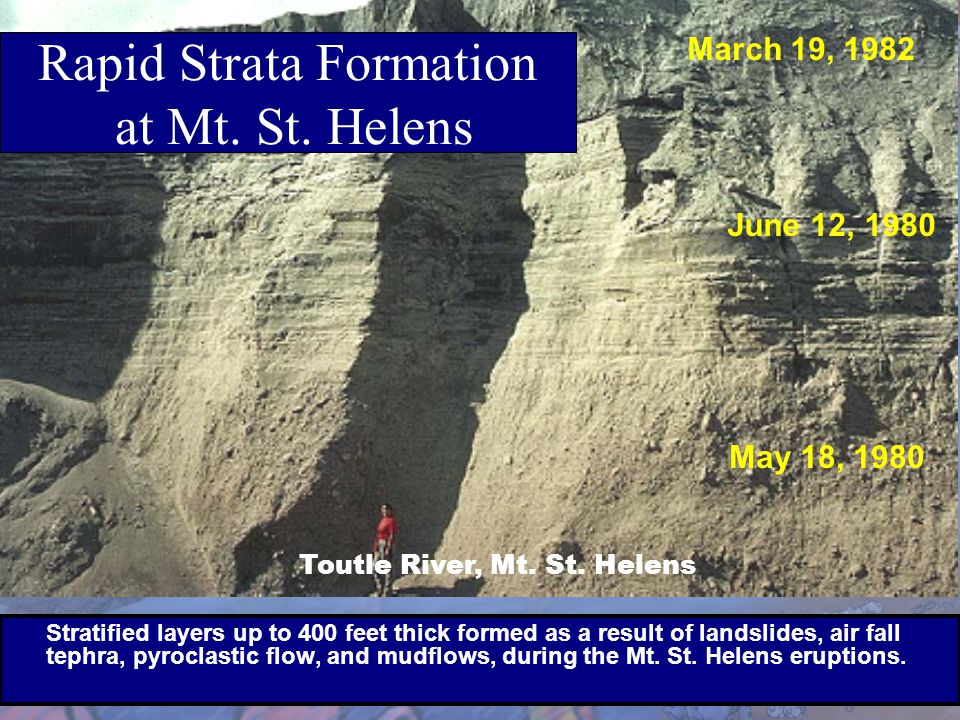
Visit the fossil museum:
www.flickr.com/photos/101536517@N06/sets/72157641367196613/
Just how good are peer reviews of scientific papers?
www.sciencemag.org/content/342/6154/60.full
www.examiner.com/article/want-to-publish-science-paper-ju...
The neo-Darwinian idea that the human genome consists entirely of an accumulation of billions of mutations is, quite obviously, completely bonkers. Nevertheless, it is compulsorily taught in schools and universities as 'science'.
Resurrección de Jesús.
La resurrección de Jesús es un episodio evangélico y un tema muy representado en el arte cristiano, dentro del ciclo de la Pasión. En la literatura cristiana Jesús es, por antonomasia, "el Resucitado".
Según el Nuevo Testamento, ocurrió al tercer día de que Jesús fuera crucificado, muerto y sepultado en una tumba. El momento preciso de la resurrección no se describe, ni aparece como presenciado por nadie (ni siquiera por los soldados que custodiaban el lugar); sí su consecuencia: las miróforas1 (tres Marías o santas mujeres) encuentran la tumba vacía2 (en uno de los evangelios, el de Mateo, en medio de un estruendo causado por la llegada de un ángel -en los demás evangelios también aparecen ángeles, aunque en otra actitud-). A partir de ese momento se mencionan varias apariciones de Jesús resucitado3 en diversas ocasiones, tanto a María Magdalena (Noli me tangere) como a los apóstoles (Tomás, que había mostrado su incredulidad,4 es invitado por el propio Jesucristo a meter la mano en la llaga del costado)5 y a otros discípulos (a los discípulos de Emaús y a un grupo de más de quinientos "hermanos").6
La resurrección de Jesucristo se celebra en el calendario cristiano con la festividad del domingo de pascua o de resurrección. El domingo de resurrección se denomina también en los Συναξάριον synaxarion y calendarios litúrgicos de la iglesia ortodoxa "domingo de las miróforas con el noble José.7
Los textos evangélicos datan el descubrimiento de la tumba vacía en el primer día de la semana siguiente a la celebración de la pascua judía (que es la festividad que se celebró en la última cena). La expresión al tercer día, que suscita una curiosa controversia cronológica (menos de cuarenta y ocho horas se cuentan como tres días),8 es la más utilizada por recogerse en el Credo: resucitó al tercer día, según las Escrituras;9 y proviene de un fragmento del Evangelio de Lucas: ya van tres días que sucedieron estas cosas (la muerte de Jesús)10 y, más literalmente, de otro de la primera Epístola de San Pablo a los corintios:
os he enseñado lo que asimismo recibí: Que Cristo murió por nuestros pecados, conforme a las Escrituras, y que fue sepultado, y que resucitó al tercer día, conforme a las Escrituras.11
Interpretación teológica
El que Cristo resucitara, triunfando sobre la muerte, es el punto clave de la doctrina y teología cristiana. Tal importancia se declara desde los propios textos bíblicos:
Y si Cristo no resucitó, la fe de ustedes es inútil y sus pecados no han sido perdonados.
Primera epístola de San Pablo a los corintios, capítulo 15, versículo 17.12
La frase, muy citada, suele darse también en esta otra traducción al castellano:
si Cristo no ha resucitado, vana es vuestra fe;
pero también con una significativa diferencia:
si Cristo no ha resucitado, vana es nuestra fe.13
La muerte de Jesús y su posterior resurrección fundamentan la doctrina de la salvación (soteriología), que establece cómo estos acontecimientos causaron la redención del género humano (condenado desde el pecado original que pesaba sobre él desde los primeros padres) y abrieron la posibilidad de que cada hombre pudiera también, tras su propia muerte, gozar de la vida eterna en la Gloria.
[editar]La resurrección en los evangelios canónicos
La resurrección y las escenas subsiguientes son el fin natural de los evangelios canónicos, que (tanto en los tres sinópticos como en el de Juan, a pesar de sus diferencias) trazan una narración lógica y cronológica continuada desde la encarnación.
1 Pasado el sábado, al amanecer del primer día de la semana, María Magdalena y la otra María fueron a visitar el sepulcro.
2 De pronto, se produjo un gran temblor de tierra: el ángel del Señor bajó del cielo, hizo rodar la piedra del sepulcro y se sentó sobre ella.
3 Su aspecto era como el de un relámpago y sus vestiduras eran blancas como la nieve.
4 Al verlo, los guardias temblaron de espanto y quedaron como muertos.
5 El ángel dijo a las mujeres: «No teman, yo sé que ustedes buscan a Jesús, el Crucificado.
6 No está aquí, porque ha resucitado como lo había dicho. Vengan a ver el lugar donde estaba,
7 y vayan en seguida a decir a sus discípulos: «Ha resucitado de entre los muertos, e irá antes que ustedes a Galilea: allí lo verán». Esto es lo que tenía que decirles».
8 Las mujeres, atemorizadas pero llenas de alegría, se alejaron rápidamente del sepulcro y fueron a dar la noticia a los discípulos.
9 De pronto, Jesús salió a su encuentro y las saludó, diciendo: «Alégrense». Ellas se acercaron y, abrazándole los pies, se postraron delante de él.
10 Y Jesús les dijo: «No teman; avisen a mis hermanos que vayan a Galilea, y allí me verán».
Evangelio de Mateo, capítulo 28.14
1 Pasado el sábado, María Magdalena, María, la madre de Santiago, y Salomé compraron perfumes para ungir el cuerpo de Jesús.
2 A la madrugada del primer día de la semana, cuando salía el sol, fueron al sepulcro.
3 Y decían entre ellas: «¿Quién nos correrá la piedra de la entrada del sepulcro?»
4 Pero al mirar, vieron que la piedra había sido corrida; era una piedra muy grande.
5 Al entrar al sepulcro, vieron a un joven sentado a la derecha, vestido con una túnica blanca. Ellas quedaron sorprendidas.
6 pero él les dijo: «No teman. Ustedes buscan a Jesús de Nazaret, el Crucificado. Ha resucitado, no está aquí. Miren el lugar donde lo habían puesto.
7 Vayan ahora a decir a sus discípulos y a Pedro que él irá antes que ustedes a Galilea; allí lo verán, como él se lo había dicho».
8 Ellas salieron corriendo del sepulcro, porque estaban temblando y fuera de sí. Y no dijeron nada a nadie, porque tenían miedo.
9 Jesús, que había resucitado a la mañana del primer día de la semana, se apareció primero a María Magdalena, aquella de quien había echado siete demonios.
10 Ella fue a contarlo a los que siempre lo habían acompañado, que estaban afligidos y lloraban.
11 Cuando la oyeron decir que Jesús estaba vivo y que lo había visto, no le creyeron.
Evangelio de Marcos, capítulo 16.15
1 El primer día de la semana, al amanecer, las mujeres fueron al sepulcro con los perfumes que habían preparado.
2 Ellas encontraron removida la piedra del sepulcro
3 y entraron, pero no hallaron el cuerpo del Señor Jesús.
4 Mientras estaban desconcertadas a causa de esto, se les aparecieron dos hombres con vestiduras deslumbrantes.
5 Como las mujeres, llenas de temor, no se atrevían a levantar la vista del suelo, ellos les preguntaron: «¿Por qué buscan entre los muertos al que está vivo?
6 No está aquí, ha resucitado. Recuerden lo que él les decía cuando aún estaba en Galilea:
7 «Es necesario que el Hijo del Hombre sea entregado en manos de los pecadores, que sea crucificado y que resucite al tercer día».
8 Y las mujeres recordaron sus palabras.
9 Cuando regresaron del sepulcro, refirieron esto a los Once y a todos los demás.
10 Eran María Magdalena, Juana y María, la madre de Santiago, y las demás mujeres que las acompañaban. Ellas contaron todo a los Apóstoles,
11 pero a ellos les pareció que deliraban y no les creyeron.
12 Pedro, sin embargo, se levantó y corrió hacia el sepulcro, y al asomarse, no vio más que las sábanas. Entonces regresó lleno de admiración por que había sucedido.
Evangelio de Lucas, capítulo 24.16
1 El primer día de la semana, de madrugada, cuando todavía estaba oscuro, María Magdalena fue al sepulcro y vio que la piedra había sido sacada.
2 Corrió al encuentro de Simón Pedro y del otro discípulo al que Jesús amaba, y les dijo: «Se han llevado del sepulcro al Señor y no sabemos dónde lo han puesto».
3 Pedro y el otro discípulo salieron y fueron al sepulcro.
4 Corrían los dos juntos, pero el otro discípulo corrió más rápidamente que Pedro y llegó antes.
5 Asomándose al sepulcro, vio las vendas en el suelo, aunque no entró.
6 Después llegó Simón Pedro, que lo seguía, y entró en el sepulcro; vio las vendas en el suelo,
7 y también el sudario que había cubierto su cabeza; este no estaba con las vendas, sino enrollado en un lugar aparte.
8 Luego entró el otro discípulo, que había llegado antes al sepulcro: él también vio y creyó.
9 Todavía no habían comprendido que, según la Escritura, él debía resucitar de entre los muertos.
10 Los discípulos regresaron entonces a su casa.
11 María se había quedado afuera, llorando junto al sepulcro. Mientras lloraba, se asomó al sepulcro
12 y vio a dos ángeles vestidos de blanco, sentados uno a la cabecera y otro a los pies del lugar donde había sido puesto el cuerpo de Jesús.
13 Ellos le dijeron: «Mujer, ¿por qué lloras?». María respondió: «Porque se han llevado a mi Señor y no sé dónde lo han puesto».
14 Al decir esto se dio vuelta y vio a Jesús, que estaba allí, pero no lo reconoció.
15 Jesús le preguntó: «Mujer, ¿por qué lloras? ¿A quién buscas?». Ella, pensando que era el cuidador de la huerta, le respondió: «Señor, si tú lo has llevado, dime dónde lo has puesto y yo iré a buscarlo».
16 Jesús le dijo: «¡María!». Ella lo reconoció y le dijo en hebreo: «¡Raboní!», es decir «¡Maestro!».
17 Jesús le dijo: «No me retengas, porque todavía no he subido al Padre. Ve a decir a mis hermanos: «Subo a mi Padre, el Padre de ustedes; a mi Dios, el Dios de ustedes».
18 María Magdalena fue a anunciar a los discípulos que había visto al Señor y que él le había dicho esas palabras.
Evangelio de Juan, capítulo 20.17
[editar]La resurrección en los evangelios apócrifos
Los evangelios apócrifos que desarrollan más ampliamente el tema de la resurrección son el Evangelio de Pedro y otros "Evangelios de la pasión y resurrección" así como el Evangelio de María (con los diálogos entre Jesús y María Magdalena tras la resurrección) y otros "Diálogos del resucitado" de carácter gnóstico.18
Iconografía.
Simbolismo paleocristiano
El arte paleocristiano, fuertemente simbólico, tuvo en el triunfo sobre la muerte uno de sus principales motivos. En el periodo de las persecuciones, el tema de la resurrección (trascendental para una comunidad que venera a sus mártires) se aludía a través de los pasajes bíblicos que se consideraban alegóricos de ella, como el de Daniel en el foso de los leones.21 Con la cristianización del Imperio romano,22 el arte cristiano pasó a desarrollarse pública y monumentalmente, y el tema de la resurrección se expresó en formas derivadas de la civilización romana: tanto en el crismón (evolución del lábaro imperial, transformado en cruz por el In hoc signo vinces del sueño que Constantino tuvo antes de la batalla del puente Milvio -en sus monedas aparece ese lábaro-crismón venciendo a una serpiente-)23 como en el ábside de las basílicas (donde se reproduce la forma del arco de triunfo).
La cruz deja de ser un simple instrumento de tortura para convertirse en un símbolo de triunfo sobre la muerte, que recuerda al cristiano la resurrección de Cristo y la promesa de su su segunda venida.
Un sarcófago procedente de la catacumba de Domitila (ca. 350) es uno de los primeros ejemplos del uso del crismón como crux invicta ("cruz invicta" o cruz triunfante) en contextos funerarios, como símbolo de la resurrección y triunfo sobre la muerte (rodeada por una corona de laurel, uno de los elementos del triunfo romano). A sus pies, dos soldados hacen referencia a los que custodiaban el sepulcro de Cristo.24 Posteriormente, en la Edad Media, se generalizó el uso de la cruz funeraria.
La crux gemmata25 ("cruz de gemas" o enjoyada) reproduce la cruz monumental de oro y piedras preciosas que Constantino mandó levantar en el monte Calvario de Jerusalén, y que se reproduce en el mosaico del ábside de la basílica de Santa Pudenciana de Roma.
Tema pictórico y escultórico
En pintura, la convención iconográfica fijada desde el Gótico26 para el tema de la resurrección incluye la presencia de soldados dormidos (ocasionalmente, despiertos y asombrados -mezclando anacrónicamente su actitud en el momento de la resurrección con la de la aparición del ángel, tal como se describe en el evangelio de Mateo-) en torno a la tumba abierta de Cristo27 de la que surge su figura semidesnuda (envuelta en su sudario) elevándose milagrosamente, rodada de un halo luminoso y portando un estandarte de la cruz.
Hay excelentes ejemplos de representaciones pictóricas de la Resurrección tanto en el Renacimiento italiano (La resurrección de Cristo de Piero della Francesca, La resurrección de Cristo de Rafael) como en el Renacimiento nórdico (una de las tablas del Altar de Isenheim, de Grünewald), en el Manierismo (La resurrección de Cristo, de El Greco) o en el Barroco (La resurrección de Cristo de Rubens).
En escultura la iconografía de la resurrección es similar, aunque en el caso del Cristo de la Minerva de Miguel Ángel (que se suele denominar como "Cristo redentor"), se optó por representar a Cristo resucitado completamente desnudo, y abrazando la cruz, como símbolo de su victoria tanto sobre la muerte como sobre el pecado.28
No debe confundirse el tema artístico de la resurrección con otros con los que puede tener alguna similitud formal o conceptual: la transfiguración (que refleja un episodio evangélico anterior a la muerte de Cristo, en el que la figura de Cristo se ilumina), la ascensión (que refleja uno posterior, en el que Cristo asciende al cielo ante la vista de sus discípulos), la anastasis Aναστασις ("resurrección" en griego, término que, como tema artístico, se refiere a la visita de Cristo al limbo -descenso de Cristo a los infiernos-, entre la resurrección y la ascensión). Algunos otros temas iconográficos participan de elementos de la resurrección y de otros episodios, como los denominados Varón de dolores o Cristo de las cinco llagas (donde, junto a un Cristo resucitado aparecen tanto elementos de la resurrección como las arma Christi -instrumentos de la Pasión-) y las denominadas Cristo muerto sostenido por ángeles.
[editar]Notas
↑ Se aplica muy poco en masculino (miróforos), y designa los personajes que intervienen en descubrimiento de la tumba vacía. La palabra griega Μυροφόροι, transcrita al latín como Myrophorae, literalmente significa "portadores de la mirra". Además de las Tres Marías, hay dos varones que no intervienen en este episodio pero que se identifican con la mirra en este contexto: Nicodemo y José de Arimatea, que intervinieron en el descendimiento de la Cruz y embalsamaron el cuerpo de Cristo con mirra y aloes. Richard Bauckham, Jesus and the Eyewitnesses (Eerdmans Publishing Company: Cambridge, 2006, fuente citada en en:Myrrhbearers. En el contexto de la natividad de Jesús, los reyes magos llevaron oro, incienso y mirra como regalo al Niño.
↑ Stagg, Evelyn and Frank. Woman in the World of Jesus. Philadelphia: Westminster Press, 1978 ISBN 0-664-24195-6. Fuente citada en en:Empty tomb
↑ Tilborg, Sj. van and P. Chatelion Counet. Jesus' Appearances and Disappearances in Luke 24, Leiden etc.: Brill, 2000. Fuente citada en en:Resurrection appearances of Jesus
↑ Glenn W. Most, Doubting Thomas. Fuente citada en en:Doubting Thomas. Véase también La incredulidad de santo Tomás (Caravaggio).
↑ Evangelio de Juan, 20: 24-29. Traducción argentina en la web oficial del Vaticano.
↑ 1 Corintios 15:6. Traducción argentina en la web oficial del Vaticano.
↑ Sunday of the Holy Myrrhbearing Women with the Noble Joseph. Véase también en:Synaxarius.
↑ La Resurección de Jesús (foro con pregunta y comentarios sobre estos cómputos).
↑ credo Credo de Nicena-Constantinopla, en la web oficial del Vaticano. La misma página recoge el Símbolo de los apóstoles, que dice: al tercer día resucitó de entre los muertos.
↑ Traducción argentina en en la web oficial del Vaticano.
↑ John Lankford, La muerte de Cristo está mostrada por el pan y la copa, y la resurrección por el primer día de la semana, en La Voz Eterna, Septiembre-Octubre 2004.
↑ Traducción argentina en la web oficial del Vaticano.
↑ Véanse ejemplos bibliográficos de uso de la primera y de la segunda de ambas frases. En la versión de Evaristo Martín Nieto la frase se traduce como Y si Cristo no ha resucitado, vana es nuestra fe; todavía estáis en vuestros pecados (edición de 2008). En la versión de Reina-Valera la frase se traduce como y si Cristo no resucitó, vuestra fe es vana; aún estáis en vuestros pecados (edición de 1960 -Bible Gateway-).
↑ Traducción argentina en la web oficial del Vaticano.
↑ Traducción argentina en la web oficial del Vaticano.
↑ Traducción argentina en la web oficial del Vaticano.
↑ Traducción argentina en la web oficial del Vaticano.
↑ Santiago Guijarro Evangelios canónicos y evangelios apócrifos, en Comentario al Nuevo Testamento, Sígueme - Verbo Divino, 1995.
↑ Dizionario biografico degli italiani, vo.64, Roma, Istituto dell'Enciclopedia Italiana, 2005 (Laureti Tommaso Detto Il Siciliano). Fuente citada en it:Tommaso Lauretti.
↑ Web de los Museos Vaticanos, fuente citada en it:Sala di Costantino
↑ Boice, James Montgomery (2006). Daniel: An Expositional Commentary. Baker Books. Fuente citada en en:Daniel in the lions' den
↑ Ramsay MacMullen, "Christianizing The Roman Empire A.D. 100-400, Yale University Press, 1984, ISBN 0-300-03642-6. Fuente citada en en:Constantine I and Christianity. Véase también cristianización e Imperio romano.
↑ Understanding early Christian art by Robin Margaret Jensen 2000 ISBN 0-415-20454-2 page 149
↑ Ronald John Zawilla, Cross and Crucifix in the Christian Assembly - Part I (The Early Christian Period: Crux Invicta, Crux Gemmata) en Envision Church, 30 de octubre de 2007.
↑ Schiller, Gertud, Iconography of Christian Art, Vol. I, 1971 (English trans from German), Lund Humphries, London, ISBN 853312702 Fuente citada en en:Crux gemmata
↑
Iconografía de la Resurrección: origen y evolución a través del arte
Matilde Azcárate de Luxán, Iconografía de la Resurrección en la escultura gótica española, en En la España Medieval, Universidad Complutense de Madrid 2012, ISSN 0214-3038
↑ en:Tomb of Jesus
↑ The Sexuality of Christ in Renaissance Art and in Modern Oblivion. Steinberg, Leo. University of Chicago Press. 2nd ed. 1997.
Four teams sprint from the start line to begin the 2017 Sandhurst Military Skills Competition at West Point April 7. During Sandhurst, 62 teams representing 12 international military academies, four U.S. service academies and eight ROTC programs competed in 11 events throughout a 23-mile course. (U.S. Army photo by: Staff Sgt. Vito T. Bryant)
Venice Biennale / Colonel at the MALDIVES PAVILION : "IS CLIMATE CHANGE STILL AN EMERGENCY ? " ( part 2)
In 2013 Thierry Geoffroy / Colonel is represented at the Malives pavilion at the Venice Biennale and then went further and received hospitality at the Zimbabwe pavilion with the Emergency Room Mobile .
He ask in his installation made of different steps : "IS CLIMATE CHANGE STILL AN EMERGENCY ? "
www.emergencyrooms.org/biennalist.html .
at the Zimbabwe pavilion he open an Emergency Room mobile open to all emergencies around the tent was the Delay museum
www.emergencyrooms.org ( please ask permission for use of photos =1@colonel.dk )
---------------------------------------------------------------------- ----------------------------------------------------------------------
lists of artists participating at the Venice Biennale :
Hilma af Klint, Victor Alimpiev, Ellen Altfest, Paweł Althamer, Levi Fisher Ames, Yuri Ancarani, Carl Andre, Uri Aran, Yüksel Arslan, Ed Atkins, Marino Auriti, Enrico Baj, Mirosław Bałka, Phyllida Barlow, Morton Bartlett, Gianfranco Baruchello, Hans Bellmer, Neïl Beloufa, Graphic Works of Southeast Asia and Melanesia, Hugo A. Bernatzik Collection, Ștefan Bertalan, Rossella Biscotti, Arthur Bispo do Rosário, John Bock, Frédéric Bruly Bouabré, Geta Brătescu, KP Brehmer, James Lee Byars, Roger Caillois, Varda Caivano, Vlassis Caniaris, James Castle, Alice Channer, George Condo, Aleister Crowley & Frieda Harris, Robert Crumb, Roberto Cuoghi, Enrico David, Tacita Dean, John De Andrea, Thierry De Cordier, Jos De Gruyter e Harald Thys, Walter De Maria, Simon Denny, Trisha Donnelly, Jimmie Durham, Harun Farocki, Peter Fischli & David Weiss, Linda Fregni Nagler, Peter Fritz, Aurélien Froment, Phyllis Galembo, Norbert Ghisoland, Yervant Gianikian & Angela Ricci Lucchi, Domenico Gnoli, Robert Gober, Tamar Guimarães and Kasper Akhøj, Guo Fengyi, João Maria Gusmão & Pedro Paiva, Wade Guyton, Haitian Vodou Flags, Duane Hanson, Sharon Hayes, Camille Henrot, Daniel Hesidence, Roger Hiorns, Channa Horwitz, Jessica Jackson Hutchins, René Iché, Hans Josephsoh, Kan Xuan, Bouchra Khalili, Ragnar Kjartansson, Eva Kotátková, Evgenij Kozlov, Emma Kunz, Maria Lassnig, Mark Leckey, Augustin Lesage, Lin Xue, Herbert List, José Antonio Suárez Londoño, Sarah Lucas, Helen Marten, Paul McCarthy, Steve McQueen, Prabhavathi Meppayil, Marisa Merz, Pierre Molinier, Matthew Monahan, Laurent Montaron, Melvin Moti, Matt Mullican, Ron Nagle, Bruce Nauman, Albert Oehlen, Shinro Ohtake, J.D. ‘Okhai Ojeikere, Henrik Olesen, John Outterbridg, Paño Drawings, Marco Paolini, Diego Perrone, Walter Pichler, Otto Piene, Eliot Porter, Imran Qureshi, Carol Rama, Charles Ray, James Richards, Achilles G. Rizzoli, Pamela Rosenkranz, Dieter Roth, Viviane Sassen, Shinichi Sawada, Hans Schärer, Karl Schenker, Michael Schmidt, Jean-Frédéric Schnyder, Friedrich Schröder-Sonnenstern, Tino Sehgal, Richard Serra, Shaker Gift Drawings, Jim Shaw, Cindy Sherman, Laurie Simmons e Allan McCollum, Drossos P. Skyllas, Harry Smith, Xul Solar, Christiana Soulou, Eduard Spelterini, Rudolf Steiner, Hito Steyerl, Papa Ibra Tall, Dorothea Tanning, Anonymous Tantric Paintings, Ryan Trecartin, Rosemarie Trockel, Andra Ursuta, Patrick Van Caeckenbergh, Stan VanDerBeek, Erik van Lieshout, Danh Vo, Eugene Von Bruenchenhein, Günter Weseler, Jack Whitten, Cathy Wilkes, Christopher Williams, Lynette Yiadom-Boakye, Kohei YoshiyUKi, Sergey Zarva, Anna Zemánková, Jakub Julian Ziółkowski ,Artur Żmijewski.
---------------------------------------------------------------------- ----------------------------------------------------------------------
other pavilions at Venice Biennale
Andorra Artists: Javier Balmaseda, Samantha Bosque, Fiona Morrison
Commissioner: Henry Périer Deputy Commissioners: Francesc Rodríguez, Ermengol Puig, Ruth Casabella
Curators: Josep M. Ubach, Paolo De GrandisAngola Artist: Edson Chagas Commissioner: Ministry of Culture
Curators: Beyond Entropy (Paula Nascimento, Stefano Rabolli Pansera), Jorge Gumbe, Feliciano dos Santos
Argentina Artist: Nicola Costantino Commissioner: Magdalena Faillace Curator: Fernando Farina
Armenia Artist: Ararat SarkissianCurator: Arman Grogoryan /AustraliaArtist: Simryn Gill Commissioner: Simon Mordant Deputy Commissioner: Penelope Seidler Curator: Catherine de Zegher /AustriaArtist: Mathias Poledna ,Curator: Jasper Sharp /AzerbaijanArtists: Rashad Alakbarov, Sanan Aleskerov, Chingiz Babayev, Butunay Hagverdiyev, Fakhriyya Mammadova, Farid Rasulov /Commissioner: Heydar Aliyev FoundationCurator: Hervé Mikaeloff
Bahamas Artist: Tavares Strachan Commissioner: Nalini Bethel, Ministry of Tourism Curators: Jean Crutchfield, Robert HobbsDeputy Curator: Stamatina Gregory/BangladeshChhakka Artists’ Group: Mokhlesur Rahman, Mahbub Zamal, A. K. M. Zahidul Mustafa, Ashok Karmaker, Lala Rukh Selim, Uttam Kumar Karmaker. Dhali Al Mamoon, Yasmin Jahan Nupur, Gavin Rain, Gianfranco Meggiato, Charupit School/Commissioner/Curator: Francesco Elisei. , Curator: Fabio Anselmi./BahrainArtists: Mariam Haji, Waheeda Malullah, Camille Zakharia /Commissioner: Mai bint Mohammed Al Khalifa, Minister of Culture /Curator: Melissa Enders-Bhatiaa/BelgiumArtist: Berlinde De Bruyckere
Commissioner: Joke Schauvliege, Flemish Minister for Environment, Nature and Culture .Curator: J. M. Coetzee ,Deputy Curator: Philippe Van Cauteren /Bosnia and Herzegovina
Artist: Mladen Miljanovic .Commissioners: Sarita Vujković, Irfan Hošić
Brazil Artists: Hélio Fervenza, Odires Mlászho, Lygia Clark, Max Bill, Bruno Munari
Commissioner: Luis Terepins, Fundação Bienal de São Paulo,Curator: Luis Pérez-Oramas ,Deputy Curator: André Severo
CanadaArtist: Shary Boyle /Commissioner: National Gallery of Canada / Musée des beaux-arts du Canada ,Curator: Josée Drouin-Brisebois/Central AsiaArtists: Vyacheslav Akhunov, Sergey Chutkov, Saodat Ismailova, Kamilla Kurmanbekova, Ikuru Kuwajima, Anton Rodin, Aza Shade, Erlan Tuyakov
Commissioner: HIVOS (Humanist Institute for Development Cooperation)
Deputy Commissioner: Dean Vanessa Ohlraun (Oslo National Academy of the Arts/The Academy of Fine Art)
Curators: Ayatgali Tuleubek, Tiago Bom
Scientific Committee: Susanne M. Winterling
ChileArtist: Alfredo JaarCommissioner: CNCA, National Council of Culture and the Arts Curator: Madeleine Grynsztejn
ChinaArtists: He Yunchang, Hu Yaolin, Miao Xiaochun, Shu Yong, Tong Hongsheng, Wang Qingsong, Zhang Xiaotao
Commissioner: China Arts and Entertainment Group (CAEG) ,Curator: Wang Chunchen
Costa Rica Artists: Priscilla Monge, Esteban Piedra, Rafael Ottón Solís, Cinthya Soto
Commissioner: Francesco EliseiCurator: Francisco Córdoba, Museo de Arte y Diseño Contemporáneo (Fiorella Resenterra)
Croatia Artist: Kata Mijatovic ,Commissioner/Curator: Branko Franceschi.
CubaArtists: Liudmila and Nelson, Maria Magdalena Campos & Neil Leonard, Sandra Ramos, Glenda León, Lázaro Saavedra, Tonel, Hermann Nitsch, Gilberto Zorio, Wang Du, H.H.Lim, Pedro Costa, Rui Chafes, Francesca Leone ,Commissioner: Miria ViciniCurators: Jorge Fernández Torres, Giacomo Zaza
CyprusArtists: Lia Haraki, Maria Hassabi, Phanos Kyriacou, Constantinos Taliotis, Natalie Yiaxi, Morten Norbye Halvorsen, Jason Dodge, Gabriel Lester, Dexter Sinister /Louli Michaelidou
Deputy Commissioners: Angela Skordi, Marika Ioannou/Curator: Raimundas Malašauskas
Czech Republic & Slovak RepublicArtists: Petra Feriancova, Zbynek Baladran ,Commissioner: Monika Palcova, Curator: Marek Pokorny /DenmarkArtist: Jesper Just in collaboration with Project ProjectsEgypt
Artists: Mohamed Banawy, Khaled Zaki
EstoniaArtist: Dénes Farkas ,Commissioner: Maria Arusoo ,Curator: Adam Budak
FinlandArtist: Antti Laitinen , Commissioner: Raija Koli , Curators: Marko Karo, Mika Elo, Harri Laakso
FranceArtist: Anri Sala ,Curator: Christine Macel
GeorgiaArtists: Bouillon Group,Thea Djordjadze, Nikoloz Lutidze, Gela Patashuri with Ei Arakawa and Sergei Tcherepnin, Gio Sumbadze/Commissioner: Marine Mizandari, First Deputy Minister of Culture Curator: Joanna Warsza
GermanyArtists: Ai Weiwei, Romuald Karmakar, Santu Mofokeng, Dayanita Singh Commissioner/Curator: Susanne Gaensheimer /Great BritainArtist: Jeremy Deller ,Commissioner: Andrea Rose , Curator: Emma Gifford-Mead
Holy SeeArtists: Lawrence Carroll, Josef Koudelka, Studio Azzurro ,Curator: Antonio Paolucci
Hungary , Artist: Zsolt Asztalos , Curator: Gabriella Uhl
Iceland , Artist: Katrín Sigurðardóttir ,Commissioner: Dorotheé Kirch
Curators: Mary Ceruti , Ilaria Bonacossa/IndonesiaArtists: Albert Yonathan Setyawan, Eko Nugroho, Entang Wiharso, Rahayu Supanggah, Sri Astari, Titarubi
Deputy Commissioner: Achille Bonito Oliva , Assistant Commissioner: Mirah M. Sjarif
Curators: Carla Bianpoen, Rifky Effendy
IraqArtists: Abdul Raheem Yassir, Akeel Khreef, Ali Samiaa, Bassim Al-Shaker, Cheeman Ismaeel, Furat al Jamil, Hareth Alhomaam, Jamal Penjweny, Kadhim Nwir, WAMI (Yaseen Wami, Hashim Taeeh)
Commissioner: Tamara Chalabi (Ruya Foundation for Contemporary Culture)Curator: Jonathan Watkins.
IrelandArtist: Richard MosseCommissioner, Curator: Anna O’Sullivan
Israel , Artist: Gilad Ratman , Commissioners: Arad Turgeman, Michael GovCurator: Sergio Edelstein
ItalyArtists: Francesco Arena, Massimo Bartolini, Gianfranco Baruchello, Elisabetta Benassi, Flavio Favelli, Luigi Ghirri, Piero Golia, Francesca Grilli, Marcello Maloberti, Fabio Mauri, Giulio Paolini, Marco Tirelli, Luca Vitone, Sislej Xhafa ,Commissioner: Maddalena Ragni
Curator: Bartolomeo Pietromarchi /Ivory Coast Artists: Frédéric Bruly Bouabré, Tamsir Dia, Jems Koko Bi, Franck Fanny
Commissioner: Paolo De Grandis , Curator: Yacouba Konaté
Japan ,Artist: Koki Tanaka ,Curator: Mika Kuraya
KenyaArtists: Kivuthi Mbuno, Armando Tanzini, Chrispus Wangombe Wachira, Fan Bo, Luo Ling & Liu Ke, Lu Peng, Li Wei, He Weiming, Chen Wenling, Feng Zhengjie, César MeneghettiCommissioner: Paola Poponi ,Curators: Sandro Orlandi, Paola Poponi /Korea (Republic of)Artist: Kimsooja
KosovoArtist: Petrit Halilaj ,Commissioner: Erzen Shkololli ,Curator: Kathrin Rhomberg
KuwaitArtists: Sami Mohammad, Tarek Al-Ghoussein
Commissioner: Mohammed Al-Asoussi ,Curator: Ala Younis /Latin AmericaIstituto Italo-Latino Americano
Artists:Marcos Agudelo, Miguel Alvear & Patricio Andrade, Susana Arwas, François Bucher, Fredi Casco, Colectivo Quintapata (Pascal Meccariello, Raquel Paiewonsky, Jorge Pineda, Belkis Ramírez), Humberto Díaz, Sonia Falcone, León & Cociña, Lucía Madriz, Jhafis Quintero, Martín Sastre, Guillermo Srodek-Hart, Juliana Stein, Simón Vega, Luca Vitone, David Zink Yi. /Harun Farocki & Antje Ehmann. In collaboration with: Cristián Silva-Avária, Anna Azevedo, Paola Barreto, Fred Benevides, Anna Bentes, Hermano Callou, Renata Catharino, Patrick Sonni Cavalier, Lucas Ferraço Nassif, Luiz Garcia, André Herique, Bruna Mastrogiovanni, Cezar Migliorin, Felipe Ribeiro, Roberto Robalinho, Bruno Vianna, Beny Wagner, Christian Jankowski ,Commissioner: Sylvia Irrazábal ,Curator: Alfons Hug
Deputy Curator: Paz Guevara /Latvia Artists: Kaspars Podnieks, Krišs Salmanis ,Commissioners: Zane Culkstena, Zane Onckule ,Curators: Anne Barlow, Courtenay Finn, Alise Tifentale
LithuaniaArtist: Gintaras Didžiapetris, Elena Narbutaite, Liudvikas Buklys, Kazys Varnelis, Vytaute Žilinskaite, Morten Norbye Halvorsen, Jason Dodge, Gabriel Lester, Dexter SinisterCommissioners: Jonas Žokaitis, Aurime Aleksandraviciute Curator: Raimundas Malašauskas /LuxembourgArtist: Catherine LorentCommissioner: Clément Minighetti Curator: Anna Loporcaro /MexicoArtist: Ariel Guzik ,Commissioner: Gastón Ramírez Feltrín ,Curator: Itala Schmelz
Montenegro ,Artist: Irena Lagator Pejovic .Commissioner/Curator: Nataša Nikcevic
The Netherlands ,Artist: Mark Manders
Commissioner: Mondriaan Fund ,Curator: Lorenzo Benedetti
New Zealand Artist: Bill Culbert ,Commissioner: Jenny Harper ,Deputy Commissioner: Heather Galbraith ,Curator: Justin Paton /Finland: ,Artist: Terike Haapoja ,Commissioner: Raija Koli ,Curators: Marko Karo, Mika Elo, Harri Laakso
Norway:Artists: Edvard Munch, Lene Berg
Curators: Marta Kuzma, Pablo Lafuente, Angela Vettese
Paraguay Artists: Pedro Barrail, Felix Toranzos, Diana Rossi, Daniel Milessi ,Commissioner: Elisa Victoria Aquino Laterza
Deputy Commissioner: Nori Vaccari Starck , Curator: Osvaldo González Real
Poland Artist: Konrad Smolenski Commissioner: Hanna Wróblewska Curators: Agnieszka Pindera, Daniel Muzyczuk
Portugal Artist: Joana Vasconcelos Curator: Miguel Amado
RomaniaArtists: Maria Alexandra Pirici, Manuel Pelmus Commissioner: Monica Morariu Deputy Commissioner: Alexandru Damia Curator: Raluca VoineaArtists: Anca Mihulet, Apparatus 22 (Dragos Olea, Maria Farcas,Erika Olea), Irina Botea, Nicu Ilfoveanu, Karolina Bregula, Adi Matei, Olivia Mihaltianu, Sebastian MoldovanCommissioner: Monica Morariu ,Deputy Commissioner: Alexandru Damian ,Curator: Anca Mihulet
Russia Artist: Vadim Zakharov ,Commissioner: Stella Kasaeva ,Curator: Udo Kittelmann
Serbia Artists: Vladimir Peric, Miloš Tomic .Commissioner: Maja Ciric
SloveniaArtist: Jasmina CibicCommissioner: Blaž Peršin ,Curator: Tevž Logar
South Africa Commissioner: Saul Molobi ,Curator: Brenton Maart
Spain Artist: Lara Almarcegui , Commissioner/Curator: Octavio Zaya
Switzerland Artist: Valentin Carron Commissioners: Pro Helvetia - Sandi Paucic and Marianne Burki
Curator: Giovanni CarmineVenue: Pavilion at Giardini
Syrian Arab RepublicArtists: Giorgio De Chirico, Miro George, Makhowl Moffak, Al Samman Nabil, Echtai Shaffik, Giulio Durini, Dario Arcidiacono, Massimiliano Alioto, Felipe Cardena, Roberto Paolini, Concetto Pozzati, Sergio Lombardo, Camilla Ancilotto, Lucio Micheletti, Lidia Bachis, Cracking Art Group, Hannu Palosuo
Commissioner: Christian Maretti Curator: Duccio Trombadori
Taiwan Artists: Bernd Behr, Chia-Wei Hsu, Kateřina Šedá + BATEŽO MIKILU Curator: Esther Lu
Thailand Artists: Wasinburee Supanichvoraparch, Arin Rungjang
Curators: Penwadee Nophaket Manont, Worathep Akkabootara
Turkey Artist: Ali Kazma Commissioner: Istanbul Foundation for Culture and Arts Curator: Emre Baykal
Ukraine Artists: Ridnyi Mykola, Zinkovskyi Hamlet, Kadyrova Zhanna Commissioner: Victor Sydorenko
Curators: Soloviov Oleksandr, Burlaka Victoria
United Arab Emirates Artist: Mohammed Kazem /Commissioner: Dr. Lamees Hamdan Curator: Reem Fadda
Uruguay Artist: Wifredo Díaz Valdéz
Commissioner: Ricardo Pascale Curators: Carlos Capelán, Verónica Cordeiro
USA Artist: Sarah Sze Commissioners/Curators: Carey Lovelace, Holly Block
Venezuela Colectivo de Artistas Urbanos Venezolanos , Commissioner: Edgar Ernesto González Curator: Juan Calzadilla
---------------------------------------------------------------------- ---------------------------------------------------------------------- --
Encyclopedic Palace is curated by Massimiliano Gioni
---------------------------------------------------------------------- ---------------------------------------------------------------------- -------------------
Other Biennales (Biennials ) : Venice Biennial , Documenta Havana Biennial,Istanbul Biennial ( Istanbuli),Biennale de Lyon ,Dak'Art Berlin Biennial,Mercosul Visual Arts Biennial ,Bienal do Mercosul Porto Alegre.,Berlin Biennial ,Echigo-Tsumari Triennial .Yokohama Triennial Aichi Triennale,manifesta ,Copenhagen Biennale,Aichi Triennale
Yokohama Triennial,Echigo-Tsumari Triennial.Sharjah Biennial ,Biennale of Sydney, Liverpool , São Paulo Biennial ; Athens Biennale , Bienal do Mercosul ,Göteborg International Biennial for Contemporary Art
---------------------------------------------------------------------- -
in preparation of the COP 19 to be held in Warsaw Poland 2013 ( climate change conference on global warming ) . Can artist performa and activate a debate ?
Detail of the Swedish windows, located in the area immediately to the left of the great tapestry by the stairwell leading to the undercroft. They were the gift of the people of Sweden and made in the country by artist Einar Forseth (who also designed the mosaic floor of the Chapel of Unity).
The theme of the windows is the work of British missionaries in bringing the faith to Scandinavia, represented in the first three figurative windows, whilst the remaining two feature national and Christian symbols. The bright colouring and style set them apart from the other, more painterly windows in the Cathedral.
Coventry's Cathedral is a unique synthesis of old a new, born of wartime suffering and forged in the spirit of postwar optimism, famous for it's history and for being the most radically modern of Anglican cathedrals. Two cathedral's stand side by side, the ruins of the medieval building, destroyed by incendiary bombs in 1940 and the bold new building designed by Basil Spence and opened in 1962.
It is a common misconception that Coventry lost it's first cathedral in the wartime blitz, but the bombs actually destroyed it's second; the original medieval cathedral was the monastic St Mary's, a large cruciform building believed to have been similar in appearance to Lichfield Cathedral (whose diocese it shared). Tragically it became the only English cathedral to be destroyed during the Reformation, after which it was quickly quarried away, leaving only scant fragments, but enough evidence survives to indicate it's rich decoration (some pieces were displayed nearby in the Priory Visitors Centre, sadly since closed). Foundations of it's apse were found during the building of the new cathedral in the 1950s, thus technically three cathedrals share the same site.
The mainly 15th century St Michael's parish church became the seat of the new diocese of Coventry in 1918, and being one of the largest parish churches in the country it was upgraded to cathedral status without structural changes (unlike most 'parish church' cathedrals created in the early 20th century). It lasted in this role a mere 22 years before being burned to the ground in the 1940 Coventry Blitz, leaving only the outer walls and the magnificent tapering tower and spire (the extensive arcades and clerestoreys collapsed completely in the fire, precipitated by the roof reinforcement girders, installed in the Victorian restoration, that buckled in the intense heat).
The determination to rebuild the cathedral in some form was born on the day of the bombing, however it wasn't until the mid 1950s that a competition was held and Sir Basil Spence's design was chosen. Spence had been so moved by experiencing the ruined church he resolved to retain it entirely to serve as a forecourt to the new church. He envisaged the two being linked by a glass screen wall so that the old church would be visible from within the new.
Built between 1957-62 at a right-angle to the ruins, the new cathedral attracted controversy for it's modern form, and yet some modernists argued that it didn't go far enough, after all there are echoes of the Gothic style in the great stone-mullioned windows of the nave and the net vaulting (actually a free-standing canopy) within. What is exceptional is the way art has been used as such an integral part of the building, a watershed moment, revolutionising the concept of religious art in Britain.
Spence employed some of the biggest names in contemporary art to contribute their vision to his; the exterior is adorned with Jacob Epstein's triumphant bronze figures of Archangel Michael (patron of the cathedral) vanquishing the Devil. At the entrance is the remarkable glass wall, engraved by John Hutton with strikingly stylised figures of saints and angels, and allowing the interior of the new to communicate with the ruin. Inside, the great tapestry of Christ in majesty surrounded by the evangelistic creatures, draws the eye beyond the high altar; it was designed by Graham Sutherland and was the largest tapestry ever made.
However one of the greatest features of Coventry is it's wealth of modern stained glass, something Spence resolved to include having witnessed the bleakness of Chartres Cathedral in wartime, all it's stained glass having been removed. The first window encountered on entering is the enormous 'chess-board' baptistry window filled with stunning abstract glass by John Piper & Patrick Reyntiens, a symphony of glowing colour. The staggered nave walls are illuminated by ten narrow floor to ceiling windows filled with semi-abstract symbolic designs arranged in pairs of dominant colours (green, red, multi-coloured, purple/blue and gold) representing the souls journey to maturity, and revealed gradually as one approaches the altar. This amazing project was the work of three designers lead by master glass artist Lawrence Lee of the Royal College of Art along with Keith New and Geoffrey Clarke (each artist designed three of the windows individually and all collaborated on the last).
The cathedral still dazzles the visitor with the boldness of it's vision, but alas, half a century on, it was not a vision to be repeated and few of the churches and cathedrals built since can claim to have embraced the synthesis of art and architecture in the way Basil Spence did at Coventry.
The cathedral is generally open to visitors most days. For more see below:-
In 2013 Thierry Geoffroy / Colonel is represented at the Malives pavilion at the Venice Biennale and then went further and received hospitality at the Zimbabwe pavilion with the Emergency Room Mobile .
He ask in his installationmade of different steps : "IS CLIMATE CHANGE STILL AN EMERGENCY ? "
www.emergencyrooms.org/biennalist.html .
He also converge with his work on emergencies : www.emergencyrooms.org
The exhibition update is from the 25/9/2013( please ask permission for use of photos =1@colonel.dk )
--------------------------------------------------------------------------------------------------------------------------------------------
lists of artists participating at the Venice Biennale :
Hilma af Klint, Victor Alimpiev, Ellen Altfest, Paweł Althamer, Levi Fisher Ames, Yuri Ancarani, Carl Andre, Uri Aran, Yüksel Arslan, Ed Atkins, Marino Auriti, Enrico Baj, Mirosław Bałka, Phyllida Barlow, Morton Bartlett, Gianfranco Baruchello, Hans Bellmer, Neïl Beloufa, Graphic Works of Southeast Asia and Melanesia, Hugo A. Bernatzik Collection, Ștefan Bertalan, Rossella Biscotti, Arthur Bispo do Rosário, John Bock, Frédéric Bruly Bouabré, Geta Brătescu, KP Brehmer, James Lee Byars, Roger Caillois, Varda Caivano, Vlassis Caniaris, James Castle, Alice Channer, George Condo, Aleister Crowley & Frieda Harris, Robert Crumb, Roberto Cuoghi, Enrico David, Tacita Dean, John De Andrea, Thierry De Cordier, Jos De Gruyter e Harald Thys, Walter De Maria, Simon Denny, Trisha Donnelly, Jimmie Durham, Harun Farocki, Peter Fischli & David Weiss, Linda Fregni Nagler, Peter Fritz, Aurélien Froment, Phyllis Galembo, Norbert Ghisoland, Yervant Gianikian & Angela Ricci Lucchi, Domenico Gnoli, Robert Gober, Tamar Guimarães and Kasper Akhøj, Guo Fengyi, João Maria Gusmão & Pedro Paiva, Wade Guyton, Haitian Vodou Flags, Duane Hanson, Sharon Hayes, Camille Henrot, Daniel Hesidence, Roger Hiorns, Channa Horwitz, Jessica Jackson Hutchins, René Iché, Hans Josephsoh, Kan Xuan, Bouchra Khalili, Ragnar Kjartansson, Eva Kotátková, Evgenij Kozlov, Emma Kunz, Maria Lassnig, Mark Leckey, Augustin Lesage, Lin Xue, Herbert List, José Antonio Suárez Londoño, Sarah Lucas, Helen Marten, Paul McCarthy, Steve McQueen, Prabhavathi Meppayil, Marisa Merz, Pierre Molinier, Matthew Monahan, Laurent Montaron, Melvin Moti, Matt Mullican, Ron Nagle, Bruce Nauman, Albert Oehlen, Shinro Ohtake, J.D. ‘Okhai Ojeikere, Henrik Olesen, John Outterbridg, Paño Drawings, Marco Paolini, Diego Perrone, Walter Pichler, Otto Piene, Eliot Porter, Imran Qureshi, Carol Rama, Charles Ray, James Richards, Achilles G. Rizzoli, Pamela Rosenkranz, Dieter Roth, Viviane Sassen, Shinichi Sawada, Hans Schärer, Karl Schenker, Michael Schmidt, Jean-Frédéric Schnyder, Friedrich Schröder-Sonnenstern, Tino Sehgal, Richard Serra, Shaker Gift Drawings, Jim Shaw, Cindy Sherman, Laurie Simmons e Allan McCollum, Drossos P. Skyllas, Harry Smith, Xul Solar, Christiana Soulou, Eduard Spelterini, Rudolf Steiner, Hito Steyerl, Papa Ibra Tall, Dorothea Tanning, Anonymous Tantric Paintings, Ryan Trecartin, Rosemarie Trockel, Andra Ursuta, Patrick Van Caeckenbergh, Stan VanDerBeek, Erik van Lieshout, Danh Vo, Eugene Von Bruenchenhein, Günter Weseler, Jack Whitten, Cathy Wilkes, Christopher Williams, Lynette Yiadom-Boakye, Kohei YoshiyUKi, Sergey Zarva, Anna Zemánková, Jakub Julian Ziółkowski ,Artur Żmijewski.
--------------------------------------------------------------------------------------------------------------------------------------------
other pavilions at Venice Biennale
Andorra Artists: Javier Balmaseda, Samantha Bosque, Fiona Morrison
Commissioner: Henry Périer Deputy Commissioners: Francesc Rodríguez, Ermengol Puig, Ruth Casabella
Curators: Josep M. Ubach, Paolo De GrandisAngola Artist: Edson Chagas Commissioner: Ministry of Culture
Curators: Beyond Entropy (Paula Nascimento, Stefano Rabolli Pansera), Jorge Gumbe, Feliciano dos Santos
Argentina Artist: Nicola Costantino Commissioner: Magdalena Faillace Curator: Fernando Farina
Armenia Artist: Ararat SarkissianCurator: Arman Grogoryan /AustraliaArtist: Simryn Gill Commissioner: Simon Mordant Deputy Commissioner: Penelope Seidler Curator: Catherine de Zegher /AustriaArtist: Mathias Poledna ,Curator: Jasper Sharp /AzerbaijanArtists: Rashad Alakbarov, Sanan Aleskerov, Chingiz Babayev, Butunay Hagverdiyev, Fakhriyya Mammadova, Farid Rasulov /Commissioner: Heydar Aliyev FoundationCurator: Hervé Mikaeloff
Bahamas Artist: Tavares Strachan Commissioner: Nalini Bethel, Ministry of Tourism Curators: Jean Crutchfield, Robert HobbsDeputy Curator: Stamatina Gregory/BangladeshChhakka Artists’ Group: Mokhlesur Rahman, Mahbub Zamal, A. K. M. Zahidul Mustafa, Ashok Karmaker, Lala Rukh Selim, Uttam Kumar Karmaker. Dhali Al Mamoon, Yasmin Jahan Nupur, Gavin Rain, Gianfranco Meggiato, Charupit School/Commissioner/Curator: Francesco Elisei. , Curator: Fabio Anselmi./BahrainArtists: Mariam Haji, Waheeda Malullah, Camille Zakharia /Commissioner: Mai bint Mohammed Al Khalifa, Minister of Culture /Curator: Melissa Enders-Bhatiaa/BelgiumArtist: Berlinde De Bruyckere
Commissioner: Joke Schauvliege, Flemish Minister for Environment, Nature and Culture .Curator: J. M. Coetzee ,Deputy Curator: Philippe Van Cauteren /Bosnia and Herzegovina
Artist: Mladen Miljanovic .Commissioners: Sarita Vujković, Irfan Hošić
Brazil Artists: Hélio Fervenza, Odires Mlászho, Lygia Clark, Max Bill, Bruno Munari
Commissioner: Luis Terepins, Fundação Bienal de São Paulo,Curator: Luis Pérez-Oramas ,Deputy Curator: André Severo
CanadaArtist: Shary Boyle /Commissioner: National Gallery of Canada / Musée des beaux-arts du Canada ,Curator: Josée Drouin-Brisebois/Central AsiaArtists: Vyacheslav Akhunov, Sergey Chutkov, Saodat Ismailova, Kamilla Kurmanbekova, Ikuru Kuwajima, Anton Rodin, Aza Shade, Erlan Tuyakov
Commissioner: HIVOS (Humanist Institute for Development Cooperation)
Deputy Commissioner: Dean Vanessa Ohlraun (Oslo National Academy of the Arts/The Academy of Fine Art)
Curators: Ayatgali Tuleubek, Tiago Bom
Scientific Committee: Susanne M. Winterling
ChileArtist: Alfredo JaarCommissioner: CNCA, National Council of Culture and the Arts Curator: Madeleine Grynsztejn
ChinaArtists: He Yunchang, Hu Yaolin, Miao Xiaochun, Shu Yong, Tong Hongsheng, Wang Qingsong, Zhang Xiaotao
Commissioner: China Arts and Entertainment Group (CAEG) ,Curator: Wang Chunchen
Costa Rica Artists: Priscilla Monge, Esteban Piedra, Rafael Ottón Solís, Cinthya Soto
Commissioner: Francesco EliseiCurator: Francisco Córdoba, Museo de Arte y Diseño Contemporáneo (Fiorella Resenterra)
Croatia Artist: Kata Mijatovic ,Commissioner/Curator: Branko Franceschi.
CubaArtists: Liudmila and Nelson, Maria Magdalena Campos & Neil Leonard, Sandra Ramos, Glenda León, Lázaro Saavedra, Tonel, Hermann Nitsch, Gilberto Zorio, Wang Du, H.H.Lim, Pedro Costa, Rui Chafes, Francesca Leone ,Commissioner: Miria ViciniCurators: Jorge Fernández Torres, Giacomo Zaza
CyprusArtists: Lia Haraki, Maria Hassabi, Phanos Kyriacou, Constantinos Taliotis, Natalie Yiaxi, Morten Norbye Halvorsen, Jason Dodge, Gabriel Lester, Dexter Sinister /Louli Michaelidou
Deputy Commissioners: Angela Skordi, Marika Ioannou/Curator: Raimundas Malašauskas
Czech Republic & Slovak RepublicArtists: Petra Feriancova, Zbynek Baladran ,Commissioner: Monika Palcova, Curator: Marek Pokorny /DenmarkArtist: Jesper Just in collaboration with Project ProjectsEgypt
Artists: Mohamed Banawy, Khaled Zaki
EstoniaArtist: Dénes Farkas ,Commissioner: Maria Arusoo ,Curator: Adam Budak
FinlandArtist: Antti Laitinen , Commissioner: Raija Koli , Curators: Marko Karo, Mika Elo, Harri Laakso
FranceArtist: Anri Sala ,Curator: Christine Macel
GeorgiaArtists: Bouillon Group,Thea Djordjadze, Nikoloz Lutidze, Gela Patashuri with Ei Arakawa and Sergei Tcherepnin, Gio Sumbadze/Commissioner: Marine Mizandari, First Deputy Minister of Culture Curator: Joanna Warsza
GermanyArtists: Ai Weiwei, Romuald Karmakar, Santu Mofokeng, Dayanita Singh Commissioner/Curator: Susanne Gaensheimer /Great BritainArtist: Jeremy Deller ,Commissioner: Andrea Rose , Curator: Emma Gifford-Mead
Holy SeeArtists: Lawrence Carroll, Josef Koudelka, Studio Azzurro ,Curator: Antonio Paolucci
Hungary , Artist: Zsolt Asztalos , Curator: Gabriella Uhl
Iceland , Artist: Katrín Sigurðardóttir ,Commissioner: Dorotheé Kirch
Curators: Mary Ceruti , Ilaria Bonacossa/IndonesiaArtists: Albert Yonathan Setyawan, Eko Nugroho, Entang Wiharso, Rahayu Supanggah, Sri Astari, Titarubi
Deputy Commissioner: Achille Bonito Oliva , Assistant Commissioner: Mirah M. Sjarif
Curators: Carla Bianpoen, Rifky Effendy
IraqArtists: Abdul Raheem Yassir, Akeel Khreef, Ali Samiaa, Bassim Al-Shaker, Cheeman Ismaeel, Furat al Jamil, Hareth Alhomaam, Jamal Penjweny, Kadhim Nwir, WAMI (Yaseen Wami, Hashim Taeeh)
Commissioner: Tamara Chalabi (Ruya Foundation for Contemporary Culture)Curator: Jonathan Watkins.
IrelandArtist: Richard MosseCommissioner, Curator: Anna O’Sullivan
Israel , Artist: Gilad Ratman , Commissioners: Arad Turgeman, Michael GovCurator: Sergio Edelstein
ItalyArtists: Francesco Arena, Massimo Bartolini, Gianfranco Baruchello, Elisabetta Benassi, Flavio Favelli, Luigi Ghirri, Piero Golia, Francesca Grilli, Marcello Maloberti, Fabio Mauri, Giulio Paolini, Marco Tirelli, Luca Vitone, Sislej Xhafa ,Commissioner: Maddalena Ragni
Curator: Bartolomeo Pietromarchi /Ivory Coast Artists: Frédéric Bruly Bouabré, Tamsir Dia, Jems Koko Bi, Franck Fanny
Commissioner: Paolo De Grandis , Curator: Yacouba Konaté
Japan ,Artist: Koki Tanaka ,Curator: Mika Kuraya
KenyaArtists: Kivuthi Mbuno, Armando Tanzini, Chrispus Wangombe Wachira, Fan Bo, Luo Ling & Liu Ke, Lu Peng, Li Wei, He Weiming, Chen Wenling, Feng Zhengjie, César MeneghettiCommissioner: Paola Poponi ,Curators: Sandro Orlandi, Paola Poponi /Korea (Republic of)Artist: Kimsooja
KosovoArtist: Petrit Halilaj ,Commissioner: Erzen Shkololli ,Curator: Kathrin Rhomberg
KuwaitArtists: Sami Mohammad, Tarek Al-Ghoussein
Commissioner: Mohammed Al-Asoussi ,Curator: Ala Younis /Latin AmericaIstituto Italo-Latino Americano
Artists:Marcos Agudelo, Miguel Alvear & Patricio Andrade, Susana Arwas, François Bucher, Fredi Casco, Colectivo Quintapata (Pascal Meccariello, Raquel Paiewonsky, Jorge Pineda, Belkis Ramírez), Humberto Díaz, Sonia Falcone, León & Cociña, Lucía Madriz, Jhafis Quintero, Martín Sastre, Guillermo Srodek-Hart, Juliana Stein, Simón Vega, Luca Vitone, David Zink Yi. /Harun Farocki & Antje Ehmann. In collaboration with: Cristián Silva-Avária, Anna Azevedo, Paola Barreto, Fred Benevides, Anna Bentes, Hermano Callou, Renata Catharino, Patrick Sonni Cavalier, Lucas Ferraço Nassif, Luiz Garcia, André Herique, Bruna Mastrogiovanni, Cezar Migliorin, Felipe Ribeiro, Roberto Robalinho, Bruno Vianna, Beny Wagner, Christian Jankowski ,Commissioner: Sylvia Irrazábal ,Curator: Alfons Hug
Deputy Curator: Paz Guevara /Latvia Artists: Kaspars Podnieks, Krišs Salmanis ,Commissioners: Zane Culkstena, Zane Onckule ,Curators: Anne Barlow, Courtenay Finn, Alise Tifentale
LithuaniaArtist: Gintaras Didžiapetris, Elena Narbutaite, Liudvikas Buklys, Kazys Varnelis, Vytaute Žilinskaite, Morten Norbye Halvorsen, Jason Dodge, Gabriel Lester, Dexter SinisterCommissioners: Jonas Žokaitis, Aurime Aleksandraviciute Curator: Raimundas Malašauskas /LuxembourgArtist: Catherine LorentCommissioner: Clément Minighetti Curator: Anna Loporcaro /MexicoArtist: Ariel Guzik ,Commissioner: Gastón Ramírez Feltrín ,Curator: Itala Schmelz
Montenegro ,Artist: Irena Lagator Pejovic .Commissioner/Curator: Nataša Nikcevic
The Netherlands ,Artist: Mark Manders
Commissioner: Mondriaan Fund ,Curator: Lorenzo Benedetti
New Zealand Artist: Bill Culbert ,Commissioner: Jenny Harper ,Deputy Commissioner: Heather Galbraith ,Curator: Justin Paton /Finland: ,Artist: Terike Haapoja ,Commissioner: Raija Koli ,Curators: Marko Karo, Mika Elo, Harri Laakso
Norway:Artists: Edvard Munch, Lene Berg
Curators: Marta Kuzma, Pablo Lafuente, Angela Vettese
Paraguay Artists: Pedro Barrail, Felix Toranzos, Diana Rossi, Daniel Milessi ,Commissioner: Elisa Victoria Aquino Laterza
Deputy Commissioner: Nori Vaccari Starck , Curator: Osvaldo González Real
Poland Artist: Konrad Smolenski Commissioner: Hanna Wróblewska Curators: Agnieszka Pindera, Daniel Muzyczuk
Portugal Artist: Joana Vasconcelos Curator: Miguel Amado
RomaniaArtists: Maria Alexandra Pirici, Manuel Pelmus Commissioner: Monica Morariu Deputy Commissioner: Alexandru Damia Curator: Raluca VoineaArtists: Anca Mihulet, Apparatus 22 (Dragos Olea, Maria Farcas,Erika Olea), Irina Botea, Nicu Ilfoveanu, Karolina Bregula, Adi Matei, Olivia Mihaltianu, Sebastian MoldovanCommissioner: Monica Morariu ,Deputy Commissioner: Alexandru Damian ,Curator: Anca Mihulet
Russia Artist: Vadim Zakharov ,Commissioner: Stella Kasaeva ,Curator: Udo Kittelmann
Serbia Artists: Vladimir Peric, Miloš Tomic .Commissioner: Maja Ciric
SloveniaArtist: Jasmina CibicCommissioner: Blaž Peršin ,Curator: Tevž Logar
South Africa Commissioner: Saul Molobi ,Curator: Brenton Maart
Spain Artist: Lara Almarcegui , Commissioner/Curator: Octavio Zaya
Switzerland Artist: Valentin Carron Commissioners: Pro Helvetia - Sandi Paucic and Marianne Burki
Curator: Giovanni CarmineVenue: Pavilion at Giardini
Syrian Arab RepublicArtists: Giorgio De Chirico, Miro George, Makhowl Moffak, Al Samman Nabil, Echtai Shaffik, Giulio Durini, Dario Arcidiacono, Massimiliano Alioto, Felipe Cardena, Roberto Paolini, Concetto Pozzati, Sergio Lombardo, Camilla Ancilotto, Lucio Micheletti, Lidia Bachis, Cracking Art Group, Hannu Palosuo
Commissioner: Christian Maretti Curator: Duccio Trombadori
Taiwan Artists: Bernd Behr, Chia-Wei Hsu, Kateřina Šedá + BATEŽO MIKILU Curator: Esther Lu
Thailand Artists: Wasinburee Supanichvoraparch, Arin Rungjang
Curators: Penwadee Nophaket Manont, Worathep Akkabootara
Turkey Artist: Ali Kazma Commissioner: Istanbul Foundation for Culture and Arts Curator: Emre Baykal
Ukraine Artists: Ridnyi Mykola, Zinkovskyi Hamlet, Kadyrova Zhanna Commissioner: Victor Sydorenko
Curators: Soloviov Oleksandr, Burlaka Victoria
United Arab Emirates Artist: Mohammed Kazem /Commissioner: Dr. Lamees Hamdan Curator: Reem Fadda
Uruguay Artist: Wifredo Díaz Valdéz
Commissioner: Ricardo Pascale Curators: Carlos Capelán, Verónica Cordeiro
USA Artist: Sarah Sze Commissioners/Curators: Carey Lovelace, Holly Block
Venezuela Colectivo de Artistas Urbanos Venezolanos , Commissioner: Edgar Ernesto González Curator: Juan Calzadilla
----------------------------------------------------------------------------------------------------------------------------------------------
Encyclopedic Palace is curated by Massimiliano Gioni
---------------------------------------------------------------------------------------------------------------------------------------------------------------
Other Biennales (Biennials ) : Venice Biennial , Documenta Havana Biennial,Istanbul Biennial ( Istanbuli),Biennale de Lyon ,Dak'Art Berlin Biennial,Mercosul Visual Arts Biennial ,Bienal do Mercosul Porto Alegre.,Berlin Biennial ,Echigo-Tsumari Triennial .Yokohama Triennial Aichi Triennale,manifesta ,Copenhagen Biennale,Aichi Triennale
Yokohama Triennial,Echigo-Tsumari Triennial.Sharjah Biennial ,Biennale of Sydney, Liverpool , São Paulo Biennial ; Athens Biennale , Bienal do Mercosul ,Göteborg International Biennial for Contemporary Art
-----------------------------------------------------------------------
in preparation of the COP 19 to be held in Warsaw Poland 2013 ( climate change conference on global warming ) . Can artist performa and activate a debate ?
Le bâtiment représente un chapiteau hexagonal traversé par trois galeries de 80m de long, 7m de haut et 15m de largeur, et une flèche centrale qui culmine à 77m, en référence à l'année d'inauguration du Centre Pompidou à Paris en 1977. Les trois galeries sont orientés vers la cathédrale, vers la gare, ou encore vers le pars de la Seille. La charpente est un assemblage de plus de 16 kilomètres de poutres en épicés recouverte d'un alliage de fibre de verre et de téflon.
Pays : France 🇫🇷
Région : Grand Est (Lorraine)
Département : Moselle (57)
Ville : Metz (57000)
Quartier : Amphithéatre
Adresse : 1, parvis des Droits de l'Homme
Fonction : Musée
Construction : 2006 → 2010
Ouverture : 12 mai 2010
• Architecte : Shigeru Ban / Jean de Gastines
• Gros œuvre : Groupe Demathieu Bard
PC n° 57 463 05 X0133 délivré le 22 septembre 2005
PC modificatif n° 57 463 05 X0133 M1 délivré le 12 mars 2008
Niveaux : R+3
Hauteur toiture : 37.00 m
Hauteur flèche : 77.00 m
SHON : 11 167 m²
SHOB : 10 000 m²
Surface du terrain : 60 527 m²
Meanwhile Meanwhile the Venice Biennale 2019 is going on , here intervention from 23 august 2019 . Mors
www.emergencyrooms.org/biennalist.html
www.emergencyrooms.org/formats.html
more here about the Biennale :
Ralph Rugoff has declared: «May You Live in Interesting Times will no doubt include artworks that reflect upon precarious aspects of existence today, including different threats to key traditions, institutions and relationships of the “post-war order.” But let us acknowledge at the outset that art does not exercise its forces in the domain of politics. Art cannot stem the rise of nationalist movements and authoritarian governments in different parts of the world, for instance, nor can it alleviate the tragic fate of displaced peoples across the globe (whose numbers now represent almost one percent of the world’s entire population).»
ALBANIA
Maybe the cosmos is not so extraordinary
Commissioner: Ministry of Culture Republic of Albania. Curator: Alicia Knock.
Exhibitor: Driant Zeneli.
ALGERIA***
Time to shine bright
Commissioner/Curator: Hellal Mahmoud Zoubir, National Council of Arts and Letters Ministry of Culture. Exhibitors: Rachida Azdaou, Hamza Bounoua, Amina Zoubir, Mourad Krinah, Oussama Tabti.
Venue: Fondamenta S. Giuseppe, 925
ANDORRA
The Future is Now / El futur és ara
Commissioner: Eva Martínez, “Zoe”. Curators: Ivan Sansa, Paolo De Grandis.
Exhibitor: Philippe Shangti.
Venue: Istituto Santa Maria della Pietà, Castello 3701
ANTIGUA & BARBUDA
Find Yourself: Carnival and Resistance
Commissioner: Daryll Matthew, Minister of Sports, Culture, National Festivals and the Arts. Curator: Barbara Paca with Nina Khrushcheva. Exhibitors: Timothy Payne, Sir Gerald Price, Joseph Seton, and Frank Walter; Intangible Cultural, Heritage Artisans and Mas Troup.
Venue: Centro Culturale Don Orione Artigianelli, Dorsoduro 919
ARGENTINA
El nombre de un país / The name of a country
Commissioner: Sergio Alberto Baur Ambasciatore. Curator: Florencia Battiti. Exhibitor: Mariana Telleria.
Venue: Arsenale
ARMENIA (Republic of)
Revolutionary Sensorium
Commissioner: Nazenie Garibian, Deputy Minister. Curator: Susanna Gyulamiryan.
Exhibitors: "ArtlabYerevan" Artistic Group (Gagik Charchyan, Hovhannes Margaryan, Arthur Petrosyan, Vardan Jaloyan) and Narine Arakelian.
Venue: Palazzo Zenobio – Collegio Armeno Moorat-Raphael, Dorsoduro 2596
AUSTRALIA
ASSEMBLY
Commissioner: Australia Council for the Arts. Curator: Juliana Engberg. Exhibitor: Angelica Mesiti.
Venue: Giardini
AUSTRIA
Discordo Ergo Sum
Commissioner: Arts and Culture Division of the Federal Chancellery of Austria.
Curator: Felicitas Thun-Hohenstein. Exhibitor: Renate Bertlmann.
Venue: Giardini
AZERBAIJAN (Republic of )
Virtual Reality
Commissioner: Mammad Ahmadzada, Ambassador of the Republic of Azerbaijan.
Curators: Gianni Mercurio, Emin Mammadov. Exhibitors: Zeigam Azizov, Orkhan Mammadov, Zarnishan Yusifova, Kanan Aliyev, Ulviyya Aliyeva.
Venue: Palazzo Lezze, Campo S. Stefano, San Marco 2949
BANGLADESH (People’s Republic of)
Thirst
Commissioner: Liaquat Ali Lucky. Curators: Mokhlesur Rahman, Viviana Vannucci.
Exhibitors: Bishwajit Goswami, Dilara Begum Jolly, Heidi Fosli, Nafis Ahmed Gazi, Franco Marrocco, Domenico Pellegrino, Preema Nazia Andaleeb, Ra Kajol, Uttam Kumar karmaker.
Venue: Palazzo Zenobio – Collegio Armeno Moorat-Raphael, Dorsoduro 2596
BELARUS (Republic of)
Exit / Uscita
Commissioner: Siarhey Kryshtapovich. Curator: Olga Rybchinskaya. Exhibitor: Konstantin Selikhanov.
Venue: Spazio Liquido, Sestiere Castello 103, Salizada Streta
BELGIUM
Mondo Cane
Commissioner: Fédération Wallonie-Bruxelles. Curator: Anne-Claire Schmitz.
Exhibitor: Jos de Gruyter & Harald Thys.
Venue: Giardini
BOSNIA and HERZEGOVINA
ZENICA-TRILOGY
Commissioner: Senka Ibrišimbegović, Ars Aevi Museum for Contemporary Art Sarajevo.
Curators: Anja Bogojević, Amila Puzić, Claudia Zini. Exhibitor: Danica Dakić.
Venue: Palazzo Francesco Molon Ca’ Bernardo, San Polo 2184/A
BRAZIL
Swinguerra
Commissioner: José Olympio da Veiga Pereira, Fundação Bienal de São Paulo.
Curator: Gabriel Pérez-Barreiro. Exhibitor: Bárbara Wagner & Benjamin de Burca.
Venue: Giardini
BULGARIA
How We Live
Commissioner: Iaroslava Boubnova, National Gallery in Sofia. Curator: Vera Mlechevska.
Exhibitors: Rada Boukova , Lazar Lyutakov.
Venue: Palazzo Giustinian Lolin, San Marco 2893
CANADA
ISUMA
Commissioner: National Gallery of Canada. Curators: Asinnajaq, Catherine Crowston, Josée Drouin-Brisebois, Barbara Fischer, Candice Hopkins. Exhibitors: Isuma (Zacharias Kunuk, Norman Cohn, Paul Apak, Pauloosie Qulitalik).
Venue: Giardini
CHILE
Altered Views
Commissioner: Varinia Brodsky, Ministry of Cultures, Arts and Heritage.
Curator: Agustín Pérez. Rubio. Exhibitor: Voluspa Jarpa.
Venue: Arsenale
CHINA (People’s Republic of)
Re-睿
Commissioner: China Arts and Entertainment Group Ltd. (CAEG).
Curator: Wu Hongliang. Exhibitors: Chen Qi, Fei Jun, He Xiangyu, Geng Xue.
Venue: Arsenale
CROATIA
Traces of Disappearing (In Three Acts)
Commissioner: Ministry of Culture of the Republic of Croatia. Curator: Katerina Gregos.
Exhibitor: Igor Grubić.
Venue: Calle Corner, Santa Croce 2258
CUBA
Entorno aleccionador (A Cautionary Environment)
Commissioner: Norma Rodríguez Derivet, Consejo Nacional de Artes Plásticas.
Curator: Margarita Sanchez Prieto. Exhibitors: Alejandro Campins, Alex Hérnandez, Ariamna Contino and Eugenio Tibaldi. Venue: Isola di San Servolo
CYPRUS (Republic of)
Christoforos Savva: Untimely, Again
Commissioner: Louli Michaelidou. Curator: Jacopo Crivelli Visconti. Exhibitor: Christoforos Savva.
Venue: Associazione Culturale Spiazzi, Castello 3865
CZECH (Republic) and SLOVAK (Republic)
Stanislav Kolíbal. Former Uncertain Indicated
Commissioner: Adam Budak, National Gallery Prague. Curator: Dieter Bogner.
Exhibitor: Stanislav Kolibal.
Venue: Giardini
DOMINICAN (Republic) *
Naturaleza y biodiversidad en la República Dominicana
Commissioner: Eduardo Selman, Minister of Culture. Curators: Marianne de Tolentino, Simone Pieralice, Giovanni Verza. Exhibitors: Dario Oleaga, Ezequiel Taveras, Hulda Guzmán, Julio Valdez, Miguel Ramirez, Rita Bertrecchi, Nicola Pica, Marraffa & Casciotti.
Venue: Palazzo Albrizzi Capello, Cannaregio 4118 – Sala della Pace
EGYPT
khnum across times witness
Commissioner: Ministry of Culture. Curator: Ahmed Chiha.
Exhibitors: Islam Abdullah, Ahmed Chiha, Ahmed Abdel Karim.
Venue: Giardini
ESTONIA
Birth V
Commissioner: Maria Arusoo, Centre of Contemporary Arts of Estonia. Curators: Andrew Berardini, Irene Campolmi, Sarah Lucas, Tamara Luuk. Exhibitor: Kris Lemsalu.
Venue: c/o Legno & Legno, Giudecca 211
FINLAND (Alvar Aalto Pavilion)
A Greater Miracle of Perception
Commissioner: Raija Koli, Director Frame Contemporary Art Finland.
Curators: Giovanna Esposito Yussif, Bonaventure Soh Bejeng Ndikung, Christopher Wessels. Exhibitors: Miracle Workers Collective (Maryan Abdulkarim, Khadar Ahmed, Hassan Blasim, Giovanna Esposito Yussif, Sonya Lindfors, Bonaventure Soh Bejeng Ndikung, Outi Pieski, Leena Pukki, Lorenzo Sandoval, Martta Tuomaala, Christopher L. Thomas, Christopher Wessels, Suvi West).
Venue: Giardini
FRANCE
Deep see blue surrounding you / Vois ce bleu profond te fondre
Commissioner: Institut français with the Ministry for Europe and Foreign Affairs and the Ministry of Culture. Curator: Martha Kirszenbaum. Exhibitor: Laure Prouvost.
Venue: Giardini
GEORGIA
REARMIRRORVIEW, Simulation is Simulation, is Simulation, is Simulation
Commissioner: Ana Riaboshenko. Curator: Margot Norton. Exhibitor: Anna K.E.
Venue: Arsenale
GERMANY
Commissioner: ifa (Institut für Auslandsbeziehungen) on behalf of the Federal Foreign Office, Germany. Curator: Franciska Zólyom. Exhibitor: Natascha Süder Happelmann.
Venue: Giardini
GHANA ***
Ghana Freedom
Commissioner: Ministry of Tourism, Arts and Culture. Curator: Nana Oforiatta Ayim.
Exhibitors: Felicia Abban, John Akomfrah, El Anatsui, Lynette Yiadom Boakye, Ibrahim Mahama, Selasi Awusi Sosu.
Venue: Arsenale
GREAT BRITAIN
Cathy Wilkes
Commissioner: Emma Dexter. Curator: Zoe Whitley. Exhibitor: Cathy Wilkes.
Venue: Giardini
GREECE
Mr Stigl
Commissioner: Syrago Tsiara (Deputy Director of the Contemporary Art Museum - Metropolitan Organization of Museums of Visual Arts of Thessaloniki - MOMus).
Curator: Katerina Tselou. Exhibitors: Panos Charalambous, Eva Stefani, Zafos Xagoraris.
Venue: Giardini
GRENADA
Epic Memory
Commissioner: Susan Mains. Curator: Daniele Radini Tedeschi.
Exhibitors: Amy Cannestra, Billy Gerard Frank, Dave Lewis, Shervone Neckles, Franco Rota Candiani, Roberto Miniati, CRS avant-garde.
Venue: Palazzo Albrizzi-Capello (first floor), Cannaregio 4118
GUATEMALA
Interesting State
Commissioner: Elder de Jesús Súchite Vargas, Minister of Culture and Sports of Guatemala. Curator: Stefania Pieralice. Exhibitors: Elsie Wunderlich, Marco Manzo.
Venue: Palazzo Albrizzi-Capello (first floor), Cannaregio 4118
HAITI
THE SPECTACLE OF TRAGEDY
Commissioner: Ministry of Culture and Communication.
Curator: Giscard Bouchotte. Exhibitor: Jean Ulrick Désert.
Venue: Circolo Ufficiali Marina, Calle Seconda de la Fava, Castello 2168
HUNGARY
Imaginary Cameras
Commissioner: Julia Fabényi, Museo Ludwig – Museo d’arte contemporanea, Budapest.
Curator: Zsuzsanna Szegedy-Maszák. Exhibitor: Tamás Waliczky.
Venue: Giardini
ICELAND
Chromo Sapiens – Hrafnhildur Arnardóttir / Shoplifter
Commissioner: Eiríkur Þorláksson, Icelandic Ministry of Education, Science and Culture.
Curator: Birta Gudjónsdóttir. Exhibitor: Hrafnhildur Arnardóttir / Shoplifter.
Venue: Spazio Punch, Giudecca 800
INDIA
Our time for a future caring
Commissioner: Adwaita Gadanayak National Gallery of Modern Art.
Curator: Roobina Karode, Director & Chief Curator, Kiran Nadar Museum of Art. Exhibitors: Atul Dodiya, Ashim Purkayastha, GR Iranna, Jitish Kallat, Nandalal Bose, Rummana Hussain, Shakuntala Kulkarni.
Venue: Arsenale
INDONESIA
Lost Verses
Commissioner: Ricky Pesik & Diana Nazir, Indonesian Agency for Creative Economy.
Curator: Asmudjo Jono Irianto. Exhibitors: Handiwirman Saputra and Syagini Ratna Wulan.
Venue: Arsenale
IRAN (Islamic Republic of)
of being and singing
Commissioner: Hadi Mozafari, General Manager of Visual Arts Administration of Islamic Republic of Iran. Curator: Ali Bakhtiari.
Exhibitors: Reza Lavassani, Samira Alikhanzadeh, Ali Meer Azimi.
Venue: Fondaco Marcello, San Marco 3415
IRAQ
Fatherland
Commissioner: Fondazione Ruya. Curators: Tamara Chalabi, Paolo Colombo.
Exhibitor: Serwan Baran.
Venue: Ca’ del Duca, Corte del Duca Sforza, San Marco 3052
IRELAND
The Shrinking Universe
Commissioner: Culture Ireland. Curator: Mary Cremin. Exhibitor: Eva Rothschild.
Venue: Arsenale
ISRAEL
Field Hospital X
Commissioner: Michael Gov, Arad Turgeman. Curator: Avi Lubin. Exhibitor: Aya Ben Ron.
Venue: Giardini
ITALY
Commissioner: Federica Galloni, Direttore Generale Arte e Architettura Contemporanee e Periferie Urbane, Ministero dei Beni e delle Attività Culturali. Curator: Milovan Farronato.
Exhibitors: Enrico David, Liliana Moro, Chiara Fumai.
Venue: Padiglione Italia, Tese delle Vergini, Arsenale
IVORY COAST
The Open Shadows of Memory
Commissioner: Henri Nkoumo. Curator: Massimo Scaringella. Exhibitors: Ernest Dükü, Ananias Leki Dago, Valérie Oka, Tong Yanrunan.
Venue: Castello Gallery, Castello 1636/A
JAPAN
Cosmo-Eggs
Commissioner: The Japan Foundation. Curator: Hiroyuki Hattori. Exhibitors: Motoyuki Shitamichi, Taro Yasuno, Toshiaki Ishikura, Fuminori Nousaku.
Venue: Giardini
KIRIBATI
Pacific Time - Time Flies
Commissioner: Pelea Tehumu, Ministry of Internal Affairs. Curators: Kautu Tabaka, Nina Tepes. Exhibitors: Kaeka Michael Betero, Daniela Danica Tepes, Kairaken Betio Group; Teroloang Borouea, Neneia Takoikoi, Tineta Timirau, Teeti Aaloa, Kenneth Ioane, Kaumai Kaoma, Runita Rabwaa, Obeta Taia, Tiribo Kobaua, Tamuera Tebebe, Rairauea Rue, Teuea Kabunare, Tokintekai Ekentetake, Katanuti Francis, Mikaere Tebwebwe, Terita Itinikarawa, Kaeua Kobaua, Raatu Tiuteke, Kaeriti Baanga, Ioanna Francis, Temarewe Banaan, Aanamaria Toom, Einako Temewi, Nimei Itinikarawa, Teniteiti Mikaere, Aanibo Bwatanita, Arin Tikiraua.
Venue: European Cultural Centre, Palazzo Mora, Strada Nuova 3659
KOREA (Republic of)
History Has Failed Us, but No Matter
Commissioner: Arts Council Korea. Curator: Hyunjin Kim. Exhibitors: Hwayeon Nam, siren eun young jung, Jane Jin Kaisen.
Venue: Giardini
KOSOVO (Republic of)
Family Album
Commissioner: Arta Agani. Curator: Vincent Honore. Exhibitor: Alban Muja.
Venue: Arsenale
LATVIA
Saules Suns
Commissioner: Dace Vilsone. Curators: Valentinas Klimašauskas, Inga Lāce.
Exhibitor: Daiga Grantiņa.
Venue: Arsenale
LITHUANIA
Sun & Sea (Marina)
Commissioner: Rasa Antanavičıūte. Curator: Lucia Pietroiusti.
Exhibitors: Lina Lapelyte, Vaiva Grainyte and Rugile Barzdziukaite.
Venue: Magazzino No. 42, Marina Militare, Arsenale di Venezia, Fondamenta Case Nuove 2738c
LUXEMBOURG (Grand Duchy of)
Written by Water
Commissioner: Ministry of Culture of Luxembourg.
Curator: Kevin Muhlen. Exhibitor: Marco Godinho.
Venue: Arsenale
NORTH MACEDONIA (Republic of )
Subversion to Red
Commissioner: Mira Gakina. Curator: Jovanka Popova. Exhibitor: Nada Prlja.
Venue: Palazzo Rota Ivancich, Castello 4421
MADAGASCAR ***
I have forgotten the night
Commissioner: Ministry of Communication and Culture of the Republic of Madagascar. Curators: Rina Ralay Ranaivo, Emmanuel Daydé.
Exhibitor: Joël Andrianomearisoa.
Venue: Arsenale
MALAYSIA ***
Holding Up a Mirror
Commissioner: Professor Dato’ Dr. Mohamed Najib Dawa, Director General of Balai Seni Negara (National Art Gallery of Malaysia), Ministry of Tourism, Arts and Culture of Malaysia. Curator: Lim Wei-Ling. Exhibitors: Anurendra Jegadeva, H.H.Lim, Ivan Lam, Zulkifli Yusoff.
Venue: Palazzo Malipiero, San Marco 3198
MALTA
Maleth / Haven / Port - Heterotopias of Evocation
Commissioner: Arts Council Malta. Curator: Hesperia Iliadou Suppiej. Exhibitors: Vince Briffa, Klitsa Antoniou, Trevor Borg.
Venue: Arsenale
MEXICO
Actos de Dios / Acts of God
Commissioner: Gabriela Gil Verenzuela. Curator: Magalí Arriola. Exhibitor: Pablo Vargas Lugo.
Venue: Arsenale
MONGOLIA
A Temporality
Commissioner: The Ministry of Education, Culture, Science and Sports of Mongolia.
Curator: Gantuya Badamgarav. Exhibitor: Jantsankhorol Erdenebayar with the participation of traditional Mongolian throat singers and Carsten Nicolai (Alva Noto).
Venue: Bruchium Fermentum, Calle del Forno, Castello 2093-2090
MONTENEGRO
Odiseja / An Odyssey
Commissioner: Nenad Šoškić. Curator: Petrica Duletić. Exhibitor: Vesko Gagović.
Venue: Palazzo Malipiero (piano terra), San Marco 3078-3079/A, Ramo Malipiero
MOZAMBIQUE (Republic of)
The Past, the Present and The in Between
Commissioner: Domingos do Rosário Artur. Curator: Lidija K. Khachatourian.
Exhibitors: Gonçalo Mabunda, Mauro Pinto, Filipe Branquinho.
Venue: Palazzo Mora, Strada Nova, 3659
NETHERLANDS (The)
The Measurement of Presence
Commissioner: Mondriaan Fund. Curator: Benno Tempel. Exhibitors: Iris Kensmil, Remy Jungerman. Venue: Giardini
NEW ZEALAND
Post hoc
Commissioner: Dame Jenny Gibbs. Curators: Zara Stanhope and Chris Sharp.
Exhibitor: Dane Mitchell.
Venue: Palazzina Canonica, Riva Sette Martiri
NORDIC COUNTRIES (FINLAND - NORWAY - SWEDEN)
Weather Report: Forecasting Future
Commissioner: Leevi Haapala / Museum of Contemporary Art Kiasma / Finnish National Gallery, Katya García-Antón / Office for Contemporary Art Norway (OCA), Ann-Sofi Noring / Moderna Museet. Curators: Leevi Haapala, Piia Oksanen. Exhibitors: Ane Graff, Ingela Ihrman, nabbteeri.
Venue: Giardini
PAKISTAN ***
Manora Field Notes
Commissioner: Syed Jamal Shah, Pakistan National Council of the Arts, PNCA.
Curator: Zahra Khan. Exhibitor: Naiza Khan.
Venue: Tanarte, Castello 2109/A and Spazio Tana, Castello 2110-2111
PERU
“Indios Antropófagos”. A butterfly Garden in the (Urban) Jungle
Commissioner: Armando Andrade de Lucio. Curator: Gustavo Buntinx. Exhibitors: Christian Bendayán, Otto Michael (1859-1934), Manuel Rodríguez Lira (1874-1933), Segundo Candiño Rodríguez, Anonymous popular artificer.
Venue: Arsenale
PHILIPPINES
Island Weather
Commissioner: National Commission for Culture and the Arts (NCCA) / Virgilio S. Almario.
Curator: Tessa Maria T. Guazon. Exhibitor: Mark O. Justiniani.
Venue: Arsenale
POLAND
Flight
Commissioner: Hanna Wroblewska. Curators: Łukasz Mojsak, Łukasz Ronduda.
Exhibitor: Roman Stańczak.
Venue: Giardini
PORTUGAL
a seam, a surface, a hinge or a knot
Commissioner: Directorate-General for the Arts. Curator: João Ribas. Exhibitor: Leonor Antunes.
Venue: Fondazione Ugo e Olga Levi Onlus, Palazzo Giustinian Lolin, San Marco 2893
ROMANIA
Unfinished Conversations on the Weight of Absence
Commissioner: Attila Kim. Curator: Cristian Nae. Exhibitor: Belu-Simion Făinaru, Dan Mihălțianu, Miklós Onucsán.
Venues: Giardini and New Gallery of the Romanian Institute for Culture and Humanistic Research (Campo Santa Fosca, Palazzo Correr, Cannaregio 2214)
RUSSIA
Lc 15:11-32
Commissioner: Semyon Mikhailovsky. Curator: Mikhail Piotrovsky. Exhibitors: Alexander Sokurov, Alexander Shishkin-Hokusai.
Venue: Giardini
SAN MARINO (Republic of)
Friendship Project International
Commissioner: Vito Giuseppe Testaj. Curator: Vincenzo Sanfo. Exhibitors: Gisella Battistini, Martina Conti, Gabriele Gambuti, Giovanna Fra, Thea Tini, Chen Chengwei, Li Geng, Dario Ortiz, Tang Shuangning, Jens W. Beyrich, Xing Junqin, Xu de Qi, Sebastián.
Venue: Palazzo Bollani, Castello 3647; Complesso dell’Ospedaletto, Castello 6691
SAUDI ARABIA
After Illusion بعد توهم
Commissioner: Misk Art Insitute. Curator: Eiman Elgibreen. Exhibitor: Zahrah Al Ghamdi.
Venue: Arsenale
SERBIA
Regaining Memory Loss
Commissioner: Vladislav Scepanovic. Curator: Nicoletta Lambertucci. Exhibitor: Djordje Ozbolt.
Venue: Giardini
SEYCHELLES (Republic of)
Drift
Commissioner: Galen Bresson. Curator: Martin Kennedy.
Exhibitors: George Camille and Daniel Dodin.
Venue: Palazzo Mora, Strada Nova, 3659
SINGAPORE
Music For Everyone: Variations on a Theme
Commissioner: Rosa Daniel, Chief Executive Officer, National Arts Council (NAC).
Curator: Michelle Ho. Exhibitor: Song-Ming Ang.
Venue: Arsenale
SLOVENIA (Republic of)
Here we go again... SYSTEM 317
A situation of the resolution series
Commissioner: Zdenka Badovinac, Director Moderna galerija / Museum of Modern Art, Ljubljana. Curator: Igor Španjol. Exhibitor: Marko Peljhan.
Venue: Arsenale
SOUTH AFRICA (Republic of)
The stronger we become
Commissioner: Titi Nxumalo, Console Generale. Curators: Nkule Mabaso, Nomusa Makhubu. Exhibitors: Dineo Seshee Bopape, Tracey Rose, Mawande Ka Zenzile.
Venue: Arsenale
SPAIN
Perforated by Itziar Okariz and Sergio Prego
Commissioner: AECID Agencia Espanola de Cooperacion Internacional Para El Desarrollo. Ministerio de Asuntos Exteriores, Union Europea y Cooperacion. Curator: Peio Aguirre.
Exhibitors: Itziar Okariz, Sergio Prego.
Venue: Giardini
SWITZERLAND
Moving Backwards
Commissioner: Swiss Arts Council Pro-Helvetia: Marianne Burki, Sandi Paucic, Rachele Giudici Legittimo. Curator: Charlotte Laubard. Exhibitors: Pauline Boudry/Renate Lorenz.
Venue: Giardini
SYRIAN ARAB (Republic)
Syrian Civilization is still alive
Commissioner/Curator: Emad Kashout. Exhibitors: Abdalah Abouassali, Giacomo Braglia, Ibrahim Al Hamid, Chen Huasha, Saed Salloum, Xie Tian, Saad Yagan, Primo Vanadia, Giuseppe Biasio.
Venue: Isola di San Servolo; Chiesetta della Misericordia, Campo dell'Abbazia, Cannaregio
THAILAND
The Revolving World
Commissioner: Vimolluck Chuchat, Office of Contemporary Art and Culture, Ministry of Culture, Thailand. Curator: Tawatchai Somkong. Exhibitors: Somsak Chowtadapong, Panya Vijinthanasarn, Krit Ngamsom.
Venue: In Paradiso 1260, Castello
TURKEY
We, Elsewhere
Commissioner: IKSV. Curator: Zeynep Öz. Exhibitor: İnci Eviner.
Venue: Arsenale
UKRAINE
The Shadow of Dream cast upon Giardini della Biennale
Commissioner: Svitlana Fomenko, First Deputy Minister of Culture. Curators: Open group (Yurii Biley, Pavlo Kovach, Stanislav Turina, Anton Varga). Exhibitors: all artists of Ukraine.
Venue: Arsenale
UNITED ARAB EMIRATES
Nujoom Alghanem: Passage
Commissioner: Salama bint Hamdan Al Nahyan Foundation.
Curators: Sam Bardaouil and Till Fellrath. Exhibitor: Nujoom Alghanem.
Venue: Arsenale
UNITED STATES OF AMERICA
Martin Puryear: Liberty
Commissioner/Curator: Brooke Kamin Rapaport. Exhibitor: Martin Puryear.
Venue: Giardini
URUGUAY
“La casa empática”
Commissioner: Alejandro Denes. Curators: David Armengol, Patricia Bentancur.
Exhibitor: Yamandú Canosa.
Venue: Giardini
VENEZUELA (Bolivarian Republic of)
Metaphore of three windows
Venezuela: identity in time and space
Commissioner/Curator: Oscar Sottillo Meneses. Exhibitors: Natalie Rocha Capiello, Ricardo García, Gabriel López, Nelson Rangelosky.
Venue: Giardini
ZIMBABWE (Republic of)
Soko Risina Musoro (The Tale without a Head)
Commissioner: Doreen Sibanda, National Gallery of Zimbabwe. Curator: Raphael Chikukwa. Exhibitors: Georgina Maxim, Neville Starling , Cosmas Shiridzinomwa, Kudzanai Violet Hwami.
Venue: Istituto Provinciale per L’infanzia “Santa Maria Della Pietà”. Calle della Pietà Castello n. 3701 (ground floor)
---
invited artist :
Lawrence Abu Hamdan (Jordan / Beirut)
Njideka Akunyili Crosby (Nigeria / USA),Halil Altındere (Turkey),Michael Armitage (Kenya / UK),Korakrit Arunanondchai (Thailand / USA),Alex Gvojic (USA),Ed Atkins (UK / Germany / Denmark),Tarek Atoui (Lebanon / France),
Darren Bader (USA),Nairy Baghramian (Iran / Germany,
Neïl Beloufa (France),Alexandra Bircken (Germany),Carol Bove (Switzerland / USA,
Christoph Büchel (Switzerland / Iceland,
Ludovica Carbotta (Italy / Barcelona),Antoine Catala (France / USA),Ian Cheng (USA),George Condo (USA
Alex Da Corte (USA),Jesse Darling (UK / Germany),Stan Douglas (Canada),Jimmie Durham (USA / Germany),Nicole Eisenman (France / USA,
Haris Epaminonda (Cyprus / Germany),Lara Favaretto (Italy),Cyprien Gaillard (France / Germany), Gill (India),Dominique Gonzalez-Foerster (France),Shilpa Gupta (India),Soham Gupta (India),Martine Gutierrez (USA),Rula Halawani (Palestine),Anthea Hamilton (UK),Jeppe Hein (Denmark / Germany),Anthony Hernandez (USA),Ryoji Ikeda (Japan / France),Arthur Jafa (USA),Cameron Jamie (USA / France / Germany),Kahlil Joseph (USA),Zhanna Kadyrova (Ukraine),Suki Seokyeong Kang (South Korea),Mari Katayama (Japan),Lee Bul (South Korea),Liu Wei (China),Maria Loboda (Poland / Germany),Andreas Lolis (Albania / Greece),Christian Marclay (USA / London),Teresa Margolles (Mexico / Spain),Julie Mehretu (Ethiopia / USA),Ad Minoliti (Argentina),Jean-Luc Moulène (France),Zanele Muholi (South Africa),Jill Mulleady (Uruguay / USA),Ulrike Müller (Austria / USA),Nabuqi (China),Otobong Nkanga (Nigeria / Belgium),Khyentse Norbu (Bhutan / India),Frida Orupabo (Norway),Jon Rafman (Canada).Gabriel Rico (Mexico),Handiwirman Saputra (Indonesia),Tomás Saraceno (Argentina / Germany),Augustas Serapinas (Lithuania),Avery Singer (USA),Slavs and Tatars (Germany),Michael E. Smith (USA),Hito Steyerl (Germany),Tavares Strachan (Bahamas / USA),Sun Yuan and Peng Yu (China),Henry Taylor (USA),Rosemarie Trockel (Germany),Kaari Upson (USA),Andra Ursuţa (Romania),Danh Vō (Vietnam / Mexico),Kemang Wa Lehulere (South Africa),Apichatpong Weerasethakul (Thailand) and Tsuyoshi Hisakado (Japan),Margaret Wertheim and Christine Wertheim (Australia / USA) ,Anicka Yi (South Korea/ USA),Yin Xiuzhen (China),Yu Ji (China / Austria)
-----
other Biennale :(Biennials ) :Venice Biennial , Documenta Havana Biennial,Istanbul Biennial ( Istanbuli),Biennale de Lyon ,Dak'Art Berlin Biennial,Mercosul Visual Arts Biennial ,Bienal do Mercosul Porto Alegre.,Berlin Biennial ,Echigo-Tsumari Triennial .Yokohama Triennial Aichi Triennale,manifesta ,Copenhagen Biennale,Aichi Triennale
Yokohama Triennial,Echigo-Tsumari Triennial.Sharjah Biennial ,Biennale of Sydney, Liverpool , São Paulo Biennial ; Athens Biennale , Bienal do Mercosul ,Göteborg International Biennial for Contemporary Art
وینس Venetsiya
art umjetnost umění kunst taide τέχνη művészetList ealaín arte māksla menasarti Kunst sztuka artă umenie umetnost konstcelfקונסטարվեստincəsənətশিল্প艺术(yìshù)藝術 (yìshù)ხელოვნებაकलाkos duabアートಕಲೆសិល្បៈ미(misul)ສິນລະປະകലकलाအတတ်ပညာकलाකලාවகலைఆర్ట్ศิลปะ آرٹsan'atnghệ thuậtفن (fan)אומנותهنرsanat artist
venice biennale Venezia Venedig biennalen Bienal_de_Venecia Venise Venecia Bienalo Bienal Biënnale Venetië Veneza Μπιενάλε της Βενετίας ヴェネツィ ア・ビエンナーレ 威尼斯双年展 Venedik Bienali Venetsian biennaali Wenecji biennial #venicebiennale #venicebiennial biennalism
Veneziako Venecija Venècia Venetië Veneetsia Venetsia VenedigΒ ενετία Velence Feneyjar Venice Venēcija Venezja Venezia Wenecja VenezaVeneția Venetsiya Benátky Benetke Fenisוועניס Վենետիկ ভেনি স威尼斯 威尼斯 ვენეციისવે નિસवेनिसヴ ェネツィアವೆನಿಸ್베니스வெனிஸ்వెనిస్เวนิซوینس Venetsiya Italy italia
Ralph Rugoff Ralph_Rugoff #RalphRugoff RalphRugoff 2019
pavilion giardini artcontemporain contemporary kunst modern #artcontemporain art artsenal gallery gallerie museum
artist curator commissaire country contemporary ultracontemporary art kunst perfomance sport jogging emergency room urgency panic saving artist role responsability
#art #artist #artistic #artists #arte #artwork
Thierry Geoffroy / Colonel