View allAll Photos Tagged Render
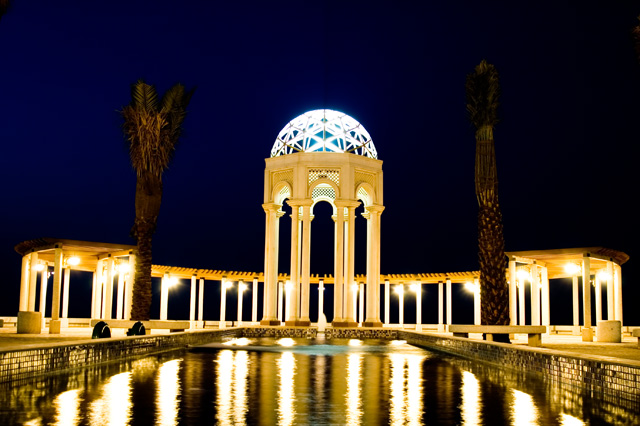
The weather was very humid tonight so I wasn't able to do a lot of shooting. I was planning on going back down to the city again but decided to stay in Salmiya and shoot here. Opposite Salmiya Palace on the seaside there is this thing, I don't know what its called but its a fountain with this tall tower over it. It's hard to explain so here is a picture of it. Anyway I took this shot off to the side of the fountain. I used a long 15 second exposure while using my tripod. It was around 6PM which I have realized is a good time to take night shots since with a decent amount of exposure time the sky lights up into a nice blue. I think the picture looks like it was rendered in 3D on a computer.
Dewailly Cloister Roof - Amiens -France
HDA : Architect
Client : Ville d’Amiens
Architect: H²O& HDA
Date : 2007
See more at : www.hda-paris.com/
Equilibre - France
HDA : Pylon Designer
Client : RTE - ERDF
Architect : HDA
Date : 2013 -
See more at : www.hda-paris.com/
I admit it - I've become render mad. I had this old version of my Berkshire sitting in my LDraw folder and decided to run it through the new light and color settings.
Even if she's not fully updated in this shot, for my first LEGO train MOC she's a looker.
I actually had a scene with multiple locomotives all set up, but for some reason the LGEO library deletes the Flex tube work around that Tim taught me, so I aborted it.
Nokia’s LTE/4G network will be integrated into an Intuitive Machines Nova-C lander and a Lunar Outpost MAPP rover.
www.bell-labs.com/research-innovation/first-cellular-netw...
Bridle’s search for the lost ghosts, the architectural spectres wandering the renders of our possible futures, had all but failed. His project had been shown around the globe, he’d gained glorious reviews in the pages of art journals and magazines, his ghosts had been discussed on many a panel. However, none of ‘the originals’ had been located.
There had been the odd false hope; a mythical photoshoot in albuquerque, a photographers convention in Milton Keynes, but the trail always went cold. He’d been approached by people claiming they were an original, but it didn’t take long to dismiss their claims. The ghouls, as he called them, went to extraordinary lengths to convince him. They dressed up in similar clothes, posed in the same positions, they’d even been known to return to the construction site where their hopeful ghost image had once occupied; placing their flesh bodies into, yet another, distanced layer of our hyper real existence.
It wasn’t until he returned to Korea, that he discovered where the ghosts had come from. After a particularly poorly attended lecture, an elderly man approached him and reprimanded him for accessing ‘the unknown’. The ghosts that he’d been searching for would never appear. The man claimed they’d come from ancient space, a pre-architectural world of possibility. Their projection into the render world, somewhat akin to Edwin Abbott Abbott’s Flatland, was to discover whether architects had evolved since their last contact. Sadly, the man said, they still felt us too primitive in our spatial practice to materialise, they’d returned to the unknown to wait out our spatial puberty.
3D visualization – Michał Grzymała
Ślizg – spirit of Vistula River
Maurycy Gomulicki 2015
Sculpture: Concrete, polyconcrete with fluorescent stones, 17 m long, aprox. 20 T + 24 T fundament weight
Wybrzeże Gdyńskie, Żoliborz, Warsaw, Poland
Done as a part of the Associations Project – in collaboration with Bęc Zmiana Foundation and Lafarge in Poland.
main credits:
Bogna Świątkowska – curator
Magda Grabowska – producer
Magdalena Kicińska – project sponsor / producer
Jędrzej Zdziechowski – project coordinator / engineer
Aldona Wcisło – technologist
Jakub Boroński – technologist
Grzegorz Olech – cast forms
Big thanks to the Fighters:
Poznań:
main working team: Sylwek, Przemo, Romek, Robert, Łukasz & Grzesiek.
supporting workers: Adrian, Patryk, Paweł, Piotrek, Michał, Piotr & students (Wojtek, Hubert & Arek) heavy duty crew: Krzysiek, Wojtek, Paweł, Radek, Jacek & Leszek
Warsaw:
montage & finishing working team:
Remik, Krystian, Marcin, Pinky, Sylwek, Paweł), Jarek & Students (Łukasz, Paweł & Rafał)
Also my Big Thanks to other front liners: Adam Garguliński, Kasia Krapacz & Piotr Drewko
Special Thanks to Sylwek Koprowicz for Consequence & Great Energy, Magda Grabowska who perfectly coordinated the Mess & Honza Zamojski who hosted me in His Poznań Den.
My True Gratitude to everybody else who devoted his attention, time & sweat to the creation of the Beast.
– without U it would be impossible.
Full list of collaborators in project description.
Initial 3d render for the yacht building... dusk time like i usually like to do. hopefully, the pitch for the client will go OK and I'll get a chance to elaborate this further. Modeled with SketchUP and rendered with VRay 1.5 sp3a. VRay RT was a saver on this one to cut production time.
I'm a bit listless right now in my building. I haven't latched on to a project that grabs me. The contenders of late are shown here, All of them are exploratory renders only. These are also in addition to all the other renders that have yet to be built!
Taïkoo Hui - Tianhe, Guangzhou, Guangdong, China
HDA : Specialist Design consultants
Client : Swire Properties Inc.
Architect: Arquitectonica
Date : 2005 - 2010
See more at : www.hda-paris.com/
Generated and rendered directly in Structure Synth. I went back to the 1.5 Hinxton version to get some subtle reflection.
Minor post-work in Zone
I admit I disliked fuji when it started. From the X100 to the XPro1, the camera system, despite its completely seducing color science output, was completely out of sync with my practice in terms of autofocus speed and file. Now the X system has matured into something that I find very hard to match for mirrorless camera photography.
The XT1 comes to solve pretty much all the problems I had with the system: AF and Camera Operations (once u get used to the nobs, hard to go back to menus) are reliable and quick, Lightroom 5.7 renders the file beautifully (with Classic Chrome) and the viewfinder is bigger than that of a full frame dSLR. Not only the camera is now a great camera, the lens system is superb in its consistency: the 14, 23 and 56 are great highly recommended lenses and perform equally marvellously in sharpness, colors and BOKEH while also looking darn good with the Fuji design language. Image quality wise, you get clean files at most of the modern ISOs 200-6400 (you can push the 6400 raw up to 12800 if u want without much penalty or color shifts).
The running cost of ownership is also even more interesting. The body goes for around 1K$ and the rest of the "super prime lenses" (you'd want to shoot prime with this one) go for 1k$ or less each. You can get yourself up and running for less than a full frame camera with equivalent quality lenses.The XT1 ain't still sunshine and rainbow though: It requires the extra grip to enjoy shooting with it, it is not light, the battery lasts as much as a film roll, you can't use exposure compensation on "manual" mode to shift the auto-ISO values, the RAW files are HUGE 30-40mb a piece, low-light AF works fast as long as you have a contrast zone to hunt for but then you also have a magnificent manual focus experience. Classic Chrome (also available in LR 5.7) redefines the fuji photography experience by offering a raw file free of color distorsions and true of natural colors as well as a butt load of great micro-contrast off the file.
All in all, I have to say that I fell in love with it. It is truly the best enthusiast mirrorless system I've come across and it's now well matured.
If you use a full frame dSLR: switching to fuji will depend if you want the premium lenses or the full frame IQ but can't afford the steep 2K$ per lens or 2-4K$ per body, also if you want to sacrifice the extensive "flash system" that dSLRs have.
If you are using a crop sensor dSLR: switching to fuji will depend if you want to keep investing in photography lenses and equipment and don't have to shoot unpredictable fast moving subjects, like birdies.
If you use a Sony: switching to fuji will depend if you are fed up with the teenage identity crisis unpredictability of the system's evolution (new tech = new "test" camera = no "conclusion" camera = less lenses for existing cameras = change the name). The A7 system will flourish to lead the mirrorless trend one day but before that day comes, you have at least until 2016.
If you use a m43 camera: switching to fuji will depend if are willing to drop a bunch of practical technical features: super fast AF (fuji is DARN FAST but m43 cameras are INSTANT FAST), video (I don't shoot video) or image stabilisation or clinical sharpness (fuji images are sharp! but not as pixel sharp as m43... I mean no camera is as pixel sharp as the m43 an) or the touchscreen af point selection... all this for an upgrade in image aesthetics that's a compromise of m43 compactness (somewhat) and passionated lens designs (m43's got good lenses but no "omg wow what the heck" lenses, sorry)
If you shoot film: This is IT. Film nobs, Film look, Film grain, Film output… on digital. This is fujifilm making a camera with the color science they apply on their negatives, all of it.
Indigo park cinemas - Beijing - China
HDA : Architect
Client : Swire Properties LTD,& Sin-Ocean Land
Date : 2010
See more at : www.hda-paris.com/
St Georges Shopping Center - Toulouse, France
HDA : Glass Roof & Facade Consultants
Client : SCI ALTA Saint. Georges
Architect: Guerin Pedroza & Jean Pierre Buffi
Date : 2003
See more at : www.hda-paris.com/
The Newman Center Student Housing project at the University of North Florida, designed by Goodwyn Mills Cawood, is a faith based student housing development known as Frassati Hall in Jacksonville, Florida. This is the first of two planned phases for the student housing development with 204 beds in a 3 story building. The 69 units are apartment style living with one, two and four bedroom units. There are lounges and study retreats on each floor along with space for a priest’s office. The first phase is a 3-story structure with 75,000 total square feet. It’s location in a coastal environment required special attention by the design team to address issues related to humidity and the ability to withstand severe storms. The building follows all required State of Florida and City of Jacksonville building codes for storm resistance. Phase II is planned to add an additional 158 beds.