View allAll Photos Tagged Reasoning
Part of my Independence Day celebration.
I'll be celebrating my independence and freedom every day the rest of the year and the rest of my life! There's nowhere I'd rather be :-)
My personal independence and freedom were unexpectedly forced on me. I fought it a bit and it took a while to accept and adapt to it. Looking back, it was a blessing in disguise. Possibly done intentionally in my best interest to save me. Maybe it was for Joe. It's had a marked positive effect on him too. He's much calmer and at ease. Whatever the reasoning, we're finding our groove and rhythm and it's pretty cool :-) I'm more and more thankful every day!
I have enough positive energy to power a small village!
As much as I enjoy adults as friends, animals and kids give me the most happiness beyond reasoning... no offense. :)
Final image from the series "More Than Skin Deep" for the Body Altar Show.
More Than Skin Deep is a series I did about the people behind the tattoos, and more specifically, why they each decided to carry a permanent mark on their precious canvas. The title of each piece recalls my discussions with them regarding their vast reasoning. Shot with a Polaroid EE100 Special on Fuji pack film, the emulsion was boiled off the backing and applied to the canvas to give each piece more of a living feel. Shooting in an environment without Command +Z, and hand creating one of a kind pieces without the convenience of negatives to duplicate endlessly, allows the medium to replicate the subject matter.
These were shot on a Polaroid EE Special camera with Fuji pack film. The images were then boiled off the paper backing and glued via a mixture of tacky glue and water to 5x7 pre stretched canvases. I toyed with affixing the photo both after it had dried and still wet and found the dried version worked a bit better while the wet was more prone to air bubbles. Once dry, the photographs were rubbed with different colors of acrylic paint, especially visible were the glue residue picked it up. Once that was dry, I used duct tape and newspaper to protect the fronts and spray painted the sidesusing complimentary colors to what was found in the picture.
Here is info on the show they will be in (and for sale at $80 each):
Flesh: The Body Altar
Friday, January 7, 2011 at 8:00pm - Saturday, January 8, 2011 at 2:00am
Taste (at Edgewater in College Park)
717 W Smith St
Orlando, FL
Friday Ferox presents an art event focusing on all forms of art on the human body... BODY ART, TATTOOS, PIERCING, MODIFICATION...
Sponsored by Ascension Tattoos (www.ascensiontattoo.com) & Draco Felis.
Art by Earl Funk, Ant Iannucci, Vinny Burkhart, Jim Carchidi, Nik Nelson, Justin Lynn...
Music by Ring Of Scars and DJ Robb Blak.
Performances by Florida Tribal Dance.
Honey Malone on Silks.
Live Body Art.
Tattoo Fashion Show.
Henna by The Henna Goddess.
Vendors.
$5 cover (free raffle ticket for door prize & $5 Taste coupon given with paid admission)
18+ Suggested
Contact: anna@dracofelis.com, 407.252.4913, facebook.com/bluemaiya
Little does Mister Harrison know, but just around the corner there is a dragon’s head quietly waiting – with the kind of patience imbued only by decapitation – for to use his mobile telephone to ring the number 86906635. Mister Harrison has, in the past and by most of the people who know him best, been accused of being an outrageously blunt instrument of modern reasoning – at times he has been referred to as a dolt and it has often been joked, at his expense, that little does he know indeed. The dragon was unaware of Mister Harrison’s inability to fathom its true desire when he snuck up to the corner at the hands of the person who previously had been waving him all about town. Mister Harrison is the sort of man who when chancing upon his reflection in the window of a passing car laments the notion that with his meagre resemblance to Brad Pitt and his unadvanced years he really could have made it in Hollywood if only he had fallen in with the right crowd at a younger age. The only one to see the virtue in Mister Harrison’s narcissistic flights of fancy in passing cars is the dragon’s head, who but for a misplaced body could have taken flight from the legends of yore and sailed into a more reasonable and contempory state of being. The dragon’s head is aware of Mister Harrison’s presence around the corner because it saw him sit down, however, Mister Harrison, who is barely cognisant of the animated members of society as they do things to/on/around and in spite of his clumsy existence, has forgotten all about the dragon’s head and was never really aware of its need to use his mobile phone at all. As a matter of inevitable fact, from the moment Mister Harrison sat down and lit his cigarette he has been transfixed by his reflection in the car window opposite the dragon’s head. ‘Is that the roguish Brad Pitt? No, no…it’s Mister Harrison!’ The singular unanswered question in Mister Harrison’s life thus remains: ‘Am I happy to look a little like Brad Pitt, or am I sad that no one else thinks it to be important?’ Mister Harrison was mulling this over in his addled mind, at the very time which the dragon’s head was mustering the accrued reason and spirit of a lost species in a cathartic attempt to make any intelligible gesture which Mister Harrison might interpret as a clear sign that it needed his mobile phone to call the number 86906635. Mister Harrison was apparently unimpressed. And the familiar tension between desire and reason played out in the worlds of the inanimate and the blunt sat in this very position – in the afternoon sun – until Mister Harrison got up from his chair walked past the dragon’s head and as he rounded the next corner was ground into the bitumen by Brad Pitt’s reflection in an oncoming cement truck which took 150 meters to full stop after the fact. It was Mister Harrison’s last insult to the dragon’s head that the cement truck completed his desired rounding of the corner on his behalf and the dragon’s head never actually knew what became of Mister Harrison’s mobile telephone.
¿ nee-KOH-tay-bah ? -- anagram of the epithet betonica; could not find reasoning
bet-OH-nee-kuh -- variant of vettonica, a Spanish native plant ... Dave's Botanary
commonly known as: leafy bract justicia, paper plume, rose-spotted white-flowered Justice wort, squirrel's tail, white shrimp plant • Bengali: পাটল বাসক patela basak • Gujarati: ગુલાબી અરડુસી gulabi aradusi • Hindi: हाड़पात hadpat, मोकंदर mokander, प्रमेहःहराती pramehaharati • Kannada: ಕಾಡು ಕನಕಾಂಬರ kaadu kanakaambara, ಸಣ್ಣ ಅಡುಸೋಗೆ sanna adusoge • Konkani: धवो पोक्षो dhavo pokso • Malayalam: വെള്ളക്കുറിഞ്ഞി vellakurunji • Marathi: गुलाबी अडुलसा gulabi adulasa • Odia: ମାଟି ଶାଗ mati saga • Rajasthani: गुलाबी अडूसा gulabi adusa • Sanskrit: श्वेत सहचरः sveta-sahacarah • Santali: ᱛᱟᱭᱟᱨ tayar • Tamil: வேலிமூங்கில் veli-munkil • Telugu: తెల్ల రంతు tellarantu
botanical names: Nicoteba betonica (L.) Lindau ... homotypic synonyms: Adhatoda betonica (L.) Nees • Ecbolium betonica (L.) Kuntze • Justicia betonica L. ... heterotypic synonyms: Gendarussa betonica Nees ex Steud., not validly publ. ... and more at POWO, retrieved 27 June 2025
歸納法或歸納推理(Inductive reasoning),有時叫做歸納邏輯,
是論證的前提支持結論但不確保結論的推理過程。
它基於對特殊的代表(token)的有限觀察,把性質或關係歸結到類型;
或基於對反覆再現的現象的模式(pattern)的有限觀察,公式表達規律。
A Congressional initiative that would award the Purple Heart Medal to the military victims of Major Nidal Hasan’s terrorist attack on Fort Hood is being blocked by the U.S. Department of Defense in a most bizarre rendering of reasoning.
“Passage of this legislation could directly and indirectly influence potential court-martial panel members, witnesses, or the chain of command, all of whom exercise a critical role under the Uniform Code of Military Justice (UCMJ). Defense counsel will argue that Major Hasan cannot receive a fair trial because a branch of government has indirectly declared that Major Hasan is a terrorist -- that he is criminally culpable.”
The DOD said “The Army objects to the proposal because it would undermine the prosecution of Major Nidal Hasan by materially and directly compromising Major Hasan’s ability to receive a fair trial. This provision will be viewed as setting the stage for a formal declaration that Major Hasan is a terrorist, on what is now the eve of trial. Such a situation, prior to trial, would fundamentally compromise the fairness and due process of the pending trial.”
Once again the U.S. government, for reasons unbeknownst to us, seeks to enjoin some sort of political correctness regarding defendants’ rights as opposed to calling an Islamic terrorist an Islamic terrorist.
You’ll have to excuse us if we can't quite wrap our brains around the unwillingness of the administration to cite a Muslim man who shouts “Allahu Akhbar” before murdering the lives of 13 innocent people as an Islamic terrorist. Do they really believe that they can convince us that he was just having a bad hair day? Suicide bombers do the same thing.
In case you might be wondering what the White House thinks, “The Administration objects to Section 552 which would grant Purple Hearts to the victims of the shooting incidents in Fort Hood, Texas, and Little Rock, Arkansas.” This a direct quote from an eight-page official STATEMENT OF ADMINISTRATION POLICY issued on the letterhead of the Executive Office of the President!
We must ask ourselves, “Where is the America that will defend its own against acts of terrorism?” Then it follows that we must also ask, “Where is the America that will defend its allies?” That leads to asking “Where is the America that will defend Israel?”
Fortunately for Israel, she does not need the American President. Almighty God is her Protector and Redeemer. Some might argue, asking “Where has He been for the last 2,000 years?” Those who ask do so through the eyes of flesh that miss the fact that His dealings with Israel are not done. He has walked with the Jews through the “valley of the shadow of death” and He will lead them to a time when they “shall dwell in the house of the Lord forever.” That time has not yet come, but it is close at hand. We need to pray for the peace of Jerusalem (Psalm 122:6) with a heart that completely trusts the Lord and knows that His plan is perfect in every way. Pray with us, please.
For more on this story, visit: Jerusalem Prayer Team Articles Page.
LIKE and SHARE this story to encourage others to pray for peace in Jerusalem, and leave your own PRAYERS and COMMENTS below.
--------------------
Support the Jerusalem Prayer Team. Visit us now.
Going through old scrapbooks and now rethinking my reasoning as may NOT be EXACTLY helping me as much as I'd hoped...look how young we BOTH are!!!
“Computer science also differs from physics in that it is not actually a science. It does not study natural objects. Neither is it, as you might think, mathematics; although it does use mathematical reasoning pretty extensively. Rather, computer science is like engineering - it is all about getting something to do something, rather than just dealing with abstractions ...”
—en.wikipedia.org/wiki/Richard_Feynman in his preface to the Feynman lectures on Computation www.worldcat.org/oclc/1110664774
Mark 12:28 And one of the scribes came , and having heard them reasoning together , and perceiving that he had answered them well, asked him, Which is the first commandment of all? 29 And Jesus answered him, The first of all the commandments is, Hear , O Israel; The Lord our God is one Lord: 30 And thou shalt love the Lord thy God with all thy heart, and with all thy soul, and with all thy mind, and with all thy strength: this is the first commandment. 31 And the second is like, namely this , Thou shalt love thy neighbour as thyself. There is none other commandment greater than these
www.youtube.com/watch?v=DGIk-4QytjM
'Hope for Sam and Melody', a video I made to enter a contest sponsored by Focus on the Family to win money for them. Check it out! When you see the living conditions they are in, you will be thankful for what you have. Please pray for them. They live in our local town of Wolverine, MI. You can help by buying Sam's products on my site. He has a clock, crosses, cookies. Or by going to Petoskey, MI at the Crooked Tree Art Center on Mitchell across from the library and buying our cookie magnets or cookie ornaments until Dec. 23rd. Open 10-5 M-F and 10-4 Sat. Also, the birdbaths are here in my art center next to my house. I will let you see them anytime.
Love in Jesus, Kathie
"Slinky Dog's Zigzag Spin" ride in the Toy Story Playland section of Disneyland Paris.
The ride is bright and cheery to look at, but pretty much identical to the old "caterpillar" ride at your home town amusement park. In fact, it's missing the coolest part of those rides, when the caterpillar's "skin" wraps around the riders...
Tara Hepworth (left) and Mallorie Nason (center) provide a informal screening for language speech and auditory reasoning for preschool to 3rd grade to Mckenzee Touvelo (right) as graduate students in Communication Sciences & Disorders Program provide speech, language, hearing, voice and/or cognitive screening during the Speech and Hearing Fair on Saturday, May 4, 2019 in Chico, Calif. May is Better Hearing and Speech Month and CMSD governing body, ASHA, encourages speech-language pathologists and audiologists to do their part to educate the community about speech, language and hearing disorders and the role of speech-language pathologists and audiologists in treatment of communication disorders.
(Jason Halley/University Photographer/CSU Chico)
¿ nee-KOH-tay-bah ? -- anagram of the epithet betonica; could not find reasoning
bet-OH-nee-kuh -- variant of vettonica, a Spanish native plant ... Dave's Botanary
commonly known as: leafy bract justicia, paper plume, rose-spotted white-flowered Justice wort, squirrel's tail, white shrimp plant • Bengali: পাটল বাসক patela basak • Gujarati: ગુલાબી અરડુસી gulabi aradusi • Hindi: हाड़पात hadpat, मोकंदर mokander, प्रमेहःहराती pramehaharati • Kannada: ಕಾಡು ಕನಕಾಂಬರ kaadu kanakaambara, ಸಣ್ಣ ಅಡುಸೋಗೆ sanna adusoge • Konkani: धवो पोक्षो dhavo pokso • Malayalam: വെള്ളക്കുറിഞ്ഞി vellakurunji • Marathi: गुलाबी अडुलसा gulabi adulasa • Odia: ମାଟି ଶାଗ mati saga • Rajasthani: गुलाबी अडूसा gulabi adusa • Sanskrit: श्वेत सहचरः sveta-sahacarah • Santali: ᱛᱟᱭᱟᱨ tayar • Tamil: வேலிமூங்கில் veli-munkil • Telugu: తెల్ల రంతు tellarantu
botanical names: Nicoteba betonica (L.) Lindau ... homotypic synonyms: Adhatoda betonica (L.) Nees • Ecbolium betonica (L.) Kuntze • Justicia betonica L. ... heterotypic synonyms: Gendarussa betonica Nees ex Steud., not validly publ. ... and more at POWO, retrieved 27 June 2025
Salamieh CommunityTelecenter - Syria
Children with learning disabilities exhibit a wide range of symptoms. These include problems with reading, mathematics, comprehension, writing, spoken language, or reasoning abilities. Hyperactivity, inattention and perceptual coordination may also be associated with learning disabilities but are not learning disabilities themselves. The primary characteristic of a learning disability is a significant difference between a child's achievement in some areas and his or her overall intelligence. Learning disabilities typically affect five general areas:
Spoken language: delays, disorders, and deviations in listening and speaking.
Written language: difficulties with reading, writing and spelling.
Arithmetic: difficulty in performing arithmetic operations or in understanding basic concepts.
Reasoning: difficulty in organizing and integrating thoughts.
Memory: difficulty in remembering information and instructions.
Among the symptoms commonly related to learning disabilities are:
poor performance on group tests
difficulty discriminating size, shape, color
difficulty with temporal (time) concepts
distorted concept of body image
reversals in writing and reading
general awkwardness
poor visual-motor coordination
hyperactivity
difficulty copying accurately from a model
slowness in completing work
poor organizational skills
easily confused by instructions
difficulty with abstract reasoning and/or problem solving
disorganized thinking
often obsesses on one topic or idea
poor short-term or long-term memory
impulsive behavior; lack of reflective thought prior to action
low tolerance for frustration
excessive movement during sleep
poor peer relationships
overly excitable during group play
poor social judgment
inappropriate, unselective, and often excessive display of affection
lags in developmental milestones (e.g. motor, language)
behavior often inappropriate for situation
failure to see consequences for his actions
overly gullible; easily led by peers
excessive variation in mood and responsiveness
poor adjustment to environmental changes
overly distractible; difficulty concentrating
difficulty making decisions
lack of hand preference or mixed dominance
difficulty with tasks requiring sequencing
Best Regards
Eng. Nabil Eid
Manager of Salamieh Community Telecenter- Syria
Best Regards
Rapid strata formation in soft sand (field evidence).
Photo of strata formation in soft sand on a beach, created by tidal action of the sea.
Formed in a single, high tidal event. Stunning evidence which displays multiple strata/layers.
Why this is so important ....
It has long been assumed, ever since the 17th century, that layers/strata observed in sedimentary rocks were built up gradually, layer upon layer, over many years. It certainly seemed logical at the time, from just looking at rocks, that lower layers would always be older than the layers above them, i.e. that lower layers were always laid down first followed, in time, by successive layers on top.
This was assumed to be true and became known as the superposition principle.
It was also assumed that a layer comprising a different material from a previous layer, represented a change in environmental conditions/factors.
These changes in composition of layers or strata were considered to represent different, geological eras on a global scale, spanning millions of years. This formed the basis for the Geologic Column, which is used to date rocks and also fossils. The evolutionary, 'fossil record' was based on the vast ages and assumed geological eras of the Geologic Column.
There was also circular reasoning applied with the assumed age of 'index' fossils (based on evolutionary beliefs & preconceptions) used to date strata in the Geologic Column. Dating strata from the assumed age of (index) fossils is known as Biostratigraphy.
We now know that, although these assumptions seemed logical, they are not supported by the evidence.
At the time, the mechanics of stratification were not properly known or studied.
An additional factor was that this assumed superposition and uniformitarian model became essential, with the wide acceptance of Darwinism, for the long ages required for progressive microbes-to-human evolution. There was no incentive to question or challenge the superposition, uniformitarian model, because the presumed, fossil 'record' had become dependant on it, and any change in the accepted model would present devastating implications for Darwinism.
This had the unfortunate effect of linking the study of geology so closely to Darwinism, that any study independent of Darwinian considerations was effectively stymied. This link of geology with Darwinian preconceptions is known as biostratigraphy.
Some other field evidence, in various situations, can be observed here: www.flickr.com/photos/101536517@N06/sets/72157635944904973/
and also in the links to stunning, experimental evidence, carried out by sedimentologists, given later.
_______________________________________________
GEOLOGIC PRINCIPLES (established by Nicholas Steno in the 17th Century):
What Nicolas Steno believed about strata formation is the basis of the principle of Superposition and the principle of Original Horizontality.
dictionary.sensagent.com/Law_of_superposition/en-en/
“Assuming that all rocks and minerals had once been fluid, Nicolas Steno reasoned that rock strata were formed when particles in a fluid such as water fell to the bottom. This process would leave horizontal layers. Thus Steno's principle of original horizontality states that rock layers form in the horizontal position, and any deviations from this horizontal position are due to the rocks being disturbed later.”)
BEDDING PLANES.
'Bedding plane' describes the surface in between each stratum which are formed during sediment deposition.
science.jrank.org/pages/6533/Strata.html
“Strata form during sediment deposition, that is, the laying down of sediment. Meanwhile, if a change in current speed or sediment grain size occurs or perhaps the sediment supply is cut off, a bedding plane forms. Bedding planes are surfaces that separate one stratum from another. Bedding planes can also form when the upper part of a sediment layer is eroded away before the next episode of deposition. Strata separated by a bedding plane may have different grain sizes, grain compositions, or colours. Sometimes these other traits are better indicators of stratification as bedding planes may be very subtle.”
______________________________________________
Several catastrophic events, flash floods, volcanic eruptions etc. have forced Darwinian, influenced geologists to admit to rapid stratification in some instances. However they claim it is a rare phenomenon, which they have known about for many years, and which does nothing to invalidate the Geologic Column, the fossil record, evolutionary timescale, or any of the old assumptions regarding strata formation, sedimentation and the superposition principle. They fail to face up to the fact that rapid stratification is not an extraordinary phenonemon, but rather the prevailing and normal mechanism of sedimentary deposition whenever and wherever there is moving, sediment-laden water. The experimental evidence demonstrates the mechanism and a mass of field evidence in normal (non-catastrophic) conditions shows it is a normal everyday occurrence.
It is clear from the experimental evidence that the usual process of stratification is - that strata are not formed by horizontal layers being laid on top of each other in succession, as was assumed. But by sediment being sorted in the flowing water and laid down diagonally in the direction of flow. See diagram:
www.flickr.com/photos/truth-in-science/39821536092/in/dat...
The field evidence (in the image) presented here - of rapid, simultaneous stratification refutes the Superposition Principle and the Principle of Lateral Continuity.
We now know, the Superposition Principle only applies on a rare occasion where sedimentary deposits are laid down in still water.
Superposition is required for the long evolutionary timescale, but the evidence shows it is not the general rule, as was once believed. Most sediment is laid down in moving water, where particle segregation is the general rule, resulting in the simultaneous deposition of strata/layers as shown in the photo.
See many other examples of rapid stratification (with geological features): www.flickr.com/photos/101536517@N06/sets/72157635944904973/
Rapid, simultaneous formation of layers/strata, through particle segregation in moving water, is so easily created it has even been described by sedimentologists (working on flume experiments) as a law ...
"Upon filling the tank with water and pouring in sediments, we immediately saw what was to become the rule: The sediments sorted themselves out in very clear layers. This became so common that by the end of two weeks, we jokingly referred to Andrew's law as "It's difficult not to make layers," and Clark's law as "It's easy to make layers." Later on, I proposed the "law" that liquefaction destroys layers, as much to my surprise as that was." Ian Juby, www.ianjuby.org/sedimentation/
The example in the photo is the result of normal, everyday tidal action formed in a single incident, and subsequently eroded by water flow revealing the strata/layers.
Where the water current or movement is more turbulent, violent, or catastrophic, great depths (many metres) of stratified sediment can be laid down in a short time. Certainly not the many millions of years assumed by evolutionists.
The composition of strata formed in any deposition event. is related to whatever materials are in the sediment mix, not to any particular timescale. Whatever is in the mix will be automatically sorted into strata/layers. It could be sand, or other material added from mud slides, erosion of chalk deposits, coastal erosion, volcanic ash etc. Any organic material (potential fossils), alive or dead, engulfed by, or swept into, a turbulent sediment mix, will also be sorted and buried within the rapidly, forming layers.
See many other examples of rapid stratification with geological features: www.flickr.com/photos/101536517@N06/sets/72157635944904973/
Stratified, soft sand deposit. demonstrates the rapid, stratification principle.
Important, field evidence which supports the work of the eminent, sedimentologist Dr Guy Berthault MIAS - Member of the International Association of Sedimentologists.
(Dr Berthault's experiments (www.sedimentology.fr/)
And also the experimental work of Dr M.E. Clark (Professor Emeritus, U of Illinois @ Urbana), Andrew Rodenbeck and Dr. Henry Voss, (www.ianjuby.org/sedimentation/)
Location: Sandown, Isle of Wight. Formed 18/01/2018 This field evidence demonstrates that multiple strata in sedimentary deposits do not need millions of years to form and can be formed rapidly. This natural example confirms the principle demonstrated by the sedimentation experiments carried out by Dr Guy Berthault and other sedimentologists. It calls into question the standard, multi-million year dating of sedimentary rocks, and the dating of fossils by depth of burial or position in the strata.
Mulltiple strata/layers are evident in this example.
Dr Berthault's experiments (www.sedimentology.fr/) and other experiments (www.ianjuby.org/sedimentation/) and field studies of floods and volcanic action show that, rather than being formed by gradual, slow deposition of sucessive layers superimposed upon previous layers, with the strata or layers representing a particular timescale, particle segregation in moving water or airborne particles can form strata or layers very quickly, frequently, in a single event.
And, most importantly, lower strata are not older than upper strata, they are the same age, having been created in the same sedimentary episode.
Such field studies confirm experiments which have shown that there is no longer any reason to conclude that strata/layers in sedimentary rocks relate to different geological eras and/or a multi-million year timescale. www.youtube.com/watch?v=5PVnBaqqQw8&feature=share&.... they also show that the relative position of fossils in rocks is not indicative of an order of evolutionary succession. Obviously, the uniformitarian principle, on which the geologic column is based, can no longer be considered valid. And the multi-million, year dating of sedimentary rocks and fossils needs to be reassessed. Rapid deposition of stratified sediments also explains the enigma of polystrate fossils, i.e. large fossils that intersect several strata. In some cases, tree trunk fossils are found which intersect the strata of sedimentary rock up to forty feet in depth. upload.wikimedia.org/wikipedia/commons/thumb/0/08/Lycopsi... They must have been buried in stratified sediment in a short time (certainly not millions, thousands, or even hundreds of years), or they would have rotted away. youtu.be/vnzHU9VsliQ
In fact, the vast majority of fossils are found in good, intact condition, which is testament to their rapid burial. You don't get good fossils from gradual burial, because they would be damaged or destroyed by decay, predation or erosion. The existence of so many fossils in sedimentary rock on a global scale is stunning evidence for the rapid depostion of sedimentary rock as the general rule. It is obvious that all rock containing good intact fossils was formed from sediment laid down in a very short time, not millions, or even thousands of years.
See set of photos of other examples of rapid stratification: www.flickr.com/photos/101536517@N06/sets/72157635944904973/
Carbon dating of coal should not be possible if it is millions of years old, yet significant amounts of Carbon 14 have been detected in coal and other fossil material, which indicates that it is less than 50,000 years old. www.ldolphin.org/sewell/c14dating.html
www.grisda.org/origins/51006.htm
Evolutionists confidently cite multi-million year ages for rocks and fossils, but what most people don't realise is that no one actually knows the age of sedimentary rocks or the fossils found within them. So how are evolutionists so sure of the ages they so confidently quote? The astonishing thing is they aren't. Sedimentary rocks cannot be dated by radiometric methods*, and fossils can only be dated to less than 50,000 years with Carbon 14 dating. The method evolutionists use is based entirely on assumptions. Unbelievably, fossils are dated by the assumed age of rocks, and rocks are dated by the assumed age of fossils, that's right ... it is known as circular reasoning.
* Regarding the radiometric dating of igneous rocks, which is claimed to be relevant to the dating of sedimentary rocks, in an occasional instance there is an igneous intrusion associated with a sedimentary deposit -
Prof. Aubouin says in his Précis de Géologie: "Each radioactive element disintegrates in a characteristic and constant manner, which depends neither on the physical state (no variation with pressure or temperature or any other external constraint) nor on the chemical state (identical for an oxide or a phosphate)."
"Rocks form when magma crystallizes. Crystallisation depends on pressure and temperature, from which radioactivity is independent. So, there is no relationship between radioactivity and crystallisation.
Consequently, radioactivity doesn't date the formation of rocks. Moreover, daughter elements contained in rocks result mainly from radioactivity in magma where gravity separates the heavier parent element, from the lighter daughter element. Thus radiometric dating has no chronological signification." Dr. Guy Berthault www.sciencevsevolution.org/Berthault.htm
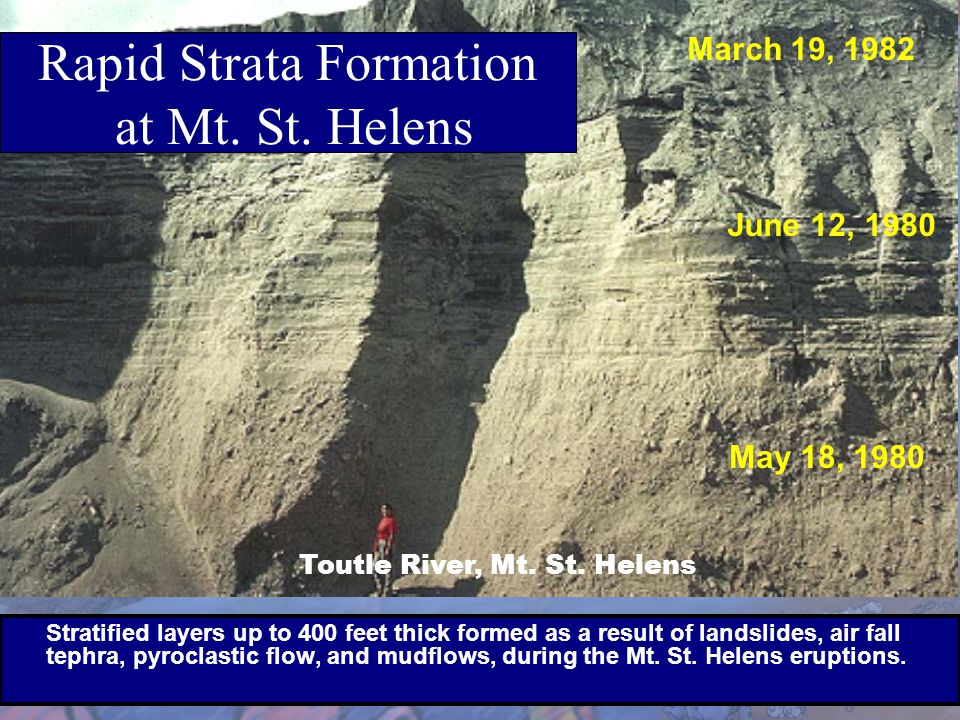
Rapid strata formation and rapid erosion at Mount St Helens.
slideplayer.com/slide/5703217/18/images/28/Rapid+Strata+F...
Visit the fossil museum:
www.flickr.com/photos/101536517@N06/sets/72157641367196613/
Just how good are peer reviews of scientific papers?
www.sciencemag.org/content/342/6154/60.full
www.examiner.com/article/want-to-publish-science-paper-ju...
The neo-Darwinian idea that the human genome consists entirely of an accumulation of billions of mutations is, quite obviously, completely bonkers. Nevertheless, it is compulsorily taught in schools and universities as 'science'.
Our Lady and St Walstan, Costessey, Norwich
As was remarked by the anonymous author of That Great Gothic Fane, published in 1910 to mark the opening of the huge Catholic church of St John the Baptist in Norwich, the idea that his ancestors had been Catholics was as remote for the typical rural Norfolker as was the idea that dinosaurs had once walked the land. And yet, there were pockets in Norfolk where the Catholic Faith not only survived through the long penal years, but flourished, and not as an exotic species. These were the parishes where the local Big Family refused to switch to the new protestant Church of England, but stubbornly clung to the Faith of their forebears. The most steadfast of all these recusant families were probably the Jerninghams of Costessey Hall.
It is no exaggeration to say that the Jerninghams were the architects of the survival of the Old Faith in Norwich. Although records of a resident Priest only go back to 1701, Costessey Hall was host to Mass throughout the penal period, one of few places in East Anglia of which that could be said. In the middle years of the 19th century, Costessey Hall was rebuilt to the designs of JC Buckler, an architect with two good Norfolk churches to his name at Welney and Walpole Highway. Buckler was also commissioned to build a mission church to go with the Hall - until then, local Catholics had made use of the Hall chapel. The result is a tall, rather serious building in red brick. The high lancets and strong buttressing create a fortress-like effect, perhaps understandably as the church opened on the 26th of May 1841, just five years after the Reform Act which had made its construction legal.
A mark of the success of its design is that we would still be building churches in this style until well into the 1890s, but it has none of the nooks and crannies which we have come to expect of 19th century Catholic churches. Rather, the effect is that of a protestant preaching hall church. The west end has had its severity ameliorated by a modern extension in the early years of the 21st century. Even so, this building would fit well into an industrial town.
The first Priest of this church was a Dr Husenbeth, who had been appointed chaplain of Costessey Hall in 1820. We may assume that he was largely responsible for the design of the church, which cost a little under £4500 to build, about eight hundred thousand in today's money, although this amount also included the presbytery and all the furnishings. There were about 400 Catholics living in Costessey at the time, and it is interesting to compare this with the vast Kings Lynn parish, which covered most of north-west Norfolk and which at this time had, according to the Lynn News, less than 150 Catholics all told, and all of them poor. I assume that most of the Costessey Catholics were working for the Hall Estate.
The Catholic hierarchy was reintroduced to England in 1851, and at that time St Walstan became a parish church within the vast Diocese of Northampton. An Order of Nuns took up residence in the village, and the Sisters opened a village school. But hard times were coming to Costessey. In 1872, Dr Husenbeth died, and, with the Jerningham family no longer able to support the Church in the parish, the Bishop of Northampton decided not to send another Priest to Costessey, reasoning that his resources would be more usefully deployed in the heart of industrial Norwich. St Walstan's church closed for regular use, and soon fell into decay. The Parish reverted to mission status, with Priests coming out from Holy Apostles chapel in central Norwich to say Mass in the chapel of the Hall. It was not until 1910, coincidentally the year that the church which is now Norwich's Catholic Cathedral was opened, that another Priest was sent to Costessey, and the Parish brought back to life.
Our Lady and St Walstan is open every day. You step into the modern extension, and then beyond this the church is all of a piece, the structure and the furnishings all dating from 1841. The interior is as serious as the exterior - Pevsner thought it pleasant but plain. A solid, stone-built west gallery with the linked monograms of Mary and Walstan is a pleasing counterpoint to Buckler's apse of a chancel at the other end. The glass in the chancel is interesting rather than beautiful, its significance coming from its early date.
The stations on the walls echo the bench ends, and the font is a simple marble tub in the transitional style. There is a good modern icon of St Walstan, apparently based on a local, and the panelled altar provides a moment of High Victorian splendour.
If the architecture of the church is urban in character, its setting is wholly delightful. Although we are just off of Costessey's main street, the church sits on the crest of a ridge which falls rapidly away towards the north-east, and here is a fascinating and lovely Catholic graveyard. The snowdrops still punctuated the spaces between the gravestones when we came this way in April, and among the often elaborate and beautifully carved headstones is a simple cross on a moss-covered pedestal. Beside it is a sign which reads Pray for the Souls of the Jerningham Family, whose bodies were brought from the chapel in Costessey Park and buried here on November 18th 1953. Their names are inscribed in the porch of St Walstan's Church.
☝️ Columbia Professor Jeffrey Sachs: Ukrainians are dying. Americans Are Fighting And Funding !!! More Pain In Coming Days
You be the judge. Is the Newsweek heading "Russia Suffering Crippling Loss in Ukraine Threatens World Order: Kissinger" completely out of line? Dr Kissinger said no such thing in his article.
www.msn.com/en-us/news/world/russia-suffering-crippling-l...
Russia Suffering Crippling Loss in Ukraine Threatens World Order: Kissinger
www.rt.com/news/568389-kissinger-ukraine-peace-proposal/
Kissinger outlines Ukraine peace proposal
Elder US statesman invoked the missed opportunity to negotiate an end to WWI in 1916
Urgently negotiating an end to hostilities in Ukraine would prevent another world war, former US secretary of state Henry Kissinger argued in an essay published on Friday. The 99-year-old statesman noted that, in 1916, the US government had the chance to end the First World War through diplomacy, but missed it for reasons of domestic politics.
Kissinger laid out his reasoning in the December 17 issue of The Spectator, describing the current conflict as a “war in which two nuclear powers contest a conventionally armed country,” a clear reference to Ukraine being a proxy war between the US and Russia.
The “peace process” Kissinger proposes would “link Ukraine to NATO, however expressed,” as he believes neutrality for Kiev is no longer an option. He also wants Russia to withdraw to the lines before February 24, while the other territories Ukraine claims – Donetsk, Lugansk and Crimea – “could be the subject of a negotiation after a ceasefire.”
In addition to “confirming the freedom of Ukraine,” the arrangement would strive to “define a new international structure, especially for Central and Eastern Europe,” in which Russia should “eventually” find a place, he explained.
While some would prefer “a Russia rendered impotent by the war,” Kissinger disagrees, arguing that Moscow’s “historical role should not be degraded.” Dismantling Russia could turn its vast territory into a “contested vacuum,” where “competing societies might decide to settle their disputes by violence” and neighbors could seek to claim territory by force, all in the presence of “thousands of nuclear weapons.”
In substance, this is the same proposal Kissinger had first floated in May, for which he was labeled an enemy of Ukraine and added to the notorious ‘Peacemaker’ kill list. In an interview earlier this month, Ukrainian President Vladimir Zelensky categorically rejected any sort of ceasefire that did not take Kiev’s claimed 1991 borders as the starting point.
It was also unclear whether Moscow would accept any Western-mediated ceasefire at all, after former German Chancellor Angela Merkel’s admission that the 2014 Minsk armistice was intended to “give Ukraine time” to prepare for war.
What’s fresh in Kissinger’s Spectator essay is his reasoning. He points to August 1916, at the height of the First World War, when the warring powers sought US mediation to end the unprecedented bloodshed. Though “a peace based on the modified status quo ante was within reach,” President Woodrow Wilson delayed the talks until after he could get re-elected in November. By then it was too late, and the war would go on for two more years, “irretrievably damaging Europe’s established equilibrium.”
Asked about Kissinger’s proposal, Kremlin spokesman Dmitry Peskov said Russian President Vladimir Putin was “eager to give the article a thorough reading,” but “hasn’t had a chance to do so yet, unfortunately.”
Russia sent troops into Ukraine on February 24, citing Kiev’s failure to implement the Minsk agreements, designed to give the regions of Donetsk and Lugansk special status within the Ukrainian state. The Kremlin demanded that Ukraine officially declare itself a neutral country that would never join any Western military bloc. Kiev insists the Russian offensive was completely unprovoked.
www.tvr.by/eng/news/v_mire/kissindzher_nastal_moment_dlya...
Kissinger: The time is approaching to achieve peace in Ukraine trough negotiations
www.spectator.co.uk/article/the-push-for-peace/
How to avoid another world war?
The first world war was a kind of cultural suicide that destroyed Europe’s eminence. Europe’s leaders sleepwalked – in the phrase of historian Christopher Clark – into a conflict which none of them would have entered had they foreseen the world at war’s end in 1918. In the previous decades, they had expressed their rivalries by creating two sets of alliances whose strategies had become linked by their respective schedules for mobilisation. As a result, in 1914, the murder of the Austrian Crown Prince in Sarajevo, Bosnia by a Serb nationalist was allowed to escalate into a general war that began when Germany executed its all-purpose plan to defeat France by attacking neutral Belgium at the other end of Europe.
The nations of Europe, insufficiently familiar with how technology had enhanced their respective military forces, proceeded to inflict unprecedented devastation on one another. In August 1916, after two years of war and millions in casualties, the principal combatants in the West (Britain, France and Germany) began to explore prospects for ending the carnage. In the East, rivals Austria and Russia had extended comparable feelers. Because no conceivable compromise could justify the sacrifices already incurred and because no one wanted to convey an impression of weakness, the various leaders hesitated to initiate a formal peace process. Hence they sought American mediation. Explorations by Colonel Edward House, President Woodrow Wilson’s personal emissary, revealed that a peace based on the modified status quo ante was within reach. However, Wilson, while willing and eventually eager to undertake mediation, delayed until after the presidential election in November. By then the British Somme offensive and the German Verdun offensive had added another two million casualties.
In the words of the book on the subject by Philip Zelikow, diplomacy became the road less travelled. The Great War went on for two more years and claimed millions more victims, irretrievably damaging Europe’s established equilibrium. Germany and Russia were rent by revolution; the Austro-Hungarian state disappeared from the map. France had been bled white. Britain had sacrificed a significant share of its young generation and of its economic capacities to the requirements of victory. The punitive Treaty of Versailles that ended the war proved far more fragile than the structure it replaced.
Does the world today find itself at a comparable turning point in Ukraine as winter imposes a pause on large-scale military operations there? I have repeatedly expressed my support for the allied military effort to thwart Russia’s aggression in Ukraine. But the time is approaching to build on the strategic changes which have already been accomplished and to integrate them into a new structure towards achieving peace through negotiation.
Ukraine has become a major state in Central Europe for the first time in modern history. Aided by its allies and inspired by its President, Volodymyr Zelensky, Ukraine has stymied the Russian conventional forces which have been overhanging Europe since the second world war. And the international system – including China – is opposing Russia’s threat or use of its nuclear weapons.
This process has mooted the original issues regarding Ukraine’s membership in Nato. Ukraine has acquired one of the largest and most effective land armies in Europe, equipped by America and its allies. A peace process should link Ukraine to Nato, however expressed. The alternative of neutrality is no longer meaningful, especially after Finland and Sweden joined Nato. This is why, last May, I recommended establishing a ceasefire line along the borders existing where the war started on 24 February. Russia would disgorge its conquests thence, but not the territory it occupied nearly a decade ago, including Crimea. That territory could be the subject of a negotiation after a ceasefire.
If the pre-war dividing line between Ukraine and Russia cannot be achieved by combat or by negotiation, recourse to the principle of self-determination could be explored. Internationally supervised referendums concerning self-determination could be applied to particularly divisive territories which have changed hands repeatedly over the centuries.
The goal of a peace process would be twofold: to confirm the freedom of Ukraine and to define a new international structure, especially for Central and Eastern Europe. Eventually Russia should find a place in such an order.
The preferred outcome for some is a Russia rendered impotent by the war. I disagree. For all its propensity to violence, Russia has made decisive contributions to the global equilibrium and to the balance of power for over half a millennium. Its historical role should not be degraded. Russia’s military setbacks have not eliminated its global nuclear reach, enabling it to threaten escalation in Ukraine. Even if this capability is diminished, the dissolution of Russia or destroying its ability for strategic policy could turn its territory encompassing 11 time zones into a contested vacuum. Its competing societies might decide to settle their disputes by violence. Other countries might seek to expand their claims by force. All these dangers would be compounded by the presence of thousands of nuclear weapons which make Russia one of the world’s two largest nuclear powers.
As the world’s leaders strive to end the war in which two nuclear powers contest a conventionally armed country, they should also reflect on the impact on this conflict and on long-term strategy of incipient high–technology and artificial intelligence. Autonomous weapons already exist, capable of defining, assessing and targeting their own perceived threats and thus in a position to start their own war.
Once the line into this realm is crossed and hi-tech becomes standard weaponry – and computers become the principal executors of strategy – the world will find itself in a condition for which as yet it has no established concept. How can leaders exercise control when computers prescribe strategic instructions on a scale and in a manner that inherently limits and threatens human input? How can civilisation be preserved amid such a maelstrom of conflicting information, perceptions and destructive capabilities?
No theory for this encroaching world yet exists, and consultative efforts on this subject have yet to evolve – perhaps because meaningful negotiations might disclose new discoveries, and that disclosure itself constitutes a risk for the future. Overcoming the disjunction between advanced technology and the concept of strategies for controlling it, or even understanding its full implications, is as important an issue today as climate change, and it requires leaders with a command of both technology and history.
The quest for peace and order has two components that are sometimes treated as contradictory: the pursuit of elements of security and the requirement for acts of reconciliation. If we cannot achieve both, we will not be able to reach either. The road of diplomacy may appear complicated and frustrating. But progress to it requires both the vision and the courage to undertake the journey.
"Murder of a main care detective". Author: Nakayamashichiri
Outstanding performance topped 220,000 parts, actor "Tsumabuki Satoshi"'s also appeared in the critically acclaimed "Debussy Goodbye," "GenTaro" Grandpa becomes a hero!
Of the leading real estate company president who rode in a wheelchair for cerebral infarction "Katsuki GenTaro". Corpse was found from the house of the land he owned. It is a situation of full behind closed doors, investigation would be deadlocked. I felt the police and undependable the "GenTaro", embark in search of the culprit by involving the caregiver "Michiko"!
In addition, continuous cropping of short stories and the mystery of the phantom killer aiming for just the elderly, such as the confrontation with the bank robbery, the name of the main reasoning care detective freeze.
Crawling behind the Northern stopper, the maroon ex Thunderbird leads 5z65 Carnforth Steamtown - Tyne Yard with 4 mk2's in tow past Durranhill. The reasoning for it even going there is unknown. 09/07/13
.... cloud up my reasoning
(lyrics of the matchbox20 song "argue")
modell : [em-si]
painting: done by myself
technical info
watering pot illuminated with sb600 (triggered remotely by integrated d200 flash)
painting: done with a little flashlight
postprocessing: capture nx
this pic is also part of projekt52 this weeks topic was "wahnsinn"
Interested in discovering how to master hypnotic influence and create powerful channels in the mind using emotion, logic, and reasoning?
Yes? Well, we have got good news for you as Hypnosis Training Academy has created an in-depth guide that explains the heart of influence, the Influence Strategy Tree and the 5 branches of influence that fall under it.
With this guide, you will get a very clear sense of how you can effectively use hypnosis to carve influence channels in people’s mind.
This 2-part guide on hypnotic influence also takes you through strategic influence techniques to generate a positive change in your subjects and clients.
Intrigued?
Visit HypnosisTrainingAcademy.com today to discover what is the role of influence when used in hypnosis….
hypnosistrainingacademy.com/how-to-master-hypnotic-influe...
I don't attempt to explain the reasoning behind being asked to make this other than sheer frugality...
"Just chop up the leftover chicken fingers with butter and Miracle Whip and make the sandwiches with that".
Me: 0_o
Culinary gods, forgive me.
5/52
I absolutely hate snakes and I decided that maybe I'd get over my fears and actually take photos of one with a friend. So that's exactly what I did.
Rapid strata formation in soft sand (field evidence).
Photo of strata formation in soft sand on a beach, created by tidal action of the sea.
Formed in a single, high tidal event. Stunning evidence which displays multiple strata/layers.
Why this is so important ....
It has long been assumed, ever since the 17th century, that layers/strata observed in sedimentary rocks were built up gradually, layer upon layer, over many years. It certainly seemed logical at the time, from just looking at rocks, that lower layers would always be older than the layers above them, i.e. that lower layers were always laid down first followed, in time, by successive layers on top.
This was assumed to be true and became known as the superposition principle.
It was also assumed that a layer comprising a different material from a previous layer, represented a change in environmental conditions/factors.
These changes in composition of layers or strata were considered to represent different, geological eras on a global scale, spanning millions of years. This formed the basis for the Geologic Column, which is used to date rocks and also fossils. The evolutionary, 'fossil record' was based on the vast ages and assumed geological eras of the Geologic Column.
There was also circular reasoning applied with the assumed age of 'index' fossils (based on evolutionary beliefs & preconceptions) used to date strata in the Geologic Column. Dating strata from the assumed age of (index) fossils is known as Biostratigraphy.
We now know that, although these assumptions seemed logical, they are not supported by the evidence.
At the time, the mechanics of stratification were not properly known or studied.
An additional factor was that this assumed superposition and uniformitarian model became essential, with the wide acceptance of Darwinism, for the long ages required for progressive microbes-to-human evolution. There was no incentive to question or challenge the superposition, uniformitarian model, because the presumed, fossil 'record' had become dependant on it, and any change in the accepted model would present devastating implications for Darwinism.
This had the unfortunate effect of linking the study of geology so closely to Darwinism, that any study independent of Darwinian considerations was effectively stymied. This link of geology with Darwinian preconceptions is known as biostratigraphy.
Some other field evidence, in various situations, can be observed here: www.flickr.com/photos/101536517@N06/sets/72157635944904973/
and also in the links to stunning, experimental evidence, carried out by sedimentologists, given later.
_______________________________________________
GEOLOGIC PRINCIPLES (established by Nicholas Steno in the 17th Century):
What Nicolas Steno believed about strata formation is the basis of the principle of Superposition and the principle of Original Horizontality.
dictionary.sensagent.com/Law_of_superposition/en-en/
“Assuming that all rocks and minerals had once been fluid, Nicolas Steno reasoned that rock strata were formed when particles in a fluid such as water fell to the bottom. This process would leave horizontal layers. Thus Steno's principle of original horizontality states that rock layers form in the horizontal position, and any deviations from this horizontal position are due to the rocks being disturbed later.”)
BEDDING PLANES.
'Bedding plane' describes the surface in between each stratum which are formed during sediment deposition.
science.jrank.org/pages/6533/Strata.html
“Strata form during sediment deposition, that is, the laying down of sediment. Meanwhile, if a change in current speed or sediment grain size occurs or perhaps the sediment supply is cut off, a bedding plane forms. Bedding planes are surfaces that separate one stratum from another. Bedding planes can also form when the upper part of a sediment layer is eroded away before the next episode of deposition. Strata separated by a bedding plane may have different grain sizes, grain compositions, or colours. Sometimes these other traits are better indicators of stratification as bedding planes may be very subtle.”
______________________________________________
Several catastrophic events, flash floods, volcanic eruptions etc. have forced Darwinian, influenced geologists to admit to rapid stratification in some instances. However they claim it is a rare phenomenon, which they have known about for many years, and which does nothing to invalidate the Geologic Column, the fossil record, evolutionary timescale, or any of the old assumptions regarding strata formation, sedimentation and the superposition principle. They fail to face up to the fact that rapid stratification is not an extraordinary phenonemon, but rather the prevailing and normal mechanism of sedimentary deposition whenever and wherever there is moving, sediment-laden water. The experimental evidence demonstrates the mechanism and a mass of field evidence in normal (non-catastrophic) conditions shows it is a normal everyday occurrence.
It is clear from the experimental evidence that the usual process of stratification is - that strata are not formed by horizontal layers being laid on top of each other in succession, as was assumed. But by sediment being sorted in the flowing water and laid down diagonally in the direction of flow. See diagram:
www.flickr.com/photos/truth-in-science/39821536092/in/dat...
The field evidence (in the image) presented here - of rapid, simultaneous stratification refutes the Superposition Principle and the Principle of Lateral Continuity.
We now know, the Superposition Principle only applies on a rare occasion where sedimentary deposits are laid down in still water.
Superposition is required for the long evolutionary timescale, but the evidence shows it is not the general rule, as was once believed. Most sediment is laid down in moving water, where particle segregation is the general rule, resulting in the simultaneous deposition of strata/layers as shown in the photo.
See many other examples of rapid stratification (with geological features): www.flickr.com/photos/101536517@N06/sets/72157635944904973/
Rapid, simultaneous formation of layers/strata, through particle segregation in moving water, is so easily created it has even been described by sedimentologists (working on flume experiments) as a law ...
"Upon filling the tank with water and pouring in sediments, we immediately saw what was to become the rule: The sediments sorted themselves out in very clear layers. This became so common that by the end of two weeks, we jokingly referred to Andrew's law as "It's difficult not to make layers," and Clark's law as "It's easy to make layers." Later on, I proposed the "law" that liquefaction destroys layers, as much to my surprise as that was." Ian Juby, www.ianjuby.org/sedimentation/
The example in the photo is the result of normal, everyday tidal action formed in a single incident, and subsequently eroded by water flow revealing the strata/layers.
Where the water current or movement is more turbulent, violent, or catastrophic, great depths (many metres) of stratified sediment can be laid down in a short time. Certainly not the many millions of years assumed by evolutionists.
The composition of strata formed in any deposition event. is related to whatever materials are in the sediment mix, not to any particular timescale. Whatever is in the mix will be automatically sorted into strata/layers. It could be sand, or other material added from mud slides, erosion of chalk deposits, coastal erosion, volcanic ash etc. Any organic material (potential fossils), alive or dead, engulfed by, or swept into, a turbulent sediment mix, will also be sorted and buried within the rapidly, forming layers.
See many other examples of rapid stratification with geological features: www.flickr.com/photos/101536517@N06/sets/72157635944904973/
Stratified, soft sand deposit. demonstrates the rapid, stratification principle.
Important, field evidence which supports the work of the eminent, sedimentologist Dr Guy Berthault MIAS - Member of the International Association of Sedimentologists.
(Dr Berthault's experiments (www.sedimentology.fr/)
And also the experimental work of Dr M.E. Clark (Professor Emeritus, U of Illinois @ Urbana), Andrew Rodenbeck and Dr. Henry Voss, (www.ianjuby.org/sedimentation/)
Location: Yaverland, Isle of Wight. Deposit formed during March 2018.
This field evidence demonstrates that multiple strata in sedimentary deposits do not need millions of years to form and can be formed rapidly. This natural example confirms the principle demonstrated by the sedimentation experiments carried out by Dr Guy Berthault and other sedimentologists. It calls into question the standard, multi-million year dating of sedimentary rocks, and the dating of fossils by depth of burial or position in the strata.
Mulltiple strata/layers are evident in this example.
Dr Berthault's experiments (www.sedimentology.fr/) and other experiments (www.ianjuby.org/sedimentation/) and field studies of floods and volcanic action show that, rather than being formed by gradual, slow deposition of sucessive layers superimposed upon previous layers, with the strata or layers representing a particular timescale, particle segregation in moving water or airborne particles can form strata or layers very quickly, frequently, in a single event.
And, most importantly, lower strata are not older than upper strata, they are the same age, having been created in the same sedimentary episode.
Such field studies confirm experiments which have shown that there is no longer any reason to conclude that strata/layers in sedimentary rocks relate to different geological eras and/or a multi-million year timescale. www.youtube.com/watch?v=5PVnBaqqQw8&feature=share&.... they also show that the relative position of fossils in rocks is not indicative of an order of evolutionary succession. Obviously, the uniformitarian principle, on which the geologic column is based, can no longer be considered valid. And the multi-million, year dating of sedimentary rocks and fossils needs to be reassessed. Rapid deposition of stratified sediments also explains the enigma of polystrate fossils, i.e. large fossils that intersect several strata. In some cases, tree trunk fossils are found which intersect the strata of sedimentary rock up to forty feet in depth. upload.wikimedia.org/wikipedia/commons/thumb/0/08/Lycopsi... They must have been buried in stratified sediment in a short time (certainly not millions, thousands, or even hundreds of years), or they would have rotted away. youtu.be/vnzHU9VsliQ
In fact, the vast majority of fossils are found in good, intact condition, which is testament to their rapid burial. You don't get good fossils from gradual burial, because they would be damaged or destroyed by decay, predation or erosion. The existence of so many fossils in sedimentary rock on a global scale is stunning evidence for the rapid depostion of sedimentary rock as the general rule. It is obvious that all rock containing good intact fossils was formed from sediment laid down in a very short time, not millions, or even thousands of years.
See set of photos of other examples of rapid stratification: www.flickr.com/photos/101536517@N06/sets/72157635944904973/
Carbon dating of coal should not be possible if it is millions of years old, yet significant amounts of Carbon 14 have been detected in coal and other fossil material, which indicates that it is less than 50,000 years old. www.ldolphin.org/sewell/c14dating.html
www.grisda.org/origins/51006.htm
Evolutionists confidently cite multi-million year ages for rocks and fossils, but what most people don't realise is that no one actually knows the age of sedimentary rocks or the fossils found within them. So how are evolutionists so sure of the ages they so confidently quote? The astonishing thing is they aren't. Sedimentary rocks cannot be dated by radiometric methods*, and fossils can only be dated to less than 50,000 years with Carbon 14 dating. The method evolutionists use is based entirely on assumptions. Unbelievably, fossils are dated by the assumed age of rocks, and rocks are dated by the assumed age of fossils, that's right ... it is known as circular reasoning.
* Regarding the radiometric dating of igneous rocks, which is claimed to be relevant to the dating of sedimentary rocks, in an occasional instance there is an igneous intrusion associated with a sedimentary deposit -
Prof. Aubouin says in his Précis de Géologie: "Each radioactive element disintegrates in a characteristic and constant manner, which depends neither on the physical state (no variation with pressure or temperature or any other external constraint) nor on the chemical state (identical for an oxide or a phosphate)."
"Rocks form when magma crystallizes. Crystallisation depends on pressure and temperature, from which radioactivity is independent. So, there is no relationship between radioactivity and crystallisation.
Consequently, radioactivity doesn't date the formation of rocks. Moreover, daughter elements contained in rocks result mainly from radioactivity in magma where gravity separates the heavier parent element, from the lighter daughter element. Thus radiometric dating has no chronological signification." Dr. Guy Berthault www.sciencevsevolution.org/Berthault.htm
Rapid strata formation and rapid erosion at Mount St Helens.
slideplayer.com/slide/5703217/18/images/28/Rapid+Strata+F...
Visit the fossil museum:
www.flickr.com/photos/101536517@N06/sets/72157641367196613/
Just how good are peer reviews of scientific papers?
www.sciencemag.org/content/342/6154/60.full
www.examiner.com/article/want-to-publish-science-paper-ju...
The neo-Darwinian idea that the human genome consists entirely of an accumulation of billions of mutations is, quite obviously, completely bonkers. Nevertheless, it is compulsorily taught in schools and universities as 'science'.
CHIBITRONICS CIRCUIT ART + OZOBOTS ROBOTIC PROGRAMMING
One of the STEAM Camp’s key missions is to create innovative ways to play, learn and socially interact in an expanding digital world. Students using Ozobots are learning sequential thinking, logical reasoning and coding concepts. These critical life skills enable students from all walks of life to succeed in the future digital age. Our students learn how to channel their ideas into reality, creating private games, secret codes and their very own robotic equations, putting them at the forefront of learning without even realizing it. When playing digital apps with a physical toy, it bridges the gap between the physical and digital realm - creating a whole new world of educational play. Such activities help us present an innovative way to teach subjects like programming, math and science in classrooms. Kids become engaged and inspired lifelong learners when topics come alive.
___________
About STEAM Camp
STEAM Camp introduces participants to potential careers within Science, Technology, Engineering Art and Mathematics. Campers will learn about educational decisions that will prepare them for these careers. STEAM Camp also focuses on how these careers often require similar, overlapping skills. This is a connected educational approach designed to share a well-rounded experience. Middle school students presented by the Urban League of Greater Madison, Girl Scouts of Badgerland Wisconsin and Big Brothers, Big Sisters of Dane County. This will be a constructive and collaborative experience. Campers will discover together how to explore these exciting careers.
Rapid strata formation in soft sand (field evidence).
Photo of strata formation in soft sand on a beach, created by tidal action of the sea.
Formed in a single, high tidal event. Stunning evidence which displays multiple strata/layers.
Why this is so important ....
It has long been assumed, ever since the 17th century, that layers/strata observed in sedimentary rocks were built up gradually, layer upon layer, over many years. It certainly seemed logical at the time, from just looking at rocks, that lower layers would always be older than the layers above them, i.e. that lower layers were always laid down first followed, in time, by successive layers on top.
This was assumed to be true and became known as the superposition principle.
It was also assumed that a layer comprising a different material from a previous layer, represented a change in environmental conditions/factors.
These changes in composition of layers or strata were considered to represent different, geological eras on a global scale, spanning millions of years. This formed the basis for the Geologic Column, which is used to date rocks and also fossils. The evolutionary, 'fossil record' was based on the vast ages and assumed geological eras of the Geologic Column.
There was also circular reasoning applied with the assumed age of 'index' fossils (based on evolutionary beliefs & preconceptions) used to date strata in the Geologic Column. Dating strata from the assumed age of (index) fossils is known as Biostratigraphy.
We now know that, although these assumptions seemed logical, they are not supported by the evidence.
At the time, the mechanics of stratification were not properly known or studied.
An additional factor was that this assumed superposition and uniformitarian model became essential, with the wide acceptance of Darwinism, for the long ages required for progressive microbes-to-human evolution. There was no incentive to question or challenge the superposition, uniformitarian model, because the presumed, fossil 'record' had become dependant on it, and any change in the accepted model would present devastating implications for Darwinism.
This had the unfortunate effect of linking the study of geology so closely to Darwinism, that any study independent of Darwinian considerations was effectively stymied. This link of geology with Darwinian preconceptions is known as biostratigraphy.
Some other field evidence, in various situations, can be observed here: www.flickr.com/photos/101536517@N06/sets/72157635944904973/
and also in the links to stunning, experimental evidence, carried out by sedimentologists, given later.
_______________________________________________
GEOLOGIC PRINCIPLES (established by Nicholas Steno in the 17th Century):
What Nicolas Steno believed about strata formation is the basis of the principle of Superposition and the principle of Original Horizontality.
dictionary.sensagent.com/Law_of_superposition/en-en/
“Assuming that all rocks and minerals had once been fluid, Nicolas Steno reasoned that rock strata were formed when particles in a fluid such as water fell to the bottom. This process would leave horizontal layers. Thus Steno's principle of original horizontality states that rock layers form in the horizontal position, and any deviations from this horizontal position are due to the rocks being disturbed later.”)
BEDDING PLANES.
'Bedding plane' describes the surface in between each stratum which are formed during sediment deposition.
science.jrank.org/pages/6533/Strata.html
“Strata form during sediment deposition, that is, the laying down of sediment. Meanwhile, if a change in current speed or sediment grain size occurs or perhaps the sediment supply is cut off, a bedding plane forms. Bedding planes are surfaces that separate one stratum from another. Bedding planes can also form when the upper part of a sediment layer is eroded away before the next episode of deposition. Strata separated by a bedding plane may have different grain sizes, grain compositions, or colours. Sometimes these other traits are better indicators of stratification as bedding planes may be very subtle.”
______________________________________________
Several catastrophic events, flash floods, volcanic eruptions etc. have forced Darwinian, influenced geologists to admit to rapid stratification in some instances. However they claim it is a rare phenomenon, which they have known about for many years, and which does nothing to invalidate the Geologic Column, the fossil record, evolutionary timescale, or any of the old assumptions regarding strata formation, sedimentation and the superposition principle. They fail to face up to the fact that rapid stratification is not an extraordinary phenonemon, but rather the prevailing and normal mechanism of sedimentary deposition whenever and wherever there is moving, sediment-laden water. The experimental evidence demonstrates the mechanism and a mass of field evidence in normal (non-catastrophic) conditions shows it is a normal everyday occurrence.
It is clear from the experimental evidence that the usual process of stratification is - that strata are not formed by horizontal layers being laid on top of each other in succession, as was assumed. But by sediment being sorted in the flowing water and laid down diagonally in the direction of flow. See diagram:
www.flickr.com/photos/truth-in-science/39821536092/in/dat...
The field evidence (in the image) presented here - of rapid, simultaneous stratification refutes the Superposition Principle and the Principle of Lateral Continuity.
We now know, the Superposition Principle only applies on a rare occasion where sedimentary deposits are laid down in still water.
Superposition is required for the long evolutionary timescale, but the evidence shows it is not the general rule, as was once believed. Most sediment is laid down in moving water, where particle segregation is the general rule, resulting in the simultaneous deposition of strata/layers as shown in the photo.
See many other examples of rapid stratification (with geological features): www.flickr.com/photos/101536517@N06/sets/72157635944904973/
Rapid, simultaneous formation of layers/strata, through particle segregation in moving water, is so easily created it has even been described by sedimentologists (working on flume experiments) as a law ...
"Upon filling the tank with water and pouring in sediments, we immediately saw what was to become the rule: The sediments sorted themselves out in very clear layers. This became so common that by the end of two weeks, we jokingly referred to Andrew's law as "It's difficult not to make layers," and Clark's law as "It's easy to make layers." Later on, I proposed the "law" that liquefaction destroys layers, as much to my surprise as that was." Ian Juby, www.ianjuby.org/sedimentation/
The field example in the photo is the result of normal, everyday tidal action formed in a single incident,
Where the water current or movement is more turbulent, violent, or catastrophic, great depths (many metres) of stratified sediment can be laid down in a short time. Certainly not the many millions of years assumed by evolutionists.
The composition of strata formed in any deposition event. is related to whatever materials are in the sediment mix, not to any particular timescale. Whatever is in the mix will be automatically sorted into strata/layers. It could be sand, or other material added from mud slides, erosion of chalk deposits, coastal erosion, volcanic ash etc. Any organic material (potential fossils), alive or dead, engulfed by, or swept into, a turbulent sediment mix, will also be sorted and buried within the rapidly, forming layers.
See many other examples of rapid stratification with geological features: www.flickr.com/photos/101536517@N06/sets/72157635944904973/
Stratified, soft sand deposit. demonstrates the rapid, stratification principle.
Important, field evidence which supports the work of the eminent, sedimentologist Dr Guy Berthault MIAS - Member of the International Association of Sedimentologists.
(Dr Berthault's experiments (www.sedimentology.fr/)
And also the experimental work of Dr M.E. Clark (Professor Emeritus, U of Illinois @ Urbana), Andrew Rodenbeck and Dr. Henry Voss, (www.ianjuby.org/sedimentation/)
Location: Sandown, Isle of Wight. photographed 16/11/2018, formed several days earlier.
This field evidence demonstrates that multiple strata in sedimentary deposits do not need millions of years to form and can be formed rapidly. This natural example confirms the principle demonstrated by the sedimentation experiments carried out by Dr Guy Berthault and other sedimentologists. It calls into question the standard, multi-million year dating of sedimentary rocks, and the dating of fossils by depth of burial or position in the strata.
Mulltiple strata/layers are evident in this example.
Dr Berthault's experiments (www.sedimentology.fr/) and other experiments (www.ianjuby.org/sedimentation/) and field studies of floods and volcanic action show that, rather than being formed by gradual, slow deposition of sucessive layers superimposed upon previous layers, with the strata or layers representing a particular timescale, particle segregation in moving water or airborne particles can form strata or layers very quickly, frequently, in a single event.
And, most importantly, lower strata are not older than upper strata, they are the same age, having been created in the same sedimentary episode.
Such field studies confirm experiments which have shown that there is no longer any reason to conclude that strata/layers in sedimentary rocks relate to different geological eras and/or a multi-million year timescale. www.youtube.com/watch?v=5PVnBaqqQw8&feature=share&.... they also show that the relative position of fossils in rocks is not indicative of an order of evolutionary succession. Obviously, the uniformitarian principle, on which the geologic column is based, can no longer be considered valid. And the multi-million, year dating of sedimentary rocks and fossils needs to be reassessed. Rapid deposition of stratified sediments also explains the enigma of polystrate fossils, i.e. large fossils that intersect several strata. In some cases, tree trunk fossils are found which intersect the strata of sedimentary rock up to forty feet in depth. upload.wikimedia.org/wikipedia/commons/thumb/0/08/Lycopsi... They must have been buried in stratified sediment in a short time (certainly not millions, thousands, or even hundreds of years), or they would have rotted away. youtu.be/vnzHU9VsliQ
In fact, the vast majority of fossils are found in good, intact condition, which is testament to their rapid burial. You don't get good fossils from gradual burial, because they would be damaged or destroyed by decay, predation or erosion. The existence of so many fossils in sedimentary rock on a global scale is stunning evidence for the rapid depostion of sedimentary rock as the general rule. It is obvious that all rock containing good intact fossils was formed from sediment laid down in a very short time, not millions, or even thousands of years.
See set of photos of other examples of rapid stratification: www.flickr.com/photos/101536517@N06/sets/72157635944904973/
Carbon dating of coal should not be possible if it is millions of years old, yet significant amounts of Carbon 14 have been detected in coal and other fossil material, which indicates that it is less than 50,000 years old. www.ldolphin.org/sewell/c14dating.html
www.grisda.org/origins/51006.htm
Evolutionists confidently cite multi-million year ages for rocks and fossils, but what most people don't realise is that no one actually knows the age of sedimentary rocks or the fossils found within them. So how are evolutionists so sure of the ages they so confidently quote? The astonishing thing is they aren't. Sedimentary rocks cannot be dated by radiometric methods*, and fossils can only be dated to less than 50,000 years with Carbon 14 dating. The method evolutionists use is based entirely on assumptions. Unbelievably, fossils are dated by the assumed age of rocks, and rocks are dated by the assumed age of fossils, that's right ... it is known as circular reasoning.
* Regarding the radiometric dating of igneous rocks, which is claimed to be relevant to the dating of sedimentary rocks, in an occasional instance there is an igneous intrusion associated with a sedimentary deposit -
Prof. Aubouin says in his Précis de Géologie: "Each radioactive element disintegrates in a characteristic and constant manner, which depends neither on the physical state (no variation with pressure or temperature or any other external constraint) nor on the chemical state (identical for an oxide or a phosphate)."
"Rocks form when magma crystallizes. Crystallisation depends on pressure and temperature, from which radioactivity is independent. So, there is no relationship between radioactivity and crystallisation.
Consequently, radioactivity doesn't date the formation of rocks. Moreover, daughter elements contained in rocks result mainly from radioactivity in magma where gravity separates the heavier parent element, from the lighter daughter element. Thus radiometric dating has no chronological signification." Dr. Guy Berthault www.sciencevsevolution.org/Berthault.htm
"A team of Russian sedimentologists directed by Alexander Lalomov (Russian Academy of Sciences’ Institute of Ore Deposits) applied paleohydraulic analyses to geological formations in Russia. One example is the publication of a report in 2007 by the Lithology and Mineral Resources journal of the Russian Academy of Sciences. It concerns the Crimean Peninsular. It shows that the time of sedimentation of the sequence studied corresponds to a virtually instantaneous episode whilst according to stratigraphy it took several millions of years. Moreover, a recent report concerning the North-West Russian plateau in the St. Petersburg region shows that the time of sedimentation was much shorter than that attributed to it by the stratigraphic time-scale: 0.05% of the time."
www.sciencevsevolution.org/Berthault.htm
Rapid strata formation and rapid erosion at Mount St Helens.
slideplayer.com/slide/5703217/18/images/28/Rapid+Strata+F...
Visit the fossil museum:
www.flickr.com/photos/101536517@N06/sets/72157641367196613/
Just how good are peer reviews of scientific papers?
www.sciencemag.org/content/342/6154/60.full
www.examiner.com/article/want-to-publish-science-paper-ju...
The neo-Darwinian idea that the human genome consists entirely of an accumulation of billions of mutations is, quite obviously, completely bonkers. Nevertheless, it is compulsorily taught in schools and universities as 'science'.
Goal: Create logo to brand our church life groups
Direction: No direction
Reasoning behind these designs...
1st "honeycomb" logo is based on a fun fact about bees: bee colonies are typically small, with a dozen or fewer workers, on average...just like a typical life group. :)
2nd: is the first thing that comes to mind when you hear the word "life"...a plant (didn't travel too far out of the creative box)
3rd logo represents the "connection" that's developed among people in life groups.
I just need a little insight...tell me if I'm on the right track, if I should start all over...anything. Thanks!
"This was a case in which you were given the results and had to find everything else for yourself," Holmes explained. "Let me show you the steps of my reasoning. To start at the beginning, I approached the house on foot, with my mind free from all impressions. I examined the road and found the marks of a cab. Through inquiry, I ascertained that it must have been there during the night. The narrow gauge of the wheels indicated that it was a cab and not a private carriage. This was the first point gained.
"I then walked down the garden path, which was composed of a clay soil, suitable for taking impressions. To you it may have looked like trampled slush, but to my trained eyes, every mark had a meaning. No branch of detective science is as important or as overlooked as tracing footsteps. Practice has made it second nature to me. I saw the heavy footprints of the constables, but also the prints of two men. I knew that they had come before the others because in places their tracks were completely obliterated. This gave me the second link: that the nocturnal visitors were two in number. One was very tall, as I calculated from his stride, and the other fashionable, judging by the small and elegant impression of his boots."
L-R: Owain Roberts, Tony Turrell, Maria Owen, Rachel Cohen, Matthew Cohen, Jake Bradford-Sharp, Dylan Thompson
Photo by Mike Evans
we wrapped up the cows faster than I thought we would, so i used these optical coloring pages...but when i copied them, i blocked out some info and told the students they had to first draw in the rest of the worksheet and then apply color. it was surprisingly popular!
Salamieh CommunityTelecenter - Syria
Children with learning disabilities exhibit a wide range of symptoms. These include problems with reading, mathematics, comprehension, writing, spoken language, or reasoning abilities. Hyperactivity, inattention and perceptual coordination may also be associated with learning disabilities but are not learning disabilities themselves. The primary characteristic of a learning disability is a significant difference between a child's achievement in some areas and his or her overall intelligence. Learning disabilities typically affect five general areas:
Spoken language: delays, disorders, and deviations in listening and speaking.
Written language: difficulties with reading, writing and spelling.
Arithmetic: difficulty in performing arithmetic operations or in understanding basic concepts.
Reasoning: difficulty in organizing and integrating thoughts.
Memory: difficulty in remembering information and instructions.
Among the symptoms commonly related to learning disabilities are:
poor performance on group tests
difficulty discriminating size, shape, color
difficulty with temporal (time) concepts
distorted concept of body image
reversals in writing and reading
general awkwardness
poor visual-motor coordination
hyperactivity
difficulty copying accurately from a model
slowness in completing work
poor organizational skills
easily confused by instructions
difficulty with abstract reasoning and/or problem solving
disorganized thinking
often obsesses on one topic or idea
poor short-term or long-term memory
impulsive behavior; lack of reflective thought prior to action
low tolerance for frustration
excessive movement during sleep
poor peer relationships
overly excitable during group play
poor social judgment
inappropriate, unselective, and often excessive display of affection
lags in developmental milestones (e.g. motor, language)
behavior often inappropriate for situation
failure to see consequences for his actions
overly gullible; easily led by peers
excessive variation in mood and responsiveness
poor adjustment to environmental changes
overly distractible; difficulty concentrating
difficulty making decisions
lack of hand preference or mixed dominance
difficulty with tasks requiring sequencing
Best Regards
Eng. Nabil Eid
Manager of Salamieh Community Telecenter- Syria
Best Regards
4 fair
got blue at fair
the judges reasoning was that the near flower wasn't completely in focus.
went to the greenhouse that grandma and grandpa work at. It is much easier to find cool flowers in a greenhouse than wild.
Brainstorm Session with NCHD Sindh Mar6, 2015 at Karachi University
Brainstorming Session
1. Challenges for universal primary education in Pakistan.
2. Role of NCHD and PHDF to increase the literacy rate.
3. Success and Failure of Plan already implemented.
4. Reasoning for High Drop out of students.
5. Improvement of Infrastructure needed for improving literacy rate.
6. How to incorporate technology for basic education?
7. Capacity building and teachers training programs and etc.
Participants: Mr.Pervaiz Lodhie Member PHDF, Madam Humaira Hashmi Director Operations NCHD Sindh, Mr.Anees Ur Rehman Chairman Fund Raising Committee Rotery Club,Dr. Iqbal Muhammad Choudry Director HEJ Research Institute of Chemistry Karachi University.Mr.Abdul Wajid Shaikh DGM Karachi and Jamshoro, Mr.Daim Janwri DGM Thatta, Mr.Muneer Memon DGM Badin, Mr.Pir Niaz Jan DGM TM Khan, Dr Anwar Rajar DGM Matiari, Mr.Riaz Ahmed Aagro DGM Tando Allahyar, Mr.Sher Muhammad Mangrio ADGM Umer Kot,Mr.Abdul Fatah Moro DGM SBA&N.Feroz,Mr.Ayaz Shaikh DGM Larkana,Mr.Rizawan Memon ADGM Shikarpur, Mr.Javed Mangi ADGM Sukkur,Miss.Qamar u Nisa ADGM Ghotiki,Mr.Ali Madad Bozdar ADGM Jacab abad, Mr.Sajjad Ali Memon PCE, Mr.Hamza Lashari PCL,Miss.Zeesha Khuwaja Provincial Manager.
Madam Humaira Hashmi ( Director Operations NCHD Sindh ) provided detailed presentation about NCHD Programs i.e. UPE, Literacy, BBSYDP Projects and also about MALALA and OWN School initiatives. It also includes the detailed briefing of NCHD’s national and provincial achievements. The achievements and efforts were widely appreciated by the Participants.
Dr. Iqbal Muhammad Choudry Director HEJ Research Institute of Chemistry Karachi University highlighted the importance of education and appreciated the role of NCHD in bridging the gap between strategy formulation and strategy execution to enhance Literacy rate and Universal Primary Education (UPE) with a view to fulfilling Millennium Development Goals (MDGs). He further ensured his volunteer support in teachers’ training and development for the provision of intellectual volunteers for the training of teachers all across the board. He further said that socio-economic development of Brazil, South Korea and Malaysia is largely attributed to effective education systems. In addition to that he urged government to increase budget allocation for the education sector.
Anees Ur Rehman Chairman Fund Raising Committee Rotery Club explained the role of private sector for enhancement of education. He said that Rotery club is already working for improvements in education. He affirmed his support to NCHD and also ensured that they would also undertake filed visits in collaboration with NCHD aiming at enhancement of School initiatives.
Pervaiz Lodhie Member PHDF provided detailed information regarding background of PHDF its working style and the current role. He also explained the collaboration of PHDF with NCHD & Govt of Pakistan. He also conducted interactive session with the participants about the models of UPE and Literacy. He also discussed about the use of technology to improve the education and teacher’s training.
All DGMs shared the achievements of their respective districts in the UPE and Literacy and also provided feedback to further improve the execution of strategies at the district level.
Prevez Lodhi sb appreciated the work, efforts and achievement of NCHD and focused on proper showcasing of NCHD work to share with the national and international donor community to attract them to support education through NCHD. He suggested all DGMs of NCHD to share success story reports & documentaries of schools/ literacy centers on social groups.
He further shared that his meeting with Baligh ur Rehman (Minister for Professional Education and Technical Training) has been fixed in which he will discuss about NCHD.
Rapid strata formation in soft sand (field evidence).
Photo of strata formation in soft sand on a beach, created by tidal action of the sea.
Formed in a single, high tidal event. Stunning evidence which displays multiple strata/layers.
Why this is so important ....
It has long been assumed, ever since the 17th century, that layers/strata observed in sedimentary rocks were built up gradually, layer upon layer, over many years. It certainly seemed logical at the time, from just looking at rocks, that lower layers would always be older than the layers above them, i.e. that lower layers were always laid down first followed, in time, by successive layers on top.
This was assumed to be true and became known as the superposition principle.
It was also assumed that a layer comprising a different material from a previous layer, represented a change in environmental conditions/factors.
These changes in composition of layers or strata were considered to represent different, geological eras on a global scale, spanning millions of years. This formed the basis for the Geologic Column, which is used to date rocks and also fossils. The evolutionary, 'fossil record' was based on the vast ages and assumed geological eras of the Geologic Column.
There was also circular reasoning applied with the assumed age of 'index' fossils (based on evolutionary beliefs & preconceptions) used to date strata in the Geologic Column. Dating strata from the assumed age of (index) fossils is known as Biostratigraphy.
We now know that, although these assumptions seemed logical, they are not supported by the evidence.
At the time, the mechanics of stratification were not properly known or studied.
An additional factor was that this assumed superposition and uniformitarian model became essential, with the wide acceptance of Darwinism, for the long ages required for progressive microbes-to-human evolution. There was no incentive to question or challenge the superposition, uniformitarian model, because the presumed, fossil 'record' had become dependant on it, and any change in the accepted model would present devastating implications for Darwinism.
This had the unfortunate effect of linking the study of geology so closely to Darwinism, that any study independent of Darwinian considerations was effectively stymied. This link of geology with Darwinian preconceptions is known as biostratigraphy.
Some other field evidence, in various situations, can be observed here: www.flickr.com/photos/101536517@N06/sets/72157635944904973/
and also in the links to stunning, experimental evidence, carried out by sedimentologists, given later.
_______________________________________________
GEOLOGIC PRINCIPLES (established by Nicholas Steno in the 17th Century):
What Nicolas Steno believed about strata formation is the basis of the principle of Superposition and the principle of Original Horizontality.
dictionary.sensagent.com/Law_of_superposition/en-en/
“Assuming that all rocks and minerals had once been fluid, Nicolas Steno reasoned that rock strata were formed when particles in a fluid such as water fell to the bottom. This process would leave horizontal layers. Thus Steno's principle of original horizontality states that rock layers form in the horizontal position, and any deviations from this horizontal position are due to the rocks being disturbed later.”)
BEDDING PLANES.
'Bedding plane' describes the surface in between each stratum which are formed during sediment deposition.
science.jrank.org/pages/6533/Strata.html
“Strata form during sediment deposition, that is, the laying down of sediment. Meanwhile, if a change in current speed or sediment grain size occurs or perhaps the sediment supply is cut off, a bedding plane forms. Bedding planes are surfaces that separate one stratum from another. Bedding planes can also form when the upper part of a sediment layer is eroded away before the next episode of deposition. Strata separated by a bedding plane may have different grain sizes, grain compositions, or colours. Sometimes these other traits are better indicators of stratification as bedding planes may be very subtle.”
______________________________________________
Several catastrophic events, flash floods, volcanic eruptions etc. have forced Darwinian, influenced geologists to admit to rapid stratification in some instances. However they claim it is a rare phenomenon, which they have known about for many years, and which does nothing to invalidate the Geologic Column, the fossil record, evolutionary timescale, or any of the old assumptions regarding strata formation, sedimentation and the superposition principle. They fail to face up to the fact that rapid stratification is not an extraordinary phenonemon, but rather the prevailing and normal mechanism of sedimentary deposition whenever and wherever there is moving, sediment-laden water. The experimental evidence demonstrates the mechanism and a mass of field evidence in normal (non-catastrophic) conditions shows it is a normal everyday occurrence.
It is clear from the experimental evidence that the usual process of stratification is - that strata are not formed by horizontal layers being laid on top of each other in succession, as was assumed. But by sediment being sorted in the flowing water and laid down diagonally in the direction of flow. See diagram:
www.flickr.com/photos/truth-in-science/39821536092/in/dat...
The field evidence (in the image) presented here - of rapid, simultaneous stratification refutes the Superposition Principle and the Principle of Lateral Continuity.
We now know, the Superposition Principle only applies on a rare occasion where sedimentary deposits are laid down in still water.
Superposition is required for the long evolutionary timescale, but the evidence shows it is not the general rule, as was once believed. Most sediment is laid down in moving water, where particle segregation is the general rule, resulting in the simultaneous deposition of strata/layers as shown in the photo.
See many other examples of rapid stratification (with geological features): www.flickr.com/photos/101536517@N06/sets/72157635944904973/
Rapid, simultaneous formation of layers/strata, through particle segregation in moving water, is so easily created it has even been described by sedimentologists (working on flume experiments) as a law ...
"Upon filling the tank with water and pouring in sediments, we immediately saw what was to become the rule: The sediments sorted themselves out in very clear layers. This became so common that by the end of two weeks, we jokingly referred to Andrew's law as "It's difficult not to make layers," and Clark's law as "It's easy to make layers." Later on, I proposed the "law" that liquefaction destroys layers, as much to my surprise as that was." Ian Juby, www.ianjuby.org/sedimentation/
The example in the photo is the result of normal, everyday tidal action formed in a single incident, and subsequently eroded by water flow revealing the strata/layers.
Where the water current or movement is more turbulent, violent, or catastrophic, great depths (many metres) of stratified sediment can be laid down in a short time. Certainly not the many millions of years assumed by evolutionists.
The composition of strata formed in any deposition event. is related to whatever materials are in the sediment mix, not to any particular timescale. Whatever is in the mix will be automatically sorted into strata/layers. It could be sand, or other material added from mud slides, erosion of chalk deposits, coastal erosion, volcanic ash etc. Any organic material (potential fossils), alive or dead, engulfed by, or swept into, a turbulent sediment mix, will also be sorted and buried within the rapidly, forming layers.
See many other examples of rapid stratification with geological features: www.flickr.com/photos/101536517@N06/sets/72157635944904973/
Stratified, soft sand deposit. demonstrates the rapid, stratification principle.
Important, field evidence which supports the work of the eminent, sedimentologist Dr Guy Berthault MIAS - Member of the International Association of Sedimentologists.
(Dr Berthault's experiments (www.sedimentology.fr/)
And also the experimental work of Dr M.E. Clark (Professor Emeritus, U of Illinois @ Urbana), Andrew Rodenbeck and Dr. Henry Voss, (www.ianjuby.org/sedimentation/)
Location: Yaverland, Isle of Wight. Formed 11/10/2018 This field evidence demonstrates that multiple strata in sedimentary deposits do not need millions of years to form and can be formed rapidly. This natural example confirms the principle demonstrated by the sedimentation experiments carried out by Dr Guy Berthault and other sedimentologists. It calls into question the standard, multi-million year dating of sedimentary rocks, and the dating of fossils by depth of burial or position in the strata.
Mulltiple strata/layers are evident in this example.
Dr Berthault's experiments (www.sedimentology.fr/) and other experiments (www.ianjuby.org/sedimentation/) and field studies of floods and volcanic action show that, rather than being formed by gradual, slow deposition of sucessive layers superimposed upon previous layers, with the strata or layers representing a particular timescale, particle segregation in moving water or airborne particles can form strata or layers very quickly, frequently, in a single event.
And, most importantly, lower strata are not older than upper strata, they are the same age, having been created in the same sedimentary episode.
Such field studies confirm experiments which have shown that there is no longer any reason to conclude that strata/layers in sedimentary rocks relate to different geological eras and/or a multi-million year timescale. www.youtube.com/watch?v=5PVnBaqqQw8&feature=share&.... they also show that the relative position of fossils in rocks is not indicative of an order of evolutionary succession. Obviously, the uniformitarian principle, on which the geologic column is based, can no longer be considered valid. And the multi-million, year dating of sedimentary rocks and fossils needs to be reassessed. Rapid deposition of stratified sediments also explains the enigma of polystrate fossils, i.e. large fossils that intersect several strata. In some cases, tree trunk fossils are found which intersect the strata of sedimentary rock up to forty feet in depth. upload.wikimedia.org/wikipedia/commons/thumb/0/08/Lycopsi... They must have been buried in stratified sediment in a short time (certainly not millions, thousands, or even hundreds of years), or they would have rotted away. youtu.be/vnzHU9VsliQ
In fact, the vast majority of fossils are found in good, intact condition, which is testament to their rapid burial. You don't get good fossils from gradual burial, because they would be damaged or destroyed by decay, predation or erosion. The existence of so many fossils in sedimentary rock on a global scale is stunning evidence for the rapid depostion of sedimentary rock as the general rule. It is obvious that all rock containing good intact fossils was formed from sediment laid down in a very short time, not millions, or even thousands of years.
See set of photos of other examples of rapid stratification: www.flickr.com/photos/101536517@N06/sets/72157635944904973/
Carbon dating of coal should not be possible if it is millions of years old, yet significant amounts of Carbon 14 have been detected in coal and other fossil material, which indicates that it is less than 50,000 years old. www.ldolphin.org/sewell/c14dating.html
www.grisda.org/origins/51006.htm
Evolutionists confidently cite multi-million year ages for rocks and fossils, but what most people don't realise is that no one actually knows the age of sedimentary rocks or the fossils found within them. So how are evolutionists so sure of the ages they so confidently quote? The astonishing thing is they aren't. Sedimentary rocks cannot be dated by radiometric methods*, and fossils can only be dated to less than 50,000 years with Carbon 14 dating. The method evolutionists use is based entirely on assumptions. Unbelievably, fossils are dated by the assumed age of rocks, and rocks are dated by the assumed age of fossils, that's right ... it is known as circular reasoning.
* Regarding the radiometric dating of igneous rocks, which is claimed to be relevant to the dating of sedimentary rocks, in an occasional instance there is an igneous intrusion associated with a sedimentary deposit -
Prof. Aubouin says in his Précis de Géologie: "Each radioactive element disintegrates in a characteristic and constant manner, which depends neither on the physical state (no variation with pressure or temperature or any other external constraint) nor on the chemical state (identical for an oxide or a phosphate)."
"Rocks form when magma crystallizes. Crystallisation depends on pressure and temperature, from which radioactivity is independent. So, there is no relationship between radioactivity and crystallisation.
Consequently, radioactivity doesn't date the formation of rocks. Moreover, daughter elements contained in rocks result mainly from radioactivity in magma where gravity separates the heavier parent element, from the lighter daughter element. Thus radiometric dating has no chronological signification." Dr. Guy Berthault www.sciencevsevolution.org/Berthault.htm
Rapid strata formation and rapid erosion at Mount St Helens.
slideplayer.com/slide/5703217/18/images/28/Rapid+Strata+F...
Visit the fossil museum:
www.flickr.com/photos/101536517@N06/sets/72157641367196613/
Just how good are peer reviews of scientific papers?
www.sciencemag.org/content/342/6154/60.full
www.examiner.com/article/want-to-publish-science-paper-ju...
The neo-Darwinian idea that the human genome consists entirely of an accumulation of billions of mutations is, quite obviously, completely bonkers. Nevertheless, it is compulsorily taught in schools and universities as 'science'.
On any list of 'smartest dog breeds,' border collies always come out on top. But smart doesn't always mean easily trained, or willing to please. Smart can just mean what it always means, and that is having a capacity for learning, reasoning, understanding, and similar forms of mental activity; aptitude in grasping truths, relationships, facts, meanings, etc. (from dictionary.com)
Einstein was smart. So was Leonardo Da Vinci, Marie Curie, Plato and Sofia Kovalevskaya to name a few. Now we're talking brain cells on level I can't even comprehend. On my best day, plenty of sleep and hydration, I don't think I could grasp meanings better than any of those people, even today, when they're all dead.
So when people say stuff like, "Oh, my dog is really smart! He's the smartest dog ever," they MUST be talking in terms of dog smart, and not people smart. Because come on, they're dogs.
Well, except of course, MY dog, Pete. He is really smart! He's the smartest dog ever. Which is really annoying because it's been my move for a long time now and I only have my king left.
Save on Using and Understanding Mathematics A Quantitative Reasoning Approach (5th Edition) Saving, Order Now! Want it delivered within 1 day? Choose One-Day Shipping at checkout.Using and Understanding Mathematics A Quantitative Reasoning Approach (5th Edition) See More Detail at this Link: Read Full Detail | Compare
Using and Understanding Mathematics A Quantitative Reasoning Approach (5th Edition)
The Charles Town history info (see below, calls this Victorian Gothic... I would argue that it is more an example of Second Empire Victorian. My reasoning, the central tower with a steep though short mansard roof, it's asymetrical with almost a townhouse feel, has a small iron trim on the tower top, and the ornamentation on the towers top and windows make the structure appear grand and imposing. Plus, it's completion date of 1876 is right smack in the time period (1865 to 1880) when Second Empire was popular. All that, coupled with windows that have no arches, and border on federal, I think take this house out of classification as Gothic or Gothic Revival.
This Victorian Gothic house, designed and built by J.C. Holmes, was completed in 1876. It was the home of William L. Wilson (1833-1900). While serving as president of West Virginia University from 1882-83, Wilson accepted a nomination for U.S. Congress from the second district of WV. He won election by 10 votes. Appointed U.S. Postmaster General in 1894, he introducted rural-free delivery of mail in Jefferson County, first in the country.
Do not vainly argue through the reasoning power of the intellect, which ignores the Self and clings to the non-Self, that ‘reality exists’; ‘it doesn’t exist’; ‘it is form’; ‘it is formless’; ‘it is dual’; ‘it is non-dual’. Only the mauna that shines forever as the unfailing experience of being-consciousness-bliss is true religion.
I really miss my EF 70-200mm f/4L IS, but not enough to buy another one.
I’ve said before that if I ever got a full-frame camera I would opt for a 70-200mm f/2.8 instead of a f/4. My reasoning is I would use a 70-200 on full-frame differently than a 70-200 on APS-C. On full-frame, 70-200mm is more or less the portrait range, and as such is designed for portraits and event photography – applications where you typically want to blur the background with a large-aperture lens. On APS-C, 70-200 is a compromise: a bit too long for event photography and too short for wildlife, but passable for both given a budget. Thus, I got an f/4 on APS-C, but now that I have a full-frame camera and no more f/4, I’m planning to replace it with an f/2.8.
I’ve been holding off for weeks, though, because of rumors of an update to the EF 70-200mm f/2.8L IS (and an unfounded hope the original 70-200 f/2.8 IS would drop in price). Indeed, last week Canon announced the EF 70-200mm f/2.8L IS II.
Improvements over the original EF 70-200mm f/2.8L IS are not earth-shaking but are comprehensive:
• sharper at all focal lengths and apertures
• more effective image stabilization (4-stop vs. 3-stop)
• shorter minimum focus distance (1.2m vs. 1.4m)
• faster AF
• stronger build
• recessed buttons
There’s no reason to doubt Canon’s claims of a one-stop improvement in image stabilization effectiveness – the EF 70-200mm f/4L IS has had this for years. The same is true for the MFD.
If the MTF charts are right (generally they are a good guide, but Canon USA has mislabeled MTF charts in the past), the new lens should be about as sharp as the 70-200mm f/4L IS wide open (but presumably sharper stopped down to f/4), sharper than the 70-200mm f/2.8L, and sharper (except in the corners) than even the 200mm f/2L IS wide open (which is again presumably sharper stopped down to f/2.8).
These improvements come at the cost of, well, cost. The official price has not yet been announced, but my money (literally) is on the range $2250-2400, making it about $550-700 more than the currently rebate-reduced price of the original 70-200mm f/2.8L IS.
Will it be worth $2400? Lots of Nikon shooters think their new 70-200mm f/2.8 VR II is worth $2400. This is definitely not priced for amateurs, though – I could get either a 5D Mk II or a TS-E 17mm f/4L for only a hundred more.
As an amateur for whom event photography is not a primary pursuit, I could not justify purchasing this lens on its own. The only way I can justify it is if, like my 70-200mm f/4 on my 450D, it can serve for all my telephoto needs. That means adding a 2x teleconverter to turn it into a 140-400mm f/5.6 IS as well. There are lots of pros and cons to choosing that over an EF 100-400mm f/4.5-5.6L IS, so I’ll tackle that chain of reasoning later.
My reasoning for this was the fact that my friend Erin is such a hard worker and she is constantly piled high with homework every night which she has sprawled across her bed. She's got the two of four cats on her bed with her as well. I thought it'd be cool to step in her place for a moment and I had her tell me what her school day is like and homework and I even took a look at the homework she had. I am not a very studious person but manage to get by, but she goes above and beyond and I admire that about her.
Salamieh CommunityTelecenter - Syria
Children with learning disabilities exhibit a wide range of symptoms. These include problems with reading, mathematics, comprehension, writing, spoken language, or reasoning abilities. Hyperactivity, inattention and perceptual coordination may also be associated with learning disabilities but are not learning disabilities themselves. The primary characteristic of a learning disability is a significant difference between a child's achievement in some areas and his or her overall intelligence. Learning disabilities typically affect five general areas:
Spoken language: delays, disorders, and deviations in listening and speaking.
Written language: difficulties with reading, writing and spelling.
Arithmetic: difficulty in performing arithmetic operations or in understanding basic concepts.
Reasoning: difficulty in organizing and integrating thoughts.
Memory: difficulty in remembering information and instructions.
Among the symptoms commonly related to learning disabilities are:
poor performance on group tests
difficulty discriminating size, shape, color
difficulty with temporal (time) concepts
distorted concept of body image
reversals in writing and reading
general awkwardness
poor visual-motor coordination
hyperactivity
difficulty copying accurately from a model
slowness in completing work
poor organizational skills
easily confused by instructions
difficulty with abstract reasoning and/or problem solving
disorganized thinking
often obsesses on one topic or idea
poor short-term or long-term memory
impulsive behavior; lack of reflective thought prior to action
low tolerance for frustration
excessive movement during sleep
poor peer relationships
overly excitable during group play
poor social judgment
inappropriate, unselective, and often excessive display of affection
lags in developmental milestones (e.g. motor, language)
behavior often inappropriate for situation
failure to see consequences for his actions
overly gullible; easily led by peers
excessive variation in mood and responsiveness
poor adjustment to environmental changes
overly distractible; difficulty concentrating
difficulty making decisions
lack of hand preference or mixed dominance
difficulty with tasks requiring sequencing
Best Regards
Eng. Nabil Eid
Manager of Salamieh Community Telecenter- Syria
Best Regards
After setting up camp at Indian Gardens, my brother and I decided to take a quick hike out to Plateau Point, as opposed to waiting out the afternoon heat and doing the ~3 mile roundtrip hike later in the evening. Our reasoning was that if we let the effects of the morning hike soak in deep enough, come evening, we would probably be more inclined to skip it altogether. This shot was taken at the end of the Plateau Point Trail, which, of course, leads to the Plateau Point overlook.
Interestingly, as we headed out for Plateau Point, Tony Robbins (of self-help fame) came walking right past me as I sat in the shade waiting for my brother to finish using the privy. Tony was talking excitedly to a companion about "the new strategy I'm going to roll out this year, blah, blah, blah..." I remember wondering if the guy ever turns it off. Even in the Grand Canyon, the salesmanship seemed to be at full volume. Ugh.
Then, not twenty yards behind him, another group of fellows comes down the path. One of them I think I recognize, but I can't seem to convince myself. It looked like Pierce Brosnan. He walks right past me as I was sitting on a bench and he began to fill up his canteen. Now, I'd like to think that I'm above getting all star-struck. But man, how cool would it be to chat with Pierce in the Grand Canyon? However, I figure in this place, everyone deserves a bit peace. So I tried to rope him into a conversation by speaking to an older couple sitting about ten feet away, adjacent to where Pierce was filling up. We exchanged greetings and started to chat about the Canyon. I kept my voice loud enough to be sure Pierce could hear, but he never took the bait. The most I could get out of him was a chuckle when the couple asked me how I was feeling after my second day of hiking in the Canyon, and I responded with a witty "Well, my feet sure do hurt."
Hopefully, the laugh was out of empathy, but then again, it looked like both Robbins and Brosnan were riding burrows down to Phantom Ranch. I'm sure their feet were feeling just fine.
In the end, I heard him speak to one of his companions as he walked past me again, and hearing the accent left no doubt as to his identity. I thought of taking his picture (oddly enough, I know) as my brother and I finally departed for the quick hike, but in the end I decided against it. Everyone should find a bit of peace in the Canyon.
2005-06-02_10.34.59_a95_GrandCanyonNP-PlateauPointTrail
my reasoning is that finding Interesting pictures of Pennsylvania is much harder... Probably all pictures of Arizona was saved due to her fame is my guess.... nope this USS PENNSYLVANIA--armoured tower in front of bridge is one level taller on the Flagship Pennsylvania.....forgot what else exactly but feel the bridge is a bit higher too or maybe extra Admiral bridge above the Captains bridge...