View allAll Photos Tagged ROTHKO
Licensed under a creative commons share-alike. Use freely but give attribution to Jennifer Conley, Dallas arts and culture writer and link to www.iliveindallas.com.
A large field of common sunflowers (Allowissadula holosericea) grows between Kyle and Buda, Texas. Lesson Three of David Ulrich's book "Zen Camera" challenges the photographer to take a photograph to emulate a famous painter. Ulrich cautions the photographer to choose wisely, and this photograph emulates Mark Rothko. No watermark on the photo.
Photographed from home in the Waitakere Ranges, West Auckland, New Zealand, with no retouching or colour manipulation.
Fotos de Roberto Ruíz.
PEDRO G. ROMERO
HABITACIÓN
25 MAYO – 9 SEPTIEMBRE 2018
INAUGURACIÓN 24 MAYO 20:00
COMISARIOS: ÁNGEL CALVO ULLOA Y NURIA ENGUITA
Coorganiza: La Nau, Centre Cultural de la Universitat de València y MNAC Museu Nacional d’Art de Catalunya
Con la colaboración de los artistas Lola Lasurt, Patricia Gómez, María Jesús González y Álvaro Perdices
Archivo F.X del artista Pedro G. Romero (Huelva, 1964) es un fondo documental “en construcción”, formado por más de mil imágenes y fichas, que por un lado constituye un archivo de las imágenes de la iconoclastia política anticlerical en España y por otro, y bajo esa luz, es un reflector de los proyectos radicales de la vanguardia moderna desde Malévich a Rothko, desde Dadá a los situacionistas.
Desde final de los años 90, el Archivo F.X. viene trabajando sobre las chekas psicotécnicas que Alfonso Laurencic construyera para el Servicio de Información Militar del Ejército republicano español, entre 1937 y 1939, en templos y conventos incautados a la Iglesia Católica. En cierto sentido los campos de sentido antagonistas que operan en el Archivo F.X. se encuentran aquí naturalizados: estética, conocimiento y violencia dados a la vez como arte experimental y como profanación religiosa.
El núcleo central de la exposición presenta las reconstrucciones a escala 1:1 de tres de las chekas psicotécnicas de Barcelona y Valencia. A su alrededor habrá todo tipo de trabajos documentales, fotografías, filmes, piezas de arte, fondo bibliográfico y diseños arquitectónicos.
El proyecto explora sucesos históricos tan paradójicos como los de la retaguardia republicana en la guerra civil española, las contradicciones entre bondad y violencia del proyecto radical moderno, los desengaños de la ampliación psicotrópica de la percepción, las necesarias crisis de la visión utópica y los mismos límites del arte.
Con la colaboración de los artistas Lola Lasurt, Patricia Gómez, María Jesús González y Álvaro Perdices.
With the collaboration of artists Lola Lasurt, Patricia Gómez, Maria Jesus González and Álvaro Perdices
File F.X of artist Pedro G. Romero (Huelva, 1964) is an archive “in construction”, formed by more than thousand images and cards, which on the one hand there constitutes a file of the images of the anticlerical political iconoclastia in Spain and for other, and under this light, it is a searchlight of the radical projects of the modern avant-garde from Malévich to Rothko, from Dadá to the situacionistas.
From end of the 90s, the File F.X. has working on the chekas psicotécnicas that Alfonso Laurencic was constructing for the Military Information service of the Spanish republican Army, between 1937 and 1939, in temples and convents seized to the Catholic Church. In a certain way the sense fields antagonists who operate in the File F.X. are naturalized here: esthetics, knowledge and violence given simultaneously like experimental art and like religious desecration.
The central nucleus of the exhibition presents the reconstructions to scale 1:1 of three of the chekas psicotécnicas of Barcelona and Valencia. Around him there will be all kinds of documentary works, photos, movies, pieces of art, bibliographical fund and building designs.
The project explores historical events as paradoxical as those of the republican rearguard in the Spanish civil war, the contradictions between kindness and violence of the modern radical project, the disappointments of the psychotropic enlargement of the perception, the necessary crises of the Utopian vision and the same limits of the art.
With the collaboration of artists Lola Lasurt, Patricia Gómez, Maria Jesus González and Álvaro Perdices.
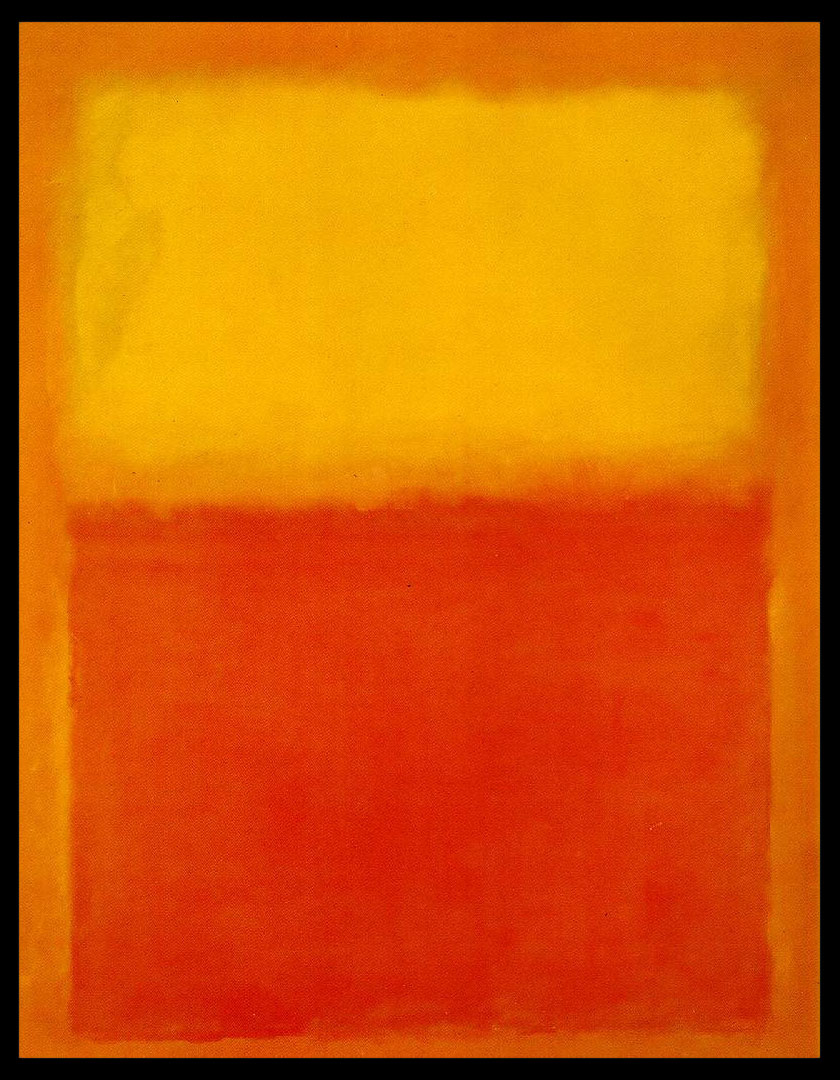
Mark Rothko's painting "Orange and Yellow" - theslenderthread.creativeguide.com/blog/wp-content/upload...
ND237.R725.A4 2007b
Written by leading experts on the artists Mark Rothko (1903–1970) was one of the greatest artists of the twentieth century. His work is intensely charged with meaning and emotion, portraying human feelings rather then color or form. In this lavishly illustrated survey, Bonnie Clearwater traces the development of Rothko’s career, from his arrival in the United States as a child through to the formation of his mature style, and examines his initial influences and interactions with other artists. Drawing on the artist’s own letters and writings, The Rothko Book provides the most comprehensive introduction yet to this complex and fascinating figure.