View allAll Photos Tagged Proportion
After Wrotham, I drove the few miles to Kemsimg, though the sat nav did take me on a heck of a tour, but I arrived, and found the church on the east side of the village, next to some sheltered housing.
Through the lych gate, I saw the porch door closed, and a white notice flapping in the wind.
Sigh,
Indeed, not only was the church locked, but those riders and striders would find no refreshments here, nor a sign in sheet either.
I took a few shots, waited for the sun to come out to get the chuch to best effect, then walked back to the car.
-------------------------------------------
A chocolate-box church in a well-maintained churchyard. The nave is twelfth century in date, remodelled in the fourteenth century when the present roof was constructed. The chancel is also early but was reconstructed in the sixteenth century. A north aisle was added in 1890. The character of the church derives almost entirely from the nineteenth-and twentieth-century furnishings with which it is blessed. The rood screen is of the correct proportion and design and in the main dates from 1894 with minimal amounts of old woodwork. The wonderful figures on top are of 1908 and were designed by Sir Ninian Comper - the angels balance on their wheels like unicyclists! Comper also designed the wall paintings in the chancel, the altar, reredos and canopy. In the north aisle is an interesting collection of furnishings. There is a painted tile picture of Kemsing by the Kent artist Donald Maxwell, one of only a handful to survive. The central window is of two bishops and is typical of Comper's work, but it does not carry his usual signature of a strawberry plant. The west window of the north aisle is by Douglas Strachan, 1935, and is an excellent example of his angular figures. By the font is a bronze Arts and Crafts panel of the Virgin and Child by Henry Wilson, the famous turn-of-the-century designer who lived in a neighbouring village and whose work may also be found in the churchyard.
www.kentchurches.info/church.asp?p=Kemsing
-------------------------------------------
KEMSING.
THE next parish eastward from Otford is KEMSING, called in the Testa de Nevil, CAMESING, and in the Textus Rossensis, CIMICINGA. (fn. 1) The name of this place seems to have been given to it from some royal camp or fortress, situated here.
THIS PARISH of Kemsing, from its situation, is not much known or frequented, nor is it a pleasant one. It lies partly in the valley and partly on the chalk hills, at a small distance southward from the foot of which the village is situated, at the intersection of the roads from Otford to Ightham, and from the chalk hills to the high road by Seal Chart. Near the centre of it is a water, called St. Edith's well, who was a famous female saint, said to have been born in this parish, and to have wrought many miracles for such as applied to her for relief. (fn. 2) The parish is about two miles square; the soil of it, in the northern part, is mostly chalk, in the southern very fertile, it has about one hundred acres of wood; in the eastern part of it is the seat of Crowdleham, situated near the boundary of the parish of Ightham.
There was a market antiently kept here on a Monday, by grant from king Henry III. which has been long since discontinued, and a fair, which is still kept on Easter Monday. (fn. 3) There was an old knightly family, who took their surname from this place, being called Kempsing, whose coat of arms was, Argent, a sess and chevron, interlaced sable, which was quartered by the Harts of Lullingstone, in right of Peche, who married the heir general of it. (fn. 4)
IN THE SCUTAGE, levied as well on the prelates as the rest of the barons, in the 32d of king Henry II. being the seventh of that reign, towards the expences of the army in Wales. The honour of Kemesing, as it is there called, then being in the king's hands, answered for twenty-nine shillings by the hands of the sheriff of the county. (fn. 5) Soon after which it came into the possession of the earl of Albermarle, who held it of Walter Fitzhelt, as he again did of the king in capite.
In the reign of king John, Baldwin de Betun, who, by favour of king Richard I. had enjoyed the earldom of Albermarle, in Hawis his wife's right, who was daughter land sole heir of William le Gross, earl of Albermarle, was owner of this place, and in the 5th year of that reign granted the lordships of Kemesing, Braborne, and Sutton, in this county, to William Mareschal, earl of Pembroke, with Alice, his sole daughter and heir, in frank marriage. (fn. 6)
In the reign of king John he attached himself closely to the rebellious barons, when his lands were seised on, as escheats to the crown; and this manor, then valued at thirty-six pounds per annum, as appears by the Testa de Nevil, was granted to Fulke de Brent; on the confiscation of whose estates, and the earl's return to his obedience, he again came into possession of it, which happened on the king's death, his father having persuaded him to return to his loyalty once more, and he had many favours conferred on him by king Henry III. in the 7th year of whose reign he had, for his good services against the Welsh, scutage of all his tenants in this and other counties. In the 10th year of that reign, his first wife being dead, he married Alianore, the king's sister, by which he greatly incurred his displeasure; but a reconciliation quickly after taking place, he was again taken into favour, and in the 14th year of that reign had a confirmation of the manors of Kemsing, Braborne, and Sutton, in this county, upon condition, that in case Alianore, his wife, survived him, she should enjoy them during life. (fn. 7) He died possessed of Kemsing in the 15th year of that reign without issue, and lies buried in the Temple church, having his effigies cross legged on his tomb; on which the sheriff of this county had the king's precept to make livery to Alianore, his widow, of those manors. She, after seven years widowhood, remarried Simon de Montford, earl of Leicester, and steward of England, in St. Stephen's chapel, Westminster, the king giving her away with his own hand.
In the 45th year of that reign, the earl of Leicester, heading the discontented barons against the king, continued with them till the battle of Evesham, in the 49th year of it, in which the earl was killed; after whose death, the countess Alianore and her children were forced to forsake England, and she died some time afterwards in the nunnery of Montarges, in France.
In the mean time the four brothers of William earl of Pembroke, successively earls of Pembroke, being dead without issue, their inheritance became divided between the heirs of their five sisters and coheirs; and upon the partition of their interest in the manor of Kemsing, it seems to have become the sole property of Roger, eldest son of Maud the eldest sister, by her husband, Hugh Bigod, earl of Norfolk, (fn. 8) though the time of his coming into the possession of it. I do not find, as Alianore, second wife of William earl of Pembroke, was then living, who was entitled to it for her life.
Roger earl of Norfolk, and marshal of England, who bore for his arms, Per pale or and vert, a lion rampant gules, died of a bruise, which he received at a tour nament, about the 54th of Henry III.'s reign, leaving no issue by Isabel his wife, daughter of William king of Scots; upon which he was succeeded, as earl of Norfolk and marshal of the king's palace, as well as in the possession of this manor, by Roger his nephew, son of Hugh his brother, chief justice of England, (fn. 9) who, in the 7th of king Edward I. claimed, before the justices itinerant, large privileges for this manor; (fn. 10) and afterwards, in the 11th year of that reign, sold it, together with the advowson of this church, to Otho de Grandison, descended of a family, who were of the dukedom of Burgundy, in France, their residence there being called Grandison castle, a man of great account with that prince, who employed him much, and conferred many favours on him.
In the 18th year of that reign, he obtained free warren for all his demesne lands in Kemsing, (fn. 11) and having had summons to parliament among the barons of this realm, he departed this life without issue, leaving William de Grandison, his brother, his next heir; who died possessed of this manor, leaving by his wife, Sibilla, youngest daughter, and one of the coheirs of John de Tregoze, three sons; Peter de Grandison, his eldest son and heir, who, as well as his father, had summons to parliament; John bishop of Exeter; and Otho; and four daughters. (fn. 12)
On his death this manor became the property of Otho, the youngest son, who paid aid for it, in the 20th of king Edward III. as half a knight's fee, which William de Grandison before held in Kemsing of the earl of Leicester. He died possessed of this manor in the 33d year of that reign, (fn. 13) leaving by Beatrix his wife, daughter and coheir of Nicholas Malmains, one son and heir, Thomas, and a daughter, Elizabeth.
Thomas de Grandison, being of full age, had possession granted of this manor, among others; he was afterwards knighted, and died possessed of it in the 50th year of king Edward III. without issue, leaving Margaret his wife surviving, who likewise possessed it at her decease, in the 18th year of king Richard II. After which it came to Sir William de Bryene, or Bryan, who died possessed of it in the 19th year of the same reign, and lies buried in Seale church.
After his death, Sir William Fynes (whose name was originally spelt Fiennes, but about this time came to be written both Fynes and Fenys) became possessed of it, bearing for his arms, Azure, three lions rampant or. He was son of William Fiennes and Joane his wife, third sister and coheir of William de Say; and by Elizabeth his wife, daughter and heir of William Batisford, left issue two sons, Roger and James; from the former of which were descended the several lords Dacre of the south; and from the latter, the viscounts Say and Seale, both which titles are now extinct, (fn. 14) and the present lord Say and Sele.
James, the second son, above mentioned, possessed this manor, and in the 14th of king Henry, VI. was sheriff of this county, and soon afterwards made esquire of the body to that king. In the 24th year of whose reign, being then a knight, he was, by reason that Joane his grandmother was third sister and coheir of William de Say, by a special writ, on March 3d, next year, summoned to Parliament by the title of lord Say and Sele; (fn. 15) and two days afterwards, in consideration of his eminent services, he was, in open parliament, advanced to the dignity of a baron of this realm, by the above title, to him and his heirs male, and in the 27th year of that reign, he had a full confirmation and release of that title from John, lord Clinton, and of the arms of Say, which, on account of his descent from Idonea, the eldest sister of William de Say, might belong to him. In consideration of which he then granted to the lord Clinton, all advowsons of churches, knights fees, &c. which belonged to the latter, by reason of the lordship of Say. (fn. 16)
After which he obtained a grant of the office of constable of Dover-castle, and warden of the five ports, to him and his heirs male; was made lord chamberlain, and one of the king's council, and next year lord treasurer of England.
This rise to so high a pitch of honour, increased the hatred of the commons towards him, and served but to make his fall the more sudden and unhappy, for next year they accused him and others in the parliament held at St. Edmunds Bury, of treason, for having ing assented to the release of Anjou, and the delivery of Maine to the French; upon which the king, to appease them, sequestered him from his office of treasurer, and shortly after, on the insurrection of the Kentish men, under Jack Cade, observing their clamour against him, to mitigate it, he committed him prisoner to the tower; shortly after which, this riotous mob entering London, and finding their numbers increase, fetched him thence to Guildhall, and there arraigned him before the lord-mayor, and other the king's justices, notwithstanding his request to be tried by his peers; after which hurrying him to the standard in Cheapside, they cut off his head there, and carried it about on a pole, causing his naked body to be drawn at a horse's tail into Southwark, and there hanged and quartered, though his body was afterwards buried in the church of the Grey Friars, London. (fn. 17)
He left issue, by Emeline Cromer his wife, one son and heir, Sir William Fienes, who was that year, by special writ, summoned to parliament, being seized of an estate tail of the office of constable of Dover-castle, and warden of the five ports, by virtue of the patent above-mentioned, to James, his father, his interest in which he soon afterwards sold to Humphry, duke of Buckingham, and his heirs male.
The unhappy contention subsisting at that time between the houses of York and Lancaster for the throne, in which he risqued not only his person, but his whole fortune, brought him into great distresses, and necessitated him to mortgage, and fell the greatest part of his lands. (fn. 18) He married Margaret the daughter and heir of William Wickham, great-grandson of Agnes, sister to William of Wickham, founder of New College, Oxford. The lands of the lord Say being thus alienated the barony lay dormant, and the heirs male of the family were only called Fienes. Henry, his son and heir, though he used the title of lord Say, had never summons to parliament, and it remained unclaimed till the year 1733, when it was claimed by John Twisleton, esq. of Broughton, in Oxfordshire, descended by the female line from the above Sir William Fienes, lord Say and Sele, which claim, though it then failed, was renewed by his son Thomas, who was summoned to parliament as lord Say and Sele, in 1781, and was father to the present Gregory, lord Say and Sele. In the second year of king Edward IV. Sir William Fienes, lord Say and Sele, mentioned above, sold this manor of Kemsing to Sir Geoffry Bulleyn, (fn. 19) a wealthy mercer of London, who had been lord mayor in the 37th year of king Henry VI. whose grandson Thomas, was sheriff of this county in the 3d and 9th years of Henry VIII. and became a man of great note in that reign; for the king in his 3d year made him one of the knights of his body, and afterwards embassador several times to the emperor, and the kings of France and Spain, and in the 17th year of his reign, on account of the great affection which he bore to the lady Anne Bulleyn, his daughter, advanced him to the title of viscount Rochford; and in his 21st year, created him, being then knight of the garter, earl of Wiltshire and Ormond, and made him lord privy seal. (fn. 20) He died in the 30th year of king Henry VIII. possessed of this manor, have ing had by Elizabeth his wife, daughter of Thomas Howard, duke of Norfolk, one son, George, executed in his life-time, and two daughters; Anne, wife to king Henry VIII. and Mary, wife of William Carey, esq. of the king's body, and ancestor of the lords Hunsdon, and of the earls of Dover and Monmouth.
George Bulleyn, the son above-mentioned, bearing the title of viscount Rochford in his father's life-time, was, in the 26th year of that reign, made constable of Dover-castle, and warden of the five ports, and was much favored by that king, till the time of his change of affection from queen Anne Bulleyn; when the king, to make the path more easy towards the enjoyment of his new passion, in a sudden and unexpected gust of anger, in his 28th year, committed him to the tower, a few days after which, he was arraigned and beheaded, having had no issue, and was buried in St. Peter's chapel in the tower. (fn. 21)
On the death of the earl of Wiltshire without male issue, the king seized on this manor, in right of his late wife, the unfortunate Anne Bulleyn, the earl's elder daughter; and it remained in his hands till the 32d year of his reign, when by his indenture that year, reciting, that as the most noble lady, Anne of Cleves, daugh ter of John, late duke of Cleve, &c. came into his realm of England, on a certain treaty of marriage between himself and the said lady Anne; which marriage, although celebrated in the face of the church, yet was never consummated, for the conditions of it were never performed in due time, and there being other great and important causes, on account of which the convocation of the realm, with assent of the parties, and of the parliament, had declared the marriage to be invalid, there being no prospect of any children from it, notwithstanding which, the said lady was contented to conform to the laws of the realm, and to free herself and her conscience of the said marriage, and to remain at liberty within the realm; therefore the king, considering her high birth and nobility, of his especial grace and favour, granted her, for the maintenance of her noble estate, among other premises, his manors of Hever, Seale, and Kemsing, and his park of Hever, with all their rights, members, and appurtenances, late belonging to Thomas, earl of Wiltshire, deceased, and then in the king's hands; and all messuages, lands and hereditaments whatsoever, in Hever, Seale, and Kemsing, lately purchased by the king of Sir James Bulleyn, and William Bulleyn, clerk, to hold to her during life, so long as she should stay within the realm of England, and not depart out of it, without the licence of the king and his successors, and the king granted the premises free and discharged of all outgoings, rents, pensions, &c. except among others of forty shillings, issuing yearly out of the lands of John Tybolde, called Seale Park. (fn. 22)
¶The lady Ann of Cleves died possessed of these manors and estates in the 4th and 5th year of king Philip and queen Mary, when they reverted again to the crown; where the manors of Seale and Kemsing, and the other premises in those parishes, lay till queen Elizabeth, in her first year, granted them to her kinsman, Sir Henry Carey, whom she had advanced that year to the title of lord Hunsdon, baron of Hunsdon, in Hertfordshire, to hold in capite by knights service. (fn. 23) He was descended of an antient family, seated at Cockington, in Devonshire; one of whom was Sir Robert Carey, who in the beginning of king Henry V's reign, acquired great renown by his encountering and overcoming an Arragonian knight, who had performed many notable feats of arms in different countries, and then came to make trial of his prowess here in England, in a long and doubtful combat in Smithfield; for which he was by the king knighted, and restored to part of his father's inheritance, which had been forfeited. From which time he bore, as by the law of arms he might, the coat armour of the vanquished knight, viz. Argent, on a bend sable, three roses of the field barbed and seeded proper; the present bearing of this family: their antient bearing before this being, Gules, a chevron argent between three swans proper; one of which they still retain for their crest. His son was William Carey, who being in the battle of Tewksbury, in the 10th year of king Edward IV. on the part of the Lancastrians, upon the loss of that day, was taken prisoner, and notwithstanding he was promised a pardon, lost his head.
Kemsing is within the ECCLESIASTICAL JURISDICTION of the diocese of Rochester, and deanry of Malling.
The church stands on the north side of the village, and is dedicated to St. Edith, whose image, set up in this church-yard, was greatly frequented for the singular benefits she daily dispensed in preserving corn and grain from blasting, mill-dew, and other harm incident to it. (fn. 32) It is a small church, consisting of only one isle and a chancel, having a pointed steeple at the west end, in which are two bells. There are but few monuments or inscriptions in it, in the chancel there is a grave-stone, with the figure of a man, and an inscription in brass in black letter, for Thomas de Hop, and at the east end a mural monument for Michael Jermin, D. D. obt. August 14, 1659, æt. 70. (fn. 33)
In the year 1397, anno 21 king Richard II. the king granted licence to Guy Mone, to give the advowson of the church of Kemsing to the prior and convent of Bermondsey for ever. (fn. 34) In which year they obtained the pope's bull, (fn. 35) to appropriate it with the chapel of Seale annexed to it, to the use and support of their convent; reserving, nevertheless, out of the fruits, rents, and profits of the church and chapel, for a perpetual vicar to be instituted in it by the ordinary, a fit portion, by which he might be maintained, the episcopal dues be paid, and other burthens incumbent on him might be conveniently borne. (fn. 36)
In consequence of which, John (de Bottlesham) bishop of Rochester, by his instrument, dated Oct. 12, anno 1402, (fn. 37) with the consent of the abbot and convent of Bermondesey, endowed the vicarage of this church as follows:
First, he decreed, that there should be a perpetual vicarage, to be held and possessed as a perpetual ecclesiastical benefice in the church of Kemsing, which he endowed out of the fruits, rents, and profits of the said church and the chapel of Seale; the vicar of which, who should be intitled to it, by the abbot and convent, proprietaries of this church, should be from time to time presented to the bishop and his successors, and inducted by the archdeacon; and he ordained, that the abbot and convent, and their successors, proprietaries of it, in right of the same, should take, have, and freely enjoy, all and every kind of great tythes, viz. of corn, of whatsoever sort it be, and of hay, growing within the bounds and limits, or titheable places of the church and chapel, the tithe of the grange or field of Budirevere within this parish only excepted; and he ordained, that the repair of the chancel of the church, in the walls, glass windows, and roof, and also the paying of all papal and royal tenths and procurations, and the procurations of legates of the apostolic see, of archbishops, bishops, and archdeacons, (the bishop and his church of Rochester being always saved harmless, on account of this appropriation) should belong to the abbot and convent, and their successors, to be paid and performed at their costs and expences; and he ordained, that the abbot and convent, and their successors, should cause forty pence in money, or meat and drink of as much value, to be yearly distributed to, and bestowed on, the poor, and more indigent parishioners of the church of Kemsing, towards their relief and support, out of the profits of the church; and he ordained, that the tithes of the food of all animals, and of pidgeons, and other titheable matters accruing within the rectory, and the straw of the church and chapel, so long as the rectory should remain in the hands of the abbot and convent, and be in no wife let to ferm, should belong to them, as proprietaries of the parish church; but if the same should be let to ferm, then he ordained, that the tithes of the food of animals, &c. as above-mentioned, should belong to the vicar of the vicarage of the same, for the time being, for ever, with this exception however, that if the abbot and convent should let to ferm any of their stock, with the rectory, no tithe should be taken of that stock; and he ordained, that the abbot and convent should cause to be built at their costs and expences, for that time only, a competent dwelling on a part of the glebe and soil of the rectory allotted for that purpose, in which he ordained, that the vicar for the time being should reside; and he ordained, that the portion of the vicar should be as follows: that he should take and have all oblations and obventions of the altar, as well in the parish church of Kemsing, as in the chapel of Seale, and the small tythes, of what kind or nature soever they be, accruing within the parish of the said church and chapel, and the titheable places of the same, and also all great and small tithes whatsoever, in and of the grange or field called Budyrevere, within the bounds and limits of the parish of the church of Kemsing; and he ordained, that the vicar for the time being should have the cure of all and singular the parishioners of the said church and chapel, and that he should find, at his own costs and expences, a proper chaplain to celebrate divine offices in the said chapel, and duly administer the sacraments and ecclesiastical sacramentals in the same, and also the bread, wine, and lights, necessary and accustomed at the celebrating divine offices in the said church and chapel; and, lastly, he pronounced and declared, that the above was a sufficient and competent portion for the vicar, and such as from it he would be able to support himself, to keep hospitality, and conveniently support the burthens incumbent on him. Which endowment was confirmed by the abbot and convent the day after, under their common seal. (fn. 38)
The above appropriation and endowment was confirmed by John Langdon, bishop of Rochester, in 1422, who further ordained, with the consent of the abbot and convent, that no future vicar might have any cause to complain, that he should receive yearly, from the abbot and convent, fourteen shillings of English money, beyond the portion before assigned to him as before-mentioned; and it was then agreed between the bishop and the abbot and convent, that the bishop should receive in future, out of the fruits and profits of the said church and chapel, 6s. 8d. yearly of English money, as an indemnity to the church of Rochester for any injury it might have received, by reason of the appropriation of this church and chapel.
All which was confirmed by the abbot and convent, under their common seal, the day and year abovementioned. (fn. 39)
On the dissolution of the monastery of St. Saviour's, Bermondesey, which happened in the 29th year of king Henry VIII. this church, with the chapel of Seale annexed was surrendered, among the rest of the possessions of that house, into the king's hands, and became part of the possessions of the crown, after which queen Elizabeth granted this rectory to Sir Peter Manwood; in king Charles I's reign, it was in the possession of James Bunce, esq. whose descendant, James Bunce, esq. of Crowdleham, in this parish, is the present owner of it.
But the advowson of the vicarage seems to have been granted, with the manor of Kemsing, to Henry Carey, lord Hunsdon, since which it has continued unalienated, for many generations, the property of the earls and dukes of Dorset, and is now in the possession of his grace John Frederick duke of Dorset.
In the 15th year of king Edward I. this church was valued at fifteen marcs. (fn. 40)
¶By virtue of the commission of enquiry into the value of church livings, in 1650, issuing out of chancery, it was returned, that here was a parsonage and vicarage; the parsonage tithes being about forty pounds per annum, and the glebe land thereunto belonging, worth ten pounds, master Bunce being patron, but it was then sequestered, and that the vicarage, tythes, and house, were worth one hundred pounds per annum; that there was issuing out of the parsonage to the vicar, by composition from the abbot, two pounds per annum, and by the will of master Bunce six pounds per annum, in all eighteen pounds, master Barton then incumbent. (fn. 41)
This vicarage, with Seale annexed, is valued in the king's books at 19l. 13s. 4d. and the yearly tenths at 1l. 9s. 4d.
[day 271]
One month after working as a graphic designer, I really learn a lot
from colleague about the printing in graphic industry, yeah, this is what I need to learn before go to the next step of my planning in this life journey. Well, I learn how to speak and deal with client everyday, design bunting, banner, restaurant menu, name card, logo, sticker, touch up, and control a printing machine :) quite interesting but sometimes it's very tiring, I wish everything will be alright. Have a nice day.
View in Light Box for more detail by pressing letter "L"
Golden Number Ratio Divine Proportion Compositions Fine Art Photography Dr. Elliot McGucken : Using the Nature's Golden Cut to Exalt Nature Photography!
Join my golden ratio groups!
www.facebook.com/goldennumberratio/
www.facebook.com/groups/1401714589947057/
instagram.com/goldennumberratio
Dr. Elliot McGucken Fine Art Landscape & Nature Photography
New book page!
www.facebook.com/epiclandscapephotography/
Epic Landscape Photography: The Mythological Principles of Fine Art Nature Photography
Ansel Adams used the golden ratio in his photography too:
www.youtube.com/watch?v=WFlzAaBgsDI
www.youtube.com/watch?v=zrOUX3ZCl7I
The Fibonacci Numbers are closely related to the golden ratio, and thus they also play a prominent role in exalted natural and artistic compositions!
I'm working on a far deeper book titled The Golden Ratio Number for Photographers. :)
The famous mathematician Jacob Bernoulli wrote:
The (golden spiral) may be used as a symbol, either of fortitude and constancy in adversity, or of the human body, which after all its changes, even after death, will be restored to its exact and perfect self.
Engraved upon Jacob’s tombstone is a spiral alongside the words, "Eadem Mutata Resurgo," meaning "Though changed, I shall rise again." And so it is that within the Golden Ratio Principle, the golden harmonies rise yet again.
The golden ratio is oft known as the divine cut, the golden cut, the divine proportion, the golden number, and PHI for the name of the architect of the Parthenon Phidias. It has exalted classical art on down through the millennia and it can exalt your art too!
Ask me anything about the golden ratio! :) I will do my best to answer!!
Enjoy my Fine Art Ballet instagram too!
Dr. Elliot McGucken's Golden Ratio Principle: The Golden Number Ratio Principle: Dr. E’s Golden Ratio Principle: The golden ratio exalts beauty because the number is a characteristic of the mathematically and physically most efficient manners of growth and distribution, on both evolutionary and purely physical levels. The golden ratio ensures that the proportions and structure of that which came before provide the proportions and structure of that which comes after. Robust, ordered growth is naturally associated with health and beauty, and thus we evolved to perceive the golden ratio harmonies as inherently beautiful, as we saw and felt their presence in all vital growth and life—in the salient features and proportions of humans and nature alike, from the distribution of our facial features and bones to the arrangements of petals, leaves, and sunflowers seeds. As ratios between Fibonacci Numbers offer the closest whole-number approximations to the golden ratio, and as seeds, cells, leaves, bones, and other physical entities appear in whole numbers, the Fibonacci Numbers oft appear in nature’s elements as “growth’s numbers.” From the dawn of time, humanity sought to salute their gods in art and temples exalting the same proportion by which all their vital sustenance and they themselves had been created—the golden ratio. the golden number, rectangle, and spiral!
Somehow I had missed Boxley from previous crawls in the area. I guess, once upon a time, Boxley was a quiet village halfway up the downs, relying on sheepfarming for its income. In the 21st century, its just a suburb of Maidstone, though a mile or so outside the county town.
All Saints popped up on the churchcrawling group on Facebook, and thought it looked interesting, which is something of an understatement.
We arrived at just after eleven, in the lych gate there was a sign saying the church was open, so, result!
Approaching the church aloong a stone path it feels very un-Kent-like, especially as entrance to the church is in the very west end.
You enter, and are in a large space, in fact this was the Norman chancel of the original church, then into the space below the west tower, and there is the door into the church as it is now.
But I could hear voices from within, probably wardens cleaning, or so I thought...
But turned out to be a lecture on wildflowers; maybe i should crash it? But don't.
We find a leaflet and find that it had been going on nearly an hour, so we go to sit outside to see if it was going to end on the hour mark....
We give up after 20 minutes, but decide to visit a third church, then come back. Maybe it would be free then......
-------------------------------------------------
The church lies at the far end of the village green. Visitors who do not first walk around the outside of the church wonder if they are ever going to get in - for they have to walk through two rooms first! From the outside it is not so puzzling; the first room is in fact the nave of the Norman church. Then comes the base of the fifteenth-century tower, built on the site of the Norman chancel. Only after we have gone through this do we come to the church proper - a complete fourteenth-century structure. It is wide, with two aisles, and relatively short. The chancel is well proportioned and has a definite lean to the south indicating medieval building error.
www.kentchurches.info/church.asp?p=Boxley
-------------------------------------------------
BOXLEY.
ADJOINING to Maidstone north-eastward lies the parish of Boxley, written in Domesday, Boseleu, and in the Textus Roffensis, Boxele and Boxle, a parish noted, as well for the famous assembly of the whole county, held at Pinenden heath, within the boundaries of it, in the reign of the Conqueror, as for the abbey not long afterwards founded in it.
THE VILLAGE of Boxley situated at the foot of the chalk hills, above which this parish extends among the coppice woods, over a barren dreary country covered with flints, to Dun-street, at the northern boundaries of it. Southward it extends to the rivulet in the valley, at a very small distance from the town of Maidstone, a length of near four miles, the width of it is not more than three at its greatest extent, and in most parts much less; the soil from its extent is of course various, to the northward it is chalk; in the middle, and towards the west a deep sand; to the eastward a wet cludgy earth, and to the south and south-east for the most part a not unfertile loamy soil bounding upon the rock. It is a situation much more healthy than it is pleasant, owing to its chalky and sandy soils, and its bleak situation. The village is watered by a clear spring, which rises just below the church, and directs its course through the street; this spring, as well as another, which rises likewise at the foot of the chalk hill, just above Boxley abbey, are both very inviting to the sight, but the water is very hard and unfit for culinary uses, especially the latter, which in two months will petrify wood, the incrustation resembling brown and unpolished marble. These join just below the abbey, and flow together into the Medway, almost opposite to Allington castle.
The village lies on a descent from the hills, there are several genteel houses in it; at the upper or northern part of it is Boxley house, lord Romney's, inhabited by his three sisters and Mr. Coker; somewhat lower down is a house, which for many years was the property and residence of the family of Charlton, who bore for their arms, Or, a lion rampant gules, the last of them, John Charlton, esq. dying in 1770 unmarried, it came by his will, together with the chief of his other estates, to his eldest nephew, the Rev. George Burville, (son of the Rev. Henry Burville, by Anne his sister). The Burvilles bear for their arms, Argent, a chevron between three oak leaves erect, vert. Mr. Burville married Juliana, daughter of William Bowyer, esq. of Denham, in Buckinghamshire, by whom he has a son John, and daughter Frances, married to the Rev. Philip Rashleigh. He is the present possessor of this house, in which he resides; below this is the parsonage and vicarage, the latter a handsome genteel house, and just above it at a small distance from the east side of the street, the church; almost adjoining to Mr. Burville's house, is another more antient one, called Park-house, once part of the estate of Boxley abbey, and afterwards in like manner, the estate of Sir Thomas Wyatt, whose son forfeited it for treason in the 1st year of queen Mary How it passed afterwards I have not found, though it seems never to have been restored to his descendants; in the beginning of the present century it was in the possession of the family of St. John, in which it remained till Mrs. St. John joining with her son, Paulet St. John, sold it in 1720 to Maudistley Best, esq. (son of Mr. Thomas Best, of Chatham) who resided and kept his shrievalty here in 1730, bearing for his arms, sable, two cross croslets in chief, and a cinquefoil in base, or. He died in 1740, leaving two sons, Thomas, late of Chilston, esq. and James, of Chatham, and a daughter, married to the hon. Robert, afterwards lord Fairfax, of Leeds castle, who died s. p. He gave by will this seat to his youngest son James, who served the office of sheriff in 1751, and resided here at times, and died in 1782, leaving by Frances his wife, one of the daughters of Richard Shelley, esq. four sons and four daughters, to the eldest of the former, Thomas Best, esq. he by will gave this house and his estate in this parish, and he now resides in it. There has been from time immemorial a warren for rabbits here, the lands of which lay close at the foot of the chalk hills, it formerly belonged to Boxley abbey, and was afterwards in the possession of the Wyatts, and is now from them the estate of lord Romney, and there was likewise another part of it used likewise as a warren, lying near Pinenden-heath, which was part of the Park-house estate, and as such, is now the property of Mr. Best, but the name only remains, the rabbits having been for some time destroyed, and the land made arable. About a mile. eastward from the village in a low flat situation, at no great distance from the high road from Rochester to Maidstone, is Boxley abbey, with a small hamlet of houses near it, and nearer to the hills the abbey farm. The plantations of the estate called the Park-house, likewise, the old seat of which was situated in Maidstone parish, near the high road to Rochester, as has been already described, extend into the western part of this parish. The late Sir Henry Calder, whose property it was, pulled down the old house, and on a beautiful spot near adjoining, though within this parish, began a handsome stone mansion, which after his death was finished by his widow, who with her son Sir Henry, for some time resided in it; it is now inhabited by Mr. Osborne. At a small distance eastward from hence, in nearly the centre of this parish, excepting that Maidstone stretches itself with a point or nook over a part of it, is that noted plain Pinnenden, now usually called Pickenden heath, a place made famous in early times; the western part is in Maidstone parish, the remainder in this of Boxley. From its situation almost in the middle of the county or shire of Kent, this heath has been time out of mind used for all county meetings, and for the general business of it, the county house for this purpose, a poor low shed, is situated on the north side of it, where the sheriff continues to hold his county court monthly, and where he takes the poll for the members of the county, and for the coroners, the former of which, after a few suffrages is usually adjourned to Maidstone; on a conspicuous hill on the opposite side of the heath, though in Maidstone parish, is the gallows, for the public execution of criminals condemned at the assizes.
At the time of the conquest it was the noted place for the public meetings of the county; for in the book of Domesday there is mention made, that when the inhabitants of Kent were summoned to meet ad sciram, that is, in public assembly at the shyregemot or Sheriff'stourn, for the trial of certain customs therein mentioned, they should go for that purpose as far as Pinnedenna, but no further.
In the year 1076, being the 11th of the Conqueror's reign, a famous assembly was held at this place on the following occasion.
Odo, bishop of Baieux and earl of Kent, had by means of his great power, defrauded the church of Canterbury of many manors and lands, and of several liberties, and had kept possession of them; but upon Lanfranc's being made archbishop in the year 1070, he represented the whole of the injury done to his church to the king, who forthwith commanded that it should be enquired into and determined by the nobles, and other competent men, not only of this county, but of the other counties of England, assembled for this purpose at this heath.
There were present at this meeting Goisfrid, bishop of Constance, who sat as the king's representative on this occasion; archbishop Lanfranc, who pleaded his church's cause; Odo, earl of Kent, who defended himself against his accusers in what he had done; Ernest, bishop of Rochester; Agelric, bishop of Chester, an antient man, and well versed in the laws of the realm; who on account of his great age was, by the king's order, brought hither in a waggon, in una quadriga; Richard de Tunebrige, Hugh de Montfort, William de Arsic, Hamo Vicecomes or Sheriff, and many others, barons of the king and of the archbishop, many tenants of those bishops, and many others of good and great account, as well of this as of other counties, both French and English.
This trial lasted three days, at the end of which the archbishop recovered several of the antient possessions of his church, as well from Odo as from Hugh Montfort and Ralph de Curva Spina or Crookthorne, and established the liberties of it, in matters between the king and himself. (fn. 1)
On the south side of the heath the turnpike road from Maidstone through Detling to Key-street aud Sittingbourn crosses this parish, and another branches off from hence to Bersted and Ashford; in the southern part of it are the hamlets of Grove green and Wavering-street, Newnham court, and the beautiful seat of Vinters, most pleasantly situated; below which in the vale is the stream which turns the paper mills, and separates this parish from Maidstone. At Grove, as has been already noticed, is a remarkable fine vein of fuller's earth, by the working of which Mr. John Watts, the owner of it, at the beginning of this century, became famous. But this earth was in working in 1630, at which time John Ray, merchant, of London, was sentenced to a severe fine and punishment in the Star Chamber, for transporting of it clandestinely to Holland. (fn. 2) This vein lies about thirty feet deep, and is about seven feet thick. There are two sorts of it, the blue and the dark grey, the latter of which lying under the former is most valuable; a great quantity of this earth is sent from hence by sea for the use of the clothiers in distant countries. For the manufacture carried on in this parish for the making of paper there are four sets of mills, two of which are situated at the south-east extremity of it, on the stream called the Little River, which rises near Lenham, and runs by Leeds castle hither; the upper ones, belonging to lord Aylesford, and the lower ones to Messrs. Hollingworth's; the other two are situated on the western side of the parish, near Aylesford, on the rivulet which rises under the chalk hills, and are made use of for making an inferior kind of merchandize, one of these belongs to lord Romney. The lower mills above-mentioned belonging to Messrs. Hollingworth, stand at a small distance on the north side of the road leading from Maidstone to the Mote, and are called the Old Turkey Mills, they deserve a more particular notice in this place for their superiority, as well in the many extensive buildings, machines and conveniences erected for carrying on this large and curious manufacture, and the number of people continually employed in the different branches of it, as the easy and regular method, and the neatness with which the whole is conducted. They were formerly used as fulling mills, but on the decay of the cloathing trade in these parts, were, by Mr. Gill, the proprietor, converted into paper mills, and used by him as such for a few years; he sold them to Mr. James Whatman, who in 1739 pulled the whole of them down, and erected them on a much more curious and extensive plan, which was afterwards much more improved by his son James Whatman, esq. who with infinite pains and expence, brought his manufactory of writing paper, for no other sort is made here, to a degree of perfection, superior to most in the kingdom. In 1794 he sold these mills to Messrs. Hollingworth, and retired to Vintners, where he now resides, and they now carry on this manufacture here; under the buildings is a strong chalybeat spring, which however does not produce any great quantity of water. In 1711 a Roman urn was dug up at Grove, by the workmen, near the vein of Fuller's earth there, as several others have been since, with other relics of antiquity and coins, both there and at Vintners, most of the coins having the inscription of the emperor Adrian, and the like have been from time to time discovered at Goddard's hill, in this parish, where there are several stones set up similar to those about Horsted.
OUR BOTANISTS have observed the following scarce plants in this parish:
Borago minor silvestris, small white bugloss, or German madwort.
Scopyllum angustifolium glabrum, smooth narrowleased thyme.
Buxus, the box tree, which grows plentifully in the woods here. (fn. 3)
Stellaria sanicula major, ladies mantle.
BOXLEY, at the time of taking the general survey of Domesday, was part of the vast estate of Odo, the great bishop of Baieux and earl of Kent, the Conqueror's half-brother; in which record it is thus described:
Robert Latin holds to ferm Boseleu. It was taxed at seven sulings in the time of king Edward the Confessor, and now at five sulings. The arable land is twenty carucates. In demesne there are three carucates, and fortyseven villeins, with eleven borderers having sixteen carucates. There are three mills of thirty-six shillings and eight-pence, and sixteen servants, and twenty acres of meadow. Wood for the pannage of thirty hogs. In the time of king Edward the Confessor, and afterwards, it was worth twenty-five pounds, now thirty pounds, and Robert yet pay fifty-five pounds. Alnod Cilt held it.
Four years after the taking of the above survey, about the year 1084, this estate, on the bishop of Baieux's disgrace, became forfeited to the crown, among the rest of his possessions.
In the year 1146, (fn. 4) William d'Ipre, earl of Kent, who afterwards became a monk himself at Laon, in Flanders, (fn. 5) founded an ABBEY at this place for monks of the Cistertian order, some of whom he brought from Claravalle, in Burgundy, for this purpose, and dedicated it to the Virgin Mary, as all the houses of this order were. The first monastery of this order in England was at Waverly, which was built in 1129, by Walter Gifford, bishop of Winchester. They were a branch of the Benedictines, called by the English, from their habit, White monks, and likewise Cif tertians; which last name they had from the town of Cistertium or Cisteaux, in the bishopric of Chalons, in Burgundy, where this order was first instituted by Robert, abbot of Molesme, in the year 1098. There were eighty-five houses of this order, at the time of the dissolution, in England.
King Richard I. in his 1st year, anno 1189, gave the MANOR of BOXELE (fn. 6) to this abbey, which king Henry III. in his 37th year, confirmed by his letters of inspeximus. (fn. 7)
King Henry III. in his 37th year, granted to the abbot and convent to hold a market weekly within their manor of Boxley. (fn. 8) The place where it was held appears to have been called Farthings.
In the 7th year of Edward I. the abbot claimed, before the justices itinerant, certain liberties, by the charters of king Henry and king Richard, and the confirmation of them by the charter of king Henry, the then king's father. And he claimed to have warren in all his demesne lands in Kent and Surry, which he had in the time of king Henry, the king's father; and that he and his predecessors had fully used those liberties, &c. and it was then found, that the abbot had in his manor of Boxley a free court, &c. and that the tenants of the manor ought to plead in the hundred of Maidstone, pleas of Withernam, &c. and that the abbot ought to allow pannage, &c, and that the tenants of the manor owed pontage, and paid it to Rochester bridge. (fn. 9)
The abbot of Boxley was summoned to parliament twice in the 23d year of king Edward I. once in the 24th, and twice in the 28th years of that reign, but never afterwards, that I can find. (fn. 10)
In the reign of king Henry III. there were sixtyfour abbots and thirty-six priors summoned to parliament; but this number being thought too great, king Edward III. reduced them to twenty-five abbots and two priors, to which were afterwards added two more abbots, so that there were no more than twentynine in all, who statedly and constantly enjoyed this privilege, of which only St. Austen's, near Canterbury, was in this county. (fn. 11)
King Edward II. in his 15th year, honoured this abbey with his presence, where, on Oct. 25, he granted to the aldermen and citizens of London to nominate a mayor out of their own body, at his will. (fn. 12) King Edward III. in his 33d year, granted to the abbot, &c. free warren in their manor of Boxele, &c. (fn. 13)
In the reign of king Richard II. the revenues of this abbey were valued at 218l. 19s. 10d. of which 98l. 19s. 7d. was in the diocese of Canterbury, (fn. 14)
John Dobbes, the last abbot, and the convent of Boxley, surrendered it into the hands of Henry VIII. on January 29, in the 29th year of his reign, (fn. 15) and it was, together with all the lands and possessions belonging to it, confirmed to the king and his heirs, by the general words of the act, passed in the 31st year of that reign for this purpose; after which there were pensions allowed to the abbot, 50l. and to eight of the canons, from 2l. 13s. 4d. to 4l. yearly, for their lives, or until the person was promoted to a benefice of equal or superior value; the five last of which pensions remained in charge in 1553. (fn. 16)
It was endowed, at its dissolution, with 204l. 4s. 11d. per annum, clear revenue, according to Dug dale; or, according to Speed, with 218l. 9s. 10d. per annum, yearly income. (fn. 17)
The coat of arms belonging to it was, Argent, a dexter bend lozenge, gules; on a canton of the second, a crozier or pastoral staff of the field. (fn. 18) This coat, without the crozier, as also another, being a pastoral staff, surmounted of a bend, are still remaining carved in stone on the capitals of two pillars, from which springs a small circular arch in the garden, at the back of this abbey.
There was a chapel, dedicated to St. Andrew the apostle, founded hard by the outer gate of this monastery, which was served by a curate appointed for that purpose.
The lands of the abbey of Boxley, of the order of Cistertians, were as such, in particular circumstances, exempted from the payment of tithes. Pope Pascal II. exempted all the religious in general from the payment of tithes for lands in their own occupation, and this continued till the reign of Henry II. when pope Hadrian IV. restrained this exemption to the three religious orders of Cistertians, Templars, and Hospitallers, to which pope Innocent III. added a fourth, viz. the Præmonstratenses, from whence these were generally called the four privileged orders. After which the general council of Lateran, in 1215, further restrained this exemption to lands in their own occupation, and to those which they possessed before that time. After this the Cistertians procured bulls to exempt all their lands likewise which were letten to farm. To restrain which, the statute of the second of king Henry IV. cap. 4. was made, which enacted, that whoever, religious as well as secular, should put these bulls in execution, and purchase any others, and by colour of them should take any advantage in any shape, should be guilty of a præmunire. This restrained their privilege again to such lands only as they had before the Lateran council above mentioned; so that the lands they afterwards acquired are in no wise exempted, and this statute left them subject to the payment of such composition for tithes of their demesne lands as they had made with any particular rectors, &c. who contesting their privileges, even under that head, brought them to compound. This monastery of Boxley was one of those dissolved by the act of the 31st of king Henry VIII. the only ones which continued these privileges to their possessors afterwards; by which act, as well the king, his heirs and successors, as all others who should have any of those monasteries, their lands or possessions, were to hold and enjoy them, according to their estates and titles, discharged and acquitted of payment of tithes, as freely, and in as large and ample a manner as the late abbots, priors, &c. of the same before held them. (fn. 19)
In the Registrum Roffense, (fn. 20) are the names of the fields, woods, and other premises in the parish of Boxley, of which the abbot and convent here should in future be free and exempt from the payment of all tithes whilst they were in their own hands.
In the church of this abbey was the statue of St. Rumbald, usually called by the common people, St. Grumbald, which was held in great reverence for his fancity by them, for the miracles it was said to perform.
¶King Henry VIII. in his 32d year, exchanged with Sir Thomas Wyatt, of Allynton, for other premises, the house and scite of this monastery, lately dissolved, and the church, steeple, and church yard of it, with the buildings, lands, &c. as well nigh and adjoining to the scite and precinct of it, his lordship of Boxley, Hoo, and Newenham court, with their appurtenances and the farm and lands, called Upper Grange, and all lands, tenements, and other premises late belonging to it, in the parishes, townships, or hamlets of Boxley, Boxley-street, Burley, Burthin, Sandelyng, Wilston, Wavering, Havurland, Oxefiyth, Dunstreet upon the Hill, and elsewhere, in Kent, excepting to the king the parsonage of Boxley and the advowson of the parish church; (fn. 21) all which were soon afterwards again vested in the crown, as appears by the Escheat rolls of the 38th year of that reign, (fn. 22) when the king regranted the whole of them to Sir Thomas Wyatt, son of Sir Thomas before mentioned, to hold in capite by knight's service, who having, in the 1st year of queen Mary, with other gentlemen of note in this county, raised a rebellion, was found guilty of high treason, and executed that year, and his estate was consiscated to the crown; but the queen, through her bounty, the next year, granted the manor of Boxly, with the Upper Grange, and some other lands adjoining, to his widow, the lady Jane Wyatt, (daughter and coheir of Sir William Haut, of Bourne) and her heirs male, to hold in like manner. On her death, her son, George Wyatt, succeeded to them; but the abbey seems to have continued in the crown, for queen Elizabeth, in her 11th year, granted the scite and mansion of it to John Astley for a term of years. In the 13th year of that reign, George Wyatt, esq. was restored in blood by act of parliament, after which he became possessed of this seat, and resided here, having the fee of it granted to him by the crown. He died in 1624, and was buried in the chancel of this church, as were his several descendants, who bore for their arms, Per fess azure and gules, a barnacle argent, the ring or; he left several sons and daughters, of whom the second son, Haute Wyatt, was vicar of this parish; and Francis, the eldest, succeeded him in the manor of Boxley, the mansion of the abbey, the Grange, and his other estates in this parish. He was afterwards knighted, and was twice governor of Virginia. He died in 1644, leaving two sons, Henry, his eldest son and heir, and Edwin, who afterwards became possessed of this manor, seat, and estates, above mentioned, and a daughter, Elizabeth, who married Thomas Bosvile, esq. of Littlemote in Eynsford, esq. whose daughter Margaret became the wife of Sir Robert Marsham, bart. great grandfather of the present lord Romney.
Henry Wyatt, esq. was of Boxley abbey, and left an only daughter and heir, Francis, who carried this manor, seat, with the Grange and other estates above mentioned, in marriage to Sir Thomas Selyard, bart. but Edwin Wiat, the younger brother of Henry above mentioned, disputing at law the lady Selyard's title to them, recovered the manor of Boxley, with other estates last mentioned, in this parish and elsewhere; but the abbey, with the lands belonging to it, remained in the possession of Sir Thomas Selyard, as will be mentioned hereafter.
BOXLEY is within the ECCLESIASTICAL JURISDICTION of the diocese of Canterbury, and deanry of Sutton.
The church, which is dedicated to All Saints, stands on the east side of the village; it is not large, but neat, and contains three isles and a chancel, with a handsome square tower at the west end, in which hang four small bells, which were cast in 1652, by M. Darby.
In this church, before the Reformation, was a famous rood, called the Rood of Grace, which was held in great esteem for the miracles it was supposed to work. It was broken to pieces by the king's command at St. Paul's cross, in London, on Sunday, February 24, 1538, in the presence of John Hilsey, bishop of Rochester, and a vast concourse of the populace. (fn. 35)
The church of Boxley was given by king Henry I. in 1130, to the church of Rochester, with all its liberties and rights, in like manner as his chaplain, Jeffry or Ansfrid, the clerk, had ever held it; but that church and monastery, having been destroyed by fire, and the monks dispersed abroad, king Stephen, in 1137, dispossessed them of this church, which, howeever, on their return to their monastery, was on their remonstrance to the court of Rome, by the pope's bull, restored and confirmed to them; and Walter, bishop of Rochester, not only confirmed to them the appropriation of it, but granted to them the free disposal and presentation of the vicarage, saving the right of the bishop of the diocese; which grant was confirmed likewise by the several archbishops of Canterbury afterwards.
In the year 1180, there was an agreement made between the monks of Boxley and those of Rochester, concerning the parochial tithes of this church; by which the latter granted to the former a certain field belonging to the parish church of Boxley, above the hills, but by the consent of the former they retained out of it for ever half an acre of wood for fencing; and the monks of Rochester granted to those of Boxley all the tithes above the hills of all lands, as well of those free lands, which the latter had of the king's gift, as of those which they had acquired, to be held finally in villenage, or might acquire in future, at any time for their own use; and likewise certain land belonging to this parish church, under the hill, with the meadow adjoining, between the abbey and village of Boxley; on the other hand, the monks of Boxley granted to those of Rochester all their tithes under the hills, without the bounds of the abbey and grange; that is to say, of all corn only and pulse, of all their lands under the hills, as well of those antiently as newly cultivated, and which they had from the foundation of the abbey, or might bring into culture at any time in future; and that the monks of Rochester should have all the tithes on the sides of the hills of all lands which at that time, or before were reduced to culture, excepting the field which the monks of Boxley bought of John de Horespole; which composition was confirmed by Richard, archbishop of Canterbury.
The confirmations of this church to the priory seem afterwards to have been but little regarded, and they were again dispossessed of it, with a reservation of 60s. annual pension only from it; and it appears, that the bishop of Rochester, together with the prior and convent, used to present to it on a vacancy, till the time of archbishop Islip, who at the petition of the monks, with the consent of the bishop, in 1363, restored this church to them, in as ample a manner as they had before held it; and he granted them full liberty to reenter into the corporal possession of it, with all its rights and appurtenances, on the vacancy of the rector then incumbent on it; reserving, nevertheless, in the first place, a proper portion out of the fruits and profits, for the maintenance of a perpetual vicar, at the presentation of the bishop, to be instituted by him and his successors, and for the due support of the episcopal and archidiaconal burthens, and others belonging to it; and a vicarage was afterwards accordingly endowed in it by archbishop Sudbury, in the year 1377. (fn. 36)
In 1403, a definitive sentence was passed concerning the tithes of this vicarage; (fn. 37) at which time, and so late as the year 1485, this church and advowson belonged to the priory of Rochester, for in the latter year, archbishop Bouchier, cardinal and apostolic legate, confirmed the appropriation of it to them; and a composition was entered into, anno 20 Richard II. between the prior and convent, and Adam Motrum, archdeacon of Canterbury; that as the archdeacon and his archdeaconry was detrimented in the yearly sum of 6s. 8d. the like sum should be yearly paid to the latter, out of the profits of it so long as they possessed it.
The appropriation, as well as the advowson of the vicarage, seems very soon afterwards to have passed into the hands of the prior and convent of Boxley, tho' by what means I do not find, before its dissolution, which happened in the 29th year of king Henry VIII. for that king, by his dotation charter, in his 32d year, settled his rectory and church of Boxley, late belonging to the dissolved monastery of Boxley, and the vicarage of it, on his new erected dean and chapter of Rochester, part of whose possessions they now remain.
In the 15th year of king Edward I. this church was valued at 32l. the vicarage is valued in the king's books at 12l. 19s. 2d. and the yearly tenths at 1l. 5s. 11d.
King Henry VIII. in his 29th year, let to Thomas Vicary, one of his surgeons, the tithes of corn and the glebe lands of this rectory, and the capital messuage, houses, and buildings belonging to it, and ten pieces of land, late belonging to the monastery of Boxley and the advowson of the vicarage, for twenty-one years, at the yearly rent of forty pounds.
In the exchange of lands, made between Henry VIII. and Sir Thomas Wyatt, in the 32d year of his reign, the parsonage of Boxley, and the advowson of the vicarage, with their appurtenances, were particularly excepted, to remain to the king's use.
By a survey of this parsonage, on the abolition of deans and chapters, after the death of king Charles I. in 1649, by order of the state, is appears, that the par sonage-house, a fair and goodly house, with its appurtenances, tithes, &c. late belonging to the late monastery there, and forty-eight acres, three roods, and two perches of land, in the improved rents, were the whole of them worth 140l. 3s. 6d. per annum; and were let by the dean and chapter, anno 15 Charles I. to Robert Parker for twenty-one years, at the yearly rent of 26l. 13s. 4d. and twelve couple of conies, or 16s. in money; that the lessee was bound to repair the chancel, and that the vicarage, which was excepted out of the lease, was worth sixty pounds per annum.
The present lessee of the parsonage is Mr. William Fowle; the vicarage is reserved out of the lease of it, and is in the disposal of the dean and chapter.
The vicar of Boxley has belonging to him all tithes of wood, hops, hay, clover, cinquefoil, flax, wold, wool, lambs, milk, eggs, apples, cherries, and other fruit, and of pasture; his dues are, for burials, 2s. for marriages, 5s. for christenings in houses, 2s. 6d. and for churchings at church, 6d. at home, 1s. for Easter offerings he can demand of every person, above sixteen years old, 6d. so of a man and his wife, 1s.
He has a pension of 8l. per annum, payable out of the exchequer, as an augmentation; the fees for receiving of which are, if he receives it himself, 12s. if by another, 20s. (fn. 38)
¶The land the vicarage house, with its appurtenances, stands on, with the garden and court yard, is not above the third part of an acre; which, with the herbage of the church yard, is all the glebe the vicar has. The house, which is built of brick, and sashed, is handsome and commodious, and has proper offices adjoining to it. It was erected by Mr. archdeacon Spratt, whilst vicar of this parish; since which it has been considerably improved by Dr. Markham, vicar likewise, now arch bishop of York, who sometimes resided in it, as did his successor, Dr. North, now bishop of Winchester.
In 1733, the vicarage was valued at 200l. it is now 300l. per annum.
Bishop Henry de Sandford, by his decree temp. Henry III. at the petition of the vicar and parishioners, changed the feast of the dedication of this church, from the 10th of February to the Monday next after the feast of St. Peter and St. Paul.
The Birth of Venus! Pretty Bikini Beach Model Goddesses! Beautiful Golden Ratio Composition Photography Surf Goddesses! Athletic Action Portraits of Swimsuit Bikini Models! Athena, Artemis, Helen, and Aphrodite! Athletic Fitness Models! dx4/dt=ic
My physics equation dx4/dt=ic graces the swimsuits and bikinis, while the golden gun is designed in proportion with the golden ratio, and the photos are oft cropped in divine proportions!
Beautiful Golden Ratio Composition Photography Surf Goddesses! dx4/dt=ic Athletic Action Portraits of Swimsuit Bikini Models! Athena, Artemis, Helen, and Aphrodite! Athletic Fitness Models!
My Epic Gear Guide for Landscapes & Portraits!
Everyone is always asking me for this! Here ya go! :)
My Epic Book: Photographing Women Models!
Portrait, Swimsuit, Lingerie, Boudoir, Fine Art, & Fashion Photography Exalting the Venus Goddess Archetype: How to Shoot Epic ...
Epic! Beautiful Surf Fine Art Portrait Swimsuit Bikini Models!
Bitcoin: 1FMBZJeeHVMu35uegrYUfEkHfPj5pe9WNz
Follow me friends!
facebook.com/goldennumberratio
Epic books, prints, & more!
Exalt your photography with Golden Ratio Compositions!
Golden Ratio Compositions & Secret Sacred Geometry for Photography, Fine Art, & Landscape Photographers: How to Exalt Art with Leonardo da Vinci's, Michelangelo's!
Epic Landscape Photography:
A Simple Guide to the Principles of Fine Art Nature Photography: Master Composition, Lenses, Camera Settings, Aperture, ISO, ... Hero's Odyssey Mythology Photography)
Epic Art & Gear for your Epic Hero's Odyssey:
Enjoy my physics books graces with my fine art photography! Light Time Dimension Theory: The Foundational Physics Unifying Einstein's Relativity and Quantum Mechanics: A Simple, Illustrated Introduction to the Physical
Beautiful Surf Goddesses! Athletic Action Portraits of Swimsuit Bikini Models! Athena, Artemis, Helen, and Aphrodite!
Durga
------
In Hinduism, Durga (Sanskrit: दुर्गा, meaning "the inaccessible" or "the invincible"; Bengali: দুর্গা, durga) or Maa Durga (Bengali: মা দুর্গা, ma durga, meaning "Mother Durga") "one who can redeem in situations of utmost distress" is a form of Devi, the supremely radiant goddess, depicted as having ten arms, riding a lion or a tiger, carrying weapons and a lotus flower, maintaining a meditative smile, and practicing mudras, or symbolic hand gestures.
An embodiment of creative feminine force (Shakti), Durga exists in a state of svātantrya (independence from the universe and anything/anybody else, i.e., self-sufficiency) and fierce compassion. Kali is considered by Hindus to be an aspect of Durga. Durga is also the mother of Ganesha and Kartikeya. She is thus considered the fiercer, demon-fighting form of Shiva's wife, goddess Parvati. Durga manifests fearlessness and patience, and never loses her sense of humor, even during spiritual battles of epic proportion.
The word Shakti means divine feminine energy/force/power, and Durga is the warrior aspect of the Divine Mother. Other incarnations include Annapurna and Karuɳamayi (karuɳa = kindness). Durga's darker aspect Kali is represented as the consort of the god Shiva, on whose body she is often seen standing.
Durga Slays Mahishasura, Mahabalipuram sculpture.
As a goddess, Durga's feminine power contains the energies of the gods. Each of her weapons was given to her by various gods: Rudra's trident, Vishnu's discus, Indra's thunderbolt, Brahma's kamandalu, Kuber's Ratnahar, etc.
According to a narrative in the Devi Mahatmya story of the Markandeya Purana text, Durga was created as a warrior goddess to fight an asura (an inhuman force/demon) named Mahishasura. He had unleashed a reign of terror on earth, heaven and the nether worlds, and he could not be defeated by any man or god, anywhere. The gods went to Brahma, who had given Mahishasura the power not to be defeated by a man. Brahma could do nothing. They made Brahma their leader and went to Vaikuntha — the place where Vishnu lay on Ananta Naag. They found both Vishnu and Shiva, and Brahma eloquently related the reign of terror Mahishasur had unleashed on the three worlds. Hearing this Vishnu, Shiva and all of the gods became very angry and beams of fierce light emerged from their bodies. The blinding sea of light met at the Ashram of a priest named Katyan. The goddess Durga took the name Katyaayani from the priest and emerged from the sea of light. She introduced herself in the language of the Rig-Veda, saying she was the form of the supreme Brahman who had created all the gods. Now she had come to fight the demon to save the gods. They did not create her; it was her lila that she emerged from their combined energy. The gods were blessed with her compassion.
It is said that upon initially encountering Durga, Mahishasura underestimated her, thinking: "How can a woman kill me, Mahishasur — the one who has defeated the trinity of gods?" However, Durga roared with laughter, which caused an earthquake which made Mahishasur aware of her powers.
And the terrible Mahishasur rampaged against her, changing forms many times. First he was a buffalo demon, and she defeated him with her sword. Then he changed forms and became an elephant that tied up the goddess's lion and began to pull it towards him. The goddess cut off his trunk with her sword. The demon Mahishasur continued his terrorizing, taking the form of a lion, and then the form of a man, but both of them were gracefully slain by Durga.
Then Mahishasur began attacking once more, starting to take the form of a buffalo again. The patient goddess became very angry, and as she sipped divine wine from a cup she smiled and proclaimed to Mahishasur in a colorful tone — "Roar with delight while you still can, O illiterate demon, because when I will kill you after drinking this, the gods themselves will roar with delight".[cite this quote] When Mahashaur had half emerged into his buffalo form, he was paralyzed by the extreme light emitting from the goddess's body. The goddess then resounded with laughter before cutting Mahishasur's head down with her sword.
Thus Durga slew Mahishasur, thus is the power of the fierce compassion of Durga. Hence, Mata Durga is also known as Mahishasurmardhini — the slayer of Mahishasur. According to one legend, the goddess Durga created an army to fight against the forces of the demon-king Mahishasur, who was terrorizing Heaven and Earth. After ten days of fighting, Durga and her army defeated Mahishasur and killed him. As a reward for their service, Durga bestowed upon her army the knowledge of jewelry-making. Ever since, the Sonara community has been involved in the jewelry profession [3].
The goddess as Mahisasuramardhini appears quite early in Indian art. The Archaeological Museum in Matura has several statues on display including a 6-armed Kushana period Mahisasuramardhini that depicts her pressing down the buffalo with her lower hands [4]. A Nagar plaque from the first century BC - first century AD depicts a 4-armed Mahisamardhini accompanied by a lion. But it is in the Gupta period that we see the finest representations of Mahisasuramardhini (2-, 4-, 6-, and at Udayagiri, 12-armed). The spear and trident are her most common weapons. a Mamallapuram relief shows the goddess with 8 arms riding her lion subduing a bufalo-faced demon (as contrasted with a buffalo demon); a variation also seen at Ellora. In later sculptures (post-seventh Century), sculptures show the goddess having decapitated the buffalo demon
Durga Puja
----------
Durga puja (pronounced [ˈd̪uɾga ˈpudʒa], Bengali: দুর্গা পূজা ,Oriya: ଦୁର୍ଗା ପୂଜା ,‘Worship of Durga’), also referred to as Durgotsava (Bengali: দুর্গোৎসব, ‘Festival of Durga’), is an annual Hindu festival in South Asia that celebrates worship of the Hindu goddess Durga. It refers to all the six days observed as Mahalaya, Shashthi , Maha Saptami, Maha Ashtami, Maha Navami and Bijoya Dashami. The dates of Durga Puja celebrations are set according to the traditional Hindu calendar and the fortnight corresponding to the festival is called Devi Paksha (Bengali:দেবী পক্ষ , ‘Fortnight of the Goddess’). Devi Paksha is preceded by Mahalaya (Bengali: মহালয়া), the last day of the previous fortnight Pitri Pokkho (Bengali: পিতৃ পক্ষ, ‘Fortnight of the Forefathers’), and is ended on Kojagori Lokkhi Puja (Bengali: কোজাগরী লক্ষ্মী পূজা, ‘Worship of Goddess Lakshmi on Kojagori Full Moon Night’).
Durga Puja is widely celebrated in the Indian states of West Bengal, Assam, Jharkhand, Orissa and Tripura where it is a five-day annual holiday.In West Bengal and Tripura which has majority of Bengali Hindus it is the Biggest festival of the year. Not only is it the biggest Hindu festival celebrated throughout the State, but it is also the most significant socio-cultural event in Bengali society. Apart from eastern India, Durga Puja is also celebrated in Delhi, Uttar Pradesh, Bihar, Maharashtra, Gujarat, Punjab, Kashmir, Karnataka and Kerala. Durga Puja is also celebrated as a major festival in Nepal and in Bangladesh where 10% population are Hindu. Nowadays, many diaspora Bengali cultural organizations arrange for Durgotsab in countries such as the United States, Canada, United Kingdom, Australia, Germany, France, The Netherlands, Singapore and Kuwait, among others. In 2006, a grand Durga Puja ceremony was held in the Great Court of the British Museum.
The prominence of Durga Puja increased gradually during the British Raj in Bengal. After the Hindu reformists identified Durga with India, she became an icon for the Indian independence movement. In the first quarter of the 20th century, the tradition of Baroyari or Community Puja was popularised due to this. After independence, Durga Puja became one of the largest celebrated festivals in the whole world.
Durga Puja also includes the worship of Shiva, Lakshmi, Ganesha, Saraswati and Kartikeya. Modern traditions have come to include the display of decorated pandals and artistically depicted idols (murti) of Durga, exchange of Bijoya Greetings and publication of Puja Annuals.
Source: www.Wikipedia.com
Working on a book titled THE GOLDEN HERO'S ODYSSEY!
Check out my epic album: Golden Rectangle, Golden Ratio, Golden Spiral, Phi Grid, and Fibonacci Spiral in Fine Art Photography Compositions!
www.flickr.com/photos/herosjourneymythology45surf/albums/...
Boticelli's The Birth of Venus! Divine Proportion on a Divine Goddess! Golden Rectangle Goddess! Fibonacci Spiral Composition for Classical Goddess and Exalted Fine Art!
Pretty Greek Goddesses! Artemis, Athena, Hera, and Aphrodite! Venus, Minerva, and Ares, Demeter, and Nike!
Pretty Swimsuit Bikini Model Goddess Nikon D800 Super Sharp AF-S NIKKOR 70-200mm f/2.8G ED VR II
All of the new Gold 45 Revolver and 45SURF logos and designs are inspired by the golden number phi and divine proportion! Just as my landscapes oft employ the golden rectangle and fibonacci spiral in composition, all the bikinis, shirts, and lingerie designs are made with the golden section and gold number Phi (1.618) in mind! The golden grids, rectangles, pentagons, and spirals make a far better system for compositions than does the rule of thirds! And too, the golden mean and divine proportion are found in every model--in her pretty face and in the divine proportions of the 45surf goddess's heavenly body! I'm working on a book on all this beautitful craziness in fine art landscapes and models called The Golden Hero's Odyssey, which also ties it to my physics theory Dynamic Dimenions theory (dx4/dt=ic). :)
More of the epic Greek goddess bikini swimsuit models on instagram!
I have been traveling around in Zion, Yosemite, the Grand Canyon, and Bryce Canyon! Will share soon! :)
ALL THE BEST on your Epic Hero's Odyssey from Johnny Ranger McCoy!
Follow me & 45surf!!
www.facebook.com/45surfAchillesOdysseyMythology/
Beautiful Swimsuit Bikini Surfer Girl Athletic Model Goddess ! Sexy, hot, tall, thin, tan,toned, tan, and fit!
Working on a photography book too--Hero's Odyssey Photography! It focuses on my greatest hits while telling the story behind each one, thusly teaching how to shoot epic landscapes, ballerinas, and models!
All the best on your Epic Hero's Odyssey!
45SURF! Celebrating epic, heroic poetry, classic goddess beauty and the classical soul! Shakespeare, Homer's Iliad & Odyssey, and Moby Dick!
All the best on your epic hero's odyssey!
This stamp is made of pine, which allows for a more intricate design. Unlike the last stamp which has holes in it for the dye to flow, this stamp is one you dip into the ink and then stamp onto the fabric. If I wasn't afraid of damaging the wood by wetting it I could still use this today.
Golden Number Ratio Divine Proportion Compositions Fine Art Photography Dr. Elliot McGucken : Using the Nature's Golden Cut to Exalt Nature Photography!
Join my golden ratio groups!
www.facebook.com/goldennumberratio/
www.facebook.com/groups/1401714589947057/
instagram.com/goldennumberratio
Dr. Elliot McGucken Fine Art Landscape & Nature Photography
New book page!
www.facebook.com/epiclandscapephotography/
Epic Landscape Photography: The Mythological Principles of Fine Art Nature Photography
Ansel Adams used the golden ratio in his photography too:
www.youtube.com/watch?v=WFlzAaBgsDI
www.youtube.com/watch?v=zrOUX3ZCl7I
The Fibonacci Numbers are closely related to the golden ratio, and thus they also play a prominent role in exalted natural and artistic compositions!
I'm working on a far deeper book titled The Golden Ratio Number for Photographers. :)
The famous mathematician Jacob Bernoulli wrote:
The (golden spiral) may be used as a symbol, either of fortitude and constancy in adversity, or of the human body, which after all its changes, even after death, will be restored to its exact and perfect self.
Engraved upon Jacob’s tombstone is a spiral alongside the words, "Eadem Mutata Resurgo," meaning "Though changed, I shall rise again." And so it is that within the Golden Ratio Principle, the golden harmonies rise yet again.
The golden ratio is oft known as the divine cut, the golden cut, the divine proportion, the golden number, and PHI for the name of the architect of the Parthenon Phidias. It has exalted classical art on down through the millennia and it can exalt your art too!
Ask me anything about the golden ratio! :) I will do my best to answer!!
Enjoy my Fine Art Ballet instagram too!
Dr. Elliot McGucken's Golden Ratio Principle: The Golden Number Ratio Principle: Dr. E’s Golden Ratio Principle: The golden ratio exalts beauty because the number is a characteristic of the mathematically and physically most efficient manners of growth and distribution, on both evolutionary and purely physical levels. The golden ratio ensures that the proportions and structure of that which came before provide the proportions and structure of that which comes after. Robust, ordered growth is naturally associated with health and beauty, and thus we evolved to perceive the golden ratio harmonies as inherently beautiful, as we saw and felt their presence in all vital growth and life—in the salient features and proportions of humans and nature alike, from the distribution of our facial features and bones to the arrangements of petals, leaves, and sunflowers seeds. As ratios between Fibonacci Numbers offer the closest whole-number approximations to the golden ratio, and as seeds, cells, leaves, bones, and other physical entities appear in whole numbers, the Fibonacci Numbers oft appear in nature’s elements as “growth’s numbers.” From the dawn of time, humanity sought to salute their gods in art and temples exalting the same proportion by which all their vital sustenance and they themselves had been created—the golden ratio. the golden number, rectangle, and spiral!
The Four Seasons Hotel, New York
57 East 57th Street
New York, New York, U.S.A. 10022
58th Street view: The 54-story limestone skyscraper is finely proportioned.
------------------
In 1987 William Zeckendorf Jr. assembled land on 57th Street between Park and Madison Avenue, consisting of four empty 5-floor buildings on the north side of 57th and an adjoining 58th Street site. Zeckendorf determined the best use for the site was a luxury hotel and began discussions with hotel operators.
One of the parcels at 50 East 58th - is the site of the former 200-room Blackstone Hotel and its restaurant Lottie's Dogwood Room.
Zeckendorf sought I.M. Pei (whose firm designed the Jacob K. Javits Convention Center) to design the luxury hotel. Zeckendorf Jr's father William Zeckendorf Sr. provided Pei with his first design job in 1946.
During the same time Harunori Takahashi, who some called the king of resort development projects in the South Pacific, admired Robert H Burns the founder of Regent Hotels International (a Hong Kong hotel company owned by an American!). Burns' first globally recognized luxury hotel, The Regent Hong Kong, opened in 1980. (It is an InterContinental now and not quite its former self).
Takahashi had just bought from Robert Burn's company the The Regent Sydney and was looking for more hotels to buy through the company he controlled - EIE International Corp. (Electronic & International Enterprises got its start in the 1940s importing from the US magnetic disc tapes). Takahashi also bought 30% of Regent Hotels from Robert Burns who retained 65%. The Hong Kong and Shanghai Banking Corporation owns 5 percent.
Burns knew William Zeckendorf Jr. and he knew Takahashi wanted to own an extraordinary hotel in New York City. The concept of a tall limestone luxury hotel on the 25,000 square foot lot was ready to move forward.
The hotel was announced in January 1989. It was expected to be the grandest hotel built in New York since the Waldorf=Astoria. The original plan was for 400 rooms and a main tower of 46-stories. A consortium of six Japanese banks led by Long-Term Credit Bank (LTCB) secured construction financing. The hotel was named Regent New York Hotel and to be managed by Regent International Hotels of Hong Kong. William Zeckendorf, Jr. acted as development consultant. Architects were I.M. Pei and Frank Williams, and Tishman Construction was the construction manager. (Frank Williams designed the 55-story W hotel in Times Square)
The interiors were to be designed by John F. Saladino, who was replaced by Hong Kong based Chhada, Siembieda & Associates, which was founded by Chandu Chhada and Don Siembieda in 1980.
Total costs for the 372-room project were estimated at $370 million - a million per room. By completion time the cost had swelled to $477 million, or $1.3 million a room.
A contemporary-modern approach was taken for the Regent, not a classical motif. The hotel's 52-story tower required a series of cascading set backs to comply with strict zoning requirements. Custom designed 12-foot decorative lanterns grace the upper levels. Honey-colored French Mangy limestone from France clad the facade.
The standard guest rooms are 610 sq ft with 10'4" ceilings. Fiddleback English Sycamore was used for all cabinetwork, doors and furniture.
Robert Burns was a stickler for detail especially on how to build a bathroom. Burns is quoted saying "I just feel that nobody should sit in a tub where somebody stood." The Regent New York baths are built with a glass enclosed shower stall and separate soaking tub.
Just after the hotel's topping off event in 1990 the Japanese real estate market imploded. EIE and Regent Hotels was forced to sell the Regent hotel chain and hotels under development at that time were in New York City, Bali, Milan, and Istanbul - all were subsequently opened as Four Seasons.
One of the major figures during Japan's bubble economy years was EIE's Harunori Takahashi, who bought up Hyatt and Regent hotels with $6 billion borrowed from the credit unions that were run by his friends. He was also president of a credit union which lent his own businesses over $1.26 billion. Takahashi died in 2005 a convicted felon.
The opening of the Regent New York closely coincided with the chains loss of the Mayfair Regent, which was a Regent hotel from 1978 to 1991. That affiliation ended when Heitman Financial of Chicago, a longtime Mayfair owner, took on a new partner, Cogeta Hotels of Italy and rebranded the hotel to the Mayfair Baglioni.
In March 1992 Four Seasons Hotels Inc. paid $102 million for the Regent International Hotels group, providing the North American hotel operator an Asian foothold. Ownership of the under-construction Regent remained with Japan's Long-Term Credit Bank (LTCB).
LTCB, later renamed Shinsei, epitomized Japan’s banking problems. It is a story of greed, corruption and at time madness. LTCB was once the world’s 9th biggest bank. It collapsed in 1998 with $50 billion of bad loans.
The opening general manager was Wilfried N. Wagner.
According to the NY Times in August 1996 The Four Seasons Hotel was sold to a group of Hong Kong investors led by the Lai Sun Group (which also bought the Regent Beverly Wilshire in Beverly Hills, Calif., in February 1996). The seller was the Japanese bank LTCB. The sale price was estimated between $190 million, well below the $450 million it cost to build. Four Seasons Hotels Ltd. of Toronto, with a minority interest in the hotel, continued to operate it.
In February 1999 57 BB Property LLC (BB stands for Beanie Babies) otherwise known as Ty Warner acquired the Four Seasons Hotel from Lai Sun Group for $275 million or $743,243 per room.
The Michelin star restaurant L'Atelier de Joël Robuchon took its place in the hotel lobby.
With renowned restaurants in Paris, Tokyo and Las Vegas, Joël Robuchon focuses on the highest-quality ingredients, prepared with precision and creativity. With just 20 seats at the pearwood counter – considered the most desirable, with their view of the kitchen – and only 26 more at individual tables, L’Atelier offers an atmosphere that is both intimate and dynamic.
Covering the entire top floor of the Hotel, the nine-room Ty Warner Penthouse, accessed by its own private elevator, is reported to be the most expensive hotel suite in the U.S. at $35,000 per night.
Ty Warner, collaborated with designer Peter Marino and architect I.M. Pei, who came out of retirement to design the 4,300 square foot suite - which creates the sense of living within a multilayered work of art. Amenities include TVs programmed for every channel worldwide, unlimited global telephone calling, a personal butler, a personal trainer/therapist, and a chauffeured Rolls Royce Phantom.
Warner has diversified beyond toys with significant investments in hotels, property and golf courses. Ty Warner Hotels and Resorts include the Four Seasons Hotel in New York, the Sandpiper golf course, the Four Seasons Resort in Santa Barbara, California, the San Ysidro Ranch in Montecito, the Kona Village resort in Hawaii purchased in July 2004, the Montecito Country Club and the Las Ventanas al Paraiso Resort in Los Cabos, Mexico which was acquired in September 2004. In 2005, Warner also bought the beachfront Miramar resort and Rancho San Marcos golf course.
In 2009 Ty Warner held discussions of a sale of the 368-room luxury hotel. He is holding firm on pricing expectations of $644,000.000 million or a whopping $1,750.000 per room - according to Real Estate Alert.
The property's occupancy rate averaged 58% in the 12 months ending June 30, 2009 down from 72% in calendar year 2008, according to Realpoint. The average room rate dipped slightly, to $1,086 from $1,112, but revenue per available room fell to $635 from $798.
The Four Seasons Hotel New York is not heavily leveraged. The property has $185.6 million of mortgage debt - well below the price being sought by Warner.
I was waiting for someone to cross the road then I capture such a scene. He was closer than I expected so the proportion between the background buildings and him is exaggerated. I thought of Truman's World during editing, as the background is like a set up and he is not part of that world, so I changed the colour of sky to make it even more fake. Vechiles and other passby people were masked and not affected by the layer adjustment, so they don't look like a part of the background.
St Andrew's Church in Rugby.
Seen from Little Church Street.
It is Grade II* listed.
Listing Text
731/1/18 CHURCH STREET
11-OCT-1949 (South side)
CHURCH OF SAINT ANDREW
GV II*
St Andrew is an Anglican parish church retaining a significant proportion of C14 fabric, the majority of the church dating from 1877, by William Butterfield, and additions of 1895/6 by Ewan Christian to Butterfield's design.
MATERIALS: The church is built from Bath stone with some detailing in red Alton stone, and is set under a grey slate roof.
PLAN: The church is roughly rectangular on plan, with projecting sanctuary, choir vestry and north and south porches, and towers at the west and north-east.
EXTERIOR: The building consists of two towers, nave with inner and outer north aisles and south aisle, Lady Chapel, choir, sanctuary, vestries and north and south porches. To the exterior, the west tower is the visible remaining C14 element, a three-stage tower of squared and coursed limestone with rectangular slit windows, paired louvred openings to the bell chamber, and castellation. The remainder of the church is Butterfield's work, in a robust Gothic style, with a continuous roof line, employing geometric tracery to the windows. The body of the church is of five bays; the north elevation has a two-storey, north-west porch and a tall north-east tower with bellchamber, surmounted by pinnacles and a spire. The C19 tower and spire have high quality polychrome work, using a variety of elements and materials, and a decorative fishscale slate roof. The north side has two aisles and a clerestory to the nave, with hierarchical windows; those to the ground floor are tripartite windows of paired lancets and cinquefoils. The south side has a single aisle with similar windows to those in the north elevation, though these are paired and each pair has a continuous drip mould. There is a large rose window above the organ chamber.
INTERIOR: To the interior, the former nave and north aisle are reused from the C14 church, becoming the inner and outer north aisles of Butterfield's church. The arcade between the two is of pointed arches carried on slender octagonal columns. The former chancel was converted to a Lady Chapel in the early C20. Butterfield's church has nave and south aisle, choir and sanctuary, organ chamber and vestries, one of which is housed in the base of the C19 tower. The nave arcades are pointed arches carried on muscular piers of banded red and cream stone, with carved capitals; the style is generally early English, though adapted. The interior is highly decorative, increasing in complexity and richness from the west to the east, culminating in the richly decorated marble and polychrome sanctuary. The structural elements of the building are exposed stone, in alternating bands of red and cream stone, with both colours used for architectural details. There are elaborate stencilled ceilings, polychrome tiles to the floor and some wall surfaces, and marble fittings to the east end, where the sanctuary is articulated by a rich decorative scheme, which is prefigured by the polychrome marble chancel arch, springing from foliate carved capitals. There is an extensive stained glass scheme running throughout the church; the east window, showing Christ in Glory, is by the renowned firm of Clayton and Bell, as is the west window. The scheme of stained glass in the remainder of the church is currently unattributed but may be by Alexander Gibbs; it is an extensive scheme with figures from the Old and New Testaments and reads as a narrative around the church. The font is octagonal, dating from Butterfield's rebuilding, in polychrome marble. The pulpit is of oak, with traceried Gothic superstructure set on a marble base of clustered columns. The oak altar, and oak and pine pews, remain from Butterfield's original scheme for the building. The doors throughout have typically exuberant and detailed ironwork to Butterfield's designs. The organ is of several phases, the earliest dating from the end of the C17. A number of memorials dating from the C18 and earlier C19 are reset at the west end of the north aisle.
HISTORY: The current church of St Andrew originated in the C14; the medieval church consisted of west tower, nave, chancel and north aisle. In the 1870s, the church, which had become unsafe, was rebuilt by William Butterfield on a much larger footprint, which incorporated the surviving elements of the earlier building. The west tower was retained at the west end of the new church, the nave and aisle of the medieval church became the parallel north aisles of the new building, and the former chancel became the Lady Chapel. To this core was added a new nave, choir, sanctuary, south aisle and organ chamber, and north and south porches. In 1895/6, further additions were made by Ewan Christian to Butterfield's original designs, including the two vestries and the tall north east tower and steeple. The building has remained virtually unaltered since, with the exception of the glassing in of a section of the outer north aisle to create a parish office, and the insertion of a kitchen and lavatories at the base of the tower.
SOURCES: Victoria County History: A History of the County of Warwick Volume 6: Knightlow hundred (1951) 202-210
Rob Parker-Gulliford: St Andrew's Church - a Guide to the Stained Glass Windows, unpublished guide, 2006
REASONS FOR DESIGNATION DECISION
The Anglican church of St Andrew is listed at Grade II*, for the following principal reasons:
* The building is a parish church retaining its C14 west tower, nave, north aisle and chancel
* The medieval building is incorporated into a much larger, high quality church of 1877, designed by one of the most significant C19 architects of places of worship, William Butterfield
* The high quality of the exterior work and the extensive and high quality interior decorative scheme, which includes glass by Clayton and Bell
* Group value with the Grade II listed boundary railings (qv)
This text is from the original listing, and may not necessarily reflect the current setting of the building.
Clock
St Peter and St Paul, East Harling, Norfolk
With its aisles, clerestory, porch and chancel, St Peter and St Paul is a textbook example of its century, although there are a number of curiosities that add even more interest. The vestry on the north side of the chancel, for example, which was once a shrine chapel, retains its image niche on its eastern face. And there are more image niches, these with elaborate foliage pedestals, in the buttresses of the tower; everything is topped off by a lead and timber fleche which was apparently the model for the one at St Peter Mancroft in Norwich, a church which has several features in common with this one.
The tower is a delight, the buttressing and pinnacles exactly in proportion to make it appear to rise like a fairy castle from the ground. The south porch, by contrast, is, despite its flushwork, rather austere, a result of its rebuilding early in the 19th century before the ecclesiological movement took hold. All in all, this is as good as 15th century rebuilding gets, the money coming thanks to Anne Harling having no less than three husbands who all wanted to spend as little time in purgatory as possible.
You step down into a wide space which, on a dull day, can be rather gloomy. Although inevitably heavily restored by the Victorians, St Peter and St Paul does not have that depressingly anonymous urban feel you so often find in churches of this size. This is partly because the beautiful parclose screen in the south aisle partitions off so much space, creating a sense of rooms within rooms, altering the way your eyes are inevitably drawn to the east. The rood screen must have been vast here; its dado survives at the west end, a deeply traceried affair with its features presented in carving rather than painting.
When the rood screen was in its proper place, to move from the nave into the chancel must have been like stepping from darkness into light. This is because of the feature that makes East Harling famous, the vast east window with its 15th century glass. After St Peter Mancroft it is the best collection in Norfolk. Unusually, the provenance of the glass is fairly well-documented: we can be fairly certain that it came from this church originally. Still present after the Reformation, it was removed by the Harling family to the Hall in the early 17th century. They may have been Laudians wanting to preserve it from the intentions of the puritans, or merely thought it would look nice in their dining hall; whatever, we know that shortly before Francis Blomefield visited here in the 1730s it was returned to the church and set in its present configuration.
In 1939, when war threatened, it was removed again, being reset just before Cautley visited in the early 1950s. There are parts of at least three sequences here, two of which were almost certainly in the east window originally, and one which almost certainly wasn't.
Essentially, the window contains two rosary sequences; the Joyful Mysteries of the Blessed Virgin, which include the Annunciation, the Nativity and the Assumption, and the Sorrowful Mysteries of the Blessed Virgin, which include the Crucifixion and the Deposition. However, this is open to interpretation, as we shall see. There is also the figure of St Mary Magdalene, which may once have been associated with a nave altar, and would have been located in a window there.
The five lights contain four rows of panels, making twenty altogether.
Top row:
I. Annunciation: Mary at her prayer desk. Gabriel, crowned and haloed, with a sceptre of lilies, kneels in supplication.
II. Visitation: Elizabeth, hooded to show her age, places her hand on Mary's pregnant belly.
III. Nativity: Two midwives look on. The infant in the manger is rayed; a horned cow gazes in awe.
IV. Adoration of the Shepherds: One holds a lamb, one plays pipes. A third appears to offer a fleece.
V. Adoration of the Magi: Two of the wise men gauge each others' reactions as the third offers his gift.
Second row:
VI: collection of fragments.
VII: Presentation in the Temple: Joseph carries the doves, Mary offers the child to Simeon. Anna is not shown.
VIII: The Finding in the Temple: Head covered, Mary bursts in among the men to find her son teaching.
IX: The Wedding at Canaa: Christ, seated at the top table, blesses a chicken and a ham. Mary directs the servant.
X: collection of fragments.
Third row:
XI: Mary of Magdala: Mary holds her long hair ready to anoint Christ's feet. Probably not from this window originally.
XII: The Betrayal at Gethsemane: Judas kisses Christ; Peter cuts off the ear of the high priest's servant.
XIII: Crucifixion: Mary swoons in John's arms.
XIV: Deposition from the cross: The pieta. Tears spring from Mary's eyes.
XV: Assumption of the Blessed Virgin: Mary is assumed bodily into heaven.
Bottom row:
XVI: Donor: Probably Robert Wingfield, second husband of Anne Harling.
XVII: Resurrection: Christ steps fully clothed from the tomb. Unusually, the soldiers are awake.
XVIII: Ascension of Christ: Mary, surrounded by disciples, watches as her son ascends to heaven.
XIX: Descent of the Holy Spirit: Mary, surrounded by disciples, receives the Holy Spirit at Pentecost.
XX: Donor: Probably William Chamberlain, first husband of Anne Harling.
Nowadays, we tend to think of the rosary as consisting of three sequences of five mysteries each, but in the late middle ages things were much more flexible, and rosary sequences often consisted of seven mysteries. The Glorious Mysteries sequence, of which the Assumption is now a part, is a later development, and the two adorations shown here are subsumed into a single mystery. There are a couple of images here that don't quite fit; the Wedding at Canaa is obviously a Marian text, and yet is not traditionally a rosary subject. Similarly the Betrayal, the only one of the images not to feature Mary. I wonder if what we have here are parts of two separate sequences, a Marian sequence of mysteries (I-V, VII-IX, XV), and a Passion sequence (XII-XIV, XVII-XIX). They are both clearly the work of the same workshop, and Mary is always shown with the same face and dress, but this would not preclude them from being two sequences.
Why were they here at all? We need to get away from thinking of such things as a 'poor man's bible', the need for which was superseded at the Reformation. These were devotional objects, designed to be used as meditations while praying and saying the rosary. They were created in the 15th century, a time when the mind of the Church was fiercely concentrated on asserting orthodox Catholic doctrine in the face of local superstitions and abuses. As such, they were anathema to the reformers, and were later elsewhere destroyed for being superstitious, not for being superfluous. An 18th century antiquarian mind, ignorant of the nature of Catholic devotion, might easily mix the two sequences into historical order, and possibly misunderstand the Assumption (obviously, as Mary reappears two images on at the Ascension, it is out of order). I wonder what they thought it was?
A couple of other things about the east window that you shouldn't miss. Firstly, everywhere you look there are tiny baskets - Mortlock calls them 'frails', and tells us that they were simple rush baskets used by workmen to carry tools. Also, though not in such profusion, there are bodices. These symbols are repeated elsewhere in the church in stone on tombs, and as such must be symbols of the Harling family.
Another symbol is high up on the north side, a red squirrel. Curiously, this also appears in the painting A Lady with a Squirrel and a Starling by Hans Holbein, now thought to be a portrait of Anne Lovell - the squirrel is a symbol of the Lovell family, who took over the local manor here from the Harlings in the 16th century, and the starling represents Ea- well, you guess.
In July 2006, Chris Harrison and I came across
some more glass from East Harling in the Norfolk County Archaeologist Service archive at Gressenhall. It was probably removed from the church for safety in 1939, and then not replaced, possibly ending up at the museum of church art in Norwich at St Peter Hungate, disappearing into storage when that closed in 1993. It depicts a Bishop and Christ seated in Majesty, and the lozenges in between carry the telltale frails and bodices familiar from other glass within the church.
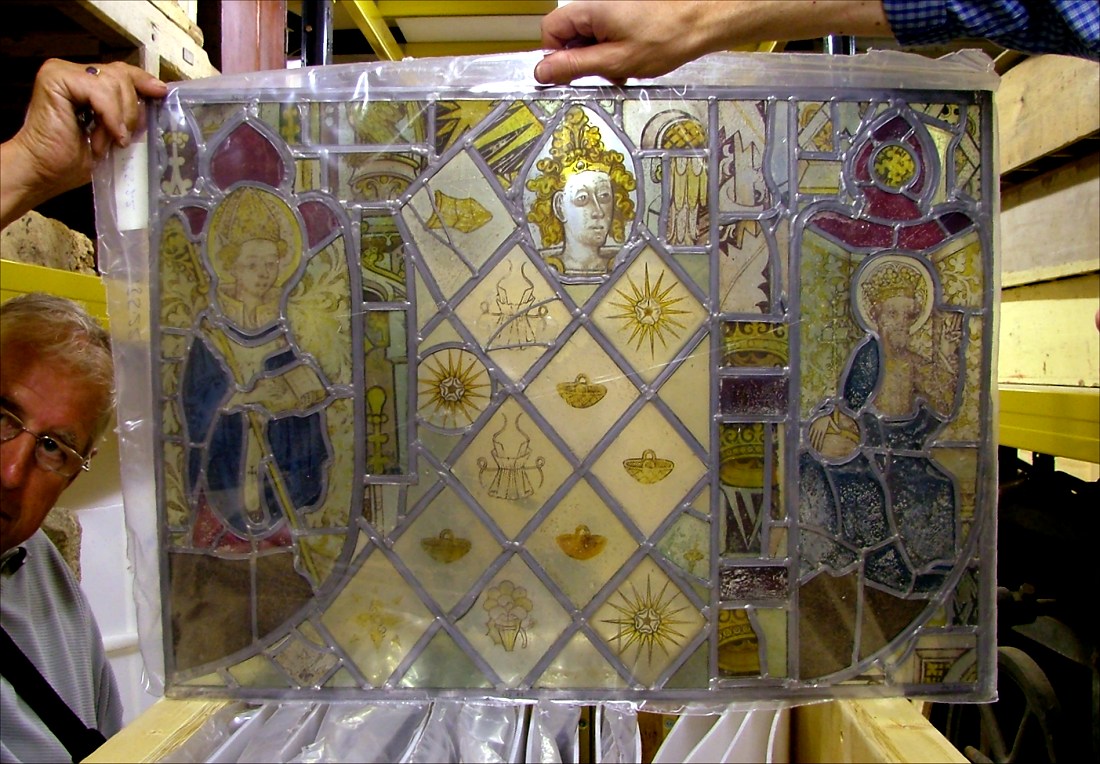
Within the screen is a large chapel, containing two major tombs. One is in alabaster, an early 17th century memorial to Sir Thomas and Lady Alice Lovell (remember the squirrel?) who died in 1604. The piece is good - too good, its 1950s restoration gives it a Festival of Britain air. Their symbols lie at their feet - his a magnificent peacock, hers a gruesome Saracen scalp held aloft.
The other appears to be a composite. It lies to the east, and the two effigies are clearly not from this tomb; they simply don't fit. They are supposed to be Robert Harling, died Paris in 1435, and his wife Dame Joan. Neither are buried here - she is at Rushford near Thetford, he is in some corner of a foreign field that is forever French schoolchildren on picnics excitedly tugging old thighbones from the soil - but in any case it is the trimmings of the tomb rather than the effigies that are most of interest, including a pelican in her piety and one that is almost a lily crucifix.
On the north side of the chancel is a fine tomb with brass inlays - the brasses now gone. Not as magnificent as either of the two previously mentioned, it is actually the most significant, as this is where you'll find Anne Harling, wife of the serial rebuilders of this church. Look out for those flails again.
What more? 17th century Lovells (remember the squirrel) have in-yer-face memorials either side of the sanctuary - that to the north curiously with no inscription. There are hatchments, remains of a wallpainting that are too indistinct to interpret (but may be seven works of mercy), a good set of royal arms, medieval heads, curious 19th century bench ends of a lion and a wild man, heraldic misericords, a Dec font - well, come and see for yourself. You know you want to.
Pentax ME Super
Takumar f4.54 80-205mm zoom lens
Ilford Delta 400 film
Kodak D-76 developer (stock solution; 10min @ 72F)
digitally scanned from negative
One of my favorite photos, with its variety breaking the photos balance having the focus on the right side of the photo for the characters while on the left side there is a huge pond. I emphasized this photo by taking it at an strange angel and forcing the focus to the right where the action is taking place. I feel there is a sort of rhythm with the tree roots moving out of the ground at strange angels. There is a contrast with the color in this photo having all these greens. Proportions was a big factor in this photo for me I was taking it off the center point and using the tree as a scale for you the viewer to judge the scale of this photo and know how the small things we don't see can still be awesome.
Biggie small, at round lake.
I never study a church before I go, maybe that's a fault on my part because I might miss something important and so have to go back. But for me, it's the wonder as you walk through the porch or door into the church, not knowing what to expect.
St Mary's looks like a typical Suffolk church from the outside, nice proportioned tower, good quality flint knapping. And yet once you enter, your breath is taken away by the glorious restored ceiling.
----------------------------------------------
It is not easy to find Huntingfield; even the signposts do not bear its name until you are within the parish boundary. Yet this shallow valley, divided by the infant river Blyth, with church and parsonage on one bank and manor house on the other, has been owned by some notable families in England's history.
The church is a Grade 1 Listed Building, largely due to its amazing Victorian painted ceiling.
The existing church certainly dates from the 11th century but there are signs that there had been a chapel here long before.
Some fragments of carved stones are set into the wall of the tower. At the beginning of this century they were turned up by a ploughman in a field called 'Chapel Field', a little to the south of the present church. They are fragments from a Saxon stone coffin and standing cross of the 10th century, long since disappeared.
The oldest part of the church is the wall between the nave and the north aisle which was the solid outer wall of the original twelfth century church. That church would have been small and dark, the whole building probably standing within the area of the present nave. The light would have come from small high windows of which one still remains above the two round-headed arches.
This wall has been altered at least twice. It was first broken through when the north aisle was built, and again in the nineteenth century when the arches were given their present 'Norman' curves. That first church was built by the family who took their name from the village and lived in the manor for 250 years, the Lords de Huntingfield.
The chancel was added in the thirteenth century.
By the end of the fourteenth, the south side of the nave had been altered and both aisles had been built in the fashionable Gothic style with its pointed arches. The five small high, or clerestory, windows on the south side of the nave would have provided light into the nave, the advent of affordable glass having made such things possible.
The east window of the south aisle has all that remains of the medieval glass that would once have filled many of the windows. There is a record of what was still to be seen here in the sixteenth century which lists the memorial windows with the coats of arms borne by the families who once owned the Manor.
The windows of the south aisle are particularly pretty and date from the fifteenth century. Their Perpendicular style is indicated by their familiar flat-topped shape. The porch is also from the fifteenth century.
The font dates from the fourteenth century.
The ceiling painting is very special and is explained on a separate page. The work was carried out in the 19th century while William Holland was rector. At the same time the organ and vestry were added with the Vanneck family vault beneath.
The ceiling is a masterpiece of Victorian church decoration, painted from end to end in brilliant colours, with carved and coloured angels, with banners, crowns and shields, all in the medieval style and of a most intricate and detailed finish.
The scheme of decoration is important as it reflects the ecclestiastical devotion of the late Victorian period clergy and their patrons, combined with the heightened liturgical practices of the Oxford Movement.
It was painted by Mildred Holland, the wife of William Holland who was rector for 44 years from 1848 until his death in 1892. The church was closed for eight months from September 1859 to April 1860 while she painted the chancel roof. Tradesmen provided scaffolding and prepared the ceiling for painting but there is no record to show that she had any help with the work, and legend has it that she did much of it lying on her back. We may imagine Victorian ladies wearing tight laced corsets and many petticoats, and wonder how she managed the ladders, scaffolding and hard labour of painting. She had an adviser on her schemes, a Mr. E. L. Blackburne F.S.A., an authority on medieval decoration.
The twelve large panels of the chancel ceiling each show an angel holding either a scroll with the words of the canticle 'Blessed be the Lord God of Israel', or the emblems of the Passion: the cross, the hammer and nails, the scourge, the lance, the crown of thorns and the reed.
Two pelicans in their piety (pecking their breasts to feed their young) are in the last small panels.
Between the beam ends of the chancel roof there are Bible verses in Gothic lettering,
then two tiers of panels; the lower have pictures of the Lamb of God alternating with`the Keys of Heaven. Above, are crowned monograms.
Above the Chancel Arch, the Lamb of God is depicted with the words 'Glory, Honour, Praise and Power unto the Lamb for Ever and Ever', lines taken from the Book of Revelation.
Three years later Mildred Holland began to paint again in the nave. In 1866 her husband William makes a note 'scaffolding finally taken down, September Ist'. The whole cost of repairing the nave roof, preparing it for painting and for materials amounted to £247.10s.7d of which £16.7s.6d was for 225 books of gold leaf and £72 for colours. William Holland's notes show that between 1859 and 1882 a total of £2,034. 10s.0d was spent on the church restoration, of which, apparently, he gave all but £400.
Recent research has found the complete record of William Holland's work in restoring and furnishing the church. These are available for interested students.
The figures on the nave roof are of the twelve apostles and two female saints. Each is painted in the lower tier with their traditional symbols and again in the upper tier clothed in heavenly raiment holding scrolls bearing their names.
Note that Saints Margaret and Andrew are both included as there is a tradition that these two saints were specially venerated here. There are niches for statues in the south aisle which may have held statues of them. The cult of St Margaret of Antioch grew in the 10th century and her veneration was brought back to England by crusaders. Her inclusion here may hint at an early date for the church's foundation.
Mildred Holland died in 1878; William served on until 1892, a total of forty years. He gave the font cover in memory of his wife and also the brass lectern with its graceful angels and winged dragons. Their graves are in the churchyard to the west of the entrance gates. Side by side they lie, beneath a table tomb alongside a standing cross.
It is natural to speculate about the roof. It is of a single hammer-beam construction, arch-braced principals alternating with hammer-beams ending in carved angels. The angels in the nave carry a crown or a banner, those in the chancel have heraldic shields bearing arms. The question all ask is: are these angels genuinely medieval work which escaped the axes of the post-Reformation Puritans, (and remember that William Dowsing, the arch-destroyer, came from nearby Laxfield) or are they all the handiwork of Victorian craftsmen?
Traditional East Anglian hammer-beam roofs generally terminate in a carving of some sort, and the de la Poles made angel roofs in the churches of their manors, even taking Suffolk carpenters to Ewelme in Oxfordshire to make one there. But our angels are too perfect to be so old. Entries in a tradesman's account of 1865 would seem to settle the matter; or do they?
The fourteenth and fifteenth centuries were times of great development and two families, both wealthy and influential, used their means to beautify and rebuild the churches on their manors including St Mary's. Keeping up with the neighbours is not a new fashion. Both left their marks on the font which, standing on restored steps and with a splendid cover, shows two heraldic shields.
The shield facing south depicts the arms of de Ufford while that on the north side is of de la Pole.
The de Ufford shield is that of Sir William de Ufford, Earl of Suffolk during the reign of Edward III. He held Framlingham Castle for the King and owned several manors in Suffolk. Among these were Parham, where he built the church, and Huntingfield.
The other shield is that of Michael de la Pole, Lord Chancellor and Earl of Suffolk, who married Catherine, daughter and heiress of Sir John Wingfield of Wingfield Castle. He succeeded to the manor of Huntingfield through his wife, and died in 1389. The shield shows both of their arms.
Michael de la Pole's has three polecat faces while Catherine Wingfield's has three open wings. Both are puns on their names. (For another heraldic pun look for the arms of Huntingfield being held by one of the angels in the roof: three hunting horns on a 'field'.)
In Ufford church you can see a medieval font cover which was a model for ours when it was made in the nineteenth century. In Wingfield church there is a font so like ours that it was probably made by the same craftsman.
www.stmaryshuntingfield.org.uk/history.htm
-----------------------------------------------
There is nowhere else in Suffolk quite like St Mary. Huntingfield is one of the county's most obscure villages; there are hardly any signposts to it. It is the nearest village to the great pile of Heveningham Hall, and perhaps these two facts are not unconnected. But it is worth getting out the old Ordnance Survey map, because here at St Mary was a remarkable 19th century restoration.
In the second half of that century, many parish churches were drawn by the excitement of the age into major reconstructions and revisions. They often looked to London stars like Scott and Butterfield, or local plodders like Phipson, or else mavericks like Salvin. The demands of the new liturgical arrangements, coupled with a renewed sense of the need to glorify God, led them into what was often a rebuilding rather than a restoration. Internal decorations were, perhaps, the bespoke work of the architect; witness Phipson's meticulous attention to detail at St Mary le Tower, Ipswich.
Other restorers relied on the big picture, a vision that encompassed walls and floors, but left the fittings to others; as, for example, Salvin's Flixton St Mary. What was the driving force behind Victorian revisionism? Essentially, what happened in England between about 1830 and 1870 was a cultural revolution, a ferment of new ideas and the reaction to them. The changes proposed by the Oxford Movement were, at first, objectionable, and then merely controversial; but gradually, they seeped into the mainstream, until by about 1890 they had become as natural as the air we breathe.
By the centenary of the movement in the 1930s, one Anglican clergyman could observe "It is as if the Reformation had never happened". Well, not quite. And now, the pendulum has swung the other way, leaving the ritualists high and dry. But the evidence of the energy of those days survives, especially at Huntingfield, where it was the local vicar who drove the Oxford Movement through the heart of the parish, like a motorway through a Site of Special Scientific Interest.
What the vicar of Huntingfield had, and many other ministers didn't, was a visionary wife. Between 1859 and 1866, Mrs Mildred Holland planned, designed and executed the most elaborate redecoration of a church this county had seen since the Reformation. For seven years, she lay on her back at the top of scaffolding, first in the chancel (angels) and then in the nave (saints on the ceilure, fine angels on the beam ends), gilding, lettering and painting this most glorious of small church roofs. Her husband, the Reverend William Holland, kept a journal throughout this period, and there is no suggestion that she had any assistance, beyond that of workmen to raise the scaffolding, and a Mr E.L. Blackburne FSA, who was, apparently, an 'authority on medieval decoration'.
J.P. St Aubyn was responsible for the structural restoration of this largely 15th century building, and it is very restrained and merciful. He did, however, refit the little windows in the south clerestory. But you come here to see the painted roofs, which are perfectly splendid. Beware if you come with children, or it will cost you a fortune in pound coins to activate the illuminations.
The font cover is not part of Mildred Holland's work; rather, it is her memorial, as is the art nouveau lectern. It is as if her art was a catalyst, inspiring others to acts of beauty. She died in the 1870s, predeceasing her husband by twenty years. They are both now buried by the churchyard gate. How fitting, that they should lie in the graveyard of the church they loved so much, and to which they gave so much of their time, energy and money.
Curiously, Ann Owen, the wife of the vicar of nearby Heveningham, produced the stained glass there; a novel is waiting to be written about these two women.
For such an obscure village, St Mary has had its share of influential patrons. Four major families in particular have left their mark here. Before the Reformation, the de la Poles and Uffords, whose shields you'll find on the font, and in later years the Cokes and the Pastons, both more usually associated with Norfolk.
But, as I have said, you don't come to Huntingfield because of important dead people. Look up, look all around, and see the true memorial to Mrs Holland. It does not have the gravitas of Lound, or the piety of Kettlebaston. And I really love it for that. I think this is a place that should be better known, and not just because of the way it contrasts with the less successful 19th century restorations at neighbouring Cookley and Walpole.
What we have here is as fine a display of 19th century folk art as you'll find anywhere in the county.
Simon Knott, 2001 (updated 2007)
St Peter and St Paul, East Harling, Norfolk
With its aisles, clerestory, porch and chancel, St Peter and St Paul is a textbook example of its century, although there are a number of curiosities that add even more interest. The vestry on the north side of the chancel, for example, which was once a shrine chapel, retains its image niche on its eastern face. And there are more image niches, these with elaborate foliage pedestals, in the buttresses of the tower; everything is topped off by a lead and timber fleche which was apparently the model for the one at St Peter Mancroft in Norwich, a church which has several features in common with this one.
The tower is a delight, the buttressing and pinnacles exactly in proportion to make it appear to rise like a fairy castle from the ground. The south porch, by contrast, is, despite its flushwork, rather austere, a result of its rebuilding early in the 19th century before the ecclesiological movement took hold. All in all, this is as good as 15th century rebuilding gets, the money coming thanks to Anne Harling having no less than three husbands who all wanted to spend as little time in purgatory as possible.
You step down into a wide space which, on a dull day, can be rather gloomy. Although inevitably heavily restored by the Victorians, St Peter and St Paul does not have that depressingly anonymous urban feel you so often find in churches of this size. This is partly because the beautiful parclose screen in the south aisle partitions off so much space, creating a sense of rooms within rooms, altering the way your eyes are inevitably drawn to the east. The rood screen must have been vast here; its dado survives at the west end, a deeply traceried affair with its features presented in carving rather than painting.
When the rood screen was in its proper place, to move from the nave into the chancel must have been like stepping from darkness into light. This is because of the feature that makes East Harling famous, the vast east window with its 15th century glass. After St Peter Mancroft it is the best collection in Norfolk. Unusually, the provenance of the glass is fairly well-documented: we can be fairly certain that it came from this church originally. Still present after the Reformation, it was removed by the Harling family to the Hall in the early 17th century. They may have been Laudians wanting to preserve it from the intentions of the puritans, or merely thought it would look nice in their dining hall; whatever, we know that shortly before Francis Blomefield visited here in the 1730s it was returned to the church and set in its present configuration.
In 1939, when war threatened, it was removed again, being reset just before Cautley visited in the early 1950s. There are parts of at least three sequences here, two of which were almost certainly in the east window originally, and one which almost certainly wasn't.
Essentially, the window contains two rosary sequences; the Joyful Mysteries of the Blessed Virgin, which include the Annunciation, the Nativity and the Assumption, and the Sorrowful Mysteries of the Blessed Virgin, which include the Crucifixion and the Deposition. However, this is open to interpretation, as we shall see. There is also the figure of St Mary Magdalene, which may once have been associated with a nave altar, and would have been located in a window there.
The five lights contain four rows of panels, making twenty altogether.
Top row:
I. Annunciation: Mary at her prayer desk. Gabriel, crowned and haloed, with a sceptre of lilies, kneels in supplication.
II. Visitation: Elizabeth, hooded to show her age, places her hand on Mary's pregnant belly.
III. Nativity: Two midwives look on. The infant in the manger is rayed; a horned cow gazes in awe.
IV. Adoration of the Shepherds: One holds a lamb, one plays pipes. A third appears to offer a fleece.
V. Adoration of the Magi: Two of the wise men gauge each others' reactions as the third offers his gift.
Second row:
VI: collection of fragments.
VII: Presentation in the Temple: Joseph carries the doves, Mary offers the child to Simeon. Anna is not shown.
VIII: The Finding in the Temple: Head covered, Mary bursts in among the men to find her son teaching.
IX: The Wedding at Canaa: Christ, seated at the top table, blesses a chicken and a ham. Mary directs the servant.
X: collection of fragments.
Third row:
XI: Mary of Magdala: Mary holds her long hair ready to anoint Christ's feet. Probably not from this window originally.
XII: The Betrayal at Gethsemane: Judas kisses Christ; Peter cuts off the ear of the high priest's servant.
XIII: Crucifixion: Mary swoons in John's arms.
XIV: Deposition from the cross: The pieta. Tears spring from Mary's eyes.
XV: Assumption of the Blessed Virgin: Mary is assumed bodily into heaven.
Bottom row:
XVI: Donor: Probably Robert Wingfield, second husband of Anne Harling.
XVII: Resurrection: Christ steps fully clothed from the tomb. Unusually, the soldiers are awake.
XVIII: Ascension of Christ: Mary, surrounded by disciples, watches as her son ascends to heaven.
XIX: Descent of the Holy Spirit: Mary, surrounded by disciples, receives the Holy Spirit at Pentecost.
XX: Donor: Probably William Chamberlain, first husband of Anne Harling.
Nowadays, we tend to think of the rosary as consisting of three sequences of five mysteries each, but in the late middle ages things were much more flexible, and rosary sequences often consisted of seven mysteries. The Glorious Mysteries sequence, of which the Assumption is now a part, is a later development, and the two adorations shown here are subsumed into a single mystery. There are a couple of images here that don't quite fit; the Wedding at Canaa is obviously a Marian text, and yet is not traditionally a rosary subject. Similarly the Betrayal, the only one of the images not to feature Mary. I wonder if what we have here are parts of two separate sequences, a Marian sequence of mysteries (I-V, VII-IX, XV), and a Passion sequence (XII-XIV, XVII-XIX). They are both clearly the work of the same workshop, and Mary is always shown with the same face and dress, but this would not preclude them from being two sequences.
Why were they here at all? We need to get away from thinking of such things as a 'poor man's bible', the need for which was superseded at the Reformation. These were devotional objects, designed to be used as meditations while praying and saying the rosary. They were created in the 15th century, a time when the mind of the Church was fiercely concentrated on asserting orthodox Catholic doctrine in the face of local superstitions and abuses. As such, they were anathema to the reformers, and were later elsewhere destroyed for being superstitious, not for being superfluous. An 18th century antiquarian mind, ignorant of the nature of Catholic devotion, might easily mix the two sequences into historical order, and possibly misunderstand the Assumption (obviously, as Mary reappears two images on at the Ascension, it is out of order). I wonder what they thought it was?
A couple of other things about the east window that you shouldn't miss. Firstly, everywhere you look there are tiny baskets - Mortlock calls them 'frails', and tells us that they were simple rush baskets used by workmen to carry tools. Also, though not in such profusion, there are bodices. These symbols are repeated elsewhere in the church in stone on tombs, and as such must be symbols of the Harling family.
Another symbol is high up on the north side, a red squirrel. Curiously, this also appears in the painting A Lady with a Squirrel and a Starling by Hans Holbein, now thought to be a portrait of Anne Lovell - the squirrel is a symbol of the Lovell family, who took over the local manor here from the Harlings in the 16th century, and the starling represents Ea- well, you guess.
In July 2006, Chris Harrison and I came across
some more glass from East Harling in the Norfolk County Archaeologist Service archive at Gressenhall. It was probably removed from the church for safety in 1939, and then not replaced, possibly ending up at the museum of church art in Norwich at St Peter Hungate, disappearing into storage when that closed in 1993. It depicts a Bishop and Christ seated in Majesty, and the lozenges in between carry the telltale frails and bodices familiar from other glass within the church.
Within the screen is a large chapel, containing two major tombs. One is in alabaster, an early 17th century memorial to Sir Thomas and Lady Alice Lovell (remember the squirrel?) who died in 1604. The piece is good - too good, its 1950s restoration gives it a Festival of Britain air. Their symbols lie at their feet - his a magnificent peacock, hers a gruesome Saracen scalp held aloft.
The other appears to be a composite. It lies to the east, and the two effigies are clearly not from this tomb; they simply don't fit. They are supposed to be Robert Harling, died Paris in 1435, and his wife Dame Joan. Neither are buried here - she is at Rushford near Thetford, he is in some corner of a foreign field that is forever French schoolchildren on picnics excitedly tugging old thighbones from the soil - but in any case it is the trimmings of the tomb rather than the effigies that are most of interest, including a pelican in her piety and one that is almost a lily crucifix.
On the north side of the chancel is a fine tomb with brass inlays - the brasses now gone. Not as magnificent as either of the two previously mentioned, it is actually the most significant, as this is where you'll find Anne Harling, wife of the serial rebuilders of this church. Look out for those flails again.
What more? 17th century Lovells (remember the squirrel) have in-yer-face memorials either side of the sanctuary - that to the north curiously with no inscription. There are hatchments, remains of a wallpainting that are too indistinct to interpret (but may be seven works of mercy), a good set of royal arms, medieval heads, curious 19th century bench ends of a lion and a wild man, heraldic misericords, a Dec font - well, come and see for yourself. You know you want to.
St Peter and St Paul, East Harling, Norfolk
With its aisles, clerestory, porch and chancel, St Peter and St Paul is a textbook example of its century, although there are a number of curiosities that add even more interest. The vestry on the north side of the chancel, for example, which was once a shrine chapel, retains its image niche on its eastern face. And there are more image niches, these with elaborate foliage pedestals, in the buttresses of the tower; everything is topped off by a lead and timber fleche which was apparently the model for the one at St Peter Mancroft in Norwich, a church which has several features in common with this one.
The tower is a delight, the buttressing and pinnacles exactly in proportion to make it appear to rise like a fairy castle from the ground. The south porch, by contrast, is, despite its flushwork, rather austere, a result of its rebuilding early in the 19th century before the ecclesiological movement took hold. All in all, this is as good as 15th century rebuilding gets, the money coming thanks to Anne Harling having no less than three husbands who all wanted to spend as little time in purgatory as possible.
You step down into a wide space which, on a dull day, can be rather gloomy. Although inevitably heavily restored by the Victorians, St Peter and St Paul does not have that depressingly anonymous urban feel you so often find in churches of this size. This is partly because the beautiful parclose screen in the south aisle partitions off so much space, creating a sense of rooms within rooms, altering the way your eyes are inevitably drawn to the east. The rood screen must have been vast here; its dado survives at the west end, a deeply traceried affair with its features presented in carving rather than painting.
When the rood screen was in its proper place, to move from the nave into the chancel must have been like stepping from darkness into light. This is because of the feature that makes East Harling famous, the vast east window with its 15th century glass. After St Peter Mancroft it is the best collection in Norfolk. Unusually, the provenance of the glass is fairly well-documented: we can be fairly certain that it came from this church originally. Still present after the Reformation, it was removed by the Harling family to the Hall in the early 17th century. They may have been Laudians wanting to preserve it from the intentions of the puritans, or merely thought it would look nice in their dining hall; whatever, we know that shortly before Francis Blomefield visited here in the 1730s it was returned to the church and set in its present configuration.
In 1939, when war threatened, it was removed again, being reset just before Cautley visited in the early 1950s. There are parts of at least three sequences here, two of which were almost certainly in the east window originally, and one which almost certainly wasn't.
Essentially, the window contains two rosary sequences; the Joyful Mysteries of the Blessed Virgin, which include the Annunciation, the Nativity and the Assumption, and the Sorrowful Mysteries of the Blessed Virgin, which include the Crucifixion and the Deposition. However, this is open to interpretation, as we shall see. There is also the figure of St Mary Magdalene, which may once have been associated with a nave altar, and would have been located in a window there.
The five lights contain four rows of panels, making twenty altogether.
Top row:
I. Annunciation: Mary at her prayer desk. Gabriel, crowned and haloed, with a sceptre of lilies, kneels in supplication.
II. Visitation: Elizabeth, hooded to show her age, places her hand on Mary's pregnant belly.
III. Nativity: Two midwives look on. The infant in the manger is rayed; a horned cow gazes in awe.
IV. Adoration of the Shepherds: One holds a lamb, one plays pipes. A third appears to offer a fleece.
V. Adoration of the Magi: Two of the wise men gauge each others' reactions as the third offers his gift.
Second row:
VI: collection of fragments.
VII: Presentation in the Temple: Joseph carries the doves, Mary offers the child to Simeon. Anna is not shown.
VIII: The Finding in the Temple: Head covered, Mary bursts in among the men to find her son teaching.
IX: The Wedding at Canaa: Christ, seated at the top table, blesses a chicken and a ham. Mary directs the servant.
X: collection of fragments.
Third row:
XI: Mary of Magdala: Mary holds her long hair ready to anoint Christ's feet. Probably not from this window originally.
XII: The Betrayal at Gethsemane: Judas kisses Christ; Peter cuts off the ear of the high priest's servant.
XIII: Crucifixion: Mary swoons in John's arms.
XIV: Deposition from the cross: The pieta. Tears spring from Mary's eyes.
XV: Assumption of the Blessed Virgin: Mary is assumed bodily into heaven.
Bottom row:
XVI: Donor: Probably Robert Wingfield, second husband of Anne Harling.
XVII: Resurrection: Christ steps fully clothed from the tomb. Unusually, the soldiers are awake.
XVIII: Ascension of Christ: Mary, surrounded by disciples, watches as her son ascends to heaven.
XIX: Descent of the Holy Spirit: Mary, surrounded by disciples, receives the Holy Spirit at Pentecost.
XX: Donor: Probably William Chamberlain, first husband of Anne Harling.
Nowadays, we tend to think of the rosary as consisting of three sequences of five mysteries each, but in the late middle ages things were much more flexible, and rosary sequences often consisted of seven mysteries. The Glorious Mysteries sequence, of which the Assumption is now a part, is a later development, and the two adorations shown here are subsumed into a single mystery. There are a couple of images here that don't quite fit; the Wedding at Canaa is obviously a Marian text, and yet is not traditionally a rosary subject. Similarly the Betrayal, the only one of the images not to feature Mary. I wonder if what we have here are parts of two separate sequences, a Marian sequence of mysteries (I-V, VII-IX, XV), and a Passion sequence (XII-XIV, XVII-XIX). They are both clearly the work of the same workshop, and Mary is always shown with the same face and dress, but this would not preclude them from being two sequences.
Why were they here at all? We need to get away from thinking of such things as a 'poor man's bible', the need for which was superseded at the Reformation. These were devotional objects, designed to be used as meditations while praying and saying the rosary. They were created in the 15th century, a time when the mind of the Church was fiercely concentrated on asserting orthodox Catholic doctrine in the face of local superstitions and abuses. As such, they were anathema to the reformers, and were later elsewhere destroyed for being superstitious, not for being superfluous. An 18th century antiquarian mind, ignorant of the nature of Catholic devotion, might easily mix the two sequences into historical order, and possibly misunderstand the Assumption (obviously, as Mary reappears two images on at the Ascension, it is out of order). I wonder what they thought it was?
A couple of other things about the east window that you shouldn't miss. Firstly, everywhere you look there are tiny baskets - Mortlock calls them 'frails', and tells us that they were simple rush baskets used by workmen to carry tools. Also, though not in such profusion, there are bodices. These symbols are repeated elsewhere in the church in stone on tombs, and as such must be symbols of the Harling family.
Another symbol is high up on the north side, a red squirrel. Curiously, this also appears in the painting A Lady with a Squirrel and a Starling by Hans Holbein, now thought to be a portrait of Anne Lovell - the squirrel is a symbol of the Lovell family, who took over the local manor here from the Harlings in the 16th century, and the starling represents Ea- well, you guess.
In July 2006, Chris Harrison and I came across
some more glass from East Harling in the Norfolk County Archaeologist Service archive at Gressenhall. It was probably removed from the church for safety in 1939, and then not replaced, possibly ending up at the museum of church art in Norwich at St Peter Hungate, disappearing into storage when that closed in 1993. It depicts a Bishop and Christ seated in Majesty, and the lozenges in between carry the telltale frails and bodices familiar from other glass within the church.
Within the screen is a large chapel, containing two major tombs. One is in alabaster, an early 17th century memorial to Sir Thomas and Lady Alice Lovell (remember the squirrel?) who died in 1604. The piece is good - too good, its 1950s restoration gives it a Festival of Britain air. Their symbols lie at their feet - his a magnificent peacock, hers a gruesome Saracen scalp held aloft.
The other appears to be a composite. It lies to the east, and the two effigies are clearly not from this tomb; they simply don't fit. They are supposed to be Robert Harling, died Paris in 1435, and his wife Dame Joan. Neither are buried here - she is at Rushford near Thetford, he is in some corner of a foreign field that is forever French schoolchildren on picnics excitedly tugging old thighbones from the soil - but in any case it is the trimmings of the tomb rather than the effigies that are most of interest, including a pelican in her piety and one that is almost a lily crucifix.
On the north side of the chancel is a fine tomb with brass inlays - the brasses now gone. Not as magnificent as either of the two previously mentioned, it is actually the most significant, as this is where you'll find Anne Harling, wife of the serial rebuilders of this church. Look out for those flails again.
What more? 17th century Lovells (remember the squirrel) have in-yer-face memorials either side of the sanctuary - that to the north curiously with no inscription. There are hatchments, remains of a wallpainting that are too indistinct to interpret (but may be seven works of mercy), a good set of royal arms, medieval heads, curious 19th century bench ends of a lion and a wild man, heraldic misericords, a Dec font - well, come and see for yourself. You know you want to.
St Peter and St Paul, East Harling, Norfolk
With its aisles, clerestory, porch and chancel, St Peter and St Paul is a textbook example of its century, although there are a number of curiosities that add even more interest. The vestry on the north side of the chancel, for example, which was once a shrine chapel, retains its image niche on its eastern face. And there are more image niches, these with elaborate foliage pedestals, in the buttresses of the tower; everything is topped off by a lead and timber fleche which was apparently the model for the one at St Peter Mancroft in Norwich, a church which has several features in common with this one.
The tower is a delight, the buttressing and pinnacles exactly in proportion to make it appear to rise like a fairy castle from the ground. The south porch, by contrast, is, despite its flushwork, rather austere, a result of its rebuilding early in the 19th century before the ecclesiological movement took hold. All in all, this is as good as 15th century rebuilding gets, the money coming thanks to Anne Harling having no less than three husbands who all wanted to spend as little time in purgatory as possible.
You step down into a wide space which, on a dull day, can be rather gloomy. Although inevitably heavily restored by the Victorians, St Peter and St Paul does not have that depressingly anonymous urban feel you so often find in churches of this size. This is partly because the beautiful parclose screen in the south aisle partitions off so much space, creating a sense of rooms within rooms, altering the way your eyes are inevitably drawn to the east. The rood screen must have been vast here; its dado survives at the west end, a deeply traceried affair with its features presented in carving rather than painting.
When the rood screen was in its proper place, to move from the nave into the chancel must have been like stepping from darkness into light. This is because of the feature that makes East Harling famous, the vast east window with its 15th century glass. After St Peter Mancroft it is the best collection in Norfolk. Unusually, the provenance of the glass is fairly well-documented: we can be fairly certain that it came from this church originally. Still present after the Reformation, it was removed by the Harling family to the Hall in the early 17th century. They may have been Laudians wanting to preserve it from the intentions of the puritans, or merely thought it would look nice in their dining hall; whatever, we know that shortly before Francis Blomefield visited here in the 1730s it was returned to the church and set in its present configuration.
In 1939, when war threatened, it was removed again, being reset just before Cautley visited in the early 1950s. There are parts of at least three sequences here, two of which were almost certainly in the east window originally, and one which almost certainly wasn't.
Essentially, the window contains two rosary sequences; the Joyful Mysteries of the Blessed Virgin, which include the Annunciation, the Nativity and the Assumption, and the Sorrowful Mysteries of the Blessed Virgin, which include the Crucifixion and the Deposition. However, this is open to interpretation, as we shall see. There is also the figure of St Mary Magdalene, which may once have been associated with a nave altar, and would have been located in a window there.
The five lights contain four rows of panels, making twenty altogether.
Top row:
I. Annunciation: Mary at her prayer desk. Gabriel, crowned and haloed, with a sceptre of lilies, kneels in supplication.
II. Visitation: Elizabeth, hooded to show her age, places her hand on Mary's pregnant belly.
III. Nativity: Two midwives look on. The infant in the manger is rayed; a horned cow gazes in awe.
IV. Adoration of the Shepherds: One holds a lamb, one plays pipes. A third appears to offer a fleece.
V. Adoration of the Magi: Two of the wise men gauge each others' reactions as the third offers his gift.
Second row:
VI: collection of fragments.
VII: Presentation in the Temple: Joseph carries the doves, Mary offers the child to Simeon. Anna is not shown.
VIII: The Finding in the Temple: Head covered, Mary bursts in among the men to find her son teaching.
IX: The Wedding at Canaa: Christ, seated at the top table, blesses a chicken and a ham. Mary directs the servant.
X: collection of fragments.
Third row:
XI: Mary of Magdala: Mary holds her long hair ready to anoint Christ's feet. Probably not from this window originally.
XII: The Betrayal at Gethsemane: Judas kisses Christ; Peter cuts off the ear of the high priest's servant.
XIII: Crucifixion: Mary swoons in John's arms.
XIV: Deposition from the cross: The pieta. Tears spring from Mary's eyes.
XV: Assumption of the Blessed Virgin: Mary is assumed bodily into heaven.
Bottom row:
XVI: Donor: Probably Robert Wingfield, second husband of Anne Harling.
XVII: Resurrection: Christ steps fully clothed from the tomb. Unusually, the soldiers are awake.
XVIII: Ascension of Christ: Mary, surrounded by disciples, watches as her son ascends to heaven.
XIX: Descent of the Holy Spirit: Mary, surrounded by disciples, receives the Holy Spirit at Pentecost.
XX: Donor: Probably William Chamberlain, first husband of Anne Harling.
Nowadays, we tend to think of the rosary as consisting of three sequences of five mysteries each, but in the late middle ages things were much more flexible, and rosary sequences often consisted of seven mysteries. The Glorious Mysteries sequence, of which the Assumption is now a part, is a later development, and the two adorations shown here are subsumed into a single mystery. There are a couple of images here that don't quite fit; the Wedding at Canaa is obviously a Marian text, and yet is not traditionally a rosary subject. Similarly the Betrayal, the only one of the images not to feature Mary. I wonder if what we have here are parts of two separate sequences, a Marian sequence of mysteries (I-V, VII-IX, XV), and a Passion sequence (XII-XIV, XVII-XIX). They are both clearly the work of the same workshop, and Mary is always shown with the same face and dress, but this would not preclude them from being two sequences.
Why were they here at all? We need to get away from thinking of such things as a 'poor man's bible', the need for which was superseded at the Reformation. These were devotional objects, designed to be used as meditations while praying and saying the rosary. They were created in the 15th century, a time when the mind of the Church was fiercely concentrated on asserting orthodox Catholic doctrine in the face of local superstitions and abuses. As such, they were anathema to the reformers, and were later elsewhere destroyed for being superstitious, not for being superfluous. An 18th century antiquarian mind, ignorant of the nature of Catholic devotion, might easily mix the two sequences into historical order, and possibly misunderstand the Assumption (obviously, as Mary reappears two images on at the Ascension, it is out of order). I wonder what they thought it was?
A couple of other things about the east window that you shouldn't miss. Firstly, everywhere you look there are tiny baskets - Mortlock calls them 'frails', and tells us that they were simple rush baskets used by workmen to carry tools. Also, though not in such profusion, there are bodices. These symbols are repeated elsewhere in the church in stone on tombs, and as such must be symbols of the Harling family.
Another symbol is high up on the north side, a red squirrel. Curiously, this also appears in the painting A Lady with a Squirrel and a Starling by Hans Holbein, now thought to be a portrait of Anne Lovell - the squirrel is a symbol of the Lovell family, who took over the local manor here from the Harlings in the 16th century, and the starling represents Ea- well, you guess.
In July 2006, Chris Harrison and I came across
some more glass from East Harling in the Norfolk County Archaeologist Service archive at Gressenhall. It was probably removed from the church for safety in 1939, and then not replaced, possibly ending up at the museum of church art in Norwich at St Peter Hungate, disappearing into storage when that closed in 1993. It depicts a Bishop and Christ seated in Majesty, and the lozenges in between carry the telltale frails and bodices familiar from other glass within the church.
Within the screen is a large chapel, containing two major tombs. One is in alabaster, an early 17th century memorial to Sir Thomas and Lady Alice Lovell (remember the squirrel?) who died in 1604. The piece is good - too good, its 1950s restoration gives it a Festival of Britain air. Their symbols lie at their feet - his a magnificent peacock, hers a gruesome Saracen scalp held aloft.
The other appears to be a composite. It lies to the east, and the two effigies are clearly not from this tomb; they simply don't fit. They are supposed to be Robert Harling, died Paris in 1435, and his wife Dame Joan. Neither are buried here - she is at Rushford near Thetford, he is in some corner of a foreign field that is forever French schoolchildren on picnics excitedly tugging old thighbones from the soil - but in any case it is the trimmings of the tomb rather than the effigies that are most of interest, including a pelican in her piety and one that is almost a lily crucifix.
On the north side of the chancel is a fine tomb with brass inlays - the brasses now gone. Not as magnificent as either of the two previously mentioned, it is actually the most significant, as this is where you'll find Anne Harling, wife of the serial rebuilders of this church. Look out for those flails again.
What more? 17th century Lovells (remember the squirrel) have in-yer-face memorials either side of the sanctuary - that to the north curiously with no inscription. There are hatchments, remains of a wallpainting that are too indistinct to interpret (but may be seven works of mercy), a good set of royal arms, medieval heads, curious 19th century bench ends of a lion and a wild man, heraldic misericords, a Dec font - well, come and see for yourself. You know you want to.
One of the keys to shooting Epic Landscape Photography is exalting the photograph's soul via golden ratio compositions, thusly wedding the photographic art to the divine proportion by which life itself was designed and exalted. The simple golden ratio PHI can exalt your art with the golden ratio harmonies in the form of golden rectangles, golden triangles, golden spirals, golden cuts, and more, all linked by the divine proportion!
Dr. Elliot McGucken's Golden Number Ratio Fine Art Landscape & Nature Photography Composition Studies!
instagram.com/goldennumberratio
www.facebook.com/goldennumberratio/
Greetings flickr friends! I am working on several books on "epic photography," and I recently finished a related one titled: The Golden Number Ratio Principle: Why the Fibonacci Numbers Exalt Beauty and How to Create PHI Compositions in Art, Design, & Photography: An Artistic and Scientific Introduction to the Golden Mean . Message me on facebook for a free review copy!
www.facebook.com/goldennumberratio/
The Golden Ratio also informs the design of the golden revolver on all the swimsuits and lingerie, as well as the 45surf logo!
The Golden Number Ratio Principle: Dr. E’s Golden Ratio Principle: The golden ratio exalts beauty because the number is a characteristic of the mathematically and physically most efficient manners of growth and distribution, on both evolutionary and purely physical levels. The golden ratio ensures that the proportions and structure of that which came before provide the proportions and structure of that which comes after. Robust, ordered growth is naturally associated with health and beauty, and thus we evolved to perceive the golden ratio harmonies as inherently beautiful, as we saw and felt their presence in all vital growth and life—in the salient features and proportions of humans and nature alike, from the distribution of our facial features and bones to the arrangements of petals, leaves, and sunflowers seeds. As ratios between Fibonacci Numbers offer the closest whole-number approximations to the golden ratio, and as seeds, cells, leaves, bones, and other physical entities appear in whole numbers, the Fibonacci Numbers oft appear in nature’s elements as “growth’s numbers.” From the dawn of time, humanity sought to salute their gods in art and temples exalting the same proportion by which all their vital sustenance and they themselves had been created—the golden ratio.
Ansel Adams is not only my favorite photographer, but he is one of the greatest photographers and artists of all time. And just like great artists including Michelangelo, Monet, Degas, Renoir, Leonardo da Vinci, Vermeer, Rembrandt, Botticelli, and Picasso, Ansel used the golden ratio and divine proportions in his epic art.
Not so long ago I discovered golden regions in many of his famous public domain his 8x10 aspect ratio photographs. I call these golden harmony regions "regions of golden action" or "ROGA"S, as seen here:
www.facebook.com/media/set/?set=a.1812448512351066.107374...
And too, I created some videos highlighting Ansel's use of the golden harmonies. Enjoy!
www.youtube.com/watch?v=AGnxOAhK3os
www.youtube.com/watch?v=WFlzAaBgsDI
www.youtube.com/watch?v=D3eJ86Ej1TY
More golden ratio and epic photography composition books soon! Best wishes for the Holiday Season! Dr. Elliot McGucken :)
Dr. Elliot McGucken Fine Art Landscape & Nature Photography
New book page!
www.facebook.com/epiclandscapephotography/
Epic Landscape Photography: The Mythological Principles of Fine Art Nature Photography
Golden Number Ratio Divine Proportion Compositions Fine Art Photography Dr. Elliot McGucken : Using the Nature's Golden Cut to Exalt Nature Photography!
Join my golden ratio groups!
www.facebook.com/goldennumberratio/
www.facebook.com/groups/1401714589947057/
instagram.com/goldennumberratio
Dr. Elliot McGucken Fine Art Landscape & Nature Photography
New book page!
www.facebook.com/epiclandscapephotography/
Epic Landscape Photography: The Mythological Principles of Fine Art Nature Photography
Ansel Adams used the golden ratio in his photography too:
www.youtube.com/watch?v=WFlzAaBgsDI
www.youtube.com/watch?v=zrOUX3ZCl7I
The Fibonacci Numbers are closely related to the golden ratio, and thus they also play a prominent role in exalted natural and artistic compositions!
I'm working on a far deeper book titled The Golden Ratio Number for Photographers. :)
The famous mathematician Jacob Bernoulli wrote:
The (golden spiral) may be used as a symbol, either of fortitude and constancy in adversity, or of the human body, which after all its changes, even after death, will be restored to its exact and perfect self.
Engraved upon Jacob’s tombstone is a spiral alongside the words, "Eadem Mutata Resurgo," meaning "Though changed, I shall rise again." And so it is that within the Golden Ratio Principle, the golden harmonies rise yet again.
The golden ratio is oft known as the divine cut, the golden cut, the divine proportion, the golden number, and PHI for the name of the architect of the Parthenon Phidias. It has exalted classical art on down through the millennia and it can exalt your art too!
Ask me anything about the golden ratio! :) I will do my best to answer!!
Enjoy my Fine Art Ballet instagram too!
Dr. Elliot McGucken's Golden Ratio Principle: The Golden Number Ratio Principle: Dr. E’s Golden Ratio Principle: The golden ratio exalts beauty because the number is a characteristic of the mathematically and physically most efficient manners of growth and distribution, on both evolutionary and purely physical levels. The golden ratio ensures that the proportions and structure of that which came before provide the proportions and structure of that which comes after. Robust, ordered growth is naturally associated with health and beauty, and thus we evolved to perceive the golden ratio harmonies as inherently beautiful, as we saw and felt their presence in all vital growth and life—in the salient features and proportions of humans and nature alike, from the distribution of our facial features and bones to the arrangements of petals, leaves, and sunflowers seeds. As ratios between Fibonacci Numbers offer the closest whole-number approximations to the golden ratio, and as seeds, cells, leaves, bones, and other physical entities appear in whole numbers, the Fibonacci Numbers oft appear in nature’s elements as “growth’s numbers.” From the dawn of time, humanity sought to salute their gods in art and temples exalting the same proportion by which all their vital sustenance and they themselves had been created—the golden ratio. the golden number, rectangle, and spiral!
Golden Number Ratio Divine Proportion Compositions Fine Art Photography Dr. Elliot McGucken : Using the Nature's Golden Cut to Exalt Nature Photography!
Join my golden ratio groups!
www.facebook.com/goldennumberratio/
www.facebook.com/groups/1401714589947057/
instagram.com/goldennumberratio
Dr. Elliot McGucken Fine Art Landscape & Nature Photography
New book page!
www.facebook.com/epiclandscapephotography/
Epic Landscape Photography: The Mythological Principles of Fine Art Nature Photography
Ansel Adams used the golden ratio in his photography too:
www.youtube.com/watch?v=WFlzAaBgsDI
www.youtube.com/watch?v=zrOUX3ZCl7I
The Fibonacci Numbers are closely related to the golden ratio, and thus they also play a prominent role in exalted natural and artistic compositions!
I'm working on a far deeper book titled The Golden Ratio Number for Photographers. :)
The famous mathematician Jacob Bernoulli wrote:
The (golden spiral) may be used as a symbol, either of fortitude and constancy in adversity, or of the human body, which after all its changes, even after death, will be restored to its exact and perfect self.
Engraved upon Jacob’s tombstone is a spiral alongside the words, "Eadem Mutata Resurgo," meaning "Though changed, I shall rise again." And so it is that within the Golden Ratio Principle, the golden harmonies rise yet again.
The golden ratio is oft known as the divine cut, the golden cut, the divine proportion, the golden number, and PHI for the name of the architect of the Parthenon Phidias. It has exalted classical art on down through the millennia and it can exalt your art too!
Ask me anything about the golden ratio! :) I will do my best to answer!!
Enjoy my Fine Art Ballet instagram too!
Dr. Elliot McGucken's Golden Ratio Principle: The Golden Number Ratio Principle: Dr. E’s Golden Ratio Principle: The golden ratio exalts beauty because the number is a characteristic of the mathematically and physically most efficient manners of growth and distribution, on both evolutionary and purely physical levels. The golden ratio ensures that the proportions and structure of that which came before provide the proportions and structure of that which comes after. Robust, ordered growth is naturally associated with health and beauty, and thus we evolved to perceive the golden ratio harmonies as inherently beautiful, as we saw and felt their presence in all vital growth and life—in the salient features and proportions of humans and nature alike, from the distribution of our facial features and bones to the arrangements of petals, leaves, and sunflowers seeds. As ratios between Fibonacci Numbers offer the closest whole-number approximations to the golden ratio, and as seeds, cells, leaves, bones, and other physical entities appear in whole numbers, the Fibonacci Numbers oft appear in nature’s elements as “growth’s numbers.” From the dawn of time, humanity sought to salute their gods in art and temples exalting the same proportion by which all their vital sustenance and they themselves had been created—the golden ratio. the golden number, rectangle, and spiral!
BMW 7-Series. Yes, I know it's not rare, but I liked the location and thought it was amazing that someone would drive such a big car through tiny hilly streets.
Spoleto, Italy | 2013
My physics equation dx4/dt=ic graces the swimsuits and bikinis, while the golden gun is designed in proportion with the golden ratio, and the photos are oft cropped in divine proportions!
Beautiful Golden Ratio Composition Photography Surf Goddesses! dx4/dt=ic Athletic Action Portraits of Swimsuit Bikini Models! Athena, Artemis, Helen, and Aphrodite! Athletic Fitness Models!
My Epic Gear Guide for Landscapes & Portraits!
Everyone is always asking me for this! Here ya go! :)
My Epic Book: Photographing Women Models!
Portrait, Swimsuit, Lingerie, Boudoir, Fine Art, & Fashion Photography Exalting the Venus Goddess Archetype: How to Shoot Epic ...
Epic! Beautiful Surf Fine Art Portrait Swimsuit Bikini Models!
Bitcoin: 1FMBZJeeHVMu35uegrYUfEkHfPj5pe9WNz
Follow me friends!
facebook.com/goldennumberratio
Epic books, prints, & more!
Exalt your photography with Golden Ratio Compositions!
Golden Ratio Compositions & Secret Sacred Geometry for Photography, Fine Art, & Landscape Photographers: How to Exalt Art with Leonardo da Vinci's, Michelangelo's!
Epic Landscape Photography:
A Simple Guide to the Principles of Fine Art Nature Photography: Master Composition, Lenses, Camera Settings, Aperture, ISO, ... Hero's Odyssey Mythology Photography)
Epic Art & Gear for your Epic Hero's Odyssey:
Enjoy my physics books graces with my fine art photography! Light Time Dimension Theory: The Foundational Physics Unifying Einstein's Relativity and Quantum Mechanics: A Simple, Illustrated Introduction to the Physical
Beautiful Surf Goddesses! Athletic Action Portraits of Swimsuit Bikini Models! Athena, Artemis, Helen, and Aphrodite!