View allAll Photos Tagged Probability
Ho scattato questa foto mentre stava piovendo ... si sotto l'ombrello !
Una vista più vasta del paesaggio !
** I Cipressi in Toscana :
La sua inconfondibile chioma stretta e affusolata con terminale a punta come una lancia, ha contribuito alla caratterizzazione del paesaggio toscano: lo si trova dalla costa tirrenica alle morbide colline interne. Importato con molta probabilità dapprima durante la colonizzazione Fenicia e Greca, e poi dagli Etruschi.
È un albero sempreverde diffuso in tutte le regioni del mediterraneo medio-orientale dove nasce e cresce spontaneamente, dall’Iran all’Egitto, passando per la Grecia. Il tronco retto è di colore grigio-brunastro può raggiungere anche i 25 mt. di altezza. Le foglie sono piccolissime di colore verde cupo e squamiformi tanto da coprire interamente i rametti cilindrici.
----
I took this picture while it was raining ... under the umbrella!
A wider view of the landscape!
** The Cypresses in Tuscany:
Its unmistakable narrow, tapered jaw with a pointed end like a spear contributes to the characterization of the Tuscan landscape: it is located from the Tyrrhenian coast to the soft inner hills. Imported with great probability first during Phoenician and Greek colonization, and then by the Etruscans.
It is an evergreen tree spread in all the regions of the Middle East where it originates and grows spontaneously, from Iran to Egypt, passing through Greece. The straight trunk is grayish-brown can reach up to 25 mt. Of height. The leaves are tiny, dark green and squamiform so as to completely cover the cylindrical ramps.
When I looked at this photo, it reminded me of sperm cells. There’s nothing embarrassing about that; it’s just a part of how we all came into existence. It only takes one out of millions to create a human. This is true in many aspects of life as well. Sometimes, it takes just one chance in a million to make things work out, no matter what those things may be.
Little more than a record snap at the time, the passage of over 40 years has given the image above more interest value.
Standing at what was then Nottingham's platform 4 is a 3-car BRC&W class 104 DMU, and what was probably a Lincoln - Crewe working. Note the smartly turned-out Driver with jacket, tie and the BR rail-blue era peaked cap. Not only have I caught his eye but also that of the passenger sat in arguably the best seat in the house - that behind the empty Secondman's seat and thus offering a clear view of the journey ahead.
To the left stands class 37 no. 37234 at the head of a parcels working. Looking down the platform towards the end of what looks to be a lengthy train is a class 08 shunter and railman, presumably in the process of coupling up an additional van or two. Class 37s weren't especially common here at the time, although the Harwich Boat Train diagram would occasionally produce a Stratford allocated engine in lieu of the more usual white-roofed class 47. From my admittedly limited research it would appear that 37234 was Landore (LE) based, so there's a reasonable probability the train was destined for South Wales. The station clock reads 2.30pm so that might allow it to be identified.
At the very top of the frame is the bridge carrying the closed and lifted GCR route into Nottingham Victoria. The bridge would eventually be removed, only to be replaced years later with a new bridge in almost the same position carrying the Nottingham Tram system (NET) out to Clifton and Beeston / Toton.
The footbridge behind remains and, along with the rest of the station (and particularly the platform awnings) has been cleaned up considerably. The third more distant bridge, used for mail back in the day, is no longer there.
No surprise the platform and track layout has changed here in the last few years, and there are now more platforms but no longer any platform-avoiding through lines.
Ilford FP4 rated at 160asa, developed in Acutol
2.30pm, 2nd May 1977
Kestrel - Falco tinnunculus (m)
The common kestrel (Falco tinnunculus) is a bird of prey species belonging to the kestrel group of the falcon family Falconidae. It is also known as the European kestrel, Eurasian kestrel, or Old World kestrel. In Britain, where no other kestrel species occurs, it is generally just called "the kestrel".
This species occurs over a large range. It is widespread in Europe, Asia, and Africa, as well as occasionally reaching the east coast of North America.
Kestrels can hover in still air, even indoors in barns. Because they face towards any slight wind when hovering, the common kestrel is called a "windhover" in some areas.
Unusual for falcons, plumage often differs between male and female, although as is usual with monogamous raptors the female is slightly larger than the male. This allows a pair to fill different feeding niches over their home range. Kestrels are bold and have adapted well to human encroachment, nesting in buildings and hunting by major roads. Kestrels do not build their own nests, but use nests built by other species.
Their plumage is mainly light chestnut brown with blackish spots on the upperside and buff with narrow blackish streaks on the underside; the remiges are also blackish. Unlike most raptors, they display sexual colour dimorphism with the male having fewer black spots and streaks, as well as a blue-grey cap and tail. The tail is brown with black bars in females, and has a black tip with a narrow white rim in both sexes. All common kestrels have a prominent black malar stripe like their closest relatives.
The cere, feet, and a narrow ring around the eye are bright yellow; the toenails, bill and iris are dark. Juveniles look like adult females, but the underside streaks are wider; the yellow of their bare parts is paler. Hatchlings are covered in white down feathers, changing to a buff-grey second down coat before they grow their first true plumage.
Data from Britain shows nesting pairs bringing up about 2–3 chicks on average, though this includes a considerable rate of total brood failures; actually, few pairs that do manage to fledge offspring raise less than 3 or 4. Compared to their siblings, first-hatched chicks have greater survival and recruitment probability, thought to be due to the first-hatched chicks obtaining a higher body condition when in the nest. Population cycles of prey, particularly voles, have a considerable influence on breeding success. Most common kestrels die before they reach 2 years of age; mortality up until the first birthday may be as high as 70%. At least females generally breed at one year of age; possibly, some males take a year longer to maturity as they do in related species. The biological lifespan to death from senescence can be 16 years or more, however; one was recorded to have lived almost 24 years.
Population:
UK breeding:
46,000 pairs
Fort Pulaski was named after Revolutionary War hero General Casimir Pulaski of Poland, who is considered the "Father of the American Cavalry." Pulaski was mortally wounded a few miles west of here as he rallied troops against the British.
Days before Georgia seceded from the United States and joined the Confederate States, the state militia walked into the federal fortification of Fort Pulaski on Cockspur Island near Savannah and took its watch. In effect, the fort was now theirs as secession was declared, and war broke out. Unfortunately for the Confederacy, it then did not support the surrounding ground because its military command thought the area was too remote, a waste of resources for what it deemed to be an impenetrable fort. The Civil War would quickly test those military assumptions. The United States thought of Fort Pulaski in terms of a bigger picture–Southern supply chain, military logistics, and economic bottleneck. Controlling the traffic of the Southern port city of Savannah was very important to the overall war effort.
The United States military took advantage of the blind eye of the Confederacy's military command. First came the U.S. Navy, blockading the Savannah River for a 112-day siege of the fort. But that was not enough. The U.S. Army built up troops and batteries by night at Tybee Island, hidden, on Fort Pulaski's facing shore of the Savannah River.
On April 10, 1862, U.S. troops struck out. Rolling back their camouflage, they bombarded Confederate-occupied Fort Pulaski and won. The Confederate commander unconditionally surrendered, noting his isolation from any Confederate backup and that a breached wall exposed his entire garrison to the possibility of a catastrophic explosion from the ammunition storage area. He stated:
"We were absolutely isolated beyond any possibility of help from the Confederate authorities, and I did not feel warranted in exposing the garrison to the hazard of the blowing up of our main magazine -- a danger which had just been proved well within the limits of probability."†
The reclaimed fort would remain under U.S. control for the remainder of the Civil War.
The Confederacy did not emphasize the loss of Fort Pulaski because of clearer tactics, strategy, or supply logistics employed by their foe that capitalized on the Confederate military's blindspots but rather because of the Union's state-of-the-art technology that Confederate commanders did not anticipate to be used against their impenetrable fort, i.e. new rifled-bore cannons of the Union shot further and more accurately than traditional smooth-bore cannons. The new cannon fire could now reach the fort from the opposite shore to bring down its walls.
Wikipedia observes the strategic loss for the Confederacy and the strategic gain of Fort Pulaski for the United States: "all shipping into and out of Savannah ceased. The loss of Savannah as a viable Confederate port crippled its war effort."
----
†Source– Wikipedia: Quote from Colonel Charles H. Olmstead, commander of Fort Pulaski's Confederate garrison, Fort Pulaski brochure, National Park Service, United States Department of the Interior
For junk-lovers like me, there were lots of goodies in this farmyard including the portion shown here. The barn is interesting in that it contains either living quarters or a man-cave on the second level. You can see an air conditioner, satellite dish and, through the windows, its doors.
I am guessing that the barn was used for living quarters in the waning years of the farm in that the only house on the property was exceedingly small. (However, fear not man-cave fans, because I recently found an unmistable man-cave and another high-probability man-cave, both yet to be posted.)
Washington series: Ricksecker Point, Mount Rainier National Park.
🇺🇸 With a summit elevation of 4.394 m Mount Rainier is the highest mountain in the U.S. state of Washington and the Cascade Range. Due to its high probability of an eruption in the (relative) near future, Mount Rainier is considered one of the most dangerous volcanoes in the world. Late May many parts of the national park were still closed due to snow, the lakes were still frozen and spring had not really arrived.
🇩🇪 Mit einer Höhe von 4394 m ist Mount Rainier der höchste Berg in Washington und der Kaskadenkette. Ein Ausbruch in (relativ) naher Zukunft wird erwartet und macht Mt. Rainier zu einem der aktuell gefährlichsten Vulkane. Ende Mai waren große Teile des Nationalparks noch immer wegen Schneemassen gesperrt, die Seen waren immer noch zugefroren und der Frühling liess noch auf sich warten.
Role: Long Range Patrol, Attack & Defence Platform
Armament: sHV17 Goalkeeper 30x155mm CIWS (x2), Raytheon KP22[hm] Pilum Block V (x8), Lockheed Martin Peregrine MR Tactical Nuclear Missile (x2) (optional)
Despite smaller and more advanced defence platforms such as the Tursiops and Delphinapterus being developed, the decades old Orcinus gunboats remain the primary long range patrol and attack craft within IBN fleets.
Two pilots are able to go out on extended patrols for up to two weeks. The cramped accommodation within the rear cabin provide only the most basic amenities, and as a result, Orcinus pilots are colloquially referred to as "Gemini Jockeys". But the two pilots are able to rotate piloting shifts and when in battle, the secondary pilot can act as gunner and sensor officer from the rear terminal.
Most targeting, sensor and jamming systems have been upgraded over time leaving the exterior of most of the frontline units a hodge-podge of sensor blisters and radomes. So although most ships are a good decade older than their pilots, they are still highly capable to take on more advanced enemy craft.
Robust and reliable 2nd generation fusion reactors power the dual main engine nozzles and multiple reaction control thrusters. More efficient power and propulsion systems have since been developed, but the tried and tested technology allows for easy field maintainability in remote forward operating bases.
The dual sHV17 Goalkeepers function adequately in both anti-missile defence, as well as, close quarters ship-to-ship combat. Veteran pilots like nothing more than to hide close to abandoned station complexes when on anti-piracy patrol and surprising enemy ships while they are busy with docking procedures. The Pilum armament is a rudimentary kinetic penetrator, powered by a high maneuverability rocket engine. However, the Block V systems feature the added benefit of the 'Maelstrom' secondary attack function. If the projectile is estimated to miss the target, or there is a a high probability of intercept by CIWS it will take a more erratic flight path to confuse the targeting systems and then the outer shroud will detonate sending a barrage of high velocity small projectiles towards the target. It certainly does not do as much damage as the full penetrator, but it typically is enough to disrupt and disable sensor and defensive systems allowing for further Pilums to be launched in order to eliminate the target...also useful when only wanting to disable an enemy ship to allow for boarding. The Peregrine missile is typically only outfitted when units are likely to meet capital ships, or when operating in a station assault role.
The Eurasian sparrowhawk (Accipiter nisus), also known as the northern sparrowhawk or simply the sparrowhawk, is a small bird of prey in the family Accipitridae. Adult male Eurasian sparrowhawks have bluish grey upperparts and orange-barred underparts; females and juveniles are brown above with brown barring below. The female is up to 25% larger than the male – one of the greatest size differences between the sexes in any bird species. Though it is a predator which specialises in catching woodland birds, the Eurasian sparrowhawk can be found in any habitat and often hunts garden birds in towns and cities. Males tend to take smaller birds, including tits, finches, and sparrows; females catch primarily thrushes and starlings, but are capable of killing birds weighing 500 g (18 oz) or more.
The Eurasian sparrowhawk is found throughout the temperate and subtropical parts of the Old World; while birds from the northern parts of the range migrate south for winter, their southern counterparts remain resident or make dispersive movements. Eurasian sparrowhawks breed in suitable woodland of any type, with the nest, measuring up to 60 cm (2.0 ft) across, built using twigs in a tree. Four or five pale blue, brown-spotted eggs are laid; the success of the breeding attempt is dependent on the female maintaining a high weight while the male brings her food. The chicks hatch after 33 days and fledge after 24 to 28 days.
The probability of a juvenile surviving its first year is 34%, with 69% of adults surviving from one year to the next. Mortality in young males is greater than that of young females and the typical lifespan is four years. This species is now one of the most common birds of prey in Europe, although the population crashed after the Second World War. Organochlorine insecticides used to treat seeds before sowing built up in the bird population, and the concentrations in Eurasian sparrowhawks were enough to kill some outright and incapacitate others; affected birds laid eggs with fragile shells which broke during incubation. However, its population recovered after the chemicals were banned, and it is now relatively common, classified as being of least concern by BirdLife International.
The Eurasian sparrowhawk's hunting behaviour has brought it into conflict with humans for hundreds of years, particularly racing pigeon owners and people rearing poultry and gamebirds. It has also been blamed for decreases in passerine populations. The increase in population of the Eurasian sparrowhawk coincides with the decline in house sparrows in Britain.[2] Studies of racing pigeon deaths found that Eurasian sparrowhawks were responsible for less than 1%. Falconers have utilised the Eurasian sparrowhawk since at least the 16th century; although the species has a reputation for being difficult to train, it is also praised for its courage. The species features in Teutonic mythology and is mentioned in works by writers including William Shakespeare, Alfred, Lord Tennyson and Ted Hughes.
Thank you for visiting - ❤ with gratitude! Fave if you like it, add comments below, get beautiful HDR prints at qualityHDR.com.
We are on the way to the Black Rock Desert in Nevada again. This time for the Mudroc rocket event organized by Aeropac. Can't wait to shoot and launch rockets again!
Last September we went to the Black Rock Desert in Nevada to attend Balls 24, a crazy rocket launch event with huge rockets. Some people call this event the Super Bowl of rocketry, others the Wild Wild West of rocketry. Over 300 people attended; there were teams from as far as England and Egypt. Many rockets were built in the garage from scratch, including the solid propellant for the motors.
Quite a number of rockets came down ballistic, either with some problems with the electronics, structural problems at high g-forces and supersonic speed, or parachute deployment problems. You gotta have balls to be there - the probability to get hit by a rocket is tiny but not zero.
This rocket had an excellent flight reaching over 100k altitude. I do not have any more info on this rocket. I took this shot the next day early in the morning at sunrise. You can see peeled off paint - battle scars - from the supersonic flight.
I processed a balanced HDR photo from three RAW exposures.
-- © Peter Thoeny, CC BY-NC-SA 4.0, HDR, 3 RAW exposures, NEX-6, _DSC7433_4_5_hdr3bal1c
Days before Georgia seceded from the United States and joined the Confederacy, the state seized the federal fortification of Fort Pulaski on Cockspur Island near Savannah. Unfortunately for the Confederacy, it then did not support the surrounding ground because it thought Tybee Island was too remote, a waste of resources for what it deemed to be an impenetrable fort. The Civil War would quickly test those military assumptions. The United States thought of Fort Pulaski in terms of a bigger picture–Southern supply chain, military logistics, and economic bottleneck. Controlling traffic of the Southern port city of Savannah was very important to the overall war effort.
The United States military took advantage of the blind eye of the Confederacy's military command. First came the U.S. Navy, blockading the Savannah River for a 112-day siege of the fort. But that was not enough. The U.S. Army built up troops and batteries by night at Tybee Island, hidden, on Fort Pulaski's facing shore of the Savannah River.
On April 10, 1862, U.S. troops struck out. Rolling back their camouflage, they bombarded Confederate-occupied Fort Pulaski and won. The Confederate commander unconditionally surrendered, noting his isolation from any Confederate backup and that a breached wall exposed his entire garrison to the possibility of a catastrophic explosion from the ammunition storage area. He stated:
"We were absolutely isolated beyond any possibility of help from the Confederate authorities, and I did not feel warranted in exposing the garrison to the hazard of the blowing up of our main magazine -- a danger which had just been proved well within the limits of probability."†
The reclaimed fort would remain under U.S. control for the remainder of the Civil War.
The Confederacy did not emphasize the loss of Fort Pulaski because of clearer tactics, strategy, or supply logistics employed by their foe that capitalized on the Confederate military's blindspots but rather because of the Union's state-of-the-art technology that Confederate commanders did not anticipate to be used against their impenetrable fort, i.e. new rifled-bore cannons of the Union shot further and more accurately than traditional smooth-bore cannons. The new cannon fire could now reach the fort from the opposite shore to bring down its walls.
Wikipedia observes the strategic loss for the Confederacy and the strategic gain of Fort Pulaski for the United States: "all shipping into and out of Savannah ceased. The loss of Savannah as a viable Confederate port crippled its war effort."
----
†Source– Wikipedia: Quote from Colonel Charles H. Olmstead, commander of Fort Pulaski's Confederate garrison, Fort Pulaski brochure, National Park Service, United States Department of the Interior
The jaguar (Panthera onca) is a big cat, a feline in the Panthera genus, and is the only Panthera species found in the Americas. The jaguar is the third-largest feline after the tiger and the lion, and the largest and most powerful feline in the Western Hemisphere. The jaguar's present range extends from Mexico across much of Central America and south to Paraguay and northern Argentina. Apart from a known and possibly breeding population in Arizona (southeast of Tucson), the cat has largely been extirpated from the United States since the early 1900s.
This spotted cat most closely resembles the leopard physically, although it is usually larger and of sturdier build and its behavioral and habitat characteristics are closer to those of the tiger. While dense rainforest is its preferred habitat, the jaguar will range across a variety of forested and open terrain. It is strongly associated with the presence of water and is notable, along with the tiger, as a feline that enjoys swimming. The jaguar is a largely solitary, stalk-and-ambush predator, and is opportunistic in prey selection. It is also an apex and keystone predator, playing an important role in stabilizing ecosystems and regulating the populations of prey species. The jaguar has an exceptionally powerful bite, even relative to the other big cats.[3] This allows it to pierce the shells of armoured reptiles[4] and to employ an unusual killing method: it bites directly through the skull of prey between the ears to deliver a fatal bite to the brain.[5]
The jaguar is a near threatened species and its numbers are declining. Threats include habitat loss and fragmentation. While international trade in jaguars or their parts is prohibited, the cat is still regularly killed by humans, particularly in conflicts with ranchers and farmers in South America. Although reduced, its range remains large; given its historical distribution, the jaguar has featured prominently in the mythology of numerous indigenous American cultures, including that of the Maya and Aztec.
Etymology
A jaguar at the Milwaukee County Zoological GardensThe word jaguar is pronounced /ˈdʒæɡwɑr/ or, in British English, /ˈdʒæɡjuː.ər/. It comes to English from one of the Tupi-Guarani languages, presumably the Amazonian trade language Tupinambá, via Portuguese jaguar.[6] The Tupian word, yaguara "beast", sometimes translated as "dog",[7][8] is used for any carnivorous mammal.[9] The specific word for jaguar is yaguareté, with the suffix -eté meaning "real" or "true".[6][9][10]
The first component of its taxonomic designation, Panthera, is Latin, from the Greek word for leopard, πάνθηρ, the type species for the genus. This has been said to derive from the παν- "all" and θήρ from θηρευτής "predator", meaning "predator of all" (animals), though this may be a folk etymology[11]—it may instead be ultimately of Sanskrit origin, from pundarikam, the Sanskrit word for "tiger".[12]
Onca is the Portuguese onça, with the cedilla dropped for typographical reasons, found in English as ounce for the Snow Leopard, Uncia uncia. It derives from the Latin lyncea lynx, with the letter L confused with the definite article (Italian lonza, Old French l'once).[13]
In many Central and South American countries, the cat is referred to as el tigre ("the tiger")
Taxonomy
The jaguar, Panthera onca, is the only extant New World member of the Panthera genus. DNA evidence shows that the lion, tiger, leopard, jaguar, snow leopard, and clouded leopard share a common ancestor and that this group is between six and ten million years old;[14] the fossil record points to the emergence of Panthera just two to 3.8 million years ago.[14][15] Phylogenetic studies generally have shown that the clouded leopard (Neofelis nebulosa) is basal to this group.[14][16][17][18] The position of the remaining species varies between studies and is effectively unresolved.
Based on morphological evidence, British zoologist Reginald Pocock concluded that the jaguar is most closely related to the leopard.[18] However, DNA evidence is inconclusive and the position of the jaguar relative to the other species varies between studies.[14][16][17][18] Fossils of extinct Panthera species, such as the European Jaguar (Panthera gombaszoegensis) and the American Lion (Panthera atrox), show characteristics of both the lion and the jaguar.[18] Analysis of jaguar mitochondrial DNA has dated the species lineage to between 280,000 and 510,000 years ago, later than suggested by fossil records.[19Geographical variation
While numerous subspecies of the jaguar have been recognized, recent research suggests just three. Geographical barriers, such as the Amazon river, limit gene flow within the species.The last taxonomic delineation of the jaguar subspecies was performed by Pocock in 1939. Based on geographic origins and skull morphology, he recognized eight subspecies. However, he did not have access to sufficient specimens to critically evaluate all subspecies, and he expressed doubt about the status of several. Later consideration of his work suggested only three subspecies should be recognized.[20]
Recent studies have also failed to find evidence for well defined subspecies, and are no longer recognized.[21] Larson (1997) studied the morphological variation in the jaguar and showed that there is clinal north–south variation, but also that the differentiation within the supposed subspecies is larger than that between them and thus does not warrant subspecies subdivision.[22] A genetic study by Eizirik and coworkers in 2001 confirmed the absence of a clear geographical subspecies structure, although they found that major geographical barriers such as the Amazon River limited the exchange of genes between the different populations.[19] A subsequent, more detailed, study confirmed the predicted population structure within the Colombian jaguars.[23]
Pocock's subspecies divisions are still regularly listed in general descriptions of the cat.[24] Seymour grouped these in three subspecies.[20]
Panthera onca onca: Venezuela through the Amazon, including
P. onca peruviana (Peruvian Jaguar): Coastal Peru
P. onca hernandesii (Mexican Jaguar): Western Mexico – including
P. onca centralis (Central American Jaguar): El Salvador to Colombia
P. onca arizonensis (Arizonan Jaguar): Southern Arizona to Sonora, Mexico
P. onca veraecrucis: Central Texas to Southeastern Mexico
P. onca goldmani (Goldman's Jaguar): Yucatán Peninsula to Belize and Guatemala
P. onca palustris (the largest subspecies, weighing more than 135 kg or 300 lb):[25] The Pantanal regions of Mato Grosso & Mato Grosso do Sul, Brazil, along the Paraguay River into Paraguay and northeastern Argentina.
Physical characteristics
The jaguar is a compact and well-muscled animal. There are significant variations in size and weight: weights are normally in the range of 56–96 kilograms (124–211 lb). Larger males have been recorded at 160 kilograms (350 lb)[26] (roughly matching a tigress or lioness), and smaller ones have extremely low weights of 36 kilograms (80 lb). Females are typically 10–20% smaller than males. The length of the cat varies from 1.62–1.83 metres (5.3–6 ft), and its tail may add a further 75 centimeters (30 in). It stands about 67–76 centimeters (27–30 in) tall at the shoulders.[27]
The head of the jaguar is robust and the jaw extremely powerful. The size of jaguars tends to increase the farther south they are located.
Jaguar skull and jawboneFurther variations in size have been observed across regions and habitats, with size tending to increase from the north to south. A study of the jaguar in the Chamela-Cuixmala Biosphere Reserve on the Mexican Pacific coast, showed ranges of just 30–50 kilograms (66–110 lb), about the size of the cougar.[28] By contrast, a study of the Jaguar in the Brazilian Pantanal region found average weights of 100 kilograms (220 lb) and weights of 300 lb or more are not uncommon in old males.[29] Forest jaguars are frequently darker and considerably smaller than those found in open areas (the Pantanal is an open wetland basin), possibly due to the smaller numbers of large herbivorous prey in forest areas.[30]
A short and stocky limb structure makes the jaguar adept at climbing, crawling and swimming.[27] The head is robust and the jaw extremely powerful. The jaguar has the strongest bite of all felids capable of biting down with 2000 lbs of force twice the strength of a lion, and the second strongest of all mammals after the spotted hyena; this strength is an adaptation that allows the jaguar to pierce turtle shells.[4] A comparative study of bite force adjusted for body size ranked it as the top felid, alongside the clouded leopard and ahead of the lion and tiger.[31] It has been reported that "an individual jaguar can drag a 360 kg (800 lb) bull 8 m (25 ft) in its jaws and pulverize the heaviest bones".[32] The jaguar hunts wild animals weighing up to 300 kilograms (660 lb) in dense jungle, and its short and sturdy physique is thus an adaptation to its prey and environment.
A melanistic jaguar. Melanism is the result of a dominant allele but remains relatively rare in jaguars.The base coat of the jaguar is generally a tawny yellow, but can range to reddish-brown and black. The cat is covered in rosettes for camouflage in its jungle habitat. The spots vary over individual coats and between individual Jaguars: rosettes may include one or several dots, and the shape of the dots varies. The spots on the head and neck are generally solid, as are those on the tail, where they may merge to form a band. The underbelly, throat and outer surface of the legs and lower flanks are white.[27]
A condition known as melanism occurs in the species. The melanistic form is less common than the spotted form (it occurs at about six percent of the population)[33] of jaguars and is the result of a dominant allele.[34] Jaguars with melanism appear entirely black, although their spots are still visible on close examination. Melanistic Jaguars are informally known as black panthers, but do not form a separate species. Rare albino individuals, sometimes called white panthers, also occur among jaguars, as with the other big cats.[30]
While the jaguar closely resembles the leopard, it is sturdier and heavier, and the two animals can be distinguished by their rosettes: the rosettes on a jaguar's coat are larger, fewer in number, usually darker, and have thicker lines and small spots in the middle that the leopard lacks. Jaguars also have rounder heads and shorter, stockier limbs compared to leopards.[35
[edit] Reproduction and life cycle
Jaguar females reach sexual maturity at about two years of age, and males at three or four. The cat is believed to mate throughout the year in the wild, although births may increase when prey is plentiful.[36] Research on captive male jaguars supports the year-round mating hypothesis, with no seasonal variation in semen traits and ejaculatory quality; low reproductive success has also been observed in captivity.[37] Female estrous is 6–17 days out of a full 37-day cycle, and females will advertise fertility with urinary scent marks and increased vocalization.[36] Both sexes will range more widely than usual during courtship.
Mother about to pick up a cub by the neckMating pairs separate after the act, and females provide all parenting. The gestation period lasts 93–105 days; females give birth to up to four cubs, and most commonly to two. The mother will not tolerate the presence of males after the birth of cubs, given a risk of infanticide; this behaviour is also found in the tiger.[38]
The young are born blind, gaining sight after two weeks. Cubs are weaned at three months but remain in the birth den for six months before leaving to accompany their mother on hunts.[39] They will continue in their mother's company for one to two years before leaving to establish a territory for themselves. Young males are at first nomadic, jostling with their older counterparts until they succeed in claiming a territory. Typical lifespan in the wild is estimated at around 12–15 years; in captivity, the jaguar lives up to 23 years, placing it among the longest-lived cats.[29]
Social activity
Like most cats, the jaguar is solitary outside mother-cub groups. Adults generally meet only to court and mate (though limited non-courting socialization has been observed anecdotally[38]) and carve out large territories for themselves. Female territories, which range from 25 to 40 square kilometers in size, may overlap, but the animals generally avoid one another. Male ranges cover roughly twice as much area, varying in size with the availability of game and space, and do not overlap.[38][40] The jaguar uses scrape marks, urine, and feces to mark its territory.[41]
Like the other big cats, the jaguar is capable of roaring (the male more powerfully) and does so to warn territorial and mating competitors away; intensive bouts of counter-calling between individuals have been observed in the wild.[42] Their roar often resembles a repetitive cough, and they may also vocalize mews and grunts.[29] Mating fights between males occur, but are rare, and aggression avoidance behaviour has been observed in the wild.[41] When it occurs, conflict is typically over territory: a male's range may encompass that of two or three females, and he will not tolerate intrusions by other adult males.[38]
The jaguar is often described as nocturnal, but is more specifically crepuscular (peak activity around dawn and dusk). Both sexes hunt, but males travel further each day than females, befitting their larger territories. The jaguar may hunt during the day if game is available and is a relatively energetic feline, spending as much as 50–60% of its time active.[30] The jaguar's elusive nature and the inaccessibility of much of its preferred habitat make it a difficult animal to sight, let alone study.
Hunting and diet
Illustration of a jaguar battling a boa constrictor
Illustration of a jaguar killing a tapirLike all cats, the jaguar is an obligate carnivore, feeding only on meat. It is an opportunistic hunter and its diet encompasses 87 species.[30] The jaguar prefers large prey and will take adult caiman, deer, capybara, tapirs, peccaries, dogs, foxes, and sometimes even anacondas . However, the cat will eat any small species that can be caught, including frogs, mice, birds, fish, sloths, monkeys, and turtles; a study conducted in Cockscomb Basin Wildlife Sanctuary in Belize, for example, revealed that jaguars there had a diet that consisted primarily of armadillos and pacas.[41] Some jaguars will also take domestic livestock, including adult cattle and horses.[43]
The jaguar has an exceptionally powerful bite, even relative to the other big cats. It is an adaptation that allows it to pierce the shells of armoured reptiles.While the jaguar employs the deep-throat bite-and-suffocation technique typical among Panthera, it prefers a killing method unique amongst cats: it pierces directly through the temporal bones of the skull between the ears of prey (especially the Capybara) with its canine teeth, piercing the brain.[44] This may be an adaptation to "cracking open" turtle shells; following the late Pleistocene extinctions, armoured reptiles such as turtles would have formed an abundant prey base for the jaguar.[30][42] The skull bite is employed with mammals in particular; with reptiles such as caiman, the jaguar may leap on to the back of the prey and sever the cervical vertebrae, immobilizing the target. While capable of cracking turtle shells, the jaguar may simply reach into the shell and scoop out the flesh.[38] With prey such as smaller dogs, a paw swipe to the skull may be sufficient in killing it.
The jaguar is a stalk-and-ambush rather than a chase predator. The cat will walk slowly down forest paths, listening for and stalking prey before rushing or ambushing. The jaguar attacks from cover and usually from a target's blind spot with a quick pounce; the species' ambushing abilities are considered nearly peerless in the animal kingdom by both indigenous people and field researchers, and are probably a product of its role as an apex predator in several different environments. The ambush may include leaping into water after prey, as a jaguar is quite capable of carrying a large kill while swimming; its strength is such that carcasses as large as a heifer can be hauled up a tree to avoid flood levels.[38]
On killing prey, the jaguar will drag the carcass to a thicket or other secluded spot. It begins eating at the neck and chest, rather than the midsection. The heart and lungs are consumed, followed by the shoulders.[38] The daily food requirement of a 34 kilogram animal, at the extreme low end of the species' weight range, has been estimated at 1.4 kilograms.[45] For captive animals in the 50–60 kilogram range, more than 2 kilograms of meat daily is recommended.[46] In the wild, consumption is naturally more erratic; wild cats expend considerable energy in the capture and kill of prey, and may consume up to 25 kilograms of meat at one feeding, followed by periods of famine.[47] Unlike all other species in the Panthera genus, jaguars very rarely attack humans. Most of the scant cases where jaguars turn to taking a human show that the animal is either old with damaged teeth or is wounded.[48] Sometimes, if scared, jaguars in captivity may lash out at zookeepers.[49]
[edit] Ecology
[edit] Distribution and habitat
The jaguar has been attested in the fossil record for two million years[24] and it has been an American cat since crossing the Bering Land Bridge during the Pleistocene epoch; the immediate ancestor of modern animals is Panthera onca augusta, which was larger than the contemporary cat.[23] Its present range extends from Mexico, through Central America and into South America, including much of Amazonian Brazil.[50] The countries included in this range are Argentina, Belize, Bolivia, Brazil, Colombia, Costa Rica (particularly on the Osa Peninsula), Ecuador, French Guiana, Guatemala, Guyana, Honduras, Mexico, Nicaragua, Panama, Paraguay, Peru, Suriname, United States and Venezuela. The jaguar is now extinct in El Salvador and Uruguay.[2] It occurs in the 400 km² Cockscomb Basin Wildlife Sanctuary in Belize, the 5,300 km² Sian Ka'an Biosphere Reserve in Mexico, the approximately 15,000 km² Manú National Park in Peru, the approximately 26,000 km² Xingu National Park in Brazil, and numerous other reserves throughout its range.
The jaguar can range across a variety of forested and open habitat, but is strongly associated with presence of water.The inclusion of the United States in the list is based on occasional sightings in the southwest, particularly in Arizona, New Mexico and Texas. In the early 1900s, the jaguar's range extended as far north as the Grand Canyon, and as far west as Southern California.[45] The jaguar is a protected species in the United States under the Endangered Species Act, which has stopped the shooting of the animal for its pelt. In 2004, wildlife officials in Arizona photographed and documented jaguars in the southern part of the state. For any permanent population to thrive, protection from killing, an adequate prey base, and connectivity with Mexican populations are essential.[51] On February 25, 2009 a 118 lb Jaguar was caught, radio-collared and released in an area southwest of Tucson, Arizona; this is farther north than had previously been expected and represents a sign that there may be a permanent breeding population of Jaguars within southern Arizona. It was later confirmed that the animal is indeed the same male individual (known as 'Macho B') that was photographed in 2004 and is now the oldest known Jaguar in the wild (approximately 15 years old.)[52] On Monday March 2, 2009, Macho B, which is the only jaguar spotted in the U.S. in more than a decade, was recaptured and euthanized after he was found to be suffering from kidney failure.[53]
Completion of the United States–Mexico barrier as currently proposed will reduce the viability of any population currently residing in the United States, by reducing gene flow with Mexican populations, and prevent any further northward expansion for the species.[54]
The historic range of the species included much of the southern half of the United States, and in the south extended much farther to cover most of the South American continent. In total, its northern range has receded 1,000 kilometers southward and its southern range 2,000 km northward. Ice age fossils of the jaguar, dated between 40,000 and 11,500 years ago, have been discovered in the United States, including some at an important site as far north as Missouri. Fossil evidence shows jaguars of up to 190 kg (420 lb), much larger than the contemporary average for the animal.[55]
The habitat of the cat includes the rain forests of South and Central America, open, seasonally flooded wetlands, and dry grassland terrain. Of these habitats, the jaguar much prefers dense forest;[30] the cat has lost range most rapidly in regions of drier habitat, such as the Argentinian pampas, the arid grasslands of Mexico, and the southwestern United States.[2] The cat will range across tropical, subtropical, and dry deciduous forests (including, historically, oak forests in the United States). The jaguar is strongly associated with water and it often prefers to live by rivers, swamps, and in dense rainforest with thick cover for stalking prey. Jaguars have been found at elevations as high as 3,800 m, but they typically avoid montane forest and are not found in the high plateau of central Mexico or in the Andes.[30]
Substantial evidence exists that there is also a colony of non-native melanistic leopards or jaguars inhabiting the rainforests around Sydney, Australia. A local report compiled statements from over 450 individuals recounting their stories of sighting large black cats in the area and confidential NSW Government documents regarding the matter proved wildlife authorities were so concerned about the big cats and the danger to humans, they commissioned an expert to catch it. The three-day hunt later failed, but ecologist Johannes J. Bauer warned: "Difficult as it seems to accept, the most likely explanation is the presence of a large, feline predator. In this area, [it is] most likely a leopard, less likely a jaguar."[56]
Ecological role
The adult jaguar is an apex predator, meaning that it exists at the top of its food chain and is not preyed on in the wild. The jaguar has also been termed a keystone species, as it is assumed, through controlling the population levels of prey such as herbivorous and granivorous mammals, apex felids maintain the structural integrity of forest systems.[28][57] However, accurately determining what effect species like the jaguar have on ecosystems is difficult, because data must be compared from regions where the species is absent as well as its current habitats, while controlling for the effects of human activity. It is accepted that mid-sized prey species undergo population increases in the absence of the keystone predators and it has been hypothesized that this has cascading negative effects.[58] However, field work has shown this may be natural variability and that the population increases may not be sustained. Thus, the keystone predator hypothesis is not favoured by all scientists.[59]
The jaguar also has an effect on other predators. The jaguar and the cougar, the next largest feline of the Americas, are often sympatric (related species sharing overlapping territory) and have often been studied in conjunction. Where sympatric with the jaguar, the cougar is smaller than normal and is smaller than the local jaguars. The jaguar tends to take larger prey and the cougar smaller, reducing the latter's size.[60] This situation may be advantageous to the cougar. Its broader prey niche, including its ability to take smaller prey, may give it an advantage over the jaguar in human-altered landscapes;[28] while both are classified as near-threatened species, the cougar has a significantly larger current distribution.
[edit] Conservation status
Jaguar populations are rapidly declining. The animal is considered Near Threatened by the International Union for Conservation of Nature and Natural Resources,[2] meaning it may be threatened with extinction in the near future. The loss of parts of its range, including its virtual elimination from its historic northern areas and the increasing fragmentation of the remaining range, have contributed to this status. The 1960s saw particularly significant declines, with more than 15,000 jaguar skins brought out of the Brazilian Amazon yearly; the Convention on International Trade in Endangered Species (CITES) of 1973 brought about a sharp decline in the pelt trade.[61] Detailed work performed under the auspices of the Wildlife Conservation Society reveal that the animal has lost 37% of its historic range, with its status unknown in an additional 18%. More encouragingly, the probability of long-term survival was considered high in 70% of its remaining range, particularly in the Amazon basin and the adjoining Gran Chaco and Pantanal.[50]
The major risks to the jaguar include deforestation across its habitat, increasing competition for food with human beings,[2] poaching, hurricanes in northern parts of its range, and the behaviour of ranchers who will often kill the cat where it preys on livestock. When adapted to the prey, the jaguar has been shown to take cattle as a large portion of its diet; while land clearance for grazing is a problem for the species, the jaguar population may have increased when cattle were first introduced to South America as the animals took advantage of the new prey base. This willingness to take livestock has induced ranch owners to hire full-time jaguar hunters, and the cat is often shot on sight.[29]
The Pantanal, Brazil, seen here in flood condition, is a critical jaguar range area.The jaguar is regulated as an Appendix I species under CITES: all international trade in jaguars or their parts is prohibited. All hunting of jaguars is prohibited in Argentina, Belize, Colombia, French Guiana, Honduras, Nicaragua, Panama, Paraguay, Suriname, the United States (where it is listed as endangered under the Endangered Species Act), Uruguay and Venezuela. Hunting of jaguars is restricted to "problem animals" in Brazil, Costa Rica, Guatemala, Mexico and Peru, while trophy hunting is still permitted in Bolivia. The species has no legal protection in Ecuador or Guyana.[24]
Current conservation efforts often focus on educating ranch owners and promoting ecotourism.[62] The jaguar is generally defined as an umbrella species — a species whose home range and habitat requirements are sufficiently broad that, if protected, numerous other species of smaller range will also be protected.[63] Umbrella species serve as "mobile links" at the landscape scale, in the jaguar's case through predation. Conservation organizations may thus focus on providing viable, connected habitat for the jaguar, with the knowledge that other species will also benefit.[62]
Given the inaccessibility of much of the species' range—particularly the central Amazon—estimating jaguar numbers is difficult. Researchers typically focus on particular bioregions, and thus species-wide analysis is scant. In 1991, 600–1,000 (the highest total) were estimated to be living in Belize. A year earlier, 125–180 jaguars were estimated to be living in Mexico's 4,000 square kilometer (2400 mi²) Calakmul Biosphere Reserve, with another 350 in the state of Chiapas. The adjoining Maya Biosphere Reserve in Guatemala, with an area measuring 15,000 square kilometers (9,000 mi²), may have 465–550 animals.[64] Work employing GPS–telemetry in 2003 and 2004 found densities of only six to seven jaguars per 100 square kilometers in the critical Pantanal region, compared with 10 to 11 using traditional methods; this suggests that widely used sampling methods may inflate the actual numbers of cats.[65]
On 7 January 2008 United States Fish and Wildlife Service Director H. Dale Hall approved a decision by the George W. Bush Administration to abandon jaguar recovery as a federal goal under the Endangered Species Act. Some critics of the decision said that the jaguar is being sacrificed for the government's new border fence, which is to be built along many of the cat's typical crossings between the United States and Mexico.[66]
In the past, conservation of jaguars sometimes occurred through the protection of jaguar "hotspots". These hotspots were described as Jaguar Conservation Units, and were large areas populated by about 50 jaguars. However, some researchers recently determined that, in order to maintain a robust sharing of the jaguar gene pool necessary for maintaining the species, it is important that the jaguars be interconnected. To effect this, a new project, the Paseo del Jaguar, as been established to connect the jaguar hotspots.[67]
Fonte-Wikipedia.
The probability of being hit by a stack of Corona boxes is higher than dying from a deadly Corona infection.
According to Statista, the infection rate for the entire Covid period from January 2020 to November 2021 was 6.9 percent for Germany as a national average. However, one would have to relate the infection rate to 1 year. Then it would be perhaps 5 percent. The lethality or number of deaths within the group of positively tested persons is, according to a high estimate (e.g. Prof. Drosten), 1 percent. The probability of getting Covid (with a positive test) and then dying from it is therefore purely mathematically 6.9/100 * 1.0/100 = 6.9 / 10000 = 0.00069. To die from Covid, one would have to live more than 1000 years in the pandemic.
That's why the elites can celebrate without a care in the world:
"In a quantum universe, there are no such things as accidents, only possibilities and probabilities folded into existence by perception."
― Dr Manhattan (Alan Moore)
A volume comprising twenty-four leaves of Bible Pictures by W. de Brailes, an English artist active in Oxford in the middle of the thirteenth century. Seven leaves from the same set of images are now in the Musee Marmottan in Paris. These 31 leaves are all that remain of an image cycle that once contained at least 98 miniatures, and which was the longest cycle of Bible miniatures surviving from the thirteenth century in England. In all probability these Bible Pictures were actually prefatory matter to a Psalter, now Stockholm, National Museum, Ms. B.2010. De Brailes also composed and wrote the captions that accompany many of the images. W. de Brailes is one of only two English artists of the thirteenth century whose name we can associate with surviving works. 11 manuscripts have been identified that contain miniatures in his hand. De Brailes has a quirky and chatty style, and he was extremely gifted at turning Bible Stories into paint.
To explore fully digitized manuscripts with a virtual page-turning application, please visit Walters Ex Libris.
Portrait of a veteran whose days, in all probability, are numbered, BCOL Dash 8-40CMu 4608. It is leading CN westbound #L509 at Komoka, far from its original haunts.
Because of developments of non Egypto-Dutch engineering the probability of Detroit Lake (Oregon) existing circa 1800 are small, but not impossible. As probability approaches zero there is a fine patina to events as viewed through the Probability Globe, and we see a hint of that here. To learn more about the Probability Globe see:
www.flickr.com/photos/glenbledsoe/52566653482/in/datepost...
Stable Diffusion | Photoshop
Trying to wrap my head around a concept at the moment that suggests that the conscious observer creates the universe, rather than the universe having somehow created the observer.
What I understand that means is that everything exists in a probability state until it's observed. So, if a programme is being broadcast, but if everyone has their TVs switched off, does that programme exist? Your eyes don't see stuff, they simply convey information through synapses and nerves to the back of your brain. You see what you want to see.
Amtrak B32-8W #519 charges through the Blue Ridge Mountains, leading the tri-weekly Cardinal on C&O's former passenger main. Against all probability, the Dash 8 was tacked on point of 50 at Beach Grove after its Siemens charger suffered a mechanical failure. Rather than cancel the train (as they do 99% of the time) Amtrak let the legacy GE unit out on the road where it dazzled the C&O for the first time in 9 years. It's the first time since 2022 that a Dash 8 has led a long-distance train anywhere in the US.
It was a wild stroke of luck that I found myself within a shout of Clifton Forge when initial word was given. I 'dashed' north from a morning on the Whitethorne and chased the Cardinal from CF to Staunton. 2 days later, it would return on the 51 where I would capture the train here at the precipice of evening light.
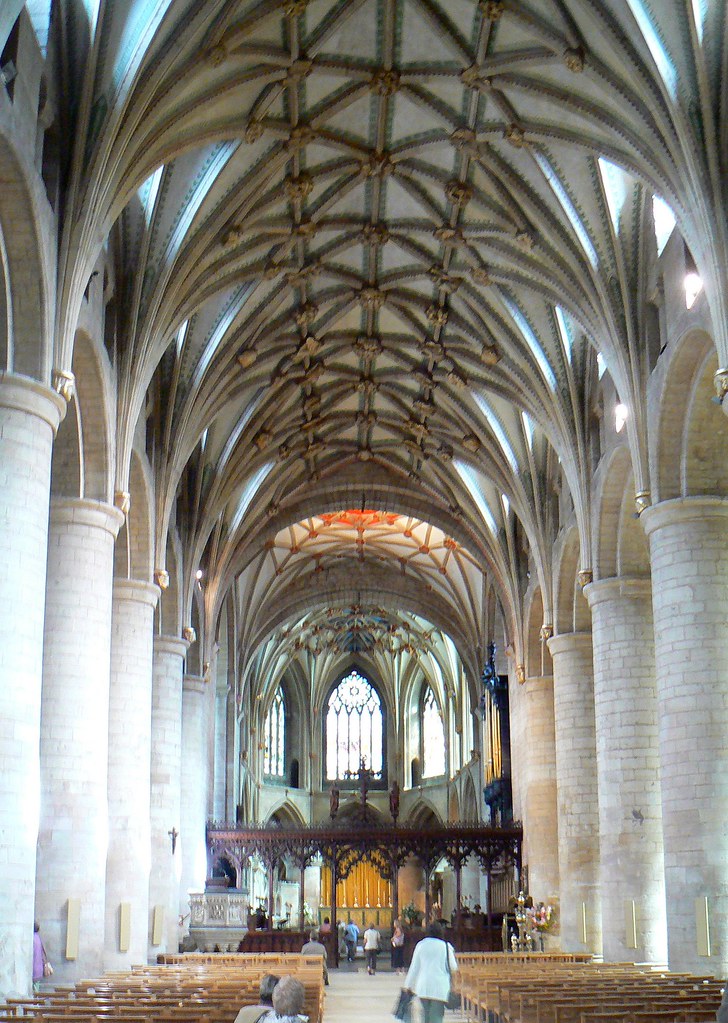
No. 1 - 4: Exploring - the Abbey Church of Saint Mary the Virgin, Tewkesbury, Gloucestershire .
The Nave whilst looking westward
The nave here was being built in all probability while the great Flambard was busy with Durham (1105-1130), and very soon after he had finished his labours at Twynham or Christchurch, Hampshire. Gloucester is generally assigned to Serlo, 1089 to 1100, and Norwich was begun in1096.
Above the arches of the nave are small double round-headed openings into a very narrow triforium walk, which is vaulted, as at Gloucester, with a quadrantal arch.
There is another peculiarity, too, here, in that the vaulting of the roof springs from corbels which rest directly on the capitals of the piers. As a result of this the roof looks low and heavy.
The triforium openings, which are divided by small shafts, similar in character to those in the tower chamber, are 5 feet 6 inches high and 4 feet 10 inches wide. The passage is 26 inches wide and 6-½ to 7 feet high.
The two western bays of the triforium are not alike. On the north the openings correspond to those in the other bays, and are not contracted to correspond with the narrowed arch below; whereas on the south side they are so contracted. By this means the square angle of the western pier was continued to the roof. On the north side the western pier ends abruptly at the capital of the respond.
The clerestory windows are partly concealed by the vaulting. Of course the original windows were much smaller, and were removed and the space enlarged when the re-roofing was done in the fourteenth century.
The Roof
-Originally, no doubt, as at Peterborough, where it remains, the inner roof was a flat panelled ceiling of wood, supported by a moulded framing. Whether the wooden roof decayed or was destroyed by fire, it was found necessary in the early part of the fourteenth century to re-roof the nave, and the present vaulting was then constructed. Beautiful though it is architecturally, it has the effect of dwarfing the nave, as it springs directly from the tops of the piers in the nave. In character it is a simple pointed vaulting, and the ribs at their many points of intersection are lavishly decorated with bosses.
Originally the vaulting was painted and gilded, but owing to the idiosyncrasies of those who fancied they were having things done "decently and in order," it was colour-washed in the early part of this century. The present scheme of colour decoration was carried out by Mr. T. Gambier Parry. Its chief merit is that it throws out the bosses in very strong relief. The bosses can be studied with an opera-glass, but it is less fatiguing to examine them with the help of a pocket mirror. There is a tradition that the bosses were carved by a monk who was not held in much esteem by his companions, and was a butt for their gibes and witticisms. Whether this was so or not, he knew how to carve rudely and effectively in stone, and long may his work remain with us. They represent in a highly pictorial manner the life of our Lord. Beginning at the west end, the central bosses depict:
(1)
The Nativity. (2) The Shepherds rendering homage.
(3) The Magi on their journey.
(4) The Magi in adoration.
(5) The finding of Christ in the Temple.
(6) The triumphal entry into Jerusalem.
(7) The Last Supper
(8) The Betrayal.
(9) The Flagellation.
(10) The Crucifixion.
(11) The Resurrection.
(12) The Ascension.
(13) The Day of Pentecost.
(14) The Coronation of the Virgin.
(15) The Last Judgment.
The other bosses contain angels bearing musical instruments of every known kind, and alternating, more or less regularly, with angels censing and angels bearing emblems of the Passion.
On the south side:
(1) Angels with pipe and tambourine.
(2) Angels with cymbals and bagpipes.
(3) Angels with hurdy-gurdy and harp.
(4) Angels with dulcimer and organ.
(5 and 6) Angels censing.
(7) St. Matthew and St. John with their emblems, a scroll and an eagle.
(8) Angel with a violin; others with emblems of the Passion, _i.e._,
posts, spear, and scourges.
On the north side are to be found:
(1) Angel with pipe and tabor; another censing.
(2) Angel with harp; another censing.
(3) Angels with rebec and zither.
(4) Angels with tabor and zither.
(5 and 6) Angels censing.
(7) St. Luke and St. Mark, with their emblems, a winged ox,
and a winged lion.
(8) Angel with a harp; others with emblems of the Passion, ie, a crown of thorns, a sponge, a cross, and a scourge.
Mr. Gambier Parry, who personally supervised, where he did not personally execute, the decoration of the roof, termed it "a marvellous specimen of English carving," and says that "together with the cathedrals of Gloucester and Norwich, it combined some of the finest features of mediæval sculpture." Further he adds that though "fine details must not be looked for, yet it exhibited a vigour of conception and a charm of inspiration which quite atoned for any
faults."
At the west end of the building are two half-figures, male and female, like the figure-heads of ships, which serve as corbels for the vaulting of the roof. They have been thought by some to represent Adam and Eve, and by others to represent the founder, Fitz-Hamon, and Sibylla his wife.
The Great West Window dates back, as far as the masonry is concerned, to 1686, and was erected then to replace the window blown in by the wind in 1661. The glass was inserted in 1886 by Rev. C.W. Grove in memory of his wife, and represents various scenes in the life of Christ. In the lowest tier is the Annunciation, with the Nativity in the centre, and the Presentation in the Temple on the right. Above is the Baptism by St. John in the Jordan, the Last Supper in the centre, the Agony in the Garden on the right. In the topmost tier is the Bearing of the Cross, the Crucifixion, and the appearance of our Lord to Mary after the Resurrection. In the head of the window are angels, those in the two side lights on either side being engaged in censing. In the central top light is Christ in Majesty, with angels. The glass is by Hardman.
The Abbey Church of Tewkesbury ...... by H.J.L.J. Masse, M.A.
London George Bell & Sons 1906
Larger size:-
farm3.static.flickr.com/2570/3974262304_c31b40b9ec_b.jpg
Taken on:-
August 29, 2007 at 11:35 BST
I often throw out a cautionary note as planet Mercury swings retrograde. Like many situations in life, we're often well into a new phase before even realizing it. Mercury retrograde can catch us all off guard. There's not much we can do about it, the delays, accidents, communication failures, mechanical and electrical breakdowns, misunderstandings, and on and on. But being aware of the increased likelihood of these things can help reduce the impact. Retrogrades tend to be reflective times with our thoughts often leading us backwards to prior times, events and people. It's a good time to take one's foot off the gas and just ease up a bit. Reflect, plan, check and double check. There's a high probability for careless mistakes now, often times not realized until after the retrograde comes to an end (that's one that always gets me, one way or another). The shadow phase of Mercury retrograde began a couple of weeks ago so the effects have already begun to play out. The actual retrograde begins today and runs through July 12. As if that's not enough, Mercury is joined in retrograde by five other planets this month. Six planets in simultaneous retrograde is a fairly unusual occurrence and could pose for some additional life challenges over the next few weeks.
Time seemed to pause for me momentarily at this abandoned farmstead one foggy morning. It was as if I'd ventured onto a Hollywood movie set. One of those scenes you see with your eyes, but also feel in your heart. Times like this I really can't believe what I'm seeing, but feeling immensely fortunate to be here. I often get this weird desire to walk into the scenes in other people's photos. Places that seem so special that I just want to be a part of, to experience them firsthand.
Check out some of these scenes you've created here:
www.flickr.com/photos/forlornphotos/galleries/72157687531...
The moon lights up the night sky and illuminates the clouds over Mt. Inglismaldie and the frozen Lake Minnewanka in Banff National Park.
The night had a high probability of the borealis, but to not avail, the moon and clouds still made it an interesting show.
Excerpt from Wikipedia:
Mount Rainier, also known as Tahoma or Tacoma, is a large active stratovolcano in the Cascade Range of the Pacific Northwest, located in Mount Rainier National Park about 59 miles (95 km) south-southeast of Seattle. With a summit elevation of 14,411 ft (4,392 m), it is the highest mountain in the U.S. state of Washington and the Cascade Range, the most topographically prominent mountain in the contiguous United States, and the tallest in the Cascade Volcanic Arc.
Due to its high probability of eruption in the near future, Mount Rainier is considered one of the most dangerous volcanoes in the world, and it is on the Decade Volcano list. The large amount of glacial ice means that Mount Rainier could produce massive lahars which could threaten the entire Puyallup River valley. According to the United States Geological Survey, "about 80,000 people and their homes are at risk in Mount Rainier’s lahar-hazard zones."
Max Hailstone - Te Tiriti o Waitangi
These marks were in all probability the first marks written by many of the chiefs as well as perhaps among the earliest examples of indigenous writing from New Zealand.”
“For the Māori people the prints represent much more than simple marks, they are part of their ancestors and as such maintain their spiritual qualities quite often moving them to tears or private reflection, quite unrelated to the Treaty’s political or legal relevance.”
en.wikipedia.org/wiki/Treaty_of_Waitangi
A dark day to sign away your heritage.
Thank you for visiting - ❤ with gratitude! Fave if you like it, add comments below, get beautiful HDR prints at qualityHDR.com.
In September we went to the Black Rock Desert in Nevada to attend Balls 24, a crazy rocket launch event with huge rockets. Some people call this event the Super Bowl of rocketry, others the Wild Wild West of rocketry. Over 300 people attended, there were teams from as far as England and Egypt. Many rockets were built in the garage from scratch, including the solid propellant for the motors.
Quite a number of rockets came down ballistic, either with some problems with the electronics, structural problems at high g-forces and supersonic speed, or parachute deployment problems. You gotta have balls to be there - the probability to get hit by a rocket is tiny but not zero.
This is the rocket of James Dougherty's team, a shiny minimum diameter vehicle taking off on an big O motor. It should have achieved around 65k AGL, but was destroyed at around 25k (half way through motor burn) when the electronics deployed the drogue chute prematurely.
I processed a balanced HDR photo from a RAW exposure.
-- © Peter Thoeny, CC BY-NC-SA 4.0, HDR, 1 RAW exposure, NEX-6, _DSC7532_hdr1bal1i
Although ten balloons were scheduled to fly this evening, only James and this other out-of-towner balloon decided to fly. (The decision to fly or not is a personal decision that each pilot makes on his own.)
The others, including myself all cancelled on the launch site. It's never an easy decision because there are a lot of people involved and a lot of money. The wind speed and direction were just not looking right at all. It's only about 5% of the time that we might cancel on the launch site due to unfavorable weather conditions (wind speed or direction, clouds, POP/ probability of precipitation, visibility/haze/fog)
Although we may be able to have a perfectly safe flight, increasing pressures from landowners and other controlling agencies (like an unreasonable, out-of-control-extremist park ranger) means we need to err on the side of caution when targeting landing areas.
James and the other guy ended up having a beautiful flight to 'The Postage Stamp' A few of the pilots who cancelled, including me, were there to greet him and conditions were perfect for this twilight shot. I think his new balloon has one of the most beautiful color patterns I've seen in a long time.
(James: You do not have permission to use this photo for any kind of commercial use. You made some remark to me about posting it on Flickr, so I just wanted to clarify that. But talk to me and we can work something out to spruce up your web site which is looking a little drab lately, hehehehe)
The revival protocol is complete
The revival protocol is complete, rebooting my biology. The GRIP holds me, a psychical pressure of my magnified self, exposed by the anomaly. Here, I meet a reflection of myself with crimson eyes, the colour of cosmic decay. It projects, "You see the beauty, don't you? The flawless logic of a 45 per cent probability was never about survival. It was about the sublime perfection of this…unmaking."
Podcast:
www.youtube.com/playlist?list=PLXaHuXMcUMrhIzfjKlj9clJCOf...
Meta TV
www.facebook.com/watch/100063480315046/1020837046583872/
Blogger:
www.jjfbbennett.com/2025/09/the-cryo-unit.html
FB Subscriber Hub
www.facebook.com/share/g/1AycZvNRzH/
eBook
www.amazon.com/author/jjfbbennett
Tags
#art #Spacestation #scifi #fictionalworld #story #arthouse #futuristic #spaceadventure #Sanctuary #Revitalisation #Retro #art #metaart #videoart #videoartist
Soundtrack: Tangerine Dream - "origin of supernatural probabilities"
-- somewhere between dreaming of foreign worlds and drifting through the cold, endless depths of space...
I chose to take my picture outside today. It was pretty idiotic of me to go out in a hoodie, but thankfully, I survived. That's how I tend to dress-- simply and comfortably. A pair of jeans, a plain white shirt, an American Apparel hoodie, and some sneakers. I don't really like to dress extravagantly. My shoes got really wet and gross though.. I hate how canvas shoes get wet so easily.
A bunch of people kept staring at me when I took pictures, and I don't quite understand why. I'm doing something perfectly normal in public...sure, there is the probability that people will look, but why can't they mind their own business?! One guy was passed by me on his bike and started laughing and smiling hysterically. I hope he crashed into a tree, car, or some other inanimate object that would have hurt like a bitch if you crashed into it.
I worked on my art project this afternoon. It still looks pathetic :/
I don't think I've done anything productive today. It's been a 'Suicide Sunday', if you will. Thankfully, I have off tomorrow!
I want a chicken quesadilla and Lizzie McGuire back on Disney Channel.
And a couple other things.
Currently Spinning: "With Me" - Sum 41
callous lack of empathypsychopath test pclr
please score yourself 0 1 2 3 on each of the 20 items and record your score as a comment on the total score image
The PCL-R is a clinical rating scale (rated by a psychologist or other professional) of 20 items. Each of the items in the PCL-R is scored on a three-point scale according to specific criteria through file information and a semi-structured interview. A value of 0 is assigned if the item does not apply, 1 if it applies somewhat, and 2 if it fully applies. In addition to lifestyle and criminal behavior the checklist assesses glib and superficial charm, grandiosity, need for stimulation, pathological lying, conning and manipulating, lack of remorse, callousness, poor behavioral controls, impulsivity, irresponsibility, failure to accept responsibility for one's own actions and so forth. The scores are used to predict risk for criminal re-offence and probability of rehabilitation.
The current edition of the PCL-R officially lists four factors (1.a, 1.b, 2.a, and 2.b), which summarize the 20 assessed areas via factor analysis. The previous edition of the PCL-R[5] listed two factors. Factor 1 is labelled "selfish, callous and remorseless use of others". Factor 2 is labelled as "chronically unstable, antisocial and socially deviant lifestyle". There is a high risk of recidivism and currently small likelihood of rehabilitation for those who are labelled as having "psychopathy" on the basis of the PCL-R ratings in the manual for the test, although treatment research is ongoing.
PCL-R Factors 1a and 1b are correlated with narcissistic personality disorder and histrionic personality disorder. They are associated with extraversion and positive affect. Factor 1, the so-called core personality traits of psychopathy, may even be beneficial for the psychopath (in terms of nondeviant social functioning).
PCL-R Factors 2a and 2b are particularly strongly correlated to antisocial personality disorder and criminality and are associated with reactive anger, criminality, and impulsive violence. The target group for the PCL-R is convicted criminals. The quality of ratings may depend on how much background information is available and whether the person rated is honest and forthright.
[edit] The two factorsFactor 1: Personality "Aggressive narcissism"
Glibness/superficial charm
Grandiose sense of self-worth
Pathological lying
Cunning/manipulative
Lack of remorse or guilt
Shallow affect (genuine emotion is short-lived and egocentric)
Callousness; lack of empathy
Failure to accept responsibility for own actions
Factor 2: Case history "Socially deviant lifestyle".
Need for stimulation/proneness to boredom
Parasitic lifestyle
Poor behavioral control
Lack of realistic long-term goals
Impulsivity
Irresponsibility
Juvenile delinquency
Early behavior problems
Revocation of conditional release
Traits not correlated with either factor
Promiscuous sexual behavior
Many short-term marital relationships
Criminal versatility
Acquired behavioural sociopathy/sociological conditioning (Item 21: a newly identified trait i.e. a person relying on sociological strategies and tricks to deceive)
Early factor analysis of the PCL-R indicated it consisted of two factors. Factor 1 captures traits dealing with the interpersonal and affective deficits of psychopathy (e.g. shallow affect, superficial charm, manipulativeness, lack of empathy) whereas Factor 2 dealt with symptoms relating to antisocial behaviour (e.g. criminal versatility, impulsiveness, irresponsibility, poor behaviour controls, juvenile delinquency).
The two factors have been found by those following this theory to display different correlates. Factor 1 has been correlated with narcissistic personality disorder, low anxiety, low empathy, low stress reaction and low suicide risk but high scores on scales of achievement and well-being. In addition, the use of item response theory analysis of female offender PCL-R scores indicates factor 1 items are more important in measuring and generalizing the construct of psychopathy in women than factor 2 items.
In contrast, Factor 2 was found to be related to antisocial personality disorder, social deviance, sensation seeking, low socio-economic status[6] and high risk of suicide. The two factors are nonetheless highly correlated and there are strong indications they do result from a single underlying disorder. However, research has failed to replicate the two-factor model in female samples.
Recent statistical analysis using confirmatory factor analysis by Cooke and Michie indicated a three-factor structure, with those items from factor 2 strictly relating to antisocial behaviour (criminal versatility, juvenile delinquency, revocation of conditional release, early behavioural problems and poor behavioural controls) removed from the final model. The remaining items are divided into three factors: Arrogant and Deceitful Interpersonal Style, Deficient Affective Experience and Impulsive and Irresponsible Behavioural Style.
In the most recent edition of the PCL-R, Hare adds a fourth antisocial behaviour factor, consisting of those Factor 2 items excluded in the previous model. Again, these models are presumed to be hierarchical with a single unified psychopathy disorder underlying the distinct but correlated factors.
The Cooke & Michie hierarchical ‘three’-factor model has severe statistical problems—i.e., it actually contains ten factors and results in impossible parameters (negative variances)—as well as conceptual problems. Hare and colleagues have published detailed critiques of the Cooke & Michie model. New evidence, across a range of samples and diverse measures, now supports a four-factor model of the psychopathy construct,] which represents the Interpersonal, Affective, Lifestyle, and overt Antisocial features of the personality disorder.
Diagnostic criteria and PCL-R assessmentPsychopathy is most commonly assessed with the PCL-R, which is a clinical rating scale with 20 items. Each of the items in the PCL-R is scored on a three-point (0, 1, 2) scale according to two factors. PCL-R Factor 2 is associated with reactive anger, anxiety, increased risk of suicide, criminality, and impulsive violence.
PCL-R Factor 1, in contrast, is associated with extraversion and positive affect. Factor 1, the so-called core personality traits of psychopathy, may even be beneficial for the psychopath (in terms of nondeviant social functioning). A psychopath will score high on both factors, whereas someone with APD will score high only on Factor 2.
Both case history and a semi-structured interview are used in the analysis.
Mount Shasta (Karuk: Úytaahkoo or "White Mountain") is a potentially active volcano at the southern end of the Cascade Range in Siskiyou County, California. At an elevation of 14,179 feet (4321.8 m), it is the second-highest peak in the Cascades and the fifth-highest in the state. Mount Shasta has an estimated volume of 85 cubic miles (350 km3), which makes it the most voluminous stratovolcano in the Cascade Volcanic Arc. The mountain and surrounding area are part of the Shasta–Trinity National Forest.
Mount Shasta is connected to its satellite cone of Shastina, and together they dominate the landscape. Shasta rises abruptly to tower nearly 10,000 feet (3,000 m) above its surroundings. On a clear winter day, the mountain can be seen from the floor of the Central Valley 140 miles (230 km) to the south. The mountain has attracted the attention of poets, authors, and presidents.
The mountain consists of four overlapping dormant volcanic cones that have built a complex shape, including the main summit and the prominent satellite cone of 12,330 ft (3,760 m) Shastina, which has a visibly conical form. If Shastina were a separate mountain, it would rank as the fourth-highest peak of the Cascade Range (after Mount Rainier, Rainier's Liberty Cap, and Mount Shasta itself).
Mount Shasta's surface is relatively free of deep glacial erosion except, paradoxically, for its south side where Sargents Ridge runs parallel to the U-shaped Avalanche Gulch. This is the largest glacial valley on the volcano, although it does not now have a glacier in it. There are seven named glaciers on Mount Shasta, with the four largest (Whitney, Bolam, Hotlum, and Wintun) radiating down from high on the main summit cone to below 10,000 ft (3,000 m) primarily on the north and east sides. The Whitney Glacier is the longest, and the Hotlum is the most voluminous glacier in the state of California. Three of the smaller named glaciers occupy cirques near and above 11,000 ft (3,400 m) on the south and southeast sides, including the Watkins, Konwakiton, and Mud Creek glaciers.
The oldest-known human settlement in the area dates to about 7,000 years ago.
At the time of Euro-American contact in the 1820s, the Native American tribes who lived within view of Mount Shasta included the Shasta, Okwanuchu, Modoc, Achomawi, Atsugewi, Karuk, Klamath, Wintu, and Yana tribes.
The historic eruption of Mount Shasta in 1786 may have been observed by Lapérouse, but this is disputed. Although perhaps first seen by Spanish explorers, the first reliably reported land sighting of Mount Shasta by a European or American was by Peter Skene Ogden (a leader of a Hudson's Bay Company trapping brigade) in 1826. In 1827, the name "Sasty" or "Sastise" was given to nearby Mount McLoughlin by Ogden. An 1839 map by David Burr lists the mountain as Rogers Peak. This name was apparently dropped, and the name Shasta was transferred to present-day Mount Shasta in 1841, partly as a result of work by the United States Exploring Expedition.
Beginning in the 1820s, Mount Shasta was a prominent landmark along what became known as the Siskiyou Trail, which runs at Mount Shasta's base. The Siskiyou Trail was on the track of an ancient trade and travel route of Native American footpaths between California's Central Valley and the Pacific Northwest.
The California Gold Rush brought the first Euro-American settlements into the area in the early 1850s, including at Yreka, California and Upper Soda Springs. The first recorded ascent of Mount Shasta occurred in 1854 (by Elias Pearce), after several earlier failed attempts. In 1856, the first women (Harriette Eddy, Mary Campbell McCloud, and their party) reached the summit.
By the 1860s and 1870s, Mount Shasta was the subject of scientific and literary interest. In 1854 John Rollin Ridge titled a poem "Mount Shasta." A book by California pioneer and entrepreneur James Hutchings, titled Scenes of Wonder and Curiosity in California, contained an account of an early summit trip in 1855. The summit was achieved (or nearly so) by John Muir, Josiah Whitney, Clarence King, and John Wesley Powell. In 1877, Muir wrote a dramatic popular article about his surviving an overnight blizzard on Mount Shasta by lying in the hot sulfur springs near the summit. This experience was inspiration to Kim Stanley Robinson's short story "Muir on Shasta".
The 1887 completion of the Central Pacific Railroad, built along the line of the Siskiyou Trail between California and Oregon, brought a substantial increase in tourism, lumbering, and population into the area around Mount Shasta. Early resorts and hotels, such as Shasta Springs and Upper Soda Springs, grew up along the Siskiyou Trail around Mount Shasta, catering to these early adventuresome tourists and mountaineers.
In the early 20th century, the Pacific Highway followed the track of the Siskiyou Trail to the base of Mount Shasta, leading to still more access to the mountain. Today's version of the Siskiyou Trail, Interstate 5, brings thousands of people each year to Mount Shasta.
From February 13–19, 1959, the Mount Shasta Ski Bowl obtained the record for the most snowfall during one storm in the U.S., with a total of 15.75 feet (480 cm).
Mount Shasta was declared a National Natural Landmark in December 1976.
About 593,000 years ago, andesitic lavas erupted in what is now Mount Shasta's western flank near McBride Spring. Over time, an ancestral Mount Shasta stratovolcano was built to a large but unknown height; sometime between 300,000 and 360,000 years ago the entire north side of the volcano collapsed, creating an enormous landslide or debris avalanche, 6.5 cu mi (27 km3) in volume. The slide flowed northwestward into Shasta Valley, where the Shasta River now cuts through the 28-mile-long (45 km) flow.
What remains of the oldest of Mount Shasta's four cones is exposed at Sargents Ridge on the south side of the mountain. Lavas from the Sargents Ridge vent cover the Everitt Hill shield at Mount Shasta's southern foot. The last lavas to erupt from the vent were hornblende-pyroxene andesites with a hornblende dacite dome at its summit. Glacial erosion has since modified its shape.
The next cone to form is exposed south of Mount Shasta's current summit and is called Misery Hill. It was formed 15,000 to 20,000 years ago from pyroxene andesite flows and has since been intruded by a hornblende dacite dome.
There are many buried glacial scars on the mountain which were created in recent glacial periods ("ice ages") of the present Wisconsinian glaciation. Most have since been filled in with andesite lava, pyroclastic flows, and talus from lava domes. Shastina, by comparison, has a fully intact summit crater indicating Shastina developed after the last ice age. Shastina has been built by mostly pyroxene andesite lava flows. Some 9,500 years ago, these flows reached about 6.8 mi (10.9 km) south and 3 mi (4.8 km) north of the area now occupied by nearby Black Butte. The last eruptions formed Shastina's present summit about a hundred years later. But before that, Shastina, along with the then forming Black Butte dacite plug dome complex to the west, created numerous pyroclastic flows that covered 43 sq mi (110 km2), including large parts of what is now Mount Shasta, California and Weed, California. Diller Canyon (400 ft (120 m) deep and 0.25 mi (400 m) wide) is an avalanche chute that was probably carved into Shastina's western face by these flows.
The last to form, and the highest cone, the Hotlum Cone, formed about 8,000 years ago. It is named after the Hotlum glacier on its northern face; its longest lava flow, the 500-foot-thick (150-metre) Military Pass flow, extends 5.5 mi (8.9 km) down its northeast face. Since the creation of the Hotlum Cone, a dacite dome intruded the cone and now forms the summit. The rock at the 600-foot-wide (180-metre) summit crater has been extensively hydrothermally altered by sulfurous hot springs and fumaroles there (only a few examples still remain).
In the last 8,000 years, the Hotlum Cone has erupted at least eight or nine times. About 200 years ago the last significant Mount Shasta eruption came from this cone and created a pyroclastic flow, a hot lahar (mudflow), and three cold lahars, which streamed 7.5 mi (12.1 km) down Mount Shasta's east flank via Ash Creek. A separate hot lahar went 12 mi (19 km) down Mud Creek. This eruption was thought to have been observed by the explorer La Pérouse, from his ship off the California coast, in 1786, but this has been disputed.
During the last 10,000 years, Mount Shasta has erupted an average of every 800 years, but in the past 4,500 years the volcano has erupted an average of every 600 years. The last significant eruption on Mount Shasta may have occurred about two centuries ago.
USGS seismometers and GPS receivers operated by UNAVCO form the monitoring network for Mount Shasta. The volcano has been relatively quiet for at least the past 15 years, with only a handful of small magnitude earthquakes and no demonstrable ground deformation. Although geophysically quiet, periodic geochemical surveys indicate that volcanic gas emanates from a fumarole at the summit of Mount Shasta from a deep-seated reservoir of partly molten rock.
Mount Shasta can release volcanic ash, pyroclastic flows or dacite and andesite lava. Its deposits can be detected under nearby small towns. Mount Shasta has an explosive, eruptive history. There are fumaroles on the mountain, which show Mount Shasta is still alive.
The worst-case scenario for an eruption is a large pyroclastic flow, similar to that which occurred in the 1980 eruption of Mount St. Helens. Since there is ice, such as Whitney Glacier and Mud Creek Glacier, lahars would also result. Ash would probably blow inland, perhaps as far as eastern Nevada. There is a small chance an eruption could result in a collapse of the mountain, as happened when Mount Mazama in Oregon collapsed to form what is now called Crater Lake, but this is of much lower probability.
The United States Geological Survey monitors Mount Shasta and rates it as a very high-threat volcano.
The summer climbing season runs from late April until October, although many attempts are made in the winter. In winter, Sargents Ridge and Casaval Ridge, to the east and west of Avalanche Gulch, respectively, become the most traveled routes, to avoid avalanche danger. Mount Shasta is also a popular destination for backcountry skiing. Many of the climbing routes can be descended by experienced skiers, and there are numerous lower-angled areas around the base of the mountain.
The most popular route on Mount Shasta is Avalanche Gulch route, which begins at the Bunny Flat Trailhead and gains about 7,300 feet (2,200 m) of elevation in approximately 11.5 miles (18.5 km) round trip. The crux of this route is considered to be to climb from Lake Helen, at approximately 10,443 feet (3,183 m), to the top of Red Banks. The Red Banks are the most technical portion of the climb, as they are usually full of snow/ice, are very steep, and top out at around 13,000 feet (4,000 m) before the route heads to Misery Hill. The Casaval Ridge route is a steeper, more technical route on the mountain's southwest ridge best climbed when there's a lot of snow pack. This route tops out to the left (north) of the Red Banks, directly west of Misery Hill. So the final sections involve a trudge up Misery Hill to the summit plateau, similar to the Avalanche Gulch route.
No quota system currently exists for climbing Mount Shasta, and reservations are not required. However, climbers must obtain a summit pass and a wilderness permit to climb the mountain. Permits and passes are available at the ranger station in Mount Shasta and the ranger station in McCloud, or climbers can obtain self-issue permits and passes at any of the trailheads 24 hours a day.
(Wikipedia)
Der Mount Shasta ist ein zu der Kaskadenkette gehörender Vulkan im Norden des US-Bundesstaats Kalifornien.
Er ist mit einer Höhe von 4322 m nach dem Mount Rainier der zweithöchste Berg dieser Gebirgskette und einer der höchsten Berge Kaliforniens. Daneben ist er der zweithöchste Vulkan der USA.
Der Mount Shasta ist vulkanisch aktiv; der letzte Ausbruch fand im Jahre 1786 statt. Die Gipfelregion ist von fünf Gletschern bedeckt, darunter auch der größte Kaliforniens, der Whitney Glacier.
Die Erstbesteigung fand 1854 statt. Im Jahr 1998 gelang es Robert Webb, den Gipfel innerhalb von 24 Stunden sechsmal zu erklimmen. Er stieg insgesamt 11.500 Meter hoch, was einen Weltrekord darstellte.
Der gleichnamige Ort Mount Shasta mit etwa 3000 Einwohnern liegt am Fuß des Berges auf 1100 Metern Seehöhe. Er ist Ausgangspunkt für Wassersport-Trips zum vier Kilometer entfernten Siskiyou-See.
(Wikipedia)
Title inspired by one of the greatest Rock Bands of all time: Dire Straits.
It was an amazing morning on the quayside, and surprising how quiet it was that time of the morning, the ducks making plenty of noise and my wife talking rather loudly to me - I was thinking if the residents weren't awake before, then there was a high probability they were shortly after we arrived.
So if you live here, sorry about that!... whispering is an alien concept for my wife!
It's the possibility of having a dream come true that makes life interesting.
( Paulo Coelho )
Not the mere possibility, the probability (however small)!
( norcal d.d. )
- - - - - - - - - - - - - - - -
Taken in Leicestershire, I was visiting because a ♂ Common Scoter was seen the day before, I knew it was a longshot has Scoters migrate at night so the probability of it still being there was quite small, but there was a long stay bird that I could spend my time with.
We didn't find the Scoter but the Ring-necked duck was very obliging and the closest that I had seen it.
The light was very variable as you can tell by the differences in the water colour, but a very enjoyable couple of hours.
1967 Mustang Convertible...
the Mississauga Promenade Center 15th Annual Cruisin' for A Cure Canada;
Something I have been a huge supporter of in the past. The Car Show That Saves Men's Lives, which is held annually at the Powerade center in Brampton.
that was the first one in three years as Coiid shut it down and this is the first one since 2019. the turn out was amazing with over 400 cars participating and a smaller than typical crowd of only 3000. hopefully this year will be better.
Please tell your husbands, fathers, uncles, grandfather brothers and any man you care about to get a PSA test it changes the odds from 5 % survivability to 93%.
Prostate cancer is the second leading cause of cancer death in American men, behind lung cancer. About 1 man in 41 will die of prostate cancer. Prostate cancer can be a fatal disease, but due to early detection most men diagnosed with prostate cancer will not die from it.
74% of prostate cancers are diagnosed early at Stage I and II. The probability of surviving prostate cancer at least five years after diagnosis is about 93% in Canada.
For more information check out the website for the car show.
www.cruisinforacurecanada.com/About.htm
Thank you for visiting for marking my photo as a favorite and for the kind comments,
Please do not copy my image or use it on websites, blogs or other media without my express permission.
© NICK MUNROE (MUNROE PHOTOGRAPHY)
You can contact me
by email @
karenick23@yahoo.ca
munroephotographic@gmail.com
munroedesignsphotography@gmail.com
or on Facebook @
www.facebook.com/MunroePhotography/
On Instagram
Wetterlage
Teils bewölkt
17° Grad
Nächste Woche
durchwachsen
21 23 21 21 21 Grad
Teils bewölkt
eventuell Regen
●
Weather forecast for today
Sunday, 24. May
05:30
21:09
CEST
Partly Cloudy
19°C / 8°C
Wind: 26 km/h WNW
Humidity: 40%
Precip. probability: 10%
Precipitation: 0 mm
UV index: 6
A mix of clouds and sun. High 19C. Winds WNW at 15 to 30 km/h
#AbFav_LOVE_❤
MESMERISING aren't they? OP-HEARTS or POP-HEARTS? LOL? Best not 'jiggle' it about!
If you and your mate master these values, your love will, in all probability, last a lifetime.
1. The couple in love is committed to always putting each other first in their relationship with each other.
2. The couple in love is committed to democracy in their relationship.
3. The couple in love is committed to ensuring their mutual happiness.
4. The couple in love values absolute trustworthiness and integrity in their relationship with each other.
5. The couple in love is committed to caring and unconditional love for each other.
6. The couple in love is committed to being mutually respectful towards each other.
7. The couple in love values their mutual sense of responsibility for each other.
A special day, but don't forget, Valentine... love not just ONE day... but 365?
Have a day filled with love, M, (*_*)
For more: www.indigo2photography.com
IT IS STRICTLY FORBIDDEN (BY LAW!!!) TO USE ANY OF MY image or TEXT on websites, blogs or any other media without my explicit permission. © All rights reserved
Valentine, KITCHEN-GADGETS, red, prickers, utensils, kitchen, tools, wood, studio, hearts, colour, square, "Nikon D7000", black-background, "magda indigo"
One morning recently on a sunrise hike, we had the treat of seeing a few foxes. This young Red Fox had a case of the zoomies. At one point she came trotting over the rise of the hill and there we were, she stopped and watched us from about 30 feet away and then "zoomed" on up the hill and back down close to where we were again. Such a beautiful animal.
Unfortunately, she seems to have lost her fear of humans due to the area they live and the probability that people are feeding them. Please do not feed wildlife, for their health and safety!
Darwin's beetle, Grant's stag beetle, or the Chilean stag beetle. Charles Darwin collected the species in Chile during the second voyage
Variable in size and in the development of the jaws and exhibits a strong sexual dimorphism. Males can reach a length of 60–90 millimetres (2.4–3.5 in) including the mandibles, while females are much smaller, having a body length of 25–37 millimetres (0.98–1.46 in). The upper mandibles of the males are very robust at the base, finely serrated and longer than the body itself.
C. grantii is considered a rare and vulnerable species, with a high probability of extinction, mainly as a consequence of the global climate change.
The male's over-sized jaws are crucial in its objective to secure a mate. It climbs trees, often climbing many meters, searching for a female. As it climbs and searches for females, it also seeks out other males in the vicinity. When two males meet, they fight. Males use their jaws in combat: they hook them under the opposite beetle's wings, pull up and throw their opponent to the ground (from 20 meters above, as they are in great trees most of the time).
I have seen big numbers dead under the big trees.
They can fly ...scary!
In February 1848 Rep. Abraham Lincoln explained his opposition to the Mexican War: "Allow the President to invade a neighboring nation, whenever he shall deem it necessary to repel an invasion and you allow him to do so whenever he may choose to say he deems it necessary for such purpose -- and you allow him to make war at pleasure [emphasis added]. . . . If, today, he should choose to say he thinks it necessary to invade Canada to prevent the British from invading us, how could you stop him? You may say to him, 'I see no probability of the British invading us'; but he will say to you, 'Be silent; I see it, if you don't.' "
iconographer: Wayne Hajos
Since, then, there was needed a lifting up from death for the whole of our nature, He stretches forth a hand as it were to prostrate humanity, and stooping down to our dead corpse He came so far within the grasp of death as to touch a state of deadness, and then in His own body to bestow on our nature the principle of the resurrection, raising as He did by His power along with Himself the whole human being. For since from no other source than from the concrete lump of our nature had come that flesh, which was the receptacle of the Godhead and in the resurrection was raised up together with that Godhead, therefore just in the same way as, in the instance of this body of ours, the operation of one of the organs of sense is felt at once by the whole system, as one with that member, so also the resurrection principle of this Member, as though the whole of humankind was a single living being, passes through the entire race, being imparted from the Member to the whole by virtue of the continuity and oneness of the nature. What, then, is there beyond the bounds of probability in what this Revelation teaches us; viz. that He Who stands upright stoops to one who has fallen, in order to lift him up from his prostrate condition?
Gregory of Nyssa,
The Great Catechism, 32
Sorry about the lack of activity over the past month or however long it’s been, I’ve just been *insert excuse here* for a while now and it’s been hard to find time for Flickr. Summer break is only a few weeks away though so I should be posting more frequently(unless I get lazy which has a high probability)
Anyways
Here are some figures
They’re inspired by infinity war or something but not really war machine cuz he looks nothing like that in Infinity War but anyways I’m rambling now so lego. I’m gonna update War Machine later because he was very quickly put together for the sole purpose of filling up this photo...
In case it was unclear before you clicked on this image, I was having way too much fun editing this shot (so naturally, that means others won't like it). Because I played a majority of the games I knew exactly what I wanted from a shot of Bowser's Castle, even if it looked unnatural.
While I was at USJ's Super Nintendo World I was throwing everything I could against the wall and would wait to see what stuck once I got back to the states. Replicating the model of the castle from Mk8 as an entrance for the Mario Kart ride was a genius way to incorporate this staple of the franchise in the mushroom kingdom, and I must say it looked really good. Once I had the vision I couldn't get it out until it was right there.
Taking inspiration from World and New U, I gave the sky a hint of red to signify the sinister nature of this particular corner of this universe. I raised the temperature on the side of the image, determined to weaken the color blue particularly. The castle is 4 differently shaded pieces. So basically, almost nothing in this image is how it originally looked.
I didn't have enough data to remove everyone from the photo, but I successfully removed 2 people by hand (because the ai tool was of no help whatsoever). The ground specifically had a one sided vignette to help center the lighting.
The most abundant of evil (though at times not the worst) brews inside those walls and is not for the faint hearted. Thousands of species of various strengths and sizes working under Lord Bowser. Unless you are specifically the Mario brothers, there is a high probability you won't last long. His power and rage knows no limits and he will never stop coming for Peach, it's honestly inspiring and I see why so many besides Toads look up to him, all hail King Bowser.
Macro Monday project – 09/08/10
"Personal Soundtrack"
Listen to this great song by Sting .
The song is about a man who is a master card-player but plays to find some divine, almost spiritual meaning to the probabilities of the game. He is so involved in the game that he is almost emotionless, and this affects his relationships aversely.
He isn't a man who used to express his feelings,but he wants to. However he knows that he is only a man of one "face", which is the "mask" he hides behind, his poker-face.
If you're interested in purchasing this print ,please contact me : violetkashi@gmail.com
A caribou biologist told me that if I ever encounter one on the open tundra and want it to come closer, "Just lie down. They're curious - they have to find out where you went." So, the following summer in the Burwash Uplands, I did just that: lay down on my back, hand holding a 200mm lens. And sure enough, this caribou bull couldn't resist, sidling in with much snorting and hesitation until he was within range.
These are non-migratory caribou, in the summertime found in small, scattered herds throughout the area. Their main predators are wolves, and a few days after getting this shot I was thrilled to witness a wolf-caribou chase. It wasn't close - the caribou easily escaped - and unfortunately I wasn't close enough for good photos.
Amphitheatre Mountain sprawls in the background here, a volcanic remnant, heavily eroded on one side. It's an easy hike via the other side, and then a fabulous ridge walk, with a high probability of finding Dall Sheep on top. One year I located a Red Fox den on the eroded side, was all set to return the next day and set up for a fabulous shoot - and a bilizzard arrived overnight, snowing us in for three days. Opportunity lost; we'd already been out there nearly two weeks and were running short of food and fuel for the camp stove. When the storm finally broke, we had no choice but to pack out. But that's another story...
Photographed in the Burwash Uplands, Kluane National Park, Yukon (Canada); scanned from the original Kodachrome 64 slide. Don't use this image on websites, blogs, or other media without explicit permission ©1983 James R. Page - all rights reserved.
The Charger That Changes Lives...
Yesterday I attended the the 14th Annual Cruisin' for A Cure Canada;
Something I have been a huge supporter of in the past. The Car Show That Saves Men's Lives, which is held annually at the Powerade center in Brampton.
Yesterday was the first one in three years as Coiid shut it down and this is the first one since 2019. the turn out was amazing with over 400 cars participating and a smaller than typical crowd of only 3000. hopefully next year will be better.
This is a shot of a 1970 Dodge Charger Sleeper car. it boasts almost 700hp and is a tuned racing machine.
Please tell your husbands, fathers, uncles, grandfather brothers and any man you care about to get a PSA test it changes the odds from 5 % survivability to 93%.
Prostate cancer is the second leading cause of cancer death in American men, behind lung cancer. About 1 man in 41 will die of prostate cancer. Prostate cancer can be a fatal disease, but due to early detection most men diagnosed with prostate cancer will not die from it.
74% of prostate cancers are diagnosed early at Stage I and II. The probability of surviving prostate cancer at least five years after diagnosis is about 93% in Canada.
For more information check out the website for the car show.
www.cruisinforacurecanada.com/About.htm
Thank you for visiting for marking my photo as a favorite and for the kind comments,
Please do not copy my image or use it on websites, blogs or other media without my express permission.
© NICK MUNROE (MUNROE PHOTOGRAPHY)
You can contact me
by email @
karenick23@yahoo.ca
munroephotographic@gmail.com
munroedesignsphotography@gmail.com
or on Facebook @
www.facebook.com/MunroePhotography/
On Instagram