View allAll Photos Tagged Line
Athens, GA (Clarke County). Copyright 2007 D. Nelson
Looking down E. Broad St. with the Norfolk Southern railroad line in the center and the F.M. Coker Cotton Warehouse on the right. The warehouse is part of the Warehouse Historic District as which was added to the National Register for Historic Places in 1988.
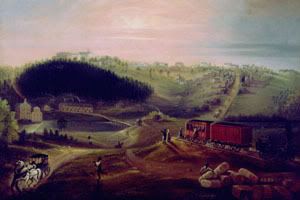
The Warehouse Historic District was developed relatively late because construction of the Georgia Railroad from Augusta in 1841 failed to bridge the North Oconee River, terminating instead at Carr's Hill on the east side opposite the Athens Factory; for the next forty years Athenians had to tediously haul freight from Carr's Hill across the river by wagon, as seen here. The Georgia Railroad finally bridged the river and built a new depot in the 1880s for both freight and passenger service, and by 1893 the district had begun to assume its present character. The Seaboard Railroad added another freight depot to the district at the turn of the century, and two other railroads later known as the Central of Georgia extended rail service to the warehouses on Foundry Street.
Stimulated by these rail connections, the warehouse district became a bustling area of shipping, wholesale, and storage enterprises including grocery distribution, cotton and fertilizer warehousing, and small industry; by 1926 it had become almost exclusively a warehouse and wholesale center.
The Farmers Hardware Building (not shown) has recently been converted into lofts; the Hodgsons Oil Building (not shown) has been renovated and is now home to the UGA Police Department, Office of Public Affairs, and the Office of Real Estate and Space Management. The strip of run-down little warehouses along Foundry Street behind today's Classic Center have been very much cleaned up and the addition of a new bus and train station as well as a highrise building seen here on the left have given the area quite a different and urban feel.
Yoyogi National Stadium. A bunch of teen girls waiting for some pop boyband later that evening. This was like at 10am.
Ilford Delta 400
Minolta CLE
Minolta M-Rokkor 40mm F/2
The London Underground 1972 Stock is a fleet of trains used on the London Underground. The 1972 Stock was ordered to make up the shortfall in trains on the Northern line's 1959 Tube Stock fleet. It is, however, currently used on the Bakerloo line.
Since July 2011 it is the oldest Tube stock in service on London Underground, after the 1967 Stock on the Victoria Line was permanently withdrawn on 30 June 2011.
The Bakerloo Line serves 25 stations, of which 15 are underground. It is the ninth busiest line on the network with over 111 million passengers annually.
With fifteen player on each side in a Rugby Union match plus the substitutes the line-ups are pretty long!
Durante la crisis del petróleo de mediados de los 70, la General Motors en EE.UU. tomó varias medidas. Una de éstas fué dotar a todas sus divisiones de una versión del compacto, para EE.UU., Chevrolet Nova con los motores correspondientes a cada división. Todos, menos Cadillac, hicieron versiones ligeramente modificadas para dotarlas de una identidad propia. Cadillac presentó su versión mucho después que las otras divisiones con importantes cambios entre los que se encontraban una carrocería totalmente distinta y una suspensión completamente rediseñada por los ingenieros de Cadillac. Como los motores Cadillac eran demasiado grandes para un coche de estas dimensiones, tomaron por base el motor 5,7 litros 8 en V de la Oldsmobile y le añadieron inyección como el motor Cadillac. El interior era también totalmente distinto con el lujo que se espera en un Cadillac. Después de todo, Cadillac quería este modelo para competir con Mercedes que ya empezaba a incomodar al gigante del lujo. Las ventas fueron muy buenas y posteriormente se le añadió el motor diesel de la Oldsmobile pero este motor fué lanzado precipidamente al mercado y tuvo problemas que afectaron su imagen.
Why does no one comment my photos..? They only get favorited.. You know, I enjoy getting comments too. *hint hint*
Good publicity for Southern Transit's Adur Valley Line service at Horsham Station today, 6th March, 2017, and amazingly takeaway timetables are available from the bus stop.
Feeding their fledglings is a mammoth task for a pair of swallows. Both parents were coming in at an average of one minute intervals. The second image shows the frustration of one who feels he has missed is turn! :)
A tunnel between terminals at the Detroit airport, illuminated in green and purple. Very outworldish experience!
1502 stopping at Judah and 31st. We're on the last leg of a six mile walk on the first day of the holiday and the only day that we didn't avail ourselves of the superb transport system in this city!
This flag used to fly from the stern of the steamboat Bailey Gatzert when it plyied the waters of the mighty and as-yet untamed Columbia River.
One of the oldest buildings in The Dalles, Oregon, has a large sign for the Regulator Line on the side.
Columbia Gorge Interpretive Center Museum, Stevenson, Washington.
1960/07.R393. The train seen at Sheffield Park in previous shots proceeded up the line, complete with the camera crew aloft on STEPNEY.
At that time, the Bluebell Line was denied access to Horsted Keynes station and had to stop short a bit down the line. The sleepers visible in the grass on the left were ready for a gang of volunteers to build a temporary halt at this spot.
July, 1960. Copyright © Ron Fisher.
MODEL : follow the line Kesenia
FASHION :
Combinaison : Clear lan
Belt : Vanessa dress code
Bracelet : colour my world Darla
Shoes : bionica Jordan
I was experimenting some redress on my gorgeous Kesenia and though this one was an interesting mix of colors. Since I am lazy today, I just put her on my sofa and took these shots. Didn't even attached the shoes :-)
Purple and navy blue works great on her (+ red to wake up the silhouette !) With her palette she could be a great model for the next Yves Saint-laurent Opium Poison perfume !!!
Boro’line 261, a Bristol LH with Eastern Coachworks bodywork new to East Kent in 1975. The bus is seen at the Queens Monument in Maidstone with a service to Leeds and Hollingbourne.
Seen here at the old Hertford Garage in the mid-1980's is Leyland Tiger / Plaxton A124 EPA displaying the then current Green Line livery. The vehicle later worked for Southend Transport and then Meridian Line of Kneesworth.
Scanned from an acquired, un-copyrighted negative.
Tokina 11-16mm f2,8
Heliport of the boat Mariela who covers the line between Helsinki and Stockholm.
Peak Season Special...
ANICETO BUS LINE
Bus: 7-21
Bus Engine: Isuzu 10PC1
Bus Body Model: Isuzu IK COACH (High Deck)
Seating Configuration: 2X2X41
Classification: Regular Airconditioned Bus
December 23, 2009
Aniceto Bus Line Terminal, Manila
Thanks to Jessica Truscott for the original Image:
faestock.deviantart.com/art/Dusk6-394374430
See the many faces of Jessica Truscott here: