View allAll Photos Tagged Insignificant
Their inner coldness surrounded me and sent cold shivers up and down my spine.
I felt numb, insecure, insignificant, I didn't belong.
But I do belong. And I'm still here.
Krka National Park - Šibenik-Knin - Croatia
Krka National Park (Croatian: Nacionalni park Krka) is one of the Croatian national parks, named after the river Krka that it encloses. It is located along the middle-lower course of the Krka River in central Dalmatia, in Šibenik-Knin county, downstream Miljevci area, and just a few kilometers northeast of the city of Šibenik. It was formed to protect the Krka River and is intended primarily for scientific, cultural, educational, recreational, and tourism activities. It is the seventh national park in Croatia and was proclaimed a national park in 1985.
The Park is a spacious, largely unchanged region of exceptional and multifaceted natural value, and includes one or more preserved or insignificantly altered ecosystems. The Krka Waterfalls has the second highest concentration of lavender per km squared in Europe, hence the high frequency of wasps and bees in the area.
Almost everything you do will seem insignificant, but it is important that you do it” ~ Mahatma Gandhi
In many photos, at first glance Bella looks quite similar to Daisy. But Bella’s nose has brown fur, compared with Daisy’s white fur. Even more important is the tiny mark on her nose, only noticed when fairly close to her. It’s a constant reminder to me of Bella’s bravery & that I am very lucky to have her. She nearly died when hit by a car & had dreadful injuries - a charity rescued her, their amazing vets saved her life & after a few months she was ready to be rehomed. I was the lucky person who was allowed to adopt her. Her tiny scar is the most obvious sign of all that happened - insignificant compared with the broken bones & internal injuries, but very important to me.
Happy Caturday.
view very large
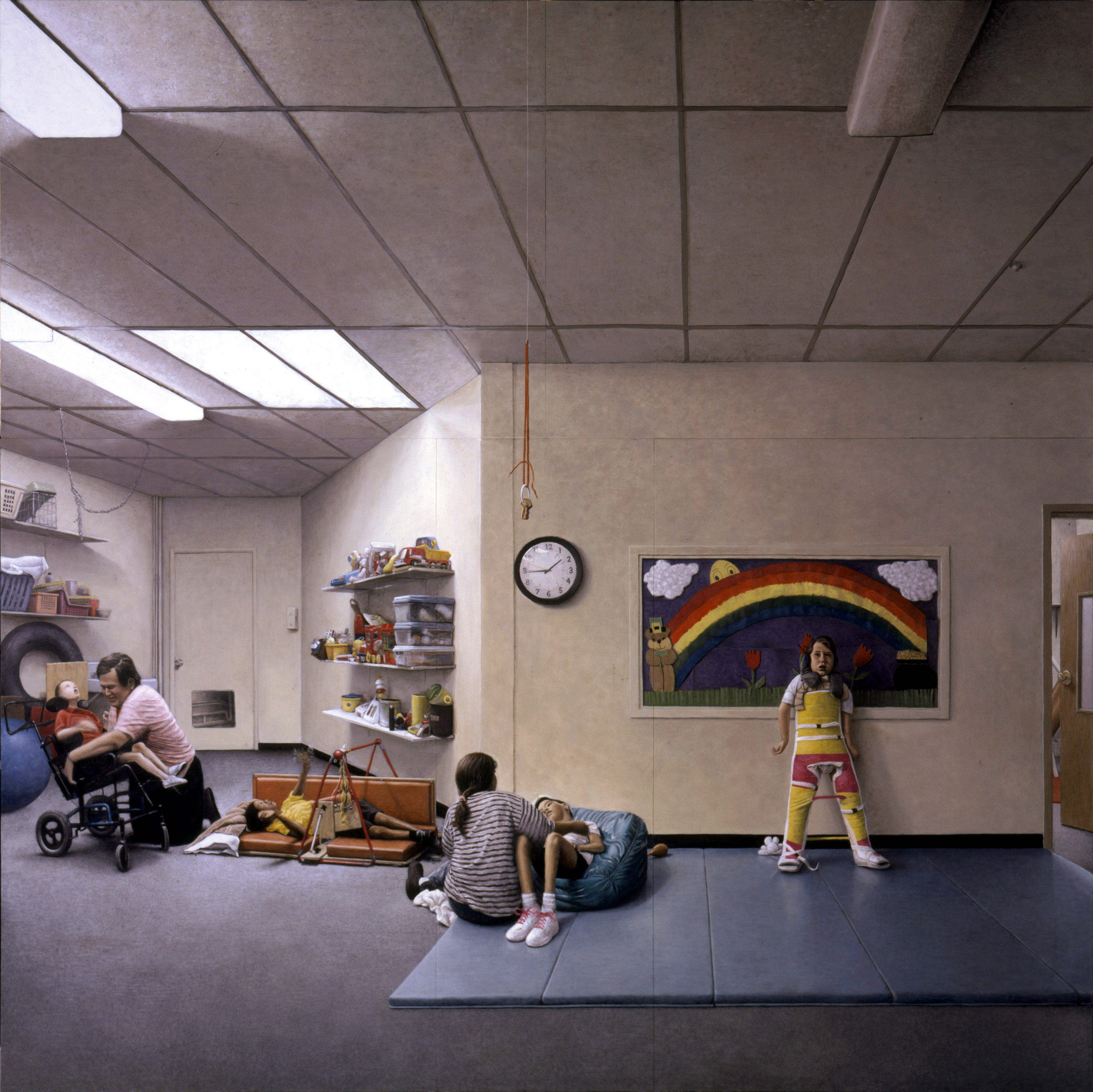
Big Picture, Tim Lowly © 1997, 120" x 120", tempera on panel. Private collection, Seoul, Korea.
This painting was part of an exhibition at Art Space Seoul in Korea. It was the first of several large paintings I have made where I intentionally engaged the convention of “the big picture” as the territory of politically or religiously charged spectacle. In size Big Picture, references the painting Las Meninas by Velázquez: a painting that in itself subverts convention. In Las Meninas, Velázquez’s most important painting as the court painter, he chose to include and emphasize the representation people who were in service in the court (including himself) while relegating the king and queen to a reflection in the mirror. Implicitly, but not insignificantly the viewers of the painting are standing where the reflected royalty should (according to the mirror) be standing. In a parallel manner the painting Big Picture,’s use of a rather compelling perspective (particularly for anyone who is in the room with the actual painting) situates the viewer of the painting in the painting. Let me rephrase this latter point: the way this work is functioning is such as to place the viewer into the world of the painting. As such to the extent that the painting is spectacle it is not one that allows or encourages a passive, removed observation.
For the exhibition catalogue curator Soo-Jin Park wrote this essay.
Assistance with the production of this painting was provided by interns Dean Olson Ramos, Deborah Hendriksma Anderson and Kim So-Jeong.
Prints available at: timlowly.imagekind.com/
Ullapool is a village and port located in Northern Scotland. Ullapool has a population of approximately 1,500 inhabitants. It is located around 45 miles northwest of Inverness in Ross and Cromarty, Scottish Highlands. Despite its modest size, it is the largest settlement for many miles around. It is an important port and tourist destination. The North Atlantic Drift passes Ullapool, moderating the temperature. A few Cordyline australis (New Zealand cabbage trees) are grown in the town and are often mistaken for palm trees. The Ullapool River flows through the town, which lies on Loch Broom, on the A835 road from Inverness.
It is in the civil parish and community council area of Lochbroom.
On the east shore of Loch Broom, Ullapool was founded in 1788 as a herring port by the British Fisheries Society.[6] It was designed by Thomas Telford. Prior to 1788 the town was only an insignificant hamlet made up of just over 20 households. The harbour is used as a fishing port, yachting haven, and ferry port. Ferries sail to Stornoway in the Outer Hebrides.
A road to link Ullapool with Dingwall was commenced in 1792. The village was historically in Cromartyshire, a county made up of many separate enclaves scattered across northern Ross-shire. Cromartyshire was abolished and combined with surrounding Ross-shire in 1890.
Many of the pivotal Victorian era discoveries[example needed] that informed the concept of plate tectonics were made in this area. There are still regular international geological conferences[example needed] held in Ullapool, which has been described as the top geological hotspot in Scotland.
Parliament granted permission in the 1890s for a railway from Ullapool to the main Highland network at Garve, but the scheme was abandoned due to insufficient funds.
The name is possibly derived from the Norse for "Wool farm" or "Ulli's farm".
The clouds would probably be regarded as insignificant elsewhere, but here in the Sonoran Desert in June, their arrival signals the beginning of the summer monsoon season, when (we hope) we'll be blessed with rain ... and get to smell the pleasamt aromatic scent of the creosote bushes (aka 'chaparral') which is released only when it rains.
Whilst the human population are pre-occupied with their pandemic, another more hidden crisis is hitting the natural world, that of a huge reduction in insect numbers worldwide. Sadly, many wildflower meadows and wildflower species, which specialist insects rely on for their life cycles are being obliterated at an alarming rate. Therefore, think twice before you pull up a dandelion. I found this very small and insignificant-looking dull brown fly on a small dandelion flower yesterday. It could be a yellow-legged centurion, a robber or a soldier fly, but I am no expert and there are very many fly species. In our garden, they arrive in ones or twos but are very scarce indeed and getting more so. What looked very dull and insignificant on the dandelion, was so much more colourful and beautiful on screen. But dull and insignificant this fly certainly isn't. These small creatures are vital links in the food chain and every effort must be made to preserve the most lowly.
Ullapool is a village and port located in Northern Scotland. Ullapool has a population of approximately 1,500 inhabitants. It is located around 45 miles northwest of Inverness in Ross and Cromarty, Scottish Highlands. Despite its modest size, it is the largest settlement for many miles around. It is an important port and tourist destination. The North Atlantic Drift passes Ullapool, moderating the temperature. A few Cordyline australis (New Zealand cabbage trees) are grown in the town and are often mistaken for palm trees. The Ullapool River flows through the town, which lies on Loch Broom, on the A835 road from Inverness.
It is in the civil parish and community council area of Lochbroom.
On the east shore of Loch Broom, Ullapool was founded in 1788 as a herring port by the British Fisheries Society.[6] It was designed by Thomas Telford. Prior to 1788 the town was only an insignificant hamlet made up of just over 20 households. The harbour is used as a fishing port, yachting haven, and ferry port. Ferries sail to Stornoway in the Outer Hebrides.
A road to link Ullapool with Dingwall was commenced in 1792. The village was historically in Cromartyshire, a county made up of many separate enclaves scattered across northern Ross-shire. Cromartyshire was abolished and combined with surrounding Ross-shire in 1890.
Many of the pivotal Victorian era discoveries[example needed] that informed the concept of plate tectonics were made in this area. There are still regular international geological conferences[example needed] held in Ullapool, which has been described as the top geological hotspot in Scotland.
Parliament granted permission in the 1890s for a railway from Ullapool to the main Highland network at Garve, but the scheme was abandoned due to insufficient funds.
The name is possibly derived from the Norse for "Wool farm" or "Ulli's farm".
#AB_FAV_SUMMER_to_AUTUM_ 🍄🍁🍂
In my garden, this is the only plant I do not know the name of!
I bought it on the market, years ago, it had a lovely photo of how it would become, no name though... shows again how deceptive photos can be, LOL!
Anyway, it is not very big, very hardy, with insignificant small leaves, in late Spring... it grows insignificant little white flowers, mostly hidden under the leaves, in Summer it is ... just there?
Then comes Autumn, and the leaves turn on all the colours of the rainbow, for a few short weeks it becomes an ABSOLUTE focal point of attraction in the garden... pure GLORY... then it's gone again... till next year!
I thought I'd share this with you.
THANK you for ALL your comments and visits, so appreciated.
Have a wonderful day, filled with love and beauty, M, (*_*)
For more: www.indigo2photography.com
IT IS STRICTLY FORBIDDEN (BY LAW!!!) TO USE ANY OF MY image or TEXT on websites, blogs or any other media without my explicit permission. © All rights reserved
LEAVES, DESIGN, Autumn, yellow, red, golden, green, studio, black-background, colour, square, "Nikon D7000", "Magda indigo"
With the huge gas storage facility at Grain on the horizon and the pylons marching across the fields to the E.ON combined heat and power station 66004 Climate Hero trailing its rake of blue grey stock looks rather insignificant as the punters on the Doctor Syn railtour, 1Z41, are treated to a run down the branch.
#42 ( Explored)
Cropped version with 300 mm lens!!
Thanks Flickr and to all for the likes and appreciations
The Tailed Jay butterfly (Graphium agamemnon) is a striking species found in South and Southeast Asia. Its vibrant colors and elongated tail-like extensions make it easily recognizable. The wings are primarily black with light green bands and spots, while the tails are thin and elongated. These butterflies are known for their graceful flight and are often found in forested areas, gardens, and parks.
They typically feed on nectar from flowers and play a role in pollination. The Tailed Jay undergoes a complete metamorphosis, transitioning from egg to larva (caterpillar) to pupa (chrysalis) before emerging as a beautiful adult butterfly.
in the comments section I am getting some really awesome comments to lift me up
I would say we are nothing in terms of nature beauty and their variation .my role is really insignificant in portraying the beautiful creatures of nature!💚
We may feel as majestic and large as we want at times, but compared to the majesties of nature, we remain only an insignificant piece of cells fighting for existence ...
----
Lofoten, Norway.
To all my Flickr friends, I would herewith like to wish you all a very Merry Christmas and a fantastic 2025.
I choose this image as I think it is not only my best image of 2024, I feel that the Aurora colours provide awe and Xmas cheer, the big star in the middle (which is actually the moon) sits on top of the world's virtual Xmas tree, and I feel that the milky way makes us humans so insignificant in the universe.
Remember, Xmas is not about the presents. Spending time with family and friends is what matters!
The night sky never ceases to inspire and bewilder me, the vastness of space, the thought that in this picture alone there may be just a few thousands visible and this is just a tiny portion of the night sky. Every star in view is unthinkable distances from us but they capture our imagination and also make you feel like a very insignificant part of the universe.
I got an invite last Saturday evening to join a couple of friends on a sunset, Astro and sunrise shoot without sleep and of course I'm not one for turning down a chance for a bit of fun, so I agreed. Our astro and potential milky way shoot location was Magpie mine, an abandoned lead mine in the Derbyshire peak district, a fairly dark sky area, not perfect but a decent chance of capturing something. I have been wanting to do a night time shoot ever since I purchased my very fast Sigma 18-35 f1.8 lense, just to see how good it was in capturing the night sky, I have to say I was very pleased with the results, especially as I am quite new to astro photography. We didn't have a great deal of time to make the most of the darker sky because the half moon soon rose and put paid to capturing much more of the Milky way, super practice nevertheless and I can't wait until next time.
7 x portrait format images stitched in photoshop
From ancient times to the present, philosophers have repeatedly emphasized the importance of living a frugal or minimalist life. The ancient Greek philosopher Diogenes said, “True wealth is not in increasing possessions, but in reducing one’s needs.” Mahatma Gandhi pointed to the destructive side of human greed, stating, “The Earth has enough for everyone’s needs, but not enough for everyone’s greed.” From the Buddha to Karl Marx, across the passage of time, many have expressed similar ideas. This minimalist concept in philosophy has greatly influenced the photographer, and its mark is clearly visible in his vision and framing.
The absence of color or the use of minimal composition in framing reflects the photographer’s inclination toward a minimalist approach. The fog, wrapped like a thick winter blanket, creates a serene atmosphere. In this calm and pure dramatic setting, human presence becomes secondary. Before nature, even humanity’s vast achievements become insignificant. That is why the photographer has kept humans and their architectural achievements in the background, framing the scene in a minimalist style. Here, nature is the primary subject—not humans or their constructions.
According to nihilism, or the philosophy of pessimism, human life does not has inherent purpose. Evolutionary theory has shown that humans are an unintended outcome of nature’s evolutionary process. Yet human beings, regarded as the finest of creations, continue to exploit all their knowledge and effort into seeking meaning in life. They establish ever-greater architectural structures upon the heart of nature. In proving their superiority, they seem to challenge nature itself. Viewing nature as an adversary, humanity gradually distances itself further and further from it.
Walking through the streets of Girona is a great experience, it makes you feel and live the immensity of art and architecture that forged our ancestors, live it in first person, makes you feel small, almost insignificant before so much beauty, my eyes hallucinate and enjoy the charm of such mastery ...
With this minimalist photography, I would like to put in value the greatness of art in this world, the idea is to transmit this, so that we take care of it and enjoy it ... I hope I have succeeded!
Seriously, thanks for the visits and kind comments I receive, I really appreciate it and I don't always deserve it!
"Thank you very much my friends!"
When you feel you have no control over your life.
Tumbling is incredibly visceral. It doesn't just imply a lack of direction; it implies gravity is doing all the work while you are taking the hits—a state of disorientation, exhaustion, and vulnerability.
When you combine that chaotic motion with a feeling of insignificance, it can feel like you are disappearing into the background noise of the universe. It is a heavy, lonely place to be.
The "One Thing" Rule: When everything is chaotic, pick one thing that is exactly the same every day. It could be making coffee at 8:00 AM. It could be reading two pages of a book before bed. This creates a single fixed point in a spinning world.
Honiton, Devon, UK.
Couldn't get out today so spent a wee while on the kitchen stool outside in this fine afternoon's warm sunshine.
I'll confess to some skulduggery here - the buzzy-thing that's bravely zipping past this gull's eating-machinery was actually originally doing so aft of its backside instead; but I decided to take it from being an insignificant extra to having an albeit minor starring role in this pic's cast list. (several other bug-consumption shots in this photostream were all 100% unedited the real thing)
The curious bill shape of the flamingo shows fairly well here. Flamingos employ a unique method of food acquisition known as filter feeding, which is essential for their survival in shallow, often brackish or saline, water habitats.
They feed with their heads upside down, submerging their lower mandibles into the water and filtering algae, insect larvae and crustaceans through comb-like lamellae inside their bills, forcing unwanted water out with a piston-like action of their tongues.
The pink colour of flamingo plumage is directly related to the quality of their diet. Algae such as spirulina and also brine shrimps contain a great deal of beta-carotene, the pigment which forms the reddish colour of the birds' feathers. If they consume little beta-carotene, they remain white in colour.
The difficulty with photographing flamingos lies in their relatively small, insignificant eyes. The eye, after all, is central to the appeal of an animal subject.
250422 077
Rosaflamingo
Ро́зовый флами́нго
----------------------------------------------------------------------------------------------
All images are the property of the photographer and may not be reproduced, copied, downloaded, transmitted or used in any way without the written permission of the photographer who may be contacted by registering with flickr and using flickrmail
----------------------------------------------------------------------------------------------
After finding my 1st a couple of weeks ago, I was amazed and thrilled to find a 2nd one last Saturday! A beautifully marked one too! Shot below isn't great, but shows the lovely markings!
Newport - Shropshire
Three early morning Frosts in one week; this was Wellington weather at its best...!!! And so, as part of my (almost) daily exercise routine, I decided to take a walk along the banks of the Hutt River (north-east of Wellington NZ).
The river (looking upstream in this instance) looked fantastic, but in an effort to capture it without the river bank in view, I decided to clamber down the rocks below said bank...
It quickly became obvious that this was a bad move; the rocks were wet and still slippery from the heavy overnight Frost, and so - about half way down the bank and with "warning bells" ringing in my head, I decided it was better to climb back up to the safety of the grass I'd just left...
I almost made it...!
I reached the top of the bank alright, but my foot slipped off the final rock and I ended up sprawled face-down on the wet grass...!
My first instinct was of course to save the camera - which I did... or at least: I thought I did...!
As it turned out, the view from the top of the river bank was actually better than it had been half way down the rocks, but I was so busy focusing on the beauty before me that I didn't notice the water droplets on the Lens in the viewfinder! (A very careless mistake!!!).
It was only when I reviewed my efforts about a kilometre down-stream that I spotted the offending droplets...!
At the end of the Walk, and now back to where I'd taken this first photo, I tried again, but an insignificant wisp of Breeze now ruffled the waters, so this - in spite of those pesky droplets - was actually the better image!
Of course, there's a bit of a moral to my little tale of Woe: don't try to clamber down a steep rocky river bank slick with Ice - unless you want to hear your Spouse mutter, "You could have ended up in the river!" And I had to admit: I probably was lucky - lucky not to have fallen in, but also lucky that the camera only skimmed the top of the wet grass!!!
But hey: I got The Shot never-the-less...!!!
(Left click the Mouse to view Large; click again to return to normal).
Our first and only relatively close view of a wild stag with his harem was this youngish one with fairly insignificant and damaged antlers; he seemed to be trying to make up for it with noise.
I thought I had missed him roaring on this rock, but must have pressed the shutter as I was lifting the camera to my eye, luckily catching a single shot of the roar in progress.
From ancient times to the present, philosophers have repeatedly emphasized the importance of living a frugal or minimalist life. The ancient Greek philosopher Diogenes said, “True wealth is not in increasing possessions, but in reducing one’s needs.” Mahatma Gandhi pointed to the destructive side of human greed, stating, “The Earth has enough for everyone’s needs, but not enough for everyone’s greed.” From the Buddha to Karl Marx, across the passage of time, many have expressed similar ideas. This minimalist concept in philosophy has greatly influenced the photographer, and its mark is clearly visible in his vision and framing.
The absence of color or the use of minimal composition in framing reflects the photographer’s inclination toward a minimalist approach. The fog, wrapped like a thick winter blanket, creates a serene atmosphere. In this calm and pure dramatic setting, human presence becomes secondary. Before nature, even humanity’s vast achievements become insignificant. That is why the photographer has kept humans and their architectural achievements in the background, framing the scene in a minimalist style. Here, nature is the primary subject—not humans or their constructions.
According to nihilism, or the philosophy of pessimism, human life does not has inherent purpose. Evolutionary theory has shown that humans are an unintended outcome of nature’s evolutionary process. Yet human beings, regarded as the finest of creations, continue to exploit all their knowledge and effort into seeking meaning in life. They establish ever-greater architectural structures upon the bosom of nature. In proving their superiority, they seem to challenge nature itself. Viewing nature as an adversary, humanity gradually distances itself further and further from it.
being is not doing
being is not achieving or aspiring
being is not growing
nor is it receding
not ebbing nor flowing
being is not becoming
being is not transformation
being is not the result of some positive fixation
nor is it the consequence of any particularly negative experience
it’s not static
nor dynamic
not passive
not active
being is not existing simply ‘because’
it's not autonomic
not rote
not step by step by step by step
not part of an incomprehensible process
being is not grand
nor is it insignificant
being is not an outward and visible sign
nor is it a higher order of consciousness
nor the zen of zen-ness
being is not egocentric
nor is it selfish
nor is it gracious
it’s not inclusive
nor is it exclusive
it’s not existential
nor is it nihilistic
being is not a method
not a path to connection
nor connection itself
nor disconnection
nor isolation
being is not anti anything
nor is it pro anything
nor is it any thing, really, at all
there is no sadness
there is no joy
no silence
no noise
no color
no shape
there is no light
there is no shadow
no desire
no longing
no brief interruption
no expectation
in being
littletinperson
The number of the breath one does in the life, is insignificant. The moments to one the breath it are important rob....
The last substantial rain in Kentville was on Saturday, June 7, 2025, when 28.9 mm of precipitation was recorded. That’s 3.5 months of dry, hot and sunny days. We had a small, insignificant shower through the night, September 11th and found a small puddle on this leaf. Please let it rain.
Explore #258, 8/21/09.
View On Black | View Large On Black
I know. One of the rules of composition is, "Dead center is deadly." But I also know that these rules can be broken, if there's a reason to do so. In this case, I wanted to show how insignificant the flower is, compared to its surroundings, but how it overwhelms the image, due to its brilliance.
David & I went to Cramer Gutter last Thursday to see if we could find this little ladybird. We ended up finding two, both females. Now to find a male too!
Cramer Gutter - Shropshire
Even though it’s the smallest of the three Rhenish Imperial cathedrals, the soaring steeples will leave you feeling small and insignificant. Built between 1130 and 1181, the church has maintained its Romanesque appearance with lots of intricate details to discover. Unfortunately, the original stained glass windows were destroyed by the explosion of a nearby factory, but there are other things to see. Some of the highlights are the St. Nicholas Chapel, the south portal, a number of beautiful Gothic reliefs and the high altar.
Called Ahibis by the Romans, Buziaș was first mentioned by Charles I of Hungary in a document from 1321. Until the early 19th century, it was an insignificant village away from the main routes. It owes its reputation to the healing effects of local mineral springs, which were first analyzed in 1811. In 1911 it was officially declared a spa resort of national interest. The imperial wooden colonnade connecting the springs and the casino was erected (similar promenades are found in Europe only in Karlovy Vary and Baden-Baden). Built in Byzantine architectural style, with panels that give the impression of a huge lace, the Colonnade (500 m in length) is considered unique in Europe. (Wikipedia)
A mōlī, or Laysan albatross, effortlessly glides through clear sky over the tropical Pacific to return to land. Albatrosses are built to glide with high aspect ratio wings as displayed in a left banking turn by this beautiful bird. Bones lock joints into position reducing wing extension muscle tension during soaring flight with an energy efficiency that raises metabolism insignificantly above resting rate. Alternately utilizing orographic lift and gravity acceleration, its undulating flight path skims the crests and troughs of ocean waves for thousands of miles while seldom necessitating flapping its six-foot wing span. Laysan albatrosses with established pair bonds are the first of the season to arrive at the breeding colony. After 3 to 5 years at sea, juvenile birds return later in the season in search of establishing a bond with a future mate.
From ancient times to the present, philosophers have repeatedly emphasized the importance of living a frugal or minimalist life. The ancient Greek philosopher Diogenes said, “True wealth is not in increasing possessions, but in reducing one’s needs.” Mahatma Gandhi pointed to the destructive side of human greed, stating, “The Earth has enough for everyone’s needs, but not enough for everyone’s greed.” From the Buddha to Karl Marx, across the passage of time, many have expressed similar ideas. This minimalist concept in philosophy has greatly influenced the photographer, and its mark is clearly visible in his vision and framing.
The absence of color or the use of minimal composition in framing reflects the photographer’s inclination toward a minimalist approach. The fog, wrapped like a thick winter blanket, creates a serene atmosphere. In this calm and pure dramatic setting, human presence becomes secondary. Before nature, even humanity’s vast achievements become insignificant. That is why the photographer has kept humans and their architectural achievements in the background, framing the scene in a minimalist style. Here, nature is the primary subject—not humans or their constructions.
According to nihilism, or the philosophy of pessimism, human life does not has inherent purpose. Evolutionary theory has shown that humans are an unintended outcome of nature’s evolutionary process. Yet human beings, regarded as the finest of creations, continue to exploit all their knowledge and effort into seeking meaning in life. They establish ever-greater architectural structures upon the heart of nature. In proving their superiority, they seem to challenge nature itself. Viewing nature as an adversary, humanity gradually distances itself further and further from it.
"The heaviest of burdens is therefore simultaneously an image of life's most intense fulfillment. The heavier the burden, the closer our lives come to the earth, the more real and truthful they become. Conversely, the absolute absence of burden causes man to be lighter than air, to soar into heights, take leave of the earth and his earthly being, and become only half real, his movements as free as they are insignificant. What then shall we choose? Weight or lightness?”
Milan Kundera
and there is a darn car already in the tunnel. What. This tunnel is almost literally in the middle of nowhere, on a track of the main road and even that is insignificant. And when we arrived, there was already a car heading through.
The tunnel is hewn from solid rock and not lined with the usual brick or concrete. Excavated a distance of 192 metres, the tunnel is the longest unsupported tunnel in the southern hemisphere. However, in more recent times it appears to have been sprayed with shotcrete, probably to stabilise smaller rocks from falling. And what about the bats who live inside, well you can still see their little bodies under the spray on concrete. Ha ha, got you there, there are no bats frozen in time (or concrete) but I must admit, I don't know how they did it!!!
I think we're all pretty much agreed that 2020 isn't going to be a year that too many people look back upon fondly. No doubt some of us have experienced the odd landmark moment that will make the year more memorable for them personally, but for most people, it's been a stinker. For some it's been a lot worse than that.
In our own little world of insignificant first world problems, our plans to spend a fortnight in South Western Spain had been long since shelved when we decided that a few days in the remote Somerset Levels would make a pleasing change of scene. During the first half of last week, the weather in the UK had been unusually hot, a sure sign that thunderstorms were on the horizon. Earlier in the day we'd had lunch at a very exclusive looking nearby hotel before hiking up onto the cooler climes of the Quantock Hills to gaze down over the Bristol Channel beyond the twin islets of Steep Holm and Flat Holm towards the haze of a not too distant South Wales.
After agreeing that Steep Holm would offer better natural protection (the clue is in the name) in the event of an apocalypse where we were among the few survivors we strolled happily back down the slope to the car and headed for the coast at nearby Kilve. We've reached the age where we have started to take camping chairs along with us on our outings, and so we sat by the low cliffs above the beach and watched the sun change colour from yellow to orange and then red as it sunk into the sea near the coast of Exmoor. Needless to say I took photos. We agreed it had been a good day; in fact the most enjoyable day of the year we decided after a little more thought on the subject. Not that it's had much competition of course, but there you go.
I'm never one for leaving immediately after sunset - it's often the best time to take photos. Pink cumulus had formed above us in a manner that both threatened and excited at the same time, and before long, the occasional flash of lightning flickered menacingly behind them. Surely rain was on the way? We watched and waited, spellbound by the unfolding drama as the light gradually faded and the lightning began to spread westwards along the Welsh coast on the opposite side of the estuary. It was getting late, but still we stayed, riveted by the show and expecting to get soaked by the urgent rainfall that never arrived. At some point it occurred to my slow witted brain that putting the camera on the tripod and pointing it across the Severn Estuary might be an idea. I'd always had an idea as to how it might be possible to photograph lightning, but the opportunity had never arisen; at least not until now it hadn't. With a series of 25 to 30 second exposures I hoped that what was mostly sheet lightning might produce the odd fork, which it eventually did - close to the resort town of Barry, which for those of you who are British will know is the home of a much loved sitcom of recent years - hence the title. I was very happy. An already excellent day, completed by watching a thunderstorm from a safe, dry location in the comfort of a cheap folding chair. What's not to love about that?
Dusty Miller (Senecio cineraria) is an attractive bushy perennial flowering shrub with silvery gray, soft fuzzy lobed leaves. Also known as "Silver Dust", the plant is in the family Asteraceae and endemic to Italy.
The small thistle-like cream to yellow flowers bloom in midsummer and are not considered showy. The flowers usually do not appear in the first year; are insignificant and; generally detract from the foliage effect.
I had read the name "Projection Optics" a couple of times before, but I never would have guessed, that I'd be writing about a small and (in the grand scheme of things) pretty insignificant maker of projection lenses from the US... and yet, after I had stumbled upon an interesting lens from them, I had to take a deeper look.
While (as usual) resources were not plentiful, it was really fascinating to find out some stuff about the small company from Rochester, NY, which has always been focused on projection lenses almost exclusively.
Their Super-Lite and Hilux names were known names in the area of cine projection in the US, but never gained worldwide recognition. What I wouldn't have expected to find is, that the company was very early with their ideas and patents. They certainly always seem to have followed their own unique path.
You can find the article here:
deltalenses.com/the-projection-optics-story/
If you have some additional information on Projection Optics, have used one of their lenses or can share something else related to the article, please don't hesitate to reach out. I don't have a great amount of hand-on experience with their lenses, and am thankful for any contribution!
... to show that they do have wings ... and dandruff ;-)
Best viewed in lightbox and then zoom in, on full screen of course!
You could be forgiven for thinking that the bee has only got one antenna; an observation already made in a comment below. However, if you view in lightbox, zoom in and look very carefully indeed you should be able to make out the first segment (a couple of millimetres of dark brown) going up from where you would expect to find the second antenna.
Are you with me? It gets a little more complicated as you read on, as you surely must ;-)
Then, from the top this segment, the rest of the antenna (a very faint light brown line) is going across its face between its simple eyes on top of its head and its left compound eye as well as away from the camera and thus disappearing out of focus.
This is because my setup (see gear below) provides an extremely shallow depth of field where only parts of the picture in the same very fine plane will appear in focus at any given focal length. A good example of this is in my photo; I've got my eye on you! where only the eye and the sharp claws are realy in focus.
Are you still with me? No? Never mind, but as further evidence that my bee is fully intact, you can see the same bee in my next upload with both its antennae and a smile on its face to let you know that all is well. (ツ)
Tools of the trade! Shh!!! Mum's the word!
Take care and many thanks for calling,
Colin ...
★ Food for thought :
The bee is fast becoming an endangered species in many parts of the world. In France, the newly arrived Asian hornet (new tab) is just another nail in the coffin. Without the bee, we too could well become an endangered species! :-(( - Love thy neighbour and thy bee however small and insignificant it may appear to be.
"If the Bee Disappeared Off the Face of the Earth, Man Would Only Have Four Years Left To Live" - Albert Einstein
God slay the Asian queens and save our noble bees!
(ironically, to the tune of "God Save the Queen")
P.S. Sorry about the dandruff but bees will be bees*
(。◕‿◕。)
* allusion à l'expression anglaise: "boys will be boys"
Back to photo page : Leo, the Dande Lion King
We are surrounded by a certain sort of pessimists who continually tell us that our world is foundering in atheism. But should we not rather say that what it is suffering from is unsatisfied theism? Men, you say, no longer want God; but are you quite sure that what they are rejecting is not simply the image of a God who is too insignificant to nourish in us this concern to survive and super-live to which the need to worship may ultimately be reduced?
-“The Zest for Living” (1950), AE, 239–40., Teilhard de Chardin