View allAll Photos Tagged Importance
Masonic Altar - A place of sacrifice or worship.
Of what importance is the Altar to the Lodge? The Altar is undoubtedly the most important piece of furniture in the Lodge. In all of the religions of antiquity, it was the usage of the priests and the people, to pass around the Altar in the course of the sun, that is to say, from the east, by way of the south, to the west, singing hymns of praise to Deity as part of their worship. See ("Great Paschal Hallel,") or hymn of praise, consisting of Psalms (113 to 118). The most important article of furniture in a Lodge room is the altar, on which rests a copy of the Holy Bible open at an appropriate passage and recognized as the principal light of Masonry. Before this altar the candidate for the mysteries of Masonry bows in prayer; symbolically, he offers up to God the incense of praise, lays on the altar the passions of his heart, and dedicates to God and to the service of Freemasonry his affections and faculties. The presence of the altar in the center of the Lodge room serves as a constant reminder of the religious character and purpose of all Masonic rites and ceremonies. An Illustration of a Masonic Altar.
banahtorah.blogspot.ca/2006/07/12-tribes-of-israel-banner...
These flags [of the individual tribes of Israel] were published some months ago in Banderas, but I don't have drawings of them, because I think that probably they are a bit fantasious.
Jaume Ollé, 5 May 1998
There is a biblical reference to the tribal flags as well that a friend of mine sent me some months ago, to whit: (Book of Numbers, Chapter 2, Verse 2) "The children of Israel shall encamp every man by his own standard, with the ensigns of their father's houses". The book the Standard Bible Encyclopedia has this and other biblical references under the heading of "Banner" that might be interesting to list members.
Greg Biggs, 5 May 1998
The following article about the Tribes of Israel is taken from a CD on Israeli stamps that was just released (I was one of the philatelic advisors). The CD has full-colour images of all the stamps of Israel plus articles on them (like this one) as well as stationaries, booklets and ATM labels. It costs about US$ 80. The stamps were issued in 1955/56 as a definitive series, Scott 105/116, SG 115/126, Yv 97/108, Mi 119/130, Bale 118/119.
This set of stamps features the emblems of the 12 tribes of Israel. Each stamp bears a single tribal emblem, part of them in combination with other motifs. The symbols of the tribes are by no means fixed as different interpretations may be given to the biblical texts describing the sons of Jacob.
The 12 tribes of the House of Israel are the descendants of the Patriarch Jacob and his two wives, Leah and Rachel, and his two concubines, Zilpah and Bilhah. Leah had six sons — Reuben, Simon, Levi, Judah, Issachar, and Zebulun. Each of the other women had two sons each. Rachel's were Joseph and Benjamin; Zilpah's, Gad and Asher; and Bilhah's, Dan and Naphtali.
In Jacob' Blessing (Genesis 49) each of the sons is described allegorically and symbols for the tribes have been derived from these descriptions as well as form other biblical passages. Interesting descriptions of the tribal symbols are found in a rabbinical commentary on the Bible, the Midrash Rabba (c. 3rd century), which describes the flag of each tribe. The emblems of the tribes, however, found no expression in graphic art in earlier ages.
That the number of the tribes bears some relation to the zodiac follows from the hints which accompany different names mentioned in Jacob's Blessing. Simon and Levi, there noted together, are the Twins, Judah is described as a Lion; Dan as Scales, and Benjamin as Wolf. In the Wars of the Jews (4, 5) Flavius Josephus also mentions that the 12 shewbreads in the Temple represented the zodiac.
REUBEN
The mandrakes in Reuben's coat-of-arms are based on the episode related in Gen. 30, where young Reuben brought his mother Leah mandrakes from the field. The biblical phrase on the tab is from Deut. 33:6, "Let Reuben live."
SIMON
Simon was one of the strongest tribes during the wandering in the desert but later became one of the weakest in consequence of losses suffered during the battles for the Promised Land. It was eventually absorbed by mighty Judah. Formerly the city of Shechem was situated within the boundaries of Simon and the gate of the city therefore appears on the tribe's. The biblical phrase on the tab is from Deut. 33:5, "...and the tribes of Israel were gathered together."
LEVI
The Levites "kept the charge of the tabernacles of testimony" (Num. 1:53); they had no territory of their own and were dispersed among the other tribes. Their emblem was the ephod of the High Priest on which were engraved, upon precious stones, the names of all tribes. The biblical phrase on the tab is from Deut. 33:10, "They shall teach Jacob thy judgments, and Israel thy law."
JUDAH
The most famous heraldic symbol belongs to the tribe of Judah, which displayed a lion on its shield. This tribe became the most powerful and constituted the Kingdom of Judah. The lion is the symbol of strength and is featured as such in innumerable works throughout the ages. This animal is one those most frequently mentioned in the Bible, appearing about 130 times under 6 different names. The biblical phrase on the tab is from Gen. 49:9, "Judah is a lion's whelp."
DAN
The original area of the tribe of Dan extended from Jaffa southward. Samson was a son of this tribe. As it could not conquer its entire territory, Dan looked to settle elsewhere and the tribe moved north to the source of the Jordan River, captured the city Laish, and settled there. In Jacob's Blessing Dan was promised that he "shall judge his people" (Gen. 49:16), a reference symbolized by the scales of justice on the stamp. The phrase appears on the tab.
NAFTALI
After the conquest of the country, the tribe of Naftali settled in the north where played a central role among the tribes located there. Naftali is represented by a gazelle or running stag. The biblical phrase on the tab is "Naftali is a hind let loose" (Gen. 49:21).
GAD
The tribe of Gad settled in the land of Gilead, east of the Jordan. It did battle against Amon and Moab coming from the south, wandering tribes from the east, and Aram from the north. The emblem resembles a camp in reminiscence of the biblical phrase -on the tab- "Gad, a troop shall overcome him" (Gen. 49:19).
ASHER
The coastal strip from the foot of Mount Carmel up to Sidon was inhabited by Asher, the fertility of whose land was indicated by an olive tree or —as represented on stamps of the Jewish National Fund or in the synagogue of Aix-la-Chapelle, Germany— by ears of corn or fruit. The biblical phrase on the tab is "Out of Asher his bread shall be fat" (Gen. 49:20).
ISSACHAR
Issachar's territory was the plain of Esdraelon, from the sea to the banks of the Jordan. This tribe is frequently mentioned together with Zebulun indicative of their being neighbors and maintaining close relations. The tribe's emblem of sun and stars is derived from the biblical phrase, "And of the children of Issachar, which were men that had understanding of the times" (1 Chron. 12:32), which appears on the tab. Other representations of Issachar reflect the dependence of this tribe on the Phoenicians, in whose products the tribe dealt — as a carrier of loads (see also Menorah stamp), as a donkey (on the Jewish National Fund stamp), or as a laden camel (in the synagogue of Aix-la-Chapelle).
ZEVULUN
Zevulun settled on the country's seaboard and as symbolized by its emblem was engaged in navigation. This idea is conveyed in the biblical phrase, "Zebulun (...) shall be for a haven of ships" (Gen. 49:13).
JOSEPH
Joseph was the principal tribe in central Eretz Israel, which split into Manasseh and Ephraim. The fertility of Joseph's country is symbolized by the sheaf on the stamp. The biblical phrase on the tab reads, "...blessed of the Lord be his land" (Deut. 33:13).
BENJAMIN
The favorite son of Jacob, Benjamin has remained the symbol of the tender youngest child. The tribe of Benjamin, however, was considered particularly warlike and courageous. To this tribe belonged Saul, the first king, and Jonathan, his son. The symbol of the tribe was the wolf, a predatory animal. The biblical phrase on the tab reads, "...in the morning he shall devour the prey" (Gen. 49:27).
Notes:
I disagree to the use of the terms coat-of-arms and heraldic in the article. I believe that heraldry is a well-defined European concept that began more than two millenia after the Tribes of Israel.
There is a confusion about the 12 tribes. Those on the stamps are the sons of Jacob, but there was no tribe of Joseph — only tribes of Menasseh and Ephraiym, his sons. Levi was not regarded as a tribe either because the Levites were the priests and they had no territory of their own.
The Lion of Judah is the origin of the city emblem of Jerusalem that is on the city flag. It is also (in a different design) the emblem of the IDF Central Command which has its HQ in Jerusalem. One of the Command Generals in the 70's had a cage with a live lion there!
Nahum Shereshevsky, 5 May 1998
The emblems of the Tribes are commonly used as decorations in official ceremonies, like the ceremony that closes Memorial Day and opens Independence Day.
Nahum Shereshevsky, 2 June 1998
I scanned stamps of the symbols of the 12 tribes.
Dov Gutterman, 1 June 1999
This Saturday the portion "Bamidbar" (the beginning of the book of Numbers) was read in the synagogue; flags of the tribes of Israel are mentioned there. Exact descriptions are not given in the Biblical text itself, but two commentaries do describe them, and I was pleasantly surprised when my rabbi's short speech today focused on the design of the flags.
In short, one commentary assigns a flag to each of the twelve (or thirteen) tribes (related but somewhat distinct from the emblems described here), while another assigns a flag to each "camp" (a group of three tribes, for a total of four "camps").
Nathan Lamm, 31 May 2003
I went into the biblical texts mentioned by Nathan and found in the St James version of the English translation dating from the early 18th century (Numbers 2 Vers 2) the following:
"Every man of the children of Israel shall pitch by his own standard, with the ensigns of his father's house..."..
The revised standard version of the Bible's English translation dating from 1952 renders the same verse as follows:
"The people of Israel shall encamp each by his own standard, with the ensigns of their father's houses..."
Considering the age when the original Book of Numbers book was likely written (between 1000 and 800 BCE?), I have always thought that this reference to standards and ensigns to be English interpretations of the ancient Hebrew words which might possibly have referred to emblems that we in modern times would term vexilloids. Nathan's mention of rabbinical commentaries providing descriptions of actual flags, would to my mind be an exciting discovery of a very early use of actual flags not encountered in any other historical sources. (According to Whitney Smith, W.G. Perrin et al, the first real flag in the West was probably the Roman vexillum).
Andre Burgers, 1 June 2003
I think one of the commentaries dates to about the year 100, and the other to about the year 200 (but possibly based on much older traditions). So it's entirely possible that the rabbis who wrote them were influenced by Roman flags when interpreting the verse. Of course, as they use the same Hebrew terms as the Biblical text itself, they may simply be referring to the same objects as the Bible- and yet they do seem to be clearly referring to a piece of cloth with a design, hung in whichever way.
Nathan Lamm, 1 June 2003
Here is a scan (part 1, part 2) of the 12 tribal flags according was published in "Banderas".
Jaume Ollé, 1 June 2003
The flags just posted are, I believe, from a ceremony a few decades back in Israel. There are some errors in the transcription (Asher and Simeon are transposed, etc.); furthermore, there are some differences with the original accounts. The two rabbinic commentaries on the flags of the tribes are Numbers Rabbah and Pseudo-Jonathan.
Numbers Rabbah is a Midrash, part of the collection called Midrash Rabbah, the Great Midrash. A Midrash (there are about a hundred) expounds (the meaning of Midrash) on verses in the Bible, whether to determine Jewish law or, on the other hand, history, lore, and so on from them. They were written over a large span of time, from about the first century until about the tenth. (Some collections came out in the next few centuries) Numbers Rabbah was written in about the ninth century. It's in Hebrew, and the translation below is my own.
Pseudo-Jonathan is a Targum, that is, a translation of the Bible (here, the first five books) into Aramaic. There are several Targums, of different style. Some are simple translations with minimal exposition, but Pseudo-Jonathan gives much commentary among its translation- all of what is below is not in the actual Biblical text. (The actual Targum Jonathan covers the Prophetic books, not the first five. This is actually the "Jerusalem Targum" [it was written in Israel], but someone mistook the initials "T.J." [actually "T.Y."] for Targum Jonathan, because of the other Targum of that name, and the name stuck, hence the use of the term "Pseudo-Jonathan.) This Targum was written in about the seventh or eighth centuries. The translation from the Aramaic is my own; as my knowledge of Aramaic isn't as good as my knowledge of Hebrew, it's a bit rougher.
An important note: Although the two works date from when I wrote above, each uses sources that were much older, perhaps dating to the first or second centuries. These sources, in turn, may have been based on even older traditions, perhaps dating back to the time of the writing of the Bible and/or the events described therein. Going back that far, one would have to see what the vexillological customs of the ancient Mesopotamians (the place of origin of the Israelites), the ancient Canaanites/Phoenicians (where they had come from and where they were going) and the ancient Egyptians (where they had just come out of) were. Of course, it is hard to tell what portions of these two works have long traditions behind them and what portions do not, and one cannot discount the fact the descriptions of flags here are undoubtedly influenced by flags that existed in the early Middle Ages, when they were written. The word "flags" here may thus mean "banner" or "strip of cloth" or "vexillum" or perhaps even "flag" in our modern sense. However, the original standards, if any, may have been an object (a vexillloid) of some sort. (Note that the Midrash attributes the widespread use of colored cloth flags to the example of the Israelites!)
Numbers Rabbah, 2:7, commenting on Numbers Chapter 2, Verse 2 ("Each man according to his degel ["division", but modern: "flag"] under the otot ["standards"] of their fathers' houses shall the Children of Israel camp..."):
BeOtot ("Under the standards"): Each prince [of each tribe] had symbols, a mapah ["cloth," "spread," hereafter "flag"], and the color of each flag was like the color of the fine stone that was on the heart of Aaron [the High Priest]. [The breastplate of the high priest contained twelve precious stones, one for each tribe. The exact definition of each is not known, so the Hebrew is given here; hints may be taken from the colors and are given as well, but therefore may only match some of the colors given.] From this the kingdoms learned to make flags and a color for each flag. For each tribes' prince, the color of the flag was similar to the color of its stone.
- Reuben's stone was Odem [carnelian? ruby?], and the color of his flag was red, [a picture of] mandrakes was drawn on it. [Mandrakes figure in a story about Reuben, the founder of the tribe, Genesis 30:14.] [I'm not sure where the imagery of a rising son comes from- Reuben being the eldest?]
- Simeon's stone was Pitedah [emerald?], and the color of his flag was green, and [a picture of the city of] Shechem was drawn on it. [Simeon, together with Levi, destroyed that city, Genesis 34.]
- Levi's [stone was] Bareket [topaz? carbuncle? smaragd?], and the color of his flag was a third white, a third black, and a third red [think of a banded stone], and [a picture of] the Urim VeTummim [that is, the twelve-stone breastplate {the Urim VeTummim were within}- a square, four rows of three stones each, usually horizontal but sometimes vertical] was drawn on it. [The priesthood was drawn from the tribe of Levi, and the whole tribe participated in holy service.] [Levi is omitted from the list by some, as he was not counted among the others, with the two tribes of Joseph making up the total of twelve.]
- Judah's [stone was] was Nofekh [carbuncle? topaz?], and the color of his flag was sky blue, and [a picture of] a lion was drawn on it. [Judah, from whom the monarchy descended, is compared to the king of beasts in Genesis 49:9, the blessing of Jacob.]
- Issachar's [stone was] Sapir [sapphire?], and the color of his flag was like azure [some: black], and [a picture of] a sun and a moon was drawn on it, because [as it says in I Chronicles 12:33] "And from the sons of Issachar were those who knew the wisdom of the times [i.e.,astronomy and calendars]". [Jacob's blessing calls Issachar a "laden donkey," and sometimes the symbol is shown as that or as a laden man.]
- Zebulon's [stone was] Yahalom [beryl?], and the color of his flag was white [according to some, like silver {similar to heraldic rules today} because of his wealth], and [a picture of] a ship was drawn on it, because [as it says in Genesis 49:13] "Zebulon shall dwell by the seashore [i.e., engage in trade]."
- Dan's [stone was] Leshem [jacinth?], and the color of his flag was like a sapphire [others: black], and [a picture of] a snake was drawn on it, because [as it says ibid. 17] "Dan shall be [as] a snake [when he attacks from an ambush]." [As Dan's descendants were judges, scales are sometimes shown as well.]
- Gad's [stone was] Shevo [agate?], and the color of his flag was not white and not black but a mixture of black and white [gray?], and [a picture of] a camp was drawn on it, because [as it says ibid. 19] "Gad shall camp in troops" [Heb: Gad Yegud Yegudenu, a reference to his fighting strength]. [Sometimes actual troops, not tents, are shown.]
- Naftali's [stone was] Achlamah [amethyst?], and the color of his flag was like diluted wine (whose red [color] was no longer strong), and [a picture of] a deer was drawn on it, because [as it says ibid. 21] "Naftali shall be as a sent deer [i.e., he was fast]".
- Asher's [stone was] Tarshish [chrysolite?], and the color of his flag was like the expensive stone women decorate themselves with [pearl? opal?] [others: olive, or the light given by olive oil], and [a picture of] an olive tree was drawn on it, because [as it says ibid. 20] "From Asher will be his rich bread [i.e., he will live in a fertile area]". [Sometimes other signs of agricultural wealth- a cornucopia, say- are shown.]
- Joseph's [stone was] Shoham [onyx?], and the color of his flag[s] was very black, and the [picture] drawn on it for the two princes [of] Ephraim and Menasseh was Egypt [a pyramid?], because they were born in Egypt. And on the flag of Ephraim was drawn an ox, because [as it is written in Deuteronomy 33:17] "His first born is his ox," this is [a reference to] Joshua who was from the tribe of Ephraim [in addition, although the younger brother, Ephraim's was considered the senior tribe, and Genesis 49 calls Joseph an ox as well]. And on the flag of Menasseh was drawn a re'em [a sort of wild ox], because [as it is written Deuteronomy ibid.] "And the horns of the re'em will be [as] his horn," this means Gideon son of Joash who was from the tribe of Menasseh. [There is a question what this means: Was there one black flag with an overall picture of Egypt plus the two animals, or a flag with Egypt for the whole Joseph and a flag for each tribe, or just aflag for each tribe?]
- Benjamin's [stone was] Yashpeh [jasper?], and the color of his flag was like all the colors of the twelve colors, and [a picture of] a wolf was drawn on it, because [as it says Genesis 49:17] "Benjamin is like a scavenging wolf".
Therefore [the word] "BeOtot" [literally "in the signs"] is used, for there were symbols for each prince. [End of Numbers Rabbah translation.]
Targum Pseudo-Jonathan reads the verse as giving not one flag to each tribe, but one flag for each "camp"- that is, each of the four groups of three tribes each. He also sees the stones on the breastplate as being arranged for the tribes not in the order above (by mother, then by age) but according to the camps. Thus his commentary on the following verses:
- Numbers 2:3: "...[the camp of Judah's] Tekes (lit. "troop" [?], here clearly "flag") had three stripes, each like three of the stones of the breastplate, odem, pitedah, bareket. On it was written the names of the three tribes, "Judah- Issachar- Zebulon" and (in the center[?]) the verse [Numbers 10:35] "Arise, Lord, and may Your enemies be scattered, and may those who hate You flee before You!" And there was a picture of a young lion [Genesis 49:9, "Judah is a young lion..."] on it..."
- Numbers 2:10: "...[the camp of Reuben's] flag had three stripes, each like three of the stones of the breastplate, nofekh-sapir-yahalom. On it was written the names of the three tribes, "Reuben- Simeon-Gad" and (in the center[?]) the verse [Deuteronomy 6:4] "Hear Israel, the Lord is our God, the Lord is One." And there was a picture of a young deer [ram?] [originally to have been a calf, but changed because of the sin of the golden calf, hence the verse, with "rams" symbolizing Israel] on it..."
- Numbers 2:18: "...[the camp of Ephraim's] flag had three stripes, each like three of the stones of the breastplate, leshem-shivo-achlamah. On it was written the names of the three tribes, "Ephraim-Menasseh-Benjamin" and (in the center[?]) the verse [Numbers 10:34] "And the cloud of the Lord was above them during the day when they traveled from the camp." And there was a picture of a young boy [Jeremiah 31:19, "Ephraim is my dear son..."] on it..."
- Numbers 2:25: "...[the camp of Dan's] flag had three stripes, each like three of the stones of the breastplate, tarshish-shoma-yashpeh. On it was written the names of the three tribes, "Dan- Naftali-Asher" and (in the center[?]) the verse [Numbers 10:36] "Return, Lord, the myriads of thousands of Israel!" And there was a picture of a snake [Genesis 49: 17, "Dan shall be [as] a snake..." {see above}] on it..."
Nathan Lamm, 5 June 2003
In "Modern" Hebrew, the stones are translated as follows:
- Odem: Ruby
- Pitedah: Topaz
- Bareket: Emerald
- Nofekh: Not in use as stone name today
- Sapir: Sapphire
- Yahalom: Diamond
- Leshem: Opal
- Shevo: Not in use as stone name today
- Achlamah: Amethyst
- Tarshish: Not in use as stone name today
- Shoham: Onyx
- Yashpeh: Jasper
Dov Gutterman, 5 June 2003
First of all, while the Twelve Tribes of Israel, or Shivtei Yisrael, as they are known in Hebrew, did indeed have what we might term in contemporary usage heraldic signs and devices, all of which are mentioned repeatedly in the bible. There is no Tanachic record of the Tribes ever actually possessing, much less using flags of any sort. Any such items are purely fictitious in nature, having been invented not earlier than the Protestant Reformation and probably much more recently. Any flag which you have seen which claims (or has claimed for it) that it belonged to any or all of the Twelve Tribes is absolutely, completely, and totally spurious.
Incidentally, the State of Israel has over the years issued several series of postage stamps which depict the heraldic devices of the Twelve Tribes; you can find these illustrated in Scott's Standard Postage Stamp Catalogue or in Stanley Gibbons' Stamps of the World Catalogue. Believe me, if the Twelve Tribes had had any flags the Israelis would have issued postage stamps commemorating the fact.
What might have been the case was that in battle some or all of the tribes may have borne standards containing a depiction of their identifyiong device on a piece of colored cloth. Hoever, none of them would have borne any flag such as you describe.
Ron Lahav, 18 March 2004
The fact is rather the opposite: Symbols of the tribes are mentioned at the end of Genesis, and are merely part of a blessing. On the other hand, flags (of a sort) are explicitely mentioned in Numbers, but the Bible itself does not mention what was on them. The Midrash does, often but not always in line with the blessing in Genesis.
Of course, the "flags" likely did not resemble modern flags at all, and may not even have been made of cloth.
Nathan Lamm, 18 March 2004
I do not think that the Degalim (flags) mentioned in Numbers (Bamidbar) can be considered as true standards or flags. If anything they were Vexilloids.
Ron Lahav, 18 March 2004
You should be aware that the flags of the tribes of israel ARE described, but not in the Torah (Old Testament). Each tribe had a colour with a symbol embroidered on it. The colour of the flag could be from a single colour such as that of Joseph (shared by Ephraim and Menasshe) of black, to that of Benjamin which is described as "many colours" and is taken to mean any colour of the wolf which is the symbol on the flag. It must be noted that use of heraldry began from this source as the Romans did not use flags, and Celts and germanii used carved/hammered symbols on long poles as far as I'm aware.
The stamps do not reflect the colours. The significance of the colours is that they related to the colours of the stones on the breastplate of the High Priest.
Greg Chalik, 5 January 2006
It should be pointed out, though, that "heraldry" originated in coats of arms, not flags, and so can't be traced to the tribes of Israel. In any event, it's not entirely clear that "flags" as we know them are meant here, at least in the Bible itself.
One more point: Some of the flags *are* multi-colored.
Nathan Lamm, 5 January 2006
OVO presents ‘THE IMPORTANCE OF BEING EARNEST’ by Oscar Wilde July 2nd-July 17th at The Roman Theatre, St Albans www.ovo.org.uk Press night: July 7th at 7.30pm - The Roman Theatre Open Air Festival
Directed by Adam Nichols and Matt Strachan
Musical Direction by Tom Cagnoni
Charlie Clee as Algernon Montcrieff
Eloise Westwood as Cecily Cardew
Anna Franklin as Lady Bracknell
Guido Garcia Lueches as Merriman
Emilia Harrild as Gwendolen Fairfax
Emma Wright as Miss Laetitia Prism
Lyle Fulton as Jack Worthing
OVO presents a bold, imaginative and unexpected jazz remix of Oscar Wilde’s ‘THE IMPORTANCE OF BEING EARNEST’ which the playwright subtitled: ‘A Trivial Comedy for Serious People’ when it was published in 1895. Within the historic grounds of The Roman Theatre in St Albans, directors Adam Nichols and Matt Strachan (who co-directed the current Roman Theatre run of ‘A Midsummer Night’s Dream’) have created an elegant world of fashionable society together with a strong whiff of scandal set to a very cool jazz soundtrack.
www.messersmith.name/wordpress/2011/01/05/goodbye-vagabon...
Sometimes I write more for myself than for my readers. This is one of those times. If you would like to traipse down memory lane with me for a few minutes, then read on. It's not a story of great importance. It is, instead, a modest metaphor of the changes of seasons which affect all of our lives. Like most of life's changes it is neither all bad nor all good. It is simply change. I'll tell the little story in more or less chronological order beginning in April of 2008.
Eunie and I bought the Harley several years earlier because we got a good deal on it and it fulfilled a long standing fantasy. In our first years of marriage I made a very modest living as a motorcycle mechanic and later as a motorcycle repair shop manager. We both had motorcycles and rode nearly daily. Though I worked on a variety of makes, I had never owned a Harley. It was a desire which I kept quiet and locked away. When I expressed it to Eunie a few years ago, she, in her usual practical way said, "Why not. We can't lose money on a Harley."
As usual, Eunie's wisdom turned out to be greater than even I imagined. More about that later. So, in 1998 we bought a nearly new Sportster 883, the largest model which I could pick up if it was on its side. And, it has been on its side a few times.
In 2008, we decided that, since Madang was to be our home for life, we needed to pack up everything which we valued and ship it all home by sea freight. Having these treasured personal items in her home turned out to be a blessing for Eunie for the short time which she had left. They are now somewhat less of a blessing for me, since, with the exception of the Harley, I now have to contend with several hundred kilograms of personal belongings which will someday have to remain in Madang. I have no home to send them to and they mean nothing to anyone but me. That's the bitter sweet part of the story. The rest is happy by comparison. There'll be no tears here.
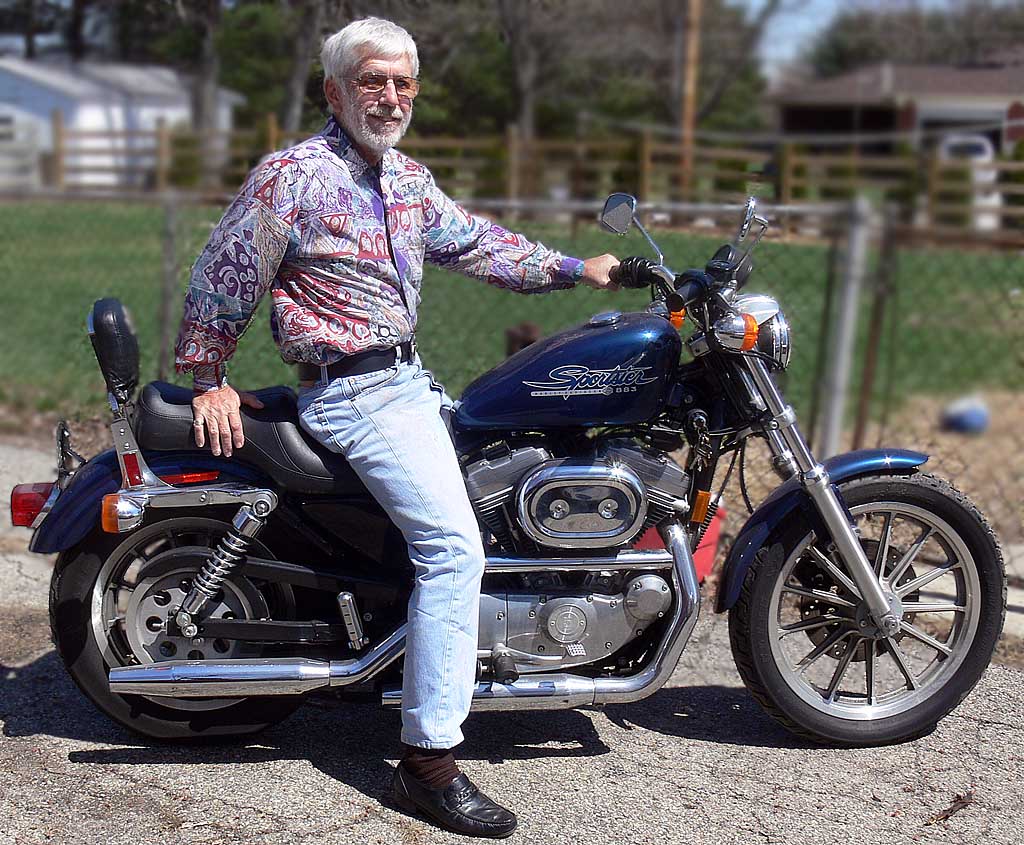
Here I am in all my glory in an ancient silk shirt a few days before we left the house in Brownsburg, Indiana for the last time, headed for Springfield Illinois to pack the crates:
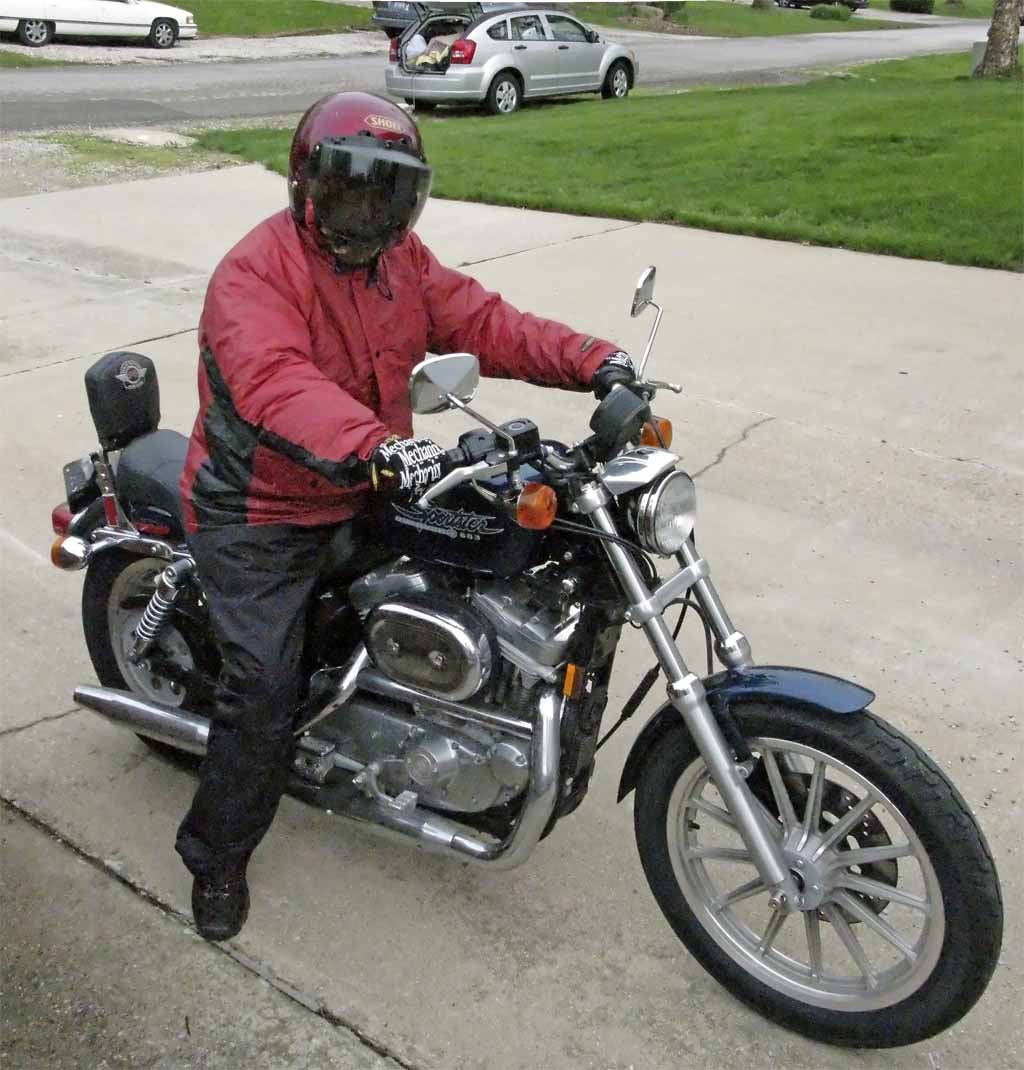
The trip to Springfield was the most miserable motorcycle ride of my life. You can read about it in the link in the previous sentence. I'll simply say that I cannot remember being so cold in my life. Here I am arriving in Springfield looking as if I'd suddenly gained fifty kilos:
The packing was a tedious chore which would have been far more difficult without the help of Eunie's Sister, Mary Sexton and her husband, Jim. Here are Eunie at the left and her sister Mary amidst the clutter:

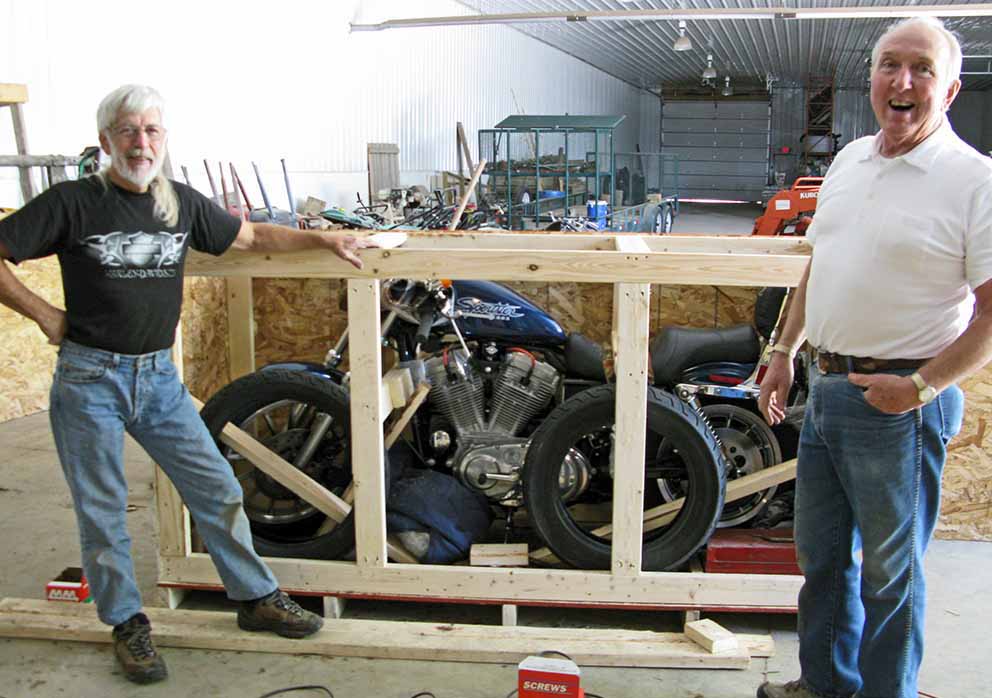
And, here I am with Jim and the partially packed Harley:
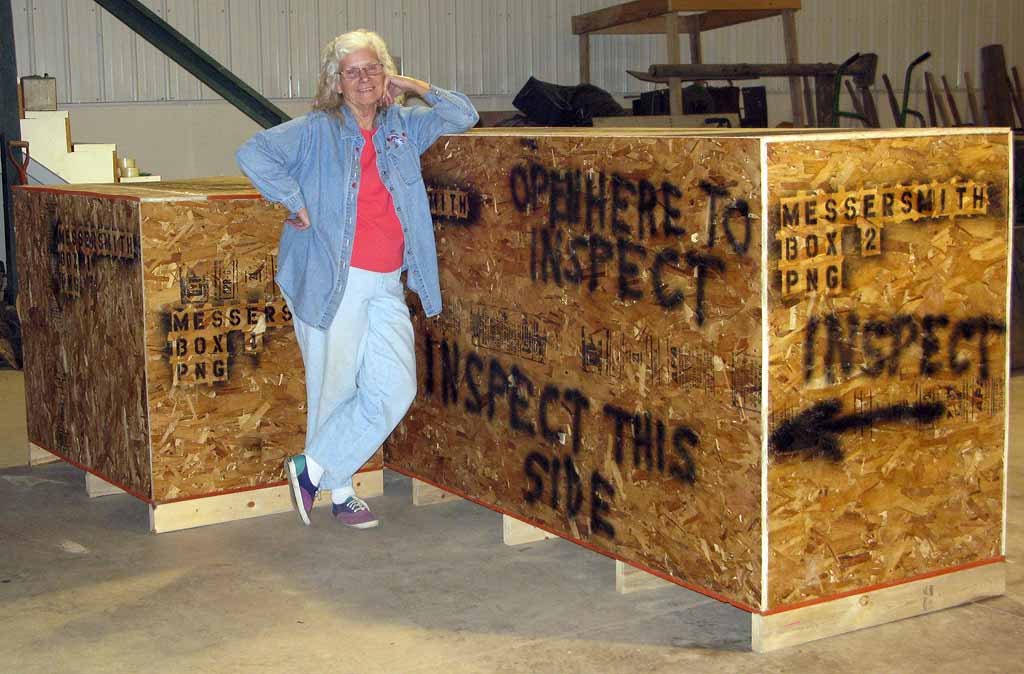
This is my beloved wife beaming with satisfaction that all of the material things which she cherished were safely on their way home:
After a rather nervous wait of a few months, the crates arrived in Madang. Here is the crated Harley on it's way from the harbour to our workshop:

On several occasions I expressed to Eunie that I thought that it might be wiser to sell the Harley in the USA. She was never of a mind to do that for a couple of reasons. First, she believed it was something which would make me happy to have in Madang. She was right, of course. She also told me that selling it in the USA would be a bother and it would probably be worth at least as much here in PNG, if we ever needed to sell it. To her it was like money in the bank, except that you could spend it and still have it. I was always happy to be married to a woman who was smarter than me.
So, we ended up owning the only Harley in Madang:
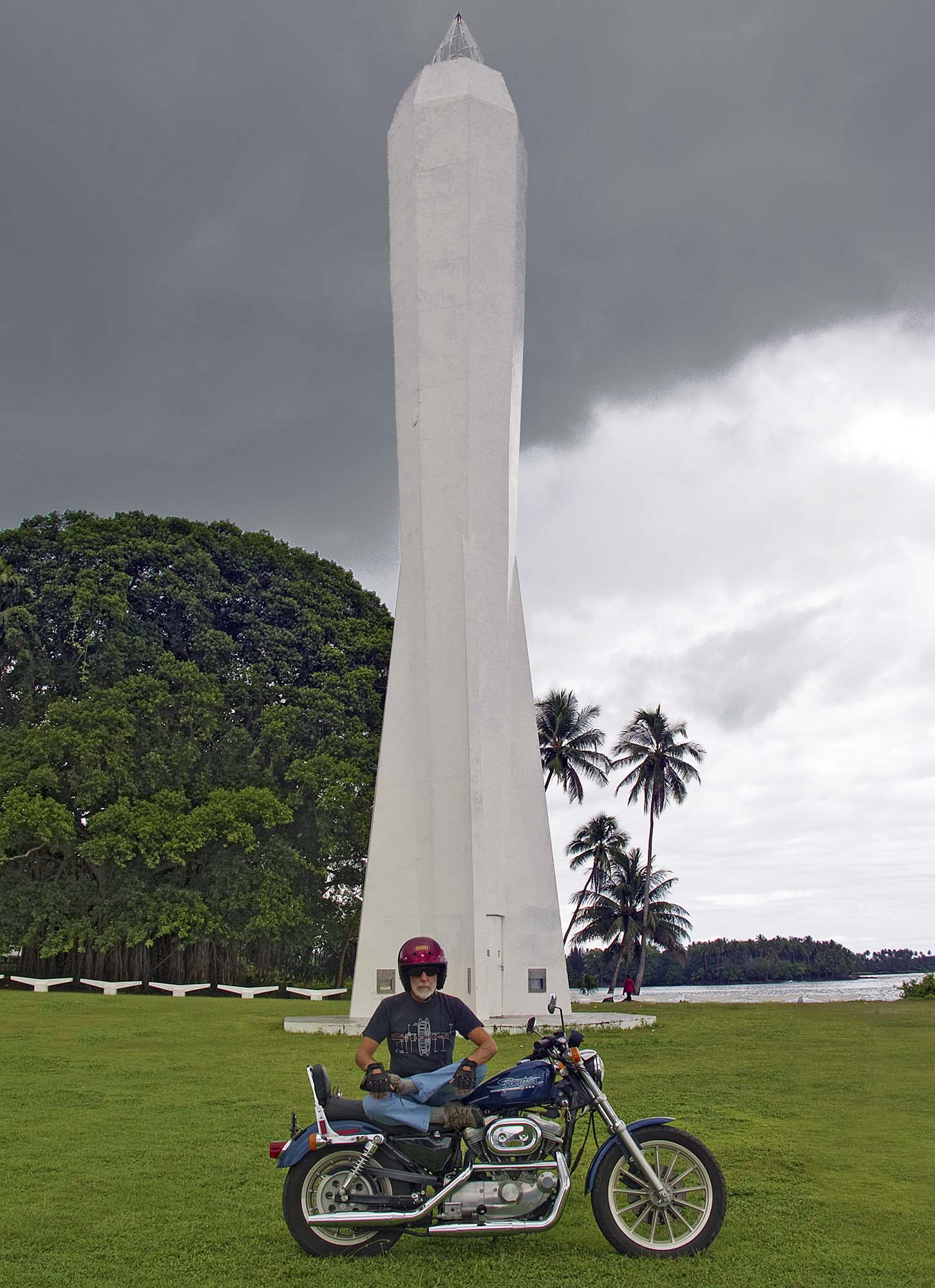
That is the locally famous Coastwatcher's Monument.
In the two years or so after its arrival I seldom rode the Harley. The roads here are horrible and steadily getting worse. There are very few places which are safe to ride. Riding alone never interested me, but we have always been blessed by having adventuresome friends, many of whom took an interest in a ride on the rare machine. Here's Ush Antia 108 kilometres up the North Coast Road at the Tapira Surf Club:
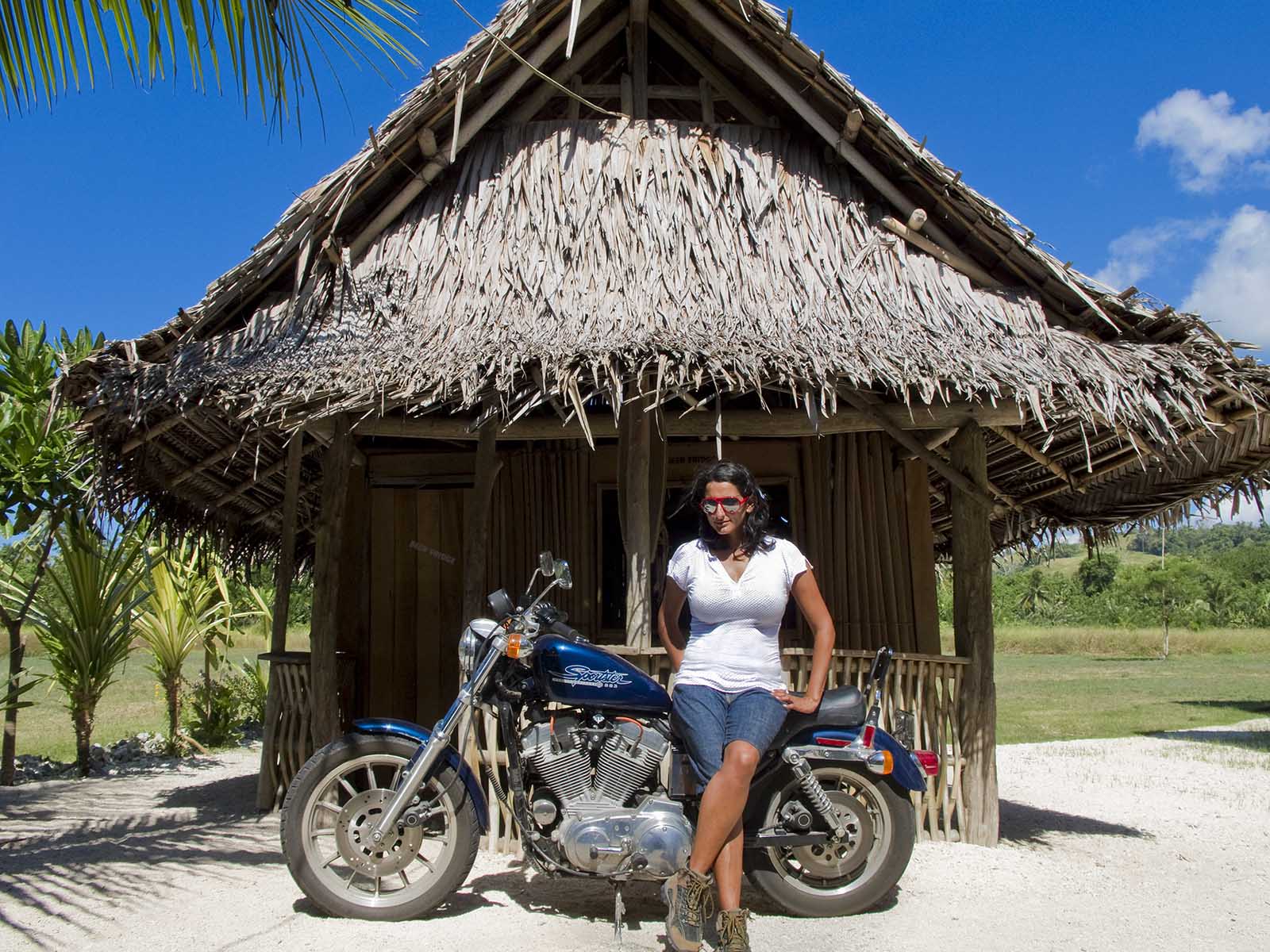
Sadly, it's not even safe to travel up there any more. The criminal activity in that area makes it too risky for my blood.
Another memorable ride was with Jo Noble to the Balek Wildlife Reserve:
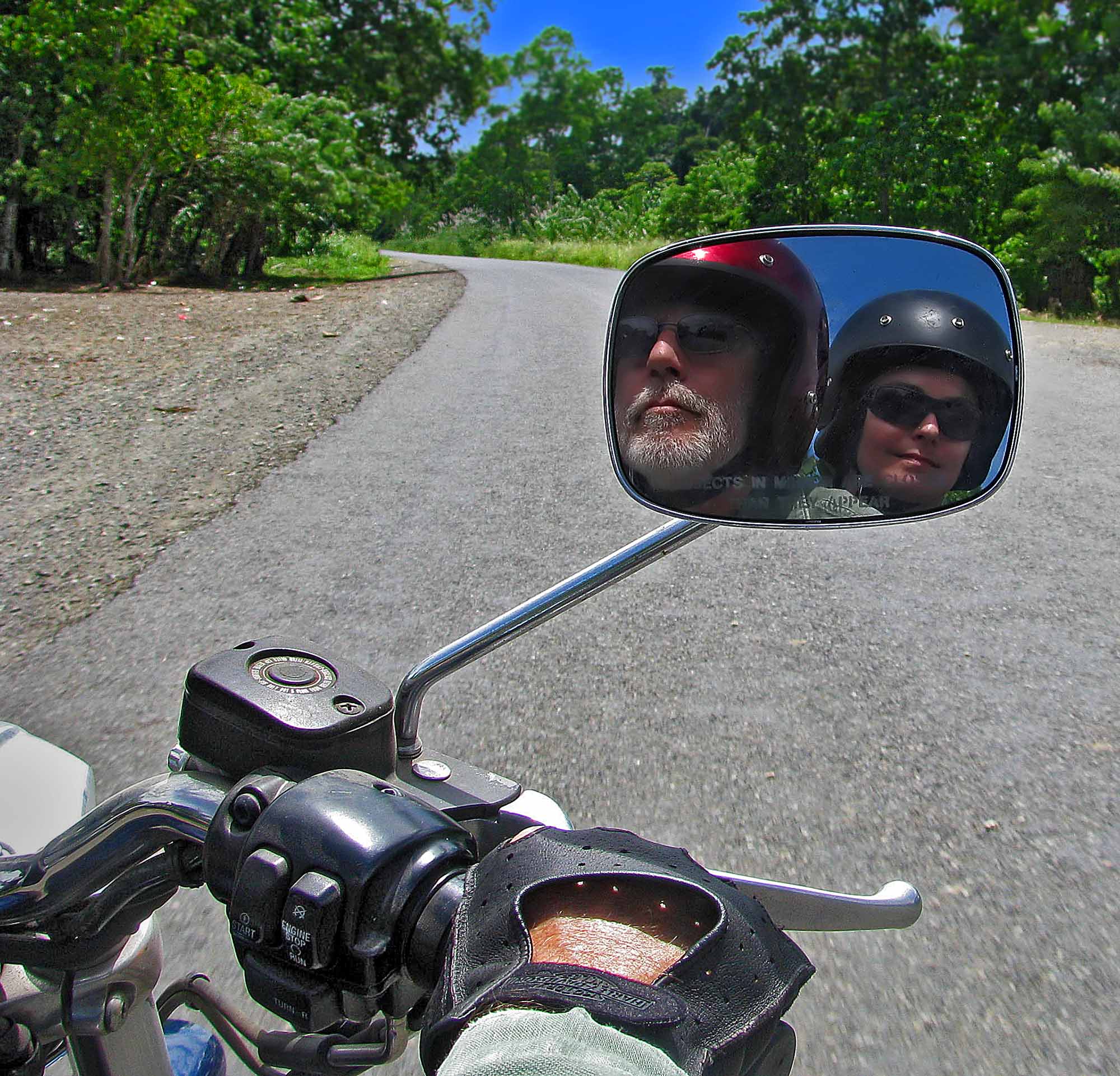
Though I have mixed emotions at present concerning parting with the Harley, I must admit that I have not ridden it once since Eunie's passing. The lustre has departed from many things in my life. I debated in my mind whether or not to sell it. While it is true that it was "money in the bank", it wasn't money which was in any way contributing to my quality of life. I couldn't imagine a time while I remain in Madang during which I would get much enjoyment from it.
I dreaded advertising it. I did not want to deal with the minor trauma of parting with it any longer than absolutely necessary. As it turned out, it took only two days. I called an old friend, Ron McKenna, who owns a car dealership and repair garage here in Madang. He is well known for his interest in exotic vehicles. He has restored several 1960's era vintage Ford Mustangs, a task made considerably more complex, because they must be converted from left hand drive to right hand drive. I called Ron with the offer yesterday. Today he came to the office and bought it on sight.
Here I sit for my last portrait on a machine which gave me great pleasure. Minutes after this image was taken I had my helmet on and was taking my last ride. I blasted down Modilon Road at a terrifying pace. As always, she delivered a thrill. What a sound! There's nothing else like it:
I know perfectly well that Ron did me a great favour by purchasing the Harley. He certainly doesn't need it. Ron has had far more than his share of grief in the last few years. He is a sympathetic friend, a commodity with which I am well supplied. Once again, a friend has come to my aid. I will use the money from the sale to help to pay off the last of my debts. It will get me very close to my goal of being debt-free. This means far more to me at this season of life than any occasional pleasure which the Harley could deliver.
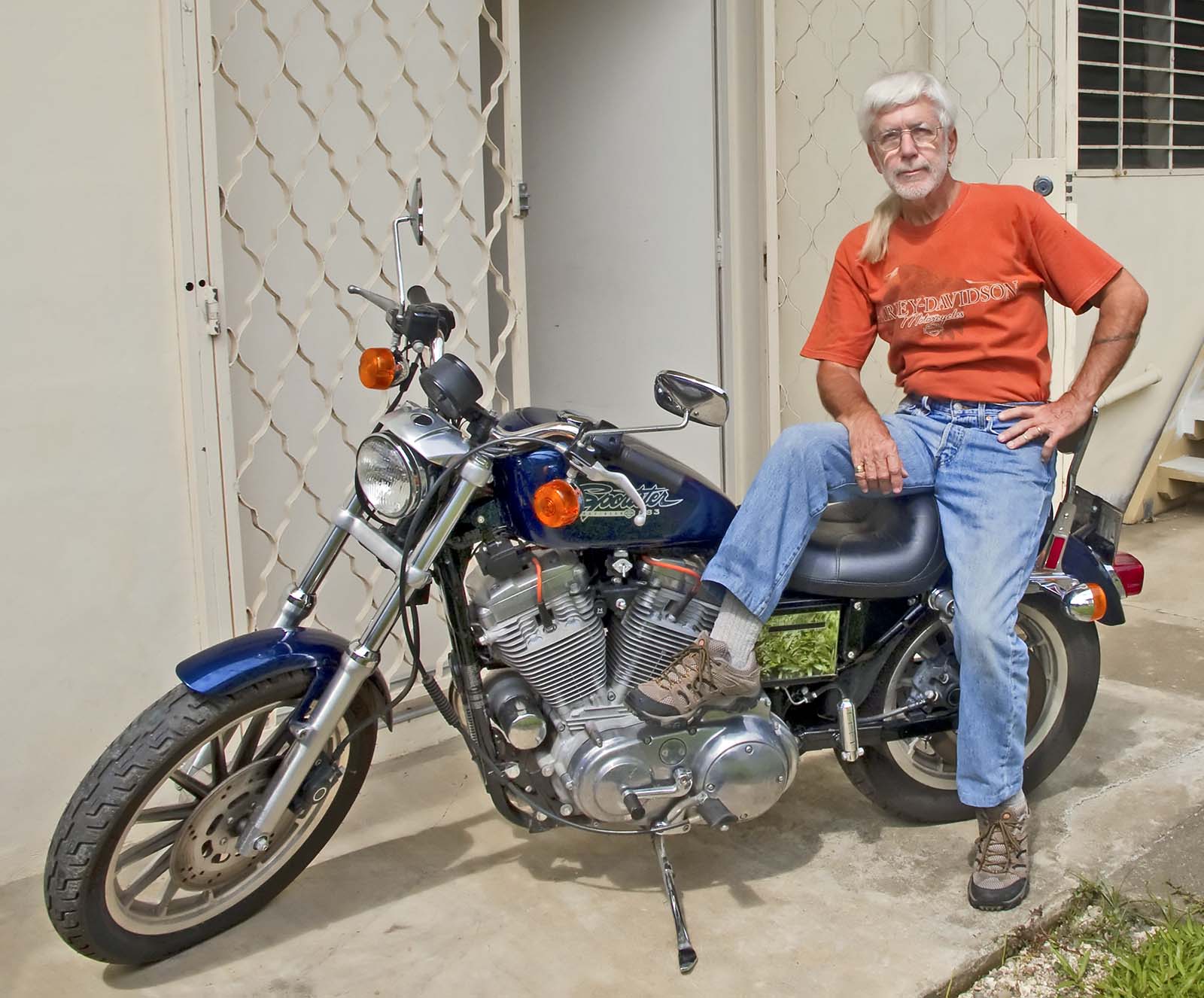
Finally, once again I am compelled to acknowledge the wisdom of my dear wife. She told me that we would never lose money on the Harley. In a way it was a gift that we gave to ourselves without cost. This made it somehow priceless. I'm sure that Ron will smile if he reads this. The price in Kina, converted to US Dollars, is nearly the same as we paid for the machine in 1998.
Eunie was right again.
Srirangapatna (also spelled Shrirangapattana; anglicized to Seringapatam during the British Raj) is a town in Mandya district of the Indian state of Karnataka. Located near the city of Mysore, it is of religious, cultural and historic importance.
The monuments on the island town of Srirangapatna has been nominated as a UNESCO World Heritage Site, and its application is pending on the tentative list of UNESCO
LOCATION
Although situated a mere 15 km from Mysore city, Srirangapatna lies in the neighbouring district of Mandya. The entire town is enclosed by the river Kaveri to form a river island, northern half of which is shown in the adjacent image. While the main river flows on the eastern side of the island, the Paschima Vaahini segment of the same river flows to its west. The town is easily accessible by train from Bangalore and Mysore and is also well-connected by road, lying as it does just off the Bangalore-Mysore highway. The highway passes through this town and special care was taken to minimize any impact on the monuments.
RELIGIOUS SIGNIFICANCE
The town takes its name from the celebrated Ranganathaswamy temple which dominates the town, making Srirangapatna one of the most important Vaishnavite centers of pilgrimage in South India. The temple was built by the Ganga dynasty rulers of the area in the 9th century; the structure was strengthened and improved upon architecturally some three centuries later. Thus, the temple is a medley of the Hoysala and Vijayanagar styles of temple architecture.
Tradition holds that all the islands formed in the Kaveri River are consecrated to Sri Ranganathaswamy, and large temples have been built in very ancient times dedicated to that deity on the three largest islands. These three towns, which constitute the main pilgrimage centers dedicated to Ranganathaswamy, are:
Adi Ranga - at Srirangapatna
Madhya Ranga - at Shivanasamudra
Antya Ranga - at Srirangam
The presence of the Kaveri River is in itself considered auspicious and sanctifying. The Paschima Vaahini section of the Kaveri at Srirangapatna is considered especially sacred; the pious come from far and wide to immerse the ashes of the departed and perform obsequies to their ancestors in these waters.
DEMOGRAPHICS
As of 2001 India census, Srirangapatna had a population of 23,448. Males constitute 51% of the population and females 49%. Srirangapatna has an average literacy rate of 68%, higher than the national average of 59.5%: male literacy is 74%, and female literacy is 63%. In Srirangapatna, 10% of the population is under 6 years of age.
GEOGRAPHY
Srirangapatna is located at 12.41°N 76.7°E. It has an average elevation of 679 metres (2227 feet). Srirangapatna Sangama is the confluence of the three holy streams creating the island. Located 27 km upstream from the town is the spectacular Shivanasamudra Falls, the second biggest waterfall in India and the 16th largest in the world.
HISTORY
Srirangapatna has since time immemorial been an urban center and place of pilgrimage. During the Vijayanagar empire, it became the seat of a major viceroyalty, from where several nearby vassal states of the empire, such as Mysore and Talakad, were overseen. When, perceiving the decline of the Vijayanagar empire, the rulers of Mysore ventured to assert independence, Srirangapatna was their first target. Raja Wodeyar vanquished Rangaraya, the then viceroy of Srirangapatna, in 1610 and celebrated the Navaratri festival in the town that year. It came to be accepted in time that two things demonstrated control and signified sovereignty over the Kingdom of Mysore by any claimant to the throne:
Successful holding of the 10-day-long Navaratri festival, dedicated to Chamundeshwari, patron goddess of Mysore;
Control of the fort of Srirangapatna, the fortification nearest to the capital city of Mysore.
Srirangapatna remained part of the Kingdom of Mysore from 1610 to after India's independence in 1947; as the fortress closest to the capital city of Mysore, it was the last bastion and defence of the kingdom in case of invasion.
HYDER AND TIPU
Srirangapatna became the de facto capital of Mysore under Hyder Ali and Tipu Sultan. When Tipu finally dispensed with the charade of deference to the legitimate Wodeyar Maharaja who was actually his captive, and proclaimed the "Khudadad State" under his own kingship, Srirangapatna became de jure the capital of this just and ably managed kingdom. In that heady period, the state ruled by Tipu extended its frontiers in every direction, encompassing a major portion of South India. Srirangapatna flourished as the cosmopolitan capital of this powerful state. Various Indo-Islamic monuments that dot the town, such as Tipu Sultan's palaces, the Darya Daulat and the Jumma Masjid (Friday congregational mosque), date from this period.
TREATY OF SERINGAPATAM 1792
The Treaty of Seringapatam (also called Srirangapatinam), signed 18 March 1792, ended the Third Anglo-Mysore War. Its signatories included Lord Cornwallis on behalf of the British East India Company, representatives of the Nizam of Hyderabad and the Mahratta Empire, and Tipu Sultan, the ruler of Mysore.
BATTLE OF SERINGAPATAM 1799
Srirangapatna was the scene of the last and decisive battle fought between Tipu Sultan and a combined force of 50,000 men provided equally by the Nizam of Hyderabad and the East India Company under the overall command of General George Harris. This battle was the last engagement of the Fourth Anglo-Mysore War. The Battle of Seringapatam, 1799, was truly momentous in its historic effects.
At the battle's climax, Tipu Sultan was killed within the fort of Seringapatam, betrayed by one of his own confidants; the spot where he ultimately fell is marked by a memorial. For the last time in history, Seringapatam had been the scene of political change in the Sultanate of Mysore. The joint forces of the victorious army proceeded to plunder Seringapatam and ransack Tipu's palace. Apart from the usual gold and cash, innumerable valuables and objets d'art, not excepting even the personal effects of Tipoo Sultan, his rich clothes and shoes, sword and firearms, were shipped to England.
While most of this is now to be found in the British Royal Collection and in the Victoria and Albert Museum, some articles have occasionally become available at auctions and have been retrieved for their native land. The sword of Tipu Sultan has been acquired by Vijay Mallya, a liquor baron from Karnataka, who purchased the same at a Sotheby's auction.
Much of the site of the Battle is still intact including the ramparts, the Water Gate, the place where the Tippu Sultan's body was found, the area where the British prisoners were held and the site of the destroyed palace.
Tipu's Tiger, an automaton now in the Victoria & Albert Museum, was captured at the battle.
PLACES OF INTEREST
The town is famous for a very ancient temple dedicated to Sri Ranganathaswamy, a form of Lord Vishnu. There is also Kalyani Siddhi Vinayaka Temple in front of the Sri Ranganathaswamy Temple. Other temples in Srirangapatna include the Lakshminarasimha Swamy Temple, Jyothi Mahaswara Temple, Bidhcotta Ganesha Temple, Panduranga Swamy Temple, the Sathyanarayana Swamy Temple, the Anjunaya Swamy Temple, the Ayyapa Temple, the Gangadhareswara Swamy Temple, and RaganathaNagara Ganesha Temple, Lakshmi Temple, Sri raghavendra swamy mutt on old post office road, surrounding Srirangapatna in fort 8 Ganesh & Anjunaya temples. The Karighatta (Black Hill) and its temple of Lord Srinivasa is situated a few kilometres from the town. The deity is that of Kari-giri-vasa (one who resides on the black hill). The renowned Nimishambha Temple is located about 2 km from the town. Srirangapatna also hosts the summer palace of Tipu Sultan and his mausoleum.
SRI RANGANATHASWAMY TEMPLE
The Ranganthaswamy Temple – usually referred to as "Sri Ranganathaswamy" – is dedicated to Ranganatha, a manifestation of Vishnu. It is one of the five important pilgrimage sites along the river Kaveri for devotees of Ranganatha. These five sacred sites are together known as Pancharanga Kshetrams in Southern India. Since Srirangapatna is the first temple starting from upstream, the deity is known as Adi Ranga (lit; "first Ranga"), and the town of Srirangapatna, which derives its name from the temple, is located on an island in the river Kaveri.
DARIA DAULAT BAGH
The Dariya Daulat Palace (Summer Palace) is set amidst beautiful gardens called Daria Daulat Bagh. Tippu Sultan built this palace in 1784. The palace is built in the Indo-Sarcenic style in mostly made of teakwood. The palace has a rectangular plan and is built on a raised platform.
Other attractions in Srirangapatna include the Jumma Masjid (a Mosque) and the Daria Daulat Gardens. The mosque has stone Arabic inscriptions which mention the 99 different titles given to the Prophet Mohammed, along with the Farsi inscriptions which mentions that the Jamia Masjid called Masjid-E-Ala was built in AD 1782 by Tipu Sultan.
TIPU SULTAN GUMBAZ
The Gumbaz is an impeccably detailed mausoleum and houses the remains of Tipu Sultan, his father Hyder Ali and his mother Fatima Begum among beautifully manicured gardens. Various tombs of other relatives surround the gumbaz, some with small signs offering guidance on which specific individuals are buried here. The outer gumbaz columns are made of amphibolite, a very dark rock that exudes a somber richness. Handcrafted door frames covered in a deep lacquer finish lead into an inner tomb illuminated only by natural light. All visitors are welcome inside, and even encouraged to enter by the friendly doormen.
WELLESLEY BRIDGE
Wellesley Bridge was erected by Dewan Purnaiya on the Kavery river in 1804. It was named after the then Governor General Marquis of Wellesley. The bridge is built of stone pillars and stone corbels and surrounded by stone girders. The bridge is very strong and has survived the heavy traffic of many years.
KARRIGHATTA VIEWPOINT
The Karighatta viewpoint gives good panorama of Mysore and Srirangapatna cities from a height of 3,000 feet. Karighatta is a hill situated a few kilometres outside the 'island' town of Srirangapatna. The name Karighatta translates to "Black Hill" in Kannada. The hill supports dry scrub jungle and many tamarind and gooseberry trees are found around the temple. A small river, Lokapavani, a tributary of Kaveri flows by the hill. The main entrance to the temple, with huge wooden doors opens into a large quadrangle, which is the main shrine for Vaikunta Srinivasa in black stone, flanked by Yoga Srinivasa (without his consort) and Bhoga Srinivasa idols. The hill may be climbed by stone steps (450 in number). A winding paved road is used for vehicular transport. The stone steps lead to a flat hilltop where the temple stands. The hillock has a superb panoramic view of Srirangapatna and Mysore. The beautiful landscape around the hill and the confluence of the Kaveri and Lokapavani rivers can be seen from atop the hill.
NIMISHAMBA TEMPLE
The famous Nimishamba (the incarnation of Parvathi, the goddess wife of Lord Shiva) temple is on the bank of the Lokapavani river. This temple too can be clearly seen from the top of the Karighatta hill. It is a belief that Parvathi will clear all the problems and troubles of her devotees within a minute (nimisha in Sanskrit), and hence the name.
GARRISON CEMETERY SRIRANGAPATNA
The Garrison Cemetery is located in Srirangapatna, on the banks of the river Cauvery, about 300m from the Bangalore Mysore Highway. It has about 307 graves of the European officers killed in the final assault on Tippu Sultan in 1799, and their family members. Among the graves, there are 80 graves of the officers of the Swiss Regiment de Meuron, and the rest of the graves are their family members.
SCOTTT´S BUNGALOW SERINGAPATAM
The Scott’s Bungalow is located in Seringapatam on the banks of the river Cauvery, at about half a mile from the Mysore Gate of the Seringapatam gate. The bungalow was the residence of Col. Scott, an officer of the Madras Army who took part in the Siege of Seringapatam in 1799. The bungalow is associated with the legend and tradegy of Col. Scott. The story of Scott’s Bungalow is lamented in a poem by Walter Yeldham called The Deserted Bungalow, published in 1875
LORD HARRIS´S HOUSE
Between the Garrison Cemetery and Scott’s Bungalow a path leads to house on the river banks. This house is known as Lord Harris's House or The Doctor's Bungalow or Puraniah's Bungalow. This house was the residence of General Harris, for a short time after the Siege of Seringapatam in 1799, and went on to become headquarters of the commanding officer of Seringapatam. In 1809, the house was the scene of a mutiny by officers of the Madras Army, led by Col. Bell, against Sir. George Barlow, the Governor of Madras. Purnaiah, lived in this house after his retirement from service in 1811, and died there on 28 March 1812. A tablet on the wall records the connection of Lord Harris and Puraniah to the house.
SRIRANGAPATNA FORT
The fortress is situated in the west of the island, and is surrounded by double walls. The point at which the British broke through the walls, and thus Tipu Sultan's troops surprised, is marked by an obelisk. Also highlighted is the place where Tipu Sultan was killed by the British forces. In addition, the dungeon in which the Mysore rulers had imprisoned British soldiers.
BAILEY´S DUNGEON
This was the place where Tipu Sultan used to imprison all the British officers. It is located near the death place memorial of Tipu Sultan and is surrounded by gardens on all four sides. Lord Bailey was the only British officer who died in that place and could not make it through the tough conditions and so it was later named after him.
Another version says that the commanding officer of the British at the Battle of Pollilur (1780), Col. Baillie, was imprisoned here after the defeat of his troops in the First Mysore War.
RANGANATHITTU BIRD SANCTUARY
Near the town is the Ranganathittu Bird Sanctuary, which is the breeding site for several bird species, including the painted stork, open-billed stork, black-headed ibis, river tern, great stone plover and Indian shag.
WIKIPEDIA
The Postcard
A postally unused carte postale published by F. David, 21 Rue des Réservoirs, Versailles.
The Palace of Fontainebleau
The Palace of Fontainebleau, or Château de Fontainebleau, is located 55 kilometers (34 miles) southeast of the centre of Paris.
The castle and subsequent palace served as a residence for French monarchs from Louis VII to Napoleon III.
Francis I and Napoleon were the monarchs who had the most influence on the Palace as it stands today.
It became a national museum in 1927, and was designated a UNESCO World Heritage Site in 1981 for its unique architecture and historical importance.
The Medieval Palace
The earliest record of a fortified castle at Fontainebleau dates to 1137. It became a favorite residence and hunting lodge of the Kings of France because of the abundant game and many springs in the surrounding forest.
Fontainebleau took its name from one of the springs, la Fontaine de Bliaud, located now in the English Garden, next to the wing of Louis XV.
Fontainebleau was used by King Louis VII, for whom Thomas Becket consecrated the chapel in 1169; also by Philip II; by Louis IX (later canonised as Saint Louis), who built a hospital and a convent, the Couvent des Trinitaires, next to the castle; and by Philip IV, who was born and died in the castle.
The Renaissance Château of Francis I (1528–1547)
In the 15th. century some modifications and embellishments were made to the castle by Isabeau of Bavaria, the wife of King Charles VI, but the medieval structure remained essentially intact until the reign of Francis I (1494–1547).
He commissioned the architect Gilles Le Breton to build a palace in the new Renaissance style, recently imported from Italy. Le Breton preserved the old medieval donjon, where the King's apartments were located, but incorporated it into the new Renaissance-style Cour Ovale, built on the foundations of the old castle.
It included the monumental Porte Dorée, as its southern entrance. as well as a monumental Renaissance stairway, the Portique de Serlio, to give access the royal apartments on the north side.
Beginning in about 1528, Francis constructed the Galerie François I, which allowed him to pass directly from his apartments to the chapel of the Trinitaires. He brought the architect Sebastiano Serlio from Italy, and the Florentine painter Rosso Fiorentino, to decorate the new gallery.
Between 1533 and 1539 Fiorentino filled the gallery with murals glorifying the King, framed in stucco ornament in high relief, and panelling sculpted by the furniture maker Francesco Scibec da Carpi.
Another Italian painter, Francesco Primaticcio from Bologna, joined later in the decoration of the palace. Together their style of decoration became known as the first School of Fontainebleau. This was the first great decorated gallery built in France. Fontainebleau introduced the Renaissance to France.
In about 1540, Francis began another major addition to the château. Using land on the east side of the Château purchased from the order of the Trinitaires, he began to build a new square of buildings around a large courtyard.
The Château was surrounded by a new park in the style of the Italian Renaissance garden, with pavilions and the first grotto in France.
The Château of Henry II and Catherine de' Medici (1547–1570)
Following the death of Francis I, King Henry II decided to continue and expand the Château. The King and his wife chose the architects Philibert de l'Orme and Jean Bullant to do the work.
They extended the east wing of the lower court and decorated it with the first famous horseshoe-shaped staircase which was built between 1547 and 1559. The staircase was subsequently re-built for Louis XIII by Jean Androuet du Cerceau in about 1632-1634.
In the Oval Court, they transformed the loggia planned by Francois into a Salle des Fêtes or grand ballroom with a coffered ceiling. Facing the courtyard of the fountain and the fish pond, they designed a new building, the Pavillon des Poeles (destroyed), to contain the new apartments of the King.
The decoration of the new ballroom and the gallery of Ulysses with murals by Francesco Primaticcio and sculptured stucco continued.
At Henri's orders the Nymphe de Fontainebleau by Benvenuto Cellini was installed at the gateway entrance of Château d'Anet, the domain of Henri's primary mistress Diane de Poitiers (the original bronze lunette is now in the Musée du Louvre, with a replica in place).
Following the death of Henry II in a jousting accident, his widow, Catherine de' Medici, continued the construction and decoration of the château. She named Primaticcio as the new superintendent of royal public works.
He designed the section known today as the wing of the Belle Cheminée, noted for its elaborate chimneys and its two opposing stairways. In 1565, as a security measure due to the Wars of Religion, she also had moat dug around the château to protect it against attack.
Château of Henry IV (1570–1610)
King Henry IV made more additions to the château than any King since Francis I. He extended the oval court toward the west by building two pavilions, called Tiber and Luxembourg.
Between 1601 and 1606, he remade all the façades around the courtyard, including that of the chapel of Saint-Saturnin, to give the architecture greater harmony. On the east side, he built a new monumental domed gateway, the Porte du Baptistère.
Between 1606 and 1609, he built a new courtyard, the Cour des Offices or Quartier Henry IV, to provide a place for the kitchens as well as residences for court officials.
Two new galleries, the Galerie de Diane de Poitiers and the Galerie des Cerfs, were built to enclose the old garden of Diane. He also added a large Jeu de Paume, or indoor tennis court, the largest such court in the world.
A Second School of Fontainebleau painters and decorators went to work on the interiors. The architect Martin Fréminet created the ornate chapel of the Trinity, while the painters Ambroise Dubois and Toussaint Dubreuil created a series of heroic paintings for the salons. A new wing, named after its central building, La Belle Cheminée, was built next to the large carp pond.
Henry IV also devoted great attention to the park and gardens around the Château. The garden of the Queen or garden of Diane, created by Catherine de' Medici, with the fountain of Diane in the centre, was located on the north side of the palace.
Henry IV's gardener, Claude Mollet, who trained at Château d'Anet, created a large parterre of flower beds, decorated with ancient statues and separated by paths into large squares.
The fountain of Diana and the grotto were made by Tommaso Francini, who may also have designed the Medici Fountain in the Luxembourg Garden for Marie de Medici.
On the south side, Henry created a park, planted with pines, elms and fruit trees, and laid out a grand canal 1200 meters long, sixty years before Louis XIV built his own grand canal at Versailles.
The Château from Louis XIII through Louis XVI
King Louis XIII was born and baptized in the Château, and continued the works begun by his father. He completed the decoration of the chapel of the Trinity, and assigned the court architect Jean Androuet du Cerceau to re-construct the horseshoe stairway on the courtyard that had become known as the Cour de Cheval Blanc.
After his death, his widow, Anne of Austria, re-decorated the apartments within the Wing of the Queen Mothers (Aile des Reines Mères) next to the Court of the Fountain, designed by Primatrice.
King Louis XIV spent more days at Fontainebleau than any other monarch. He liked to hunt there every year at the end of summer and the beginning of autumn.
He made few changes to the exterior of the Château, but did build a new apartment for his companion Madame de Maintenon. He furnished it with major works of André-Charles Boulle. He also demolished the old apartments of the baths under the Gallery of Francis I to create new apartments for the royal princes.
The architect Jules Hardouin-Mansard built a new wing alongside the Galerie des Cerfs and the Galerie de Diane in order to provide more living space for the Court.
Louis XIV made major changes to the park and gardens; he commissioned André Le Nôtre and Louis Le Vau to redesign the large parterre into a French formal garden. He destroyed the hanging garden which Henry IV had built next to the large carp lake, and instead built a pavilion, designed by Le Vau, on a small island in the centre of the lake.
Louis XIV signed the Edict of Fontainebleau at the Château on the 22nd. October 1685, revoking the policy of tolerance towards Protestants begun by Henry IV.
Louis welcomed many foreign guests at the Château, including the former Queen Christina of Sweden, who had just abdicated her crown. While a guest in the Château on the 10th. November 1657, Christina suspected her Master of the Horse and reputed lover, the Marchese Gian Rinaldo Monaldeschi, of betraying her secrets to her enemies.
Her servants chased him through the halls of the Château and stabbed him to death. Louis XIV came to see her at the Château, did not mention the murder, and allowed her to continue her travels.
On the 18th. and 20th. May 1717, following the death of Louis XIV, the Russian Czar Peter the Great was a guest at Fontainebleau. A hunt for stags was organized for him, along with a banquet.
Although officially the visit was a great success, later memoires revealed that Peter disliked the French style of hunting, and that he found the Château too small, compared to the other royal French residences.
The routine of Fontainebleau also did not suit his tastes; he preferred beer to wine (and brought his own supply with him) and he liked to get up early, unlike the French Court.
The renovation projects of Louis XV were more ambitious than those of Louis XIV. To create more lodging for his enormous number of courtiers, in 1737–38 the King built a new courtyard, called the Cour de la Conciergerie or the Cour des Princes, to the east of the Galerie des Cerfs.
On the Cour du Cheval Blanc, the wing of the Gallery of Ulysses was torn down and gradually replaced by a new brick and stone building, built in stages in 1738–1741 and 1773–74, extending west toward the Pavilion and grotto of the pines.
Between 1750 and 1754, the King commissioned the architect Ange-Jacques Gabriel to build a new wing along the Cour de la Fontaine and the carp lake.
The old Pavilion des Poeles was demolished and replaced by the Gros Pavilion, built of cream-colored stone. Lavish new apartments were created inside this building for the King and Queen. The new meeting room for the Royal Council was decorated by the leading painters of the day, including François Boucher, Carle Vanloo, Jean-Baptiste Marie Pierre and Alexis Peyrotte. A magnificent small theatre was created on the first floor of the wing of the Belle Cheminée.
King Louis XVI also made additions to the Château in order to create more space for his courtiers. A new building was constructed alongside the Gallery of Francis I; it created a large new apartment on the first floor, and a number of small apartments on the ground floor, but also blocked the windows on the north side of the Gallery of Francis I.
The apartments of Queen Marie-Antoinette were redone, a Turkish-style salon was created for her in 1777, a room for games in 1786–1787, and a boudoir in the arabesque style. Louis XVI and Marie-Antoinette made their last visit to Fontainebleau in 1786, on the eve of the French Revolution.
The Château during the Revolution and the First Empire
During the French Revolution the Château did not suffer any significant damage, but all the furniture was sold at auction. The buildings were occupied by the Central School of the Department of Seine-et-Marne until 1803, when Napoleon I installed a military school there.
As he prepared to become Emperor, Napoleon wanted to preserve as much as possible of the palaces and protocol of the Old Regime. He chose Fontainebleau as the site of his historic 1804 meeting with Pope Pius VII, who had travelled from Rome to crown Napoleon Emperor.
Napoleon had a suite of rooms decorated for the Pope, and had the entire Château refurnished and decorated. The bedroom of the Kings was transformed into a throne room for Napoleon. Apartments were refurnished and decorated for the Emperor and Empress in the new Empire style.
The Cour du Cheval Blanc was re-named the Cour d'Honneur. One wing facing the courtyard, the Aile de Ferrare, was torn down and replaced with an ornamental iron fence and gate, making the façade of the Palace visible.
The gardens of Diane and the gardens of the Pines were replanted and turned into an English landscape garden.
Napoleon's visits to Fontainebleau were not frequent, because he was occupied so much of the time with military campaigns. Between 1812 and 1814, the Château served as a very elegant prison for Pope Pius VII. On the 5th. November 1810, the chapel of the Château was used for the baptism of Napoleon's nephew, the future Napoleon III, with Napoleon serving as his godfather, and the Empress Marie-Louise as his godmother.
Napoleon spent the last days of his reign at Fontainebleau, before abdicating there on the 4th. April 1814. On the 20th. April, after failing in an attempt to commit suicide, he gave an emotional farewell to the soldiers of the Old Guard, assembled in the Court of Honor. Later, during the One Hundred Days, he stopped there on the 20th. March 1815.
In his memoires, written while in exile on Saint Helena, he recalled his time at Fontainebleau:
"The true residence of Kings, the house of
the centuries. Perhaps it was not a rigorously
architectural palace, but it was certainly a place
of residence well thought out and perfectly
suitable. It was certainly the most comfortable
and happily situated palace in Europe.”
The Château during the Restoration and the Reign of Louis-Philippe (1815–1848)
Following the restoration of the Monarchy, Kings Louis XVIII and Charles X each stayed at Fontainebleau, but neither made any major changes to the palace. Louis-Philippe was more active, both restoring some rooms and redecorating others in the style of his period.
The Hall of the Guards and Gallery of Plates were redecorated in a Neo-Renaissance style, while the Hall of Columns, under the ballroom, was remade in a neoclassical style. He added new stained glass windows, made by the royal manufactory of Sèvres.
The Château During the Second Empire
Emperor Napoleon III, who had been baptised at Fontainebleau, resumed the custom of long stays at the Château, particularly during the summer. Many of the historic rooms, such as the Galerie des Cerfs, were restored to something like their original appearance, while the private apartments were redecorated to suit the tastes of the Emperor and Empress.
Numerous guest apartments were squeezed into unused spaces within the buildings. The old theatre of the palace, built in the 18th. century, was destroyed by a fire in the wing of the Belle Cheminée 1856. Between 1854 and 1857 the architect Hector Lefuel built a new theatre in the style of Louis XVI.
On the ground floor of the Gros Pavilion, the Empress Eugénie built a small but well-stocked museum, containing gifts from the King of Siam in 1861, and works of art taken during the pillage of the Summer Palace in Beijing.
The museum also featured paintings by contemporary artists, including Franz Xaver Winterhalter, and the sculptor Charles Henri Joseph Cordier. Close by, in the Louis XV wing, the Emperor established his office, and the Empress made her Salon of Lacquer.
These were the last rooms created by the royal residents of Fontainebleau. In 1870, during the Franco-German War, the Empire fell, and the Château was closed.
The Château from the Third Republic to the Present Day
During the Franco-Prussian War, the palace was occupied by the Prussians on the 17th. September 1870, and briefly used as an army headquarters by Frederic Charles of Prussia from March 1871.
Following the war, two of the buildings became the home of the advanced school of artillery and engineering of the French Army, which had been forced to leave Alsace when the province was annexed by Germany.
The Château was occasionally used as a residence by the Presidents of the Third Republic, and to welcome state guests including King Alexander I of Serbia (1891), King George I of Greece (1892) Leopold II of Belgium (1895) and King Alphonse XIII of Spain (1913).
It also received a visit by the last survivor of its royal residents, the Empress Eugenie, on the 26th. June 1920.
The façades the major buildings received their first protection by classification as historic monuments on the 20th. August 1913.
In 1923, following the Great War, the Château became the home of the Écoles d'Art Américaines, schools of art and music, which still exist today. In 1927 it became a national museum. Between the wars the upper floors of the wing of the Belle Cheminée, burned in 1856, were rebuilt by a grant from the Rockefeller Foundation.
During World War II, Fontainebleau was occupied by the Germans on the 16th. June 1940, and occupied until the 10th. November 1940, and again from the 15th. May to the end of October 1941.
Following the war, part of the Château became a headquarters of the Western Union and later NATO's Allied Forces Central Europe/Supreme Headquarters Allied Powers Europe, until 1966.
The general restoration of the Château took place between 1964 and 1968 under President Charles De Gaulle and his Minister of Culture, Andre Malraux. It was classified as a UNESCO World Heritage Site in 1981. In 2006, the Ministry of Culture purchased the royal stables, and began their restoration.
Beginning in 2007, restoration began of the theatre of the Château, created by Napoleon III during the Second Empire. The project was funded by the government of Abu-Dhabi, and in exchange the theater was renamed after Sheik Khalifa Bin Zayed al Nahyan. It was inaugurated on the 30th. April 2014.
On the 1st. March 2015, the Chinese Museum of the Château was robbed by professional thieves. They broke in at about six in the morning, and, despite alarms and video cameras, in seven minutes stole about fifteen of the most valuable objects in the collection, including the replica of the crown of Siam given by the Siamese government to Napoleon III, a Tibetan mandala, and an enamel chimera from the reign of the Qianlong Emperor (1736–1795).
The Grand Apartments at Fontainebleau
The Gallery of Francis I
The Gallery of Francis I is one of the first and finest examples of Renaissance decoration in France. It was originally constructed in 1528 as a passageway between the apartments of the King with the oval courtyard and the great chapel of the convent Trinitaires, but in 1531 Francis I made it a part of his royal apartments, and between 1533 and 1539 it was decorated by artists and craftsmen from Italy, under the direction of the painter Rosso Fiorentino, in the new Renaissance style.
The lower walls of the passage were the work of the master Italian furniture maker Francesco Scibec da Carpi; they are decorated with the coat of arms of France and the salamander, the emblem of the King. The upper walls are covered by frescoes framed in richly sculpted stucco. The frescoes used mythological scenes to illustrate the virtues of the King.
On the side of the gallery with windows, the frescoes represent Ignorance Driven Out; The Unity of the State; Cliobis and Biton; Danae; The Death of Adonis; The Loss of Perpetual Youth; and The Battle of the Centaurs and the Lapithes.
On the side of the gallery facing the windows, the frescoes represent: A Sacrifice; The Royal Elephant; The Burning of Catane; The Nymph of Fontainebleau (painted in 1860–61 by J. Alaux to cover a former entry to the gallery); The Sinking of Ajax; The Education of Achilles and The Frustration of Venus.
The Ballroom
The Ballroom was originally begun as an open passageway, or loggia, by Francis I. In about 1552 King Henry II closed it with high windows and an ornate coffered ceiling, and transformed it into a room for celebrations and balls.
The 'H', the initial of the King, is prominent in the decor, as well as figures of the crescent moon, the symbol of Henry's mistress Diane de Poitiers.
At the western end is a monumental fireplace, decorated with bronze statues originally copied from classical statues in Rome. At the eastern end of the room is a gallery where musicians played during balls.
The decor was restored many times over the years. The floor, which mirrors the design of the ceiling, was built by Louis-Philippe in the first half of the 19th. century.
The frescoes on the walls and pillars were painted beginning in 1552 by Nicolo dell'Abate, following drawings by Primatice. On the garden side of the ballroom, they represent: The Harvest; Vulcan forging weapons for Love at the request of Venus; Phaeton begging the sun to let him drive his chariot; and Jupiter and Mercury at the home of Philemon and Baucis.
The frescoes on the side of the Oval Courtyard represent: The feast of Bacchus; Apollo and the Muses on Mount Parnassus; The Three Graces dancing before the gods; and The wedding feast of Thetis and Peleus.
St. Saturnin's Chapel
Behind the ballroom, there is St. Saturnin's Chapel. The lower chapel was originally built in the 12th. century, but was destroyed and completely rebuilt under Francis I. The windows made in Sèvres were installed during Louis Philippe's period, and were designed by his daughter Marie, an artist herself.
The upper chapel was the royal chapel decorated by Philibert de l'Orme. The ceiling, made in the same style as the ballroom, ends with a dome.
Room of the Guards
A room for the guards was always located next to the royal bedchambers. The Salle des Gardes was built during the reign of Charles IX. Some traces of the original decor remain from the 1570's, including the vaulted ceiling and a frieze of military trophies attributed to Ruggiero d'Ruggieri.
In the 19th. century Louis Philippe turned the room into a salon, and redecorated it with a new parquet floor of exotic woods echoing the design of the ceiling, along with a monumental fireplace (1836), which incorporates pieces of ornament from demolished rooms that were built the 15th. and early 16th. century.
The bust of Henry IV, attributed to Mathieu Jacquet, is from that period, as are the two figures on either side of the fireplace. The sculpted frame around the bust, by Pierre Bontemps, was originally in the bedchamber of Henry II.
The decorations added by Louis Philippe include a large vase decorated with Renaissance themes, made by the Sèvres porcelain manufactory in 1832.
During the reign of Napoleon III, the hall was used as a dining room.
Stairway of the King
The stairway of the King was installed in 1748 and 1749, in the space occupied during the reign of Francis I by the bedroom of Anne de Pisseleu, the Duchess of Étampes, a favorite of the King.
It was designed by the architect Ange-Jacques Gabriel, who used many decorative elements from the earlier room, which had originally been decorated by Primatice.
The upper portion of the walls is divided into panels, oval and rectangular, with scenes representing the love life of Alexander the Great. The paintings are framed by large statues of women by Primatice. The eastern wall of the room was destroyed during the reconstruction, and was replaced during the reign of Louis Philippe in the 19th. century with paintings by Abel de Pujol.
The Queen's Bedroom
All of the Queens and Empresses of France from Marie de Medici to the Empress Eugènie slept in the bedchamber of the Queen. The ornate ceiling over the bed was made in 1644 by the furniture-maker Guillaume Noyers for the Dowager Queen Anne of Austria, the mother of Louis XIV, and bears her initials.
The room was redecorated by Marie Leszczynska, the Queen of Louis XV in 1746–1747. The ceiling of the alcove, the decoration around the windows and the wood panelling were made by Jacques Vererckt and Antoine Magnonais in the rocaille style of the day. The decoration of the fireplace dates to the same period.
The doors have an arabesque design, and were made for Marie-Antoinette, as were the sculpted panels over the doors, installed in 1787. The bed was also made especially for Marie Antoinette, but did not arrive until 1797, after the Revolution and her execution. it was used instead by Napoleon's wives, the Empress Josephine and Marie-Louise of Austria.
The walls received their ornamental textile covering, with a design of flowers and birds, in 1805. It was restored in 1968–1986 using the original fabric as a model.
The furniture in the room all dates to the First Empire. The balustrade around the bed was originally made for the throne room of the Tuileries Palace in 1804. The armchairs with a sphinx pattern, the consoles and screen and the two chests of drawers were placed in the room in 1806.
The Boudoir of Marie-Antoinette
The boudoir next to the Queen's bedroom was created for Queen Marie-Antoinette in 1786, and permitted the Queen to have a measure of privacy.
The room is the best surviving example of the decorative style just before the French Revolution, inspired by ancient Roman models, with delicately painted arabesques, cameos, vases, antique figures and garlands of flowers against a silver background, framed by gilded and sculpted woodwork.
The room was made for the Queen by the same team of artists and craftsmen who also made the game room; the design was by the architect Pierre Rousseau (1751-1829); the wood panelling was sculpted by Laplace, and painted by Michel-Hubert Bourgeois and Louis-François Touzé.
Eight figures of the Muses were made in plaster by Roland; the ornate mantle of the fireplace was made by Jacques-François Dropsy, and decorated with glided bronze works by Claude-Jean Pitoin.
The mahogany parquet floor, decorated with the emblems of the Queen, was made by Bernard Molitor, and finished in 1787. The painted ceiling, by Jean-Simon Berthélemy, shows Aurora with a group of angels.
The furnishings were designed for the room by Jean-Henri Riesener, using the finest materials available; mother of pearl, gilded bronze, brass, satin and ebony. Some of the original furnishings remain, including the cylindrical desk and the table, which were made between 1784 and 1789.
The two armchairs are copies of the originals made by Georges Jacob which are now in the Gulbenkian Museum in Lisbon, while the footstool is the original.
The Throne Room of Napoleon (former bedroom of the King)
The Throne Room was the bedroom of the Kings of France from Henry IV to Louis XVI.
In 1808 Napoleon decided to install his throne in the former bedroom of the Kings of France in the location where the royal bed had been. Under the Old Regime, the King's bed was a symbol of royal authority in France and was saluted by courtiers who passed by it. Napoleon wanted to show the continuity of his Empire with the past monarchies of France.
The majority of the carved wood ceiling, the lower part of the wood panelling, and the doors date to the reign of Louis XIII. The ceiling directly over the throne was made at the end of the reign of Louis XIV.
Louis XV created the portion of the ceiling directly over the throne, a new chimney, sculpted wooden medallions near the fireplace, the designs over the doors, and the fine carved woodwork facing the throne (1752–54).
He also had the ceiling painted white and gilded and decorated with mosaics, to match the ceiling of the bedroom of the Queen.
Napoleon added the standards with his initial and the Imperial eagle. The decoration around the throne was originally designed in 1804 by Jacob-Desmalter for the Palace of Saint-Cloud, and the throne itself came from the Tuileries Palace.
The chimney was originally decorated with a portrait of Louis XIII painted by Philippe de Champaigne, which was burned in 1793 during the French Revolution. Napoleon replaced it with a portrait of himself, by Robert Lefèvre. In 1834, King Louis-Philippe took down Napoleon's picture and replaced with another of Louis XIII.
The Council Chamber
The Council Chamber, where the Kings and Emperors met their closest advisors, was close to the Throne Room. It was originally the office of Francis I, and was decorated with painted wooden panels showing following designs of Primatice, the virtues and the heroes of antiquity.
The room was enlarged under Louis XIV, and the decorator, Claude Audran, followed the same theme.
The room was entirely redecorated between 1751 and 1754 by the architect Ange-Jacques Gabriel, with arcades and wooded panels showing the virtues, and allegories of the seasons and the elements, painted by Jean-Baptiste Marie Pierre and Carle van Loo.
The painter Alexis Peyrotte added another series of medallions to the upper walls depicting floral themes, the sciences and arts. The five paintings on the vaulted ceiling were the work of François Boucher, and show the seasons and the sun beginning its journey and chasing away the night.
A half-rotonda on the garden side of the room was added by Louis XV in 1773, with a painted ceiling by Lagrenée depicting Glory surrounded by his children.
The room was used as a council chamber by Napoleon I, and the furnishings are from that time. The armchairs at the table for the ministers are by Marcion (1806) and the folding chairs for advisors are by Jacob-Desmalter (1808).
Apartment of the Pope and of the Queen-Mothers
The apartment of the Pope, located on the first floor of the wing of the Queen Mothers and of the Gros Pavillon, takes its name from the 1804 visit of Pope Pius VII, who stayed there on his way to Paris to crown Napoleon I the Emperor of France.
He stayed there again, involuntarily, under the close supervision of Napoleon from 1812 to 1814. Prior to that, beginning in the 17th. century it was the residence of the Queen Mothers Marie de' Medici and Anne of Austria.
It was also the home of the Grand Dauphin, the oldest son of Louis XIV. In the 18th. century it was used by the daughters of Louis XV, and then by the Count of Provence, the brother of Louis XVI.
During the First Empire it was used by Louis, the brother of Napoleon, and his wife Queen Hortense, the daughter of the Empress Josephine. During the reign of Louis-Philippe, it was used by his eldest son, the Duke of Orleans.
During the Second Empire, it was occupied by Stephanie de Bade, the adopted niece of Napoleon I. It was restored in 1859–1861, and used thereafter for guests of high rank. It was originally two apartments, which were divided or joined over the years depending upon its occupants.
The Grand Salon, the Antechamber to the Bedroom of the Queen-Mother (Mid-17th. century)
The Salon de Reception was the anteroom to the bedroom of Anne of Austria, wife of Louis XIII and mother of Louis XIV. It features a gilded and sculpted ceiling divided into seven compartments, representing the sun and the known planets, along with smaller compartments for military trophies.
The room was created in 1558 by Ambroise Perret as the bedroom of Henry II in the pavilion des Poeles, a section of the Château that was later destroyed. Anne had it moved and decorated with her own emblems, including a pelican. The wood paneling in the room is probably from the same period.
The decor of the bedroom dates largely to the 1650's; it includes grotesque paintings in compartments on the ceiling, attributed to Charles Errard; richly carved wood paneling featuring oak leaves and putti; and paintings over the doors of Anne of Austria costumed as Minerva and Marie-Therese of Austria costumed as Abundance, both painted by Gilbert de Sève.
The bedroom was modified in the 18th. century by the addition of a new fireplace and sculptured borders of cascades of flowers around the mirrors added in 1784. During the Second Empire, painted panels imitating the style of the 17th. century were added above the mirrors and between the mirrors and the doors.
The Gallery of Diana
The Gallery of Diana, an eighty-metre (242 feet) long corridor now lined with bookcases, was created by Henry IV at the beginning of the 17th. century as a place for the Queen to promenade. The paintings on the vaulted ceiling, painted beginning in 1605 by Ambroise Dubois and his workshop, represented scenes from the myth of Diana, goddess of the Hunt.
At the beginning of the 19th. century, the gallery was in ruins. In 1810 Napoleon decided to turn it into a gallery devoted to the achievements of his Empire. A few of the paintings still in good condition were removed and put in the Gallery of Plates.
The architect Hurtault designed a new plan for the gallery, inspired by the Grand Gallery of the Louvre, featuring paintings on the ceiling illustrating the great events of Napoleon's reign.
By 1814 the corridor had been rebuilt and the decorative frames painted by Moench and Redouté, but the cycle of paintings on the Empire had not been started when Napoleon fell from power.
Once the monarchy was restored, King Louis XVIII had the gallery completed in a neoclassical style. A new series of the goddess Diana was done by Merry-Joseph Blondel and Abel de Pujol, using the painted frames prepared for Napoleon's cycle.
Paintings were also added along the corridor, illustrating the history of the French monarchy, painted in the Troubador style of the 1820's and 1830's, painted by a team of the leading academic painters.
Beginning in 1853, under Napoleon III, the corridor was turned into a library and most of the paintings were removed, with the exception of a large portrait of Henry IV on horseback by Jean-Baptiste Mauzaisse. The large globe near the entrance of the gallery, placed there in 1861, came from the office of Napoleon in the Tuileries Palace.
The Apartments of Napoleon
In 1804 Napoleon decided that he wanted his own private suite of apartments within the Palace, separate from the old state apartments. He took over a suite of six rooms which had been created in 1786 for Louis XVI, next to the Gallery of Francis I, and had them redecorated in the Empire style.
The Emperor's Bedroom
Beginning in 1808, Napoleon had his bedroom in the former dressing room of the King. From this room, using a door hidden behind the drapery to the right of the bed, Napoleon could go directly to his private library or to the offices on the ground floor.
Much of the original decor was unchanged from the time of Louis XVI; the fireplaces, the carved wooden panels sculpted by Pierre-Joseph LaPlace and the sculpture over the door by Sauvage remained as they were.
The walls were painted with Imperial emblems in gold on white by Frederic-Simon Moench. The bed, made especially for the Emperor, was the summit of the Empire style; it was crowned with an imperial eagle and decorated with allegorical sculptures representing Glory, Justice, and Abundance.
The Emperor had a special carpet made by Sallandrouze in the shape of the cross of the Legion of Honor; the branches of the cross alternate with symbols of military and civilian attributes.
The chairs near the fireplace were specially designed, with one side higher than the other, to contain the heat from the fire while allowing the occupants to see the decorations of the fireplace.
The painting on the ceiling of the room was added later, after the downfall of Napoleon, by Louis XVIII. Painted by Jean-Baptiste Regnault, it is an allegory representing The clemency of the King halting justice in its course.
The study was a small room designated as Napoleon's work room. In 1811 he added the camp bed, similar to the bed he used on his military campaigns, so he could rest briefly during a long night of work.
The salon of the Emperor was simply furnished and decorated. It was in this room, on the small table on display, that the Emperor signed his abdication in 1814.
The Theatre
Concerts, plays and other theatrical productions were a regular part of court life at Fontainebleau. Prior to the reign of Louis XV these took place in different rooms of the palace, but during his reign, a theatre was built in the Belle-Cheminée wing. It was rebuilt by the architect Gabriel, but was destroyed by a fire in 1856.
It had already been judged too small for the court of Napoleon III, and a new theatre was begun in 1854 at the far eastern end of the wing of Louis XIV. It was designed by architect Hector Lefuel in the style of Louis XVI, and was inspired by the opera theatre at the palace of Versailles and that of Marie-Antoinette at the Trianon Palace.
The new theatre, with four hundred seats arranged in a parterre, two balconies and boxes in a horseshoe shape, was finished in 1856. It has the original stage machinery, and many of the original sets, including many transferred from the old theatre before the fire of 1856.
The theatre was closed after the end of the Second Empire and was rarely used. A restoration began in 2007, funded with ten million Euros by the government of Abu-Dhabi. In exchange, the theatre was renamed after Sheik Khalifa Bin Zayed al Nahyan.
It was inaugurated on the 30th. April 2014. The theatre can be visited, but it no longer can be used for plays because some working parts of the theater, including the stage, were not included in the restoration.
The Chinese Museum
The Chinese Museum, on the ground floor of the Gros Pavillon close to the lake, was among the last rooms decorated within the Chateau while it was still an imperial residence.
In 1867, the Empress Eugenie had the rooms remade to display her personal collection of Asian art, which included gifts given to the Emperor by a delegation sent by the King of Siam in 1861, and other objects taken during the destruction and looting of the Old Summer Palace near Beijing by a joint British-French military expedition to China in 1860.
The objects displayed in the antechamber include two royal palanquins given by the King of Siam, one designed for a King and the other (with curtains) for a Queen. Inside the two salons of the museum, some of the walls are covered with lacquered wood panels in black and gold, taken from 17th. century Chinese screens, along with specially designed cases to display antique porcelain vases.
Other objects on display include a Tibetan stupa containing a Buddha taken from the Summer Palace in China; and a royal Siamese crown given to Napoleon III.
The salons are lavishly decorated with both Asian and European furnishings and art objects, including silk-covered furnishings and Second Empire sculptures by Charles Cordier and Pierre-Alexandre Schoenewerk. The room also served as a place for games and entertainment; an old bagatelle game and a mechanical piano from that period are on display.
In addition to the Chinese Museum, the Empress created a small office in 1868, the Salon of Lacquerware, which was also decorated with lacquered panels and Asian art objects, on the ground floor of the Louis XV wing. This was the last room decorated before the fall of the Empire, and the eventual transformation of the Chateau into a museum.
The Chapel of the Trinity
The Chapel of the Trinity was built at the end of the reign of Francis I to replace the old chapel of the convent of the Trinitaires. It was finished under Henry II, but was without decoration until 1608, when the painter Martin Freminet was commissioned to design frescoes for the ceiling and walls.
The sculptor Barthèlemy Tremblay created the vaults of the ceiling out of stucco and sculpture. The paintings of Freminet in the central vaults depict the redemption of Man, from the appearance of God to Noah at the launching of the Ark (Over the tribune) to the Annunciation.
They surrounded these with smaller paintings depicting the ancestors of the Virgin Mary, the Kings of Judah, the Patriarchs announcing the coming of Christ, and the Virtues.
Between 1613 and 1619 Freminet and Tremblay added paintings in stucco frames between the windows on the sides of the chapel, depicting the life of Christ. Freminet died in 1619, and work did not resume until 1628.
The Trinity chapel, like Sainte-Chapelle in Paris other royal chapels, had an upper section or tribune, where the King and his family sat, with a separate entrance; and a lower part, where the rest of the Court was placed.
Beginning in 1628, the side chapels were decorated with iron gates and carved wood panelling, and the Florentine sculptor Francesco Bordoni began work on the marble altar. The figure to the left depicts Charlemagne, with the features of Henry II, while the figure on the right depicts Louis IX, or Saint Louis, with the features of Louis XIII, his patron.
Bordoni also designed the multicolored marble pavement before the altar and on the walls of the nave. The painting of the Holy Trinity over the altar, by Jean Dubois the Elder, was added in 1642.
In the mid-17th. century the craftsman Anthony Girault made the sculpted wooden doors of the nave. while Jean Gobert made the doors of the tribune where the Royal family worshipped.
In 1741 the royal tribune was enlarged, while ornate balconies of wrought iron were added between the royal tribune and the simpler balconies used by the musicians and those who chanted the mass. In 1779, under Louis XVI, the frescoes of Freminet illustrating the life of Christ, which had deteriorated with time, were replaced by new paintings on the same theme. The paintings were done in the same style by about a dozen painters from the Royal Academy of Painting and Sculpture.
Under Napoleon, the old tabernacle of the chapel, which had been removed during the Revolution, was replaced by a new one designed by the architect Maximilien Hurtault.
Beginning in 1824, the chapel underwent a program of major renovation and restoration that lasted for six years. The twelve paintings of the life of Christ were removed, as well as the gates to the side chapels.
During the Second Empire, the wood panelling of the side chapels was replaced. The restoration was not completed until the second half of the 20th. century, when the twelve paintings, which had been scattered to different museums, were brought together again and restored in their stucco frames. Between 1772 and 1774, a small organ made by François-Henri Cilquot was installed on the left side of the chapel, near the altar.
On the 5th. September 1725, the chapel was the setting for the wedding of Louis XV and Marie Leszczynska. Napoleon III was baptized there on 4 November 1810, and Ferdinand-Philippe d'Orleans, the son of King Louis-Philippe, was married there to Helene de Mecklembourg Schwerin on the 30th. May 1837.
The Gardens and the Park at Fontainebleau
From the time of Francis I, the palace was surrounded by formal gardens, representing the major landscaping styles of their periods; the French Renaissance garden, inspired by Italian Renaissance gardens; the French formal garden, the favorite style of Louis XIV; and, in the 18th. and 19th. century, the French landscape garden, inspired by the English landscape garden.
The Garden of Diana
The Garden of Diana was created during the reign of Henry IV; it was the private garden of the King and Queen, and was visible from the windows of their rooms.
The fountain of Diana was originally in the centre of the garden, which at that time was enclosed by another wing, containing offices and later, under, Louis XIV, an orangery. That building, and another, the former chancellery, were demolished in the 19th. century, thereby doubling the size of the garden.
From the 17th. until the end of the 18th. century, the garden was in the Italian and then the French formal style, divided by straight paths into rectangular flower beds centred on the fountains, and decorated with statues, ornamental plants and citrus trees in pots.
It was transformed during the reign of Napoleon I into a landscape garden in the English style, with winding paths and trees grouped into picturesque landscapes, and it was enlarged during the reign of Louis-Philippe. it was opened to the public after the downfall of Napoleon III.
The fountain in the centre was made by Tommaso Francini, the master Italian fountain-maker, whose work included the Medici Fountain in the Jardin du Luxembourg in Paris.
The bronze statue of Diana, the goddess of the hunt, with a young deer, was made by the Keller brothers in 1684 for another royal residence, at Marly. It is a copy of an antique Roman statue, Diana of Versailles, which was given by the Pope to King Henry IV, and which is now in the Louvre.
The original statue of the fountain, made by Barthelemy Prieur in 1602, can be seen in the Gallery of the Cerfs inside the palace. The sculptures of hunting dogs and deer around the fountain were made by Pierre Biard.
The Carp Lake, English Garden, Grotto and Spring
The lake next to the palace, with an area of four hectares, was made during the reign of Henry IV, and was used for boating parties by members of the Court, and as a source of fish for the table and for amusement.
Descriptions of the palace in the 17th. century tell of guests feeding the carp, some of which reached enormous size, and were said to be a hundred years old. The small octagonal house on an island in the center of the lake, Pavillon de l'Étang, was added during the reign of Louis XIV, then rebuilt under Napoleon I, and is decorated with his initial.
The English garden also dates back to the reign of Henry IV. In one part of the garden, known as the garden of pines, against the wing of Louis XV, is an older structure dating to Francis I; the first Renaissance-style grotto to be built in a French garden, a rustic stone structure decorated with four statues of Atlas.
Under Napoleon, his architect, Maximilien-Joseph Hurtault, turned this part of the garden into an English park, with winding paths and exotic trees, including catalpa, tulip trees, sophora, and cypress trees from Louisiana, and with a picturesque stream and boulders.
The garden also features two 17th. century bronze copies of ancient Roman originals, the Borghese gladiator and the Dying Gladiator. A path leads from the garden through a curtain of trees to the spring which gave its name to the palace, next to a statue of Apollo.
The Parterre and Canal
On the other side of the Château, on the site of the garden of Francis I, Henry IV created a large formal garden, or parterre Along the axis of the parterre, he also built a grand canal 1200 metres long, similar to one at the nearby château of Fleury-en-Biere.
Between 1660 and 1664 the chief gardener of Louis XIV, André Le Nôtre, and Louis Le Vau rebuilt the parterre on a grander scale, filling it with geometric designs and paths bordered with boxwood hedges and filled with colourful flowerbeds.
They also added a basin, called Les Cascades, decorated with fountains, at the head of the canal. Le Nôtre planted shade trees along the length of the canal, and also laid out a wide path, lined with elm trees, parallel to the canal.
The fountains of Louis XIV were removed after his reign. More recently, the Cascades were decorated with works of sculpture from the 19th. century. A large ornamental fountain was installed in the central basin in 1817.
A bronze replica of an ancient Roman statue, "The Tiber", was placed in the round basin in 1988. It replaced an earlier statue from the 16th. century which earlier had decorated the basin.
Two statues of sphinxes by Mathieu Lespagnandel, from 1664, are placed near the balustrade of the grand canal.
A carte postale bearing no publisher's name which was posted in Middle Barton on the 10th. October 1910 to:
Miss Nelly Ackling,
Abingdon,
Berks.
The message on the back of the card was as follows:
"Dear Nell,
Thanks very much for
postcard.
Glad to hear that you are
having a nice time of it.
Fancy you being at Sutton.
Did you find out where A.
lives?
The G. came back Friday
and went to Oxford
Yvonne".
The Palace of Fontainebleau
The Palace of Fontainebleau, or Château de Fontainebleau, is located 55 kilometers (34 miles) southeast of the centre of Paris.
The castle and subsequent palace served as a residence for French monarchs from Louis VII to Napoleon III.
Francis I and Napoleon were the monarchs who had the most influence on the Palace as it stands today.
It became a national museum in 1927, and was designated a UNESCO World Heritage Site in 1981 for its unique architecture and historical importance.
The Medieval Palace
The earliest record of a fortified castle at Fontainebleau dates to 1137. It became a favorite residence and hunting lodge of the Kings of France because of the abundant game and many springs in the surrounding forest.
Fontainebleau took its name from one of the springs, la Fontaine de Bliaud, located now in the English Garden, next to the wing of Louis XV.
Fontainebleau was used by King Louis VII, for whom Thomas Becket consecrated the chapel in 1169; also by Philip II; by Louis IX (later canonised as Saint Louis), who built a hospital and a convent, the Couvent des Trinitaires, next to the castle; and by Philip IV, who was born and died in the castle.
The Renaissance Château of Francis I (1528–1547)
In the 15th. century some modifications and embellishments were made to the castle by Isabeau of Bavaria, the wife of King Charles VI, but the medieval structure remained essentially intact until the reign of Francis I (1494–1547).
He commissioned the architect Gilles Le Breton to build a palace in the new Renaissance style, recently imported from Italy. Le Breton preserved the old medieval donjon, where the King's apartments were located, but incorporated it into the new Renaissance-style Cour Ovale, built on the foundations of the old castle.
It included the monumental Porte Dorée, as its southern entrance. as well as a monumental Renaissance stairway, the Portique de Serlio, to give access the royal apartments on the north side.
Beginning in about 1528, Francis constructed the Galerie François I, which allowed him to pass directly from his apartments to the chapel of the Trinitaires. He brought the architect Sebastiano Serlio from Italy, and the Florentine painter Rosso Fiorentino, to decorate the new gallery.
Between 1533 and 1539 Fiorentino filled the gallery with murals glorifying the King, framed in stucco ornament in high relief, and panelling sculpted by the furniture maker Francesco Scibec da Carpi.
Another Italian painter, Francesco Primaticcio from Bologna, joined later in the decoration of the palace. Together their style of decoration became known as the first School of Fontainebleau. This was the first great decorated gallery built in France. Fontainebleau introduced the Renaissance to France.
In about 1540, Francis began another major addition to the château. Using land on the east side of the Château purchased from the order of the Trinitaires, he began to build a new square of buildings around a large courtyard.
The Château was surrounded by a new park in the style of the Italian Renaissance garden, with pavilions and the first grotto in France.
The Château of Henry II and Catherine de' Medici (1547–1570)
Following the death of Francis I, King Henry II decided to continue and expand the Château. The King and his wife chose the architects Philibert de l'Orme and Jean Bullant to do the work.
They extended the east wing of the lower court and decorated it with the first famous horseshoe-shaped staircase which was built between 1547 and 1559. The staircase was subsequently re-built for Louis XIII by Jean Androuet du Cerceau in about 1632-1634.
In the Oval Court, they transformed the loggia planned by Francois into a Salle des Fêtes or grand ballroom with a coffered ceiling. Facing the courtyard of the fountain and the fish pond, they designed a new building, the Pavillon des Poeles (destroyed), to contain the new apartments of the King.
The decoration of the new ballroom and the gallery of Ulysses with murals by Francesco Primaticcio and sculptured stucco continued.
At Henri's orders the Nymphe de Fontainebleau by Benvenuto Cellini was installed at the gateway entrance of Château d'Anet, the domain of Henri's primary mistress Diane de Poitiers (the original bronze lunette is now in the Musée du Louvre, with a replica in place).
Following the death of Henry II in a jousting accident, his widow, Catherine de' Medici, continued the construction and decoration of the château. She named Primaticcio as the new superintendent of royal public works.
He designed the section known today as the wing of the Belle Cheminée, noted for its elaborate chimneys and its two opposing stairways. In 1565, as a security measure due to the Wars of Religion, she also had moat dug around the château to protect it against attack.
Château of Henry IV (1570–1610)
King Henry IV made more additions to the château than any King since Francis I. He extended the oval court toward the west by building two pavilions, called Tiber and Luxembourg.
Between 1601 and 1606, he remade all the façades around the courtyard, including that of the chapel of Saint-Saturnin, to give the architecture greater harmony. On the east side, he built a new monumental domed gateway, the Porte du Baptistère.
Between 1606 and 1609, he built a new courtyard, the Cour des Offices or Quartier Henry IV, to provide a place for the kitchens as well as residences for court officials.
Two new galleries, the Galerie de Diane de Poitiers and the Galerie des Cerfs, were built to enclose the old garden of Diane. He also added a large Jeu de Paume, or indoor tennis court, the largest such court in the world.
A Second School of Fontainebleau painters and decorators went to work on the interiors. The architect Martin Fréminet created the ornate chapel of the Trinity, while the painters Ambroise Dubois and Toussaint Dubreuil created a series of heroic paintings for the salons. A new wing, named after its central building, La Belle Cheminée, was built next to the large carp pond.
Henry IV also devoted great attention to the park and gardens around the Château. The garden of the Queen or garden of Diane, created by Catherine de' Medici, with the fountain of Diane in the centre, was located on the north side of the palace.
Henry IV's gardener, Claude Mollet, who trained at Château d'Anet, created a large parterre of flower beds, decorated with ancient statues and separated by paths into large squares.
The fountain of Diana and the grotto were made by Tommaso Francini, who may also have designed the Medici Fountain in the Luxembourg Garden for Marie de Medici.
On the south side, Henry created a park, planted with pines, elms and fruit trees, and laid out a grand canal 1200 meters long, sixty years before Louis XIV built his own grand canal at Versailles.
The Château from Louis XIII through Louis XVI
King Louis XIII was born and baptized in the Château, and continued the works begun by his father. He completed the decoration of the chapel of the Trinity, and assigned the court architect Jean Androuet du Cerceau to re-construct the horseshoe stairway on the courtyard that had become known as the Cour de Cheval Blanc.
After his death, his widow, Anne of Austria, re-decorated the apartments within the Wing of the Queen Mothers (Aile des Reines Mères) next to the Court of the Fountain, designed by Primatrice.
King Louis XIV spent more days at Fontainebleau than any other monarch. He liked to hunt there every year at the end of summer and the beginning of autumn.
He made few changes to the exterior of the Château, but did build a new apartment for his companion Madame de Maintenon. He furnished it with major works of André-Charles Boulle. He also demolished the old apartments of the baths under the Gallery of Francis I to create new apartments for the royal princes.
The architect Jules Hardouin-Mansard built a new wing alongside the Galerie des Cerfs and the Galerie de Diane in order to provide more living space for the Court.
Louis XIV made major changes to the park and gardens; he commissioned André Le Nôtre and Louis Le Vau to redesign the large parterre into a French formal garden. He destroyed the hanging garden which Henry IV had built next to the large carp lake, and instead built a pavilion, designed by Le Vau, on a small island in the centre of the lake.
Louis XIV signed the Edict of Fontainebleau at the Château on the 22nd. October 1685, revoking the policy of tolerance towards Protestants begun by Henry IV.
Louis welcomed many foreign guests at the Château, including the former Queen Christina of Sweden, who had just abdicated her crown. While a guest in the Château on the 10th. November 1657, Christina suspected her Master of the Horse and reputed lover, the Marchese Gian Rinaldo Monaldeschi, of betraying her secrets to her enemies.
Her servants chased him through the halls of the Château and stabbed him to death. Louis XIV came to see her at the Château, did not mention the murder, and allowed her to continue her travels.
On the 18th. and 20th. May 1717, following the death of Louis XIV, the Russian Czar Peter the Great was a guest at Fontainebleau. A hunt for stags was organized for him, along with a banquet.
Although officially the visit was a great success, later memoires revealed that Peter disliked the French style of hunting, and that he found the Château too small, compared to the other royal French residences.
The routine of Fontainebleau also did not suit his tastes; he preferred beer to wine (and brought his own supply with him) and he liked to get up early, unlike the French Court.
The renovation projects of Louis XV were more ambitious than those of Louis XIV. To create more lodging for his enormous number of courtiers, in 1737–38 the King built a new courtyard, called the Cour de la Conciergerie or the Cour des Princes, to the east of the Galerie des Cerfs.
On the Cour du Cheval Blanc, the wing of the Gallery of Ulysses was torn down and gradually replaced by a new brick and stone building, built in stages in 1738–1741 and 1773–74, extending west toward the Pavilion and grotto of the pines.
Between 1750 and 1754, the King commissioned the architect Ange-Jacques Gabriel to build a new wing along the Cour de la Fontaine and the carp lake.
The old Pavilion des Poeles was demolished and replaced by the Gros Pavilion, built of cream-colored stone. Lavish new apartments were created inside this building for the King and Queen. The new meeting room for the Royal Council was decorated by the leading painters of the day, including François Boucher, Carle Vanloo, Jean-Baptiste Marie Pierre and Alexis Peyrotte. A magnificent small theatre was created on the first floor of the wing of the Belle Cheminée.
King Louis XVI also made additions to the Château in order to create more space for his courtiers. A new building was constructed alongside the Gallery of Francis I; it created a large new apartment on the first floor, and a number of small apartments on the ground floor, but also blocked the windows on the north side of the Gallery of Francis I.
The apartments of Queen Marie-Antoinette were redone, a Turkish-style salon was created for her in 1777, a room for games in 1786–1787, and a boudoir in the arabesque style. Louis XVI and Marie-Antoinette made their last visit to Fontainebleau in 1786, on the eve of the French Revolution.
The Château during the Revolution and the First Empire
During the French Revolution the Château did not suffer any significant damage, but all the furniture was sold at auction. The buildings were occupied by the Central School of the Department of Seine-et-Marne until 1803, when Napoleon I installed a military school there.
As he prepared to become Emperor, Napoleon wanted to preserve as much as possible of the palaces and protocol of the Old Regime. He chose Fontainebleau as the site of his historic 1804 meeting with Pope Pius VII, who had travelled from Rome to crown Napoleon Emperor.
Napoleon had a suite of rooms decorated for the Pope, and had the entire Château refurnished and decorated. The bedroom of the Kings was transformed into a throne room for Napoleon. Apartments were refurnished and decorated for the Emperor and Empress in the new Empire style.
The Cour du Cheval Blanc was re-named the Cour d'Honneur. One wing facing the courtyard, the Aile de Ferrare, was torn down and replaced with an ornamental iron fence and gate, making the façade of the Palace visible.
The gardens of Diane and the gardens of the Pines were replanted and turned into an English landscape garden.
Napoleon's visits to Fontainebleau were not frequent, because he was occupied so much of the time with military campaigns. Between 1812 and 1814, the Château served as a very elegant prison for Pope Pius VII. On the 5th. November 1810, the chapel of the Château was used for the baptism of Napoleon's nephew, the future Napoleon III, with Napoleon serving as his godfather, and the Empress Marie-Louise as his godmother.
Napoleon spent the last days of his reign at Fontainebleau, before abdicating there on the 4th. April 1814. On the 20th. April, after failing in an attempt to commit suicide, he gave an emotional farewell to the soldiers of the Old Guard, assembled in the Court of Honor. Later, during the One Hundred Days, he stopped there on the 20th. March 1815.
In his memoires, written while in exile on Saint Helena, he recalled his time at Fontainebleau:
"The true residence of Kings, the house of
the centuries. Perhaps it was not a rigorously
architectural palace, but it was certainly a place
of residence well thought out and perfectly
suitable. It was certainly the most comfortable
and happily situated palace in Europe.”
The Château during the Restoration and the Reign of Louis-Philippe (1815–1848)
Following the restoration of the Monarchy, Kings Louis XVIII and Charles X each stayed at Fontainebleau, but neither made any major changes to the palace. Louis-Philippe was more active, both restoring some rooms and redecorating others in the style of his period.
The Hall of the Guards and Gallery of Plates were redecorated in a Neo-Renaissance style, while the Hall of Columns, under the ballroom, was remade in a neoclassical style. He added new stained glass windows, made by the royal manufactory of Sèvres.
The Château During the Second Empire
Emperor Napoleon III, who had been baptised at Fontainebleau, resumed the custom of long stays at the Château, particularly during the summer. Many of the historic rooms, such as the Galerie des Cerfs, were restored to something like their original appearance, while the private apartments were redecorated to suit the tastes of the Emperor and Empress.
Numerous guest apartments were squeezed into unused spaces within the buildings. The old theatre of the palace, built in the 18th. century, was destroyed by a fire in the wing of the Belle Cheminée 1856. Between 1854 and 1857 the architect Hector Lefuel built a new theatre in the style of Louis XVI.
On the ground floor of the Gros Pavilion, the Empress Eugénie built a small but well-stocked museum, containing gifts from the King of Siam in 1861, and works of art taken during the pillage of the Summer Palace in Beijing.
The museum also featured paintings by contemporary artists, including Franz Xaver Winterhalter, and the sculptor Charles Henri Joseph Cordier. Close by, in the Louis XV wing, the Emperor established his office, and the Empress made her Salon of Lacquer.
These were the last rooms created by the royal residents of Fontainebleau. In 1870, during the Franco-German War, the Empire fell, and the Château was closed.
The Château from the Third Republic to the Present Day
During the Franco-Prussian War, the palace was occupied by the Prussians on the 17th. September 1870, and briefly used as an army headquarters by Frederic Charles of Prussia from March 1871.
Following the war, two of the buildings became the home of the advanced school of artillery and engineering of the French Army, which had been forced to leave Alsace when the province was annexed by Germany.
The Château was occasionally used as a residence by the Presidents of the Third Republic, and to welcome state guests including King Alexander I of Serbia (1891), King George I of Greece (1892) Leopold II of Belgium (1895) and King Alphonse XIII of Spain (1913).
It also received a visit by the last survivor of its royal residents, the Empress Eugenie, on the 26th. June 1920.
The façades the major buildings received their first protection by classification as historic monuments on the 20th. August 1913.
In 1923, following the Great War, the Château became the home of the Écoles d'Art Américaines, schools of art and music, which still exist today. In 1927 it became a national museum. Between the wars the upper floors of the wing of the Belle Cheminée, burned in 1856, were rebuilt by a grant from the Rockefeller Foundation.
During World War II, Fontainebleau was occupied by the Germans on the 16th. June 1940, and occupied until the 10th. November 1940, and again from the 15th. May to the end of October 1941.
Following the war, part of the Château became a headquarters of the Western Union and later NATO's Allied Forces Central Europe/Supreme Headquarters Allied Powers Europe, until 1966.
The general restoration of the Château took place between 1964 and 1968 under President Charles De Gaulle and his Minister of Culture, Andre Malraux. It was classified as a UNESCO World Heritage Site in 1981. In 2006, the Ministry of Culture purchased the royal stables, and began their restoration.
Beginning in 2007, restoration began of the theatre of the Château, created by Napoleon III during the Second Empire. The project was funded by the government of Abu-Dhabi, and in exchange the theater was renamed after Sheik Khalifa Bin Zayed al Nahyan. It was inaugurated on the 30th. April 2014.
On the 1st. March 2015, the Chinese Museum of the Château was robbed by professional thieves. They broke in at about six in the morning, and, despite alarms and video cameras, in seven minutes stole about fifteen of the most valuable objects in the collection, including the replica of the crown of Siam given by the Siamese government to Napoleon III, a Tibetan mandala, and an enamel chimera from the reign of the Qianlong Emperor (1736–1795).
The Grand Apartments at Fontainebleau
The Gallery of Francis I
The Gallery of Francis I is one of the first and finest examples of Renaissance decoration in France. It was originally constructed in 1528 as a passageway between the apartments of the King with the oval courtyard and the great chapel of the convent Trinitaires, but in 1531 Francis I made it a part of his royal apartments, and between 1533 and 1539 it was decorated by artists and craftsmen from Italy, under the direction of the painter Rosso Fiorentino, in the new Renaissance style.
The lower walls of the passage were the work of the master Italian furniture maker Francesco Scibec da Carpi; they are decorated with the coat of arms of France and the salamander, the emblem of the King. The upper walls are covered by frescoes framed in richly sculpted stucco. The frescoes used mythological scenes to illustrate the virtues of the King.
On the side of the gallery with windows, the frescoes represent Ignorance Driven Out; The Unity of the State; Cliobis and Biton; Danae; The Death of Adonis; The Loss of Perpetual Youth; and The Battle of the Centaurs and the Lapithes.
On the side of the gallery facing the windows, the frescoes represent: A Sacrifice; The Royal Elephant; The Burning of Catane; The Nymph of Fontainebleau (painted in 1860–61 by J. Alaux to cover a former entry to the gallery); The Sinking of Ajax; The Education of Achilles and The Frustration of Venus.
The Ballroom
The Ballroom was originally begun as an open passageway, or loggia, by Francis I. In about 1552 King Henry II closed it with high windows and an ornate coffered ceiling, and transformed it into a room for celebrations and balls.
The 'H', the initial of the King, is prominent in the decor, as well as figures of the crescent moon, the symbol of Henry's mistress Diane de Poitiers.
At the western end is a monumental fireplace, decorated with bronze statues originally copied from classical statues in Rome. At the eastern end of the room is a gallery where musicians played during balls.
The decor was restored many times over the years. The floor, which mirrors the design of the ceiling, was built by Louis-Philippe in the first half of the 19th. century.
The frescoes on the walls and pillars were painted beginning in 1552 by Nicolo dell'Abate, following drawings by Primatice. On the garden side of the ballroom, they represent: The Harvest; Vulcan forging weapons for Love at the request of Venus; Phaeton begging the sun to let him drive his chariot; and Jupiter and Mercury at the home of Philemon and Baucis.
The frescoes on the side of the Oval Courtyard represent: The feast of Bacchus; Apollo and the Muses on Mount Parnassus; The Three Graces dancing before the gods; and The wedding feast of Thetis and Peleus.
St. Saturnin's Chapel
Behind the ballroom, there is St. Saturnin's Chapel. The lower chapel was originally built in the 12th. century, but was destroyed and completely rebuilt under Francis I. The windows made in Sèvres were installed during Louis Philippe's period, and were designed by his daughter Marie, an artist herself.
The upper chapel was the royal chapel decorated by Philibert de l'Orme. The ceiling, made in the same style as the ballroom, ends with a dome.
Room of the Guards
A room for the guards was always located next to the royal bedchambers. The Salle des Gardes was built during the reign of Charles IX. Some traces of the original decor remain from the 1570's, including the vaulted ceiling and a frieze of military trophies attributed to Ruggiero d'Ruggieri.
In the 19th. century Louis Philippe turned the room into a salon, and redecorated it with a new parquet floor of exotic woods echoing the design of the ceiling, along with a monumental fireplace (1836), which incorporates pieces of ornament from demolished rooms that were built the 15th. and early 16th. century.
The bust of Henry IV, attributed to Mathieu Jacquet, is from that period, as are the two figures on either side of the fireplace. The sculpted frame around the bust, by Pierre Bontemps, was originally in the bedchamber of Henry II.
The decorations added by Louis Philippe include a large vase decorated with Renaissance themes, made by the Sèvres porcelain manufactory in 1832.
During the reign of Napoleon III, the hall was used as a dining room.
Stairway of the King
The stairway of the King was installed in 1748 and 1749, in the space occupied during the reign of Francis I by the bedroom of Anne de Pisseleu, the Duchess of Étampes, a favorite of the King.
It was designed by the architect Ange-Jacques Gabriel, who used many decorative elements from the earlier room, which had originally been decorated by Primatice.
The upper portion of the walls is divided into panels, oval and rectangular, with scenes representing the love life of Alexander the Great. The paintings are framed by large statues of women by Primatice. The eastern wall of the room was destroyed during the reconstruction, and was replaced during the reign of Louis Philippe in the 19th. century with paintings by Abel de Pujol.
The Queen's Bedroom
All of the Queens and Empresses of France from Marie de Medici to the Empress Eugènie slept in the bedchamber of the Queen. The ornate ceiling over the bed was made in 1644 by the furniture-maker Guillaume Noyers for the Dowager Queen Anne of Austria, the mother of Louis XIV, and bears her initials.
The room was redecorated by Marie Leszczynska, the Queen of Louis XV in 1746–1747. The ceiling of the alcove, the decoration around the windows and the wood panelling were made by Jacques Vererckt and Antoine Magnonais in the rocaille style of the day. The decoration of the fireplace dates to the same period.
The doors have an arabesque design, and were made for Marie-Antoinette, as were the sculpted panels over the doors, installed in 1787. The bed was also made especially for Marie Antoinette, but did not arrive until 1797, after the Revolution and her execution. it was used instead by Napoleon's wives, the Empress Josephine and Marie-Louise of Austria.
The walls received their ornamental textile covering, with a design of flowers and birds, in 1805. It was restored in 1968–1986 using the original fabric as a model.
The furniture in the room all dates to the First Empire. The balustrade around the bed was originally made for the throne room of the Tuileries Palace in 1804. The armchairs with a sphinx pattern, the consoles and screen and the two chests of drawers were placed in the room in 1806.
The Boudoir of Marie-Antoinette
The boudoir next to the Queen's bedroom was created for Queen Marie-Antoinette in 1786, and permitted the Queen to have a measure of privacy.
The room is the best surviving example of the decorative style just before the French Revolution, inspired by ancient Roman models, with delicately painted arabesques, cameos, vases, antique figures and garlands of flowers against a silver background, framed by gilded and sculpted woodwork.
The room was made for the Queen by the same team of artists and craftsmen who also made the game room; the design was by the architect Pierre Rousseau (1751-1829); the wood panelling was sculpted by Laplace, and painted by Michel-Hubert Bourgeois and Louis-François Touzé.
Eight figures of the Muses were made in plaster by Roland; the ornate mantle of the fireplace was made by Jacques-François Dropsy, and decorated with glided bronze works by Claude-Jean Pitoin.
The mahogany parquet floor, decorated with the emblems of the Queen, was made by Bernard Molitor, and finished in 1787. The painted ceiling, by Jean-Simon Berthélemy, shows Aurora with a group of angels.
The furnishings were designed for the room by Jean-Henri Riesener, using the finest materials available; mother of pearl, gilded bronze, brass, satin and ebony. Some of the original furnishings remain, including the cylindrical desk and the table, which were made between 1784 and 1789.
The two armchairs are copies of the originals made by Georges Jacob which are now in the Gulbenkian Museum in Lisbon, while the footstool is the original.
The Throne Room of Napoleon (former bedroom of the King)
The Throne Room was the bedroom of the Kings of France from Henry IV to Louis XVI.
In 1808 Napoleon decided to install his throne in the former bedroom of the Kings of France in the location where the royal bed had been. Under the Old Regime, the King's bed was a symbol of royal authority in France and was saluted by courtiers who passed by it. Napoleon wanted to show the continuity of his Empire with the past monarchies of France.
The majority of the carved wood ceiling, the lower part of the wood panelling, and the doors date to the reign of Louis XIII. The ceiling directly over the throne was made at the end of the reign of Louis XIV.
Louis XV created the portion of the ceiling directly over the throne, a new chimney, sculpted wooden medallions near the fireplace, the designs over the doors, and the fine carved woodwork facing the throne (1752–54).
He also had the ceiling painted white and gilded and decorated with mosaics, to match the ceiling of the bedroom of the Queen.
Napoleon added the standards with his initial and the Imperial eagle. The decoration around the throne was originally designed in 1804 by Jacob-Desmalter for the Palace of Saint-Cloud, and the throne itself came from the Tuileries Palace.
The chimney was originally decorated with a portrait of Louis XIII painted by Philippe de Champaigne, which was burned in 1793 during the French Revolution. Napoleon replaced it with a portrait of himself, by Robert Lefèvre. In 1834, King Louis-Philippe took down Napoleon's picture and replaced with another of Louis XIII.
The Council Chamber
The Council Chamber, where the Kings and Emperors met their closest advisors, was close to the Throne Room. It was originally the office of Francis I, and was decorated with painted wooden panels showing following designs of Primatice, the virtues and the heroes of antiquity.
The room was enlarged under Louis XIV, and the decorator, Claude Audran, followed the same theme.
The room was entirely redecorated between 1751 and 1754 by the architect Ange-Jacques Gabriel, with arcades and wooded panels showing the virtues, and allegories of the seasons and the elements, painted by Jean-Baptiste Marie Pierre and Carle van Loo.
The painter Alexis Peyrotte added another series of medallions to the upper walls depicting floral themes, the sciences and arts. The five paintings on the vaulted ceiling were the work of François Boucher, and show the seasons and the sun beginning its journey and chasing away the night.
A half-rotonda on the garden side of the room was added by Louis XV in 1773, with a painted ceiling by Lagrenée depicting Glory surrounded by his children.
The room was used as a council chamber by Napoleon I, and the furnishings are from that time. The armchairs at the table for the ministers are by Marcion (1806) and the folding chairs for advisors are by Jacob-Desmalter (1808).
Apartment of the Pope and of the Queen-Mothers
The apartment of the Pope, located on the first floor of the wing of the Queen Mothers and of the Gros Pavillon, takes its name from the 1804 visit of Pope Pius VII, who stayed there on his way to Paris to crown Napoleon I the Emperor of France.
He stayed there again, involuntarily, under the close supervision of Napoleon from 1812 to 1814. Prior to that, beginning in the 17th. century it was the residence of the Queen Mothers Marie de' Medici and Anne of Austria.
It was also the home of the Grand Dauphin, the oldest son of Louis XIV. In the 18th. century it was used by the daughters of Louis XV, and then by the Count of Provence, the brother of Louis XVI.
During the First Empire it was used by Louis, the brother of Napoleon, and his wife Queen Hortense, the daughter of the Empress Josephine. During the reign of Louis-Philippe, it was used by his eldest son, the Duke of Orleans.
During the Second Empire, it was occupied by Stephanie de Bade, the adopted niece of Napoleon I. It was restored in 1859–1861, and used thereafter for guests of high rank. It was originally two apartments, which were divided or joined over the years depending upon its occupants.
The Grand Salon, the Antechamber to the Bedroom of the Queen-Mother (Mid-17th. century)
The Salon de Reception was the anteroom to the bedroom of Anne of Austria, wife of Louis XIII and mother of Louis XIV. It features a gilded and sculpted ceiling divided into seven compartments, representing the sun and the known planets, along with smaller compartments for military trophies.
The room was created in 1558 by Ambroise Perret as the bedroom of Henry II in the pavilion des Poeles, a section of the Château that was later destroyed. Anne had it moved and decorated with her own emblems, including a pelican. The wood paneling in the room is probably from the same period.
The decor of the bedroom dates largely to the 1650's; it includes grotesque paintings in compartments on the ceiling, attributed to Charles Errard; richly carved wood paneling featuring oak leaves and putti; and paintings over the doors of Anne of Austria costumed as Minerva and Marie-Therese of Austria costumed as Abundance, both painted by Gilbert de Sève.
The bedroom was modified in the 18th. century by the addition of a new fireplace and sculptured borders of cascades of flowers around the mirrors added in 1784. During the Second Empire, painted panels imitating the style of the 17th. century were added above the mirrors and between the mirrors and the doors.
The Gallery of Diana
The Gallery of Diana, an eighty-metre (242 feet) long corridor now lined with bookcases, was created by Henry IV at the beginning of the 17th. century as a place for the Queen to promenade. The paintings on the vaulted ceiling, painted beginning in 1605 by Ambroise Dubois and his workshop, represented scenes from the myth of Diana, goddess of the Hunt.
At the beginning of the 19th. century, the gallery was in ruins. In 1810 Napoleon decided to turn it into a gallery devoted to the achievements of his Empire. A few of the paintings still in good condition were removed and put in the Gallery of Plates.
The architect Hurtault designed a new plan for the gallery, inspired by the Grand Gallery of the Louvre, featuring paintings on the ceiling illustrating the great events of Napoleon's reign.
By 1814 the corridor had been rebuilt and the decorative frames painted by Moench and Redouté, but the cycle of paintings on the Empire had not been started when Napoleon fell from power.
Once the monarchy was restored, King Louis XVIII had the gallery completed in a neoclassical style. A new series of the goddess Diana was done by Merry-Joseph Blondel and Abel de Pujol, using the painted frames prepared for Napoleon's cycle.
Paintings were also added along the corridor, illustrating the history of the French monarchy, painted in the Troubador style of the 1820's and 1830's, painted by a team of the leading academic painters.
Beginning in 1853, under Napoleon III, the corridor was turned into a library and most of the paintings were removed, with the exception of a large portrait of Henry IV on horseback by Jean-Baptiste Mauzaisse. The large globe near the entrance of the gallery, placed there in 1861, came from the office of Napoleon in the Tuileries Palace.
The Apartments of Napoleon
In 1804 Napoleon decided that he wanted his own private suite of apartments within the Palace, separate from the old state apartments. He took over a suite of six rooms which had been created in 1786 for Louis XVI, next to the Gallery of Francis I, and had them redecorated in the Empire style.
The Emperor's Bedroom
Beginning in 1808, Napoleon had his bedroom in the former dressing room of the King. From this room, using a door hidden behind the drapery to the right of the bed, Napoleon could go directly to his private library or to the offices on the ground floor.
Much of the original decor was unchanged from the time of Louis XVI; the fireplaces, the carved wooden panels sculpted by Pierre-Joseph LaPlace and the sculpture over the door by Sauvage remained as they were.
The walls were painted with Imperial emblems in gold on white by Frederic-Simon Moench. The bed, made especially for the Emperor, was the summit of the Empire style; it was crowned with an imperial eagle and decorated with allegorical sculptures representing Glory, Justice, and Abundance.
The Emperor had a special carpet made by Sallandrouze in the shape of the cross of the Legion of Honor; the branches of the cross alternate with symbols of military and civilian attributes.
The chairs near the fireplace were specially designed, with one side higher than the other, to contain the heat from the fire while allowing the occupants to see the decorations of the fireplace.
The painting on the ceiling of the room was added later, after the downfall of Napoleon, by Louis XVIII. Painted by Jean-Baptiste Regnault, it is an allegory representing The clemency of the King halting justice in its course.
The study was a small room designated as Napoleon's work room. In 1811 he added the camp bed, similar to the bed he used on his military campaigns, so he could rest briefly during a long night of work.
The salon of the Emperor was simply furnished and decorated. It was in this room, on the small table on display, that the Emperor signed his abdication in 1814.
The Theatre
Concerts, plays and other theatrical productions were a regular part of court life at Fontainebleau. Prior to the reign of Louis XV these took place in different rooms of the palace, but during his reign, a theatre was built in the Belle-Cheminée wing. It was rebuilt by the architect Gabriel, but was destroyed by a fire in 1856.
It had already been judged too small for the court of Napoleon III, and a new theatre was begun in 1854 at the far eastern end of the wing of Louis XIV. It was designed by architect Hector Lefuel in the style of Louis XVI, and was inspired by the opera theatre at the palace of Versailles and that of Marie-Antoinette at the Trianon Palace.
The new theatre, with four hundred seats arranged in a parterre, two balconies and boxes in a horseshoe shape, was finished in 1856. It has the original stage machinery, and many of the original sets, including many transferred from the old theatre before the fire of 1856.
The theatre was closed after the end of the Second Empire and was rarely used. A restoration began in 2007, funded with ten million Euros by the government of Abu-Dhabi. In exchange, the theatre was renamed after Sheik Khalifa Bin Zayed al Nahyan.
It was inaugurated on the 30th. April 2014. The theatre can be visited, but it no longer can be used for plays because some working parts of the theater, including the stage, were not included in the restoration.
The Chinese Museum
The Chinese Museum, on the ground floor of the Gros Pavillon close to the lake, was among the last rooms decorated within the Chateau while it was still an imperial residence.
In 1867, the Empress Eugenie had the rooms remade to display her personal collection of Asian art, which included gifts given to the Emperor by a delegation sent by the King of Siam in 1861, and other objects taken during the destruction and looting of the Old Summer Palace near Beijing by a joint British-French military expedition to China in 1860.
The objects displayed in the antechamber include two royal palanquins given by the King of Siam, one designed for a King and the other (with curtains) for a Queen. Inside the two salons of the museum, some of the walls are covered with lacquered wood panels in black and gold, taken from 17th. century Chinese screens, along with specially designed cases to display antique porcelain vases.
Other objects on display include a Tibetan stupa containing a Buddha taken from the Summer Palace in China; and a royal Siamese crown given to Napoleon III.
The salons are lavishly decorated with both Asian and European furnishings and art objects, including silk-covered furnishings and Second Empire sculptures by Charles Cordier and Pierre-Alexandre Schoenewerk. The room also served as a place for games and entertainment; an old bagatelle game and a mechanical piano from that period are on display.
In addition to the Chinese Museum, the Empress created a small office in 1868, the Salon of Lacquerware, which was also decorated with lacquered panels and Asian art objects, on the ground floor of the Louis XV wing. This was the last room decorated before the fall of the Empire, and the eventual transformation of the Chateau into a museum.
The Chapel of the Trinity
The Chapel of the Trinity was built at the end of the reign of Francis I to replace the old chapel of the convent of the Trinitaires. It was finished under Henry II, but was without decoration until 1608, when the painter Martin Freminet was commissioned to design frescoes for the ceiling and walls.
The sculptor Barthèlemy Tremblay created the vaults of the ceiling out of stucco and sculpture. The paintings of Freminet in the central vaults depict the redemption of Man, from the appearance of God to Noah at the launching of the Ark (Over the tribune) to the Annunciation.
They surrounded these with smaller paintings depicting the ancestors of the Virgin Mary, the Kings of Judah, the Patriarchs announcing the coming of Christ, and the Virtues.
Between 1613 and 1619 Freminet and Tremblay added paintings in stucco frames between the windows on the sides of the chapel, depicting the life of Christ. Freminet died in 1619, and work did not resume until 1628.
The Trinity chapel, like Sainte-Chapelle in Paris other royal chapels, had an upper section or tribune, where the King and his family sat, with a separate entrance; and a lower part, where the rest of the Court was placed.
Beginning in 1628, the side chapels were decorated with iron gates and carved wood panelling, and the Florentine sculptor Francesco Bordoni began work on the marble altar. The figure to the left depicts Charlemagne, with the features of Henry II, while the figure on the right depicts Louis IX, or Saint Louis, with the features of Louis XIII, his patron.
Bordoni also designed the multicolored marble pavement before the altar and on the walls of the nave. The painting of the Holy Trinity over the altar, by Jean Dubois the Elder, was added in 1642.
In the mid-17th. century the craftsman Anthony Girault made the sculpted wooden doors of the nave. while Jean Gobert made the doors of the tribune where the Royal family worshipped.
In 1741 the royal tribune was enlarged, while ornate balconies of wrought iron were added between the royal tribune and the simpler balconies used by the musicians and those who chanted the mass. In 1779, under Louis XVI, the frescoes of Freminet illustrating the life of Christ, which had deteriorated with time, were replaced by new paintings on the same theme. The paintings were done in the same style by about a dozen painters from the Royal Academy of Painting and Sculpture.
Under Napoleon, the old tabernacle of the chapel, which had been removed during the Revolution, was replaced by a new one designed by the architect Maximilien Hurtault.
Beginning in 1824, the chapel underwent a program of major renovation and restoration that lasted for six years. The twelve paintings of the life of Christ were removed, as well as the gates to the side chapels.
During the Second Empire, the wood panelling of the side chapels was replaced. The restoration was not completed until the second half of the 20th. century, when the twelve paintings, which had been scattered to different museums, were brought together again and restored in their stucco frames. Between 1772 and 1774, a small organ made by François-Henri Cilquot was installed on the left side of the chapel, near the altar.
On the 5th. September 1725, the chapel was the setting for the wedding of Louis XV and Marie Leszczynska. Napoleon III was baptized there on 4 November 1810, and Ferdinand-Philippe d'Orleans, the son of King Louis-Philippe, was married there to Helene de Mecklembourg Schwerin on the 30th. May 1837.
The Gardens and the Park at Fontainebleau
From the time of Francis I, the palace was surrounded by formal gardens, representing the major landscaping styles of their periods; the French Renaissance garden, inspired by Italian Renaissance gardens; the French formal garden, the favorite style of Louis XIV; and, in the 18th. and 19th. century, the French landscape garden, inspired by the English landscape garden.
The Garden of Diana
The Garden of Diana was created during the reign of Henry IV; it was the private garden of the King and Queen, and was visible from the windows of their rooms.
The fountain of Diana was originally in the centre of the garden, which at that time was enclosed by another wing, containing offices and later, under, Louis XIV, an orangery. That building, and another, the former chancellery, were demolished in the 19th. century, thereby doubling the size of the garden.
From the 17th. until the end of the 18th. century, the garden was in the Italian and then the French formal style, divided by straight paths into rectangular flower beds centred on the fountains, and decorated with statues, ornamental plants and citrus trees in pots.
It was transformed during the reign of Napoleon I into a landscape garden in the English style, with winding paths and trees grouped into picturesque landscapes, and it was enlarged during the reign of Louis-Philippe. it was opened to the public after the downfall of Napoleon III.
The fountain in the centre was made by Tommaso Francini, the master Italian fountain-maker, whose work included the Medici Fountain in the Jardin du Luxembourg in Paris.
The bronze statue of Diana, the goddess of the hunt, with a young deer, was made by the Keller brothers in 1684 for another royal residence, at Marly. It is a copy of an antique Roman statue, Diana of Versailles, which was given by the Pope to King Henry IV, and which is now in the Louvre.
The original statue of the fountain, made by Barthelemy Prieur in 1602, can be seen in the Gallery of the Cerfs inside the palace. The sculptures of hunting dogs and deer around the fountain were made by Pierre Biard.
The Carp Lake, English Garden, Grotto and Spring
The lake next to the palace, with an area of four hectares, was made during the reign of Henry IV, and was used for boating parties by members of the Court, and as a source of fish for the table and for amusement.
Descriptions of the palace in the 17th. century tell of guests feeding the carp, some of which reached enormous size, and were said to be a hundred years old. The small octagonal house on an island in the center of the lake, Pavillon de l'Étang, was added during the reign of Louis XIV, then rebuilt under Napoleon I, and is decorated with his initial.
The English garden also dates back to the reign of Henry IV. In one part of the garden, known as the garden of pines, against the wing of Louis XV, is an older structure dating to Francis I; the first Renaissance-style grotto to be built in a French garden, a rustic stone structure decorated with four statues of Atlas.
Under Napoleon, his architect, Maximilien-Joseph Hurtault, turned this part of the garden into an English park, with winding paths and exotic trees, including catalpa, tulip trees, sophora, and cypress trees from Louisiana, and with a picturesque stream and boulders.
The garden also features two 17th. century bronze copies of ancient Roman originals, the Borghese gladiator and the Dying Gladiator. A path leads from the garden through a curtain of trees to the spring which gave its name to the palace, next to a statue of Apollo.
The Parterre and Canal
On the other side of the Château, on the site of the garden of Francis I, Henry IV created a large formal garden, or parterre Along the axis of the parterre, he also built a grand canal 1200 metres long, similar to one at the nearby château of Fleury-en-Biere.
Between 1660 and 1664 the chief gardener of Louis XIV, André Le Nôtre, and Louis Le Vau rebuilt the parterre on a grander scale, filling it with geometric designs and paths bordered with boxwood hedges and filled with colourful flowerbeds.
They also added a basin, called Les Cascades, decorated with fountains, at the head of the canal. Le Nôtre planted shade trees along the length of the canal, and also laid out a wide path, lined with elm trees, parallel to the canal.
The fountains of Louis XIV were removed after his reign. More recently, the Cascades were decorated with works of sculpture from the 19th. century. A large ornamental fountain was installed in the central basin in 1817.
A bronze replica of an ancient Roman statue, "The Tiber", was placed in the round basin in 1988. It replaced an earlier statue from the 16th. century which earlier had decorated the basin.
Two statues of sphinxes by Mathieu Lespagnandel, from 1664, are placed near the balustrade of the grand canal.
This castle of Muslim origin had a great strategic importance after its Castilian conquest by the troops of Fernando III in the year 1229, as it was in the front line against the kingdom of Granada. This brought with it great modifications to its citadel, at the same time that two great towers (Old and New) were built, used as the residence of the old lords.
Jodar
This beautiful village, surrounded by olive groves, is situated at the foot of the Sierra Magina Mountains, with vast extensions of olive trees on one side, and mountains on the other. The village, the most populated in the Park, spreads over a hill under the vigilance of a beautiful castle, which is also part of the Historic Artistic site. It also boasts a magnificent Parish Church.
Its municipal boundaries lie within the Sierra Magina Natural Park, a part of the Subbetic region, which offers beautiful and spectacular views. With regard to vegetation, Holm and Gall oaks are frequent, as well as pine trees and salgareños. Its rich and varied wildlife is also important.
Part of the Alto Guadalquivir Natural Space, an important wetland of great environmental importance, also lies within its district.
History
During the al-Andalus period it was called Galdur y Xauda. Its castle is among the oldest in the province, as it has been documented since the year 860. In the 10th century, the Arab governor Jair Aben Xaquir, declared it independent and joined the rebellious Omar Ben Hafsun, later to betray him. One of Omar Ben Hafsun"s deputies beheaded him and sent his head to Cordoba.
The Christian conquest was carried out by Sancho Martí-nez de la Torre in 1231, by order of King Fernando III, as a starting point in the battle for Ubeda.
In 1485, Diaz Sanchez de Carvajal founded an estate over Jodar, with the approval of the Catholic Kings, until the abolition of estate privileges in the 19th century.
The interfaith EarthKeepers II Team held a strategy meeting on April 5, 2013 at the Big Bay Point Lighthouse Bed and Breakfast in Big Bay, Michigan to plan the 30 faith community gardens.
Presentation on the importance of native species plants and protecting pollinators by Jan Schultz, U.S. Forest Service Midwest Botanist.
Jan Schultz is the head Botanist at the USFS Eastern Region (R-9) Office in Milwaukee, WI and the EarthKeepers II Technical Advisor for Community Gardens
EarthKeepers II is an Interfaith Energy Conservation and Community Garden Initiative across the Upper Peninsula of Michigan.
Over the next two years, at least 30 interfaith community gardens will be planted that include vegetables (some fresh produce will be given to food banks) - plus native species plants.
EarthKeepers II has representatives from 10 faith communities involving 250 churches/temples in northern Michigan: Roman Catholic, Episcopal, Jewish, Lutheran, Presbyterian, United Methodist, Bahá'í, Unitarian Universalist and Zen Buddhist.
These gardens will serve as a pollinator central for all plants in the area.
Native species plants are pollinator friendly - and that is important as one-third of America's pollinators have died in the past 7 years.
The reasons for the pollinator disappearances (bees, butterflies) are varied but most of which are human related especially a new and deadly pesticide/fertilizer powder that is used to coat seeds.
Humans cannot live without pollinators.
A presentation on native species plants and pollinators was given by U.S. Forest Service Midwest Botanist Jan Schultz.
Schultz is the Head Botanist at the USFS Eastern Region (R-9) Office in Milwaukee, Wisconsin and we are fortunate she is the EarthKeepers II Technical Advisor for Community Gardens
EarthKeepers II Project Coordinator Kyra Fillmore Ziomkowski explained the community garden plans at churches and temples across the U.P.
Funded by the EPA Great Lakes Restoration Initiative, EarthKeepers II has a major goal of reducing toxins in the Great Lakes including airborne mercury - through energy conservation audits and grants for churches/temples - and educating their congregations on ways to reduce energy consumption at home - while getting financial incentives to do so.
An EarthKeepers II contractor has completed 17 of the 40 energy audits at churches/temples in the U.P. - and all will be completed by this fall, according to Delta Green Ex. Dir. Doug Russell, Executive Director, EarthKeepers II Energy Conservation Consultant.
Grants of up to $500 (in a few cases more) will be offered to these congregations to help make energy conservations repairs at the houses of worship
Those attending the Big Bay meeting included faith leaders and representatives, project organizers and the EarthKeepers II Student Team from Northern Michigan University.
Attendees included:
Longtime EarthKeeper Rev. Tesshin Paul Lehmberg of the Lake Superior Zendo, a Zen Buddhist temple located at 2222 Longyear Ave, in Marquette, MI.
906-226-6407
plehmber@nmu.edu
Guest speaker the Rev. Stephen Gauger of Calvary Lutheran Church
Rapid River, Michigan - representing the Northern Great Lakes Synod (NGLS) of the Evangelical Lutheran Church in America (ELCA) - and NGLS Bishop Thomas Skrenes.
Helen Grossman, representing Jewish Temple Beth Sholom in Ishpeming, MI
www.templebethsholom-ishpeming.org
Rev. Christine Bergquist of the Bark River United Methodist Church (UMC) and the First UMC of Hermansville - and representing the United Methodist Church Marquette District - and Rev Elbert P Dulworth, District Superintendent.
(EarthKeepers II also thanks Grant Lobb, former Mqt. Dist. Supt. (who has taken another position) and a longtime supporter of U.P. EarthKeepers projects - and we remember the late Episcopal "Earth Bishop" - Bishop James "Jim" Kelsey - who was with the EarthKeepers from our humble beginnings in 2005 - and now watches over us from above.)
Rev. Albert Valentine II of the Manistique Presbyterian Church of the Redeemer and the Gould City Community Presbyterian Church - and representing the Presbytery of Mackinac.
Rev. Pete Andersen, a retired ELCA pastor from Marquette.
Rev. Elisabeth Zant of the NGLS ELCA Eden Evangelical Lutheran Church in Munising, MI.
Heidi Gould of
Marquette representing the Marquette Unitarian Universalist Congregation, a liberal religious community for the Marquette community
Check out the EarthKeepers II social sites (see links below) including our videos - that include beautiful pollinator and nature photos in videos by environmentalist Nancy Parker Hill.
And vegetable garden photos by Carol Michel, a garden blogger, garden writer, eccentric gardener in the Indianapolis, IN area.
Indygardener at gmail.com
May Dreams Gardens:
www.maydreamsgardens.blogspot.com
www.facebook.com/MayDreamsGardens
Among those involved in the project but not mentioned above are:
Rev. Jon Magnuson, Executive Director
Nonprofit Cedar Tree Institute
EarthKeepers II Project Director
Marquette, Michigan
Nonprofit Cedar Tree Institute projects include Zaagkii Wings and Seeds Project, the Manitou Project and the Zaagkii Wings and Seeds Project
Keweenaw Bay Indian Community (KBIC)
Baraga, Michigan
KBIC Natural Resources Department
KBIC Solar-Powered Green House
L'Anse, Michigan
Borealis Seed Company
Judy Keast, Suzanne Rabitaille
Big Bay, Michigan
NMU EarthKeepers II Student Team:
Katelin Bingner
Tom Merkel
Adam Magnuson
10 Faith Communities:
Roman Catholic
Episcopal
Jewish
Lutheran
Presbyterian
United Methodist
Bahá'í
Unitarian Universalist
Zen Buddhist
Rev. Charlie West
EarthKeepers II Religious Communications
Obadiah Metivier
EarthKeepers II Webmaster
Owner & Creative Director of Middle Ear Media
Marquette, Michigan
Videography, Editor, Producer, and Project Volunteer Media Advisor:
Greg Peterson
EarthKeepersII@gmail.com
906-401-0109
Special thanks to the Marquette Community Gardens
www.marquettecommunitygardens.org
www.facebook.com/pages/Marquette-Community-Gardens/277739...
EarthKeepers II thanks everyone named and unnamed for their loving help with this project:
An Interfaith Energy Conservation and Community Garden Initiative Across the Upper Peninsula of Michigan to Restore Native Plants and Protect the Great Lakes from Toxins like Airborne Mercury in cooperation with the EPA Great Lakes Restoration Initiative, U.S. Forest Service, 10 faith traditions and Native American tribes like the Keweenaw Bay Indian Community
Official EarthKeepers II website
Nonprofit Cedar Tree Institute in Marquette, MI
EPA Great Lakes Restoration Initiative
U.S. Environmental Protection Agency
Great Lakes Binational Toxics Strategy (GLBTS)
Deborah Lamberty
Program Analyst
U.S. Environmental Protection Agency (EPA)
Great Lakes National Program Office
77 W. Jackson Blvd.
Chicago, IL
60604-3590
Lamberty.Deborah@epa.gov
312-886-6681 (wk)
312-692-2974 (fax)
Elizabeth 'Liz' LaPlante, senior manager for the EPA Great Lakes National Programs Office in Chicago, Ill
EarthKeepers II social sites:
www.youtube.com/EarthKeepersII
www.facebook.com/EarthKeepersII
www.twitter.com/EarthKeeperTeam
pinterest.com/EarthKeepersII/EarthKeepers-II-and-the-EPA-...
pinterest.com/EarthKeepersII/Great-Lakes-Restoration-Init...
Google youtube page for EKII:
plus.google.com/u/0/b/104404714072685272630/1044047140726...
www.linkedin.com/in/gregpetersonyoopernewsman
www.facebook.com/GregJohnPeterson
www.facebook.com/EarthKeepersII
fyi:
EarthKeeper II Energy Conservation Audits finished as of 6-12-13
St. Paul's Episcopal Church
Marquette, MI
St. Matthais Episcopal Church
Pickford, MI
St. James Episcopal Church
Sault Ste. Marie, MI
Temple Beth Sholom
Jewish Synagogue
Ishpeming, MI
Messiah Lutheran Church
Marquette, MI
St. Mark's Church
Marquette, MI
Grace Lutheran Church
Pembine, WI
Trinity Lutheran Church
Rhinelander, WI
Emmanuel Lutheran Church
Skandia, MI
St. James Lutheran Church
Rudyard, MI
Pickford United Methodist Church (UMC)
Pickford, MI
First UMC
Marquette, MI
Newberry UMC
Newberry, MI
Paradise UMC
Paradise, MI
Hulbert/Taquamenon UMC
Hulbert, MI
Marquette Unitarian Universalist Congregation
Marquette, MI
Lake Superior Zendo
Zen Buddhist
Aurora Dharma Temple
Marquette, MI
Thanks to our friends at the Big Bay lighthouse:
Big Bay Point Lighthouse Bed and Breakfast
#3 Lighthouse Road
Big Bay, Michigan
49808
906-345-9957 (office)
keepers@BigBayLighthouse.com
Palácio Itamaraty
Veja a localização no endereço wiki.worldflicks.org/palácio_do_itamaraty_-_ministry_of_...
A seguir, um texto, em português, da Wikipédia, a Enciclopédia Livre:
O Palácio Itamaraty[1], também conhecido como Palácio dos Arcos, e os anexos foram projetados pelo arquiteto Oscar Niemeyer. O Palácio foi inaugurado em 21 de abril de 1970. Foi a sede do Ministério das Relações Exteriores, quando dos primórdios de Brasília. Atualmente, três edifícios compõem a sede do Ministério: o Palácio, o Anexo I e o Anexo II, conhecido popularmente como "Bolo de Noiva". O Palácio possui o maior hall sem colunas do mundo, com área de 2.800m².
Palácio dos Arcos:
Palácio dos Arcos foi o primeiro nome dado ao edifício, devido aos arcos da fachada. No entanto a tradição do nome Itamaraty foi mais forte e o Palácio seguiu chamando-se Palácio Itamaraty. Em seu interior, possui painéis de artistas como Athos Bulcão, Rubem Valentim, Sérgio Camargo, Maria Martins e afresco de Alfredo Volpi. O paisagismo interno e externo é de Roberto Burle Marx. Em frente ao Palácio do Itamaraty, sobre o espelho d'água, encontra-se a escultura Meteoro, desenhada por Bruno Giorgi.
A pedra fundamental do Palácio foi lançada em 12 de setembro de 1960, no entanto este só foi efetivamente concluído e inaugurado em 1970, devido às dificuldades técnicas para atender às inovações do projeto.
Anexo II:
O anexo II que, por sua forma circular, também é conhecido como "Bolo de Noiva", teve sua construção iniciada em 1979 e foi concluído em 1986.
↑ Pelo acordo ortográfico em vigor, o termo deve ser grafado Itamarati, termo que, pelo menos desde o Formulário Ortográfico de 1943, foi atualizado.
Projeto de Oscar Niemeyer, é a sede do Ministério das Relações Exteriores, também conhecido como Palácio dos Arcos. À sua frente, sobre a água, está o “Meteoro”, obra de Bruno Giorgi formada por cinco blocos de mármore representando os cinco continentes. Possui jardins internos, várias obras de arte e sua decoração baseia-se no contraste entre o antigo e o moderno.
O Palácio do Itamaraty em Brasília é uma obra prima na Esplanada dos Ministérios
da capital do Brasil, a única cidade construída no século XX laureada pela Unesco como
Patrimônio Cultural da Humanidade, em 1989. O Palácio denota o gênio de seus criadores - o
arquiteto Oscar Niemeyer e engenheiro estrutural Joaquim Cardozo, e a ousadia e qualidade dos
profissionais de projeto e construção do Brasil. Baseado em documentos originais e depoimentos
do pessoal envolvido na construção, entre 1963 e 1970, o objetivo deste artigo é recuperar a
história do monumento, evidenciando seus mais importantes aspectos: plantas de arquitetura e do
projeto estrutural e detalhes gerais das técnicas construtivas e materiais. Uma análise estrutural
foi efetuada por meio do programa computacional SAP2000 (1995), que forneceu modelos para o
cálculo dos esforços internos nos elementos, momentos fletores e deslocamentos. O
dimensionamento das colunas típicas de concreto armado e vigas, segundo a norma brasileira
NBR 6118: 2003 (ABNT, 2004), mostrou as armaduras de aço de acordo com os padrões de
segurança, inclusive considerando as prescrições sobre fluência do concreto. Um programa de
avaliação estrutural e diagnóstico do monumento foi realizado, mostrando que a situação presente
da estrutura é adequada. Todavia, a manutenção preventiva imprópria da edificação é um fato
preocupante, como outros monumentos do patrimônio de Brasília, cuja importância exige
especial atenção e planejamento especifico para preservá-los para as futuras gerações. Veja mais sobre "A ESTRUTURA DO PALÁCIO DO ITAMARATY EM BRASÍLIA:
ASPECTOS HISTÓRICOS E TECNOLÓGICOS DE PROJETO,
EXECUÇÃO, INTERVENÇÕES E MANUTENÇÃO" em academic.uprm.edu/laccei/index.php/RIDNAIC/article/viewFi...
Itamaraty Palace (Palácio do Itamaraty) is the name of the building of the head office of the Ministry of Foreign Affairs.
Itamaraty is one of Niemeyer's most radiant buildings. The bridge over an enormous ornamental pool dotted with islands of tropical plants leads to one of the largest public art collections in Brazil.
The massive 220-square-meter (2,368 sq. ft.) main hall on the ground floor is free of columns and features a 2.3 meter-wide (7.5-foot) spiral staircase without a banister. Athos Bulcão created the embossed marble walls. Burle Marx designed the gardens, featuring plants from the Amazon region, and Bruno Giorgi (the same artist who created the Hanging Angels in the Brasilia Cathedral) carved the sculpture Meteoro from a single four-ton block of Carrar marble, which has been exposed in the water garden in front of the Palace since 1967.
There are also numerous works by other great artists o display, including sculptures by Maria Martins, Victor Brecheret and Alfredo Ceschiatti, and paintings by Portinari, Manabu Mabe and Alfredo Volpi. Foreign artists such as Frans Post, Rugendas and Debret also depict scenes of Brazil's past.
On the upper floor, visitors can see the desk Princess Isabel used to sign the Lei Áurea (the law which abolished slavery in Brazil) in 1888 and a triple-seat bench from Bahia with each of the places curiously baptized as fofoqueira (gossiper), conversadeira (chitchatter) and namoradeira (flirter).
Brasilia’s Itamaraty Palace is a masterpiece in the Ministries Esplanade of Brazil’s
capital, the only city built in the XX Century awarded by Unesco as a Mankind’s Cultural
Heritage, in 1989. The Palace denotes the genius of its creators, architect Oscar Niemeyer and
structural engineer Joaquim Cardozo, and the daring and quality of the design and construction
experts in Brazil. Based on original documents and statements of the personnel involved with its
construction, between 1963 and 1970, the purpose of this paper is to recover the monument
history, putting in evidence its most important aspects: architectural drawings, structural design
and general details of construction techniques and materials. A structural analysis was carried out
by means of the computational software SAP2000 (1995), which provided models for the
calculation of elements internal forces, moments and displacements. Calculations of typical
reinforced concrete columns and beams according to the Brazilian code NBR 6118: 2003
(ABNT, 2004) showed the steel reinforcements in agreement with current safety standards,
including if concrete creep is taken into account. A structural assessment and diagnosis
programme of the monument was conducted, showing that its structure present situation is
adequate. However, the building ineffective routine maintenance is a worrying fact, like others
Brasília Heritage monuments, whose importance ask for special attention and specific plans to
preserve them for the future generation.
See more about "THE STRUCTURE OF PALÁCIO DO ITAMARATY IN BRASILIA:
HISTORICAL AND TECNOLOGICAL ASPECTS OF THE PROJECT,
CONSTRUCTION, INTERVENTIONS AND MAINTENANCE"
at academic.uprm.edu/laccei/index.php/RIDNAIC/article/viewFi...
See the more at wiki.worldflicks.org/palácio_do_itamaraty_-_ministry_of_...
Udayagiri and Khandagiri Caves (Odia: ଉଦୟଗିରି ଓ ଖଣ୍ଡଗିରି ଗୁମ୍ଫା) are partly natural and partly artificial caves of archaeological, historical and religious importance near the city of Bhubaneswar in Odisha, India. The caves are situated on two adjacent hills, Udayagiri and Khandagiri, mentioned as Kumari Parvat in the Hathigumpha inscription. They have a number of finely and ornately carved caves. It is believed that most of these caves were carved out as residential blocks for Jain monks during the reign of King Kharavela. Udayagiri means "Sunrise Hill" and has 18 caves while Khandagiri has 15 caves.
The caves of Udayagiri and Khandagiri, called lena or leṇa in the inscriptions, were dug out mostly during the reign of Kharavela for the abode of Jaina ascetics. The most important of this group is Ranigumpha in Udayagiri which is a double storeyed monastery.
COUNT OF THE CAVES
B.M. Barua, based on a reading of line 14 of the Hathigumpha inscription, declared that a total of 117 caves were excavated by Kharavela and others on the Kumari hill (Udayagiri). Marshall has counted more than 35 caves in both the hills, while M.M. Ganguli has enumerated only 27 caves.
The number of existing caves at Udayagiri is 18, while Khandagiri has 15. The local names of the existing caves are listed below, numbered according to the enumeration of the Archaeological Survey of India.
THE FAMOUS CAVES
In Udayagiri, Hathigumpha (cave 14) and Ganeshagumpha (cave 10) are especially well known due to art treasures of their sculptures and reliefs as well as due to their historical importance. Rani ka Naur (Queen's Palace cave, cave 1) is also an extensively carved cave and elaborately embellished with sculptural friezes. Khandagiri offers a fine view back over Bhubaneswar from its summit. The Ananta cave (cave 3) depicts carved figures of women, elephants, athletes, and geese carrying flowers.
INSCRIPTIONS IN CAVES IN BRAHMI
HATHIGUMPHA INSCRIPTIONS
The Hathigumpha cave ("Elephant Cave") has the Hathigumpha inscription, written by Raja Kharavela, the king of Kalinga in India, during the 2nd century BCE. The Hathigumpha inscription consists of seventeen lines incised in deep cut Brahmi letters on the overhanging brow of a natural cavern Hathigumpha in the south side of the Udayagiri hill. It faces the rock edicts of Asoka at Dhauli, situated about six miles away.
OTHER MINOR INSCRIPTIONS
Besides Hathigumpha Inscription of Kharavela, there are some other minor Brahmi inscriptions in the twin hillocks of Udayagiri and Khandagiri, which were deciphered earlier by Prof RD Banergy during 1915-16 (Epigraphic Indica-XIII) and BM Baraua (Indian Historical Quarterly-XIV). Sadananda Agrawal has given further clarifications about them and are produced as under:
I - MANCAPURI CAVE INSCRIPTION (Upper storey)
This inscription is engraved on the raised space between the second and third doorways of the cave. The text in Devanagari script is as under:
L.1- अरहंत पसादाय कलिंगानं समनानं लेनं कारितं राजिनो ललाकस
L.2- हथिसिहस पपोतस धुतुना कलिंग चकवतिनो सिरिखारवेलस
L.3- अगमहिसिना कारितं
Translation: By the blessings of Arhats, the chief queen of Kharavela, the Cakravarti monarch of Kalinga, the great granddaughter of Hathisiha (Hasti Simha) and the daughter of Lalāka or Lalārka caused to be excavated the cave for the sramanas of Kalinga.
II - MANCAPURI CAVE INSCRIPTION (Upper storey) - A
This inscription is incised on a raised bend between the 3rd and 4th doorways from the left and contains single line. The text in Devanagari script is as under:
ऐरस महाराजस कलिंगाधिपतिना महामेघवाहनस कुदेपसिरिनो लेणं
Translation: This is the cave of Aira Mahameghavahana Maharaja Kudepasiri, the overlord of Kalinga.
Note: Kudepasiri seems to be the immediate successor of Kharavela.
III - MANCAPURI CAVE INSCRIPTION 'B' (Lower storey)
This inscription has been engraved on the right wall of Veranda, to the right of the entrance to the right-hand side chamber of the main wing, consisting of one line. The text in Devanagari script is as under:
कुमारो वडुखस लेणं
Translation: [This is] the cave of Prince Vaḍukha.
Note: On palaeographic ground Prof Banergy considers this inscription to be a little earlier than the inscription of King Kudepasiri. According to Sadananda Agrawal, Prince Badukha stands an obscure figure in history, but Badukha seems to be the son or brother of Kudepasiri.
IV - INSCRIPTIONS IN THE SARPAGUMPHA (Over the door way)
This inscription consisting of one line, is incised over the doorway of the Sarpagumpha. The text in Devanagari script is as under:
चूलकमस कोठाजेया च
Translation: The chamber and veranda/or side chamber of cūlakama.
Note: However Dr. Sahu interpreted Ajeya being united by a Sandhi qualifying Koṭha there by denoting invincible. But he ignored the conjunction ca (Devanagari: च) which follows Koṭha (Devanagari:कोठा) and Jeya (Devanagari:जेया).
V - INSCRIPTIONS IN THE SARPAGUMPHA ( to the left of the doorway) The text in Devanagari script is as under:
L.1- कंमस हलखि
L.2- णय च पसादो
Translation: [The pavilion is the] gift of Kamma and Halakhina.
Note: Most probably Halakhiṇa was the wife of Kamma. Chūlakamma - found in the inscription No.IV and Kamma of this record indicate official designations rather than the proper names. Kamma may be taken as minister of works (Karma saciva) and Cūlakamma appears to be a junior cadre of minister in the Department of works.
VI - HARIDAS CAVE INSCRIPTION
This inscription contains one line has been incised over one of the three entrances to the main chamber of the cave from the veranda. The text in Devanagari script is as under:
चूलकमस पसातो कोठाजेया च
Translation: The chamber and veranda (or side chamber) are the gift of cūlakama.
VII - VYAGHRAGUMPHA INSCRIPTION
The record is incised on the outer wall of the inner chamber. The text in Devanagari script is as under:
L.1- नगर अखंदस
L.2- स भूतिनो लेणं
Translation: The cave of Bhūti, the city judge.
VIII - JAMBESAVARA CAVE INSCRIPTION
This inscription has been engraved over the entrances to the inner chamber of the cave. The text in Devanagari script is as under:
महादस बरयाय नकियस लेनं
Translation: The cave of Mahamāda Nākiya and Bāriyā.
X - TATOWAGUMPHA INSCRIPTION (Cave No 1)
The record of this inscription is incised over one of the entrances to the inner chamber. The Text reads in Sanskrit as
पादमुलिकस कुसुमस लेणं x [॥]
Translation: The cave of Kusuma, the padamulika.
Notes: There is a syllable after the word lenam, which may be read as ni or phi,. padamulika literally means, one who serves at the feet [of king].
According to Kishori Lal Faujdar, Here Kusuma seems to be related with Kaswan clan of Jats. He refers an article ‘Hathi Gumpha and three other inscriptions’ (page 24) in Devanagari as under:
कुसवानाम् क्षत्रियानां च सहाय्यतावतां प्राप्त मसिक नगरम्
Kusawānāṃ kshatriyānāṃ ca Sahāyyatāvatāṃ prāpt masika nagaraṃ.
Translation: This translates that the city of 'Masikanagara ' was obtained with the help of 'Kuswan' Kshatriyas.
Note: Sadananda Agrawal has interpreted Masikanagara as Asikanagara and identified with the city Adam (Nagpur district). In view of the evidence of a highly prosperous city unearthed at Adam, Prof AM Shastri is of the opinion that Adam itself represents the Asikanagara of Hathigumpha inscription. It is worth noting in the present context that a terracotta sealing having a legend, has been discovered from Adam, situated on the right bank of the river Wainganga, which reads Asakajanapadasa (Devanagari: असकजनपदस).
XI - ANANTA GUMPHA INSCRIPTION (A)
The record is incised on the architrave between the left ante and the fifth pillar. The text in Oriya script is: Odia: ଦୋହଦ ସମଣନ ଲେଖ (Devanagari: दोहद समणनं लेणं
Translation: The cave of the Dohada Śramaṇas.
LIST OF CAVES AT UDAYAGIRI
Ranigumpha
Bajagharagumpha
Chota Hathigumpha
Alkapurigumpha
Jaya-vijayagumpha
Panasagumpha
Thakuranigumpha
Patalapurigumpha
Mancapurigumpha
Ganesagumpha
Jambesvaragumpha
Vyaghragumpha
Sarpagumpha
Hathigumpha
Dhanagharagumpha
Haridasagumpha
Jagammathgumpha
Rosaigumpha
UDAYAGIRI
The Udayagiri hills fall on your right side when you enter into this area from Bhubaneswar. There are 18 caves in Udayagiri. Compared to Khandagiri, Udayagiri offers more beautiful and better maintained cave shrines.
1. RANI GUMPHA
Rani Gumpha is the largest and most popular cave among the caves of Udayagiri and Khandagiri. The word 'Rani' means Queen. Although it is not an architectural marvel, it has some ancient beautiful sculptures.
This cave is double storeyed. Each storey has three wings and the central wing is bigger among all the three wings. The lower floor has seven entrances in the middle wing whereas the upper floor has nine columns. The upper portion of the central wing has relief images depicting the victory march of a king. Many of the cells have carved dwara pala images; some of them are disfigured. The area that connects the central wing with right and left wings have some panels where the sculptures of wild animals, fruit laden trees, human figures, women playing musical instruments, monkeys and playful elephants are found. The pilasters contain the toranas (arches) decorated with sculptures of Jain religious importance and royal scenes.
2. BAJAGHARA GUMPHA
Bajaghara Gumpha is very simple and small. It has stone bed and pillow and it was obviously used as the Jain monks' shelter in the ancient times. Apart from the plain rectangular shaped pillars, there is no other sculpture found in this cave.
3. CHOTA HATHI GUMPHA
Chota Hathi Gumpha is small in size. It has six small elephant figures in the facade. The word 'chota hathi' means 'small elephant'.
4. ALKAPURI GUMPHA
Alkapuri Gumpha has a relief sculpture of a lion holding its prey in its mouth. The pillars with the human figures (divine beings) with wings are found in this cave. It is double storeyed.
5. JAYA VIJAYA GUMPHA
Jaya Vijaya Gumpha is double storeyed. It has a relief image of Bodhi tree with umbrella on its top and flanked by people worshipping it.
6. PANASA GUMPHA
Panasa Gumpha is very small and simple cave without any significant features.
7. THAKURANI GUMPHA
Thakurani Gumpha is double storeyd but is very simple in style. It has few tiny relief sculptures.
8. PATALAPURI GUMPHA
Patalapuri Gumpha is slightly bigger with a pillared verandah. However, there is no noteable feature in this cave.
9. MANCAPURI & SWARGAPURI GUMPHA
Mancapuri and Swargapuri Gumpha is double storeyed. It has a damaged Jain religious symbol which was probably used for worship.
There are three inscriptions found in this cave. One inscription talks about the chief queen of Kharavela. The other two inscriptions talk about Kudepasiri, the successor of Kharavela and Badukha, the son or brother of Kudepasiri.
10. GANESHA GUMPHA
Ganesha Gumpha is one of the most important caves in Udayagiri. The cave got this name due to carved figure of Ganesha on the back of its right cell. Of course, it would have been carved in the later period and it cannot be the original work. The cave has two big statues of elephants carrying garlands at the entrance. Also, the carved figures of dwara palas are found at the entrances. The carvings in this cave narrate the story of the elopement of Bassavadatta, Princess of Ujjayini, with King Udayan of Kausambi in the company of Vasantaka.
Above this cave, the ruins of an apsidal structure is found. It is believed that the legendary Kalinga Jina was placed here once. Kalinga Jina was the idol of Rishabhanatha, which had been taken away from Kalinga by Mahapadma Nanda. After 300 years, Kharavela won the Sunga King Bahasatimita and brought it back.
11. JAMBESVARA GUMPHA
Jambesvara Gumpha is a very simple and small cave with one column and two pilasters. The inscription tells that it is the cave of Nayaki, wife of Mahamade.
12. VYAGHRA GUMPHA
Vyaghra Gumpha is one of the popular caves in Udayagiri. The cave, which is in ruins, has the entrance carves like a large mouth of a tiger. It is one of the most photographed site in Udayagiri. The word 'vyaghra' means tiger. The inscription found here tells that this cave belongs to the city judge Sabhuti.
13. SARPA GUMPHA
Sarpa Gumpha is unusually very small cave. There are two inscriptions found in this cave. The word 'sarpa' means snake.
14. HATHI GUMPHA
Hathi Gumpha is a natural cavern. On the wall, the inscription erected by Kharavela is found. It is the main source of history of Kharavela. (The word 'hathi' means elephant)
15. DHANAGHARA GUMPHA
Dhanaghara Gumpha is a small cave which has two wide pillars and dwara pala sculptures carved at the entrance.
16. HARIDASA GUMPHA
Haridasa Gumpha is a small cave with three entrances and a verandah in the front side. There is an inscription found here.
17. JAGANNATHA GUMPHA
Jagannatha Gumpha is roughly cut cave with three entrances.
18. RASUI GUMPHA
Rasui Gumpha is unusually very small cave.
(Reeta,14024,SU)
LIST OF CAVES AT KHANDAGIRI
Tatowa gumpha No.-1
Tatowa gumpha No.-2
Ananta gumpha
Tentuli gumpha
Khandagiri gumpha
Dhyana gumpha
Navamuni gumpha
Barabhuji gumpha
Trusula gumpha
Ambika gumpha
Lalatendukesari gumpha
Unnamed
Unnamed
Ekadasi gumpha
Unnamed
The above nomenclature has no historical significance but is accepted at present for the convenience of scholars and general readers. The art of Udayagiri and Khandagiri, being almost contemporaneous with that of Sanchi, has a striking resemblance to it but at the same time retains its own individuality and advanced technique.
KHANDAGIRI
The Khandagiri hills fall on your left side when you enter into this area from Bhubaneswar. There are 15 caves in Khandagiri.
1. TATOWA GUMPHA
The parrots are carved above the entrance arch and hence it is called as Tatowa Gumpha. It has two dwarapala figures too.
2. TATOWA GUMPHA
The cave sharing the same name with the first cave has a veranda with pilasters containing exquisite carvings.
3. ANANTA GUMPHA
The cave has sculptures of women, elephants, geese, etc.
4. TENTULI GUMPHA
It is a small rock cut chamber with just one column.
5. KHANDAGIRI GUMPHA
It is a roughly cut cell and has double storeys.
6. DHYANA GUMPHA
It is a roughly cut cell.
7. NAVAMUNI GUMPHA
Navamuni Gumpha is a roughly cut cell with the sculptures of nine Jain Tirthankaras and Sasana Devis.
8. BARABHUJI GUMPHA
Barabhuji Gumpha has two relief images of twelve armed Sasana Devis, hence it is called as Barabhuji (meaning twelve armed) Gumpha. There are few Tirthankara sculptures also found in this cave. The Sasana Devis are worshiped as Hindu deity Durga nowadays. Funnily, the priests in this shrine claim some Jain Tirthankara sculpture as Surya.
9. TRUSULA GUMPHA
Trusula Gumpha appears to be reconverted in the medieval times. There are three sculptures of Rishabha Deva who is found in the standing posture and look beautiful. Apart from these sculptures there are sculptures of 24 Jain Tirthankaras which look rough.
10. AMBIKA GUMPHA
Few relief images of Sasana Devis are found here.
11. LALATENDU KESHARI GUMPHA
The relief images of Mahavira, Parshvanath and few Jain Tirthankaras are found here.
Caves 12, 13 and 15 are unnamed. Cave 14 is very simple and called as Ekadasi Gumpha.
(Reeta,14024,SU)
TICKETS
Entry fee for Citizens of India and visitors of SAARC (Bangladesh, Nepal, Bhutan, Sri Lanka, Pakistan, Maldives and Afghanistan) and BIMSTEC Countries (Bangladesh, Nepal, Bhutan, Sri Lanka, Thailand and Myanmar) - Rs. 5 per head and for each foreigner is Rs. 100.00 or US $2.00 and free entry for children below 15 years.
TIMING
The monument remains open from sunrise to sunset.
WIKIPEDIA
The Brabbia marsh
One of the most important marshland areas of northern Italy, it presents visitors a series of interesting landscape views and birdwatching opportunities. It is part of the list of wetland areas of international importance compiled by the Ramsar Convention. From 1994, the Province of Varese has signed an agreement for the management of the area with LIPU (Italian League for the Protection of Birds).
This is a very interesting biotope, situated between the basins of Lakes Varese and Comabbio, and included in the municipal districts of Biandronno, Cazzago Brabbia, Inarzo, Ternate, Varano Borghi and Casale Litta. The Brabbia Marsh represent one of the best-preserved examples of flat peatbog in the Alpine foothills. The area is clearly of post-glacial origin, dating back to the last 20,000 years. In this period, the water level of the extensive lakes system comprising what are now Lakes Varese, Comabbio and Biandronno gradually dropped, leaving an extensive area of marshland in its place. Today, the whole area is criss-crossed by channels, and dotted with areas of free water.
The central area of the marshland habitat comprises fenland in which the predominant species is Calamagostis canescens, with vast reed beds in the areas with most water. At the edges of the marshes there are large shrubland areas with grey willow and woods of black alder. The pools of water in the shade of these trees are home to large numbers of the rare water violet (Hottonia palustris), which is sometime accompanied by the fern Matteuccia struthiopteris. There are small areas of peat moss beds, in which the relicted species Drosera rotundifolia (sundew), Viola palustris (marsh violet) and Rhinchospora alba (white beak sedge) thrive. The areas of free water are an ideal habitat for extensive floating vegetation, with water lilies and various species of duckweed (Lemna sp., Spirodela polyrrhiza). In addition, there are other species that are rare in the Po valley plain habitat and the Alpine footlands, such as Utricularia australis, Orchis incarnata (early marsh orchid) and Hybiscus palustris. The latter thrives particularly as a result of its cultivation by man, and the same is true of lotus flowers, intensively grown in the past.
As regards fauna, the most important inhabitants of the marshes are without doubt birds, with about 170 species including the ferruginous duck (Ayatha nyroca), with some pairs nesting here, the common gadwall (Anas strepera), and the Eurasian bittern (Botaurus stellaris). There are many species typical of reed beds and areas of grey willow, primarily the sedge warbler, with many pairs nesting here.
In the south of the Nature Reserve, there is also a colony of Ardeidae (heron colony), with over a hundred nesting pairs, amongst which the grey heron (Ardea cinerea), the purple heron (Ardea purpurea) and the black-crowned night heron (Nycticorax nycticorax).
As regards mammals, there are large populations of harvest mice, water voles (Arvicola terrestris) and the Mediterranean water shrew (Neomys anomalus). The six amphibian species include the Lataste frog and the viviparous lizard (Lacerta vivipara), for which the Brabbia is one of the very few lowland habitats in Italy. Generally this species is found in the Alps and subalpine areas, generally at heights of around 2,000 metres.
The Postcard
An early shot of people enjoying themselves at Fontainebleau during the Belle Époque.
The postcard, by Louis Lévy, is postally unused.
The Palace of Fontainebleau
The Palace of Fontainebleau, or Château de Fontainebleau, is located 55 kilometers (34 miles) southeast of the centre of Paris.
The castle and subsequent palace served as a residence for French monarchs from Louis VII to Napoleon III.
Francis I and Napoleon were the monarchs who had the most influence on the Palace as it stands today.
It became a national museum in 1927, and was designated a UNESCO World Heritage Site in 1981 for its unique architecture and historical importance.
The Medieval Palace
The earliest record of a fortified castle at Fontainebleau dates to 1137. It became a favorite residence and hunting lodge of the Kings of France because of the abundant game and many springs in the surrounding forest.
Fontainebleau took its name from one of the springs, la Fontaine de Bliaud, located now in the English Garden, next to the wing of Louis XV.
Fontainebleau was used by King Louis VII, for whom Thomas Becket consecrated the chapel in 1169; also by Philip II; by Louis IX (later canonised as Saint Louis), who built a hospital and a convent, the Couvent des Trinitaires, next to the castle; and by Philip IV, who was born and died in the castle.
The Renaissance Château of Francis I (1528–1547)
In the 15th. century some modifications and embellishments were made to the castle by Isabeau of Bavaria, the wife of King Charles VI, but the medieval structure remained essentially intact until the reign of Francis I (1494–1547).
He commissioned the architect Gilles Le Breton to build a palace in the new Renaissance style, recently imported from Italy. Le Breton preserved the old medieval donjon, where the King's apartments were located, but incorporated it into the new Renaissance-style Cour Ovale, built on the foundations of the old castle.
It included the monumental Porte Dorée, as its southern entrance. as well as a monumental Renaissance stairway, the Portique de Serlio, to give access the royal apartments on the north side.
Beginning in about 1528, Francis constructed the Galerie François I, which allowed him to pass directly from his apartments to the chapel of the Trinitaires. He brought the architect Sebastiano Serlio from Italy, and the Florentine painter Rosso Fiorentino, to decorate the new gallery.
Between 1533 and 1539 Fiorentino filled the gallery with murals glorifying the King, framed in stucco ornament in high relief, and panelling sculpted by the furniture maker Francesco Scibec da Carpi.
Another Italian painter, Francesco Primaticcio from Bologna, joined later in the decoration of the palace. Together their style of decoration became known as the first School of Fontainebleau. This was the first great decorated gallery built in France. Fontainebleau introduced the Renaissance to France.
In about 1540, Francis began another major addition to the château. Using land on the east side of the Château purchased from the order of the Trinitaires, he began to build a new square of buildings around a large courtyard.
The Château was surrounded by a new park in the style of the Italian Renaissance garden, with pavilions and the first grotto in France.
The Château of Henry II and Catherine de' Medici (1547–1570)
Following the death of Francis I, King Henry II decided to continue and expand the Château. The King and his wife chose the architects Philibert de l'Orme and Jean Bullant to do the work.
They extended the east wing of the lower court and decorated it with the first famous horseshoe-shaped staircase which was built between 1547 and 1559. The staircase was subsequently re-built for Louis XIII by Jean Androuet du Cerceau in about 1632-1634.
In the Oval Court, they transformed the loggia planned by Francois into a Salle des Fêtes or grand ballroom with a coffered ceiling. Facing the courtyard of the fountain and the fish pond, they designed a new building, the Pavillon des Poeles (destroyed), to contain the new apartments of the King.
The decoration of the new ballroom and the gallery of Ulysses with murals by Francesco Primaticcio and sculptured stucco continued.
At Henri's orders the Nymphe de Fontainebleau by Benvenuto Cellini was installed at the gateway entrance of Château d'Anet, the domain of Henri's primary mistress Diane de Poitiers (the original bronze lunette is now in the Musée du Louvre, with a replica in place).
Following the death of Henry II in a jousting accident, his widow, Catherine de' Medici, continued the construction and decoration of the château. She named Primaticcio as the new superintendent of royal public works.
He designed the section known today as the wing of the Belle Cheminée, noted for its elaborate chimneys and its two opposing stairways. In 1565, as a security measure due to the Wars of Religion, she also had moat dug around the château to protect it against attack.
Château of Henry IV (1570–1610)
King Henry IV made more additions to the château than any King since Francis I. He extended the oval court toward the west by building two pavilions, called Tiber and Luxembourg.
Between 1601 and 1606, he remade all the façades around the courtyard, including that of the chapel of Saint-Saturnin, to give the architecture greater harmony. On the east side, he built a new monumental domed gateway, the Porte du Baptistère.
Between 1606 and 1609, he built a new courtyard, the Cour des Offices or Quartier Henry IV, to provide a place for the kitchens as well as residences for court officials.
Two new galleries, the Galerie de Diane de Poitiers and the Galerie des Cerfs, were built to enclose the old garden of Diane. He also added a large Jeu de Paume, or indoor tennis court, the largest such court in the world.
A Second School of Fontainebleau painters and decorators went to work on the interiors. The architect Martin Fréminet created the ornate chapel of the Trinity, while the painters Ambroise Dubois and Toussaint Dubreuil created a series of heroic paintings for the salons. A new wing, named after its central building, La Belle Cheminée, was built next to the large carp pond.
Henry IV also devoted great attention to the park and gardens around the Château. The garden of the Queen or garden of Diane, created by Catherine de' Medici, with the fountain of Diane in the centre, was located on the north side of the palace.
Henry IV's gardener, Claude Mollet, who trained at Château d'Anet, created a large parterre of flower beds, decorated with ancient statues and separated by paths into large squares.
The fountain of Diana and the grotto were made by Tommaso Francini, who may also have designed the Medici Fountain in the Luxembourg Garden for Marie de Medici.
On the south side, Henry created a park, planted with pines, elms and fruit trees, and laid out a grand canal 1200 meters long, sixty years before Louis XIV built his own grand canal at Versailles.
The Château from Louis XIII through Louis XVI
King Louis XIII was born and baptized in the Château, and continued the works begun by his father. He completed the decoration of the chapel of the Trinity, and assigned the court architect Jean Androuet du Cerceau to re-construct the horseshoe stairway on the courtyard that had become known as the Cour de Cheval Blanc.
After his death, his widow, Anne of Austria, re-decorated the apartments within the Wing of the Queen Mothers (Aile des Reines Mères) next to the Court of the Fountain, designed by Primatrice.
King Louis XIV spent more days at Fontainebleau than any other monarch. He liked to hunt there every year at the end of summer and the beginning of autumn.
He made few changes to the exterior of the Château, but did build a new apartment for his companion Madame de Maintenon. He furnished it with major works of André-Charles Boulle. He also demolished the old apartments of the baths under the Gallery of Francis I to create new apartments for the royal princes.
The architect Jules Hardouin-Mansard built a new wing alongside the Galerie des Cerfs and the Galerie de Diane in order to provide more living space for the Court.
Louis XIV made major changes to the park and gardens; he commissioned André Le Nôtre and Louis Le Vau to redesign the large parterre into a French formal garden. He destroyed the hanging garden which Henry IV had built next to the large carp lake, and instead built a pavilion, designed by Le Vau, on a small island in the centre of the lake.
Louis XIV signed the Edict of Fontainebleau at the Château on the 22nd. October 1685, revoking the policy of tolerance towards Protestants begun by Henry IV.
Louis welcomed many foreign guests at the Château, including the former Queen Christina of Sweden, who had just abdicated her crown. While a guest in the Château on the 10th. November 1657, Christina suspected her Master of the Horse and reputed lover, the Marchese Gian Rinaldo Monaldeschi, of betraying her secrets to her enemies.
Her servants chased him through the halls of the Château and stabbed him to death. Louis XIV came to see her at the Château, did not mention the murder, and allowed her to continue her travels.
On the 18th. and 20th. May 1717, following the death of Louis XIV, the Russian Czar Peter the Great was a guest at Fontainebleau. A hunt for stags was organized for him, along with a banquet.
Although officially the visit was a great success, later memoires revealed that Peter disliked the French style of hunting, and that he found the Château too small, compared to the other royal French residences.
The routine of Fontainebleau also did not suit his tastes; he preferred beer to wine (and brought his own supply with him) and he liked to get up early, unlike the French Court.
The renovation projects of Louis XV were more ambitious than those of Louis XIV. To create more lodging for his enormous number of courtiers, in 1737–38 the King built a new courtyard, called the Cour de la Conciergerie or the Cour des Princes, to the east of the Galerie des Cerfs.
On the Cour du Cheval Blanc, the wing of the Gallery of Ulysses was torn down and gradually replaced by a new brick and stone building, built in stages in 1738–1741 and 1773–74, extending west toward the Pavilion and grotto of the pines.
Between 1750 and 1754, the King commissioned the architect Ange-Jacques Gabriel to build a new wing along the Cour de la Fontaine and the carp lake.
The old Pavilion des Poeles was demolished and replaced by the Gros Pavilion, built of cream-colored stone. Lavish new apartments were created inside this building for the King and Queen. The new meeting room for the Royal Council was decorated by the leading painters of the day, including François Boucher, Carle Vanloo, Jean-Baptiste Marie Pierre and Alexis Peyrotte. A magnificent small theatre was created on the first floor of the wing of the Belle Cheminée.
King Louis XVI also made additions to the Château in order to create more space for his courtiers. A new building was constructed alongside the Gallery of Francis I; it created a large new apartment on the first floor, and a number of small apartments on the ground floor, but also blocked the windows on the north side of the Gallery of Francis I.
The apartments of Queen Marie-Antoinette were redone, a Turkish-style salon was created for her in 1777, a room for games in 1786–1787, and a boudoir in the arabesque style. Louis XVI and Marie-Antoinette made their last visit to Fontainebleau in 1786, on the eve of the French Revolution.
The Château during the Revolution and the First Empire
During the French Revolution the Château did not suffer any significant damage, but all the furniture was sold at auction. The buildings were occupied by the Central School of the Department of Seine-et-Marne until 1803, when Napoleon I installed a military school there.
As he prepared to become Emperor, Napoleon wanted to preserve as much as possible of the palaces and protocol of the Old Regime. He chose Fontainebleau as the site of his historic 1804 meeting with Pope Pius VII, who had travelled from Rome to crown Napoleon Emperor.
Napoleon had a suite of rooms decorated for the Pope, and had the entire Château refurnished and decorated. The bedroom of the Kings was transformed into a throne room for Napoleon. Apartments were refurnished and decorated for the Emperor and Empress in the new Empire style.
The Cour du Cheval Blanc was re-named the Cour d'Honneur. One wing facing the courtyard, the Aile de Ferrare, was torn down and replaced with an ornamental iron fence and gate, making the façade of the Palace visible.
The gardens of Diane and the gardens of the Pines were replanted and turned into an English landscape garden.
Napoleon's visits to Fontainebleau were not frequent, because he was occupied so much of the time with military campaigns. Between 1812 and 1814, the Château served as a very elegant prison for Pope Pius VII. On the 5th. November 1810, the chapel of the Château was used for the baptism of Napoleon's nephew, the future Napoleon III, with Napoleon serving as his godfather, and the Empress Marie-Louise as his godmother.
Napoleon spent the last days of his reign at Fontainebleau, before abdicating there on the 4th. April 1814. On the 20th. April, after failing in an attempt to commit suicide, he gave an emotional farewell to the soldiers of the Old Guard, assembled in the Court of Honor. Later, during the One Hundred Days, he stopped there on the 20th. March 1815.
In his memoires, written while in exile on Saint Helena, he recalled his time at Fontainebleau:
"The true residence of Kings, the house of
the centuries. Perhaps it was not a rigorously
architectural palace, but it was certainly a place
of residence well thought out and perfectly
suitable. It was certainly the most comfortable
and happily situated palace in Europe.”
The Château during the Restoration and the Reign of Louis-Philippe (1815–1848)
Following the restoration of the Monarchy, Kings Louis XVIII and Charles X each stayed at Fontainebleau, but neither made any major changes to the palace. Louis-Philippe was more active, both restoring some rooms and redecorating others in the style of his period.
The Hall of the Guards and Gallery of Plates were redecorated in a Neo-Renaissance style, while the Hall of Columns, under the ballroom, was remade in a neoclassical style. He added new stained glass windows, made by the royal manufactory of Sèvres.
The Château During the Second Empire
Emperor Napoleon III, who had been baptised at Fontainebleau, resumed the custom of long stays at the Château, particularly during the summer. Many of the historic rooms, such as the Galerie des Cerfs, were restored to something like their original appearance, while the private apartments were redecorated to suit the tastes of the Emperor and Empress.
Numerous guest apartments were squeezed into unused spaces within the buildings. The old theatre of the palace, built in the 18th. century, was destroyed by a fire in the wing of the Belle Cheminée 1856. Between 1854 and 1857 the architect Hector Lefuel built a new theatre in the style of Louis XVI.
On the ground floor of the Gros Pavilion, the Empress Eugénie built a small but well-stocked museum, containing gifts from the King of Siam in 1861, and works of art taken during the pillage of the Summer Palace in Beijing.
The museum also featured paintings by contemporary artists, including Franz Xaver Winterhalter, and the sculptor Charles Henri Joseph Cordier. Close by, in the Louis XV wing, the Emperor established his office, and the Empress made her Salon of Lacquer.
These were the last rooms created by the royal residents of Fontainebleau. In 1870, during the Franco-German War, the Empire fell, and the Château was closed.
The Château from the Third Republic to the Present Day
During the Franco-Prussian War, the palace was occupied by the Prussians on the 17th. September 1870, and briefly used as an army headquarters by Frederic Charles of Prussia from March 1871.
Following the war, two of the buildings became the home of the advanced school of artillery and engineering of the French Army, which had been forced to leave Alsace when the province was annexed by Germany.
The Château was occasionally used as a residence by the Presidents of the Third Republic, and to welcome state guests including King Alexander I of Serbia (1891), King George I of Greece (1892) Leopold II of Belgium (1895) and King Alphonse XIII of Spain (1913).
It also received a visit by the last survivor of its royal residents, the Empress Eugenie, on the 26th. June 1920.
The façades the major buildings received their first protection by classification as historic monuments on the 20th. August 1913.
In 1923, following the Great War, the Château became the home of the Écoles d'Art Américaines, schools of art and music, which still exist today. In 1927 it became a national museum. Between the wars the upper floors of the wing of the Belle Cheminée, burned in 1856, were rebuilt by a grant from the Rockefeller Foundation.
During World War II, Fontainebleau was occupied by the Germans on the 16th. June 1940, and occupied until the 10th. November 1940, and again from the 15th. May to the end of October 1941.
Following the war, part of the Château became a headquarters of the Western Union and later NATO's Allied Forces Central Europe/Supreme Headquarters Allied Powers Europe, until 1966.
The general restoration of the Château took place between 1964 and 1968 under President Charles De Gaulle and his Minister of Culture, Andre Malraux. It was classified as a UNESCO World Heritage Site in 1981. In 2006, the Ministry of Culture purchased the royal stables, and began their restoration.
Beginning in 2007, restoration began of the theatre of the Château, created by Napoleon III during the Second Empire. The project was funded by the government of Abu-Dhabi, and in exchange the theater was renamed after Sheik Khalifa Bin Zayed al Nahyan. It was inaugurated on the 30th. April 2014.
On the 1st. March 2015, the Chinese Museum of the Château was robbed by professional thieves. They broke in at about six in the morning, and, despite alarms and video cameras, in seven minutes stole about fifteen of the most valuable objects in the collection, including the replica of the crown of Siam given by the Siamese government to Napoleon III, a Tibetan mandala, and an enamel chimera from the reign of the Qianlong Emperor (1736–1795).
The Grand Apartments at Fontainebleau
The Gallery of Francis I
The Gallery of Francis I is one of the first and finest examples of Renaissance decoration in France. It was originally constructed in 1528 as a passageway between the apartments of the King with the oval courtyard and the great chapel of the convent Trinitaires, but in 1531 Francis I made it a part of his royal apartments, and between 1533 and 1539 it was decorated by artists and craftsmen from Italy, under the direction of the painter Rosso Fiorentino, in the new Renaissance style.
The lower walls of the passage were the work of the master Italian furniture maker Francesco Scibec da Carpi; they are decorated with the coat of arms of France and the salamander, the emblem of the King. The upper walls are covered by frescoes framed in richly sculpted stucco. The frescoes used mythological scenes to illustrate the virtues of the King.
On the side of the gallery with windows, the frescoes represent Ignorance Driven Out; The Unity of the State; Cliobis and Biton; Danae; The Death of Adonis; The Loss of Perpetual Youth; and The Battle of the Centaurs and the Lapithes.
On the side of the gallery facing the windows, the frescoes represent: A Sacrifice; The Royal Elephant; The Burning of Catane; The Nymph of Fontainebleau (painted in 1860–61 by J. Alaux to cover a former entry to the gallery); The Sinking of Ajax; The Education of Achilles and The Frustration of Venus.
The Ballroom
The Ballroom was originally begun as an open passageway, or loggia, by Francis I. In about 1552 King Henry II closed it with high windows and an ornate coffered ceiling, and transformed it into a room for celebrations and balls.
The 'H', the initial of the King, is prominent in the decor, as well as figures of the crescent moon, the symbol of Henry's mistress Diane de Poitiers.
At the western end is a monumental fireplace, decorated with bronze statues originally copied from classical statues in Rome. At the eastern end of the room is a gallery where musicians played during balls.
The decor was restored many times over the years. The floor, which mirrors the design of the ceiling, was built by Louis-Philippe in the first half of the 19th. century.
The frescoes on the walls and pillars were painted beginning in 1552 by Nicolo dell'Abate, following drawings by Primatice. On the garden side of the ballroom, they represent: The Harvest; Vulcan forging weapons for Love at the request of Venus; Phaeton begging the sun to let him drive his chariot; and Jupiter and Mercury at the home of Philemon and Baucis.
The frescoes on the side of the Oval Courtyard represent: The feast of Bacchus; Apollo and the Muses on Mount Parnassus; The Three Graces dancing before the gods; and The wedding feast of Thetis and Peleus.
St. Saturnin's Chapel
Behind the ballroom, there is St. Saturnin's Chapel. The lower chapel was originally built in the 12th. century, but was destroyed and completely rebuilt under Francis I. The windows made in Sèvres were installed during Louis Philippe's period, and were designed by his daughter Marie, an artist herself.
The upper chapel was the royal chapel decorated by Philibert de l'Orme. The ceiling, made in the same style as the ballroom, ends with a dome.
Room of the Guards
A room for the guards was always located next to the royal bedchambers. The Salle des Gardes was built during the reign of Charles IX. Some traces of the original decor remain from the 1570's, including the vaulted ceiling and a frieze of military trophies attributed to Ruggiero d'Ruggieri.
In the 19th. century Louis Philippe turned the room into a salon, and redecorated it with a new parquet floor of exotic woods echoing the design of the ceiling, along with a monumental fireplace (1836), which incorporates pieces of ornament from demolished rooms that were built the 15th. and early 16th. century.
The bust of Henry IV, attributed to Mathieu Jacquet, is from that period, as are the two figures on either side of the fireplace. The sculpted frame around the bust, by Pierre Bontemps, was originally in the bedchamber of Henry II.
The decorations added by Louis Philippe include a large vase decorated with Renaissance themes, made by the Sèvres porcelain manufactory in 1832.
During the reign of Napoleon III, the hall was used as a dining room.
Stairway of the King
The stairway of the King was installed in 1748 and 1749, in the space occupied during the reign of Francis I by the bedroom of Anne de Pisseleu, the Duchess of Étampes, a favorite of the King.
It was designed by the architect Ange-Jacques Gabriel, who used many decorative elements from the earlier room, which had originally been decorated by Primatice.
The upper portion of the walls is divided into panels, oval and rectangular, with scenes representing the love life of Alexander the Great. The paintings are framed by large statues of women by Primatice. The eastern wall of the room was destroyed during the reconstruction, and was replaced during the reign of Louis Philippe in the 19th. century with paintings by Abel de Pujol.
The Queen's Bedroom
All of the Queens and Empresses of France from Marie de Medici to the Empress Eugènie slept in the bedchamber of the Queen. The ornate ceiling over the bed was made in 1644 by the furniture-maker Guillaume Noyers for the Dowager Queen Anne of Austria, the mother of Louis XIV, and bears her initials.
The room was redecorated by Marie Leszczynska, the Queen of Louis XV in 1746–1747. The ceiling of the alcove, the decoration around the windows and the wood panelling were made by Jacques Vererckt and Antoine Magnonais in the rocaille style of the day. The decoration of the fireplace dates to the same period.
The doors have an arabesque design, and were made for Marie-Antoinette, as were the sculpted panels over the doors, installed in 1787. The bed was also made especially for Marie Antoinette, but did not arrive until 1797, after the Revolution and her execution. it was used instead by Napoleon's wives, the Empress Josephine and Marie-Louise of Austria.
The walls received their ornamental textile covering, with a design of flowers and birds, in 1805. It was restored in 1968–1986 using the original fabric as a model.
The furniture in the room all dates to the First Empire. The balustrade around the bed was originally made for the throne room of the Tuileries Palace in 1804. The armchairs with a sphinx pattern, the consoles and screen and the two chests of drawers were placed in the room in 1806.
The Boudoir of Marie-Antoinette
The boudoir next to the Queen's bedroom was created for Queen Marie-Antoinette in 1786, and permitted the Queen to have a measure of privacy.
The room is the best surviving example of the decorative style just before the French Revolution, inspired by ancient Roman models, with delicately painted arabesques, cameos, vases, antique figures and garlands of flowers against a silver background, framed by gilded and sculpted woodwork.
The room was made for the Queen by the same team of artists and craftsmen who also made the game room; the design was by the architect Pierre Rousseau (1751-1829); the wood panelling was sculpted by Laplace, and painted by Michel-Hubert Bourgeois and Louis-François Touzé.
Eight figures of the Muses were made in plaster by Roland; the ornate mantle of the fireplace was made by Jacques-François Dropsy, and decorated with glided bronze works by Claude-Jean Pitoin.
The mahogany parquet floor, decorated with the emblems of the Queen, was made by Bernard Molitor, and finished in 1787. The painted ceiling, by Jean-Simon Berthélemy, shows Aurora with a group of angels.
The furnishings were designed for the room by Jean-Henri Riesener, using the finest materials available; mother of pearl, gilded bronze, brass, satin and ebony. Some of the original furnishings remain, including the cylindrical desk and the table, which were made between 1784 and 1789.
The two armchairs are copies of the originals made by Georges Jacob which are now in the Gulbenkian Museum in Lisbon, while the footstool is the original.
The Throne Room of Napoleon (former bedroom of the King)
The Throne Room was the bedroom of the Kings of France from Henry IV to Louis XVI.
In 1808 Napoleon decided to install his throne in the former bedroom of the Kings of France in the location where the royal bed had been. Under the Old Regime, the King's bed was a symbol of royal authority in France and was saluted by courtiers who passed by it. Napoleon wanted to show the continuity of his Empire with the past monarchies of France.
The majority of the carved wood ceiling, the lower part of the wood panelling, and the doors date to the reign of Louis XIII. The ceiling directly over the throne was made at the end of the reign of Louis XIV.
Louis XV created the portion of the ceiling directly over the throne, a new chimney, sculpted wooden medallions near the fireplace, the designs over the doors, and the fine carved woodwork facing the throne (1752–54).
He also had the ceiling painted white and gilded and decorated with mosaics, to match the ceiling of the bedroom of the Queen.
Napoleon added the standards with his initial and the Imperial eagle. The decoration around the throne was originally designed in 1804 by Jacob-Desmalter for the Palace of Saint-Cloud, and the throne itself came from the Tuileries Palace.
The chimney was originally decorated with a portrait of Louis XIII painted by Philippe de Champaigne, which was burned in 1793 during the French Revolution. Napoleon replaced it with a portrait of himself, by Robert Lefèvre. In 1834, King Louis-Philippe took down Napoleon's picture and replaced with another of Louis XIII.
The Council Chamber
The Council Chamber, where the Kings and Emperors met their closest advisors, was close to the Throne Room. It was originally the office of Francis I, and was decorated with painted wooden panels showing following designs of Primatice, the virtues and the heroes of antiquity.
The room was enlarged under Louis XIV, and the decorator, Claude Audran, followed the same theme.
The room was entirely redecorated between 1751 and 1754 by the architect Ange-Jacques Gabriel, with arcades and wooded panels showing the virtues, and allegories of the seasons and the elements, painted by Jean-Baptiste Marie Pierre and Carle van Loo.
The painter Alexis Peyrotte added another series of medallions to the upper walls depicting floral themes, the sciences and arts. The five paintings on the vaulted ceiling were the work of François Boucher, and show the seasons and the sun beginning its journey and chasing away the night.
A half-rotonda on the garden side of the room was added by Louis XV in 1773, with a painted ceiling by Lagrenée depicting Glory surrounded by his children.
The room was used as a council chamber by Napoleon I, and the furnishings are from that time. The armchairs at the table for the ministers are by Marcion (1806) and the folding chairs for advisors are by Jacob-Desmalter (1808).
Apartment of the Pope and of the Queen-Mothers
The apartment of the Pope, located on the first floor of the wing of the Queen Mothers and of the Gros Pavillon, takes its name from the 1804 visit of Pope Pius VII, who stayed there on his way to Paris to crown Napoleon I the Emperor of France.
He stayed there again, involuntarily, under the close supervision of Napoleon from 1812 to 1814. Prior to that, beginning in the 17th. century it was the residence of the Queen Mothers Marie de' Medici and Anne of Austria.
It was also the home of the Grand Dauphin, the oldest son of Louis XIV. In the 18th. century it was used by the daughters of Louis XV, and then by the Count of Provence, the brother of Louis XVI.
During the First Empire it was used by Louis, the brother of Napoleon, and his wife Queen Hortense, the daughter of the Empress Josephine. During the reign of Louis-Philippe, it was used by his eldest son, the Duke of Orleans.
During the Second Empire, it was occupied by Stephanie de Bade, the adopted niece of Napoleon I. It was restored in 1859–1861, and used thereafter for guests of high rank. It was originally two apartments, which were divided or joined over the years depending upon its occupants.
The Grand Salon, the Antechamber to the Bedroom of the Queen-Mother (Mid-17th. century)
The Salon de Reception was the anteroom to the bedroom of Anne of Austria, wife of Louis XIII and mother of Louis XIV. It features a gilded and sculpted ceiling divided into seven compartments, representing the sun and the known planets, along with smaller compartments for military trophies.
The room was created in 1558 by Ambroise Perret as the bedroom of Henry II in the pavilion des Poeles, a section of the Château that was later destroyed. Anne had it moved and decorated with her own emblems, including a pelican. The wood paneling in the room is probably from the same period.
The decor of the bedroom dates largely to the 1650's; it includes grotesque paintings in compartments on the ceiling, attributed to Charles Errard; richly carved wood paneling featuring oak leaves and putti; and paintings over the doors of Anne of Austria costumed as Minerva and Marie-Therese of Austria costumed as Abundance, both painted by Gilbert de Sève.
The bedroom was modified in the 18th. century by the addition of a new fireplace and sculptured borders of cascades of flowers around the mirrors added in 1784. During the Second Empire, painted panels imitating the style of the 17th. century were added above the mirrors and between the mirrors and the doors.
The Gallery of Diana
The Gallery of Diana, an eighty-metre (242 feet) long corridor now lined with bookcases, was created by Henry IV at the beginning of the 17th. century as a place for the Queen to promenade. The paintings on the vaulted ceiling, painted beginning in 1605 by Ambroise Dubois and his workshop, represented scenes from the myth of Diana, goddess of the Hunt.
At the beginning of the 19th. century, the gallery was in ruins. In 1810 Napoleon decided to turn it into a gallery devoted to the achievements of his Empire. A few of the paintings still in good condition were removed and put in the Gallery of Plates.
The architect Hurtault designed a new plan for the gallery, inspired by the Grand Gallery of the Louvre, featuring paintings on the ceiling illustrating the great events of Napoleon's reign.
By 1814 the corridor had been rebuilt and the decorative frames painted by Moench and Redouté, but the cycle of paintings on the Empire had not been started when Napoleon fell from power.
Once the monarchy was restored, King Louis XVIII had the gallery completed in a neoclassical style. A new series of the goddess Diana was done by Merry-Joseph Blondel and Abel de Pujol, using the painted frames prepared for Napoleon's cycle.
Paintings were also added along the corridor, illustrating the history of the French monarchy, painted in the Troubador style of the 1820's and 1830's, painted by a team of the leading academic painters.
Beginning in 1853, under Napoleon III, the corridor was turned into a library and most of the paintings were removed, with the exception of a large portrait of Henry IV on horseback by Jean-Baptiste Mauzaisse. The large globe near the entrance of the gallery, placed there in 1861, came from the office of Napoleon in the Tuileries Palace.
The Apartments of Napoleon
In 1804 Napoleon decided that he wanted his own private suite of apartments within the Palace, separate from the old state apartments. He took over a suite of six rooms which had been created in 1786 for Louis XVI, next to the Gallery of Francis I, and had them redecorated in the Empire style.
The Emperor's Bedroom
Beginning in 1808, Napoleon had his bedroom in the former dressing room of the King. From this room, using a door hidden behind the drapery to the right of the bed, Napoleon could go directly to his private library or to the offices on the ground floor.
Much of the original decor was unchanged from the time of Louis XVI; the fireplaces, the carved wooden panels sculpted by Pierre-Joseph LaPlace and the sculpture over the door by Sauvage remained as they were.
The walls were painted with Imperial emblems in gold on white by Frederic-Simon Moench. The bed, made especially for the Emperor, was the summit of the Empire style; it was crowned with an imperial eagle and decorated with allegorical sculptures representing Glory, Justice, and Abundance.
The Emperor had a special carpet made by Sallandrouze in the shape of the cross of the Legion of Honor; the branches of the cross alternate with symbols of military and civilian attributes.
The chairs near the fireplace were specially designed, with one side higher than the other, to contain the heat from the fire while allowing the occupants to see the decorations of the fireplace.
The painting on the ceiling of the room was added later, after the downfall of Napoleon, by Louis XVIII. Painted by Jean-Baptiste Regnault, it is an allegory representing The clemency of the King halting justice in its course.
The study was a small room designated as Napoleon's work room. In 1811 he added the camp bed, similar to the bed he used on his military campaigns, so he could rest briefly during a long night of work.
The salon of the Emperor was simply furnished and decorated. It was in this room, on the small table on display, that the Emperor signed his abdication in 1814.
The Theatre
Concerts, plays and other theatrical productions were a regular part of court life at Fontainebleau. Prior to the reign of Louis XV these took place in different rooms of the palace, but during his reign, a theatre was built in the Belle-Cheminée wing. It was rebuilt by the architect Gabriel, but was destroyed by a fire in 1856.
It had already been judged too small for the court of Napoleon III, and a new theatre was begun in 1854 at the far eastern end of the wing of Louis XIV. It was designed by architect Hector Lefuel in the style of Louis XVI, and was inspired by the opera theatre at the palace of Versailles and that of Marie-Antoinette at the Trianon Palace.
The new theatre, with four hundred seats arranged in a parterre, two balconies and boxes in a horseshoe shape, was finished in 1856. It has the original stage machinery, and many of the original sets, including many transferred from the old theatre before the fire of 1856.
The theatre was closed after the end of the Second Empire and was rarely used. A restoration began in 2007, funded with ten million Euros by the government of Abu-Dhabi. In exchange, the theatre was renamed after Sheik Khalifa Bin Zayed al Nahyan.
It was inaugurated on the 30th. April 2014. The theatre can be visited, but it no longer can be used for plays because some working parts of the theater, including the stage, were not included in the restoration.
The Chinese Museum
The Chinese Museum, on the ground floor of the Gros Pavillon close to the lake, was among the last rooms decorated within the Chateau while it was still an imperial residence.
In 1867, the Empress Eugenie had the rooms remade to display her personal collection of Asian art, which included gifts given to the Emperor by a delegation sent by the King of Siam in 1861, and other objects taken during the destruction and looting of the Old Summer Palace near Beijing by a joint British-French military expedition to China in 1860.
The objects displayed in the antechamber include two royal palanquins given by the King of Siam, one designed for a King and the other (with curtains) for a Queen. Inside the two salons of the museum, some of the walls are covered with lacquered wood panels in black and gold, taken from 17th. century Chinese screens, along with specially designed cases to display antique porcelain vases.
Other objects on display include a Tibetan stupa containing a Buddha taken from the Summer Palace in China; and a royal Siamese crown given to Napoleon III.
The salons are lavishly decorated with both Asian and European furnishings and art objects, including silk-covered furnishings and Second Empire sculptures by Charles Cordier and Pierre-Alexandre Schoenewerk. The room also served as a place for games and entertainment; an old bagatelle game and a mechanical piano from that period are on display.
In addition to the Chinese Museum, the Empress created a small office in 1868, the Salon of Lacquerware, which was also decorated with lacquered panels and Asian art objects, on the ground floor of the Louis XV wing. This was the last room decorated before the fall of the Empire, and the eventual transformation of the Chateau into a museum.
The Chapel of the Trinity
The Chapel of the Trinity was built at the end of the reign of Francis I to replace the old chapel of the convent of the Trinitaires. It was finished under Henry II, but was without decoration until 1608, when the painter Martin Freminet was commissioned to design frescoes for the ceiling and walls.
The sculptor Barthèlemy Tremblay created the vaults of the ceiling out of stucco and sculpture. The paintings of Freminet in the central vaults depict the redemption of Man, from the appearance of God to Noah at the launching of the Ark (Over the tribune) to the Annunciation.
They surrounded these with smaller paintings depicting the ancestors of the Virgin Mary, the Kings of Judah, the Patriarchs announcing the coming of Christ, and the Virtues.
Between 1613 and 1619 Freminet and Tremblay added paintings in stucco frames between the windows on the sides of the chapel, depicting the life of Christ. Freminet died in 1619, and work did not resume until 1628.
The Trinity chapel, like Sainte-Chapelle in Paris other royal chapels, had an upper section or tribune, where the King and his family sat, with a separate entrance; and a lower part, where the rest of the Court was placed.
Beginning in 1628, the side chapels were decorated with iron gates and carved wood panelling, and the Florentine sculptor Francesco Bordoni began work on the marble altar. The figure to the left depicts Charlemagne, with the features of Henry II, while the figure on the right depicts Louis IX, or Saint Louis, with the features of Louis XIII, his patron.
Bordoni also designed the multicolored marble pavement before the altar and on the walls of the nave. The painting of the Holy Trinity over the altar, by Jean Dubois the Elder, was added in 1642.
In the mid-17th. century the craftsman Anthony Girault made the sculpted wooden doors of the nave. while Jean Gobert made the doors of the tribune where the Royal family worshipped.
In 1741 the royal tribune was enlarged, while ornate balconies of wrought iron were added between the royal tribune and the simpler balconies used by the musicians and those who chanted the mass. In 1779, under Louis XVI, the frescoes of Freminet illustrating the life of Christ, which had deteriorated with time, were replaced by new paintings on the same theme. The paintings were done in the same style by about a dozen painters from the Royal Academy of Painting and Sculpture.
Under Napoleon, the old tabernacle of the chapel, which had been removed during the Revolution, was replaced by a new one designed by the architect Maximilien Hurtault.
Beginning in 1824, the chapel underwent a program of major renovation and restoration that lasted for six years. The twelve paintings of the life of Christ were removed, as well as the gates to the side chapels.
During the Second Empire, the wood panelling of the side chapels was replaced. The restoration was not completed until the second half of the 20th. century, when the twelve paintings, which had been scattered to different museums, were brought together again and restored in their stucco frames. Between 1772 and 1774, a small organ made by François-Henri Cilquot was installed on the left side of the chapel, near the altar.
On the 5th. September 1725, the chapel was the setting for the wedding of Louis XV and Marie Leszczynska. Napoleon III was baptized there on 4 November 1810, and Ferdinand-Philippe d'Orleans, the son of King Louis-Philippe, was married there to Helene de Mecklembourg Schwerin on the 30th. May 1837.
The Gardens and the Park at Fontainebleau
From the time of Francis I, the palace was surrounded by formal gardens, representing the major landscaping styles of their periods; the French Renaissance garden, inspired by Italian Renaissance gardens; the French formal garden, the favorite style of Louis XIV; and, in the 18th. and 19th. century, the French landscape garden, inspired by the English landscape garden.
The Garden of Diana
The Garden of Diana was created during the reign of Henry IV; it was the private garden of the King and Queen, and was visible from the windows of their rooms.
The fountain of Diana was originally in the centre of the garden, which at that time was enclosed by another wing, containing offices and later, under, Louis XIV, an orangery. That building, and another, the former chancellery, were demolished in the 19th. century, thereby doubling the size of the garden.
From the 17th. until the end of the 18th. century, the garden was in the Italian and then the French formal style, divided by straight paths into rectangular flower beds centred on the fountains, and decorated with statues, ornamental plants and citrus trees in pots.
It was transformed during the reign of Napoleon I into a landscape garden in the English style, with winding paths and trees grouped into picturesque landscapes, and it was enlarged during the reign of Louis-Philippe. it was opened to the public after the downfall of Napoleon III.
The fountain in the centre was made by Tommaso Francini, the master Italian fountain-maker, whose work included the Medici Fountain in the Jardin du Luxembourg in Paris.
The bronze statue of Diana, the goddess of the hunt, with a young deer, was made by the Keller brothers in 1684 for another royal residence, at Marly. It is a copy of an antique Roman statue, Diana of Versailles, which was given by the Pope to King Henry IV, and which is now in the Louvre.
The original statue of the fountain, made by Barthelemy Prieur in 1602, can be seen in the Gallery of the Cerfs inside the palace. The sculptures of hunting dogs and deer around the fountain were made by Pierre Biard.
The Carp Lake, English Garden, Grotto and Spring
The lake next to the palace, with an area of four hectares, was made during the reign of Henry IV, and was used for boating parties by members of the Court, and as a source of fish for the table and for amusement.
Descriptions of the palace in the 17th. century tell of guests feeding the carp, some of which reached enormous size, and were said to be a hundred years old. The small octagonal house on an island in the center of the lake, Pavillon de l'Étang, was added during the reign of Louis XIV, then rebuilt under Napoleon I, and is decorated with his initial.
The English garden also dates back to the reign of Henry IV. In one part of the garden, known as the garden of pines, against the wing of Louis XV, is an older structure dating to Francis I; the first Renaissance-style grotto to be built in a French garden, a rustic stone structure decorated with four statues of Atlas.
Under Napoleon, his architect, Maximilien-Joseph Hurtault, turned this part of the garden into an English park, with winding paths and exotic trees, including catalpa, tulip trees, sophora, and cypress trees from Louisiana, and with a picturesque stream and boulders.
The garden also features two 17th. century bronze copies of ancient Roman originals, the Borghese gladiator and the Dying Gladiator. A path leads from the garden through a curtain of trees to the spring which gave its name to the palace, next to a statue of Apollo.
The Parterre and Canal
On the other side of the Château, on the site of the garden of Francis I, Henry IV created a large formal garden, or parterre Along the axis of the parterre, he also built a grand canal 1200 metres long, similar to one at the nearby château of Fleury-en-Biere.
Between 1660 and 1664 the chief gardener of Louis XIV, André Le Nôtre, and Louis Le Vau rebuilt the parterre on a grander scale, filling it with geometric designs and paths bordered with boxwood hedges and filled with colourful flowerbeds.
They also added a basin, called Les Cascades, decorated with fountains, at the head of the canal. Le Nôtre planted shade trees along the length of the canal, and also laid out a wide path, lined with elm trees, parallel to the canal.
The fountains of Louis XIV were removed after his reign. More recently, the Cascades were decorated with works of sculpture from the 19th. century. A large ornamental fountain was installed in the central basin in 1817.
A bronze replica of an ancient Roman statue, "The Tiber", was placed in the round basin in 1988. It replaced an earlier statue from the 16th. century which earlier had decorated the basin.
Two statues of sphinxes by Mathieu Lespagnandel, from 1664, are placed near the balustrade of the grand canal.
Importance of oil lamps in India
A basic earthen oil lamp used for Divali
In vedic times, fire was kept alive in every household in some form and carried with oneself while migrating to new locations. Later the presence of fire in the household or a religious building was ensured by an oil lamp. Over the years various rituals and customs were woven around an oil lamp.
Deep Daan, the gift of a lamp was and still is believed to be the best daan. During marriages, spinsters of the household stand behind the bride and groom, holding an oil lamp to ward off the evil. The presence of oil lamp is an important aspect of ritual worship (the shodashopachar puja) offered to a deity. Moreover, a day is kept aside for the worship of the lamp in the busy festival calendar, on one amavasya (no moon) day in the month of Shravan. This reverence for the deep is based on the symbolism of the journey from darkness and ignorance to light and the knowledge of the ultimate reality – 'tamaso ma jyotirgamaya!'
A "Kuthuvilakku" being lit
The earlier lamps were made out of stone or seashells. The shape was like a circular bowl with a protruding beak. Later they were replaced by earthen and metal lamps. In the epics Ramayana and Mahabharata, there are references of gold and silver lamps as well. The simple shape evolved and the lamps were created in the shapes of the matsya (fish), kurma (boar) and other incarnations of god Vishnu and also in the shape of the many attributes of gods like conch shells, lotuses and so on. The birds like swans, peacocks, parrots and animals like snakes, lions, elephants and horses were also favorites while beautifying a lamp. For lighting multiple lamps, wooden and stone deepastambhas (towers of light) were created. Erecting a deepastambha in front of a temple is still a general practice in western and southern India. For adapting the design to the households and smaller spaces, the deepavriksha (tree of light) was formed. As the name suggests, it is a metal lamp container with aesthetically curvi-linear lines branching out from the base each holding a lamp. The Deepalaxmi is another favorite design where goddess Laxmi holds the lamp in her hands. Kuthuvilakku is another typical lamp traditionally used for house hold purposes in South India.
Oil lamps also became proverbial. For example, a Bradj (pre-Hindi) proverb says, "Chiraag tale andhera", "the [utmost] darkness is under the oil-lamp (chiraag)", meaning that what you seek could be close but unnoticed, in various senses (and indeed, a lamp's container casts shadow)
The Postcard
A postally unused carte postale published by L. Menard of Fontainebleau.
The Palace of Fontainebleau
The Palace of Fontainebleau, or Château de Fontainebleau, is located 55 kilometers (34 miles) southeast of the centre of Paris.
The castle and subsequent palace served as a residence for French monarchs from Louis VII to Napoleon III.
Francis I and Napoleon were the monarchs who had the most influence on the Palace as it stands today.
It became a national museum in 1927, and was designated a UNESCO World Heritage Site in 1981 for its unique architecture and historical importance.
The Medieval Palace
The earliest record of a fortified castle at Fontainebleau dates to 1137. It became a favorite residence and hunting lodge of the Kings of France because of the abundant game and many springs in the surrounding forest.
Fontainebleau took its name from one of the springs, la Fontaine de Bliaud, located now in the English Garden, next to the wing of Louis XV.
Fontainebleau was used by King Louis VII, for whom Thomas Becket consecrated the chapel in 1169; also by Philip II; by Louis IX (later canonised as Saint Louis), who built a hospital and a convent, the Couvent des Trinitaires, next to the castle; and by Philip IV, who was born and died in the castle.
The Renaissance Château of Francis I (1528–1547)
In the 15th. century some modifications and embellishments were made to the castle by Isabeau of Bavaria, the wife of King Charles VI, but the medieval structure remained essentially intact until the reign of Francis I (1494–1547).
He commissioned the architect Gilles Le Breton to build a palace in the new Renaissance style, recently imported from Italy. Le Breton preserved the old medieval donjon, where the King's apartments were located, but incorporated it into the new Renaissance-style Cour Ovale, built on the foundations of the old castle.
It included the monumental Porte Dorée, as its southern entrance. as well as a monumental Renaissance stairway, the Portique de Serlio, to give access the royal apartments on the north side.
Beginning in about 1528, Francis constructed the Galerie François I, which allowed him to pass directly from his apartments to the chapel of the Trinitaires. He brought the architect Sebastiano Serlio from Italy, and the Florentine painter Rosso Fiorentino, to decorate the new gallery.
Between 1533 and 1539 Fiorentino filled the gallery with murals glorifying the King, framed in stucco ornament in high relief, and panelling sculpted by the furniture maker Francesco Scibec da Carpi.
Another Italian painter, Francesco Primaticcio from Bologna, joined later in the decoration of the palace. Together their style of decoration became known as the first School of Fontainebleau. This was the first great decorated gallery built in France. Fontainebleau introduced the Renaissance to France.
In about 1540, Francis began another major addition to the château. Using land on the east side of the Château purchased from the order of the Trinitaires, he began to build a new square of buildings around a large courtyard.
The Château was surrounded by a new park in the style of the Italian Renaissance garden, with pavilions and the first grotto in France.
The Château of Henry II and Catherine de' Medici (1547–1570)
Following the death of Francis I, King Henry II decided to continue and expand the Château. The King and his wife chose the architects Philibert de l'Orme and Jean Bullant to do the work.
They extended the east wing of the lower court and decorated it with the first famous horseshoe-shaped staircase which was built between 1547 and 1559. The staircase was subsequently re-built for Louis XIII by Jean Androuet du Cerceau in about 1632-1634.
In the Oval Court, they transformed the loggia planned by Francois into a Salle des Fêtes or grand ballroom with a coffered ceiling. Facing the courtyard of the fountain and the fish pond, they designed a new building, the Pavillon des Poeles (destroyed), to contain the new apartments of the King.
The decoration of the new ballroom and the gallery of Ulysses with murals by Francesco Primaticcio and sculptured stucco continued.
At Henri's orders the Nymphe de Fontainebleau by Benvenuto Cellini was installed at the gateway entrance of Château d'Anet, the domain of Henri's primary mistress Diane de Poitiers (the original bronze lunette is now in the Musée du Louvre, with a replica in place).
Following the death of Henry II in a jousting accident, his widow, Catherine de' Medici, continued the construction and decoration of the château. She named Primaticcio as the new superintendent of royal public works.
He designed the section known today as the wing of the Belle Cheminée, noted for its elaborate chimneys and its two opposing stairways. In 1565, as a security measure due to the Wars of Religion, she also had moat dug around the château to protect it against attack.
Château of Henry IV (1570–1610)
King Henry IV made more additions to the château than any King since Francis I. He extended the oval court toward the west by building two pavilions, called Tiber and Luxembourg.
Between 1601 and 1606, he remade all the façades around the courtyard, including that of the chapel of Saint-Saturnin, to give the architecture greater harmony. On the east side, he built a new monumental domed gateway, the Porte du Baptistère.
Between 1606 and 1609, he built a new courtyard, the Cour des Offices or Quartier Henry IV, to provide a place for the kitchens as well as residences for court officials.
Two new galleries, the Galerie de Diane de Poitiers and the Galerie des Cerfs, were built to enclose the old garden of Diane. He also added a large Jeu de Paume, or indoor tennis court, the largest such court in the world.
A Second School of Fontainebleau painters and decorators went to work on the interiors. The architect Martin Fréminet created the ornate chapel of the Trinity, while the painters Ambroise Dubois and Toussaint Dubreuil created a series of heroic paintings for the salons. A new wing, named after its central building, La Belle Cheminée, was built next to the large carp pond.
Henry IV also devoted great attention to the park and gardens around the Château. The garden of the Queen or garden of Diane, created by Catherine de' Medici, with the fountain of Diane in the centre, was located on the north side of the palace.
Henry IV's gardener, Claude Mollet, who trained at Château d'Anet, created a large parterre of flower beds, decorated with ancient statues and separated by paths into large squares.
The fountain of Diana and the grotto were made by Tommaso Francini, who may also have designed the Medici Fountain in the Luxembourg Garden for Marie de Medici.
On the south side, Henry created a park, planted with pines, elms and fruit trees, and laid out a grand canal 1200 meters long, sixty years before Louis XIV built his own grand canal at Versailles.
The Château from Louis XIII through Louis XVI
King Louis XIII was born and baptized in the Château, and continued the works begun by his father. He completed the decoration of the chapel of the Trinity, and assigned the court architect Jean Androuet du Cerceau to re-construct the horseshoe stairway on the courtyard that had become known as the Cour de Cheval Blanc.
After his death, his widow, Anne of Austria, re-decorated the apartments within the Wing of the Queen Mothers (Aile des Reines Mères) next to the Court of the Fountain, designed by Primatrice.
King Louis XIV spent more days at Fontainebleau than any other monarch. He liked to hunt there every year at the end of summer and the beginning of autumn.
He made few changes to the exterior of the Château, but did build a new apartment for his companion Madame de Maintenon. He furnished it with major works of André-Charles Boulle. He also demolished the old apartments of the baths under the Gallery of Francis I to create new apartments for the royal princes.
The architect Jules Hardouin-Mansard built a new wing alongside the Galerie des Cerfs and the Galerie de Diane in order to provide more living space for the Court.
Louis XIV made major changes to the park and gardens; he commissioned André Le Nôtre and Louis Le Vau to redesign the large parterre into a French formal garden. He destroyed the hanging garden which Henry IV had built next to the large carp lake, and instead built a pavilion, designed by Le Vau, on a small island in the centre of the lake.
Louis XIV signed the Edict of Fontainebleau at the Château on the 22nd. October 1685, revoking the policy of tolerance towards Protestants begun by Henry IV.
Louis welcomed many foreign guests at the Château, including the former Queen Christina of Sweden, who had just abdicated her crown. While a guest in the Château on the 10th. November 1657, Christina suspected her Master of the Horse and reputed lover, the Marchese Gian Rinaldo Monaldeschi, of betraying her secrets to her enemies.
Her servants chased him through the halls of the Château and stabbed him to death. Louis XIV came to see her at the Château, did not mention the murder, and allowed her to continue her travels.
On the 18th. and 20th. May 1717, following the death of Louis XIV, the Russian Czar Peter the Great was a guest at Fontainebleau. A hunt for stags was organized for him, along with a banquet.
Although officially the visit was a great success, later memoires revealed that Peter disliked the French style of hunting, and that he found the Château too small, compared to the other royal French residences.
The routine of Fontainebleau also did not suit his tastes; he preferred beer to wine (and brought his own supply with him) and he liked to get up early, unlike the French Court.
The renovation projects of Louis XV were more ambitious than those of Louis XIV. To create more lodging for his enormous number of courtiers, in 1737–38 the King built a new courtyard, called the Cour de la Conciergerie or the Cour des Princes, to the east of the Galerie des Cerfs.
On the Cour du Cheval Blanc, the wing of the Gallery of Ulysses was torn down and gradually replaced by a new brick and stone building, built in stages in 1738–1741 and 1773–74, extending west toward the Pavilion and grotto of the pines.
Between 1750 and 1754, the King commissioned the architect Ange-Jacques Gabriel to build a new wing along the Cour de la Fontaine and the carp lake.
The old Pavilion des Poeles was demolished and replaced by the Gros Pavilion, built of cream-colored stone. Lavish new apartments were created inside this building for the King and Queen. The new meeting room for the Royal Council was decorated by the leading painters of the day, including François Boucher, Carle Vanloo, Jean-Baptiste Marie Pierre and Alexis Peyrotte. A magnificent small theatre was created on the first floor of the wing of the Belle Cheminée.
King Louis XVI also made additions to the Château in order to create more space for his courtiers. A new building was constructed alongside the Gallery of Francis I; it created a large new apartment on the first floor, and a number of small apartments on the ground floor, but also blocked the windows on the north side of the Gallery of Francis I.
The apartments of Queen Marie-Antoinette were redone, a Turkish-style salon was created for her in 1777, a room for games in 1786–1787, and a boudoir in the arabesque style. Louis XVI and Marie-Antoinette made their last visit to Fontainebleau in 1786, on the eve of the French Revolution.
The Château during the Revolution and the First Empire
During the French Revolution the Château did not suffer any significant damage, but all the furniture was sold at auction. The buildings were occupied by the Central School of the Department of Seine-et-Marne until 1803, when Napoleon I installed a military school there.
As he prepared to become Emperor, Napoleon wanted to preserve as much as possible of the palaces and protocol of the Old Regime. He chose Fontainebleau as the site of his historic 1804 meeting with Pope Pius VII, who had travelled from Rome to crown Napoleon Emperor.
Napoleon had a suite of rooms decorated for the Pope, and had the entire Château refurnished and decorated. The bedroom of the Kings was transformed into a throne room for Napoleon. Apartments were refurnished and decorated for the Emperor and Empress in the new Empire style.
The Cour du Cheval Blanc was re-named the Cour d'Honneur. One wing facing the courtyard, the Aile de Ferrare, was torn down and replaced with an ornamental iron fence and gate, making the façade of the Palace visible.
The gardens of Diane and the gardens of the Pines were replanted and turned into an English landscape garden.
Napoleon's visits to Fontainebleau were not frequent, because he was occupied so much of the time with military campaigns. Between 1812 and 1814, the Château served as a very elegant prison for Pope Pius VII. On the 5th. November 1810, the chapel of the Château was used for the baptism of Napoleon's nephew, the future Napoleon III, with Napoleon serving as his godfather, and the Empress Marie-Louise as his godmother.
Napoleon spent the last days of his reign at Fontainebleau, before abdicating there on the 4th. April 1814. On the 20th. April, after failing in an attempt to commit suicide, he gave an emotional farewell to the soldiers of the Old Guard, assembled in the Court of Honor. Later, during the One Hundred Days, he stopped there on the 20th. March 1815.
In his memoires, written while in exile on Saint Helena, he recalled his time at Fontainebleau:
"The true residence of Kings, the house of
the centuries. Perhaps it was not a rigorously
architectural palace, but it was certainly a place
of residence well thought out and perfectly
suitable. It was certainly the most comfortable
and happily situated palace in Europe.”
The Château during the Restoration and the Reign of Louis-Philippe (1815–1848)
Following the restoration of the Monarchy, Kings Louis XVIII and Charles X each stayed at Fontainebleau, but neither made any major changes to the palace. Louis-Philippe was more active, both restoring some rooms and redecorating others in the style of his period.
The Hall of the Guards and Gallery of Plates were redecorated in a Neo-Renaissance style, while the Hall of Columns, under the ballroom, was remade in a neoclassical style. He added new stained glass windows, made by the royal manufactory of Sèvres.
The Château During the Second Empire
Emperor Napoleon III, who had been baptised at Fontainebleau, resumed the custom of long stays at the Château, particularly during the summer. Many of the historic rooms, such as the Galerie des Cerfs, were restored to something like their original appearance, while the private apartments were redecorated to suit the tastes of the Emperor and Empress.
Numerous guest apartments were squeezed into unused spaces within the buildings. The old theatre of the palace, built in the 18th. century, was destroyed by a fire in the wing of the Belle Cheminée 1856. Between 1854 and 1857 the architect Hector Lefuel built a new theatre in the style of Louis XVI.
On the ground floor of the Gros Pavilion, the Empress Eugénie built a small but well-stocked museum, containing gifts from the King of Siam in 1861, and works of art taken during the pillage of the Summer Palace in Beijing.
The museum also featured paintings by contemporary artists, including Franz Xaver Winterhalter, and the sculptor Charles Henri Joseph Cordier. Close by, in the Louis XV wing, the Emperor established his office, and the Empress made her Salon of Lacquer.
These were the last rooms created by the royal residents of Fontainebleau. In 1870, during the Franco-German War, the Empire fell, and the Château was closed.
The Château from the Third Republic to the Present Day
During the Franco-Prussian War, the palace was occupied by the Prussians on the 17th. September 1870, and briefly used as an army headquarters by Frederic Charles of Prussia from March 1871.
Following the war, two of the buildings became the home of the advanced school of artillery and engineering of the French Army, which had been forced to leave Alsace when the province was annexed by Germany.
The Château was occasionally used as a residence by the Presidents of the Third Republic, and to welcome state guests including King Alexander I of Serbia (1891), King George I of Greece (1892) Leopold II of Belgium (1895) and King Alphonse XIII of Spain (1913).
It also received a visit by the last survivor of its royal residents, the Empress Eugenie, on the 26th. June 1920.
The façades the major buildings received their first protection by classification as historic monuments on the 20th. August 1913.
In 1923, following the Great War, the Château became the home of the Écoles d'Art Américaines, schools of art and music, which still exist today. In 1927 it became a national museum. Between the wars the upper floors of the wing of the Belle Cheminée, burned in 1856, were rebuilt by a grant from the Rockefeller Foundation.
During World War II, Fontainebleau was occupied by the Germans on the 16th. June 1940, and occupied until the 10th. November 1940, and again from the 15th. May to the end of October 1941.
Following the war, part of the Château became a headquarters of the Western Union and later NATO's Allied Forces Central Europe/Supreme Headquarters Allied Powers Europe, until 1966.
The general restoration of the Château took place between 1964 and 1968 under President Charles De Gaulle and his Minister of Culture, Andre Malraux. It was classified as a UNESCO World Heritage Site in 1981. In 2006, the Ministry of Culture purchased the royal stables, and began their restoration.
Beginning in 2007, restoration began of the theatre of the Château, created by Napoleon III during the Second Empire. The project was funded by the government of Abu-Dhabi, and in exchange the theater was renamed after Sheik Khalifa Bin Zayed al Nahyan. It was inaugurated on the 30th. April 2014.
On the 1st. March 2015, the Chinese Museum of the Château was robbed by professional thieves. They broke in at about six in the morning, and, despite alarms and video cameras, in seven minutes stole about fifteen of the most valuable objects in the collection, including the replica of the crown of Siam given by the Siamese government to Napoleon III, a Tibetan mandala, and an enamel chimera from the reign of the Qianlong Emperor (1736–1795).
The Grand Apartments at Fontainebleau
The Gallery of Francis I
The Gallery of Francis I is one of the first and finest examples of Renaissance decoration in France. It was originally constructed in 1528 as a passageway between the apartments of the King with the oval courtyard and the great chapel of the convent Trinitaires, but in 1531 Francis I made it a part of his royal apartments, and between 1533 and 1539 it was decorated by artists and craftsmen from Italy, under the direction of the painter Rosso Fiorentino, in the new Renaissance style.
The lower walls of the passage were the work of the master Italian furniture maker Francesco Scibec da Carpi; they are decorated with the coat of arms of France and the salamander, the emblem of the King. The upper walls are covered by frescoes framed in richly sculpted stucco. The frescoes used mythological scenes to illustrate the virtues of the King.
On the side of the gallery with windows, the frescoes represent Ignorance Driven Out; The Unity of the State; Cliobis and Biton; Danae; The Death of Adonis; The Loss of Perpetual Youth; and The Battle of the Centaurs and the Lapithes.
On the side of the gallery facing the windows, the frescoes represent: A Sacrifice; The Royal Elephant; The Burning of Catane; The Nymph of Fontainebleau (painted in 1860–61 by J. Alaux to cover a former entry to the gallery); The Sinking of Ajax; The Education of Achilles and The Frustration of Venus.
The Ballroom
The Ballroom was originally begun as an open passageway, or loggia, by Francis I. In about 1552 King Henry II closed it with high windows and an ornate coffered ceiling, and transformed it into a room for celebrations and balls.
The 'H', the initial of the King, is prominent in the decor, as well as figures of the crescent moon, the symbol of Henry's mistress Diane de Poitiers.
At the western end is a monumental fireplace, decorated with bronze statues originally copied from classical statues in Rome. At the eastern end of the room is a gallery where musicians played during balls.
The decor was restored many times over the years. The floor, which mirrors the design of the ceiling, was built by Louis-Philippe in the first half of the 19th. century.
The frescoes on the walls and pillars were painted beginning in 1552 by Nicolo dell'Abate, following drawings by Primatice. On the garden side of the ballroom, they represent: The Harvest; Vulcan forging weapons for Love at the request of Venus; Phaeton begging the sun to let him drive his chariot; and Jupiter and Mercury at the home of Philemon and Baucis.
The frescoes on the side of the Oval Courtyard represent: The feast of Bacchus; Apollo and the Muses on Mount Parnassus; The Three Graces dancing before the gods; and The wedding feast of Thetis and Peleus.
St. Saturnin's Chapel
Behind the ballroom, there is St. Saturnin's Chapel. The lower chapel was originally built in the 12th. century, but was destroyed and completely rebuilt under Francis I. The windows made in Sèvres were installed during Louis Philippe's period, and were designed by his daughter Marie, an artist herself.
The upper chapel was the royal chapel decorated by Philibert de l'Orme. The ceiling, made in the same style as the ballroom, ends with a dome.
Room of the Guards
A room for the guards was always located next to the royal bedchambers. The Salle des Gardes was built during the reign of Charles IX. Some traces of the original decor remain from the 1570's, including the vaulted ceiling and a frieze of military trophies attributed to Ruggiero d'Ruggieri.
In the 19th. century Louis Philippe turned the room into a salon, and redecorated it with a new parquet floor of exotic woods echoing the design of the ceiling, along with a monumental fireplace (1836), which incorporates pieces of ornament from demolished rooms that were built the 15th. and early 16th. century.
The bust of Henry IV, attributed to Mathieu Jacquet, is from that period, as are the two figures on either side of the fireplace. The sculpted frame around the bust, by Pierre Bontemps, was originally in the bedchamber of Henry II.
The decorations added by Louis Philippe include a large vase decorated with Renaissance themes, made by the Sèvres porcelain manufactory in 1832.
During the reign of Napoleon III, the hall was used as a dining room.
Stairway of the King
The stairway of the King was installed in 1748 and 1749, in the space occupied during the reign of Francis I by the bedroom of Anne de Pisseleu, the Duchess of Étampes, a favorite of the King.
It was designed by the architect Ange-Jacques Gabriel, who used many decorative elements from the earlier room, which had originally been decorated by Primatice.
The upper portion of the walls is divided into panels, oval and rectangular, with scenes representing the love life of Alexander the Great. The paintings are framed by large statues of women by Primatice. The eastern wall of the room was destroyed during the reconstruction, and was replaced during the reign of Louis Philippe in the 19th. century with paintings by Abel de Pujol.
The Queen's Bedroom
All of the Queens and Empresses of France from Marie de Medici to the Empress Eugènie slept in the bedchamber of the Queen. The ornate ceiling over the bed was made in 1644 by the furniture-maker Guillaume Noyers for the Dowager Queen Anne of Austria, the mother of Louis XIV, and bears her initials.
The room was redecorated by Marie Leszczynska, the Queen of Louis XV in 1746–1747. The ceiling of the alcove, the decoration around the windows and the wood panelling were made by Jacques Vererckt and Antoine Magnonais in the rocaille style of the day. The decoration of the fireplace dates to the same period.
The doors have an arabesque design, and were made for Marie-Antoinette, as were the sculpted panels over the doors, installed in 1787. The bed was also made especially for Marie Antoinette, but did not arrive until 1797, after the Revolution and her execution. it was used instead by Napoleon's wives, the Empress Josephine and Marie-Louise of Austria.
The walls received their ornamental textile covering, with a design of flowers and birds, in 1805. It was restored in 1968–1986 using the original fabric as a model.
The furniture in the room all dates to the First Empire. The balustrade around the bed was originally made for the throne room of the Tuileries Palace in 1804. The armchairs with a sphinx pattern, the consoles and screen and the two chests of drawers were placed in the room in 1806.
The Boudoir of Marie-Antoinette
The boudoir next to the Queen's bedroom was created for Queen Marie-Antoinette in 1786, and permitted the Queen to have a measure of privacy.
The room is the best surviving example of the decorative style just before the French Revolution, inspired by ancient Roman models, with delicately painted arabesques, cameos, vases, antique figures and garlands of flowers against a silver background, framed by gilded and sculpted woodwork.
The room was made for the Queen by the same team of artists and craftsmen who also made the game room; the design was by the architect Pierre Rousseau (1751-1829); the wood panelling was sculpted by Laplace, and painted by Michel-Hubert Bourgeois and Louis-François Touzé.
Eight figures of the Muses were made in plaster by Roland; the ornate mantle of the fireplace was made by Jacques-François Dropsy, and decorated with glided bronze works by Claude-Jean Pitoin.
The mahogany parquet floor, decorated with the emblems of the Queen, was made by Bernard Molitor, and finished in 1787. The painted ceiling, by Jean-Simon Berthélemy, shows Aurora with a group of angels.
The furnishings were designed for the room by Jean-Henri Riesener, using the finest materials available; mother of pearl, gilded bronze, brass, satin and ebony. Some of the original furnishings remain, including the cylindrical desk and the table, which were made between 1784 and 1789.
The two armchairs are copies of the originals made by Georges Jacob which are now in the Gulbenkian Museum in Lisbon, while the footstool is the original.
The Throne Room of Napoleon (former bedroom of the King)
The Throne Room was the bedroom of the Kings of France from Henry IV to Louis XVI.
In 1808 Napoleon decided to install his throne in the former bedroom of the Kings of France in the location where the royal bed had been. Under the Old Regime, the King's bed was a symbol of royal authority in France and was saluted by courtiers who passed by it. Napoleon wanted to show the continuity of his Empire with the past monarchies of France.
The majority of the carved wood ceiling, the lower part of the wood panelling, and the doors date to the reign of Louis XIII. The ceiling directly over the throne was made at the end of the reign of Louis XIV.
Louis XV created the portion of the ceiling directly over the throne, a new chimney, sculpted wooden medallions near the fireplace, the designs over the doors, and the fine carved woodwork facing the throne (1752–54).
He also had the ceiling painted white and gilded and decorated with mosaics, to match the ceiling of the bedroom of the Queen.
Napoleon added the standards with his initial and the Imperial eagle. The decoration around the throne was originally designed in 1804 by Jacob-Desmalter for the Palace of Saint-Cloud, and the throne itself came from the Tuileries Palace.
The chimney was originally decorated with a portrait of Louis XIII painted by Philippe de Champaigne, which was burned in 1793 during the French Revolution. Napoleon replaced it with a portrait of himself, by Robert Lefèvre. In 1834, King Louis-Philippe took down Napoleon's picture and replaced with another of Louis XIII.
The Council Chamber
The Council Chamber, where the Kings and Emperors met their closest advisors, was close to the Throne Room. It was originally the office of Francis I, and was decorated with painted wooden panels showing following designs of Primatice, the virtues and the heroes of antiquity.
The room was enlarged under Louis XIV, and the decorator, Claude Audran, followed the same theme.
The room was entirely redecorated between 1751 and 1754 by the architect Ange-Jacques Gabriel, with arcades and wooded panels showing the virtues, and allegories of the seasons and the elements, painted by Jean-Baptiste Marie Pierre and Carle van Loo.
The painter Alexis Peyrotte added another series of medallions to the upper walls depicting floral themes, the sciences and arts. The five paintings on the vaulted ceiling were the work of François Boucher, and show the seasons and the sun beginning its journey and chasing away the night.
A half-rotonda on the garden side of the room was added by Louis XV in 1773, with a painted ceiling by Lagrenée depicting Glory surrounded by his children.
The room was used as a council chamber by Napoleon I, and the furnishings are from that time. The armchairs at the table for the ministers are by Marcion (1806) and the folding chairs for advisors are by Jacob-Desmalter (1808).
Apartment of the Pope and of the Queen-Mothers
The apartment of the Pope, located on the first floor of the wing of the Queen Mothers and of the Gros Pavillon, takes its name from the 1804 visit of Pope Pius VII, who stayed there on his way to Paris to crown Napoleon I the Emperor of France.
He stayed there again, involuntarily, under the close supervision of Napoleon from 1812 to 1814. Prior to that, beginning in the 17th. century it was the residence of the Queen Mothers Marie de' Medici and Anne of Austria.
It was also the home of the Grand Dauphin, the oldest son of Louis XIV. In the 18th. century it was used by the daughters of Louis XV, and then by the Count of Provence, the brother of Louis XVI.
During the First Empire it was used by Louis, the brother of Napoleon, and his wife Queen Hortense, the daughter of the Empress Josephine. During the reign of Louis-Philippe, it was used by his eldest son, the Duke of Orleans.
During the Second Empire, it was occupied by Stephanie de Bade, the adopted niece of Napoleon I. It was restored in 1859–1861, and used thereafter for guests of high rank. It was originally two apartments, which were divided or joined over the years depending upon its occupants.
The Grand Salon, the Antechamber to the Bedroom of the Queen-Mother (Mid-17th. century)
The Salon de Reception was the anteroom to the bedroom of Anne of Austria, wife of Louis XIII and mother of Louis XIV. It features a gilded and sculpted ceiling divided into seven compartments, representing the sun and the known planets, along with smaller compartments for military trophies.
The room was created in 1558 by Ambroise Perret as the bedroom of Henry II in the pavilion des Poeles, a section of the Château that was later destroyed. Anne had it moved and decorated with her own emblems, including a pelican. The wood paneling in the room is probably from the same period.
The decor of the bedroom dates largely to the 1650's; it includes grotesque paintings in compartments on the ceiling, attributed to Charles Errard; richly carved wood paneling featuring oak leaves and putti; and paintings over the doors of Anne of Austria costumed as Minerva and Marie-Therese of Austria costumed as Abundance, both painted by Gilbert de Sève.
The bedroom was modified in the 18th. century by the addition of a new fireplace and sculptured borders of cascades of flowers around the mirrors added in 1784. During the Second Empire, painted panels imitating the style of the 17th. century were added above the mirrors and between the mirrors and the doors.
The Gallery of Diana
The Gallery of Diana, an eighty-metre (242 feet) long corridor now lined with bookcases, was created by Henry IV at the beginning of the 17th. century as a place for the Queen to promenade. The paintings on the vaulted ceiling, painted beginning in 1605 by Ambroise Dubois and his workshop, represented scenes from the myth of Diana, goddess of the Hunt.
At the beginning of the 19th. century, the gallery was in ruins. In 1810 Napoleon decided to turn it into a gallery devoted to the achievements of his Empire. A few of the paintings still in good condition were removed and put in the Gallery of Plates.
The architect Hurtault designed a new plan for the gallery, inspired by the Grand Gallery of the Louvre, featuring paintings on the ceiling illustrating the great events of Napoleon's reign.
By 1814 the corridor had been rebuilt and the decorative frames painted by Moench and Redouté, but the cycle of paintings on the Empire had not been started when Napoleon fell from power.
Once the monarchy was restored, King Louis XVIII had the gallery completed in a neoclassical style. A new series of the goddess Diana was done by Merry-Joseph Blondel and Abel de Pujol, using the painted frames prepared for Napoleon's cycle.
Paintings were also added along the corridor, illustrating the history of the French monarchy, painted in the Troubador style of the 1820's and 1830's, painted by a team of the leading academic painters.
Beginning in 1853, under Napoleon III, the corridor was turned into a library and most of the paintings were removed, with the exception of a large portrait of Henry IV on horseback by Jean-Baptiste Mauzaisse. The large globe near the entrance of the gallery, placed there in 1861, came from the office of Napoleon in the Tuileries Palace.
The Apartments of Napoleon
In 1804 Napoleon decided that he wanted his own private suite of apartments within the Palace, separate from the old state apartments. He took over a suite of six rooms which had been created in 1786 for Louis XVI, next to the Gallery of Francis I, and had them redecorated in the Empire style.
The Emperor's Bedroom
Beginning in 1808, Napoleon had his bedroom in the former dressing room of the King. From this room, using a door hidden behind the drapery to the right of the bed, Napoleon could go directly to his private library or to the offices on the ground floor.
Much of the original decor was unchanged from the time of Louis XVI; the fireplaces, the carved wooden panels sculpted by Pierre-Joseph LaPlace and the sculpture over the door by Sauvage remained as they were.
The walls were painted with Imperial emblems in gold on white by Frederic-Simon Moench. The bed, made especially for the Emperor, was the summit of the Empire style; it was crowned with an imperial eagle and decorated with allegorical sculptures representing Glory, Justice, and Abundance.
The Emperor had a special carpet made by Sallandrouze in the shape of the cross of the Legion of Honor; the branches of the cross alternate with symbols of military and civilian attributes.
The chairs near the fireplace were specially designed, with one side higher than the other, to contain the heat from the fire while allowing the occupants to see the decorations of the fireplace.
The painting on the ceiling of the room was added later, after the downfall of Napoleon, by Louis XVIII. Painted by Jean-Baptiste Regnault, it is an allegory representing The clemency of the King halting justice in its course.
The study was a small room designated as Napoleon's work room. In 1811 he added the camp bed, similar to the bed he used on his military campaigns, so he could rest briefly during a long night of work.
The salon of the Emperor was simply furnished and decorated. It was in this room, on the small table on display, that the Emperor signed his abdication in 1814.
The Theatre
Concerts, plays and other theatrical productions were a regular part of court life at Fontainebleau. Prior to the reign of Louis XV these took place in different rooms of the palace, but during his reign, a theatre was built in the Belle-Cheminée wing. It was rebuilt by the architect Gabriel, but was destroyed by a fire in 1856.
It had already been judged too small for the court of Napoleon III, and a new theatre was begun in 1854 at the far eastern end of the wing of Louis XIV. It was designed by architect Hector Lefuel in the style of Louis XVI, and was inspired by the opera theatre at the palace of Versailles and that of Marie-Antoinette at the Trianon Palace.
The new theatre, with four hundred seats arranged in a parterre, two balconies and boxes in a horseshoe shape, was finished in 1856. It has the original stage machinery, and many of the original sets, including many transferred from the old theatre before the fire of 1856.
The theatre was closed after the end of the Second Empire and was rarely used. A restoration began in 2007, funded with ten million Euros by the government of Abu-Dhabi. In exchange, the theatre was renamed after Sheik Khalifa Bin Zayed al Nahyan.
It was inaugurated on the 30th. April 2014. The theatre can be visited, but it no longer can be used for plays because some working parts of the theater, including the stage, were not included in the restoration.
The Chinese Museum
The Chinese Museum, on the ground floor of the Gros Pavillon close to the lake, was among the last rooms decorated within the Chateau while it was still an imperial residence.
In 1867, the Empress Eugenie had the rooms remade to display her personal collection of Asian art, which included gifts given to the Emperor by a delegation sent by the King of Siam in 1861, and other objects taken during the destruction and looting of the Old Summer Palace near Beijing by a joint British-French military expedition to China in 1860.
The objects displayed in the antechamber include two royal palanquins given by the King of Siam, one designed for a King and the other (with curtains) for a Queen. Inside the two salons of the museum, some of the walls are covered with lacquered wood panels in black and gold, taken from 17th. century Chinese screens, along with specially designed cases to display antique porcelain vases.
Other objects on display include a Tibetan stupa containing a Buddha taken from the Summer Palace in China; and a royal Siamese crown given to Napoleon III.
The salons are lavishly decorated with both Asian and European furnishings and art objects, including silk-covered furnishings and Second Empire sculptures by Charles Cordier and Pierre-Alexandre Schoenewerk. The room also served as a place for games and entertainment; an old bagatelle game and a mechanical piano from that period are on display.
In addition to the Chinese Museum, the Empress created a small office in 1868, the Salon of Lacquerware, which was also decorated with lacquered panels and Asian art objects, on the ground floor of the Louis XV wing. This was the last room decorated before the fall of the Empire, and the eventual transformation of the Chateau into a museum.
The Chapel of the Trinity
The Chapel of the Trinity was built at the end of the reign of Francis I to replace the old chapel of the convent of the Trinitaires. It was finished under Henry II, but was without decoration until 1608, when the painter Martin Freminet was commissioned to design frescoes for the ceiling and walls.
The sculptor Barthèlemy Tremblay created the vaults of the ceiling out of stucco and sculpture. The paintings of Freminet in the central vaults depict the redemption of Man, from the appearance of God to Noah at the launching of the Ark (Over the tribune) to the Annunciation.
They surrounded these with smaller paintings depicting the ancestors of the Virgin Mary, the Kings of Judah, the Patriarchs announcing the coming of Christ, and the Virtues.
Between 1613 and 1619 Freminet and Tremblay added paintings in stucco frames between the windows on the sides of the chapel, depicting the life of Christ. Freminet died in 1619, and work did not resume until 1628.
The Trinity chapel, like Sainte-Chapelle in Paris other royal chapels, had an upper section or tribune, where the King and his family sat, with a separate entrance; and a lower part, where the rest of the Court was placed.
Beginning in 1628, the side chapels were decorated with iron gates and carved wood panelling, and the Florentine sculptor Francesco Bordoni began work on the marble altar. The figure to the left depicts Charlemagne, with the features of Henry II, while the figure on the right depicts Louis IX, or Saint Louis, with the features of Louis XIII, his patron.
Bordoni also designed the multicolored marble pavement before the altar and on the walls of the nave. The painting of the Holy Trinity over the altar, by Jean Dubois the Elder, was added in 1642.
In the mid-17th. century the craftsman Anthony Girault made the sculpted wooden doors of the nave. while Jean Gobert made the doors of the tribune where the Royal family worshipped.
In 1741 the royal tribune was enlarged, while ornate balconies of wrought iron were added between the royal tribune and the simpler balconies used by the musicians and those who chanted the mass. In 1779, under Louis XVI, the frescoes of Freminet illustrating the life of Christ, which had deteriorated with time, were replaced by new paintings on the same theme. The paintings were done in the same style by about a dozen painters from the Royal Academy of Painting and Sculpture.
Under Napoleon, the old tabernacle of the chapel, which had been removed during the Revolution, was replaced by a new one designed by the architect Maximilien Hurtault.
Beginning in 1824, the chapel underwent a program of major renovation and restoration that lasted for six years. The twelve paintings of the life of Christ were removed, as well as the gates to the side chapels.
During the Second Empire, the wood panelling of the side chapels was replaced. The restoration was not completed until the second half of the 20th. century, when the twelve paintings, which had been scattered to different museums, were brought together again and restored in their stucco frames. Between 1772 and 1774, a small organ made by François-Henri Cilquot was installed on the left side of the chapel, near the altar.
On the 5th. September 1725, the chapel was the setting for the wedding of Louis XV and Marie Leszczynska. Napoleon III was baptized there on 4 November 1810, and Ferdinand-Philippe d'Orleans, the son of King Louis-Philippe, was married there to Helene de Mecklembourg Schwerin on the 30th. May 1837.
The Gardens and the Park at Fontainebleau
From the time of Francis I, the palace was surrounded by formal gardens, representing the major landscaping styles of their periods; the French Renaissance garden, inspired by Italian Renaissance gardens; the French formal garden, the favorite style of Louis XIV; and, in the 18th. and 19th. century, the French landscape garden, inspired by the English landscape garden.
The Garden of Diana
The Garden of Diana was created during the reign of Henry IV; it was the private garden of the King and Queen, and was visible from the windows of their rooms.
The fountain of Diana was originally in the centre of the garden, which at that time was enclosed by another wing, containing offices and later, under, Louis XIV, an orangery. That building, and another, the former chancellery, were demolished in the 19th. century, thereby doubling the size of the garden.
From the 17th. until the end of the 18th. century, the garden was in the Italian and then the French formal style, divided by straight paths into rectangular flower beds centred on the fountains, and decorated with statues, ornamental plants and citrus trees in pots.
It was transformed during the reign of Napoleon I into a landscape garden in the English style, with winding paths and trees grouped into picturesque landscapes, and it was enlarged during the reign of Louis-Philippe. it was opened to the public after the downfall of Napoleon III.
The fountain in the centre was made by Tommaso Francini, the master Italian fountain-maker, whose work included the Medici Fountain in the Jardin du Luxembourg in Paris.
The bronze statue of Diana, the goddess of the hunt, with a young deer, was made by the Keller brothers in 1684 for another royal residence, at Marly. It is a copy of an antique Roman statue, Diana of Versailles, which was given by the Pope to King Henry IV, and which is now in the Louvre.
The original statue of the fountain, made by Barthelemy Prieur in 1602, can be seen in the Gallery of the Cerfs inside the palace. The sculptures of hunting dogs and deer around the fountain were made by Pierre Biard.
The Carp Lake, English Garden, Grotto and Spring
The lake next to the palace, with an area of four hectares, was made during the reign of Henry IV, and was used for boating parties by members of the Court, and as a source of fish for the table and for amusement.
Descriptions of the palace in the 17th. century tell of guests feeding the carp, some of which reached enormous size, and were said to be a hundred years old. The small octagonal house on an island in the center of the lake, Pavillon de l'Étang, was added during the reign of Louis XIV, then rebuilt under Napoleon I, and is decorated with his initial.
The English garden also dates back to the reign of Henry IV. In one part of the garden, known as the garden of pines, against the wing of Louis XV, is an older structure dating to Francis I; the first Renaissance-style grotto to be built in a French garden, a rustic stone structure decorated with four statues of Atlas.
Under Napoleon, his architect, Maximilien-Joseph Hurtault, turned this part of the garden into an English park, with winding paths and exotic trees, including catalpa, tulip trees, sophora, and cypress trees from Louisiana, and with a picturesque stream and boulders.
The garden also features two 17th. century bronze copies of ancient Roman originals, the Borghese gladiator and the Dying Gladiator. A path leads from the garden through a curtain of trees to the spring which gave its name to the palace, next to a statue of Apollo.
The Parterre and Canal
On the other side of the Château, on the site of the garden of Francis I, Henry IV created a large formal garden, or parterre Along the axis of the parterre, he also built a grand canal 1200 metres long, similar to one at the nearby château of Fleury-en-Biere.
Between 1660 and 1664 the chief gardener of Louis XIV, André Le Nôtre, and Louis Le Vau rebuilt the parterre on a grander scale, filling it with geometric designs and paths bordered with boxwood hedges and filled with colourful flowerbeds.
They also added a basin, called Les Cascades, decorated with fountains, at the head of the canal. Le Nôtre planted shade trees along the length of the canal, and also laid out a wide path, lined with elm trees, parallel to the canal.
The fountains of Louis XIV were removed after his reign. More recently, the Cascades were decorated with works of sculpture from the 19th. century. A large ornamental fountain was installed in the central basin in 1817.
A bronze replica of an ancient Roman statue, "The Tiber", was placed in the round basin in 1988. It replaced an earlier statue from the 16th. century which earlier had decorated the basin.
Two statues of sphinxes by Mathieu Lespagnandel, from 1664, are placed near the balustrade of the grand canal.
World Soil Day is held annually around the world on 5 December, as a means to focus attention on the importance of healthy soil and advocating for the sustainable management of soil resources.
The theme of World Soil Day 2017 is "Caring for the Planet starts from the Ground". As the United Nations notes, ‘soil is a finite natural resource. On a human time-scale it is non-renewable. However, despite the essential role that soil plays in human livelihoods, there is a worldwide increase in degradation of soil resources due to inappropriate management practices, population pressure driving unsustainable intensification and inadequate governance over this essential resource.’
‘To an Eroded Landscape – The Naked Land’ is a poem by Robin Peace that fits this theme well. Produced as a poster in the mid-1980s, it describes the erosion of the land and soil from the perspective of the land itself.
Archives Reference: ABKK 24411 W4358 Box 414
collections.archives.govt.nz/en/web/arena/search#/?q=R232...
For updates on our On This Day series and news from Archives New Zealand, follow us on Twitter www.twitter.com/ArchivesNZ
Material supplied by Archives New Zealand Te Rua Mahara o te Kāwanatanga
The church at Laughton was the main church to a large area, an indication of the village's importance in Anglo-Saxon times. The Saxon church was a simple rectangular structure. Rebuilding in Norman style began c1190 when a north aisle was added. The church was rebuilt again c1377 and a 185ft tower and spire were added. The north arcade of the nave retains its Norman columns while Saxon stonework can be seen in the lower courses of the chancel walls. The Lady Chapel contains a pre-reformation stone altar table which was found buried in the south aisle during the 19th century. Considerable alterations and repairs to the church were carried out in 1857 at the expense of AFB St Leger, the lord of the manor.
Smithsonian National Air and Space Museum – Udvar-Hazy Center
Documenting spaceflight through photography has gained importance during the space age. NASA used cameras to record tests while developing rockets, spacecraft, and other equipment. The value of in-flight photography by astronauts, however, was debated up through the Apollo program. Because every gram of equipment had to be justified, and every moment of an astronaut’s time meticulously planned, it took years for photography to become fully accepted in the U.S. space program.
Photography equipment, either integrated into the spacecraft or held by astronauts was selected by NASA for its high quality, reliability, and ability to be modified for use in space. Photographs taken by those cameras are crucial to understanding the experience and science of space exploration.
The cameras and equipment displayed here show not only the evolution of photographic technology for space flight, but also the increasing role of the astronaut as a photographer.
Key Army leaders visit U.S. Army Africa, discuss importance of citizen soldiers
By Rick Scavetta, U.S. Army Africa
VICENZA, Italy – Senior Army leaders received an update on U.S. Army Africa’s progress during recent visits to the command’s headquarters at Caserma Ederle.
Honorable Thomas Lamont, Assistant Secretary of the Army for Manpower and Reserve Affairs, met with Maj. Gen. William B. Garrett III, commander of U.S. Army Africa. Discussions focused on the command’s ongoing partnership engagements in Africa and a summary of Natural Fire 10, a successful humanitarian assistance and disaster relief exercise held in Uganda during Oct. 2009.
Lt. Gen. Jack C. Stultz, commanding general, U.S. Army Reserve Command and Command Sgt. Maj. Michael D. Schultz, the Army Reserve’s senior noncommissioned officer, also met with U.S. Army Africa leaders and held talks with local Army Reserve Soldiers.
Army leaders understand that security, stability and peace in Africa are vital for African nations, the United States and the world, Lamont said. His two-day visit to U.S. Army Africa’s headquarters gave Lamont a better understanding of the command’s role in partnering with African nations to strengthen military capacity, he said.
“U.S. Army Africa is vital to the national security interests of our country in the years to come,” Lamont said. “I’ve learned a lot and I’m very impressed with what I’ve seen here.”
A career attorney, Lamont oversees civilian and military personnel interests for the active and Reserve force and is the Army's top civilian for manpower and structure policies, human resources, Soldier records and equal employment opportunity programs. Lamont, a retired Illinois National Guard officer, sees Soldiers from the Reserve component as a key part of U.S. Army Africa’s missions, he said.
“Our Reserve force can play a great role in U.S. Army Africa’s missions, bringing with them military skills and also skills from their civilian lives that apply to emerging nations on the African continent,” Lamont said.
Before arriving in Vicenza, Stultz spent a week in East Africa visiting 130 Army Reserve Soldiers working in civil affairs teams. They met Reserve Soldiers in Kenya, Ethiopia, Uganda and Camp Lemonnier, Djibouti — home of Combined Joint Task Force-Horn of Africa. Reserve teams are effective in applying unique approaches to countering violent extremism and deterring conflicts, Stultz said.
In Africa, it’s often junior officers and noncommissioned officers leading small teams to organize projects that make a huge impact on people’s lives, from improving schools to providing clean water, Stultz said. Reserve Soldiers are able to mentor Africans with more than just military experience, Schultz said.
“The added value is their civilian skills,” Schultz said. “That is important.”
At Caserma Ederle, during a town hall meeting with Reserve Soldiers within the Vicenza military community, Stultz shared his perspective of what his all-volunteer reserve force means to the United States.
“The Army Reserve today is positive investment,” Stultz said. “Our Reserve Soldiers are dependable and ready when America calls.”
Two Army Reserve units, the 772nd Civil Support Team and Company A, 457th Civil Affairs Battalion, drill in nearby Longare. They fall under the Kaiserslautern, Germany-based 7th Civil Support Command. In their civilian jobs, many work for U.S. Army Africa. Army Reserve units from the States augment the Vicenza garrison security force. The current rotation includes Soldiers from New York and New Jersey, who recently replaced a Reserve unit from Puerto Rico.
To accomplish Army missions, Reserve Soldiers often sacrifice time away from their family, income and civilian promotions, he said. Stultz also spoke about his command’s efforts to balance Reserve force commitments with the lives of citizen Soldiers and their families.
Reserve Soldiers today joined to do more than just weekend drills and two-weeks of annual training, Stultz said. Right now, roughly 45,000 Reserve Soldiers are on active duty – a force larger than some nations’ entire military, Stultz said.
“We have been transforming the Army Reserve over the last three years, from what used to be a strategic reserve to the force we have today – an operational force engaged around the world,” Stutlz said. “We have forces in about 25 different countries now, to include U.S. Army Africa’s area.”
Reserve deployments may not mean supporting war efforts in Iraq or Afghanistan. Nor does Reserve duty mean serving one-year tours overseas. Reserve Soldiers may find themselves putting their skills to work in Africa, Stultz said.
“The skills sets and the capabilities of the Army Reserve, such as medical, engineering, civil affairs and logistics – these are valued here at U.S. Army Africa,” Stultz said.
To learn more about U.S. Army Africa visit our official website at www.usaraf.army.mil
Official Twitter Feed: www.twitter.com/usarmyafrica
Official YouTube video channel: www.youtube.com/usarmyafrica
(further pictures and information are available by clicking on the link at the end of page!)
History of the Vienna Hofburg
First residence
With the elevation of Austria to Archduchy in 1156, Vienna became a city of residence. From the residence of the Babenberg dynasty, who was located on the present site "Am Hof", unfortunately, there do not exist any remains anymore. After the extinction of the Babenberg, Ottokar II of Bohemia (1230-1278) took over by marriage the rule in Vienna and began in 1275 with the construction of a castle within the city walls of Vienna. This castle was equipped with four towers around a rectangular court that is known as Schweizerhof today. In the battle for the German crown Ottokar was defeated at the Battle of Dürnkrut by Rudolf I of Habsburg (1218-1291) and killed during the retreat.
As the old residence of the Babenberg in 1276 burned down, Rudolf probably 1279 moved into the former castle of Ottokar. The descendants of Rudolf extended the castle only slightly: castle chapel (documentary mention in 1296), St. Augustine's Church (consecrated in 1349), reconstruction of the chapel (1423-1426). Due to the division of the lands of the Habsburg Vienna lost its importance and also lacked the financial resources to expand the castle.
Imperial residence
Under Frederick III. (1415-1493) the Habsburgs obtained the imperial title and Vienna became an imperial residence. But Friedrich and his successors used the Vienna Residence only rarely and so it happened that the imperial residence temporarily orphaned. Only under Ferdinand I (1503-1564) Vienna again became the capital of the Archduchy. Under Ferdinand set in a large construction activity: The three existing wings of the Swiss court were expanded and increased. The defensive wall in the northwest as fourth tract with the Swiss Gate (built in 1552 probably by Pietro Ferrabosco) was rebuilt. In the southwest, a tract for Ferdinand's children (the so-called "children Stöckl") was added. The newly constituted authorities Exchequer and Chancery were located in adjacent buildings at Castle Square. Were added in the castle an art chamber, a hospital, a passage from the castle to St. Augustine's Church and a new ballroom.
First major extensions of the residence
In the area of "desolate church" built Ferdinand from 1559 a solitary residence for his son. However, the construction was delayed, and Maximilian II (1527-1576) after his father's death in 1564 moved into the ancient castle. His residence he for his Spanish horses had converted into a Hofstallgebäude (Stallburg - stables) and increased from 1565 .
Ferdinand I decided to divide his lands to his three sons, which led to a reduction of Vienna as a residence. Moreover, stayed Maximilian II, who was awarded alongside Austria above and below the Enns also Bohemia and Hungary, readily in Prague and he moved also the residence there. In 1575 he decided to build a new building in front of the Swiss court for the royal household of his eldest son, Rudolf II (1552-1612). The 1577 in the style of the late Renaissance completed and in 1610 expanded building, which was significantly fitted with a turret with "welscher hood" and an astronomical clock, but by the governor of the Emperor (Archduke Ernst of Austria) was inhabited. However, the name "Amalienborg Castle" comes from Amalie of Brunswick-Wolfenbüttel (wife of Joseph I.), which in 1711 there installed her widow seat.
In the late 16th and early 17th Century only a few extensions were carried out: extension of a separate tract in the northeast of the castle for the Treasure and Art chamber (1583-1585) and setting up of a dance hall in the area of today's Redoutensäle (1629-1631).
Under Leopold I the dance hall by Ludovico Burnacini 1659/1660 was rebuilt into an at that time modern theater ("Comedy House"). 1666 Leopold I in the area of today's castle garden a new opera house with three tiers and a capacity of 5,000 people had built.
In the 1660-ies under Leopold I (1640-1705) after the plans of architect Filiberto Lucchese an elongated wing building between the Amalienborg Castle and the Schweizerhof, the so-called Leopoldine Wing, was built. However, since the tract shortly after the completion burned down, this by Giovanni Pietro Tencala was set up newly and increased. Architecturally, this tract still connects to the late Renaissance. The connection with the Amalienborg castle followed then under Leopold's son Joseph I (1678-1711).
After completion of the Leopoldine Wing the in the southeast of castle located riding school was renewed, the south tower of the old castle pulled down, the old sacristy of the chapel replaced by an extension. Under Charles VI. (1685-1740) the Gateway Building between cabbage market (Kohlmarkt) and Courtyard by Johann Lucas von Hildebrandt was transformed into a monumental triumphal arch as a representative sign of the imperial power. However, this construction does not exist anymore, it had to give way to the Michael tract.
Baroque redesign of the Hofburg
In the early 18th Century set in a buoyant construction activity. The emperor commissioned Johann Bernhard Fischer von Erlach with the construction of new stables outside the city walls and a new court library.
After the death of Johann Bernhard Fischer von Erlach, his son Joseph Emanuel Fischer von Erlach took over the construction management for the stables and the court library. 1725 the palatial front of the stables was completed. As already during the construction period has been established that the stables were dimensioned too small, the other wings were not realized anymore. The with frescoes by Daniel Gran and statues of Emperors by Paul Strudel equipped Court Library was completed in 1737.
Opposite the Leopoldine Wing a new Reich Chancellery should be built. 1723 was entrusted with the planning Johann Lucas von Hildebrandt. 1726, however, the supervision the Reich Chancellery was withdrawn and transferred to the Chancery and thus Joseph Emanuel Fischer von Erlach, who also designed the adjacent Court Chamber and the front to St. Michael's Church. 1728 the Court Chamber and the facade of the two buildings were completed. By Joseph Emanuel Fischer von Erlach was also the Michaelertrakt, the connection between the Winter Riding School and the Imperial Chancellery Wing planned. However, since the old Burgtheater the building was in the path, this was half done for a period of 150 years and was only completed in 1889-1893 by Ferdinand Kirschner .
Under Maria Theresia (1717-1780) the at St. Michael's Square located and only as remnants existing Ballhaus was adapted as a court theater. Beside the Emperor hospital in return a new ball house was built, being eponymous for the Ballhausplatz. Subsequently, there occured again and again conversions and adaptations: reconstruction of the comedy hall according to the plans of Jean Nicolas Jadot into two ballrooms, the small and large ball room (1744-1748). The transformation of the two halls (from 1760), repair of the Court Library, and from 1769 onwards the design of the Josephsplatz took place under Joseph Nicolas of Pacassi. These buildings were completed by the successor of Pacassi Franz Anton Hillebrandt. As an extension for the Court Library in the southeast the Augustinian tract was built.
Other structural measures under Maria Theresia: establishment of the court pharmacy into the Stallburg, relocation of the in the Stallburg housed art collection into the Upper Belvedere, razing of the two remaining towers of the old castle, the construction of two stairways (the ambassador stairway and the column stairways (Botschafter- and Säulenstiege).
Extensions in the 19th Century and early 20th century
Francis II (1768-1835) gave Duke Albert of Saxe-Teschen and his wife Marie Christine (daughter of Maria Theresa) the Palais Tarouca south of the Augustinian monastery. From 1800 this was remodeled by Louis Montoyer and extended by a wing building to today's Albertina.
1804, Francis II proclaimed the hereditary Empire of Austria and was, consequently, as Franz I the first Emperor of Austria. With the by Napoleon Bonaparte provoked abdication of the emperor in 1806 ended the Holy Roman Empire of the German Nation.
1809 part of the old bastions was blown up at the castle in consequence of the war with Napoleon, and after it blazed. Towards today's ring road, then new outworks were created (the so-called Hornwerkskurtine and the Escarpen). In the early 20-ies of the 19th Century were layed out three gardens: the private imperial castle garden with two of Louis Remy planned steel/glass- constructed greenhouses, Heroes Square (Heldenplatz) with avenues and the People's garden (Volksgarten) with the Theseus Temple (Pietro Nobile). At the same time, emerged also the new, 1821 by Luigi Cagnola began and 1824 by Pietro Nobile completed outer castle gate.
1846 was built a monumental memorial to Francis I in Inner Castle Square. In the turmoil of the 1848 revolution the Stallburg was stormed and fought fiercely at the outer castle square and the castle gate. As a result, the roof of the court library burned. The political consequences of the revolution were the abdication of Emperor Ferdinand I (1793-1875), the dismissal of the dreaded Chancellor Clemens Lothar Fürst Metternich and the enthronement of Ferdinand's nephew Franz Joseph.
In the first years of the reign of Emperor Franz Joseph I (1830-1916) the royal stables of Leopold Mayer have been redesigned and expanded. As part of the expansion of the city, the city walls were razed and instead of the fortifications arose place for a magnificent boulevard, the Ringstrasse. 1862, the idea of an Imperial Forum by architect Ludwig Förster was born. On the surface between the Hofburg and the Imperial Stables should arise court museums (Museum of Art History and Museum of Natural History).
At the outer Castle Square (today's Heldenplatz) were in the 60-ies of the 19th Century the by Anton Dominik Fernkorn created equestrian statues of Archduke Charles (victor over Napoleon at the Battle of Aspern) and Prince Eugene of Savoy (victor over the Turks in several battles) set up.
After an unsuccessful architectural competition on the design of the Heroes' Square area in 1869 Gottfried Semper could be won. This led to the involuntary and not frictionless collaboration with Carl Freiherr von Hasenauer. Planned was a two-wing complex beyond the ring road, with the two flanking twin museums (Art and Natural History Museum) and the old stables as a conclusion. 1871 was began with the Erdaushebungen (excavations) for the museums. 1889, the Museum of Natural History was opened, and in 1891, the Museum of Art History.
On a watercolor from 1873 by Rudolf Ritter von Alt (1812 - 1905) an overall view of the Imperial Forum is shown.
1888, the Old Court Theatre at St. Michael's Square was demolished, as the new KK Court Theatre (today's Burgtheater), built by Gottfried Semper and Carl Freiherr von Hasenauer, was finished. The since 150 years existing construction site at St. Michael's Square could be completed. The roundel got a dome, the concave curved Michaelertrakt was finalized by Ferdinand Kirschner. The once by Lorenzo Mattielli created cycle of statues on the facade of the Reich Chancellery was continued with four other "deeds of Hercules' at he side of the passage arches. 1893, the Hofburg had finally got its ostentatious show facade.
1901, the old greenhouses were demolished and replaced by an orangery with Art Nouveau elements according to plans by Friedrich Ohmann (completed in 1910). In 1907, the Corps de Logis, which forms the end of the Neue Burg, is completed. Since Emperor Franz Joseph I in budding 20th Century no longer was interested in lengthy construction projects and the heir to the throne Franz Ferdinand of Austria-Este (1863-1914) was against the establishment of a throne hall building, but was in favour for the construction of a smaller ballroom tract, the implementation of the second wing was dropped. After the assassination of Franz Ferdinand of Austria-Este in Sarajevo, the First World War broke out. Franz Joseph I died in 1916. A great-nephew of Franz Joseph I, Charles I (1887-1922), succeeded to the throne, however, he held only two years. The end of the First World War also meant the end of the Austro-Hungarian monarchy. On 11 November 1918 the First Republic was proclaimed. As Karl although renounced to government business, but not to the throne, he had to go into exile with his family.
The Imperial Palace in the 20th century
The interior design of the ballroom tract and the Neue Burg continued despite the end of the monarchy until 1926. By the end of the monarchy, many of the buildings lost their purpose. Furthermore used or operated was the Riding School. The stables were used from 1921 as an exhibition site of the Vienna Fair ("Fair Palace"). In 1928, the Corps de Logis, the Museum of Ethnology, until then part of the Natural History Museum, opened. In 1935 the collection of weapons (Court, Hunting and Armour Chamber) of the Kunsthistorisches Museum (Museum of Art History) came in the Neue Burg.
1933/1934 the outer castle gate by Rudolf Wondracek was transformed into the hero monument to the victims of the First World War. 1935 emerged on the left and on the right of the castle gate the pylon portals with eagle sculptures by William Frass. In March 1938, the Heroes Square and the balcony of the Neue Burg gained notoriety after Adolf Hitler to the cheering crowd at the Heldenplatz announced the annexation of Austria to the German Reich. The Nazis were planning a redesign of the Heroes' Square to a paved parade and ceremony space. The plans were not realized since 1943 a fire pond at Heldenplatz was dredged and the place was later used for agriculture. In the Trade Fair Palace during the period of Nazism propaganda events were held.
During the war, the Hofburg (Imperial Stables, St. Augustine's Church, Albertina, the official building of the Federal President, the current building of the Federal Chancellery) was severely damaged by bombing: The first President of the Second Republic, Dr. Karl Renner, in 1946 the Office of the President moved into the Leopoldine Wing (in the former living quarters of Maria Theresa and Joseph II).
During the occupation time the seat of the Inter-Allied Commission was housed in the Neue Burg.
1946 first events were held in the Exhibition Palace again, and were built two large halls in the main courtyard of the Exhibition Palace. In the course of the reconstruction war damages were disposed and the Imperial Palace was repaired, the barn castle (Stallburg) erected again. In 1958, in the ballroom wing the convention center has been set up.
1962-1966 the modern Library of the Austrian National Library is housed in the Neue Burg.
1989 emerged for the first time the notion of a "Museum Quarter". The museum quarter should include contemporary art and culture. The oversized design by Laurids and Manfred Ortner but was downsized several times after resistance of a citizens' initiative. It was implemented a decade later.
1992 the two Redoutensäle (ball rooms) burned out completely. Yet shortly after the fire was started with reconstruction. The roof was reconstructed and the little ball room (Kleiner Redoutensaal) could be restored. The big ball room, however, was renovated and designed with paintings by Josef Mikl. In 1997 the two halls were reopened.
From 1997-2002 the Museum Quarter (including Kunsthalle Wien, Leopold Collection) was rebuilt and the old building fabric renovated.
Was began in 1999 with the renovation of the Albertina. The by a study building, two exhibit halls and an underground storage vault extended Museum was reopened in 2003. The Albertina ramp was built with an oversized shed roof by Hans Hollein.
In 2006, additional rooms for the convention center were created by the boiler house yard.
(Source: Trenkler, Thomas: "The Hofburg Wien", Vienna, 2004)
www.burghauptmannschaft.at/php/detail.php?ukatnr=12185&am....
The Postcard
A postally unused carte postale published by L. B. of Dijon and distributed by Ch. Macé of Versailles. The card has a divided back.
The Gardens of Versailles
The Gardens of Versailles are situated to the west of the palace. They cover some 800 hectares (1,977 acres) of land, much of which is landscaped in the classic French formal garden style perfected here by André Le Nôtre.
Beyond the surrounding belt of woodland, the gardens are bordered by the urban areas of Versailles to the east and Le Chesnay to the north-east, by the National Arboretum de Chèvreloup to the north, the Versailles plain (a protected wildlife preserve) to the west, and by the Satory Forest to the south.
In 1979, the gardens along with the château were inscribed on the UNESCO World Heritage List due to its cultural importance during the 17th. and 18th. centuries.
The gardens are now one of the most visited public sites in France, receiving more than six million visitors a year.
The gardens contain 200,000 trees, 210,000 flowers planted annually, and feature meticulously manicured lawns and parterres, as well as many sculptures.
50 fountains containing 620 water jets, fed by 35 km. of piping, are located throughout the gardens. Dating from the time of Louis XIV and still using much of the same network of hydraulics as was used during the Ancien Régime, the fountains contribute to making the gardens of Versailles unique.
On weekends from late spring to early autumn, there are the Grandes Eaux - spectacles during which all the fountains in the gardens are in full play. Designed by André Le Nôtre, the Grand Canal is the masterpiece of the Gardens of Versailles.
In the Gardens too, the Grand Trianon was built to provide the Sun King with the retreat that he wanted. The Petit Trianon is associated with Marie-Antoinette, who spent time there with her closest relatives and friends.
The Du Bus Plan for the Gardens of Versailles
With Louis XIII's purchase of lands from Jean-François de Gondi in 1632 and his assumption of the seigneurial role of Versailles in the 1630's, formal gardens were laid out west of the château.
Claude Mollet and Hilaire Masson designed the gardens, which remained relatively unchanged until the expansion ordered under Louis XIV in the 1660's. This early layout, which has survived in the so-called Du Bus plan of c.1662, shows an established topography along which lines of the gardens evolved. This is evidenced in the clear definition of the main east–west and north–south axis that anchors the gardens' layout.
Louis XIV
In 1661, after the disgrace of the finance minister Nicolas Fouquet, who was accused by rivals of embezzling crown funds in order to build his luxurious château at Vaux-le-Vicomte, Louis XIV turned his attention to Versailles.
With the aid of Fouquet's architect Louis Le Vau, painter Charles Le Brun, and landscape architect André Le Nôtre, Louis began an embellishment and expansion program at Versailles that would occupy his time and worries for the remainder of his reign.
From this point forward, the expansion of the gardens of Versailles followed the expansions of the château.
(a) The First Building Campaign
In 1662, minor modifications to the château were undertaken; however, greater attention was given to developing the gardens. Existing bosquets (clumps of trees) and parterres were expanded, and new ones created.
Most significant among the creations at this time were the Versailles Orangerie and the "Grotte de Thétys". The Orangery, which was designed by Louis Le Vau, was located south of the château, a situation that took advantage of the natural slope of the hill. It provided a protected area in which orange trees were kept during the winter months.
The "Grotte de Thétys", which was located to the north of the château, formed part of the iconography of the château and of the gardens that aligned Louis XIV with solar imagery. The grotto was completed during the second building campaign.
By 1664, the gardens had evolved to the point that Louis XIV inaugurated the gardens with the fête galante called Les Plaisirs de L'Île Enchantée. The event, was ostensibly to celebrate his mother, Anne d'Autriche, and his consort Marie-Thérèse but in reality celebrated Louise de La Vallière, Louis' mistress.
Guests were regaled with entertainments in the gardens over a period of one week. As a result of this fête - particularly the lack of housing for guests (most of them had to sleep in their carriages), Louis realised the shortcomings of Versailles, and began to expand the château and the gardens once again.
(b) The Second Building Campaign
Between 1664 and 1668, there was a flurry of activity in the gardens - especially with regard to fountains and new bosquets; it was during this time that the imagery of the gardens exploited Apollo and solar imagery as metaphors for Louis XIV.
Le Va's enveloppe of the Louis XIII's château provided a means by which, though the decoration of the garden façade, imagery in the decors of the grands appartements of the king and queen formed a symbiosis with the imagery of the gardens.
With this new phase of construction, the gardens assumed the design vocabulary that remained in force until the 18th. century. Solar and Apollonian themes predominated with projects constructed at this time.
Three additions formed the topological and symbolic nexus of the gardens during this phase of construction: the completion of the "Grotte de Thétys", the "Bassin de Latone", and the "Bassin d'Apollon".
The Grotte de Thétys
Started in 1664 and finished in 1670 with the installation of the statuary, the grotto formed an important symbolic and technical component to the gardens. Symbolically, the "Grotte de Thétys" related to the myth of Apollo - and by association to Louis XIV.
It represented the cave of the sea nymph Thetis, where Apollo rested after driving his chariot to light the sky. The grotto was a freestanding structure located just north of the château.
The interior, which was decorated with shell-work to represent a sea cave, contained the statue group by the Marsy brothers depicting the sun god attended by nereids.
Technically, the "'Grotte de Thétys" played a critical role in the hydraulic system that supplied water to the garden. The roof of the grotto supported a reservoir that stored water pumped from the Clagny pond and which fed the fountains lower in the garden via gravity.
The Bassin de Latone
Located on the east–west axis is the Bassin de Latone. Designed by André Le Nôtre, sculpted by Gaspard and Balthazar Marsy, and constructed between 1668 and 1670, the fountain depicts an episode from Ovid's Metamorphoses.
Altona and her children, Apollo and Diana, being tormented with mud slung by Lycian peasants, who refused to let her and her children drink from their pond, appealed to Jupiter who responded by turning the Lycians into frogs.
This episode from mythology has been seen as a reference to the revolts of the Fronde, which occurred during the minority of Louis XIV. The link between Ovid's story and this episode from French history is emphasised by the reference to "mud slinging" in a political context.
The revolts of the Fronde - the word fronde also means slingshot - have been regarded as the origin of the use of the term "mud slinging" in a political context.
The Bassin d'Apollon
Further along the east–west axis is the Bassin d'Apollon. The Apollo Fountain, which was constructed between 1668 and 1671, depicts the sun god driving his chariot to light the sky. The fountain forms a focal point in the garden, and serves as a transitional element between the gardens of the Petit Parc and the Grand Canal.
The Grand Canal
With a length of 1,500 metres and a width of 62 metres, the Grand Canal, which was built between 1668 and 1671, prolongs the east–west axis to the walls of the Grand Parc. During the Ancien Régime, the Grand Canal served as a venue for boating parties.
In 1674 the king ordered the construction of Petite Venise (Little Venice). Located at the junction of the Grand Canal and the northern transversal branch, Little Venice housed the caravels and yachts that were received from The Netherlands and the gondolas and gondoliers received as gifts from the Doge of Venice.
The Grand Canal also served a practical role. Situated at a low point in the gardens, it collected water that drained from the fountains in the garden above. Water from the Grand Canal was pumped back to the reservoir on the roof of the Grotte de Thétys via a network of windmill- and horse-powered pumps.
The Parterre d'Eau
Situated above the Latona Fountain is the terrace of the château, known as the Parterre d'Eau. Forming a transitional element from the château to the gardens below, the Parterre d'Eau provided a setting in which the symbolism of the grands appartements synthesized with the iconography of the gardens.
In 1664, Louis XIV commissioned a series of statues intended to decorate the water feature of the Parterre d'Eau. The Grande Command, as the commission is known, comprised twenty-four statues of the classic quaternities and four additional statues depicting abductions from the classic past.
Evolution of the Bosquets
One of the distinguishing features of the gardens during the second building campaign was the proliferation of bosquets. Expanding the layout established during the first building campaign, Le Nôtre added or expanded on no fewer that ten bosquets between 1670 and 1678:
-- The Bosquet du Marais
-- The Bosquet du Théâtre d'Eau, Île du Roi
-- The Miroir d'Eau
-- The Salle des Festins (Salle du Conseil)
-- The Bosquet des Trois Fontaines
-- The Labyrinthe
-- The Bosquet de l'Arc de Triomphe
-- The Bosquet de la Renommée (Bosquet des Dômes)
-- The Bosquet de l'Encélade
-- The Bosquet des Sources
In addition to the expansion of existing bosquets and the construction of new ones, there were two additional projects that defined this era, the Bassin des Sapins and the Pièce d'Eau des Suisses.
-- The Bassin des Sapins
In 1676, the Bassin des Sapins, which was located north of the château below the Allée des Marmoset's was designed to form a topological pendant along the north–south axis with the Pièce d'Eau des Suisses located at the base of the Satory hill south of the château.
Later modifications in the gardens transformed this fountain into the Bassin de Neptune.
-- Pièce d'Eau des Suisses
Excavated in 1678, the Pièce d'Eau des Suisses - named after the Swiss Guards who constructed the lake - occupied an area of marshes and ponds, some of which had been used to supply water for the fountains in the garden.
This water feature, with a surface area of more than 15 hectares (37 acres), is the second largest - after the Grand Canal - at Versailles.
(c) The Third Building Campaign
Modifications to the gardens during the third building campaign were distinguished by a stylistic change from the natural aesthetic of André Le Nôtre to the architectonic style of Jules Hardouin Mansart.
The first major modification to the gardens during this phase occurred in 1680 when the Tapis Vert - the expanse of lawn that stretches between the Latona Fountain and the Apollo Fountain - achieved its final size and definition under the direction of André Le Nôtre.
Beginning in 1684, the Parterre d'Eau was remodelled under the direction of Jules Hardouin-Mansart. Statues from the Grande Commande of 1674 were relocated to other parts of the garden; two twin octagonal basins were constructed and decorated with bronze statues representing the four main rivers of France.
In the same year, Le Vau's Orangerie, located to south of the Parterrre d'Eau was demolished to accommodate a larger structure designed by Jules Hardouin-Mansart.
In addition to the Orangerie, the Escaliers des Cent Marches, which facilitated access to the gardens from the south, to the Pièce d'Eau des Suisses, and to the Parterre du Midi were constructed at this time, giving the gardens just south of the château their present configuration and decoration.
Additionally, to accommodate the anticipated construction of the Aile des Nobles - the north wing of the château - the Grotte de Thétys was demolished.
With the construction of the Aile des Nobles (1685–1686), the Parterre du Nord was remodelled to respond to the new architecture of this part of the château.
To compensate for the loss of the reservoir on top of the Grotte de Thétys and to meet the increased demand for water, Jules Hardouin-Mansart designed new and larger reservoirs situated north of the Aile des Nobles.
Construction of the ruinously expensive Canal de l'Eure was inaugurated in 1685; designed by Vauban it was intended to bring waters of the Eure over 80 kilometres, including aqueducts of heroic scale, but the works were abandoned in 1690.
Between 1686 and 1687, the Bassin de Latone, under the direction of Jules Hardouin-Mansart, was rebuilt. It is this final version of the fountain that one sees today at Versailles.
During this phase of construction, three of the garden's major bosquets were modified or created. Beginning with the Galerie des Antiques, this bosquet was constructed in 1680 on the site of the earlier and short-lived Galerie d'Eau. This bosquet was conceived as an open-air gallery in which antique statues and copies acquired by the Académie de France in Rome were displayed.
The following year, construction began on the Salle de Bal. Located in a secluded section of the garden west of the Orangerie, this bosquet was designed as an amphitheater that featured a cascade – the only one surviving in the gardens of Versailles. The Salle de Bal was inaugurated in 1685 with a ball hosted by the Grand Dauphin.
Between 1684 and 1685, Jules Hardouin-Mansart built the Colonnade. Located on the site of Le Nôtre's Bosquet des Sources, this bosquet featured a circular peristyle formed from thirty-two arches with twenty-eight fountains, and was Hardouin-Mansart's most architectural of the bosquets built in the gardens of Versailles.
(d) The Fourth Building Campaign
Due to financial constraints arising from the War of the League of Augsburg and the War of the Spanish Succession, no significant work on the gardens was undertaken until 1704.
Between 1704 and 1709, bosquets were modified, some quite radically, with new names suggesting the new austerity that characterised the latter years of Louis XIV's reign.
Louis XV
With the departure of the king and court from Versailles in 1715 following the death of Louis XIV, the palace and gardens entered an era of uncertainty.
In 1722, Louis XV and the court returned to Versailles. Seeming to heed his great-grandfather's admonition not to engage in costly building campaigns, Louis XV did not undertake the costly rebuilding that Louis XIV had.
During the reign of Louis XV, the only significant addition to the gardens was the completion of the Bassin de Neptune (1738–1741).
Rather than expend resources on modifying the gardens at Versailles, Louis XV - an avid botanist - directed his efforts at Trianon. In the area now occupied by the Hameau de la Reine, Louis XV constructed and maintained les Jardins Botaniques.
In 1761, Louis XV commissioned Ange-Jacques Gabriel to build the Petit Trianon as a residence that would allow him to spend more time near the Jardins Botaniques. It was at the Petit Trianon that Louis XV fell fatally ill with smallpox; he died at Versailles on the 10th. May 1774.
Louis XVI
Upon Louis XVI's ascension to the throne, the gardens of Versailles underwent a transformation that recalled the fourth building campaign of Louis XIV. Engendered by a change in outlook as advocated by Jean-Jacques Rousseau and the Philosophes, the winter of 1774–1775 witnessed a complete replanting of the gardens.
Trees and shrubbery dating from the reign of Louis XIV were felled or uprooted with the intent of transforming the French formal garden of Le Nôtre and Hardouin-Mansart into a version of an English landscape garden.
The attempt to convert Le Nôtre's masterpiece into an English-style garden failed to achieve its desired goal. Owing largely to the topology of the land, the English aesthetic was abandoned and the gardens replanted in the French style.
However, with an eye on economy, Louis XVI ordered the Palisades - the labour-intensive clipped hedging that formed walls in the bosquets - to be replaced with rows of lime trees or chestnut trees. Additionally, a number of the bosquets dating from the time of the Sun King were extensively modified or destroyed.
The most significant contribution to the gardens during the reign of Louis XVI was the Grotte des Bains d'Apollon. The rockwork grotto set in an English style bosquet was the masterpiece of Hubert Robert in which the statues from the Grotte de Thétys were placed.
Revolution
In 1792, under order from the National Convention, some of the trees in the gardens were felled, while parts of the Grand Parc were parcelled and dispersed.
Sensing the potential threat to Versailles, Louis Claude Marie Richard (1754–1821) – director of the Jardins Botaniques and grandson of Claude Richard – lobbied the government to save Versailles. He succeeded in preventing further dispersing of the Grand Parc, and threats to destroy the Petit Parc were abolished by suggesting that the parterres could be used to plant vegetable gardens, and that orchards could occupy the open areas of the garden.
These plans were never put into action; however, the gardens were opened to the public - it was not uncommon to see people washing their laundry in the fountains and spreading it on the shrubbery to dry.
Napoléon I
The Napoleonic era largely ignored Versailles. In the château, a suite of rooms was arranged for the use of the empress Marie-Louise, but the gardens were left unchanged, save for the disastrous felling of trees in the Bosquet de l'Arc de Triomphe and the Bosquet des Trois Fontaines. Massive soil erosion necessitated planting of new trees.
Restoration
With the restoration of the Bourbons in 1814, the gardens of Versailles witnessed the first modifications since the Revolution. In 1817, Louis XVIII ordered the conversion of the Île du Roi and the Miroir d'Eau into an English-style garden - the Jardin du Roi.
The July Monarchy; The Second Empire
While much of the château's interior was irreparably altered to accommodate the Museum of the History of France (inaugurated by Louis-Philippe on the 10th. June 1837), the gardens, by contrast, remained untouched.
With the exception of the state visit of Queen Victoria and Prince Albert in 1855, at which time the gardens were a setting for a gala fête that recalled the fêtes of Louis XIV, Napoléon III ignored the château, preferring instead the château of Compiègne.
Pierre de Nolhac
With the arrival of Pierre de Nolhac as director of the museum in 1892, a new era of historical research began at Versailles. Nolhac, an ardent archivist and scholar, began to piece together the history of Versailles, and subsequently established the criteria for restoration of the château and preservation of the gardens, which are ongoing to this day.
Bosquets of the Gardens
Owing to the many modifications made to the gardens between the 17th. and the 19th. centuries, many of the bosquets have undergone multiple modifications, which were often accompanied by name changes.
Deux Bosquets - Bosquet de la Girondole - Bosquet du Dauphin - Quinconce du Nord - Quinconce du Midi
These two bosquets were first laid out in 1663. They were arranged as a series of paths around four salles de verdure and which converged on a central "room" that contained a fountain.
In 1682, the southern bosquet was remodeled as the Bosquet de la Girondole, thus named due to spoke-like arrangement of the central fountain. The northern bosquet was rebuilt in 1696 as the Bosquet du Dauphin with a fountain that featured a dolphin.
During the replantation of 1774–1775, both the bosquets were destroyed. The areas were replanted with lime trees and were rechristened the Quinconce du Nord and the Quinconce du Midi.
Labyrinthe - Bosquet de la Reine
In 1665, André Le Nôtre planned a hedge maze of unadorned paths in an area south of the Latona Fountain near the Orangerie. In 1669, Charles Perrault - author of the Mother Goose Tales - advised Louis XIV to remodel the Labyrinthe in such a way as to serve the Dauphin's education.
Between 1672 and 1677, Le Nôtre redesigned the Labyrinthe to feature thirty-nine fountains that depicted stories from Aesop's Fables. The sculptors Jean-Baptiste Tuby, Étienne Le Hongre, Pierre Le Gros, and the brothers Gaspard and Balthazard Marsy worked on these thirty-nine fountains, each of which was accompanied by a plaque on which the fable was printed, with verse written by Isaac de Benserade; from these plaques, Louis XIV's son learned to read.
Once completed in 1677, the Labyrinthe contained thirty-nine fountains with 333 painted metal animal sculptures. The water for the elaborate waterworks was conveyed from the Seine by the Machine de Marly.
The Labyrinthe contained fourteen water-wheels driving 253 pumps, some of which worked at a distance of three-quarters of a mile.
Citing repair and maintenance costs, Louis XVI ordered the Labyrinthe demolished in 1778. In its place, an arboretum of exotic trees was planted as an English-styled garden.
Rechristened Bosquet de la Reine, it would be in this part of the garden that an episode of the Affair of the Diamond Necklace, which compromised Marie-Antoinette, transpired in 1785.
Bosquet de la Montagne d'Eau - Bosquet de l'Étoile
Originally designed by André Le Nôtre in 1661 as a salle de verdure, this bosquet contained a path encircling a central pentagonal area. In 1671, the bosquet was enlarged with a more elaborate system of paths that served to enhance the new central water feature, a fountain that resembled a mountain, hence the bosquets new name: Bosquet de la Montagne d'Eau.
The bosquet was completely remodeled in 1704 at which time it was rechristened Bosquet de l'Étoile.
Bosquet du Marais - Bosquet du Chêne Vert - Bosquet des Bains d'Apollon - Grotte des Bains d'Apollon
Created in 1670, this bosquet originally contained a central rectangular pool surrounded by a turf border. Edging the pool were metal reeds that concealed numerous jets for water; a swan that had water jetting from its beak occupied each corner.
The centre of the pool featured an iron tree with painted tin leaves that sprouted water from its branches. Because of this tree, the bosquet was also known as the Bosquet du Chêne Vert.
In 1705, this bosquet was destroyed in order to allow for the creation of the Bosquet des Bains d'Apollon, which was created to house the statues had once stood in the Grotte de Thétys.
During the reign of Louis XVI, Hubert Robert remodeled the bosquet, creating a cave-like setting for the Marsy statues. The bosquet was renamed the Grotte des Bains d'Apollon.
Île du Roi - Miroir d'Eau - Jardin du Roi
Originally designed in 1671 as two separate water features, the larger - Île du Roi - contained an island that formed the focal point of a system of elaborate fountains.
The Île du Roi was separated from the Miroir d'Eau by a causeway that featured twenty-four water jets. In 1684, the island was removed and the total number of water jets in the bosquet was significantly reduced.
The year 1704 witnessed a major renovation of the bosquet, at which time the causeway was remodelled and most of the water jets were removed.
A century later, in 1817, Louis XVIII ordered the Île du Roi and the Miroir d'Eau to be completely remodeled as an English-style garden. At this time, the bosquet was rechristened Jardin du Roi.
Salle des Festins - Salle du Conseil - Bosquet de l'Obélisque
In 1671, André Le Nôtre conceived a bosquet - originally christened Salle des Festins and later called Salle du Conseil - that featured a quatrefoil island surrounded by a channel containing fifty water jets. Access to the island was obtained by two swing bridges.
Beyond the channel and placed at the cardinal points within the bosquet were four additional fountains. Under the direction of Jules Hardouin-Mansart, the bosquet was completely remodeled in 1706. The central island was replaced by a large basin raised on five steps, which was surrounded by a canal. The central fountain contained 230 jets that, when in play, formed an obelisk – hence the new name Bosquet de l'Obélisque.
Bosquet du Théâtre d'Eau - Bosquet du Rond-Vert
The central feature of this bosquet, which was designed by Le Nôtre between 1671 and 1674, was an auditorium/theatre sided by three tiers of turf seating that faced a stage decorated with four fountains alternating with three radiating cascades.
Between 1680 and Louis XIV's death in 1715, there was near-constant rearranging of the statues that decorated the bosquet.
In 1709, the bosquet was rearranged with the addition of the Fontaine de l'Île aux Enfants. As part of the replantation of the gardens ordered by Louis XVI during the winter of 1774–1775, the Bosquet du Théâtre d'Eau was destroyed and replaced with the unadorned Bosquet du Rond-Vert. The Bosquet du Théâtre d'Eau was recreated in 2014, with South Korean businessman and photographer Yoo Byung-eun being the sole patron, donating €1.4 million.
Bosquet des Trois Fontaines - Berceau d'Eau
Situated to the west of the Allée des Marmousets and replacing the short-lived Berceau d'Eau (a long and narrow bosquet created in 1671 that featured a water bower made by numerous jets of water), the enlarged bosquet was transformed by Le Nôtre in 1677 into a series of three linked rooms.
Each room contained a number of fountains that played with special effects. The fountains survived the modifications that Louis XIV ordered for other fountains in the gardens in the early 18th. century and were subsequently spared during the 1774–1775 replantation of the gardens.
In 1830, the bosquet was replanted, at which time the fountains were suppressed. Due to storm damage in the park in 1990 and then again in 1999, the Bosquet des Trois Fontaines was restored and re-inaugurated on the 12th. June 2004.
Bosquet de l'Arc de Triomphe
This bosquet was originally planned in 1672 as a simple pavillon d'eau - a round open expanse with a square fountain in the centre. In 1676, this bosquet was enlarged and redecorated along political lines that alluded to French military victories over Spain and Austria, at which time the triumphal arch was added - hence the name.
As with the Bosquet des Trois Fontaines, this bosquet survived the modifications of the 18th. century, but was replanted in 1830, at which time the fountains were removed.
Bosquet de la Renommée - Bosquet des Dômes
Built in 1675, the Bosquet de la Renommée featured a fountain statue of Fame. With the relocation of the statues from the Grotte de Thétys in 1684, the bosquet was remodelled to accommodate the statues, and the Fame fountain was removed.
At this time the bosquet was rechristened Bosquet des Bains d'Apollon. As part of the reorganisation of the garden that was ordered by Louis XIV in the early part of the 18th. century, the Apollo grouping was moved once again to the site of the Bosquet du Marais - located near the Latona Fountain - which was destroyed and was replaced by the new Bosquet des Bains d'Apollon.
The statues were installed on marble plinths from which water issued; and each statue grouping was protected by an intricately carved and gilded baldachin.
The old Bosquet des Bains d'Apollon was renamed Bosquet des Dômes due to two domed pavilions built in the bosquet.
Bosquet de l'Encélade
Created in 1675 at the same time as the Bosquet de la Renommée, the fountain of this bosquet depicts Enceladus, a fallen Giant who was condemned to live below Mount Etna, being consumed by volcanic lava.
From its conception, this fountain was conceived as an allegory of Louis XIV's victory over the Fronde. In 1678, an octagonal ring of turf and eight rocaille fountains surrounding the central fountain were added. These additions were removed in 1708.
When in play, this fountain has the tallest jet of all the fountains in the gardens of Versailles - 25 metres.
Bosquet des Sources - La Colonnade
Designed as a simple unadorned salle de verdure by Le Nôtre in 1678, the landscape architect enhanced and incorporated an existing stream to create a bosquet that featured rivulets that twisted among nine islets.
In 1684, Jules Hardouin-Mansart completely redesigned the bosquet by constructing a circular arched double peristyle. The Colonnade, as it was renamed, originally featured thirty-two arches and thirty-one fountains – a single jet of water splashed into a basin center under the arch.
In 1704, three additional entrances to the Colonnade were added, which reduced the number of fountains from thirty-one to twenty-eight. The statue that currently occupies the centre of the Colonnade - the Abduction of Persephone - (from the Grande Commande of 1664) was set in place in 1696.
Galerie d'Eau - Galerie des Antiques - Salle des Marronniers
Occupying the site of the Galerie d'Eau (1678), the Galerie des Antiques was designed in 1680 to house the collection of antique statues and copies of antique statues acquired by the Académie de France in Rome.
Surrounding a central area paved with colored stone, a channel was decorated with twenty statues on plinths, each separated by three jets of water.
The Galerie was completely remodeled in 1704 when the statues were transferred to Marly and the bosquet was replanted with horse chestnut trees - hence the current name Salle des Marronniers.
Salle de Bal
This bosquet, which was designed by Le Nôtre and built between 1681 and 1683, features a semi-circular cascade that forms the backdrop for a salle de verdure.
Interspersed with gilt lead torchères, which supported candelabra for illumination, the Salle de Bal was inaugurated in 1683 by Louis XIV's son, the Grand Dauphin, with a dance party.
The Salle de Bal was remodeled in 1707 when the central island was removed and an additional entrance was added.
Replantations of the Gardens
Common to any long-lived garden is replantation, and Versailles is no exception. In their history, the gardens of Versailles have undergone no less than five major replantations, which have been executed for practical and aesthetic reasons.
During the winter of 1774–1775, Louis XVI ordered the replanting of the gardens on the grounds that many of the trees were diseased or overgrown, and needed to be replaced.
Also, as the formality of the 17th.-century garden had fallen out of fashion, this replantation sought to establish a new informality in the gardens - that would also be less expensive to maintain.
This, however, was not achieved, as the topology of the gardens favored the Jardin à la Française over an English-style garden.
Then, in 1860, much of the old growth from Louis XVI's replanting was removed and replaced. In 1870, a violent storm struck the area, damaging and uprooting scores of trees, which necessitated a massive replantation program.
However, owing to the Franco-Prussian War, which toppled Napoléon III, and the Commune de Paris, replantation of the garden did not get underway until 1883.
The most recent replantations of the gardens were precipitated by two storms that battered Versailles in 1990 and then again in 1999. The storm damage at Versailles and Trianon amounted to the loss of thousands of trees - the worst such damage in the history of Versailles.
The replantations have allowed museum and governmental authorities to restore and rebuild some of the bosquets that were abandoned during the reign of Louis XVI, such as the Bosquet des Trois Fontaines, which was restored in 2004.
Catherine Pégard, the head of the public establishment which administers Versailles, has stated that the intention is to return the gardens to their appearance under Louis XIV, specifically as he described them in his 1704 description, Manière de Montrer les Jardins de Versailles.
This involves restoring some of the parterres like the Parterre du Midi to their original formal layout, as they appeared under Le Nôtre. This was achieved in the Parterre de Latone in 2013, when the 19th. century lawns and flower beds were torn up and replaced with boxwood-enclosed turf and gravel paths to create a formal arabesque design.
Pruning is also done to keep trees at between 17 and 23 metres (56 to 75 feet), so as not to spoil the carefully designed perspectives of the gardens.
Owing to the natural cycle of replantations that has occurred at Versailles, it is safe to state that no trees dating from the time of Louis XIV are to be found in the gardens.
Problems With Water
The marvel of the gardens of Versailles - then as now - is the fountains. Yet, the very element that animates the gardens, water, has proven to be the affliction of the gardens since the time of Louis XIV.
The gardens of Louis XIII required water, and local ponds provided an adequate supply. However, once Louis XIV began expanding the gardens with more and more fountains, supplying the gardens with water became a critical challenge.
To meet the needs of the early expansions of the gardens under Louis XIV, water was pumped to the gardens from ponds near the château, with the Clagny pond serving as the principal source.
Water from the pond was pumped to the reservoir on top of the Grotte de Thétys, which fed the fountains in the garden by means of gravitational hydraulics. Other sources included a series of reservoirs located on the Satory Plateau south of the château.
The Grand Canal
By 1664, increased demand for water necessitated additional sources. In that year, Louis Le Vau designed the Pompe, a water tower built north of the château. The Pompe drew water from the Clagny pond using a system of windmills and horsepower to a cistern housed in the Pompe's building. The capacity of the Pompe 600 cubic metres per day - alleviated some of the water shortages in the garden.
With the completion of the Grand Canal in 1671, which served as drainage for the fountains of the garden, water, via a system of windmills, was pumped back to the reservoir on top of the Grotte de Thétys.
While this system solved some of the water supply problems, there was never enough water to keep all of the fountains running in the garden in full-play all of the time.
While it was possible to keep the fountains in view from the château running, those concealed in the bosquets and in the farther reaches of the garden were run on an as-needed basis.
In 1672, Jean-Baptiste Colbert devised a system by which the fountaineers in the gardens would signal each other with whistles upon the approach of the king, indicating that their fountain needed to be turned on. Once the king had passed a fountain in play, it would be turned off and the fountaineer would signal that the next fountain could be turned on.
In 1674, the Pompe was enlarged, and subsequently referred to as the Grande Pompe. Pumping capacity was increased via increased power and the number of pistons used for lifting the water. These improvements increased the water capacity to nearly 3,000 cubic metres of water per day; however, the increased capacity of the Grande Pompe often left the Clagny pond dry.
The increasing demand for water and the stress placed on existing systems of water supply necessitated newer measures to increase the water supplied to Versailles. Between 1668 and 1674, a project was undertaken to divert the water of the Bièvre river to Versailles. By damming the river and with a pumping system of five windmills, water was brought to the reservoirs located on the Satory Plateau. This system brought an additional 72,000 cubic metres water to the gardens on a daily basis.
Despite the water from the Bièvre, the gardens needed still more water, which necessitated more projects. In 1681, one of the most ambitious water projects conceived during the reign of Louis XIV was undertaken.
Owing to the proximity of the Seine to Versailles, a project was proposed to raise the water from the river to be delivered to Versailles. Seizing upon the success of a system devised in 1680 that raised water from the Seine to the gardens of Saint-Germain-en-Laye, construction of the Machine de Marly began the following year.
The Machine de Marly was designed to lift water from the Seine in three stages to the Aqueduc de Louveciennes some 100 metres above the level of the river. A series of huge waterwheels was constructed in the river, which raised the water via a system of 64 pumps to a reservoir 48 metres above the river. From this first reservoir, water was raised an additional 56 metres to a second reservoir by a system of 79 pumps. Finally, 78 additional pumps raised the water to the aqueduct, which carried the water to Versailles and Marly.
In 1685, the Machine de Marly came into full operation. However, owing to leakage in the conduits and breakdowns of the mechanism, the machine was only able to deliver 3,200 cubic metres of water per day - approximately one-half the expected output. The machine was nevertheless a must-see for visitors. Despite the fact that the gardens consumed more water per day than the entire city of Paris, the Machine de Marly remained in operation until 1817.
During Louis XIV's reign, water supply systems represented one-third of the building costs of Versailles. Even with the additional output from the Machine de Marly, fountains in the garden could only be run à l'ordinaire - which is to say at half-pressure.
With this measure of economy, the fountains still consumed 12,800 cubic metres of water per day, far above the capacity of the existing supplies. In the case of the Grandes Eaux - when all the fountains played to their maximum - more than 10,000 cubic metres of water was needed for one afternoon's display.
Accordingly, the Grandes Eaux were reserved for special occasions such as the Siamese Embassy visit of 1685–1686.
The Canal de l'Eure
One final attempt to solve water shortage problems was undertaken in 1685. In this year it was proposed to divert the water of the Eure river, located 160 km. south of Versailles and at a level 26 m above the garden reservoirs.
The project called not only for digging a canal and for the construction of an aqueduct, it also necessitated the construction of shipping channels and locks to supply the workers on the main canal.
Between 9,000 to 10,000 troops were pressed into service in 1685; the next year, more than 20,000 soldiers were engaged in construction. Between 1686 and 1689, when the Nine Years' War began, one-tenth of France's military was at work on the Canal de l'Eure project.
However with the outbreak of the war, the project was abandoned, never to be completed. Had the aqueduct been completed, some 50,000 cubic metres of water would have been sent to Versailles - more than enough to solve the water problem of the gardens.
Today, the museum of Versailles is still faced with water problems. During the Grandes Eaux, water is circulated by means of modern pumps from the Grand Canal to the reservoirs. Replenishment of the water lost due to evaporation comes from rainwater, which is collected in cisterns that are located throughout the gardens and diverted to the reservoirs and the Grand Canal.
Assiduous husbanding of this resource by museum officials prevents the need to tap into the supply of potable water of the city of Versailles.
The Versailles Gardens In Popular Culture
The creation of the gardens of Versailles is the context for the film 'A Little Chaos', directed by Alan Rickman and released in 2015, in which Kate Winslet plays a fictional landscape gardener and Rickman plays King Louis XIV.
Shams-ud-din Iltutmish (reigned: 1211–36) was the founder of the Delhi Sultanate (actually the foundation of the Delhi Sultanate was done by Qutub-uddin-Aibak, but the Sultanate consolidated its position in India during the reign of Iltutmish).
Shams-ud-din Iltutmish was the third ruler of the Slave dynasty. He founded the Delhi Sultanate in 1211 and received the Caliph's investiture in his rule. He conquered Multan and Bengal from contesting rulers, and Ranathambhore and Siwalik from their rulers.
He expanded his domain by defeating the Muslim rulers of Ghazni, Multan and Bengal, which had previously annexed some of his territories and threatened his domain. He conquered the latter two territories and made further conquests in the Hindu lands, conquering the fort of Ranathambhore and the lands of Gawalior and the fort of Mandur.
He instituted many changes to the Sultanate, re-organising the monetary system and the nobility as well as the distribution of grounds and fiefs, and erected many buildings, including Mosques, Khanqas (Monasteries), Dargahs (Graves) and a Hauz (reservoir) for pilgrims.
Shams ud-din Iltutmish founded the Delhi Sultanate and much strengthened the power of the slave dynasty and of Islam in the India, although his kindred and heirs were not as politically gifted, with no ruler comparable to him in the area until the time of Ghiyas ud din Balban.
NAME AND TUTELAGE
The name Iltutmish is a Turkic name, meaning "he has held/owned land" (İltutmuş, in modern Turkish). Another theory concerning the meaning of the name suggests a connection with an eclipse that supposedly occurred at his birth (an event of some importance in the view of the people of the time). The other etymologies for his name include Altamash, which donates the number sixty, or the guard of the army, which is the ancient Turkic Khanates numbered at sixty; but this theory falsely draws its source from that he is often referred to as "Al-Tamash", which is most likely an Arabic variation of his Turkic name.
The title "Shams ad-Dunya Wa'd-Din" is a royal Laqab (regal title) of the time, translated as "Sun of the world and [of the] Faith" which he used once he was established Sultan at Delhi. Subsequent to the investiture by the Caliph, he was also addressed by the title "Yamin Amir al-Mu'minin" - The righthand man of the commander of the Faithful, or as "Naib" (lieutenant) of the Commander of the Faithful, which is the Caliph.
EARLY LIFE AND CAREER
Shams-ud-din belonged to the tribe of Ilbari in the Eurasian Steppe of Turkestan. While his association (by his biographers) with the Turkic nobility of that tribe confederation can be seen as dubious and anachronistic, it is possible that he was indeed high-born.
He was sold into slavery at an early age, reportedly after being sold by his kinsmen to slave merchants. the motif was for being handsome and particularly intelligent that Iltutmish caused jealousy among his brothers (a motif admittedly taken from the Biblical and Quranic tale of Joseph) that were all around the Steppe, supplying Turkic slaves as soldiers (Ghilman) to the military Elite of the Muslim world of the time.
He was taken to the great slave market of Bukhara, and later to Ghazni, which was the Western capital of the Ghurid dynasty, where he was purchased to the court of the Sultan, Muhammad Ghuri Sam, a notable Muslim ruler of the time. Earning some reputation in his court, he was quickly appointed personal attendant of the Sultan.
Muhammad's deputy and former slave, Qutub-ud-din-Aybak, then Viceroy of Lahore, sought to procure the slave. Due to the Sultan's refusal to sell his slave to his nobles, it was decided that Iltutmish be taken to Delhi, and there bought by Aibak, so that the Sultan's orders may not be violated in his own capital. Aibak bought Iltutmish and another slave (who would later perish) for the high price of 100,000 Tankas, the silver coin used in Muslim India.
He rose quickly in Aibak's service, earned the title Amir Tamghach, married Aibak's daughter, and served in succession as the Governor of Tabarind, Gwalior and Baran. In recognition of his services during the campaign of Muhammad of Ghur against the Khokhars in 1205-06, he was, by the Sultan's order, manumitted. Iltutmish was appointed Governor of Badaun in 1206 and was serving in this post when Aibak died in a polo accident and succeeded by a rumoredly incompetent man called Aram Shah. Subsequently, a group of noblemen invited Iltutmish to stake his claim on the Indian dominions of the Ghurids.
SULTAN OF DELHI
RISE TO POWER
In 1210, Qutb-ud-din Aibak died in a seemingly naive Polo accident in his capital of Lahore. Muizzi amirs, who had been appointed by Muhammad of Ghor, supported one Aram Shah, whose relation to Aibak is clad in mystery. Sources and estimations vary, considering him Aibak's son, brother or one of his nobles.
Qutbi amirs, owing allegiance to Aibak, invited Iltutmish, then Governor of Badaun, to seize power in Delhi. Aram Shah acceded to the throne in Lahore. In 1211, Iltutmish claimed the throne in Delhi. Aram Shah marched towards Delhi but was slain in battle at Bagh-i-Jud (the plains of Jud) leaving Iltutmish unopposed in Delhi.
The clash between Iltutmish, now Sultan Shams-ud-din, and Aram Shah, also led to the shift of capital from Lahore to Delhi. Thereby, Shams-ud-din can be viewed as the first ruler of the Delhi Sultanate, albeit being the third ruler in the Slave Dynasty, a fact leading to some confusion as to the periodization of the Delhi Sultanate. The shift of capital was probably supposed to shift power from the seat of Aram Shah's supporters and nobles, as well as to establish a more central and secured position of his newly founded Sultanate.
EARLY CHALLENGES
On his accession, Iltutmish faced a number of challenges to his rule. In the aftermath of Aibak's death, the Ghurid dominions in India had divided into four. Iltutmish controlled Delhi. Nasir-ud-Din Qabacha, the Governor of Uch and Multan asserted his independence. Ali Mardan Khilji, who had been appointed Governor of Lakhnauti in Bengal by Aibak in 1206, had thrown off his allegiance to Delhi after his death and styled himself Sultan Ala-ud-din. His successor, Ghiyasuddin, conquered Bihar. Lahore was contested by Iltutmish, Qabacha and [Tajuddin Yildoz], Muhammad of Ghor's adopted son and successor in Ghazni. Yildoz attempted to bring Delhi under his control. Initially, Iltutmish acknowledged Yildoz's suzerainty by accepting the symbolic presents of the chatr and durbash. The Hindu princes and chiefs were discontented at their loss of independence and had recovered Kannauj, Benaras, Gwalior, and Kalinjar had been lost during Qutub-ud-din's reign while Ranthambore had been reconquered by the Chauhans during Aram Shah's rule. To add to Iltutmish's troubles, some of the Amirs of Delhi expressed resentment against his rule.
The first order of business was to bring under control dependencies of Delhi that were under the control of Muizzi nobles and Hindu chieftains. Iltutmish launched military campaigns to assert his rule over Awadh, Badaun, Benaras and Siwalik. Iltutmish's son Nasir-ud-din Mahmud captured the Gangetic valley territories of Budaun, Kanauj, and the Hindus' holy city of Benaras. Rohilkhand was taken with heavy losses.
In 1215-1216, Yildoz, who had been defeated and expelled from Ghazni by the forces of the Shah of Khwarezm, moved towards Punjab and captured Lahore from Qabacha. Yildoz laid claim to the throne of Delhi as the heir to Muhammad of Ghor. Iltutmish refused, stating:
[T]he dominion of the world is enjoyed by the one who possesses the greatest strength. The principle of hereditary succession is not extinct but long ago destiny abolished this custom Iltutmish defeated Yildoz at Tarain. Yildoz was imprisoned in Badaun and was later executed. This ended Ghazni's aspirations to dominate northern India
After the death of Yildoz, Qabacha had retaken Lahore. In 1217, Iltutmish led his army towards Qabacha. Qabacha attempted to retreat from Lahore towards Multan but was defeated at Mansura. Iltutmish refrained from attacking Sindh due to the presence of Mongols on his north-west frontier. Iltutmish was preoccupied with the Mongol threat and did not threaten Qabacha until year 1227. Lahore was under Iltutmish's rule but not for long.
MONGOL THREAT
In 1221, the Mongols, under Genghis Khan appeared for the first time on the banks of the Indus. They had overrun the countries of Central and Western Asia with lightning rapidity. The Mongols sacked the Khwarazmian kingdom (Khwarazm-Shah), captured Khiva and forced its ruler, Jalal ad-Din Mingburnu al-Khwarazmi to flee to the Punjab.
Mingburnu, a staunt opposer of the Mongols, entered into an alliance with the Khokhars and captured Lahore and much of the Punjab. He requested an alliance with Shams-ud-din against the Mongols . The Sultan of Delhi refused, not wishing to get into a conflict with Genghis Khan and marched towards Lahore at the head of a large army. Mingburnu retreated from Lahore and moved towards Uchch inflicting a heavy defeat on Qabacha, and plundered Sindh and northern Gujarat and returned to Persia in 1224. The Mongols invested Multan before leaving as well.
CONSOLDATION OF POWER
Loath to get into a conflict with the Mongols, Iltutmish turned his attention towards the Hindu east. Iltutmish marched against Ghiyasuddin in 1225 and was successful. Ghiyasuddin accepted Iltutmish's suzerainty, ceded Bihar, and paid a large tribute. However, soon after Iltutmish left, Ghiyasuddin revoked the agreement and retook control of Bihar. Iltutmish's son Nasiruddin Mahmud, Governor of Awadh was tasked with dealing with Bengal. In 1227, when Ghiyasuddin was campaigning in Assam, Mahmud launched a sudden attack, capturing Lakhnauti. Ghiyasuddin was imprisoned and then executed. Mahmud died suddenly in 1229, to the dismay of his father. This led to further revolts by the Khalji Maliks of Bengal until Iltutmish captured Lakhnauti again in 1230. Ala-ud-din Jani was appointed Governor of Lakhnauti.
Iltutmish then turned his attention to Qabacha. Capture of Bengal and Rajput territories had significantly enhanced the state of Iltutmish's treasury whereas Qabacha had been weakened by Mingburnu's sack of Uchch and the Mongol siege of Multan. The upheaval caused by the Mongol invasion had led to a large number of military adventurers and officers from Turkic lands to move to India. Iltutmish's replenished treasury allowed him to recruit a large army. A number of officials also defected from Qabacha's camp. In 1228, Iltutmish attacked Qabacha. Ucch was captured after a siege of three months.[10] Qabacha fled and was surrounded on all sides in the fort of Bhakkar, on the banks of Indus. He drowned while attempting to escape. Sindh and Multan were incorporated into the Delhi Sultanate and placed under separate governors.
In 1228-29, Iltutmish received emissaries from the Abbasid Caliph Al-Mustansir and was presented with the Caliphal robe (khilat) and investiture (manshur) signifying the Caliphate's recognition of Iltutmish's rule over India. Such recognition was highly sought after by the Sunni Muslim rulers of India as it leant religious and political legitimacy and prestige. In Iltutmish's case, in particular, this was a symbolic declaration of the Delhi Sultanate's status as an independent kingdom rather than a client of the Ghurids. and earned Iltutmish the title of "Lieutanat" (Naib) or "righthand man" (Yamin) of the Caliph, or Commander of the Faithfull (Amir al-Mu'minin). Iltutmish also went to Egypt, the seat of the Caliph under the Ayyubid Cairo Sultanate, as part of the mutual delegations between his domain and the Caliphate. Due to his problems first with Turkic nobles and then with the Mongols, Iltutmish had also ignored the Rajputs, who had regained territory lost earlier to the Turks, for the first fifteen years of his reign. Starting in 1226, however, Iltutmish began a series of campaigns against the Rajputs. Ranthambore, considered impregnable, was taken in 1226; Mandsaur in 1227. Bayana, Ajmer and Sambhar were also captured. Ranthambore was returned to its Chauhan rulers, who served as feudatories, while Ajmer remained part of the Delhi Sultanate. Nagaur was captured in 1230 and Gwalior was captured in 1231 after a one-year siege. In 1235, Iltutmish sacked Ujjain.
CIVIL ADMINISTRATION
ARCHITECTURE
During his dominion in Badaun, Iltutmish built the city's fort (Kotla) and the Jama Masjid (great Friday Mosque) of the city, which remained the biggest and most famous Mosque in Mediveal India until the expansion of Delhi's Jama Masjid in Alauddin's time and is still second largest with the largest Mosque Dome.
Shams ud-din built several Khanqas (monasteries) and Dargahs (graves) for Sufi saints, as Sufism was dominant in the Deccan. He commenced the structure of Hamid ud-din's Khanaqa, and build the Gandhak-ki-Baoli, a stepwell for the Sufi saint, Qutbuddin Bakhtiar Kaki, who moved to Delhi during his reign.
Near the Gandhaki Baoli, Shams ud-din also built the Hauz-i-Shamsi, a watertank (a popular means for the welfare of pilgrims), which he erected in 1230 after the Prophet Muhammad was claimed to appeared in his dream and led him there. Iltutmish claimed to have found the footprint of the Buraq, the prophet's mount, at the site. The site also encompasses the Jahaz Mahal standing on its edge, used by later Mughal Emperors.
In 1231, following the demise of his oldest son and heir apparent, Nasir ud-Din Mahmud, he built Sultan Ghari the mausoleum for him, which was the first Islamic Mausoleum in Delhi. The tomb lies within fortified grounds, which also include the graves of several others of Iltutmish's kindred.
He is said to have completed the construction of the Qutb Minar, erected by Qutb ud-din, and expanded the Qutb complex and the Quwwat al-Islam Mosque therein
COINAGE
The early Ghurid rulers had maintained the Rajput coinage system based on the Hindushahi bull-and horseman coins in place at the Delhi mint. Dehliwala, the standard coin, was a silver-copper alloy with a uniform weight of 3.38 grams, of which 0.59 grams was Silver. The major source of silver for the Delhi mint were coin hoards from Central Asia. Another source was European silver which made its way to Delhi via the Red Sea, Persian Gulf through the ports of Gujarat. By the 1220s, supply from Central Asia had dried up and Gujarat was under control of hostile forces.
In response to the lack of silver, Iltutmish introduced a new bimetallic coinage system to Northern India consisting of an 11 grams silver Tanka and the billon Jital, with 0.25 grams of silver. The Dehliwala was devalued to be on par with the Jital. This meant that a Dehliwala with 0.59 grams of silver was now equivalent to a coin with 0.25 grams of silver. Each Dehliwala paid as tax, therefore produced an excess 0.34 grams of silver which could be used to produce Tankas. The new system served as the basis for coinage for much of the Sultanate period and even beyond, though periodic shortages of silver caused further debasement. The Tanka is a forerunner to the Rupee.
IQTADAR
Iltutmish introduced the Iqta-dar system, which had been the common practice of the majority of the Islamic world since the time of the Buyids. The system shares some similarities with the contemporary European custom of Feudalism, and involved dedicating the profits of a certain land of fief (Quta') to warlords in payment of their martial service and political loyalty.
ISLAMIC CULTURE
Shams ud-din's court was abundant with poets in the Arabic and Persian languages. He is said to have rewarded a poet called Nasiri for writing him a fifty-three couplets long Qasida, by giving him fifty-three thousands Tankas; Iltutmish is also said to have learned the opening (Fatiha) of the Qasida by heart. His victories against the Hindu Rajputs of Ranathambhor was celebrated by the poet Ruhani al-Samarqandi to devote these verses to the Sultan:
- The faithful Gabriel carried the tidings to the dwellers in heaven,
- From the record of victories of the Sulṭán of the age Shams ud-Dín,
- Saying — Oh ye holy angels raise upon the heavens,
- Hearing this good tidings, the canopy of adornment.
- That from the land of the heretics the Sháhansháh of Islám
- Has conquered a second time the fort resembling the sky;
- The Sháh, holy warrior and Ghází, whose hand and sword
- The soul of the lion of repeated attacks praises.
The verses compare the Sultan to 'Ali, who is often called Asad-Illah (or Shir-i Khuda), and adornes him with the Persian title of Shanshah (King of Kings) and clearly refer to Ranathambor as "the fort resembling the sky", due to its high position in the mountains. The famous poet, Amir Khusraw, was a poet in the service of his court, as well, and has mentioned the Sultan in verses often
NOBILITY
Shams ud-din installed a new nobility, which was based on a confederation of Turkic and a few Mawali (new Muslims of Hindu origin) that were acquitants of him or of Qutb ud-din. They formed a council of forty (Chilanghan) which was very powerful and became the de facto rulers behind the majority of his heirs.
DEATH AND SUCCESSION
In 1236 Iltutmish died, and was buried in the Qutb complex in Mehrauli.
The death of Iltutmish was followed by years of political instability at Delhi. During this period, four descendants of Iltutmish were put on the throne and murdered. Iltutmish's eldest son, Nasir-ud-din Mahmud, had died in 1229 while governing Bengal as his father's deputy. The surviving sons of the Sultan were incapable of the task of administration. In 1236, Iltutmish, on his death-bed, nominated his daughter Razia as his heiress. But, Razia did not have support of the nobles of the court, who did not want a woman ruler.
Iltutmish's eldest surviving son, Rukn-ud-din Firuz was raised to the throne. Firuz left governance in the hands of his mother, Shah Turken. Firuz was deposed within six months, and Razia became the ruler. Razia's growing assertiveness brought her in conflict with the nobles. In 1240, a rebellion led to the replacement of Razia by her brother, Muiz ud din Bahram. Bahram ruled for two years before he was overthrown in favour of Firuz's son, Ala ud din Masud in 1242.
Order was re-established only after Iltutmish's grandson Nasir-ud-din-Mahmud became Sultan with Iltutmish's prominent slave, Ghias-ud-din-Balban as his Deputy Sultan (Naib) in 1246. Balban held all the power at the time and became Sultan in 1266. There was internal stability from 1246 until 1290 when Jalal-ud-din Khilji overthrew Balban's great-grandson Kayumarath, thus ending the Mamluk Dynasty and founded the Khilji Dynasty.
IN ART
Poet-diplomat Abhay K's poem 'Iltutmish' is a reflection of the Sultan from his grave.
WIKIPEDIA
It is difficult to exaggerate the rarity and the importance of this small royal portrait. When discovered it was described by Catherine MacLeod, curator of sixteenth and seventeenth century portraits at the National Portrait Gallery, as ‘the only surviving portrait of Arthur that could have been painted within his lifetime,’1 which means that it is one of the earliest surviving easel portraits in British art.
When it was painted the sitter, Arthur Prince of Wales, was heir to the newly-won throne of his father King Henry VII, and was the hope of the country in reuniting the competing dynasties of York and Lancaster after a century of bitter warfare. Not only was the prince, as son of Elizabeth of York and Henry Tudor, the physical embodiment of the new dynasty’s legitimacy, but he was also crucially placed on the diplomatic stage. His formal betrothal in 1497 to Catherine of Aragon, daughter of Ferdinand and Isabella of Spain was the final element in Henry VII’s policy intended to guarantee England’s security both at home and abroad. His untimely death a year after the marriage was solemnised at St Paul’s cathedral in 1501 had consequences that resonate through British history to the present day, as Catherine’s subsequent marriage to his younger brother the future King Henry VIII, its want of a male heir and its questionable legality resulted in England’s break with Rome and began the English Reformation.
As an example of portraiture in England at the turn of the fifteenth and sixteenth centuries it is a priceless document. The jewel-like richness of its execution stands comparison with the few known royal portraits that survive from this period, most notably the portrait of the sitter’s father King Henry VII (National Portrait Gallery, London) painted some five years later, and in the sympathetic treatment of the subject may be considered superior. Equally impressive is the meticulous and realistic treatment of the fur collar to the Prince’s robe, whilst the jewel in the Prince’s hat and around his neck are reminders of the opulence and display of aristocratic and royal dress at this period. The painter’s preoccupation with the rich applied gilding used in the costume bears comparison with the image of Richard II in the Wilton Diptych (National Gallery, London) painted one hundred years previously. Indeed, although attributed to an unknown Anglo-Flemish painter, the execution has as much in common with the native medieval tradition as it does with the more recent developments on the continent, and suggests the almost miniature scale and original appearance of the lost paintings of the fifteenth century kings now known only through later copies.
Otto Mueller (1874-1930), Dos chicas que se bañan en un estanque al borde de un bosque/Badende Mädchen im Waldteich/Bathing Girls at the Forest Pond, 1916-1919 (Albertina - Sammlung Batliner)
The myth of naturalness was of crucial importance to the "Brücke" (Bridge) group of artists. An accordant relationship between nature and man as well as embedding man into an Arcadian landscape were key issues for them. This also holds true for Otto Mueller's work: the artist strove "to express emotions felt at the sight of a landscape and a human being with the greatest simplicity possible. For Mueller, depictions of self-absorbed nudes in unpretentious Arcadian landscapes always symbolisied primitiveness and were an expression of the yearning for a harmonious co-existence of man and nature - something the artist associated with his idea of an earthly paradise.
Für die Künstler der "Brücke" spielt der Mythos der Ursprünglichkeit eine bedeutende Rolle: Zentrale Themen sind der Einklang zwischen Natur und Mensch und dessen Einbettung in eine arkadische Landschaft. Das gilt auch für das Werk Otto Muellers: Der Künstler ist bestrebt, mit "größtmöglicher Einfachheit Empfindungen von Landschaft und Mensch auszudrücken". Die Darstellung völlig in sich versunkener Akte in einer unprätentiösen, arkadischen Landschaft ist für Müller stehts ein Sinnbild für Ursprünglichkeit und Ausdruck der Sehnsucht nach einer harmonischen Einheit von Mensch und Natur, mit der der Künstler seine Vorstellung eines irdischen Paradieses verknüpft.
The Albertina
The architectural history of the Palais
(Pictures you can see by clicking on the link at the end of page!)
Image: The oldest photographic view of the newly designed Palais Archduke Albrecht, 1869
"It is my will that the expansion of the inner city of Vienna with regard to a suitable connection of the same with the suburbs as soon as possible is tackled and at this on Regulirung (regulation) and beautifying of my Residence and Imperial Capital is taken into account. To this end I grant the withdrawal of the ramparts and fortifications of the inner city and the trenches around the same".
This decree of Emperor Franz Joseph I, published on 25 December 1857 in the Wiener Zeitung, formed the basis for the largest the surface concerning and architecturally most significant transformation of the Viennese cityscape. Involving several renowned domestic and foreign architects a "master plan" took form, which included the construction of a boulevard instead of the ramparts between the inner city and its radially upstream suburbs. In the 50-years during implementation phase, an impressive architectural ensemble developed, consisting of imperial and private representational buildings, public administration and cultural buildings, churches and barracks, marking the era under the term "ring-street style". Already in the first year tithe decided a senior member of the Austrian imperial family to decorate the facades of his palace according to the new design principles, and thus certified the aristocratic claim that this also "historicism" said style on the part of the imperial house was attributed.
Image: The Old Albertina after 1920
It was the palace of Archduke Albrecht (1817-1895), the Senior of the Habsburg Family Council, who as Field Marshal held the overall command over the Austro-Hungarian army. The building was incorporated into the imperial residence of the Hofburg complex, forming the south-west corner and extending eleven meters above street level on the so-called Augustinerbastei.
The close proximity of the palace to the imperial residence corresponded not only with Emperor Franz Joseph I and Archduke Albert with a close familial relationship between the owner of the palace and the monarch. Even the former inhabitants were always in close relationship to the imperial family, whether by birth or marriage. An exception here again proves the rule: Don Emanuel Teles da Silva Conde Tarouca (1696-1771), for which Maria Theresa in 1744 the palace had built, was just a close friend and advisor of the monarch. Silva Tarouca underpins the rule with a second exception, because he belonged to the administrative services as Generalhofbaudirektor (general court architect) and President of the Austrian-Dutch administration, while all other him subsequent owners were highest ranking military.
In the annals of Austrian history, especially those of military history, they either went into as commander of the Imperial Army, or the Austrian, later kk Army. In chronological order, this applies to Duke Carl Alexander of Lorraine, the brother-of-law of Maria Theresa, as Imperial Marshal, her son-in-law Duke Albert of Saxe-Teschen, also field marshal, whos adopted son, Archduke Charles of Austria, the last imperial field marshal and only Generalissimo of Austria, his son Archduke Albrecht of Austria as Feldmarschalil and army Supreme commander, and most recently his nephew Archduke Friedrich of Austria, who held as field marshal from 1914 to 1916 the command of the Austro-Hungarian troops. Despite their military profession, all five generals conceived themselves as patrons of the arts and promoted large sums of money to build large collections, the construction of magnificent buildings and cultural life. Charles Alexander of Lorraine promoted as governor of the Austrian Netherlands from 1741 to 1780 the Academy of Fine Arts, the Théâtre de Ja Monnaie and the companies Bourgeois Concert and Concert Noble, he founded the Academie royale et imperial des Sciences et des Lettres, opened the Bibliotheque Royal for the population and supported artistic talents with high scholarships. World fame got his porcelain collection, which however had to be sold by Emperor Joseph II to pay off his debts. Duke Albert began in 1776 according to the concept of conte Durazzo to set up an encyclopedic collection of prints, which forms the core of the world-famous "Albertina" today.
Image : Duke Albert and Archduchess Marie Christine show in family cercle the from Italy brought along art, 1776. Frederick Henry Füger.
1816 declared to Fideikommiss and thus in future indivisible, inalienable and inseparable, the collection 1822 passed into the possession of Archduke Carl, who, like his descendants, it broadened. Under him, the collection was introduced together with the sumptuously equipped palace on the Augustinerbastei in the so-called "Carl Ludwig'schen fideicommissum in 1826, by which the building and the in it kept collection fused into an indissoluble unity. At this time had from the Palais Tarouca by structural expansion or acquisition a veritable Residenz palace evolved. Duke Albert of Saxe-Teschen was first in 1800 the third floor of the adjacent Augustinian convent wing adapted to house his collection and he had after 1802 by his Belgian architect Louis de Montoyer at the suburban side built a magnificent extension, called the wing of staterooms, it was equipped in the style of Louis XVI. Only two decades later, Archduke Carl the entire palace newly set up. According to scetches of the architect Joseph Kornhäusel the 1822-1825 retreaded premises presented themselves in the Empire style. The interior of the palace testified from now in an impressive way the high rank and the prominent position of its owner. Under Archduke Albrecht the outer appearance also should meet the requirements. He had the facade of the palace in the style of historicism orchestrated and added to the Palais front against the suburbs an offshore covered access. Inside, he limited himself, apart from the redesign of the Rococo room in the manner of the second Blondel style, to the retention of the paternal stock. Archduke Friedrich's plans for an expansion of the palace were omitted, however, because of the outbreak of the First World War so that his contribution to the state rooms, especially, consists in the layout of the Spanish apartment, which he in 1895 for his sister, the Queen of Spain Maria Christina, had set up as a permanent residence.
Picture: The "audience room" after the restoration: Picture: The "balcony room" around 1990
The era of stately representation with handing down their cultural values found its most obvious visualization inside the palace through the design and features of the staterooms. On one hand, by the use of the finest materials and the purchase of masterfully manufactured pieces of equipment, such as on the other hand by the permanent reuse of older equipment parts. This period lasted until 1919, when Archduke Friedrich was expropriated by the newly founded Republic of Austria. With the republicanization of the collection and the building first of all finished the tradition that the owner's name was synonymous with the building name:
After Palais Tarouca or tarokkisches house it was called Lorraine House, afterwards Duke Albert Palais and Palais Archduke Carl. Due to the new construction of an adjacently located administration building it received in 1865 the prefix "Upper" and was referred to as Upper Palais Archduke Albrecht and Upper Palais Archduke Frederick. For the state a special reference to the Habsburg past was certainly politically no longer opportune, which is why was decided to name the building according to the in it kept collection "Albertina".
Picture: The "Wedgwood Cabinet" after the restoration: Picture: the "Wedgwood Cabinet" in the Palais Archduke Friedrich, 1905
This name derives from the term "La Collection Albertina" which had been used by the gallery Inspector Maurice von Thausing in 1870 in the Gazette des Beaux-Arts for the former graphics collection of Duke Albert. For this reason, it was the first time since the foundation of the palace that the name of the collection had become synonymous with the room shell. Room shell, hence, because the Republic of Austria Archduke Friedrich had allowed to take along all the movable goods from the palace in his Hungarian exile: crystal chandeliers, curtains and carpets as well as sculptures, vases and clocks. Particularly stressed should be the exquisite furniture, which stems of three facilities phases: the Louis XVI furnitures of Duke Albert, which had been manufactured on the basis of fraternal relations between his wife Archduchess Marie Christine and the French Queen Marie Antoinette after 1780 in the French Hofmanufakturen, also the on behalf of Archduke Charles 1822-1825 in the Vienna Porcelain Manufactory by Joseph Danhauser produced Empire furnitures and thirdly additions of the same style of Archduke Friedrich, which this about 1900 at Portois & Ffix as well as at Friedrich Otto Schmidt had commissioned.
The "swept clean" building got due to the strained financial situation after the First World War initially only a makeshift facility. However, since until 1999 no revision of the emergency equipment took place, but differently designed, primarily the utilitarianism committed office furnitures complementarily had been added, the equipment of the former state rooms presented itself at the end of the 20th century as an inhomogeneous administrative mingle-mangle of insignificant parts, where, however, dwelt a certain quaint charm. From the magnificent state rooms had evolved depots, storage rooms, a library, a study hall and several officed.
Image: The Albertina Graphic Arts Collection and the Philipphof after the American bombing of 12 März 1945.
Image: The palace after the demolition of the entrance facade, 1948-52
Worse it hit the outer appearance of the palace, because in times of continued anti-Habsburg sentiment after the Second World War and inspired by an intolerant destruction will, it came by pickaxe to a ministerial erasure of history. In contrast to the graphic collection possessed the richly decorated facades with the conspicuous insignia of the former owner an object-immanent reference to the Habsburg past and thus exhibited the monarchial traditions and values of the era of Francis Joseph significantly. As part of the remedial measures after a bomb damage, in 1948 the aristocratic, by Archduke Albert initiated, historicist facade structuring along with all decorations was cut off, many facade figures demolished and the Hapsburg crest emblems plunged to the ground. Since in addition the old ramp also had been cancelled and the main entrance of the bastion level had been moved down to the second basement storey at street level, ended the presence of the old Archduke's palace after more than 200 years. At the reopening of the "Albertina Graphic Collection" in 1952, the former Hapsburg Palais of splendour presented itself as one of his identity robbed, formally trivial, soulless room shell, whose successful republicanization an oversized and also unproportional eagle above the new main entrance to the Augustinian road symbolized. The emocratic throw of monuments had wiped out the Hapsburg palace from the urban appeareance, whereby in the perception only existed a nondescript, nameless and ahistorical building that henceforth served the lodging and presentation of world-famous graphic collection of the Albertina. The condition was not changed by the decision to the refurbishment because there were only planned collection specific extensions, but no restoration of the palace.
Image: The palace after the Second World War with simplified facades, the rudiment of the Danubiusbrunnens (well) and the new staircase up to the Augustinerbastei
This paradigm shift corresponded to a blatant reversal of the historical circumstances, as the travel guides and travel books for kk Residence and imperial capital of Vienna dedicated itself primarily with the magnificent, aristocratic palace on the Augustinerbastei with the sumptuously fitted out reception rooms and mentioned the collection kept there - if at all - only in passing. Only with the repositioning of the Albertina in 2000 under the direction of Klaus Albrecht Schröder, the palace was within the meaning and in fulfillment of the Fideikommiss of Archduke Charles in 1826 again met with the high regard, from which could result a further inseparable bond between the magnificent mansions and the world-famous collection. In view of the knowing about politically motivated errors and omissions of the past, the facades should get back their noble, historicist designing, the staterooms regain their glamorous, prestigious appearance and culturally unique equippment be repurchased. From this presumption, eventually grew the full commitment to revise the history of redemption and the return of the stately palace in the public consciousness.
Image: The restored suburb facade of the Palais Albertina suburb
The smoothed palace facades were returned to their original condition and present themselves today - with the exception of the not anymore reconstructed Attica figures - again with the historicist decoration and layout elements that Archduke Albrecht had given after the razing of the Augustinerbastei in 1865 in order. The neoclassical interiors, today called after the former inhabitants "Habsburg Staterooms", receiving a meticulous and detailed restoration taking place at the premises of originality and authenticity, got back their venerable and sumptuous appearance. From the world wide scattered historical pieces of equipment have been bought back 70 properties or could be returned through permanent loan to its original location, by which to the visitors is made experiencable again that atmosphere in 1919 the state rooms of the last Habsburg owner Archduke Frederick had owned. The for the first time in 80 years public accessible "Habsburg State Rooms" at the Palais Albertina enable now again as eloquent testimony to our Habsburg past and as a unique cultural heritage fundamental and essential insights into the Austrian cultural history. With the relocation of the main entrance to the level of the Augustinerbastei the recollection to this so valuable Austrian Cultural Heritage formally and functionally came to completion. The vision of the restoration and recovery of the grand palace was a pillar on which the new Albertina should arise again, the other embody the four large newly built exhibition halls, which allow for the first time in the history of the Albertina, to exhibit the collection throughout its encyclopedic breadh under optimal conservation conditions.
Image: The new entrance area of the Albertina
64 meter long shed roof. Hans Hollein.
The palace presents itself now in its appearance in the historicist style of the Ringstrassenära, almost as if nothing had happened in the meantime. But will the wheel of time should not, cannot and must not be turned back, so that the double standards of the "Albertina Palace" said museum - on the one hand Habsburg grandeur palaces and other modern museum for the arts of graphics - should be symbolized by a modern character: The in 2003 by Hans Hollein designed far into the Albertina square cantilevering, elegant floating flying roof. 64 meters long, it symbolizes in the form of a dynamic wedge the accelerated urban spatial connectivity and public access to the palace. It advertises the major changes in the interior as well as the huge underground extensions of the repositioned "Albertina".
Christian Benedictine
Art historian with research interests History of Architecture, building industry of the Hapsburgs, Hofburg and Zeremonialwissenschaft (ceremonial sciences). Since 1990 he works in the architecture collection of the Albertina. Since 2000 he supervises as director of the newly founded department "Staterooms" the restoration and furnishing of the state rooms and the restoration of the facades and explores the history of the palace and its inhabitants.
Key Army leaders visit U.S. Army Africa, discuss importance of citizen soldiers
By Rick Scavetta, U.S. Army Africa
VICENZA, Italy – Senior Army leaders received an update on U.S. Army Africa’s progress during recent visits to the command’s headquarters at Caserma Ederle.
Honorable Thomas Lamont, Assistant Secretary of the Army for Manpower and Reserve Affairs, met with Maj. Gen. William B. Garrett III, commander of U.S. Army Africa. Discussions focused on the command’s ongoing partnership engagements in Africa and a summary of Natural Fire 10, a successful humanitarian assistance and disaster relief exercise held in Uganda during Oct. 2009.
Lt. Gen. Jack C. Stultz, commanding general, U.S. Army Reserve Command and Command Sgt. Maj. Michael D. Schultz, the Army Reserve’s senior noncommissioned officer, also met with U.S. Army Africa leaders and held talks with local Army Reserve Soldiers.
Army leaders understand that security, stability and peace in Africa are vital for African nations, the United States and the world, Lamont said. His two-day visit to U.S. Army Africa’s headquarters gave Lamont a better understanding of the command’s role in partnering with African nations to strengthen military capacity, he said.
“U.S. Army Africa is vital to the national security interests of our country in the years to come,” Lamont said. “I’ve learned a lot and I’m very impressed with what I’ve seen here.”
A career attorney, Lamont oversees civilian and military personnel interests for the active and Reserve force and is the Army's top civilian for manpower and structure policies, human resources, Soldier records and equal employment opportunity programs. Lamont, a retired Illinois National Guard officer, sees Soldiers from the Reserve component as a key part of U.S. Army Africa’s missions, he said.
“Our Reserve force can play a great role in U.S. Army Africa’s missions, bringing with them military skills and also skills from their civilian lives that apply to emerging nations on the African continent,” Lamont said.
Before arriving in Vicenza, Stultz spent a week in East Africa visiting 130 Army Reserve Soldiers working in civil affairs teams. They met Reserve Soldiers in Kenya, Ethiopia, Uganda and Camp Lemonnier, Djibouti — home of Combined Joint Task Force-Horn of Africa. Reserve teams are effective in applying unique approaches to countering violent extremism and deterring conflicts, Stultz said.
In Africa, it’s often junior officers and noncommissioned officers leading small teams to organize projects that make a huge impact on people’s lives, from improving schools to providing clean water, Stultz said. Reserve Soldiers are able to mentor Africans with more than just military experience, Schultz said.
“The added value is their civilian skills,” Schultz said. “That is important.”
At Caserma Ederle, during a town hall meeting with Reserve Soldiers within the Vicenza military community, Stultz shared his perspective of what his all-volunteer reserve force means to the United States.
“The Army Reserve today is positive investment,” Stultz said. “Our Reserve Soldiers are dependable and ready when America calls.”
Two Army Reserve units, the 772nd Civil Support Team and Company A, 457th Civil Affairs Battalion, drill in nearby Longare. They fall under the Kaiserslautern, Germany-based 7th Civil Support Command. In their civilian jobs, many work for U.S. Army Africa. Army Reserve units from the States augment the Vicenza garrison security force. The current rotation includes Soldiers from New York and New Jersey, who recently replaced a Reserve unit from Puerto Rico.
To accomplish Army missions, Reserve Soldiers often sacrifice time away from their family, income and civilian promotions, he said. Stultz also spoke about his command’s efforts to balance Reserve force commitments with the lives of citizen Soldiers and their families.
Reserve Soldiers today joined to do more than just weekend drills and two-weeks of annual training, Stultz said. Right now, roughly 45,000 Reserve Soldiers are on active duty – a force larger than some nations’ entire military, Stultz said.
“We have been transforming the Army Reserve over the last three years, from what used to be a strategic reserve to the force we have today – an operational force engaged around the world,” Stutlz said. “We have forces in about 25 different countries now, to include U.S. Army Africa’s area.”
Reserve deployments may not mean supporting war efforts in Iraq or Afghanistan. Nor does Reserve duty mean serving one-year tours overseas. Reserve Soldiers may find themselves putting their skills to work in Africa, Stultz said.
“The skills sets and the capabilities of the Army Reserve, such as medical, engineering, civil affairs and logistics – these are valued here at U.S. Army Africa,” Stultz said.
To learn more about U.S. Army Africa visit our official website at www.usaraf.army.mil
Official Twitter Feed: www.twitter.com/usarmyafrica
Official YouTube video channel: www.youtube.com/usarmyafrica
Key Army leaders visit U.S. Army Africa, discuss importance of citizen soldiers
By Rick Scavetta, U.S. Army Africa
VICENZA, Italy – Senior Army leaders received an update on U.S. Army Africa’s progress during recent visits to the command’s headquarters at Caserma Ederle.
Honorable Thomas Lamont, Assistant Secretary of the Army for Manpower and Reserve Affairs, met with Maj. Gen. William B. Garrett III, commander of U.S. Army Africa. Discussions focused on the command’s ongoing partnership engagements in Africa and a summary of Natural Fire 10, a successful humanitarian assistance and disaster relief exercise held in Uganda during Oct. 2009.
Lt. Gen. Jack C. Stultz, commanding general, U.S. Army Reserve Command and Command Sgt. Maj. Michael D. Schultz, the Army Reserve’s senior noncommissioned officer, also met with U.S. Army Africa leaders and held talks with local Army Reserve Soldiers.
Army leaders understand that security, stability and peace in Africa are vital for African nations, the United States and the world, Lamont said. His two-day visit to U.S. Army Africa’s headquarters gave Lamont a better understanding of the command’s role in partnering with African nations to strengthen military capacity, he said.
“U.S. Army Africa is vital to the national security interests of our country in the years to come,” Lamont said. “I’ve learned a lot and I’m very impressed with what I’ve seen here.”
A career attorney, Lamont oversees civilian and military personnel interests for the active and Reserve force and is the Army's top civilian for manpower and structure policies, human resources, Soldier records and equal employment opportunity programs. Lamont, a retired Illinois National Guard officer, sees Soldiers from the Reserve component as a key part of U.S. Army Africa’s missions, he said.
“Our Reserve force can play a great role in U.S. Army Africa’s missions, bringing with them military skills and also skills from their civilian lives that apply to emerging nations on the African continent,” Lamont said.
Before arriving in Vicenza, Stultz spent a week in East Africa visiting 130 Army Reserve Soldiers working in civil affairs teams. They met Reserve Soldiers in Kenya, Ethiopia, Uganda and Camp Lemonnier, Djibouti — home of Combined Joint Task Force-Horn of Africa. Reserve teams are effective in applying unique approaches to countering violent extremism and deterring conflicts, Stultz said.
In Africa, it’s often junior officers and noncommissioned officers leading small teams to organize projects that make a huge impact on people’s lives, from improving schools to providing clean water, Stultz said. Reserve Soldiers are able to mentor Africans with more than just military experience, Schultz said.
“The added value is their civilian skills,” Schultz said. “That is important.”
At Caserma Ederle, during a town hall meeting with Reserve Soldiers within the Vicenza military community, Stultz shared his perspective of what his all-volunteer reserve force means to the United States.
“The Army Reserve today is positive investment,” Stultz said. “Our Reserve Soldiers are dependable and ready when America calls.”
Two Army Reserve units, the 772nd Civil Support Team and Company A, 457th Civil Affairs Battalion, drill in nearby Longare. They fall under the Kaiserslautern, Germany-based 7th Civil Support Command. In their civilian jobs, many work for U.S. Army Africa. Army Reserve units from the States augment the Vicenza garrison security force. The current rotation includes Soldiers from New York and New Jersey, who recently replaced a Reserve unit from Puerto Rico.
To accomplish Army missions, Reserve Soldiers often sacrifice time away from their family, income and civilian promotions, he said. Stultz also spoke about his command’s efforts to balance Reserve force commitments with the lives of citizen Soldiers and their families.
Reserve Soldiers today joined to do more than just weekend drills and two-weeks of annual training, Stultz said. Right now, roughly 45,000 Reserve Soldiers are on active duty – a force larger than some nations’ entire military, Stultz said.
“We have been transforming the Army Reserve over the last three years, from what used to be a strategic reserve to the force we have today – an operational force engaged around the world,” Stutlz said. “We have forces in about 25 different countries now, to include U.S. Army Africa’s area.”
Reserve deployments may not mean supporting war efforts in Iraq or Afghanistan. Nor does Reserve duty mean serving one-year tours overseas. Reserve Soldiers may find themselves putting their skills to work in Africa, Stultz said.
“The skills sets and the capabilities of the Army Reserve, such as medical, engineering, civil affairs and logistics – these are valued here at U.S. Army Africa,” Stultz said.
To learn more about U.S. Army Africa visit our official website at www.usaraf.army.mil
Official Twitter Feed: www.twitter.com/usarmyafrica
Official YouTube video channel: www.youtube.com/usarmyafrica
The Fort Aguada is one of the largest and impressive forts preserved as one of the best known landmarks in Goan history. Its prominence has grown from the fact that its headland on which it is built offers a wonderful site for military architects due to its shielding of the vital sea access from the heart of the Portuguese territory thereby making it an ideal site for seaward as well as landward defense.
The elimination of the Maratha threat and the acquisition of the New Conquest added more glory to its importance right upto the end of the 18th century when Goa's future borders were established. The most vital part of it was its impregnability to survive attacks by enemies through land or sea or simultaneously from both sides which often happened.
The most feared threat for the Portuguese came from the Europeans in the east, which came true when a Dutch squadron approached the Mandovi in 1604. The Reis Magos Fort, Gaspar Dias Fort and the Cabo Fort proved to be futile in keeping them at bay and though eventually warded off, the Dutch succeeded in burning quite a number of Portuguese ships. In 1606, they returned back and settled at the entrance of the river, blocking the harbour and preventing the entry or departure of all the ships.
The Portuguese naval strength was now actually not enough to face the Dutch for an open sea battle whereby they had to resort to defensive methods against the Dutch to keep them at a safe distance meanwhile work on building a fort was started on the headland which was completely finished in 1612. During the reign of the Catholic King Dom Filippe of Portugal, the construction of the fortress began with orders from the municipality levying 1 percent duty towards protection and defence of ships approaching the fort. The Fortress was finally completed in 1612 by the members of the Municipality under the administration of Viceroy Ruy Tavara.
The water link with the sea on the north side was extended with the use of the Nerul river which dissolves into creeks beyond the peninsula and the whole of the headland was utilized as well making it a thoroughly defensible island. The fort was built as per the design laid down by the Italian military architects employed by the Portuguese government in Lisbon. On the highest point of the headland, there is a citadel which is linked by a defended passage to the riverside. The entire area at sea level is surrounded by fat walls with occasionally occurring bastions along the riverside. The outer wall part has now disappeared though there are still fragments which can be seen, distinctively along the river.
A delight for a military architect was the position of the fort citadel situated at the heart of the fort on the western tip of the headland commanding any seaward approach. It is now used as a jail outside the area of the fort and can still be visited. Similar to all forts built by the Portuguese where the fort configuration usually conforms towards the ground, this one is in form of a square with bastions for artillery placed at each of its three corners, while the fourth corner is occupied by a main gate. Each of the three corners are strongly defended by a dry moat and extremely thick walls while the fourth faces out on the steep slope towards the river. The embrasures are far and wide enough to allow a broad field of fire for the cannons. At one time, 200 cannons were a part of this fort, quite a massive artillery! The bastions are arrow shaped with rounded corners.
The solidity of the Aguada fort can be seen from the fact that neither this one has any delicate turrets nor the battlement lines are bisected by any towers. The citadel gateway being narrow is also blocked by heavy and iron studded doors thereby preventing easy access. The narrow bridge over the ditch makes it all the more difficult while the ramp into the fort inside the gateway curves off at a sharp angle and the steep steps upto the battlements do not make access any easier either. The 1st lighthouse was built here two and half centuries later. The main gate has a magazine adjacent to it, which has a unique half round design in order to deflect any enemy shots.
One of the distinctive features of the Aguada headlands are the Lighthouses built as early as 1864 thereby marking them as one of the oldest and first lighthouses to be built in Asia. Earlier to this, ships were normally guided by bonfire beacons lit on the Hill of the Pilots above the Immaculate Conception Church at Panjim. The 1st lighthouse initially built served purpose right upto 1976 when it was replaced by a square, modern lighthouse located nearby the walls of the citadel. This one is open to visitors and it makes all the watching more enjoyable due to the scenic views one gets to see when he/she climbs up the spiral staircase with a metal ladder within the lighthouse.
The old model is a splendid structure, and form a distance dominates the skyline. The Viceroy, together with the architect and engineer, is suitably, commemorated on a copper plaque in the ‘turret’ of the tower. Somewhat squat and with a solid appearance relieved by a balustrade around the platform and a curving staircase up to the lamp housing, it is most satisfying building. This is where the great bell from the Augustinian church in Old Goa was brought before being transferred to Panjim Church. Wherever it was hung it must have deafened the light house the lighthouse keeper. There is a third and smaller lighthouse, the Aguada Beacon, at the foot of the slopes near the buildings on the river bank. Built in 1890, it marks the entrance to the river.
The splendid structure of the lighthouse has a turret in which on a copper plaque are built and commemorated statues of the Viceroy, together with the architect and the engineer. The building has a solid appearance with the presence of a balustrade around the platform with a curving staircase to the lamp housing. The great bell from the Augustinian church was initially brought here before getting transferred to the Panjim church. Its peals must have deafened the lighthouse surroundings not to mention, the lighthouse keeper too. A smaller lighthouse, ‘The Aguada Beacon’, built in 1890 near the foot of the slopes besides the buildings on the river bank, marks the entrance to the river.
The lighthouse is surrounded by magnificent places where Panjim lies to the east along the river, with its Miramar and Caranzalem beaches leading to the Cabo with the Governor’s house on its point. Beyond the lighthouse lies the estuary of the Zuari river and the Mormugao port with the islands of St. George and Cambariem offshore. On the western side lie the famous northern beaches of Baga and Calangute. While the Candolim church is located inland to these beaches.
A huge underground cistern beneath the steps leading down from the centre of the citadel courtyard provides the water supply with its arched caverns having a capacity of more than 10 million litres or two and quarter million gallons to be precise. This was enhanced by the presence of several springs of clear sweet water which were instrumental in the naming of the fort Aguada which literally means ‘a place for watering’.
Another significant aspect of the Fort Aguada was the small chapel dedicated to ‘Our Lady of Good Voyage’, this being named due to ships anchoring at this place after a long journey and restocking before embarking on another journey. A jetty extends out towards the sea on the northern side where the Taj Group hotel is located just within the outer walls of the fort. The canon provides the necessary fire cover at the foot of the steep slopes, hidden from the guns of the citadel above. The cistern was excavated which in turn arranged for the stone from which the fortress walls were built. The fortress has many passages and rooms and narrow steps leading into more deeper and darker passageways to lost magazines and storerooms.
Parallel walls form a defensible passageway which connect the citadel with the anchorage below, where at river level, there are located old buildings not to forget the first chapel already mentioned above. The largest of all springs, the Mother of Water or Mae de Agua is also found here. This part of the fort is closed for visitors as it is utilized as a prison. At the new gates to the prison area, there is a statue of a man and a woman, the man holding the body of a child in his arms while the woman has her arms raised to show the breaking of chain bondage in front of the national emblem of India, the Ashoka Pillar which has an inscription which is dedicated to the memory of people, dead and alive, known and unknown and who have laid down their life for the cause of freedom from foreign powers.
The ceremony for commemoration of the beginning of the struggle is held on 18th June each year. The prison was in extensive use as it housed the revolutionaries of the 19th century when in 1946, the first peaceful non violence movement was initiated. All through the fight for freedom, nationalist supporters found themselves imprisoned here. The barrack built by British forces at the beginning of the 19th century during the Napoleonic Wars is no longer visible now.
1935 Ontario "shorty" license plate three digit issued to VIP's such as judges, politicians, prominent businessmen and other people of importance.,
Kimberlites and lamproites have significant economic importance because they are host rocks for gem-grade and industrial-grade diamonds. Kimberlites and lamproites are unusual igneous bodies having overall pipe-shaped geometries. Their mode of formation is only moderately understood because they have not been observed forming. These rocks are known from scattered localities throughout the world - only some are significantly diamondiferous. The earliest diamond localities were India and Brazil. Africa was later discovered to have many kimberlites and is world-famous for producing large numbers of diamonds. Other notable diamondiferous kimberlite-lamproite occurrences include Russia, China, northwestern Australia, and northwestern Canada.
Kimberlites are named for the town of Kimberley, South Africa. Several kimberlite pipes occur in the Kimberley area. Kimberlites have a gently tapering-downward, pipe-shaped cross-section. Lamproites have a cross-section more closely resembling that of a martini glass.
The locality seen here is the only publicly-accessible diamond collecting site in America - Crater of Diamonds State Park, in Arkansas. At the site, diamondiferous lamproitic rocks of the Prairie Creek Lamproite are exposed (actually, it’s just a field of rocky dirt). Diamonds are found regularly by tourists. The Prairie Creek Lamproite is an ultramafic pipe that intruded Proterozoic-aged (Grenvillian) basement rocks. Prairie Creek rocks are Cretaceous in age and date to about 106 million years old.
--------------------------------------------
From park signage:
THE “CRATER” PIPE
The “Crater” diamond deposits are the result of a series of volcanic eruptions that carried a diamond-bearing magma called peridotite to the surface. This molten rock slowly cooled, forming a solid, vertical shaft or pipe.
Later, secondary eruptions occurred that shattered much of the peridotite. The fragmented mixture left by the eruptions formed a volcanic breccia that comprises the majority of the searching area. The intrusive peridotite, and a tuff and fine-grained breccia, also formed by the eruptions, cover the remainder of the mine surface.
STRATIGRAPHIC PROFILE
The volcanic eruptions forming the “Crater’s” pipe had to force their way upward through the layers of rock and sediment formed during Paleozoic and Mesozoic times.
Diamonds are located throughout the pipe - from the surface to an undetermined depth (possibly several thousand meters). The mine is simply the exposed surface area of the pipe.
TOPOGRAPHY
Surface features at the “Crater” today reflect the depositional, erosional, and weathering processes which have occurred since the pipe’s formation. Erosional forces, such as wind and water, have erased the original surface features of the pipe and surrounding rock formations.
Most of the exposed volcanic rocks tend to weather rapidly forming soils of various colors. It is in these soils that we find diamonds today.
In 1948, Glen L. Martin leased property to build a diamond processing plant. Martin’s plant operation lasted only eight months after recovering less than 250 carats of diamonds. The original location of the Martin Plant has been preserved. Its location lies just south of the Visitor Center.
DAZZLING DIAMONDS FROM THE CRATER
Over 85,000 Crater diamonds have been found. Each year an average of 600 are found.
1924 - The Uncle Sam, 40.23 carats
1956 - The Star of Arkansas, 15.33 carats
1956 - The Eisenhower, 6.11 carats
1960 - The Gary Moore, 6.43 carats
Over 24,000 diamonds have been found since Crater of Diamonds State Park was established in 1972.
1975 - The Amarillo Starlight, 163.7 carats
1978 - The Lamle Diamond, 8.61 carats
1981 - The Star of Shreveport, 8.82 carats
1986 - The Conell Diamond, 7.95 carats
1990 - The Strawn-Wagner, 3.03 carats
1997 - The Cooper Diamonds, 6.72 & 6.0 carats
1998 - The Dickinson/Stevens, 7.28 carats
An end to a mystery
Since 1906, when John Huddleston discovered the first diamonds in this field, people have wondered what was beneath this green soil surface. Just how deep and how large is this diamond deposit?
From 1990 to 1997, Arkansas State Parks and several international commercial mining companies conducted tests to determine the underground size and shape of the diamond deposit, and to evaluate the grade of diamonds from the mine.
Phase I testing determined that this is the world’s 8th largest diamond deposit, in size and shape. It extends over 660 feet into the earth. In phase II, 210 diamonds totaling 45.7 carats were recovered. This verified that a significant number of diamonds occur within this large deposit. However, the grade was less than commercially profitable at the time and interest in further testing diminished.
--------------------------------------------
Geologic unit: Prairie Creek Lamproite (Prairie Creek Pipe), mid-Albian Stage, late Early Cretaceous, ~106 Ma
Locality: Crater of Diamonds State Park, just south of the town of Murfreesboro, Pike County, southwestern Arkansas, USA (34° 01’ 55” to 34° 02’ 05” North latitude, 93° 40’ 18” to 93° 40’ 25” West longitude)
The Postcard
A postally unused carte postale that was published by Cossé of 2, Rue Colbert, Versailles. The card has a divided back.
The Gardens of Versailles
The Gardens of Versailles are situated to the west of the palace. They cover some 800 hectares (1,977 acres) of land, much of which is landscaped in the classic French formal garden style perfected here by André Le Nôtre.
Beyond the surrounding belt of woodland, the gardens are bordered by the urban areas of Versailles to the east and Le Chesnay to the north-east, by the National Arboretum de Chèvreloup to the north, the Versailles plain (a protected wildlife preserve) to the west, and by the Satory Forest to the south.
In 1979, the gardens along with the château were inscribed on the UNESCO World Heritage List due to its cultural importance during the 17th. and 18th. centuries.
The gardens are now one of the most visited public sites in France, receiving more than six million visitors a year.
The gardens contain 200,000 trees, 210,000 flowers planted annually, and feature meticulously manicured lawns and parterres, as well as many sculptures.
50 fountains containing 620 water jets, fed by 35 km. of piping, are located throughout the gardens. Dating from the time of Louis XIV and still using much of the same network of hydraulics as was used during the Ancien Régime, the fountains contribute to making the gardens of Versailles unique.
On weekends from late spring to early autumn, there are the Grandes Eaux - spectacles during which all the fountains in the gardens are in full play. Designed by André Le Nôtre, the Grand Canal is the masterpiece of the Gardens of Versailles.
In the Gardens too, the Grand Trianon was built to provide the Sun King with the retreat that he wanted. The Petit Trianon is associated with Marie-Antoinette, who spent time there with her closest relatives and friends.
The Du Bus Plan for the Gardens of Versailles
With Louis XIII's purchase of lands from Jean-François de Gondi in 1632 and his assumption of the seigneurial role of Versailles in the 1630's, formal gardens were laid out west of the château.
Claude Mollet and Hilaire Masson designed the gardens, which remained relatively unchanged until the expansion ordered under Louis XIV in the 1660's. This early layout, which has survived in the so-called Du Bus plan of c.1662, shows an established topography along which lines of the gardens evolved. This is evidenced in the clear definition of the main east–west and north–south axis that anchors the gardens' layout.
Louis XIV
In 1661, after the disgrace of the finance minister Nicolas Fouquet, who was accused by rivals of embezzling crown funds in order to build his luxurious château at Vaux-le-Vicomte, Louis XIV turned his attention to Versailles.
With the aid of Fouquet's architect Louis Le Vau, painter Charles Le Brun, and landscape architect André Le Nôtre, Louis began an embellishment and expansion program at Versailles that would occupy his time and worries for the remainder of his reign.
From this point forward, the expansion of the gardens of Versailles followed the expansions of the château.
(a) The First Building Campaign
In 1662, minor modifications to the château were undertaken; however, greater attention was given to developing the gardens. Existing bosquets (clumps of trees) and parterres were expanded, and new ones created.
Most significant among the creations at this time were the Versailles Orangerie and the "Grotte de Thétys". The Orangery, which was designed by Louis Le Vau, was located south of the château, a situation that took advantage of the natural slope of the hill. It provided a protected area in which orange trees were kept during the winter months.
The "Grotte de Thétys", which was located to the north of the château, formed part of the iconography of the château and of the gardens that aligned Louis XIV with solar imagery. The grotto was completed during the second building campaign.
By 1664, the gardens had evolved to the point that Louis XIV inaugurated the gardens with the fête galante called Les Plaisirs de L'Île Enchantée. The event, was ostensibly to celebrate his mother, Anne d'Autriche, and his consort Marie-Thérèse but in reality celebrated Louise de La Vallière, Louis' mistress.
Guests were regaled with entertainments in the gardens over a period of one week. As a result of this fête - particularly the lack of housing for guests (most of them had to sleep in their carriages), Louis realised the shortcomings of Versailles, and began to expand the château and the gardens once again.
(b) The Second Building Campaign
Between 1664 and 1668, there was a flurry of activity in the gardens - especially with regard to fountains and new bosquets; it was during this time that the imagery of the gardens exploited Apollo and solar imagery as metaphors for Louis XIV.
Le Va's enveloppe of the Louis XIII's château provided a means by which, though the decoration of the garden façade, imagery in the decors of the grands appartements of the king and queen formed a symbiosis with the imagery of the gardens.
With this new phase of construction, the gardens assumed the design vocabulary that remained in force until the 18th. century. Solar and Apollonian themes predominated with projects constructed at this time.
Three additions formed the topological and symbolic nexus of the gardens during this phase of construction: the completion of the "Grotte de Thétys", the "Bassin de Latone", and the "Bassin d'Apollon".
The Grotte de Thétys
Started in 1664 and finished in 1670 with the installation of the statuary, the grotto formed an important symbolic and technical component to the gardens. Symbolically, the "Grotte de Thétys" related to the myth of Apollo - and by association to Louis XIV.
It represented the cave of the sea nymph Thetis, where Apollo rested after driving his chariot to light the sky. The grotto was a freestanding structure located just north of the château.
The interior, which was decorated with shell-work to represent a sea cave, contained the statue group by the Marsy brothers depicting the sun god attended by nereids.
Technically, the "'Grotte de Thétys" played a critical role in the hydraulic system that supplied water to the garden. The roof of the grotto supported a reservoir that stored water pumped from the Clagny pond and which fed the fountains lower in the garden via gravity.
The Bassin de Latone
Located on the east–west axis is the Bassin de Latone. Designed by André Le Nôtre, sculpted by Gaspard and Balthazar Marsy, and constructed between 1668 and 1670, the fountain depicts an episode from Ovid's Metamorphoses.
Altona and her children, Apollo and Diana, being tormented with mud slung by Lycian peasants, who refused to let her and her children drink from their pond, appealed to Jupiter who responded by turning the Lycians into frogs.
This episode from mythology has been seen as a reference to the revolts of the Fronde, which occurred during the minority of Louis XIV. The link between Ovid's story and this episode from French history is emphasised by the reference to "mud slinging" in a political context.
The revolts of the Fronde - the word fronde also means slingshot - have been regarded as the origin of the use of the term "mud slinging" in a political context.
The Bassin d'Apollon
Further along the east–west axis is the Bassin d'Apollon. The Apollo Fountain, which was constructed between 1668 and 1671, depicts the sun god driving his chariot to light the sky. The fountain forms a focal point in the garden, and serves as a transitional element between the gardens of the Petit Parc and the Grand Canal.
The Grand Canal
With a length of 1,500 metres and a width of 62 metres, the Grand Canal, which was built between 1668 and 1671, prolongs the east–west axis to the walls of the Grand Parc. During the Ancien Régime, the Grand Canal served as a venue for boating parties.
In 1674 the king ordered the construction of Petite Venise (Little Venice). Located at the junction of the Grand Canal and the northern transversal branch, Little Venice housed the caravels and yachts that were received from The Netherlands and the gondolas and gondoliers received as gifts from the Doge of Venice.
The Grand Canal also served a practical role. Situated at a low point in the gardens, it collected water that drained from the fountains in the garden above. Water from the Grand Canal was pumped back to the reservoir on the roof of the Grotte de Thétys via a network of windmill- and horse-powered pumps.
The Parterre d'Eau
Situated above the Latona Fountain is the terrace of the château, known as the Parterre d'Eau. Forming a transitional element from the château to the gardens below, the Parterre d'Eau provided a setting in which the symbolism of the grands appartements synthesized with the iconography of the gardens.
In 1664, Louis XIV commissioned a series of statues intended to decorate the water feature of the Parterre d'Eau. The Grande Command, as the commission is known, comprised twenty-four statues of the classic quaternities and four additional statues depicting abductions from the classic past.
Evolution of the Bosquets
One of the distinguishing features of the gardens during the second building campaign was the proliferation of bosquets. Expanding the layout established during the first building campaign, Le Nôtre added or expanded on no fewer that ten bosquets between 1670 and 1678:
-- The Bosquet du Marais
-- The Bosquet du Théâtre d'Eau, Île du Roi
-- The Miroir d'Eau
-- The Salle des Festins (Salle du Conseil)
-- The Bosquet des Trois Fontaines
-- The Labyrinthe
-- The Bosquet de l'Arc de Triomphe
-- The Bosquet de la Renommée (Bosquet des Dômes)
-- The Bosquet de l'Encélade
-- The Bosquet des Sources
In addition to the expansion of existing bosquets and the construction of new ones, there were two additional projects that defined this era, the Bassin des Sapins and the Pièce d'Eau des Suisses.
-- The Bassin des Sapins
In 1676, the Bassin des Sapins, which was located north of the château below the Allée des Marmoset's was designed to form a topological pendant along the north–south axis with the Pièce d'Eau des Suisses located at the base of the Satory hill south of the château.
Later modifications in the gardens transformed this fountain into the Bassin de Neptune.
-- Pièce d'Eau des Suisses
Excavated in 1678, the Pièce d'Eau des Suisses - named after the Swiss Guards who constructed the lake - occupied an area of marshes and ponds, some of which had been used to supply water for the fountains in the garden.
This water feature, with a surface area of more than 15 hectares (37 acres), is the second largest - after the Grand Canal - at Versailles.
(c) The Third Building Campaign
Modifications to the gardens during the third building campaign were distinguished by a stylistic change from the natural aesthetic of André Le Nôtre to the architectonic style of Jules Hardouin Mansart.
The first major modification to the gardens during this phase occurred in 1680 when the Tapis Vert - the expanse of lawn that stretches between the Latona Fountain and the Apollo Fountain - achieved its final size and definition under the direction of André Le Nôtre.
Beginning in 1684, the Parterre d'Eau was remodelled under the direction of Jules Hardouin-Mansart. Statues from the Grande Commande of 1674 were relocated to other parts of the garden; two twin octagonal basins were constructed and decorated with bronze statues representing the four main rivers of France.
In the same year, Le Vau's Orangerie, located to south of the Parterrre d'Eau was demolished to accommodate a larger structure designed by Jules Hardouin-Mansart.
In addition to the Orangerie, the Escaliers des Cent Marches, which facilitated access to the gardens from the south, to the Pièce d'Eau des Suisses, and to the Parterre du Midi were constructed at this time, giving the gardens just south of the château their present configuration and decoration.
Additionally, to accommodate the anticipated construction of the Aile des Nobles - the north wing of the château - the Grotte de Thétys was demolished.
With the construction of the Aile des Nobles (1685–1686), the Parterre du Nord was remodelled to respond to the new architecture of this part of the château.
To compensate for the loss of the reservoir on top of the Grotte de Thétys and to meet the increased demand for water, Jules Hardouin-Mansart designed new and larger reservoirs situated north of the Aile des Nobles.
Construction of the ruinously expensive Canal de l'Eure was inaugurated in 1685; designed by Vauban it was intended to bring waters of the Eure over 80 kilometres, including aqueducts of heroic scale, but the works were abandoned in 1690.
Between 1686 and 1687, the Bassin de Latone, under the direction of Jules Hardouin-Mansart, was rebuilt. It is this final version of the fountain that one sees today at Versailles.
During this phase of construction, three of the garden's major bosquets were modified or created. Beginning with the Galerie des Antiques, this bosquet was constructed in 1680 on the site of the earlier and short-lived Galerie d'Eau. This bosquet was conceived as an open-air gallery in which antique statues and copies acquired by the Académie de France in Rome were displayed.
The following year, construction began on the Salle de Bal. Located in a secluded section of the garden west of the Orangerie, this bosquet was designed as an amphitheater that featured a cascade – the only one surviving in the gardens of Versailles. The Salle de Bal was inaugurated in 1685 with a ball hosted by the Grand Dauphin.
Between 1684 and 1685, Jules Hardouin-Mansart built the Colonnade. Located on the site of Le Nôtre's Bosquet des Sources, this bosquet featured a circular peristyle formed from thirty-two arches with twenty-eight fountains, and was Hardouin-Mansart's most architectural of the bosquets built in the gardens of Versailles.
(d) The Fourth Building Campaign
Due to financial constraints arising from the War of the League of Augsburg and the War of the Spanish Succession, no significant work on the gardens was undertaken until 1704.
Between 1704 and 1709, bosquets were modified, some quite radically, with new names suggesting the new austerity that characterised the latter years of Louis XIV's reign.
Louis XV
With the departure of the king and court from Versailles in 1715 following the death of Louis XIV, the palace and gardens entered an era of uncertainty.
In 1722, Louis XV and the court returned to Versailles. Seeming to heed his great-grandfather's admonition not to engage in costly building campaigns, Louis XV did not undertake the costly rebuilding that Louis XIV had.
During the reign of Louis XV, the only significant addition to the gardens was the completion of the Bassin de Neptune (1738–1741).
Rather than expend resources on modifying the gardens at Versailles, Louis XV - an avid botanist - directed his efforts at Trianon. In the area now occupied by the Hameau de la Reine, Louis XV constructed and maintained les Jardins Botaniques.
In 1761, Louis XV commissioned Ange-Jacques Gabriel to build the Petit Trianon as a residence that would allow him to spend more time near the Jardins Botaniques. It was at the Petit Trianon that Louis XV fell fatally ill with smallpox; he died at Versailles on the 10th. May 1774.
Louis XVI
Upon Louis XVI's ascension to the throne, the gardens of Versailles underwent a transformation that recalled the fourth building campaign of Louis XIV. Engendered by a change in outlook as advocated by Jean-Jacques Rousseau and the Philosophes, the winter of 1774–1775 witnessed a complete replanting of the gardens.
Trees and shrubbery dating from the reign of Louis XIV were felled or uprooted with the intent of transforming the French formal garden of Le Nôtre and Hardouin-Mansart into a version of an English landscape garden.
The attempt to convert Le Nôtre's masterpiece into an English-style garden failed to achieve its desired goal. Owing largely to the topology of the land, the English aesthetic was abandoned and the gardens replanted in the French style.
However, with an eye on economy, Louis XVI ordered the Palisades - the labour-intensive clipped hedging that formed walls in the bosquets - to be replaced with rows of lime trees or chestnut trees. Additionally, a number of the bosquets dating from the time of the Sun King were extensively modified or destroyed.
The most significant contribution to the gardens during the reign of Louis XVI was the Grotte des Bains d'Apollon. The rockwork grotto set in an English style bosquet was the masterpiece of Hubert Robert in which the statues from the Grotte de Thétys were placed.
Revolution
In 1792, under order from the National Convention, some of the trees in the gardens were felled, while parts of the Grand Parc were parcelled and dispersed.
Sensing the potential threat to Versailles, Louis Claude Marie Richard (1754–1821) – director of the Jardins Botaniques and grandson of Claude Richard – lobbied the government to save Versailles. He succeeded in preventing further dispersing of the Grand Parc, and threats to destroy the Petit Parc were abolished by suggesting that the parterres could be used to plant vegetable gardens, and that orchards could occupy the open areas of the garden.
These plans were never put into action; however, the gardens were opened to the public - it was not uncommon to see people washing their laundry in the fountains and spreading it on the shrubbery to dry.
Napoléon I
The Napoleonic era largely ignored Versailles. In the château, a suite of rooms was arranged for the use of the empress Marie-Louise, but the gardens were left unchanged, save for the disastrous felling of trees in the Bosquet de l'Arc de Triomphe and the Bosquet des Trois Fontaines. Massive soil erosion necessitated planting of new trees.
Restoration
With the restoration of the Bourbons in 1814, the gardens of Versailles witnessed the first modifications since the Revolution. In 1817, Louis XVIII ordered the conversion of the Île du Roi and the Miroir d'Eau into an English-style garden - the Jardin du Roi.
The July Monarchy; The Second Empire
While much of the château's interior was irreparably altered to accommodate the Museum of the History of France (inaugurated by Louis-Philippe on the 10th. June 1837), the gardens, by contrast, remained untouched.
With the exception of the state visit of Queen Victoria and Prince Albert in 1855, at which time the gardens were a setting for a gala fête that recalled the fêtes of Louis XIV, Napoléon III ignored the château, preferring instead the château of Compiègne.
Pierre de Nolhac
With the arrival of Pierre de Nolhac as director of the museum in 1892, a new era of historical research began at Versailles. Nolhac, an ardent archivist and scholar, began to piece together the history of Versailles, and subsequently established the criteria for restoration of the château and preservation of the gardens, which are ongoing to this day.
Bosquets of the Gardens
Owing to the many modifications made to the gardens between the 17th. and the 19th. centuries, many of the bosquets have undergone multiple modifications, which were often accompanied by name changes.
Deux Bosquets - Bosquet de la Girondole - Bosquet du Dauphin - Quinconce du Nord - Quinconce du Midi
These two bosquets were first laid out in 1663. They were arranged as a series of paths around four salles de verdure and which converged on a central "room" that contained a fountain.
In 1682, the southern bosquet was remodeled as the Bosquet de la Girondole, thus named due to spoke-like arrangement of the central fountain. The northern bosquet was rebuilt in 1696 as the Bosquet du Dauphin with a fountain that featured a dolphin.
During the replantation of 1774–1775, both the bosquets were destroyed. The areas were replanted with lime trees and were rechristened the Quinconce du Nord and the Quinconce du Midi.
Labyrinthe - Bosquet de la Reine
In 1665, André Le Nôtre planned a hedge maze of unadorned paths in an area south of the Latona Fountain near the Orangerie. In 1669, Charles Perrault - author of the Mother Goose Tales - advised Louis XIV to remodel the Labyrinthe in such a way as to serve the Dauphin's education.
Between 1672 and 1677, Le Nôtre redesigned the Labyrinthe to feature thirty-nine fountains that depicted stories from Aesop's Fables. The sculptors Jean-Baptiste Tuby, Étienne Le Hongre, Pierre Le Gros, and the brothers Gaspard and Balthazard Marsy worked on these thirty-nine fountains, each of which was accompanied by a plaque on which the fable was printed, with verse written by Isaac de Benserade; from these plaques, Louis XIV's son learned to read.
Once completed in 1677, the Labyrinthe contained thirty-nine fountains with 333 painted metal animal sculptures. The water for the elaborate waterworks was conveyed from the Seine by the Machine de Marly.
The Labyrinthe contained fourteen water-wheels driving 253 pumps, some of which worked at a distance of three-quarters of a mile.
Citing repair and maintenance costs, Louis XVI ordered the Labyrinthe demolished in 1778. In its place, an arboretum of exotic trees was planted as an English-styled garden.
Rechristened Bosquet de la Reine, it would be in this part of the garden that an episode of the Affair of the Diamond Necklace, which compromised Marie-Antoinette, transpired in 1785.
Bosquet de la Montagne d'Eau - Bosquet de l'Étoile
Originally designed by André Le Nôtre in 1661 as a salle de verdure, this bosquet contained a path encircling a central pentagonal area. In 1671, the bosquet was enlarged with a more elaborate system of paths that served to enhance the new central water feature, a fountain that resembled a mountain, hence the bosquets new name: Bosquet de la Montagne d'Eau.
The bosquet was completely remodeled in 1704 at which time it was rechristened Bosquet de l'Étoile.
Bosquet du Marais - Bosquet du Chêne Vert - Bosquet des Bains d'Apollon - Grotte des Bains d'Apollon
Created in 1670, this bosquet originally contained a central rectangular pool surrounded by a turf border. Edging the pool were metal reeds that concealed numerous jets for water; a swan that had water jetting from its beak occupied each corner.
The centre of the pool featured an iron tree with painted tin leaves that sprouted water from its branches. Because of this tree, the bosquet was also known as the Bosquet du Chêne Vert.
In 1705, this bosquet was destroyed in order to allow for the creation of the Bosquet des Bains d'Apollon, which was created to house the statues had once stood in the Grotte de Thétys.
During the reign of Louis XVI, Hubert Robert remodeled the bosquet, creating a cave-like setting for the Marsy statues. The bosquet was renamed the Grotte des Bains d'Apollon.
Île du Roi - Miroir d'Eau - Jardin du Roi
Originally designed in 1671 as two separate water features, the larger - Île du Roi - contained an island that formed the focal point of a system of elaborate fountains.
The Île du Roi was separated from the Miroir d'Eau by a causeway that featured twenty-four water jets. In 1684, the island was removed and the total number of water jets in the bosquet was significantly reduced.
The year 1704 witnessed a major renovation of the bosquet, at which time the causeway was remodelled and most of the water jets were removed.
A century later, in 1817, Louis XVIII ordered the Île du Roi and the Miroir d'Eau to be completely remodeled as an English-style garden. At this time, the bosquet was rechristened Jardin du Roi.
Salle des Festins - Salle du Conseil - Bosquet de l'Obélisque
In 1671, André Le Nôtre conceived a bosquet - originally christened Salle des Festins and later called Salle du Conseil - that featured a quatrefoil island surrounded by a channel containing fifty water jets. Access to the island was obtained by two swing bridges.
Beyond the channel and placed at the cardinal points within the bosquet were four additional fountains. Under the direction of Jules Hardouin-Mansart, the bosquet was completely remodeled in 1706. The central island was replaced by a large basin raised on five steps, which was surrounded by a canal. The central fountain contained 230 jets that, when in play, formed an obelisk – hence the new name Bosquet de l'Obélisque.
Bosquet du Théâtre d'Eau - Bosquet du Rond-Vert
The central feature of this bosquet, which was designed by Le Nôtre between 1671 and 1674, was an auditorium/theatre sided by three tiers of turf seating that faced a stage decorated with four fountains alternating with three radiating cascades.
Between 1680 and Louis XIV's death in 1715, there was near-constant rearranging of the statues that decorated the bosquet.
In 1709, the bosquet was rearranged with the addition of the Fontaine de l'Île aux Enfants. As part of the replantation of the gardens ordered by Louis XVI during the winter of 1774–1775, the Bosquet du Théâtre d'Eau was destroyed and replaced with the unadorned Bosquet du Rond-Vert. The Bosquet du Théâtre d'Eau was recreated in 2014, with South Korean businessman and photographer Yoo Byung-eun being the sole patron, donating €1.4 million.
Bosquet des Trois Fontaines - Berceau d'Eau
Situated to the west of the Allée des Marmousets and replacing the short-lived Berceau d'Eau (a long and narrow bosquet created in 1671 that featured a water bower made by numerous jets of water), the enlarged bosquet was transformed by Le Nôtre in 1677 into a series of three linked rooms.
Each room contained a number of fountains that played with special effects. The fountains survived the modifications that Louis XIV ordered for other fountains in the gardens in the early 18th. century and were subsequently spared during the 1774–1775 replantation of the gardens.
In 1830, the bosquet was replanted, at which time the fountains were suppressed. Due to storm damage in the park in 1990 and then again in 1999, the Bosquet des Trois Fontaines was restored and re-inaugurated on the 12th. June 2004.
Bosquet de l'Arc de Triomphe
This bosquet was originally planned in 1672 as a simple pavillon d'eau - a round open expanse with a square fountain in the centre. In 1676, this bosquet was enlarged and redecorated along political lines that alluded to French military victories over Spain and Austria, at which time the triumphal arch was added - hence the name.
As with the Bosquet des Trois Fontaines, this bosquet survived the modifications of the 18th. century, but was replanted in 1830, at which time the fountains were removed.
Bosquet de la Renommée - Bosquet des Dômes
Built in 1675, the Bosquet de la Renommée featured a fountain statue of Fame. With the relocation of the statues from the Grotte de Thétys in 1684, the bosquet was remodelled to accommodate the statues, and the Fame fountain was removed.
At this time the bosquet was rechristened Bosquet des Bains d'Apollon. As part of the reorganisation of the garden that was ordered by Louis XIV in the early part of the 18th. century, the Apollo grouping was moved once again to the site of the Bosquet du Marais - located near the Latona Fountain - which was destroyed and was replaced by the new Bosquet des Bains d'Apollon.
The statues were installed on marble plinths from which water issued; and each statue grouping was protected by an intricately carved and gilded baldachin.
The old Bosquet des Bains d'Apollon was renamed Bosquet des Dômes due to two domed pavilions built in the bosquet.
Bosquet de l'Encélade
Created in 1675 at the same time as the Bosquet de la Renommée, the fountain of this bosquet depicts Enceladus, a fallen Giant who was condemned to live below Mount Etna, being consumed by volcanic lava.
From its conception, this fountain was conceived as an allegory of Louis XIV's victory over the Fronde. In 1678, an octagonal ring of turf and eight rocaille fountains surrounding the central fountain were added. These additions were removed in 1708.
When in play, this fountain has the tallest jet of all the fountains in the gardens of Versailles - 25 metres.
Bosquet des Sources - La Colonnade
Designed as a simple unadorned salle de verdure by Le Nôtre in 1678, the landscape architect enhanced and incorporated an existing stream to create a bosquet that featured rivulets that twisted among nine islets.
In 1684, Jules Hardouin-Mansart completely redesigned the bosquet by constructing a circular arched double peristyle. The Colonnade, as it was renamed, originally featured thirty-two arches and thirty-one fountains – a single jet of water splashed into a basin center under the arch.
In 1704, three additional entrances to the Colonnade were added, which reduced the number of fountains from thirty-one to twenty-eight. The statue that currently occupies the centre of the Colonnade - the Abduction of Persephone - (from the Grande Commande of 1664) was set in place in 1696.
Galerie d'Eau - Galerie des Antiques - Salle des Marronniers
Occupying the site of the Galerie d'Eau (1678), the Galerie des Antiques was designed in 1680 to house the collection of antique statues and copies of antique statues acquired by the Académie de France in Rome.
Surrounding a central area paved with colored stone, a channel was decorated with twenty statues on plinths, each separated by three jets of water.
The Galerie was completely remodeled in 1704 when the statues were transferred to Marly and the bosquet was replanted with horse chestnut trees - hence the current name Salle des Marronniers.
Salle de Bal
This bosquet, which was designed by Le Nôtre and built between 1681 and 1683, features a semi-circular cascade that forms the backdrop for a salle de verdure.
Interspersed with gilt lead torchères, which supported candelabra for illumination, the Salle de Bal was inaugurated in 1683 by Louis XIV's son, the Grand Dauphin, with a dance party.
The Salle de Bal was remodeled in 1707 when the central island was removed and an additional entrance was added.
Replantations of the Gardens
Common to any long-lived garden is replantation, and Versailles is no exception. In their history, the gardens of Versailles have undergone no less than five major replantations, which have been executed for practical and aesthetic reasons.
During the winter of 1774–1775, Louis XVI ordered the replanting of the gardens on the grounds that many of the trees were diseased or overgrown, and needed to be replaced.
Also, as the formality of the 17th.-century garden had fallen out of fashion, this replantation sought to establish a new informality in the gardens - that would also be less expensive to maintain.
This, however, was not achieved, as the topology of the gardens favored the Jardin à la Française over an English-style garden.
Then, in 1860, much of the old growth from Louis XVI's replanting was removed and replaced. In 1870, a violent storm struck the area, damaging and uprooting scores of trees, which necessitated a massive replantation program.
However, owing to the Franco-Prussian War, which toppled Napoléon III, and the Commune de Paris, replantation of the garden did not get underway until 1883.
The most recent replantations of the gardens were precipitated by two storms that battered Versailles in 1990 and then again in 1999. The storm damage at Versailles and Trianon amounted to the loss of thousands of trees - the worst such damage in the history of Versailles.
The replantations have allowed museum and governmental authorities to restore and rebuild some of the bosquets that were abandoned during the reign of Louis XVI, such as the Bosquet des Trois Fontaines, which was restored in 2004.
Catherine Pégard, the head of the public establishment which administers Versailles, has stated that the intention is to return the gardens to their appearance under Louis XIV, specifically as he described them in his 1704 description, Manière de Montrer les Jardins de Versailles.
This involves restoring some of the parterres like the Parterre du Midi to their original formal layout, as they appeared under Le Nôtre. This was achieved in the Parterre de Latone in 2013, when the 19th. century lawns and flower beds were torn up and replaced with boxwood-enclosed turf and gravel paths to create a formal arabesque design.
Pruning is also done to keep trees at between 17 and 23 metres (56 to 75 feet), so as not to spoil the carefully designed perspectives of the gardens.
Owing to the natural cycle of replantations that has occurred at Versailles, it is safe to state that no trees dating from the time of Louis XIV are to be found in the gardens.
Problems With Water
The marvel of the gardens of Versailles - then as now - is the fountains. Yet, the very element that animates the gardens, water, has proven to be the affliction of the gardens since the time of Louis XIV.
The gardens of Louis XIII required water, and local ponds provided an adequate supply. However, once Louis XIV began expanding the gardens with more and more fountains, supplying the gardens with water became a critical challenge.
To meet the needs of the early expansions of the gardens under Louis XIV, water was pumped to the gardens from ponds near the château, with the Clagny pond serving as the principal source.
Water from the pond was pumped to the reservoir on top of the Grotte de Thétys, which fed the fountains in the garden by means of gravitational hydraulics. Other sources included a series of reservoirs located on the Satory Plateau south of the château.
The Grand Canal
By 1664, increased demand for water necessitated additional sources. In that year, Louis Le Vau designed the Pompe, a water tower built north of the château. The Pompe drew water from the Clagny pond using a system of windmills and horsepower to a cistern housed in the Pompe's building. The capacity of the Pompe 600 cubic metres per day - alleviated some of the water shortages in the garden.
With the completion of the Grand Canal in 1671, which served as drainage for the fountains of the garden, water, via a system of windmills, was pumped back to the reservoir on top of the Grotte de Thétys.
While this system solved some of the water supply problems, there was never enough water to keep all of the fountains running in the garden in full-play all of the time.
While it was possible to keep the fountains in view from the château running, those concealed in the bosquets and in the farther reaches of the garden were run on an as-needed basis.
In 1672, Jean-Baptiste Colbert devised a system by which the fountaineers in the gardens would signal each other with whistles upon the approach of the king, indicating that their fountain needed to be turned on. Once the king had passed a fountain in play, it would be turned off and the fountaineer would signal that the next fountain could be turned on.
In 1674, the Pompe was enlarged, and subsequently referred to as the Grande Pompe. Pumping capacity was increased via increased power and the number of pistons used for lifting the water. These improvements increased the water capacity to nearly 3,000 cubic metres of water per day; however, the increased capacity of the Grande Pompe often left the Clagny pond dry.
The increasing demand for water and the stress placed on existing systems of water supply necessitated newer measures to increase the water supplied to Versailles. Between 1668 and 1674, a project was undertaken to divert the water of the Bièvre river to Versailles. By damming the river and with a pumping system of five windmills, water was brought to the reservoirs located on the Satory Plateau. This system brought an additional 72,000 cubic metres water to the gardens on a daily basis.
Despite the water from the Bièvre, the gardens needed still more water, which necessitated more projects. In 1681, one of the most ambitious water projects conceived during the reign of Louis XIV was undertaken.
Owing to the proximity of the Seine to Versailles, a project was proposed to raise the water from the river to be delivered to Versailles. Seizing upon the success of a system devised in 1680 that raised water from the Seine to the gardens of Saint-Germain-en-Laye, construction of the Machine de Marly began the following year.
The Machine de Marly was designed to lift water from the Seine in three stages to the Aqueduc de Louveciennes some 100 metres above the level of the river. A series of huge waterwheels was constructed in the river, which raised the water via a system of 64 pumps to a reservoir 48 metres above the river. From this first reservoir, water was raised an additional 56 metres to a second reservoir by a system of 79 pumps. Finally, 78 additional pumps raised the water to the aqueduct, which carried the water to Versailles and Marly.
In 1685, the Machine de Marly came into full operation. However, owing to leakage in the conduits and breakdowns of the mechanism, the machine was only able to deliver 3,200 cubic metres of water per day - approximately one-half the expected output. The machine was nevertheless a must-see for visitors. Despite the fact that the gardens consumed more water per day than the entire city of Paris, the Machine de Marly remained in operation until 1817.
During Louis XIV's reign, water supply systems represented one-third of the building costs of Versailles. Even with the additional output from the Machine de Marly, fountains in the garden could only be run à l'ordinaire - which is to say at half-pressure.
With this measure of economy, the fountains still consumed 12,800 cubic metres of water per day, far above the capacity of the existing supplies. In the case of the Grandes Eaux - when all the fountains played to their maximum - more than 10,000 cubic metres of water was needed for one afternoon's display.
Accordingly, the Grandes Eaux were reserved for special occasions such as the Siamese Embassy visit of 1685–1686.
The Canal de l'Eure
One final attempt to solve water shortage problems was undertaken in 1685. In this year it was proposed to divert the water of the Eure river, located 160 km. south of Versailles and at a level 26 m above the garden reservoirs.
The project called not only for digging a canal and for the construction of an aqueduct, it also necessitated the construction of shipping channels and locks to supply the workers on the main canal.
Between 9,000 to 10,000 troops were pressed into service in 1685; the next year, more than 20,000 soldiers were engaged in construction. Between 1686 and 1689, when the Nine Years' War began, one-tenth of France's military was at work on the Canal de l'Eure project.
However with the outbreak of the war, the project was abandoned, never to be completed. Had the aqueduct been completed, some 50,000 cubic metres of water would have been sent to Versailles - more than enough to solve the water problem of the gardens.
Today, the museum of Versailles is still faced with water problems. During the Grandes Eaux, water is circulated by means of modern pumps from the Grand Canal to the reservoirs. Replenishment of the water lost due to evaporation comes from rainwater, which is collected in cisterns that are located throughout the gardens and diverted to the reservoirs and the Grand Canal.
Assiduous husbanding of this resource by museum officials prevents the need to tap into the supply of potable water of the city of Versailles.
The Versailles Gardens In Popular Culture
The creation of the gardens of Versailles is the context for the film 'A Little Chaos', directed by Alan Rickman and released in 2015, in which Kate Winslet plays a fictional landscape gardener and Rickman plays King Louis XIV.
(further pictures and information are available by clicking on the link at the end of page!)
History of the Vienna Hofburg
First residence
With the elevation of Austria to Archduchy in 1156, Vienna became a city of residence. From the residence of the Babenberg dynasty, who was located on the present site "Am Hof", unfortunately, there do not exist any remains anymore. After the extinction of the Babenberg, Ottokar II of Bohemia (1230-1278) took over by marriage the rule in Vienna and began in 1275 with the construction of a castle within the city walls of Vienna. This castle was equipped with four towers around a rectangular court that is known as Schweizerhof today. In the battle for the German crown Ottokar was defeated at the Battle of Dürnkrut by Rudolf I of Habsburg (1218-1291) and killed during the retreat.
As the old residence of the Babenberg in 1276 burned down, Rudolf probably 1279 moved into the former castle of Ottokar. The descendants of Rudolf extended the castle only slightly: castle chapel (documentary mention in 1296), St. Augustine's Church (consecrated in 1349), reconstruction of the chapel (1423-1426). Due to the division of the lands of the Habsburg Vienna lost its importance and also lacked the financial resources to expand the castle.
Imperial residence
Under Frederick III. (1415-1493) the Habsburgs obtained the imperial title and Vienna became an imperial residence. But Friedrich and his successors used the Vienna Residence only rarely and so it happened that the imperial residence temporarily orphaned. Only under Ferdinand I (1503-1564) Vienna again became the capital of the Archduchy. Under Ferdinand set in a large construction activity: The three existing wings of the Swiss court were expanded and increased. The defensive wall in the northwest as fourth tract with the Swiss Gate (built in 1552 probably by Pietro Ferrabosco) was rebuilt. In the southwest, a tract for Ferdinand's children (the so-called "children Stöckl") was added. The newly constituted authorities Exchequer and Chancery were located in adjacent buildings at Castle Square. Were added in the castle an art chamber, a hospital, a passage from the castle to St. Augustine's Church and a new ballroom.
First major extensions of the residence
In the area of "desolate church" built Ferdinand from 1559 a solitary residence for his son. However, the construction was delayed, and Maximilian II (1527-1576) after his father's death in 1564 moved into the ancient castle. His residence he for his Spanish horses had converted into a Hofstallgebäude (Stallburg - stables) and increased from 1565 .
Ferdinand I decided to divide his lands to his three sons, which led to a reduction of Vienna as a residence. Moreover, stayed Maximilian II, who was awarded alongside Austria above and below the Enns also Bohemia and Hungary, readily in Prague and he moved also the residence there. In 1575 he decided to build a new building in front of the Swiss court for the royal household of his eldest son, Rudolf II (1552-1612). The 1577 in the style of the late Renaissance completed and in 1610 expanded building, which was significantly fitted with a turret with "welscher hood" and an astronomical clock, but by the governor of the Emperor (Archduke Ernst of Austria) was inhabited. However, the name "Amalienborg Castle" comes from Amalie of Brunswick-Wolfenbüttel (wife of Joseph I.), which in 1711 there installed her widow seat.
In the late 16th and early 17th Century only a few extensions were carried out: extension of a separate tract in the northeast of the castle for the Treasure and Art chamber (1583-1585) and setting up of a dance hall in the area of today's Redoutensäle (1629-1631).
Under Leopold I the dance hall by Ludovico Burnacini 1659/1660 was rebuilt into an at that time modern theater ("Comedy House"). 1666 Leopold I in the area of today's castle garden a new opera house with three tiers and a capacity of 5,000 people had built.
In the 1660-ies under Leopold I (1640-1705) after the plans of architect Filiberto Lucchese an elongated wing building between the Amalienborg Castle and the Schweizerhof, the so-called Leopoldine Wing, was built. However, since the tract shortly after the completion burned down, this by Giovanni Pietro Tencala was set up newly and increased. Architecturally, this tract still connects to the late Renaissance. The connection with the Amalienborg castle followed then under Leopold's son Joseph I (1678-1711).
After completion of the Leopoldine Wing the in the southeast of castle located riding school was renewed, the south tower of the old castle pulled down, the old sacristy of the chapel replaced by an extension. Under Charles VI. (1685-1740) the Gateway Building between cabbage market (Kohlmarkt) and Courtyard by Johann Lucas von Hildebrandt was transformed into a monumental triumphal arch as a representative sign of the imperial power. However, this construction does not exist anymore, it had to give way to the Michael tract.
Baroque redesign of the Hofburg
In the early 18th Century set in a buoyant construction activity. The emperor commissioned Johann Bernhard Fischer von Erlach with the construction of new stables outside the city walls and a new court library.
After the death of Johann Bernhard Fischer von Erlach, his son Joseph Emanuel Fischer von Erlach took over the construction management for the stables and the court library. 1725 the palatial front of the stables was completed. As already during the construction period has been established that the stables were dimensioned too small, the other wings were not realized anymore. The with frescoes by Daniel Gran and statues of Emperors by Paul Strudel equipped Court Library was completed in 1737.
Opposite the Leopoldine Wing a new Reich Chancellery should be built. 1723 was entrusted with the planning Johann Lucas von Hildebrandt. 1726, however, the supervision the Reich Chancellery was withdrawn and transferred to the Chancery and thus Joseph Emanuel Fischer von Erlach, who also designed the adjacent Court Chamber and the front to St. Michael's Church. 1728 the Court Chamber and the facade of the two buildings were completed. By Joseph Emanuel Fischer von Erlach was also the Michaelertrakt, the connection between the Winter Riding School and the Imperial Chancellery Wing planned. However, since the old Burgtheater the building was in the path, this was half done for a period of 150 years and was only completed in 1889-1893 by Ferdinand Kirschner .
Under Maria Theresia (1717-1780) the at St. Michael's Square located and only as remnants existing Ballhaus was adapted as a court theater. Beside the Emperor hospital in return a new ball house was built, being eponymous for the Ballhausplatz. Subsequently, there occured again and again conversions and adaptations: reconstruction of the comedy hall according to the plans of Jean Nicolas Jadot into two ballrooms, the small and large ball room (1744-1748). The transformation of the two halls (from 1760), repair of the Court Library, and from 1769 onwards the design of the Josephsplatz took place under Joseph Nicolas of Pacassi. These buildings were completed by the successor of Pacassi Franz Anton Hillebrandt. As an extension for the Court Library in the southeast the Augustinian tract was built.
Other structural measures under Maria Theresia: establishment of the court pharmacy into the Stallburg, relocation of the in the Stallburg housed art collection into the Upper Belvedere, razing of the two remaining towers of the old castle, the construction of two stairways (the ambassador stairway and the column stairways (Botschafter- and Säulenstiege).
Extensions in the 19th Century and early 20th century
Francis II (1768-1835) gave Duke Albert of Saxe-Teschen and his wife Marie Christine (daughter of Maria Theresa) the Palais Tarouca south of the Augustinian monastery. From 1800 this was remodeled by Louis Montoyer and extended by a wing building to today's Albertina.
1804, Francis II proclaimed the hereditary Empire of Austria and was, consequently, as Franz I the first Emperor of Austria. With the by Napoleon Bonaparte provoked abdication of the emperor in 1806 ended the Holy Roman Empire of the German Nation.
1809 part of the old bastions was blown up at the castle in consequence of the war with Napoleon, and after it blazed. Towards today's ring road, then new outworks were created (the so-called Hornwerkskurtine and the Escarpen). In the early 20-ies of the 19th Century were layed out three gardens: the private imperial castle garden with two of Louis Remy planned steel/glass- constructed greenhouses, Heroes Square (Heldenplatz) with avenues and the People's garden (Volksgarten) with the Theseus Temple (Pietro Nobile). At the same time, emerged also the new, 1821 by Luigi Cagnola began and 1824 by Pietro Nobile completed outer castle gate.
1846 was built a monumental memorial to Francis I in Inner Castle Square. In the turmoil of the 1848 revolution the Stallburg was stormed and fought fiercely at the outer castle square and the castle gate. As a result, the roof of the court library burned. The political consequences of the revolution were the abdication of Emperor Ferdinand I (1793-1875), the dismissal of the dreaded Chancellor Clemens Lothar Fürst Metternich and the enthronement of Ferdinand's nephew Franz Joseph.
In the first years of the reign of Emperor Franz Joseph I (1830-1916) the royal stables of Leopold Mayer have been redesigned and expanded. As part of the expansion of the city, the city walls were razed and instead of the fortifications arose place for a magnificent boulevard, the Ringstrasse. 1862, the idea of an Imperial Forum by architect Ludwig Förster was born. On the surface between the Hofburg and the Imperial Stables should arise court museums (Museum of Art History and Museum of Natural History).
At the outer Castle Square (today's Heldenplatz) were in the 60-ies of the 19th Century the by Anton Dominik Fernkorn created equestrian statues of Archduke Charles (victor over Napoleon at the Battle of Aspern) and Prince Eugene of Savoy (victor over the Turks in several battles) set up.
After an unsuccessful architectural competition on the design of the Heroes' Square area in 1869 Gottfried Semper could be won. This led to the involuntary and not frictionless collaboration with Carl Freiherr von Hasenauer. Planned was a two-wing complex beyond the ring road, with the two flanking twin museums (Art and Natural History Museum) and the old stables as a conclusion. 1871 was began with the Erdaushebungen (excavations) for the museums. 1889, the Museum of Natural History was opened, and in 1891, the Museum of Art History.
On a watercolor from 1873 by Rudolf Ritter von Alt (1812 - 1905) an overall view of the Imperial Forum is shown.
1888, the Old Court Theatre at St. Michael's Square was demolished, as the new KK Court Theatre (today's Burgtheater), built by Gottfried Semper and Carl Freiherr von Hasenauer, was finished. The since 150 years existing construction site at St. Michael's Square could be completed. The roundel got a dome, the concave curved Michaelertrakt was finalized by Ferdinand Kirschner. The once by Lorenzo Mattielli created cycle of statues on the facade of the Reich Chancellery was continued with four other "deeds of Hercules' at he side of the passage arches. 1893, the Hofburg had finally got its ostentatious show facade.
1901, the old greenhouses were demolished and replaced by an orangery with Art Nouveau elements according to plans by Friedrich Ohmann (completed in 1910). In 1907, the Corps de Logis, which forms the end of the Neue Burg, is completed. Since Emperor Franz Joseph I in budding 20th Century no longer was interested in lengthy construction projects and the heir to the throne Franz Ferdinand of Austria-Este (1863-1914) was against the establishment of a throne hall building, but was in favour for the construction of a smaller ballroom tract, the implementation of the second wing was dropped. After the assassination of Franz Ferdinand of Austria-Este in Sarajevo, the First World War broke out. Franz Joseph I died in 1916. A great-nephew of Franz Joseph I, Charles I (1887-1922), succeeded to the throne, however, he held only two years. The end of the First World War also meant the end of the Austro-Hungarian monarchy. On 11 November 1918 the First Republic was proclaimed. As Karl although renounced to government business, but not to the throne, he had to go into exile with his family.
The Imperial Palace in the 20th century
The interior design of the ballroom tract and the Neue Burg continued despite the end of the monarchy until 1926. By the end of the monarchy, many of the buildings lost their purpose. Furthermore used or operated was the Riding School. The stables were used from 1921 as an exhibition site of the Vienna Fair ("Fair Palace"). In 1928, the Corps de Logis, the Museum of Ethnology, until then part of the Natural History Museum, opened. In 1935 the collection of weapons (Court, Hunting and Armour Chamber) of the Kunsthistorisches Museum (Museum of Art History) came in the Neue Burg.
1933/1934 the outer castle gate by Rudolf Wondracek was transformed into the hero monument to the victims of the First World War. 1935 emerged on the left and on the right of the castle gate the pylon portals with eagle sculptures by William Frass. In March 1938, the Heroes Square and the balcony of the Neue Burg gained notoriety after Adolf Hitler to the cheering crowd at the Heldenplatz announced the annexation of Austria to the German Reich. The Nazis were planning a redesign of the Heroes' Square to a paved parade and ceremony space. The plans were not realized since 1943 a fire pond at Heldenplatz was dredged and the place was later used for agriculture. In the Trade Fair Palace during the period of Nazism propaganda events were held.
During the war, the Hofburg (Imperial Stables, St. Augustine's Church, Albertina, the official building of the Federal President, the current building of the Federal Chancellery) was severely damaged by bombing: The first President of the Second Republic, Dr. Karl Renner, in 1946 the Office of the President moved into the Leopoldine Wing (in the former living quarters of Maria Theresa and Joseph II).
During the occupation time the seat of the Inter-Allied Commission was housed in the Neue Burg.
1946 first events were held in the Exhibition Palace again, and were built two large halls in the main courtyard of the Exhibition Palace. In the course of the reconstruction war damages were disposed and the Imperial Palace was repaired, the barn castle (Stallburg) erected again. In 1958, in the ballroom wing the convention center has been set up.
1962-1966 the modern Library of the Austrian National Library is housed in the Neue Burg.
1989 emerged for the first time the notion of a "Museum Quarter". The museum quarter should include contemporary art and culture. The oversized design by Laurids and Manfred Ortner but was downsized several times after resistance of a citizens' initiative. It was implemented a decade later.
1992 the two Redoutensäle (ball rooms) burned out completely. Yet shortly after the fire was started with reconstruction. The roof was reconstructed and the little ball room (Kleiner Redoutensaal) could be restored. The big ball room, however, was renovated and designed with paintings by Josef Mikl. In 1997 the two halls were reopened.
From 1997-2002 the Museum Quarter (including Kunsthalle Wien, Leopold Collection) was rebuilt and the old building fabric renovated.
Was began in 1999 with the renovation of the Albertina. The by a study building, two exhibit halls and an underground storage vault extended Museum was reopened in 2003. The Albertina ramp was built with an oversized shed roof by Hans Hollein.
In 2006, additional rooms for the convention center were created by the boiler house yard.
(Source: Trenkler, Thomas: "The Hofburg Wien", Vienna, 2004)
www.burghauptmannschaft.at/php/detail.php?ukatnr=12185&am....
History of the Vienna Hofburg
First residence
(further informations you can get by clicking on the link at the end of page!)
With the elevation of Austria to Archduchy in 1156 Vienna became city of residence. From the residence of the Babenberg which was located on the present site "Am Hof", unfortunately there are no more remains left. After the extinction of the Babenberg, King Ottokar II Přemysl of Bohemia (1230-1278) took over by marriage the rule in Vienna and began in 1275 with the construction of a castle within the city walls of Vienna. This castle was equipped with four towers around a rectangular court that is known today as the Schweizerhof (Swiss court). In the fight for the German crown Ottokar was defeated at the Battle of Dürnkrut (Lower Austria) by Rudolf I of Habsburg (1218-1291) and killed during the retreat.
As the old residence of the Babenberg burnt about 1276, Rudolf probably in 1296 moved to the former castle of Ottokar 1279. The descendants of Rudolf extended the castle only slightly: chapel (documentary mention in 1296), St. Augustine's Church (consecrated in 1349), reconstruction of the chapel (1423-1426) . Due to the division of the lands of the Habsburgs, Vienna lost its importance and it also lacked the financial resources to expand the castle.
Imperial residence
Under Frederick III. (1415-1493) acquired the Habsburgs the imperial title and Vienna became an imperial residence. But Friedrich and his successors used the Vienna Residence rarely and so it happened that the imperial residence temporarily orphaned. Only under Ferdinand I (1503-1564) Vienna again became the capital of the Archduchy. Under Ferdinand began a large construction: the three wings of the existing Swiss court were expanded and increased. The defensive wall in the northwest was as fourth wing with the Swiss Gate (built in 1552 probably by Pietro Ferrabosco ) rebuilt. In the southwest was a tract for Ferdinand's children (the so-called "children Stöckl (Kinderstöckl)") added. The newly constituted authorities Exchequer and Chancery were domiciled in adjacent buildings at Castle Square. There were also an art chamber in the castle, a hospital, a passage from the castle to St. Augustine's Church and a new ballroom.
First major extensions of the residence
In the area of the "desolate church" built Ferdinand from 1559 a solitary residence for his son. However, the construction was delayed, and Maximilian II (1527-1576) moved after his father's death in 1564 in the old castle. He had his residence for his Spanish horses in a Hofstallgebäude (Court stables building - Stallburg) converted and from 1565 increased.
Ferdinand I decided to divide his lands to his three sons, which led to a reduction of Vienna as a residence. Moreover, resided Maximilian II, who was awarded apart from Austria above and below the Enns also Bohemia and Hungary, readily in Prague and moved also the residence there. In 1575 he decided to build a new building opposite the Swiss court for the royal household of his eldest son, Rudolf II (1552-1612). The 1577 in the style of the late Renaissance completed and in 1610 expanded building, which was significantly fitted with a turret with "welscher hood" and an astronomical clock, but was inhabited by the governor of the Emperor (Archduke Ernst of Austria). However, the name "Amalienborg Castle" comes from Amalie of Brunswick-Wolfenbüttel (wife of Joseph I) that in 1711 there established her widow's home.
In the late 16th and early 17th Century only a few extensions were carried out: extension of a separate tract in the northeast of the castle for the treasure and art chamber (1583-1585) as well as setting up of a dance hall in the area of today's Redoutensäle (1629-1631).
Under Leopold I the dance hall war rebuilt of Ludovico Burnacini 1659/1660 into a at that time modern theater ("Comedy House"). 1666 Leopold I had in the area of today's castle garden a new opera house with three tiers and a capacity of 5,000 persons built.
In the 1660-ies was under Leopold I (1640-1705) between the Amalienbourg and the Schweizerhof, the so-called Leopoldine Wing (Leopoldinischer Trakt), according to the plans of architect Filiberto Lucchese an elongated Flügelbau (wing building) built. Since, however, the tract shortly after the completion burned down, it has been newly built and increased by Giovanni Pietro Tencala. Due to its architectur, this tract connects yet more to the late Renaissance. The connection with the Amalienborg Castle followed then under Leopold's son, Joseph I (1678-1711).
After completion of the Leopoldine Wing the in the southeast of the castle located Riding School was restored, the south tower of the old castle razed, the old sacristy of the castle chapel replaced by an extension. Under Charles VI. (1685-1740) the gatehouse between the Castle Yard and carbon market (Kohlmarkt) by Johann Lucas von Hildebrandt was transformed into a monumental triumphal portal as a representative signum of the imperial power. However, this construction does not exist anymore, it had to give way to the Michael tract.
Baroque redesign of the Hofburg
In the early 18th Century began an intense construction activity. The Emperor commissioned Johann Bernhard Fischer von Erlach with the construction of new stables outside the city walls as well as a new court library.
After the death of Johann Bernhard Fischer von Erlach whose son Joseph Emanuel Fischer von Erlach took over the supervision of the stables and the Imperial Library. 1725 the palatial front of the stables was completed. Since yet during the construction period has been noted that the stables were too smal dimensioned, the other wings were not realized anymore. The with frescoes by Daniel Gran and emperor statues of Paul Strudel equipped Court Library was completed in 1737.
Opposite of the Leopoldine Wing was supposed to be built a new Reich Chancellery. 1723 Johann Lucas von Hildebrandt was commissioned with the design. 1726, however, the Reich Chancellery was withdrawn the supervision and is was transferred to the Chancery and thus to Joseph Emanuel Fischer von Erlach, who also designed the adjacent court chamber and the front to St. Michael's Church. 1728 were finished the court chamber and the facade of the two buildings. By Joseph Emanuel Fischer von Erlach was also planned the Michaelertrakt, the connection between the Winter Riding School and Reichskanzleitrakt (Imperial Chancellery Tract). However, since the old Burgtheater building was in the way, this was half done for a period of 150 years and was only completed in 1889-1893 by Ferdinand Kirschner.
Under Maria Theresa (1717-1780) was the at St. Michael's Square located and only as remnants existing Ballhaus (ballhouse) adapted as a court theater. Beside the Kaiser hospital therefore a new ballhouse was built, which was name giving for the Ballhausplatz. Subsequently, there were over and over again modifications and adaptations: reconstruction of the comedy hall according to the plans of Jean Nicolas Jadot into two ballrooms, the small Redoutensaal and the large Redoutensaal (ball room) (1744-1748). The transformation of the two halls (since 1760), repair of the Court Library and since 1769 the design of the Josefsplatz followed under Joseph Nicolas of Pacassi. These buildings were completed by the successor of Pacassi Franz Anton Hillebrandt. As an extension building for the Royal Library was built in the southeast the Augustinian tract.
Other structural measures under Maria Theresa: establishment of the court pharmacy into the Stallburg, relocation of the in the Stallburg accommodated art collection to the Upper Belvedere, demolition of the remaining two towers of the old castle, the construction of two stairways (the ambassadors (Botschafterstiege) and the Säulenstiege (pillar stairway).
Extensions in the 19th Century and early 20th century
Francis II (1768-1835) gave Albert Duke of Saxe-Teschen and his wife Marie Christine (daughter of Maria Theresa), the Palais Tarouca south of the Augustinian monastery. From 1800 this was remodeled by Louis Montoyer and by a wing building expanded to the today's Albertina.
1804 proclaimed Francis II the hereditary Empire of Austria and was thus as Francis I the first Austrian emperor. With the by Napoleon Bonaparte provoked abdication of the emperor in 1806 ended the Holy Roman Empire of the German Nation.
1809 part of the old bastions by the castle was blown up as a consequence of the war with Napoleon and afterwards razed. Towards to the today's ring road then new outworks were layed out (the so-called Hornwerkskurtine and the Escarpen). In the early 20's of the 19th Century were created three gardens: the private Imperial Castle Garden with two by Louis von Remy planned steel/glass-constructed greenhouses, Heroes Square with boulevards and the People garden with the Theseus Temple (Pietro Nobile). At the same time arised also the new, by Luigi Cagnola in 1821 begun and 1824 by Pietro Nobile completed outer castle gate.
1846 was built a monumental memorial to Francis I in the Interior Castle Square. In the turmoil of the 1848 Revolution the Stallburg was stormed and at the outer castle square as well as the castle gate fiercely fought. In the process burned the roof of the court library. The political consequences of the revolution were the abdication of Emperor Ferdinand I (1793-1875), the dismissal of the dreaded Chancellor Clemens Lothar Prince Metternich and the coronation of Ferdinand's nephew Franz Joseph.
In the first years of the reign of Emperor Franz Joseph I (1830-1916) were converted the court stables by Leopold Mayer and expanded. As part of the expansion of the city, the city walls were razed and it emerged in place of the fort complex space for a magnificent boulevard, the Ringstrasse (Ring road). 1862, was born the idea of an Imperial Forum of architect Ludwig Förster. On the surface between the Hofburg and the Imperial Stables should arise Court Museums (Art and Natural History Museum).
At the outer Castle Square (today's Heldenplatz) were in the 60-ies of the 19th Century the by Anton Dominik Fernkorn created equestrian statues of Archduke Charles (defeated Napoleon at the Battle of Aspern-Essling) and Prince Eugene of Savoy (victor over the Turks in several battles) set.
After an unsuccessful architectural competition on the design of the Heroes square area in 1869 Gottfried Semper could be won. This led to the involuntary and not frictionless collaboration with Carl Freiherr von Hasenauer. Planned was a two-wing building over the ring road away with the two flanking twin museums (Art and Natural History Museum) and the old stables as a conclusion. 1871 was started with the Erdaushebungen (soil excavations) for the museums. 1889, the Natural History Museum was opened,1891 the Museum of Fine Arts (Kunsthistorisches Museum).
On a watercolor from 1873 by Rudolf Ritter von Alt (1812 - 1905), an overall view of the Imperial Forum is shown
1888 the Old Court Theatre at St. Michael's Square was demolished as the new KK Court Theatre (today's Burgtheater) by Gottfried Semper and Carl Freiherr von Hasenauer built, was finished. The since150 years existing construction site at St. Michael's Square could be completed. The roundel got a dome, the concave curved Michaelertrakt was finalized by Ferdinand Kirschner. The once by Lorenzo Mattielli created cycle of statues on the facade of the Reich Chancellery was continued with four other "deeds of Hercules" sidewards of the drive-through arches. 1893, the Hofburg had finally its last magnificent decorative facade .
1901, the old greenhouses were demolished and replaced by an orangery with Art Nouveau elements according to plans of Friedrich Ohmann (finalization in 1910). In 1907, the Corps de Logis, which forms a closure of the new castle, completed. Since Emperor Franz Joseph I in the budding 20th Century no longer was interested in lengthy construction projects and the Crown Prince Franz Ferdinand of Austria-Este (1863-1914) spoke out against the establishment of a throne hall building, but spoke for the construction of a smaller ballroom tract, the implementation of the second wing was dropped. After the assassination of Franz Ferdinand of Austria-Este in Sarajevo, the First World War broke out. Franz Joseph I died in 1916. A great-nephew of Franz Joseph I, Charles I (1887-1922) succeeded to the throne, however, that he only occupied two years. The end of the First World War also meant the end of the Austro-Hungarian monarchy. On 11th November 1918 the First Republic was proclaimed. As Karl in fact renounced of the businesses of government, but not the throne, he had to go into exile with his family.
The Imperial Palace in the 20th century
The interior design of the ballroom tract and the New Castle were continued despite the end of the monarchy to 1926. By the end of the monarchy, many of the buildings lost their purpose. Further on used or operated was the Riding School. The stables were used from 1921 as the Wiener Messe (Fair) exhibition grounds ("Messe palace"). In 1928, the Corps de Logis, the Museum of Ethnology, by then part of the Natural History Museum, opened. 1935 came the weapons collection (court, hunting and armour chamber) of the Kunsthistorisches Museum in the New Castle.
1933/1934 the outer castle gate by Rudolf Wondracek was transformed into a hero monument to the victims of the First World War. 1935 emerged left and right of the castle gate pylon portals with eagle sculptures of Wilhelm Frass. In March 1938, the Heroes' Square and the balcony of the Neue Burg gained notoriety after Adolf Hitler announced to the cheering crowd at the Heldenplatz the annexation of Austria to the German Reich. The Nazis were planning a redesign of the Heroes' Square to a paved parade and ceremony space. The plans were not realized since 1943 a fire pond at Heldenplatz was dredged and the place was later used for agriculture. In the Trade Fair Palace were held during the period of the Nazism propaganda events.
During the war, the Imperial Palace (Stallburg, St. Augustine's Church, Albertina, the head office of the Federal President, the current building of the Federal Chancellery) was severely damaged by bomb hits: The first President of the Second Republic, Dr. Karl Renner, moved in 1946 the Office of the President to the Leopoldine Wing (in the former living quarters of Maria Theresa and Joseph II).
During the time of occupation the seat of the Inter-Allied Commission was housed in the Neue Burg.
1946 again were held first events in the Exhibition Palace and have been set up two large exhibition halls in the main courtyard of the fair palace. In the course of the reconstruction the damages of war were eliminated and the Imperial Palace repaired, the castle stable were built again. In 1958 in the ballroom wing was set up the convention center, 1962-1966 the modern Library of the Austrian National Library housed in the Neue Burg.
For the first time appeared in 1989 the concept of a "Museum Quarter". The Museum district should include contemporary art and culture. The oversized design of Laurids and Manfred Ortner but was redimensioned several times after the resistance of a citizens' initiative. The implementation followed a decade later.
1992 the two Redoutensäle completely burned out. Yet shortly after the fire was began with the reconstruction. The roof was extended and the small ball room could be restored. The big ball room, however, was renovated and designed with paintings by Josef Mikl. In 1997 the two halls were reopened.
From 1997-2002 the Museum Quarter (including Kunsthalle Wien, Leopold Collection) was rebuilt and the old building fabric renovated.
1999 was began with the renovation of the Albertina. The for a study building, two exhibition halls and an underground storage enlarged museum was reopened in 2003. The Albertina ramp was built with an oversized shed roof by Hans Hollein.
In 2006, in the area of the boiler house yard were created additional rooms for the convention center.
(Source: Trenkler, Thomas: "The Vienna Hofburg", Vienna 2004)
Key Army leaders visit U.S. Army Africa, discuss importance of citizen soldiers
By Rick Scavetta, U.S. Army Africa
VICENZA, Italy – Senior Army leaders received an update on U.S. Army Africa’s progress during recent visits to the command’s headquarters at Caserma Ederle.
Honorable Thomas Lamont, Assistant Secretary of the Army for Manpower and Reserve Affairs, met with Maj. Gen. William B. Garrett III, commander of U.S. Army Africa. Discussions focused on the command’s ongoing partnership engagements in Africa and a summary of Natural Fire 10, a successful humanitarian assistance and disaster relief exercise held in Uganda during Oct. 2009.
Lt. Gen. Jack C. Stultz, commanding general, U.S. Army Reserve Command and Command Sgt. Maj. Michael D. Schultz, the Army Reserve’s senior noncommissioned officer, also met with U.S. Army Africa leaders and held talks with local Army Reserve Soldiers.
Army leaders understand that security, stability and peace in Africa are vital for African nations, the United States and the world, Lamont said. His two-day visit to U.S. Army Africa’s headquarters gave Lamont a better understanding of the command’s role in partnering with African nations to strengthen military capacity, he said.
“U.S. Army Africa is vital to the national security interests of our country in the years to come,” Lamont said. “I’ve learned a lot and I’m very impressed with what I’ve seen here.”
A career attorney, Lamont oversees civilian and military personnel interests for the active and Reserve force and is the Army's top civilian for manpower and structure policies, human resources, Soldier records and equal employment opportunity programs. Lamont, a retired Illinois National Guard officer, sees Soldiers from the Reserve component as a key part of U.S. Army Africa’s missions, he said.
“Our Reserve force can play a great role in U.S. Army Africa’s missions, bringing with them military skills and also skills from their civilian lives that apply to emerging nations on the African continent,” Lamont said.
Before arriving in Vicenza, Stultz spent a week in East Africa visiting 130 Army Reserve Soldiers working in civil affairs teams. They met Reserve Soldiers in Kenya, Ethiopia, Uganda and Camp Lemonnier, Djibouti — home of Combined Joint Task Force-Horn of Africa. Reserve teams are effective in applying unique approaches to countering violent extremism and deterring conflicts, Stultz said.
In Africa, it’s often junior officers and noncommissioned officers leading small teams to organize projects that make a huge impact on people’s lives, from improving schools to providing clean water, Stultz said. Reserve Soldiers are able to mentor Africans with more than just military experience, Schultz said.
“The added value is their civilian skills,” Schultz said. “That is important.”
At Caserma Ederle, during a town hall meeting with Reserve Soldiers within the Vicenza military community, Stultz shared his perspective of what his all-volunteer reserve force means to the United States.
“The Army Reserve today is positive investment,” Stultz said. “Our Reserve Soldiers are dependable and ready when America calls.”
Two Army Reserve units, the 772nd Civil Support Team and Company A, 457th Civil Affairs Battalion, drill in nearby Longare. They fall under the Kaiserslautern, Germany-based 7th Civil Support Command. In their civilian jobs, many work for U.S. Army Africa. Army Reserve units from the States augment the Vicenza garrison security force. The current rotation includes Soldiers from New York and New Jersey, who recently replaced a Reserve unit from Puerto Rico.
To accomplish Army missions, Reserve Soldiers often sacrifice time away from their family, income and civilian promotions, he said. Stultz also spoke about his command’s efforts to balance Reserve force commitments with the lives of citizen Soldiers and their families.
Reserve Soldiers today joined to do more than just weekend drills and two-weeks of annual training, Stultz said. Right now, roughly 45,000 Reserve Soldiers are on active duty – a force larger than some nations’ entire military, Stultz said.
“We have been transforming the Army Reserve over the last three years, from what used to be a strategic reserve to the force we have today – an operational force engaged around the world,” Stutlz said. “We have forces in about 25 different countries now, to include U.S. Army Africa’s area.”
Reserve deployments may not mean supporting war efforts in Iraq or Afghanistan. Nor does Reserve duty mean serving one-year tours overseas. Reserve Soldiers may find themselves putting their skills to work in Africa, Stultz said.
“The skills sets and the capabilities of the Army Reserve, such as medical, engineering, civil affairs and logistics – these are valued here at U.S. Army Africa,” Stultz said.
To learn more about U.S. Army Africa visit our official website at www.usaraf.army.mil
Official Twitter Feed: www.twitter.com/usarmyafrica
Official YouTube video channel: www.youtube.com/usarmyafrica
Khlong Toei also spelt Klong Toey District, is next to the Chao Phraya River and contains major port facilities. It is also the location of a major market, though not one of importance used mainly by Thai. An estimated 20% of Bangkok residents live in illegal squatter settlements across the capital. With over 100,000 inhabitants around Klong Toey it is considered to be Thailand’s largest slum community. Klong Toei slum area has the most drug prone related problems especially in areas called, Lock 1-3 and Lock 4-5 over a 70-rai area and occupied by some 7,000 to 8,000 people.
The district is sub divided into 3 sub districts
1. Khlong Toei from the railway line known as Soi Zero to Sukhumvit Soi 22
2. Khlong Tan from Sukhumvit Soi 22 to Soi 36
3. Phra Khanong from Sukhumvit 36 to 52
The district used to be part of Phra Khanong. It was later separated into a new district on 9th November 1989. Originally Khlong Toei consisted of 6 sub districts. Three of which have since left to form the new Watthana district. The area has a history dating back to the 9th century as a port to cities upstream along the Chao Phraya River. It was a city called Pak Nam Phra Pradaeng , as opposed to the current Amphoe Phra Pradaeng. Khlong Thanon Trong was a khlong (canal) and a parallel road built by King Mongkut around 1857. Later, it became known as Khlong Toei and Khlong Hua Lamphong for different sections of the canal. Khlong Toei means the canal of pandan, as the plant grew along the southern bank of the canal. The road was renamed to Rama IV Road by King Vajiravudh in 1919.
The Khlong Toei Port, also known as Bangkok Port, was Thailand's only major port for sea transportation of cargo. The construction began in 1938 and finished after the end of World War II. The port is located on the Chao Phraya River, not far from the Gulf of Thailand. Due to its limited capacity and traffic problem caused by semi trailer trucks, much of its shipping operation has been moved to Laem Chabang Port in Chon Buri Province since it's opening in July 1981.
Nana Plaza ~ Nana Entertainment Plaza is a 3 storey red light district in Bangkok, which is said to be the largest sex complex in the world. It is located on Sukhumvit Road Soi 4 in Khlong Toei District it is opposite the Nana Hotel, within walking distance of the BTS Sky Train's Nana Station. The name originates from the Nana family ( with Lek Nana the most prominent member ) who own much of the property in the area and still has much influence in Thailand.The Plaza is like a square, with a single opening on the western side, and consists of a ground floor and two additional floors.
The area was re modernised a few years ago. However it still looks a mess. It started as a restaurant area in the late 1970’s. During the early 1980’s a few go go bars appeared and gradually replaced the restaurants. A few bars offer a more pub like or beer bar format without dancing. Three short time hotels operate on the top floor. Short time hotels rent out rooms by the hour or more to the NEP patrons to take a bar girl for commercial sex. Most bar girls working at bars in Nana Plaza are willing to leave with customers on payment of a bar fine. This is the place that determines what visitors to Bangkok think about it as a whole.
There are three areas like this around Bangkok, Nana plaza, Patpong and Soi Cowboy. Many capital and large cities around the world are the same. They all have their red light districts. This will never change, no matter what law is passed.
Not all places around Nana are bad or sordid. I stayed many times in hotels around here because its so central. Sukhumvit Soi 4 is where most of the bars are and where many visitors head to play pool or drink beer or just for good food.
Soi 10 , you will find a small park called Chuvit Garden also known as Chuwit Park. It was created in 2006 by Chuwit Kamolvisit who owns the area. The block was formerly known as Sukhumvit Square. The park is open to the public daily from 08:00 to 10:00 and from 16:00 to 20:00.
Soi 12, you will find the famous Cabbages and Condoms Restaurant. Odd name I know but a very worth while charity is based around it. The PDA uses the profit from its restaurants and hotel near Pattaya to promote awareness of birth control, family planning and sex education along with HIV awareness. The Population and Community Development Association ( PDA ) was founded in 1974 as a non-governmental organization with the initial aim to compliment the efforts of the Royal Thai Government in promoting family planning in Thailand, especially in areas where knowledge and access to services were scarce.
I have been to the restaurant in Sukhumvit - Soi 12 in Bangkok. The surroundings are a surprise - its like a little bit of a rain forest in the centre of Bangkok. With water features and tropical plants all around. The food & service was first class. It's not cheap but it's not expensive either. However the ambience is well worth paying just a little more for. I have included further addresses of the other restaurants they have, plus the luxury hotel in Pattaya. If you feel like supporting this worth while cause, while enjoying your holiday, then why not.
Roofing Romford - roofingcontractorsuk.com/
Licensed and qualified roofers know the importance of installing a strong roof to make sure that rain, wind and snow doesn’t penetrate the roof and create a hole in your house.
Romford Roofing Contractors Are Experienced
With the help and expertise of a roofing contractor, they can help you decide on a roof that fits your property’s structure, your budget and can withstand local weather conditions.
A professional can answer questions that you may have about your roof such as;
• What is the condition of my current roof and can I reuse the slate/titles? If so, what percentage is reusable?
• Will the weight of my new roof have a negative impact on the stability of my roof structure?
• Do I need roof ventilation?
• How will you join my neighbour’s roof?
• What will you be replacing the valleys and flashings with?
• Do I need planning permission?
Before hiring the roofing contractor, you should also ask those questions to make sure that you are informed and both on the same page.
• What are the costs?
• What needs to be replaced?
• Which materials will be used?
• Are you insured to work on my property?
• How long have you been in the business, what is the guarantee and what does it cover me for?
Romford Roofers Will Guarantee Customer Satisfaction
Our roofers have the training and experience that you need to have a strong, stable and weatherproof roof. Not only are our roof installers qualified, they have the knowledge and experience to make the best out of your investment. We take extra care with our customer services and make sure that you are happy with all work done to your roof.
Choosing our roofers to carry out repairs and installations will ensure that you are getting your money’s worth and our quality of work and positive attitude will guarantee satisfaction.
Visit our website roofingcontractorsuk.com for a free callback if you are thinking about repairing or replacing your roof.
Roofing Contractors in Romford
8, Holgate Court,
4 - 10 Western Rd
Romford,
Essex
RM1 3JS
Ambassador Daniel Shapiro reinforced the importance of Beit Issie Shapiro (BIS) Ra’anana, as an innovative agent for social change. The March 20 visit reiterated the message of US special advisor for international disability rights Judith Heumann and the importance of inclusion in the workforce. Director of BIS Jean Judes and the ambassador discussed BIS efforts on disability legislation, and promoting awareness of the rights of people with disabilities. Ambassador Shapiro also joined discussions on barriers associated with social attitudes, and efforts to address accessibility issues as a way to increase peace and reconciliation and reduce conflict between Israel, the West Bank and Gaza. Beit Issie Shapiro is proof that everyone can add value to a society, and societies that allow all members to attain their fullest potential are better off for it.
+++ DISCLAIMER +++
Nothing you see here is real, even though the model, the conversion or the presented background story might be based on historical facts. BEWARE!
Some background:
Shortly after the end of World War II, the South Korean Air Construction Association was founded on August 10, 1946, to publicize the importance of air power. Despite the then-scanty status of Korean armed forces, the first air unit was formed on May 5, 1948, under the direction of Dong Wi-bu, the forerunner to the modern South Korean Ministry of National Defense. On September 13, 1949, the United States contributed 10 L-4 Grasshopper observation aircraft to the South Korean air unit. An Army Air Academy was founded in January 1949, and the ROKAF was officially founded in October 1949.
The 1950s were a critical time for the ROKAF as it expanded tremendously during the Korean War. At the outbreak of the war, the ROKAF consisted of 1,800 personnel but was equipped with only 20 trainers and liaison aircraft, including 10 North American T-6 Texan advanced trainers purchased from Canada. The North Korean air force had acquired a considerable number of Yak-9 and La-7 fighters from the Soviet Union, dwarfing the ROKAF in terms of size and strength. However, in the course of the war the ROKAF acquired 110 aircraft from the USA which equipped three fighter squadrons and one fighter wing. The first combat aircraft received were North American F-51D Mustangs, along with a contingent of US Air Force instructor pilots, as part of Bout One Project.
From the start of the Korean War, the Mustang proved useful. A "substantial number" of stored or in-service F-51Ds were shipped, via aircraft carriers, to the combat zone, and were used by the USAF, the South African Air Force, and the ROKAF. The F-51 was used for ground attack, fitted with rockets and bombs, and photo reconnaissance, rather than as interceptors or "pure" fighters. However, the losses of the rather fragile Mustang due to AA fire and even through small caliber weapons were high – especially the ventral radiator for the liquid-cooled engine turned out to be highly vulnerable.
After the first North Korean invasion, USAF units were forced to fly from bases in Japan and the F-51Ds, with their long range and endurance, could attack targets in Korea that short-ranged F-80 jets could not. Due to its lighter structure and a shortage of spare parts, the newer, faster F-51H was not used in Korea, and the F-47 Thunderbolt, which would have been better suited for most typical missions over the Korean peninsula, was not available in sufficient numbers to employ them overseas.
Nevertheless, the ROKAF participated with its F-51s in bombing operations and flew independent sorties. The only other suitable piston engine aircraft at hand and available in sufficient numbers was the Vought F4U Corsair. As ROKAF F-51 losses rose, a handful of F4U-4s were transferred in 1952 to fill these operational gaps. These were revamped USN and USMC aircraft from local field workshops that had been damaged and grounded through enemy fire or accidents, replaced in American service with new machines from overseas.
The F4U-4 was the last Corsair variant that had been introduced during WWII, but it only saw action during the final weeks of the conflict. At the outbreak of the Korean War, it was the USN and USMC’s most common carrier-borne aircraft. It had a 2,100 hp (1,600 kW) dual-stage-supercharged -18W engine, and when the cylinders were injected with the water/alcohol mixture, power was boosted to 2,450 hp (1,830 kW). The aircraft required an air scoop under the nose and the unarmored wing fuel tanks of 62 US gal (230 L) capacities were removed for better maneuverability at the expense of maximum range. The partly fabric-covered outer wings from the former Corsair versions were retained. To better cope with the additional power, the propeller was changed to a four-blade type. Maximum speed was increased to 448 miles per hour (721 km/h) and climb rate to over 4,500 feet per minute (1,400 m/min) as opposed to the 2,900 feet per minute (880 m/min) of the F4U-1A. Other detail improvements were introduced with the F4U-4, too: The windscreen was now flat bullet-resistant glass to avoid optical distortion, a change from the curved Plexiglas windscreens with the internal plate glass of the earlier Corsairs. The cockpit hood was furthermore without bracing and slightly bulged, similar to the P-51B/Cs’ Malcolm hood, to give the pilot a better field of view, esp. backwards.
The "4-Hog" retained the original armament of six 0.5” machine guns and had all the external load (i.e., drop tanks, bombs) capabilities of the F4U-1D. A major sub-type, the F4U-4B, was the same but featured an alternate gun armament of four 20 millimeters (0.79 in) AN/M3 cannon, 300 were built. The F4U-4P was a rare photo reconnaissance variant (only eleven were built) with an additional camera compartment in the rear fuselage, but fully combat-capable. The F4U-4 was the oldest active Corsair variant during the Korean War, and new post-WWII variants like the AU-1 for the USMC, optimized for ground attacks and low-level operations, or the F4U-5 and its F4U-5N night fighter sub-variant with onboard radar, were exclusively used by American forces.
The ROKAF Corsairs were constantly and heavily used. They operated primarily as fighter bombers because of the type’s ability to absorb a lot of damage and to carry up to 4,000 lb of ordnance on centerline and underwing pylon racks. The machines, all standard F4U-4s with six machine guns to maintain ammunition commonality with the F-51Ds, were allocated to ROKAF 1 Squadron. They equipped a dedicated attack wing within the unit and were flown by both South Korean and American pilots. To differentiate them from American machines, the first Korean F4U-4s were stripped off of their characteristic allover dark blue paint, received large ROKAF roundels on fuselage and wings and colorful ID-markings. These included a yellow band around the fuselage, a large “K” on the fin, and a red ring around the cowling as a unit identifier. Some machines featured additional individual highlights, like colored fin tips and tail sections, some had the canopy frame painted in individual colors, too, or had taglines (in Hangul writing) added on the flanks.
Major maintenance and repairs were, however, still carried out by American personnel at USMC workshops, so that transfer flights were common practice and limited the number of operational machines to only about half a dozen at a time. As battle damage and losses were frequent, repairs with cannibalized parts from American aircraft and full replacements with revamped or operational American F4U-4s were common – resulting in a large variety of liveries within the unit, as some machine retained the American all-blue paint scheme or received blue replacement parts to speed up repairs.
Due to this practice the exact number of ROKAF Corsairs until the end of hostilities in mid-1953 remains uncertain. However, less than 25 documented complete airframes were supplied in total, and no more than 15 machines were active at any time.
Together with Mustangs, the Corsairs continued flying with USAF, USN, USMC and other ROKAF fighter-bomber units on close support and interdiction missions in Korea until July 1953, when the fighting ended and the Korean Armistice Agreement was signed. By then, most piston engine fighter bombers had been largely replaced by USAF F-84s and by United States Navy (USN) Grumman F9F Panthers. After the war, the ROKAF quickly switched to F-86 Sabre fighters and all ROKAF F4Us were scrapped by late 1953 as they were regarded as outdated and disposable.
General characteristics:
Crew: One
Length: 33 ft 8 in (10.26 m)
Wingspan: 41 ft 0 in (12.50 m)
Height: 14 ft 9 in (4.50 m)
Wing area: 314 sq ft (29.17 m²)
Empty weight: 9,205 lb (4,238 kg)
Gross weight: 14,670 lb (6,654 kg)
Max takeoff weight: 14,533 lb (6,592 kg)
Powerplant:
1× Pratt & Whitney R-2800-18W radial engine with 2,100 hp (1,600 kW),
temporary 2,450 hp (1,830 kW) output when boosted with water/alcohol injection,
driving a 4-bladed propeller
Performance:
Maximum speed: 446 mph (717 km/h, 385 kn) at sea level
Cruise speed: 215 mph (346 km/h, 187 kn) at sea level
Stall speed: 89 mph (143 km/h, 77 kn)
Range with internal fuel, clean: 1,005 mi (1,617 km, 873 nmi)
Combat range with max. ordnance: 328 mi (528 km, 285 nmi)
Service ceiling: 41,500 ft (12,600 m)
Rate of climb: 4,360 ft/min (22.1 m/s)
Armament:
6× 0.5 in (12,7 mm) M2 Browning machine guns in the outer wings, 400 RPG
11× hardpoints under the wings and the fuselage for a total ordnance of 4,000 pounds,
including drop tanks, up to 8× 5 in (12.7 cm) high velocity aircraft rockets and/or bombs or
napalm tanks of up to 1.000 lb (454 kg) caliber
The kit and its assembly:
This what-if model was spawned from a leftover decal sheet from an Academy F-51D kit, which features markings for South Korean aircraft from the Korean War. This made me wonder if there could have been another type supplied to the South Korean forces beyond the Mustang? A fighter bomber would have made sense, and the P/F-47 was an immediate favorite. However, this was quickly discarded since maintenance and supplies for another type in the theatre would have been very complicated, and the potential, small number would also make no sense. So, I looked for alternatives and eventually settled upon the F4U from American sources. The F4U-4 was chosen because it was the oldest type in service at the time, and from there the model unspun almost naturally.
Another selling point for the F4U-4 was that I had a respective Hobby Boss kit in store without a proper plan yet. Since I did not want to change much about the aircraft to represent a former USN/USMC aircraft, I built the simple Hobby Boss kit almost OOB. Purists will certainly look down upon the toylike Hobby Boss offering – and you must not take a close look, esp. at the interior details. But when you only want a “canvas”, the kit is not too bad. You get fine recessed panels, a clear canopy (over a rudimentary cockpit without leg room but with separate gunsight!) in two pieces and a closed single-piece alternative, and the kit’s construction with good fit leaves almost no seam to sand or fill. The fabric-covered outer wing panels are there, but they are IMHO exaggerated and very deep, as if they had been made from corrugated sheet metal?
The weakest point is the kit’s HVAR armament: It comes with eight unguided missiles that are molded onto their launch rails (with separate tail fins, though), and the gap between the two small pylons that hold the rail under the wing in real life are molded into a single massive and deep piece. These pylons are to be mounted into 2mm wide and just as deep “slots” in the lower wing surface – a very crude and toylike solution. Even though I’d have liked to use the HVARs on the model (after all, it’s supposed to be a fighter bomber), I omitted them altogether and filled up the slots. To keep the attack profile visible, I cut the small pylons off from the OOB drop tanks and replaced them with American 750 lb (340 kg) M117 bombs from the spares bin – they look modern, but they were actually introduced during the Korea War.
Painting and markings:
Well, F4Us handed over from American to Korean units would certainly have left them in their typical all-blue paint scheme, with the “Stars and Bars” simply replaced by the South Korean “yin-yang” symbol and former tactical markings painted over. The ex-American F-51s were handled in a similar fashion, just that they came from overstock in bare metal finish.
To provide the ROKAF F4U with an individual touch I decided to strip the original Navy paint off and give it an NMF with colorful markings similar to the Mustangs. And for a weirdo touch the outer foldable wings would become blue donor parts from an American Corsair, together with a single rudder on the stabilizer.
The bare metal fuselage was painted with Revell 99 (Aluminum), post-shaded with Humbrol 27001 (Matt Aluminum MetalCote); the dark blue sections, including the landing gear, were painted with FS 35042 (Modelmaster 1718), the fabric-covered rudders on the tail with Humbrol 56 (Aluminum Dope). The landing gear wells and the cockpit were painted with Humbrol 80 (Grass Green) to simulate Zinc Chromate primer. To hide the lack of space inside of the cowling its interior walls were painted in a darker shade of green, with a dark grey engine block.
An olive drab anti-glare panel was added in front of the windscreen, the red unit markings on cowling, fin and tail tip were painted with Humbrol 19. The yellow ID fuselage band was created with decal sheet.
The ROKAF roundels came from the aforementioned Academy Mustang kit – and, yes, some ROKAF machines had national markings in six places instead of the US-style four. The tagline on the cowling comes from the same sheet, and it might read “I fly with confidence!” (uncertain, though). The tactical codes were created with single USAF 45° numbers from Superscale aftermarket sheets.
Graphite was used to create soot stains around the gun and the exhaust areas, and Tamiya “Smoke” was used to mimic oil spills from the engine around the forward fuselage. Finally, the kit was sealed with acrylic varnish; the bare metal sections became semi-gloss, the blue areas and the fabric-covered tail sections a slightly more matt finish.
An interesting result – an F4U in NMF looks pretty odd, and with the red and blue sections the Corsair somehow looks like a Reno Racer or a Red Bull heritage aircraft? But the ROKAF Corsair appears pretty plausible in its role and in the Korean War’s time frame: a whif nicely shoehorned into a historic framework. The simple Hobby Boss kit is certainly not the best model of the Corsair, but for a simple “livery variant” it was an O.K. basis, and the result is quite presentable. Just do not look into the cockpit or the landing gear wells.
So this is a salutary lesson in the importance of having a UV or protector filter on your lens. This is my 24-105 L as of 8.30 this morning after it fell (with my 50D) about 8 inches off of my tripod and landed on the floor. The lens cap was on, but must have been fired off by the force of it hitting the ground. I can only assume that the whole thing hit the floor with the front edge of the lens taking the brunt of the impact. It's also a lesson in making sure that your tripod is sitting properly and that one of it's legs aren't tucked in so that it's not stable BEFORE you take any steps away from it.
Fortunately it appears that both camera and lens are ok and they both escaped without so much as a scratch. I'm also very glad that I have insurance on all my gear!
+4 in comments.
Udayagiri and Khandagiri Caves (Odia: ଉଦୟଗିରି ଓ ଖଣ୍ଡଗିରି ଗୁମ୍ଫା) are partly natural and partly artificial caves of archaeological, historical and religious importance near the city of Bhubaneswar in Odisha, India. The caves are situated on two adjacent hills, Udayagiri and Khandagiri, mentioned as Kumari Parvat in the Hathigumpha inscription. They have a number of finely and ornately carved caves. It is believed that most of these caves were carved out as residential blocks for Jain monks during the reign of King Kharavela. Udayagiri means "Sunrise Hill" and has 18 caves while Khandagiri has 15 caves.
The caves of Udayagiri and Khandagiri, called lena or leṇa in the inscriptions, were dug out mostly during the reign of Kharavela for the abode of Jaina ascetics. The most important of this group is Ranigumpha in Udayagiri which is a double storeyed monastery.
COUNT OF THE CAVES
B.M. Barua, based on a reading of line 14 of the Hathigumpha inscription, declared that a total of 117 caves were excavated by Kharavela and others on the Kumari hill (Udayagiri). Marshall has counted more than 35 caves in both the hills, while M.M. Ganguli has enumerated only 27 caves.
The number of existing caves at Udayagiri is 18, while Khandagiri has 15. The local names of the existing caves are listed below, numbered according to the enumeration of the Archaeological Survey of India.
THE FAMOUS CAVES
In Udayagiri, Hathigumpha (cave 14) and Ganeshagumpha (cave 10) are especially well known due to art treasures of their sculptures and reliefs as well as due to their historical importance. Rani ka Naur (Queen's Palace cave, cave 1) is also an extensively carved cave and elaborately embellished with sculptural friezes. Khandagiri offers a fine view back over Bhubaneswar from its summit. The Ananta cave (cave 3) depicts carved figures of women, elephants, athletes, and geese carrying flowers.
INSCRIPTIONS IN CAVES IN BRAHMI
HATHIGUMPHA INSCRIPTIONS
The Hathigumpha cave ("Elephant Cave") has the Hathigumpha inscription, written by Raja Kharavela, the king of Kalinga in India, during the 2nd century BCE. The Hathigumpha inscription consists of seventeen lines incised in deep cut Brahmi letters on the overhanging brow of a natural cavern Hathigumpha in the south side of the Udayagiri hill. It faces the rock edicts of Asoka at Dhauli, situated about six miles away.
OTHER MINOR INSCRIPTIONS
Besides Hathigumpha Inscription of Kharavela, there are some other minor Brahmi inscriptions in the twin hillocks of Udayagiri and Khandagiri, which were deciphered earlier by Prof RD Banergy during 1915-16 (Epigraphic Indica-XIII) and BM Baraua (Indian Historical Quarterly-XIV). Sadananda Agrawal has given further clarifications about them and are produced as under:
I - MANCAPURI CAVE INSCRIPTION (Upper storey)
This inscription is engraved on the raised space between the second and third doorways of the cave. The text in Devanagari script is as under:
L.1- अरहंत पसादाय कलिंगानं समनानं लेनं कारितं राजिनो ललाकस
L.2- हथिसिहस पपोतस धुतुना कलिंग चकवतिनो सिरिखारवेलस
L.3- अगमहिसिना कारितं
Translation: By the blessings of Arhats, the chief queen of Kharavela, the Cakravarti monarch of Kalinga, the great granddaughter of Hathisiha (Hasti Simha) and the daughter of Lalāka or Lalārka caused to be excavated the cave for the sramanas of Kalinga.
II - MANCAPURI CAVE INSCRIPTION (Upper storey) - A
This inscription is incised on a raised bend between the 3rd and 4th doorways from the left and contains single line. The text in Devanagari script is as under:
ऐरस महाराजस कलिंगाधिपतिना महामेघवाहनस कुदेपसिरिनो लेणं
Translation: This is the cave of Aira Mahameghavahana Maharaja Kudepasiri, the overlord of Kalinga.
Note: Kudepasiri seems to be the immediate successor of Kharavela.
III - MANCAPURI CAVE INSCRIPTION 'B' (Lower storey)
This inscription has been engraved on the right wall of Veranda, to the right of the entrance to the right-hand side chamber of the main wing, consisting of one line. The text in Devanagari script is as under:
कुमारो वडुखस लेणं
Translation: [This is] the cave of Prince Vaḍukha.
Note: On palaeographic ground Prof Banergy considers this inscription to be a little earlier than the inscription of King Kudepasiri. According to Sadananda Agrawal, Prince Badukha stands an obscure figure in history, but Badukha seems to be the son or brother of Kudepasiri.
IV - INSCRIPTIONS IN THE SARPAGUMPHA (Over the door way)
This inscription consisting of one line, is incised over the doorway of the Sarpagumpha. The text in Devanagari script is as under:
चूलकमस कोठाजेया च
Translation: The chamber and veranda/or side chamber of cūlakama.
Note: However Dr. Sahu interpreted Ajeya being united by a Sandhi qualifying Koṭha there by denoting invincible. But he ignored the conjunction ca (Devanagari: च) which follows Koṭha (Devanagari:कोठा) and Jeya (Devanagari:जेया).
V - INSCRIPTIONS IN THE SARPAGUMPHA ( to the left of the doorway) The text in Devanagari script is as under:
L.1- कंमस हलखि
L.2- णय च पसादो
Translation: [The pavilion is the] gift of Kamma and Halakhina.
Note: Most probably Halakhiṇa was the wife of Kamma. Chūlakamma - found in the inscription No.IV and Kamma of this record indicate official designations rather than the proper names. Kamma may be taken as minister of works (Karma saciva) and Cūlakamma appears to be a junior cadre of minister in the Department of works.
VI - HARIDAS CAVE INSCRIPTION
This inscription contains one line has been incised over one of the three entrances to the main chamber of the cave from the veranda. The text in Devanagari script is as under:
चूलकमस पसातो कोठाजेया च
Translation: The chamber and veranda (or side chamber) are the gift of cūlakama.
VII - VYAGHRAGUMPHA INSCRIPTION
The record is incised on the outer wall of the inner chamber. The text in Devanagari script is as under:
L.1- नगर अखंदस
L.2- स भूतिनो लेणं
Translation: The cave of Bhūti, the city judge.
VIII - JAMBESAVARA CAVE INSCRIPTION
This inscription has been engraved over the entrances to the inner chamber of the cave. The text in Devanagari script is as under:
महादस बरयाय नकियस लेनं
Translation: The cave of Mahamāda Nākiya and Bāriyā.
X - TATOWAGUMPHA INSCRIPTION (Cave No 1)
The record of this inscription is incised over one of the entrances to the inner chamber. The Text reads in Sanskrit as
पादमुलिकस कुसुमस लेणं x [॥]
Translation: The cave of Kusuma, the padamulika.
Notes: There is a syllable after the word lenam, which may be read as ni or phi,. padamulika literally means, one who serves at the feet [of king].
According to Kishori Lal Faujdar, Here Kusuma seems to be related with Kaswan clan of Jats. He refers an article ‘Hathi Gumpha and three other inscriptions’ (page 24) in Devanagari as under:
कुसवानाम् क्षत्रियानां च सहाय्यतावतां प्राप्त मसिक नगरम्
Kusawānāṃ kshatriyānāṃ ca Sahāyyatāvatāṃ prāpt masika nagaraṃ.
Translation: This translates that the city of 'Masikanagara ' was obtained with the help of 'Kuswan' Kshatriyas.
Note: Sadananda Agrawal has interpreted Masikanagara as Asikanagara and identified with the city Adam (Nagpur district). In view of the evidence of a highly prosperous city unearthed at Adam, Prof AM Shastri is of the opinion that Adam itself represents the Asikanagara of Hathigumpha inscription. It is worth noting in the present context that a terracotta sealing having a legend, has been discovered from Adam, situated on the right bank of the river Wainganga, which reads Asakajanapadasa (Devanagari: असकजनपदस).
XI - ANANTA GUMPHA INSCRIPTION (A)
The record is incised on the architrave between the left ante and the fifth pillar. The text in Oriya script is: Odia: ଦୋହଦ ସମଣନ ଲେଖ (Devanagari: दोहद समणनं लेणं
Translation: The cave of the Dohada Śramaṇas.
LIST OF CAVES AT UDAYAGIRI
Ranigumpha
Bajagharagumpha
Chota Hathigumpha
Alkapurigumpha
Jaya-vijayagumpha
Panasagumpha
Thakuranigumpha
Patalapurigumpha
Mancapurigumpha
Ganesagumpha
Jambesvaragumpha
Vyaghragumpha
Sarpagumpha
Hathigumpha
Dhanagharagumpha
Haridasagumpha
Jagammathgumpha
Rosaigumpha
UDAYAGIRI
The Udayagiri hills fall on your right side when you enter into this area from Bhubaneswar. There are 18 caves in Udayagiri. Compared to Khandagiri, Udayagiri offers more beautiful and better maintained cave shrines.
1. RANI GUMPHA
Rani Gumpha is the largest and most popular cave among the caves of Udayagiri and Khandagiri. The word 'Rani' means Queen. Although it is not an architectural marvel, it has some ancient beautiful sculptures.
This cave is double storeyed. Each storey has three wings and the central wing is bigger among all the three wings. The lower floor has seven entrances in the middle wing whereas the upper floor has nine columns. The upper portion of the central wing has relief images depicting the victory march of a king. Many of the cells have carved dwara pala images; some of them are disfigured. The area that connects the central wing with right and left wings have some panels where the sculptures of wild animals, fruit laden trees, human figures, women playing musical instruments, monkeys and playful elephants are found. The pilasters contain the toranas (arches) decorated with sculptures of Jain religious importance and royal scenes.
2. BAJAGHARA GUMPHA
Bajaghara Gumpha is very simple and small. It has stone bed and pillow and it was obviously used as the Jain monks' shelter in the ancient times. Apart from the plain rectangular shaped pillars, there is no other sculpture found in this cave.
3. CHOTA HATHI GUMPHA
Chota Hathi Gumpha is small in size. It has six small elephant figures in the facade. The word 'chota hathi' means 'small elephant'.
4. ALKAPURI GUMPHA
Alkapuri Gumpha has a relief sculpture of a lion holding its prey in its mouth. The pillars with the human figures (divine beings) with wings are found in this cave. It is double storeyed.
5. JAYA VIJAYA GUMPHA
Jaya Vijaya Gumpha is double storeyed. It has a relief image of Bodhi tree with umbrella on its top and flanked by people worshipping it.
6. PANASA GUMPHA
Panasa Gumpha is very small and simple cave without any significant features.
7. THAKURANI GUMPHA
Thakurani Gumpha is double storeyd but is very simple in style. It has few tiny relief sculptures.
8. PATALAPURI GUMPHA
Patalapuri Gumpha is slightly bigger with a pillared verandah. However, there is no noteable feature in this cave.
9. MANCAPURI & SWARGAPURI GUMPHA
Mancapuri and Swargapuri Gumpha is double storeyed. It has a damaged Jain religious symbol which was probably used for worship.
There are three inscriptions found in this cave. One inscription talks about the chief queen of Kharavela. The other two inscriptions talk about Kudepasiri, the successor of Kharavela and Badukha, the son or brother of Kudepasiri.
10. GANESHA GUMPHA
Ganesha Gumpha is one of the most important caves in Udayagiri. The cave got this name due to carved figure of Ganesha on the back of its right cell. Of course, it would have been carved in the later period and it cannot be the original work. The cave has two big statues of elephants carrying garlands at the entrance. Also, the carved figures of dwara palas are found at the entrances. The carvings in this cave narrate the story of the elopement of Bassavadatta, Princess of Ujjayini, with King Udayan of Kausambi in the company of Vasantaka.
Above this cave, the ruins of an apsidal structure is found. It is believed that the legendary Kalinga Jina was placed here once. Kalinga Jina was the idol of Rishabhanatha, which had been taken away from Kalinga by Mahapadma Nanda. After 300 years, Kharavela won the Sunga King Bahasatimita and brought it back.
11. JAMBESVARA GUMPHA
Jambesvara Gumpha is a very simple and small cave with one column and two pilasters. The inscription tells that it is the cave of Nayaki, wife of Mahamade.
12. VYAGHRA GUMPHA
Vyaghra Gumpha is one of the popular caves in Udayagiri. The cave, which is in ruins, has the entrance carves like a large mouth of a tiger. It is one of the most photographed site in Udayagiri. The word 'vyaghra' means tiger. The inscription found here tells that this cave belongs to the city judge Sabhuti.
13. SARPA GUMPHA
Sarpa Gumpha is unusually very small cave. There are two inscriptions found in this cave. The word 'sarpa' means snake.
14. HATHI GUMPHA
Hathi Gumpha is a natural cavern. On the wall, the inscription erected by Kharavela is found. It is the main source of history of Kharavela. (The word 'hathi' means elephant)
15. DHANAGHARA GUMPHA
Dhanaghara Gumpha is a small cave which has two wide pillars and dwara pala sculptures carved at the entrance.
16. HARIDASA GUMPHA
Haridasa Gumpha is a small cave with three entrances and a verandah in the front side. There is an inscription found here.
17. JAGANNATHA GUMPHA
Jagannatha Gumpha is roughly cut cave with three entrances.
18. RASUI GUMPHA
Rasui Gumpha is unusually very small cave.
(Reeta,14024,SU)
LIST OF CAVES AT KHANDAGIRI
Tatowa gumpha No.-1
Tatowa gumpha No.-2
Ananta gumpha
Tentuli gumpha
Khandagiri gumpha
Dhyana gumpha
Navamuni gumpha
Barabhuji gumpha
Trusula gumpha
Ambika gumpha
Lalatendukesari gumpha
Unnamed
Unnamed
Ekadasi gumpha
Unnamed
The above nomenclature has no historical significance but is accepted at present for the convenience of scholars and general readers. The art of Udayagiri and Khandagiri, being almost contemporaneous with that of Sanchi, has a striking resemblance to it but at the same time retains its own individuality and advanced technique.
KHANDAGIRI
The Khandagiri hills fall on your left side when you enter into this area from Bhubaneswar. There are 15 caves in Khandagiri.
1. TATOWA GUMPHA
The parrots are carved above the entrance arch and hence it is called as Tatowa Gumpha. It has two dwarapala figures too.
2. TATOWA GUMPHA
The cave sharing the same name with the first cave has a veranda with pilasters containing exquisite carvings.
3. ANANTA GUMPHA
The cave has sculptures of women, elephants, geese, etc.
4. TENTULI GUMPHA
It is a small rock cut chamber with just one column.
5. KHANDAGIRI GUMPHA
It is a roughly cut cell and has double storeys.
6. DHYANA GUMPHA
It is a roughly cut cell.
7. NAVAMUNI GUMPHA
Navamuni Gumpha is a roughly cut cell with the sculptures of nine Jain Tirthankaras and Sasana Devis.
8. BARABHUJI GUMPHA
Barabhuji Gumpha has two relief images of twelve armed Sasana Devis, hence it is called as Barabhuji (meaning twelve armed) Gumpha. There are few Tirthankara sculptures also found in this cave. The Sasana Devis are worshiped as Hindu deity Durga nowadays. Funnily, the priests in this shrine claim some Jain Tirthankara sculpture as Surya.
9. TRUSULA GUMPHA
Trusula Gumpha appears to be reconverted in the medieval times. There are three sculptures of Rishabha Deva who is found in the standing posture and look beautiful. Apart from these sculptures there are sculptures of 24 Jain Tirthankaras which look rough.
10. AMBIKA GUMPHA
Few relief images of Sasana Devis are found here.
11. LALATENDU KESHARI GUMPHA
The relief images of Mahavira, Parshvanath and few Jain Tirthankaras are found here.
Caves 12, 13 and 15 are unnamed. Cave 14 is very simple and called as Ekadasi Gumpha.
(Reeta,14024,SU)
TICKETS
Entry fee for Citizens of India and visitors of SAARC (Bangladesh, Nepal, Bhutan, Sri Lanka, Pakistan, Maldives and Afghanistan) and BIMSTEC Countries (Bangladesh, Nepal, Bhutan, Sri Lanka, Thailand and Myanmar) - Rs. 5 per head and for each foreigner is Rs. 100.00 or US $2.00 and free entry for children below 15 years.
TIMING
The monument remains open from sunrise to sunset.
WIKIPEDIA
A degree in bsc agribusiness management focuses on agribusiness and business development in nonmetropolitan regions. Agribusinesses in these regions tend to be smaller and more self-sufficient, The program offers training in the use of business, marketing, financial management, economics, and computer applications.
St Mary and All Saints, Fotheringhay, Northamptonshire
As any experienced pub quizzer will be able to tell you, Cambridgeshire shares borders with more other counties than any other English county, and one of the pleasures of exploring its churches by bike is to occasionally pop over a border and cherry-pick some of the best churches nearby. I had long wanted to visit Fotheringhay in Northamptonshire, and it is only ten miles west of Peterborough, and so I thought why not? I could also take in its near neighbours Nassington and Warmington, both noted as interesting churches.
Fotheringhay is a haunted place. It is haunted by noble birth and violent death, by its pivotal importance as a place in 15th Century English politics, and by its desolation in later centuries - not to mention by one significant event in the last couple of years.
The view of the church from the south across the River Nene is one of the most famous views of a church in England - there can be few books about churches which do not include it. The tower is a spectacular wedding cake, the square stage surmounted by an octagonal bell stage. This is not an unusual arrangement in the area of the Nene and Ouse Valleys, but nowhere is it on such a scale and with such intricacy as this.
The nave is also vast, a great length of flying buttresses running above each aisle, and walls of glass, great perpendicular windows designed to let in light and drive out superstition. What you cannot see from across the river is that, behind the big oak tree, the church has no chancel.
Inside, it is a square box full of light divided by great arcades that march resolutely eastwards towards a large blank wall. Heraldic shields stand aloof up in the arcades, and the one fabulous spot of colour is the great pulpit nestled in the south arcade, another sign that this building was designed to assert the doctrine of the Holy Catholic Church. This place swallows sound and magnifies light. It is thrilling, awe-inspiring. What happened here?
In the medieval period, Fotheringhay Castle was the powerbase of the House of York. The church was built as a result of a bequest by Edward III, who died in 1370. It was complete by the 1430s, with a college of priests and a large nave for the Catholic devotions of the people.
Over the next century it would house the tombs of, among others, Edward of Norwich, 2nd Duke of York and grandson of Edward III who was killed in 1415 at Agincourt, and Richard Plantaganet, 3rd Duke of York, who was killed in the Battle of Wakefield in 1460. It was Richard's claim to the throne of England which had led to the Wars of the Roses. His decapitated head was gleefully displayed on a pike above Micklegate Bar in York by the victorious Lancastrian forces. Also killed in the battle was Richard's 17 year old son Edmund.
But the Lancastrian delight was shortlived, for by the following year Richard's eldest son had become King as Edward IV. He immediately arranged for the translation of the bodies of his father and brother from their common grave at Pontefract back to Fotheringhay.
It was recorded that on 24 July the bodies were exhumed, that of the Duke garbed in an ermine furred mantle and cap of maintenance, covered with a cloth of gold lay in state under a hearse blazing with candles, guarded by an angel of silver, bearing a crown of gold as a reminder that by right the Duke had been a king.
On its journey, Richard, Duke of Gloucester, with other lords and officers of arms, all dressed in mourning, followed the funeral chariot, drawn by six horses, with trappings of black, charged with the arms of France and England and preceded by a knight bearing the banner of the ducal arms.
Fotheringhay was reached on 29 July, where members of the college and other ecclesiastics went forth to meet the cortege. At the entrance to the churchyard, King Edward waited, together with the Duke of Clarence, the Marquis of Dorset, Earl Rivers, Lord Hastings and other noblemen. Upon its arrival the King made obeisance to the body right humbly and put his hand on the body and kissed it, crying all the time.
The procession moved into the church where two hearses were waiting, one in the choir for the body of the Duke and one in the Lady Chapel for that of the Earl of Rutland, and after the King had retired to his closet and the princes and officers of arms had stationed themselves around the hearses, masses were sung and the King's chamberlain offered for him seven pieces of cloth of gold 'which were laid in a cross on the body.
The sorrowing Edward IV donated the great pulpit for the proclamation of the Catholic faith. And then in 1483 he died. He was succeeded as tradition required by his son, the 12 year old Edward V. But three months after his father's death the younger Edward was also dead, in mysterious circumstances. He was succeeded by his uncle, who had been born here in Fotheringhay in 1452, and who would reign, albeit briefly, as Richard III.
Was Richard III really the villain that history has made him out to be? Did he really murder his nephew to achieve the throne? Within two years he had also been killed at the Battle of Bosworth Field, and the Lancastrians were finally triumphant. Henry VII established the Tudor dynasty, and, as we all know, history is written by the victors, not by the losers.
But Fotheringhay had one more dramatic scene to set in English history before settling back into obscurity, and this time it involved the Tudors. In September 1586 a noble woman of middle years arrived at Fotheringhay Castle under special guard, and was imprisoned here. Her name was Mary, and she was on trial for treason.
It is clear today that most of the evidence was entirely fictional, but the powers of the day had good reason to fear Mary, for she had what appeared to many to be a legitimate claim to the English throne. She was the daughter of James V of Scotland, and had herself become Queen of Scotland at the age of just six weeks. She spent her childhood and youth in France while regents governed the nation in her stead, and she married Francis, the Dauphin of France, who became King of France in 1559. Briefly, Mary was both Queen of Scotland and Queen Consort of France, but in 1561 Francis died, and Mary returned to Scotland to govern her own country.
But there was a problem. Mary was a Catholic. Scotland had led the way in the English-speaking Reformation with a particularly firebrand form of Calvinism, and the protestant merchants of Edinburgh, Glasgow, Aberdeen and Dundee were aghast at the prospect of a Catholic monarch.
And there was a further problem. Scotland was currently at peace with its neighbour England, where Queen Elizabeth I had brought some stability to the troubled country. But the Catholic Church did not recognise Elizabeth as the rightful monarch of England, because it was considered that her father Henry VIII's divorce from his first wife Katherine of Aragon was invalid. As he had divorced Katherine to marry Elizabeth's mother Ann Boleyn, Catholics considered that the rightful line of succession had passed horizontally from Henry VIII to his deceased elder sister and then on to her descendants, the most senior of whom was Mary, Queen of Scotland.
Mary remarried in Scotland, but her husband was murdered, and she was forced to abdicate her throne in favour of their one year old baby. He would be brought up by protestant regents and advisors, and would reign Scotland as James VI. His protestant faith allowed the English crown to recognise the line's legitimate claims, and in 1603 James VI of Scotland became James I of England, the first monarch to govern both nations.
But that was all in the future. After her abdication, Mary fled south to seek the protection of her cousin Elizabeth. She spent most of the next 18 years in protective custody. A succession of plots and conspiracies implicated her, and finally on 8th February 1587, at the age of 44, Mary Queen of Scots was beheaded at Fotheringhay Castle.
One of her son James's first acts on ascending the English throne was to order that the castle where his mother had been shamefully imprisoned and executed be razed to the ground.
The chancel of Fotheringhay church and its College of Priests were already gone by then, demolished after the Reformation, leaving the York tombs exposed to the elements. it is said that Elizabeth herself, on a visit to Fotheringhay in 1566, insisted that they be brought back into the church.
Fotheringhay church settled back into obscurity. During the long 18th Century sleep of the Church of England it suffered neglect and disuse, but was restored well in the 19th Century. A chapel was designated for the memory of the York dynasty during the 20th Century, a sensitive issue for the Church of England which does not recognise prayers for the dead, but they can happen here in the Catholic tradition.
Today, the population of Fotheringhay cannot be much more than a hundred, an obscure backwater in remote north-east Northamptonshire, consisting of little more than its grand church set above the water meadows of the River Nene. But there was one more day in the public light to come.
In 2012, an archaeological dig in the centre of the city of Leicester, some 30 miles from here, uncovered a skeleton which had been buried in such a manner that it seemed it might be the dead King Richard III. Carbon dating and DNA matching proved that it was so. A controversy erupted about where the dead king might be reburied. Leicester Cathedral seemed the obvious place, although pompous claims were made by, among others, the MP for York, for him to be buried in York Minster. But there was also a case for the remains being returned here, to the quiet peace of Fotheringhay.
In the event reason held sway and Richard was reburied in Leicester, but Fotheringhay church, along with Leicester Cathedral, York Minster and Westminster Abbey, was one of four sites to host books of remembrance for Richard III.
In June 2015 I was surprised to find that the book here was still in use at the west end of the nave, and is still regularly signed by people. Perhaps they think it is the visitors book.
The silence of the church and the quiet peace of the graveyard are in dramatic contrast to the sensationalism of the media over the controversy and the razzamatazz of Richard's reburial in Leicester Cathedral. But now the circus has moved on, and Fotheringhay is still here. And white roses are scattered in the church every year on Richard III's birthday.
Key Army leaders visit U.S. Army Africa, discuss importance of citizen soldiers
By Rick Scavetta, U.S. Army Africa
VICENZA, Italy – Senior Army leaders received an update on U.S. Army Africa’s progress during recent visits to the command’s headquarters at Caserma Ederle.
Honorable Thomas Lamont, Assistant Secretary of the Army for Manpower and Reserve Affairs, met with Maj. Gen. William B. Garrett III, commander of U.S. Army Africa. Discussions focused on the command’s ongoing partnership engagements in Africa and a summary of Natural Fire 10, a successful humanitarian assistance and disaster relief exercise held in Uganda during Oct. 2009.
Lt. Gen. Jack C. Stultz, commanding general, U.S. Army Reserve Command and Command Sgt. Maj. Michael D. Schultz, the Army Reserve’s senior noncommissioned officer, also met with U.S. Army Africa leaders and held talks with local Army Reserve Soldiers.
Army leaders understand that security, stability and peace in Africa are vital for African nations, the United States and the world, Lamont said. His two-day visit to U.S. Army Africa’s headquarters gave Lamont a better understanding of the command’s role in partnering with African nations to strengthen military capacity, he said.
“U.S. Army Africa is vital to the national security interests of our country in the years to come,” Lamont said. “I’ve learned a lot and I’m very impressed with what I’ve seen here.”
A career attorney, Lamont oversees civilian and military personnel interests for the active and Reserve force and is the Army's top civilian for manpower and structure policies, human resources, Soldier records and equal employment opportunity programs. Lamont, a retired Illinois National Guard officer, sees Soldiers from the Reserve component as a key part of U.S. Army Africa’s missions, he said.
“Our Reserve force can play a great role in U.S. Army Africa’s missions, bringing with them military skills and also skills from their civilian lives that apply to emerging nations on the African continent,” Lamont said.
Before arriving in Vicenza, Stultz spent a week in East Africa visiting 130 Army Reserve Soldiers working in civil affairs teams. They met Reserve Soldiers in Kenya, Ethiopia, Uganda and Camp Lemonnier, Djibouti — home of Combined Joint Task Force-Horn of Africa. Reserve teams are effective in applying unique approaches to countering violent extremism and deterring conflicts, Stultz said.
In Africa, it’s often junior officers and noncommissioned officers leading small teams to organize projects that make a huge impact on people’s lives, from improving schools to providing clean water, Stultz said. Reserve Soldiers are able to mentor Africans with more than just military experience, Schultz said.
“The added value is their civilian skills,” Schultz said. “That is important.”
At Caserma Ederle, during a town hall meeting with Reserve Soldiers within the Vicenza military community, Stultz shared his perspective of what his all-volunteer reserve force means to the United States.
“The Army Reserve today is positive investment,” Stultz said. “Our Reserve Soldiers are dependable and ready when America calls.”
Two Army Reserve units, the 772nd Civil Support Team and Company A, 457th Civil Affairs Battalion, drill in nearby Longare. They fall under the Kaiserslautern, Germany-based 7th Civil Support Command. In their civilian jobs, many work for U.S. Army Africa. Army Reserve units from the States augment the Vicenza garrison security force. The current rotation includes Soldiers from New York and New Jersey, who recently replaced a Reserve unit from Puerto Rico.
To accomplish Army missions, Reserve Soldiers often sacrifice time away from their family, income and civilian promotions, he said. Stultz also spoke about his command’s efforts to balance Reserve force commitments with the lives of citizen Soldiers and their families.
Reserve Soldiers today joined to do more than just weekend drills and two-weeks of annual training, Stultz said. Right now, roughly 45,000 Reserve Soldiers are on active duty – a force larger than some nations’ entire military, Stultz said.
“We have been transforming the Army Reserve over the last three years, from what used to be a strategic reserve to the force we have today – an operational force engaged around the world,” Stutlz said. “We have forces in about 25 different countries now, to include U.S. Army Africa’s area.”
Reserve deployments may not mean supporting war efforts in Iraq or Afghanistan. Nor does Reserve duty mean serving one-year tours overseas. Reserve Soldiers may find themselves putting their skills to work in Africa, Stultz said.
“The skills sets and the capabilities of the Army Reserve, such as medical, engineering, civil affairs and logistics – these are valued here at U.S. Army Africa,” Stultz said.
To learn more about U.S. Army Africa visit our official website at www.usaraf.army.mil
Official Twitter Feed: www.twitter.com/usarmyafrica
Official YouTube video channel: www.youtube.com/usarmyafrica
(Portuguese version below). The meeting between President Dilma Rousseff and Prime Minister Recep Tayyip Erdoğan on June 21, 2012, on the margins of the UN Conference on Sustainable Development (Rio+20), held in Rio de Janeiro on June 20-22, 2012, is a clear indication of the importance attributed by Turkey and Brazil to the further strengthening of bilateral relations.
The two countries, who have overridden the impacts of geographical distance by establishing and maintaining close relations, value the importance of acting together in meeting the challenges of the evolving global order. The countries acknowledge that the current pattern of multilateralism provides ample opportunities for emerging actors, such as Brazil and Turkey, to play pivotal roles in providing solutions to complex international problems.
Brazil and Turkey continue to forge their strong bilateral relations and their cooperation in the international realm on the basis of mutual respect for universal values including peace, security, stability, democracy, rule of law, good governance and promotion of human rights.
Against this background, the two Leaders reviewed the recent progress in bilateral relations which have experienced a substantial development in the last few years. They praised the continuation of high level contacts and political consultation processes realized as a result of strong political will on both sides.
The Leaders specifically highlighted the importance of High Level Cooperation Commission meeting between the Ministers of Foreign Affairs, as well as the political consultation mechanisms carried out at the Undersecretary/Secretary-General level of the Ministries of Foreign Affairs, both held annually. Both countries also agreed to regulary conduct policy planning consultations.
They welcomed the development in economic relations as well as the growth of the bilateral trade volume up to almost 3 billion USD in 2011, at a time of international financial crisis. They reiterated their determiniation to reach the 10 billion USD target in trade. They highlighted the importance of the entry into force of the Agreement for the Avoidance of Double Taxation and the Prevention of Fiscal Evasion with respect to the Taxes on Income, signed in December 2010, in promoting mutual investments. They also agreed to convene the Third Meeting of the Joint Economic Commission, in Brazil within the year.
In the realm of defense, the Leaders welcomed the successful outcomes of the official visit carried out by the Turkish Minister of National Defense, İsmet Yılmaz, to Brazil in May 2012, upon the invitation of Celso Amorim, Minister of Defense of Brazil. On the occasion, public and private companies from the defense industry held productive meetings. In this respect, the Leaders noted the increased cooperation between the two countries’ defense industries and emphasized the importance of further promoting it.
The Leaders also expresssed their willingness to explore the opportunities to develop their cooperation in the aerospace field.
The Leaders stressed the necessity to continue strengthening cooperation in the field of energy. The leaders stressed the importance of the establishment of the Energy Sub-Committee within the year.
The Leaders also expressed their satisfaction with the intensification of cultural ties between Brazil and Turkey. They welcomed the decision of the Turkish Goverment to open the Tourism and Promotion Office under the Turkish Consulate General in Sao Paulo. They highlighted the positive impact of the direct flights between Sao Paulo and Istanbul in promoting and increasing cultural and touristic activities.
They spoke at length about their close collaboration in the multinational fora. They emphasized the importance of the synergy created by acting together in understanding and facing the complex dynamics of the international system.
The Leaders praised the success of the Rio+20 Conference, making special reference to the added value of extensive and high level participation. They considered the Conference to be a critical effort in attaining sustainable development and emphasized the importance of implementing the set goals.
Welcoming the growing roles of Turkey and Brazil as donors and dynamic actors in global development efforts, the Leaders agreed to further intensify cooperation and coordination between the two countries in the international development architecture, in particular in the area of South-South Cooperation. In this vein, the Leaders pledged that Turkey and Brazil will engage in sustained joint efforts in all relevant international platforms to promote lasting solutions to the problems and challenges faced by developing countries, especially the Least Developed Countries.
The leaders expressed their satisfaction with the existing level of cooperation between Brazil and Turkey within international organizations in particular the UN, which has a central role in the establishment and sustainability of global peace, stability and prosperity. They agreed upon the need for the comprehensive reform of the United Nations Security Council in order to make it more representative, democratic and responsive to meet the challenges of our era more effectively. Brazil reiterated its support for Turkey’s candidacy to a non-permanent seat in the UN Security Council for the period of 2015-2016.
The Leaders underlined the importance of the G-20 and its international economic policies at a time when most countries struggle with economic crisis. They agreed on pursuing a more intense consultation between the two countries regarding the matters of the G-20.
They emphasized the importance of the relations between Turkey and MERCOSUL. Prime Minister Erdoğan reitareted Turkey’s strong desire for the resumption of negotiations between Turkey and MERCOSUL of a Free Trade Agreement and for holding the first meeting of Political Dialogue and Cooperation Mechanism and requested Brazil’s support in this respect.
President Rousseff expressed appreciation for Turkey’s support for Brazil’s bid for observer status at the Organization of Islamic Cooperation(OIC).
The two Leaders expressed full support to the legitimate aspirations of peoples in the Middle East and North Africa for democracy, human rights, the rule of law, dignity and social justice. They underlined the need for popular movements to make such demands in a peaceful manner and the imperative of governments to respond in the same manner. They condemned the use of force and violence against the peoples who are trying to make their rightful and legitimate demands heard through peaceful means. They also reaffirmed their full support for the establishment of an independent Palestinian State within the June 4th 1967 borders and with East Jerusalem as its capital.
Reviewing the latest developments in Syria, both leaders expressed their deep concern at the continuation of violence against the civilians, which they agreed must stop immediately and unconditionally. They expressed full support to UN-Arab League Joint Special Envoy Annan’s effort and called for complete and immediate implementation of the Annan’s six-point plan in its entirety in accordance with the UN Security Council resolutions 2042 and 2043. They underlined the importance of initiating without delay a inclusive, Syrian-led political process aimed at democratically and effectively addressing the the legitimate aspirations of Syrian people.
The Leaders also highlighted the importance of other joint cooperation areas including the Alliance of Civilizations, the Istanbul Mediation Conference and the Open Goverment Partnership İnitiative.
The Leaders recognized each other’s interest in further developing relations with the African Countries. In this vein, they decided to hold regular consultation between their Ministries of Foreign Affairs in order to exchange experiences with regard to Africa.
President Rousseff and Prime Minister Erdoğan agreed on the necessity of acting together and seeking common peaceful solutions to regional problems that have global ramifications.
In this respect, the Leaders agreed to strengthen existing cooperation mechanisms and develop new ones as deemed necessary, encouraging the implementation of the Action Plan for Strategic Partnership as their road map.
The Leaders concluded that, with the mutual sharing of a peace culture as well as dedication to the same set of universal values, the enduring partnership between Brazil and Turkey is capable to continue conrtibuting to international peace and stability, with resolve.
Both Leaders explored the possibility of cooperation in the field of urban development and regeneration. In this regard, Minister of Urban Development and Environment of Turkey, Mr. Erdogan Bayraktar, will visit Brazil in the second semester of 2012.
Comunicado Conjunto entre Brasil e Turquia – Rio de Janeiro, 21 de junho de 2012
================
Brasil e Turquia: Parceria duradoura em uma Nova Ordem Global
A reunião entre a Presidenta Dilma Rousseff e o Primeiro-Ministro Recep Tayyip Erdoğan, realizada em 21 de junho de 2012, à margem da Conferência das Nações Unidas sobre Desenvolvimento Sustentável (Rio +20), que teve lugar no Rio de Janeiro, no período de 20 a 22 de Junho de 2012, é indicação clara da importância atribuída por Brasil e Turquia ao fortalecimento das relações bilaterais.
Os dois países, que superaram o obstáculo da distância geográfica por meio do estabelecimento e da manutenção de relações estreitas, valorizam a importância de atuarem em conjunto para enfrentar os desafios da ordem global em transformação. Ambos os países reconhecem que as bases atuais do multilateralismo oferecem amplas oportunidades para que atores emergentes como Brasil e Turquia desempenhem papel-chave no oferecimento de soluções para complexas questões internacionais.
Brasil e Turquia continuam a moldar seus vínculos bilaterais e sua cooperação internacional com base no respeito mútuo aos valores universais, incluindo a paz, a segurança, a estabilidade, a democracia, o Estado de Direito, a boa governança e a promoção dos direitos humanos.
Neste contexto, os dois mandatários examinaram o estado das relações bilaterais, que testemunharam desenvolvimento substancial nos últimos anos. Saudaram a continuidade dos contatos de alto nível e os processos de consulta política, realizados como resultado de forte vontade política de ambos os lados.
Os mandatários sublinharam, especificamente, a importância da reunião da Comissão de Cooperação de Alto Nível entre Chanceleres, bem como dos mecanismos de consulta política em nível de Subsecretário/Secretário-Geral das duas Chancelarias, ambos realizados anualmente. Os dois países concordaram, ademais, em manter consultas regulares entre as áreas responsáveis pelo planejamento de políticas.
Congratularam-se com o avanço das relações econômicas e com o crescimento do volume de comércio bilateral, que, segundo dados turcos, alcançou quase 3 bilhões de dólares em 2011, em meio à crise da financeira internacional. Reiteraram sua determinação de atingir a meta de 10 bilhões de dólares no comércio bilateral. Destacaram a importância da entrada em vigor do Acordo para Evitar a Dupla Tributação e Prevenir a Evasão Fiscal em Matéria de Impostos sobre a Renda, assinado em dezembro de 2010, com vistas à promoção de investimentos recíprocos. Concordaram, também, em realizar no Brasil, em 2012, a Terceira Reunião da Comissão Mista Econômica.
No domínio da defesa, os dois mandatários saudaram os resultados positivos da visita oficial efetuada ao Brasil pelo ministro da Defesa Nacional da Turquia, İsmet Yılmaz, em maio de 2012, a convite do Ministro da Defesa do Brasil, Celso Amorim. Na ocasião, empresas públicas e privadas do setor de defesa mantiveram reuniões produtivas. A esse respeito, os mandatários sublinharam o fortalecimento da cooperação entre as indústrias de defesa dos dois países e destacaram a importância de se dar continuidade a tal processo.
Os dois mandatários destacaram, também, seu interesse em explorar oportunidades para desenvolver a cooperação no campo aeroespacial.
Enfatizaram a necessidade de continuar a fortalecer a cooperação no domínio da energia. Realçaram a importância de se criar, em 2012, um Subcomitê de Energia.
Os mandatários também expressaram satisfação com estreitamento dos laços culturais entre Brasil e Turquia. Apreciaram a decisão do Governo turco de abrir Escritório de Turismo e Promoção junto ao Consulado-Geral em São Paulo. Destacaram o impacto positivo dos vôos diretos entre São Paulo e Istambul na promoção e no aumento das atividades culturais e turísticas.
Examinaram detidamente a estreita colaboração entre os dois países nos foros multilaterais. Destacaram a importância da sinergia criada a partir da ação conjunta voltada para o entendimento e enfrentamento das complexas dinâmicas do sistema internacional.
Os mandatários saudaram o êxito da Conferência Rio+20, fazendo referência especial à expressiva participação de alto nível. Consideraram a Conferência esforço fundamental na consecução do desenvolvimento sustentável e salientaram a necessidade da implementação dos objetivos acordados.
Ao saudar os papéis cada vez mais importantes desempenhados por Brasil e Turquia como doadores e atores dinâmicos nos esforços de desenvolvimento global, os mandatários concordaram em intensificar a cooperação e a coordenação entre os dois países no tocante à arquitetura internacional para o desenvolvimento, em particular na área da Cooperação Sul-Sul. Nesse sentido, comprometeram-se com o engajamento de Brasil e Turquia, de forma sustentada, em esforços conjuntos em todas as plataformas internacionais pertinentes para a promoção de soluções duradouras para os problemas e desafios enfrentados pelos países em desenvolvimento, especialmente aqueles de menor desenvolvimento relativo.
Os mandatários expressaram satisfação com o nível existente de cooperação entre Brasil e Turquia no âmbito das organizações internacionais, particularmente nas Nações Unidas, que têm papel central no estabelecimento e na manutenção da paz global, estabilidade e prosperidade. Concordaram sobre a necessidade e urgência de uma abrangente reforma do Conselho de Segurança das Nações Unidas com vistas a torná-lo mais representativo, legítimo e apto a enfrentar de forma eficaz os desafios de nosso tempo. O Brasil reiterou seu apoio à candidatura turca a assento não-permanente no CSNU no biênio 2015-2016.
Os mandatários sublinharam a importância do G-20 e suas políticas econômicas internacionais num momento em que a crise econômica atinge a maior parte dos países. Concordaram sobre a necessidade de se manter consulta mais intensa entre os dois países com relação às questões do G-20.
Enfatizaram a importância das relações entre MERCOSUL e Turquia. O Primeiro-Ministro Erdoğan reiterou o forte interesse da Turquia na retomada das negociações entre o MERCOSUL e a Turquia de Acordo de Livre Comércio, assim como na realização da primeira reunião do Mecanismo de Diálogo Político e Cooperação e solicitou o apoio do Brasil a esse respeito.
A Presidenta Dilma Rousseff agradeceu o apoio da Turquia à postulação do Brasil à condição de observador na Organização de Cooperação Islâmica (OIC).
Os dois Mandatários manifestaram pleno apoio às legítimas aspirações das populações do Oriente Médio e do Norte da África por democracia, direitos humanos, Estado de Direito, dignidade e justiça social. Sublinharam a necessidade de que os movimentos populares conduzam tais demandas de modo pacífico e o imperativo de que os governos respondam da mesma maneira. Condenaram o uso da força e da violência contra populações que tentam fazer ouvir suas justas e legítimas reivindicações por meios pacíficos. Reafirmaram, também, seu pleno apoio ao estabelecimento de um Estado palestino independente, dentro das fronteiras de 04 de junho de 1967, com Jerusalém Oriental como sua capital.
Passando em revista os últimos acontecimentos na Síria, os dois mandatários expressaram profunda preocupação com a continuação da violência contra civis, que, concordaram, deve acabar de forma imediata e incondicional. Expressaram total apoio aos esforços do Enviado Especial das Nações Unidas e da Liga Árabe, Kofi Annan, e apelaram para a implementação completa e imediata do plano de seis pontos, em conformidade com as Resoluções 2042 e 2043 do Conselho de Segurança das Nações Unidas. Sublinharam a importância de iniciar sem demora processo político inclusivo, conduzido pelos próprios sírios e que contemple de forma democrática e efetiva as legítimas aspirações do povo sírio.
Os dois mandatários destacaram, também, a importância de outras áreas de cooperação conjunta, incluindo a Aliança das Civilizações, a Conferência de Mediação de Istambul e a Iniciativa de Parceria para um Governo Aberto.
Reconheceram o interesse recíproco no aprofundamento das relações com os países africanos. Nesse sentido, decidiram realizar consultas regulares entre as Chancelarias, com vistas à troca de experiências com relação à África.
A Presidenta Dilma Rousseff e o Primeiro-Ministro Erdoğan coincidiram na necessidade de atuar em conjunto e buscar soluções pacíficas comuns para problemas regionais com ramificações globais.
A este respeito, os mandatários concordaram com o fortalecimento dos mecanismos de cooperação existentes, bem como, caso necessário, com o desenvolvimento de novos instrumentos, havendo encorajado a implementação do Plano de Ação para a Parceria Estratégica, como seu mapa do caminho.
Os mandatários concluíram que a parceria duradoura entre Brasil e Turquia, países que compartilham uma cultura de paz e um mesmo conjunto de valores universais, é capaz de continuar a contribuir, de forma efetiva, para a paz e a estabilidade internacionais.
Ambos mandatários exploraram a possibilidade de cooperação no campo do desenvolvimento e renovação urbana. A esse respeito, o Ministro do Desenvolvimento Urbano e Meio Ambiente da Turquia, Erdogan Bayraktar, visitará o Brasil no segundo semestre de 2012.
* * *
Khlong Toei also spelt Klong Toey District, is next to the Chao Phraya River and contains major port facilities. It is also the location of a major market, though not one of importance used mainly by Thai. An estimated 20% of Bangkok residents live in illegal squatter settlements across the capital. With over 100,000 inhabitants around Klong Toey it is considered to be Thailand’s largest slum community. Klong Toei slum area has the most drug prone related problems especially in areas called, Lock 1-3 and Lock 4-5 over a 70-rai area and occupied by some 7,000 to 8,000 people.
The district is sub divided into 3 sub districts
1. Khlong Toei from the railway line known as Soi Zero to Sukhumvit Soi 22
2. Khlong Tan from Sukhumvit Soi 22 to Soi 36
3. Phra Khanong from Sukhumvit 36 to 52
The district used to be part of Phra Khanong. It was later separated into a new district on 9th November 1989. Originally Khlong Toei consisted of 6 sub districts. Three of which have since left to form the new Watthana district. The area has a history dating back to the 9th century as a port to cities upstream along the Chao Phraya River. It was a city called Pak Nam Phra Pradaeng , as opposed to the current Amphoe Phra Pradaeng. Khlong Thanon Trong was a khlong (canal) and a parallel road built by King Mongkut around 1857. Later, it became known as Khlong Toei and Khlong Hua Lamphong for different sections of the canal. Khlong Toei means the canal of pandan, as the plant grew along the southern bank of the canal. The road was renamed to Rama IV Road by King Vajiravudh in 1919.
The Khlong Toei Port, also known as Bangkok Port, was Thailand's only major port for sea transportation of cargo. The construction began in 1938 and finished after the end of World War II. The port is located on the Chao Phraya River, not far from the Gulf of Thailand. Due to its limited capacity and traffic problem caused by semi trailer trucks, much of its shipping operation has been moved to Laem Chabang Port in Chon Buri Province since it's opening in July 1981.
Nana Plaza ~ Nana Entertainment Plaza is a 3 storey red light district in Bangkok, which is said to be the largest sex complex in the world. It is located on Sukhumvit Road Soi 4 in Khlong Toei District it is opposite the Nana Hotel, within walking distance of the BTS Sky Train's Nana Station. The name originates from the Nana family ( with Lek Nana the most prominent member ) who own much of the property in the area and still has much influence in Thailand.The Plaza is like a square, with a single opening on the western side, and consists of a ground floor and two additional floors.
The area was re modernised a few years ago. However it still looks a mess. It started as a restaurant area in the late 1970’s. During the early 1980’s a few go go bars appeared and gradually replaced the restaurants. A few bars offer a more pub like or beer bar format without dancing. Three short time hotels operate on the top floor. Short time hotels rent out rooms by the hour or more to the NEP patrons to take a bar girl for commercial sex. Most bar girls working at bars in Nana Plaza are willing to leave with customers on payment of a bar fine. This is the place that determines what visitors to Bangkok think about it as a whole.
There are three areas like this around Bangkok, Nana plaza, Patpong and Soi Cowboy. Many capital and large cities around the world are the same. They all have their red light districts. This will never change, no matter what law is passed.
Not all places around Nana are bad or sordid. I stayed many times in hotels around here because its so central. Sukhumvit Soi 4 is where most of the bars are and where many visitors head to play pool or drink beer or just for good food.
Soi 10 , you will find a small park called Chuvit Garden also known as Chuwit Park. It was created in 2006 by Chuwit Kamolvisit who owns the area. The block was formerly known as Sukhumvit Square. The park is open to the public daily from 08:00 to 10:00 and from 16:00 to 20:00.
Soi 12, you will find the famous Cabbages and Condoms Restaurant. Odd name I know but a very worth while charity is based around it. The PDA uses the profit from its restaurants and hotel near Pattaya to promote awareness of birth control, family planning and sex education along with HIV awareness. The Population and Community Development Association ( PDA ) was founded in 1974 as a non-governmental organization with the initial aim to compliment the efforts of the Royal Thai Government in promoting family planning in Thailand, especially in areas where knowledge and access to services were scarce.
I have been to the restaurant in Sukhumvit - Soi 12 in Bangkok. The surroundings are a surprise - its like a little bit of a rain forest in the centre of Bangkok. With water features and tropical plants all around. The food & service was first class. It's not cheap but it's not expensive either. However the ambience is well worth paying just a little more for. I have included further addresses of the other restaurants they have, plus the luxury hotel in Pattaya. If you feel like supporting this worth while cause, while enjoying your holiday, then why not.
(further information and pictures you can get by clicking on the link at the end of page!)
Mariahilferstraße
Mariahilferstraße, 6th, 7th, 14th and 15th, since 1897 (in the 6th and 7th district originally Kremser Sraße, then Bavarian highway, Laimgrubner main road, Mariahilfer main street, Fünfhauserstraße, Schönbrunnerstraße and Penzinger Poststraße, then Schönbrunner Straße), in memory of the old suburb name; Mariahilf was an independent municipality from 1660 to 1850, since then with Gumpendorf, Magdalenengrund, Windmühle and Laimgrube 6th District.
From
aeiou - the cultural information system of the bm: bwk
14,000 key words and 2000 pictures from history, geography, politics and business in Austria
Mariahilferstraße, 1908 - Wien Museum
Mariahilferstraße, 1908
Picture taken from "August Stauda - A documentarian of old Vienna"
published by Christian Brandstätter - to Book Description
History
Pottery and wine
The first ones who demonstrably populated the area of today's Mariahilferstraße (after the mammoth) were the Illyrians. They took advantage of the rich clay deposits for making simple vessels. The Celts planted on the sunny hills the first grape vines and understood the wine-making process very well. When the Romans occupied at the beginning of our Era Vienna for several centuries, they left behind many traces. The wine culture of the Celts they refined. On the hill of today's Mariahilferstraße run a Roman ridge trail, whose origins lay in the camp of Vindobona. After the rule of the Romans, the migration of peoples temporarily led many cultures here until after the expulsion of the Avars Bavarian colonists came from the West.
The peasant Middle Ages - From the vineyard to the village
Thanks to the loamy soil formed the winery, which has been pushed back only until the development of the suburbs, until the mid-17th Century the livelihood of the rural population. "Im Schöff" but also "Schöpf - scoop" and "Schiff - ship" (from "draw of") the area at the time was called. The erroneous use of a ship in the seal of the district is reminiscent of the old name, which was then replaced by the picture of grace "Mariahilf". The Weinberg (vineyard) law imposed at that time that the ground rent in the form of mash on the spot had to be paid. This was referred to as a "draw".
1495 the Mariahilfer wine was added to the wine disciplinary regulations for Herrenweine (racy, hearty, fruity, pithy wine with pleasant acidity) because of its special quality and achieved high prices.
1529 The first Turkish siege
Mariahilferstraße, already than an important route to the West, was repeatedly the scene of historical encounters. When the Turks besieged Vienna for the first time, was at the lower end of today Mariahilferstrasse, just outside the city walls of Vienna, a small settlement of houses and cottages, gardens and fields. Even the St. Theobald Monastery was there. This so-called "gap" was burned at the approach of the Turks, for them not to offer hiding places at the siege. Despite a prohibition, the area was rebuilt after departure of the Turks.
1558, a provision was adopted so that the glacis, a broad, unobstructed strip between the city wall and the outer settlements, should be left free. The Glacis existed until the demolition of the city walls in 1858. Here the ring road was later built.
1663 The new Post Road
With the new purpose of the Mariahilferstrasse as post road the first three roadside inn houses were built. At the same time the travel increased, since the carriages were finally more comfortable and the roads safer. Two well-known expressions date from this period. The "tip" and "kickbacks". In the old travel handbooks of that time we encounter them as guards beside the route, the travel and baggage tariff. The tip should the driver at the rest stop pay for the drink, while the bribe was calculated in proportion to the axle grease. Who was in a hurry, just paid a higher lubricant (Schmiergeld) or tip to motivate the coachman.
1683 The second Turkish siege
The second Turkish siege brought Mariahilferstraße the same fate. Meanwhile, a considerable settlement was formed, a real suburb, which, however, still had a lot of fields and brick pits. Again, the suburb along the Mariahilferstraße was razed to the ground, the population sought refuge behind the walls or in the Vienna Woods. The reconstruction progressed slowly since there was a lack of funds and manpower. Only at the beginning of the 18th Century took place a targeted reconstruction.
1686 Palais Esterhazy
On several "Brandstetten", by the second Turkish siege destroyed houses, the Hungarian aristocratic family Esterhazy had built herself a simple palace, which also had a passage on the Mariahilferstrasse. 1764 bought the innkeeper Paul Winkelmayr from Spittelberg the building, demolished it and built two new buildings that have been named in accordance with the Esterhazy "to the Hungarian crown."
17th Century to 19th Century. Fom the village to suburb
With the development of the settlements on the Mariahilferstraße from village to suburbs, changed not only the appearance but also the population. More and more agricultural land fell victim to the development, craftsmen and tradesmen settled there. There was an incredible variety of professions and trades, most of which were organized into guilds or crafts. Those cared for vocational training, quality and price of the goods, and in cases of unemployment, sickness and death.
The farms were replaced by churches and palaces, houses and shops. Mariahilf changed into a major industrial district, Mariahilferstrasse was an important trading center. Countless street traders sold the goods, which they carried either with them, or put in a street stall on display. The dealers made themselves noticeable by a significant Kaufruf (purchase call). So there was the ink man who went about with his bottles, the Wasserbauer (hydraulic engineering) who sold Danube water on his horse-drawn vehicle as industrial water, or the lavender woman. This lovely Viennese figures disappeared with the emergence of fixed premises and the improvement of urban transport.
Private carriages, horse-drawn carriages and buggies populated the streets, who used this route also for trips. At Mariahilferplatz Linientor (gate) was the main stand of the cheapest and most popular means of transport, the Zeiselwagen, which the Wiener used for their excursions into nature, which gradually became fashionable. In the 19th Century then yet arrived the Stellwagen (carriage) and bus traffic which had to accomplish the connection between Vienna and the suburbs. As a Viennese joke has it, suggests the Stellwagen that it has been so called because it did not come from the spot.
1719 - 1723 Royal and Imperial Court Stables
Emperor Charles VI. gave the order for the construction of the stables to Johann Bernhard Fischer von Erlach. 1772 the building was extended by two houses on the Mariahilferstrasse. The size of the stables still shows, as it serves as the Museum Quarter - its former importance. The Mariahilferstraße since the building of Schönbrunn Palace by the Imperial court very strongly was frequented. Today in the historic buildings the Museum Quarter is housed.
The church and monastery of Maria Hülff
Coloured engraving by J. Ziegler, 1783
1730 Mariahilferkirche
1711 began the renovation works at the Mariahilferkirche, giving the church building today's appearance and importance as a baroque monument. The plans stem from Franziskus Jänkl, the foreman of Lukas von Hildebrandt. Originally stood on the site of the Mariahilferkirche in the medieval vineyard "In Schoeff" a cemetery with wooden chapel built by the Barnabites. Already in those days, the miraculous image Mariahilf was located therein. During the Ottoman siege the chapel was destroyed, the miraculous image could be saved behind the protective walls. After the provisional reconstruction the miraculous image in a triumphal procession was returned, accompanied by 30,000 Viennese.
1790 - 1836 Ferdinand Raimund
Although in the district Mariahilf many artists and historical figures of Vienna lived , it is noticeable that as a residence they rather shunned the Mariahilferstraße, because as early as in the 18th Century there was a very lively and loud bustle on the street. The most famous person who was born on the Mariahilferstrasse is the folk actor and dramatist Ferdinand Raimund. He came in the house No. 45, "To the Golden deer (Zum Goldenen Hirschen)", which still exists today, as son of a turner into the world. As confectioners apprentice, he also had to visit the theaters, where he was a so-called "Numero", who sold his wares to the visitors. This encounter with the theater was fateful. He took flight from his training masters and joined a traveling troupe as an actor. After his return to Vienna, he soon became the most popular comedian. In his plays all those figures appeared then bustling the streets of Vienna. His most famous role was that of the "ash man" in "Farmer as Millionaire", a genuine Viennese guy who brings the wood ash in Butte from the houses, and from the proceeds leading a modest existence.
1805 - 1809 French occupation
The two-time occupation of Vienna by the French hit the suburbs hard. But the buildings were not destroyed fortunately.
19th century Industrialization
Here, where a higher concentration of artisans had developed as in other districts, you could feel the competition of the factories particularly hard. A craftsman after another became factory worker, women and child labor was part of the day-to-day business. With the sharp rise of the population grew apartment misery and flourished bed lodgers and roomers business.
1826
The Mariahilferstraße is paved up to the present belt (Gürtel).
1848 years of the revolution
The Mariahilferstraße this year was in turmoil. At the outbreak of the revolution, the hatred of the people was directed against the Verzehrungssteuerämter (some kind of tax authority) at the lines that have been blamed for the rise of food prices, and against the machines in the factories that had made the small craftsmen out of work or dependent workers. In October, students, workers and citizens tore up paving stones and barricaded themselves in the Mariahilfer Linientor (the so-called Linienwall was the tax frontier) in the area of today's belt.
1858 The Ring Road
The city walls fell and on the glacis arose the ring-road, the now 6th District more closely linking to the city center.
1862 Official naming
The Mariahilferstraße received its to the present day valid name, after it previously was bearing the following unofficial names: "Bavarian country road", "Mariahilfer Grund Straße", "Penzinger Street", "Laimgrube main street" and "Schönbrunner Linienstraße".
The turn of the century: development to commercial street
After the revolution of 1848, the industry displaced the dominant small business rapidly. At the same time the Mariahilferstraße developed into the first major shopping street of Vienna. The rising supply had to be passed on to the customer, and so more and more new shops sprang up. Around the turn of the century broke out a real building boom. The low suburban houses with Baroque and Biedermeier facade gave way to multi-storey houses with flashy and ostentatious facades in that historic style mixture, which was so characteristic of the late Ringstrasse period. From the former historic buildings almost nothing remained. The business portals were bigger and more pompous, the first department stores in the modern style were Gerngross and Herzmansky. Especially the clothing industry took root here.
1863 Herzmansky opened
On 3 March opened August Herzmansky a small general store in the Church Lane (Kirchengasse) 4. 1897 the great establishment in the pin alley (Stiftgasse) was opened, the largest textile company of the monarchy. August Herzmansky died a year before the opening, two nephews take over the business. In 1928, Mariahilferstraße 28 is additionally acquired. 1938, the then owner Max Delfiner had to flee, the company Rhonberg and Hämmerle took over the house. The building in Mariahilferstrasse 30 additionally was purchased. In the last days of the war in 1945 it fell victim to the flames, however. 1948, the company was returned to Max Delfiner, whose son sold in 1957 to the German Hertie group, a new building in Mariahilferstrasse 26 - 30 constructing. Other ownership changes followed.
1869 The Pferdetramway
The Pferdetramway made it first trip through the Mariahilferstraße to Neubaugasse.
Opened in 1879 Gerngroß
Mariahilferstraße about 1905
Alfred Gerngross, a merchant from Bavaria and co-worker August
Herzmanskys, founded on Mariahilferstrasse 48/corner Church alley (Kirchengasse) an own fabric store. He became the fiercest competitor of his former boss.
1901 The k.k. Imperial Furniture Collection
The k.k. Hofmobilien and material depot is established in Mariahilferstrasse 88. The collection quickly grew because each new ruler got new furniture. Today, it serves as a museum. Among other things, there is the office of Emperor Franz Joseph, the equipment of Emperor Maximilian of Mexico from Miramare Castle, the splendid table of Charles VI. and the furniture from the Oriental Cabinet of Crown Prince Rudolf.
1911 The House Stafa
On 18 August 1911, on the birthday of Emperor Franz Joseph, corner Mariahilferstraße/imperial road (Kaiserstraße) the "central palace" was opened. The construction by its architecture created a sensation. Nine large double figure-relief panels of Anton Hanak decorated it. In this building the "1st Vienna Commercial sample collective department store (Warenmuster-Kollektivkaufhaus)", a eight-storey circular building was located, which was to serve primarily the craft. The greatest adversity in the construction were underground springs. Two dug wells had to be built to pump out the water. 970 liters per minute, however, must be pumped out until today.
1945 bombing of Vienna
On 21 February 1945 bombs fell on the Mariahilferstrasse, many buildings were badly damaged. On 10th April Wiener looted the store Herzmansky. Ella Fasser, the owner of the café "Goethe" in Mariahilferstrasse, preserved the Monastery barracks (Stiftskaserne) from destruction, with the help other resistance fighters cutting the fire-conducting cords that had laid the retreating German troops. Meanwhile, she invited the officers to the cafe, and befuddled them with plenty of alcohol.
The Oriental Museum, formerly the Gulbenkian Museum of Oriental Art and Archaeology, is a museum of the University of Durham in England. The museum has a collection of more than 23,500 Chinese, Egyptian, Korean, Indian, Japanese and other far east and Asian artefacts. The museum was founded due to the need to house an increasing collection of Oriental artefacts used by the School of Oriental Studies, that were previously housed around the university. The museum's Chinese and Egyptian collections were 'designated' by the Museums, Libraries and Archives Council (MLA), now the Arts Council England as being of "national and international importance".
History
Founded in 1960 to support the university's teaching and research in the Oriental School, the collections of the museum have largely grown through donations and purchases to support cultural studies alongside the teaching of languages. The museum's initial collection arose from the sale of the antiquities of Algernon Percy, 4th Duke of Northumberland, from Anatolia, Mesopotamia and Ancient Egypt. The collection arrived in late 1950 being initially housed in two rooms (one for display, one for storage) in Hatfield College. After this was forced to close in 1956, much of the collection was placed in storage.
The establishment of Raymond Dawson as lecturer in Indian religions and philosophy in 1952 led to the collection expanding into the Far East. Initially Dawson organised a series of Chinese exhibitions from loaned items before the foundation of the Chinese collection came about from Harold MacDonald's promotion to High Commissioner of India in 1955. Having amassed a large collection of gifts and antiquities, from his prior role as Commissioner General for South East Asia, MacDonald was reluctant to relocate his collection from Singapore to India. Subsequently, Dawson was contacted by MacDonald and an initial five-year loan of the collection was agreed.
The growth of the school led to the school moving to Elvet Hill House, where the current location of the museum is set, on the south edge of Durham. With part of the collection still held at various sites and the success of the initial exhibitions potential donors were sought for the formal establishment of a museum. A successful bid was made to the Gulbenkian Foundation in 1957 with a £60,000 donation to fund the initial stage of the museum which was renamed the Gulbenkian Museum of Oriental Art and Archaeology in honour of the donation. The museum was completed in 1959 with the collections being transferred along with the bequest of 3,000 Chinese objects from Sir Charles Hardinge to the new museum by the end of the year. After the creation of the displays the museum was officially opened in May 1960 with a three-day week initially attracting c.100 visitors a week.
In October 1969 a fragment of Moon rock was sent to the university's department of earth sciences. Prior to undergoing analysis the rock was displayed at the museum for two days attracting over 12,000 people resulting in the museum opening until 8:30pm to accommodate the visitors.
During 2008 the Egyptian and Chinese art and archaeology collections were granted designated status along with 150 pieces from the collections touring Japan for nine months in the Oriental Art from Durham University and Eton College exhibition attracting over 185,000 visitors.
In 2012 thieves stole Chinese artefacts worth almost £2 million. The items were recovered by police and returned to the museum. In 2013 two men were found guilty of the theft and jailed.
Awards
In March 2012, a national award, "The Bronze Hear by Right", was presented to the museum by the National Youth Agency.
Finances
Subsequent to the Moon rock display, funding was sought to complete the second stage of the museum, however, such funds were not forthcoming and in the 1980s a competition was launched to add additional side galleries in lieu of the second stage. In 2000 further funding was secured to create a mezzanine floor to house additional artifacts from the collections.
In 2012, Culture Minister Ed Vaizey announced funding from the DCMS/Wolfson Foundation Museums and Galleries Improvement Fund. The grant, totally more than £80,000 will be used to help fund new galleries dedicated to Japan and Korea.
Collections
China: The Chinese collection contains over 10,000 objects ranging from the Zhou dynasty to the Qing dynasty included c.1,000 pieces of Chinese pottery, of which 400 are from the Malcolm MacDonald collection, and nearly 2,000 pieces of Jade and hardstones from the Sir Charles Hardinge donation.
Korea: Containing just over 500 pieces, the collection is one of the smallest with objects from the Goryeo dynasty and Joseon dynasty including bronze mirrors and ceramics with sanggam decoration. The collection is predominantly composed of the donations from Richard Rutt and Henry de Laszlo. Recent acquisitions of contemporary Korean culture and art have been made possible by the Stories of the World project and the Art Fund, resulting in the Korean collection encompassing the time period from 600 AD to 2013.
Indian subcontinent: Ranging from stone sculptures to Mughal jade and Gandharan sculptures the collections contains 1,500 objects, and over 5,000 photographs taken by John Marshall.
Japan: The Japanese collection spans mostly the Edo and Meiji periods of Japanese history but also contains objects from the Muromachi and Momoyama periods, along with a bronze Buddha head from the Kamakura era.
South East Asia: The collection is formed mainly from two acquisitions, the Harold MacDonald collection consisting of items presented to him as Commissioner General of South East Asia, and the Roberts Collection of Balinese art.
The Levant and Middle East: The collection contains many artefacts collected from archaeological excavations such as those from Sir Leonard Woolley's excavations at Ur, Kathleen Kenyon's at Jericho and the Lachish excavation. The core of the collection is from the Northumberland Collections consisting of seals and cuneiform tablets.
Ancient Egypt: Made up of over 6,700 objects the Egyptian collection is formed from two main acquisitions; The Northumberland collection of over 2,500, purchased from the Fourth Duke of Northumberland, and 4,600 items comprising the Sir Henry Wellcome collections. The collection includes an 18th dynasty funeral mask, and Shabti of Prince Bahmery along with a statue of the Vizier Paser from the 19th dynasty, reign of Ramesses
Durham is a cathedral city and civil parish in the county of Durham, England. It is the county town and contains the headquarters of Durham County Council, the unitary authority which governs the district of County Durham. It had a population of 48,069 at the 2011 Census.
The city was built on a meander of the River Wear, which surrounds the centre on three sides and creates a narrow neck on the fourth. The surrounding land is hilly, except along the Wear's floodplain to the north and southeast.
Durham was founded in 995 by Anglo-Saxon monks seeking a place safe from Viking raids to house the relics of St Cuthbert. The church the monks built lasted only a century, as it was replaced by the present Durham Cathedral after the Norman Conquest; together with Durham Castle it is a UNESCO World Heritage Site. From the 1070s until 1836 the city was part of the County Palatine of Durham, a semi-independent jurisdiction ruled by the prince bishops of Durham which acted as a geopolitical buffer between the kingdoms of England and Scotland. In 1346, the Battle of Neville's Cross was fought half a mile west of the city, resulting in an English victory. In 1650, the cathedral was used to house Scottish prisoners after their defeat at the Battle of Dunbar. During the Industrial Revolution, the Durham coalfield was heavily exploited, with dozens of collieries operating around the city and in nearby villages. Although these coal pits have now closed, the annual Durham Miners' Gala continues and is a major event for the city and region. Historically, Durham was also known for the manufacture of hosiery, carpets, and mustard.
The city is the home of Durham University, which was founded in 1832 and therefore has a claim to be the third-oldest university in England. The university is a significant employer in the region, alongside the local council and national government at the land registry and passport office. The University Hospital of North Durham and HM Prison Durham are also located close to the city centre. The city also has significant tourism and hospitality sectors.
Toponymy
The name "Durham" comes from the Brythonic element dun, signifying a hill fort and related to -ton, and the Old Norse holme, which translates to island. The Lord Bishop of Durham takes a Latin variation of the city's name in his official signature, which is signed "N. Dunelm". Some attribute the city's name to the legend of the Dun Cow and the milkmaid who in legend guided the monks of Lindisfarne carrying the body of Saint Cuthbert to the site of the present city in 995 AD. Dun Cow Lane is said to be one of the first streets in Durham, being directly to the east of Durham Cathedral and taking its name from a depiction of the city's founding etched in masonry on the south side of the cathedral. The city has been known by a number of names throughout history. The original Nordic Dun Holm was changed to Duresme by the Normans and was known in Latin as Dunelm. The modern form Durham came into use later in the city's history. The north-eastern historian Robert Surtees chronicled the name changes in his History and Antiquities of the County Palatine of Durham but states that it is an "impossibility" to tell when the city's modern name came into being.
Durham is likely to be Gaer Weir in Armes Prydein, derived from Brittonic cajr meaning "an enclosed, defensible site" (cf. Carlisle; Welsh caer) and the river-name Wear.
History
Early history
Archeological evidence suggests a history of settlement in the area since roughly 2000 BC. The present city can clearly be traced back to AD 995, when a group of monks from Lindisfarne chose the strategic high peninsula as a place to settle with the body of Saint Cuthbert, that had previously lain in Chester-le-Street, founding a church there.
City origins, the Dun Cow story
Local legend states that the city was founded in A.D. 995 by divine intervention. The 12th-century chronicler Symeon of Durham recounts that after wandering in the north, Saint Cuthbert's bier miraculously came to a halt at the hill of Warden Law and, despite the effort of the congregation, would not move. Aldhun, Bishop of Chester-le-Street and leader of the order, decreed a holy fast of three days, accompanied by prayers to the saint. During the fast, Saint Cuthbert appeared to a certain monk named Eadmer, with instructions that the coffin should be taken to Dun Holm. After Eadmer's revelation, Aldhun found that he was able to move the bier, but did not know where Dun Holm was.
The legend of the Dun Cow, which is first documented in The Rites of Durham, an anonymous account about Durham Cathedral, published in 1593, builds on Symeon's account. According to this legend, by chance later that day, the monks came across a milkmaid at Mount Joy (southeast of present-day Durham). She stated that she was seeking her lost dun cow, which she had last seen at Dun Holm. The monks, realising that this was a sign from the saint, followed her. They settled at a wooded "hill-island" – a high wooded rock surrounded on three sides by the River Wear. There they erected a shelter for the relics, on the spot where Durham Cathedral would later stand. Symeon states that a modest wooden building erected there shortly thereafter was the first building in the city. Bishop Aldhun subsequently had a stone church built, which was dedicated in September 998. This no longer remains, having been supplanted by the Norman structure.
The legend is interpreted by a Victorian relief stone carving on the north face of the cathedral and, more recently, by the bronze sculpture 'Durham Cow' (1997, Andrew Burton), which reclines by the River Wear in view of the cathedral.
Medieval era
During the medieval period the city gained spiritual prominence as the final resting place of Saint Cuthbert and Saint Bede the Venerable. The shrine of Saint Cuthbert, situated behind the High Altar of Durham Cathedral, was the most important religious site in England until the martyrdom of St Thomas Becket at Canterbury in 1170.
Saint Cuthbert became famous for two reasons. Firstly, the miraculous healing powers he had displayed in life continued after his death, with many stories of those visiting the saint's shrine being cured of all manner of diseases. This led to him being known as the "wonder worker of England". Secondly, after the first translation of his relics in 698 AD, his body was found to be incorruptible. Apart from a brief translation back to Holy Island during the Norman Invasion the saint's relics have remained enshrined to the present day. Saint Bede's bones are also entombed in the cathedral, and these also drew medieval pilgrims to the city.
Durham's geographical position has always given it an important place in the defence of England against the Scots. The city played an important part in the defence of the north, and Durham Castle is the only Norman castle keep never to have suffered a breach. In 1314, the Bishopric of Durham paid the Scots a 'large sum of money' not to burn Durham. The Battle of Neville's Cross took place around half a mile west of the city on 17 October 1346 between the English and Scots and was a disastrous loss for the Scots.
The city suffered from plague outbreaks in 1544, 1589 and 1598.
Bishops of Durham
Owing to the divine providence evidenced in the city's legendary founding, the Bishop of Durham has always enjoyed the formal title "Bishop by Divine Providence" as opposed to other bishops, who are "Bishop by Divine Permission". However, as the north-east of England lay so far from Westminster, the bishops of Durham enjoyed extraordinary powers such as the ability to hold their own parliament, raise their own armies, appoint their own sheriffs and Justices, administer their own laws, levy taxes and customs duties, create fairs and markets, issue charters, salvage shipwrecks, collect revenue from mines, administer the forests and mint their own coins. So far-reaching were the bishop's powers that the steward of Bishop Antony Bek commented in 1299 AD: "There are two kings in England, namely the Lord King of England, wearing a crown in sign of his regality and the Lord Bishop of Durham wearing a mitre in place of a crown, in sign of his regality in the diocese of Durham". All this activity was administered from the castle and buildings surrounding the Palace Green. Many of the original buildings associated with these functions of the county palatine survive on the peninsula that constitutes the ancient city.
From 1071 to 1836 the bishops of Durham ruled the county palatine of Durham. Although the term "prince bishop" has been used as a helpful tool in the understanding the functions of the bishops of Durham in this era, it is not a title they would have recognised. The last bishop to rule the palatinate, Bishop William Van Mildert, is credited with the foundation of Durham University in 1832. Henry VIII curtailed some of the bishop's powers and, in 1538, ordered the destruction of the shrine of Saint Cuthbert.
A UNESCO site describes the role of the bishops in the "buffer state between England and Scotland":
From 1075, the Bishop of Durham became a Prince-Bishop, with the right to raise an army, mint his own coins, and levy taxes. As long as he remained loyal to the king of England, he could govern as a virtually autonomous ruler, reaping the revenue from his territory, but also remaining mindful of his role of protecting England’s northern frontier.
Legal system
The bishops had their own court system, including most notably the Court of Chancery of the County Palatine of Durham and Sadberge. The county also had its own attorney general, whose authority to bring an indictment for criminal matters was tested by central government in the case of R v Mary Ann Cotton (1873). Certain courts and judicial posts for the county were abolished by the Supreme Court of Judicature Act 1873. Section 2 of the Durham (County Palatine) Act 1836 and section 41 of the Courts Act 1971 abolished others.
Civil War and Cromwell (1640 to 1660)
The city remained loyal to King Charles I in the English Civil War – from 1642 to the execution of the king in 1649. Charles I came to Durham three times during his reign of 1625–1649. Firstly, he came in 1633 to the cathedral for a majestic service in which he was entertained by the Chapter and Bishop at great expense. He returned during preparations for the First Bishops' War (1639). His final visit to the city came towards the end of the civil war; he escaped from the city as Oliver Cromwell's forces got closer. Local legend stated that he escaped down the Bailey and through Old Elvet. Another local legend has it that Cromwell stayed in a room in the present Royal County Hotel on Old Elvet during the civil war. The room is reputed to be haunted by his ghost. Durham suffered greatly during the civil war (1642–1651) and Commonwealth (1649–1660). This was not due to direct assault by Cromwell or his allies, but to the abolition of the Church of England and the closure of religious institutions pertaining to it. The city has always relied upon the Dean and Chapter and cathedral as an economic force.
The castle suffered considerable damage and dilapidation during the Commonwealth due to the abolition of the office of bishop (whose residence it was). Cromwell confiscated the castle and sold it to the Lord Mayor of London shortly after taking it from the bishop. A similar fate befell the cathedral, it being closed in 1650 and used to incarcerate 3,000 Scottish prisoners, who were marched south after the Battle of Dunbar. Graffiti left by them can still be seen today etched into the interior stone.
At the Restoration in 1660, John Cosin (a former canon) was appointed bishop (in office: 1660–1672) and set about a major restoration project. This included the commissioning of the famous elaborate woodwork in the cathedral choir, the font cover and the Black Staircase in the castle. Bishop Cosin's successor Bishop Lord Nathaniel Crewe (in office: 1674–1721) carried out other renovations both to the city and to the cathedral.
18th century
In the 18th century a plan to turn Durham into a seaport through the digging of a canal north to join the River Team, a tributary of the River Tyne near Gateshead, was proposed by John Smeaton. Nothing came of the plan, but the statue of Neptune in the Market Place was a constant reminder of Durham's maritime possibilities.
The thought of ships docking at the Sands or Millburngate remained fresh in the minds of Durham merchants. In 1758, a new proposal hoped to make the Wear navigable from Durham to Sunderland by altering the river's course, but the increasing size of ships made this impractical. Moreover, Sunderland had grown as the north east's main port and centre for shipping.
In 1787 Durham infirmary was founded.
The 18th century also saw the rise of the trade-union movement in the city.
19th century
The Municipal Corporations Act 1835 gave governing power of the town to an elected body. All other aspects of the Bishop's temporal powers were abolished by the Durham (County Palatine) Act 1836 and returned to the Crown.
The Representation of the People Act 2000 and is regarded as the second most senior bishop and fourth most senior clergyman in the Church of England. The Court of Claims of 1953 granted the traditional right of the bishop to accompany the sovereign at the coronation, reflecting his seniority.
The first census, conducted in 1801, states that Durham City had a population of 7,100. The Industrial Revolution mostly passed the city by. However, the city was well known for carpet making and weaving. Although most of the mediaeval weavers who thrived in the city had left by the 19th century, the city was the home of Hugh MacKay Carpets’ factory, which produced the famous brands of axminster and tufted carpets until the factory went into administration in April 2005. Other important industries were the manufacture of mustard and coal extraction.
The Industrial Revolution also placed the city at the heart of the coalfields, the county's main industry until the 1970s. Practically every village around the city had a coal mine and, although these have since disappeared as part of the regional decline in heavy industry, the traditions, heritage and community spirit are still evident.
The 19th century also saw the founding of Durham University thanks to the benevolence of Bishop William Van Mildert and the Chapter in 1832. Durham Castle became the first college (University College, Durham) and the bishop moved to Auckland Castle as his only residence in the county. Bishop Hatfield's Hall (later Hatfield College, Durham) was added in 1846 specifically for the sons of poorer families, the Principal inaugurating a system new to English university life of advance fees to cover accommodation and communal dining.
The first Durham Miners' Gala was attended by 5,000 miners in 1871 in Wharton Park, and remains the largest socialist trade union event in the world.
20th century
Early in the 20th century coal became depleted, with a particularly important seam worked out in 1927, and in the following Great Depression Durham was among those towns that suffered exceptionally severe hardship. However, the university expanded greatly. St John's College and St Cuthbert's Society were founded on the Bailey, completing the series of colleges in that area of the city. From the early 1950s to early 1970s the university expanded to the south of the city centre. Trevelyan, Van Mildert, Collingwood, and Grey colleges were established, and new buildings for St Aidan's and St Mary's colleges for women, formerly housed on the Bailey, were created. The final 20th century collegiate addition came from the merger of the independent nineteenth-century colleges of the Venerable Bede and St Hild, which joined the university in 1979 as the College of St Hild and St Bede. The 1960s and 70s also saw building on New Elvet. Dunelm House for the use of the students' union was built first, followed by Elvet Riverside, containing lecture theatres and staff offices. To the southeast of the city centre sports facilities were built at Maiden Castle, adjacent to the Iron Age fort of the same name, and the Mountjoy site was developed, starting in 1924, eventually containing the university library, administrative buildings, and facilities for the Faculty of Science.
Durham was not bombed during World War II, though one raid on the night of 30 May 1942 did give rise to the local legend of 'St Cuthbert's Mist'. This states that the Luftwaffe attempted to target Durham, but was thwarted when Cuthbert created a mist that covered both the castle and cathedral, sparing them from bombing. The exact events of the night are disputed by contemporary eyewitnesses. The event continues to be referenced within the city, including inspiring the artwork 'Fogscape #03238' at Durham Lumiere 2015.
'Durham Castle and Cathedral' was named a UNESCO World Heritage Site in 1986. Among the reasons given for the decision were 'Durham Cathedral [being] the largest and most perfect monument of "Norman" style architecture in England', and the cathedral's vaulting being an early and experimental model of the gothic style. Other important UNESCO sites near Durham include Auckland Castle, North of England Lead Mining Museum and Beamish Museum.
Historical
The historic city centre of Durham has changed little over 200 years. It is made up of the peninsula containing the cathedral, palace green, former administrative buildings for the palatine and Durham Castle. This was a strategic defensive decision by the city's founders and gives the cathedral a striking position. So much so that Symeon of Durham stated:
To see Durham is to see the English Sion and by doing so one may save oneself a trip to Jerusalem.
Sir Walter Scott was so inspired by the view of the cathedral from South Street that he wrote "Harold the Dauntless", a poem about Saxons and Vikings set in County Durham and published on 30 January 1817. The following lines from the poem are carved into a stone tablet on Prebends Bridge:
Grey towers of Durham
Yet well I love thy mixed and massive piles
Half church of God, half castle 'gainst the Scot
And long to roam those venerable aisles
With records stored of deeds long since forgot.
The old commercial section of the city encompasses the peninsula on three sides, following the River Wear. The peninsula was historically surrounded by the castle wall extending from the castle keep and broken by two gatehouses to the north and west of the enclosure. After extensive remodelling and "much beautification" by the Victorians the walls were removed with the exception of the gatehouse which is still standing on the Bailey.
The medieval city was made up of the cathedral, castle and administrative buildings on the peninsula. The outlying areas were known as the townships and owned by the bishop, the most famous of these being Gilesgate (which still contains the mediaeval St Giles Church), Claypath and Elvet.
The outlying commercial section of the city, especially around the North Road area, saw much change in the 1960s during a redevelopment spearheaded by Durham City Council; however, much of the original mediaeval street plan remains intact in the area close to the cathedral and market place. Most of the mediaeval buildings in the commercial area of the city have disappeared apart from the House of Correction and the Chapel of Saint Andrew, both under Elvet Bridge. Georgian buildings can still be found on the Bailey and Old Elvet most of which make up the colleges of Durham University.
Cadets from 6th Regiment, Advanced Camp participate in Chemical, Biological, Radiological, and Nuclear (CBRN) training as part of Cadet Summer Training at Fort Knox, Ky., July 6, 2022. Cadets learned the importance of properly donning their protective mask. (Photo by Cristina Betz, CST Public Affairs)