The {Sub-textual} Image Underground
View allAll Photos Tagged Implicit
The Gerbera daisy Legend says that the daisy originated from a nymph who transformed herself into a charming but unassuming wildflower to escape unwanted attention. Since then, this April birth flower has had the flower meaning of implicitly and modesty.
These awesome flowers are a genus of ornamental plant from the Sunflowers, Daisies and Aster’s family “Asteraceae”. {It] is a native from Transvaal, South Africa, where it grows in full sun. It was named in honor of the German naturalist Traugott Gerber in 1743. [...].
Gerberas come in a wide range of colors, bicolor and tricolors… almost every color except blue. They often measure 17-18cm across and can be colored light to dark yellow, orange, pink, brilliant scarlet and deep red.
From my Archives
Stupas are constructed in Myanmar by donations from individuals for the merit-making, an important Buddhist practice to ensure a good quality of next life. Short-term returns in the present life such as good luck, economic prosperity, healthy life may be also expected implicitly.
Each stupa is decorated with Hti, the metal ornament that tops each structure. Hti means umbrella which is regarded as a symbol of Buddha and Buddhism.
Street photography
Itapevi, SP, BRASIL - 2022
Every photographic image has a story behind it. If, as a document, it is an instrument of memory fixation and, in this sense, it shows us what the objects, the faces, the streets, the world were like, at the same time, as a representation, it makes us imagine the implicit secrets, the enigmas it hides, the unmanifest, the emotion and the ideology of the photographer.
Source: The Hiroshima clock: reflections on the dialogues and silences of images, by Boris Kossoy, 2005
Histórias secretas dos objetos e dos seres
Toda imagem fotográfica tem atrás de si uma história. Se, enquanto documento, ela é um instrumento de fixação da memória e, neste sentido, nos mostra como eram os objetos, os rostos, as ruas, o mundo, ao mesmo tempo, enquanto representação, ela nos faz imaginar os segredos implícitos, os enigmas que esconde, o não manifesto, a emoção e a ideologia do fotógrafo.
Fonte: O relógio de Hiroshima: reflexões sobre os diálogose silêncios das imagens, por Boris Kossoy, 2005
Y buen humor...
“Al mal tiempo, buena cara” es un refrán o dicho popular según el cual cuando las cosas van mal o se complican, lo más conveniente es enfrentarlas con la mejor actitud.
En su sentido literal, se puede interpretar que cuando hay mal tiempo atmosférico, lo mejor es mostrar una cara sonriente o plácida para evitar que el estado del clima nos arruine el día.
Gira en torno a la idea de la conformidad o el temple ante la adversidad. Así, pues, aconseja mantener una buena disposición, a no desanimarse ni desmoralizarse cuando las cosas se tornan difíciles o confusas.
En este sentido, el refrán llama a tener, ante todo, optimismo y esperanza, pues con buena actitud podemos transformar las desdichas en situaciones favorables. Tiene, pues, un mensaje optimista implícito.
La actitud es fundamental en la forma en que enfrentamos las situaciones de la vida, sobre todo aquellas que son decepcionantes o especialmente difíciles.
L'artiste est ce professionnel de la transformation de l'implicite en explicite, de l'objectivation, qui transforme le goût en objet, qui réalise le potentiel, c'est-à-dire ce sens pratique du beau qui ne peut se connaitre qu'en se réalisant.
Questions de sociologie - Pierre Bourdieu
Beaucoup de difficulté pour faire ce montage .
Comme tous mes montages précédents; les prises de vues n'ont pas été faites dans le but de réaliser un montage : ( donc angle de prise de vues et focale variable) .
Mais je souhaitais déposer ces photos sur Flickr sans pour autant me répéter.
Merci pour vos visites et bon week-end.
Very difficult to do this assembly.
Like all my previous arrangements; the shots were not made in order to achieve a mounting (therefore angle shooting and varifocal).
But I wanted to drop on Flickr without repeating myself.
Thank you for your visits and good weekend.
Yes, it's the garden centre again - to me a treasure chest of contemporary culture. So, it is Christmas, and the decorations are up. Why not actually? Does it not look quite festive, this giraffe? Were animals not present in Bethlehem's stable? Is salvation not something including all of creation? And, therefore, is the garden centre's implicit "theology" not far ahead of the explicit focus on humanity as expressed on the 24th/25th of December in most of the churches?
L’Arbre de vie, la symbolique universelle reprise par les Chrétiens
L’arbre de vie symbolise l'éternité qui puise sa force au centre de la terre grâce à ses racines profondes. Il fait écho à l’humain qui évolue au fil de ses expériences, et à l’enfant qui grandit à mesure qu’il apprend, jusqu’à devenir un adulte. La jeune tige devient petit arbuste, qui se transforme en arbre.
Dans la religion chrétienne, le symbole de l’arbre de vie est fortement associé à l’amour de Dieu et à sa protection. Il est intimement lié à la vie éternelle, et en filigrane à l’accès au paradis. Enfin, l’arbre de vie est également symbole de paix et d’harmonie. Il inspire le calme et la détente, la résistance face aux épreuves de la vie.
The Tree of Life, a universal symbol adopted by Christians
The tree of life symbolizes eternity, drawing its strength from the center of the earth through its deep roots. It echoes the human being who evolves through his experiences, and the child who grows as he learns, until he becomes an adult. The young stem becomes a small shrub, which transforms into a tree.
In the Christian religion, the symbol of the tree of life is strongly associated with God's love and protection. It is intimately linked to eternal life, and implicitly to access to paradise. Finally, the tree of life is also a symbol of peace and harmony. It inspires calm and relaxation, and resilience in the face of life's challenges.
Un grand merci pour vos favoris, commentaires et encouragements toujours très appréciés.
Many thanks for your much appreciated favorites and comments.
Ce à partir de quoi le Dasein comprend implicitement en général quelque chose comme l'être est le temps.
Être et Temps - Martin Heidegger
A house front in Bangkok with windows shimmering in different colours takes up the whole picture. There is no middle or background. Instead, the sun is reflected in the glass-metal window front, which places the viewer in the middle between the sun and the image plane, thus creating a depth, even if only implicitly.
Great word, isn't it? Just rolls off the tongue. While its use might admittedly fall under the heading of pretentious for those very few who might somehow know its meaning, it remains a tragedy what is happening to our language and the ever increasing disdain and lack of concern for vocabulary. Do the schools still teach it? Do standardized tests still recognize excellence in it? Or have we become so "woke" that the only things that matter are recognition of our "unconscious or implicit racial bias" or that gender is something that can be chosen by our children from 70+ options. I think we all know the answer to that.
The one word that our present culture wildly accepts and inappropriately and indiscriminately uses begins with "f" and was, above all others, taboo when I was young. Is this a sign of an advancing culture or one in decline? A rhetorical question, but I, for one, still cringe when I hear it. As our language coarsens, so does our civility. In a time of equal parts tragedy and nonsense, it's truly a shame to see all our cultural norms and mores decline so quickly.
And from what I understand defines being "woke," count me as soundly asleep.
________________________________________________
Behind the Scenes
Is it your face
that adorns the garden?
Is it your fragrance
that intoxicates this garden?
Is it your spirit
that has made this brook
a river of wine?
Hundreds have looked for you
and died searching
in this garden
where you hide behind the scenes.
But this pain is not for those
who come as lovers.
You are easy to find here.
You are in the breeze
and in this river of wine.
I submitted this and three other works to the 34th Visual Arts Alliance Jutied Membershipo Exhibition, which opens on Wednesday next. This one didn't make it, but I've added the two that did--each posted previously--in the comments below. Each was digitally remixed from a single exposure of a drab concrete floor in an art space repurposed from an earlier industrial use. The colors are strongly enhanced, but were already implicit in the uneven lighting at the scene. With a little exploration, art can emerge from a post-industrial environment.
The title recalls Walt Whitman's elegy for Abraham Lincoln, although truncating it to just 3 words allows a more hopeful interpretation. The image reminds me of a garden in raking light, either dawn or twilight. My wife thinks it looks more like a birch tree on a lake shore. Happy for you to find your preferred interpretation.
_2717p
Some people enter your life for no reason at all and become the one person you know and trust implicitly. My Sis Sneeky is this person. Neither of us ever had "family" in SL until we met. I respect her, and cherish our friendship. The past 3 years have been tough on friendships in SL, but she stood by me.
Here is to Family! ♥Love you Sis always ♥
✈️ : Luanes World Winter
Hey girl, it's me, just called to tell you hi
Call me when you get this
Haven't talked lately, so hard to find the time
Give the boys a big kiss
Tell them that I miss them
By the way, I miss you too
I was thinking just today
About how we used to play
Barbie dolls and makeup
Tea Parties, dress up
I remember how we'd fight
And make up and laugh all night
Wish we were kids again
My sister, my friend
Positive and negative, implicit and explicit, foreground and background, partial and complete triangles with a ternary--adjacent complementary--palette, for the #FlickrFriday #Triangle theme. Happy Flickr Friday!
15 July 2022; 17:20 CDT; Provia
Explore 16 July; no142
Las dalias amarillas representan la fidelidad, es una promesa implícita de amor leal y eterno, a pesar de haber tenido en el pasado una conducta reprochable.
In the period of preparation the soul loves in emptiness. It does not know whether anything real answers its love. It may believe that it knows, but to believe is not to know. Such a belief does not help. The soul knows for certain only that it is hungry. The important thing is that it announces its hunger by crying. A child does not stop crying if we suggest to it that perhaps there is no bread. It goes on crying just the same. The danger is not lest the soul should doubt whether there is any bread, but lest, by a lie, it should persuade itself that it is not hungry. It can only persuade itself of this by lying, for the reality of its hunger is not a belief, it is a certainty.
-Simone Weil, “Forms of the Implicit Love of God,” an essay written in April of 1942.
has eyes
feathers
branches leaves
a flying song
growing roots
inhale
it expands
a tree universe enfolding
me you it them
inside
we
©ajk2015
Edited in Fujifilm's raw converter. This image has been inspired by +Pattycake+. She recently published a very successful photo called "summer sunset". I was asking myself whether the attraction of this beautiful image was the implicit suggestion that we can be one with nature. Much of landscape photography has a spiritual side to it - or, if you wish, a secular version of what theologians used to call the "unio mystica", the union of man and God. I do think that, to express things paradoxically, an image (among other things) can for a brief moment make us experience eternity. It still remains, however, an experience, that is, it remains within the boundaries of the human condition.
The void of waiting,
Attracting
With the very power
Of the place's promise.
Implicit sound,
Echoes of movement,
And life, impressed and trodden,
Staying, prefigured.
In this wait
Of visibility of the soul,
Distinctly life.
Vuoto d'attesa,
Che attrae
Con la potenza
Di un luogo e sua promessa.
Suono implicito,
Eco di movimento,
E vita, impressa e calcata,
Che resta, prefigurata.
In questa attesa
Di visibilità dell'anima,
Distintamente vita.
2015 claudia ioan
Roma, il palco del Teatro Quirino prima delle prove.
Rome, the stage of Teatro Quirino before the rehearsal.
Maybe this is true of every one of us. To know and love someone is more than to grasp facts about them, or recognize their qualities. It is more than assenting to the identity that they claim, their self-image. It is to have some glimpse of the journey on which they are embarking, the hunger and thirst that are in their heart, how they are on the pilgrimage towards the fullness of being in God. We are all touched surely, implicitly or explicitly, by some yearning for infinity and who we are is disclosed most deeply in how we seek it, whether through marriage or art or writing poetry, our job or just loving the people we bump into day by day.
--Questioning God, Timothy Radcliffe and Lukasz Popco
Dalla frase di Oscar Wilde questo fortunatissimo momento di colore e bellezza, ma mentre chi vede raccoglie la sensazione che il colore può ingannevolmente portare, come pensava Oscar Wilde pur essendo considerato un Dandy, questa frase che parrebbe un elogio alla moda sicuramente creava volontariamente un fraintendimento in quanto lui al contrario disprezzava la moda e credo non volesse far parte di nulla che avesse a che fare o che legasse implicitamente qualsiasi pensiero che derivasse da ella. Lo sguardo quasi annoiato sembrerebbe lasciar pensare che dietro a tutta questa bellezza ed eleganza si possa nascondere il buio dell'animo umano capace di trasparire ogni qual volta venga a trovarsi in seno a bellezze effimere e caduche legate solamente a quello che puoi avere se te lo puoi permettere dimenticando che la bellezza non la puoi comprare e non la puoi vedere se non sai che è in te e in ogni persona.
Galleria Vittorio Emanuele - II Milano
By the time Avery painted this rather muted depiction of Brooklyn's Coney Island,the popular amusement park and beach had for decades been attracting artists and photographers,lured by scenes of boisterous human activity and the implicit surrealism of the park's escapist attractions.Curiously,Avery's interpretation of Coney Island only features a small group of bathers in the foreground,and most of whom appear isolated from one another.The Steeplechase,roller coaster (the famous Cyclone),and carousel behind them show no signs of movement.Thus,the painter seems to show the park during off-season, when its of joy and frivolity is forestalled until the following spring.
At first I wasn't sure about this image, thinking maybe it was just boring, so I asked a good friend whose photographic judgement I trust implicitly, and they said it was anything but. I hope you agree.
The Golden Princess in the background, moored at Station Pier, Port Melbourne.
La unificación a 3000 voltios de la red catalana, ha obligado a pasar por el taller a esta veterana. Lo que hubiese supuesto el fin para cualquier otra, es en este caso un reconocimiento implícito a su buen hacer. Y es que no hay rampa ni pendiente que se le resista.
De vuelta a casa y desviándose un poco de su camino, le ha tocado ir a echar una mano a una de las nuevas Alsthom. Las 18 milésimas hasta Pradell serán un juego de niños.
GRACIAS, APPFI.
When you once started to post your pictures on a public space like Flickr (or any another service of this sort), your probably have in mind some criteria about what is worth posting. What is a good image ? How to make the difference between what's for the trash bin and your photostream ?
Most of the time, it's not difficult to answer these questions : you just have to look at the images and notice the effect it creates on you sensitivity. The difficulty begins when you have to justify your choice : what are the implicit and effective rules leading you to like or dislike a picture ? Of course, there's plenty of criteria. Some are really technical: is the rule of third respected ? is the subject properly lighted ? and so on. However, we all know that if these technical criterion are important, they are at best a first step to a good picture. Something more - which is not that easy to explain - is needed to get something that creates a real effect.
One of the criteria I started to follow when I got more and more seriously into photography is - I think - interesting because it's quite paradoxical. I personally think that all the pictures I really like (among the ones I took and the ones took by others) look as if they were taken in a fictional world, or at least not in the real world. In other words, if the picture smells too much of the boring reality of everyday life (with it's objects, poor light, colors, etc), I tend to consider them as esthetically defective. A good picture has to carry with it a world of its own which could be totally independent. I am not saying that this fictional world have to be "fantastic" or totally different than the real one. It could be "realistic". For example, a good street photo looks like it was taken in a real street. However, such picture would create the impression than the New York, London, or any city street on the picture is maybe not the real one. It's like a movie taking place in a real city : it's a real and an unreal space at the same time.
This idea can sounds a little bit strange when we consider the fact that photography IS the art of capturing the objective reality. Whatever the picture you take, it represent always a part of reality (I am not speaking of these 100% Photoshop creations. I am not a big fan). However, the art is precisely to take reality with some angles, light, colors, etc. that will create an impression of strangeness. It stops us in our life and make us thinking : "I never thought that a flower, a street, a landscape, a man, a woman, could look like that in my everyday world". If this criteria is not reached, if a picture is just the capture of a minute boring visual perception, then we are probably justified to say that it doesn't work.
Of course, most of the pictures we take cannot create this effect (it’s probably like a 1 / 1000 ratio). Most of the pictures of your parents and friends holidays cannot create this effect. That is why it's sometimes quite boring to watch them : it is so obvious that these places are real places! It is so visible that the reality is better than the picture ! How can such an image create a real emotion ? The only reasonable thing to do would be to go there by yourself : this kind of picture can't give you any hint of the emotion you could feel if you were there.
However, sometime, we successfully catch an image that has this "little thing" that changes everything and makes it potentially interesting for people who do not know you and have no interest in coming at the exact place where you took the picture. What makes the difference is often some very little details : the absence of a distracting object in the background that would recall too aggressively the reality, some blur at the right place, etc. The fictionality of a picture is quite fragile, that's why it is so difficult to get it.
I am now used to go at the Creux-du-Van to shoot the sunrise. I am always happy to do so. As always, I took a lot of images, trying new things. I also tried to recreate an image I already had (and already posted on Flickr). I had a precise idea in mind, I had my frame, my angle, and so on. However, I don't know exactly why, I try the same setting but I unzoomed at 10mm : then this frame of trees one the left and upper border appear and I realized that with the sun on the leafs, the roots and on this little pathway it looked quite magical. The only fact of passing from 14 to 10mm had - in my opinion - changed the picture and created the "unreal effect" : this could happen in a fairytale, this could be a magic tree in an enchanted forest. I spent two hours more after the sunrise on the place, taking panoramas and a lot of others "nice" pictures (I was secretly hoping to get something else that could create such an impression). But I knew the only worth posting picture would be this one ...
This picture was explored on the 26th of June 2016. Thank you !
view very large
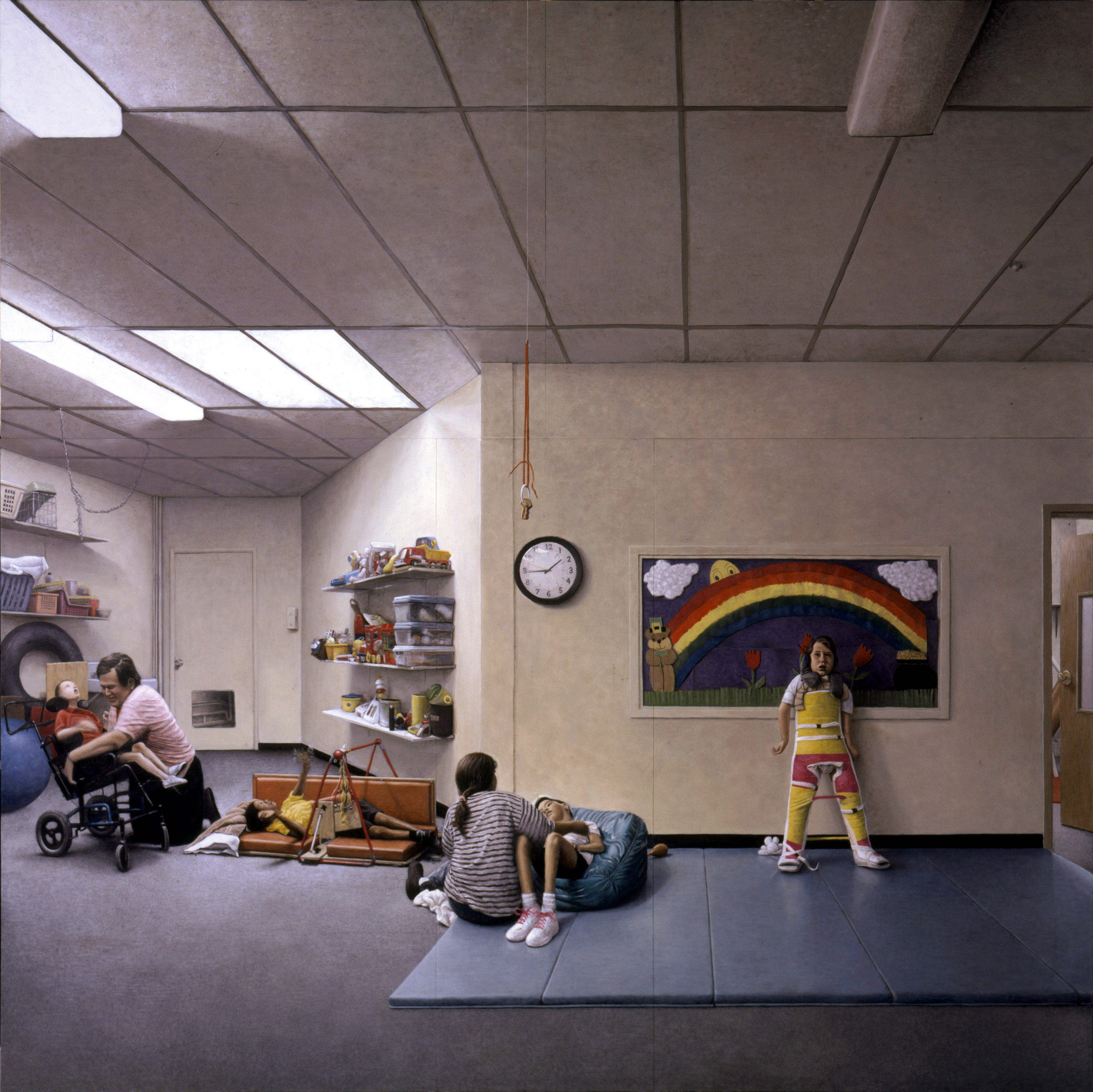
Big Picture, Tim Lowly © 1997, 120" x 120", tempera on panel. Private collection, Seoul, Korea.
This painting was part of an exhibition at Art Space Seoul in Korea. It was the first of several large paintings I have made where I intentionally engaged the convention of “the big picture” as the territory of politically or religiously charged spectacle. In size Big Picture, references the painting Las Meninas by Velázquez: a painting that in itself subverts convention. In Las Meninas, Velázquez’s most important painting as the court painter, he chose to include and emphasize the representation people who were in service in the court (including himself) while relegating the king and queen to a reflection in the mirror. Implicitly, but not insignificantly the viewers of the painting are standing where the reflected royalty should (according to the mirror) be standing. In a parallel manner the painting Big Picture,’s use of a rather compelling perspective (particularly for anyone who is in the room with the actual painting) situates the viewer of the painting in the painting. Let me rephrase this latter point: the way this work is functioning is such as to place the viewer into the world of the painting. As such to the extent that the painting is spectacle it is not one that allows or encourages a passive, removed observation.
For the exhibition catalogue curator Soo-Jin Park wrote this essay.
Assistance with the production of this painting was provided by interns Dean Olson Ramos, Deborah Hendriksma and Kim So-Jeong.
Prints available at: timlowly.imagekind.com/
Hay que distinguir la diferencia entre querer y amar.
El concepto querer lleva implícita la idea de posesión. Te quiero para algo, para que estés conmigo, para que me acompañes, para que compartas alguna actividad, etc.
A fin de cuentas, los seres queridos son seres de los que se espera algunos comportamientos que nos causen satisfacción.
Querer es, generalmente, causa de sufrimiento. Si quiero a alguien, tengo expectativas, espero algo. Si la otra persona no me da lo que espero, sufro. El problema es que hay una mayor probabilidad que la otra persona tenga otras motivaciones, pues todos somos muy diferentes entre sí.
Cada ser humano es un universo.
Amar es desear lo mejor para el otro, aún cuando éste tenga otras motivaciones muy distintas. Amar es permitir que seas feliz, aún cuando tu camino sea diferente al mío. Es un sentimiento altruista y desinteresado. Por esto, el amor nunca será causa de sufrimiento.
Cuando una persona dice que ha sufrido por amor, en realidad ha sufrido por querer, no por amar. Se sufre por apegos. Si realmente se ama, no puede sufrir, pues nada ha esperado del otro. Cuando amamos nos entregamos sin pedir nada a cambio, se da por el simple y puro placer de dar.
Amar produce un gozo profundo. Es la alegría de dar. La única manera de darse cuenta de esto es empezar a aprender a amar. Se puede comenzar por actos pequeños, con las personas a quienes más queremos. Luego, debe extenderse a todas las personas, en todo momento.
“Es difícil encontrar que alguien me ame. Es más fácil encontrar que alguien me quiera para algo, mientras sea necesario y útil para alguien. Pero son pocas las personas que dan amor altruista y desinteresado.”
Pero si bien es difícil encontrar a alguien que me ame, tenemos más de seis mil millones de personas, en todo el mundo, que necesitan amor. Y la mayor felicidad no está en ser amado, sino en la acción de amar al otro.
De modo que nuestra felicidad y gozo está asegurado si dejamos nuestro egoísmo. Seguro que a nuestro alrededor hay cientos de personas que serán felices cuando compartamos con ella nuestro amor. Y no hay problema al darlo: dar amor no agota el amor, por el contrario, lo aumenta.
athens, 1970s sculpture in hotel. it was tiny but attractive with those deep shadows and its implicit references to athena nike. for more images in the eclectic series click here
"Lo conmovedor o irónico de dejar atrás la juventud está implícito en cada uno de los momentos gozosos al viajar: uno sabe que la primera alegría jamás será recobrada, y el viajero sabio aprende a no repetir sus éxitos y a ir tras nuevos lugares todo el tiempo"
..........Paul Fussell
“This is quite the season indeed for friendly meetings. At Christmas, everybody invites their friends about them, and people think little of even the worst weather. I was snowed up at a friend’s house once for a week. Nothing could be pleasanter.“ – Jane Austen, Emma
*
Jane Austen (16 December 1775 – 18 July 1817) was an English novelist known primarily for her six novels, which implicitly interpret, critique, and comment upon the British landed gentry at the end of the 18th century. Austen's plots often explore the dependence of women on marriage for the pursuit of favourable social standing and economic security. Her works are an implicit critique of the novels of sensibility of the second half of the 18th century and are part of the transition to 19th-century literary realism. Her deft use of social commentary, realism and biting irony have earned her acclaim among critics and scholars.
*
maps.secondlife.com/secondlife/Caracus%20Island/81/157/28
Witherwood Thicket
www.flickr.com/groups/frogmore/
Frogmore
At the end of the 11th century the Normans extended their conquest of England into Wales and Pembroke Castle became the centre of Norman rule in South Pembrokeshire. Gerald de Windsor was constable of the Castle on behalf of Henry I when he decided to build his own fortification on the Carew River, some ten miles up the tidal waterway from Pembroke.
This was not the first settlement on the site however. Excavation has revealed an Iron Age settlement. A substantial five ditched promontory fort has been unearthed, together with large quantities of Roman pottery. A Dark Age settlement or fort may also have existed on the site. Gerald's fortification was probably built of earth and wooden stakes. This fortification was later replaced by a stone Castle.
Much of what remains of Carew Castle today was the work of Sir Nicholas de Carew (who died in 1311), who was responsible in particular for the east and west ranges.
In the late fifteenth century the Castle was greatly improved and extended by a very colourful character, Sir Rhys ap Thomas (1449-1525). He altered both the east and west ranges, and was responsible for many of the Bath stone windows and other features. Gaining the implicit trust of both Henry VII and Henry VIII he was said 'to rule this corner of Wales like a King'. The final development took Carew from Medieval fortress to Elizabethan manor. Sir John Perrot (1530-1592) built the great northern range, with its huge windows overlooking the Millpond. However he was not destined to enjoy his magnificent new home, for he died in the Tower of London before the work could be completed.
During the Civil War the Castle was owned by Sir George Carew who declared for the King, but it was garrisoned at different times by both royalists and parliamentarians, and indeed changed hands four times, on at least one occasion following a fierce assault. Buildings on the south side, including the kitchens, were slighted to prevent the enemy making further use of the site. Following the Civil War the Castle was occupied for some years, but eventually abandoned in 1686.
www.flickriver.com/photos/jimborobbo/popular-interesting/
© Jim Roberts Gallery
Thank you for looking at my photographs and for any comments it is much appreciated
All my photos and images are copyrighted to me although you are welcome to use them for non commercial purposes as long as you give credit to myself.
A monk helps a woman preform penance. This was taken at Angkor Wat in Cambodia, on a sweltering day, so being doused with water would not be the worst thing in the world. Angkor is, perhaps, the most extraordinary ancient site in all of Asia (there are more pictures of it to come), but it is also overwhelmed by tourists. We had just come from the grandest of the temples, Angkor Wat itself, and had bought fresh green coconuts to get re-hydrated. Behind the souvenir and snack stalls was this small local temple, where village life was going on unaffected by, and unknown to, the millions of foreigners all around it.
I like this image because of the story implicit in it. There is a power and gender and cultural dynamic at play that is challenging to the viewer. I like the water splashing off the steps, and I find intriguing the woman standing in the shadows. To me she personifies judgement, the need to maintain the status quo by making sure her own rigid morality is maintained.
For more blogs, please visit my website:http://kebeandfast.com/blog/
The red petals implicit extremely delicate level of another gradation of red colors
Microsoft Window like a pirate eating my original
works from my PC destroyed all memory cards of cameras making my PC can not work. Friends of Flickr members do not use Window 10 or you will be same as me.
Excerpt from the plaque:
Saint Luke painting the Virgin Mary by Maerten de Vos, Otto van Veen and Ambrosius Francken
In 1602, Antwerp’s St. Luke’s Guild commissioned a new altar from Maerten de Vos, who was already seventy years old at the time. De Vos’s guild brothers thus implicitly recognized him as the leading painter of his era and the successor of such masters as Quentin Metsijs and Grans Floris.
The subject, Saint Luke paints the Virgin Mary, was extremely popular in the Netherlands, thanks to Rogier van der Weyden. The subject was updated by De Vos and personalized by giving the painter’s apprentice, who rubs the paint, the traits of Abraham Grapheus, the guild’s messenger.
Because de Vos died prior to the altarpiece’s completion, the executive of the panels was entrusted to Otto van Veen and Ambrosius Francken.
Una belleza implícita en la casi marchita flor, un adios a algo que fue, extiende un potente bálsamo que hechiza y aplaca el espíritu fatigado.
Con la Pluma m´abro paso. Luis "Vive (s)"
A part of the Autumn 2017 Collection called "Call & Response" at Wave Hill's Glyndor House, I was immediately attracted to this "story box" by Tammy Nguyen because it reminded me of a Renaissance triptych.
The sculpture and painting combination was actually inspired by two practices that are far different. One is "Cabinets of Curiosity" that originated in England and contained collections of small objects relating to natural history. The other is a custom which originated in India, "Kavad Box" are three-dimensional story boxes that depict narratives and are activated by a storyteller.
While I was in Renaissance triptych mode It never dawned on me that the small book marked "Book of Saints" was supposed to be opened and read. I later learned the the book contains a list of plants that U.S. Customs has deemed may enter and exit our borders without inspection.
In fact the art is about U.S. immigration and the colonialism implicit in our understanding of natural history. Tammy Nguyen wrote "a script to be performed for storytelling, describing the plants as a tribe of nationless organisms free to travel and reside anywhere."
A Faithful Dog Will Play With You
And Laugh With You -Or Cry-
He'll Gladly Starve To Stay With You
Nor Ever Reason Why,
And When You're Feeling Out Of Sorts
Somehow He'll Understand
He'll Watch You With His Shining Eyes
And Try To Lick Your Hand.
His Blind, Implicit Faith In You
Is Matched By His Great Love -
The Kind That All Of Us Should Have
In The Master, Up Above.
When Everything Is Said And Done
I Guess This Isn't Odd
For When You Spell "Dog" Backwards
You Get The Name Of God.
(author unknown)
One of the working dogs at Pencarrow Lodge near Wellington, New Zealand
This is for my friend Jan (Jan 130) with best wishes for her beautiful dog Zak
Own photo processed with DDG and Topaz
~~~ Thank you all for viewing, kind comments, favs and awards - much appreciated! ~~~
En lisière de la forêt d’Halatte, en bordure de la rivière l’Aunette qui sert d’exutoire à la pièce d’eau du parc, la seigneurie d’Ognon relevait de celle de Chantilly. Le château d’Ognon est mentionné pour la première fois en 1382. Les rois de France venus chasser en forêt d’Halatte séjournent au château : Louis xii en 1511, François 1er en 1526.
Le château, reconstruit au xixe, et sa tour féodale, tous deux endommagés pendant la seconde guerre mondiale, ont été détruits en 1957. La ferme possède encore deux tours du xviie
siècle.
Le parc conserve le témoignage des aménagements paysagers, des fabriques et de la statuaire dûs aux campagnes d’embellissement successives.
L’aménagement du parc au xviie siècle
Artus de la Fontaine, seigneur d’Ognon à partir de 1540, fut grand maître des cérémonies sous les règnes d’Henri II à Henri III, puis ambassadeur à Constantinople et Vienne. Des revers de fortune de la famille de la Fontaine décidèrent de la vente du domaine au début du xviie siècle.
A partir de 1610-1620 commen cent les travaux d’embelli ssement du domaine commandé vraissemblablement par le nouveau seigneur d’Ognon, Jean Lescuyer, conseiller d’Etat et doyen de la chambre des comptes.
Un mail relie les parterres du château aux gloriettes. Cette grande allée de 520 m, orientée nord-sud, est plantée de hêtres majestueux. Le mail destiné à la pratique du jeu de Paume, fort prisé au xviie siècle, est bordé de petits murets destinés à empêcher la perte de la boule en bois dans les taillis. Plusieurs statues (Apollon, Minerve, Mars) datées du milieu du xviie siècle l’accompagnent. Les gloriettes, érigées à l’extrémité sud du parc, se composent de deux édicules carrés, voûtés en arc de cloître, amortissant le mur de soutènement de l’allée. Ils dominent un double niveau de terrasses. Sur l’escalier, les statues des vertus sont attribuées à l’atelier Guillaume Berthelot, qui travaillait en 1623 au Palais du Luxembourg, sous la direction de Salomon de Brosse, né au village voisin de Verneuil-en-Halatte.
Les transformations entre 1676 et le milieu du xviiie siècle
En 1676, le domaine est acquis par Maximilien Titon (1631-v.1711), filleul de Sully, directeur général des Manufactures et magasins d’armes royaux de France. Maximilien Titon et ses descendants qui conservèrent Ognon jusqu’à la révolution, agrandirent et réalisèrent les magnifiques embellissements du parc.
L’hypothèse d’une intervention de Le Nôtre, qui oeuvrait à Chantilly entre 1666 et 1684, a été envisagée sans pouvoir être étayée par des documents. Le dessin actuel du parc fut réalisé entre 1676 et 1723, tout comme l’aménagement du miroir d’eau bordé de tilleuls, accompagné de statues des quatre parties du monde et de vases, et de l’embarcadère (entre 1702 et 1723), du bosquet des quatre saisons, des allées du bois, du carrefour de Diane et de la salle de verdure
et des parterres à la française agrémentant la façade orientale du château. Ces parterres seront remplacés au xixe
siècle par des vallonnements puis par de nouveaux parterres (intervention du paysagiste Varé).
Un parc mis en valeur
Au cours du xixe siècle, la propriété va connaître de grands déboisements, puis des dommages pendant la seconde guerre mondiale. Aujourd’hui, les maçonneries du miroir d’eau ont été refaites. Le lac, existant au xviie siècle, a été restauré (2004). Trois arboretum ont été créés à la place d’anciennes peupleraies. La percée vers Senlis mentionnée dans le rapport d’origine n’existe plus. Certains éléments de sculptures ont été victimes des intempéries ou de vol. Néanmoins, le parc est aujourd’hui bien entretenu et la volonté de préserver les grands tracés et la statuaire est
manifeste.
La partie ouest du site inscrit d’origine du château et du parc d’Ognon est désormais inclus dans le site classé de la forêt d’Halatte, l’arrêté de site classé abroge implicitement la partie du site inscrit concerné.
A finely balanced load of maize, or millet or sorghum makes its precarious way from the fields to the storage site. The ubiquitous three-wheeler is not the most stable of platforms, so the man riding up top obviously has implicit faith in his chauffeur.
Nei Mongol, China. October 2004. © David Hill
The faith exercised in prayer is faith in the God who sovereignly accomplishes His will. When we pray, our faith recognizes, explicitly or implicitly, the overruling providential purposes of God. We may at times be given insight into that will, enabling us to pray with absolute confidence in God’s plan to answer as we ask. But surely those cases are rare – more rare even than our subjective, emotional desires would lead us to suspect. - Douglas Moo
El cultivo del olivo lleva implícita una cultura milenaria llena de luces y sombras, como cualquier otra cultura.
La diferencia estriba en que se trata de nuestra propia cultura, en la que hay que conservar lo aprendido, pero también evolucionar de forma equilibrada entre las nuevas tecnologías y el respeto al medio ambiente.
Nuestro futuro depende de ello.
"Cuantos siglos de aceitunas
los pies y las manos presos,
sol a sol y luna a luna
pesan sobre vuestros huesos..."
Miguel Hernández.