View allAll Photos Tagged Executor
1885 Abstract of Title 38 Belle View Road under Will of Stephen Cockburn, Ironmonger, Ramsgate, Kent.
23 August 1866 Conveyance between Revd.’ James Gillman of 14 Wimbledon Park Road, Wandsworth, Surrey and Stephen Cockburn of Ramsgate, Ironmonger. Stephen Cockburn was married to his wife, Sarah. (Note seems a bit of confusion in marriage dates… 5th July 1836 is the correct date of Stephen Cockburn’s marriage to Sarah Herridge at St. George's Church, Ramsgate, Kent) to sell 38 Belle View Road, formerly known as 2 Arklow Square.
17th January 1845 Indenture between, Elizabeth Hutchinson, Widow, John Hake, Grocer, Revd.’ James Gillman (then of the Parish of Barfreystone, Kent) Thomas Hodges Grove Snowden to sell to Stephen Cockburn.
List of previous occupants is given:
Thomas Grundy, James Craven, Louisa Holman.
2nd May 1873 Will of Stephen Cockburn known as the elder. Executors were wife, Sarah Cockburn, daughter Sarah Cockburn and Son Edward Cockburn. Who along with his other two sons Stephen Cockburn and George Cockburn were beneficiaries under the Will.
10th July 1877 Stephen Cockburn known as the elder died.
5th December 1884 his wife Sarah Cockburn died
Church of Simon and St Jude,
Monument to Sir John Pettus †1614 and Bridget Curtis and Sir Augustine Pettus †1613, alabaster. Commissioned by Thomas Pettus, Sir John’s second son, the executor of his will. Unknown, probably Norwich mason, also responsible for the Suckling monuments in St Andrew’s, restored 2007/8.
St Simon and St Jude was declared redundant in the 1890s, and abandoned in the 1930s. Now owned by the Norwich Churches Trust it has been saved from its state of collapse in the 1930s, but the inside has been butchered by the addition of the nave mezzanine. This makes it impossible to appreciate the monument to Sir John and his family, on filling the north wall flanking the chancel arch. Mercifully the late George Plunkett took a full set of photographs of the interior in the 1930s, including the monument (www.norfolkchurches.co.uk/norwichsimonjude/plunkett/plunk...).
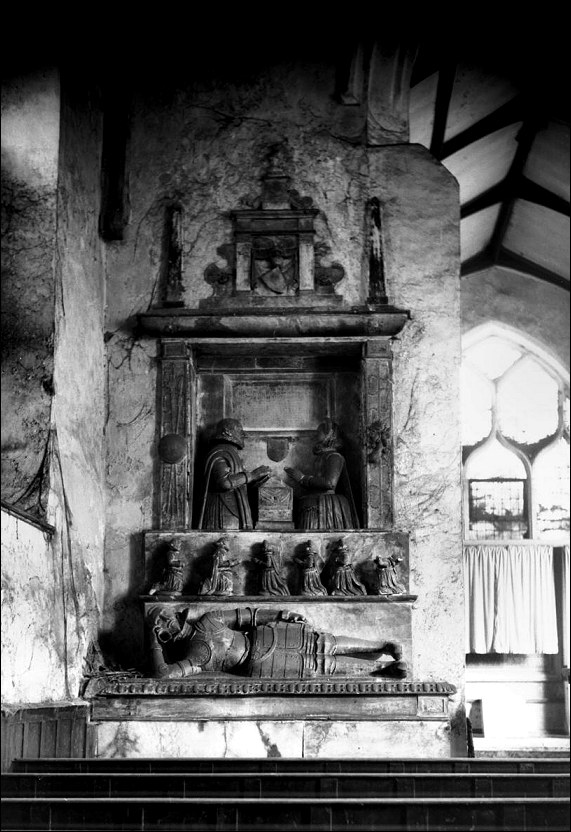
The monument rises from an impressive coloured alabaster base, to the Pettus coat of arms flanked by two obelisks. Sir John in his mayoral robes (he was Mayor in 1608) appears to kneel at a prayer desk opposite his wife, Bridget Curtis, although there is no sign of their legs. Blomefield writing in the 18th century mistook the armorials and identified the kneeling figure as Sir Augustine, who, unlike his father, was never Mayor of Norwich. Most of the literature has followed Blomefield, who was corrected by the Norfolk Heraldry Society (information from Tony Sims). Sir John and Lady Bridget are flanked by pilasters; his decorated with lances, hers with pomegranates and other fruit. Their children, two sons and two daughters kneel underneath, while Sir Augustine, who had died under a year before his father, is repeated lying stiffly in his full armour looking out from the monument, his head propped on his right arm, holding what could be a gauntlet or drinking horn, showing the fingers of a small hand.
Sir John had moved beyond both the family’s relative humble origins as tailors and local politics when in 1604 he had become the first Norwich Member since 1558 to be elected to two consecutive parliaments. He was active as an MP, while continuing his charitable work in Norwich. At the death of his father he had inherited considerable wealth, as well as the family house on Elm Hill, once extending to the churchyard, now nos. 41-43, and the estate at Rackheath, since at death his moveable goods, which included a substantial armoury of nine guns, were valued at £952 19s. 6d and the house on Elm Hill contained 27 rooms, together with stables for eight horses.
Blomefield, An Essay towards a Topographical History of the County of Norfolk: volume 4: The History of the City and County of Norwich, part II, ‘chapter 42: East Wimer ward', (1806), pp. 329-367; Chris Kyle, ‘Sir John Pettus’ in The History of Parliament: the House of Commons 1604-1629, , ed. Andrew Thrush and John P. Ferris, 2010.
Chelsea, Manhattan, New York City, New York, United States
The two stables at Nos. 130 and 132 West 18th Street — units of an original row of thirteen brick-fronted stables erected in 1864-66 of which nine survive — were joined in 1907 to create the present building. Though joined at the ground story, the two facades retain their individual identity at the second story and remain largely intact. Designed in a round-arched utilitarian style related to the German Rundbogenstil. they feature a mix of Romanesque and Renaissance Revival details.
Each unit of the 130-132 West 18th Street building has a tripartite triumphal arch composition which focuses on a central bifurcated Renaissance arch at the second story. Originally built for wealthy businessmen, the two stables had several prominent owners, among them Civil War hero, Major Theodore K. Gibbs, and Nathaniel McCready, founder of the Old Dominion Steamship Line. As a component of one of the two uniformly designed mid-nineteenth-century private carriage house groups remaining in Manhattan, the 130-132 West 18th Street Stables Building is a rare survivor.
These stable rows reflect a period in the city's developmental history when private carriage houses began to be erected some blocks away from their owners' homes, on streets devoted almost exclusively to private stables and commercial liveries. An early manifestation of this trend, which became common practice during the late-nineteenth and early-twentieth centuries, the West 18th Street row was one of the most extensive of the period and contained unusually large and handsomely decorated stables.
The Tonnele Estate and the Development of the Private Stables on West 18th Street
Once part of the eighteenth-century farm of Peter Warren, the lots on the south side of West 18th Street between Sixth Avenue and the old Warren Road to the west were acquired by John Tonnele around 1817.
Senior partner in the firm of Tonnele & Hall, the country's leading dealer in wool, Tonnele had extensive real estate holdings in Manhattan including large tracts on Sixth Avenue, 14th and 15th, and 17th and 18th Streets.
In his will of 1846, Tonnele divided his real estate among his family, giving them the option of selling the property and investing the proceeds in trust for their heirs. A total of thirty-two lots on West 17th and 18th Streets were left to his daughter Susan G. Hall. In March of 1863, she and the executors of the estate, her husband Valentine G. Hall and his brother George Hall, began selling her lots which were then occupied by small dwellings and wood shanties.
As the area was semi-industrial in character, with a brewery located on the north side of 18th Street and the Weber piano factory occupying the northeast corner of Seventh Avenue and 17th Street, the Halls must have regarded the lots as unsuitable for first-class residential or commercial development. However, the lots' proximity to the fashionable Fifth Avenue residential district north of Union Square must have made them seem ideal for private stables and apparently they were offered for sale as such. By 1867, all the former Tonnele Estate lots on 17th and 18th Streets were occupied by private stables with restrictive covenants on the properties prohibiting their conversion to factories or commercial livery stables.
Stables were a necessity during the period when private urban transportation was limited to horses and carriages.3 While the majority of New Yorkers rented or boarded their horses in large commercial stables, the very wealthy maintained private stables.
Traditionally, these were located directly behind their owners' houses, sometimes facing onto the less desirable street front of a through-the-block lot. By the mid-nineteenth century, carriage-house rows developed to serve a few of the city's most exclusive streets.
Remnants of these stable rows survive at 127 and 129 East 19th Street, originally part of a group of stables serving the houses on Gramercy Park South and Irving Place, * and at 57 Great Jones Street, the sole survivor of a long row of stables which once backed onto the mansions on the north side of Bond Street between Broadway and Lafayette Street.
Around 1860, carriage houses began to be erected a few blocks from their owners' homes, on convenient but less fashionable streets, where land costs were lower and where the noises and smells associated with stables would not mar the character of a residential neighborhood. Eventually a number of streets in Manhattan were devoted almost exclusively to private and livery stables.
These included East 35th and East 36th Streets between Lexington and Third Avenues , East 73rd Street between Lexington and Third Avenues , and West 58th Street between Broadway and Seventh Avenue
The twenty-nine stables erected on the former Tonnele Estate in the 1860s, extending from 121 to 143 West 17th Street and from 112 to 146 West 18th Street, were an early example of this type of development and together formed one of the most extensive groups of private stables built in Manhattan in the 1860s.
It should be noted that throughout the 1860s, most of the private carriage houses on these "stable streets" were commissioned on an individual basis and that speculatively built rows were a rarity.
Perhaps the most extensive speculative development was Sniffen court, a group of ten private carriage houses on a blind alley off East 36th Street, erected in 1864 for four investors by local builder John Sniff in, and subsequently sold to wealthy residents of Murray Hill.
Although uniform in design, the row from 122 to 146 West 18th Street was created through a combination of small-scale speculative development and individual commissions. in May and June of 1864, Elisha Brooks, a partner in the successful Brooks Brothers clothing firm, purchased the lots from 122 to 126 West 18th Street and had three identical stables erected on the site.
As work was proceeding on the Brooks stables, Susan Hall and her children agreed to use part of the proceeds from the sale of the lots on 18th Street to build a stable at 128 West 18th Street which would be retained for the family's use.
Though commissioned by a different client, this stable was identical in plan and design to the recently completed Brooks stables. By 1866, the nine remaining lots extending from 130 to 146 West 18th Street had been sold. Their new owners also had stables erected which followed the articulation established by the Brooks stables creating a uniform row of thirteen stables.
This would suggest that Brooks had made the plans for his stables available to the other owners and/or that the same builder or architect was commissioned for all thirteen buildings. The result was one of the most extensive stable rows in the city, containing unusually large and handsomely decorated buildings whose owners included a number of New York's wealthiest and most prominent citizens, among them Samuel F.B. Morse who was the original owner of the stable at 144 West 18th Street .
The stable at 130 West 18th Street was constructed in 1864-65 for Wilmot Johnson, a resident of Albany, who owned a coal company with offices in New York at 111 Broadway.
Soon after its completion Johnson sold the stable to Walter S. Gurnee, a midwesterner who had made a fortune in the tannery business and railroads in Chicago before moving to New York in 1863 where he operated an investment banking firm and served on the board of several mining and metal processing companies.
Gurnee retained the 18th Street stable for three years while he was living at 33 West 20th Street. The stable was then purchased by Henry T. Helmbold, described by nineteenth-century diarist George Templeton Strong as a "sporting druggist [who] is said to have acquired a vast fortune by pictorial advertisements."14 Helmbold also retained the stable for about three years, selling it in 1871 to Major Theodore K. Gibbs, who resided nearby at 62 West 21st Street.
A descendent of a prominent and wealthy Rhode Island family, Theodore Kane Gibbs was born in Newport in 1840. His father William Charming Gibbs was a leader in the public affairs of the state who had served as a member of the state assembly, chief magistrate, and governor from 1820 to 1824.
Theodore K. Gibbs was raised in Newport and entered the army as a young man during the Civil War. He served with distinction, was twice wounded, and twice decorated for bravery. Following the war, he enlisted in the regular army and while stationed on Staten Island married Virginia Barrett. The Gibbses maintained homes in New York and on Gibbs Avenue in Newport.
They were active in society and were known for "giving liberally of their large means."
The stable at 132 West 18th Street was built in 1864-65 for John R. Garland, a broker who headed his own firm on William Street and resided at 28 West 21st Street.
In 1868, the building was acquired by Nathaniel L'Hommedieu McCready, president of the Old Dominion Steamship Line, who lived at 10 West 22nd Street.
A leader in the shipping industry in New York, McCready had entered the business in 1840 at the age of nineteen, organizing his cwn firm, the N.L. McCready Company, which he ran successfully until 1865. He then formed a partnership with Livingston, Fox & Company, owners of several steamship lines. In 1867, he organized the Old Dominion Line which operated a fleet of steamships between New York and the Virginia ports of Norfolk, Newport News, Richmond, and West Point. McCready served as president of the line until his death in 1887; he was also president of the Missouri, Kansas and Texas Railroad for fourteen years.
Following her husband's death Caroline Waldron McCready retained ownership of 132 West 18th Street which continued to function as a private stable. In 1895, the building was remodeled to accommodate horses on the second floor. Four years later Mrs. McCready sold the building to Theodore K. Gibbs who retained ownership of both 130 and 132 West 18th Street until his death in 1906.
The Design of the 130 and 132 West 18th Street Stables
Originally units of a stable row, the stables at 130 and 132 West 18th Street are characteristic of nineteenth carriage house design as adapted to a narrow urban lot. Typically, such stables would have been divided into two major ground-floor spaces — a front room for carriages and a rear room with stalls for horses.
The front portion of the second floor would have contained quarters for the coachman or grocsn, while the rear would have been used as a hayloft. Windows were restricted to the front of the building to spare neighbors the sights and smells associated with horses, but two large skylights provided additional light to the second-floor roams.
The facades of the two buildings were designed in a round-arched utilitarian style derived from the German Rundbogenstil . The Rundbogenstil evolved in Germany in the 1820s among a group of progressive architects who sought to create a synthesis of classical and medieval architecture by drawing on historic precedents in the round-arched Byzantine, Romanesque, and Renaissance styles.
Transmitted to this country through the immigration of German and Central European architects in the 1840s, as well as through architectural publications, the Rundbogenstil tended to be conflated with other mid-nineteenth century round-arched styles such as the Romanesque and Renaissance Revivals.
Among the major American examples of the round-arched style are Charles Blesch and Leopold Eidlitz's St. George's Church on Stuyvesant Square at 16th Street, Alexander Saeltzer's Astor Library , at 425 Lafayette Street, and Thomas Tefft's Union Depot, Providence, R.I. . The style is reflected in the design of the West 18th Street stables by the choice of materials , by the emphasis on flat wall surfaces, and by the clear definition of architectural elements.
The meshing of classical and medieval motifs is apparent in the tripartite composition for each unit, which recalls both a Roman triumphal arch and the elevation of a medieval nave arcade, and in the incorporation of such details as the Renaissance-inspired cornice and diamond-pointed keystones and the Romanesque-inspired arcades and rusticated bands.
The chief feature of each facade is a large central arch containing a pair of inscribed arches and a bull's-eye tympanum. This motif, which was thought by nineteenth-century theorists to have originated in northern Italy during the Romanesque period and was widely used during the Renaissance, became a hallmark of the nineteenth-century round-arched styles, both here and in Germany.
Interestingly, the only other remaining group of mid-nineteenth century carriage houses in Manhattan, located at Sniffen Court, is also designed in a round-arched style and features a triumphal arch composition with arched windows and doors flanking a central two-story arch. At 18th Street, the stables are larger and more elaborate in design.
In addition to its ties to the round-arched style, the design of the stables at 130 and 132 West 18th Street is distinguished by its skillful super imposition of recessed and projected planes. The double-height arcade of each facade, carried on slender projected piers, is on a forward plane, while the wall membrane with its door and window openings is recessed. A series of horizontal moldings break forward over the piers to unite the two planes.
The moldings at the arches' imposts at the second story form the capitals for two pilaster orders . In addition to their function in the design of these individual units, the repeated use of horizontal elements and the alternation of large and small arches are important elements in creating a strong sense of rhythm and harmony within the row.
Description
Two components of a uniformly designed stable row were joined in 1907 to create the building at 130-132 West 18th Street which has a frontage of forty-three feet on West 18th Street and has been extended from its original depth of eighty-one feet to occupy the entire length of its ninety-two-foot-deep lot. Though joined on the ground story, the two facades retain much of their individual identity. Faced with brick and brownstone they are designed in a round-arched style that incorporates Romanesque and Renaissance details.
Each facade is organized in a tripartite triumphal arch composition that focuses on a double-width center bay. At the ground story, the bays are articulated by projected piers. Originally, the wide center bay of each building contained a pair of wood carriage doors, the eastern bay had an arched entrance, and the western bays had an arched window.
The arches were ornamented by diamond-pointed keystones and stone bands ran across the facade at the sill, watertable, impost, and cornice lines. Today, the eastern bay remains relatively intact, although the entrance has been enlarged somewhat to accommodate a metal door. In the center bay of No. 130 the paired carriage doors have been replaced by two arched windows with metal grilles; the windows are supported by a wood bulkhead and surmounted by multipane transoms. At watertable level the stone bands ornamenting the piers have been cut flush with the brickwork.
When No. 130 and No. 132 were joined in 1907, the end piers in the west bay at No. 130 and the east bay of No. 132 were removed to create a vehicle entrance. At that time cast-iron supports were installed next to the brick piers and steel girders were inserted above the old center bay at No. 130 and new vehicle entrance . ,The girders are currently covered with stucco, as are the rusticated blocks above the piers. The cornice that separated the two stories has been removed.
On the western portion of the facade the ground story has been extensively altered. In addition to the changes in the east bay, the piers flanking the original vehicle entrance have been replaced and a steel beam has been inserted above the entrance.
This necessitated the removal of the stone cornice which once capped the first story; the area above the vehicle entrance is now stuccoed. In the west bay, the arched surround has been removed and the window opening has been enlarged to create a doorway. The Weill surface is covered with sheet metal. The opening contains a metal and glass door surmounted by narrow transom. The paired carriage doors in the center bay have also been replaced by a garage door.
The second story of the facade at 130 West 18th Street remains virtually intact. Here the piers carry an arcade in which the center arch is both wider and taller than the flanking arches. The arches are set-off by stone diamond-pointed keystones and stone sills beneath the windows. Stone bands, which break forward over the piers at the impost line of the arches, form the capitals for two pilaster orders — a major order articulating the arcade and a minor order framing the windows.
A small pilaster bisects the center bay into a pair of arched windows which are topped by a molded wood surround that features a central bull's-eye. All of the window openings contain original wood frames and four-over-four double-hung sash. This section of the facade is crowned by a simple molded brick entablature.
On the second story of the portion of the facade at No. 132 the articulation of the facade at No. 130 is repeated. The facade remains largely intact; however, only the east window bay retains its original sash and a fire escape has been added at the west window.
Subsequent History
In the 1870s and 1880s, the neighborhood to the east of the stables on 18th Street, which had once been exclusively residential, became the heart of New York's chief shopping district as the retail trade expanded along Broadway, Sixth Avenue, and 14th and 23rd Streets. At least two of the stables were sold to neighboring businesses in the 1880s and by the first decade of the twentieth century all were being used for commercial or manufacturing purposes. This change in the character of the neighborhood was coupled with the advent of the automobile.
The forerunners of the modern automobile had developed in Europe in the last decades of the of the nineteenth century.
By the 1890s horseless carriages were being manufactured in the United States, and in the first decade of the twentieth century they became a major means of transport for the rich. In 1907, the year following the death of Theodore K. Gibbs, the buildings at 130 and 132 West 18th Street were acquired by the Metropolis Security Company and leased to T.J. Gerome for conversion to an automobile repair garage.
At that time the buildings were joined and a portion of the front wall was taken dcwn and supported on steel beams. The inclusion of a drafting room on the second floor gives some indication of how very specialized auto repair must have been during this period. From documents filed with the Department of Buildings,23 it would appear that the building remained in use as a garage through the mid-twentieth century.
Fires in 1914 and 1946 made alterations to the ground story necessary; however, the second story is largely intact. Today, the 130-132 West 18th Street stables building is a component of one of the two remaining mid-nineteenth century carriage house groups in Manhattan and is distinguished by its design which provides a notable example of the round-arched style as applied to a utilitarian building type.
- From the 1990 NYCLPC Landmark Designation Report
1885 Abstract of Title 38 Belle View Road under Will of Stephen Cockburn, Ironmonger, Ramsgate, Kent.
23 August 1866 Conveyance between Revd.’ James Gillman of 14 Wimbledon Park Road, Wandsworth, Surrey and Stephen Cockburn of Ramsgate, Ironmonger. Stephen Cockburn was married to his wife, Sarah. (Note seems a bit of confusion in marriage dates… 5th July 1836 is the correct date of Stephen Cockburn’s marriage to Sarah Herridge at St. George's Church, Ramsgate, Kent) to sell 38 Belle View Road, formerly known as 2 Arklow Square.
17th January 1845 Indenture between, Elizabeth Hutchinson, Widow, John Hake, Grocer, Revd.’ James Gillman (then of the Parish of Barfreystone, Kent) Thomas Hodges Grove Snowden to sell to Stephen Cockburn.
List of previous occupants is given:
Thomas Grundy, James Craven, Louisa Holman.
2nd May 1873 Will of Stephen Cockburn known as the elder. Executors were wife, Sarah Cockburn, daughter Sarah Cockburn and Son Edward Cockburn. Who along with his other two sons Stephen Cockburn and George Cockburn were beneficiaries under the Will.
10th July 1877 Stephen Cockburn known as the elder died.
5th December 1884 his wife Sarah Cockburn died
Strobist info:
- Nikon SB-25 at 1/4 power high camera right with shoot-through umbrella,
- Nikon SB-600 at 1/4 power behind model as rim light, both fired with Blazzeo (PT-04) wireless flash trigger.
Heraldry / shield - arms of Browne (3 mallets) and Elmes ( William Browne 1498 1489 www.flickr.com/gp/52219527@N00/40333i founder of Browne's Hosptial and his grandson and executor William Thomas Elmes ) - Browne's Hospital Stamford Lincolnshire
Alexander Justice. A general treatise of the dominion of the sea: and a compleat body of the sea-laws. London: Printed for the executors of J. Nicholson, J. and B. Sprint ... and R. Smith ..., [1710?].
Sorry – neigh, neigh – I can’t stop to talk! I’m in a rush. I’m the lead sea horse pulling Poseidon through the waters of the deep. That’s his son Triton swimming alongside us, blowing his conch shell. This book was published in the early eighteenth century, when the British navy was the master of the seas – which meant that many readers were interested in knowing about the law governing the seas. You won’t learn my name, and you’ll never catch me! We’re on our way to Mystic Seaport!
Folio from Quran, 750-800 AD (2nd century AH) (Syria?)
Black, red and green ink on vellum
33.3 x 400 mm (leaf)
267 x 320 mm (text block)
A QUR'AN FOLIO, NORTH AFRICA OR THE NEAR EAST, LATE 8TH CENTURY
Qur'an manuscript leaf on vellum, with 16ll. of elegant black kufic with pronounced circular letters, diacritics indicated with black lines, vocalization of red and occasional green dots, verse endings marked with groups of three diagonal lines.
Roundel 10-verse marker on obverse, line 8
Alif 5-verse marker on reverse, line 8
According to a friend, the entire folio is from Surah 5: al-Ma'ida: The Table Spread With Food and starts with the last part of Verse 101 and runs through the first part of verse 106. Verses 101-105 address faith, with Allah (the Beneficent and Merciful) demanding believers give up their other faiths they've held onto out of tradition, but also forgives them for having done so. Verse 103 alludes to some of those traditions, which are similar to the Hindu practice of letting cows loose to wander freely. Verse 106 addresses appointing two good and pious men as executors of one's dying will.
Condition: Well.... Top and bottom halves are completely separated horizontally and there's a vertical crease in the middle, suggesting the leaf was folded into quarters. Numerous other signs of wear. Text on both sides is complete but barely legible on obverse (pages are turned left to right). Tear and repairs (obverse) affect all of line 9 and the 10-verse marker, and some of lines 7 and 9. Remnants on obverse of tape used to hold top and bottom together at one time. The only mitigating factors are that descriptions of other leaves suggest similar horizontal tears, and even a leaf missing its last three lines was desirable, though that came from a famous collection.
Provenance: Acquired in 2018 from an Amsterdam antiques dealer retiring and selling off his eclectic stock (viz. paintings, prints, glass, nautical antiques, etc.). I had known him several years. When I asked him where he'd gotten this manuscript, he couldn't recall, but he had had it in storage since the 1980s.
As about 90 leaves appear extant, out of a conjectured 500-600 in the total text, my leaf has at least a 1 in 6 or 7 chance of following or preceding a known page.
Similar folios:
Two at LACMA - "Abbasid Caliphate, late 8th century"
(M.73.5.508) - collections.lacma.org/node/240038
(M.2002.1.383) - collections.lacma.org/node/204570 (white and green alif every 5 verses, roundel every 10)
One at Brooklyn Museum - Abbasid / 8th-9th century (same white and green alif every 5 verses, roundel every 10, as LACMA)
(1995.186 ) www.brooklynmuseum.org/opencollection/objects/154555
One at Bonhams - Sale 25 April 2017, 11:00 BST - late 8th century - early 9th century AD (Syria?)
www.bonhams.com/auctions/24197/lot/3/?category=list - (Roundel, no alif)
One at Ashmolean - late 8th century - early 9th century AD - Roundel, no alif
jameelcentre.ashmolean.org/collection/8/per_page/25/offse...
Three individual leaves and an incredible bonanza of 76 leaves, at Christies:
Art of the Islamic and Indian Worlds Including Oriental Rugs and Carpets, 2019 (76 leaves)
A SUBSTANTIAL GROUP OF LARGE KUFIC QUR’AN LEAVES
LATE UMAYYAD OR EARLY ABBASID, PROBABLY DAMASCUS OR JERUSALEM, MID-8TH CENTURY
www.christies.com/en/lot/lot-6229646
The Saeed Motamed Collection - Part I, London, South Kensington, 22 April 2013
Lot 38 - A LARGE KUFIC QUR'AN FOLIO - NEAR EAST OR NORTH AFRICA, LATE 8TH CENTURY (Roundel, no alif)
www.christies.com/lotfinder/books-manuscripts/a-large-kuf...
Art of the Islamic and Indian Worlds, London, 5 October 2010
Lot 53 - A KUFIC QUR'AN FOLIO - NEAR EAST OR NORTH AFRICA, END OF THE 8TH CENTURY (Roundel, no alif)
www.christies.com/lotfinder/lot/a-kufic-quran-folio-near-...
Indian & Islamic Works of Art, London, South Kensington, 26 October 2007
Lot 257 - A QUR'AN FOLIO, NORTH AFRICA OR THE NEAR EAST, LATE 8TH CENTURY (Dire condition, missing top line and most of bottom line; roundel, no alif)
www.christies.com/lotfinder/lot/a-quran-folio-north-afric...
Two lots (1 & 5) at Sothebys London, in 2019: THE SHAKERINE COLLECTION: Calligraphy in Qur’ans and other Manuscripts, 23 October 2019:
www.sothebys.com/en/buy/auction/2019/the-shakerine-collec...
All of these match this item in the Khalili Collection, in page size, text size, style, number of lines, and ornamentation:
Francois Deroche, The Abbasid Tradition: Qurans in the 8th to 10th cCenturies the Nasser D. Khalili Collection of Islamic Art, London 1992, pp. 120-123, no. 66.
The tomb with modern glass barrier
The tomb of Oscar Wilde is located in Père Lachaise Cemetery, Paris, France. It took nine to ten months to complete by the sculptor Jacob Epstein, with an accompanying plinth by Charles Holden and an inscription carved by Joseph Cribb.
In 1908, Oscar Wilde's literary executor Robert Ross[3] chose Jacob Epstein for the commission of the tomb at a cost of two thousand pounds, which had been anonymously donated for this purpose. Later, in a publication of letters between Ada Leverson and Ross in 1930, Letters to the Sphinx, the anonymous donor was revealed to be Helen Carew, with financial assistance from novelist Stephen Hudson (Sydney Schiff).[4] This was only Epstein's second commission, his first being the sculpture for the British Medical Association building in The Strand; these had been severely criticised for being too sexualised for public consumption. However, Epstein retained some noteworthy supporters within the Wilde circle such as William Rothenstein.
The choice of Oscar Wilde's monument would create controversy. Wilde's supporters would have liked for the monument to derive in some way from Wilde's works, such as The Young King, by invoking homoerotica with figures of forlorn Greek youths, whereas Wilde's detractors believed he was deserving of no monument at all. One can see the influences of Wilde's works in Epstein's original sketches for the tomb, which feature two young men, heads downcast in an image of grief and sorrow upon an empty stone stele. However, Epstein has said of his sketches of the tomb that he "was dissatisfied and scrapped quite completed work".
It has been suggested that the change in design plans are due to Epstein's new focus on Wilde's poem The Sphinx. However, a number of influences began to play on Epstein around this period, including that of fellow sculptor Eric Gill. The two artists were deeply interested in what they saw as the more primal sexuality of Indian and Egyptian art, as opposed to British art. Pennington refers to this period in the Epstein's work as the Sun Temple period and claims that, having been unable to follow this path with some of his works in Britain, Epstein transferred his new passion onto the Wilde tomb.
The monument began as a 20-tonne block of Hopton Wood stone in Derbyshire, England, unveiled to the London press in June 1912. Epstein devised a vast winged figure, a messenger swiftly moving with vertical wings, giving the feeling of forward flight; the conception was purely symbolical, the conception of a poet as a messenger, but many people tried to read into it a portrait of Oscar Wilde.
In the original sketches, the influences have been linked to the winged Assyrian bulls in the British Museum.[11] The small angel figure behind the ear of the Sphinx may have been a deliberate reference by Epstein to the verse in Wilde's poem The Sphinx: "sing me all your memories".[9] Upon the headress there are five figures, one with a crucifix, perhaps symbolising the martyrdom of Oscar Wilde; this may be a recurring theme—Epstein may have chosen the Sphinx with a crucified figure upon the headress in reference to the sensual life choice of Wilde thinly veiled by his Catholicism. In Epstein's original sketchings there is a list of ten sins, however none are recognisable clearly on the final monument apart from the Egyptian-like helmet haircuts on the women.
On the finished monument the small angel behind the ear has been removed and replaced by an elaborate headdress, the crucified figure and the phallic sphinx have been removed, and in their place is a personification of fame being trumpeted. This may have been Epstein landing on a less sentimental, carved and angular alternative.
Whilst transporting the monument to the cemetery in France from his Cheyne Walk studios in London, Epstein ran into trouble with the police—having rejected its status as a work of art, French customs placed a punishing import duty of £120 on the monument for the value of the stone. Once the bill was paid (it has been suggested that Robert Ross had borrowed the funds from Ada Leverson), the monument was covered with tarpaulin due to the Parisian officials' reaction to the monument's nakedness. Epstein returned to the cemetery one evening and found that the testicles on the statue had been covered by plaster, as the size of the testicles was considered unusual. The monument was under police surveillance and Epstein found he could only continue his work upon it after bribing a police officer to look away, but the work was sporadic and the tarpaulin was replaced at night. Eventually, as compromise, under Robert Ross' instruction, a bronze plaque similar to the shape of butterfly was placed upon the testicles of the monument and it was unveiled in early August 1914 by the occultist and poet Aleister Crowley. Epstein was furious that his work had been altered without his consent and refused to attend the unveiling. A few weeks later Aleister Crowley approached Epstein in a café in Paris, and around his neck was a bronze butterfly – he informed Epstein that his work was now on display as he intended.
The testicles were removed in an act of vandalism in 1961. It is said that the cemetery manager used them as a paperweight. They are now missing.[22] In 2000, Leon Johnson, a multimedia artist, installed a silver prosthesis to replace them.
The epitaph is a verse from The Ballad of Reading Gaol:
And alien tears will fill for him
Pity's long-broken urn,
For his mourners will be outcast men,
And outcasts always mourn.
Today, the monument is viewed by thousands of visitors every year. A tradition developed whereby visitors would kiss the tomb after applying lipstick to their mouth, thereby leaving a "print" of their kiss. Cleaning operations to remove the lipstick grease have caused the stone to become more porous. It is therefore even harder to clean in subsequent attempts, necessitating more drastic and surface-damaging procedures. In 2011, a glass barrier was erected to make the monument 'kiss-proof'. However, the barrier only covers the lower half of the tomb. As Ireland's Office of Public Works considers the tomb an Irish monument overseas, it has paid for the cleaning and the barrier.
I ACKNOWLEDGE the "rebel" alliance of WAR CRIME. Make the decision to shoot down the Super Star Destroyer "the Ravager", while its admiralty had Surrendered, the disarmament codes had been transmitted to the Rebel Admiral ship, a deluge of fire fell on this imperial building causing the death of 48,523 prisoners of war, de facto. The Allaince Rebelle, who was not at his first attempt at war crimes, tried to put a veil on this affair but all ended up knowing. We can never forget or forgive this so-called Rebel Alliance until the criminals who made the decision to take down the Ravager are brought to justice. The victors write history in propaganda books with the tears of the widows of the vanquished soldiers as ink. More than 48,000 dead, more than 48,000 families have lost one of their own, sometimes even complete siblings decimated. It is out of the question to pass the towel. He who reigns through lies ends up deceiving; he who lives in terror dies in fear.
Richard Gerald Balls ,born Wisbech 1887. Cinema manager, Chelmsford (hence the reference to the film business - showing them,not making them) Now, which Cinema would that be? Married Beatrice L Wright in Downham Market. in 1914. An internet reference gives his executors as his wife and his brother, Francis Barron Balls [b. Wisbech 1893], formerly of the Downham Motor Company, and his widow. Ref:: Richard Gerald Balls, late of Phoenix House Chelmsford in the county of Essex Cinema Proprietor and Manager deceased, who died on the 16th day of December 1936 and of whose estate letters of administration were granted by the Principal Probate Registry on the 1st day of April 1937 to Beatrice Louisa Balls of Bexwell House Downham Market Norfolk Widow and Francis Barren Balls of Bexwell House Downham Market ***aforesaid Cinema manager. [*** I think brother of the has been accidentally omitted there. Otherwise it makes no sense]
And which cinema? Bexwell House was a signficant address in Downham. It may have been demolished.
A contemporary copy of the Essex Chronicle in the Essex records office one day will answer these mysteries.
Update: Phoenix House was situated in the affluent Upper Moulsham Street/Elm Road/New London Road area, as per this document. with large estate. 204b New London Road is known as Phoenix House which in the 1950s was a hostel for Crompton Parkinson Ltd (204) I think this is Phoenix House
Beatrice L Balls died in Downham Market in 1962. His daughter may have been Marjorie, who married Charles G Haddon in Downham in 1963.
In the 1901 census, other children were Walter Wilfrid b 1899 and Archibald James b 1894, sister Eva b 1889. The parents appear to be Henry or Harry Richard Balls, a post office clerk, born Lowestoft, and Annie Haddon.....see how the name reappears in 1963...married in 1886,
Folio from Quran, 750-800 AD (2nd century AH) (Syria? Yemen?)
Black, red and green ink on vellum
33.3 x 400 mm (leaf)
267 x 320 mm (text block)
A QUR'AN FOLIO, NORTH AFRICA OR THE NEAR EAST, LATE 8TH CENTURY
Qur'an manuscript leaf on vellum, with 16ll. of elegant black kufic with pronounced circular letters, diacritics indicated with black lines, vocalization of red and occasional green dots, verse endings marked with groups of three diagonal lines.
Roundel 10-verse marker on obverse, line 8
Alif 5-verse marker on reverse, line 8
According to a friend, the entire folio is from Surah 5: al-Ma'ida: The Table Spread With Food and starts with the last part of Verse 101 and runs through the first part of verse 106. Verses 101-105 address faith, with Allah (the Beneficent and Merciful) demanding believers give up their other faiths they've held onto out of tradition, but also forgives them for having done so. Verse 103 alludes to some of those traditions, which are similar to the Hindu practice of letting cows loose to wander freely. Verse 106 addresses appointing two good and pious men as executors of one's dying will.
Condition: Well... Top and bottom halves are completely separated horizontally and there's a vertical crease in the middle, suggesting the leaf was folded into quarters. Numerous other signs of wear. Text on both sides is complete but barely legible on obverse (pages are turned left to right). Tear and repairs (obverse) affect all of line 9 and the 10-verse marker, and some of lines 7 and 9. Remnants on obverse of tape used to hold top and bottom together at one time. The only mitigating factors are that descriptions of other leaves suggest similar horizontal tears, and even a leaf missing its last three lines was desirable, though that came from a famous collection.
Provenance: Acquired in 2018 from an Amsterdam antiques dealer retiring and selling off his eclectic stock (viz. paintings, prints, glass, nautical antiques, etc.). I had known him several years. When I asked him where he'd gotten this manuscript, he couldn't recall, but he had had it in storage since the 1980s.
As about 90 leaves appear extant, out of a conjectured 500-600 in the total text, my leaf has at least a 1 in 6 or 7 chance of following or preceding a known page.
Similar folios I have found online:
Two at LACMA - "Abbasid Caliphate, late 8th century"
(M.73.5.508) - collections.lacma.org/node/240038
(M.2002.1.383) - collections.lacma.org/node/204570 (white and green alif every 5 verses, roundel every 10)
One at Brooklyn Museum - Abbasid / 8th-9th century (same white and green alif every 5 verses, roundel every 10, as LACMA)
(1995.186 ) www.brooklynmuseum.org/opencollection/objects/154555
One at Bonhams - Sale 25 April 2017, 11:00 BST - late 8th century - early 9th century AD (Syria?)
www.bonhams.com/auctions/24197/lot/3/?category=list - (Roundel, no alif)
One at Ashmolean - late 8th century - early 9th century AD - Roundel, no alif
jameelcentre.ashmolean.org/collection/8/per_page/25/offse...
Three individual leaves and an incredible bonanza of 76 leaves, at Christies:
Art of the Islamic and Indian Worlds Including Oriental Rugs and Carpets, 2019 (76 leaves)
A SUBSTANTIAL GROUP OF LARGE KUFIC QUR’AN LEAVES
LATE UMAYYAD OR EARLY ABBASID, PROBABLY DAMASCUS OR JERUSALEM, MID-8TH CENTURY
www.christies.com/en/lot/lot-6229646
The Saeed Motamed Collection - Part I, London, South Kensington, 22 April 2013
Lot 38 - A LARGE KUFIC QUR'AN FOLIO - NEAR EAST OR NORTH AFRICA, LATE 8TH CENTURY (Roundel, no alif)
www.christies.com/lotfinder/books-manuscripts/a-large-kuf...
Art of the Islamic and Indian Worlds, London, 5 October 2010
Lot 53 - A KUFIC QUR'AN FOLIO - NEAR EAST OR NORTH AFRICA, END OF THE 8TH CENTURY (Roundel, no alif)
www.christies.com/lotfinder/lot/a-kufic-quran-folio-near-...
Indian & Islamic Works of Art, London, South Kensington, 26 October 2007
Lot 257 - A QUR'AN FOLIO, NORTH AFRICA OR THE NEAR EAST, LATE 8TH CENTURY (Dire condition, missing top line and most of bottom line; roundel, no alif)
www.christies.com/lotfinder/lot/a-quran-folio-north-afric...
Two lots (1 & 5) at Sothebys London, in 2019: THE SHAKERINE COLLECTION: Calligraphy in Qur’ans and other Manuscripts, 23 October 2019:
www.sothebys.com/en/buy/auction/2019/the-shakerine-collec...
All of these match this item in the Khalili Collection, in page size, text size, style, number of lines, and ornamentation:
Francois Deroche, The Abbasid Tradition: Qurans in the 8th to 10th Centuries - The Nasser D. Khalili Collection of Islamic Art, London 1992, pp. 120-123, no. 66.
Rio Tocantins na cidade de Marabá (PA).
Julgamento do assassinato dos ativistas José Cláudio e Maria dos Espírito Santo, que foram mortos em março de 2011 em Nova Ipixuna. O resultado do júri, que aconteceu nos dias 03 e 04 de abril, foi a condenação dos executores Alberto Lopes e Lindonjonson Silva, e absolvição de José Rodrigues, acusado de ser o mandante do crime. A ação provocou revolta nos familiares e movimentos agrários que acompanhavam o caso em vigília no Fórum de Marabá (PA).
(CC BY-SA) NINJA
Todas as imagens estão sob licença Creative Commons 3.0 e podem ser utilizadas livremente desde que disponibilizadas nas mesmas condições com o uso do código acima. Imagens em alta resolução estão disponíveis através de requerimento no email fotografia@foradoeixo.org.br
William Browne c1410 - 1489 and wife Margaret 1489 lye on the south chapel floor in their original place where he asked in his will of 17th February 1489 to be buried . General wool merchant, Mayor, Justice of the Peace, Sherriff, Benefactor. Acquired during his lifetime around 200 properties and 10,000 acres of land including the Manor of Lilford He and his brother John 1475 www.flickr.com/gp/52219527@N00/B6W946 restored, embellished and enlarged the 13c church of All Saints c1475 after major damage by lancastrians during the Wars of the Roses..
Browne's hospital www.flickr.com/gp/52219527@N00/N8Uh6c , an almshouse in Broad Street adjacent to where he lived and which is still in use today was founded in November 1493 on his instructions after his death by his widow Margaret, Thomas Stokke, clerk, her brother and other executors which was dedicated to pray their souls and also for the Queen, Sir Reynold Bray and wife Katherine, Thomas Stokke and William Elmes,
William who died on 14th April 1489 stands on 2 woolsacks, over his head is his motto "X me spede" (Christ speed me) and at his feet the family crest of a stork on a woolsack. Over Margaret are the words "Dere Lady help at need"
A long inscription translates -
"Since Thou alone art King of kings, Lord of lords
All that is and will be shall be subjected to Thy will
My body entered the earth, but my spirit to Thee
hastens to run. Thou God, accept me,
Who put my hope in Thee, Son of God, gentle Father
and Holy Ghost thundering from on high - accept and receive me, I have sinned, I have done much evil, and rue this
Thou God accept and receive me who is calling out to Thee !
Enter not, Lord, in judgement, unless beforehand
Thou deignest to give me of Thy redeeming grace, which is enough and since for the sake of the salvation of our souls
Thou, King, wast on earth, receive me, my God! "
William was the son of John Browne 1442, wool merchant, and wife Margery / Margaret 1460 www.flickr.com/gp/52219527@N00/z1Zb1N
He m Margaret 1489 heiress daughter of Agnes 1465 & John Stock / Stokke / Stokes of Warmington
Children
1. Elizabeth c1441-1511 m John Elmes 1497 of Henley-on-Thames, merchant of the Staple of Calais (parents of Margaret Elmes 1571 www.flickr.com/gp/52219527@N00/30591z )
2. Agnes died young
Elizabeth inherited the majority of his wealth and land, estimated to be around 6,000 acres in total and 50 houses (at today’s value worth around £50 million), the balance of land having been endowed to the Alms houses / Hospital. One of the manors inherited by Elizabeth was the Manor of Lilford, which the Elmes family owned until 1711. The wealth of William Browne was thus the basis on which Lilford Hall was built by his grandson and executor William Elmes in 1495, and indeed its' extension in 1635.
www.pegasus-onlinezeitschrift.de/2010_1/erga_1_2010_lamp-...
www.lilfordhall.com/ElmesFamily/William-Browne.asp - Church of All Saints, Stamford Lincolnshire
The Nathaniel Russell House, at 51 Meeting Street, was built by Nathaniel Russell, a wealthy Rhode Island merchant, from 1908-1911. He and his wife, Sarah Russell, lived in the Adamesque building during the early 19th century. Russell's heirs sold the house to Gov. Robert Francis Withers Allston, who lived here while governor. ln 1870, his executors sold it to the Sisters of Our Lady of Mercy. In 1905 it was purchased by the Pelzer family and converted back to a private residence. The Historic Charleston Foundation bought it in 1955 and has restored it as a house museum and the foundation's headquarters
The rectangular three story brick mansion with an octagonal wing on the south side is built of brick with white stone and wood trim. lt has a transomed entrance with an elliptical fanlight, a wrought iron balcony with the monogram of Russell, and a balustraded parapet. It famously boasts a free flying staircase rising three floors without visible support.
National Register #71000750
ANNAPOLIS, Md. (Jan. 17, 2023) Fabien Cousteau, executor and founder of the Proteus Ocean Group (POG), and members of his team take a tour of various departments during a visit to the U.S. Naval Academy. Proteus is the world’s most advanced underwater research station, a collaborative global platform for researchers, academics, government agencies, and corporations to advance ocean science. U.S. Naval Academy midshipmen are working with Proteus as part of their final capstone project.(U.S. Navy photo by Mass Communication Specialist 1st Class Jordyn Diomede)
Underneath the arch between the north chapel and chancel, tomb of Sir David Phillip / Phelip 1450- 1506 and wife Anne Seymark 1533-1510 www.flickr.com/gp/52219527@N00/VG480o who is buried Chenies manor Bucks which she inherited ++
This was the site of a chantry set up after his death, licenced in November 1506 to David Cecille one of his executors "to fund a chantry of 2 chaplins or 1 chaplin perpetual for the good estate of the King while he lives and for his soul afterwards and for the soul of Elizabeth his late consort and the soul of the said David and of his father and mother and Anne his wife (when she dies) and all faithful with licence for the said chaplin to acquire in mortmoin lands to the value of 9l a year".
Anne was the co-heiress daughter of Thomas Seymark / Semark of Thornhaugh by Alice daughter of William Lexham
and Margaret Oldhall. She was the ward of Sir Richard Sapcote of Elton Hunts and later firstly married to his 2nd son William Sapcote having a son Guy Sapcote m Margaret daughter of Guy Wolston
Sir David & Anne m c1485 but had no children,
.Coming from a lowly welsh family Sir David served Henry Tudor (late Henry Vll) in France and fought at the Battle of Bosworth. He became a squire to the body and gentleman usher at court and steward to the kings mother Margaret Beaufort at Colley Weston palace near Stamford living nearby at Thornhaugh, He also held the office of Keeper of the Kings Swans in the waters of Lincolnshire, Northamptonshire, Cambridgeshire and Huntingdonshire and was also keeper of the royal forest of Kings Cliffe which bounded his estates and Windsor Park. .In 1499 he was sheriff of Bedford and Buckingham and a benefactor to the church of Holme in Hunts where there was a window inscription "Of your chartie pray for Sir Davy Phelip and my lady his wife, and for all benefactors of this windowe".
His nephew by marriage Richard Cecil www.flickr.com/gp/52219527@N00/z8mxo3 , father of William Cecil, Lord Burghley joined him having married advantageously Alice daughter of John Dicons alderman of Stamford by Margaret Seymark sister of his wife Anne Seymark ++
On the monument is the Dragon of Wales together with crowned Tudor Roses, and the Portcullis emblem of the Beauforts
The Semarks were out of favour after Bosworth and Annes marriage to David Phelip favoured by the Tudors and Ann's inheritance of the Cheyne fortune resulted into a family of position within the Court of Henry VIII.
www.cb5.co.uk/davidphelip.htm - Church of St Mary Stamford Lincolnshire
Letter from Elizabeth Nichols, widow of Jonas Nichols to Solicitors Hearn and Hearn 7th June 1894, Preston Bissett, Buckinghamshire.
Elizabeth Warr born 1843 at Preston Bissett the daughter of John and Hannah Warr married Jonas Nichols born 1850 at Croughton, Northamptonshire in 1875 at Buckingham.
He died 10th March 1894. He had named his wife Elizabeth as Executrix and sole beneficiary. In the Codicil he names Thomas Herons, Farmer of Hardwick, Oxford as an Executor along with his wife.
Nichols of Preston Bissett, Buckinghamshire Family Papers
ANNAPOLIS, Md. (Jan. 17, 2023) Fabien Cousteau, executor and founder of the Proteus Ocean Group (POG), and members of his team take a tour of various departments during a visit to the U.S. Naval Academy. Proteus is the world’s most advanced underwater research station, a collaborative global platform for researchers, academics, government agencies, and corporations to advance ocean science. U.S. Naval Academy midshipmen are working with Proteus as part of their final capstone project.(U.S. Navy photo by Mass Communication Specialist 1st Class Jordyn Diomede)
Church of St Andrew Thursford Norfolk (Tureforde . Tiresfort in 1086 Domesday book) restored by W Lightly in c1862-65 & partly rebuilt 1870s by a Mr Walker, for Sir Charles Chad & family of Thursford Hall . Only the c1200 north doorway, early 14c tower and 15c south aisle survive
A north aisle was added and chancel rebuilt 1873-74
The raised south transept has the Chad private pews overlooking the chancel altar, underneath is their mausoleum. (The Chad family bought the manor from the executors of William Guybon in the 18c whose family monuments are also here)
Right-i-o.
Sorry for the small size, my resolution is apparently too large, so please click full view :)
My desk is nothing special, far from it, but whatever.
The launcher is Executor (Executor.dk), and it's running without a skin (Still looks yum)
Browser is Firefox, with an autohide bookmarks bar where my back/forward buttons (also autohiding), and refresh/stop (Yes. Autohiding) buttons live.
IM Client is Miranda-IM, running IRC there, connected to 2 servers, with the colours tweaked slightly.
Sidebar is Samurize, absolutely nothing complex there. The to-do list is outputting Gina's todo.sh with the batch file
"@echo off
C:
chdir C:\cygwin\bin
bash --login -i -c 't ls'"
Outputs it nicely.
Most of the other plugins are available from the PluginPak on the main site, nothing special there. I'll list the clickables in notes or something, too.
If you have any questions about anything, feel free to ask, and I'll answer. VS is called "NEWPAGE", OS is Vista.
Boot time 30ish seconds, usable from the instant you see the desktop (Only my AHK script and sam configs load, foobar2k can be open within 32 seconds of boot, Firefox 33. Yes, I timed it. Yes, I'm a nerd.)
In 1961, Imperial Bank of Canada merged with the Candian Bank of Commerce to form the Canadian Imperial Bank of Commerce, or CIBC.
I think I paid $2 for this old cheque. It's purely a hobby for me, old cheques like this one have no value. And one day when I'm dead, I'm sure my executor would just recycle it anyway!
More on the history of Imperial Bank of Canada and CIBC:
bankingmergers.blogspot.com/2011/08/canada-bank-mergers-a...
The only R&R featuring Ava, sort of my alter-ego. It had to be her this time. You’ll possibly understand when you read this review.
Paul Auster
The New York Trilogy
First published in: “City of Glass” (1985), “Ghosts” (1986) and “The Locked Room” (1986).
This edition (as a trilogy): Penguin Books 1990.
Cover design by Greg Mollica
One morning last February, I was standing right outside a Starbucks in New York City and for some reason decided to look down. And there they were. Three twenty dollar bills. I planted my foot down immediately – because it was windy there, around the Empire State Building. Then of course I looked around and waited for a couple of minutes, to see if anyone was groping their pockets or frantically looking for something. I could have yelled “Yo, who lost 60 dollars?” but we all know people aren’t that honest. Anyway, there was no one. So I kindly thanked New York, promised to give back to the city by visiting again soon and then I took Wil to The Strand to spend the money on a just cause. Books.
One of the books I decided on was Auster’s “New York Trilogy”, partly as a nod to the city, which serves as the atmospheric backdrop to most of Auster’s novels.
“The New York Trilogy” is in intricate work consisting of three detective novella’s, seemingly stand-alone. Each novella has its own storyline, all with common themes and elements.
“City of Ghosts” begins with a phonecall to Daniel Quinn, a writer, who is mistaken for ‘Paul Auster’ (yes, Auster features himself in the book), whose services are requested to help search for a young man’s father, one Peter Stillman. Bored with his life and lacking inspiration for his writing, Quinn decides to pose as ‘Paul Auster’ and takes on the job to find Stillman. Instead of finding much of an answer, Quinn instead slowly loses something... his grip on himself.
“Ghosts” is an interesting take on the detective novel, reminiscent of film noir (or a graphic novel). Blue is hired by White to spy on Black... but what if the spy becomes the one spied on?
Finally, “The Locked Room” is the one connecting the trilogy as a whole. A mediocre writer (the narrator of this third novella) becomes the literary executor for an old friend, who has mysteriously vanished. What happened, and why is it so hard to let go?
To me personally, this quote found in “The Locked Room” is a perfect way to begin explaining what Auster is trying to do: “The story is not in the words. It’s in the struggle.” (p.346 of my edition.)
In this trilogy, which is a wonderful example of meta-fiction, Auster is exploring the techniques used in the writing of detective novels. He’s looking beneath the surface of the novels in the detective genre. Identity is a big factor; each ‘detective’ in this trilogy is trying to find someone else, but obsession forces him to be confronted with his own self.
Introspection is another theme, which is evident from the fact that Auster has incorporated a lot of himself in this book, not only by introducing the character ‘Paul Auster’ but also by using the names of various loved ones for his characters (one character is named Sophie, also the name of his daughter. Another is named Daniel, the name of his son, and so on). Details such as these makes me value the idea that perhaps Auster writes to also explore himself as a writer and individual.
What Auster has accomplished is that the reader, initially a bystander, becomes a ‘detective’ too. Reading the trilogy is thrilling, adventurous even; I found myself on the look-out for underlying connections and patterns throughout the book. Trying to find clues, searching for possible predictions and what ties these three novellas together. The ‘detectives’ in the novellas become the watched; the readers are the ones observing them, trying to find anwers.
Are there any answers? There is some form of a conclusion, yes, but much is left unresolved. But that isn’t necessarily what makes a book great. “Oracle Night”, another one of Auster’s meta-fiction novels, was quite unresolved in many ways as well, but I learned to be more aware of the reading and writing process, not just to focus my attention on a satisfying conclusion.
What I gained from “The New York Trilogy” is to actually get a real kick out of the reading experience. I am a bit of a ‘detective’ now no matter what book I read.
4.5/5
----------
Book review & accompanying photo copyright Karin Elizabeth. Do NOT copy and repost or reproduce the text or photo anywhere without my permission.
Copyright © Karin Elizabeth. All rights reserved. This photo is public only so you ("the public") may view it; it is not to be used as free stock. Use without written consent by the author (that would be me) is illegal and punishable by law; I will take action. This goes for blogging, as well. So, contact me beforehand if you are interested in using this image or any of my others (non-)commercially.
No group images or (admin) invites wanted in my comments. I will delete your comments.
I block assholes.
Elizabeth Nash married Mr. John Barnard, of Abington, Northamptonshire, at Billesley, a village four miles from Stratford, June 5, 1649.
Sir John Barnard was a widower, and had already a family. There is no mention of this family in Lady Barnard's will, and a limitation to the barest law and justice towards her husband, whom she did not leave her executor. The will was drawn up on January 29, 1669-70, and she died at Abington in February. "Madam Elizabeth Bernard, wife of Sir John Bernard, Knight, was buried 17th Feb., 1669-70."1 No sepulchral monument was raised in memory of the granddaughter and heir of Shakespeare, but she probably lay in the same tomb as her husband, who died in 1674.
10221 Super Star Destroyer (Star Wars)
Ages 16+. 3,152 pieces.
US $399.99 CA $499.99 DE 399.99 € UK 349.99 £
The Super Star Destroyer Executor has arrived! This jaw-dropping vessel served as command ship at the Battle of Endor and as the personal flagship of Darth Vader in the classic Star Wars movies. With its classic dagger-shaped design, the Executor is among the largest and most powerful vessels in the Star Wars galaxy. With over 3,000 pieces, measuring nearly 50" (124.5 cm) long and weighing nearly 8 pounds (3.5 kg), every aspect of this fantastic LEGO® Star Wars™ model impresses. Includes 4 minifigures: Darth Vader, Admiral Piett, Dengar, Bossk and IG-88.
Includes 4 minifigures: Darth Vader, Admiral Piett, Dengar and Bossk!
Also includes IG-88 figure!
Features over 3,000 pieces!
Measures nearly 50 inches (124.5 cm) long and weighs nearly 8 pounds (3.5kg)!
Includes display stand and data sheet label!
Center section lifts off to reveal command center!
The Super Star Destroyer is on sale from September 1, 2011
Annie Zunz was the Irish wife of a German iron merchant, Siegfried Rudolf Zunz, who had come to London from Frankfurt-am-Main in 1860 to make his fortune with the firm Henry R Merton Ltd (dodgy goings on in WWI Hansard 16 October 1918) The couple were married for 22 years, but were childless, and when Annie died in 1896 her husband was inconsolable. He died a broken man just three years after his wife.
Siegfried decided that after his death his fortune was to be used to perpetuate the memory of his beloved Annie. In his will he instructed his executors and trustees to give £25,000 (about £1.9 million today) to a London hospital to build and maintain forever a ward named “The Annie Zunz ward”, and that a life-sized photograph of Annie was to be hung in that ward. The surplus of his estate was to be given to other London hospitals to support Annie Zunz wards.
The Royal Free, Bart’s, King’s College Hospital, the Bolingbroke and the Royal London all have Annie Zunz wards
(Brasília - DF, 05/08/2020) Presidente da República, Jair Bolsonaro conversa com a imprensa.
Foto: Isac Nóbrega/PR
Draft Will of Thomas George Williams, of 17 Redbourne Street, Hull now temporarily residing at the Admiral Harvey Public House, Ramsgate dated 22nd March 1887.
Executors/Executrix: Wife, Ellen Ann Williams and Richard Joseph Hodgman of 4, Elgar Place, Ramsgate, Kent.
Beneficiaries: Ellen Ann Williams, Son, Thomas Harold Williams. Other children are not named.
Witnesses: Edward Wotton, Solicitor and Thomas Crusaly, Clerk
My Sister,
You know you have been a real horrible sister...how do you sleep? You say she is at peace...I say She cannot be! You didn't do what she wanted! Period. That is the long and the short of it, Shirley Deane. How could you keep this fight of ours alive...this division of her children. Her last wish was for Unity sister...but you're stubborn and cannot admit when you are wrong. She was that way too. You used to understand the problem with that kind of thinking...but you want her bad traits to be your as well? She made me EQUAL to you and Patrick.
I will bitch, and moan, and from the top of the world until I die- Expose you! You owe me an apology and you owe me 12.5% of My Mother's Estate, photos, dolls, jewelry and the rest of what I did not even get to look at ever again. I will tell everyone The Truth...you remember the Truth Shirley? Remember promising your little sister to love her and grow old with her...Viola's Jewelry, all the promises are broken like Our Sisterhood. You walked in her apt and said to me" What the fuck are you doing here...LEAVE!"and of course "we" know the rest of it...don't we Shirley, and Mother! You let that and mom's decision change everything between us...WHY? I know who I am, what I am. You wanna go back and throw my past in my face...write it down?
I am going write a book...Yet you put others down all the time...if half of our relatives knew what you were saying about them behind their backs...for shame sister. I am ashamed of you.
Sometimes I wanna beat your ass - other times I want to just hold you in my arms. What you said and did in front of Mom was unforgivable Shirley...the things you have done since...despicable. I want my share, my Inheritance. I have your Bible, Joe handed it to me, if you had not run him off, Shari and anyone else you felt like taking away from her- you would have it now...he was mink oiling it for her, and never got to give it back-because of YOU! Momma loved her Shirley...for whatever reasons she loved a lot of other people as well.
You were her favorite...we all knew that. Kevin was too. Sure he hurt her...but that was her favorite son, I've heard her tell him that many times. You cannot rewrite her history, her will her children. You have disgraced us All Shirley- The Cavender Siblings..we look so dysfunctional and you relish in it!. So many know what you really have done to me...and NO ONE agrees - except your own subjects and most disagree/but cannot tell you for fear of your wrath. You can follow web-sites tell you die, I will never stop until this is made right!. You can read my story...I am publishing it, I have a contract with Random. Now you have the power to Unite Sylvia's family...you have the Power to forgive whatever the hell it is you think I did to YOU! I did nothing, I took up for you, when
Momma told me she was changing Executor's, she was scared you would sell her house, that is what you had been telling her. You did this...by being mean to her, trying to get her to leave Yates Center...that is why she called me...we both fell right in and then you went crazy! How come none of you knew?
Kevin was there 3 years...yet no one cared about him living with her, caring for her. They enabled each other at that time. Of course she was dying...she had been for years and years...she had a disease and you all acted like it just could not be, What? No way...yeah, a here is a NewsFlash Shirley..We are Next!
What you did to me at her Funeral, Grandmother's Funeral as well...is now History. You have been so mean, so unloving to me. You do not deserve me as your sister Shirley. I am very different than you. I love unconditionally, I give my heart and it stays where I left it Forever. You have hurt me more that anyone in the world! I cannot stress to you more...This whole thing since I called from her hospital room has been the worst time in my life! You have taken from me not only my birthright and my Inheritance...you try to take my Mother...but My mother loved me...whether you like it or not Shirley...God is going to ask you one day...what you have done to your sister...? I fear you will pay dearly for this choice you have made! I pray you fix this...before YOU pass...please for your own Soul's Sake! There was/is enough to share...she wrote what she wanted, she signed it in front of YOU on your birthday! How do you explain all the lies now? We never tried to take Daddy's $$, Bruce Harrington told me about the Topeka trip! Despicable! My treatment at my mother's Funeral, horrifying, the letter, the obituary's all of them hers and Daddy's...don't you realize everyone knows about your greed? My book will make it clear...wouldn't be great if it made me $$$ :) How you treated Mom...when Rocky died..you and Pat...you could have cared less that Momma was grieving, all you thought about was bad, and what he did to you! I defended you both and hoped you would come around and you did, hell you gave me an 1/8 of really good weed. Thanks:) I also was with her that entire time, Gale too. I tried to help her, I told you what she was going through you still were mean. The when it all became too real, that she was truly leaving us...you did what you do best-you struck out at me and you refuse to believe you can ever do wrong to Kelly...who the fuck does she think she is??? Who do you think I am Shirley? Do you know me...my heart? Who and how deep is My Love for My Family, For My one and Only Mother?
You are not too bright lately, have you had your head and heart looked at? Maybe you should see a Doctor? Want to go to Family Counseling Shirley, my Treat? I think we should or would you rather this fester to a stinking rotten time in hell?
Put yourself in my shoes, be me...think of what has gone on the last 6 years...be me...How would you feel about your big sister?
www.facebook.com/pages/Whos-Will-Family-Losses/1284834505...
Fix this Shirley, I love you...you will always be mine. We could get past all of this division. Mom could truly be at Peace...not just your wishful thinking( she is PISSED-She was of a sound mind-(her body no) but her mind sharp...give to me what she wanted me to have. I want my wedding rings and my star sapphire& platinum ring, I want Viola's Jewelry, my dolls, I want copies of photos, I want 12.5 % and I want Mike to give Tj his share -he is 18 and he wants it. I want my beautiful sister in my life but how can I ever trust this woman with love again? God is the only help we have sister. I want a family Reunion...to bad your half won't be there...Shirley WAKE UP...You are Killing ME! MY blood pressure is high, hurt for you, I beg you to stop this assault on me, Kevin, Joe( those two are so lost), the moment you do...everyone else will come together like she wanted1 You told her a Findagrave...she could be at Peace again. Shirley she is not...how can she be? The Will was not kept...and you took 3 of her babies away from her and her greats. How can She be at Peace? All because YOU love her...sorry dear sister...you are not an only child. She loved us all, you have no right to rewrite her history, kids or Will!
I pray that you read this and understand I am so hurt and angry. I try daily to not feel this pain, but it is a constant. Do you really hate me so much Shirley that you would slowly kill me like this? Please don't - Please love me as I love you. Please let's show this fucked-up world nothing can break Our Family again...that we are United and we do love each other...everyone wants Unity except you! I will forgive you Shirley...I promise I will. It has been so very hard losing her, you Clay, Shannon, Brandie, Brooke, Mikie, Bobbie, Jace......your momma died- well, my momma died and half my family died with her- because of YOU. Don't you miss Nicholl'e? She wishes she could invite you all to her Wedding next month. Don't you miss Victor...he has been so down, really hurt, I worry about him. I have four new Grans, one from Joe and 3 from Nic's David. everyone wants to see us together again like Mom wanted! This is so unfair to my kids- to me, to Kevin & Joe(she loved them)it is the worst Injustice of My Lifetime...and it comes straight from your hateful heart. What you have done is Civil fraud and I can and might file formal charges against you and Mikie, you sure sent and provided solid proof of my case...they want me to file...Bel Aire PD, advised me to and I already knew what my rights are.My IQ is very high! I could have sued in Probate Court, I thought about, got advice. I believe Mom would not have wanted me to do that...sue my sister and nephew, so I didn't. I believe she will try to move this mountain of pain if I keep praying and talking, sharing, publishing and in general....haunt your thoughts as you do mine- until you make this right! For me, for her, for the others you have ostracized. Please Shirley just get this over with. You and him have more that you will ever need, you have many blessings. I am poor, I could have really used that 12.5% share of my mother's will . Does that make me greedy? I have never been greedy and it is not about the property or $...it is about my birthright and my big sister's Vendetta. SAVE ME SHIRLEY...I AM DYING...LIKE A PLANT IN THE SUN WITH NO WATER...I PRAY FOR RAIN ! I know what losing mom was like for you, how much and how close you two always were, I would never say less. But Shirley I loved her and she loved me...had it not been for Joe...we probably would have had better times, but we made up, you know this...because you were there too. Where are you now? How can you just go in and out of people's life when they displease you? You do it to lots of us...think about it. Shirley, I was not put on this earth to please you...I am just a struggling human trying to make the most of love, life and my family. If it were not for Victor and Nicholl'e loving me...there would be no one here that does. I Thank God for that...and I pray for you and I to stop and realize we are losing precious time and we both love and want Momma at Peace. She can be...but you have to make good on her wishes, her will, her life, her children. I miss you so much Shirley, everyday I wish you were my sister again, I am sorry, I did not do whatever it is you think I did! I swear, I have always been on your side...until you choked me 4-6-2007 and began hating me again...God you were me down, you take my family, my joy, my future greats and it hurts so bad Shirley, I hope no one ever hurts you like you have done to me. I would not wish this injustice or pain on anyone! I want my sister back, I want Mom's will to be DONE...not Undone. Shirley you are not dumb...Do the right thing...Fix this PLEASE...I miss you guys, I miss Momma....I want to share her pictures...I HAVE HARDLY ANY! I have loved you much better then you have loved me...let's do this Shirley...it is in your hands to make the Cavender a whole United family...It is sooooo Broken right now. I do not deserve this and I fight back with renewed strength!You have broken me Shirley, I am a mess, I cry all the time, my heart breaks I swear I hear new cracks everyday I miss you. Every day my Mother is Not At Rest..We are Not United...She wants us UNITED SHIRLEY...don't you get it????????? Kelly Ann