View allAll Photos Tagged Effort
Infinity focus at last and what an effort. Shot about twenty frames and this was the only keeper; cropped to improve composition but at least it's sharp. The other shots looked OK in the viewfinder and focus peaking was doing its thing, but there was very little time between first view on the laptop and being transferred to the bin. Just my ineptitude in fine tuning the lens position; more practice to follow.
INDUSTAR-22 5cm f3.5 collapsible lens @ f8.
Simon Bolivar statue in Cartagena, Colombia.
A statue depicts Simon Bolívar astride a horse in a park setting.
This statue is located in Bolívar park, in the center of the city of Cartagena. At the base of the statue is inscribed one of Bolívar’s famous sayings: “Cartagenians: If Caracas gave me life, Cartagena gave me glory.”
Simon Bolívar is known as “The Liberator,” of South America because of his efforts to free the colonies from Spanish rule. The movement for independence in Colombia began in 1810, but succeeded only in 1819 when Bolívar incorporated Colombia into the confederation of Gran Colombia. Gran Colombia included Ecuador and Venezuela (Panama was part of Colombia) until it dissolved into its component parts in 1830.
In an effort to bring in more pollinators to my vegetable garden, I've started trying to grow more flowers. I'm not nearly as successful with flowers as I am with veggies!
I've been making an effort over the last few weeks to get some Pan Am shots at locations I've not gotten previously (even though this spot is in my home town); this netted me this view of AYPO hustling east at 'Cummings' in South Berwick, Maine. B40-8s are fairly unusual in District 2 so even with the gloom I was happy with the result. The B&M Cummings depot that stood at this spot is now on display at the Johnson Hall Museum on US Route 1 in Wells, Maine.
©2008 Marianne Bush
Better Large
Front Page Explore
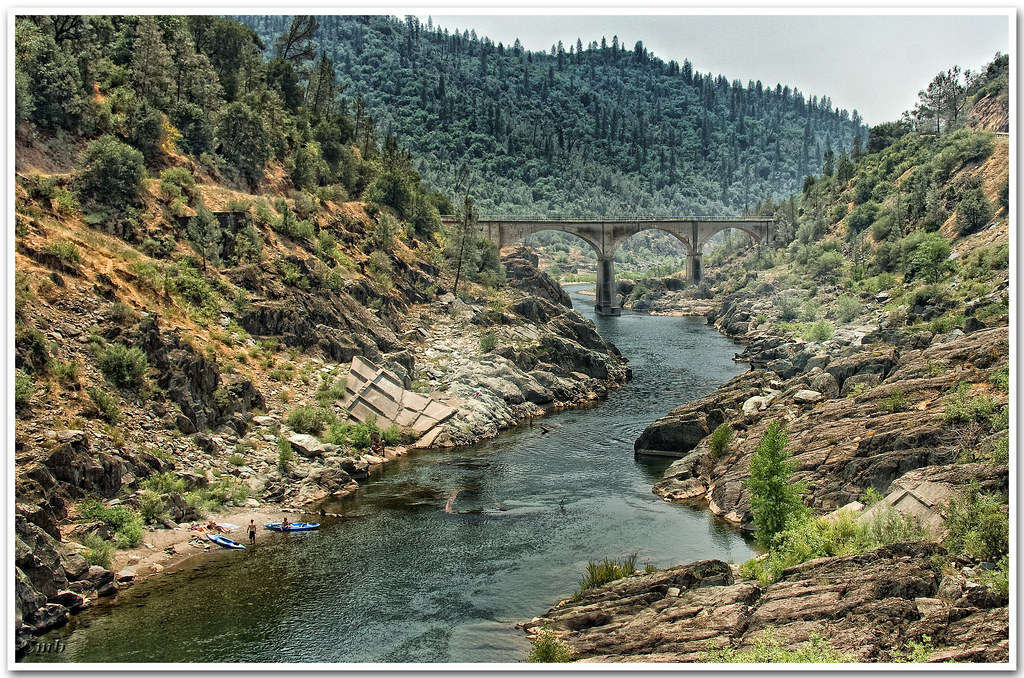
Just found the reason for those slabs on either side of the river:
The Mountain Quarry Cement Bridge, later known as "No Hands Bridge," was completed on March 23, 1912, by 600 men working on the Placer County side and 200 more on the E1 Dorado side to the tune of $300,000. At the time of its construction the bridge was the longest concrete arch bridge in the world. The building of this structure proved that concrete was practical for building long bridges. Although it was plagued by various problems during construction , the span was considered a great piece of railroad bridge engineering.
The old cement bridge stands today as a proud monument to early-day engineering and the men who built it. The bridge has withstood the tugging of the American River currents for over 80 years and stayed on its footings when the Hell Hole Dam broke in December 1964 and took out two modern bridges upstream. It also withstood the so-called "Valentines Day Flood" of 1986, which submerged the bridge before destroying a 250-foot earth-filled coffer dam two miles down river.
The cement bridge has served as a landmark since the railroad went out of service in the 1940s. It did, however, serve a purpose shortly after the Hell Hole dam flood. The dam, located some 40 miles upstream, brought millions of tons of thundering water down the Middle Fork. The force of the water tore out the newer concrete-and-steel highway bridge nearby that linked Auburn with Cool and Georgetown. But the cement railroad bridge survived and was quickly pressed into temporary service to restore vehicle traffic between the two counties.
The rail route's 15 trestles and lines of tracks were removed in the 1940s: the metal and other materials were used in the war effort.
Today, a portion of the old rail route is designated as the Western States Pioneer Express Recreation Trail, in accordance with the National Trails System Act. It is primarily used by horsemen, runners and hikers. The name "no hands" came from veteran rider, Ina Robinson, who would drop her reins to ride across the then guardrail-less bridge. The bridge now stands as the "gateway to Auburn" and the final American River crossing of the Western States 100 Mile Endurance Run.
Eyes: Hecate Collection (het 2) by Gloom *Get this item at the mainstore now!* www.flickr.com/photos/dahviegloom
Eyeshadow: Galaxis Makeup (lel evo x) by veltica www.flickr.com/photos/tokisan/
Makeup: Indigo Liner by [REVERIE] *This item was part of the Planet 29 event!* www.flickr.com/photos/185450605@N02
By September of 1868, mining efforts started near Rock Springs when Thomas Wardell and his Missouri minors opened the no. 1 mine in Rock Springs. The no. 1 mine went on to become one of the largest coal mines in the West. Rock Springs coal was considered the highest quality coal found along the Union Pacific mainline.
Another effort from last night's trip.
A spot of light painting up at the splendid, forgotten weir near Stronachlachar on Loch Katrine in The Trossachs, Scotland. It is part of the system of aquaducts and tunnels that carries Glasgow's public water supply 35 miles to the city. I achieved this effect by swinging some LED fairy lights as I walked towards the camera along the weir in the dark with the roar of the water cascading as accompaniment. Exhilerating. (video capturing the atmosphere here youtu.be/L0epRswGyAA )
Faded.
Secret #24
Sometimes, I wonder how I got to be where I'm at now.
I'm a fairly humble guy, and i often sit back and wonder why me?
Ever since Jr. High, I was never really a good test taker, and that lived through to the SAT's....i took them twice and combined, only scored an 890. It is what it is, i put forth an effort both times and I just couldn't make it.
I applied to one school..California University of Pennsylvania, its part of the State School System in PA, now, I'm not sure if they just let anyone in, or if they were looking for more of a demographic from Central part of the state (its kinda like the 13th grade of Pittsburgh)
To be honest I'm not sure why I got in. But what came of it, is what makes me glad that i was accepted.
Towards the end of my freshman year, my one professor approached me. now earlier on in the day i was dickin around in class w/ a friend so i thought well i deserve whats about to come to me...i walk into his office and he asked me to be his lab assistant...Little did i know, that this professor was about to become one of my best friends. Thats when i knew i was in the right spot....when he announced who his labby was going to be almost all the professors responded with a "Who? Why? Really?"
...well little did they know but, I caught wind of this, and i was now not only out to impress myself....i wanted to prove these professors wrong, and make a somebody out of myself. From that moment on I changed i could tell, I was given an opportunity, and I knew it would take hard work.
All went well, and then as part of my Labby duties I attended the Advisory Board meeting, cause we were going through accreditation. There I met an industry leader, someone i've only dreamed of talking to, some one we talked about in Class..it was crazy i'm sitting next to this person and i some how got the courage to ask him a few questions...i was intrigued by this cutting edge technology he helped build...he was very polite, and before i knew it we were setting up a position for me at the company he worked for as an intern
...now previously i jokingly talked up this company like "Yeah I want to work there someday"
....well that day was now, i started immediately that summer and have been there since...(2 summers now)...
I've made a name for myself... and thats something i can be proud of.
now i'm starting my last semester, I'm graduating a semester early, and my journey is ending, and ...all the professors are sad to see me leave.
That was like 4-6 secrets in itself, i hope you all took the time to read this, i apologize for its length.
It’s difficult to reach the top
Easy to fall back down
The efforts of a single person
In the end
Even when all the stars line up
Are never enough
Reach out, hold my hand.
Of all the images I’ve taken in the last twelve months, this one, for me, represents the year 2020.
Only half awake, I stand here with my hands in my pockets gazing into the distance, watching the shape of the dunes and the sheer size of it is overwhelming even frightening at 4 am. The only existing light is a star filled sky above me. I could’ve stayed here, watched the day arrive softly with each ray of light warming my skin; I could’ve written a love letter and been perfectly content. But on this day, in October, my goal is to climb up the highest dune and photograph at sunrise. Surrounded by silence, my inner voice tells me: You’ve been here before, you know this place, trust your instincts, trust your heart. Encouraged I begin my journey. But be aware, gravity tests your balance with every step sinking into sand as the mind begins to wander: I’ve left my roots far from here, does it mean I’ve grown? Or will I need to find my way back, because the original source is where life began holding water? Certainly, the rhythm of life has changed as well as the rhythm of each step I take. Intently, I listen to the melody familiar to me -my beating heart, moving forward, here and in life -my life. Just then I see a shooting star; flickering lights in my eyes I whisper: “Starlight, star bright, first star I see tonight, I wish I may, I wish I might, have this wish I wish tonight.” I make a wish and I make it to the top. The rising sun greets with all her glory surrounding me with golden hues as far as I can see. For thousands of years these dunes have been here, yet they stay young: always moving, always changing, separating and reconnecting; it's a life of art in motion. The passage of time right in front of my eyes, like an hourglass -two glass bulbs connected- shifting sands, and I can’t help to think that in this lifetime we are all in search for some form of connection -two hearts connected- to give and to take.
Empty, so empty
When the sun goes down
The human touch far
Where do we belong
What do we hold on
Only time will tell
Twenty twenty.
*****
This year, sharing art with people around the world, for me, has been rewarding. I believe that we speak a common language created within all of us -making something meaningful with our cameras. Along the way, we see a glimpse of each other's world. Understanding how much we have in common unites us as people no matter where we come from; the earth is home to all of us. Thank you for being here, I wish everyone a wonderful holiday season filled with joy, health and happiness. Above all, I wish you love.
*****
Decided to make the effort and get up and out of bed to start doing sunrises again.
This is Higger Tor / Surprise View in The Peak District, the light was fantastic for about 20 minutes and then the grey clouds just appeared.
Many Thanks to the +13,335,000 visitors of my photographic stream
===============================================
© Ioan C. Bacivarov
All the photos on this gallery are protected by the international of copyright and they are not for being used on any site, blog or forum, transmitted or manipulated without the explicit written permission of the author. Thank you in advance
Please view my most interesting photos on flickriver stream: www.flickriver.com/photos/ioan_bacivarov/
Cerulean Warblers nests in old growth deciduous forests. Once on their nesting grounds, they hang out at the very top of the canopies. From the forest floor, birdwatchers will have no problem hearing the little warbler's song and can with time and effort even see the little bird flit from tree to tree or branch to branch. The Cerulean provides its fans with a classic case of warbler neck.
Photographing this bird is very hard because one must lean backwards and shoot straight up, and those efforts have given me barely passable 'proof pics' in the past.
This year, however, I found a small area in the far southwestern corner of Michigan of old growth forest with nesting Cerulean Warblers that lay in a depression. From the road above the depression, I was able to photograph a Cerulean at a nearly straight level or at least an acceptable upward angle.
Needless to say, I was very happy to photograph this bird in gleaming sunlight. Sadly, the Cerulean is suffering falling population numbers due to habitat loss. My hope is we will preserve the forests he needs so he may always be with us.
Generated by me, Tool used AI Stable Diffusion
The agents are tasked with taking down a powerful criminal organization that has eluded the authorities for years. This group is notoriously elusive and their leader, known only as "The Phantom," is a master of disguise and deception. Despite the agents' best efforts, they just can't seem to get close to him.
As the agents dig deeper, they begin to uncover a web of corruption that goes all the way to the top of the government. They realize that they can't trust anyone and must rely solely on their own skills and instincts to bring down the organization....
Malgré son chant et la danse de ses plumes, les efforts de ce mâle restèrent vains. Point de femelle en vue.
I very nearly didn't take the camera out with me today, it was foggy, damp and slippery under foot, not ideal conditions, but I'm pleased I made the effort, even though I did have to put a bit more effort into the processing :-)
A huge amount of effort has been made to encourage the Bittern to breed in the UK. From a low number of just eleven breeding pairs in 1997 their population has increased to 227 breeding pairs. Much of the reason for this has been habitat management. This has been great for the Bittern and also those like me who are interested in birdlife in the UK. The big issue for those enthusiasts is that the Bittern is a shy and secretive bird that lives in reedbeds, rarely poking its beak out to look at the outside world.
I have seen and photographed them before but much to Shirley's frustration she has only had very distant views of the birds. Yesterday all of that changed when we were sat in the Roger Mitchell Hide at Potteric Carr, Shirley quietly but excitedly pointed me in the direction of the nearest reedbeds where the unmistakable shape of a Bittern could be seen stealthily stalking through the reeds. Good views were short lived but we could see its shadow and occasionally its beak poke up to see what was going on for some time.
Après avoir exposé à Anvers et à Venise, en 1999, l'entreprise a déménagé dans une nouvelle maison connue sous le nom de Kanaal, située à Wijnegem, à vingt minutes à l'est d'Anvers. Construit à l'origine en 1857, le vaste site était un ancien complexe de distillerie et de maltage. L'architecture existante comprenait des entrepôts en briques et des silos à grains en béton situés le long des rives du canal Albert.
Le développement initial du Kanaal comprenait l'installation des bureaux et des studios de l'entreprise. Cela a été rapidement suivi par l'acquisition d'installations artistiques permanentes, telles que celle d'Anish Kapoor, Au bord du monde. Un plan a été conçu pour faire de Kanaal un centre culturel et résidentiel, un processus qui a commencé au début des années 2000.
Les plans de transformation du site se sont appuyés sur le caractère et l'histoire des bâtiments d'origine pour donner à l'ensemble du quartier un nouveau souffle authentique. C'est un trait central de beaucoup de nos projets. Dick Vervoordt a mené un plan ambitieux pour combiner les efforts de trois équipes d'architectes - Bogdan & Van Broeck, Coussée & Goris, Stéphane Beel - avec le paysagiste Michel Desvigne. La qualité de vie était une priorité absolue et les plans ont été conçus pour adapter la conception de l'intérieur vers l'extérieur, convertissant les anciens bâtiments en nouveaux espaces de vie et de travail.
En 2017, la galerie anversoise déménage dans un nouvel espace au Kanaal, ouvrant par une rétrospective monumentale de Kazuo Shiraga.
Le premier programme de la galerie comprenait une spécialité dans l'art d'après-guerre et contemporain avec un accent particulier sur l'art d'Europe, du Japon et de Corée, en particulier l'art des mouvements ZERO et Gutai. L'accent mis sur Dansaekhwa a suivi, alors que le programme de la galerie et sa participation à des foires d'art mondiales ont pris de l'importance et que sa liste d'artistes s'est élargie.
After exhibiting in Antwerp and Venice, in 1999 the company moved to a new house known as Kanaal, located in Wijnegem, twenty minutes east of Antwerp. Originally built in 1857, the sprawling site was a former distillery and malting complex. The existing architecture included brick warehouses and concrete grain silos located along the banks of the Albert Canal.
The initial development of the Kanaal included the installation of corporate offices and studios. This was quickly followed by the acquisition of permanent art installations, such as Anish Kapoor's At the Edge of the World. A plan has been devised to make Kanaal a cultural and residential center, a process that began in the early 2000s.
The site's transformation plans have built on the character and history of the original buildings to give the whole area an authentic new lease of life. This is a central feature of many of our projects. Dick Vervoordt led an ambitious plan to combine the efforts of three teams of architects - Bogdan & Van Broeck, Coussée & Goris, Stéphane Beel - with landscaper Michel Desvigne. Quality of life was a top priority and plans were made to adapt the design from the inside out, converting old buildings into new living and working spaces.
In 2017, the Antwerp gallery moved to a new space at Kanaal, opening with a monumental retrospective of Kazuo Shiraga.
The gallery's first program included a specialty in post-war and contemporary art with a particular focus on art from Europe, Japan and Korea, particularly art from the ZERO and Gutai movements. The focus on Dansaekhwa followed, as the gallery's program and its participation in global art fairs grew in importance and its roster of artists grew.
Waimea Valley, Botanic Gardens
"Through the efforts of men and women who appreciate the plant that blooms for us every day of the year, Hawaii may rightly be called the Land of the Hibiscus."
- Gerrit P. Wilder, 1921
Modern tropical hibiscus hybrids are truly spectacular, with large flowers and wide variety in color and form, as seen in this section.
These botanical treasures simply would not exist without Hawai'i's pioneering hibiscus breeders. Their impact on the world is clear: Nearly every modern hybrid descends from an early Hawaii hybrid!
Today, breeders throughout the islands and around the world continue to perpetuate Hawaii's legacy of creating and sharing beauty.
In an effort to improve fuel efficiency, NASA and the aircraft industry are rethinking aircraft design. Inside the 8’ x 6’ wind tunnel at NASA Glenn, engineers recently tested a fan and inlet design, commonly called a propulsor, which could use four to eight percent less fuel than today’s advanced aircraft.
The new propulsor is designed to be embedded in the aircraft’s body, where it would ingest the slower flowing air that normally develops along an aircraft’s surface, called boundary layer, and use it to help propel the aircraft.
The tests showed that the new fan and inlet design could withstand the turbulent boundary layer airflow and increase efficiency. Results of the tests can be applied to cutting-edge aircraft designs that NASA and its partners are pursuing.
Image credit: NASA
Brazil
Cuiaba River
The Pantanal
South America
This image celebrates International Jaguar Day.
International Jaguar Day was created to raise awareness about the increasing threats facing the jaguar and the critical conservation efforts ensuring its survival from Mexico to Argentina.
Observed annually on November 29, International Jaguar Day celebrates the Americas’ largest wild cat as an umbrella species for biodiversity conservation and an icon for sustainable development and the centuries-old cultural heritage of Central and South America.
The jaguar (Panthera onca) is a large felid species and the only extant member of the genus Panthera native to the Americas. The jaguar's present range extends from Southwestern United States and Mexico in North America, across much of Central America, and south to Paraguay and northern Argentina in South America.
It is listed as Near Threatened on the IUCN Red List; and its numbers are declining. Threats include loss and fragmentation of habitat.
Overall, the jaguar is the largest native cat species of the New World and the third largest in the world. This spotted cat closely resembles the leopard, but is usually larger and sturdier. It ranges across a variety of forested and open terrains, but its preferred habitat is tropical and subtropical moist broadleaf forest, swamps and wooded regions.
The jaguar enjoys swimming and is largely a solitary, opportunistic, stalk-and-ambush predator at the top of the food chain. As a keystone species it plays an important role in stabilizing ecosystems and regulating prey populations.
Rolling towards the junction into West Burton Power Station 66546 heads 6Z40 from Immingham Import Terminal loaded with coal in an attempt to keep the home lights burning this winter.
The hordes of tiny bushtits are back! Well, they never left but only show up at our feeders in colder weather. And when they do come in, a dozen or more will be on the suet feeder at the same time. It makes for some frenetic shooting as they have mastered the ability to sit still for only a nanosecond! It's definitely worth the effort to try and get glass on them as they are really cute. This is a female - you can tell the difference by looking at their eyes. Females have a light-colored ring around their pupils while a male's eyes are all black.
My sincere thanks to all who spend the time to view, like or comment on my photos. It is much appreciated!
© 2023 Craig Goettsch - All rights reserved. Any unauthorized use without permission is prohibited.
Early morning in Audubon Park New Orleans. A garden open to all. Many residents enjoy a moment of nature thanks to the efforts of park employees and volunteers.
photo by Louis Dutrey
No. 4, 'Loch' simmers outside Douglas Shed. Douglas, Isle of Man. Taken on 17th April 2012 during a David Williams IoM Photocharter with kind permission of the Shed Foreman. I will be back on the Isle of Man next Sunday and hoping to record more atmospheric shots like this one.
Built in 1874 by Beyer, Peacock & Co. and named after lieutenant governor Henry Brougham Loch and beloved by many as their "favourite" engine on the railway, As originally built "Loch" was a small boilered locomotive, but was rebuilt as a medium boilered locomotive in 1909. This gave 'Loch' the same tractive effort as Nos 10 and 11. No. 4 has the strange distinction of being what must surely be the first locomotive ever to (re)enter service on the day the line closed. Having been earmarked for re-boilering in 1967 by the 1968 season 'Loch' was ready for service and steam tests were carried out accordingly. Fate intervened however and at the end of September 1968 the Peel and Ramsey lines closed for good. Fortunately, the Port Erin line was retained and No. 4 was familiar to many as the south based engine for many years, right up until her withdrawal from service after the 1995 Christmas services on the railway. She is the only locomotive to carry a non functioning "bell-mouth" dome and a non-standard livery of maroon was carried from 1979 to withdrawal. No. 4 now wears the familiar Indian red but is distinguished from shed-mates by carrying a Legs Of Mann and "4" numeral on the locomotive's buffer beam.
Something exciting has happened to the humble native coneflower over the past decade. Breeders have put their best efforts toward developing new and improved colors and forms of this easy-growing native perennial wildflower. Some of the newest varieties are hybrid crosses between two different coneflower species. With these makeovers, Echinacea has morphed into a rock star in the garden. With the addition of so many new Echinacea forms, it is possible to design an entire landscape centered on this flower.
Not that there was anything wrong with the original E. purpurea, a familiar dusky purple daisy-like flower with a prominent orange center. Its long bloom period, self-seeding habit, and drought tolerance still make it a favorite of beginners and professionals alike, who delight in the wildlife-friendly attributes of the pollen-rich blooms. Coneflowers are trouble-free but just watch out that you don't overwater the plant or root rot and fungal diseases like powdery mildew can occur.
Oly OM-2n | Zuiko 50/1.4 | ISO 200
Kodiang
This picture was taken in October when the farmers were busy with the rice planting. That was before the big flood that destroyed their crop. Now it is too late in the season for replanting.
Red-throated Loon
Gavia stellata
Member of Nature’s Spirit
Good Stewards of Nature
© 2022 Patricia Ware - All Rights Reserved
When friend Don Marson suggested I come out to Maine for Christmas it sounded good but I couldn't quite make up my mind. When GDM passed along that the CMQ plan was to run east in daylight on Christmas Eve, that tipped the scales.
Grundy drove up from Syracuse and we headed to Jackman before the sun came up. Spirits were high as the forecast was for a blue dome and that's what we got. We saw a Brownville Taxi on the highway so we knew the crew would be leaving soon and looked for a place to shoot him.
We wound up at Long Pond at a spot that needed a little cleanup, so Grundy grabbed the bowsaw in the back of my truck and did a stellar job. Soon we could hear EMD's in the woods and the chase was on!
L'effort à fournir pour parcourir le chemin #36 Chemin de la Découverte vaut la peine.
Caché dans les bois ,les ruines donnent une vision du passé
An effort to go out early the morning after a night out with a few of my ex workmates, obeying the rules in a freezing cliff top marquee with a substantial meal but I was glad I went as we don't seem to get many of these frosty mornings and the sunrises are at such civilised times now. I liked the way the lines in the frosty ground matched the sky. I felt much better afterwards.