View allAll Photos Tagged Dedicated
Dedicated to all 'helmets' ;)
Girls gone wild crew (well, there really was just one cameraman and another guy holding a sort of reflector apart from the model) shooting at South Padre Island during Spring Break
This photo is dedicated to the PritzkerArchitecturePrizeOnFlickr group!
I decided to concentrate all my volunteer work just for one group, the one that I always loved the most, the PritzkerArchitecture group!
I encourage you all to have a seat and watch the show, it is not clear yet, what will be on stage, but there will be changes! We already started with a contest on skyscrapers and a new photo of the month!
The rules have been simplified as well.
I encourage you to stand up and participate, comment on photos, leave constructive critic, participate in the threads, make suggestions, what you would like to see in the group!
Do you want to help out backstage, become a moderator or administrator? Please let me know!
Last but not least, thanks to all my Flickr friends and all the members of this group who make the PritzkerArchitecture group so great! Let's keep the quality high and make the group more interactive!
Dedicated to Stefano Sivieri ;-) – View On Black
Chantier de la Maison du Site, le Pont du Diable – Aniane
Monument dedicated to the memory of John George Howard.
Photograph by Michael A. J. Rumig.
HALLOWEEN Rock N' Roll MUSIC SOUNDTRACK background suggestions for Halloween & Friday the 13th:
Friday the 13th by Thelonious Monk or Theme From Firday the 13th by Manfredini or Tomorrow Never Knows by The Beatles or Dr. Wu by Steely Dan or their other song Kid Charlemagne or the song Scary Monsters (And Super Creeps) by David Bowie or I Put A Spell On You by Scremin' Jay Hawkins or The Witch by The Sonics or the Witches' Rave by Jeff Buckley or Walking With A Ghost by Tegan & Sara or This is Halloween by Marilyn Manson or Monster Mash by Bobby "Borris" Pickett and the Beach boys did this to on their Live Album or Burning Down the House by Talking Heads or Love Potion # 9 by The Searchers or Free Fallin' by Tom Petty or Super Freak by Rick James or The Snake by Johnny Rivers or Spooky by Classics IV or Phantom of the Opera by Iron Maiden or Feed My Frankenstein by Alice Cooper or Clap For The Wolfman(Jack) by Canada's - The Guess Who and also another Canadian group is April Wine and their song Sign Of The Gypsy Queen or as Ian Tyson told me personally at the Mariposa Folk Festival in Orillia, Ontario the greatest folk song in his opinion ever written is The Wreck of the Edmund Fitzgerald by the Canada's legendary Gordon Lightfoot or his other song If You Could Read My Mind or another Canadian doing Spiderman Theme by Michael Buble or Beware The Friendly Stranger by Boards of Canada or check out Fogbounded Creepy Music album Xenophobia on You Tube or The Slender Man Song by Brentalfloss or Behold The Darkness by Medwyn Goodall or Suspiria Theme - 1977 by Goblin or Maggot Dream by Death Cube K or Atmospheres by Gyorgy Ligeti or Volume Alpha by Minecraft or Pokemon G/R/B/Y Lavender Town Remix or check this out on Youtube Hatsune Miku - "結ンデ開イテ羅刹ト骸(Hold, Release; Rakshasa and Carcasses)" Eng subbed or Lavender Town theme(Depressive Black Metal Version) by Anit or for some fabulous creepy listening check this one out called Tidal Tempest Bad Future(Extended) by Sonic CD or The Bottom Feeder by Nurse With Wound or Gwely Mernans by Aphex Twin or Blood On Satan's Claw by Reverend Bizarre or Love Me Forever by Motorhead or +Everything by Limp Bizkit or Creeping Death by Metallica or Blind by KoRn or White Wedding by Billy Idol or his other song called Dancing With Myself or The Visitors by Abba or Purple People Eater by Sheb Wooley or Ghostbusters by Ray Parker, Jr. or This Is Halloween by Gary Gee or The Adams Family by Vic Mizzy orThe Cask Of Amontillado by Alan Parsons Project or The Raven (Long Version) by Alan Parsons Project or Halloween by Aqua or Witches Promise by Juthro Tull or Witches - Aqualords by Dark Horse or Witches by Switchblade Symphony or Witche's Brew by Palmer Hap or Witch Queen Of New Orleans by Redbone or Wicca the Witches Song by Marianne Faithful or When You're Evil by Voltaire or Werewolves Of London by Warren Zevon or We Only Come Out At Night by Smashing Pumpkins or Transylvania Twist by Ex-Voto or Tito and Tarantula by After Dark or The Time Warp by Rocky Horror or Thriller by Michael Jackson(the ultimate classic) or Strange Brew by Cream or Nightmare on My Street by DJ Jazzy Jeff & Fresh Prince or Monster by the B-52's or Friend Of The Devil by Grateful Dead or (Don't Fear) The Reeper by Blue Oyster Cult or Zombie Stomp by Ozzy Osborne and Rob Zombie or the Halloween Volume II soundtrack from Mannheim Steamroller or The X-Files Theme by Enya or Bloodletting (The Vampire Song) by Concrete Blonde or Sympathy For The Devil by The Rolling Stones or Devil In Disguise by Elvis or JJ Cale's version or Devil Inside by Inxs or Race with the Devil by Gene Vincent or The Ghost by Jim Morrison(Lizard Man) and The Doors and then one of the kings of the country boys is It's A Monster's Holiday by Buck Owens and the words will sure to turn your twists or Season of the Witch(Sunshine Superman) by Donavan or Season of the Witch by Brian Augur, Julie Driscoll & Trinity or Toccata and Fugue in d Minor, s. 565 (Anton AHeiller, organist) or Sorceror's Apprentice (Magic?) (transcribedand performed by Peter Richard Centre or Cauldron of Cerridwen(Emerging) by Kay Gardner or Ghosts in the Landscape(Terma) by Tuu & Nick Parkin or All Souls Night by Loreena McKennitt or Strange Brew by Cream or The Burning Times by Charlie Murphy or This is Halloween by Danny Elfman or Witchy Women by The Eagles orFlight of the Magicians by David Michael & Randy Mead or Magic Man by Heart or Arrival To Nowhere by Numina or White Rabbit by The Great Society or The Earth, The Air, The Fire, The Water(ACirle is Cast by Libana or Ghost(Sacred Sacrifice) by Fountain's M.U.S.E or Totem(Picture Music) by Klaus Schulze or Voodoo Child by Jimi Hendrix or The Ghost In Me(Wanderlust) by Terra Ambient or You Must Be A Witch(Nuggets vol.3, Rhino) by The Lollipop Shoppe or Green Eyed Lady by Sugarloaf.
This is some fine Halloween Rockin' and whatever to amuse and stimulate your senses come what the 31st or for any other Friday the 13th!
Is it TRICK or is it TREAT or is it Friday the 13th!
I wonder what Gene, and Alice and Ozzie and Marilyn are doing on the 31st?
Check out these websites for More HALLOWEEN MUSIC:
top40.about.com/od/top10lists/tp/halloweensongs.htm
www.rocknrollview.com/blog/2009/10/13/13-killer-rock-n-ro...
itunes.apple.com/ca/album/100-halloween-rock-n-roll/id406...
This site here is one of the best with links: creepypasta.wikia.com/wiki/Recommended_Listening_Music
www.amazon.com/Halloween-Rock-Roll-Party-Sha/dp/B000000K82
www.imdb.com/title/tt0373883/soundtrack
And on Facebook this site: www.facebook.com/shoutingthomasthetorments
Also from this site is this poem:
gluvlee.blogspot.ca/2012/02/halloween-2010.html
Gramma Luvlee’s Good Friend Fred
Here lies Fred, my dear departed friend.
I know he wished to be here til the end.
Fred was a fun man a giving man too.
He wanted to share his body parts with you!
1) Fred was a golly man with a great big gut.
Let's pass around his intestines just for luck.
Fresh from the grave, wet & cold.
Just a little slimy, just a little old!
Twisted and shriveled in a bunch
just like they were after his lunch.
( A long thin balloon filled with jello & oiled)
2) His fingers were long, almost pure white.
Lets pass around a few, no need for fright.
Fresh from the grave, wet & cold.
Just a little slimy, just a little old!
Pretty greasy & slimy, he lived in a cave.
Never really had time to bathe.
(Slightly cooked & cooled & oiled baby carrots)
3) His toes were grimy from wearing no shoes.
Short & stubby and a little bit blue.
Fresh from the grave, wet & cold.
Just a little slimy, just a little old!
His toenails are long and a little bit brittle.
Don’t mind the wet, it’s just his spittle!
(Cold Vienna sausages)
4) One eye went left, the other right.
Poor Fred had really bad eyesight!
Fresh from the grave, wet & cold.
Just a little slimy, just a little old!
Handle them gently for they may roll.
Fred would hate if they fell from the bowl!
(2 Large peeled grapes)
5) Now Fred he wasn’t a very smart man.
We found his brain stuffed in a can.
Fresh from the grave, wet & cold.
Just a little slimy, just a little old!
Give them a squeeze, there’s not a lot.
I guess old Fred, his mind is shot!
(I rounded the corners on three sponges and put a rubber band in the center to hold them together. It sort of resembled a brain. Then I soaked them in cold water. You could also use a cooked cauliflower.)
6) Fred’s bones were brittle, dry & old.
Give them a crack, if you’re so bold.
Fresh from the grave, wet & cold.
Just a little slimy, just a little old!
The rats have chewed them, you can too!
But wipe them first, there may be goo!
(Pretzel rods)
7) Now one thing Fred couldn’t be called
was billiard ball, hairless, slick or bald!
Fresh from the grave, wet & cold.
Just a little slimy, just a little old!
His crowning glory, styled with spit.
They ladies liked to run their fingers through it!
(Fake Fur)
8) It stopped beating with a start.
Poor Fred’s little slimy heart.
Fresh from the grave, wet & cold.
Just a little slimy, just a little old!
His heart it stopped no more to thump.
Please don’t scream if it starts to jump!
(A large tomato, blanched & peeled)
9) Fred was proud of his pearly whites.
A good set of choppers kept him feed right.
Fresh from the grave, wet & cold.
Just a little slimy, just a little old!
His teeth were strong unlike his eyesight.
Be careful when you touch them, they might bite!
(Corn Nuts)
10) Just like Van Gough, he only had one ear.
But he heard just fine, perfectly clear.
Fresh from the grave, wet & cold.
Just a little slimy, just a little old!
A little bit shriveled because of age.
But an ear nonetheless, it says on this page.
(Dried apricot)
11) The last thing we found was Fred’s strong hands.
They were down deep, covered in sand.
Fresh from the grave, wet & cold.
Just a little slimy, just a little old!
Cold and stiff as they were when he died.
Hold one or you’ll think that I lied.
I WANNA GO TO SYRIA - THE SHOOTING OF SAMMY YATIM
A VIDEO OF THIS SONG WILL BE RELEASED SOON.
Words & Music By MICHAEL A. J. RUMIG
. . . . . . . . . Starting with the sound of bullets and or maybe the sound of a haunting bell ringing nine times!
Key of Open D Minor
VERSE 1
I wanna go to Syria
But now I stay in this paranoia
Gonna ride the TTC
Get me home safely
VERSE 2
Dundas Street Friday mid-night
Turned out to be a fearful flight
Catch a ride on the Red Rocket
Got my token in my pocket
PRE-CHORUS
This summer I hear nine shots
Eight bulls eyes on the dot.
After getting all of those layers
Then finally they got me tasered
REFRAIN
Shoot me up, Shoot me up
Down I go
Shoot me up, Shoot me up
A cop on a roll
Shoot me up, Shoot me up
You think they'd know
Shoot me up, Shoot me up
Why is it sooooooooo
LEAD GUITAR SOLO
VERSE 3
Neon lights torments Toronto
This vision you get onto
Surrounded by cops in rage
I'm cornered in this cage
VERSE 4
Cut off by men in black
No one has got my back
Last ride on the TTC
Why did it have to be
VERSE 5
I wanna go to Syria
Now I stay in this paranoia
Gonna ride No. 4058
Destiny has got my fate
2nd PRE-CHORUS
This summer I hear nine shots
Eight bulls eyes on the dot.
After getting all of those layers
Then finally they got me tasered
2nd REFRAIN
Shoot me up, Shoot me up
Down I go
Shoot me up, Shoot me up
A cop on a roll
Shoot me up, Shoot me up
You think they'd know
Shoot me up, Shoot me up
Why is it sooooooooo
(For the ending repeat the last line)
ENDING
bell Then finally they got me tasered.........
Get me home safely
bell Then finally they got me tasered.........
Canada's land of opportunity
bell Then finally they got me tasered.........
Why did it have to be
bell Then finally they got me tasered.........
bell Why Why Why
Why is it so
bell Oh Why Why Why
Why must I die
bell Why Why Why
Do Cops ever Cry
bell Oh Why Why Why
bell Why must I die die die
. . . . . . . . . ending maybe with the sound of a haunting bell ringing nine times!
When I was at Ryerson at this time a fellow student was there and behind the troops when this following event happened at OHIO.
After the troops killed 4 students in Ohio, Neil Young went into the woods and wrote his classic signature song 'Ohio'.
The Ohio song: www.youtube.com/watch?v=hkg-bzTHeAk
A documentary on Ohio: www.youtube.com/watch?v=TdCpI2qdsd8
ohio- neil young
movie for a history project
ohio- neil young
movie for a history project
If you are looking for a CORN MAZE or two to enjoy anywhere in the United States, you may find it at this web site: www.cornmazesamerica.com/directory.php?state=US
And here: www.funtober.com/cornmaze/
For Canada: puzzles.about.com/od/cornmazes/qt/CDNCornMaze.htm
And here: kccbigcountry.hubpages.com/hub/Corn-Mazes-in-Canada
If you are looking for HAUNTED HOUSES in United States go here: www.trutv.com/conspiracy/paranormal/haunted-houses/galler...
And here: www.hauntworld.com/americas_scariest_best_haunted_houses
For HAUNTED HOUSES in Canada: www.hauntedhouse.com/canada/
And here: paranormal.boomja.com/Haunted-Canada-31326.html
And INTERNATIONALLY: directorywww.haunted-places.com/International.htm
So long dare Spookies!
Dedicated to Mary - (Passion4Nature)
www.flickr.com/photos/47538947@N03/
Words can't express how saddened I am by the tragic loss of Mary.
May she rest in peace.
© ALL RIGHTS RESERVED. Use without permission is illegal.
Please, don't fave my photos and run
Topaz Studio
The Brihadeshwara Temple at Thanjavur in the Indian state of Tamil Nadu, is a Hindu temple dedicated to Shiva. It is an important example of Tamil architecture achieved during the Chola dynasty. The temple is part of the UNESCO World Heritage Site known as the "Great Living Chola Temples".
This is one of the largest temples in India and one of India's most prized architectural sites. Built by emperor Raja Raja Chola I and completed in 1010 AD, Peruvudaiyaar Temple, also popularly known as the 'Big Temple', turned 1000 years old in 2010.
Thanjavur Periya Kovil stands amidst fortified walls that were probably added in the 16th century. The vimanam (or temple tower) is 66 m) high and is among the tallest of its kind in the world. The Kumbam (Kalasha or Chikharam, the apex or the bulbous structure on the top) of the temple is carved out of a single rock and it weighs around 80 tons. There is a big statue of Nandi (sacred bull), carved out of a single rock, at the entrance measuring about 16 feet long and 13 feet high. The entire temple structure is made out of granite, the nearest sources of which are close to Tiruchirappalli, about 60 km to the west of Thanjavur.
HISTORY
The temple had its foundations laid out by the Tamil emperor Arulmozhivarman, popularly called Rajaraja Chola I, in 1002 CE, as the first of the great Tamil Chola building projects.
The Brihadeshwarar Temple was built to grace the throne of the Chola empire in compliance to a command given to him in his dream. The scale and grandeur is in the Chola tradition. An axial and symmetrical geometry rules the temple layout. Temples from this period and the following two centuries are an expression of the Tamils (Chola) wealth, power and artistic expertise. The emergence of such features as the multifaceted columns with projecting square capitals signal the arrival of the new Chola style.
The Brihadeshwarar Temple was built to be the royal temple to display the emperor's vision of his power and his relationship to the universal order. The temple was the site of the major royal ceremonies such as anointing the emperor and linking him with its deity, Shiva, and the daily rituals of the deities were mirrored by those of the king. It is an architectural example showcasing the pure form of the Dravida type of temple architecture and representative of the Chola Empire ideology and the Tamil civilisation in Southern India. The temple "testify to the brilliant achievements of the Chola in architecture, sculpture, painting and bronze casting."
CONSTRUCTION
The wish to build a mammoth temple like this is said to have occurred to Raja Raja while he stayed at Sri Lanka as an emperor.
The esteemed architect and engineer of the temple was Kunjara Mallan Raja Raja Perunthachan as stated in inscriptions found at the temple. The temple was built per ancient texts called Vaastu Shastras and Agamas. He is the ancient ancestor of the doyan of Vaastu Vedic architecture, the late Dr. V. Ganapti Sthapati of Chennai and Mahabalipurim (architect of the 133' granite Thiruvalluvar statue at the tip of south India). Members of his family still live and practice the ancient art and science. The American University of Mayonic Science and Technology was initiated by Dr. V. Ganapati Sthapati to perpetuate the same form of architectural principles used by Kunjara Mallan Raja Raja Perunthachan to build the Brihadeeswarar temple. The temple was built using a measure of 1 3/8-inch called an angula (24 units equalling 33 inches called a hasta, muzam, or kishku). This is the same measure found in ancient Lothal and other sites in the Indus Valley dating back 4000 - 6000 years. This same measure is used to build structures compliant with the Vaastu Shastras and Agamas today. While some builders use a different measure this is considered a standard due to its antiquity.
This temple is the first building fully built by granite and finished within 5yrs [1004AD – 1009AD]. The solid base of the temple raises about 5 metres, above which stone deities and representatives of Shiva dance. The huge kalasam or Vimanam (top portion of the shrine) is believed to weigh 81.28 tonnes of single stone block and was raised to its present height by dragging on an inclined plane of 6.44 km. The big Nandi (bull), weighing about 20 tonnes is made of a single stone and is about 2 m in height, 6 m in length and 2.5 m in width. The presiding deity of lingam is 3.7m tall. The prakaram (outer precincts of the temple) measures 240m by 125m. The outer wall of the upper storey is carved with 81 dance karanas – postures of Bharathanatyam, the classical dance of Tamil Nadu. The shrine of Goddess was added by Pandyas during the 13th century, Subramanya Shrine by Vijayanagara rulers and the Vinayaka shrine was renovated by Maratha rulers.
TEMPLE COMPLEX
The temple complex sits on the banks of a river that was channelled to make a moat around the complex's outer walls, the walls being built like a fortress. The complex is made up of many structures that are aligned axially. The complex can be entered either on one axis through a five-story gopuram or with a second access directly to the huge main quadrangle through a smaller free-standing gopuram. The massive size of the main Vimanam (Shikhara) is ca. 60 meters high, with 16 elaborately articulated stories, and dominates the main quadrangle. Pilaster, piers, and attached columns are placed rhythmically covering every surface of the Vimanam.
The gopuram of the main entrance is 30 m high, smaller than the vimana. It is unusual in the dravidian architecture where the gopurams are generally the main towers and taller than the vimanam.
MAIN TEMPLE
A first rectangular surrounding wall, 270 m by 140 m, marks the outer boundary. The main temple is in the center of the spacious quadrangle composed of a sanctuary, a Nandi, a pillared hall and an assembly hall (mandapas), and many sub-shrines. The most important part of the temple is the inner mandapa which is surrounded by massive walls that are divided into levels by sharply cut sculptures and pilasters providing deep bays and recesses. Each side of the sanctuary has a bay emphasising the principle cult icons. The karuvarai, a Tamil word meaning the interior of the sanctum sanctorum, is the inner most sanctum and focus of the temple where an image of the primary deity, Shiva, resides. Inside is a huge stone linga. The word Karuvarai means "womb chamber" from Tamil word karu for foetus. Only priests are allowed to enter this inner-most chamber.
In the Dravida style, the Karuvarai takes the form of a miniature vimana with other features exclusive to southern Indian temple architecture such as the inner wall together with the outer wall creating a pradakshina around the garbhagriha for circumambulation (pradakshina). The entrance is highly decorated. The inside chamber housing the image of the god is the sanctum sanctorum, the garbhagriha. The garbhagriha is square and sits on a plinth, its location calculated to be a point of total equilibrium and harmony as it is representative of a microcosm of the universe. In the center is placed the image of the deity. The royal bathing-hall where Rajaraja the great gave gifts is to the east of the hall of Irumudi-Soran.
The circumambulation winds around the massive lingam in the garbhagriha and is repeated in an upper story, presenting the idea that Chola Empire freely offered access to the gods.
The inner mandapa leads out to a rectangular mandapa and then to a twenty-columned porch with three staircases leading down. Sharing the same stone plinth is a small open mandapa dedicated to Nandi, Shiva's sacred bull mount.
TEMPLE DEITIES
The "moolavar" or prime deity of the Brihadeeswarar Temple is Shiva. All deities, particularly those placed in the niches of the outer wall (Koshta Moorthigal) like Dakshinamurthy, Surya, Chandra are of huge size. The Brihadiswarar temple is one of the rare temples which has idols for "Ashta-dikpaalakas" (Guardians of the directions) – Indra, Agni, Yama, Nirṛti, Varuṇa, Vāyu, Kubera, Īśāna – each of whom was originally represented by a life-sized statue, approximately 6 feet tall, enshrined in a separate temple located in the respective direction. (Only Agni, Varuṇa, Vāyu and Īśāna are preserved in situ.)
ADJOINING STRUCTURES
Surrounding the main temple are two walled enclosures. The outer wall is high, defining the temple complex area. Here is the massive gopuram or gateway mentioned above. Within this a portico, a barrel vaulted gorpuram with over 400 pillars, is enclosed by a high wall interspersed with huge gopurams axially lined up to the main temple.
FEATURES
Another widely held belief is that the shadow of the gopuram (pyramidal tower usually over the gateway of a temple) never falls on the ground. . The temple is said to be made up of about 60,000 tons of sandstone and granite. The Kumbam itself, a 60 ton granite stone carved in one piece, on top of the main gopuram is believed to have been taken to the top by creating an inclined slope to the height of 66m to the top of the gopuram. The prevailing belief is that a mud-slope, which starts at about three miles from the temple site, from Thirukoilore (birthplace of Raja raja's mother) near Sri Virateshvara swamy temple portrays the figure of the Thanjavur Temple. Elephants might have been used to drag the stone up the slope. This was claimed to be the only part of the gopuram, which does not cast a shadow that fall on the ground, at least not within the temple premises which is an architectural amazement in the world of architecture.
MURALS
The temple has Chola frescoes on the walls around the sanctum sanctorum potryaing Shiva in action, destroying demonic forts, dancing and sending a white elephant to transport a devotee to heaven. These frescoes were discovered in the 1940s and portray the mythological episodes of the journey of Saint Sundarar and the Chera King to heaven, the battle scene of Tripurantaka (Lord Siva) with Asuras (demons). The Chola artists have proved their mettle by portraying even the Asura women with a sense of beauty. Some of the paintings in the sanctum sanctorum and the walls in the passage had been damaged because of the soot that had deposited on them. Owing to the continuous exposure to smoke and soot from the lamps and burning of camphor in the sanctum sanctorum over a period of centuries certain parts of the Chola paintings on the circumambulatory passage walls had been badly damaged. The Tanjore Nayak kings replaced them with a few paintings of their own, about 400 years ago. The Archaeological Survey of India, for the first time in the world, used its unique de-stucco process to restore 16 Nayak paintings, which were superimposed on 1000-year-old Chola frescoes. These 400-year-old paintings have been mounted on fibre glass boards, displayed at a separate pavilion.
TEMPLE PERSONNEL
The temple was consecrated in 1010 CE by Raja Raja Chola I & in 2010 a celebration commemorated the temple's thousandth anniversary. The temple maintained a staff of 1000 people in various capacities with 400 being temple dancers Besides the Brahmin priests, these included record-keepers, musicians, scholars, and craftsman of every type as well as housekeeping staff. In those days the temple was a hub of business activities for the flower, milk, oil, and ghee merchants, all of whom made a regular supply of their respective goods for the temple for its poojas and during festival seasons. Moreover as evidenced by the inscriptions that found in the compound wall of this temple, the temple had always been serving as a platform for the dancers who excelled in the traditional dance form of Bharatnatyam. vallamuthu minnadi generation worshipped this temple.
WIKIPEDIA
Dedicated to a very special friend, the one and only Roberta
Wishing you and your loved ones happiness, love and lots of smile,
Happy new year!
Happy new year to all my Flickr frinds,
best wishes!
With the rain falling harder, it was a bit of a route march to Holborn and my next church, the stunning St Sepulchre, which was also open.
-----------------------------------------------------
St Sepulchre-without-Newgate, also known as the Church of the Holy Sepulchre (Holborn), is an Anglican church in the City of London. It is located on Holborn Viaduct, almost opposite the Old Bailey. In medieval times it stood just outside ("without") the now-demolished old city wall, near the Newgate. It has been a living of St John's College, Oxford, since 1622.
The original Saxon church on the site was dedicated to St Edmund the King and Martyr. During the Crusades in the 12th century the church was renamed St Edmund and the Holy Sepulchre, in reference to the Church of the Holy Sepulchre in Jerusalem. The name eventually became contracted to St Sepulchre.
The church is today the largest parish church in the City. It was completely rebuilt in the 15th century but was gutted by the Great Fire of London in 1666,[1] which left only the outer walls, the tower and the porch standing[2] -. Modified in the 18th century, the church underwent extensive restoration in 1878. It narrowly avoided destruction in the Second World War, although the 18th-century watch-house in its churchyard (erected to deter grave-robbers) was completely destroyed and had to be rebuilt.
The interior of the church is a wide, roomy space with a coffered ceiling[3] installed in 1834. The Vicars' old residence has recently been renovated into a modern living quarter.
During the reign of Mary I in 1555, St Sepulchre's vicar, John Rogers, was burned as a heretic.
St Sepulchre is named in the nursery rhyme Oranges and Lemons as the "bells of Old Bailey". Traditionally, the great bell would be rung to mark the execution of a prisoner at the nearby gallows at Newgate. The clerk of St Sepulchre's was also responsible for ringing a handbell outside the condemned man's cell in Newgate Prison to inform him of his impending execution. This handbell, known as the Execution Bell, now resides in a glass case to the south of the nave.
The church has been the official musicians' church for many years and is associated with many famous musicians. Its north aisle (formerly a chapel dedicated to Stephen Harding) is dedicated as the Musicians' Chapel, with four windows commemorating John Ireland, the singer Dame Nellie Melba, Walter Carroll and the conductor Sir Henry Wood respectively.[4] Wood, who "at the age of fourteen, learned to play the organ" at this church [1] and later became its organist, also has his ashes buried in this church.
The south aisle of the church holds the regimental chapel of the Royal Fusiliers (City of London Regiment), and its gardens are a memorial garden to that regiment.[5] The west end of the north aisle has various memorials connected with the City of London Rifles (the 6th Battalion London Regiment). The church was designated a Grade I listed building on 4 January 1950.
en.wikipedia.org/wiki/St_Sepulchre-without-Newgate
The Early History of St. Sepulchre's—Its Destruction in 1666—The Exterior and Interior—The Early Popularity of the Church—Interments here—Roger Ascham, the Author of the "Schoolmaster"—Captain John Smith, and his Romantic Adventures—Saved by an Indian Girl— St. Sepulchre's Churchyard—Accommodation for a Murderess—The Martyr Rogers—An Odd Circumstance—Good Company for the Dead—A Leap from the Tower—A Warning Bell and a Last Admonition—Nosegays for the Condemned—The Route to the Gallows-tree— The Deeds of the Charitable—The "Saracen's Head"—Description by Dickens—Giltspur Street—Giltspur Street Compter—A Disreputable Condition—Pie Corner—Hosier Lane—A Spurious Relic—The Conduit on Snow Hill—A Ladies' Charity School—Turnagain Lane—Poor Betty!—A Schoolmistress Censured—Skinner Street—Unpropitious Fortune—William Godwin—An Original Married Life.
Many interesting associations—Principally, however, connected with the annals of crime and the execution of the laws of England—belong to the Church of St. Sepulchre, or St. 'Pulchre. This sacred edifice—anciently known as St. Sepulchre's in the Bailey, or by Chamberlain Gate (now Newgate)—stands at the eastern end of the slight acclivity of Snow Hill, and between Smithfield and the Old Bailey. The genuine materials for its early history are scanty enough. It was probably founded about the commencement of the twelfth century, but of the exact date and circumstances of its origin there is no record whatever. Its name is derived from the Holy Sepulchre of our Saviour at Jerusalem, to the memory of which it was first dedicated.
The earliest authentic notice of the church, according to Maitland, is of the year 1178, at which date it was given by Roger, Bishop of Sarum, to the Prior and Canons of St. Bartholomew. These held the right of advowson until the dissolution of monasteries by Henry VIII., and from that time until 1610 it remained in the hands of the Crown. James I., however, then granted "the rectory and its appurtenances, with the advowson of the vicarage," to Francis Phillips and others. The next stage in its history is that the rectory was purchased by the parishioners, to be held in fee-farm of the Crown, and the advowson was obtained by the President and Fellows of St. John the Baptist College, at Oxford.
The church was rebuilt about the middle of the fifteenth century, when one of the Popham family, who had been Chancellor of Normandy and Treasurer of the King's Household, with distinguished liberality erected a handsome chapel on the south side of the choir, and the very beautiful porch still remaining at the south-west corner of the building. "His image," Stow says, "fair graven in stone, was fixed over the said porch."
The dreadful fire of 1666 almost destroyed St. Sepulchre's, but the parishioners set energetically to work, and it was "rebuilt and beautified both within and without." The general reparation was under the direction of Sir Christopher Wren, and nothing but the walls of the old building, and these not entirely, were suffered to remain. The work was done rapidly, and the whole was completed within four years.
"The tower," says Mr. Godwin, "retained its original aspect, and the body of the church, after its restoration, presented a series of windows between buttresses, with pointed heads filled with tracery, crowned by a string-course and battlements. In this form it remained till the year 1790, when it appears the whole fabric was found to be in a state of great decay, and it was resolved to repair it throughout. Accordingly the walls of the church were cased with Portland stone, and all the windows were taken out and replaced by others with plain semi-circular heads, as now seen—certainly agreeing but badly with the tower and porch of the building, but according with the then prevailing spirit of economy. The battlements, too, were taken down, and a plain stone parapet was substituted, so that at this time (with the exception of the roof, which was wagon-headed, and presented on the outside an unsightly swell, visible above the parapet) the church assumed its present appearance." The ungainly roof was removed, and an entirely new one erected, about 1836.
At each corner of the tower—"one of the most ancient," says the author of "Londinium Redivivum," "in the outline of the circuit of London" —there are spires, and on the spires there are weathercocks. These have been made use of by Howell to point a moral: "Unreasonable people," says he, "are as hard to reconcile as the vanes of St. Sepulchre's tower, which never look all four upon one point of the heavens." Nothing can be said with certainty as to the date of the tower, but it is not without the bounds of probability that it formed part of the original building. The belfry is reached by a small winding staircase in the south-west angle, and a similar staircase in an opposite angle leads to the summit. The spires at the corners, and some of the tower windows, have very recently undergone several alterations, which have added much to the picturesqueness and beauty of the church.
The chief entrance to St. Sepulchre's is by a porch of singular beauty, projecting from the south side of the tower, at the western end of the church. The groining of the ceiling of this porch, it has been pointed out, takes an almost unique form; the ribs are carved in bold relief, and the bosses at the intersections represent angels' heads, shields, roses, &c., in great variety.
Coming now to the interior of the church, we find it divided into three aisles, by two ranges of Tuscan columns. The aisles are of unequal widths, that in the centre being the widest, that to the south the narrowest. Semi-circular arches connect the columns on either side, springing directly from their capitals, without the interposition of an entablature, and support a large dental cornice, extending round the church. The ceiling of the middle aisle is divided into seven compartments, by horizontal bands, the middle compartment being formed into a small dome.
The aisles have groined ceilings, ornamented at the angles with doves, &c., and beneath every division of the groining are small windows, to admit light to the galleries. Over each of the aisles there is a gallery, very clumsily introduced, which dates from the time when the church was built by Wren, and extends the whole length, excepting at the chancel. The front of the gallery, which is of oak, is described by Mr. Godwin as carved into scrolls, branches, &c., in the centre panel, on either side, with the initials "C. R.," enriched with carvings of laurel, which have, however, he says, "but little merit."
At the east end of the church there are three semicircular-headed windows. Beneath the centre one is a large Corinthian altar-piece of oak, displaying columns, entablatures, &c., elaborately carved and gilded.
The length of the church, exclusive of the ambulatory, is said to be 126 feet, the breadth 68 feet, and the height of the tower 140 feet.
A singularly ugly sounding-board, extending over the preacher, used to stand at the back of the pulpit, at the east end of the church. It was in the shape of a large parabolic reflector, about twelve feet in diameter, and was composed of ribs of mahogany.
At the west end of the church there is a large organ, said to be the oldest and one of the finest in London. It was built in 1677, and has been greatly enlarged. Its reed-stops (hautboy, clarinet, &c.) are supposed to be unrivalled. In Newcourt's time the church was taken notice of as "remarkable for possessing an exceedingly fine organ, and the playing is thought so beautiful, that large congregations are attracted, though some of the parishioners object to the mode of performing divine service."
On the north side of the church, Mr. Godwin mentions, is a large apartment known as "St. Stephen's Chapel." This building evidently formed a somewhat important part of the old church, and was probably appropriated to the votaries of the saint whose name it bears.
Between the exterior and the interior of the church there is little harmony. "For example," says Mr. Godwin, "the columns which form the south aisle face, in some instances, the centre of the large windows which occur in the external wall of the church, and in others the centre of the piers, indifferently." This discordance may likely enough have arisen from the fact that when the church was rebuilt, or rather restored, after the Great Fire, the works were done without much attention from Sir Christopher Wren.
St. Sepulchre's appears to have enjoyed considerable popularity from the earliest period of its history, if one is to judge from the various sums left by well-disposed persons for the support of certain fraternities founded in the church—namely, those of St. Katherine, St. Michael, St. Anne, and Our Lady—and by others, for the maintenance of chantry priests to celebrate masses at stated intervals for the good of their souls. One of the fraternities just named—that of St. Katherine— originated, according to Stow, in the devotion of some poor persons in the parish, and was in honour of the conception of the Virgin Mary. They met in the church on the day of the Conception, and there had the mass of the day, and offered to the same, and provided a certain chaplain daily to celebrate divine service, and to set up wax lights before the image belonging to the fraternity, on all festival days.
The most famous of all who have been interred in St. Sepulchre's is Roger Ascham, the author of the "Schoolmaster," and the instructor of Queen Elizabeth in Greek and Latin. This learned old worthy was born in 1515, near Northallerton, in Yorkshire. He was educated at Cambridge University, and in time rose to be the university orator, being notably zealous in promoting what was then a novelty in England—the study of the Greek language. To divert himself after the fatigue of severe study, he used to devote himself to archery. This drew down upon him the censure of the all-work-and-no-play school; and in defence of himself, Ascham, in 1545, published "Toxophilus," a treatise on his favourite sport. This book is even yet well worthy of perusal, for its enthusiasm, and for its curious descriptions of the personal appearance and manners of the principal persons whom the author had seen and conversed with. Henry VIII. rewarded him with a pension of £10 per annum, a considerable sum in those days. In 1548, Ascham, on the death of William Grindall, who had been his pupil, was appointed instructor in the learned languages to Lady Elizabeth, afterwards the good Queen Bess. At the end of two years he had some dispute with, or took a disgust at, Lady Elizabeth's attendants, resigned his situation, and returned to his college. Soon after this he was employed as secretary to the English ambassador at the court of Charles V. of Germany, and remained abroad till the death of Edward VI. During his absence he had been appointed Latin secretary to King Edward. Strangely enough, though Queen Mary and her ministers were Papists, and Ascham a Protestant, he was retained in his office of Latin secretary, his pension was increased to £20, and he was allowed to retain his fellowship and his situation as university orator. In 1554 he married a lady of good family, by whom he had a considerable fortune, and of whom, in writing to a friend, he gives, as might perhaps be expected, an excellent character. On the accession of Queen Elizabeth, in 1558, she not only required his services as Latin secretary, but as her instructor in Greek, and he resided at Court during the remainder of his life. He died in consequence of his endeavours to complete a Latin poem which he intended to present to the queen on the New Year's Day of 1569. He breathed his last two days before 1568 ran out, and was interred, according to his own directions, in the most private manner, in St. Sepulchre's Church, his funeral sermon being preached by Dr. Andrew Nowell, Dean of St. Paul's. He was universally lamented; and even the queen herself not only showed great concern, but was pleased to say that she would rather have lost ten thousand pounds than her tutor Ascham, which, from that somewhat closehanded sovereign, was truly an expression of high regard.
Ascham, like most men, had his little weaknesses. He had too great a propensity to dice and cock-fighting. Bishop Nicholson would try to convince us that this is an unfounded calumny, but, as it is mentioned by Camden, and other contemporary writers, it seems impossible to deny it. He died, from all accounts, in indifferent circumstances. "Whether," says Dr. Johnson, referring to this, "Ascham was poor by his own fault, or the fault of others, cannot now be decided; but it is certain that many have been rich with less merit. His philological learning would have gained him honour in any country; and among us it may justly call for that reverence which all nations owe to those who first rouse them from ignorance, and kindle among them the light of literature." His most valuable work, "The Schoolmaster," was published by his widow. The nature of this celebrated performance may be gathered from the title: "The Schoolmaster; or a plain and perfite way of teaching children to understand, write, and speak the Latin tongue. … And commodious also for all such as have forgot the Latin tongue, and would by themselves, without a schoolmaster, in short time, and with small pains, recover a sufficient habilitie to understand, write, and speak Latin: by Roger Ascham, ann. 1570. At London, printed by John Daye, dwelling over Aldersgate," a printer, by the way, already mentioned by us a few chapters back (see page 208), as having printed several noted works of the sixteenth century.
Dr. Johnson remarks that the instruction recommended in "The Schoolmaster" is perhaps the best ever given for the study of languages.
Here also lies buried Captain John Smith, a conspicuous soldier of fortune, whose romantic adventures and daring exploits have rarely been surpassed. He died on the 21st of June, 1631. This valiant captain was born at Willoughby, in the county of Lincoln, and helped by his doings to enliven the reigns of Elizabeth and James I. He had a share in the wars of Hungary in 1602, and in three single combats overcame three Turks, and cut off their heads. For this, and other equally brave deeds, Sigismund, Duke of Transylvania, gave him his picture set in gold, with a pension of three hundred ducats; and allowed him to bear three Turks' heads proper as his shield of arms. He afterwards went to America, where he had the misfortune to fall into the hands of the Indians. He escaped from them, however, at last, and resumed his brilliant career by hazarding his life in naval engagements with pirates and Spanish men-of-war. The most important act of his life was the share he had in civilising the natives of New England, and reducing that province to obedience to Great Britain. In connection with his tomb in St. Sepulchre's, he is mentioned by Stow, in his "Survey," as "some time Governor of Virginia and Admiral of New England."
Certainly the most interesting events of his chequered career were his capture by the Indians, and the saving of his life by the Indian girl Pocahontas, a story of adventure that charms as often as it is told. Bancroft, the historian of the United States, relates how, during the early settlement of Virginia, Smith left the infant colony on an exploring expedition, and not only ascended the river Chickahominy, but struck into the interior. His companions disobeyed his instructions, and being surprised by the Indians, were put to death. Smith preserved his own life by calmness and self-possession. Displaying a pocket-compass, he amused the savages by an explanation of its power, and increased their admiration of his superior genius by imparting to them some vague conceptions of the form of the earth, and the nature of the planetary system. To the Indians, who retained him as their prisoner, his captivity was a more strange event than anything of which the traditions of their tribes preserved the memory. He was allowed to send a letter to the fort at Jamestown, and the savage wonder was increased, for he seemed by some magic to endow the paper with the gift of intelligence. It was evident that their captive was a being of a high order, and then the question arose, Was his nature beneficent, or was he to be dreaded as a dangerous enemy? Their minds were bewildered, and the decision of his fate was referred to the chief Powhatan, and before Powhatan Smith was brought. "The fears of the feeble aborigines," says Bancroft, "were about to prevail, and his immediate death, already repeatedly threatened and repeatedly delayed, would have been inevitable, but for the timely intercession of Pocahontas, a girl twelve years old, the daughter of Powhatan, whose confiding fondness Smith had easily won, and who firmly clung to his neck, as his head was bowed down to receive the stroke of the tomahawks. His fearlessness, and her entreaties, persuaded the council to spare the agreeable stranger, who could make hatchets for her father, and rattles and strings of beads for herself, the favourite child. The barbarians, whose decision had long been held in suspense by the mysterious awe which Smith had inspired, now resolved to receive him as a friend, and to make him a partner of their councils. They tempted him to join their bands, and lend assistance in an attack upon the white men at Jamestown; and when his decision of character succeeded in changing the current of their thoughts, they dismissed him with mutual promises of friendship and benevolence. Thus the captivity of Smith did itself become a benefit to the colony; for he had not only observed with care the country between the James and the Potomac, and had gained some knowledge of the language and manners of the natives, but he now established a peaceful intercourse between the English and the tribes of Powhatan."
On the monument erected to Smith in St. Sepulchre's Church, the following quaint lines were formerly inscribed:—
"Here lies one conquered that hath conquered kings,
Subdued large territories, and done things
Which to the world impossible would seem,
But that the truth is held in more esteem.
Shall I report his former service done,
In honour of his God, and Christendom?
How that he did divide, from pagans three,
Their heads and lives, types of his chivalry?—
For which great service, in that climate done,
Brave Sigismundus, King of Hungarion,
Did give him, as a coat of arms, to wear
These conquered heads, got by his sword and spear.
Or shall I tell of his adventures since
Done in Virginia, that large continent?
How that he subdued kings unto his yoke,
And made those heathens flee, as wind doth smoke;
And made their land, being so large a station,
An habitation for our Christian nation,
Where God is glorified, their wants supplied;
Which else for necessaries, must have died.
But what avails his conquests, now he lies
Interred in earth, a prey to worms and flies?
Oh! may his soul in sweet Elysium sleep,
Until the Keeper, that all souls doth keep,
Return to judgment; and that after thence
With angels he may have his recompense."
Sir Robert Peake, the engraver, also found a last resting-place here. He is known as the master of William Faithorne—the famous English engraver of the seventeenth century—and governor of Basing House for the king during the Civil War under Charles I. He died in 1667. Here also was interred the body of Dr. Bell, grandfather of the originator of a well-known system of education.
"The churchyard of St. Sepulchre's," we learn from Maitland, "at one time extended so far into the street on the south side of the church, as to render the passage-way dangerously narrow. In 1760 the churchyard was, in consequence, levelled, and thrown open to the public. But this led to much inconvenience, and it was re-enclosed in 1802."
Sarah Malcolm, the murderess, was buried in the churchyard of St. Sepulchre's in 1733. This coldhearted and keen-eyed monster in human form has had her story told by us already. The parishioners seem, on this occasion, to have had no such scruples as had been exhibited by their predecessors a hundred and fifty years previous at the burial of Awfield, a traitor. We shall see presently that in those more remote days they were desirous of having at least respectable company for their deceased relatives and friends in the churchyard.
"For a long period," says Mr. Godwin (1838), "the church was surrounded by low mean buildings, by which its general appearance was hidden; but these having been cleared away, and the neighbourhood made considerably more open, St. Sepulchre's now forms a somewhat pleasing object, notwithstanding that the tower and a part of the porch are so entirely dissimilar in style to the remainder of the building." And since Godwin's writing the surroundings of the church have been so improved that perhaps few buildings in the metropolis stand more prominently before the public eye.
In the glorious roll of martyrs who have suffered at the stake for their religious principles, a vicar of St. Sepulchre's, the Reverend John Rogers, occupies a conspicuous place. He was the first who was burned in the reign of the Bloody Mary. This eminent person had at one time been chaplain to the English merchants at Antwerp, and while residing in that city had aided Tindal and Coverdale in their great work of translating the Bible. He married a German lady of good position, by whom he had a large family, and was enabled, by means of her relations, to reside in peace and safety in Germany. It appeared to be his duty, however, to return to England, and there publicly profess and advocate his religious convictions, even at the risk of death. He crossed the sea; he took his place in the pulpit at St. Paul's Cross; he preached a fearless and animated sermon, reminding his astonished audience of the pure and wholesome doctrine which had been promulgated from that pulpit in the days of the good King Edward, and solemnly warning them against the pestilent idolatry and superstition of these new times. It was his last sermon. He was apprehended, tried, condemned, and burned at Smithfield. We described, when speaking of Smithfield, the manner in which he met his fate.
Connected with the martyrdom of Rogers an odd circumstance is quoted in the "Churches of London." It is stated that when the bishops had resolved to put to death Joan Bocher, a friend came to Rogers and earnestly entreated his influence that the poor woman's life might be spared, and other means taken to prevent the spread of her heterodox doctrines. Rogers, however, contended that she should be executed; and his friend then begged him to choose some other kind of death, which should be more agreeable to the gentleness and mercy prescribed in the gospel. "No," replied Rogers, "burning alive is not a cruel death, but easy enough." His friend hearing these words, expressive of so little regard for the sufferings of a fellow-creature, answered him with great vehemence, at the same time striking Rogers' hand, "Well, it may perhaps so happen that you yourself shall have your hands full of this mild burning." There is no record of Rogers among the papers belonging to St. Sepulchre's, but this may easily be accounted for by the fact that at the Great Fire of 1666 nearly all the registers and archives were destroyed.
A noteworthy incident in the history of St. Sepulchre's was connected with the execution, in 1585, of Awfield, for "sparcinge abrood certen lewed, sedicious, and traytorous bookes." "When he was executed," says Fleetwood, the Recorder, in a letter to Lord Burleigh, July 7th of that year, "his body was brought unto St. Pulcher's to be buryed, but the parishioners would not suffer a traytor's corpse to be laid in the earth where their parents, wives, children, kindred, masters, and old neighbours did rest; and so his carcass was returned to the burial-ground near Tyburn, and there I leave it."
Another event in the history of the church is a tale of suicide. On the 10th of April, 1600, a man named William Dorrington threw himself from the roof of the tower, leaving there a prayer for forgiveness.
We come now to speak of the connection of St. Sepulchre's with the neighbouring prison of Newgate. Being the nearest church to the prison, that connection naturally was intimate. Its clock served to give the time to the hangman when there was an execution in the Old Bailey, and many a poor wretch's last moments must it have regulated.
On the right-hand side of the altar a board with a list of charitable donations and gifts used to contain the following item:—"1605. Mr. Robert Dowe gave, for ringing the greatest bell in this church on the day the condemned prisoners are executed, and for other services, for ever, concerning such condemned prisoners, for which services the sexton is paid £16s. 8d.—£50.
It was formerly the practice for the clerk or bellman of St. Sepulchre's to go under Newgate, on the night preceding the execution of a criminal, ring his bell, and repeat the following wholesome advice:—
"All you that in the condemned hold do lie,
Prepare you, for to-morrow you shall die;
Watch all, and pray, the hour is drawing near
That you before the Almighty must appear;
Examine well yourselves, in time repent,
That you may not to eternal flames be sent.
And when St. Sepulchre's bell to-morrow tolls,
The Lord above have mercy on your souls.
Past twelve o'clock!"
This practice is explained by a passage in Munday's edition of Stow, in which it is told that a Mr. John Dowe, citizen and merchant taylor of London, gave £50 to the parish church of St. Sepulchre's, under the following conditions:—After the several sessions of London, on the night before the execution of such as were condemned to death, the clerk of the church was to go in the night-time, and also early in the morning, to the window of the prison in which they were lying. He was there to ring "certain tolls with a hand-bell" appointed for the purpose, and was afterwards, in a most Christian manner, to put them in mind of their present condition and approaching end, and to exhort them to be prepared, as they ought to be, to die. When they were in the cart, and brought before the walls of the church, the clerk was to stand there ready with the same bell, and, after certain tolls, rehearse a prayer, desiring all the people there present to pray for the unfortunate criminals. The beadle, also, of Merchant Taylors' Hall was allowed an "honest stipend" to see that this ceremony was regularly performed.
The affecting admonition—"affectingly good," Pennant calls it—addressed to the prisoners in Newgate, on the night before execution, ran as follows:—
"You prisoners that are within,
Who, for wickedness and sin,
after many mercies shown you, are now appointed to die to-morrow in the forenoon; give ear and understand that, to-morrow morning, the greatest bell of St. Sepulchre's shall toll for you, in form and manner of a passing-bell, as used to be tolled for those that are at the point of death; to the end that all godly people, hearing that bell, and knowing it is for your going to your deaths, may be stirred up heartily to pray to God to bestow his grace and mercy upon you, whilst you live. I beseech you, for Jesus Christ's sake, to keep this night in watching and prayer, to the salvation of your own souls while there is yet time and place for mercy; as knowing to-morrow you must appear before the judgment-seat of your Creator, there to give an account of all things done in this life, and to suffer eternal torments for your sins committed against Him, unless, upon your hearty and unfeigned repentance, you find mercy through the merits, death, and passion of your only Mediator and Advocate, Jesus Christ, who now sits at the right hand of God, to make intercession for as many of you as penitently return to Him."
And the following was the admonition to condemned criminals, as they were passing by St. Sepulchre's Church wall to execution:—" All good people, pray heartily unto God for these poor sinners, who are now going to their death, for whom this great bell doth toll.
"You that are condemned to die, repent with lamentable tears; ask mercy of the Lord, for the salvation of your own souls, through the [merits, death, and passion of Jesus Christ, who now sits at the right hand of God, to make intercession for as many of you as penitently return unto Him.
"Lord have mercy upon you;
Christ have mercy upon you.
Lord have mercy upon you;
Christ have mercy upon you."
The charitable Mr. Dowe, who took such interest in the last moments of the occupants of the condemned cell, was buried in the church of St. Botolph, Aldgate.
Another curious custom observed at St. Sepulchre's was the presentation of a nosegay to every criminal on his way to execution at Tyburn. No doubt the practice had its origin in some kindly feeling for the poor unfortunates who were so soon to bid farewell to all the beauties of earth. One of the last who received a nosegay from the steps of St. Sepulchre's was "Sixteen-string Jack," alias John Rann, who was hanged, in 1774, for robbing the Rev. Dr. Bell of his watch and eighteen pence in money, in Gunnersbury Lane, on the road to Brentford. Sixteen-string Jack wore the flowers in his button-hole as he rode dolefully to the gallows. This was witnessed by John Thomas Smith, who thus describes the scene in his admirable anecdotebook, "Nollekens and his Times:"—" I remember well, when I was in my eighth year, Mr. Nollekens calling at my father's house, in Great Portland Street, and taking us to Oxford Street, to see the notorious Jack Rann, commonly called Sixteenstring Jack, go to Tyburn to be hanged. … The criminal was dressed in a pea-green coat, with an immense nosegay in the button-hole, which had been presented to him at St. Sepulchre's steps; and his nankeen small-clothes, we were told, were tied at each knee with sixteen strings. After he had passed, and Mr. Nollekens was leading me home by the hand, I recollect his stooping down to me and observing, in a low tone of voice, 'Tom, now, my little man, if my father-in-law, Mr. Justice Welch, had been high constable, we could have walked by the side of the cart all the way to Tyburn.'"
When criminals were conveyed from Newgate to Tyburn, the cart passed up Giltspur Street, and through Smithfield, to Cow Lane. Skinner Street had not then been built, and the Crooked Lane which turned down by St. Sepulchre's, as well as Ozier Lane, did not afford sufficient width to admit of the cavalcade passing by either of them, with convenience, to Holborn Hill, or "the Heavy Hill," as it used to be called. The procession seems at no time to have had much of the solemn element about it. "The heroes of the day were often," says a popular writer, "on good terms with the mob, and jokes were exchanged between the men who were going to be hanged and the men who deserved to be."
"On St. Paul's Day," says Mr. Timbs (1868), "service is performed in St. Sepulchre's, in accordance with the will of Mr. Paul Jervis, who, in 1717, devised certain land in trust that a sermon should be preached in the church upon every Paul's Day upon the excellence of the liturgy o the Church of England; the preacher to receive 40s. for such sermon. Various sums are also bequeathed to the curate, the clerk, the treasurer, and masters of the parochial schools. To the poor of the parish he bequeathed 20s. a-piece to ten of the poorest householders within that part of the parish of St. Sepulchre commonly called Smithfield quarter, £4 to the treasurer of St. Bartholomew's Hospital, and 6s. 8d. yearly to the clerk, who shall attend to receive the same. The residue of the yearly rents and profits is to be distributed unto and amongst such poor people of the parish of St. Sepulchre's, London, who shall attend the service and sermon. At the close of the service the vestry-clerk reads aloud an extract from the will, and then proceeds to the distribution of the money. In the evening the vicar, churchwardens, and common councilmen of the precinct dine together."
In 1749, a Mr. Drinkwater made a praiseworthy bequest. He left the parish of St. Sepulchre £500 to be lent in sums of £25 to industrious young tradesmen. No interest was to be charged, and the money was to be lent for four years.
Next to St. Sepulchre's, on Snow Hill, used to stand the famous old inn of the "Saracen's Head." It was only swept away within the last few years by the ruthless army of City improvers: a view of it in course of demolition was given on page 439. It was one of the oldest of the London inns which bore the "Saracen's Head" for a sign. One of Dick Tarlton's jests makes mention of the "Saracen's Head" without Newgate, and Stow, describing this neighbourhood, speaks particularly of "a fair large inn for receipt of travellers" that "hath to sign the 'Saracen's Head.'" The courtyard had, to the last, many of the characteristics of an old English inn; there were galleries all round leading to the bedrooms, and a spacious gateway through which the dusty mail-coaches used to rumble, the tired passengers creeping forth "thanking their stars in having escaped the highwaymen and the holes and sloughs of the road." Into that courtyard how many have come on their first arrival in London with hearts beating high with hope, some of whom have risen to be aldermen and sit in state as lord mayor, whilst others have gone the way of the idle apprentice and come to a sad end at Tyburn! It was at this inn that Nicholas Nickleby and his uncle waited upon the Yorkshire schoolmaster Squeers, of Dotheboys Hall. Mr. Dickens describes the tavern as it existed in the last days of mail-coaching, when it was a most important place for arrivals and departures in London:—
"Next to the jail, and by consequence near to Smithfield also, and the Compter and the bustle and noise of the City, and just on that particular part of Snow Hill where omnibus horses going eastwards seriously think of falling down on purpose, and where horses in hackney cabriolets going westwards not unfrequently fall by accident, is the coach-yard of the 'Saracen's Head' inn, its portals guarded by two Saracen's heads and shoulders, which it was once the pride and glory of the choice spirits of this metropolis to pull down at night, but which have for some time remained in undisturbed tranquillity, possibly because this species of humour is now confined to St. James's parish, where doorknockers are preferred as being more portable, and bell-wires esteemed as convenient tooth-picks. Whether this be the reason or not, there they are, frowning upon you from each side of the gateway; and the inn itself, garnished with another Saracen's head, frowns upon you from the top of the yard; while from the door of the hind-boot of all the red coaches that are standing therein, there glares a small Saracen's head with a twin expression to the large Saracen's head below, so that the general appearance of the pile is of the Saracenic order."
To explain the use of the Saracen's head as an inn sign various reasons have been given. "When our countrymen," says Selden, "came home from fighting with the Saracens and were beaten by them, they pictured them with huge, big, terrible faces (as you still see the 'Saracen's Head' is), when in truth they were like other men. But this they did to save their own credit." Or the sign may have been adopted by those who had visited the Holy Land either as pilgrims or to fight the Saracens. Others, again, hold that it was first set up in compliment to the mother of Thomas à Becket, who was the daughter of a Saracen. However this may be, it is certain that the use of the sign in former days was very general.
Running past the east end of St. Sepulchre's, from Newgate into West Smithfield, is Giltspur Street, anciently called Knightriders Street. This interesting thoroughfare derives its name from the knights with their gilt spurs having been accustomed to ride this way to the jousts and tournaments which in days of old were held in Smithfield.
In this street was Giltspur Street Compter, a debtors' prison and house of correction appertaining to the sheriffs of London and Middlesex. It stood over against St. Sepulchre's Church, and was removed hither from the east side of Wood Street, Cheapside, in 1791. At the time of its removal it was used as a place of imprisonment for debtors, but the yearly increasing demands upon the contracted space caused that department to be given up, and City debtors were sent to Whitecross Street. The architect was Dance, to whom we are also indebted for the grim pile of Newgate. The Compter was a dirty and appropriately convictlooking edifice. It was pulled down in 1855. Mr. Hepworth Dixon gave an interesting account of this City House of Correction, not long before its demolition, in his "London Prisons" (1850). "Entering," he says, "at the door facing St. Sepulchre's, the visitor suddenly finds himself in a low dark passage, leading into the offices of the gaol, and branching off into other passages, darker, closer, more replete with noxious smells, than even those of Newgate. This is the fitting prelude to what follows. The prison, it must be noticed, is divided into two principal divisions, the House of Correction and the Compter. The front in Giltspur Street, and the side nearest to Newgate Street, is called the Compter. In its wards are placed detenues of various kinds—remands, committals from the police-courts, and generally persons waiting for trial, and consequently still unconvicted. The other department, the House of Correction, occupies the back portion of the premises, abutting on Christ's Hospital. Curious it is to consider how thin a wall divides these widely-separate worlds! And sorrowful it is to think what a difference of destiny awaits the children—destiny inexorable, though often unearned in either case—who, on the one side of it or the other, receive an eleemosynary education! The collegian and the criminal! Who shall say how much mere accident— circumstances over which the child has little power —determines to a life of usefulness or mischief? From the yards of Giltspur Street prison almost the only objects visible, outside of the gaol itself, are the towers of Christ's Hospital; the only sounds audible, the shouts of the scholars at their play. The balls of the hospital boys often fall within the yards of the prison. Whether these sights and sounds ever cause the criminal to pause and reflect upon the courses of his life, we will not say, but the stranger visiting the place will be very apt to think for him. …
"In the department of the prison called the House of Correction, minor offenders within the City of London are imprisoned. No transports are sent hither, nor is any person whose sentence is above three years in length." This able writer then goes on to tell of the many crying evils connected with the institution—the want of air, the over-crowded state of the rooms, the absence of proper cellular accommodation, and the vicious intercourse carried on amongst the prisoners. The entire gaol, when he wrote, only contained thirty-six separate sleeping-rooms. Now by the highest prison calculation—and this, be it noted, proceeds on the assumption that three persons can sleep in small, miserable, unventilated cells, which are built for only one, and are too confined for that, being only about one-half the size of the model cell for one at Pentonville—it was only capable of accommodating 203 prisoners, yet by the returns issued at Michaelmas, 1850, it contained 246!
A large section of the prison used to be devoted to female delinquents, but lately it was almost entirely given up to male offenders.
"The House of Correction, and the Compter portion of the establishment," says Mr. Dixon, "are kept quite distinct, but it would be difficult to award the palm of empire in their respective facilities for demoralisation. We think the Compter rather the worse of the two. You are shown into a room, about the size of an apartment in an ordinary dwelling-house, which will be found crowded with from thirty to forty persons, young and old, and in their ordinary costume; the low thief in his filth and rags, and the member of the swell-mob with his bright buttons, flash finery, and false jewels. Here you notice the boy who has just been guilty of his first offence, and committed for trial, learning with a greedy mind a thousand criminal arts, and listening with the precocious instinct of guilty passions to stories and conversations the most depraved and disgusting. You regard him with a mixture of pity and loathing, for he knows that the eyes of his peers are upon him, and he stares at you with a familiar impudence, and exhibits a devil-may-care countenance, such as is only to be met with in the juvenile offender. Here, too, may be seen the young clerk, taken up on suspicion—perhaps innocent—who avoids you with a shy look of pain and uneasiness: what a hell must this prison be to him! How frightful it is to think of a person really untainted with crime, compelled to herd for ten or twenty days with these abandoned wretches!
"On the other, the House of Correction side of the gaol, similar rooms will be found, full of prisoners communicating with each other, laughing and shouting without hindrance. All this is so little in accordance with existing notions of prison discipline, that one is continually fancying these disgraceful scenes cannot be in the capital of England, and in the year of grace 1850. Very few of the prisoners attend school or receive any instruction; neither is any kind of employment afforded them, except oakum-picking, and the still more disgusting labour of the treadmill. When at work, an officer is in attendance to prevent disorderly conduct; but his presence is of no avail as a protection to the less depraved. Conversation still goes on; and every facility is afforded for making acquaintances, and for mutual contamination."
After having long been branded by intelligent inspectors as a disgrace to the metropolis, Giltspur Street Compter was condemned, closed in 1854, and subsequently taken down.
Nearly opposite what used to be the site of the Compter, and adjoining Cock Lane, is the spot called Pie Corner, near which terminated the Great Fire of 1666. The fire commenced at Pudding Lane, it will be remembered, so it was singularly appropriate that it should terminate at Pie Corner. Under the date of 4th September, 1666, Pepys, in his "Diary," records that "W. Hewer this day went to see how his mother did, and comes home late, telling us how he hath been forced to remove her to Islington, her house in Pye Corner being burned; so that the fire is got so far that way." The figure of a fat naked boy stands over a public house at the corner of the lane; it used to have the following warning inscription attached:— "This boy is in memory put up of the late fire of London, occasioned by the sin of gluttony, 1666." According to Stow, Pie Corner derived its name from the sign of a well-frequented hostelry, which anciently stood on the spot. Strype makes honourable mention of Pie Corner, as "noted chiefly for cooks' shops and pigs dressed there during Bartholomew Fair." Our old writers have many references—and not all, by the way, in the best taste—to its cookstalls and dressed pork. Shadwell, for instance, in the Woman Captain (1680) speaks of "meat dressed at Pie Corner by greasy scullions;" and Ben Jonson writes in the Alchemist (1612)—
"I shall put you in mind, sir, at Pie Corner,
Taking your meal of steam in from cooks' stalls."
And in "The Great Boobee" ("Roxburgh Ballads"):
"Next day I through Pie Corner passed;
The roast meat on the stall
Invited me to take a taste;
My money was but small."
But Pie Corner seems to have been noted for more than eatables. A ballad from Tom D'Urfey's "Pills to Purge Melancholy," describing Bartholomew Fair, eleven years before the Fire of London, says:—
"At Pie-Corner end, mark well my good friend,
'Tis a very fine dirty place;
Where there's more arrows and bows. …
Than was handled at Chivy Chase."
We have already given a view of Pie Corner in our chapter on Smithfield, page 361.
Hosier Lane, running from Cow Lane to Smithfield, and almost parallel to Cock Lane, is described by "R. B.," in Strype, as a place not over-well built or inhabited. The houses were all old timber erections. Some of these—those standing at the south corner of the lane—were in the beginning of this century depicted by Mr. J. T. Smith, in his "Ancient Topography of London." He describes them as probably of the reign of James I. The rooms were small, with low, unornamented ceilings; the timber, oak, profusely used; the gables were plain, and the walls lath and plaster. They were taken down in 1809.
In the corner house, in Mr. Smith's time, there was a barber whose name was Catchpole; at least, so it was written over the door. He was rather an odd fellow, and possessed, according to his own account, a famous relic of antiquity. He would gravely show his customers a short-bladed instrument, as the identical dagger with which Walworth killed Wat Tyler.
Hosier Lane, like Pie Corner, used to be a great resort during the time of Bartholomew Fair, "all the houses," it is said in Strype, "generally being made public for tippling."
We return now from our excursion to the north of St. Sepulchre's, and continue our rambles to the west, and before speaking of what is, let us refer to what has been.
Turnagain Lane is not far from this. "Near unto this Seacoal Lane," remarks Stow, "in the turning towards Holborn Conduit, is Turnagain Lane, or rather, as in a record of the 5th of Edward III., Windagain Lane, for that it goeth down west to Fleet Dyke, from whence men must turn again the same way they came, but there it stopped." There used to be a proverb, "He must take him a house in Turnagain Lane."
A conduit formerly stood on Snow Hill, a little below the church. It is described as a building with four equal sides, ornamented with four columns and pediment, surmounted by a pyramid, on which stood a lamb—a rebus on the name of Lamb, from whose conduit in Red Lion Street the water came. There had been a conduit there, however, before Lamb's day, which was towards the close of the sixteenth century.
At No. 37, King Street, Snow Hill, there used to be a ladies' charity school, which was established in 1702, and remained in the parish 145 years. Dr. Johnson and Mrs. Thrale were subscribers to this school, and Johnson drew from it his story of Betty Broom, in "The Idler." The world of domestic service, in Betty's days, seems to have been pretty much as now. Betty was a poor girl, bred in the country at a charity-school, maintained by the contributions of wealthy neighbours. The patronesses visited the school from time to time, to see how the pupils got on, and everything went well, till "at last, the chief of the subscribers having passed a winter in London, came down full of an opinion new and strange to the whole country. She held it little less than criminal to teach poor girls to read and write. They who are born to poverty, she said, are born to ignorance, and will work the harder the less they know. She told her friends that London was in confusion by the insolence of servants; that scarcely a girl could be got for all-work, since education had made such numbers of fine ladies, that nobody would now accept a lower title than that of a waiting-maid, or something that might qualify her to wear laced shoes and long ruffles, and to sit at work in the parlour window. But she was resolved, for her part, to spoil no more girls. Those who were to live by their hands should neither read nor write out of her pocket. The world was bad enough already, and she would have no part in making it worse.
"She was for a long time warmly opposed; but she persevered in her notions, and withdrew her subscription. Few listen, without a desire of conviction, to those who advise them to spare their money. Her example and her arguments gained ground daily; and in less than a year the whole parish was convinced that the nation would be ruined if the children of the poor were taught to read and write." So the school was dissolved, and Betty with the rest was turned adrift into the wide and cold world; and her adventures there any one may read in "The Idler" for himself.
There is an entry in the school minutes of 1763, to the effect that the ladies of the committee censured the schoolmistress for listening to the story of the Cock Lane ghost, and "desired her to keep her belief in the article to herself."
Skinner Street—now one of the names of the past—which ran by the south side of St. Sepulchre's, and formed the connecting link between Newgate Street and Holborn, received its name from Alderman Skinner, through whose exertions, about 1802, it was principally built. The following account of Skinner Street is from the picturesque pen of Mr. William Harvey ("Aleph"), whose long familiarity with the places he describes renders doubly valuable his many contributions to the history of London scenes and people:—"As a building speculation," he says, writing in 1863, "it was a failure. When the buildings were ready for occupation, tall and substantial as they really were, the high rents frightened intending shopkeepers. Tenants were not to be had; and in order to get over the money difficulty, a lottery, sanctioned by Parliament, was commenced. Lotteries were then common tricks of finance, and nobody wondered at the new venture; but even the most desperate fortune-hunters were slow to invest their capital, and the tickets hung sadly on hand. The day for the drawing was postponed several times, and when it came, there was little or no excitement on the subject, and whoever rejoiced in becoming a house-owner on such easy terms, the original projectors and builders were understood to have suffered considerably. The winners found the property in a very unfinished condition. Few of the dwellings were habitable, and as funds were often wanting, a majority of the houses remained empty, and the shops unopened. After two or three years things began to improve; the vast many-storeyed house which then covered the site of Commercial Place was converted into a warehousing depôt; a capital house opposite the 'Saracen's Head' was taken by a hosier of the name of Theobald, who, opening his shop with the determination of selling the best hosiery, and nothing else, was able to convince the citizens that his hose was first-rate, and, desiring only a living profit, succeeded, after thirty years of unwearied industry, in accumulating a large fortune. Theobald was possessed of literary tastes, and at the sale of Sir Walter Scott's manuscripts was a liberal purchaser. He also collected a library of exceedingly choice books, and when aristocratic customers purchased stockings of him, was soon able to interest them in matters of far higher interest…
"The most remarkable shop—but it was on the left-hand side, at a corner house—was that established for the sale of children's books. It boasted an immense extent of window-front, extending from the entrance into Snow Hill, and towards Fleet Market. Many a time have I lingered with loving eyes over those fascinating story-books, so rich in gaily-coloured prints; such careful editions of the marvellous old histories, 'Puss in Boots,' 'Cock Robin,' 'Cinderella,' and the like. Fortunately the front was kept low, so as exactly to suit the capacity of a childish admirer. . . . . But Skinner Street did not prosper much, and never could compete with even the dullest portions of Holborn. I have spoken of some reputable shops; but you know the proverb, 'One swallow will not make a summer,' and it was a declining neighbourhood almost before it could be called new. In 1810 the commercial depôt, which had been erected at a cost of £25,000, and was the chief prize in the lottery, was destroyed by fire, never to be rebuilt—a heavy blow and discouragement to Skinner Street, from which it never rallied. Perhaps the periodical hanging-days exercised an unfavourable influence, collecting, as they frequently did, all the thieves and vagabonds of London. I never sympathised with Pepys or Charles Fox in their passion for public executions, and made it a point to avoid those ghastly sights; but early of a Monday morning, when I had just reached the end of Giltspur Street, a miserable wretch had just been turned off from the platform of the debtors' door, and I was made the unwilling witness of his last struggles. That scene haunted me for months, and I often used to ask myself, 'Who that could help it would live in Skinner Street?' The next unpropitious event in these parts was the unexpected closing of the child's library. What could it mean? Such a well-to-do establishment shut up? Yes, the whole army of shutters looked blankly on the inquirer, and forbade even a single glance at 'Sinbad' or 'Robinson Crusoe.' It would soon be re-opened, we naturally thought; but the shutters never came down again. The whole house was deserted; not even a messenger in bankruptcy, or an ancient Charley, was found to regard the playful double knocks of the neighbouring juveniles. Gradually the glass of all the windows got broken in, a heavy cloud of black dust, solidifying into inches thick, gathered on sills and doors and brickwork, till the whole frontage grew as gloomy as Giant Despair's Castle. Not long after, the adjoining houses shared the same fate, and they remained from year to year without the slightest sign of life—absolute scarecrows, darkening with their uncomfortable shadows the busy streets. Within half a mile, in Stamford Street, Blackfriars, there are (1863) seven houses in a similar predicament— window-glass demolished, doors cracked from top to bottom, spiders' webs hanging from every projecting sill or parapet. What can it mean? The loss in the article of rents alone must be over £1,000 annually. If the real owners are at feud with imaginary owners, surely the property might be rendered valuable, and the proceeds invested. Even the lawyers can derive no profit from such hopeless abandonment. I am told the whole mischief arose out of a Chancery suit. Can it be the famous 'Jarndyce v. Jarndyce' case? And have all the heirs starved each other out? If so, what hinders our lady the Queen from taking possession? Any change would be an improvement, for these dead houses make the streets they cumber as dispiriting and comfortless as graveyards. Busy fancy will sometimes people them, and fill the dreary rooms with strange guests. Do the victims of guilt congregate in these dark dens? Do wretches 'unfriended by the world or the world's law,' seek refuge in these deserted nooks, mourning in the silence of despair over their former lives, and anticipating the future in unappeasable agony? Such things have been—the silence and desolation of these doomed dwellings make them the more suitable for such tenants."
A street is nothing without a mystery, so a mystery let these old tumble-down houses remain, whilst we go on to tell that, in front of No. 58, the sailor Cashman was hung in 1817, as we have already mentioned, for plundering a gunsmith's shop there. William Godwin, the author of "Caleb Williams," kept a bookseller's shop for several years in Skinner Street, at No. 41, and published school-books in the name of Edward Baldwin. On the wall there was a stone carving of Æsop reciting one of his fables to children.
The most noteworthy event of the life of Godwin was his marriage with the celebrated Mary Wollstonecraft, authoress of a "Vindication of the Rights of Women," whose congenial mind, in politics and morals, he ardently admired. Godwin's account of the way in which they got on together is worth reading:—"Ours," he writes, "was not an idle happiness, a paradise of selfish and transitory pleasures. It is, perhaps, scarcely necessary to mention, that influenced by ideas I had long entertained, I engaged an apartment about twenty doors from our house, in the Polygon, Somers Town, which I designed for the purpose of my study and literary occupations. Trifles, however, will be interesting to some readers, when they relate to the last period of the life of such a person as Mary. I will add, therefore, that we were both of us of opinion, that it was possible for two persons to be too uniformly in each other's society. Influenced by that opinion, it was my practice to repair to the apartment I have mentioned as soon as I rose, and frequently not to make my appearance in the Polygon till the hour of dinner. We agreed in condemning the notion, prevalent in many situations in life, that a man and his wife cannot visit in mixed society but in company with each other, and we rather sought occasions of deviating from than of complying with this rule. By this means, though, for the most part, we spent the latter half of each day in one another's society, yet we were in no danger of satiety. We seemed to combine, in a considerable degree, the novelty and lively sensation of a visit with the more delicious and heartfelt pleasure of a domestic life."
This philosophic union, to Godwin's inexpressible affliction, did not last more than eighteen months, at the end of which time Mrs. Godwin died, leaving an only daughter, who in the course of time became the second wife of the poet Shelley, and was the author of the wild and extraordinary tale of "Frankenstein."
Merci Jess pour ce cadeau
Le Troubadours est un restaurant gastronomique médiéval situé dans le quartier du père Lachaise. Le décor plonge dans une atmosphère enchanteresque. Murs en pierre ornés de jolis petits tableaux, très beaux meubles d'époque en bois gravé, le cadre est adorable. Les mets cuisinés sont d'une finesse incomparable
Dedicated to a future peace and reconciliation.
"Something to Live For" is a lit-box installation process that celebrates the concept of building something to live for rather than fighting for something to die for. That title echoes the words of one of the 1916 leaders, Countess Markievicz, who said: "nature should provide me with something to live for, something to die for".
As you can see, some 68 images of citizens who played a part in the Rising and the subsequent formative years of Irish political life have been erected in each of the window panes of the building, which will be lit from the inside at nightfall. The installation acknowledges the contribution these individuals made to the establishment of an Irish Republic. All of those depicted in this piece have given of themselves so that future generations may live prosperously.
******************************ATTENTION****************************
This photo is easily on of the most-viewed of my photo collection. I used to be able to see where the links were coming from, but I can't anymore and I'm dying of curiosity to know where these links are from.
If you have a sec, leave a comment or pop me a message to let me know how you arrived at this photo. Thanks! :)
******************************************************************************
Experiencing these stations was what most made me realise that there might actually be something to this BRT-thing after all:
And another flickr user's photo (awesome capture): www.flickr.com/photos/doctorlo/2275173783/
Here are links to some short videos showing how the stations work:
Go to 0:52 on this one (actually a different system, but identical station style)
www.youtube.com/watch?v=hncSYjBQBIM&feature=related
www.youtube.com/watch?v=UA4IR7PvO6I
www.youtube.com/watch?v=vjP_GTnjEKI
The stations really frame the experience and provide numerous other services that improve the speed, capacity and comfort of the system as well as show a significant commitment/permanence by the local government/transit agency - like tracks they are not apt to be moved anytime soon.
The transmilenio is a BRT (for bus rapid transit).. like a cross between a metro and the express B-Line buses of Vancouver. Another way to put it (for those who don't know Vancouver) would be like a surface metro - enclosed stations and all- that uses articulated buses instead of trains, and isolated lanes instead of track. Like skytrain, the station platform sits in between each direction of line.. but for TransMilenio, lanes. In this case, forming the long part of the "T" where the top is a crosswalk - right in the centre of the road (not on some distant, time-consuming pull-out)
The stations are well ... they feel like the Expo line skytrain, but on the ground. There is ramp (wheelchair friendly) to go up to the bus-level platform, and one passes through automated fare collection (smart card). You can see a bit here: farm1.static.flickr.com/19/107068591_e6b678aa23_o.jpg Once inside, the entire station is all fare-paid zone, and buses on different routes each have a platform segment. This means that once one gets in the system (like a metro) you could actually ride all day. Each platform/bay has 3 wide sets of sliding glass doors that automatically open as the bus slides into position.
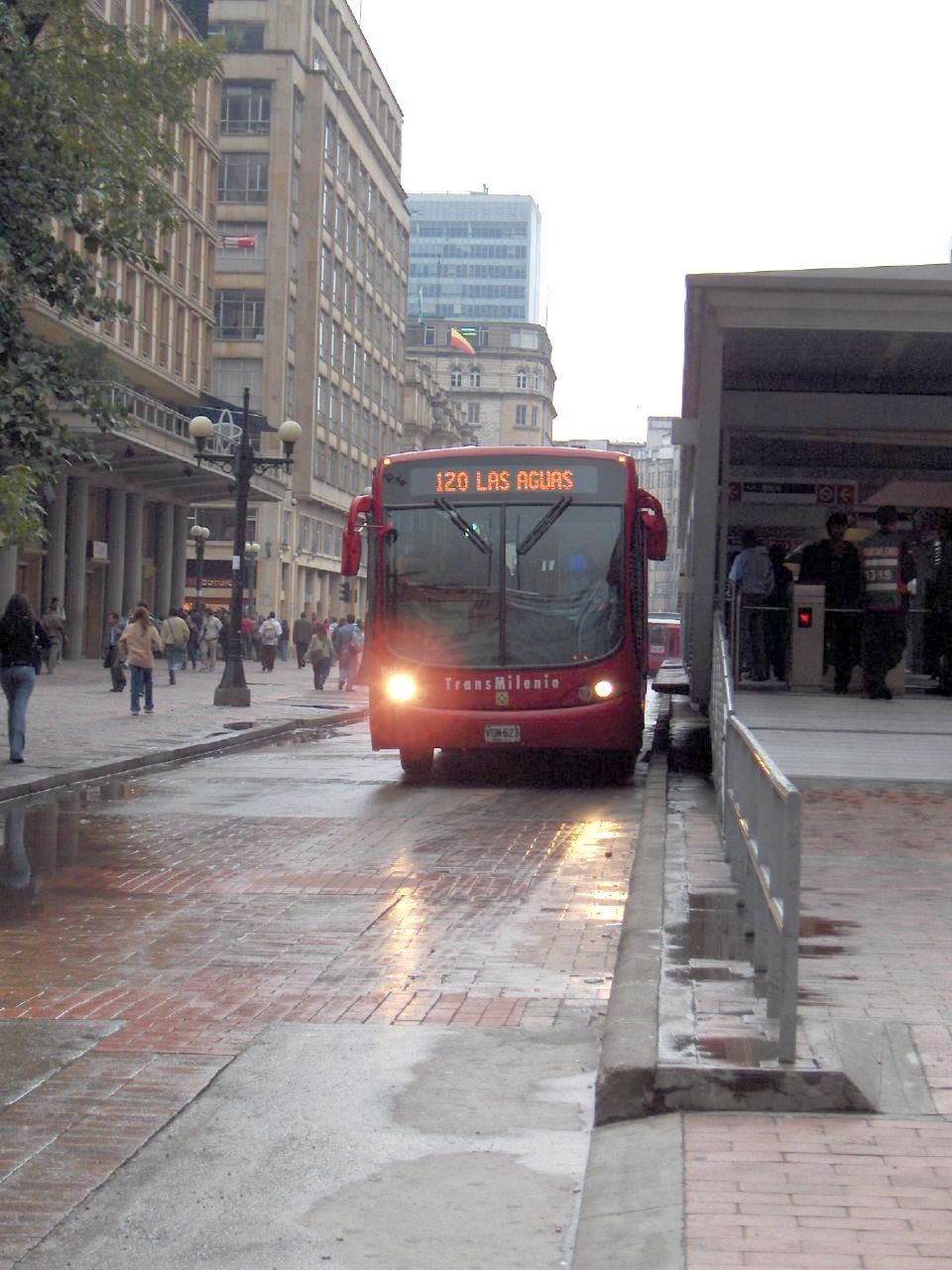
The 3 sets of wide glass doors of the station whisk open in unision with their bus counterparts (also wide) and riders step in and out (like skytrain, subway, or metro). There are no line ups. - People/wheelchairs/strollers simply step/roll in.. not up.. Wheelchairs and strollers are restricted to the front set of doors, everyone else uses the other two sets. . People transferring to another route just walk to the other bay/platform and get on that bus when it arrives without needing to pay again or queue for one door.
This system is far more cost-effective system than subsurface rail (most ROWs were expropriated from existing car lanes - transit priority over car), and there are no dangerous rails on the surface (and no fences like the around skytrain).
Also unlike something like the Silverline in Boston (which has a painfully slow transition to underground, and runs in mixed traffic, and generally oscillates between bus and wannabe metro), TransMilenio is completely consistent and uniform in what it has across the network.
The buses have their own median lanes, usually 2 in *each* direction. See how it looks here?: www.flickr.com/photos/99887786@N00/2468594299/ I would guess about 65% of the network is like this, and the remaining stations have passing lanes. This was a politically gutsy move to make, as the lanes the buses use were expropriated from car traffic. It basically creates additional congestion for cars, while allowing the cleaner more space-efficient public transit to go much much faster. A clear priority for public transit over car use. It is a carrot & stick. carrot to use transit becuase it is faster, stick against driving because it gets slower. In addition this is a major cost-saving measure, becuase existing roadways are used and no new ones are constructed (unlike other BRTs elswhere)
It also made construction of the busways incredible simple and fast. Nearly 100 kms of dedicated lines were in place within a matter of a few years.
My favourite resource for Bus Rapid Transit systems is the ITDPs BRT Planning Guide - in particular The Annex Section has system comparisons across BRT Systems all over the world. It is clear here how feature-rich TransMilenio is compared to lacklustre cousins elsewhere. itdp.pmhclients.com/index.php/microsite/brt_planning_guid...
Another good one: The US Transportation Research Board has a paper discussing applicability of the Transmilenio in the US - an identified challenge is that there could be little public support since most people would initially associate it with "the bus" rather than it's own mode.
TransMilenio has immense capacity - moving more people than many heavy-rail subway systems - at peak hours the busiest single line moves 45,000 people per direction. In some ways the system is victim of it's own success - some residents have nicknamed it TransMi-lleno (full), for being famously full.
Please see the next photo - there is more info there about TransMilenio.
Another informative video is this one of the Rea Vaya - a South African BRT system heavily modelled after TransMilenio. The station interior pan starts at 3:37
www.youtube.com/watch?v=85xXs7JTt5k and www.reavaya.org.za/
And last an electric trolleybus BRT in Venezuela: www.insideyorks.co.uk/tbus/xmd1.jpg

Electric trolley-bus BRT in Venezuela: www.flickr.com/photos/venex/sets/72157600189865830/
e questa è per te.
non sono riuscito a fotografarti l'esterno come avrei voluto,
ma ho "rubato" un interno a sprezzo del pericolo! :-)
spero ti piaccia
Dedicated to Miriam259 (Miriam Ulivi - www.flickr.com/photos/49010317@N07/) to welcome her as a new visitor
Well uh-huh, well uh-huh girl I'm parked outside
And you know that it's sittin on chrome, chrome (uh-huh)
Hey, I'm just lookin for a pretty young thang
that uh, I can take home (take home)
Can we leave hurr (yeah) can we leave hurr (yeah)
Can we leave hurr (yeah) can we leave hurr - shorty can we
leave hurr (yeah) can we leave hurr (yeah)
Can we leave hurr (yeah) can we leave hurr (yeah)
(Na-nana-na) I'm smoother than you know
(Na-nana-na) Cadillac do's and bank rolls
(Na-nana-na) I simply go places you can't go
Ain't see me in no Linc', but you know that derrty in Brougham
I be on my (grind-na-grind-na-grind-na-grind)
With my money on my (mind-my-mind-my-mind-my-mind)
Plus I'm still in my (prime-my-prime-my-prime-my-prime)
And we be smokin that (la-lala-lala-lala)
HoPe u LiiiKe it ;)
This image is dedicated to. . .
~~those women across the world who may never see their child again.
~~those who may never see their grandchildren again.
~~those who may never meet their grandchildren.
I know these women exist.
For I am one.
~~~~
I have been estranged from my youngest daughter, through no choice of my own, for several years. I have not been allowed to see, or to meet, or even to see pictures of her daughters, my granddaughters. I am not even allowed to know their names. Mother’s Day is not a welcome day for me.
I wrote this poem for my daughter when she was in her late teens, and life for her was turning dark.
~~~
A Butterfly on the Wall - a Mother’s Day Lament
by
Sheree Zielke
I have a butterfly on my wall.
It's made of bits of tissue, construction paper,
Pipe cleaners,
And love.
Its toilet paper tube body has drooped,
Been patched and drooped some more.
It's even fallen off.
But the butterfly on my wall continues
To live.
It has moved from house to house,
Room to room.
Once a little girl took it away entirely,
To punish me.
But I wanted it back
And she gave it back mysteriously.
My butterfly on the wall.
My butterfly on the wall
Has a crooked penciled-on smile and two eyes.
It's forever smiling,
Unlike the little girl who gave it to me.
She smiles less these days,
And her smiles don't go very deep.
Sad smiles of a lost lonely girl.
I love my butterfly on the wall,
But I love the little girl more.
She loved me once, too,
Before she found the world.
Some days, I think all I have
Is a butterfly on the wall.
Where is the little girl who gave it to me?
Lonely butterfly on the wall.
~~~
How do I cope with the icy reality of missing a child?
I drive my car too fast.
I play my music too loud.
I take lots of photographs of beautiful images.
I befriend lots of people.
And I give it all over to the One who created me.
For He truly understands the love a parent can feel for a child.
For a Son.
For a daughter.
For two little granddaughters.
And every so often, when the pain becomes too much to bear,
I wring out my soul in a poem.
Blessings,
Sheree
(Note: Fave and comment, if you wish, but it is absolutely unnecessary. This is not for me; It’s for the others, the ones who have no voice.)
Winlaton's Chapel of St Anne
Four hundred years ago there stood in Winlaton a small Catholic Chapel dedicated to St. Anne, which was destroyed after the failure of the rebellion headed by the Duke of Westmorland in 1569. The Earl sold the manor of Winlaton for £3000 to a group of Newcastle merchants in order to finance what was then called the Rebellion of the Earls, aiming to overthrow Queen Elizabeth I, a scheme which ended in disaster for most of those who took part. There is really no documentary evidence to support this tradition, only the statement made by Jonathan Storey in 1705, that the chapel, built by the Crowley workmen was erected upon the ruins of the old chapel which had been burnt down in 1569, in retribution for the rebellion. The foundation and reason for the old chapel standing here is unknown, but the problem leaves plenty of scope for conjecture. The County Durham historian William Hutchinson writing in 1787, states “whenever the ground near to the chapel is broken to any depth, large quantities of human bones are frequently dug up”. This may point to the fact that there was a burial ground connected with the chapel.
The chapel stood on Front Street, where the road forks; the apartment block named Thornbury covering the exact place today. In 1890, excavations were made on the site by Mr. T.C.Nicholson, an architect of Blaydon whose chief local works were the old Winlaton Board Schools and Blaydon East School that used to stand at the bottom of Shibdon Bank. Nothing of note was found during these excavations, a fact hardly surprising, considering the large amount of activity which has taken place upon the grounds surrounding the chapel after its destruction.
When Ambrose Crowley came north to set up his factory in 1691, Winlaton village, consisting of a few houses occupied by miners and farmers, stood in the old Parish of Ryton. Any person wishing to receive the rites of the Church, marriage, baptism and burial, and also to perform their ordinary devotions, had to tread, what was for some a long weary road. As can be imagined the congregation at Ryton Church would not have among its number many people from the outlying districts.
A young man from Newcastle, Jonathan Storey, aged seventeen, was apprenticed to Crowley in 1697. Promotion in Crowley’s firm was rapid and by 1702 aged only 22years he had become manager of the Winlaton factory. He was very concerned with the spiritual welfare of the village, and with Crowley’s backing, he approached Nathanial Crewe, Bishop of Durham, for permission to build a place of worship. The reasons given were that Winlaton with a population of about 2000 was suffering “ the hearty attempts of the Emissaries of Rome, and the sinister practices of the no less dangerous Factors of Geneva, to turn them away from the established church”.
Apparently, for some time the Catholics had set up a ‘mass house’ in the village, which Storey viewed with an uneasy eye. Things came to a head on New Year’s Eve 1704-05 when the Dissenting Teachers came and set up a ‘conventicle’ at the other end of town. On New Year’s morning, Storey rang the factory bell and called the villagers to a meeting at the Sandhill. In a fire and brimstone speech he told people of the dangers, in his view, of being seduced from the established church. They also had to beware the ‘strolling preacher’ to whom he apportioned some of the blame for Civil War fifty years earlier. The speech being ended, the whole assembly firmly resolved to adhere to the Church. It could hardly have been any other way in firm like Crowley’s; the managers views would be practically a command; the men told Storey they were willing to have the benefit of the preaching of the church but they did not have a consecrated place of worship in the village, nor a minister. The Bishop on hearing this sent his blessing for the good work and urged the clergy to help. The hall, belonging to Sir William Blackett was licensed as a place of worship and visiting clergy held services there.
The Revd. Dr. Tomlinson, Rector of Whickham was greatly interested in the work and on 5th. February came to Winlaton to preach, bringing with him several Magistrates from Newcastle. He did not preach very well, as he was suffering from ill health and had difficulty entering the pulpit. After the service several clergy offered their services free of charge, every Lord’s day until the factory provided a chaplain. It was decided by the workmen that one half farthing in the shilling would be deducted from their wages to pay for a chaplain with Crowley adding another £10 from the firm. The chaplain’s wage was to be £50 per annum, to be paid weekly. The whole sum collected was enough to pay the wage bill and to give £20 per annum to endow a school.
The minister’s wage settled, next came the building of a chapel. Jonathan Storey launched an appeal for funds and was quite astonished at the response. Contributions flowed in, some giving 10 or 15 shillings ( 50p & 75p) and up to £1 each. Which soon built up a considerable sum. At the same time they appointed Mr. Edmund Lodge from Haydon Bridge as a temporary chaplain. Jonathan Storey was invited to lay the foundation stone which he dutifully did on 5th. April, 1705. The building progressed so quickly that by 23d. August it was fit to be preached in. As usual this was celebrated by Crowley’s crew with a huge party. It was a memorable night in Winlaton with bonfires burning in many parts of the village and the factory bells echoing across the countryside, the evening concluded with a feast. The chapel was finished in January 1706, laid out with pews, a gallery at the west end and a turret in which was placed a clock. Both the turret and the east end of the chapel were decorated with fancy iron work. This is a blacksmiths village after all. It was said the clock was ‘of good use to the town and also to all of the adjacent villages’. From this statement, can it be presumed that this was a chiming clock? There was seating for 300 persons and these loyal subjects of Queen Anne had decorated the interior with the Royal Coat of Arms and other ornaments, with texts from the Commandments upon the walls. Everything needed for the service of the church was complete, including surplices etc. daily service was performed there, but communion was not allowed, nor services on Christmas or Easter day, when the congregation had to travel to Ryton Church and where a gallery was reserved for the use of the Crowley workmen and their families. This chapel like the first, was also dedicated to St. Anne.
After the opening, Crowley appointed his own chaplains, his first appointment being a Mr. James Meir. A hundred years later the last appointment was given to the Rev. John Chambers who was well known in the district as a crack shot. The chaplain’s duties were many and varied. He was instructed to read prayers, as directed by the Church of England, established by law, every Sunday in the morning and afternoon. He had to sit on some of the committees and to champion the cause of the oppressed. In addition, he had to visit the sick and ‘rebuke vice and promote virtue’. One passage of his instructions make us curious; ‘itt is thought reasonable that the Chaplain do forebear frequenting ale houses, or att least not to make any considerable stay there’.
In 1815, when Winlaton was abandoned by the Crowleys the chapel fell into decay and was demolished. It may not have been used regularly during the last few years of the Crowley regime, the last known service taking place on 10th. September 1809, when the Rev. Charles Thorpe, Rector of Ryton preached a charity sermon on behalf of the Sunday Schools. In 1816, a large schoolroom was built on this same site, by subscription aided by gifts from the National and the Diocesan School Societies and from Lord Crewe’s Trustees. This school remained until about 1898, when the ground was prepared for yet another chapel – that of the Congregational Church.
The successor to the original Catholic Chapel, built in 1962, is dedicated to St. Anne.
Winlaton is a village situated in the Metropolitan Borough of Gateshead, Tyne and Wear, England. Historically in County Durham, it was incorporated into the metropolitan county of Tyne and Wear and Borough of Gateshead in 1974. In 2011 the village was absorbed into the Gateshead MBC ward of Winlaton and High Spen. The population of this ward at the 2011 census was 8,342.
Winlaton was once at the centre of the local steel industry. Ambrose Crowley, a Quaker nail-manufacturer, moved in 1691 to Winlaton. He set up furnaces and forges there and on the River Derwent at Winlaton Mill. The river was ideally suitable for tempering steel, as the sword-makers of Shotley Bridge also found. Crowley not only produced high-quality nails, but also iron goods such as pots, hinges, wheel-hubs, hatchets and edged tools. He could also make heavy forgings, such as chains, pumps, cannon carriages and anchors up to four tons in weight. The Crowley works were regarded as the largest manufactory of the kind in Europe. The gates for Buckingham Palace were also forged in Winlaton.
It still has one of the oldest forges remaining in existence, built c1690.
Winlaton's front street is the village's forefront for shopping, as it has a variety of shops, public houses and takeaways. The Winlaton Centre, a local events venue, was built in 1973, and is host to events such as youth clubs and fitness classes.
There is an Anglican church dedicated to St Paul; St Paul's church was built in the 19th–century. There is also a Roman Catholic church, dedicated to St Anne and built in 1962. "Coffee Johnny", a local Blaydon celebrity (1829-1900), is buried at St Paul's church graveyard. He "...would be an outstanding figure in any crowd. Not only was he over six feet six inches and well made (he was a blacksmith at Winlaton), but he was quite a dandy and on special occasions wore a tall white hat."
On one of the edges of the village is Winlaton Rugby Club, first founded in 1896, they were reformed in 1962 and currently play at Axwell View Playing Fields where a clubhouse was erected the following year after moving in.
Blaydon is a town in the Metropolitan Borough of Gateshead, Tyne and Wear, England, and historically in County Durham. Blaydon, and neighbouring Winlaton, which Blaydon is now contiguous with, form the town of Blaydon-on-Tyne. The Blaydon/Winlaton ward had a population in 2011 of 13,896.
Between 1894 and 1974, Blaydon was an urban district which extended inland from the Tyne along the River Derwent for ten miles (16 km), and included the mining communities of Chopwell and High Spen, the villages of Rowlands Gill, Blackhall Mill, Barlow, Winlaton Mill and Stella, as well as Blaydon and Winlaton. During its existence, the Urban District's fourteen and a half square miles constituted the second largest administrative district by area, on Tyneside, after Newcastle upon Tyne.
History
The town of Blaydon is essentially an industrial area and is not more than two centuries old. Indeed, in the 1760s there was little here but a few farms and cottages. In the latter part of the same century a smelting works was set up from which sprang the industrial growth of the area.
Though the town itself has a relatively short history there has been activity in the area for many centuries.
Early history
The earliest recorded evidence of human activity at Blaydon is a Neolithic polished stone axe found in the early 20th century. Finds and structures from later prehistoric periods include a bronze spearhead and log-boat, both recovered from the River Tyne in the 19th century. A number of Bronze Age cists[citation needed] are recorded from Summerhill and several others from Bewes Hill.
Little is recorded of medieval Blaydon, which appears to have been based upon the modern farm sites of High and Low Shibdon. The Blaydon Burn Belts Corn Mill, part of a row of 5 or 6 water corn mills stretching from Brockwell Wood to the River Tyne is known to have been present by the early 17th century, suggesting a healthy population at that time. It is likely that, as well as farming, many industrial activities such as mining and quarrying had begun in the medieval and post-medieval periods, well before the industrial period of the 18th to 20th centuries when Blaydon became an important industrial centre.
Battle of Stella Ford
Also known as the Battle of Newburn or Newburn Ford, this relatively unknown battle has recently been elevated in importance by English Heritage. On 28 August 1640, 20,000 Scots defeated 5,500 English soldiers who were defending the ford over the Tyne four miles (6 km) west of Newcastle.[6] The Scots had been provoked by Charles I, who had imposed bishops and a foreign prayer book on their church. The Scots army, led by Alexander Leslie, fought its way to Newcastle and occupied the city for almost a year before Charles I paid it £200,000 to depart. The battle brought to an end the so-called 'Eleven Years of Tyranny' by forcing Charles to recall Parliament.
The 18th century and the Industrial Revolution
The stimulus for industry at Blaydon and Blaydon burn, as elsewhere in the region, was the growth in coal mining and the coal trade, particularly from the early 18th century, when the Hazard and Speculation pits were established at Low Shibdon linked to the Tyne by wagonways. The 18th century Blaydon Main Colliery was reopened in the mid-19th century and worked until 1921. Other pits and associated features included Blaydon Burn Colliery, Freehold pit and the Blaydonburn wagonway. Industries supported by the coal trade included chemical works, bottle works, sanitary pipe works, lampblack works, an ironworks, a smithy and brickworks - Cowen's Upper and Lower Brickworks were established in 1730 and were associated with a variety of features including a clay drift mine and coal/clay drops. The Lower works remains in operation. Blaydon Burn Coke Ovens, also of 19th-century origin, were replaced in the 1930s by Priestman Ottovale Coke and Tar Works which was the first in the world to produce petrol from coal[citation needed] known as Blaydon Benzole.
In addition to the workers' housing developments associated with industrialisation, a number of grand residences were constructed for industrialists in the area, such as Blaydon Burn House, home of Joseph Cowen, owner of the brickworks. Ironically, the remains of Old Dockendale Hall, an earlier grand residence (or perhaps a superior farmhouse) of 17th century or earlier construction, was destroyed when the coke and tar works was built at Blaydon Burn.
Blaydon School Press
In the 1930s, pupils at the now demolished Blaydon Intermediate School, under the leadership of English teacher Mr Elliott and art teacher Mr Boyce, gradually developed a technique for producing hardback books. Their productions were highly respected and favourably compared to other successful private printing presses of the time. In one volume produced by the school in 1935, entitled "Songs of Enchantment", the pupils were successful in convincing the famous poet Walter de la Mare to write a foreword in which he praised their enterprise and efforts.
Stella South Power Station
The post war era of the late 40s and 50s saw a rapid rise in demand for electricity and, in the North East, the extension of existing and construction of a number of new power stations was seen as a key part of the solution. For the Blaydon area, this meant the arrival of a new power station at Stella Haugh, known as the South Stella Power Station, which helped to meet the energy demands of the North East until its closure in 1991. It was demolished in 1992.
Governance
Blaydon ward elects three councillors to Gateshead Council. In the House of Commons, the Blaydon constituency has been held by Liz Twist for the Labour Party since 2017. The area has traditionally been a Labour stronghold and the seat has been held by them since 1935.
Geography
Modern Blaydon stands close to the Tyne with the A695, a key road from Gateshead to Hexham, passing through the town centre. Between this main road and the river is the railway and beyond it, on a bend of the Tyne, is the industrial district of Blaydon Haughs. The main part of the town lies south of the railway.
Despite being a largely urban and industrial area, there are various rural aspects to Blaydon and the surrounding area. The area has many acres of open countryside, mostly at 500 feet (150 m) or more above sea level, and numerous farms and similar holdings. Between High Spen and Chopwell are large Forestry Commission woods, and these and other forested areas extend westward down the hillside to the River Derwent, which forms most of the metropolitan district boundary.
Shibdon Pond, on the eastern edge of the town at the former site of Blaydon Main colliery, is a nature reserve with many species of waterfowl. English Nature has designated Shibdon Pond as one of Tyne and Wear's Sites of Special Scientific Interest (SSSIs). The subject of a regeneration campaign, Shibdon Dene (sometimes inaccurately called 'Blaydon Dene') is another recreational area consisting of a pathway between a great number of fine trees.
There is also a nature reserve north-west of Blaydon at Blaydon Burn, on the route of a wagon-way which carried coal to the riverside. The track, roughly a mile-and-a-half long, is used by walkers and cyclists and ends near the Path Head Watermill.
Demography
Blaydon had a population of 15,155 in the 2011 census, which increased from 14,648 a decade earlier.
Economy
Once the powerhouse of the Industrial Revolution in Gateshead, Blaydon's traditional industry was coal mining. However, since the decline of mining in the 1950s and 1960s, the economy has diversified. As well as a small number of commuting professionals, residents of Blaydon are often involved in engineering and manufacturing with many businesses operating from premises in Blaydon Haughs (or 'The Spike'), on the banks of the River Tyne.
Blaydon was for a time the head office of Associated Cooperative Creameries (later renamed ACC then ACC Milk). ACC Milk was sold to Dairy Farmers of Britain in 2004. On 3 June 2009, Dairy Farmers of Britain went into receivership and the dairy in Chainbridge Road closed shortly afterwards with the loss of 300 jobs. In 2010 the dairy was acquired by Medina Dairies and reopened, but closed again just a year later.
Blaydon has a shopping centre, known locally as the precinct. A brutalist 1970s creation, it contains the town's major shops including newsagents, Greggs, Costa, Iceland (supermarket), B & M, Blaydon Carpets and Furnishings, Ladbrokes, Superdrug, Boots (chemist), Boyes and, at the nearby car park, a McDonald's. There are also several food and grocery outlets. The precinct underwent redevelopment in 2012–2014, with the installation of a lift, and the demolition of the Geordie Ridley pub to make way for a new Morrison's supermarket, a new day-centre and doctors' surgery, and roof-top parking. There is also a Co-op Funeralcare just outside the precinct on Bridge street. Blaydon Car Boot Sale takes place every Wednesday between March and October at Blaydon RFC.
The area underwent a significant programme of housing regeneration between 2009 and 2014 with new developments in progress at High View on the Winlaton-Blaydon border, by the riverside on the site of the former Stella South power station and at Axwell Gardens, near to the existing Axwell Park estate.
Landmarks
On the west of the town and a mile inland from the Tyne is Axwell Park, once the home of the Clavering family. Axwell Hall (also Axwell House) is a Grade II* listed mansion, built for Sir Thomas Clavering by the noted architect James Paine and completed in 1761. The last (10th) baronet died in 1893 and Axwell Hall later found use as a prisoner-of-war camp during the second world war and later as an approved school. Much of the park has been developed for residential purposes and the hall itself was, after two decades of decay, restored. There are plans to convert it to residential apartments.
Stella Hall
Up-river from Blaydon and outside the town boundary, Stella Hall was a 17th-century mansion set in a park. The house was built by the Tempest family, and in the next century passed by marriage to Lord Widdrington and then into the Towneley family. From 1850 it was owned by Joseph Cowen, owner of the local brickworks and MP for Newcastle, who was followed by his son, also Joseph, again an MP and also the owner of the Newcastle Chronicle. The house was demolished in 1955 to make way for housing.
Education
Blaydon is part of the Gateshead Local Education Authority. It is home to a number of primary schools (both faith and secular schools) including Blaydon West primary and St Joseph's, a Roman Catholic primary school. It also has St Thomas More Catholic School, a high achieving Roman Catholic secondary school which serves the Roman Catholic population of the western part of Gateshead borough.
Religious sites
Blaydon has several churches. In the town centre, St Cuthbert's (Church of England, opened in 1845) and St Joseph's (Roman Catholic, opened in 1905 on the site of an earlier church) are opposite each other, on either side of Shibdon Road. Both are impressive structures, and the interiors still reflect the style of architecture used in their construction. Also on Shibdon Road, at the corner with Lucy Street and opposite the entrance to the roof-top car park above Morrisons, is Trinity Methodist Church.
There is also a Catholic church in Stella (St Mary and Thomas Aquinas, opened 1835) .
A brand new Kingdom Hall of Jehovah's Witnesses was opened in 2013, near Cowen Road. This was built by voluntary labour as Witnesses from all over the North-East donned hard hats and work gear, working under the supervision of professional builders.
In Winlaton, the parish church of Winlaton opened in 1828, the Congregational church in 1829, and the Wesleyan Chapel in 1868. The latter two united to form Winlaton United Reformed-Methodist Church, but this closed in August 2015, with some members moving to join Trinity Methodist Church in Blaydon. The Primitive Methodists had opened a building in 1850, which was extended in 1895, and was later to become the Blaydon Corps of the Salvation Army; this corps closed in September 2012. St Anne's Catholic Church in Winlaton was opened in 1962.
Sports
The Blaydon area is the origin of the well-known traditional song "Blaydon Races", written by local musician and showman George 'Geordie' Ridley in 1862. The town's athletic club – the Blaydon Harriers – organise a road running race (called the Blaydon Race) every year on 9 June. The route of the race follows the route outlined by Ridley in his song. The traditional starting point lies outside Balmbra's pub in Newcastle's Bigg Market, and the race follows a course along Scotswood Road before crossing the River Tyne and ultimately finishing in Blaydon town centre. Local councillors, societies and notaries have in recent years organised an annual Blaydon Festival with music, sport and arts events that coincides with the week of race day.
As well as the Blaydon races, The Blaydon Harriers organise regular race meetings on the Shibdon Pond fields (and other venues) throughout the year. These are usually well-attended both by participants and spectators. The Harriers' colours are orange and black.
The rugby union club, Blaydon RFC play in the English National League 2 North, the fourth tier of the English rugby union system and a high level considering the size of the town. The Crow Trees rugby ground is situated to the east of the town, in neighbouring Swalwell. Blaydon RFC play in red shirts and white shorts. The former England international Mick Skinner played for Blaydon. Their smaller but no less illustrious neighbours, Winlaton Vulcans RFC play in Durham and Northumberland Division 2 and number Ken Goodall, the former Ireland and British Lion International, as one of their former players. They play in black shirts, shorts and socks with the club badge of an arm gripping a hammer over an anvil depicting their heritage being formed from the steelworking heritage of the area.
Since 2013 Blaydon has also been host to Blaydon Cycle Club, meeting weekly and throughout the week catering from novice cyclists right through to having a race team competing in local and national events.
Notable people
Alun Armstrong, former professional footballer with Ipswich Town F.C. and Middlesbrough FC
Peter Armstrong, the poet and psychotherapist, was born in Blaydon
Sir Thomas Clavering, 7th Baronet, owner of Axwell Hall
Joseph Cowen, 19th century politician and journalist
Graham Onions, Durham and England cricketer
Bert Tulloch, former professional footballer with Blackpool
Gavin Webster, stand-up comedian
William Widdrington, 4th Baron Widdrington, owner of Stella Hall
Culture
Live jazz and rock music is regularly performed at the Black Bull pub near Blaydon Bridge. Although many pubs were demolished during the refurbishment of the town in the 1970s, a number of pubs still exist in and around the precinct, along with the Staffs (formerly the Railway Staff Club). The Blaydon and District Social Club – a former working men's club – and the Blaydon House Sports and Social Club (formerly the Conservative Club), which occupied the house of the nineteenth-century Doctor Morrison, and was reputedly the oldest building in Blaydon, were both demolished in 2020–2021 to make way for housing. The façade of Blaydon House was incorporated into a new building. The Masonic Hall on Blaydon Bank was closed in 2015, with Lodge meetings transferring to Ryton Masonic Hall.
Dedicated to my sweet friend Madge
Gemelli with cream, Italian rosemary ham, fresh tomato and baby spinach
Gemelli has a lovely shape for holding cream sauces. A large, very finely chopped French shallot [the size of a small onion] and a thinly sliced, fat and juicy garlic clove, a few sprigs of fresh rosemary plus a pinch of cayenne pepper are sautéed gently in extra virgin olive oil and butter. The thinly sliced ham is cut in squares and added to the pan, then cooked for a few seconds. Small cubes of seeded tomatoes are added and cooked another 30 seconds or so. Then a little white wine is added, and finally a generous amount of rich [35%] cream and a few gratings of fresh nutmeg, a few sprigs of fresh rosemary, sea salt and freshly ground pepper. Once it starts bubbling, a few handfuls of baby spinach are added along with 125 ml freshly grated Parmigiano Reggiano and about 10 leaves of fresh basil. The cooked and drained pasta is immediately added to the sauce, and stirred over med-high heat for a short minute before serving in warm plates with additional grated Parmigiano.
It all takes about 20 minutes: 12 minutes or so to prep all ingredients before starting to cook, then another 6 minutes or so to cook the pasta and the sauce while the pasta is cooking.
2022 - Dedicated to those who fell and to those who carry on - 9/11 Twin Tower Memorial Wall Relief World Trade Center plaque - WTC Bronze Plaque outside of Firehouse Engine 54 Ladder 4 Battalion 9 at the corner of 8th Ave and 48th Street Hell's Kitchen Manhattan West Side Clinton Area 05/10/2022 May