View allAll Photos Tagged Create
Kathakali (Malayalam: കഥകളി, kathakaḷi; Sanskrit: कथाकळिः, kathākaḷiḥ) is a stylized classical Indian dance-drama noted for the attractive make-up of characters, elaborate costumes, detailed gestures and well-defined body movements presented in tune with the anchor playback music and complementary percussion. It originated in the country's present day state of Kerala during the 17th century and has developed over the years with improved looks, refined gestures and added themes besides more ornate singing and precise drumming.
HISTORY
Popular belief is that kathakali is emerged from "Krishnanattam", the dance drama on the life and activities of Lord Krishna created by Sri Manavedan Raja, the Zamorin of Calicut (1585-1658 AD). Once Kottarakkara Thampuran, the Raja of Kottarakkara who was attracted by Krishnanattam requested the Zamorin for the loan of a troupe of performers. Due to the political rivalry between the two, Zamorin did not allow this. So Kottarakkara Thampuran created another art form called Ramanattam which was later transformed into Aattakatha. Krishnanaattam was written in Sanskrit, and Ramanattam was in Malayalam. By the end of 17th century, Attakatha was presented to the world with the title 'Kathakali'.
Kathakali also shares a lot of similarities with Krishnanattam, Koodiyattam (a classical Sanskrit drama existing in Kerala) and Ashtapadiyattam (an adaptation of 12th-century musical called Gitagovindam). It also incorporates several other elements from traditional and ritualistic art forms like Mudiyettu, Thiyyattu, Theyyam and Padayani besides a minor share of folk arts like Porattunatakam. All along, the martial art of Kalarippayattu has influenced the body language of Kathakali. The use of Malayalam, the local language (albeit as a mix of Sanskrit and Malayalam, called 'Manipravaalam'), has also helped the literature of Kathakali sound more transparent for the average audience.
As a part of modernising, propagating, promoting and popularizing Kathakali, the International Centre for Kathakali at New Delhi has taken up a continuing project since 1980 of producing new plays based on not only traditional and mythological stories, but also historical stories, European classics and Shakespeare's plays. Recently they produced Kathakali plays based on Shakespeare's Othello and Greek-Roman mythology of Psyche and Cupid.
Even though the lyrics/literature would qualify as another independent element called Sahithyam, it is considered as a component of Geetha or music, as it plays only a supplementary role to Nritham, Nrithyam and Natyam.
KATHAKALI PLAYS
Traditionally there are 101 classical Kathakali stories, though the commonly staged among them these days total less than one-third that number. Almost all of them were initially composed to last a whole night. Nowadays, there is increasing popularity for concise, or oftener select, versions of stories so as the performance lasts not more than three to four hours from evening. Thus, many stories find stage presentation in parts rather than totality. And the selection is based on criteria like choreographical beauty, thematic relevance/popularity or their melodramatic elements. Kathakali is a classical art form, but it can be appreciated also by novices—all contributed by the elegant looks of its character, their abstract movement and its synchronisation with the musical notes and rhythmic beats. And, in any case, the folk elements too continue to exist. For better appreciation, perhaps, it is still good to have an idea of the story being enacted.
The most popular stories enacted are Nalacharitham (a story from the Mahabharata), Duryodhana Vadham (focusing on the Mahabharata war after profiling the build-up to it), Kalyanasougandhikam, (the story of Bhima going to get flowers for his wife Panchali), Keechakavadham (another story of Bhima and Panchali, but this time during their stint in disguise), Kiratham (Arjuna and Lord Shiva's fight, from the Mahabharata), Karnashapatham (another story from the Mahabharata), Nizhalkuthu and Bhadrakalivijayam authored by Pannisseri Nanu Pillai. Also staged frequently include stories like Kuchelavrittam, Santanagopalam, Balivijayam, Dakshayagam, Rugminiswayamvaram, Kalakeyavadham, Kirmeeravadham, Bakavadham, Poothanamoksham, Subhadraharanam, Balivadham, Rugmangadacharitam, Ravanolbhavam, Narakasuravadham, Uttaraswayamvaram, Harishchandracharitam, Kacha-Devayani and Kamsavadham.
Recently, as part of attempts to further popularise the art, stories from other cultures and mythologies, such as those of Mary Magdalene from the Bible, Homer's Iliad, and William Shakespeare's King Lear and Julius Caesar besides Goethe's Faust too have been adapted into Kathakali scripts and on to its stage. Synopsis of 37 kathakali stories are available in kathakalinews.com.
MUSIC
The language of the songs used for Kathakali is Manipravalam. Though most of the songs are set in ragas based on the microtone-heavy Carnatic music, there is a distinct style of plain-note rendition, which is known as the Sopanam style. This typically Kerala style of rendition takes its roots from the temple songs which used to be sung (continues even now at several temples) at the time when Kathakali was born.
As with the acting style, Kathakali music also has singers from the northern and southern schools. The northern style has largely been groomed by Kerala Kalamandalam in the 20th century. Kalamandalam Neelakantan Nambisan, an overarching Kathakali musician of those times, was a product of the institute. His prominent disciples include Kalamandalam Unnikrishna Kurup, Kalamandalam Gangadharan, Kalamandalam P.G. Radhakrishnan, Rama Varrier, Madambi Subramanian Namboodiri, Tirur Nambissan, Kalamandalam Sankaran Embranthiri, Kalamandalam Hyderali, Kalamandalam Haridas, Subramanian, Kalanilayam Unnikrishnan and Kalamandalam Bhavadasan. The other prominent musicians of the north feature Kottakkal Vasu Nedungadi, Kottakkal Parameswaran Namboodiri, Kottakkal P.D. Narayanan Namboodiri, Kottakkal Narayanan, Kalamandalam Anantha NarayananKalamandalam Sreekumar Palanad Divakaran, Kalanilayam Rajendran, Kolathappilli Narayanan Namboodiri, Kalamandalam Narayanan Embranthiri, Kottakkal Madhu, Kalamandalam Babu Namboodiri, Kalamandalam Harish and Kalamandalam Vinod. In the south, some of whom are equally popular in the north these days, include Pathiyur Sankarankutty. Southerner musicians of the older generation include Cherthala Thankappa Panikker, Thakazhi Kuttan Pillai, Cherthala Kuttappa Kurup, Thanneermukkam Viswambharan and Mudakkal Gopinathan.
PERFORMANCE
Traditionally, a Kathakali performance is usually conducted at night and ends in early morning. Nowadays it isn't difficult to see performances as short as three hours or fewer. Kathakali is usually performed in front of the huge Kalivilakku (kali meaning dance; vilakku meaning lamp) with its thick wick sunk till the neck in coconut oil. Traditionally, this lamp used to provide sole light when the plays used to be performed inside temples, palaces or abodes houses of nobles and aristocrats. Enactment of a play by actors takes place to the accompaniment of music (geetha) and instruments (vadya). The percussion instruments used are chenda, maddalam (both of which underwent revolutionary changes in their aesthetics with the contributions of Kalamandalam Krishnankutty Poduval and Kalamandalam Appukutty Poduval) and, at times, edakka. In addition, the singers (the lead singer is called “ponnani” and his follower is called “singidi”) use chengila (gong made of bell metal, which can be struck with a wooden stick) and ilathalam (a pair of cymbals). The lead singer in some sense uses the Chengala to conduct the Vadyam and Geetha components, just as a conductor uses his wand in western classical music. A distinguishing characteristic of this art form is that the actors never speak but use hand gestures, expressions and rhythmic dancing instead of dialogue (but for a couple of rare characters).
ACTING
A Kathakali actor uses immense concentration, skill and physical stamina, gained from regimented training based on Kalaripayattu, the ancient martial art of Kerala, to prepare for his demanding role. The training can often last for 8–10 years, and is intensive. In Kathakali, the story is enacted purely by the movements of the hands (called mudras or hand gestures) and by facial expressions (rasas) and bodily movements. The expressions are derived from Natyashastra (the tome that deals with the science of expressions) and are classified into nine as in most Indian classical art forms. Dancers also undergo special practice sessions to learn control of their eye movements.
There are 24 basic mudras—the permutation and combination of which would add up a chunk of the hand gestures in vogue today. Each can again can be classified into 'Samaana-mudras'(one mudra symbolising two entities) or misra-mudras (both the hands are used to show these mudras). The mudras are a form of sign language used to tell the story.
The main facial expressions of a Kathakali artist are the 'navarasams' (Navarasas in anglicised form) (literal translation: Nine Tastes, but more loosely translated as nine feelings or expressions) which are Sringaram (amour), Hasyam (ridicule, humour), Bhayanakam (fear), Karunam (pathos), Roudram (anger, wrath), Veeram (valour), Beebhatsam (disgust), Adbhutam (wonder, amazement), Shantam (tranquility, peace). The link at the end of the page gives more details on Navarasas.
One of the most interesting aspects of Kathakali is its elaborate make-up code. Most often, the make-up can be classified into five basic sets namely Pachcha, Kathi, Kari, Thaadi, and Minukku. The differences between these sets lie in the predominant colours that are applied on the face. Pachcha (meaning green) has green as the dominant colour and is used to portray noble male characters who are said to have a mixture of "Satvik" (pious) and "Rajasik" (dark; Rajas = darkness) nature. Rajasik characters having an evil streak ("tamasic"= evil) -- all the same they are anti-heroes in the play (such as the demon king Ravana) -- and portrayed with streaks of red in a green-painted face. Excessively evil characters such as demons (totally tamasic) have a predominantly red make-up and a red beard. They are called Red Beard (Red Beard). Tamasic characters such as uncivilised hunters and woodsmen are represented with a predominantly black make-up base and a black beard and are called black beard (meaning black beard). Women and ascetics have lustrous, yellowish faces and this semi-realistic category forms the fifth class. In addition, there are modifications of the five basic sets described above such as Vella Thadi (white beard) used to depict Hanuman (the Monkey-God) and Pazhuppu, which is majorly used for Lord Shiva and Balabhadra.
NOTABLE TRAINING CENTRES & MASTERS
Kathakali artistes need assiduous grooming for almost a decade's time, and most masters are products of accomplished institutions that give a minimum training course of half-a-dozen years. The leading Kathakali schools (some of them started during the pre-Independent era India) are Kerala Kalamandalam (located in Cheruthuruthy near Shoranur), PSV Natya Sangham (located in Kottakal near Kozhikode), Sadanam Kathakali and Classical Arts Academy (or Gandhi Seva Sadan located in Perur near Ottappalam in Palakkad), Unnayi Varier Smaraka Kalanilayam (located in Irinjalakuda south of Thrissur), Margi in Thiruvananthapuram, Muthappan Kaliyogam at Parassinikkadavu in Kannur district and RLV School at Tripunithura off Kochi and Kalabharathi at Pakalkkuri near Kottarakkara in Kollam district, Sandarshan Kathakali Kendram in Ambalapuzha and Vellinazhi Nanu Nair Smaraka Kalakendra in Kuruvattor. Outside Kerala, Kathakali is being taught at the International Centre for Kathakali in New Delhi, Santiniketan at Visva-Bharati University in West Bengal, Kalakshetra in Chennai and Darpana Academy in Ahmedabad among others. PadmaSree Guru Chengannur Raman Pillai mostly known as 'Guru Chengannur'was running a traditional Gurukula Style approach to propagate Kathakali.
‘Guru Chengannur” is ever renowned as the Sovereign Guru of Kathakali. His precision in using symbols, gestures and steps were highest in the field of Kathakali. Guru Chegannur's kaththi vesham, especially the portrayal of Duryodhana enthralled the audience every time he performed. A master of the art, he found immense happiness and satisfaction in the success and recognition of his disciples.
Senior Kathakali exponents of today include Padma Bhushan Kalamandalam Ramankutty Nair, Padma Shri Kalamandalam Gopi, Madavoor Vasudevan Nair, Chemancheri Kunhiraman Nair, Kottakkal Krishnankutty Nair, Mankompu Sivasankara Pillai, Sadanam Krishnankutty, Nelliyode Vasudevan Namboodiri, Kalamandalam Vasu Pisharody, FACT Padmanabhan, Kottakkal Chandrasekharan, Margi Vijayakumar, Kottakkal Nandakumaran Nair, Vazhenkada Vijayan, Inchakkattu Ramachandran Pillai, Kalamandalam Kuttan, Mayyanad Kesavan Namboodiri, Mathur Govindan Kutty, Narippatta Narayanan Namboodiri, Chavara Parukutty, Thonnakkal Peethambaran, Sadanam Balakrishnan, Kalanilayam Gopalakrishnan, Chirakkara Madhavankutty, Sadanam K. Harikumaran, Thalavadi Aravindan, Kalanilayam Balakrishnan, Pariyanampatta Divakaran, Kottakkal Kesavan, Kalanilayam Gopi and Kudamaloor Muralikrishnan. The late titan actor-dancers of Kathakali's modern age (say, since the 1930s) include Pattikkamthodi Ravunni Menon, Chenganoor Raman Pillai, Chandu Panicker, Thakazhi Guru Kunchu Kurup, Padma Shri Kalamandalam Krishnan Nair, Padma Shri Vazhenkada Kunchu Nair, Kavalappara Narayanan Nair, Kurichi Kunhan Panikkar, Thekkinkattil Ramunni Nair, Padma Shri Keezhpadam Kumaran Nair, Kalamandalam Padmanabhan Nair, Mankulam Vishnu Namboodiri, Oyur Kochu Govinda Pillai, Vellinezhi Nanu Nair, Padma Shri Kavungal Chathunni Panikkar, Kudamaloor Karunakaran Nair, Kottakkal Sivaraman, Kannan Pattali, Pallippuram Gopalan Nair, Haripad Ramakrishna Pillai, Champakkulam Pachu Pillai, Chennithala Chellappan Pillai, Guru Mampuzha Madhava Panicker, and Vaikkom Karunakaran.
Kathakali is still hugely a male domain but, since the 1970s, females too have made entry into the art form on a recognisable scale. The central Kerala temple town of Tripunithura has, in fact, a ladies troupe (with members belonging to several part of the state) that performs Kathakali, by and large in Travancore.
KATHAKALI STYLES
Known as Sampradäyaṃ(Malayalam: സമ്പ്രദായം); these are leading Kathakali styles that differ from each other in subtleties like choreographic profile, position of hand gestures and stress on dance than drama and vice versa. Some of the major original kathakali styles included:
Vettathu Sampradayam
Kalladikkodan Sampradyam
Kaplingadu Sampradayam
Of late, these have narrowed down to the northern (Kalluvazhi) and southern (Thekkan) styles. It was largely developed by the legendary Pattikkamthodi Ravunni Menon (1881-1949) that is implemented in Kerala Kalamandalam (though it has also a department that teaches the southern style), Sadanam, RLV and Kottakkal. Margi has its training largely based on the Thekkan style, known for its stress on drama and part-realistic techniques. Kalanilayam, effectively, churns out students with a mix of both styles.
OTHER FORMS OD DANCE & OFFSHOOTS
Kerala Natanam is a kind of dance form, partly based on Kathakali techniques and aesthetics, developed and stylised by the late dancer Guru Gopinath in the mid-20th century. Kathakali also finds portrayal in Malayalam feature films like Vanaprastham, Parinayam, Marattam, and Rangam. Besides documentary films have also been shot on Kathakali artistes like Chenganoor Raman Pillai, Kalamandalam Krishnan Nair, Keezhpadam Kumaran Nair, Kalamandalam Ramankutty Nair, Kalamandalam Gopi and Kottakkal Sivaraman.
As for fictional literature, Kathakali finds mention in several Malayalam short stories like Karmen (by N.S. Madhavan) and novels like Keshabharam (by P.V. Sreevalsan). Even the Indo-Anglian work like Arundhati Roy's Booker prize-winning The God of Small Things has a chapter on Kathakali, while, of late, Anita Nair's novel, Mistress, is entirely wrapped in the ethos of Kathakali.
Similar musical theater is popular in Kasaragod and the coastal and Malenadu regions of Karnataka, viz. Yakshagana. Though Yakshagana resembles Kathakali in terms of its costume and makeup to an extent, Yakshagana is markedly different from Kathakali as it involves dialogues and method acting also the narration is in Kannada, wherein philosophical debates are also possible within framework of the character. As per records the art form of Yakshagana was already rooted and well established at the time of Sri Manavedan Raja. There is possibilities of its significant influence in formation of Kathakkali as the troupe of performers of "Krishnanattam" designed the basic costume of the art form already established in other parts of south India including Males playing the female roles (until more recently).
Kottayam thamburan's way of presenting kathakali was later known as Kalladikkoden sambradayam. Chathu Paniker,the introducer of Kallikkoden Sambrathayam, stayed in Kottayam for five years with Kottayam Thamburan's residence and practiced Kalladikkoden Sambrathayam. Then he returned to his home place. After a short period Chathu Paniker reached Pulapatta as instructed by Kuthiravattath nair. That was around the year ME 865. Many deciples from Kadathanadu, Kurumbra nadu, Vettathu nadu, Palakkadu and Perumpadappu studied kathakali(Kalladikkoden Sambrathayam ) By that time Chathu Paniker was an old man. Some years later he died from Pulapatta.
NOTED KATHAKALI VILLAGES & BELTS
There are certain pockets in Kerala that have given birth to many Kathakali artistes over the years. If they can be called Kathakali villages (or some of them, these days, towns), here are some of them: Vellinezhi, Kuruvattoor, Karalmanna, Cherpulassery, Kothachira, peringode, sreekrishnapuram Kongad and Ottapalam in Palakkad district, Vazhenkada in Malappuram district, Thichur or Tichoor, Guruvayur, Thiruvilwamala and Irinjalakuda in Thrissur district, Tripunithura, Edappally, Thekkan Chittoor in Ernakulam district and Kuttanad, Harippad belt in Alappuzha district besides places in and around Thiruvanathapuram in south Travancore and Payyannur in north Malabar.
AWARDS FOR KATHAKALI ARTISTS
Sangeet Natak Akademi Awardees - Kathakali (1956–2005)
Nambeesan Smaraka Awards—For artistic performances related kathakali{1992-2008}
KATHAKALI ATTAMS (ELAKI ATTAMS)
Attams or more specifically "elaki attams" are sequences of acting within a story acted out with the help of mudras without support from vocal music. The actor has the freedom to change the script to suit his own individual preferences. The actor will be supported ably by Chenda, Maddalam, and Elathalam (compulsory), Chengila (not very compulsory).
The following are only some examples. 'Kailasa Udharanam' and 'Tapas Attam' are very important attams and these are described at the end. Two of the many references are Kathakali Prakaram, pages 95 to 142 by Pannisheri Nanu Pillai and Kathakaliyile Manodharmangal by Chavara Appukuttan Pillai.
VANA VARNANA: BHIMA IN KALYANA SAUGANDHIKA
Modern man looks at the forest, indeed the birthplace of primates, with a certain wonder and a certain respect. Kathakali characters are no exception.
When Pandavas were living in the forest, one day, a flower, not seen before, wafted by the wind, comes and falls at the feet of Panchali. Exhilarated by its beauty and smell, Panchali asks Bhima to bring her more such flowers. To her pleasure Bhima is ready to go at once. But Panchali asks him what he shall do for food and drink on the way. Bhima thinks and says "Food and Drink! Oh, this side glance (look) of yours. This look of longing. This look of anticipation. The very thought fills me up. I don't need any food and drink at all. Let me go." He takes his mace and off he goes. Ulsaham (enthusiasm) is his Sdhayi Bhavam (permanent feature).
"Let me go at once in search of this flower," says Bhima. "The scented wind is blowing from the southern side. Let me go that way." After walking some distance he sees a huge mountain called Gandhamadana and three ways. He decides to take the middle one which goes over the mountain. After going further "The forest is getting thicker. Big trees, big branches in all directions. The forest looks like a huge dark vessel into which even light can not penetrate. This is my (Bhima's) way. Nothing can hinder me." So saying he pulls down many trees. Sometimes he shatters the trees with his mace. Suddenly he sees an elephant. "Oh! Elephant." He describes it. Its trunk. Sharp ears.
The itching sensation in the body. It takes some mud and throws on the body. Oh good. Then it sucks water and throws on the body. Somewhat better. Slowly it starts dosing even though alert at times. A very huge python is approaching steadily. Suddenly it catches hold of the elephant's hind leg. The elephant wakes up and tries to disengage the python. The python pulls to one side. The elephant kicks and drags to the other side. This goes on for some time. Bhima looks to the other side where a hungry lion is looking for food. It comes running and strikes the elephants head and eats part of the brain and goes off. The python completes the rest. "Oh my god, how ruthless!" says Bhima and proceeds on his way.
UDYANA VARNANA: NALA IN NALACHARITHAM SECOND DAY
Descriptions of gardens are found in most dance forms of India and abroad. These are also common in Kathakali.
Newly married Nala and Damayanthi are walking in the garden. When Nala was lovingly looking at Damayanthi a flower falls on her. Nala is overjoyed and thinks that this is a kindness nature has shown on his wife. Nala says "On seeing the arrival of their queen, the trees and climbers are showing happiness by dropping flowers on you." He tells her, "See that tree. When I used to be alone the tree used to hug the climber and seemingly laugh at my condition." Then he looks at the tree and says, "Dear Tree, look at me now. See how fortunate I am with my beautiful wife."
Both wander about. A bumblebee flies towards Damayanthi. Immediately Nala protects her face with a kerchief. He looks at the bee and then at Damayanthi. He says, "On seeing your face the bee thought it was a flower and came to drink the nectar." Nala and Damayanthi listen to the sounds coming out of the garden. Damayanti says, "It appears that the whole garden is thrilled. The flowers are blooming and smiling. Cuckoos are singing and the bees are dancing. Gentle winds are blowing and rubbing against our bodies. How beautiful the whole garden looks." Then Nala says that the sun is going down and it is time for them to go back and takes her away.
SHABDA VARNANA: HANUMAN IN KALYANA SAUGANDHIKAM
While Bhima goes in search of the flower, here Hanuman is sitting doing Tapas with mind concentrated on Sri Rama.
When he hears the terrible noises made by Bhima in the forest he feels disturbed in doing his Tapas. He thinks "What is the reason for this?" Then the sounds become bigger. "What is this?" He thinks, "The sounds are getting bigger. Such a terrible noise. Is the sea coming up thinking that the time is ripe for the great deluge (Pralaya). Birds are flying helter-skelter. Trees look shocked. Even Kali Yuga is not here. Then what is it? Are mountains quarreling with each other? No, That can't be it. Indra had cut off the wings of mountains so that they don't quarrel. Is the sea changing its position? No it can't be. The sea has promised it will not change its position again. It can't break the promise." Hanuman starts looking for clues. "I see elephants and lions running in fear of somebody. Oh a huge man is coming this way. Oh, a hero is coming. He is pulling out trees and throwing it here and there. Okay. Let him come near, We will see."
THANDEDATTAM: RAVANA IN BALI VADHAM
After his theranottam Ravana is seen sitting on a stool. He says to himself "I am enjoying a lot of happiness. What is the reason for this?" Thinks. "Yes I know it. I did Tapas to Brahma and received all necessary boons. Afterwards I won all ten directions. I also defeated my elder brother Vaishravana. Then I lifted Kailas mountain when Siva and Parvathi were having a misunderstanding. Parvathi got frightened and embraced Siva in fear. Siva was so happy he gave a divine sword called Chandrahasa. Now the whole world is afraid of me. That is why I am enjoying so much happiness." He goes and sits on the stool. He looks far away. "Who is coming from a distance. he is coming fast. Oh, it is Akamba. Okay. Let me find out what news he has for me."
ASHRAMA VARNANA: ARJUNA IN KIRATHAM
Arjuna wants to do Tapas to Lord Siva and he is looking a suitable place in the Himalayan slopes. He comes to place where there is an ashram. Arjuna looks closely at the place. "Oh. What a beautiful place this is. A small river in which a very pure water is flowing. Some hermits are taking baths in the river. Some hermits are standing in the water and doing Tapsas. Some are facing the Sun. Some are standing in between five fires." Arjuna salutes the hermits from far. He says to himself "Look at this young one of a deer. It is looking for its mother. It seems to be hungry and thirsty. Nearby a female tiger is feeding its young ones. The little deer goes towards the tigress and pushes the young tiger cubs aside and starts drinking milk from the tigress. The tigress looks lovingly at the young deer and even licks its body as if it were its own child. How beautiful. How fulfilling."
Again he looks "Here on this side a mongoose and a serpent forgetting their enmity are hugging each other. This place is really strange and made divine by saints and hermits. Let me start my Tapas somewhere nearby."
A sloka called "Shikhini Shalabha" can be selected instead of the above if time permits.
AN ATTAM BASED ON A SLOKA
Sansrit slokas are sometimes shown in mudras and it has a pleasing and exhilarating effect. Different actors use slokas as per his own taste and liking. However, the slokas are taught to students during their training period. An example is given below.
Kusumo Kusumolpatti Shrooyathena Chathushyathe
Bale thava Mukhambuje Pashya Neelolpaladwayam
Meaning a flower blooming inside another flower is not known to history. But, my dear, in your lotus like face are seen two blue Neelolpala flowers (eyes).
A CONVERSATION BASED ON A SLOKA
Sanskrit slokas can also be used to express an intent. One such example is a sloka used by Arjuna addressed to Mathali the charioteer in Kalakeya Vadham. Sloka:
Pitha: Kushalee Mama hritha Bhujaam
Naatha Sachee Vallabha:
Maatha: kim nu Pralomacha Kushalinee
Soonurjayanthasthayo
Preethim va Kushchate Thadikshnavidhow
Cheta Samutkanuthe
Sutha: tvam Radhamashu Chodaya vayam
Dharmadivam Mathala
Meaning: The husband of Indrani and the lord of gods my father - Is he in good health? His son Jayantha - Is he strictly following the commands of his father? Oh, I am impatient to see all of them.
SWARGA VARNANA: ARJUNA IN KELAKEYA VADHAM
Arjuna goes to heaven on the invitation of his father, Indra. After taking permission from Indrani he goes out to see all the places in Swarga. First he sees a building, his father's palace. It is so huge with four entrances. It is made of materials superior to gold and jewels of the world. Then he goes ahead and sees Iravatha. Here he describes it as a huge elephant with four horns. He is afraid to touch it. Then he thinks that animals in Swarga can't be cruel like in the world and so thinking he goes and touches and salutes Iravatha. He describes the churning of the white sea by gods and demons with many details and how Iravatha also came out of the white sea due to this churning.
He walks on and sees his father's (Indra's) horse. It is described as being white and its mane is sizzling like the waves of the white sea from which it came. He touches and salutes the horse also. Then he goes to see the river of the sky (or milky way). He sees many birds by this river and how the birds fly and play is shown.
Then he sees the heavenly ladies. Some are collecting flowers, and one of them comes late and asks for some flowers for making garland. The others refuse. She goes to the Kalpa Vriksha and says "please give me some flowers." Immediately a shower of flowers occurs which she collects in her clothes and goes to make garlands chiding the others. "See... I also got flowers." After this he sees the music and dance of the heavenly ladies. First it starts with the adjustments of instruments Thamburu, Mridangam, Veena. Then the actual music starts along with the striking of cymbals. Then two or three types of dances are shown. Then comes juggling of balls. It is described by a sloka thus:
Ekopi Thraya Iva Bhathi Kandukoyam
Kanthayaa: Karathala Raktharaktha:
Abhrastho Nayanamareechi Neelaneelo
Popular belief is that kathakali is emerged from "Krishnanattam", the dance drama on the life and activities of Lord Krishna created by Sri Manavedan Raja, the Zamorin of Calicut (1585-1658 AD). Once Kottarakkara Thampuran, the Raja of Kottarakkara who was attracted by Krishnanattam requested the Zamorin for the loan of a troupe of performers. Due to the political rivalry between the two, Zamorin did not allow this. So Kottarakkara Thampuran created another art form called Ramanattam which was later transformed into Aattakatha. Krishnanaattam was written in Sanskrit, and Ramanattam was in Malayalam. By the end of 17th century, Attakatha was presented to the world with the title 'Kathakali'. Kathakali also shares a lot of similarities with Krishnanattam, Koodiyattam (a classical Sanskrit drama existing in Kerala) and Ashtapadiyattam (an adaptation of 12th-century musical called Gitagovindam). It also incorporates several other elements from traditional and ritualistic art forms like Mudiyettu, Thiyyattu, Theyyam and Padayani besides a minor share of folk arts like Porattunatakam. All along, the martial art of Kalarippayattu has influenced the body language of Kathakali. The use of Malayalam, the local language (albeit as a mix of Sanskrit and Malayalam, called ), has also helped the literature of Kathakali sound more transparent for the average audience. As a part of modernising, propagating, promoting and popularizing Kathakali, the International Centre for Kathakali at New Delhi has taken up a continuing project since 1980 of producing new plays based on not only traditional and mythological stories, but also historical stories, European classics and Shakespeare's plays. Recently they produced Kathakali plays based on Shakespeare's Othello and Greek-Roman mythology of Psyche and Cupid.
Even though the lyrics/literature would qualify as another independent element called Sahithyam, it is considered as a component of Geetha or music, as it plays only a supplementary role to
Bhumau Talcharana Naghamshu Gaurgaura:
Meaning One ball looks like three balls. When it is in the hands of the juggler, it takes the redness of the hands, when it goes up it takes the blueness of the eyes, when it strikes the ground it becomes white from the whiteness of the leg nails. Once a juggled ball falls down. Then she, the juggler, somehow manages to proceed and remarks "See.. how I can do it".
At one time a garment slips from a lady's body and she adjusts the cloth showing shameful shyness (Lajja). Then the ladies go in for a Kummi dance. As Arjuna was enjoying this dance, suddenly somebody calls him. Arjuna feels scared. "Oh God, where am I?" he says and beats a hasty retreat.
TAPAS ATTAM: RAVANA IN RAVANA ULBHAVAM
[Background: Mali, Sumali and Malyavan were three brothers ruling Sri Lanka. During a war between them and Indra, Indra requested help from Lord Vishnu and as a consequence Lord Vishnu killed Mali. Sumali and Malyavan escaped to Patala. Kaikasi was the daughter of Sumali. She wandered in the forest. She belong three boys through a great sage called Vishravassu. (Vishravassu had an earlier son called Vaishravana who became the richest among all people.) The eldest boy of Kaikasi was Ravana followed by Kumbhakarna and Vibhishana.]
SCENE 1
When Ravana was a young boy (Kutti Ravana vesham), one day he was sleeping on his mothers lap in a place called madhuvanam. At that time Kaikasi sees Vaishravana flying overhead in his vimana (mythical aeroplane). She thinks “Oh, that is Vaishravana, technically a brother of my son who is sleeping on my lap. He is rich and strong. My son is so poor and weak. While thinking thus a drop of tear from her eyes drops on Ravana’s face. Ravana suddenly wakes up and sees his mother crying. When he knew the reason he could not bear it. He says he is going to do tapas to Brahma to get boons so that he will be strong and rich.
SCENE 2
(The tapas itself is shown as a part of autobiographical narration of adult ravana)
Ravana (adult Ravana, not kutti Ravana) is sitting on a stool. He thinks “Why am I so happy? How did I become so rich and strong? Oh yes. It is because of the tapas I did. What made me do the tapas? When I was a young boy, one day I was sleeping on my mother’s lap in a place called Madhuvanam. A drop of tear from her eyes falls on my face. I asked her why she was crying. She said she saw Vaishravana flying overhead in his vimana (plane). She told me Vaishravan was a brother of mine now flying in a plane. He is rich and strong. I am so poor and weak. When I heard this comparison between me and my brother, I could not bear it. I am going to do tapas to Brahma to get boons so that I will be strong and rich.
I made five different types of fires (while doing tapas gods are approached through Agni the god of fire). Then I started my tapas. I asked my brothers to stand guard and also keep the fires burning. Then I fully concentrated on tapas. Time passed but Brahma did not appear. I looked. Why is Brahma not appearing? I doubled my concentration. Time passed. Brahma is not appearing. Still not appearing? I cut one of my heads and put it in the fire. Waited, Brahma did not come. One more head rolls. Still no Brahma comes. Heads roll and roll. No Brahma. Only one head is left. First I thought of stopping my tapas. But no! Never! That will be an insult to me and my family. It is better to die than stop. Also when I die Brahma will be judged as being partial. With great determination I swung the sword at my last neck, when, lo and behold, suddenly Brahma appeared and caught my hand. I looked at him with still un-subsided, but gradually subsiding anger. Brahma asked me what boons I wanted. I asked for a boon that I should win all the worlds and have all the wealth and fame and that I should not be killed except by man. I also asked him to give boons for my brothers.
In the next scene Ravana asks Kumbhakarna and Vibhishana what boons they got. Unfortunately Kumbhakarna’s tongue got twisted while asking for boon and he got ‘sleep’ instead of becoming the ‘king of gods’. Ravana laughed it off. As for Vibhishana, he being a bhaktha of Vishnu, asked for Vishnu’s blessings and got it. Ravana laughs it off and also decides to conquer all the worlds and starts preparing his grand army for the big conquest of the worlds.
[This method of presentation with a peculiar sequence has a tremendous dramatic affect. The main actor redoes a small part of what happened to kutti Ravana vesham, and this gives a view of the high contrast between the boy and the man Ravana. Similarly the presence of Kumbhakarna and Vibhishana in the subsequent scene offers a good smile on the face of the viewer at the end of the play.]
KAILASA UDDHARANAM: RAVANA IN BALI VIJAYAM
[Background and Previous scene: After receiving the boons, and widening his kingdom in all directions, Ravana lives in Sri Lanka with great pomp and splendor. One day he sees Saint Narada approaching his palace singing songs in praise of him ‘Jaya jaya Ravana, Lanka Pathe’. Happily he receives Narada and seats him next to him. After telling Narada about the victory of his son Indrajith on Indra, Ravana tells Narada “Now there is nobody on earth or other worlds who can fight with me”. To this Narada replies “ Very true indeed, but there is one huge monkey called Bali who says he can defeat you. He even said that you are just like a blade of grass to him. Well let him say what he wants. You are unbeatable.” Then Narada says ‘let us go there and see him’. Both decide to go. But Ravana takes his famous sword called “Chandrahasam”. Then Narada asks the history of this sword. Ravana’s Attam Starts.]
Ravana says “I received this sword from Lord Siva. It happened thus. Once when I was conquering new places and expanding my empire I happened to be going across the Kailasa mountain. The plane got stuck on the mountain unable to move forward. I got down from the plane and looked at the mountain. (Looks from one end to the other first horizontally and then vertically.) So huge it was. Then I decided to lift it with my bare hand and keep it aside and move forward. I started sticking my hands under it one by one. Then I tried to lift it. It doesn’t move. I put more force and more force. It moved just a bit. I pushed harder and harder, slowly it started moving then again and again and it moved easily. Then I lifted it up with my hands and started juggling it (exaggeration evident).
“At that particular time Lord Siva was quarreling with his wife Parvathi. Why did they fight? The story is as follows. Parvathi had gone for enjoying swimming and bathing in some beautiful pond. At that time Siva opened his jata (disheveled long hair) and called Ganga for some entertainment after asking Ganapathi and Subramania to go for some errands. Somehow becoming suspicious, right at that time, Parvathi came back in a hurry with wet clothes and saw Siva with Ganga. Siva was wondering what to do and it was at that time that Ravana started lifting the Kailasa. When Kailasa started shaking Parvathi got scared and ran to Siva and hugged him. So the quarrel ended and Siva was happy. “As a reward Siva called me and gave me this famous Chandrahasa sword.”
Then Narada and Ravana leave to meet Bali. Ravana wanted to take the sword along with him, but Narada suggested that the sword is not required for teaching a lesson to Bali who is after all an unarmed monkey.
WIKIPEDIA
SNOWFLAKES FALLING SOFTLY TO THE GROUND - CREATE A PEACE ALL AROUND!
1. Catching a Snowflake, 2. When snowflakes fall, 3. inspiration_snowflake, 4. Snowflake_080022, 5. Snowflake, 6. Snowflake 3435, 7. Snowflake..., 8. Hippie snowflake, 9. Snowflake_080020, 10. Snowflake on my Sleeve.... What you are is important - not what you are missing!, 11. Snowflakes on my Garbage Can, 12. SnowFlake, 13. i saw snowflakes yesterday14. Not available15. Not available16. Not available
Created with fd's Flickr Toys.
No new photos today so playing with the toys.
Thanks to lynne_b for the title of "When Snowflakes Fall"
Greeting Card created with:
- Bazzill cardstock
- Scenic Route Paper Co. background script paper
- BoBunny coordinating paper panel
- Bird (Magenta) is made with alcohol inks on glossy paper, stamped, cut out, and adhered with mounting tape
- Dragonfly image (Magenta) was stamped on coordinating background panel
- Card embellished with floral die-cut, Creatables by Marianne Design
- Card measures 5 x 7
Available at bonitaspapercreations.com/
Feminist/Sexist
BFA Thesis Project and Gallery Show
As a twenty-one year old woman, I am often faced with the need and desire to fulfill two or more conflicting roles. By showing the audience only the black and white, I encourage them to reflect on their own gray areas. I use quilts, traditionally a woman's medium, as sites to talk about sexuality, self-image, and stereotypes.
CREATED WITH FLICKR TOYS ~~~~~~~motivator614214~~~~~~~
Webster's photo was taken through the window in Southern New Jersey USA
© All Rights Reserved - No Usage Allowed in Any Form Without the Written Consent of Frozen in Time photos by Marianne.Unauthorized use or reproduction for any reason is prohibited.
Please visit my Photostream,
thanks!
An old photo, looked at again. Of course I've warmed the colours because they make me feel more cheery.
This was the residence of the chief retainer of the house of Doi that ruled the Koga domain. The Takami family held the hereditary position of chief retainer. The house dates back to 1633 and was built with extra wood that wasn’t used for the construction of Koga Castle’s 3rd floor. The most famous chief retainer of the Doi clan was Takami Senseki (1785-1758) who also served as respected advisor to the Tokugawa shogunate as an advisor on all things “western”. A student of Dutch studies, Senseki was instrumental in creating modern maps of Japan and engaging in the diplomatic negotiations with the western powers in the waning days of the Shogunate. Senseki was fond of corresponding in Dutch and even signed his letters under the pen name Jan Hendrik Daper. An extensive collection of his work is on display at the Koga City History Museum.
Koga City, in Ibaraki Prefecture, Japan, has a history that dates back to ancient Jomon times and was even mentioned in the Man’yōshu anthology of poems that was compiled in the AD 800s. During the Muromachi period, Koga became the base for the Kantō branch of Ashikaga under the leadership of Shigeuji, who led a rebellion against the Ashikaga shogunate.
During the Edo period (1603-1868), the fief of Koga was ruled by many hereditary daimyo whose families had pledged loyalty to Tokugawa Ieyasu prior to the battle of Sekigahara in 1600. The families that ruled Koga included the Ogasawara, various branches of the Matsudaira, Okudaira, Nagai, Honda and Doi. Perhaps Doi Toshikatsu, who became tairō (chief elder of the council of elders - rōjū) during the reign of Shogun Tokugawa Iemitsu, was the most famous ruler of Koga.
Another famous ruler of Koga was Doi Toshitsura (1789-1848), who is sometimes called the “The Snow Lord”. Apart from being a key advisor to the Tokugawa shogunate, he was the first person in Japan to seriously study the designs of snowflakes. He illustrated his findings in a book Sekka Zusetsu (Pictorial Illustrations of Snowflakes) and some of the patterns became popular for clothing and decorative purposes.
Today, there is nothing left of the Edo period Koga castle, but numerous old temples, shrines, samurai and farmer homes remain. Unfortunately, many of these buildings suffered damage during the magnitude 9.0 earthquake that struck northeastern Japan on March 11, 2011 and repairs were ongoing when I visited.
1908 - soprano Maria Kuznetsova as Tosca.
She was born in Odessa, Ukraine during 1880 and died in Paris, France during 1966.
Having been a ballet dancer in St. Petersburg, she then studied singing with baritone Joakim Tartakov and made her debut as 'Marguerite' in Gounod's opera Faust at the Mariinsky Theatre during 1905.
She created the role of 'Fevroniya' in Rimsky-Korsakov’s opera the Legend of the Invisible City of Kitezh and the Maiden Fevroniya on 20th Feb 1907 at the Mariinsky Theatre in St. Petersburg.
She created the role of 'Fausta' in Massenet's opera Roma world première at the Opéra de Monte Carlo on 17th Feb 1912 and created the role of 'Cléopâtre' in Massenet's opera of the same name at the Opéra de Monte-Carlo on 23 February 1914.
On 14th May 1914 she created the role of Potiphar's wife in the ballet the Legend of Joseph by Richard Strauss at the Théâtre National de l’Opéra, Paris.
as part of a prize draw you can now find yellow tokens at shops, cafes across Portsmouth. If you are given a token please take to aspex gallery, Gunwharf and enter our prize draw. More info - creatingbalanceproject.tumblr.com/
On the floor of the second storey of the Rotunda in the Pinakothek der Moderne the Korean ceramicist Young-Jae Lee has arranged 1111 china bowls to form an unusual installation: Though initially each bowl stands for itself, the juxtaposition of the many bowls stimulates a dialogue between the individual object and the group around it.
Each of the bowls has been hand-made by Young-Jae Lee. In concrete terms the theme of the installation deals with its form, colour, volume and shape. From the arrangement in the room there emerges a rhythm created by the differences in size, width, colour, light and shade. The individual bowl refers to the assembly of bowls as a complete entity, only to relate back to itself or to another bowl. This directs the gaze and attention of the viewer to following the patterns of inter-relationships.
www.pinakothek.de/pinakothek-der-moderne/html/kalender/ka...
as part of a prize draw you can now find yellow tokens at shops, cafes across Portsmouth. If you are given a token please take to aspex gallery, Gunwharf and enter our prize draw. More info - creatingbalanceproject.tumblr.com/
Creating groove undercut and wavy serrations at the National Projectile Factory, Birtley, 14 June 1916 (TWAM ref. 1027/271).
These images belong to an album of photographs taken in the National Projectile Factory, Birtley (near Gateshead) during the First World War.
The photographs were taken by Sir W.G. Armstrong Whitworth & Co Ltd, who built the factory. The images date from June 1916, shortly after the factory became operational.
What makes the factory (and these photographs of it) so special is that all the management and workers there were Belgian. The factory and the nearby village of Elisabethville (built to accommodate them) were like a little corner of Belgium transplanted to the North East of England.
More information about the factory and the village of Elisabethville can be found in the blog, which accompanies this set.
(Copyright) We're happy for you to share these digital images within the spirit of The Commons. Please cite 'Tyne & Wear Archives & Museums' when reusing. Certain restrictions on high quality reproductions and commercial use of the original physical version apply though; if you're unsure please email archives@twmuseums.org.uk
Create Your Style using CRYSTALLIZED™ - Swarovski Elements workshop
Blingalicious Links Heliotrope
Beaders must have prior knowledge of peyote stitch.
In this lesson, you learn to bezel the Swarovski fancy stone with the
tubulor peyote stitch. And bead a necklace to compliment the fabulous
pendant!
[Level]
Advanced
[Workshop]
Cost : S$418.00 (inclusive of all materials and fees)
Duration : 7 hours
Part 1 = 4 hours and part 2 = 3 hours
Location : Bead Hub
Time : Please book your class at Bead Hub
Check out our calendar for workshop time-table
[Kits]
Kits available for sale SGD210.00 (free local shipping)
OR
you may purchase them at Bead Hub.
(Actual product, materials and colours used may differ from picture
represented.)
Just want to share a card I made for CREATE Blog challenge: 3 flowers, 2 butterflies and 1 bird. FUN~
details:Here
Stamp:
CL513 Lauderdale Flower
CG360 Vine Background
Participants during the session: Creating Profit through Purpose at the Annual Meeting 2017 of the World Economic Forum in Davos, January 19, 2017
Copyright by World Economic Forum / Ciaran McCrickard
there are total 52 numbers of veshas (guise, one for each week for 52 weeks of a calendar year). but at present it is very difficult to find a bahuroopi who can perform all the 52 veshas. now a days they hardly perform 7-8 veshas. they choose an area for performance and perform 7-8 veshas and at the end of veshas collect fund.
here, kantibhai is posing for a second, while making-up lord krishna for today's show.
see more FACEs here.
Rapid strata formation in soft sand (field evidence).
Photo of strata formation in soft sand on a beach, created by tidal action of the sea.
Formed in a single, high tidal event. Stunning evidence which displays multiple strata/layers.
Why this is so important ....
It has long been assumed, ever since the 17th century, that layers/strata observed in sedimentary rocks were built up gradually, layer upon layer, over many years. It certainly seemed logical at the time, from just looking at rocks, that lower layers would always be older than the layers above them, i.e. that lower layers were always laid down first followed, in time, by successive layers on top.
This was assumed to be true and became known as the superposition principle.
It was also assumed that a layer comprising a different material from a previous layer, represented a change in environmental conditions/factors.
These changes in composition of layers or strata were considered to represent different, geological eras on a global scale, spanning millions of years. This formed the basis for the Geologic Column, which is used to date rocks and also fossils. The evolutionary, 'fossil record' was based on the vast ages and assumed geological eras of the Geologic Column.
There was also circular reasoning applied with the assumed age of 'index' fossils (based on evolutionary beliefs & preconceptions) used to date strata in the Geologic Column. Dating strata from the assumed age of (index) fossils is known as Biostratigraphy.
We now know that, although these assumptions seemed logical, they are not supported by the evidence.
At the time, the mechanics of stratification were not properly known or studied.
An additional factor was that this assumed superposition and uniformitarian model became essential, with the wide acceptance of Darwinism, for the long ages required for progressive microbes-to-human evolution. There was no incentive to question or challenge the superposition, uniformitarian model, because the presumed, fossil 'record' had become dependant on it, and any change in the accepted model would present devastating implications for Darwinism.
This had the unfortunate effect of linking the study of geology so closely to Darwinism, that any study independent of Darwinian considerations was effectively stymied. This link of geology with Darwinian preconceptions is known as biostratigraphy.
Some other field evidence, in various situations, can be observed here: www.flickr.com/photos/101536517@N06/sets/72157635944904973/
and also in the links to stunning, experimental evidence, carried out by sedimentologists, given later.
_______________________________________________
GEOLOGIC PRINCIPLES (established by Nicholas Steno in the 17th Century):
What Nicolas Steno believed about strata formation is the basis of the principle of Superposition and the principle of Original Horizontality.
dictionary.sensagent.com/Law_of_superposition/en-en/
“Assuming that all rocks and minerals had once been fluid, Nicolas Steno reasoned that rock strata were formed when particles in a fluid such as water fell to the bottom. This process would leave horizontal layers. Thus Steno's principle of original horizontality states that rock layers form in the horizontal position, and any deviations from this horizontal position are due to the rocks being disturbed later.”)
BEDDING PLANES.
'Bedding plane' describes the surface in between each stratum which are formed during sediment deposition.
science.jrank.org/pages/6533/Strata.html
“Strata form during sediment deposition, that is, the laying down of sediment. Meanwhile, if a change in current speed or sediment grain size occurs or perhaps the sediment supply is cut off, a bedding plane forms. Bedding planes are surfaces that separate one stratum from another. Bedding planes can also form when the upper part of a sediment layer is eroded away before the next episode of deposition. Strata separated by a bedding plane may have different grain sizes, grain compositions, or colours. Sometimes these other traits are better indicators of stratification as bedding planes may be very subtle.”
______________________________________________
Several catastrophic events, flash floods, volcanic eruptions etc. have forced Darwinian, influenced geologists to admit to rapid stratification in some instances. However they claim it is a rare phenomenon, which they have known about for many years, and which does nothing to invalidate the Geologic Column, the fossil record, evolutionary timescale, or any of the old assumptions regarding strata formation, sedimentation and the superposition principle. They fail to face up to the fact that rapid stratification is not an extraordinary phenonemon, but rather the prevailing and normal mechanism of sedimentary deposition whenever and wherever there is moving, sediment-laden water. The experimental evidence demonstrates the mechanism and a mass of field evidence in normal (non-catastrophic) conditions shows it is a normal everyday occurrence.
It is clear from the experimental evidence that the usual process of stratification is - that strata are not formed by horizontal layers being laid on top of each other in succession, as was assumed. But by sediment being sorted in the flowing water and laid down diagonally in the direction of flow. See diagram:
www.flickr.com/photos/truth-in-science/39821536092/in/dat...
The field evidence (in the image) presented here - of rapid, simultaneous stratification refutes the Superposition Principle and the Principle of Lateral Continuity.
We now know, the Superposition Principle only applies on a rare occasion where sedimentary deposits are laid down in still water.
Superposition is required for the long evolutionary timescale, but the evidence shows it is not the general rule, as was once believed. Most sediment is laid down in moving water, where particle segregation is the general rule, resulting in the simultaneous deposition of strata/layers as shown in the photo.
See many other examples of rapid stratification (with geological features): www.flickr.com/photos/101536517@N06/sets/72157635944904973/
Rapid, simultaneous formation of layers/strata, through particle segregation in moving water, is so easily created it has even been described by sedimentologists (working on flume experiments) as a law ...
"Upon filling the tank with water and pouring in sediments, we immediately saw what was to become the rule: The sediments sorted themselves out in very clear layers. This became so common that by the end of two weeks, we jokingly referred to Andrew's law as "It's difficult not to make layers," and Clark's law as "It's easy to make layers." Later on, I proposed the "law" that liquefaction destroys layers, as much to my surprise as that was." Ian Juby, www.ianjuby.org/sedimentation/
The example in the photo is the result of normal, everyday tidal action formed in a single incident, and subsequently eroded by water flow revealing the strata/layers.
Where the water current or movement is more turbulent, violent, or catastrophic, great depths (many metres) of stratified sediment can be laid down in a short time. Certainly not the many millions of years assumed by evolutionists.
The composition of strata formed in any deposition event. is related to whatever materials are in the sediment mix, not to any particular timescale. Whatever is in the mix will be automatically sorted into strata/layers. It could be sand, or other material added from mud slides, erosion of chalk deposits, coastal erosion, volcanic ash etc. Any organic material (potential fossils), alive or dead, engulfed by, or swept into, a turbulent sediment mix, will also be sorted and buried within the rapidly, forming layers.
See many other examples of rapid stratification with geological features: www.flickr.com/photos/101536517@N06/sets/72157635944904973/
Stratified, soft sand deposit. demonstrates the rapid, stratification principle.
Important, field evidence which supports the work of the eminent, sedimentologist Dr Guy Berthault MIAS - Member of the International Association of Sedimentologists.
(Dr Berthault's experiments (www.sedimentology.fr/)
And also the experimental work of Dr M.E. Clark (Professor Emeritus, U of Illinois @ Urbana), Andrew Rodenbeck and Dr. Henry Voss, (www.ianjuby.org/sedimentation/)
Location: Yaverland, Isle of Wight. Photographed 12/10/2018 This field evidence demonstrates that multiple strata in sedimentary deposits do not need millions of years to form and can be formed rapidly. This natural example confirms the principle demonstrated by the sedimentation experiments carried out by Dr Guy Berthault and other sedimentologists. It calls into question the standard, multi-million year dating of sedimentary rocks, and the dating of fossils by depth of burial or position in the strata.
Mulltiple strata/layers are evident in this example.
Dr Berthault's experiments (www.sedimentology.fr/) and other experiments (www.ianjuby.org/sedimentation/) and field studies of floods and volcanic action show that, rather than being formed by gradual, slow deposition of sucessive layers superimposed upon previous layers, with the strata or layers representing a particular timescale, particle segregation in moving water or airborne particles can form strata or layers very quickly, frequently, in a single event.
And, most importantly, lower strata are not older than upper strata, they are the same age, having been created in the same sedimentary episode.
Such field studies confirm experiments which have shown that there is no longer any reason to conclude that strata/layers in sedimentary rocks relate to different geological eras and/or a multi-million year timescale. www.youtube.com/watch?v=5PVnBaqqQw8&feature=share&.... they also show that the relative position of fossils in rocks is not indicative of an order of evolutionary succession. Obviously, the uniformitarian principle, on which the geologic column is based, can no longer be considered valid. And the multi-million, year dating of sedimentary rocks and fossils needs to be reassessed. Rapid deposition of stratified sediments also explains the enigma of polystrate fossils, i.e. large fossils that intersect several strata. In some cases, tree trunk fossils are found which intersect the strata of sedimentary rock up to forty feet in depth. upload.wikimedia.org/wikipedia/commons/thumb/0/08/Lycopsi... They must have been buried in stratified sediment in a short time (certainly not millions, thousands, or even hundreds of years), or they would have rotted away. youtu.be/vnzHU9VsliQ
In fact, the vast majority of fossils are found in good, intact condition, which is testament to their rapid burial. You don't get good fossils from gradual burial, because they would be damaged or destroyed by decay, predation or erosion. The existence of so many fossils in sedimentary rock on a global scale is stunning evidence for the rapid depostion of sedimentary rock as the general rule. It is obvious that all rock containing good intact fossils was formed from sediment laid down in a very short time, not millions, or even thousands of years.
See set of photos of other examples of rapid stratification: www.flickr.com/photos/101536517@N06/sets/72157635944904973/
Carbon dating of coal should not be possible if it is millions of years old, yet significant amounts of Carbon 14 have been detected in coal and other fossil material, which indicates that it is less than 50,000 years old. www.ldolphin.org/sewell/c14dating.html
www.grisda.org/origins/51006.htm
Evolutionists confidently cite multi-million year ages for rocks and fossils, but what most people don't realise is that no one actually knows the age of sedimentary rocks or the fossils found within them. So how are evolutionists so sure of the ages they so confidently quote? The astonishing thing is they aren't. Sedimentary rocks cannot be dated by radiometric methods*, and fossils can only be dated to less than 50,000 years with Carbon 14 dating. The method evolutionists use is based entirely on assumptions. Unbelievably, fossils are dated by the assumed age of rocks, and rocks are dated by the assumed age of fossils, that's right ... it is known as circular reasoning.
* Regarding the radiometric dating of igneous rocks, which is claimed to be relevant to the dating of sedimentary rocks, in an occasional instance there is an igneous intrusion associated with a sedimentary deposit -
Prof. Aubouin says in his Précis de Géologie: "Each radioactive element disintegrates in a characteristic and constant manner, which depends neither on the physical state (no variation with pressure or temperature or any other external constraint) nor on the chemical state (identical for an oxide or a phosphate)."
"Rocks form when magma crystallizes. Crystallisation depends on pressure and temperature, from which radioactivity is independent. So, there is no relationship between radioactivity and crystallisation.
Consequently, radioactivity doesn't date the formation of rocks. Moreover, daughter elements contained in rocks result mainly from radioactivity in magma where gravity separates the heavier parent element, from the lighter daughter element. Thus radiometric dating has no chronological signification." Dr. Guy Berthault www.sciencevsevolution.org/Berthault.htm
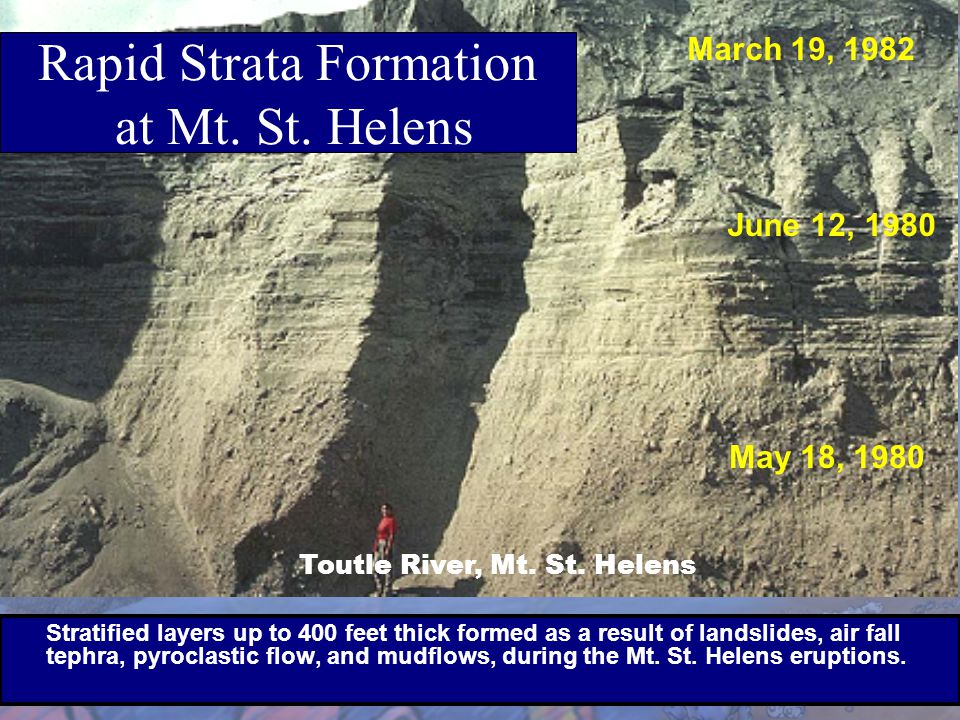
Rapid strata formation and rapid erosion at Mount St Helens.
slideplayer.com/slide/5703217/18/images/28/Rapid+Strata+F...
Visit the fossil museum:
www.flickr.com/photos/101536517@N06/sets/72157641367196613/
Just how good are peer reviews of scientific papers?
www.sciencemag.org/content/342/6154/60.full
www.examiner.com/article/want-to-publish-science-paper-ju...
The neo-Darwinian idea that the human genome consists entirely of an accumulation of billions of mutations is, quite obviously, completely bonkers. Nevertheless, it is compulsorily taught in schools and universities as 'science'.
Create a high-fashion surrealist portrait of a glamorous model whose upper body is replaced by a glossy red soda can, shaped like an elegant hourglass. She wears a shimmering red gown that flows like liquid metal, capturing studio light in dazzling reflections. Silver stiletto heels accentuate her confident stride, while the muted background highlights her bold, iconic silhouette. Blend haute couture with pop-art whimsy, celebrating the fusion of fashion, fantasy, and commercial nostalgia in a striking editorial style.
Colors of Compassion flags for the LGBT Compassion Games created at LA PRIDE's Momentum Pavillion to send to LGBT youth with love, support and encouragement.
as part of a prize draw you can now find yellow tokens at shops, cafes across Portsmouth. If you are given a token please take to aspex gallery, Gunwharf and enter our prize draw. More info - creatingbalanceproject.tumblr.com/
This is my wife Mairi (Sammy) with her mother, father and brother in 1939. A very famous artist at that time (sorry, don't have her name) sat this family down and, with a fine pair of scissors, cut out their likenesses in one sitting in unbelievably accurate detail. I didn't become familiar with this family until 20 years later, but I clearly recognize her father, and from photos from that era, the other likenesses are dead on.
Sammy's father was Counsel General from Estonia to the United States, and they had this art work done just before they left America to return to Estonia at a most inopportune time, for shortly thereafter, at the beginning of World War II, the Communists took over Estonia, and Mairi and her family were trapped. Their escape was the sort of thing international intrigue novels are made from, but theirs was no novel. Unfortunately, it's too long a story to tell here, but John Le Carre never created a novel that could top their true story.