View allAll Photos Tagged Coherence
my breast is cradled
in the curve of my guitar
i'm breaking strings and other things
playing hard
no, i'm not on the rag
but i'm not on the run
i am matching the big boys
one for one
and i must admit i am
having myself some fun
because the music business
is still run by men
like every business and everything
but i can sing like a sonofabitch
make them twitch around their eyes
make them apologize
I don't even know how to write about Ani Difranco and what her albums have meant to me over the years with any sort of intelligence or coherence. All I can say is: I'm thankful she does what she does.
"Out of chaos there emerged emotional coherence; the power of her turbulent desire was transformed into a passion to care; a commitment to truth became a driving force; beneath her intellectual and emotional vitality she found an undercurrent of wisdom; and in the secrecy of an untidy bathroom her heart’s deepest longing was met in the practice of adoration."
-Etty Hillesum: A Life Transformed by Patrick Woodhouse
"Yes, we carry everything within us, God and Heaven and Hell and Earth and Life and Death and all of history. The externals are simply so many props; everything we need is within us. And we have to take everything that comes: the bad with the good which does not mean we cannot devote our life to curing the bad."
--Etty Hillesum: A Life Transformed by Patrick Woodhouse
The University of Aarhus, which dates from 1931, is a unique and coherent university campus with consistent architecture, homogenous use of yellow brickwork and adaptation to the landscape. The university has won renown and praise as an integrated complex which unites the best aspects of functionalism with solid Danish traditions in form and materials.
The competition for the university was won by the architects Kay Fisker, C. F. Møller og Povl Stegmann in 1931. Stegman left the partnership in 1937, Fisker in 1942 and C. F. Møller Architects has been in charge of the continued architectural development and building design of the university until today.
The University of Aarhus, with its extensive park in central Aarhus, includes teaching rooms, offices, libraries, workshops and student accommodation. The university has a distinct homogeneous building style and utilises the natural contours of the landscape. The campus has emerged around a distinct moraine gorge and the buildings for the departments and faculties are placed on the slopes, from the main buildings alongside the ring road to the center of the city at Nørreport. All throughout the campus, the buildings are variations of the same clear-cut prismatic volume with pitched roofs, oriented orthogonally to form individual architectural clusters sharing the same vocabulary. The way the buildings emerge from the landscape makes them seem to grow from it, rather than being superimposed on the site.
The original scheme for the campus park was made by the famous Danish landscape architect C. Th. Sørensen. Until the death of C. Th. Sørensens in 1979 the development of the park areas were conducted in a close cooperation between C. Th. Sørensen, C. F. Møller and the local park authorities. Since 1979 C. F. Møller Architects - in cooperation with the staff at the university - has continued the intentions of the original scheme for the park, and today the park is a beautiful, green area and an immense contribution to both the university and the city in general.
In 2001, C. F. Møller Architects prepared a new masterplan for the long and short term development of the university. Although the university has been extended continuously for more than 75 years, the original masterplan and design principles have been maintained, and have proven a simple yet versatile tool to create a timeless and coherent architectural expression adaptable to changing programs. Today, the university is officially recognized as a Danish national architectural treasure and is internationally renowned as an excellent example of early modern university campus planning.
Berlin Hauptbahnhof is the main railway station in Berlin. It began operation 4 years ago on 28 May 2006. It is now Europe's largest two-level railway station, with different lines passing through it.
In contrast to Berlin's Hauptbahnhof, the most important railway stations in other European capitals are terminal stations. That is the case of many stations around London (Victoria, Waterloo, King's Cross, St Pancras, Paddington, Charing Cross...) or Paris (Gare du Nord, Austerlitz, Gare de l'Est, Gare de Lyon, St. Lazare...). This configuration stems in part from these cities being strong polarizing centers to which passangers from different parts of their countries' territories are atracted.
The concept behind Berlin Hauptbahnhof is different. Trains pass through this station instead of having it as their terminal. The station is just one of the possible destinations and not necessarily the "final destination" for passengers travelling in the trains that stop by.
The two main train stations in Tokyo (Tokyo and Shinjuku) operate according to the same concept of Berlin's Hauptbahnhof, eventually with a higher degree of complexity. Each of these two stations is a multi-level hub connecting different national, regional and commuter train lines and a few metro lines as well. The coherence of the train and metro networks in Tokyo is assured by the circular Yamanote Line (see my post on 25.5.2010) which with its ring shape connects major train stations in the city, namely Tokyo station and Shinjuku station.
The development of this new huge structure in Berlin along similar lines of the two main Tokyo train stations, stemmed from the opportunities opened by the fall of the wall that allowed for a reshaping of the city.
New Auditiorium Building, ramp detail 2001
The University of Aarhus, which dates from 1931, is a unique and coherent university campus with consistent architecture, homogenous use of yellow brickwork and adaptation to the landscape. The university has won renown and praise as an integrated complex which unites the best aspects of functionalism with solid Danish traditions in form and materials.
The competition for the university was won by the architects Kay Fisker, C. F. Møller og Povl Stegmann in 1931. Stegman left the partnership in 1937, Fisker in 1942 and C. F. Møller Architects has been in charge of the continued architectural development and building design of the university until today.
The University of Aarhus, with its extensive park in central Aarhus, includes teaching rooms, offices, libraries, workshops and student accommodation. The university has a distinct homogeneous building style and utilises the natural contours of the landscape. The campus has emerged around a distinct moraine gorge and the buildings for the departments and faculties are placed on the slopes, from the main buildings alongside the ring road to the center of the city at Nørreport. All throughout the campus, the buildings are variations of the same clear-cut prismatic volume with pitched roofs, oriented orthogonally to form individual architectural clusters sharing the same vocabulary. The way the buildings emerge from the landscape makes them seem to grow from it, rather than being superimposed on the site.
The original scheme for the campus park was made by the famous Danish landscape architect C. Th. Sørensen. Until the death of C. Th. Sørensens in 1979 the development of the park areas were conducted in a close cooperation between C. Th. Sørensen, C. F. Møller and the local park authorities. Since 1979 C. F. Møller Architects - in cooperation with the staff at the university - has continued the intentions of the original scheme for the park, and today the park is a beautiful, green area and an immense contribution to both the university and the city in general.
In 2001, C. F. Møller Architects prepared a new masterplan for the long and short term development of the university. Although the university has been extended continuously for more than 75 years, the original masterplan and design principles have been maintained, and have proven a simple yet versatile tool to create a timeless and coherent architectural expression adaptable to changing programs. Today, the university is officially recognized as a Danish national architectural treasure and is internationally renowned as an excellent example of early modern university campus planning.
My Subject is Exhibitionism
Thus, I realise that any two or more elements could be combined and any suggestion for coupling is as fecund (or as barren) as the next, or as chance allows. The choice of constituents is purely subjective and perhaps says more about the writer than the written about. To elucidate, or to restrict conjecture slightly, I should like to state that my personal interest lies in non-reproductive coupling. My goal is an exposition and celebration of sterility.
My Subject is Auto-Eroticism
‘The Observer’, Sunday 14th June 1981: ‘Shots at Queen-Treason Charge’
A seventeen-year-old youth was charged under the Treason Act yesterday after six blanks were fired only yards away from the Queen on her official birthday.
Marcus Simon Sarjeant, unemployed of Folkstone, Kent, was charged that “at the Mall he wilfully discharged at the person of her Majesty the Queen, a blank cartridge pistol with intent to alarm her”.
My Subject is Desperation
My introduction to the Bachelor Machine phenomenon coincided with my first really considered exposure to the work of Marcel Duchamp. This cathartic ‘Road to Damascus’ conversion occurred on board a ‘Laker’ aircraft whilst returning from New York. I was 24.
The catalyst took the form of a book by Octavio Paz entitled ‘Marcel Duchamp: Appearances Stripped Bare’. As with any ‘conversion’ the initial response manifested itself in an outburst of enthusiasm but with very little understanding. However, the damage had been well and truly done. Stretching this conversion metaphor even further, this attempt at coherence is a presentation of a possible ‘New Trinity’: Goya is the omnipotent Father, Sarjeant as the wayward ‘Sacrificial Son’, and finally Duchamp as the Holy Ghost, the overseer.
Testing, Testing, ... BANG!!!
Nondestructive testing
Nondestructive testing or Non-destructive testing (NDT) is a wide group of analysis techniques used in science and industry to evaluate the properties of a material, component or system without causing damage.[1] The terms Nondestructive examination (NDE), Nondestructive inspection (NDI), and Nondestructive evaluation (NDE) are also commonly used to describe this technology.[2] Because NDT does not permanently alter the article being inspected, it is a highly valuable technique that can save both money and time in product evaluation, troubleshooting, and research. Common NDT methods include ultrasonic, magnetic-particle, liquid penetrant, radiographic, remote visual inspection (RVI), eddy-current testing,[1] and low coherence interferometry.[3][4] NDT is commonly used in forensic engineering, mechanical engineering, petroleum engineering, electrical engineering, civil engineering, systems engineering, aeronautical engineering, medicine, and art.[1] Innovations in the field of nondestructive testing have had a profound impact on medical imaging, including on echocardiography, medical ultrasonography, and digital radiography.
Methods[edit]
NDT methods may rely upon use of electromagnetic radiation, sound, and inherent properties of materials to examine samples. This includes some kinds of microscopy to examine external surfaces in detail, although sample preparation techniques for metallography, optical microscopy and electron microscopy are generally destructive as the surfaces must be made smooth through polishing or the sample must be electron transparent in thickness. The inside of a sample can be examined with penetrating radiation, such as X-rays, neutrons or terahertz radiation. Sound waves are utilized in the case of ultrasonic testing. Contrast between a defect and the bulk of the sample may be enhanced for visual examination by the unaided eye by using liquids to penetrate fatigue cracks. One method (liquid penetrant testing) involves using dyes, fluorescent or non-fluorescent, in fluids for non-magnetic materials, usually metals. Another commonly used NDT method used on ferrous materials involves the application of fine iron particles (either liquid or dry dust) that are applied to a part while it is in an externally magnetized state (magnetic-particle testing). The particles will be attracted to leakage fields within the test object, and form on the objects surface. Magnetic particle testing can reveal surface & some sub-surface defects within the part. Thermoelectric effect (or use of the Seebeck effect) uses thermal properties of an alloy to quickly and easily characterize many alloys. The chemical test, or chemical spot test method, utilizes application of sensitive chemicals that can indicate the presence of individual alloying elements. Electrochemical methods, such as electrochemical fatigue crack sensors, utilize the tendency of metal structural material to oxidize readily in order to detect progressive damage.
Analyzing and documenting a non-destructive failure mode can also be accomplished using a high-speed camera recording continuously (movie-loop) until the failure is detected. Detecting the failure can be accomplished using a sound detector or stress gauge which produces a signal to trigger the high-speed camera. These high-speed cameras have advanced recording modes to capture some non-destructive failures.[5] After the failure the high-speed camera will stop recording. The capture images can be played back in slow motion showing precisely what happen before, during and after the non-destructive event, image by image.
Le Dao de jing (chinois simplifié : 道德经 ; chinois traditionnel : 道德經 ; pinyin : Dàodéjīng ; Wade : Tao⁴te²ching¹ ; EFEO : Tao-tö-king, « livre de la voie et de la vertu »), parfois écrit Tao te king, est un ouvrage classique chinois qui, selon la tradition, fut écrit autour de 600 av. J.-C. par Lao Tseu, le sage fondateur du taoïsme, dont l'existence historique est toutefois incertaine1,2. De nombreux chercheurs modernes penchent pour une pluralité d’auteurs et de sources, une transmission tout d’abord orale et une édition progressive3,4. Les plus anciens fragments connus, découverts à Guodian, remontent à 300 av. J.-C. environ5 ; les premières versions complètes très semblables au texte actuel, provenant de Mawangdui, datent de la première moitié du iie siècle av. J.-C.
Le Dao de jing a été classé parmi les textes taoïstes par les érudits6 de la dynastie Hann 1 et faisait partie des écrits sacrés des Maîtres célestes, qui divinisaient Lao Tseu. Pourtant, son lectorat n’était pas limité à un courant philosophique. Le fait que le premier à le mentionner et à le commenter soit le légiste Hanfei, et que les textes de Guodian semblent avoir été rassemblés par des confucéens7 en témoigne.
Le Dao de jing a eu une influence considérable en Extrême-Orient et en Occident à travers ses très nombreuses interprétations et traductions. En 1988, on en recensait 250 versions en langues étrangères8. Il n'existe pas de conclusion définitive quant à sa signification réelle. Selon certains, ce serait un recueil d'aphorismes provenant de plusieurs auteurs où on trouve des propositions contradictoires. D'autres au contraire y voient un texte cachant une cohérence profonde sous un style allusif et elliptique. En Chine, le texte a toujours été accompagné d'un commentaire. Par l'interprétation qu'ils suggèrent, ces commentaires ont contribué autant que le texte d'origine au sens de l'ouvrage et à sa place dans la philosophie et la religion.
The above image is the cover of a book asking "Can you say the word #$@&%*, that you learned in primary school, in English?" There are lots of similar books which contain lists of English words for Japanese learners of English.
#$@&%* is a Japanese word that is extremely difficult to translate into English. It refers to the common Japanese school-yard exercise of using kicks to spin around horizontal bars resting on ones hips. The book above gives "back hip circle." An Amazon.jp reviewer suggests instead, "kick-up pullover" but it does not really matter which gymnastic jargon is correct since few English speakers would understand either since they do not generally perform this behaviour in English speaking schools. There is no point in being aware of translations for Japanese cultural practices and proclivities in specialists English jargon since few English speakers would understand them even if the Japanese could remember all those specialist words.
There are three reasons why Japanese attempt to memorize such complex and useless English words.
One is the nature of the Japanese lexicon, which can be learned, since it has structure, provided by the kanji, requiring the the learning of only 2000 units of meaning after which one can read or explain anything. English speakers are typically forced to acquire 30,000 units of meaning over the course of their lifetime.
Secondly, because humans are scared of meaninglessness (Heine, Proulx, & Vohs, 2006), which is unavoidable when actually speaking in a new language, so they tend to want to amass a larger than needed vocabulary, and purchase useless dictionaries, before they jump into the chaos of the target language.
Thirdly because the second reason is exacerbated in the case of Japanese learning English and vice versa. The Japanese find the mental gymnastics required to explain anything in English too meaningless, and thus stressful, because of the doubly reversed - vis-à-vis Japanese - structure of the English sentence.
English sentence structure is generally of the form:
I will speak English fluently in class today.
[subject auxillary verb object adjective, adjective, adjective]
The Japanese for this would be in the reverse order
Kyou kurasude ryuuchouni eigo wo hana-sou
(today, class-in, fluently English speak-will)
[adjective, adjective, adjective, object, verb, auxillary]
Apart from the typical omission of the subject, this the above is precisely the opposite of English.
English is doubly reversed because within the the above reversed sentence structure, adjectival clauses are placed after the noun in English and before noun (like adjectives in both languagese) in Japanese.
So if a Japanese person did not know the word "jargon" and wished to gloss it with an explanation such as "words that specialists use," then the above sentence would become:
I will speak *words that specialists use* fluently in class today.
Which in Japanese is
Kyou kurasu-de ryuchou-ni *senmonka-ga tsukau kotoba-wo* hana-sou.
Today class fluent-ly *specialists use words* speak will.
It is not till the end of this long spiral of a sentence that the speaker will get confirmation of whether she has made sense requiring her to leap into a maelstrom of unmeaning for so much longer.
Bearing in mind these reasons, is no surprise therefore that Japanese attempt to learn *the whole English lexicon*(!), including specialist words to explain their cultural practices.
But this attempt is utterly hopeless. It would take Japanese learners of English two to four lifetimes to learn that many English words in Japan. And the words, like "back hip circle," "kick-up pullover," would be #$@&%* useless anyway.
The Japanese have, therefore, to be taught to use adjectival clauses: to form a reversed clause within a reversed sentence, requiring them to jump into the malestrom of unmeaning for up to 20 or 30 seconds.
As well as giving my students practice at adjectival clauses, I also try to teach them not to fear meaninglessness by getting them to practice gobbledygook.
The above explained in my pidgin Japanese.
Image copyright the author and publisher of
お取り下げ後希望でありましたらコメント欄か<a href="nihonbunka.comのメールリンクまでご連絡ください。
Heine, S. J., Proulx, T., & Vohs, K. D. (2006). The meaning maintenance model: On the coherence of social motivations. Personality and Social Psychology Review, 10(2), 88–110.
__________________________________________________
Outlining a Theory of General Creativity . .
. . on a 'Pataphysical projectory
Entropy ≥ Memory ● Creativity ²
__________________________________________________
For Y SIN EMBARGO magazine #20 :
Le moment est venu de révéler les immanences et les transcendances de notre monde. Mais comment concilier la profonde cohérence des agencements de Sophy avec la large clairvoyance des inventaires de Philo ? Quel Verbe pour dire la reliance harmonieuse de leurs émerveillements respectifs ?
Philo et Sophy d’achever leur exploration par celle de nos mots, pour retenir les plus justes, conjuguer les plus vrais, néologir les plus beaux. Notre langage se révèle malheureusement nébuleux, maladroitement confus, fâcheusement ambigu, tragiquement ambivalent, cruellement disjonctif.
Dotés d’une infaillible sagesse, dénués du moindre préjugé, partant vers d’autres mondes, ils nous donnent les clés pour pénétrer le nôtre. Ces dialemmes redresseront-ils nos filtres ? Refondront-ils nos index ? Sous quelles formes nos affects et nos percepts émergeront-ils de nos plans de résilience ?
Pensons-classons ces dialemmes dans un réseau sémantique performatif. Dé(re)construisons les adversaires métaphysiques, les opposés subjectifs, les disjonctions manichéennes, les dialogiques mécanistes, les exclusions théologiques, les dialectiques récurrentes. Inventons l’idiome d’un nouveau rhizome ; soyons notre dialemmatique !
Deux petits princes dotés d’une infaillible sagesse, deux petits démons dénués du moindre préjugé, désormais raisonnent en chacun de nous. On ne peut révéler deux fois le même secret ? Le moment est venu d’en concevoir ensemble de nouveaux, comme autant d’ultimes extimités !
__________________________________________________
Time is come to reveal us immanences and transcendences of our world. But how to conciliate the deep consistency of Sophy’s arrangements with the wide perspicacity of Philo’s inventories ? Which Word to say the harmonious reliance of their respective wonders?
Philo and Sophy complete their exploration by our words, to retain the more right, to conjugate the truest, to neologize the nicest. Unfortunately our language shows itself nebulous, sadly confused, awkwardly ambiguous, tragically ambivalent, cruelly disjunctive.
Endowed of an infallible wisdom, devoid of any prejudice, going away to other worlds, they give us the keys to penetrate our own. Will these dialemmas rectify our filters ? Will they revise our index ? Through what forms our affects and our percepts will emerge from our planes of resilience ?
Let us think-classify these dialemmas in a performative semantic network. Let us dis(re)construct the metaphysical enemies, the subjective opponents, the manichean disjunctions, the mechanist dialogics, the theogical exclusions, the recurrent dialectics. Let us invent the idiom of a new rhizome ; let us be our dialemmatics !
Two little princes endowed of an infallible wisdom, two small demons devoid of any prejudice, are now reasonning in each one of us. One can not reveal the same secret twice ? Time is come to create new ones together, as so many ultimate extimacies !
__________________________________________________
El momento ha llegado de revelar las inmanencias y las trascendencias de nuestro mundo. Pero ¿ cómo conciliar la profunda coherencia de las disposiciones de Sophy con la vasta clarividencia de los inventarios de Philo ? ¿ Qué Verbo para decir la relianza armoniosa de sus respectivos asombros ?
Philo y Sophy completan su exploración por medio de nuestras palabras, para retener las más justas, conjugar las más verdaderas, neologizar las más bellas. Desgraciadamente nuestro lenguaje se revela nebuloso, tristemente confuso, torpemente ambiguo, trágicamente ambivalente, cruelmente disyuntivo.
Dotados de una infalible sabiduría, desprovistos del menor prejuicio, partiendo hacia otros mundos, nos dan las claves para penetrar el nuestro. ¿ Rectificarán estos dialemas nuestros filtros ? ¿ Reformarán nuestros índices ? ¿ Bajo qué formas nuestros afectos y percepciones emergerán de nuestros planos de resiliencia ?
Pensemos-clasifiquemos estos dialemas en una red semántica performativa. De(re)construyamos los adversarios metafísicos, los opuestos subjetivos, las disyunciones maniqueas, los dialógicos mecanistas, las exclusiones teológicas, las dialécticas recurrentes. Inventemos el idioma de un nuevo rizoma ; ¡ seamos nuestra dialemática !
Dos pequeños príncipes dotados de una infalible sabiduría, dos pequeños demonios desprovistos del menor prejuicio, razonan ahora en cada uno de nosotros. ¿ No se puede revelar dos veces el mismo secreto ? ¡ Ha llegado el momento de concebir algunos nuevos, como tantas ultimas extimidades !
spanish translation by Alicia Pallas alias Alificacion
__________________________________________________
rectO-persO | E ≥ m.C² | co~errAnce | TiLt
I started working on this booklet before a physical version of the album had been released. I decided to use Sky’s Vogue shoot by Tom Munro, due to its polished looks and coherence with the pre-existing album themes, including the slashes, green tiles, and heavy use of Helvetica, which I used throughout my own version. I re-colored all the photos from scratch to add a slight vintage look to them, and modified the way the majority of the text was presented. Make sure to view it in full-scale!
iss053e238919 (Nov. 21, 2017) --- Cosmonauts Alexander Misurkin (foreground) and Sergey Ryazanskiy participate in a remotely guided eye exam with assistance from doctors on Earth using Optical Coherence Tomography gear. Misurkin was the Crew Medical Officer and Ryazanskiy was the subject helping doctors understand how living in microgravity impacts vision.
Former Art Museum, now converted to faculty, ca. 1963
The University of Aarhus, which dates from 1931, is a unique and coherent university campus with consistent architecture, homogenous use of yellow brickwork and adaptation to the landscape. The university has won renown and praise as an integrated complex which unites the best aspects of functionalism with solid Danish traditions in form and materials.
The competition for the university was won by the architects Kay Fisker, C. F. Møller og Povl Stegmann in 1931. Stegman left the partnership in 1937, Fisker in 1942 and C. F. Møller Architects has been in charge of the continued architectural development and building design of the university until today.
The University of Aarhus, with its extensive park in central Aarhus, includes teaching rooms, offices, libraries, workshops and student accommodation. The university has a distinct homogeneous building style and utilises the natural contours of the landscape. The campus has emerged around a distinct moraine gorge and the buildings for the departments and faculties are placed on the slopes, from the main buildings alongside the ring road to the center of the city at Nørreport. All throughout the campus, the buildings are variations of the same clear-cut prismatic volume with pitched roofs, oriented orthogonally to form individual architectural clusters sharing the same vocabulary. The way the buildings emerge from the landscape makes them seem to grow from it, rather than being superimposed on the site.
The original scheme for the campus park was made by the famous Danish landscape architect C. Th. Sørensen. Until the death of C. Th. Sørensens in 1979 the development of the park areas were conducted in a close cooperation between C. Th. Sørensen, C. F. Møller and the local park authorities. Since 1979 C. F. Møller Architects - in cooperation with the staff at the university - has continued the intentions of the original scheme for the park, and today the park is a beautiful, green area and an immense contribution to both the university and the city in general.
In 2001, C. F. Møller Architects prepared a new masterplan for the long and short term development of the university. Although the university has been extended continuously for more than 75 years, the original masterplan and design principles have been maintained, and have proven a simple yet versatile tool to create a timeless and coherent architectural expression adaptable to changing programs. Today, the university is officially recognized as a Danish national architectural treasure and is internationally renowned as an excellent example of early modern university campus planning.
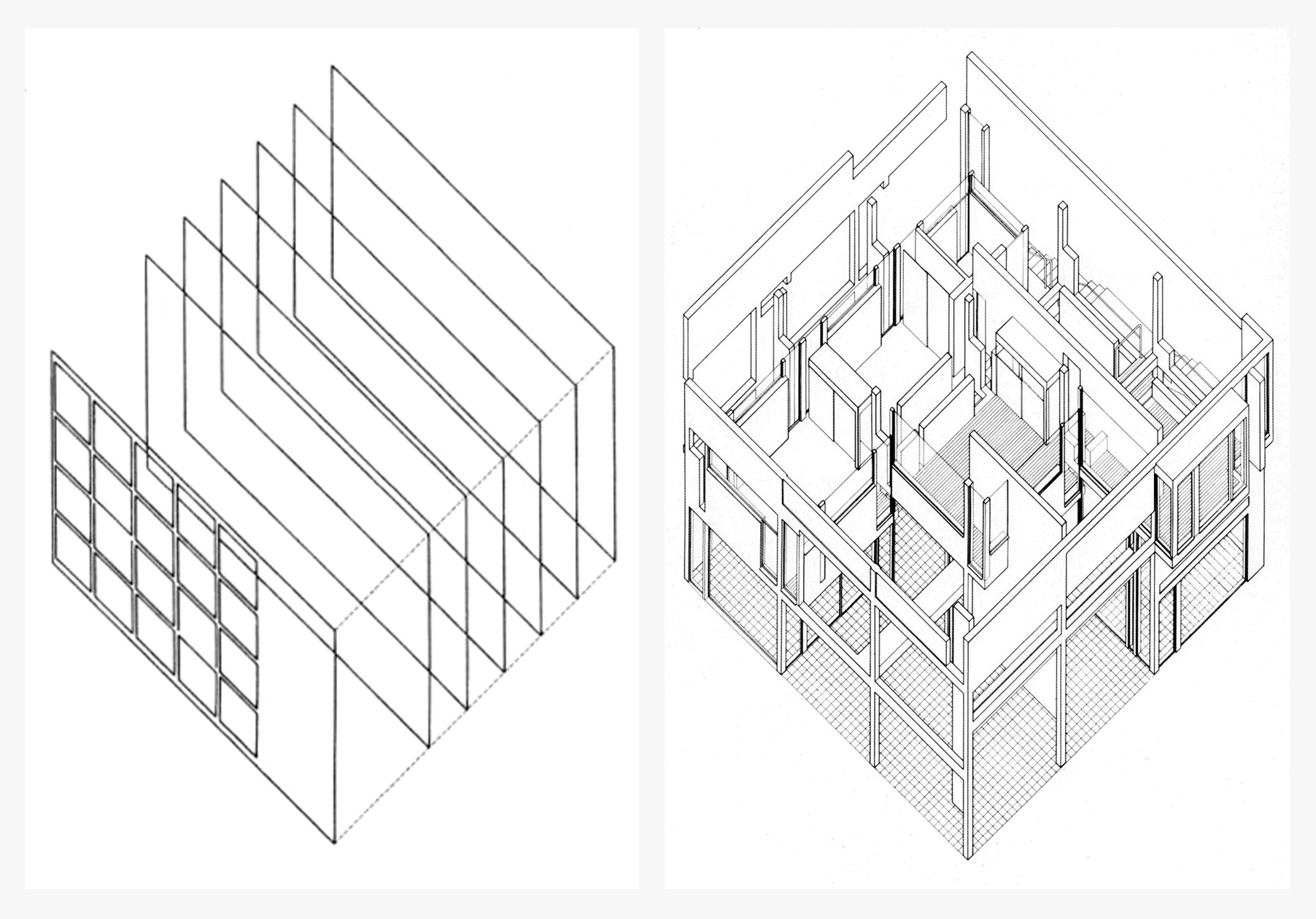
Giuseppe Terragni's infamous Casa Del Fascio (today casa del populi) built in 1935 as a symbol for the superiority of the rising fascist party shows mainly Terragnis superiority in comosing space with complexity and coherence. The balance of rules and exceptions and the impressive control of light fascinated architects and theorists (such as Peter Eisenman who analysed the building properly) for decades.
architecturality.files.wordpress.com/2010/10/terragni_eis...
Each of us submitted an essay on innovation and growth in advance for the Gruter Institute Conference on Growth. I’ll append mine below.
(photo by John Chisholm. More below).
Discussion ensued over lunch, and one of my favorite authors, Matt Ridley wrote a summary for the WSJ “Why Can't Things Get Better Faster (or Slower)?”
------------------------------------
Innovation and Growth — Evolving Cities and Culture
By Steve Jurvetson
Innovation is critical to economic growth, progress, and the fate of the planet. Yet, it seems so random. But patterns emerge in the aggregate, and planners and politicians may be able to promote innovation and growth despite the overall inscrutability of this complex system. To tap the wisdom of crowds, we should shift the locus of learning from products to process. Leadership is not spotting the next growth industry, but tuning the parameters of human communication.
One emergent pattern, spanning centuries, is that the pace of innovation is perpetually accelerating, and it is exogenous to the economy. Rather, it is the combinatorial explosion of possible innovation-pairings that creates economic growth. And that is why cities are the crucible of innovation.
Geoffrey West of the Santa Fe Institute argues that cities are an autocatalytic attractor and amplifier of innovation. People are more innovative and productive, on average, when they live in a city because ideas can cross-pollinate more easily. Proximity promotes propinquity and the promiscuity of what Matt Ridley calls “ideas having sex”. This positive network effect drives another positive feedback loop - by attracting the best and the brightest to flock to the salon of mind, the memeplex of modernity.
Cities are a structural manifestation of the long arc of evolutionary indirection, whereby the vector of improvement has risen steadily up the ladder of abstractions from chemicals to genes to systems to networks. At each step, the pace of progress has leapt forward, making the prior vectors seem glacial in comparison – rather we now see the nature of DNA and even a neuron as a static variable in modern times. Now, it’s all about the ideas - the culture and the networks of humanity. We have moved from genetic to mimetic evolution, and much like the long-spanning neuron (which took us beyond nearest neighbor and broadcast signaling among cells) ushering the Cambrian explosion of differentiated and enormous body plans, the Internet brings long-spanning links between humans, engendering an explosion in idea space, straddling isolated pools of thought.
And it’s just beginning. In the next 10 years, three billion minds will come online for the first time to join this global conversation (Diamandis).
But why does this drive innovation and accelerating change? Start with Brian Arthur’s observation that all new technologies are combinations of technologies that already exist. Innovation does not occur in a vacuum; it is a combination of ideas from before. In any academic field, the advances today are built on a large edifice of history. This is the foundation of progress, something that was not so evident to the casual observer before the age of science. Science tuned the process parameters for innovation, and became the best method for a culture to learn.
From this conceptual base, come the origin of economic growth and accelerating technological change, as the combinatorial explosion of possible idea pairings grows exponentially as new ideas come into the mix (on the order of 2^n of possible groupings per Reed’s Law). It explains the innovative power of urbanization and networked globalization. And it explains why interdisciplinary ideas are so powerfully disruptive; it is like the differential immunity of epidemiology, whereby islands of cognitive isolation (e.g., academic disciplines) are vulnerable to disruptive memes hopping across, much like South America was to smallpox from Cortés and the Conquistadors. If disruption is what you seek, cognitive island-hopping is good place to start, mining the interstices between academic disciplines.
So what evidence do we have of accelerating technological change? At DFJ, we see it in the diversity and quality of the entrepreneurial ideas arriving each year across our global offices. Scientists do not slow their thinking during recessions. For a good mental model of the pace of innovation, consider Moore’s Law in the abstract – the annual doubling of compute power or data storage. As Ray Kurzweil has plotted, the smooth pace of exponential progress spans from 1890 to 2012, across countless innovations, technology substrates, and human dramas — with most contributors completely unaware that they were fitting to a curve.
Moore’s Law is a primary driver of disruptive innovation – such as the iPod usurping the Sony Walkman franchise – and it drives not only IT and communications, but also now genomics, medical imaging and the life sciences in general. As Moore’s Law crosses critical thresholds, a formerly lab science of trial and error experimentation becomes a simulation science and the pace of progress accelerates dramatically, creating opportunities for new entrants in new industries. And so the industries impacted by the latest wave of tech entrepreneurs are more diverse, and an order of magnitude larger — from automobiles and rockets to energy and chemicals.
At the cutting edge of computational capture is biology; we are actively reengineering the information systems of biology and creating synthetic microbes whose DNA was manufactured from bare computer code and an organic chemistry printer. But what to build? So far, we largely copy large tracts of code from nature. But the question spans across all the complex systems that we might wish to build, from cities to designer microbes, to computer intelligence.
As these systems transcend human comprehension, will we continue to design them or will we increasingly evolve them? As we design for evolvability, the locus of learning shifts from the artifacts themselves to the process that created them. There is no mathematical shortcut for the decomposition of a neural network or genetic program, no way to "reverse evolve" with the ease that we can reverse engineer the artifacts of purposeful design. The beauty of compounding iterative algorithms (evolution, fractals, organic growth, art) derives from their irreducibility. (My Google Tech Talk goes into some detail on the dichotomy of design and evolution).
The corporation is a complex system that seeks to perpetually innovate. Leadership in these complex organizations shifts from direction setting to a wisdom of crowds. And the process learning is a bit counterintuitive to some alpha leaders: cognitive diversity is more important than ability, disagreement is more important than consensus, voting policies and team size are more important than the coherence or comprehensibility of the decisions, and tuning the parameters of communication (frequency and fanout) is more important than charisma.
The same could be said for urban planning. How will cities be built and iterated upon? Who will make those decisions and how? We are just starting to see the shimmering refractions of the hive mind of human culture, and now we want to redesign the hives themselves to optimize the emergent complexity within. Perhaps the best we can do is set up the grand co-evolutionary dance, and listen carefully for the sociobiology of supra-human sentience.
wan·der
- To move about without a definite destination or purpose.
- To go by an indirect route or at no set pace; amble: wander toward town.
- To proceed in an irregular course; meander.
- To go astray: wander from the path of righteousness.
- To lose clarity or coherence of thought or expression.
Giuseppe Terragni's infamous Casa Del Fascio (today casa del populi) built in 1935 as a symbol for the superiority of the rising fascist party shows mainly Terragnis superiority in comosing space with complexity and coherence. The balance of rules and exceptions and the impressive control of light fascinated architects and theorists (such as Peter Eisenman who analysed the building properly) for decades.
architecturality.files.wordpress.com/2010/10/terragni_eis...
"The fontaine Saint-Michel was part of the great project for the reconstruction of Paris overseen by Baron Haussmann during the French Second Empire. In 1855 Haussmann completed an enormous new boulevard, originally called boulevard de Sébastopol-rive-gauche, now called Boulevard Saint-Michel, which opened up the small place Pont-Saint-Michel into a much larger space. Haussmann asked the architect of the service of promenades and plantations of the prefecture, Gabriel Davioud, to design a fountain which would be appropriate in scale to the new square. As the architect of the prefecture, he was able to design not only the fountain but also the facades of the new buildings around it, giving coherence to the square, but he also had to deal with the demands of the prefet and city administration, which was paying for the project.
Davioud's original project was for a fountain dedicated to peace, located in the center of the square. The prefect authorities rejected this idea and asked him instead to build a fountain to hide the end wall of the building at the corner of boulevard Saint-Michel and Saint-André des Arts. This forced Davioud to adapt his plan to the proportions of that building.
The next design made by Davioud in 1856 provided the architectural structure of the fountain; a facade divided into four horizontal levels, similar to a triumphal arch, with four Corinthian columns on high socles framing the central niche. The main cornice is surmounted by a French Renaissance design feature, an inscribed tablet in a grand architectural framing. As the revised site was just off the axis of the bridge, Davioud created a visual compromise in a series of shallow bowed basins through which the water issuing from the rock under the supine body of Saint Michael's adversary spills. The water ends in a basin sunk into street level, with a curving front edge that softens the line of the monuments architectural base.
In the 1856 plan, Davioud placed a feminine statue of Peace into the central niche. The 1858 plan called for replacing Peace with a statue of Napoleon Bonaparte. This provoked furious opposition from the opponents of Louis-Napoleon, so later in 1858 Davioud proposed that the central figure be the Archangel Michael wrestling with the devil. This was agreed, construction began in June 1858, and the statue was inaugurated on August 15, 1860.
In September 1870, after the capture of Emperor Louis Napoleon by the Germans during the French-German War and his abdication, the fountain was threatened by a mob. On September 5, Davioud wrote an urgent letter to the Director of the Municipal Service of Promenades and Plantations: "A crowd of unarmed workers have just come to the Fontaine Saint-Michel..they apparently want to attack the fountain and want to deface the eagles and inscriptions on the upper part. What should I do?"
The fountain, along with other symbols of Louis Napoleon, was apparently attacked and damaged by mobs during the 1871 uprising and suppression of the Paris Commune. In 1872, Davioud was authorized by the Prefecture to make urgent repairs to the fountain. It was restored again in 1893." [from Wikipedia]
Thank you for viewing.
Your useful feedback, constructive criticism, and kind comments are sincerely welcomed, highly encouraged, and greatly appreciated on this and all of my images.
This technology is the OCT (optical coherence tomography) instrument at my optometry office. It allows a perspective of the layers of the retina that can't be visualized otherwise and has been very useful in the management of eye diseases like glaucoma and macular degeneration.
Meditation is a powerful tool to incorporate into your daily life, bringing you clarity, a peaceful mind, better concentration, a sense of well being, and increased energy. Meditation is synonymous with yoga and, in reality, is an integral part of any yoga practice. The forefather of yoga, Patanjali, in his systemic approach to yoga categorizes yoga as having eight limbs. Of the eight limbs, meditation is the water that awakens and nourishes the quiet spirit within. A famous western yogi often said that meditation was like “watering the root to enjoy the fruit."1 A regular meditation practice enhances and accelerates the progress firefighters will reap from their yoga practice.
It is important to understand that meditation incorporates a wide range of disciplines, all with healthy results. Each type of meditation is beneficial to practice. Jeanne Ball, a writer for the David Lynch Foundation, outlines three major types of meditation and gives a brief explanation of the benefits.
Controlled focus: Classic examples of concentration or controlled focus are found in the revered traditions of Zen, Tibetan Buddhism, Qiqong, Yoga, Christianity, and Vedanta, though many methods involve attempts to control or direct the mind. Attention is focused on an object of meditation--such as one's breath, an idea or image, or an emotion. Brain waves recorded during these practices are typically in the gamma frequency (20-50 Hz), seen whenever you concentrate or during "active" cognitive processing.2
Open monitoring: These mindfulness type practices, common in Vipassana and Zazen, involve watching or actively paying attention to experiences--without judging, reacting, or holding on. Open monitoring gives rise to frontal theta (4-8 Hz), an EEG pattern commonly seen during memory tasks or reflection on mental concepts.3
Automatic self-transcending: This category describes practices designed to go beyond their own mental activity--enabling the mind to spontaneously transcend the process of meditation itself. Whereas concentration and open monitoring require degrees of effort or directed focus to sustain the activity of meditation, this approach is effortless because there is no attempt to direct attention--no controlled cognitive processing. The EEG pattern of this category is frontal alpha coherence, associated with a distinct state of relaxed inner wakefulness.4,5
Immediately one would ask, Which meditation is right for me? We would encourage that you find a meditation practice and teacher that you are comfortable with. Our recommendation is that you do an Automatic Self Transcending meditation, which is a form of mantra meditation. The meditation should be done twice a day.
There are several mantra meditations that produce the desired results. Most of the research on the physiological benefits of mantra meditation has been done in conjunction with or under the sponsorship of the TM (Transcendental Meditation) organization. These techniques are taught through individualized instruction and are intended to give maximum results to the practitioner. A brief summary of the benefits include increased alertness, increased IQ and mental clarity, reduced stress, reduced cholesterol, reduced incidence of coronary heart disease, increased creativity, increased workplace performance, and significant sociological benefits of reduction in crime and increased peace.6
Practitioners of mantra meditation techniques describe the above measured benefits as easy to achieve, because the techniques are effortless in their practice. Patanjali’s Yoga Sutras states in the second sutra, “Yoga is the complete settling of the activity of the mind.” A mantra meditation technique takes the mind effortlessly to that state of “complete settling of the mind.”
Sleeping, Dreaming, and Waking are the three states of consciousness that our bodies cycle through daily. Beginning a mantra meditation practice introduces us to a new state of consciousness. This state has a physiological correlation now known as “Restful Alertness,” a fourth major state of consciousness.7
If you are unable to learn a mantra meditation from a qualified teacher, then the So Hum meditation described below will settle the mind and take it to the state of “pure awareness.”
So Hum Meditation:
1. Sit comfortably where you will not be disturbed, and softly close your eyes.
2. For a few minutes, simply observe the inflow and outflow of your breath.
3. Now, take a slow deep breath through the nose while thinking the word So.
4. Exhale slowly through the nose while thinking the word HUM.
5. Allow your breathing to flow easily, silently repeating, So… Hum… with each inflow and outflow of breath.
6. Whenever your attention drifts to thoughts in your mind, sounds in your environment, or sensations in your body, gently return to your breath, silently repeating, So… Hum.
7. Continue this process for 15 or 30 minutes, with an attitude of effortlessness and simplicity.
8. When the time is up, sit with your eyes closed for a couple of minutes before resuming your daily activity.8
Experiences during meditation will fall into four categories: (1) Repeating the mantra, (2) having thoughts, (3) falling asleep, or (4) experiencing pure awareness. Keep these guidelines in mind.
A. Repeat the mantra easily and effortlessly. It may change, become vague, or follow a certain rhythm. Just let it go and experience any changes innocently.
B. If you notice that your attention has drifted away from the mantra to thoughts, sensations in the body, or noise in the environment, gently bring your awareness back to the mantra.
C. If you fall asleep, it is OK. The body will naturally take the rest it needs. When you notice that you have been asleep, just return to the mantra. If your meditation time is up, spend a few minutes repeating the mantra before stopping and coming out of meditation.
D. If you notice that there has been some time without thoughts or the mantra, yet you were aware, that is called “slipping into the gap,” or pure awareness. The experience of the mind settling down to a state of no activity yet has awareness is a transcendent experience of the peace within. As the experience grows, you will notice that this quiet witness begins to become part of your everyday awareness.
Meditation is not for tuning out; it is for tuning in. It is not for getting away from it all; it is for getting in touch with it all. You will find that the value of meditation is not found specifically in meditation but in a more enjoyable and fulfilling life. We encourage you to begin a regular meditation practice and begin the process of experiencing your true self, which is kind, compassionate, lighthearted, understanding, creative, brilliant, calm, and focused.
Enjoy!
For DVD's and more info on Meditation Visit: www.AmericanYogaAcademy.com and www.ClaireDiab.com
REFERENCES
1. Maharishi Mahesh Yogi.
2. Lutz, Greischar, Rawlings, Ricard, Davidson, 2004. Proc Natl Acad Sci U S A 101,16369-73.
3. Cahn, Delorme, & Polich, 2010. Cognitive Processing 2010 11(1):39-56.
4. Travis et al, 2010. Cognitive Processing 11(1), 21-30.
5. www.huffingtonpost.com/jeanne-ball/how-meditation-techniq...
6. www.tm.org/benefits-of-meditation
7. www.cbeprograms.org/brain_development/research/index.html
8. Dr. Deepak Chopra & Dr. David Simon “The Seven Spiritual Laws of Yoga” pgs. 90-92.
Food photography isn't usually my thing but here's a little starter that arrived before me in Venice that I just had to share. Meanwhile, today's blog post bit.ly/1gRd2FD details my attempts to bring together my photography in a more rational manner, this focus on coherence is at odds with the incoherence of my Monday. I'm sorry Flickr I just don't have the time or inclination to devote to you any more!
www.lansingheritage.org/html/jbl/specs/home-speakers/1967...
This one uses the LE8T full range driver (ie. no tweeter and no cross over) plus an 8 inch passive radiator. I use a vintage Marantz 2216B with these. They do have a sweet spot for the treble; however, the sound well off axis is still very good, and they image well even used in that manner. Probably has to do with the coherence of the sound from a single driver. These sound great with a single ended 300b amp as well.
www.lansingheritage.org/images/jbl/specs/home-comp/le8t/p...

The piazza is not rectangular. It is shaped as a trapezium with a length of 176 m and a width between 62 m and 82 m. This creates the illusion of being longer than it is in reality.
Across the piazza in front of the church are three large mast-like flagpoles with bronze bases decorated in high relief by Alessandro Leopardi in 1505. The Venetian flag of St Mark used to fly from them in the time of the republic of Venice and now shares them with the Italian flag.
Procuratie Vecchie (16th century, Early Renaissance) is on the right, Procuratie Nuovo (1640, classical style) on the left, Ala Napoleonica (Napoleonic Wing) in the center.
The 500-year-old building of the Procuratie Vecchie, which was originally intended to house the apartments and offices of the procurators of San Marco, was rebuilt in the 16th century by architect Mauro Codussi after a fire burned the original 12th-century structure to the ground.
The building still shows some of its Gothic or even Venetian Byzantine roots.
"Construction of the Procuratie Nuove began in 1586 and completed by Longhena in 1640. The extended effort resulted in the creation of one of the finest buildings in any square, with serious attention paid to the classical architectural style. Though this classical style was unusual in the 17th century, today see how this building provides a perfect European setting for a daytime stroll and a coffee."
Ala Napoleonica was begun in 1810 in a Neoclassical style.
The building has maintained many of the distinctive features of the Napoleonic and Hapsburg periods; neo-classical influence in architecture, decor, frescoes and furnishings make it an important record of the culture and style of a period.
The Ala Napoleonica completed Piazza San Marco bringing it coherence and unity. The façade facing the Basilica takes as its inspiration the Procuratie Nuove.
Venice. 2014
Dolfin - The Early Days Once gin a life time a horse may come into your life as a profound teacher and this horse for me, was an ex bullfighting Spanish stallion, Delfin. Over many years now he has become my very special friend and teacher, revealing to me many deeper aspects of the horse's mind. I have been taught by several great teachers, who have shown me insights into methods of training the horse. However, my greatest teacher is Delfin, who has won the affection of everyone that meets him. They have come to respect and love his infinite wisdom, supreme intelligence and talent. I teach internationally with my stallions, of the power of breath energy awareness as a potent connection with the horse. This potent energy connection IS part of natural herd language and is so often overlooked. So how did this journey begin for me? I bought Delfin back to the UK and he was very high in tension and energy, unable to relax producing passage and piaffe, within his stable. I slowly tried to win his confidence by sitting outside his stable, often just peeling vegetables, reading books , just to while away time. I wanted him to feel secure and calm in his mind. His inquisitive nature began to take over and he would come and peer over the stable door. We put the radio on during the day, in an attempt to calm him. We also began to introduce him to grass. Delfin did not understand freedom or space so it would have been unwise to just turn him out in the field. If you have a human who has suffered imprisonment or a suppressed lifestyle for many years, there would be major problems to overcome for him to gain the confidence to deal with new situations. There is a strange type of security which can be built up from a restricted and confined environment. Each day I led Delfin, as quietly as possible, into a field and I just stood or sat with him. He would snatch violently at the grass, always more curious about his surroundings. It was quite a while before I could take off the rope and leave him alone in the field. Freedom and space were new concepts for Delfin who would always position himself in the field so that he could watch me. Delfin was to become my teacher who would show me the importance of listening and tuning in to my horse, not in a logical or mechanical way but with feeling and emotion. A truly amazing and revealing empathy was to develop between us. We were becoming kindred spirits both searching to learn from each other. Early training I learnt so much from our early days training in England. Delfin was very tense with highly charged, nervous reactions and his trot was almost on the spot and bunched up. The trot did not improve at first, even with walk and trot transitions. This highly charged tension controlled all his movements but he did seem to settle more in the canter. A bull-fighter works in canter for a great deal of the time and it appeared that work in trot was a foreign language for Delfin. The most testing lessons for me have been to maintain Delfin's trust and confidence. He would often test my patience and I would be forced to feel that a strong tap with the whip would be in order to gain his attention. The problem was, that after such a reprimand, Delfin would become extremely agitated and the chance of any relaxed work would totally disappear. This is one of the reasons why Delfin has become my greatest teacher, as whenever I have felt that I had the answers, he would produce another aspect of behaviour for me to work through. If I chose the route of patience and more patience we did reap rewards in our communications. We have to assess the reason for difficult behaviour and if the cause is anxiety or fear then we have to become thoughtful and clever in our thinking, to encourage the horse to be 'on our side'. Frequently I changed exercises or re-evaluated my ideas, to bring about a more positive response from Delfin. Breath Awarenes The Beginning Of My Journey On one particular day, Delfin appeared to be ignoring my usual aids as there were mares galloping around in the next field. He was much more tuned in to their behavior and his whole body was a quivering mass of energy. He felt as if he could launch anywhere. Almost without a thought I took a deep breath inwards, I suppose in exasperation as my communications were having no impact on Delfin! Slowly, I remember breathing quite strongly outwards and I began to feel a more attentive response. The air released, with the outward breath, caused a flow of relaxation and energy through my body. My seat relaxed and my legs became lighter around his rib cage. Delfin responded immediately. I felt a slight lifting and loosening of his back. He began to concentrate and walk forwards more calmly. I leant forward, stroked his neck and took a breath inwards, Delfin came back to halt. I had not planned this and felt it happen as an instinctive response. I was extremely curious about the effect of my breathing on Delfin, and so I began to repeat these exercises over and over again. He would move from halt to walk or walk to trot with every deep breath out and then respond by coming back down the transitions, with my deeper inward breath. I was amazed. He was concentrating much more on my breathing and not so much on the mares and the other external influences. Could these techniques work again? The following day I was eager to repeat these techniques to see if I could gain a similar response. Yes, I was delighted, as the lessons were repeated, remembered and understood. Could they help me to communicate with any other horses, or was this a connection, just between Delfin and myself? He is an extremely sensitive horse and maybe other horses would not pick up such subtle changes in the breathing patterns of the rider. I wanted to explore further, so I used these techniques with my bay stallion, Maestu. He has a totally different outlook on life, being very laid back but quite assertive and dominant in nature. Although Maestu is so very different in his nature from Delfin, he quickly understood and responded to the same breathing patterns. This was a breakthrough in my communications. I had realised the significance of the rider's seat, but I had not thought deeply about the importance of breathing. I now realize that our understanding of breathing is fundamental to control and balance of both our body and seat! The science of breath energy My teacher has been the horse and my learning continues to evolve. When I am teaching we always begin with the horse at liberty and finding a breath energy connection before any tack or ridden work. Techniques of core breathing now instigate the first aid for all basic work and also for more advanced collected work including lateral exercises, pirouettes and passage. I have more recently been studying Groundbreaking Scientific research which gives clarity to the importance of breath-heart-energy within the interaction and communication between humans and horse.
To delve more fully, this energy or electromagnetic signals are waves propagated through space or matter by the oscilating electric and magnetic fields generated by an oscilating electrical charge. In the human body, the heart has been proven to be the most powerful source of electromagnetic energy. This is the scientific description given to the power of breath-heart- energy connection. The breath can control the heart rate and this will change the energy surrounding the heart. The fear flight response to stress activates the sympathetic nervous system causing a constriction of blood vessels and a rise in heart rate. This state is known as chaos in heart rhythm which demonstrates disorder, incoherence and confusion.In physics when two or more wave forms are phase- locked together, to form constructive energy, this is known as coherence. Heart coherence enables the emergence of new levels of creativity, co-operation and quality at all levels. When a person is calm we have heart coherence which ensures there is no energy wasted and the body is in harmony.Awareness of heart coherence will enable the rider to influence the horse in a more profound way, creating co-operation, positive flowing energy which enhances a connection. Traditionally riders use arms and legs and a more mechanical approach from the outside so how would subtle energy changes from within, affect the horse? The Institute of Heartmath in California (www.heartmath.org. ) was founded to research the emotional intelligence of the heart which it is believed has everything to do with the way the human brain functions. The heart would appear to be a window to a further domain of human intelligence. Developing our own emotional intelligence involves self awareness – becoming aware of our mood and emotions and how we express our feelings, for instance in a relationship. Without the guiding influence of the heart, we can easily fall prey to reactive emotions such as insecurity, fear, anger and blame as well as any other energy draining reactions and behaviours. (from The HeartMath Solution) These responses can change our energy field and the horse will quickly tune in to these signals, before we are aware of it.Science now has the evidence, from experiments with individuals that emotional distress causes chaos in the rhythm of the heart. The natural steady rhythm becomes distorted through changes in emotion which have a profound effect on the heart.The horse will immediately tune into our emotions and heart rhythm and if it is steady he will feel more calm. If we allow our emotions to create chaos in our heart rhythm, the horse will demonstrate anxiety and fear. His leader is giving him messages to fuel his natural fear and flight instinct! When the rider builds more self awareness mentally, physically and emotionally, these symptoms of heart chaos, giving messages of fear and flight, can be altered, from chaos to calmness.Delfin the equine professor For many years now, Delfin has been willingly teaching the art of connection for riders and trainers around the world. I give clinics with my Iberian stallions and where my words may be helpful, the feeling between the student and stallion can be much deeper. They leave with an experience they will never forget- the beginning of a new journey. With this deeper bond, tuning into breath- energy they can progress with their own horses, in a language which is natural to the equine spirit.I feel so privileged to be part of Delfin's life. He is truly a 'soul friend' and my equine professor who is so generous and wise. When a student works with him, I can interpret what he is saying and in this way assist the student to find a mindful place of connection, from within.The key to my teaching are: Top to Toe' posture awareness Focus on core breathing for breathheart- energy connection and personal empowerment Visualization – to capture the essence of the moment Become the Mirror – for the horse to reflect. When we can give to the horse, patience, love and wisdom together with humility and honesty, we will receive the greatest friendship, trust and courage from the horse. Together, we can build a quiet place for mutual calm where truth from the heart may be nurtured. It is difficult to describe the depth of friendship which the horse can offer, but it has the potential to become both life changing and life enhancing. The way we ride the horse will be a reflection of the whole relationship which will weave a path to oneness and harmony. Secrets of the horse will be given clarity as you go not where the path may lead, but follow in the trail of his hoof prints.
The University of Aarhus, which dates from 1931, is a unique and coherent university campus with consistent architecture, homogenous use of yellow brickwork and adaptation to the landscape. The university has won renown and praise as an integrated complex which unites the best aspects of functionalism with solid Danish traditions in form and materials.
The competition for the university was won by the architects Kay Fisker, C. F. Møller og Povl Stegmann in 1931. Stegman left the partnership in 1937, Fisker in 1942 and C. F. Møller Architects has been in charge of the continued architectural development and building design of the university until today.
The University of Aarhus, with its extensive park in central Aarhus, includes teaching rooms, offices, libraries, workshops and student accommodation. The university has a distinct homogeneous building style and utilises the natural contours of the landscape. The campus has emerged around a distinct moraine gorge and the buildings for the departments and faculties are placed on the slopes, from the main buildings alongside the ring road to the center of the city at Nørreport. All throughout the campus, the buildings are variations of the same clear-cut prismatic volume with pitched roofs, oriented orthogonally to form individual architectural clusters sharing the same vocabulary. The way the buildings emerge from the landscape makes them seem to grow from it, rather than being superimposed on the site.
The original scheme for the campus park was made by the famous Danish landscape architect C. Th. Sørensen. Until the death of C. Th. Sørensens in 1979 the development of the park areas were conducted in a close cooperation between C. Th. Sørensen, C. F. Møller and the local park authorities. Since 1979 C. F. Møller Architects - in cooperation with the staff at the university - has continued the intentions of the original scheme for the park, and today the park is a beautiful, green area and an immense contribution to both the university and the city in general.
In 2001, C. F. Møller Architects prepared a new masterplan for the long and short term development of the university. Although the university has been extended continuously for more than 75 years, the original masterplan and design principles have been maintained, and have proven a simple yet versatile tool to create a timeless and coherent architectural expression adaptable to changing programs. Today, the university is officially recognized as a Danish national architectural treasure and is internationally renowned as an excellent example of early modern university campus planning.
Main hall interior, brick floor detail, ca. 1948
The University of Aarhus, which dates from 1931, is a unique and coherent university campus with consistent architecture, homogenous use of yellow brickwork and adaptation to the landscape. The university has won renown and praise as an integrated complex which unites the best aspects of functionalism with solid Danish traditions in form and materials.
The competition for the university was won by the architects Kay Fisker, C. F. Møller og Povl Stegmann in 1931. Stegman left the partnership in 1937, Fisker in 1942 and C. F. Møller Architects has been in charge of the continued architectural development and building design of the university until today.
The University of Aarhus, with its extensive park in central Aarhus, includes teaching rooms, offices, libraries, workshops and student accommodation. The university has a distinct homogeneous building style and utilises the natural contours of the landscape. The campus has emerged around a distinct moraine gorge and the buildings for the departments and faculties are placed on the slopes, from the main buildings alongside the ring road to the center of the city at Nørreport. All throughout the campus, the buildings are variations of the same clear-cut prismatic volume with pitched roofs, oriented orthogonally to form individual architectural clusters sharing the same vocabulary. The way the buildings emerge from the landscape makes them seem to grow from it, rather than being superimposed on the site.
The original scheme for the campus park was made by the famous Danish landscape architect C. Th. Sørensen. Until the death of C. Th. Sørensens in 1979 the development of the park areas were conducted in a close cooperation between C. Th. Sørensen, C. F. Møller and the local park authorities. Since 1979 C. F. Møller Architects - in cooperation with the staff at the university - has continued the intentions of the original scheme for the park, and today the park is a beautiful, green area and an immense contribution to both the university and the city in general.
In 2001, C. F. Møller Architects prepared a new masterplan for the long and short term development of the university. Although the university has been extended continuously for more than 75 years, the original masterplan and design principles have been maintained, and have proven a simple yet versatile tool to create a timeless and coherent architectural expression adaptable to changing programs. Today, the university is officially recognized as a Danish national architectural treasure and is internationally renowned as an excellent example of early modern university campus planning.
Giuseppe Terragni's infamous Casa Del Fascio (today casa del populi) built in 1935 as a symbol for the superiority of the rising fascist party shows mainly Terragnis superiority in comosing space with complexity and coherence. The balance of rules and exceptions and the impressive control of light fascinated architects and theorists (such as Peter Eisenman who analysed the building properly) for decades.
architecturality.files.wordpress.com/2010/10/terragni_eis...
Tiziano / Tizian / Titian (Tiziano Vecellio), Pieve di Cadore um 1485/90 - Venedig 1576
Pietà (1576/6)
Gallerie dell'Accademia, Venedig/Venice/Venezia
In the second half of the 16th century Titian was continually overburdened with commissions for work - from Charles V and Philip II, from the Republic and from many churches. Overcoming the crisis of Mannerism shortly before his stay in Rome at the Papal court (1545/6), Titian's work now took on a new incomparable coherence of vision and creative force. We witness the triumph of colour and light over the Renaissance notions of sculptural form. In his later works Titian's handling of colour is suffused with spirituality; his youthful themes lose their Phidian serenity and from the burning rhythm of interwoven tones which melt slowly into the glowing tints images emerge, at times dramatic, at times full of emotion for lost earthly happiness.
In his Pietà, originally planned for his tomb at the Frari and left unfinished at his death Titian achieves the high point of the expressive possibilities of his 'alchimia cromatica'. The work was completed by Palma il Giovane who added the torch-bearing cherub. The opaque density of this detail contrasts with the 'magical impressionism' of Titian's tonal harmonies. In the shimmering nocturnal scene figures of flesh and marble are evoked by a suffusion of glowing colour. And along the diagonal formed by the figures we are witness to an outpouring of human passion: Mary Magdalene turns in a cry of uncontrollable grief, the Virgin appears frozen in contemplation of her dead son and St Jerome leans forward to catch the last breath of Christ.
Source: Web Gallery of Art
The glory of St Mary’s is its holy well, the only such one in the diocese, and the original Saxon ‘church’ for the village. The Normans began a stone church higher up the slope, to which a fine, solid tower was added in 1510. The interior may have too many pews, but it has a fine, light screen and 18th century altar; a Portuguese statue of Mary and Child; and a fine set of six bells, with an active team of ringers.
There is a regular said Mass on Tuesday mornings at 10.00, and during the summer a Mass and the Service of Sprinkling on many Saturdays.
Thornton is the biggest village in the benefice, with over 400 people; the congregation also has more people from the surrounding area, who come for the liturgy and the teaching. The bell-ringers practise on Monday mornings and Thursday afternoons, and welcome visiting groups from all over the country; they ring in the body of the church, not hidden away up the tower, which is another reason for its popularity.
2010 marked the 500th anniversary of St Mary’s fine, imposing tower – the newest addition to the church.
It is likely, in view of the age of the village, that there was a Saxon church here, well before the Norman invasion, but no physical evidence remains. The first recorded resident priest was William de Byrley in 1280; the building, therefore, dates back at least to the reign of Henry III, but most probably a good deal further.
It was rebuilt some 200 years later during the reign of Henry VI; this is confirmed by a much eroded inscription over the east window, ‘When this church and the quire were builded Thomas Lord Ros was patron. Upon his soul God have mercy and benignity. Amen.’
As the inscription on its south face indicates, the well-proportioned tower was built in 1510 by a James Carr, with parishioners contributing their labour. It still holds two of the original bells, one inscribed in Latin ‘Hail Mary, full of grace, the Lord is with thee’, the other ‘St Anthony’s bell’. Further work was carried out on the bells in 1617 and again in 1743 during Mr Richardson’s time, and finally two more bells were added to the existing four in 1998.
In the late nineteenth century, the parish was much larger than it is now, including the whole of Earby and Kelbrook. During this time the interior was re-ordered, the floor being raised at the west end (check the base of the pillars, to see how their base has been submerged by the rising stone) and as many extras pews as possible were added, to supplement the original ones from the seventeenth century; some of these have since been removed, which makes it possible to move around the church.
It was at this time that it was realized how much cheaper it would be to have a single roof over the whole church. This practical if philistine solution is found in several other churches in this area of Yorkshire, though none have been as ill-treated as St Mary’s. One can see outside on the east side of the tower where the original nave roof has been removed and how the modern one extends over the two side aisles. There must have something like 7, or more probably 9, roof slopes: there are now just 2. Lost are the north and south aisles, clerestory windows in the nave, a Lady Chapel to the south-east (now containing the organ and sacristy), and smaller aisles/chapels to the north-east and south-west. The whole of the south side was also rebuilt, with the result that the present building has, sadly, lost its coherence and proportion with the tower.
Inside, there is a fine east window, by Charles Eamer Kemper in 1898; an early twentieth century window in the south aisle depicting Faith, Hope and Charity, and a later one of a more open style in the north aisle; and a spectacularly glorious Victorian horror under the tower – yes, that central figure is indeed male, none other than that great warrior the Archangel Michael.
The carved head on the north-western pillar in the nave is a mystery: severed heads, such as St Oswald’s, are often connected with holy wells around these parts, but whether this explains anything is entirely uncertain.
Incorporated into the floor under the tower are two 12th century gravestones brought in from the churchyard for protection, the faint outline of a cross still visible.
The statue of Our Lady and Child in the north-west corner came originally from Portugal, probably in the nineteenth century when it would have been sold to make way for the devotional renewal following the First Vatican Council, of 1870. It was bought by the church of St Mary Magdalene’s in Bradford, and came here when it was closed.
And finally there is Henry Richardson’s incongruous Georgian font of 1755, with its fine modern cover: it may look odd now, but it did then fit in with the Georgian gallery above, removed by the Victorians for an organ.
www.thorntonincraven.co.uk/our-village/st-marys-church-th...
Dear all,
I’ve been back from the Republic of Georgia a few weeks now and have been trying to find the time and more honestly the emotional energy to share my impressions with you. Most of you know that Georgia for me has been a love affair since almost the first day my organization, the American Jewish Joint Distribution Committee (JDC) parachuted me into Tbilisi in 2006. I arrived in Georgia to spend over a year with sleeves rolled up working in local communities to help nurture young leaders and empower the poor and vulnerable. While I am proud of what I helped build there Georgia and its people gave back to me in adventure, friendship and hospitality far more than I could ever repay.
Any of you who have talked to me about my experiences have heard me wax poetic about the stunning natural beauty of the country: To the west lies the subtropical coast line of the Black Sea, to the north the dramatic and passionate Caucasus mountain chain and east lies rolling wine country with endless vineyards finally giving way to the starkly beautiful desert along the Azerbaijani border.
The Georgians, too have a tremendous and visible culture which is very ancient. Their religion, their literature, their language, their very existence as a nation are all for more ancient than even their large Russian neighbor (Tbilisi is 800 years older than even Moscow and is considered the "new" Georgian capital!). The Georgian language is a linguistic marvel seemingly unique and unrelated to any other language grouping on the planet. Georgians take great pride in this and it has no doubt played a large role in maintaining their cohesiveness as a people (much the same way as Hebrew has done for the Jewish people) again through many centuries of upheaval and destruction. Not least among the singular facts about Georgia is that it survives at all. Fought over by the great empires of the Romans, Persians, Turks, Mongols, Arabs and Russians to name only a few, it was sacked, destroyed and rebuilt countless times. There is a psychological strength that comes from such a history, such continuity, such coherence in the face of overwhelming odds. It is certainly a history which resonated with me in my time there as I reflected on the similarities of this narrative with that of my own people and Israel.
Incidentally the Jewish community in Georgia is over 2,600 years old and have enjoyed a long and peaceful (as much as the average Georgian anyway) history in the country. This is unheard of in almost any other country of the former Soviet Union where anti-semitism is endemic, rife and painfully obvious and too often proudly expressed. These attitudes hold no sway in Georgia and I was amazed once again at the tolerance of the Georgian people on this last trip as well. Even during a time of war, misery and occupation while I could feel currents of bitterness and anti-Russian sentiment swirling around me the people seemed very able to separate the Russian people from its government- and certainly there was no enmity directed at the large Russian minority living (also quite peacefully) in the country. Speaking Russian, playing Russian songs or expressing admiration for its literature were not and is not an issue. We did not acquit ourselves half so well after 9/11
I believe in this country.Returning after nearly a year away from what became a second home was an emotional experience. I had been overwrought and worried for 2 weeks while fighting raged and I was either unable to contact friends and loved ones in the country or was intensely focused trying to put together various evacuation plans for my friends who are Georgian nationals (most of which were conversations with myself as Georgians being very patriotic refused to leave their country in the face of invasion even at the pleas of very well meaning friends from abroad).
My best friend there sent her children to the countryside to try and get them away from the oncoming bombs, another friend whose family hails from Gori was unable to reach them after the cell phone towers were bombed in the city…all he knew is that they were cowering in a basement somewhere in the city waiting for the invading army to arrive. Most ex-pats fled by plane before the airport was closed or made a run by car for the Armenian border. For countless others, nearly 200,000 displaced at the peak of the conflict the nightmare was only beginning.
In Georgia proper (not in the contested region of South Ossetia where the conflict sparked off) close to 150,000 people, mostly ethnic Georgians fled bombing campaigns and later inebriated bands of Russian irregular forces and the marauding bands of militias that followed in their wake. Incited by propaganda about atrocities committed by the Georgian army these groups and other opportunistic foreign mercenaries took the opportunity to loot, burn, rape and murder their way through ethnic Georgian villages.
I returned to Georgia to assess the humanitarian crisis that quickly followed on the heels of the fighting and make recommendations about how the JDC could quickly intervene to help the most vulnerable. Tbilisi was suddenly flooded with tens of thousands of desperate refugees- crowded into abandoned buildings and school gymnasiums- without enough food, water, sanitation or beds. In most instances these people were severely traumatized and unable to assimilate what they had witnessed or the terrible conditions which they now were forced to live in.
In one collective center I visited, Isani, in an abandoned old Soviet military hospital, one man described that after days of hiding he and his family and neighbors were forced to flee their village after the stench of dead bodies became unbearable. Now close to 700 people were crammed into this abandoned building with no doors or windows or protection of any kind from the elements and the oncoming winter. There was no running water and 700 people shared one outdoor water tap for all their cooking and hygienic needs. Six latrines dug into the ground served as toilet facilities for all these people. There was no electricity and as dusk set in I had trouble navigating my way safely around the exposed wires and broken glass throughout the building where the children with their always amazing resilience were making attempts to cavort and play.
Many of these refugees were from the greenbelt of Georgia, they were hard working and used to being self-sufficient. Forced to sit idly by dependent on handouts with little access to information about their homes or futures and only their recent trauma to replay in their minds on an endless loop it was apparent that severe anxiety and depression had rapidly set in. Parents worried for their children whose educations were now interrupted. Pregnant mothers fretted about the living conditions in which they would have to give birth and worried at having to put their toddlers on the cold cement floor to sleep because there were not enough cots or over elderly parents who were weak or ill and needed medicines that were not available. The JDC and our local partners in the Georgian Orthodox church were the only charities reaching out to the refugees of Isani at the time. In a country where religious faith is revered but diversity respected and honored it seemed very appropriate to me that two faith based organizations from different traditions would join hands to work together for a common good.
Almost all we spoke with at Isani expressed the most frustration at having nothing to do: they wanted to work, improve their living conditions, and provide for their families- to regain some sense of control over their destinies and feel dignified again but they had no means of doing so.
During our visit a group of refugee women approached us at the center with a tentative but hopeful plea: they wanted to start a sewing collective to make blankets for all 700 people in the collective center to offer some protection for their families against the oncoming winter. Many observers had come and told the refugees what they thought they needed but none had stopped to listen before to what they themselves identified as their most pressing needs. We sat down together with the group of women and figured out what would be involved in undertaking their proposal.
It would cost only $20 per piece—including the costs of materials and refurbishing the barren room in which the women would work—to provide the entire center with blankets for the winter, Moreover we could provide the women with a modest salary for each blanket made. The dank and crumbling room where the women would work would be renovated by the husbands, fathers, sons and brothers of the refugee center for a stipend as well- ameliorating their sense of helplessness and restoring their dignity and their ability to provide for their families.
In Georgia guests are considered a gift from God and it was hard to contain my composure when I left the home of a group of refugees with whom we had visited- the family was living in poverty before the war and now had even less- the mother and her small children fleeing to the forests around their town for days to escape bombs and tanks at the start of the war- when the lady of the house pressed a bag of fresh peaches into my arms before leaving her home. It was unthinkable that a guest should leave empty handed and with an empty stomach.
A little in this small corner of the world still goes a long way. $500 donated to the refugees at this center while I was there bought numerous cots for children and toddlers, portable gas stoves for families to prepare hot nutritious meals, over 30 pairs of shoes and winter boots for children, dairy products and nutritional supplements for lactating mothers and vulnerable children and other essentials.
I have given and will continue to give out of pocket to help these people to whom JDC and its supporters have become quite literally a lifeline. The stories of these people have faded from the headlines but their struggle continues. What has sustained me through the stress and anguish of the last few weeks was the knowledge that I am blessed to have a job that allows me to channel the love and compassion of my friends, family and even strangers to empower and heal those who so desperately need and appreciate it on the other side of the world.
I invite you to join with me in this effort
To help provide blankets, livelihoods, dignity and essential supplies to victims of the crisis, please send donations paid to the order of “JDC”, with "Georgia Non-Sectarian Refugee Training" in the memo line to:
American Jewish Joint Distribution Committee
Attn: Alexis Frankel-Georgia IDP
P.O. Box # 530 132 E. 43rd St.
NY, NY 10017
All donations are tax deductible
If you’ve made it this far thanks for reading and if you are able to contribute even a little to this effort my eternal gratitude and blessings. If you think others would be interested or moved by this story please feel free to share.
Love, Alexis
georgien.blogspot.com/2008/10/refugees-personal-reflectio...
Villa Empain, Avenue Franklin Roosevelt 67, 1000 Bruxelles, Belgium.
The Villa Empain is a private house in the Art Deco style designed and built between 1930 and 1934 by Swiss architect Michel Polak for Baron Louis Empain. With the Stoclet Palace, built by the Austrian architect Josef Hoffman in 1911, the Villa Empain is one of the architectural masterpieces of Art Deco in Brussels.
In 1930, at the age of 21, Baron Louis Empain, son of Belgian industrialist Baron Édouard Empain, had this private mansion constructed. The 2500 square meters mansion was built on the prestigious avenue of the Nation which was later on renamed as Franklin Roosevelt Avenue. Architect Michel Polak was already well known in Belgium : one of his major works consisted of the famous “Residence Palace ” (1928) and the George Eastman dental institute in the Leopold Parc.
The project conceived for Baron Empain on a property of 55 acres includes a monumental villa with four granite polished facades, a garden surrounding a decorated swimming pool with a pergola and a caretaker’s lodge. The modern and luxurious character of this construction generated enthusiasm and curiosity. The diversity and the quality of the materials used (marble, polished granite, bronzes, wrought iron, glasses and precious woods), the refinement of the details and the coherence of the whole imposing simple lines contributed from the start to the villa's patrimonial value.
Louis Empain did not follow his father's entrepreneurial footsteps and barely inhabited the villa after its completion in 1934. He donated the property to the Belgian state in 1937, with the intention of turning it into a museum of decorative and contemporary art. The foundation, known as the Le Cambre School hosted various exhibition in the villa until 1943. During the German occupation in World War II, the property was requisitioned by the German Army. It served afterwards as the Embassy of the Soviet Union. In the 1970s, the villa was rented by RTL television before being left unoccupied in the 1990s.
In 2000, the villa was purchased by Belgian businessman Stéphan Jourdain, he then proceeded to modernise the building without gaining appropriate permission, removing many unique articles and so in 2001 the Brussels-based conservation organisation, 'Monuments et Sites' sought to rescue the site from further destruction and locked the site down from further action. In 2001 the villa was added to the architectural heritage list of Brussels. The site then lay empty and suffered from vandalism and squatters. In 2008, the Fondation Boghossian acquired the building and initiated an extensive renovation program. Inaugurated in 2010, the villa is a cultural center which hosting art exhibitions, concerts and conferences. The conservation project was awarded the European Union Prize for Cultural Heritage / Europa Nostra Award in 2011.
Sources: Villaempain. com and Wikipedia.
That would be the title of my first Blurb book...
I've treated myself to something I've been willing to do for quite some time : see 100 medium format photographies in print, in a book, in an setup I'd have elaborated by myself.
Just received my copy : I love it, so I thought I'd share. The preview covers the whole beast. I'd love to have your informed feedback on it.
The (short) foreword, both in French and English :
100 photographies
Que voit-on quand on photographie ?
Que cherche-t-on ?
Pourquoi presser le déclencheur ?
Pourquoi cette envie de voir sur papier ce qu'on a déjà vu ?
Ces 100 photographies interrogent l'acte étrange de photographier, de cataloguer le réel en recherchant le nouveau et le même.
Elles croisent les lieux, les séries, les années, en quête d'une hypothétique cohérence.
Elles tracent la toujours incomplète cartographie d'un regard.
What do we see when we take a picture ?
What are we looking for ?
Why press the shutter ?
Why this urge to see in print what’s already been seen ?
These 100 photographies question the strange act of shooting, of classifying reality by looking for what’s both new and the same.
They intersect places ,series and years in search of a hypothetical coherence.
They trace the ever incomplete map of one’s way to look.
Having gained my interest photography almost accidentally through hill walking, I have long felt that my photography lacked intent. After some reflection and feedback from club competitions, I decided to try something different. On select walks, typically those away from home, I would attempt to treat any photography as mini projects and aim to capture cohesive panels rather than individual photographs.
Today's walk along the Lincolnshire Coast was the first of these experiments and I decided to try using ICM and in camera multiple exposures as the aesthetic tool to hopefully deliver coherence. So, I left the tripod in the car and committed to these techniques for all photographs taken during this fine winter's day.
It must have been in about 1968 that I first encountered the work of the American "underground" cartoonist Robert Crumb. Every Friday I called at a newsagent's shop in that hotbed of revolutionary counter-culture, Corsham, in Wiltshire. In those days there was a teacher training college in the village which, in consequence, had a large student population. On the newsagent's shelves Woman's Realm, Weekend and Titbits shared space, most incongruously, with Oz and International Times. Soon a couple of "head" shops had opened in Bristol and I was able to buy imported copies of Chicago Seed, Berkeley Barb and Georgia Straight.
Crumb is best known to the general public for the drug-fuelled "stream of consciousness" work he produced at that time. In my view this is a pity. From about the mid-1970s, following some kind of nervous breakdown and the renunciation of drugs, Crumb seems to have worked hard to put his life on an orderly footing. In his cartoons a new clarity and narrative coherence began. He began to produce "documentary" strips distinguished by great technical accomplishment, and to use his own life as raw material.
He has been called "the Bruegel of the 20th century", but might also claim to be its Jean-Jacques Rousseau. "I am commencing an undertaking", wrote Rousseau at the beginning of his celebrated Confessions, "hitherto without precedent and which will never find an imitator. I desire to set before my fellows the likeness of a man in all the truth of nature, and that man myself". It is the measure of an autobiographer's trustworthiness that he is prepared to tell us discreditable things about himself. Everyone has things to be ashamed of. With Crumb it is all there ...the neurotic sexuality, the ambivalent love-hatred of women, the torpor, the clamorous ego, the hopeless longing for what is gone, the dread of the void that underlies every life.
Under hypnosis a man given a foul-tasting substance can be persuaded that he is drinking vintage Champagne, pronouncing it delicious. Crumb knows what he is being offered. A hatred of modern popular culture runs like a leitmotiv through his work. A strip entitled Where Has It Gone, All The Beautiful Music Of Our Grandparents? shows a family group sitting in a beautifully realised domestic interior of about the 1930s, entertaining themselves with a guitar, accordion and violin. They are not presented, as they would be anywhere else, as artless yokels for us to laugh at. They are among the last people in the western world who possess a popular culture that is truly their own and which expresses the collective soul of the people ...before entertainment was piped into every living-room in the land by a centralised agency. Like savages duped into exchanging their birthright for a few trinkets and gewgaws, we have renounced a 2,000-year civilisation for a standardised, international, electronically-disseminated moron culture.
People who have acquiesced in their own deception do not like to have the fact pointed out to them and it is unsurprising that Crumb's disenchantment with modern culture should have earned him a great deal of opprobrium. So often accused of being a backward-looking curmudgeon, the reverse is true. He is a visionary idealist of the first order. Over the years he has rejected many offers of marketing deals and suchlike that would, presumably, have made him a rich man. He rejected them, it seems to me, not only from principled objections but ...what is even more admirable... a genuine unworldliness and lack of avarice. He has overcome disadvantages of temperament and upbringing. He demonstrates how it is possible for a sensitive, intelligent man to survive in a world hell-bent on stupidity and barbarism. He has been mercilessly self-aware and honest about himself. There is a kind of heroism in such a life. Perhaps even a touch of saintliness.
Place Saint-Michel 23/05/2014 07h46
A quiet morning before 8h00 on Place Saint-Michel in front of the fountain with the same name.
Fontaine Saint-Michèl
The Fontaine Saint-Michel is a monumental fountain located in Place Saint-Michel in the 5th arrondissement in Paris. It was constructed in 1858–1860 during the French Second Empire by the architect Gabriel Davioud.
The fontaine Saint-Michel was part of the great project for the reconstruction of Paris overseen by Baron Haussmann during the French Second Empire. In 1855 Haussmann completed an enormous new boulevard, originally called boulevard de Sébastopol-rive-gauche, now called Boulevard Saint-Michel, which opened up the small place Pont-Saint-Michel into a much larger space. Haussmann asked the architect of the service of promenades and plantations of the prefecture, Gabriel Davioud, to design a fountain which would be appropriate in scale to the new square. As the architect of the prefecture, he was able to design not only the fountain but also the facades of the new buildings around it, giving coherence to the square, but he also had to deal with the demands of the prefet and city administration, which was paying for the project.
[ Source & more Info: Wiki - Fontaine Saint-Michèl ]
Try-out at E.ON Electriciteitsfabriek, The Hague 2015
Gwyneth Wentink, Wouter Snoei and Arnout Hulskamp present In Code, an audiovisual performance of Terry Riley’s ‘In C’ for harp, electronics and visuals.
Gwyneth Wentink, Wouter Snoei and Arnout Hulskamp’s interpretation of In C is inspired by its very first performance in 1964; a pioneering performance (with Steve Reich among others) where live electronics and “real-time” visuals were integrated into an ensemble of acoustic instruments. During the performance of In Code a custom made lens will join the ensemble on stage. It is a special structure on which visuals are shown. In Code investigates the coherence of sound and image, creating a mix of enthralling audible and visual textures. In Code revolves around the themes of embodiment and structure, creating surprising and unexpected connections between the senses.
Japanese adults have spent many years learning grammar structures and vocabulary but very few of them learn how to speak English due to the fact that they are gripped with fear. Their fear seems to be of meaninglessness and specifically, breaking the chain of questions and answers. This fear is heighten by the fact that they are particularly polite. I think that the lack of meaning is however, from a Derridean perspective, asking something impolite to the point of being unanswerable, of ones internal other.
Today I had students ask questions that were difficult to answer and then go on to the "next question." That helped. But still they had cords of steel around their hearts preventing them from practicing freely for fear of asking nonsense.
Another method to get around this barrier is to ask them to ask nonsense, and then rather than making their partner suffer, teach their partner to parry the question in the negative. Thus when asked "Why should you tie children?" partners will be encouraged to say "I shouldn't tie children?"
This means that, aware that their partners have been taught to parry, the students should feel more free to ask random permutations of forms in the conversation, or "sparring" part of the lesson.
The students are getting there. One hundred and fifty years of silence may be about to be broken.
These questions were made with an updated random question generator which can be downloaded from here
I explained the theory to my colleagues in the following way.
以前から学生が英語が話せないのは無意味への恐怖だと思ってきましたが、意味があるとは言いがたい「英語の形練習」は流暢に非常に答えられます。なぜ英会話になると英文が作れなくなるでしょうか?
I have been thinking that the reason why students can't speak English is due to their fear of meaninglessness (Heine, Proulx, Vohs, 2006) but the strange thing is that when it comes to practising meaningless English forms
Do you eat food - Yes I eat food
They are very fluent, even though these forms do not have much meaning. So why is it that they are still very un-fluent when it comes to conversation?
学生が疑問詞(Why, When, Where, How often, How, Who....with,What (noun))と助動詞(do / don't, did / didn't, will/ won't, can / can't, should / shouldn't must / mustn't, could /couldn't, have / haven't (+ past participle), do/ don't want to, are/aren't going to)とを無差別的に組み合わせて、たくさんの英文を作り出してほしいですが、相手が答えできないバカで無礼な質問を訊くことがものすごく恐くて、日本語にもどって、確認して、和訳しながらしか質問を作らないようですので、流暢性があがりません。
I want them to just ask a load of random questions using the question words and auxiliaries to improve their fluency but it seems that they are very scared of asking stupid 'impolite' questions that their partners can not respond to. So they return to Japanese, check the question, and since they are speaking from translation, their fluency does not improve.
それは日本の学生は何より丁寧で相手を困らせたくないからという理由もありますが、デリダの立場から「無意味」というのは内なる他者が答えられない発言ですから、無礼への恐怖と、無意味への恐怖は同じことかもわかりません。
I think that the biggest block is perhaps politeness and their desire not to trouble their partner. However at the same time, from a Derridean (Derrida, 1985) perspective, the meaningless are questions that are impolite to the point of being unanswerable by ones internal other. So fear of impoliteness and meaningless may be the same thing.
そこで、So I have them practice
1)答えにくい質問 Questions that are difficult to answer
What do you swim?
Why must you live?
Who did you recycle?
What can't you walk?
をきいてもらって、相手が答えられなければ、Next questionと言って次の質問をする
And then, when their partner can't answer say "Next question" and go on to the next question.
And
2)無意味な質問 Nonsense questions
When should you turn moons? 答えかたI shouldn't turn moons.
Why should you tie children? I shouldn't tie children.
How must you stop lakes? I must not stop lakes (I don't have to はベッターだが)
Why did you exercise your tails?I didn't exercise my tails.
を訊いて、相手に否定形で答えてもらいます。
そうすることによって、どの質問をきいてもよい。たくさんの質問を日本語で練習せずに
することが次第に可能となっているようにも思います。
Except this time having their partner respond in the negative like the examples above.
By doing this it may be possible to get students to realize that it is okay to ask any question, and thereby encourage them to ask lots of questions. It may even be the case that 150 years of silence may come to an end, but, that is probably my over optimism.
The resources are available here.
nihonbunka.com/public_html/Defeating
Derrida, J. (1985). The Ear of the Other: Otobiography, Transference, Translation: Texts and Discussions with Jacques Derrida.
Heine, S. J., Proulx, T., & Vohs, K. D. (2006). The meaning maintenance model: On the coherence of social motivations. Personality and Social Psychology Review, 10(2), 88-110.
I found this glass lens in my basement and I have no idea where it came from, but it has an awesome magnification.
I'd like to try this again with a lot more light. Maybe the next nice day out I'll take a mirror outside and lower that aperture a bit...
If you'd be so kind: Please View On Black
The University of Aarhus, which dates from 1931, is a unique and coherent university campus with consistent architecture, homogenous use of yellow brickwork and adaptation to the landscape. The university has won renown and praise as an integrated complex which unites the best aspects of functionalism with solid Danish traditions in form and materials.
The competition for the university was won by the architects Kay Fisker, C. F. Møller og Povl Stegmann in 1931. Stegman left the partnership in 1937, Fisker in 1942 and C. F. Møller Architects has been in charge of the continued architectural development and building design of the university until today.
The University of Aarhus, with its extensive park in central Aarhus, includes teaching rooms, offices, libraries, workshops and student accommodation. The university has a distinct homogeneous building style and utilises the natural contours of the landscape. The campus has emerged around a distinct moraine gorge and the buildings for the departments and faculties are placed on the slopes, from the main buildings alongside the ring road to the center of the city at Nørreport. All throughout the campus, the buildings are variations of the same clear-cut prismatic volume with pitched roofs, oriented orthogonally to form individual architectural clusters sharing the same vocabulary. The way the buildings emerge from the landscape makes them seem to grow from it, rather than being superimposed on the site.
The original scheme for the campus park was made by the famous Danish landscape architect C. Th. Sørensen. Until the death of C. Th. Sørensens in 1979 the development of the park areas were conducted in a close cooperation between C. Th. Sørensen, C. F. Møller and the local park authorities. Since 1979 C. F. Møller Architects - in cooperation with the staff at the university - has continued the intentions of the original scheme for the park, and today the park is a beautiful, green area and an immense contribution to both the university and the city in general.
In 2001, C. F. Møller Architects prepared a new masterplan for the long and short term development of the university. Although the university has been extended continuously for more than 75 years, the original masterplan and design principles have been maintained, and have proven a simple yet versatile tool to create a timeless and coherent architectural expression adaptable to changing programs. Today, the university is officially recognized as a Danish national architectural treasure and is internationally renowned as an excellent example of early modern university campus planning.
This is the "Soleri Bridge" on the Scottsdale Waterfront. This is just south of the Southwest corner of Scottsdale Road and Camelback Road. I had an opportunity to walk around Scottsdale Fashion Square and The Waterfront.
scottsdalepublicart.org/work/soleri-bridge-and-plaza/
"Scottsdale’s breathtaking Soleri Bridge and Plaza, by renowned artist, architect, and philosopher Paolo Soleri, is at once a pedestrian passage, solar calendar, and gathering place along the Scottsdale Waterfront. The public space in Old Town Scottsdale appeals to a diverse audience, ranging from casual Waterfront visitors and local residents to students, tourists, architects, and art lovers. By celebrating solar events, the signature bridge and plaza unify the past and the present. The site of the waterway, rich with historic undertones, mingles with modern cultures striving for coherence between humanity and nature.
The bridge is anchored by two 64-foot pylons and is 27 feet wide on the south side narrowing to 18 feet on the north. Situated at a true north axis, the bridge is intended to mark solar events produced by the sun’s shadow. The 6-inch gap between both sets of pylons allows the sun to create a shaft of light as the earth moves. Each solar noon—which can vary up to 40 minutes from 12 p.m. noon—light coming through the gap produces a shadow. The length of this shaft of light varies depending upon the time of year.
One of the most imaginative thinkers of our time, Paolo Soleri dedicated his life to addressing the ecological and social concerns raised by modern urban existence. Soleri’s career contained significant accomplishments in the field of architecture and urban planning. He conceived the idea of arcology: architecture with ecology. His seminal work of arcology—Arcosanti—continues under construction to this day, 50 years after its inception. Soleri’s design of the bridge and plaza encourages awareness of our connections to the sun and the natural world. Although designing bridges for 60 years, this was the first commissioned and completed bridge for the then 91-year old Soleri."
"Out of chaos there emerged emotional coherence; the power of her turbulent desire was transformed into a passion to care; a commitment to truth became a driving force; beneath her intellectual and emotional vitality she found an undercurrent of wisdom; and in the secrecy of an untidy bathroom her heart’s deepest longing was met in the practice of adoration."
-Etty Hillesum: A Life Transformed by Patrick Woodhouse
"Yes, we carry everything within us, God and Heaven and Hell and Earth and Life and Death and all of history. The externals are simply so many props; everything we need is within us. And we have to take everything that comes: the bad with the good which does not mean we cannot devote our life to curing the bad."
--Etty Hillesum: A Life Transformed by Patrick Woodhouse
National Library (a.k.a. Book Tower) 1954-62
The University of Aarhus, which dates from 1931, is a unique and coherent university campus with consistent architecture, homogenous use of yellow brickwork and adaptation to the landscape. The university has won renown and praise as an integrated complex which unites the best aspects of functionalism with solid Danish traditions in form and materials.
The competition for the university was won by the architects Kay Fisker, C. F. Møller og Povl Stegmann in 1931. Stegman left the partnership in 1937, Fisker in 1942 and C. F. Møller Architects has been in charge of the continued architectural development and building design of the university until today.
The University of Aarhus, with its extensive park in central Aarhus, includes teaching rooms, offices, libraries, workshops and student accommodation. The university has a distinct homogeneous building style and utilises the natural contours of the landscape. The campus has emerged around a distinct moraine gorge and the buildings for the departments and faculties are placed on the slopes, from the main buildings alongside the ring road to the center of the city at Nørreport. All throughout the campus, the buildings are variations of the same clear-cut prismatic volume with pitched roofs, oriented orthogonally to form individual architectural clusters sharing the same vocabulary. The way the buildings emerge from the landscape makes them seem to grow from it, rather than being superimposed on the site.
The original scheme for the campus park was made by the famous Danish landscape architect C. Th. Sørensen. Until the death of C. Th. Sørensens in 1979 the development of the park areas were conducted in a close cooperation between C. Th. Sørensen, C. F. Møller and the local park authorities. Since 1979 C. F. Møller Architects - in cooperation with the staff at the university - has continued the intentions of the original scheme for the park, and today the park is a beautiful, green area and an immense contribution to both the university and the city in general.
In 2001, C. F. Møller Architects prepared a new masterplan for the long and short term development of the university. Although the university has been extended continuously for more than 75 years, the original masterplan and design principles have been maintained, and have proven a simple yet versatile tool to create a timeless and coherent architectural expression adaptable to changing programs. Today, the university is officially recognized as a Danish national architectural treasure and is internationally renowned as an excellent example of early modern university campus planning.