View allAll Photos Tagged Capable
In the late 1940s, the newly independent US Air Force faced a number of challenges, two of which were paramount: developing a reliable strategic nuclear bomber, and developing interceptors capable of defending the United States from the Soviet Union’s strategic nuclear bombers. The USAF had a plan in mind—the so-called “1954 Interceptor” that would evolve into the F-102 Delta Dagger and F-106 Delta Dart—but these were still some years away. To bridge the gap, Northrop was developing the F-89 Scorpion, but delays to the Scorpion project meant that the United States was theoretically defenseless until it entered service. The USAF then called for interceptors that could be converted quickly from existing aircraft. This would evolve into two aircraft: the F-94 Starfire and F-86D Sabre Dog.
The F-86D started life as the F-95A. Unlike the F-94, which was a fairly straightforward conversion of the T-33A Shooting Star trainer into an interceptor, the F-95 was designed to be flown by one man. In previous dedicated interceptors, a two-man crew was deemed optimum, as the second man would operate the complicated radars of the day. A single-seat interceptor was unheard of, but as the 1954 Interceptor was also going to be a single-seat aircraft, the F-95 would provide valuable research into the concept. To achieve this, however, the fire control system would have to have advanced computers assisting the pilot.
Though it was based on the F-86 Sabre day fighter, the F-95 had less than 30 percent commonality with its parent design: the fuselage was deeper, wider, and longer; the intake had to be redesigned to accommodate the nose radar; the tail was larger; the engine was upgraded with an afterburner for quick takeoffs and climbs; and the canopy was changed to a hinged type rather than the sliding model on the F-86. The latter’s machine gun armament was deleted in favor of an underfuselage tray of 24 Mighty Mouse folding-fin aerial rockets (FFARs).
As the F-95 prototype neared completion, there was some thought that Congress might cancel the aircraft: it was redundant with the F-89 and F-94 also entering service. The F-95 did have the Sabre’s remarkable combat record behind it, and in a funding dodge, North American changed the designation from F-95 to F-86D, making it seem like just another Sabre variant, rather than the nearly entirely new aircraft that it was. This also earned the aircraft its informal nickname: Sabre Dog, based on the old phonetic alphabet for D.
Some pilots, however, claimed the Dog stood for the way the F-86D flew. While it did not have the same propensity to go into uncontrollable pitchups like the F-86 (which was known as the “Sabre Dance”), it could easily be overcorrected, with much the same fatal results. It was not as easy to fly as the “standard” F-86, and the fire control computer, as could be expected for an early 1950s aircraft, was not very reliable. An optical sight was provided for the pilot if the computer went down, which was frequently. Moreover, North American, operating in “emergency” mode, could turn out F-86Ds before Hughes could complete the fire control system. At one point, over 300 F-86Ds sat idle at the North American plant, waiting for computers. Because of the balky computer and the flying characteristics of the Sabre Dog, it was considered the most complicated aircraft to fly in the USAF, requiring a training syllabus matched only by the B-47 Stratojet.
The United States was not the only nation that needed interceptors, and several NATO nations requested F-86Ds of their own. The fire control system was considered too advanced for export, however, and instead it was downgraded to a simper version, the rocket tray was removed and replaced with four 20mm cannon, and it was supplied to friendly nations as the F-86K. While still not the easiest aircraft to fly, the pilot had a better chance of scoring a kill with the more accurate cannon, and the F-86K was successful in NATO service. Subsequently, a number of F-86Ds were returned to North American, undergoing an avionics upgrade, a simpler cockpit layout, and extended wingtips. This resulted in the F-86L, which was used by several Air National Guard interceptor units into the mid-1960s. While American Sabre Dogs only carried rockets, foreign aircraft were modified to carry AIM-9 Sidewinders later. 16 foreign air forces flew Sabre Dogs.
2847 F-86D and associated variants were built, and were the most prolific interceptor in the West during the late 1950s and early 1960s. Most were replaced by more advanced aircraft beginning in the mid-1960s, but a few Yugoslavian F-86Ks soldiered on into the early 1980s. None were ever involved in combat. Today, a handful remain in museums.
Possibly the most famous Sabre Dog, "Dennis the Menace" was known to the USAF as 52-3863; it was assigned to the 97th Fighter-Interceptor Squadron, based at Wright-Patterson AFB, Ohio. When the F-86D was withdrawn from active duty USAF service in the late 1950s, 3863 was scrapped.
When the USAF began saving examples of aircraft types for preservation for the National Museum of the USAF, it acquired 50-0477, one of the first Sabre Dogs to be built. 0477 never served with an active duty or Air National Guard unit, but was used as a testbed for its entire service life. It was retired in 1956 at Wright-Patterson and moved across the field to the NMUSAF. Since 0477 had never seen squadron duty, it was repainted as 52-3863.
The 97th FIS had one of the more impressive F-86D markings in the USAF, with its stylized snarling panther, and 52-3863 was one of the few USAF aircraft to carry nose art at a time when it was officially discouraged by the service. "Dennis the Menace" is, of course, Hank Ketchum's famous and destructive little boy, which was serialized both as a comic strip and TV show in the 1950s. This "Dennis" is displayed with the rocket tray open.
Aeroscopia est un musée aéronautique français implanté à Blagnac (Haute-Garonne), près du site AéroConstellation, et accueille notamment deux exemplaires du Concorde, dont l'ouverture a eu lieu le 14 janvier 2015
Le tarmac Sud du musée n'est capable d'accueillir que trois gros appareils. L'installation des appareils fut définitivement terminée après que le premier prototype de l'A400M-180 y fut arrivé le 16 juillet 2015, en dépit de la possibilité de 360 000 euros de TVA.
Concorde, F-BVFC, MSN209 aux couleurs d'Air France
Caravelle 12, F-BTOE, MSN280 aux couleurs d'Air Inter, dernier exemplaire construit
A400M-180, F-WWMT, MSN001 stationné depuis le 16 juillet 2015
La réalisation en 2019 du nouveau tarmac au Nord du musée permet l'accueil d'appareils supplémentaires issus des entreprises locales Airbus et ATR. Le transfert des avions entre le site Airbus "Lagardère" et le musée a lieu sur une semaine, à raison d'un appareil par jour :
ATR 72-600, F-WWEY, MSN098 aux couleurs d'ATR, transféré sur site le 26 août 2019, premier exemplaire du 72 dans sa version 600
Airbus A340-600, F-WWCA, MSN360 aux couleurs d'Airbus, transféré sur site le 27 août 2019, premier exemplaire de l'A340 dans sa version 600
Airbus A320-111, F-WWAI, MSN001 aux anciennes couleurs d'Airbus, transféré sur site le 28 août 2019, premier exemplaire de l'A320 : inauguration le 14 février 1987 en présence de Lady Diana et du Prince Charles, premier vol le 22 février 1987
Airbus A380-800, F-WXXL, MSN002 aux couleurs d'Airbus, transféré sur site le 29 août 2019, second exemplaire de l'A380. Les deux ponts de cet appareil sont visitables, ainsi que le cockpit.
ATR 42-300, F-WEGC, MSN003 aux anciennes couleurs d'ATR, transféré sur site le 30 août 2019, troisième exemplaire du 42. Cet exemplaire est décoré aux couleurs du MSN001 et porte l'immatriculation F-WEGA
Concorde, F-WTSB, MSN201 (ANAE), il s'agit d'un appareil de présérie qui a servi entre autres à transporter plusieurs présidents de la République française.
Airbus A300B4-203, F-WUAB, MSN238 (Airbus Heritage), décoré aux couleurs du prototype, au lieu de MSN001 démantelé. L'intérieur est visitable. Dans la première section des vitrages transparents permettent de voir la structure et les systèmes de l'avion, tandis que dans les sections suivantes sont représentés des aménagements de première classe et VIP.
Super Guppy de l'association Ailes Anciennes Toulouse, l'appareil qui servait au transport des tronçons d'Airbus est exposé porte ouverte, et une passerelle permet l'accès à la soute où un film est projeté. L'ouverture n'a pas été une mince affaire, l'appareil n'ayant pas été ouvert pendant 15 ans. L'aide des anciens mécaniciens de l'avion a été primordiale pour permettre une ouverture en toute sécurité.
Corvette (Airbus)
Falcon 10 no 02, prototype ayant servi aux essais du turboréacteur Larzac (Ailes Anciennes Toulouse)
Fouga Magister (AAT)
Gazelle prototype (AAT)
Mirage III C (AAT)
Nord 1100 (AAT)
Lockheed F-104G (AAT)
MiG-15 (AAT)
MS.760 Paris (AAT)
Vought F-8E(FN) Crusader et son réacteur (AAT)
Alouette II Marine (AAT)
Cessna Skymaster (AAT)
Fairchild Metro, ancien avion de Météo-France (AAT)
HM-293, de Rodolphe Grunberg
Chagnes MicroStar, avion de construction amateur, version biréacteur de Rutan VariViggen (AAT)
Saab J35OE Draken (AAT)
Aeroscopia is a French aeronautical museum located in Blagnac (Haute-Garonne), near the AéroConstellation site, and notably hosts two copies of the Concorde, which opened on January 14, 2015
The south tarmac of the museum can only accommodate three large aircraft. The installation of the devices was definitively finished after the first prototype of the A400M-180 arrived there on July 16, 2015, despite the possibility of 360,000 euros in VAT.
Concorde, F-BVFC, MSN209 in Air France colors
Caravelle 12, F-BTOE, MSN280 in Air Inter colors, last model built
A400M-180, F-WWMT, MSN001 parked since July 16, 2015
The construction in 2019 of the new tarmac north of the museum will accommodate additional aircraft from local Airbus and ATR companies. The transfer of planes between the Airbus "Lagardère" site and the museum takes place over a week, at the rate of one aircraft per day:
ATR 72-600, F-WWEY, MSN098 in ATR colors, transferred to site on August 26, 2019, first copy of the 72 in its 600 version
Airbus A340-600, F-WWCA, MSN360 in Airbus colors, transferred to site on August 27, 2019, first copy of the A340 in its 600 version
Airbus A320-111, F-WWAI, MSN001 in the old Airbus colors, transferred to site on August 28, 2019, first copy of the A320: inauguration on February 14, 1987 in the presence of Lady Diana and Prince Charles, first flight on February 22, 1987
Airbus A380-800, F-WXXL, MSN002 in Airbus colors, transferred to site on August 29, 2019, second copy of the A380. The two decks of this aircraft can be visited, as well as the cockpit.
ATR 42-300, F-WEGC, MSN003 in the old ATR colors, transferred to the site on August 30, 2019, third specimen of the 42. This specimen is decorated in the colors of the MSN001 and bears the registration F-WEGA
Concorde, F-WTSB, MSN201 (ANAE), this is a pre-production aircraft which was used, among other things, to transport several presidents of the French Republic.
Airbus A300B4-203, F-WUAB, MSN238 (Airbus Heritage), decorated in the colors of the prototype, instead of dismantled MSN001. The interior can be visited. In the first section transparent glazing allows to see the structure and systems of the aircraft, while in the following sections are shown first class and VIP fittings.
Super Guppy from the Ailes Anciennes Toulouse association, the aircraft which was used to transport the Airbus sections is on display with the door open, and a gangway allows access to the hold where a film is shown. Opening was no small feat, as the device has not been opened for 15 years. The help of the former mechanics of the aircraft was essential to allow a safe opening.
Corvette (Airbus)
Falcon 10 no 02, prototype used for testing the Larzac turbojet engine (Ailes Anciennes Toulouse)
Fouga Magister (AAT)
Prototype Gazelle (AAT)
Mirage III C (AAT)
North 1100 (AAT)
Lockheed F-104G (AAT)
MiG-15 (AAT)
MS.760 Paris (AAT)
Vought F-8E (FN) Crusader and its engine (AAT)
Alouette II Marine (AAT)
Cessna Skymaster (AAT)
Fairchild Metro, former Météo-France (AAT) aircraft
HM-293, by Rodolphe Grunberg
Chagnes MicroStar, amateur-built aircraft, twin-jet version of Rutan VariViggen (AAT)
Saab J35OE Draken (AAT)
Capable of creating a classic, elegant design with its pilasters and distinctive beading, Magnet Kitchens' Bloomsbury can just as effortlessly become the height of contemporary styling, with its new curved contours and sleek, stainless steel appliances.
Wildland Firefighters on Rappel capable crews, come from all over the nation each spring to train at the National Helicopter Rappel Program’s Rappel Academy at Salmon AirBase, in Salmon, Idaho.
Wildland fire aircraft play a critical role in supporting firefighters on wildland fires. Helicopters also deliver aerial crews called Heli-Rappellers to wildland fires. These are specially trained firefighters that rappel from helicopters in order to effectively and quickly respond to fires in remote terrain.
Heli-Rappellers may land near a wildfire but if there is no landing zone close by they can utilize their skills to rappel from the hoovering helicopter. Once on the ground, crews build firelines using hand tools, chainsaws, and other firefighting tools. Forest Service photo by Charity Parks.
The B-52 is considered the longest lived front-line military aircraft in aviation history. In 1948, Boeing began designing a long range nuclear capable bomber to meet the demands of the Strategic Air Command and the first B-52 was delivered in August 1954. The plane utilized four double engine pods and four twin wheel landing trucks which could be slewed to crab the aircraft in a crosswind landing. The B-52H aircraft used by the Air Force today are older than the pilots who fly them. The engines have no thrust reversers, so a very long reinforced runway is needed for takeoff and landing as the maximum aircraft weight can exceed 200 tons! Internal fuel tanks could hold over 46,000 gallons of fuel, allowing the aircraft to reach targets half-way around the world. With air-to-air refueling, B52's were a truly global aircraft and have flown the 24,000 mile round the world route several times. B-52 bombers were considered the weapon the enemy feared most in the Vietnam War. B-52D's would fly in formation too high to be seen or heard, dropping over one hundred 500 lb bombs each. B-52 tail gunners shot down two enemy aircraft in Viet Nam. All flight controls are manual, making it a very tough aircraft to fly. The BUFF's (Big Ugly Fat Fellows) have survived wars, modernization, and replacement from more than five next generation bombers, but have remained in active Air Force inventory for almost forty years. B-52's are used today as cruise missile carriers, but during the Gulf War reverted to their original design of carrying a large number of iron bombs, earning the respect and fear of those on the receiving end.
The museum's B-52D, serial number 55-0679, was manufactured by Boeing Aircraft, Wichita, KS, and delivered to the Air Force on June 5, 1957. During the Vietnam Conflict, it served 41 months (November 1966 to October 1973) in combat with 175 missions. In 1975, it was involved in a ground mishap at March AFB that resulted in a broken wing spar. Our B-52D last saw service here at the March Air Force Base with the 22nd Bombardment Wing as a weapons loading trainer. The museum aircraft was declared surplus at March AFB when it developed weakness in the rear fuselage and was assigned to the museum. This aircraft is on loan from the USAF.
-March Field Air Museum website (www.marchfield.org/)
The Vickers Valiant came out of the same postwar specification drawn up by the Royal Air Force for a nuclear-capable, all-jet bomber force to replace the huge numbers of Avro Lancaster and Lincoln bombers then making up the backbone of Bomber Command. This became known as the “V-Bomber” force for the names of each aircraft: the Avro Vulcan, Handley-Page Victor, and Vickers Valiant.
The latter almost never made it to production. Both the Vulcan and Victor used revolutionary wing designs that the British Air Ministry was not entirely sure would work. As a hedge against the failure of either or both of the other designs, Vickers was given the nod to develop the Type 660, which had been initially rejected as too conservative; helping matters considerably was the company’s promise to fly a prototype in 1951—a very short time, considering the specification was issued in 1949. Vickers delivered, however, the first Valiant B.1 taking to the air in May 1951, and deliveries commencing in December 1953, despite the loss of the first prototype to a fire.
As designed, the Valiant was not particularly remarkable, but it was not designed to be: unlike the Vulcan’s all-delta wing and the Victor’s cruciform wing and bulbous fuselage, both considered radical at the time, the Valiant had nothing particularly revolutionary about its design, which was partially inspired by the Boeing B-47 Stratojet and had similar performance. Despite this, however, it had superb performance, able to reach speeds just below the speed of sound at altitude and with the best climb rate of any of the V-bombers, as well as carry the large atomic bombs of the time. Valiants were used to test the first British air-droppable nuclear bombs in the mid-1950s, and would be the only one of the V-bombers to drop bombs in combat: a number of Valiants were used to attack Egyptian airfields during the 1957 Suez War, with mixed results. As the V-force would need air refuelling to reach targets deep inside the Soviet Union, a number of Valiants were converted or purpose-built as Valiant B(K).1s, and these were used extensively during the 1950s.
The Valiant was to have a comparatively short life, however. Due to the increased surface-to-air missile defenses of the Soviet Union by 1960, the V-bombers were forced to the low-level penetration role. While this was not difficult for any of the V-force, it had unintended consequences for the Valiant: due to the type of aluminum alloy used in its construction, the Valiant was particularly vulnerable to metal fatigue, made worse by the switch to low-level operations. After a near-fatal collapse of a wing spar in August 1964, the Valiant force was grounded for inspection, which revealed wing cracks in most of the aircraft. As there was nothing the Valiant could do that the Vulcan and Victor could not do as well, it was decided to retire the Valiant in 1965 as a cost-saving measure. The force was rapidly taken out of service, replaced by the Vulcan in the bomber role and Victor as tankers. Of 107 aircraft produced, only one still exists today, at RAF Museum Cosford.
The Valiant in the Malmstrom Museum’s Foreign Bombers collection is the sole Valiant B.2 produced. This aircraft was a purpose-built low altitude penetration version of the Valiant, with longer wings, upgraded engines and a strengthened airframe, which increased its speed nearly to supersonic at sea level. It was painted overall gloss black for night operations; as the only Valiant so painted, it became known simply as the “Black Bomber.” Though it offered superior performance to the Valiant B.1, the B.2 was cancelled in 1955 and was destroyed as a ground gunnery target a few years afterwards.
Built by the Schiffswerks Rieherst company in Hamburg, the Umbria was launched on December 30th 1911 with the name of Bahia Blanca. It was a large freighter by that time, 150 meters long, with a power capable of providing a speed of 14 knots that could carry 9,000 tons of cargo and up to 2,000 passengers. In 1912 it began operating the Hamburg-America line doing different jobs between Europe and Argentina until the outbreak of World War I, when it was based in Buenos Aires. In 1918 the ship was acquired by the Argentinian government and it was not until 1935 when the ship was taken over by the Italian government and renamed again: the Umbria. From that moment its trips were to transport troops and during the following two years carried several thousand soldiers to the Italian colonies in East Africa.
The loss of the Umbria
In May 1940, when Italy was still neutral in World War II, the Umbria was secretly loaded with 360,000 bombs between 15 kg and 100 kg, 60 boxes of detonators, building materials and three Fiat Lunga cars, carrying a total 8,600 tons of weapons towards the East Africa. The explosives had destination Massawa and Assab, Eritrea, that was Italian colony by then, and the rest of the cargo was heading different locations in Asia. Italy's entry into the war was imminent and this shipment was destined to the defense of the colonies against the Allies and to the possible expansion of its African territories.
On 3rd June 1940 the Umbria reached Port Said, northern Egypt, where loaded with 1,000 tons of coal and water in a movement to fool the Allies, trying to look like a harmless freighter. The port, controlled by the Royal Navy, and its authorities allowed the ship enter on the Red Sea three days after arrival. The British delayed the departure of the Umbria knowing that Italy's entry into the war was imminent and that the cargo of Umbria had devastating power that sooner or later would be used against the Allies and why not, to get a great load to fight fascism. But Italy, as a neutral country that it was, had every right to transport weapons much like any other cargo to its colonies.
Having met the deadline to be retained, the Umbria crossed the Suez Canal on June 6th but with the escort of the HMS Grimsby. The importance and destructive capacity of the cargo required it. Three days later the Umbria entered in Sudan waters and the HMS Grimsby ordered the Umbria captain to anchor on Wingate Reef under the pretext of searching for contraband. Moments later the British warship HMS Leander arrived with a group of 20 sailors who boarded the Umbria. After thoroughly searching the ship and finding nothing, the captain ordered the British troops to remain the night aboard the Umbria.
The next morning Lorenzo Muiesan, Umbria captain, was in his cabin listening to the radio when Mussolini announced the entry of Italy into the World War II. Hostilities would begin at midnight of that day. Muiesan, a very patriotic captain with long experience, was the only one in the area who had heard the news and knew immediately that both Umbria and the burden would be used by the Allies against their own country. He had no option to disable both. In a move of extraordinary intelligence, as the hours passed retained by the British who did not yet know that Italy was officially the enemy, the captain ordered his crew conducting a rescue simulation... that was more real than the British thought. This maneuver, which the English soldiers agreed as they believed it would serve to further delay the departure of the Umbria. While the Italians occupied the lifeboats, the chief engineers, following Muiesan´s orders, opened all the valves and drown the ship to the bottom of the reef. With the crew safe, the British only had time to get on their ship and watch the freighter slid slowly.
When the captain of HMS Grimsby asked why he had done that Muiesan confirmed the declaration of war from Italy to Britain. The next day Muiesan and the rest of Umbria crew departed detainees to India, where they spent four years in prison.
CARGO:
The Umbria was carrying 360,000 individual aircraft bombs ranging in size from 15, 50 and 100 kg. The vessel also carried a large quantity of fuses, ammunition and detonators as well as other traditional cargo. The captain knew these bombs would be confiscated and used by the enemy against his country should they ever discover them which was why he made the call to sink the ship.
The Umbria had sailed in June 1940 with 6,000 tons of bombs, 60 boxes detonators, explosives, weapons and three Fiat 1100 Lunga from Genoa via Livorno and Naples in the Suez Canal and on the way via Massaua and Assab to Calcutta.
I remembered St Peter being in the centre of the village, near the pub, not a hike along the lane to the nature reserve.
That's what nine years does to your memory, I guess.
We were last here, when we visited the marshes, and tried the church and found it open. I took a handful of shots, most not good, so as we were in the area, I thought I'd try again.
Set back from the lane, parking for one car, but as I had walked, no problems.
I walked to the small porch, and found it locked, and no details of key holder, either.
So I snap the churchyard and admire the views as I waited for Jools to come back to pick me up.
------------------------------------------
St Peter’s Oare, a Grade I listed building, is often described as a ‘mainly 13th century church’ – which it is. However, the view that confronts the visitor entering the churchyard gate is pure Victoriana, the work of diocesan architect Joseph Clarke, an example of the sympathetic restoration of which not all Victorians were capable.
Indeed, it is this west elevation, with its louvred bell-tower and cedar-shingled spirelet, that is St Peter’s to visitors, artists and photographers.
The building could hardly be better sited. It stands where village becomes countryside, set inconspicuously back from a road that leads only to the broadening waters of the Swale and their marshland bird-life. In the churchyard, a few mature trees remain of those that once cast gloom over church and graves. They rise from among ancient headstones and ivy-clad tombs, providing summer shade for those who want to enjoy the panoramic views over Oare Creek and acre upon distant acre of marsh pastures with the North Downs as a backdrop. With binoculars or good eyesight you can rest on one of the conveniently located benches and count how many far-off churches you can pick out from this elevated point of vantage.
But how old is the church? you ask. Everyone seems to. To this there is no categorical answer. Today the building is little changed since the 1860s restoration and yet there was a church here when the Domesday Book was penned – well, half a church, but which half our Norman forebears didn’t say. A church half-finished? Or a church part-razed by the tempests of that tempestuous age?
What we do know is that the chancel was extended eastwards in the late 14th or early 15th century, and some time thereafter the old east window was taken out and replaced by a larger one in the Perpendicular style. The actual glass is more recent – the work of F.C. Eden. It was given in memory of artist Francis Forster, a casualty of WWI. Another window by this noted London artisan, on the north wall, commemorates another war victim. Below it a memorial slab set into the frame of this once tall lancet window names those who died in the great explosion of 1916, when the marshes throbbed with a wartime industry of munitions manufacture.
Back in the secluded peace of this village church is one treasured rarity, a square font of Purbeck marble from the late Norman/Early English period. Its sides were once elaborately carved, but many years ago it went missing, only to be recovered decades later from a nearby pond, somewhat the worse for its immersion. Was it concealed from Cromwell’s ravaging iconoclasts? No one knows. This hazy fact must take its place with the many mysteries hidden among the pages of time. But is it not these undocumented secrets that make a church like St Peter’s so alluring? Who can tell when the truth will emerge and another page of history can be written?
www.thekingsdownandcreeksidecluster.co.uk/?page_id=683
-------------------------------------------
A small Norman church overlooking Oare Creek with fine views to the east. Built of flint with Victorian additions by Joseph Clarke, the exterior is dominated by lively painted spirelet and south porch and muscular buttresses. Inside, a simple view with no chancel arch is enlivened by a Norman font, simple Victorian pulpit and fine stained glass windows by F C Eden. The west window – an oculus – contains the date 1867 recording the restoration of the church. A plaque commemorates those who lost their lives in one of the explosions at the nearby Gunpowder factory in 1916. The overall impression is of a lovingly cared for church, mirroring the lives of generations of Oare folk and it is highly recommended.
www.kentchurches.info/church.asp?p=Oare
-------------------------------------------
ORE
LIES the next parish north westward from Davington, and is so called from the etymology of it in the Saxon language, signifying a fenny or marshy place.
This parish is a very low situation, at the very edge of the marshes, it is consequently but little known or frequented, its vicinity to the marshes, and its low and watry situation, make it very unhealthy, so that it is but very thinly inhabited, but the lands are very rich and fertile, the waters of the Swale are its northern boundaries; on its south it rises up towards Bysing-wood, from which it is distant about a mile. The village is occupied by a few fishermen and oyster dredgers, situated near the middle of the parish on a small ascent, having the church about a quarter of a mile to the north-westward of it, and Ore-court at the like distance, at the edge of the marshes. The creek, which is navigable up to the village, whence it runs north-east, and at a little more than half a mile's distance joins the Faversham creek, and flows with it about the like distance, till it meets the waters of the Swale.
Several scarce plants have been observed in this parish by Mr. Jacob, who has enumerated them among his Plantæ Favershamienses, to which book the reader is referred for a list of them.
THE MANOR of Ore was part of the vast possessions of Odo, bishop of Baieux, and earl of Kent, the Conqueror's half-brother, under the general title of whose lands it is thus entered in the general survey of Domesday:
In Lest de Wiwarlet. In Favreshant hundered, Adam holds of the bishop (of Baieux) Ore. It was taxed at two sulings. The arable lands are four carucates. In demesne there is one, and ten villeins, with ten borderers, having two carucates. There is half a church, and one mill of twenty-two shillings, and two fisheries without tallage, and one salt-pit of twenty-eight pence. Wood for the pannage of six bogs. In the time of king Edward the Confessor it was worth four pounds, and afterwards sixty shillings, now one hundred shillings. Turgis held it of king Edward.
And a little afterwards there is another entry as follows:
Adam holds of the bishop one yoke in Ore, and it was taxed at one yoke. The arable land is one carucate. Four villeins now hold this to ferme, and pay twenty shillings, and it was worth so much separately. There is a church. Leunold held it of king Edward.
Four years after the taking of the above survey, the bishop of Baieux was disgraced, and all his possessions were consiscated to the crown.
Upon which the manor of Ore came to be held immediately, or in capite of the king, by the beforementioned. Adam de Port, of whose heirs it was afterwards again held by Arnulf Kade, who gave this manor, with that of Stalishfield, and their appurtenances, to the knights hospitallers of St. John of Jerusalem, and it was assigned by them to the jurisdiction of their preceptory, established at Swingfield.
The manor of Ore continued part of the possessions of these knights till the general dissolution of their hospital in the 32d year of Henry VIII. when this order was suppressed by an act then specially passed for that purpose. (fn. 1)
This manor seems to have remained in the hands of the crown till king Edward VI. granted it in his 5th year, to Edward, lord Clinton and Say, who next year re-conveyed it back again to the king. (fn. 2)
How it passed from the crown afterwards I have not found, but that at length it came into the possession of the family of Monins, and thence by sale to that of Short, one of which, Samuel Short, esq. owned it in 1722, and it continued down in his descendants to Philip Short, esq. who was succeeded in it by Mr. Charles Maples Short, who died a few years ago at Jamaica, on which it became vested in Mr. Humphry Munn, gent. in right of Lydia Short his wife. Hence it passed by sale to Mr. Bonnick Lipyeatt, who died in 1789, leaving two daughters his coheirs, who married Mr. Charles Brooke, of London, and Mr. Gosselin, and entitled them respectively to this estate.
A court leet and court baron is held for this manor.
There are noparochial charities. The poor constantly relieved here are not more than two; casually about six.
ORE is within the ECCLESTASTICAL JURISDICTION of the diocese of Canterbury, and deanry of Ospringe.
The church which is dedicated to St. Peter, is a small building, of one isle and one chancel, having a pointed steeple at the west end, in which are two bells.
This church, which was antiently accounted only as a chapel to that of Stalisfield, belonged to the priory of St. Gregory, in Canterbury, perhaps part of its orignal endowment by archbishop Lanfranc, in the time of the Conqueror, and it was confirmed to it, among its other possessions, by archbishop Hubert, about the reign of king Richard I.
In the 8th year of Richard II. there was a yearly pension paid from the church of Ore, of ten shillings to the priory of Rochester, and another of eight shilling to that of Leeds. (fn. 3)
This church remained part of the possessions of the priory of St. Gregory, till the dissolution of it in the reign of Henry VIII. in the 27th year of which, an act having passed for the suppression of all such religious houses, whose revenues did not amount to the clear yearly value of two hundred pounds, this priory was thereby dissolved, and the scite of it, together with all its lands, possessions, and revenues, surrendered into the king's hands, by John Symkins, prior of it.
The church of Ore remained with the other possessions of the priory in the crown but a small time, for an act passed that year to enable the king and the archbishop of Canterbury to exchange the scite of the late dissolved priory of St. Radigund near Dover, with all its possessions, lately given by the king to the archbishop, for the scite of the late dissolved priory of St. Gregory, and all the possessions belonging to it, excepting the manor of Howfield, in Chartham.
After which the parsonage of this church was demised by the archbishop, as it has been since by his successors, among the rest of the revenues of the priory of St. Gregory, from time to time, in one great lease, (in which all advowsons and nominations to churches and chapels have constantly been excepted) in which state it continues at this time. George Gipps, esq. of Harbledown, M.P. is the present lessee of then to the archbishop, and Mr. John Hope, of Ore, is the present leffee under him for the parsonage of this church, at the yearly rent of thirty-four pounds.
It pays, procurations to the archdecaon five shillings, and to the archbishop at his visitaiton two shillings. When the church of Ore was separated from that of Stalisfield, I have not found, but it has long been an independent church of itself.
It was, long before the dissolution of the priory of St. Gregory, served as a curacy by the religious of it; since which it has been esteemed as a perpetual curacy, of the patronage of the successive archbishops of Canterbury, and continues to at this time. In 1640 the communicants here were forty-seven.
The lessee of the parsonage pays the curate, by the convenants of his lease, the yearly sum of fifteen pounds.
¶Before the year 1755, it had been augmented by the governors of queen Anne's bounty with the sum of two hundred pounds, and divine service was performed here only once a fortnight; since which it has been augmented with 1000l. more, and it is now performed here once a week. Of the above sum of 1200l. in the year 1764, 260l. were laid out in the purchase of an estate, of a house, buildings, and twenty-two acres of land, in Ospringe; and in 1770, another estate was purchased, consisting of a house, buildings, and thirty-three acres of land, in Boughton under Blean. The remaining 280l. yet remain in the governors hands.
These 3 baby minah birds were sitting on this rope waiting for Mum and Dad to come back and feed them. They looked quite big and I would have thought quite capable of taking care of themselves, but when Mum or Dad came anywhere near, a squarking would ensure, asking for more food.
These birds were taken in the front garden of our family home at Cadbury's, Claremont, Tasmania, when I visited recently.
This species of bird are very territorial and I can remember years ago when our family cat would walk in the garden, they would constantly dive-bomb our cat. I am not sure what either thought of the other, it would have been interesting to read each other's thoughts!!! These sorts of birds were also very territorial regarding other birds in our garden too. We had a bird bath and if another bird was carrying out its ablutions they would do their best to get rid of the "visitor" although they were perfectly entitled to use the bird bath as were the minahs!!! They were always a constant source of fun, with their raucous call and we always knew if there was a cat around as their calling would be frenetic at times!!!!!
I am hoping that these particular birds have grown out of the baby stage and dependency and are now fully fledged and living their own lives!!
NEOBALLS / ZEN MAGNETS - Neodymium Magnetic Balls (@4205) - Starcraft II's Massive Thor
This is my most complex and largest build to date.
It was designed in parts: Cockpit body, then legs, then arms, then rear guns. Then I had to redesign parts when it came time to assemble it together because of incorrect bonding assumptions and misalignment of magnet fields.
Experimented with x-beam coupled bonds to get the maximum lateral strength with reinforcements on the sides. This proved to be very string. Created a X-Beam using similar methods producing a very strong leg structure. It was capable of support the entire weight of the cockpit body w/o a problem. Had to redesign the leg to cockpit body mount point from the earlier concept because the bond was not completely coupled.
Next up were the arm/guns ... the weight was too much for the cockpit body to support so I fashioned a pair of lego-platforms for them to rest on and take the weight off of the central body.
Finally ... the rear guns ... these were a challenge in that their original mount point design had to be reworked also to make them fit correctly into the rear of the cockpit body. I changed the mount points on the guns to fit the space on both sides and added a few support balls to improve the mount point bonds. I was very surprised how they were balanced and supported only by two point sections to the body. The guns stayed in place for a small series of photos.
The design flaw was in the side bonds of the beam to the legs. The coupled field held nicely for a short amount of time and would have held if it didn't have the weight of the rear guns to support. When they were standing upright and straight, all was good. As soon as I attempted to move the platform forward (to take a video), the rear guns tilted slightly backwards and and that was the end of the leg to body support bonds ... and created the dreaded implosion.
The rear gun weight caused the entire central body section to rotate backwards and fall back on the rear guns ... taking the arms in the process. Perhaps I should have created a Lego-support structure for the rear guns to remove the pendulum force backwards ... but that would have created another view blocker like the side Lego-platforms obstructed the view of the legs and feet. Not sure if I can recreate it for a rotational video ... this took over a week (on/off to design and assemble).
Overall ... I was very happy with the result ... hope I captured enough detail to warrant some visual recognition as a Starcraft II Thor reproduction/interpretation.
This was design and built for the Zen Magnets Contest 26: The Massive Thor
www.zenmagnets.com/blog/26-the-massive-thor/
I tried to document the info for this super complex build (below) accompanied by associated pics in this set
www.flickr.com/photos/tend2it/sets/72157632920071597/
Starcraft II Thor Magnet Count and Detail Talley
======+================
Cockpit Body bottom section: (@0520)
(@0217) - Main shape middle core = (2x10⁸) + 1
(@0095) - central bottom layer 1 = (47x2) + 1 w/black parameter
(@0078) - Sides Bottom layer 2 = (2x(22 parallel pair frnt2bck support + 3 red + 4 gold + 10 ring outside black))
(@0028) - Central bottom layer 3 = (2x14) rectangle
(@0032) - Sides bottom layer 3 = (2x((2x5 parallel bridge rectangle to ring) + (6 ring outside))
(@0010) - Central bottom layer 4 = (10 ring) leg waist w/gold
(@0020) - Sides bottom layer 4 = (2x10 ring) coupled over parallel bridge for perpendicular underside support
(@0040) - Central rear Barrel = (4x8 ring w2 red rings) + (2x4 sqr end)
------
Cockpit Body top section (from center out): (@0371)
(@0166) - top layer 1 = (2x83) w/black missle cover + middle sect separator
(@0105) - top layer 2 = ((2x52) + 1) w/black separator, red trim, gold cockpit
(@0083) - top layer 3 = ((2x41) + 1) w/black separator, red trim, gold cockpit
(@0037) - top layer 4 = ((2x18) + 1) w/black separator trim
(@0010) - top layer 5 = (2x5) w/red/black
------
(@0891)
Leg section x2 (@0640 - 12 removed from bottom of @ leg for foot contact pt)
leg internal structure:
(@0384) - columns = 2 x (4x((2x12) + ((2x11) + 2))) top/bottom coupled bonds w/parallel bonds stacked x 4))
(@0096) - side reinforcements = 2x((2x11) + 2) coupled pair along outside edge centers)
(@0032) - ball reinforcements = 2x(2x4 balls are two balls added to 4 ball in 2, 4, 6, 8th positions) - (12 @ bottom)
leg arch structure (connected to one flat leg top face:
(@0128) - (4x4 parallel sqr) + (2x(6 + 2)) pointy rings) + (4x4 parallel sqr) + (2x(6 + 2)) pointy rings)
Place the two leg arch structures together to form the leg arch
-------
(@1519) = 1531-12
Leg side panels (@0384)
(@0344) - (2 each leg x (2x(2x43 each side))) w/black outside trim
Knees + Leg detail
(@0040) - (2x(2x(6 + 2) knee w/red sqr) + 2x(4 red sqr top of leg))
-------
(@1903)
Feet x2 (@0242)
(@0184) - (2x((2x7 + 2 1st mid layer) + (2x(2x10 + 1) 2nd mid layer) + ((2x(2x8 + 1) outside layer))
(@0034) - (2x(2x(2x3 + 1 top of toe 2 leg)) + (1 center rear foot 2 leg conn) + (2 x 1 outer rear foot sides 2 leg
conn))
(@0024) - (2x(2x6 rings rear foot heel))
-------
(@2145)
X-Beam waist platform - (@0233 - 19) this part is placed across the center perpendicular to the x-beam leg arch
(@0214) - (2x(2x(18 + 17 + 6 + 3)) + (2x(7 + 2)) + ((8 + 1 front side) + (2x9 rear side)) + ((2 x 3 red front center) +
(2 x 2 red front sides) + (2 red rear)) - (19 removed under rear panel side to fold)
Arm Guns (2 pair per arm w/red + black accents)
(@0380) - (4x((4x9 center core) + (3x((2x7) + 1)) top/sides) + (2x7) middle join))
Shoulder to elbow core w/o reinforcements ((@0174)per arm)
(@0348) - (2 x (top((2x5)+2) + (4x8+2 parallel) + ((2x5)+2) + (2x5) + (2x(2x5)+1) + (2x(2x6)+1) + ((4x7)+2 parallel
mount2gun) + (1 ball center to bridge below 2 ball center to 1 ball) + ((2x6)+1) + ((2x4)+2)bottom)
Shoulder to elbow (per arm, per side)
(@0248) - (2 x (2 x (top 3 + 5 + 5 + 5 + 4 + 5 + 4 + 4 + 5 + (2x7arm2shoulder bridge) + (5 + 3 bottom))
Elbow to gun support (per arm, per side) (@0140 - 18 for outside facing side revamp)
(@0122) - (2 x (2 x (((2x9)+1) + (2x8)) -
Revamp outside facing sides for Z bracket (remove 2x(4 top/4 bottom/2 middle/move center ball down, add 1 ball)
Revamp 2 rear centerballs with red
(@028) - add red design outside facing shoulder 2 elbow
------
(@3485)
Rear Guns x2
Large cannon (@0112 each)
(@0224) - 2 x ((2x(2x15) + (4x(5+2)) + (4x(6 ring)))
Smaller cannon (@0092 each)
(@0184) - 2 x ((2x(2x13) + (4x(4+2)) + (4x(4 ring)))
Gun bridges (@0010 each)
(@0020) - (2 x (4 ring + 6 ring across two cannons)
Gun mounts x2
(@0104) - (2 x ((top (2x4+2) + (2x5+2) parallel to existing + (2x4+2) + (2x5 parallel) + (2x4+2) bottom)
Gun panel x 2 (@0102 each)
(@0204) - (2 x (2x(11 + 10 + 9 + 8 + 7 + 6))
-------
Revamp base
(@4221) subtotal b4 assembly
Assembly mods
-------------
Moved the (@0040) - Central rear Barrel = (4x8 ring w2 red rings) + (2x4 sqr end) below the rear of the body between
the leg mount and cockpit body. Actually used the barrel as a mount point for the rear guns.
Modded Cockpit Body bottom section (mount point):
(@0020) = (2 x (7 + 6 + 5)) = Changed = (@0028) - Central bottom layer 3 = (2x14) rectangle to covert parallel
rectangle to hex parallel center, coupled sides
-------
(@4213) = (@4221 - 8)
Moved central bottom layer x-beam
(@0018) = (2x09 ring) = Changed = (@0020) - Sides bottom layer 4 = shifted it down one row, removed 1 ball on end to form point and pinched outside end fit in center of 6 ball side.
(@4211) = (@4213 - 2)
Removed gold 10 ball ring mount
Changed = (@0010) = Central bottom layer 4 = (10 ring) leg waist w/gold
-------
(@4201) = (@4213 - 10)
Modded Rear Guns
(@0100) = Changed = Rear Gun mounts x2 - removed +2 from top/bottom mount point (2x4+2)=>(2x4)
(@4197) = (@4201-4)
Added extra mount point support bwtween rear gun mounts and rear cockpit body
(@4205) = (@4201+8)
Grand Total! = (@4205)
***UPDATE*** Jen has officially kickstarted the summer with a healthy addcition to Paul McCobb. I was jazzed to help fuel her passion. Thanks!
On deck- a pair of C Jere metal wall sculptures.
HVL130 Condor, VTOL Hypersonic Transport, global point to point capable. www.ioaircraft.com/hypersonic/condor.php
130' length, 22-25 TON cargo bay capacity, H2 fueled, with onboard oxidizer as needed for Mach 15 velocity at 70 mile altitude (above the karman line). Website link: www.ioaircraft.com/hypersonic/condor.php
At apx 100,000-120,000ft, cruise velocity is Mach 8-10, with a 10,000nm range. Cargo bay and cockpit are hemetically sealed, with onboard oxygen supply and environmentals.
The entire cargo bay opens instead of a cargo bay door, while the nose gear retracts on the ground providing 8 1/2 ft of clearance into the bay.
*This same engineering principle that applies to Condor, can be scaled up further, with a 50-100 ton cargo capacity.
Propulsion for this aircraft is extensive:
2 U-TBCC (Unified Turbine Based Combine Cycle / Dual Mode Scramjet (300,000 LBS Thrust)
5 H2/O2 Compressed Fueled Bell Nozzle Rockets. No turbo pumps.
3 U-GTG / Thrust Producing Gas Turbine Generators (60-70K LBS vertical thrust by themselves)
24 Graphene Based Super Conducting Lift Fans, 70-90K+ LBS vertically lift)
In the last image, for sizing comparison are
Discovery SSTO Heavy Lift: www.ioaircraft.com/hypersonic/discovery-218.php
Raven B Model, 22 Person Hypersonic Business Jet www.ioaircraft.com/hypersonic/raven-business.php
Grey Hawk, Mach 8-10 7th Gen Hypersonic Super Fighter www.ioaircraft.com/hypersonic/greyhawk.php
All are serial production ready.
vtol, hypersonics, evtol, hydrogen, hsvtol, hypersonic, hypersonic plane, hypersonic aircraft, hypersonic jet, business jet, arrw, hsv, hawc, scramjet, tbcc, reaction engines, hermeus, hypersonix, hydrogen aviation, hydrogen aerospace, space plane, hypersonic weapons, icao, son of blackbird, scramjet physics, cfd, ramjet, supersonic, supersonic jet, aviation, aerospace, usaf, boeing, lockheed martin, northrop grumman, raytheon, turbine, dynetics, afrl, nrl, onr, defcon, darpa, graphene, physics, computational fluid dynamics, aircraft, nasa, engineering, energy, nsic AIAA, innovation, renewables, aerospace, green aerospace, AFWERX, Air Force Research Laboratory, United States Air Force, Defense Advanced Research Projects Agency, DARPA, NASA, National Aeronautics and Space Administration, Army Futures Command, USMC Special Operations, DLR, NATO
Aeroscopia est un musée aéronautique français implanté à Blagnac (Haute-Garonne), près du site AéroConstellation, et accueille notamment deux exemplaires du Concorde, dont l'ouverture a eu lieu le 14 janvier 2015
Le tarmac Sud du musée n'est capable d'accueillir que trois gros appareils. L'installation des appareils fut définitivement terminée après que le premier prototype de l'A400M-180 y fut arrivé le 16 juillet 2015, en dépit de la possibilité de 360 000 euros de TVA.
Concorde, F-BVFC, MSN209 aux couleurs d'Air France
Caravelle 12, F-BTOE, MSN280 aux couleurs d'Air Inter, dernier exemplaire construit
A400M-180, F-WWMT, MSN001 stationné depuis le 16 juillet 2015
La réalisation en 2019 du nouveau tarmac au Nord du musée permet l'accueil d'appareils supplémentaires issus des entreprises locales Airbus et ATR. Le transfert des avions entre le site Airbus "Lagardère" et le musée a lieu sur une semaine, à raison d'un appareil par jour :
ATR 72-600, F-WWEY, MSN098 aux couleurs d'ATR, transféré sur site le 26 août 2019, premier exemplaire du 72 dans sa version 600
Airbus A340-600, F-WWCA, MSN360 aux couleurs d'Airbus, transféré sur site le 27 août 2019, premier exemplaire de l'A340 dans sa version 600
Airbus A320-111, F-WWAI, MSN001 aux anciennes couleurs d'Airbus, transféré sur site le 28 août 2019, premier exemplaire de l'A320 : inauguration le 14 février 1987 en présence de Lady Diana et du Prince Charles, premier vol le 22 février 1987
Airbus A380-800, F-WXXL, MSN002 aux couleurs d'Airbus, transféré sur site le 29 août 2019, second exemplaire de l'A380. Les deux ponts de cet appareil sont visitables, ainsi que le cockpit.
ATR 42-300, F-WEGC, MSN003 aux anciennes couleurs d'ATR, transféré sur site le 30 août 2019, troisième exemplaire du 42. Cet exemplaire est décoré aux couleurs du MSN001 et porte l'immatriculation F-WEGA
Concorde, F-WTSB, MSN201 (ANAE), il s'agit d'un appareil de présérie qui a servi entre autres à transporter plusieurs présidents de la République française.
Airbus A300B4-203, F-WUAB, MSN238 (Airbus Heritage), décoré aux couleurs du prototype, au lieu de MSN001 démantelé. L'intérieur est visitable. Dans la première section des vitrages transparents permettent de voir la structure et les systèmes de l'avion, tandis que dans les sections suivantes sont représentés des aménagements de première classe et VIP.
Super Guppy de l'association Ailes Anciennes Toulouse, l'appareil qui servait au transport des tronçons d'Airbus est exposé porte ouverte, et une passerelle permet l'accès à la soute où un film est projeté. L'ouverture n'a pas été une mince affaire, l'appareil n'ayant pas été ouvert pendant 15 ans. L'aide des anciens mécaniciens de l'avion a été primordiale pour permettre une ouverture en toute sécurité.
Corvette (Airbus)
Falcon 10 no 02, prototype ayant servi aux essais du turboréacteur Larzac (Ailes Anciennes Toulouse)
Fouga Magister (AAT)
Gazelle prototype (AAT)
Mirage III C (AAT)
Nord 1100 (AAT)
Lockheed F-104G (AAT)
MiG-15 (AAT)
MS.760 Paris (AAT)
Vought F-8E(FN) Crusader et son réacteur (AAT)
Alouette II Marine (AAT)
Cessna Skymaster (AAT)
Fairchild Metro, ancien avion de Météo-France (AAT)
HM-293, de Rodolphe Grunberg
Chagnes MicroStar, avion de construction amateur, version biréacteur de Rutan VariViggen (AAT)
Saab J35OE Draken (AAT)
Aeroscopia is a French aeronautical museum located in Blagnac (Haute-Garonne), near the AéroConstellation site, and notably hosts two copies of the Concorde, which opened on January 14, 2015
The south tarmac of the museum can only accommodate three large aircraft. The installation of the devices was definitively finished after the first prototype of the A400M-180 arrived there on July 16, 2015, despite the possibility of 360,000 euros in VAT.
Concorde, F-BVFC, MSN209 in Air France colors
Caravelle 12, F-BTOE, MSN280 in Air Inter colors, last model built
A400M-180, F-WWMT, MSN001 parked since July 16, 2015
The construction in 2019 of the new tarmac north of the museum will accommodate additional aircraft from local Airbus and ATR companies. The transfer of planes between the Airbus "Lagardère" site and the museum takes place over a week, at the rate of one aircraft per day:
ATR 72-600, F-WWEY, MSN098 in ATR colors, transferred to site on August 26, 2019, first copy of the 72 in its 600 version
Airbus A340-600, F-WWCA, MSN360 in Airbus colors, transferred to site on August 27, 2019, first copy of the A340 in its 600 version
Airbus A320-111, F-WWAI, MSN001 in the old Airbus colors, transferred to site on August 28, 2019, first copy of the A320: inauguration on February 14, 1987 in the presence of Lady Diana and Prince Charles, first flight on February 22, 1987
Airbus A380-800, F-WXXL, MSN002 in Airbus colors, transferred to site on August 29, 2019, second copy of the A380. The two decks of this aircraft can be visited, as well as the cockpit.
ATR 42-300, F-WEGC, MSN003 in the old ATR colors, transferred to the site on August 30, 2019, third specimen of the 42. This specimen is decorated in the colors of the MSN001 and bears the registration F-WEGA
Concorde, F-WTSB, MSN201 (ANAE), this is a pre-production aircraft which was used, among other things, to transport several presidents of the French Republic.
Airbus A300B4-203, F-WUAB, MSN238 (Airbus Heritage), decorated in the colors of the prototype, instead of dismantled MSN001. The interior can be visited. In the first section transparent glazing allows to see the structure and systems of the aircraft, while in the following sections are shown first class and VIP fittings.
Super Guppy from the Ailes Anciennes Toulouse association, the aircraft which was used to transport the Airbus sections is on display with the door open, and a gangway allows access to the hold where a film is shown. Opening was no small feat, as the device has not been opened for 15 years. The help of the former mechanics of the aircraft was essential to allow a safe opening.
Corvette (Airbus)
Falcon 10 no 02, prototype used for testing the Larzac turbojet engine (Ailes Anciennes Toulouse)
Fouga Magister (AAT)
Prototype Gazelle (AAT)
Mirage III C (AAT)
North 1100 (AAT)
Lockheed F-104G (AAT)
MiG-15 (AAT)
MS.760 Paris (AAT)
Vought F-8E (FN) Crusader and its engine (AAT)
Alouette II Marine (AAT)
Cessna Skymaster (AAT)
Fairchild Metro, former Météo-France (AAT) aircraft
HM-293, by Rodolphe Grunberg
Chagnes MicroStar, amateur-built aircraft, twin-jet version of Rutan VariViggen (AAT)
Saab J35OE Draken (AAT)
NEOBALLS / ZEN MAGNETS - Neodymium Magnetic Balls (@4205) - Starcraft II's Massive Thor
This is my most complex and largest build to date.
It was designed in parts: Cockpit body, then legs, then arms, then rear guns. Then I had to redesign parts when it came time to assemble it together because of incorrect bonding assumptions and misalignment of magnet fields.
Experimented with x-beam coupled bonds to get the maximum lateral strength with reinforcements on the sides. This proved to be very string. Created a X-Beam using similar methods producing a very strong leg structure. It was capable of support the entire weight of the cockpit body w/o a problem. Had to redesign the leg to cockpit body mount point from the earlier concept because the bond was not completely coupled.
Next up were the arm/guns ... the weight was too much for the cockpit body to support so I fashioned a pair of lego-platforms for them to rest on and take the weight off of the central body.
Finally ... the rear guns ... these were a challenge in that their original mount point design had to be reworked also to make them fit correctly into the rear of the cockpit body. I changed the mount points on the guns to fit the space on both sides and added a few support balls to improve the mount point bonds. I was very surprised how they were balanced and supported only by two point sections to the body. The guns stayed in place for a small series of photos.
The design flaw was in the side bonds of the beam to the legs. The coupled field held nicely for a short amount of time and would have held if it didn't have the weight of the rear guns to support. When they were standing upright and straight, all was good. As soon as I attempted to move the platform forward (to take a video), the rear guns tilted slightly backwards and and that was the end of the leg to body support bonds ... and created the dreaded implosion.
The rear gun weight caused the entire central body section to rotate backwards and fall back on the rear guns ... taking the arms in the process. Perhaps I should have created a Lego-support structure for the rear guns to remove the pendulum force backwards ... but that would have created another view blocker like the side Lego-platforms obstructed the view of the legs and feet. Not sure if I can recreate it for a rotational video ... this took over a week (on/off to design and assemble).
Overall ... I was very happy with the result ... hope I captured enough detail to warrant some visual recognition as a Starcraft II Thor reproduction/interpretation.
This was design and built for the Zen Magnets Contest 26: The Massive Thor
www.zenmagnets.com/blog/26-the-massive-thor/
I tried to document the info for this super complex build (below) accompanied by associated pics in this set
www.flickr.com/photos/tend2it/sets/72157632920071597/
Starcraft II Thor Magnet Count and Detail Talley
======+================
Cockpit Body bottom section: (@0520)
(@0217) - Main shape middle core = (2x10⁸) + 1
(@0095) - central bottom layer 1 = (47x2) + 1 w/black parameter
(@0078) - Sides Bottom layer 2 = (2x(22 parallel pair frnt2bck support + 3 red + 4 gold + 10 ring outside black))
(@0028) - Central bottom layer 3 = (2x14) rectangle
(@0032) - Sides bottom layer 3 = (2x((2x5 parallel bridge rectangle to ring) + (6 ring outside))
(@0010) - Central bottom layer 4 = (10 ring) leg waist w/gold
(@0020) - Sides bottom layer 4 = (2x10 ring) coupled over parallel bridge for perpendicular underside support
(@0040) - Central rear Barrel = (4x8 ring w2 red rings) + (2x4 sqr end)
------
Cockpit Body top section (from center out): (@0371)
(@0166) - top layer 1 = (2x83) w/black missle cover + middle sect separator
(@0105) - top layer 2 = ((2x52) + 1) w/black separator, red trim, gold cockpit
(@0083) - top layer 3 = ((2x41) + 1) w/black separator, red trim, gold cockpit
(@0037) - top layer 4 = ((2x18) + 1) w/black separator trim
(@0010) - top layer 5 = (2x5) w/red/black
------
(@0891)
Leg section x2 (@0640 - 12 removed from bottom of @ leg for foot contact pt)
leg internal structure:
(@0384) - columns = 2 x (4x((2x12) + ((2x11) + 2))) top/bottom coupled bonds w/parallel bonds stacked x 4))
(@0096) - side reinforcements = 2x((2x11) + 2) coupled pair along outside edge centers)
(@0032) - ball reinforcements = 2x(2x4 balls are two balls added to 4 ball in 2, 4, 6, 8th positions) - (12 @ bottom)
leg arch structure (connected to one flat leg top face:
(@0128) - (4x4 parallel sqr) + (2x(6 + 2)) pointy rings) + (4x4 parallel sqr) + (2x(6 + 2)) pointy rings)
Place the two leg arch structures together to form the leg arch
-------
(@1519) = 1531-12
Leg side panels (@0384)
(@0344) - (2 each leg x (2x(2x43 each side))) w/black outside trim
Knees + Leg detail
(@0040) - (2x(2x(6 + 2) knee w/red sqr) + 2x(4 red sqr top of leg))
-------
(@1903)
Feet x2 (@0242)
(@0184) - (2x((2x7 + 2 1st mid layer) + (2x(2x10 + 1) 2nd mid layer) + ((2x(2x8 + 1) outside layer))
(@0034) - (2x(2x(2x3 + 1 top of toe 2 leg)) + (1 center rear foot 2 leg conn) + (2 x 1 outer rear foot sides 2 leg
conn))
(@0024) - (2x(2x6 rings rear foot heel))
-------
(@2145)
X-Beam waist platform - (@0233 - 19) this part is placed across the center perpendicular to the x-beam leg arch
(@0214) - (2x(2x(18 + 17 + 6 + 3)) + (2x(7 + 2)) + ((8 + 1 front side) + (2x9 rear side)) + ((2 x 3 red front center) +
(2 x 2 red front sides) + (2 red rear)) - (19 removed under rear panel side to fold)
Arm Guns (2 pair per arm w/red + black accents)
(@0380) - (4x((4x9 center core) + (3x((2x7) + 1)) top/sides) + (2x7) middle join))
Shoulder to elbow core w/o reinforcements ((@0174)per arm)
(@0348) - (2 x (top((2x5)+2) + (4x8+2 parallel) + ((2x5)+2) + (2x5) + (2x(2x5)+1) + (2x(2x6)+1) + ((4x7)+2 parallel
mount2gun) + (1 ball center to bridge below 2 ball center to 1 ball) + ((2x6)+1) + ((2x4)+2)bottom)
Shoulder to elbow (per arm, per side)
(@0248) - (2 x (2 x (top 3 + 5 + 5 + 5 + 4 + 5 + 4 + 4 + 5 + (2x7arm2shoulder bridge) + (5 + 3 bottom))
Elbow to gun support (per arm, per side) (@0140 - 18 for outside facing side revamp)
(@0122) - (2 x (2 x (((2x9)+1) + (2x8)) -
Revamp outside facing sides for Z bracket (remove 2x(4 top/4 bottom/2 middle/move center ball down, add 1 ball)
Revamp 2 rear centerballs with red
(@028) - add red design outside facing shoulder 2 elbow
------
(@3485)
Rear Guns x2
Large cannon (@0112 each)
(@0224) - 2 x ((2x(2x15) + (4x(5+2)) + (4x(6 ring)))
Smaller cannon (@0092 each)
(@0184) - 2 x ((2x(2x13) + (4x(4+2)) + (4x(4 ring)))
Gun bridges (@0010 each)
(@0020) - (2 x (4 ring + 6 ring across two cannons)
Gun mounts x2
(@0104) - (2 x ((top (2x4+2) + (2x5+2) parallel to existing + (2x4+2) + (2x5 parallel) + (2x4+2) bottom)
Gun panel x 2 (@0102 each)
(@0204) - (2 x (2x(11 + 10 + 9 + 8 + 7 + 6))
-------
Revamp base
(@4221) subtotal b4 assembly
Assembly mods
-------------
Moved the (@0040) - Central rear Barrel = (4x8 ring w2 red rings) + (2x4 sqr end) below the rear of the body between
the leg mount and cockpit body. Actually used the barrel as a mount point for the rear guns.
Modded Cockpit Body bottom section (mount point):
(@0020) = (2 x (7 + 6 + 5)) = Changed = (@0028) - Central bottom layer 3 = (2x14) rectangle to covert parallel
rectangle to hex parallel center, coupled sides
-------
(@4213) = (@4221 - 8)
Moved central bottom layer x-beam
(@0018) = (2x09 ring) = Changed = (@0020) - Sides bottom layer 4 = shifted it down one row, removed 1 ball on end to form point and pinched outside end fit in center of 6 ball side.
(@4211) = (@4213 - 2)
Removed gold 10 ball ring mount
Changed = (@0010) = Central bottom layer 4 = (10 ring) leg waist w/gold
-------
(@4201) = (@4213 - 10)
Modded Rear Guns
(@0100) = Changed = Rear Gun mounts x2 - removed +2 from top/bottom mount point (2x4+2)=>(2x4)
(@4197) = (@4201-4)
Added extra mount point support bwtween rear gun mounts and rear cockpit body
(@4205) = (@4201+8)
Grand Total! = (@4205)
On the 15th July 2017 the tugs "SD Careful"(1982) and "SD Forceful" (1985) escort a Royal Navy "Trafalgar" Class Hunter Killer submarine out of Plymouth.
The nine members of the "Adept" Class of tractor tugs were completed by Richard Dunston (Hessle) Ltd and designed for harbour and coastal towage.
The vessels were:
RMAS Adept (A224)
RMAS Bustler (A225)
RMAS Capable (A226)
RMAS Careful (A227)
RMAS Forceful (A221)
RMAS Nimble (A222)
RMAS Powerful (A223)
RMAS Faithful (A228)
RMAS Dexterous (A231)
Only five of the class remain in service supporting Naval operations and all appear to be now based at Devonport: "SD Adept", "SD Careful", "SD Fathful", "SD Forceful" and "SD Powerful".
Unfortunately the days of Naval tugs coming from British builders are long gone with recent orders being placed with Damen of the Netherlands and I wonder how much longer the puposeful "Adept" class will remain in service.
The Tornado GR4 is a variable geometry, two-seat, day or night, all-weather attack aircraft, capable of delivering a wide variety of weapons. Powered by two Rolls-Royce RB 199 Mk 103 turbofan engines, the GR4 is capable of low-level supersonic flight and can sustain a high subsonic cruise speed. The aircraft can fly automatically at low level using terrain-following radar when poor weather prevents visual flight. The aircraft is also equipped with forward-looking infrared and is night-vision goggle compatible, making it a capable platform for passive night operations. For navigation purposes, the Tornado is equipped with an integrated global positioning inertial navigation system that can also be updated with visual or radar inputs. The GR4 is also equipped with a Laser Ranger and Marked Target Seeker system that can be used for ground designation or can provide accurate range information on ground targets.
The GR4 can carry up to three Paveway II, two Paveway III or Enhanced Paveway Laser and Global Positioning System Guided Bombs (LGBs), and by using a Thermal Imaging Airborne Laser Designation (TIALD) pod it is able to self-designate targets for LGB delivery. The GR4 also has a ground-mapping radar to identify targets for the delivery of conventional 1000lb bombs. All GR4 aircraft are capable of carrying the Air Launched Anti- Radiation Missile (ALARM), which homes on the emitted radiation of enemy radar systems and can be used for the suppression of enemy air defences. The GR4 is capable of carrying up to nine ALARM missiles or a mixed configuration of ALARM missiles and bombs. In the reconnaissance role the GR4 can carry the Digital Joint Reconnaissance Pod to provide detailed reconnaissance imagery; this is currently being replaced with the RAPTOR pod, which provides an even greater day-and night reconnaissance potential.
For self-protection, the GR4 is normally armed with two AIM-9L Sidewinder short-range air-to-air missiles, a BOZ-107 Pod on the right wing to dispense chaff and flares and a Sky Shadow-2 electronic countermeasures pod on the left wing. The aircraft can also carry an integral 27mm Mauser cannon capable of firing 1700 rounds per minute.
The Tornado GR4 is now equipped with the Storm Shadow missile and the new Brimstone missile. The Storm Shadow allows the Tornado to make precision strikes in poor weather with a greatly increased stand-off range from the target area. Brimstone provides the Tornado with an effective anti-armour weapon, also providing an enhanced stand-off range.
The Tornado GR4 is currently operated from two bases. Based at RAF Lossiemouth, in Scotland, are the Operational Conversion Unit, No. 15(R) Squadron, and Nos 12(B), 14 and 617 Squadrons. RAF Marham is the home of the GR4s of Nos II(AC), IX(B), 13 and 31 Squadrons.
In addition to its long-range, high-speed precision strike capability, including supersonic at low level with a low-level combat radius of 400nmls, the Tornado GR4 is a world leader in the specialised field of all-weather, day and night tactical reconnaissance. The new RAPTOR (Reconnaissance Airborne Pod TORnado) pod is one of the most advanced reconnaissance sensors in the world and greatly increased the effectiveness of the aircraft in the reconnaissance role. Its introduction into service gave the GR4 the ability to download real-time, long-range, oblique-photography data to ground stations or to the cockpit during a mission. The stand-off range of the sensors also allows the aircraft to remain outside heavily defended areas, thus minimising the aircraft’s exposure to enemy air-defence systems.
Some Tornado GR4s involved in Operation Telic were fitted with the RAPTOR pod and the aircraft is currently employed in the Gulf on both Close Support and Reconnaissance missions in support of Coalition Forces in Afghanistan.
Specifications
Engines: Two RB199 turbofans
Thrust: 16,000lbs each
Max speed: 1.3Mach
Length: 16.72m
Max altitude: 50,000ft
Span: 8.6m
Aircrew: 2
Armament: Storm Shadow, Brimstone, ALARM, AIM-9 Sidewinder, Paveway II, Paveway III, Enhanced Paveway, General Purpose Bombs, Mauser 27mm
Built by the Schiffswerks Rieherst company in Hamburg, the Umbria was launched on December 30th 1911 with the name of Bahia Blanca. It was a large freighter by that time, 150 meters long, with a power capable of providing a speed of 14 knots that could carry 9,000 tons of cargo and up to 2,000 passengers. In 1912 it began operating the Hamburg-America line doing different jobs between Europe and Argentina until the outbreak of World War I, when it was based in Buenos Aires. In 1918 the ship was acquired by the Argentinian government and it was not until 1935 when the ship was taken over by the Italian government and renamed again: the Umbria. From that moment its trips were to transport troops and during the following two years carried several thousand soldiers to the Italian colonies in East Africa.
The loss of the Umbria
In May 1940, when Italy was still neutral in World War II, the Umbria was secretly loaded with 360,000 bombs between 15 kg and 100 kg, 60 boxes of detonators, building materials and three Fiat Lunga cars, carrying a total 8,600 tons of weapons towards the East Africa. The explosives had destination Massawa and Assab, Eritrea, that was Italian colony by then, and the rest of the cargo was heading different locations in Asia. Italy's entry into the war was imminent and this shipment was destined to the defense of the colonies against the Allies and to the possible expansion of its African territories.
On 3rd June 1940 the Umbria reached Port Said, northern Egypt, where loaded with 1,000 tons of coal and water in a movement to fool the Allies, trying to look like a harmless freighter. The port, controlled by the Royal Navy, and its authorities allowed the ship enter on the Red Sea three days after arrival. The British delayed the departure of the Umbria knowing that Italy's entry into the war was imminent and that the cargo of Umbria had devastating power that sooner or later would be used against the Allies and why not, to get a great load to fight fascism. But Italy, as a neutral country that it was, had every right to transport weapons much like any other cargo to its colonies.
Having met the deadline to be retained, the Umbria crossed the Suez Canal on June 6th but with the escort of the HMS Grimsby. The importance and destructive capacity of the cargo required it. Three days later the Umbria entered in Sudan waters and the HMS Grimsby ordered the Umbria captain to anchor on Wingate Reef under the pretext of searching for contraband. Moments later the British warship HMS Leander arrived with a group of 20 sailors who boarded the Umbria. After thoroughly searching the ship and finding nothing, the captain ordered the British troops to remain the night aboard the Umbria.
The next morning Lorenzo Muiesan, Umbria captain, was in his cabin listening to the radio when Mussolini announced the entry of Italy into the World War II. Hostilities would begin at midnight of that day. Muiesan, a very patriotic captain with long experience, was the only one in the area who had heard the news and knew immediately that both Umbria and the burden would be used by the Allies against their own country. He had no option to disable both. In a move of extraordinary intelligence, as the hours passed retained by the British who did not yet know that Italy was officially the enemy, the captain ordered his crew conducting a rescue simulation... that was more real than the British thought. This maneuver, which the English soldiers agreed as they believed it would serve to further delay the departure of the Umbria. While the Italians occupied the lifeboats, the chief engineers, following Muiesan´s orders, opened all the valves and drown the ship to the bottom of the reef. With the crew safe, the British only had time to get on their ship and watch the freighter slid slowly.
When the captain of HMS Grimsby asked why he had done that Muiesan confirmed the declaration of war from Italy to Britain. The next day Muiesan and the rest of Umbria crew departed detainees to India, where they spent four years in prison.
CARGO:
The Umbria was carrying 360,000 individual aircraft bombs ranging in size from 15, 50 and 100 kg. The vessel also carried a large quantity of fuses, ammunition and detonators as well as other traditional cargo. The captain knew these bombs would be confiscated and used by the enemy against his country should they ever discover them which was why he made the call to sink the ship.
The Umbria had sailed in June 1940 with 6,000 tons of bombs, 60 boxes detonators, explosives, weapons and three Fiat 1100 Lunga from Genoa via Livorno and Naples in the Suez Canal and on the way via Massaua and Assab to Calcutta.
Le Gulden Leeuw
Il repart ce mardi après son escale de la Pentecôte bassin Vauban. Les promeneurs du quai Saint-Louis ont pu admirer plusieurs jours l'élégante goélette à hunier à trois-mâts de 70 m de long construite en 1937 pour le ministère danois de l'agriculture et de la pêche. Racheté en 2007, il a été transformé pour devenir un voilier de croisière.
Voilier robuste
Le 'Gulden Leeuw' a été conçu et construit comme navire de catégorie supérieure, capable de naviguer sur les océans. En combinaison avec les gréements choisis, il deviendra un navire rapide et fiable. Nous voulons un navire qui sache vraiment naviguer à la voile. Les gréements ne doivent pas seulement servir de décoration, mais ils doivent aussi réellement disposer de bonnes dispositions pour naviguer à la voile. Le 'Gulden Leeuw' est une goélette à huniers à trois mâts; le mât avant est donc également à voiles carrées. Ces gréements très variés combinent les avantages d'un voilier à voiles carrées à ceux d'un navire à gréements longitudinaux. Vous pouvez naviguez près du vent ou prendre les vents alizés. Avec ce Grand Voilier, nous pouvons naviguer dans toutes les eaux internationales.
L'ambiance des années 30
Le style des années 30 fut caractérisé d'une part, par des matériaux précieux et somptueux, souvent réalisés à la main, décoratifs et luxueux. D'autre part, on recherchait les formes simples et fonctionnelles. Une excellente qualité et un niveau élevé de finition allaient de soi. Notre navire a été construit en 1937. On a pu conserver de très beaux détails authentiques. Nous revenons à nouveau à ces caractéristiques originales, ce qui donne à notre navire une ambiance merveilleuse.
Aménagement du pont
Le 'Gulden Leeuw' a un énorme pont central sur lequel tous les invités peuvent être présents en même temps. Ce pont central jouxte le rouf qui sera pourvu de grandes portes-fenêtres. Ce qui a pour avantage que le rouf et le pont central semblent former un grand espace. L'intérieur et l'extérieur sont réunis. Il sera possible de recouvrir le navire tout entier. Quand nous nous promenons sur le pont, nous passons par de très larges coursives où on placera des petits bancs chargés de nostalgie. Rien qu'à l'extérieur, on a déjà créé 170 places assises. Vous atteignez le sun-deck via le pont arrière.
Disposition à l'intérieur
Notre 'captains-VIP-lounge' jouxte le pont arrière. C'est un vaste espace avec un feu ouvert, habillage Chesterfield et une grande variété de bons whiskys et de cigares. C'est un endroit où on passe un moment à bavarder. Quand nous allons plus loin, nous passons devant le vestiaire dans le grand rouf, où vous trouvez un bar au centre. Si vous descendez l'escalier, vous arrivez à la salle à manger multifonctionnelle. Toutes les tables, toutes les chaises et toutes les banquettes peuvent être enlevées en un minimum de temps ou disposées d'une autre manière. Il est donc possible d'utiliser ce grand espace comme salle de danse, salle de séminaire ou dortoir, par exemple,
The Gulden Leeuw is one of the world's largest three-mast-topsail schooners, built under architecture, she has perfect sailing abilities. The ship has very high safety standard because of strict Dutch additional safety requirements on top of SOLAS requirements. Our professional crew consists of very well trained and experienced sailors which hold all required certificates. The (deck) layout of the Gulden Leeuw guarantees a safe learning environment. The Gulden Leeuw was built with the function of sail training in mind. We are passionate about sail training and are eager to "show you the ropes." As soon as you step on board we consider you as "one of the crew." On board our ship, we appreciate team spirit and an open atmosphere. Sailing is great! We also understand that you are there to meet others, see the world and have fun. We get that. You are very welcome to join us and become part of the team.
The ultimate goal is for the trainees to take over the ship. Therefore, everything is done by the trainees – from watch keeping to cleaning the deck. We believe it should be your vessel and your challenge. Our program makes it possible to find out what you like and where your qualities and personal challenges lie. Throughout the course of the journey, the trainees are provided with a sense of seafaring tradition and values, which are indispensable for life on board and within a close community. The group on board is an independent community, almost like a small town in terms of the challenges that it faces, which cannot be ignored and must be overcome. In doing so, personal commitment is promoted and reinforced. Due to the small size of the team in comparison to those on board large freight vessels, the trainees are able to assist in every area on board – from the ship’s management, right through to route planning. Learning by doing is what we do. Depending on the duration of a trip, it is also possible to go into further detail in some areas. Here, a primary focus is on training and encouraging the aspects of community and team-spirit.
The “Gulden Leeuw” is a big, sturdy sailing ship reminiscent of the 30’s and with the deck layout of a classic yacht.
This ship was built in 1937 on behalf of the Danish Ministry of Agriculture and Fisheries. The DANA was designed and built as an ocean-going ice class ship. During her period of service for the Danish government, she was frequently used for marine biological research, not only in Danish waters but also in international ones. The ship has a rich history. She sailed as a researcher, supplier and even as a training ship for a Danish nautical college.
In the past two years the ship has been converted into a three-masted topsail schooner, so the foremast is also yard-rigged. This very versatile rigging combines the advantages of a square-sailed ship and a fore-and-aft rigged ship.
The “Gulden Leeuw” offers space for up to 200 passengers on day sails and for 56 trainees on longer voyages. We are passionate about sail training and are eager to “show you the ropes”. On board our ship we appreciate team spirit.
The ship has a luxurious flair and is therefore also very suitable for corporate hospitality, seminars and day trips.
Aeroscopia est un musée aéronautique français implanté à Blagnac (Haute-Garonne), près du site AéroConstellation, et accueille notamment deux exemplaires du Concorde, dont l'ouverture a eu lieu le 14 janvier 2015
Le tarmac Sud du musée n'est capable d'accueillir que trois gros appareils. L'installation des appareils fut définitivement terminée après que le premier prototype de l'A400M-180 y fut arrivé le 16 juillet 2015, en dépit de la possibilité de 360 000 euros de TVA.
Concorde, F-BVFC, MSN209 aux couleurs d'Air France
Caravelle 12, F-BTOE, MSN280 aux couleurs d'Air Inter, dernier exemplaire construit
A400M-180, F-WWMT, MSN001 stationné depuis le 16 juillet 2015
La réalisation en 2019 du nouveau tarmac au Nord du musée permet l'accueil d'appareils supplémentaires issus des entreprises locales Airbus et ATR. Le transfert des avions entre le site Airbus "Lagardère" et le musée a lieu sur une semaine, à raison d'un appareil par jour :
ATR 72-600, F-WWEY, MSN098 aux couleurs d'ATR, transféré sur site le 26 août 2019, premier exemplaire du 72 dans sa version 600
Airbus A340-600, F-WWCA, MSN360 aux couleurs d'Airbus, transféré sur site le 27 août 2019, premier exemplaire de l'A340 dans sa version 600
Airbus A320-111, F-WWAI, MSN001 aux anciennes couleurs d'Airbus, transféré sur site le 28 août 2019, premier exemplaire de l'A320 : inauguration le 14 février 1987 en présence de Lady Diana et du Prince Charles, premier vol le 22 février 1987
Airbus A380-800, F-WXXL, MSN002 aux couleurs d'Airbus, transféré sur site le 29 août 2019, second exemplaire de l'A380. Les deux ponts de cet appareil sont visitables, ainsi que le cockpit.
ATR 42-300, F-WEGC, MSN003 aux anciennes couleurs d'ATR, transféré sur site le 30 août 2019, troisième exemplaire du 42. Cet exemplaire est décoré aux couleurs du MSN001 et porte l'immatriculation F-WEGA
Concorde, F-WTSB, MSN201 (ANAE), il s'agit d'un appareil de présérie qui a servi entre autres à transporter plusieurs présidents de la République française.
Airbus A300B4-203, F-WUAB, MSN238 (Airbus Heritage), décoré aux couleurs du prototype, au lieu de MSN001 démantelé. L'intérieur est visitable. Dans la première section des vitrages transparents permettent de voir la structure et les systèmes de l'avion, tandis que dans les sections suivantes sont représentés des aménagements de première classe et VIP.
Super Guppy de l'association Ailes Anciennes Toulouse, l'appareil qui servait au transport des tronçons d'Airbus est exposé porte ouverte, et une passerelle permet l'accès à la soute où un film est projeté. L'ouverture n'a pas été une mince affaire, l'appareil n'ayant pas été ouvert pendant 15 ans. L'aide des anciens mécaniciens de l'avion a été primordiale pour permettre une ouverture en toute sécurité.
Corvette (Airbus)
Falcon 10 no 02, prototype ayant servi aux essais du turboréacteur Larzac (Ailes Anciennes Toulouse)
Fouga Magister (AAT)
Gazelle prototype (AAT)
Mirage III C (AAT)
Nord 1100 (AAT)
Lockheed F-104G (AAT)
MiG-15 (AAT)
MS.760 Paris (AAT)
Vought F-8E(FN) Crusader et son réacteur (AAT)
Alouette II Marine (AAT)
Cessna Skymaster (AAT)
Fairchild Metro, ancien avion de Météo-France (AAT)
HM-293, de Rodolphe Grunberg
Chagnes MicroStar, avion de construction amateur, version biréacteur de Rutan VariViggen (AAT)
Saab J35OE Draken (AAT)
Aeroscopia is a French aeronautical museum located in Blagnac (Haute-Garonne), near the AéroConstellation site, and notably hosts two copies of the Concorde, which opened on January 14, 2015
The south tarmac of the museum can only accommodate three large aircraft. The installation of the devices was definitively finished after the first prototype of the A400M-180 arrived there on July 16, 2015, despite the possibility of 360,000 euros in VAT.
Concorde, F-BVFC, MSN209 in Air France colors
Caravelle 12, F-BTOE, MSN280 in Air Inter colors, last model built
A400M-180, F-WWMT, MSN001 parked since July 16, 2015
The construction in 2019 of the new tarmac north of the museum will accommodate additional aircraft from local Airbus and ATR companies. The transfer of planes between the Airbus "Lagardère" site and the museum takes place over a week, at the rate of one aircraft per day:
ATR 72-600, F-WWEY, MSN098 in ATR colors, transferred to site on August 26, 2019, first copy of the 72 in its 600 version
Airbus A340-600, F-WWCA, MSN360 in Airbus colors, transferred to site on August 27, 2019, first copy of the A340 in its 600 version
Airbus A320-111, F-WWAI, MSN001 in the old Airbus colors, transferred to site on August 28, 2019, first copy of the A320: inauguration on February 14, 1987 in the presence of Lady Diana and Prince Charles, first flight on February 22, 1987
Airbus A380-800, F-WXXL, MSN002 in Airbus colors, transferred to site on August 29, 2019, second copy of the A380. The two decks of this aircraft can be visited, as well as the cockpit.
ATR 42-300, F-WEGC, MSN003 in the old ATR colors, transferred to the site on August 30, 2019, third specimen of the 42. This specimen is decorated in the colors of the MSN001 and bears the registration F-WEGA
Concorde, F-WTSB, MSN201 (ANAE), this is a pre-production aircraft which was used, among other things, to transport several presidents of the French Republic.
Airbus A300B4-203, F-WUAB, MSN238 (Airbus Heritage), decorated in the colors of the prototype, instead of dismantled MSN001. The interior can be visited. In the first section transparent glazing allows to see the structure and systems of the aircraft, while in the following sections are shown first class and VIP fittings.
Super Guppy from the Ailes Anciennes Toulouse association, the aircraft which was used to transport the Airbus sections is on display with the door open, and a gangway allows access to the hold where a film is shown. Opening was no small feat, as the device has not been opened for 15 years. The help of the former mechanics of the aircraft was essential to allow a safe opening.
Corvette (Airbus)
Falcon 10 no 02, prototype used for testing the Larzac turbojet engine (Ailes Anciennes Toulouse)
Fouga Magister (AAT)
Prototype Gazelle (AAT)
Mirage III C (AAT)
North 1100 (AAT)
Lockheed F-104G (AAT)
MiG-15 (AAT)
MS.760 Paris (AAT)
Vought F-8E (FN) Crusader and its engine (AAT)
Alouette II Marine (AAT)
Cessna Skymaster (AAT)
Fairchild Metro, former Météo-France (AAT) aircraft
HM-293, by Rodolphe Grunberg
Chagnes MicroStar, amateur-built aircraft, twin-jet version of Rutan VariViggen (AAT)
Saab J35OE Draken (AAT)
Wildland Firefighters on Rappel capable crews, come from all over the nation each spring to train at the National Helicopter Rappel Program’s Rappel Academy at Salmon AirBase, in Salmon, Idaho.
Wildland fire aircraft play a critical role in supporting firefighters on wildland fires. Helicopters also deliver aerial crews called Heli-Rappellers to wildland fires. These are specially trained firefighters that rappel from helicopters in order to effectively and quickly respond to fires in remote terrain.
Heli-Rappellers may land near a wildfire but if there is no landing zone close by they can utilize their skills to rappel from the hoovering helicopter. Once on the ground, crews build firelines using hand tools, chainsaws, and other firefighting tools. Forest Service photo by Charity Parks.
Aeroscopia est un musée aéronautique français implanté à Blagnac (Haute-Garonne), près du site AéroConstellation, et accueille notamment deux exemplaires du Concorde, dont l'ouverture a eu lieu le 14 janvier 2015
Le tarmac Sud du musée n'est capable d'accueillir que trois gros appareils. L'installation des appareils fut définitivement terminée après que le premier prototype de l'A400M-180 y fut arrivé le 16 juillet 2015, en dépit de la possibilité de 360 000 euros de TVA.
Concorde, F-BVFC, MSN209 aux couleurs d'Air France
Caravelle 12, F-BTOE, MSN280 aux couleurs d'Air Inter, dernier exemplaire construit
A400M-180, F-WWMT, MSN001 stationné depuis le 16 juillet 2015
La réalisation en 2019 du nouveau tarmac au Nord du musée permet l'accueil d'appareils supplémentaires issus des entreprises locales Airbus et ATR. Le transfert des avions entre le site Airbus "Lagardère" et le musée a lieu sur une semaine, à raison d'un appareil par jour :
ATR 72-600, F-WWEY, MSN098 aux couleurs d'ATR, transféré sur site le 26 août 2019, premier exemplaire du 72 dans sa version 600
Airbus A340-600, F-WWCA, MSN360 aux couleurs d'Airbus, transféré sur site le 27 août 2019, premier exemplaire de l'A340 dans sa version 600
Airbus A320-111, F-WWAI, MSN001 aux anciennes couleurs d'Airbus, transféré sur site le 28 août 2019, premier exemplaire de l'A320 : inauguration le 14 février 1987 en présence de Lady Diana et du Prince Charles, premier vol le 22 février 1987
Airbus A380-800, F-WXXL, MSN002 aux couleurs d'Airbus, transféré sur site le 29 août 2019, second exemplaire de l'A380. Les deux ponts de cet appareil sont visitables, ainsi que le cockpit.
ATR 42-300, F-WEGC, MSN003 aux anciennes couleurs d'ATR, transféré sur site le 30 août 2019, troisième exemplaire du 42. Cet exemplaire est décoré aux couleurs du MSN001 et porte l'immatriculation F-WEGA
Concorde, F-WTSB, MSN201 (ANAE), il s'agit d'un appareil de présérie qui a servi entre autres à transporter plusieurs présidents de la République française.
Airbus A300B4-203, F-WUAB, MSN238 (Airbus Heritage), décoré aux couleurs du prototype, au lieu de MSN001 démantelé. L'intérieur est visitable. Dans la première section des vitrages transparents permettent de voir la structure et les systèmes de l'avion, tandis que dans les sections suivantes sont représentés des aménagements de première classe et VIP.
Super Guppy de l'association Ailes Anciennes Toulouse, l'appareil qui servait au transport des tronçons d'Airbus est exposé porte ouverte, et une passerelle permet l'accès à la soute où un film est projeté. L'ouverture n'a pas été une mince affaire, l'appareil n'ayant pas été ouvert pendant 15 ans. L'aide des anciens mécaniciens de l'avion a été primordiale pour permettre une ouverture en toute sécurité.
Corvette (Airbus)
Falcon 10 no 02, prototype ayant servi aux essais du turboréacteur Larzac (Ailes Anciennes Toulouse)
Fouga Magister (AAT)
Gazelle prototype (AAT)
Mirage III C (AAT)
Nord 1100 (AAT)
Lockheed F-104G (AAT)
MiG-15 (AAT)
MS.760 Paris (AAT)
Vought F-8E(FN) Crusader et son réacteur (AAT)
Alouette II Marine (AAT)
Cessna Skymaster (AAT)
Fairchild Metro, ancien avion de Météo-France (AAT)
HM-293, de Rodolphe Grunberg
Chagnes MicroStar, avion de construction amateur, version biréacteur de Rutan VariViggen (AAT)
Saab J35OE Draken (AAT)
Aeroscopia is a French aeronautical museum located in Blagnac (Haute-Garonne), near the AéroConstellation site, and notably hosts two copies of the Concorde, which opened on January 14, 2015
The south tarmac of the museum can only accommodate three large aircraft. The installation of the devices was definitively finished after the first prototype of the A400M-180 arrived there on July 16, 2015, despite the possibility of 360,000 euros in VAT.
Concorde, F-BVFC, MSN209 in Air France colors
Caravelle 12, F-BTOE, MSN280 in Air Inter colors, last model built
A400M-180, F-WWMT, MSN001 parked since July 16, 2015
The construction in 2019 of the new tarmac north of the museum will accommodate additional aircraft from local Airbus and ATR companies. The transfer of planes between the Airbus "Lagardère" site and the museum takes place over a week, at the rate of one aircraft per day:
ATR 72-600, F-WWEY, MSN098 in ATR colors, transferred to site on August 26, 2019, first copy of the 72 in its 600 version
Airbus A340-600, F-WWCA, MSN360 in Airbus colors, transferred to site on August 27, 2019, first copy of the A340 in its 600 version
Airbus A320-111, F-WWAI, MSN001 in the old Airbus colors, transferred to site on August 28, 2019, first copy of the A320: inauguration on February 14, 1987 in the presence of Lady Diana and Prince Charles, first flight on February 22, 1987
Airbus A380-800, F-WXXL, MSN002 in Airbus colors, transferred to site on August 29, 2019, second copy of the A380. The two decks of this aircraft can be visited, as well as the cockpit.
ATR 42-300, F-WEGC, MSN003 in the old ATR colors, transferred to the site on August 30, 2019, third specimen of the 42. This specimen is decorated in the colors of the MSN001 and bears the registration F-WEGA
Concorde, F-WTSB, MSN201 (ANAE), this is a pre-production aircraft which was used, among other things, to transport several presidents of the French Republic.
Airbus A300B4-203, F-WUAB, MSN238 (Airbus Heritage), decorated in the colors of the prototype, instead of dismantled MSN001. The interior can be visited. In the first section transparent glazing allows to see the structure and systems of the aircraft, while in the following sections are shown first class and VIP fittings.
Super Guppy from the Ailes Anciennes Toulouse association, the aircraft which was used to transport the Airbus sections is on display with the door open, and a gangway allows access to the hold where a film is shown. Opening was no small feat, as the device has not been opened for 15 years. The help of the former mechanics of the aircraft was essential to allow a safe opening.
Corvette (Airbus)
Falcon 10 no 02, prototype used for testing the Larzac turbojet engine (Ailes Anciennes Toulouse)
Fouga Magister (AAT)
Prototype Gazelle (AAT)
Mirage III C (AAT)
North 1100 (AAT)
Lockheed F-104G (AAT)
MiG-15 (AAT)
MS.760 Paris (AAT)
Vought F-8E (FN) Crusader and its engine (AAT)
Alouette II Marine (AAT)
Cessna Skymaster (AAT)
Fairchild Metro, former Météo-France (AAT) aircraft
HM-293, by Rodolphe Grunberg
Chagnes MicroStar, amateur-built aircraft, twin-jet version of Rutan VariViggen (AAT)
Saab J35OE Draken (AAT)
Just bought a new camera to be my always-have-it-with-me camera, a Sony A6000 mirrorless and was playing with it today. Small, light and extraordinarily capable.
As of now, all I have is the kit lens but that will change.
New screenshots from CAD of Raven, Mach 8-10 Aircraft that is orbital capable. Image shows U-TBCC (not omitted). Fueled by 8,000 PSI compressed H2, and forward tank at 8,000 PSI compressed O2 for orbital launches, max payload of 15,000 LBS with an estimated launch cost of $2.5 million. Aircraft flies up to 40,000ft, and accelerates into hypersonic velocities and continues accelerating to outside atmosphere reaching 16,000+ mph and parking orbit of 170 miles.
That's right, 95% lower costs for launching 15,000 LBS payloads into orbit. True single stage to orbit aircraft, that is not capable of burning up on re-entry since it is 6,000F temperature resistent.
Larger Image: www.ioaircraft.com/hypersonic/ravenutbcc_space_23.jpg
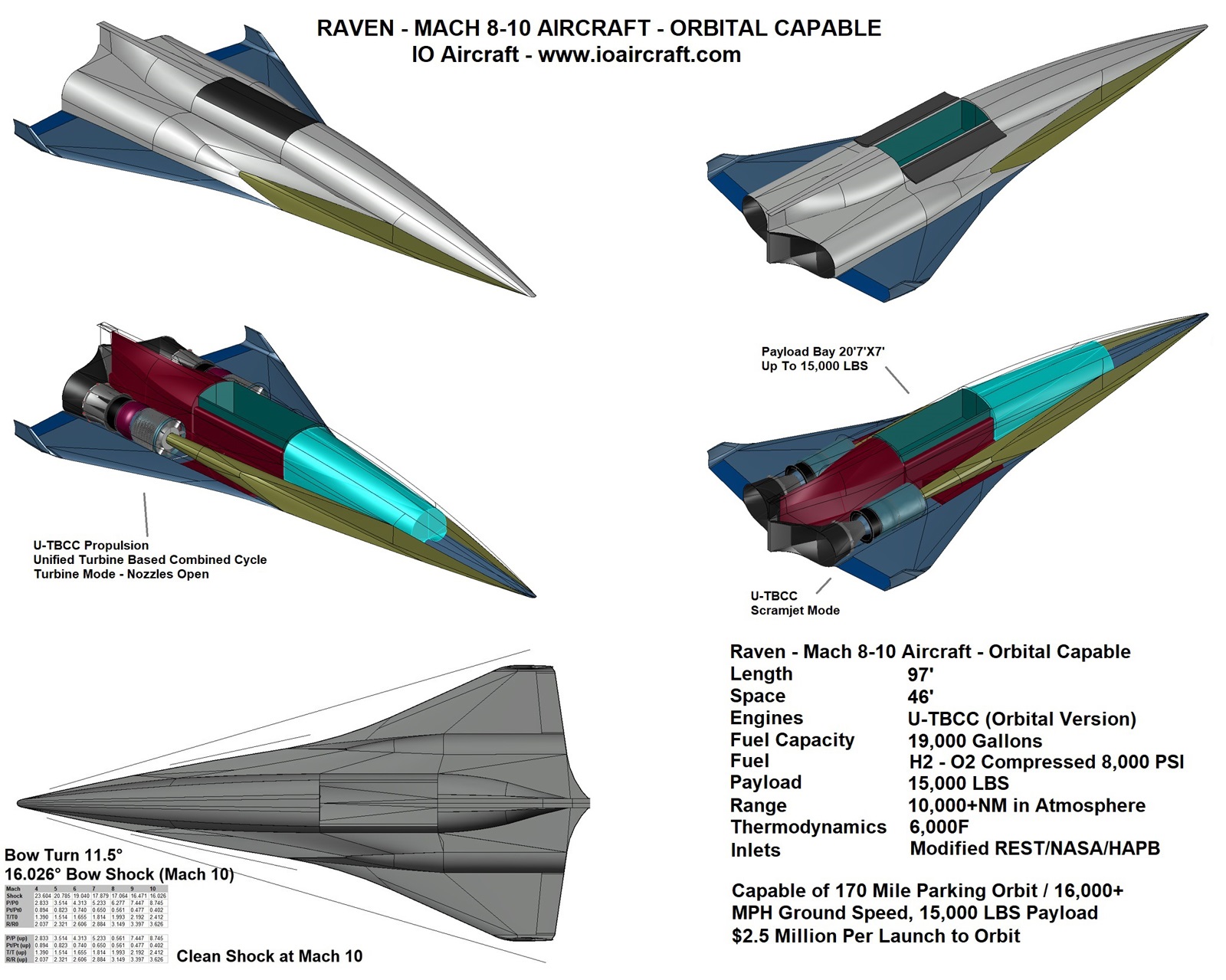
Website: www.ioaircraft.com
Drew Blair
www.linkedin.com/in/drew-b-25485312
-------------
io aircraft, phantom express, phantom works, boeing phantom works, lockheed skunk works, hypersonic weapon, hypersonic missile, scramjet missile, scramjet engineering, scramjet physics, boost glide, tactical glide vehicle, Boeing XS-1, htv, Air-Launched Rapid Response Weapon, (ARRW), hypersonic tactical vehicle, hypersonic plane, hypersonic aircraft, space plane, scramjet, turbine based combined cycle, ramjet, dual mode ramjet, darpa, onr, navair, afrl, air force research lab, defense science, missile defense agency, aerospike, additive manufacturing, titanium 3d printing, go fly prize, boeing go fly prize,
Advanced Additive Manufacturing for Hypersonic Aircraft
Utilizing new methods of fabrication and construction, make it possible to use additive manufacturing, dramatically reducing the time and costs of producing hypersonic platforms from missiles, aircraft, and space capable craft. Instead of aircraft being produced in piece, then bolted together; small platforms can be produced as a single unit and large platforms can be produces in large section and mated without bolting. These techniques include using exotic materials and advanced assembly processes, with an end result of streamlining the production costs and time for hypersonic aircraft; reducing months of assembly to weeks. Overall, this process greatly reduced the cost for producing hypersonic platforms. Even to such an extent that a Hellfire missile costs apx $100,000 but by utilizing our technologies, replacing it with a Mach 8-10 hypersonic missile of our physics/engineering and that missile would cost roughly $75,000 each delivered.
Materials used for these manufacturing processes are not disclosed, but overall, provides a foundation for extremely high stresses and thermodynamics, ideal for hypersonic platforms. This specific methodology and materials applications is many decades ahead of all known programs. Even to the extend of normalized space flight and re-entry, without concern of thermodynamic failure.
*Note, most entities that are experimenting with additive manufacturing for hypersonic aircraft, this makes it mainstream and standardized processes, which also applies for mass production.
What would normally be measured in years and perhaps a decade to go from drawing board to test flights, is reduced to singular months and ready for production within a year maximum.
Unified Turbine Based Combined Cycle (U-TBCC)
To date, the closest that NASA and industry have achieved for turbine based aircraft to fly at hypersonic velocities is by mounting a turbine into an aircraft and sharing the inlet with a scramjet or rocket based motor. Reaction Engines Sabre is not able to achieve hypersonic velocities and can only transition into a non air breathing rocket for beyond Mach 4.5
However, utilizing Unified Turbine Based Combine Cycle also known as U-TBCC, the two separate platforms are able to share a common inlet and the dual mode ramjet/scramjet is contained within the engine itself, which allows for a much smaller airframe footprint, thus engingeers are able to then design much higher performance aerial platforms for hypersonic flight, including the ability for constructing true single stage to orbit aircraft by utilizing a modification/version that allows for transition to outside atmosphere propulsion without any other propulsion platforms within the aircraft. By transitioning and developing aircraft to use Unified Turbine Based Combined Cycle, this propulsion system opens up new options to replace that airframe deficit for increased fuel capacity and/or payload.
Enhanced Dynamic Cavitation
Dramatically Increasing the efficiency of fuel air mixture for combustion processes at hypersonic velocities within scramjet propulsion platforms. The aspects of these processes are non disclosable.
Dynamic Scramjet Ignition Processes
For optimal scramjet ignition, a process known as Self Start is sought after, but in many cases if the platform becomes out of attitude, the scramjet will ignite. We have already solved this problem which as a result, a scramjet propulsion system can ignite at lower velocities, high velocities, at optimal attitude or not optimal attitude. It doesn't matter, it will ignite anyways at the proper point for maximum thrust capabilities at hypersonic velocities.
Hydrogen vs Kerosene Fuel Sources
Kerosene is an easy fuel to work with, and most western nations developing scramjet platforms use Kerosene for that fact. However, while kerosene has better thermal properties then Hydrogen, Hydrogen is a far superior fuel source in scramjet propulsion flight, do it having a much higher efficiency capability. Because of this aspect, in conjunction with our developments, it allows for a MUCH increased fuel to air mixture, combustion, thrust; and ability for higher speeds; instead of very low hypersonic velocities in the Mach 5-6 range. Instead, Mach 8-10 range, while we have begun developing hypersonic capabilities to exceed 15 in atmosphere within less then 5 years.
Conforming High Pressure Tank Technology for CNG and H2.
As most know in hypersonics, Hydrogen is a superior fuel source, but due to the storage abilities, can only be stored in cylinders thus much less fuel supply. Not anymore, we developed conforming high pressure storage technology for use in aerospace, automotive sectors, maritime, etc; which means any overall shape required for 8,000+ PSI CNG or Hydrogen. For hypersonic platforms, this means the ability to store a much larger volume of hydrogen vs cylinders.
As an example, X-43 flown by Nasa which flew at Mach 9.97. The fuel source was Hydrogen, which is extremely more volatile and combustible then kerosene (JP-7), via a cylinder in the main body. If it had used our technology, that entire section of the airframe would had been an 8,000 PSI H2 tank, which would had yielded 5-6 times the capacity. While the X-43 flew 11 seconds under power at Mach 9.97, at 6 times the fuel capacity would had yielded apx 66 seconds of fuel under power at Mach 9.97. If it had flew slower, around Mach 6, same principles applied would had yielded apx 500 seconds of fuel supply under power (slower speeds required less energy to maintain).
Enhanced Fuel Mixture During Shock Train Interaction
Normally, fuel injection is conducted at the correct insertion point within the shock train for maximum burn/combustion. Our methodologies differ, since almost half the fuel injection is conducted PRE shock train within the isolator, so at the point of isolator injection the fuel enhances the combustion process, which then requires less fuel injection to reach the same level of thrust capabilities.
Improved Bow Shock Interaction
Smoother interaction at hypersonic velocities and mitigating heat/stresses for beyond Mach 6 thermodynamics, which extraordinarily improves Type 3, 4, and 5 shock interaction.
6,000+ Fahrenheit Thermal Resistance
To date, the maximum thermal resistance was tested at AFRL in the spring of 2018, which resulted in a 3,200F thermal resistance for a short duration. This technology, allows for normalized hypersonic thermal resistance of 3,000-3,500F sustained, and up to 6,500F resistance for short endurance, ie 90 seconds or less. 10-20 minute resistance estimate approximately 4,500F +/- 200F.
*** This technology advancement also applies to Aerospike rocket engines, in which it is common for Aerospike's to exceed 4,500-5,000F temperatures, which results in the melting of the reversed bell housing. That melting no longer ocurrs, providing for stable combustion to ocurr for the entire flight envelope
Scramjet Propulsion Side Wall Cooling
With old technologies, side wall cooling is required for hypersonic flight and scramjet propulsion systems, otherwise the isolator and combustion regions of a scramjet would melt, even using advanced ablatives and ceramics, due to their inability to cope with very high temperatures. Using technology we have developed for very high thermodynamics and high stresses, side wall cooling is no longer required, thus removing that variable from the design process and focusing on improved ignition processes and increasing net thrust values.
Lower Threshold for Hypersonic Ignition
Active and adaptive flight dynamics, resulting in the ability for scramjet ignition at a much lower velocity, ie within ramjet envelope, between Mach 2-4, and seamless transition from supersonic to hypersonic flight, ie supersonic ramjet (scramjet). This active and dynamic aspect, has a wide variety of parameters for many flight dynamics, velocities, and altitudes; which means platforms no longer need to be engineered for specific altitude ranges or preset velocities, but those parameters can then be selected during launch configuration and are able to adapt actively in flight.
Dramatically Improved Maneuvering Capabilities at Hypersonic Velocities
Hypersonic vehicles, like their less technologically advanced brethren, use large actuator and the developers hope those controls surfaces do not disintegrate in flight. In reality, it is like rolling the dice, they may or may not survive, hence another reason why the attempt to keep velocities to Mach 6 or below. We have shrunken down control actuators while almost doubling torque and response capabilities specifically for hypersonic dynamics and extreme stresses involved, which makes it possible for maximum input authority for Mach 10 and beyond.
Paradigm Shift in Control Surface Methodologies, Increasing Control Authority (Internal Mechanical Applications)
To date, most control surfaces for hypersonic missile platforms still use fins, similar to lower speed conventional missiles, and some using ducted fins. This is mostly due to lack of comprehension of hypersonic velocities in their own favor. Instead, the body itself incorporates those control surfaces, greatly enhancing the airframe strength, opening up more space for hardware and fuel capacity; while simultaneously enhancing the platforms maneuvering capabilities.
A scramjet missile can then fly like conventional missile platforms, and not straight and level at high altitudes, losing velocity on it's decent trajectory to target. Another added benefit to this aspect, is the ability to extend range greatly, so if anyone elses hypersonic missile platform were developed for 400 mile range, falling out of the sky due to lack of glide capabilities; our platforms can easily reach 600+ miles, with minimal glide deceleration.
The Birken is a “table car” capable of seating 56 passengers at 14 tables. With warming ovens and refrigerators behind the bar and buffet area, the Birken is an excellent venue for a cocktail hour. Alternately, the Birken can be used with a dining car or another passenger car with a full kitchen to seat your guests for a full meal while rolling down the railroad. It is the perfect companion to any other private passenger car on the market, allowing you the extra space to expand your event. The tables are also removable, making the Birken into an excellent open space. The car features two restrooms, a generator for power, and heat & air conditioning throughout. The Birken is fully certified by Amtrak, the FRA, and NJ Transit to operate anywhere the rails lead it.
The Birken was the first in an order of 218 identical 72-seat coaches built by Canadian Car & Foundry in 1954 for the Canadian National Railway. Numbered #5437, the car served on CN until 1978, when CN split off its passenger service into VIA Rail (the Canadian equivalent of Amtrak). The #5437 continued to serve VIA until it was sold to the British Columbia Railway in 1990, where it was rebuilt into a 14-table, 56-seat “table car” for use as a bar car and extra dining space on their Royal Hudson trains. It was during this time that the Birken was named for a location along the railroad’s mainline in British Columbia. After a decade of further service, the Birken was sold into private ownership in 2002. The car was upgraded to full Amtrak and FRA standards and repainted into colors once worn by the New York Central’s famous 20th Century Limited train.
Photos, text and plan - Morristown & Erie Railway
ScanNap™ for Catering event napkins are capable of "auto-dialing" your sales & catering line directly! Catering professionals have long understood the effectiveness of branding their name on their catered event napkin to captive guest audiences in an effort to help convert them to prospective future customers. The ScanNap™ digital napkin for catering takes this simple and effective promotional strategy to an entirely new level by offering you and your guests a tool which provided more functionality than a traditional desktop web page! The ScanNap for Catering promo napkin features "Click-To-Call" functionality which allows your prospects to easily AUTO DIAL your Sales & Catering line, directly from their ScanNap™ digital event napkin, to simplify the process of reserving your services for their future events and at just the right moment when they are most enjoying your delicacy! Your interactive ScanNap™ digital napkin provides simplified offline access to all of your online digital promotional content. With ScanNap™, your promotional offer is seamlessly delivered directly into your guests mobile hand-sets where it will be retained - and more importantly, where it may now easily be shared exponentially with all of the friends and family within your guests own social networks. The result is a very low-cost, highly effective, measurable mobile content delivery system for generating new business by way of referral. Here are some other important content links you may want to consider including in your ScanNap™:
- Your Catering Menu
- Your Photo & Video Gallery
- Your Customer Testimonials
- Your Social Media Page Links
- Your Social Media "Check-In" DEALS
- Links to your Blogs and/or Newsletter
- Links to your Calendar of Events Pages
What's more, you will receive full scan metric analytics reporting with your ScanNap™for Catering branded napkin. ORDER NOW: Call us right now to get started today!
GET A FREE & INSTANT QUOTE:
scan-nap.com/scannapforcatering.html
877-NAP-ONLY (627-6659)
Built by the Schiffswerks Rieherst company in Hamburg, the Umbria was launched on December 30th 1911 with the name of Bahia Blanca. It was a large freighter by that time, 150 meters long, with a power capable of providing a speed of 14 knots that could carry 9,000 tons of cargo and up to 2,000 passengers. In 1912 it began operating the Hamburg-America line doing different jobs between Europe and Argentina until the outbreak of World War I, when it was based in Buenos Aires. In 1918 the ship was acquired by the Argentinian government and it was not until 1935 when the ship was taken over by the Italian government and renamed again: the Umbria. From that moment its trips were to transport troops and during the following two years carried several thousand soldiers to the Italian colonies in East Africa.
The loss of the Umbria
In May 1940, when Italy was still neutral in World War II, the Umbria was secretly loaded with 360,000 bombs between 15 kg and 100 kg, 60 boxes of detonators, building materials and three Fiat Lunga cars, carrying a total 8,600 tons of weapons towards the East Africa. The explosives had destination Massawa and Assab, Eritrea, that was Italian colony by then, and the rest of the cargo was heading different locations in Asia. Italy's entry into the war was imminent and this shipment was destined to the defense of the colonies against the Allies and to the possible expansion of its African territories.
On 3rd June 1940 the Umbria reached Port Said, northern Egypt, where loaded with 1,000 tons of coal and water in a movement to fool the Allies, trying to look like a harmless freighter. The port, controlled by the Royal Navy, and its authorities allowed the ship enter on the Red Sea three days after arrival. The British delayed the departure of the Umbria knowing that Italy's entry into the war was imminent and that the cargo of Umbria had devastating power that sooner or later would be used against the Allies and why not, to get a great load to fight fascism. But Italy, as a neutral country that it was, had every right to transport weapons much like any other cargo to its colonies.
Having met the deadline to be retained, the Umbria crossed the Suez Canal on June 6th but with the escort of the HMS Grimsby. The importance and destructive capacity of the cargo required it. Three days later the Umbria entered in Sudan waters and the HMS Grimsby ordered the Umbria captain to anchor on Wingate Reef under the pretext of searching for contraband. Moments later the British warship HMS Leander arrived with a group of 20 sailors who boarded the Umbria. After thoroughly searching the ship and finding nothing, the captain ordered the British troops to remain the night aboard the Umbria.
The next morning Lorenzo Muiesan, Umbria captain, was in his cabin listening to the radio when Mussolini announced the entry of Italy into the World War II. Hostilities would begin at midnight of that day. Muiesan, a very patriotic captain with long experience, was the only one in the area who had heard the news and knew immediately that both Umbria and the burden would be used by the Allies against their own country. He had no option to disable both. In a move of extraordinary intelligence, as the hours passed retained by the British who did not yet know that Italy was officially the enemy, the captain ordered his crew conducting a rescue simulation... that was more real than the British thought. This maneuver, which the English soldiers agreed as they believed it would serve to further delay the departure of the Umbria. While the Italians occupied the lifeboats, the chief engineers, following Muiesan´s orders, opened all the valves and drown the ship to the bottom of the reef. With the crew safe, the British only had time to get on their ship and watch the freighter slid slowly.
When the captain of HMS Grimsby asked why he had done that Muiesan confirmed the declaration of war from Italy to Britain. The next day Muiesan and the rest of Umbria crew departed detainees to India, where they spent four years in prison.
CARGO:
The Umbria was carrying 360,000 individual aircraft bombs ranging in size from 15, 50 and 100 kg. The vessel also carried a large quantity of fuses, ammunition and detonators as well as other traditional cargo. The captain knew these bombs would be confiscated and used by the enemy against his country should they ever discover them which was why he made the call to sink the ship.
The Umbria had sailed in June 1940 with 6,000 tons of bombs, 60 boxes detonators, explosives, weapons and three Fiat 1100 Lunga from Genoa via Livorno and Naples in the Suez Canal and on the way via Massaua and Assab to Calcutta.
Aeroscopia est un musée aéronautique français implanté à Blagnac (Haute-Garonne), près du site AéroConstellation, et accueille notamment deux exemplaires du Concorde, dont l'ouverture a eu lieu le 14 janvier 2015
Le tarmac Sud du musée n'est capable d'accueillir que trois gros appareils. L'installation des appareils fut définitivement terminée après que le premier prototype de l'A400M-180 y fut arrivé le 16 juillet 2015, en dépit de la possibilité de 360 000 euros de TVA.
Concorde, F-BVFC, MSN209 aux couleurs d'Air France
Caravelle 12, F-BTOE, MSN280 aux couleurs d'Air Inter, dernier exemplaire construit
A400M-180, F-WWMT, MSN001 stationné depuis le 16 juillet 2015
La réalisation en 2019 du nouveau tarmac au Nord du musée permet l'accueil d'appareils supplémentaires issus des entreprises locales Airbus et ATR. Le transfert des avions entre le site Airbus "Lagardère" et le musée a lieu sur une semaine, à raison d'un appareil par jour :
ATR 72-600, F-WWEY, MSN098 aux couleurs d'ATR, transféré sur site le 26 août 2019, premier exemplaire du 72 dans sa version 600
Airbus A340-600, F-WWCA, MSN360 aux couleurs d'Airbus, transféré sur site le 27 août 2019, premier exemplaire de l'A340 dans sa version 600
Airbus A320-111, F-WWAI, MSN001 aux anciennes couleurs d'Airbus, transféré sur site le 28 août 2019, premier exemplaire de l'A320 : inauguration le 14 février 1987 en présence de Lady Diana et du Prince Charles, premier vol le 22 février 1987
Airbus A380-800, F-WXXL, MSN002 aux couleurs d'Airbus, transféré sur site le 29 août 2019, second exemplaire de l'A380. Les deux ponts de cet appareil sont visitables, ainsi que le cockpit.
ATR 42-300, F-WEGC, MSN003 aux anciennes couleurs d'ATR, transféré sur site le 30 août 2019, troisième exemplaire du 42. Cet exemplaire est décoré aux couleurs du MSN001 et porte l'immatriculation F-WEGA
Concorde, F-WTSB, MSN201 (ANAE), il s'agit d'un appareil de présérie qui a servi entre autres à transporter plusieurs présidents de la République française.
Airbus A300B4-203, F-WUAB, MSN238 (Airbus Heritage), décoré aux couleurs du prototype, au lieu de MSN001 démantelé. L'intérieur est visitable. Dans la première section des vitrages transparents permettent de voir la structure et les systèmes de l'avion, tandis que dans les sections suivantes sont représentés des aménagements de première classe et VIP.
Super Guppy de l'association Ailes Anciennes Toulouse, l'appareil qui servait au transport des tronçons d'Airbus est exposé porte ouverte, et une passerelle permet l'accès à la soute où un film est projeté. L'ouverture n'a pas été une mince affaire, l'appareil n'ayant pas été ouvert pendant 15 ans. L'aide des anciens mécaniciens de l'avion a été primordiale pour permettre une ouverture en toute sécurité.
Corvette (Airbus)
Falcon 10 no 02, prototype ayant servi aux essais du turboréacteur Larzac (Ailes Anciennes Toulouse)
Fouga Magister (AAT)
Gazelle prototype (AAT)
Mirage III C (AAT)
Nord 1100 (AAT)
Lockheed F-104G (AAT)
MiG-15 (AAT)
MS.760 Paris (AAT)
Vought F-8E(FN) Crusader et son réacteur (AAT)
Alouette II Marine (AAT)
Cessna Skymaster (AAT)
Fairchild Metro, ancien avion de Météo-France (AAT)
HM-293, de Rodolphe Grunberg
Chagnes MicroStar, avion de construction amateur, version biréacteur de Rutan VariViggen (AAT)
Saab J35OE Draken (AAT)
Aeroscopia is a French aeronautical museum located in Blagnac (Haute-Garonne), near the AéroConstellation site, and notably hosts two copies of the Concorde, which opened on January 14, 2015
The south tarmac of the museum can only accommodate three large aircraft. The installation of the devices was definitively finished after the first prototype of the A400M-180 arrived there on July 16, 2015, despite the possibility of 360,000 euros in VAT.
Concorde, F-BVFC, MSN209 in Air France colors
Caravelle 12, F-BTOE, MSN280 in Air Inter colors, last model built
A400M-180, F-WWMT, MSN001 parked since July 16, 2015
The construction in 2019 of the new tarmac north of the museum will accommodate additional aircraft from local Airbus and ATR companies. The transfer of planes between the Airbus "Lagardère" site and the museum takes place over a week, at the rate of one aircraft per day:
ATR 72-600, F-WWEY, MSN098 in ATR colors, transferred to site on August 26, 2019, first copy of the 72 in its 600 version
Airbus A340-600, F-WWCA, MSN360 in Airbus colors, transferred to site on August 27, 2019, first copy of the A340 in its 600 version
Airbus A320-111, F-WWAI, MSN001 in the old Airbus colors, transferred to site on August 28, 2019, first copy of the A320: inauguration on February 14, 1987 in the presence of Lady Diana and Prince Charles, first flight on February 22, 1987
Airbus A380-800, F-WXXL, MSN002 in Airbus colors, transferred to site on August 29, 2019, second copy of the A380. The two decks of this aircraft can be visited, as well as the cockpit.
ATR 42-300, F-WEGC, MSN003 in the old ATR colors, transferred to the site on August 30, 2019, third specimen of the 42. This specimen is decorated in the colors of the MSN001 and bears the registration F-WEGA
Concorde, F-WTSB, MSN201 (ANAE), this is a pre-production aircraft which was used, among other things, to transport several presidents of the French Republic.
Airbus A300B4-203, F-WUAB, MSN238 (Airbus Heritage), decorated in the colors of the prototype, instead of dismantled MSN001. The interior can be visited. In the first section transparent glazing allows to see the structure and systems of the aircraft, while in the following sections are shown first class and VIP fittings.
Super Guppy from the Ailes Anciennes Toulouse association, the aircraft which was used to transport the Airbus sections is on display with the door open, and a gangway allows access to the hold where a film is shown. Opening was no small feat, as the device has not been opened for 15 years. The help of the former mechanics of the aircraft was essential to allow a safe opening.
Corvette (Airbus)
Falcon 10 no 02, prototype used for testing the Larzac turbojet engine (Ailes Anciennes Toulouse)
Fouga Magister (AAT)
Prototype Gazelle (AAT)
Mirage III C (AAT)
North 1100 (AAT)
Lockheed F-104G (AAT)
MiG-15 (AAT)
MS.760 Paris (AAT)
Vought F-8E (FN) Crusader and its engine (AAT)
Alouette II Marine (AAT)
Cessna Skymaster (AAT)
Fairchild Metro, former Météo-France (AAT) aircraft
HM-293, by Rodolphe Grunberg
Chagnes MicroStar, amateur-built aircraft, twin-jet version of Rutan VariViggen (AAT)
Saab J35OE Draken (AAT)
Aeroscopia est un musée aéronautique français implanté à Blagnac (Haute-Garonne), près du site AéroConstellation, et accueille notamment deux exemplaires du Concorde, dont l'ouverture a eu lieu le 14 janvier 2015
Le tarmac Sud du musée n'est capable d'accueillir que trois gros appareils. L'installation des appareils fut définitivement terminée après que le premier prototype de l'A400M-180 y fut arrivé le 16 juillet 2015, en dépit de la possibilité de 360 000 euros de TVA.
Concorde, F-BVFC, MSN209 aux couleurs d'Air France
Caravelle 12, F-BTOE, MSN280 aux couleurs d'Air Inter, dernier exemplaire construit
A400M-180, F-WWMT, MSN001 stationné depuis le 16 juillet 2015
La réalisation en 2019 du nouveau tarmac au Nord du musée permet l'accueil d'appareils supplémentaires issus des entreprises locales Airbus et ATR. Le transfert des avions entre le site Airbus "Lagardère" et le musée a lieu sur une semaine, à raison d'un appareil par jour :
ATR 72-600, F-WWEY, MSN098 aux couleurs d'ATR, transféré sur site le 26 août 2019, premier exemplaire du 72 dans sa version 600
Airbus A340-600, F-WWCA, MSN360 aux couleurs d'Airbus, transféré sur site le 27 août 2019, premier exemplaire de l'A340 dans sa version 600
Airbus A320-111, F-WWAI, MSN001 aux anciennes couleurs d'Airbus, transféré sur site le 28 août 2019, premier exemplaire de l'A320 : inauguration le 14 février 1987 en présence de Lady Diana et du Prince Charles, premier vol le 22 février 1987
Airbus A380-800, F-WXXL, MSN002 aux couleurs d'Airbus, transféré sur site le 29 août 2019, second exemplaire de l'A380. Les deux ponts de cet appareil sont visitables, ainsi que le cockpit.
ATR 42-300, F-WEGC, MSN003 aux anciennes couleurs d'ATR, transféré sur site le 30 août 2019, troisième exemplaire du 42. Cet exemplaire est décoré aux couleurs du MSN001 et porte l'immatriculation F-WEGA
Concorde, F-WTSB, MSN201 (ANAE), il s'agit d'un appareil de présérie qui a servi entre autres à transporter plusieurs présidents de la République française.
Airbus A300B4-203, F-WUAB, MSN238 (Airbus Heritage), décoré aux couleurs du prototype, au lieu de MSN001 démantelé. L'intérieur est visitable. Dans la première section des vitrages transparents permettent de voir la structure et les systèmes de l'avion, tandis que dans les sections suivantes sont représentés des aménagements de première classe et VIP.
Super Guppy de l'association Ailes Anciennes Toulouse, l'appareil qui servait au transport des tronçons d'Airbus est exposé porte ouverte, et une passerelle permet l'accès à la soute où un film est projeté. L'ouverture n'a pas été une mince affaire, l'appareil n'ayant pas été ouvert pendant 15 ans. L'aide des anciens mécaniciens de l'avion a été primordiale pour permettre une ouverture en toute sécurité.
Corvette (Airbus)
Falcon 10 no 02, prototype ayant servi aux essais du turboréacteur Larzac (Ailes Anciennes Toulouse)
Fouga Magister (AAT)
Gazelle prototype (AAT)
Mirage III C (AAT)
Nord 1100 (AAT)
Lockheed F-104G (AAT)
MiG-15 (AAT)
MS.760 Paris (AAT)
Vought F-8E(FN) Crusader et son réacteur (AAT)
Alouette II Marine (AAT)
Cessna Skymaster (AAT)
Fairchild Metro, ancien avion de Météo-France (AAT)
HM-293, de Rodolphe Grunberg
Chagnes MicroStar, avion de construction amateur, version biréacteur de Rutan VariViggen (AAT)
Saab J35OE Draken (AAT)
Aeroscopia is a French aeronautical museum located in Blagnac (Haute-Garonne), near the AéroConstellation site, and notably hosts two copies of the Concorde, which opened on January 14, 2015
The south tarmac of the museum can only accommodate three large aircraft. The installation of the devices was definitively finished after the first prototype of the A400M-180 arrived there on July 16, 2015, despite the possibility of 360,000 euros in VAT.
Concorde, F-BVFC, MSN209 in Air France colors
Caravelle 12, F-BTOE, MSN280 in Air Inter colors, last model built
A400M-180, F-WWMT, MSN001 parked since July 16, 2015
The construction in 2019 of the new tarmac north of the museum will accommodate additional aircraft from local Airbus and ATR companies. The transfer of planes between the Airbus "Lagardère" site and the museum takes place over a week, at the rate of one aircraft per day:
ATR 72-600, F-WWEY, MSN098 in ATR colors, transferred to site on August 26, 2019, first copy of the 72 in its 600 version
Airbus A340-600, F-WWCA, MSN360 in Airbus colors, transferred to site on August 27, 2019, first copy of the A340 in its 600 version
Airbus A320-111, F-WWAI, MSN001 in the old Airbus colors, transferred to site on August 28, 2019, first copy of the A320: inauguration on February 14, 1987 in the presence of Lady Diana and Prince Charles, first flight on February 22, 1987
Airbus A380-800, F-WXXL, MSN002 in Airbus colors, transferred to site on August 29, 2019, second copy of the A380. The two decks of this aircraft can be visited, as well as the cockpit.
ATR 42-300, F-WEGC, MSN003 in the old ATR colors, transferred to the site on August 30, 2019, third specimen of the 42. This specimen is decorated in the colors of the MSN001 and bears the registration F-WEGA
Concorde, F-WTSB, MSN201 (ANAE), this is a pre-production aircraft which was used, among other things, to transport several presidents of the French Republic.
Airbus A300B4-203, F-WUAB, MSN238 (Airbus Heritage), decorated in the colors of the prototype, instead of dismantled MSN001. The interior can be visited. In the first section transparent glazing allows to see the structure and systems of the aircraft, while in the following sections are shown first class and VIP fittings.
Super Guppy from the Ailes Anciennes Toulouse association, the aircraft which was used to transport the Airbus sections is on display with the door open, and a gangway allows access to the hold where a film is shown. Opening was no small feat, as the device has not been opened for 15 years. The help of the former mechanics of the aircraft was essential to allow a safe opening.
Corvette (Airbus)
Falcon 10 no 02, prototype used for testing the Larzac turbojet engine (Ailes Anciennes Toulouse)
Fouga Magister (AAT)
Prototype Gazelle (AAT)
Mirage III C (AAT)
North 1100 (AAT)
Lockheed F-104G (AAT)
MiG-15 (AAT)
MS.760 Paris (AAT)
Vought F-8E (FN) Crusader and its engine (AAT)
Alouette II Marine (AAT)
Cessna Skymaster (AAT)
Fairchild Metro, former Météo-France (AAT) aircraft
HM-293, by Rodolphe Grunberg
Chagnes MicroStar, amateur-built aircraft, twin-jet version of Rutan VariViggen (AAT)
Saab J35OE Draken (AAT)
NEOBALLS / ZEN MAGNETS - Neodymium Magnetic Balls (@4205) - Starcraft II's Massive Thor
This is my most complex and largest build to date.
It was designed in parts: Cockpit body, then legs, then arms, then rear guns. Then I had to redesign parts when it came time to assemble it together because of incorrect bonding assumptions and misalignment of magnet fields.
Experimented with x-beam coupled bonds to get the maximum lateral strength with reinforcements on the sides. This proved to be very string. Created a X-Beam using similar methods producing a very strong leg structure. It was capable of support the entire weight of the cockpit body w/o a problem. Had to redesign the leg to cockpit body mount point from the earlier concept because the bond was not completely coupled.
Next up were the arm/guns ... the weight was too much for the cockpit body to support so I fashioned a pair of lego-platforms for them to rest on and take the weight off of the central body.
Finally ... the rear guns ... these were a challenge in that their original mount point design had to be reworked also to make them fit correctly into the rear of the cockpit body. I changed the mount points on the guns to fit the space on both sides and added a few support balls to improve the mount point bonds. I was very surprised how they were balanced and supported only by two point sections to the body. The guns stayed in place for a small series of photos.
The design flaw was in the side bonds of the beam to the legs. The coupled field held nicely for a short amount of time and would have held if it didn't have the weight of the rear guns to support. When they were standing upright and straight, all was good. As soon as I attempted to move the platform forward (to take a video), the rear guns tilted slightly backwards and and that was the end of the leg to body support bonds ... and created the dreaded implosion.
The rear gun weight caused the entire central body section to rotate backwards and fall back on the rear guns ... taking the arms in the process. Perhaps I should have created a Lego-support structure for the rear guns to remove the pendulum force backwards ... but that would have created another view blocker like the side Lego-platforms obstructed the view of the legs and feet. Not sure if I can recreate it for a rotational video ... this took over a week (on/off to design and assemble).
Overall ... I was very happy with the result ... hope I captured enough detail to warrant some visual recognition as a Starcraft II Thor reproduction/interpretation.
This was design and built for the Zen Magnets Contest 26: The Massive Thor
www.zenmagnets.com/blog/26-the-massive-thor/
I tried to document the info for this super complex build (below) accompanied by associated pics in this set
www.flickr.com/photos/tend2it/sets/72157632920071597/
Starcraft II Thor Magnet Count and Detail Talley
======+================
Cockpit Body bottom section: (@0520)
(@0217) - Main shape middle core = (2x10⁸) + 1
(@0095) - central bottom layer 1 = (47x2) + 1 w/black parameter
(@0078) - Sides Bottom layer 2 = (2x(22 parallel pair frnt2bck support + 3 red + 4 gold + 10 ring outside black))
(@0028) - Central bottom layer 3 = (2x14) rectangle
(@0032) - Sides bottom layer 3 = (2x((2x5 parallel bridge rectangle to ring) + (6 ring outside))
(@0010) - Central bottom layer 4 = (10 ring) leg waist w/gold
(@0020) - Sides bottom layer 4 = (2x10 ring) coupled over parallel bridge for perpendicular underside support
(@0040) - Central rear Barrel = (4x8 ring w2 red rings) + (2x4 sqr end)
------
Cockpit Body top section (from center out): (@0371)
(@0166) - top layer 1 = (2x83) w/black missle cover + middle sect separator
(@0105) - top layer 2 = ((2x52) + 1) w/black separator, red trim, gold cockpit
(@0083) - top layer 3 = ((2x41) + 1) w/black separator, red trim, gold cockpit
(@0037) - top layer 4 = ((2x18) + 1) w/black separator trim
(@0010) - top layer 5 = (2x5) w/red/black
------
(@0891)
Leg section x2 (@0640 - 12 removed from bottom of @ leg for foot contact pt)
leg internal structure:
(@0384) - columns = 2 x (4x((2x12) + ((2x11) + 2))) top/bottom coupled bonds w/parallel bonds stacked x 4))
(@0096) - side reinforcements = 2x((2x11) + 2) coupled pair along outside edge centers)
(@0032) - ball reinforcements = 2x(2x4 balls are two balls added to 4 ball in 2, 4, 6, 8th positions) - (12 @ bottom)
leg arch structure (connected to one flat leg top face:
(@0128) - (4x4 parallel sqr) + (2x(6 + 2)) pointy rings) + (4x4 parallel sqr) + (2x(6 + 2)) pointy rings)
Place the two leg arch structures together to form the leg arch
-------
(@1519) = 1531-12
Leg side panels (@0384)
(@0344) - (2 each leg x (2x(2x43 each side))) w/black outside trim
Knees + Leg detail
(@0040) - (2x(2x(6 + 2) knee w/red sqr) + 2x(4 red sqr top of leg))
-------
(@1903)
Feet x2 (@0242)
(@0184) - (2x((2x7 + 2 1st mid layer) + (2x(2x10 + 1) 2nd mid layer) + ((2x(2x8 + 1) outside layer))
(@0034) - (2x(2x(2x3 + 1 top of toe 2 leg)) + (1 center rear foot 2 leg conn) + (2 x 1 outer rear foot sides 2 leg
conn))
(@0024) - (2x(2x6 rings rear foot heel))
-------
(@2145)
X-Beam waist platform - (@0233 - 19) this part is placed across the center perpendicular to the x-beam leg arch
(@0214) - (2x(2x(18 + 17 + 6 + 3)) + (2x(7 + 2)) + ((8 + 1 front side) + (2x9 rear side)) + ((2 x 3 red front center) +
(2 x 2 red front sides) + (2 red rear)) - (19 removed under rear panel side to fold)
Arm Guns (2 pair per arm w/red + black accents)
(@0380) - (4x((4x9 center core) + (3x((2x7) + 1)) top/sides) + (2x7) middle join))
Shoulder to elbow core w/o reinforcements ((@0174)per arm)
(@0348) - (2 x (top((2x5)+2) + (4x8+2 parallel) + ((2x5)+2) + (2x5) + (2x(2x5)+1) + (2x(2x6)+1) + ((4x7)+2 parallel
mount2gun) + (1 ball center to bridge below 2 ball center to 1 ball) + ((2x6)+1) + ((2x4)+2)bottom)
Shoulder to elbow (per arm, per side)
(@0248) - (2 x (2 x (top 3 + 5 + 5 + 5 + 4 + 5 + 4 + 4 + 5 + (2x7arm2shoulder bridge) + (5 + 3 bottom))
Elbow to gun support (per arm, per side) (@0140 - 18 for outside facing side revamp)
(@0122) - (2 x (2 x (((2x9)+1) + (2x8)) -
Revamp outside facing sides for Z bracket (remove 2x(4 top/4 bottom/2 middle/move center ball down, add 1 ball)
Revamp 2 rear centerballs with red
(@028) - add red design outside facing shoulder 2 elbow
------
(@3485)
Rear Guns x2
Large cannon (@0112 each)
(@0224) - 2 x ((2x(2x15) + (4x(5+2)) + (4x(6 ring)))
Smaller cannon (@0092 each)
(@0184) - 2 x ((2x(2x13) + (4x(4+2)) + (4x(4 ring)))
Gun bridges (@0010 each)
(@0020) - (2 x (4 ring + 6 ring across two cannons)
Gun mounts x2
(@0104) - (2 x ((top (2x4+2) + (2x5+2) parallel to existing + (2x4+2) + (2x5 parallel) + (2x4+2) bottom)
Gun panel x 2 (@0102 each)
(@0204) - (2 x (2x(11 + 10 + 9 + 8 + 7 + 6))
-------
Revamp base
(@4221) subtotal b4 assembly
Assembly mods
-------------
Moved the (@0040) - Central rear Barrel = (4x8 ring w2 red rings) + (2x4 sqr end) below the rear of the body between
the leg mount and cockpit body. Actually used the barrel as a mount point for the rear guns.
Modded Cockpit Body bottom section (mount point):
(@0020) = (2 x (7 + 6 + 5)) = Changed = (@0028) - Central bottom layer 3 = (2x14) rectangle to covert parallel
rectangle to hex parallel center, coupled sides
-------
(@4213) = (@4221 - 8)
Moved central bottom layer x-beam
(@0018) = (2x09 ring) = Changed = (@0020) - Sides bottom layer 4 = shifted it down one row, removed 1 ball on end to form point and pinched outside end fit in center of 6 ball side.
(@4211) = (@4213 - 2)
Removed gold 10 ball ring mount
Changed = (@0010) = Central bottom layer 4 = (10 ring) leg waist w/gold
-------
(@4201) = (@4213 - 10)
Modded Rear Guns
(@0100) = Changed = Rear Gun mounts x2 - removed +2 from top/bottom mount point (2x4+2)=>(2x4)
(@4197) = (@4201-4)
Added extra mount point support bwtween rear gun mounts and rear cockpit body
(@4205) = (@4201+8)
Grand Total! = (@4205)
Bid to £100,000 - Not Sold
Reg Number:EXK 80
Chassis Number:14298
Engine Number:15368
Cc:4387
Body Colour: Black / Cream
Trim Colour:Black / Cream
MOT ExpiryDate:Exempt
With the 4.3-litre, introduced in August 1936 at the same time as the SB Speed 25, the developmental line that began with the first Speed 20 back in 1932 reached its pinnacle. From that earlier year, this succession of sports / touring chassis had steadily established a peerless reputation. Of 198 examples of the '4.3' that left the Coventry factory before wartime conditions stopped private car production, this is the only chassis ever fitted with this pattern of striking 4-door fully-opening drophead coupé bodywork by Abbey Coachworks.
The first owner of this imposing car was A Erwin Goldschmidt (1917 - '70), then of Oxford, and it seems that it returned with him to New York. From 1960, Alvis Owner Club records list just 4 owners here in the UK, including the current one, who purchased the car in 2001 and has carried out and commissioned a great deal of work to lift the car up to its present mechanical and bodily condition.
The 6-cylinder ohv engine (92 x 110mm, 4387cc) has a seven-bearing crankshaft and triple SU carburettors. With a 6.25:1 compression ratio, maximum power output was quoted as 137bhp. A single plate clutch takes the drive to the all-synchromesh 4-speed centre change gearbox, a unit that is generally accepted as the best gearbox ever made before WWII. Independent front suspension of the transverse leaf spring design was a feature of the finely engineered and top quality chassis. Braking was vacuum servo-assisted. The dashboard contains the fullest array of instrumentation, and Lucas P100 headlights add to the already impressive frontal appearance of the car. Period road tests record that the 4.3 Alvis was the first standard British saloon car accepted to be capable of achieving the magic 100mph.
Alvis factory records show that this chassis was delivered to London Alvis agents, Messrs Oxborrow & Fuller Ltd in February of 1937. Messrs Abbey Coachworks of Acton, London NW10 were selected to clothe chassis no 14298, and it must have been rare indeed that luxury and panache were so happily married. It was 12 months later that the car was complete, available for sale and first registered (in London) as EXK80.
In 1930, Abbey Coachworks Ltd rose from Compton Sons & Terry, whose origins in the north London coachbuilding firms' melting pot were linked back to Jarvis, and to Compton & Hermon. Abbey would in 1937 take over Martin Walter Ltd of Folkestone. Martin Walter's 'Wingham' style of fully-opening cabriolet clearly influenced the type of bodywork made for this particular Alvis chassis. Abbey's build quality was first rate, and this body includes many remarkable and original features. The glass pane of each rear door window, metal framed, is in two parts that slightly overlap. The forward one falls vertically, as normal, whilst the rear one moves downwards at 45° to clear the intrusion necessary to accommodate the rear wheel arch.
With the Alvis is a large file of invoices detailing work carried out and expenditure over the past dozen years. In addition, there is an original handbook.
In short, this 4.3-litre Alvis is a prime example of the leading chassis and coachwork designs of the glamorous immediate pre-war epoch.
NEOBALLS / ZEN MAGNETS - Neodymium Magnetic Balls (@4205) - Starcraft II's Massive Thor
This is my most complex and largest build to date.
It was designed in parts: Cockpit body, then legs, then arms, then rear guns. Then I had to redesign parts when it came time to assemble it together because of incorrect bonding assumptions and misalignment of magnet fields.
Experimented with x-beam coupled bonds to get the maximum lateral strength with reinforcements on the sides. This proved to be very string. Created a X-Beam using similar methods producing a very strong leg structure. It was capable of support the entire weight of the cockpit body w/o a problem. Had to redesign the leg to cockpit body mount point from the earlier concept because the bond was not completely coupled.
Next up were the arm/guns ... the weight was too much for the cockpit body to support so I fashioned a pair of lego-platforms for them to rest on and take the weight off of the central body.
Finally ... the rear guns ... these were a challenge in that their original mount point design had to be reworked also to make them fit correctly into the rear of the cockpit body. I changed the mount points on the guns to fit the space on both sides and added a few support balls to improve the mount point bonds. I was very surprised how they were balanced and supported only by two point sections to the body. The guns stayed in place for a small series of photos.
The design flaw was in the side bonds of the beam to the legs. The coupled field held nicely for a short amount of time and would have held if it didn't have the weight of the rear guns to support. When they were standing upright and straight, all was good. As soon as I attempted to move the platform forward (to take a video), the rear guns tilted slightly backwards and and that was the end of the leg to body support bonds ... and created the dreaded implosion.
The rear gun weight caused the entire central body section to rotate backwards and fall back on the rear guns ... taking the arms in the process. Perhaps I should have created a Lego-support structure for the rear guns to remove the pendulum force backwards ... but that would have created another view blocker like the side Lego-platforms obstructed the view of the legs and feet. Not sure if I can recreate it for a rotational video ... this took over a week (on/off to design and assemble).
Overall ... I was very happy with the result ... hope I captured enough detail to warrant some visual recognition as a Starcraft II Thor reproduction/interpretation.
This was design and built for the Zen Magnets Contest 26: The Massive Thor
www.zenmagnets.com/blog/26-the-massive-thor/
I tried to document the info for this super complex build (below) accompanied by associated pics in this set
www.flickr.com/photos/tend2it/sets/72157632920071597/
Starcraft II Thor Magnet Count and Detail Talley
======+================
Cockpit Body bottom section: (@0520)
(@0217) - Main shape middle core = (2x10⁸) + 1
(@0095) - central bottom layer 1 = (47x2) + 1 w/black parameter
(@0078) - Sides Bottom layer 2 = (2x(22 parallel pair frnt2bck support + 3 red + 4 gold + 10 ring outside black))
(@0028) - Central bottom layer 3 = (2x14) rectangle
(@0032) - Sides bottom layer 3 = (2x((2x5 parallel bridge rectangle to ring) + (6 ring outside))
(@0010) - Central bottom layer 4 = (10 ring) leg waist w/gold
(@0020) - Sides bottom layer 4 = (2x10 ring) coupled over parallel bridge for perpendicular underside support
(@0040) - Central rear Barrel = (4x8 ring w2 red rings) + (2x4 sqr end)
------
Cockpit Body top section (from center out): (@0371)
(@0166) - top layer 1 = (2x83) w/black missle cover + middle sect separator
(@0105) - top layer 2 = ((2x52) + 1) w/black separator, red trim, gold cockpit
(@0083) - top layer 3 = ((2x41) + 1) w/black separator, red trim, gold cockpit
(@0037) - top layer 4 = ((2x18) + 1) w/black separator trim
(@0010) - top layer 5 = (2x5) w/red/black
------
(@0891)
Leg section x2 (@0640 - 12 removed from bottom of @ leg for foot contact pt)
leg internal structure:
(@0384) - columns = 2 x (4x((2x12) + ((2x11) + 2))) top/bottom coupled bonds w/parallel bonds stacked x 4))
(@0096) - side reinforcements = 2x((2x11) + 2) coupled pair along outside edge centers)
(@0032) - ball reinforcements = 2x(2x4 balls are two balls added to 4 ball in 2, 4, 6, 8th positions) - (12 @ bottom)
leg arch structure (connected to one flat leg top face:
(@0128) - (4x4 parallel sqr) + (2x(6 + 2)) pointy rings) + (4x4 parallel sqr) + (2x(6 + 2)) pointy rings)
Place the two leg arch structures together to form the leg arch
-------
(@1519) = 1531-12
Leg side panels (@0384)
(@0344) - (2 each leg x (2x(2x43 each side))) w/black outside trim
Knees + Leg detail
(@0040) - (2x(2x(6 + 2) knee w/red sqr) + 2x(4 red sqr top of leg))
-------
(@1903)
Feet x2 (@0242)
(@0184) - (2x((2x7 + 2 1st mid layer) + (2x(2x10 + 1) 2nd mid layer) + ((2x(2x8 + 1) outside layer))
(@0034) - (2x(2x(2x3 + 1 top of toe 2 leg)) + (1 center rear foot 2 leg conn) + (2 x 1 outer rear foot sides 2 leg
conn))
(@0024) - (2x(2x6 rings rear foot heel))
-------
(@2145)
X-Beam waist platform - (@0233 - 19) this part is placed across the center perpendicular to the x-beam leg arch
(@0214) - (2x(2x(18 + 17 + 6 + 3)) + (2x(7 + 2)) + ((8 + 1 front side) + (2x9 rear side)) + ((2 x 3 red front center) +
(2 x 2 red front sides) + (2 red rear)) - (19 removed under rear panel side to fold)
Arm Guns (2 pair per arm w/red + black accents)
(@0380) - (4x((4x9 center core) + (3x((2x7) + 1)) top/sides) + (2x7) middle join))
Shoulder to elbow core w/o reinforcements ((@0174)per arm)
(@0348) - (2 x (top((2x5)+2) + (4x8+2 parallel) + ((2x5)+2) + (2x5) + (2x(2x5)+1) + (2x(2x6)+1) + ((4x7)+2 parallel
mount2gun) + (1 ball center to bridge below 2 ball center to 1 ball) + ((2x6)+1) + ((2x4)+2)bottom)
Shoulder to elbow (per arm, per side)
(@0248) - (2 x (2 x (top 3 + 5 + 5 + 5 + 4 + 5 + 4 + 4 + 5 + (2x7arm2shoulder bridge) + (5 + 3 bottom))
Elbow to gun support (per arm, per side) (@0140 - 18 for outside facing side revamp)
(@0122) - (2 x (2 x (((2x9)+1) + (2x8)) -
Revamp outside facing sides for Z bracket (remove 2x(4 top/4 bottom/2 middle/move center ball down, add 1 ball)
Revamp 2 rear centerballs with red
(@028) - add red design outside facing shoulder 2 elbow
------
(@3485)
Rear Guns x2
Large cannon (@0112 each)
(@0224) - 2 x ((2x(2x15) + (4x(5+2)) + (4x(6 ring)))
Smaller cannon (@0092 each)
(@0184) - 2 x ((2x(2x13) + (4x(4+2)) + (4x(4 ring)))
Gun bridges (@0010 each)
(@0020) - (2 x (4 ring + 6 ring across two cannons)
Gun mounts x2
(@0104) - (2 x ((top (2x4+2) + (2x5+2) parallel to existing + (2x4+2) + (2x5 parallel) + (2x4+2) bottom)
Gun panel x 2 (@0102 each)
(@0204) - (2 x (2x(11 + 10 + 9 + 8 + 7 + 6))
-------
Revamp base
(@4221) subtotal b4 assembly
Assembly mods
-------------
Moved the (@0040) - Central rear Barrel = (4x8 ring w2 red rings) + (2x4 sqr end) below the rear of the body between
the leg mount and cockpit body. Actually used the barrel as a mount point for the rear guns.
Modded Cockpit Body bottom section (mount point):
(@0020) = (2 x (7 + 6 + 5)) = Changed = (@0028) - Central bottom layer 3 = (2x14) rectangle to covert parallel
rectangle to hex parallel center, coupled sides
-------
(@4213) = (@4221 - 8)
Moved central bottom layer x-beam
(@0018) = (2x09 ring) = Changed = (@0020) - Sides bottom layer 4 = shifted it down one row, removed 1 ball on end to form point and pinched outside end fit in center of 6 ball side.
(@4211) = (@4213 - 2)
Removed gold 10 ball ring mount
Changed = (@0010) = Central bottom layer 4 = (10 ring) leg waist w/gold
-------
(@4201) = (@4213 - 10)
Modded Rear Guns
(@0100) = Changed = Rear Gun mounts x2 - removed +2 from top/bottom mount point (2x4+2)=>(2x4)
(@4197) = (@4201-4)
Added extra mount point support bwtween rear gun mounts and rear cockpit body
(@4205) = (@4201+8)
Grand Total! = (@4205)
The X100T is a lot of things-- compact, stylish, and extremely capable. One thing it's not, though-- the original rangefinder. Granted, the GW690 II isn't the "first," either, but a comparison between the two is rather humorous. Besides their styling, there are a few mechanical similarities as well. Both cameras can be controlled entirely with physical dials, and both have externally focusing lenses. More to the point, the GW690 II's 90mm lens works out to around 36mm in 35mm terms, whereas the X100T's 23mm lens comes out to about 35mm in 35mm terms. Nifty, huh?
This photo was lit primarily by a Yongnuo 568EXII fired through a 43" umbrella above and to the right. A SB-700 and Flashdisc were used from the left, on the same plane as the camera as an accent light. I considered using a rim light instead, but with only two flashes I stuck with this setup. The backdrop is actually an old DDR mat that I held up to produce a dark backdrop.
I really wanted to convey an anthromorphic "feel" to this image. The X100T is often called a rangefinder, but that's something of a misnomer. In my head, I envisioned the newcomer looking up at its larger, older, "truer" ancestor for acceptance. I used odds and ends to prop the cameras in the current position so that the GW690 II looks "down" on the X100T, and focused the former to its minimum distance to extend the barrel a little further.
Working out the tilts to use was difficult. I wanted both cameras to be making "eye" contact, but I also wanted to show more of each camera than just the side view. I succeeded with one, failed with the other. I also couldn't crop lower down, as I might have liked because doing so would expose the Wii game cases I was using to prop up the GW690 II. Still, this is one of my better photos and I'm quite pleased with the result.
Wildland Firefighters on Rappel capable crews, come from all over the nation each spring to train at the National Helicopter Rappel Program’s Rappel Academy at Salmon AirBase, in Salmon, Idaho.
Wildland fire aircraft play a critical role in supporting firefighters on wildland fires. Helicopters also deliver aerial crews called Heli-Rappellers to wildland fires. These are specially trained firefighters that rappel from helicopters in order to effectively and quickly respond to fires in remote terrain.
Heli-Rappellers may land near a wildfire but if there is no landing zone close by they can utilize their skills to rappel from the hoovering helicopter. Once on the ground, crews build firelines using hand tools, chainsaws, and other firefighting tools. Forest Service photo by Charity Parks.
These solidly built, medium-displacement cruisers are capable of a very reasonable pace in open seas, where they offer a particularly sea-kindly motion. Thanks to the inboard genoa tracks they do point quite close – up to 33° in fact, although they lose a lot of speed when pinched that tight. Her favourite point of sail is around 50-55° off the apparent wind, when she surges forward relentlessly, oblivious to the sea state.
The Moody 36 is also easy to sail singlehanded, with all the sail control lines and winches within easy reach in the compact cockpit, and you’re not going to get shoulder cramps if you have to hand-steer her for hours on end, either. Nor are you going to become bruised and battered if the seas come up when you’re working at the galley, where the chunky fiddles act as solid handholds. You’ll feel very secure making your way forward on deck, with one hand firmly clutching the wooden handrails.
On a reach the she is capable of averaging 6.5-7.5 knots in all but the choppiest waters. She does lack downwind performance, so needs a big fat spinnaker to really get her tramping along.
Aeroscopia est un musée aéronautique français implanté à Blagnac (Haute-Garonne), près du site AéroConstellation, et accueille notamment deux exemplaires du Concorde, dont l'ouverture a eu lieu le 14 janvier 2015
Le tarmac Sud du musée n'est capable d'accueillir que trois gros appareils. L'installation des appareils fut définitivement terminée après que le premier prototype de l'A400M-180 y fut arrivé le 16 juillet 2015, en dépit de la possibilité de 360 000 euros de TVA.
Concorde, F-BVFC, MSN209 aux couleurs d'Air France
Caravelle 12, F-BTOE, MSN280 aux couleurs d'Air Inter, dernier exemplaire construit
A400M-180, F-WWMT, MSN001 stationné depuis le 16 juillet 2015
La réalisation en 2019 du nouveau tarmac au Nord du musée permet l'accueil d'appareils supplémentaires issus des entreprises locales Airbus et ATR. Le transfert des avions entre le site Airbus "Lagardère" et le musée a lieu sur une semaine, à raison d'un appareil par jour :
ATR 72-600, F-WWEY, MSN098 aux couleurs d'ATR, transféré sur site le 26 août 2019, premier exemplaire du 72 dans sa version 600
Airbus A340-600, F-WWCA, MSN360 aux couleurs d'Airbus, transféré sur site le 27 août 2019, premier exemplaire de l'A340 dans sa version 600
Airbus A320-111, F-WWAI, MSN001 aux anciennes couleurs d'Airbus, transféré sur site le 28 août 2019, premier exemplaire de l'A320 : inauguration le 14 février 1987 en présence de Lady Diana et du Prince Charles, premier vol le 22 février 1987
Airbus A380-800, F-WXXL, MSN002 aux couleurs d'Airbus, transféré sur site le 29 août 2019, second exemplaire de l'A380. Les deux ponts de cet appareil sont visitables, ainsi que le cockpit.
ATR 42-300, F-WEGC, MSN003 aux anciennes couleurs d'ATR, transféré sur site le 30 août 2019, troisième exemplaire du 42. Cet exemplaire est décoré aux couleurs du MSN001 et porte l'immatriculation F-WEGA
Concorde, F-WTSB, MSN201 (ANAE), il s'agit d'un appareil de présérie qui a servi entre autres à transporter plusieurs présidents de la République française.
Airbus A300B4-203, F-WUAB, MSN238 (Airbus Heritage), décoré aux couleurs du prototype, au lieu de MSN001 démantelé. L'intérieur est visitable. Dans la première section des vitrages transparents permettent de voir la structure et les systèmes de l'avion, tandis que dans les sections suivantes sont représentés des aménagements de première classe et VIP.
Super Guppy de l'association Ailes Anciennes Toulouse, l'appareil qui servait au transport des tronçons d'Airbus est exposé porte ouverte, et une passerelle permet l'accès à la soute où un film est projeté. L'ouverture n'a pas été une mince affaire, l'appareil n'ayant pas été ouvert pendant 15 ans. L'aide des anciens mécaniciens de l'avion a été primordiale pour permettre une ouverture en toute sécurité.
Corvette (Airbus)
Falcon 10 no 02, prototype ayant servi aux essais du turboréacteur Larzac (Ailes Anciennes Toulouse)
Fouga Magister (AAT)
Gazelle prototype (AAT)
Mirage III C (AAT)
Nord 1100 (AAT)
Lockheed F-104G (AAT)
MiG-15 (AAT)
MS.760 Paris (AAT)
Vought F-8E(FN) Crusader et son réacteur (AAT)
Alouette II Marine (AAT)
Cessna Skymaster (AAT)
Fairchild Metro, ancien avion de Météo-France (AAT)
HM-293, de Rodolphe Grunberg
Chagnes MicroStar, avion de construction amateur, version biréacteur de Rutan VariViggen (AAT)
Saab J35OE Draken (AAT)
Aeroscopia is a French aeronautical museum located in Blagnac (Haute-Garonne), near the AéroConstellation site, and notably hosts two copies of the Concorde, which opened on January 14, 2015
The south tarmac of the museum can only accommodate three large aircraft. The installation of the devices was definitively finished after the first prototype of the A400M-180 arrived there on July 16, 2015, despite the possibility of 360,000 euros in VAT.
Concorde, F-BVFC, MSN209 in Air France colors
Caravelle 12, F-BTOE, MSN280 in Air Inter colors, last model built
A400M-180, F-WWMT, MSN001 parked since July 16, 2015
The construction in 2019 of the new tarmac north of the museum will accommodate additional aircraft from local Airbus and ATR companies. The transfer of planes between the Airbus "Lagardère" site and the museum takes place over a week, at the rate of one aircraft per day:
ATR 72-600, F-WWEY, MSN098 in ATR colors, transferred to site on August 26, 2019, first copy of the 72 in its 600 version
Airbus A340-600, F-WWCA, MSN360 in Airbus colors, transferred to site on August 27, 2019, first copy of the A340 in its 600 version
Airbus A320-111, F-WWAI, MSN001 in the old Airbus colors, transferred to site on August 28, 2019, first copy of the A320: inauguration on February 14, 1987 in the presence of Lady Diana and Prince Charles, first flight on February 22, 1987
Airbus A380-800, F-WXXL, MSN002 in Airbus colors, transferred to site on August 29, 2019, second copy of the A380. The two decks of this aircraft can be visited, as well as the cockpit.
ATR 42-300, F-WEGC, MSN003 in the old ATR colors, transferred to the site on August 30, 2019, third specimen of the 42. This specimen is decorated in the colors of the MSN001 and bears the registration F-WEGA
Concorde, F-WTSB, MSN201 (ANAE), this is a pre-production aircraft which was used, among other things, to transport several presidents of the French Republic.
Airbus A300B4-203, F-WUAB, MSN238 (Airbus Heritage), decorated in the colors of the prototype, instead of dismantled MSN001. The interior can be visited. In the first section transparent glazing allows to see the structure and systems of the aircraft, while in the following sections are shown first class and VIP fittings.
Super Guppy from the Ailes Anciennes Toulouse association, the aircraft which was used to transport the Airbus sections is on display with the door open, and a gangway allows access to the hold where a film is shown. Opening was no small feat, as the device has not been opened for 15 years. The help of the former mechanics of the aircraft was essential to allow a safe opening.
Corvette (Airbus)
Falcon 10 no 02, prototype used for testing the Larzac turbojet engine (Ailes Anciennes Toulouse)
Fouga Magister (AAT)
Prototype Gazelle (AAT)
Mirage III C (AAT)
North 1100 (AAT)
Lockheed F-104G (AAT)
MiG-15 (AAT)
MS.760 Paris (AAT)
Vought F-8E (FN) Crusader and its engine (AAT)
Alouette II Marine (AAT)
Cessna Skymaster (AAT)
Fairchild Metro, former Météo-France (AAT) aircraft
HM-293, by Rodolphe Grunberg
Chagnes MicroStar, amateur-built aircraft, twin-jet version of Rutan VariViggen (AAT)
Saab J35OE Draken (AAT)
Aeroscopia est un musée aéronautique français implanté à Blagnac (Haute-Garonne), près du site AéroConstellation, et accueille notamment deux exemplaires du Concorde, dont l'ouverture a eu lieu le 14 janvier 2015
Le tarmac Sud du musée n'est capable d'accueillir que trois gros appareils. L'installation des appareils fut définitivement terminée après que le premier prototype de l'A400M-180 y fut arrivé le 16 juillet 2015, en dépit de la possibilité de 360 000 euros de TVA.
Concorde, F-BVFC, MSN209 aux couleurs d'Air France
Caravelle 12, F-BTOE, MSN280 aux couleurs d'Air Inter, dernier exemplaire construit
A400M-180, F-WWMT, MSN001 stationné depuis le 16 juillet 2015
La réalisation en 2019 du nouveau tarmac au Nord du musée permet l'accueil d'appareils supplémentaires issus des entreprises locales Airbus et ATR. Le transfert des avions entre le site Airbus "Lagardère" et le musée a lieu sur une semaine, à raison d'un appareil par jour :
ATR 72-600, F-WWEY, MSN098 aux couleurs d'ATR, transféré sur site le 26 août 2019, premier exemplaire du 72 dans sa version 600
Airbus A340-600, F-WWCA, MSN360 aux couleurs d'Airbus, transféré sur site le 27 août 2019, premier exemplaire de l'A340 dans sa version 600
Airbus A320-111, F-WWAI, MSN001 aux anciennes couleurs d'Airbus, transféré sur site le 28 août 2019, premier exemplaire de l'A320 : inauguration le 14 février 1987 en présence de Lady Diana et du Prince Charles, premier vol le 22 février 1987
Airbus A380-800, F-WXXL, MSN002 aux couleurs d'Airbus, transféré sur site le 29 août 2019, second exemplaire de l'A380. Les deux ponts de cet appareil sont visitables, ainsi que le cockpit.
ATR 42-300, F-WEGC, MSN003 aux anciennes couleurs d'ATR, transféré sur site le 30 août 2019, troisième exemplaire du 42. Cet exemplaire est décoré aux couleurs du MSN001 et porte l'immatriculation F-WEGA
Concorde, F-WTSB, MSN201 (ANAE), il s'agit d'un appareil de présérie qui a servi entre autres à transporter plusieurs présidents de la République française.
Airbus A300B4-203, F-WUAB, MSN238 (Airbus Heritage), décoré aux couleurs du prototype, au lieu de MSN001 démantelé. L'intérieur est visitable. Dans la première section des vitrages transparents permettent de voir la structure et les systèmes de l'avion, tandis que dans les sections suivantes sont représentés des aménagements de première classe et VIP.
Super Guppy de l'association Ailes Anciennes Toulouse, l'appareil qui servait au transport des tronçons d'Airbus est exposé porte ouverte, et une passerelle permet l'accès à la soute où un film est projeté. L'ouverture n'a pas été une mince affaire, l'appareil n'ayant pas été ouvert pendant 15 ans. L'aide des anciens mécaniciens de l'avion a été primordiale pour permettre une ouverture en toute sécurité.
Corvette (Airbus)
Falcon 10 no 02, prototype ayant servi aux essais du turboréacteur Larzac (Ailes Anciennes Toulouse)
Fouga Magister (AAT)
Gazelle prototype (AAT)
Mirage III C (AAT)
Nord 1100 (AAT)
Lockheed F-104G (AAT)
MiG-15 (AAT)
MS.760 Paris (AAT)
Vought F-8E(FN) Crusader et son réacteur (AAT)
Alouette II Marine (AAT)
Cessna Skymaster (AAT)
Fairchild Metro, ancien avion de Météo-France (AAT)
HM-293, de Rodolphe Grunberg
Chagnes MicroStar, avion de construction amateur, version biréacteur de Rutan VariViggen (AAT)
Saab J35OE Draken (AAT)
Aeroscopia is a French aeronautical museum located in Blagnac (Haute-Garonne), near the AéroConstellation site, and notably hosts two copies of the Concorde, which opened on January 14, 2015
The south tarmac of the museum can only accommodate three large aircraft. The installation of the devices was definitively finished after the first prototype of the A400M-180 arrived there on July 16, 2015, despite the possibility of 360,000 euros in VAT.
Concorde, F-BVFC, MSN209 in Air France colors
Caravelle 12, F-BTOE, MSN280 in Air Inter colors, last model built
A400M-180, F-WWMT, MSN001 parked since July 16, 2015
The construction in 2019 of the new tarmac north of the museum will accommodate additional aircraft from local Airbus and ATR companies. The transfer of planes between the Airbus "Lagardère" site and the museum takes place over a week, at the rate of one aircraft per day:
ATR 72-600, F-WWEY, MSN098 in ATR colors, transferred to site on August 26, 2019, first copy of the 72 in its 600 version
Airbus A340-600, F-WWCA, MSN360 in Airbus colors, transferred to site on August 27, 2019, first copy of the A340 in its 600 version
Airbus A320-111, F-WWAI, MSN001 in the old Airbus colors, transferred to site on August 28, 2019, first copy of the A320: inauguration on February 14, 1987 in the presence of Lady Diana and Prince Charles, first flight on February 22, 1987
Airbus A380-800, F-WXXL, MSN002 in Airbus colors, transferred to site on August 29, 2019, second copy of the A380. The two decks of this aircraft can be visited, as well as the cockpit.
ATR 42-300, F-WEGC, MSN003 in the old ATR colors, transferred to the site on August 30, 2019, third specimen of the 42. This specimen is decorated in the colors of the MSN001 and bears the registration F-WEGA
Concorde, F-WTSB, MSN201 (ANAE), this is a pre-production aircraft which was used, among other things, to transport several presidents of the French Republic.
Airbus A300B4-203, F-WUAB, MSN238 (Airbus Heritage), decorated in the colors of the prototype, instead of dismantled MSN001. The interior can be visited. In the first section transparent glazing allows to see the structure and systems of the aircraft, while in the following sections are shown first class and VIP fittings.
Super Guppy from the Ailes Anciennes Toulouse association, the aircraft which was used to transport the Airbus sections is on display with the door open, and a gangway allows access to the hold where a film is shown. Opening was no small feat, as the device has not been opened for 15 years. The help of the former mechanics of the aircraft was essential to allow a safe opening.
Corvette (Airbus)
Falcon 10 no 02, prototype used for testing the Larzac turbojet engine (Ailes Anciennes Toulouse)
Fouga Magister (AAT)
Prototype Gazelle (AAT)
Mirage III C (AAT)
North 1100 (AAT)
Lockheed F-104G (AAT)
MiG-15 (AAT)
MS.760 Paris (AAT)
Vought F-8E (FN) Crusader and its engine (AAT)
Alouette II Marine (AAT)
Cessna Skymaster (AAT)
Fairchild Metro, former Météo-France (AAT) aircraft
HM-293, by Rodolphe Grunberg
Chagnes MicroStar, amateur-built aircraft, twin-jet version of Rutan VariViggen (AAT)
Saab J35OE Draken (AAT)
Aeroscopia est un musée aéronautique français implanté à Blagnac (Haute-Garonne), près du site AéroConstellation, et accueille notamment deux exemplaires du Concorde, dont l'ouverture a eu lieu le 14 janvier 2015
Le tarmac Sud du musée n'est capable d'accueillir que trois gros appareils. L'installation des appareils fut définitivement terminée après que le premier prototype de l'A400M-180 y fut arrivé le 16 juillet 2015, en dépit de la possibilité de 360 000 euros de TVA.
Concorde, F-BVFC, MSN209 aux couleurs d'Air France
Caravelle 12, F-BTOE, MSN280 aux couleurs d'Air Inter, dernier exemplaire construit
A400M-180, F-WWMT, MSN001 stationné depuis le 16 juillet 2015
La réalisation en 2019 du nouveau tarmac au Nord du musée permet l'accueil d'appareils supplémentaires issus des entreprises locales Airbus et ATR. Le transfert des avions entre le site Airbus "Lagardère" et le musée a lieu sur une semaine, à raison d'un appareil par jour :
ATR 72-600, F-WWEY, MSN098 aux couleurs d'ATR, transféré sur site le 26 août 2019, premier exemplaire du 72 dans sa version 600
Airbus A340-600, F-WWCA, MSN360 aux couleurs d'Airbus, transféré sur site le 27 août 2019, premier exemplaire de l'A340 dans sa version 600
Airbus A320-111, F-WWAI, MSN001 aux anciennes couleurs d'Airbus, transféré sur site le 28 août 2019, premier exemplaire de l'A320 : inauguration le 14 février 1987 en présence de Lady Diana et du Prince Charles, premier vol le 22 février 1987
Airbus A380-800, F-WXXL, MSN002 aux couleurs d'Airbus, transféré sur site le 29 août 2019, second exemplaire de l'A380. Les deux ponts de cet appareil sont visitables, ainsi que le cockpit.
ATR 42-300, F-WEGC, MSN003 aux anciennes couleurs d'ATR, transféré sur site le 30 août 2019, troisième exemplaire du 42. Cet exemplaire est décoré aux couleurs du MSN001 et porte l'immatriculation F-WEGA
Concorde, F-WTSB, MSN201 (ANAE), il s'agit d'un appareil de présérie qui a servi entre autres à transporter plusieurs présidents de la République française.
Airbus A300B4-203, F-WUAB, MSN238 (Airbus Heritage), décoré aux couleurs du prototype, au lieu de MSN001 démantelé. L'intérieur est visitable. Dans la première section des vitrages transparents permettent de voir la structure et les systèmes de l'avion, tandis que dans les sections suivantes sont représentés des aménagements de première classe et VIP.
Super Guppy de l'association Ailes Anciennes Toulouse, l'appareil qui servait au transport des tronçons d'Airbus est exposé porte ouverte, et une passerelle permet l'accès à la soute où un film est projeté. L'ouverture n'a pas été une mince affaire, l'appareil n'ayant pas été ouvert pendant 15 ans. L'aide des anciens mécaniciens de l'avion a été primordiale pour permettre une ouverture en toute sécurité.
Corvette (Airbus)
Falcon 10 no 02, prototype ayant servi aux essais du turboréacteur Larzac (Ailes Anciennes Toulouse)
Fouga Magister (AAT)
Gazelle prototype (AAT)
Mirage III C (AAT)
Nord 1100 (AAT)
Lockheed F-104G (AAT)
MiG-15 (AAT)
MS.760 Paris (AAT)
Vought F-8E(FN) Crusader et son réacteur (AAT)
Alouette II Marine (AAT)
Cessna Skymaster (AAT)
Fairchild Metro, ancien avion de Météo-France (AAT)
HM-293, de Rodolphe Grunberg
Chagnes MicroStar, avion de construction amateur, version biréacteur de Rutan VariViggen (AAT)
Saab J35OE Draken (AAT)
Aeroscopia is a French aeronautical museum located in Blagnac (Haute-Garonne), near the AéroConstellation site, and notably hosts two copies of the Concorde, which opened on January 14, 2015
The south tarmac of the museum can only accommodate three large aircraft. The installation of the devices was definitively finished after the first prototype of the A400M-180 arrived there on July 16, 2015, despite the possibility of 360,000 euros in VAT.
Concorde, F-BVFC, MSN209 in Air France colors
Caravelle 12, F-BTOE, MSN280 in Air Inter colors, last model built
A400M-180, F-WWMT, MSN001 parked since July 16, 2015
The construction in 2019 of the new tarmac north of the museum will accommodate additional aircraft from local Airbus and ATR companies. The transfer of planes between the Airbus "Lagardère" site and the museum takes place over a week, at the rate of one aircraft per day:
ATR 72-600, F-WWEY, MSN098 in ATR colors, transferred to site on August 26, 2019, first copy of the 72 in its 600 version
Airbus A340-600, F-WWCA, MSN360 in Airbus colors, transferred to site on August 27, 2019, first copy of the A340 in its 600 version
Airbus A320-111, F-WWAI, MSN001 in the old Airbus colors, transferred to site on August 28, 2019, first copy of the A320: inauguration on February 14, 1987 in the presence of Lady Diana and Prince Charles, first flight on February 22, 1987
Airbus A380-800, F-WXXL, MSN002 in Airbus colors, transferred to site on August 29, 2019, second copy of the A380. The two decks of this aircraft can be visited, as well as the cockpit.
ATR 42-300, F-WEGC, MSN003 in the old ATR colors, transferred to the site on August 30, 2019, third specimen of the 42. This specimen is decorated in the colors of the MSN001 and bears the registration F-WEGA
Concorde, F-WTSB, MSN201 (ANAE), this is a pre-production aircraft which was used, among other things, to transport several presidents of the French Republic.
Airbus A300B4-203, F-WUAB, MSN238 (Airbus Heritage), decorated in the colors of the prototype, instead of dismantled MSN001. The interior can be visited. In the first section transparent glazing allows to see the structure and systems of the aircraft, while in the following sections are shown first class and VIP fittings.
Super Guppy from the Ailes Anciennes Toulouse association, the aircraft which was used to transport the Airbus sections is on display with the door open, and a gangway allows access to the hold where a film is shown. Opening was no small feat, as the device has not been opened for 15 years. The help of the former mechanics of the aircraft was essential to allow a safe opening.
Corvette (Airbus)
Falcon 10 no 02, prototype used for testing the Larzac turbojet engine (Ailes Anciennes Toulouse)
Fouga Magister (AAT)
Prototype Gazelle (AAT)
Mirage III C (AAT)
North 1100 (AAT)
Lockheed F-104G (AAT)
MiG-15 (AAT)
MS.760 Paris (AAT)
Vought F-8E (FN) Crusader and its engine (AAT)
Alouette II Marine (AAT)
Cessna Skymaster (AAT)
Fairchild Metro, former Météo-France (AAT) aircraft
HM-293, by Rodolphe Grunberg
Chagnes MicroStar, amateur-built aircraft, twin-jet version of Rutan VariViggen (AAT)
Saab J35OE Draken (AAT)
Wildland Firefighters on Rappel capable crews, come from all over the nation each spring to train at the National Helicopter Rappel Program’s Rappel Academy at Salmon AirBase, in Salmon, Idaho.
Wildland fire aircraft play a critical role in supporting firefighters on wildland fires. Helicopters also deliver aerial crews called Heli-Rappellers to wildland fires. These are specially trained firefighters that rappel from helicopters in order to effectively and quickly respond to fires in remote terrain.
Heli-Rappellers may land near a wildfire but if there is no landing zone close by they can utilize their skills to rappel from the hoovering helicopter. Once on the ground, crews build firelines using hand tools, chainsaws, and other firefighting tools. Forest Service photo by Charity Parks.
SCAMP is an extremely capable small boat; at 11 feet 11 inches in length. The boat was designed by well-known New Zealand designer John Welsford for the magazine Small Craft Advisor, hence its name - Small Craft Advisor Magazine Project, or SCAMP. www.smallcraftadvisor magazine.com
The Northwest School of Wooden Boatbuilding (www.nwboatschool.org) hosted the third SCAMP Camp (sm) March 4th - 15th, 2013 at the Northwest Maritime Center in Port Townsend WA. www.nwmaritime.org/
The next SCAMP Camp is scheduled in the same location August 5th - 16th, 2013; check the School's website for details. We'll announce 2014 SCAMP Camp dates later this spring.
This SCAMP Camp (sm) is taught by well-known small boat adventurer Howard Rice. SCAMP's designer, New Zealander John Welsford, will help to teach the August 2013 SCAMP Camp (sm).
During the March class, 6 SCAMPs are being built from CAD kits cut by Turnpoint Design of Port Townsend during the March 2013 workshop, and a total of ten students participated in the class. Students came from as far away as Germany and from Vermont, Montana, Oregon and other locations across the US to attend the class.
The Northwest School of Wooden Boatbuilding is located in Port Hadlock WA and is a private, accredited non-profit vocational school. You can find us on the web at www.nwboatschool.org .
Our mission is to teach and preserve the fine art of wooden boatbuilding and traditional maritime crafts. We build both commissioned and speculative boats for sale while teaching students boatbuilding the skills they need to work in the marine trades.
We also teach a variety of workshops throughout the year, of which SCAMP Camp (sm) is one.
You can reach us via e-mail at info@nwboatschool.org or by calling us at 360-385-4948.
RAF Museum, Cosford.
BAe Harrier GR9A, ZG477.
The Harrier, informally referred to as the Jump Jet, is the famous family of British-designed military jet aircraft capable of vertical/short take-off and landing (V/STOL) operations. The Harrier family is the only truly successful design of this type from the many that arose in the 1960s.
There are four main versions of the Harrier family: Hawker Siddeley Harrier, British Aerospace Sea Harrier, Boeing/BAE Systems AV-8B Harrier II, and BAE Systems/Boeing Harrier II. The Hawker Siddeley Harrier is the first generation-version and is also known as the AV-8A Harrier. The Sea Harrier is a naval strike/air defence fighter. The AV-8B and BAE Harrier II are the US and British variants respectively of the second generation Harrier aircraft. Between 1969 and 2003, 824 Harrier variants were delivered, including remanufactured aircraft.
Historically the Harrier was developed to operate from ad-hoc facilities such as car parks or forest clearings, avoiding the need for large air bases vulnerable to tactical nuclear weapons. Later the design was adapted for use from aircraft carriers.
Following an approach by the Bristol Engine Company in 1957 that they were planning a directed thrust engine, Hawker Aircraft came up with a design for an aeroplane that could meet the NATO specification for a "Light Tactical Support Fighter". The resultant Hawker P.1127 was ordered as a prototype and flew in 1960.
Development continued with nine evaluation aircraft, the Hawker Siddeley Kestrel; These started flying in 1964 and were assessed by the "Tri-partite Evaluation Squadron" which consisted of British, US and German pilots, and several flew-and are preserved- in the United States. The RAF ordered a modified P.1127/Kestrel as the Harrier GR.1 in 1966, with most converted to uprated GR.1A and ultimately GR.3 status in the 1970s with more powerful engines. These and new-build GR3s operated with the RAF until 1994, and a number survive in museums around the world as well as frequent use as 'gate guards' at MoD establishments.
The British Aerospace Sea Harrier is a naval V/STOL jet fightof the Hawker Siddeley Harrier. The first version entered service with the Royal Navy's Fleet Air Arm in April 1980 as the Sea Harrier FRS.1, and was informally known as the 'Shar'. The upgraded Sea Harrier FA2 entered service in 1993. It was withdrawn from Royal Navy service in March 2006. The Sea Harrier FRS Mk.51 remains in active service with the Indian Navy.
The Harrier was extensively redeveloped by McDonnell Douglas and British Aerospace (now parts of Boeing and BAE Systems respectively), leading to the Boeing/BAE Systems AV-8B Harrier II. This is a family of second-generation V/STOL jet multi-role aircraft, including the British Aerospace-built Harrier GR5/GR7/GR9, which entered service in the mid-1980s. The AV-8B is primarily used for light attack or multi-role tasks, typically operated from small aircraft carriers. Versions are used by several NATO countries, including the Spanish and Italian Navies, and the United States.
The BAE Systems/Boeing Harrier II is a modified version of the AV-8B Harrier II that was used by the RAF and the Royal Navy until December 2010, when they were all retired from operational service due to defence cuts in favour of maintaining the remaining Tornado fleet, and stored serviceable at RAF Cottesmore. At the end of November 2011, the UK Government announced the sale of 72 remaining Harrier Airframes to the US Marine Corps for spares to support their AV-8B fleet, with the remaining two others being allocated to museums, including the airframe now at Cosford.
In 1951, the US Air Force issued a requirement for a tactical bomber capable of carrying nuclear weapons that would also serve as a replacement for the aging A-26 Invader. Several companies submitted designs, but it was Douglas who won the bid: while North American had proposed a modified B-45 Tornado and Boeing a modified B-47 Stratojet, Douglas’ proposal was a USAF variant of the carrier-based, strategic bomber already being built by the company for the US Navy, the A3D Skywarrior.
Since this would save a great deal of money, the USAF ordered five preproduction RB-66A Destroyers, as the A3D was already a proven aircraft and would not need any prototype testing. All that was needed, the USAF assumed, was to convert it from a high-altitude, carrier-based nuclear bomber to a low-altitude, land-based nuclear bomber; the only modifications thought to be needed was stripping out the naval equipment, reinforcing the structure for low-level operations, and equipping the cockpit with ejection seats, which the A3D lacked.
As the modification of the first five Destroyers proceeded, the USAF learned that much more needed to be done. Installing the ejection seats meant completely redesigning the cockpit and the canopy. Strengthening the airframe meant rerouting hydraulic systems. Since the USAF used a different refueling method, the fuel system had to be redesigned. The USAF specification had also called for a more comprehensive electronic warfare suite, requiring the weapons bay to be redesigned; it had called for defensive armament, leading to a redesign of the tail to accommodate two 20mm cannon; it had called for operations from unimproved runways, which meant the landing gear wheels had to be larger. In the end, the list of modifications was so long that the USAF seriously considered cancelling the project. Though it was allowed to continue as too much money had already been spent on it, the USAF got an entirely new aircraft. The RB-66As were only used briefly for testing, and the follow-on B-66B bombers had their initial order cut in half. Deliveries finally began in 1956.
While the B-66 had become something of an albatross for the USAF, it had potential. The bomber version found itself quickly overtaken by faster and more capable aircraft, such as the F-105 Thunderchief, but just as the US Navy had begun modifying its A3Ds into a variety of roles, so did the USAF. Purpose-built RB-66B tactical reconnaissance aircraft were first used in 1962 during the Cuban Missile Crisis, where crews found that the Destroyer’s long range and loiter time made it very valuable to keep an eye on developments. The USAF rapidly converted B-66B bombers and RB-66Bs into RB-66C electronic intelligence and finally EB-66C/E electronic warfare aircraft. The latter could operate both in the jamming role and in intelligence gathering, and had a crew of seven with all armament deleted for ECM equipment. It was not entirely popular with its crews, as pilots found the Destroyer to be difficult to fly and aircrew found it dangerous to bail out of.
As Operation Rolling Thunder began over North Vietnam in 1965, RB-66s were first used as pathfinder bombers for formations of F-105s, using their electronic equipment to mark targets through bad weather. As North Vietnam’s air defenses improved and grew, the RB-66s were withdrawn for EB-66s, which now accompanied strike packages into North Vietnam to jam gunlaying radars, surface-to-air missile sites, and air defense radars, as well as lay down chaff corridors for strike aircraft to fly through. Other RB-66s were modified for use in finding targets over the Ho Chi Minh trail supply network to South Vietnam. EB-66s would remain in service for the duration of the war and afterwards, being finally withdrawn in 1975. The USAF went a few years without a standoff jamming aircraft until the deployment of the EF-111 Raven. 294 B-66s were built, and today seven remain in museums.
This is one of two RB-66s left in existence--53-0475, an early RB-66B used mainly for tactical reconnaissance purposes. This aircraft spent most of its career with the 363rd Tactical Reconnaissance Wing at Shaw AFB, South Carolina. During Vietnam, the 363rd deployed detachments of RB-66s to the theater, and 53-0475 flew combat missions during the conflict. When the RB-66 fleet was retired in 1970, 53-0475 was flown to the National Museum of the USAF at Wright-Patterson AFB, Ohio, where it remains on display today.
53-0475 wears a very glossy version of standard USAF Southeast Asia camouflage. Displayed above the floor, it's hard to get the entire aircraft in the picture.
A fast, capable road bike with a great build and killer paint job by Jordan at Hot Tubes. Photo by JP Bevins.
The C-3 Forward Ballistic Missile was capable of being launched from a submerged Fleet Ballistic Missle (FBM) submarine. Outfitted with multiple independently-targetable re-entry vehicle (MIRV) warheads, the C-3 was twice as accurate and had twice the explosive power of the A-3. The first submarine to carry and launch a C-3 missile was the USS James Madison (SSBN-627) in August of 1970. This mock-up missile was donated by the U.S. Navy through Lockheed Missile and Space Company, which manufactured the C-3 Missiles for the Navy. It measures 32 feet long with a 74-inch diameter. The mockup weighs 12,000 pounds, but the deployable missile weighed 65,000 pounds.
The USS Bowfin Submarine Museum and Park opened in 1981 next to the USS Arizona Memorial Visitor Center in Pearl Harbor. The centerpiece of the museum is the World War II submarine USS Bowfin (SS-287), which is open for public tours. Adjacent to the Bowfin is a 10,000 square foot museum which exhibits an impressive collection of submarine-related artifacts such as submarine weapon systems, photographs, paintings, battleflags, original recruiting posters, and detailed submarine models, all illustrating the history of the U.S. Submarine Service. Numerous submarine-related artifacts litter the grounds around the park, which also features the Waterfront Memorial, a public memorial honoring the 52 American submarines and the more than 3,500 submariners lost during World War II.
MB81 was commissioned, and accepted, in 1942. Capable of 42 knots (48+ mph), MB81 was in action in the English Channel, attacking enemy torpedo boats, and landing secret agents on enemy soil. MB81 was also involved in D-Day operations in 1944.
Medusa was laid down as HDML 1387 at the yard of R A Newman and Sons in Poole, Dorset, on 27th July 1943, and launched on 20th October 1943. She was powered by two Gardner 8L3 diesel engines and was equipped with a Gardner 1L2 auxiliary. Her armament was a 2 pounder and a 20mm Oerlikon, with two twin Vickers 'K' machine
guns, and six depth charges. Under the command of Temporary sublieutenant Maurice Liddiard, RNVR, who commanded her throughout her war service, she was initially involved in convoy escort work in the Western Approaches. In the spring of 1944 she joined the 149th HDML Flotilla, was based at Portland, and took part in Exercise Fabius 1, which was a practice assault carried out by the Americans at Slapton Sands in Devon. Medusa took part in the 'D'-Day landings, arriving off Omaha Beach on the night before the invasion and remaining on station for 30 hours as the Navigational Leader for approach channel 4. In October 1944, Medusa was transferred to the 185 Auxiliary Minesweeping Flotilla, based on the Medway. Early in 1945, Medusa crossed to Ostend and from there took passage to IJmuidenwhere she accepted the surrender of the occupying German forces. From IJmuiden she navigated the North Sea Canal to Amsterdam, the first allied ship to do so. Post war, Medusa was redesignated Fast Despatch Boat (FDB) 76 and was allocated to Cardiff University, and thenBristol, as a training vessel. In 1949 she was allocated to London Division RNVR and temporarily assumed the name HMS Thames. Whilstin London she was redesignated Seaward Defence Motor Launch (SDML) 3516. In 1953 she became an Hydrographic Survey Vessel with the pennant number A 323, and was finally named HMS Medusa in 1961.
In 1968, after 25 years' service, she was sold by the Admiralty in a condition they considered fit only for the breakers. She was purchased by a group from Weymouth and then, over a period of 18 years, was painstakingly restored to a seagoing condition once again, such that her life was extended to more than 60 years. The Medusa Trust was formed in 2002 to take ownership of the vessel, and raise funds for a major
restoration programme. At the same time the Medusa Support Group was formed and now provides volunteers for maintenance, crew for the vessel when she goes to sea as well as guides to show visitors around the vessel in port. Medusa is in the national historic fleet and is the first vessel to fly the fleet red ensign.
During World War II, both Great Britain and Germany had experimented with very large glider designs (the Hamlicar and Gigant, respectively) capable of carrying tanks. Though glider assaults had varied results during the war, the US Air Force briefly considered resurrecting the idea in 1948, and commissioned Chase Aircraft to build a large glider, the XCG-20 Avitruc. The XCG-20 was of all-metal construction, with a fully-equipped flight deck and a rear-mounted loading ramp for vehicles to be driven directly into the fuselage. The USAF abandoned the idea of glider assaults soon after the first XCG-20 was completed, but Chase had anticipated this: through the simple installation of two propeller-driven engines, the XCG-20 became the XC-123. This itself was considered only an interim design, as the XC-123A had four turbojet engines, becoming the first all-jet transport aircraft.
The USAF rejected the XC-123A, as it was found to have poor performance and short range, owing to the thirsty jets of the early 1950s. However, the piston-engined XC-123 showed promise, and the USAF ordered it into production in 1953. Production was delayed due to Chase Aircraft being acquired by Kaiser, who in turn sold the design to Fairchild Aircraft, who would produce it as the C-123B Provider.
The C-123 was considered a supplemental aircraft to the C-119 Flying Boxcar already in service and the soon-to-be-deployed C-130 Hercules. It had better single-engine performance than the C-119, and acquired a reputation for reliability, rugged design, simple maintenance, and the ability to land almost anywhere. A small number were converted to C-123J standard, with ski landing gear for operations in Antarctica and Greenland, and experiments were even made to convert it to an amphibian. Nevertheless, the number of C-123s in service were small compared to other types, and the C-130 began replacing it beginning in 1958.
As the United States involved itself more in the Vietnam War, one major advantage of its Viet Cong and North Vietnamese Army adversaries was the very jungle of Vietnam itself, which provided ready-made cover and camouflage from American air units. In an attempt to deprive the VC/NVA of jungle cover in known concentration areas, the USAF converted a number of C-123s to UC-123 standard, with spraying equipment for the pesticide Agent Orange. Under Operation Ranch Hand, UC-123s were among the first USAF aircraft deployed to Vietnam, and the first USAF aircraft lost in combat was a UC-123B. Spraying Agent Orange was very dangerous work, as it involved flying low and slow over hostile territory; it would not be until after the Vietnam War was over that it was learned that Agent Orange, used in the concentrated quantity employed in Vietnam, was also a deadly carcinogenic.
Besides their controversial employment as defoilant sprayers, standard C-123s were used as transports and Candlestick flareships, as the C-130 demand was exceeding supply, and the US Army’s CV-2 (later C-8) Caribous were proving the worth of a short-takeoff and landing transport. To improve the Provider’s performance in the “hot and high” conditions of Vietnam, two J85 turbojets were added beneath the wings of the C-123K variant, which became the final Provider variant and the main type used in Vietnam. CIA-flown Providers were used by Air America to clandestinely supply friendly Hmong tribes in Laos and in Cambodia. 54 C-123s were lost in Vietnam, second only to the C-130.
Following the end of American involvement in Vietnam, the C-123Ks were either handed over to South Vietnam or relegated to USAF Reserve and Air National Guard units, from which they were finally withdrawn around 1980. A few UC-123Ks were used to spray insecticides in Alaska and Guam as late as 1982. 11 other air forces used Providers, and the last C-123s were retired from the South Korean Air Force in 2001. 27 are preserved as museum pieces and a few remain in revenue service as “bush” aircraft in Alaska and elsewhere; remaining aircraft in storage were scrapped due to Agent Orange contamination.
55-4505 was built for the USAF in 1956, and started its career with as a support aircraft for the 419th Tactical Fighter Wing at Ardmore AFB, Oklahoma. In 1960, it was transferred to the US Coast Guard and modified to a HC-123B with a bigger radar in the nose. As USCG 4505, it was stationed at Kodiak, Alaska; Guam; Miami, Florida; and Naples, Italy. While stationed at the latter, it was used as a calibration aircraft for the LORAN air navigation system. In 1972, 4505/55-4505 was retired and donated to the Pima Air and Space Museum in 1979.
The Coast Guard's colors always look good on any aircraft, even the C-123. 4505's scheme has faded in the Arizona dry heat, but it is displayed as it appeared at its final duty station at USCG Miami.
Aeroscopia est un musée aéronautique français implanté à Blagnac (Haute-Garonne), près du site AéroConstellation, et accueille notamment deux exemplaires du Concorde, dont l'ouverture a eu lieu le 14 janvier 2015
Le tarmac Sud du musée n'est capable d'accueillir que trois gros appareils. L'installation des appareils fut définitivement terminée après que le premier prototype de l'A400M-180 y fut arrivé le 16 juillet 2015, en dépit de la possibilité de 360 000 euros de TVA.
Concorde, F-BVFC, MSN209 aux couleurs d'Air France
Caravelle 12, F-BTOE, MSN280 aux couleurs d'Air Inter, dernier exemplaire construit
A400M-180, F-WWMT, MSN001 stationné depuis le 16 juillet 2015
La réalisation en 2019 du nouveau tarmac au Nord du musée permet l'accueil d'appareils supplémentaires issus des entreprises locales Airbus et ATR. Le transfert des avions entre le site Airbus "Lagardère" et le musée a lieu sur une semaine, à raison d'un appareil par jour :
ATR 72-600, F-WWEY, MSN098 aux couleurs d'ATR, transféré sur site le 26 août 2019, premier exemplaire du 72 dans sa version 600
Airbus A340-600, F-WWCA, MSN360 aux couleurs d'Airbus, transféré sur site le 27 août 2019, premier exemplaire de l'A340 dans sa version 600
Airbus A320-111, F-WWAI, MSN001 aux anciennes couleurs d'Airbus, transféré sur site le 28 août 2019, premier exemplaire de l'A320 : inauguration le 14 février 1987 en présence de Lady Diana et du Prince Charles, premier vol le 22 février 1987
Airbus A380-800, F-WXXL, MSN002 aux couleurs d'Airbus, transféré sur site le 29 août 2019, second exemplaire de l'A380. Les deux ponts de cet appareil sont visitables, ainsi que le cockpit.
ATR 42-300, F-WEGC, MSN003 aux anciennes couleurs d'ATR, transféré sur site le 30 août 2019, troisième exemplaire du 42. Cet exemplaire est décoré aux couleurs du MSN001 et porte l'immatriculation F-WEGA
Concorde, F-WTSB, MSN201 (ANAE), il s'agit d'un appareil de présérie qui a servi entre autres à transporter plusieurs présidents de la République française.
Airbus A300B4-203, F-WUAB, MSN238 (Airbus Heritage), décoré aux couleurs du prototype, au lieu de MSN001 démantelé. L'intérieur est visitable. Dans la première section des vitrages transparents permettent de voir la structure et les systèmes de l'avion, tandis que dans les sections suivantes sont représentés des aménagements de première classe et VIP.
Super Guppy de l'association Ailes Anciennes Toulouse, l'appareil qui servait au transport des tronçons d'Airbus est exposé porte ouverte, et une passerelle permet l'accès à la soute où un film est projeté. L'ouverture n'a pas été une mince affaire, l'appareil n'ayant pas été ouvert pendant 15 ans. L'aide des anciens mécaniciens de l'avion a été primordiale pour permettre une ouverture en toute sécurité.
Corvette (Airbus)
Falcon 10 no 02, prototype ayant servi aux essais du turboréacteur Larzac (Ailes Anciennes Toulouse)
Fouga Magister (AAT)
Gazelle prototype (AAT)
Mirage III C (AAT)
Nord 1100 (AAT)
Lockheed F-104G (AAT)
MiG-15 (AAT)
MS.760 Paris (AAT)
Vought F-8E(FN) Crusader et son réacteur (AAT)
Alouette II Marine (AAT)
Cessna Skymaster (AAT)
Fairchild Metro, ancien avion de Météo-France (AAT)
HM-293, de Rodolphe Grunberg
Chagnes MicroStar, avion de construction amateur, version biréacteur de Rutan VariViggen (AAT)
Saab J35OE Draken (AAT)
Aeroscopia is a French aeronautical museum located in Blagnac (Haute-Garonne), near the AéroConstellation site, and notably hosts two copies of the Concorde, which opened on January 14, 2015
The south tarmac of the museum can only accommodate three large aircraft. The installation of the devices was definitively finished after the first prototype of the A400M-180 arrived there on July 16, 2015, despite the possibility of 360,000 euros in VAT.
Concorde, F-BVFC, MSN209 in Air France colors
Caravelle 12, F-BTOE, MSN280 in Air Inter colors, last model built
A400M-180, F-WWMT, MSN001 parked since July 16, 2015
The construction in 2019 of the new tarmac north of the museum will accommodate additional aircraft from local Airbus and ATR companies. The transfer of planes between the Airbus "Lagardère" site and the museum takes place over a week, at the rate of one aircraft per day:
ATR 72-600, F-WWEY, MSN098 in ATR colors, transferred to site on August 26, 2019, first copy of the 72 in its 600 version
Airbus A340-600, F-WWCA, MSN360 in Airbus colors, transferred to site on August 27, 2019, first copy of the A340 in its 600 version
Airbus A320-111, F-WWAI, MSN001 in the old Airbus colors, transferred to site on August 28, 2019, first copy of the A320: inauguration on February 14, 1987 in the presence of Lady Diana and Prince Charles, first flight on February 22, 1987
Airbus A380-800, F-WXXL, MSN002 in Airbus colors, transferred to site on August 29, 2019, second copy of the A380. The two decks of this aircraft can be visited, as well as the cockpit.
ATR 42-300, F-WEGC, MSN003 in the old ATR colors, transferred to the site on August 30, 2019, third specimen of the 42. This specimen is decorated in the colors of the MSN001 and bears the registration F-WEGA
Concorde, F-WTSB, MSN201 (ANAE), this is a pre-production aircraft which was used, among other things, to transport several presidents of the French Republic.
Airbus A300B4-203, F-WUAB, MSN238 (Airbus Heritage), decorated in the colors of the prototype, instead of dismantled MSN001. The interior can be visited. In the first section transparent glazing allows to see the structure and systems of the aircraft, while in the following sections are shown first class and VIP fittings.
Super Guppy from the Ailes Anciennes Toulouse association, the aircraft which was used to transport the Airbus sections is on display with the door open, and a gangway allows access to the hold where a film is shown. Opening was no small feat, as the device has not been opened for 15 years. The help of the former mechanics of the aircraft was essential to allow a safe opening.
Corvette (Airbus)
Falcon 10 no 02, prototype used for testing the Larzac turbojet engine (Ailes Anciennes Toulouse)
Fouga Magister (AAT)
Prototype Gazelle (AAT)
Mirage III C (AAT)
North 1100 (AAT)
Lockheed F-104G (AAT)
MiG-15 (AAT)
MS.760 Paris (AAT)
Vought F-8E (FN) Crusader and its engine (AAT)
Alouette II Marine (AAT)
Cessna Skymaster (AAT)
Fairchild Metro, former Météo-France (AAT) aircraft
HM-293, by Rodolphe Grunberg
Chagnes MicroStar, amateur-built aircraft, twin-jet version of Rutan VariViggen (AAT)
Saab J35OE Draken (AAT)
Aeroscopia est un musée aéronautique français implanté à Blagnac (Haute-Garonne), près du site AéroConstellation, et accueille notamment deux exemplaires du Concorde, dont l'ouverture a eu lieu le 14 janvier 2015
Le tarmac Sud du musée n'est capable d'accueillir que trois gros appareils. L'installation des appareils fut définitivement terminée après que le premier prototype de l'A400M-180 y fut arrivé le 16 juillet 2015, en dépit de la possibilité de 360 000 euros de TVA.
Concorde, F-BVFC, MSN209 aux couleurs d'Air France
Caravelle 12, F-BTOE, MSN280 aux couleurs d'Air Inter, dernier exemplaire construit
A400M-180, F-WWMT, MSN001 stationné depuis le 16 juillet 2015
La réalisation en 2019 du nouveau tarmac au Nord du musée permet l'accueil d'appareils supplémentaires issus des entreprises locales Airbus et ATR. Le transfert des avions entre le site Airbus "Lagardère" et le musée a lieu sur une semaine, à raison d'un appareil par jour :
ATR 72-600, F-WWEY, MSN098 aux couleurs d'ATR, transféré sur site le 26 août 2019, premier exemplaire du 72 dans sa version 600
Airbus A340-600, F-WWCA, MSN360 aux couleurs d'Airbus, transféré sur site le 27 août 2019, premier exemplaire de l'A340 dans sa version 600
Airbus A320-111, F-WWAI, MSN001 aux anciennes couleurs d'Airbus, transféré sur site le 28 août 2019, premier exemplaire de l'A320 : inauguration le 14 février 1987 en présence de Lady Diana et du Prince Charles, premier vol le 22 février 1987
Airbus A380-800, F-WXXL, MSN002 aux couleurs d'Airbus, transféré sur site le 29 août 2019, second exemplaire de l'A380. Les deux ponts de cet appareil sont visitables, ainsi que le cockpit.
ATR 42-300, F-WEGC, MSN003 aux anciennes couleurs d'ATR, transféré sur site le 30 août 2019, troisième exemplaire du 42. Cet exemplaire est décoré aux couleurs du MSN001 et porte l'immatriculation F-WEGA
Concorde, F-WTSB, MSN201 (ANAE), il s'agit d'un appareil de présérie qui a servi entre autres à transporter plusieurs présidents de la République française.
Airbus A300B4-203, F-WUAB, MSN238 (Airbus Heritage), décoré aux couleurs du prototype, au lieu de MSN001 démantelé. L'intérieur est visitable. Dans la première section des vitrages transparents permettent de voir la structure et les systèmes de l'avion, tandis que dans les sections suivantes sont représentés des aménagements de première classe et VIP.
Super Guppy de l'association Ailes Anciennes Toulouse, l'appareil qui servait au transport des tronçons d'Airbus est exposé porte ouverte, et une passerelle permet l'accès à la soute où un film est projeté. L'ouverture n'a pas été une mince affaire, l'appareil n'ayant pas été ouvert pendant 15 ans. L'aide des anciens mécaniciens de l'avion a été primordiale pour permettre une ouverture en toute sécurité.
Corvette (Airbus)
Falcon 10 no 02, prototype ayant servi aux essais du turboréacteur Larzac (Ailes Anciennes Toulouse)
Fouga Magister (AAT)
Gazelle prototype (AAT)
Mirage III C (AAT)
Nord 1100 (AAT)
Lockheed F-104G (AAT)
MiG-15 (AAT)
MS.760 Paris (AAT)
Vought F-8E(FN) Crusader et son réacteur (AAT)
Alouette II Marine (AAT)
Cessna Skymaster (AAT)
Fairchild Metro, ancien avion de Météo-France (AAT)
HM-293, de Rodolphe Grunberg
Chagnes MicroStar, avion de construction amateur, version biréacteur de Rutan VariViggen (AAT)
Saab J35OE Draken (AAT)
Aeroscopia is a French aeronautical museum located in Blagnac (Haute-Garonne), near the AéroConstellation site, and notably hosts two copies of the Concorde, which opened on January 14, 2015
The south tarmac of the museum can only accommodate three large aircraft. The installation of the devices was definitively finished after the first prototype of the A400M-180 arrived there on July 16, 2015, despite the possibility of 360,000 euros in VAT.
Concorde, F-BVFC, MSN209 in Air France colors
Caravelle 12, F-BTOE, MSN280 in Air Inter colors, last model built
A400M-180, F-WWMT, MSN001 parked since July 16, 2015
The construction in 2019 of the new tarmac north of the museum will accommodate additional aircraft from local Airbus and ATR companies. The transfer of planes between the Airbus "Lagardère" site and the museum takes place over a week, at the rate of one aircraft per day:
ATR 72-600, F-WWEY, MSN098 in ATR colors, transferred to site on August 26, 2019, first copy of the 72 in its 600 version
Airbus A340-600, F-WWCA, MSN360 in Airbus colors, transferred to site on August 27, 2019, first copy of the A340 in its 600 version
Airbus A320-111, F-WWAI, MSN001 in the old Airbus colors, transferred to site on August 28, 2019, first copy of the A320: inauguration on February 14, 1987 in the presence of Lady Diana and Prince Charles, first flight on February 22, 1987
Airbus A380-800, F-WXXL, MSN002 in Airbus colors, transferred to site on August 29, 2019, second copy of the A380. The two decks of this aircraft can be visited, as well as the cockpit.
ATR 42-300, F-WEGC, MSN003 in the old ATR colors, transferred to the site on August 30, 2019, third specimen of the 42. This specimen is decorated in the colors of the MSN001 and bears the registration F-WEGA
Concorde, F-WTSB, MSN201 (ANAE), this is a pre-production aircraft which was used, among other things, to transport several presidents of the French Republic.
Airbus A300B4-203, F-WUAB, MSN238 (Airbus Heritage), decorated in the colors of the prototype, instead of dismantled MSN001. The interior can be visited. In the first section transparent glazing allows to see the structure and systems of the aircraft, while in the following sections are shown first class and VIP fittings.
Super Guppy from the Ailes Anciennes Toulouse association, the aircraft which was used to transport the Airbus sections is on display with the door open, and a gangway allows access to the hold where a film is shown. Opening was no small feat, as the device has not been opened for 15 years. The help of the former mechanics of the aircraft was essential to allow a safe opening.
Corvette (Airbus)
Falcon 10 no 02, prototype used for testing the Larzac turbojet engine (Ailes Anciennes Toulouse)
Fouga Magister (AAT)
Prototype Gazelle (AAT)
Mirage III C (AAT)
North 1100 (AAT)
Lockheed F-104G (AAT)
MiG-15 (AAT)
MS.760 Paris (AAT)
Vought F-8E (FN) Crusader and its engine (AAT)
Alouette II Marine (AAT)
Cessna Skymaster (AAT)
Fairchild Metro, former Météo-France (AAT) aircraft
HM-293, by Rodolphe Grunberg
Chagnes MicroStar, amateur-built aircraft, twin-jet version of Rutan VariViggen (AAT)
Saab J35OE Draken (AAT)
The SPAD S.XIII was one of the most capable fighters of World War One. The type first flew in April 1917 and 8,472 had been built by the end of the War. Many well-known pilots flew the type in combat, including French pilots Georges Guynemer and Rene Fonk, Italian Francesco Baracca and Americans Eddie Rickenbacker and Frank Luke.
Several saw Belgian service after March 1918 with the last not being retired until 1928.
This is a genuine Belgian example which was gifted to the museum in 1920/1921. Since restored, it remains on display at what is known as the Brussels Air Museum, although it is actually the Air and Space Section of the Royal Museum of the Armed Forces and Military History.
Brussels, Belgium.
26th June 2016
In the capable hands of driver Alex Bertuchi and conductor Terry Wong Min, Londoner Buses' former Stagecoach London Dartmaster RM 1941 is captured by my camera on the eastern side of the busy Westminster Bridge Roundabout near London Waterloo station on the cold early afternoon of Sunday 11th December 2022 with the vehicle about to make the left turn into the Cab Road beneath the array of tracks at Waterloo station on its allocated lunch break on Heritage Service A. Visible in the background one of Stagecoach London's fleet of Enviro400H (MMC) Hybrid vehicles in the form of 12443 is parked up at the Waterloo (County Hall) terminus of the busy route 53 from Plumstead Station, with this bus stand also being shared with terminating buses on route 381 from Peckham.