View allAll Photos Tagged Capable
Aeroscopia est un musée aéronautique français implanté à Blagnac (Haute-Garonne), près du site AéroConstellation, et accueille notamment deux exemplaires du Concorde, dont l'ouverture a eu lieu le 14 janvier 2015
Le tarmac Sud du musée n'est capable d'accueillir que trois gros appareils. L'installation des appareils fut définitivement terminée après que le premier prototype de l'A400M-180 y fut arrivé le 16 juillet 2015, en dépit de la possibilité de 360 000 euros de TVA.
Concorde, F-BVFC, MSN209 aux couleurs d'Air France
Caravelle 12, F-BTOE, MSN280 aux couleurs d'Air Inter, dernier exemplaire construit
A400M-180, F-WWMT, MSN001 stationné depuis le 16 juillet 2015
La réalisation en 2019 du nouveau tarmac au Nord du musée permet l'accueil d'appareils supplémentaires issus des entreprises locales Airbus et ATR. Le transfert des avions entre le site Airbus "Lagardère" et le musée a lieu sur une semaine, à raison d'un appareil par jour :
ATR 72-600, F-WWEY, MSN098 aux couleurs d'ATR, transféré sur site le 26 août 2019, premier exemplaire du 72 dans sa version 600
Airbus A340-600, F-WWCA, MSN360 aux couleurs d'Airbus, transféré sur site le 27 août 2019, premier exemplaire de l'A340 dans sa version 600
Airbus A320-111, F-WWAI, MSN001 aux anciennes couleurs d'Airbus, transféré sur site le 28 août 2019, premier exemplaire de l'A320 : inauguration le 14 février 1987 en présence de Lady Diana et du Prince Charles, premier vol le 22 février 1987
Airbus A380-800, F-WXXL, MSN002 aux couleurs d'Airbus, transféré sur site le 29 août 2019, second exemplaire de l'A380. Les deux ponts de cet appareil sont visitables, ainsi que le cockpit.
ATR 42-300, F-WEGC, MSN003 aux anciennes couleurs d'ATR, transféré sur site le 30 août 2019, troisième exemplaire du 42. Cet exemplaire est décoré aux couleurs du MSN001 et porte l'immatriculation F-WEGA
Concorde, F-WTSB, MSN201 (ANAE), il s'agit d'un appareil de présérie qui a servi entre autres à transporter plusieurs présidents de la République française.
Airbus A300B4-203, F-WUAB, MSN238 (Airbus Heritage), décoré aux couleurs du prototype, au lieu de MSN001 démantelé. L'intérieur est visitable. Dans la première section des vitrages transparents permettent de voir la structure et les systèmes de l'avion, tandis que dans les sections suivantes sont représentés des aménagements de première classe et VIP.
Super Guppy de l'association Ailes Anciennes Toulouse, l'appareil qui servait au transport des tronçons d'Airbus est exposé porte ouverte, et une passerelle permet l'accès à la soute où un film est projeté. L'ouverture n'a pas été une mince affaire, l'appareil n'ayant pas été ouvert pendant 15 ans. L'aide des anciens mécaniciens de l'avion a été primordiale pour permettre une ouverture en toute sécurité.
Corvette (Airbus)
Falcon 10 no 02, prototype ayant servi aux essais du turboréacteur Larzac (Ailes Anciennes Toulouse)
Fouga Magister (AAT)
Gazelle prototype (AAT)
Mirage III C (AAT)
Nord 1100 (AAT)
Lockheed F-104G (AAT)
MiG-15 (AAT)
MS.760 Paris (AAT)
Vought F-8E(FN) Crusader et son réacteur (AAT)
Alouette II Marine (AAT)
Cessna Skymaster (AAT)
Fairchild Metro, ancien avion de Météo-France (AAT)
HM-293, de Rodolphe Grunberg
Chagnes MicroStar, avion de construction amateur, version biréacteur de Rutan VariViggen (AAT)
Saab J35OE Draken (AAT)
Aeroscopia is a French aeronautical museum located in Blagnac (Haute-Garonne), near the AéroConstellation site, and notably hosts two copies of the Concorde, which opened on January 14, 2015
The south tarmac of the museum can only accommodate three large aircraft. The installation of the devices was definitively finished after the first prototype of the A400M-180 arrived there on July 16, 2015, despite the possibility of 360,000 euros in VAT.
Concorde, F-BVFC, MSN209 in Air France colors
Caravelle 12, F-BTOE, MSN280 in Air Inter colors, last model built
A400M-180, F-WWMT, MSN001 parked since July 16, 2015
The construction in 2019 of the new tarmac north of the museum will accommodate additional aircraft from local Airbus and ATR companies. The transfer of planes between the Airbus "Lagardère" site and the museum takes place over a week, at the rate of one aircraft per day:
ATR 72-600, F-WWEY, MSN098 in ATR colors, transferred to site on August 26, 2019, first copy of the 72 in its 600 version
Airbus A340-600, F-WWCA, MSN360 in Airbus colors, transferred to site on August 27, 2019, first copy of the A340 in its 600 version
Airbus A320-111, F-WWAI, MSN001 in the old Airbus colors, transferred to site on August 28, 2019, first copy of the A320: inauguration on February 14, 1987 in the presence of Lady Diana and Prince Charles, first flight on February 22, 1987
Airbus A380-800, F-WXXL, MSN002 in Airbus colors, transferred to site on August 29, 2019, second copy of the A380. The two decks of this aircraft can be visited, as well as the cockpit.
ATR 42-300, F-WEGC, MSN003 in the old ATR colors, transferred to the site on August 30, 2019, third specimen of the 42. This specimen is decorated in the colors of the MSN001 and bears the registration F-WEGA
Concorde, F-WTSB, MSN201 (ANAE), this is a pre-production aircraft which was used, among other things, to transport several presidents of the French Republic.
Airbus A300B4-203, F-WUAB, MSN238 (Airbus Heritage), decorated in the colors of the prototype, instead of dismantled MSN001. The interior can be visited. In the first section transparent glazing allows to see the structure and systems of the aircraft, while in the following sections are shown first class and VIP fittings.
Super Guppy from the Ailes Anciennes Toulouse association, the aircraft which was used to transport the Airbus sections is on display with the door open, and a gangway allows access to the hold where a film is shown. Opening was no small feat, as the device has not been opened for 15 years. The help of the former mechanics of the aircraft was essential to allow a safe opening.
Corvette (Airbus)
Falcon 10 no 02, prototype used for testing the Larzac turbojet engine (Ailes Anciennes Toulouse)
Fouga Magister (AAT)
Prototype Gazelle (AAT)
Mirage III C (AAT)
North 1100 (AAT)
Lockheed F-104G (AAT)
MiG-15 (AAT)
MS.760 Paris (AAT)
Vought F-8E (FN) Crusader and its engine (AAT)
Alouette II Marine (AAT)
Cessna Skymaster (AAT)
Fairchild Metro, former Météo-France (AAT) aircraft
HM-293, by Rodolphe Grunberg
Chagnes MicroStar, amateur-built aircraft, twin-jet version of Rutan VariViggen (AAT)
Saab J35OE Draken (AAT)
Wildland Firefighters on Rappel capable crews, come from all over the nation each spring to train at the National Helicopter Rappel Program’s Rappel Academy at Salmon AirBase, in Salmon, Idaho.
Wildland fire aircraft play a critical role in supporting firefighters on wildland fires. Helicopters also deliver aerial crews called Heli-Rappellers to wildland fires. These are specially trained firefighters that rappel from helicopters in order to effectively and quickly respond to fires in remote terrain.
Heli-Rappellers may land near a wildfire but if there is no landing zone close by they can utilize their skills to rappel from the hoovering helicopter. Once on the ground, crews build firelines using hand tools, chainsaws, and other firefighting tools. Forest Service photo by Charity Parks.
Aeroscopia est un musée aéronautique français implanté à Blagnac (Haute-Garonne), près du site AéroConstellation, et accueille notamment deux exemplaires du Concorde, dont l'ouverture a eu lieu le 14 janvier 2015
Le tarmac Sud du musée n'est capable d'accueillir que trois gros appareils. L'installation des appareils fut définitivement terminée après que le premier prototype de l'A400M-180 y fut arrivé le 16 juillet 2015, en dépit de la possibilité de 360 000 euros de TVA.
Concorde, F-BVFC, MSN209 aux couleurs d'Air France
Caravelle 12, F-BTOE, MSN280 aux couleurs d'Air Inter, dernier exemplaire construit
A400M-180, F-WWMT, MSN001 stationné depuis le 16 juillet 2015
La réalisation en 2019 du nouveau tarmac au Nord du musée permet l'accueil d'appareils supplémentaires issus des entreprises locales Airbus et ATR. Le transfert des avions entre le site Airbus "Lagardère" et le musée a lieu sur une semaine, à raison d'un appareil par jour :
ATR 72-600, F-WWEY, MSN098 aux couleurs d'ATR, transféré sur site le 26 août 2019, premier exemplaire du 72 dans sa version 600
Airbus A340-600, F-WWCA, MSN360 aux couleurs d'Airbus, transféré sur site le 27 août 2019, premier exemplaire de l'A340 dans sa version 600
Airbus A320-111, F-WWAI, MSN001 aux anciennes couleurs d'Airbus, transféré sur site le 28 août 2019, premier exemplaire de l'A320 : inauguration le 14 février 1987 en présence de Lady Diana et du Prince Charles, premier vol le 22 février 1987
Airbus A380-800, F-WXXL, MSN002 aux couleurs d'Airbus, transféré sur site le 29 août 2019, second exemplaire de l'A380. Les deux ponts de cet appareil sont visitables, ainsi que le cockpit.
ATR 42-300, F-WEGC, MSN003 aux anciennes couleurs d'ATR, transféré sur site le 30 août 2019, troisième exemplaire du 42. Cet exemplaire est décoré aux couleurs du MSN001 et porte l'immatriculation F-WEGA
Concorde, F-WTSB, MSN201 (ANAE), il s'agit d'un appareil de présérie qui a servi entre autres à transporter plusieurs présidents de la République française.
Airbus A300B4-203, F-WUAB, MSN238 (Airbus Heritage), décoré aux couleurs du prototype, au lieu de MSN001 démantelé. L'intérieur est visitable. Dans la première section des vitrages transparents permettent de voir la structure et les systèmes de l'avion, tandis que dans les sections suivantes sont représentés des aménagements de première classe et VIP.
Super Guppy de l'association Ailes Anciennes Toulouse, l'appareil qui servait au transport des tronçons d'Airbus est exposé porte ouverte, et une passerelle permet l'accès à la soute où un film est projeté. L'ouverture n'a pas été une mince affaire, l'appareil n'ayant pas été ouvert pendant 15 ans. L'aide des anciens mécaniciens de l'avion a été primordiale pour permettre une ouverture en toute sécurité.
Corvette (Airbus)
Falcon 10 no 02, prototype ayant servi aux essais du turboréacteur Larzac (Ailes Anciennes Toulouse)
Fouga Magister (AAT)
Gazelle prototype (AAT)
Mirage III C (AAT)
Nord 1100 (AAT)
Lockheed F-104G (AAT)
MiG-15 (AAT)
MS.760 Paris (AAT)
Vought F-8E(FN) Crusader et son réacteur (AAT)
Alouette II Marine (AAT)
Cessna Skymaster (AAT)
Fairchild Metro, ancien avion de Météo-France (AAT)
HM-293, de Rodolphe Grunberg
Chagnes MicroStar, avion de construction amateur, version biréacteur de Rutan VariViggen (AAT)
Saab J35OE Draken (AAT)
Aeroscopia is a French aeronautical museum located in Blagnac (Haute-Garonne), near the AéroConstellation site, and notably hosts two copies of the Concorde, which opened on January 14, 2015
The south tarmac of the museum can only accommodate three large aircraft. The installation of the devices was definitively finished after the first prototype of the A400M-180 arrived there on July 16, 2015, despite the possibility of 360,000 euros in VAT.
Concorde, F-BVFC, MSN209 in Air France colors
Caravelle 12, F-BTOE, MSN280 in Air Inter colors, last model built
A400M-180, F-WWMT, MSN001 parked since July 16, 2015
The construction in 2019 of the new tarmac north of the museum will accommodate additional aircraft from local Airbus and ATR companies. The transfer of planes between the Airbus "Lagardère" site and the museum takes place over a week, at the rate of one aircraft per day:
ATR 72-600, F-WWEY, MSN098 in ATR colors, transferred to site on August 26, 2019, first copy of the 72 in its 600 version
Airbus A340-600, F-WWCA, MSN360 in Airbus colors, transferred to site on August 27, 2019, first copy of the A340 in its 600 version
Airbus A320-111, F-WWAI, MSN001 in the old Airbus colors, transferred to site on August 28, 2019, first copy of the A320: inauguration on February 14, 1987 in the presence of Lady Diana and Prince Charles, first flight on February 22, 1987
Airbus A380-800, F-WXXL, MSN002 in Airbus colors, transferred to site on August 29, 2019, second copy of the A380. The two decks of this aircraft can be visited, as well as the cockpit.
ATR 42-300, F-WEGC, MSN003 in the old ATR colors, transferred to the site on August 30, 2019, third specimen of the 42. This specimen is decorated in the colors of the MSN001 and bears the registration F-WEGA
Concorde, F-WTSB, MSN201 (ANAE), this is a pre-production aircraft which was used, among other things, to transport several presidents of the French Republic.
Airbus A300B4-203, F-WUAB, MSN238 (Airbus Heritage), decorated in the colors of the prototype, instead of dismantled MSN001. The interior can be visited. In the first section transparent glazing allows to see the structure and systems of the aircraft, while in the following sections are shown first class and VIP fittings.
Super Guppy from the Ailes Anciennes Toulouse association, the aircraft which was used to transport the Airbus sections is on display with the door open, and a gangway allows access to the hold where a film is shown. Opening was no small feat, as the device has not been opened for 15 years. The help of the former mechanics of the aircraft was essential to allow a safe opening.
Corvette (Airbus)
Falcon 10 no 02, prototype used for testing the Larzac turbojet engine (Ailes Anciennes Toulouse)
Fouga Magister (AAT)
Prototype Gazelle (AAT)
Mirage III C (AAT)
North 1100 (AAT)
Lockheed F-104G (AAT)
MiG-15 (AAT)
MS.760 Paris (AAT)
Vought F-8E (FN) Crusader and its engine (AAT)
Alouette II Marine (AAT)
Cessna Skymaster (AAT)
Fairchild Metro, former Météo-France (AAT) aircraft
HM-293, by Rodolphe Grunberg
Chagnes MicroStar, amateur-built aircraft, twin-jet version of Rutan VariViggen (AAT)
Saab J35OE Draken (AAT)
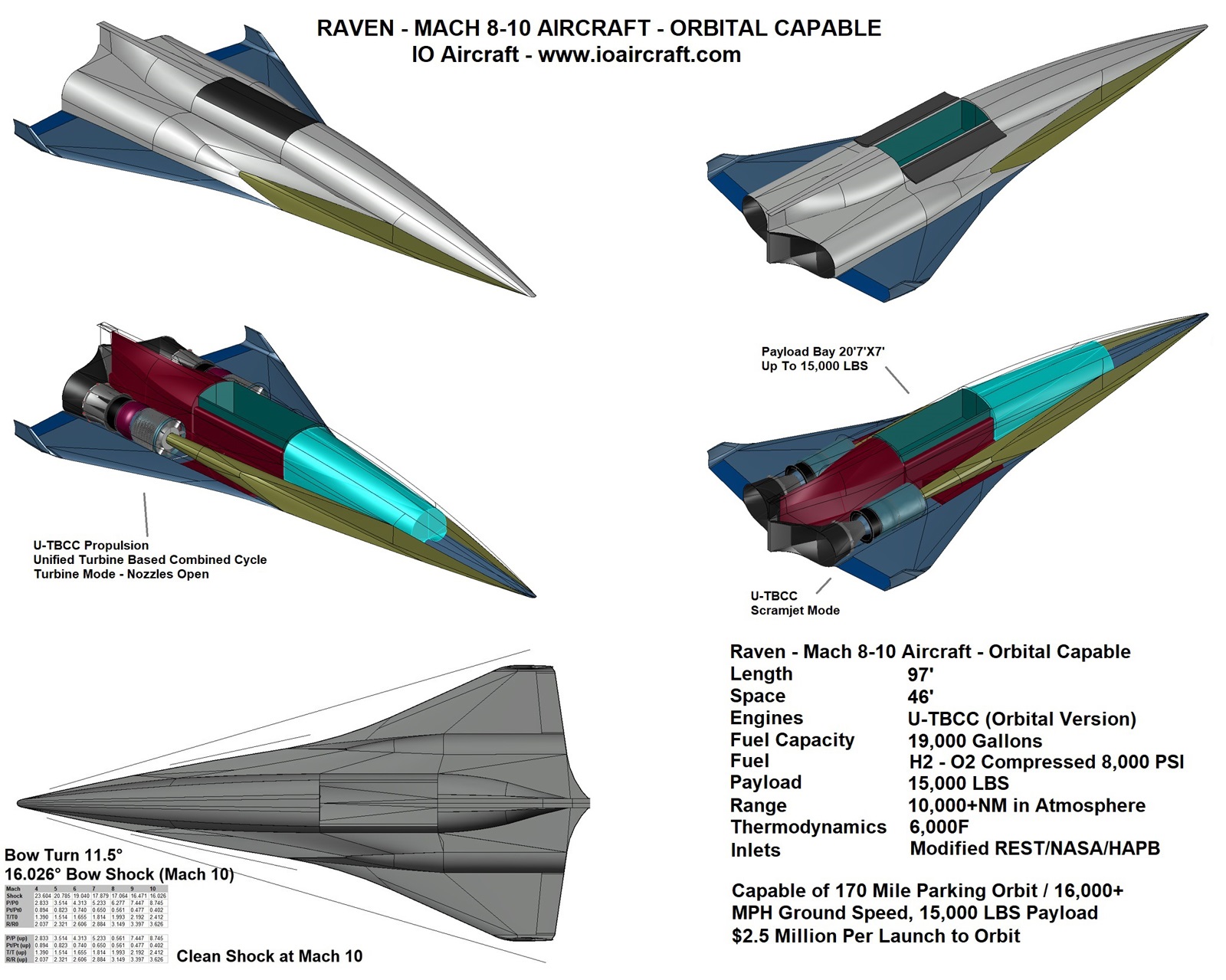
New screenshots from CAD of Raven, Mach 8-10 Aircraft that is orbital capable. Image shows U-TBCC (not omitted). Fueled by 8,000 PSI compressed H2, and forward tank at 8,000 PSI compressed O2 for orbital launches, max payload of 15,000 LBS with an estimated launch cost of $2.5 million. Aircraft flies up to 40,000ft, and accelerates into hypersonic velocities and continues accelerating to outside atmosphere reaching 16,000+ mph and parking orbit of 170 miles.
That's right, 95% lower costs for launching 15,000 LBS payloads into orbit. True single stage to orbit aircraft, that is not capable of burning up on re-entry since it is 6,000F temperature resistent.
Larger Image: www.ioaircraft.com/hypersonic/ravenutbcc_space_23.jpg
Website: www.ioaircraft.com
Drew Blair
www.linkedin.com/in/drew-b-25485312
-------------
io aircraft, phantom express, phantom works, boeing phantom works, lockheed skunk works, hypersonic weapon, hypersonic missile, scramjet missile, scramjet engineering, scramjet physics, boost glide, tactical glide vehicle, Boeing XS-1, htv, Air-Launched Rapid Response Weapon, (ARRW), hypersonic tactical vehicle, hypersonic plane, hypersonic aircraft, space plane, scramjet, turbine based combined cycle, ramjet, dual mode ramjet, darpa, onr, navair, afrl, air force research lab, defense science, missile defense agency, aerospike, additive manufacturing, titanium 3d printing, go fly prize, boeing go fly prize,
Advanced Additive Manufacturing for Hypersonic Aircraft
Utilizing new methods of fabrication and construction, make it possible to use additive manufacturing, dramatically reducing the time and costs of producing hypersonic platforms from missiles, aircraft, and space capable craft. Instead of aircraft being produced in piece, then bolted together; small platforms can be produced as a single unit and large platforms can be produces in large section and mated without bolting. These techniques include using exotic materials and advanced assembly processes, with an end result of streamlining the production costs and time for hypersonic aircraft; reducing months of assembly to weeks. Overall, this process greatly reduced the cost for producing hypersonic platforms. Even to such an extent that a Hellfire missile costs apx $100,000 but by utilizing our technologies, replacing it with a Mach 8-10 hypersonic missile of our physics/engineering and that missile would cost roughly $75,000 each delivered.
Materials used for these manufacturing processes are not disclosed, but overall, provides a foundation for extremely high stresses and thermodynamics, ideal for hypersonic platforms. This specific methodology and materials applications is many decades ahead of all known programs. Even to the extend of normalized space flight and re-entry, without concern of thermodynamic failure.
*Note, most entities that are experimenting with additive manufacturing for hypersonic aircraft, this makes it mainstream and standardized processes, which also applies for mass production.
What would normally be measured in years and perhaps a decade to go from drawing board to test flights, is reduced to singular months and ready for production within a year maximum.
Unified Turbine Based Combined Cycle (U-TBCC)
To date, the closest that NASA and industry have achieved for turbine based aircraft to fly at hypersonic velocities is by mounting a turbine into an aircraft and sharing the inlet with a scramjet or rocket based motor. Reaction Engines Sabre is not able to achieve hypersonic velocities and can only transition into a non air breathing rocket for beyond Mach 4.5
However, utilizing Unified Turbine Based Combine Cycle also known as U-TBCC, the two separate platforms are able to share a common inlet and the dual mode ramjet/scramjet is contained within the engine itself, which allows for a much smaller airframe footprint, thus engingeers are able to then design much higher performance aerial platforms for hypersonic flight, including the ability for constructing true single stage to orbit aircraft by utilizing a modification/version that allows for transition to outside atmosphere propulsion without any other propulsion platforms within the aircraft. By transitioning and developing aircraft to use Unified Turbine Based Combined Cycle, this propulsion system opens up new options to replace that airframe deficit for increased fuel capacity and/or payload.
Enhanced Dynamic Cavitation
Dramatically Increasing the efficiency of fuel air mixture for combustion processes at hypersonic velocities within scramjet propulsion platforms. The aspects of these processes are non disclosable.
Dynamic Scramjet Ignition Processes
For optimal scramjet ignition, a process known as Self Start is sought after, but in many cases if the platform becomes out of attitude, the scramjet will ignite. We have already solved this problem which as a result, a scramjet propulsion system can ignite at lower velocities, high velocities, at optimal attitude or not optimal attitude. It doesn't matter, it will ignite anyways at the proper point for maximum thrust capabilities at hypersonic velocities.
Hydrogen vs Kerosene Fuel Sources
Kerosene is an easy fuel to work with, and most western nations developing scramjet platforms use Kerosene for that fact. However, while kerosene has better thermal properties then Hydrogen, Hydrogen is a far superior fuel source in scramjet propulsion flight, do it having a much higher efficiency capability. Because of this aspect, in conjunction with our developments, it allows for a MUCH increased fuel to air mixture, combustion, thrust; and ability for higher speeds; instead of very low hypersonic velocities in the Mach 5-6 range. Instead, Mach 8-10 range, while we have begun developing hypersonic capabilities to exceed 15 in atmosphere within less then 5 years.
Conforming High Pressure Tank Technology for CNG and H2.
As most know in hypersonics, Hydrogen is a superior fuel source, but due to the storage abilities, can only be stored in cylinders thus much less fuel supply. Not anymore, we developed conforming high pressure storage technology for use in aerospace, automotive sectors, maritime, etc; which means any overall shape required for 8,000+ PSI CNG or Hydrogen. For hypersonic platforms, this means the ability to store a much larger volume of hydrogen vs cylinders.
As an example, X-43 flown by Nasa which flew at Mach 9.97. The fuel source was Hydrogen, which is extremely more volatile and combustible then kerosene (JP-7), via a cylinder in the main body. If it had used our technology, that entire section of the airframe would had been an 8,000 PSI H2 tank, which would had yielded 5-6 times the capacity. While the X-43 flew 11 seconds under power at Mach 9.97, at 6 times the fuel capacity would had yielded apx 66 seconds of fuel under power at Mach 9.97. If it had flew slower, around Mach 6, same principles applied would had yielded apx 500 seconds of fuel supply under power (slower speeds required less energy to maintain).
Enhanced Fuel Mixture During Shock Train Interaction
Normally, fuel injection is conducted at the correct insertion point within the shock train for maximum burn/combustion. Our methodologies differ, since almost half the fuel injection is conducted PRE shock train within the isolator, so at the point of isolator injection the fuel enhances the combustion process, which then requires less fuel injection to reach the same level of thrust capabilities.
Improved Bow Shock Interaction
Smoother interaction at hypersonic velocities and mitigating heat/stresses for beyond Mach 6 thermodynamics, which extraordinarily improves Type 3, 4, and 5 shock interaction.
6,000+ Fahrenheit Thermal Resistance
To date, the maximum thermal resistance was tested at AFRL in the spring of 2018, which resulted in a 3,200F thermal resistance for a short duration. This technology, allows for normalized hypersonic thermal resistance of 3,000-3,500F sustained, and up to 6,500F resistance for short endurance, ie 90 seconds or less. 10-20 minute resistance estimate approximately 4,500F +/- 200F.
*** This technology advancement also applies to Aerospike rocket engines, in which it is common for Aerospike's to exceed 4,500-5,000F temperatures, which results in the melting of the reversed bell housing. That melting no longer ocurrs, providing for stable combustion to ocurr for the entire flight envelope
Scramjet Propulsion Side Wall Cooling
With old technologies, side wall cooling is required for hypersonic flight and scramjet propulsion systems, otherwise the isolator and combustion regions of a scramjet would melt, even using advanced ablatives and ceramics, due to their inability to cope with very high temperatures. Using technology we have developed for very high thermodynamics and high stresses, side wall cooling is no longer required, thus removing that variable from the design process and focusing on improved ignition processes and increasing net thrust values.
Lower Threshold for Hypersonic Ignition
Active and adaptive flight dynamics, resulting in the ability for scramjet ignition at a much lower velocity, ie within ramjet envelope, between Mach 2-4, and seamless transition from supersonic to hypersonic flight, ie supersonic ramjet (scramjet). This active and dynamic aspect, has a wide variety of parameters for many flight dynamics, velocities, and altitudes; which means platforms no longer need to be engineered for specific altitude ranges or preset velocities, but those parameters can then be selected during launch configuration and are able to adapt actively in flight.
Dramatically Improved Maneuvering Capabilities at Hypersonic Velocities
Hypersonic vehicles, like their less technologically advanced brethren, use large actuator and the developers hope those controls surfaces do not disintegrate in flight. In reality, it is like rolling the dice, they may or may not survive, hence another reason why the attempt to keep velocities to Mach 6 or below. We have shrunken down control actuators while almost doubling torque and response capabilities specifically for hypersonic dynamics and extreme stresses involved, which makes it possible for maximum input authority for Mach 10 and beyond.
Paradigm Shift in Control Surface Methodologies, Increasing Control Authority (Internal Mechanical Applications)
To date, most control surfaces for hypersonic missile platforms still use fins, similar to lower speed conventional missiles, and some using ducted fins. This is mostly due to lack of comprehension of hypersonic velocities in their own favor. Instead, the body itself incorporates those control surfaces, greatly enhancing the airframe strength, opening up more space for hardware and fuel capacity; while simultaneously enhancing the platforms maneuvering capabilities.
A scramjet missile can then fly like conventional missile platforms, and not straight and level at high altitudes, losing velocity on it's decent trajectory to target. Another added benefit to this aspect, is the ability to extend range greatly, so if anyone elses hypersonic missile platform were developed for 400 mile range, falling out of the sky due to lack of glide capabilities; our platforms can easily reach 600+ miles, with minimal glide deceleration.
The Birken is a “table car” capable of seating 56 passengers at 14 tables. With warming ovens and refrigerators behind the bar and buffet area, the Birken is an excellent venue for a cocktail hour. Alternately, the Birken can be used with a dining car or another passenger car with a full kitchen to seat your guests for a full meal while rolling down the railroad. It is the perfect companion to any other private passenger car on the market, allowing you the extra space to expand your event. The tables are also removable, making the Birken into an excellent open space. The car features two restrooms, a generator for power, and heat & air conditioning throughout. The Birken is fully certified by Amtrak, the FRA, and NJ Transit to operate anywhere the rails lead it.
The Birken was the first in an order of 218 identical 72-seat coaches built by Canadian Car & Foundry in 1954 for the Canadian National Railway. Numbered #5437, the car served on CN until 1978, when CN split off its passenger service into VIA Rail (the Canadian equivalent of Amtrak). The #5437 continued to serve VIA until it was sold to the British Columbia Railway in 1990, where it was rebuilt into a 14-table, 56-seat “table car” for use as a bar car and extra dining space on their Royal Hudson trains. It was during this time that the Birken was named for a location along the railroad’s mainline in British Columbia. After a decade of further service, the Birken was sold into private ownership in 2002. The car was upgraded to full Amtrak and FRA standards and repainted into colors once worn by the New York Central’s famous 20th Century Limited train.
Photos, text and plan - Morristown & Erie Railway
Built by the Schiffswerks Rieherst company in Hamburg, the Umbria was launched on December 30th 1911 with the name of Bahia Blanca. It was a large freighter by that time, 150 meters long, with a power capable of providing a speed of 14 knots that could carry 9,000 tons of cargo and up to 2,000 passengers. In 1912 it began operating the Hamburg-America line doing different jobs between Europe and Argentina until the outbreak of World War I, when it was based in Buenos Aires. In 1918 the ship was acquired by the Argentinian government and it was not until 1935 when the ship was taken over by the Italian government and renamed again: the Umbria. From that moment its trips were to transport troops and during the following two years carried several thousand soldiers to the Italian colonies in East Africa.
The loss of the Umbria
In May 1940, when Italy was still neutral in World War II, the Umbria was secretly loaded with 360,000 bombs between 15 kg and 100 kg, 60 boxes of detonators, building materials and three Fiat Lunga cars, carrying a total 8,600 tons of weapons towards the East Africa. The explosives had destination Massawa and Assab, Eritrea, that was Italian colony by then, and the rest of the cargo was heading different locations in Asia. Italy's entry into the war was imminent and this shipment was destined to the defense of the colonies against the Allies and to the possible expansion of its African territories.
On 3rd June 1940 the Umbria reached Port Said, northern Egypt, where loaded with 1,000 tons of coal and water in a movement to fool the Allies, trying to look like a harmless freighter. The port, controlled by the Royal Navy, and its authorities allowed the ship enter on the Red Sea three days after arrival. The British delayed the departure of the Umbria knowing that Italy's entry into the war was imminent and that the cargo of Umbria had devastating power that sooner or later would be used against the Allies and why not, to get a great load to fight fascism. But Italy, as a neutral country that it was, had every right to transport weapons much like any other cargo to its colonies.
Having met the deadline to be retained, the Umbria crossed the Suez Canal on June 6th but with the escort of the HMS Grimsby. The importance and destructive capacity of the cargo required it. Three days later the Umbria entered in Sudan waters and the HMS Grimsby ordered the Umbria captain to anchor on Wingate Reef under the pretext of searching for contraband. Moments later the British warship HMS Leander arrived with a group of 20 sailors who boarded the Umbria. After thoroughly searching the ship and finding nothing, the captain ordered the British troops to remain the night aboard the Umbria.
The next morning Lorenzo Muiesan, Umbria captain, was in his cabin listening to the radio when Mussolini announced the entry of Italy into the World War II. Hostilities would begin at midnight of that day. Muiesan, a very patriotic captain with long experience, was the only one in the area who had heard the news and knew immediately that both Umbria and the burden would be used by the Allies against their own country. He had no option to disable both. In a move of extraordinary intelligence, as the hours passed retained by the British who did not yet know that Italy was officially the enemy, the captain ordered his crew conducting a rescue simulation... that was more real than the British thought. This maneuver, which the English soldiers agreed as they believed it would serve to further delay the departure of the Umbria. While the Italians occupied the lifeboats, the chief engineers, following Muiesan´s orders, opened all the valves and drown the ship to the bottom of the reef. With the crew safe, the British only had time to get on their ship and watch the freighter slid slowly.
When the captain of HMS Grimsby asked why he had done that Muiesan confirmed the declaration of war from Italy to Britain. The next day Muiesan and the rest of Umbria crew departed detainees to India, where they spent four years in prison.
CARGO:
The Umbria was carrying 360,000 individual aircraft bombs ranging in size from 15, 50 and 100 kg. The vessel also carried a large quantity of fuses, ammunition and detonators as well as other traditional cargo. The captain knew these bombs would be confiscated and used by the enemy against his country should they ever discover them which was why he made the call to sink the ship.
The Umbria had sailed in June 1940 with 6,000 tons of bombs, 60 boxes detonators, explosives, weapons and three Fiat 1100 Lunga from Genoa via Livorno and Naples in the Suez Canal and on the way via Massaua and Assab to Calcutta.
Aeroscopia est un musée aéronautique français implanté à Blagnac (Haute-Garonne), près du site AéroConstellation, et accueille notamment deux exemplaires du Concorde, dont l'ouverture a eu lieu le 14 janvier 2015
Le tarmac Sud du musée n'est capable d'accueillir que trois gros appareils. L'installation des appareils fut définitivement terminée après que le premier prototype de l'A400M-180 y fut arrivé le 16 juillet 2015, en dépit de la possibilité de 360 000 euros de TVA.
Concorde, F-BVFC, MSN209 aux couleurs d'Air France
Caravelle 12, F-BTOE, MSN280 aux couleurs d'Air Inter, dernier exemplaire construit
A400M-180, F-WWMT, MSN001 stationné depuis le 16 juillet 2015
La réalisation en 2019 du nouveau tarmac au Nord du musée permet l'accueil d'appareils supplémentaires issus des entreprises locales Airbus et ATR. Le transfert des avions entre le site Airbus "Lagardère" et le musée a lieu sur une semaine, à raison d'un appareil par jour :
ATR 72-600, F-WWEY, MSN098 aux couleurs d'ATR, transféré sur site le 26 août 2019, premier exemplaire du 72 dans sa version 600
Airbus A340-600, F-WWCA, MSN360 aux couleurs d'Airbus, transféré sur site le 27 août 2019, premier exemplaire de l'A340 dans sa version 600
Airbus A320-111, F-WWAI, MSN001 aux anciennes couleurs d'Airbus, transféré sur site le 28 août 2019, premier exemplaire de l'A320 : inauguration le 14 février 1987 en présence de Lady Diana et du Prince Charles, premier vol le 22 février 1987
Airbus A380-800, F-WXXL, MSN002 aux couleurs d'Airbus, transféré sur site le 29 août 2019, second exemplaire de l'A380. Les deux ponts de cet appareil sont visitables, ainsi que le cockpit.
ATR 42-300, F-WEGC, MSN003 aux anciennes couleurs d'ATR, transféré sur site le 30 août 2019, troisième exemplaire du 42. Cet exemplaire est décoré aux couleurs du MSN001 et porte l'immatriculation F-WEGA
Concorde, F-WTSB, MSN201 (ANAE), il s'agit d'un appareil de présérie qui a servi entre autres à transporter plusieurs présidents de la République française.
Airbus A300B4-203, F-WUAB, MSN238 (Airbus Heritage), décoré aux couleurs du prototype, au lieu de MSN001 démantelé. L'intérieur est visitable. Dans la première section des vitrages transparents permettent de voir la structure et les systèmes de l'avion, tandis que dans les sections suivantes sont représentés des aménagements de première classe et VIP.
Super Guppy de l'association Ailes Anciennes Toulouse, l'appareil qui servait au transport des tronçons d'Airbus est exposé porte ouverte, et une passerelle permet l'accès à la soute où un film est projeté. L'ouverture n'a pas été une mince affaire, l'appareil n'ayant pas été ouvert pendant 15 ans. L'aide des anciens mécaniciens de l'avion a été primordiale pour permettre une ouverture en toute sécurité.
Corvette (Airbus)
Falcon 10 no 02, prototype ayant servi aux essais du turboréacteur Larzac (Ailes Anciennes Toulouse)
Fouga Magister (AAT)
Gazelle prototype (AAT)
Mirage III C (AAT)
Nord 1100 (AAT)
Lockheed F-104G (AAT)
MiG-15 (AAT)
MS.760 Paris (AAT)
Vought F-8E(FN) Crusader et son réacteur (AAT)
Alouette II Marine (AAT)
Cessna Skymaster (AAT)
Fairchild Metro, ancien avion de Météo-France (AAT)
HM-293, de Rodolphe Grunberg
Chagnes MicroStar, avion de construction amateur, version biréacteur de Rutan VariViggen (AAT)
Saab J35OE Draken (AAT)
Aeroscopia is a French aeronautical museum located in Blagnac (Haute-Garonne), near the AéroConstellation site, and notably hosts two copies of the Concorde, which opened on January 14, 2015
The south tarmac of the museum can only accommodate three large aircraft. The installation of the devices was definitively finished after the first prototype of the A400M-180 arrived there on July 16, 2015, despite the possibility of 360,000 euros in VAT.
Concorde, F-BVFC, MSN209 in Air France colors
Caravelle 12, F-BTOE, MSN280 in Air Inter colors, last model built
A400M-180, F-WWMT, MSN001 parked since July 16, 2015
The construction in 2019 of the new tarmac north of the museum will accommodate additional aircraft from local Airbus and ATR companies. The transfer of planes between the Airbus "Lagardère" site and the museum takes place over a week, at the rate of one aircraft per day:
ATR 72-600, F-WWEY, MSN098 in ATR colors, transferred to site on August 26, 2019, first copy of the 72 in its 600 version
Airbus A340-600, F-WWCA, MSN360 in Airbus colors, transferred to site on August 27, 2019, first copy of the A340 in its 600 version
Airbus A320-111, F-WWAI, MSN001 in the old Airbus colors, transferred to site on August 28, 2019, first copy of the A320: inauguration on February 14, 1987 in the presence of Lady Diana and Prince Charles, first flight on February 22, 1987
Airbus A380-800, F-WXXL, MSN002 in Airbus colors, transferred to site on August 29, 2019, second copy of the A380. The two decks of this aircraft can be visited, as well as the cockpit.
ATR 42-300, F-WEGC, MSN003 in the old ATR colors, transferred to the site on August 30, 2019, third specimen of the 42. This specimen is decorated in the colors of the MSN001 and bears the registration F-WEGA
Concorde, F-WTSB, MSN201 (ANAE), this is a pre-production aircraft which was used, among other things, to transport several presidents of the French Republic.
Airbus A300B4-203, F-WUAB, MSN238 (Airbus Heritage), decorated in the colors of the prototype, instead of dismantled MSN001. The interior can be visited. In the first section transparent glazing allows to see the structure and systems of the aircraft, while in the following sections are shown first class and VIP fittings.
Super Guppy from the Ailes Anciennes Toulouse association, the aircraft which was used to transport the Airbus sections is on display with the door open, and a gangway allows access to the hold where a film is shown. Opening was no small feat, as the device has not been opened for 15 years. The help of the former mechanics of the aircraft was essential to allow a safe opening.
Corvette (Airbus)
Falcon 10 no 02, prototype used for testing the Larzac turbojet engine (Ailes Anciennes Toulouse)
Fouga Magister (AAT)
Prototype Gazelle (AAT)
Mirage III C (AAT)
North 1100 (AAT)
Lockheed F-104G (AAT)
MiG-15 (AAT)
MS.760 Paris (AAT)
Vought F-8E (FN) Crusader and its engine (AAT)
Alouette II Marine (AAT)
Cessna Skymaster (AAT)
Fairchild Metro, former Météo-France (AAT) aircraft
HM-293, by Rodolphe Grunberg
Chagnes MicroStar, amateur-built aircraft, twin-jet version of Rutan VariViggen (AAT)
Saab J35OE Draken (AAT)
NEOBALLS / ZEN MAGNETS - Neodymium Magnetic Balls (@4205) - Starcraft II's Massive Thor
This is my most complex and largest build to date.
It was designed in parts: Cockpit body, then legs, then arms, then rear guns. Then I had to redesign parts when it came time to assemble it together because of incorrect bonding assumptions and misalignment of magnet fields.
Experimented with x-beam coupled bonds to get the maximum lateral strength with reinforcements on the sides. This proved to be very string. Created a X-Beam using similar methods producing a very strong leg structure. It was capable of support the entire weight of the cockpit body w/o a problem. Had to redesign the leg to cockpit body mount point from the earlier concept because the bond was not completely coupled.
Next up were the arm/guns ... the weight was too much for the cockpit body to support so I fashioned a pair of lego-platforms for them to rest on and take the weight off of the central body.
Finally ... the rear guns ... these were a challenge in that their original mount point design had to be reworked also to make them fit correctly into the rear of the cockpit body. I changed the mount points on the guns to fit the space on both sides and added a few support balls to improve the mount point bonds. I was very surprised how they were balanced and supported only by two point sections to the body. The guns stayed in place for a small series of photos.
The design flaw was in the side bonds of the beam to the legs. The coupled field held nicely for a short amount of time and would have held if it didn't have the weight of the rear guns to support. When they were standing upright and straight, all was good. As soon as I attempted to move the platform forward (to take a video), the rear guns tilted slightly backwards and and that was the end of the leg to body support bonds ... and created the dreaded implosion.
The rear gun weight caused the entire central body section to rotate backwards and fall back on the rear guns ... taking the arms in the process. Perhaps I should have created a Lego-support structure for the rear guns to remove the pendulum force backwards ... but that would have created another view blocker like the side Lego-platforms obstructed the view of the legs and feet. Not sure if I can recreate it for a rotational video ... this took over a week (on/off to design and assemble).
Overall ... I was very happy with the result ... hope I captured enough detail to warrant some visual recognition as a Starcraft II Thor reproduction/interpretation.
This was design and built for the Zen Magnets Contest 26: The Massive Thor
www.zenmagnets.com/blog/26-the-massive-thor/
I tried to document the info for this super complex build (below) accompanied by associated pics in this set
www.flickr.com/photos/tend2it/sets/72157632920071597/
Starcraft II Thor Magnet Count and Detail Talley
======+================
Cockpit Body bottom section: (@0520)
(@0217) - Main shape middle core = (2x10⁸) + 1
(@0095) - central bottom layer 1 = (47x2) + 1 w/black parameter
(@0078) - Sides Bottom layer 2 = (2x(22 parallel pair frnt2bck support + 3 red + 4 gold + 10 ring outside black))
(@0028) - Central bottom layer 3 = (2x14) rectangle
(@0032) - Sides bottom layer 3 = (2x((2x5 parallel bridge rectangle to ring) + (6 ring outside))
(@0010) - Central bottom layer 4 = (10 ring) leg waist w/gold
(@0020) - Sides bottom layer 4 = (2x10 ring) coupled over parallel bridge for perpendicular underside support
(@0040) - Central rear Barrel = (4x8 ring w2 red rings) + (2x4 sqr end)
------
Cockpit Body top section (from center out): (@0371)
(@0166) - top layer 1 = (2x83) w/black missle cover + middle sect separator
(@0105) - top layer 2 = ((2x52) + 1) w/black separator, red trim, gold cockpit
(@0083) - top layer 3 = ((2x41) + 1) w/black separator, red trim, gold cockpit
(@0037) - top layer 4 = ((2x18) + 1) w/black separator trim
(@0010) - top layer 5 = (2x5) w/red/black
------
(@0891)
Leg section x2 (@0640 - 12 removed from bottom of @ leg for foot contact pt)
leg internal structure:
(@0384) - columns = 2 x (4x((2x12) + ((2x11) + 2))) top/bottom coupled bonds w/parallel bonds stacked x 4))
(@0096) - side reinforcements = 2x((2x11) + 2) coupled pair along outside edge centers)
(@0032) - ball reinforcements = 2x(2x4 balls are two balls added to 4 ball in 2, 4, 6, 8th positions) - (12 @ bottom)
leg arch structure (connected to one flat leg top face:
(@0128) - (4x4 parallel sqr) + (2x(6 + 2)) pointy rings) + (4x4 parallel sqr) + (2x(6 + 2)) pointy rings)
Place the two leg arch structures together to form the leg arch
-------
(@1519) = 1531-12
Leg side panels (@0384)
(@0344) - (2 each leg x (2x(2x43 each side))) w/black outside trim
Knees + Leg detail
(@0040) - (2x(2x(6 + 2) knee w/red sqr) + 2x(4 red sqr top of leg))
-------
(@1903)
Feet x2 (@0242)
(@0184) - (2x((2x7 + 2 1st mid layer) + (2x(2x10 + 1) 2nd mid layer) + ((2x(2x8 + 1) outside layer))
(@0034) - (2x(2x(2x3 + 1 top of toe 2 leg)) + (1 center rear foot 2 leg conn) + (2 x 1 outer rear foot sides 2 leg
conn))
(@0024) - (2x(2x6 rings rear foot heel))
-------
(@2145)
X-Beam waist platform - (@0233 - 19) this part is placed across the center perpendicular to the x-beam leg arch
(@0214) - (2x(2x(18 + 17 + 6 + 3)) + (2x(7 + 2)) + ((8 + 1 front side) + (2x9 rear side)) + ((2 x 3 red front center) +
(2 x 2 red front sides) + (2 red rear)) - (19 removed under rear panel side to fold)
Arm Guns (2 pair per arm w/red + black accents)
(@0380) - (4x((4x9 center core) + (3x((2x7) + 1)) top/sides) + (2x7) middle join))
Shoulder to elbow core w/o reinforcements ((@0174)per arm)
(@0348) - (2 x (top((2x5)+2) + (4x8+2 parallel) + ((2x5)+2) + (2x5) + (2x(2x5)+1) + (2x(2x6)+1) + ((4x7)+2 parallel
mount2gun) + (1 ball center to bridge below 2 ball center to 1 ball) + ((2x6)+1) + ((2x4)+2)bottom)
Shoulder to elbow (per arm, per side)
(@0248) - (2 x (2 x (top 3 + 5 + 5 + 5 + 4 + 5 + 4 + 4 + 5 + (2x7arm2shoulder bridge) + (5 + 3 bottom))
Elbow to gun support (per arm, per side) (@0140 - 18 for outside facing side revamp)
(@0122) - (2 x (2 x (((2x9)+1) + (2x8)) -
Revamp outside facing sides for Z bracket (remove 2x(4 top/4 bottom/2 middle/move center ball down, add 1 ball)
Revamp 2 rear centerballs with red
(@028) - add red design outside facing shoulder 2 elbow
------
(@3485)
Rear Guns x2
Large cannon (@0112 each)
(@0224) - 2 x ((2x(2x15) + (4x(5+2)) + (4x(6 ring)))
Smaller cannon (@0092 each)
(@0184) - 2 x ((2x(2x13) + (4x(4+2)) + (4x(4 ring)))
Gun bridges (@0010 each)
(@0020) - (2 x (4 ring + 6 ring across two cannons)
Gun mounts x2
(@0104) - (2 x ((top (2x4+2) + (2x5+2) parallel to existing + (2x4+2) + (2x5 parallel) + (2x4+2) bottom)
Gun panel x 2 (@0102 each)
(@0204) - (2 x (2x(11 + 10 + 9 + 8 + 7 + 6))
-------
Revamp base
(@4221) subtotal b4 assembly
Assembly mods
-------------
Moved the (@0040) - Central rear Barrel = (4x8 ring w2 red rings) + (2x4 sqr end) below the rear of the body between
the leg mount and cockpit body. Actually used the barrel as a mount point for the rear guns.
Modded Cockpit Body bottom section (mount point):
(@0020) = (2 x (7 + 6 + 5)) = Changed = (@0028) - Central bottom layer 3 = (2x14) rectangle to covert parallel
rectangle to hex parallel center, coupled sides
-------
(@4213) = (@4221 - 8)
Moved central bottom layer x-beam
(@0018) = (2x09 ring) = Changed = (@0020) - Sides bottom layer 4 = shifted it down one row, removed 1 ball on end to form point and pinched outside end fit in center of 6 ball side.
(@4211) = (@4213 - 2)
Removed gold 10 ball ring mount
Changed = (@0010) = Central bottom layer 4 = (10 ring) leg waist w/gold
-------
(@4201) = (@4213 - 10)
Modded Rear Guns
(@0100) = Changed = Rear Gun mounts x2 - removed +2 from top/bottom mount point (2x4+2)=>(2x4)
(@4197) = (@4201-4)
Added extra mount point support bwtween rear gun mounts and rear cockpit body
(@4205) = (@4201+8)
Grand Total! = (@4205)
Io Aircraft - www.ioaircraft.com
Drew Blair
www.linkedin.com/in/drew-b-25485312/
io aircraft, phantom express, phantom works, boeing phantom works, lockheed skunk works, hypersonic weapon, hypersonic missile, scramjet missile, scramjet engineering, scramjet physics, boost glide, tactical glide vehicle, Boeing XS-1, htv, Air-Launched Rapid Response Weapon, (ARRW), hypersonic tactical vehicle, hypersonic plane, hypersonic aircraft, space plane, scramjet, turbine based combined cycle, ramjet, dual mode ramjet, darpa, onr, navair, afrl, air force research lab, defense science, missile defense agency, aerospike,
Advanced Additive Manufacturing for Hypersonic Aircraft
Utilizing new methods of fabrication and construction, make it possible to use additive manufacturing, dramatically reducing the time and costs of producing hypersonic platforms from missiles, aircraft, and space capable craft. Instead of aircraft being produced in piece, then bolted together; small platforms can be produced as a single unit and large platforms can be produces in large section and mated without bolting. These techniques include using exotic materials and advanced assembly processes, with an end result of streamlining the production costs and time for hypersonic aircraft; reducing months of assembly to weeks. Overall, this process greatly reduced the cost for producing hypersonic platforms. Even to such an extent that a Hellfire missile costs apx $100,000 but by utilizing our technologies, replacing it with a Mach 8-10 hypersonic missile of our physics/engineering and that missile would cost roughly $75,000 each delivered.
Materials used for these manufacturing processes are not disclosed, but overall, provides a foundation for extremely high stresses and thermodynamics, ideal for hypersonic platforms. This specific methodology and materials applications is many decades ahead of all known programs. Even to the extend of normalized space flight and re-entry, without concern of thermodynamic failure.
*Note, most entities that are experimenting with additive manufacturing for hypersonic aircraft, this makes it mainstream and standardized processes, which also applies for mass production.
What would normally be measured in years and perhaps a decade to go from drawing board to test flights, is reduced to singular months and ready for production within a year maximum.
Unified Turbine Based Combined Cycle (U-TBCC)
To date, the closest that NASA and industry have achieved for turbine based aircraft to fly at hypersonic velocities is by mounting a turbine into an aircraft and sharing the inlet with a scramjet or rocket based motor. Reaction Engines Sabre is not able to achieve hypersonic velocities and can only transition into a non air breathing rocket for beyond Mach 4.5
However, utilizing Unified Turbine Based Combine Cycle also known as U-TBCC, the two separate platforms are able to share a common inlet and the dual mode ramjet/scramjet is contained within the engine itself, which allows for a much smaller airframe footprint, thus engingeers are able to then design much higher performance aerial platforms for hypersonic flight, including the ability for constructing true single stage to orbit aircraft by utilizing a modification/version that allows for transition to outside atmosphere propulsion without any other propulsion platforms within the aircraft. By transitioning and developing aircraft to use Unified Turbine Based Combined Cycle, this propulsion system opens up new options to replace that airframe deficit for increased fuel capacity and/or payload.
Enhanced Dynamic Cavitation
Dramatically Increasing the efficiency of fuel air mixture for combustion processes at hypersonic velocities within scramjet propulsion platforms. The aspects of these processes are non disclosable.
Dynamic Scramjet Ignition Processes
For optimal scramjet ignition, a process known as Self Start is sought after, but in many cases if the platform becomes out of attitude, the scramjet will ignite. We have already solved this problem which as a result, a scramjet propulsion system can ignite at lower velocities, high velocities, at optimal attitude or not optimal attitude. It doesn't matter, it will ignite anyways at the proper point for maximum thrust capabilities at hypersonic velocities.
Hydrogen vs Kerosene Fuel Sources
Kerosene is an easy fuel to work with, and most western nations developing scramjet platforms use Kerosene for that fact. However, while kerosene has better thermal properties then Hydrogen, Hydrogen is a far superior fuel source in scramjet propulsion flight, do it having a much higher efficiency capability. Because of this aspect, in conjunction with our developments, it allows for a MUCH increased fuel to air mixture, combustion, thrust; and ability for higher speeds; instead of very low hypersonic velocities in the Mach 5-6 range. Instead, Mach 8-10 range, while we have begun developing hypersonic capabilities to exceed 15 in atmosphere within less then 5 years.
Conforming High Pressure Tank Technology for CNG and H2.
As most know in hypersonics, Hydrogen is a superior fuel source, but due to the storage abilities, can only be stored in cylinders thus much less fuel supply. Not anymore, we developed conforming high pressure storage technology for use in aerospace, automotive sectors, maritime, etc; which means any overall shape required for 8,000+ PSI CNG or Hydrogen. For hypersonic platforms, this means the ability to store a much larger volume of hydrogen vs cylinders.
As an example, X-43 flown by Nasa which flew at Mach 9.97. The fuel source was Hydrogen, which is extremely more volatile and combustible then kerosene (JP-7), via a cylinder in the main body. If it had used our technology, that entire section of the airframe would had been an 8,000 PSI H2 tank, which would had yielded 5-6 times the capacity. While the X-43 flew 11 seconds under power at Mach 9.97, at 6 times the fuel capacity would had yielded apx 66 seconds of fuel under power at Mach 9.97. If it had flew slower, around Mach 6, same principles applied would had yielded apx 500 seconds of fuel supply under power (slower speeds required less energy to maintain).
Enhanced Fuel Mixture During Shock Train Interaction
Normally, fuel injection is conducted at the correct insertion point within the shock train for maximum burn/combustion. Our methodologies differ, since almost half the fuel injection is conducted PRE shock train within the isolator, so at the point of isolator injection the fuel enhances the combustion process, which then requires less fuel injection to reach the same level of thrust capabilities.
Improved Bow Shock Interaction
Smoother interaction at hypersonic velocities and mitigating heat/stresses for beyond Mach 6 thermodynamics, which extraordinarily improves Type 3, 4, and 5 shock interaction.
6,000+ Fahrenheit Thermal Resistance
To date, the maximum thermal resistance was tested at AFRL in the spring of 2018, which resulted in a 3,200F thermal resistance for a short duration. This technology, allows for normalized hypersonic thermal resistance of 3,000-3,500F sustained, and up to 6,500F resistance for short endurance, ie 90 seconds or less. 10-20 minute resistance estimate approximately 4,500F +/- 200F.
*** This technology advancement also applies to Aerospike rocket engines, in which it is common for Aerospike's to exceed 4,500-5,000F temperatures, which results in the melting of the reversed bell housing. That melting no longer ocurrs, providing for stable combustion to ocurr for the entire flight envelope
Scramjet Propulsion Side Wall Cooling
With old technologies, side wall cooling is required for hypersonic flight and scramjet propulsion systems, otherwise the isolator and combustion regions of a scramjet would melt, even using advanced ablatives and ceramics, due to their inability to cope with very high temperatures. Using technology we have developed for very high thermodynamics and high stresses, side wall cooling is no longer required, thus removing that variable from the design process and focusing on improved ignition processes and increasing net thrust values.
Lower Threshold for Hypersonic Ignition
Active and adaptive flight dynamics, resulting in the ability for scramjet ignition at a much lower velocity, ie within ramjet envelope, between Mach 2-4, and seamless transition from supersonic to hypersonic flight, ie supersonic ramjet (scramjet). This active and dynamic aspect, has a wide variety of parameters for many flight dynamics, velocities, and altitudes; which means platforms no longer need to be engineered for specific altitude ranges or preset velocities, but those parameters can then be selected during launch configuration and are able to adapt actively in flight.
Dramatically Improved Maneuvering Capabilities at Hypersonic Velocities
Hypersonic vehicles, like their less technologically advanced brethren, use large actuator and the developers hope those controls surfaces do not disintegrate in flight. In reality, it is like rolling the dice, they may or may not survive, hence another reason why the attempt to keep velocities to Mach 6 or below. We have shrunken down control actuators while almost doubling torque and response capabilities specifically for hypersonic dynamics and extreme stresses involved, which makes it possible for maximum input authority for Mach 10 and beyond.
Paradigm Shift in Control Surface Methodologies, Increasing Control Authority (Internal Mechanical Applications)
To date, most control surfaces for hypersonic missile platforms still use fins, similar to lower speed conventional missiles, and some using ducted fins. This is mostly due to lack of comprehension of hypersonic velocities in their own favor. Instead, the body itself incorporates those control surfaces, greatly enhancing the airframe strength, opening up more space for hardware and fuel capacity; while simultaneously enhancing the platforms maneuvering capabilities.
A scramjet missile can then fly like conventional missile platforms, and not straight and level at high altitudes, losing velocity on it's decent trajectory to target. Another added benefit to this aspect, is the ability to extend range greatly, so if anyone elses hypersonic missile platform were developed for 400 mile range, falling out of the sky due to lack of glide capabilities; our platforms can easily reach 600+ miles, with minimal glide deceleration.
The X100T is a lot of things-- compact, stylish, and extremely capable. One thing it's not, though-- the original rangefinder. Granted, the GW690 II isn't the "first," either, but a comparison between the two is rather humorous. Besides their styling, there are a few mechanical similarities as well. Both cameras can be controlled entirely with physical dials, and both have externally focusing lenses. More to the point, the GW690 II's 90mm lens works out to around 36mm in 35mm terms, whereas the X100T's 23mm lens comes out to about 35mm in 35mm terms. Nifty, huh?
This photo was lit primarily by a Yongnuo 568EXII fired through a 43" umbrella above and to the right. A SB-700 and Flashdisc were used from the left, on the same plane as the camera as an accent light. I considered using a rim light instead, but with only two flashes I stuck with this setup. The backdrop is actually an old DDR mat that I held up to produce a dark backdrop.
I really wanted to convey an anthromorphic "feel" to this image. The X100T is often called a rangefinder, but that's something of a misnomer. In my head, I envisioned the newcomer looking up at its larger, older, "truer" ancestor for acceptance. I used odds and ends to prop the cameras in the current position so that the GW690 II looks "down" on the X100T, and focused the former to its minimum distance to extend the barrel a little further.
Working out the tilts to use was difficult. I wanted both cameras to be making "eye" contact, but I also wanted to show more of each camera than just the side view. I succeeded with one, failed with the other. I also couldn't crop lower down, as I might have liked because doing so would expose the Wii game cases I was using to prop up the GW690 II. Still, this is one of my better photos and I'm quite pleased with the result.
Wildland Firefighters on Rappel capable crews, come from all over the nation each spring to train at the National Helicopter Rappel Program’s Rappel Academy at Salmon AirBase, in Salmon, Idaho.
Wildland fire aircraft play a critical role in supporting firefighters on wildland fires. Helicopters also deliver aerial crews called Heli-Rappellers to wildland fires. These are specially trained firefighters that rappel from helicopters in order to effectively and quickly respond to fires in remote terrain.
Heli-Rappellers may land near a wildfire but if there is no landing zone close by they can utilize their skills to rappel from the hoovering helicopter. Once on the ground, crews build firelines using hand tools, chainsaws, and other firefighting tools. Forest Service photo by Charity Parks.
These solidly built, medium-displacement cruisers are capable of a very reasonable pace in open seas, where they offer a particularly sea-kindly motion. Thanks to the inboard genoa tracks they do point quite close – up to 33° in fact, although they lose a lot of speed when pinched that tight. Her favourite point of sail is around 50-55° off the apparent wind, when she surges forward relentlessly, oblivious to the sea state.
The Moody 36 is also easy to sail singlehanded, with all the sail control lines and winches within easy reach in the compact cockpit, and you’re not going to get shoulder cramps if you have to hand-steer her for hours on end, either. Nor are you going to become bruised and battered if the seas come up when you’re working at the galley, where the chunky fiddles act as solid handholds. You’ll feel very secure making your way forward on deck, with one hand firmly clutching the wooden handrails.
On a reach the she is capable of averaging 6.5-7.5 knots in all but the choppiest waters. She does lack downwind performance, so needs a big fat spinnaker to really get her tramping along.
Aeroscopia est un musée aéronautique français implanté à Blagnac (Haute-Garonne), près du site AéroConstellation, et accueille notamment deux exemplaires du Concorde, dont l'ouverture a eu lieu le 14 janvier 2015
Le tarmac Sud du musée n'est capable d'accueillir que trois gros appareils. L'installation des appareils fut définitivement terminée après que le premier prototype de l'A400M-180 y fut arrivé le 16 juillet 2015, en dépit de la possibilité de 360 000 euros de TVA.
Concorde, F-BVFC, MSN209 aux couleurs d'Air France
Caravelle 12, F-BTOE, MSN280 aux couleurs d'Air Inter, dernier exemplaire construit
A400M-180, F-WWMT, MSN001 stationné depuis le 16 juillet 2015
La réalisation en 2019 du nouveau tarmac au Nord du musée permet l'accueil d'appareils supplémentaires issus des entreprises locales Airbus et ATR. Le transfert des avions entre le site Airbus "Lagardère" et le musée a lieu sur une semaine, à raison d'un appareil par jour :
ATR 72-600, F-WWEY, MSN098 aux couleurs d'ATR, transféré sur site le 26 août 2019, premier exemplaire du 72 dans sa version 600
Airbus A340-600, F-WWCA, MSN360 aux couleurs d'Airbus, transféré sur site le 27 août 2019, premier exemplaire de l'A340 dans sa version 600
Airbus A320-111, F-WWAI, MSN001 aux anciennes couleurs d'Airbus, transféré sur site le 28 août 2019, premier exemplaire de l'A320 : inauguration le 14 février 1987 en présence de Lady Diana et du Prince Charles, premier vol le 22 février 1987
Airbus A380-800, F-WXXL, MSN002 aux couleurs d'Airbus, transféré sur site le 29 août 2019, second exemplaire de l'A380. Les deux ponts de cet appareil sont visitables, ainsi que le cockpit.
ATR 42-300, F-WEGC, MSN003 aux anciennes couleurs d'ATR, transféré sur site le 30 août 2019, troisième exemplaire du 42. Cet exemplaire est décoré aux couleurs du MSN001 et porte l'immatriculation F-WEGA
Concorde, F-WTSB, MSN201 (ANAE), il s'agit d'un appareil de présérie qui a servi entre autres à transporter plusieurs présidents de la République française.
Airbus A300B4-203, F-WUAB, MSN238 (Airbus Heritage), décoré aux couleurs du prototype, au lieu de MSN001 démantelé. L'intérieur est visitable. Dans la première section des vitrages transparents permettent de voir la structure et les systèmes de l'avion, tandis que dans les sections suivantes sont représentés des aménagements de première classe et VIP.
Super Guppy de l'association Ailes Anciennes Toulouse, l'appareil qui servait au transport des tronçons d'Airbus est exposé porte ouverte, et une passerelle permet l'accès à la soute où un film est projeté. L'ouverture n'a pas été une mince affaire, l'appareil n'ayant pas été ouvert pendant 15 ans. L'aide des anciens mécaniciens de l'avion a été primordiale pour permettre une ouverture en toute sécurité.
Corvette (Airbus)
Falcon 10 no 02, prototype ayant servi aux essais du turboréacteur Larzac (Ailes Anciennes Toulouse)
Fouga Magister (AAT)
Gazelle prototype (AAT)
Mirage III C (AAT)
Nord 1100 (AAT)
Lockheed F-104G (AAT)
MiG-15 (AAT)
MS.760 Paris (AAT)
Vought F-8E(FN) Crusader et son réacteur (AAT)
Alouette II Marine (AAT)
Cessna Skymaster (AAT)
Fairchild Metro, ancien avion de Météo-France (AAT)
HM-293, de Rodolphe Grunberg
Chagnes MicroStar, avion de construction amateur, version biréacteur de Rutan VariViggen (AAT)
Saab J35OE Draken (AAT)
Aeroscopia is a French aeronautical museum located in Blagnac (Haute-Garonne), near the AéroConstellation site, and notably hosts two copies of the Concorde, which opened on January 14, 2015
The south tarmac of the museum can only accommodate three large aircraft. The installation of the devices was definitively finished after the first prototype of the A400M-180 arrived there on July 16, 2015, despite the possibility of 360,000 euros in VAT.
Concorde, F-BVFC, MSN209 in Air France colors
Caravelle 12, F-BTOE, MSN280 in Air Inter colors, last model built
A400M-180, F-WWMT, MSN001 parked since July 16, 2015
The construction in 2019 of the new tarmac north of the museum will accommodate additional aircraft from local Airbus and ATR companies. The transfer of planes between the Airbus "Lagardère" site and the museum takes place over a week, at the rate of one aircraft per day:
ATR 72-600, F-WWEY, MSN098 in ATR colors, transferred to site on August 26, 2019, first copy of the 72 in its 600 version
Airbus A340-600, F-WWCA, MSN360 in Airbus colors, transferred to site on August 27, 2019, first copy of the A340 in its 600 version
Airbus A320-111, F-WWAI, MSN001 in the old Airbus colors, transferred to site on August 28, 2019, first copy of the A320: inauguration on February 14, 1987 in the presence of Lady Diana and Prince Charles, first flight on February 22, 1987
Airbus A380-800, F-WXXL, MSN002 in Airbus colors, transferred to site on August 29, 2019, second copy of the A380. The two decks of this aircraft can be visited, as well as the cockpit.
ATR 42-300, F-WEGC, MSN003 in the old ATR colors, transferred to the site on August 30, 2019, third specimen of the 42. This specimen is decorated in the colors of the MSN001 and bears the registration F-WEGA
Concorde, F-WTSB, MSN201 (ANAE), this is a pre-production aircraft which was used, among other things, to transport several presidents of the French Republic.
Airbus A300B4-203, F-WUAB, MSN238 (Airbus Heritage), decorated in the colors of the prototype, instead of dismantled MSN001. The interior can be visited. In the first section transparent glazing allows to see the structure and systems of the aircraft, while in the following sections are shown first class and VIP fittings.
Super Guppy from the Ailes Anciennes Toulouse association, the aircraft which was used to transport the Airbus sections is on display with the door open, and a gangway allows access to the hold where a film is shown. Opening was no small feat, as the device has not been opened for 15 years. The help of the former mechanics of the aircraft was essential to allow a safe opening.
Corvette (Airbus)
Falcon 10 no 02, prototype used for testing the Larzac turbojet engine (Ailes Anciennes Toulouse)
Fouga Magister (AAT)
Prototype Gazelle (AAT)
Mirage III C (AAT)
North 1100 (AAT)
Lockheed F-104G (AAT)
MiG-15 (AAT)
MS.760 Paris (AAT)
Vought F-8E (FN) Crusader and its engine (AAT)
Alouette II Marine (AAT)
Cessna Skymaster (AAT)
Fairchild Metro, former Météo-France (AAT) aircraft
HM-293, by Rodolphe Grunberg
Chagnes MicroStar, amateur-built aircraft, twin-jet version of Rutan VariViggen (AAT)
Saab J35OE Draken (AAT)
Aeroscopia est un musée aéronautique français implanté à Blagnac (Haute-Garonne), près du site AéroConstellation, et accueille notamment deux exemplaires du Concorde, dont l'ouverture a eu lieu le 14 janvier 2015
Le tarmac Sud du musée n'est capable d'accueillir que trois gros appareils. L'installation des appareils fut définitivement terminée après que le premier prototype de l'A400M-180 y fut arrivé le 16 juillet 2015, en dépit de la possibilité de 360 000 euros de TVA.
Concorde, F-BVFC, MSN209 aux couleurs d'Air France
Caravelle 12, F-BTOE, MSN280 aux couleurs d'Air Inter, dernier exemplaire construit
A400M-180, F-WWMT, MSN001 stationné depuis le 16 juillet 2015
La réalisation en 2019 du nouveau tarmac au Nord du musée permet l'accueil d'appareils supplémentaires issus des entreprises locales Airbus et ATR. Le transfert des avions entre le site Airbus "Lagardère" et le musée a lieu sur une semaine, à raison d'un appareil par jour :
ATR 72-600, F-WWEY, MSN098 aux couleurs d'ATR, transféré sur site le 26 août 2019, premier exemplaire du 72 dans sa version 600
Airbus A340-600, F-WWCA, MSN360 aux couleurs d'Airbus, transféré sur site le 27 août 2019, premier exemplaire de l'A340 dans sa version 600
Airbus A320-111, F-WWAI, MSN001 aux anciennes couleurs d'Airbus, transféré sur site le 28 août 2019, premier exemplaire de l'A320 : inauguration le 14 février 1987 en présence de Lady Diana et du Prince Charles, premier vol le 22 février 1987
Airbus A380-800, F-WXXL, MSN002 aux couleurs d'Airbus, transféré sur site le 29 août 2019, second exemplaire de l'A380. Les deux ponts de cet appareil sont visitables, ainsi que le cockpit.
ATR 42-300, F-WEGC, MSN003 aux anciennes couleurs d'ATR, transféré sur site le 30 août 2019, troisième exemplaire du 42. Cet exemplaire est décoré aux couleurs du MSN001 et porte l'immatriculation F-WEGA
Concorde, F-WTSB, MSN201 (ANAE), il s'agit d'un appareil de présérie qui a servi entre autres à transporter plusieurs présidents de la République française.
Airbus A300B4-203, F-WUAB, MSN238 (Airbus Heritage), décoré aux couleurs du prototype, au lieu de MSN001 démantelé. L'intérieur est visitable. Dans la première section des vitrages transparents permettent de voir la structure et les systèmes de l'avion, tandis que dans les sections suivantes sont représentés des aménagements de première classe et VIP.
Super Guppy de l'association Ailes Anciennes Toulouse, l'appareil qui servait au transport des tronçons d'Airbus est exposé porte ouverte, et une passerelle permet l'accès à la soute où un film est projeté. L'ouverture n'a pas été une mince affaire, l'appareil n'ayant pas été ouvert pendant 15 ans. L'aide des anciens mécaniciens de l'avion a été primordiale pour permettre une ouverture en toute sécurité.
Corvette (Airbus)
Falcon 10 no 02, prototype ayant servi aux essais du turboréacteur Larzac (Ailes Anciennes Toulouse)
Fouga Magister (AAT)
Gazelle prototype (AAT)
Mirage III C (AAT)
Nord 1100 (AAT)
Lockheed F-104G (AAT)
MiG-15 (AAT)
MS.760 Paris (AAT)
Vought F-8E(FN) Crusader et son réacteur (AAT)
Alouette II Marine (AAT)
Cessna Skymaster (AAT)
Fairchild Metro, ancien avion de Météo-France (AAT)
HM-293, de Rodolphe Grunberg
Chagnes MicroStar, avion de construction amateur, version biréacteur de Rutan VariViggen (AAT)
Saab J35OE Draken (AAT)
Aeroscopia is a French aeronautical museum located in Blagnac (Haute-Garonne), near the AéroConstellation site, and notably hosts two copies of the Concorde, which opened on January 14, 2015
The south tarmac of the museum can only accommodate three large aircraft. The installation of the devices was definitively finished after the first prototype of the A400M-180 arrived there on July 16, 2015, despite the possibility of 360,000 euros in VAT.
Concorde, F-BVFC, MSN209 in Air France colors
Caravelle 12, F-BTOE, MSN280 in Air Inter colors, last model built
A400M-180, F-WWMT, MSN001 parked since July 16, 2015
The construction in 2019 of the new tarmac north of the museum will accommodate additional aircraft from local Airbus and ATR companies. The transfer of planes between the Airbus "Lagardère" site and the museum takes place over a week, at the rate of one aircraft per day:
ATR 72-600, F-WWEY, MSN098 in ATR colors, transferred to site on August 26, 2019, first copy of the 72 in its 600 version
Airbus A340-600, F-WWCA, MSN360 in Airbus colors, transferred to site on August 27, 2019, first copy of the A340 in its 600 version
Airbus A320-111, F-WWAI, MSN001 in the old Airbus colors, transferred to site on August 28, 2019, first copy of the A320: inauguration on February 14, 1987 in the presence of Lady Diana and Prince Charles, first flight on February 22, 1987
Airbus A380-800, F-WXXL, MSN002 in Airbus colors, transferred to site on August 29, 2019, second copy of the A380. The two decks of this aircraft can be visited, as well as the cockpit.
ATR 42-300, F-WEGC, MSN003 in the old ATR colors, transferred to the site on August 30, 2019, third specimen of the 42. This specimen is decorated in the colors of the MSN001 and bears the registration F-WEGA
Concorde, F-WTSB, MSN201 (ANAE), this is a pre-production aircraft which was used, among other things, to transport several presidents of the French Republic.
Airbus A300B4-203, F-WUAB, MSN238 (Airbus Heritage), decorated in the colors of the prototype, instead of dismantled MSN001. The interior can be visited. In the first section transparent glazing allows to see the structure and systems of the aircraft, while in the following sections are shown first class and VIP fittings.
Super Guppy from the Ailes Anciennes Toulouse association, the aircraft which was used to transport the Airbus sections is on display with the door open, and a gangway allows access to the hold where a film is shown. Opening was no small feat, as the device has not been opened for 15 years. The help of the former mechanics of the aircraft was essential to allow a safe opening.
Corvette (Airbus)
Falcon 10 no 02, prototype used for testing the Larzac turbojet engine (Ailes Anciennes Toulouse)
Fouga Magister (AAT)
Prototype Gazelle (AAT)
Mirage III C (AAT)
North 1100 (AAT)
Lockheed F-104G (AAT)
MiG-15 (AAT)
MS.760 Paris (AAT)
Vought F-8E (FN) Crusader and its engine (AAT)
Alouette II Marine (AAT)
Cessna Skymaster (AAT)
Fairchild Metro, former Météo-France (AAT) aircraft
HM-293, by Rodolphe Grunberg
Chagnes MicroStar, amateur-built aircraft, twin-jet version of Rutan VariViggen (AAT)
Saab J35OE Draken (AAT)
NEOBALLS / ZEN MAGNETS - Neodymium Magnetic Balls (@4205) - Starcraft II's Massive Thor
This is my most complex and largest build to date.
It was designed in parts: Cockpit body, then legs, then arms, then rear guns. Then I had to redesign parts when it came time to assemble it together because of incorrect bonding assumptions and misalignment of magnet fields.
Experimented with x-beam coupled bonds to get the maximum lateral strength with reinforcements on the sides. This proved to be very string. Created a X-Beam using similar methods producing a very strong leg structure. It was capable of support the entire weight of the cockpit body w/o a problem. Had to redesign the leg to cockpit body mount point from the earlier concept because the bond was not completely coupled.
Next up were the arm/guns ... the weight was too much for the cockpit body to support so I fashioned a pair of lego-platforms for them to rest on and take the weight off of the central body.
Finally ... the rear guns ... these were a challenge in that their original mount point design had to be reworked also to make them fit correctly into the rear of the cockpit body. I changed the mount points on the guns to fit the space on both sides and added a few support balls to improve the mount point bonds. I was very surprised how they were balanced and supported only by two point sections to the body. The guns stayed in place for a small series of photos.
The design flaw was in the side bonds of the beam to the legs. The coupled field held nicely for a short amount of time and would have held if it didn't have the weight of the rear guns to support. When they were standing upright and straight, all was good. As soon as I attempted to move the platform forward (to take a video), the rear guns tilted slightly backwards and and that was the end of the leg to body support bonds ... and created the dreaded implosion.
The rear gun weight caused the entire central body section to rotate backwards and fall back on the rear guns ... taking the arms in the process. Perhaps I should have created a Lego-support structure for the rear guns to remove the pendulum force backwards ... but that would have created another view blocker like the side Lego-platforms obstructed the view of the legs and feet. Not sure if I can recreate it for a rotational video ... this took over a week (on/off to design and assemble).
Overall ... I was very happy with the result ... hope I captured enough detail to warrant some visual recognition as a Starcraft II Thor reproduction/interpretation.
This was design and built for the Zen Magnets Contest 26: The Massive Thor
www.zenmagnets.com/blog/26-the-massive-thor/
I tried to document the info for this super complex build (below) accompanied by associated pics in this set
www.flickr.com/photos/tend2it/sets/72157632920071597/
Starcraft II Thor Magnet Count and Detail Talley
======+================
Cockpit Body bottom section: (@0520)
(@0217) - Main shape middle core = (2x10⁸) + 1
(@0095) - central bottom layer 1 = (47x2) + 1 w/black parameter
(@0078) - Sides Bottom layer 2 = (2x(22 parallel pair frnt2bck support + 3 red + 4 gold + 10 ring outside black))
(@0028) - Central bottom layer 3 = (2x14) rectangle
(@0032) - Sides bottom layer 3 = (2x((2x5 parallel bridge rectangle to ring) + (6 ring outside))
(@0010) - Central bottom layer 4 = (10 ring) leg waist w/gold
(@0020) - Sides bottom layer 4 = (2x10 ring) coupled over parallel bridge for perpendicular underside support
(@0040) - Central rear Barrel = (4x8 ring w2 red rings) + (2x4 sqr end)
------
Cockpit Body top section (from center out): (@0371)
(@0166) - top layer 1 = (2x83) w/black missle cover + middle sect separator
(@0105) - top layer 2 = ((2x52) + 1) w/black separator, red trim, gold cockpit
(@0083) - top layer 3 = ((2x41) + 1) w/black separator, red trim, gold cockpit
(@0037) - top layer 4 = ((2x18) + 1) w/black separator trim
(@0010) - top layer 5 = (2x5) w/red/black
------
(@0891)
Leg section x2 (@0640 - 12 removed from bottom of @ leg for foot contact pt)
leg internal structure:
(@0384) - columns = 2 x (4x((2x12) + ((2x11) + 2))) top/bottom coupled bonds w/parallel bonds stacked x 4))
(@0096) - side reinforcements = 2x((2x11) + 2) coupled pair along outside edge centers)
(@0032) - ball reinforcements = 2x(2x4 balls are two balls added to 4 ball in 2, 4, 6, 8th positions) - (12 @ bottom)
leg arch structure (connected to one flat leg top face:
(@0128) - (4x4 parallel sqr) + (2x(6 + 2)) pointy rings) + (4x4 parallel sqr) + (2x(6 + 2)) pointy rings)
Place the two leg arch structures together to form the leg arch
-------
(@1519) = 1531-12
Leg side panels (@0384)
(@0344) - (2 each leg x (2x(2x43 each side))) w/black outside trim
Knees + Leg detail
(@0040) - (2x(2x(6 + 2) knee w/red sqr) + 2x(4 red sqr top of leg))
-------
(@1903)
Feet x2 (@0242)
(@0184) - (2x((2x7 + 2 1st mid layer) + (2x(2x10 + 1) 2nd mid layer) + ((2x(2x8 + 1) outside layer))
(@0034) - (2x(2x(2x3 + 1 top of toe 2 leg)) + (1 center rear foot 2 leg conn) + (2 x 1 outer rear foot sides 2 leg
conn))
(@0024) - (2x(2x6 rings rear foot heel))
-------
(@2145)
X-Beam waist platform - (@0233 - 19) this part is placed across the center perpendicular to the x-beam leg arch
(@0214) - (2x(2x(18 + 17 + 6 + 3)) + (2x(7 + 2)) + ((8 + 1 front side) + (2x9 rear side)) + ((2 x 3 red front center) +
(2 x 2 red front sides) + (2 red rear)) - (19 removed under rear panel side to fold)
Arm Guns (2 pair per arm w/red + black accents)
(@0380) - (4x((4x9 center core) + (3x((2x7) + 1)) top/sides) + (2x7) middle join))
Shoulder to elbow core w/o reinforcements ((@0174)per arm)
(@0348) - (2 x (top((2x5)+2) + (4x8+2 parallel) + ((2x5)+2) + (2x5) + (2x(2x5)+1) + (2x(2x6)+1) + ((4x7)+2 parallel
mount2gun) + (1 ball center to bridge below 2 ball center to 1 ball) + ((2x6)+1) + ((2x4)+2)bottom)
Shoulder to elbow (per arm, per side)
(@0248) - (2 x (2 x (top 3 + 5 + 5 + 5 + 4 + 5 + 4 + 4 + 5 + (2x7arm2shoulder bridge) + (5 + 3 bottom))
Elbow to gun support (per arm, per side) (@0140 - 18 for outside facing side revamp)
(@0122) - (2 x (2 x (((2x9)+1) + (2x8)) -
Revamp outside facing sides for Z bracket (remove 2x(4 top/4 bottom/2 middle/move center ball down, add 1 ball)
Revamp 2 rear centerballs with red
(@028) - add red design outside facing shoulder 2 elbow
------
(@3485)
Rear Guns x2
Large cannon (@0112 each)
(@0224) - 2 x ((2x(2x15) + (4x(5+2)) + (4x(6 ring)))
Smaller cannon (@0092 each)
(@0184) - 2 x ((2x(2x13) + (4x(4+2)) + (4x(4 ring)))
Gun bridges (@0010 each)
(@0020) - (2 x (4 ring + 6 ring across two cannons)
Gun mounts x2
(@0104) - (2 x ((top (2x4+2) + (2x5+2) parallel to existing + (2x4+2) + (2x5 parallel) + (2x4+2) bottom)
Gun panel x 2 (@0102 each)
(@0204) - (2 x (2x(11 + 10 + 9 + 8 + 7 + 6))
-------
Revamp base
(@4221) subtotal b4 assembly
Assembly mods
-------------
Moved the (@0040) - Central rear Barrel = (4x8 ring w2 red rings) + (2x4 sqr end) below the rear of the body between
the leg mount and cockpit body. Actually used the barrel as a mount point for the rear guns.
Modded Cockpit Body bottom section (mount point):
(@0020) = (2 x (7 + 6 + 5)) = Changed = (@0028) - Central bottom layer 3 = (2x14) rectangle to covert parallel
rectangle to hex parallel center, coupled sides
-------
(@4213) = (@4221 - 8)
Moved central bottom layer x-beam
(@0018) = (2x09 ring) = Changed = (@0020) - Sides bottom layer 4 = shifted it down one row, removed 1 ball on end to form point and pinched outside end fit in center of 6 ball side.
(@4211) = (@4213 - 2)
Removed gold 10 ball ring mount
Changed = (@0010) = Central bottom layer 4 = (10 ring) leg waist w/gold
-------
(@4201) = (@4213 - 10)
Modded Rear Guns
(@0100) = Changed = Rear Gun mounts x2 - removed +2 from top/bottom mount point (2x4+2)=>(2x4)
(@4197) = (@4201-4)
Added extra mount point support bwtween rear gun mounts and rear cockpit body
(@4205) = (@4201+8)
Grand Total! = (@4205)
NEOBALLS / ZEN MAGNETS - Neodymium Magnetic Balls (@4205) - Starcraft II's Massive Thor
This is my most complex and largest build to date.
It was designed in parts: Cockpit body, then legs, then arms, then rear guns. Then I had to redesign parts when it came time to assemble it together because of incorrect bonding assumptions and misalignment of magnet fields.
Experimented with x-beam coupled bonds to get the maximum lateral strength with reinforcements on the sides. This proved to be very string. Created a X-Beam using similar methods producing a very strong leg structure. It was capable of support the entire weight of the cockpit body w/o a problem. Had to redesign the leg to cockpit body mount point from the earlier concept because the bond was not completely coupled.
Next up were the arm/guns ... the weight was too much for the cockpit body to support so I fashioned a pair of lego-platforms for them to rest on and take the weight off of the central body.
Finally ... the rear guns ... these were a challenge in that their original mount point design had to be reworked also to make them fit correctly into the rear of the cockpit body. I changed the mount points on the guns to fit the space on both sides and added a few support balls to improve the mount point bonds. I was very surprised how they were balanced and supported only by two point sections to the body. The guns stayed in place for a small series of photos.
The design flaw was in the side bonds of the beam to the legs. The coupled field held nicely for a short amount of time and would have held if it didn't have the weight of the rear guns to support. When they were standing upright and straight, all was good. As soon as I attempted to move the platform forward (to take a video), the rear guns tilted slightly backwards and and that was the end of the leg to body support bonds ... and created the dreaded implosion.
The rear gun weight caused the entire central body section to rotate backwards and fall back on the rear guns ... taking the arms in the process. Perhaps I should have created a Lego-support structure for the rear guns to remove the pendulum force backwards ... but that would have created another view blocker like the side Lego-platforms obstructed the view of the legs and feet. Not sure if I can recreate it for a rotational video ... this took over a week (on/off to design and assemble).
Overall ... I was very happy with the result ... hope I captured enough detail to warrant some visual recognition as a Starcraft II Thor reproduction/interpretation.
This was design and built for the Zen Magnets Contest 26: The Massive Thor
www.zenmagnets.com/blog/26-the-massive-thor/
I tried to document the info for this super complex build (below) accompanied by associated pics in this set
www.flickr.com/photos/tend2it/sets/72157632920071597/
Starcraft II Thor Magnet Count and Detail Talley
======+================
Cockpit Body bottom section: (@0520)
(@0217) - Main shape middle core = (2x10⁸) + 1
(@0095) - central bottom layer 1 = (47x2) + 1 w/black parameter
(@0078) - Sides Bottom layer 2 = (2x(22 parallel pair frnt2bck support + 3 red + 4 gold + 10 ring outside black))
(@0028) - Central bottom layer 3 = (2x14) rectangle
(@0032) - Sides bottom layer 3 = (2x((2x5 parallel bridge rectangle to ring) + (6 ring outside))
(@0010) - Central bottom layer 4 = (10 ring) leg waist w/gold
(@0020) - Sides bottom layer 4 = (2x10 ring) coupled over parallel bridge for perpendicular underside support
(@0040) - Central rear Barrel = (4x8 ring w2 red rings) + (2x4 sqr end)
------
Cockpit Body top section (from center out): (@0371)
(@0166) - top layer 1 = (2x83) w/black missle cover + middle sect separator
(@0105) - top layer 2 = ((2x52) + 1) w/black separator, red trim, gold cockpit
(@0083) - top layer 3 = ((2x41) + 1) w/black separator, red trim, gold cockpit
(@0037) - top layer 4 = ((2x18) + 1) w/black separator trim
(@0010) - top layer 5 = (2x5) w/red/black
------
(@0891)
Leg section x2 (@0640 - 12 removed from bottom of @ leg for foot contact pt)
leg internal structure:
(@0384) - columns = 2 x (4x((2x12) + ((2x11) + 2))) top/bottom coupled bonds w/parallel bonds stacked x 4))
(@0096) - side reinforcements = 2x((2x11) + 2) coupled pair along outside edge centers)
(@0032) - ball reinforcements = 2x(2x4 balls are two balls added to 4 ball in 2, 4, 6, 8th positions) - (12 @ bottom)
leg arch structure (connected to one flat leg top face:
(@0128) - (4x4 parallel sqr) + (2x(6 + 2)) pointy rings) + (4x4 parallel sqr) + (2x(6 + 2)) pointy rings)
Place the two leg arch structures together to form the leg arch
-------
(@1519) = 1531-12
Leg side panels (@0384)
(@0344) - (2 each leg x (2x(2x43 each side))) w/black outside trim
Knees + Leg detail
(@0040) - (2x(2x(6 + 2) knee w/red sqr) + 2x(4 red sqr top of leg))
-------
(@1903)
Feet x2 (@0242)
(@0184) - (2x((2x7 + 2 1st mid layer) + (2x(2x10 + 1) 2nd mid layer) + ((2x(2x8 + 1) outside layer))
(@0034) - (2x(2x(2x3 + 1 top of toe 2 leg)) + (1 center rear foot 2 leg conn) + (2 x 1 outer rear foot sides 2 leg
conn))
(@0024) - (2x(2x6 rings rear foot heel))
-------
(@2145)
X-Beam waist platform - (@0233 - 19) this part is placed across the center perpendicular to the x-beam leg arch
(@0214) - (2x(2x(18 + 17 + 6 + 3)) + (2x(7 + 2)) + ((8 + 1 front side) + (2x9 rear side)) + ((2 x 3 red front center) +
(2 x 2 red front sides) + (2 red rear)) - (19 removed under rear panel side to fold)
Arm Guns (2 pair per arm w/red + black accents)
(@0380) - (4x((4x9 center core) + (3x((2x7) + 1)) top/sides) + (2x7) middle join))
Shoulder to elbow core w/o reinforcements ((@0174)per arm)
(@0348) - (2 x (top((2x5)+2) + (4x8+2 parallel) + ((2x5)+2) + (2x5) + (2x(2x5)+1) + (2x(2x6)+1) + ((4x7)+2 parallel
mount2gun) + (1 ball center to bridge below 2 ball center to 1 ball) + ((2x6)+1) + ((2x4)+2)bottom)
Shoulder to elbow (per arm, per side)
(@0248) - (2 x (2 x (top 3 + 5 + 5 + 5 + 4 + 5 + 4 + 4 + 5 + (2x7arm2shoulder bridge) + (5 + 3 bottom))
Elbow to gun support (per arm, per side) (@0140 - 18 for outside facing side revamp)
(@0122) - (2 x (2 x (((2x9)+1) + (2x8)) -
Revamp outside facing sides for Z bracket (remove 2x(4 top/4 bottom/2 middle/move center ball down, add 1 ball)
Revamp 2 rear centerballs with red
(@028) - add red design outside facing shoulder 2 elbow
------
(@3485)
Rear Guns x2
Large cannon (@0112 each)
(@0224) - 2 x ((2x(2x15) + (4x(5+2)) + (4x(6 ring)))
Smaller cannon (@0092 each)
(@0184) - 2 x ((2x(2x13) + (4x(4+2)) + (4x(4 ring)))
Gun bridges (@0010 each)
(@0020) - (2 x (4 ring + 6 ring across two cannons)
Gun mounts x2
(@0104) - (2 x ((top (2x4+2) + (2x5+2) parallel to existing + (2x4+2) + (2x5 parallel) + (2x4+2) bottom)
Gun panel x 2 (@0102 each)
(@0204) - (2 x (2x(11 + 10 + 9 + 8 + 7 + 6))
-------
Revamp base
(@4221) subtotal b4 assembly
Assembly mods
-------------
Moved the (@0040) - Central rear Barrel = (4x8 ring w2 red rings) + (2x4 sqr end) below the rear of the body between
the leg mount and cockpit body. Actually used the barrel as a mount point for the rear guns.
Modded Cockpit Body bottom section (mount point):
(@0020) = (2 x (7 + 6 + 5)) = Changed = (@0028) - Central bottom layer 3 = (2x14) rectangle to covert parallel
rectangle to hex parallel center, coupled sides
-------
(@4213) = (@4221 - 8)
Moved central bottom layer x-beam
(@0018) = (2x09 ring) = Changed = (@0020) - Sides bottom layer 4 = shifted it down one row, removed 1 ball on end to form point and pinched outside end fit in center of 6 ball side.
(@4211) = (@4213 - 2)
Removed gold 10 ball ring mount
Changed = (@0010) = Central bottom layer 4 = (10 ring) leg waist w/gold
-------
(@4201) = (@4213 - 10)
Modded Rear Guns
(@0100) = Changed = Rear Gun mounts x2 - removed +2 from top/bottom mount point (2x4+2)=>(2x4)
(@4197) = (@4201-4)
Added extra mount point support bwtween rear gun mounts and rear cockpit body
(@4205) = (@4201+8)
Grand Total! = (@4205)
DAY 2 of the Formula Ford 50th Anniversary Race Weekend and after a Really Fast Action Packed array of Cars in both Mazda and Formula Ford Racing and Qualifying on Saturday it was time for Sunday and to find out who would be Crowned the Formula Ford Champion of 2021.
AMOC GT / GT4 & Intermarque (Qualifying)
First up on the Sunday for Qualifying was The AMOC GT/GT4 Championship and with a Grid of Just 5 Cars for this One its going to be Very Interesting to see out of the 5 Drivers who Can set the Quickest Pace During Qualifying. Lets Find Out who took Pole and the Fastest Lap.
In First Place taking Pole Position and the Fastest Lap was the Duo Pair of Rikki Cann and Samuel Wilson) in their Aston Martin V8 Vantage with a Best Lap Time of 1:00.791 and a Top Speed of 71.53mph. Fantastic Work both Ricky and Rob Really Pushing the Aston Martin Hard and Gunning fort that All Important Victory come the First Race.
In Second Place was (Jamie Sturges) in his VW Golf TCR with a Best Lap Time of 1:03.245 and a Top Speed of 68.75mph. Amazing Work there Jamie Pushing that Golf and Racing it Like a Pro.
In Third Place was the Duo of (Whit and Fenn) in their Lotus Elise Motorsport with a Best Lap Time of 1:04.089 and a Top Speed of 67.85mph. Great Work there Whit and Fenn Fantastic Driving and Great Team Work.
Three Very Quick and Capable Cars in the Hands of Some Very Competitive Drivers will make for a Really Fantastic Race. With all three Cars Having Different Power Outputs it will be Interesting to see what Techniques Each of them will use to their Advantage Come the First Race.
AMOC GT / GT4 & Intermarque (Race 1)
After a Very Quick and Heated Qualifying Session which saw the Duo of Rikki Cann and Samuel Wilson Take Pole Position will Jamie and the Duo of Whit and Fenn be able to Beat them off the Line and Who Will Take Home their First Victory of the Weekend?
In First Place Taking the Victory was (Rikki Cann) in his Aston Martin V8 Vantage with a Best Lap Time of 58.194 and an Average Speed of 73.41mph. Amazing Job there Ricky Really Working Hard Behind the Wheel to Keep that Aston in the Lead Thought the Entire Race with some Beautifully Controlled Driving as well.
In Second Place was (Andy Thompson) in his Seat Toledo with a Best Lap Time of 57.893 and an Average Speed of 73.35mph. Incredible Drive there Andy Really Well Done and Making sure to hold onto that All Important Second Place.
In Third Place was (Paul Whight) in his Lotus Elise Motorsport with a Best Lap Time of 57.284 and an Average Speed of 72.75mph. Superb Drive from Paul Really Looked like he was Enjoying that Drive and Kept Pushing Hard the Whole Way around the Race Track. His Smooth Driving Through Clearways was Amazing to see.
What an Amazing First Race for the AMOC GT Championship with Many Different Cars from Many different Manufacturers Taking Part it always a Joy to see both the Cars and their Drivers Happy Doing what they Love to do. With One Last Race to go will the Likes of Rikki Cann's Teammate Samuel Wilson be able to Hold on and Get One More Victory for the Team? Lets Find Out.
AMOC GT / GT4 & Intermarque (Race 2 FINAL)
In First Place taking the Final Win of the Day for AMOC GT was (Rob Fenn) in his Lotus Elise Motorsport) with a Best Lap Time of 50.083 and an Average Speed of 83.82mph. Congratulations Rob what a Drive and What a Car Fantastic Work.
In Second Place was (Samuel Wilson) in his Aston Martin V8 Vantage with a Best Lap Time of 51.459 and an Average Speed of 80.50mph. Amazing Driving there Samuel Keeping Close to Rob on Many Occasions around the Circuit and a Cracking Overtake on Rob through Clearways.
In Third Place was (Julian Reddyhough) in his Aston Martin Vantage with a Best Lap Time of 59.552 and an Average Speed of 71.18mph. Super Driving From Julian Smooth through the Corners and Making sure to Hang onto that Third Place During the Entirety of the Race.
A Really Fantastic Two Races for the AMOC GT Championship here this Weekend while the Grid might not have been up to Full Capacity We saw the Likes of Rob Fenn Samuel Wilson Rikki Cann and Julian Reddyhough take some Incredible Victories thought the Two Races. Congratulations to All of you and Good Luck to all other Drivers who were Taking Part. Keep Pushing Hard and Victory Will Come to You.
BRSCC Mazda MX5 Championship (Race 1)
Next Up was the BRSCC Mazda MX5 Championship and with Saturdays Qualifying showing a Huge Grid of 35 Cars this was Definitely going to be a Fantastic Race to Witness. Lets get right to it and Find Out who Took Victory and by How Much.
In First Place taking the Victory was (Brian Trott) in his Mazda MX5 MK1 with a Best Lap Time of 58.179 and an Average Speed of 73.82mph. Super Work there Brain Racing Against another 34 Competitors in Identical Cars and Winning takes Incredible Driver Skill and Talent and you Really Showed that During the Race. Congratulations.
In Second Place was (Oliver Allwood) in his Mazda MX5 MK1 with a Best Lap Time of 57.532 and an Average Speed of 73.81mph. Well Done Oliver Fantastic Driving and a Really Great Defence of Second Place thought the entire Race.
In Third Place was (Zak Oates) in his Mazda MX5 MK1 with a Best Lap Time of 58.020 and an Average Speed of 73.79mph. Really Nice Work there Zak Amazing Drive and Keeping Very Close to Oliver and Brain at the Front of the Gird thought. Brilliant Driving.
What a Race with Three Incredible Drivers in the likes of Brian Oliver and Zak All Pushing their Cars to the Limit and Achieving Superb Results for Race 1. Good Luck to all other Drivers Lets See if Race 2 of the Day Might Turn things Around.
BRSCC Mazda MX5 Championship (Race 2)
After a Thrilling and Nail Biting Race 1 which saw Brian Trott take the Victory with Oliver Allwood in Second and Zak Oates in Third Place will anyone Else be able to Challenge thease Three Very Fast and Talented Drivers? Lets Find Out.
In First Place taking the Overall Victory was (Steve Foden) in his Mazda MX5 MK1 with a Best Lap Time of 1:07.517 and an Average Speed of 63.32mph. Congratulations Steve a Well Deserved Victory and Another Brilliant Trophy to add to the Cabinet at Home. Congratulations.
In Second Place was (Oliver Allwood) in his Mazda MX5 MK1 with a Best Lap Time of 1:07.789 and an Average Speed of 63.17mph. Brilliant Work Once Again Oliver taking Second Place and Racing with Everything you could Possibly Get out of that Car. A Future Mazda Champion in the Making no Doubt. Brilliant Drive.
In Third Place was (Luke Pullen) in his Mazda MX5 MK1 with a Best Lap Time of 1:07.835 and an Average Speed of 63.14mph. Well Done Luke Really Fantastic Driving in Very Damp and Bright Conditions.
Another Amazing Race for the Mazda MX5 Championship with the Likes of Steve Foden Oliver Allwood and Luke Pullen all taking Incredible Victories thought Race 2 and Standing on the Podium. Keep Up the Amazing Work you Three and to Everyone Else Keep Working Towards Those Goals of Victory and Success.
With One Final Race Coming Up will Steve Foden be able to Hang on and Take Another Victory for 1st Place or will the Likes of Luke and Oliver try to Steal it away from Him? Lets Find Out.
BRSCC Mazda MX5 Championship (Race 3 FINAL)
In First Place taking the Last Victory of the Day for the BRSCC Mazda MX5 Championship was (Michael Knibbs) in his Mazda MX5 MK1 with a Best Lap Time of 58.656 and an Average Speed of 72.84mph. Congratulations Michael A Very Strong Drive with a Lot of Ambition Behind the Wheel. What a Fantastic Way to End off the Weekend.
In Second Place was (Jack Brewer in his Mazda MX5 MK1 with a Best Lap Time of 57.970 and an Average Speed of 72.82mph. Great Drive Jack Pushing Hard and Making Sure to Keep Up with Michael at the Front of the Grid. A Very Committed and Determined Drive.
In Third Place was (Brian Trott) in his Mazda MX5 MK1 with a Best Lap Time of 58.293 and an Average Speed of 72.75mph. Well Done Brian Great Driving and it looked like you were Having a lot of Fun out there and always Remember that its the Love and the Passion that Counts not Just The Race Victory.
What a Weekend it has been for the BRSCC Mazda MX5 Championship. We Have Witnessed Many Talented Drivers from the Likes of Brain Trott and Jack Brewer to Steve Foden and Oliver Allwood as well as Zak Oates. All thease Incredible People Come Here every Year to Share their Passions for what they Love not Just with the Teams and Crew but also the Spectators. Here's to Hoping that a New Generation can be Inspired to follow in their Footsteps and Keep the Legacy of this Great Racing Series Going Now and Well into the Future.
BRSCC Mazda MX5 SuperCup Championship (Race 2)
The Mazda MX5 Super Cup Championship was next Up and after A Whole Day of Qualifying and Qualifying Second Fastest on Saturday it was time to see what Each of the Drivers could do and How they would use their Style and Race Craft to Gain a Victory. With Another Large Grid of 30 Cars Anything Can Happen and Racing always has its Moments of Unpredictability.
In First Place taking the Victory was (Declan Lee) in his Mazda MX5 MK3 with a Best Lap Time of 1:07.272 and an Average Speed of 45.71mph. What a Drive from Declan in Very Wet and Near Impossible Visibility Conditions He Kept his Foot Down and Head up to Take an Incredible Victory. Congratulations Declan.
In Second Place was (Richard Amos) in his Mazda MX5 MK3 with a Best Lap Time of 1:06.697 and an Average Speed of 45.70mph. Brilliant Driving there Richard Keep Pace with Declan Really Well and Navigating in Almost Blind Conditions shows Just How Incredible of a Driver you are.
In Third Place was (John Langridge) in his Mazda MX5 MK3 with a Best Lap Time of 1:07.831 and an Average Speed of 45.68mph. Brilliant Work out there John a True Rain Master of Brands Hatch Keeping the Car on Track and some Truly Incredible Pace from you.
What an Insane Race with Wet and Rainy Weather Conditions Really Mixing the Grid Up and Showing who the Very Talented Drivers are that can Push their Machinery Beyond its Limits in the Wet and Still take Victory. Some Incredible Drivers in the likes of Declan Richard and John Braving it out there to Deliver some Truly Fantastic Wet Weather Performances. Well Done to all the other Drivers as Well thease Conditions are Always Unpredictable and Yet you All put on a Brave Face and Drive like true Gentlemen Thought.
With Race 3 The Final Race Coming up who will be able to take the Last Podium for Mazda SuperCup? Lets Find Out.
BRSCC Mazda MX5 SuperCup Championship (Race 3 FINAL)
The FINAL Race for Mazda SuperCup and with Some Incredible Racing Witnessed in the Rain in the Previous Race would this Last Race Shake things up further? Lets See.
In First Place Taking the Victory was (Jack Harding) in his Mazda MX5 MK3 with a Best Lap Time of 56.785 and an Average Speed of 61.14mph. Super Work there Jack Taking the Victory and the Fastest Lap. Well Done.
In Second Place was (Patrick Fletcher) in his Mazda MX5 MK3 with a Best Lap Time of 56.820 and an Average Speed of 61.05mph. Great Work there Patrick Really Great Effort and a Super Drive for Second Place.
In Third Place was (James Cossins) in his Mazda MX5 MK3 with a Best Lap Time of 56.839 and an Average Speed of 61.04mph. Amazing Driving there James Racing Hard and Holding on Tightly to that All Important Third Place Finish.
Another Incredible Set of Races from the Mazda's to Round of a Brilliant Days Racing for All Drivers Competing in the Mazda Classes. Another set of Incredible Victories for the likes of Jack Patrick and James who all showed their Talent Skill and Determination for Victory.
However We are Not Done Yet as the Grand Finale of Races for this Weekends Formula Ford Championship is Coming Up Next and After a Hectic and Very Competitive Day of both Qualifying and Racing on Saturday With Multiple Races to be Decided Who would be Crowed the Formula Ford Festival Champion?
BRSCC Formula Ford Festival (Semi Final Race 1 Result)
Here we are Now at The Semi Finals after a Very Action Packed Last Chance Race and Now with a Gird of 26 Drivers and Cars This Race as Well as Two More Will Decide the 2021 Formula Ford Champion. Lets See First Who Took Victory in Race 1 for the Semi Finals.
In First Place was (Niall Murray) in his Van Diemen BD21 with a Best Lap Time of 1:01.661 and an Average Speed of 56.48mph. Brilliant Work Niall Congratulations on P1 after a Heroic Drive.
In Second Place was (Neil McLennan) in his Spectrum KMR with a Best Lap Time of 1:01.640 and an Average Speed of 56.41mph. Superb Work there from Neil to take P2 He Really Enjoys this Track and Loves to Race as Quickly as he Can alongside his Fellow Friends and Competitors.
In Third Place was (Jamie Sharp) in his Medina Sport JL17 with a Best Lap Time of 1:01.157 and an Average Speed of 56.37mph. Congratulations Jamie a Really Fantastic Drive and Keeping Very Close to Neil During the Whole Race. Here's Hoping for an Epic Duel in the FINALE Between you two.
With the First of Two Semi Final Races Over Niall Murray is the Winner with Neil McLennan in Second Place and Jamie Sharp in Third Place. Currently Jamie Can Still Win the Championship but will both the likes of Neil and Nial try Something in Race 2 of the Semi Finals to Gain Back their Chances of Becoming Champion? Lets Find Out.
BRSCC Formula Ford Festival (Semi Final Race 2 Result)
In First Place was (Joey Foster) in his Firman 2021 with a Best Lap Time of 1:01.302 and an Average Speed of 69.96mph. Fantastic Driving Joey Really Well Done and a Super Victory for you Indeed.
In Second Place was (Oliver White) in his Medina Sport JL17 with a Best Lap Time of 1:01.124 and an Average Speed of 69.67mph. Congratulations Oliver P2 and Super Car Control During the Race and a Stunning Formula Ford.
In Third Place was (Thomas Mills) in his Spectrum KMR with a Best Lap Time of 1:01.154 and an Average Speed of 69.66mph. Fantastic Work Thomas Well Driven with Amazing Car Control and Tight through the Corners at Clearways.
Another Brilliant Final for Formula Ford with the Likes of Joey Oliver and Thomas all Taking Victories. A Huge Congratulations to Everyone Else who was also Competing in both of Thease Finals. Keep Working on the Car and Training as Much as you can To Improve Lap Times and Strike when the Moment is right on Track for Victory.
BRSCC Formula Ford Festival (GRAND FINAL) (GRAND FINAL CHAMPIONSHIP RACE RESULTS ONLY NOT OVERALL FORMULA FORD 2021 GRAND FINAL CHAMPIONSHIP RESULTS)
This is it the Grand Final of the Formula Ford Festival Race Weekend and With Jamie Sharp Being Potentially One Race away From Taking the Title it has come down to the wire and this Last Race will Determined who The New Formula Ford Grand Final Champion of 2021 is.
In First Place Taking the Grand Final Championship Crown is (Jamie Sharp) in his Medina Sport JL17 with a Best Lap Time of 50.918 and an Average Speed of 66.77mph. Congratulations Jamie a Truly Champion Like Drive to Secure The Title of 2021 Formula Ford Grand Final Champion and Some Brilliant Drives all Season for a Well Deserved Victory in Formula Ford.
In Second Place was (Maxwell Esterson) in his Ray GR18 with a Best Lap Time of 51.116 and an Average Speed of 66.76mph. A Truly Competitive Drive there Maxwell Second in The Championship Standings and Something to be Very Proud of Phenomenal Driving.
In Third Place was (Andre Castro) in his Ray GR15 with a Best Lap Time of 51.137 and an Average Speed of 66.73mph. Superb Driving there Andre with P3 in the Standings and a Well Deserved Place in Formula Ford History.
Jamie Sharp is The New 2021 Formula Ford Grand Final Champion After a Heroic Battle Thought the Season He has Emerged Victorious. Congratulations Jamie you Really Deserve This Championship and all the Hard Work you Have done has Really Paid off. Both Maxwell and Andre also Did a Phenomenal Job and together All Three of you will Make History and Inspire Future Generations to come and Have a Go at Formula Ford.
Now Lets take a Look at the Overall GRAND FINAL Championship Standings for Formula Ford 2021
In First Position was (Jamie Sharp) in his Medina Sport JL17
In Second Position was (Neil McClennan) in his Spectrum KMR
In Third Position was (Maxwell Esterson) in his Ray GR 18
The Overall Formula Ford National Championship Pro 2021 was Won by (Chris Middlehurst) in his Van Diemen LA10 with 433 Points A Really Incredible Achievement Chris and a Strong Drive Thought The Whole Season
In Second Place on 431 Points was (Alex Walker) in his Spectrum 011 Superb Job there Alex Well Deserved
In Third Place on 414 Points was (Max Esterson) in his Ray GR18 Fantastic Work Max Phenomenal Driving Thought The Season
And This Concludes The Weekend at Brands Hatch's Formula Ford 50th Anniversary Weekend. This Weekend will be Remembered for a Long Time Coming and to All The Drivers who Took the Crowns in their Respective Championships. Congratulations. To All other Drivers Keep Working at it your Time Will Come.
See You All Again Next Year for Another Competitive and no Doubt Incredible Season of Formula Ford Racing at Brands Hatch.
Wildland Firefighters on Rappel capable crews, come from all over the nation each spring to train at the National Helicopter Rappel Program’s Rappel Academy at Salmon AirBase, in Salmon, Idaho.
Wildland fire aircraft play a critical role in supporting firefighters on wildland fires. Helicopters also deliver aerial crews called Heli-Rappellers to wildland fires. These are specially trained firefighters that rappel from helicopters in order to effectively and quickly respond to fires in remote terrain.
Heli-Rappellers may land near a wildfire but if there is no landing zone close by they can utilize their skills to rappel from the hoovering helicopter. Once on the ground, crews build firelines using hand tools, chainsaws, and other firefighting tools. Forest Service photo by Charity Parks.
SCAMP is an extremely capable small boat; at 11 feet 11 inches in length. The boat was designed by well-known New Zealand designer John Welsford for the magazine Small Craft Advisor, hence its name - Small Craft Advisor Magazine Project, or SCAMP. www.smallcraftadvisor magazine.com
The Northwest School of Wooden Boatbuilding (www.nwboatschool.org) hosted the third SCAMP Camp (sm) March 4th - 15th, 2013 at the Northwest Maritime Center in Port Townsend WA. www.nwmaritime.org/
The next SCAMP Camp is scheduled in the same location August 5th - 16th, 2013; check the School's website for details. We'll announce 2014 SCAMP Camp dates later this spring.
This SCAMP Camp (sm) is taught by well-known small boat adventurer Howard Rice. SCAMP's designer, New Zealander John Welsford, will help to teach the August 2013 SCAMP Camp (sm).
During the March class, 6 SCAMPs are being built from CAD kits cut by Turnpoint Design of Port Townsend during the March 2013 workshop, and a total of ten students participated in the class. Students came from as far away as Germany and from Vermont, Montana, Oregon and other locations across the US to attend the class.
The Northwest School of Wooden Boatbuilding is located in Port Hadlock WA and is a private, accredited non-profit vocational school. You can find us on the web at www.nwboatschool.org .
Our mission is to teach and preserve the fine art of wooden boatbuilding and traditional maritime crafts. We build both commissioned and speculative boats for sale while teaching students boatbuilding the skills they need to work in the marine trades.
We also teach a variety of workshops throughout the year, of which SCAMP Camp (sm) is one.
You can reach us via e-mail at info@nwboatschool.org or by calling us at 360-385-4948.
RAF Museum, Cosford.
BAe Harrier GR9A, ZG477.
The Harrier, informally referred to as the Jump Jet, is the famous family of British-designed military jet aircraft capable of vertical/short take-off and landing (V/STOL) operations. The Harrier family is the only truly successful design of this type from the many that arose in the 1960s.
There are four main versions of the Harrier family: Hawker Siddeley Harrier, British Aerospace Sea Harrier, Boeing/BAE Systems AV-8B Harrier II, and BAE Systems/Boeing Harrier II. The Hawker Siddeley Harrier is the first generation-version and is also known as the AV-8A Harrier. The Sea Harrier is a naval strike/air defence fighter. The AV-8B and BAE Harrier II are the US and British variants respectively of the second generation Harrier aircraft. Between 1969 and 2003, 824 Harrier variants were delivered, including remanufactured aircraft.
Historically the Harrier was developed to operate from ad-hoc facilities such as car parks or forest clearings, avoiding the need for large air bases vulnerable to tactical nuclear weapons. Later the design was adapted for use from aircraft carriers.
Following an approach by the Bristol Engine Company in 1957 that they were planning a directed thrust engine, Hawker Aircraft came up with a design for an aeroplane that could meet the NATO specification for a "Light Tactical Support Fighter". The resultant Hawker P.1127 was ordered as a prototype and flew in 1960.
Development continued with nine evaluation aircraft, the Hawker Siddeley Kestrel; These started flying in 1964 and were assessed by the "Tri-partite Evaluation Squadron" which consisted of British, US and German pilots, and several flew-and are preserved- in the United States. The RAF ordered a modified P.1127/Kestrel as the Harrier GR.1 in 1966, with most converted to uprated GR.1A and ultimately GR.3 status in the 1970s with more powerful engines. These and new-build GR3s operated with the RAF until 1994, and a number survive in museums around the world as well as frequent use as 'gate guards' at MoD establishments.
The British Aerospace Sea Harrier is a naval V/STOL jet fightof the Hawker Siddeley Harrier. The first version entered service with the Royal Navy's Fleet Air Arm in April 1980 as the Sea Harrier FRS.1, and was informally known as the 'Shar'. The upgraded Sea Harrier FA2 entered service in 1993. It was withdrawn from Royal Navy service in March 2006. The Sea Harrier FRS Mk.51 remains in active service with the Indian Navy.
The Harrier was extensively redeveloped by McDonnell Douglas and British Aerospace (now parts of Boeing and BAE Systems respectively), leading to the Boeing/BAE Systems AV-8B Harrier II. This is a family of second-generation V/STOL jet multi-role aircraft, including the British Aerospace-built Harrier GR5/GR7/GR9, which entered service in the mid-1980s. The AV-8B is primarily used for light attack or multi-role tasks, typically operated from small aircraft carriers. Versions are used by several NATO countries, including the Spanish and Italian Navies, and the United States.
The BAE Systems/Boeing Harrier II is a modified version of the AV-8B Harrier II that was used by the RAF and the Royal Navy until December 2010, when they were all retired from operational service due to defence cuts in favour of maintaining the remaining Tornado fleet, and stored serviceable at RAF Cottesmore. At the end of November 2011, the UK Government announced the sale of 72 remaining Harrier Airframes to the US Marine Corps for spares to support their AV-8B fleet, with the remaining two others being allocated to museums, including the airframe now at Cosford.
Aeroscopia est un musée aéronautique français implanté à Blagnac (Haute-Garonne), près du site AéroConstellation, et accueille notamment deux exemplaires du Concorde, dont l'ouverture a eu lieu le 14 janvier 2015
Le tarmac Sud du musée n'est capable d'accueillir que trois gros appareils. L'installation des appareils fut définitivement terminée après que le premier prototype de l'A400M-180 y fut arrivé le 16 juillet 2015, en dépit de la possibilité de 360 000 euros de TVA.
Concorde, F-BVFC, MSN209 aux couleurs d'Air France
Caravelle 12, F-BTOE, MSN280 aux couleurs d'Air Inter, dernier exemplaire construit
A400M-180, F-WWMT, MSN001 stationné depuis le 16 juillet 2015
La réalisation en 2019 du nouveau tarmac au Nord du musée permet l'accueil d'appareils supplémentaires issus des entreprises locales Airbus et ATR. Le transfert des avions entre le site Airbus "Lagardère" et le musée a lieu sur une semaine, à raison d'un appareil par jour :
ATR 72-600, F-WWEY, MSN098 aux couleurs d'ATR, transféré sur site le 26 août 2019, premier exemplaire du 72 dans sa version 600
Airbus A340-600, F-WWCA, MSN360 aux couleurs d'Airbus, transféré sur site le 27 août 2019, premier exemplaire de l'A340 dans sa version 600
Airbus A320-111, F-WWAI, MSN001 aux anciennes couleurs d'Airbus, transféré sur site le 28 août 2019, premier exemplaire de l'A320 : inauguration le 14 février 1987 en présence de Lady Diana et du Prince Charles, premier vol le 22 février 1987
Airbus A380-800, F-WXXL, MSN002 aux couleurs d'Airbus, transféré sur site le 29 août 2019, second exemplaire de l'A380. Les deux ponts de cet appareil sont visitables, ainsi que le cockpit.
ATR 42-300, F-WEGC, MSN003 aux anciennes couleurs d'ATR, transféré sur site le 30 août 2019, troisième exemplaire du 42. Cet exemplaire est décoré aux couleurs du MSN001 et porte l'immatriculation F-WEGA
Concorde, F-WTSB, MSN201 (ANAE), il s'agit d'un appareil de présérie qui a servi entre autres à transporter plusieurs présidents de la République française.
Airbus A300B4-203, F-WUAB, MSN238 (Airbus Heritage), décoré aux couleurs du prototype, au lieu de MSN001 démantelé. L'intérieur est visitable. Dans la première section des vitrages transparents permettent de voir la structure et les systèmes de l'avion, tandis que dans les sections suivantes sont représentés des aménagements de première classe et VIP.
Super Guppy de l'association Ailes Anciennes Toulouse, l'appareil qui servait au transport des tronçons d'Airbus est exposé porte ouverte, et une passerelle permet l'accès à la soute où un film est projeté. L'ouverture n'a pas été une mince affaire, l'appareil n'ayant pas été ouvert pendant 15 ans. L'aide des anciens mécaniciens de l'avion a été primordiale pour permettre une ouverture en toute sécurité.
Corvette (Airbus)
Falcon 10 no 02, prototype ayant servi aux essais du turboréacteur Larzac (Ailes Anciennes Toulouse)
Fouga Magister (AAT)
Gazelle prototype (AAT)
Mirage III C (AAT)
Nord 1100 (AAT)
Lockheed F-104G (AAT)
MiG-15 (AAT)
MS.760 Paris (AAT)
Vought F-8E(FN) Crusader et son réacteur (AAT)
Alouette II Marine (AAT)
Cessna Skymaster (AAT)
Fairchild Metro, ancien avion de Météo-France (AAT)
HM-293, de Rodolphe Grunberg
Chagnes MicroStar, avion de construction amateur, version biréacteur de Rutan VariViggen (AAT)
Saab J35OE Draken (AAT)
Aeroscopia is a French aeronautical museum located in Blagnac (Haute-Garonne), near the AéroConstellation site, and notably hosts two copies of the Concorde, which opened on January 14, 2015
The south tarmac of the museum can only accommodate three large aircraft. The installation of the devices was definitively finished after the first prototype of the A400M-180 arrived there on July 16, 2015, despite the possibility of 360,000 euros in VAT.
Concorde, F-BVFC, MSN209 in Air France colors
Caravelle 12, F-BTOE, MSN280 in Air Inter colors, last model built
A400M-180, F-WWMT, MSN001 parked since July 16, 2015
The construction in 2019 of the new tarmac north of the museum will accommodate additional aircraft from local Airbus and ATR companies. The transfer of planes between the Airbus "Lagardère" site and the museum takes place over a week, at the rate of one aircraft per day:
ATR 72-600, F-WWEY, MSN098 in ATR colors, transferred to site on August 26, 2019, first copy of the 72 in its 600 version
Airbus A340-600, F-WWCA, MSN360 in Airbus colors, transferred to site on August 27, 2019, first copy of the A340 in its 600 version
Airbus A320-111, F-WWAI, MSN001 in the old Airbus colors, transferred to site on August 28, 2019, first copy of the A320: inauguration on February 14, 1987 in the presence of Lady Diana and Prince Charles, first flight on February 22, 1987
Airbus A380-800, F-WXXL, MSN002 in Airbus colors, transferred to site on August 29, 2019, second copy of the A380. The two decks of this aircraft can be visited, as well as the cockpit.
ATR 42-300, F-WEGC, MSN003 in the old ATR colors, transferred to the site on August 30, 2019, third specimen of the 42. This specimen is decorated in the colors of the MSN001 and bears the registration F-WEGA
Concorde, F-WTSB, MSN201 (ANAE), this is a pre-production aircraft which was used, among other things, to transport several presidents of the French Republic.
Airbus A300B4-203, F-WUAB, MSN238 (Airbus Heritage), decorated in the colors of the prototype, instead of dismantled MSN001. The interior can be visited. In the first section transparent glazing allows to see the structure and systems of the aircraft, while in the following sections are shown first class and VIP fittings.
Super Guppy from the Ailes Anciennes Toulouse association, the aircraft which was used to transport the Airbus sections is on display with the door open, and a gangway allows access to the hold where a film is shown. Opening was no small feat, as the device has not been opened for 15 years. The help of the former mechanics of the aircraft was essential to allow a safe opening.
Corvette (Airbus)
Falcon 10 no 02, prototype used for testing the Larzac turbojet engine (Ailes Anciennes Toulouse)
Fouga Magister (AAT)
Prototype Gazelle (AAT)
Mirage III C (AAT)
North 1100 (AAT)
Lockheed F-104G (AAT)
MiG-15 (AAT)
MS.760 Paris (AAT)
Vought F-8E (FN) Crusader and its engine (AAT)
Alouette II Marine (AAT)
Cessna Skymaster (AAT)
Fairchild Metro, former Météo-France (AAT) aircraft
HM-293, by Rodolphe Grunberg
Chagnes MicroStar, amateur-built aircraft, twin-jet version of Rutan VariViggen (AAT)
Saab J35OE Draken (AAT)
After Adolf Hitler took power in Germany in 1933, the nation’s secret rearmament after World War I could come out into the open. The Luftwaffe quickly announced a competition for a single-seat point defense interceptor, able to reach 250 mph at 20,000 feet, be capable of reaching 15,000 feet in 17 minutes or less, and have heavy cannon armament. Production aircraft would need to use either the Junkers Jumo 210 or Daimler-Benz 600 series inline piston engines. Arado, Heinkel, and the Bayerische Flugzeugwerke, headed by its chief designer Willy Messerschmitt, all submitted entries. The Ar 80 was rejected, but both Heinkel’s He 112 and BFW’s Bf 109 were highly competitive.
To ensure he had enough aircraft for the competition, Messerschmitt’s first Bf 109V1s were equipped with borrowed Rolls-Royce Kestrel engines. During the competition, it looked as if the He 112 would win it: the Bf 109 was disliked by test pilots because of poor visibility forward on the ground, unreliable narrow-track landing gear, sideways-closing canopy, and heaviness on the controls. However, the Bf 109 was lighter and cheaper than the He 112, and it had better manueverability, thanks to the then novel inclusion of leading-edge slats; it was also faster. The Reich Air Ministry chose the Bf 109, noting that Messerschmitt needed to put it in full production as soon as possible: the British were testing a similar high-performance fighter, the Supermarine Spitfire.
Initially, production Bf 109s (from the A through D variants) used the less powerful Jumo engine. These aircraft provided valuable experience in the type, however: several Bf 109Ds were deployed with the German “volunteer” Condor Legion during the Spanish Civil War, where it proved to be superior to anything in either the Spanish Republican or Nationalist air forces. By the beginning of World War II in September 1939, however, the majority of German fighter units had been equipped with the Daimler-Benz DB 601 powered Bf 109E, which was an even better aircraft with plenty of power. “Emils” obliterated the obsolescent air forces of Poland, Norway, and the Low Countries, and did well against more contemporary aircraft such as the Hawker Hurricane and Dewoltine D.520 over France. Only against the Spitfire, which the Bf 109 met for the first time during the Dunkirk evacuation, did it meet its match.
This was to continue during the Battle of Britain. German pilots such as Werner Molders and Adolf Galland learned that the Spitfire could turn inside the Bf 109, but that their fighter was better in the vertical; the only limit to the Bf 109’s performance was its lack of range, which limited it to 15 minutes combat time over England—the 109 had simply never been designed as an escort fighter. Pilots liked the stable gun platform of the Bf 109, which concentrated its main armament in the nose, consisting of two machine guns in the cowl and a single cannon firing through the propeller hub.
Messerschmitt listened to Battle of Britain veterans and produced the Bf 109F, which was more aerodynamically clean, as it eliminated tailplane bracing and the wing cannon, which had been added before the Battle of France but impacted the 109’s manueverability. The “Fritz” was the equal of the Spitfire and superior to the P-40 Warhawk, which it began to fight in North Africa in early 1941, and far and away better than anything the Soviet Air Force could field when Hitler invaded Russia in June 1941. German veteran pilots began to rack up incredible kill ratios, with Molders and Galland topping the 100 mark in early 1941; Hans-Joachim Marseille would clear the 150 kill mark by 1942.
Yet the situation in Europe changed, and changed too rapidly for Messerschmitt to react. By 1943, when the Bf 109G was introduced, the tide was beginning to turn; by 1944, when 109 production hit its peak, the fighter was clearly outclassed by newer Allied fighters. The Bf 109 was not as manueverable as the P-51 Mustang and was outlcassed above 15,000 feet by the P-47 Thunderbolt; on the Eastern Front, the Russians began fielding the powerful Lavochkin La-5 and the nimble Yakovlev Yak-3. German pilot quality kept the Bf 109 very competitive in the East, where several Luftwaffe pilots now surpassed the 200 victory mark, but in the West, where Allied pilots were every bit as good as their German counterparts, attrition began to set in. German pilot training could not keep up with losses, and German pilot quality began to degrade.
By 1944, the 109 was obsolete and hunted down by American fighters ranging all over the shrinking Reich: even the best pilot could do little when he was attacked the moment he took off by P-51s superior to his aircraft and in far greater numbers. The “Gustav” had introduced the more powerful DB 605 engine, which had needed so many adaptations and cooling vents that the Bf 109G was referred to by pilots as the “pickle”: the Bf 109K returned to a more aerodynamic finish, but the “Kara” was nearly obsolete before it entered service. Luftwaffe pilots and RLM officials had wanted Messerschmitt to end Bf 109 production in favor of the jet-powered Me 262, but this was not practical due to the lack of jet engines; Willy Messerschmitt himself also distrusted the new technology and kept the 109 in production far longer than it should have been. Whatever the case, the Bf 109 was still in production when its factories were destroyed or overrun in 1945.
Despite its shortcomings—more 109s were destroyed in landing accidents on the Eastern Front than by Russian fighters—it had proven a deadly opponent. Over a hundred Luftwaffe pilots scored more than a hundred kills in the aircraft; a few, such as Molders, Galland, and Marseille had done so against Allied pilots their equal in skill and training. Kill ratios against the Soviets were as high as 25 to 1. Bf 109s were also flown by the top ace of Finland, Ilmari Juutilainen, and Romania, Alexandru Serbanescu; it was also briefly flown by Italy’s top ace, Adriano Visconti.
After the end of World War II, most surviving Bf 109s were scrapped by the victorious Allies, but it remained in limited production in Czechslovakia, as the Avia S.199, and in Spain, as the Hispano HA-1112 Buchon. Due to a lack of Daimler-Benz engines, the S.199 was equipped with later model Jumo engines, which impacted their performance, leading Czech pilots to call them “Mules.” Ironically, they would be supplied to the nascent Israeli Air Force as the Sherut Avir’s first operational fighter, where they were used effectively. Buchons, refitted with Rolls-Royce Merlin engines, those used by the Bf 109’s principal foes, would stay in Spanish service until 1967. 33,984 Bf 109s were produced during World War II, making it the most widely produced fighter in history. Today, only 70 remain, with a mere seven original or restored examples airworthy.
This Bf 109 is not an actual aircraft, but a replica built by a private owner in 1978. It was donated to the March AFB Museum in 1981, but as that museum is largely outside, it was in turn donated to the San Diego Air and Space Museum in 1983. It is painted in the colors of Erich Hartmann's Bf 109G-14, "Karaya One," in the winter of 1944; for winter operations, the Luftwaffe often spraypainted (or just mopped on) white paint over the uppersurfaces of their aircraft. Hartmann retained his personal emblems of the bleeding heart with his wife's name beneath the canopy, and the famous tulip petals around the nose. Because the latter were so well known to the Russians Hartmann was often fighting--90% of his 352 kills were Soviet--he would occasionally let new pilots fly the tulip-petaled Bf 109, allowing them to get combat time while the Russians kept a healthy distance from who they thought was the "Black Devil of the Ukraine."
As I've mentioned before here, I got to meet Erich Hartmann in 1980 when I was just a kid, so it's always good to see a Bf 109 in his colors--even if his opponents were not quite as enthusiastic. I don't really like how the museum has displayed this replica, which makes good pictures a little difficult.
Aeroscopia est un musée aéronautique français implanté à Blagnac (Haute-Garonne), près du site AéroConstellation, et accueille notamment deux exemplaires du Concorde, dont l'ouverture a eu lieu le 14 janvier 2015
Le tarmac Sud du musée n'est capable d'accueillir que trois gros appareils. L'installation des appareils fut définitivement terminée après que le premier prototype de l'A400M-180 y fut arrivé le 16 juillet 2015, en dépit de la possibilité de 360 000 euros de TVA.
Concorde, F-BVFC, MSN209 aux couleurs d'Air France
Caravelle 12, F-BTOE, MSN280 aux couleurs d'Air Inter, dernier exemplaire construit
A400M-180, F-WWMT, MSN001 stationné depuis le 16 juillet 2015
La réalisation en 2019 du nouveau tarmac au Nord du musée permet l'accueil d'appareils supplémentaires issus des entreprises locales Airbus et ATR. Le transfert des avions entre le site Airbus "Lagardère" et le musée a lieu sur une semaine, à raison d'un appareil par jour :
ATR 72-600, F-WWEY, MSN098 aux couleurs d'ATR, transféré sur site le 26 août 2019, premier exemplaire du 72 dans sa version 600
Airbus A340-600, F-WWCA, MSN360 aux couleurs d'Airbus, transféré sur site le 27 août 2019, premier exemplaire de l'A340 dans sa version 600
Airbus A320-111, F-WWAI, MSN001 aux anciennes couleurs d'Airbus, transféré sur site le 28 août 2019, premier exemplaire de l'A320 : inauguration le 14 février 1987 en présence de Lady Diana et du Prince Charles, premier vol le 22 février 1987
Airbus A380-800, F-WXXL, MSN002 aux couleurs d'Airbus, transféré sur site le 29 août 2019, second exemplaire de l'A380. Les deux ponts de cet appareil sont visitables, ainsi que le cockpit.
ATR 42-300, F-WEGC, MSN003 aux anciennes couleurs d'ATR, transféré sur site le 30 août 2019, troisième exemplaire du 42. Cet exemplaire est décoré aux couleurs du MSN001 et porte l'immatriculation F-WEGA
Concorde, F-WTSB, MSN201 (ANAE), il s'agit d'un appareil de présérie qui a servi entre autres à transporter plusieurs présidents de la République française.
Airbus A300B4-203, F-WUAB, MSN238 (Airbus Heritage), décoré aux couleurs du prototype, au lieu de MSN001 démantelé. L'intérieur est visitable. Dans la première section des vitrages transparents permettent de voir la structure et les systèmes de l'avion, tandis que dans les sections suivantes sont représentés des aménagements de première classe et VIP.
Super Guppy de l'association Ailes Anciennes Toulouse, l'appareil qui servait au transport des tronçons d'Airbus est exposé porte ouverte, et une passerelle permet l'accès à la soute où un film est projeté. L'ouverture n'a pas été une mince affaire, l'appareil n'ayant pas été ouvert pendant 15 ans. L'aide des anciens mécaniciens de l'avion a été primordiale pour permettre une ouverture en toute sécurité.
Corvette (Airbus)
Falcon 10 no 02, prototype ayant servi aux essais du turboréacteur Larzac (Ailes Anciennes Toulouse)
Fouga Magister (AAT)
Gazelle prototype (AAT)
Mirage III C (AAT)
Nord 1100 (AAT)
Lockheed F-104G (AAT)
MiG-15 (AAT)
MS.760 Paris (AAT)
Vought F-8E(FN) Crusader et son réacteur (AAT)
Alouette II Marine (AAT)
Cessna Skymaster (AAT)
Fairchild Metro, ancien avion de Météo-France (AAT)
HM-293, de Rodolphe Grunberg
Chagnes MicroStar, avion de construction amateur, version biréacteur de Rutan VariViggen (AAT)
Saab J35OE Draken (AAT)
Aeroscopia is a French aeronautical museum located in Blagnac (Haute-Garonne), near the AéroConstellation site, and notably hosts two copies of the Concorde, which opened on January 14, 2015
The south tarmac of the museum can only accommodate three large aircraft. The installation of the devices was definitively finished after the first prototype of the A400M-180 arrived there on July 16, 2015, despite the possibility of 360,000 euros in VAT.
Concorde, F-BVFC, MSN209 in Air France colors
Caravelle 12, F-BTOE, MSN280 in Air Inter colors, last model built
A400M-180, F-WWMT, MSN001 parked since July 16, 2015
The construction in 2019 of the new tarmac north of the museum will accommodate additional aircraft from local Airbus and ATR companies. The transfer of planes between the Airbus "Lagardère" site and the museum takes place over a week, at the rate of one aircraft per day:
ATR 72-600, F-WWEY, MSN098 in ATR colors, transferred to site on August 26, 2019, first copy of the 72 in its 600 version
Airbus A340-600, F-WWCA, MSN360 in Airbus colors, transferred to site on August 27, 2019, first copy of the A340 in its 600 version
Airbus A320-111, F-WWAI, MSN001 in the old Airbus colors, transferred to site on August 28, 2019, first copy of the A320: inauguration on February 14, 1987 in the presence of Lady Diana and Prince Charles, first flight on February 22, 1987
Airbus A380-800, F-WXXL, MSN002 in Airbus colors, transferred to site on August 29, 2019, second copy of the A380. The two decks of this aircraft can be visited, as well as the cockpit.
ATR 42-300, F-WEGC, MSN003 in the old ATR colors, transferred to the site on August 30, 2019, third specimen of the 42. This specimen is decorated in the colors of the MSN001 and bears the registration F-WEGA
Concorde, F-WTSB, MSN201 (ANAE), this is a pre-production aircraft which was used, among other things, to transport several presidents of the French Republic.
Airbus A300B4-203, F-WUAB, MSN238 (Airbus Heritage), decorated in the colors of the prototype, instead of dismantled MSN001. The interior can be visited. In the first section transparent glazing allows to see the structure and systems of the aircraft, while in the following sections are shown first class and VIP fittings.
Super Guppy from the Ailes Anciennes Toulouse association, the aircraft which was used to transport the Airbus sections is on display with the door open, and a gangway allows access to the hold where a film is shown. Opening was no small feat, as the device has not been opened for 15 years. The help of the former mechanics of the aircraft was essential to allow a safe opening.
Corvette (Airbus)
Falcon 10 no 02, prototype used for testing the Larzac turbojet engine (Ailes Anciennes Toulouse)
Fouga Magister (AAT)
Prototype Gazelle (AAT)
Mirage III C (AAT)
North 1100 (AAT)
Lockheed F-104G (AAT)
MiG-15 (AAT)
MS.760 Paris (AAT)
Vought F-8E (FN) Crusader and its engine (AAT)
Alouette II Marine (AAT)
Cessna Skymaster (AAT)
Fairchild Metro, former Météo-France (AAT) aircraft
HM-293, by Rodolphe Grunberg
Chagnes MicroStar, amateur-built aircraft, twin-jet version of Rutan VariViggen (AAT)
Saab J35OE Draken (AAT)
Aeroscopia est un musée aéronautique français implanté à Blagnac (Haute-Garonne), près du site AéroConstellation, et accueille notamment deux exemplaires du Concorde, dont l'ouverture a eu lieu le 14 janvier 2015
Le tarmac Sud du musée n'est capable d'accueillir que trois gros appareils. L'installation des appareils fut définitivement terminée après que le premier prototype de l'A400M-180 y fut arrivé le 16 juillet 2015, en dépit de la possibilité de 360 000 euros de TVA.
Concorde, F-BVFC, MSN209 aux couleurs d'Air France
Caravelle 12, F-BTOE, MSN280 aux couleurs d'Air Inter, dernier exemplaire construit
A400M-180, F-WWMT, MSN001 stationné depuis le 16 juillet 2015
La réalisation en 2019 du nouveau tarmac au Nord du musée permet l'accueil d'appareils supplémentaires issus des entreprises locales Airbus et ATR. Le transfert des avions entre le site Airbus "Lagardère" et le musée a lieu sur une semaine, à raison d'un appareil par jour :
ATR 72-600, F-WWEY, MSN098 aux couleurs d'ATR, transféré sur site le 26 août 2019, premier exemplaire du 72 dans sa version 600
Airbus A340-600, F-WWCA, MSN360 aux couleurs d'Airbus, transféré sur site le 27 août 2019, premier exemplaire de l'A340 dans sa version 600
Airbus A320-111, F-WWAI, MSN001 aux anciennes couleurs d'Airbus, transféré sur site le 28 août 2019, premier exemplaire de l'A320 : inauguration le 14 février 1987 en présence de Lady Diana et du Prince Charles, premier vol le 22 février 1987
Airbus A380-800, F-WXXL, MSN002 aux couleurs d'Airbus, transféré sur site le 29 août 2019, second exemplaire de l'A380. Les deux ponts de cet appareil sont visitables, ainsi que le cockpit.
ATR 42-300, F-WEGC, MSN003 aux anciennes couleurs d'ATR, transféré sur site le 30 août 2019, troisième exemplaire du 42. Cet exemplaire est décoré aux couleurs du MSN001 et porte l'immatriculation F-WEGA
Concorde, F-WTSB, MSN201 (ANAE), il s'agit d'un appareil de présérie qui a servi entre autres à transporter plusieurs présidents de la République française.
Airbus A300B4-203, F-WUAB, MSN238 (Airbus Heritage), décoré aux couleurs du prototype, au lieu de MSN001 démantelé. L'intérieur est visitable. Dans la première section des vitrages transparents permettent de voir la structure et les systèmes de l'avion, tandis que dans les sections suivantes sont représentés des aménagements de première classe et VIP.
Super Guppy de l'association Ailes Anciennes Toulouse, l'appareil qui servait au transport des tronçons d'Airbus est exposé porte ouverte, et une passerelle permet l'accès à la soute où un film est projeté. L'ouverture n'a pas été une mince affaire, l'appareil n'ayant pas été ouvert pendant 15 ans. L'aide des anciens mécaniciens de l'avion a été primordiale pour permettre une ouverture en toute sécurité.
Corvette (Airbus)
Falcon 10 no 02, prototype ayant servi aux essais du turboréacteur Larzac (Ailes Anciennes Toulouse)
Fouga Magister (AAT)
Gazelle prototype (AAT)
Mirage III C (AAT)
Nord 1100 (AAT)
Lockheed F-104G (AAT)
MiG-15 (AAT)
MS.760 Paris (AAT)
Vought F-8E(FN) Crusader et son réacteur (AAT)
Alouette II Marine (AAT)
Cessna Skymaster (AAT)
Fairchild Metro, ancien avion de Météo-France (AAT)
HM-293, de Rodolphe Grunberg
Chagnes MicroStar, avion de construction amateur, version biréacteur de Rutan VariViggen (AAT)
Saab J35OE Draken (AAT)
Aeroscopia is a French aeronautical museum located in Blagnac (Haute-Garonne), near the AéroConstellation site, and notably hosts two copies of the Concorde, which opened on January 14, 2015
The south tarmac of the museum can only accommodate three large aircraft. The installation of the devices was definitively finished after the first prototype of the A400M-180 arrived there on July 16, 2015, despite the possibility of 360,000 euros in VAT.
Concorde, F-BVFC, MSN209 in Air France colors
Caravelle 12, F-BTOE, MSN280 in Air Inter colors, last model built
A400M-180, F-WWMT, MSN001 parked since July 16, 2015
The construction in 2019 of the new tarmac north of the museum will accommodate additional aircraft from local Airbus and ATR companies. The transfer of planes between the Airbus "Lagardère" site and the museum takes place over a week, at the rate of one aircraft per day:
ATR 72-600, F-WWEY, MSN098 in ATR colors, transferred to site on August 26, 2019, first copy of the 72 in its 600 version
Airbus A340-600, F-WWCA, MSN360 in Airbus colors, transferred to site on August 27, 2019, first copy of the A340 in its 600 version
Airbus A320-111, F-WWAI, MSN001 in the old Airbus colors, transferred to site on August 28, 2019, first copy of the A320: inauguration on February 14, 1987 in the presence of Lady Diana and Prince Charles, first flight on February 22, 1987
Airbus A380-800, F-WXXL, MSN002 in Airbus colors, transferred to site on August 29, 2019, second copy of the A380. The two decks of this aircraft can be visited, as well as the cockpit.
ATR 42-300, F-WEGC, MSN003 in the old ATR colors, transferred to the site on August 30, 2019, third specimen of the 42. This specimen is decorated in the colors of the MSN001 and bears the registration F-WEGA
Concorde, F-WTSB, MSN201 (ANAE), this is a pre-production aircraft which was used, among other things, to transport several presidents of the French Republic.
Airbus A300B4-203, F-WUAB, MSN238 (Airbus Heritage), decorated in the colors of the prototype, instead of dismantled MSN001. The interior can be visited. In the first section transparent glazing allows to see the structure and systems of the aircraft, while in the following sections are shown first class and VIP fittings.
Super Guppy from the Ailes Anciennes Toulouse association, the aircraft which was used to transport the Airbus sections is on display with the door open, and a gangway allows access to the hold where a film is shown. Opening was no small feat, as the device has not been opened for 15 years. The help of the former mechanics of the aircraft was essential to allow a safe opening.
Corvette (Airbus)
Falcon 10 no 02, prototype used for testing the Larzac turbojet engine (Ailes Anciennes Toulouse)
Fouga Magister (AAT)
Prototype Gazelle (AAT)
Mirage III C (AAT)
North 1100 (AAT)
Lockheed F-104G (AAT)
MiG-15 (AAT)
MS.760 Paris (AAT)
Vought F-8E (FN) Crusader and its engine (AAT)
Alouette II Marine (AAT)
Cessna Skymaster (AAT)
Fairchild Metro, former Météo-France (AAT) aircraft
HM-293, by Rodolphe Grunberg
Chagnes MicroStar, amateur-built aircraft, twin-jet version of Rutan VariViggen (AAT)
Saab J35OE Draken (AAT)
Aeroscopia est un musée aéronautique français implanté à Blagnac (Haute-Garonne), près du site AéroConstellation, et accueille notamment deux exemplaires du Concorde, dont l'ouverture a eu lieu le 14 janvier 2015
Le tarmac Sud du musée n'est capable d'accueillir que trois gros appareils. L'installation des appareils fut définitivement terminée après que le premier prototype de l'A400M-180 y fut arrivé le 16 juillet 2015, en dépit de la possibilité de 360 000 euros de TVA.
Concorde, F-BVFC, MSN209 aux couleurs d'Air France
Caravelle 12, F-BTOE, MSN280 aux couleurs d'Air Inter, dernier exemplaire construit
A400M-180, F-WWMT, MSN001 stationné depuis le 16 juillet 2015
La réalisation en 2019 du nouveau tarmac au Nord du musée permet l'accueil d'appareils supplémentaires issus des entreprises locales Airbus et ATR. Le transfert des avions entre le site Airbus "Lagardère" et le musée a lieu sur une semaine, à raison d'un appareil par jour :
ATR 72-600, F-WWEY, MSN098 aux couleurs d'ATR, transféré sur site le 26 août 2019, premier exemplaire du 72 dans sa version 600
Airbus A340-600, F-WWCA, MSN360 aux couleurs d'Airbus, transféré sur site le 27 août 2019, premier exemplaire de l'A340 dans sa version 600
Airbus A320-111, F-WWAI, MSN001 aux anciennes couleurs d'Airbus, transféré sur site le 28 août 2019, premier exemplaire de l'A320 : inauguration le 14 février 1987 en présence de Lady Diana et du Prince Charles, premier vol le 22 février 1987
Airbus A380-800, F-WXXL, MSN002 aux couleurs d'Airbus, transféré sur site le 29 août 2019, second exemplaire de l'A380. Les deux ponts de cet appareil sont visitables, ainsi que le cockpit.
ATR 42-300, F-WEGC, MSN003 aux anciennes couleurs d'ATR, transféré sur site le 30 août 2019, troisième exemplaire du 42. Cet exemplaire est décoré aux couleurs du MSN001 et porte l'immatriculation F-WEGA
Concorde, F-WTSB, MSN201 (ANAE), il s'agit d'un appareil de présérie qui a servi entre autres à transporter plusieurs présidents de la République française.
Airbus A300B4-203, F-WUAB, MSN238 (Airbus Heritage), décoré aux couleurs du prototype, au lieu de MSN001 démantelé. L'intérieur est visitable. Dans la première section des vitrages transparents permettent de voir la structure et les systèmes de l'avion, tandis que dans les sections suivantes sont représentés des aménagements de première classe et VIP.
Super Guppy de l'association Ailes Anciennes Toulouse, l'appareil qui servait au transport des tronçons d'Airbus est exposé porte ouverte, et une passerelle permet l'accès à la soute où un film est projeté. L'ouverture n'a pas été une mince affaire, l'appareil n'ayant pas été ouvert pendant 15 ans. L'aide des anciens mécaniciens de l'avion a été primordiale pour permettre une ouverture en toute sécurité.
Corvette (Airbus)
Falcon 10 no 02, prototype ayant servi aux essais du turboréacteur Larzac (Ailes Anciennes Toulouse)
Fouga Magister (AAT)
Gazelle prototype (AAT)
Mirage III C (AAT)
Nord 1100 (AAT)
Lockheed F-104G (AAT)
MiG-15 (AAT)
MS.760 Paris (AAT)
Vought F-8E(FN) Crusader et son réacteur (AAT)
Alouette II Marine (AAT)
Cessna Skymaster (AAT)
Fairchild Metro, ancien avion de Météo-France (AAT)
HM-293, de Rodolphe Grunberg
Chagnes MicroStar, avion de construction amateur, version biréacteur de Rutan VariViggen (AAT)
Saab J35OE Draken (AAT)
Aeroscopia is a French aeronautical museum located in Blagnac (Haute-Garonne), near the AéroConstellation site, and notably hosts two copies of the Concorde, which opened on January 14, 2015
The south tarmac of the museum can only accommodate three large aircraft. The installation of the devices was definitively finished after the first prototype of the A400M-180 arrived there on July 16, 2015, despite the possibility of 360,000 euros in VAT.
Concorde, F-BVFC, MSN209 in Air France colors
Caravelle 12, F-BTOE, MSN280 in Air Inter colors, last model built
A400M-180, F-WWMT, MSN001 parked since July 16, 2015
The construction in 2019 of the new tarmac north of the museum will accommodate additional aircraft from local Airbus and ATR companies. The transfer of planes between the Airbus "Lagardère" site and the museum takes place over a week, at the rate of one aircraft per day:
ATR 72-600, F-WWEY, MSN098 in ATR colors, transferred to site on August 26, 2019, first copy of the 72 in its 600 version
Airbus A340-600, F-WWCA, MSN360 in Airbus colors, transferred to site on August 27, 2019, first copy of the A340 in its 600 version
Airbus A320-111, F-WWAI, MSN001 in the old Airbus colors, transferred to site on August 28, 2019, first copy of the A320: inauguration on February 14, 1987 in the presence of Lady Diana and Prince Charles, first flight on February 22, 1987
Airbus A380-800, F-WXXL, MSN002 in Airbus colors, transferred to site on August 29, 2019, second copy of the A380. The two decks of this aircraft can be visited, as well as the cockpit.
ATR 42-300, F-WEGC, MSN003 in the old ATR colors, transferred to the site on August 30, 2019, third specimen of the 42. This specimen is decorated in the colors of the MSN001 and bears the registration F-WEGA
Concorde, F-WTSB, MSN201 (ANAE), this is a pre-production aircraft which was used, among other things, to transport several presidents of the French Republic.
Airbus A300B4-203, F-WUAB, MSN238 (Airbus Heritage), decorated in the colors of the prototype, instead of dismantled MSN001. The interior can be visited. In the first section transparent glazing allows to see the structure and systems of the aircraft, while in the following sections are shown first class and VIP fittings.
Super Guppy from the Ailes Anciennes Toulouse association, the aircraft which was used to transport the Airbus sections is on display with the door open, and a gangway allows access to the hold where a film is shown. Opening was no small feat, as the device has not been opened for 15 years. The help of the former mechanics of the aircraft was essential to allow a safe opening.
Corvette (Airbus)
Falcon 10 no 02, prototype used for testing the Larzac turbojet engine (Ailes Anciennes Toulouse)
Fouga Magister (AAT)
Prototype Gazelle (AAT)
Mirage III C (AAT)
North 1100 (AAT)
Lockheed F-104G (AAT)
MiG-15 (AAT)
MS.760 Paris (AAT)
Vought F-8E (FN) Crusader and its engine (AAT)
Alouette II Marine (AAT)
Cessna Skymaster (AAT)
Fairchild Metro, former Météo-France (AAT) aircraft
HM-293, by Rodolphe Grunberg
Chagnes MicroStar, amateur-built aircraft, twin-jet version of Rutan VariViggen (AAT)
Saab J35OE Draken (AAT)
In the capable hands of driver Alex Bertuchi and conductor Terry Wong Min, Londoner Buses' former Stagecoach London Dartmaster RM 1941 is captured by my camera on the eastern side of the busy Westminster Bridge Roundabout near London Waterloo station on the cold early afternoon of Sunday 11th December 2022 with the vehicle about to make the left turn into the Cab Road beneath the array of tracks at Waterloo station on its allocated lunch break on Heritage Service A. Visible in the background one of Stagecoach London's fleet of Enviro400H (MMC) Hybrid vehicles in the form of 12443 is parked up at the Waterloo (County Hall) terminus of the busy route 53 from Plumstead Station, with this bus stand also being shared with terminating buses on route 381 from Peckham.
Famous throughout the world as the first jet fighter capable of vertical take off and landing, the Harrier GR3 was utilised by the Royal Air Force as a ground attack and reconnaissance aircraft in the Close Air Support role (CAS).
The Harrier GR3 was a development of the Harrier GR1, being fitted with improved attack sensors, electronic countermeasures and a more powerful engine over the GR1.
The simplicity and flexibility inherent in the Harrier design proved their worth in service in Germany. In time of war the Harrier was to be deployed away from established airfields, which were vulnerable to attack. Instead it was to be operated from short, rough strips of ground and hidden in camouflaged 'hides', from which it would attack the enemy's approaching armoured formations.
These qualities came into their own during the Falklands War. RAF Harriers were deployed to the Royal Navy aircraft carrier HMS Hermes, as part of the Task Force sent to recapture the Falklands Islands. The Harrier GR3 performed attack sorties from the aircraft carrier, and later from basic landing strips on the islands, often in conditions that would have grounded conventional aircraft.
In addition to operations with RAF Germany, the Harrier GR3 has also seen service with the Royal Air Force in Norway and Belize.
What makes this a milestone aircraft?
The concept of a high performance fighter aircraft being able to take off and land vertically was almost unbelievable until the Harrier was developed. The scientific, technological and engineering challenges which were overcome in order to achieve the remarkable performance enjoyed by this aircraft marks it out as one of the most special machines.
The Tornado GR4 is a variable geometry, two-seat, day or night, all-weather attack aircraft, capable of delivering a wide variety of weapons. Powered by two Rolls-Royce RB 199 Mk 103 turbofan engines, the GR4 is capable of low-level supersonic flight and can sustain a high subsonic cruise speed. The aircraft can fly automatically at low level using terrain-following radar when poor weather prevents visual flight. The aircraft is also equipped with forward-looking infrared and is night-vision goggle compatible, making it a capable platform for passive night operations. For navigation purposes, the Tornado is equipped with an integrated global positioning inertial navigation system that can also be updated with visual or radar inputs. The GR4 is also equipped with a Laser Ranger and Marked Target Seeker system that can be used for ground designation or can provide accurate range information on ground targets.
The GR4 can carry up to three Paveway II, two Paveway III or Enhanced Paveway Laser and Global Positioning System Guided Bombs (LGBs), and by using a Thermal Imaging Airborne Laser Designation (TIALD) pod it is able to self-designate targets for LGB delivery. The GR4 also has a ground-mapping radar to identify targets for the delivery of conventional 1000lb bombs. All GR4 aircraft are capable of carrying the Air Launched Anti- Radiation Missile (ALARM), which homes on the emitted radiation of enemy radar systems and can be used for the suppression of enemy air defences. The GR4 is capable of carrying up to nine ALARM missiles or a mixed configuration of ALARM missiles and bombs. In the reconnaissance role the GR4 can carry the Digital Joint Reconnaissance Pod to provide detailed reconnaissance imagery; this is currently being replaced with the RAPTOR pod, which provides an even greater day-and night reconnaissance potential.
For self-protection, the GR4 is normally armed with two AIM-9L Sidewinder short-range air-to-air missiles, a BOZ-107 Pod on the right wing to dispense chaff and flares and a Sky Shadow-2 electronic countermeasures pod on the left wing. The aircraft can also carry an integral 27mm Mauser cannon capable of firing 1700 rounds per minute.
The Tornado GR4 is now equipped with the Storm Shadow missile and the new Brimstone missile. The Storm Shadow allows the Tornado to make precision strikes in poor weather with a greatly increased stand-off range from the target area. Brimstone provides the Tornado with an effective anti-armour weapon, also providing an enhanced stand-off range.
The Tornado GR4 is currently operated from two bases. Based at RAF Lossiemouth, in Scotland, are the Operational Conversion Unit, No. 15(R) Squadron, and Nos 12(B), 14 and 617 Squadrons. RAF Marham is the home of the GR4s of Nos II(AC), IX(B), 13 and 31 Squadrons.
In addition to its long-range, high-speed precision strike capability, including supersonic at low level with a low-level combat radius of 400nmls, the Tornado GR4 is a world leader in the specialised field of all-weather, day and night tactical reconnaissance. The new RAPTOR (Reconnaissance Airborne Pod TORnado) pod is one of the most advanced reconnaissance sensors in the world and greatly increased the effectiveness of the aircraft in the reconnaissance role. Its introduction into service gave the GR4 the ability to download real-time, long-range, oblique-photography data to ground stations or to the cockpit during a mission. The stand-off range of the sensors also allows the aircraft to remain outside heavily defended areas, thus minimising the aircraft’s exposure to enemy air-defence systems.
Some Tornado GR4s involved in Operation Telic were fitted with the RAPTOR pod and the aircraft is currently employed in the Gulf on both Close Support and Reconnaissance missions in support of Coalition Forces in Afghanistan.
Specifications
Engines: Two RB199 turbofans
Thrust: 16,000lbs each
Max speed: 1.3Mach
Length: 16.72m
Max altitude: 50,000ft
Span: 8.6m
Aircrew: 2
Armament: Storm Shadow, Brimstone, ALARM, AIM-9 Sidewinder, Paveway II, Paveway III, Enhanced Paveway, General Purpose Bombs, Mauser 27mm
The McDonnell Douglas (now Boeing) AV-8B Harrier II is a single-engine ground-attack aircraft that constitutes the second generation of the Harrier family, capable of vertical or short takeoff and landing (V/STOL). The aircraft is primarily employed on light attack or multi-role missions, ranging from close air support of ground troops to armed reconnaissance. The AV-8B is used by the United States Marine Corps (USMC), the Spanish Navy, and the Italian Navy. A variant of the AV-8B, the British Aerospace Harrier II, was developed for the British military, while another, the TAV-8B, is a dedicated two-seat trainer.
The project that eventually led to the AV-8B's creation started in the early 1970s as a cooperative effort between the United States and United Kingdom, aimed at addressing the operational inadequacies of the first-generation Hawker Siddeley Harrier. Early efforts centered on a larger, more powerful Pegasus engine to dramatically improve the capabilities of the Harrier. Because of budgetary constraints, the UK abandoned the project in 1975. Following the UK's withdrawal, McDonnell Douglas extensively redesigned the earlier AV-8A Harrier to create the AV-8B. While retaining the general layout of its predecessor, the aircraft incorporates a new, larger composite wing with an additional hardpoint on each side, an elevated cockpit, a redesigned fuselage and other structural and aerodynamic refinements. The aircraft is powered by an upgraded version of the Pegasus. The AV-8B made its maiden flight in November 1981 and entered service with the USMC in January 1985. Later upgrades added a night-attack capability and radar, resulting in the AV-8B(NA) and AV-8B Harrier II Plus versions, respectively. An enlarged version named Harrier III was also studied but not pursued. The UK, through British Aerospace, re-joined the improved Harrier project as a partner in 1981, giving it a significant work-share in the project. Following corporate mergers in the 1990s, Boeing and BAE Systems have jointly supported the program. Approximately 340 aircraft were produced in a 22-year production program that ended in 2003.
Typically operated from small aircraft carriers, large amphibious assault ships and simple forward operating bases, AV-8Bs have participated in numerous military and humanitarian operations, proving themselves versatile assets. U.S. Army General Norman Schwarzkopf named the USMC Harrier II as one of several important weapons in the Gulf War. It also served in Operation Enduring Freedom in Afghanistan, the Iraq War and subsequent War in Iraq, along with Operation Odyssey Dawn in Libya in 2011. Italian and Spanish Harrier IIs have taken part in overseas conflicts in conjunction with NATO coalitions. During its service history, the AV-8B has had a high accident rate, related to the percentage of time spent in critical take-off and landing phases. USMC and Italian Navy AV-8Bs are being replaced by the Lockheed Martin F-35B Lightning II, with the former expected to operate its Harriers until 2025.
An EAV-8B Harrier II performing at RIAT in 2019
Spain, already using the AV-8S Matador, became the first international operator of the AV-8B by signing an order for 12 aircraft in March 1983. Designated VA-2 Matador II by the Spanish Navy (Armada Española), this variant is known as EAV-8B by McDonnell Douglas. Pilot conversion took place in the U.S. On 6 October 1987, the first three Matador IIs were delivered to Naval Station Rota. The new aircraft were painted in a two-tone matte gray finish, similar to U.S. Navy aircraft, and deliveries were complete by 1988.
BAe test pilots cleared the aircraft carrier Príncipe de Asturias for Harrier operations in July 1989. The carrier, which replaced the World War II-era Dédalo, has a 12° ski-jump ramp. It was originally planned that the first unit to operate the aircraft would be the 8a Escuadrilla. This unit was disbanded on 24 October 1986, following the sales of AV-8S Matadors to Thailand. Instead, 9a Escuadrilla was formed on 29 September 1987, to become part of the Alpha Carrier Air Group and operate the EAV-8B.
In March 1993, under the September 1990 Tripartite MoU between the U.S., Italy, and Spain, eight EAV-8B Plus Matadors were ordered, along with a twin-seat TAV-8B. Deliveries of the Plus-standard aircraft started in 1996. On 11 May 2000, Boeing and the NAVAIR finalized a contract to remanufacture Spanish EAV-8Bs to bring them up to Plus standard. Boeing said the deal required it to remanufacture two EAV-8Bs, with an option for another seven aircraft; other sources say the total was 11 aircraft. The remanufacture allowed the aircraft to carry four AIM-120 AMRAAMs, enhanced the pilot's situational awareness through the installation of new radar and avionics, and provided a new engine. Eventually, 5 aircraft were modified, the last having been delivered on 5 December 2003.
(more information about the Austrian Military Academy and Armed Forces you can get by going to the end of page and clicking the link, it's completely legal!)
History
Date/Event
14th December 1751 Imperial resolution of Maria Theresa on the establishment of a military academy in Wiener Neustadt. Order to the 1. Chief Executive General Quartermaster Graf Daun: "Make them capable officers and righteous men."
11th November 1752 Cadet school in Wiener Neustadt with 200 pupils (2 companies) opened.
Beginning of study operations.
Objective: To train officers suitable for field duty.
Focus in education: drill, fencing, riding, fortification, arithmetic, foreign languages.
1755 first graduates from Military Academy.
From 1771 title: "Theresianische Militärakademie".
1785 - 1805 Chief Executive Major General Count Kinsky, reformer of the education system.
Promoter of patriotic thinking, management of the Academy in the spirit of the Enlightenment.
1794 - 1797 Franziska Scanagatta ("first female cadet").
1843 - 1847 Vice-Principal Major Ignaz von Reinisch:
Introduction of a "higher teaching course" for outstanding cadets with subjects military business style, literature, foreign languages, history, mathematics, practical items.
1852 reorganization of the military education system:
Opportunity to enter the Academy at the age of 15-16, 4 years of training, graduation as second lieutenant.
1874 reorganization.
Required as qualifications for entry into the academy graduating from middle school or military junior high school.
1894 award of the official title "Theresa Military Academy" by Franz Joseph.
To 1918 graduation of a total of 10,966 lieutenants.
From 1919 Babenbergerburg (castle of the Babenberg) handed over to the State Office of the Interior and Education.
The officer training took place at the army school in Enns (Upper Austria).
23 October 1919 founding of the graduate association "Alt Neustadt", whose main concern was the return of officer training to the Castle of Neustadt.
29 August 1934 The battalion of academics moved into the castle.
1 September 1934 reintroduction of the name "Theresa Military Academy".
2 September 1934 first graduation of 55 lieutenants in the first Republic in Wr. Neustadt.
Subjects were, inter alia: combat theory, practical infantry training, gas battle, civics, war history, pedagogy, foreign languages.
12 March 1938 invasion of the German Wehrmacht.
2 September 1938 Last age group of the former Theresa Military Academy is sworn in on the "Führer".
1938 - 1939 Colonel Rommel first commander of the now "School of War Wiener Neustadt" subsequently "War School" or temporarily NCO School of the Wehrmacht.
September 1939 With the outbreak of war, the "War School Wiener Neustad" for the time being was shut down.
From 1st December 1942 "School II for officer cadets of the infantry".
From 23rd January 1944 "military school for officer cadets (Fahnenjunker) of the infantry".
16th March 1945, the castle after bomb attack completely burns out.
1946 Start of the reconstruction, which lasts until 1958.
1956 Start of officer training in Enns.
1st December 1958 Relocation of the Military Academy from Enns to Wr. Neustadt.
14th December 1958 Festive reopening on the Founding Day.
Commander: Colonel of the higher military service Heck.
1958 With beginning of the studies 1958 start of the scheduled 3- year training of military academics.
From 1966 age groups with "age group names" provided (selected by age group itself).
"Study Regulation 70" New Commander: Major General Erich Watzek
Educational subject divided into three study groups:
Training for battle, general military training, state political training and education.
"Study Regulation 80" New Commander: Major General Hannes Philipp
Officer training divided into "leadership in action", "Leadership in Peace" and "Military Political Education".
From 21 September 1980 Joint taking over of professional and militia officers in the army, graduation of the regular officers the day before. Increased importance of further education and training of professional and militia officers.
1st June 1985 reorganization:
"Institute 1" (officer training) and
"Institute 2 " (officer further education and continuing training) istalled.
From 1990
Officer training concept 2000 developed. New Commander: Major General Adolf-Erwin Felber
Basis for the promotion of the education to "polytechnic course".
1 January 1998 Recognition as a "polytechnic course of studies" (6 semesters).
Structuring of the "troops officer training" in "polytechnic studies" (for civilian students open) and the "troops officer course" (only for professional soldiers).
Degree: Lieutenant Magister (FH - Fachhochschule - polytechnic school) Military Leadership .
Since September 2003, the beginning of the 8-semester training as FH-degree program.
Graduation 2003 The first 4 women finish the education at the Military Academy positively. A total of 3576 officers were trained at the Theresa Military Academy since reopening in 1959.
Tthe Royal Canadian Mint in Winnipeg.
Capable of producing 20 million coins a day the Winnipeg home of the Royal Canadian Mint also produces circulation coins for other countries around the World, upon driving into the mint visitors pass the flags of the countries served lining each side of the road. Over 73 countries have had coins produced at Canadian mints including Australia and Malaysia. For my Australian friends, check your change as the 1981 20c coin was produced in Winnipeg.
The discovered fact I found most surprising was that upon transferring coinage out of the RCM disguised trucks are used. UPS, Canadian Tire and other common delivery vehicles are used to transport the valuable cargo hidden behind the thin screen of the ordinary.
There are things of value hidden behind the thin screen of the ordinary in our everyday, hidden behind the people we see, the decisions to be made and even the untapped potential in us.
The Chance Vought F4U Corsair was a carrier-capable fighter aircraft that saw service primarily in World War II and the Korean War. Goodyear-built Corsairs were designated FG and Brewster-built aircraft F3A. The Corsair served in smaller air forces until the 1960s, following the longest production run of any piston-engined fighter in U.S. history (1942–1952). Some Japanese pilots regarded it as the most formidable American fighter of World War II. The U.S. Navy counted an 11:1 kill ratio with the F4U Corsair.
Corsairs served with the U.S. Navy, U.S. Marines, Fleet Air Arm and the Royal New Zealand Air Force, as well the French Navy Aeronavale and other services postwar. It quickly became the most capable carrier-based fighter-bomber of World War II. Demand for the aircraft soon overwhelmed Vought's manufacturing capability, resulting in production by Goodyear (as the FG-1) and Brewster (as the F3A-1). From the first prototype delivery to the U.S. Navy in 1940, to final delivery in 1953 to the French, 12,571 F4U Corsairs were manufactured by Vought, in 16 separate models.
Harrier GR9
The Harrier, informally referred to as the Jump Jet, is the famous family of British-designed military jet aircraft capable of vertical/short take-off and landing (V/STOL) operations. The Harrier family is the only truly successful design of this type from the many that arose in the 1960s.
There are four main versions of the Harrier family: Hawker Siddeley Harrier, British Aerospace Sea Harrier, Boeing/BAE Systems AV-8B Harrier II, and BAE Systems/Boeing Harrier II. The Hawker Siddeley Harrier is the first generation-version and is also known as the AV-8A Harrier. The Sea Harrier is a naval strike/air defence fighter. The AV-8B and BAE Harrier II are the US and British variants respectively of the second generation Harrier aircraft. Between 1969 and 2003, 824 Harrier variants were delivered, including remanufactured aircraft.
Historically the Harrier was developed to operate from ad-hoc facilities such as car parks or forest clearings, avoiding the need for large air bases vulnerable to tactical nuclear weapons. Later the design was adapted for use from aircraft carriers.
Following an approach by the Bristol Engine Company in 1957 that they were planning a directed thrust engine, Hawker Aircraft came up with a design for an aeroplane that could meet the NATO specification for a "Light Tactical Support Fighter". The resultant Hawker P.1127 was ordered as a prototype and flew in 1960.
Development continued with nine evaluation aircraft, the Hawker Siddeley Kestrel; These started flying in 1964 and were assessed by the "Tri-partite Evaluation Squadron" which consisted of British, US and German pilots, and several flew and are preserved in the United States. The RAF ordered a modified P.1127/Kestrel as the Harrier GR.1 in 1966, with most converted to GR.1A and ultimately GR.3 status in the 1970s with more powerful engines. These and new-build GR3s operated with the RAF until 1994, and a number survive in museums around the world as well as frequent use as 'gate guards' at MoD establishments.
The British Aerospace Sea Harrier is a naval V/STOL jet fighter, reconnaissance and attack aircraft, a development of the Hawker Siddeley Harrier. The first version entered service with the Royal Navy's Fleet Air Arm in April 1980 as the Sea Harrier FRS.1, and was informally known as the 'Shar'. The upgraded Sea Harrier FA2 entered service in 1993. It was withdrawn from Royal Navy service in March 2006. The Sea Harrier FRS Mk.51 remains in active service with the Indian Navy.
The Harrier was extensively redeveloped by McDonnell Douglas and British Aerospace (now parts of Boeing and BAE Systems respectively), leading to the Boeing/BAE Systems AV-8B Harrier II. This is a family of second-generation V/STOL jet multi-role aircraft, including the British Aerospace-built Harrier GR5/GR7/GR9, which entered service in the mid-1980s. The AV-8B is primarily used for light attack or multi-role tasks, typically operated from small aircraft carriers. Versions are used by several NATO countries, including the Spanish and Italian Navies, and the United States.
The BAE Systems/Boeing Harrier II is a modified version of the AV-8B Harrier II that was used by the RAF and the Royal Navy until December 2010, when they were all retired from operational service due to defence cuts in favour of maintaining the remaining Tornado fleet, and stored serviceable at RAF Cottesmore. At the end of November 2011, the UK Government announced the sale of 72 remaining Harrier Airframes to the US Marine Corps for spares to support their AV-8B fleet, with the remaining two others being allocated to museums.
Aeroscopia est un musée aéronautique français implanté à Blagnac (Haute-Garonne), près du site AéroConstellation, et accueille notamment deux exemplaires du Concorde, dont l'ouverture a eu lieu le 14 janvier 2015
Le tarmac Sud du musée n'est capable d'accueillir que trois gros appareils. L'installation des appareils fut définitivement terminée après que le premier prototype de l'A400M-180 y fut arrivé le 16 juillet 2015, en dépit de la possibilité de 360 000 euros de TVA.
Concorde, F-BVFC, MSN209 aux couleurs d'Air France
Caravelle 12, F-BTOE, MSN280 aux couleurs d'Air Inter, dernier exemplaire construit
A400M-180, F-WWMT, MSN001 stationné depuis le 16 juillet 2015
La réalisation en 2019 du nouveau tarmac au Nord du musée permet l'accueil d'appareils supplémentaires issus des entreprises locales Airbus et ATR. Le transfert des avions entre le site Airbus "Lagardère" et le musée a lieu sur une semaine, à raison d'un appareil par jour :
ATR 72-600, F-WWEY, MSN098 aux couleurs d'ATR, transféré sur site le 26 août 2019, premier exemplaire du 72 dans sa version 600
Airbus A340-600, F-WWCA, MSN360 aux couleurs d'Airbus, transféré sur site le 27 août 2019, premier exemplaire de l'A340 dans sa version 600
Airbus A320-111, F-WWAI, MSN001 aux anciennes couleurs d'Airbus, transféré sur site le 28 août 2019, premier exemplaire de l'A320 : inauguration le 14 février 1987 en présence de Lady Diana et du Prince Charles, premier vol le 22 février 1987
Airbus A380-800, F-WXXL, MSN002 aux couleurs d'Airbus, transféré sur site le 29 août 2019, second exemplaire de l'A380. Les deux ponts de cet appareil sont visitables, ainsi que le cockpit.
ATR 42-300, F-WEGC, MSN003 aux anciennes couleurs d'ATR, transféré sur site le 30 août 2019, troisième exemplaire du 42. Cet exemplaire est décoré aux couleurs du MSN001 et porte l'immatriculation F-WEGA
Concorde, F-WTSB, MSN201 (ANAE), il s'agit d'un appareil de présérie qui a servi entre autres à transporter plusieurs présidents de la République française.
Airbus A300B4-203, F-WUAB, MSN238 (Airbus Heritage), décoré aux couleurs du prototype, au lieu de MSN001 démantelé. L'intérieur est visitable. Dans la première section des vitrages transparents permettent de voir la structure et les systèmes de l'avion, tandis que dans les sections suivantes sont représentés des aménagements de première classe et VIP.
Super Guppy de l'association Ailes Anciennes Toulouse, l'appareil qui servait au transport des tronçons d'Airbus est exposé porte ouverte, et une passerelle permet l'accès à la soute où un film est projeté. L'ouverture n'a pas été une mince affaire, l'appareil n'ayant pas été ouvert pendant 15 ans. L'aide des anciens mécaniciens de l'avion a été primordiale pour permettre une ouverture en toute sécurité.
Corvette (Airbus)
Falcon 10 no 02, prototype ayant servi aux essais du turboréacteur Larzac (Ailes Anciennes Toulouse)
Fouga Magister (AAT)
Gazelle prototype (AAT)
Mirage III C (AAT)
Nord 1100 (AAT)
Lockheed F-104G (AAT)
MiG-15 (AAT)
MS.760 Paris (AAT)
Vought F-8E(FN) Crusader et son réacteur (AAT)
Alouette II Marine (AAT)
Cessna Skymaster (AAT)
Fairchild Metro, ancien avion de Météo-France (AAT)
HM-293, de Rodolphe Grunberg
Chagnes MicroStar, avion de construction amateur, version biréacteur de Rutan VariViggen (AAT)
Saab J35OE Draken (AAT)
Aeroscopia is a French aeronautical museum located in Blagnac (Haute-Garonne), near the AéroConstellation site, and notably hosts two copies of the Concorde, which opened on January 14, 2015
The south tarmac of the museum can only accommodate three large aircraft. The installation of the devices was definitively finished after the first prototype of the A400M-180 arrived there on July 16, 2015, despite the possibility of 360,000 euros in VAT.
Concorde, F-BVFC, MSN209 in Air France colors
Caravelle 12, F-BTOE, MSN280 in Air Inter colors, last model built
A400M-180, F-WWMT, MSN001 parked since July 16, 2015
The construction in 2019 of the new tarmac north of the museum will accommodate additional aircraft from local Airbus and ATR companies. The transfer of planes between the Airbus "Lagardère" site and the museum takes place over a week, at the rate of one aircraft per day:
ATR 72-600, F-WWEY, MSN098 in ATR colors, transferred to site on August 26, 2019, first copy of the 72 in its 600 version
Airbus A340-600, F-WWCA, MSN360 in Airbus colors, transferred to site on August 27, 2019, first copy of the A340 in its 600 version
Airbus A320-111, F-WWAI, MSN001 in the old Airbus colors, transferred to site on August 28, 2019, first copy of the A320: inauguration on February 14, 1987 in the presence of Lady Diana and Prince Charles, first flight on February 22, 1987
Airbus A380-800, F-WXXL, MSN002 in Airbus colors, transferred to site on August 29, 2019, second copy of the A380. The two decks of this aircraft can be visited, as well as the cockpit.
ATR 42-300, F-WEGC, MSN003 in the old ATR colors, transferred to the site on August 30, 2019, third specimen of the 42. This specimen is decorated in the colors of the MSN001 and bears the registration F-WEGA
Concorde, F-WTSB, MSN201 (ANAE), this is a pre-production aircraft which was used, among other things, to transport several presidents of the French Republic.
Airbus A300B4-203, F-WUAB, MSN238 (Airbus Heritage), decorated in the colors of the prototype, instead of dismantled MSN001. The interior can be visited. In the first section transparent glazing allows to see the structure and systems of the aircraft, while in the following sections are shown first class and VIP fittings.
Super Guppy from the Ailes Anciennes Toulouse association, the aircraft which was used to transport the Airbus sections is on display with the door open, and a gangway allows access to the hold where a film is shown. Opening was no small feat, as the device has not been opened for 15 years. The help of the former mechanics of the aircraft was essential to allow a safe opening.
Corvette (Airbus)
Falcon 10 no 02, prototype used for testing the Larzac turbojet engine (Ailes Anciennes Toulouse)
Fouga Magister (AAT)
Prototype Gazelle (AAT)
Mirage III C (AAT)
North 1100 (AAT)
Lockheed F-104G (AAT)
MiG-15 (AAT)
MS.760 Paris (AAT)
Vought F-8E (FN) Crusader and its engine (AAT)
Alouette II Marine (AAT)
Cessna Skymaster (AAT)
Fairchild Metro, former Météo-France (AAT) aircraft
HM-293, by Rodolphe Grunberg
Chagnes MicroStar, amateur-built aircraft, twin-jet version of Rutan VariViggen (AAT)
Saab J35OE Draken (AAT)
I am really in love with Cady Groves song "This Little Girl" and this is pretty the result of having her song on repeat for awhile. AND a dexter tribute since this is sadly the last season, I ADORE Dexter, he's my favorite character of all time.
Before World War II, aeronautical engineers sought to build an aircraft capable of making short takeoffs and landings. Eventually, their efforts produced the helicopter, but they also pursued a less common design -- the autogiro. Like helicopters, autogiros used a rotary wing to produce lift. However, unlike helicopters, the engine did not power the autogiro's rotor. Instead, aerodynamic forces made the autogiro rotor spin, while the engine propelled the aircraft.
In 1931 the Kellett brothers, Wallace and Rod, manufactured 12 K-2 autogiros. Based on existing Cierva and Pitcairn autogiro designs, the K-2 incorporated a much larger blade area, a simplified landing gear and a wider fuselage to accommodate side-by-side seating. Equipped with a 165-hp Continental A-70 engine, the K-2 could carry a useful load of 609 pounds at a top speed of 100 mph, a cruise speed of 80 mph and a stall speed of 24 mph.
In 1932 Kellett produced an improved model, the K-3. Powered by a 210-hp Kinner C-5 engine, it had a top speed of 110 mph, a cruise speed of 90 mph and a stall speed of only 15 mph. Kellett produced six of these aircraft, with two of them being modified K-2s.
To observe enemy forces and to control artillery fire, the U.S. Army needed an aircraft capable of flying very slowly, and the autogiro seemed to be a perfect solution. Therefore, the U.S. Army Air Corps tested both versions of the Kellett at Wright Field, but these aircraft lacked the performance necessary for military applications.
Later versions of the Kellett autogiro proved more successful, and the Army Air Corps purchased a small number of Kellett YG-1s, the first practical rotorcraft procured by the Army Air Corps, at the end of the 1930s. The Kelletts sold two K-3s to the Japanese War Office in 1932, but the most famous Kellett was the K-3 that Admiral Richard E. Byrd used on his Antarctic Expedition of 1933-1934.
The aircraft on display, a modified K-2, was the first autogiro tested by the Army Air Corps at Wright Field in 1931.
TECHNICAL NOTES:
Crew: Two
Armament: None
Load: 753 lbs.
Weight: 1,647 lbs. empty
In 1956, the US Navy issued a requirement for a basic trainer aircraft capable of carrier landings, but an aircraft that would also be easy to fly, easy to maintain, and relatively low-cost. The intent of the aircraft was to supplement and eventually replace the earlier TV-1 SeaStar (a navalized version of the T-33 Shooting Star) and two-seat F9F-8T Cougar trainers.
North American, which had earlier designed the successful T-28 Trojan propeller-driven basic trainer for the Navy, chose a design that deliberately drew from earlier naval aircraft. The prototype used the wing design from the FJ-1 Fury, one of the Navy’s first jet fighters, while the cockpit layout was based on the T-28’s. Though the aircraft was obviously no high-performance fighter, with straight wings and a bulbous fuselage, it met all the Navy’s requirements of being robust, simple to fly, and below cost. The Navy purchased the aircraft as the T2J-1 Buckeye, named for the state of Ohio, where it was produced, and it entered service in 1958.
While initial reports were favorable, the Buckeye lacked speed: though it was never intended to be supersonic, it was slower than the aircraft it was meant to replace, and its single engine meant that a flameout would mean a subsequent bailout. North American redesigned the aircraft with two J85 turbojets, which was a minimal-time conversion, provided the Buckeye with the safety of two engines, and brought performance up to standard. This aircraft was accepted into the Navy as the T-2B, under post-1962 designation practices. A version with uprated engines, the T-2C, became the baseline aircraft.
Over the next forty years, every naval aviator to pass through the US Navy’s pilot training program flew Buckeyes. The syllabus called for initial qualification in T-34C TurboMentors, after which the pilot went on to the T-2. If he (or she) were selected for fighter or attack duties, the T-2 was then used to “carqual” (carrier qualify) before going on to the more high performance TA-4J, and from there to frontline squadrons after graduation. The T-2’s forgiving nature and easy handling made it a perfect trainer for naval aviators. These features also led to it being adopted as the T-2D and T-2E respectively for the Venezuelan and Greek air forces, who used them primarily as trainers, but with secondary roles of light bomber, counterinsurgency, and forward air control duties.
Though the T-2 lasted in service longer than the US Navy had anticipated—the last would not leave naval service until 2008—plans to replace it had already been made by 1990, and gradually the Buckeye was replaced by the T-45A Goshawk. Venezuela has also since retired theirs, leaving Greece the only nation still flying T-2s, which in turn are likely to be retired in the next five years. A few have made their way to civilian operators. 529 Buckeyes were built.
This aircraft wears the standard paint scheme of a US Navy trainer: overall white with international red tail, wing, and nose panels. This particular aircraft was assigned to VT-9 at NAS Pensacola, also operating off of the dedicated training carrier USS Lexington. VT-9 has subsequently reequipped with T-45s.
Built by the Schiffswerks Rieherst company in Hamburg, the Umbria was launched on December 30th 1911 with the name of Bahia Blanca. It was a large freighter by that time, 150 meters long, with a power capable of providing a speed of 14 knots that could carry 9,000 tons of cargo and up to 2,000 passengers. In 1912 it began operating the Hamburg-America line doing different jobs between Europe and Argentina until the outbreak of World War I, when it was based in Buenos Aires. In 1918 the ship was acquired by the Argentinian government and it was not until 1935 when the ship was taken over by the Italian government and renamed again: the Umbria. From that moment its trips were to transport troops and during the following two years carried several thousand soldiers to the Italian colonies in East Africa.
The loss of the Umbria
In May 1940, when Italy was still neutral in World War II, the Umbria was secretly loaded with 360,000 bombs between 15 kg and 100 kg, 60 boxes of detonators, building materials and three Fiat Lunga cars, carrying a total 8,600 tons of weapons towards the East Africa. The explosives had destination Massawa and Assab, Eritrea, that was Italian colony by then, and the rest of the cargo was heading different locations in Asia. Italy's entry into the war was imminent and this shipment was destined to the defense of the colonies against the Allies and to the possible expansion of its African territories.
On 3rd June 1940 the Umbria reached Port Said, northern Egypt, where loaded with 1,000 tons of coal and water in a movement to fool the Allies, trying to look like a harmless freighter. The port, controlled by the Royal Navy, and its authorities allowed the ship enter on the Red Sea three days after arrival. The British delayed the departure of the Umbria knowing that Italy's entry into the war was imminent and that the cargo of Umbria had devastating power that sooner or later would be used against the Allies and why not, to get a great load to fight fascism. But Italy, as a neutral country that it was, had every right to transport weapons much like any other cargo to its colonies.
Having met the deadline to be retained, the Umbria crossed the Suez Canal on June 6th but with the escort of the HMS Grimsby. The importance and destructive capacity of the cargo required it. Three days later the Umbria entered in Sudan waters and the HMS Grimsby ordered the Umbria captain to anchor on Wingate Reef under the pretext of searching for contraband. Moments later the British warship HMS Leander arrived with a group of 20 sailors who boarded the Umbria. After thoroughly searching the ship and finding nothing, the captain ordered the British troops to remain the night aboard the Umbria.
The next morning Lorenzo Muiesan, Umbria captain, was in his cabin listening to the radio when Mussolini announced the entry of Italy into the World War II. Hostilities would begin at midnight of that day. Muiesan, a very patriotic captain with long experience, was the only one in the area who had heard the news and knew immediately that both Umbria and the burden would be used by the Allies against their own country. He had no option to disable both. In a move of extraordinary intelligence, as the hours passed retained by the British who did not yet know that Italy was officially the enemy, the captain ordered his crew conducting a rescue simulation... that was more real than the British thought. This maneuver, which the English soldiers agreed as they believed it would serve to further delay the departure of the Umbria. While the Italians occupied the lifeboats, the chief engineers, following Muiesan´s orders, opened all the valves and drown the ship to the bottom of the reef. With the crew safe, the British only had time to get on their ship and watch the freighter slid slowly.
When the captain of HMS Grimsby asked why he had done that Muiesan confirmed the declaration of war from Italy to Britain. The next day Muiesan and the rest of Umbria crew departed detainees to India, where they spent four years in prison.
CARGO:
The Umbria was carrying 360,000 individual aircraft bombs ranging in size from 15, 50 and 100 kg. The vessel also carried a large quantity of fuses, ammunition and detonators as well as other traditional cargo. The captain knew these bombs would be confiscated and used by the enemy against his country should they ever discover them which was why he made the call to sink the ship.
The Umbria had sailed in June 1940 with 6,000 tons of bombs, 60 boxes detonators, explosives, weapons and three Fiat 1100 Lunga from Genoa via Livorno and Naples in the Suez Canal and on the way via Massaua and Assab to Calcutta.
This off-road mech is capable to travel 1200 miles without re-fueling. It's powerd by a V8 16.7 liters engine with 1248LHP (Leg Horse Power). The cruising speed is at around 160mph. It's equipped with powerful headlights for night time.
It's inspired by my last racing mech and Legohaulic's Off road racer.
Hope you like it :D
A kestrel is capable of locating its prey at remarkable distances - it can see and catch a beetle 50 m from its perch. Kestrels need to eat 4-8 voles a day, depending on the time of the year and the amount of energy-consuming hover-hunting they do. They have a habit of catching several voles in succession and cacheing some for later.
Kestrel~Falco tinnunculus
Forgiveness does not always lead to a healed relationship.
Some people are not capable of love, and it might be wise to let them go along with your anger.
Just wish them well and take care of yourself.
130729-N-DB801-160 (PEARL HARBOR, Hawaii) July 29, 2013 - Los Angeles-class fast attack submarine USS Santa Fe (SSN 763) departs Joint Base Pearl Harbor-Hickam, Monday, July 29, for a deployment to the Western Pacific region. The second ship to be named in honor of the capital city of New Mexico, Santa Fe features the BSY-1 combat system, retractable bow planes, and 12 vertical launch tubes for cruise missile strikes. She combines stealth, endurance, and agility to provide a highly cost effective and capable ship, ready on a moment's notice to carry out a multitude of missions. (U.S Navy photo by Mass Communication Specialist 2nd Class Steven Khor/Released)
Atmosphere comfortable kitchen capable of making your wife feel at home cooking in the kitchen. Therefore, the selection of proper kitchen set, can provide a sense of comfort and a neat impression in the kitchen. To that end, we present some kitchen sets minimalist design can be your... freshomedaily.com/?p=53678
#Kitchen-Decoration, #Kitchen-Furniture, #Kitchen-Interior-Design
remember, self
you are capable of being a good person
you are capable of being a good person
you are also capable of being a person who is not always good
so watch it, self
a lot of my favorite people seem to spend a lot of time feeling as if they are very stupid
i have been told that i look like a cartoon character
sometimes i think that when i look at someone's neck it means almost the same thing to me as if i were trusted to see them naked
as if it were as personal a thing to me
an inner monologue that is twenty three pages long
made it's way into my journal two days ago and since then i have worked 20 hours
i am glad that i was able to get it out before i numbed my braincells for seven dollars an hour
on a bike ride today i felt that satisfying burn in my legs, when you pedal fast
when i was racing to the field to try to get there before the sun had actually set
route 83, you are the only place i can really be alone
the couple of times i went without a camera
are oddly the most memorable
i have been thinking a lot about what kate said on the phone about
how things and circumstances are forever changed because of the fact of the existence of the camera, forever changing what happened, forever changing what actually happened
i think about her standing next to the berlin wall in a beautiful city with a lot of people standing around, everyone posing for a picture
i imagine japanese tourists holding maps, tiny pink digital cameras
their bodies probably in coats, their little arms probably holding their backpacks or purses
i imagined her standing there with others
probably not knowing whether or not they should smile
because of what the berlin wall used to mean, obviously
and it didn't make sense to her
and she is right, it doesn't make much sense
and then i think about the pictures my parents took of me when i was a baby
before i knew what a picture was and before i knew what it meant to want to try to take pictures of something because you loved it, you loved it in an obnoxious or a whispering way, either way it was something you felt
was worth documenting or attributing to your image, if you're the sort
or wanting to take pictures of something because you wanted to understand it
i want to understand things more than i want anything else
which explains my fascination with the "cruelty of abstraction"
and the fact that it is impossible to understand anything
and then
i looked at pictures of myself as a baby, sitting in the dirt, my hands in the dirt
naked in the dirt
that photo was brown, and whatever color my skin is, and bright orange, my hair against the dirt
and the blue sky
my legs are buried in the dirt
and then i looked at the photograph which i have taped next to my bed of my dead grandfather at dachau concentration camp, he is holding a folder with some papers in it, i assume
it is one of six photos i have ever seen of him
and i know photos are fake and they are not real and they don't help me understand things as much as i'd like to think that they do but then when i look at the picture of him standing in front of the gates to that place where his friends and two members of his family were murdered (according to my grandmother, who is perhaps not always as much of a reliable resource as i would hope, but for the sake of something, i will try to believe her) and so
i look at that picture and i don't know
because of it i know what his face looked like and i know a little about what was important to him or how he decided to cope with things that were probably hard for him
because of the fact that he actually went to this place
where people he cared about were murdered
and i feel like i could maybe try to understand why he did that
and why he went alone
and why he took a camera
and i will never know if i am like him or not
but when i look at that picture i feel like i might be like him
i never met him and i never will meet him because of what he did to himself
but looking at that photo makes me miss him
Aeroscopia est un musée aéronautique français implanté à Blagnac (Haute-Garonne), près du site AéroConstellation, et accueille notamment deux exemplaires du Concorde, dont l'ouverture a eu lieu le 14 janvier 2015
Le tarmac Sud du musée n'est capable d'accueillir que trois gros appareils. L'installation des appareils fut définitivement terminée après que le premier prototype de l'A400M-180 y fut arrivé le 16 juillet 2015, en dépit de la possibilité de 360 000 euros de TVA.
Concorde, F-BVFC, MSN209 aux couleurs d'Air France
Caravelle 12, F-BTOE, MSN280 aux couleurs d'Air Inter, dernier exemplaire construit
A400M-180, F-WWMT, MSN001 stationné depuis le 16 juillet 2015
La réalisation en 2019 du nouveau tarmac au Nord du musée permet l'accueil d'appareils supplémentaires issus des entreprises locales Airbus et ATR. Le transfert des avions entre le site Airbus "Lagardère" et le musée a lieu sur une semaine, à raison d'un appareil par jour :
ATR 72-600, F-WWEY, MSN098 aux couleurs d'ATR, transféré sur site le 26 août 2019, premier exemplaire du 72 dans sa version 600
Airbus A340-600, F-WWCA, MSN360 aux couleurs d'Airbus, transféré sur site le 27 août 2019, premier exemplaire de l'A340 dans sa version 600
Airbus A320-111, F-WWAI, MSN001 aux anciennes couleurs d'Airbus, transféré sur site le 28 août 2019, premier exemplaire de l'A320 : inauguration le 14 février 1987 en présence de Lady Diana et du Prince Charles, premier vol le 22 février 1987
Airbus A380-800, F-WXXL, MSN002 aux couleurs d'Airbus, transféré sur site le 29 août 2019, second exemplaire de l'A380. Les deux ponts de cet appareil sont visitables, ainsi que le cockpit.
ATR 42-300, F-WEGC, MSN003 aux anciennes couleurs d'ATR, transféré sur site le 30 août 2019, troisième exemplaire du 42. Cet exemplaire est décoré aux couleurs du MSN001 et porte l'immatriculation F-WEGA
Concorde, F-WTSB, MSN201 (ANAE), il s'agit d'un appareil de présérie qui a servi entre autres à transporter plusieurs présidents de la République française.
Airbus A300B4-203, F-WUAB, MSN238 (Airbus Heritage), décoré aux couleurs du prototype, au lieu de MSN001 démantelé. L'intérieur est visitable. Dans la première section des vitrages transparents permettent de voir la structure et les systèmes de l'avion, tandis que dans les sections suivantes sont représentés des aménagements de première classe et VIP.
Super Guppy de l'association Ailes Anciennes Toulouse, l'appareil qui servait au transport des tronçons d'Airbus est exposé porte ouverte, et une passerelle permet l'accès à la soute où un film est projeté. L'ouverture n'a pas été une mince affaire, l'appareil n'ayant pas été ouvert pendant 15 ans. L'aide des anciens mécaniciens de l'avion a été primordiale pour permettre une ouverture en toute sécurité.
Corvette (Airbus)
Falcon 10 no 02, prototype ayant servi aux essais du turboréacteur Larzac (Ailes Anciennes Toulouse)
Fouga Magister (AAT)
Gazelle prototype (AAT)
Mirage III C (AAT)
Nord 1100 (AAT)
Lockheed F-104G (AAT)
MiG-15 (AAT)
MS.760 Paris (AAT)
Vought F-8E(FN) Crusader et son réacteur (AAT)
Alouette II Marine (AAT)
Cessna Skymaster (AAT)
Fairchild Metro, ancien avion de Météo-France (AAT)
HM-293, de Rodolphe Grunberg
Chagnes MicroStar, avion de construction amateur, version biréacteur de Rutan VariViggen (AAT)
Saab J35OE Draken (AAT)
Aeroscopia is a French aeronautical museum located in Blagnac (Haute-Garonne), near the AéroConstellation site, and notably hosts two copies of the Concorde, which opened on January 14, 2015
The south tarmac of the museum can only accommodate three large aircraft. The installation of the devices was definitively finished after the first prototype of the A400M-180 arrived there on July 16, 2015, despite the possibility of 360,000 euros in VAT.
Concorde, F-BVFC, MSN209 in Air France colors
Caravelle 12, F-BTOE, MSN280 in Air Inter colors, last model built
A400M-180, F-WWMT, MSN001 parked since July 16, 2015
The construction in 2019 of the new tarmac north of the museum will accommodate additional aircraft from local Airbus and ATR companies. The transfer of planes between the Airbus "Lagardère" site and the museum takes place over a week, at the rate of one aircraft per day:
ATR 72-600, F-WWEY, MSN098 in ATR colors, transferred to site on August 26, 2019, first copy of the 72 in its 600 version
Airbus A340-600, F-WWCA, MSN360 in Airbus colors, transferred to site on August 27, 2019, first copy of the A340 in its 600 version
Airbus A320-111, F-WWAI, MSN001 in the old Airbus colors, transferred to site on August 28, 2019, first copy of the A320: inauguration on February 14, 1987 in the presence of Lady Diana and Prince Charles, first flight on February 22, 1987
Airbus A380-800, F-WXXL, MSN002 in Airbus colors, transferred to site on August 29, 2019, second copy of the A380. The two decks of this aircraft can be visited, as well as the cockpit.
ATR 42-300, F-WEGC, MSN003 in the old ATR colors, transferred to the site on August 30, 2019, third specimen of the 42. This specimen is decorated in the colors of the MSN001 and bears the registration F-WEGA
Concorde, F-WTSB, MSN201 (ANAE), this is a pre-production aircraft which was used, among other things, to transport several presidents of the French Republic.
Airbus A300B4-203, F-WUAB, MSN238 (Airbus Heritage), decorated in the colors of the prototype, instead of dismantled MSN001. The interior can be visited. In the first section transparent glazing allows to see the structure and systems of the aircraft, while in the following sections are shown first class and VIP fittings.
Super Guppy from the Ailes Anciennes Toulouse association, the aircraft which was used to transport the Airbus sections is on display with the door open, and a gangway allows access to the hold where a film is shown. Opening was no small feat, as the device has not been opened for 15 years. The help of the former mechanics of the aircraft was essential to allow a safe opening.
Corvette (Airbus)
Falcon 10 no 02, prototype used for testing the Larzac turbojet engine (Ailes Anciennes Toulouse)
Fouga Magister (AAT)
Prototype Gazelle (AAT)
Mirage III C (AAT)
North 1100 (AAT)
Lockheed F-104G (AAT)
MiG-15 (AAT)
MS.760 Paris (AAT)
Vought F-8E (FN) Crusader and its engine (AAT)
Alouette II Marine (AAT)
Cessna Skymaster (AAT)
Fairchild Metro, former Météo-France (AAT) aircraft
HM-293, by Rodolphe Grunberg
Chagnes MicroStar, amateur-built aircraft, twin-jet version of Rutan VariViggen (AAT)
Saab J35OE Draken (AAT)
Wildland Firefighters on Rappel capable crews, come from all over the nation each spring to train at the National Helicopter Rappel Program’s Rappel Academy at Salmon AirBase, in Salmon, Idaho.
Wildland fire aircraft play a critical role in supporting firefighters on wildland fires. Helicopters also deliver aerial crews called Heli-Rappellers to wildland fires. These are specially trained firefighters that rappel from helicopters in order to effectively and quickly respond to fires in remote terrain.
Heli-Rappellers may land near a wildfire but if there is no landing zone close by they can utilize their skills to rappel from the hoovering helicopter. Once on the ground, crews build firelines using hand tools, chainsaws, and other firefighting tools. Forest Service photo by Charity Parks.
YOKOSUKA, Japan (Aug. 07, 2018) - Sailors attached to U.S. Seventh Fleet Flagship USS Blue Ridge (LCC 19) participate in a fire drill while training for MOB-S certifications. Blue Ridge is in a final upkeep and training phase in preparation to become fully mission capable for operations. (U.S. Navy photo by Mass Communication Specialist 3rd Class Dylan McKay) 180807-N-YM543-122
** Interested in following U.S. Indo-Pacific Command? Engage and connect with us at www.facebook.com/indopacom | twitter.com/PacificCommand |
www.instagram.com/indopacom | www.flickr.com/photos/us-pacific-command; | www.youtube.com/user/USPacificCommand | www.pacom.mil/ **