View allAll Photos Tagged Capable
The Great Northern Railway (GNR) Class C1 is a type of 4-4-2 steam locomotive. One, ex GNR 251 (later LNER 3251 in 1924, and LNER 2800 in 1946), survives in preservation. Much like their small boiler cousins, they were capable of reaching speeds of up to 90 mph (145 km/h). They were also known as Large Atlantics.
The C1 Class, as it was known under both GNR & LNER classifications, was designed by Henry Ivatt as an enlarged version of what became the LNER C2 Class. The principle of the design was to produce a powerful, free-steaming engine to haul the fastest and heaviest express trains on the Great Northern. They could thus be seen as the start of the East Coast 'Big Engine' policy. None were ever named.
The first engine, No. 251, was introduced in 1902, with eighty more being built at Doncaster Works between 1904 and 1908. Although they suffered from a number of teething troubles, the Atlantics were generally very successful. They were originally fitted with slide valves, but later gained piston valves, which produced a notable improvement in performance. The Atlantics remained in front-line service for many years, sometimes being called upon to haul trains of over 500 long tons (508 t; 560 short tons). They were known for reaching speeds of up to 90 miles per hour.
On the GNR, the classification C1 was used for all of their 4-4-2 tender locomotives, but there was considerable variation within the 116 locomotives making up this group. The LNER divided them into two classes: C2 for the 22 locomotives built in 1898–1903 with boilers of 4 feet 8 inches (1.42 m) diameter; and C1 for the remaining 94, which mostly had boilers of 5 ft 6 in (1.68 m) diameter – but there were several locomotives within the latter group that differed significantly from the others.
The "standard" variety of large-boiler C1 was represented by nos. 251, 272–291, 293–301, 1400–20 and 1422–51 built at Doncaster between 1902 and 1908. These had boilers producing saturated steam at a pressure of 175 lbf/in2 (1,210 kPa) and two outside cylinders, having a diameter of 18+3⁄4 in (480 mm) and a stroke of 24 in (610 mm) using simple expansion driving the rear coupled wheels and fed through slide valves.
No. 292, built at Doncaster in 1904 (but not entering service until 1905), was a four-cylinder compound. The high-pressure cylinders, having a diameter of 13 in (330 mm) and a stroke of 20 in (510 mm), were outside the frames, driving the rear coupled wheels; and the low-pressure cylinders, 16 by 26 in (410 by 660 mm) were inside, driving the front coupled axle. The valves were arranged so that the locomotive could work either as a compound or as a four-cylinder simple. The boiler pressure was 200 lbf/in2 (1,400 kPa), but whilst the boiler was under repair, the locomotive used a 175 lbf/in2 (1,210 kPa) boiler from 1910 to 1912. This locomotive was withdrawn in 1927 and scrapped in 1928.
No. 1300, another four-cylinder compound, was an experimental locomotive which differed greatly from all of the others. It was built by Vulcan Foundry in 1905, largely to their own design although to Ivatt's specifications. The boiler had a narrow firebox, a diameter of 5 ft 3 in (1.60 m) and a pressure of 200 lbf/in2 (1,400 kPa). As with No. 292, the high-pressure cylinders were outside, driving the rear coupled wheels, whilst the low-pressure cylinders were inside, driving the front coupled axle; but their dimensions were 14 by 26 in (360 by 660 mm) and 23 by 26 in (580 by 660 mm) respectively. The engine worked as a two-cylinder simple on starting, changing over to compound expansion automatically. A superheater was fitted in 1914, and the engine was rebuilt as a two-cylinder simple in 1917; the new cylinders were outside, 20 by 26 in (510 by 660 mm) of the type used on class H3, driving the leading coupled wheels. It was withdrawn in 1924.
No. 1421, built at Doncaster in 1907 was again a four-cylinder compound, but differed from No. 292 in a number of ways; in particular, the inside cylinder diameter was increased to 18 in (460 mm). It was superheated in 1914 and rebuilt in 1920 as a two-cylinder simple with piston valves. It was then generally similar to the standard engines after they had been superheated, and it ran until 1947.
The last ten, Nos. 1452–61 built at Doncaster in 1910, had boilers producing superheated steam at 150 lbf/in2 (1,000 kPa), and the cylinders were fed through piston valves.
No. 279 was rebuilt in 1915 with four cylinders 15 by 26 in (380 by 660 mm) utilising simple expansion and driving the rear coupled axle. It was rebuilt back to a two-cylinder simple in 1938, but using 20 by 26 in (510 by 660 mm) cylinders of the type used on class K2 having the piston valves above the cylinders; in this form it ran until 1948.
No. 1419 (renumbered 4419 in May 1924) was equipped with a booster engine on the trailing axle in July 1923; to accommodate this, the frames were lengthened at the rear, which also allowed a larger cab to be fitted. At the same time, the locomotive was given a superheater and piston valves, in line with others of the class. The booster, being for extra power at very low speeds, were of little use above speeds of 25mph, was removed temporarily between July 1924 and February 1925, and it was permanently removed in November 1935.
They were eventually superseded on the heaviest trains by the Gresley A1 Pacifics in the early 1920s. They continued to haul lighter expresses up until 1950, although this did include the Harrogate Pullman for a period during the 1920s and 1930s. They were often called upon to take over trains from failed Pacifics and put up some remarkable performances with loads far in excess of those they were designed to haul. One once took over the Flying Scotsman from a failed A3 at Peterborough and not only made up time but arrived early.
Aeroscopia est un musée aéronautique français implanté à Blagnac (Haute-Garonne), près du site AéroConstellation, et accueille notamment deux exemplaires du Concorde, dont l'ouverture a eu lieu le 14 janvier 2015
Le tarmac Sud du musée n'est capable d'accueillir que trois gros appareils. L'installation des appareils fut définitivement terminée après que le premier prototype de l'A400M-180 y fut arrivé le 16 juillet 2015, en dépit de la possibilité de 360 000 euros de TVA.
Concorde, F-BVFC, MSN209 aux couleurs d'Air France
Caravelle 12, F-BTOE, MSN280 aux couleurs d'Air Inter, dernier exemplaire construit
A400M-180, F-WWMT, MSN001 stationné depuis le 16 juillet 2015
La réalisation en 2019 du nouveau tarmac au Nord du musée permet l'accueil d'appareils supplémentaires issus des entreprises locales Airbus et ATR. Le transfert des avions entre le site Airbus "Lagardère" et le musée a lieu sur une semaine, à raison d'un appareil par jour :
ATR 72-600, F-WWEY, MSN098 aux couleurs d'ATR, transféré sur site le 26 août 2019, premier exemplaire du 72 dans sa version 600
Airbus A340-600, F-WWCA, MSN360 aux couleurs d'Airbus, transféré sur site le 27 août 2019, premier exemplaire de l'A340 dans sa version 600
Airbus A320-111, F-WWAI, MSN001 aux anciennes couleurs d'Airbus, transféré sur site le 28 août 2019, premier exemplaire de l'A320 : inauguration le 14 février 1987 en présence de Lady Diana et du Prince Charles, premier vol le 22 février 1987
Airbus A380-800, F-WXXL, MSN002 aux couleurs d'Airbus, transféré sur site le 29 août 2019, second exemplaire de l'A380. Les deux ponts de cet appareil sont visitables, ainsi que le cockpit.
ATR 42-300, F-WEGC, MSN003 aux anciennes couleurs d'ATR, transféré sur site le 30 août 2019, troisième exemplaire du 42. Cet exemplaire est décoré aux couleurs du MSN001 et porte l'immatriculation F-WEGA
Concorde, F-WTSB, MSN201 (ANAE), il s'agit d'un appareil de présérie qui a servi entre autres à transporter plusieurs présidents de la République française.
Airbus A300B4-203, F-WUAB, MSN238 (Airbus Heritage), décoré aux couleurs du prototype, au lieu de MSN001 démantelé. L'intérieur est visitable. Dans la première section des vitrages transparents permettent de voir la structure et les systèmes de l'avion, tandis que dans les sections suivantes sont représentés des aménagements de première classe et VIP.
Super Guppy de l'association Ailes Anciennes Toulouse, l'appareil qui servait au transport des tronçons d'Airbus est exposé porte ouverte, et une passerelle permet l'accès à la soute où un film est projeté. L'ouverture n'a pas été une mince affaire, l'appareil n'ayant pas été ouvert pendant 15 ans. L'aide des anciens mécaniciens de l'avion a été primordiale pour permettre une ouverture en toute sécurité.
Corvette (Airbus)
Falcon 10 no 02, prototype ayant servi aux essais du turboréacteur Larzac (Ailes Anciennes Toulouse)
Fouga Magister (AAT)
Gazelle prototype (AAT)
Mirage III C (AAT)
Nord 1100 (AAT)
Lockheed F-104G (AAT)
MiG-15 (AAT)
MS.760 Paris (AAT)
Vought F-8E(FN) Crusader et son réacteur (AAT)
Alouette II Marine (AAT)
Cessna Skymaster (AAT)
Fairchild Metro, ancien avion de Météo-France (AAT)
HM-293, de Rodolphe Grunberg
Chagnes MicroStar, avion de construction amateur, version biréacteur de Rutan VariViggen (AAT)
Saab J35OE Draken (AAT)
Aeroscopia is a French aeronautical museum located in Blagnac (Haute-Garonne), near the AéroConstellation site, and notably hosts two copies of the Concorde, which opened on January 14, 2015
The south tarmac of the museum can only accommodate three large aircraft. The installation of the devices was definitively finished after the first prototype of the A400M-180 arrived there on July 16, 2015, despite the possibility of 360,000 euros in VAT.
Concorde, F-BVFC, MSN209 in Air France colors
Caravelle 12, F-BTOE, MSN280 in Air Inter colors, last model built
A400M-180, F-WWMT, MSN001 parked since July 16, 2015
The construction in 2019 of the new tarmac north of the museum will accommodate additional aircraft from local Airbus and ATR companies. The transfer of planes between the Airbus "Lagardère" site and the museum takes place over a week, at the rate of one aircraft per day:
ATR 72-600, F-WWEY, MSN098 in ATR colors, transferred to site on August 26, 2019, first copy of the 72 in its 600 version
Airbus A340-600, F-WWCA, MSN360 in Airbus colors, transferred to site on August 27, 2019, first copy of the A340 in its 600 version
Airbus A320-111, F-WWAI, MSN001 in the old Airbus colors, transferred to site on August 28, 2019, first copy of the A320: inauguration on February 14, 1987 in the presence of Lady Diana and Prince Charles, first flight on February 22, 1987
Airbus A380-800, F-WXXL, MSN002 in Airbus colors, transferred to site on August 29, 2019, second copy of the A380. The two decks of this aircraft can be visited, as well as the cockpit.
ATR 42-300, F-WEGC, MSN003 in the old ATR colors, transferred to the site on August 30, 2019, third specimen of the 42. This specimen is decorated in the colors of the MSN001 and bears the registration F-WEGA
Concorde, F-WTSB, MSN201 (ANAE), this is a pre-production aircraft which was used, among other things, to transport several presidents of the French Republic.
Airbus A300B4-203, F-WUAB, MSN238 (Airbus Heritage), decorated in the colors of the prototype, instead of dismantled MSN001. The interior can be visited. In the first section transparent glazing allows to see the structure and systems of the aircraft, while in the following sections are shown first class and VIP fittings.
Super Guppy from the Ailes Anciennes Toulouse association, the aircraft which was used to transport the Airbus sections is on display with the door open, and a gangway allows access to the hold where a film is shown. Opening was no small feat, as the device has not been opened for 15 years. The help of the former mechanics of the aircraft was essential to allow a safe opening.
Corvette (Airbus)
Falcon 10 no 02, prototype used for testing the Larzac turbojet engine (Ailes Anciennes Toulouse)
Fouga Magister (AAT)
Prototype Gazelle (AAT)
Mirage III C (AAT)
North 1100 (AAT)
Lockheed F-104G (AAT)
MiG-15 (AAT)
MS.760 Paris (AAT)
Vought F-8E (FN) Crusader and its engine (AAT)
Alouette II Marine (AAT)
Cessna Skymaster (AAT)
Fairchild Metro, former Météo-France (AAT) aircraft
HM-293, by Rodolphe Grunberg
Chagnes MicroStar, amateur-built aircraft, twin-jet version of Rutan VariViggen (AAT)
Saab J35OE Draken (AAT)
Contact me 24/7 via email. All day. Every single day. Kennyk@k2modern.com. Also, don't forget to follow my shenanigans on Instagram and Twitter.
You have to watch your step. The bodies that
so many had become are gummy bits
and pieces all across the stone. They splat-
tered easily as mucus forms. From its
formation in the north of England, our
wholehearted column – mostly volunteers
that swelled the ranks of regulars – by far
was capable of breaking down the gears
of tyranny's machine with one long march,
to strike the tool of misery where it
encamped in our Hibernia. The arch-
usurper could not stand against us. Shit.
It all was shit. Like Jacobites, we came
to love a cause to blindness. We're to blame.
I still recall the rhetoric. And if
I let my heart be so disposed, why sure –
I'd resurrect the way it felt – the cliff
we toppled off, unseen in such a pur-
ity of passion. Stupid pure, is what
I'd call it now. You know the way it works –
this universe. We started out in guts-
and-glory Eighteenth-Century: the dirks
and flintlocks; cockades on our bonnets; plaid
clan kilts; those mass attack formations in
a column, tight and disciplined to mad-
ly die for duty. Human bowling pins.
That's what we were, and glad of it. The long
trek north would change us... as it all went wrong...
What were we thinking? Going north? You know
how time and dream and space get fuddled up
the father north you go! The column's slow
progression left us open – like a cup
you drink from unaware of who had sipped
from it – and it was Typhoid Mary. We
would start to change – one here, one there. We slipped
so slowly from an army, by degree,
that – muddled up in dream – we failed to see
what we'd become. It all seemed natural...
the tentacles... the life forms made of brie
with eyes like caviar... We drank in-full...
I've wondered, since, what agent lured us in
to our own choice of ruin just to win...
At last we reached the stretch of coast, beyond
which were the enemy encampments. We
were just as passionate as when we'd donned
these uniforms and arms. Between the sea
and coastal crags, a narrow strip of stone
allows a man or two to step across
the scree and clinging life that's somehow grown
in salt-spray – stubborn, hardy, bits of moss
that even manages to cling to life
despite the scouring of storm-waves. Just
a few survive, wedged deep in cracks a knife-
blade hardly fits. A knife-blade, though, will rust.
This narrow strip of stone became, for those
of us who passed, the act come to its close.
Our train, by now, was straggling in groups
of twos and threes, around a core command
of fifty. What was once ten-thousand troops
now numbered in the hundreds – who could stand
on human legs, I mean. The column teemed
with things like jellyfish that rode on carts
and ponies – ectoplasma shapes undreamed
in Jacobean Scotland – trailing parts
that rose in greeting to a longtime friend,
perhaps, for those with any brain left, and
a memory of what they were. Append-
ages were plentiful, though none could stand.
To us this all seemed natural, the way
it always had been. Normal. Everyday...
It happened I was first to reach the ledge
of shelving on the cliff-face dropping to
the sea. It stretched a quarter-mile – the edge
precipitous. But still, we'd manage through
the tumbled rock, and moss that made it hard
to keep your footing. Others had arrived
as I had stopped to check my gear, and start-
ed easing out along the ledge. I tried
to hurry, but had been a soldier long
enough to know to be prepared for what
might just be waiting for us. Quite a throng,
by now, had formed, my window clearly shut.
And as I'd feared, the firing began –
our soldiers fed to it as though by plan.
As more recruits arrived, and tried to reach
the fighting, each would trail the one before
with hardly any shoving. Yet, as each
impelled the other forward – many more
than possibly could fit on one slim ledge –
of course men fell. The jellies made it worse.
Abandoned carts too wide for us to wedge
onto the narrow shelf were interspersed
with milling masses – not all men. The ec-
toplasma one-time soldiers -- those with some
mean structure to their flaccid jelly – trekked
their way to war, like those they were among.
The press of troops... combined with slimy goo
the jellies trailed... then add an ambush, too...
We never had a chance. But we were deep
in latitude conditioning, way down
among the trees. What’s more, we climbed to steep-
er latitudes. Who doesn’t run aground
on nightmare sometimes when in transit? We
sure did! Thank God the latitude set in
as quickly as it did. As clarity
began to reassert – the muddle, thin –
I stood in horror at the thought of all
we’d done. An attribute this latitude
has (once again, thank God) is prime recall
of universal law – and that there was no feud!
I had to stop the fighting. Only I
could see the forest. No one else need die!
As scientists, we thought our knowledge made
us different – exempting us from how
a change of latitude affects you. Trade
had lured us south. But nothing could endow
us with immunity to changing. Those
of us who tried forgot ourselves. And of
those, many lost their form as well. Who knows
what they’ve become! My mind now rose above
the dream-world chaos. Human still, my luck
had served me well. And I had further need
of it. In time, I got to where the duck
shoot was – or more like sickles do to weeds...
The “enemy” were men like me. They soon
could see I didn’t mean them harm. Yeah... soon...
It wasn’t soon enough. I’d shouted “Hold
your fire! Stop this now!” to no avail.
They didn’t aim at me, but still they bowled
our nine-pins down until, at last, the scale
of our attack became a trickle. Scat-
tered on the slaughterground were corpses cut
to bits by automatic weapons. That
was what our flintlocks faced. They listened but,
to all my anguished whys, explained that though
they understood – that these were men condemned
by latitude conditioning and showed
the signs of transit change, we chose our end...
They couldn’t take the risk we’d overrun
them. Yes, I saw the sense in what they’d done.
I understood the reasoning for all
the slaughter. What would be the use of minds
returned too late to clarity... and sprawl-
ing all around them, evidence reminds
those men of acts committed prior to
awakening? So men were killed the same
as jellies – those already lost. Would you
do any different? It’s luck their aim
was poor before they realized that I’d
regained my reasoning. I pick my way
among the corpses, do my best to guide
a lucky few to base who’d gone astray...
I wonder if the mucus forms, once men,
recalled their names before they died..? And when..?
© Keith Ward 2007
Click here for more about this image and series, SF Sonnets.
"Jacobites" is a sequence of eleven verses, each in the form of a Shakespearean sonnet. Unlike other sonnets I've written, I allowed myself to break words into syllables between lines.
The story is based on a dream I had on Monday, January 1, 2007 - yesterday, in fact, although it seems so long ago, for some reason... The basic scene sequence, images and plotline are from the dream. The logical explanation for it all, and the single defined character who narrates the story, were added for the poem.
We are a highly capable and professional moving company which is dedicated to offering unmatched moving and packing services to our clients. Our company offers advanced and creative moving, storage, commercial warehousing, and transport alternatives aimed for individuals and companies equally. Our main focus is building lasting company-client relationships among our clients through our devotion, integrity, teamwork, continuous improvement, above all other things and devotion to high quality services.
Our moving company is employed with highly skilled and devoted movers who are devoted to offering the finest of what they can. We trained them professionally to be able to enable them to get their job done in the most professional way possible. We are servicing a little bit of the US and the Ontario place, and we continue to expand our services and characteristics as a way to widen our customer base up.
We take pride clarify to our valued customers all about the phases and processes needed to begin and finish their move! This really is how our company simplifies the transferring process, so you know just what to expect from us. We strive in order to offer you with the appropriate moving alternatives regardless of how exceptional requirements and your needs may be. We start with an effective investigation completing with complete client satisfaction and during the first contact.
White Sands Missile Range Museum
Little John was the Army's smallest nuclear-capable rocket ever deployed. It was a free flight artillery rocket, capable of carrying either nuclear or conventional warheads.
Little John was an air-transportable, unguided rocket powered by a solid-fuel rocket motor. Designed to give airborne Army units a nuclear capability, the highly mobile Little John rocket system complemented the heavier self-propelled Honest John systems.
Developmental studies began in 1953. Little John went through two stages of development. The one shown here (XM47) with triangular fins was the earlier of the two, first launched in June 1956. This was essentially a rocket test vehicle, and was used for training and test purposes.
The final tactical Little John (XM51) had small square fins. Its development began in 1956, with test firings conducted between December 1958 and October 1959. Production began in late 1959 and the first rockets were deployed by airborne battalions in January 1961.
Production and deployment were limited by the fact that Little John was designed for airborne operations and there were only two airborne Army units at the time. In August 1969, it was declared obsolete and withdrawn from service.
At White Sands Missile Range, the first Little John was tested in 1956. Before it was declared obsolete, 636 rockets had been test-fired here. Between 1969 and 1977, 43 additional Little Johns were launched to test laser guidance, warheads and other components. It was a Range workhorse.
Length: 14.5 ft
Diameter: 12 in
Weight: 800 pounds
Propellant: Solid
Range: 11 miles
First Fired: 1956
Cowes RNLI ILB (inshore lifeboat)
Lifeboat
B-810 Tabby Cat
being launched down the slipway of the new lifeboat station in the river Medina at Cowes for the last time.
B-810 is a Atlantic 85 B class lifeboats, which are 8½ metres long, are capable of 35 knots and can carry up to four crew members.
The Atlantic 85 was designed by the RNLI and has been developed over the past 5 years to meet the ever-changing requirements of the lifesaving service. It can operate safely in daylight up to force 7 conditions and at night up to force 6.
FORT HUNTER LIGGETT, Calif. (May 8, 2013) Construction Mechanic 3rd Class Chris Nieman from Naval Mobile Construction Battalion (NMCB) 3's Alfa Company laughs beneath his gas mask during a chemical, biological and radiological (CBR) simulated attack. NMCB 3 is conducting their final graded field training exercise (FTX), testing the battalions overall readiness through a variety of realistic scenarios encountered during routine Seabee deployments. NMCB 3 provides combatant commanders and Navy component commanders with combat-ready warfighters capable of general engineering, construction and limited combat engineering across the full range of military operations. (U.S. Navy photo by Utilitiesman 3rd Class Jennifer Stewart/RELEASED)
Wildland Firefighters on Rappel capable crews, come from all over the nation each spring to train at the National Helicopter Rappel Program’s Rappel Academy at Salmon AirBase, in Salmon, Idaho.
Wildland fire aircraft play a critical role in supporting firefighters on wildland fires. Helicopters also deliver aerial crews called Heli-Rappellers to wildland fires. These are specially trained firefighters that rappel from helicopters in order to effectively and quickly respond to fires in remote terrain.
Heli-Rappellers may land near a wildfire but if there is no landing zone close by they can utilize their skills to rappel from the hovering helicopter. Once on the ground, crews build firelines using hand tools, chainsaws, and other firefighting tools. (Forest Service photo by Charity Parks)
"Since Auschwitz we know what man is capable of. And since Hiroshima we know what is at stake."
~ Viktor Frankl
Yesterday was the 65th anniversary of the dropping of the atomic bomb on Hiroshima, which killed approximately 150,000 people.
90% of Hiroshima's buildings were flattened. The Industrial Promotion Hall, now known as the A-Bomb Dome, was the nearest building to the bomb's hypocentre to remain standing. Today it acts as a memorial to those who died.
Four years ago I went to Japan on my first trip abroad by myself. When I got to Hiroshima I attended a talk given by a hibakusha (survivor) in the museum in the peace park. When the bomb went off he was a schoolchild sitting in a classroom on the outskirts of the city, and although he survived, his best friend, sitting in the same room, did not.
The museum itself is harrowing. After a while all the statistics, all the rights and wrongs of the US's decision, and all the pro-Japanese propaganda up on the walls become meaningless, and you're left with details, individual exhibits and scraps that your brain can process. Every clock and watch that broke and stopped just after 8.15am. The slab of concrete showing the outline of a vapourised person. The melted tricycle of a three-year old who would have died instantly. I was holding it together, just about, until I got to the tricycle.
In 1937, the Imperial Japanese Navy issued a requirement for a replacement for the Mitsubishi A5M then entering service. The IJN wanted a carrier-capable fighter with a top speed of 300 mph, an endurance of eight hours, cannon armament, good maneuverability, with a wingspan less than 40 feet—the width of elevators on Japanese aircraft carriers. All of this had to be done with an existing powerplant.
Nakajima promptly declared that the IJN was asking the impossible and did not bother trying to submit a design. Mitsubishi’s chief designer, Jiro Horikoshi, felt differently and began working on a prototype. Using the Nakajima Sakae 12 as the powerplant, he lightened his design as much as physically possible, leaving off crew armor and self-sealing fuel tanks, and using a special kind of light but brittle duralumin in its construction. Though it delayed production, the wing and fuselage were constructed as a single piece for better durability. Using flush riveting also made for an aerodynamically clean design; it had a stall speed below that of any contemporary fighter at 70 mph. Its wide tracked landing gear also made it fairly simple to recover on both carriers and land on unimproved airstrips. Horikoshi had delivered, and the IJN accepted the new fighter into service in July 1940 as the A6M Rei-sen (Type 0), referring to the Imperial calendar date used by the Emperor of Japan; 1940 was Imperial year 2400. Both friend and foe would refer to the A6M simply as the Zero.
The Zero had its first combat encounter with Chinese Polikarpov I-16s in September 1940, a fighter that was the equal of the A5Ms and Ki-27s then in Japanese service, yet 13 Zeroes were easily able to handle 27 I-16s, shooting all of them down without loss in three minutes. Claire Chennault, the American advisor to the Chinese Nationalists, sent reports of this amazing new fighter to the United States, but he was ignored. The Allies would therefore learn of the Zero’s prowess first-hand on 7 December 1941 at Pearl Harbor. Making matters worse for the Allies was that the Zeroes they encountered were flown by IJN pilots, who were among the best in the world. Teaming elite pilots with a supremely maneuverable fighter was a deadly combination that seemed unstoppable in 1942, when Zeroes over New Guinea sustained a kill ratio of 12 to 1 over Allied opponents.
Even at this dark stage of the war for the Allies, however, their pilots were learning the Zero’s weaknesses. Hirokoshi’s sacrifices had given the Japanese an excellent and very long-ranged fighter (A6Ms regularly made the round trip between Rabaul and Guadalcanal in 1942), but it had come at a price. P-40 and F4F Wildcat pilots in China and the Pacific learned that the Zero, lacking any sort of armor or self-sealing fuel tanks, was very prone to catching fire and exploding with only a few hits. They also learned that the best defense against a Zero was to dive away from it, as Japanese pilots could not keep up with either the P-40 or the F4F in a dive, as it would tear their fragile fighter apart. While trying to dogfight a Zero was suicide, Allied pilots could use the vertical to their advantage. Japanese pilots also learned that the rifle-caliber 7.7mm machine guns in the Zero’s cowl were ineffective against armored Allied fighters, and the 20mm cannon often had poor fusing on the shells. The Allies gave the Zero the reporting name “Zeke,” while later models were codenamed “Hamp” and floatplane A6M2-Ns were codenamed “Rufe,” but most pilots continued to call it the Zero.
As World War II continued, the Allies began drawing on those lessons in fighter design, helped immensely when an intact A6M2 was captured in the Aleutians in summer 1942. First to arrive was the F4U Corsair, which still could not turn with the Zero but was faster and better in a climb; the second was the F6F Hellcat, which was also faster and better in the vertical, and could stay with the Zero in a sustained turn. The Allies also benefited from the Japanese losing so many experienced pilots in battles such as Midway and the Guadalcanal campaign: the IJN’s pilot replacement program was too selective, and could not replace the heavy losses of 1942 and 1943. Japanese industry was also slow to come up with a replacement for the A6M. As a result, by late 1943, the Zero menace had been reduced drastically. While the Zero was still deadly in the hands of a good pilot, these pilots were increasingly scarce by 1945.
Though Mitsubishi kept upgrading the Zero throughout World War II, the design simply was too specialized to do much with. By 1945, it was being used mainly as a kamikaze suicide aircraft, flown by half-trained former college students. While the kamikazes did a great deal of damage and killed thousands of Allied sailors, it was a desperation tactic that only lengthened a war that Japan had already lost. The Zero had exacted a price, however: it was responsible for the loss of 1550 Allied aircraft, a conservative estimate.
By war’s end, 10, 939 A6Ms had been built and Mitsubishi was working on a replacement, the similar A7M Reppu. Of these, the aircraft that survived the war were mostly scrapped and few preserved, and no flyable aircraft were left; directors attempting to make World War II movies were forced to convert a number of T-6 Texan trainers to look something like Zeroes. A few have since been restored to flying condition. Today, about 17 Zeroes remain, though some are being recovered from wartime wreck sites and restored to museum display.
This Zero is an earlier A6M2 Model 21 type, built under license by Nakajima, and as such would have been identical to the A6M2s used in the Pearl Harbor attack. The light gray finish and black cowling were typical Imperial Japanese Navy colors. AI-3-102, the Zero's tail number, and the single white stripe on the fuselage indicate an aircraft off the IJNS Zuiho (which did not participate in the Pearl Harbor operation), but this Zero was found as a wreck at Kavieng, New Guinea. It was recovered and restored for display at the National Museum of the USAF in 2004.
Aeroscopia est un musée aéronautique français implanté à Blagnac (Haute-Garonne), près du site AéroConstellation, et accueille notamment deux exemplaires du Concorde, dont l'ouverture a eu lieu le 14 janvier 2015
Le tarmac Sud du musée n'est capable d'accueillir que trois gros appareils. L'installation des appareils fut définitivement terminée après que le premier prototype de l'A400M-180 y fut arrivé le 16 juillet 2015, en dépit de la possibilité de 360 000 euros de TVA.
Concorde, F-BVFC, MSN209 aux couleurs d'Air France
Caravelle 12, F-BTOE, MSN280 aux couleurs d'Air Inter, dernier exemplaire construit
A400M-180, F-WWMT, MSN001 stationné depuis le 16 juillet 2015
La réalisation en 2019 du nouveau tarmac au Nord du musée permet l'accueil d'appareils supplémentaires issus des entreprises locales Airbus et ATR. Le transfert des avions entre le site Airbus "Lagardère" et le musée a lieu sur une semaine, à raison d'un appareil par jour :
ATR 72-600, F-WWEY, MSN098 aux couleurs d'ATR, transféré sur site le 26 août 2019, premier exemplaire du 72 dans sa version 600
Airbus A340-600, F-WWCA, MSN360 aux couleurs d'Airbus, transféré sur site le 27 août 2019, premier exemplaire de l'A340 dans sa version 600
Airbus A320-111, F-WWAI, MSN001 aux anciennes couleurs d'Airbus, transféré sur site le 28 août 2019, premier exemplaire de l'A320 : inauguration le 14 février 1987 en présence de Lady Diana et du Prince Charles, premier vol le 22 février 1987
Airbus A380-800, F-WXXL, MSN002 aux couleurs d'Airbus, transféré sur site le 29 août 2019, second exemplaire de l'A380. Les deux ponts de cet appareil sont visitables, ainsi que le cockpit.
ATR 42-300, F-WEGC, MSN003 aux anciennes couleurs d'ATR, transféré sur site le 30 août 2019, troisième exemplaire du 42. Cet exemplaire est décoré aux couleurs du MSN001 et porte l'immatriculation F-WEGA
Concorde, F-WTSB, MSN201 (ANAE), il s'agit d'un appareil de présérie qui a servi entre autres à transporter plusieurs présidents de la République française.
Airbus A300B4-203, F-WUAB, MSN238 (Airbus Heritage), décoré aux couleurs du prototype, au lieu de MSN001 démantelé. L'intérieur est visitable. Dans la première section des vitrages transparents permettent de voir la structure et les systèmes de l'avion, tandis que dans les sections suivantes sont représentés des aménagements de première classe et VIP.
Super Guppy de l'association Ailes Anciennes Toulouse, l'appareil qui servait au transport des tronçons d'Airbus est exposé porte ouverte, et une passerelle permet l'accès à la soute où un film est projeté. L'ouverture n'a pas été une mince affaire, l'appareil n'ayant pas été ouvert pendant 15 ans. L'aide des anciens mécaniciens de l'avion a été primordiale pour permettre une ouverture en toute sécurité.
Corvette (Airbus)
Falcon 10 no 02, prototype ayant servi aux essais du turboréacteur Larzac (Ailes Anciennes Toulouse)
Fouga Magister (AAT)
Gazelle prototype (AAT)
Mirage III C (AAT)
Nord 1100 (AAT)
Lockheed F-104G (AAT)
MiG-15 (AAT)
MS.760 Paris (AAT)
Vought F-8E(FN) Crusader et son réacteur (AAT)
Alouette II Marine (AAT)
Cessna Skymaster (AAT)
Fairchild Metro, ancien avion de Météo-France (AAT)
HM-293, de Rodolphe Grunberg
Chagnes MicroStar, avion de construction amateur, version biréacteur de Rutan VariViggen (AAT)
Saab J35OE Draken (AAT)
Aeroscopia is a French aeronautical museum located in Blagnac (Haute-Garonne), near the AéroConstellation site, and notably hosts two copies of the Concorde, which opened on January 14, 2015
The south tarmac of the museum can only accommodate three large aircraft. The installation of the devices was definitively finished after the first prototype of the A400M-180 arrived there on July 16, 2015, despite the possibility of 360,000 euros in VAT.
Concorde, F-BVFC, MSN209 in Air France colors
Caravelle 12, F-BTOE, MSN280 in Air Inter colors, last model built
A400M-180, F-WWMT, MSN001 parked since July 16, 2015
The construction in 2019 of the new tarmac north of the museum will accommodate additional aircraft from local Airbus and ATR companies. The transfer of planes between the Airbus "Lagardère" site and the museum takes place over a week, at the rate of one aircraft per day:
ATR 72-600, F-WWEY, MSN098 in ATR colors, transferred to site on August 26, 2019, first copy of the 72 in its 600 version
Airbus A340-600, F-WWCA, MSN360 in Airbus colors, transferred to site on August 27, 2019, first copy of the A340 in its 600 version
Airbus A320-111, F-WWAI, MSN001 in the old Airbus colors, transferred to site on August 28, 2019, first copy of the A320: inauguration on February 14, 1987 in the presence of Lady Diana and Prince Charles, first flight on February 22, 1987
Airbus A380-800, F-WXXL, MSN002 in Airbus colors, transferred to site on August 29, 2019, second copy of the A380. The two decks of this aircraft can be visited, as well as the cockpit.
ATR 42-300, F-WEGC, MSN003 in the old ATR colors, transferred to the site on August 30, 2019, third specimen of the 42. This specimen is decorated in the colors of the MSN001 and bears the registration F-WEGA
Concorde, F-WTSB, MSN201 (ANAE), this is a pre-production aircraft which was used, among other things, to transport several presidents of the French Republic.
Airbus A300B4-203, F-WUAB, MSN238 (Airbus Heritage), decorated in the colors of the prototype, instead of dismantled MSN001. The interior can be visited. In the first section transparent glazing allows to see the structure and systems of the aircraft, while in the following sections are shown first class and VIP fittings.
Super Guppy from the Ailes Anciennes Toulouse association, the aircraft which was used to transport the Airbus sections is on display with the door open, and a gangway allows access to the hold where a film is shown. Opening was no small feat, as the device has not been opened for 15 years. The help of the former mechanics of the aircraft was essential to allow a safe opening.
Corvette (Airbus)
Falcon 10 no 02, prototype used for testing the Larzac turbojet engine (Ailes Anciennes Toulouse)
Fouga Magister (AAT)
Prototype Gazelle (AAT)
Mirage III C (AAT)
North 1100 (AAT)
Lockheed F-104G (AAT)
MiG-15 (AAT)
MS.760 Paris (AAT)
Vought F-8E (FN) Crusader and its engine (AAT)
Alouette II Marine (AAT)
Cessna Skymaster (AAT)
Fairchild Metro, former Météo-France (AAT) aircraft
HM-293, by Rodolphe Grunberg
Chagnes MicroStar, amateur-built aircraft, twin-jet version of Rutan VariViggen (AAT)
Saab J35OE Draken (AAT)
NEOBALLS / ZEN MAGNETS - Neodymium Magnetic Balls (@4205) - Starcraft II's Massive Thor
This is my most complex and largest build to date.
It was designed in parts: Cockpit body, then legs, then arms, then rear guns. Then I had to redesign parts when it came time to assemble it together because of incorrect bonding assumptions and misalignment of magnet fields.
Experimented with x-beam coupled bonds to get the maximum lateral strength with reinforcements on the sides. This proved to be very string. Created a X-Beam using similar methods producing a very strong leg structure. It was capable of support the entire weight of the cockpit body w/o a problem. Had to redesign the leg to cockpit body mount point from the earlier concept because the bond was not completely coupled.
Next up were the arm/guns ... the weight was too much for the cockpit body to support so I fashioned a pair of lego-platforms for them to rest on and take the weight off of the central body.
Finally ... the rear guns ... these were a challenge in that their original mount point design had to be reworked also to make them fit correctly into the rear of the cockpit body. I changed the mount points on the guns to fit the space on both sides and added a few support balls to improve the mount point bonds. I was very surprised how they were balanced and supported only by two point sections to the body. The guns stayed in place for a small series of photos.
The design flaw was in the side bonds of the beam to the legs. The coupled field held nicely for a short amount of time and would have held if it didn't have the weight of the rear guns to support. When they were standing upright and straight, all was good. As soon as I attempted to move the platform forward (to take a video), the rear guns tilted slightly backwards and and that was the end of the leg to body support bonds ... and created the dreaded implosion.
The rear gun weight caused the entire central body section to rotate backwards and fall back on the rear guns ... taking the arms in the process. Perhaps I should have created a Lego-support structure for the rear guns to remove the pendulum force backwards ... but that would have created another view blocker like the side Lego-platforms obstructed the view of the legs and feet. Not sure if I can recreate it for a rotational video ... this took over a week (on/off to design and assemble).
Overall ... I was very happy with the result ... hope I captured enough detail to warrant some visual recognition as a Starcraft II Thor reproduction/interpretation.
This was design and built for the Zen Magnets Contest 26: The Massive Thor
www.zenmagnets.com/blog/26-the-massive-thor/
I tried to document the info for this super complex build (below) accompanied by associated pics in this set
www.flickr.com/photos/tend2it/sets/72157632920071597/
Starcraft II Thor Magnet Count and Detail Talley
======+================
Cockpit Body bottom section: (@0520)
(@0217) - Main shape middle core = (2x10⁸) + 1
(@0095) - central bottom layer 1 = (47x2) + 1 w/black parameter
(@0078) - Sides Bottom layer 2 = (2x(22 parallel pair frnt2bck support + 3 red + 4 gold + 10 ring outside black))
(@0028) - Central bottom layer 3 = (2x14) rectangle
(@0032) - Sides bottom layer 3 = (2x((2x5 parallel bridge rectangle to ring) + (6 ring outside))
(@0010) - Central bottom layer 4 = (10 ring) leg waist w/gold
(@0020) - Sides bottom layer 4 = (2x10 ring) coupled over parallel bridge for perpendicular underside support
(@0040) - Central rear Barrel = (4x8 ring w2 red rings) + (2x4 sqr end)
------
Cockpit Body top section (from center out): (@0371)
(@0166) - top layer 1 = (2x83) w/black missle cover + middle sect separator
(@0105) - top layer 2 = ((2x52) + 1) w/black separator, red trim, gold cockpit
(@0083) - top layer 3 = ((2x41) + 1) w/black separator, red trim, gold cockpit
(@0037) - top layer 4 = ((2x18) + 1) w/black separator trim
(@0010) - top layer 5 = (2x5) w/red/black
------
(@0891)
Leg section x2 (@0640 - 12 removed from bottom of @ leg for foot contact pt)
leg internal structure:
(@0384) - columns = 2 x (4x((2x12) + ((2x11) + 2))) top/bottom coupled bonds w/parallel bonds stacked x 4))
(@0096) - side reinforcements = 2x((2x11) + 2) coupled pair along outside edge centers)
(@0032) - ball reinforcements = 2x(2x4 balls are two balls added to 4 ball in 2, 4, 6, 8th positions) - (12 @ bottom)
leg arch structure (connected to one flat leg top face:
(@0128) - (4x4 parallel sqr) + (2x(6 + 2)) pointy rings) + (4x4 parallel sqr) + (2x(6 + 2)) pointy rings)
Place the two leg arch structures together to form the leg arch
-------
(@1519) = 1531-12
Leg side panels (@0384)
(@0344) - (2 each leg x (2x(2x43 each side))) w/black outside trim
Knees + Leg detail
(@0040) - (2x(2x(6 + 2) knee w/red sqr) + 2x(4 red sqr top of leg))
-------
(@1903)
Feet x2 (@0242)
(@0184) - (2x((2x7 + 2 1st mid layer) + (2x(2x10 + 1) 2nd mid layer) + ((2x(2x8 + 1) outside layer))
(@0034) - (2x(2x(2x3 + 1 top of toe 2 leg)) + (1 center rear foot 2 leg conn) + (2 x 1 outer rear foot sides 2 leg
conn))
(@0024) - (2x(2x6 rings rear foot heel))
-------
(@2145)
X-Beam waist platform - (@0233 - 19) this part is placed across the center perpendicular to the x-beam leg arch
(@0214) - (2x(2x(18 + 17 + 6 + 3)) + (2x(7 + 2)) + ((8 + 1 front side) + (2x9 rear side)) + ((2 x 3 red front center) +
(2 x 2 red front sides) + (2 red rear)) - (19 removed under rear panel side to fold)
Arm Guns (2 pair per arm w/red + black accents)
(@0380) - (4x((4x9 center core) + (3x((2x7) + 1)) top/sides) + (2x7) middle join))
Shoulder to elbow core w/o reinforcements ((@0174)per arm)
(@0348) - (2 x (top((2x5)+2) + (4x8+2 parallel) + ((2x5)+2) + (2x5) + (2x(2x5)+1) + (2x(2x6)+1) + ((4x7)+2 parallel
mount2gun) + (1 ball center to bridge below 2 ball center to 1 ball) + ((2x6)+1) + ((2x4)+2)bottom)
Shoulder to elbow (per arm, per side)
(@0248) - (2 x (2 x (top 3 + 5 + 5 + 5 + 4 + 5 + 4 + 4 + 5 + (2x7arm2shoulder bridge) + (5 + 3 bottom))
Elbow to gun support (per arm, per side) (@0140 - 18 for outside facing side revamp)
(@0122) - (2 x (2 x (((2x9)+1) + (2x8)) -
Revamp outside facing sides for Z bracket (remove 2x(4 top/4 bottom/2 middle/move center ball down, add 1 ball)
Revamp 2 rear centerballs with red
(@028) - add red design outside facing shoulder 2 elbow
------
(@3485)
Rear Guns x2
Large cannon (@0112 each)
(@0224) - 2 x ((2x(2x15) + (4x(5+2)) + (4x(6 ring)))
Smaller cannon (@0092 each)
(@0184) - 2 x ((2x(2x13) + (4x(4+2)) + (4x(4 ring)))
Gun bridges (@0010 each)
(@0020) - (2 x (4 ring + 6 ring across two cannons)
Gun mounts x2
(@0104) - (2 x ((top (2x4+2) + (2x5+2) parallel to existing + (2x4+2) + (2x5 parallel) + (2x4+2) bottom)
Gun panel x 2 (@0102 each)
(@0204) - (2 x (2x(11 + 10 + 9 + 8 + 7 + 6))
-------
Revamp base
(@4221) subtotal b4 assembly
Assembly mods
-------------
Moved the (@0040) - Central rear Barrel = (4x8 ring w2 red rings) + (2x4 sqr end) below the rear of the body between
the leg mount and cockpit body. Actually used the barrel as a mount point for the rear guns.
Modded Cockpit Body bottom section (mount point):
(@0020) = (2 x (7 + 6 + 5)) = Changed = (@0028) - Central bottom layer 3 = (2x14) rectangle to covert parallel
rectangle to hex parallel center, coupled sides
-------
(@4213) = (@4221 - 8)
Moved central bottom layer x-beam
(@0018) = (2x09 ring) = Changed = (@0020) - Sides bottom layer 4 = shifted it down one row, removed 1 ball on end to form point and pinched outside end fit in center of 6 ball side.
(@4211) = (@4213 - 2)
Removed gold 10 ball ring mount
Changed = (@0010) = Central bottom layer 4 = (10 ring) leg waist w/gold
-------
(@4201) = (@4213 - 10)
Modded Rear Guns
(@0100) = Changed = Rear Gun mounts x2 - removed +2 from top/bottom mount point (2x4+2)=>(2x4)
(@4197) = (@4201-4)
Added extra mount point support bwtween rear gun mounts and rear cockpit body
(@4205) = (@4201+8)
Grand Total! = (@4205)
The Chance Vought F4U Corsair was a carrier-capable fighter aircraft that saw service primarily in World War II and the Korean War.
Demand for the aircraft soon overwhelmed Vought's manufacturing capability, resulting in production by Goodyear and Brewster: Goodyear-built Corsairs were designated FG and Brewster-built aircraft F3A. From the first prototype delivery to the U.S. Navy in 1940, to final delivery in 1953 to the French, 12,571 F4U Corsairs were manufactured by Vought, in 16 separate models, in the longest production run of any piston-engined fighter in U.S. history (1942–1953).
The Corsair served in the U.S. Navy, U.S. Marines, Fleet Air Arm and the Royal New Zealand Air Force, as well as the French Navy Aéronavale and other, smaller, air forces until the 1960s. It quickly became the most capable carrier-based fighter-bomber of World War II. Some Japanese pilots regarded it as the most formidable American fighter of World War II, and the U.S. Navy counted an 11:1 kill ratio with the F4U Corsair. As well as being an outstanding fighter, the Corsair proved to be an excellent fighter-bomber, serving almost exclusively in the latter role throughout the Korean War and during the French colonial wars in Indochina and Algeria.
SCAMP is an extremely capable small boat; at 11 feet 11 inches in length.
The Northwest School of Wooden Boatbuilding (www.nwboatschool.org) hosted the first SCAMP Camp (sm) August 6th - 17th, 2012 at the Northwest Maritime Center in Port Townsend WA. www.nwmaritime.org/
The next SCAMP Camps are scheduled in the same location March 4th - 15th, 2013 and again in August, 2013; check the School's website for details.
SCAMP Camp (sm) is taught by SCAMP's designer, New Zealander John Welsford, and well-known small boat adventurer Howard Rice. 10 SCAMPs were built from CAD kits cut by Turnpoint Design of Port Townsend during the August 2012 workshop, and a total of twelve students participated in the class. Students came from as far away as Germany and from all across the US to attend the class.
The Northwest School of Wooden Boatbuilding (www.nwboatschool.org) hosted the first SCAMP Camp (sm) August 6th - 17th, 2012 at the Northwest Maritime Center in Port Townsend WA. The next SCAMP Camps are scheduled in the same location March 4th - 15th, 2013 and again in August, 2013; check the School's website for details. www.nwboatschool.org
The March 2013 SCAMP Camp (sm) was taught by the well-known small boat adventurer Howard Rice, and three local Boat School alumni: Scott Jones, Jason Bledsoe and Fred Shwiller..
SCAMP's designer, New Zealander John Welsford, will help to teach the August 2013 SCAMP Camp (sm).
The Northwest School of Wooden Boatbuilding is located in Port Hadlock WA and is a private, accredited non-profit vocational school. You can find us on the web at www.nwboatschool.org .
Our mission is to teach and preserve the fine art of wooden boatbuilding and traditional maritime crafts. We build both commissioned and speculative boats for sale while teaching students boatbuilding the skills they need to work in the marine trades.
We also teach a variety of workshops throughout the year, of which SCAMP Camp (sm) is one.
You can reach us via e-mail at info@nwboatschool.org or by calling us at 360-385-4948.
This Panavia Tornado GR4 was seen at the RAF Benson Families Day 2011
The Tornado GR4 is a variable geometry, two-seat, day or night, all-weather attack aircraft, capable of delivering a wide variety of weapons. Powered by two Rolls-Royce RB 199 Mk 103 turbofan engines, the GR4 is capable of low-level supersonic flight and can sustain a high subsonic cruise speed. The aircraft can fly automatically at low level using terrain-following radar when poor weather prevents visual flight. The aircraft is also equipped with forward-looking infrared and is night-vision goggle compatible, making it a capable platform for passive night operations. For navigation purposes, the Tornado is equipped with an integrated global positioning inertial navigation system that can also be updated with visual or radar inputs. The GR4 is also equipped with a Laser Ranger and Marked Target Seeker system that can be used for ground designation or can provide accurate range information on ground targets.
The GR4 can carry up to three Paveway II, two Paveway III or Enhanced Paveway Laser and Global Positioning System Guided Bombs (LGBs), and by using a Thermal Imaging Airborne Laser Designation (TIALD) pod it is able to self-designate targets for LGB delivery. The GR4 also has a ground-mapping radar to identify targets for the delivery of conventional 1000lb bombs. All GR4 aircraft are capable of carrying the Air Launched Anti- Radiation Missile (ALARM), which homes on the emitted radiation of enemy radar systems and can be used for the suppression of enemy air defences. The GR4 is capable of carrying up to nine ALARM missiles or a mixed configuration of ALARM missiles and bombs. In the reconnaissance role the GR4 can carry the Digital Joint Reconnaissance Pod to provide detailed reconnaissance imagery; this is currently being replaced with the RAPTOR pod, which provides an even greater day-and night reconnaissance potential.
For self-protection, the GR4 is normally armed with two AIM-9L Sidewinder short-range air-to-air missiles, a BOZ-107 Pod on the right wing to dispense chaff and flares and a Sky Shadow-2 electronic countermeasures pod on the left wing. The aircraft can also carry an integral 27mm Mauser cannon capable of firing 1700 rounds per minute.
The Tornado GR4 is now equipped with the Storm Shadow missile and the new Brimstone missile. The Storm Shadow allows the Tornado to make precision strikes in poor weather with a greatly increased stand-off range from the target area. Brimstone provides the Tornado with an effective anti-armour weapon, also providing an enhanced stand-off range.
The Tornado GR4 is currently operated from two bases. Based at RAF Lossiemouth, in Scotland, are the Operational Conversion Unit, No. 15(R) Squadron, and Nos 12(B), 14 and 617 Squadrons. RAF Marham is the home of the GR4s of Nos II(AC), IX(B), 13 and 31 Squadrons.
In addition to its long-range, high-speed precision strike capability, including supersonic at low level with a low-level combat radius of 400nmls, the Tornado GR4 is a world leader in the specialised field of all-weather, day and night tactical reconnaissance. The new RAPTOR (Reconnaissance Airborne Pod TORnado) pod is one of the most advanced reconnaissance sensors in the world and greatly increased the effectiveness of the aircraft in the reconnaissance role. Its introduction into service gave the GR4 the ability to download real-time, long-range, oblique-photography data to ground stations or to the cockpit during a mission. The stand-off range of the sensors also allows the aircraft to remain outside heavily defended areas, thus minimising the aircraft’s exposure to enemy air-defence systems.
Some Tornado GR4s involved in Operation Telic were fitted with the RAPTOR pod and the aircraft is currently employed in the Gulf on both Close Support and Reconnaissance missions in support of Coalition Forces in Afghanistan.
In 1934, the US Army Air Corps issued a requirement for a four-engined bomber capable of bombing from altitudes of 10,000 feet, with a range of 2000 miles (capable of reaching bases in Alaska and Hawaii), and a top speed of 250 mph. Douglas, Martin and Boeing all submitted prototypes; Boeing’s Model 299 combined features of the failed XB-15 bomber with the successful Model 247 airliner. Because it carried five machine guns, including two in a nose turret, Boeing dubbed it the Flying Fortress. The prototype crashed during the competition and Douglas’s B-18 Bolo twin-engined bomber won, based on its cheaper price and operating costs.
However, as the Model 299 had outperformed the competition and the USAAC saw a need for heavy bombers, even if the US Congress did not, a loophole in procurement laws allowed the USAAC to order 13 Y1B-17s (later B-17A). The Y1B-17s range and bombload proved the heavy bomber concept, and as funding was loosened for the USAAC, more B-17s were to be procured, though not in significant numbers until the B-17D.
Even that was only seen as an interim type: after researching the experience of British and German bombers over Europe, the B-17E featured a near complete redesign of the aircraft, with a ten-foot extension of the fuselage, much larger tail, and a tail turret; defensive armament had risen from five .30 caliber machine guns to ten .50 caliber machine guns (sometimes more), and one nose turret was now replaced by tail, dorsal, and belly turrets. The B-17E was the first large-scale production type, and was already in service by the time the United States entered World War II after the attack on Pearl Harbor.
While the B-17 would see notable service over the Pacific, it was over Europe that the “Fort” would achieve immortality. B-17Es and B-17Fs were deployed to North Africa and England and began striking targets in occupied Europe in August 1942, gradually working up to significant numbers with the 8th Air Force and attacking Germany itself by April 1943. As part of the Combined Bomber Offensive, RAF heavy bombers would strike Germany by night while US B-17s and B-24s would attack by day, though the RAF warned the 8th Air Force that daylight attacks were suicidal; the 8th’s commander, Ira Eaker, replied—correctly—that the RAF had misused their B-17s in small formations.
Losses were enough that Eaker had adopted the “combat box” formation to maximize the B-17’s firepower, and “maximum effort” strikes of over 300 B-17s began to penetrate deeper into Germany by October 1943. However, the RAF had been proven partially correct: the Allies lacked long-range fighters capable of escorting the bombers to their targets, with the result that the B-17s were on their own after they reached the German border. Raids on Schweinfurt and Regensburg resulted in the loss of 176 B-17s, a rate that was unsustainable. Losses might have been still higher had it not been for the B-17’s legendary toughness: aircraft came home on one engine, missing half the tail, and with wrecked noses; one B-17 even survived a midair collision with a German fighter and landed in North Africa with a gigantic rent through the entire fuselage. 17 Medals of Honor were awarded to B-17 crewmen, the most of any single type in World War II.
Luftwaffe fighter pilots had discovered that the best way to attack the B-17 was from the front, leading to the definitive B-17G variant, which added a chin turret, uprated engines, and staggered waist gun positions. Even with these improvements, it would not be until early 1944 that the B-17s returned to long-range bombing missions, and then with improved P-47 Thunderbolts and P-51 Mustang escorts. Loss rates continued to be high until summer 1944, when the Luftwaffe finally had taken too many casualties to adequately oppose the bombers, at which time loss rates declined. Despite its losses, the easy flying characteristics of the B-17, its resiliency, and its numbers made the B-17 the backbone of the USAAF’s bombers over Europe, with over half the bomber groups in theater using the Flying Fortress. Over 12,000 were produced before production ended in 1945.
After the end of World War II, the B-17 force was rapidly drawn down, with only relatively few remaining in the new USAF—mainly as SB-17G rescue aircraft and DB-17G drones. The latter flew the last B-17 mission in USAF service, in 1959. Other nations used them into the 1960s, mainly as patrol and rescue aircraft, and as those were retired, they were converted to transports or fire bombers. By the 1980s, even those had reached the end of their service lives. Luckily, about 50 B-17s have survived to the present, a dozen still in flying condition.
This B-17G was delivered to the USAAF in 1944, and was one of the last B-17s used operationally; seconded to the CIA, it was used to recover agents from Southeast Asia using the "Skyhook" technique until 1969. It appeared at the end of the James Bond movie "Thunderball" demonstrating this technique.
Sold off, it was then converted to a firefighting aircraft until 1985, when it was bought by Evergreen International. Completely restored to wartime configuration, it is displayed as 44-83785 "Shady Lady," a B-17G of the 447th Bomb Group based at RAF Rattlesden. The 447th had the dubious distinction of posting some of the highest loss rates of the war. The square K carried on the tail indicates a 447th aircraft, though the red bands on the tail and wings were used by a different group, the 96th Bomb Group. When I saw "Shady Lady" in 2014, it was on display at the Evergreen Aviation Museum, but it has since been sold to the Collings Foundation in Stowe, Connecticut.
Io Aircraft - www.ioaircraft.com
Drew Blair
www.linkedin.com/in/drew-b-25485312/
io aircraft, phantom express, phantom works, boeing phantom works, lockheed skunk works, hypersonic weapon, hypersonic missile, scramjet missile, scramjet engineering, scramjet physics, boost glide, tactical glide vehicle, Boeing XS-1, htv, Air-Launched Rapid Response Weapon, (ARRW), hypersonic tactical vehicle, hypersonic plane, hypersonic aircraft, space plane, scramjet, turbine based combined cycle, ramjet, dual mode ramjet, darpa, onr, navair, afrl, air force research lab, defense science, missile defense agency, aerospike,
Advanced Additive Manufacturing for Hypersonic Aircraft
Utilizing new methods of fabrication and construction, make it possible to use additive manufacturing, dramatically reducing the time and costs of producing hypersonic platforms from missiles, aircraft, and space capable craft. Instead of aircraft being produced in piece, then bolted together; small platforms can be produced as a single unit and large platforms can be produces in large section and mated without bolting. These techniques include using exotic materials and advanced assembly processes, with an end result of streamlining the production costs and time for hypersonic aircraft; reducing months of assembly to weeks. Overall, this process greatly reduced the cost for producing hypersonic platforms. Even to such an extent that a Hellfire missile costs apx $100,000 but by utilizing our technologies, replacing it with a Mach 8-10 hypersonic missile of our physics/engineering and that missile would cost roughly $75,000 each delivered.
Materials used for these manufacturing processes are not disclosed, but overall, provides a foundation for extremely high stresses and thermodynamics, ideal for hypersonic platforms. This specific methodology and materials applications is many decades ahead of all known programs. Even to the extend of normalized space flight and re-entry, without concern of thermodynamic failure.
*Note, most entities that are experimenting with additive manufacturing for hypersonic aircraft, this makes it mainstream and standardized processes, which also applies for mass production.
What would normally be measured in years and perhaps a decade to go from drawing board to test flights, is reduced to singular months and ready for production within a year maximum.
Unified Turbine Based Combined Cycle (U-TBCC)
To date, the closest that NASA and industry have achieved for turbine based aircraft to fly at hypersonic velocities is by mounting a turbine into an aircraft and sharing the inlet with a scramjet or rocket based motor. Reaction Engines Sabre is not able to achieve hypersonic velocities and can only transition into a non air breathing rocket for beyond Mach 4.5
However, utilizing Unified Turbine Based Combine Cycle also known as U-TBCC, the two separate platforms are able to share a common inlet and the dual mode ramjet/scramjet is contained within the engine itself, which allows for a much smaller airframe footprint, thus engingeers are able to then design much higher performance aerial platforms for hypersonic flight, including the ability for constructing true single stage to orbit aircraft by utilizing a modification/version that allows for transition to outside atmosphere propulsion without any other propulsion platforms within the aircraft. By transitioning and developing aircraft to use Unified Turbine Based Combined Cycle, this propulsion system opens up new options to replace that airframe deficit for increased fuel capacity and/or payload.
Enhanced Dynamic Cavitation
Dramatically Increasing the efficiency of fuel air mixture for combustion processes at hypersonic velocities within scramjet propulsion platforms. The aspects of these processes are non disclosable.
Dynamic Scramjet Ignition Processes
For optimal scramjet ignition, a process known as Self Start is sought after, but in many cases if the platform becomes out of attitude, the scramjet will ignite. We have already solved this problem which as a result, a scramjet propulsion system can ignite at lower velocities, high velocities, at optimal attitude or not optimal attitude. It doesn't matter, it will ignite anyways at the proper point for maximum thrust capabilities at hypersonic velocities.
Hydrogen vs Kerosene Fuel Sources
Kerosene is an easy fuel to work with, and most western nations developing scramjet platforms use Kerosene for that fact. However, while kerosene has better thermal properties then Hydrogen, Hydrogen is a far superior fuel source in scramjet propulsion flight, do it having a much higher efficiency capability. Because of this aspect, in conjunction with our developments, it allows for a MUCH increased fuel to air mixture, combustion, thrust; and ability for higher speeds; instead of very low hypersonic velocities in the Mach 5-6 range. Instead, Mach 8-10 range, while we have begun developing hypersonic capabilities to exceed 15 in atmosphere within less then 5 years.
Conforming High Pressure Tank Technology for CNG and H2.
As most know in hypersonics, Hydrogen is a superior fuel source, but due to the storage abilities, can only be stored in cylinders thus much less fuel supply. Not anymore, we developed conforming high pressure storage technology for use in aerospace, automotive sectors, maritime, etc; which means any overall shape required for 8,000+ PSI CNG or Hydrogen. For hypersonic platforms, this means the ability to store a much larger volume of hydrogen vs cylinders.
As an example, X-43 flown by Nasa which flew at Mach 9.97. The fuel source was Hydrogen, which is extremely more volatile and combustible then kerosene (JP-7), via a cylinder in the main body. If it had used our technology, that entire section of the airframe would had been an 8,000 PSI H2 tank, which would had yielded 5-6 times the capacity. While the X-43 flew 11 seconds under power at Mach 9.97, at 6 times the fuel capacity would had yielded apx 66 seconds of fuel under power at Mach 9.97. If it had flew slower, around Mach 6, same principles applied would had yielded apx 500 seconds of fuel supply under power (slower speeds required less energy to maintain).
Enhanced Fuel Mixture During Shock Train Interaction
Normally, fuel injection is conducted at the correct insertion point within the shock train for maximum burn/combustion. Our methodologies differ, since almost half the fuel injection is conducted PRE shock train within the isolator, so at the point of isolator injection the fuel enhances the combustion process, which then requires less fuel injection to reach the same level of thrust capabilities.
Improved Bow Shock Interaction
Smoother interaction at hypersonic velocities and mitigating heat/stresses for beyond Mach 6 thermodynamics, which extraordinarily improves Type 3, 4, and 5 shock interaction.
6,000+ Fahrenheit Thermal Resistance
To date, the maximum thermal resistance was tested at AFRL in the spring of 2018, which resulted in a 3,200F thermal resistance for a short duration. This technology, allows for normalized hypersonic thermal resistance of 3,000-3,500F sustained, and up to 6,500F resistance for short endurance, ie 90 seconds or less. 10-20 minute resistance estimate approximately 4,500F +/- 200F.
*** This technology advancement also applies to Aerospike rocket engines, in which it is common for Aerospike's to exceed 4,500-5,000F temperatures, which results in the melting of the reversed bell housing. That melting no longer ocurrs, providing for stable combustion to ocurr for the entire flight envelope
Scramjet Propulsion Side Wall Cooling
With old technologies, side wall cooling is required for hypersonic flight and scramjet propulsion systems, otherwise the isolator and combustion regions of a scramjet would melt, even using advanced ablatives and ceramics, due to their inability to cope with very high temperatures. Using technology we have developed for very high thermodynamics and high stresses, side wall cooling is no longer required, thus removing that variable from the design process and focusing on improved ignition processes and increasing net thrust values.
Lower Threshold for Hypersonic Ignition
Active and adaptive flight dynamics, resulting in the ability for scramjet ignition at a much lower velocity, ie within ramjet envelope, between Mach 2-4, and seamless transition from supersonic to hypersonic flight, ie supersonic ramjet (scramjet). This active and dynamic aspect, has a wide variety of parameters for many flight dynamics, velocities, and altitudes; which means platforms no longer need to be engineered for specific altitude ranges or preset velocities, but those parameters can then be selected during launch configuration and are able to adapt actively in flight.
Dramatically Improved Maneuvering Capabilities at Hypersonic Velocities
Hypersonic vehicles, like their less technologically advanced brethren, use large actuator and the developers hope those controls surfaces do not disintegrate in flight. In reality, it is like rolling the dice, they may or may not survive, hence another reason why the attempt to keep velocities to Mach 6 or below. We have shrunken down control actuators while almost doubling torque and response capabilities specifically for hypersonic dynamics and extreme stresses involved, which makes it possible for maximum input authority for Mach 10 and beyond.
Paradigm Shift in Control Surface Methodologies, Increasing Control Authority (Internal Mechanical Applications)
To date, most control surfaces for hypersonic missile platforms still use fins, similar to lower speed conventional missiles, and some using ducted fins. This is mostly due to lack of comprehension of hypersonic velocities in their own favor. Instead, the body itself incorporates those control surfaces, greatly enhancing the airframe strength, opening up more space for hardware and fuel capacity; while simultaneously enhancing the platforms maneuvering capabilities.
A scramjet missile can then fly like conventional missile platforms, and not straight and level at high altitudes, losing velocity on it's decent trajectory to target. Another added benefit to this aspect, is the ability to extend range greatly, so if anyone elses hypersonic missile platform were developed for 400 mile range, falling out of the sky due to lack of glide capabilities; our platforms can easily reach 600+ miles, with minimal glide deceleration.
Gompou
(Adreotis kori)
The kori bustard (Ardeotis kori) is the largest flying bird native to Africa. It is a member of the bustard family, which all belong to the order Otidiformes and are restricted in distribution to the Old World. It is one of the four species (ranging from Africa to India to Australia) in the large-bodied Ardeotis genus. In fact, the male kori bustard may be the heaviest living animal capable of flight.
This species, like most bustards, is a ground-dwelling bird and an opportunistic omnivore. Male kori bustards, which can be more than twice as heavy as the female, attempt to breed with as many females as possible and then take no part in the raising of the young. The nest is a shallow hollow in the earth, often disguised by nearby obstructive objects such as trees.
The kori bustard is cryptically coloured, being mostly grey and brown, finely patterned with black and white coloring. The upper parts and neck are a vermiculated black and greyish-buff colour. The ventral plumage is more boldly colored, with white, black and buff. The crest on its head is blackish in coloration, with less black on the female's crest. There is a white eye stripe above the eye. The chin, throat and neck are whitish with thin, fine black barring. A black collar at the base of the hind-neck extends onto the sides of the breast. The feathers around the neck are loose, giving the appearance of a thicker neck than they really have. The belly is white and the tail has broad bands of brownish-gray and white coloration. Their feathers contain light sensitive porphyrins, which gives their feathers a pinkish tinge at the base- especially noticeable when the feathers are shed suddenly. The head is large and the legs are relatively long. The eye is pale yellow, while the bill is light greenish horn coloured, relatively long, straight and rather flattened at the base. The legs are yellowish. The feet have three forward facing toes. Females are similar in plumage but are much smaller, measuring about 20-30% less in linear measurements and often weighing 2-3 times less than the male. The female is visibly thinner legged and slimmer necked. The juvenile is similar in appearance to the female, but is browner with more spotting on the mantle, with shorter crest and neck plumes.Male juveniles are larger than females and can be the same overall size as the adult male but tends to be less bulky with a thinner neck, shorter head crest, paler eyes and a darker mantle.
The male kori bustard is 120 to 150 cm (3 ft 11 in to 4 ft 11 in), stands 71–120 cm (2 ft 4 in–3 ft 11 in) tall and may have a wingspan about 230 to 275 cm (7 ft 7 in to 9 ft 0 in). Male birds may typically weigh between 7 and 18 kg (15 and 40 lb). The average weight of adult males of the nominate race in Namibia (20 specimens) was 11.3 kg (25 lb), while A. k. struthiunculus males were found to average 10.9 kg (24 lb). The larger excepted males can scale up to 16 to 19 kg (35 to 42 lb) and a few exceptional specimens may weigh up to at least 20 kg (44 lb). Reports of outsized specimens weighing 23 kg (51 lb), 34 kg (75 lb) and even "almost" 40 kg (88 lb) have been reported, but none of these giant sizes have been verified and some may be from unreliable sources. Among bustards, only male great bustards (Otis tarda) achieve similarly high weights, making the male kori and great not only the two largest bustards but also arguably the heaviest living flying animals. As a whole, other species, such as Dalmatian pelican (Pelecanus crispus), Andean condor (Vultur gryphus) and trumpeter swan (Cygnus buccinator), might weigh more on average between the sexes but are less sexually dimorphic in mass than the giant bustards. The female kori bustard weighs an average of 4.8 to 6.1 kg (11 to 13 lb), with a full range of 3 to 7 kg (6.6 to 15.4 lb). Females of the nominate race (35 specimens) in Namibia weighed a mean of 5.62 kg (12.4 lb), while females from A. k. struthiunculus weighed a mean of 5.9 kg (13 lb).[13] Female length is from 80 to 120 cm (2 ft 7 in to 3 ft 11 in) and they usually stand 60 cm (2 ft 0 in) tall and have a wingspan of 177 to 220 cm (5 ft 10 in to 7 ft 3 in). The standard measurements of the male include a wing chord of 69.5 to 83 cm (27.4 to 32.7 in), a tail measures from 35.8–44.7 cm (14.1–17.6 in), a culmen from 9.5 to 12.4 cm (3.7 to 4.9 in) and a tarsus from 20 to 24.7 cm (7.9 to 9.7 in). Meanwhile, the female's standard measurements are a wing chord of 58.5 to 66.5 cm (23.0 to 26.2 in), a tail of 30.7 to 39.5 cm (12.1 to 15.6 in), a culmen from 7 to 10.4 cm (2.8 to 4.1 in) and a tarsus from 16 to 19.5 cm (6.3 to 7.7 in). Body mass can vary considerably based upon rain conditions.
Wikipedia
( September 8, 2009 ) PDEA 7th Year Anniversary -
CAPABLE AND CREDIBLE
Today, Senior Undersecretary Dionisio R. Santiago presents to the country's drug czar, Her Excellency President Gloria Macapagal Arroyo a new Philippines Drug Enforcement Agency ( PDEA ) - a government instrumentality capable and credible in leading the nation's fight against illegal drugs.
PDEA marks its 7th Anniversary by presenting the Agency's report card of accomplishments to the President in grateful appreciation for all her support that enabled the agency to build up its capability to execute its mandate with competence and efficiency amidst the challenges it confronted the previous years.
"We could not have stood our ground if not for the full support of the nation's drug czar herself by bestowing her full trust and confidence on us. The President's actions speak greatly of her patronage that ensured the support mechanisms to strengthen PDEA. And because of this, we were able to re-group and in the process we were able to develop our capability and enhance our competence as an agency," the PDEA Director General said.
The PDEA Chief also acknowledged the unwavering commitment and conviction of the Senate and the congress for sponsoring legislations that will support PDEA's effort to attain the objective of a drug free Philippines.
Senior Undersecretary Santiago compared PDEA to a sturdy tree " stood- strong " amidst raging storms. he said year 2008 challenged the capability and competence of PDEA as the premiere agency in the fight against illegal drugs.
"The difficulties we have encountered along the way have shaken us but had not uprooted us. In fact, those experiences improved us and made us more stalwart...enabling us to "stand-strong' as an agency in the face of adversities, "he said.
PDEA Summary of Operational Accomplishments
(July 31,2008 to July 30,2009)
The Philippine Drug Enforcement Agency (PDEA), as mandated by Republic Act 9165, led the conduct of intensified operations against the production, manufacturing, trafficking, retailing and consumption of illegal drugs in collaboration with other law enforcement agencies.
From period covered July 31, 2008 to July 30, 2009, intelligence -driven operations initiated by PDEA supported by anti-drug efforts of other law enforcement agencies greatly affected the illegal drug trade in the country. The neutralization of 2 international drug groups with local counterparts operating in the country and other 59 major independent local drug groups greatly crippled the production and transporting of illegal drugs. Fourteen (14) clandestine laboratories for the manufacture of methamphetamine hydrochloride (shabu)- with classification ranging from kitchen-type to industrial- were discovered and dismantled together with 3 warehouses utilized as storage for equipment and controlled precursors and essential chemicals (CPECs) on the other hand resulted to scarcity of supply that prompted price inflation and adulteration of illegal drugs. a total of 9,107 personalities were arrested for involvement in illegal drugs activities, 569 of which were included in the target and watchlist.
The intelligence-driven operations yielded illegal drugs, CPECs, laboratory equipment, and other non-drug evidence worth P2.93 billion. Illegal drugs confiscated consist of 138 kilos pf shabu; marijuana derivatives like cigarette sticks, hashish and teabags; and other drugs such as ecstasy, ketamine, ephedrine, cocaine, valium, and toluene. Marijuana eradication operations cleared 51 plantation sites where approximately 4.5 million pieces of marijuana palnts and seedlings together with 20 kilos of seeds were uprooted and destroyed.
For the year, PDEA has posted a significant increase in the rate of suspects convicted for their involvement in illegal drug activities. Compared to the same period the previous year, efforts in the prosecution of drug cases filed in court yielded more positive results with 46% increase in the number of persons convicted for violation of RA 9165 from 482 to 705.
We have also improved the landscape for community involvement in drug supply reduction through the continued implementation of our Operation: Private Eye, a kind of reward scheme that provides for monetary incentives to individuals who offer intelligence information leading to successful anti-drug operations. For the period in review, a total of P4.6 M was awarded to 9 informants for their valuable contributions to the anti-drug campaign.
To complement our supply reduction efforts, we have likewise intensified initiatives on demand reduction. We launched intensive information and advocacy campaign to generate public awareness on the negative effects of illegal drugs and to mobilize the communities to support and participate in the government's anti-drug programs.
The above achievements are not solely PDEA's success- it is everybody's triumph in the campaign against illegal drugs. Without the support of the nation's drug czar herself, President Gloria Macapagal Arroyo, and the concerted efforts of all the stakeholders: all the other law enforcement agencies, national government agencies, the private sector and the communities; our efforts would have been futile because the drug menace is not only our concern- IT IS EVERYBODY'S CONCERN.
www.msn.com/en-us/news/world/newly-discovered-bat-viruses...
Newly Discovered Bat Viruses Give Hints to Covid’s Origins
In the summer of 2020, half a year into the coronavirus pandemic, scientists traveled into the forests of northern Laos to catch bats that might harbor close cousins of the pathogen.
In the dead of night, they used mist nets and canvas traps to snag the animals as they emerged from nearby caves, gathered samples of saliva, urine and feces, then released them back into the darkness.
The fecal samples turned out to contain coronaviruses, which the scientists studied in high security biosafety labs, known as BSL-3, using specialized protective gear and air filters.
Three of the Laos coronaviruses were unusual: They carried a molecular hook on their surface that was very similar to the hook on the virus that causes Covid-19, called SARS-CoV-2. Like SARS-CoV-2, their hook allowed them to latch onto human cells.
“It is even better than early strains of SARS-CoV-2,” said Marc Eloit, a virologist at the Pasteur Institute in Paris who led the study, referring to how well the hook on the Laos coronaviruses binds to human cells. The study was posted online last month and has not yet been published in a scientific journal.
Virus experts are buzzing about the discovery. Some suspect that these SARS-CoV-2-like viruses may already be infecting people from time to time, causing only mild and limited outbreaks. But under the right circumstances, the pathogens could give rise to a Covid-19-like pandemic, they say.
The findings also have significant implications for the charged debate over Covid’s origins, experts say. Some people have speculated that SARS-CoV-2’s impressive ability to infect human cells could not have evolved through a natural spillover from an animal. But the new findings seem to suggest otherwise.
“That really puts to bed any notion that this virus had to have been concocted, or somehow manipulated in a lab, to be so good at infecting humans,” said Michael Worobey, a University of Arizona virologist who was not involved in the work.
These bat viruses, along with more than a dozen others discovered in recent months in Laos, Cambodia, China and Thailand, may also help researchers better anticipate future pandemics. The viruses’ family trees offer hints about where potentially dangerous strains are lurking, and which animals scientists should look at to find them.
Last week, the U.S. government announced a $125 million project to identify thousands of wild viruses in Asia, Latin America and Africa to determine their risk of spillover. Dr. Eloit predicted that there were many more relatives of SARS-CoV-2 left to find.
“I am a fly fisherman,” he said. “When I am unable to catch a trout, that doesn’t mean there are no trout in the river.”
When SARS-CoV-2 first came to light, its closest known relative was a bat coronavirus that Chinese researchers found in 2016 in a mine in southern China’s Yunnan Province. RaTG13, as it is known, shares 96 percent of its genome with SARS-CoV-2. Based on the mutations carried by each virus, scientists have estimated that RaTG13 and SARS-CoV-2 share a common ancestor that infected bats about 40 years ago.
Both viruses infect cells by using a molecular hook, called the “receptor-binding domain,” to latch on to their surface. RaTG13’s hook, adapted for attaching to bat cells, can only cling weakly to human cells. SARS-CoV-2’s hook, by contrast, can clasp cells in the human airway, the first step toward a potentially lethal case of Covid-19.
To find other close relatives of SARS-CoV-2, wildlife virus experts checked their freezers full of old samples from across the world. They identified several similar coronaviruses from southern China, Cambodia, and Thailand. Most came from bats, while a few came from scaly mammals known as pangolins. None was a closer relative than RaTG13.
Dr. Eloit and his colleagues instead set out to find new coronaviruses.
They traveled to northern Laos, about 150 miles from the mine where Chinese researchers had found RaTG13. Over six months they caught 645 bats, belonging to 45 different species. The bats harbored two dozen kinds of coronaviruses, three of which were strikingly similar to SARS-CoV-2 — especially in the receptor-binding domain.
In RaTG13, 11 of the 17 key building blocks of the domain are identical to those of SARS-CoV-2. But in the three viruses from Laos, as many as 16 were identical — the closest match to date.
Dr. Eloit speculated that one or more of the coronaviruses might be able to infect humans and cause mild disease. In a separate study, he and colleagues took blood samples from people in Laos who collect bat guano for a living. Although the Laotians did not show signs of having been infected with SARS-CoV-2, they carried immune markers, called antibodies, that appeared to be caused by a similar virus.
Linfa Wang, a molecular virologist at the Duke-NUS Medical School in Singapore who was not involved in the study, agreed that such an infection was possible, since the newly discovered viruses can attach tightly to a protein on human cells called ACE2.
“If the receptor binding domain is ready to use ACE2, these guys are dangerous,” Dr. Wang said.
Paradoxically, some other genes in the three Laotian viruses are more distantly related to SARS-CoV-2 than other bat viruses. The cause of this genetic patchwork is the complex evolution of coronaviruses.
If a bat infected with one coronaviruses catches a second one, the two different viruses may end up in a single cell at once. As that cell begins to replicate each of those viruses, their genes get shuffled together, producing new virus hybrids.
In the Laotian coronaviruses, this gene shuffling has given them a receptor-binding domain that’s very similar to that of SARS-CoV-2. The original genetic swap took place about a decade ago, according to a preliminary analysis by Spyros Lytras, a graduate student at the University of Glasgow in Scotland.
Mr. Lytras and his colleagues are now comparing SARS-CoV-2 not just to the new viruses from Laos, but to other close relatives that have been found in recent months. They’re finding even more evidence of gene shuffling. This process — known as recombination — may be reshaping the viruses from year to year.
“It’s becoming more and more obvious how important recombination is,” Mr. Lytras said.
He and his colleagues are now drawing the messy evolutionary trees of SARS-CoV-2-like viruses based on these new insights. Finding more viruses could help clear up the picture. But scientists are divided as to where to look for them.
Dr. Eloit believes the best bet is a zone of Southeast Asia that includes the site where his colleagues found their coronaviruses, as well as the nearby mine in Yunnan where RaTG13 was found.
“I think the main landscape corresponds to north Vietnam, north Laos and south China,” Dr. Eloit said.
The U.S. government’s new virus-hunting project, called DEEP VZN, may turn up one or more SARS-CoV-2-like viruses in that region. A spokesman for USAID, the agency funding the effort, named Vietnam as one of the countries where researchers will be searching, and said that new coronaviruses are one of their top priorities.
Other scientists think it’s worth looking for relatives of SARS-CoV-2 further afield. Dr. Worobey of the University of Arizona said that some bat coronaviruses carrying SARS-CoV-2-like segments have been found in eastern China and Thailand.
“Clearly the recombination is showing us that these viruses are part of a single gene pool over hundreds and hundreds of miles, if not thousands of miles,” Dr. Worobey said.
Colin Carlson, a biologist at Georgetown University, suspects that a virus capable of producing a Covid-like outbreak might be lurking even further away. Bats as far east as Indonesia and as far west as India, he noted, share many biological features with the animals known to carry SARS-CoV-2-like viruses.
“This is this is not just a Southeast Asia problem,” Dr. Carlson said. “These viruses are diverse, and they are more cosmopolitan than we have thought.”
The interest in the origins of the pandemic has put renewed attention on the safety measures researchers are using when studying potentially dangerous viruses. To win DEEP VZN grants, scientists will have to provide a biosafety and biosecurity plan, according to a USAID spokesman, including training for staff, guidelines on protective equipment to be worn in the field and safety measures for lab work.
If scientists find more close cousins of SARS-CoV-2, it doesn’t necessarily mean they pose a deadly threat. They might fail to spread in humans or, as some scientists speculate, cause only small outbreaks. Just seven coronaviruses are known to have jumped the species barrier to become well-established human pathogens.
“There’s probably a vast range of other coronaviruses that end up going nowhere,” said Jessica Metcalf, an evolutionary ecologist at Princeton University.
Still, recombination may be able to turn a virus going nowhere into a new threat. In May, researchers reported that two coronaviruses in dogs recombined in Indonesia. The result was a hybrid that infected eight children.
“When a coronavirus that we have monitored for decades, that we think of as just something our pets can get, can make the jump — we should have seen that coming, right?” Dr. Carlson said.
The all new Yuzu Emulator update is now capable of fulling running and playing Pokemon Sword game without any issue and problem. It is full playable with the new DLC, so try it out now.
Pokemon SWSH XCI/NSP ROM: bit.ly/pokeswshyuzupc
Official Yuzu Emulator: yuzu-emu.org/
System Requirements:
CPU: Atleast 4 cores (Higher Core count = better performance)
GPU: atleast GTX 1060 or amd equivalent
RAM: 8GB RAM (16GB is recommended)
Storage: atleast 1TB since Switch games are large in file size
Related Tags:
pokemon sword and shield
pokemon sword and shield the isle of armor
pokemon sword and shield expansion pass
pokemon sword and shield gameplay
pokemon sword and shield yuzu emulator
pokemon sword and shield pc gameplay
pokemon sword and shield dlc download
pokémon sword and shield expansion pass download
pokémon sword and shield pc
pokémon sword and shield the isle of armor download
pokémon sword usa version download xci
pokémon shield usa version download xci
how to download pokemon sword and shield on pc
how to setup pokemon sword and shield on pc
how to play pokemon sword and shield on pc
how to install pokemon sword and shield on pc
how to get pokemon sword and shield on pc
#pokemonswordandshield #pokemonswshexpansionpass #pokemonswordandshielddlc
“Test sphere mounted on the end of the third stage of the Vanguard rocket at Cape Canaveral, Florida. The 3¼-pound, 6.4-inch sphere, designed and built at the Naval Research Laboratory, Washington, D. C., has six antennas and two radio transmitters capable of sending signals to tracking station on the ground hundreds of miles away. The six rectangular objects on the surface of the aluminum sphere are solar batteries which will power the radio transmitters.”
Note the reflections in the satellite…a parking lot, with cars visible. So, possibly taken at the NRL prior to shipment to Cape Canaveral, or somewhere on Cape Canaveral (other than LC-18) during preflight testing, inspection, transport…or not. ¯\_(ツ)_/¯
Much more amusingly...although it might not've been "flight-rated", and merely used here to temporarily secure the satellite, check out the good, old-fashioned hose clamp! Regardless, I LOVE IT.
Hmm...note in this diagram that the "shaft" to which the hose clamp is attached, is indeed part of the satellite/launch vehicle, labeled as the "SEPARATION MECHANISM". Maybe it did fly:
www.americaspace.com/wp-content/uploads/2018/03/vanguard1...
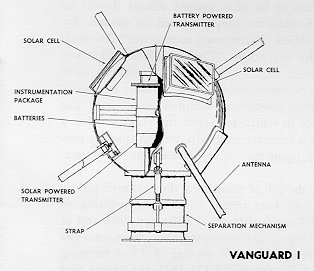
Credit: AmericaSpace website
I remember seeing this photograph, or variants of it, in countless books, magazines, etc., from childhood on. Hence, a very nostalgic photograph for me. And now, seeing it for the first time at such high resolution, a very nice photo indeed.
Additionally, per the NSSDCA website, at:
nssdc.gsfc.nasa.gov/nmc/spacecraftDisplay.do?id=VAGT3
"Vanguard Test Vehicle 3 (TV3) was the first U.S. attempt to launch a satellite into orbit around the Earth. It was a small satellite designed to test the launch capabilities of a three-stage launch vehicle and study the effects of the environment on a satellite and its systems in Earth orbit. It also was to be used to study micrometeor impacts and to obtain geodetic measurements through orbit analysis. The IGY Vanguard satellite program was designed with the purpose of launching one or more Earth orbiting satellites during the International Geophysical Year (IGY).
At launch on 6 December 1957 at 16:44:34 UT at the Atlantic Missile Range in Cape Canaveral, Florida, the booster ignited and began to rise but about 2 seconds after liftoff, after rising about a meter, the rocket lost thrust and began to settle back down to the launch pad. As it settled against the launch pad the fuel tanks ruptured and exploded, destroying the rocket and severely damaging the launch pad. The Vanguard (Vanguard 1A) satellite was thrown clear and landed on the ground a short distance away with its transmitters still sending out a beacon signal. The satellite was damaged, however, and could not be reused. It is now on display at the Smithsonian Air and Space Museum.
[airandspace.si.edu/collection-objects/satellite-vanguard-...
Credit: NASM website]
The exact cause of the accident was never determined, presumably it was due to a fuel leak between the fuel tank and the rocket engine, possibly due to a loose connection in a fuel line or low fuel pump inlet pressure allowing some of the burning fuel in the thrust chamber to leak back into the fuel tank."
Additional excellent & pertinent Vanguard reading:
www.spaceflighthistories.com/post/vanguard
Credit: “SPACEFLIGHT HISTORIES” website
And:
www.drewexmachina.com/2017/12/06/vanguard-tv-3-americas-f...
Credit: Andrew LePage/Drew Ex Machina website
Finally…interesting:
www.collectspace.com/ubb/Forum14/HTML/000241.html
Credit: collectSPACE website
During World War II, both Great Britain and Germany had experimented with very large glider designs (the Hamlicar and Gigant, respectively) capable of carrying tanks. Though glider assaults had varied results during the war, the US Air Force briefly considered resurrecting the idea in 1948, and commissioned Chase Aircraft to build a large glider, the XCG-20 Avitruc. The XCG-20 was of all-metal construction, with a fully-equipped flight deck and a rear-mounted loading ramp for vehicles to be driven directly into the fuselage. The USAF abandoned the idea of glider assaults soon after the first XCG-20 was completed, but Chase had anticipated this: through the simple installation of two propeller-driven engines, the XCG-20 became the XC-123. This itself was considered only an interim design, as the XC-123A had four turbojet engines, becoming the first all-jet transport aircraft.
The USAF rejected the XC-123A, as it was found to have poor performance and short range, owing to the thirsty jets of the early 1950s. However, the piston-engined XC-123 showed promise, and the USAF ordered it into production in 1953. Production was delayed due to Chase Aircraft being acquired by Kaiser, who in turn sold the design to Fairchild Aircraft, who would produce it as the C-123B Provider.
The C-123 was considered a supplemental aircraft to the C-119 Flying Boxcar already in service and the soon-to-be-deployed C-130 Hercules. It had better single-engine performance than the C-119, and acquired a reputation for reliability, rugged design, simple maintenance, and the ability to land almost anywhere. A small number were converted to C-123J standard, with ski landing gear for operations in Antarctica and Greenland, and experiments were even made to convert it to an amphibian. Nevertheless, the number of C-123s in service were small compared to other types, and the C-130 began replacing it beginning in 1958.
As the United States involved itself more in the Vietnam War, one major advantage of its Viet Cong and North Vietnamese Army adversaries was the very jungle of Vietnam itself, which provided ready-made cover and camouflage from American air units. In an attempt to deprive the VC/NVA of jungle cover in known concentration areas, the USAF converted a number of C-123s to UC-123 standard, with spraying equipment for the pesticide Agent Orange. Under Operation Ranch Hand, UC-123s were among the first USAF aircraft deployed to Vietnam, and the first USAF aircraft lost in combat was a UC-123B. Spraying Agent Orange was very dangerous work, as it involved flying low and slow over hostile territory; it would not be until after the Vietnam War was over that it was learned that Agent Orange, used in the concentrated quantity employed in Vietnam, was also a deadly carcinogenic.
Besides their controversial employment as defoilant sprayers, standard C-123s were used as transports and Candlestick flareships, as the C-130 demand was exceeding supply, and the US Army’s CV-2 (later C-8) Caribous were proving the worth of a short-takeoff and landing transport. To improve the Provider’s performance in the “hot and high” conditions of Vietnam, two J85 turbojets were added beneath the wings of the C-123K variant, which became the final Provider variant and the main type used in Vietnam. CIA-flown Providers were used by Air America to clandestinely supply friendly Hmong tribes in Laos and in Cambodia. 54 C-123s were lost in Vietnam, second only to the C-130.
Following the end of American involvement in Vietnam, the C-123Ks were either handed over to South Vietnam or relegated to USAF Reserve and Air National Guard units, from which they were finally withdrawn around 1980. A few UC-123Ks were used to spray insecticides in Alaska and Guam as late as 1982. 11 other air forces used Providers, and the last C-123s were retired from the South Korean Air Force in 2001. 27 are preserved as museum pieces and a few remain in revenue service as “bush” aircraft in Alaska and elsewhere; remaining aircraft in storage were scrapped due to Agent Orange contamination.
This C-123K was originally built as a JC-123B testbed, 54-0580, in 1955. It was redesignated as a standard C-123B in 1960 and assigned to the 824th Combat Support Group at Carswell AFB, Texas, providing logistical support to the B-36 Peacemakers and B-52 Stratofortresses there. In 1967, it was converted to a C-123K and assigned to the 1st Special Operations Wing at Hurlburt Field, Florida, where it was used to train crews operating NC-123K Black Spot surveillance aircraft in Southeast Asia. As the C-123 force was wound down, 55-0580's last duty station was the 731st Tactical Airlift Squadron (Air Force Reserve) at Westover AFB, Massachusetts, and was retired in 1982.
54-0580's career was not quite over yet, however: it was bought by TBM of California and converted to a firefighting aircraft. It flew as Tanker 63 for a few years, but was retired for good in 1989. Its last flight was to Arizona for display at the Pima Air and Space Museum, where it has been ever since.
Pima's firefighting aircraft are displayed on the other side of their World War II hangars, and can be a little hard to get to...unless, of course, you use the handy map that the museum provides when you pay admission. I didn't check the map and originally was trying to shoot pictures through the fence, which meant getting entirely too close to a bush-filled ravine, that was probably the home of various rattlesnakes and Gila monsters. Luckily, I had an attack of common sense, checked the map, and went around to get a much better picture of Tanker 63. Though its markings are a little worn, Tanker 63's bare metal is holding up in the Arizona heat.
Aeroscopia est un musée aéronautique français implanté à Blagnac (Haute-Garonne), près du site AéroConstellation, et accueille notamment deux exemplaires du Concorde, dont l'ouverture a eu lieu le 14 janvier 2015
Le tarmac Sud du musée n'est capable d'accueillir que trois gros appareils. L'installation des appareils fut définitivement terminée après que le premier prototype de l'A400M-180 y fut arrivé le 16 juillet 2015, en dépit de la possibilité de 360 000 euros de TVA.
Concorde, F-BVFC, MSN209 aux couleurs d'Air France
Caravelle 12, F-BTOE, MSN280 aux couleurs d'Air Inter, dernier exemplaire construit
A400M-180, F-WWMT, MSN001 stationné depuis le 16 juillet 2015
La réalisation en 2019 du nouveau tarmac au Nord du musée permet l'accueil d'appareils supplémentaires issus des entreprises locales Airbus et ATR. Le transfert des avions entre le site Airbus "Lagardère" et le musée a lieu sur une semaine, à raison d'un appareil par jour :
ATR 72-600, F-WWEY, MSN098 aux couleurs d'ATR, transféré sur site le 26 août 2019, premier exemplaire du 72 dans sa version 600
Airbus A340-600, F-WWCA, MSN360 aux couleurs d'Airbus, transféré sur site le 27 août 2019, premier exemplaire de l'A340 dans sa version 600
Airbus A320-111, F-WWAI, MSN001 aux anciennes couleurs d'Airbus, transféré sur site le 28 août 2019, premier exemplaire de l'A320 : inauguration le 14 février 1987 en présence de Lady Diana et du Prince Charles, premier vol le 22 février 1987
Airbus A380-800, F-WXXL, MSN002 aux couleurs d'Airbus, transféré sur site le 29 août 2019, second exemplaire de l'A380. Les deux ponts de cet appareil sont visitables, ainsi que le cockpit.
ATR 42-300, F-WEGC, MSN003 aux anciennes couleurs d'ATR, transféré sur site le 30 août 2019, troisième exemplaire du 42. Cet exemplaire est décoré aux couleurs du MSN001 et porte l'immatriculation F-WEGA
Concorde, F-WTSB, MSN201 (ANAE), il s'agit d'un appareil de présérie qui a servi entre autres à transporter plusieurs présidents de la République française.
Airbus A300B4-203, F-WUAB, MSN238 (Airbus Heritage), décoré aux couleurs du prototype, au lieu de MSN001 démantelé. L'intérieur est visitable. Dans la première section des vitrages transparents permettent de voir la structure et les systèmes de l'avion, tandis que dans les sections suivantes sont représentés des aménagements de première classe et VIP.
Super Guppy de l'association Ailes Anciennes Toulouse, l'appareil qui servait au transport des tronçons d'Airbus est exposé porte ouverte, et une passerelle permet l'accès à la soute où un film est projeté. L'ouverture n'a pas été une mince affaire, l'appareil n'ayant pas été ouvert pendant 15 ans. L'aide des anciens mécaniciens de l'avion a été primordiale pour permettre une ouverture en toute sécurité.
Corvette (Airbus)
Falcon 10 no 02, prototype ayant servi aux essais du turboréacteur Larzac (Ailes Anciennes Toulouse)
Fouga Magister (AAT)
Gazelle prototype (AAT)
Mirage III C (AAT)
Nord 1100 (AAT)
Lockheed F-104G (AAT)
MiG-15 (AAT)
MS.760 Paris (AAT)
Vought F-8E(FN) Crusader et son réacteur (AAT)
Alouette II Marine (AAT)
Cessna Skymaster (AAT)
Fairchild Metro, ancien avion de Météo-France (AAT)
HM-293, de Rodolphe Grunberg
Chagnes MicroStar, avion de construction amateur, version biréacteur de Rutan VariViggen (AAT)
Saab J35OE Draken (AAT)
Aeroscopia is a French aeronautical museum located in Blagnac (Haute-Garonne), near the AéroConstellation site, and notably hosts two copies of the Concorde, which opened on January 14, 2015
The south tarmac of the museum can only accommodate three large aircraft. The installation of the devices was definitively finished after the first prototype of the A400M-180 arrived there on July 16, 2015, despite the possibility of 360,000 euros in VAT.
Concorde, F-BVFC, MSN209 in Air France colors
Caravelle 12, F-BTOE, MSN280 in Air Inter colors, last model built
A400M-180, F-WWMT, MSN001 parked since July 16, 2015
The construction in 2019 of the new tarmac north of the museum will accommodate additional aircraft from local Airbus and ATR companies. The transfer of planes between the Airbus "Lagardère" site and the museum takes place over a week, at the rate of one aircraft per day:
ATR 72-600, F-WWEY, MSN098 in ATR colors, transferred to site on August 26, 2019, first copy of the 72 in its 600 version
Airbus A340-600, F-WWCA, MSN360 in Airbus colors, transferred to site on August 27, 2019, first copy of the A340 in its 600 version
Airbus A320-111, F-WWAI, MSN001 in the old Airbus colors, transferred to site on August 28, 2019, first copy of the A320: inauguration on February 14, 1987 in the presence of Lady Diana and Prince Charles, first flight on February 22, 1987
Airbus A380-800, F-WXXL, MSN002 in Airbus colors, transferred to site on August 29, 2019, second copy of the A380. The two decks of this aircraft can be visited, as well as the cockpit.
ATR 42-300, F-WEGC, MSN003 in the old ATR colors, transferred to the site on August 30, 2019, third specimen of the 42. This specimen is decorated in the colors of the MSN001 and bears the registration F-WEGA
Concorde, F-WTSB, MSN201 (ANAE), this is a pre-production aircraft which was used, among other things, to transport several presidents of the French Republic.
Airbus A300B4-203, F-WUAB, MSN238 (Airbus Heritage), decorated in the colors of the prototype, instead of dismantled MSN001. The interior can be visited. In the first section transparent glazing allows to see the structure and systems of the aircraft, while in the following sections are shown first class and VIP fittings.
Super Guppy from the Ailes Anciennes Toulouse association, the aircraft which was used to transport the Airbus sections is on display with the door open, and a gangway allows access to the hold where a film is shown. Opening was no small feat, as the device has not been opened for 15 years. The help of the former mechanics of the aircraft was essential to allow a safe opening.
Corvette (Airbus)
Falcon 10 no 02, prototype used for testing the Larzac turbojet engine (Ailes Anciennes Toulouse)
Fouga Magister (AAT)
Prototype Gazelle (AAT)
Mirage III C (AAT)
North 1100 (AAT)
Lockheed F-104G (AAT)
MiG-15 (AAT)
MS.760 Paris (AAT)
Vought F-8E (FN) Crusader and its engine (AAT)
Alouette II Marine (AAT)
Cessna Skymaster (AAT)
Fairchild Metro, former Météo-France (AAT) aircraft
HM-293, by Rodolphe Grunberg
Chagnes MicroStar, amateur-built aircraft, twin-jet version of Rutan VariViggen (AAT)
Saab J35OE Draken (AAT)
Nearly 1,000 Students to Participate in WSSU Commencement on May 15
WINSTON-SALEM, NC -- Christina Wareâs story is one of the many inspiring testimonials of the nearly 1,000 undergraduate and graduate students from near and afar who are expected to participate in Winston-Salem State Universityâs commencement ceremony on Friday, May 15, at 9:45 a.m., at Bowman Gray Stadium, 1250 South Martin Luther King, Jr. Drive.
Academy Award-winning recording artist, activist and actor Common will be the keynote speaker. There are no guest limits or ticket requirements for the ceremony.
It is conceivable that Wareâs story of work ethic, undeniable spirit and enthusiasm encapsulates the sentiment of her graduating 2015 classmates.
Ware, 43, of Winston-Salem, is quite active on and off campus as a mentor to other students, a member of the non-traditional student organization, the first president of Epsilon Chapter 130 of Tau Sigma National Honor Society at WSSU, a wife and proud mother of two. She is also legally blind. She wants to blaze trails, set examples and raise the bar for others with disabilities.
âIn 2007, I lost my eyesight. After a six-month pity party, I decided to continue my education and make a difference for others. Since 2008, I have spent every day of my life proving to society that having a disability does not mean we are weak. I am now an advocate for persons with disabilities,â Ware, a business major, said, "We are not handicapped, we are handy capable!"
Ware, who can be described as always pleasant and having an unlimited enthusiasm for life, says every day alive is like Christmas. She demands to be treated like everyone else and has been noted to say, âI may physically fall, but mentally I can get back up and pull a 4.0 semester.â After graduation she wants to start a Kosher/Halal foods business and become active on community boards.
The China Connection
From the City of Harbin, the capital and largest city of the Heilongjiang province of the People's Republic of China, WSSU Master of Arts in the Teaching of English as a Second Language and Applied Linguistics students Yaowen Xing and Chunling Zhang have found a second home at WSSU and in Winston-Salem. They perhaps have come the farthest distance attend the university.
With a population of more than five million people, Harbin is situated in the northeast region of China so close to Russia that only the Songhua River separates the two countries. Nicknamed the Ice City, the average winter temperature is -3.5 °F with annual lows hitting -31.0 °F. Itâs no wonder the students say the warmer weather here in the Piedmont Triad has not been lost in translation with them and itâs one of the things they enjoy.
âWe really love the weather in North Carolina, especially the long summer time, since our hometown is so cold with snow for almost 6 months of the year,â Xing, 30, noted. âWe also love the people at WSSU and the faculty who all are nice and it has been a really good experience.â
Xing and Zhang, 35, are in America as part of a Chinese education immersion program to help exchange the cultures between China and America. They enjoy working as cultural ambassadors to students in both the cultures. The two came to the U.S. in 2013 and have been teaching at Konnoak Elementary school during the early hours and studying and researching later in the day. âComing to America was a dream for me after learning about it through books, movies and music, and my time here it has been amazing,â Xing said.
Zhang, said she didnât know much about WSSU or Historically Black Colleges or Universities (HBCUâs), but after a short time here she knew WSSU would be was special part of life. âI have met many African- Americans who have been friendly and helpful. I now can say I truly have many black friends,â Zhang said. She and Xing have taken advantage of the HBCU experience. They have been often seen attending evening lectures and presentations, sports events, musical and visual arts events. With their WSSU master degrees they will return to China one day in the future to make an impact on teaching and the quality of education there.
The All-In Approach
Olivia N. Sedwick, 21, a political science major from Indianapolis, has taken âthe all-in approach" to her WSSU experience. The current WSSU student government president (SGA), honorâs student and champion athlete, chose WSSU over other schools she could have attended.
Featured in a USA Today article highlighting the HBCU experience released last June, Sedwick is quoted as saying about WSSU, âI fell in love with the school.â She says, âWe talked about things that I had never had the chance to before coming from a predominantly white high school.â
Liking the intellectual and social environment, she was comfortable becoming involved around campus. In her first year, a walk-on athlete for the womenâs track and field team, she was a 2013 CIAA Indoor Womenâs Track and Field All-Conference competitor and the WSSU womenâs shot put record holder until earlier this year, although she never competed in the throws until coming to college. In her second year she served as the sophomore class vice president while also being appointed to serve on many committees throughout the university. In that same year, she was a delegate to the UNC Association of Student Governments (UNCASG), representing WSSU students on a state-wide level. At the end of that year, she became the first African-American female elected senior vice president of UNCASG and served in that capacity for the entirety of her third year while being active as the chief of staff for the WSSU student government association that year also. Toward the end of her term in UNCASG, she decided to run for student body president and has served as the voice of the students for the duration of her last year. With all of her activities, she has maintained a 3.95 GPA throughout her time in college.
Sedwick has been selected as a UNC General Administration Presidential Intern, which begins in July. Upon completion of the prestigious one-year appointment, Sedwick plans to attend Howard University School of Law.
A Drum Major who will March for a Noble Cause
Willie Davis, 22, a social work major from Fayetteville, N.C., who has led WSSUâs Red Sea of Sound Marching Band as a drum major for his senior year, will now march to lead the charge for helping veterans and their families cope with typical and unique challenges of serving in military. Davis will be one of four Cadets with the distinct honor of being commissioned as a 2nd Lieutenant U.S. in the U.S. Army during this yearâs commencement ceremony. Despite that professionally Davis will help vets, military and families with things like dealing with emotions, he said, âI donât think I will be ready for the commissioning part (of commencement) emotionally.â
Readiness for Davis is an understatement. The youngest of three siblings, who was age 10 when his father died, Davis has been an A average student throughout life. He was in the top ten of his high school class and the first generation in his family to attend college. At WSSU, besides maintaining high academic achievement and serving in the U.S. Army ROTC, Davis has been active with the WSSU Band, the University Choir, a Campus Ambassador, a mentor to freshmen students, vice president of the WSSU chapter of Kappa Kappa Psi National Honorary Band Fraternity, a Veterans Helping Veterans Heal intern and a member of Galilee Missionary Baptist Church in Winston-Salem.
After graduation, Davis is going to graduate school at the University of South Carolina. He plans to complete that program in one year and begin his military duties. As a clinical social worker, his responsibilities may range from clinical counseling, crisis intervention, disaster relief, critical event debriefing, teaching and training, supervision, research, administration, consultation and policy development in various military settings. He wants to specialize in helping military veterans who suffer from different traumas such as Post Traumatic Stress Disorder (PTSD), paranoid schizophrenia and other conditions.
Almost ALL the sample photos of this camera do not capture what it is capable of. I took these photos on program mode. Sharpness for the majority of the images is bumped up one notch, but with a sensor this size, it does a nice job of in camera sharpening. This was with the kit lens. Saturation and contrast were both left at default. There may be one or two where I bumped up contrast on the humming bird feeder, but the rest are regular photos strait from program mode. I am convinced that the majority of photos of this camera posted to flickr have HDR set to ON which is the camera default. So it is set to OFF on all the photos which may account for why there is more observed contrast.
This camera is fast. Ive owned the the Epm2, the canon t1i, the GF6 and this is by far my favorite camera. My camera search has after all these years officially ended. This is it.
I will say that when I first looked at the pictures, I looked at them on a dell laptop with a poor Intel graphics card. Even with a nice monitor viewed in windows viewer I was not all moved by the photos. Then I hooked that same external monitor (a dell s2340mc set on movie mode default) on a laptop with a good graphics card.... It looks fantastic. And Im positive its not just the monitor making the pictures look nice. Ive compared the pictures against other cameras. The sensor on this camera is outstanding. Ive compared the Nikon 3200, and several other DSLRs and still prefer this. it keeps good contrast and the black/contrast ratio in my opinion is one of the larger factors in bringing photos to life.
And THANK YOU Sony for NOT programming auto focus to fix on the nearest subject like canon does. I once used a Canon T1i, and that thing focused on everything CLOSE to the subject. It also overexposed everything. In fact that was one of the reasons I looked at this camera. The whole rebel series...even the upper rebels over all these years tend to overexpose everything on almost every mode with the ones Ive used. This one has a very very good metering system. Just overall very impressed. Fast speed. fast autofocus, good contrast ratio (OFF HDR MODE unlike the majority of uploads of this camera to flickr), defiantly a great camera. AND as an added bonus, there are hundreds of INEXPENSIVE lenses, including all the non-MD Minoltas
The Rolls-Royce Griffon engine was designed in answer to Royal Naval specifications for an engine capable of generating good power at low altitudes. Concepts for adapting the Spitfire to take the new engine had begun as far back as October 1939; Joseph Smith felt that "The good big 'un will eventually beat the good little 'un." and Ernest Hives of Rolls-Royce thought that the Griffon would be "a second power string for the Spitfire". The first of the Griffon-engined Spitfires flew on 27 November 1941.
Although the Griffon-engined Spitfires were never produced in the large numbers of the Merlin-engined variants they were an important part of the Spitfire family, and in their later versions kept the Spitfire at the forefront of piston-engined fighter development. This article describes the Griffon-powered Spitfire variants.
The majority of Spitfires from the Mk VIII used C, D and E wing types. Unless otherwise noted, all Griffon-engined Spitfire variants used the strengthened Dunlop AH10019 "four spoke" pattern mainwheels. With the increasing use of hard-surfaced runways in the post-war years, many Spitfires were either manufactured or re-fitted with, larger mainwheels which were of a "three spoke" pattern. These were used on modified undercarriage legs which had reduced "toe-in" for the axles, which reduced tyre scrub.
Also known as the "Universal wing" the new design was standard on the majority of Spitfires built from mid-1942. This wing was structurally modified to reduce labour and manufacturing time plus it was designed to allow mixed armament options, A type, B type or four 20 mm Hispano cannon.
The undercarriage mountings were redesigned and the undercarriage doors were bowed in cross section allowing the legs to sit lower in the wells, eliminating the upper-wing blisters over the wheel wells and landing gear pivot points. Stronger undercarriage legs were raked 2 inches (5.08 cm) forward, making the Spitfire more stable on the ground and reducing the likelihood of the aircraft tipping onto its nose.[2] During production of the Mk VIII and Mk IX, a new undercarriage leg was introduced which had external v-shaped "scissor-links" fitted to the front of the leg; this also led to small changes in the shape of the undercarriage bay and leg fairings. Several versions of the Spitfire, including Mk XIV and Mk XVIII had extra 13 gallon integral fuel tanks in the wing leading edges, between the wing-root and the inboard cannon bay.
The Hispano Mk.II cannons were now belt fed from box magazines allowing for 120 rpg (the Chattelleraul system). The fairings over the Hispano barrels were shorter and there was usually a short rubber stub covering the outer cannon port. Redesigned upper wing gun bay doors incorporated "teardrop" shaped blisters to clear the cannon feed motors and the lower wings no longer had the gun bay heating vents outboard of the gunbays. To provide room for the belt feed system of the cannon, the inner machine gun bays were moved outboard between ribs 13 and 14. As the Spitfire was no longer to be used as a night fighter, the retractable landing lights were no longer fitted.
D Type
These were specifically made for the Photo-Reconnaissance Spitfires, including the PR XIX; no armament was fitted and the "D" shaped leading edges of the wings ahead of the main spar, were converted into integral fuel tanks, each carrying 66 gallons. To avoid the expansion of fuel in hot weather damaging the wing, pressure relief valves, incorporating small external vent pipes, were fitted near the wing tips.
Harrier GR9
The Harrier, informally referred to as the Jump Jet, is the famous family of British-designed military jet aircraft capable of vertical/short take-off and landing (V/STOL) operations. The Harrier family is the only truly successful design of this type from the many that arose in the 1960s.
There are four main versions of the Harrier family: Hawker Siddeley Harrier, British Aerospace Sea Harrier, Boeing/BAE Systems AV-8B Harrier II, and BAE Systems/Boeing Harrier II. The Hawker Siddeley Harrier is the first generation-version and is also known as the AV-8A Harrier. The Sea Harrier is a naval strike/air defence fighter. The AV-8B and BAE Harrier II are the US and British variants respectively of the second generation Harrier aircraft. Between 1969 and 2003, 824 Harrier variants were delivered, including remanufactured aircraft.
Historically the Harrier was developed to operate from ad-hoc facilities such as car parks or forest clearings, avoiding the need for large air bases vulnerable to tactical nuclear weapons. Later the design was adapted for use from aircraft carriers.
Following an approach by the Bristol Engine Company in 1957 that they were planning a directed thrust engine, Hawker Aircraft came up with a design for an aeroplane that could meet the NATO specification for a "Light Tactical Support Fighter". The resultant Hawker P.1127 was ordered as a prototype and flew in 1960.
Development continued with nine evaluation aircraft, the Hawker Siddeley Kestrel; These started flying in 1964 and were assessed by the "Tri-partite Evaluation Squadron" which consisted of British, US and German pilots, and several flew and are preserved in the United States. The RAF ordered a modified P.1127/Kestrel as the Harrier GR.1 in 1966, with most converted to GR.1A and ultimately GR.3 status in the 1970s with more powerful engines. These and new-build GR3s operated with the RAF until 1994, and a number survive in museums around the world as well as frequent use as 'gate guards' at MoD establishments.
The British Aerospace Sea Harrier is a naval V/STOL jet fighter, reconnaissance and attack aircraft, a development of the Hawker Siddeley Harrier. The first version entered service with the Royal Navy's Fleet Air Arm in April 1980 as the Sea Harrier FRS.1, and was informally known as the 'Shar'. The upgraded Sea Harrier FA2 entered service in 1993. It was withdrawn from Royal Navy service in March 2006. The Sea Harrier FRS Mk.51 remains in active service with the Indian Navy.
The Harrier was extensively redeveloped by McDonnell Douglas and British Aerospace (now parts of Boeing and BAE Systems respectively), leading to the Boeing/BAE Systems AV-8B Harrier II. This is a family of second-generation V/STOL jet multi-role aircraft, including the British Aerospace-built Harrier GR5/GR7/GR9, which entered service in the mid-1980s. The AV-8B is primarily used for light attack or multi-role tasks, typically operated from small aircraft carriers. Versions are used by several NATO countries, including the Spanish and Italian Navies, and the United States.
The BAE Systems/Boeing Harrier II is a modified version of the AV-8B Harrier II that was used by the RAF and the Royal Navy until December 2010, when they were all retired from operational service due to defence cuts in favour of maintaining the remaining Tornado fleet, and stored serviceable at RAF Cottesmore. At the end of November 2011, the UK Government announced the sale of 72 remaining Harrier Airframes to the US Marine Corps for spares to support their AV-8B fleet, with the remaining two others being allocated to museums.
Baltimore the Tug Boat at the Baltimore Museum of Industry in Baltimore, MD on February-3rd-2022.
Baltimore is a preserved steam-powered tugboat, built in 1906 by the Skinner Shipbuilding Company of Baltimore, Maryland. She is formerly the oldest operating steam tugboat in the United States, but at present does not hold an operating license issued by the US Coast Guard, so is unable to leave her dock at the Baltimore Museum of Industry on Key Highway, Baltimore. Her hull is not capable of operating on open water. Baltimore was built and operated as a harbor inspection tug, capable of acting as a municipal tugboat for city barges, as well as an official welcoming vessel and VIP launch, an auxiliary fireboat, and as a light icebreaker.
She was declared a National Historic Landmark in 1993,and is part of the Baltimore Museum of Industry. The Baltimore and Chesapeake Steamboat Co., a nonprofit organization, was established to maintain the tugboat.
Baltimore is equipped with a compound reciprocating steam engine, fed by a Scotch marine boiler. Hull construction is rivetted iron, with a wooden deckhouse. The 84.5 feet (25.8 m) wrought iron hull has proven to be more durable than steel or wood. Displacement measures 81 gross tons and 55 net tons. The hull form is typical for its time, with an upright stem, moderate sheer and elliptical stern. Bulwarks are vertical about the stern rather than inwardly-sloped as in more modern designs.
Boiler
The boiler was a replacement for the original, fitted in 1922, but is similar to the original. The cylindrical boiler measures 9.5 feet (2.9 m) by 10.25 feet (3.12 m), with two Morrison furnaces connecting to a combustion chamber at the rear. The fire tubes pass from the back to the front of the boiler. Exhaust passes through an annular steam dryer/superheater on its way to the smokestack. Originally designed to burn coal, the boiler was converted to oil in 1957. The boiler has since been converted back to coal and the original coal bunkers restored by the Baltimore Museum of Industry as part of their conservation and restoration work. Steam pressure as designed was 150 psi (1,000 kPa), however it is limited to 115 psi (790 kPa) by the boiler rating.
Engine
The tug is powered by a compound double-acting, vertical-inverted steam reciprocating engine, a common type for tugboats. A 12 inches (30 cm) high-pressure cylinder operates at 150 psi (1,000 kPa) (now 115 psi (790 kPa)), while a 25 inches (64 cm) low-pressure cylinder takes the high-pressure cylinder's exhaust at 17psi. Both cylinders have a stroke of 22 inches (56 cm), offset by 90 degrees to keep the engine from being stuck on center. A manual jacking gear acts as a further measure to prevent sticking on center. Stephenson valve gear permits reversing, aided by a steam reversing engine or ram to adjust eccentric rods. The propeller has a diameter of 6.75 feet (2.06 m) with a pitch of 8.66 feet (2.64 m).
Auxiliaries and pumps
Baltimore has a rotative duplex donkey pump, duplex feed pump, duplex sanitary pump and a centrifugal circulating pump. The pump system provides a moderate fire fighting capability through two hose standpipes on top of the pilothouse. Piping runs to each compartment allow water to be forced out through air pressure in the event of flooding.
A 5.5 kW Westinghouse dynamo provides electrical power, driven by an American Blocwer steam engine at 500 RPM. A Pyle National 5 kW reserve generator was installed in 1957. The electrical system was unusual in 1906, and was fitted when the yard was able to build the tug for substantially less than the estimated cost.
Superstructure
The full-length deckhouse is built of Georgia pine, with a similarly constructed pilothouse on top, set slightly back from the front of the deckhouse. Both are sheathed with tongue-and-groove planking. Windows are sash units designed to drop into self-draining metal pockets in the bulkheads. A saloon fills the front of the deckhouse, finished with oak match board. Aft of a bulkhead a companionway ladder leads to the pilothouse. The middle of the deckhouse covers the boiler and engine room spaces. The rear of the deckhouse contains the galley, provided with a Shipmate coal-burning stove. The deckhouse ends at toilets, officers to port and crew to starboard.
The pilothouse has an elliptical forward face and a flat rear. A steam radiator provides heat, and a ladder provides access to the pilothouse roof. The large wheel dominates the house, its size dictated by the entirely manual steering gear, an anachronistic feature for the time. Voice pipes run to the engine room and saloon. Bells provide additional communication to the engine room. Whistles are fitted for signals to ships and shore.
A 20 feet (6.1 m) Kallenweller metal lifeboat for eleven people is carried on chocks above the engine room skylight on the deckhouse, lifted by pipe davits.
History
Baltimore acted as a general-purpose harbor vessel, taking on roles as needed in her capacity as a representative of the city. The tug took on school tours, carried VIPs and attended ceremonies. On one occasion in 1922, a newly launched ship capsized onto Baltimore, damaging her pilothouse. The city took advantage of the repair period to replace Baltimore's boiler.
In her capacity as an official welcoming vessel for the City of Baltimore, Baltimore met the German unarmed merchant submarine Deutschland on her first voyage to America, prior to the United States' entry into World War I. Baltimore and the city quarantine tug Thomas F. Timmins patrolled the vicinity of Deutschland's berth to ensure American neutrality.
In 1956 the Baltimore Harbor Board was dissolved and its assets, including Baltimore, transferred to the Maryland Port Authority. In 1963 the state sold Baltimore to Alexander Luckton, Jr., owner of Baltimore's Poe Bookstore. Luckton proposed to use Baltimore as a tow vessel for a barge carrying 100,000 books bound for Puerto Rico. With the failure of Luckton's health the project was called off and Baltimore was sold to the Harbor Towing Company of Baltimore, which in turn sold her the same year to Samuel F. and Joanna J. DuPont, who had her repaired and certified as a steam yacht. In 1979 Baltimore sank at her dock on the Sassafras River in fifteen feet of water.In 1981 DuPont offered the tug to the Baltimore Museum of Industry. After several tries the tug was raised, and has been undergoing repair and conservation ever since.In 2009 the project was awarded federal funding for further restoration work, and additional funding in 2011 through a Maryland Heritage Areas Authority grant.
Baltimore was listed on the National Register of Historic Places and Made a National Historic Landmark on November-4th-1993.
The rise of the Sforza Castle
Originally from Romagna, Francesco Sforza was an immensely capable military leader as well as an astute politician. Having previously been hired to defend the city by Filippo Maria Visconti, he successfully laid siege to Milan and was welcomed by the populace as a liberator. On the 25th March 1450, Sforza and his wife Bianca Maria Visconti were hailed as the rulers of Milan.
Once in power, Francesco Sforza immediately set to work building additions to the Visconti Castle. Knowing the hatred the Milanese had for the building, he justified its reconstruction on the basis of a desire to beautify the city while defending it from outside enemies.
Coherently with this line of reasoning, in 1452, he set a civil engineer, the Florentine Antonio Averulino, known as il Filarete, to work alongside the military engineers, Giovanni da Milano, Jacopo da Cortona and Marcoleone da Nogolarolo. Averulino was tasked with designing the façade on the side of the city and the high central tower that rose above the castle gate. The Tuscan architect, however, was soon dismissed and the project was headed by Bartolomeo Gadio, a military architect who had the trust of the Sforzas and who had taken up the post of fortress commissioner for the duchy in the same year. The original plans for the façade were modified by Gadio to include two massive round corner towers covered in diamond shaped Serizzo stone that was more resistant to the artillery of the time. On the other side of the castle he also fortified and extended the “Ghirlanda”, a pre-existing Visconti era wall, which together with its two corner towers and a covered road, constituted the northern defences.
The efforts to complete and embellish the castle were intensified under the rule of Francesco Sforza's successor. In 1468 Galeazzo Maria, the first in line to the title, moved into the castle together with his court and spouse, Bona di Savoia, the sister-in-law of King Louis XI of France. In a matter of just a few years the Rocchetta Keep and the Ducal Courtyard were completed, the castle rooms frescoed and the Ducal Chapel decorated.
At this time the Castle was composed of the buildings that surrounded the capacious Courtyard of Arms on the side of the city, and the Ducal Apartments and fortified Rocchetta Keep towards the park.
NEOBALLS / ZEN MAGNETS - Neodymium Magnetic Balls (@4205) - Starcraft II's Massive Thor
This is my most complex and largest build to date.
It was designed in parts: Cockpit body, then legs, then arms, then rear guns. Then I had to redesign parts when it came time to assemble it together because of incorrect bonding assumptions and misalignment of magnet fields.
Experimented with x-beam coupled bonds to get the maximum lateral strength with reinforcements on the sides. This proved to be very string. Created a X-Beam using similar methods producing a very strong leg structure. It was capable of support the entire weight of the cockpit body w/o a problem. Had to redesign the leg to cockpit body mount point from the earlier concept because the bond was not completely coupled.
Next up were the arm/guns ... the weight was too much for the cockpit body to support so I fashioned a pair of lego-platforms for them to rest on and take the weight off of the central body.
Finally ... the rear guns ... these were a challenge in that their original mount point design had to be reworked also to make them fit correctly into the rear of the cockpit body. I changed the mount points on the guns to fit the space on both sides and added a few support balls to improve the mount point bonds. I was very surprised how they were balanced and supported only by two point sections to the body. The guns stayed in place for a small series of photos.
The design flaw was in the side bonds of the beam to the legs. The coupled field held nicely for a short amount of time and would have held if it didn't have the weight of the rear guns to support. When they were standing upright and straight, all was good. As soon as I attempted to move the platform forward (to take a video), the rear guns tilted slightly backwards and and that was the end of the leg to body support bonds ... and created the dreaded implosion.
The rear gun weight caused the entire central body section to rotate backwards and fall back on the rear guns ... taking the arms in the process. Perhaps I should have created a Lego-support structure for the rear guns to remove the pendulum force backwards ... but that would have created another view blocker like the side Lego-platforms obstructed the view of the legs and feet. Not sure if I can recreate it for a rotational video ... this took over a week (on/off to design and assemble).
Overall ... I was very happy with the result ... hope I captured enough detail to warrant some visual recognition as a Starcraft II Thor reproduction/interpretation.
This was design and built for the Zen Magnets Contest 26: The Massive Thor
www.zenmagnets.com/blog/26-the-massive-thor/
I tried to document the info for this super complex build (below) accompanied by associated pics in this set
www.flickr.com/photos/tend2it/sets/72157632920071597/
Starcraft II Thor Magnet Count and Detail Talley
======+================
Cockpit Body bottom section: (@0520)
(@0217) - Main shape middle core = (2x10⁸) + 1
(@0095) - central bottom layer 1 = (47x2) + 1 w/black parameter
(@0078) - Sides Bottom layer 2 = (2x(22 parallel pair frnt2bck support + 3 red + 4 gold + 10 ring outside black))
(@0028) - Central bottom layer 3 = (2x14) rectangle
(@0032) - Sides bottom layer 3 = (2x((2x5 parallel bridge rectangle to ring) + (6 ring outside))
(@0010) - Central bottom layer 4 = (10 ring) leg waist w/gold
(@0020) - Sides bottom layer 4 = (2x10 ring) coupled over parallel bridge for perpendicular underside support
(@0040) - Central rear Barrel = (4x8 ring w2 red rings) + (2x4 sqr end)
------
Cockpit Body top section (from center out): (@0371)
(@0166) - top layer 1 = (2x83) w/black missle cover + middle sect separator
(@0105) - top layer 2 = ((2x52) + 1) w/black separator, red trim, gold cockpit
(@0083) - top layer 3 = ((2x41) + 1) w/black separator, red trim, gold cockpit
(@0037) - top layer 4 = ((2x18) + 1) w/black separator trim
(@0010) - top layer 5 = (2x5) w/red/black
------
(@0891)
Leg section x2 (@0640 - 12 removed from bottom of @ leg for foot contact pt)
leg internal structure:
(@0384) - columns = 2 x (4x((2x12) + ((2x11) + 2))) top/bottom coupled bonds w/parallel bonds stacked x 4))
(@0096) - side reinforcements = 2x((2x11) + 2) coupled pair along outside edge centers)
(@0032) - ball reinforcements = 2x(2x4 balls are two balls added to 4 ball in 2, 4, 6, 8th positions) - (12 @ bottom)
leg arch structure (connected to one flat leg top face:
(@0128) - (4x4 parallel sqr) + (2x(6 + 2)) pointy rings) + (4x4 parallel sqr) + (2x(6 + 2)) pointy rings)
Place the two leg arch structures together to form the leg arch
-------
(@1519) = 1531-12
Leg side panels (@0384)
(@0344) - (2 each leg x (2x(2x43 each side))) w/black outside trim
Knees + Leg detail
(@0040) - (2x(2x(6 + 2) knee w/red sqr) + 2x(4 red sqr top of leg))
-------
(@1903)
Feet x2 (@0242)
(@0184) - (2x((2x7 + 2 1st mid layer) + (2x(2x10 + 1) 2nd mid layer) + ((2x(2x8 + 1) outside layer))
(@0034) - (2x(2x(2x3 + 1 top of toe 2 leg)) + (1 center rear foot 2 leg conn) + (2 x 1 outer rear foot sides 2 leg
conn))
(@0024) - (2x(2x6 rings rear foot heel))
-------
(@2145)
X-Beam waist platform - (@0233 - 19) this part is placed across the center perpendicular to the x-beam leg arch
(@0214) - (2x(2x(18 + 17 + 6 + 3)) + (2x(7 + 2)) + ((8 + 1 front side) + (2x9 rear side)) + ((2 x 3 red front center) +
(2 x 2 red front sides) + (2 red rear)) - (19 removed under rear panel side to fold)
Arm Guns (2 pair per arm w/red + black accents)
(@0380) - (4x((4x9 center core) + (3x((2x7) + 1)) top/sides) + (2x7) middle join))
Shoulder to elbow core w/o reinforcements ((@0174)per arm)
(@0348) - (2 x (top((2x5)+2) + (4x8+2 parallel) + ((2x5)+2) + (2x5) + (2x(2x5)+1) + (2x(2x6)+1) + ((4x7)+2 parallel
mount2gun) + (1 ball center to bridge below 2 ball center to 1 ball) + ((2x6)+1) + ((2x4)+2)bottom)
Shoulder to elbow (per arm, per side)
(@0248) - (2 x (2 x (top 3 + 5 + 5 + 5 + 4 + 5 + 4 + 4 + 5 + (2x7arm2shoulder bridge) + (5 + 3 bottom))
Elbow to gun support (per arm, per side) (@0140 - 18 for outside facing side revamp)
(@0122) - (2 x (2 x (((2x9)+1) + (2x8)) -
Revamp outside facing sides for Z bracket (remove 2x(4 top/4 bottom/2 middle/move center ball down, add 1 ball)
Revamp 2 rear centerballs with red
(@028) - add red design outside facing shoulder 2 elbow
------
(@3485)
Rear Guns x2
Large cannon (@0112 each)
(@0224) - 2 x ((2x(2x15) + (4x(5+2)) + (4x(6 ring)))
Smaller cannon (@0092 each)
(@0184) - 2 x ((2x(2x13) + (4x(4+2)) + (4x(4 ring)))
Gun bridges (@0010 each)
(@0020) - (2 x (4 ring + 6 ring across two cannons)
Gun mounts x2
(@0104) - (2 x ((top (2x4+2) + (2x5+2) parallel to existing + (2x4+2) + (2x5 parallel) + (2x4+2) bottom)
Gun panel x 2 (@0102 each)
(@0204) - (2 x (2x(11 + 10 + 9 + 8 + 7 + 6))
-------
Revamp base
(@4221) subtotal b4 assembly
Assembly mods
-------------
Moved the (@0040) - Central rear Barrel = (4x8 ring w2 red rings) + (2x4 sqr end) below the rear of the body between
the leg mount and cockpit body. Actually used the barrel as a mount point for the rear guns.
Modded Cockpit Body bottom section (mount point):
(@0020) = (2 x (7 + 6 + 5)) = Changed = (@0028) - Central bottom layer 3 = (2x14) rectangle to covert parallel
rectangle to hex parallel center, coupled sides
-------
(@4213) = (@4221 - 8)
Moved central bottom layer x-beam
(@0018) = (2x09 ring) = Changed = (@0020) - Sides bottom layer 4 = shifted it down one row, removed 1 ball on end to form point and pinched outside end fit in center of 6 ball side.
(@4211) = (@4213 - 2)
Removed gold 10 ball ring mount
Changed = (@0010) = Central bottom layer 4 = (10 ring) leg waist w/gold
-------
(@4201) = (@4213 - 10)
Modded Rear Guns
(@0100) = Changed = Rear Gun mounts x2 - removed +2 from top/bottom mount point (2x4+2)=>(2x4)
(@4197) = (@4201-4)
Added extra mount point support bwtween rear gun mounts and rear cockpit body
(@4205) = (@4201+8)
Grand Total! = (@4205)
Royal Marines of 40 Commando and Army Commandos taking part in PROJECT HERMOD LIVEX.
PROJECT HERMOD was a capability demonstration to mark the Defence Integrated Review (IR).
Taking place on RFA Mounts Bay and at Bovington training area, it displayed Multi-Domain Integration (MDI) within Defence as part of a transformation programme.
Trained for rapid worldwide deployment, the troops of 40 Commando are highly skilled, adaptable, and capable of combating a wide range of threats.
The unit are at the forefront of innovation as commandos go back to their roots as raiders from the sea and embrace new technologies to help their specialised operations around the world.
Since its formation in 1942, 40 Commando has served in every major British conflict, playing a pivotal role in several notable campaigns and operations.
Photos: LPhot Phil Bloor
Credit: UK Ministry of Defence 2021
Built by the Schiffswerks Rieherst company in Hamburg, the Umbria was launched on December 30th 1911 with the name of Bahia Blanca. It was a large freighter by that time, 150 meters long, with a power capable of providing a speed of 14 knots that could carry 9,000 tons of cargo and up to 2,000 passengers. In 1912 it began operating the Hamburg-America line doing different jobs between Europe and Argentina until the outbreak of World War I, when it was based in Buenos Aires. In 1918 the ship was acquired by the Argentinian government and it was not until 1935 when the ship was taken over by the Italian government and renamed again: the Umbria. From that moment its trips were to transport troops and during the following two years carried several thousand soldiers to the Italian colonies in East Africa.
The loss of the Umbria
In May 1940, when Italy was still neutral in World War II, the Umbria was secretly loaded with 360,000 bombs between 15 kg and 100 kg, 60 boxes of detonators, building materials and three Fiat Lunga cars, carrying a total 8,600 tons of weapons towards the East Africa. The explosives had destination Massawa and Assab, Eritrea, that was Italian colony by then, and the rest of the cargo was heading different locations in Asia. Italy's entry into the war was imminent and this shipment was destined to the defense of the colonies against the Allies and to the possible expansion of its African territories.
On 3rd June 1940 the Umbria reached Port Said, northern Egypt, where loaded with 1,000 tons of coal and water in a movement to fool the Allies, trying to look like a harmless freighter. The port, controlled by the Royal Navy, and its authorities allowed the ship enter on the Red Sea three days after arrival. The British delayed the departure of the Umbria knowing that Italy's entry into the war was imminent and that the cargo of Umbria had devastating power that sooner or later would be used against the Allies and why not, to get a great load to fight fascism. But Italy, as a neutral country that it was, had every right to transport weapons much like any other cargo to its colonies.
Having met the deadline to be retained, the Umbria crossed the Suez Canal on June 6th but with the escort of the HMS Grimsby. The importance and destructive capacity of the cargo required it. Three days later the Umbria entered in Sudan waters and the HMS Grimsby ordered the Umbria captain to anchor on Wingate Reef under the pretext of searching for contraband. Moments later the British warship HMS Leander arrived with a group of 20 sailors who boarded the Umbria. After thoroughly searching the ship and finding nothing, the captain ordered the British troops to remain the night aboard the Umbria.
The next morning Lorenzo Muiesan, Umbria captain, was in his cabin listening to the radio when Mussolini announced the entry of Italy into the World War II. Hostilities would begin at midnight of that day. Muiesan, a very patriotic captain with long experience, was the only one in the area who had heard the news and knew immediately that both Umbria and the burden would be used by the Allies against their own country. He had no option to disable both. In a move of extraordinary intelligence, as the hours passed retained by the British who did not yet know that Italy was officially the enemy, the captain ordered his crew conducting a rescue simulation... that was more real than the British thought. This maneuver, which the English soldiers agreed as they believed it would serve to further delay the departure of the Umbria. While the Italians occupied the lifeboats, the chief engineers, following Muiesan´s orders, opened all the valves and drown the ship to the bottom of the reef. With the crew safe, the British only had time to get on their ship and watch the freighter slid slowly.
When the captain of HMS Grimsby asked why he had done that Muiesan confirmed the declaration of war from Italy to Britain. The next day Muiesan and the rest of Umbria crew departed detainees to India, where they spent four years in prison.
CARGO:
The Umbria was carrying 360,000 individual aircraft bombs ranging in size from 15, 50 and 100 kg. The vessel also carried a large quantity of fuses, ammunition and detonators as well as other traditional cargo. The captain knew these bombs would be confiscated and used by the enemy against his country should they ever discover them which was why he made the call to sink the ship.
The Umbria had sailed in June 1940 with 6,000 tons of bombs, 60 boxes detonators, explosives, weapons and three Fiat 1100 Lunga from Genoa via Livorno and Naples in the Suez Canal and on the way via Massaua and Assab to Calcutta.
Northrop Grumman E-2 Hawkeye, an American all-weather, carrier-capable tactical airborne early warning (AEW) aircraft. This twin-turboprop aircraft was designed and developed during the late 1950s and early 1960s by the Grumman Aircraft Company for the United States Navy as a replacement for the earlier E-1 Tracer, which was rapidly becoming obsolete. The aircraft's performance has been upgraded with the E-2B, and E-2C versions, where most of the changes were made to the radar and radio communications due to advances in electronic integrated circuits and other electronics. The fourth version of the Hawkeye is the E-2D, which first flew in 2007. The E-2 was the first aircraft designed to be an AEW aircraft from the outset, as opposed to a modification of an existing airframe, such as the E-3. Variants of the Hawkeye have been in continuous production since 1960, giving it the longest production run of any carrier based aircraft. The E-2 also received the nickname Super Fudd because it replaced the E-1 Tracer Willy Fudd. In recent decades, the E-2 has been commonly referred to as the Hummer because of the distinctive sounds of its turboprop engines, quite unlike that of turbojet and turbofan jet engines. The E-2 and its sister, the C-2 Greyhound, are currently the only propeller airplanes that operate from aircraft carriers. In addition to U.S. Navy service, smaller numbers of E-2s have been sold to the armed forces of Egypt, France, Israel, Japan, Mexico, Singapore and Taiwan.
AMARG (or the Boneyard) is the world's largest aircraft and missile storage and maintenance facility in Tucson, Arizona. I took these pictures during a bus tour in June 2008.
A világ legnagyobb repülőgép és rakéta tároló és karbantartó létesítménye az Arizona állambeli Tucson-ban. A hely csak idegenvezetett autóbuszos túrán tekinthető meg, mi is így jártunk itt 2008. júniusban.
The 309th Aerospace Maintenance and Regeneration Group (AMARG), often called The Boneyard, is a United States Air Force aircraft and missile storage and maintenance facility in Tucson, Arizona, located on Davis-Monthan Air Force Base. AMARG takes care of more than 4,400 aircraft on 11 km2, which makes it the largest aircraft storage and preservation facility in the world. AMARG holds aircarft for future use, sales to friendly governments, or parts reclamation. Stored aircraft go through the following treatments: removing guns, ejection seat charges, or classified hardware. Draining its fuel system. Sealing it from dust, sunlight, and high temperatures by using high tech vinyl plastic compounds, Spraying an opaque white color on it, or using simple garbage bags. AMARG is a controlled-access site, and is off-limits to anyone not employed there without the proper clearance. The only access to AMARG for non-cleared individuals is via a bus tour.
Northrop Grumman E-2 Hawkeye, an American all-weather, carrier-capable tactical airborne early warning (AEW) aircraft. This twin-turboprop aircraft was designed and developed during the late 1950s and early 1960s by the Grumman Aircraft Company for the United States Navy as a replacement for the earlier E-1 Tracer, which was rapidly becoming obsolete. The aircraft's performance has been upgraded with the E-2B, and E-2C versions, where most of the changes were made to the radar and radio communications due to advances in electronic integrated circuits and other electronics. The fourth version of the Hawkeye is the E-2D, which first flew in 2007. The E-2 was the first aircraft designed to be an AEW aircraft from the outset, as opposed to a modification of an existing airframe, such as the E-3. Variants of the Hawkeye have been in continuous production since 1960, giving it the longest production run of any carrier based aircraft. The E-2 also received the nickname Super Fudd because it replaced the E-1 Tracer Willy Fudd. In recent decades, the E-2 has been commonly referred to as the Hummer because of the distinctive sounds of its turboprop engines, quite unlike that of turbojet and turbofan jet engines. The E-2 and its sister, the C-2 Greyhound, are currently the only propeller airplanes that operate from aircraft carriers. In addition to U.S. Navy service, smaller numbers of E-2s have been sold to the armed forces of Egypt, France, Israel, Japan, Mexico, Singapore and Taiwan.
AMARG (or the Boneyard) is the world's largest aircraft and missile storage and maintenance facility in Tucson, Arizona. I took these pictures during a bus tour in June 2008.
A világ legnagyobb repülőgép és rakéta tároló és karbantartó létesítménye az Arizona állambeli Tucson-ban. A hely csak idegenvezetett autóbuszos túrán tekinthető meg, mi is így jártunk itt 2008. júniusban.
The 309th Aerospace Maintenance and Regeneration Group (AMARG), often called The Boneyard, is a United States Air Force aircraft and missile storage and maintenance facility in Tucson, Arizona, located on Davis-Monthan Air Force Base. AMARG takes care of more than 4,400 aircraft on 11 km2, which makes it the largest aircraft storage and preservation facility in the world. AMARG holds aircarft for future use, sales to friendly governments, or parts reclamation. Stored aircraft go through the following treatments: removing guns, ejection seat charges, or classified hardware. Draining its fuel system. Sealing it from dust, sunlight, and high temperatures by using high tech vinyl plastic compounds, Spraying an opaque white color on it, or using simple garbage bags. AMARG is a controlled-access site, and is off-limits to anyone not employed there without the proper clearance. The only access to AMARG for non-cleared individuals is via a bus tour.
en.wikipedia.org/wiki/Blackburn_Buccaneer
en.wikipedia.org/wiki/Yorkshire_Air_Museum#Collection
The Blackburn Buccaneer is a British carrier-capable attack aircraft designed in the 1950s for the Royal Navy (RN). Designed and initially produced by Blackburn Aircraft at Brough, it was later officially known as the Hawker Siddeley Buccaneer when Blackburn became a part of the Hawker Siddeley Group, but this name is rarely used.
The Buccaneer was originally designed in response to the Soviet Union introducing the Sverdlov class of light cruisers. Instead of building a new class of its own cruisers, the Royal Navy decided that it could address the threat posed via low-level attack runs performed by Buccaneers, so low as to exploit the ship's radar horizon to minimise the opportunity for being fired upon. The Buccaneer could attack using nuclear weapons or conventional munitions. During its service life, it would be modified to carry anti-ship missiles, allowing it to attack vessels from a stand-off distance and thus improve its survivability against modern ship-based anti-aircraft weapons. The Buccaneer performed its maiden flight in April 1958 and entered Royal Navy service during July 1962.
Initial production aircraft suffered a series of accidents, largely due to insufficient engine power; this shortfall would be quickly addressed via the introduction of the Buccaneer S.2, equipped with more powerful Rolls-Royce Spey jet engines, in 1965. The Buccaneer S.2 would be the first Fleet Air Arm (FAA) aircraft to make a non-stop, unrefuelled crossing of the Atlantic Ocean. During the 1960s and 1970s, the Royal Navy standardised the air wings operating from their carriers around the Buccaneer, Phantom, and the Fairey Gannet. The Buccaneer was also offered as a possible solution for the Royal Air Force (RAF) requirement for a supersonic interdictor carrying nuclear weapons. It was rejected as not meeting the specification in favour of the more advanced BAC TSR-2 bomber, but this aircraft would be cancelled largely due to its high cost, then its selected replacement, the General Dynamics F-111K, would also be cancelled. The Buccaneer was purchased as a TSR-2 substitute and entered RAF service during October 1969.
The Royal Navy retired the last of its large aircraft carriers in February 1979; as a result, the Buccaneer's strike role was transferred to the British Aerospace Sea Harrier and the Buccaneers were transferred to the RAF. After a crash in 1980 revealed metal fatigue problems, the RAF's fleet was reduced to 60 aircraft while the rest were withdrawn. The ending of the Cold War in the 1990s led to military cutbacks that accelerated the retirement of Britain's remaining Buccaneers; the last of the RAF's Buccaneers were retired in March 1994 in favour of the more modern Panavia Tornado. The South African Air Force (SAAF) was the only export customer for the type. Buccaneers saw combat action in the first Gulf War of 1991, and the lengthy South African Border War.
Following the end of the Second World War, the Royal Navy soon needed to respond to the threat posed by the rapid expansion of the Soviet Navy. Chief amongst Soviet naval developments in the early 1950s was the Sverdlov-class cruiser; these vessels were classifiable as light cruisers, being fast, effectively armed, and numerous. Like the German "pocket battleships" during the Second World War, these new Soviet cruisers presented a serious threat to the merchant fleets in the Atlantic. To counter this threat, the Royal Navy decided not to use a new ship class of its own, but instead introduce a specialised strike aircraft employing conventional or nuclear weapons. Operating from the Navy's fleet carriers, and attacking at high speed and low level, it would offer a solution to the Sverdlov problem.
A detailed specification was issued in June 1952 as Naval Staff Requirement NA.39, calling for a two-seat aircraft with folding wings, capable of flying at 550 knots (1,020 km/h; 630 mph) at sea level, with a combat radius of 400 nautical miles (740 km; 460 mi) at low altitude, and 800 nautical miles (1,500 km; 920 mi) at higher cruising altitudes. A weapons load of 8,000 pounds (3,600 kg) was required, including conventional bombs, the Red Beard free-fall nuclear bomb, or the Green Cheese anti-ship missile. Based on the requirement, the Ministry of Supply issued specification M.148T in August 1952, and the first responses were returned in February 1953. Blackburn's design by Barry P. Laight, Project B-103, won the tender in July 1955. For reasons of secrecy, the aircraft was called BNA (Blackburn Naval Aircraft) or BANA (Blackburn Advanced Naval Aircraft) in documents, leading to the nickname of "Banana Jet". The first prototype made its maiden flight from RAE Bedford on 30 April 1958.
The first production Buccaneer model, the Buccaneer S.1, entered squadron service with the Fleet Air Arm (FAA) in January 1963. It was powered by a pair of de Havilland Gyron Junior turbojets, producing 7,100 pounds-force (32,000 N) of thrust. This mark was somewhat underpowered, and as a consequence, could not achieve take off if fully laden with both fuel and armament. A temporary solution to this problem was the "buddy system": aircraft took off with a full load of weaponry and minimal fuel, and would subsequently rendezvous with a Supermarine Scimitar that would deliver the full load of fuel by aerial refuelling. The lack of power meant, however, that the loss of an engine during take-off, or landing at full load, when the aircraft was dependent on flap blowing, could be catastrophic.
The long-term solution to the underpowered S.1 was the development of the Buccaneer S.2, fitted with the Rolls-Royce Spey engine, which provided 40% more thrust. The turbofan Spey also had significantly lower fuel consumption than the pure-jet Gyron, which provided improved range. The engine nacelles had to be enlarged to accommodate the Spey, and the wing required minor aerodynamic modifications as a result. Hawker Siddeley announced the production order for the S.2 in January 1962. All Royal Navy squadrons had converted to the improved S.2 by the end of 1966. However, 736 Naval Air Squadron also used eight S.1 aircraft taken from storage to meet an extra training demand for RAF crews until December 1970.
Blackburn's first attempt to sell the Buccaneer to the Royal Air Force (RAF) occurred in 1957–1958, in response to the Air Ministry Operational Requirement OR.339, for a replacement for the RAF's English Electric Canberra light bombers, with supersonic speed, and a 1,000-nautical-mile (1,900 km; 1,200 mi) combat radius; asking for an all-weather aircraft that could deliver nuclear weapons over a long range, operate at high level at Mach 2+ or low level at Mach 1.2, with STOL performance. Blackburn proposed two designs, the B.103A, a simple modification of the Buccaneer S.1 with more fuel, and the B.108, a more extensively modified aircraft with more sophisticated avionics. Against a background of inter-service distrust, political issues, and the 1957 Defence White Paper, both types were rejected by the RAF; as being firmly subsonic, and incapable of meeting the RAF's range requirements; while the B.108, which retained Gyron Junior engines while being 10,000 pounds (4,500 kg) heavier than the S.1, would have been severely underpowered, giving poor short-take off performance. The BAC TSR-2 was eventually selected in 1959.
After the cancellation of the TSR-2, and then the substitute American General Dynamics F-111K, the Royal Air Force still required a replacement for its Canberras in the low-level strike role, while the planned retirement for the Royal Navy's aircraft carriers meant that the RAF would also need to add a maritime strike capability. It was therefore decided in 1968 that the RAF would adopt the Buccaneer, both by the purchase of new-build aircraft, and by taking over the Fleet Air Arm's Buccaneers as the carriers were retired. A total of 46 new-build aircraft for the RAF were built by Blackburn's successor, Hawker Siddeley, designated S.2B. These had RAF-type communications and avionics equipment, Martel air-to-surface missile capability, and could be equipped with a bulged bomb-bay door containing an extra fuel tank.
Some Fleet Air Arm Buccaneers were modified in-service to also carry the Martel anti-ship missile. Martel-capable FAA aircraft were later redesignated S.2D. The remaining aircraft became S.2C. RAF aircraft were given various upgrades. Self-defence was improved by the addition of the AN/ALQ-101 electronic countermeasures (ECM) pod (also found on RAF's SEPECAT Jaguar GR.3), chaff and flare dispensers, and AIM-9 Sidewinder capability. RAF low-level strike Buccaneers could carry out what was known as 'retard defence'; four 1,000-pound (450 kg) retarded bombs carried internally could be dropped to provide an effective deterrent against any following aircraft. In 1979, the RAF obtained the American AN/AVQ-23E Pave Spike laser designator pod for Paveway II laser-guided bombs; allowing the aircraft to act as target designators for further Buccaneers, Jaguars, and other strike aircraft. From 1986, No. 208 Squadron RAF, then No. 12 (B) Squadron, replaced the Martel ASM with the Sea Eagle missile.
The Yorkshire Air Museum & Allied Air Forces Memorial is an aviation museum in Elvington, York on the site of the former RAF Elvington airfield, a Second World War RAF Bomber Command station. The museum was founded, and first opened to the public, in the mid 1980s.
The museum is one of the largest independent air museums in Britain. It is also the only Allied Air Forces Memorial in Europe. The museum is an accredited museum under Arts Council accreditation scheme. It is a Member of Friends of the Few (Battle of Britain Memorial), the Royal Aeronautical Society, the Museums Association and the Association of Independent Museums.
The Museum is a registered charity (No. 516766) dedicated to the history of aviation and was also set up as a Memorial to all allied air forces personnel, particularly those who served in the Royal Air Force during the Second World War.
Site
Further information: RAF Elvington
The 20-acre (81,000 m2) parkland site includes buildings and hangars, some of which are listed. It incorporates a 7-acre (28,000 m2) managed environment area and a DEFRA and Environment Agency supported self sustainability project called "Nature of Flight". The museum is situated next to a 10,000 ft runway, which is privately owned.
History
Whilst the Royal Air Force carried on using the runway for aircraft landing and take off training until 1992, the buildings and hangars had long been abandoned. In 1980 Rachel Semlyen approached the owners of "what was then an abandoned and derelict wartime site, with the idea of restoring the buildings and creating a museum". In 1983, a group started clearing the undergrowth and the site was ready to be unveiled as the Yorkshire Air Museum in 1986.
Events
The Museum undertakes several annual events each year within the general attraction / entertainment area as well as educational / academic events for specific audiences, plus several corporate events in association with companies such as Bentley, Porsche, banking, government agencies etc. The unique annual Allied Air Forces Memorial Day takes place in September.
Exhibits
The Museum has over 50 aircraft spanning the development of aviation from 1853 up to the latest GR4 Tornado. Several aircraft including Victor, Nimrod, Buccaneer, Sea Devon, SE5a, Eastchurch Kitten, DC3 Dakota are kept live and operated on special "Thunder Days" during the year. Over 20 historic vehicles and a Registered Archive containing over 500,000 historic artefacts and documents are also preserved at the Museum, which is also the Official Archive for the National Aircrew Association and National Air Gunners Association. It is nationally registered and accredited through DCMS/Arts Council England and is a registered charity.
A permanent exhibition on RAF Bomber Command was opened at the museum by life member, Sir David Jason. In 2010 a new exhibition called "Pioneers of Aviation", and funded by the Heritage Lottery Fund, was opened featuring the lives and achievements of Sir George Cayley, Sir Barnes Wallis, Robert Blackburn, Nevil Shute and Amy Johnson.
Principal on-site businesses include: Restaurant, Retail Shop, Events, Aircraft Operation Engineering Workshops, Archives and Corporate Business Suite. The museum is also a location for TV and film companies.
Building 1 – Airborne Forces Display & No. 609 Squadron RAF Room
Building 2 – Uniform Display
Building 3 – Air Gunners' Exhibition
Building 4 – Archives & Reference Library
Building 5 – Museum Shop
Building 7 – Memorial Garden
Building 8 – Museum HQ, Main Entrance
Building 9 – Against the Odds
Building 10 – Elvington Corporate Room
Building 11 – Museum NAAFI Restaurant
Building 12 – Control Tower
Building 13 – French Officers' Mess
Building 14 – Airmens Billet and Station MT Display
Building 15 – Royal Observer Corp
Building 16 – Signal Square
Building 17 – Hangar T2 Main Aircraft exhibition
Building 18 – Archive & Collections Building
Building 19 – Handley Page Aircraft Workshop
Building 20 – Pioneer of Aviation Exhibition
Collection
Aircraft on display
Pre-World War II
Avro 504K – Replica
Blackburn Mercury – Replica
Cayley Glider – Replica
Mignet HM.14 Pou-du-Ciel
Port Victoria P.V.8 Eastchurch Kitten Replica
Royal Aircraft Factory BE.2c – Replica
Royal Aircraft Factory SE.5a – Replica
Wright Flyer – Replica
World War II
Avro Anson T.21 VV901
Douglas Dakota IV KN353
Fairchild Argus II FK338
Gloster Meteor F.8 WL168
Gloster Meteor NF.14 WS788
Handley Page Halifax III LV907
Hawker Hurricane I – Replica
Messerschmitt Bf 109 G-6 – Replica
Slingsby T.7 Kirby Cadet RA854
Supermarine Spitfire I – Replica
Waco Hadrian 237123
Post World War II
Air Command Commander Elite
Beagle Terrier 2 TJ704
Canadair CT-133 Silver Star 133417
de Havilland Devon C.2 VP967
de Havilland Vampire T.11 XH278
Europa Prototype 001
Mainair Demon
Saunders-Roe Skeeter AOP.12 XM553
Westland Dragonfly HR.5 WH991
Cold War
BAC Jet Provost T.4 XP640
Blackburn Buccaneer S.2 XN974
Blackburn Buccaneer S.2B XX901
British Aerospace Harrier GR.3 XV748
British Aerospace Nimrod MR.2 XV250
Dassault Mirage IIIE 538
Dassault Mirage IVA 45/BR
English Electric Canberra T.4 WH846
English Electric Lightning F.6 XS903 which arrived during June 1988.
Fairey Gannet AEW.3 XL502
Gloster Javelin FAW.9 XH767
Handley Page Victor K.2 XL231
Hawker Hunter FGA.78 QA10
Hawker Hunter T.7 XL572
Panavia Tornado GR.1 ZA354
Panavia Tornado GR.4 XZ631
Ground vehicles
Second World War
Thompson Brothers Aircraft Refueller
1938 Ford Model E
1940 "Tilly" Standard 12 hp Mkl RAF Utility Vehicle
1941 Chevrolet 4x4 CMP
1942 Austin K2 NAAFI Wagon
1942 Thornycroft ‘Amazon’ Coles Crane
Cold War
1947 Commer one and a half deck airport coach
1949 Citroen 11BL
1948 David Brown VIG.2 Aircraft Tractor
1949 David Brown VIG.3 Aircraft Tractor
1951 David Brown GP Airfield Tractor
1953 Alvis Saracen 12ton APC
1953 Austin Champ Cargo 4x4 General Purpose Vehicle
1956 Green Goddess Self Propelled Pump
1958 Commer Q4 Bikini Fire Pump Unit
1958 Lansing Aircraft Carrier Type Tug
1959 Daimler Ferret ASC MK.2/3/7
1966 Chieftain Main Battle Tank
1970 Douglas P3 nuclear aircraft 25 tonne tug
1971 Pathfinder Fire Engine 35ton (ex. Manchester Airport)
1972 TACR2 Range Rover - 6 wheeled fast response fire unit
1974 GMC 6 wheeled fast response airfield fire truck
1976 Dennis Mercury 17.5 tonne aircraft tug
Pathfinder Fire Engine
***UPDATE*** Tamara and Josh have really been working hard to get their new home up to snuff. They snared this great table for their library sitting area.
A small teddy bear is CAPABLE of anything in my imagination and on the page (including crossing the Egyptian desert on a camel)
is a weekly illustration challenge. A topic is posted every Friday and then participants have all week to come up with their own interpretation
The all new Yuzu Emulator update is now capable of fulling running and playing Pokemon Shield game without any issue and problem. It is full playable with the new DLC, so try it out now.
Pokemon SWSH XCI/NSP ROM: bit.ly/pokeswshyuzupc
Official Yuzu Emulator: yuzu-emu.org/
System Requirements:
CPU: Atleast 4 cores (Higher Core count = better performance)
GPU: atleast GTX 1060 or amd equivalent
RAM: 8GB RAM (16GB is recommended)
Storage: atleast 1TB since Switch games are large in file size
Related Tags:
pokemon sword and shield
pokemon sword and shield the isle of armor
pokemon sword and shield expansion pass
pokemon sword and shield gameplay
pokemon sword and shield yuzu emulator
pokemon sword and shield pc gameplay
pokemon sword and shield dlc download
pokémon sword and shield expansion pass download
pokémon sword and shield pc
pokémon sword and shield the isle of armor download
pokémon sword usa version download xci
pokémon shield usa version download xci
how to download pokemon sword and shield on pc
how to setup pokemon sword and shield on pc
how to play pokemon sword and shield on pc
how to install pokemon sword and shield on pc
how to get pokemon sword and shield on pc
#pokemonswordandshield #pokemonswshexpansionpass #pokemonswordandshielddlc
The Dominion Post photo of the livestock carrier Nada at the Port of Timaru loading some 50,000 sheep and 3000 head of cattle for shipment to Mexico. The ship is capable of holding some 110,000 head of livestock.
LARGEST LIVESTOCK SHIPMENT EVER REMAINS SHROUDED IN MYSTERY
The largest shipment of livestock ever to leave New Zealand remains shrouded in mystery.
While a livestock carrier arrived off Timaru on Tuesday, PrimePort Timaru, livestock brokers and shipping agents refused to discuss the shipment.
The carrier Nada has since docked at the port to begin loading 50,000 sheep and 3000 cattle destined for Mexico for breeding purposes. The number of animals involved supercedes the 35,000 shipped by the Daneb Prima to Mexico in 2007. At the time that was considered the largest shipment ever from New Zealand.
The ship's arrival was not listed in PrimePort's online shipping list. Independent livestock brokers Peter Walsh and Associates refused to speak on the issue but did not deny they were involved in the shipment. Shipping agent Matt Mayo said he was the agent for the Nada but initially claimed it was a passenger ship before refusing to comment further.
It was not until the Ministry of Primary Industries (MPI) was approached details of the shipment were obtained.
It is understood the animals have been held on Rangitata Island, 50km north of Timaru, for several weeks, in preparation for being transported to the port.
New Zealand does not export livestock for slaughter and has not done so since a Customs Export Prohibition Order was put in place in 2007. Livestock can be exported for breeding, but there are strict animal welfare standards in place.
A spokesperson for the MPI said it received an application for the export of around 50,000 sheep and 3000 cattle tor Mexico.
"Strict animal welfare requirements will need to be met before and during each shipment. These include requirements around water, food, space and facilities and having export-approved stockmen and veterinarians with the animals.
"Before the animals are transported they will be inspected at the port by an MPI veterinarian to make sure they are fit to travel and their transport is sufficient."
New Zealand Meat and Related Trade Workers Union Canterbury branch secretary Bill Watts said it was assumed the lambs were being shipped for breeding stock as it was illegal to ship livestock from New Zealand for slaughter.
"Any live sheep shipment is taking work away from the local freezing works and taking money from the local economy.
"Smithfield (meatworks in Timaru) kill 35,000 lambs a week; those sheep equate to over a week's work for those people. It's disappointing these sheep are going out of New Zealand - it's exporting jobs." - Stuff, June 10, 2015
NZ NEEDS TO STOP PUTTING ANIMALS IN FLOATING PRISONS
Opinion by Catriona MacLennan
What is the point of animal protection laws when they are so ineffective at ensuring animal welfare?
Some 53,000 New Zealand animals are now crammed together aboard a floating prison. They will spend the 16 days travelling from a southern hemisphere winter to Mexico, where the current temperature ranges between 25 and 33 degrees.
New Zealand has had a ban on live sheep exports in place since 2003, following international shock and revulsion at the suffering and deaths of thousands of Australian sheep on the Cormo Express.
However, our prohibition applies only to animals exported for slaughter. The law does not prevent live animals being sent overseas for breeding.
With little public awareness, hundreds of thousands of New Zealand animals are regularly shipped and air-freighted to other nations. This includes 35,000 sheep sent to Mexico in 2007, around 80,000 cattle transported to Mexico, cows exported to China, and sheep air-lifted to Saudi Arabia.
The Animal Welfare Act requires owners and people in charge of animals to take all reasonable steps to ensure that the animals' physical, health and behavioural needs are met in accordance with good practice and scientific knowledge.
What this means is that animals should have access to:
- proper food and water
- adequate shelter
- the opportunity to display normal patterns of behaviour
- physical handling in a manner which minimises the likelihood of unreasonable or unnecessary pain or distress
- protection from and rapid diagnosis of, any significant injury or disease
Shipping live animals half-way across the world fails those tests on a number of grounds. 53,000 animals crammed together on a multi-storey vessel cannot display normal patterns of behaviour. Shockingly, there is only one vet on board to care for the animals. How can one person properly monitor and treat so many animals?
Even if the vet on the Nada worked 24 hours a day and looked at each animal only once during the voyage, literally seconds would be able to be spent with each.
Many of the animals will be so distressed at being at sea that they will refuse to eat. We know this because tens of thousands of Australasian animals have already died at sea in the past two decades.
The fact that the Ministry for Primary Industries - which is the main agency charged with policing animal welfare - is permitting this, shows yet again that it is far more focused on promoting economic benefits than on protecting animal welfare.
There is a clear conflict between the ministry's responsibility to promote New Zealand's exports, and its animal welfare responsibilities. The only way to resolve this is to create an Independent Commissioner of Animal Welfare, with sole responsibility for promoting and monitoring animal welfare and a properly-resourced office to ensure this happens.
The ministry says it has statutory declarations that the animals going to Mexico are strictly for breeding purposes, and not for slaughter.
Will ministry staff be permanently stationed in Mexico to monitor this on an ongoing basis ?
And what of the animals bred from the New Zealand animals? The pregnant ewes already air-freighted from New Zealand to Saudi Arabia will give birth to lambs – will those animals not be slaughtered in a way considered unacceptable in New Zealand ?
If this country had effective animal welfare laws, this would not be permitted. But what we have is a toothless law with so many exceptions that the act's basic protections are all but worthless.
New Zealand animals living in factory farms do not enjoy the fundamental protections set out in the Animal Welfare Act because the law is interpreted to allow for huge loopholes.
These mean millions of pigs and hens continue to suffer agonising lives in cramped conditions, with no opportunity to display normal patterns of behaviour.
We should tear up our Animal Welfare Act and start afresh to write a proper law which guarantees real protections to animals. And we should ban live exports.
Catriona MacLennan is a barrister and the co-ordinator of Animal Agenda Aotearoa. - The Dominion Post, June 12, 2015
After Adolf Hitler took power in Germany in 1933, the nation’s secret rearmament after World War I could come out into the open. The Luftwaffe quickly announced a competition for a single-seat point defense interceptor, able to reach 250 mph at 20,000 feet, be capable of reaching 15,000 feet in 17 minutes or less, and have heavy cannon armament. Production aircraft would need to use either the Junkers Jumo 210 or Daimler-Benz 600 series inline piston engines. Arado, Heinkel, and the Bayerische Flugzeugwerke, headed by its chief designer Willy Messerschmitt, all submitted entries. The Ar 80 was rejected, but both Heinkel’s He 112 and BFW’s Bf 109 were highly competitive.
To ensure he had enough aircraft for the competition, Messerschmitt’s first Bf 109V1s were equipped with borrowed Rolls-Royce Kestrel engines. During the competition, it looked as if the He 112 would win it: the Bf 109 was disliked by test pilots because of poor visibility forward on the ground, unreliable narrow-track landing gear, sideways-closing canopy, and heaviness on the controls. However, the Bf 109 was lighter and cheaper than the He 112, and it had better manueverability, thanks to the then novel inclusion of leading-edge slats; it was also faster. The Reich Air Ministry chose the Bf 109, noting that Messerschmitt needed to put it in full production as soon as possible: the British were testing a similar high-performance fighter, the Supermarine Spitfire.
Initially, production Bf 109s (from the A through D variants) used the less powerful Jumo engine. These aircraft provided valuable experience in the type, however: several Bf 109Ds were deployed with the German “volunteer” Condor Legion during the Spanish Civil War, where it proved to be superior to anything in either the Spanish Republican or Nationalist air forces. By the beginning of World War II in September 1939, however, the majority of German fighter units had been equipped with the Daimler-Benz DB 601 powered Bf 109E, which was an even better aircraft with plenty of power. “Emils” obliterated the obsolescent air forces of Poland, Norway, and the Low Countries, and did well against more contemporary aircraft such as the Hawker Hurricane and Dewoltine D.520 over France. Only against the Spitfire, which the Bf 109 met for the first time during the Dunkirk evacuation, did it meet its match.
This was to continue during the Battle of Britain. German pilots such as Werner Molders and Adolf Galland learned that the Spitfire could turn inside the Bf 109, but that their fighter was better in the vertical; the only limit to the Bf 109’s performance was its lack of range, which limited it to 15 minutes combat time over England—the 109 had simply never been designed as an escort fighter. Pilots liked the stable gun platform of the Bf 109, which concentrated its main armament in the nose, consisting of two machine guns in the cowl and a single cannon firing through the propeller hub.
Messerschmitt listened to Battle of Britain veterans and produced the Bf 109F, which was more aerodynamically clean, as it eliminated tailplane bracing and the wing cannon, which had been added before the Battle of France but impacted the 109’s manueverability. The “Fritz” was the equal of the Spitfire and superior to the P-40 Warhawk, which it began to fight in North Africa in early 1941, and far and away better than anything the Soviet Air Force could field when Hitler invaded Russia in June 1941. German veteran pilots began to rack up incredible kill ratios, with Molders and Galland topping the 100 mark in early 1941; Hans-Joachim Marseille would clear the 150 kill mark by 1942.
Yet the situation in Europe changed, and changed too rapidly for Messerschmitt to react. By 1943, when the Bf 109G was introduced, the tide was beginning to turn; by 1944, when 109 production hit its peak, the fighter was clearly outclassed by newer Allied fighters. The Bf 109 was not as manueverable as the P-51 Mustang and was outlcassed above 15,000 feet by the P-47 Thunderbolt; on the Eastern Front, the Russians began fielding the powerful Lavochkin La-5 and the nimble Yakovlev Yak-3. German pilot quality kept the Bf 109 very competitive in the East, where several Luftwaffe pilots now surpassed the 200 victory mark, but in the West, where Allied pilots were every bit as good as their German counterparts, attrition began to set in. German pilot training could not keep up with losses, and German pilot quality began to degrade.
By 1944, the 109 was obsolete and hunted down by American fighters ranging all over the shrinking Reich: even the best pilot could do little when he was attacked the moment he took off by P-51s superior to his aircraft and in far greater numbers. The “Gustav” had introduced the more powerful DB 605 engine, which had needed so many adaptations and cooling vents that the Bf 109G was referred to by pilots as the “pickle”: the Bf 109K returned to a more aerodynamic finish, but the “Kara” was nearly obsolete before it entered service. Luftwaffe pilots and RLM officials had wanted Messerschmitt to end Bf 109 production in favor of the jet-powered Me 262, but this was not practical due to the lack of jet engines; Willy Messerschmitt himself also distrusted the new technology and kept the 109 in production far longer than it should have been. Whatever the case, the Bf 109 was still in production when its factories were destroyed or overrun in 1945.
Despite its shortcomings—more 109s were destroyed in landing accidents on the Eastern Front than by Russian fighters—it had proven a deadly opponent. Over a hundred Luftwaffe pilots scored more than a hundred kills in the aircraft; a few, such as Molders, Galland, and Marseille had done so against Allied pilots their equal in skill and training. Kill ratios against the Soviets were as high as 25 to 1. Bf 109s were also flown by the top ace of Finland, Ilmari Juutilainen, and Romania, Alexandru Serbanescu; it was also briefly flown by Italy’s top ace, Adriano Visconti.
After the end of World War II, most surviving Bf 109s were scrapped by the victorious Allies, but it remained in limited production in Czechslovakia, as the Avia S.199, and in Spain, as the Hispano HA-1112 Buchon. Due to a lack of Daimler-Benz engines, the S.199 was equipped with later model Jumo engines, which impacted their performance, leading Czech pilots to call them “Mules.” Ironically, they would be supplied to the nascent Israeli Air Force as the Sherut Avir’s first operational fighter, where they were used effectively. Buchons, refitted with Rolls-Royce Merlin engines, those used by the Bf 109’s principal foes, would stay in Spanish service until 1967. 33,984 Bf 109s were produced during World War II, making it the most widely produced fighter in history. Today, only 70 remain, with a mere seven original or restored examples airworthy.
This is a Bf 109E-7 "Emil" variant, the main type used in the early part of the war; Werknummer 3523 was delivered to the Luftwaffe just after the invasion of Poland in 1939, and took part in both the Battle of France and the Battle of Britain. In 1942, 3523 was transferred to Jagdgeschwader 5, based at Petsamo, Finland, a somewhat forgotten front during World War II. On 4 April 1942, Oberleutnant Wulf-Dietrich Widowitz was flying 3523--coded Red 6 on that day--when he was jumped by a Soviet Hawker Hurricane. Widowitz was shot down, but managed to belly land on a frozen lake. The pilot escaped and would survive the war with 36 kills; Red 6 broke through the ice and sank into the lake.
It would remain there, forgotten, until 2003, when it was found by an American warbird collector. The very cold, fresh water of the lake had remarkably preserved Red 6, enough that some of its paint was still intact. The aircraft was recovered and brought back to Planes of Fame in Chino, California, for eventual restoration to flyable status.
For an aircraft that spent 61 years underwater, 3523/Red 6 is in excellent condition; vestiges of the yellow paint used to denote an Eastern Front aircraft on the nose and wingtips can still be made out, along with the blue-gray underside color of the aircraft. A lot will need to be done to restore this aircraft to the skies, and for now, it is displayed in its unrestored state.
Northrop Grumman E-2 Hawkeye, an American all-weather, carrier-capable tactical airborne early warning (AEW) aircraft. This twin-turboprop aircraft was designed and developed during the late 1950s and early 1960s by the Grumman Aircraft Company for the United States Navy as a replacement for the earlier E-1 Tracer, which was rapidly becoming obsolete. The aircraft's performance has been upgraded with the E-2B, and E-2C versions, where most of the changes were made to the radar and radio communications due to advances in electronic integrated circuits and other electronics. The fourth version of the Hawkeye is the E-2D, which first flew in 2007. The E-2 was the first aircraft designed to be an AEW aircraft from the outset, as opposed to a modification of an existing airframe, such as the E-3. Variants of the Hawkeye have been in continuous production since 1960, giving it the longest production run of any carrier based aircraft. The E-2 also received the nickname Super Fudd because it replaced the E-1 Tracer Willy Fudd. In recent decades, the E-2 has been commonly referred to as the Hummer because of the distinctive sounds of its turboprop engines, quite unlike that of turbojet and turbofan jet engines. The E-2 and its sister, the C-2 Greyhound, are currently the only propeller airplanes that operate from aircraft carriers. In addition to U.S. Navy service, smaller numbers of E-2s have been sold to the armed forces of Egypt, France, Israel, Japan, Mexico, Singapore and Taiwan.
AMARG (or the Boneyard) is the world's largest aircraft and missile storage and maintenance facility in Tucson, Arizona. I took these pictures during a bus tour in June 2008.
A világ legnagyobb repülőgép és rakéta tároló és karbantartó létesítménye az Arizona állambeli Tucson-ban. A hely csak idegenvezetett autóbuszos túrán tekinthető meg, mi is így jártunk itt 2008. júniusban.
The 309th Aerospace Maintenance and Regeneration Group (AMARG), often called The Boneyard, is a United States Air Force aircraft and missile storage and maintenance facility in Tucson, Arizona, located on Davis-Monthan Air Force Base. AMARG takes care of more than 4,400 aircraft on 11 km2, which makes it the largest aircraft storage and preservation facility in the world. AMARG holds aircarft for future use, sales to friendly governments, or parts reclamation. Stored aircraft go through the following treatments: removing guns, ejection seat charges, or classified hardware. Draining its fuel system. Sealing it from dust, sunlight, and high temperatures by using high tech vinyl plastic compounds, Spraying an opaque white color on it, or using simple garbage bags. AMARG is a controlled-access site, and is off-limits to anyone not employed there without the proper clearance. The only access to AMARG for non-cleared individuals is via a bus tour.
Our Nikonos lens capable PiratePro underwater housing for the Olympus E-P1, viewed from the rear. We posed an actual Nikonos next to it for a size comparison.
Capable of crossing the Atlantic in under three hours, Concorde cruised at over twice the speed of sound and reached an altitude of 60,000ft. Her passengers would marvel at the curvature of the Earth and look up at a blue-black sky, as they travelled at 1320mph and sipped Champagne on the edge of space.
These ships were equipped with a series of new and capable weapons, being equipped with weapons to deal with all sort of threats instead of being specialized on a certain role.
For this, they were armed with a 76mm Automatic Otomelara gun on the front, plus a Sea Sparrow missile launcher on the rear and two 20mm Phalanx CIWS to deal with aerial enemies.
Two quadruple harpoon anti-ship missile launchers were installed midships and a massive ASROC launcher for eight anti-submarine missiles was installed in front of the bridge, plus the two traditional triple torpedo tube launchers for the Mark 46 torpedoes.
The ships also had a hangar, initially for a Sea King anti-submarine patrol helicopter which was eventually replaced by the newer SH-60J Seahawk.
To know more about the history of these ships, click here for the next picture:
www.flickr.com/photos/einon/54309018808
Eínon
I admire people who are capable of creating wonderful things with their hands. Like my best friend Josefin, you can give a her a sewing machine, some thread, a little cloth and she'll turn it into an absolute beauty! I have never been one of those (that's probably why I admire them), you can give me a sewing machine, some thread and a little cloth and I'll turn it into an absolute mess! ;-D
Admiro a la gente que es capaz de crear cosas geniales con sus manos. Como mi amiga Josefin, le puedes dar una máquina de coser, un poco de hilo y un trapo y lo convertirá en una belleza! Yo nunca he sido una de esas personas, dame una máquina de coser, un poco de hilo y un trapo y lo convertiré en un autentico lío! ;)
photo by violeta minnick - szasza szoom
in the picture - me
view large & View On Black