View allAll Photos Tagged Bodyshell
Bodyshell for a new Aventra unit; from the window arrangement, I believe this is a Class 720 vehicle.
Northern Ireland Railways class 450 three car DMU 458 departs Lurgan for Belfast sometime in 1995.
Unit History
In the mid 1980s, Northern Ireland Railways was in the process of upgrading its rolling stock and provide for its Class 70 diesel multiple units. A total of nine three car trains were constructed by British Rail Engineering Ltd at Derby, between 1985 and 1987. They were constructed using underframes of existing BR Mark I coaching stock, and new Mark III bodyshells These were combined with refurbished power units and traction motors from the withdrawn class 70 units. They bear a strong likeness to BR class 150 DMU’s They remained in service until 2011 when they were withdrawn except 458 which is still (February 2012) in traffic.
Volkswagen Golf GTi Mk.2 (1983-92) Engine 1781cc S4 8v Production 6,000,000 (all Golf Mk.2's)
Registration NumberE 992 BMV (London SE)
VOLKSWAGEN SET
www.flickr.com/photos/45676495@N05/sets/72157623738785355...
The second-generation Volkswagen Golf was launched in Europe at the 1983 Frankfurt Motor Show.and launched into the British marketplace March 1984. It featured a larger bodyshell, and a wider range of engine options than the Mark 1 and a more rounded style.
The successful hot GTi model was continued with the Mk2 as a sporty 3- or 5-door hatchback. Like late Mk1 GTIs, it featured a fuel-injected and was later joined by the more powerful Golf GTi 16v marked by discreet red and black "16v" badges front and rear.
Thanks for a stunning 60,983,5732 views
Diolch am olygfa anhygoel, 60,983,573 hoblogaeth y Lloegr honno dros y Mynyddoedd
Shot 18.06.2017 at Trentham Gardens Car Show, Trentham, Stoke on Trent REF 128-298
The Porsche 911 (pronounced Nine Eleven or German: Neunelf) is a two-door, 2+2 high performance sports car made since 1963 by Porsche AG of Stuttgart, Germany. It has a rear-mounted six cylinder boxer engine and all round independent suspension. It has undergone continuous development, though the basic concept has remained little changed. The engines were air-cooled until the introduction of the Type 996 in 1998, with Porsche's "993" series, produced in model years 1994-1998, being the last of the air-cooled Porsches.
The 911 has been modified by private teams and by the factory itself for racing, rallying, and other forms of automotive competition. It is among the most successful competition cars. In the mid-1970s, naturally aspirated 911 Carrera RSRs won major world championship sports car races such as Targa Florio, Daytona, Sebring, and Nürburgring, even against prototypes. The 911-derived 935 turbo also won the 24 Hours of Le Mans in 1979.
In the 1999 international poll for the award of Car of the Century, the 911 came fifth. It is one of two in the top five that had remained continuously in production (the original Beetle remained in production until 2003), and was until 1998 a successful surviving application of the air- (now water-) cooled opposed rear-engine layout pioneered by its ancestor, the Volkswagen Beetle. It is one of the oldest sports coupé nameplates still in production, and 820,000 had been sold by the car's 50th anniversary in 2013. "Around 150,000 911 cars from the model years 1964 to 1989 are still on the road today."
911 NOMENCLATURE
Although Porsche internally changes the headings for its models, all 911 models were and are currently sold as a "911". The headings below use Porsche's internal classifications:
Porsche 911 (1963–1989)
Porsche 930 (1975-1989) a turbo version of the original 911
Porsche 964 (1989–1994)
Porsche 993 (1995-1998)
Porsche 996 (1999-2004) all-new body and water-cooled engines
Porsche 997 (2005–2011)
Porsche 991 (2012–Present)
The series letter (A, B, C, etc.) is used by Porsche to indicate the revision for production cars. It often changes annually to reflect changes for the new model year. The first 911 models are the "A series", the first 993 cars are the "R series".
Not all of the Porsche 911 models ever produced are mentioned here. The listed models are notable for their role in the advancements in technology and their influence on other vehicles from Porsche.
Carrera: Also offered in upgrades of S and GTS. All models have cabriolet options.
Carrera 4: Also offered in upgrades of S and GTS. All models have cabriolet options.
Targa 4: Also offered in upgrades of S and GTS.
Turbo: Also offered in upgrades of S. All models have cabriolet options.
AIR-COOLED ENGINES (1963–1997)
PORSCHE 911 CLASSIC (1963–1989)
The 911 traces its roots to sketches drawn by Ferdinand "Butzi" Porsche in 1959. The Porsche 911 was developed as a more powerful, larger, more comfortable replacement for the Porsche 356, the company's first model. The new car made its public debut at the 1963 Frankfurt Motor Show (German: Internationale Automobil-Ausstellung). The car was developed with the proof-of-concept twin-fan Type 745 engine, and the car presented at the auto show had a non-operational mockup of the production single-fan 901 engine, receiving a working one in February 1964.
It originally was designated as the "Porsche 901" (901 being its internal project number). 82 cars were built as 901s. However, Peugeot protested on the grounds that in France it had exclusive rights to car names formed by three numbers with a zero in the middle. So, instead of selling the new model with another name in France, Porsche changed the name to 911. Internally, the cars' part numbers carried on the prefix 901 for years. Production began in September 1964, the first 911s reached the US in February 1965 with a price tag of US$6,500.
The earliest edition of the 911 had a 130 metric horsepower (96 kW; 128 hp) Type 901/01 flat-6 engine, in the "boxer" configuration like the 356, air-cooled and rear-mounted, displaced 1991 cc compared with the 356's four-cylinder, 1582 cc unit. The car had four seats although the rear seats were small, thus the car is usually called a 2+2 rather than a four-seater (the 356 was also a 2+2). It was mated to a four or five-speed manual "Type 901" transmission. The styling was largely by Ferdinand "Butzi" Porsche, son of Ferdinand "Ferry" Porsche. Erwin Komenda, the leader of the Porsche car body construction department, initially objected but later was also involved in the design.
The 356 came to the end of its production life in 1965, but there was still a market for a 4-cylinder car, particularly in the USA. The Porsche 912, introduced the same year, served as a direct replacement, offering the de-tuned version of 356 SC's 4-cylinder, 1582 cc, 90 hp (67 kW) boxer four Type 616/36 engine inside the 911 bodywork with Type 901 four speed transmission (5 speed was optional).
In 1966, Porsche introduced the more powerful 911S with Type 901/02 engine, the power raised to 160 PS (118 kW; 158 hp). Forged aluminum alloy wheels from Fuchs, in a distinctive 5-spoke design, were offered for the first time. In motor sport at the same time, the engine was developed into Type 901/20 installed in the mid-engined Porsche 904 and Porsche 906 with 210 PS (154 kW), as well as fuel injected Type 901/21 installed in 906 and 910 with 220 PS (160 kW).
In Aug. 1967, the A series went into production with dual brake circuits and widened (5.5J-15) wheels, and the previously standard gasoline-burning heater became optional. The Targa (meaning "plate" in Italian) version was introduced. The Targa had a stainless steel-clad roll bar, as Porsche had, at one point, thought that the U.S. National Highway Traffic Safety Administration (NHTSA) would outlaw fully open convertibles in the US, an important market for the 911. The name "Targa" came from the Targa Florio sports car road race in Sicily, Italy in which Porsche had several victories until 1973. The last win in the subsequently discontinued event was scored with a 911 Carrera RS against prototypes entered by Ferrari and Alfa Romeo. The road going Targa was equipped with a removable roof panel and a removable plastic rear window (although a fixed glass version was offered from 1968).
The 110 PS (81 kW; 108 hp) 911T was also launched in 1967 with Type 901/03 engine. The 130 PS (96 kW; 128 hp) model was renamed the 911L with Type 901/06 engine and ventilated front disc brakes. The brakes had been introduced on the previous 911S. The 911R with 901/22 engine had a limited production (20 in all), as this was a lightweight racing version with thin fiberglass reinforced plastic doors, a magnesium crankcase, twin overhead camshafts, and a power output of 210 PS (154 kW).
The B series went into production in Aug. 1968 that replaced the 911L model with 911E with fuel injection, and remained in production until July 1969. 911E gained 185/70VR15 tires and 6J-15 wheels.
The C series was introduced in Aug. 1969 with enlarged 2.2 L engine (84 mm bore x 66 mm stroke). The wheelbase for all 911 and 912 models was increased from 2211 to 2268 mm, to help remedy to the cars' nervous handling at the limit. The overall length of the car did not change, but the rear wheels were relocated further back. Fuel injection arrived for the 911S (901/10 engine) and for a new middle model, 911E (901/09 engine). A semi-automatic Sportomatic model, composed of a torque converter, an automatic clutch, and the four-speed transmission was added. It was canceled after the 1980 model year partly because of the elimination of a forward gear to make it a three-speed.
The D series was produced from Aug. 1970 to July 1971. The 2.2 L 911E (C and D series) had lower power output of the 911/01 engine (155 PS (114 kW; 153 hp) at 6200 rpm) compared to the 911S's Type 911/02 (180 PS (132 kW; 178 hp) at 6500 rpm), but 911E was quicker in acceleration up to 160 km/h (100 mph).
The E series for 1972–1973 model years (Aug. 1971 to July 1972 production) consisted of the same models, but with a new, larger 2341 cc engine. This is universally known as the "2.4 L" engine, despite its displacement being closer to 2.3 litres. The 911E (Type 911/52 engine) and 911S (Type 911/53) used Bosch (Kugelfischer) mechanical fuel injection (MFI) in all markets. For 1972 the 911T (Type 911/57) was carbureted, except in the U.S. and some Asian markets where the 911T also came with (MFI) mechanical fuel injection (Type 911/51 engine) with power increase over European models (130HP) to 140 HP, commonly known as a 911T/E.
With the power and torque increases, the 2.4 L cars also got a newer, stronger transmission, identified by its Porsche type number 915. Derived from the transmission in the Porsche 908 race car, the 915 did away with the 901 transmission's "dog-leg" style first gear arrangement, opting for a traditional H pattern with first gear up to the left, second gear underneath first, etc. The E series had the unusual oil filler behind the right side door, with the dry sump oil tank relocated from behind the right rear wheel to the front of it in an attempt to move the center of gravity slightly forward for better handling. For this reason it's commonly called an "Oil Klapper", "Ölklappe" or "Vierte Tür". This rare 1972 911 is considered highly collectable.
The F series (Aug. 1972 to July 1973 production) moved the oil tank back to the original behind-the-wheel location. This change was in response to complaints that gas-station attendants often filled gasoline into the oil tank. In January, 1973, US 911Ts were switched to the new K-Jetronic CIS (Continuous Fuel Injection) system from Bosch on Type 911/91 engine.
911S models also gained a small spoiler under the front bumper to improve high-speed stability. The cars weighed 1050 kg. The 911 ST was produced in small numbers for racing (the production run for the ST lasted from 1970 to 1971). The cars were available with engines of either 2466 cc or 2494 cc, producing 270 PS (199 kW; 266 hp) at 8000 rpm. Weight was down to 960 kg. The cars had success at the Daytona 6 Hours, the Sebring 12 Hours, the 1000 km Nürburgring, and the Targa Florio.
911 CARRERA RS (1973 AND 1974)
These models are sometimes considered by enthusiasts to be the most "classic" 911s. RS stands for Rennsport in German, meaning race sport. The Carrera name was reintroduced from the 356 Carrera which had itself been named after Porsche's class victories in the Carrera Panamericana races in Mexico in the 1950s. The RS was built to meet motorsport homologation requirements. Compared to a standard 911S, the Carrera 2.7 RS had a larger engine (2687 cc) developing 210 PS (150 kW; 210 hp) with Bosch (Kugelfischer) mechanical fuel injection, revised and stiffened suspension, a "ducktail" rear spoiler, larger brakes, wider rear wheels and rear fenders. In RS Touring form it weighed 1075 kg, in Sport Lightweight form it was about 100 kg lighter, the saving coming from thin gauge steel used for parts of the body shell and also the use of thinner glass. In total, 1,580 were made, and qualified for the FIA Group 4 class. 49 Carrera RS cars were built with 2808 cc engines producing 300 PS (221 kW).
For the 1974 IROC Championship (which started in Dec. 1973), 1973 Carrera RSR models were fitted with the 3.0 engine and a flat "whale tail" in place of the ducktail spoiler.
In 1974, Porsche created the Carrera RS 3.0 with mechanical fuel injection producing 230 PS (169 kW). Its price was almost twice that of the 2.7 RS, but it offered racing capability. The chassis was largely similar to that of the 1973 Carrera RSR and the brake system was from the Porsche 917. The use of thinner metal plate panels and a spartan interior enabled its weight to be reduced to around 900 kg.
The Carrera RSR 3.0 was sold to racing teams and scored wins in several major sports car races of the mid-1970s. Also, a prototype Carrera RSR Turbo (with 2.1 L engine due to a 1.4x equivalency formula) came second at the 24 Hours of Le Mans in 1974 and won several major races, a significant event in that its engine would form the basis of many future Porsche attempts in sports car racing. This, and the earlier Porsche 917, was Porsche's commitment to turbocharger applications in its cars.
911 AND 911S 2.7 (1973–1977)
Model year 1974 (G Series. Aug. 1973 to July 1974 production) saw three significant changes. First, the engine size was increased to 2687 cc achieving higher torque. Second, new impact bumpers conformed with low-speed protection requirements of US regulations. Thirdly, the use of K-Jetronic CIS Bosch fuel injection in two of the three models in the line up— the 911 and 911S models, retaining the narrow rear arches of the old 2.4, now had a 2.7-litre engine producing 150 PS (110 kW; 150 hp) and 175 PS (129 kW; 173 hp), respectively.
Carrera 2.7 MFI AND CIS (1974–1976)
The Carrera 2.7 model built for all markets, except for the United States, used the 210 PS (150 kW; 210 hp) RS 911/83 engine with Bosch mechanical fuel injection pump from the 1973 Carrera RS. These Carrera 2.7 MFI models were built from 1974 until 1976 and were mechanically identical to the 1973 Carrera RS. The Carrera 2.7 model produced for the North American markets, often referred to as the Carrera 2.7 CIS, was powered by the same 2.7 litre engine as the 911S which produced 175 PS (129 kW; 173 hp). The initial Carrera 2.7 models had the same welded-on rear RS flares, before switching to the SC stamped style rear flares during the middle of the 1974 production year. The Carrera 2.7 coupés weighed in at 1075 kg, the same weight as the 1973 Carrera RS Touring.
For the 1974 model year, the Carrera 2.7 was available with the "ducktail "rear spoiler first introduced with the 1973 Carrera RS. In the North American markets the ducktail was standard equipment for the Carrera. All other markets the ducktail was optional, except or the home German market where the ducktail had been outlawed by the TÜV road homologation department. This led to the introduction of the whale tail rear spoiler, available as an option on the 1974-75 Carrera 2.7 models, as well as the newly introduced Porsche 930 Turbo.
The Carrera 2.7 was replaced by the Carrera 3.0 for the 1976 model, except for a special run of 113 1976 Carrera 2.7 MFI coupés were built for the German market featuring the 911/83 RS engine, with an additional 20 narrow-bodied 1976 Carrera MFI 2.7 Targas being supplied to the Belgian Gendarmerie. The 1976 Carrera 2.7 MFI Sondermodells were the last mechanically fuel injected 911 produced by Porsche, and still featured the 1973 RS engine.
912E (1976)
For the 1976 model year, the 912E was produced for the U.S. market. This was 4-cylinder version of the 911 in the same manner as the 912 that had last been produced in 1969. It used the I-series chassis powered by the Volkswagen 2.0 engine also used the Porsche 914. 2,099 units were produced. The 912E was replaced by the front-engine Porsche 924 for the 1977 model year.
CARRERA 3.0 (1976–1977)
For the 1976 model year, Porsche introduced the Carrera 3.0 with wide rear flares, optional whaletail, and a variety of other luxury options. It was available in all markets except North America. The Carrera 3.0 was fitted with a variation of the 930 Turbo's 2994 cc engine (minus the turbocharger). The engine (dubbed the 930/02) featured K-Jetronic CIS. It developed 200 PS (150 kW; 200 hp) in contrast to the older Carrera 2.7 MFI model's 210 PS (150 kW; 210 hp). The crankcase and gearbox housing were made of aluminium rather than magnesium for extra durability.
The new engine, which featured bigger intake and exhaust valves, produced greater torque allowing the Carrera 3.0 to achieve the same performance as the previous Carrera 2.7, 0-100 km/h (0-62 mph) in 6.1 seconds and 0-200 km/h in 27 seconds. Both versions boasted a top speed of approximately 236 km/h (147 mph).
Weight increased marginally by 45 kg to 1120 kg.
The 911 Carrera 3.0 was produced in both targa (1,125 examples produced) and coupé (2,566) versions. The Carrera 3.0 was available with manual gearbox (type 915) with 4 or 5 speeds as well as 3-speed automatic transmission (called the Sportomatic). Production totals were 3,691 manual cars and 58 Sportomatics.
930 TURBO AND TURBO CARRERA 3.0-LITRE (1975–1977)
For the 1975 model year, Porsche introduced the first production turbocharged 911. Although called the 930 Turbo (930 being its internal type number) in Europe, it was marketed as the 930 Turbo Carrera in North America. The body shape incorporated wide wheel-arches to accommodate the wide tires, and a large rear spoiler often known as a "whale tail" on the early cars (modified from the original 1974 IROC design). They were initially fitted with a 3.0-litre engine 260 PS (190 kW; 260 hp) and four-speed gearbox.
Production of the first 400 units qualified the 930 for FIA Group 4 competition, with the racing version called the Porsche 934 of 1976. They participated at Le Mans and other races including battles with the BMW 3.0 CSL "Batmobile". The FIA Group 5 version called Porsche 935 evolved from the 934. Fitted with a slope nose, the 500+ PS car was campaigned in 1976 by the factory, winning the world championship title. Private teams went on to win many races, like Le Mans in 1979, and continued to compete successfully with the car well into the 1980s until the FIA and IMSA rules were changed.
930 TURBO 3.3-LITRE (1978–1989)
For the 1978 model year, Porsche revised the 930 with a larger 3.3-litre turbocharged engine with intercooler that produced 300 PS (220 kW; 300 hp). To fit the intercooler a newly designed "tea-tray" tail replaced the earlier whale tail. Porsche dropped the "Carrera" nomenclature for the North American markets and simply call it the Porsche Turbo worldwide. The larger engine helped reduce some of the turbo lag inherent in the earlier version.
Only in 1989, its last year of production, was the 930 equipped with a five-speed gearbox. The 930 was replaced in 1990 with a 964 version featuring the same 3.3 L engine. There have been turbocharged variants of each subsequent generation of 911.
911SC (1978–1983)
In 1978, Porsche introduced the new version of the 911, called the '911SC'. Porsche reintroduced the SC designation for the first time since the 356SC (as distinguished from the race engined 356 Carrera). There was no Carrera version of the 911SC. The "SC" stands for "Super Carrera". It featured a 3.0-litre engine with Bosch K-Jetronic fuel injection and a 5-speed 915 transmission. Originally power output was 180 bhp, later 188 bhp and then in 1981 it was increased to 204 bhp. In 1981 a Cabriolet concept car was introduced at the Frankfurt Motor Show. The convertible body design also featured four-wheel drive, although this was dropped in the production version. The first 911 Cabriolet debuted in late 1982, as a 1983 model. This was Porsche's first cabriolet since the 356 of the mid-1960s. A total of 4,214 were sold in its introductory year, despite its premium price relative to the open-top targa. Cabriolet versions of the 911 have been offered ever since.
In 1979, Porsche had made plans to replace the 911 with their new 928. Sales of the 911 remained so strong however, that Porsche revised its strategy and decided to inject new life into the 911 editions. 911 SC sales totaled 58,914 cars.
Peter W. Schutz (CEO Porsche AG 1981–1987) wrote:
The decision to keep the 911 in the product line occurred one afternoon in the office of Dr. Helmuth Bott de:Helmuth Bott, the Porsche operating board member responsible for all engineering and development. I noticed a chart on the wall of Professor Bott's office. It depicted the ongoing development schedules for the three primary Porsche product lines: 944, 928 and 911. Two of them stretched far into the future, but the 911 program stopped at the end of 1981. I remember rising from my chair, walking over to the chart, taking a black marker pen, and extending the 911 program bar clean off the chart. I am sure I heard a silent cheer from Professor Bott, and I knew I had done the right thing. The Porsche 911, the company icon, had been saved, and I believe the company was saved with it.
CARRERA 3.2 (1984–1989)
The replacement for the SC series came in 1984 named 911 3.2 Carrera, reviving the Carrera name for the first time since 1977. This was the last iteration in the original 911 series, with all subsequent models featuring new body styling with new brake, electronic and suspension technologies.
A new higher-displacement motor, a 3.2-litre horizontally opposed flat 6-cylinder, was utilized. At the time Porsche claimed it was 80% new. The new swept volume of 3164 cc was achieved using the 95 mm bore (from the previous SC model) combined with the 1978 Turbo 3.3 crankshaft's 74.4 mm stroke. In addition, higher domed pistons increased the compression ratio from 9.8 to 10.3:1 (9.5:1 for the US market). New inlet manifold and exhaust systems were fitted. The 915 transmission was carried over from the SC series for the first three model years. In 1987, the Carrera got a new five-speed gearbox sourced from Getrag, model number G50 with proven BorgWarner synchronizers. This slightly heavier version also featured a hydraulically operated clutch.
With the new engine, power was increased to 207 bhp (154 kW; 210 PS) (@ 5900 rpm) for North American-delivered cars and to 231 bhp (172 kW; 234 PS) (@ 5900 rpm) for most other markets. This version of the 911 accelerated 0–60 mph (100 km/h) in 5.4 seconds and had a top speed of 150 mph (242 km/h) as measured by Autocar. Factory times were more modest: 0–60 mph time of 6.3 seconds for the US version and 6.1 seconds for cars outside the American market.
The brake discs were increased in size to aid in more effective heat dissipation and improved oil-fed chain tensioners were fitted to the engine. To improve oil cooling, a finned cooler replaced the serpentine lines in the front passenger fender well. This was further improved in 1987, with the addition of a thermostatically controlled fan.
Driving refinement and motor reliability were improved with an upgrade of the fuel and ignition control components to an L-Jetronic with Bosch Motronics 2 DME (Digital Motor Electronics system). An improvement in fuel-efficiency was due to the DME providing a petrol cut-off on the overrun. Changes in the fuel map and chip programming from October 1986 further improved the power to 217 bhp (162 kW; 220 PS) (@ 5900 rpm) for North American delivered cars as well as for other markets mandating low emissions, like Germany.
Three basic models were available – coupé, targa and cabriolet. The Carrera is almost indistinguishable from the SC with the external clue being the front fog lights that were integrated into the front valance. Only cosmetic changes were made during the production of the Carrera, with a redesigned dash featuring larger air conditioning vents appearing in 1986.
In 1984, Porsche also introduced the M491 option. Officially called the Supersport in the UK, it was commonly known as the "Turbo-look". It was a style that resembled the Porsche 930 Turbo with wide wheel arches and the distinctive "tea tray" tail. It featured the stiffer turbo suspension and the superior turbo braking system as well as the wider turbo wheels. Sales of the Supersport were high for its first two years in the United States because the desirable 930 was not available.
The 911 Carrera Club Sport (CS) (option M637), 340 of which were produced from August 1987 to September 1989, is a reduced weight version of the standard Carrera that, with engine and suspension modifications, was purpose built for club racing. The CS had a blueprinted engine with hollow intake valves and a higher rev limit, deletion of: all power options, sunroof (except one unit), air conditioning (except two unit), radio, rear seat, undercoating, sound insulation, rear wiper, door pocket lids, fog lamps, front hood locking mechanism, engine and luggage compartment lights, lockable wheel nuts and even the rear lid "Carrera" logo, all in order to save an estimated 70 kg in weight. With the exception of CSs delivered to the UK, all are identifiable by the "CS Club Sport" decal on the left front fender and came in a variety of colors, some special ordered. Some U.S. CS's did not have the decal installed by the dealer; however, all CS's have a "SP" stamp on the crankcase and cylinder head. The UK CS's were all "Grand Prix White" with a red "Carrera CS" decal on each side of the car and red wheels. Although the CS was well received by the club racers, because it cost more than the stock 911, but had fewer comfort features. According to Porsche Club of America and Porsche Club Great Britain CS Registers, 21 are documented as delivered to the U.S. in 1988 with 7 in 1989, one to Canada in 1988 and 53 to the United Kingdom from 1987 to 1989.
For 1989, Porsche produced the 25th Anniversary Special Edition model to mark the 25th year of 911 production. The 1989 Porsche brochure lists production of 500 U.S. market cars, of which 300 were coupés (240 in silver metallic paint and 60 in satin black metallic, and 200 cabriolet models (160 in silver and 40 in black). All had "silk grey" leather with black accent piping and silk grey velour carpeting. Included were body color Fuchs wheels in 6x16 (front) and 8x16 (rear), stitched leather console with an outside temperature gauge and a CD or cassette holder, a limited slip differential, and a short shifting gear lever, as well as small bronze "25th Anniversary Special Edition" badges
According to the manufacturer, around 150,000 911 cars from the model years 1964 to 1989 are still on the road today.
The 911 Speedster (option M503), a low-roof version of the Cabriolet which was evocative of the Porsche 356 Speedster of the 1950s, was produced in limited numbers (2,104) starting in January 1989 until July 1989 as both a narrow body car and a Turbo-look. The narrow version production was 171. The Speedster started as a design under Helmuth Bott in 1983 but was not manufactured until six years later. It was a two-seat convertible that featured a low swept windshield.
Total production of the 911 3.2 Carrera series was 76,473 cars (35,670 coupé, 19,987 cabrio, 18,468 targa).
964 SERIES (1989–1993)
In late-1989, the 911 underwent a major evolution with the introduction of the Type 964. With technologies from the 959 model, this would be an important car for Porsche, since the world economy was undergoing recession and the company could not rely on its image alone. It was launched as the Carrera 4, the "4" indicating four-wheel-drive, demonstrating the company's commitment to engineering. Drag coefficient was down to 0.32. A rear spoiler deployed at high speed, preserving the purity of line when the vehicle was at rest. The chassis was redesigned overall. Coil springs, ABS brakes and power steering made their debut. The engine was increased in size to 3600 cc and developed 250 PS (184 kW). The rear-wheel-drive version, the Carrera 2, arrived a year later.
The 964 incarnation of the 911 Turbo returned in 1990 after an absence from the price lists. At first it used a refined version of the 3.3 L engine of the previous Turbo, but two years later a turbo engine based on the 3.6 L engine of the other 964 models was introduced.
In 1990, Porsche introduced the ahead-of-its-time Tiptronic automatic transmission in the 964 Carrera 2, featuring adaptive electronic management and full manual control. The 964 was one of the first cars in the world offered with dual airbags standard (from 1991), the first being the Porsche 944 Turbo (from 1987).
In 1992, Porsche re-introduced a limited-edition RS model, inspired by the 1973 Carrera RS and emissions-legal in Europe only. In 1993, appeals from American customers resulted in Porsche developing the RS America of which 701 were built. In 1994, the RS America returned with rear seats. A total of 84 RSA's were made in 1994. However, while European RS was a homologation special, RS America was an option delete variant of the regular model. The RS 3.8 of 1993 had Turbo-style bodywork, a larger fixed whale tail in place of the movable rear spoiler, and a 300 PS (221 kW) 3746 cc engine.
Since the RS/RS America was intended as a no-frills, higher performance version of the 964, there were four factory options available: a limited-slip differential, AM/FM cassette stereo, air conditioning, and a sunroof. The interior was more basic than a standard 911 as well; for example the interior door panels lacked the armrests and door pockets and had a simple pull strap for the opening mechanism. Although the RS America was about $10,000 cheaper than a fully equipped C2 at the time of their production, these models now command a premium price on the used market over a standard 964 (RS Europe was about $20,000 more expensive than a C2).
964 Turbo (1990–1994)
In 1990 Porsche introduced a Turbo version of the 964 series. This car is sometimes mistakenly called 965 (this type number actually referred to a stillborn project that would have been a hi-tech turbocharged car in the vein of the 959). For the 1991 through 1993 model years, Porsche produced the 964 Turbo with the 930's proven 3.3 L engine, improved to produce 320 PS (235 kW). 1994 brought the Carrera 2/4's 3.6 L engine, now in turbo-charged form and sending a staggering 360 PS (265 kW) to the rear wheels. With the 993 on the way, this car was produced through 1994 and remains rather rare.
993 Series (1994–mid 1998)
The 911 was again revised for model year 1994 under the internal name Type 993. This car was significant as it was the final incarnation of the air-cooled 911 first introduced in 1964. Most enthusiasts and collectors consider the 993 to be the best of the 911 series. As Car & Driver noted, "Porsche's version of the Goldilocks tale is the 993-generation 911, the one many Porschephiles agree that the company got just right," with an "ideal blend of technology and classic 911 air-cooled heritage."
The exterior featured all-new front and rear ends. The revised bodywork was smoother, having a noticeably more aerodynamic front end somewhat reminiscent of the 959. Styling was by Englishman Tony Hatter under the supervision of design chief Harm Lagaay and completed in 1991.
Along with the revised bodywork, mechanically the 993 also featured an all-new multilink rear suspension that improved the car's ride and handling. This rear suspension was largely derived from the stillborn Porsche 989's rear multilink design, and served to rectify the problems with earlier models' tendency to oversteer if the throttle or brakes were applied mid-corner. These modifications also reduced previous 911's lift-off oversteer problems to a much more moderate degree.
The new suspension, along with chassis refinements, enabled the car to keep up dynamically with the competition. Engine capacity remained at 3.6 L, but power rose to 272 PS (200 kW / 268 BHP) thanks to better engine management and exhaust design, and beginning with model year 1996 to 286 PS (210 kW / 281 BHP). The 993 was the first Porsche to debut variable-length intake runners with the "Variocam" system on 1996 models. This addressed the inherent compromise between high-rpm power production and low-rpm torque production, and was one of the first of its kind to be employed on production vehicles. However, the Varioram version with its ODB II had issues with carbon deposits, resulting in failed smog tests. This caused expensive repairs, and made comparisons with the 1995 car (with OBD I and just 12 hp less) inevitable. Meanwhile, a new four-wheel-drive system was introduced as an option in the form of the Carrera 4, the rear-wheel-drive versions simply being called Carrera or C2. A lightweight RS 993 had a 3.8 L engine with 300 PS (221 kW / 296 BHP), and was only rear-wheel drive.
Non-turbo models appeared that used the Turbo's wide bodyshell and some other components (the Carrera 4S and later the Carrera S) but not the large tack-on Turbo "hibachi" spoiler. "The Carrera S series (C2S) from 1997 thru 1998 is (according to most Porsche enthusiasts) the most highly sought after version of the 993."
The Targa open-topped model also made a return, this time with a large glass roof that slid under the rear window. The expensive air-cooled 993 Targa had a limited release between 1996 and 1998. [Production numbers: 1996: US/Can: 462 ROW: 1980, 1997: US/Can: 567 ROW: 1276, 1998: US/Can: 122 (100 Tiptronic / 22 Manual)]
As an investment, the 1997 and 1998 C2S version has proven the most desirable (apart from even rarer models such as the RS and Turbo S). "Many find that they are the best looking 911 there is and used prices have always seemed to reflect this. They command a hefty premium in today's market and the very best example wide body cars can be priced more than the higher mileage Turbos." Of the widebody 993 series, "The purists will want 2 wheel drive and nothing else will do." Similarly, purists will insist upon the manual transmission over the automatic "Tiptronic" version; this is even more true in the case of the 993 as compared with other models, because Porsche 993s were the first production model (apart from the 959 supercar) to feature a 6-speed manual transmission. The C2S wide-body 993s are in scarce supply, with none built in 1995 or 1996, and just 759 units made for North America in 1997, with a final supply of 993 in 1998, for a total of 1,752 C2S examples overall.
993 TURBO (1995–1997)
A Turbo version of the 993 was launched in 1995 and became the first standard production Porsche with twin turbochargers and the first 911 Turbo to be equipped with permanent all-wheel-drive (the homologated GT2 retained RWD). The similarity in specification and in performance levels inspired several comparison road tests with the Porsche 959. The 3.6 L twin turbo M64/60 engine produced 408 PS (300 kW / 402 BHP).
In 1997, Porsche introduced a limited run of 183 copies of the 993 911 Turbo S with 24 PS (17.7 kW) over the regular Turbo's 400 PS (294 kW). Features include a scoop on the side right behind the doors for engine cooling and vents on the whale tail rear spoiler.
WATER-COOLED ENGINES (1998–PRESENT)
996 SERIES (1998/9–2004)
The water-cooled Type 996 replaced the air-cooled mechanism used in the 911 for 34 years. This was also the first major re-design to the body shell. The 996 styling shared its front end with Porsche's mid engined Boxster. Pinky Lai's work on exterior won international design awards between 1997 and 2003.
The Carrera model had a 0.30 coefficient of drag. The interior was criticized for its plainness and its lack of relationship to prior 911 interiors, although this came largely from owners of older 911s.
The Type 996 spawned over a dozen variations, including all-wheel-drive Carrera 4 and Carrera 4S (which had a 'Turbo look') models, the club racing-oriented GT3, and the forced-induction 996 Turbo and GT2. The Turbo, four-wheel-drive and twin-turbo, often made appearances in magazines' lists of the best cars on sale.
The Carrera and Carrera 4 underwent revisions for model year 2002, receiving clear lens front and rear indicator lights which were first seen on the Turbo version two years earlier. This allowed the 911 to be more distinguishable from the Boxster. A mildly revised front fascia was also introduced, though the basic architecture remained.
Engine displacement was 3.4 L and power 300 PS (221 kW) featuring dry sump technology and variable valve timing, increased in 2002 to 3.6 L and 320 PS (235 kW).
The roof system on the convertible transformed the car from a coupé to a roadster in 19 seconds. The car is equipped with a rear spoiler that raises at speeds over 120 km/h. It can also be raised manually by means of an electric switch.
Starting from the models with water-cooled engines, 911 Carreras do not come with rear limited-slip differential, except the 40th Anniversary 911, GT2, GT3 and Turbo. The exception would be for MY1999 where the limited-slip differential was available as option code 220.
996 GT3 (1999–2004)
Porsche released a road version GT3 version of the 996 series which was derived from the company's racing GT3. Simply called GT3, the car featured lightweight materials including thinner windows. The GT3 was a lighter and more focused design with the emphasis on handling and performance. The suspension ride height was lowered and tuned for responsiveness over compliance and comfort. These revisions improved handling and steering. Of more significance was the engine used in the GT3. Instead of using a version of the water-cooled units found in other 996s, the naturally aspirated engine was derived from the Porsche 911 GT1 '98 sports-prototype racing car and featured lightweight materials which enabled the engine to rotate at high speeds.
The engine was a naturally aspirated 3600 cc flat-six (F6) rather than either engine from the pre-facelift and revised Carrera. It produced 360 bhp (268 kW; 365 PS) at first and later improved to 381 bhp (284 kW; 386 PS) at the end of the 996 series' revision.
The GT3 did not feature rear seats.
996 TURBO (2001–2005)
In 2000, Porsche launched the Turbo version of the Type 996 for MY 2001. Like the GT3, the new Turbo engine derived from the 911 GT1 engine and, like its predecessor, featured twin-turbos and now developed 420 PS (309 kW). Also like its predecessor the new Turbo was only available with all-wheel drive. In 2002, a US$17,000 factory option, the X50 package, was available that boosted the engine output to 450 PS (331 kW) with 620 N·m (457 lb·ftf) of torque across a wide section of the power band. With the X50 package in place the car could make 0–100 km/h in 3.91 seconds. Later on toward the end of the 996 life cycle, a 996 Turbo S coupé also returned to the US along with a new debut of the Turbo S Cabriolet boasting even more power - 450 PS (331 kW) and 620 N·m (457 lb·ftf) - than the regular Turbo. The Turbo can reach a top speed of 189 mph (304 km/h).
The styling was more individual than previous Turbos. Along with the traditional wider rear wings, the 996 Turbo had different front lights and bumpers when compared to the Carrera and Carrera 4. The rear bumper had air vents that were reminiscent of those on the Porsche 959 and there were large vents on the front bumper, which have been copied on the Carrera 4S and Cayenne Turbo.
Most important of all, the Styling of 996 Turbo was done, for the first time (1997) in the company history and in the car design field, with the help of Computer Aided Styling. Practically a digital Styling model existed before the full size clay model, and 99% of the Styling changes were done on the digital model and then the clay model would be milled (CNC) in order to present to the top management for approval.
997 SERIES (2005–2012)
In 2005, the 911 was revised and the 996's replacement, the 997, was unveiled. The 997 keeps the basic profile of the 996, bringing the drag coefficient down to 0.28, but draws on the 993 for detailing. In addition, the new headlights revert to the original bug-eye design, drifting from the teardrop scheme of the 996. Its interior is also similarly revised, with strong links to the earlier 911 interiors while at the same time looking fresh and modern. The 997 shares less than a third of its parts with the outgoing 996, but is still technically similar to it.
Initially, two versions of the 997 were introduced - the rear-wheel-drive Carrera and Carrera S. While the base 997 Carrera produced 325 PS (239 kW) from its 3.6 L Flat 6, a more powerful 3.8 L 355 PS (261 kW) Flat 6 powers the Carrera S.
In late 2005, Porsche announced the all-wheel-drive versions to the 997 lineup. Carrera 4 models (both Carrera 4 and Carrera 4S) were announced as 2006 models. Both Carrera 4 models are wider than their rear-wheel-drive counterparts by 32 mm to cover wider rear tires. 0–60 mph (97 km/h) for a base Carrera 4 with the 325 PS (239 kW; 321 hp) engine was reported at 4.5 seconds according to Edmunds.com. The 0–100 km/h acceleration for the Carrera S with the 355 PS (261 kW; 350 hp) was noted to be as fast as 4.2 seconds in a recent Motor Trend comparison, and Road & Track has timed it at 3.8 seconds.
WIKIPEDIA
Mk2A FK W13465 at Birmingham New Street on 30/06/84.
I've uploaded shots of W13465 before, albeit taken on a different date, but this one shows the corridor side more clearly. You can tell who was hacking old Hornby bodyshells around at the time!
Scanned from a Boots HR200 colour negative.
Often described as Britain's first supercar (a little late, Italy beat us to that like 5 years earlier!), but the Aston Martin V8 and the derivative Vantage helped keep the company afloat during those dark years of bankruptcy and recovery, even though it almost committed corporate suicide by developing the overly complicated Lagonda!
The original Aston Martin V8 was a coupé manufactured from 1969 to 1989, built to replace the Aston Martin DBS, a more angular car that killed off the DB6, and by extension the iconic design that had eminated through the James Bond DB5. As with all traditional Aston Martins, it was entirely handbuilt, with each car requiring 1,200 manhours to finish. Aston Martin's customers had been clamouring for an eight-cylinder car for years, so Aston Martin designed a larger car. The engine was not ready, however, so in 1967 the company released the DBS with the straight-six Vantage engine from the DB6. Two years later, Tadek Marek's V8 was ready, and Aston released the DBS V8. With the demise of the straight-six Vantage in 1973, the DBS V8, now restyled and called simply the Aston Martin V8, became the company's mainstream car for nearly two decades. It was retired in favour of the Virage in 1989.
The Aston Martin V8 Vantage on the other hand took the original bodyshell of this 60's sports coupé, and completely re-engineered it to create something that was not of this earth! The first series had 375hp, and series specific details such as a blanked bonnet vent and a separate rear spoiler, of which 38 of these were built.
The Vantage name had previously been used on a number of high-performance versions of Aston Martin cars, but this was a separate model. Although based on the Aston Martin V8, numerous detail changes added up to a unique driving experience. One of the most noticeable features was the closed-off hood bulge rather than the open scoop found on the normal V8. The grille area was also closed off, with twin driving lights inserted and a spoiler added to the bootlid.
Upon its introduction in 1977, the car's incredible speed and power was taken up with acclaim, and, as mentioned, was dubbed 'Britain's first supercar', with a top speed of 170 mph top speed. Its engine was shared with the Lagonda, but it used high-performance camshafts, increased compression ratio, larger inlet valves and bigger carburettors mounted on new manifolds for increased output. Straight-line performance was the best of the day, with acceleration from 0–60 mph in 5.3 seconds, one-tenth of a second quicker than the Ferrari Daytona.
The Oscar India version, introduced in late 1978, featured an integrated tea-tray spoiler and smoother bonnet bulge. Inside, a black leather-covered dash replaced the previous walnut. The wooden dashboard did find its way back into the Vantage during the eighties, giving a more luxurious appearance. The Oscar India version also received a slight increase in power, to 390hp. This line was produced, with some running changes, until 1989. From 1986 the engine had 403hp.
1986 saw the introduction of X-Pack was a further upgrade, with Cosworth pistons and Nimrod racing-type heads producing 403hp. A big bore after-market option was also available from Works Service, with 50mm carbs and straight-through exhaust system giving 432hp, the same engine as fitted to the limited-edition V8 Zagato. 16-inch wheels were also now fitted. A 450hp 6.3L version was also available from Aston Martin, and independent manufacturers offered a 7L version just to up the ante.
In 1986, the Vantage had its roof cut off into what would become the convertible Vantage Volante, basically identical. In 1987 The Prince of Wales took delivery of a Vantage Volante, but at his request without the production car's wider wheelarches, front air dam and side skirts. This became known as the 'Prince of Wales Spec' (or POW) and around another 26 such cars were built by the factory.
The Prince was obviously very specific about his motorcars!
304 Series 2 Vantage coupés were built, including 131 X-Packs and 192 Volantes. Volante's are often considered the most desirable of the Aston Martin V8 Vantage range. In all, 534 V8 Vantages were constructed during its 12 year production run, with the car being replaced in 1989 by the Aston Martin Virage, as well as a new generation V8 Vantage which remained somewhat faithful to the original design of the 60's (if not a little more bulky) and was the last Aston Martin design to incorporate a traditional style before changing to the style laid down by the DB7 in 1993.
However, the Vantage did find its way into movie fame as the first Aston Martin used in a James Bond movie since the DBS used in On Her Majesty's Secret Service in 1969. In 1987's 'The Living Daylights' (the first film to star Timothy Dalton as 007), Bond was treated to Q-Branch's Aston Martin V8 Vantage, complete with missiles, lasers to separate pesky Lada's from their chassis, and a heads-up display to assist in warding off evildoers. It also came with a 'Winter Pack', which included skis, a rocket propulsion and spiked tyres for better grip. The car however met an unfortunate demise after getting stuck in a snowdrift, forcing Bond to activate the self-destruct, engulfing the car in a fiery explosion. But at least everyone's favourite secret agent had finally been reunited with his faithful Aston Martin once again!
There is some slight incongruity with the film though, as at the beginning of the movie, the car is a convertible Volante, yet for the rest of the movie it's a hardtop regular Vantage. This confused me somewhat, or perhaps whilst Bond had the car shipped he had a roof welded on in the meantime!
Today there are a fair number of Vantages roaming the countryside, their popular design, pedigree Bond Car status and sheer raw power keeping them truly afloat. In fact, these cars are much more prominent than the Virage that replaced it, of which you barely see any!
EWS Class 37 number 37261 'Caithness' was a really late survivor in Railfreight Distribution livery and is seen departing Bescot on 01.02.99 light engine. After surviving in service with DRS until 2014 and almost being broken up completely the bodyshell has been rescued for preservation.
howlingpixel.com/wiki/Alfa_Romeo_Giulia
The Alfa Romeo Giulia TI Super was a special road-going sports model produced in limited numbers, fitted with a more powerful engine and a number of weight saving components, and intended for racing use. It was introduced to the press at the Monza race track on 24 April 1963.[8][9] In total only 501 were made, 178 in 1963 and 323 1964.[10] On 2 May 1964 the TI Super received international FIA and Italian CSAI homologation for racing, and was then extensively campaigned in the European Touring Car Challenge.[8] Today the Giulia TI Super is rare and considered very desirable by collectors.[11]
The TI Super's 1,570 cc engine was the same installed on the Giulia Sprint Speciale coupé—though bearing a different type code.[9] It was fitted with two twin-choke horizontal Weber 45 DCOE 14 carburettors[12] and, as on the Sprint Speciale, produced 112 DIN-rated PS (82 kW; 110 hp) or 129 SAE-rated PS at 6,500 rpm, pushing top speed to over 185 km/h (115 mph).[9] Dry weight was 910 kilograms (2,006 lb) compared to 1,000 kg (2,205 lb) of the standard Giulia TI.[6][9] Parts contributing to the weight reduction were mesh grilles replacing the inner pair of head lamps, bumpers without overriders, fixed front quarter windows, Plexiglas rear windows, and magnesium alloy wheels with hubcaps, very similar in appearance to the standard steel wheels of the TI. Braking was by discs all around, although the first cars used drums. Cars built from August 1964 used the bodyshell of the TI with mounting points for the brake servo, but were never fitted with one.[8] On the inside both the gear shifter and the handbrake lever were moved to the floor. The TI's instrument cluster with its strip speedometer was replaced by a three-instrument binnacle comprising speedometer, tachometer and a multi-gauge instrument (fuel level, water temperature, oil temperature and oil pressure). The steering wheel was a three-spoke aluminium lightweight item with centre horn button. Front racing-type bucket seats and safety belts were standard, while the heater, door armrests, the grab handle in front of the passenger, the glove box lid, and ashtrays were deleted. Visually the Giulia TI Super was made immediately recognizable by green quadrifoglios (four-leaf clovers) on the front wings and tail panel, and "Giulia TI Super" scripts on the engine bonnet and tail. All cars produced were painted white, save for two examples—one red and one grey.[13]
There are a lot of changes coming up with regards to Arriva Rail North, one of the main ones being the withdrawal of the Pacers. Either you love them or you hate them, they’re still going to be missed (or remembered to put it politely), in and around Yorkshire.
Approaching 34 years old, it’s hard to believe that these trains were only designed to be used as a short term solution to what was a huge problem back in British Rail’s financial problems.
Back in the 1980s, BR were reaching out to a number of manufacturers to provide a lightweight train that’ll temporarily be used to replace the first generation DMUs, whilst the financial problems were going on at the time. Leyland were chosen and the idea was to take the bodyshell a Leyland National bus and put it on a freight wagon chassis. Prototypes can be seen here: www.simplonpc.co.uk/WensleyRly/LEV-1_130406-1892_b.jpg
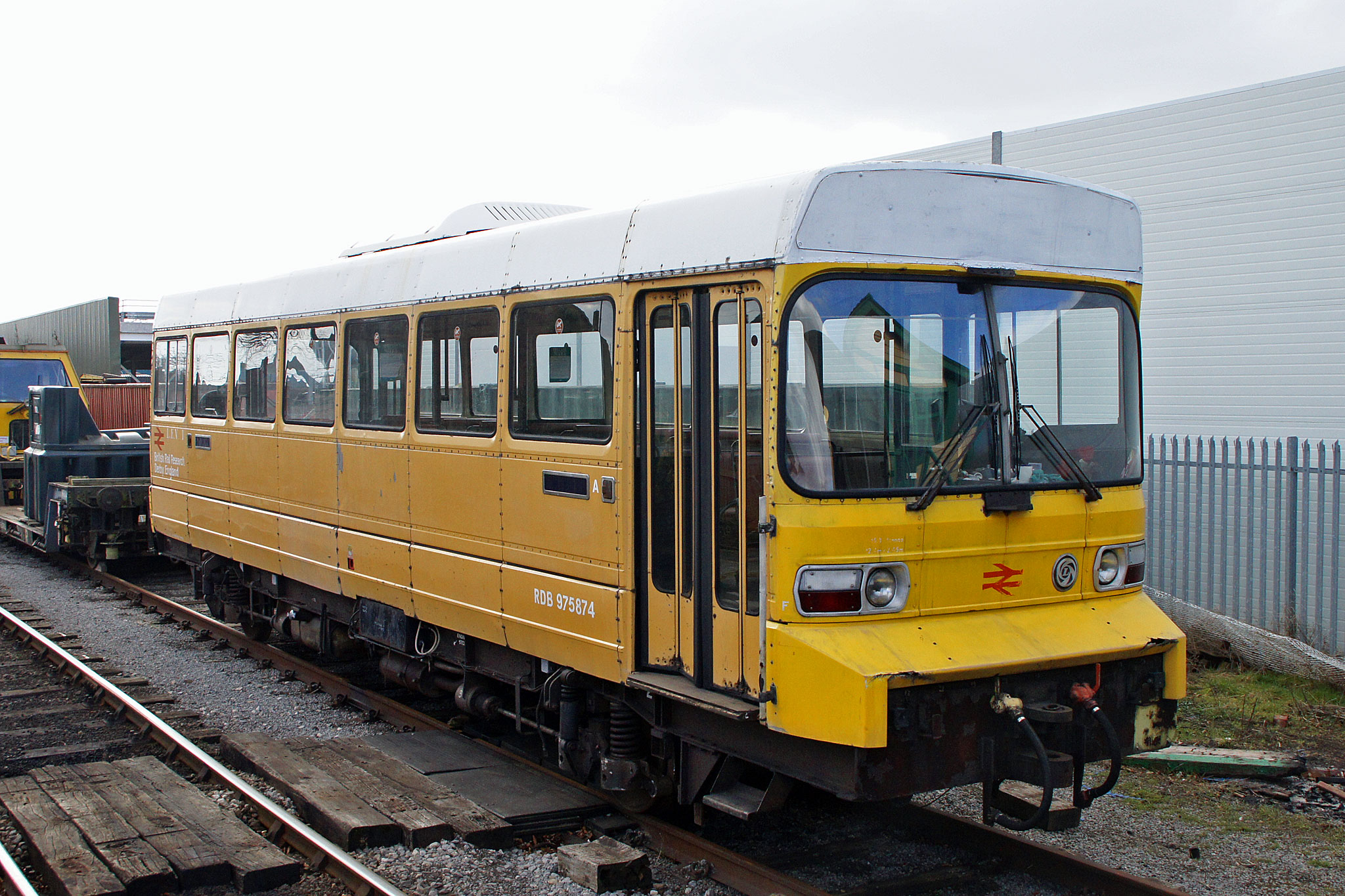
Upon these prototypes the class 141 was officially introduced and roughly 40 units were used on branch lines operated out of the Neville Hill depot. These only lasted around 15 years having been withdrawn in the early 2000s and some were exported to Iran.
After the class 141 was introduced, work began on the 142 and a total of 96 trainsets entered service. And the sad thing is, as of 2018, only two have been withdrawn owing to write offs. That’s a total of 33 boneshaking years! However, these years are due to come to an end, as Angel Trains have no plans to refurbish these, and with DDA requirements coming up in the next year or so, it has been told that Northern must not use pacers in public service after the end of 2019.
The class 143 was a development of the 142, and both classes were built at roughly the same time. Only 25 class 143 trainsets were built with 23 remaining in service as of 2018. These Pacers may see more life in them, as these are owned and ran by Great Western Railway (around Cardiff and Exeter). There have been proposals to refurbish the class 143/144 however this would reduce the capacity a lot.
The class 144 is largely similar to the 143 and a total of 23 units were built.
The future of the Pacers seems quite certain. Since there is no good use for them after 2019, it’s likely that most of the class 142/143/144 units will be scrapped - with possible preservation candidates. The first Pacers will be withdrawn by Northern in September 2018 with phases of withdrawals going through to March 2019 where all Pacers will be withdrawn from the franchise. Class 170s and a large number of Sprinters have already arrived at Neville Hill for use at Northern, as well as brand new class 195s currently in build and in test. Viva rail is also developing a possible Pacer replacement, the class 230. This is an extensively refurbished former D79 stock and so far only 2 units are developed through this.
142067 rests at Sheffield between duties
Island Line, a subsidiary of South West Trains runs a train service on the Isle of Wight, serving the towns of Ryde, Brading, Sandown, Lake and Shanklin.
The British Rail Class 483 electrical multiple units were originally built as 1938 tube stock units for London Underground. They were extensively refurbished between 1989 and 1992 by Eastleigh Works, for use on services on the Isle of Wight's Island Line. Five of the original nine units remain in service - 483004 /6-9. The stock is around 76 years old, making it the oldest type in Great Britain to remain in regular service and South West Trains currently has no plans to replace them.
With passenger numbers falling and annual £3.5m losses, the Government announced plans to remove the service from the next regional train franchise.
However five new two-car Class 484 units are being produced at Vivarail’s Long Marston site using the bodyshells and bogies of metro cars which were previously used on London Underground’s District Line to enter service in March 2021. They will replace Island Line’s existing fleet of small profile ex-London Underground vehicles dating back to 1938, which are now the oldest trains on the national network.
Island Line will close from 4 January 2021 until the end of March for track and platform upgrades, with rail replacement bus services running. The track upgrade will include a new passing loop at Brading and enhancements to improve ride quality
Mercedes 300SL Gullwing AMG (1954) AMG conversions (1996-2006) Engine 5956cc V8 Production 11
MERCEDES SET
www.flickr.com/photos/45676495@N05/sets/72157623671722255...
The story goes that AMG were approached by the Sultan of Brunei with a request to to tune and modify six of his cars. The project was kept secret to all but a select few. In total 11 cars were modified, 8 300 SL Gullwings and 3 300SL Roadsters.The projest was overseen by AMG Project Manager Volker Niewig.
This car started life as a standard 1954 300SL Gullwing, the AMG modifications included all but the bodyshell of the original car. The finished car has a 5956cc V8 engine of 390bhp canted over in a modified engine bay in order to fit under the bonnet, a four speed automatic gearbox, five link rear suspension from the then current SL with brakes from the C36.
Inside there are fully adjustable Recaro leather seats, an airbag equiped steering wheel. The trim is finished in leather and Alacantara with specially fabricated carbon fibre dashboard to house the modified instruments. Top speed is electronically limited at 155mph.
The cost of each car was reputedly over 1,000,000 Euro and the total developement costs well over 4,000,000 Euro.
This car is the last of produced and the only one completed once AMG had become part of the Daimler Group
A big thankyou for an incredible 23.6 Million views
Shot 06:03:2014 at Mercedes Benz World REF 101-424
For 1961, Mercury underwent a major transformation of its model line. In a transition from 1957 to 1960, Mercury again shared a bodyshell with a divisional counterpart, shifting from Edsel to Ford, with the Monterey becoming the equivalent of the Ford Galaxie. The Montclair and Park Lane were discontinued, shifting the Monterey from the base-trim Mercury sedan to its flagship, slotted above the newly introduced Mercury Meteor (as with the Comet, intended as an Edsel before the discontinuation of the division). One of the first examples of downsizing, by adopting a common chassis and body with Ford, the Monterey lost six inches of wheelbase, nearly two inches of width, and over 4 inches of length; dependent on powertrain, the 1961 Monterey shed over 300 pounds of curb weight. At 120 inches, the Monterey was given a 1-inch longer wheelbase than the Galaxie.
The Monterey was offered in four bodystyles, including two and four-door hardtops, a four-door sedan, and a two-door convertible. Sharing its roofline with the Galaxie (except for the Starliner fastback), the Monterey differed primarily by its grille; in place of two large taillamps, Mercury used six small taillamps. While slightly more adorned than its Galaxie counterpart, the Monterey continued to adopt more subdued styling, shifting chrome trim nearly entirely to the front and rear fascias and the roofline.
Shared with the Ford Galaxie, the Monterey again received the 292 cubic-inch Y-block V8 (175 hp), with the option of 352 and 390 cubic-inch FE V8s (220 hp and 300/330 hp, respectively). As before, 3-speed manual and 3-speed automatics were offered, with a 4-speed manual becoming an option.
Vauxhall Corsa (Corsa F) SE SRi Premium (2019-on) Engine 1199cc S3 Turbocharged 99hp (100 PS)
Registration Number BG 70 GAO (Birmingham)
VAUXHALL ALBUM
www.flickr.com/photos/45676495@N05/sets/72157623863172810...
The sixth generation Corsa was originally intended to be released in the the quarter of 2017, on a GM platform, however following it was cancelled in the wake of the takeover by the PSA Group. With the cancelled project reaching production in a sedan form as the Buick Excelle in China
The Corsa then went back to the drawing board thus the Corsa F became the first Opel/Vauxhall model developed under the PSA ownership. Its exterior was designed by Martin Schaufler as a five door Hatchback the new model debuted at the 2019 Frankfurt Motor Show.
The Corsa F supermini marks the arrival of new petrol and diesel engines as well as an all-electric Corsa-e into the range. Two petrol engines and one diesel engine are available, starting with the 1.2-litre three-cylinder engine that produces 75 bhp and comes with a five-speed manual gearbox as standard. Sitting above is a three-cylinder 1.2-litre turbo PureTech engine which is shared with Peugeot and Citroen models and produces 99 bhp and 205 Nm of torque. It comes with a six-speed manual or eight-speed automatic gearbox option. The diesel engine is a BlueHDi 1.5-litre four-cylinder diesel, producing 99 bhp and 250 Nm of torque.
The car is lighter than the previous generation, with lighter underpinnings redesigned bodyshell and new aluminium engines . A new aluminium bonnet will also replace the previous generation's steel unit. The Corsa Fis slightly larger than its predecessor, with a larger body and longer wheelbase to allocate more interior and boot space
A facelift was unveiled on 24 May 2023, featuring a new front fascia features the brand's Visor front end, new exterior colours, a new steering wheel, new shifter for automatic transmission, new seat designs, updated technology and powertrains
Diolch am 89,012,031 o olygfeydd anhygoel, mae pob un yn cael ei werthfawrogi'n fawr.
Thanks for 89,012,031 amazing views, every one is greatly appreciated.
Shot 10.10.2021 at Bicester Scramble, Bicester, Oxon. Ref. 122-399
Ford Escort (5th Gen) 1.8 litre LX Estate (1990-97) Engine 1753cc S4
Registration Number L 57 RPW (Norwich)
FORD EUROPE
www.flickr.com/photos/45676495@N05/albums/72157623665118181/
The Escort Mark V (and Mark III Orion saloon) arrived in September 1990 with an all-new bodyshell and a simplified torsion beam rear suspension (instead of the Mark III's fully independent layout). This model however was poorly received by the motoring press, and was panned by journalists for its mediocre driving dynamics and unremarkable styling in early 1992, an all new Zetec 16-valve engine was launched bringing improved driveability, while also marking the return of the XR3i which was available with two versions of the 1.8 L Zetec
Stung by the criticism of the original Mark V, which had remained popular with the motoring public Ford facelifted the Escort and Orion in September 1992, giving the revised cars a new grille, bonnet and, in the Escort convertible and hatchback's case, a new rear end. A new 1.6 L 16-valve 90 bhp (66 kW) Zetec engine was introduced, replacing the previous CVH. Fuel injection was now standard on all petrol models, and Ford introduced a four-wheel-drive variant of the RS2000,
Diolch am 95,535,109 o olygfeydd anhygoel, mae pob un yn cael ei werthfawrogi'n fawr.
Thanks for 95,359,109 amazing views, every one is greatly appreciated.
Shot 10.07.2022, at Walsall Classic Car Show, Walsall Arboretum, Walsall REF 161-266
Volkswagen Golf GTi Mk.2 (1983-92) Engine 1781cc S4 8v Production 6,000,000 (all Golf Mk.2's)
Registration Number K 515 MGU
VOLKSWAGEN SET
www.flickr.com/photos/45676495@N05/sets/72157623738785355...
The second-generation Volkswagen Golf was launched in Europe at the 1983 Frankfurt Motor Show.and launched into the British marketplace March 1984. It featured a larger bodyshell, and a wider range of engine options than the Mark 1 and a more rounded style.
The successful hot GTi model was continued with the Mk2 as a sporty 3- or 5-door hatchback. Like late Mk1 GTIs, it featured a fuel-injected and was later joined by the more powerful Golf GTi 16v marked by discreet red and black "16v" badges front and rear.
Many thanks for a fantabulous
44,441,525 views (adjusted and readjusted during FLICKR re-engineering, reduced by around 650,000)
Shot 23.08.2015 at Lupin Farm, Classic Vehicle Gathering, Orgreave, Alrewas, Staffordshire - Ref 109-1055
MG YB (1952-53) Engine 1250 cc S4 OHV Production 1201
Registration Number 438 LRM
MG SET
www.flickr.com/photos/45676495@N05/sets/72157623797586658...
Developed pre-war and designed by Gerald Palmer, the new MG small Y Type Saloon was based on Morris Eight Series E four-door bodyshell in pressed steel, with added a swept tail and rear wings, and also a front-end MG identity in the shape of their well-known upright grille. The MG 1 1/4 Litre Saloon would retain the traditional feature of separately mounted headlights at a time when Morris was integrating headlamps into the front wing and it was also to have a separate chassis under this pressed-steel bodywork, even though the trend in the industry was towards ‘unitary construction’. The power unit was a single carburettor version of the 1,250 cc engine used in the latest MG-TB. This engine, the XPAG, went on to power both the MG-TC and MG-TD series. The MG Y Type saloon developed 46 bhp at 4,800 rpm, with 58.5 lb ft of torque at 2,400 rpm, the YT Tourer (with the higher lift camshaft and twin carburettors) develop 54 bhp.
The new MG YA was launched in 1947
.
The MG YB launched in 1952 strongly resembling the YA. The "YB" had a completely new Lockheed twin leading shoe braking system, 15 inch wheels and a much more modern hypoid type of back axle. Road holding was also improved by the introduction of smaller 15-inch wheels and the use of an anti-roll bar fitted to the front of the car and stronger shock absorbers, or dampers, Little else was changed about the car, which soldiered on until the end of 1953 and the MG ZA Magnette was introduced in 1954.
Many Thanks for a fan'dabi'dozi 25,765,900 views
Shot 09:06:2014 ar The Luton Classic Car Show, Stockwell Park, Luton REF 102-509
1967 Daimler Sovereign 4.2
Lot 1 (Kempton Park Racecourse, 18th October 2006)
Sold for £5,738
(including buyers premium)
Lot details
Registration No: PGV102E
Chassis No: 1A32348DN
Mot Expiry: April 2007
Introduced in 1966, the Daimler Sovereign was a more luxurious version of the contemporaneous Jaguar 420. Differentiated from its badge-engineered sibling by means of a different grille and better standard equipment, it otherwise shared the same four-door monocoque bodyshell equipped with all-round independent coil-sprung suspension, disc brakes and a detuned version (245bhp vs. 265bhp) of the Jaguar MKX's 4235cc DOHC straight-six engine. In many ways a testbed for the forthcoming Jaguar XJ6's styling and mechanical layout, the Daimler Sovereign remained in production until 1969 by which time some 5,829 are thought to have been made. Among the rarest of the Browns Lane designed Daimlers, the Sovereign is a highly underrated motorcar.
Finished in British Racing Green with suede green leather upholstery, this particular example is described by the vendor as being in "very good" overall condition. Reportedly "a very rare manual (overdrive) matching numbers original colour car with Jaguar Daimler Heritage Trust Certificate", 'PGV 102E' is further understood to have been begun life in the Channel Islands where it was used for "diplomatic service until returning to the UK during 1976". Apparently treated to refurbished front / rear subframes (new mountings, suspension bushes, bearings, universal joints, wheel bearings etc), an overhauled steering box, rebuilt differential, reconditioned callipers and new brake discs by its previous keeper, the Daimler has also benefited from replacement carpets / headlining and dashboard relacquering. Indeed, the car is thought to have had "some £4,000 recently spent on it". Though, we are informed that "no receipts are available as the owner purchased parts at Jaguar Spares Days and carried out the work himself". Boasting "new wire wheel hubs / spinners, tyres that have done less than 2,000 miles, power steering and a period Motorola radio (in working order)", 'PGV 102E' is said to "drive well with good oil pressure". Believed but not warranted to have covered 59,000 miles from new, this pampered Daimler is offered for sale with MOT certificate valid until April 2007 and historic class (free) road tax until March 2007.
www.handh.co.uk/auction/lot/1-1967-daimler-sovereign-42/?...
Ref. 26-1611.
Audi 80 GL (1972-1976).
Escala 1/43.
Testauftrag >S<.
Schuco.
Made in Germany.
Production year: 1976.
"Schuco no. 26-1611 Test order S, from the 1976 series "For test drivers". Apart from actuality, what was special about these modellautos, that they could be divided into about 15 to 20 individual parts and thus the slogan test assignment got a special significance! (...)"
Source: www.autostadt.de/de/eshops/audi-80-gl.html
(original text in german language)
---------------------------------------------------------------------------------------------------
AUDI 80 (B1)
"The Audi 80 was developed by Ludwig Kraus and was presented in 1972.
It quickly became the bestseller in the lower middle class.
With a facelift in September 1976, the style of the Audi 80 was aligned towards that of the Audi 100, which had just been launched.
The Audi 80 GL was the top model in the series. Front-wheel drive, negative steering scrub radius and diagonal brake circuit distribution provided for driving safety even in adverse conditions."
Engine: 4-cylinder inline engine
Displacement: 1,297 cc to 1,588 cc
Power: from 55 hp at 5,500 rpm to 110 hp at 6,000 rpm
Series: 07/1972-09/1978
Production: 932,403 cars (without US models)
Source:
www.audi-me.com/me/brand/en/company/audi_history/Evolutio...
www.audi-me.com/me/brand/en/company/audi_history/Evolutio...
------------------------------------------------------------------------------------------------
Audi 80 (B1) (1972-1978)
"This model debuted in Europe in 1972 as the Audi 80, and in 1973 in Australia and North America (Canada and the USA) as the Audi Fox, and was available as either a two-door or a four-door saloon (sedan).
It effectively took the place of several models that Audi had discontinued (the F103 series, which included the first model designated as an "Audi 80"), and provided the company with a viable rival to the Opel Ascona and the Ford Taunus (Ford Cortina in the UK), as well as more upmarket offerings including the Alfa Romeo Alfetta and Triumph Dolomite."
"The Audi 80 B1 was only the second modern-era Audi product to be developed entirely under Volkswagen ownership - Audi chief engineer Ludwig Kraus had famously been disparaging about the outgoing F103 series, referring to it as the "bastard", owing to its Auto Union/DKW bodyshell and Mercedes-Benz engine.
The B1 was a clean break from the Auto Union era, being equipped with.a range of brand new 1.3- and 1.5-litre SOHC inline-four petrol engines - the first appearance of the now legendary EA827 series of engines, whose descendants are still used in VW Group vehicles to the present day."
(...)
"On the home market, two- and four- door saloons were available in base trim (55 or 60 PS, called simply Audi 80 and 80 S, respectively), as L models (LS with 75 PS engine) or as a more luxurious GL (85 PS only).
In September 1973, Audi added the sporty 80 GT (two-door only) featuring a carburettor 1.6 litre engine (code: XX) rated at 100 PS (74 kW; 99 bhp)."
(...)
"Audi's design and development efforts paid off during the 1973 European Car of the Year competition where the 80 won ahead of the Renault 5 and the Alfa Romeo Alfetta.
A facelift in autumn 1976 brought about a revised front end in the style of the newly introduced Audi 100 C2 with square instead of round headlights, 1.6- instead of 1.5 litre engines (still of 75/85 PS) and a new 80 GTE model with a fuel-injected version of the 1.6-litre (110 PS (81 kW; 108 bhp)) replacing the former 80 GT."
(...)
"The B1 platform was dropped from the European market in 1978, although it was sold into the 1979 model year in North America."
(...)
---------------------------
Audi 80 B1 (80/82)
Also called
Audi Fox
Production
1972–1978
1,103,766 built
Body style
2/4-door sedan
5-door wagon
Layout
Front-engine, front-wheel-drive
Platform
Volkswagen Group B1 platform
Engine
1.3 L I4
1.5 L I4
1.6 L I4
Transmission
4-speed manual
3-speed automatic
Dimensions
Wheelbase
2,470 mm (97.2 in)
Length
4,175 mm (164.4 in)
Width
1,600 mm (63.0 in)
Height
1,362 mm (53.6 in)
Chronology
Predecessor
Audi 72
Successor
Audi 80 (B2)
Source: en.wikipedia.org/wiki/Audi_80
More info:
A brand new purchase for ConnexionsBuses, the first in 2 years, is of Mercedes-engined Euro 6 compliant Optare Solo SR YJ67 GGO - seen here at York Piccadilly working HCT service 16 to and from Acomb. This has gained the new-style Connexions logo with the union flag 'big X'; but the vehicle bodyshell itself is different from the other Solos as this has curved-top skirt panels as would normally be seen on a Versa, in addition to a new latch fitted between the front wipers. Audibly this bus sounds as if it has the same engine as a Wright Streetdeck, it certainly sounds almost identical to First York's 35100.
G-Model
Bonhams : the Zoute Sale
Estimated : € 120.000 - 160.000
Sold for € 138.000
Zoute Grand Prix 2018
Knokke - Zoute
België - Belgium
October 2018
The legendary Porsche 911 Carrera RS resulted from the Zuffenhausen factory's realisation that the excess weight of its top-of-the-range 2.4-litre 911S production model restricted its development potential for racing. It was therefor decided to produced and homologate a special lightweight production variant for competition purposes, which would also incorporate, as standard, specific performance enhancements forbidden as post-production modifications. The result was the Carrera RS (RennSport) of 1972, which featured thinner-gauge metal in its doors, roof, boot lid, floors and even in the gearchange platform. Thinner window glass was provided by Glaverbel and most of the standard sound proofing was removed, while performance modifications included enlarged rear wheel arches to accommodate 7" wide wheel rims, the first of the famous 'duck's tail' spoilers, and the newly enlarged, 2.7-litre, 210 bhp engine.
These alterations resulted in the RS having a top speed of around 150 mph while ensuring that it remained stable and controllable right up to the limit. The homologation regulations required that cars had be built to the lightweight, racing specification; customers wishing to purchase a Carrera RS for the road had to specify the Touring package (order number '472') which cost an extra DM 2.500 (£ 430) and offered the greater comfort of the 911S's trimmed and upholstered interior.
When the homologation targets had been met, the lightweight RS was discontinued but the Carrera name continued on Porsche's top-of-the-range model, which in its new, series-production form mounted the 210 bhp engine in a full-weight, fully trimmed bodyshell; the tail spoiler was an option. Porsche had first used Bosch's K-Jetronic mechanical fuel injection ('MFI') on 911T models destined for the USA, and this cleaner-running system was adopted for the 2.7-litre cars in 1974. As well as reducing emissions, the Bosch injection made the engine more flexible, with better power delivery at low revs.
This Porsche 911 Carrera was delivered new to Barcelona, Spain in March 1975 finished in Grand Prix White with dark red leatherette interior, and left the factory equipped with the following options: tinted windows; rear window with anti-fog system; engine compartment light; and rear fog light. The car was first registered in September 1975 in Barcelona by its first owner, Antonio Giminez Rodriguez, who kept it until 1993, nearly 20 years. It was then sold to Mr Jose Luis Brandes Calvo from Zaragoza. The Carrera stayed in Spain until 2012 and then went to Belgium where it was registered in March 2012. It was last registered in Belgium in February 2014 by Mr Pierre Mélotte.
Although it still presented beautifully, in 2016 the current owner decided to re-spray the car completely from bare metal to the highest standard because of a minor crack in the front left wing paintwork and the fact that the paintwork generally was beginning to show signs of age (invoices on file). At the same time the engine, which had only minor oil leaks, was removed for a complete overhaul; the owner, being a perfectionist, wanted his car to be 100%!
Service records track the odometer readings from February 1993 at 99,614 kilometres to April 2016 at 56.246 kilometres (actually 156.246 kilometres from new). Additional documentation consists of old Spanish registration papers showing technical inspections from 2000-2011; technical inspection 2014; Porsche Certificate of Authenticity; Porsche 111-point check carried out in 2016; Belgian registration papers; and a Classic Data report confirming the car's condition (before restoration) and its estimated value in 2016 of € 190.000. The car also comes with its original pouch with instruction manuals and service booklet; spare key; and the original spare wheel.
Retaining its original dark red interior, beautifully preserved, this Carrera is described by the vendor as in generally excellent condition, ready to enjoy. We have had the pleasure of test-driving the car and can confirm that it performed flawlessly, with a very responsive throttle. This car is worthy of a place in any important collection as direct successor or 'little brother' of the Carrera RS at less than half the price.
Triumph GT6 Mk.III (1970-73) Engine 1998cc S6 OHV Production 13043
Registration Number YBH 510 M (Buckinghamshire)
TRIUMPH ALBUM
www.flickr.com/photos/45676495@N05/sets/72157623847263736...
The final facelift for the Michelotti designed GT6. This time the whole bodyshell was revised to match the changes made to the Spitfire Mk.IV; these included a cut-off rear end, recessed door handles and a smoother front end.
Only detail changes were made to the mechanics, but in 1973 – close to the end of the car's life – the rear suspension was changed again, this time for the cheaper (but still effective) swing-spring layout also fitted to the Spitfire Mk.IV. a larger front anti-roll bar was fitted. A brake servo was also added in 1973, and seats were changed from vinyl to cloth. Engine power and torque for the MK3 was similar to the MK2, but better aerodynamics led to a new top speed of 112 mph
Diolch am 92,072,818 o olygfeydd anhygoel, mae pob un yn cael ei werthfawrogi'n fawr.
Thanks for 92,072,818 amazing views, every one is greatly appreciated.
Shot 17.04.2022 Weston Park (Classic Car Show), Weston-under-Lizard, Salop 157-367
Working a light engine movement from Felixstowe to Peterborough North Yard are GBRf Class 66's, 66711 'Sense' and 66742 'Port of Immingham', stopping for a red light at Peterborough.
One of Britain's, and indeed Europe's, most numerous diesel locomotives, the Class 66 has become the face of nearly every freight operating rail company on the UK network, a simple, utilitarian design with an enormous, powerful engine. But with it's popularity among rail companies came a price, as it is often listed as one of the most hated locomotives ever to hit the UK rails, largely because of the slew of older BR classic locomotives it replaced from the late 1990's onward.
But is it really deserving of such a bum rap?
By the mid-1990's it was apparent that a majority of the ex-British Rail locomotives were well beyond their bloom of youth. Aside from the Class 58's of 1983, the Class 60's of 1989, and the American built Class 59's of 1985, most locomotives in the service of freight companies were coming up to 30 or 40 years old, and reliability was a major issue. Years of under-investment in the BR freight sector Railfreight Distribution, had resulted in a fleet comprised of decrepit diesels such as the Class 37's and Class 47's, being worked into the ground to keep the company rolling. Although the opening of the Channel Tunnel in 1994 was a catalyst to investments for freight trains working those particular trunk routes to the South East, with the construction of the Class 92's and the refurbishment of Wembley based Class 47's, the remainder of the freight operators, by this time led by shadow franchises Loadhaul, Transrail and Mainline, were left with a fleet that was slowly dying before their eyes. Class 47's, especially, needed a major overhaul every seven years, costing £400,000; yet had an average daily availability of less than 65% with only 16 days between major failures.
Enter Wisconsin Central, who, in 1996, bought the three franchises together with Railfreight Distribution and mail operator Rail Express Systems to create EWS, or English, Welsh & Scottish Railways. As part of the franchise commitment, the intention was to replace the ageing diesel fleet with a standard design that would reduce maintenance and operating costs substantially, with higher levels of reliability and efficiency. Looking at the fleet of diesels in general, it was noted that among the most reliable classes in the UK were the small fleet of 15 Class 59's, built by General Motors between 1985 and 1995 for private Aggregate operators such as Foster Yeoman and Hanson, as well as energy company National Power for the haulage of their coal trains between Collieries and Power Stations. These engines were, for the most part, substantially younger than the likes of the Class 20's, 31's, 37's and 47's, and more reliable than the early built Class 56's from Romania, which were infamous for their poor build quality.
Seeing their success, EWS placed an order in 1997 for 250 locomotives based on similar principles to that of the Class 59, often dubbed one of the biggest locomotive orders since the age of Steam. Locomotives were built at GM's factory in London, Ontario, and externally the bodyshell and design shared that with the Class 59. Internally though, the engines took many of GM's previous developments and updated the engine and traction motors to enable higher speeds. The new locomotive was fitted with the 20 year old design of the EMD 710 12-cylinder diesel engine, found originally in the GP60 freight locomotives of North America. However, some of GM's newer creations also made it into the mix, such as updated cab-control systems, the kind found in the Irish Railways Class 201 of 1994.
Originally designated Class 61, the first of these new locomotives arrived by boat at Immingham in June 1998, prior to proving tests at Derby. The locomotives then shipped at a rate of 11 per month into the UK via Newport Docks, until the order was completed in December 2001. After unloading, EWS engineers then simply took off the tarpaulin, unblocked the suspension, and finally as each was shipped with water and fuel, hooked up the batteries, before starting the engine and handing the locomotive into service. Almost immediately, other UK freight operators took interest in the Class, and companies such as Freightliner, GB Railfreight and Direct Rail Services also placed orders.
Upon their introduction, reliability levels for EWS's operations improved substantially. Each locomotive is specified and guaranteed to 95% availability, aiming for a minimum of 180 days mean time between failures. It is designed to cover 1·6million km between major rebuilds, equivalent to 18 years' service, with each major rebuild costed at £200,000. But with their success came the sad reality that the much loved classes of yesteryear were going to be given the push, and this is where a majority of the Class 66's unpopularity comes from. It could have been understood the replacement of the 40 year old Class 20's, 31's, 37's and 47's, as it was quite clear they were past their prime, the same could equally be said for some of the earlier Class 56's of the late 1970's. However, the line was stepped across with the withdrawal of the Class 58's and Class 60's, as the desire of EWS to have a standardised fleet, resulted in the removal of locomotives that were nowhere near life-expired. The large-scale retirement of these extremely reliable and powerful locomotives that weren't even 20 years old was seen as a travesty, and whilst some Class 60's have seen a revival with other operators as of late, the Class 58's are all but extinct, whilst many Class 60's continue to languish in yards across the UK, mostly at Toton in the East Midlands.
Nevertheless, the class continued to grow over the years, and, upon the conclusion of Class 66 production in the UK in 2014, 446 of the class were eventually built. But we can't forget also that the class has seen major success across Europe as well, with dozens of engines in operation in Germany, the Netherlands, Belgium, Luxembourg, Sweden, Norway, Denmark, France, and Poland, with certification pending in the Czech Republic and Italy.
Today, a majority of the class is still in service with a variety of operators. DB Schenker, the successor to EWS, continues to operate the largest fleet of 249 locomotives. Freightliner operates 141, DRS operates 19, GBRf operates 72 and Colas Rail operates 5. Not all of the locomotives however remain with us, as three have been written off.
The first was 66521 on the 28th February, 2001, where after hitting a Land Rover that had fallen down an embankment from the M62 motorway, a southbound GNER InterCity 225 set led by lightweight Class 82 DVT, 82221, derailed and ran straight into the path of the oncoming Class 66 which was working a northbound coal train. With an estimated closing speed of 142mph, the DVT was obliterated upon hitting the Class 66, and the freight locomotive was mangled and distorted as it was crushed between its loaded coal train behind and the passenger coaches in front. In the disaster, 10 people were killed, including 66521's driver Stephen Dunn, although his instructor Andrew Hill, who was also riding in the cab, was able to survive. The locomotive however was for the most part destroyed, and scrapped later that year.
The second was on the 4th January, 2010 involving 66048, which derailed at Carrbridge in snowy weather. Coming down the Highland Mainline with a loaded container train, it passed a signal at danger and was derailed at trap points, subsequently falling down an embankment into trees and injuring the two crew members.
The third was on the 28th June 2012, where GBRf 66734 derailed at Loch Treig whilst working Alcan Tanks. The inability of recovery crews to access the highly remote and dangerous location resulted in the engine being cut-up on site.
Additionally, many Class 66's have suffered low-speed collisions and derailments, either through faults in the track, driver error, or faults with the rolling stock.
However, despite the criticism, and often being dubbed as bland and utilitarian, the Class 66 is still a major part of the UK freight network, working behind the scenes without need of major attention so as to get the job done. Indeed it may find a home among rail enthusiasts, and perhaps one day it'll be dubbed a classic like the Class 37's and 47's it replaced, but at the moment it's the UK networks humble hero, plying its trade the best way it knows how.
Ford Cortina Mk.V (1979-82) Engine 1593cc S4 OHV
Registration Number EGJ 856 X
FORD UK SET www.flickr.com/photos/45676495@N05/sets/72157623665118181
The Mark V was announced on 24 August 1979. A large update on the Mark IV, it was really a step between a facelift and a rebody. The Mark V differentiated itself from the Mark IV by having revised headlights with larger turn indicators incorporated (which now showed to the side too), a wider slatted grille said to be more aerodynamically efficient, a flattened roof, more glass area, slimmer C-pillars with revised vent covers, larger, slatted tail lights (on saloon models) and upgraded trim.
Improvements were also made to the engine range, with slight improvements to both fuel economy and power output compared to the Mk.IV, Ford also claimed improved corrosion protection.
The estate models combined the Mk IV's bodyshell (which was initially from the 1970 Ford Taunus) with Mk V front body pressings.
Variants included the Base, L, GL, and Ghia (all available in saloon and estate forms), together with Base and L spec 2-door sedan versions (this bodystyle was available up to Ghia V6 level on overseas markets)..
Shot at Tatton Park, Manchester, Classic Car Show 18:08:2012 REF 88-121.
Mini 1275 Mk.III (ADO 20) (1969-76) Engine 1275cc S4 Tr OHV
Registration Number XLV 107 J (Liverpool)
MINI (BL) SET
www.flickr.com/photos/45676495@N05/sets/72157623797597842...
The Mark III Mini had a modified bodyshell with enough alterations to see the factory code change from ADO15 to ADO20 (which it shared with the Clubman). The most obvious changes were larger doors with concealed hinges. Customer demand led to the sliding windows being replaced with winding windows—although some Australian-manufactured Mark I Minis had adopted this feature in 1965 (with opening quarterlight windows). The suspension reverted from Hydrolastic to rubber cones
Production at the Cowley plant was ended in 1969, and the simple name Mini completely replaced the separate Austin and Morris brands. In April 1974, a heater became standard equipment on the entry-level Mini 850, as well, having by then already been included in the standard specification of the other models for some time
This car sports a Police roo, sign, unsure wether it was actually used for Police duties. Any confirmation appreciated
Thankyou for a massive 54,152,295 views
Shot 29.08.2016 at Shrewesbury Steam Rally, Onslow Park, Shrewesbury REF 119-358
Volkswagen Golf GTi Mk.2 (1983-92) Engine 1781cc S4 inj 8v 110bhp Production 6,000,000 (all Golf Mk.2's)
Registration Number H 342 KHP (Bournemouth for Salisbury)
VOLKSWAGEN SET
www.flickr.com/photos/45676495@N05/sets/72157623738785355...
The second-generation Volkswagen Golf was launched in Europe at the 1983 Frankfurt Motor Show.and launched into the British marketplace March 1984. It featured a larger bodyshell, and a wider range of engine options than the Mark 1 and a more rounded style. During the life of the Golf MK2, there were a number of external style revisions. Notable changes to the looks of the Golf MK2 included the removal of quarterlight windows in the front doors, and the introduction of larger grille slats with the August 1987 facelift. The most notable was the introduction of so-called "Big Bumpers", which were introduced in the European market with an August 1989 facelift.
The successful hot GTi model was continued with the Mk2 as a sporty 3- or 5-door hatchback. Like late Mk1 GTIs, it featured a fuel-injected and was later joined by the more powerful Golf GTi 16v marked by discreet red and black "16v" badges front and rear.
Diolch yn fawr am 68,087,162 o olygfeydd anhygoel, mwynhewch ac arhoswch yn ddiogel
Thank you 68,087,162 amazing views, enjoy and stay safe
Shot 02.09.2018 at Himley Hall, Wolverhampton Ref 136-289
Triumph GT6 Mk2 (1968-70) Engine 1998c S6 OHV
Production 12,066
Registration Number RUT 513 G (Leicestershire)
TRIUMPH ALBUM
www.flickr.com/photos/45676495@N05/sets/72157623847263736...
Introduced in 1966 the first series of GT6 was introduced in 1966 as a six cylinder sports coupe based on the Spitfire. Designed by Giovanni Michelotti and based on the recently introduced Spitfire Mk. IV. The new body was a sleek fastback design with an opening rear hatch, In essence a two seater but with a small extra rear seat could be ordered, large enough for small children. The family resemblance to the Spitfire Mk II was strong, the longer 6-cylinder engine necessitated a new bonnet top with a power bulge and the doors were provided with opening quarter light windows and squared-off glass in the top rear corner. The 6-cylinder engine was, like the Vitesse 2 litre, tuned to develop 95 hp (71 kW) with a top speed pf 106mph
The Mk.II GT6 was launched in 1978 using a 104bhp version of the six cylinder engine, with optional overdrive as available on the Mk.1. Now fitted with lower wishbone independent rear suspension. The Mk.2 also got a new facia, better ventilation for both engine bay and cockpit and Rostyle wheels, though wires were a popular option. There were other changes for the Mk II; the front bumper was raised (in common with the Spitfire Mk 3) to conform with new regulations necessitating a revised front end, and side vents were added to the front wings and rear pillars. Under the bonnet, the engine was the uprated Vitesse MkII unit developing 104 hp (78 kW) with a new cylinder head, camshaft, and manifolds Performance improved slightly to 107 mph
The third generation of 1970 was the GT6s last major facelift the entire bodyshell was revised to match the changes made to the Spitfire Mk IV: modifications included a cut-off rear end, recessed door handles and a smoother front end, and the deletion of the chrome stripes on top of the wings . Only detail changes were made to the mechanics, but in 1973 – close to the end of the car's production life – the rear suspension was changed again, this time for the cheaper swing-spring layout fitted to the Spitfire Mk IV. Engine output was similar to that of the Mark 2 but better aerodynamics led to a new top speed of 112 mph
Diolch am 83,874,675 o olygfeydd anhygoel, mae pob un yn 90cael ei werthfawrogi'n fawr.
Thanks for 83,874,675 amazing views, every one is greatly appreciated.
Shot 25.07.2021 at Beaumanor Hall, Woodhouse, Leic. 148-149
This body shell of Jaguar's fantastic sports car has been generously donated to the Museum by the company, who prepared it especially for the display in the Museum.
Coventry Transport Museum
Millennium Place
Hales Street
Coventry
England - United kingdom
November 2018
The original Rover 200 (sometimes referred to by the codename SD3) was the replacement for the earlier Triumph Acclaim, and was the second product of the alliance between British Leyland (BL) and Honda. Only available as a four-door saloon, the 200 series was intended to be more upmarket than the company's Maestro and Montego models, which the 200 Series came in between in terms of size. It was launched on 19 June 1984, at which time there was still a high demand for small family saloons, with many manufacturers selling this type of car under a different nameplate to similar-sized hatchbacks. For example, Ford was selling the saloon version of the Escort as the Orion, the saloon version of the Volkswagen Golf was called the Jetta, and Vauxhall would soon launch an Astra-based saloon called the Belmont. The Rover 200 Series, however, was not based on a hatchback.
Essentially, the 200 series was a British-built Honda Ballade, the original design of which had been collaborated upon by both companies. Engines employed were either the Honda Civic derived E series 'EV2' 71 PS (52 kW; 70 bhp) 1.3 litre 12 valve engine, or BL's own S-Series engine in 1.6 litre format (both in 86 PS (63 kW; 85 bhp) carburettor and 103 PS (76 kW; 102 bhp) Lucas EFi form). The resulting cars were badged as either Rover 213 or Rover 216.
The 213 used either a Honda five-speed manual gearbox or a Honda three-speed automatic transmission. The British-engined 216 also employed a Honda five-speed manual gearbox, unlike the S-Series engine when fitted in the Maestro and Montego. There was also the option of a German ZF four-speed automatic on some 216 models as well.
The Honda-badged version was the first Honda car to be built in the United Kingdom (the Honda equivalent of the 200 Series' predecessor, the Triumph Acclaim, was never sold in the UK). Ballade bodyshells, and later complete cars, were made in the Longbridge plant alongside the Rover equivalent, with the Ballade models then going to Honda's new Swindon plant for quality-control checks.
This model of car is well known as Richard and Hyacinth Bucket's car in the BBC Television sitcom Keeping up Appearances (1990–1995). A blue 213 model was also used in the Series 2 episode "Think Fast, Father Ted" of comedy series Father Ted.
Fiat Tipo Sedicivalvole (1988-95) Rngine 1756cc S4 16v
Registration Number D 15 TPO (On a personalised number, originally allocated for Portsmouth)
FIAT SET
www.flickr.com/photos/45676495@N05/sets/72157623665060711...
The Fiat Tipo was designed by Ercole Spada at the I.DE.A Institute design house and unveiled in January 1988, going on sale in Europe in June 1988 to LHD markets and to RHD markets in July 1988.
Initially available five door hatchback. The car was made entirely out of galvanized body panels to avoid rust, and was built on a completely new Fiat platform, which was later used on Fiat, Alfa Romeo, and Lancia models
In 1989 the Fiat Tipo was awarded European Car of the Year.
The United Kingdom market initially received only the 1.4 and 1.6 versions of the Tipo, with the 1.8 and 2.0 petrol engines and the diesel powered units not being imported until the early 1990s. The top of the range available in the UK was the 2.0 Sedicivalvole (16 valves).. The Sedicivalvole gained its engine from the Lancia Thema, and with a much smaller and lighter bodyshell to house it, this power unit brought superb performance and handling, and a top speed of around 130 mph
The Tipo was facelifted in 1993, and a three door version was added, as well as minor exterior changes (the two evolutions of the car can be differentiated by their slightly different radiator grilles and headlamps) and improved specifications; safety features like stiffer bodyshells, driver's airbag, and side impact bars were added to the range. This included the new S, SX, and SLX trim levels, as well as a new eight valve 2.0 GT model..
Many thanks for a fantabulous 34,592,300 views
Shot at Curborough Sprint Course 26:04:2015 Ref 105a-544
Coachwork by Henri Chapron
Bonhams : the Zoute Sale
Estimated : € 240.000 - 320.000
Sold for € 425.500
Zoute Grand Prix 2018
Knokke - Zoute
België - Belgium
October 2018
Just as it had done 21 years previously with the revolutionary 'Traction Avant', Citroën stunned the world again in 1955 with the launch of the strikingly styled 'DS'. Beneath the shark-like newcomer's aerodynamically efficient, low-drag bodyshell there was all-independent, self-levelling, hydro-pneumatic suspension plus power-operated brakes, clutch, and steering.
The project had been initiated in the 1930s by the company's managing director, Pierre-Jules Boulanger, and would be brought to fruition by designers Andre Lefebvre, previously with Voisin and Renault, and Flaminio Bertoni, who had worked on the styling of the pre-war Traction Avant. Part of Boulanger's brief had been that the proposed 'VGD' (Voiture de Grand Diffusion or Mass Market Car) should be capable of affording a comfortable ride over sub-standard rural roads while remaining stable at sustained high speeds on the Autoroutes. The solution to these seemingly incompatible requirements was the famous hydro-pneumatic suspension, suggested by Citroën engineer Paul Mages. No European car would match the DS's ride quality for several years, the fundamental soundness of Citroën's ahead-of-its-time hydro-pneumatic suspension being demonstrated by its survival in present-day top-of-the-range models.
In September 1965 the DS's original 1,911cc, overhead-valve, long-stroke engine – inherited from the Traction Avant - was replaced by a short-stroke 1,985cc unit, also available in 2,175cc and 2,347cc versions, while other DS developments included swivelling headlights, fuel injection and a five-speed gearbox. Other models offered alongside the original DS were the ID (a simplified, cheaper version), the cavernous Safari estate and the two-door Décapotable (convertible), the latter boasting coachwork by Henri Chapron. Chapron's first convertibles had been produced independently of Citroën but the factory eventually gave the project its blessing. Citroën's own Décapotables were built on the longer, stronger chassis of the ID Break (Estate) but the model was never produced in England, where Citroën's right-hand drive cars were assembled at its Slough factory up to 1966. In total, 1,365 usine (factory) convertibles were made with either the DS19 or DS21 engine between 1960 and 1971, while Chapron built a further 389 of his own, the last in 1973.
The beautiful Citroën convertible offered here is the first of three DS23 IE cars built by the Chapron factory for 1973, and one of only four such examples with the 2.3-litre IE (fuel injected) engine. It was originally ordered by eminent Parisian Raoul d'Iray in October 1972 through the Citroën dealership in Paris 18th, 6 rue d'Oran. Carrying the Chapron build number '9414', this exceedingly rare car was finished in December 1972 and first registered in March 1973 under the Parisian number '3304 ZB 75' to Mr Raoul d'Iray, 148 Avenue Louis Roche, Gennevilliers/Seine, France.
At that time, Henri Chapron's cars were no longer sold through the Citroën dealer network, and every car that Chapron transformed had to be approved by the French licensing authority (the 'Service des Mines') before it could be registered. These papers accompany the car. The DS remained in Raoul d'Iray's ownership for a decade. It then passed to a Mr Van Houten, remaining with him for a further decade before passing to Mr Jaap Knap, a Citroën dealer.
Last publicly offered for sale in 2006 at Rétromobile, this rare Citroën DS23 IE Décapotable was purchased by the car collector and hugely successful fashion entrepreneur, Mr Kevin Stanford, who registered it in the UK with his personal registration plate, '56 KS'.
For the next 12 years the car was enjoyed by Mr Stanford and his family before being purchased by a UK car collector. Since then it has received a detailed mechanical overhaul at the hands of the widely respected UK-based Citroën specialist, Olivier Houiller of French Classics Ltd. Recent receipts totalling over £15,000 accompany the car, as does the extensive Chapron build documentation that was provided by Noëlle-Eleonore Chapron, Henri Chapron's daughter.
This magnificent and very rare piece of French motoring history is 'on the button' and ready to be enjoyed. An eye-catcher at any gathering, it comes with the aforementioned documentation and is currently registered in the UK.
Here are two Danish Railways DSB locomotives. The ME is by MCK and numbered 1530, the MZ is by Hobbytrade and numbered 1456. The Roco also produce a MZ but the Hobbytrade model is of a later seriesIV model with a completely different bodyshell.
MG MGB (Mk.II) GTS Replica (1972) Engine 1798cc S4 OHV BMC B Series
Registration Number YUJ 20 K (Shropshire)
MG SET
www.flickr.com/photos/45676495@N05/sets/72157623797586658...
This car is a replica of the MGC GTS Racecars, created by the BMC Competitions Department to promote the new MGC by entering them in high profile GT races. Their target being the annual twelve hour endurance race at Sebring Florida. The MG would clearly have a power disadvantage, so the Competitions Department set about reducing the cars weight, Specially fabricated aluminum body panels were ordered for the MGC "GTS" or "Sebring" racecars. Most of these panels were made on regular production press dies by supplier Pressed Steel. Fenders were a conspicuous exception: they were hand-made and they featured aggressive fender flares to suit oversized tires. The following bolt-on panels were made from aluminum instead of steel: front valance, front fenders, doors skins, and GT hatches. (Aluminum bonnets were already standard equipment.) Aluminum rear fender flares were riveted onto modified steel quarter panels, and the rivets were hidden under body filler and paint. Aluminum roofs were also riveted and glued on. However, the underlying structure of the MGC GTS bodyshells remained essentially stock because these were unibody cars. Strength and stiffness were achieved by spreading stress through spotwelds into thin sheetmetal. Regular mass-produced steel parts were used for most of the cars' structural core: floorpans, transmission/driveshaft tunnels, crossmembers, rocker panels (inner and outer), firewalls, inner wings, rear wheel wells, the heelboards behind the seats, and of course the subframe sections that ran underneath the floorboards. Also the engine block and cylinder heads were specially cast to save weight compared to the iron blocks and heads used on production cars. The Comps team only used an aluminum MGC engine block once, and the results weren't good, but the aluminum heads worked out much better.
Enough panels were produced to fabricate six cars plus spares but only two were ever raced by the Comps Department.
The GTS racecar debuted with a four cylinder engine and a regular MGB bonnet because the upcoming MGC model was still a well-guarded secret. The occasion was the 1967 Targa Floria endurance race in Sicily. Sadly, it finished far enough behind the winner that its results weren't officially classified. Updated with a six-cylinder engine and MGC style bonnet, this same car was entered at Sebring in 1968 and 1969.
isappointing race results at Sebring in 1969 and in light of pending discontinuation of MGC production, an executive decision was made to liquidate inventory of GTS bodies and attendant spare parts held at Abingdon. By 1969 the official entrant was British Leyland Motor Corporation when the cars were entered for the Sebring Twelve Hour race. This was the last "works" race entry for the MG marque.
After the 1969 Sebring 12 Hour race, the Comps Department sold ADO52-1060 and ADO52-1059 in America at an advertised price of $4500 each (including spare engine, transmission, and rear axle) instead of shipping them back to England. The two cars remain intact and un-raced in private collections
Diolch am olygfa anhygoel, 62,259,101 oblogaeth y Lloegr honno dros y Mynyddoedd
Thanks for a stonking 62,259,101 views
Shot 30-07-2017 exiting the 2017 Silverstone Classic REF 129-513
Coachwork by Pininfarina
Chassis n° 12031
'Pininfarina clothed it all in a beautifully refined bodyshell employing the nose lines of the 500 Superfast and the tail treatment of the contemporary 275 GTS. It was built at Grugliasco by Pininfarina themselves...' - Hans Tanner & Doug Nye, 'Ferrari', 1984.
In essence a closed version of the 275 GTS, the 330 GTC – immediate forerunner of the 365 GTC - was first shown at the Geneva Motor Show in March 1966. Beneath the understated Pininfarina coachwork there was the 4.0-litre version of Ferrari's familiar Colombo-designed two-cam 60-degree V12 (as used in the 330GT 2+2) mated to a five-speed all-synchromesh transaxle. The chassis was of relatively short wheelbase (2,400mm) and the suspension independent all round by wishbones and coil springs. Naturally, there were disc brakes on all four wheels.
Introduced late in 1968 as a replacement for the 330 GTC and given its first public airing at Geneva in March 1969, the 365 GTC was virtually identical in appearance apart from engine cooling vents relocated in the bonnet, a feature it shared with last of the 330s. Installing an 81mm-bore 4.4-litre V12 in place of the 300 GTC's 4.0-litre unit boosted mid-range torque and flexibility while maximum power was raised to 320bhp at 6,600rpm; acceleration improved markedly and the luxury coupés top speed increased to over 150mph. Less obvious to the eye were the refinements made to the drive-train that achieved a marked reduction in cabin noise, a sign that Ferrari understood that 365 GTC customers valued comfort as well as high performance. A sumptuous leather-trimmed interior, electric windows, and heated rear screen were standard equipment, while air conditioning could be ordered as an option. Like so many European sports cars, the 365 GTC (and convertible 365 GTS) would fall victim to increasingly stringent US safety and emissions legislation, production ceasing after less than one year during which time around 150 GTC and 20 GTS models left the factory.
The example offered here was delivered new in June 1969 to Mr Edouard Washer via Jacques Swaters' Garage Francorchamps, the official Ferrari importer for Belgium. The 20th 365 GTC built, chassis number '12031' was delivered finished in Grigio Mahmoud with beige leather interior, the latter equipped with a Voxson 'Sonar' radio with electric antenna. Mr Washer kept the Ferrari for a few years before trading it back to Garage Francorchamps in the mid-1970s. Garage Francorchamps then sold it to the next owner, in the Netherlands.
By 1982, '12031' was owned by one H L E Swarts in the Netherlands, who in March of that year advertised the car for sale, describing it as red with black interior and with 75,000 kilometres recorded. Around 1987, the car was sold to Fritz Kroymans, the Dutch Ferrari importer/collector, who kept it until 2004 when it was sold to Hans Jungblut of Maastricht, Netherlands. While in Mr Jungblut's care, the Ferrari was completely restored to its factory original colour, Grigio Mahmoud, in the Netherlands by marque specialists Garage Roelofs (restoration photographs on file), with the beige leather interior re-trim being entrusted to HVL Exclusive Italian Interiors.
From 2004 to 2014, the Ferrari was maintained by Forza Service and stayed in Holland. Later, in April 2014, the car was sold to the current owner in Belgium. Since, this stunning 365 GTC has been carefully looked after by its passionate Ferrari owner/collector. The most recent service was carried out in May 2017, by Ferrari Specialists L'Officina in Overijse, Belgium.
The car comes with an original sales brochure; copies of the original factory paperwork; a copy of the old Dutch registration papers (cancelled); Belgian registration papers; restoration invoices from Ferrari Garage Piet Roelofs; invoices for work carried out in 2004-2008 by Forza Service in Holland; and HVL Exclusive Italian Interiors' certificate (2008) confirming the interior was professionally restored using mostly original parts. The all-important Ferrari Classiche has been applied for and is currently in progress for this matching numbers 365 GTC; the file is still in production and will follow after the sale. Prospective purchasers should be aware that this process can take a few months to complete.
Examples of this strikingly handsome, startlingly fast, and much under-rated Ferrari Gran Turismo model rarely appear at auction. Well documented, professionally restored, and with Ferrari Classiche granted, '12031' represents an opportunity for the discerning collector to acquire one of these exclusive and ultra-desirable models, which are rare even by Ferrari standards.
Bonhams : the Zoute Sale
Sold for € 805.000
Zoute Grand Prix 2017
Knokke - Zoute
België - Belgium
October 2017
JR Central, Japan Railway unveiled this week its new bodyshell for the next generation Bullet Trains to be designated N700S.
This is the first bodyshell, a test train will be built and ready by March 2018 and they expect the train to be in Mainstay full service in 2020.
This new look Shinkansen has a bigger beak shaped nose with more bulges to reduce wind resistance and noise.
The Lancia Fulvia (Tipo 818) is an Italian car introduced at the Geneva Motor Show in 1963 by Lancia and produced until 1976. Fulvias are notable for their role in motorsport history, including winning the International Rally Championship in 1972. On testing it in 1967, Road & Track summed up the Fulvia as "a precision motorcar, an engineering tour de force". Named after Via Fulvia, Roman road leading from Tortona to Torino.
The Fulvia was available in three variants: Berlina 4-door saloon, 2-door Coupé, and Sport, an alternative fastback coupé designed and built by Zagato on the Coupé floorpan.
Specifications:
Chassis
The Fulvia Berlina was designed by Antonio Fessia, to replace the Lancia Appia with which it shared almost no components. The Appia was a rear wheel drive car, however, while the Fulvia moved to front wheel drive like the Flavia. The general engineering design of the Fulvia was identical to that of the Flavia with the major exception of the engine, the Flavia having a four-cylinder horizontally opposed engine and the Fulvia a 'Narrow Angle' vee configuration as featured on most production Lancias from the Lambda. The Fulvia used a longitudinal engine mounted in front of its transaxle. An independent suspension in front used wishbones and a single leaf spring, while a beam axle with a panhard rod and leaf springs was used in back. Four wheel Dunlop disc brakes were fitted to first series Fulvias. With the introduction of the second series in 1970 the brakes were uprated with larger Girling calipers all round and a brake servo. The handbrake design was also changed - using separate drums and brake-shoes operating on the rear wheels.
Engine
The V4 engine of a 1972 Fulvia Berlina
One element that was new was the narrow-angle V4 engine. Designed by Zaccone Mina, it used a narrow angle (12°53'28") and was mounted well forward at a 45° angle. The engine is a DOHC design with a one camshaft operating all intake valves and another operating all exhaust valves. The very narrow angle of the cylinders allowed for use of a single cylinder head.
Displacement began at just 1091 cc with 58 bhp (44 kW) with a 72 mm bore and 67 mm stroke. A higher (9.0:1) compression ratio and the fitment of twin Solex carburettors raised power to 71 bhp (53 kW) soon after.
The engine was bored to 6 mm to enlarge displacement to 1216 cc for the HF model. This, and some tuning, raised output to 80 to 88 bhp (60 to 66 kW).
The engine was re-engineered with a slightly narrower bank angle (12°45'28") and longer (69.7 mm) stroke for 1967. Three displacements were produced: 1199 cc (74 mm bore), 1231 cc (75 mm bore), and 1298 cc (77 mm bore). The new 1298 cc engine was produced in two versions; the type 818.302 produced 87 bhp (65 kW) at 6000 rpm and was fitted to 1st series Coupés, Sports and Berlina GTE and later to the 2nd Series Berlina. The Type 818.303 was first produced with 92 hp (69 kW) and was fitted to the 1st series Coupé Rallye S and Sport S. For the 2nd Series Coupé and Sport power was slightly reduced to 90 hp (67 kW) at 6000 rpm.
The engine was completely reworked for the new 1.6 HF with an even-narrower angle (11°20' now) and longer 75 mm stroke combined with a bore of 82 mm gave it a displacement of 1584 cc, and power ranged from 115 to 132 bhp (85 to 98 kW) depending on tune.
Coupé 1.3 S Montecarlo: 1972–73.
Special edition based on the 1.3 S, commemorating Lancia's victory at the 1972 Monte Carlo Rally. The livery resembled the works car, with matte black bonnet and boot lid bearing Monte Carlo rally plate-style stickers. This version used his own bodyshell with flared wheel arches, similar to but different from the 1.6 HF bodyshell. Other accouterments included 1.6 HF Lusso interior fittings such as bucket seats with headrests, rectangular front fog lamps, no bumpers and black single wing mirror; 4.5J steel wheels of the standard Coupé were fitted.
[Text from Wikipedia]
en.wikipedia.org/wiki/Lancia_Fulvia
This Lego miniland-scale Lancia Fulvia Coupe 1.3 S Monte Carlo - has been created for Flickr LUGNuts' 106th Build Challenge, titled - 'Exclusive Edition!' - a challenge for vehicles made in a 'special edition' - for whatever reason.
Speeding north with the 1H11 London Euston to Manchester Piccadilly is an unidentified Virgin Trains Class 390 Pendolino unit.
Since their introduction in 2002, the Class 390 tilting Pendolino sets have revolutionised services on the West Coast Mainline, bringing about an entirely new level of speed onto a route notorious for its laboriously winding route. But with such a technological leap, the Class 390 has sadly paid the price for its image due to what it was replacing.
The idea of a tilting train on the West Coast Mainline was however not a new one to Alstom when they developed the Pendolino sets in the late 1990's, with the concept being toyed way back in the early 1970's. British Rail first pioneered the concept of the tilting train with the ill-fated Advanced Passenger Train or APT of the mid-1970's. The idea was to create a train that could shift its centre of gravity whilst moving around sharp bends at high speeds, similar to how a motorcyclist leans into corners. This was to not only allow the train to travel at higher speeds on winding track without fear of it falling over, but also to improve passenger comfort levels and stop people being pressed against the windows when taking corners!
The original APT was a Gas-Turbine unit that operated on the Midland Region out of London St Pancras, and was later followed by the Class 370 electric multiple unit that began trials on the West Coast Mainline from 1980. A truly brilliant concept, the APT showed the world that the idea of a tilting train could be possible, that is, when it worked. The Class 370 was marred by teething problems and reliability issues, mostly consisting of the fact that the tilting mechanism wouldn't work properly or there would be just general train faults. Coupled with the winter of 1981, the worst winter for many years, and the train's image was damaged beyond repair. Even while developments were looking promising, and with only a few million Pounds required to complete the project, the British Government pulled the plug and the APT was axed in 1986, with only one complete set remaining as a rather sorry museum piece. The train of the future had become a thing of the past.
But the developments of the APT were picked up by none-other than Fiat Ferroviaria, who, following the failure of their British rival, developed their own and much more successful tilting train, the ETR-401 Pendolino, which began operations in 1988. This was later translated into a fleet of 15 ETR 450 production units which became the first revenue earning tilting trains.
In 2000, Fiat Ferroviaria was acquired by Alstom, who has been building their legendary tilting trains ever since. This coincided with the formation of Virgin Trains following privatisation of British Rail in 1994. As part of Virgin Trains' franchise requirements in 1997, the company intended the replacement of the ageing BR stock of the 1960's with a new fleet of high speed trains that would reduce journey times and up travel quality. As such, Virgin turned to Fiat Ferroviaria and later successor Alstom to provide them with a derivative version of the company's latest tilting Pendolino, the ETR 460.
Fiat Ferroviaria supplied much of the content of the Class 390 units, including the bodyshell and the bogies, while final assembly was carried out at Washwood Heath. The tilting technology was developed by SIG Switzerland (later Fiat-SIG, today Alstom). Two electromechanical actuators are used per car to achieve the desired tilting angle on curved stretches of track. The train can tilt to a maximum of eight degrees, at which point one side of the cabin train is 380 mm higher above the track than the other. In contrast to other Fiat Ferroviaria tilting trains which use hydraulic tilting actuators, the electromechanical systems offers lower maintenance cost and higher efficiency.
The new trains were intended to run at 140mph, but the West Coast Main Line modernisation programme, which was an upgrade to the infrastructure to allow faster line speeds, ran over budget. Consequently, plans were scaled back, and in a manner reminiscent of the introduction of the InterCity 225, the lack of signalling upgrades resulted in the maximum line speed being restricted to 125mph. Although this (and 140mph) are well below BR's hopes for APT of 155mph, it does match the maximum speed of 125mph for the APT in passenger service (although one APT set reached 162mph in testing).
The fleet was introduced into passenger services from London Euston to Manchester Piccadilly on 23rd July, 2002, to coincide with the opening of the 2002 Commonwealth Games in Manchester. Over the next few months they took over the Manchester services, and were soon introduced on routes from London to Liverpool Lime Street, Birmingham New Street, Wolverhampton and Preston.
With the start of Class 390 operations, the writing was very much on the wall for the ageing sets of trains it was replacing, and thus the Class 390's image began to be somewhat tarnished amongst the railway purists. First to go were the Class 86's of the 1960's, proud high-speed locomotives that were once the mainstay of the WCML, withdrawn from service in 2003 following both the introduction of the Class 390's, and the Class 220/221 Voyager units on Cross-Country services. Next were the newer Class 90's of 1989, replaced in 2004 once Class 390's had been allocated to routes north of Preston. The final locomotive hauled trains were provided by the Class 87's of the 1970's, which held strong until final replacement in 2005, bringing an end to locomotive hauled services on the West Coast Mainline. From then on, the Class 86's have mostly been scrapped, whilst Class 90's were transferred to Anglia to replace their Class 86 fleet. Class 87's on the other hand have since been exported largely to Bulgaria, the few remaining here in the UK either being scrapped, placed in storage, or made into museum pieces. This left a great deal of animosity towards the Class 390's by the railway enthusiast community, who, even after 10 years, still have a strong hatred towards these trains.
The service improvements however are something that can't be taken away from the Class 390's as these trains have taken the original and comparatively sluggish 110mph top speed and translated it into the extremely fast 125mph running speed that BR had dreamt of for years. In September 2006, the Pendolino set a new speed record, completing the 401 mile length of the West Coast Main Line from Glasgow Central to London Euston in 3 hours, 55 minutes, beating the 4-hour-14-minute record for the southbound run previously set in 1981 by the Class 370 APT. The APT however retains the ultimate speed record for this route, having completed the northbound journey between London Euston and Glasgow Central in 3 hours 52 minutes in 1984 which included a 5-minute delay due to a signal fault.
Since then the Pendolino has become very much a staple of high speed train travel in the UK, and still looks good even 15 years after the first ones hit the test tracks back in 2001.
The Class 390 was put to the test however with 390033 'City of Glasgow', which was written off after the Grayrigg derailment of February 23rd, 2007. The accident had been caused by a points malfunction, which, after a failure to inspect by Network Rail, changed the direction of travel from normal and thus resulted in the entire set derailing and plummeting down an embankment at 95mph. The sturdy design and robust nature of the Class 390 has been attributed to the fact that only one person, an elderly lady, was killed in the disaster, whereas if the previous MkII carriages had been involved, the death-toll could have been much higher. As said, the unit was written off, and the less damaged rear carriages of the set now reside at the Crewe Training Centre and are used for the instruction of drivers and train crew. The subsequent destruction of one of the units led to Virgin Trains reinstating a loco-hauled service to cover its diagrams, this being in the form of a hired Class 90 (usually from Freightliner), a set of 9 MkIII coaches, and a Driving Van Trailer. This train operated covering diagrams until November 2014, when it was retired and transferred to Greater Anglia.
Since 2007 the Class 390's have had their fleet enhanced from the original 53 sets to 57 with the addition of 4 new units between 2011 and 2012. The introduction of these new sets coincided with the extension of 31 sets to 11-cars, with new carriages built and imported from Alstom's factory in Italy, the first routine 11-car InterCity train to operate in the UK since the 1970's.
Today the Class 390's continue to ply their merry trade, and remain vital parts of the UK's high speed network, bringing Glasgow, Manchester, Birmingham, Liverpool and London closer together than they've ever been before.
Mini 850 Mk.III (1969-76) Engine 848cc S4 Tr OHV
Registration Number JPC 603 K
MINI (BL) SET
www.flickr.com/photos/45676495@N05/sets/72157623797597842...
The Mark III Mini had a modified bodyshell with enough alterations to see the factory code change from ADO15 to ADO20 (which it shared with the Clubman). The most obvious changes were larger doors with concealed hinges. Customer demand led to the sliding windows being replaced with winding windows—although some Australian-manufactured Mark I Minis had adopted this feature in 1965 (with opening quarterlight windows). The suspension reverted from Hydrolastic to rubber cones
Production at the Cowley plant was ended in 1969, and the simple name Mini completely replaced the separate Austin and Morris brands. In April 1974, a heater became standard equipment on the entry-level Mini 850, as well, having by then already been included in the standard specification of the other models for some time
This car was originally supplied by Swain & Jones in Farnham, with an invoice totalling £669.00 and registered on 14th December 1971, with the optional extras of a heater - £ 11 and seat belts £ 6-50, a one owner car with only 30,000 miles, It was offered for sale at the H+H Brooklands Auction of 8th March 2014, with an Estimate of £ 4 - 5500 selling for £ 5152.
A big thankyou for an incredible 23.7 Million views
Shot 06:03:2014 at Brooklands REF 101-501
Singer Gazelle Series VI (1965-67) Engine 1725cc S4 OHV
Production 14,842
Registration Number DPE 151 D (Lincoln)
SINGER SET
www.flickr.com/photos/45676495@N05/sets/72157623722487129...
The Gazelle was introced in September 1956, as the first Singer to be produced following the take-over of the Singer company by the Rootes Group earlier that year. and was a version of the mainstream Hillman Minx differing mainly in retaining the Singer overhead cam engine. Externally the only significant difference was a restyled nose based around a traditional Singer grille., the body style which as well as the Minx and Gazelle included the Sunbeam Rapier became known as the Audax body and had significant input from the US design school of Raymond Loewy. Initially the Gazelle was offered as a Saloon or Convertible with an Estate joining the line up for 1957 with the Series II
The Gazelle was updated with 10 Series during the cars 14 year production life, as Seies 1, II, III, IIIA, IIIB, IIIC,, IV, V, VI, and VII.
The Series VI was introduced in 1965 as the last of the Audax shaped Gazelles, the engine was the Rootes all new 1725cc with a five bearing crankshaft and initially an output of 65bhp, later reduced to 59bhp.
The grille shaped changed to a small rectangluar design replacing the oval of all earlier versions and was no longer attached to the opening bonnet remained fixed to the front panels on opening.
The Series VI Gazelle was replaced by the Seies VII in 1967, built on the Rootes Arrow bodyshell.
Many thanks for a fantabulous 36103,000 views (recalculated by Flickr)
3hot at the Enfield Pagaent N. London-25:05:2015 Ref 106-441
Volkswagen Golf GTi Mk.2 (1983-92) Engine 1781cc S4 8v Production 6,000,000 (all Golf Mk.2's)
Registration Number C 275 XDB (Manchester)
VOLKSWAGEN SET
www.flickr.com/photos/45676495@N05/sets/72157623738785355...
The second-generation Volkswagen Golf was launched in Europe at the 1983 Frankfurt Motor Show.and launched into the British marketplace March 1984. It featured a larger bodyshell, and a wider range of engine options than the Mark 1 and a more rounded style.
The successful hot GTi model was continued with the Mk2 as a sporty 3- or 5-door hatchback. Like late Mk1 GTIs, it featured a fuel-injected and was later joined by the more powerful Golf GTi 16v marked by discreet red and black "16v" badges front and rear.
Many thanks for a fantabulous
47,392,563 views
Shot at Weston Park Classic Car Show 27.03.2016 - Ref 111-687
For my video; youtu.be/gHhWkB8ap0M
Canada Day Parade from North Harbour to North End Community Hall
Spanish Hills, Galiano Island, British Columbia, Canada.
The Buick Riviera is a personal luxury car produced by Buick from 1963 to 1999. GM's first entry into that prestige niche, the Riviera was highly praised by automotive journalists upon its high-profile debut. While early models stayed close to the original form, subsequent generations varied substantially over the Riviera's thirty-year lifespan. In all, 1,127,261 were produced.
First generation (1963–1965)
The production Riviera's distinctive bodyshell was unique to it, unusual for a GM product. It rode a cruciform frame similar to the standard Buick frame, but shorter and narrower, with a 2.0 in (51 mm) narrower track. Its wheelbase of 117 in (3,000 mm) and overall length of 208 in (5,300 mm) were 6.0 inches (150 mm) and 7.7 in (200 mm) shorter, respectively, than a Buick LeSabre, but slightly longer than a contemporary Thunderbird. At 3,998 lb (1,813 kg),[2] it was about 390 pounds (180 kg) lighter than either. It shared the standard Buick V8 engines, with a displacement of either 401 cu in (6.57 L) or 425 cu in (6.96 l), and the unique continuously variable design twin turbine automatic transmission. Power brakes were standard, using Buick's massive "Al-Fin" (aluminum finned) drums of 12 in (300 mm) diameter. Power steering was standard equipment, with an overall steering ratio of 20.5:1, giving 3.5 turns lock-to-lock.
The Riviera's suspension uses Buick's standard design, with double wishbones front and a live axle located by trailing arms and a lateral track bar, but the roll centers were raised to reduce body lean. Although its coil springs were actually slightly softer than other Buicks, the Riviera's lighter weight made its ride somewhat firmer. While still biased towards understeer, contemporary testers considered it one of the most driveable American cars, with an excellent balance of comfort and agility.
Rather than the "Sweepspear" used on beltlines of earlier Buicks with the Riviera package, the new Rivera sported new "Coke bottle styling", with the middle of the body exhibiting a tapered tucked-in appearance.
The Riviera was introduced on October 4, 1962, as a 1963 model, with the 325 hp (242 kW) 401 cu in (6.6 l) "Nailhead" V-8 as the only available engine fitted with dual exhaust as standard equipment, and the turbine drive the only transmission, at a base price of $4,333;[5] typical delivered prices with options ran upwards of $5,000. Buick announced in December, 1962, the availability of a 340 hp (254 kW) 425 cu in (7.0 l) version of the Nailhead as an option. Total production was deliberately limited to 40,000 vehicles (in a year that Buick sold 440,000 units overall) to emphasize its exclusivity and to increase demand; only 2,601 of them were delivered with the 425 cu in (7.0 l) engine in the 1963 model year.
With the same power as the larger Buicks and less weight, the Riviera had sparkling all-around performance: Motor Trend found it capable of running 0–60 mph (0–97 km/h) in 8 seconds or less, the standing quarter mile in about 16 seconds, and an observed top speed of 115 miles per hour (185 km/h). Fuel economy was a meager 13.2 miles per US gallon (17.8 L/100 km; 15.9 mpg-imp). Front leg room was 40.1 inches.
Inside, the Riviera featured a four-place cabin with front bucket seats separated by a center console with floor shifter and storage compartment that was built into the instrument panel, and bucket-style seats in the rear. Upholstery choices included all-vinyl, cloth and vinyl, or optional leather. A deluxe interior option included real walnut inserts on the doors and below the rear side windows. Popular extra-cost options included a tilt steering wheel, power windows, power driver's seat, air conditioning, a remote-controlled side view mirror, and white sidewall tires.
The Riviera continued with minimal trim changes for 1964 including the discontinuation of leather upholstery from the option list, differing mainly in substitution of the old Dynaflow-based twin turbine for the new three-speed Super Turbine 400, which was marketed as Turbo Hydra-Matic by other GM divisions. This was the first year that the Stylized "R" emblem was used on the Riviera, a trademark that would continue throughout the remainder of Riviera's 36-year production run. Under the hood, the 401 cu in (6.6 l) was dropped as the standard power plant in favor of the previously optional 340 hp (254 kW) 425 cu in (7.0 l) V8. A 'Super Wildcat' version was optionally available, with dual Carter AFB four-barrel carburetors, rated at 360 hp (268 kW).
Changes for 1965 included the introduction of the "Gran Sport" option, which included the dual-quad Super Wildcat 425 V8, a numerically higher 3.42 axle ratio, and stiffer, heavy-duty suspension. The stock dual exhaust pipes were increased from 2.0 inches (51 mm) to 2.25 inches (57 mm) inside diameter and had fewer turns to reduce backpressure. The 401 cu in (6.6 l) V8 returned as the standard Riviera engine and the Super Turbine 400 transmission now had a variable pitch torque converter like the old twin turbine Dynaflow had two years before. Externally, the headlamps were concealed behind clamshell doors in the leading edges of each fender, as in the original design. Further back, the non-functional side scoops between the doors and rear wheel arches were removed, and the taillights were moved from the body into the rear bumper. A vinyl roof became available as an option, initially offered only in black, and the tilt steering wheel optional in previous years was now standard equipment.
Total sales for the three model years was a respectable 112,244. All in all, the Riviera was extremely well received and considered a great success, giving the Thunderbird its first real competition.
The 1963–1965 Riviera met with approval from all quarters, and has since earned Milestone status from the Milestone Car Society. Jaguar founder and designer Sir William Lyons said that Mitchell had done "a very wonderful job," and Sergio Pininfarina declared it "one of the most beautiful American cars ever built; it has marked a very impressive return to simplicity of American car design." At its debut at the Paris Auto Show, Raymond Loewy said the Riviera was the handsomest American production car—apart from his own Studebaker Avanti, that is, the Riviera's only real competition for 1963. The first-generation Riviera is considered a styling landmark, and is quite collectible today.
Having already been stripped and removed from its bogies Class 46 Peak 1Co-Co1 diesel electric locomotive 46005 has reached the final stages of having its bodyshell cut up at Derby Works on 17th April 1978. It was built at the same works and entered traffic as D142 in 1961. Having worked from the London Midland region, often on inter-regional services to Bristol, it was transferred to Bristol Bath Road depot (82A) and later to Laira Plymouth in 1973 from where it was withdrawn in December 1977.
S1219
Ford Thames 300E Van (1954-61) Engine 1172cc S4 SV Production 196885 (comprising 139,267 5 cwt, 10,056 Standard 7 cwt and 47,562 Deluxe 7 cwt units.)
Decals L Bank Fabrications, Shrewsbury
Registration Number XVJ 840 (Hertfordshire)
FORD UK SET
www.flickr.com/photos/45676495@N05/sets/72157623665118181...
The 300E was introduced in 1954, based on the Ford Anglia and Prefect 100E saloon cars. It shared its bodyshell and 1172 cc side valve four-cylinder engine with the estate car versions of the line with shorter doors and a smaller overall length than the Saloon. Initially only produced with a 5cwt (250kg) carrying capacity, the range was increased with the addition of Standard and Deluxe 7cwt (350kg) variants. All three offered the same 66-cubic-foot (1.9 m3) load volume.
Diolch am 99,947,542 o olygiadau gwych, mae pob un ohonynt yn cael eu gwerthfawrogi'n fawr.
Thanks for 99,947,542 amazing views, every one is greatly appreciated.
Shot 12.11.2022, at the Classic Car Show, NEC, Marston Green, Birmingham REF 167-220
See more car pics on my facebook page!
From 1974 to 1982, Lotus produced the 4-seat, considerably larger Type 75 and later Type 83 Elite.
Lotus' first saloon car was front engined with rear wheel drive. Like all production Lotuses since the Elan, the Elite used fiberglass for the hatchback bodyshell, mounted on a steel backbone chassis evolved from the Elan andEuropa. It had 4-wheel independent suspension using coil springs. The Elite was Lotus' first car to use the 907aluminium-block 4-valve, DOHC, four-cylinder, 1973cc, developing 155 bhp. (The 907 engine had previously been used in Jensen-Healeys.) The 907 engine ultimately became the foundation for the 2.0 L and 2.2 L Lotus Espritpowerplants, the naturally aspirated 912 and the turbocharged 910. The Elite was fitted with a 4 or 5 speed gearbox and from January 1976 automatic transmission was optional.
The Elite had a claimed drag co-efficient of 0.30 and at the time of launch it was the world's most expensive four cylinder car.
Elites were available in 4 main specification variations, 501, 502, 503, and later on 504.
501 was the 'base' version.
502 added air conditioning to the specification of the 501.
503 added power steering to the specification of the 502.
504 added automatic transmission to the specification of the 503.
The Elite was the basis for the Eclat, and the later Excel 2+2 coupes.
Regarding performance, the Elite and the related Éclat are notable in that the stock kerb weight is not much over 2,000 lb (907 kg). Once the motors reach their power band, both acceleration and handling are impressive for cars of the era.
(Wikipedia)
Vauxhall Cresta EPIC (1955-57) Engine 2262cc S6 OHV Production 166504
Registration Number KWM 312
VAUXHALL SET
www.flickr.com/photos/45676495@N05/sets/72157623863172810...
Vauxhalls first six cylinder E Series model was in 1951 as the Velox EIP, updated for 1952 as the EIPV with a new 2262cc S6 OHV 68bhp engine the model served as the top of the range from its inception to 1955 when joined by the EIPC Cresta.
The Cresta had the same bodyshell and shared the same 2262cc engine in the same state of tune as its Velox sibling. But was intended to counter the top of the range Ford Zodiac, the two models (Cresta and Velox) positioned in the same way as the Ford Zephyr and Zodiac. The Cresta came with leather or fabric upholstery options , and an optional two tone colour scheme inside and out, a heater came as standard as did a small electric fascia mounted clock, a cigar lighter, a lamp automatically illuminating the boot when opened and a vanity mirror on the inside of the front passenger's sun visor along with a special ornamental badge above the V (for Vauxhall) badge on the nose of the car. A radio was optional.In October 1955 a facelift model with deeper front and rear screens was introduced. The balanced drop windows were replaced by ones with proper winding mechanisms, there were interior trim improvements, separate amber rear flasher lights and windscreen washers became standard. A new chrome plated grille with fewer vertical slats replaced the earlier diecast version. More changes were made in October 1956, with a new grille with horizontal bars, higher compression ratio engine, electrically operated windscreen wipers (replacing the camshaft driven system) and changes to the body trim and two tone colour scheme. In June 1957 the Cresta received a redesigned engine of the same capacity based on the deeper block design
Many Thanks for a fan'dabi'dozi 26,274,500 views
Shot 09:06:2014 ar The Luton Classic Car Show, Stockwell Park, Luton REF 102-739
Well half of it anyways...
This unique DMU is now looking rather sorry for herself after being withdrawn in December 2024 in favour of more converted Class 153s.
Only one Class 950 was ever built, the one you see here. She was purpose built in 1987 using a Class 150 bodyshell for track monitoring and was even numbered as a Class 150 under TOPS.
She is spotted at the back of Derby RTC, from London Road Bridge. I'm unaware of where the other half of this unit is though I imagine it could well have met a sticky end already...
Chassis n° 303232
Zoute Sale - Bonhams
Estimated : € 160.000 - 200.000
Sold for € 178.250
Zoute Grand Prix 2021
Knokke - Zoute
België - Belgium
October 2021
"Those now-immortal three numbers, 911, have come to signify the benchmark by which every other sports car is measured. Just as it was 30 years ago, sports cars are still all about excitement and speed. And this the 911 provides in abundance," – Peter Morgan, Original Porsche 911, 1995.
Few sports cars have proved as versatile as Porsche's perennial 911, a model that, for the past 50-plus years, has proved equally capable as a Grand Tourer, circuit racer or rally car. A 'modern classic' if ever there was one, the 911 first appeared at the 1963 Frankfurt Motor Show as the '901', but shortly after production proper commenced in 1964 had become the '911' following Peugeot's complaints about the use of '0' model numbers. The preceding Type 356's rear-engined layout was retained but the 911 switched to unitary construction for the bodyshell and dropped the 356's VW-based suspension in favour of a more modern McPherson strut and trailing arm arrangement. In its first incarnation, Porsche's single-overhead-camshaft, air-cooled flat six engine displaced 1,991cc and produced 130bhp; progressively enlarged and developed, it would eventually grow to more than 3.0 litres and, in turbo-charged form, put out well over 300 horsepower.
This particular Porsche 911 is one of the early, short-wheelbase cars of the type much favoured by the historic rallying fraternity, a situation that has led to original examples such as this one becoming a great rarity. It belongs to the '0-Programme' series built from the start of production in August 1964 up to the introduction of the longer-wheelbase 'A-Programme' model in August 1967, and thus represents the Porsche 911 in its earliest and purest form.
According to the accompanying documentation issued by Porsche Italia, this car was built for the 1965 model year (1st August 1964 to 31st July 1965) with an invoice date of 16th December 1965. The specified colour scheme was Polo Red (colour code 6602) with a brown vinyl interior, while the only other factory option listed was Webasto heating. The country of first registration was Italy, in the province of Macerata in the Marche region, and the car has remained in Italy ever since. The Certification of Origin, again issued by Porsche Italia, confirms engine number '903335' was the original (it is still fitted to the car).
The current owner, an avid classic car enthusiast with a small stable of cars, purchased the Porsche in 2004, initially to race it, which he did. But then he decided that a 911 from 1965 was far too valuable to race and commissioned respected Porsche specialists Pentacar of Colico near Milan to carry out a no-expense-spared restoration, commencing in March 2017. The body was stripped back to bare metal, repaired where necessary and professionally repainted to a very high standard in the original colour of Polo Red. The interior was restored at the same time, as of course were the mechanicals and the original matching-numbers engine. The result is described as excellent in all respects, and since the restoration's completion in May 2020 the car has been driven only a little over 1,200 kilometres at the time of cataloguing. As icing on the cake, the owner purchased a new tool kit and jack from Porsche Classic to complete the picture. The car is offered with the Italian libretto and Certificato di Proprietà as well as ASI Targa Oro certification. An original, Italian-delivered Porsche 911 from 1965, with matching engine and colour, this is a car for the true Porsche connoisseur.
Happened to be back in Newport Pagnell for the first time in years last month, and as I was taking pics of the old mill and bridge, just look what happened along. Silver, too.
Perfect timing and most fitting.
For anyone who doesn't know, Aston Martin used to be based at Newport Pagnell. I have fond boyhood memories of the bodyshells lined up by the side of the old workshops.
Bonhams : The Autumn Sale 2020
Estimated : € 120.000 - 180.000
Sold for € 143.750
Autoworld
Brussels - Belgium
September 2020
"The Mercedes 220 SE coupé is a very fine engineering achievement. Not only does it provide fast and economical transports for four and their luggage, but outstanding roadholding and riding qualities make this a car which is a pleasure to drive hard, and one in which it is safe and comfortable to do so. Furthermore, it has superb brakes and a high standard of mechanical refinement." – Autocar.
Mercedes-Benz debuted four new models at the Frankfurt Show in 1959 - the 220 SEb among them - all of which shared the same basic unitary-construction bodyshell and all-round independent suspension. This new 220 family moved Mercedes-Benz's styling into the modern era; longer than their predecessors, these elegant newcomers featured a wider radiator shell, wrap-around windscreen, enlarged rear window and vertically stacked twin headlamps. The new 220 SEb retained the fuel-injected, single-overhead-camshaft engine of the previous 220 SE, though maximum power of the 2,195cc six was increased by five horsepower to 120bhp (DIN). Top speed was now 172km/h with 100km/h attainable in under 14 seconds.
Coupé and Cabriolet models appeared in 1960 and 1961 respectively, minus the already dated-looking tail fins of the saloon. More modern in style, the luxurious 220 SEb Coupé and Cabriolet were better appointed too, being equipped as standard with a rev counter, leather upholstery, and four-speed automatic transmission with floor-mounted gearchange lever. Girling servo-assisted front disc brakes were fitted from the start of production, a benefit not enjoyed by the saloon until 1962. By the time production ceased in October 1965, fewer than 17,000 220 SEb Coupé and Cabriolet models had been manufactured, of which only 2,729 were Cabriolets, and today these stylish and luxuriously equipped Grand Tourers are highly prized.
This superbly restored Mercedes-Benz 220 SEb Cabriolet was delivered new in Germany. A matching-numbers example equipped with the desirable manual 'floor shift' gearbox, the Mercedes was sold new to a member of the United States' armed forces, who, it is presumed, took the car to the USA.
The present owner discovered this 220 SEb Cabriolet while searching for rare spare parts for his Mercedes-Benz 300 Adenauer Cabriolet D. Visiting the classic car fair in Stuttgart in March 2015, he became enchanted by this Mercedes 220 SEb cabriolet, which he considered to be the most perfectly restored vehicle on show. Delivered new in Germany, retaining matching numbers, and restored to concours standard, it met all of the perfectionist owner's exacting criteria and duly became part of his private collection on 1st March 2016. Since then, some 1,000 kilometres have been covered, including a recent trip to the Coppa Classic Concours in Belgium where it won the award for 'Best Restored Car'. Finished in the attractive colour combination of Burgundy with tan interior, and guaranteed to turn heads wherever it goes, this quite exceptional soft-top 4-seat Mercedes is well-documented and offered with all its original books; M-B Datakart; a selection of restoration photographs; and Belgian registration documents.
For 1961, Mercury underwent a major transformation of its model line. In a transition from 1957 to 1960, Mercury again shared a bodyshell with a divisional counterpart, shifting from Edsel to Ford, with the Monterey becoming the equivalent of the Ford Galaxie. The Montclair and Park Lane were discontinued, shifting the Monterey from the base-trim Mercury sedan to its flagship, slotted above the newly introduced Mercury Meteor (as with the Comet, intended as an Edsel before the discontinuation of the division). One of the first examples of downsizing, by adopting a common chassis and body with Ford, the Monterey lost six inches of wheelbase, nearly two inches of width, and over 4 inches of length; dependent on powertrain, the 1961 Monterey shed over 300 pounds of curb weight. At 120 inches, the Monterey was given a 1-inch longer wheelbase than the Galaxie.
The Monterey was offered in four bodystyles, including two and four-door hardtops, a four-door sedan, and a two-door convertible. Sharing its roofline with the Galaxie (except for the Starliner fastback), the Monterey differed primarily by its grille; in place of two large taillamps, Mercury used six small taillamps. While slightly more adorned than its Galaxie counterpart, the Monterey continued to adopt more subdued styling, shifting chrome trim nearly entirely to the front and rear fascias and the roofline.
Shared with the Ford Galaxie, the Monterey again received the 292 cubic-inch Y-block V8 (175 hp), with the option of 352 and 390 cubic-inch FE V8s (220 hp and 300/330 hp, respectively). As before, 3-speed manual and 3-speed automatics were offered, with a 4-speed manual becoming an option.