UK Viaducts
View allAll Photos Tagged viaduct
North Yorkshire is not a place I have visited much, but on my way to the Lakes I thought I would go to a couple of places this being one of them, of course late afternoon is not ideal here but the sun broke free of the clouds at this time so got the old Sony out and snapped a few pictures. Managed to get this one as the train happened to cross the viaduct with sunrays breaking through.
This place has such a variety of light even in the little time that was spent at this location, I can see why you can when here capture in the evening and dawn such atmospheric light and mood!!!
Yorkshire is certainly a place to visit more.
54°12'45" N 2°22'12" W
Scattered along the main road, Glenfinnan is situated at the head of Loch Shiel which stretches south west for 20 miles to Acharacle.
Glenfinnan attracts many thousands of visitors from around the world to experience the stunning scenery but also the special atmosphere. The famous Glenfinnan viaduct carries the railway to Glenfinnan Station across a 1,000 ft span, 100 ft above the ground. The Jacobite steam train runs from here to Fort William and Mallaig in summer months with regular trains available the rest of the year.
The filming of the second and third Harry Potter books, Harry Potter and the Chambers of Secret and Harry Potter and the Prisoner of Azkaban took place in this area with the Hogwarts Express calling at Glenfinnan! In August every year, on the Saturday closest to 19 August, the Glenfinnan Gathering and Games take place.
An early morning visit to Knaresborough was rewarded with some good reflections.
© This photograph is copyrighted. Under no circumstances can it be reproduced, distributed, modified, copied, posted to websites or printed or published in media or other medium or used for commercial or other uses without the prior written consent and permission of the photographer.
This morning I took a trip over to St Germans in Cornwall to get a shot of the viaduct. I'd been hoping for a clear blue sky and no wind for a while and I had the perfect morning for it today.
This shot was taken from the quay at St Germans Sailing Club.
The viaduct was built in 1899 to replace the old wooden one and is 106ft high, has 17 arches and spans 978ft across the River Tiddy.
The Welwyn Viaduct, also called Digswell Viaduct, carries the East Coast Line Railway over the River Mimram. Designed by William Cubbit, it was originally opened by Queen Victoria, 6 August 1850 who was said to be so frightened of the height she refused to travel across the viaduct.
The viaduct is around 1,560ft (475m) long and comprises forty arches of 30ft (9.1m) span, and is 100ft (30m) high.
The Makatote Viaduct takes the North Island Main Trunk railway across the Makatote River. It is 335.7 km from Wellington, at the foot of Ruapehu, in northern Manawatu-Wanganui, between National Park and Ohakune. Wikipedia
Overview
The Makatote Viaduct transformed passenger and freight transport and turned the government railway into a modern main-line system.
Description
The saga of the North Island main trunk railway involved overcoming almost every physical obstacle that could be conceived. The forbidding central North Island terrain had hitherto required travellers from Auckland to take a steamer down the east coast to Wellington or from Onehunga down to New Plymouth to catch a train to the capital. A Christchurch firm won the Makatote Viaduct contract tender in 1905 and completed the structure within three years, using a cableway to lower steel components into place on the 262 metre-long and 79 metre-high viaduct.
The Makatote Viaduct transformed passenger and freight transport and turned the government railway into a modern main-line system. All told there are 23 major viaducts and 26 bridges on the main trunk line. The American Society of Civil Engineers awarded the line a Landmark Award in 1997, so it joined the Eiffel Tower and Panama Canal on a very select list. The best view is from a rest stop beneath the southern piers on SH4 between Pokaka and Erua.
Varda Viaduct
locally known as "Alman Köprüsü" or "Koca Köprü" (literally: German Viaduct or Big Viaduct), is a railway viaduct situated at Hacıkırı (Kıralan) village in Karaisalı district of Adana Province in southern Turkey. Designed and built by Imperial German engineers as part of the Baghdad Railway (Haydarpaşa Terminal, Istanbul-Baghdad), the stone arch structure is 63 km (39 mi) from Adana Central Station and 306 km (190 mi) from Konya.
The building of the viaduct was coupled with the construction of the Ottoman-German project of Istanbul-Baghdad railway line to connect Berlin with Basra, then part of the Ottoman Empire, to enable direct supply of oil to German industry
The construction began in 1905, and in 1907, the main works were completed. Technical details were accomplished in 1912. The railway on the viaduct went into service in 1916.
The 172m (564 ft) long and 98 m (322 ft) high structure consists of eleven ashlar arch spans in total. The central portion has three 30 m (98 ft) arches, with spandrel arches over the piers, and is flanked on each side by four arch spans, at one side one of 6 m (20 ft), three of 12 m (39 ft) and at the other side four of 10 m (33 ft). After erecting the masonry pillars, the arches were built over a temporary falsework steel frame, which was placed on the pillars. The viaduct, which spans in north-south direction, is curved having a radius of curvature of 1,200 m (3,900 ft).
Another view of this famous viaduct on a very stormy day in August. For me the weather enhances the feel of this wild and beautiful place.
T669 1059 mit ihrem Zug bei Paulesh auf dem Weg nach Elbasan. Zu diesem Zeitpunkt fuhr die HSH noch regelmäßig nach Fahrplan. Heute ist das leider nicht mehr so und die Bahn quasi am Ende.
T669 1059 with his train from Durres to Elbasan near Paulesh (Albania).
A familiar theme for me - the beautiful Victorian Viaduct spanning one of the many ponds in Hampstead Heath. I believe it was built in anticipation of a new housing development very nearby that never came to fruition thus creating a bit of a 'folly'.
The pond had been undergoing extensive 'works' but this is the first time I've seen it since the completion of repairs.
A non-HDR composition.
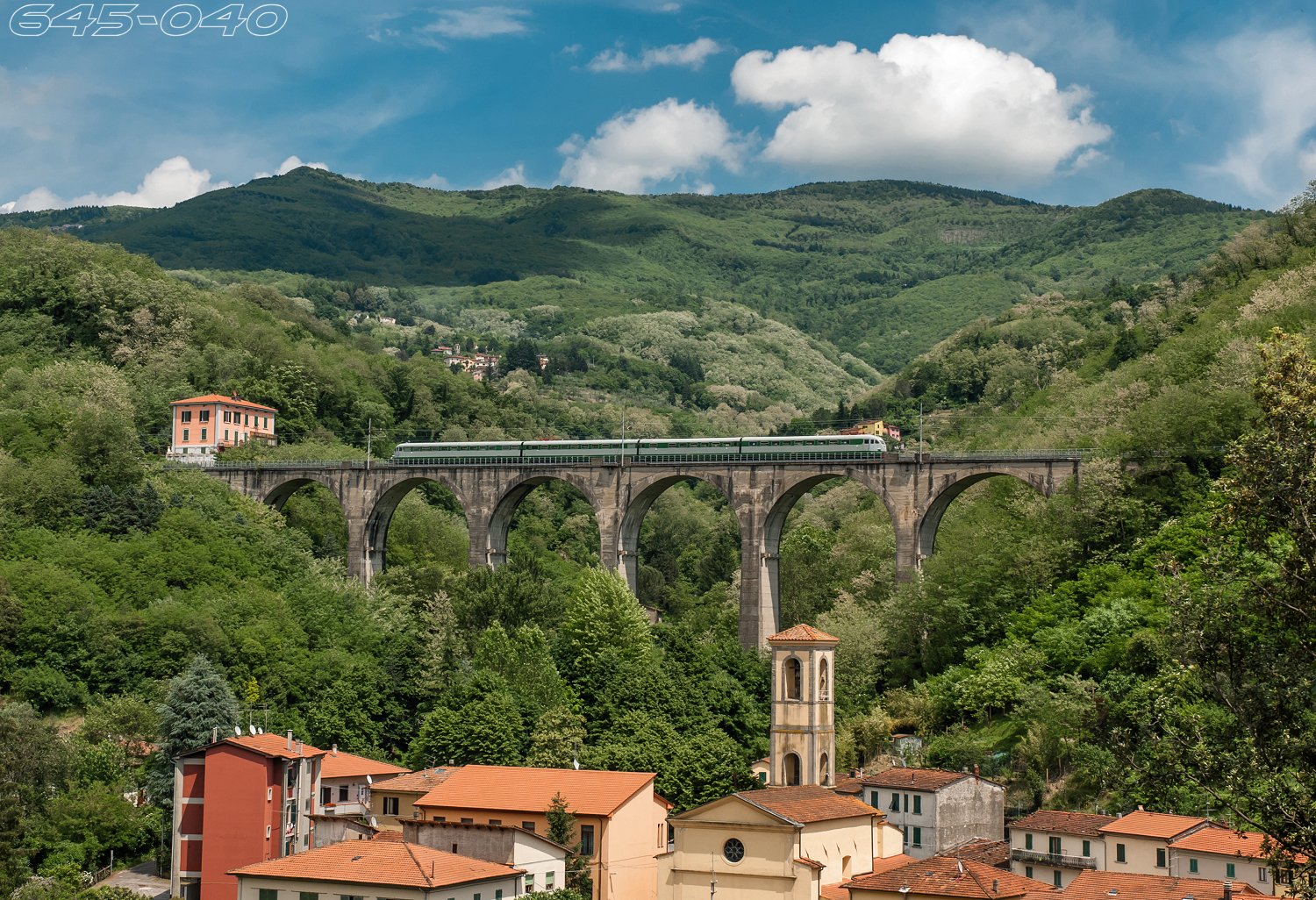
Piteccio(PT) 29 Maggio 2010
Transita sul ponte di Piteccio(PT) l'ETR 232P mentre svolge lo straordinario Porretta Terme/Pistoia
Guardala in FULL FRAME:
lnx.645-040.net/sito/modules/xcgal/albums/userpics/10001/...
A visit to Ribblehead Viaduct by Andy Rouse and me did not disappoint as a photographic outing. The weather was not great, but ideal for some very dramatic skies with the use of ND filters. One minute we had rain, the next we would get a break in the clouds giving some really fantastic light patterns across the moors, and then complete shadow; all accompanied by very strong winds from time to time, typical British weather. Great day out though….!
The Conisbrough Viaduct. The viaduct - built with 15 million bricks in 1906-7 this massive structure carried passenger trains across the Don Gorge until 1951.
After a bit of a scramble down the side of Busby Glen to the White Cart river, I got this shot of the Busby viaduct at nightfall