Technical Theatre
View allAll Photos Tagged technicians
Clover waters our trees and shrubs. She wishes it would rain too. She has a very busy schedule being a Corgi and helping us out.
Pat Dougherty is one of those guys who makes mere mortals wonder why they're so lame. At least that's the effect he has on your author. Pat's happily married and has raised three kids, he can sing and act, his "Blues Patrol" Blues Brothers stage show has packed New England venues for 20 years, he's an ASA Certified master automotive technician, but most of all, Pat can draw cars.
No computers are involved, and he isn't the type to obtain realism via retouched digital photos. The only digital aspect of his drawings are his 10 fingers. Everything on the paper comes directly from his inquisitive and detail-oriented mind. Ever since elementary school art class, Pat's had an innate ability to create highly realistic renderings without much training beyond the usual public-school curriculum. But it was during architectural graphics class at Stamford High School (the same Connecticut public school that hatched star-crossed Hogan's Heroes star Bob Crane a generation earlier) where Pat says, "My teacher, Mr. Burkhardt, was very supportive and fed my interest with helpful commentary. It took off from there."
In particular, Pat's grasp of the technical sideline of drawing, as described with terms like "fineness of line," "perspective," "realism," "shading," and "proportion" is highly calibrated. Beyond that, his attention to realistic details like factory part numbers, correct surface textures, and—to this writer's opinion—getting the correct rocker panel "tuck under" or "fuselage effect" are what separate Pat's work from that of other automotive cartoonists. Check for yourself: too many automotive illustrators and cartoonists fail to properly capture the tube-like surface development of most automobile bodies. They're rendered with vertical slab sides that simply aren't correct. Dougherty's stuff differs.
After high school, Pat went to work at an architect's office. There, he "discovered the empty feeling of doing work that others took credit for." Following his passion for cars, he left the architect after a year and went to work at Fairbanks Racing Transmissions, a leading East Coast retailer of high-performance automatic transmissions and components. At Fairbanks, Pat did a lot of everything, from assembly to marketing to answering tech questions by phone. Yes, Pat even applied Fairbanks' trademark black tiger stripesoverCaterpillar Tractor Yellow graphics to completed transmissions and torque converters prior to shipment: "We used a template to mask off the stripes." No, Pat's transmissions weren't "signed by the artist," but he took extra care to make sure the paintwork was applied with care. Maybe there's one in your garage or under the floorboards of your hot rod.
After leaving Fairbanks, Pat spent the next 30 years working for AAMCO transmission shops in Connecticut. But through it all, Pat remained active at his hobby of drawing automotive subjects while also finding time to raise a happy family of three. Today, Pat is transitioning into the world of self-employment with a business centered around his hand-drawn renderings of cars and trucks. During the car-show season, he can be found at more than 30 outdoor events, including the Syracuse Nationals in New York, Carlisle Chrysler Nationals in Pennsylvania, and others where he's given spotlight space to do his thing before the passing crowd. We visited Pat's Stamford, Connecticut, home and studio for a look at his work. If you dig what you see, Pat sells reprints and is also ready to render your vehicle in his unique cartoon-realist style.
Credit: HotRod www.motortrend.com/features/jobs-cars-automotive-art-pat-...
The Tsu-ka are known for not having the best brains, but when it comes down to mechanics, they can make a starship out of practically anything
My entry for Round 3 of the NPU Contest. Part as noted.
Of course inspired by the one and only Tyler =3
⊷⊷⊷⊷⊷⊷⊷⊷⊷⊷⊷⊷⊷⊷⊷⊷⊷⊷⊷⊷⊷⊷⊷⊷
❇ Tokyo Zero Event ❇
⋗ Head Accessory: [AA]: Neurolink
⋗ Outfit: [V.C.LAB] No.28 - FATPACK
❇ Harajuku Event ❇
⋗ Skin: MUDSKIN - YUMI SKIN (EvoX)
⋗ Eyes: Gloom. - Nymph Collection - Fatpack
▶ Others
⋗ Hair: bonbon - yuuma hair
⋗ Nails: {Sakura} Chipped Nails - Fatpack
⋗ Gloves: =Zenith=Zazu Glove
⋗ Boots: Phedora ~ Savin Boots 20 Colors Fatpack
⊶⊶⊶⊶⊶⊶⊶⊶⊶⊶⊶⊶⊶⊶⊶⊶⊶⊶⊶⊶⊶⊶⊶⊶
❇ Kustom 9 Event ❇
⋗ Backdrop: K&S - // Bunker. Backdrop
Credit to all creators
blue & green
should not be seen
without a colour in between...
...Whoever said that never ventured past the end of their street, never saw a pastoral landscape on a clear sunny day...
If nature is happy with it what's the issue?
Technicians at NASA’s Marshall Space Flight Center in Huntsville, Alabama, have completed applying thermal protection system material to the launch vehicle stage adapter (LVSA) of NASA’s SLS (Space Launch System) rocket for Artemis III, which will land astronauts on the Moon to advance long-term lunar exploration and scientific discovery and inspire the Artemis Generation. The LVSA is a cone-shaped element connecting the mega rocket’s core stage to its interim cryogenic propulsion stage (ICPS), partially enclosing it and protecting its avionics and electrical systems from the extreme pressures, sounds, and temperatures during launch and flight.
Teams at Marshall began applying the thermal protection system material earlier this spring. Unlike other parts of the SLS rocket, the thermal protection system material for the LVSA is applied entirely by hand using a spray gun. During application, the technicians use a thin measuring rod to gauge the proper thickness. Once the thermal protection system has cured, certain areas are sanded down to meet parameters. The entire process takes several months.
The LVSA is fully manufactured at Marshall by NASA, lead contractor Teledyne Brown Engineering, and the Jacobs Space Exploration Group’s ESSCA contract. The LVSA for Artemis III is the last of its kind as future SLS rockets will transition to its next, more powerful Block 1B configuration beginning with Artemis IV.
NASA is working to land the first woman and first person of color on the Moon under Artemis. SLS is part of NASA’s backbone for deep space exploration, along with the Orion spacecraft, advanced spacesuits and rovers, the Gateway in orbit around the Moon, and commercial human landing systems. SLS is the only rocket that can send Orion, astronauts, and supplies to the Moon in a single mission.
Image credit: NASA/Brandon Hancock
#NASA #NASAMarshall #sls #spacelaunchsystem #nasasls #exploration #rocket #artemis
The original photo was a a piece of playground equipment that our grandkids really like. Photoleap was used to turn it into a moon-containment device.
We went to the legendary Lick Observatory located on Mt. Hamilton high above the Silicon Valley in the San Francisco Bay Area, California. It was a special night for photographers. Once the telescope was in place, the lights went out, and all that was left was dark glowing red. Eyes adapt well to darkness, which takes about 10 minutes. A dark red light is used so that the human eyes can retain night vision. This is a 210º fisheye lens shot pointed straight up. At the bottom you see the technician in front of the control panel. In the center is the refracting telescope and the opened dome.
I processed a balanced and a soft HDR photo from a RAW exposure, blended them selectively, and carefully adjusted the color balance and curves. I welcome and appreciate constructive comments.
Thank you for visiting - ♡ with gratitude! Fave if you like it, add comments below, like the Facebook page, order beautiful HDR prints at qualityHDR.com.
-- ƒ/4.0, 4 mm, 3.2 sec, ISO 3200, Sony A6000, Laowa 4mm f/2.8 Fisheye, HDR, 1 RAW exposure, _DSC1821_hdr1bal1sof1m.jpg
-- CC BY-NC-SA 4.0, © 2023 Peter Thoeny, Quality HDR Photography
Here we have an Arcturus Outpost technician hard at work on the new port side main engine on Capitan Knight’s LL-962 Arrow Mark II - Nova-01. The work to retrofit the remaining Arrow’s should take a couple of weeks at most, giving Nova Team some time to relax and catch up on some paperwork.
To learn more about Nova Team's other adventures visit their album: flic.kr/s/aHskpavQh5
::::This is a continuation of my previous photo LL-962 Upgrade: Mark II Plans flic.kr/p/EPpQqS. One more to go after this, then on to something new!
For those who are interested, unfortunately I am unable to sell the Nova Team minifigures or designs due to the use of the "Classic Space" logo which is owned and trademarked by The LEGO Group. My custom designed figures and use of the official "Classic Space" logo is for personal use only in my MOCs and photography. By the same token, I will not give away the design files and source material either. Thank you for understanding! Trust me, if I could legally sell these, I would.
Engineers and technicians at Cape Canaveral are preparing the Psyche spacecraft for liftoff, which is slated for Oct. 5.
With less than 100 days to go before its Oct. 5 launch, NASA’s Psyche spacecraft is undergoing final preparations at Cape Canaveral, Florida. Teams of engineers and technicians are working almost around the clock to ensure the orbiter is ready to journey 2.5 billion miles (4 billion kilometers) to a metal-rich asteroid that may tell us more about planetary cores and how planets form.
In this image, the high gain antenna of NASA’s Psyche spacecraft takes center stage in this photo, captured at the Astrotech Space Operations facility near the agency’s Kennedy Space Center in Florida.
Image Credit: NASA/Frank Michaux
#SolarSystemandBeyond #NASAMarshall #jpl #psyche #asteroid
Northern Lights Entertainment
Performers displayed quite an affinity for fire.
Great entertainment!
Like Me on facebook for daily photos:
Technicians with NASA's Exploration Ground Systems rehearse booster stacking operations inside the Vehicle Assembly Building (VAB) at the agency's Kennedy Space Center in Florida on Monday, Sept.14, in preparation for the Artemis I launch. The team is using full-scale replicas of booster segments, referred to as pathfinders, for the practice exercise in one of the tallest sections, or high bays, of the VAB built for stacking rockets. As part of the rehearsal, a pathfinder for an aft segment, the very bottom of the stack, was prepared in High Bay 4. Then, a team of crane operators moved the segment into High Bay 3, where it was placed on the mobile launcher. Careful measurements were taken before the team added a center segment to the stack.
The actual Space Launch System (SLS) booster segments will be stacked on the mobile launcher later this year, following completion of Green Run testing of the rocket's core stage -- a series of eight tests taking place at the agency's Stennis Space Center in Mississippi. Under the Artemis program, NASA is working toward landing the first woman and the next man on the Moon in 2024. The first in a series of increasingly complex missions, Artemis I will test SLS and the Orion spacecraft as an integrated system ahead of crewed flights to the Moon.
Image credit: NASA/Kim Shiflett
#NASA #space #moon #Mars #NASAMarshall #msfc #sls #spacelaunchsystem #nasasls #rockets #exploration #engineering #explore #rocketscience #artemis
These CAW Local 2301 power line technicians are working on one of the transmission towers that bring power from the Alcan generating station at Kemano across the mountains to the smelter at Kitimat. The harbour and smelter can be seen in the background with the mountains rising behind them.
Photo courtesy CAW Local 2301.
Technicians are manufacturing NASA's Space Launch System (SLS) core stage for the Artemis II lunar mission at NASA's Michoud Assembly Facility in New Orleans. The core stage for the deep space rocket consists of two huge propellant tanks, four RS-25 engines, and miles of cabling for the avionics systems and flight computers. All the main core stage structures for Artemis II, the first mission with astronauts, have been built and are being outfitted with electronics, feedlines, propulsion systems, and other components. Technicians are currently wiring and performing functional tests on the avionics inside both the forward skirt and intertank sections. The engine section – the most complicated part of the stage – is in production assembly.
Image Credit: NASA
#NASA #space #moon #Mars #NASAMarshall #msfc #sls #spacelaunchsystem #nasasls #rockets #exploration #engineering #explore #rocketscience #artemis #KennedySpaceCenter #KSC
“Suited technicians “safe” the Orbiter Challenger after eight days in orbit and a successful landing at KSC. Cooling and purge lines are hooked up to the orbiter to prepare it for towing to the Orbiter Processing Facility for post-flight assessment. The 41G astronaut crew arrived safely at KSC’s runway at the conclusion of the mission. This was the second shuttle landing at KSC since the beginning of the STS program.”
Note the tile damage:
www.nasa.gov/feature/35-years-ago-sts-41g-a-flight-of-man...
Very cool, especially since both OMS engine nozzles can be seen…the power plant of one of them being at the end of the European Service Module (ESM) of Artemis I:
mobile.twitter.com/ThePrimalDino/status/1504450964928942086
Credit: David Willis/Twitter
So, the large nozzle seen here is powered by one of the two OMS engines behind one or the other of the two nozzles visible in my posted photograph:
uploads.disquscdn.com/images/60ddeac864c868b26fed545499d5...
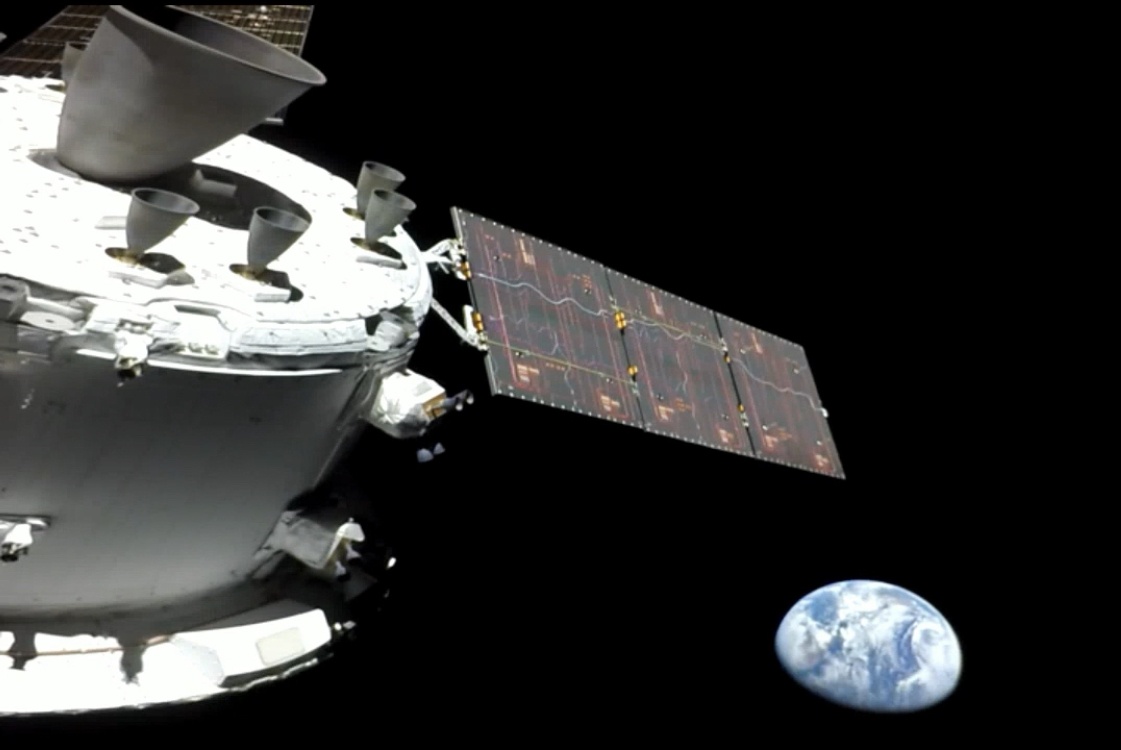
uploads.disquscdn.com/images/a5ed616c5381feb7ec49b0ae5640...
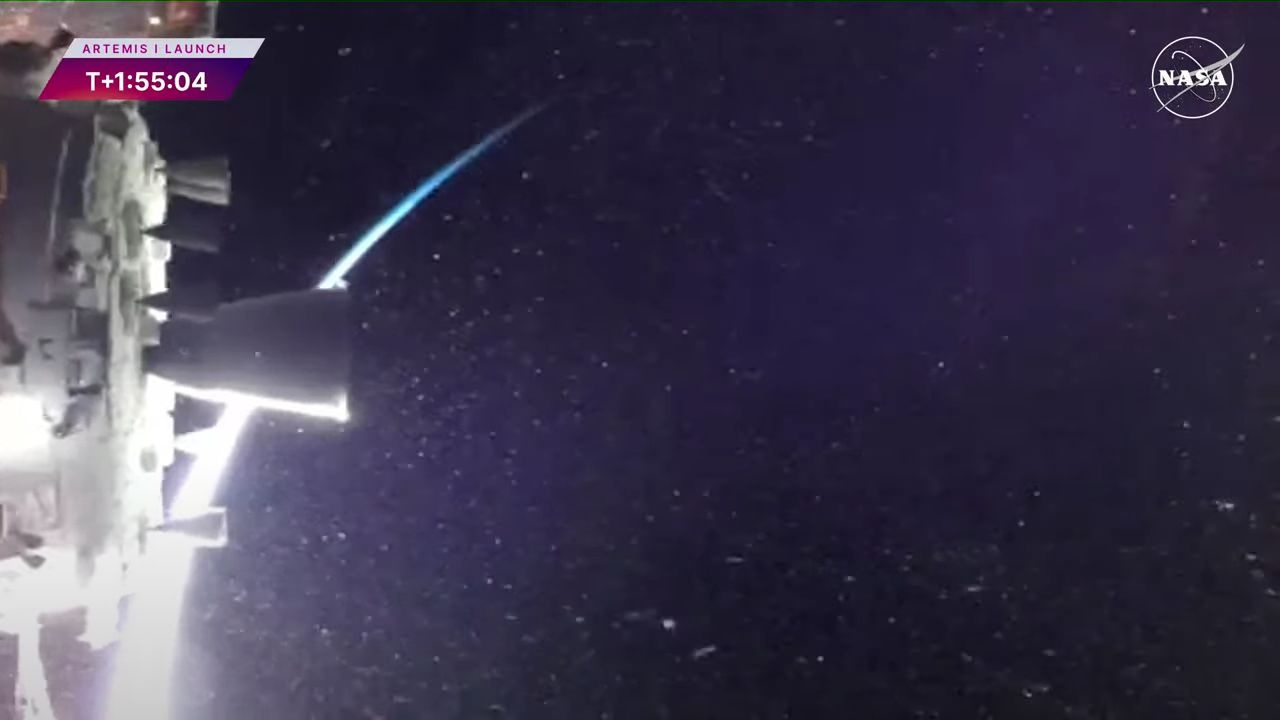
Both above credit: SPACE NEWS website
STS-41G being the engine's first flight, Artemis I its last.
Also:
www.aero-news.net/annticker.cfm?do=main.textpost&id=9...
Credit: Aero-News Network website
en.wikipedia.org/wiki/Space_Shuttle_recovery_convoy
Credit: Wikipedia